US claims jurisdiction over all .com/.net sites even if outside the US (2011)(web.archive.org)
web.archive.org
US claims jurisdiction over all .com/.net sites even if outside the US (2011)
https://web.archive.org/web/20111102045835/http://www.theinquirer.net/inquirer/news/2083906/claims-com-net-websites-jurisdiction
107 comments
Even with a CIC, the Operation continues [1].
[1] https://en.wikipedia.org/wiki/Operation_In_Our_Sites
[1] https://en.wikipedia.org/wiki/Operation_In_Our_Sites
> to detect and hinder intellectual property violations on the Internet
by detecting and hindering domain name intellectual property
double plus based
by detecting and hindering domain name intellectual property
double plus based
Can someone explain me why ICE has the power to enforce intellectual property laws on the internet? What does this have to do with immigration enforcement? Can ICE enforce other seemingly irrelevant laws? E.g. can ICE bust e.g. drug users, prostitution etc?
The “C” in ICE is for “customs.” I imagine domains fall under the purview of import/export laws.
One of the main reasons that ICE believes they can exert this authority is because the .com/.net TLD namespace is owned and operated by Verisign, a US company. Further, the ICANN namespace is owned and operated by ICANN, a US company who, in fact, is also under the jurisdiction of attorney generals of California state [1].
As long as the namespace remains under the control of a centralized authority like the US, this will continue to be a reality. There may be some naysayers about solutions like Handshake, but frankly speaking, there's no person who would logically want their name to be able to be taken away by someone else. Your name is your identity and it is you. To be able to assert this with cryptography is a cypherpunk's dream.
[1] https://oag.ca.gov/news/press-releases/heels-ag-becerra-lett...
As long as the namespace remains under the control of a centralized authority like the US, this will continue to be a reality. There may be some naysayers about solutions like Handshake, but frankly speaking, there's no person who would logically want their name to be able to be taken away by someone else. Your name is your identity and it is you. To be able to assert this with cryptography is a cypherpunk's dream.
[1] https://oag.ca.gov/news/press-releases/heels-ag-becerra-lett...
Yeah, which seems ridiculous. As a first step, ICANN should be changed to some kind of international non-profit (I'm not even sure how you do that - do you just register it in Switzerland?).
Since they are not under a country code TLD, I think it really makes sense migrate .com, .net and .org to be 'international' TLDs (I think many people internationality basically already consider them to effectively be so) and US companies should be able to access equivalents under the ccTLD like .com.us, .net.us etc. if they wanted a US-specific one, just like every other country does. Then also, I really think all .gov, .mil and .edu and the other US-only TLDs should be phased out (they could just become redirects to .gov.us, .mil.us etc.). Having those TLDs as US-only just smacks of American exceptionalism - I understand the history and it made sense at the time, but became inappropriate as all the other ccTLDs started becoming used. They should have migrated to .us domains back then and deprecated .mil, .gov and so on.
It would be a bit messy, since .us is already delegated and there are already heaps of domains in that namespace which would have to be either retained as legacy or migrated after some time. So really the sooner the better! The US Government would probably have to buy the .us ccTLD back, create ones like com.us, net.us, org.us under it and then re-delegate them while operating .mil.us, .gov.us, .edu.us themselves.
Since they are not under a country code TLD, I think it really makes sense migrate .com, .net and .org to be 'international' TLDs (I think many people internationality basically already consider them to effectively be so) and US companies should be able to access equivalents under the ccTLD like .com.us, .net.us etc. if they wanted a US-specific one, just like every other country does. Then also, I really think all .gov, .mil and .edu and the other US-only TLDs should be phased out (they could just become redirects to .gov.us, .mil.us etc.). Having those TLDs as US-only just smacks of American exceptionalism - I understand the history and it made sense at the time, but became inappropriate as all the other ccTLDs started becoming used. They should have migrated to .us domains back then and deprecated .mil, .gov and so on.
It would be a bit messy, since .us is already delegated and there are already heaps of domains in that namespace which would have to be either retained as legacy or migrated after some time. So really the sooner the better! The US Government would probably have to buy the .us ccTLD back, create ones like com.us, net.us, org.us under it and then re-delegate them while operating .mil.us, .gov.us, .edu.us themselves.
> deprecated .mil...
Have you seen what the DoD PKI chain looks like?
https://militarycac.com/images/fed_crosscert2Sm.jpg
Good luck migrating all of that to a new TLD in the next millennium.
Have you seen what the DoD PKI chain looks like?
https://militarycac.com/images/fed_crosscert2Sm.jpg
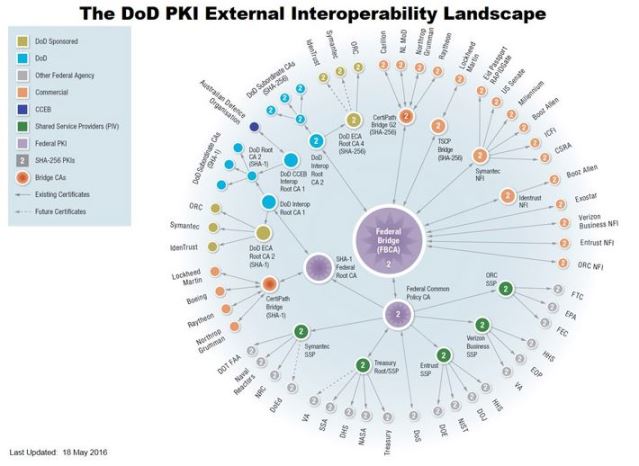
Good luck migrating all of that to a new TLD in the next millennium.
> "SHA-1 Federal ROOT CA"
> "DoD Subordinate CAs (SHA-1)"
> "DoD ECA Root CA 2 (SHA-1)"
> "DoD Root CA 2 (SHA-1)"
> -- https://militarycac.com/images/fed_crosscert2Sm.jpg
O___O
Might be worth considering a migration sooner than later.
> "DoD Subordinate CAs (SHA-1)"
> "DoD ECA Root CA 2 (SHA-1)"
> "DoD Root CA 2 (SHA-1)"
> -- https://militarycac.com/images/fed_crosscert2Sm.jpg
O___O
Might be worth considering a migration sooner than later.
> Then also, I really think all .gov, .mil and .edu and the other US-only TLDs should be phased out (they could just become redirects to .gov.us, .mil.us etc.). Having those TLDs as US-only just smacks of American exceptionalism
If other countries don't like it... why connect and use an American network? Why not build their own (and foot the research bill!).
If other countries don't like it... why connect and use an American network? Why not build their own (and foot the research bill!).
The internet isn't a box stored somewhere in America, it's the collection of computers connected together with wires.
They can change protocols, but that would just lead to a fractured ecosystem fir the benefit of no one, American or otherwise.
They can change protocols, but that would just lead to a fractured ecosystem fir the benefit of no one, American or otherwise.
The tlds aren't the collection of computers, either, are they?
Does Anguilla have the right to control .ai, or do people who want to use it to reference AI have a right to use it?
Does Anguilla have the right to control .ai, or do people who want to use it to reference AI have a right to use it?
That's another issue.
Domains like .io, .ly and .tv are also used for vanity URL. That was not something originally expected with these.
Domains like .io, .ly and .tv are also used for vanity URL. That was not something originally expected with these.
Foreign entities engaging in exchanges with the U.S. market via U.S. TLDs implicate U.S. customs enforcement.
Immigration and Customs Enforcement has jurisdiction over customs enforcement.
Immigration and Customs Enforcement has jurisdiction over customs enforcement.
I guess I still have no idea how come this falls into customs (what is being imported exported here? The domain?), but I can accept it as a fact.
In more recent news, this tech https://handshake.org/ is aimed at this kind of jurisdictional issue. Limiting the reach of a US court or any other central org for that matter at shutting down a domain .com, .net or other.
The only way an alternate TLD registrar will ever take off is if you get the people who own the current root servers on board. And the only way that will happen is if you figure out how they can make money from owning and operating the root servers.
My guess is that if you create a blockchain for registering DNS, and only the current registrars can issue coins on said blockchain, you might have a solution they would be willing to implement. You'd still have to pay them money to register a new domain or maintain it, but once you had the coin, you could register whatever you wanted and no government could stop you.
My guess is that if you create a blockchain for registering DNS, and only the current registrars can issue coins on said blockchain, you might have a solution they would be willing to implement. You'd still have to pay them money to register a new domain or maintain it, but once you had the coin, you could register whatever you wanted and no government could stop you.
And more importantly than letting you register, it avoids a .com, .net domain getting one of these on a landing page https://www.justice.gov/sites/default/files/styles/width_12/...
This has been the story for many sites, where domains are seized even if owned by a non-US person/company, with an order to the TLD that operates in the US. With a distributed DNS system like Handshake, 'in theory' this shouldn't be possible, since it would require multiple nodes to alter a domain's DNS records vs. a central TLD authority which has to abide by US law.
It's all interesting, but it still seems we are ways off from the DNS backbone (& my browser) operating with this kind of DNS architecture. It even appears it's becoming easier to take down a domain, not at the TLD/registrar level, but more so at the hosting level (e.g. Parler)

This has been the story for many sites, where domains are seized even if owned by a non-US person/company, with an order to the TLD that operates in the US. With a distributed DNS system like Handshake, 'in theory' this shouldn't be possible, since it would require multiple nodes to alter a domain's DNS records vs. a central TLD authority which has to abide by US law.
It's all interesting, but it still seems we are ways off from the DNS backbone (& my browser) operating with this kind of DNS architecture. It even appears it's becoming easier to take down a domain, not at the TLD/registrar level, but more so at the hosting level (e.g. Parler)
Is it the root servers that you need to get on board, or the publishers of the publications that most people use, or the operating system publishers?
For instance, if the browser makers all started resolving certain TLDs via an alternate network, then people could start publishing websites using domains managed by that network without needing to engage with the root DNS servers at all.
For instance, if the browser makers all started resolving certain TLDs via an alternate network, then people could start publishing websites using domains managed by that network without needing to engage with the root DNS servers at all.
It would be a start, but not all of the internet is accessed through a browser. And I'm not sure you'd get Apple and Google on board unless there was a way for them to make money from it.
Those servers are only necessary for the ICANN tlds and those will continue to act as they do today, even in a Handshake future.
With Handshake, you run your own authoritative server (or use a hosted one) for your own name and that authoritative server's information will be obtainable on chain. No middle-man, no rent seeking.
With Handshake, you run your own authoritative server (or use a hosted one) for your own name and that authoritative server's information will be obtainable on chain. No middle-man, no rent seeking.
I understand how handshake works. What I'm saying is that getting my mom to point her DNS servers at an alternate server is a non-starter. You have to get the root servers on board to carry all TLDs or most people will never find them.
But then the root servers can still be used to censor domains by removing them.
They aren't all in the US. Right now they remove a .com by telling Verisign, a US company, to change the registration for the .com. Since Verisign is the only way to change a .com, it works.
Many root servers operate outside of the US. If the blockchain were the authority on IP addresses, then even if they blocked the US roots the others would still have it.
Even today if all the US root servers go off-line every system would find the others and use them.
Many root servers operate outside of the US. If the blockchain were the authority on IP addresses, then even if they blocked the US roots the others would still have it.
Even today if all the US root servers go off-line every system would find the others and use them.
> If the blockchain were the authority on IP addresses
But it's not -- the root servers are -- by premise here. Premise is we assume zero config results in ICANN root servers having authority. My point is that given this premise, blockchain is ineffective. You are introducing ICANN as informational MITM and censor node in between user and blockchain validation.
True, you are excluding USA, if your only goal is exclude USA then this accomplishes that goal, but if your goal is censorship-proof then this is not it.
But it's not -- the root servers are -- by premise here. Premise is we assume zero config results in ICANN root servers having authority. My point is that given this premise, blockchain is ineffective. You are introducing ICANN as informational MITM and censor node in between user and blockchain validation.
True, you are excluding USA, if your only goal is exclude USA then this accomplishes that goal, but if your goal is censorship-proof then this is not it.
Browser extensions and apps can start resolving alternate roots using non-DNS methods for those who opt-in.
Sure, but again, that will never take off. "Install this plugin to access our website" is a non-starter for most people.
It doesn't seem different from "install this app" to access our services though? And clearly, this model has proliferated with fluidity.
Installing apps is easy, built into the phone. And comes from a curated store run by a US company.
Installing plugins is well beyond the capabilities of most people, especially since the plugins for the default browsers come from a curated store run by US companies.
Installing plugins is well beyond the capabilities of most people, especially since the plugins for the default browsers come from a curated store run by US companies.
...Only because we (software engineers, developers, etc...) have completely failed in managing to make our field more communicable to users, and have gone down the path of complicating the hell out of things instead of nailing down the primitives and onboarding to the field.
I'm not even talking any wishy washy inclusiveness mumbo jumbo either. I'm talking over complicating the boot chain, over complicating memory management/models/toolchains.
Browsers are a living nightmare of complexity, and I am continuously amazed at the number of programmers who have no clue about the gory details of networking.
I'm not even talking any wishy washy inclusiveness mumbo jumbo either. I'm talking over complicating the boot chain, over complicating memory management/models/toolchains.
Browsers are a living nightmare of complexity, and I am continuously amazed at the number of programmers who have no clue about the gory details of networking.
> … "and have gone down the path of complicating the hell out of things instead of nailing down the primitives and onboarding to the field."
I've thought much this same thing myself for ages now.
Not just "complicating the hell out of things" either. Complicating the hell out of things that should be simple ( or at least should be simplified, or automated, or something ). I see a lot of tedious activities in modern computing that appear to exist purely for the sake of the tedium time-wastery factor.
The flip-side of the same coin is the over-simplifying or "dumbing down" of some things that really should stay "complicated" (and hidden behind an "expert mode" toggle) to the point of allowing willfully uneducated morons to repeatedly "shoot themselves in the foot" and justify blaming everyone and everything but themselves for their error.
That sort of "computers should be an appliance like a toaster" mentality has contributed to a culture which seems convinced they should be able to magically jump from zero to "Hacker-Man" with no effort or learning required, the very same day they decide to "learn" programming.
I've thought much this same thing myself for ages now.
Not just "complicating the hell out of things" either. Complicating the hell out of things that should be simple ( or at least should be simplified, or automated, or something ). I see a lot of tedious activities in modern computing that appear to exist purely for the sake of the tedium time-wastery factor.
The flip-side of the same coin is the over-simplifying or "dumbing down" of some things that really should stay "complicated" (and hidden behind an "expert mode" toggle) to the point of allowing willfully uneducated morons to repeatedly "shoot themselves in the foot" and justify blaming everyone and everything but themselves for their error.
That sort of "computers should be an appliance like a toaster" mentality has contributed to a culture which seems convinced they should be able to magically jump from zero to "Hacker-Man" with no effort or learning required, the very same day they decide to "learn" programming.
Products created for the purpose of lock-in can't invite user participation because the first thing user-participants would do is remediate lock-in.
Handshake is awful. Because they decided to allow anyone to register a TLD there's no way to determine if a name needs to be resolved with handshake other than trying to resolve it.
Yeah, IMO they should have gone the Tor route and registered `.hs` or something with ICANN and then made all Handshake domains a subdomain of that. That'd have made it way easier for software to support Handshake without breaking compatibility with traditional DNS roots.
Interesting, I had no idea they were letting anyone register data, I had initially thought the idea was for registrars to provide nodes & data to eventually phase out the current DNS architecture, ensuring no single TLD org could wipe out a domain.
The Handshake design still seems like a step in the right direction, but even with sound data, it's probably years away (if ever) for DNS resolution to "flip the switch" to use this kind of architecture.
The Handshake design still seems like a step in the right direction, but even with sound data, it's probably years away (if ever) for DNS resolution to "flip the switch" to use this kind of architecture.
There was a time when some used /etc/hosts whilst others used DNS. It was definitely a different time. Resolution issues with Handshake TLDs will easily be solved in time.
There are, however, other reasons why one might think Handshake isn't up to par just yet. Those reasons might be, for example, even though it completes the internet, making it significantly more secure and sovereign, the current implementations including DANE aren't as fast. Of course, this too [1] will be addressed with time.
There are highly technical people working on these problems with a heavy lean on making sure the experience is comparable if not better than today's expected experience. I think things will only get better from here.
[1] https://github.com/handshake-org/HIPs/discussions/44
There are, however, other reasons why one might think Handshake isn't up to par just yet. Those reasons might be, for example, even though it completes the internet, making it significantly more secure and sovereign, the current implementations including DANE aren't as fast. Of course, this too [1] will be addressed with time.
There are highly technical people working on these problems with a heavy lean on making sure the experience is comparable if not better than today's expected experience. I think things will only get better from here.
[1] https://github.com/handshake-org/HIPs/discussions/44
See, this is an interesting problem.
Seems like you might be caught on the infinite abstraction escalator though, as who will manage the DNSNS (Domain Name Service NameSpaces) servers, and who'll take the onus for making the standard selector or display for the user to decide which lookup to consider canon for the request? This would actually be a pretty exciting development.
This would greatly complicate domain squatting (or maybe intensify/arms race it), and add a layer of resilience in the form of building up the interfaces required for users to maintain their own private DNS namespaces. This would conclusively shut the door in terms of centralized seizability of domains, since the user would in effect be empowered to be their own registrar.
You could even keep the traditional stuff seizable I guess. However, you'd be able to ask the fellow down the street if he still had the old DNS entry for x.y.z
Seems like you might be caught on the infinite abstraction escalator though, as who will manage the DNSNS (Domain Name Service NameSpaces) servers, and who'll take the onus for making the standard selector or display for the user to decide which lookup to consider canon for the request? This would actually be a pretty exciting development.
This would greatly complicate domain squatting (or maybe intensify/arms race it), and add a layer of resilience in the form of building up the interfaces required for users to maintain their own private DNS namespaces. This would conclusively shut the door in terms of centralized seizability of domains, since the user would in effect be empowered to be their own registrar.
You could even keep the traditional stuff seizable I guess. However, you'd be able to ask the fellow down the street if he still had the old DNS entry for x.y.z
yet another alternate root DNS that has maybe 0.001% of install base on the global scale of client devices with browsers?
yeah okay
seen it for 20 years now...
yeah okay
seen it for 20 years now...
wow, that's generous. more like 1x10-12, if that
.001% would be absolutely enormous, and the actual start of a thing.
the design and use case of it looks laughable to me. however, it does spark the imagination.
.001% would be absolutely enormous, and the actual start of a thing.
the design and use case of it looks laughable to me. however, it does spark the imagination.
yeah that was overly charitable, reality would be more like 0.00000001% of client devices. considering we now have several billion internet using cellphones and people globally.
Not that it's going to do any better but more relevant figure is the percentage of routers... those client devices just accept configuration from the upstream network.
>> github developers with over 15 followers on February 2019
...I am wondering if it must also be a javascript project...
...I am wondering if it must also be a javascript project...
Thank you for sharing.
> even gnutella became The Pirate Bay.
Never thought about that.
> even gnutella became The Pirate Bay.
Never thought about that.
superkuh(1)
I always had this question and perhaps someone here can shine some light.
It is my understanding that under US copyright law if you own a trademark you have some grounds to sue someone else that may be using/squatting "your" domain in order to acquire it.
What would happen, though, if the owner of the domain does not live in the US, does not operate in the US, nor has any other thing to do there aside from owning a .com domain?
It is my understanding that under US copyright law if you own a trademark you have some grounds to sue someone else that may be using/squatting "your" domain in order to acquire it.
What would happen, though, if the owner of the domain does not live in the US, does not operate in the US, nor has any other thing to do there aside from owning a .com domain?
ICANN has a process [1] by which they can take the domain away from you, doesn't matter where you live.
[1] https://en.wikipedia.org/wiki/Uniform_Domain-Name_Dispute-Re...
[1] https://en.wikipedia.org/wiki/Uniform_Domain-Name_Dispute-Re...
I'm not a us citizen. But as far as I see, money talks in courts. So if one cannot afford a good lawyer, or at least does not have a valuable domain to defend using a borrowed money, that's it. Correct me if I'm wrong.
I'm not a lawyer, but my impression is that money mostly matters in tipping the scales of a difficult case (e.g. Google v. Oracle) or in pursuing a case despite low stakes or a fundamentally weak legal position. Someone with a strong, high-stakes case can typically get a lawyer to take it on contingency.
Minor tangentially related quibble: copyright law and trademark law are entirely separate. The rules by which they work are different.
Thank you, you are absolutely right!
That's why we offer .onion addresses for our services (websites, APIs, everything). These addresses connect customers to tor/onion services hosted on our property. Customers who need to keep disruption at a minimum are advised to implement tor access as a fallback.
I firmly believe that automated DMCA-style processes (and other slow, guilty-until-proven-innocent schemes) are going to become more prevalent around the world. Defending against all of them in a timely manner will become impossible for all but the biggest of players. Smaller players will have to use services like Tor to have any semblance of reliability.
Disclaimer: We're a registered llc (not US-based), and all our activities are 100% legitimate in most jurisdictions including the US.
I firmly believe that automated DMCA-style processes (and other slow, guilty-until-proven-innocent schemes) are going to become more prevalent around the world. Defending against all of them in a timely manner will become impossible for all but the biggest of players. Smaller players will have to use services like Tor to have any semblance of reliability.
Disclaimer: We're a registered llc (not US-based), and all our activities are 100% legitimate in most jurisdictions including the US.
Your registration in the DNS is always subject to the policies, procedures, security, and legal environment of the controlling registry.
This is one reason I always recommend avoiding obscure ccTLDs, especially if you have no presence there.
This is one reason I always recommend avoiding obscure ccTLDs, especially if you have no presence there.
This article is from 2011...how has ICE used this power since then?
[deleted]
Since then, they've shut down atleast 1 million if not more websites.
Source?
https://en.wikipedia.org/wiki/Operation_In_Our_Sites
Keep in mind, they classify, for example 'scihub' as a piracy site [1]
[1] https://www.theverge.com/2017/11/7/16618874/court-pirate-sci...
Keep in mind, they classify, for example 'scihub' as a piracy site [1]
[1] https://www.theverge.com/2017/11/7/16618874/court-pirate-sci...
Which it is, surely? Don't get me wrong, sites like it are on my most-visited list on every device, but they are for pirating papers, no?
If you consider articles and research that the public paid for and suddenly don't have access to, to be piracy, then sure.
To be clear, people have given their life for this cause.
To be clear, people have given their life for this cause.
I feel like you're trying to argue that piracy is ethical, which is different than something not being piracy.
The words we use are important, because public opinion tends to matter quite a bit with these things, and public opinion is shaped immensely by words and their connotations (remember death panels?). If sci-hub is said to aid in the pirating of papers, it is doomed. If instead its purpose is said to be to make publicly-funded research accessible to the public for the benefit of all, then there's at least a slightly better chance of its surviving.
I think it's possible it could be considered piracy in the US, but not all countries follow these same rules nor schools of thought.
The issue is that the jurisdiction bleeds into others' jurisdictions that might have different rules on these types of things, but the US doesn't really care since it has absolute power and exercises its authority over those outside of its jurisdiction.
The issue is that the jurisdiction bleeds into others' jurisdictions that might have different rules on these types of things, but the US doesn't really care since it has absolute power and exercises its authority over those outside of its jurisdiction.
It's not all publicly funded, to be clear. Lots and lots of finance stuff is written by people in industry for example.
It's a gift to mankind but it is still technically illegal (which I would vote to change every single second of the day, but still).
It's a gift to mankind but it is still technically illegal (which I would vote to change every single second of the day, but still).
It could be illegal in the US, but not in all the jurisdictions where they overstepped their bounds.
> people have given their life for this cause
I'm aware of one, and if it's the one I'm thinking of, he didn't so much "give his life for the cause" as tragically commit suicide because he couldn't see a way out of legal pressure put on him (which other people have had put on them and didn't commit suicide over; depression is a terrible disease).
Is there someone else you're referring to that I haven't heard of?
I'm aware of one, and if it's the one I'm thinking of, he didn't so much "give his life for the cause" as tragically commit suicide because he couldn't see a way out of legal pressure put on him (which other people have had put on them and didn't commit suicide over; depression is a terrible disease).
Is there someone else you're referring to that I haven't heard of?
> I'm aware of one, and if it's the one I'm thinking of, he didn't so much "give his life for the cause" as tragically commit suicide because he couldn't see a way out of legal pressure put on him (which other people have had put on them and didn't commit suicide over; depression is a terrible disease).
You have described someone as having a weakness and committed suicide where others didn't. For you to know what was going on in whoever you speak of's mind is interesting to me to say the least.
That said, I don't know anyone like that; so I wasn't referring to the same person as you probably.
Sorry!
You have described someone as having a weakness and committed suicide where others didn't. For you to know what was going on in whoever you speak of's mind is interesting to me to say the least.
That said, I don't know anyone like that; so I wasn't referring to the same person as you probably.
Sorry!
Who were you referring to?
Every single man and woman who has given their life to ensure that knowledge was available to all and not in the hands of a select few.
There are too many to count and far too many to name.
Who were you referring to?
There are too many to count and far too many to name.
Who were you referring to?
Ah, I follow. Since the topic was Sci-Hub, I assumed you were referring to Aaron Swartz specifically; I'm aware of nobody else whom anyone has claimed has given their life to the cause of open access to partially publicly-funded research. Carry on.
So have some people who campaign for the Pirate Party in various countries. It's not necessarily even a pejorative.
Old article, but still relevant in that it should be seen as a reminder of the sorts of political and corporate Internet "fuckery" that we should all always be on the lookout for.
Something something … "forget history" … "doomed to repeat past mistakes" ~ Someone Famous
Something something … "forget history" … "doomed to repeat past mistakes" ~ Someone Famous
This seems way more sensational than “US government tells US company to remove entry from their own servers.”
Not sure where you got that title from.
The actual title is: "US claims all .com and .net websites are in its jurisdiction" which is virtually the same as the title of the HN thread.
The literal first sentence is:
"THE US Immigration and Customs Enforcement agency (ICE) wants to take down web sites that use the .com and .net top level domains (TLD) regardless of whether their servers are based in the US."
The actual title is: "US claims all .com and .net websites are in its jurisdiction" which is virtually the same as the title of the HN thread.
The literal first sentence is:
"THE US Immigration and Customs Enforcement agency (ICE) wants to take down web sites that use the .com and .net top level domains (TLD) regardless of whether their servers are based in the US."
I’m agreeing with you? I’m saying that the HN title “claims jurisdiction over all sites even if outside the US” is way more sensational than the US gov’t telling a
US based registrar to remove entries pointing to sites hosted outside the US.
> than the US gov’t telling a US based registrar to remove entries pointing to sites hosted outside the US.
But this title does not capture the impact of the fact.
Every RCE exploit is just the ability to change a few bytes on your computer.
But this title does not capture the impact of the fact.
Every RCE exploit is just the ability to change a few bytes on your computer.
This is why we need decentralized DNS. Sure you can subscribe to ICANNs list, or create your own TLDs, or pin domains to something ICANN doesn't agree with because fuck governments trying to control domains and TLDs.
I honestly can't think of a better steward. Believing that independent organizations can continue to main an infrastructure that supports trillions of dollars of economic activity is absurd. And regardless of politics, the US has the most stable and trusted rule of law in the world.
Not at all, and I say this as an American. I mean we’ve had several protests in just the last year about our legal system’s inability to function correctly.
They always have, the internet originated from U.S. defense, (was that not domain name allocation)? residing physicaly with-in a country never mattered. they still consider it ownership.
wasen't this why russia/ussr didn't adhear to US ip's on their local lan?
is this not the same as FAA wanting all the control, including foreign airspace and the space whithin your ceiling?
you physically do not have control over something but still want to say it's yours. that's what this is, no?
wasen't this why russia/ussr didn't adhear to US ip's on their local lan?
is this not the same as FAA wanting all the control, including foreign airspace and the space whithin your ceiling?
you physically do not have control over something but still want to say it's yours. that's what this is, no?
About that, I don’t know why nor how but, does starlink needs authorization for all the countries their satellites fly by or only the usa? Is it becasuse the satellites are too “up” in the sky in ot her countries?
This is probably covered by the Outer Space Treaty, but in short, no. Satellites overfly many countries and if they needed permission from every country we'd have no satellites.
I imagine orbits are a thing seen not as deliberate as say, flying a U-2 plane over other airspace. Terrestial jurisdiction would be a very trying thing to enforce for space vehicles
Many states have the capability to shoot down the satellites if they violate local rules, but AFAIK whether they would actually be willing to do that is unknown.
PIRACY!!
It looks as the same as international waters.
thought it was around 40-50 miles from dry ground. but idk
edit: (hope someone vouches for you else your free game.)
It looks as the same as international waters.
thought it was around 40-50 miles from dry ground. but idk
edit: (hope someone vouches for you else your free game.)
But if you entered a country's airspace or waters without permission you'd be arrested or worse. This is more like preventing everyone from doing things that are illegal for Americans too. Meanwhile, if you operate legally, they are not claiming any control.
[deleted]
[deleted]
https://www.icann.org/en/blogs/details/cheers-to-the-multist...
https://www.icann.org/en/announcements/details/stewardship-o...