RGB K-D Tree (2016)(allrgb.com)
allrgb.com
RGB K-D Tree (2016)
https://allrgb.com/kd-tree
15 comments
Can you use a memory mapped file?
It reminds me of a project I've built recently: https://reversedns.space/
Although it is not guaranteed to contain every RGB color, it is very likely.
Although it is not guaranteed to contain every RGB color, it is very likely.
Why is "random RGB" instantly recognizable by the weirdly large/disproportionately noticeable amount of "random RGB purple" (#C31BEE for example)?
https://allrgb.com/radiator does something weird to my display, the lines extend beyond the window
Yeah same here. Had it with other "pulse trains" or similar harsh repetitive structures.
Guessing it's some resonances in the cable or so?
Guessing it's some resonances in the cable or so?
I believe it's typically a resonance in a power supply / voltage regulator.
Ah yes, that makes a lot more sense.
Yeah, I get weird horizontal lines that follow the image but extend to the edges of the screen. Since it extends to both sides it doesn't feel like a panel artifact, but a processing one.
These are impressive, I wonder how he computes them: https://allrgb.com/al-zimmermann
According to the user on that site "alzayani":
sort an array of all 16777216 image positions (x,y) randomly
loop the positions array and for each position:
read the pixel color at the position as a reference
sample N random colors from the available colors list
for each sample calculate the hypotenuse from the reference color Math.hypot(R - r, G - g, B - b).
find the nearst color, use it for that position in the output image update the list of avalible colors (for practicality in chunks)
sort an array of all 16777216 image positions (x,y) randomly
loop the positions array and for each position:
read the pixel color at the position as a reference
sample N random colors from the available colors list
for each sample calculate the hypotenuse from the reference color Math.hypot(R - r, G - g, B - b).
find the nearst color, use it for that position in the output image update the list of avalible colors (for practicality in chunks)
Wait, is that the Al Zimmermann, who runs the massive recreational math programming contests http://azspcs.com/?
Without looking into what these images actually are and how they are generated, they remind me of mosaics I've made of hobby game contests https://williame.github.io/media/old/143376853353_1.jpg using https://en.wikipedia.org/wiki/Hungarian_algorithm, except _better_.
Without looking into what these images actually are and how they are generated, they remind me of mosaics I've made of hobby game contests https://williame.github.io/media/old/143376853353_1.jpg using https://en.wikipedia.org/wiki/Hungarian_algorithm, except _better_.
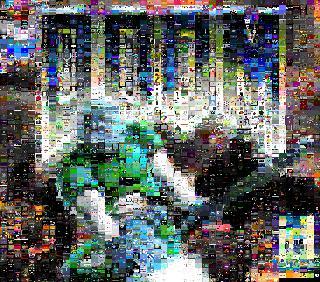
Wow, that's some impressive dithering. No lie, the "grayscale" images are the most impressive to me. Reminds me of color half-tone printing and film grain.
I wonder what videos games look like in this visual interpretation. I want this as a shader.
I wonder what videos games look like in this visual interpretation. I want this as a shader.
[deleted]
FYI:
This project site is a gallery of images created using one pixel for every RGB color (all 16,777,216 of them, no duplicates)
This project site is a gallery of images created using one pixel for every RGB color (all 16,777,216 of them, no duplicates)
https://tim.fish/assets/images/omni/drip.png https://tim.fish/assets/images/omni/splut.png
The code is here if you’re in the mood to be morbidly fascinated by my hacky python https://github.com/TimEwing/omni
Worth noting mine are only 7-bit instead of 8-bit because my poor little lenovo kept running out of ram and crashing.