Why a Greece Deal Matters: A Visual Guide(nytimes.com)
nytimes.com
Why a Greece Deal Matters: A Visual Guide
http://www.nytimes.com/interactive/2015/07/12/business/international/100000003795310.mobile.html
105 comments
It will never be like the US because Europe countries don't share a single language / culture, nor a common history.
The engineer in me really feels safer having many small independant systems than a single mega unified thing that is too big to fail - but it's another story.
The engineer in me really feels safer having many small independant systems than a single mega unified thing that is too big to fail - but it's another story.
Having a bunch of small systems is no good if the failure of any one system brings the whole thing down.
I'm not personally convinced that a Greek exit from the Euro would be the disaster that the news outlets like to think it will be. I think it will suck for the Greeks and basically brand them as a third world country, but it is probably a better solution than a few years of crippling austerity followed by another default/bailout/more austerity.
On the other hand, a Greek exit would also mean that the Eurozone countries wouldn't be forced to examine the aggregate fiscal policy and figure out a way to prevent this sort of problem from happening elsewhere.
I'm not personally convinced that a Greek exit from the Euro would be the disaster that the news outlets like to think it will be. I think it will suck for the Greeks and basically brand them as a third world country, but it is probably a better solution than a few years of crippling austerity followed by another default/bailout/more austerity.
On the other hand, a Greek exit would also mean that the Eurozone countries wouldn't be forced to examine the aggregate fiscal policy and figure out a way to prevent this sort of problem from happening elsewhere.
The EU is not a collection of states, it's an association of countries. Such a fundamental change to the nature of the political arrangement would be not just unpopular, but completely unprecedented. You'd be essentially turning all of Europe into one country. Taxation is one of those things people have very very strong feelings about, enough to go to war over.
Maybe in a few hundred years the EU might be cohesive enough for such a drastic political alteration. For now rectifying the problems caused by the currency union through the abysmally-slow process of international diplomacy is going to have to suffice. What's nice about Schengen is that at least those who are too-adversely affected can (relatively) easily move to another country with more opportunities.
Maybe in a few hundred years the EU might be cohesive enough for such a drastic political alteration. For now rectifying the problems caused by the currency union through the abysmally-slow process of international diplomacy is going to have to suffice. What's nice about Schengen is that at least those who are too-adversely affected can (relatively) easily move to another country with more opportunities.
This is the problem though. They're pretending that they're all unified, and have built a monetary system on that fantasy, while in fact they are all still independent. It is an inherently unstable situation, and we can expect a steady string of financial crises until something is changed.
The latest Greek bailout is just another example of them kicking the can down the road. No problems were solved, none of the underlying issues were addressed, it's going to be a problem again in a few months. On the other hand, it looks like everybody at the table knows that the current agreement is a joke. Did you see the timetable on the massive reforms Greece is supposed to implement? They've given themselves like 3 days to completely turn their economy around. And on the European side the agreement basically says "We'll maybe consider maybe extending the payback period if you succeed in completely reforming yourself by the end of the week." It's not even a funny joke.
The latest Greek bailout is just another example of them kicking the can down the road. No problems were solved, none of the underlying issues were addressed, it's going to be a problem again in a few months. On the other hand, it looks like everybody at the table knows that the current agreement is a joke. Did you see the timetable on the massive reforms Greece is supposed to implement? They've given themselves like 3 days to completely turn their economy around. And on the European side the agreement basically says "We'll maybe consider maybe extending the payback period if you succeed in completely reforming yourself by the end of the week." It's not even a funny joke.
The elephant in the room can not be that big since it could enter through the door. The EU project is nothing like US. This is the XIX, with all the economical and political complications. And we're talking about a bunch of very different countries and cultures. You don't just throw them together in a bowl and stir. USofE is a solution to a problem created by a solution that was not needed in the first place. It was an ideal. It still is. The ideal of a few that got to be shared by more and more people. But not by everyone, not with any cost.
You are right, exept when you say that the EU needs to make itself more like the US.
If people actually want that, then we might want to do so. However not a single country will vote for this. So if you don't want to force it one people, then this will not work.
If people actually want that, then we might want to do so. However not a single country will vote for this. So if you don't want to force it one people, then this will not work.
Well, especially in border regions such stuff is popular – the people living at the border between Denmark and Sweden, or the Netherlands and Belgium would prefer more unification, as for them every bit of independence of these countries means a less convenient life.
Minmal amount of people live along the border. You can get most of the benefit without a political union. Free movment of goods and people can be done with bilateral agreements. No need for the EU.
Well, it’s not just that: For the people in border regions – which, if you take Denmark (50% of the population), the Netherlands (100%), Belgium (100%) are especially in small countries a high percentage – it’s important to be able to live in the other country as if it were your own.
Free ability to live, work, retire, buy stuff, sell stuff, etc is extremely important.
For this to work, though, you need a common currency (imagine you work in Germany and live in Denmark, now the exchange rate changes, and your money is only worth half of the original value, and you suddenly can’t pay your rent anymore), you need simplified tax systems (imagine the mess of working in Germany, living in the netherlands, having your funds in Luxembourg, and owning a second house in Belgium).
The EU guarantuees all this. It also helps with unified travel, with unified conservation of natural resources – take the UNESCO World Natural Heritage Site of the wadden sea – it reaches into 3 countries and the EU had a great deal in making it happen.
For someone living in a border region, the EU is necessary for survival. No, the EU can not be undone, we need to get even closer. In my state, policemen of Denmark and Germany are on patrol together to make cross-border crimes easier to process – because it means you always have one with authority, even if you end up arresting them in the other country. We recently made Danish an official language in my state even. A family member of mine works as a public facing official in a governmental institution here and has to deal with people filing forms in German, Dutch, English and Danish every day.
In some cities in the border regions, up to half of the population works on the other side of the border!
No, the EU can not be undone.
Free ability to live, work, retire, buy stuff, sell stuff, etc is extremely important.
For this to work, though, you need a common currency (imagine you work in Germany and live in Denmark, now the exchange rate changes, and your money is only worth half of the original value, and you suddenly can’t pay your rent anymore), you need simplified tax systems (imagine the mess of working in Germany, living in the netherlands, having your funds in Luxembourg, and owning a second house in Belgium).
The EU guarantuees all this. It also helps with unified travel, with unified conservation of natural resources – take the UNESCO World Natural Heritage Site of the wadden sea – it reaches into 3 countries and the EU had a great deal in making it happen.
For someone living in a border region, the EU is necessary for survival. No, the EU can not be undone, we need to get even closer. In my state, policemen of Denmark and Germany are on patrol together to make cross-border crimes easier to process – because it means you always have one with authority, even if you end up arresting them in the other country. We recently made Danish an official language in my state even. A family member of mine works as a public facing official in a governmental institution here and has to deal with people filing forms in German, Dutch, English and Danish every day.
In some cities in the border regions, up to half of the population works on the other side of the border!
No, the EU can not be undone.
Non of the things you say, need to EU to work. You are setting up a false choice between central control and chaos.
I happen to live in Switzerland, and I know many people who work in Switzerland or Germany and work in the other country. This is perfeclty simple and workable. Countries can agree on how taxes work without a central control from brussel.
You can make bilateral agreements about Individual problems. This will get you 95% of the benefits and you avoid the majority of the cost.
You know like that little tiny problem were the hole of the Eurozone is suffering economicly and the society of greece is disintegrating. I guess fuck the problem of the greeks, let them suffer, its much more important for me to be able to buy cheap petrol on the other side of the border.
I happen to live in Switzerland, and I know many people who work in Switzerland or Germany and work in the other country. This is perfeclty simple and workable. Countries can agree on how taxes work without a central control from brussel.
You can make bilateral agreements about Individual problems. This will get you 95% of the benefits and you avoid the majority of the cost.
You know like that little tiny problem were the hole of the Eurozone is suffering economicly and the society of greece is disintegrating. I guess fuck the problem of the greeks, let them suffer, its much more important for me to be able to buy cheap petrol on the other side of the border.
Most of this bailout money will go straight back to paying interest on the bad loans that caused the crisis. Much of these loans came from banks in the very same Eurozone countries that are imposing this deal onto Greece. So much for European solidarity...
The austerity imposed on the Greek people will shrink the economy and ensure that the next few generations will be labouring in servitude to pay off the debts of the previous generations. The supreme irony in all of this is that Germany was able to thrive after WW2 in part because of the writing-off of more than half of their government debt, something that Angela Merkel has claimed is 'off the table'.
Further reading: http://www.theguardian.com/world/2015/jun/29/where-did-the-g... https://medium.com/@gavinschalliol/thomas-piketty-germany-ha...
The austerity imposed on the Greek people will shrink the economy and ensure that the next few generations will be labouring in servitude to pay off the debts of the previous generations. The supreme irony in all of this is that Germany was able to thrive after WW2 in part because of the writing-off of more than half of their government debt, something that Angela Merkel has claimed is 'off the table'.
Further reading: http://www.theguardian.com/world/2015/jun/29/where-did-the-g... https://medium.com/@gavinschalliol/thomas-piketty-germany-ha...
Bad loans did not cause the crisis.
Bad loans are a symptom of a poor fiscal situation.
No one forced Greece to take out loans.
Consider this write up :http://www.vanityfair.com/news/2010/10/greeks-bearing-bonds-...
This was before the "Greeks as Victims" narrative gained wide currency.
“The way they were keeping track of their finances—they knew how much they had agreed to spend, but no one was keeping track of what he had actually spent. It wasn’t even what you would call an emerging economy. It was a Third World country.”
As it turned out, what the Greeks wanted to do, once the lights went out and they were alone in the dark with a pile of borrowed money, was turn their government into a piñata stuffed with fantastic sums and give as many citizens as possible a whack at it.
Bad loans are a symptom of a poor fiscal situation.
No one forced Greece to take out loans.
Consider this write up :http://www.vanityfair.com/news/2010/10/greeks-bearing-bonds-...
This was before the "Greeks as Victims" narrative gained wide currency.
“The way they were keeping track of their finances—they knew how much they had agreed to spend, but no one was keeping track of what he had actually spent. It wasn’t even what you would call an emerging economy. It was a Third World country.”
As it turned out, what the Greeks wanted to do, once the lights went out and they were alone in the dark with a pile of borrowed money, was turn their government into a piñata stuffed with fantastic sums and give as many citizens as possible a whack at it.
No one forced Greece to take the loans. No one forced banks to loan to Greece. Both parties are at fault. Both parties ought to take losses. Only one is in this case.
Lenders already took a 53.5% haircut in 2011. In return, the Greeks were supposed to implement structural reforms and privatization. They delayed implementing that until 2014 at which point they officially repudiated their side of the agreement (but kept the money).
https://en.wikipedia.org/wiki/Greek_government-debt_crisis#2...
So yes, so far, only one side (lenders) has taken losses.
https://en.wikipedia.org/wiki/Greek_government-debt_crisis#2...
So yes, so far, only one side (lenders) has taken losses.
Your view is quite selective. Greece can't repay the loans and never will. Their economy has shrunk and they are in the midst of a major depression. It is quite incorrect to say Greeks have not suffered.
Also, by the time of the haircut the banks that did the original lending to Greece were not holders of the private bonds. They had been unloaded. Ever since 2009 almost all money given to Greece from the so called bailouts have merely been transfers to primarily German and French banks. The bailout has been nothing more than a propping up of German and French banks while at the same time doing great damage to the Greek economy.
To be sure Greece has a pretty messed up government and they need to mature politically. The Greek people have suffered greatly and need to reform but further austerity is not going to help them.
Also, by the time of the haircut the banks that did the original lending to Greece were not holders of the private bonds. They had been unloaded. Ever since 2009 almost all money given to Greece from the so called bailouts have merely been transfers to primarily German and French banks. The bailout has been nothing more than a propping up of German and French banks while at the same time doing great damage to the Greek economy.
To be sure Greece has a pretty messed up government and they need to mature politically. The Greek people have suffered greatly and need to reform but further austerity is not going to help them.
Ever since 2009 almost all money given to Greece from the so called bailouts have merely been transfers to primarily German and French banks. The bailout has been nothing more than a propping up of German and French banks while at the same time doing great damage to the Greek economy.
In that case, Greece should be fine with no further bailouts - all they need to do is officially repudiate their debt. Then they can go on running Greece independently without any reforms and they won't need to beg the Germans and Bulgarians to send them money.
In that case, Greece should be fine with no further bailouts - all they need to do is officially repudiate their debt. Then they can go on running Greece independently without any reforms and they won't need to beg the Germans and Bulgarians to send them money.
Given your previous comments with regard to your knowledge of finance you know this isn't such an easy thing. Their financial system is intimately tied into the euro and remaining part of the EU.
If the Greeks produce X euros worth of goods/serviecs and consume Y euros for Y < X, this should be a minor problem at best - paperwork, really. The actual problem is that Greece can't pay for their current levels of consumption. They haven't been able to pay for consumption in quite a while actually, but previously EU lending propped them up.
This is why Argentina's default wasn't anywhere near as bad - they were fairly close to consuming as much as they produced.
Unlike Greece, Argentina also instituted necessary reforms - for example, import substitution and breaking sticky wages via a 13% nominal wage cut for govt workers and pensioners [1]. Greece has steadfastly refused to do these things in spite of having ample time.
[1] Recall why Keynesians promote inflation - to inflate away real wages, which this cut also did.
This is why Argentina's default wasn't anywhere near as bad - they were fairly close to consuming as much as they produced.
Unlike Greece, Argentina also instituted necessary reforms - for example, import substitution and breaking sticky wages via a 13% nominal wage cut for govt workers and pensioners [1]. Greece has steadfastly refused to do these things in spite of having ample time.
[1] Recall why Keynesians promote inflation - to inflate away real wages, which this cut also did.
Europe is taking losses. Banking is becoming a risk-free businees, I wouldn't call this capitalism.
The banks have taken some losses as well.
https://en.wikipedia.org/wiki/Greek_government-debt_crisis#c...
https://en.wikipedia.org/wiki/Greek_government-debt_crisis#c...
So? Loans carry an inherent risk with them. Banks and other institutions chose to take that risk and sometimes it doesn't pay out. Why should we protect private institutions from a risk they voluntarily assumed?
Banking is not risk free, nor should it be.
Banking is not risk free, nor should it be.
So? Taking out a loan has an inherent risk associated with it that you may not be able to pay it back. How do we protect institutions who desire to loan money from losing it when they loanee can't pay back their debts?
Borrowing isn't risk free. Nor should it be.
Both sides have a responsibility in this. Actions have consequences.
Borrowing isn't risk free. Nor should it be.
Both sides have a responsibility in this. Actions have consequences.
>How do we protect institutions who desire to loan money from losing it when they loanee can't pay back their debts?
Why would we protect institutions from the effects of the free market?
Why suddenly when it's a bank in trouble, does free market ideology not provide the solution?
>Both sides have a responsibility in this
I dont see both sides making efforts to work this out at all. I see greece in headlines owing money; i dont see headlines about DB being forced to agree to forgive interest on loans, cut employee salaries/bonuses, or take any kind of belt-tightening measures.
Where exactly do you see both sides taking responsibility?
Why would we protect institutions from the effects of the free market?
Why suddenly when it's a bank in trouble, does free market ideology not provide the solution?
>Both sides have a responsibility in this
I dont see both sides making efforts to work this out at all. I see greece in headlines owing money; i dont see headlines about DB being forced to agree to forgive interest on loans, cut employee salaries/bonuses, or take any kind of belt-tightening measures.
Where exactly do you see both sides taking responsibility?
Except we only see one side being forced to make sacrifices, not both.
The banks and the politicians on both sides have a responsibility. The ordinary young Greeks who will be forced to pay back the debt don't.
You can't have your cake and eat it to. For the 20% (guess) of "young Greeks" that are getting the raw end of a stick because they didn't vote for the government/disagree with the borrowing, there are probably > 20% of Greeks that did vote for the government, and/or did agree with the unsustainable borrowing.
Or are we going to single out individuals that are responsible and saddle them with billions of debt? The alternative in this scenario to democratically-shared blame is ludicrous. Blame/consequences can't just magically disappear at this point.
Look, don't get me wrong, I'm all for politicians being accountable for their actions. As a freedom minded (Libertarian/Anarcho-capitalist), I think a simple act/rule such as that would put us straight down a path to true freedom from government. But this crisis/situation is not one of those times where I'd advocate such a course.
Or are we going to single out individuals that are responsible and saddle them with billions of debt? The alternative in this scenario to democratically-shared blame is ludicrous. Blame/consequences can't just magically disappear at this point.
Look, don't get me wrong, I'm all for politicians being accountable for their actions. As a freedom minded (Libertarian/Anarcho-capitalist), I think a simple act/rule such as that would put us straight down a path to true freedom from government. But this crisis/situation is not one of those times where I'd advocate such a course.
This came to light six years ago, and barring default or forgiveness, isn't going away soon. Young people who never voted for or against anyone responsible for the debt will suffer for it. People who haven't even been born yet might end up repaying the debt.
"Democratically-shared blame" is the ludicrous option.
"Democratically-shared blame" is the ludicrous option.
But that's how voting works. People vote for who they want to represent them. Yes, there are going to be parts of the population too young to have a voice. But later, they will and there'll be a whole new population too you to have a vote. You can't change that.
The important part is this; if you live in a country where you're allowed to vote for your representation, you are part of the government and share in it's successes and it's failures.
The important part is this; if you live in a country where you're allowed to vote for your representation, you are part of the government and share in it's successes and it's failures.
That's why voting for the best candidate is so important. Your decisions today will affect your grandchildren. So, make very wise decisions.
Socially liberal young Greeks are the main supporters of Syriza.
[ source : http://www.bbc.com/news/world-europe-18056677 ]
[ source : http://www.bbc.com/news/world-europe-18056677 ]
Bad loans very much created the situation.
But not loans to governments, but loans to individuals, industry and finance.
What then happened was that the crash of '07-08 came and spooked the private banks issuing those loans. Only then did the various governments step in and underwrite the bad loans to effectively bail out the private banking system.
This, along with the number of companies etc that shut down, has put a massive economic burden on said governments.
Thing is that before the euro, Greece could have depreciated its currency to make its exports cheaper. But with the euro the currency is set to the export situation of Germany.
But not loans to governments, but loans to individuals, industry and finance.
What then happened was that the crash of '07-08 came and spooked the private banks issuing those loans. Only then did the various governments step in and underwrite the bad loans to effectively bail out the private banking system.
This, along with the number of companies etc that shut down, has put a massive economic burden on said governments.
Thing is that before the euro, Greece could have depreciated its currency to make its exports cheaper. But with the euro the currency is set to the export situation of Germany.
But what happens if you forgive 50%, 60% or even 100% of all Greek debt? Sure the Greeks have some breathing room and don't have to pay crippling interest for a while. But it won't fix the rampant corruption, nepotism, mismanagement, tax evasion, and downright fraud that seems to be quite systemic in Greece. At least that's the impression that I have, maybe incorrectly and unfairly. I don't know.
But the point is, if you forgive the Greek their debt, how do you know that they won't return to their old ways and ruin their country yet another time? How do you know that you won't have the same problems again 15-20 years down the road? And should you bail them out again then?
I'm not saying the proposed solution is great. It's not. But my impression is that the Greek are hemming and hawing, and doing their best to avoid any structural reforms that would prevent such a crisis from happening again. They don't seem to take responsibility for their mismanagement and they don't seem to see any reason why they should change their behavior. They put band aids on some parts and the people suffer, and the creditors are partly to blame. But no one seems to be interested in getting rid of the systemic issues like corruption, tax evasion and fraud.
I think that's the difference. The creditors don't trust the Greeks to fix their country because they don't seem to think any of it is their fault. But the creditors did trust Germany to fix its problems after WW2.
EDIT: replaced "debtor" with "creditor".
But the point is, if you forgive the Greek their debt, how do you know that they won't return to their old ways and ruin their country yet another time? How do you know that you won't have the same problems again 15-20 years down the road? And should you bail them out again then?
I'm not saying the proposed solution is great. It's not. But my impression is that the Greek are hemming and hawing, and doing their best to avoid any structural reforms that would prevent such a crisis from happening again. They don't seem to take responsibility for their mismanagement and they don't seem to see any reason why they should change their behavior. They put band aids on some parts and the people suffer, and the creditors are partly to blame. But no one seems to be interested in getting rid of the systemic issues like corruption, tax evasion and fraud.
I think that's the difference. The creditors don't trust the Greeks to fix their country because they don't seem to think any of it is their fault. But the creditors did trust Germany to fix its problems after WW2.
EDIT: replaced "debtor" with "creditor".
Why would anyone lend to Greece again after debt forgiveness?
(Nitpick: the Greeks are the debtors.)
(Nitpick: the Greeks are the debtors.)
If they can reform their politcal system and people belife it to be sound, they should get money again.
I agree, but the comment I responded to suggested they wouldn't do that, they'd get loans again despite not reforming, and this crisis would happen again.
It seems to me that if anyone loans money again to an unreformed Greece, they've accepted that risk.
It seems to me that if anyone loans money again to an unreformed Greece, they've accepted that risk.
I agree. The most important thing is to make the RULES clear for the future. But eurocrats don't seem to understand this.
It's pretty insane that after the referendum, Tsipras tipped his hat that he still wanted a deal (word is the government never actually did any planning for a new sovereign currency and Tsipras was secretly hoping to lose the referendum [0] ) and Germany came back with one of the most crushing term sheets possible, basically set up to remove Greek sovereignty completely. If you love history, read the term sheets [1].
I expected Greece to be pushed out of the Eurozone just on the term sheets alone. I can't possibly see how this ends without another referendum in another handful of years and a Grexit in the end, anyway.
[0] http://mobile.nytimes.com/blogs/krugman/2015/07/12/disaster-...
[1] https://twitter.com/EdConwaySky/status/620272062771429377/ph...
I expected Greece to be pushed out of the Eurozone just on the term sheets alone. I can't possibly see how this ends without another referendum in another handful of years and a Grexit in the end, anyway.
[0] http://mobile.nytimes.com/blogs/krugman/2015/07/12/disaster-...
[1] https://twitter.com/EdConwaySky/status/620272062771429377/ph...
Krugman on the "madness" of the demands and "Killing the European Project": http://krugman.blogs.nytimes.com/2015/07/12/killing-the-euro...
I'd like a more indepth analysis of [1] and related stories.
At a glance it seems that there is a big push for privatisation and more power for capital over labour to encourage business, which the cynic in me assumes will be for the rest of Europe to exploit.
At a glance it seems that there is a big push for privatisation and more power for capital over labour to encourage business, which the cynic in me assumes will be for the rest of Europe to exploit.
Most of this bailout money will go straight back to paying interest on the bad loans that caused the crisis.
If that's the case, then Greece shouldn't have much of a problem. If X% of the money will go to paying interest, then the Greeks can default and their budgetary shortfall is only (100-X)%.
So why is Greece so keen on having other people send them money?
Also, no austerity can be imposed on the Greeks - Greece is a sovereign nation. Greece can choose to trade austerity for money, or they can choose to default and do whatever they like (although of course they will need to pay for it themselves).
If that's the case, then Greece shouldn't have much of a problem. If X% of the money will go to paying interest, then the Greeks can default and their budgetary shortfall is only (100-X)%.
So why is Greece so keen on having other people send them money?
Also, no austerity can be imposed on the Greeks - Greece is a sovereign nation. Greece can choose to trade austerity for money, or they can choose to default and do whatever they like (although of course they will need to pay for it themselves).
As I understand it Greece has already had a lot of debt written off
From the OECD. Here are a few articles that explore the EU's approach on sovereign debt crisis. One is form 2011, and the other is from 2012. The 2012 article discusses the "Greece Problem":
2. 2012 - http://www.oecd.org/finance/financial-markets/49481502.pdf
3. Greece @ OECD.org: https://data.oecd.org/greece.htm
  The „Greece problem‟ needs to be resolved once and for all
  with a 50% (or larger) haircut on its sovereign debt and
  necessary ancillary policies, so that its chances
  or remaining in the euro improve. (2012)
2. 2012 - http://www.oecd.org/finance/financial-markets/49481502.pdf
3. Greece @ OECD.org: https://data.oecd.org/greece.htm
I'm actually surprised that the OECD has said that. Similar research has been published by the IMF as well. So these organizations have experts and yet spokesmen and officials give the opposite advice of what they tell them. Good thing they have transparency at least.
Indeed – illustrates very clearly how governments, institutions and corporations aren't the unified hierarchies they present themselves as, and instead can be many-headed organisms pursuing sometimes contradictory aims. Compare to Samsung and Google suing each other for patent infringement while operating a revenue-share scheme on ad profits.
I don't think Samsung and Google have sued each other for patent infringement. I could be mistaken. Do you have a source?
I believe you meant to say Samsung and Apple perhaps?
I believe you meant to say Samsung and Apple perhaps?
If you'd like to visualize the physical amount of euros relative to the size of a human and delivery trucks: http://demonocracy.info/infographics/eu/debt_greek/debt_gree...
Access via a Google query: https://www.google.com/url?sa=t&rct=j&q=&esrc=s&source=web&c...
The real reason the Greece deal matters, is the rest of the EU are looking at it as a proxy for what will happen to Spain and Italy next. These two make up a much larger proportion of the EU GDP, and are facing their own major debt crises.
Spain and Italy have cut their deficits in half.
http://www.tradingeconomics.com/spain/government-budget
http://www.tradingeconomics.com/italy/government-budget
Robust growth predicted for Spain : http://www.oecd.org/eco/outlook/spain-economic-forecast-summ...
Robust growth is projected over the next two years, driven by very supportive financial conditions
http://www.oecd.org/eco/outlook/italy-economic-forecast-summ...
After a long recession, the Italian economy has started its gradual recovery. Output is projected to grow by 0.6% in 2015 and by 1.5% in 2016/
http://www.tradingeconomics.com/spain/government-budget
http://www.tradingeconomics.com/italy/government-budget
Robust growth predicted for Spain : http://www.oecd.org/eco/outlook/spain-economic-forecast-summ...
Robust growth is projected over the next two years, driven by very supportive financial conditions
http://www.oecd.org/eco/outlook/italy-economic-forecast-summ...
After a long recession, the Italian economy has started its gradual recovery. Output is projected to grow by 0.6% in 2015 and by 1.5% in 2016/
If reducing your budget matters, then Greece has a very prosperous economy. Reducing your budget does not matter if doing so sends you into a (bigger) depression that makes your debt grow.
Spanish debt is growing fast, having almost doubled since 2010 (http://www.tradingeconomics.com/spain/government-debt-to-gdp).
Spanish debt is growing fast, having almost doubled since 2010 (http://www.tradingeconomics.com/spain/government-debt-to-gdp).
A nice visual guide of all Euro countries. Some still have too much debt compared to GDP. Scandinavia seems to be doing just fine.
Unfortunately it's hard to see how austerity measures (in the "bailout" deal) are going to improve debt compared to GDP. It certainly didn't in Greece, where a 6% rise in debt (post-haircut) went with a ~35% increase in debt/GDP, because austerity tanked the economy.
It's also unclear what exactly "too much debt compared to GDP" means. What number is too much, and under what circumstances?
Additionally, while Finland's debt/GDP may be "fine", for your definition of fine, Finland's economy is not doing fine, thanks to the constraints imposed by the Euro and the same austerity policies in place throughout Europe. [1] [2] Even now Finland has 8%+ unemployment and 0.8% growth. Indeed for these reasons, Finland is expected to become one of the most indebted countries in Europe. [3]
[1] http://krugman.blogs.nytimes.com/2015/06/01/the-finnish-dise...
[2] http://www.interfluidity.com/uploads/2015/07/Greekovery.png
[3] http://www.bloomberg.com/bw/articles/2014-01-23/is-finland-a...
It's also unclear what exactly "too much debt compared to GDP" means. What number is too much, and under what circumstances?
Additionally, while Finland's debt/GDP may be "fine", for your definition of fine, Finland's economy is not doing fine, thanks to the constraints imposed by the Euro and the same austerity policies in place throughout Europe. [1] [2] Even now Finland has 8%+ unemployment and 0.8% growth. Indeed for these reasons, Finland is expected to become one of the most indebted countries in Europe. [3]
[1] http://krugman.blogs.nytimes.com/2015/06/01/the-finnish-dise...
[2] http://www.interfluidity.com/uploads/2015/07/Greekovery.png
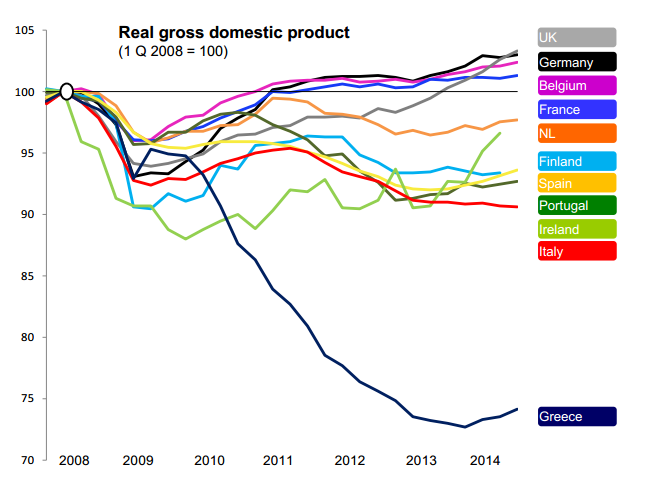
[3] http://www.bloomberg.com/bw/articles/2014-01-23/is-finland-a...
From what I've learned as this crisis began to unfold, Greece's problems are manifold and quite intractable.
Cynics and detractors have already pointed out the corruption, cronyism, the woeful state of pension reform and rampant tax evasion.
A highly favorited comment on a different NYT piece on the Greece deal sheds light on the indifference, there:
I particularly want to know why certain southern European countries share this brand of indifference and fatalism about their affairs. I have observed this in Portugal too.
[1] Peter Bowen a British citizen in Crete, Greece shares his thoughts
http://www.nytimes.com/2015/07/14/world/europe/greece-debt-p...
Cynics and detractors have already pointed out the corruption, cronyism, the woeful state of pension reform and rampant tax evasion.
A highly favorited comment on a different NYT piece on the Greece deal sheds light on the indifference, there:
  I was at my local tax office this morning - I figured that since most people
  here have stopped paying taxes, the timing might be good. It took me half an
  hour to do what normally would have taken a morning (most of which would have
  involved waiting on line).

  In the office I was dealing with, both wickets were open, and I could see the
  office beyond. Of the five people I could see, two were at the wickets, one was
  entertaining a succession of visitors who were not conducting business, and two
  were doing nothing. Just sitting there. Nothing.

  I was there because I have a new (British) passport. I have a password-protected
  file on the Tax Office site, but I cannot change my number myself, because every
  such transaction in Greece begins with the assumption that the client is lying,
  and therefore this sort of trivial business has to be done in person and the
  number verified. Fill in a two-page form and present the passport.

  The woman I dealt with - very courteous - entered the information in my file.
  Then she printed everything as well - several pages, nine stamps, seven
  signatures.

  Greece has been promising (to its creditors) to simplify, cut the red tape,
  reduce the Civil Service, for years, but things only get worse. Syriza re-hired
  the few that the previous government laid off, knowing they didn't have money to
  pay for them.

  This is a tiny example of why no one trusts the promises of successive
  governments. 'Give us the money now, and we'll reform later.'[1]
I particularly want to know why certain southern European countries share this brand of indifference and fatalism about their affairs. I have observed this in Portugal too.
[1] Peter Bowen a British citizen in Crete, Greece shares his thoughts
http://www.nytimes.com/2015/07/14/world/europe/greece-debt-p...
In before Finns are labelled lazy and corrupt.
> It's also unclear what exactly "too much debt compared to GDP" means. What number is too much, and under what circumstances?
It is clearly meant according to the Maastricht criteria:
https://en.wikipedia.org/wiki/Euro_convergence_criteria
"2. Government budget deficit: The ratio of the annual general government deficit relative to gross domestic product (GDP) at market prices, must not exceed 3% at the end of the preceding fiscal year (based on notified measured data) and neither for any of the two subsequent years (based on the European Commission's published forecast data)."
"3. Government debt-to-GDP ratio: The ratio of gross government debt (measured at its nominal value outstanding at the end of the year, and consolidated between and within the sectors of general government) relative to GDP at market prices, must not exceed 60% at the end of the preceding fiscal year. Or if the debt-to-GDP ratio exceeds the 60% limit, the ratio shall at least be found to have "sufficiently diminished and must be approaching the reference value at a satisfactory pace"."
Or in easier words:
> https://en.wikipedia.org/wiki/Maastricht_Treaty
"2. Government finance:
Annual government deficit:
The ratio of the annual government deficit to gross domestic product (GDP) must not exceed 3% at the end of the preceding fiscal year. If not, it is at least required to reach a level close to 3%. Only exceptional and temporary excesses would be granted for exceptional cases.
Government debt: The ratio of gross government debt to GDP must not exceed 60% at the end of the preceding fiscal year. Even if the target cannot be achieved due to the specific conditions, the ratio must have sufficiently diminished and must be approaching the reference value at a satisfactory pace.".
It is clearly meant according to the Maastricht criteria:
https://en.wikipedia.org/wiki/Euro_convergence_criteria
"2. Government budget deficit: The ratio of the annual general government deficit relative to gross domestic product (GDP) at market prices, must not exceed 3% at the end of the preceding fiscal year (based on notified measured data) and neither for any of the two subsequent years (based on the European Commission's published forecast data)."
"3. Government debt-to-GDP ratio: The ratio of gross government debt (measured at its nominal value outstanding at the end of the year, and consolidated between and within the sectors of general government) relative to GDP at market prices, must not exceed 60% at the end of the preceding fiscal year. Or if the debt-to-GDP ratio exceeds the 60% limit, the ratio shall at least be found to have "sufficiently diminished and must be approaching the reference value at a satisfactory pace"."
Or in easier words:
> https://en.wikipedia.org/wiki/Maastricht_Treaty
"2. Government finance:
Annual government deficit:
The ratio of the annual government deficit to gross domestic product (GDP) must not exceed 3% at the end of the preceding fiscal year. If not, it is at least required to reach a level close to 3%. Only exceptional and temporary excesses would be granted for exceptional cases.
Government debt: The ratio of gross government debt to GDP must not exceed 60% at the end of the preceding fiscal year. Even if the target cannot be achieved due to the specific conditions, the ratio must have sufficiently diminished and must be approaching the reference value at a satisfactory pace.".
The bit that probably make GP puzzled - out of the EURO countries, only Estonia, Finland, Latvia, Lithuania, Luxembourg, Slovakia matches those requirements.
Or less than 20 millions out the 330 million people living in the EURO zone.[0]
The Debt-To-GDP ratio is a mess. You can see the combined effect of austerity and crisis on some economies. And countries like France have only been twice within the target and not recently. [1]
At the end of the day, as many things with the EU, the real rule is around the interpretation of what means "satisfactory pace" and "exceptional cases" - which is regular political hidden under a layer of pseudo-righteous mathematics. (which is not unusual at all for an international treaty)
[0] http://ec.europa.eu/eurostat/tgm/table.do?tab=table&init=1&l... [1] http://ec.europa.eu/eurostat/tgm/table.do?tab=table&plugin=1...
Or less than 20 millions out the 330 million people living in the EURO zone.[0]
The Debt-To-GDP ratio is a mess. You can see the combined effect of austerity and crisis on some economies. And countries like France have only been twice within the target and not recently. [1]
At the end of the day, as many things with the EU, the real rule is around the interpretation of what means "satisfactory pace" and "exceptional cases" - which is regular political hidden under a layer of pseudo-righteous mathematics. (which is not unusual at all for an international treaty)
[0] http://ec.europa.eu/eurostat/tgm/table.do?tab=table&init=1&l... [1] http://ec.europa.eu/eurostat/tgm/table.do?tab=table&plugin=1...
The problem is that eurocrats think pushing their project is more important then the rules to make it a workable projects. The rules are more or less lies that they allowed to be written to convince people that the EU is a good thing, but then they ignored the rules.
The EU is a horrible project and a complet failure in every way.
The EU is a horrible project and a complet failure in every way.
The problem with the Maastricht criteria is that they reflect the reality of 25 years ago. They were basically drawn by a bunch of French civil servants (some of them quite young), at a time when France had a 5% ratio and the French government was looking for excuses to reduce it a little bit. 5% was off the table for the abovementioned reason, 1 or 2% would have been too harsh, so 3% was born. This at a time when overall growth in what is now the Eurozone was much higher than it has been almost ever since.
There is no real economic study that says "3% good, 4% bad" (and it would be idiotic, really -- you need many more parameters to judge a State credit-worthiness, as Japan proves every day). It's all about politics.
There is no real economic study that says "3% good, 4% bad" (and it would be idiotic, really -- you need many more parameters to judge a State credit-worthiness, as Japan proves every day). It's all about politics.
> It is clearly meant according to the Maastricht criteria:
It was not clear to me, but thank you for the explanation.
What insanity that the European nations would cripple their economic tools with a treaty like this. There are times when debt/GDP absolutely should be in great excess of 3%, and times when debt must be greater than 60%, and no country should require 'approval' to tackle their own economic problems.
Fortunately, I suppose, it looks like these sections of the treaty are not enforced very strongly.
It was not clear to me, but thank you for the explanation.
What insanity that the European nations would cripple their economic tools with a treaty like this. There are times when debt/GDP absolutely should be in great excess of 3%, and times when debt must be greater than 60%, and no country should require 'approval' to tackle their own economic problems.
Fortunately, I suppose, it looks like these sections of the treaty are not enforced very strongly.
> it looks like these sections of the treaty are not enforced very strongly.
Or at all, for certain countries. Germany and France routinely break pretty much any parameter, in various directions, and absolutely nothing happens.
But as soon as a minnow spends a little bit more, oooh boy...
Or at all, for certain countries. Germany and France routinely break pretty much any parameter, in various directions, and absolutely nothing happens.
But as soon as a minnow spends a little bit more, oooh boy...
> Or at all, for certain countries. Germany and France routinely break pretty much any parameter, in various directions, and absolutely nothing happens.
Germany has been very strict on their own budget in the last four years and tries hard to satisfy the Masstricht criteria. For the following data, cf. http://www.tagesschau.de/wirtschaft/wirtschaftsdaten104.html
budget deficit/surplus of EU countries (% of GDP) (Haushaltsdefizite/-überschuss der EU-Länder): -3 is allowed, Germany has
From the Maastricht criteria only "total debt (% of GDP)" (Gesamtschulden (in % des BIP)) is problematic, since there only 60% is allowed. But also here Germany is working very hard to satisfy this criterion:
Germany has been very strict on their own budget in the last four years and tries hard to satisfy the Masstricht criteria. For the following data, cf. http://www.tagesschau.de/wirtschaft/wirtschaftsdaten104.html
budget deficit/surplus of EU countries (% of GDP) (Haushaltsdefizite/-überschuss der EU-Länder): -3 is allowed, Germany has
  2012: +0,1 %
  2013: +0,1 %
  2914: +0,7 %
  2015 (estimate): +0,6 %
  2016 (estimate): +0,5 %
From the Maastricht criteria only "total debt (% of GDP)" (Gesamtschulden (in % des BIP)) is problematic, since there only 60% is allowed. But also here Germany is working very hard to satisfy this criterion:
  2012: 79,3 %
  2013: 77,1 %
  2014: 74,7 %
  2015 (estimate): 71,5 %
2016 (estimate): 68,2 %Well it does illustrate how transient "exemplary" is. Ireland and Spain were exemplary in the years leading to the crisis, beating Germany in the debt and surplus metrics.[0][1]
Media like to show "feel good metric" to put a patriotic positive spin (us good, them bad) on the result of regular political arm-wrestling between temporarily weaker countries. You won't see those metric in France however the media will use different things to achieve the same effect. The idea is to build a moral high horse so that your people can forget that over there, few people have benefited but a lot will pay.
[0] http://ec.europa.eu/eurostat/tgm/table.do?tab=table&init=1&l...
[1] http://ec.europa.eu/eurostat/tgm/table.do?tab=table&plugin=1...
Media like to show "feel good metric" to put a patriotic positive spin (us good, them bad) on the result of regular political arm-wrestling between temporarily weaker countries. You won't see those metric in France however the media will use different things to achieve the same effect. The idea is to build a moral high horse so that your people can forget that over there, few people have benefited but a lot will pay.
[0] http://ec.europa.eu/eurostat/tgm/table.do?tab=table&init=1&l...
[1] http://ec.europa.eu/eurostat/tgm/table.do?tab=table&plugin=1...
Yes, but the Euro wasn't created in the last 4 years: http://www.bbc.co.uk/news/world-europe-16761087
"In 2003, France and Germany had both overspent, and their budget deficits had exceeded the 3% of GDP limit to which they were legally bound."
Both countries basically spent their way out of their economic downturns, then told everyone else not to do that.
"In 2003, France and Germany had both overspent, and their budget deficits had exceeded the 3% of GDP limit to which they were legally bound."
Both countries basically spent their way out of their economic downturns, then told everyone else not to do that.
These rules were made to convince people that what is happening now would not be happening. Many parties, have on good faith exepted the EU because of this rules. However nobody cared to enforce them, theirfore the EU is based on lies and would never have been exepted by any voter if it had been known.
Well, one could argue that it was just a bubble that burst – but that would be ignoring a lot of the situation.
Some of the issues are that the IMF wants Greece to implement the austerity stuff on a different time scale than SYRIZA plans to, and that the population is very much against those systems (which I can understand).
If the greek government would improve their tax agency so they’d have 0 tax evasion (let’s just assume that), then with the next election, a party would get elected that changes that. The reason: Currently, greece has to pay back debts, but that means people have to pay a lot more taxes, and only see the infrastructure to become worse – leading to uproar.
Greece can’t just stop spending completely, they have to improve the situation in many places, while simultaneously improving tax collection slowly.
Some of the issues are that the IMF wants Greece to implement the austerity stuff on a different time scale than SYRIZA plans to, and that the population is very much against those systems (which I can understand).
If the greek government would improve their tax agency so they’d have 0 tax evasion (let’s just assume that), then with the next election, a party would get elected that changes that. The reason: Currently, greece has to pay back debts, but that means people have to pay a lot more taxes, and only see the infrastructure to become worse – leading to uproar.
Greece can’t just stop spending completely, they have to improve the situation in many places, while simultaneously improving tax collection slowly.
Concerning "Some of the issues are that the IMF wants Greece to
implement the austerity stuff on a different time scale
than SYRIZA plans to, and that the population is very
much against those systems (which I can understand). [...]
The reason: Currently, greece has to pay back debts,
but that means people have to pay a lot more taxes,
and only see the infrastructure to become worse –
leading to uproar.":
If the Greek people lived beyond their means in the past, someday the moment will come where they have to tighten their belts. Bad luck, but they decided in the past to spend money that they don't have.
If the Greek people lived beyond their means in the past, someday the moment will come where they have to tighten their belts. Bad luck, but they decided in the past to spend money that they don't have.
The point is, people lent them that money, without caring if they could or not pay... Those people are demanding their terms to be met, regardless of weather that is a realistic demand or not.
I am not saying who is wrong or who is right, but I don't think the blame falls only in one side. I'd argue that you take a risk when you lend money, and shit happens if you lend to people who can't pay.
I am not saying who is wrong or who is right, but I don't think the blame falls only in one side. I'd argue that you take a risk when you lend money, and shit happens if you lend to people who can't pay.
The way I'm seeing this is that "yes, Greece can pay", they just voted not to.
If one looks at it that way, the whole argument about "lenders chose to lend to them, taking risk that they might not be able to pay, therefore they are to blame as well", falls wayside. This is because the risk they assumed to be taking was one of Greece "not being able to pay", not Greece choosing to not honour the deal.
Tl;dr: There is a difference between the risk of not being able to pay, and the risk of choosing to default/not pay at all.
If one looks at it that way, the whole argument about "lenders chose to lend to them, taking risk that they might not be able to pay, therefore they are to blame as well", falls wayside. This is because the risk they assumed to be taking was one of Greece "not being able to pay", not Greece choosing to not honour the deal.
Tl;dr: There is a difference between the risk of not being able to pay, and the risk of choosing to default/not pay at all.
Sure, but the only way they can pay, is by borrowing more, it is just a vicious cycle that will eventually pop...
The point is no one wants the bomb to blow up on their hands, and I get that, but meanwhile the situation in the country gets worse and worse... in the hopes that somehow the country generates more money.
Here the "ideology" starts taking place in the discussion, there are proponents of austerity, saying the confidence generated by always paying out-weights the short term losses, and there are people that say it doesn't work, and that we should somehow try something different since this strategy has been tried and failed a couple of times already. Like, hey let the guys off the hook for part of their debt (lenders knew the risk...), and let the blow generate economic pressure for growth (e.g. Get out of the euro, and let the newly minted and devalued currency be extremely attractive to buy stuff out of Greece, making their economy move).
The point is no one wants the bomb to blow up on their hands, and I get that, but meanwhile the situation in the country gets worse and worse... in the hopes that somehow the country generates more money.
Here the "ideology" starts taking place in the discussion, there are proponents of austerity, saying the confidence generated by always paying out-weights the short term losses, and there are people that say it doesn't work, and that we should somehow try something different since this strategy has been tried and failed a couple of times already. Like, hey let the guys off the hook for part of their debt (lenders knew the risk...), and let the blow generate economic pressure for growth (e.g. Get out of the euro, and let the newly minted and devalued currency be extremely attractive to buy stuff out of Greece, making their economy move).
Yes, but what I’m saying is: If you only increase taxes and shut down spending to a minimum, you’ll either get a revolution, or the next election will lead to a government that just stops the Austerity.
You have to show the people at the same time that they gain something, too – for example, while you reduce corruption in tax spending, one of the first priorities should be improving performance of Police and similar public services. You can save a lot of money there while at the same time providing a better service. That leads to better public acceptance.
You have to show the people at the same time that they gain something, too – for example, while you reduce corruption in tax spending, one of the first priorities should be improving performance of Police and similar public services. You can save a lot of money there while at the same time providing a better service. That leads to better public acceptance.
So, future generations should be condemned to misery and poverty because of the bad decisions of the past and a need to make amends for that?
If that's really your theory, then Greece is not the first European country you should target.
If that's really your theory, then Greece is not the first European country you should target.
If the Greek really hate their debt (and the interest) so much, then why isn't there a strong movement in Greece to reduce or at least not increase debt by a strict budget policy?
Switzerland added a balanced budget amendment to their constitution in 2001
> https://en.wikipedia.org/wiki/Balanced_budget_amendment#Swit...
Many people consider this as the model for a similar amendment that was added to Germany's constitution in 2009
> https://en.wikipedia.org/wiki/Balanced_budget_amendment#Germ...
(which the German government takes really seriously at the moment) and Austria's in 2011:
> https://en.wikipedia.org/wiki/Balanced_budget_amendment#Aust...
Switzerland added a balanced budget amendment to their constitution in 2001
> https://en.wikipedia.org/wiki/Balanced_budget_amendment#Swit...
Many people consider this as the model for a similar amendment that was added to Germany's constitution in 2009
> https://en.wikipedia.org/wiki/Balanced_budget_amendment#Germ...
(which the German government takes really seriously at the moment) and Austria's in 2011:
> https://en.wikipedia.org/wiki/Balanced_budget_amendment#Aust...
[deleted]
If you actually look at the country's debt compared to its tax revenue, most of these countries situations become much more severe:
A better comparison is to examine each country’s debt to government tax revenue, since that is the government’s income. This also offers a better comparison because different countries have very different levels of taxation. A country with high taxes can afford more debt than a low tax country. Debt to GDP ignores this difference. Comparing debt to tax revenue reveals a much truer picture of the burden of each country’s debt on its government’s finances.
When I compute those figures, Japan is still #1, with a debt as a percentage of tax revenue of about 900 percent and Greece is still in second place at about 475 percent. The big change is the U.S. jumps up to third place, with a debt to income measure of 408 percent. If the U.S. were a family, it would be deep into the financial danger zone.
To add a bit more perspective, the countries in fourth, fifth, and sixth place are Iceland, Portugal, and Italy, all between 300 and 310 percent. In other words, these three are starting to see a flashing yellow warning light, but only three developed countries in the world are in the red zone for national debt to income. The U.S. is one of those three.
source: http://www.forbes.com/sites/jeffreydorfman/2014/07/12/forget...
Many Scandinavian countries economies have slowed somewhat recently. Norway has been nicked from gas prices coming down since its such a big oil exporter. Even with the slow down, most countries still have robust economies.
A better comparison is to examine each country’s debt to government tax revenue, since that is the government’s income. This also offers a better comparison because different countries have very different levels of taxation. A country with high taxes can afford more debt than a low tax country. Debt to GDP ignores this difference. Comparing debt to tax revenue reveals a much truer picture of the burden of each country’s debt on its government’s finances.
When I compute those figures, Japan is still #1, with a debt as a percentage of tax revenue of about 900 percent and Greece is still in second place at about 475 percent. The big change is the U.S. jumps up to third place, with a debt to income measure of 408 percent. If the U.S. were a family, it would be deep into the financial danger zone.
To add a bit more perspective, the countries in fourth, fifth, and sixth place are Iceland, Portugal, and Italy, all between 300 and 310 percent. In other words, these three are starting to see a flashing yellow warning light, but only three developed countries in the world are in the red zone for national debt to income. The U.S. is one of those three.
source: http://www.forbes.com/sites/jeffreydorfman/2014/07/12/forget...
Many Scandinavian countries economies have slowed somewhat recently. Norway has been nicked from gas prices coming down since its such a big oil exporter. Even with the slow down, most countries still have robust economies.
> If the U.S. were a family, it would be deep into the financial danger zone.
But the US government is not a family. Neither is the Japanese government. This analogy is disingenuous and one that should be eradicated from all economic thinking.
When in debt, the rational thing for a family to do is always cut expenses to the greatest extent practicable (or to declare bankruptcy, I suppose.) This is decidedly not the most rational thing for the government to do in every situation, because it can crash the economy and actually worsen the relative debt load of the country.
The US is not in danger. Interest rates are very low, sometimes still trending into negative territory. [1] The US is a sovereign nation that issues its own currency. The US can inflate its debt away, just as it did with an almost equally large debt in the late 40s and 50s. Granted, the economy needs to be growing more than it does now; in part because of anemic growth, the Fed is struggling to meet target inflation rates of 2%.
http://www.treasury.gov/resource-center/data-chart-center/in...
But the US government is not a family. Neither is the Japanese government. This analogy is disingenuous and one that should be eradicated from all economic thinking.
When in debt, the rational thing for a family to do is always cut expenses to the greatest extent practicable (or to declare bankruptcy, I suppose.) This is decidedly not the most rational thing for the government to do in every situation, because it can crash the economy and actually worsen the relative debt load of the country.
The US is not in danger. Interest rates are very low, sometimes still trending into negative territory. [1] The US is a sovereign nation that issues its own currency. The US can inflate its debt away, just as it did with an almost equally large debt in the late 40s and 50s. Granted, the economy needs to be growing more than it does now; in part because of anemic growth, the Fed is struggling to meet target inflation rates of 2%.
http://www.treasury.gov/resource-center/data-chart-center/in...
> The US is a sovereign nation that issues its own currency.
Note that only major economies with a history of having a stable currency are able to finance all their debt in their own currency.
Note that only major economies with a history of having a stable currency are able to finance all their debt in their own currency.
Even in a family, if the breadwinner loses their job, they should not sell their car if that's the only way they'll get another job.
> trending into negative territory
i dont get how interest can be negative - i get paid money for borrowing?!
i dont get how interest can be negative - i get paid money for borrowing?!
> i dont get how interest can be negative - i get paid money for borrowing?!
Yes, that is how negative interest works.
I should have qualified that, though, with "real interest rates", meaning that inflation is accounted for. Rates in the US at least are nominally not negative. But the net effect is the same: a borrower with a negative real interest rate is being paid to hold your money. This implies that investors are looking for very safe places to keep their money, so much so that knowing you're going to lose a little bit is OK.
Yes, that is how negative interest works.
I should have qualified that, though, with "real interest rates", meaning that inflation is accounted for. Rates in the US at least are nominally not negative. But the net effect is the same: a borrower with a negative real interest rate is being paid to hold your money. This implies that investors are looking for very safe places to keep their money, so much so that knowing you're going to lose a little bit is OK.
At times during the Great Recession, nominal interest rates on US (and German) bonds did actually go negative for brief periods of time.
An important difference between Greece those other countries is that Greece is borrowing in a currency it does not control...
> Some still have too much debt compared to GDP
Some countries never defaulted except during wars (Italy, France), other did (Germany: 1931, 1953) and have now a decent debt/GDP ratio.
One can say much about Italian politics, but part of current Italian debt goes to repay debts contracted to pay war reparations back to the first world war.
http://www.spiegel.de/international/germany/economic-histori... https://en.wikipedia.org/wiki/List_of_sovereign_debt_crises
Some countries never defaulted except during wars (Italy, France), other did (Germany: 1931, 1953) and have now a decent debt/GDP ratio.
One can say much about Italian politics, but part of current Italian debt goes to repay debts contracted to pay war reparations back to the first world war.
http://www.spiegel.de/international/germany/economic-histori... https://en.wikipedia.org/wiki/List_of_sovereign_debt_crises
Exporting gas/oil helps alot :)
There is a far more serious issue at stake: The threat by the hardline creditors, most importantly Germany, as well as by 'euro-skeptics' in the UK and elsewhere, that European integration and union are not goals and ideals, but transactional economic arrangements that are good only for the money. When is the last time you heard someone argue the political and security benefits of the EU and the costs of losing it?
Sometime in the last year. Russia's recent I-can't-believe-it's-not-an-invasion of Ukraine (combined with its unabashed invasion of Georgia several years ago) has made it clear that it deeply desires political hegemony over the former Soviet Union states. The three Baltic states have cultural memories of Soviet aggression and are deeply terrified, and membership in the EU gives them both some measure of protection (outright aggression would likely trigger military response) and a political avenue to respond that means something (pushing for tough sanctions).
There are other benefits. The shared currency and borders reduce costs of intra-EU trade (particularly beneficial for tiny landlocked countries like, say, Luxembourg). It's also another large public purse to raid for spending (e.g., CAP).
There are other benefits. The shared currency and borders reduce costs of intra-EU trade (particularly beneficial for tiny landlocked countries like, say, Luxembourg). It's also another large public purse to raid for spending (e.g., CAP).
What are these politcal benefits? Security benefits, seams like the EU is more likly to cause war then to make it go away.
Contrary to popular belive you can make agreements without the EU. If you want to have a security agreement, create a security agreement.
Contrary to popular belive you can make agreements without the EU. If you want to have a security agreement, create a security agreement.
The people creating the EU were not mistaken that the only way to create security benefits was by creating the EU. They instead were well acquainted with a popular theory that said trade and economic interdependence reduces the risk of war. The architects of the EU wanted to increase this interdependence not for economic gain but to tie together the economies of Europe so closely that war would be next to impossible.
Yes, they were idiots. Trade does help, true. But you can agree to free trade and free movment of people WITHOUT things like common currency and sharing of debt. These things cause problems, and many people have pointed this out.
There are different visions of the EU, some wanted it to be a free-trade zone others want 'United State of Europe'.
There are different visions of the EU, some wanted it to be a free-trade zone others want 'United State of Europe'.
> What are these politcal benefits? Security benefits, seams like the EU is more likly to cause war then to make it go away.
From what I understand, the primary purpose of the EU is politics and security. It was created by the survivors of WWI and WWII. They needed a way to prevent another European war, and the solution was to bind together into "ever closer union". It worked amazingly well -- one of the most successful acts of international relations I can think of -- war between EU states, who had been fighting each other for hundreds of years and had devastated the continent twice in the first half of the century, is now unthinkable. We were born with it and assume it, but from the perspective of 1945 and centuries before that, it's a miracle.
Another way to think of it: Why not have a democratic mechanism to decide common issues? Democracy is what we believe in, and the alternative is the anarchy of the strong abusing the weak.
From what I understand, the primary purpose of the EU is politics and security. It was created by the survivors of WWI and WWII. They needed a way to prevent another European war, and the solution was to bind together into "ever closer union". It worked amazingly well -- one of the most successful acts of international relations I can think of -- war between EU states, who had been fighting each other for hundreds of years and had devastated the continent twice in the first half of the century, is now unthinkable. We were born with it and assume it, but from the perspective of 1945 and centuries before that, it's a miracle.
Another way to think of it: Why not have a democratic mechanism to decide common issues? Democracy is what we believe in, and the alternative is the anarchy of the strong abusing the weak.
> It worked amazingly well -- one of the most successful acts of international relations I can think of
Correlation is not Causation
Your theory need some evidence. Their are a number of other factors to be considered. I can list a few if you like, change in culture, change in structure of government, military commitment to protect status quo by the dominat power (this is unliky after WW1), cold war thread and a number of other things.
The EU was only founded in 1993 so you need something else to explain 1945 to 1993.
The reality is that the desaster that the EU and the Eurozone have brought onto Europe has made war more likly then it has been since the last balkan war. Its the biggest economic desaster since the great depression. It has weakend the communality feeling between European Nations more then any alternative system of alliance ever could have. Its a absolut failure in every single way, by ever possible metric.
> war between EU states, who had been fighting each other for hundreds of years and had devastated the continent twice in the first half of the century
War was unthinkable before 1914 by many people as well. Freedom since 1870 and that was not a huge war. The only war that had three powers in it, was in 1853. People back then did absolutly not belive that a war would happen.
In the Interwar years most people were absolutly certain that no war was gone happen as well. People in Britain and France could not belive that anybody was mad enougth that they would actually want to repeat the idiocy that was WW1. Sadly because of many factors a small number of people who did want to repeat the experiance came to power. This is why the Brits were so strong on Appeasement.
> Why not have a democratic mechanism to decide common issues?
Why is the EU so absolutly undemocratic in every way then? Why can democratic nation not make bilateral agreements to integrate economically. Why not have a bottum up democratic process, why do we have to have this horrible burocratic wanna be state? Again, EU has been a desaster in every way, the 'their was no war excuse' is absolutly weak.
Correlation is not Causation
Your theory need some evidence. Their are a number of other factors to be considered. I can list a few if you like, change in culture, change in structure of government, military commitment to protect status quo by the dominat power (this is unliky after WW1), cold war thread and a number of other things.
The EU was only founded in 1993 so you need something else to explain 1945 to 1993.
The reality is that the desaster that the EU and the Eurozone have brought onto Europe has made war more likly then it has been since the last balkan war. Its the biggest economic desaster since the great depression. It has weakend the communality feeling between European Nations more then any alternative system of alliance ever could have. Its a absolut failure in every single way, by ever possible metric.
> war between EU states, who had been fighting each other for hundreds of years and had devastated the continent twice in the first half of the century
War was unthinkable before 1914 by many people as well. Freedom since 1870 and that was not a huge war. The only war that had three powers in it, was in 1853. People back then did absolutly not belive that a war would happen.
In the Interwar years most people were absolutly certain that no war was gone happen as well. People in Britain and France could not belive that anybody was mad enougth that they would actually want to repeat the idiocy that was WW1. Sadly because of many factors a small number of people who did want to repeat the experiance came to power. This is why the Brits were so strong on Appeasement.
> Why not have a democratic mechanism to decide common issues?
Why is the EU so absolutly undemocratic in every way then? Why can democratic nation not make bilateral agreements to integrate economically. Why not have a bottum up democratic process, why do we have to have this horrible burocratic wanna be state? Again, EU has been a desaster in every way, the 'their was no war excuse' is absolutly weak.
This is really about a institutional setup. If Greece is allowed to make debt common to the hole EU, it will set a president.
The marekt thought that debt was held in common and bond yields were the same for everybody, now they have to make it clear to markets that this is not the case. Because if it was the case, then ALL the debt is held by everybody.
https://2.bp.blogspot.com/-lDRRJhgiFTE/T9tShSNsaII/AAAAAAAAA...
It does not need a PhD in Game Theory to see what the likly outcome of such a system is.
Greece is in the unfortinate situation of beeing the case were this choice has to be made. Its not all their fault, but its also not their fault.
This is just on of the problems of the EU and the Eurozone.
Its my beliefe that if debt should be assumed commonly, it will break up the EU because no voters in any country would agree to this.
It is really sad, and if you want to blame somebody, its the eurocrats who have steamrolled over many economists and many others who have point out the idiocy of their plans.
The marekt thought that debt was held in common and bond yields were the same for everybody, now they have to make it clear to markets that this is not the case. Because if it was the case, then ALL the debt is held by everybody.
https://2.bp.blogspot.com/-lDRRJhgiFTE/T9tShSNsaII/AAAAAAAAA...
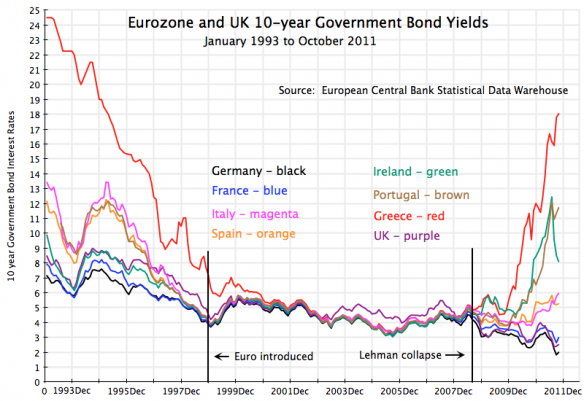
It does not need a PhD in Game Theory to see what the likly outcome of such a system is.
Greece is in the unfortinate situation of beeing the case were this choice has to be made. Its not all their fault, but its also not their fault.
This is just on of the problems of the EU and the Eurozone.
Its my beliefe that if debt should be assumed commonly, it will break up the EU because no voters in any country would agree to this.
It is really sad, and if you want to blame somebody, its the eurocrats who have steamrolled over many economists and many others who have point out the idiocy of their plans.
<< Its my beliefe that if debt should be assumed commonly, it will break up the EU because no voters in any country would agree to this. >>
But that's exactly what happened in the early days of the founding of the US, when Alexander Hamilton negotiated the Funding Act of 1790: "The Funding Act authorized the federal government to receive certificates of state war-incurred debts and to issue federal securities in exchange." https://en.wikipedia.org/wiki/Funding_Act_of_1790
Without the Funding Act, the state governments would've defaulted on their Revolutionary War debt. By assuming the debt of the states, the US greatly strengthened their collective borrowing ability and also brought the states closer together into the union.
But that's exactly what happened in the early days of the founding of the US, when Alexander Hamilton negotiated the Funding Act of 1790: "The Funding Act authorized the federal government to receive certificates of state war-incurred debts and to issue federal securities in exchange." https://en.wikipedia.org/wiki/Funding_Act_of_1790
Without the Funding Act, the state governments would've defaulted on their Revolutionary War debt. By assuming the debt of the states, the US greatly strengthened their collective borrowing ability and also brought the states closer together into the union.
If you WANT a "United State of Europe" then yes, common debt makes sence. But in that case all nations lose their sovereignty and absolutly no nation in the EU has voted on this, and not a single one would agree to this.
I, for one, am against a United States of Europe and theirfore Im against common debt.
If we want to attempted such a project we should start by democratically asking people if they want it, not just imposing it. That EU doing this now would essentially be taking away sovereignty in a undemocratic way, and theirfore it would be tyranny.
I, for one, am against a United States of Europe and theirfore Im against common debt.
If we want to attempted such a project we should start by democratically asking people if they want it, not just imposing it. That EU doing this now would essentially be taking away sovereignty in a undemocratic way, and theirfore it would be tyranny.
The deal is terrible ... I cannot see how it will pass parliament. It is dooming Greece for a century. And on top of that the privatization fund is deeply humiliating.
Krugman agrees that the list of demands is "madness":
http://krugman.blogs.nytimes.com/2015/07/12/killing-the-euro...
I don't understand how they plan on reducing tax evasion if it can be justified as only going to Germany anyway.
I think before you talk about how to reduce tax evasion, you have to figure out why tax evasion is so high to begin with. Are local tax offices hopelessly corrupt? Does there need to be some sort of "untouchables" type operation for the Greek government to root out corruption?
Is it cultural? Does Greece simply need to make tax evasion uncool? Along with coming down on evaders like the US IRS of course.
Is the process of paying taxes simply too onerous? Can the process be streamlined with online resources and stricter employer reporting standards?
It is best if you understand the problem before trying to solve it.
Is it cultural? Does Greece simply need to make tax evasion uncool? Along with coming down on evaders like the US IRS of course.
Is the process of paying taxes simply too onerous? Can the process be streamlined with online resources and stricter employer reporting standards?
It is best if you understand the problem before trying to solve it.
Much higher VAT? Tougher penalties for tax evasion + more thorough investigation?
And the people of Greece would vote for a government that does that?
Do they have a choice at this stage? Personally I don't think austerity is a good way out but when you have no money, no one will give you money, and nobody even wants anything to do with you, there aren't many other choices.
Are we going to wait until Greece has to be bailed out a fourth time? Or a fifth time? What about when Spain defaults? This is going to keep on happening until the underlying problems are addressed. Ultimately, the EU is going to need the ability to tax and spend to redistribute wealth and keep the economies working. It's the same way the US taxes New York, Massachusetts, California, etc... to give to Alabama, Mississippi, Louisiana, and so on.
I know it will be unpopular politically, but the EU really needs to make itself look more like the United States of Europe if it wants this whole unified currency thing to work. They have been trying to ignore the elephant in the room for so long that smaller countries are drowning in its shit.