If that amount was spent on general healthcare, or tackling sugar and air pollution, how many more lives would have been saved?
Given that Vitamin D is a major factor in mortality, its unlikely that Australia would have been hit hard beyond the mortality experienced from regular flu seasons.
They're not pulling it due to seizures, they're pulling it due to CDPR offer refunds, when the Sony policy is explicitly no-refunds if you have already played the game.
The major underappreciated factor for this release is the impact of COVID lockdowns - particularly enforced WFH - on the final development of this title.
For me this is the single factor which has lead to so many of the problems inherent in the game. You cannot just pickup a multi-hundred person digital interactive art project (ie. a video game) and shift it online overnight.
Still, I think CDPR were right to release the game. Its good enough, content is complete, and they need to have the product on shelves before Christmas and before people lose interest in last-gen consoles.
Having the product out there will motivate its staff - still stuck at home in Lockdown Poland - to work on the very public bugs.
Its also interesting that Poland seems to have had basically the same COVID case and death profile as Ukraine, despite Ukraine having a significantly less strict lockdown (bars, restaurants, workplaces never shut this Autumn or Winter).
It would be more effective to just regulate the maximum % commission that these platforms are allowed to charge. Set it at 5% for developers located in the EU, and be done with regulation forever.
But - this method doesn't allow for over-regulation, over-government, and megafines. The benefits go to small and medium-sized European businesses, instead of the European bureaucrat class, so its a no-go.
We can't wait decades for that process to play out. The environment doesn't have the time.
Offer young poor men with one or zero children a vasectomy: and give them a bicycle, a shack with a light, a pressure cooker, a phone, a solar charger and battery. Total cost a few hundred dollars.
This will shortcut what people ultimately materially want and would also fundamentally alleviate poverty.
The solution is even simpler than that: encourage poor people to have one or zero children. Cash handouts to encourage poor men to receive vasectomies for example.
And who is going to come in and fix this water infrastructure, the British?
The fact is that environmental conditions worsen each decade in India and quality of life is lower than in the 70s when the population was 555million (currently 1.3b).
Meanwhile the upper castes flee the country en-masse to the USA, Canada, Australia, Europe.
The Indian population will rise to 1.6b by 2050. It will be substantially easier to fix water infrastructure if this number was hundreds of millions lower. Population management is a bigger part of the solution than pipes and dams.
Then why are they not massively ramping up ICU capacity? Surely the 'cost' of doing that is less than the 'cost' of shutting down huge sections of society?
Why don't we have the same lockdowns when influenza threatens to overwhelm hospitals each year?
Where is the focus on public health interventions such as mass Vitamin D, Vitamin C, Zinc supplemenation, as well as seriously dealing with obesity (banning or taxing added sugar) and air pollution (banning or taxing coal and oil)?
With the core factor being that there are more people than the water supplies can support. The solution here is a one-child or no-child policy, just as in China.
People should be able to go out on their own terms, instead of deteriorating in an aged care centre. It should be completely legal for those aged 80 and over, for example, to seek to end their life - if they decide they have lived all they want, and don't want to suffer the problems associated with old age. This also allows them to choose their time of death, and for their family to remember them in a state of relatively good health.
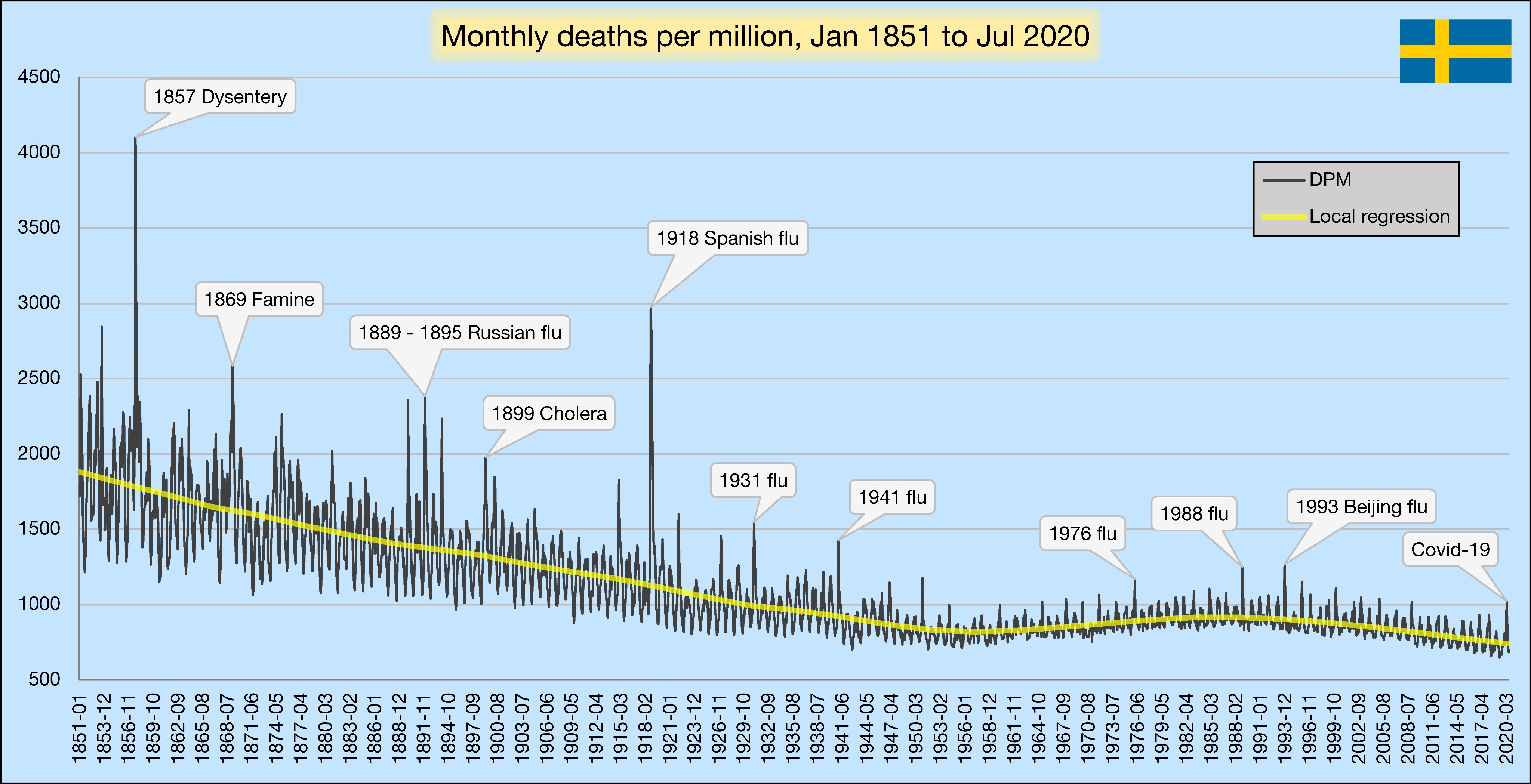
Weekly snapshots are too volatile. If everyone who was going to die in March dies in the first week of March, but none die in the remaining three weeks, this will show a death spike whilst the number of monthly deaths is unchanged. If someone at the end of their natural lifespan dies a few weeks earlier or later than usual, this is not a national concern.
2019 was a weak flu season.
We need to examine this data across broader time scales to avoid the hysteria we are currently experiencing.
The other factor little talked about in Europe is aged carers - usually from Eastern Europe and the FSU - rushing to return home to their families in the midst of border closures, lockdowns, and flight cancellations.
This lead many residents to die of neglect, or for COVID to sweep easily through many centres if the remaining staff worked whilst symptomatic and took shifts across multiple locations.
This is part of the reason why countries in EE and the FSU, as well as those with less strict lockdowns (ie. Sweden), had lower mortality rates than in places like the UK, Spain, Italy, France.
It might be worth reconsidering the whole aged care model, and advancing the idea of voluntary euthanasia for the elderly.
https://www.theguardian.com/environment/2020/apr/24/coronavi...
And air pollution weakens immune systems and makes people more susceptible to respiratory viruses:
https://www.iqair.com/us/blog/health-wellness/air-pollution-...
The effort against COVID should have been directed towards ending the burning of coal and oil.