There Is Gas Under the Tundra(lensculture.com)
lensculture.com
There Is Gas Under the Tundra
https://www.lensculture.com/articles/charles-xelot-there-is-gas-under-the-tundra
77 comments
I think all the photos are beautiful in this article. There's a sense of peaceful harshness in that type of climate.
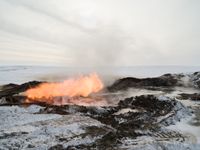
I guess so. But all I can see are extremely fuzzy images.[0] Anyone know why I might be seeing that?
0) https://keybase.pub/mirimir/flare.png
0) https://keybase.pub/mirimir/flare.png

Yup, check your JS blocking and/or connection. I can confirm that the pictures in this article are both high-quality and simply beautiful (especially for those of us who love industrial porn).
I do connect via nested VPNs. Bandwidth isn't bad, but latency is 100-200 msec. Maybe the site is just confused.
Do you have javascript disabled or a slow connection? That looks like a low res image to make the site load quicker before the higher quality (larger file size) images load.
That seems to be it. The HTML for the first image is
So their code is just deranged.
<div class="article-photo-placeholder"><img data-progressive-url="https://prod-lensculture-photos.s3.amazonaws.com/original/ce95b807-b76a-4557-a8ac-bb53cabff94a.jpg" src="https://prod-lensculture-photos.s3.amazonaws.com/small/ce95b807-b76a-4557-a8ac-bb53cabff94a.jpg" class="photo progressive-image-loading"></div>

So their code is just deranged.
The same thing, in Firefox on Linux.
Disabling uBlock origin didn't help, neither did disabling DuckDuckGo privacy extensions.
Disabling uBlock origin didn't help, neither did disabling DuckDuckGo privacy extensions.
Yes, for me as well, Firefox in Linux.
I use NoScript and a bunch of other extensions, but disabling them didn't help. And sure, I could have spent more time debugging it, but damn. These are image files!
I use NoScript and a bunch of other extensions, but disabling them didn't help. And sure, I could have spent more time debugging it, but damn. These are image files!
As others have suggested, I suspect it is because javascript is disabled (I see the same images and I disable javascript).
Websites that "need" javascript to display a 26 year old image format and/or text(!!!) can go pound sand.
Websites that "need" javascript to display a 26 year old image format and/or text(!!!) can go pound sand.
I don't think that it was Javascript per se. I do use NoScript, but I did "temporarily allow all this page". Twice. However, I do block WebRTC, and I didn't disable that.
> Websites that "need" javascript to display a 26 year old image format and/or text(!!!) can go pound sand.
I registered at MeWe. And ever since, I've been getting "Updates at MeWe" with just this: "Please view this email in an HTML compatible email client." Why they can't include plaintext of the actual update is beyond me. I emailed them about it, but never heard back. So I've written them off as clueless.
> Websites that "need" javascript to display a 26 year old image format and/or text(!!!) can go pound sand.
I registered at MeWe. And ever since, I've been getting "Updates at MeWe" with just this: "Please view this email in an HTML compatible email client." Why they can't include plaintext of the actual update is beyond me. I emailed them about it, but never heard back. So I've written them off as clueless.
> Why they can't include plaintext of the actual update is beyond me
Completely understand. The number of mails I have to pipe through w3m or lynx in order to read them has been steadily climbing, and it's obsurd.
Completely understand. The number of mails I have to pipe through w3m or lynx in order to read them has been steadily climbing, and it's obsurd.
I know they are used to it, but I doubt I'd be able to get comfy enough to sleep there!
The pictures are beautiful indeed :)
The pictures are beautiful indeed :)
It was known for a long time that hydrocarbons existed below the ice in this location. Russia simply lacked the expertise to explore it properly and so it there it sat.
To my knowledge, only two companies worldwide possess the ability to explore in such harsh conditions: ExxonMobil and Royal Dutch Shell.
Russia, via Rosneft, opted to partner with ExxonMobil to explore the region and created the project photo-documented by the original post. It is known as Sakhalin-1 [1]. ExxonMobil is the principal operator and a 1/3 partner.
This article by CNBC [2] does a decent job of discussing the project and some of the economic and political issues involved. Personally, I found the contents below the fold the most informative and insightful.
Associated links: [1] https://www.sakhalin-1.com/ [2] https://www.cnbc.com/2016/12/13/exxon-mobil-could-tap-huge-a...
To my knowledge, only two companies worldwide possess the ability to explore in such harsh conditions: ExxonMobil and Royal Dutch Shell.
Russia, via Rosneft, opted to partner with ExxonMobil to explore the region and created the project photo-documented by the original post. It is known as Sakhalin-1 [1]. ExxonMobil is the principal operator and a 1/3 partner.
This article by CNBC [2] does a decent job of discussing the project and some of the economic and political issues involved. Personally, I found the contents below the fold the most informative and insightful.
Associated links: [1] https://www.sakhalin-1.com/ [2] https://www.cnbc.com/2016/12/13/exxon-mobil-could-tap-huge-a...
"ice breaker tankers" just sounds like tempting fate. Or maybe every tanker should be that sturdy /s.
It just means the hull design (and some other things) are different so it can function as its own icebreaker. If anything it's less risky than using normal tankers and constantly trying to clear a path for them.
Tundra will soon experience full freedom.
FYI: There are some NSFW images/links at the bottom of this article.
Clarification: there are two risqué thumbnails to other articles. One of them is a breastfeeding mother and the other is a nudist male seen roughly from the side.
... and it better stays there. Building up more capacity to extract fossil fuels is not what we should be doing right now.
In practice, the shift to renewable electricity and the focus on reducing emissions means more demand for natural gas, since gas generators produce less pollution than coal and are better at responding to changes in demand caused by variation in the renewable energy supply.
Is that really practical though? I mean, it makes sense financially and in terms of how we usually do transition, but we’re frankly running out of time, and maybe we need to be radical rather than practical.
I’m old, I’ve seen how we’ve ignored the warnings for the past 30 years. Worse yet, if you ask people on when sollutuons can be ready, they say 10-20 years, and we only have one decade left to stop our own destruction.
I’m old, I’ve seen how we’ve ignored the warnings for the past 30 years. Worse yet, if you ask people on when sollutuons can be ready, they say 10-20 years, and we only have one decade left to stop our own destruction.
I'm old too and I truly believe that we will continue to be here 10-20 years from now with roughly the same world we've always had.
10-20 years ago places I lived and remembered being quite heavily snowy in the winter just get a bit of dusting at best now.
New England has lost over 600 ski areas. There are fewer and fewer places with good enough conditions to grow coffee (a shame as I feel like the culture around fine coffee is just now coming into existence in the US). Enjoy oysters, clams, and scallops while you can as ocean acidification is killing them in droves. As soil heats due to global warming, it releases carbon dioxide, accelerating these effects.
I don't think the world is the same for anyone working in these industries or in tourism. Folks on HN are also generally isolated from the effects of the kinds of droughts that caused the Arab Spring, or from having to home refugees of climate change whose islands are disappearing to the rising sea levels.
New England has lost over 600 ski areas. There are fewer and fewer places with good enough conditions to grow coffee (a shame as I feel like the culture around fine coffee is just now coming into existence in the US). Enjoy oysters, clams, and scallops while you can as ocean acidification is killing them in droves. As soil heats due to global warming, it releases carbon dioxide, accelerating these effects.
I don't think the world is the same for anyone working in these industries or in tourism. Folks on HN are also generally isolated from the effects of the kinds of droughts that caused the Arab Spring, or from having to home refugees of climate change whose islands are disappearing to the rising sea levels.
At least with the ski areas, gross mismanagement had a significant part to play. Saddleback mountain doesn't get any less snow than Sugarloaf or Sunday River, but it has been repeatedly run into the ground.
Same world in most of the non-coastal parts of the West? Probably. Same world in a lot of low-lying or heat-sensitive third world countries? Probably not.
It has been argued that Yemen is the first resource exhaustion war - the country has extremely limited water supplies.
The West is going to have to look at the possibility of a lot of refugees in the future, with the option of taking them in or watching them die.
It has been argued that Yemen is the first resource exhaustion war - the country has extremely limited water supplies.
The West is going to have to look at the possibility of a lot of refugees in the future, with the option of taking them in or watching them die.
The west won’t go free. Heatwaves have been killing thousands for the past decades in Europe, and extreme weather is really fucking with America.
Being near the cost isn’t necessarily worse than being inland as the sea can help regulate the extreme temperatures. I live in a costal city which basically sits around 100meters above sea level, on a good foundation, so the higher amount of rainfall and increasing sea levels aren’t really a worry. I work in another city 40km in land. In the winter my work place can be absolutely frozen while my hometown sits around 0 degrees, and vice versa in the summer. We had a really bad heatwave this summer, but it was 5 degrees worse at my work place than my home.
But basically you’re only going to be fine if you live as far north as Canada or northern Germany.
You’re spot on about climate refugees though. Syria was/is a war about water control, and now Yemen is in the same boat.
The real worry isn’t that though. It’s all the methane gas locked in the permafrost. It might make the air unbreatheable to humans, and then the rest really won’t matter.
Being near the cost isn’t necessarily worse than being inland as the sea can help regulate the extreme temperatures. I live in a costal city which basically sits around 100meters above sea level, on a good foundation, so the higher amount of rainfall and increasing sea levels aren’t really a worry. I work in another city 40km in land. In the winter my work place can be absolutely frozen while my hometown sits around 0 degrees, and vice versa in the summer. We had a really bad heatwave this summer, but it was 5 degrees worse at my work place than my home.
But basically you’re only going to be fine if you live as far north as Canada or northern Germany.
You’re spot on about climate refugees though. Syria was/is a war about water control, and now Yemen is in the same boat.
The real worry isn’t that though. It’s all the methane gas locked in the permafrost. It might make the air unbreatheable to humans, and then the rest really won’t matter.
> I'm old too
That doesn't mean you get to mess it up for the rest of us.
That doesn't mean you get to mess it up for the rest of us.
Flow batteries, where charged electrolyte can be stockpiled, are under heavy development. These would allow us to finally make the grid 100% fossil fuel free.
Also, I firmly believe that we can figure out how to make things like methane and oil from biological processes; it's just that extracting it from the ground is cheaper.
Maybe I'm too optimistic, but I think we're quickly getting to a point where this is a political problem instead of a technology problem.
Also, I firmly believe that we can figure out how to make things like methane and oil from biological processes; it's just that extracting it from the ground is cheaper.
Maybe I'm too optimistic, but I think we're quickly getting to a point where this is a political problem instead of a technology problem.
Making methane and oil from known biological processes is quite inefficient, even if a lot of energy input comes just from exposure to sunlight.
We have to either bio-engineer organisms to make them better producers (as we do for producing medicines, etc), or use any of the non-biologic processes for fuel synthesis, like Fischer-Tropsch.
We have to either bio-engineer organisms to make them better producers (as we do for producing medicines, etc), or use any of the non-biologic processes for fuel synthesis, like Fischer-Tropsch.
"it's just that extracting it from the ground is cheaper"
Why is it destruction and not just it will be more costly to adapt? Why suppose that we can't figure out a way to scrub C02 from the atmosphere, or offset it some other way? Why can't humanity, who managed to survive an ice age with stone aged tools, figure out a way to survive a warmer planet with modern tech?
Thermodynamics comes into play. Because the entropy of a pure gas increases rapidly as it diffuses into a mixture, it will always require massively more energy to scrub CO2 from the air than you get from burning the carbon in the first place.
Scrubbing would only become possible if we either:
- develop unlimited free energy (fusion, or incredibly cheap solar)
- let plants do the work for us, harvesting the Earth's tremendous isolation.
Either of these solutions almost implies that the climate battle is already won. In the first case, if clean energy is cheap enough to scrub carbon, then it is cheap enough to displace all other power sources. In the latter case, the slow pace of photosynthesis means we'd have to stop burning carbon (and stop burning forests) for a long time until CO2 concentrations stabilize, which is exactly what the Kyoto protocol was all about.
Scrubbing would only become possible if we either:
- develop unlimited free energy (fusion, or incredibly cheap solar)
- let plants do the work for us, harvesting the Earth's tremendous isolation.
Either of these solutions almost implies that the climate battle is already won. In the first case, if clean energy is cheap enough to scrub carbon, then it is cheap enough to displace all other power sources. In the latter case, the slow pace of photosynthesis means we'd have to stop burning carbon (and stop burning forests) for a long time until CO2 concentrations stabilize, which is exactly what the Kyoto protocol was all about.
There's also geoengineering. While it's risky and controversial, it will become a real option if we are faced with bad enough consequences otherwise. Doomsday predictions assume we can't figure out a way to adapt or counter the climate change.
I agree. But I haven't heard a plausible geoengineering plan proposed yet. This is the part where engineers should be able to provide an answer today, achievable with our existing technology. It isn't enough to wave one's hands and assume that a solution can be developed someday when we're in deep enough trouble.
With our technology, it's still considered a nation-scale accomplishment to build a bridge spanning 55 km, or a dam spanning 2 km. Those kinds of engineering accomplishments are currently the likes of which most nations can only dream.
All we can currently do on the planetary scale is resource extraction -- fishing, strip mining, and deforestation. And accidentally altering the atmospheric composition of course.
I guess we can try to cover the entire ocean in floating white plastic pellets, to increase its albedo? That would probably work.
With our technology, it's still considered a nation-scale accomplishment to build a bridge spanning 55 km, or a dam spanning 2 km. Those kinds of engineering accomplishments are currently the likes of which most nations can only dream.
All we can currently do on the planetary scale is resource extraction -- fishing, strip mining, and deforestation. And accidentally altering the atmospheric composition of course.
I guess we can try to cover the entire ocean in floating white plastic pellets, to increase its albedo? That would probably work.
Cold is easier to survive than heat. Humans can't do any useful work outside or even survive once the web bulb temperature reaches a certain point. For example at 90% humidity the temperature limit is 35℃. Some tropical areas will become essentially uninhabitable.
https://insideclimatenews.org/news/02082017/heatwaves-deadly...
https://insideclimatenews.org/news/02082017/heatwaves-deadly...
Some tropical areas becoming uninhabitable doesn't sound like doomsday. It sounds like people have to be relocated, or stay indoors during part of the day or season. Which might mean increased automation in that part of the world to replace manual labor.
Is that supposed to be some kind of joke? We're talking about mass migrations to cooler areas. Wealthy people might be able to crank up the AC and hide inside but the poor will just die. If the predictions do come to pass then it literally will be doomsday for parts of the world.
So doomsday for part of the world or doomsday for the human race? The parent's claim was we have ten years or we face doomsday without qualifications.
As for migrating to cooler climates , what is the time scale? A century? 50 years? 20 years? What about technological solutions that come into existence during that time frame? Are we going to discount them?
Doomsday implies the human race can't adapt.
As for migrating to cooler climates , what is the time scale? A century? 50 years? 20 years? What about technological solutions that come into existence during that time frame? Are we going to discount them?
Doomsday implies the human race can't adapt.
>For example at 90% humidity the temperature limit is 35℃.
This seems weird. A lot of tropical places are both hotter and more humid than this limit, and people seem to have adapted.
This seems weird. A lot of tropical places are both hotter and more humid than this limit, and people seem to have adapted.
>A lot of tropical places are both hotter and more humid than this limit
Where? As far as I can tell, the highest wet-bulb temperatures are around the Persian Gulf, and although they sometimes come close to the human survival limit, they do not yet exceed it.
https://blogs.ei.columbia.edu/2017/12/22/humidity-may-prove-...
Where? As far as I can tell, the highest wet-bulb temperatures are around the Persian Gulf, and although they sometimes come close to the human survival limit, they do not yet exceed it.
https://blogs.ei.columbia.edu/2017/12/22/humidity-may-prove-...
Temperature exceeds 35C, and humidity exceeds 90%, but not both at the same time.
[flagged]
The radicals fucked us all over by agitating against nuke power in the 70s. Free love and climate change, man.
Would you please stop posting to HN like this? It breaks several of the site guidelines. Please read and follow them:
https://news.ycombinator.com/newsguidelines.html
https://news.ycombinator.com/newsguidelines.html
I'm not sure what that means? Posting facts that oppose common narratives? I'm not going to do that.
The ocean is filled with nuclear waste world wide from one plant leaking. You can't eat food grown in huge areas of Europe.
The last generation plants were a military money hack. The plants that got funded interestingly were good at producing materials used for bombs. Not good designs that are financially viable without military money. Or even designs that are safe.
They are too expensive to close down properly. That's why not one has been closed down in the USA. That's not a safe design.
If the military jerks didn't hijack things so the power plants were designed wrong we would probably have had better designs made and more research going into the right directions. Instead we have a sea of toxic waste and bullshit plants to clean up.
Blaming environmentalists is fucking stupid.
What's your counter argument? Something like...
War is peace, hate is love, ignorance is strength?
Bullshit.
The last generation plants were a military money hack. The plants that got funded interestingly were good at producing materials used for bombs. Not good designs that are financially viable without military money. Or even designs that are safe.
They are too expensive to close down properly. That's why not one has been closed down in the USA. That's not a safe design.
If the military jerks didn't hijack things so the power plants were designed wrong we would probably have had better designs made and more research going into the right directions. Instead we have a sea of toxic waste and bullshit plants to clean up.
Blaming environmentalists is fucking stupid.
What's your counter argument? Something like...
War is peace, hate is love, ignorance is strength?
Bullshit.
> You can't eat food grown in huge areas of Europe.
Do you mean Tschernobyl? It depends how you define 'huge areas in Europe', there is a good overview on Wikipedia: https://en.wikipedia.org/wiki/Chernobyl_disaster#National_an...
According to this table, 10 % of Austria is contamined with 37–185 kBq/m2 (lowest contamination of this table). You can eat food grown anywhere in Austria, I do not know where 'food not edible' starts.
But just the fact that you now have to discuss such things is wrong enough.
Do you mean Tschernobyl? It depends how you define 'huge areas in Europe', there is a good overview on Wikipedia: https://en.wikipedia.org/wiki/Chernobyl_disaster#National_an...
According to this table, 10 % of Austria is contamined with 37–185 kBq/m2 (lowest contamination of this table). You can eat food grown anywhere in Austria, I do not know where 'food not edible' starts.
But just the fact that you now have to discuss such things is wrong enough.
thrower123(1)
But they still produce half as much CO2 as coal, and if you count methane leaks they may be even more damaging to the climate.
If renewables plus storage aren't enough to get us to zero emissions, we need nuclear.
If renewables plus storage aren't enough to get us to zero emissions, we need nuclear.
It might still be better to extract it and burn it than to let it off-gas into the atmosphere on its own when the ice melts. Methane is a significantly stronger greenhouse gas than carbon dioxide.
You've got it wrong if you are worried about the greenhouse effect.
If humans don't extract and burn the gas, the gas will be released as-is into the atmosphere by beavers thawing out the permafrost.[1] Natural gas is actually a stronger greenhouse gas than its combustion products.[2]
[1] https://www.alaskapublic.org/2018/07/11/beavers-are-moving-i...
[2] "Natural gas is thus a more potent greenhouse gas than carbon dioxide due to the greater global-warming potential of methane" https://en.wikipedia.org/wiki/Natural_gas#Natural_gas
If humans don't extract and burn the gas, the gas will be released as-is into the atmosphere by beavers thawing out the permafrost.[1] Natural gas is actually a stronger greenhouse gas than its combustion products.[2]
[1] https://www.alaskapublic.org/2018/07/11/beavers-are-moving-i...
[2] "Natural gas is thus a more potent greenhouse gas than carbon dioxide due to the greater global-warming potential of methane" https://en.wikipedia.org/wiki/Natural_gas#Natural_gas
> Natural gas is actually a stronger greenhouse gas than its combustion products
But it naturally decomposes into CO2 in a few years once in the atmosphere, so the net effect is more or less the same.
The GP is right: it would be much better if the methane just stays where it is.
But it naturally decomposes into CO2 in a few years once in the atmosphere, so the net effect is more or less the same.
The GP is right: it would be much better if the methane just stays where it is.
The net effect is not even close to the same; it's far worse.
Methane is ~36x more potent as a greenhouse gas over a 100-year timespan. This includes the eventual decay to CO2.
Methane is ~36x more potent as a greenhouse gas over a 100-year timespan. This includes the eventual decay to CO2.
Source?
Here's what I have:
https://en.wikipedia.org/wiki/Atmospheric_methane
"Methane has a large effect but for a relatively brief period, having an estimated lifetime of 9.1 years in the atmosphere..."
Either way, the conclusion is the same: better to leave it where it is.
Here's what I have:
https://en.wikipedia.org/wiki/Atmospheric_methane
"Methane has a large effect but for a relatively brief period, having an estimated lifetime of 9.1 years in the atmosphere..."
Either way, the conclusion is the same: better to leave it where it is.
>"Source?"
I just searched "methane 36x more potent", here is a random result:
"CO2, by definition, has a GWP of 1... Methane (CH4) is estimated to have a GWP of 28–36 over 100 years" https://www.epa.gov/ghgemissions/understanding-global-warmin...
>"Either way, the conclusion is the same: better to leave it where it is."
So, you are in favor of the gas being released as methane then? Your reasoning is not clear.
EDIT:
To make it clear: Humans burning this gas for fuel leads to less greenhouse effect than would otherwise occur.
I just searched "methane 36x more potent", here is a random result:
"CO2, by definition, has a GWP of 1... Methane (CH4) is estimated to have a GWP of 28–36 over 100 years" https://www.epa.gov/ghgemissions/understanding-global-warmin...
>"Either way, the conclusion is the same: better to leave it where it is."
So, you are in favor of the gas being released as methane then? Your reasoning is not clear.
EDIT:
To make it clear: Humans burning this gas for fuel leads to less greenhouse effect than would otherwise occur.
I'm in favor of radical curtailment of the burning of all fossil fuels. Anything short of that is going to be catastrophic. Yes, I know this is a pipe dream at this point. But a boy can still dream.
Deciding whether or not to burn this methane is kind of like being adrift on the north Atlantic and deciding whether or not to burn the ship to stay warm.
Deciding whether or not to burn this methane is kind of like being adrift on the north Atlantic and deciding whether or not to burn the ship to stay warm.
I think you are underestimating how much methane there is under there.
>"There is a huge amount of carbon stored in permafrost. Right now, the Earth's atmosphere contains about 850 gigatons of carbon. (A gigaton is one billion tons—about the weight of one hundred thousand school buses). We estimate that there are about 1,400 gigatons of carbon frozen in permafrost." https://nsidc.org/cryosphere/frozenground/methane.html
The beavers are going to do their thing and create comfortable habitats for themselves, which is melting the permafrost. So it looks like this gas is coming out one way or the other.
>"There is a huge amount of carbon stored in permafrost. Right now, the Earth's atmosphere contains about 850 gigatons of carbon. (A gigaton is one billion tons—about the weight of one hundred thousand school buses). We estimate that there are about 1,400 gigatons of carbon frozen in permafrost." https://nsidc.org/cryosphere/frozenground/methane.html
The beavers are going to do their thing and create comfortable habitats for themselves, which is melting the permafrost. So it looks like this gas is coming out one way or the other.
Oil and gas are the only reliable Russian exports.
Economic pressure on Russia leads to increase of importance of oil and gas sector as other sectors plunge. This leads to more capacity, more offering. Which leads to price correction, even more offering as prices fall and have to be made for. Which in total leads to massive use of cheap gas.
If there was someone committed to decrease in fossil fuel usage they will be making sure that Russia turns into Norway economically and politically. Meaning much fewer extraction of much more expensive fuels and more effort to not knock the ecology in the process.
Economic pressure on Russia leads to increase of importance of oil and gas sector as other sectors plunge. This leads to more capacity, more offering. Which leads to price correction, even more offering as prices fall and have to be made for. Which in total leads to massive use of cheap gas.
If there was someone committed to decrease in fossil fuel usage they will be making sure that Russia turns into Norway economically and politically. Meaning much fewer extraction of much more expensive fuels and more effort to not knock the ecology in the process.
> Oil and gas are the only reliable Russian exports.
Just to corroborate this, I found this interesting website [1].
"The top exports of Russia are Crude Petroleum ($75.7B), Refined Petroleum ($43.1B), Petroleum Gas ($16B), Coal Briquettes ($10.4B) and Raw Aluminium ($6.08B)"
[1] https://atlas.media.mit.edu/en/profile/country/rus/
Just to corroborate this, I found this interesting website [1].
"The top exports of Russia are Crude Petroleum ($75.7B), Refined Petroleum ($43.1B), Petroleum Gas ($16B), Coal Briquettes ($10.4B) and Raw Aluminium ($6.08B)"
[1] https://atlas.media.mit.edu/en/profile/country/rus/
It is also an eye-opener that food is so cheap these days you can make more from selling Diamonds mined at 2-3 locations than from selling Wheat grown all over the map.
What happens when those exports stop being reliable, if and when renewables get cheap enough that electrolysing hydrogen from water is still cheaper than mining methane from Siberia despite the inefficiency of the former?
>What happens when those exports stop being reliable
The last time it happened - mid 198x - the USSR collapsed.
The oil price drop in 2014-2016 delivered a significant jolt to Russia causing economical crisis https://en.wikipedia.org/wiki/Russian_financial_crisis_(2014.... Among other effects, that affected new weapons systems and armed forces modernization, etc. It also lead to very unpopular pension (social security) eligibility age increase. Also https://en.wikipedia.org/wiki/Russian_financial_crisis_(2014... :
"According to New World Wealth study, over 2,000 millionaires emigrated from Russia."
The last time it happened - mid 198x - the USSR collapsed.
The oil price drop in 2014-2016 delivered a significant jolt to Russia causing economical crisis https://en.wikipedia.org/wiki/Russian_financial_crisis_(2014.... Among other effects, that affected new weapons systems and armed forces modernization, etc. It also lead to very unpopular pension (social security) eligibility age increase. Also https://en.wikipedia.org/wiki/Russian_financial_crisis_(2014... :
"According to New World Wealth study, over 2,000 millionaires emigrated from Russia."
Nobody knows for sure. Maybe a Syria-style (but ten times stronger) migration from Russia westwards?
It is assumed that Syrian crisis started happening when its Oil exports dipped in red, as in existing Syrian economy would consume more Oil than they were capable to extract. Worsening climate did not help of course.
It is assumed that Syrian crisis started happening when its Oil exports dipped in red, as in existing Syrian economy would consume more Oil than they were capable to extract. Worsening climate did not help of course.
Love the guy taking a rest in the snow.