James Webb Space Telescope (JWST) first full-color image(nasa.gov)
nasa.gov
James Webb Space Telescope (JWST) first full-color image
https://www.nasa.gov/sites/default/files/styles/full_width/public/thumbnails/image/main_image_deep_field_smacs0723-1280.jpg
9 comments
For comparison, here's a view of SMACS 0723 from Hubble:
https://bigthink.com/wp-content/uploads/2022/07/smacs0723-73...
> This image of galaxy cluster SMACS 0723 has been constructed from blue, green, and red filters aboard Hubble, along with four infrared filter views of the cluster’s central regions. Hubble viewed this object to wavelengths of ~1600 nanometers; [1]
[1] https://bigthink.com/starts-with-a-bang/universe-before-jwst...
https://bigthink.com/wp-content/uploads/2022/07/smacs0723-73...
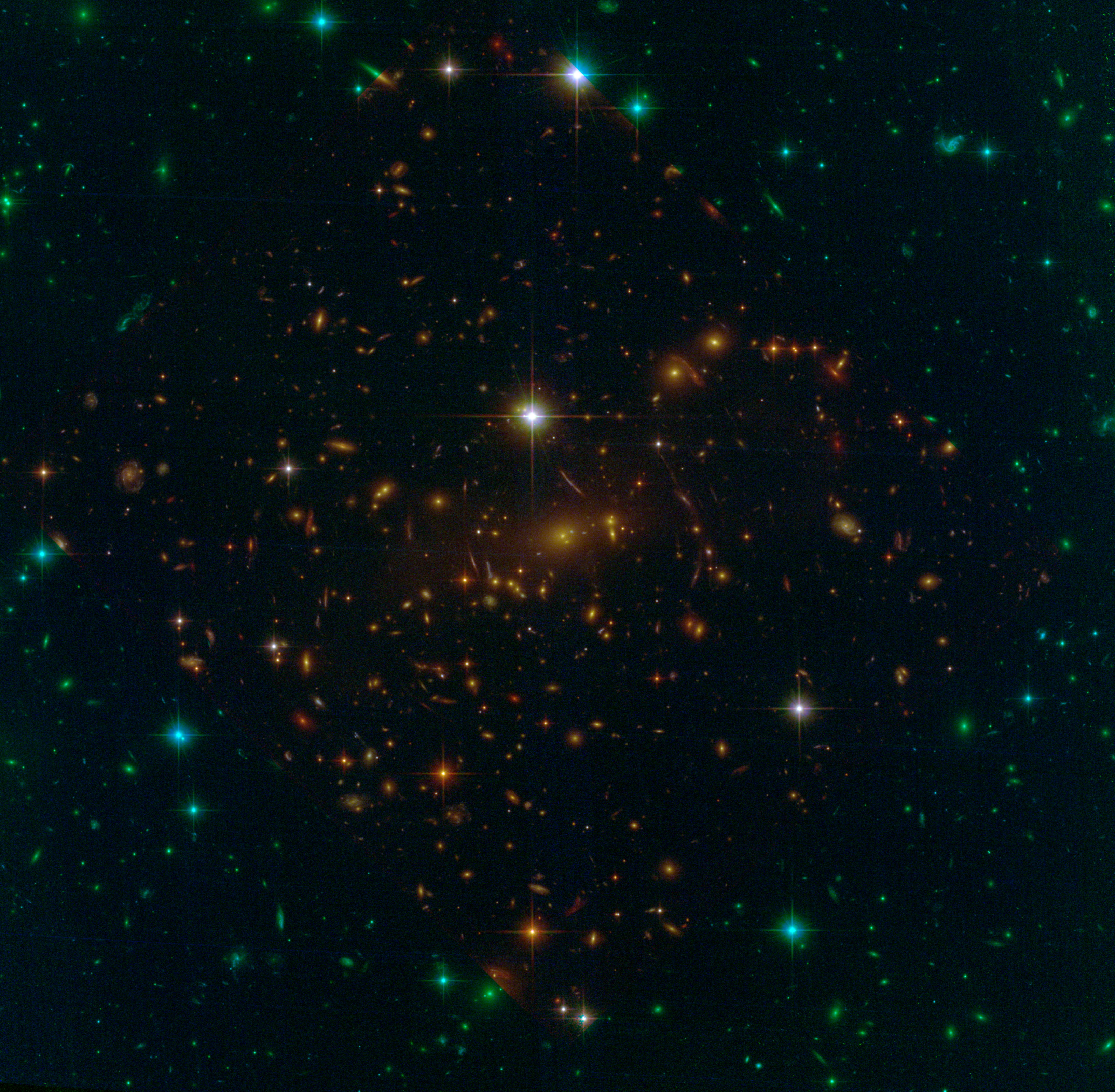
> This image of galaxy cluster SMACS 0723 has been constructed from blue, green, and red filters aboard Hubble, along with four infrared filter views of the cluster’s central regions. Hubble viewed this object to wavelengths of ~1600 nanometers; [1]
[1] https://bigthink.com/starts-with-a-bang/universe-before-jwst...
Since I'm a complete noob at astronomy, I wanted to ask a couple of basic questions about the image:
1. What causes the bright flares/flashes around some bright starts/galaxies?
2. What are the elongated traces that look as if the telescope moved/rotated while capturing the image?
3. Why do some of the smaller flares seem to be doubled (e.g. 3 stars in the top-right corner of the image)?
Thanks in advance to anybody patient enough to explain.
1. What causes the bright flares/flashes around some bright starts/galaxies?
2. What are the elongated traces that look as if the telescope moved/rotated while capturing the image?
3. Why do some of the smaller flares seem to be doubled (e.g. 3 stars in the top-right corner of the image)?
Thanks in advance to anybody patient enough to explain.
[deleted]
1. Those are diffraction spikes that reflects the structure of the mirror, which is composed of hexagonal elements.
2. That is background galaxies that are distorted and heavily magnified due to gravitational lensing, gravity from a foreground galaxy can bend the light just like a lens (the sun bending the light from stars during an eclipse was an early test of general relativity just after WWI)
2. That is background galaxies that are distorted and heavily magnified due to gravitational lensing, gravity from a foreground galaxy can bend the light just like a lens (the sun bending the light from stars during an eclipse was an early test of general relativity just after WWI)
Duplication can also come from gravitation lensing, as the light from the bright thing bends around either side of the heavy thing
I can see lots of galaxies that are rather dim. Are the stars with diffraction spikes really close or just extra bright?
There should be some post post-processing algorithms that can remove/clean hex elements, right?
We’ve come a long way since Einstein ́s Eclipse in 1919 when it comes to observing gravitational lensing.
https://www.discovermagazine.com/the-sciences/how-the-1919-s...
https://www.discovermagazine.com/the-sciences/how-the-1919-s...
Update: Hi resolution image also available here https://esawebb.org/media/archives/images/original/webb-firs... (4537x4630, ~39MB)