Recreating the THX Deep Note (2009)(earslap.com)
earslap.com
Recreating the THX Deep Note (2009)
https://earslap.com/article/recreating-the-thx-deep-note.html
27 comments
> Absolutely crazy how people can fit all these things into these short snippets of code.
It reminds me of Qrpff[0] a six or seven line (depending on version) Perl program that could be used to strip DSS from DVDs.
[0] https://en.wikipedia.org/wiki/Qrpff
It reminds me of Qrpff[0] a six or seven line (depending on version) Perl program that could be used to strip DSS from DVDs.
[0] https://en.wikipedia.org/wiki/Qrpff
>> Absolutely crazy how people can fit all these things into these short snippets of code.
This reminded me of "A Mind Is Born"[0]
https://www.linusakesson.net/scene/a-mind-is-born/index.php
This reminded me of "A Mind Is Born"[0]
https://www.linusakesson.net/scene/a-mind-is-born/index.php
That's insane. Looking the person up, I guess it isn't a surprise that they're working at Teenage Engineering now.
The demoscene is one of the areas of niche computing that's always interesting to me, even though I completely lack the skillset and even the interest to do things like that.
The demoscene is one of the areas of niche computing that's always interesting to me, even though I completely lack the skillset and even the interest to do things like that.
That’s haunting / hypnotic
This reminded me of the One-Liner Mathematica competition that Wolfram holds:
https://blog.wolfram.com/2022/10/28/winners-of-the-2022-one-...
https://blog.wolfram.com/2021/11/24/the-winners-of-the-2021-...
https://blog.wolfram.com/2020/10/20/the-winners-of-the-2020-...
https://blog.wolfram.com/2022/10/28/winners-of-the-2022-one-...
https://blog.wolfram.com/2021/11/24/the-winners-of-the-2021-...
https://blog.wolfram.com/2020/10/20/the-winners-of-the-2020-...
Huh. That resolution was not at all what I expected, but somehow just as good.
I'm no good with music theory, but this sounds like it resolves to a diminished chord as opposed to the original major chord. It's deeply menacing instead of triumphant. I really like it.
I'm no good with music theory, but this sounds like it resolves to a diminished chord as opposed to the original major chord. It's deeply menacing instead of triumphant. I really like it.
To me it sounds almost like converging Shepard tones from both sides of the spectrum, and I agree that the resolution is not the same chord (or at least there's a different quality to it).
USPTO MP3 Correct Link: https://www.uspto.gov/sites/default/files/74309951.mp3
Better audio at https://www.youtube.com/watch?v=uYMpMcmpfkI
Inevitable Simpsons clip:
https://www.youtube.com/watch?v=nu0R96OZy6w
https://www.youtube.com/watch?v=nu0R96OZy6w
And “Tiny Toon Adventures: How I Spent My Vacation” (1992) https://www.youtube.com/watch?v=hByt1KkiwgM
Personally, I prefer the acapella version:
https://youtu.be/bzVXFTGy2OY?si=kygVDnb7OtDwwmni
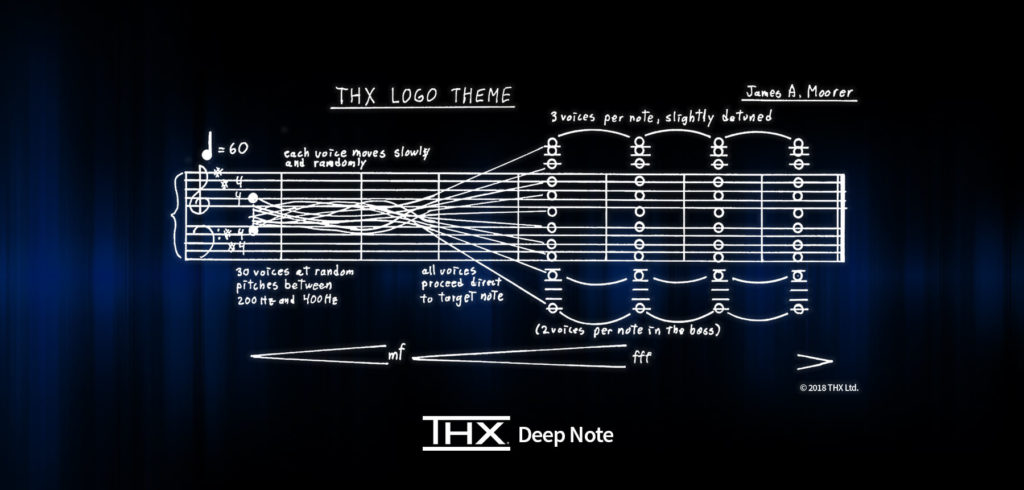
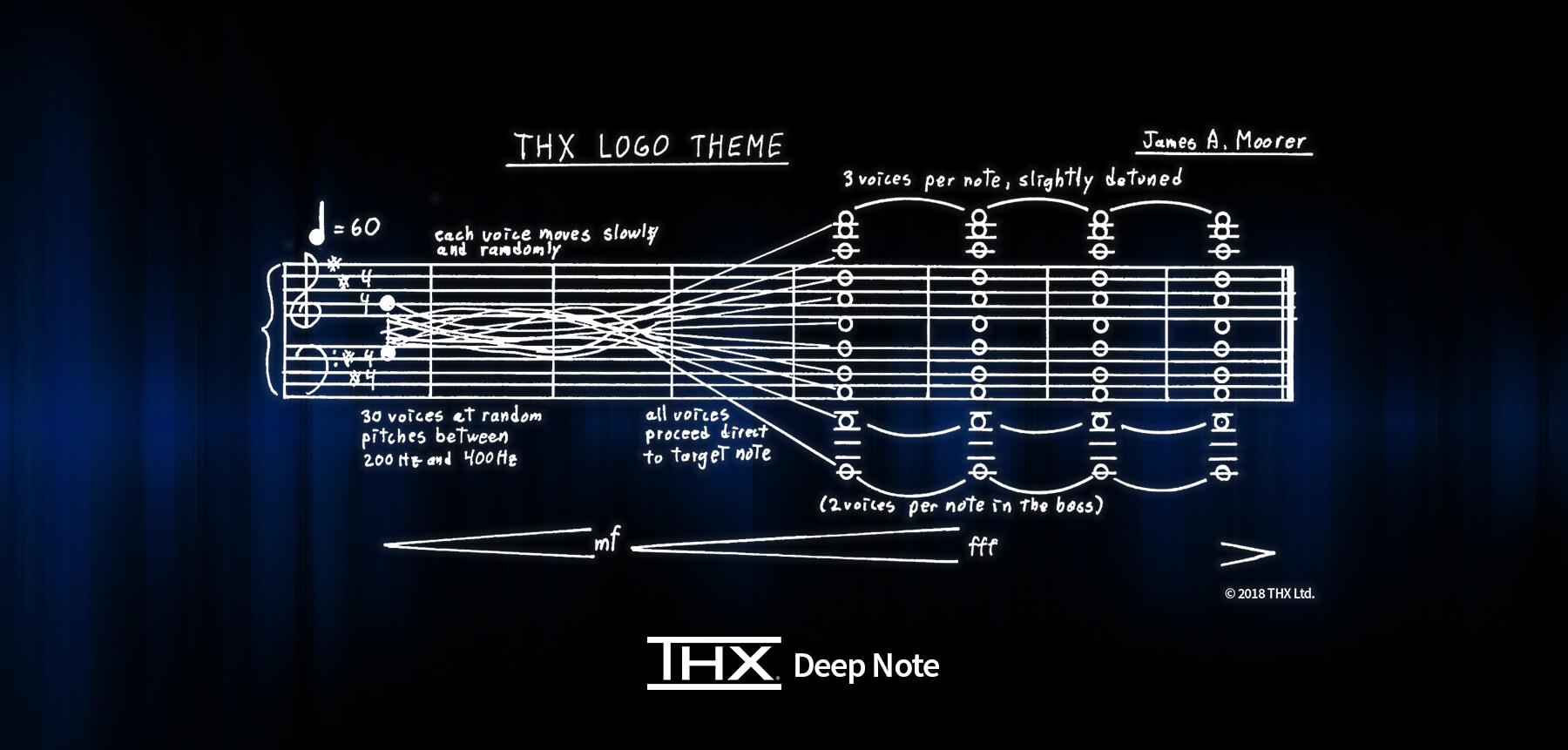
It's always fun to go on a THX Deep Note rabbit hole trip, finding all the people who have replicated it.
Here's a neat example I just found where the original sound is just repeated and mixed at increasingly high numbers: https://www.youtube.com/watch?v=CvipzurlCK0. Pretty awesome.
This Pure Data recreation is pretty great: https://www.youtube.com/watch?v=Rz1uNLHorEs
Here's a neat example I just found where the original sound is just repeated and mixed at increasingly high numbers: https://www.youtube.com/watch?v=CvipzurlCK0. Pretty awesome.
This Pure Data recreation is pretty great: https://www.youtube.com/watch?v=Rz1uNLHorEs
I remember some years ago I saw a YouTube video of a guy who did a recreation of this in some sort of Audio Programming Language (it might have been SonicPI or something).
He started off by claiming he wanted to create the sound of a hundred bees or something, then he coded these, and bit by bit he re-created the Deep Note. Since the video wasn't titled after that, it was quite a surprise.
I can't seem to find that video anymore, if anyone has a link, please share it :)
He started off by claiming he wanted to create the sound of a hundred bees or something, then he coded these, and bit by bit he re-created the Deep Note. Since the video wasn't titled after that, it was quite a surprise.
I can't seem to find that video anymore, if anyone has a link, please share it :)
From TFA: "The sound recording used for the patent application can be listened from here:
http://www.uspto.gov/go/kids/soundex/74309951.mp3
Be sure to listen the sound because we will be referring to that particular recording when we have a go at recreating the Deep Note."
Too bad the link returns a 404. No referring for you
http://www.uspto.gov/go/kids/soundex/74309951.mp3
Be sure to listen the sound because we will be referring to that particular recording when we have a go at recreating the Deep Note."
Too bad the link returns a 404. No referring for you
Found it by searching by the id in the original URL here
https://www.uspto.gov/sites/default/files/74309951.mp3
https://www.uspto.gov/sites/default/files/74309951.mp3
Link to the audio programming language / server they're using in the article: https://github.com/supercollider/supercollider
Can someone explain how I’m what universe this takes 20,000 lines of code?
Q. A couple of people have already asked me about how you wound up with 20,000 lines of code in the original. I expect there was a fair bit of manual mucking about?
A. Actually I made a mistake with that 20,000 lines of code statement – that was just off the top of my head. I need to correct that if I can figure out how, but it also depends a bit on what lines of code you count. The original 30-year-old C program is 325 lines, and the “patch” file for the synthesizer was 298 more lines. I guess it just felt like 20,000 lines when I did it.
Given that it was written and debugged in 4 days, I can’t claim the programming chops to make 20,000 lines of working code that quickly. But, to synthesize it in real time, in 1983, took 2 years to design and build a 19” rack full of digital hardware and 200,000 lines of system code to run the synthesizer. All that was already done, so I was building on a large foundation of audio processing horsepower, both hardware and software. Consequently, a mere 325 lines of C code and 298 lines of audio patching setup for the 30 voices was enough to invoke the audio horsepower to make the piece.
https://cdm.link/2015/04/thx-deep-note-creator-remade-iconic...
A. Actually I made a mistake with that 20,000 lines of code statement – that was just off the top of my head. I need to correct that if I can figure out how, but it also depends a bit on what lines of code you count. The original 30-year-old C program is 325 lines, and the “patch” file for the synthesizer was 298 more lines. I guess it just felt like 20,000 lines when I did it.
Given that it was written and debugged in 4 days, I can’t claim the programming chops to make 20,000 lines of working code that quickly. But, to synthesize it in real time, in 1983, took 2 years to design and build a 19” rack full of digital hardware and 200,000 lines of system code to run the synthesizer. All that was already done, so I was building on a large foundation of audio processing horsepower, both hardware and software. Consequently, a mere 325 lines of C code and 298 lines of audio patching setup for the 30 voices was enough to invoke the audio horsepower to make the piece.
https://cdm.link/2015/04/thx-deep-note-creator-remade-iconic...
1982 (pre-ANSI C!), without any audio library or hardware driver to handle things for you, so 20,000 lines of code encompasses the whole audio stack.
With that in mind, the 140-char snippet at the end is an unfair comparison, since that leverages a sophisticated and mature audio stack provided by the OS and Supercollider.
With that in mind, the 140-char snippet at the end is an unfair comparison, since that leverages a sophisticated and mature audio stack provided by the OS and Supercollider.
A universe where you are not standing on the shoulders of giants.
For a little context the deep note was released the same year as TCP/IP and the Commodore 64. Source code was mostly shared by printing it in magazines (multi-page printed publications that would be mailed to your house monthly in exchange for a yearly subscription fee).
For a little context the deep note was released the same year as TCP/IP and the Commodore 64. Source code was mostly shared by printing it in magazines (multi-page printed publications that would be mailed to your house monthly in exchange for a yearly subscription fee).
I don't disagree with you but a comment above shows the truth, that it was 400 lines and 200,000 lines of synth code he didn't write. Anyway, it is still cool.
1000 oscillators version: https://m.youtube.com/watch?t=300&v=c3wk9WWTfNs
WebAudio version
https://github.com/stoyan/deepnote
The repo has slides with helpful links for those looking for a rabbit hole. Especially nice is a podcast interview with the original engineer James Moorer which sheds a lot of light on the implementation
The repo has slides with helpful links for those looking for a rabbit hole. Especially nice is a podcast interview with the original engineer James Moorer which sheds a lot of light on the implementation
> play{Mix({|k|k=k+1/2;2/kMix({|i|i=i+1;Blip.ar(iXLine.kr(rand(2e2,4e2),87+LFNoise2.kr(2)k,15),2,1/(i/a=XLine.kr(0.3,1,9))/9)}!9)}!40)!2a}
> http://earslap.com/assets/thxdeepsound/soundtweet.mp3
Absolutely crazy how people can fit all these things into these short snippets of code. The demo scene impresses me equally in this.