Can anyone tell if this architecture makes sense to ship in their actual cars to replace whatever is doing the computation there now? That is the only way I can see this making any sense to develop.
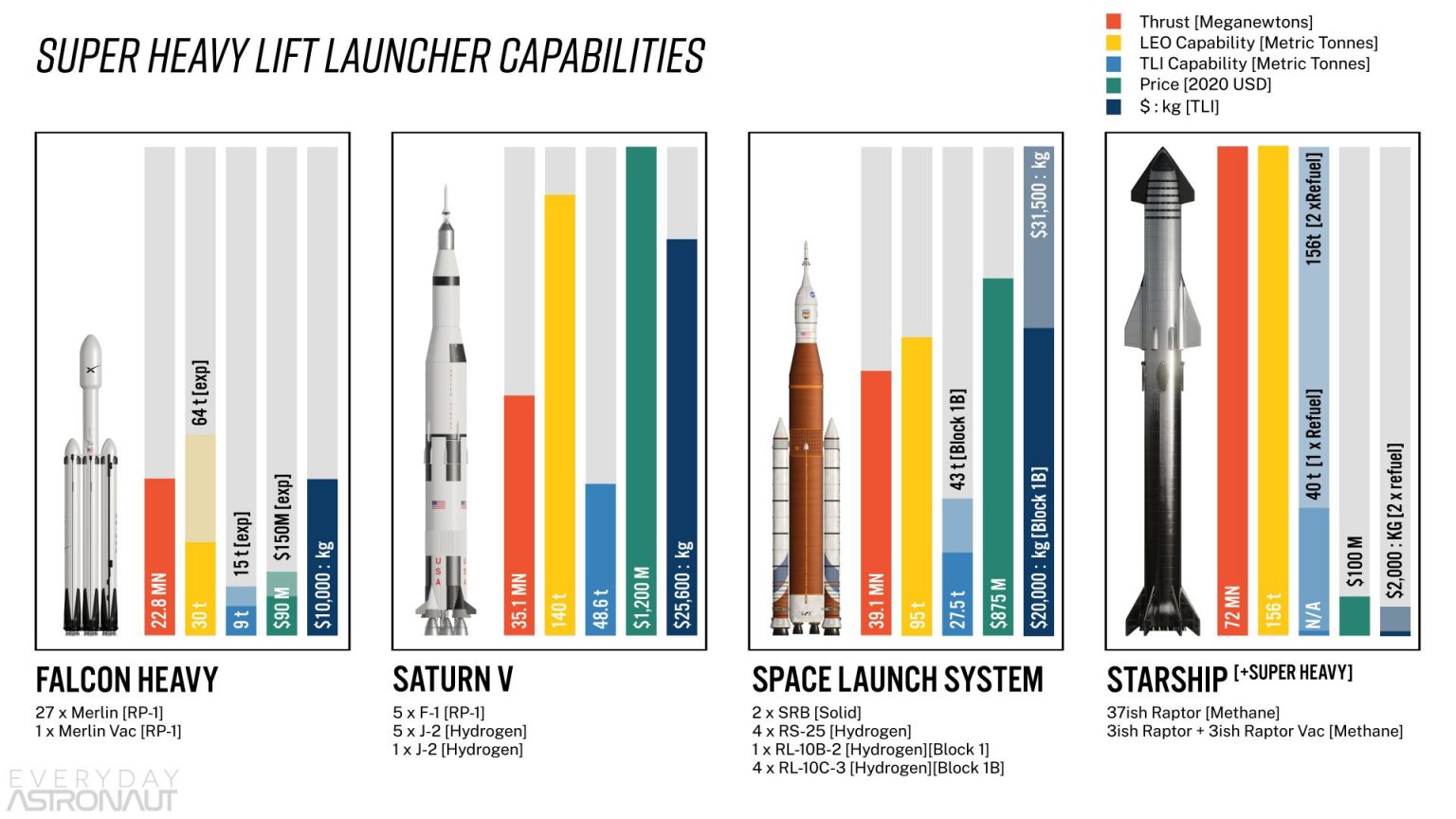
I'm not sure if this is the point you're trying to make or if you're implying private companies aren't up to it, but... the other launcher of the same class, which will probably be launching within a year and is much more capable, is Starship.
That video uses a pretty strange calculation to estimate the battery weight. Here is a different way: 500 mile range * 2 kWh/mile means they need a 1000 kWh pack. The most recent packs they are shipping (Texas Model Y) are 543 kg [1] for 67 kWh [2], or 8.1 kg/kWh. If they have the same energy-to-weight ratio for the truck, its should weigh something like 8104 kg. As opposed to 17000 kg in the video.
You are right to be confused about that claim, but it because the units of the claim have been mixed up. The actual claim is 2 kWh/mile. That is a measure of energy per distance, kind of like gallons per mile.
If a truck is using 2 kWh/mile while traveling down highway at 70 miles per hour, its power draw will be 140 kW -- that is the one to compare to your 2 kW idling or 24 kW hard pull.
My EV uses 0.2 to 0.3 kWh/mile, so 2 kWh/mile for a truck seems plausible to me.
I ran into the case of needing to back up a write-heavy database without blocking anything, and came up with a solution: Writing a VFS ( https://www.sqlite.org/vfs.html ) that makes the application move the Sqlite journals file to a directory for processing instead of deleting them. Another process reads them to see what pages were touched and can very quickly get the changes to update the backup.
My house is set up like you describe. The whole solar/battery system never interconnects with the grid, and is instead set up like a generator. There is a transfer switch to choose between "generator" power and grid power. If there is some exceptional weather and the battery gets too low, we switch to grid. If the battery is full and the day is sunny we often dump power into the car, air conditioning, or whatever.
For pressure vessels like rockets, the mass of the structure and the mass of the fuel scale together as far as square-cube reasoning goes. The surface area of the structure scales with the square while the volume of the fuel scales with the cube, but the thickness of the cylinder walls must also increase, so you end up with cube vs cube.
Here is a graph of Texas's generation by source during that time and the surrounding time. It seems borderline dishonest to have an article about this topic not include this. The sharp dip in the middle on the image (the beginning of Feb 15th) is when my power went out. https://postimg.cc/FfG4XdDy
Just to clarify: this is about insurance for the payload, not the booster. So, the insurance costs only depend on how likely the insurance company thinks it is for the satellite to be blown up and how much the satellite costs, not how much the launch costs.
If you expected most billionaires to get into rocketry, you would expect there to be hundreds or thousands of rocket companies given the more than 2000 billionaires around.
I couldn't find the quote in your citation 1 so I looked it up.x
"...we're closely following the terrible events unfolding in Charolottesville, Virginia. We condemn in the strongest possible terms this egregious display of hatred, bigotry, and violence on many sides, on many sides."
In the US, Telsa no longer receives any federal tax credit as of January 2020. A few states (including California) still have incentives. In any case, losing the tax credit doesn't seem to have slowed them down.
Imagine cutting a cylinder in half from top to bottom, then taping the halves back together. As you spin it, the tape has to stop the two halves from flying apart. If you make the cylinder bigger and keep the centripetal acceleration the same, the tape has a harder job do because it has heavier things trying to fly apart.
Every strip of the cylinder has to keep the opposing halves from flying apart. For a big enough cylinder, the material will not be strong enough. You can make the cylinder walls thicker, but now you've made the flying-apart halves heavier too.
I charge through a ~40 foot long 120V "extension cord" made of 10 gauge wire and plugged into an appropriately rated outlet. Which is to say, you probably could charge in your garage if you really wanted to.
I see. For a regular gas car, the 4 miles per kWh is wildly optimistic -- 134 miles per gallon. The kWh per mile (just from tank to wheels) would be something like 4 times higher than that. (1 kWh per mile = 33 miles per gallon). So that 8.5 kWh per day from manufacturing would be on top of something like 41 kWh per day of driving, not the 10.3 from the post up there.