I've been manually copying responses between chats when I hit token limits, and I'm wondering - have you considered a multi-AI consensus approach instead of persistent memory?
The idea: multiple AIs (Claude, GPT, Gemini, Grok) brainstorm simultaneously and produce one agreed response. This might solve the context problem more elegantly because:
- No token limit anxiety - you get comprehensive answers upfront
- Better quality through AI cross-validation
- The consensus answer naturally becomes your context
- Simpler to implement - just parallel API calls vs memory tree management
Just curious if you've explored this direction or if there's a reason the memory persistence approach works better for your use case?
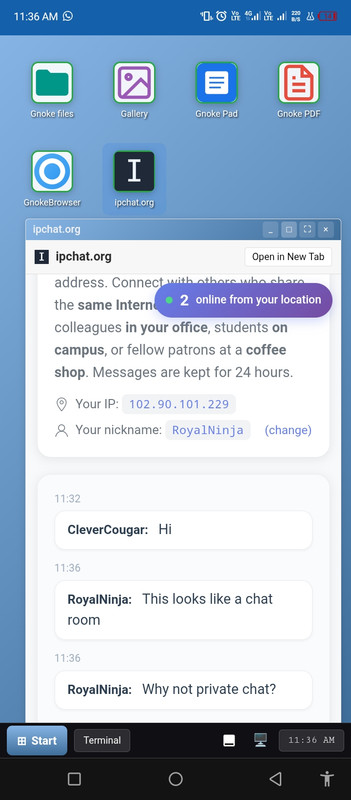
The video shows SignalTower running inside GnokeStation, then demonstrates the app installation system - I install Photopea (a web-based Photoshop alternative) via terminal, then uninstall both apps.
This proves GnokeStation can run any web app as a native-feeling application just by typing "install [url]" in the terminal. No app store, no complex packaging - just URLs.
For the industrial use case: imagine a factory floor where workers can instantly deploy new control interfaces by pasting a URL. No IT approval, no vendor negotiations, no waiting.
Happy to answer technical questions about signaltower or gnokestation.
Hi everyone!
I just wanted to jump in and add a quick note on engagement:
Since Gnoke Station is a solo, passion project, my time for prompt replies and detailed discussions here on the thread will be limited, especially given the breadth of the WebOS concept (IoT, industrial HMI, webperf).
This is exactly why the project is open source under the GPLv3. I can't manage all the possibilities and pathways alone, and I encourage anyone interested in these specialized WebOS applications to dive into the GitHub repo.
I'll be reading every comment, and I'll focus my replies on the most challenging technical questions and architectural feedback. Thanks for checking it out!
Thanks for bringing up the GPL-v3 click-through. I agree that the phrasing ('I have read and accept the license') may be redundant or misleading as the GPL is a license, not a contract.
The goal isn’t to replace your Mac or Windows calculator or Operating system — it’s to provide a lightweight, modular foundation for browser-based workflows that are entirely user-defined.
The modularity is key:
Customization: If the aesthetic feels “AI slop,” it’s open source — users can restyle it, change the CSS, or swap out the default “vibe-coded” apps for polished ones.
Platform definition: It’s about creating your own minimal workspace, free from the bloat of traditional operating systems.
Industrial logic: Like manufacturers’ HMI templates, the framework provides a consistent, reusable structure — a solid skeleton that others can adapt to their own use cases, whether for dashboards, tools, or creative interfaces.
I built the stable core. The next step is for the community — users, developers, and designers — to build the polished experiences they want on top of it.
And yes I designed it entirely on my Infinix phone
The most impressive software is often born out of constraint.
I recently completed development on a project called GnokeStation, an open-source webdesktop, with a story that I believe is a testament to what's possible with just a phone.
GnokeStation is a unique, ultralight, and highly modular webdesktop environment. It’s designed to function primarily as an HMI (Human-Machine Interface) for industrial dashboards, but its core technical achievement is its minimal resource footprint.
It’s fast, has minimal overhead, and is perfect for low-spec hardware like older computers and Single-Board Computers (SBCs).
The Origin Story: Coded on an Infinix
The reason GnokeStation is so resource-efficient is because I developed and managed the entire code pipeline using nothing but an Infinix Hot 12 Play phone in a rural Nigerian village.
This meant writing, debugging, testing, and managing versions without access to a traditional IDE, a powerful laptop, or reliable power infrastructure. It was a true exercise in constraints-driven development.
The project shows that sophisticated software doesn't require a high-end setup. It demonstrates the immense power and utility of mobile devices as standalone development platforms, even for complex web desktop environments.
The Mission of Accessibility
My goal with GnokeStation is to champion accessibility. By being ultra-light and browser-based, it lowers the barrier to entry for users worldwide who have limited access to high-end computing or stable, high-speed internet.
It's a decentralized solution built to run efficiently anywhere.
I invite anyone interested in web desktop tech, open-source projects, or constraints-driven development to check it out.