HackerTrans
TopNewTrendsCommentsPastAskShowJobs

unlord

no profile record

comments

unlord
·11 tháng trước·discuss
> People don’t develop video codecs for fun like they do with software. And the reason is that it’s almost impossible to do without support from the industry.

As someone who lead an open source team (of majority volunteers) for nearly a decade at Mozilla, I can tell you that people do work on video codecs for fun, see https://github.com/xiph/daala

Working with fine people from Xiph.Org and the IETF (and later AOM) on royalty free formats Theora, Opus, Daala and AV1 was by far the most fun, interesting and fulfilling work I've had as professional engineer.
unlord
·năm ngoái·discuss
Someone asked about benchmarks, so I ran these just now to bring data to the discussion:

  nathan@arm1:~/git/rav1d.new/target$ hyperfine --warmup 2 "release/dav1d -q -i ~/Chimera-AV1-8bit-1920x1080-6736kbps.ivf -o /dev/null --threads 8"
  Benchmark 1: release/dav1d -q -i ~/Chimera-AV1-8bit-1920x1080-6736kbps.ivf -o /dev/null --threads 8
    Time (mean ± σ):     31.532 s ±  1.971 s    [User: 244.512 s, System: 1.644 s]
    Range (min … max):   28.498 s … 34.270 s    10 runs

  nathan@arm1:~/git/dav1d.new/build$ hyperfine --warmup 2 "tools/dav1d -q -i ~/Chimera-AV1-8bit-1920x1080-6736kbps.ivf -o /dev/null --threads 8"
  Benchmark 1: tools/dav1d -q -i ~/Chimera-AV1-8bit-1920x1080-6736kbps.ivf -o /dev/null --threads 8
    Time (mean ± σ):     29.696 s ±  2.308 s    [User: 230.507 s, System: 1.479 s]
    Range (min … max):   26.618 s … 35.105 s    10 runs
It shows that as of this moment rav1d is (31.532 - 29.696)/29.696 * 100 = 6.2% slower to decode this Netflix test sequence. Note, this is an improvement from the (32.775 - 29.696)/29.696 * 100 = 10.4% when Prossimo posted a bounty for improving rav1d [1]:

  nathan@arm1:~/git/rav1d.old/target$ hyperfine --warmup 2 "release/dav1d -q -i ~/Chimera-AV1-8bit-1920x1080-6736kbps.ivf -o /dev/null --threads 8"
  Benchmark 1: release/dav1d -q -i ~/Chimera-AV1-8bit-1920x1080-6736kbps.ivf -o /dev/null --threads 8
    Time (mean ± σ):     32.775 s ±  2.694 s    [User: 254.120 s, System: 1.659 s]
    Range (min … max):   28.847 s … 37.606 s    10 runs
None of this is particularly new, I reported this gap in performance over a year ago [2]. Here are some questions for HN:

Even if rav1d closes the gap, who will ship rav1d over dav1d? More than 85% of dav1d is hand written assembly that rav1d takes as-is and calls via unsafe blocks. Is this really memory safety?

The dav1d improvements must continuously be backported to rav1d, see the 82 closed PR's here [3]. Who is going to pay for this maintenance in perpetuity?

VideoLAN fuzzes dav1d and fixes bugs extremely quickly, typically less than 24h. The rav1d developers are Rust experts, but not codec experts. Is it reasonable to expect the same support?

[1] https://www.memorysafety.org/blog/rav1d-perf-bounty/

[2] https://github.com/memorysafety/rav1d/issues/804

[3] https://github.com/memorysafety/rav1d/pulls?q=backport+is%3A...
unlord
·2 năm trước·discuss
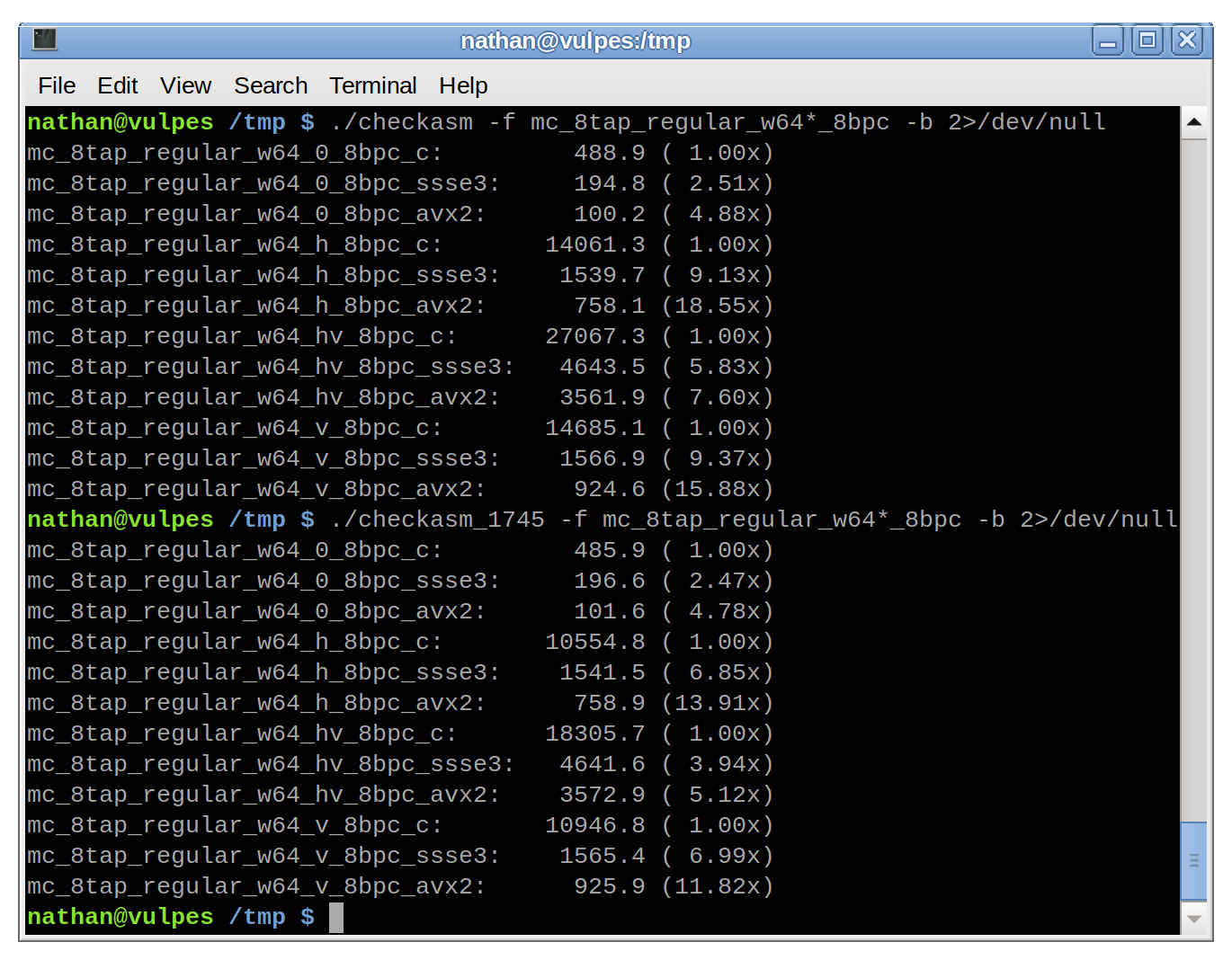
It is actually quite a bit more misleading. I was not able to reproduce these numbers on Zen2 hardware, see https://people.videolan.org/~unlord/dav1d_6tap.png. I spoke with the slide author and he confirmed he was using an -O0 debug build of the checkasm binary.

What's more, the C code is running an 8-tap filter where the SIMD for that function (in all of SSSE3, AVX2 and AVX512) is implemented as 6-tap. Last week I posted MR !1745 (https://code.videolan.org/videolan/dav1d/-/merge_requests/17...) which adds 6-tap to the C code and brings improved performance to all platforms dav1d supports.

This, of course, also closes the gap in these numbers but is a more accurate representation of the speed-up from hand-written assembly.
unlord
·2 năm trước·discuss
Encoding speed is not really a concern for web uses, where the image is decoded potentially millions or even billions of times more than it is encoded.

I agree, PSNR is a terrible measure of quality. The study "Benchmarking JPEG XL lossy/lossless image compression" (https://research.google/pubs/benchmrking-jpeg-xl-lossylossle...) which you are an author on included a controlled subjective evaluation done by EPFL using an ITU recommend methodology. The subjective results concluded:

"HEVC with SCC generally results in better rate/distortion performance when compared to JPEG XL at low bitrates (< 0.75), better preserving sharp lines and smooth areas"

It is known that AVIF performs better than HEVC. Can you say why it was not included in your 2020 subjective evaluation? It would be nice to not need to speculate on the relative quality of AVIF v JPEG XL at web bitrates.
unlord
·2 năm trước·discuss
> Have you seen this more recent data that includes AVIF? https://cloudinary.com/labs/cid22

The graph from Cloudinary uses libaom to do the encoding at speed preset 7 (aom s7), which is far from speed preset 0 and disables many AVIF coding tools. I do not know why this was chosen by the author, but it does not reflect AVIF performance. According to https://github.com/AOMediaCodec/libavif/issues/440#issuecomm... speed preset 8 loses 20-35% compression efficiency.
unlord
·2 năm trước·discuss
> While that most definitely is a consideration, AVIF lacks many features and much of the functionality offered by JPEG XL.

What features are these? You have not named a single concrete advantage. The places where AVIF out-performs JPEG XL are exactly where it make sense as an image format for the web: high fidelity images with bit rates at or below 1 bit/pixel. Nobody is browsing the web on a 16-bit panel and AVIF supports 12bpc images anyway.

Unfortunately, JPEG XL authors chose not include AVIF when they performed a subjective image comparison in 2020 under controlled viewing conditions (https://research.google/pubs/benchmarking-jpeg-xl-lossylossl...), but previous subjective studies showed AVIF outperforming PIK and FUIF over the evaluated bit-rates.
unlord
·2 năm trước·discuss
> Regarding JPEG XL's mobile support, it makes sense it would see limited development if the company that manages one of the biggest mobile players has been the greatest restriction on their success. The lack of support also disincentivises manufacturers to prioritise support.

There was literally no involvement from any hardware vendor in the standardization of JPEG XL. It went from a Call for Proposals in Sept 2018 to Committee Draft in Aug 2019 with very little time for industry feedback. Contrast this with AV1 which had involvement from hardware vendors Intel, NVIDIA, Arm, AMD, Broadcom, Amlogic from the beginning as well as companies who ship media on hardware at scale such as Cisco, Netflix, Samsung and yes Google. These companies reviewed and provided significant feedback on the format that made it suitable for hardware implementation.

https://news.ycombinator.com/threads?id=JyrkiAlakuijala is a lead on the project and a Google employee, and active in JPEG XL development https://github.com/libjxl/libjxl/commits?author=jyrkialakuij...
unlord
·2 năm trước·discuss
The article claims that "Google wants control, and JPEG XL could take that away from them" however this is disingenuous. The JPEG XL format was co-authored by Google employees, and they have just as much say over the direction of that format as they do WebP.

The JPEG XL authors make claims about it's superiority over formats like AVIF, but there is no support or even timeline for hardware encode or decode on important platforms like mobile.

By contrast, Qualcomm is adding support for AV1 encoding to Snapdragon X (https://www.qualcomm.com/products/mobile/snapdragon/pcs-and-...) which could lead to efficient encoding of AVIF photos and animations.
unlord
·2 năm trước·discuss
> If you avoid it then you won't be using RISC-V at all, right now.

I'm sorry this just isn't true. The K230 has RVV 1.0 hardware and has been available for 5 months.

> Which matters much less than it used to, as gcc 14 can compile C code with RVV intrinsics to either.

This is still a huge problem for fragmentation. Multimedia libraries in FFmpeg and VideoLAN use hand written assembly and only support standards compliant RVV 1.0.

There is no reason to ever produce a binary for RVV 0.7.1, it will simply fail if run on standards compliant hardware.