HackerTrans
TopNewTrendsCommentsPastAskShowJobs

_xivi

no profile record

Submissions

A week of not using a search engine

neilzone.co.uk
4 points·by _xivi·قبل سنتين·2 comments

In many cases we need something less like AI and more like a basic algorithm (2023)

zacs.site
30 points·by _xivi·قبل سنتين·23 comments

The "Modern Day Slaves" of the AI Tech World [video]

youtube.com
2 points·by _xivi·قبل سنتين·0 comments

Why privacy is important, and having "nothing to hide" is irrelevant (2016)

robindoherty.com
193 points·by _xivi·قبل سنتين·132 comments

I Received an AI Email

timharek.no
716 points·by _xivi·قبل سنتين·574 comments

Code reviews do find bugs

two-wrongs.com
221 points·by _xivi·قبل سنتين·160 comments

All web "content" is freeware

rubenerd.com
160 points·by _xivi·قبل سنتين·98 comments

Fighting Bots

manuelmoreale.com
2 points·by _xivi·قبل سنتين·0 comments

Deep dive CSS: font metrics, line-height and vertical-align (2017)

iamvdo.me
1 points·by _xivi·قبل سنتين·0 comments

Exploring How Cache Memory Works

pikuma.com
129 points·by _xivi·قبل سنتين·33 comments

No Best Tool for the Job

frantic.im
2 points·by _xivi·قبل سنتين·0 comments

Enough

davemart.in
1 points·by _xivi·قبل سنتين·0 comments

We Already Have a Digital Currency

kevquirk.com
3 points·by _xivi·قبل سنتين·0 comments

You could have invented Parser Combinators (2014)

theorangeduck.com
1 points·by _xivi·قبل سنتين·0 comments

Ask HN: How's your experience with Compose/Kotlin multiplatform?

3 points·by _xivi·قبل سنتين·3 comments

The Power of Constraints: Why Less Is More in Social Media

khromov.se
2 points·by _xivi·قبل سنتين·0 comments

Success for Consumer Mobile Software

proofofconcept.pub
2 points·by _xivi·قبل سنتين·0 comments

The Myth of RAM, part IV (2015)

ilikebigbits.com
2 points·by _xivi·قبل سنتين·0 comments

Productivity

blog.samaltman.com
3 points·by _xivi·قبل سنتين·0 comments

TechEmpower Web Framework Benchmarks

techempower.com
2 points·by _xivi·قبل سنتين·0 comments

comments

_xivi
·قبل سنتين·discuss
> I have tried several times to get Node.js into the military on approved software lists for internal development and its a huge struggle

What's on the approved stack? I imagine .Net and Java/spring are the standard, right? anything else like php, python, go etc?
_xivi
·قبل سنتين·discuss
> I bet they could have 2 interns porting the thing to Google App Engine and then migrate the database

How can you possibly have this assessment without looking at the code/infra?

There are many things that affect cost beyond the visible features. The project isn't in a vacuum. It's interlocked with their other services infrastructure.

You can judge Google however you want, but they're not stupid or amateurs. These types of announcements immensely damages their image and affect their customers, if they could avoid it easily as you imagine, why would they not?

They've built the service and run it for many years for billions of people. A more realistic guess would be that for whatever reason, the price is higher than what's visible on the surface and they're not willing to pay it.
_xivi
·قبل سنتين·discuss
The real reason is probably maintenance due to some hidden costs like conflicting infrastructure and they couldn't justify migrating it.

Related discussion (2 days ago): https://news.ycombinator.com/item?id=40998549

Discussion of the previous announcement in 2018: https://news.ycombinator.com/item?id=16719272
_xivi
·قبل سنتين·discuss
Normally I'd not pay too much attention to these comments but the assessment here is spot on. I'd say LLMs articles in general are:

  1- Always longer than necessary with a lot of fluff

  2- Favor lists and hierarchy
Because they're trained on mostly SEO spam and buzzfeed-style articles

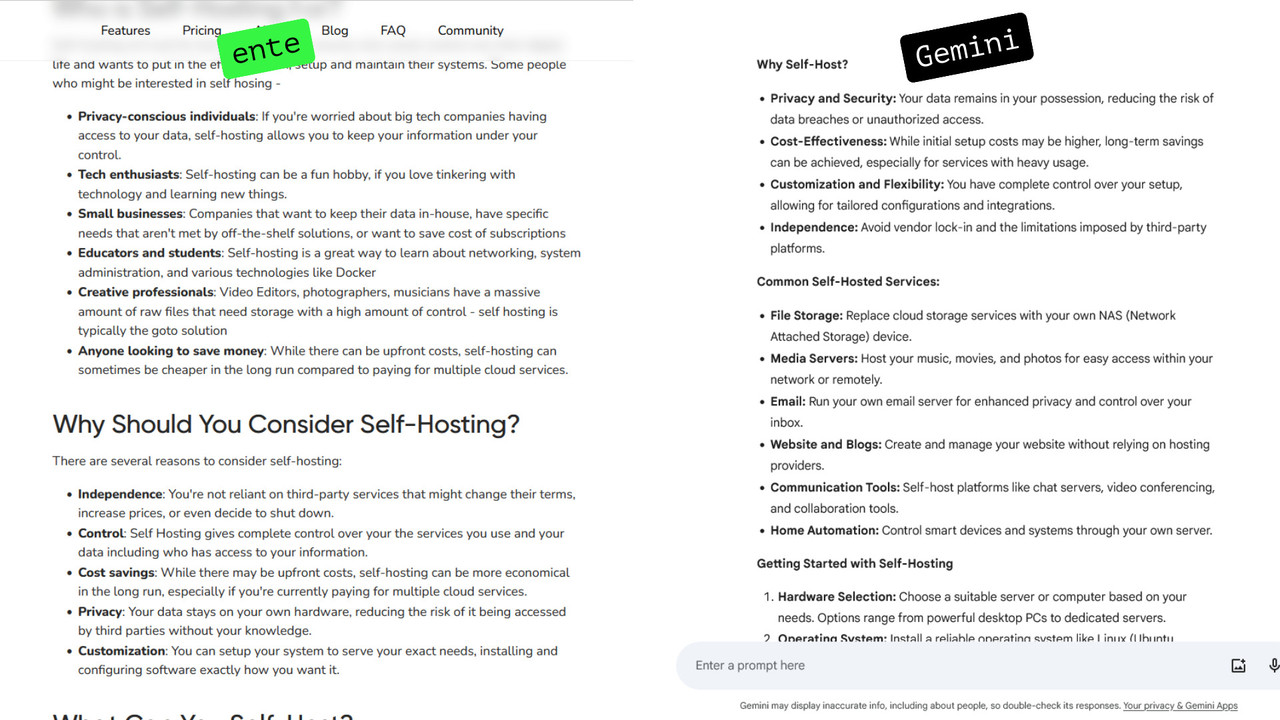
I asked Gemini to "write an article about self hosting" and the output structure and content is eerily similar

Here is a side by side comparison: https://i.postimg.cc/kXXpWgnZ/why-it-look-like-LLM-generated...
_xivi
·قبل سنتين·discuss
> What are the use cases you Invision?

Not OP, but they said the following in an answer to similar question: https://news.ycombinator.com/item?id=40940707

"The technology is extremely flexibile, off the top of my head:

* Education (Linux, Programming, Security, ...)

* Live docs for arbitrary languages and binary libraries

* Preservation of historical software and games

* Virtualization of legacy Windows enterprise apps.

* Dev environment for Web IDEs

Just a few examples, the list could go on for long"
_xivi
·قبل سنتين·discuss
I think you're on the same page here. They might not have expressed it clearly but it's about pivoting and adapting to the market.

I'm also reminded of Mike Tyson's quote: "Everybody has a plan until they get punched in the face".

Things rarely go as planned, so you should favor following leads and taking advantage of opportunities, instead of sticking rigorously to some plan you put together when you were less experienced.

Unless there's evidence the original plan is still viable, oftentimes, being attached to it and ignoring what's the market is telling you is just your ego speaking.
_xivi
·قبل سنتين·discuss
> Feature factories are a thing for a reason.

If anything that goes against the parent comment, how Apple has more revenue per engineer while not being a feature factory by any stretch

In any case, taking both of the comments combined kinda prove my point, that higher revenue can be attributed to many things completely outside how many products/features was shipped:

- Pricing strategy

- You can have a monopoly with a single shitty product

- You can be middle man/broker with no product to begin with

- You can be running a Ponzi scheme or committing fraud

So it doesn't make sense to use revenue (or revenue per team member) as a way to compare teams between different companies and furthermore possibly across completely separate markets and industry
_xivi
·قبل سنتين·discuss
What does revenue got to do with producing/shipping products? maybe you quoted the wrong sentence?

You can have millions of dollars in revenue without producing anything, on the other hand, you can also provide a lot of services and products for free
_xivi
·قبل سنتين·discuss
> from this obviously bad take

This is like saying your evaluation of my property, back when it was in bad shape was wrong... because after renovating the entire thing and fixing its issues, I got a different price.

From the linked article:

> Is there some way Microsoft could come back? In principle, yes

So, of course if you manage to change the input, you'll get a different output.

Today's Microsoft (WSL, Edge, Bing, Azure, VSCode, copilot, etc) is so different from 2007 you wouldn't even recognize it as the same company. Just like what Paul Graham has said they needed to change if they were to survive.
_xivi
·قبل سنتين·discuss
PG wasn't wrong, it's just that Microsoft was resurrected later in 2014 by Satya Nadella.

When Paul wrote this, the industry was witnessing a technological revolution across the board (smartphones, AWS, Google docs, etc) while Microsoft was drugged and lacking behind on all fronts. At the time, their latest product launch was probably Windows Vista.

It was a different company back then and it's such an amazing feat of Satya to manage to steer a ship of Microsoft's size.
_xivi
·قبل سنتين·discuss
What are you expectations of Google X based on? in other words, what are you measuring against? Are there similar research ventures pursuing moonshots that are doing better?

Your comment was pretty harsh. Google X has been around for what? only 14 years? The number of projects they funded and the researchers they employed during that time frame is great initiative and admirable on its own.
_xivi
·قبل سنتين·discuss
> Google X is a failure. Waymo is the only worthwhile thing they ever did and it predates X (as Chauffeur).

A failure in what sense? It's their research arm.

It feels crazy to bash down what they're doing even if it led nowhere. I'd prefer the money goes toward funding "failed research" than sit in their bank accounts.

Do you feel the same way about NASA, CERN, scientific research in general? There are many areas that receive significant funding for decades and lead nowhere by the looks of it.
_xivi
·قبل سنتين·discuss
> Seems strange that people were damning algorithmic social media walls but are now welcoming preprocessed reality.

Are they the same people? The vast majority of users are consumers, they don't even think about these stuff, they only complain when the product degrade.

I don't see the privacy crowd who were conscious about their data and algorithmic feeds, are treating commercial LLMs products differently.
_xivi
·قبل سنتين·discuss
> Not if they're trying to sell me something...

How do you know they're trying to sell you something without even reading the email?

Your question was "Do you read/answer cold outreaches then? Why?" which doesn't make much sense. For me, and I imagine the same applies for most people:

1. You read until you find a clue that its content is not of interestt. Usually the email subject doesn't say much.

2. You only reply if you need.

Cold outreach are genuine emails that covers colleagues, new clients, job opportunities, someone reaching out to collaborate, etc. How you deal with it depends on your profile and who you've given your email address to. Personally, I have many email addresses, for some I don't even check my inbox.
_xivi
·قبل سنتين·discuss
> If someone manages to generate a letter that I actually find useful and interesting

But that's inconsistent with the example you put forward. For the email to be interesting a human would need to research and approach every prospect independently, how many emails a day they can do? 5, 10, 20, 100?

It's simply not possible for a human to generate 100,000 personalized email by hand. That's the difference.
_xivi
·قبل سنتين·discuss
> Do you read/answer cold outreaches then? Why?

Do you only read emails from recognized addresses? No new communication whatsoever unless it's initiated by you?
_xivi
·قبل سنتين·discuss
> what’s the difference?

The key difference here is personalization.

Traditionally, if a message was personalized it fell under 'cold outreach' and users were more likely to interact and play along. Just like what happened with the author (the same applies for everyone).

It's like the difference between receiving a flyer vs being contacted by a sales representative. Even if it's they advertise the same product, the perception is different, the results are different.

If you're mean the difference from a pure technical spam detection perspective, I'm not familiar, but would love to read more about the subject and the state of the art techniques if anyone has some resources to recommend.
_xivi
·قبل سنتين·discuss
> What evidence of AI is there?

They admit (or actually brag) about it on their company blog "I used AI agents to send out nearly 1,000 personalized emails to developers with public blogs on GitHub."

Do you think they're bluffing?
_xivi
·قبل سنتين·discuss
> That sounds an awful lot like a static site generator to me?

Right? They didn't abandon the concept, they just picked a solution that better fits their needs. Less headache, less abstraction, and less surprises overall.
_xivi
·قبل سنتين·discuss
> How do you scale your site or add * number of posts or headers and footers that do things like show the latest post?

It depends on your needs, some use a templating language (like Handlebars, Nunjucks, Pug, etc), others might write a script to build the site

The problem with many static site generators is that they grow beyond their initial mission and get bloated in an effort to please a wider audience, so previous adopters get tired of the imposed complexity and problematic dependencies they didn't need or ask for and start looking for simpler solutions that meet their needs.

  I want to migrate, but my blog currently has this cool thing and I need it.
And since the audience probably can't settle, and keep trying different setups, all SSGs grow in complexity and more or less reach feature parity among each other.