Unfortunately, we live in a world where public opinion (skewed by fossil fuel companies or otherwise) is a huge driving force. We can lament what the world would be like if only people were more knowledgeable, but at the end of the day it's the ecosystem we have to operate in.
Fusion power has indeed had high R&D costs, but so has any significant project before the ROI starts to kick in. Fusion power (especially the types that don't generate a neutron flux) is safer and more productive in principle compared to fission, and I have high confidence I will live to see a commercial fusion reactor come online in my lifetime.
I don't work as a physicist (but I got my degree in Engineering Physics @ CU-Boulder, 2009) and I went to see Interstellar in IMAX on opening night. I really enjoyed it overall, and the scenes involving the realistically-rendered black hole were worth it alone.
I'm relatively easy to please when it comes to movies, but to each their own of course.
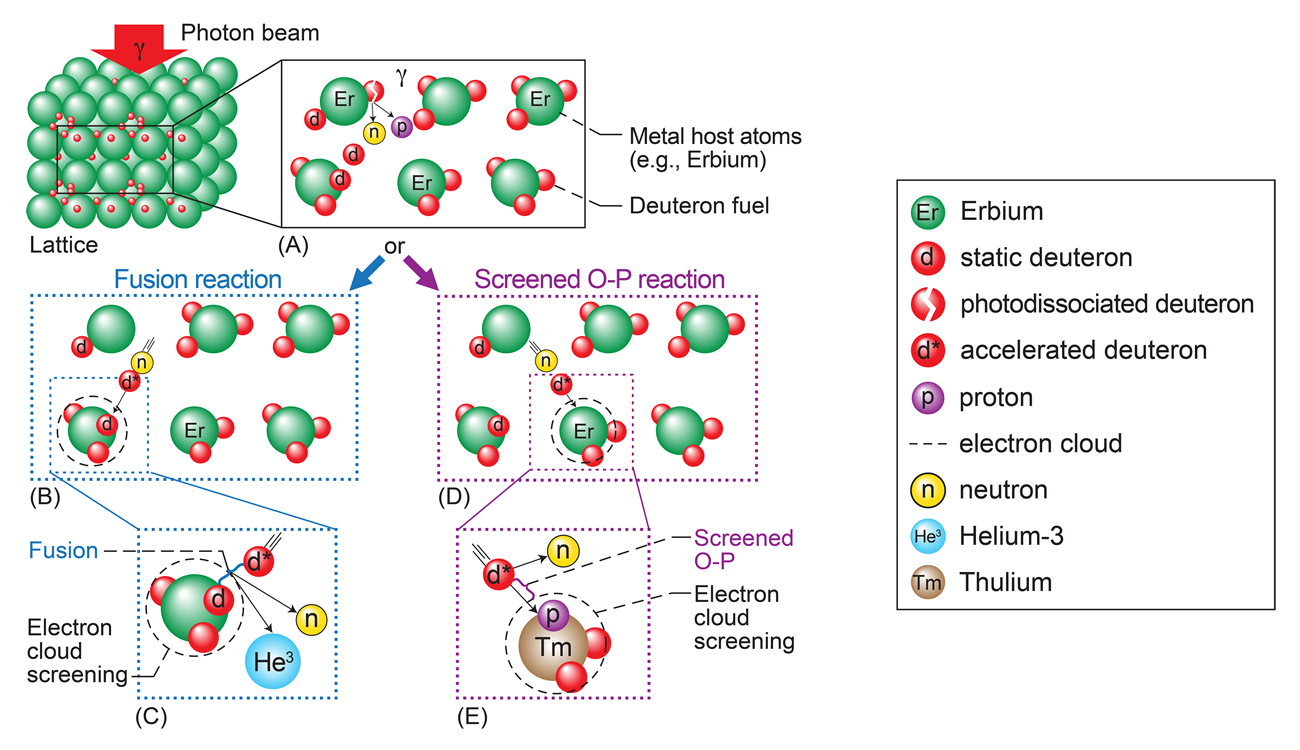
It appears to be the same mechanism as neutronic high-energy fusion. An energetic neutron gets kicked out, which collides with some material in the cell (probably the erbium lattice), and generates heat. Which then needs to be hooked up to a water boiler to create steam, which powers a turbine, etc.
I'm much more hopeful for someone creating a Dense Plasma Focus device with aneutronic hydrogen-boron (pB11) fuel because the reaction energy can be directly captured as electricity, instead of having to capture hot neutrons to boil water.
Theoretical LENR device would be comparable to an RTG [1] because at high heat the device would melt itself. It's more about a trickle of stable power, rather than being used as a cell of a power plant. So, ignoring support infrastructure and focusing on the size of the power generator, we have:
Using the power source for the voyager probe as an example:
RTG size: 0.5m x 0.5m x 1m == 0.25 cubic meters.
RTG power: 2400 watts (thermal)
RTG power density: 9600 watts per cubic meter
Using ITER as an example for the scale of fusion power plant:
Reactor size: 800 cubic meters
Reactor power: 500,000,000 watts (thermal)
Reactor power density: 625,000 watts per cubic meter
So yeah, theoretically it would be compact, but low power density. Enough to power a space probe, but not our civilization.
I got my undergrad in Engineering Physics from CU-Boulder and talked with many professors about fusion research (plus keeping up with developments since then).
Putting aside all the controversy of LENR (low-energy nuclear reactions, the official name for cold fusion) and assuming that the theory actually results in usable tech (for once), the first line of the NASA article hints at where a device's power density would be competitive:
> "A team of NASA researchers seeking a new energy source for deep-space exploration missions"
which tells me that a theoretical device would be a replacement for current RTGs [1]. Low but consistent power for niche applications.
But in general I wouldn't get your hopes up. The higher-energy types of fusion power are far more promising for world-wide civilization-powering clean energy.
“That which can be asserted without evidence, can be dismissed without evidence.” - Hitchens's razor.
The burden of proof is always on the person making an assertion or proposition. When they do not provide proof of their claim, and another person calls it "full of shit", it is not valid to shift the burden of proof onto them to disprove the original claim.
And there's a great reason for this - the bullshit asymmetry principle: the amount of energy needed to refute bullshit is an order of magnitude bigger than to produce it.
My family visited here in 1998/99 when my dad (USA Air Force) was stationed at "Peace Vector 3" in Ismailia, Egypt. The Siwa Oasis was a fascinating place - people still lived in the ancient mudbrick houses that have been around for hundreds of years (so we were told). The whole neighborhood looked like Dr. Suess buildings because torrential rains that came once a decade warped everything and then re-dried. Just like everywhere we visited, the people were welcoming and generous, the street food was amazing, and there was more to experience than we had time for. I'd love to go back some day.
Also, we went on a tour of the dunes and salt flats and the guide started his jeep with a flathead screwdriver. That was a culture shock for my 12yo american kid self.
> ITER was designed before the newest generations of superconductors were available. ITER is now succumbing to the escalation of commitment that sunk-costs engender. SPARK [sic] has the advantage of an agile development model and new materials and technology that combined, dramatically shortens the path to breakeven and the reduction in costs to do so.
Just imagine where we'd be if fusion science were given equal footing with other investment endeavors.
(77/0.24) = 320.8 Joules raises 1g water from 23 C to 100 C (boiling).
(1E9 Joules / 320.8 Joules) lightning strike with no losses along the way heats 3,116,883g of water.
3,116,883g of water == 31,168 L of water == 31 cu.meters of water. This is a block of water 1m x 3m x 10m.
Steam volume is 1600x liquid water volume. So even if we say that 90% of the energy is lost in the transfer, that's still 3 cubic meters of water that flash-boils into steam, quite possibly causing damage to the bridge.
So: perhaps unlikely, but quite possible.
Edit: 3,116,883g of water == 3,117 L of water == 3 cu.meters of water. Damn math errors, always creeping in. Still unlikely, still possible.
> In the game, players were fashioned as “planeswalkers,” who cast spells and travel between planes of existence. The spells themselves were the cards, ...
I played 1999-2004 and now 2016+, mostly non-tournament casual for this exact idea that most players seem to have forgotten. Decks with an emphasis on flavor feel more in line with the core theme of the game, and it's a very rewarding experience to roleplay a Planeswalker using their library of spells.
Many new players (especially tournament-minded) seem to treat the art and flavor as tertiary to the mechanics. One person told me they'd still play the game even if it was black text on plain white cards. Apparently the point was to win, not enjoy the aestetic.
Win or lose, I enjoy the fact that my decks have a rock solid roleplay theme and are usually under $40 each.
I graduated from CU-Boulder in 2009 and have lived in the Denver-metro area ever since. I could very easily see Amazon drawn to the Boulder-Longmont-Lafayette triangle if not in Denver proper.
Lots of growth here in the last 5 years especially. Many long-time locals are complaining about the cost-of-living going up, though.
I probably should have clarified that my analogy was coming from a perspective of super-deterministic[1] compatibilism[2]. In the absence of knowing the truth, I feel that solution is the best model / explanation. It strips away the 'spookiness' and many other problems, though it admittedly has its own issues with testability and proof.
I do not believe in the idea that particles can super-luminally affect each other during the moment of observation. I think that is a failing of our measurement systems and ability to describe what's going on. Just as we often fail to accurately convey the Schrodinger's Cat thought experiment [3].
But for the record, if a different perspective were definitively proven to be true, I would of course switch to it, as any scientist should. But given that there are multiple avenues of investigation open, I'm exploring super-deterministic compatibilism.
Caveat: I only have a B.Science degree in Engineering Physics (Colorado, USA) and hobbyist-type research in PhD-level physics.
I've always found it easier to explain quantum entanglement thusly:
Imagine you have 2 cubes that alternate glowing between purple and orange. And they stay in one color for a random amount of time (100s of milliseconds). Holding both in your hands, you would just have randomly color-shifting cubes. But a neat trick of these cubes is that when you close your eyes, hit them together, and quickly put them into separate closed boxes, you know that three things will happen:
1. they will be locked into one color as long as the box stays closed (no more alternating)
2. each cube will be the opposite color from each other (when one is purple, the other is orange, and vice versa)
3. when you open the box and observe the cube, it will stay in the current color for 1 second, and then resume its randomness once again.
So you take one of the boxes containing a cube and ship it to your friend on the Moon (greater than 1 light-second away). When she gets the box, you call her on your phone and ask her to wait. Then you open your box and see that your cube is purple. And then the cube starts blinking again because the entanglement is broken on your end. So you wait a few seconds and say to her "open your box and I bet you the cube is orange". She does so and confirms the cube was glowing orange before resuming the random blinking. Now the entanglement is broken on her end, but you "knew" that by having the purple cube in your possession that hers would be orange.
Using this system, there is no way to exploit your knowledge of what the colors will be once observed (so sorry, no FTL communication here). The particles no longer influence each other after they are entangled at the start. It's not an active process, but rather a very specific type of setup. But it still bothers physicists (most famously Einstein), that you could "know" something without direct proof.
And people in general hope that this un-intuitive phenomenon will open up whole new worlds of sci-fi tech. But no, as the article explained:
"Nothing we knew suggested this goal was unachievable. The significance of this news is not that it was unexpected or that it overturns anything previously believed, but simply that it’s a satisfying culmination of years of hard work."
If you had shipped the other cube-box to the opposite side of the galaxy, thousands of years after you were long dead, someone would open it and still find an orange cube.
It has that fun Hackathon / side-project feel, that someone probably noticed and said "Hey, if you polish it up, we can host it for public use, because why not?".
The spleen was the one working overtime, since it would normally be filtering a fraction of his blood that was problematic, but instead 100% of his blood 'needed' to be filtered.

"Dense Plasma Focus device with aneutronic hydrogen-boron (pB11) fuel"