The Covid Science Wars(scientificamerican.com)
scientificamerican.com
The Covid Science Wars
https://www.scientificamerican.com/article/the-covid-science-wars1/
214 comments
> What helps you to sympathize and communicate with others?
I try to
- Remember virtually no individual or group is 100% right or 100% incorrect about things which require interpretation or value judgements. Even people who I think are often terribly wrong can still occasionally be right about some topic.
- Consider sometimes people can reach a generally correct conclusion based on incorrect reasoning, interpretation or data. Conversely, sometimes people can reach substantially incorrect conclusions based on correct reasoning, interpretation or data.
- Not to let my feelings about a person or group's other positions influence my assessments about a position in a different domain.
- Be aware of the basis and degree of my own preconceived feelings and biases related to a topic.
- Remember that everyone is influenced to some degree by their personal experiences, context, knowledge and feelings, even if we're not aware of it.
- Ensure I fully understand the other person's position. Especially that I'm not making assumptions or drawing conclusions which may over-simplify, extend or 'extreme' what they're actually saying. I also try to imagine possible 'steelman' forms of their arguments which may be stronger, clearer or more nuanced than what they are saying.
- Separate assertions about objective facts from subjective interpretation or conclusions such as policy. Especially that future outcomes cannot be objective facts because they haven't happened.
- Apply extra charitable interpretation in areas where I may have strong pre-held notions.
- Stay open-minded and ask clarifying questions in a reasonable and neutral tone.
- Focus my responses on the most key elements of the arguments actually being made versus the person, style, tone or my feelings.
I try to
- Remember virtually no individual or group is 100% right or 100% incorrect about things which require interpretation or value judgements. Even people who I think are often terribly wrong can still occasionally be right about some topic.
- Consider sometimes people can reach a generally correct conclusion based on incorrect reasoning, interpretation or data. Conversely, sometimes people can reach substantially incorrect conclusions based on correct reasoning, interpretation or data.
- Not to let my feelings about a person or group's other positions influence my assessments about a position in a different domain.
- Be aware of the basis and degree of my own preconceived feelings and biases related to a topic.
- Remember that everyone is influenced to some degree by their personal experiences, context, knowledge and feelings, even if we're not aware of it.
- Ensure I fully understand the other person's position. Especially that I'm not making assumptions or drawing conclusions which may over-simplify, extend or 'extreme' what they're actually saying. I also try to imagine possible 'steelman' forms of their arguments which may be stronger, clearer or more nuanced than what they are saying.
- Separate assertions about objective facts from subjective interpretation or conclusions such as policy. Especially that future outcomes cannot be objective facts because they haven't happened.
- Apply extra charitable interpretation in areas where I may have strong pre-held notions.
- Stay open-minded and ask clarifying questions in a reasonable and neutral tone.
- Focus my responses on the most key elements of the arguments actually being made versus the person, style, tone or my feelings.
> Consider sometimes people can reach a generally correct conclusion based on incorrect reasoning, interpretation or data. Conversely, sometimes people can reach substantially incorrect conclusions based on correct reasoning, interpretation or data.
I'm worried this one will get lost in amongst all the other good points. Human society has numerous mechanisms (traditions and ethics being the big ones, but also rules and stories) that are there to guide people to make good decisions even if they can't explain why they are good.
Everyone knows lying is bad, for example. But in my experience the behaviour of a lot of people shows they don't actually understand why - I suspect they think it is bad because they fear punishment more than because they understand global optimum equilibriums. It is remarkably common for good ideas to be floating around that people struggle to justify.
I'm worried this one will get lost in amongst all the other good points. Human society has numerous mechanisms (traditions and ethics being the big ones, but also rules and stories) that are there to guide people to make good decisions even if they can't explain why they are good.
Everyone knows lying is bad, for example. But in my experience the behaviour of a lot of people shows they don't actually understand why - I suspect they think it is bad because they fear punishment more than because they understand global optimum equilibriums. It is remarkably common for good ideas to be floating around that people struggle to justify.
That point stood out to me as well. In The Problems of Philosophy [0], Bertrand Russell summarizes this phenomenon nicely
> At first sight we might imagine that knowledge could be defined as "true belief." When what we believe is true, it might be supposed that we had achieved a knowledge of what we believe. But this would not accord with the way in which the word is commonly used. To take a very trivial instance: If a man believes that the late Prime Minister's last name began with a B, he believes what is true, since the late Prime Minister was Sir Henry Campbell Bannerman. But if he believes that Mr. Balfour was the late Prime Minister, he will still believe that the late Prime Minister's last name began with a B, yet this belief, though true, would not be thought to constitute knowledge. If a newspaper, by an intelligent anticipation, announces the result of a battle before any telegram giving the result has been received, it may by good fortune announce what afterwards turns out to be the right result, and it may produce belief in some of its less experienced readers. But in spite of the truth of their belief, they cannot be said to have knowledge. Thus it is clear that a true belief is not knowledge when it is deduced from a false belief.
[0] (https://www.wmcarey.edu/crockett/russell/xiii.htm)
> At first sight we might imagine that knowledge could be defined as "true belief." When what we believe is true, it might be supposed that we had achieved a knowledge of what we believe. But this would not accord with the way in which the word is commonly used. To take a very trivial instance: If a man believes that the late Prime Minister's last name began with a B, he believes what is true, since the late Prime Minister was Sir Henry Campbell Bannerman. But if he believes that Mr. Balfour was the late Prime Minister, he will still believe that the late Prime Minister's last name began with a B, yet this belief, though true, would not be thought to constitute knowledge. If a newspaper, by an intelligent anticipation, announces the result of a battle before any telegram giving the result has been received, it may by good fortune announce what afterwards turns out to be the right result, and it may produce belief in some of its less experienced readers. But in spite of the truth of their belief, they cannot be said to have knowledge. Thus it is clear that a true belief is not knowledge when it is deduced from a false belief.
[0] (https://www.wmcarey.edu/crockett/russell/xiii.htm)
there is a third possibility. Sometime people reach different but correct conclusions based on the same information but a different valueset
We could also be wrong in the other direction. The European COVID could have been a mutation to the point where the 15% or so death rate that Italy was seeing was actually the natural death rate for COVID. COVID could have been far more devastating to children, who do not have the immunity adults do. It may have been completely resistant to a vaccine for years, like viruses like HIV.
The idea that uncertainty about COVID reduced the need for a lockdown in March April when we knew that China was scared enough of the virus that it shut down Wuhan completely, and Italy was seeing an epic disaster, is completely backwards. The uncertainty at that point was MORE reason to lock down, and use fiscal and monetary tools to handle the economic effects which we did know about and could predict and defend from, until we got a better understanding of the virus.
Sweden, once again, is very instructive. Their PHA’s position was to basically protect the eldest by insisting that anyone showing symptoms stay home and not go to care homes to work or visit. But our complete lack of knowledge meant that Tegnells did not know that asymptomatic carriers ans transmission existed, which essentially made a mockery of this plan and wrecked any hope of Sweden handling the pandemic well.
The idea that just because there are no proven studies that show what works and what doesn’t means we don’t do anything is beyond stupid. A lack of confirmed evidence means we need to take actions based on the slight evidence we do have, while weighing the cost of those actions to individuals and society, and whether those costs can be mitigated or not.
So, for example, requiring masks once we had a suspicion that it was spread via aerosols and droplets as opposed to fomites, which was the initial understanding, meant that mandating masks was a no brainer. Worst case scenario if you’re wrong is that people are out $20-$30 each, but you will more than make that up in the reduced spread of other diseases that we do know masks would help with, such as the flu, which has basically been non existent this year thanks to COVID measures.
Lockdowns were obviously more drastic, and the complete lack of knowledge and disasters unfolding in Wuhan (remember China constructing 2-3 hospitals in days to handle what happened there) and Italy, and uncontrolled rise of cases in other parts of Europe and the US meant a lockdown was almost necessary.
Once we did find out more about the virus, once we got testing under control, and now that doctors understand treatments better leading to a much lower death rate, a full lockdown like in spring does not appear necessary. Distancing and mask wearing and gathering outdoors seem sufficient to control it. When people do not follow this leading to a spike in cases, temporary, localized, soft lockdowns make sense until we get people to follow this.
The contrarians in Sweden and the Great Barrington Deckaration (which is hilariously not scientific at all, and is basically completely wrong at this point) are not holding a contrary scientific viewpoint. They are holding apolitical viewpoint which they are promoting with the absence of science.
The idea that uncertainty about COVID reduced the need for a lockdown in March April when we knew that China was scared enough of the virus that it shut down Wuhan completely, and Italy was seeing an epic disaster, is completely backwards. The uncertainty at that point was MORE reason to lock down, and use fiscal and monetary tools to handle the economic effects which we did know about and could predict and defend from, until we got a better understanding of the virus.
Sweden, once again, is very instructive. Their PHA’s position was to basically protect the eldest by insisting that anyone showing symptoms stay home and not go to care homes to work or visit. But our complete lack of knowledge meant that Tegnells did not know that asymptomatic carriers ans transmission existed, which essentially made a mockery of this plan and wrecked any hope of Sweden handling the pandemic well.
The idea that just because there are no proven studies that show what works and what doesn’t means we don’t do anything is beyond stupid. A lack of confirmed evidence means we need to take actions based on the slight evidence we do have, while weighing the cost of those actions to individuals and society, and whether those costs can be mitigated or not.
So, for example, requiring masks once we had a suspicion that it was spread via aerosols and droplets as opposed to fomites, which was the initial understanding, meant that mandating masks was a no brainer. Worst case scenario if you’re wrong is that people are out $20-$30 each, but you will more than make that up in the reduced spread of other diseases that we do know masks would help with, such as the flu, which has basically been non existent this year thanks to COVID measures.
Lockdowns were obviously more drastic, and the complete lack of knowledge and disasters unfolding in Wuhan (remember China constructing 2-3 hospitals in days to handle what happened there) and Italy, and uncontrolled rise of cases in other parts of Europe and the US meant a lockdown was almost necessary.
Once we did find out more about the virus, once we got testing under control, and now that doctors understand treatments better leading to a much lower death rate, a full lockdown like in spring does not appear necessary. Distancing and mask wearing and gathering outdoors seem sufficient to control it. When people do not follow this leading to a spike in cases, temporary, localized, soft lockdowns make sense until we get people to follow this.
The contrarians in Sweden and the Great Barrington Deckaration (which is hilariously not scientific at all, and is basically completely wrong at this point) are not holding a contrary scientific viewpoint. They are holding apolitical viewpoint which they are promoting with the absence of science.
>and wrecked any hope of Sweden handling the pandemic well
Sweden handled the pandemic better than anyone. Life went on as close to normal as any country, and their number of deaths seems pretty average for a European country. The only mistake they made was sending elderly to care homes which ended up accounting for over 50% of the deaths (a mistake made by many countries).
> The contrarians in Sweden and the Great Barrington Deckaration (which is hilariously not scientific at all, and is basically completely wrong at this point) are not holding a contrary scientific viewpoint.
There is very little scientific evidence about lockdowns, or (non n95) masks or any of the other measures we are being forced into. Everyone basically just copied what China were doing. Very scientific. (And listened to Neil Ferguson who's models predictions have been out by an order of magnitude) .
Sweden handled the pandemic better than anyone. Life went on as close to normal as any country, and their number of deaths seems pretty average for a European country. The only mistake they made was sending elderly to care homes which ended up accounting for over 50% of the deaths (a mistake made by many countries).
> The contrarians in Sweden and the Great Barrington Deckaration (which is hilariously not scientific at all, and is basically completely wrong at this point) are not holding a contrary scientific viewpoint.
There is very little scientific evidence about lockdowns, or (non n95) masks or any of the other measures we are being forced into. Everyone basically just copied what China were doing. Very scientific. (And listened to Neil Ferguson who's models predictions have been out by an order of magnitude) .
[deleted]
[deleted]
It was once controversial for Doctors to wash their hands. Now everyone believes and understands why it is necessary. But few of us have any real understanding of what bacteria and infections actually are. We just take it for granted. Sometimes our basic understanding of the world is insufficient to really grasp new ideas. It just takes a while for people to adapt and in the meantime the alternative theories become very powerful.
Thank you for this thoughtful post and prompt
> What helps you to sympathize and communicate with others?
You and others have suggested good ideas. Another that I find useful is to always give something. It doesn’t have to be falsely giving in on a fact. It can be “Y’know I was thinking the exact same thing then I ran into this paper!” or “This is interesting, I hadn’t thought of it this way. And...”
I think the tiniest, almost inconsequential gift and saving of face that that represents can totally change the tone of a conversation
Just my two cents
> What helps you to sympathize and communicate with others?
You and others have suggested good ideas. Another that I find useful is to always give something. It doesn’t have to be falsely giving in on a fact. It can be “Y’know I was thinking the exact same thing then I ran into this paper!” or “This is interesting, I hadn’t thought of it this way. And...”
I think the tiniest, almost inconsequential gift and saving of face that that represents can totally change the tone of a conversation
Just my two cents
That's a good two cents. :)
Never compromising is romanticized heavily in our culture. However, being willing to make concessions, get rid of personal pride in the interest of understanding, etc. is surer evidence of strength and personal fortitude than a tough-and-gruff, unyielding stance. There are precious few arenas in life where never compromising is actually the right course of action imo. Most of the time we're just too proud to make a concession.
Never compromising is romanticized heavily in our culture. However, being willing to make concessions, get rid of personal pride in the interest of understanding, etc. is surer evidence of strength and personal fortitude than a tough-and-gruff, unyielding stance. There are precious few arenas in life where never compromising is actually the right course of action imo. Most of the time we're just too proud to make a concession.
My question is mostly just "how do we draw the line in the sand?"
The fact is that if mask-wearing and lockdowns prevent the spread of this virus, they'll work for the flu too. If there is a moral imperative to use these methods for COVID, why would there not also be a moral imperative to use them for the flu?
Where do you draw the line?
The fact is that if mask-wearing and lockdowns prevent the spread of this virus, they'll work for the flu too. If there is a moral imperative to use these methods for COVID, why would there not also be a moral imperative to use them for the flu?
Where do you draw the line?
The line has been drawn, historically, at somewhere between a "normal" flu and the Spanish Flu of 1918. And that matters, because it sets the default on what people are inclined to accept.
The line is drawn based on hospital capacity. We have enough capacity for flu, because of immunity and vaccinations. We don't have enough for Covid.
If you have the flu you should wear a mask.
We are enforcing mask-wearing and doing lockdowns because of COVID asymptomatic infections, these methods don't make much sense for the flu.
Many influenza cases are asymptomatic, and they can transmit the virus.
https://www.centerforhealthsecurity.org/cbn/2005/cbnreport_1...
https://www.centerforhealthsecurity.org/cbn/2005/cbnreport_1...
> We are enforcing mask-wearing and doing lockdowns because of COVID asymptomatic infections,
We are doing these so that politicians can be seen to be "doing something". Not because there is any evidence that they work or are effective
We are doing these so that politicians can be seen to be "doing something". Not because there is any evidence that they work or are effective
False equivalency. Hospitals don't overflow with flu patients every winter. Meanwhile just in Italy and NY, hospitals were overflowing with Covid patients with only a fraction of people exposed to it compared to the billions exposed to the flu every year.
Same with the number of deaths. 65,000 in a really bad flu season in the US with hundreds of millions exposed to it, and Covid already has exceed that with only about 20% exposed to the virus.
Same with the number of deaths. 65,000 in a really bad flu season in the US with hundreds of millions exposed to it, and Covid already has exceed that with only about 20% exposed to the virus.
It's not a false equivalency because I'm not saying the two diseases are equivalent.
I'm asking where we draw the line. Yes the flu is less severe than COVID-19. The question is not which is worse. It is how many lives do we need to save with these measures in order to make it "worth it"? Who determines that? How do we determine that?
We apparently decided it is worth it for COVID-19. Ok, but then why not for the flu. It kills people too, just not as many. What about something in between the flu in COVID in terms of lethality?
I'm asking where we draw the line. Yes the flu is less severe than COVID-19. The question is not which is worse. It is how many lives do we need to save with these measures in order to make it "worth it"? Who determines that? How do we determine that?
We apparently decided it is worth it for COVID-19. Ok, but then why not for the flu. It kills people too, just not as many. What about something in between the flu in COVID in terms of lethality?
Like your parent said, the difference is the tendency for COVID-19 to eat up all health care capacity.
Appendicitis? Stroke? Car accident? Sorry, the hospital is full of COVID patients, we can't take you in. Go home, lie down, see if it gets better.
This is the scenario we're trying to avoid. If the flu would do that, we'd have lockdowns for it too.
Appendicitis? Stroke? Car accident? Sorry, the hospital is full of COVID patients, we can't take you in. Go home, lie down, see if it gets better.
This is the scenario we're trying to avoid. If the flu would do that, we'd have lockdowns for it too.
[deleted]
I don’t know what to tell you, we should have probably banned tobacco a long time ago. You’re arguing against a kafkacracy, not scientists.
> Ok, but then why not for the flu. It kills people too, just not as many.
Literally because of "just not as many" part. Yes, real world policies do some cold calculations about "how many people die" and have arbitrary lines. Arbitrary lines are actually ok. Better then arbitrary line on either "never ever" or "totally all the time" extreme. Also, we literally close schools when flu get out of control in some area - for a week or so and that is enough for flu to get under control. There is also huge push for flu vaccines each year. It is not true that no flu management is done, there is a lot of flu management going on.
Like, I dont know whether it is consequences of two party system, but the whole "we either lock everything for every reason or never nothing at all" and "we cant possibly think in probabilities and death rates and nuance" is frankly, idiotic.
Literally because of "just not as many" part. Yes, real world policies do some cold calculations about "how many people die" and have arbitrary lines. Arbitrary lines are actually ok. Better then arbitrary line on either "never ever" or "totally all the time" extreme. Also, we literally close schools when flu get out of control in some area - for a week or so and that is enough for flu to get under control. There is also huge push for flu vaccines each year. It is not true that no flu management is done, there is a lot of flu management going on.
Like, I dont know whether it is consequences of two party system, but the whole "we either lock everything for every reason or never nothing at all" and "we cant possibly think in probabilities and death rates and nuance" is frankly, idiotic.
Yes they do:
https://www.upi.com/Top_News/US/2018/01/24/Hospitals-overwhe...
https://www.latimes.com/local/lanow/la-me-ln-flu-demand-2018...
https://www.dispatchhealth.com/blog/ers-are-overwhelmed-with...
https://www.cbsnews.com/news/overwhelmed-by-flu-cases-some-e...
https://edition.cnn.com/2018/01/12/health/flu-surveillance-c...
In Italy and Spain, aged care centres were abandoned by Eastern European workers fleeing the country before border closure, leaving residents ill cared for.
In New York, symptomatic patients were ordered back into aged care homes to free up hospital space.
These conditions would not have occurred without hysteria and excessive fear.
COVID in Sweden is about as deadly as the 2009 flu wave: https://swprs.org/wp-content/uploads/2020/10/sweden-monthly-...
Sweden is on track for an annual number of deaths in 2020 mostly the same as prior years: https://www.statista.com/statistics/525353/sweden-number-of-...
https://www.upi.com/Top_News/US/2018/01/24/Hospitals-overwhe...
https://www.latimes.com/local/lanow/la-me-ln-flu-demand-2018...
https://www.dispatchhealth.com/blog/ers-are-overwhelmed-with...
https://www.cbsnews.com/news/overwhelmed-by-flu-cases-some-e...
https://edition.cnn.com/2018/01/12/health/flu-surveillance-c...
In Italy and Spain, aged care centres were abandoned by Eastern European workers fleeing the country before border closure, leaving residents ill cared for.
In New York, symptomatic patients were ordered back into aged care homes to free up hospital space.
These conditions would not have occurred without hysteria and excessive fear.
COVID in Sweden is about as deadly as the 2009 flu wave: https://swprs.org/wp-content/uploads/2020/10/sweden-monthly-...
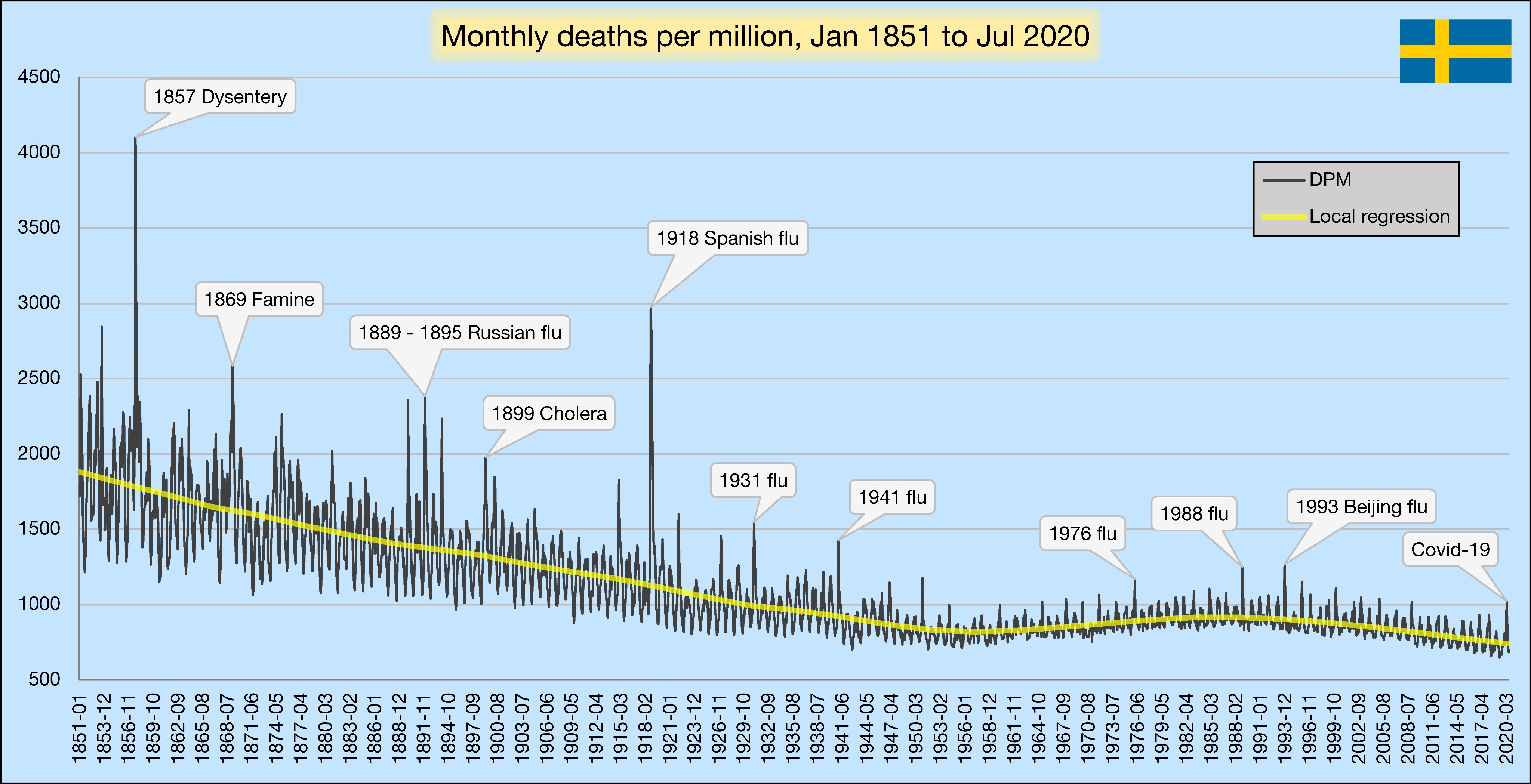
Sweden is on track for an annual number of deaths in 2020 mostly the same as prior years: https://www.statista.com/statistics/525353/sweden-number-of-...
I’ll just point out the last one, because it’s terribly wrong, and how wrong it was pointed out in HN over the last couple of days itself.
Sweden, through early November, has as many deaths as it has had in its worst entire years before. And Swedens death numbers increase beyond the current year, as they attribute more deaths towards the previous year in the beginning of a year.
Sweden is on track to have 10-20% more deaths than normal.
Sweden, through early November, has as many deaths as it has had in its worst entire years before. And Swedens death numbers increase beyond the current year, as they attribute more deaths towards the previous year in the beginning of a year.
Sweden is on track to have 10-20% more deaths than normal.
There are no excess deaths apparent in October or November for Sweden: https://www.euromomo.eu/graphs-and-maps#z-scores-by-country
>Hospitals don't overflow with flu patients every winter.
They do it just isn't covered as much as anything covid related.
https://time.com/5107984/hospitals-handling-burden-flu-patie...
They do it just isn't covered as much as anything covid related.
https://time.com/5107984/hospitals-handling-burden-flu-patie...
Do lockdowns help?
A lot of countries with hard lockdowns had really bad curves. A slow fire maybe sometimes burns better. A place where everybody gets infected can maybe be more dangerous for visitors when you increase the time the infection is going on?!
Do masks help? Do they reduce immunity by eliminating some light contacts? Do they allow to transfer the virus without being infected? For sure you wouldn't like to have doctors (treating e.g. Ebola patients) go shopping and exhaling through their contaminated masks.
Is there any epidemiological evidence that masks helped? Data using "reporting date" often shows trend changes around mask measures. Taking a look at "date of death" data those trend changes usually are gone. Why is so little "date of death" data available?
Do masks help? Do they reduce immunity by eliminating some light contacts? Do they allow to transfer the virus without being infected? For sure you wouldn't like to have doctors (treating e.g. Ebola patients) go shopping and exhaling through their contaminated masks.
Is there any epidemiological evidence that masks helped? Data using "reporting date" often shows trend changes around mask measures. Taking a look at "date of death" data those trend changes usually are gone. Why is so little "date of death" data available?
In the US, 40,000 deaths per year for typical flu. Currently, we have 275,0000 deaths from covid over 9 months even with social interventions. And, that’s not considering the under-reporting of deaths. And, before March 2021, we’ll see another 200k deaths.
Where do we draw the line? As with most complex things, it requires a careful balance of trade-offs. And, when there’s a lot of uncertainty and risk, it’s good to be cautious at first.
Where do we draw the line? As with most complex things, it requires a careful balance of trade-offs. And, when there’s a lot of uncertainty and risk, it’s good to be cautious at first.
It would be reasonable to conclude that countries where mask wearing is common (South Korea, Japan) would have lower rates of deaths from flu. It doesn't appear to be the case.
> In today’s COVID-19 wars, the global scientific divide leans heavily in favor of active, and sometimes even draconian, public health interventions, including widespread locking down of nonessential business, mandating masks, restricting travel and imposing quarantines. On the other side, some doctors, scientists and public health officials are questioning the wisdom of this approach in the face of massive unknowns about their efficacy and in light of the clear and growing evidence that such measures may not be working in some cases, and may also be causing net harm.
It's very hard to dissent against the current narrative because any dissent can easily be framed as "killing people". I blame technology for our current predicament. If we didn't have computers and a global internet, there's no way we would be shutting down everything. We might be wearing masks and washing hands, but I would bet life would be largely the same.
But because technology dangled the carrot of "we can save lives by doing everything virtually with computers" we are charging down that path optimizing for lives saved without giving fair consideration to other side effects of that (loneliness, depression, suicide, homelessness, civil unrest, economy). In some ways, taking a one time "excess deaths" hit as we have done with past pandemics does have measurable benefits in other ways, but you'll get shouted out of the room if you bring up that position even as a hypothetical.
It's very hard to dissent against the current narrative because any dissent can easily be framed as "killing people". I blame technology for our current predicament. If we didn't have computers and a global internet, there's no way we would be shutting down everything. We might be wearing masks and washing hands, but I would bet life would be largely the same.
But because technology dangled the carrot of "we can save lives by doing everything virtually with computers" we are charging down that path optimizing for lives saved without giving fair consideration to other side effects of that (loneliness, depression, suicide, homelessness, civil unrest, economy). In some ways, taking a one time "excess deaths" hit as we have done with past pandemics does have measurable benefits in other ways, but you'll get shouted out of the room if you bring up that position even as a hypothetical.
>It's very hard to dissent against the current narrative because any dissent can easily be framed as "killing people".
Every dissent winds up getting framed this way. The numbers don't matter. The way you win is by having "your side" be the side who's policy kills people less directly. When you take it to extremes like "make everyone do backbreaking labor and all the health problems that comes with that to save a few dozen kids with cancer" the absurdity becomes obvious. It's maddening but this is the nature of a lot of arguments we have in society today. For example you have Safety Sally wanting to do something that will crush an industry in order to save a few dozen workplace injuries. How many years of life will be lost from all those people's reduced standard of living? Hard to tell. But Safety Sally always wins because she can argue that anyone arguing against her policy is killing people more directly, numbers be damned. Sometimes (e.g. coal industry) the numbers do work out in her favor. Often times it's hard to tell and then you get into arguments about who's analysis is more accurate
Every dissent winds up getting framed this way. The numbers don't matter. The way you win is by having "your side" be the side who's policy kills people less directly. When you take it to extremes like "make everyone do backbreaking labor and all the health problems that comes with that to save a few dozen kids with cancer" the absurdity becomes obvious. It's maddening but this is the nature of a lot of arguments we have in society today. For example you have Safety Sally wanting to do something that will crush an industry in order to save a few dozen workplace injuries. How many years of life will be lost from all those people's reduced standard of living? Hard to tell. But Safety Sally always wins because she can argue that anyone arguing against her policy is killing people more directly, numbers be damned. Sometimes (e.g. coal industry) the numbers do work out in her favor. Often times it's hard to tell and then you get into arguments about who's analysis is more accurate
In my observation this is just the way that people debate these days. They know that there are one or more contenders in the room but at least one that is in stark contrast to their view. They arrive at the most maximal conclusion possible, apply a moralistic impetus (everyone will die because of you and your ideas), we accept the proverbial threat and move on. If someone who isn't in stark contrast to their opinion continues to object then they just find a way to shove them in the box of whatever that stark contrast group is and follow the normal rules. The really creative part is when their contender also does this. At this point it's a race to the bottom of describing their opponent with various pejoratives and unrelated adjectives or sometimes it's as simple as having the best meme.
Pretty good description of the internet circa 2020
Sad days
Sad days
As in biology systems societal systems also become more resilient to the difficulties they encounter, so to put it in your own words is completely possible for Safety Sally to enforce restrictions that do kill more people indirectly in the next 10 years but at the same time save way more people in the next 100 years...
To put some examples in the current context: The speed at which medical facilities are researching this virus has never been seen before in the history of mankind, and many of the findings are shreding light on understanding how viruses work (not only this one), including knowledge for when (_not if_) a virus much stronger and infectious that coronavirus pays us a visit.
To put some examples in the current context: The speed at which medical facilities are researching this virus has never been seen before in the history of mankind, and many of the findings are shreding light on understanding how viruses work (not only this one), including knowledge for when (_not if_) a virus much stronger and infectious that coronavirus pays us a visit.
> we are charging down that path optimizing for lives saved without giving fair consideration to other side effects
This reminds me of the French economist Frederic Bastiat's essay "That which is seen, and that which is not seen". The media (tv, newspapers and internet) were all hyper-focused on the number of deaths (initially) and later number of cases but always failed to take into account secondary consequences like those you mention.
Link to Bastiat's essay: https://en.wikisource.org/wiki/Essays_on_Political_Economy/T...
This reminds me of the French economist Frederic Bastiat's essay "That which is seen, and that which is not seen". The media (tv, newspapers and internet) were all hyper-focused on the number of deaths (initially) and later number of cases but always failed to take into account secondary consequences like those you mention.
Link to Bastiat's essay: https://en.wikisource.org/wiki/Essays_on_Political_Economy/T...
Literally every media outlet I have encountered has published extensive coverage of the wider economic, health, social and political impact of the virus itself and the response to it.
Media outlets are too broad a category for "literally every" one to have done that.
I would agree with you that there is some coverage of these issues...lately. Yesterday for instance CNN ran a story about the suicide trend in Japan. However there was very little coverage of the secondary effects until late in the summer.
It takes time for secondary effects like that to show up. But I recall reports of large numbers of restaurant closures as far back as late spring.
The idea that the media did not focus on the second order effects is so obviously wrong it’s hilarious.
And even if the media didn’t, politicians did. To the point that nearly every country in the world has passed economic and financial aid measures that probably exceed anything they’ve done in the past, certainly during peacetime, and globally the world has put more resources into mitigating the second order effects through all sorts of programs than it almost certainly ever has before.
This whole narrative about how dissenters are not heard, when they are parroted the loudest is ridiculous. Even the Scientific A,Eric an article puts the great barrington declaration, with absolutely no scientific backing, with 0 footnotes and references, and a signee list that is completely unvetted, on equal footing with the John Snow memo which has vetted every signee, has references to actual papers littered through it to the point that the text in footnotes probably exceed the entire scientific content of the GBD, if not the entire GBD itself.
And even if the media didn’t, politicians did. To the point that nearly every country in the world has passed economic and financial aid measures that probably exceed anything they’ve done in the past, certainly during peacetime, and globally the world has put more resources into mitigating the second order effects through all sorts of programs than it almost certainly ever has before.
This whole narrative about how dissenters are not heard, when they are parroted the loudest is ridiculous. Even the Scientific A,Eric an article puts the great barrington declaration, with absolutely no scientific backing, with 0 footnotes and references, and a signee list that is completely unvetted, on equal footing with the John Snow memo which has vetted every signee, has references to actual papers littered through it to the point that the text in footnotes probably exceed the entire scientific content of the GBD, if not the entire GBD itself.
They didn't have scoreboards overlayed on the news displaying number of suicides, number of business closures, number of lost jobs, number of domestic violence incidents. It was Deaths, and Cases. Every hour, on the hour. The other stuff got covered, but not nearly with the same intensity.
> I blame technology for our current predicament. If we didn't have computers and a global internet, there's no way we would be shutting down everything.
Why guess, we have The spanish flu to compare to. There was no internet then. There was however significant restrictions on people to control it. https://en.wikipedia.org/wiki/Spanish_flu#Responses
Why guess, we have The spanish flu to compare to. There was no internet then. There was however significant restrictions on people to control it. https://en.wikipedia.org/wiki/Spanish_flu#Responses
We can also compare it to the 1889 "Russian flu" pandemic. It killed about a million people worldwide and in most places there were no significant restrictions on people to control it. There is now circumstantial evidence to indicate that pandemic was not caused by influenza at all, but rather by another coronavirus.
https://www.ncbi.nlm.nih.gov/pmc/articles/PMC7252012/
https://www.ncbi.nlm.nih.gov/pmc/articles/PMC7252012/
I fail to see how that's evidence of the internet causes people to lock down. Seems more like its evidence that the internet has nothing to do with the lockdown, and other factors control whether societies choose to lock down or not.
Correlation doesn't imply causation, but lack of correlation is pretty strong evidence for lack of causation.
Correlation doesn't imply causation, but lack of correlation is pretty strong evidence for lack of causation.
I don't think nradov was disagreeing with you. More that they were providing a counterpoint. If anything the fact we have examples swinging both ways makes the argument that internet !~ lockdown even stronger.
I guess life would be largely the same except for the millions of dead people?
In general though, there has been a huge variety of policy responses across the globe and over time, so I'm not sure what you mean be 'we' 'shutting everything down'. My state came closest to shutting everything down for a month or so in the spring, but there has been a constant effort since then to adjust policy to balance health risks and economic/social pain. Italy had a super hard lockdown. South Dakota isn't even wearing masks.
In general though, there has been a huge variety of policy responses across the globe and over time, so I'm not sure what you mean be 'we' 'shutting everything down'. My state came closest to shutting everything down for a month or so in the spring, but there has been a constant effort since then to adjust policy to balance health risks and economic/social pain. Italy had a super hard lockdown. South Dakota isn't even wearing masks.
It is also enlightening to consider the success of various strategies too. This will take years to piece together but one comparison from my corner of the globe is the contact tracing in New South Wales and Victoria. In NSW contact tracing successfully prevented a large second wave while in Victoria it did not, and they were forced into a strict lockdown which eventually worked. Remarkably, both states become free of COVID around the same time. There isn't much difference in socioeconomic status or population density between NSW and Victoria so the difference likely lies with the effectiveness of the contact tracing or just good/bad luck.
>> If we didn't have computers and a global internet, there's no way we would be shutting down everything.
Really? Do some digging into historical pandemics. City entrances would be boarded up. Villages might be "shut" and their people would literally starve to death if the they could not sustain themselves. Harbor chains were raised against suspected plague ships. Innocent people were confined to pest hospitals, even exiled to dedicated colonies on remote islands. Londoners once feared being boarded up in their own houses should they get ill. The pre-computer past was full of much more draconean efforts than anything COVID-19 has brought us.
And for all the horrors of being locked indoors with covid, just spend a few minutes reading about the kids polio trapped inside iron lungs. That was within living memory.
Really? Do some digging into historical pandemics. City entrances would be boarded up. Villages might be "shut" and their people would literally starve to death if the they could not sustain themselves. Harbor chains were raised against suspected plague ships. Innocent people were confined to pest hospitals, even exiled to dedicated colonies on remote islands. Londoners once feared being boarded up in their own houses should they get ill. The pre-computer past was full of much more draconean efforts than anything COVID-19 has brought us.
And for all the horrors of being locked indoors with covid, just spend a few minutes reading about the kids polio trapped inside iron lungs. That was within living memory.
[deleted]
You're referencing responses to pandemics from before the germ theory of disease. More recent responses to pandemics were far less restrictive. For example: The Spanish flu was one of the deadliest pandemics in human history. It infected 1/3rd of the world and killed 1-6% of the population (depending on which estimate you want to cite). It was a much deadlier virus than covid. It killed the young and healthy at a much greater rate. There was zero chance that a vaccine would be developed. Despite all of those greater dangers, the response of first world countries was to implement similar restrictions to today: encouraging or requiring masks, doing more business outdoors, reducing business occupancy, etc.
Polio.
Which polio epidemic had more restrictions than covid? As far as I can tell, US authorities closed movie theaters and public pools. They also warned people to avoid amusement parks and quarantined families that had confirmed infections. These restrictions only happened in a few cities at a time. That seems far less restrictive than what we're experiencing today, and for a far deadlier disease. The case fatality rate for the 1916 polio epidemic was over 20%, and most of those who survived were paralyzed.
If a pathogen with identical risks and outcomes struck today, I guarantee government restrictions would be greater than in the past.
If a pathogen with identical risks and outcomes struck today, I guarantee government restrictions would be greater than in the past.
To be fair, it's quite unlikely the Spanish Flu was deadlier than COVID. We now know that the majority of SARS-CoV-2 infections are asymptomatic/mild, and those infections are only really identified due to RT-PCR testing. The vast majority of asymptomatic Spanish Flu cases would have been impossible to identify in 1918. We also have access to much faster/more aggressive treatment options than would have been available in 1918/1919. As a global community we were also more tuned into breaking events in Wuhan & prepared more swiftly accordingly (not enough - but that's a different discussion). Comparing oranges to oranges, if SARS-CoV-2 had spread in 1918, it's likely COVID would have been a bigger killer than the Spanish Flu.
It's probably more apt to state that the 1918 Pandemic was worse than the 2019/2020/2021 Pandemic - probably true. Virus to virus? Probably not.
It's probably more apt to state that the 1918 Pandemic was worse than the 2019/2020/2021 Pandemic - probably true. Virus to virus? Probably not.
> Comparing oranges to oranges, if SARS-CoV-2 had spread in 1918, it's likely COVID would have been a bigger killer than the Spanish Flu.
The lower bound on Spanish flu's IFR is 3%. Covid's IFR is around 1%, and almost all of that is in old and sick people. Spanish flu killed far more at far younger ages. Had covid hit a century ago, its IFR would likely be lower because those hit worst by the covid (the old and sick) would have already died of something else.
Again, Spanish flu infected 1/3rd of the world and killed at least 1% of the world population. It was the last time in history that human population declined over a year. Even in 3rd world countries, covid can't approach that level of lethality.
The lower bound on Spanish flu's IFR is 3%. Covid's IFR is around 1%, and almost all of that is in old and sick people. Spanish flu killed far more at far younger ages. Had covid hit a century ago, its IFR would likely be lower because those hit worst by the covid (the old and sick) would have already died of something else.
Again, Spanish flu infected 1/3rd of the world and killed at least 1% of the world population. It was the last time in history that human population declined over a year. Even in 3rd world countries, covid can't approach that level of lethality.
It's worth noting that you're comparing the dynamics of a particular pandemic in a particular year - we don't know for sure how the Spanish Flu would have behaved in a different time. There are reasonable theories that the Spanish Flu had been spreading for years prior to 1918 - perhaps as early as 1915, with few noteworthy "pandemic" level deaths before going nuclear in 1918. Even the cities that were hit by the first wave in 1918 tended to do much better, before the more deadly strains began to spread - contrary to pandemic evolution and driven largely by the dynamics of war. 1918 was a perfect shitstorm - malnourishment was rampant at a global level from the prolonged war, young active soldiers carried the infections worldwide, the sickest soldiers (ie, the most deadly viral mutations) were transported to crowded field hospitals, infected soldiers passed on the virus to soldiers recovering from poison gas attacks, the pathogen was not identified for the longest time and bacterial agents were focused on instead, the refusal of national governments to recognize the pandemic, and so on. It's a fair assumption that those conditions would have greatly exacerbated a 1918 COVID pandemic as well. Yes, COVID deaths have been highest in the elderly - but co-morbidity is important as well. A 1918 population would have fared poorly with SARS-CoV-2.
I'm not trying to imply that Spanish Flu was not a killer - my home country of India suffered ~ 13 millions deaths. Yet the policies of the Colonial Administration also made a bad situation much worse. My suspicion is that given those circumstances, COVID would be just as bad, if not worse. At this point we can only speculate.
I'm not trying to imply that Spanish Flu was not a killer - my home country of India suffered ~ 13 millions deaths. Yet the policies of the Colonial Administration also made a bad situation much worse. My suspicion is that given those circumstances, COVID would be just as bad, if not worse. At this point we can only speculate.
It's very hard to dissent against the current narrative because any dissent can easily be framed as "killing people".
You know what, I call bullshit on this.
It’s pretty easy to argue in favour of or against specific measures when done in good faith and with evidence. What it’s hard to do is engage in this sort of shallow middlebrow meta-argument.
You know what, I call bullshit on this.
It’s pretty easy to argue in favour of or against specific measures when done in good faith and with evidence. What it’s hard to do is engage in this sort of shallow middlebrow meta-argument.
> I blame technology for our current predicament. If we didn't have computers and a global internet, there's no way we would be shutting down everything.
My take on this is that, without the internet, we would (1) either still choose to lock down and cause much greater economic harm[^1], or (2) not choose to lock down and lose more lives. I'm not disagreeing with the fact that we still need to perform a cost–benefit analysis before going into lockdowns. But the internet has lowered the "cost" part of this analysis, by allowing most people to continue to work during lockdowns.
[^1] Note that during the 1918 Spanish flu epidemic, there were also lockdowns: https://www.nationalgeographic.com/history/2020/03/how-citie...
My take on this is that, without the internet, we would (1) either still choose to lock down and cause much greater economic harm[^1], or (2) not choose to lock down and lose more lives. I'm not disagreeing with the fact that we still need to perform a cost–benefit analysis before going into lockdowns. But the internet has lowered the "cost" part of this analysis, by allowing most people to continue to work during lockdowns.
[^1] Note that during the 1918 Spanish flu epidemic, there were also lockdowns: https://www.nationalgeographic.com/history/2020/03/how-citie...
I think another issue is that methods for sharing and debating scientific research needs to catch up to the age of computing. Publishing research in scientific journals has some serious flaws and it would be interesting to incubate some new and improved methods for sharing scientific info and peer review. Not only new means for publishing research and peer review but also a lot of global standardization of medical indications etc. since until recently it’s been a bit of a Wild West.
Medrxiv.org allows anyone to read and comment on pre-print journal articles.
>But because technology dangled the carrot of "we can save lives by doing everything virtually with computers" we are charging down that path optimizing for lives saved without giving fair consideration to other side effects of that (loneliness, depression, suicide, homelessness, civil unrest, economy).
This is a false dichotomy. Look at the countries that acted quickly and had cooperation from everyone - they have many fewer deaths, and the impact of the pandemic has been much, much less.
We are only in this position we are in because people did not want to cooperate from the start. This attempt to blame the side effects on people advocating for masks is not an accurate depiction of reality. If people had done the right thing from the beginning, we wouldn't be in the predicament.
This is a false dichotomy. Look at the countries that acted quickly and had cooperation from everyone - they have many fewer deaths, and the impact of the pandemic has been much, much less.
We are only in this position we are in because people did not want to cooperate from the start. This attempt to blame the side effects on people advocating for masks is not an accurate depiction of reality. If people had done the right thing from the beginning, we wouldn't be in the predicament.
Yes, it's very frustrating. Japan is basically open. Restaurants, coffee shops, bars, are full and people have their masks of when in them. Shops are open, movie theaters are open, shopping centers are packed. There, people do have masks on. When someone is without a mask it's usually a non-asian foreigner.
The government even has programs trying to encourage people to go out eating and to travel within the country.
Numbers are very low compared to similar populations elsewhere including deaths so we're not killing people here. At least not yet. They are at their highest rate yet but it's still 1/100th of similar populations in the west.
The government even has programs trying to encourage people to go out eating and to travel within the country.
Numbers are very low compared to similar populations elsewhere including deaths so we're not killing people here. At least not yet. They are at their highest rate yet but it's still 1/100th of similar populations in the west.
Japan did aggressive contact tracing (which people actually respect) and there is already a mask wearing culture - people already wore facemasks when feeling ill. In the US there was a plan to send free cloth facemasks to every household that was stopped because it could "cause too much panic".
Americans bring up examples of countries with 10X the discipline, like America would have an infection rate closer to Japan if we _had not_ locked down.
It's fucking ridiculous.
Americans bring up examples of countries with 10X the discipline, like America would have an infection rate closer to Japan if we _had not_ locked down.
It's fucking ridiculous.
Until we know what Japan did right [0] (or any non-behavioral advantage they may have had) is completely pointless to try to frame them as an example or anything alike.
[0] https://www.bbc.com/news/world-asia-53188847
[0] https://www.bbc.com/news/world-asia-53188847
hanniabu(5)
pjc50(4)
.
Which platform has removed questioning of lockdown measures? I see these debates happening daily here, on Twitter, on Facebook, on reddit, and in the mainstream media.
At least, individual Reddit moderators remove them (I have first hand experience). I've heard reports of removals on many platforms.
It varies by subreddit. It's basically whatever the mods want to allow.
Interesting how this person who was apparently complaining about being oppressed now oppressed himself. Like that comic about the guy sticking a rod in his own wheel.
The initial lockdowns early this year worked quite well...which is why we are able to withstand the subsequent waves because the healthcare systems weren't overwhelmed and we could focus on getting proper clinical treatments created.
I can't find any instance of the scientific community encouraging permanent lockdowns.
I can't find any instance of the scientific community encouraging permanent lockdowns.
Do you have evidence for that?
The stats I've seen seem to indicate that COVID has behaved (in terms of waning) more seasonally than in response to lockdowns.
For example Sweden, who didn't have lockdowns anything like what we've seen in other countries, have a curve[1] that tapered off too. At deaths per capita, they're lower than UK, Spain, Italy, Belgium, and many more.
[1] http://91-divoc.com/pages/covid-visualization/
The stats I've seen seem to indicate that COVID has behaved (in terms of waning) more seasonally than in response to lockdowns.
For example Sweden, who didn't have lockdowns anything like what we've seen in other countries, have a curve[1] that tapered off too. At deaths per capita, they're lower than UK, Spain, Italy, Belgium, and many more.
[1] http://91-divoc.com/pages/covid-visualization/
https://www.euromomo.eu/graphs-and-maps/
You can see normal flu seasons and the out-of-season huge spike. Then you can see subsequent bumps on a per-country basis. Some countries had multiple spikes and lockdowns etc.
You can see normal flu seasons and the out-of-season huge spike. Then you can see subsequent bumps on a per-country basis. Some countries had multiple spikes and lockdowns etc.
Yes, a huge spike which quickly tapers off. You can't kill the most vulnerable in the population multiple times in a year. People don't get vulnerable that quickly.
These charts tell exactly the story I'm telling. The peaks and troughs appear at the same time for countries with strict lockdowns as for those with less strict / non-existent lockdowns.
These charts tell exactly the story I'm telling. The peaks and troughs appear at the same time for countries with strict lockdowns as for those with less strict / non-existent lockdowns.
I don’t know of any country on that list that hasn’t been mitigating infections in some way after the initial surge, so it’s no surprise the spike came down.
You would also expect to get no (average) excess mortality for the year if you just killed off the frail earlier than normal. This is not the case, excess mortality just returned to normal levels. You would need either a spike in the other direction or a step change down to fit with your theory.
You can track the yearly excess mortality data here for a few countries.
https://www.economist.com/graphic-detail/2020/07/15/tracking...
You would also expect to get no (average) excess mortality for the year if you just killed off the frail earlier than normal. This is not the case, excess mortality just returned to normal levels. You would need either a spike in the other direction or a step change down to fit with your theory.
You can track the yearly excess mortality data here for a few countries.
https://www.economist.com/graphic-detail/2020/07/15/tracking...
The huge spike happens and people adjust. They take less risks. Government mandates step in, businesses make decisions to close.
This isn't going to correlate to one thing. The seasonal impact is real, but that doesn't mean lockdowns don't work.
This isn't going to correlate to one thing. The seasonal impact is real, but that doesn't mean lockdowns don't work.
> At deaths per capita, they [ = Sweden] [a]re lower than UK, Spain, Italy, Belgium, and many more.
Which is not difficult because you picked the worst of the worst to compare them with. Compare them with other nordic countries like Norway or especially Finland and Sweden suddenly looks like a complete failure.
Which is not difficult because you picked the worst of the worst to compare them with. Compare them with other nordic countries like Norway or especially Finland and Sweden suddenly looks like a complete failure.
Yes. The studies will be published in the coming months.
Keep an eye out.
Keep an eye out.
Is it seasonal because of natural yearly weather seasons, or is it because of the growth dynamics?!
Most curves look a lot like an explosion that burns out locally too fast to sustain a continuous fire. This could lead to some kind of seasonal dynamics without external factors.
One exception is maybe Argentina. Since the beginning it was more like a continuous burning fire - until they stopped. What did they do?
Most curves look a lot like an explosion that burns out locally too fast to sustain a continuous fire. This could lead to some kind of seasonal dynamics without external factors.
One exception is maybe Argentina. Since the beginning it was more like a continuous burning fire - until they stopped. What did they do?
> taking a one time "excess deaths" hit as we have done with past pandemics
The black plague -the biggest one we have ever gotten as far as we know- lasted 7 years, I don't think that constitutes under any definition a "one time 'excess deaths' hit"; also I'm pretty sure that given 50% of the population died nobody was free from depression (or loneliness/suicide for that matter) given that in all likelihood half of the people you knew had died when it ended.
The black plague -the biggest one we have ever gotten as far as we know- lasted 7 years, I don't think that constitutes under any definition a "one time 'excess deaths' hit"; also I'm pretty sure that given 50% of the population died nobody was free from depression (or loneliness/suicide for that matter) given that in all likelihood half of the people you knew had died when it ended.
There is a lot unknown about the effects of various measures used to contain COVID-19. But the consequences of doing nothing are reasonably well known. We know the death rate by age well enough, we can suspect that there are significant long-term effects in survivors even if we don't know the full extent.
We also know that reducing contacts reduces the transmission of diseases like COVID-19. We might have no hard data on how well each measure works, but we know that reducing contacts does work in general.
The part I find problematic are the very generic "just protect the vulnerable populations" calls. I mean that would be a great solution for a virus with this kind of strong age dependency in lethality. But I still have no idea at all how we are supposed to protect the vulnerable populations while the virus is spreading among everyone else. For me this is just a slogan, not a real solution. I don't see how it could be possible to let the virus surge in a large part of the population while still reliably isolating everyone above 60 or so. I honestly don't see any way this can work at all, so I'm entirely baffled by this line of argument.
We also know that reducing contacts reduces the transmission of diseases like COVID-19. We might have no hard data on how well each measure works, but we know that reducing contacts does work in general.
The part I find problematic are the very generic "just protect the vulnerable populations" calls. I mean that would be a great solution for a virus with this kind of strong age dependency in lethality. But I still have no idea at all how we are supposed to protect the vulnerable populations while the virus is spreading among everyone else. For me this is just a slogan, not a real solution. I don't see how it could be possible to let the virus surge in a large part of the population while still reliably isolating everyone above 60 or so. I honestly don't see any way this can work at all, so I'm entirely baffled by this line of argument.
> But the consequences of doing nothing are reasonably well known.
What do you think happens if we do nothing? Seeing that Sweden's cases didn't spiral out of control as initially expected I am sceptical about how much use lockdowns actually are.
What do you think happens if we do nothing? Seeing that Sweden's cases didn't spiral out of control as initially expected I am sceptical about how much use lockdowns actually are.
I think its worth looking at US cases for what happens when you do nothing, as Sweden had (non-mandatory) but strongly recommended restrictions since March.
How so? The US hasn't done nothing.
Are there countries that have actually had zero response at a national or provincial level to COVID that we can look at?
Are there countries that have actually had zero response at a national or provincial level to COVID that we can look at?
They've done a lot less in large parts of the country than basically any other developed country, so it's closer to nothing than most of Europe.
Look at state-wide restrictions. Effectively every state has them and they cover our large cities as well as rural regions. You can see a very rough overview here in one of our major papers: https://www.usatoday.com/storytelling/coronavirus-reopening-...
The degree of the response varies. Most states have a program to close “non-essential” commercial and public indoor spaces or limit inhabitants. Masks are typically required indoors.
In rural areas you’ll see lower compliance rates, but also fewer outbreaks due to the lower population density and fewer social opportunities.
It is technically closer to nothing than a very aggressive lockdown, though, even though that does not make for an effective study of no response. US residents have not been forbidden from leaving their homes.
The degree of the response varies. Most states have a program to close “non-essential” commercial and public indoor spaces or limit inhabitants. Masks are typically required indoors.
In rural areas you’ll see lower compliance rates, but also fewer outbreaks due to the lower population density and fewer social opportunities.
It is technically closer to nothing than a very aggressive lockdown, though, even though that does not make for an effective study of no response. US residents have not been forbidden from leaving their homes.
It is interesting to note that Thomas Lars Benfield's Danish mask study, whose empirical results are at odds with the "majoritarian view" mentioned in the article, has yet to be reported by the BBC.
Because there are actual peer-reviewed studies about mask use and COVID.
https://wwwnc.cdc.gov/eid/article/26/11/20-3003_article
https://www.cdc.gov/mmwr/volumes/69/wr/pdfs/mm6947e2-H.pdf
https://wwwnc.cdc.gov/eid/article/26/11/20-3003_article
https://www.cdc.gov/mmwr/volumes/69/wr/pdfs/mm6947e2-H.pdf
Benfield's study has been peer-reviewed and published in Annals of Internal Medicine.
And the conclusion was that based on the data they were not able to determine if face masks protects you from infection or not.
For some reason this has led to media concluding that face masks do not protect you but that's not the same.
Another important effect of wearing a face mask is that it may protect other people from being infected by you but that effect was not part of the study.
For some reason this has led to media concluding that face masks do not protect you but that's not the same.
Another important effect of wearing a face mask is that it may protect other people from being infected by you but that effect was not part of the study.
ESP (extra sensory perception for predicting the future) has been peer reviewed.
Stripped of all the political connotations it's actually kind of an interesting debate for scientists to have.
https://www.nytimes.com/2011/01/06/science/06esp.html
Stripped of all the political connotations it's actually kind of an interesting debate for scientists to have.
https://www.nytimes.com/2011/01/06/science/06esp.html
As Anthony Fauci already pointed, one study can be both peer reviewed and be wrong.
I refer to July 31, 2020:
https://news.yahoo.com/fauci-shoots-down-flawed-hydroxychlor...
Rep. Blaine Luetkemeyer (R-Mo.): "it was peer reviewed"
Fauci: "It doesn't matter. You can peer review something that's a bad study."
https://news.yahoo.com/fauci-shoots-down-flawed-hydroxychlor...
Rep. Blaine Luetkemeyer (R-Mo.): "it was peer reviewed"
Fauci: "It doesn't matter. You can peer review something that's a bad study."
Taleb has been going pretty hard all week on how that study doesn't demonstrate what certain people really, really want it to demonstrate: https://fooledbyrandomnessdotcom.wordpress.com/2020/11/25/hy...
Check out his Twitter feed for more.
Check out his Twitter feed for more.
I await his peer-reviewed response with interest.
He isn't responding to the claims in the actual paper (which are quite weak - they explicitly say the paper doesn't show masks are ineffective) but rather the crowd of charlatans who have hoisted this paper upon their shoulders to push anti-mask bullshit.
"they explicitly say the paper doesn't show masks are ineffective"
No paper can ever show that. You cannot prove a negative (except in extremely bounded cases, of which the mask proposition is not one).
This is why statistical studies attempt to provide evidence supporting an alternative hypothesis. If you cannot accept the alternative hypothesis, you must accept the null. Studies do not attempt to disprove the alternative hypothesis, and accept it otherwise.
This study attempted to find statistically convincing evidence that masks provided personal protection, and failed to do so. Does it mean that they have proven that masks don't work? Of course not. There are many reasons why they might have failed to detect a real effect. But it does imply that whatever effect is being hypothesized is smaller than the power of the study they used to detect it.
No paper can ever show that. You cannot prove a negative (except in extremely bounded cases, of which the mask proposition is not one).
This is why statistical studies attempt to provide evidence supporting an alternative hypothesis. If you cannot accept the alternative hypothesis, you must accept the null. Studies do not attempt to disprove the alternative hypothesis, and accept it otherwise.
This study attempted to find statistically convincing evidence that masks provided personal protection, and failed to do so. Does it mean that they have proven that masks don't work? Of course not. There are many reasons why they might have failed to detect a real effect. But it does imply that whatever effect is being hypothesized is smaller than the power of the study they used to detect it.
Limitations summary, quoted directly from Benfield study[0]:
> Limitation: Inconclusive results, missing data, variable adherence, patient-reported findings on home tests, no blinding, and no assessment of whether masks could decrease disease transmission from mask wearers to others.
I would not be quick to promulgate or depend on the study.
[0] https://www.acpjournals.org/doi/10.7326/M20-6817
> Limitation: Inconclusive results, missing data, variable adherence, patient-reported findings on home tests, no blinding, and no assessment of whether masks could decrease disease transmission from mask wearers to others.
I would not be quick to promulgate or depend on the study.
[0] https://www.acpjournals.org/doi/10.7326/M20-6817
> variable adherence
But that's the point.
We know that distancing works. We know that hygiene works. We don't yet know whether masks work or not, but we do struggle to find benefit when research is done (and this includes for source control -- there's plenty of research on that).
When scientists claim "masks work, we know they work, and we know they work well" they risk feeding a narrative that we can go about our normal day to day life so long as we wear a mask. That's untrue. We still need to distance, we still need scrupulous hygiene routines.
They also feed into a narrative that people not wearing masks are causing harm, which leaves those people open to harassment and attack.
But that's the point.
We know that distancing works. We know that hygiene works. We don't yet know whether masks work or not, but we do struggle to find benefit when research is done (and this includes for source control -- there's plenty of research on that).
When scientists claim "masks work, we know they work, and we know they work well" they risk feeding a narrative that we can go about our normal day to day life so long as we wear a mask. That's untrue. We still need to distance, we still need scrupulous hygiene routines.
They also feed into a narrative that people not wearing masks are causing harm, which leaves those people open to harassment and attack.
It is easy to dismiss any scientific study based on their limitations but to date, no other study has attempted to place any controls. We have mechanistic models based on incomplete transmission knowledge (is it airborne?) and we have observational studies where we look at what happened and attempt to adjust for certain variables.
It seems obvious by now that universal mask policies have not been very effective at controlling the transmission rate when compared to other variables: known and unknown. Maybe it is a little bit effective but that has not been conclusively shown yet. Where I live, the Ro value dropped below 1 before masks were required and shot well above 1 months later. Compliance is high, probably as high as any public health policy
It seems obvious by now that universal mask policies have not been very effective at controlling the transmission rate when compared to other variables: known and unknown. Maybe it is a little bit effective but that has not been conclusively shown yet. Where I live, the Ro value dropped below 1 before masks were required and shot well above 1 months later. Compliance is high, probably as high as any public health policy
Does it matter if other studies have done better? If no study to date has met standards, do we lower the standards until a published study rises to the occasion? I hope not. After all, the point of standards includes defense against confounding---your "other variables", known and unknown---especially in combo with motivated reasoning. During a pandemic, reason doesn't lack for motivation!
As for studies that do meet standards, they are hard, not easy, to dismiss. That work tends to get meta-analyzed and synthesized, not brushed off, at least by the reader community at large. I wish more of it got replicated, too, but that's a different thread.
Meanwhile, we still have to make decisions. But not entirely without scientific guidance. We can reason from studies of how the disease spreads and how potential countermeasures work. We can argue by analogy to what science has revealed about apparently similar phenomenon, like flu. Those aren't scientific arguments so much as other kinds of arguments hopefully informed by science. Pending better science as such, that's what we've got.
As for studies that do meet standards, they are hard, not easy, to dismiss. That work tends to get meta-analyzed and synthesized, not brushed off, at least by the reader community at large. I wish more of it got replicated, too, but that's a different thread.
Meanwhile, we still have to make decisions. But not entirely without scientific guidance. We can reason from studies of how the disease spreads and how potential countermeasures work. We can argue by analogy to what science has revealed about apparently similar phenomenon, like flu. Those aren't scientific arguments so much as other kinds of arguments hopefully informed by science. Pending better science as such, that's what we've got.
> "no assessment of whether masks could decrease disease transmission from mask wearers to others." [0]
It seems reasonable to me to think that, whatever the scientific contribution of the study, the fact that it doesn't test the primary claimed benefit of masks suggests that it is not the last word on the matter. When I say 'I would not be quick to promulgate or depend on the study', I am not dismissing the study, but recognizing its limitations, as do the authors.
It seems reasonable to me to think that, whatever the scientific contribution of the study, the fact that it doesn't test the primary claimed benefit of masks suggests that it is not the last word on the matter. When I say 'I would not be quick to promulgate or depend on the study', I am not dismissing the study, but recognizing its limitations, as do the authors.
It's not so obvious to me. Take for example Switzerland. Second wave hit it very hard. Since a couple of weeks it was however able to bring R0 down below 1 while keeping schools, stores and restaurants open. This is far from a controlled study, but the conclusion has to be that a combination of distancing, contact reduction and mask wearing is working. Note that Switzerland is densely populated and currently has relatively cold and dark weather.
The primary 'value' of mask mandating is to discourage shopping, going outside, and use of public transit - since masks are generally unpleasant and asocial.
Once these factors are removed its unlikely that mask wearing provides any value beyond security theatre.
Once these factors are removed its unlikely that mask wearing provides any value beyond security theatre.
The study doesn’t even attempt to measure whether or not masks protect others, which, until recently, was the only claim health organizations were making. So the study doesn’t even attempt to study the primary effect of mask wearing.
Beyond that, as the link tm Taleb’s blog posted by a commenter below shows, if anything, the study shows a positive effect for mask wearers.
Beyond that, as the link tm Taleb’s blog posted by a commenter below shows, if anything, the study shows a positive effect for mask wearers.
TLDR of Talib's take:
The study says:
"We are not sure whether wearing a mask OUTSIDE YOUR HOUSE (but not at home) will give you more protection than distancing from catching Covid INSIDE YOUR HOUSE."
Statistically, junk!
Wow.
Public Policy and Academic Discussions are not the same thing.
If you tell 100M people to change their lives dramatically, there's a 100% chance death threats will be involved. There are always naysaysers. We got death threats when seatbelts were legally enforced.
That's not to say public policy is always correct.
But what we talk about in inner circles, what we publish ... should be open. We shouldn't be oppressing such-and-such periodical because they say this or that.
Unfortunately, publications do make their way into the headlines as Fox and CNN pluck, selectively from the stack and misrepresent findings to suit their narrative.
Which may in fact point at the real problem ... making better firewalls between 'serious discussion' and 'public communications'. Scientists don't like being misrepresented either.
Public Policy and Academic Discussions are not the same thing.
If you tell 100M people to change their lives dramatically, there's a 100% chance death threats will be involved. There are always naysaysers. We got death threats when seatbelts were legally enforced.
That's not to say public policy is always correct.
But what we talk about in inner circles, what we publish ... should be open. We shouldn't be oppressing such-and-such periodical because they say this or that.
Unfortunately, publications do make their way into the headlines as Fox and CNN pluck, selectively from the stack and misrepresent findings to suit their narrative.
Which may in fact point at the real problem ... making better firewalls between 'serious discussion' and 'public communications'. Scientists don't like being misrepresented either.
The main problem these days is that people will say anything they want in the name of science and if you even dare to express the slightest doubt you will be called a science denier. It's like science has become a religion and you aren't allowed to express doubt, no matter how contradictory some of those positions may be. Scientific discussion is tolerated, but only if they agree with these viewpoints. If they don't they get "fact-checked" and removed from the internet as soon as possible.
Also, it is pretty ironic how Scientific American is crying about science getting less evidence based and more politically motivated. I don't remember them staying out of politics in the last American election.
Also, it is pretty ironic how Scientific American is crying about science getting less evidence based and more politically motivated. I don't remember them staying out of politics in the last American election.
It's hard to fault a scientist first publication for coming out against a firmly anti-scientist political party.
As someone who does science day to day, I have had no issue discussing contentious scientific ideas with other scientists. I also know plenty of scientists that hold views that others would think go again science; religious fundamentalism not the least of these. I have found scientists to be very tolerant of people holding ideas that are not gained from evidence.
As someone who does science day to day, I have had no issue discussing contentious scientific ideas with other scientists. I also know plenty of scientists that hold views that others would think go again science; religious fundamentalism not the least of these. I have found scientists to be very tolerant of people holding ideas that are not gained from evidence.
I have also found scientists to be very tolerant. But I was not talking about the scientists, I was talking about the platforms where scientists talk. Science magazines (like this one), social media and (more broadly) the internet. More often than not the ones doing the censorship are not scientists. They are usually employees and these so called fact checkers. It doesn't matter how good your argument is when a fact checker can declare your argument false based on a pedantic mistake. The rest will see the fact check and just accept it. Or in some cases they will simply delete it.
Also, how does one become anti-science in your opinion? Does questioning contradictory orders now means anti-science? Like how masks didn't work at the start of the pandemic but now even a kerchief will work? Millions of people protesting in the streets don't spread coronavirus but ten people indoors is a hotspot? I don't know about you but my teachers taught me questioning everything is an integral part of science.
Also, how does one become anti-science in your opinion? Does questioning contradictory orders now means anti-science? Like how masks didn't work at the start of the pandemic but now even a kerchief will work? Millions of people protesting in the streets don't spread coronavirus but ten people indoors is a hotspot? I don't know about you but my teachers taught me questioning everything is an integral part of science.
You can answer these questions yourself, though, can't you?
Masks worked the same at the beginning of the pandemic as they do now, but the government did have terrible messaging about masks being (potentially) more likely to infect you, and encouraging people not to wear masks. There was minor pushback on this. Clearly a kerchief is a shitty mask, there is public guidance that you should not be able to blow out a birthday candle with your mask on. The dude at the front of the Target isn't going to argue with you about it, but I think it's antisocial to not wear a mask or to wear a faux mask.
Large protests did spread the virus, but as it was summer, covid is UV-sensitive, and participants mostly young/healthy, the effect was muted. This also occurred with many outdoor "going-to-be-a-superspreader" events like political rallys.
Indoors is the worst case for coronavirus as home A/C systems will recirculate the virus throughout the house. Some hospitals had to rush to overhaul ventilation and filtration systems for COVID.
Masks worked the same at the beginning of the pandemic as they do now, but the government did have terrible messaging about masks being (potentially) more likely to infect you, and encouraging people not to wear masks. There was minor pushback on this. Clearly a kerchief is a shitty mask, there is public guidance that you should not be able to blow out a birthday candle with your mask on. The dude at the front of the Target isn't going to argue with you about it, but I think it's antisocial to not wear a mask or to wear a faux mask.
Large protests did spread the virus, but as it was summer, covid is UV-sensitive, and participants mostly young/healthy, the effect was muted. This also occurred with many outdoor "going-to-be-a-superspreader" events like political rallys.
Indoors is the worst case for coronavirus as home A/C systems will recirculate the virus throughout the house. Some hospitals had to rush to overhaul ventilation and filtration systems for COVID.
> Masks worked the same at the beginning of the pandemic as they do now, but the government did have terrible messaging about masks being (potentially) more likely to infect you, and encouraging people not to wear masks.
That is my point. Masks (the same type) always work the same way. It doesn't matter if they are in the beginning or ending of a pandemic. My problem is with people who put science on a pedestal and suppress anyone who disagree. They did the same thing at the beginning of the pandemic. Masks have been used for decades but apparently they were now reserved only for the govt. After the pandemic started taking off this position was flipped. Now you have to use anything you have to cover your mouth. Some of the early infected might have died just because they heard in the TV that masks are not safe.
My frustration is with people who abandon their common sense just because some "experts" on TV told them to. (There were plenty of others who said that masks will work, but they were also attacked by fact checkers who cited these experts on TV.)
That is my point. Masks (the same type) always work the same way. It doesn't matter if they are in the beginning or ending of a pandemic. My problem is with people who put science on a pedestal and suppress anyone who disagree. They did the same thing at the beginning of the pandemic. Masks have been used for decades but apparently they were now reserved only for the govt. After the pandemic started taking off this position was flipped. Now you have to use anything you have to cover your mouth. Some of the early infected might have died just because they heard in the TV that masks are not safe.
My frustration is with people who abandon their common sense just because some "experts" on TV told them to. (There were plenty of others who said that masks will work, but they were also attacked by fact checkers who cited these experts on TV.)
Can you give an example of people saying masks will work and fact-checkers or experts attacking them? I have looked and cannot find a single example. I can find news anchors repeating the crappy CDC guidance, but they clearly cite the CDC as their source, not "science" or "experts".
This is the first time I am hearing that CDC doesn't mean science or experts. Maybe they lost their reputation in this pandemic but before that I remember them being pretty reputable.
And perhaps you missed it but I said:
> they were also attacked by fact checkers who cited these experts on TV.
I never said experts themselves attacked anyone. I said fact checkers attacked people using these experts. The most famous one is of course Dr. Fauci. His famous video was used by news anchors, fact checkers and most people on social media. And most of the fact checking was going on platforms like Twitter and reddit. And searching for months old comments on those platforms is very difficult.
Update: It is impossible. Reddit search results won't even sort by time. Most search results are cluttered by recent posts.
And perhaps you missed it but I said:
> they were also attacked by fact checkers who cited these experts on TV.
I never said experts themselves attacked anyone. I said fact checkers attacked people using these experts. The most famous one is of course Dr. Fauci. His famous video was used by news anchors, fact checkers and most people on social media. And most of the fact checking was going on platforms like Twitter and reddit. And searching for months old comments on those platforms is very difficult.
Update: It is impossible. Reddit search results won't even sort by time. Most search results are cluttered by recent posts.
"Science" is not a single group of people, and there were plenty of disagreements about the initial mask guidance. During the major PPE shortage, healthcare workers would certainly agree that masks were important - they needed them really badly!
The CDC gives guidance to try to help the health of the country, not you personally. This resulted in bad guidance being issued. This has hurt their reputation quite a bit. It wasn't like "Science said masks don't work" though.
Finally, as we have seen clearly during this pandemic, the CDC is highly political. They hire scientists, but overall it seems like everything must be approved by the politically appointed leaders at the top of the org. A good example of this are the hastily retracted reports, where statements telling people it is risky to eat in restaurants were cut from the updated version.
The CDC gives guidance to try to help the health of the country, not you personally. This resulted in bad guidance being issued. This has hurt their reputation quite a bit. It wasn't like "Science said masks don't work" though.
Finally, as we have seen clearly during this pandemic, the CDC is highly political. They hire scientists, but overall it seems like everything must be approved by the politically appointed leaders at the top of the org. A good example of this are the hastily retracted reports, where statements telling people it is risky to eat in restaurants were cut from the updated version.
As I recall, their anti-Trump article relied on claims about Covid and the global response to it that were both very obviously untrue and being pushed by the mainstream media as indisputable scientifc fact that was beyond debate for, in part at least, partisan political reasons. It was an example of almost exactly what this article decries.
I'm sympathetic to that as an issue, but most people aren't rigorously combing over all evidence, they're making snap decisions with the availability heuristic.
So in practice the 1% of evidence against something really obvious ends up being enough ammo for people who have an agenda to form a convincing case.
This happens a lot with conspiracy theories like <insert your favorite example here>
So in practice the 1% of evidence against something really obvious ends up being enough ammo for people who have an agenda to form a convincing case.
This happens a lot with conspiracy theories like <insert your favorite example here>
and one prominent topic where it is obvious is mask usage.
The author seems unaware that covid isn't science. It's politics.
>Advocates on both sides have dug in, hurling dismissive and vitriolic attacks at individuals in the other camp.
In other words politics. Only in politics are your opponents uninformed, unenlightened, rude, and careless.
If we create a venn diagram of science fields and politics fields. The only place in science where we call the science deniers or call for censorship is where politics get involved.
Now that you know it's politics and not science. Evaluate the goal. Evaluate which politics is behind it. Weird I keep hearing about a great reset.
For example, https://www.amnesty.org/en/latest/news/2020/09/france-thousa...
Why France has made it illegal for you to leave your home and police can enter and search your home at any time.
>Advocates on both sides have dug in, hurling dismissive and vitriolic attacks at individuals in the other camp.
In other words politics. Only in politics are your opponents uninformed, unenlightened, rude, and careless.
If we create a venn diagram of science fields and politics fields. The only place in science where we call the science deniers or call for censorship is where politics get involved.
Now that you know it's politics and not science. Evaluate the goal. Evaluate which politics is behind it. Weird I keep hearing about a great reset.
For example, https://www.amnesty.org/en/latest/news/2020/09/france-thousa...
Why France has made it illegal for you to leave your home and police can enter and search your home at any time.
This is tangential, but I came across an interesting paper from 2012 on the usage of face masks in Japan. I had preconceived notions that the prevalence of mask use in Japan was solely driven by collectivist culture. If nothing else, this was a good reminder that even groups that appear to be homogenous to an outside observer have diversity in their views.
https://onlinelibrary.wiley.com/doi/full/10.1111/j.1467-9566...
https://onlinelibrary.wiley.com/doi/full/10.1111/j.1467-9566...
It is absolutely worth questioning which public health measures work, and recognising that they are very costly.
However, too many people seem to be blasé about the cost of not having effective public health measures. And many don't seem to have recognised that some countries have brought COVID down to near-zero - and as a result don't need the measures!
It's a complex space of risk management.
However, too many people seem to be blasé about the cost of not having effective public health measures. And many don't seem to have recognised that some countries have brought COVID down to near-zero - and as a result don't need the measures!
It's a complex space of risk management.
Do you think that countries that took proper measures and got COVID down are essentially now the role models for the other half of the world to scorn mask wearing and say “See, everyone is fine, it’s a hoax.”?
Like one group justifying themselves because of president of another (even though they are comparing apples to oranges)?
Like one group justifying themselves because of president of another (even though they are comparing apples to oranges)?
No, because they're completely independent; there's an entire industry of claiming that stuff is a hoax. Anyone paying attention to those countries will notice that they generally had high rates of mask wearing and generally took it seriously after the previous SARS.
Most of the COVID contrarianism is a product of the political system, not of reality.
Most of the COVID contrarianism is a product of the political system, not of reality.
That’s what I mean. Politics using reality reference as a political argument reference. A kin to correlation does not equal causation.
Too much rhetoric takes this format. We're up against a virus, not some sympathizer group of humans. There's no outgroup, no matter how much the news convinces you to hate anti-maskers, lockdown protestors or the infected.
These remain people, not enemy combatants. However people seem to you and how you think they should be punished is irrelevant.
It's a sickness! But here you are talking about the wrong type of people in the context of a war metaphor. It's completely batshit.
These remain people, not enemy combatants. However people seem to you and how you think they should be punished is irrelevant.
It's a sickness! But here you are talking about the wrong type of people in the context of a war metaphor. It's completely batshit.
I don't think I said that at all in that comment? I certainly didn't talk about types of people or use a war metaphor.
Anti-maskers are silly, but also a tiny minority. Lockdown protests have a very valid point about their livelihood and have my sympathy up until the point they start making nonsensical claims or teaming up with the usual professional controversists and far right stirrers.
Anti-maskers are silly, but also a tiny minority. Lockdown protests have a very valid point about their livelihood and have my sympathy up until the point they start making nonsensical claims or teaming up with the usual professional controversists and far right stirrers.
You are an anti-masker: https://www.foxnews.com/health/face-masks-coronavirus-zoom-c...
hanniabu(1)
This is what Wuhan is like now: https://youtu.be/OyHt7-KmK7Y
They had about two months of strict lockdown. What you see in the video is the result.
They had about two months of strict lockdown. What you see in the video is the result.
The video above is from ARTE, a French-German public broadcaster (i.e., not Chinese propaganda).
It's a fairly critical look at Wuhan and the government response there, which nevertheless shows the stark contrast between what's happening now in China vs. Europe and the US.
It's a fairly critical look at Wuhan and the government response there, which nevertheless shows the stark contrast between what's happening now in China vs. Europe and the US.
Somehow that's an answer for this article https://news.ycombinator.com/item?id=25179416
The thing that has really surprised me is that public health officials are expressing so much confidence that masks work, despite the evidence being quite meh [1]. There have been many attempts to demonstrate that masks prevent transmission of flu and overall the results are weak/negative. The focus on masks has trade offs. People have finite attention, so the focus on masks diminishes the attention we apply to other interventions.
[1] https://www.publichealthontario.ca/-/media/documents/ncov/co...
[1] https://www.publichealthontario.ca/-/media/documents/ncov/co...
People should wear masks; masks may help.
The real problem with scientists being overly optimistic about masks is that it causes some people to think they don't need to take any other measures - all the need to do is put a mask on. We see people saying that we should reopen pubs or churches (both places with serious risk of spreading covid) because we can get people to wear a mask.
The real problem with scientists being overly optimistic about masks is that it causes some people to think they don't need to take any other measures - all the need to do is put a mask on. We see people saying that we should reopen pubs or churches (both places with serious risk of spreading covid) because we can get people to wear a mask.
Note: This is an opinion article, and is definitely not a properly-contextualized roundup article on the topic.
Noting this clarifies some omissions from the narrative in the article -- e.g., the Sweden "success" is definitely mixed [1], and the US administration's messaging has been deliberately anti-science.
[1] https://science.sciencemag.org/content/370/6513/159
Noting this clarifies some omissions from the narrative in the article -- e.g., the Sweden "success" is definitely mixed [1], and the US administration's messaging has been deliberately anti-science.
[1] https://science.sciencemag.org/content/370/6513/159
It's frustrating that every time I want to see other points of view on better possible paths to deal with the pandemic, it's almost always a political hack. This is the real problem.
Both sides just want to push their narrative. No one wants to accept basic facts and find common ground to solve problems. I don't know what the solution is.
Both sides just want to push their narrative. No one wants to accept basic facts and find common ground to solve problems. I don't know what the solution is.
"Only by entertaining a broader, scientifically informed view of what might work will the next phase of COVID-19 control be acceptable to a deeply divided public."
Sorry, but that's a claim without evidence - that the public might accept the next phase of COVID-19 control.
Sorry, but that's a claim without evidence - that the public might accept the next phase of COVID-19 control.
Exactly this. The problem of the public being deeply divided on this topic isn't a problem with the topic or the science surrounding it, the causation goes the other direction. Deeply divided public is deeply divided on every issue, it all becomes a proxy for political ideology.
Science was the first victim of covid-1984.
Ok, but please don't post unsubstantive comments here. Threads are sensitive to initial conditions, so it's particularly important not to damage a fresh thread by dumping comments like this into its ecosystem.
If you wouldn't mind reviewing https://news.ycombinator.com/newsguidelines.html and sticking to the rules when posting here, we'd be grateful. Note this one: "Comments should get more thoughtful and substantive, not less, as a topic gets more divisive."
If you wouldn't mind reviewing https://news.ycombinator.com/newsguidelines.html and sticking to the rules when posting here, we'd be grateful. Note this one: "Comments should get more thoughtful and substantive, not less, as a topic gets more divisive."
Agreed. Skepticism both healthy and fringe were both equally purged from much of mainstream online discussion, sadly.
What's the debate?
Does not going to indoor weddings decrease your chance of infection? Yes, obviously. Do masks work? Very likely, yes[1]. Do masks harm? Lol, no. What's the optimal balance between prevention of infection and allowing life/the economy to continue as usual? Hard to say. Is anyone prevented from debating that question? Not according to the ten articles I see on that question every day. Hydroxychloroquine? Now that you're asking, I've a newfound appreciation for the idea of having died, say, 86 seconds ago...
That question of trade-offs, by the way, isn't even a question of science any more, but values. So it would be out of scope wrt to this article.
[1]: https://www.cdc.gov/mmwr/volumes/69/wr/mm6947e2.htm
Does not going to indoor weddings decrease your chance of infection? Yes, obviously. Do masks work? Very likely, yes[1]. Do masks harm? Lol, no. What's the optimal balance between prevention of infection and allowing life/the economy to continue as usual? Hard to say. Is anyone prevented from debating that question? Not according to the ten articles I see on that question every day. Hydroxychloroquine? Now that you're asking, I've a newfound appreciation for the idea of having died, say, 86 seconds ago...
That question of trade-offs, by the way, isn't even a question of science any more, but values. So it would be out of scope wrt to this article.
[1]: https://www.cdc.gov/mmwr/volumes/69/wr/mm6947e2.htm
>Does not going to indoor weddings decrease your chance of infection? Yes, obviously
Sure,but at the same not having indoor weeding also has its disadvantages.
The question is, is it worth the risk of going to indoor weeding? At least for me its obviously yes.
>Do masks work?
the article pointed out research paper that says there is no strong evidence that mask help.
>Do masks harm?
For some, yes, for start it can be uncomfortable to wear, it can even be more uncomfortable when exercising or in hot weather.
Not to mention you lose clue from people facial expressions.
Sure,but at the same not having indoor weeding also has its disadvantages.
The question is, is it worth the risk of going to indoor weeding? At least for me its obviously yes.
>Do masks work?
the article pointed out research paper that says there is no strong evidence that mask help.
>Do masks harm?
For some, yes, for start it can be uncomfortable to wear, it can even be more uncomfortable when exercising or in hot weather.
Not to mention you lose clue from people facial expressions.
I understand, you've made up your mind; I think I had discussion with you previously, but I will still leave some comments.
First of all, we still do not learn much about long-term consequences of COVID infection among less vulnerable population, there is a growing list of documented complications of even mild cases of COVID, so I do not think there is anything obvious in measuring the risk, even if you think otherwise. Secondly, evidence for mask significantly outnumber contrary papers, and it is some kind of cherry picking to fish for the single papers claiming the opposite. Thirdly, risk of you going to the wedding includes the risk of the spread of infection to people you contact with, among them your elder relatives.
And the argument about the inconvenience and facial expressions - well, I do not know who would buy that.
>we still do not learn much about long-term consequences of COVID infection among less vulnerable population
Then we need to first learn about it before implementing measure that is harmful such as lockdown.
Somehow lockdown doesn't have long-term consequences?
>Secondly, evidence for mask significantly outnumber contrary paper
What matter is the content of the paper not the number of paper.
>Thirdly, risk of you going to the wedding includes the risk of the spread of infection to people you contact with, among them your elder relatives
I didn't denied that but there is also risk of banning indoor weeding. The question is which has less risk?
>well, I do not know who would buy that.
I can only speak for myself
Then we need to first learn about it before implementing measure that is harmful such as lockdown.
Somehow lockdown doesn't have long-term consequences?
>Secondly, evidence for mask significantly outnumber contrary paper
What matter is the content of the paper not the number of paper.
>Thirdly, risk of you going to the wedding includes the risk of the spread of infection to people you contact with, among them your elder relatives
I didn't denied that but there is also risk of banning indoor weeding. The question is which has less risk?
>well, I do not know who would buy that.
I can only speak for myself
>> we still do not learn much about long-term consequences of COVID infection among less vulnerable population
> Then we need to first learn about it before implementing measure that is harmful such as lockdown.
So, first let the harm happen, then when we're sure there's harm, then restrict? That can make sense, depending on your perception of the degree of harm and the probability of harm. Still, for at least some degrees and probabilities of harm, that's a spectacularly wrong-headed approach.
[Edit: And let me note that I agree with you on one thing: The lockdown is harmful. That doesn't mean I agree with your larger perspective.]
> Then we need to first learn about it before implementing measure that is harmful such as lockdown.
So, first let the harm happen, then when we're sure there's harm, then restrict? That can make sense, depending on your perception of the degree of harm and the probability of harm. Still, for at least some degrees and probabilities of harm, that's a spectacularly wrong-headed approach.
[Edit: And let me note that I agree with you on one thing: The lockdown is harmful. That doesn't mean I agree with your larger perspective.]
>So, first let the harm happen, then when we're sure there's harm, then restrict?
Regardless what you choose, there will be harm.
Both is harmful.
Covid is harmful.
Lockdown is harmful.
Its matter of choosing the less harmful one.
Regardless what you choose, there will be harm.
Both is harmful.
Covid is harmful.
Lockdown is harmful.
Its matter of choosing the less harmful one.
> The question is, is it worth the risk of going to indoor weeding? At least for me its obviously yes.
This opinion is one primarily born of ignorance.
> the article pointed out research paper that says there is no strong evidence that mask help.
I'll err on the side of caution because I understand the consequences.
> For some, yes, for start it can be uncomfortable to wear, it can even be more uncomfortable when exercising or in hot weather. Not to mention you lose clue from people facial expressions.
So, no.
This opinion is one primarily born of ignorance.
> the article pointed out research paper that says there is no strong evidence that mask help.
I'll err on the side of caution because I understand the consequences.
> For some, yes, for start it can be uncomfortable to wear, it can even be more uncomfortable when exercising or in hot weather. Not to mention you lose clue from people facial expressions.
So, no.
wishinghand(1)
If anyone is infected at that wedding (highly would be likely in the US and much of Europe right now), and if it's at all like normal weddings, it's highly likely that many people will become infected. The virus has an infection fatality rate of around 0.5%, so you're running perhaps a few percent chance of someone who goes to the wedding dying of CoVID-19. The secondary effects of accelerating the spread of the virus are much harder to measure, but potentially far worse.
Yes of course there will always non zero risk of dying from covid. Even if covid never happen there is always small chance of dying from something, I never deny that.
What about the secondary effect of banning indoor wedding?
What about the secondary effect of banning indoor wedding?
> Is anyone prevented from debating that question?
Maybe they're not prevented from debating it, but the sides will not take each other seriously.
For example, ponder your phrasing here:
> Do masks harm? Lol, no.
You say "Lol, no." as if this was a settled matter - inherently dismissing all possible criticism. There are studies that indicate that the higher concentration of bacteria which masks lead to in the area around your mouth may lead to an increase in dental issues.
Is this settled science? No. Does saying "Lol, no." do a disservice to the scientists trying to settle this? Yes.
Maybe they're not prevented from debating it, but the sides will not take each other seriously.
For example, ponder your phrasing here:
> Do masks harm? Lol, no.
You say "Lol, no." as if this was a settled matter - inherently dismissing all possible criticism. There are studies that indicate that the higher concentration of bacteria which masks lead to in the area around your mouth may lead to an increase in dental issues.
Is this settled science? No. Does saying "Lol, no." do a disservice to the scientists trying to settle this? Yes.
An example of a contested scientific question from the article might be "what is the infection fatality rate?"
And I'm sure I don't know, but here's an article saying "A new study conducted by researchers at Imperial College London found the COVID-19 infection fatality ratio is about 1.15% of infected people in high-income nations and 0.23% in low-income nations." [1]
Which seems like quite a range? But they say it's because low-income nations have fewer old people.
These numbers are not like constants from physics. They aren't the same everywhere, they depend on the environment, and they can change over time. They depend on quality of care, which might improve due to doctors understanding the disease better, or degrade due to hospitals being overwhelmed.
[1] https://www.webmd.com/lung/news/20201030/covid-19-infection-...
And I'm sure I don't know, but here's an article saying "A new study conducted by researchers at Imperial College London found the COVID-19 infection fatality ratio is about 1.15% of infected people in high-income nations and 0.23% in low-income nations." [1]
Which seems like quite a range? But they say it's because low-income nations have fewer old people.
These numbers are not like constants from physics. They aren't the same everywhere, they depend on the environment, and they can change over time. They depend on quality of care, which might improve due to doctors understanding the disease better, or degrade due to hospitals being overwhelmed.
[1] https://www.webmd.com/lung/news/20201030/covid-19-infection-...
It may be "contested", although I'd agree with you and characterise it as, simply, "varying", in both space and time. Mainstream science and journalism seem to agree, which is why they either qualify any single number with the time, place, and other caveats, or give you all the data[1] (CFR, in that case). Here's the New York Times from January, clearly acknowledging the uncertainty, and somehow still managing to draw a box where that 1.15 % in high-income countries is just about dead centre: https://static01.nyt.com/images/2020/01/30/us/china-coronavi...
The only "war" in sight is of the cultural variety, with interested parties seeing that graph in January, optimistically (mis)interpreting it as showing an equivalence with the flu, and studiously avoiding any contact with new data since.
[1]: https://ourworldindata.org/coronavirus-data-explorer?zoomToS...

The only "war" in sight is of the cultural variety, with interested parties seeing that graph in January, optimistically (mis)interpreting it as showing an equivalence with the flu, and studiously avoiding any contact with new data since.
[1]: https://ourworldindata.org/coronavirus-data-explorer?zoomToS...
> Do masks harm? Lol, no.
Well, let's think about it for a second before completely dismissing it. Are there any circumstances where masks could do more harm than good? Well I don't know for sure, but off the top of my head: sharing masks and not washing your masks regularly seem like they could be vectors for infection. Also masks might give you a false sense of security and cause you social distance less frequently than you ought to (for example).
Well, let's think about it for a second before completely dismissing it. Are there any circumstances where masks could do more harm than good? Well I don't know for sure, but off the top of my head: sharing masks and not washing your masks regularly seem like they could be vectors for infection. Also masks might give you a false sense of security and cause you social distance less frequently than you ought to (for example).
> That question of trade-offs, by the way, isn't even a question of science any more, but values.
Unfortunately, everything is framed as a battle between those who believe in science and those who don't, rationality versus irrationality, experts versus conspiracy theorists, enlightenment versus chaos. There are no "values" experts, only experts in minimizing medical risk, so minimizing medical risk is what we do.
If you asked people like us in a vacuum if science provides moral answers, they would say no, of course not, and they would probably say some very pointed things about the moral track record of science. But when they have a hard decision to make, they want an expert, and the experts on disease are scientists.
Of course it works out well for us to trust scientists and other highly educated professionals with political questions. They have similar educational backgrounds, similar tastes, and similar economic and power interests. What's good for them is probably fine for us. We shouldn't be surprised when people with different backgrounds, tastes, and economic interests sense something fishy with this arrangement.
Unfortunately, everything is framed as a battle between those who believe in science and those who don't, rationality versus irrationality, experts versus conspiracy theorists, enlightenment versus chaos. There are no "values" experts, only experts in minimizing medical risk, so minimizing medical risk is what we do.
If you asked people like us in a vacuum if science provides moral answers, they would say no, of course not, and they would probably say some very pointed things about the moral track record of science. But when they have a hard decision to make, they want an expert, and the experts on disease are scientists.
Of course it works out well for us to trust scientists and other highly educated professionals with political questions. They have similar educational backgrounds, similar tastes, and similar economic and power interests. What's good for them is probably fine for us. We shouldn't be surprised when people with different backgrounds, tastes, and economic interests sense something fishy with this arrangement.
All extremism is bad. Even this comment.
In this case, reading first the end of the page helps understanding the position of the authors:
"Clarification added after publication: the authors have collaborated in the past with both John Ioannidis and Vinay Prasad, who are discussed in this essay and in the accompanying sidebar."
There is also obvious bias in the content of the article, which I guess is explainable by being an "opinion" where I guess the authors can't be told by the editors to change the content with the goal of reducing the bias -- I guess by definition they are expected to be "opinionated."
The article is written in the tone of questioning if the government mandated measures work at all and published exactly as we can observe the measures explicitly working across Europe, sinking the numbers of the registered cases:
https://ourworldindata.org/coronavirus-data-explorer?zoomToS...
It should also be pointed to the fact that all the European states didn't decide to introduce the measurements for the sake of it but because their health systems reached the point of being overwhelmed, which for some of European countries would be the second time. In all these countries, the "dilemma" as presented in the article is simply false: all of them first waited hoping that the measurements wouldn't be necessary and introduced them practically as they had no other acceptable choice.
The "hard" lockdown first time worked in Italy in the Spring, allowing for very low case count during the Summer there.
"Clarification added after publication: the authors have collaborated in the past with both John Ioannidis and Vinay Prasad, who are discussed in this essay and in the accompanying sidebar."
There is also obvious bias in the content of the article, which I guess is explainable by being an "opinion" where I guess the authors can't be told by the editors to change the content with the goal of reducing the bias -- I guess by definition they are expected to be "opinionated."
The article is written in the tone of questioning if the government mandated measures work at all and published exactly as we can observe the measures explicitly working across Europe, sinking the numbers of the registered cases:
https://ourworldindata.org/coronavirus-data-explorer?zoomToS...
It should also be pointed to the fact that all the European states didn't decide to introduce the measurements for the sake of it but because their health systems reached the point of being overwhelmed, which for some of European countries would be the second time. In all these countries, the "dilemma" as presented in the article is simply false: all of them first waited hoping that the measurements wouldn't be necessary and introduced them practically as they had no other acceptable choice.
The "hard" lockdown first time worked in Italy in the Spring, allowing for very low case count during the Summer there.
> As people are thrown out of work as a direct result of lockdowns, and as more and more families find themselves unable to cover their rent or food, there have been sharp increases in domestic violence, homelessness and illegal drug use.
This line of thoughts is quite puzzling to me. Domestic violence, drug uses are independent issues should be fixed by themselves.
In face of grave danger, there is always a balance to make, and usually their danger is so high that it usually has a overriding effect. This type of balance is not unique to covid, it literally happens everywhere all the time.
This line of thoughts is quite puzzling to me. Domestic violence, drug uses are independent issues should be fixed by themselves.
In face of grave danger, there is always a balance to make, and usually their danger is so high that it usually has a overriding effect. This type of balance is not unique to covid, it literally happens everywhere all the time.
That is unrealistic. Domestic violence and drug abuse have been problems since the dawn of time. We should take steps to minimize them but they will never be fixed.
The disagreement fundamentally is about whether there is grave danger.
I ran into this online couple days ago and was really surprised that (according to this sites collection at least) there seems to be stronger evidence for masks not being effective for stopping spread of COVID: https://swprs.org/face-masks-evidence/
EDIT: I see downvotes and that's okay I guess, but I'm not any kind of medical or scientific expert so I'd rather hear why you think this list is wrong. For me it looks like a comprehensive list of research about the topic.
EDIT: I see downvotes and that's okay I guess, but I'm not any kind of medical or scientific expert so I'd rather hear why you think this list is wrong. For me it looks like a comprehensive list of research about the topic.
https://mediabiasfactcheck.com/swiss-policy-research/ for analysis.
It's a strange site where they mix both facts and misinformation.
It's a strange site where they mix both facts and misinformation.
Reminds me of this blog post I read a while back: http://scott.wiersdorf.org/blarney/science
It's hard to disagree cordially and constructively when you perceive the "other side" as being uninformed, unenlightened, rude, or careless. We're really good at furnishing examples of such people which we generalize to represent the entire opposition.
I try and get over this by thinking what values other people have that might lead them to the conclusions that they do. I also try and think about what factors led them to the sets of information that they're working with. That has two effects: 1.) I'm less mad at them (usually), and 2.) I can understand how to talk to their concerns and worries, rather than just at them. I can't change other people, so I try and change myself.
I'm not saying I'm perfect at that—this doesn't always work as well as I'd like. What helps you to sympathize and communicate with others?