The Death of Tony Hsieh: A Spiral of Alcohol, Drugs and Extreme Behavior(wsj.com)
wsj.com
The Death of Tony Hsieh: A Spiral of Alcohol, Drugs and Extreme Behavior
https://www.wsj.com/articles/the-death-of-zappos-tony-hsieh-a-spiral-of-alcohol-drugs-and-extreme-behavior-11607264719#refreshed
313 comments
>>Tony Hsieh had a surprisingly large collection of half-empty liquor bottles at his desk.
Not just Tony.
My best friend used to work at Zappos. He used to brag to me that every employee/team gets their own mini-fridge, which is stocked with booze and liquor. He said that a common "bonding" experience for different teams in the company is to exchange different types of liquor. This was in early 2010s.
He said drinking on the job is common, but going overboard is discouraged (for obvious reasons). But even he admitted that Zappos clearly understood that in order to attract customer service people to the company (headquartered in Las Vegas), being able to drink on the job, i.e. during the day, would be a great recruitment tool.
I thought it was very cynical, although it obviously worked out well for them. Too bad about Tony though, I hear he was a great guy.
Not just Tony.
My best friend used to work at Zappos. He used to brag to me that every employee/team gets their own mini-fridge, which is stocked with booze and liquor. He said that a common "bonding" experience for different teams in the company is to exchange different types of liquor. This was in early 2010s.
He said drinking on the job is common, but going overboard is discouraged (for obvious reasons). But even he admitted that Zappos clearly understood that in order to attract customer service people to the company (headquartered in Las Vegas), being able to drink on the job, i.e. during the day, would be a great recruitment tool.
I thought it was very cynical, although it obviously worked out well for them. Too bad about Tony though, I hear he was a great guy.
And this is supposed to be the company we look up to for guidance on building a culture?
Not to mention its failed experiment with holocracy, which is a great way to de facto promote the worst.[1]
[1] https://pando.com/2016/01/19/delivering-hopelessness-38-zapp...
[1] https://pando.com/2016/01/19/delivering-hopelessness-38-zapp...
IMO holocracy can work, just not in a capitalist corporate environment. Money is power and people don't forget that because management throw buzzwords around.
Startups usually have fridge full of booze. We usually use it on fridays or during certain major milestones. Not a big deal
> every employee/team gets their own mini-fridge
That's not startup normal. Maybe having beer and liquor bottles in the kitchen or snack room or whatever but half empty bottles littering the CEO's desk and every employee or even every team having their own mini-fridge is odd.
I've worked at startups with a "drinking culture" and startups with a "board game culture" and I'll take the board game culture every time. Doesn't mean you can't let loose and drink, too - but drinking as the central activity quickly turns a business into a frat house. I do have some great memories celebrating milestones, new hires, etc with early stage coworkers :D
That's not startup normal. Maybe having beer and liquor bottles in the kitchen or snack room or whatever but half empty bottles littering the CEO's desk and every employee or even every team having their own mini-fridge is odd.
I've worked at startups with a "drinking culture" and startups with a "board game culture" and I'll take the board game culture every time. Doesn't mean you can't let loose and drink, too - but drinking as the central activity quickly turns a business into a frat house. I do have some great memories celebrating milestones, new hires, etc with early stage coworkers :D
I’d add that casual alcohol use being normalized is not necessary or positive.
Alcohol use among high school seniors in the US is on the decline, so is use of any “illicit” drug. [1]
I’m no square, but this should be encouraged.
Young people already deal with stress of fitting in at a high-velocity workplace.
Modeling conspicuous substance consumption at work seems pretty backward to me.
Perhaps the most irresponsible illustration of this is Elon Musk who has made his substance use so overt I think it wrongly and perhaps dangerously couples using to entrepreneurial success.
[1] https://www.pewresearch.org/fact-tank/2019/02/26/the-concern...
Alcohol use among high school seniors in the US is on the decline, so is use of any “illicit” drug. [1]
I’m no square, but this should be encouraged.
Young people already deal with stress of fitting in at a high-velocity workplace.
Modeling conspicuous substance consumption at work seems pretty backward to me.
Perhaps the most irresponsible illustration of this is Elon Musk who has made his substance use so overt I think it wrongly and perhaps dangerously couples using to entrepreneurial success.
[1] https://www.pewresearch.org/fact-tank/2019/02/26/the-concern...
> Alcohol use among high school seniors in the US is on the decline, so is use of any “illicit” drug.
Sounds wholesome, but is probably just the symptom of people going out and socializing less, resulting in increased isolation and loneliness.
Sounds wholesome, but is probably just the symptom of people going out and socializing less, resulting in increased isolation and loneliness.
hard to say. looking at me and my friends - we've got more time to socialize, plenty of friends, yet people drink less, and definitely use less tobacco(it's really unsexy to smoke cigarettes now, and vaping in public is just embarrassing), because we're more health focused. I have to admit I'm a regular user of psychedelics. drugs are decriminalized where I'm from. unless there will be long term consequences, i don't think it impacted me in any bad way, frankly the opposite, albeit "wasting" some time with friends.
According to Pew, teen alcohol consumption has been in decline since 1997.
> Perhaps the most irresponsible illustration of this is Elon Musk who has made his substance use so overt I think it wrongly and perhaps dangerously couples using to entrepreneurial success.
oh come off it, what substance abuse? he toked on a blunt on JRE once (clearly barely inhaled and even then, so what) and has a few bourbons with his brother on yearly retreats? please provide more info about this, because i've never, ever taken musk to be that sort of guy.
oh come off it, what substance abuse? he toked on a blunt on JRE once (clearly barely inhaled and even then, so what) and has a few bourbons with his brother on yearly retreats? please provide more info about this, because i've never, ever taken musk to be that sort of guy.
Ah yes a glass of red wine is "substance use", as a French that's a good one.
It's cool when you're in your 20s but not so much when you get older.
It becomes less and less cool as you age, because that is when you learn how many of cool adults you grew up with were hidden-to-you alcoholics or turned into full blown alcoholics. And as you age people speak more freely about negative things that happened all along you had no idea about as a kid and young one.
It becomes less and less cool as you age and realize you really gotta be careful not to go the same route.
It becomes less and less cool as you age and realize you really gotta be careful not to go the same route.
This was the case for most teams I worked on at Google too; I would have an afternoon beer and work from the couch near the mini-fridge at least once a week (I was in my early 20s, so this was less impairing than it probably would be now), and people would usually join me, though not everyone would drink.
That being said, a mini-fridge of booze _per-employee_ is pretty unusual.
That being said, a mini-fridge of booze _per-employee_ is pretty unusual.
SRE was particularly notorious for this.
A small startup where my friend worked (~200 employees) ended up locking up their liquor cabinet except for Friday afternoons. Sadly, one of the employees was alcoholic and was going there too often.
If you watched Valley of the Boom, the Netscape build team sections talk about the booze culture. This has persisted into SRE team culture. This is not new. I agree, no big deal.
Wait what are you kidding!? Drinking DURING the day was encouraged? So the famed company culture is to let everyone get drunk as long as they're all hitting targets? Recipe for disaster for anyone who stays a significant amount of time. It seems cool when you're young then after 10 years people start getting serious problems like alcoholic neuropathy. Very sad situation all round.
I don't think they meant binge drinking. In many cultures, drinking is fine throughout the day, and it does not imply continuing until drunk.
What's the point in drinking any alcohol at all unless you want to achieve some level of impairment?
I've worked a few times in Germany for onboarding new teams for a company I worked at previously. It's pretty normal to have some lunches with a beer, beer is a very cultural thing for Germans and having a beer during a lunch out with the team is completely normal, no one is impaired, no one is drinking 2-3 liters of beer in one sitting. Even here in Sweden where alcohol drinking is much more frowned upon I've had lunches (usually on Fridays) with my teams where we would have a beer or two.
There are very different degrees of what and how much to drink, it can be a socially responsible and enjoyable activity, it's relaxing to let go from the whole super-professional office culture and have a beer and cheers with colleagues.
The world isn't black-and-white.
There are very different degrees of what and how much to drink, it can be a socially responsible and enjoyable activity, it's relaxing to let go from the whole super-professional office culture and have a beer and cheers with colleagues.
The world isn't black-and-white.
I live in Germany and I don't drink beer at lunch. I never worked anywhere where people did. People drink beer for a buzz. I also have a beer at work on a Friday if I'm in the office but no work is getting done after it. I especially disagree that it is relaxing to have a beer at lunch and then go back to work and unless you are planning on doing nothing for the rest of the day.
This comment belies a misunderstanding of how alcohol affects the body - that it merely creates a gradient from "not impaired" to "impaired".
Clearly there is more to alcohol than just impairment. Alcohol is both a stimulant and a sedative. It's widely recognized as a social lubricant. All of these properties, in moderation, can be beneficial to many kinds of work.
Clearly there is more to alcohol than just impairment. Alcohol is both a stimulant and a sedative. It's widely recognized as a social lubricant. All of these properties, in moderation, can be beneficial to many kinds of work.
You get sleepy after one beer. Horrible feeling. I mean it’s nice at first but not for long.
Some people do enjoy the taste, or the warming feel you get. I will sometimes have a small glass of whiskey in the evening just for that sensation, not to feel any intoxication.
The warming feeling is mild intoxication?
No. Intoxication is generally considered to be mental impairment or a change of mental state, like mood, inhibition, etc. The warming feeling you get from alcohol is due to alcohol dilating blood vessels, moving more warm blood to your extremities and skin. It is a real physical reaction, not a mental perception. So while you might also be intoxicated, the warm feeling is not intoxication per se.
If it’s giving you a physical reaction then it’s also going to give you a mental one. They go hand in hand
Well, no. It is a drug and drugs do different things to different systems at different levels. You can't just assert that a drug must be doing B because it is doing A at the exact same dosage.
Studies have shown that light drinking has a positive effect on work performance, especially in creative areas. I had no idea that this was frowned upon and I'm from Texas, but that's probably just because I've lived my entire life in tech. Lots of startups provide copious access to booze and some even have full bars onsite. IIRC, oil executives drank liquor back in the day as well.
The situation with Tsieh is really sad and probably not a result of him being an alcoholic or drinking at work or anything else. Depression rates have tripled during the pandemic, and deaths are way up from overdose caused by people coping with isolation.
The situation with Tsieh is really sad and probably not a result of him being an alcoholic or drinking at work or anything else. Depression rates have tripled during the pandemic, and deaths are way up from overdose caused by people coping with isolation.
Obligatory apropos xkcd...
https://xkcd.com/323/
https://xkcd.com/323/
At AWS we had (still have?) Tatonka nights, where you go to a fast-food place (was it the Wingdome in Seattle?) and you race to eat 25 fried chicken wings.
I think something that gets lost in the concern about COVID is how many addicts and people struggling with mental health are being killed indirectly by these quarantines. I don't have an easy answer of course, it's a serious virus, but while for a normal person these shutdowns are depressing, for addicts these shutdowns can be indirect death sentences. I really think that needs to get factored into these decisions.
Based on the article, it doesn't sound like he was actually living in isolation. He just chose to surround himself with a crowd that enabled selfdestructive behaviors.
From the article, "the pandemic closed off much of his social scene. His drug use increased"
A lot of the "normal" opportunities for socialization have evaporated, though, leaving only the lunacy and strange ones behind for many people.
I first thought this "only abnormal people left to communicate" comment referred to online communities. But it could also refer to people who ignore the shut-downs and hang out in smaller groups regardless limits on gathering etc.
In my country there is no clear distinction of what type of people make up the crowd which is "still" socializing. While you get some pockets of conspiracy theorists, covid-deniers, mixed with conservative or right-wing elements, the left, or even politically abstinent are also there. It doesn't make them all abnormal people. There are some who I have perfectly communicated before the pandemic. But the pandemic has made many people mentally struggle (without a need to lump them all together into "abnormal").
My guess is those who have already been (mentally) vulnerable are now even more so because the world around them is becoming even more depressive/depressed. It's not that there are only abnormal people left who to socialize with. It's because many just die because they were anyway hanging on to a bare minimum before. It doesn't require the presence of "abnormal" people to kill them. It's enough when a support structure that they previously had (a friend, a source of fund/support, etc) simply breaks away. it's not an addition that hurts them but something that is taken away. (so it's actually less complicated/complex/conspirational and more ugly/sad as to why this happens)
In my country there is no clear distinction of what type of people make up the crowd which is "still" socializing. While you get some pockets of conspiracy theorists, covid-deniers, mixed with conservative or right-wing elements, the left, or even politically abstinent are also there. It doesn't make them all abnormal people. There are some who I have perfectly communicated before the pandemic. But the pandemic has made many people mentally struggle (without a need to lump them all together into "abnormal").
My guess is those who have already been (mentally) vulnerable are now even more so because the world around them is becoming even more depressive/depressed. It's not that there are only abnormal people left who to socialize with. It's because many just die because they were anyway hanging on to a bare minimum before. It doesn't require the presence of "abnormal" people to kill them. It's enough when a support structure that they previously had (a friend, a source of fund/support, etc) simply breaks away. it's not an addition that hurts them but something that is taken away. (so it's actually less complicated/complex/conspirational and more ugly/sad as to why this happens)
I'm not saying that it's only lunatics that are left.
The point I'd meant to make is that some people have 60-70% of their connection to eccentrics, online communities, etc. But they typically also have some contacts with work, from seeing family, when traveling, or chit-chatting with people at the store. Suddenly all of these other contacts are gone or much less frequent.
And the "normal" people you talk to are, as you say, depressed and much less normal.
I'm certainly in this boat to some extent.
The point I'd meant to make is that some people have 60-70% of their connection to eccentrics, online communities, etc. But they typically also have some contacts with work, from seeing family, when traveling, or chit-chatting with people at the store. Suddenly all of these other contacts are gone or much less frequent.
And the "normal" people you talk to are, as you say, depressed and much less normal.
I'm certainly in this boat to some extent.
Let's suppose you're between 20-30 years old, no health issues, and you see your parents/grandparents once a year, or never. You actually think you're a responsible person and if you ever got a temperature or whatever you'd stay home.
I think it would be arguably reasonable for someone like this to socialise right now. The risk is lower than the flu of any complications. The only reason you are being locked down right now is because we have decided governments need to enforce lockdowns on everyone, rather than individuals deciding what's responsible.
I don't think you need to be super crazy, or a covid denier, in the case above, to carry on living your normal life.
I think it would be arguably reasonable for someone like this to socialise right now. The risk is lower than the flu of any complications. The only reason you are being locked down right now is because we have decided governments need to enforce lockdowns on everyone, rather than individuals deciding what's responsible.
I don't think you need to be super crazy, or a covid denier, in the case above, to carry on living your normal life.
Given that, as a sibling commenter noted, you can spread COVID-19 to others you come in contact with (who may not have your exact circumstances), this seems daft.
The other element of this that's highly questionable is the claim that "the risk is lower than the flu of any complications". I'm really not sure this is actually true; a significant portion of people seem to be COVID "long-haulers". Even if you're not, maybe some of those other people you're socializing with might turn out to have those risk factors.
The other element of this that's highly questionable is the claim that "the risk is lower than the flu of any complications". I'm really not sure this is actually true; a significant portion of people seem to be COVID "long-haulers". Even if you're not, maybe some of those other people you're socializing with might turn out to have those risk factors.
Presumably in this example all grocery store clerks, bar and restaurant service staff, doctors and nurses etc do not have parents and grandparents? Or do they not count for some reason?
> how many addicts and people struggling with mental health are being killed
...and how many new addicts and mental illnesses are being created
...and how many new addicts and mental illnesses are being created
"The psychological impact of quarantine and how to reduce it: rapid review of the evidence" https://www.thelancet.com/journals/lancet/article/PIIS0140-6...
quarantine and flattening the curve is important imo, but the way governments go about it is not. there needs to be a parallel campaign educating people about the effects of quarantine - which are well researched. Also I highly recommend reading up on the psychological effects incarceration has on felons.
Quarantined people aren't prisoners but there are parallels due to effects of isolation. Every re-socializing attempt of a prisoner even in the most "progressive" manner, has at its core idea to _first_ rob that person of their own agency.
Isolation opens up minds to new ideas and to cause them question everything. What minds are being fed in such a state is absolutely crucial to how they're reorienting themselves and what they latch on-to. Isolation breaks everyone except the hardest psychopaths, which is why it's used in every society (since earliest civilizations) as an instrument of control.
This lancet research paper isn't talking about felons but there are some hard to ignore parallels, maybe this is why politicians avoid the subject.
quarantine and flattening the curve is important imo, but the way governments go about it is not. there needs to be a parallel campaign educating people about the effects of quarantine - which are well researched. Also I highly recommend reading up on the psychological effects incarceration has on felons.
Quarantined people aren't prisoners but there are parallels due to effects of isolation. Every re-socializing attempt of a prisoner even in the most "progressive" manner, has at its core idea to _first_ rob that person of their own agency.
Isolation opens up minds to new ideas and to cause them question everything. What minds are being fed in such a state is absolutely crucial to how they're reorienting themselves and what they latch on-to. Isolation breaks everyone except the hardest psychopaths, which is why it's used in every society (since earliest civilizations) as an instrument of control.
This lancet research paper isn't talking about felons but there are some hard to ignore parallels, maybe this is why politicians avoid the subject.
> a parallel campaign educating people
Although we have some subset of the US population that rebels against being educated. And many others who simply don't have the time, or interest, or intellectual curiousity. We get our education from social media.
Although we have some subset of the US population that rebels against being educated. And many others who simply don't have the time, or interest, or intellectual curiousity. We get our education from social media.
> I think something that gets lost...
It's really not lost at all. Most people know about the secondary effects of the lockdown. Loss of jobs, loss of schooling, mental health effects. It's all front and center.
The math is simple. Without lockdowns, millions die, so we lockdown to some degree.
It's not that government officials are enacting lockdowns in a callous disregard of their negative effects, we simply have no other sane choice.
It's really not lost at all. Most people know about the secondary effects of the lockdown. Loss of jobs, loss of schooling, mental health effects. It's all front and center.
The math is simple. Without lockdowns, millions die, so we lockdown to some degree.
It's not that government officials are enacting lockdowns in a callous disregard of their negative effects, we simply have no other sane choice.
Lost to some perhaps, however deaths of despair exacerbated by the situation surrounding this virus is a recognized and studied phenomenon.
The virus itself is doing far more to damage mental health than stay-at-home orders ever will.
Around the world, we’re talking about millions of grieving people who have lost parents, siblings, spouses, children, friends, coworkers, .... Millions more people who struggled to stay breathing and may now suffer severe long-term (or maybe permanent) symptoms. Health care workers around the world who will have PTSD from harrowing shifts treating an extremely high load of unbelievably sick people for month after month. Etc.
In places with significant community spread, people are rightfully afraid that anything they do around other people is exposing them to significant risk of severe illness or death. Even people who take every precaution sometimes turn up sick, and the sources can be hard to trace. Dealing with that for months is extremely stressful.
All while a significant part of the population continued to blithely party on as if their actions had no consequences, and “leaders” baldly lie about it day after day, month after month.
If we want people to return to normal life feeling free and safe, then controlling the virus must be the #1 priority. Indeed, in places where the virus was controlled via strong leadership and community solidarity, life is nearly back to normal; in places where leadership was absent, it will continue to be a horror show for many more months.
Around the world, we’re talking about millions of grieving people who have lost parents, siblings, spouses, children, friends, coworkers, .... Millions more people who struggled to stay breathing and may now suffer severe long-term (or maybe permanent) symptoms. Health care workers around the world who will have PTSD from harrowing shifts treating an extremely high load of unbelievably sick people for month after month. Etc.
In places with significant community spread, people are rightfully afraid that anything they do around other people is exposing them to significant risk of severe illness or death. Even people who take every precaution sometimes turn up sick, and the sources can be hard to trace. Dealing with that for months is extremely stressful.
All while a significant part of the population continued to blithely party on as if their actions had no consequences, and “leaders” baldly lie about it day after day, month after month.
If we want people to return to normal life feeling free and safe, then controlling the virus must be the #1 priority. Indeed, in places where the virus was controlled via strong leadership and community solidarity, life is nearly back to normal; in places where leadership was absent, it will continue to be a horror show for many more months.
I understand why this was downvoted, but I am a bit annoyed at the downvotes because _we can do both_. We can do more to control the virus, and we can do more for people dealing with the fallout of mental health issues exacerbated by the pandemic. That these two very related things are seen as mutually exclusive is the real bummer of this whole scenario. The number one priority is not controlling the virus or helping people with mental health or addiction issues. The "number one priority" is helping people who are struggling, pandemic-related or not, period.
I struggled to find, but the JAMA podcast (https://www.stitcher.com/show/jama-author-interviews) had a good semi-recent interview of authors on an article on the covid bereavement major depression wave
If I remember right, the authors estimated the scenario as:
* Project 500K-750K excess deaths in the US until mass vaccine availability based on current public health practices (conservative/linear, ignoring exponentials involved)
* Someone dying generally has ~10 people close to them => half will experience ~depression for 1mo, 1 quarter for 2mo
* Something like 10-20% will have severe forms (major/ptsd/..)
* So something like 3 million people across all of above
That's a lot. Not quite as high as # of addicts in the US afaict, but up there. I could have easily got parts wrong, so worth going to the interview+article if you're truly interested.
They also have some articles on depression in elderly and other groups being especially impacted right now. Pretty real.
If I remember right, the authors estimated the scenario as:
* Project 500K-750K excess deaths in the US until mass vaccine availability based on current public health practices (conservative/linear, ignoring exponentials involved)
* Someone dying generally has ~10 people close to them => half will experience ~depression for 1mo, 1 quarter for 2mo
* Something like 10-20% will have severe forms (major/ptsd/..)
* So something like 3 million people across all of above
That's a lot. Not quite as high as # of addicts in the US afaict, but up there. I could have easily got parts wrong, so worth going to the interview+article if you're truly interested.
They also have some articles on depression in elderly and other groups being especially impacted right now. Pretty real.
I don't think the grief of losing someone to the virus is any greater or less than losing someone to an overdose or suicide. A death is a death and always tragic. I'm sure the mother grieving her sons suicide is just as sad as the person grieving the death of an elderly parent. (Of course in reality people care less about addiction deaths because many still mistakenly see it as a moral failing rather than a disease). The focus needs to be on controlling the disease while also limiting the collateral damage as much as possible. Don't forget: most of us are likely to get this disease at some point anyway, even with a vaccine it will mutate. The important point has always been to slow the spread. Preventing it completely is near impossible without very extreme measures.
> most of us are likely to get this disease at some point anyway
If you live someplace like South Dakota with grossly irresponsible leaders at every level of government, this is probably true.
If you live somewhere with decisive and responsible leadership like South Korea, New Zealand, Finland (among many successful countries around the world, rich and poor), or Vermont, then probably not.
Notice that multiple effective vaccines are here. We just need to hold out through this winter, so that production can spin up enough to start getting a substantial proportion of the population vaccinated.
If you live someplace like South Dakota with grossly irresponsible leaders at every level of government, this is probably true.
If you live somewhere with decisive and responsible leadership like South Korea, New Zealand, Finland (among many successful countries around the world, rich and poor), or Vermont, then probably not.
Notice that multiple effective vaccines are here. We just need to hold out through this winter, so that production can spin up enough to start getting a substantial proportion of the population vaccinated.
The flu also has a vaccine and yet we have never managed to eradicate it, and this is even more contagious.
It will be quite hard to “eradicate” Covid around the world, but with luck vaccines will provide lasting immunity, enough to end the pandemic, return life to more or less normal, and prevent tens of millions of deaths.
Empirically, SARS-CoV-2 mutates much more slowly than influenza viruses, and if a new strain eventually pops up that the vaccine and people’s antibodies do not work on, the current vaccines should be faster to modify than to recreate from scratch.
Empirically, SARS-CoV-2 mutates much more slowly than influenza viruses, and if a new strain eventually pops up that the vaccine and people’s antibodies do not work on, the current vaccines should be faster to modify than to recreate from scratch.
I'm not sure if you genuinely believe the extreme hyperbole in the second paragraph of your post or if you're just trying to counteract the people who act like the virus is nothing at all.
If it's the former, you should probably find some more reliable information sources. If it's the latter, truth and accuracy are a better counterpoint than taking the opposite extreme of misinformation.
If it's the former, you should probably find some more reliable information sources. If it's the latter, truth and accuracy are a better counterpoint than taking the opposite extreme of misinformation.
What do you think is the hyperbolic part? That millions of people have died and millions more were extremely sick is a simple statement of fact. As far as I can tell there is nothing even slightly controversial in what I wrote.
Your response is a weird combination of vague and rude/patronizing. I’m not sure what your point is.
Your response is a weird combination of vague and rude/patronizing. I’m not sure what your point is.
Well, just for starters, millions of people haven't died of the virus. At last count, the death toll so far is just over 1.5 million. A terrible number, to be sure, but if you claim to not be engaging in hyperbole or misstatement of facts, it would be good to back that by not making your very first statement completely non-factual.
There have been 1.5 million confirmed Covid deaths, but the total number of people who have died from Covid is far higher than that, I would guess at least 1 million more, but possibly higher. Even wealthy countries with developed healthcare/government infrastructure are missing a significant fraction of deaths (in the USA alone, we have probably missed about 100k Covid deaths from the confirmed count). In many less developed countries, a majority (in some cases an overwhelming majority) of Covid deaths are never counted as such.
It will be hard to get a total estimate until at least a year or two after the pandemic is over, because even in developed countries death reporting can lag by up to a year (that’s leaving aside cause-of-death attribution). If you check back in a year or two WHO, CDC, etc. will have much better estimates for the total death toll in 2020, with (possibly wide) error bars you can largely trust.
Beyond that, this is weak pedantry about the definition of “millions”. People commonly use this plural to mean >1 million; we’re talking about the order of magnitude here, not the precise count.
It will be hard to get a total estimate until at least a year or two after the pandemic is over, because even in developed countries death reporting can lag by up to a year (that’s leaving aside cause-of-death attribution). If you check back in a year or two WHO, CDC, etc. will have much better estimates for the total death toll in 2020, with (possibly wide) error bars you can largely trust.
Beyond that, this is weak pedantry about the definition of “millions”. People commonly use this plural to mean >1 million; we’re talking about the order of magnitude here, not the precise count.
If you want to play number games like that, then you should also acknowledge that many who died were on the brink of dead already without Covid. You should only count excess deaths, not who was tested or not.
Show me the 3 million excess deaths, before you continue with the alarmism.
Show me the 3 million excess deaths, before you continue with the alarmism.
Eh, you probably should count what actually killed them, though you can make some arguments.
If you have let’s say two years left to life and COVID ends up finishing you off, that’s a death due to COVID.
If you have let’s say two years left to life and COVID ends up finishing you off, that’s a death due to COVID.
Just show me the excess deaths.
And what if somebody has only one month to live, and dies with Covid, also a death from Covid? Maybe yes, but really worthy of hyperbole then?
My grandmother died from the flu, at 99 years old. I never felt I should blame her death on the flu pandemic, though.
And what if somebody has only one month to live, and dies with Covid, also a death from Covid? Maybe yes, but really worthy of hyperbole then?
My grandmother died from the flu, at 99 years old. I never felt I should blame her death on the flu pandemic, though.
> There have been 1.5 million confirmed Covid deaths
It'd really be halpful to frame with some kind of context. TB kills that many annually. To make matters worse, it's a curable disease, so these deaths are entirely unnecessary, but when was the last time you heard a peep about that? It's been raging for decades, and WHO is targeting 2030 as the end of it.
It'd really be halpful to frame with some kind of context. TB kills that many annually. To make matters worse, it's a curable disease, so these deaths are entirely unnecessary, but when was the last time you heard a peep about that? It's been raging for decades, and WHO is targeting 2030 as the end of it.
Speaking of necessary context - in 2019 the US saw several hundred people die of TB, vs ~250,000 of covid so far this year. For better or worse, it's been possible to control the spread of TB so that it is no longer a great threat in the west, and that is what controls the amount of American money and public interest spent on it.
But, the way this control has been achieved is that the US and many other rich countries require anyone applying to immigrate (and many people not applying to immigrate, if they are from a risky country) to be screened for TB and be treated successfully before they are allowed to enter the country (with some waivers where treatment is unlikely to be available where they are). On top of all these border controls, at least $100 million is spent specifically on TB just inside the US every year, in order to keep the number of annual cases down somewhere around 10,000. Until 2019 healthcare professionals in the USA were required to be screened for TB every year. People in America who do contract active TB disease are required to take medication daily, personally supervised by a healthcare professional, for six months - to make sure they do it correctly.
And all this is only possible because TB takes a pretty significant amount of contact to spread, and there's a detectable latent stage (sometimes lasting an entire lifetime) of infection before it becomes contagious - neither of which is true with covid.
But, the way this control has been achieved is that the US and many other rich countries require anyone applying to immigrate (and many people not applying to immigrate, if they are from a risky country) to be screened for TB and be treated successfully before they are allowed to enter the country (with some waivers where treatment is unlikely to be available where they are). On top of all these border controls, at least $100 million is spent specifically on TB just inside the US every year, in order to keep the number of annual cases down somewhere around 10,000. Until 2019 healthcare professionals in the USA were required to be screened for TB every year. People in America who do contract active TB disease are required to take medication daily, personally supervised by a healthcare professional, for six months - to make sure they do it correctly.
And all this is only possible because TB takes a pretty significant amount of contact to spread, and there's a detectable latent stage (sometimes lasting an entire lifetime) of infection before it becomes contagious - neither of which is true with covid.
You're ignoring the fact that this is despite huge restrictions around the world to limit its spread, if approached the same way as TB it would do insanely more harm.
The best current estimate of the IFR of Covid is something like 0.5% with good medical care, or much higher without. If populations take no action whatsoever to curb spread, somewhere between 1/3 and 2/3 of people will likely be infected. If we multiply that by the population of the world, we get something on the order of 15–50 million people dead. Not as bad as the 1918 flu, but worse than any pandemic since, roughly comparable to the entire death toll of AIDS over the past 40 years.
Thankfully all around the world people have taken significant steps to slow the virus down, and so hopefully the vaccine will arrive in time to save tens of millions.
I am happy to agree with you that humanity could do a whole lot more to prevent deaths from infectious diseases, including tuberculosis.
Thankfully all around the world people have taken significant steps to slow the virus down, and so hopefully the vaccine will arrive in time to save tens of millions.
I am happy to agree with you that humanity could do a whole lot more to prevent deaths from infectious diseases, including tuberculosis.
Truly, where do you keep pulling the most alarmist numbers you think you can plausibly get away with from? COVID IFR at 0.5% with exceptional treatment? No, none of the wider more recent data backs this up, and please, don't just take my word for it. The CDC's more recent overview results don't at all back up your claim even though they do state that IFR can vary by region due to demographic and other factors. https://www.cdc.gov/library/covid19/112420_covidupdate.html
First, off the bat: why are you so aggressively hostile and abusive?
Your link estimates the Covid IFR in the USA to be about 0.6%, compared to e.g. 0.4% for China where the population skews younger or 0.8–1.1% for several European countries and Japan where the population skews older.
https://www.cdc.gov/library/covid19/images/november2020/1124...
I’m somewhat suspicious about the numbers for lower-income countries though. In Mexico for example Covid deaths have been grossly undercounted. These kind of high-level estimates are hard to do reliably when they are built on poor-quality low-level data.
I don’t know why you are pretending that “good medical care” (by which I mean, the average in a typical developed country with a well funded medical system that has not yet been completely overwhelmed; as compared to the “poor” level of care available in many developing countries or in places where hospitals are collapsing) is equivalent to “exceptional treatment”. I don’t know what you mean by “exceptional treatment”, but your link says nothing about it.
There have been a large number of estimates of IFR, and they consistently range from about 0.4% to about 1.5%, mostly toward the middle of that range. Judging by the best current science, the 0.5% number I used is probably a slight underestimate, but it is at at any rate in the right ballpark.
If you e.g. guess the actual number of deaths in absence of any countermeasures would be more like 10–20 million instead of the range I gave of 15–50 million, that seems plausible enough (though I stand by my estimate). It’s a counterfactual in any case, since in practice extreme countermeasures were adopted in many parts of the world.
Your link estimates the Covid IFR in the USA to be about 0.6%, compared to e.g. 0.4% for China where the population skews younger or 0.8–1.1% for several European countries and Japan where the population skews older.
https://www.cdc.gov/library/covid19/images/november2020/1124...
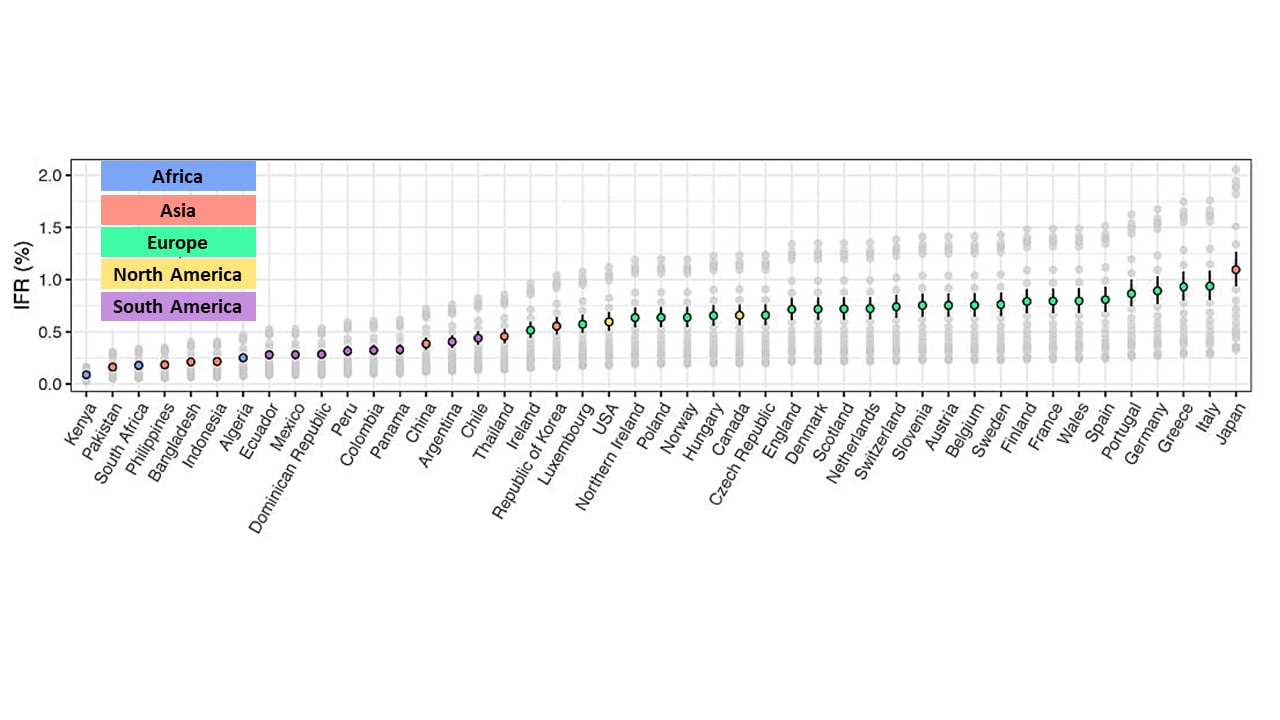
I’m somewhat suspicious about the numbers for lower-income countries though. In Mexico for example Covid deaths have been grossly undercounted. These kind of high-level estimates are hard to do reliably when they are built on poor-quality low-level data.
I don’t know why you are pretending that “good medical care” (by which I mean, the average in a typical developed country with a well funded medical system that has not yet been completely overwhelmed; as compared to the “poor” level of care available in many developing countries or in places where hospitals are collapsing) is equivalent to “exceptional treatment”. I don’t know what you mean by “exceptional treatment”, but your link says nothing about it.
There have been a large number of estimates of IFR, and they consistently range from about 0.4% to about 1.5%, mostly toward the middle of that range. Judging by the best current science, the 0.5% number I used is probably a slight underestimate, but it is at at any rate in the right ballpark.
If you e.g. guess the actual number of deaths in absence of any countermeasures would be more like 10–20 million instead of the range I gave of 15–50 million, that seems plausible enough (though I stand by my estimate). It’s a counterfactual in any case, since in practice extreme countermeasures were adopted in many parts of the world.
"Died with Covid", not "died from Covid".
Regular old respiratory infections are a frequent indirect cause of strokes and heart attacks, but we've never claimed before that common colds cause "millions" of deaths.
Regular old respiratory infections are a frequent indirect cause of strokes and heart attacks, but we've never claimed before that common colds cause "millions" of deaths.
No the common cold, but the flu.
The official death toll in Germany from the 2017/2018 flu season is still higher than deaths from COVID-19 so far. And I suspect that if we used the same method for COVID-19 deaths that was used for the flu (indirect measurement), the flu of 2017/18 would surpass COVID-19 by far.
The official death toll in Germany from the 2017/2018 flu season is still higher than deaths from COVID-19 so far. And I suspect that if we used the same method for COVID-19 deaths that was used for the flu (indirect measurement), the flu of 2017/18 would surpass COVID-19 by far.
Across every age group (except children) Covid is roughly 5x to 10x deadlier than the seasonal flu. It also spreads faster (higher reproductive number), is much more often spread by asymptomatic/presymptomatic people, and nobody has any apparent pre-existing immunity. (And the seasonal flu is a serious deadly disease which stresses hospital systems every year, not some joke. Even if Covid were only as bad as the flu, it would still be a real threat.)
The method used to estimate flu deaths every year is far more expansive than the method used for confirmed Covid deaths.
One interesting thing to see is that the social reactions vs. Covid have radically reduced the amount of flu spread this year vs. previous years.
The method used to estimate flu deaths every year is far more expansive than the method used for confirmed Covid deaths.
One interesting thing to see is that the social reactions vs. Covid have radically reduced the amount of flu spread this year vs. previous years.
> Across every age group (except children) Covid is roughly 5x to 10x deadlier than the flu.
Two points:
a) 'Flu' is a different disease than respiratory viral diseases. (A.k.a. "common colds".) Covid is a kind of respiratory viral disease.
b) "Common colds" are also deadly and cause a huge number of deaths each year. They just get classified as deaths from stroke or heart attack, not the common cold: https://www.google.com/search?hl=en&q=does%20the%20common%20...
So counting mortality rates is not a simple issue and depends a lot on cultural factors, political incentives, etc.
Two points:
a) 'Flu' is a different disease than respiratory viral diseases. (A.k.a. "common colds".) Covid is a kind of respiratory viral disease.
b) "Common colds" are also deadly and cause a huge number of deaths each year. They just get classified as deaths from stroke or heart attack, not the common cold: https://www.google.com/search?hl=en&q=does%20the%20common%20...
So counting mortality rates is not a simple issue and depends a lot on cultural factors, political incentives, etc.
I love how the assumption is always that confirmed covid death that were actually unrelated to covid are more frequent then covid death that were not confirmed.
But, chances are that latter are more frequent. Covid tests are not done on all deaths precisely in places where situation is worst.
But, chances are that latter are more frequent. Covid tests are not done on all deaths precisely in places where situation is worst.
I think in the first world the former is more likely. I personally know someone whose grandma died of entirely unrelated causes and the hospital offered to pay for the funeral if they agreed to report her as a COVID death. Our governments are setting perverse incentives.
> I love how the assumption is always that confirmed covid death that were actually unrelated to covid are more frequent then covid death that were not confirmed.
There is no such assumption. Read my post again: millions and millions of people died from the common cold before 2020. The media never reported those deaths as 'common cold deaths', though, even though it would have made just as much sense as reporting 'Covid deaths' does.
There is no such assumption. Read my post again: millions and millions of people died from the common cold before 2020. The media never reported those deaths as 'common cold deaths', though, even though it would have made just as much sense as reporting 'Covid deaths' does.
Children don't generally die from Covid19. Your numbers are exaggerated, Covid is not the only cause of death around the world.
The load of sick people is also not exceptionally high, at least not in the intensive wards (don't have data for normal hospitalizations).
Here in Germany we have daily updates on the number of ICUs in use. It shows Covid is only a fraction of the patients, even now only 10% despite of soaring infection numbers.
https://www.intensivregister.de/#/aktuelle-lage/zeitreihen
The load of sick people is also not exceptionally high, at least not in the intensive wards (don't have data for normal hospitalizations).
Here in Germany we have daily updates on the number of ICUs in use. It shows Covid is only a fraction of the patients, even now only 10% despite of soaring infection numbers.
https://www.intensivregister.de/#/aktuelle-lage/zeitreihen
Of course there is an exceptional number of ICU patients. Many hospitals in Germany already are running at capacity and can't admit any more ICU patients. And that's despite every postponable operation being postponed.
I have posted the official chart of ICU occupation in Germany. How can you argue with that? Covid patients are only a small fraction of the occupied beds.
In general it makes sense to use existing ICU beds at capacity (or slightly below), to, you know, make use of them.
Surely you could also still adjust by delaying surgical procedures that are not urgent, if things would get worse.
In general it makes sense to use existing ICU beds at capacity (or slightly below), to, you know, make use of them.
Surely you could also still adjust by delaying surgical procedures that are not urgent, if things would get worse.
You said it yourself, you want to run ICUs close to capacity, so you can't just add another 10% (or 27% like in Berlin right now) for COVID patients without calling it exceptional load. Procedures are already being delayed to free up extra capacity, and nurses are working overtime. The system is fairly close to collapse and we're lucky that the current measures stopped the growth of new infections, albeit at a very high level. We couldn't handle another doubling.
Only 20% of patients are in ICU because of Covid, so it is simply incorrect to claim that because of Covid the system is close to collapse. It is not. And if you call more than 80% use (which we don't even have) "exceptional load", it still isn't the same as "close to collapse". Have you even looked at the charts? If you count the emergency reserve, there is still capacity for 15000 more beds. A "doubling of cases" would put 4000 more people into ICU, so it wouldn't break the system at all. https://www.intensivregister.de/#/aktuelle-lage/zeitreihen
As for nurses working overtime, do you have any data for that? Quoting some individual hospital managers warning of "possible collapse" is not really evidence. They can also be politically motivated ("see, we really need more money for our ICU section"). You can also find individual hospital managers saying everything is fine.
As for nurses working overtime, do you have any data for that? Quoting some individual hospital managers warning of "possible collapse" is not really evidence. They can also be politically motivated ("see, we really need more money for our ICU section"). You can also find individual hospital managers saying everything is fine.
The offical numbers say that German's hoslitals are not running at their limits. In average roughly 20% of intensive care beds are not occupied.
https://www.intensivregister.de/#/aktuelle-lage/kartenansich...
https://www.intensivregister.de/#/aktuelle-lage/kartenansich...
The regional differences are pretty high, and beds are in many cases not the limiting factor. It's ICU nurses.
If you can read German here is a source for Berlin: https://www.tagesspiegel.de/berlin/zu-viele-corona-patienten...
TLDR is only 85% of the beds are full, but there aren't enough nurses, so the emergency room will be closed. Several other hospitals in Berlin already stopped admitting new ICU patients.
If you can read German here is a source for Berlin: https://www.tagesspiegel.de/berlin/zu-viele-corona-patienten...
TLDR is only 85% of the beds are full, but there aren't enough nurses, so the emergency room will be closed. Several other hospitals in Berlin already stopped admitting new ICU patients.
As other said, it is not that unusual that individual units are full. As for staff, if things would become dire, surely more capacity could be mustered (people working overtime and so on).
And if it is really such a limiting factor, the statistics should be adjusted accordingly.
I think it is just a wildcard argument without any specific numbers. You can imagine whatever you like. How many nurses are available? How many are sick, specifically?
Also, sick nurses tend to be well again after two weeks (if they have Covid).
And if it is really such a limiting factor, the statistics should be adjusted accordingly.
I think it is just a wildcard argument without any specific numbers. You can imagine whatever you like. How many nurses are available? How many are sick, specifically?
Also, sick nurses tend to be well again after two weeks (if they have Covid).
Yes, I read German. But this is not a singular event that has never happened before. Here is a report from 2017 that sounds familiar:
https://www.welt.de/regionales/bayern/article161869919/Klini...
https://www.welt.de/regionales/bayern/article161869919/Klini...
Yes of course, there are other occasions where this happens, but I consider in very good evidence against the claim that there is no exceptional ICU load right now.
Yes, situation is bad, but we will make it. Prof. Kluge does not sound too pessimistic. If you have time, take a look at his report about the flu season 2017/18. Pretty grim stuff, more than 40% of intensive care patients died.
https://www.researchgate.net/publication/333785335_Managemen...
https://www.researchgate.net/publication/333785335_Managemen...
You never run ICUs at 100% because where would you put the people who have car crashes etc?
Optimal rate depends on the country, but about 75% is typical.
Optimal rate depends on the country, but about 75% is typical.
Sure, but that is exactly the case in Germany, only 80% are in use, as would be expected in normal times. Presumably they can adjust by delaying surgical procedures that are not urgent.
I think it's insane to change policy intended to protect a huge segment of our vulnerable population to placate addicts. Addiction is a terrible thing (I've lost family members to it), but I'm not going to prioritize their needs over the needs of the elderly, essential workers, medical staff and high risk individuals.
Fair enough, but it's not only addicts being adversely affected by the quarantines and lockdowns. I would go so far to say that everyone has been adversely affected by the lockdowns--it's just a question of how much and have these costs outweighed the benefits.
Until recently, I'd it was pretty clear that Sweden (no lock-downs) and the US (many lockdowns of varying length and enforcment) have suffered the same per capita fatality rate.
Until recently, I'd it was pretty clear that Sweden (no lock-downs) and the US (many lockdowns of varying length and enforcment) have suffered the same per capita fatality rate.
Sweden changed course on that decision a couple weeks ago now, and has stricter rules than a lot of the US (no gatherings larger than 8 people, for example).
> something that gets lost in the concern about COVID
I don't know if I'd describe it as passively as "getting lost". Very visible people have been talking about it, including the outgoing President, who mentioned the mental health costs of lockdown multiple times. Leaving aside the fact that even true things that Trump says are discounted due to his lunacy, most people are too dim to understand the concept of trade-offs, so anything that gives "aid and comfort to the enemy" is systematically downplayed among most of those that are pro-Covid-restrictions (I say all of this as someone who think that restrictions have tragic costs but are necessary).
That is to say, the problem isn't that no one has thought of factoring this into decisions, it's that the discourse upstream of policy is driven largely by the majority of voters that don't actually care about pandemic policy as anything other than another wedge issue to fight pre-existing cultural/religious wars over.
I don't know if I'd describe it as passively as "getting lost". Very visible people have been talking about it, including the outgoing President, who mentioned the mental health costs of lockdown multiple times. Leaving aside the fact that even true things that Trump says are discounted due to his lunacy, most people are too dim to understand the concept of trade-offs, so anything that gives "aid and comfort to the enemy" is systematically downplayed among most of those that are pro-Covid-restrictions (I say all of this as someone who think that restrictions have tragic costs but are necessary).
That is to say, the problem isn't that no one has thought of factoring this into decisions, it's that the discourse upstream of policy is driven largely by the majority of voters that don't actually care about pandemic policy as anything other than another wedge issue to fight pre-existing cultural/religious wars over.
[deleted]
Fortunately it is being factored into these decisions, and has been publicly discussed for about nine months now as a consideration. What makes you think it's getting lost? https://www.nytimes.com/2020/03/26/health/coronavirus-alcoho...
Given the extreme conditions being imposed in certain states, it certainly is not being factored into these decisions uniformly by all governors. There are states that are using reason and common sense. But look at California for example. When you have Sheriffs in virtually every major county directly and publicly refusing to enforce your orders, perhaps you have gone too far [1].
[1] https://ktla.com/news/local-news/riverside-county-sheriff-sl...
[1] https://ktla.com/news/local-news/riverside-county-sheriff-sl...
That's a weakness of allowing elected police chiefs who may be doing this for political reasons and not considering their duty to protect the public.
That’s pretty cynical. A more likely explanation might be that police agencies have limited resources, and and as a result have to prioritize their enforcement activities for actual crimes. There simply aren’t enough police, jails, or courts to arrest random people for leaving their homes with a mask on.
Further, by advocating for aggressive enforcement, you are also advocating for the ultimate super spreader event: filling jails with people that don’t belong there, where the virus already runs rampant. Most of these people would be booked in, get the virus, and then bail out or be released by a judge a few days later. Then, they would take the virus out into the community and spread it further.
These restrictions are a fun exercise in virtue signaling, but are impractical and actually enforcing them would increase the spread of the virus.
Further, by advocating for aggressive enforcement, you are also advocating for the ultimate super spreader event: filling jails with people that don’t belong there, where the virus already runs rampant. Most of these people would be booked in, get the virus, and then bail out or be released by a judge a few days later. Then, they would take the virus out into the community and spread it further.
These restrictions are a fun exercise in virtue signaling, but are impractical and actually enforcing them would increase the spread of the virus.
Given the behaviour of US police forces that has come to light (or ben more exposed recently) - its a reasonable position.
You disagree with their conclusions and are using that as proof that they are not including this data in their decision making. That's a poor argument, weakened even further by the various announcements and resources Newsom specifically has made about impacts on mental health and newly created helplines and recommendations - which make it clear that he is well aware of this effect.
Someone mentioned this here on HN and possibly setting the house on fire but was dismissed as unfounded. I actually realise that they knew something...
It is sad that Tony Hsieh didn’t get the help that he needed and instead tried to self medicate in order to get away from all that. This recurrent story where extremely intelligent people are battling mental health issues and cannot speak out because the stigma behind this issue is too damaging is why we need to normalize the discourse around mental health if we want to avoid this type of tragedies. I’m not actively suffering (and am not as bright as Tony) but had some bouts of depression and hypomania in the past and know how afraid I was to let anyone official (eg. at work, school) know about my suffering because once out it always trails you like a cloud and will always deem you inferior to others. Luckily I was able to escape the black hole and have been good and calm for about 10 years and learned to never slip into that again. But there’s a remnant fear of a possibility of going back to it. Along with that there is the fear of falling begind, loosing job, becoming isolated and homelessness. This fear is clearly exacerbated in the US where one or a few slip-ups turns everything into an ever accelerating down-spiral. Tony had so much more to loose as his cliff was much higher than an ordinary person. He could have seeked professional help and he probably did but too late in the game. Had we not have this stigma around, he and others could get the help early on when much more could be done.
Self-medication with drugs works temporarily but its abuse is clearly a quick path to compelte madness and early death. I personally stay away from drugs except from an ocasional puff of weed, the once a decade or two experience with LSD and the weekend bottle of beer.
Rest in peace Tony, you will be missed
It is sad that Tony Hsieh didn’t get the help that he needed and instead tried to self medicate in order to get away from all that. This recurrent story where extremely intelligent people are battling mental health issues and cannot speak out because the stigma behind this issue is too damaging is why we need to normalize the discourse around mental health if we want to avoid this type of tragedies. I’m not actively suffering (and am not as bright as Tony) but had some bouts of depression and hypomania in the past and know how afraid I was to let anyone official (eg. at work, school) know about my suffering because once out it always trails you like a cloud and will always deem you inferior to others. Luckily I was able to escape the black hole and have been good and calm for about 10 years and learned to never slip into that again. But there’s a remnant fear of a possibility of going back to it. Along with that there is the fear of falling begind, loosing job, becoming isolated and homelessness. This fear is clearly exacerbated in the US where one or a few slip-ups turns everything into an ever accelerating down-spiral. Tony had so much more to loose as his cliff was much higher than an ordinary person. He could have seeked professional help and he probably did but too late in the game. Had we not have this stigma around, he and others could get the help early on when much more could be done.
Self-medication with drugs works temporarily but its abuse is clearly a quick path to compelte madness and early death. I personally stay away from drugs except from an ocasional puff of weed, the once a decade or two experience with LSD and the weekend bottle of beer.
Rest in peace Tony, you will be missed
I agree with the sentiment of your comment, but in this case it did appear that he was seeing a therapist so he was getting some professional help.
I think the help that may be missing is friends who are "lovingly firm" with him sooner. But it's easy to assume a billionaire is going to be fine and "tony is just being tony".
I think the help that may be missing is friends who are "lovingly firm" with him sooner. But it's easy to assume a billionaire is going to be fine and "tony is just being tony".
> This recurrent story where extremely intelligent people are battling mental health issues and cannot speak out because the stigma behind this issue is too damaging is why we need to normalize the discourse around mental health if we want to avoid this type of tragedies.
Where exactly is the "stigma" of mental health in tech nowadays? We're blasted day and night to the point where apparently every other person is "battling mental health issues".
Maybe there's a deeper issue here than "stigma" and seeing overpriced therapists.
Where exactly is the "stigma" of mental health in tech nowadays? We're blasted day and night to the point where apparently every other person is "battling mental health issues".
Maybe there's a deeper issue here than "stigma" and seeing overpriced therapists.
I mean, given the demands of modern society, I wouldn’t be surprised if every other person was honestly battling some kind of mental health issues at some point.
I mean hell, it’s tough enough being sentient and dealing with mortality, throw in social issues, politics, propaganda, conspiracies, lack of health care, lack of social safety nets, caring for dependents, dating, paying bills, social media, “Instagram culture,” and a god damn pandemic. It’s rough out there.
I mean hell, it’s tough enough being sentient and dealing with mortality, throw in social issues, politics, propaganda, conspiracies, lack of health care, lack of social safety nets, caring for dependents, dating, paying bills, social media, “Instagram culture,” and a god damn pandemic. It’s rough out there.
Look a few generations back and reset your worldview. Been drafted into combat lately?
I agree. The good old days were terrible. No doubt many suffered through considerable mental anguish. Unfortunately, this knowledge does not usually help people currently living with depression or similar mental illness.
It’s like, “I can’t pay my mortgage and I don’t where my family will live, but Grandpa was a POW in Nam, so no worries!”
It’s like, “I can’t pay my mortgage and I don’t where my family will live, but Grandpa was a POW in Nam, so no worries!”
Man, grandpa was a POW in 'Nam makes me feel so old. Who's grandparents on this forum are young enough to be in Vietnam?
Yeah, doesn't take it away but that perspective can make it more bearable. "Things could be worse" is a real way to cope with stress.
You know where you don't see every other person crying about mental health on their iPhone? The entire developing world.
This isn't a mental health crisis. Westerners are just babies.
This isn't a mental health crisis. Westerners are just babies.
> I mean, given the demands of modern society
Modern society is the easiest society that has ever existed. And that's true nearly world-wide. People have never been better off or worked fewer hours at the median. In modern - affluent - society, it's that people have become soft, weak, fragile. The times are not harder, they're easier. People in affluent nations have never been more coddled and protected.
What demands are you talking about? Influencers pressuring people to have whiter smiles on Instagram or better abs on TikTok? Someone getting their feelings hurt on Facebook?
In the US things were dramatically worse for the bottom 1/2 as recently as the 1970s and earlier. Look up the poverty and hunger rates/issues in the US across the century from 1870-1970. It was barbaric compared to now. The same is true for violent crime, homelessness, and so on. The past 30-40 years have been amazing compared to the past and that holds true for the most of the world. In affluent nations you have a vast number of exceptionally spoiled people that have known very little suffering.
Modern society is the easiest society that has ever existed. And that's true nearly world-wide. People have never been better off or worked fewer hours at the median. In modern - affluent - society, it's that people have become soft, weak, fragile. The times are not harder, they're easier. People in affluent nations have never been more coddled and protected.
What demands are you talking about? Influencers pressuring people to have whiter smiles on Instagram or better abs on TikTok? Someone getting their feelings hurt on Facebook?
In the US things were dramatically worse for the bottom 1/2 as recently as the 1970s and earlier. Look up the poverty and hunger rates/issues in the US across the century from 1870-1970. It was barbaric compared to now. The same is true for violent crime, homelessness, and so on. The past 30-40 years have been amazing compared to the past and that holds true for the most of the world. In affluent nations you have a vast number of exceptionally spoiled people that have known very little suffering.
It's only easy if you consider living on welfare or being homeless as acceptable options.
>What demands are you talking about? Influencers pressuring people to have whiter smiles on Instagram or better abs on TikTok? Someone getting their feelings hurt on Facebook?
Getting a college degree is stressful and many people quit. Choosing the right one is also a challenge in it's own right. If you fail at this you will be in debt and lost an opportunity to join the workforce early. Current monetary policies are basically extremely pro business at the expense of workers (current first world economies are fundamentally flawed and 2008 just made it obvious). A lot of people have poor employment options through no fault of their own. They are simply declared unneeded because of how the economy is structured.
It's easier to survive but it's much harder to stay sane.
>What demands are you talking about? Influencers pressuring people to have whiter smiles on Instagram or better abs on TikTok? Someone getting their feelings hurt on Facebook?
Getting a college degree is stressful and many people quit. Choosing the right one is also a challenge in it's own right. If you fail at this you will be in debt and lost an opportunity to join the workforce early. Current monetary policies are basically extremely pro business at the expense of workers (current first world economies are fundamentally flawed and 2008 just made it obvious). A lot of people have poor employment options through no fault of their own. They are simply declared unneeded because of how the economy is structured.
It's easier to survive but it's much harder to stay sane.
9/10 people on Earth reading this are cringing because of how privileged it sounds. The complaints you’re describing are for babies.
That it has gone from extremely shite to very shite is not something that can just be translated to "people have become soft, weak, fragile". Suffering looks different now. It's a lazy take to conclude that people must have become weak when the technological progress haven't produced the dignified and easy life of what previous generations hoped it would. Instead we just keep producing and consuming in an endless ever expanding circle, skipping the freedom of leisure for all part.
There is no stigma in the pretty words from HR and massive stigma in the actions of HR
What does HR have to do with anything/?
They can tell us about their fruit baskets and flat hierarchies.
HR is often a great example of how fucked it all is. (Good humane HR is rare)
HR is often a great example of how fucked it all is. (Good humane HR is rare)
HR is the conservative arm of execs. They're responsible for setting company policies that reduce the risk of employee disputes and increase the chance of employees staying productive. That's why they say "HR isn't your friend". They have an outsized impact in large, chaotic companies and as a result they end up shaping the culture. HR is the lackey serving the demands of the capitalist machine.
If you admit you are chronically ill in the workplace you admit you won't ever be as productive as other "healthy" (aka those who didn't admit they are ill) employees. During layoffs you'll be the first to go.
Exactly this. It's all we care then if it impacts your work - boom you're out.
In my experience, there is is no stigma around saying you have a mental health issue, but still still the expectation that it not impact you work.
I tend to agree that the issue isn’t discourse, but that Discourse alone won’t fix the problem.
I tend to agree that the issue isn’t discourse, but that Discourse alone won’t fix the problem.
As others have said, people seem comfortable enough to talk about mental health in an abstract way, but less so about their particular needs.
You seem to have a particularly skeptical view though doubting stigma and casting doubt into therapy as well. Your comment is actually a perfect example of stigma.
I’ve struggled with anxiety before and saw a therapist for a while and benefited greatly from it. It was expensive, sure, but not over priced. Less hourly than I make.
I didn’t really talk about it much at work, but I am open about it now.
On top of that, there are less stigma towards certain aspects of mental health and more towards others. I believe anxiety, like I mentioned for myself, is becoming a more commonly discussed topic, but depression or bipolar, for example, still carry stigma that push people into facing these things alone.
You seem to have a particularly skeptical view though doubting stigma and casting doubt into therapy as well. Your comment is actually a perfect example of stigma.
I’ve struggled with anxiety before and saw a therapist for a while and benefited greatly from it. It was expensive, sure, but not over priced. Less hourly than I make.
I didn’t really talk about it much at work, but I am open about it now.
On top of that, there are less stigma towards certain aspects of mental health and more towards others. I believe anxiety, like I mentioned for myself, is becoming a more commonly discussed topic, but depression or bipolar, for example, still carry stigma that push people into facing these things alone.
RIP. It's really sad. Mental health problems are often dismissed or not caught in time.
I read his book "Delivering Happiness" after I heard about his death and before reading this article about mental health problems. As I read it I saw some interesting stories and ideas about the businesses that he built but I also read stories which put way too much focus (imho) on various nights and parties which don't really relate to entrepreneurship or business. The first thing that popped into my mind is depression, drugs and alcohol overuse.
I read his book "Delivering Happiness" after I heard about his death and before reading this article about mental health problems. As I read it I saw some interesting stories and ideas about the businesses that he built but I also read stories which put way too much focus (imho) on various nights and parties which don't really relate to entrepreneurship or business. The first thing that popped into my mind is depression, drugs and alcohol overuse.
> The first thing that popped into my mind is depression, drugs and alcohol overuse.
Same. A shadow story that eclipses the text.
"Delivering Happiness" is explicitly about delivering happiness. The subtext or implicit story is about someone who could not find happiness for himself. It's worth re-reading in the context of his passing. RIP.
Same. A shadow story that eclipses the text.
"Delivering Happiness" is explicitly about delivering happiness. The subtext or implicit story is about someone who could not find happiness for himself. It's worth re-reading in the context of his passing. RIP.
> put way too much focus (imho) on various nights and parties which don't really relate to entrepreneurship or business.
“Work hard, party hard” is an extremely common aspect of startup culture. I personally suspect that startups tend to draw in risk takers, which explains the prevalence of over-drinking in many (but not all) startups.
“Work hard, party hard” is an extremely common aspect of startup culture. I personally suspect that startups tend to draw in risk takers, which explains the prevalence of over-drinking in many (but not all) startups.
How is drinking risk taking? I was in groups that where drinking was super normalized and never ever perceived it to be dangerous. Plus, anxious fearful people do drink too, it makes them feel better.
I mean, I avoided drinking near to some specific individuals (I am woman), but I perceived those individuals to be unsafe. Drinking itself did not constituted risk taking for me.
I mean, I avoided drinking near to some specific individuals (I am woman), but I perceived those individuals to be unsafe. Drinking itself did not constituted risk taking for me.
Drinking is normalized in my entire country, but its still pretty obvious you're literally poisoning yourself with alcohol. That much I understood even as a teen.
Well, drinking is normalized in my entire country and dont refer to it as "literally poisoning yourself".
I mean, some of abstinents who are strongly against alcohol sometimes do. As an attempt to make others stop drinking. And given that the drinking is normalized, they are small minority. I mean, they are small minority of abstinent too. Most abstinents are kind of content when no one is trying to force them to drink.
I mean, some of abstinents who are strongly against alcohol sometimes do. As an attempt to make others stop drinking. And given that the drinking is normalized, they are small minority. I mean, they are small minority of abstinent too. Most abstinents are kind of content when no one is trying to force them to drink.
What is your claim?
Drinking is normal in your culture —> drinking is not risky in your culture ?
This is patently false; drinking carries risks in any context, perhaps even moreso in environments which fail to recognize its potential for harm
Drinking is normal in your culture —> drinking is not risky in your culture ?
This is patently false; drinking carries risks in any context, perhaps even moreso in environments which fail to recognize its potential for harm
My claim is that in culture where drinking is normalized, people dont perceive drinking risky. Consequently, drinking as activity is not all that much biased toward "risk takers".
It does not really matter how much risk it "objectively" puts you through. It attracts risk takers only if people consider it risky.
It does not really matter how much risk it "objectively" puts you through. It attracts risk takers only if people consider it risky.
would you say that a significant fraction of people in any culture agree that there are many activities for which drinking and then doing that activity would be considered risky?
[deleted]
Over-drinking is risk taking, OP explicitly mentioned that, not just "drinking".
It's risk taking because over-drinking is by definition going over your limits with alcohol and I assume we all know the behaviours that this can bring with.
It's risk taking because over-drinking is by definition going over your limits with alcohol and I assume we all know the behaviours that this can bring with.
Even in cultures where regular drinking is normalized, it’s typical understood that there’s a difference between having drinks and binge drinking. “Work hard, party hard” heavily implies the latter, as it’s indicating that the person doing it will party more than is socially normal, and is proud of that.
Also, I’m an American, and I’m largely commenting on both American culture and American startup culture; both of which I’ve participated in. My observations about this are relevant for Zappos, a startup based out of Las Vegas, but might not be relevant for say EPAM in Minsk.
Also, I’m an American, and I’m largely commenting on both American culture and American startup culture; both of which I’ve participated in. My observations about this are relevant for Zappos, a startup based out of Las Vegas, but might not be relevant for say EPAM in Minsk.
> Which don't really relate to entrepreneurship or business
To some extend, but startup events generally combine exactly those things (without the drugs, depending on where it is).
To some extend, but startup events generally combine exactly those things (without the drugs, depending on where it is).
It seems that Jewel wrote this in a letter warning him about his addiction.
“When you look around and realize that every single person around you is on your payroll, then you are in trouble." [1]
Not only in this particular tragedy, these are words to live by in general. We all need some neutral people around to provide an unbiased perspective so that we can make informed decisions.
[1] https://people.com/music/jewel-wrote-to-tony-hsieh-before-hi...
“When you look around and realize that every single person around you is on your payroll, then you are in trouble." [1]
Not only in this particular tragedy, these are words to live by in general. We all need some neutral people around to provide an unbiased perspective so that we can make informed decisions.
[1] https://people.com/music/jewel-wrote-to-tony-hsieh-before-hi...
As an aside: I hadn't bought anything off Zappos for years, and checked it out when the news hit and surprised that it still basically looks the same as I remember it maybe 10+ years ago. Certainly looks and feels like an eCommerce website from the late 2000s/early 2010s.
I'm curious if this was an intentional choice or a sign the website has been on cruise control since the acquisition. It certainly makes me wonder what Hsieh was doing as CEO as late as this summer either way, which is to say while he was certainly a pioneer in the 2000s I'm not sure what about Zappos in the 10+ years post-acquisition feels cutting edge.
I'm curious if this was an intentional choice or a sign the website has been on cruise control since the acquisition. It certainly makes me wonder what Hsieh was doing as CEO as late as this summer either way, which is to say while he was certainly a pioneer in the 2000s I'm not sure what about Zappos in the 10+ years post-acquisition feels cutting edge.
My impression - perhaps incorrect - was that everything on Zappos was also on Amazon. Zappos became an Amazon channel and lead generator.
Audible maintainted their pre-Amazon aquisiton site for quite some time as well. Their mobile app still has the same look and feel. Maybe this is a reflection of being aquired by Amazon?
Goodreads too.
I got a notice from Zappos some years ago about a security breach they suffered where customer information was exposed. In compensation, they offered a discount on next purchase. This offer of course had a relatively short time limit, not the same as a gift certficate or store credit. I never remember reading about this security breach publicly. Maybe I just missed it.
You buy shoes through amazon.com now (with fulfillment by Zappos). That's where all the development has gone. I get the feeling zappos.com is a dead end.
Yeah that makes sense, but then my question is why did Hsieh stay as CEO for that long in what was basically a dead end company within Amazon? It doesn’t seem like that is something someone like Hsieh would ever want to do, and yet he stayed there for a decade post acquisition.
Based on the accounts that are now coming out, the guy had been living in a fantasy world for some time.
He was probably happy to stay at Zappos as long as it made him feel good. He didn't actually need to be good at business anymore because Amazon was running the show. After leaving, he decamped to Park City and paid former colleagues to join him there, to continue the party, because that is what Zappos leadership had become by that point: a party free from the daily duties and concerns of running a company that needed to succeed in the market in order to survive.
He was probably happy to stay at Zappos as long as it made him feel good. He didn't actually need to be good at business anymore because Amazon was running the show. After leaving, he decamped to Park City and paid former colleagues to join him there, to continue the party, because that is what Zappos leadership had become by that point: a party free from the daily duties and concerns of running a company that needed to succeed in the market in order to survive.
It actually sounds like the perfect position for him. He had an impressive-sounding title of CEO of Zappos without ever actually having to do much; it was a sinecure that let him focus most of his energy on the stuff he cared more about towards the end of his life, like his Vegas project, partying, and drugs.
If it works why change it?
It's the saddest article I have read in a while. Tony Hsieh was an amazing human being. The manner of his passing from the world does not take away from the good he did while alive.
Maybe sharing the circumstances of his death will also do some good if it encourages others with friends or loved ones who have mental illness to do something before it is too late.
One of my friends has been spiraling out of control for the past few months. I have tried and tried to help them. I'm going to keep trying.
One of my friends has been spiraling out of control for the past few months. I have tried and tried to help them. I'm going to keep trying.
You can offer help and support but it's up to your friend to accept it.
I am a recovering nitrous oxide addict who once set himself on fire, so I understand the terrible predicament he found himself in. Many people do nitrous recreationally as a party drug, but there's a reason they call it 'hippie crack.' Some become obsessed with it
The dangers of nitrous are hypoxia, B vitamin depletion, nerve damage, dissociative effects and extreme compulsion to use. I was in treatment with a dentist's wife, who really screwed herself in a bad way with all of these effects and could hardly walk because of nerve damage to her feet.
I forgot to mention, it's a rich man's drug, another way it's similar to cocaine. I probably spent $150,000 on cases of whippets (25 boxes x 24 whippets to a box.) My first reaction to Tony Hsieh and nitrous was "He had too much money for his own good." I ran out of money before I could kill myself with it.
here's a writeup that really stuck with me for the last decade about the surprising level of organized crime in selling nitrous at music festivals:
https://www.villagevoice.com/2010/07/06/inside-the-nitrous-m...
https://www.villagevoice.com/2010/07/06/inside-the-nitrous-m...
Headshop owners who sell nitrous to obviously addicted people are generally not good citizens. I'd guess they make most of their profit from addicts like me. I only got cut off once after a 2wk/$10k run when I was almost too sick and incoherent to make a purchase. Every other store gladly kept selling to me when I was in that condition.
It’s (comparatively) very cheap in bulk tank form.
But that’s much harder to come by for most people.
The small whippets cartridges... you’re paying for the steel, getting a gas in there and markups. If they filled it with room air, it would cost the same.
But that’s much harder to come by for most people.
The small whippets cartridges... you’re paying for the steel, getting a gas in there and markups. If they filled it with room air, it would cost the same.
I could have looked for tanks to save money, but I surely would have died that way. I could control intake with cartridges because the limiting factor was that you had to keep cracking them. A case of 600 whippets one after another would last about 5 hours, so 2 a minute. I've heard too many stories of people dying with tanks.
Forgive me ... I am completely naive regarding this subject but find these descriptions both fascinating and confusing...
Do I understand: if you're on a whippet bender you have to do a thing every 30 seconds ?
It seems like that would interrupt and greatly diminish whatever pleasurable effects the substance was giving you ... in fact, it sounds somewhat stressful ...
Do I understand: if you're on a whippet bender you have to do a thing every 30 seconds ?
It seems like that would interrupt and greatly diminish whatever pleasurable effects the substance was giving you ... in fact, it sounds somewhat stressful ...
You can put 2-3 into a dispensing canister at a time, but yes, every 60-90 seconds it requires interaction.
This has probably saved a lot of lives, tbh. It's hard to suffocate yourself if doing so requires motor skills.
This has probably saved a lot of lives, tbh. It's hard to suffocate yourself if doing so requires motor skills.
In Australia, their paramedics have Penthrox tubes that have an anesthetic in them.
The idea is that the patient can self-administer, but if they over do it, they get too messed up to operate the thing until it wears off again.
The idea is that the patient can self-administer, but if they over do it, they get too messed up to operate the thing until it wears off again.
Cracking whippets is like popping bubble wrap. It's a pleasant repetitive motion that becomes part of automatic muscle memory after a while. It becomes a meditation, like praying the rosary.
Yes, it’s a fleeting rush. I’ve probably done nitrous 5-6 times over a couple of decades but I can see the allure.
Matt Dike famously said the worst thing for an addict is unlimited resources.
Glad you're still with us.
Glad you're still with us.
Thanks. I've made a remarkable recovery with a lot of help. I'm sharing this because the subject came up with Tony Hsieh and I know he and I weren't the only ones abusing nitrous. My email is in my profile if anyone out there thinks they have a problem with it and would like to talk about it. I'm raising awareness of the dangers here. It's seductive when you read that philosopher William James had epiphanies with it and want to have them yourself (I'm pretty sure he abused it to.) It took ahold of me pretty quickly. This has been difficult for me today because I'm triggered by thinking about it. I can taste it and feel it. But maybe I warned somebody off from it.
Did you seek professional help on your own, or did someone force you to get help? Sounds like Jewel tried to make Tony get help.
At the point I bottomed out ended up in a homeless shelter. My willful and stubborn way wasn't working, so I made a conscious decision to start doing what people told me to do. I surrendered, if you will. Family and psychology pros got me into a long term treatment program. Fortunately, I had two family members who hadn't given up on me.
The documentary of Steve-O's (from Jackass fame) descent into madness via nitrous oxide and other drugs was terrifying. The way he would convulse and then have conversations with his Mom and talk to the voices in his head? The whole thing left me speechless.
Steve-O Demise & Rise [MTV Special]:https://www.youtube.com/watch?v=i1ulzP2XUOg
Steve-O Demise & Rise [MTV Special]:https://www.youtube.com/watch?v=i1ulzP2XUOg
I think one "advantage" could be that it's an invisible drug. People don't know that you're doing it, unless of course you have neurological or organ damage, but even then it could be explained away.
You start getting incoherent after heavy use, even when not currently using. People who know you notice. Jewel said she left an event early because she was upset to see Tony was acting that way. It takes 4-6 days to recover from a heavy run, including getting feeling back in your nerve endings. Taking B vitamins help.
I’d go further and say everyone taking nitrous oxide should be taking b12 supplements.
Absolutely. I have pernicious anemia now (need B12 shots) that I didn't have before, at least not diagnosed when younger.
How much is a "heavy run"? Another commenter mentioned buying many cases.
Some rather serious side effects have been described in a vegetarian (probably already b12 deficient) after just an hour of continuous exposure.
While that was in a clinical setting, it can be quick if you’re already at risk.
https://www.thelancet.com/journals/lancet/article/PIIS0140-6...
While that was in a clinical setting, it can be quick if you’re already at risk.
https://www.thelancet.com/journals/lancet/article/PIIS0140-6...
I'd need 4 to 6 days to recover after doing 2 cases or 1200 whippets. I'd be extremely sick for the first 2 or 3 days.
I have done nitrous before - what about it makes you more likely to be set on fire? Just risk of passing out while smoking a cigarette maybe?
I used to crack a bunch of cartridges into a large plastic bag such as an outdoor trash bag. I didn't realize N2O was an accelerant so I was smoking. The tip of the cig fell on the bag and it went up in a flash. Fortunately it burned quickly and only singed me.
It's an oxidiser; it can make things which are normally not flammable become flammable, as well as accelerate burning.
It's amazing how fast it makes things burn. They sell nitrous at auto stores for super charged engines but I never did that because it's very dirty
Nitrous in cars cools the chamber allowing you to add more fuel/oxygen. It’s also not for “super charged” engines specifically.
That's not how I understand it. You may be referring to some other use I am not aware of. I'm not a car guy.
"A nitrous oxide engine is an internal combustion engine in which oxygen for burning the fuel comes from the decomposition of nitrous oxide, N2O, rather than air. The system increases the engine's power output by allowing fuel to be burned at a higher-than-normal rate, because of the higher partial pressure of oxygen injected with the fuel mixture."
https://en.wikipedia.org/wiki/Nitrous_oxide_engine
"A nitrous oxide engine is an internal combustion engine in which oxygen for burning the fuel comes from the decomposition of nitrous oxide, N2O, rather than air. The system increases the engine's power output by allowing fuel to be burned at a higher-than-normal rate, because of the higher partial pressure of oxygen injected with the fuel mixture."
https://en.wikipedia.org/wiki/Nitrous_oxide_engine
Supercharged usually refers to an engine with a supercharger, which is a crankshaft driven pump used to force more air into the engine. It is similar to a turbocharger, except a turbo is driven by exhaust gas.
N2O is typically used with a normally aspirated gasoline engine. It's just another way to get more oxygen into the combustion chamber.
https://www.racingjunk.com/news/drag-race-101-its-a-gas/
N2O is typically used with a normally aspirated gasoline engine. It's just another way to get more oxygen into the combustion chamber.
https://www.racingjunk.com/news/drag-race-101-its-a-gas/
You can absolutely run N2O with a turbo or supercharged engine. I ran a NXExpress rig on my '99 Eclipse GSX back in the day (with a big turbo).
They didn't say it couldn't be used with a super charger, they said it wasn't exclusively used with a super charger.
This same effect can be accomplished by spraying cold water into the air inlet, and this is used in some high end cars and jet engines. It also cools hot points in the engine, letting you push the compression higher without causing premature detonation.
Does mean you have to refill a water tank too, but it also lets you get more power without producing any more NOx, which are bad for both the environment and people.
Does mean you have to refill a water tank too, but it also lets you get more power without producing any more NOx, which are bad for both the environment and people.
It is a nice complement, as compressed air from a turbo or super charger is very hot. The nitrous cools it down. People also use a water or alcohol spray for a similar reason.
While it will be cooler, it also reacts better than O2 from the air. Especially since you’re injecting 100% N2O instead of 79% inert atmospheric air.
The nitrous itself also has more oxygen in it than air does.
It's a better oxidiser than oxygen - also the reason for nos tanks in cars.
Some of the speculation in this thread [1], originally flagged as hearsay, seems to be confirmed by this article, namely his use of nitrous oxide.
[1] https://news.ycombinator.com/item?id=25235843
[1] https://news.ycombinator.com/item?id=25235843
Yeah, I got downvoted to hell after asking a simple question of how this happened and if anyone had a source [0]. Really reflects pretty badly on that whole thread. Lots of fawning over Hsieh and anger at people who were asking questions, or revealing what really happened under throwaway accounts.
[0]: https://news.ycombinator.com/item?id=25235890
[0]: https://news.ycombinator.com/item?id=25235890
The singer, Jewel who was a friend sounded an alarm in August https://people.com/music/jewel-wrote-to-tony-hsieh-before-hi...
She's pretty credible.
She's pretty credible.
She sounds like someone that actually cared about him.
It’s terrible that someone who seemed like a genuinely kind person ended up surrounded by sycophants taking advantage of his wealth and encouraging his drug issues.
"I am going to be blunt," she wrote in the letter, obtained by Forbes. "I need to tell you that I don’t think you are well and in your right mind. I think you are taking too many drugs that cause you to disassociate.
“Jewel reportedly told Hsieh in the note that "people you are surrounding yourself with are either ignorant or willing to be complicit in you killing yourself.
“When you look around and realize that every single person around you is on your payroll, then you are in trouble," Jewel wrote, according to Forbes.
“You are in trouble, Tony.”
She was right.
It’s terrible that someone who seemed like a genuinely kind person ended up surrounded by sycophants taking advantage of his wealth and encouraging his drug issues.
"I am going to be blunt," she wrote in the letter, obtained by Forbes. "I need to tell you that I don’t think you are well and in your right mind. I think you are taking too many drugs that cause you to disassociate.
“Jewel reportedly told Hsieh in the note that "people you are surrounding yourself with are either ignorant or willing to be complicit in you killing yourself.
“When you look around and realize that every single person around you is on your payroll, then you are in trouble," Jewel wrote, according to Forbes.
“You are in trouble, Tony.”
She was right.
Indeed and thus life is hard whether your poor or rich, especially for those who suddenly get mega wealthly or fame. They seem to cant handle it very well from Michael Jackson to Whitney Houston to Tony to many others.
A lot of us I imagine wanted to be in Tony's position, yet would you still want to be him with how it all went down? His mega-wealth and fame of wealth seem to be his un-doing.
A lot of us I imagine wanted to be in Tony's position, yet would you still want to be him with how it all went down? His mega-wealth and fame of wealth seem to be his un-doing.
> A lot of us I imagine wanted to be in Tony's position, yet would you still want to be him with how it all went down?
Yes. A lot of people who don't have this type of success like to discredit the lives of those that do in order to protect their self-image. On average, wealth and status increase your quality of life.
I do think there's a lesson to be learned here about the problems that come with wealth and status. To dismiss the net benefits of wealth and status is the wrong lesson.
Yes. A lot of people who don't have this type of success like to discredit the lives of those that do in order to protect their self-image. On average, wealth and status increase your quality of life.
I do think there's a lesson to be learned here about the problems that come with wealth and status. To dismiss the net benefits of wealth and status is the wrong lesson.
But a rich person can absolutely live an average persons lifestyle. I believe Warren Buffet lives in an modest house and still drives his old car.
[deleted]
It's actually worthwhile to listen to what Jewel had to say:
https://youtu.be/GxqeOwVl0IQ
I was captivated when she described hearing Tony describe his vision for Holocracy, I finally understood what he was aiming for.
https://youtu.be/GxqeOwVl0IQ
I was captivated when she described hearing Tony describe his vision for Holocracy, I finally understood what he was aiming for.
I would love it if dang could weigh in on this tough issue. There were a number of people being downvoted asking questions about how this could have happened, and now to see that someone posted the true answer and it was flagged and hidden, that I think reflects poorly on HN and warrants an explanation.
I'll never forget at my first friend's funeral when his mother said during the eulogy "My son was a drug addict." It was so heartbreaking but so important to speak the truth and be open about it in order to pay respect to him and call out for action so that more mom's don't have to make that speech.
She did not bury the truth and "wait out of respect", she confronted it head on. If she can do that and do it in a positive way then I think an Internet forum could do it too. The truth is it seems if it weren't for a few of Tony's friends sharing the whole story, the truth may have been buried and many more may have gone down that path.
I'll never forget at my first friend's funeral when his mother said during the eulogy "My son was a drug addict." It was so heartbreaking but so important to speak the truth and be open about it in order to pay respect to him and call out for action so that more mom's don't have to make that speech.
She did not bury the truth and "wait out of respect", she confronted it head on. If she can do that and do it in a positive way then I think an Internet forum could do it too. The truth is it seems if it weren't for a few of Tony's friends sharing the whole story, the truth may have been buried and many more may have gone down that path.
Part of the problem is that "the truth" is generally not as simple and one dimensional as people would like it to be.
I was called "lazy" for much of my life. Then I was diagnosed with a genetic disorder and people finally understood I wasn't lazy. I just didn't have the energy other people had.
Everyone knows addiction is extremely hard to quit, yet being an addict remains stigmatizing and the addict is routinely treated in a blamey way for their failure to quit.
Specific outcomes also tend to have a circumstancial component. When a family has a "badly behaving" teenager, they typically blame the teen. But family therapists typically see a misbehaving minor as the presenting problem and wonder what is going on in the social fabric of the individual that is creating this outcome.
None of us entirely has control over our own lives and our own actions. We have some input, but we always have constraints on us.
Explanations that fall inside the Overton Window will be latched onto quickly. This can boil down to victim blaming rather than trying to understand with some compassion how and why things went wrong.
I was called "lazy" for much of my life. Then I was diagnosed with a genetic disorder and people finally understood I wasn't lazy. I just didn't have the energy other people had.
Everyone knows addiction is extremely hard to quit, yet being an addict remains stigmatizing and the addict is routinely treated in a blamey way for their failure to quit.
Specific outcomes also tend to have a circumstancial component. When a family has a "badly behaving" teenager, they typically blame the teen. But family therapists typically see a misbehaving minor as the presenting problem and wonder what is going on in the social fabric of the individual that is creating this outcome.
None of us entirely has control over our own lives and our own actions. We have some input, but we always have constraints on us.
Explanations that fall inside the Overton Window will be latched onto quickly. This can boil down to victim blaming rather than trying to understand with some compassion how and why things went wrong.
Very interesting. And thanks for mentioning Overton window, hadn’t seen that term before.
All true, but sometimes bad things are indeed one's fault, or at least under one's control, and the first step towards remedy is taking responsibility.
The person being discussed is dead. He is not in any position to take responsibility and alter his future.
I'm all for personal responsibility, but that really has nothing to do with my point at all.
I'm all for personal responsibility, but that really has nothing to do with my point at all.
A relative talking about it at the funeral is quite different than anonymous claims that are impossible to (dis)prove within hours of the death.
Hindsight is 20-20, but looking back it seems clear they were credible and correct, which is why I just wonder if dang could explain why they were flagged. Were moderators involved? Was any attempt made to verify? Or was it just lost in a sea of comments flagged daily (I don't know, not sure how the backend works here).
Users flagged it. We can only guess why users flag things. It was flagkilled for a while and then we unkilled it but left [flagged] on. It also got a lot of upvotes, so the signals were actually mixed.
I don't have any special insight, but FWIW: situations like this are inevitably messy. People want different things (e.g. the social standard about not speaking ill of the dead vs. curiosity to know the truth or share inside information) and they do different things (e.g. use of throwaway accounts to share sensitive true information vs. to post rumors or lies). How all that adds up is impossible to be certain about, and people will strongly disagree. It's intrinsically conflictual and I don't think we can impose simple rules on it. For example: HN is a watercooler site and it's natural for people to wonder what really happened and want to talk about it; and at the same time, that sort of internet thread can run amok and do harm surprisingly quickly.
In my experience, that sort of throwaway account (but there are many sorts—let's not overgeneralize) is usually reporting something true, though perhaps biased. But "usually" is still far from certain. If we'd known that it was likely false we'd have left the comment flagkilled, but in this case it felt likely true, so I unkilled it, but left [flagged] on as a marker of community discontent. To anyone who objects "who the hell are you to make calls about 'feels', 'likely', 'true' or 'false'", I can only completely agree.
p.s. Here's what I replied to a user who emailed about it a few days ago:
"I've unkilled the comment but left it [flagged]. I think that's the right balance.
Posts like that are usually authentic, in my experience. Not to say that people don't make shit up on the internet—they certainly do—but one can usually 'smell' the difference somehow.
Of course the fact that it's true doesn't make it an appropriate comment, but I think [flagged] is enough of a marker to indicate that, and to let people decide for themselves.
It's a tragic story in any case."
I don't have any special insight, but FWIW: situations like this are inevitably messy. People want different things (e.g. the social standard about not speaking ill of the dead vs. curiosity to know the truth or share inside information) and they do different things (e.g. use of throwaway accounts to share sensitive true information vs. to post rumors or lies). How all that adds up is impossible to be certain about, and people will strongly disagree. It's intrinsically conflictual and I don't think we can impose simple rules on it. For example: HN is a watercooler site and it's natural for people to wonder what really happened and want to talk about it; and at the same time, that sort of internet thread can run amok and do harm surprisingly quickly.
In my experience, that sort of throwaway account (but there are many sorts—let's not overgeneralize) is usually reporting something true, though perhaps biased. But "usually" is still far from certain. If we'd known that it was likely false we'd have left the comment flagkilled, but in this case it felt likely true, so I unkilled it, but left [flagged] on as a marker of community discontent. To anyone who objects "who the hell are you to make calls about 'feels', 'likely', 'true' or 'false'", I can only completely agree.
p.s. Here's what I replied to a user who emailed about it a few days ago:
"I've unkilled the comment but left it [flagged]. I think that's the right balance.
Posts like that are usually authentic, in my experience. Not to say that people don't make shit up on the internet—they certainly do—but one can usually 'smell' the difference somehow.
Of course the fact that it's true doesn't make it an appropriate comment, but I think [flagged] is enough of a marker to indicate that, and to let people decide for themselves.
It's a tragic story in any case."
I've run and moderated a forum for 15+ years (not dissimilar position to your role here) and think I've developed a pretty good instinct for picking the truth from fiction in anonymous posts of that sort. I was very confident that it was close enough to the truth. That said, I don't think the average reader can "smell" the difference in the same way; they haven't approached a forum daily with a moderator's eye. I'm always amazed when people mistake a troll for someone genuine or the reverse, when it's been obvious to me.
[deleted]
Thanks, really helpful the hear how you handle these sorts of situations. I don’t have any good ideas on how to handle it better, and maybe the original commenter could have provided some more corroborating info to preempt the flags. Given your information seems like it would be unreasonable on the mods to handle this one any differently.
> In my experience, that sort of throwaway account (but there are many sorts—let's not overgeneralize) is usually reporting something true, though perhaps biased.
If you look at the academic research on rumors, most rumors are apparently fairly accurate. That's why they spread so quickly. E.g.: https://journals.sagepub.com/doi/abs/10.1177/009102609001900...
If you look at the academic research on rumors, most rumors are apparently fairly accurate. That's why they spread so quickly. E.g.: https://journals.sagepub.com/doi/abs/10.1177/009102609001900...
I suppose the key word is "fairly". The higher that number goes, the more incentive there is for impostors, and that brings the number back down—so fairly accurate is about as accurate as they can get.
> Hindsight is 20-20, but looking back it seems clear they were credible and correct,
As far as I can tell, they were correct but not credible: they did not provide sources in the comment, and it was basically left to be evaluated in a vacuum.
(For context: I did not down vote or flag that comment.)
As far as I can tell, they were correct but not credible: they did not provide sources in the comment, and it was basically left to be evaluated in a vacuum.
(For context: I did not down vote or flag that comment.)
Incidental correctness does not validate a sloppy process.
Flagging is a user action, not something mods do, and I don't see why mods should have overridden that here. It's obviously always possible that strong claims that are impossible to confirm quickly turn out to be true, that doesn't mean we should let them always stand as if they are true in such circumstances.
EDIT: and usual hint, the most reliable way to get an answer from dang is emailing him.
EDIT: and usual hint, the most reliable way to get an answer from dang is emailing him.
something that is not immediately verifiable is not reason alone to censor something.
Speculating about the circumstances of someone's death can be in poor taste even if some of the speculation turns out to be correct.
This person clearly stated they weren't speculating, and any long time HN user could tell that they were likely credible and not a troll account. At least that's my take, that's why it would be good to hear from dang why this was buried.
Yes, the anonymous account certainly did claim to know for sure.
"If she can do that and do it in a positive way then I think an Internet forum could do it too. "
You just compared an Internet forum to a grieving mother.
Not the right comparison by a longshot.
Allowing a publication run by professional journalists ( they follow a code of ethics) to share news is slightly better than internet forum participants to share their opinions on such a sensitive topic.
You just compared an Internet forum to a grieving mother.
Not the right comparison by a longshot.
Allowing a publication run by professional journalists ( they follow a code of ethics) to share news is slightly better than internet forum participants to share their opinions on such a sensitive topic.
I think you have an overly favorable opinion of “journalists” (while I think WSJ is full of good ones, most publications are not).
But that being said, I agree there are lots of bad ways to handle this sort of thing on public forums (see numerous Reddit failures). But there’s gotta be something better and more positive than to bury the truth.
They were not sharing opinions they were sharing the facts.
But that being said, I agree there are lots of bad ways to handle this sort of thing on public forums (see numerous Reddit failures). But there’s gotta be something better and more positive than to bury the truth.
They were not sharing opinions they were sharing the facts.
But the truth wasn’t buried. Within a week of his passing, Forbes and the Wall Street Journal had in-depth, investigative reports into his death with on-the-record comments from those close to him. Hell, within three days of his death, the tabloid the Daily Mail (which isn’t what I would call reputable, but is significantly more reputable than a burner comment account on HN) had the 911 tape and the reports that he was drinking and abusing drugs (nitrous being mentioned) in the months leading up to his death.
And I guarantee you way more people were alerted to the truth in those well-researched and deeply reported articles than ever would have learned from a throwaway account on HN.
If the family had actively tried to halt publication of the articles or if there hadn’t been reporting into the cause of death, I would agree with you. But that isn’t what happened. Moreover, the reporting that did come out, even from the tabloid, added a lot more context and insight into the situation than what the burner account did. And even better, plenty of people were willing to put their name to their words (though you had people who were quoted anonymously too, which isn’t uncommon).
I got downvoted for calling that commenter and his comment gross - and I’ll probably get downvoted for this comment too — but the fact that unsubstantiated gossip happened to be true (which I personally didn’t so much doubt to begin with as much as it was I didn’t trust it without substantiation; my objection was how that information was shared) doesn’t change the other fact that the way it was presented was in poor form.
I’m in complete favor of being open and honest about the fact that people who we admire and respect or hold up as successful can struggle with addiction or mental illness. I think it is incredibly important to lessen the stigma around these areas.
But it is incredibly different for a mother to bravely and honestly declare that her son was an addict at his funeral then it is for a burner account to say “bro blew himself up while he was high on nitrous” (that’s a paraphrase, the original comment wasn’t as blasé but it certainly wasn’t full of either details or compassion). People are going to gossip and speculate on Internet forums, I get it. I’ve also definitely participated in it. But I don’t think it is too much to ask that as a community, HN be held to a higher standard of spreading anonymous gossip, than a place like Twitter or Reddit.
And I guarantee you way more people were alerted to the truth in those well-researched and deeply reported articles than ever would have learned from a throwaway account on HN.
If the family had actively tried to halt publication of the articles or if there hadn’t been reporting into the cause of death, I would agree with you. But that isn’t what happened. Moreover, the reporting that did come out, even from the tabloid, added a lot more context and insight into the situation than what the burner account did. And even better, plenty of people were willing to put their name to their words (though you had people who were quoted anonymously too, which isn’t uncommon).
I got downvoted for calling that commenter and his comment gross - and I’ll probably get downvoted for this comment too — but the fact that unsubstantiated gossip happened to be true (which I personally didn’t so much doubt to begin with as much as it was I didn’t trust it without substantiation; my objection was how that information was shared) doesn’t change the other fact that the way it was presented was in poor form.
I’m in complete favor of being open and honest about the fact that people who we admire and respect or hold up as successful can struggle with addiction or mental illness. I think it is incredibly important to lessen the stigma around these areas.
But it is incredibly different for a mother to bravely and honestly declare that her son was an addict at his funeral then it is for a burner account to say “bro blew himself up while he was high on nitrous” (that’s a paraphrase, the original comment wasn’t as blasé but it certainly wasn’t full of either details or compassion). People are going to gossip and speculate on Internet forums, I get it. I’ve also definitely participated in it. But I don’t think it is too much to ask that as a community, HN be held to a higher standard of spreading anonymous gossip, than a place like Twitter or Reddit.
I agree, there has to be a better way. This is a hard problem to solve as twitter, facebook and other social media companies are finding out.
"Some of the speculation in this thread [1], originally flagged as hearsay, seems to be confirmed by this article, namely his use of nitrous oxide."
Sorry to be daft ... in the prior HN discussion, which you linked to, people spoke of "nitrous ... and a candle obsession" ... candles are mentioned several times ...
Is that a euphemism ? Or is there some connection in nitrous usage ?
Or is it, simply, he really liked burning literal candles ?
Sorry to be daft ... in the prior HN discussion, which you linked to, people spoke of "nitrous ... and a candle obsession" ... candles are mentioned several times ...
Is that a euphemism ? Or is there some connection in nitrous usage ?
Or is it, simply, he really liked burning literal candles ?
Per the article, candles were relevant to his fire fixation. He also had a fixation on figuring out what his body could live without. Including food and oxygen. Nitrous oxide was one of the ways he would deprive himself of oxygen.
We don't know why it was flagged, so that's speculation too.
pcunite(3)
Oh crap, I had no idea he'd died - I met him once when he was on his happiness tour, really interesting, genuinely nice, and driven guy. He took the idea of selling shoes and somehow morphed it into spreading happiness including touring it to markets that Zapos didn't operate in (like NZ where I met him), which obviously had limited direct benefit to his company. Only really visionary people would be able to pull off something like that and connect those dots.
I also met someone who grew up with him, he said that Tony was always looking at everything with an entrepreneurial eye. Anything and everything would be a business, even bringing in a grill to sell burgers to his class mates at lunch.
Big loss of a visionary.
I also met someone who grew up with him, he said that Tony was always looking at everything with an entrepreneurial eye. Anything and everything would be a business, even bringing in a grill to sell burgers to his class mates at lunch.
Big loss of a visionary.
This is so incredibly saddening. Some people seem to truly be too kind and empathetic to cope with this modern world. I'll be forever wondering why he didn't make an extreme decision to do something such as literally disappearing into rural nowhere Asia/Europe or somewhere and attempt to live the simplest of lifestyles for some time. I want to think something of that nature may have helped reset things a bit, but what do I know. Life is so incredibly grueling for those that wish to help others so much as he seemed to want to in our now completely globalized and arguably scarily downtrending world.
Captcha is cutoff/ unable to be completed on mobile :|
I keep getting that too. Turning my phone landscape makes it full viewable again.
But I also find that I get taken to a blank screen after solving captcha and need to submit the link I’m trying to archive and won’t get the captcha again.
Maybe archive.is is forwarding us the captcha that is being requesting by the site to-be-archived and can’t do it as a seamless workflow?
But I also find that I get taken to a blank screen after solving captcha and need to submit the link I’m trying to archive and won’t get the captcha again.
Maybe archive.is is forwarding us the captcha that is being requesting by the site to-be-archived and can’t do it as a seamless workflow?
I encountered this and was able to switch to landscape mode and complete the captcha
Um, downvotes? Are you saying that that link is not to the full contents of the article? Or are you saying that you think it is bad to give people access to data? Or are you saying that one should not circumvent the paywall of the WSJ because it is stealing?
What you did is fine and recommended by dang. Downvotes may be from people not knowing about HN's convention on this, but you're in the right.
I find the best place for the archive.is link is at the very bottom of the comments. Easier to find that way.
Thanks for the link. For the downvoters, note that HN allows posts to paywalled articles only if they have a workaround, and users usually post workarounds in the comment thread.
See:
https://news.ycombinator.com/newsfaq.html
https://news.ycombinator.com/item?id=10178989
See:
https://news.ycombinator.com/newsfaq.html
https://news.ycombinator.com/item?id=10178989
thanks for the link da39a3ee, it's appreciated.
Thanks for the link! Much appreciated.
Don't want to sound harsh and insinuate anything but did Zappos make any profit? I think the merits of 'Holacracy' that Zappos and Hsieh vehemently propagated can only be validated if it made any impact on the bottomline.
The reason I am saying this is because I worked in a startup which tried posturing like Zappos- flat hierarchy, no cabins, boozing, chilling et al, while being run by a cynic CEO. The startup failed badly so this cool culture never got the limelight but my hunch is that if they had raised enough money and survived another 5 years somebody would have included them in their book or dissertation.
The reason I am saying this is because I worked in a startup which tried posturing like Zappos- flat hierarchy, no cabins, boozing, chilling et al, while being run by a cynic CEO. The startup failed badly so this cool culture never got the limelight but my hunch is that if they had raised enough money and survived another 5 years somebody would have included them in their book or dissertation.
Zappos didn’t posture. They really believed in what they were doing was good for the people who worked there. They also had imitators who were sincere. Sorry to hear yours wasn’t. Tony Hsieh was not a cynic.
I don’t know the financials pre-acquisition but I remember reading they had an excellent repeat purchase rate. Just the fact that they made shoe selling work online, in the first place, was also success as those were not considered viable ECommerce products in the first few years of Zappos’ existence.
I don’t know the financials pre-acquisition but I remember reading they had an excellent repeat purchase rate. Just the fact that they made shoe selling work online, in the first place, was also success as those were not considered viable ECommerce products in the first few years of Zappos’ existence.
Truely believe that Tony Hsieh wasn't a cynic or a wannabe. My question was centred around their financials because I still believe that the culture that Zappos famously practiced is impossible to imitate without dangerously compromising the company's productivity. So I want to know did it work for Zappos either? Because I think it didn't but I don't have any data.
Disclaimer- Nothing against Tony Hsieh. I am sure he is a good person as I have rarely heard anything other than nice stuff about him.
Disclaimer- Nothing against Tony Hsieh. I am sure he is a good person as I have rarely heard anything other than nice stuff about him.
While it had good gross sales numbers, Zappos had a cash flow problem prior to the sale to Amazon. Hsieh acknowledged this a few years ago in an article titled "Why I sold Zappos". (Even that may have been an overly positive spin on the situation at the time; I've seen speculation elsewhere that they may have been on the verge of insolvency.)
Sounds like he was rebelling hardcore against an overly restrictive, maybe typical (?), 1st generation immigrant parent background?
"“Ultimately happiness is really just about enjoying life,” he wrote in the 2010 book..."
This is often what you hear from someone who has doesn't have much of a sense of higher calling, or doesn't quite know what to do with his capabilities other than go for satisfaction in the short term. And leaves you feeling empty and unsure of what your life should be when work evaporates as your sense of self?
"“Ultimately happiness is really just about enjoying life,” he wrote in the 2010 book..."
This is often what you hear from someone who has doesn't have much of a sense of higher calling, or doesn't quite know what to do with his capabilities other than go for satisfaction in the short term. And leaves you feeling empty and unsure of what your life should be when work evaporates as your sense of self?
You might just be on the money.
Having come from a similar background, where the childhood abuse was real and looking back on my life I realize how much of my stress to succeed and achieve was really an attempt to appease/show up my parents. Addiction to work and "bad" habits was all a part of the response to that childhood abuse.
Like I wrote in one of my tweets [1], Gabor Mate's work has helped me to see and work towards reworking my relationship to stress.
It's unfortunate that Gabor Mate's work isn't part of our conversion around addiction, stress, crime and suicide.
[1] https://twitter.com/ksqio/status/1334978112703131651
Having come from a similar background, where the childhood abuse was real and looking back on my life I realize how much of my stress to succeed and achieve was really an attempt to appease/show up my parents. Addiction to work and "bad" habits was all a part of the response to that childhood abuse.
Like I wrote in one of my tweets [1], Gabor Mate's work has helped me to see and work towards reworking my relationship to stress.
It's unfortunate that Gabor Mate's work isn't part of our conversion around addiction, stress, crime and suicide.
[1] https://twitter.com/ksqio/status/1334978112703131651
Is there a particular book of Dr. Mate’s that you recommend?
Both "Scattered Minds" and "When the Body Says No" are great. I've found the content on Youtube from his talks very insightful as well. Particularly this series of videos in Scotland starting with https://www.youtube.com/watch?v=tef5_HK5Zlc.
The article points to ordinary eccentricities a whole bunch for sensationalism. E.g. the 26 day alphabet diet mentioned here sounds interesting.
Think of all the new things you'd try to fill out days where you don't know many foods that start with that letter. And the days that are mostly fasting (e.g. Z) aren't too common.
Plenty of us are a little weird. I guess something to think about is where do you know the "little weird" is treading towards excessive danger.
Think of all the new things you'd try to fill out days where you don't know many foods that start with that letter. And the days that are mostly fasting (e.g. Z) aren't too common.
Plenty of us are a little weird. I guess something to think about is where do you know the "little weird" is treading towards excessive danger.
> And the days that are mostly fasting (e.g. Z) aren't too common.
You could eat ziti with zucchini!
Options I hadn't heard of before -- Slavic savories
https://en.wikipedia.org/wiki/Zapiekanka
https://en.wikipedia.org/wiki/Zakuski
and Italian desserts
https://en.wikipedia.org/wiki/Zabaione
https://en.wikipedia.org/wiki/Zeppole
https://en.wikipedia.org/wiki/Zuccotto
You could eat ziti with zucchini!
Options I hadn't heard of before -- Slavic savories
https://en.wikipedia.org/wiki/Zapiekanka
https://en.wikipedia.org/wiki/Zakuski
and Italian desserts
https://en.wikipedia.org/wiki/Zabaione
https://en.wikipedia.org/wiki/Zeppole
https://en.wikipedia.org/wiki/Zuccotto
How could I not think of ziti?! My wife bakes ziti casseroles all the time.
And yes, it seems there are a lot of Z options :D
And yes, it seems there are a lot of Z options :D
> I guess something to think about is where do you know the "little weird" is treading towards excessive danger.
This is way beyond that. People don't huff nitrous oxide 12 times a day, every day, unless something is very wrong.
This is way beyond that. People don't huff nitrous oxide 12 times a day, every day, unless something is very wrong.
You've never come across the car with the passenger seat full of whippits?
I guess they could have been a particularly overzealous cakemaker.
I'm just jesting. But more seriously, I think a lot of people think I'm pretty weird. And if I'd developed a nitrous habit they'd not necessarily know. How does my family differentiate between my normal eccentricity and if I go off the deep end one day?
I guess they could have been a particularly overzealous cakemaker.
I'm just jesting. But more seriously, I think a lot of people think I'm pretty weird. And if I'd developed a nitrous habit they'd not necessarily know. How does my family differentiate between my normal eccentricity and if I go off the deep end one day?
Is he the only one?
What about all the other 'driven' founders who have the means to enable their self-destructive behaviour? What about everybody else? What can and should be done?
Do we want to get something done at all? The forces that made him build Zappos and motivated him to clean up down-town Las Vegas, aren't they the same as the ones that let to his sad ending? Are deaths like this the price for civilization to thrive?
What about all the other 'driven' founders who have the means to enable their self-destructive behaviour? What about everybody else? What can and should be done?
Do we want to get something done at all? The forces that made him build Zappos and motivated him to clean up down-town Las Vegas, aren't they the same as the ones that let to his sad ending? Are deaths like this the price for civilization to thrive?
Same article, no paywall: https://www.foxbusiness.com/business-leaders/the-death-of-za...
[deleted]
He was an amazing human being. RIP, Tony!
“for how we live is so far removed from how we ought to live, that he who abandons what is done for what ought to be done, will rather bring about his own ruin than his preservation.” - Niccolò Machiavelli
Not sure how that applies here, but it's a nice quote that seems to ring true.
Sad to read. Does seem like anxiety and stress is a big factor of the tech world.
This is the first thing people said on Hackernews, when the news first came out, but those comments were downvoted and/or deleted.
Drugs are bad, be careful kids.
Genius and madness often appear to go together (e.g., Vincent van Gogh, etc.) and this is no exception. It seems like he was perhaps afflicted by something like bipolar disorder. It is all very sad indeed.
[deleted]
> After a therapist recommended a “digital detox” this spring,
Yeah, uhhh, I’m sure a lot of us here could benefit from a digital detox, but unless the plan also includes “go to australia”, this doesn’t seem like the right year for this advice.
Yeah, uhhh, I’m sure a lot of us here could benefit from a digital detox, but unless the plan also includes “go to australia”, this doesn’t seem like the right year for this advice.
I couldn’t think of a better year for this advice.
How is that so? I couldn't live in quarantine without having an Internet connection. There's a limit to how many books one can read.
"Digital Detox" isn't a clearly defined term, but usually does not mean no internet use long-term. And e.g. limiting access to social media or 24/7 news is not necessarily a bad idea in the year of "doomscrolling".
thousands of generations of humans existed without it before you.
A lot of that boredom lead to exploratory missions, wiping out 80%+ of the local populations with the disease and war they brought...
That’s an interesting take...
Only because it’s hard to buy new ones with the bookstore closed.
If you were online you could order anything you want.
If you were online you could order anything you want.
In those dark times before the internet, we searched for the limit to how many books one could read in a lifetime.
We never found it.
We never found it.
I knew someone that spent some time on Necker Island. She said that there were plenty of drugs and told me a certain celebrity was taking way too much cocaine.
> Tony Hsieh died from injuries in a November house fire
He was locked in an external shed that caught on fire, not sure "house fire" is an appropriate description?
He was locked in an external shed that caught on fire, not sure "house fire" is an appropriate description?
I mentioned this below in the other thread about it.
Sounds like he was rebelling hardcore against an overly restrictive, maybe typical (?), 1st generation immigrant parent background?
"Ultimately happiness is really just about enjoying life,” he wrote in the 2010 book..."
This is often what you hear from someone who has doesn't have much of a sense of higher calling, or doesn't quite know what to do with his capabilities other than go for satisfaction in the short term. And leaves you feeling empty and unsure of what your life should be when work evaporates as your sense of self?
Sounds like he was rebelling hardcore against an overly restrictive, maybe typical (?), 1st generation immigrant parent background?
"Ultimately happiness is really just about enjoying life,” he wrote in the 2010 book..."
This is often what you hear from someone who has doesn't have much of a sense of higher calling, or doesn't quite know what to do with his capabilities other than go for satisfaction in the short term. And leaves you feeling empty and unsure of what your life should be when work evaporates as your sense of self?
It's distasteful/unethical to attach "a spiral of alcohol, drugs and extreme behaviour" to someone's name after their death.
Some may argue that doing so will result in "positive change" for others but the same is possible without attaching the identity of a person that died by alcohol, drugs and extreme behaviour as the title puts it.
People oddly value anonymity & privacy but disregard it when a person dies.
edit: ah yes, the downvotes without comments for why you disagree is the evolution of hackernews (another echo chamber).
Some may argue that doing so will result in "positive change" for others but the same is possible without attaching the identity of a person that died by alcohol, drugs and extreme behaviour as the title puts it.
People oddly value anonymity & privacy but disregard it when a person dies.
edit: ah yes, the downvotes without comments for why you disagree is the evolution of hackernews (another echo chamber).
I came away from that tour with two distinct impressions: 1 - Zappos had an amazing company culture; everyone seemed to get along and really enjoy their work. 2 - Tony Hsieh had a surprisingly large collection of half-empty liquor bottles at his desk.
Tony's death is certainly a tragedy for his family and the communities he helped build. I hope even during this pandemic we can all maintain those key relationships in life that keep us in check.