We have surpassed 6 of the 9 planetary boundaries that sustain human life (2023)(stockholmresilience.org)
stockholmresilience.org
We have surpassed 6 of the 9 planetary boundaries that sustain human life (2023)
https://www.stockholmresilience.org/research/planetary-boundaries.html
190 comments
Previous related discussion: https://news.ycombinator.com/item?id=37500752
Thanks! Macroexpanded:
Earth beyond six of nine planetary boundaries - https://news.ycombinator.com/item?id=37500752 - Sept 2023 (175 comments)
Humans Have Exceeded Six of the Nine Boundaries Keeping Earth Habitable - https://news.ycombinator.com/item?id=37577609 - Sept 2023 (35 comments)
Earth beyond six of nine planetary boundaries - https://news.ycombinator.com/item?id=37500752 - Sept 2023 (175 comments)
Humans Have Exceeded Six of the Nine Boundaries Keeping Earth Habitable - https://news.ycombinator.com/item?id=37577609 - Sept 2023 (35 comments)
Defining a discrete "boundary" seems misleading, since most of these things have linearly worse effects as you do more of them, there's no bright red sharp line. Eg. climate change is obviously bad, but you can't really point to a specific temperature as a "boundary" - 2C of warming is worse than 1.5C, 3C is worse than 2C, 4C is worse than 3C, and so on.
I didn't recognize the term "novel entities" - it seems to refer to new industrial chemicals, plastics, etc. developed by humans that don't exist in nature. The graphic is drawing on a paper which says people are developing and releasing these chemicals without enough safety testing. That's bad, sure. But how could you say when this has crossed a "boundary" - at a million tons of release? Ten million tons? Of which chemicals? Any chemicals? The paper is very fuzzy, and basically just waves its hands and says:
"We define and apply three criteria for assessment of the suitability of control variables for the boundary: feasibility, relevance, and comprehensiveness. We propose several complementary control variables to capture the complexity of this boundary, while acknowledging major data limitations. We conclude that humanity is currently operating outside the planetary boundary based on the weight-of-evidence for several of these control variables."
Again, sure, obviously pollution is bad, but this doesn't meaningfully define what a "boundary" would be, or what the consequences of crossing it are.
https://pubs.acs.org/doi/10.1021/acs.est.1c04158#
I didn't recognize the term "novel entities" - it seems to refer to new industrial chemicals, plastics, etc. developed by humans that don't exist in nature. The graphic is drawing on a paper which says people are developing and releasing these chemicals without enough safety testing. That's bad, sure. But how could you say when this has crossed a "boundary" - at a million tons of release? Ten million tons? Of which chemicals? Any chemicals? The paper is very fuzzy, and basically just waves its hands and says:
"We define and apply three criteria for assessment of the suitability of control variables for the boundary: feasibility, relevance, and comprehensiveness. We propose several complementary control variables to capture the complexity of this boundary, while acknowledging major data limitations. We conclude that humanity is currently operating outside the planetary boundary based on the weight-of-evidence for several of these control variables."
Again, sure, obviously pollution is bad, but this doesn't meaningfully define what a "boundary" would be, or what the consequences of crossing it are.
https://pubs.acs.org/doi/10.1021/acs.est.1c04158#
I have not a climate expert but I can give the abstract math answer to what is a boundary.
A dynamic system can have several stable states. There can exist forcing functions F_param, which can push the system towards different directions. Due to the interaction of the these pushes, the system can settle into a single stable state. Now, start changing one param, which only linearly changes one of the forcing function's direction. But eventually, the forcing function param will cross a value so that instead of the system accelerating towards the first stable state, the system starts accelerating towards another stable state. That crossover point for param is the boundary.
In other words a linear small change in param can create a highly non-linear and large change in the state of the system. That is the intuition about keeping warming below 2C, for example. Once Delta T goes beyond 2C, the system starts rapidly accelerating towards a new stable state which is very bad for humans.
A dynamic system can have several stable states. There can exist forcing functions F_param, which can push the system towards different directions. Due to the interaction of the these pushes, the system can settle into a single stable state. Now, start changing one param, which only linearly changes one of the forcing function's direction. But eventually, the forcing function param will cross a value so that instead of the system accelerating towards the first stable state, the system starts accelerating towards another stable state. That crossover point for param is the boundary.
In other words a linear small change in param can create a highly non-linear and large change in the state of the system. That is the intuition about keeping warming below 2C, for example. Once Delta T goes beyond 2C, the system starts rapidly accelerating towards a new stable state which is very bad for humans.
There are examples at a smaller scale. Nutrient pollution (nitrogen, phosphorous fertilizer in water) can build up for quite a while in a lake with no apparent effect. For reasons not well understood, sometimes after quite a long time (many years) of rising nitrogen/phosphorous levels, run-away growth of algae occurs suddenly and rapidly, depleting the lake of oxygen and killing off most animals and plants. Lakes and ocean regions which have undergone this process thoroughly become stable in their own way, with anaerobic bacteria and algae, but no plants or fish: https://en.wikipedia.org/wiki/Dead_zone_(ecology)
That's very helpful, thanks. It sounds like the implication is that the earth has already left the stable equilibrium of the holocene and has now entered chaotic-behavior territory. This squares with a lot of the other climate science I've read (eg. 1.5C being the boundary and us going past it, my wife's climate-change focused employer shifting the focus from mitigation to resilience, or just private chats with climate scientists where they admit that yes, we're past the point of no return) and geologists now saying we're in the anthropocene era.
I'm not entirely sure I'd classify this as being "very bad for humans" though. It does mean that our assumptions about very basic things like "Can humans live in this part of earth?" may not be valid. But humanity (and life) in general has proven to be very resilient. It's probably bad news for a significant number of specific humans, and very bad news for the social systems that currently bind us, but it seems likely that some form of descendant from humanity will survive.
I'm not entirely sure I'd classify this as being "very bad for humans" though. It does mean that our assumptions about very basic things like "Can humans live in this part of earth?" may not be valid. But humanity (and life) in general has proven to be very resilient. It's probably bad news for a significant number of specific humans, and very bad news for the social systems that currently bind us, but it seems likely that some form of descendant from humanity will survive.
My understanding was that the "boundaries" marked the point where the normal stabilization mechanisms in the environment wouldn't bounce back or where they were so kicked over that change rapidly accelerated.
It was explained to me like putting salt into a freshwater pond. It can take some but the salinity eventually reaches a point (boundary) where the fish die and you can't really "go back" and take out the salt.
It was explained to me like putting salt into a freshwater pond. It can take some but the salinity eventually reaches a point (boundary) where the fish die and you can't really "go back" and take out the salt.
Maybe the boundary isn't "discrete" or a "bright red sharp line".
But for climate change, haven't relevant experts been saying for some time that effects _aren't_ linear because of feedback loops? If each of several such feedback mechanisms has a 'steep' region where small differences can be amplified, then there may be multiple 'soft' boundaries.
I think the non-science part of this is we can't know with certainty where these feedback loops kick in until a while after we've already crossed them. But just b/c we can't know with certain where the boundaries are ahead of time doesn't mean it isn't really stupid to be cavalierly charging off into uncharted territory.
I think the non-science part of this is we can't know with certainty where these feedback loops kick in until a while after we've already crossed them. But just b/c we can't know with certain where the boundaries are ahead of time doesn't mean it isn't really stupid to be cavalierly charging off into uncharted territory.
You may not know where the boundaries are exactly, but you can come up with bounds: lower bounds are places where Earth has spent a lot of time in the geological record in regimes that are compatible with human life; upper bounds where known terrible effects are guaranteed to happen.
What's an example of a useful known upper bound where terrible effects are guaranteed but we haven't had to actually live through them?
Naming that we don't know the specific values is important; given the stakes at play, the fact that we don't know where they are ought to push us to stay close to the lower bounds. If we want to discover where the boundaries are, we can, but only at great cost.
Naming that we don't know the specific values is important; given the stakes at play, the fact that we don't know where they are ought to push us to stay close to the lower bounds. If we want to discover where the boundaries are, we can, but only at great cost.
E.g. a value of CO2 where by direct radiative forcing, without feedback, terrible stuff happens.
Right, so for the purposes of predicting what will happen on our actual planet, on which our continued existence is dependent, this is a very loose upper bound right? I'm not claiming that knowledge of where the boundary values lie is somehow epistemically unavailable. But there's some important, lower, unknown value, beyond which a bunch of very bad stuff will already happen, and learning the exact values through experience is extremely costly.
In the context of responding to this report which is saying "we have already crossed the boundaries! (and we should immediately try to course correct)" rather than squabbling about "well, do you really know the boundary on each of these factors", I think the more honest and pragmatic reframing is to say "we don't know where the boundaries are, but we're headed rapidly away from the known safe region, and we should turn back immediately."
In the context of responding to this report which is saying "we have already crossed the boundaries! (and we should immediately try to course correct)" rather than squabbling about "well, do you really know the boundary on each of these factors", I think the more honest and pragmatic reframing is to say "we don't know where the boundaries are, but we're headed rapidly away from the known safe region, and we should turn back immediately."
As far as I understand, there is not any boundary about climate change. +1.9 will be worse than +1.8 but better than 2.0
The more we wait, the harder the consequences but, for better or worse, there will never be a threshold where we will be in position to abandon the fight.
Also the good news seems to be that there is in fact very few inertia in the climate system : every increase in temperature is forever but we will always have the choice between keeping the current situation (by acting drastically) or getting an even worse outcome (by doing nothing).
The more we wait, the harder the consequences but, for better or worse, there will never be a threshold where we will be in position to abandon the fight.
Also the good news seems to be that there is in fact very few inertia in the climate system : every increase in temperature is forever but we will always have the choice between keeping the current situation (by acting drastically) or getting an even worse outcome (by doing nothing).
My understanding is that that's technically true, but not what they mean here.
The idea behind 1.5C is that that's (supposedly, and probably given what we've observed in 2022-2023) the point at which natural feedback loops kick in and climate change becomes non-linear. So for example, 1.3C is better than 1.4C is better than 1.5C. But if you cross 1.5C, you might get decreased albedo from glaciers melting, or increased methane emissions for permafrost. The result might be that you can't actually have a state with 1.8C in warming, because once you cross 1.5 you trigger natural feedback loops which bake in an extra 1C of warming. Total climate change jumps straight from 1.5C to 2.5C, because once you cross 1.5C it's not just us warming the planet anymore.
It's still better to have 1.8C of emissions than 1.9C than 2.0, but the difference in actual temperatures might be 4.8C vs 4.9C vs 5.0, while if we could've just stayed under 1.5C we could've stayed under 1.5.
The idea behind 1.5C is that that's (supposedly, and probably given what we've observed in 2022-2023) the point at which natural feedback loops kick in and climate change becomes non-linear. So for example, 1.3C is better than 1.4C is better than 1.5C. But if you cross 1.5C, you might get decreased albedo from glaciers melting, or increased methane emissions for permafrost. The result might be that you can't actually have a state with 1.8C in warming, because once you cross 1.5 you trigger natural feedback loops which bake in an extra 1C of warming. Total climate change jumps straight from 1.5C to 2.5C, because once you cross 1.5C it's not just us warming the planet anymore.
It's still better to have 1.8C of emissions than 1.9C than 2.0, but the difference in actual temperatures might be 4.8C vs 4.9C vs 5.0, while if we could've just stayed under 1.5C we could've stayed under 1.5.
They are identified as the largest contributing factors to Holocene maintence[1]. The thresholds are boundaries where long-term Holocene maintenance no longer holds.
Just curious, is Holocene maintenance is important to you?
1. https://www.science.org/doi/10.1126/sciadv.adh2458
Just curious, is Holocene maintenance is important to you?
1. https://www.science.org/doi/10.1126/sciadv.adh2458
Holocene is very important for countries with harge coastal cities, since these may submerge.
Iran and North Korea would likely not care much.
Iran and North Korea would likely not care much.
> Iran and North Korea would likely not care much
"Iran is vulnerable to the arable land equipped for irrigation, food imports over total merchandise exports, and the cereal imports dependency ratio while being resilient per capita food production and food supply variability" [1].
[1] https://www.ncbi.nlm.nih.gov/pmc/articles/PMC9874189/
"Iran is vulnerable to the arable land equipped for irrigation, food imports over total merchandise exports, and the cereal imports dependency ratio while being resilient per capita food production and food supply variability" [1].
[1] https://www.ncbi.nlm.nih.gov/pmc/articles/PMC9874189/
It is higly likely that end of Holocene will eventually make climate in Iran better in terms of arability.
Can you walk me through your argument? If it did, would you conclude that the negative outcomes experienced in other areas would be justifiable?
Why would Iranians care abour other areas? When was the last time the rest of the world cared about them in a good way?
Weather will become tropical all over planet, including Iran, which is likely too arid currently.
Weather will become tropical all over planet, including Iran, which is likely too arid currently.
I always thought that the default was to care about fellow humans regardless. It's part of my own humanity. Sorry, but I don't think climate revenge is justifiable under any circumstance even this one.
The people of the ocean coasts has caused Holocene to end then promptly sunk themselves. Where's the revenge here? Just mind your own business.
Interesting! What's your estimation of humanity's responsibility towards those who will be affected if Holocene conditions are no longer maintained?
Holocene is a geologic epoch. It started at the end of last ice age. It contains human civilization but is not human civilization. Civilization, climate, and biosphere are all separate but related things. If you want to talk about maintaining them, each one has a name, or if you want a name for all them, come up with something new.
The Holocene requires no maintenance beyond defining out the end. People are talking new epoch, Anthropocene, to include changes from global warming.
The Holocene requires no maintenance beyond defining out the end. People are talking new epoch, Anthropocene, to include changes from global warming.
Do you have even a guess what the intended meaning is? If you don't, the definitions are available in my previous footnote. Happy to hear your thoughts after you read them.
> But how could you say when this has crossed a "boundary"
When you take samples of ocean water at various depths and locations and they all come back with having microplastics, you can go ahead and say we've crossed a boundary.
When you have factories producing "forever" chemicals that have high concentrations feeding into water table and soil that can be detected large distances away from the source, you can consider a boundary crossed.
You don't have to be obtuse about admitting we've fucked up, we continue to fuck up, and we are very hesitant to stop fucking up. To me, trying to put these definitions of what is a "boundary" seems rather small minded. We know we're causing things. We know we don't have to do these things, but we're lazy and comfortable with what these things allow us to do. Until we can fix human nature, I don't see us fixing mother nature.
When you take samples of ocean water at various depths and locations and they all come back with having microplastics, you can go ahead and say we've crossed a boundary.
When you have factories producing "forever" chemicals that have high concentrations feeding into water table and soil that can be detected large distances away from the source, you can consider a boundary crossed.
You don't have to be obtuse about admitting we've fucked up, we continue to fuck up, and we are very hesitant to stop fucking up. To me, trying to put these definitions of what is a "boundary" seems rather small minded. We know we're causing things. We know we don't have to do these things, but we're lazy and comfortable with what these things allow us to do. Until we can fix human nature, I don't see us fixing mother nature.
> When you take samples of ocean water at various depths and locations and they all come back with having microplastics, you can go ahead and say we've crossed a boundary.
Until you can show that these are harmful though who cares? Are all micro plastics harmful, or are some worse than others? These details are important. If there is no harm then I don't care. Most people shouting "microplastics" or "chemicals" are yelling about a symptom that might or might not be harmful.
Until you can show that these are harmful though who cares? Are all micro plastics harmful, or are some worse than others? These details are important. If there is no harm then I don't care. Most people shouting "microplastics" or "chemicals" are yelling about a symptom that might or might not be harmful.
IIRC many human made chemicals interrupt the reproduction of critters. esp Amphibians, reptiles, birds, fish. That's bad, right? Like compounds which act like hormones (estrogens?) and mess up all sorts of stuff and causes tumors and so forth.
Further IIRC, studies of these harmful chemicals more often than not indicate they also adversely impact primates. Enough evidence to merit further study.
But we don't.
Why not?
Humans somehow managed without forever chemicals and face cream with micro beads for millennias. Why not hit "pause" on any questionables? Let the science catch up, to better inform policy. What's few more years delay, in the grand scheme of things?
As a big fan of the precautionary principle, I'm always mystified by denial of potential risks. esp When those profiteering from the risks won't face any consequences.
If we were discussing finance, we'd blather about "principle agents" and "uncollaterized debt", and the game theory would be obvious and uncontroversial. To honest players.
Further IIRC, studies of these harmful chemicals more often than not indicate they also adversely impact primates. Enough evidence to merit further study.
But we don't.
Why not?
Humans somehow managed without forever chemicals and face cream with micro beads for millennias. Why not hit "pause" on any questionables? Let the science catch up, to better inform policy. What's few more years delay, in the grand scheme of things?
As a big fan of the precautionary principle, I'm always mystified by denial of potential risks. esp When those profiteering from the risks won't face any consequences.
If we were discussing finance, we'd blather about "principle agents" and "uncollaterized debt", and the game theory would be obvious and uncontroversial. To honest players.
Let's pose a hypothetical, let's say they are bad, but it takes us 25 years to figure that out. Take asbestos for example. What exactly do we do when it's suddenly too late? Is preventative action for a possibility not worth it?
We do tons of stuff to prevent extremely rare possibilities from happening, why is doing something for "microplastics" suddenly not a big deal?
We do tons of stuff to prevent extremely rare possibilities from happening, why is doing something for "microplastics" suddenly not a big deal?
The world is full of dirt, and it's not healthy to drink it. But we can, should, and do filter it out of our drinks.
but not all dirt is equal. some dirt is laden with forever chemicals or other toxic pollutants from industrial processes. some dirt is full of microplastics.
if i were to offer you two glasses of a clear liquid and said one is clean water and the other is full of microplastics and forever chemicals, would you drink either one? what if we passed both glasses through a Brita, would you drink either of them then? what level of processing would you be comfortable with before drinking either of them?
or, more to your point, what if i said that both glasses were the results of filtering out all of the dirt. one glass from dirt from a farm, and the other was from a local dump with a nearby 3M PFAS plant. how would you feel about the water then?
if i were to offer you two glasses of a clear liquid and said one is clean water and the other is full of microplastics and forever chemicals, would you drink either one? what if we passed both glasses through a Brita, would you drink either of them then? what level of processing would you be comfortable with before drinking either of them?
or, more to your point, what if i said that both glasses were the results of filtering out all of the dirt. one glass from dirt from a farm, and the other was from a local dump with a nearby 3M PFAS plant. how would you feel about the water then?
I find it depressing that you do not feel that these microplastics or chemicals (not sure of your use of quotes) showing up in our food and water sources is not a red flag for you. We're seeing more and more studies showing that these things accumulate. That doesn't seem like something we should take note of to you?
> We know we don't have to do these things, but we're lazy and comfortable with what these things allow us to do.
That's absurdly reductive.
That's absurdly reductive.
Is it? The source for these things tends to be from the waste of the things society throws away after using once. If we weren't comfortable with it, we'd make changes to make the discomfort go away. If we feel some discomfort but choose to ignore it, we're lazy.
Yes, your opinion here is absurdly reductive. Open your eyes, my dude. Get out there and live a little; It shouldn't hard to see that the situation is more complex than "We're lazy sinners."
Here's just one perspective on the complicated situation we find ourselves in: https://www.youtube.com/watch?v=OW8vkUY93i8. There are many perspectives on this _historic global issue_ if you are open to them.
Here's just one perspective on the complicated situation we find ourselves in: https://www.youtube.com/watch?v=OW8vkUY93i8. There are many perspectives on this _historic global issue_ if you are open to them.
I'm interested in your summary of the video's content.
I’m not offering it; IMO stuff at this scale should be ruminated upon. Summaries and snap judgements will be wrong.
that's pretty lame. you were not asked for your opinion. you provided a link to a 2.5+ hour video. you were asked to summarize it. if you can't summarize something without including your opinion and snap judgement, then this isn't really someone worth having a conversation.
you can't come at someone with a video saying "here's why i think your wrong" and not be able to explain what the video is about and expect people to take you seriously
you can't come at someone with a video saying "here's why i think your wrong" and not be able to explain what the video is about and expect people to take you seriously
I sort of expected as much out of someone who characterizes the issue as you do, so I'll offer you a contradiction: Why is climate change "our" fault when the number one, single biggest emitter of greenhouse gas in the world is the US Military. Where does my personal responsibility factor into the motions of Arleigh Burke-class destroyers? Is there a letter I can send to make a difference? If you believe so, I've got a bridge to sell you.
The reality by my reckoning is that my choices and actions exist almost entirely separate from the goings on of geopolitics, and that's why the situation is more complicated than "We are just too lazy." That's just one face of the shit die we are rolling.
The video I mentioned is a deep dive on another face of this poopy-d20: The face that says "Climate change wouldn't be an issue if we just had fewer people to deal with." I won't summarize the two and a half hour long video because it deserves to be watched and commented on directly, rather than given the internet hot-take you request.
And for the record, I think your attitude is lame too. I wasn't saying anything about my snap judgement, I was saying the documentary doesn't deserve _your_ snap judgement. My judgement is that the video challenges people who think personal responsibility is _the_ driving factor in climate change. Furthermore, I'm not looking for a conversation, but rather I'm hoping you stop talking and start gaining some better perspective on that which you comment. But you do you... I'm not trying to tell you how to internet.
P.S. Rate limits on posting in this space is one more reason why we can't have a conversation here.
The reality by my reckoning is that my choices and actions exist almost entirely separate from the goings on of geopolitics, and that's why the situation is more complicated than "We are just too lazy." That's just one face of the shit die we are rolling.
The video I mentioned is a deep dive on another face of this poopy-d20: The face that says "Climate change wouldn't be an issue if we just had fewer people to deal with." I won't summarize the two and a half hour long video because it deserves to be watched and commented on directly, rather than given the internet hot-take you request.
And for the record, I think your attitude is lame too. I wasn't saying anything about my snap judgement, I was saying the documentary doesn't deserve _your_ snap judgement. My judgement is that the video challenges people who think personal responsibility is _the_ driving factor in climate change. Furthermore, I'm not looking for a conversation, but rather I'm hoping you stop talking and start gaining some better perspective on that which you comment. But you do you... I'm not trying to tell you how to internet.
P.S. Rate limits on posting in this space is one more reason why we can't have a conversation here.
> P.S. Rate limits on posting in this space is one more reason why we can't have a conversation here.
Shhh...it's a secret. Click on the date after username, and go directly to the reply without the time out.
If you want to consider an "us vs them" with your example of the US Military, then okay. But I was consider us/we as human species. Before the US was even invented, Europeans were burning coal like it was the greatest thing since sliced bread. Does the US produce a lot, absofuckinglutely, there's no denying that. At the risk of whataboutism, there's plenty of other countries that have pollution levels today that the US has not seen since the 1970s. There are things that can be done, and it shouldn't be such a damn fight to make it better.
Personal responsibility is the one that that a person can have direct change on though. To me, the real issue is the greedy corporations constantly looking to reduce costs at every turn to increase the profits. They introduced plastic to reduce costs from raw materials and shipping. The reduction in cost wasn't passed along to the consumers though. We've moved from shopping in local stores to having everything delivered in wasteful packaging.
There are so many places we've fucked up. It's just a natural thing for humans to do. When they are presented with knobs and levers to push/pull/turn, they all get turned to the max in whatever direction makes more $$$$. Look at the damage we did to farming resulting in the dust bowl as an example. People just can't help themselves.
Shhh...it's a secret. Click on the date after username, and go directly to the reply without the time out.
If you want to consider an "us vs them" with your example of the US Military, then okay. But I was consider us/we as human species. Before the US was even invented, Europeans were burning coal like it was the greatest thing since sliced bread. Does the US produce a lot, absofuckinglutely, there's no denying that. At the risk of whataboutism, there's plenty of other countries that have pollution levels today that the US has not seen since the 1970s. There are things that can be done, and it shouldn't be such a damn fight to make it better.
Personal responsibility is the one that that a person can have direct change on though. To me, the real issue is the greedy corporations constantly looking to reduce costs at every turn to increase the profits. They introduced plastic to reduce costs from raw materials and shipping. The reduction in cost wasn't passed along to the consumers though. We've moved from shopping in local stores to having everything delivered in wasteful packaging.
There are so many places we've fucked up. It's just a natural thing for humans to do. When they are presented with knobs and levers to push/pull/turn, they all get turned to the max in whatever direction makes more $$$$. Look at the damage we did to farming resulting in the dust bowl as an example. People just can't help themselves.
I reckon you rolled in the mud when you didn't have to here. In this comment you pulled in more material when what was there before was stronger.
> If you want to consider an "us vs them" with your example of the US Military, then okay. But I was consider us/we as human species. Before the US was even invented, Europeans were burning coal like it was the greatest thing since sliced bread. Does the US produce a lot, absofuckinglutely, there's no denying that. At the risk of whataboutism, there's plenty of other countries that have pollution levels today that the US has not seen since the 1970s. There are things that can be done, and it shouldn't be such a damn fight to make it better.
The point you are trying to make here is hard to parse. Could you rephrase? As a quick challenge... in your original post you talk about "We know we don't have to do these things" and I find statements like these assisine, especially when you further clarified yourself to me "we as a species." We as a species know nothing. Minds know things, species cannot. This is important. If you disagree, I would invite you to read Neo-nihilism (https://a.co/d/hWPpBBn) and think about how it applies to making collective calls about us as a species.
> Personal responsibility is the one that that a person can have direct change on though. To me, the real issue is the greedy corporations constantly looking to reduce costs at every turn to increase the profits. They introduced plastic to reduce costs from raw materials and shipping. The reduction in cost wasn't passed along to the consumers though. We've moved from shopping in local stores to having everything delivered in wasteful packaging.
I don't particularly disagree with the direction your heading, but you still are missing the complexity. "greedy corporations" is a shorthand for a much more complex situation that deserves to be considered, and it stills falls back onto the "If we just weren't so sinful, things would be better" trap. The paragraph was also an admission that even you believe my initial criticism was valid. just sayin.
> There are so many places we've fucked up. It's just a natural thing for humans to do.
No! We build as much as we fuck up. Also, fuck any idea predicated on what is "natural" or not. Mother cats eating their unviable kittens is natural. Ducks procreating mostly through rape is natural. 1 in 3 black cap chickadees dying every year just because of winter is natural. _Mosquitos_ are natural. Fuck all of that.
> When they are presented with knobs and levers to push/pull/turn, they all get turned to the max in whatever direction makes more $$$$. Look at the damage we did to farming resulting in the dust bowl as an example. People just can't help themselves.
Watch the documentary I linked. It may say something that resonates with you. I feel this way because of your last statement here.
edit: Thanks for the posting tip!
The point you are trying to make here is hard to parse. Could you rephrase? As a quick challenge... in your original post you talk about "We know we don't have to do these things" and I find statements like these assisine, especially when you further clarified yourself to me "we as a species." We as a species know nothing. Minds know things, species cannot. This is important. If you disagree, I would invite you to read Neo-nihilism (https://a.co/d/hWPpBBn) and think about how it applies to making collective calls about us as a species.
> Personal responsibility is the one that that a person can have direct change on though. To me, the real issue is the greedy corporations constantly looking to reduce costs at every turn to increase the profits. They introduced plastic to reduce costs from raw materials and shipping. The reduction in cost wasn't passed along to the consumers though. We've moved from shopping in local stores to having everything delivered in wasteful packaging.
I don't particularly disagree with the direction your heading, but you still are missing the complexity. "greedy corporations" is a shorthand for a much more complex situation that deserves to be considered, and it stills falls back onto the "If we just weren't so sinful, things would be better" trap. The paragraph was also an admission that even you believe my initial criticism was valid. just sayin.
> There are so many places we've fucked up. It's just a natural thing for humans to do.
No! We build as much as we fuck up. Also, fuck any idea predicated on what is "natural" or not. Mother cats eating their unviable kittens is natural. Ducks procreating mostly through rape is natural. 1 in 3 black cap chickadees dying every year just because of winter is natural. _Mosquitos_ are natural. Fuck all of that.
> When they are presented with knobs and levers to push/pull/turn, they all get turned to the max in whatever direction makes more $$$$. Look at the damage we did to farming resulting in the dust bowl as an example. People just can't help themselves.
Watch the documentary I linked. It may say something that resonates with you. I feel this way because of your last statement here.
edit: Thanks for the posting tip!
I find it doesn't strain me at all to take these warning signs as is, without having to feel tied in a knot over what the word "boundary" means.
You only need a tiny bit of nerve gas to kill an entire population.
There's less certainty about what less obviously lethal interventions result in. CFCs deplete the ozone layer, which increases the amount of UVB light reaching the planet, which increases cancer rates, which reduces the lifespan of humans and many animals.
We can model some of this even if there's uncertainty. Boundaries are harder to define, but models can identify some of them. If multiple climate models are more accurate on current data by predicting disastrous increases in ice melt and sea level rise somewhere above 6-8C we can probably draw a boundary.
There's less certainty about what less obviously lethal interventions result in. CFCs deplete the ozone layer, which increases the amount of UVB light reaching the planet, which increases cancer rates, which reduces the lifespan of humans and many animals.
We can model some of this even if there's uncertainty. Boundaries are harder to define, but models can identify some of them. If multiple climate models are more accurate on current data by predicting disastrous increases in ice melt and sea level rise somewhere above 6-8C we can probably draw a boundary.
That's because it's supposed to be a doom article. Nobody has any idea, it's not something you can quantify (well you can, but if 99 of the 100 simulations say nothing and 1 says we all die, what does that mean?). And when it does happen it will largely be too late to do anything. Which is why we get doom articles like this. It's purpose is to attempt to get people to care.
The earth could just fix itself. It is very capable of doing so, and has done so in the past. It may not be able to sustain us anymore, but life will live on in some form.
The earth could just fix itself. It is very capable of doing so, and has done so in the past. It may not be able to sustain us anymore, but life will live on in some form.
[deleted]
Agreed. Setting a boundary invites people to point out that nothing happened the second that boundary was crossed. Maybe defining zones with consequences attached might be more meaningful so we can evaluate which cost is preferred - solving the problem or living with it.
> Setting a boundary invites people to point out that nothing happened the second that boundary was crossed.
This problem is unsolvable by changing terminology because it's rooted in denial and misinformation.
> Maybe defining zones with consequences attached might be more meaningful so we can evaluate which cost is preferred - solving the problem or living with it.
How is this not identical to setting boundaries? A zone is a bounded area.
As for the preferred cost - the only correct response is solving the problem. The alternative is not "live with it", it's failure and suffering. Only when we're in the failure state does the choice become "live with it [and suffer]" or "die".
You seem to have internalized the suicidal narrative that addressing climate change is a tax on our economy, when in fact it's just a different and more productive way to spend money that we're already spending.
This problem is unsolvable by changing terminology because it's rooted in denial and misinformation.
> Maybe defining zones with consequences attached might be more meaningful so we can evaluate which cost is preferred - solving the problem or living with it.
How is this not identical to setting boundaries? A zone is a bounded area.
As for the preferred cost - the only correct response is solving the problem. The alternative is not "live with it", it's failure and suffering. Only when we're in the failure state does the choice become "live with it [and suffer]" or "die".
You seem to have internalized the suicidal narrative that addressing climate change is a tax on our economy, when in fact it's just a different and more productive way to spend money that we're already spending.
What are you on about? So condescending...
I'm just saying that you can link certain zones to specific outcomes. If we move into a new zone we haven't crossed the boundary (which feels final and irreversible), we are in a new zone with new consequences. We can leave that zone as well and change the outcome.
Obviously I'm in favour of fixing the problems but I'm not the majority of elected officials or their climate denying donors. You need to frame it in a way that they can act on it hence the choice.
I'm just saying that you can link certain zones to specific outcomes. If we move into a new zone we haven't crossed the boundary (which feels final and irreversible), we are in a new zone with new consequences. We can leave that zone as well and change the outcome.
Obviously I'm in favour of fixing the problems but I'm not the majority of elected officials or their climate denying donors. You need to frame it in a way that they can act on it hence the choice.
Please cite support for your claim that effects of surpassing these boundaries are linear.
The people who actually know the science in these areas do not agree with you. Specifically with regard to global warming, the science has been clear on this for decades now: past around 1.5C, we risk cascading effects that could be uncontrollable. This is really fairly common in natural systems: if you mess it up, past a certain boundary effects accelerate and are uncontrollable.
The people who actually know the science in these areas do not agree with you. Specifically with regard to global warming, the science has been clear on this for decades now: past around 1.5C, we risk cascading effects that could be uncontrollable. This is really fairly common in natural systems: if you mess it up, past a certain boundary effects accelerate and are uncontrollable.
The science has been clear? Phrasing like "we risk" and "that could be" don't inspire clarity.
Science if pretty clear that if you build a house out of flammable materials with no regard for fire safety, it could burn down and kill everyone kill it.
What you are doing is the equivalent of complaining that your house didn’t burn down this month and therefore fire safety is fake science
What you are doing is the equivalent of complaining that your house didn’t burn down this month and therefore fire safety is fake science
Non-discreteness does not imply linearity. Seems like a nitpicky point to make, but in fact the difference between linearity and other types of continuous growth can easily be the difference between a non-issue and an unprecedented catastrophe.
I'm all for bringing attention to anthropogenic changes we bring to our planet, and we should definitely be concerned with reversibility or runaway effects, but defining things in this fashion seems arbitrary and feels like junk science that can become easy fodder to the climate deniers.
> feels like junk science that can become easy fodder to the climate deniers.
Climate deniers are not a political body with any weight, capital interests are. We aren't taking as much precaution because the 71% of carbon emissions refuse to do anything about it. They aren't run by climate deniers because they withheld reports that explained it.
Climate deniers are not a political body with any weight, capital interests are. We aren't taking as much precaution because the 71% of carbon emissions refuse to do anything about it. They aren't run by climate deniers because they withheld reports that explained it.
It's a difficult nut to crack. How do you get across the severity and imminence without enabling the "the world didn't light on fire when you said it would!" crowd. No simple answer there.
> How do you get across the severity and imminence without enabling the "the world didn't light on fire when you said it would!" crowd
Error bars would help. Also, defining what red versus orange means. Are the damage assessments consistent across domains, e.g. should we drop climate change as a priority to focus on novel entities?
If the purpose is to prompt policy action, I'd start by constraining the time horizon: probable damage within 10 to 20 years. Then, dollarise it. Give it error bars. Now you have a price tag an activist can talk about when convincing voters to bear a given cost. You also have a device that builds credibility--you can look back and quantify the cost of not mitigating.
Error bars would help. Also, defining what red versus orange means. Are the damage assessments consistent across domains, e.g. should we drop climate change as a priority to focus on novel entities?
If the purpose is to prompt policy action, I'd start by constraining the time horizon: probable damage within 10 to 20 years. Then, dollarise it. Give it error bars. Now you have a price tag an activist can talk about when convincing voters to bear a given cost. You also have a device that builds credibility--you can look back and quantify the cost of not mitigating.
In fact, you can build a cascading series: If we don't do anything in 10 years, here's the damage, in dollars, with error bars. If we don't in 20 years, here's the damage then. In 30 years, and 50.
But the numbers have to be defensible, or they're going to get shredded by people who don't want to do something.
But the numbers have to be defensible, or they're going to get shredded by people who don't want to do something.
People who don’t want to do anything won’t be convinced by data
You seem to be asking how you can be speak hyperbolically while sounding realistic.
It frustrates me that the actual paper is well researched and very interesting, yet the title and even the concept of these 9 boundaries will make many immediately disregard it.
There seems to be this notion that scary titles and overly-simplistic frameworks like this make it more digestible and give it more attention, but I think that’s a big PR mistake.
There seems to be this notion that scary titles and overly-simplistic frameworks like this make it more digestible and give it more attention, but I think that’s a big PR mistake.
If the problem is genuinely that intractable and obvious then why would it need PR? What they've done is create a market for "scary titles and overly simplistic" frameworks, and then they've spent lavishly on that market, as evidenced by this website.
More damningly, none of this has evidenced any form of a workable socially aware solution at all. This isn't working. It's the opposite of what you want. It needs to stop.
More damningly, none of this has evidenced any form of a workable socially aware solution at all. This isn't working. It's the opposite of what you want. It needs to stop.
Because the implications if its true (it is) mean the entire system has to change to fix it and that’s impossible for most people to handle even conceptually
Then you're not trying to "change to fix it" you're attempting to "overcome humanity by bullying."
Either way, best of luck. Personally, I'd try a different strategy all together.
Either way, best of luck. Personally, I'd try a different strategy all together.
I’d love to hear your definition of humanity, because as far as I can tell the system we’re currently in is counter to humanity
It depends on the audience. If the PR isn't working on you, it could be bad... but in this case, I think it is just that you're not the target audience.
As you note, it's very well researched. The problem is that "good" research showing the negative effects of climate changes has been around for decades, but simplistic disinformation that argues either 1) we can ignore the science or 2) we can take our time has been winning in terms of awareness and public opinion for all that time. The challenge is to make the direness of our situation understandable enough so that people will feel compelled to take action NOW, rather than sooner... or later.
As you note, it's very well researched. The problem is that "good" research showing the negative effects of climate changes has been around for decades, but simplistic disinformation that argues either 1) we can ignore the science or 2) we can take our time has been winning in terms of awareness and public opinion for all that time. The challenge is to make the direness of our situation understandable enough so that people will feel compelled to take action NOW, rather than sooner... or later.
But is this kind of messaging effective even on those terms? I'm fairly informed about climate issues, and I have no idea what action the source article is calling me to take.
agree with the thought, but in this case, that group there was selected about ten years ago (?) from a very wide set of concerned and vocal groups. So this is second or third generation for them, to choose what is in a Press Release, what is in a slideshow and what is in formal papers.
Sounds about as accurate as the doomsday clock. Also we're outside of the safe operating region of "land-system change?" Every one of the 9 somewhat arbitrary metrics they chose are bound in complicated, non-linear arrangements with numerous other metrics, most of which they don't track. Pulling one lever will move 50 other cogs over the course of decades, at various rates, with various other linkages. It's silly to condense down environmental landscape changes to one thing like "land-system change" and assign it a single axis of goodness vs. badness.
> It's silly to condense down environmental landscape changes to one thing like "land-system change" and assign it a single axis of goodness vs. badness.
Are you saying it's better not to measure and predict these things, or do you have a less "silly" model than these climate scientists? As you say, it's an incredibly complex system. It has to be reduced to broad strokes or else you can't make meaningful predictions.
Are you saying it's better not to measure and predict these things, or do you have a less "silly" model than these climate scientists? As you say, it's an incredibly complex system. It has to be reduced to broad strokes or else you can't make meaningful predictions.
Why would I have a less silly model than these specific climate scientists? Because I'm saying that its shortcomings make it more hurtful than helpful? A moviegoer criticizing a documentary doesn't need to have made a better documentary himself.
I skimmed the background article "Earth beyond six of nine planetary boundaries." [0] The boundaries don't seem especially helpful.
* They don't seem to account for adaption, in particular by humans. Before December 1903 no powered airplane had ever achieved liftoff in the history of humankind. Within about 70 years jet travel became close to ubiquitous as a means of transportation in the developed world.
* There does not seem to be much acknowledgment of uncertainty in the science behind the boundaries. I'm unqualified to make judgements about things like ocean acidification but seeing estimates presented as bald facts does not give the reader much confidence.
* They don't have much value as a rhetorical device to persuade people to care about the environment. The basic argument seems to be that we're moving out of the conditions that prevailed across the Holocene, so that must be bad. Most people find flooded basements or crop failures more persuasive.
We're torching the environment IMO but there are better ways to get people focused on that and to fix it. Restoring marshlands or changing the albedo of cities seem like a better path.
Edit: typo
[0] https://www.science.org/doi/10.1126/sciadv.adh2458
* They don't seem to account for adaption, in particular by humans. Before December 1903 no powered airplane had ever achieved liftoff in the history of humankind. Within about 70 years jet travel became close to ubiquitous as a means of transportation in the developed world.
* There does not seem to be much acknowledgment of uncertainty in the science behind the boundaries. I'm unqualified to make judgements about things like ocean acidification but seeing estimates presented as bald facts does not give the reader much confidence.
* They don't have much value as a rhetorical device to persuade people to care about the environment. The basic argument seems to be that we're moving out of the conditions that prevailed across the Holocene, so that must be bad. Most people find flooded basements or crop failures more persuasive.
We're torching the environment IMO but there are better ways to get people focused on that and to fix it. Restoring marshlands or changing the albedo of cities seem like a better path.
Edit: typo
[0] https://www.science.org/doi/10.1126/sciadv.adh2458
> don't have much value as a rhetorical device to persuade people to care about the environment
Our success with ozone depletion should ring out as inspiration.
Our success with ozone depletion should ring out as inspiration.
Agree. Ameliorating urban heat islands looks like another place to focus effort. [0], [1] Even better, you can attack it at the level of individual cities.
I would add that the uncertainty in the underlying science means that there are as yet undiscovered opportunities to make other improvements.
[0] https://en.wikipedia.org/wiki/Urban_heat_island [1] https://cshub.mit.edu/sites/default/files/images/Albedo%2011...
I would add that the uncertainty in the underlying science means that there are as yet undiscovered opportunities to make other improvements.
[0] https://en.wikipedia.org/wiki/Urban_heat_island [1] https://cshub.mit.edu/sites/default/files/images/Albedo%2011...
The strategy that worked for the ozone layer crisis might not be as effective for other issues. Obviously for one problems like climate change are way more complex than the ozone issue, which had a pretty straightforward solution.
Also, climate change more broadly is going to affect also big sectors like energy and transportation, so there’s a lot more resistance and economic implications. The ozone issue was more direct – people got it because it had immediate effects like increased skin cancer risk.
So, yeah, while the ozone strategy was a big win, we can't expect the same playbook to work for everything else.
Also, climate change more broadly is going to affect also big sectors like energy and transportation, so there’s a lot more resistance and economic implications. The ozone issue was more direct – people got it because it had immediate effects like increased skin cancer risk.
So, yeah, while the ozone strategy was a big win, we can't expect the same playbook to work for everything else.
Acid rain is also another example I reach for. I'm not sure why these things are different that society was willing to accept the necessary changes. I'm guessing acid falling from the sky was an easy thing for people to accept is just bad, and were willing to go along with changes. I'm guessing the ozone depletion was acceptable as replacements for the items causing the problem did not cause interruptions to people's day.
The fact that we say significant improvement in such a short time during the pandemic lock down is the most recent example I reach for when providing examples. We as a society can do this if we wanted to. The fact that there are more that do not is beyond pathetic.
The fact that we say significant improvement in such a short time during the pandemic lock down is the most recent example I reach for when providing examples. We as a society can do this if we wanted to. The fact that there are more that do not is beyond pathetic.
[deleted]
Ozone depletion was a relatively easy problem to solve though, since it was replacing some chemicals with different ones, but didn't require much in the way of behavior change.
We are doing very well at replacing CO2 emitting power plants with wind and solar in some places. NIMBY is the major limit right now, so there is plenty you can do about that. Anything you do locally helps scale production of clean energy over dirty.
Electric cars are coming which are a big improvement (fueled by above wind/solar). No changes needed. Though most of us would find our lives improved by the better if we replaced cars with great transit (not to be confused with the terrible transit most of us are familiar with) even though it would be a behavior change.
Electric cars are coming which are a big improvement (fueled by above wind/solar). No changes needed. Though most of us would find our lives improved by the better if we replaced cars with great transit (not to be confused with the terrible transit most of us are familiar with) even though it would be a behavior change.
Concrete and asphalt manufacturing require similar disruption before we can claim EV a like for like win.
> They don't seem to account for adaption, in particular by humans
What kind of adaptation do you have in mind?
How do you adapt to water shortages, crop failures, or the fact that once heat index goes over 120 you die?
Like none of those adaptations sound pretty, our quality of life will roll back to like 1850’s
What kind of adaptation do you have in mind?
How do you adapt to water shortages, crop failures, or the fact that once heat index goes over 120 you die?
Like none of those adaptations sound pretty, our quality of life will roll back to like 1850’s
Humans as a population react very quickly to changes in cost. To take your first problem, water shortages, one answer is to charge something closer what it's actually worth. That actually happened in the Pajaro River basin in California, which grows a lot of the berries for the US. [0] Taxing water faces political resistance and also has downsides like pushing out some crops. The rest of California is not desperate enough to do it yet, but I would guess they'll get there soon enough.
[0] https://www.nytimes.com/interactive/2023/12/29/climate/calif...
[0] https://www.nytimes.com/interactive/2023/12/29/climate/calif...
I think that the climate chaos/catastrophe is a problem several orders of magnitude larger than any solutions we've dreamed of. I don't have much confidence that any effective solution will happen at all:
1. We would need to act as a species, across the entire world, to fix the issues that are already affecting us. But we act as local factions, fighting amongst ourselves.
2. As conditions worsen, our capacity/ability to counter them diminishes.
3. Our economic system stands in opposition to mitigation. There's a stupendous amount of money invested in doing things the current way.
4. Climate refugees will disrupt any places where there's stability enough to try to fix things.
If any humans survive, I don't think that there will be more than a couple of million people left at the end of 2099.
1. We would need to act as a species, across the entire world, to fix the issues that are already affecting us. But we act as local factions, fighting amongst ourselves.
2. As conditions worsen, our capacity/ability to counter them diminishes.
3. Our economic system stands in opposition to mitigation. There's a stupendous amount of money invested in doing things the current way.
4. Climate refugees will disrupt any places where there's stability enough to try to fix things.
If any humans survive, I don't think that there will be more than a couple of million people left at the end of 2099.
Cautionary remarks on the planetary boundary visualization: https://egusphere.copernicus.org/preprints/2023/egusphere-20...
My issue is that “sustainable” is not something we can “go back” to - we have never been sustainable since the Industrial Revolution.
Sustainable is a not-yet-invented future. People complain about climate deniers blythly waiting for a technology to fix it all for us, but getting shelter, heating, food and urban lifestyle to 8 billion people is going to come at an enormous energy cost - China spent 30 years building cities for 1 billion and basically Doubled the CO2 output of the planet.
We need to invent houses that have ridiculously less carbon, city transport based on bicycles and vegetarian diets for billions.
We don’t know what sustainable looks like
And that terrifies me more than thinking this is “just a diet”
Sustainable is a not-yet-invented future. People complain about climate deniers blythly waiting for a technology to fix it all for us, but getting shelter, heating, food and urban lifestyle to 8 billion people is going to come at an enormous energy cost - China spent 30 years building cities for 1 billion and basically Doubled the CO2 output of the planet.
We need to invent houses that have ridiculously less carbon, city transport based on bicycles and vegetarian diets for billions.
We don’t know what sustainable looks like
And that terrifies me more than thinking this is “just a diet”
Is this chart confusing as shit for anyone else? No axis ranges, label names change, categories randomly split into new sub-categories, my eyes must dart around to find anything, and what the hell are (not measured?) "novel entities"? Are the values, which are represented by areas, correspondingly non-linear?
Maybe I'm just being an idiot, but this chart choice seems horrendous.
Maybe I'm just being an idiot, but this chart choice seems horrendous.
A "control-F" gets to:
> ...humanity has exceeded a planetary boundary related to environmental pollutants and other “novel entities” including plastics.
And then not much else. I suspect this encapsulates microplastics, pfas, pesticides, ect?
> ...humanity has exceeded a planetary boundary related to environmental pollutants and other “novel entities” including plastics.
And then not much else. I suspect this encapsulates microplastics, pfas, pesticides, ect?
I dug through the article and the paper it references, and I can't find any definition of what "Biosphere integrity: Genetic" is supposed to be. The paper references two things under "Biosphere" but neither of them sound like something "Genetic" would refer to.
EDIT: Managed to find it, it's on https://www.science.org/doi/10.1126/sciadv.adh2458 .
EDIT: Managed to find it, it's on https://www.science.org/doi/10.1126/sciadv.adh2458 .
https://darktower.fandom.com/wiki/Beams
This article reminded me of the “beams” that held the universe together in Stephen Kings Dark Tower series of books.
That being said, we have a pretty complete fossil record for at least the last planetary extinction in which Earth still remained suitable for life. Obviously I have a somewhat personal opinion about being a part of the next one.
So I guess this graph more so defines ideal markers of homeostasis as I have faith that this particular planet will continue to support life after us.
This article reminded me of the “beams” that held the universe together in Stephen Kings Dark Tower series of books.
That being said, we have a pretty complete fossil record for at least the last planetary extinction in which Earth still remained suitable for life. Obviously I have a somewhat personal opinion about being a part of the next one.
So I guess this graph more so defines ideal markers of homeostasis as I have faith that this particular planet will continue to support life after us.
Complete collapse of the biosphere is outside of any serious discussion.
I don't want to see the plausible bad scenario where a double digit fraction of species and the human population die within my lifetime over the next ~50-80 years
I don't want to see the plausible bad scenario where a double digit fraction of species and the human population die within my lifetime over the next ~50-80 years
[deleted]
This is pretty scary. The worst part is nobody in charge really cares.
As an individual you can reduce, reuse, recycle, and do your part perfectly and it makes zero difference.
As an individual you can reduce, reuse, recycle, and do your part perfectly and it makes zero difference.
And this is the crux of the matter, and why I feel young people are becoming increasingly nihilistic. They are realizing that they are increasingly powerless and unable to drive change.
There are major problems out there in the world, and they can't be solved unless entities and individuals who have a vested interest in maintaining the status quo actually change their ways.
"Be the change you want to see in the world" is increasingly more and more meaningless each day.
There are major problems out there in the world, and they can't be solved unless entities and individuals who have a vested interest in maintaining the status quo actually change their ways.
"Be the change you want to see in the world" is increasingly more and more meaningless each day.
This is why I’m sympathetic to direct action. What on earth else can young people do?
But boomers can only think about being made late for work
But boomers can only think about being made late for work
> boomers can only think about being made late for work
They also show up to vote, show up at town halls and call their electeds. It's only recently, largely due to Gen Z and newly-engaged Millenials, that the tide is turning [1].
[1] https://circle.tufts.edu/latest-research/gen-z-voted-higher-...
They also show up to vote, show up at town halls and call their electeds. It's only recently, largely due to Gen Z and newly-engaged Millenials, that the tide is turning [1].
[1] https://circle.tufts.edu/latest-research/gen-z-voted-higher-...
> "Be the change you want to see in the world" is increasingly more and more meaningless each day
It's a good start. But individual action has always been meaningless. What matters is collective action. Ironically, repeating the meme of widespread nihilism (which isn't true, it's a vocal minority) degrades that capability.
It's a good start. But individual action has always been meaningless. What matters is collective action. Ironically, repeating the meme of widespread nihilism (which isn't true, it's a vocal minority) degrades that capability.
What actually matters are the actions of a small handful of elites that hold all the cards. How many people got together to decide to promote wars in the middle east and Ukraine? How much environmental destruction have they caused?
Same goes for domestic water. 2 people own a single CA business that uses more water than all of LA. But angelenos are told it’s on them to take shorter showers to save water.
Same goes for domestic water. 2 people own a single CA business that uses more water than all of LA. But angelenos are told it’s on them to take shorter showers to save water.
> How many people got together to decide to promote wars in the middle east and Ukraine?
Lots of people. Certainly for Ukraine; it's an issue electeds are called about repeatedly. (I've called on it.)
> angelenos are told it’s on them to take shorter showers to save water
And then don't. California's water shortage is a political choice by, ultimately, its voters.
Lots of people. Certainly for Ukraine; it's an issue electeds are called about repeatedly. (I've called on it.)
> angelenos are told it’s on them to take shorter showers to save water
And then don't. California's water shortage is a political choice by, ultimately, its voters.
Most citizens don’t support the war, yet it goes on. Calling is pillow talk designed to appease the people into thinking they matter.
And what do the showers matter when two people have unilateral control over more water than the entire city? The voters have no power, they are just convenient scapegoats. Not to mention all the water we let drain into the ocean every year, just to have Gavin yell about the reservoirs being low the next, while he laughs all the way to the polling office, accompanied by the two senators he unconstitutionally appointed… “voters have power”. It’d be funny if it weren’t so terrible.
And what do the showers matter when two people have unilateral control over more water than the entire city? The voters have no power, they are just convenient scapegoats. Not to mention all the water we let drain into the ocean every year, just to have Gavin yell about the reservoirs being low the next, while he laughs all the way to the polling office, accompanied by the two senators he unconstitutionally appointed… “voters have power”. It’d be funny if it weren’t so terrible.
Voters have no power if they just stick to orderly voting every X years.
If they start boycotting and sabotaging established interests, to the point that they cannot be ignored or suppressed, they do have (collective) power.
Democracy is participation. The less you participate (not just in voting - in party meetings, demos, etc), the less power you have. Elites will always exist and do their own thing, but they can be forced to do the right thing by applying enough external force.
If they start boycotting and sabotaging established interests, to the point that they cannot be ignored or suppressed, they do have (collective) power.
Democracy is participation. The less you participate (not just in voting - in party meetings, demos, etc), the less power you have. Elites will always exist and do their own thing, but they can be forced to do the right thing by applying enough external force.
> Most citizens don’t support the war
Recent shift and highly partisan [1]. Guess what's hitting the rocks in the House [2].
> Calling is pillow talk designed to appease the people into thinking they matter
How many electeds do you know? Senior staffers? Because every one I know, on both sides of the political aisle, uses calls and letters as a proxy for whether their voters care about something. Particularly if it's a novel issue, i.e. without polling.
Someone willing to call or write may also create a ruckus, or join a primary challenger's campaign. They're likely a regular voter, including in primaries. And if won over they might drive turnout over the issue.
> voters have no power, they are just convenient scapegoats
Come on, those people have control through the law.
[1] https://news.gallup.com/poll/513680/american-views-ukraine-w...
[2] https://www.nytimes.com/2024/01/17/us/politics/johnson-biden...
Recent shift and highly partisan [1]. Guess what's hitting the rocks in the House [2].
> Calling is pillow talk designed to appease the people into thinking they matter
How many electeds do you know? Senior staffers? Because every one I know, on both sides of the political aisle, uses calls and letters as a proxy for whether their voters care about something. Particularly if it's a novel issue, i.e. without polling.
Someone willing to call or write may also create a ruckus, or join a primary challenger's campaign. They're likely a regular voter, including in primaries. And if won over they might drive turnout over the issue.
> voters have no power, they are just convenient scapegoats
Come on, those people have control through the law.
[1] https://news.gallup.com/poll/513680/american-views-ukraine-w...
[2] https://www.nytimes.com/2024/01/17/us/politics/johnson-biden...
> But individual action has always been meaningless. What matters is collective action.
I think this actually misses the key point.
1. Every person only has control of their individual action, and has to find a way for it to be meaningful.
2. Individual action can't meaningfully address a problem like plastic pollution by acting against it directly.
3. The individual actions which do matter are mostly those which drive collective action. That means individuals need to learn to organize and do the work of organizing. It's hard work though.
4. People should be trained not to agonize over every individual food choice, or to rage at home about how bad things are, but to organize. Learn to do it, learn to teach it, and do the work.
I think this actually misses the key point.
1. Every person only has control of their individual action, and has to find a way for it to be meaningful.
2. Individual action can't meaningfully address a problem like plastic pollution by acting against it directly.
3. The individual actions which do matter are mostly those which drive collective action. That means individuals need to learn to organize and do the work of organizing. It's hard work though.
4. People should be trained not to agonize over every individual food choice, or to rage at home about how bad things are, but to organize. Learn to do it, learn to teach it, and do the work.
> individual actions which do matter are mostly those which drive collective action. That means individuals need to learn to organize and do the work of organizing. It's hard work though
100% agree. And look, if you’re trying to get single-use plastics banned, you shouldn’t be using them. But your Nos. 3 and 4 should be pinned to every discussion of this kind.
100% agree. And look, if you’re trying to get single-use plastics banned, you shouldn’t be using them. But your Nos. 3 and 4 should be pinned to every discussion of this kind.
Some of us middle-aged people are having that experience, too; years of trying to "be the change you want to see in the world" with no visible result tends to leave one feeling rather tired.
> The worst part is nobody in charge really cares.
I'm not sure i believe this is the main explanation at this point. I rather believe in coordination problems or that it is very hard to make a very large amount of people agree on how to split the cost when it is also almost impossible to verify when any one actor has payed their part of the split.
I'm not sure i believe this is the main explanation at this point. I rather believe in coordination problems or that it is very hard to make a very large amount of people agree on how to split the cost when it is also almost impossible to verify when any one actor has payed their part of the split.
I agree there. It's def a hard problem to solve that requires global cooperation. But I believe there is very little actual appetite to even attempt to solve the issues. As long as the shareholders keep getting a return on their investment, let the planet burn. But eventually the music will stop, maybe not in the next 10 years, or the next 50, but we're def heading towards a very bleak future.
Personally I think that anyone who believes that they're going to die before climate change kicks them in the nuts are in for an almighty shock (unless you're 80).
My prediction is that we have at best 10 years of anything resembling BAU before systematic failure.
https://medium.com/@smokingtyger/the-crisis-report-27-4e7e9f...
Happy reading.
My prediction is that we have at best 10 years of anything resembling BAU before systematic failure.
https://medium.com/@smokingtyger/the-crisis-report-27-4e7e9f...
Happy reading.
If everyone acted individually, it would add up to a huge difference.
This is the same discussion we'll soon be hearing about voting - the PTB try to convince the youth that one vote doesn't change anything, when the truth is that if everyone got out to vote at the same rate as the older demographics do, the USA would have a massive political and cultural shift.
This is the best time to step up and do what you can, even if it doesn't look like much.
This is the same discussion we'll soon be hearing about voting - the PTB try to convince the youth that one vote doesn't change anything, when the truth is that if everyone got out to vote at the same rate as the older demographics do, the USA would have a massive political and cultural shift.
This is the best time to step up and do what you can, even if it doesn't look like much.
> The worst part is nobody in charge really cares.
I disagree with this, citation needed. _Much_ of government spending I've seen in recent years has been towards climate. Bans on plastic bags, carbon reductions, environmental tax deductions, electric cars, etc. And it shows in the data: https://ourworldindata.org/co2-and-greenhouse-gas-emissions . US, Canada, UK, have all had large decreases in CO2 emissions the last ~20 years. That's not by accident, many of the people in charge really care. Is it enough? Who knows!
That's why it's important to vote for the ones who reflect your beliefs/world you want to live in! But you have to keep your wits about you and do your research too. It's _hard_. There's no shortcut and there are no easy answers. It's all nuanced shades of grey. But that is life!
I disagree with this, citation needed. _Much_ of government spending I've seen in recent years has been towards climate. Bans on plastic bags, carbon reductions, environmental tax deductions, electric cars, etc. And it shows in the data: https://ourworldindata.org/co2-and-greenhouse-gas-emissions . US, Canada, UK, have all had large decreases in CO2 emissions the last ~20 years. That's not by accident, many of the people in charge really care. Is it enough? Who knows!
That's why it's important to vote for the ones who reflect your beliefs/world you want to live in! But you have to keep your wits about you and do your research too. It's _hard_. There's no shortcut and there are no easy answers. It's all nuanced shades of grey. But that is life!
> > The worst part is nobody in charge really cares.
> _Much_ of government spending I've seen in recent years has been towards climate.
Much of the spending of a few western governments.
The majority of the world's governments do nothing except maybe wait for their "climate justice" handouts. And of course, as soon as the first-world nations have ended their dependence on oil and gas, both will get cheaper. So the rest of the world will "pick up the slack" and consume all the rest of the available fossil fuels, because they are getting real cheap now. Far cheaper than any renewable energy sources can ever hope to be since oil/gas-producing nations have to keep the good times (and the buck) rolling, in their own interest (or at least the interest of their ruling class).
What we do need is rather a closure of the world's oil/gas fields and coal mines, in the rather short term, by agreement of the respective governments or by changing those governments until they agree. Yes, this will be ugly.
But anything else is rearranging deck chairs on the Titanic.
Much of the spending of a few western governments.
The majority of the world's governments do nothing except maybe wait for their "climate justice" handouts. And of course, as soon as the first-world nations have ended their dependence on oil and gas, both will get cheaper. So the rest of the world will "pick up the slack" and consume all the rest of the available fossil fuels, because they are getting real cheap now. Far cheaper than any renewable energy sources can ever hope to be since oil/gas-producing nations have to keep the good times (and the buck) rolling, in their own interest (or at least the interest of their ruling class).
What we do need is rather a closure of the world's oil/gas fields and coal mines, in the rather short term, by agreement of the respective governments or by changing those governments until they agree. Yes, this will be ugly.
But anything else is rearranging deck chairs on the Titanic.
That's certainly a hypothesis. Definitely not guaranteed. The counterargument would likely be that renewables will be cheaper as a result of technological advancements, so other countries _will_ prefer them.
Also, your hypothesis largely hangs on the fact that oil will become cheaper. But: oil becoming cheaper means _it's making less money_. So oil producing countries would start to lose interest in it. Unless they make countries dependent on it, and then they can start increasing prices/profit! But: then the other countries will start looking for other sources, like renewables.
Furthermore: although the act of oil production itself _does_ cause co2 emissions, the resulting oil isn't all converted to co2. Some go to producing materials like plastics. Vs like fuel in a plane, which will get "directly" converted to co 2. So even if countries reduce their dependence on oil for fuel, there is still a potential market in things like plastics.
In short: the problem is complicated and murky. I am very much not an expert, but there are a ton of variables at play. It's easy to say "everyone sucks no one is doing anything" or "it's hopeless the only way forward is to take immediate drastic action to optimise for one isolated variable ignoring all the others". But I just don't think that's the reality or the best approach. But again: I am not an expert!
Also, your hypothesis largely hangs on the fact that oil will become cheaper. But: oil becoming cheaper means _it's making less money_. So oil producing countries would start to lose interest in it. Unless they make countries dependent on it, and then they can start increasing prices/profit! But: then the other countries will start looking for other sources, like renewables.
Furthermore: although the act of oil production itself _does_ cause co2 emissions, the resulting oil isn't all converted to co2. Some go to producing materials like plastics. Vs like fuel in a plane, which will get "directly" converted to co 2. So even if countries reduce their dependence on oil for fuel, there is still a potential market in things like plastics.
In short: the problem is complicated and murky. I am very much not an expert, but there are a ton of variables at play. It's easy to say "everyone sucks no one is doing anything" or "it's hopeless the only way forward is to take immediate drastic action to optimise for one isolated variable ignoring all the others". But I just don't think that's the reality or the best approach. But again: I am not an expert!
It does for the part you can act on, which is the only part for which you can be judged, including by yourself. And it also makes an example.
> The worst part is nobody in charge really cares.
The people in charge fund the research.
The people in charge fund the research.
calculatte(1)
this is false "nobody cares" - think for yourself
>"We"
>"Humanity"
There's something profoundly saccharine and inaccurate about this conceit.
The conception of being universally connected in any substantial way to the the "human species" seems extremely artificial and doesn't describe real power relations in a useful way.
I think it's more useful to explain what's happening and why it's happening, e.g. "The world has become x% unsustainable due to the actions of y, caused by simple incentives and lack of disincentives".
Then again, that also feels fake because A) "the world" has zero inherent meaning, it only has any meaning because humans deem it so and B) "sustainable" is from the perspective of thinking that human life must keep growing on the scale of billions. Even global catastrophe would likely retain a core population from the perspective of some kind of human maximalist.
Generating hypotheses upon the basis of dubious moral priors really causes some serious accuracy issues. Much easier to stick to "don't murder/torture people or animals", i.e. something literally everyone agrees with.
>"Humanity"
There's something profoundly saccharine and inaccurate about this conceit.
The conception of being universally connected in any substantial way to the the "human species" seems extremely artificial and doesn't describe real power relations in a useful way.
I think it's more useful to explain what's happening and why it's happening, e.g. "The world has become x% unsustainable due to the actions of y, caused by simple incentives and lack of disincentives".
Then again, that also feels fake because A) "the world" has zero inherent meaning, it only has any meaning because humans deem it so and B) "sustainable" is from the perspective of thinking that human life must keep growing on the scale of billions. Even global catastrophe would likely retain a core population from the perspective of some kind of human maximalist.
Generating hypotheses upon the basis of dubious moral priors really causes some serious accuracy issues. Much easier to stick to "don't murder/torture people or animals", i.e. something literally everyone agrees with.
And what should not be forgotten.
Even with all boundaries largely crossed it's still easier to keep earth self-substainable colonized then doing so for mars.
Even with all boundaries largely crossed it's still easier to keep earth self-substainable colonized then doing so for mars.
> with all boundaries largely crossed it's still easier to keep earth self-substainable colonized then doing so for mars
Straw man. Nobody argues for colonising Mars so we can abandon the Earth. It's absolutely an "and" problem. (The science and engineering required to create a self-sufficient, likely closed-loop, Martian colony have obvious implications for making our terrestrial presence more sustainable.)
Straw man. Nobody argues for colonising Mars so we can abandon the Earth. It's absolutely an "and" problem. (The science and engineering required to create a self-sufficient, likely closed-loop, Martian colony have obvious implications for making our terrestrial presence more sustainable.)
is it?
self-substainable colonizing Mars seems to be difficult to a point, where it currently looks that even with larger science improvements it won't be a thing for a long time (as a side note with self-substainable I here meant also growable, expandable, doing science maybe trying to colonies other people etc. i.e. close-loop isn't cutting it at all).
and I have seen people argue that when worse come to worse we still could try to colonies mars and similar
generally I have seen the ease of colonizing mars and the amount this will increase surivability of the human species mid term hugely estimate quite frequently
self-substainable colonizing Mars seems to be difficult to a point, where it currently looks that even with larger science improvements it won't be a thing for a long time (as a side note with self-substainable I here meant also growable, expandable, doing science maybe trying to colonies other people etc. i.e. close-loop isn't cutting it at all).
and I have seen people argue that when worse come to worse we still could try to colonies mars and similar
generally I have seen the ease of colonizing mars and the amount this will increase surivability of the human species mid term hugely estimate quite frequently
> even with larger science improvements it won't be a thing for a long time
Of course. Same as solving our ecological crises is a long-term project. All I’m saying is they have overlap, and there are a lot of people who aren’t turned on by staving off a disaster who are by pursuing a lofty ambition.
Of course. Same as solving our ecological crises is a long-term project. All I’m saying is they have overlap, and there are a lot of people who aren’t turned on by staving off a disaster who are by pursuing a lofty ambition.
Maybe it's good news that across the developed world birth rates are plummeting.
I agree. If we can’t collectively fix our planet we’ve destroyed, our natural birth rate declines seem to be a natural response to overgrowth. Seems like a healthy mechanism at least.
It always has been good news. It's temporarily painful but necessary to even have a chance of humans surviving long term.
Good news for life. Bad news for capitalism (which is also probably good news for life)
Is there any more info on the technicalities of the various measures? The one about phosphorus and nitrogen in particular - are we running out, or is it too much of them ending up in water and causing algal blooms?
The "the sky is falling" worldview is insidious and self-reinforcing. You can't convince a doomsayer that things might actually wind up okay.
There are certainly challenges ahead. My grandchildren will live in a starker world than I did, but only in some ways. We are struggling with the shrinking world, with growing demand for global economic equality but shrinking equality, and a whole slew of mostly human invented issues. The economy as we know it will cease to exist in the next few decades, and we will see pockets of 1984 here, pockets of Atlas Shrugged there, and all the while good people will be trying to do good things.
I have 100% faith in the ability of the minority to save the majority from themselves.
There are certainly challenges ahead. My grandchildren will live in a starker world than I did, but only in some ways. We are struggling with the shrinking world, with growing demand for global economic equality but shrinking equality, and a whole slew of mostly human invented issues. The economy as we know it will cease to exist in the next few decades, and we will see pockets of 1984 here, pockets of Atlas Shrugged there, and all the while good people will be trying to do good things.
I have 100% faith in the ability of the minority to save the majority from themselves.
> I have 100% faith in the ability of the minority to save the majority from themselves.
Then why has the minority spent so much money preventing the US from addressing climate change when it would have been much easier to do so?
Then why has the minority spent so much money preventing the US from addressing climate change when it would have been much easier to do so?
Sending trillions to people with a 100% track record of predictive failure isn’t popular?
Weird.
Weird.
I concur, however it generally isn’t good for the majority when the minority takes over as generally the minority has a discrimination grudge.
Eventually we’ll end up at some type of precipice in which our heroes will save us much like The Day The Rarth Stood Still
Eventually we’ll end up at some type of precipice in which our heroes will save us much like The Day The Rarth Stood Still
> The "the sky is falling" worldview is insidious and self-reinforcing. You can't convince a doomsayer that things might actually wind up okay.
Despite not hoping much about ending up ok, witnessing the kind of ideologies and literature that young adults are submitted to is creepy. It’s total doomsday, but with leftist ideologies, it gives them hope for nothing and works hard to leave them suicidal at best.
“How to survive beyond the n-th extinction” and the likes of titles, books, short films, ideas, are classics of this ideology and makes me not regret slamming the door at it. Yes, scientists might be right. No, they’re not unbiased, yes they can exaggerate a bit, and the megaphone amplifying the negative thoughts just before elections doesn’t help at all.
So much of supposed “scientific conclusions” are just exaggerated due to systemic issues in communication, that, no, it can’t be totally trusted, and yes, there is hope that we’ll be here and fine in one century, yes we should certainly pollute less, but no, we shouldn’t suppress all factories and eat bugs instead.
Some extremists enjoy hearing doomporn. It works the same on the rightwing, with other topics. But we should really quit taking it as a fact, and start factchecking and criticizing those articles.
Despite not hoping much about ending up ok, witnessing the kind of ideologies and literature that young adults are submitted to is creepy. It’s total doomsday, but with leftist ideologies, it gives them hope for nothing and works hard to leave them suicidal at best.
“How to survive beyond the n-th extinction” and the likes of titles, books, short films, ideas, are classics of this ideology and makes me not regret slamming the door at it. Yes, scientists might be right. No, they’re not unbiased, yes they can exaggerate a bit, and the megaphone amplifying the negative thoughts just before elections doesn’t help at all.
So much of supposed “scientific conclusions” are just exaggerated due to systemic issues in communication, that, no, it can’t be totally trusted, and yes, there is hope that we’ll be here and fine in one century, yes we should certainly pollute less, but no, we shouldn’t suppress all factories and eat bugs instead.
Some extremists enjoy hearing doomporn. It works the same on the rightwing, with other topics. But we should really quit taking it as a fact, and start factchecking and criticizing those articles.
> Some extremists enjoy hearing doomporn. It works the same on the rightwing, with other topics.
I wasn't sure what it was that bothers me about stuff like this, but you hit the nail on the head. Some of the worst climate alarmism has the same level of persuasiveness as "illegal immigrants are replacing the white race!" AKA a negative amount.
I wasn't sure what it was that bothers me about stuff like this, but you hit the nail on the head. Some of the worst climate alarmism has the same level of persuasiveness as "illegal immigrants are replacing the white race!" AKA a negative amount.
The real environmental question is how to get out of this situation. Growth or deceleration. It's pretty clear through growth I can get more towards a lower environmental footprint. I can put solar on my roof, drive an electric car, and run heat pumps. If I wanted to I could pretty easily use no grid electricity through growth and technology.
There is a deceleration environmental school of thought that says this is all impossible and we should decelerate growth, have no kids, and eat bugs. It makes my blood boil because of how short-sighted this approach is. It's mostly a Western, white, privileged school of thought. The problem is there are huge populations on Earth that don't believe in this deceleration approach and will just steamroll this inherently shrinking mindset in a couple of human generations. The only way out of environmental harm is strong human growth that passes the ethics of environmental stewardship down to growing generations.
There is a deceleration environmental school of thought that says this is all impossible and we should decelerate growth, have no kids, and eat bugs. It makes my blood boil because of how short-sighted this approach is. It's mostly a Western, white, privileged school of thought. The problem is there are huge populations on Earth that don't believe in this deceleration approach and will just steamroll this inherently shrinking mindset in a couple of human generations. The only way out of environmental harm is strong human growth that passes the ethics of environmental stewardship down to growing generations.
How is Ozone depletion going up after we banned cfcs?
I believe ozone depletion reduced between 2015 and now, so we're back to headed in the right direction. While much of the world adhered to the CFC ban, China had a brief resurgence of usage that created a temporary increase in depletion.
The page says "pressure is increasing on all boundary processes except ozone depletion".
It’s not. The ozone issue is very much improved. But there are also plenty of things that affect ozone coverage so it doesn’t “get better” by a steady state percentage each year in a straight line.
> it doesn’t “get better” by a steady state percentage each year in a straight line
It sort of does [1]. The Antarctic ozone layer should recover to 1980 levels within 50 years.
As of 2022, "the overall concentration of ozone-depleting substances (ODSs) in the mid-latitude stratosphere had fallen just over 50 percent back to levels observed in 1980, before ozone depletion was significant" [2]. It should recover to 1980 levels by 2050 [3].
[1] https://scied.ucar.edu/learning-zone/atmosphere/ozone-layer
[2] https://cires.colorado.edu/news/path-ozone-layer-recovery-pa...
[3] https://gml.noaa.gov/odgi/
It sort of does [1]. The Antarctic ozone layer should recover to 1980 levels within 50 years.
As of 2022, "the overall concentration of ozone-depleting substances (ODSs) in the mid-latitude stratosphere had fallen just over 50 percent back to levels observed in 1980, before ozone depletion was significant" [2]. It should recover to 1980 levels by 2050 [3].
[1] https://scied.ucar.edu/learning-zone/atmosphere/ozone-layer
[2] https://cires.colorado.edu/news/path-ozone-layer-recovery-pa...
[3] https://gml.noaa.gov/odgi/
Antarctic ozone depletion? A big problem?
(1) The ozone molecule is O3 and is unstable so we can have the reaction
2O3 --> 3O2
where ozone returns to just ordinary oxygen.
(2) Ozone can be generated by sunlight in the reaction
3O2 --> 2O3
(3) For ~6 months of each year, Antarctica gets nearly no sunlight.
(4) For ~6 months of the rest of the year, Antarctica has sunlight for 24 hours a day.
Soooo, for about half of each year Antarctica generates ozone and for the rest of the year "depletes" ozone. We expect this.
(5) Ozone absorbs UV (ultraviolet) radiation from the sun. UV radiation can cause skin cancer.
Apparently some laboratory experiments have confirmed that CFCs (Chlorofluorocarbons) speed up the depletion reaction.
It might take careful, difficult science to say in kilograms how much ozone is depleted by how many kilograms of CFCs and how much in Watts and percentage UV results.
I am unsure about such careful, difficult science.
But I am fully sure about some people forming quasi religious, fanatical, extreme, unscientific movements based on claims that greedy, irresponsible, evil humans are destroying the delicate, pure, pristine, fragile planet we need for human life and, in the process, getting publicity from the media and money and power from political systems. Since the media likes to get eyeballs, ad revenue, and influence by writing stories about evil and disaster, we get stories about ozone depletion -- to me such stories have low credibility. No surprise since to me the media fails even common high school standards for term papers and has very low credibility -- worse than just "low credibility" since I have to conclude that commonly the media is trying to trick, fool, deceive, and lie to me, do me harm, etc.
As we have seen in the US, the media stories can result in money and power from the political systems. The stories are old, go back at least to the claims of Chicken Little that the sky is falling and ... to the Mayans who killed people to pour their blood on a rock to keep the sun moving across the sky [1].
In short: There is ozone depletion over Antarctica? No surprise since for ~6 months of the year, Antarctica gets nearly no sunlight. What about ozone depletion over the US, e.g., likely the largest source of CFCs? Somehow the CFCs from the US generate legs and run ASAP down to Antarctica? And, no, I won't send all my money now or vote for some politician who wants to give money and power to protect ozone in Antarctica.
[1] Susan Milbrath, 'Star Gods of the Maya: Astronomy in Art, Folklore, and Calendars (The Linda Schele Series in Maya and Pre-Columbian Studies)', ISBN-13 978-0292752269, University of Texas Press, 2000.
(1) The ozone molecule is O3 and is unstable so we can have the reaction
2O3 --> 3O2
where ozone returns to just ordinary oxygen.
(2) Ozone can be generated by sunlight in the reaction
3O2 --> 2O3
(3) For ~6 months of each year, Antarctica gets nearly no sunlight.
(4) For ~6 months of the rest of the year, Antarctica has sunlight for 24 hours a day.
Soooo, for about half of each year Antarctica generates ozone and for the rest of the year "depletes" ozone. We expect this.
(5) Ozone absorbs UV (ultraviolet) radiation from the sun. UV radiation can cause skin cancer.
Apparently some laboratory experiments have confirmed that CFCs (Chlorofluorocarbons) speed up the depletion reaction.
It might take careful, difficult science to say in kilograms how much ozone is depleted by how many kilograms of CFCs and how much in Watts and percentage UV results.
I am unsure about such careful, difficult science.
But I am fully sure about some people forming quasi religious, fanatical, extreme, unscientific movements based on claims that greedy, irresponsible, evil humans are destroying the delicate, pure, pristine, fragile planet we need for human life and, in the process, getting publicity from the media and money and power from political systems. Since the media likes to get eyeballs, ad revenue, and influence by writing stories about evil and disaster, we get stories about ozone depletion -- to me such stories have low credibility. No surprise since to me the media fails even common high school standards for term papers and has very low credibility -- worse than just "low credibility" since I have to conclude that commonly the media is trying to trick, fool, deceive, and lie to me, do me harm, etc.
As we have seen in the US, the media stories can result in money and power from the political systems. The stories are old, go back at least to the claims of Chicken Little that the sky is falling and ... to the Mayans who killed people to pour their blood on a rock to keep the sun moving across the sky [1].
In short: There is ozone depletion over Antarctica? No surprise since for ~6 months of the year, Antarctica gets nearly no sunlight. What about ozone depletion over the US, e.g., likely the largest source of CFCs? Somehow the CFCs from the US generate legs and run ASAP down to Antarctica? And, no, I won't send all my money now or vote for some politician who wants to give money and power to protect ozone in Antarctica.
[1] Susan Milbrath, 'Star Gods of the Maya: Astronomy in Art, Folklore, and Calendars (The Linda Schele Series in Maya and Pre-Columbian Studies)', ISBN-13 978-0292752269, University of Texas Press, 2000.
> In short: There is ozone depletion over Antarctica? No surprise since for ~6 months of the year, Antarctica gets nearly no sunlight.
You cannot seriously think that this is something unaccounted for by the scientists, and it's barely a moment's work to find https://ozonewatch.gsfc.nasa.gov/meteorology/SH.html which says:
> The ozone hole begins to grow in August and reaches its largest area in depth from the middle of September to early October.
And also https://ozonewatch.gsfc.nasa.gov/meteorology/annual_data.htm... which has, among other data, "The mean ozone hole size for 07 September–13 October and the minimum of Southern Hemisphere mean ozone for 21 September–16 October for each year.".
And furthermore https://earthobservatory.nasa.gov/world-of-change/Ozone with an animated plot of ozone concentrations. Please note the dates at each step, and how they correspond to the "Minimum Ozone / Minimum Daily" chart on the page I linked to in my previous paragraph.
> I am unsure about such careful, difficult science.
That's fine, and in general a pretty good policy. In this case seems to me that your reasoning is something like "this sounds complicated, my ideological enemies are endorsing the result, therefore it must be fundamentally flawed or irrelevant," That's a common enough stance, but in general I don't think it's particularly wise.
You cannot seriously think that this is something unaccounted for by the scientists, and it's barely a moment's work to find https://ozonewatch.gsfc.nasa.gov/meteorology/SH.html which says:
> The ozone hole begins to grow in August and reaches its largest area in depth from the middle of September to early October.
And also https://ozonewatch.gsfc.nasa.gov/meteorology/annual_data.htm... which has, among other data, "The mean ozone hole size for 07 September–13 October and the minimum of Southern Hemisphere mean ozone for 21 September–16 October for each year.".
And furthermore https://earthobservatory.nasa.gov/world-of-change/Ozone with an animated plot of ozone concentrations. Please note the dates at each step, and how they correspond to the "Minimum Ozone / Minimum Daily" chart on the page I linked to in my previous paragraph.
> I am unsure about such careful, difficult science.
That's fine, and in general a pretty good policy. In this case seems to me that your reasoning is something like "this sounds complicated, my ideological enemies are endorsing the result, therefore it must be fundamentally flawed or irrelevant," That's a common enough stance, but in general I don't think it's particularly wise.
Okay, mostly we agree:
When it is late summer in the northern hemisphere, e.g., August, it is late winter in the southern hemisphere and Antarctica with some months of low sunlight. Indeed, winter in Antarctica can mean some days of 24 hours with no sunlight. So, with no sunlight we don't get the reaction
3O2 --> 2O3
that makes ozone but do continue the reaction
2O3 --> 3O2
that sees unstable ozone convert back to oxygen. Similarly for low sunlight. Soooo, we get an "ozone hole". We agree -- no surprise.
But in this case, in this Hacker News thread, the main issue was the effects of CFCs (Chlorofluorocarbons). As I recall, some laboratory studies showed that CFCs can speed up the reaction
2O3 --> 3O2
that destroys ozone. Maybe my memory is correct that there was a Nobel prize for that result.
Sooo, okay, CFCs contribute to ozone holes.
Then a question is, how much? How much do CFCs contribute to ozone holes? I.e., 1 kilogram of some CFC destroys how many additional kilograms of ozone per day causing how many additional Watts of UV (ultraviolet) light hitting the ground? And what is the increase in percent?
Uh, and maybe what is the stochastic process of ozone concentration considering solar flairs, sun spots, the standard 11 year cycle of sun spots with or without CFCs?
I remember ozone -- it has a distinctive odor. As a child I had an electric train, and sparks from its electric motor generated some ozone, enough to smell. But the ozone didn't last very long, e.g., was gone within a few minutes, certainly in less than an hour, of stopping the toy electric train. Uh, I just looked it up:
Google search
"half life of ozone in air"
yielded
"Under normal conditions, the half-life of ozone indoors is between 7 and 10 min and is determined primarily by surface removal and air exchange. ..."
Point: Ozone is unstable and doesn't last very long. So, I can believe that with 24 hours a day of low or no sunlight over Antarctica, the ozone doesn't last very long, with or without CFCs.
Uh, but with low sunlight, there is little UV to cause skin cancer, whatever the ozone concentration!
So, to get concerned about CFCs and an ozone hole in August (late winter after some months of low or no sunlight) over Antarctica, I would want a good actual scientific answer to the question of how much?
For the media, much of the media I don't like. I've had decades where I concluded their content is usually (a) without credibility and (b) deliberately deceptive.
While I like entertainment, mostly what I want from the media is credible, relevant content. The deliberately deceptive parts I won't accept or excuse.
Maybe you suspected that I am angry with much of the media -- that would be correct.
I know something about writing credible content: I hold a Ph.D. in applied math from a world famous research university, have published peer reviewed papers of original research in applied math, statistics, and artificial intelligence, have taught at Indiana University, Ohio State University, Georgetown University, while at IBM's Research division gave talks at Stanford, Wharton, etc. The paper in applied math was on the Kuhn-Tucker conditions but also solved a problem stated but not solved in a paper by Arrow, Hurwicz, and Uzawa -- Arrow won his Nobel prize in economics long before and Hurwicz won his more recently and separately.
An analysis is that the media wants to make money and to do this pursues some old techniques of journalism that involve fooling people, grabbing them emotionally by the heart, the gut, and below the belt. Such journalism is not nearly new: E.g., there is a movie from ~1941 Meet John Doe about a newspaper getting several months of twice as much circulation from a continuing but fake story about a John Doe committing suicide. Of course the reason there could be a movie about fake news is that the movie audience knew enough about journalism to accept that fake news was common. There was also yellow journalism. And tabloids. Etc.
Of course, the technique of getting attention, power, and money by scaring people with threats from evil is much older even than fake, deceptive journalism, goes back 2000+ years -- apparently it's part of human nature and society, but we can try to fight it with good judgment, science, insisting on credible content, and rejecting fake content.
So, people who want to create political movements and, thus, get money and power have natural colleagues in fake journalism.
And, indeed and specifically, for CFCs, there was a movement with the media and politics: Due to the media touting threats to ozone, CFCs were actually outlawed.
So, when I look at claims of threats of CFCs causing a worse ozone hole I see two possibilities: (1) As loudly claimed by some of journalism, CFCs make the ozone hole significantly worse and, thus, contribute significantly to skin cancer in the southern hemisphere. (2) We have no good scientific evidence that CFCs contribute significantly to either ozone holes or skin cancer, and the claims of threats are fake journalism trying to make money by grabbing people emotionally by the gut.
Between (1) and (2), I select (2).
When it is late summer in the northern hemisphere, e.g., August, it is late winter in the southern hemisphere and Antarctica with some months of low sunlight. Indeed, winter in Antarctica can mean some days of 24 hours with no sunlight. So, with no sunlight we don't get the reaction
3O2 --> 2O3
that makes ozone but do continue the reaction
2O3 --> 3O2
that sees unstable ozone convert back to oxygen. Similarly for low sunlight. Soooo, we get an "ozone hole". We agree -- no surprise.
But in this case, in this Hacker News thread, the main issue was the effects of CFCs (Chlorofluorocarbons). As I recall, some laboratory studies showed that CFCs can speed up the reaction
2O3 --> 3O2
that destroys ozone. Maybe my memory is correct that there was a Nobel prize for that result.
Sooo, okay, CFCs contribute to ozone holes.
Then a question is, how much? How much do CFCs contribute to ozone holes? I.e., 1 kilogram of some CFC destroys how many additional kilograms of ozone per day causing how many additional Watts of UV (ultraviolet) light hitting the ground? And what is the increase in percent?
Uh, and maybe what is the stochastic process of ozone concentration considering solar flairs, sun spots, the standard 11 year cycle of sun spots with or without CFCs?
I remember ozone -- it has a distinctive odor. As a child I had an electric train, and sparks from its electric motor generated some ozone, enough to smell. But the ozone didn't last very long, e.g., was gone within a few minutes, certainly in less than an hour, of stopping the toy electric train. Uh, I just looked it up:
Google search
"half life of ozone in air"
yielded
"Under normal conditions, the half-life of ozone indoors is between 7 and 10 min and is determined primarily by surface removal and air exchange. ..."
Point: Ozone is unstable and doesn't last very long. So, I can believe that with 24 hours a day of low or no sunlight over Antarctica, the ozone doesn't last very long, with or without CFCs.
Uh, but with low sunlight, there is little UV to cause skin cancer, whatever the ozone concentration!
So, to get concerned about CFCs and an ozone hole in August (late winter after some months of low or no sunlight) over Antarctica, I would want a good actual scientific answer to the question of how much?
For the media, much of the media I don't like. I've had decades where I concluded their content is usually (a) without credibility and (b) deliberately deceptive.
While I like entertainment, mostly what I want from the media is credible, relevant content. The deliberately deceptive parts I won't accept or excuse.
Maybe you suspected that I am angry with much of the media -- that would be correct.
I know something about writing credible content: I hold a Ph.D. in applied math from a world famous research university, have published peer reviewed papers of original research in applied math, statistics, and artificial intelligence, have taught at Indiana University, Ohio State University, Georgetown University, while at IBM's Research division gave talks at Stanford, Wharton, etc. The paper in applied math was on the Kuhn-Tucker conditions but also solved a problem stated but not solved in a paper by Arrow, Hurwicz, and Uzawa -- Arrow won his Nobel prize in economics long before and Hurwicz won his more recently and separately.
An analysis is that the media wants to make money and to do this pursues some old techniques of journalism that involve fooling people, grabbing them emotionally by the heart, the gut, and below the belt. Such journalism is not nearly new: E.g., there is a movie from ~1941 Meet John Doe about a newspaper getting several months of twice as much circulation from a continuing but fake story about a John Doe committing suicide. Of course the reason there could be a movie about fake news is that the movie audience knew enough about journalism to accept that fake news was common. There was also yellow journalism. And tabloids. Etc.
Of course, the technique of getting attention, power, and money by scaring people with threats from evil is much older even than fake, deceptive journalism, goes back 2000+ years -- apparently it's part of human nature and society, but we can try to fight it with good judgment, science, insisting on credible content, and rejecting fake content.
So, people who want to create political movements and, thus, get money and power have natural colleagues in fake journalism.
And, indeed and specifically, for CFCs, there was a movement with the media and politics: Due to the media touting threats to ozone, CFCs were actually outlawed.
So, when I look at claims of threats of CFCs causing a worse ozone hole I see two possibilities: (1) As loudly claimed by some of journalism, CFCs make the ozone hole significantly worse and, thus, contribute significantly to skin cancer in the southern hemisphere. (2) We have no good scientific evidence that CFCs contribute significantly to either ozone holes or skin cancer, and the claims of threats are fake journalism trying to make money by grabbing people emotionally by the gut.
Between (1) and (2), I select (2).
> So, when I look at claims of threats of CFCs causing a worse ozone hole I see two possibilities:
This is exactly what I mean, you've decided that 'the media' is your enemy and therefore any claims they make or report can be attacked and demolished without actually trying to understand what they're actually saying.
> Maybe my memory is correct that there was a Nobel prize for that result.
More of the same. Have you never once for a moment thought 'Huh, surely they wouldn't have given a Nobel Prize in Chemistry for something as basic as "CFCs speed up this reaction," maybe there's something to this atmospheric ozone thing' ?
Do you think the Nobel Prize Committee (Chemistry) was bamboozled by "the media", or do you think they were in on it? Are there any other Chemistry prizes in the last few decades that you would put in the same category
> I hold a Ph.D. in applied math from a world famous research university, have published peer reviewed papers of original research in applied math, statistics, and artificial intelligence, have taught at Indiana University, Ohio State University, Georgetown University, while at IBM's Research division gave talks at Stanford, Wharton, etc. The paper in applied math was on the Kuhn-Tucker conditions but also solved a problem stated but not solved in a paper by Arrow, Hurwicz, and Uzawa -- Arrow won his Nobel prize in economics long before and Hurwicz won his more recently and separately.
Were you expecting me to be impressed? I've also got a PhD in mathematics, and in the years since I've met literally hundreds of mathematicians with better careers than this.
This is exactly what I mean, you've decided that 'the media' is your enemy and therefore any claims they make or report can be attacked and demolished without actually trying to understand what they're actually saying.
> Maybe my memory is correct that there was a Nobel prize for that result.
More of the same. Have you never once for a moment thought 'Huh, surely they wouldn't have given a Nobel Prize in Chemistry for something as basic as "CFCs speed up this reaction," maybe there's something to this atmospheric ozone thing' ?
Do you think the Nobel Prize Committee (Chemistry) was bamboozled by "the media", or do you think they were in on it? Are there any other Chemistry prizes in the last few decades that you would put in the same category
> I hold a Ph.D. in applied math from a world famous research university, have published peer reviewed papers of original research in applied math, statistics, and artificial intelligence, have taught at Indiana University, Ohio State University, Georgetown University, while at IBM's Research division gave talks at Stanford, Wharton, etc. The paper in applied math was on the Kuhn-Tucker conditions but also solved a problem stated but not solved in a paper by Arrow, Hurwicz, and Uzawa -- Arrow won his Nobel prize in economics long before and Hurwicz won his more recently and separately.
Were you expecting me to be impressed? I've also got a PhD in mathematics, and in the years since I've met literally hundreds of mathematicians with better careers than this.
Okay, looked at your reference:
https://ozonewatch.gsfc.nasa.gov/meteorology/SH.html
There can see:
(1) Yes, there is ozone in the atmosphere of the southern hemisphere, and the concentration of the ozone varies with month of the year and altitude.
(2) The ozone is created by ultraviolet (UV) from the sun.
(3) Ozone converts back to oxygen via
2O3 --> 3O2
(4) When it is late summer, August, in the northern hemisphere, it is late winter in the southern hemisphere with some months of much less sunlight, so little that many days go 24 hours with no sunlight. Thus, by August ozone has been converting back to oxygen as usual; ozone creation has been way down; and, no surprise, there is an "ozone hole" over Antarctica.
(4) CFCs (chlorofluorocarbons) do cause destruction of some ozone. I see:
> Increased levels of human-produced gases such as CFCs (chlorofluorocarbons) have led to increased rates of ozone destruction, upsetting the natural balance of ozone and leading to reduced stratospheric ozone levels. These reduced ozone levels have increased the amount of harmful ultraviolet radiation reaching the Earth’s surface.
All of this is just as I claimed.
And the reference does not answer the crucial, central question I asked, "how much", how many kilograms of CFCs are destroying how many kilograms of ozone per day and, thus, letting how many Watts of UV radiation reach Antarctica, and what are the effects in percent of ozone and UV radiation?
So, that reference does not give credible scientific data that CFCs destroying ozone are a threat.
And there are hints in the text there that my concern is appropriate, that is, ozone concentration varies:
> Uh, and maybe what is the stochastic process of ozone concentration considering solar flairs, sun spots, the standard 11 year cycle of sun spots with or without CFCs?
Thus, 100% of my claims are supported by the reference, and, net, we are left with no credible scientific evidence that CFCs are a threat.
And the reference did not claim, as you did, that the Nobel prize is good evidence that the CFCs are a threat.
https://ozonewatch.gsfc.nasa.gov/meteorology/SH.html
There can see:
(1) Yes, there is ozone in the atmosphere of the southern hemisphere, and the concentration of the ozone varies with month of the year and altitude.
(2) The ozone is created by ultraviolet (UV) from the sun.
(3) Ozone converts back to oxygen via
2O3 --> 3O2
(4) When it is late summer, August, in the northern hemisphere, it is late winter in the southern hemisphere with some months of much less sunlight, so little that many days go 24 hours with no sunlight. Thus, by August ozone has been converting back to oxygen as usual; ozone creation has been way down; and, no surprise, there is an "ozone hole" over Antarctica.
(4) CFCs (chlorofluorocarbons) do cause destruction of some ozone. I see:
> Increased levels of human-produced gases such as CFCs (chlorofluorocarbons) have led to increased rates of ozone destruction, upsetting the natural balance of ozone and leading to reduced stratospheric ozone levels. These reduced ozone levels have increased the amount of harmful ultraviolet radiation reaching the Earth’s surface.
All of this is just as I claimed.
And the reference does not answer the crucial, central question I asked, "how much", how many kilograms of CFCs are destroying how many kilograms of ozone per day and, thus, letting how many Watts of UV radiation reach Antarctica, and what are the effects in percent of ozone and UV radiation?
So, that reference does not give credible scientific data that CFCs destroying ozone are a threat.
And there are hints in the text there that my concern is appropriate, that is, ozone concentration varies:
> Uh, and maybe what is the stochastic process of ozone concentration considering solar flairs, sun spots, the standard 11 year cycle of sun spots with or without CFCs?
Thus, 100% of my claims are supported by the reference, and, net, we are left with no credible scientific evidence that CFCs are a threat.
And the reference did not claim, as you did, that the Nobel prize is good evidence that the CFCs are a threat.
> This is exactly what I mean, you've
decided that 'the media' is your enemy and
therefore any claims they make or report
can be attacked and demolished without
actually trying to understand what they're
actually saying.
No, you are wrong: Maybe the media is my "enemy", but I'm setting that aside and paying attention just to the media claims that there is an ozone hole. Of course there's an ozone hole -- so what? The media has been claiming that there is a threat from CFCs, but they didn't make their case: The situation and the standards and criteria for making a case are simple and old: If the media wants to claim that there is some threat, then they need to follow at least common high school standards for term papers -- e.g., references to primary sources.
> actually trying to understand what they're actually saying.
What they are "actually saying" has low credibility, e.g., is just not solidly rational. Again, for a creditable case, rational, scientific, detailed, they just didn't make it or give references to such a case.
I outlined what would be part of a credible case -- from 1 kilogram of some CFC, how many kilograms of ozone and how many Watts of UV ....
> for a moment thought 'Huh, surely they wouldn't have given a Nobel Prize in Chemistry for something as basic as "CFCs speed up this reaction," maybe there's something to this atmospheric ozone thing'
Yes, maybe there is "something", in which case the media claiming a threat needs to make a case, give the "something", or at least give some good primary references.
For
> surely they wouldn't have given a Nobel Prize ...
That's not good evidence that CFCs cause a significant problem. If there is good evidence, then give it.
> Were you expecting me to be impressed?
No, not at all. My purpose and claim were clearly stated right at the beginning of the paragraph:
> I know something about writing credible content:
For your
> I've also got a PhD in mathematics, and in the years since I've met literally hundreds of mathematicians with better careers than this.
Irrelevant. Apparently you mean a "better" "career" as an academic, research mathematician.
Actually, I never once, not even for a nanosecond, ever had any desire to have a career in academics or in research mathematics.
My main reason for going to graduate school was simply the old idea that a better education would lead to a better job; academics was not such a candidate job. Since this idea seemed to work for my father, I tried it.
The Indiana University teaching was as a graduate student. For the three courses they had me taking, two of them were beneath what I'd done in college, and the third was by a prof who was ready to fail me until I read my solution to him and he saw that my solution was correct and one step shorter than his. He was nasty to me for no good reason. I never saw him again.
There were some topics I wanted to study in math and physics, but the best way was just to get a job and study on evenings and weekends.
Then I got strongly recruited for work in math, physics, and computing for US national security near DC and also did well in much of the independent study I had in mind. And I got into scientific computing -- Assembler, Basic, Fortran, Algol, PL/I, numerical analysis, statistics, the fast Fourier transform, digital filtering, phased arrays, lots of algorithms, etc.
At Georgetown I was hired into the computing center. I did too well and scared the head of the center. Then the university needed someone to teach computer science so gave the job to me.
Then I helped start FedEx -- with some computing and applied math, saved the company twice. The promised stock was late, and I was commuting from DC where my wife was in her Ph.D. program. So, I got a Ph.D. Just as a reading course, in two weeks I did the work on the KTC. Mathematical Programming wanted my Lemma to be named a Theorem, and I didn't get around to fixing that and publishing until much later. While I've published some papers, I am not now nor have I ever been at all interested in publishing anything.
I took the job at Ohio State so that my wife, who suffered in graduate school, could be near her home and family farm. I had 0.000 interest in the academics.
Now I'm doing what I always should have -- I'm an entrepreneur doing a startup. The foundations are some math, computing, and, now, the Internet.
Again, I don't want a career in math -- never did, still don't. At times, some math did me some good in school: My math SAT scores and the GRE math score were good enough to damp down nasty politics, get people out of my way, and open doors. Some of the independent study I did let me blow away the rest of the students -- I was best in the department on 4 of the 5 Ph.D. qualifying exams and for the 5th had already written the first draft of my Ph.D. dissertation. There was a LOT of nasty politics. The thing I did with the KTC beat down nearly all the bad politics, eased my path through my Ph.D. Somehow doing something independent and publishable in a good journal in two weeks was a magic wand. Silly.
Instead of publishing papers, I want to be successful in business.
In my brother's side of my family, there are three kids. I give them little encouragements to know some math and science but NO WAY would I encourage them to try for an academic "career".
Again, once again, over again, yet again, one more time, my background in math was to support my claim
> I know something about writing credible content:
in particular to critique the media claims that CFCs are a threat. To me their claims are not what I regard as "credible content".
No, you are wrong: Maybe the media is my "enemy", but I'm setting that aside and paying attention just to the media claims that there is an ozone hole. Of course there's an ozone hole -- so what? The media has been claiming that there is a threat from CFCs, but they didn't make their case: The situation and the standards and criteria for making a case are simple and old: If the media wants to claim that there is some threat, then they need to follow at least common high school standards for term papers -- e.g., references to primary sources.
> actually trying to understand what they're actually saying.
What they are "actually saying" has low credibility, e.g., is just not solidly rational. Again, for a creditable case, rational, scientific, detailed, they just didn't make it or give references to such a case.
I outlined what would be part of a credible case -- from 1 kilogram of some CFC, how many kilograms of ozone and how many Watts of UV ....
> for a moment thought 'Huh, surely they wouldn't have given a Nobel Prize in Chemistry for something as basic as "CFCs speed up this reaction," maybe there's something to this atmospheric ozone thing'
Yes, maybe there is "something", in which case the media claiming a threat needs to make a case, give the "something", or at least give some good primary references.
For
> surely they wouldn't have given a Nobel Prize ...
That's not good evidence that CFCs cause a significant problem. If there is good evidence, then give it.
> Were you expecting me to be impressed?
No, not at all. My purpose and claim were clearly stated right at the beginning of the paragraph:
> I know something about writing credible content:
For your
> I've also got a PhD in mathematics, and in the years since I've met literally hundreds of mathematicians with better careers than this.
Irrelevant. Apparently you mean a "better" "career" as an academic, research mathematician.
Actually, I never once, not even for a nanosecond, ever had any desire to have a career in academics or in research mathematics.
My main reason for going to graduate school was simply the old idea that a better education would lead to a better job; academics was not such a candidate job. Since this idea seemed to work for my father, I tried it.
The Indiana University teaching was as a graduate student. For the three courses they had me taking, two of them were beneath what I'd done in college, and the third was by a prof who was ready to fail me until I read my solution to him and he saw that my solution was correct and one step shorter than his. He was nasty to me for no good reason. I never saw him again.
There were some topics I wanted to study in math and physics, but the best way was just to get a job and study on evenings and weekends.
Then I got strongly recruited for work in math, physics, and computing for US national security near DC and also did well in much of the independent study I had in mind. And I got into scientific computing -- Assembler, Basic, Fortran, Algol, PL/I, numerical analysis, statistics, the fast Fourier transform, digital filtering, phased arrays, lots of algorithms, etc.
At Georgetown I was hired into the computing center. I did too well and scared the head of the center. Then the university needed someone to teach computer science so gave the job to me.
Then I helped start FedEx -- with some computing and applied math, saved the company twice. The promised stock was late, and I was commuting from DC where my wife was in her Ph.D. program. So, I got a Ph.D. Just as a reading course, in two weeks I did the work on the KTC. Mathematical Programming wanted my Lemma to be named a Theorem, and I didn't get around to fixing that and publishing until much later. While I've published some papers, I am not now nor have I ever been at all interested in publishing anything.
I took the job at Ohio State so that my wife, who suffered in graduate school, could be near her home and family farm. I had 0.000 interest in the academics.
Now I'm doing what I always should have -- I'm an entrepreneur doing a startup. The foundations are some math, computing, and, now, the Internet.
Again, I don't want a career in math -- never did, still don't. At times, some math did me some good in school: My math SAT scores and the GRE math score were good enough to damp down nasty politics, get people out of my way, and open doors. Some of the independent study I did let me blow away the rest of the students -- I was best in the department on 4 of the 5 Ph.D. qualifying exams and for the 5th had already written the first draft of my Ph.D. dissertation. There was a LOT of nasty politics. The thing I did with the KTC beat down nearly all the bad politics, eased my path through my Ph.D. Somehow doing something independent and publishable in a good journal in two weeks was a magic wand. Silly.
Instead of publishing papers, I want to be successful in business.
In my brother's side of my family, there are three kids. I give them little encouragements to know some math and science but NO WAY would I encourage them to try for an academic "career".
Again, once again, over again, yet again, one more time, my background in math was to support my claim
> I know something about writing credible content:
in particular to critique the media claims that CFCs are a threat. To me their claims are not what I regard as "credible content".
Banning something in the US and the EU doesn't mean they are banned everywhere.
> Banning something in the US and the EU doesn't mean they are banned everywhere
Banning something in the U.S. and EU, and then banning the import of products that use that banned something, has been pretty effective [1].
[1] https://gml.noaa.gov/odgi/odgi_fig2.png?2023
Banning something in the U.S. and EU, and then banning the import of products that use that banned something, has been pretty effective [1].
[1] https://gml.noaa.gov/odgi/odgi_fig2.png?2023
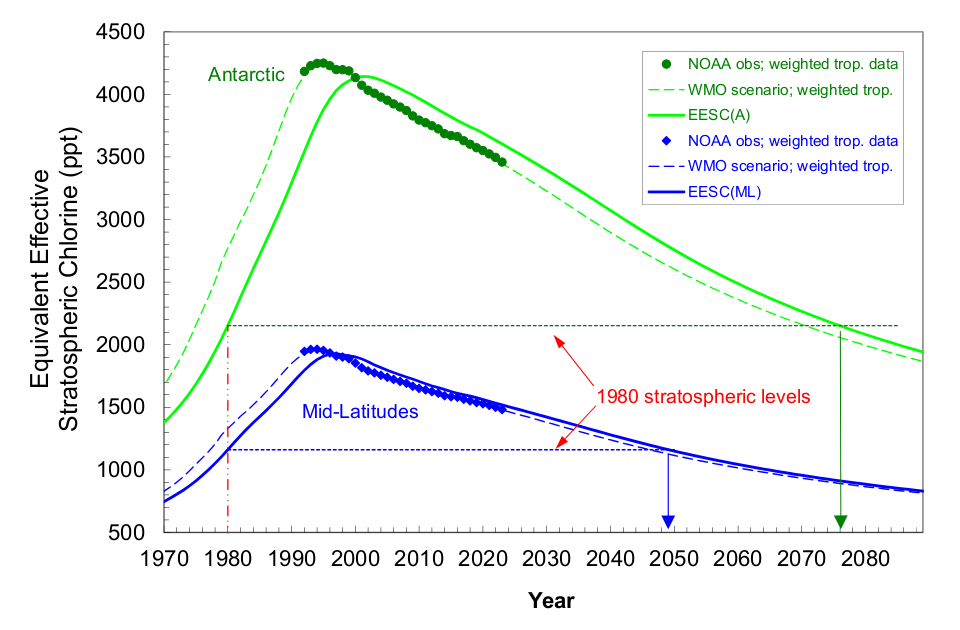
But for a brief moment in time generated great value for the shareholders
And we'll continue to for a long while I bet. I honestly wish that the end result was either a spectacular fiery apocalypse or an utopia where AGI figures it all out and fixes the problems somehow because that would at least be definitive.
But the reality is that we're mobilizing just enough effort to keep ourselves from the worst consequences, and also not nearly enough to prevent widespread damage that's already deteriorating quality of life below what we had yesterday. A banal depressing existence stretching into the pointless forever as we continue to scrape by.
Leave it it to humanity to effectively half ass absolutely anything.
But the reality is that we're mobilizing just enough effort to keep ourselves from the worst consequences, and also not nearly enough to prevent widespread damage that's already deteriorating quality of life below what we had yesterday. A banal depressing existence stretching into the pointless forever as we continue to scrape by.
Leave it it to humanity to effectively half ass absolutely anything.
Ok so is climatology the new scientology?
Much of this dribble is unfalsifiable and unscientific. There are some real climate issues to solve over the long term and this kind of planetary boundary BS is completely counterproductive.
Much of this dribble is unfalsifiable and unscientific. There are some real climate issues to solve over the long term and this kind of planetary boundary BS is completely counterproductive.
BY WHOM
--
If we can quantify such, then we can qualify where that data comes from - we should be able to identify the industries, contributors and manufactures of these inputs.
So take a single input and which industry AND companies are at its core.
--
If we can quantify such, then we can qualify where that data comes from - we should be able to identify the industries, contributors and manufactures of these inputs.
So take a single input and which industry AND companies are at its core.
It's a nice chart. Someone really wanted this chart. There isn't enough materials on this page to support the chart unfortunately.
Good. After losing my career to outsourcing and AI. Lets go Apocalypse.
The problem with the disaster reporting on the climate is that it
is starting to feel like the child who cried wolf.
I have no idea for how many years I have heard "Unless we act right now, NOW, we are all FUCKED".
Ok. so that was 20 years ago, its still: "Unless we act right now, NOW, we are all FUCKED".
Either the models were wrong and have been adjusted every year. or more likely the people shouting about reports who didnt entirely do their homework.
I have no doubt that things are getting worse. but reading speeches from 20 years ago, right now we would all be dead, beneath the sea, no food, etc etc.
Instead, here we are, a few billion more folks, consumption, and production still increasing.
The Paris goal is well and truly blown to bits by now in any sane analysis. Which we know means we are fucked.
Yet:
Norway holds the most passionate speeches at various conferences and such yet. Oslo keeps buling all the big cultural buildings and most expensive housing right at the water's edge, that will shortly be partially under water. and pumps and produces as much oil and gas as possible.
Yet: Netherlands has not started evacuating the parts fofthe country already under the waterline.
Yet: Biden giving speeches on the climate. Interpreted and translated by Greta: "Blah blah blah blah jobs, blah blah build back better blah blah".
And you see Joe opening up for drilling on federal lands, US #1 producer of oil, 2/3 from fracking.
Now either Joe doesnt not believe in his own speeches, and does not believe in science. Or he is one sadistic person.
You cant be green and still do your best to increase the production of gas and oil.
There is strong doublethink at work here. One thing is said in passionate speeches. The direct opposite is executed.
Personally, I concluded some time ago that we are fucked. and now like George Carlin said you can sit back and watch the show.
I have no idea for how many years I have heard "Unless we act right now, NOW, we are all FUCKED".
Ok. so that was 20 years ago, its still: "Unless we act right now, NOW, we are all FUCKED".
Either the models were wrong and have been adjusted every year. or more likely the people shouting about reports who didnt entirely do their homework.
I have no doubt that things are getting worse. but reading speeches from 20 years ago, right now we would all be dead, beneath the sea, no food, etc etc.
Instead, here we are, a few billion more folks, consumption, and production still increasing.
The Paris goal is well and truly blown to bits by now in any sane analysis. Which we know means we are fucked.
Yet:
Norway holds the most passionate speeches at various conferences and such yet. Oslo keeps buling all the big cultural buildings and most expensive housing right at the water's edge, that will shortly be partially under water. and pumps and produces as much oil and gas as possible.
Yet: Netherlands has not started evacuating the parts fofthe country already under the waterline.
Yet: Biden giving speeches on the climate. Interpreted and translated by Greta: "Blah blah blah blah jobs, blah blah build back better blah blah".
And you see Joe opening up for drilling on federal lands, US #1 producer of oil, 2/3 from fracking.
Now either Joe doesnt not believe in his own speeches, and does not believe in science. Or he is one sadistic person.
You cant be green and still do your best to increase the production of gas and oil.
There is strong doublethink at work here. One thing is said in passionate speeches. The direct opposite is executed.
Personally, I concluded some time ago that we are fucked. and now like George Carlin said you can sit back and watch the show.
> I have no doubt that things are getting worse. but reading speeches from 20 years ago, right now we would all be dead, beneath the sea, no food, etc etc.
While you may have had some crazies saying massive ocean rise was imminent, etc-- that was never a reasonable belief. It's going to take decades before it clears out lots of habitable coastal land.
Early 80's papers said by 2025 we'd have 13-55 cm of sea level rise. It's the beginning of 2024, and we've had about 15cm (a bit above the low end of the range with a year to go); the slope of the increase is now around the middle of the forecasted range-- similar magnitude of effect, but it took a bit longer than most authors thought to get going.
https://www.google.com/books/edition/Projecting_Future_Sea_L...
> Ok. so that was 20 years ago, its still: "Unless we act right now, NOW, we are all FUCKED".
The thing is, we're already all fucked. A lot of the negative consequences are now locked in (though we're not sure how badly). Now we're just playing the game of adding more negative consequences.
While you may have had some crazies saying massive ocean rise was imminent, etc-- that was never a reasonable belief. It's going to take decades before it clears out lots of habitable coastal land.
Early 80's papers said by 2025 we'd have 13-55 cm of sea level rise. It's the beginning of 2024, and we've had about 15cm (a bit above the low end of the range with a year to go); the slope of the increase is now around the middle of the forecasted range-- similar magnitude of effect, but it took a bit longer than most authors thought to get going.
https://www.google.com/books/edition/Projecting_Future_Sea_L...
> Ok. so that was 20 years ago, its still: "Unless we act right now, NOW, we are all FUCKED".
The thing is, we're already all fucked. A lot of the negative consequences are now locked in (though we're not sure how badly). Now we're just playing the game of adding more negative consequences.
Yeah i live in a traditionally rain forest region that doesn't normally burn, we've got patches of forest that up until recently haven't seen fire in a few hundred years/thousand years for some of it.
Spent 9 months blanketed in smoke a few years back, many of those areas experienced fire for the first time ever. Things are definitely pretty pucked. You sit back and watch the show folks.... are truly the worst. The standard you walk past, is the standard you accept.
Spent 9 months blanketed in smoke a few years back, many of those areas experienced fire for the first time ever. Things are definitely pretty pucked. You sit back and watch the show folks.... are truly the worst. The standard you walk past, is the standard you accept.
Well what you doing to stop climate change at a level that makes a difference?
Whatever I personally do, as long as Norway/US continue producing as much fossile fuel as possible (and they are not alone, but they are (I think) by far the worst in saying one thing and doing the other. <
And yes every bit helps, but not enough to make a huge difference. Whatever is predicted will happen now.
A realistic new temperature goal is probably 2.0 - 2.5 with the way things are progressing at this very moment.
Whatever I personally do, as long as Norway/US continue producing as much fossile fuel as possible (and they are not alone, but they are (I think) by far the worst in saying one thing and doing the other. <
And yes every bit helps, but not enough to make a huge difference. Whatever is predicted will happen now.
A realistic new temperature goal is probably 2.0 - 2.5 with the way things are progressing at this very moment.
Have you been outside?
The South is frozen right now and late last summer Alcapoca got hit with what went from a category 1 hurricane and in two nights over the gulf turned into a category 5 and decimated the entire town.
I think you may have had a bit too much cynic juice
The South is frozen right now and late last summer Alcapoca got hit with what went from a category 1 hurricane and in two nights over the gulf turned into a category 5 and decimated the entire town.
I think you may have had a bit too much cynic juice
> Yet: Netherlands has not started evacuating the parts fofthe country already under the waterline
Um.
Um.
There's plenty dubious about the comment, but that's not a mistake; they have dikes, dams, and sea barriers. The question is how long they'll be viable with ocean rise.
Communism is missing in their graph and is at all time high.
I am tired of the attept to use climate change and other metric to push us toward a totalitarian world government. People are waking up to it.
There is no global warming catastrophe.
Solar is on an expodential path, so is EV and other initiatives.
I am way more concerned about the risk of nuclear war (US proxy war created by the democrats), the creation of other virus in labs and the contamination of everything with BPA and forever chemical.
Tech is mostly good, so is freedom and free entreprise.
I am tired of the attept to use climate change and other metric to push us toward a totalitarian world government. People are waking up to it.
There is no global warming catastrophe.
Solar is on an expodential path, so is EV and other initiatives.
I am way more concerned about the risk of nuclear war (US proxy war created by the democrats), the creation of other virus in labs and the contamination of everything with BPA and forever chemical.
Tech is mostly good, so is freedom and free entreprise.
Boomers are the real YOLO generation.
they have to keep changing it to quantify their alarmist view
is this one really helping anyone?
you can be aware of and accept an alarmist view without this oft revised chart
is this one really helping anyone?
you can be aware of and accept an alarmist view without this oft revised chart
Boundaries? In what sense? This is an unhelpful exercise in vague fearmongering.
What actually helps is building and validating models and testing interventions against them along with planning for expected outcomes.
This seems engineered to frighten people to share and then post “why won’t anybody do anything” while that person changes nothing about their lifestyle.
I’m not opposed to science, I am opposed to whatever kind of thing this is. A scientist looks to uncover truth, an engineer looks to design for change, … this just seems like Bible-thumping on a soap box “beware sinners”. All the people who left Christianity still needed hell and replaced it with environmental doom.
What actually helps is building and validating models and testing interventions against them along with planning for expected outcomes.
This seems engineered to frighten people to share and then post “why won’t anybody do anything” while that person changes nothing about their lifestyle.
I’m not opposed to science, I am opposed to whatever kind of thing this is. A scientist looks to uncover truth, an engineer looks to design for change, … this just seems like Bible-thumping on a soap box “beware sinners”. All the people who left Christianity still needed hell and replaced it with environmental doom.
Yet when I look around, humans everwhere. This alarmist bs hurts us all.
Time to expand beyond the planet then?
If we don't manage it before we start down a degrowth/de-industrialisation path, we might well have missed the one chance our species had to go multiplanetary.
If we don't manage it before we start down a degrowth/de-industrialisation path, we might well have missed the one chance our species had to go multiplanetary.
If by "expand beyond planet" you mean bilk investors out of billions of dollars pretending you have a plan to "expand beyond the planet" then yes.
Forget billions of dollars. Trillions of dollars.
And it may fail entirely, but it's probably got a better chance of success than trying to fix the climate while we still fight wars between nations.
And it may fail entirely, but it's probably got a better chance of success than trying to fix the climate while we still fight wars between nations.
> but it's probably got a better chance of success than trying to fix the climate while we still fight wars between nations.
No, it won't. It will literally have less chance of success, because you're combining the low probability of the necessary long term political will and all of the financial and technological difficulties with the actual fleeting possibility of interplanetary travel and then the nigh nonexistent possibility of long-term colonization. All while we still fight wars between nations.
Just as the time to fix the climate was thirty years ago, the time to start our path towards becoming an interplanetary society was fifty or sixty years ago.
I like sci-fi as much as the next nerd but the cold, hard reality is we're stuck here with the consequences of our actions. Aliens aren't going to save us, God isn't going to save us, Elon Musk isn't going to save us. The climate collapse is unavoidable and inevitable, and no solution is going to stop it, but at least we can mitigate the damage (as futile as that might be) and plan for our survival, instead of wasting time imagining the next ten thousand years in a pressurized tube on Mars.
No, it won't. It will literally have less chance of success, because you're combining the low probability of the necessary long term political will and all of the financial and technological difficulties with the actual fleeting possibility of interplanetary travel and then the nigh nonexistent possibility of long-term colonization. All while we still fight wars between nations.
Just as the time to fix the climate was thirty years ago, the time to start our path towards becoming an interplanetary society was fifty or sixty years ago.
I like sci-fi as much as the next nerd but the cold, hard reality is we're stuck here with the consequences of our actions. Aliens aren't going to save us, God isn't going to save us, Elon Musk isn't going to save us. The climate collapse is unavoidable and inevitable, and no solution is going to stop it, but at least we can mitigate the damage (as futile as that might be) and plan for our survival, instead of wasting time imagining the next ten thousand years in a pressurized tube on Mars.
I guess that would give us more time, but why would you expect that we wouldn't do the same thing to any other planet we settle on?
Also consider that any other known planet within reach (and I'm really being generous with "within reach") is much, much less habitable than Earth; it would be far easier for such a colony to fail catastrophically.
Also consider that any other known planet within reach (and I'm really being generous with "within reach") is much, much less habitable than Earth; it would be far easier for such a colony to fail catastrophically.
Why not get the greed under control first?
It is preferable to deal with tractable problems
Greed can be found in many tractable problems. Shall we start with energy companies love for fossil fuels to keep status quo, or Bitcoin's energy use, some Chinese cities' production of CFCs or private jets' emissions, to name a few?
What is your objective evidence that those problems are tractable? To me, they look like greed making problems intractable.
How do you propose we do that? I'm not asking individually, but on a planetary scale.
If we could solve the problems of colonizing Mars, we'd long be in a position of solving the problems of keeping Earth habitable.
I mean, by all means, let's try for multiplanetary, but it's not an answer for "if we miss a sustainable path here". It'll require a function Earth for a long long time.
I mean, by all means, let's try for multiplanetary, but it's not an answer for "if we miss a sustainable path here". It'll require a function Earth for a long long time.