Europe is now a corporate also-ran. Can it recover its footing?(economist.com)
economist.com
Europe is now a corporate also-ran. Can it recover its footing?
https://www.economist.com/briefing/2021/06/05/once-a-corporate-heavyweight-europe-is-now-an-also-ran-can-it-recover-its-footing
890 comments
https://archive.is/goIlh
This article is truly bizarre.
The main point it makes is that the top 500 US companies grew faster than the top 500 European ones in the last decade or so.
But then it quickly mention, without any further analysis, that both their GDP actually grew at a similar pace. So the entire EU economy grew at the same speed than the US one but not its 500 bigger companies. So all else being equals it means that the smaller US companies grew more slowly and that this article is simply mesuring increasing corporate inequalities (if there is such a thing).
It then goes on to say, without much evidence, that this is actually good as economies of scale, supposedly more investment in R&D and increasing concentration should imply more innovation.
If this article actually wants to discuss innovation, why don't it use recognised tools to do so? If you take the global innovation index, the number of Nobel price per 100'000 habitants, the number of registered patents per year or simply the size of the economy, all point to a very healthy European continent.
I will even go further and say that the US should monitor much more closely increasing concentration as typically the ISPs or the energy distribution sectors show that concentration can be good for the shareholders but devastating for the consumer.
The main point it makes is that the top 500 US companies grew faster than the top 500 European ones in the last decade or so.
But then it quickly mention, without any further analysis, that both their GDP actually grew at a similar pace. So the entire EU economy grew at the same speed than the US one but not its 500 bigger companies. So all else being equals it means that the smaller US companies grew more slowly and that this article is simply mesuring increasing corporate inequalities (if there is such a thing).
It then goes on to say, without much evidence, that this is actually good as economies of scale, supposedly more investment in R&D and increasing concentration should imply more innovation.
If this article actually wants to discuss innovation, why don't it use recognised tools to do so? If you take the global innovation index, the number of Nobel price per 100'000 habitants, the number of registered patents per year or simply the size of the economy, all point to a very healthy European continent.
I will even go further and say that the US should monitor much more closely increasing concentration as typically the ISPs or the energy distribution sectors show that concentration can be good for the shareholders but devastating for the consumer.
> the entire EU economy grew at the same speed than the US one but not its 500 bigger companies
This is literally the article’s point. Europe and the U.S. grew similarly. The U.S. and China produced more large companies. (The Continent’s larger companies also being older than the other two’s.)
> supposedly more investment in R&D
Not supposedly, factually. The article explicitly states this. It’s the Economist; if you need a source, they’re available on Google Scholar.
> take the global innovation index, the number of Nobel price per 100'000 habitants, the number of registered patents per year or simply the size of the economy
Nobel prizes and patents are measures of innovation, albeit not commercial ones. Leading product centres are another. The article measure the latter.
Europe has constrained its big businesses and scale-oriented entrepreneurs. America and China have not. This is a tradeoff, and we’re seeing it play out. The Economist takes one side; it’s the side of iPhones, AWS, the Falcon 9, drones and other businesses with economies of scale. It’s against social sensibilities aligned against “big business.”
This is literally the article’s point. Europe and the U.S. grew similarly. The U.S. and China produced more large companies. (The Continent’s larger companies also being older than the other two’s.)
> supposedly more investment in R&D
Not supposedly, factually. The article explicitly states this. It’s the Economist; if you need a source, they’re available on Google Scholar.
> take the global innovation index, the number of Nobel price per 100'000 habitants, the number of registered patents per year or simply the size of the economy
Nobel prizes and patents are measures of innovation, albeit not commercial ones. Leading product centres are another. The article measure the latter.
Europe has constrained its big businesses and scale-oriented entrepreneurs. America and China have not. This is a tradeoff, and we’re seeing it play out. The Economist takes one side; it’s the side of iPhones, AWS, the Falcon 9, drones and other businesses with economies of scale. It’s against social sensibilities aligned against “big business.”
Imho, what was happening in the Silicon Valley economy looks much more like displacement of value rather than creation of value (1).
Google/Facebook have displaced other ad formats, redirecting money to themselves. AWS have displaced IT technicians in other corporations, redirecting money to themselves. Apple is selling overpriced commodity hardware, redirecting money to themselves. Uber is displacing taxis, redirecting money to themselves.
In other words, it's barely above zero-sum game. And US productivity statistics are clear - the aforementioned corporations grew 500%-1000% in their profits and valuations since 2010. Meanwhile, the US productivity has grown by 4.7%. Had the SV tech been a clear net positive to the economy, the productivity growth would look different. When the tech/telecom was truly creating new value (1995-2005), the productivity growth was at 27% that decade.
(1) with notable exceptions: Microsoft really is creating value where one didn't exist before. So is Netflix, Amazon's venerable logistics and Tesla's drive to decrease battery costs
Google/Facebook have displaced other ad formats, redirecting money to themselves. AWS have displaced IT technicians in other corporations, redirecting money to themselves. Apple is selling overpriced commodity hardware, redirecting money to themselves. Uber is displacing taxis, redirecting money to themselves.
In other words, it's barely above zero-sum game. And US productivity statistics are clear - the aforementioned corporations grew 500%-1000% in their profits and valuations since 2010. Meanwhile, the US productivity has grown by 4.7%. Had the SV tech been a clear net positive to the economy, the productivity growth would look different. When the tech/telecom was truly creating new value (1995-2005), the productivity growth was at 27% that decade.
(1) with notable exceptions: Microsoft really is creating value where one didn't exist before. So is Netflix, Amazon's venerable logistics and Tesla's drive to decrease battery costs
I people freely move from one service or product to another, usually it's because the new service is cheaper or better than the old service or product. That's direct value to the end user right there.
Moving to AWS from running your own data centres is vastly more cost effective for most companies, you can build systems faster, you can scale them instantly, you can move resources between regions easily, you can focus on your company's core competencies. AWS creates massive value, that's why we use it.
I used to look up the phone numbers of restaurants in a phone book, but now I use Google. That doesn't mean they are equivalent to me and they provide the same value. Looking up a restaurant on Google Maps is quicker, I can do it from anywhere, I can look at reviews and I can see exactly where it is and get routing direction. The experience now is orders of magnitude more powerful and that creates huge value for customers and businesses.
Apple hardware is highly customised, and dramatically better than anything their customers have with better performance and advanced features like machine learning and secure authentication all implemented in custom hardware. That's been true on the phones for many years, and now with their in house designed desktop processors it's true for the Mac as well. Although the Mac has had unique custom hardware like the T1 and the 5K iMac video system for a while too. You cannot buy hardware like it anywhere else, at any price.
Moving to AWS from running your own data centres is vastly more cost effective for most companies, you can build systems faster, you can scale them instantly, you can move resources between regions easily, you can focus on your company's core competencies. AWS creates massive value, that's why we use it.
I used to look up the phone numbers of restaurants in a phone book, but now I use Google. That doesn't mean they are equivalent to me and they provide the same value. Looking up a restaurant on Google Maps is quicker, I can do it from anywhere, I can look at reviews and I can see exactly where it is and get routing direction. The experience now is orders of magnitude more powerful and that creates huge value for customers and businesses.
Apple hardware is highly customised, and dramatically better than anything their customers have with better performance and advanced features like machine learning and secure authentication all implemented in custom hardware. That's been true on the phones for many years, and now with their in house designed desktop processors it's true for the Mac as well. Although the Mac has had unique custom hardware like the T1 and the 5K iMac video system for a while too. You cannot buy hardware like it anywhere else, at any price.
> You cannot buy hardware like it anywhere else, at any price.
Strange, I bought a PC with 2x the specs at the same price as a maxed out Mac…
Strange, I bought a PC with 2x the specs at the same price as a maxed out Mac…
I'm no Mac user but the value of a Mac to its users has more to do with its seamless integration with all other Apple products and services rather than a purely utilitarian perspective in raw specs/performance per dollar.
This has no value to me as their pricing is out of my budget and I don't like the idea of being locked into a proprietary ecosystem, which is of course down to everyone's personal preference, but judging by sales numbers, it looks like Apple's ecosystem has gotten some things really on point.
This has no value to me as their pricing is out of my budget and I don't like the idea of being locked into a proprietary ecosystem, which is of course down to everyone's personal preference, but judging by sales numbers, it looks like Apple's ecosystem has gotten some things really on point.
[deleted]
You’re sidestepping GP’s point. Does your PC have an equivalent to Apple’s Secure Enclave, for example?
Most PCs do at this point, also that secure enclave is very rarely both effective and something empowering the user so it's often ignored outside of very closed systems like Macs and phones.
Not sure what you’re saying here — most PCs have the hardware but they don’t use it?
I’m not sure what dimensions you are considering 2x the specs, but Mac laptops with an m1 beat any PC laptop on CPU performance, battery life and heat output.
Yeah, you can get a PC with more ram, more storage and a bigger GPU.
Yeah, you can get a PC with more ram, more storage and a bigger GPU.
Specs like GHz doesn't really paint the whole picture. In any case, M1 is a whole other story, and Apple went from simply being better to being a decade ahead.
Raw speed isn't everything. They are offering performance per watt, per weight, and per battery life metrics that are unavailable anywhere else. Add in display, camera, security and hardware accelerated machine learning capabilities, and there are many, many axes on which they offer unique capabilities.
And I bought a Mac with 2x the ergonomy and 2x the battery life at the same price as a maxed out Dell ;)
> Uber is displacing taxis, redirecting money to themselves.
I lived in San Francisco 2013-2018, before Uber I very rarely used taxis -- to/from the airport maybe. Having moved back to Denmark, I again very rarely use taxis.
But when I lived in the US, I used Uber many times each week. Sometimes to/from work.
But taxis in Denmark is easily 5x as expensive, and generally unavailable on-demand.
So now I was forced to buy a car, and call someone if I get a drink.
Point being: Uber certainly replaced taxis, but they also grew the market dramatically. The taxi industry is just a casualty, the pie Uber created is much bigger.
I lived in San Francisco 2013-2018, before Uber I very rarely used taxis -- to/from the airport maybe. Having moved back to Denmark, I again very rarely use taxis.
But when I lived in the US, I used Uber many times each week. Sometimes to/from work.
But taxis in Denmark is easily 5x as expensive, and generally unavailable on-demand.
So now I was forced to buy a car, and call someone if I get a drink.
Point being: Uber certainly replaced taxis, but they also grew the market dramatically. The taxi industry is just a casualty, the pie Uber created is much bigger.
I think the point is that you used the service when VC money was being used to subsidize your ride. This is zero sum. Obviously the market for rides increases once the cost is artificially depressed.
From the UX perspective, Uber combines payment processing and ride ordering in an app. Obviously an improvement over calling a Taxi dispatcher and telling them when/where to pick you up. But is that billions of dollars in value? Or is the majority of that value just being scooped up from previous incumbents?
The economics of the industry haven't changed dramatically - it's expensive to pay people to be your chauffeur.
From the UX perspective, Uber combines payment processing and ride ordering in an app. Obviously an improvement over calling a Taxi dispatcher and telling them when/where to pick you up. But is that billions of dollars in value? Or is the majority of that value just being scooped up from previous incumbents?
The economics of the industry haven't changed dramatically - it's expensive to pay people to be your chauffeur.
Actually, I think I used Uber after it got slightly more expensive too. But, sure, it's hard to know how much of it is VC money -- are you sure they subsidize much beyond software development?
> The economics of the industry haven't changed dramatically - it's expensive to pay people to be your chauffeur.
True, and if we allowed more free competition on the market Danish chauffeurs would be out of a job real quick. Replaced by immigrants.
But the size of the market did change. And that was my point :)
I think there is more people making a living driving Uber, than there was driving taxis [citation needed] ;)
You could argue that Danish chauffeurs would loose their jobs.. but part of me thinks: so what? We have low unemployment, why not have them work more productive jobs?
> Or is the majority of that value just being scooped up from previous incumbents?
So you think the majority of riders used taxis regularly before?
I certainly didn't, and I still don't -- but ride-sharing services I would use it available.
> The economics of the industry haven't changed dramatically - it's expensive to pay people to be your chauffeur.
True, and if we allowed more free competition on the market Danish chauffeurs would be out of a job real quick. Replaced by immigrants.
But the size of the market did change. And that was my point :)
I think there is more people making a living driving Uber, than there was driving taxis [citation needed] ;)
You could argue that Danish chauffeurs would loose their jobs.. but part of me thinks: so what? We have low unemployment, why not have them work more productive jobs?
> Or is the majority of that value just being scooped up from previous incumbents?
So you think the majority of riders used taxis regularly before?
I certainly didn't, and I still don't -- but ride-sharing services I would use it available.
They made upper middle class folks not buy a car, and cannibalized public transportation miles, which increased dramatically the total number of vehicle miles travelled. Not really a good trade off.
They gave people a choice, and they chose. Why does no-one see this as a problem indicating that public transportation needs to be dramatically improved?
The point of even socialism is not to push existing solutions for everything and look at everything as a threat. The point is to improve people's lives, and letting people choose might be a right-wing method of accomplishing that, but you can't deny it's effectiveness.
Why aren't we dramatically improving public transportation? The fact that people chose not to use it means people judge their quality of life better with Uber than with public transportation. Use that, don't fight it!
The point of even socialism is not to push existing solutions for everything and look at everything as a threat. The point is to improve people's lives, and letting people choose might be a right-wing method of accomplishing that, but you can't deny it's effectiveness.
Why aren't we dramatically improving public transportation? The fact that people chose not to use it means people judge their quality of life better with Uber than with public transportation. Use that, don't fight it!
Have you tried using Moove? It's the same on-demand concept of Uber, but it's Dantaxi that are behind it with certified taxi drivers: https://moove.taxi
I'll give it a shot :)
Pick up time 8 minutes in Aarhus as of writing. If I go to Ikast it's 24 minutes.
And a 10min ride is 25 USD. A hour ride is about 200 USD.
Might try it if I ever need a taxis, but it's still a bit pricey.
Pick up time 8 minutes in Aarhus as of writing. If I go to Ikast it's 24 minutes.
And a 10min ride is 25 USD. A hour ride is about 200 USD.
Might try it if I ever need a taxis, but it's still a bit pricey.
Out of interest so you prefer Copenhagen to San Francisco as a place to live ? I’ve never been to SF but am hoping to live in Denmark a while as was curious to your thoughts
Taxis in Denmark are very easily available on demand. There are several apps, or you can phone.
(I have a friend who uses them regularly after we meet up.)
(I have a friend who uses them regularly after we meet up.)
> Apple is selling overpriced commodity hardware
This hasn’t been true since the 90s. And the rest of your examples are similarly ignorant of the incredible pace of innovation coming from a lot of these companies. Google ads might not be changing the world, but their peripheral technology certainly is. AWS and Amazon’s core business as well.
This hasn’t been true since the 90s. And the rest of your examples are similarly ignorant of the incredible pace of innovation coming from a lot of these companies. Google ads might not be changing the world, but their peripheral technology certainly is. AWS and Amazon’s core business as well.
Just one correction; targeted ads have enabled the existence of many small businesses.
Want to launch a board game aimed at left-handed nerds in a specific city? Before, you’d need a big media campaign that would also reach many right-handed non-nerds, wasting a lot of money. Now, you just need a few thousand $’s worth of targeted ads.
Want to launch a board game aimed at left-handed nerds in a specific city? Before, you’d need a big media campaign that would also reach many right-handed non-nerds, wasting a lot of money. Now, you just need a few thousand $’s worth of targeted ads.
Targeted ads are unethical and should be eliminated, the abuses are too obvious to enumerate. Prostitution and drugs have also enabled the existence of many small companies.
Everything has an upside and a downside. Eliminating all targeted ads will lead to entrepreneurship being restricted to the rich or the well-connected, which is not only unethical but anathema to me and many others.
I think the way forward is somewhere in the middle, targeted ads with restrictions and opt-outs. Polarization isn't a path to progress.
As an aside, prostitution doesn't have to be the crime magnet it is today (in medieval Europe the Church ran brothels!) And while most drugs are unambiguously bad, some are considered safe enough to be traded openly and very profitably - caffeine, alcohol, nicotine, and now marijuana.
I think the way forward is somewhere in the middle, targeted ads with restrictions and opt-outs. Polarization isn't a path to progress.
As an aside, prostitution doesn't have to be the crime magnet it is today (in medieval Europe the Church ran brothels!) And while most drugs are unambiguously bad, some are considered safe enough to be traded openly and very profitably - caffeine, alcohol, nicotine, and now marijuana.
I agree. It’s interesting to look at Trade fairs and exhibitions. “Furniture industry fair” is targeted ads so to speak and benefit the industry by bringing producers to consumers under a single roof.
I think the ability to google things has provided immense, incalculable value, even if it's not value showing up in gdp figures.
There are "personal values" and there is "exchange value". The latter shows up in GDP. Isn't the problem with search also similar to education? Its effect is indirect on the both the consumer of education and within that consumer's society: when education is "useful", it enables all kinds of increased trade, not necessarily in education proper.
To do a proper experiment, I suppose we'd need to compare otherwise identical individuals with differing education. Similarly, we could compare people whose only significant difference is the amount of search using Google, and assess their effects on GDP. Daunting to carry out these experiments, but possible in principle, no?
To do a proper experiment, I suppose we'd need to compare otherwise identical individuals with differing education. Similarly, we could compare people whose only significant difference is the amount of search using Google, and assess their effects on GDP. Daunting to carry out these experiments, but possible in principle, no?
I'm old enough to have programmed a couple decades ago when you mostly had to rely on experimentation and manuals to figure things out. The experience today is much more streamlined. What might have taken me an entire afternoon to figure out in olden times can now take a single minute Google search. My productivity is substantially better now with the likes of Google, Stack Overflow, and all the other similar resources.
You are arguing that Google/FB displaced ad formats, and cite Netflix is an exception. Isn't what Netflix doing also "displacing of pre-existing formats".
> the aforementioned corporations grew 500%-1000% in their profits and valuations since 2010. Meanwhile, the US productivity has grown by 4.7%. Had the SV tech been a clear net positive to the economy, the productivity growth would look different
This is not necessarily true. The American economy is huge. Sections can grow slowly, sections can grow fast, all adding value while the bulk grows moderately.
> When the tech/telecom was truly creating new value (1995-2005), the productivity growth was at 27% that decade
4.7% growth accumulates to close to 60% over ten years. (EDIT: I misread the original comment.)
This is not necessarily true. The American economy is huge. Sections can grow slowly, sections can grow fast, all adding value while the bulk grows moderately.
> When the tech/telecom was truly creating new value (1995-2005), the productivity growth was at 27% that decade
4.7% growth accumulates to close to 60% over ten years. (EDIT: I misread the original comment.)
> 4.7% growth accumulates to close to 60% over ten years.
Sure, but I think OP meant productivity growth for the whole decade was 4.7%, not annually (though I'd like to see a source for that).
Sure, but I think OP meant productivity growth for the whole decade was 4.7%, not annually (though I'd like to see a source for that).
> OP meant productivity growth for the whole decade was 4.7%
Fair enough. Real U.S. total factor productivity growth from 2009 to 2019 was 5.8%; from 1995 to 2005 12% [1].
[1] https://fred.stlouisfed.org/series/RTFPNAUSA632NRUG
Fair enough. Real U.S. total factor productivity growth from 2009 to 2019 was 5.8%; from 1995 to 2005 12% [1].
[1] https://fred.stlouisfed.org/series/RTFPNAUSA632NRUG
> Imho, what was happening in the Silicon Valley economy looks much more like displacement of value rather than creation of value (1). Google/Facebook have displaced other ad formats, redirecting money to themselves…
I see your point but mostly disagree with it. The cost to advertise has dropped so while they have displaced some TV ads (still the largest) and most print ads, more people are able to advertise* so they are in a technical sense providing a different and better service to the market.
By analogy you say the same about cars, which “merely” displaced peoples’ “transportation spend” away from horses.
* I don’t think the growth of advertising has necessarily been particularly good; apart from the spying, people still only have 16 or so hours of consciousness per day so there is a zero sum and intrusive quality to ads. I’m just addressing your economic point.
I see your point but mostly disagree with it. The cost to advertise has dropped so while they have displaced some TV ads (still the largest) and most print ads, more people are able to advertise* so they are in a technical sense providing a different and better service to the market.
By analogy you say the same about cars, which “merely” displaced peoples’ “transportation spend” away from horses.
* I don’t think the growth of advertising has necessarily been particularly good; apart from the spying, people still only have 16 or so hours of consciousness per day so there is a zero sum and intrusive quality to ads. I’m just addressing your economic point.
Correction, AWS hasn't replaced IT, just added a bunch of requirements now for it eg:AWS certifications. They replaced the hardware aspect though.
It’s a small fraction but Amazon creates content too, maybe even more now with mgm, and content creation looks less like displacement, though there’s some of that too (not enough IMO)
>> the entire EU economy grew at the same speed than the US one but not its 500 bigger companies
> This is literally the article’s point. Europe and the U.S. grew similarly. The U.S. and China produced more large companies. (The Continent’s larger companies also being older than the other two’s.)
So Europe did a better job in distributing wealth more equally, while in the US and China you got a massive concentration of wealth? So ... fuck yeah, Europe FTW.
> This is literally the article’s point. Europe and the U.S. grew similarly. The U.S. and China produced more large companies. (The Continent’s larger companies also being older than the other two’s.)
So Europe did a better job in distributing wealth more equally, while in the US and China you got a massive concentration of wealth? So ... fuck yeah, Europe FTW.
>So Europe did a better job in distributing wealth more equally
False. Europe did a better job at distributing income due to high taxes but not wealth.
Most Europeans are rich due to accumulation of wealth (specifically old business and real estate) inherited across generations.
Due to that, statistically, Europe does worse than the US wealth inequality as wealth has pooled to the people whose families have been here the longest, the newcomers are just burdened with high income taxes and high property prices, that's why skilled immigrants in STEM who have options and can afford to "shop around" usually avoid Europe in favor of North America.
False. Europe did a better job at distributing income due to high taxes but not wealth.
Most Europeans are rich due to accumulation of wealth (specifically old business and real estate) inherited across generations.
Due to that, statistically, Europe does worse than the US wealth inequality as wealth has pooled to the people whose families have been here the longest, the newcomers are just burdened with high income taxes and high property prices, that's why skilled immigrants in STEM who have options and can afford to "shop around" usually avoid Europe in favor of North America.
> Due to that, statistically, Europe does worse than the US wealth inequality […]
Do you have a source for the statistic that show this?
Another comment mentioned Gini. Piketty uses the share of the top percentile (1%) or decile (10%):
* https://www.newyorker.com/news/john-cassidy/pikettys-inequal...
* https://news.harvard.edu/gazette/story/2020/03/pikettys-new-...
The US isn't the worst in the world, but it is certainly more unequal than Europe as a whole, and most (all?) EU countries.
Do you have a source for the statistic that show this?
Another comment mentioned Gini. Piketty uses the share of the top percentile (1%) or decile (10%):
* https://www.newyorker.com/news/john-cassidy/pikettys-inequal...
* https://news.harvard.edu/gazette/story/2020/03/pikettys-new-...
The US isn't the worst in the world, but it is certainly more unequal than Europe as a whole, and most (all?) EU countries.
Both of those citations appear to be looking at income inequality measures rather than wealth inequality measures.
There are several chapters on wealth inequality in Piketty's book:
* https://en.wikipedia.org/wiki/Capital_in_the_Twenty-First_Ce...
Wealth is harder to measure because it's not as reported in most countries. You get an 'income slip' for tax purposes (e.g., US Form W-2), but there's no official 'wealth slip'.
That's one of the things that Piketty suggests: declaring of credits and debts in an official way, which could then be used for a (net) wealth tax. Starting as little 0.1% if you're just over (e.g.) $US 10M, and having a top rate of (e.g.) 2% for those that are worth more than (say) US$ 1B.
* https://en.wikipedia.org/wiki/Capital_in_the_Twenty-First_Ce...
Wealth is harder to measure because it's not as reported in most countries. You get an 'income slip' for tax purposes (e.g., US Form W-2), but there's no official 'wealth slip'.
That's one of the things that Piketty suggests: declaring of credits and debts in an official way, which could then be used for a (net) wealth tax. Starting as little 0.1% if you're just over (e.g.) $US 10M, and having a top rate of (e.g.) 2% for those that are worth more than (say) US$ 1B.
What is wealth but income accumulated over time?
(Or wealth stolen from others. Oops?)
(Or wealth stolen from others. Oops?)
Wealth is the integral of income minus expenses plus net unrealized gains over time. The latter two terms are pretty significant in the overall calculus, if you’ll pardon the (partial?) pun.
Yeah but what pays for rent and food? Income.
> Due to that, statistically, Europe does worse than the US wealth inequality
I had a quick look at Wikipedia's wealth Gini figures and this isn't the case. Places like the Netherlands and Sweden score atrociously, but the three big European economies (France, Germany, and the UK) all have less wealth inequality than the US (significantly so for the first two), as do a whole host of other European countries.
I had a quick look at Wikipedia's wealth Gini figures and this isn't the case. Places like the Netherlands and Sweden score atrociously, but the three big European economies (France, Germany, and the UK) all have less wealth inequality than the US (significantly so for the first two), as do a whole host of other European countries.
It doesn’t look to me like Germany has significantly better score than the US. (0.818 Germany vs 0.852 US. 0.867 Sweden and 0.906 for Netherlands [with 0.736 the very year prior, making me suspicious of the stability of those data points as I can’t comprehend that wealth distribution across a country that large could change that much in a single year].)
* - https://en.m.wikipedia.org/wiki/List_of_countries_by_wealth_...
* - https://en.m.wikipedia.org/wiki/List_of_countries_by_wealth_...
The Netherlands is quite small (about the size of LA + suburbs). I didn’t look at the data, but there was a major shift in 0-hour contracts in the last year due to COVID-19 which would probably impact those calculations[citation needed].
The figures in the table are 2018 to 2019, so predate CV-19. Even with that, those would seem like that could shift income inequality measures but not wealth inequality measures by such a wide range.
Is the GINI scale linear? In other words, what does a difference of 0.81 vs 0.85 mean?
Americans overestimate social mobility in their country
https://www.economist.com/graphic-detail/2018/02/14/american...
https://www.economist.com/graphic-detail/2018/02/14/american...
> Europe did a better job in distributing wealth more equally
This assumes ex ante a similar quantity of wealth. Europe’s GDP per capita is lower than America’s. Where it’s higher, the growth is slower. The more-even distribution comes at the expense of quality of life or economic power. (Though not for Europe’s well-entrenched multi-generational and often legally-entitled wealthy.)
To be clear, I don’t believe in moralising this spectrum of tolerance of scale and creative destruction versus social stability and economic equality. There are multiple equilibria, and Europe and America’s are mutually compatible. The relationship does, however, require Europe take a backseat to the U.S. and China in certain matters. The Economist is protesting that arrangement. (I, as an American, am not.)
This assumes ex ante a similar quantity of wealth. Europe’s GDP per capita is lower than America’s. Where it’s higher, the growth is slower. The more-even distribution comes at the expense of quality of life or economic power. (Though not for Europe’s well-entrenched multi-generational and often legally-entitled wealthy.)
To be clear, I don’t believe in moralising this spectrum of tolerance of scale and creative destruction versus social stability and economic equality. There are multiple equilibria, and Europe and America’s are mutually compatible. The relationship does, however, require Europe take a backseat to the U.S. and China in certain matters. The Economist is protesting that arrangement. (I, as an American, am not.)
> Europe’s GDP per capita is lower than America’s.
Now compare GDP per hour worked:
* https://ourworldindata.org/grapher/labor-productivity-per-ho...
* https://time.com/4621185/worker-productivity-countries/
Germany and France are basically equivalent to the US. Some of the other larger economies (UK, IT, ES) are further down.
Those 4+ weeks of vacation make a difference. :)
Also, who gets to actually keep all of that GDP?
* https://www.newyorker.com/news/john-cassidy/pikettys-inequal...
* https://voxeu.org/article/exploding-wealth-inequality-united...
Now compare GDP per hour worked:
* https://ourworldindata.org/grapher/labor-productivity-per-ho...
* https://time.com/4621185/worker-productivity-countries/
Germany and France are basically equivalent to the US. Some of the other larger economies (UK, IT, ES) are further down.
Those 4+ weeks of vacation make a difference. :)
Also, who gets to actually keep all of that GDP?
* https://www.newyorker.com/news/john-cassidy/pikettys-inequal...
* https://voxeu.org/article/exploding-wealth-inequality-united...
> This assumes ex ante a similar quantity of wealth. Europe’s GDP per capita is lower than America’s.
European GDPs per capita have been by and large lower than the US one since at least 1900, so this doesn't tell us much.
You know, having a continental sized country with continent sized resources and a population all speaking the same language, plus the last conflict on its territory having happened 150+ years ago, seems to be paying off.
European GDPs per capita have been by and large lower than the US one since at least 1900, so this doesn't tell us much.
You know, having a continental sized country with continent sized resources and a population all speaking the same language, plus the last conflict on its territory having happened 150+ years ago, seems to be paying off.
> The more-even distribution thus comes at the expense of quality of life.
What are you talking about? We have fairer elections, better infrastructure, more social security, everyone's got health insurance, we're not getting shot in school, and also we're not on the way to be ruled by a fascist so ... how exactly are you measuring the quality of life?
What are you talking about? We have fairer elections, better infrastructure, more social security, everyone's got health insurance, we're not getting shot in school, and also we're not on the way to be ruled by a fascist so ... how exactly are you measuring the quality of life?
>we're not getting shot in school, and also we're not on the way to be ruled by a fascist
I downvoted you since you're going massively off-topic with your generalizations about the US that have no place on HN.
I downvoted you since you're going massively off-topic with your generalizations about the US that have no place on HN.
Thank you for your thoughtful downvote.
However I don't really follow. The discussion is clearly about politics here, so it probably does not count as off-topic. Also, fascism has a massive influence on the economy, making it relevant.
If you merely dispute my view that there's fascist tendencies in the US, that is fair, but no reason for a downvote, I'd argue.
However I don't really follow. The discussion is clearly about politics here, so it probably does not count as off-topic. Also, fascism has a massive influence on the economy, making it relevant.
If you merely dispute my view that there's fascist tendencies in the US, that is fair, but no reason for a downvote, I'd argue.
As a European who probably agrees with you regarding many policies: You may be able to argue that quality of life is better in Europe or with European-style policies [1]. Everyone having health insurance and less of a need to worry about your basics needs met are fair points. I wouldn't want to live in a society that doesn't seem to care that much about economic equality.
But "about to be ruled by a fascist"? Trump lost the election. Sure the diverging right is worrying, but is the country "about to be ruled" by a fascist?
And "getting shot at school/street" is pretty much just a cheap shot.
I haven't been to the U.S., but I'm willing to wager that for most Americans getting shot is not a primary concern. I'm not saying shootings don't happen or that they aren't tragic, because they do and they are, or that the U.S. don't have a problem. But when they do happen, they obviously get so much visibility and attention that their emotional effect is greater than their actual chances of affecting you in your life, in a way that's not entirely dissimilar to terrorist attacks.
That makes appealing to shootings a populist-style emotional argument: easy to throw around and force people's attention with, not entirely truthful, and much more work to argue against than the argument would substantially warrant. That also makes it pretty annoying and bothersome.
So, I kind of get why people might not like your argumentation style.
[1] Although both Europe and the U.S. are diverse enough that it's going to get tricky; I'm not sure there is such a homogenous thing as "Europe" when it comes to quality of life. But that's a digression.
But "about to be ruled by a fascist"? Trump lost the election. Sure the diverging right is worrying, but is the country "about to be ruled" by a fascist?
And "getting shot at school/street" is pretty much just a cheap shot.
I haven't been to the U.S., but I'm willing to wager that for most Americans getting shot is not a primary concern. I'm not saying shootings don't happen or that they aren't tragic, because they do and they are, or that the U.S. don't have a problem. But when they do happen, they obviously get so much visibility and attention that their emotional effect is greater than their actual chances of affecting you in your life, in a way that's not entirely dissimilar to terrorist attacks.
That makes appealing to shootings a populist-style emotional argument: easy to throw around and force people's attention with, not entirely truthful, and much more work to argue against than the argument would substantially warrant. That also makes it pretty annoying and bothersome.
So, I kind of get why people might not like your argumentation style.
[1] Although both Europe and the U.S. are diverse enough that it's going to get tricky; I'm not sure there is such a homogenous thing as "Europe" when it comes to quality of life. But that's a digression.
> So, I kind of get why people might not like your argumentation style.
Yeah. I know I should dial it down a little. But I'm actually really concerned about the US. They do have a lot of mass shootings, and not even tackling this problem does point to a larger dysfunction in the US.
And Trump does not accept is loss and 60% of republicans agree. That's why I actually fear that the next elections in the US will not be democratic.
https://snyder.substack.com/p/911-and-16
Yeah. I know I should dial it down a little. But I'm actually really concerned about the US. They do have a lot of mass shootings, and not even tackling this problem does point to a larger dysfunction in the US.
And Trump does not accept is loss and 60% of republicans agree. That's why I actually fear that the next elections in the US will not be democratic.
https://snyder.substack.com/p/911-and-16
You don’t understand what the mass shootings are and who does them.
Yeah but the people writing the articles I read do.
Really? I could have sworn you mentioned school shootings. Which are rare, which is why they make the headlines.
In Chicago there are mass shootings every weekend that get no press coverage. The inner city gang warfare and similar makes up the vast majority of mass shootings in the U.S.
Mass shootings have basically nothing to do with small town and rural NRA members.
Did you already know all that?
In Chicago there are mass shootings every weekend that get no press coverage. The inner city gang warfare and similar makes up the vast majority of mass shootings in the U.S.
Mass shootings have basically nothing to do with small town and rural NRA members.
Did you already know all that?
> But "about to be ruled by a fascist"?
That was wrong, but just slightly.
It wasn't fascism,but nazism.
«Evidence in Trump supporter’s trial suggests he espoused Nazi ideals»
https://www.washingtonpost.com/national-security/brendan-hun...
> And "getting shot at school/street" is pretty much just a cheap shot.
It's an enormous social and political problem, caused by the way people live in US and the incentive system that rewards the stronger over the weaker and if you can't beat them, kill them.
> but I'm willing to wager that for most Americans getting shot is not a primary concern
That's the problem.
Coming from Europe I am used to not being killed in the streets, in US the risk of being shot is 10 times higher.
It's a lot!
Consider this: it is safer to go to Nigeria than to Los Angeles. Los Angeles had 300 homicides last year (they increased over 2019, during a pandemic! ) while in the comparably sized European city of Rome violent crimes went down 80% and there were "only" 19 homicides in 2020.
Also police brutality is an overlooked issue there: every year police shoot and kills around 1 thousand people in US, comparing their population to my country's, we should have 60 kills every year by the police, but in reality we have around 1 (one!) and it causes riots in the streets because we consider it unacceptable.
edit: I understand these are controversial topics and many Americans have different opinions tha mine on them, but as an European citizen and parent, what scares me the most is that these are all solvable issues, many other countries have solved them long time ago, while in US the debate hasn't even started yet. I also understand that facing the numbers is hard for some American people, it shatters the idea of "the greatest democracy in the World", but they are unfortunately real and verifiable.
For example: https://edition.cnn.com/2020/11/23/us/los-angeles-homicides-...
That was wrong, but just slightly.
It wasn't fascism,but nazism.
«Evidence in Trump supporter’s trial suggests he espoused Nazi ideals»
https://www.washingtonpost.com/national-security/brendan-hun...
> And "getting shot at school/street" is pretty much just a cheap shot.
It's an enormous social and political problem, caused by the way people live in US and the incentive system that rewards the stronger over the weaker and if you can't beat them, kill them.
> but I'm willing to wager that for most Americans getting shot is not a primary concern
That's the problem.
Coming from Europe I am used to not being killed in the streets, in US the risk of being shot is 10 times higher.
It's a lot!
Consider this: it is safer to go to Nigeria than to Los Angeles. Los Angeles had 300 homicides last year (they increased over 2019, during a pandemic! ) while in the comparably sized European city of Rome violent crimes went down 80% and there were "only" 19 homicides in 2020.
Also police brutality is an overlooked issue there: every year police shoot and kills around 1 thousand people in US, comparing their population to my country's, we should have 60 kills every year by the police, but in reality we have around 1 (one!) and it causes riots in the streets because we consider it unacceptable.
edit: I understand these are controversial topics and many Americans have different opinions tha mine on them, but as an European citizen and parent, what scares me the most is that these are all solvable issues, many other countries have solved them long time ago, while in US the debate hasn't even started yet. I also understand that facing the numbers is hard for some American people, it shatters the idea of "the greatest democracy in the World", but they are unfortunately real and verifiable.
For example: https://edition.cnn.com/2020/11/23/us/los-angeles-homicides-...
> It wasn't fascism,but nazism.
That's not really the point, and I'm not sure the semantics matter. I'm also not doubting that Trump would take up any "ideal" that supports his ego and power. Or that, among Trump supporters, there are people who would in fact be ready to go so far as fascism or nazism.
I just think that, in a thread about the quality of life in different economic cultures, "about to be ruled by a fascists" is kind of cheap rhetoric if you can't actually argue that the U.S. are in fact close to being ruled by one.
> Coming from Europe I am used to not being killed in the streets, in US the risk of being shot is 10 times higher.
That's continuing along nearly the same lines of rhetoric as the comment I responded to.
10 times the risk means there's some kind of a meaningful difference, but that doesn't mean it becomes a huge risk. "10 times higher" is a lot as a ratio, but it doesn't mean shootings actually happen a lot. They might, but your figure alone isn't enough to show that. That's the same as with disease: 10 times the risk of a rare disease might still be rare. It might mean an actual, substantially elevated risk, or it might not. I gets you nice headlines either way, of course.
If you wanted to argue that getting shot at is a major quality of life concern in the U.S., you would need to show that it actually is a major concern for a large proportion of Americans that affects their quality of life, not just that the ratio of occurrences compared to Europe is large.
Again, I disagree about the style of rhetoric. I don't want to argue that gun violence isn't a problem. But I'm not sure us Europeans should tell Americans how that affects their quality of life in general. It's also easy to fall into the trap of stereotypes such as school shootings being everywhere and affecting everyday life. If it's not actually like that, then it's just a stereotype. Which is exactly what ChuckNorris89 was complaining about.
That's not really the point, and I'm not sure the semantics matter. I'm also not doubting that Trump would take up any "ideal" that supports his ego and power. Or that, among Trump supporters, there are people who would in fact be ready to go so far as fascism or nazism.
I just think that, in a thread about the quality of life in different economic cultures, "about to be ruled by a fascists" is kind of cheap rhetoric if you can't actually argue that the U.S. are in fact close to being ruled by one.
> Coming from Europe I am used to not being killed in the streets, in US the risk of being shot is 10 times higher.
That's continuing along nearly the same lines of rhetoric as the comment I responded to.
10 times the risk means there's some kind of a meaningful difference, but that doesn't mean it becomes a huge risk. "10 times higher" is a lot as a ratio, but it doesn't mean shootings actually happen a lot. They might, but your figure alone isn't enough to show that. That's the same as with disease: 10 times the risk of a rare disease might still be rare. It might mean an actual, substantially elevated risk, or it might not. I gets you nice headlines either way, of course.
If you wanted to argue that getting shot at is a major quality of life concern in the U.S., you would need to show that it actually is a major concern for a large proportion of Americans that affects their quality of life, not just that the ratio of occurrences compared to Europe is large.
Again, I disagree about the style of rhetoric. I don't want to argue that gun violence isn't a problem. But I'm not sure us Europeans should tell Americans how that affects their quality of life in general. It's also easy to fall into the trap of stereotypes such as school shootings being everywhere and affecting everyday life. If it's not actually like that, then it's just a stereotype. Which is exactly what ChuckNorris89 was complaining about.
> If you wanted to argue that getting shot at is a major quality of life concern in the U.S., you would need to show that it actually is a major concern for a large proportion of Americans that affects their quality of life, not just that the ratio of occurrences compared to Europe is large.
https://news.gallup.com/poll/1645/guns.aspx
https://news.gallup.com/poll/1645/guns.aspx
> to be ruled by a fascists" is kind of cheap rhetoric
on the contrary
being ruled by a fascist supporter and/or supported by fascist sympathizers has an enormous impact on the quality of life.
That's true everywhere, in Europe as in USA, that's why everybody here in Europe is preoccupied by far right extremists especially in the former eastern Europe.
> you would need to show that it actually is a major concern for a large proportion of Americans that affects their quality of life
It is, having 10 times the chances of dying shot by a stranger makes it 10 times more probable that in US I would be dead instead of alive.
Being dead it's much worse than being alive in my "quality of life" book.
One can argue that Americans don't care, but it is objectively worse as far as the quality of life goes.
Or to put it in another way: for Americans it could be irrelevant, but if we are comparing the two ways of life, it's a data point that can't be easily discarded.
Imagine having the life of a young relative taken by criminals or, worse, by the police.
Would you trade it for a better salary or a larger household, knowing that it's 10 times more probable that it could happen?
In Los Angeles in 2020 there have been 75 murders every million people (a bit more actually, closer to 76), in Rome it was 5 (a bit less, around 4.4 but rounded for easier comparison).
In NY it was 56, Kenya is 50, Egypt 25, Ghana 21, Sierra Leone 17.
Is this a meaningful difference or not?
Would you consider Los Angeles safer than Rome?
Given the choice would you rather raise your kids in Los Angeles or in Rome?
Remember: you're betting on their life or death chances.
> into the trap of stereotypes such as school shootings being everywhere
It's not a stereotype if it's true.
It's the only place were regularly school shootings end up with casaulties.
«There were, on average, 16.4 such shootings a year from 2007 to 2013, compared with an average of 6.4 shootings annually from 2000 to 2006. In the past 13 years, 486 people have been killed in such shootings, with 366 of the deaths in the past seven years. In all, the study looked at 160 shootings since 2000.Sep 24, 2014» (news from 7 years ago!)
https://www.nytimes.com/2014/09/25/us/25shooters.html
Can you name another country with similar stats?
I honestly can't.
on the contrary
being ruled by a fascist supporter and/or supported by fascist sympathizers has an enormous impact on the quality of life.
That's true everywhere, in Europe as in USA, that's why everybody here in Europe is preoccupied by far right extremists especially in the former eastern Europe.
> you would need to show that it actually is a major concern for a large proportion of Americans that affects their quality of life
It is, having 10 times the chances of dying shot by a stranger makes it 10 times more probable that in US I would be dead instead of alive.
Being dead it's much worse than being alive in my "quality of life" book.
One can argue that Americans don't care, but it is objectively worse as far as the quality of life goes.
Or to put it in another way: for Americans it could be irrelevant, but if we are comparing the two ways of life, it's a data point that can't be easily discarded.
Imagine having the life of a young relative taken by criminals or, worse, by the police.
Would you trade it for a better salary or a larger household, knowing that it's 10 times more probable that it could happen?
In Los Angeles in 2020 there have been 75 murders every million people (a bit more actually, closer to 76), in Rome it was 5 (a bit less, around 4.4 but rounded for easier comparison).
In NY it was 56, Kenya is 50, Egypt 25, Ghana 21, Sierra Leone 17.
Is this a meaningful difference or not?
Would you consider Los Angeles safer than Rome?
Given the choice would you rather raise your kids in Los Angeles or in Rome?
Remember: you're betting on their life or death chances.
> into the trap of stereotypes such as school shootings being everywhere
It's not a stereotype if it's true.
It's the only place were regularly school shootings end up with casaulties.
«There were, on average, 16.4 such shootings a year from 2007 to 2013, compared with an average of 6.4 shootings annually from 2000 to 2006. In the past 13 years, 486 people have been killed in such shootings, with 366 of the deaths in the past seven years. In all, the study looked at 160 shootings since 2000.Sep 24, 2014» (news from 7 years ago!)
https://www.nytimes.com/2014/09/25/us/25shooters.html
Can you name another country with similar stats?
I honestly can't.
> being ruled by a fascist supporter and/or supported by fascist sympathizers has an enormous impact on the quality of life
Of course. It's the "about to be ruled by" part that's the cheap-ish rhetoric, as it implies an unsubstantiated imminent threat, not just "some of these guys are really going in the wrong direction".
> having 10 times the chances of dying shot by a stranger makes it 10 times more probable that in US I would be dead instead of alive.
No, it absolutely certainly does not, unless that's the only way you could die. That's really, really basic statistics.
I don't even need to check the statistics to assert that you're much, much more likely to die of causes other than violence, both in (at least the majority of) Europe and in (at least the majority of) the U.S.
If you have a full watermelon, and then take a small slice of the watermelon and somehow multiply the slice by ten, you don't have ten watermelons as a result.
> Would you trade it for a better salary or a larger household, knowing that it's 10 times more probable that it could happen?
Depends on what it's 10 times probable than, and what my other circumstances were. I might not want to live in the most dangerous city, and certainly not in its most dangerous areas, but that doesn't mean I wouldn't want to live in the entire country. In any of those cases, I'd probably be much more likely to die of other causes than because of being shot; it's certainly that way outside of the most dangerous places. But what I want to do is not really the point.
> 366 of the deaths in the past seven years
I'm apparently past my paywall-free articles at nytimes.com, so I'll have to make some assumptions here. 366 deaths in seven years means ~50 deaths per year. That's, of course, an astoundingly large number for a modern western country, which typically see very few of these kinds of incidents. But if that's for the entire U.S. which has ~330 million people, that means an approximately one in a million chance of getting killed in a mass shooting per year.
[edit: and of course I botched the maths -- it's more like one in ten million per year -- but the point still stands]
The numbers would make me question what's going on. The risk of violence might also make me not want to live in the most dangerous areas. But a one in a million chance of dying would not stop me from wanting to live in a country if I otherwise so desired.
You can't really just argue with numbers without putting them in some kind of a context.
Of course. It's the "about to be ruled by" part that's the cheap-ish rhetoric, as it implies an unsubstantiated imminent threat, not just "some of these guys are really going in the wrong direction".
> having 10 times the chances of dying shot by a stranger makes it 10 times more probable that in US I would be dead instead of alive.
No, it absolutely certainly does not, unless that's the only way you could die. That's really, really basic statistics.
I don't even need to check the statistics to assert that you're much, much more likely to die of causes other than violence, both in (at least the majority of) Europe and in (at least the majority of) the U.S.
If you have a full watermelon, and then take a small slice of the watermelon and somehow multiply the slice by ten, you don't have ten watermelons as a result.
> Would you trade it for a better salary or a larger household, knowing that it's 10 times more probable that it could happen?
Depends on what it's 10 times probable than, and what my other circumstances were. I might not want to live in the most dangerous city, and certainly not in its most dangerous areas, but that doesn't mean I wouldn't want to live in the entire country. In any of those cases, I'd probably be much more likely to die of other causes than because of being shot; it's certainly that way outside of the most dangerous places. But what I want to do is not really the point.
> 366 of the deaths in the past seven years
I'm apparently past my paywall-free articles at nytimes.com, so I'll have to make some assumptions here. 366 deaths in seven years means ~50 deaths per year. That's, of course, an astoundingly large number for a modern western country, which typically see very few of these kinds of incidents. But if that's for the entire U.S. which has ~330 million people, that means an approximately one in a million chance of getting killed in a mass shooting per year.
[edit: and of course I botched the maths -- it's more like one in ten million per year -- but the point still stands]
The numbers would make me question what's going on. The risk of violence might also make me not want to live in the most dangerous areas. But a one in a million chance of dying would not stop me from wanting to live in a country if I otherwise so desired.
You can't really just argue with numbers without putting them in some kind of a context.
To be fair in France we get as well a lot of shooting, mass stabbing or other forms of terrorism. However it has a totally different cause.
Denmark legally discriminates agwinst "non-western" immigrants and officially aims at not taking any refugees at all. France is ruled by a rather right-wing government and has a chance to have a far-right one next. Germany hasn't seen a left-wing government for 16 years, will likely not see it for 4 more years (if ever).
The rest can be easily compromised by economic stagnation, to have good social security you need a lot of wealth, and a lot of immigration from poorer countries
The rest can be easily compromised by economic stagnation, to have good social security you need a lot of wealth, and a lot of immigration from poorer countries
I don't get your point. I mean, I agree with the danger of a far-right president in France in '22, and I'd like to see another party in power in Germany, but what does that have to do with the current quality of life?
Right now, the social security system works, does it not? Just from the perspective of a citizen ... I have health and unemployment insurance, good public transportation, I won't get shot in public, the police will less likely kill me, etc.
I really don't get your point. Because there's stuff that could go wrong, the good things we have are irrelevant?
Right now, the social security system works, does it not? Just from the perspective of a citizen ... I have health and unemployment insurance, good public transportation, I won't get shot in public, the police will less likely kill me, etc.
I really don't get your point. Because there's stuff that could go wrong, the good things we have are irrelevant?
The first part was about quality of democracy. Europe has problems with the far-right too, and American democracy at least makes it possible that it's being interchangeably ruled by different parties with pretty distinct policies.
The second part is, well, like asking why should we sit in the lockdown and wear masks when not a lot of people are dying of covid right now. It's not something that may happen, it will happen if evething goes as it goes and no one makes anything about it
The second part is, well, like asking why should we sit in the lockdown and wear masks when not a lot of people are dying of covid right now. It's not something that may happen, it will happen if evething goes as it goes and no one makes anything about it
So you're saying parties in Europe are interchangeable?
We know what happens with Covid due to science, modeling and stuff. But a virus spread is oretty easy to model compared to a society and its economy. So until now it worked really nice, haven't seen a lot of studies saying it won't in the future, rather the opposite.
Edit: or do you mean because we're getting older and hace fewer kids? Yeah that'll be a challange. Bit eventually every country will experience that, so lets figure out how to deal with this! And yeah, also let immigrants in ;)
We know what happens with Covid due to science, modeling and stuff. But a virus spread is oretty easy to model compared to a society and its economy. So until now it worked really nice, haven't seen a lot of studies saying it won't in the future, rather the opposite.
Edit: or do you mean because we're getting older and hace fewer kids? Yeah that'll be a challange. Bit eventually every country will experience that, so lets figure out how to deal with this! And yeah, also let immigrants in ;)
> So you're saying parties in Europe are interchangeable?
No, not at all. But you don't have the same party ruling in U.S. for several decades. That would be legally possible, but that just doesn't happen due to how the system works.
> So until now it worked really nice
I'm not very well versed with the statistics here. But my impression is that social security is on decline. Welfare benefits sum grows much slower than inflation, and there have been studies that it's already not enough to even get the necessary nutrients. So it is a tendency that we see right now, not a prediction about some possible catastrophic event in future.
> And yeah, also let immigrants in ;)
There will be no immigrants if economy is weak, that's the thing.
No, not at all. But you don't have the same party ruling in U.S. for several decades. That would be legally possible, but that just doesn't happen due to how the system works.
> So until now it worked really nice
I'm not very well versed with the statistics here. But my impression is that social security is on decline. Welfare benefits sum grows much slower than inflation, and there have been studies that it's already not enough to even get the necessary nutrients. So it is a tendency that we see right now, not a prediction about some possible catastrophic event in future.
> And yeah, also let immigrants in ;)
There will be no immigrants if economy is weak, that's the thing.
> No, not at all. But you don't have the same party ruling in U.S. for several decades.
Look at state/city level and you will have a different picture of United States.
And for Europe, let's take France as example. Here are the ruling party changes in the last forty years : 81,86,88,93,97,02,12,17
Do you know the average tenure of the current American senators ?
Look at state/city level and you will have a different picture of United States.
And for Europe, let's take France as example. Here are the ruling party changes in the last forty years : 81,86,88,93,97,02,12,17
Do you know the average tenure of the current American senators ?
>But you don't have the same party ruling in U.S. for several decades
It depends on what country you're talking about, but looking at which party is the biggest/who the prime minister is and summing it up as the "ruling party" is a gross oversimplification of the power dynamics in a parliamentary democracy. The power balance shifting between smaller parties can bring about huge effects on the government and the policies that are passed.
It depends on what country you're talking about, but looking at which party is the biggest/who the prime minister is and summing it up as the "ruling party" is a gross oversimplification of the power dynamics in a parliamentary democracy. The power balance shifting between smaller parties can bring about huge effects on the government and the policies that are passed.
I agree that for example in Germany, it would be very helpful to limit the chancellor(...ship?) to two terms.
But again, just because social security does not deliver all it promises - throw it out completely? I don't get that point. Tendencies that exist right now can be corrected.
And that wouldn't even be more expensive, but at least in Germany, the money would just have to be distributed more fairly. For example, you get the same amount of child benefits no matter what you earn. That doesn't make sense. So change that a little and lots of people won't notice while lots of people will do way better.
But again, just because social security does not deliver all it promises - throw it out completely? I don't get that point. Tendencies that exist right now can be corrected.
And that wouldn't even be more expensive, but at least in Germany, the money would just have to be distributed more fairly. For example, you get the same amount of child benefits no matter what you earn. That doesn't make sense. So change that a little and lots of people won't notice while lots of people will do way better.
Mass migration from developing world is mostly a burden to European welfare systems these days, since a lot of it is humanitarian and most humanitarian migrants lack skills to do well in our job markets.
When I look at my own country we want the doctors and scientists but NOT the wretched refuse of teeming shores.
Americans think it's racist but actually it is just business.
Americans think it's racist but actually it is just business.
Sorry which people are the wretched refuse ones?
Just not very good business. People want to work and people want to learn. Let them. Don't be the problem.
It is racist, and apart from that you definitely didn't try to get a job as a doctor being an immigrant in Europe (academia is less regulated, but is not a thriving job market by itself)
he says he doesn't want people who don't contribute
how is this racist?
how is this racist?
probably because he's implying immigrants (except some) wouldn't want to contribute?
Check the comment that he's replying to
Source?
Wrong for Germany, those immigrants from 2015 integrated well into the workforce.
Wrong for Germany, those immigrants from 2015 integrated well into the workforce.
> Wrong for Germany, those immigrants from 2015 integrated well into the workforce
I have no horse in this race, but I'm curious about a source for this, mostly for how it's been measured.
I have no horse in this race, but I'm curious about a source for this, mostly for how it's been measured.
First one that I could find.https://www.tagesschau.de/wirtschaft/arbeitsmarkt-fluechtlin...
It says that by 2020 half of them has found a job, which is way higher unemployment rate than is average in Germany though.
But even if they don't find jobs themselves, at the very least they have children which is critical for sustainability of a country with inverted population pyramid.
It says that by 2020 half of them has found a job, which is way higher unemployment rate than is average in Germany though.
But even if they don't find jobs themselves, at the very least they have children which is critical for sustainability of a country with inverted population pyramid.
> by 2020 half of them has found a job, which is way higher unemployment rate than is average in Germany though
Half of immigrants being unemployed after half a decade is bad, especially compared with America, where immigrants are more likely to find themselves employed than the native born [1].
> if they don't find jobs themselves, at the very least they have children
Sure. But I'd hate to do the math on how much each of those children cost the German taxpayer.
[1] https://books.google.com/books?hl=en&lr=&id=LZTRCwAAQBAJ&oi=...
Half of immigrants being unemployed after half a decade is bad, especially compared with America, where immigrants are more likely to find themselves employed than the native born [1].
> if they don't find jobs themselves, at the very least they have children
Sure. But I'd hate to do the math on how much each of those children cost the German taxpayer.
[1] https://books.google.com/books?hl=en&lr=&id=LZTRCwAAQBAJ&oi=...
Half of refugees, not half of immigrants. Most immigrants are employed of course, that's how you normally get in Europe.
And it's not like refugees were allowed to look for jobs immediately, getting work permit for a refugee takes awfully long in Germany.
Cost of their children is pretty much the same as for German children. And it's a necessary expenditure, otherwise the said taxpayers are going to have a pretty rough time when they retire.
And it's not like refugees were allowed to look for jobs immediately, getting work permit for a refugee takes awfully long in Germany.
Cost of their children is pretty much the same as for German children. And it's a necessary expenditure, otherwise the said taxpayers are going to have a pretty rough time when they retire.
[deleted]
Perhaps for some really contorted, US-centric definition of ”quality of life”.
Careful about what you wish for. Europe taking a backseat is all fun and games until you realise that the US has no legs without EU. None at all.
I’d love to know why you think quality of life is higher in the US.
You can check some objective data here - OECD Better Life Index: http://www.oecdbetterlifeindex.org/
As expected, the US makes it to the top ten only if you very single-mindedly value housing (ie. huge suburban houses) and income above everything else such as safety, environment, work–life balance, and actual life satisfaction! Otherwise you see the usual suspects at the top: the Nordics, Canada, New Zealand, Australia, Switzerland, Netherlands, then followed by the US, the UK, Germany etc. Some of the metrics also seem rather dubious: the US scores high in health despite the well-known failings of its healthcare system.
It's objective, perhaps, but not overly useful - e.g. the US gets 8.9 for health, partially because the life expectancy at birth is about the average. Except that completely ignores the quality of that life (ironic) and things like "going bankrupt because you broke your leg in a car accident", etc.
Just gotta be rich, then the health care system is awesome.
Its incredible how high maternal mortality is in the US. Like a development country.
Its incredible how high maternal mortality is in the US. Like a development country.
To be fair to Americans and to ourselves, we have often different and conflicting notions of what quality of live entails. That results in quite a bit of cognitive dissonance. For example we don't value square footage nearly as much as you guys do
That's about the distribution of economic activity between large and small businesses. It's got nothing to do with wealth distribution between individuals.
All that the Economist is pointing out is that there are some businesses in which you have to have massive scale to be competitive. In those specific businesses, you either scale up or you can't compete at all. Europe is giving up competing in those areas.
All that the Economist is pointing out is that there are some businesses in which you have to have massive scale to be competitive. In those specific businesses, you either scale up or you can't compete at all. Europe is giving up competing in those areas.
Competitive is not the same thing as innovative.
Innovative is the real disruptor. We forget this at our peril.
Innovative is the real disruptor. We forget this at our peril.
Oh sure, but as you say they're not the same thing. To disrupt at scale you need to be able to grow to that scale. There are too many barriers to doing this in Europe.
I do think Europe has many advantages the US and China don't have, it's not like being able to develop massive scale enterprises is the be-all and end-all of economics, but it is self-limiting in some important ways.
I do think Europe has many advantages the US and China don't have, it's not like being able to develop massive scale enterprises is the be-all and end-all of economics, but it is self-limiting in some important ways.
Comletition leads to innovation for all while monopolies lead to stagnation or degeneration with a few benificiaries.
Sounds like a really unhealthy market so maybe we should regulate that so this massive upscaling is not required?
Like enforcing interoperability between platforms, privacy rules etc.?
Like enforcing interoperability between platforms, privacy rules etc.?
You can't legislate away practical constraints like economies of scale or basic economics. The Soviets and Maoists tried that and it doesn't work. Also at this sort of scale, of big international business, they are, well, international. Europe can legislate itself into an artificially divided, segregated, politically engineered economic corner as much as it likes but that won't help it's companies compete in America, or China, or anywhere else.
Can’t compete, let’s legislate? I can only shake my head
Well, making the European economy competitive (in your view, not mine) would also require legislation, so I guess shaking your head is just your thing that you would do anyway?
So you favor the monopolies that some American companies have in some markets?
So you favor the monopolies that some American companies have in some markets?
Countries don't compete, they make the rules.
Only if you assume that these big companies are owned by a few people. They could be as equally distributed as small businesses nullifying the effect. Though since the USA is quite unequal comparing to Europe, it probably is not.
It's bad for business journalists who want to cover the celebs of the business world.
I agree with this and on top of it, the GDP per capita of the EU grew at the same pace as that of the US over the last 20 years only because poorer Eastern European countries are catching up to Western Europe. The GDP growth rates in France, Germany, UK etc have been anemic during the same period.
The EU did a great job at distributing wealth eastward, the GDP per capita of Slovakia for example doubled in the last 20 years, far outpacing the growth in the US.
The EU did a great job at distributing wealth eastward, the GDP per capita of Slovakia for example doubled in the last 20 years, far outpacing the growth in the US.
> EU did a great job at distributing wealth eastward
That's uncharitable. The EU did a great job of growing Eastern Europe by promoting good institutions. There was wealth redistribution. But it alone is insufficient to explain the growth.
That's uncharitable. The EU did a great job of growing Eastern Europe by promoting good institutions. There was wealth redistribution. But it alone is insufficient to explain the growth.
That actually sounds great considering the workforce drain that mostly benefitted western Europe.
> It’s the Economist; if you need a source, they’re available on Google Scholar.
For the record, I don't know what Economist you've been reading, but the Economist I know is about as factually accurate as most media publications (that is, not particularly). Not to mention, even if this was an article written by an academic expert in the field, a source would be basic table stakes.
For the record, I don't know what Economist you've been reading, but the Economist I know is about as factually accurate as most media publications (that is, not particularly). Not to mention, even if this was an article written by an academic expert in the field, a source would be basic table stakes.
> the Economist I know is about as factually accurate as most media publications
We agree. I meant that an article appearing in the Economist doesn't need to source every detail, particularly when it's a widely-accessible and well-known statistic.
We agree. I meant that an article appearing in the Economist doesn't need to source every detail, particularly when it's a widely-accessible and well-known statistic.
Thanks for the clarification.
That said, as an aside, I find it a bit worrying sometimes that the basic facts of our public conversation are provided without sources, or even in many cases, particular care or diligence.
That said, as an aside, I find it a bit worrying sometimes that the basic facts of our public conversation are provided without sources, or even in many cases, particular care or diligence.
R&I expenditure numbers are extremely slanted if you count private expenditure as that's mostly tax categories. E.g. hiring a developer doesn't mean that you are doing R&I, its often just the cost of business. But in the statistics especially the big companies will mark anything that isn't sales, support or logistics as R&I as that brings tax benefits.
I would argue the big molochs are bad for economy and society. Apple and Google are proportionally not more innovative than a random small German or French software house, they just have more scale to market/sell/push their products.
I would argue the big molochs are bad for economy and society. Apple and Google are proportionally not more innovative than a random small German or French software house, they just have more scale to market/sell/push their products.
I think you make an interesting point, but your analysis suggest that what is most important for you is the wow factor of innovation, not innovation itself.
> Leading product centres are
I disagree, leading product centres measure marketing capabilities. Why do you think EU continue growing at this pace? Because we're also producing the innovation that goes into the iPhone and are making money of the composants that goes in. How many parts do you think Siemens built for the Falcon 9?
And since you like the wow factor, don't forget where neural nets where invented, big pharma (even Pfizer Covid vaccine was invented in Germany) and Spotify for instance.
> Leading product centres are
I disagree, leading product centres measure marketing capabilities. Why do you think EU continue growing at this pace? Because we're also producing the innovation that goes into the iPhone and are making money of the composants that goes in. How many parts do you think Siemens built for the Falcon 9?
And since you like the wow factor, don't forget where neural nets where invented, big pharma (even Pfizer Covid vaccine was invented in Germany) and Spotify for instance.
The first identifiable ANN was proposed by McCulloch and Pitts in mid-1940s. First embodiments were made in the United States as well.
> How many parts do you think Siemens built for the Falcon 9?
Few if any Siemens parts in a rocket are irreplaceable; there's no other Falcon-9 maker though yet. It is also a separate question how would it play out for Siemens if were they starting up in Europe today.
> How many parts do you think Siemens built for the Falcon 9?
Few if any Siemens parts in a rocket are irreplaceable; there's no other Falcon-9 maker though yet. It is also a separate question how would it play out for Siemens if were they starting up in Europe today.
By no other Falcon-9 maker, you're ignoring the equivalent but slightly more expensive Ariane 6. Difference is around 7 million USD per launch. Both can piggyback multiple cargo pieces. The one and only difference being that SpaceX launches more often and is a bit cheaper. Also looks cooler when the booster lands. The turnaround time is similar.
But Themis is coming and this advantage won't last forever. SpaceX better hope Starship stops exploding and is as cheap to operate as they hope it will be.
But Themis is coming and this advantage won't last forever. SpaceX better hope Starship stops exploding and is as cheap to operate as they hope it will be.
[deleted]
Europe constrains its small businesses too. I’ve watched my wife’s company struggle through the endless maze of fragmented, bullshit European bureaucracy with great sympathy. It’s unending and costs small companies so much time and money.
That's a little bonkers. From my perspective, if the entire EU economy grew as fast but in the US the biggest companies grabbed everything, that is a sign that conditions in the EU are going to be better, and that the fertile soil of innovation is going to be in the EU and NOT the US.
That would be 'cos in my analysis (heavily influenced by concepts of artificial life and the genetic algorithm) concentration is devastating for innovation past local plateaus. It's not just 'the consumer', it's basically premature optimization, and it's a very serious concern.
That would be 'cos in my analysis (heavily influenced by concepts of artificial life and the genetic algorithm) concentration is devastating for innovation past local plateaus. It's not just 'the consumer', it's basically premature optimization, and it's a very serious concern.
> But then it quickly mention, without any further analysis, that both their GDP actually grew at a similar pace. So the entire EU economy grew at the same speed than the US one but not its 500 bigger companies. So all else being equals it means that the smaller US companies grew more slowly and that this article is simply mesuring increasing corporate inequalities (if there is such a thing).
No. About half of the European economy is the state. So having similar GDP growth while the big US companies grew faster could also just mean that the economic growth in Europe was driven by state activities (education, health care, etc.). You cannot conclude anything regarding the growth of small companies.
No. About half of the European economy is the state. So having similar GDP growth while the big US companies grew faster could also just mean that the economic growth in Europe was driven by state activities (education, health care, etc.). You cannot conclude anything regarding the growth of small companies.
Isn't it nice that a large part of the European economy consists of stuff helping people (the "state activities" you mention) vs. the large part of the US economy that consists of hurting people?
US creating top paying tech jobs for the working class and not taxing them to death so they can grow into a flourishing middles class is also helping people.
>large part of the US economy that consists of hurting people
Source? If you're talking about the defense sector then you should also know that the UK and France were several years in a row number 2 and 3 worldwide in arms sales, including to the Saudi regime.
>large part of the US economy that consists of hurting people
Source? If you're talking about the defense sector then you should also know that the UK and France were several years in a row number 2 and 3 worldwide in arms sales, including to the Saudi regime.
US upward social mobility is among the worst in the world. US workers are stuck in a rat race that simply doesn't exist to the same extent in Europe.
I beg to differ. The fact is hard working immigrants in the US have a much higher chance of becoming successful than in Europe.
Pretty much all the US tech companies are now run by immigrants of minority backgrounds while, for example, Eastern European and Turkish immigrants in Germany are still regarded as cleaners and kebab salesmen, with the only notable exception they can name being the Turkish CEO of BionTech.
Pretty much all the US tech companies are now run by immigrants of minority backgrounds while, for example, Eastern European and Turkish immigrants in Germany are still regarded as cleaners and kebab salesmen, with the only notable exception they can name being the Turkish CEO of BionTech.
I'd argue if you say "the fact is", you should provide a source for that.
So low-paying jobs in the service sector are not an immigrant thing in the US? Did you talk to enough Europeans to know we can only name the BionTech guy as an example of a successful immigrant?
So low-paying jobs in the service sector are not an immigrant thing in the US? Did you talk to enough Europeans to know we can only name the BionTech guy as an example of a successful immigrant?
>Did you talk to enough Europeans to know we can only name the BionTech guy as an example of a successful immigrant?
Please name some for me. Especially in Germany.
Please name some for me. Especially in Germany.
https://www.infomigrants.net/en/post/31872/people-with-migra...
A few examples as well as general recent trends but also the challenges immigrant founders are facing.
A few examples as well as general recent trends but also the challenges immigrant founders are facing.
Launching a startup is not the same as successfully navigating the local economy and being successful.
You can launch a startup by signing some papers and maybe getting some very small grant from the EU or the local government.
But good luck getting VCs interested or getting other businesses as customers/clients.
The article actually says this:
> Glaring funding gaps: A lack of access to capital -- government support, business angels and venture capital -- particularly plague first-generation migrant founders, who received €1.1 million on average, compared to €2.6 million of all startups.
> Below-average cooperation: While the average startup cooperates with seven established businesses, first-generation migrant founders only have two such firm ties. What's more, they work together with scientific institutions less often. Within the startup ecosystem, however, cooperation is well-established across the board.
The article actually says this:
> Glaring funding gaps: A lack of access to capital -- government support, business angels and venture capital -- particularly plague first-generation migrant founders, who received €1.1 million on average, compared to €2.6 million of all startups.
> Below-average cooperation: While the average startup cooperates with seven established businesses, first-generation migrant founders only have two such firm ties. What's more, they work together with scientific institutions less often. Within the startup ecosystem, however, cooperation is well-established across the board.
I am one European. You would have to talk to a lot of Europeans to make the claim you made.
The fact that you can't name any just proves my point. Thank you.
Your logic is flawed. That happens when following some ideology.
It may be flawed but at least I provide arguments for my logic while you just spam this thread with "Europe good because social system, USA bad because corporations"
If the 'higher chance' we're talking about is the chance of becoming CEO of a tech unicorn, established by the fact that there are CEOs of tech unicorns, is this not entirely a moot and meaningless point?
Effectively the difference between a chance of 0.0000001% and 0.0% is not important…
Effectively the difference between a chance of 0.0000001% and 0.0% is not important…
Even the top tier of decision making political class in the USA has many immigrants. In Europe it's still largely token presence faces in auxiliary positions.
Yeah the Trump government was really really diverse, and so are the boards of the large companies.
Sebastian Gorka is an immigrant, from the EU no less. So are the many notorious alt-right figures that are baked in your consciousness as ur-American.
Ok yeah the Nazis building your moon rockets were also immigrants, true ;-)
I'm an Eastern European immigrant in Norway, stuff your attitude where it makes you warm.
I don't follow ... what does that have to do with Nazis being a part of or employed by the US government?
And I stand by my point that the big companies that the article is about don't have too much diversity on the higher levels.
And I stand by my point that the big companies that the article is about don't have too much diversity on the higher levels.
> US upward social mobility is among the worst in the world
This is incorrect. American social mobility is low. But not widely so, and certainly not consistently lowest among rich countries. (It is consistently among the lowest.)
If one takes "the extent to which son’s [sic] earnings levels reflect those of their fathers," Britain and Italy are worse than America while France is quite close [1]. Similarly, "after adjusting for the country-specific distribution of socio-economic status, the United States, France and Belgium are countries where parental background has the greatest influence on student achievement."
[1] http://citeseerx.ist.psu.edu/viewdoc/download?doi=10.1.1.411... Figure 2, page 9
This is incorrect. American social mobility is low. But not widely so, and certainly not consistently lowest among rich countries. (It is consistently among the lowest.)
If one takes "the extent to which son’s [sic] earnings levels reflect those of their fathers," Britain and Italy are worse than America while France is quite close [1]. Similarly, "after adjusting for the country-specific distribution of socio-economic status, the United States, France and Belgium are countries where parental background has the greatest influence on student achievement."
[1] http://citeseerx.ist.psu.edu/viewdoc/download?doi=10.1.1.411... Figure 2, page 9
So US social mobility is only slightly better (insignificantly) than the two worst countries in Europe. I think that article rather supports my claim. Italy is also rather a troublesome example, because northern and southern Italy are vastly different. Regional differences account for much of the inequality and the persistence of it there.
Looking at the mean in Europe vs the US there is no contest. Other metrics in the same paper indicate that for factors that impact long term social stability, like schooling, the US is the worst.
It's possible that, since the US is such a big territory, regional differences are distorted. But I couldn't find a better source myself, with a quick search.
Looking at the mean in Europe vs the US there is no contest. Other metrics in the same paper indicate that for factors that impact long term social stability, like schooling, the US is the worst.
It's possible that, since the US is such a big territory, regional differences are distorted. But I couldn't find a better source myself, with a quick search.
> US social mobility is only slightly better (insignificantly) than the two worst countries in Europe. I think that article rather supports my claim.
Compared with the cohort of European countries, America fairs poorly (though not excessively so).
The original claim, however, was that it fares "among the worst in the world." This is incorrect; it's roughly middle of the pack [1][2].
On the measure of the "number of generations it would take...those born to...the bottom 10% of the income distribution...to approach the mean in their society," America ties with Ireland, Portugal, Italy, the U.K., Italy, Austria and Switzerland. It is ahead of France, Germany and Hungary. In summary, America is good at allowing the poor to become middle class. It is less good at letting the middle class become exorbitantly rich, though not terribly so.
[1] https://www.oecd.org/social/broken-elevator-how-to-promote-s...
[2] https://www.oecd.org/els/soc/1-5%20generations.png
Compared with the cohort of European countries, America fairs poorly (though not excessively so).
The original claim, however, was that it fares "among the worst in the world." This is incorrect; it's roughly middle of the pack [1][2].
On the measure of the "number of generations it would take...those born to...the bottom 10% of the income distribution...to approach the mean in their society," America ties with Ireland, Portugal, Italy, the U.K., Italy, Austria and Switzerland. It is ahead of France, Germany and Hungary. In summary, America is good at allowing the poor to become middle class. It is less good at letting the middle class become exorbitantly rich, though not terribly so.
[1] https://www.oecd.org/social/broken-elevator-how-to-promote-s...
[2] https://www.oecd.org/els/soc/1-5%20generations.png
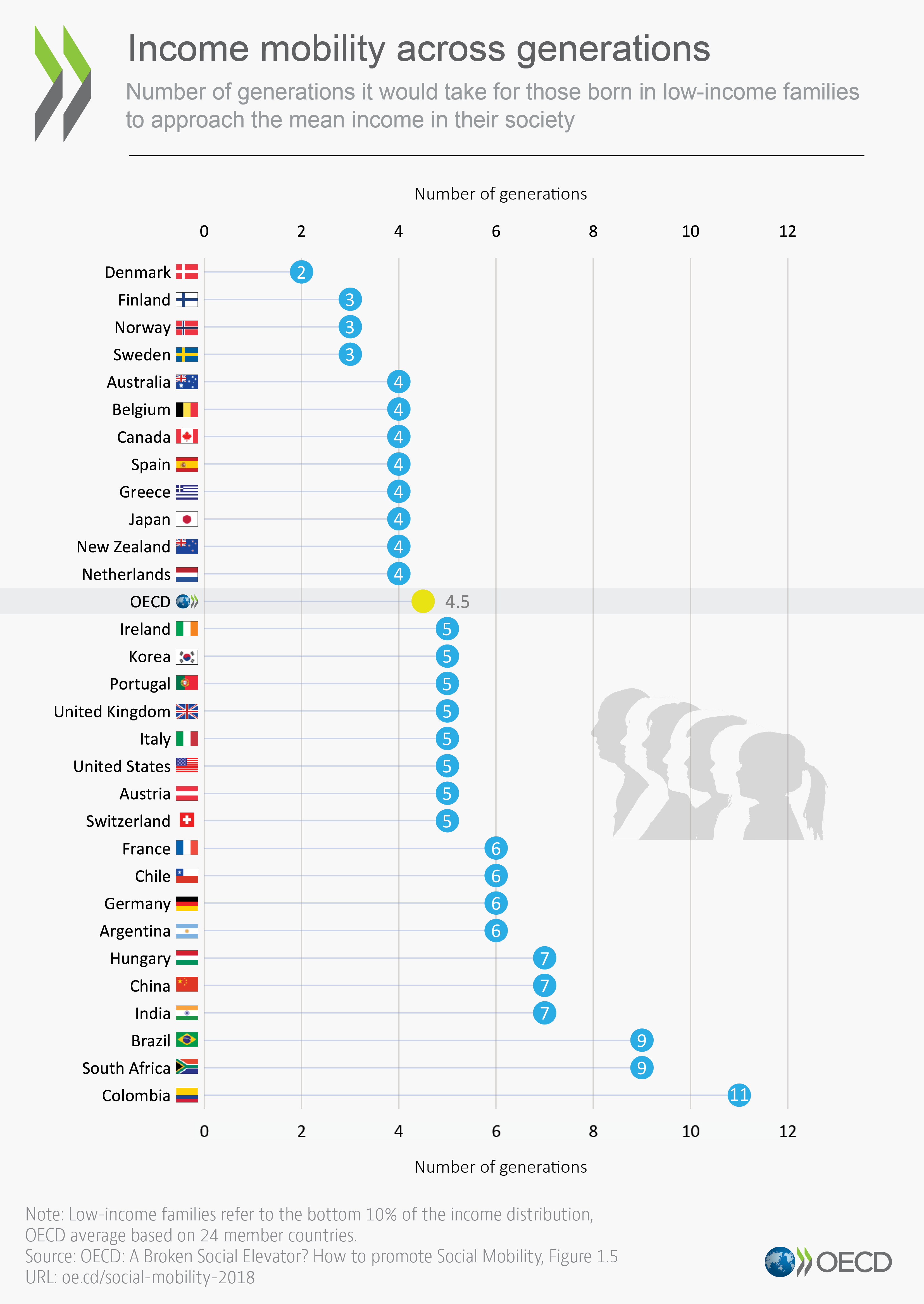
> In summary, America is good at allowing the poor to become middle class. It is less good at letting the middle class become exorbitantly rich, though not terribly so.
The common view is the opposite though: higher tax rates and lower entrepreneurship in Europe are assumed to put a damper on the middle class from amassing significant wealth. On the other hand, the US has significantly more billionaires per capita than most countries in Europe [1], and many of those are "self-made" (i.e. not generational wealth). What am I missing here?
[1] https://en.wikipedia.org/wiki/List_of_countries_by_number_of...
The common view is the opposite though: higher tax rates and lower entrepreneurship in Europe are assumed to put a damper on the middle class from amassing significant wealth. On the other hand, the US has significantly more billionaires per capita than most countries in Europe [1], and many of those are "self-made" (i.e. not generational wealth). What am I missing here?
[1] https://en.wikipedia.org/wiki/List_of_countries_by_number_of...
"Among the worst" is a bad qualifier, I'll admit. Not least because it is vague. However, the US is still worse than Europe when it comes to social mobility.
Going back to the original argument that something in the US's tax policy or job markets makes the US perform better when it comes to upwards social mobility, I think we can definitely debunk that.
Going back to the original argument that something in the US's tax policy or job markets makes the US perform better when it comes to upwards social mobility, I think we can definitely debunk that.
>top paying tech jobs for the working class
If you believe that, I'm not sure where to start. My own family put several kids into tech jobs one way or another, but sure didn't start from being working class.
As to not taxing working class people so they can turn into middle class people, boy are we not speaking the same language. For starters, you are probably talking about not taxing middle class people, by leaning MORE heavily on regressive taxation that cuts middle and upper class people a break so 'they can grow'. But that's a whole other story…
If you believe that, I'm not sure where to start. My own family put several kids into tech jobs one way or another, but sure didn't start from being working class.
As to not taxing working class people so they can turn into middle class people, boy are we not speaking the same language. For starters, you are probably talking about not taxing middle class people, by leaning MORE heavily on regressive taxation that cuts middle and upper class people a break so 'they can grow'. But that's a whole other story…
Social media giants? Environment-polluting industry?
BTW, Germany's also a top seller of weapons! We even delivered chemicals to Assad. So yeah, in that area we really are on par.
BTW, Germany's also a top seller of weapons! We even delivered chemicals to Assad. So yeah, in that area we really are on par.
> Environment-polluting industry?
Like VW's cheating diesel engines who's emissions I have to breathe as I walk/bike to work?
>Social media giants?
Nobody forces you to use those social media giants whereas I can't choose to only breathe only air not contaminated by VW diesel emissions.
Like VW's cheating diesel engines who's emissions I have to breathe as I walk/bike to work?
>Social media giants?
Nobody forces you to use those social media giants whereas I can't choose to only breathe only air not contaminated by VW diesel emissions.
Yeah but at least we have those rules that VW could then break.
And the negative effects of social media affect me if I use it or not.
And the negative effects of social media affect me if I use it or not.
>Yeah but at least we have those rules that VW could then break
What kind of logic is this, that breaking rules is fine since at least we have them? Honestly, that sounds like a child who just wants something his way rather than a logical argument. What's the point of rules if you don't bother enforcing them?
Speaking of rules, do you know the ones Wirecard blatantly broke and BaFin not only ignored the but actively pursued the foreign entities who tried to expose Wirecard's fraud, basically doing BaFin's job for them?
Yeah, big German companies are such saints and the Government institutions so efficient and incoruptibile in Europe /s.
What kind of logic is this, that breaking rules is fine since at least we have them? Honestly, that sounds like a child who just wants something his way rather than a logical argument. What's the point of rules if you don't bother enforcing them?
Speaking of rules, do you know the ones Wirecard blatantly broke and BaFin not only ignored the but actively pursued the foreign entities who tried to expose Wirecard's fraud, basically doing BaFin's job for them?
Yeah, big German companies are such saints and the Government institutions so efficient and incoruptibile in Europe /s.
You really, really have to start reading what others write and respond to that, instead of making stuff up. Where did anyone hint at German companies being saints?
But yes of course its a difference if companies can just pollute however they want, or if you have rules that say they can't but companies break those rules. In the latter case, when they're caught, they can be punished. And under Trump, lots of rules protecting the environment were eliminated.
But yes of course its a difference if companies can just pollute however they want, or if you have rules that say they can't but companies break those rules. In the latter case, when they're caught, they can be punished. And under Trump, lots of rules protecting the environment were eliminated.
The US's EPA discovered the cheating and leveled multi-billion dollar fines and indicted executives.
The military industry does indeed have the objective of hurting people, and it’s an important part of the US economy.
> does indeed have the objective of hurting people
That simply isn’t true. Generals and civilian leaders set the objectives of the military, and typically their objectives are to minimize casualties on both sides of any military engagement.
The military does use force and does hurt people but that is not an objective.
That simply isn’t true. Generals and civilian leaders set the objectives of the military, and typically their objectives are to minimize casualties on both sides of any military engagement.
The military does use force and does hurt people but that is not an objective.
Hey, steady on there. The UK may be a major arms sales to regimes with dubious human-rights records, but we don't actually use them ourselves, only 80k troops in the British Army.
There are plenty of well paid tech jobs in Europe. The ridiculous levels of pay you can get in the US are really creating more inequality rather than addressing it.
> There are plenty of well paid tech jobs in Europe.
The point was about letting working class people grow into middle class, i.e. accumulate some wealth by working at these jobs. It's much more difficult to do in Europe than in the US. First the tax system that is progressive on income, but not on net worth, that makes it increasingly hard to get richer by having good income. Second property prices are high and growing faster than income normally does. And finally as you've noticed these jobs are just not as well paid as in the US - basically it's the same grade as other office jobs (except managers and lawyers, these are paid much better)
The point was about letting working class people grow into middle class, i.e. accumulate some wealth by working at these jobs. It's much more difficult to do in Europe than in the US. First the tax system that is progressive on income, but not on net worth, that makes it increasingly hard to get richer by having good income. Second property prices are high and growing faster than income normally does. And finally as you've noticed these jobs are just not as well paid as in the US - basically it's the same grade as other office jobs (except managers and lawyers, these are paid much better)
Yeah but the people commenting here are probably the ones that earn that tech money, not the person working in the service sector for a couple of $ an hour.
Well the topic of this thread was corporate and tech related so what do you expect?
You can't always bring the lifestyle of minimum wage employees into every single discussion just as an joker card to argue that Europe is better than the US.
Yes, minimum wage immigrants have it better in Europe and skilled immigrants have better opportunities in the US.
You can't always bring the lifestyle of minimum wage employees into every single discussion just as an joker card to argue that Europe is better than the US.
Yes, minimum wage immigrants have it better in Europe and skilled immigrants have better opportunities in the US.
> Well the topic of this thread was corporate and tech related so what do you expect?
I expected exactly this - that people that benefit from those giant companies fail to see the downsides.
> You can't always bring the lifestyle of minimum wage employees into every single discussion just as an joker card to argue that Europe is better than the US.
Why not, if it works? Are you not just confirming that the US works for a few lucky ones whereas Europe works for most?
I expected exactly this - that people that benefit from those giant companies fail to see the downsides.
> You can't always bring the lifestyle of minimum wage employees into every single discussion just as an joker card to argue that Europe is better than the US.
Why not, if it works? Are you not just confirming that the US works for a few lucky ones whereas Europe works for most?
> those giant companies fail to see the downsides
So in your book big companies have only downsides? What about VW, Mercedes, BMW, SAP, Bayer, Siemens, etc?
Why are big US companies evil for you and not the rest?
So in your book big companies have only downsides? What about VW, Mercedes, BMW, SAP, Bayer, Siemens, etc?
Why are big US companies evil for you and not the rest?
> big companies have only downsides
> Why are big US companies evil for you and not the rest?
Never said any of that, so I guess you're not really reading my comments?
> Why are big US companies evil for you and not the rest?
Never said any of that, so I guess you're not really reading my comments?
What an egregiously edited quote. Cutting it down that much totally changed the meaning, leaving you a strawman that said nothing like what the original poster said.
Shame on you.
Shame on you.
> Why not, if it works?
Because it might be irrelevant? Yes, US and EU have historically different social policies, but it might not necessarily be the reason for difference in economic performance.
For me it's not "high tech companies vs working class", rather "high tech companies vs inefficient and intrusive government and old money". The obvious difference between FAANG on one side and BMW Daimler, etc. on the other side is the time when these companies have been founded.
Because it might be irrelevant? Yes, US and EU have historically different social policies, but it might not necessarily be the reason for difference in economic performance.
For me it's not "high tech companies vs working class", rather "high tech companies vs inefficient and intrusive government and old money". The obvious difference between FAANG on one side and BMW Daimler, etc. on the other side is the time when these companies have been founded.
I wouldn't seek "ridiculous levels of pay" if I could maintain a decent quality of life. Fact is, my rent at a one bedroom flat is more expensive than my parents mortgage for a full house. Of course people are looking for ways to get ahead.
But isn't the concentration of high-income tech workers in certain areas the reason for those high rents, together with little regulation of the rental market? So isn't that kind of self-inflicted?
Nah, this is an issue everywhere. Where I live there are few technology companies.
Apparently it isn't an issue quite everywhere. I mean, for instance, it doesn't seem to be one where your parents live.
The road to hell is paved with good intentions.
Europe’s entire social safety net is at risk if their private sector can’t generate enough wealth to support it. Given their declining populations and anti-immigrant tendencies inflamed by the refugee crisis in many of its member states, it doesn’t look good for the EU’s future.
Europe’s entire social safety net is at risk if their private sector can’t generate enough wealth to support it. Given their declining populations and anti-immigrant tendencies inflamed by the refugee crisis in many of its member states, it doesn’t look good for the EU’s future.
Few European people oppose migration of educated workers. Rather it's about asylum seekers who often arrive here illegally, and typically lack sufficient education to do well in our job markets, leading to very high unemployment rate and other social problems.
Europe has a problem with aging workforce, but it can't be solved by importing people who can't find a job.
Europe has a problem with aging workforce, but it can't be solved by importing people who can't find a job.
> Few European people oppose migration of educated workers.
That's a lie people tell you because they do not want to sound racist.
> Rather it's about asylum seekers who often arrive here illegally
... very few ...
> and typically lack sufficient education to do well in our job markets,
Uhm. And the ones that are educated, we don't recognize their diplomas. Nice.
And also, that's what the education system is for.
Finally, poor people in poor countries can't afford to flee to Europe. So those people are actually middle class people from poor countries with often quite some education.
> leading to very high unemployment rate and other social problems.
Nope, that's our own failed policies leading to that. Don't blame our mistakes on immigrants.
> Europe has a problem with aging workforce, but it can't be solved by importing people who can't find a job.
Than thank god we're not doing that.
That's a lie people tell you because they do not want to sound racist.
> Rather it's about asylum seekers who often arrive here illegally
... very few ...
> and typically lack sufficient education to do well in our job markets,
Uhm. And the ones that are educated, we don't recognize their diplomas. Nice.
And also, that's what the education system is for.
Finally, poor people in poor countries can't afford to flee to Europe. So those people are actually middle class people from poor countries with often quite some education.
> leading to very high unemployment rate and other social problems.
Nope, that's our own failed policies leading to that. Don't blame our mistakes on immigrants.
> Europe has a problem with aging workforce, but it can't be solved by importing people who can't find a job.
Than thank god we're not doing that.
GP didn't blame it on the immigrants but on the old money elites who first demanded former Eastern Bloc countries in the EU and then millions of immigrants.
In a real market economy, they'd have to raise wages instead. But no, undercutting local workers and cram new arrivals into the already overheated rental market, the old money vultures get even richer.
In a real market economy, they'd have to raise wages instead. But no, undercutting local workers and cram new arrivals into the already overheated rental market, the old money vultures get even richer.
The only problem with asylum seekers is that it is too difficult for them to apply for asylum before entering the country. Their first contact is a smuggler that gives them a ticket for an overloaded boat and has zero incentive to make sure they arrive in Germany legally or safely. The people they are shipping are just victims of an exploitative industry.
So basically you're saying it could not work to have a social safety net, so let's not have one all together? Because it could go wrong, don't even try?
Does not sound very American.
Does not sound very American.
It's interesting you should note anti-immigration tendencies. I believe those tendencies are fueled by ridiculously liberal immigration laws that essentially allows far too many asylum seekers into Europe. That's why you now see ghettos and zones where the police don't go in France, Sweden and even UK.
    I am not against immigration but I think Europe should
    be seriously reconsidering non-western immigration as
    it will simply clash.
Norway has done terrific integration of immigrants and also is in the process of shutting the gates since the 90s. It seems to be the way forward.
I am not against immigration but I think Europe should be seriously reconsidering non-western immigration as it will simply clash.
Norway has done terrific integration of immigrants and also is in the process of shutting the gates since the 90s. It seems to be the way forward.
I am not against immigration but I think Europe should
be seriously reconsidering non-western immigration as
it will simply clash.
> Why not set the filters to something more directly related to what you want to achieve?
Fine I'll bite: draw cartoons of you-know-who, see if they still integrate so seamlessly.
Its the elephant in the room.
Fine I'll bite: draw cartoons of you-know-who, see if they still integrate so seamlessly.
Its the elephant in the room.
There's assholes everywhere, in any group, so also there's immigrant assholes. Not letting immigrants in doesn't help with the assholes problem.
And also not every non-westerner is a Muslim, and not every Muslim is religious/cares about someone drawing Muhammad.
What you're trying to say is Muslim immigrants have trouble integrating in secular European society.
But that has been a problem with immigration for years. In Australia in the 50s/60s the same thing was said about Italians and other post-war immigrants.
The first generation works hard and busts their ass to get their kids a good education and into professions and business. They also have more of the attitudes of the society they left (conservative etc).
The second and then third generation adopt their local society's attitude. This leads to inter-generational clashes.
Radical propaganda leads to radicalization to the same endpoint, whether Islamist or Christianist or (in Israel for example) Judaist, or in India, Hinduist.
That radicalization is what is causing the current lack of assimilation. It is dangerous because it is driven by having an in group and an out group. It doesn't matter which religion it is, the radicalization, the precepts (male domination, female subjugation, attacking non-cis genders, non-hetero sexuality etc) are all the same.
But that has been a problem with immigration for years. In Australia in the 50s/60s the same thing was said about Italians and other post-war immigrants.
The first generation works hard and busts their ass to get their kids a good education and into professions and business. They also have more of the attitudes of the society they left (conservative etc).
The second and then third generation adopt their local society's attitude. This leads to inter-generational clashes.
Radical propaganda leads to radicalization to the same endpoint, whether Islamist or Christianist or (in Israel for example) Judaist, or in India, Hinduist.
That radicalization is what is causing the current lack of assimilation. It is dangerous because it is driven by having an in group and an out group. It doesn't matter which religion it is, the radicalization, the precepts (male domination, female subjugation, attacking non-cis genders, non-hetero sexuality etc) are all the same.
> The first generation works hard and busts their ass to get their kids a good education and into professions and business.
That's how it used to be back in the day, but it doesn't seem to be how it works nowadays in countries to which migrant-smugglers explicitly recruit customers based on those countries' unconditional social benefit payments.
> The second and then third generation adopt their local society's attitude.
See the above; and thus...
> This leads to inter-generational clashes.
...thus, inter-cultural clashes, rather than inter-generational.
That's how it used to be back in the day, but it doesn't seem to be how it works nowadays in countries to which migrant-smugglers explicitly recruit customers based on those countries' unconditional social benefit payments.
> The second and then third generation adopt their local society's attitude.
See the above; and thus...
> This leads to inter-generational clashes.
...thus, inter-cultural clashes, rather than inter-generational.
Comparing Italians with muslim immigrants from war torn countries is far fetched. Italians are all over the world and have integrated just fine. Nobody is more European than people from countries like Italy, Austria, Germany, France.
Because its obviously not about what makes sense ... you don't seem to know but your friends just don't fit our awesome western culture.
I really hate the term "culture" by now.
I really hate the term "culture" by now.
No, it's just the fact that some part (not all of it) of the economy has become zero sum, primarily low skill labor. When people get screwed in a zero sum game they want someone else to get screwed instead.
It's not surprising. It's completely obvious.
It's not surprising. It's completely obvious.
The thing is, in Germany the people voting for the far-right party are actually doing fine economically and so are their friends.
I do agree that parts of the economy are not working properly. And still we can't seem to get ourselves to vote for different politicians that might do something about it. Yeah that means stuff changes and change and new things are scary, but not fixing those things would be worse.
I do agree that parts of the economy are not working properly. And still we can't seem to get ourselves to vote for different politicians that might do something about it. Yeah that means stuff changes and change and new things are scary, but not fixing those things would be worse.
I think you are deceiving yourself by restricting your dataset to those in your circles. Of course there are many smart and productive immigrants in Germany from all over the world.
I said I am not against immigration, but shutting it down for a period or restricting heavily might be worth it due to the potential risks that exist long term.
There's no real harm in trying that for Germany's voters, and by doing so you will also keep the far right wingers at bay.
I said I am not against immigration, but shutting it down for a period or restricting heavily might be worth it due to the potential risks that exist long term.
There's no real harm in trying that for Germany's voters, and by doing so you will also keep the far right wingers at bay.
I feel like you are dancing around the issue, which is: why do you care if the migrants are "non-western" rather than of they are educated or have an in demand profession? Correct me if I'm wrong but are you saying you'd prefer blocking a Syrian doctor from immigrating than a French unskilled worker?
I don't want to block the French unskilled worker and I don't need to, as the EU exists and allows for him/her to move to Germany if desired. As for the Syrian doctor - sure that is a pity if strict immigration keeps such individuals out. However, going the formal route with work permit application etc exists as well. It won't be easy but resourceful people will find a way.
> but shutting it down for a period or restricting heavily might be worth it due to the potential risks that exist long term (...) by doing so you will also keep the far right wingers at bay
So that means that the people in Germany that would vote for right-wing parties are the problem, not the immigrants themselves, no matter how well they behave. I agree with that.
So that means that the people in Germany that would vote for right-wing parties are the problem, not the immigrants themselves, no matter how well they behave. I agree with that.
> That's why you now see ghettos and zones where the police don't go in France, Sweden and even UK.
That's failed policy by the people that are already here, not the fault of the immigrants.
> I think Europe should be seriously reconsidering non-western immigration as it will simply clash
Yeah ... wait what? That's kinda ... what? Why? What's the problem with that?
So you don't seem to know, but it worked out very well with the middle eastern immigrants in Germany from 2015. Integration into the workforce worked better than expected, many pay taxes and stuff.
That's failed policy by the people that are already here, not the fault of the immigrants.
> I think Europe should be seriously reconsidering non-western immigration as it will simply clash
Yeah ... wait what? That's kinda ... what? Why? What's the problem with that?
So you don't seem to know, but it worked out very well with the middle eastern immigrants in Germany from 2015. Integration into the workforce worked better than expected, many pay taxes and stuff.
If you limit immigration heavily, yet allow for immigration from countries that almost never cause problems, you will limit the risks. Lets then expand on Western countries to simply mean developed nations. Anything from US, Canada, Mexico to Australia, Russia and Japan.
But that's the thing, they don't cause too much trouble, so "yet allow for immigration from countries that almost never cause problems" means let's continue doing what we're doing.
Yes, I don't really expect things to change much.
source
> That's why you now see ghettos and zones where the police don't go in France, Sweden and even UK.
Please name me one place in the UK where police don’t go.
This is exactly the same 5 year old BS that we heard from Trump times.
Even the USA ambassador was embarrassed and grilled by the journalist in the Netherlands to provide one example of “politicians being burned” and “no-go zones” in the Netherlands.
https://youtu.be/lOEI6hYZe6Y
Please name me one place in the UK where police don’t go.
This is exactly the same 5 year old BS that we heard from Trump times.
Even the USA ambassador was embarrassed and grilled by the journalist in the Netherlands to provide one example of “politicians being burned” and “no-go zones” in the Netherlands.
https://youtu.be/lOEI6hYZe6Y
tbf, the British press fuels this nonsense. In recent weeks the Daily Mail produced one article that suggested a particular (84% white) suburb was a "no go area" for white people, and another that suggested it was a "posh and leafy suburb" that was top of the list for house hunters nationwide :-/
Police have been told to avoid certain areas in uniform when traveling to and from work. In other areas the police think twice about entering, as people are likely to throw things at the car etc. I have this from a friend in the UK.
If that doesn't qualify as a type of "no go", I don't know where to draw the line. In any case, it's shocking.
If that doesn't qualify as a type of "no go", I don't know where to draw the line. In any case, it's shocking.
"a friend in the UK"... what an excellent source of factual unbiased information.
It's also bullshit (and if it isn't prove me wrong with actual facts, not apocryphal stories from "friends" ).
It's also bullshit (and if it isn't prove me wrong with actual facts, not apocryphal stories from "friends" ).
Well I can't go and actually name my friends on a public forum, can I. So yes, it's unverifiable. But if you live there, it shouldn't be hard to find someone outside of your London bubble with this opinion.
Dude, all you’ve done is pepper this post with empty rhetoric and unsubstantiated claims. If you’re interested in an actual debate based on facts, great, otherwise you’re just adding noise.
Yeah.
Its funny how I am always kind of really relieved to come back from the US to Europe. I know there's no guns around in a bar, I know all my friend can see a doctor when they feel sick, and hey, I don't need to ask someone to pick me up from the airport because there's public transportation. And I can switch on the TV and see boobs!
Its funny how I am always kind of really relieved to come back from the US to Europe. I know there's no guns around in a bar, I know all my friend can see a doctor when they feel sick, and hey, I don't need to ask someone to pick me up from the airport because there's public transportation. And I can switch on the TV and see boobs!
> So the entire EU economy grew at the same speed than the US one but not its 500 bigger companies. So all else being equals it means that the smaller US companies grew more slowly and that this article is simply mesuring increasing corporate inequalities
The flaw here is ignoring that corporate earnings are not contiguous with GDP at a country level. A country’s earnings cam grow faster than GDP, when overseas profits grow faster than domestic profits. Since most large corporates are multinationals this consideration is highly relevant.
Apple has grown very fast, but since iPhones are mostly assembled in Asia and the software is booked in tax havens like Ireland, very little of that accrues in the form of US GDP.
What’s much more likely than corporate inequality increasing is that US corporates have done a much better job at expanding overseas than large European corporates. This is also why American consumer expenditures are much higher than you’d predict from looking at GDP per capita. iPhones may count as Taiwanese and Irish GDP, but the huge profit margins wind up buying back AAPL stock that is largely held by American shareholders.
The flaw here is ignoring that corporate earnings are not contiguous with GDP at a country level. A country’s earnings cam grow faster than GDP, when overseas profits grow faster than domestic profits. Since most large corporates are multinationals this consideration is highly relevant.
Apple has grown very fast, but since iPhones are mostly assembled in Asia and the software is booked in tax havens like Ireland, very little of that accrues in the form of US GDP.
What’s much more likely than corporate inequality increasing is that US corporates have done a much better job at expanding overseas than large European corporates. This is also why American consumer expenditures are much higher than you’d predict from looking at GDP per capita. iPhones may count as Taiwanese and Irish GDP, but the huge profit margins wind up buying back AAPL stock that is largely held by American shareholders.
The point of departure is market cap vs other measures. US companies have gained a lot of value, relative to their GDP contributions... hence the discrepancy.
I think you missed the part about Eastern Europe. From the article:
European GDP per head is about two-thirds that of America. The figure has not fallen in the past 20 years thanks mostly to poorer eastern Europeans getting closer to Western income levels.
Would suggest that as the faster GDP Growth came from Eastern European areas offsetting a stagnating GDP Growth from the rest of Europe. Am I not reading this correctly?
European GDP per head is about two-thirds that of America. The figure has not fallen in the past 20 years thanks mostly to poorer eastern Europeans getting closer to Western income levels.
Would suggest that as the faster GDP Growth came from Eastern European areas offsetting a stagnating GDP Growth from the rest of Europe. Am I not reading this correctly?
Yeah they are measuring inequality but the subtext is that some of US companies are bigger because they have big global brands, which Europe has not produced. Remember Skype and Nokia?
So the entire EU economy grew at the same speed than the US one but not its 500 bigger companies.
This is misleading. The article says the poorer (former communist) eastern European countries got richer, which brought up the average.
This is misleading. The article says the poorer (former communist) eastern European countries got richer, which brought up the average.
Ok. So lets look at the US on a state level - some got terribly rich, some suffer terribly?
How is this "misleading"?
We want the poorer countries to get richer faster in order to close the gap. Accomplishing precisely this is a large part of EU policy. And it is working.
We want the poorer countries to get richer faster in order to close the gap. Accomplishing precisely this is a large part of EU policy. And it is working.
If the US had its eastern part communist, it too would have a higher average GDP from decades ago. It is basic economics.
GDP per capita in the US ranges from $200k (DC) to $38K (MI).
https://en.wikipedia.org/wiki/List_of_states_and_territories...
Lots of ways to catch up there as well.
And that doesn't change the fact that that is the actual data, nothing "misleading" about it.
https://en.wikipedia.org/wiki/List_of_states_and_territories...
Lots of ways to catch up there as well.
And that doesn't change the fact that that is the actual data, nothing "misleading" about it.
As usual the article is almost exclusively concerned with market capitalization as an indicator of economic success. Countries like Germany are dominated by small and middle-class, family owned business. 'Big corporate' is indeed more successful in the US or China but it's just one model to manage an economy and I don't think it's that great. One of the most important points is also buried at the end of the article
>"These internal barriers mean Europe has many smaller firms operating at national, not continental, scale. Each country tends to have its own banks, utilities, airlines and supermarkets. (Europe has over 100 mobile operators, compared with a handful in America or China.) These lack the economies of scale and opportunities to grow quickly enjoyed by firms plying the American or Chinese markets."
Europe has no homogeneous consumer market for tech giants like the US or China which can propel tech firms to gigantic size. And honestly I consider this a feature instead of a bug. It seems like profits aside the major other thing they seem to promote is damaging competition, democracy and pushing surveillance. If it was up to me Europe should use the decline of business giants to double down on the idea of the 'Europe of regions'. Small, diverse and robust business that does well on international markets, pays attention to its stakeholders rather than just shareholders, and does not just pursue growth blindly.
>"These internal barriers mean Europe has many smaller firms operating at national, not continental, scale. Each country tends to have its own banks, utilities, airlines and supermarkets. (Europe has over 100 mobile operators, compared with a handful in America or China.) These lack the economies of scale and opportunities to grow quickly enjoyed by firms plying the American or Chinese markets."
Europe has no homogeneous consumer market for tech giants like the US or China which can propel tech firms to gigantic size. And honestly I consider this a feature instead of a bug. It seems like profits aside the major other thing they seem to promote is damaging competition, democracy and pushing surveillance. If it was up to me Europe should use the decline of business giants to double down on the idea of the 'Europe of regions'. Small, diverse and robust business that does well on international markets, pays attention to its stakeholders rather than just shareholders, and does not just pursue growth blindly.
In defense of the article (not agreeing nor disagreeing), the article then includes reasons why it is concerned with market capitalization:
>But if it continues, the waning of Europe’s business will bring consequences. Big firms invest in innovation, which boosts economic growth. Left to regulate only foreign groups, Europe’s ability to shape global business norms—on privacy, say, or the uses of artificial intelligence—will look weak. European policymakers’ cries for “strategic autonomy” will come to nothing without corporate backing.
>Europe’s smaller firms now find themselves competing against global behemoths with inbuilt advantages. Large firms can afford to buy and try new technology, borrow at cheaper rates and absorb fixed costs more efficiently. They tend to spend relatively more on research and development. The dearth of big companies helps explain why European spending on research, at 2.1% of gdp, is below the average of the oecd, a group of mostly rich nations.
I have no certainty about few, big corps vs. heterogenous medium sized corps, but I think the point has about Europe's ability to influence global norms/best practices has validity. Europes influence could be negatively affected without strong, global presence by local companies in sectors it cares about influencing.
>But if it continues, the waning of Europe’s business will bring consequences. Big firms invest in innovation, which boosts economic growth. Left to regulate only foreign groups, Europe’s ability to shape global business norms—on privacy, say, or the uses of artificial intelligence—will look weak. European policymakers’ cries for “strategic autonomy” will come to nothing without corporate backing.
>Europe’s smaller firms now find themselves competing against global behemoths with inbuilt advantages. Large firms can afford to buy and try new technology, borrow at cheaper rates and absorb fixed costs more efficiently. They tend to spend relatively more on research and development. The dearth of big companies helps explain why European spending on research, at 2.1% of gdp, is below the average of the oecd, a group of mostly rich nations.
I have no certainty about few, big corps vs. heterogenous medium sized corps, but I think the point has about Europe's ability to influence global norms/best practices has validity. Europes influence could be negatively affected without strong, global presence by local companies in sectors it cares about influencing.
We prefer to influence global norms/best practices via our democratically elected governments, instead of via corporate behemoths who probably don't have our interests in mind.
On the other hand, contrary to the US, in Europe we generally trust in our governments. Since we do not have huge corporations here, it's more difficult to influence government decisions, specially at Europe level.
On the other hand, contrary to the US, in Europe we generally trust in our governments. Since we do not have huge corporations here, it's more difficult to influence government decisions, specially at Europe level.
I just hope it stays that way. I fear that all the cynics blaming everything that's bad on politicians and the EU (instead of the voters putting those politicians in power) will eventually degrade trust in that in itself nicely working system ... and then, what's the point defending that system against the populists and fascists wanting to take over? They can't be that much worse ... :-(( [same with media that does a good job in Europe]
> I fear that all the cynics blaming everything that's bad on politicians and the EU (instead of the voters putting those politicians in power)
Yes. Last year I started playing an browser game about running your own commpany and got interested in economics.
If capitalism can be fun inside a game, how come it isn't fun in real life? After all a game that disenfranchises new players and prevents them from playing the game is going to die over the long term. People would quit the game the same way they quit their job. There must be a fundamental difference in how the game has designed its economy vs how we designed our real economy.
For example, unlike real life it's possible to win a video game. It's possible to have produced everything everyone else could have possibly wanted. At some point there is simply too much stuff and not enough buyers. The game would die from deflation. The game devs have strategically placed market maker NPCs that buy products at an extremely low price that is never worth it unless there is sufficient deflation. It's basically a job guarantee, it's demand side stimulus. Dumping your resources into the MM will cause inflation, which will raise the price of your resources until it makes more sense to sell your resources on the market to other players. Even if there are large players dominating the market and dumping prices to rock bottom rates, it will always be possible to earn some money until those prices are no longer rock bottom.
The point isn't that politicians should implement a job guarantee (it would certainly help though). It's that politicians have the power to design a working economic system. I always was under the impression that these politicians simply didn't understand the economy but that's not the case. They aspire to a certain form of capitalism that is good over the long term but just happens to suck over the short term right now and people willingly vote for them. Things are guaranteed get better once China, Eastern Europe, Africa, South America have caught up with the US and rich part of the EU but how long is that going to take? 40 years?
You just need to break the chain for 8 years, get things back in order over the short term. Biden is doing it. The EU has to follow similar actions but that requires voters to not choose right wing populism or the same old party they voted for 20 years straight, they need to vote for parties that actually want to help them.
Yes. Last year I started playing an browser game about running your own commpany and got interested in economics.
If capitalism can be fun inside a game, how come it isn't fun in real life? After all a game that disenfranchises new players and prevents them from playing the game is going to die over the long term. People would quit the game the same way they quit their job. There must be a fundamental difference in how the game has designed its economy vs how we designed our real economy.
For example, unlike real life it's possible to win a video game. It's possible to have produced everything everyone else could have possibly wanted. At some point there is simply too much stuff and not enough buyers. The game would die from deflation. The game devs have strategically placed market maker NPCs that buy products at an extremely low price that is never worth it unless there is sufficient deflation. It's basically a job guarantee, it's demand side stimulus. Dumping your resources into the MM will cause inflation, which will raise the price of your resources until it makes more sense to sell your resources on the market to other players. Even if there are large players dominating the market and dumping prices to rock bottom rates, it will always be possible to earn some money until those prices are no longer rock bottom.
The point isn't that politicians should implement a job guarantee (it would certainly help though). It's that politicians have the power to design a working economic system. I always was under the impression that these politicians simply didn't understand the economy but that's not the case. They aspire to a certain form of capitalism that is good over the long term but just happens to suck over the short term right now and people willingly vote for them. Things are guaranteed get better once China, Eastern Europe, Africa, South America have caught up with the US and rich part of the EU but how long is that going to take? 40 years?
You just need to break the chain for 8 years, get things back in order over the short term. Biden is doing it. The EU has to follow similar actions but that requires voters to not choose right wing populism or the same old party they voted for 20 years straight, they need to vote for parties that actually want to help them.
> The EU has to follow similar actions but that requires voters to not choose right wing populism or the same old party they voted for 20 years straight
Yeah, but it seems like voters tend to vote for the same party so long that it kind of kills the competition (if I know that I'll be re-elected no matter what, why behave?), and then suddenly voters get pissed because they don't get ... something, whatever, not sure they know themselves ... and vote for populists.
But every now and then the times are just right that some competent government is elected that implements some well thought-through laws, that have sufficient positive effects over decades to compensate for all that. At least until now.
Yeah, but it seems like voters tend to vote for the same party so long that it kind of kills the competition (if I know that I'll be re-elected no matter what, why behave?), and then suddenly voters get pissed because they don't get ... something, whatever, not sure they know themselves ... and vote for populists.
But every now and then the times are just right that some competent government is elected that implements some well thought-through laws, that have sufficient positive effects over decades to compensate for all that. At least until now.
OTOH megacorps rarely "innovate" from within, they're too bureaucratic and management stakes are too high for fast risk-taking. What they usually do is to buy out smaller entities that have somewhat proven the concept and pretend they're geniuses for having found a truffle.
Also they have no reason to innovate if they got a monopoly. Sometimes they buy that small innovative company and then that nice idea somehow just dies ... maybe cause it'd hurt their business model?
Solar city was basically a series of acquisitions. It ended up being bailed out through the Tesla acquisition but once Musk bailed out his own Solar city stock/bonds he gutted the Tesla Energy (Solar City rebrand) branch and basically pretended that it never existed in the first place. The solar roof was just some hyped up product to get the acquisition through.
> The solar roof was just some hyped up product ...
Musk style. Still not sure if all the hype is worth the results.
Musk style. Still not sure if all the hype is worth the results.
> "(Europe has over 100 mobile operators, compared with a handful in America or China.) These lack the economies of scale and opportunities to grow quickly enjoyed by firms plying the American or Chinese markets."
This is such a bad example, I count 6 European carriers with more subscribers than AT&T.
https://en.wikipedia.org/wiki/List_of_mobile_network_operato...
> "These internal barriers mean Europe has many smaller firms operating at national, not continental, scale."
Looks like they're not interested in continental scale because they're already at global scale with together 1.4B subscriptions.
I generally agree with the point but this is a bad example.
This is such a bad example, I count 6 European carriers with more subscribers than AT&T.
https://en.wikipedia.org/wiki/List_of_mobile_network_operato...
> "These internal barriers mean Europe has many smaller firms operating at national, not continental, scale."
Looks like they're not interested in continental scale because they're already at global scale with together 1.4B subscriptions.
I generally agree with the point but this is a bad example.
Also, don't Americans complain all the f**ing time how bad their broadband internet is?
Rightly so. It's absolutely pathetic, and it's because of the lack of competition through the scale of those who own and control the market, combined with the government keeping their hands off the market-controllers.
Purely rent-seeking and stagnant. Pathetic. Damagingly awful.
Purely rent-seeking and stagnant. Pathetic. Damagingly awful.
German and Austrian broadband is equally worse.
Because of a lack of competition, it’s the same issue as the US, but at a smaller scale (at least in most areas you can subscribe to multiple ISPs).
E.g. in The Netherlands you can subscribe to a large number of ISPs. In the largest part of the country either through *DSL or cable. Increasingly also fiber. This is because the government regulated internet access very early on. When the state telephone company was privatized, they were forced to make the infrastructure available to others.
The power of real competition (in contrast to ‘winner takes all’) should not be underestimated. As a result of a free market + some government regulation, anyone in the country can subscribe to an ISP that actually cares about their customers.
Xs4all was a provider that literally grew out of the hacker community and proactively fought for their user’s freedom and privacy rights (e.g. by supporting subscribers in court who were sued by Scientology for revealing information about the Church of Scientology on their Xs4all webpage).
At any rate, at some point Xs4all was bought by one of the largest ISPs (KPN). For a very long time they operated as an independent unit, continuing their strong stance on ethics. The last few years, they have been assimilated more and more by KPN. A few former employees and other supporters decided to start a new ISP, freedom.nl, that carries on the privacy/freedom angle of Xs4all. And with relatively little capital investment they are now up and running and anyone living in The Netherlands can subscribe to them.
This is only possible in a market where regulation enforces real competition. I thing regulated capitalism is one of the strengths of Europe. It may not always result in the best outcome for shareholders, but it’s definitely great for the general population.
Do we always get it right? No. I lived in Germany for 5 years, and indeed, the ISP options and quality were pretty miserable.
E.g. in The Netherlands you can subscribe to a large number of ISPs. In the largest part of the country either through *DSL or cable. Increasingly also fiber. This is because the government regulated internet access very early on. When the state telephone company was privatized, they were forced to make the infrastructure available to others.
The power of real competition (in contrast to ‘winner takes all’) should not be underestimated. As a result of a free market + some government regulation, anyone in the country can subscribe to an ISP that actually cares about their customers.
Xs4all was a provider that literally grew out of the hacker community and proactively fought for their user’s freedom and privacy rights (e.g. by supporting subscribers in court who were sued by Scientology for revealing information about the Church of Scientology on their Xs4all webpage).
At any rate, at some point Xs4all was bought by one of the largest ISPs (KPN). For a very long time they operated as an independent unit, continuing their strong stance on ethics. The last few years, they have been assimilated more and more by KPN. A few former employees and other supporters decided to start a new ISP, freedom.nl, that carries on the privacy/freedom angle of Xs4all. And with relatively little capital investment they are now up and running and anyone living in The Netherlands can subscribe to them.
This is only possible in a market where regulation enforces real competition. I thing regulated capitalism is one of the strengths of Europe. It may not always result in the best outcome for shareholders, but it’s definitely great for the general population.
Do we always get it right? No. I lived in Germany for 5 years, and indeed, the ISP options and quality were pretty miserable.
Yeah it heavily depends where you live, in Germany. In or near larger cities, there's lots of really good options.
Its funny how Germany was ruled for 16 years now by a party whose voters live mostly in rural areas, but didn't do a lot for those areas ...
Its funny how Germany was ruled for 16 years now by a party whose voters live mostly in rural areas, but didn't do a lot for those areas ...
>Its funny how Germany was ruled for 16 years now by a party whose voters live mostly in rural areas, but didn't do a lot for those areas ...
It's the same with trump. He mostly cared about himself. The only thing he did right for his voterbase is starting the trade war. From a pragmatic standpoint the tradewar was necessary, even if it's not the best thing you could possibly do. The point is that the economy is very slow, the short term can last decades. Hoping for an economic recovery that pulls up everyone will happen one day but not within the term of any politicians of today. A tradewar is a quick hack to achieve full employment.
It's the same with trump. He mostly cared about himself. The only thing he did right for his voterbase is starting the trade war. From a pragmatic standpoint the tradewar was necessary, even if it's not the best thing you could possibly do. The point is that the economy is very slow, the short term can last decades. Hoping for an economic recovery that pulls up everyone will happen one day but not within the term of any politicians of today. A tradewar is a quick hack to achieve full employment.
Its interesting that you get downvoted just for saying that we should have government regulation that leads to working markets with a healthy competition making things better for people.
> I thing regulated capitalism is one of the strengths of Europe. It may not always result in the best outcome for shareholders, but it’s definitely great for the general population.
yeaaaah :)
> I thing regulated capitalism is one of the strengths of Europe. It may not always result in the best outcome for shareholders, but it’s definitely great for the general population.
yeaaaah :)
This is a discussion about market share, not quality.
Exactly, all else being equal this article actually makes me want to invest in a European total market index.
It's basically the only continent currently which have an acceptable price earning ratio.
Even if it's true that American whales had 10 years of exeptional growth, they are priced as if they will be able to have the same growth for the next 10 years.
It's basically the only continent currently which have an acceptable price earning ratio.
Even if it's true that American whales had 10 years of exeptional growth, they are priced as if they will be able to have the same growth for the next 10 years.
I’ve made 50% returns (!) in 2 years on the Greek market index ETF…
“No big companies” is a fine policy for things that don’t require a lot of money to innovate on. A small business will never be capable of producing anything like the iPhone for example. Pushing the envelope on tech is very expensive and this is where Europe’s current model doesn’t work.
If it’s just companies reselling existing things or incremental tech (e.g. grocers, telecoms, utilities, airlines, etc), then smaller companies are nice.
If it’s just companies reselling existing things or incremental tech (e.g. grocers, telecoms, utilities, airlines, etc), then smaller companies are nice.
Europe had iPhone precursors before iPhones were a thing.
https://en.wikipedia.org/wiki/Nokia_Communicator
And don't forget ARM was initially a UK/EU design. Arduino and Pi still are.
Also not doing so badly with fintech and entertainment.
https://www.information-age.com/value-of-european-tech-compa...
https://en.wikipedia.org/wiki/Nokia_Communicator
And don't forget ARM was initially a UK/EU design. Arduino and Pi still are.
Also not doing so badly with fintech and entertainment.
https://www.information-age.com/value-of-european-tech-compa...
> Europe had iPhone precursors before iPhones were a thing
That’s the point. Where are they? They couldn’t compete due to lack of scale. They couldn’t scale due to structural restrictions on scale.
The next iPhone isn’t going to come from Europe. It may be first developed there. But an American or Chinese copycat will rapidly advance upon them.
That’s the point. Where are they? They couldn’t compete due to lack of scale. They couldn’t scale due to structural restrictions on scale.
The next iPhone isn’t going to come from Europe. It may be first developed there. But an American or Chinese copycat will rapidly advance upon them.
The previous range of state of the art smartphones did come from Europe. They couldn't compete but not because of structural restrictions on scale - just because of a series of bad decisions that were independent of the continent they were developed on.
It's more likely the next generation will come exclusively from China - not because of structural restrictions on scale but because it's deliberately built up its electronics manufacturing base while the US and Europe allowed theirs to dwindle because short term profit margins outweighed long term industrial strategy.
It's more likely the next generation will come exclusively from China - not because of structural restrictions on scale but because it's deliberately built up its electronics manufacturing base while the US and Europe allowed theirs to dwindle because short term profit margins outweighed long term industrial strategy.
> previous range of state of the art smartphones did come from Europe
Right, but where are they now? The article says in just its third paragraph that "Europe used to pack a punch." Up to 2000, "nearly a third of the combined value of the world’s 1,000 biggest listed firms was in Europe, and a quarter of their profits." That aligns with the state of the art having a home in Europe around then.
But something changed over the past 20 years. It's apparent from the outside looking in. But it remains--as made apparent by this thread--shockingly controversial within the Continent.
Right, but where are they now? The article says in just its third paragraph that "Europe used to pack a punch." Up to 2000, "nearly a third of the combined value of the world’s 1,000 biggest listed firms was in Europe, and a quarter of their profits." That aligns with the state of the art having a home in Europe around then.
But something changed over the past 20 years. It's apparent from the outside looking in. But it remains--as made apparent by this thread--shockingly controversial within the Continent.
>That aligns with the state of the art having a home in Europe around then.
Does it? Bigger doesn't mean more state of the art. Comcast isn't state of the art. Exxon isn't state of the art. Most big companies aren't Apple.
Moreover, the size of American companies is somewhat exaggerated cos of liquidity being pumped into the stock market.
Does it? Bigger doesn't mean more state of the art. Comcast isn't state of the art. Exxon isn't state of the art. Most big companies aren't Apple.
Moreover, the size of American companies is somewhat exaggerated cos of liquidity being pumped into the stock market.
The US gov didn't pump liquidity directly into the stock market: they reduced the cost of borrowing, which increased investment in basically everything, e.g., collectible baseball cards. My point is that investors bid up the price of European stocks as well as US stocks.
Who says the change was in Europe? The US got around to leveraging its comparative advantages in internet tech and grew some huge companies. The Facebook was never going to emerge from Poland, no matter how much public policy tried to support smart Polish engineers building PHP frameworks for people to upload pictures of their friends. Europe did not create any Facebooks, but achieved comparable productivity and GDP growth rates spread across a more diverse range of fields, and excelled in fields like Coronavirus vaccine research despite comparatively modest success stories in selling digital advertising. It is not obvious that we are worse off as a result, or that a giant company like Facebook is substantially more likely to come up with the Next Big Thing in technological progress than a merely large one like Siemens, or even a reasonably well capitalised research company well outside the top 1000 firms. The value of growth is demonstrated in goods and services, jobs and potential for goods and jobs across the entire economy, not in vanity metrics like number of companies with enough monopoly power to show up in top companies indices.
(And China was always going to move up the value chain in consumer electronics and grow faster than both of us; when it does so further in the next couple of decades it need not represent a flaw in US/European policy)
(And China was always going to move up the value chain in consumer electronics and grow faster than both of us; when it does so further in the next couple of decades it need not represent a flaw in US/European policy)
Nokia? Lack of scale?
Nokia couldn't compete because they made a string of incredibly poor investment and management decisions, such as the N-Gage, until their mobile division was eventually bought out by Microsoft. Even with Microsoft's scale they couldn't turn things around.
The reality is that there were a number of mobile phone manufacturers making lots of really bad decisions whilst trying unsuccessfully to compete with the likes of Apple and Samsung. They aren't gone from the market because they lacked scale: they're gone because they were stupid.
Nokia couldn't compete because they made a string of incredibly poor investment and management decisions, such as the N-Gage, until their mobile division was eventually bought out by Microsoft. Even with Microsoft's scale they couldn't turn things around.
The reality is that there were a number of mobile phone manufacturers making lots of really bad decisions whilst trying unsuccessfully to compete with the likes of Apple and Samsung. They aren't gone from the market because they lacked scale: they're gone because they were stupid.
Microsoft buying Nokia had nothing to do with saving the company. Arguably, buying Nokia and running it into the ground was an expensive gamble to push Windows 8 Mobile + Windows 8 desktop at any cost. Which was already failing before the acquisition was even complete. I'm still stunned the Finish government allowed it to happen. Nokia went from, "probably could turn this around" to "smoking wreckage of a company" in less than a year.
At least from Risto Siilasmaa tells a different story in his book. He was in the Nokia board in the last good years and then lead the effort to turn things around. If I remember correctly, he writes in his book that at the point of sale to Microsoft, Nokia was already very close to go under. In Finland, it is generally seen that the deal with Microsoft was a complete steal from Nokia, they got much more than the value was at that point and Microsoft even agreed to loan them hundreds of millions to buy full control in Nokia-Siemens networks.
[deleted]
> They couldn’t compete due to structural restrictions on scale.
Mhm. Cause a working marked with healthy competition never did anything good.
Just one question, how did European car makers then become what they are? Even though its impossible?
Mhm. Cause a working marked with healthy competition never did anything good.
Just one question, how did European car makers then become what they are? Even though its impossible?
> how did European car makers then become what they are?
Cars have for a long time been tightly linked to the military. Every major Western car maker up to the last decade at some point built tanks.
Cars have for a long time been tightly linked to the military. Every major Western car maker up to the last decade at some point built tanks.
So basically you're saying Europe should start another World War to make sure their companies stay competitive?
> you're saying Europe should start another World War to make sure their companies stay competitive?
No. You asked how Europe got certain economies of scale. I answered. Through the engines of past wars. Future wars don't guarantee similar results.
If Europe wants globally-relevant big businesses, it will likely require social upheaval on the scale of war. (I’m not betting on it.)
No. You asked how Europe got certain economies of scale. I answered. Through the engines of past wars. Future wars don't guarantee similar results.
If Europe wants globally-relevant big businesses, it will likely require social upheaval on the scale of war. (I’m not betting on it.)
[deleted]
The precursors to the iPhone were just garbage (I say this as a power user of these devices). There is a reason Android dropped their existing plans to mirror the iPhone form factor. It was a fundamental shift that fixed so many usability problems that it started the entire smartphone revolution.
> And don't forget ARM was initially a UK/EU design.
For sure, but ARM doesn’t manufacture and has not meaningfully stepped into the datacenter where low power could be a home run with some more effort.
>Arduino and Pi still are.
Yep, but these serve very little of the public. The Pi as a desktop for regular users has failed.
These are great companies but they don’t have the engineering and financial muscle to completely reshape entire industries. You need to own the stack top to bottom to do that kind of change and those companies are innovators at just one level.
> And don't forget ARM was initially a UK/EU design.
For sure, but ARM doesn’t manufacture and has not meaningfully stepped into the datacenter where low power could be a home run with some more effort.
>Arduino and Pi still are.
Yep, but these serve very little of the public. The Pi as a desktop for regular users has failed.
These are great companies but they don’t have the engineering and financial muscle to completely reshape entire industries. You need to own the stack top to bottom to do that kind of change and those companies are innovators at just one level.
On January 8, 2007, the day before Jobs announced the iPhone, Apple had a market cap of $73.76B (source: https://www.macrotrends.net/stocks/charts/AAPL/apple/market-... ) That's not exactly tiny (except if you compare to their $2T today) but it's also not exceptional. There are hundreds of companies of comparable size, including in Europe. And they gained experience producing mobile devices with the iPod released in 2001. I can't say what size company they were back then (my source only goes as far back as $33B in 2005) but certainly they were smaller.
So I think it's wrong to say that "A small business will never be capable of producing anything like the iPhone for example." since a small business can become a bigger company releasing innovative products like the iPhone.
So I think it's wrong to say that "A small business will never be capable of producing anything like the iPhone for example." since a small business can become a bigger company releasing innovative products like the iPhone.
Yeah isn't that kind of the idea how innovation in working markets with healthy innovation (i.e. no monopolies preventing innovation by smaller companies) should work? Funny how that is forgotten when it comes to comparing penis sizes.
Fairphone is European and small. There's really interesting enineering under the hood.
If anything, Apple is the counter example of being efficient at innovation. They mainly package and market existing ideas in a really efficient way, but having such a capitalisation actually create so little is a waste. The same money spent on a lot of smaller companies is much more likely to produce actual innovations
If anything, Apple is the counter example of being efficient at innovation. They mainly package and market existing ideas in a really efficient way, but having such a capitalisation actually create so little is a waste. The same money spent on a lot of smaller companies is much more likely to produce actual innovations
> They mainly package and market existing ideas in a really efficient way
This is completely erroneous. They do often take ideas originating from outside the company, either by acquihires, consuming open source, or simply just using unprotected ideas.
However the amount of resources they pour into refining and integrating those ideas into a platform that can be manufactured at scale and that consumers and developers can absorb is very large.
It’s fair to criticize Apple for not originating core technologies, but to suggest that they don’t invest much in developing them is just inaccurate.
This is completely erroneous. They do often take ideas originating from outside the company, either by acquihires, consuming open source, or simply just using unprotected ideas.
However the amount of resources they pour into refining and integrating those ideas into a platform that can be manufactured at scale and that consumers and developers can absorb is very large.
It’s fair to criticize Apple for not originating core technologies, but to suggest that they don’t invest much in developing them is just inaccurate.
I'm not saying they don't invest much, I just say the result is really underwhelming for the capitalisation they have to say the least.
It's just more of the same thing year after year.
So yeah, they invest a bit, but it looks like a big waste of resources in my opinion. The same money given to a lot of diffferent companies would drive much more innovation and employ much more people.
So yeah, they invest a bit, but it looks like a big waste of resources in my opinion. The same money given to a lot of diffferent companies would drive much more innovation and employ much more people.
> I just say the result is really underwhelming for the capitalisation they have to say the least.
Given that they are the market leader by far in many of their product categories, it’s odd that you imagine someone else could be doing better with less.
The fact is that nobody actually is.
If you are right, then whatever disappointment you have in Apple, presumably applies even more so to their competitors.
> It's just more of the same thing year after year.
You mean they haven’t introduced enough new product lines?
Their actual technology platform is dramatically different today than it was 5 years ago. If you think it’s just more of the same, it means you are only looking at the outside.
> The same money given to a lot of diffferent companies would drive much more innovation and employ much more people.
The same money is given to a lot more people and hasn’t.
Given that they are the market leader by far in many of their product categories, it’s odd that you imagine someone else could be doing better with less.
The fact is that nobody actually is.
If you are right, then whatever disappointment you have in Apple, presumably applies even more so to their competitors.
> It's just more of the same thing year after year.
You mean they haven’t introduced enough new product lines?
Their actual technology platform is dramatically different today than it was 5 years ago. If you think it’s just more of the same, it means you are only looking at the outside.
> The same money given to a lot of diffferent companies would drive much more innovation and employ much more people.
The same money is given to a lot more people and hasn’t.
Yeah but doesn't Apple rely on European companies like Bosch for sensors and stuff? So, no iPhone without those crappy uninnovative European companies.
Oh and Linux and the WWW were developed in Europe, if I remember correctly?
Oh and Linux and the WWW were developed in Europe, if I remember correctly?
Yes, but how is Europe monetizing those things? Just because something was invented here is irrelevant if people can't use it to pay rent or create new well paying jobs.
Europe _has_ monetized these thing, through open source companies like MySQL and QT. But even if it hadn't they're still a net positive for society.
Creating jobs isn't monetizing. It's the opposite, it's SPENDING money. People as a rule paying rent more easily and having better paying jobs is what the EU looks like. The scale factor of US mega-companies is about heightened efficiencies of scale making the companies not HAVE to 'create as many jobs' as a hundred smaller companies would have to create. You've got it all backwards as far as how the giant US companies are competing.
You DO NOT compete by paying more to the workers and having more workers than the competition. EU is doing the things you say are good, and that's why they are not competing as well with the giant US firms.
You DO NOT compete by paying more to the workers and having more workers than the competition. EU is doing the things you say are good, and that's why they are not competing as well with the giant US firms.
So doing good is a bad thing now? Not the whole world follows the US approach where only making money seems to count. Luckily.
They are produced in Europe (Bosch, STM, Infineon etc.. have way more factories in Europe then outside it) and pay taxes there.
Intel, Nvidia, AMD and Apple M1 chips are (mostly) not made in the US but they generate more revenue for the US tech sector as they're high-margin products and their US based designers extract most of the value from their sales with Asian based manufacturers TSMC and Samsung being next in the food chain and quite recently announced building new cutting edge fabs in the US, instead of Europe. That should tell you something.
Europe making high volume low margin chips is not bad (especially in the current shortage) but is not the best position in the market you'd want to be in, especially long term with China hot on your heels. Just ask any business analyst.
Europe making high volume low margin chips is not bad (especially in the current shortage) but is not the best position in the market you'd want to be in, especially long term with China hot on your heels. Just ask any business analyst.
Intel chips are made in the US.
Software often does not rely on huge capital. There‘s a bunch of European companies that have a good chance of doing exceptionally well (klarna, trade republic, celonis, biontech come to my mind, for example).
That's changing. A search engine index requires titanic amounts of capital. Likewise so does building a web services platform that can compete.
Meanwhile, if you don't have a platform like that to build off you are severely constrained in many other markets. Look at elastic - this is the kind of business that will dry up in the next 5-7 years. It's structurally unable to compete without being part of a major web services platform.
It used to be that building a car company didn't require a huge amount of capital, either. Detroit had hundreds of small automotive businesses before consolidation under the big 3 took place. We are witnessing the same process take place in tech.
Meanwhile, if you don't have a platform like that to build off you are severely constrained in many other markets. Look at elastic - this is the kind of business that will dry up in the next 5-7 years. It's structurally unable to compete without being part of a major web services platform.
It used to be that building a car company didn't require a huge amount of capital, either. Detroit had hundreds of small automotive businesses before consolidation under the big 3 took place. We are witnessing the same process take place in tech.
What's your point? That letting tech giants taking over just for a little faster innovation is worth it? Maybe the European approach is a little slower, but leads to better results?
But then ... what technology was really advanced by companies like Facebook? Except the ad-surveillance-machine and stuff you only need if you run a multi-billion-people "social" network ... the only thing they innovate in is business models that hurt society.
But then ... what technology was really advanced by companies like Facebook? Except the ad-surveillance-machine and stuff you only need if you run a multi-billion-people "social" network ... the only thing they innovate in is business models that hurt society.
Once big companies take over innovation stops and other companies win.
The US does have some major advantages, marketing, flag waving, cultural supremacy (which feeds into marketing), and the ability to create and exploit rent seeking at a global scale.
It benefits the companies and the share holders, but doesn’t neccersarilly benefit the American worker. Nobody care that Nike and Addidas are used globally when the employees are in Bangladesh on 10 cents an hour.
The US does have some major advantages, marketing, flag waving, cultural supremacy (which feeds into marketing), and the ability to create and exploit rent seeking at a global scale.
It benefits the companies and the share holders, but doesn’t neccersarilly benefit the American worker. Nobody care that Nike and Addidas are used globally when the employees are in Bangladesh on 10 cents an hour.
My point was only that once an industry matures it starts to consolidate and demand huge amounts of capital to compete.
And, that software is maturing.
In much the same way Japanese automobiles didn't compete with US in the 60s by having a plethora of automobile startups started in peoples' garages. It was done with large companies copying American tech being plowed with lavish subsidies and a protected domestic market.
Europe will likewise not compete with American tech head on with small tech startups either. That ship hasn't quite sailed yet, but I don't think it's far off.
I hope I'm wrong.
And, that software is maturing.
In much the same way Japanese automobiles didn't compete with US in the 60s by having a plethora of automobile startups started in peoples' garages. It was done with large companies copying American tech being plowed with lavish subsidies and a protected domestic market.
Europe will likewise not compete with American tech head on with small tech startups either. That ship hasn't quite sailed yet, but I don't think it's far off.
I hope I'm wrong.
[deleted]
>Europe has no homogeneous consumer market for tech giants like the US or China which can propel tech firms to gigantic size.
Yet they use Google and Facebook all the same. WhatsApp was an American company that wasn't even used in America but dominates Europe.
As far as domestic companies go, Nokia was a former megacorp and SAP is still one today, which proves that big tech has always been a possibility there. However, they were founded ages ago.
Yet they use Google and Facebook all the same. WhatsApp was an American company that wasn't even used in America but dominates Europe.
As far as domestic companies go, Nokia was a former megacorp and SAP is still one today, which proves that big tech has always been a possibility there. However, they were founded ages ago.
The state of mind is changing though, especially with Facebook - Europeans are aware what happened to the US in the last few years and are scared of a new wave of fascism powered by High-Tech social networks and fake news, more so than US citizens.
This won't lead to a European competitor for Facebook though, just to regular people shunning everything that's made in the US.
So in the long term only China will profit from the US's tendency to create (too) big corporations.
The bigger is better mindset is ultimately not compatible with European values.
But what has Whatsapp to do with innovation? There's nothing innovative about a messenger app. They only thing they did is degrade privacy even further.
Whatsapps original purpose wasn’t where it reached its niche. It was in the right place at the right time - it launched as it became easy to distribute apps, and it used free data (wifi or gprs) to undercut sms. This latter fact wasn’t valuable in the west, but was great in poorer countries.
This built up the network, and unlike the European and academic way of building open networks and software (web, linux, email) it captured the walled garden.
I have no idea why it was valued at however many billions though even with that.
There’s nothing special about WhatsApp that signal and telegram don’t do other than that existing network, primarily driven by laziness of the consumer (as there’s no reason you cant have all the apps installed)
This built up the network, and unlike the European and academic way of building open networks and software (web, linux, email) it captured the walled garden.
I have no idea why it was valued at however many billions though even with that.
There’s nothing special about WhatsApp that signal and telegram don’t do other than that existing network, primarily driven by laziness of the consumer (as there’s no reason you cant have all the apps installed)
> primarily driven by laziness of the consumer
oh yes :(
> unlike the European and academic way of building open networks and software (web, linux, email) it captured the walled garden
That's why politics should make sure those walled gardens have huge holes all around those walls. And no, its not the politicians fault, its the fault of the voters that they don't put politicians in power doing these things.
oh yes :(
> unlike the European and academic way of building open networks and software (web, linux, email) it captured the walled garden
That's why politics should make sure those walled gardens have huge holes all around those walls. And no, its not the politicians fault, its the fault of the voters that they don't put politicians in power doing these things.
Putting all your eggs in one basket with a handful of extremely large companies might not be a long term winning strategy. Companies fail eventually. Big companies are no exception. When they do, things get ugly.
The FANG companies are great at hoarding wealth but not so great at converting that wealth into new things. You need small, nimble companies for that. And not necessarily the VC funded Silicon Valley variety. Which of course is basically the FANG companies (and their clique of wealthy investors) trying to own and monopolize the future.
A dynamic you see in Germany where I currently live that I find very interesting is that of family owned businesses thriving and adapting to modern times every few decades. Germany has a lot of very wealthy families and some of these businesses are multi billion euro companies that you probably have heard off and there are loads more that you may not have heard off that are also worth billions.
Lately some of these companies are discovering the virtues of going online with their business. You might argue a few decades too late. But we are talking real businesses, with real markets, real customers, and real profits, real products, etc. They'll be fine. They are simply adapting and integrating commodities like the internet and making it their own. In some cases they simply skip a few steps and fast forward to what many other companies might still consider science fiction. Some of them make it work and prosper, some don't. And they disappear or get replaced by something more successful. It's organic, highly adaptive, chaotic, and competitive. You might even say that this is capitalism actually working.
Some of those commodities are provided by the above mentioned FANG companies. But how crucial are they really long term? Amazon is nice and all but it's basically just a logistics company with a side business of running cloud based services (or the other way around). I've used both and it's fine. But I also use competing services and products. Amazon being big doesn't make them better at what they do. Often it's the opposite actually. Bureaucratic, slow to adapt, not able to tap into opportunities when the payoff isn't measured in billions/trillions, etc. It takes more agile/nimble companies to do that. You find these companies all over the world.
The FANG companies are great at hoarding wealth but not so great at converting that wealth into new things. You need small, nimble companies for that. And not necessarily the VC funded Silicon Valley variety. Which of course is basically the FANG companies (and their clique of wealthy investors) trying to own and monopolize the future.
A dynamic you see in Germany where I currently live that I find very interesting is that of family owned businesses thriving and adapting to modern times every few decades. Germany has a lot of very wealthy families and some of these businesses are multi billion euro companies that you probably have heard off and there are loads more that you may not have heard off that are also worth billions.
Lately some of these companies are discovering the virtues of going online with their business. You might argue a few decades too late. But we are talking real businesses, with real markets, real customers, and real profits, real products, etc. They'll be fine. They are simply adapting and integrating commodities like the internet and making it their own. In some cases they simply skip a few steps and fast forward to what many other companies might still consider science fiction. Some of them make it work and prosper, some don't. And they disappear or get replaced by something more successful. It's organic, highly adaptive, chaotic, and competitive. You might even say that this is capitalism actually working.
Some of those commodities are provided by the above mentioned FANG companies. But how crucial are they really long term? Amazon is nice and all but it's basically just a logistics company with a side business of running cloud based services (or the other way around). I've used both and it's fine. But I also use competing services and products. Amazon being big doesn't make them better at what they do. Often it's the opposite actually. Bureaucratic, slow to adapt, not able to tap into opportunities when the payoff isn't measured in billions/trillions, etc. It takes more agile/nimble companies to do that. You find these companies all over the world.
I am from India and for the first 8-10 years of my post-college life I drank all the "glory" reporting of the American style of doing business. I tried doing it myself.
I fell apart, suffered silently for years. Moved to Germany, went through counseling at the end of that period. Learnt that life is a lot more than silly startup games. No matter what anyone tells me, I have seen it myself first hand - I want a happier life, not a fatter paycheck.
The average multi-million $ enterprise company creates CRUD apps and sell them like they are saving humanity. It is just sales all the way down.
I came back to India and started thinking of my life in 10, 20, 30 year terms. I live in a village in the Himalayas and even though I still struggle as I get influenced by the media, I take steps back, look at the gorgeous mountains in front of me and smile.
I am happy, happier than I even have been. I focus on what matters to me - empowering people, open source software, and building a sustainable business. I am never doing the crazy startup life again. Period.
I fell apart, suffered silently for years. Moved to Germany, went through counseling at the end of that period. Learnt that life is a lot more than silly startup games. No matter what anyone tells me, I have seen it myself first hand - I want a happier life, not a fatter paycheck.
The average multi-million $ enterprise company creates CRUD apps and sell them like they are saving humanity. It is just sales all the way down.
I came back to India and started thinking of my life in 10, 20, 30 year terms. I live in a village in the Himalayas and even though I still struggle as I get influenced by the media, I take steps back, look at the gorgeous mountains in front of me and smile.
I am happy, happier than I even have been. I focus on what matters to me - empowering people, open source software, and building a sustainable business. I am never doing the crazy startup life again. Period.
I am sorry you had such an experience. Startup life has pros and cons, and situationally varied. I've worked on several startup ventures of my own and nothing in the world is more satisfying than "skin in the game". It feels real and impactful. I didn't work more than 8-10 hours a day. People using your products and gratification of the fact that you/your-team built is so much more real to me. Friendships I've formed in these years are the strongest bonds of my life and have kept me mentally in better state than otherwise toiling in a FAANG job.
> The average multi-million $ enterprise company creates CRUD apps and sell them like they are saving humanity. It is just sales all the way down.
Perhaps, I suggest working on something else other than CRUD apps? That sounds horrible. Startups can vary from Space industry to biotech, from defense to green tech.
> I am happy, happier than I even have been. I focus on what matters to me - empowering people, open source software, and building a sustainable business. I am never doing the crazy startup life again. Period.
Not all startup lives are like this. I guess we have a different definition of startup life. Startups are empowering people, building open source software and building sustainable businesses. Overall, there is a huge spectrum of startups you can work on - from shitty CRUD apps to Boston Dynamics.
> The average multi-million $ enterprise company creates CRUD apps and sell them like they are saving humanity. It is just sales all the way down.
Perhaps, I suggest working on something else other than CRUD apps? That sounds horrible. Startups can vary from Space industry to biotech, from defense to green tech.
> I am happy, happier than I even have been. I focus on what matters to me - empowering people, open source software, and building a sustainable business. I am never doing the crazy startup life again. Period.
Not all startup lives are like this. I guess we have a different definition of startup life. Startups are empowering people, building open source software and building sustainable businesses. Overall, there is a huge spectrum of startups you can work on - from shitty CRUD apps to Boston Dynamics.
I think you do not understand. I have more "skin" in the game than you might think. I am a founder who understands business, finance, talks to users, takes support tickets, can talk to investors, and write in 3 different programming languages, setup the entire software pipeline myself.
I am more hands-on than you might have seen around. Trust me on that.
Your definition of "skin" does not need to be mine. I want to have impact, for those who are not being taken care of. I am tired of investor led companies making the rich richer. I do not belong in that world.
I am more hands-on than you might have seen around. Trust me on that.
Your definition of "skin" does not need to be mine. I want to have impact, for those who are not being taken care of. I am tired of investor led companies making the rich richer. I do not belong in that world.
Is there a forum for like-minded people? I went and acquired all the technical skills I need but then discovered that I have zero interest in the profit motive.
I second @codewithcheese here. I am really sad about what is going on with the open source maintainers. So much of our modern machinery is created by them yet (almost) every company simply uses the software and gives nothing much in return.
There are impactful people in there and I have gradually started going back to these communities now. I wonder how we can create an system where small/medium businesses are directly aware of the empowerment through software and they want to financially contribute to the development. There are millions of small/medium businesses around the world, they are the backbone of most economies and are more directly involved in the social structure than unicorns. Start the conversations and you will find a way to bring the change you want to see.
There are impactful people in there and I have gradually started going back to these communities now. I wonder how we can create an system where small/medium businesses are directly aware of the empowerment through software and they want to financially contribute to the development. There are millions of small/medium businesses around the world, they are the backbone of most economies and are more directly involved in the social structure than unicorns. Start the conversations and you will find a way to bring the change you want to see.
One option is to find some open source projects your interested and engage on their slack or IRC.
Sounds like you're ready for academia!
They just shift the same profit mechanism to a different token; citations.
There are plenty of startups that are bootstrapped and without investor pressure: https://www.indiehackers.com/
Yes I totally agree and I am a fan of Courtland Allen or Rob Walling. They are not mainstream and in my opinion that is where it is going wrong.
We have too much emphasis from multi-million $ invested (and mostly non-sustainable) businesses. The success ratio for ridiculously invested startups can be tiny, and yet the investor will make money on the unicorns that pass the great filter. The others will not be heard of, will suffer. We celebrate the exceptions and ignore what an alternative could be if sustainable/profitable smaller businesses were the norm. A healthier society where we would normalize 8 hours of sleep every day, or spending time with neighbors, for our entire adult lives to start with.
We have too much emphasis from multi-million $ invested (and mostly non-sustainable) businesses. The success ratio for ridiculously invested startups can be tiny, and yet the investor will make money on the unicorns that pass the great filter. The others will not be heard of, will suffer. We celebrate the exceptions and ignore what an alternative could be if sustainable/profitable smaller businesses were the norm. A healthier society where we would normalize 8 hours of sleep every day, or spending time with neighbors, for our entire adult lives to start with.
It may not be useful to look at exceptions, rather let’s look at the median. Most startups fail, most people that work at startups get burned out. If people choose to engage in these startups, I hope they do so with open eyes.
I agree about most startups fail. I wanted to share my perspective that's totally opposite of OPs for those who are thinking about working for startups or becoming founders.
I have no idea why you are so heavily downvoted for giving a rational response countering with your own experiences…?
> sell them like they are saving humanity. It is just sales all the way down.
Yeah this is the core of it. Most American devs realize this way too late, and as a result I think it powers the activism at US companies. Later in the game, they realize it’s all some form of adtech/sales/so on all the way down, so want to inject new meaning into their employment narrative.
I don’t have an answer for you other than agreeing with you. If you’re ok not looking for deep meaning through work, tech can present compensation and work life balance fo basically check out any direction of meaning fulfillment you like. Just… what to do? I empathize a lot.
Fwiw, my loose solution is two approaches:
- working in tech companies or open source projects that really present something different as an industry outlook if things work out. Crypto/btc open source comes to mind.
- or, seek out the really high comp tech jobs that are non-FAANG, and buy a new life basically after a few years there and saving.
Yeah this is the core of it. Most American devs realize this way too late, and as a result I think it powers the activism at US companies. Later in the game, they realize it’s all some form of adtech/sales/so on all the way down, so want to inject new meaning into their employment narrative.
I don’t have an answer for you other than agreeing with you. If you’re ok not looking for deep meaning through work, tech can present compensation and work life balance fo basically check out any direction of meaning fulfillment you like. Just… what to do? I empathize a lot.
Fwiw, my loose solution is two approaches:
- working in tech companies or open source projects that really present something different as an industry outlook if things work out. Crypto/btc open source comes to mind.
- or, seek out the really high comp tech jobs that are non-FAANG, and buy a new life basically after a few years there and saving.
I agree with the two approaches. I have never worked with FAANG, but I have worked in adtech and I felt suffocated. Open source (or source available to keep big vultures away) can surely work as a sustainable business model, just that this takes longer to develop.
If I chose to not have lock-in in my products, to encourage people to self-host and own their platform/data, of course it will not allow me to scale to unicorn status. But that is not my target. I would rather see people use my product, pay a fee voluntarily, and not be locked-in.
If I chose to not have lock-in in my products, to encourage people to self-host and own their platform/data, of course it will not allow me to scale to unicorn status. But that is not my target. I would rather see people use my product, pay a fee voluntarily, and not be locked-in.
My first comment ever here is for thanking you for posting these words. I find them truly educational and eerily reassuring.
I'm starting my career in this whole world after two years at a really innovative community college, and I've always resonated with your attitude, albeit I don't see it verbalized often enough on the Net.
I'm starting my career in this whole world after two years at a really innovative community college, and I've always resonated with your attitude, albeit I don't see it verbalized often enough on the Net.
I feel honored. I do not think I have done anything to get this though. I have gone through a very rough period where I felt an imposter, a loser and that I would never amount to anything. I was in mild-depression for years, the peer-pressure created by this constant chase is so horrible, yet founders still feel ashamed to talk about it. So I am simply sharing it openly.
The opening paragraph:
In 1984 a besuited 20-something American executive on a visit to France offered Europeans a few tips for corporate success. Entrepreneurs needed to be given a second chance if they failed and government bureaucrats made for lousy investors, he told a television interviewer. His advice was sage. But European companies ruled the global corporate roost alongside those of America and, occasionally, Japan. Why should they take advice from this uppity Californian newcomer? Nearly four decades later the company founded by that young upstart, Steve Jobs, is worth more than the 30 firms in the German blue-chip dax index combined.
As someone who grew up in the California Bay Area and programmed Macs and other computers my whole life, reading that gave me great enjoyment.
In 1984 a besuited 20-something American executive on a visit to France offered Europeans a few tips for corporate success. Entrepreneurs needed to be given a second chance if they failed and government bureaucrats made for lousy investors, he told a television interviewer. His advice was sage. But European companies ruled the global corporate roost alongside those of America and, occasionally, Japan. Why should they take advice from this uppity Californian newcomer? Nearly four decades later the company founded by that young upstart, Steve Jobs, is worth more than the 30 firms in the German blue-chip dax index combined.
As someone who grew up in the California Bay Area and programmed Macs and other computers my whole life, reading that gave me great enjoyment.
Yet they moved their taxable entity to Ireland, if I understand things correctly. I'm not sure what it means to say that they're an "American" company. And what do we actually gain from having companies nominally located in the US?
> they moved their taxable entity to Ireland
Apple’s Double Irish With a Dutch Sandwich avoids taxes on non-U.S. profits [1]. U.S. profits are still taxed domestically.
[1] https://en.m.wikipedia.org/wiki/Double_Irish_arrangement
Apple’s Double Irish With a Dutch Sandwich avoids taxes on non-U.S. profits [1]. U.S. profits are still taxed domestically.
[1] https://en.m.wikipedia.org/wiki/Double_Irish_arrangement
With the Apple mothership, Google, Facebook and Twitter headquarters just a few miles from my house, it's hard not to feel hometown pride and really, why should I? I'm aware of their problems but I have normal human emotions.
Yet they moved their taxable entity to Mars, if I understand things correctly. I'm not sure what it means to say that they're an "Earth" company. And what do we actually gain from having companies nominally located on Earth?
Yet they moved their taxable entity to Mars, if I understand things correctly. I'm not sure what it means to say that they're an "Earth" company. And what do we actually gain from having companies nominally located on Earth?
Not trying to put you down, but isn't it weird to feel pride for something you contributed nothing to?
Maybe you are very old, and built the infrastructure those successful companies now used, in which case I'm wrong and some pride is warranted.
I also cannot understand nationalism for the same reason. Other than a marketing scam or massive delusion, that is.
Maybe you are very old, and built the infrastructure those successful companies now used, in which case I'm wrong and some pride is warranted.
I also cannot understand nationalism for the same reason. Other than a marketing scam or massive delusion, that is.
I can't say if my code is still in use, but it had an impact on a lot of people for awhile
Every person that ever committed a patch to the Linux Kernel probably has more impact. Not because if the code itself but Linux is just so much more important than Apple, Facebook and Google altogether.
What a weird thing to say since you don't know what code I wrote, but anyway my larger point is all of us programmers and IT workers should be proud of what we have accomplished. We all together made those companies possible. Now the fact that I live here and we're part of a community is just a cherry on top for me, but that part seems to annoy people so I'll never mention it again and keep it as my private enjoyment.
That's why I said "not because if the code itself". But I have a typo there, shit. of, not if.
What community? The one where you have to be rich to be a part of?
What community? The one where you have to be rich to be a part of?
> What community? The one where you have to be rich to be a part of?
Looks like HN hides the reply if we go back and forth too quickly so I'll just reply here to say quickly that these companies have friction with local communities so they try to be nice. I've been to Facebook event like Siesta day. They try to be nice but it doesn't always help with the locals.
Looks like HN hides the reply if we go back and forth too quickly so I'll just reply here to say quickly that these companies have friction with local communities so they try to be nice. I've been to Facebook event like Siesta day. They try to be nice but it doesn't always help with the locals.
The only nice thing to do is: pay their taxes, don't build surveillance systems just to show fascist ads to your users.
Actually, I don't expect companies to do these two things. I expect governments to prevent companies from doing those crappy things. And I expect voters to vote for politicians that do these things.
Actually, I don't expect companies to do these two things. I expect governments to prevent companies from doing those crappy things. And I expect voters to vote for politicians that do these things.
They haven’t “moved” anything, they set up a corporation in Ireland and arrange for profit to be booked there.
[deleted]
On the other hand, Steve Jobs rejected conventional medicine when he became sick, which may have contributed to his premature death.
It’s almost as if experts in one area (business) are often novices in other areas (medicine)
I wouldn't call someone who doesn't listen to doctors "a novice" in medicine, I'd call them a moron.
It's almost as if experts in one area (business) often listen to experts in other areas (medicine). Except, Steve Jobs.
I guess in the sum of all things, the motions of Steve Jobs could only amount to what it did. One might consider him a genius, if not for the difficulty of determining the true distribution of efforts and talents at Apple.
There is a great article about Steve Jobs and Genentech waiting to be written, but so far nobody has done it.
Or it may have lengthened it. Oncologists are still in la la land about the genetic (as opposed to metabolic) theory of cancer, it's not clear when they will wake up.
Can you elaborate on this?
Cancer as a metabolic disease by Prof. Seyfried. Available on Amazon. Good starting point.
As someone who grew up in Normandy, it does little to me obviously. Except the part on what we lack and should do which is still so damn hard to convince people is the solution.
People in France care so much more on raising their kids, having good friends, living somewhere fun or interesting, having time away from work than they forget us the little busy bees who have to pay for all that.
I gave up after 3 years of work and taxes and being called "rich" by everyone around me for earning 40k usd/year. Moved to Hong Kong, tripled my salary and fuck these hedonists.
Life is a purgatory where you must suffer away from your family to build great consumer objects, like California taught us. You can be proud.
People in France care so much more on raising their kids, having good friends, living somewhere fun or interesting, having time away from work than they forget us the little busy bees who have to pay for all that.
I gave up after 3 years of work and taxes and being called "rich" by everyone around me for earning 40k usd/year. Moved to Hong Kong, tripled my salary and fuck these hedonists.
Life is a purgatory where you must suffer away from your family to build great consumer objects, like California taught us. You can be proud.
Sorry, but I'm having a hard time sympathising with you rather than the people spending time with their friends and family and enjoying life. Life is not a purgatory unless you believe there is an afterlife, which many people do not. You are free to derive joy from hard work or whatever, but do not think yourself better than those who do not share your priorities.
the point he's probably trying to convey is that lifestyle is subsidized by the rest who aren't and wouldn't be possible otherwise.
> you must suffer away from your family to build great consumer objects, like California taught us.
I assumed it was sarcasm.
I assumed it was sarcasm.
Which is countered by the fact he did not subsidize, but moved away, rather than sharing.
I think it's either sarcasm or bullsh#t
I think it's either sarcasm or bullsh#t
I'd rather give up the Californian consumer objects actually.
> People in France care so much more on raising their kids, having good friends, living somewhere fun or interesting, having time away from work
Ironically, working for a North American company in Europe lets me do all this better than if I worked for a local company.
Ironically, working for a North American company in Europe lets me do all this better than if I worked for a local company.
> Life is a purgatory where you must suffer away from your family...
I would amend your statement to "Young life is a purgatory..." Mark Zuckerberg famously said he wouldn't hire anyone over 30. Silicon Valley is built on young people trying to strike it rich, which befits a state that started because of a gold rush. It's also built on companies exploiting young people who want to make it big. The same is true of the film industry in Los Angeles. It's a bargain young people are eager to take. China seems to have become successful by copying everything about Silicon Valley, including IP, but they still have stifling control at the top. Let's hope Democrats in D.C. don't do something similar and kill the goose who laid the golden egg.
I would amend your statement to "Young life is a purgatory..." Mark Zuckerberg famously said he wouldn't hire anyone over 30. Silicon Valley is built on young people trying to strike it rich, which befits a state that started because of a gold rush. It's also built on companies exploiting young people who want to make it big. The same is true of the film industry in Los Angeles. It's a bargain young people are eager to take. China seems to have become successful by copying everything about Silicon Valley, including IP, but they still have stifling control at the top. Let's hope Democrats in D.C. don't do something similar and kill the goose who laid the golden egg.
[deleted]
[deleted]
It’s rather remarkable how many comments in this thread dismissively explain that, sure, the US has created far more super successful companies in recent years but, hey, who even cares about that and actually big companies are stupid anyway and Americans are all brainwashed.
That’s interesting for its knee-jerk, defensive quality. But I’ll bite: the point of using huge companies as a proxy for economic performance is that globalization and the internet mean that increasingly you’ll have few (and often: one) winners in a given space that capture essentially all the value. If Europe isn’t a competitive player in creating these winners, they’re accepting that they simply aren’t going to capture any meaningful value in these emerging and ascendant industries. That, to me, implies a certain resignation to economic stagnation as a point of pride.
I genuinely wonder how you can endorse that state of affairs without any concern for how, in the face of declining competitiveness, the comfortable status quo that is preferable to success continues to get paid for.
That’s interesting for its knee-jerk, defensive quality. But I’ll bite: the point of using huge companies as a proxy for economic performance is that globalization and the internet mean that increasingly you’ll have few (and often: one) winners in a given space that capture essentially all the value. If Europe isn’t a competitive player in creating these winners, they’re accepting that they simply aren’t going to capture any meaningful value in these emerging and ascendant industries. That, to me, implies a certain resignation to economic stagnation as a point of pride.
I genuinely wonder how you can endorse that state of affairs without any concern for how, in the face of declining competitiveness, the comfortable status quo that is preferable to success continues to get paid for.
Big companies are notoriously poor at generating value. Most of their revenues come from a handful of products, and in general most of their resources are spent in ensuring that competitive threats are eliminated. They’re not a good proxy for economic performance; in fact their presence indicates the opposite.
The American economy has succeeded because smaller firms were capable of growing rapidly and challenging and then replacing previous generations of titans. The inability of present or future firms to do this presents an existential threat to the competitiveness of the US economy.
The American economy has succeeded because smaller firms were capable of growing rapidly and challenging and then replacing previous generations of titans. The inability of present or future firms to do this presents an existential threat to the competitiveness of the US economy.
I've lived in a few different parts of the EU, and couldn't imagine a worse idea than starting a company there (which I did, once).
Starting is hard enough without the general negative attitudes, the government insanities, the insane taxes, the low work ethic, the 8 weeks of vacation every month (I exaggerate, slightly). And I was in one of the two best EU countries, God only knows how bad it is in Spain or Italy or whatever where opening for business more than one day a week is seen as aggressive. (again, I exaggerate slightly).
If anyone disagrees with this article who's in the US, I dare you to go and try and start something in the EU and report back. Not the UK, the EU.
Glory to the US, and the ability to move States with little friction. Glory to the LLC. Glory to firing someone with less than six months notice (I'm looking at you, Belgium). Glory to sales tax below 20%. Glory to the country I chose as home, which so many natives seem to be delusional about how terrible it is.
One day I hope the EU lives up to the dream of being a genuine federation of EU states, with zero friction movement of labor (this is completely laughable now compared to the US), defends its borders instead of giving up on them, allows free and fair competition and puts its citizens above the bizarre EU commission and its bonkers methods and plans.
Starting is hard enough without the general negative attitudes, the government insanities, the insane taxes, the low work ethic, the 8 weeks of vacation every month (I exaggerate, slightly). And I was in one of the two best EU countries, God only knows how bad it is in Spain or Italy or whatever where opening for business more than one day a week is seen as aggressive. (again, I exaggerate slightly).
If anyone disagrees with this article who's in the US, I dare you to go and try and start something in the EU and report back. Not the UK, the EU.
Glory to the US, and the ability to move States with little friction. Glory to the LLC. Glory to firing someone with less than six months notice (I'm looking at you, Belgium). Glory to sales tax below 20%. Glory to the country I chose as home, which so many natives seem to be delusional about how terrible it is.
One day I hope the EU lives up to the dream of being a genuine federation of EU states, with zero friction movement of labor (this is completely laughable now compared to the US), defends its borders instead of giving up on them, allows free and fair competition and puts its citizens above the bizarre EU commission and its bonkers methods and plans.
On the other hand the people in EU are happier, have better social protection, better benefits, better health systems, better consumer protection, better application of rules and laws, they make for more productive employees. Do the shareholders get as rich as fast as in the hyperactive US economy? Not, but the society functions better. I very much prefer the EU.
In the end, one may talk about all the startups (when the BPI pumps billions into it, I sure hope there are some startups and medium companies), but EU has proven unable to build an Apple. It would be dismantled here, and CEO beaten up before reaching any interesting level. DailyMotion (French) was as big as Youtube. Many others like this. We always end up #2, and the Silicon Valley still decides what is ok to say on our smartphones in EU, which is a lot of soft power, and means we live under foreign cultural domination.
This is the price of being #2. Loss of leadership of our own country.
This is the price of being #2. Loss of leadership of our own country.
There have been companies like Nokia, SAP, Spotify, ARM, ASML all showing it's not impossible to be #1. This is not even considering the auto sector where Europe dominates by a huge margin. I don't think there is something inherently lacking about Europe to enable business growth. The US obviously enjoys a first mover advantage in the software industry and as a result continues to receive much more VC funding than anyone else.
> EU has proven unable to build an Apple
and US has proven unable to build a Mercedes
and US has proven unable to build a Mercedes
The stock market thinks it's building one right now, however.
The US has Tesla, with almost 6x the market cap as Mercedes-Daimler.
Mercedes cars also destroy the planet with fossil fuel exhausts.
Mercedes cars also destroy the planet with fossil fuel exhausts.
> and US has proven unable to build a Mercedes
And yet neither the US or EU could affordably fix a Mercedes
And yet neither the US or EU could affordably fix a Mercedes
> > and US has proven unable to build a Mercedes
> And yet neither the US or EU could affordably fix a Mercedes
Or an Apple product :))
> And yet neither the US or EU could affordably fix a Mercedes
Or an Apple product :))
The problem with the Apple product is that it can't be repaired (try to swap in a new battery for an AirPod). The Mercedes can very much be repaired by any automotive shop. (And as a Mercedes owner, I can't understand what Americans are complaining about repair costs with Mercedes-Benz.)
Europeans buy new cars - Americans buy 15 year old 5th hand German cars that their previous owners mistreated harshly and expect them to be as reliable as brand new cars from the factory that are serviced at the recommended intervals.
Mercedes is expensive, though - that's why rich people like them.
I'm European and I drive a 10-year-old Mercedes-Benz so I don't understand where this data is coming from.
United States unlike EU is one big market, with one unified language and standards, and I believe this difference is a huge reason (the reason?) why US has so many large startups and corporations. Also one might think that the existance of large companies like Apple points to a deficit in executive/governmental branches.
The big reason is US prioritizes big business and makes conditions most favorable to it, even at the expense of the society.
The EU doesn't build Googles or Amazons, because those companies are inherently unhealthy monopolies. But it has built numerous tech successes, including Nokia, Spotify, Wise, Airbus, and others.
In reality the EU has curbed the imperial pretensions of aggressive US corporates numerous times - including Microsoft, Google, Amazon, Apple, and (soon) Facebook.
In reality the EU has curbed the imperial pretensions of aggressive US corporates numerous times - including Microsoft, Google, Amazon, Apple, and (soon) Facebook.
Nokia blew up. Spotify was funded by the Danish government. Wise I've never heard of and Airbus is a pan-EU jobs program sponsored primarily by the UK, French and German governments to make sure there's jobs for random people to make wings in Wales or welding in Toulouse or whatever.
5 of the 6 most valuable companies on the planet by market cap. Not doing a great job at curbing them.
“Because those companies are inherently unhealthy monopolies.”
Yeah, I’m not a billionaire because that much money brings problems. I choose not to be one...but I definitely could be.
Yeah, I’m not a billionaire because that much money brings problems. I choose not to be one...but I definitely could be.
It is easy to argue that a well functioning economy should never produce an Apple.
Do it then. Explain why we shouldn’t have Apple.
Huge companies concentrate power and distort the market. They can then extract rent from the economy by forcing others to play by their rules.
Talking about Apple specifically, they haven't released an innovative phone in years, but are still selling their phones for premium prices. They invest huge amounts of money in marketing to influence consumers to buy their products for prestige rather than any cost/benefit analysis. They extract rent in the form of their 30% cut of all iPhone transactions. They have colluded with other giants to keep programmer salaries lower. They are sitting on huge amounts of cash which are prevented from doing useful work in the economy. They can afford complex tax evasion schemes. They operate at a huge profit, which means their shareholders get a disproportionate amount of value compared to their buyers and workers. They have outsized influence on web standards and other commons (they have sometimes used this for good purposes, but there is no reason to allow such power in the hands of an autocratic power).
Note: Apple's competitors are just as bad or worse. My point is that huge corporations are a malady, not that Apple is worse than Google or MS or [...]
Talking about Apple specifically, they haven't released an innovative phone in years, but are still selling their phones for premium prices. They invest huge amounts of money in marketing to influence consumers to buy their products for prestige rather than any cost/benefit analysis. They extract rent in the form of their 30% cut of all iPhone transactions. They have colluded with other giants to keep programmer salaries lower. They are sitting on huge amounts of cash which are prevented from doing useful work in the economy. They can afford complex tax evasion schemes. They operate at a huge profit, which means their shareholders get a disproportionate amount of value compared to their buyers and workers. They have outsized influence on web standards and other commons (they have sometimes used this for good purposes, but there is no reason to allow such power in the hands of an autocratic power).
Note: Apple's competitors are just as bad or worse. My point is that huge corporations are a malady, not that Apple is worse than Google or MS or [...]
If Huawei or someone else was building a better mobile experience people would be buying that over Apple.
What is an innovative phone? The iPhone 12 looks marvellous, runs great, is secure, gets constant updates unlike android and tries to preserve privacy. Apple Pay is awesome, makes me spend more cause of how fluid it is but still is an amazing experience. The software with the hardware makes apple great.
What is an innovative phone? The iPhone 12 looks marvellous, runs great, is secure, gets constant updates unlike android and tries to preserve privacy. Apple Pay is awesome, makes me spend more cause of how fluid it is but still is an amazing experience. The software with the hardware makes apple great.
>If Huawei or someone else was building a better mobile experience people would be buying that over Apple.
Just what is it with HN and pretending that customers in general care more about functionality than anything else?
Marketing and hype are the main motivators for your average customer. As long as the product isn't utter shit when compared to the alternative, those are far more important for sales than the product itself being good.
Just what is it with HN and pretending that customers in general care more about functionality than anything else?
Marketing and hype are the main motivators for your average customer. As long as the product isn't utter shit when compared to the alternative, those are far more important for sales than the product itself being good.
Apple Pay didn’t come out until 2014, the rest of the world was paying with contactless on phones for years before that - Japan from 2004 onwards.
America’s strength is taking what other people do, slapping a flag on it for the lucrative US market, and marketing it globally.
America’s strength is taking what other people do, slapping a flag on it for the lucrative US market, and marketing it globally.
This feels like a straw man argument. It is pretty widely recognized that innovation in the US is ahead of the vast majority of the rest of the world, even Europe. Only China is now challenging the US in that regard. I think that the late adoption of contactless payments by Apple is the exception, not the rule.
Huawei was starting to make such phones, but got blocked by the power of the US state to help protect Apple, Google and others. Even if they hadn't been, Huawei is another giant, controlled by an even worse regime.
And of course, the iPhone 12 is a pretty good phone. So we're the iPhone 11, X, 8, 7, 6 etc. In fact, apart from the camera, they are essentially the same great phone, but people keep buying newer ones, mostly because of marketing reasons (sure they have more powerful processors and more memory, but virtually no one really needs the power of those, since they use their phone to browse the web and get directions).
And of course, the iPhone 12 is a pretty good phone. So we're the iPhone 11, X, 8, 7, 6 etc. In fact, apart from the camera, they are essentially the same great phone, but people keep buying newer ones, mostly because of marketing reasons (sure they have more powerful processors and more memory, but virtually no one really needs the power of those, since they use their phone to browse the web and get directions).
EU built a Nokia. Until MS infiltrated and dismantled it, that is.
How much help did Nokia have from the EU?? Sure it was very Finnish, but not clear the EU helped. And it wasn't MS, it was Nokia itself in the face of Apple. I worked at Nokia and saw it first hand.
Finland's economy opened up significantly when we joined EU. It's no coincidence that Nokia's success followed soon after.
Europe gave us GSM[0]. At a time when everyone in Europe had a GSM phone penetration in the US was embarassingly low.
It's hard to remember now, but Nokia exploded in the consumer market at a time when mobile phones were still niche in the US.
[0] https://en.wikipedia.org/wiki/GSM
It's hard to remember now, but Nokia exploded in the consumer market at a time when mobile phones were still niche in the US.
[0] https://en.wikipedia.org/wiki/GSM
Back in 2000 everyone and his dog had a payg Nokia 3310 in the U.K.
The US was (as always) late to the party, arrived in force, drove everyone else away, then claimed it was their party all along.
The US was (as always) late to the party, arrived in force, drove everyone else away, then claimed it was their party all along.
I can’t let this go. You are viewing Nokia as a consumer company. That’s wrong. Like Ericsson and Nortel they were huge in service provider. By the time MS rolled around Nokia had already flubbed the consumer market but had more importantly completely lost in the high tech arena around service providers. I competed directly with Nokia in the early 2000s and we produced a solution in the mobile backhaul space that was not only 10x more performant but also denser and more reliable. We did this with ease and crushed them. Nokia still does work on the space (notably building the dissident tracking system for Iran) but it was killed outright as soon as the Valley tech companies (the actual tech companies, not the consumer web crap) went after them. Now theyre replaying that by clinging to a product (deepfield) that is already past its expiration date.
Microsoft came along once the company was flailing and demoralized. It was already dying.
Microsoft came along once the company was flailing and demoralized. It was already dying.
I haven’t seen anyone discussing Rim/BlackBerry - who were Canadian, made great smart phones, but lost out because of the crucial mistake of concentrating on corporate IT as the customers, and by the time they pivoted to consumers with thins like BBM they were too late.
Nokia dismantled itself. Just one trivial example. Nokia backup software. It was 10x worse than anything Microsoft ever produced. They did bot care about the feedback.
How long can you push a shitty product? Not that long I guess.
How long can you push a shitty product? Not that long I guess.
Until apple and Android made it irrelevant
Chances are Nokia would have been a great competitor. Have you seen Nokia N9? It was in my opinion ahead of both iOS and Android at the time. But it was killed and replaced with Windows Phone.
Apple and Android didn't make Nokia irrelevant. Nokia made bad decisions and chose the losing player. After which said losing player gutted it.
Nokia had the might to a) build their own great OS, and b) continue to be a market leader. But when you have management making bad decisions, this is all you get. Whether you're in the EU or in the US, doesn't matter.
Nokia had the might to a) build their own great OS, and b) continue to be a market leader. But when you have management making bad decisions, this is all you get. Whether you're in the EU or in the US, doesn't matter.
Talk about moving the goalposts
How is that moving the goalposts?
It is irelevant to the present that Nokia was a big player in the past. The fact that I was a top student in high-scool is irelevant to my current job where I underperform.
Nokia is now a shadow a its former self both in money it brings to the EU economy and in the amount of tech jobs it provides.
That's what's relevant now and there's no pride in this defeat.
It is irelevant to the present that Nokia was a big player in the past. The fact that I was a top student in high-scool is irelevant to my current job where I underperform.
Nokia is now a shadow a its former self both in money it brings to the EU economy and in the amount of tech jobs it provides.
That's what's relevant now and there's no pride in this defeat.
Did the EU build an Apple? Yes, Nokia was a dominant phone manufacturer, so it clearly did. But it made a mistake and died (like Apple almost did in the 90s).
So you moved the goal posts by claiming that somehow it dying meant that it never counted.
Nothing is forever, just because the US has been briefly dominant in a field does not make it's approach right, especially as it's pretty obvious to the whole world there's a good chance it's going to become number two soon.
So you moved the goal posts by claiming that somehow it dying meant that it never counted.
Nothing is forever, just because the US has been briefly dominant in a field does not make it's approach right, especially as it's pretty obvious to the whole world there's a good chance it's going to become number two soon.
> The fact that I was a top student in high-scool is irelevant to my current job where I underperform.
Maybe spending less time on HN will improve your job performance?
Maybe spending less time on HN will improve your job performance?
I suspect that the NSA has a role in preventing any European Apple to become too successful.
Uh I think only the consumer protection, benefits, and social protection are clearly true (taken out of direct pay).
Rule of law and happier are debatable.
Productivity seems false if you define productivity as economic output versus just a redefinition of self-rated relaxation on the job.
At a certain point it gets incredibly subjective like which country's citizens are more awesome.
And honestly good on you for being in the EU and liking the EU more. I'm sure a lot of people in the USA feel the same about the USA. The entire point of democracies is that people should change their government to their liking.
Rule of law and happier are debatable.
Productivity seems false if you define productivity as economic output versus just a redefinition of self-rated relaxation on the job.
At a certain point it gets incredibly subjective like which country's citizens are more awesome.
And honestly good on you for being in the EU and liking the EU more. I'm sure a lot of people in the USA feel the same about the USA. The entire point of democracies is that people should change their government to their liking.
My kneejerk reaction was to say you're wrong and of course EU citizens are happier, but thinking deeply about it that's nonsense. North Europe yes, happier by a lot. But if you consider the EU in its entirety, the South (Italy, Spain, Portugal, Greece) and the East (Poland, Romania, Bulgaria) bring down the average by a lot.
When the economy is down and corrupt no amount of safety nets will help you be happy, you simply won't have a job.
So on average I would say happiness levels are about the same, both blocks have very vast regions which are poorer/neglected and where resentment is growing. The state of the economy is one of the most important factors in determining happiness, other things are perceived corruption, equality, freedom and safety. That's why North Europe scores so high but the struggling South despite it's awesome weather and views is not happy at all.
Are you seriously saying people in the north of Europe are happier than in the south? I beg to disagree.
Countries in the north have, for example, much higher suicide rates. I’d actually argue people in the south are happier than in the north. Of course, their economies are weaker. But that doesn’t have to translate directly into unhappiness.
Countries in the north have, for example, much higher suicide rates. I’d actually argue people in the south are happier than in the north. Of course, their economies are weaker. But that doesn’t have to translate directly into unhappiness.
You'd have to argue why suicide rates that are measured to be higher trumps scientific attempts at directly measuring happiness. The latter does indeed rank Southern Europe lower than both Northern Europe and the United States.
https://countryeconomy.com/demography/world-happiness-index
https://countryeconomy.com/demography/world-happiness-index
I think unemployment will usually translate to unhappiness. If you are unemployed 30-40 year what do you do? Start a family? Can't. Travel the world? Can't. Find consolation in religion? Very few people in Europe do that. Jobs are very very important for self esteem and mental well being.
If we don't even agree on what happiness means, how can we decide whether people in the US or EU are happier?
Well we can ask people how happy they are by making them score their lives, that's what most happiness researchers do. We can pretty much all agree on what unhappiness is right? Starvation is unhappy. Terrible war is unhappy. Mental illness is unhappy. Loneliness is almost always unhappy. I don't think it's as subjective as you make it to be. The pyramid of needs is quite universal.
But how much of this social happiness is a result of riding on the coattails of the past? As the article points out: the past in Europe was great. Today's happiness is heavily influenced by yesterday. Today Europe is not as great. Will the Europe of tomorrow be as happy when the decisions made today carry the day?
> they make for more productive employees.
Source? This has not been my experience at all in the tech industry.
Source? This has not been my experience at all in the tech industry.
> On the other hand the people in EU are happier
Are they though? And maybe happiness is overrated?
The first large scale study on overwork deaths says US has less deaths than many countries in Europe.
https://www.sciencedirect.com/science/article/pii/S016041202...
https://www.npr.org/2021/05/17/997462169/thousands-of-people...
Are they though? And maybe happiness is overrated?
The first large scale study on overwork deaths says US has less deaths than many countries in Europe.
https://www.sciencedirect.com/science/article/pii/S016041202...
https://www.npr.org/2021/05/17/997462169/thousands-of-people...
In the U.S., less than 5% of the population is exposed to have you tried to start a company there?
Why should society optimize for how easy it is to start a business?
Why wouldn't you? The number of EU professionals I've worked with here in the uk over the years is surprising to me, they all left their home countries because their prospects where limited by their governments with over zealous interference in business. Living in a business friendly country has obvious benefits: jobs and money
Because societies that promote innovation have higher quality of life and bless the entire world with technological advancement, while their own population benefits from lower prices, more goods, productivity growth, more jobs, more opportunity, and more fairness.
It's strange how quick people are to condemn monopolies and yet in the same breath insist that starting businesses is not a social good. Of course it's a social good, how do you think competition happens other than by starting businesses?
It's strange how quick people are to condemn monopolies and yet in the same breath insist that starting businesses is not a social good. Of course it's a social good, how do you think competition happens other than by starting businesses?
> societies that promote innovation have higher quality of life
Does the US have a higher quality of life than Germany, France or the Netherlands?
I agree that innovation is important and societies should promote it, but -imho- not at the cost of consumer & employee protection.
Does the US have a higher quality of life than Germany, France or the Netherlands?
I agree that innovation is important and societies should promote it, but -imho- not at the cost of consumer & employee protection.
I would like to see US answers to this but in the US your quality of life is fantastic if you are rich and then it degrades fast: in NL it is good to great for all. So I can pick bleeding hard work in a lottery to maybe be someone or I can do whatever I like and have most of those same perks. Where is the choice here?
> in the US your quality of life is fantastic if you are rich
I would argue almost everywhere in the world quality of life is fantastic if you are rich. What is the huge difference between living in a gated community in California to doing it in Thailand?
I would argue almost everywhere in the world quality of life is fantastic if you are rich. What is the huge difference between living in a gated community in California to doing it in Thailand?
That in Thailand that would cost almost nothing. And personally, it is much nicer on probably almost everything besides the small issue that the country is completely owned by the military. But yes, you are right: rich is also better in NL. But it is not 1000x better: it is just better. Subjective of course; if you enjoy driving McLarens into trees then rich is a lot better.
I have the feeling, and again, I do not live there so I cannot be sure (and can you be even if you live there?) But from books, docus and US friends, the difference is not 1000x even. It is just another world. That is simply not true here.
I guess it is a matter of taste if you can stomach that inequality. I walked (yes, strange EU thing where one uses legs instead of wheels) through some part of Fort Lauderdale and it looked like a bloody war zone. I could not live in a country that permits that. Your have poor here but that is exclusively mentally challenged(or what is the current PC term?) People who get help but always fall back, and very few of them. I recognize the vagrants in my home city from decades ago: still the same people: they have a state provided house and get help but it does not help. You cannot fix that. But rows of addicts turned criminals lining the streets in tents and worse. In the richest country on earth. Rich people should be ashamed that happens on their doorstep. They can and should fix it today.
I have the feeling, and again, I do not live there so I cannot be sure (and can you be even if you live there?) But from books, docus and US friends, the difference is not 1000x even. It is just another world. That is simply not true here.
I guess it is a matter of taste if you can stomach that inequality. I walked (yes, strange EU thing where one uses legs instead of wheels) through some part of Fort Lauderdale and it looked like a bloody war zone. I could not live in a country that permits that. Your have poor here but that is exclusively mentally challenged(or what is the current PC term?) People who get help but always fall back, and very few of them. I recognize the vagrants in my home city from decades ago: still the same people: they have a state provided house and get help but it does not help. You cannot fix that. But rows of addicts turned criminals lining the streets in tents and worse. In the richest country on earth. Rich people should be ashamed that happens on their doorstep. They can and should fix it today.
> I walked (yes, strange EU thing where one uses legs instead of wheels) through some part of Fort Lauderdale and it looked like a bloody war zone. I could not live in a country that permits that.
Your snarky comment is just pretentious cherry-picking. I can walk you through some neighborhoods in France, Sweden and the UK where you'd also wouldn't want to live.
Your snarky comment is just pretentious cherry-picking. I can walk you through some neighborhoods in France, Sweden and the UK where you'd also wouldn't want to live.
The snark was only because of the American induced (and we have it here now) driving everywhere, even if it is a few 100m (I have been all across the US many times and people find it weird if you walk anywhere unless you are actually hiking in nature). It cannot be really denied if everyone would do their shopping by foot (meaning you would need to do multiple runs a week) you would be healthier and have better quality of life right? That was the norm here but now people get into their SUVs and drive.
And it is not cherry picking: I know those places too: I do not count the UK as that is another Anglo Saxon country so it seems to copy the US values faster (like Australia where the best city in the world to live apparently, Melbourne, I literally trip over the drug addicts in every street and I go there a lot). And yes, there are places enough I would not want to live but they do not look quite as bad as some things I have seen in the US which were more akin to New Delhi. Maybe I did not travel enough and also not the point; if you are the richest country in the world you simply cannot allow that. In my opinion of course.
And it is not cherry picking: I know those places too: I do not count the UK as that is another Anglo Saxon country so it seems to copy the US values faster (like Australia where the best city in the world to live apparently, Melbourne, I literally trip over the drug addicts in every street and I go there a lot). And yes, there are places enough I would not want to live but they do not look quite as bad as some things I have seen in the US which were more akin to New Delhi. Maybe I did not travel enough and also not the point; if you are the richest country in the world you simply cannot allow that. In my opinion of course.
The US suffers from de-industrialization as a result of the free trade agreements. That is 100% the cause of the excessive poverty we have vis-a-vis Europe. What's odd is this belief that consumer protection laws are somehow what is keeping Europe from having the same problems. And I don't really see Europe as being on a different development path. Rather, the EU managed to buy time with Eastern Europe coming into the fold creating a source of cheap labor nearby that delayed the migration of industry to China and the resulting mass de-industrialization and growing pockets of poverty that result. But the rot is already there with the industrial decline of Southern Europe and firms migrating production out of Europe, just at a slower rate. You can view Europe as lagging the U.S. in this area also.
I'm in the US. Quality of life is unbelivable if you're rich, great for upper middle class, good for middle class, okay if you're working class, terrible if you're poor.
Of course, all of that is still very much generalization, and I find comparing quality of life in Europe with US is more or less dick measure contest. You try one when there are no fact based arguments to talk about. NHS versus Medicaid, for example, that's could be a good debate.
Of course, all of that is still very much generalization, and I find comparing quality of life in Europe with US is more or less dick measure contest. You try one when there are no fact based arguments to talk about. NHS versus Medicaid, for example, that's could be a good debate.
"Unbelievable" is a strong qualifier. Care to give some examples? Genuinely curious.
Depends on the demographics. Algerians in France or Turks in Germany don't have such a great quality of life, but neither do El Salvadorans in the US. The U.S. is 60% Europe, 25% Latin America, 10% Africa, 5% Asia, and has pretty good quality of life for these demographics. As demographics in Europe change, the EU will see more of the issues it likes to criticize the US for, but the demographic-adjusted quality of life in the U.S. is pretty good.
By what measure though: it is highly subjective and when there is a vote, the US never gets very high. Unlike Canada, Norway, Netherlands.
On this site most people are wealthy, but I think (not sure but I have nothing else than my visits and documentaries), you are really bad off if you are poor in the US. Here that is not really an issue.
On this site most people are wealthy, but I think (not sure but I have nothing else than my visits and documentaries), you are really bad off if you are poor in the US. Here that is not really an issue.
A lot of white Europeans in the U.S have a horrible quality of life, Trump would probably not have been elected otherwise.
A lot of French, Italians, Spaniards, and Greeks have horrible quality of life as well. You can go out to some of the more remote parts and be shocked at the living standards in Europe. But they are still higher than the world average, and this also true for the U.S. as well. I think perhaps part of this is the lack of pop-culture coming out of Europe, since scenes from movies/tv showing terrible US ghettos and american countryside decaying towns are watched around the world, but Europe isn't producing entertainment showing czech Roma living in mountains of trash or bored teenagers wandering around French slums or toothless grandmothers in rotting Italian villages. But it's all still there.
You are right. The one big difference though is even a French person living in poverty will get the best cancer treatment the country can give as far as I know. In the U.S he will be left to die if he is not insured.
According to the World Happiness Report for 2020 (which is a well-regarded and well-researched report as far as I know), 9 of the top 10 countries in the world for people's quality of life and well-being are all in the EU. The USA comes in 18th.
https://en.wikipedia.org/wiki/World_Happiness_Report#2020_re...
https://en.wikipedia.org/wiki/World_Happiness_Report#2020_re...
Devil's advocate here. They almost all have small populations: Denmark, Sweden, Finland, Norway, Netherlands combined have less people than Spain which isn't that happy. On average I'd gamble the whole EU is about as happy as the U.S
Because if you don't you'll end up with fewer businesses, which will concentrate wealth, which has documented negative effects on society.
You'll end up with fewer businesses, but the ones that won't get started are the ones people aren't really willing to put effort in to starting. You'll only really lose the easy "fill in a form and off you go" businesses. I don't imagine that's much of a loss. If someone has an idea, and a real drive to start, then they can start pretty much anywhere, even if it isn't super simple to register a company. So, really, making it easy to start a business just filters out the people who aren't especially passionate. The rest will battle through (and complain about the red tape while they do.)
And let's face it - the sort of businesses that HN readers want to start up are rarely that simple. Most people here are dealing with equity, vesting, cliffs, angel investors, VC money, cross-state and international taxation etc. We're not put off by something being a bit harder. Why should other people be?
So, while you're right that there might be fewer businesses, the EU doesn't actually stop people starting if they really want to.
It's also worth pointing out that if someone is falling at the hurdle of just registering and starting a company then the chance of success is very low. There are going to be much harder challenges ahead even where company formation is complicated.
It's also worth noting that some parts of the EU make it a lot easier to start even than the US. Estonia's e-residency programme makes it incredibly easy to register for limited citizenship and start a digital business based there.
And let's face it - the sort of businesses that HN readers want to start up are rarely that simple. Most people here are dealing with equity, vesting, cliffs, angel investors, VC money, cross-state and international taxation etc. We're not put off by something being a bit harder. Why should other people be?
So, while you're right that there might be fewer businesses, the EU doesn't actually stop people starting if they really want to.
It's also worth pointing out that if someone is falling at the hurdle of just registering and starting a company then the chance of success is very low. There are going to be much harder challenges ahead even where company formation is complicated.
It's also worth noting that some parts of the EU make it a lot easier to start even than the US. Estonia's e-residency programme makes it incredibly easy to register for limited citizenship and start a digital business based there.
The major problem in EU is not really starting the companies. Most countries have ways to incorporate by filing a form and sending an email or two.
The problem though is financing, French investors for example are really stingy and you won’t get somebody to just throw a few millions at you to see if you succeed.
France has decided to build the “French Silicon Valley” multiple times by grouping schools and companies together, providing facilities and so on. But it always fails because there is no VC money pool.
If you start a company here, better think about profitability from the get go.
The problem though is financing, French investors for example are really stingy and you won’t get somebody to just throw a few millions at you to see if you succeed.
France has decided to build the “French Silicon Valley” multiple times by grouping schools and companies together, providing facilities and so on. But it always fails because there is no VC money pool.
If you start a company here, better think about profitability from the get go.
This is the core: enough smart folk, enough ideas etc but people here sit on their money. EU investors invest in sure things and sure things are just not FAANGS when they start out. The appetite for risk is close to 0. You can see this when getting into EU incubators who try to mimic HN: they are absolutely waiting for that thing to happen where they are sure they will have ROI at which moment you can just walk to a bank or to a much better investor. This slows things down but mostly kills them entirely.
> EU investors invest in sure things
Which is mostly real-estate
Which is mostly real-estate
> French investors for example are really stingy and you won’t get somebody to just throw a few millions at you to see if you succeed
Isn't that...normal? Where did the attitude come from - that startups are somehow entitled to funding worth of several lifetime median incomes, for their half-baked business ideas that are unlikely to ever turn profit? That if the country doesn't shower the founders with angel investor money just for showing up, they are somehow unreasonably risk-averse and stingy.
As an example - Docker, arguably the most influential software of the past decade, was developed in France. HN has derided French investors for not investing in it, leading to the company relocation to US. Afaik, Docker is still burning money, with no end in sight, and will continue to do so indefinitely unless a buyout at ridiculous valuation happens. Looks like...the stingy French investors were right after all...
Isn't that...normal? Where did the attitude come from - that startups are somehow entitled to funding worth of several lifetime median incomes, for their half-baked business ideas that are unlikely to ever turn profit? That if the country doesn't shower the founders with angel investor money just for showing up, they are somehow unreasonably risk-averse and stingy.
As an example - Docker, arguably the most influential software of the past decade, was developed in France. HN has derided French investors for not investing in it, leading to the company relocation to US. Afaik, Docker is still burning money, with no end in sight, and will continue to do so indefinitely unless a buyout at ridiculous valuation happens. Looks like...the stingy French investors were right after all...
It has problems. If you have an idea that will take you a year to develop with 10 people, you need one million up front (simplifying a lot). But if the investors only give you 250k, they you need to spend time working on getting that missing 750k which will dilute your focus from the product you actually want to build. But the initial investor will still want that product.
I definitely think that there is some middle ground to find between not being able to rise money for any project, and being able to get 100M funding for a juicer.
I definitely think that there is some middle ground to find between not being able to rise money for any project, and being able to get 100M funding for a juicer.
If they stingy French investors have invested then into Docker, which now you say is posed for "a buyout at ridiculous valuation"? Yes sounds like they missed out big.
[deleted]
> If you start a company here, better think about profitability from the get go.
How is this a bad thing? Compare this requirement to, say, Uber, who has been losing billions, and has used investor money to engage in price dumping to corner the market.
How is this a bad thing? Compare this requirement to, say, Uber, who has been losing billions, and has used investor money to engage in price dumping to corner the market.
There are tech startups and then there are "burn cash by subsidizing the 10% using VC money" startups. Uber is the latter and imo the role of the investor is to be able to distinguish which one is which.
However there is a case when you need money to actually do things, e.g.: pay employees, run clinical trials, rent or build up production capacity. If you don't have initial funds then you will be bogged down by doing contract work to hopefully fund your idea one day. It will slow you down and also quite possibly tangle you in support contracts in products you don't actually want to maintain.
However there is a case when you need money to actually do things, e.g.: pay employees, run clinical trials, rent or build up production capacity. If you don't have initial funds then you will be bogged down by doing contract work to hopefully fund your idea one day. It will slow you down and also quite possibly tangle you in support contracts in products you don't actually want to maintain.
> There are tech startups and then there are "burn cash by subsidizing the 10% using VC money"
My feeling is that the absolute vast majority of tech startups in the US are of the second kind.
> However there is a case when you need money to actually do things, e.g.: pay employees, run clinical trials, rent or build up production capacity. If you don't have initial funds
This has always been the case. Until unlimited US money perverted the incentives to become "waste billions to corner the market by barely legal means" or "wasted billions until someone buys you".
My feeling is that the absolute vast majority of tech startups in the US are of the second kind.
> However there is a case when you need money to actually do things, e.g.: pay employees, run clinical trials, rent or build up production capacity. If you don't have initial funds
This has always been the case. Until unlimited US money perverted the incentives to become "waste billions to corner the market by barely legal means" or "wasted billions until someone buys you".
> My feeling is that the absolute vast majority of tech startups in the US are of the second kind.
Let's take a look at YC companies, which is representative to the kind of startups we're talking about here. Do you think the majority of them get the funding to burn and subsidize the 10%?
Let's take a look at YC companies, which is representative to the kind of startups we're talking about here. Do you think the majority of them get the funding to burn and subsidize the 10%?
Yes, let's take a look: https://www.ycombinator.com/topcompanies/
Doordash losses: 204 million in 2018, 667 million in 2019, 461 million in 2020. 1.2 billion dollars in losses over three years. [1]
Cruise: Hard to find any data (the name doesn't help). Raised billions while producing zilch. Was acquired by GM, and is now generating only losses to the tune of 200-300 million dollars per quarter. That is, losses of around 1 billion dollars per year [2]
Instacart: Doesn't publish profitability (suprised Fry face). Had it's first profitable year in 7 years in 2020. In 2019 lost 300 million dollars. Previous data unavailable.
Should I go on?
Even the proftable darlings are usually profitable if you look at them right.
AirBnB: up and down, up and down. Sometimes down with losses up to 674 million dollars a year: [4]
Dropbox: became profitable only last year. Prior to that? Well, losses up to 484 million dollars of losses per year [5]
And so on.
The vast majority is fuelled by litrerally endless investor money with only two modes of operation: corner the market (that is, outlive other competitors who don't have such an unlimited amount of money) or get sold.
[1] https://www.businessofapps.com/data/doordash-statistics/
[2] https://www.statista.com/statistics/1077077/gm-cruise-operat...
[3] https://www.businessofapps.com/data/instacart-statistics/
[4] https://craft.co/airbnb/metrics
[5] https://craft.co/dropbox/metrics
Doordash losses: 204 million in 2018, 667 million in 2019, 461 million in 2020. 1.2 billion dollars in losses over three years. [1]
Cruise: Hard to find any data (the name doesn't help). Raised billions while producing zilch. Was acquired by GM, and is now generating only losses to the tune of 200-300 million dollars per quarter. That is, losses of around 1 billion dollars per year [2]
Instacart: Doesn't publish profitability (suprised Fry face). Had it's first profitable year in 7 years in 2020. In 2019 lost 300 million dollars. Previous data unavailable.
Should I go on?
Even the proftable darlings are usually profitable if you look at them right.
AirBnB: up and down, up and down. Sometimes down with losses up to 674 million dollars a year: [4]
Dropbox: became profitable only last year. Prior to that? Well, losses up to 484 million dollars of losses per year [5]
And so on.
The vast majority is fuelled by litrerally endless investor money with only two modes of operation: corner the market (that is, outlive other competitors who don't have such an unlimited amount of money) or get sold.
[1] https://www.businessofapps.com/data/doordash-statistics/
[2] https://www.statista.com/statistics/1077077/gm-cruise-operat...
[3] https://www.businessofapps.com/data/instacart-statistics/
[4] https://craft.co/airbnb/metrics
[5] https://craft.co/dropbox/metrics
Every cost causes a difference at the margin. Businesses are fragile when small. And most of these costs are just economic dead weight, ridiculous paper proof of work schemes where all you're really proving is that you've wasted a certain amount of time and money.
If I were to identify one big flaw, it would be that EU governments don't recognize that small businesses can't do regulatory compliance as much, so they should be exempted. Or you get no small business formation that can turn into large businesses.
If I were to identify one big flaw, it would be that EU governments don't recognize that small businesses can't do regulatory compliance as much, so they should be exempted. Or you get no small business formation that can turn into large businesses.
There's usually a certain amount of exemptions already. Things like not requiring audits for companies below certain turnover etc.
The cost/effort of running a tiny deadbeat company in Europe can be very marginal (I run one). That's how all plumbers and carpenters and car mechanics run their businesses: if they can you can too.
The cost/effort of running a tiny deadbeat company in Europe can be very marginal (I run one). That's how all plumbers and carpenters and car mechanics run their businesses: if they can you can too.
Don't they recognize that, with somewhat perverse consequences? I remember reading there is a cliff in compliance in France where if you hit 50 employees additional regulations kick in, so companies are motivated to stay at 49.
This is a really damaging take. In any area imaginable, a low barrier to entry has been proven to breed more people on the high end of skill and commitment. There's nothing wrong with folks who don't want to deal with dehumanizing red tape.
> only really lose the easy "fill in a form and off you go" businesses. I don't imagine that's much of a loss
Sounds like you could easily justify soviet bureaucracy with that logic.
> It's also worth pointing out that if someone is falling at the hurdle of just registering and starting a company then the chance of success is very low
You're not wrong about this specifically. But why would I open in a difficult country if I can open in an easy country?
Sounds like you could easily justify soviet bureaucracy with that logic.
> It's also worth pointing out that if someone is falling at the hurdle of just registering and starting a company then the chance of success is very low
You're not wrong about this specifically. But why would I open in a difficult country if I can open in an easy country?
The article, most people here, and the reality disagrees with that. The point is that all the giants are elsewhere.
Case in point as mentioned elsewhere: we actually have ISP competition here.
Case in point as mentioned elsewhere: we actually have ISP competition here.
In reality there is some lag until effects are seen. Europe's economy has been huge very recently, and it's still significant, but the trend is that it's significance is shrinking as it can't keep up with American and Asian growth
I agree but this isn't a done deal. The potential is there and there is no reason why it shouldn't be able to compete.
and as a result of this, you're more innovative how...?
So in ISP world, EU has better offerings than most of US, though US had a good 2020 when it comes to download speeds: https://fairinternetreport.com/research/usa-vs-europe-intern...
However, upload speeds are still a joke in the US - I can’t buy more than 35mbps up, period. That comes with 1gbps down (in reality that’s never stable, so more like 800-900mbps). At previous home I had options of two providers with one offering symmetrical 1gbps fiber - that’s fairly rare in US.
Costs are another issue - US ~$61 per month, OECD average is ~$37: https://www.broadbandsearch.net/blog/internet-costs-compared...
Now this is mostly services innovation, not telecom tech itself, but still has very tangible benefits to consumers and barriers to operating a business.
However, upload speeds are still a joke in the US - I can’t buy more than 35mbps up, period. That comes with 1gbps down (in reality that’s never stable, so more like 800-900mbps). At previous home I had options of two providers with one offering symmetrical 1gbps fiber - that’s fairly rare in US.
Costs are another issue - US ~$61 per month, OECD average is ~$37: https://www.broadbandsearch.net/blog/internet-costs-compared...
Now this is mostly services innovation, not telecom tech itself, but still has very tangible benefits to consumers and barriers to operating a business.
coldtea(2)
I’m not claiming we are more innovative as a result.
As a result we have much better mobile plans for example. Every time I see a Ting ad I marvel at how expensive their plans are, and then they compare that to the likes of Verizon…
As a result we have much better mobile plans for example. Every time I see a Ting ad I marvel at how expensive their plans are, and then they compare that to the likes of Verizon…
Most millionaires aren't from/based in the US? I feel like European red tape mediates the concentration of wealth somewhat compared to the US
> concentrate wealth
Kind of like AT&T, Alphabet, Comcast and Disney?
Not to invoke whataboutism, but wealth concentration is as much of an issue in the US, if not more.
Kind of like AT&T, Alphabet, Comcast and Disney?
Not to invoke whataboutism, but wealth concentration is as much of an issue in the US, if not more.
Because 60% of European GDP is government spending, and the place where government gets most of that money is by taxing private businesses (profits & cap gains), their products when sold (VAT and import duties), and their employees when they are paid by said businesses (income tax).
No businesses means no wealth to redistribute which means no safety net.
They are literally the bedrock of the entire system. So yes, society should place massive importance on making it easy for them to operate.
No businesses means no wealth to redistribute which means no safety net.
They are literally the bedrock of the entire system. So yes, society should place massive importance on making it easy for them to operate.
1. Because new companies create jobs.
2. People with jobs pay taxes. As do the companies themselves.
3. Taxes pay for social safety net?
2. People with jobs pay taxes. As do the companies themselves.
3. Taxes pay for social safety net?
You make it sound like having ease to start companies leads to a better social security net. Easier to start companies -> more companies -> more taxes -> safety net.
Sounds credible in theory, but the reality is that despite it being harder in the EU than the US to start a company, the safety net is much stronger in the EU. So there must be something wrong in that theory.
Sounds credible in theory, but the reality is that despite it being harder in the EU than the US to start a company, the safety net is much stronger in the EU. So there must be something wrong in that theory.
I never made that claim at all.
What I claimed is without jobs and companies (economic activity) you cant collect taxes which pay for social safety nets.
Am I wrong? Or is there magic fairy dust to pay for a social safety net I don’t know about?
What I claimed is without jobs and companies (economic activity) you cant collect taxes which pay for social safety nets.
Am I wrong? Or is there magic fairy dust to pay for a social safety net I don’t know about?
No, you did not claim that. You said that the reason "society optimize for how easy it is to start a business" is that "new companies create jobs" which leads to the safety net.
That implies that making it easier top start a business is a requirement for the safety net; after all, you wrote that funding for the safety net is the reason creating companies should be made easy.
It follows that wherever there is funding for a safety net, businesses are easy to start. So how come that in Europe businesses are -allegedly- so hard to start, but there is a strong social safety net?
TL;DR: Europe is proof that it's possible to have a certain level of regulation to business while still having enough successful businesses to fund a strong social safety net.
That implies that making it easier top start a business is a requirement for the safety net; after all, you wrote that funding for the safety net is the reason creating companies should be made easy.
It follows that wherever there is funding for a safety net, businesses are easy to start. So how come that in Europe businesses are -allegedly- so hard to start, but there is a strong social safety net?
TL;DR: Europe is proof that it's possible to have a certain level of regulation to business while still having enough successful businesses to fund a strong social safety net.
Yeah, took a few hours of work and 1 week for correspondence to clear. Your point?
Tesl(1)
Having started 3 companies in Belgium, and one in Spain. My experience differs. Opening an branch in the US was a pain in comparison.
I love our continent, for its project, its diversity, and trying to find the right balance between work and social welfare. Life can be more than GDP or market cap.
I stopped my The Economist subscription long time ago, per their constant anti-European bashing.
I love our continent, for its project, its diversity, and trying to find the right balance between work and social welfare. Life can be more than GDP or market cap.
I stopped my The Economist subscription long time ago, per their constant anti-European bashing.
Also the measure of market cap could be debated. One could question if it is the right measurement and if market cap is a good approximate of economical prosperity. Or of a fair share of this prosperity being distributed to society.
There are many ways to measure and argue what the author is trying to convey. They choose one that fit their argument.
As a counter point one could look at the writings of authors like Varoufakis for example and see a different world view.
Because imho the article is based on the authors world view. With cherry picked metrics and stats to support.
It isn't empirical but using data to appear as such.
There is much to critique in Europe. But the article sadly fails to tackle the interesting things.
It just opens up the field for an argumentative pissing match EU vs. US (pardon my French).
ps: I also started a company. It was as easy as filling out a form. Even taxes are doable on my own. So nothing too much of a hurdle there.
There are many ways to measure and argue what the author is trying to convey. They choose one that fit their argument.
As a counter point one could look at the writings of authors like Varoufakis for example and see a different world view.
Because imho the article is based on the authors world view. With cherry picked metrics and stats to support.
It isn't empirical but using data to appear as such.
There is much to critique in Europe. But the article sadly fails to tackle the interesting things.
It just opens up the field for an argumentative pissing match EU vs. US (pardon my French).
ps: I also started a company. It was as easy as filling out a form. Even taxes are doable on my own. So nothing too much of a hurdle there.
There's a case to be made that Europe is playing the smart game here.
At this point, US has cumulatively burned a few trillions in funding for their software corporations. Europe, meanwhile, gets the fruits of it, mostly for free (1). Case in point - I personally spent more money last month on a fish tank cleaner than to all Silicon Valley corporations combined, and even that's an aberration in my social circle - most of the others do not wire a single cent there.
Yes, the overall money flow in IT is from EU to US, but expressed as ROI, it's unlikely to be very impressive.
(1) - apart from Microsoft. Imho they're the true crown jewel of the US software sector. Most of the world's economy runs on Microsoft Office in one way or another
At this point, US has cumulatively burned a few trillions in funding for their software corporations. Europe, meanwhile, gets the fruits of it, mostly for free (1). Case in point - I personally spent more money last month on a fish tank cleaner than to all Silicon Valley corporations combined, and even that's an aberration in my social circle - most of the others do not wire a single cent there.
Yes, the overall money flow in IT is from EU to US, but expressed as ROI, it's unlikely to be very impressive.
(1) - apart from Microsoft. Imho they're the true crown jewel of the US software sector. Most of the world's economy runs on Microsoft Office in one way or another
> most of the others do not wire a single cent there
That's a bit exaggerated. I'm sure EU businesses rely on Facebook for advertising or on Google/Microsoft/Amazon for software.
That's a bit exaggerated. I'm sure EU businesses rely on Facebook for advertising or on Google/Microsoft/Amazon for software.
Reporting back: Your comment is utter nonsense. There is a thriving tech scene in Europe and we do quite well!
Reliable and cheap health care is a huge boon for small entrepreneurs. There’s little regulation to deal with as a software company. Child care and great schools are cheap or free.
Yes firing people is much harder, that is a different context compared to the US you have to properly plan for. Which we do over here.
Overall many countries in Europe are amazing places to start a business in.
Reliable and cheap health care is a huge boon for small entrepreneurs. There’s little regulation to deal with as a software company. Child care and great schools are cheap or free.
Yes firing people is much harder, that is a different context compared to the US you have to properly plan for. Which we do over here.
Overall many countries in Europe are amazing places to start a business in.
> There is a thriving tech scene in Europe and we do quite well!
Is there really ? I see attempts at copying the US tech scene, but a lot of it seems structured to suck money out of government funds and programs. I see very little private investment. Just recently I talked to a local VC, in a casual chat about how they started their fund I found out they pulled money out of a EU fund, they had to put up like 25% of the money and the rest was just EU grants to stimulate entrepreneurship. Do I need to say that their portfolio looks like a garbage bin of knockoff attempts and small businesses masquerading as startups.
Is there really ? I see attempts at copying the US tech scene, but a lot of it seems structured to suck money out of government funds and programs. I see very little private investment. Just recently I talked to a local VC, in a casual chat about how they started their fund I found out they pulled money out of a EU fund, they had to put up like 25% of the money and the rest was just EU grants to stimulate entrepreneurship. Do I need to say that their portfolio looks like a garbage bin of knockoff attempts and small businesses masquerading as startups.
The lack of VC funding is a real problem.
On the other hand, I've seen many EU start-ups with lots of potential, developing things way ahead of the wave. Having ideas and skills is not a problem. Keeping afloat long enough to make them reality is hard.
There is also an important but unspoken cultural factor that really hurts EU initiatives: more-or-less subtle cultural imperialism. No, really, I mean it. As with many things, to succeed in the world of start-ups, you need to be validated by Silicon Valley pundits, to adopt the language of the Silicon Valley, the cultural codes of the Silicon Valley, and ultimately Silicon Valley money etc. That's really hard when you come from a culture that has different definitions of things as basic as "yes", "no" and "please", different definitions of what a good pitch is, different definitions of ethics, of the employer/employee relationship, etc. not to mention the need to live in a foreign language and, to a large extent, in a foreign timezone.
In many cases, the EU start-up bashing I've seen feels like (a reduced form of) poor-bashing, attempting to explain to people who started with fewer chances that everything is their fault.
Now, this doesn't mean that nothing should be done to improve the situation. But I've started to take EU start-up criticism with a pinch of salt.
On the other hand, I've seen many EU start-ups with lots of potential, developing things way ahead of the wave. Having ideas and skills is not a problem. Keeping afloat long enough to make them reality is hard.
There is also an important but unspoken cultural factor that really hurts EU initiatives: more-or-less subtle cultural imperialism. No, really, I mean it. As with many things, to succeed in the world of start-ups, you need to be validated by Silicon Valley pundits, to adopt the language of the Silicon Valley, the cultural codes of the Silicon Valley, and ultimately Silicon Valley money etc. That's really hard when you come from a culture that has different definitions of things as basic as "yes", "no" and "please", different definitions of what a good pitch is, different definitions of ethics, of the employer/employee relationship, etc. not to mention the need to live in a foreign language and, to a large extent, in a foreign timezone.
In many cases, the EU start-up bashing I've seen feels like (a reduced form of) poor-bashing, attempting to explain to people who started with fewer chances that everything is their fault.
Now, this doesn't mean that nothing should be done to improve the situation. But I've started to take EU start-up criticism with a pinch of salt.
I totally agree with you that the EU's efforts to replicate a SV style startup ecosystem are misguided and ineffective.
The comment however was about the EU not being a good place to start a business. Personally I ignore all that stuff you mentioned. We just focus on building a good product. And the EU is a great place for that. I have many acquaintances that have built a multi-million euro business in the last decade.
The comment however was about the EU not being a good place to start a business. Personally I ignore all that stuff you mentioned. We just focus on building a good product. And the EU is a great place for that. I have many acquaintances that have built a multi-million euro business in the last decade.
There is absolutely a thriving tech scene in Europe.
Here is for example a list gaming companies in Sweden:
https://en.wikipedia.org/wiki/List_of_video_game_companies_o...
That’s not “a thriving tech scene” then.
If VCs making money is your definition of a successful tech scene you sir or ma’am are utterly lost. You think Jobs or Gates were sweating over VC returns instead of drooling over the innovation and egregious wealth and cultural change they conceived?
This description is UE startups in a nutshell :) Countries like Poland for example, get massive amount of money from the EU, and there are business that specialize only in getting grants for people, which then they use to make a "company" for a year or two, and when the money runs out they close it and reopen another one with the next grant. With no revenue stream idea what so ever. In this type of country's if you have a EU grant base company, you are a meme.
Italy on the other hand, dose not use the grants, because here nobody have a clue what's the point of a company, what it means to work to build something successful, and if you talk to an Italian about the grind, or working a minimum of 16h a day, they look at you as a complete lunatic - while complaining that they don't have money. Well... Either you grind or you meet every day with your friends for an Aperitivo, and live the Dolce Vita.
Italy on the other hand, dose not use the grants, because here nobody have a clue what's the point of a company, what it means to work to build something successful, and if you talk to an Italian about the grind, or working a minimum of 16h a day, they look at you as a complete lunatic - while complaining that they don't have money. Well... Either you grind or you meet every day with your friends for an Aperitivo, and live the Dolce Vita.
If the benefits of companies touted elsewhere in the thread is providing employment, why don't you hire two people to work 8 hour days and get more done?
If the answer is that you'd need to pay twice as much, then that's the equivalent of saying the person working 16 hours is getting half the going rate as well as not having any life outside work.
If the answer is that you'd need to pay twice as much, then that's the equivalent of saying the person working 16 hours is getting half the going rate as well as not having any life outside work.
16 hours a day of work is crazy and you don’t have to work that much to have decent money.
No offense, but that stuff's pocket change to the actual economies of the EU. It's a redistribution of wealth without having to admit that's what it really is, and if it scores a success, great.
It's very easy to forget that there are only 3 countries worth talking about in the EU economically, previously 4, but the UK leaving basically took 20% of the EU's GDP.
Now there's France, Germany and Italy, and everyone else is basically irrelevant, although you might just include Spain or Holland.
It's very easy to forget that there are only 3 countries worth talking about in the EU economically, previously 4, but the UK leaving basically took 20% of the EU's GDP.
Now there's France, Germany and Italy, and everyone else is basically irrelevant, although you might just include Spain or Holland.
>working a minimum of 16h a day, they look at you as a complete lunatic
As they should.
As they should.
I don't think op is gonna admit to being a lunatic, even if they do engage in such behaviors like thinking that working 16h per day isn't insanity
I'd prefer Dolce Vita over 16h/day anytime! :-)
Also wages in tech in the EU are laughably bad compared to USA. I'm in the UK, same problem. Yet everyone seems to think that a couple weeks more holiday makes up for it.
What is the overall cost of living associated with the respective salary. Amd of people proposing a free market, why is it a problem that suddenly the same job is paid more for in a more competitive job market?
As others pointed out, CoL is also way lower in most parts were there are relevant jobs to be had.
I am working a job that would pay at least double in SF. I can afford to pay the mortgage on a 130 square meter house with 500+ square meters of garden and relax by growing my own food as a hobby with 40 hours per week, 6 weeks of holiday, paid overtime, really good health care covered by insurance.
I live in one of the four largest cities in Germany. So I benefit from the infrastructure like theater, Medical stuff and so on as well.
And also the ability to start a business on the side with filling out a single form.
And I am able to generate FU money from my main salary, go on trips, give to charity and such.
Reading about insane prices for living in SF or other tech regions puts a damper on the high salaries IMHO.
But I also define my life not by the amount on my pay check.
As others pointed out, CoL is also way lower in most parts were there are relevant jobs to be had.
I am working a job that would pay at least double in SF. I can afford to pay the mortgage on a 130 square meter house with 500+ square meters of garden and relax by growing my own food as a hobby with 40 hours per week, 6 weeks of holiday, paid overtime, really good health care covered by insurance.
I live in one of the four largest cities in Germany. So I benefit from the infrastructure like theater, Medical stuff and so on as well.
And also the ability to start a business on the side with filling out a single form.
And I am able to generate FU money from my main salary, go on trips, give to charity and such.
Reading about insane prices for living in SF or other tech regions puts a damper on the high salaries IMHO.
But I also define my life not by the amount on my pay check.
> I can afford to pay the mortgage on a 130 square meter house with 500+ square meters of garden and relax by growing my own food as a hobby with 40 hours per week
How is that possible? When I look at typical wages in Germany (50k - 80k Euros) vs cost of houses that size in Germany's four biggest cities (800k to over 1 Million Euros), something does not add up. Either your pay is way above market rates or you got your property way below market rate.
Either way, to me at least, your situation is extremely fortunate but you're an outlier and no developer moving to Germany could replicate it in the current market conditions.
How is that possible? When I look at typical wages in Germany (50k - 80k Euros) vs cost of houses that size in Germany's four biggest cities (800k to over 1 Million Euros), something does not add up. Either your pay is way above market rates or you got your property way below market rate.
Either way, to me at least, your situation is extremely fortunate but you're an outlier and no developer moving to Germany could replicate it in the current market conditions.
Bought a property for 210k in 2011. Invested 160k and a lot of manual labor for renovation. Current value is around 500k. Not sure were you have your numbers. But sure. I can get a similar property for 900k or more in some other parts of Hamburg. I could probably pay more than a million in the most prestigious parts. Living in a middle class area surrounded by greenery is more luxurious in my book, though.
> Not sure were you have your numbers.
They're made up.
They're made up.
I worked with contractors based in Denver, their salaries were 3 times mine. I don't think cost of living in Denver is insane? Property prices were I am are insane
Wages in tech are laughably bad anywhere in the world, when compared to US. Tech landscape in Canada, Australia, Japan, Korea or Taiwan looks much more like Europe than like US. US is the outlier here, not Europe
Isn’t university for your children free in Germany? That’s like a 100-200 thousand dollar savings if you have two kids you want to put through college vs the USA.
The average college graduate in the US has $35,000 in debt. There are plenty of excellent, cheap public universities. If you don’t want to work in journalism, academia, management consulting or one of the other bastions of privilege and pedigree there’s little reason to pay the premium necessary to go to a top tier private university. And every single person who pays sticker price to go to a no name private college is wasting their money.
Or the healthcare, saner rent prices, better traffic because of public transit?
I believe you have to pay 500 EUR/year, it may have changed though.
That's roughly correct, it depends on the university. Usually most of the cost is for the public transport ticket.
It's strange but true. I live in the UK and I think I could get paid 3-5x more in the US. But even though I'm annoyed by that pay gap, I will never work without healthcare and only two weeks of PTO.
At least job satisfaction doesn't change, I work with startups that interest me and I get to hack on a stimulating open source project. I'm just healthy while I do it.
At least job satisfaction doesn't change, I work with startups that interest me and I get to hack on a stimulating open source project. I'm just healthy while I do it.
I don't get this part - 2 weeks PTO - OK - tech companies are flexible in looking for good talent - if you're getting paid 2x you can work 6months a year to break even. Now taking off 6 months unpaid isn't realistic - but a month off isn't that unusual.
And the healthcare part what are you even talking about - what employer doesn't provide healthcare in tech ? You'll likely have a good plan an better coverage than NHS (eg. decent dental)
And the healthcare part what are you even talking about - what employer doesn't provide healthcare in tech ? You'll likely have a good plan an better coverage than NHS (eg. decent dental)
> You'll likely have a good plan an better coverage than NHS
What would an NHS-style plan cost in the US? Like, I'd be happy in a shared hospital room and having lower priority for non-emergency care, but in exchange having 0 co-pay, 0 deductible, 100% coverage for everything (including long-term care), 0 ambulance fees and a maximum prescription cost per item of $12/month?
What would an NHS-style plan cost in the US? Like, I'd be happy in a shared hospital room and having lower priority for non-emergency care, but in exchange having 0 co-pay, 0 deductible, 100% coverage for everything (including long-term care), 0 ambulance fees and a maximum prescription cost per item of $12/month?
Some of the NHS health care is shocking. I watched my dad dying on a ward with utterly shit jobs worth nursing staff. After enough of that he ended up in ICU with great care and died. Northern Ireland's NHS is an utter shambles. 3 week wait to see a GP. Surgery wait times of years. It's a crisis. I've got private health cover. Though don't be critical of the NHS, you ll be branded a heretic.
Per item? U.K. prescription costs £108 for 12 months, no matter how many items you have.
(Unless you’re in scotland and Wales where it’s just free, because prescriptions are a trivial cost)
(Unless you’re in scotland and Wales where it’s just free, because prescriptions are a trivial cost)
Your understanding of tech work in the US is basically wrong in every way, and sounds like you're parroting BBC propaganda on why everywhere is terrible but the UK.
I suggest living in the US for a year or two to see if it's the dystopian hellscape you think it is - you can always fly home to the glorious NHS if you stub your toe.
I suggest living in the US for a year or two to see if it's the dystopian hellscape you think it is - you can always fly home to the glorious NHS if you stub your toe.
My passport and US immigration laws mean that I have to enter a lottery in order to get a job. No thanks.
The other aspect I forgot to mention is the way work days are treated. I work 7.5-8 hour days and then I get to hack on my own stuff. I'm sceptical of US attitudes to overtime.
The other aspect I forgot to mention is the way work days are treated. I work 7.5-8 hour days and then I get to hack on my own stuff. I'm sceptical of US attitudes to overtime.
2 weeks of PTO is the customary minimum in the US, and there is no legal minimum at all. Nonetheless, many people at good jobs receive more like 4-5 weeks of PTO. It really depends on where you work. I've never had less than 4 weeks of PTO at any vaguely tech-oriented company.
I believe in some US states there is exactly zero legal pto
That's the case in all US States as far as I know. Nonetheless, every job I've had, in multiple States, going back well over a decade had 4-6 weeks of PTO.
The customary minimum is 2 weeks but most companies offer more and you can negotiate for more.
The customary minimum is 2 weeks but most companies offer more and you can negotiate for more.
Yes but you get so much more for your taxes here that it evens out, in fact I think someone ran the numbers with Denmark and US as examples and actually the Denmark example had more disposable income after tax because the US person had to pay so much more for so much extra stuff that's included here.
Silicon Valley is top, we all know that. But in terms of startup funding, after the SFBA and Beijing comes London. In terms of startup-friendliness, London typically beats every US hub except the SFBA, and occasionally ties with NYC.
I'll give you places like Stockholm and Amsterdam don't quite hit those heights, but still have healthy ecosystems going for them. But it's difficult to describe the 'EU' way of doing things because the EU is not a federal government; each country is a separate nation, with far more differentiating them than US states
I'll give you places like Stockholm and Amsterdam don't quite hit those heights, but still have healthy ecosystems going for them. But it's difficult to describe the 'EU' way of doing things because the EU is not a federal government; each country is a separate nation, with far more differentiating them than US states
> in terms of startup funding, after the SFBA and Beijing comes London
Do not believe this is correct. In 2016, London was No. 7, after 6 American cities; it was ahead of Beijing and Shanghai individually, though not collectively [1]. The next European city is Paris, in No. 16, after Chicago, Austin and Mumbai.
[1[] https://www.theatlantic.com/technology/archive/2016/01/globa...
Do not believe this is correct. In 2016, London was No. 7, after 6 American cities; it was ahead of Beijing and Shanghai individually, though not collectively [1]. The next European city is Paris, in No. 16, after Chicago, Austin and Mumbai.
[1[] https://www.theatlantic.com/technology/archive/2016/01/globa...
https://technation.io/report2021/#key-statistics
I was slightly off, London comes 4th after the Bay Area, Beijing and New York, but handily wins out over Boston, Seattle, or any EU city.
I was slightly off, London comes 4th after the Bay Area, Beijing and New York, but handily wins out over Boston, Seattle, or any EU city.
I'll dig out the report I'm thinking about, but the data in yours is either from 2016 (report date) or 2012 (where they say at least some of their data is from).
London is definitely better than the continent for startups, and you can reasonably build a successful startup there (I have). However, in my experience any of the major US tech hubs still have significant competitive advantages versus London for starting a company.
The business and culture of tech startups is just a really mature and highly developed industry in the US. It started in Silicon Valley but these days it is spread across several cities, and there is more domain specialization by city including Silicon Valley.
The business and culture of tech startups is just a really mature and highly developed industry in the US. It started in Silicon Valley but these days it is spread across several cities, and there is more domain specialization by city including Silicon Valley.
London is not EU, even when they were a member they were a separate story.
Pre covid U.K. was part of EU, very little has changed yet - same regulations and taxes as in 2019
Claiming “ahh U.K. is different” you might as well say “ahh Bay Area is different”.
Claiming “ahh U.K. is different” you might as well say “ahh Bay Area is different”.
But UK (and London especially) is different - that's why they left the EU and were always in tention with EU when they were a member, especially with regards to their financial sector. Bay Area, New York, Austin, US has a decent number of hubs, London is most comparable to New York from my experience (I've worked in a London based startup, NY agency and a SF startup) mostly focused on financial and not really into hard tech.
The U.K. left the EU because of left behind towns blaming the EU for their problems.
London (like Scotland, Liverpool, Manchester) voted massively to stay in the EU. Other gentrified cities like Leeds, Bristol, Oxford, Cambridge also voted to remain.
Where is your evidence that leave was driven by London doing things differently?
London (like Scotland, Liverpool, Manchester) voted massively to stay in the EU. Other gentrified cities like Leeds, Bristol, Oxford, Cambridge also voted to remain.
Where is your evidence that leave was driven by London doing things differently?
The UK is different, because the EU is not like the US federal government. Economic systems and cultures vary massively across the EU, far more than across US states. Hell, half the EU were Marxist-Leninist autocracies just a few decades ago!
In which case you can say “Portugal is different” or “Denmark is different”
Saying “U.K. is different” implies that Finland, Greece and France are relatively similar
Saying “U.K. is different” implies that Finland, Greece and France are relatively similar
This is entirely accurate from my experience. It's cargo cult "tech scene".
Firing isn't 'harder', it just has to be done correctly.
Giving two written warnings two weeks apart for one of the five objective reasons that are grounds for firing, then firing with a three month notice period is by definition harder than saying "you're fired, please leave the building immediately".
I don't know what country you are talking about but if it was about Germany then what you just said is a lot of bullshit.
What you can do in Germany is the following: "you're fired, please leave in x weeks" (x depends on the employment contract, usually two weeks). Those two weeks are just a matter of dignity. To give both the business and the employer time to part.
What you can do in Germany is the following: "you're fired, please leave in x weeks" (x depends on the employment contract, usually two weeks). Those two weeks are just a matter of dignity. To give both the business and the employer time to part.
This was an approximation of Norway's rules and was not a load of bullshit. Briefly, firing someone is only allowed if their position is no longer necessary and no alternative position exists, the company needs to reduce its headcount or if the employee has significantly derelicted their duties. There are significant judicial details that usually count in the employee's favor.
Standard terms in employment agreements is three months' notice, although as little as one month may be agreed upon when employment starts. The agreed notice period can only rarely be deviated from without mutual agreement.
Standard terms in employment agreements is three months' notice, although as little as one month may be agreed upon when employment starts. The agreed notice period can only rarely be deviated from without mutual agreement.
So employ people on fixed 3 month contracts, or even by day. You’ll have to pay more of course.
This was actually illegal in Norway until recently. It is legal now, though, and you're right that this is an option. For in-demand professions like software engineers, such a scheme actually requires salaries that are comparable to those of moderately high cost-of-living areas in the US.
A typical annual fee would be ~$200.000 pre-tax for a full-time consulting gig, with 25% VAT paid by the employer on top of that. Contractor pays approximately 50% tax on their fee. It's a bit strange that few companies actually do this, although many will have part of their workforce employed like this indirectly, through a contracting agency. It's popular for roles that have a weak negotiating position, such as teachers, call center employees, nurses etc. Although rarely with contract lengths as short as 3 months.
A typical annual fee would be ~$200.000 pre-tax for a full-time consulting gig, with 25% VAT paid by the employer on top of that. Contractor pays approximately 50% tax on their fee. It's a bit strange that few companies actually do this, although many will have part of their workforce employed like this indirectly, through a contracting agency. It's popular for roles that have a weak negotiating position, such as teachers, call center employees, nurses etc. Although rarely with contract lengths as short as 3 months.
[deleted]
I wish there were thriving tech scene in Europe.
>There is a thriving tech scene in Europe
please explain
please explain
Hard to know where to start!
Looking at the Netherlands, where I'm from: There are many fast-growing tech companies. Both big and small. Bigger examples are Adyen and Elastic. GitLab started out here.
This is a pretty nice overview, which still misses a lot: https://www.notion.so/Dutch-SaaS-Landscape-89504403a57e43f58...
There are many many tech companies with 10s of millions of revenue that aren't even on this list.
On the other side of the spectrum we have a huge high-tech industry around Eindhoven. ASML is market leader by far in machines to produce chips. The M1 is made possible by them for a large part. NXP is a huge chip company.
I could go on. There is a very diverse landscape here. I'm sure if you look closely you will find a lot in other European countries too.
Looking at the Netherlands, where I'm from: There are many fast-growing tech companies. Both big and small. Bigger examples are Adyen and Elastic. GitLab started out here.
This is a pretty nice overview, which still misses a lot: https://www.notion.so/Dutch-SaaS-Landscape-89504403a57e43f58...
There are many many tech companies with 10s of millions of revenue that aren't even on this list.
On the other side of the spectrum we have a huge high-tech industry around Eindhoven. ASML is market leader by far in machines to produce chips. The M1 is made possible by them for a large part. NXP is a huge chip company.
I could go on. There is a very diverse landscape here. I'm sure if you look closely you will find a lot in other European countries too.
... Just Eat Takaway. Booking.com are from the Netherlands too.
Spotify is Swedish. As is Klarna and Mojang. SoundCloud is German. Mixcloud British.
Several of the covid vaccines were develeoped in europe (albeit under the umbrella of US companies such as J&J).
Volkwagen and Volvo are beating Tesla in sales numbers and in getting self driving to market hands down.
There is lots of high tech in Europe.
Just Because there are no redicoulous overvalued tech corps, does not mean we aren't creating solid, profitable tech here.
Spotify is Swedish. As is Klarna and Mojang. SoundCloud is German. Mixcloud British.
Several of the covid vaccines were develeoped in europe (albeit under the umbrella of US companies such as J&J).
Volkwagen and Volvo are beating Tesla in sales numbers and in getting self driving to market hands down.
There is lots of high tech in Europe.
Just Because there are no redicoulous overvalued tech corps, does not mean we aren't creating solid, profitable tech here.
The BioNTech-Pfizer vaccine was AFAIK developed entirely in Germany by BioNTech. Pfizer helped with regulatory affairs, logistics and mass production.
It is also interesting that three key people at BioNTech (founders and an original developer of mRNA medicine) are immigrants. That is an interesting similarity to SV. Soundcloud was also started by two Swedes in Berlin. That one is probably entirely due to the cultural capital of Berlin - from what I hear, Sweden is a good place for software businesses.
It is also interesting that three key people at BioNTech (founders and an original developer of mRNA medicine) are immigrants. That is an interesting similarity to SV. Soundcloud was also started by two Swedes in Berlin. That one is probably entirely due to the cultural capital of Berlin - from what I hear, Sweden is a good place for software businesses.
mRNA vaccine was originated in the US in the 1980s [1]. BioNTech got in the mRNA game thanks to Katalin Kariko, who was a professor at UPenn [2].
Moderna started working at mRNA based approach in the similar timeframe, and get similar results. Also what does it tell you that Moderna can do trial and manufacturing on its own, as opposed to BioNTech who has to rely on Pfizer? Trial was absolutely vital in order to bring the vaccine to the mass that quickly, and Pfizer's role was essential.
Of course Katalin is also Hungarian, so again, it goes to prove that things are complicated than it appears.
[1] - https://en.wikipedia.org/wiki/RNA_vaccine
[2] - https://en.wikipedia.org/wiki/Katalin_Karik%C3%B3
Moderna started working at mRNA based approach in the similar timeframe, and get similar results. Also what does it tell you that Moderna can do trial and manufacturing on its own, as opposed to BioNTech who has to rely on Pfizer? Trial was absolutely vital in order to bring the vaccine to the mass that quickly, and Pfizer's role was essential.
Of course Katalin is also Hungarian, so again, it goes to prove that things are complicated than it appears.
[1] - https://en.wikipedia.org/wiki/RNA_vaccine
[2] - https://en.wikipedia.org/wiki/Katalin_Karik%C3%B3
Katalin Kariko is the third key person at BioNTech that I mentioned ;)
It is not possible to argue that Volvo is European anymore unfortunately.
It was sold by the american company Ford to the chinese company Geely.
It was sold by the american company Ford to the chinese company Geely.
Volvo cars was sold, volvo trucks and heavy machinery for construction are still independent
Volvo's R&D is in Sweden.
> Booking.com are from the Netherlands too.
Booking has been owned by a US company since 2005.
Booking has been owned by a US company since 2005.
That’s the US M.O. any innovation gets bought out by successful companies.
Nothing you mentioned is high tech. Car companies haven't innovated anything in decades. Spotify is a perfect example of a company with lots of revenue that doesn't do anything interesting with it.
> Spotify is a perfect example of a company with lots of revenue that doesn't do anything interesting with it.
As an investor, I'm very reluctant of those typical SV companies who use debt to finance growth. Not for nothing that the investing world is jitterish lately, with an interest-rate increase looming: it's very bad for tech stocks.
I see those as unhealthy or at least very risky (though I have one or two of those in my portfolio: spread)
Spotify is still growing at mad pace; even compared to the COVID/lockdown boom, they are doing well. Spending loads of cash to landgrab the podcast market. Spending loads of cash to move into the audiobook market.
I can understand the grudge some US people feel over a company like Spotify: why not a US-company? Why are they attacking our tech-pride AAPL? Why are they taking hold of our US-media (podcasts) and our entertainment (music)? But Spotify really is what it is: a tech success. Albeit a more typical European one: less debt, slower, more organic growth and less horn-tooting.
(this is not investment advise)
As an investor, I'm very reluctant of those typical SV companies who use debt to finance growth. Not for nothing that the investing world is jitterish lately, with an interest-rate increase looming: it's very bad for tech stocks.
I see those as unhealthy or at least very risky (though I have one or two of those in my portfolio: spread)
Spotify is still growing at mad pace; even compared to the COVID/lockdown boom, they are doing well. Spending loads of cash to landgrab the podcast market. Spending loads of cash to move into the audiobook market.
I can understand the grudge some US people feel over a company like Spotify: why not a US-company? Why are they attacking our tech-pride AAPL? Why are they taking hold of our US-media (podcasts) and our entertainment (music)? But Spotify really is what it is: a tech success. Albeit a more typical European one: less debt, slower, more organic growth and less horn-tooting.
(this is not investment advise)
Ramp up of electric car production isn't innovation?
I'm as big a fan of the European businesses that succeed as anyone, but the car industry would still have been dragging its feet if Tesla hadn't provided a credible threat to eat most of their market share.
Toyota was way ahead of the curve and selling more EVs and hybrids than Tesla untill something like 2018-2019. Only last few years Tesla is ramping up their output and becoming this "threat".
Toyota is not a European company. But it certainly is "the car industry" and it has moved that industry towards EV for years before Tesla produced anything close to significant numbers.
And when it comes to e.g. self-driving, Volvo is far ahead of Tesla too. When it comes to safety and duress Tesla is far from leader too.
I don't like fanboyism and a lot of "Tesla Praise" is driven by mostly this. They make great cars, I presume far above average (which also includes all the low-end cheap cars). But above all Tesla seems to be a great marketing machine, yet when it comes to building cars, they are not up there yet between the BMWs, Volvo or maybe even Toyota, Nissan or Volkswagen.
Toyota is not a European company. But it certainly is "the car industry" and it has moved that industry towards EV for years before Tesla produced anything close to significant numbers.
And when it comes to e.g. self-driving, Volvo is far ahead of Tesla too. When it comes to safety and duress Tesla is far from leader too.
I don't like fanboyism and a lot of "Tesla Praise" is driven by mostly this. They make great cars, I presume far above average (which also includes all the low-end cheap cars). But above all Tesla seems to be a great marketing machine, yet when it comes to building cars, they are not up there yet between the BMWs, Volvo or maybe even Toyota, Nissan or Volkswagen.
You chose the most competitive European economy (besides Sweden), that's not a good representation to Europe.
But even if we only look at NL there are quite a few metrics it falls way short from the U.S: VC raised per capita, exit volume and salaries are all falling short.
> You chose the most competitive European economy (besides Sweden), that's not a good representation to Europe.
There are also vast differences between states in the US. If we're comparing I think it's perfectly reasonable to pick places that are on the top end of the scale on both sides of the ocean.
> But even if we only look at NL there are quite a few metrics it falls way short from the U.S: VC raised per capita, exit volume and salaries are all falling short.
I'm not claiming that the EU is equivalent to SV, or the wider US. There is certainly much to love about SV and we can and should do better in a number of areas in which SV is already doing very well.
I'm only correcting the unfounded assumption that some people in this thread expressed that there's somehow nothing going on in the EU. Or that it's a bad place for business, it's really not.
There are also vast differences between states in the US. If we're comparing I think it's perfectly reasonable to pick places that are on the top end of the scale on both sides of the ocean.
> But even if we only look at NL there are quite a few metrics it falls way short from the U.S: VC raised per capita, exit volume and salaries are all falling short.
I'm not claiming that the EU is equivalent to SV, or the wider US. There is certainly much to love about SV and we can and should do better in a number of areas in which SV is already doing very well.
I'm only correcting the unfounded assumption that some people in this thread expressed that there's somehow nothing going on in the EU. Or that it's a bad place for business, it's really not.
your anecdotal evidence is quite entertaining. please continue.
Would you please stop posting flamewar and/or unsubstantive comments to HN? You've been doing it a lot and we ban that sort of account because we're trying for a different kind of site here. If you wouldn't mind reviewing https://news.ycombinator.com/newsguidelines.html and taking the intended spirit more to heart, we'd be grateful.
Work for a tech company in Europe. GDPR compliance is costing us massive manpower hours and money spent on compliance consultants. Most of my salary gets obliterated before it reaches me and I make significantly less than tech workers in the US.
There's a lot to like about the security but I'm starting to wonder if I can ever really break out of working until I'm enfeebled here.
There's a lot to like about the security but I'm starting to wonder if I can ever really break out of working until I'm enfeebled here.
> I can ever really break out of working until I'm enfeebled here.
It's a different life model. The EU seems better aligned for enjoying life outside of work. The US seems better aligned for enjoying life as a result of work.
You can't break out of working in the US either, until you save up a lot of money, which requires either a super high paying career, or a ton of sacrifices in terms of quality of life
It's a different life model. The EU seems better aligned for enjoying life outside of work. The US seems better aligned for enjoying life as a result of work.
You can't break out of working in the US either, until you save up a lot of money, which requires either a super high paying career, or a ton of sacrifices in terms of quality of life
What country, how much do you pay, why are you so concerned about personal information when you could simply not collect it?
Im concerned you think functions like Infosec are a drain too (same principles as gdpr - ensure you are handling information securely), please tell me who it is so I don’t invest
Im concerned you think functions like Infosec are a drain too (same principles as gdpr - ensure you are handling information securely), please tell me who it is so I don’t invest
What a completely ignorant line of questioning. You have no idea what product I work on or if I have anything to do with compliance. And you appear to assume that the use of personal data is a binary switch you can just flip on or off, regardless of the product.
Why would I be interested in answering any question you have given your evident distaste for myself, my job, and my industry?
Why would I be interested in answering any question you have given your evident distaste for myself, my job, and my industry?
Your attitude to other people’s data is exactly why the GDPR and similar rules like HIPA exist.
Who said anything about my attitude toward other people's data? You don't know anything about me. Stop turning me into your vehicle to rail against what you see as an industry abuse of personal data.
What I said was that GDPR compliance is expensive and uses manpower that US companies don't need to spend like EU companies, which may help to explain the challenges that EU tech companies face when competing with US tech companies. The degree of regulatory compliance EU companies must satisfy might also explain why I'm getting paid peanuts when I could be earning more in the US.
What I said was that GDPR compliance is expensive and uses manpower that US companies don't need to spend like EU companies, which may help to explain the challenges that EU tech companies face when competing with US tech companies. The degree of regulatory compliance EU companies must satisfy might also explain why I'm getting paid peanuts when I could be earning more in the US.
I've looked into this, and moving to the US has absolutely zero appeal.
The US corporate tax code is incomprehensible, healthcare is an expensive and high-risk potentially deadly nightmare, small businesses in tech are permanently at risk from litigation by patent trolls, scam artists, and other white collar thuggery, if you're reliant on a big corporate provider for payments or market access or promotion - and you usually are - they can shut you down without notice on a whim.
But - best of all - I don't need to worry about being murdered by some rando on my way to work.
Good luck being allowed to move to the US unless you're already a high net worth individual or have a high public profile. An EB-x series visa isn't going to get you far unless you're already a household name or you have an unusually in-demand skill. Most startups don't count.
While you can game the system in various ways, or at least try to, the reality is that your immigration status is likely to be precarious for a good long time.
The US corporate tax code is incomprehensible, healthcare is an expensive and high-risk potentially deadly nightmare, small businesses in tech are permanently at risk from litigation by patent trolls, scam artists, and other white collar thuggery, if you're reliant on a big corporate provider for payments or market access or promotion - and you usually are - they can shut you down without notice on a whim.
But - best of all - I don't need to worry about being murdered by some rando on my way to work.
Good luck being allowed to move to the US unless you're already a high net worth individual or have a high public profile. An EB-x series visa isn't going to get you far unless you're already a household name or you have an unusually in-demand skill. Most startups don't count.
While you can game the system in various ways, or at least try to, the reality is that your immigration status is likely to be precarious for a good long time.
Lack of national healthcare really puts a damper on free labor movement in the US. You want to start a company but also have health insurance for your family? That'll be $12,000 with a massive deductible... Gets in the way of a lot of would be entrepreneurs
The EU is no different with regards to movement. Just consider public health care in say Norway and in Bulgaria. Yeah it's financed indirectly by public funding but the quality can be terrible. In Croatia (where I'm from) you will regularly wait for 6+ months on life altering procedures and tests. And the public health system is in a constant crisis because of underfunding and overuse - just a few months ago drug suppliers cut off a few big public hospitals because the debt was insane (and the entire system is operating with billions of debt rolling over for years).
The upside is because of such huge disparities in standard of living, if you can work remotely you can afford to use all private healthcare that's actually decent and affordable by western standards (it's built for medical tourism for western countries).
The upside is because of such huge disparities in standard of living, if you can work remotely you can afford to use all private healthcare that's actually decent and affordable by western standards (it's built for medical tourism for western countries).
>In Croatia (where I'm from) you will regularly wait for 6+ months on life altering procedures and tests.
Anecdote meet anecdote: I had to wait over a year for life altering surgery. My first test after becoming a candidate was over 6 months out.
I'm in the US.
Anecdote meet anecdote: I had to wait over a year for life altering surgery. My first test after becoming a candidate was over 6 months out.
I'm in the US.
That sounds like a donor list thing ? I'm talking about more day to day stuff. Like recently my friend had a seizure while driving, thankfully he was at a red light, but lost his licence etc. He had to wait 2 and a half months for diagnostic scans. He went private and got it done in a week. Other friend had herniated disk, 6 months till his appointment with a specialist. Also went private and got surgery done in a month or so.
Not a donor list thing. Had to wait months for scans, referrals and tests.
All private.
All private.
Sorry didn't understand candidate part. Anyway - yeah I have no doubt private systems can get overloaded too, here if you have the money you have access to really good private system and low wait times, going public is guaranteed waiting list.
In the US if you have money going private is the waiting list and you can’t jump the queue as everyone else has already paid.
Sounds like a bad deal, might be worth looking into medical tourism.
Norway's public healthcare isn't terrible at all. There are some painful cases where a well-insured US individual would get better treatment, and there are frequently waiting lines of a few months, but for the vast majority it works quite well.
There are private-sector providers for taking up the slack if you can pay and the public sector drags its feet. The cost generally matches what the treatment costs to produce.
I recently had the choice between paying $3000 to get a novel treatment procedure done in Belgium on short notice, or pay $400 for two private consultations, leading to a referral to the public system with 6 months of waiting to get it done through the public system here. Went for the latter.
There are private-sector providers for taking up the slack if you can pay and the public sector drags its feet. The cost generally matches what the treatment costs to produce.
I recently had the choice between paying $3000 to get a novel treatment procedure done in Belgium on short notice, or pay $400 for two private consultations, leading to a referral to the public system with 6 months of waiting to get it done through the public system here. Went for the latter.
It‘s a little bit unfair to use Croatia and compare it to the US. Health care is still national in the EU. It makes sense for a way poorer country to have a worse system. Let’s see how the Croatian system will be, once the overall standard of living has caught up.
But that's the part people don't often realise. They talk about the richest countries in EU while ingoring the poor, reality is EU has way more inequality and variability between countries. And it's not just poor countries that have problem with overloaded public healthcare, it's a gradient.
It’s not about moving country, it’s about loving jobs. Does your healthcare rely on your job in Croatia?
For those who never experienced state run healthcare it sounds like an amazing idea.
It is free! It is for all! Amazing.
I usually ask my friends from the US how much do they like the service at DMV. Usually they hate it.
So you want your healthcare to be run as DMV?
Healthcare is great when you have a choice. The private healthcare industry is booming in Easter Europe now because there are people who can afford it. The state run hospitals are the last thing that are a monopoly, so it remains very badly managed, inefficient and extremely dangerous. I have lost many relatives in such institutions, because of infections due to lack of cleaning or hospital staff ignoring basic things.
I think based on statistics the best option is private healthcare with state sponsored minimum insurance, something similar to the Dutch way.
It is free! It is for all! Amazing.
I usually ask my friends from the US how much do they like the service at DMV. Usually they hate it.
So you want your healthcare to be run as DMV?
Healthcare is great when you have a choice. The private healthcare industry is booming in Easter Europe now because there are people who can afford it. The state run hospitals are the last thing that are a monopoly, so it remains very badly managed, inefficient and extremely dangerous. I have lost many relatives in such institutions, because of infections due to lack of cleaning or hospital staff ignoring basic things.
I think based on statistics the best option is private healthcare with state sponsored minimum insurance, something similar to the Dutch way.
The NHS is one of the most efficient health systems in the world.
Although it's been underfunded for decades now. But even the private healthcare in UK is waaay more affordable than in US. The free healthcare creates a price anchor (because if you can't afford it you can have the less shiny but free version, and still not die)
The NHS is probably the worst health care system in the developed world.
Hahahahahaha! It really really isn’t, it’s a national treasure and it’s amazing how well it runs given how numerous governments have underfunded it. Every study on international healthcare shows the NHS is near the top in every category and once you factor in the cost per person it’s the top in the world.
If you have a life threatening issue you will be seen and treated as well on the NHS as anywhere in the US, EXCEPT it won’t matter if you’re rich or poor, you’ll get the same treatment and it will work out at a literal fraction of the cost to the tax payer - insurance based and tax payer based are basically the same (cost is distributed over everyone contributing) except the government don’t arbitrarily say pay xxx thousand and the stress of “how to pay for this” is removed meaning people can focus on recovery and not on making ends meet.
If you have a life threatening issue you will be seen and treated as well on the NHS as anywhere in the US, EXCEPT it won’t matter if you’re rich or poor, you’ll get the same treatment and it will work out at a literal fraction of the cost to the tax payer - insurance based and tax payer based are basically the same (cost is distributed over everyone contributing) except the government don’t arbitrarily say pay xxx thousand and the stress of “how to pay for this” is removed meaning people can focus on recovery and not on making ends meet.
In Soviet Russia, grain farming is national treasure. Iz best in World! Once you factor in per-person free labor, is most top in the world! Everyone is treated same in Soviet collective farm, won't matter if you're rich or poor!
Anyway. Some of us have been through the NHS a few times. I remember is was kind of ok under the Blair funding, not so great before or after.
Anyway. Some of us have been through the NHS a few times. I remember is was kind of ok under the Blair funding, not so great before or after.
> If you have a life threatening issue you will be seen and treated as well on the NHS as anywhere in the US
That's just wrong. Try actually talking with a UK doctor about their experience instead of blindly following Labour dogma. They don't have the equipment to provide the level of care an American or Swiss hospital can.
That's just wrong. Try actually talking with a UK doctor about their experience instead of blindly following Labour dogma. They don't have the equipment to provide the level of care an American or Swiss hospital can.
I have 5 friends who are doctors as I lived with medics at uni and it’s not “just wrong”.
It’s not labour dogma it’s a fact that the NHS is excellent and there are numerous international studies that prove that. The pinnacle of medical care in the US is better but only if you can afford it through your insurance or being rich, in the uk it is available for all
It’s not labour dogma it’s a fact that the NHS is excellent and there are numerous international studies that prove that. The pinnacle of medical care in the US is better but only if you can afford it through your insurance or being rich, in the uk it is available for all
And? What is your point?
The Dutch is also one of the best. Singapore too. You can bring examples pro contra for both types.
I think the regulation that makes a healthcare good or bad, not that it is private or public. Many public healthcares are in Eastern Europe are bad. Some private healthcares are also bad. I still think that a combination of private and public offering is probably the best with regulation being the QA.
My previous comment was to point out that public healthcares can be bad, if it was not clear. Many of my friends do not want to have any nuanced discussion just, public good, private bad.
https://en.wikipedia.org/wiki/Healthcare_in_Singapore https://en.wikipedia.org/wiki/Healthcare_in_the_Netherlands
The Dutch is also one of the best. Singapore too. You can bring examples pro contra for both types.
I think the regulation that makes a healthcare good or bad, not that it is private or public. Many public healthcares are in Eastern Europe are bad. Some private healthcares are also bad. I still think that a combination of private and public offering is probably the best with regulation being the QA.
My previous comment was to point out that public healthcares can be bad, if it was not clear. Many of my friends do not want to have any nuanced discussion just, public good, private bad.
https://en.wikipedia.org/wiki/Healthcare_in_Singapore https://en.wikipedia.org/wiki/Healthcare_in_the_Netherlands
> The Dutch is also one of the best.
Sure, once you get passed the useless home doctor (huisarts).
Sure, once you get passed the useless home doctor (huisarts).
Well yes, but that is not a real problem.
Holland spends 20% more on health per capita than the Uk
As much as I'd like to agree (I am pro-national healthcare for the US) - if you don't have $20,000 (let's say that covers your annual premiums & deductible) - you sure as heck don't have the funds to quit your job and become a full-time entrepreneur.
You can start a software business in Austria with just a laptop and get health insurance for 32€/month (total social security payments if you don't make profits are about 150€/month). Fees for registering a company are waived/reduced for founders. I had nowhere near $20000 when I started.
Sure, if you want to open a capital intensive business like a restaurant, you'll need more money. But that's the same everywhere.
Sure, if you want to open a capital intensive business like a restaurant, you'll need more money. But that's the same everywhere.
It's somewhat more difficult for founding a limited liability company there, where the capital requirements are much higher than in most other countries (Eur 35K).
Yeah, that's why most founders don't actually register a GmbH. Many small businesses are sole proprietors, even businesses with a few employees.
Isn't it possible to fund a "mini" GmbH with only 10.000€ and build up to the 35.000€ over a span of a couple of years or something? I think I remember something like that being the case.
In my opinion the capital requirements are really not the biggest hurdle. If you start a GmbH, you have so many extra accounting requirements and everything gets more complicated. You also pay a lot more taxes in most cases. So it's something that many people try to avoid.
If you aren’t raking it in personally you can just get a cheap option from the exchange - if you are raking it in you can afford it
I keep hearing this but just to the North in Canada the entrepreneurship is much weaker but nobody worries about healthcare.
> general negative attitudes, poor work ethic
Citations needed as to how they’re significantly worse in Europe than the US. Perhaps they’re simply smart enough not to work hard for someone else’s benefit.
> freedom of movement
The only negative (at least in a strictly US context between the states) is that it forces issues that the Constitution says are the domain of the states into problems that only the Federal government can solve. No city can unilaterally decided to end homelessness with its borders if the homeless from the next state over are free to move in.
Citations needed as to how they’re significantly worse in Europe than the US. Perhaps they’re simply smart enough not to work hard for someone else’s benefit.
> freedom of movement
The only negative (at least in a strictly US context between the states) is that it forces issues that the Constitution says are the domain of the states into problems that only the Federal government can solve. No city can unilaterally decided to end homelessness with its borders if the homeless from the next state over are free to move in.
Speaking of frictionless employment labor movement… In the USA I once called in sick on a Monday & was retroactively fired the previous Friday.
It depends, were you hired the previous Thursday?
So what if they were? If you're ill, you're ill and should not have to go in to work. Sometimes ill-timed shit happens. Only in the US you can get fired for it. My mind boggles at the concept of "retroactive" firing... wtf is that even?
I suppose the upside is you can quit at anytime with no notice. That’s great from an employee perspective, in a feeling of freedom sense.
Nope. I’d been there for 6 months.
You are of course entitled to your personal opinion, and sharing it is OK, but this:
> ... the low work ethic .. (I exaggerate, slightly).
is a very wide-sweeping generalization which insults many of us.
Why is it that, every time someone complains about "low work ethics", the underlying context is always "my employees don't want to spend mad hours working on my idea for the compensation I think should be fair for them"?
Work ethics goes both ways BTW, and your "glory to firing someone with less than six months notice" doesn't sit square with me. "firing" is terminating for serious misconduct, notice is not due. I assume you meant laying off for economical reasons. So you want exemplary work ethics from the employees, and then quickly get rid of them when you think you don't need them anymore, did I get that right?
> ... the low work ethic .. (I exaggerate, slightly).
is a very wide-sweeping generalization which insults many of us.
Why is it that, every time someone complains about "low work ethics", the underlying context is always "my employees don't want to spend mad hours working on my idea for the compensation I think should be fair for them"?
Work ethics goes both ways BTW, and your "glory to firing someone with less than six months notice" doesn't sit square with me. "firing" is terminating for serious misconduct, notice is not due. I assume you meant laying off for economical reasons. So you want exemplary work ethics from the employees, and then quickly get rid of them when you think you don't need them anymore, did I get that right?
I am not a European but I have spent some time there. I agree with you totally. I always find it bizarre that Americans complain about European work ethic as if people there are just slacking off. I look back at my experience there and I can say I have only respect for my ex-colleagues’ work ethics. There are slackers everywhere and the US is no different. It’s just that for many people in the US answering your emails on the weekends and staying late in the office equate to stronger work ethics. Btw, this same culture exists at many companies in Singapore too. But I don’t recall Singaporeans calling Europeans lazy because of that.
Your comment would be more interesting without hyperbole.
I'm surprised by the low work ethics remark. In my (little) experience I didn't find americans so high on work ethics. It's more like your career is more important to self esteem. This can correlate with being good at work or at posturing.
I'm surprised by the low work ethics remark. In my (little) experience I didn't find americans so high on work ethics. It's more like your career is more important to self esteem. This can correlate with being good at work or at posturing.
Americans are willing to work longer hours which is used as proxy for hard work. Which is then coupled with collegues being whole your social network and meetings socialization. Afaik, by all studies, working 10 hours a day wont make you produce more, but it feels like it does.
Oddly enough I've struggled to find any data showing that the US is actually better for entrepreneurs. It's all anecdotal. I have a small business but it will stay small because I need my day job for health care.
Granted, this is but one article:
https://www.theatlantic.com/business/archive/2012/10/think-w...
Granted, this is but one article:
https://www.theatlantic.com/business/archive/2012/10/think-w...
Gdp is not anecdotal.
Nor productivity:
https://www.oecd-ilibrary.org/sites/b2774f97-en/1/2/1/index....
https://www.oecd-ilibrary.org/sites/b2774f97-en/1/2/1/index....
That only shows the evolution, what are the actual numbers?
Let's just say...that the data doesn't exactly support the thesis that the lack of venture funding is a drag on Europe's productivity
https://ourworldindata.org/grapher/labor-productivity-per-ho...
https://ourworldindata.org/grapher/labor-productivity-per-ho...
Very strange to see UK and South Korea so low.
"Oddly enough I've struggled to find any data showing that the US is actually better for entrepreneurs"
That literally was what the article was about. Tons of figures/facts in the article.
That literally was what the article was about. Tons of figures/facts in the article.
Indeed, I was just skittish about hanging my hat on a single article.
I have founded 3 companies in Germany and I have lived in the States.
A couple of comments:
1. Founding the companies was complex I have to admit, and costly. But I would not refrain from founding the next one. It’s just a matter of practice I guess. Still I’d love to have an easier, less expensive way.
2. The EU is a composition of many states, just like the US. People, processes differ a lot.
3. FWIW, filing personal taxes in the States was way more than complicated than over here.
A couple of comments:
1. Founding the companies was complex I have to admit, and costly. But I would not refrain from founding the next one. It’s just a matter of practice I guess. Still I’d love to have an easier, less expensive way.
2. The EU is a composition of many states, just like the US. People, processes differ a lot.
3. FWIW, filing personal taxes in the States was way more than complicated than over here.
Hmm so 1) the corporate tax rate and other tax benefits in many EU countries is much lower than the US (I imagine you must have heard of US companies using their European operations to dodge us taxes)
2) The quality of labor you can hire is generally higher in europe (for example its common knowledge that facebook london has better engineers)
I think what the us has is access to venture capital which i agree is difficult in europe.
2) The quality of labor you can hire is generally higher in europe (for example its common knowledge that facebook london has better engineers)
I think what the us has is access to venture capital which i agree is difficult in europe.
I have a really hard time believing theres higher quality talent in Europe in general.
Why? The EU has a higher population than the US and it has many top notch universities.
Europe tends to lose many of its tech talents to the US, but if you pay comparable salaries you'll keep them.
Europe tends to lose many of its tech talents to the US, but if you pay comparable salaries you'll keep them.
Because on average all of the top talent goes to the US companies that pay an order of magnitude more than the locals (FAANG).
In Europe college and university is cheaper (and in some places free). Also kids and younger persons are more tech savvy in Europe.
Actual tax rate dont matter, the US system allows you to easily not pay any or very little, compared to Europe. Tax benefits are very little. Please show me a company in the US that pays 25% Corp tax + all the other stuff you have to pay in most European countries.
> show me a company in the US that pays 25% Corp tax
In 2020, the companies in the S&P 500 paid an effective tax rate of 23.77% [1]. On average, it's about 25%.
[1] https://csimarket.com/Industry/industry_Profitability_Ratios...
In 2020, the companies in the S&P 500 paid an effective tax rate of 23.77% [1]. On average, it's about 25%.
[1] https://csimarket.com/Industry/industry_Profitability_Ratios...
You are exaggerating as you say yourself, but these things are mostly not issues at all. You just hire people (and that does not cost much: made a company including employees a few weeks ago for 1000E first year including accounting and payroll, no work from me; if 1000E is an issue, maybe do something else) to handle them, and, you put some provisions in for the stuff you mention, like in the US, to use your ranting language, you do for the over the top insane crazy bonkers legal crap you have there and find normal. At least paying some poor sod I have to fire a few months more does not keep me up at night as I know this upfront. Legal shit does but that's not relevant in the EU (sue me, see where that goes). You are used to the one, I am to the other.
The real EU problem is on the one hand conservative nature: almost no way to get significant investment here without actually proving you already (before you started!) can pay it back 10x. And then what you rightly say: this is not a union (yet): most countries just don't mesh and the language and culture barriers are somewhat crippling. Not how you say because those barriers do not exist anymore for decades already. Not like the current US yet but things take time: think you had some civil war and such. We are still recovering from border altering world wars and some idiots cutting up this continent like it was a cake after. Let's give half to an idiot Russian dictator and let's not bother to remove Franco. This takes time. Unless you install an actual dictator for the entire thing, this takes time in any place.
Not sure if these will be solved ever but not in my lifetime.
And another cultural thing: I like free time: that you do not probably means something you might want to discuss with someone, but working all hours of the day is something I do not miss and do not wish on anyone.
And as last point: what company do you run or what is your yearly turnover? Because, besides all your ranting, there is the real meat. How is the great US of A working out for your personally with all its blessings? Because I am afraid it will be slightly disappointing after all this. I mean with my 8 weeks a month vacation I have time to write tripe like this, but you...
The real EU problem is on the one hand conservative nature: almost no way to get significant investment here without actually proving you already (before you started!) can pay it back 10x. And then what you rightly say: this is not a union (yet): most countries just don't mesh and the language and culture barriers are somewhat crippling. Not how you say because those barriers do not exist anymore for decades already. Not like the current US yet but things take time: think you had some civil war and such. We are still recovering from border altering world wars and some idiots cutting up this continent like it was a cake after. Let's give half to an idiot Russian dictator and let's not bother to remove Franco. This takes time. Unless you install an actual dictator for the entire thing, this takes time in any place.
Not sure if these will be solved ever but not in my lifetime.
And another cultural thing: I like free time: that you do not probably means something you might want to discuss with someone, but working all hours of the day is something I do not miss and do not wish on anyone.
And as last point: what company do you run or what is your yearly turnover? Because, besides all your ranting, there is the real meat. How is the great US of A working out for your personally with all its blessings? Because I am afraid it will be slightly disappointing after all this. I mean with my 8 weeks a month vacation I have time to write tripe like this, but you...
This comment gets it. I would say there is a European identity in the sense that we all kind of know our ancestors have been here for a long time and have dominated world history in most regards. Our fellow Europeans neighbors have the same identity, since they did the same thing in general. They also created successful nations. We created humanism in the process. But that’s about where it stops. We mostly killed each other in the whole process after all.
There is no such thing as a European work ethic. Maybe a Spanish or a German, but even those places are diverse.
There is no such thing as a European work ethic. Maybe a Spanish or a German, but even those places are diverse.
I can confirm with the anecdote of an acquaintance in the EU. Nothing fancy. Just a hair salon. He was complaining about the authorities coming down to inspect it, looking for the smallest details to fine him. Sign was the wrong size, it wasn't illuminated the right way. Something about serving tea. It seemed absurd to me. On the other hand, it was a nice place to get a haircut.
Can confirm. My parents own a restaurant in Italy and if the authorities come it’s a € 2000/3000 fine for sure.
For a small seasonal business that’s substantial.
For example if you give a receipt and the customer misplaces it on the way out and can’t find anymore, you’re liable for tax evasion. Never mind that the POS has its own registry they can check. For the authorities, “you didn’t give a receipt, so they can’t tax you.”
When the restaurant was opened about 20 years ago, all sorts of departments came to check it out and suggest whatever ridiculous change.
Food safety in Italy however is probably among the best in the world due to this.
For a small seasonal business that’s substantial.
For example if you give a receipt and the customer misplaces it on the way out and can’t find anymore, you’re liable for tax evasion. Never mind that the POS has its own registry they can check. For the authorities, “you didn’t give a receipt, so they can’t tax you.”
When the restaurant was opened about 20 years ago, all sorts of departments came to check it out and suggest whatever ridiculous change.
Food safety in Italy however is probably among the best in the world due to this.
> For the authorities, “you didn’t give a receipt, so they can’t tax you.”
Honest question: is this actually the law, or a tactic of an official seeking a bribe?
Honest question: is this actually the law, or a tactic of an official seeking a bribe?
There is a very similar situation in Germany. The reason behind this is that you can use older POS systems for tax fraud (I never fully understood the details), which apparently was quite a thing amongst smaller businesses. The tax authorities then demanded a perfect chain of paper records (apparently the paper recipe contains some kind of a reference to earlier transactions). Bizarrely, they actually asked customers to keep these receipts which pretty much no one really did, but it was a public topic for a couple of weeks.
German source:
https://www.bundesfinanzministerium.de/Content/DE/FAQ/2020-0...
German source:
https://www.bundesfinanzministerium.de/Content/DE/FAQ/2020-0...
"It uses blockchain" eyeroll
On old POS systems you can just roll back the transactions and put the cash in your pocket, as if it never happened…
In Italy, that’s law because there used to be/is (don’t know which is true) a culture where, some/many cafes and restaurants let some/many visitors pay ‘under the table’, dodging VAT taxes.
That law requires shipowners to give a receipt and customers to keep it. Customers can be fined if, a few meters outside the shop, a policeman asks them to show their receipt, and the policeman has evidence they bought something or some service (https://www.accountingbolla.com/blog/sales-tax-in-italy-iva)
That law requires shipowners to give a receipt and customers to keep it. Customers can be fined if, a few meters outside the shop, a policeman asks them to show their receipt, and the policeman has evidence they bought something or some service (https://www.accountingbolla.com/blog/sales-tax-in-italy-iva)
In Poland the tax office clerks just go shopping and if they are not offered a receipt, the store will be heavily fined. The customer is not liable, but the shop is, so pretty much everyone will offer you a receipt immediately.
I’m not really familiar with the matter but this year they started requiring immediate reporting from the POS as far as I know. That should tell you how serious they are about receipts in Italy (because there is/was widespread fraud.)
This is the same on Germany, maybe it's an EU thing
It's the law
The number of times restaurants tried to defraud me makes me happy that authorities are getting stricter. Waiters make "errors" on the handwritten receipt that somehow are always in the restaurants favor, or they "forget" a 20€ bill when giving you change.
Even with the new EU laws regarding receipt, it's surprising how often you are told that you can't pay by card because the machine is broken, or that the waiter "accidentally" hands you the wrong kind of receipt (they hand you an order summary, which was not yet finalized and is not an official invoice, and after you pay they cancel everything so that the payment is not recorded).
Even with the new EU laws regarding receipt, it's surprising how often you are told that you can't pay by card because the machine is broken, or that the waiter "accidentally" hands you the wrong kind of receipt (they hand you an order summary, which was not yet finalized and is not an official invoice, and after you pay they cancel everything so that the payment is not recorded).
Did he fill his shop windows with flashing TV screens in a historic area, which there are a lot of? Did he think he can serve beverages without a hygiene pass?
There maybe be reasonable explanations.
There maybe be reasonable explanations.
It makes no sense to talk about how hard it is to start a company in the EU because it will differ between every country. Better you say which country your experience is from.
Having moved to the EU from the US nearly a decade ago I really have to agree - everything happens at a _glacial_ pace. Not just business - everything. Buying a house takes months, getting anything built takes months, medical appointments take months, paperwork for immigration takes _years_, the "grants" from the government for innovation are maybe a few months' pay in the US, and notice periods you have to give your employer are customarily _shockingly_ long. Why the hell should I have to work for 3 months after giving notice?!?!!
The EU gets a lot of things right but starting a company here would be playing on hard mode, to say the least.
The EU gets a lot of things right but starting a company here would be playing on hard mode, to say the least.
>the low work ethic, the 8 weeks of vacation every month (I exaggerate, slightly)
I'd say we better keep our lifestyles and worldviews and be corporate also-runs, than be slaves also-run-by-corporations like the US.
I'd say we better keep our lifestyles and worldviews and be corporate also-runs, than be slaves also-run-by-corporations like the US.
This thread is full of people explaining that Europeans are lazy and unproductive workers lacking ambition based on anecdotes of completely normal occurrences like an employee taking a vacation.
Disagree. It’s the mentality, not the vacation. My job in the US gives 5 weeks vacation per year. You are expected to disconnect and it’s embarrassing if email/text while on leave - people think you’re nuts.
But the work attitude is usually “lets do something cool”, “lets solve that problem”, “why can’t we be the best?” versus a work mentality of “i don’t think that will work” and “we’ll never get support for that idea” and “i can start on that after the holiday”.
I’m not knocking the lifestyle at all! If work is just a paycheck, then hats off to you. But don’t expect innovation and money to flow. It’ll go elsewhere.
But the work attitude is usually “lets do something cool”, “lets solve that problem”, “why can’t we be the best?” versus a work mentality of “i don’t think that will work” and “we’ll never get support for that idea” and “i can start on that after the holiday”.
I’m not knocking the lifestyle at all! If work is just a paycheck, then hats off to you. But don’t expect innovation and money to flow. It’ll go elsewhere.
I think it's worth understanding that there are two categories of employee.
The first is a tiny sliver of people who make good money doing interesting, possibly even fulfiling work. Like say running their own business, or building great new tech.
The larger slice though don't have this. They work long ours doing meaningless boring tasks for long hours and low wages. Think amazon warehouse, and any service level job.
There's a middle ground for qualified trades - like say plumbers - but that's getting eroded.
So when comparing things like leave, ability to fire, heath insurance etc, it's worth understanding that your view in those things is relative to your job.
For the lucky few millionaires, the US is great - it's a very easy place to live if you are rich. But for the rest Europe with lots of vacation time, shorter working hours, free health and education is a lot more appealing.
The first is a tiny sliver of people who make good money doing interesting, possibly even fulfiling work. Like say running their own business, or building great new tech.
The larger slice though don't have this. They work long ours doing meaningless boring tasks for long hours and low wages. Think amazon warehouse, and any service level job.
There's a middle ground for qualified trades - like say plumbers - but that's getting eroded.
So when comparing things like leave, ability to fire, heath insurance etc, it's worth understanding that your view in those things is relative to your job.
For the lucky few millionaires, the US is great - it's a very easy place to live if you are rich. But for the rest Europe with lots of vacation time, shorter working hours, free health and education is a lot more appealing.
We’re clearly talking about technological work here.
So? Just because you are a tech worker doesn't have to mean you love your job. Lots of companies fill your day with so much bureaucracy and unrelated stuff to your actual tech work you might hate your job none the less.
Or maybe you actually get to work on technology most/all of the time, doesn't mean you enjoy it.
Sure, working in R&D is probably pretty awesome for most tech guys there, but what about the guy maintaining that PHP app from 10 years ago that is "absolutely critical" for that one customer?
Or maybe you actually get to work on technology most/all of the time, doesn't mean you enjoy it.
Sure, working in R&D is probably pretty awesome for most tech guys there, but what about the guy maintaining that PHP app from 10 years ago that is "absolutely critical" for that one customer?
Jesus Christ. Yeah, I said that’s a fine attitude to have.
My point is you can either give a shit about your job or not. If you don’t, don’t expect to do anything innovative or produce a lot of value. If you’re cool with that, so am I.
Just don’t complain in a few decades when you have to cut back social programs.
My point is you can either give a shit about your job or not. If you don’t, don’t expect to do anything innovative or produce a lot of value. If you’re cool with that, so am I.
Just don’t complain in a few decades when you have to cut back social programs.
>My point is you can either give a shit about your job or not. If you don’t, don’t expect to do anything innovative or produce a lot of value.
You seem to have conflated working overtime and not taking vacations with "giving a shit about your job".
Sure, not giving a shit about your job wont give you innovations. But working overtime and not taking vacations wont give you innovations either. It's totally orthogonal (if not detrimental to healthy worklife and innovation) issue to whether you're passionate about your job or not.
Case in point:
(a) No innovations come out of the hundreds of millions of Americans who work BS jobs, think them as BS jobs, but still being culturally or openly forced to work overtime and to only take meagre vacations. No innovations come from office drones who share all that, and Japan has not made any dent in CS/IT, despite working even more and having worse life balance than Americans. Working overtime is good for production lines, mindlessly churning out stuff.
(b) Innovations come just fine from companies with a healthy work-life balance. Heck, most of the great CS and IT innovations, that in substance and impact no FAANG or BS "unicorn" ever matched, came from places like IBM, Bell Labs and the Xerox Parc, of the 60s and 70s, great places to work, with good work life balance, and research focus -- not toxic overtime environments.
The idea that innovation and liking your job is not compatible with worklife balance or EU-style vacations, is a toxic and dangerous to humanity (ito ndividuals and their families, for starters), idea.
It makes for good profit and docile workforces though. Whatever makes the US employer sleep well at night...
You seem to have conflated working overtime and not taking vacations with "giving a shit about your job".
Sure, not giving a shit about your job wont give you innovations. But working overtime and not taking vacations wont give you innovations either. It's totally orthogonal (if not detrimental to healthy worklife and innovation) issue to whether you're passionate about your job or not.
Case in point:
(a) No innovations come out of the hundreds of millions of Americans who work BS jobs, think them as BS jobs, but still being culturally or openly forced to work overtime and to only take meagre vacations. No innovations come from office drones who share all that, and Japan has not made any dent in CS/IT, despite working even more and having worse life balance than Americans. Working overtime is good for production lines, mindlessly churning out stuff.
(b) Innovations come just fine from companies with a healthy work-life balance. Heck, most of the great CS and IT innovations, that in substance and impact no FAANG or BS "unicorn" ever matched, came from places like IBM, Bell Labs and the Xerox Parc, of the 60s and 70s, great places to work, with good work life balance, and research focus -- not toxic overtime environments.
The idea that innovation and liking your job is not compatible with worklife balance or EU-style vacations, is a toxic and dangerous to humanity (ito ndividuals and their families, for starters), idea.
It makes for good profit and docile workforces though. Whatever makes the US employer sleep well at night...
You seem to have a hard time focusing. I never said anything about overtime.
You’re setting up a bunch of straw men then knocking them down.
You’re setting up a bunch of straw men then knocking them down.
Work is just a paycheque. If they stopped paying me, I'd stop showing up. I really doubt I'll greet the reaper with the regret of not spending more time at the office.
I did cool stuff at work, but without work, I could do much cooler things.
I did cool stuff at work, but without work, I could do much cooler things.
I guess it depends on what you consider cool. I work in drug discovery and no, I couldn't do that without some deep pocketed investors.
The work mentality is more like "we're the slaves to the coproration, our lives belong to it".
It has nothing to do with “lets do something cool”, “lets solve that problem”, “why can’t we be the best?”.
That's easy to see, if one considers that it's not just the much fewer employees working on things they consider cool that try to solve interesting problems and be the best that willingly don't go for vacations.
The hundreds of millions of US employees in BS companies, with BS products, who don't like their jobs, and don't think they're building something cool, and so on, also don't get to enjoy any significant vacation time.
Heck, papers pushers, burger flipers, and corporate cubicle drones don't get to enjoy vacations. And it's not because the McDonalds employee "wants to build something cool" while burger-flipping...
It's a distortion to make it about "lets do something cool” US mentality vs "I don't care for my job" European mentality. It's purely the puritan work ethic culture, as established by the religious minded people that dominated early America, plus the rampant release of corporate rule and cut-throat neoliberalism post-80s.
It has nothing to do with “lets do something cool”, “lets solve that problem”, “why can’t we be the best?”.
That's easy to see, if one considers that it's not just the much fewer employees working on things they consider cool that try to solve interesting problems and be the best that willingly don't go for vacations.
The hundreds of millions of US employees in BS companies, with BS products, who don't like their jobs, and don't think they're building something cool, and so on, also don't get to enjoy any significant vacation time.
Heck, papers pushers, burger flipers, and corporate cubicle drones don't get to enjoy vacations. And it's not because the McDonalds employee "wants to build something cool" while burger-flipping...
It's a distortion to make it about "lets do something cool” US mentality vs "I don't care for my job" European mentality. It's purely the puritan work ethic culture, as established by the religious minded people that dominated early America, plus the rampant release of corporate rule and cut-throat neoliberalism post-80s.
No, it's clearly not slavery because these are folks who could work anywhere.
The point is - many (not all) Europeans are happy with a 10 to 4 paper pushing role. Butt in seat, collect a paycheck. That's fine. But you can't have that plus innovation and global leadership in entrepreneurship.
The point is - many (not all) Europeans are happy with a 10 to 4 paper pushing role. Butt in seat, collect a paycheck. That's fine. But you can't have that plus innovation and global leadership in entrepreneurship.
>No, it's clearly not slavery because these are folks who could work anywhere.
Well, we can consider slavery (or rape, abuse, etc.) a binary thing. That it's just about threatening someone with direct violence and not giving them any other choice.
Or we can consider it a spectrum. Few people work in a corporate job by free choice. People might enjoy work, want to build something great, and so on. But they wouldn't go do it under some idiot middle managers, in some crappy corporation, if they had the monetary freedom.
That's true even for programmers - many would just rather work on their own thing, with their own vision. It's 10x times as true to office drones, burger flippers, and the majority of corporate employees that just do a job for the money, and have absolutely no passion, or great role even, in the final outout.
>The point is - many (not all) Europeans are happy with a 10 to 4 paper pushing role. Butt in seat, collect a paycheck. That's fine. But you can't have that plus innovation and global leadership in entrepreneurship.
Innovation is not about the hours.
Globar leadership isn't about the hours either (it's more about access to a unified market, positioning, places like SV where you can easily mix and match talents and services, synergies, etc). The US has global leading companies that have little to no innovation - they're just fed well. A military and diplomatic pressure that ensures you get favorable deals worldwide also helps.
And the Fed printing money that goes to the rich and ends up as VC spending. The EU might subsidie businesses but is very stingy compared to how the US does it: shamelessly, and through a few layers to make it appear like "private" investing.
And most of it starts from Europe being devastated from WWII, and the US being barely affected. Not from some work ethic change. In the 19th century and early 20th century, Europe was a global leader in innovation, with many of today's fundamental technologies and core research being invented there (from Maxwell to Einstein, and from the car to the computer (Babbage, Zuse).
Well, we can consider slavery (or rape, abuse, etc.) a binary thing. That it's just about threatening someone with direct violence and not giving them any other choice.
Or we can consider it a spectrum. Few people work in a corporate job by free choice. People might enjoy work, want to build something great, and so on. But they wouldn't go do it under some idiot middle managers, in some crappy corporation, if they had the monetary freedom.
That's true even for programmers - many would just rather work on their own thing, with their own vision. It's 10x times as true to office drones, burger flippers, and the majority of corporate employees that just do a job for the money, and have absolutely no passion, or great role even, in the final outout.
>The point is - many (not all) Europeans are happy with a 10 to 4 paper pushing role. Butt in seat, collect a paycheck. That's fine. But you can't have that plus innovation and global leadership in entrepreneurship.
Innovation is not about the hours.
Globar leadership isn't about the hours either (it's more about access to a unified market, positioning, places like SV where you can easily mix and match talents and services, synergies, etc). The US has global leading companies that have little to no innovation - they're just fed well. A military and diplomatic pressure that ensures you get favorable deals worldwide also helps.
And the Fed printing money that goes to the rich and ends up as VC spending. The EU might subsidie businesses but is very stingy compared to how the US does it: shamelessly, and through a few layers to make it appear like "private" investing.
And most of it starts from Europe being devastated from WWII, and the US being barely affected. Not from some work ethic change. In the 19th century and early 20th century, Europe was a global leader in innovation, with many of today's fundamental technologies and core research being invented there (from Maxwell to Einstein, and from the car to the computer (Babbage, Zuse).
By your logic everyone is a slave - if somebody doesn’t work we all starve. That seems like a useless framework.
And I said nothing about overtime. It’s the mentality of “oh I’ll do it tomorrow” and tomorrow never comes.
And I said nothing about overtime. It’s the mentality of “oh I’ll do it tomorrow” and tomorrow never comes.
If work ethic = employees working very hard, I don't think it is a good indicator of a business doing well. From my experience in software at least, Europeans tend to have an excellent work discipline with healthy work-life boundaries. When you look at aggregates, the productivity is pretty much on par if not better, and you have to question why other countries promote this culture of peer pressure where employees constantly feel the need to outcompete each other, while the business thinks it's extracting maximum value out of its resources.
> the government insanities, the insane taxes, the low work ethic, the 8 weeks of vacation every month (I exaggerate, slightly)
No country has 8 weeks of vacations. Not even counting statutory + public holidays
> Glory to the LLC. Glory to firing someone with less than six months notice
I don't think even Italy is 6 months. Germany isn't. But way to go generalizing it for the whole EU. (also pop quiz, what do the acronyms GmbH, SARL and OÜ mean?)
> with zero friction movement of labor (this is completely laughable now compared to the US)
Not my experience, but not surprising given the amount of fiction in your post.
No country has 8 weeks of vacations. Not even counting statutory + public holidays
> Glory to the LLC. Glory to firing someone with less than six months notice
I don't think even Italy is 6 months. Germany isn't. But way to go generalizing it for the whole EU. (also pop quiz, what do the acronyms GmbH, SARL and OÜ mean?)
> with zero friction movement of labor (this is completely laughable now compared to the US)
Not my experience, but not surprising given the amount of fiction in your post.
Yes, vacations are financed as a hidden tax on normal working days - the worker pays for it from his labor cost. What exactly is the problem with having 10% lower salary in exchange for 10% more time? How is it supposed to be a drag on business formation? btw, LLCs are a possibility everywhere
Every EU country I've been to has a concept of probation periods - during the first ~3 months, the employer can freely terminate the new employee, or at least choose not to extent his contract. Also, collective dismissals are about equally as difficult in most of the EU than in the US (1)
What is unarguably easier in the US is to capriciously fire an individual on the spot for trivial reasons. I wouldn't call that a feature, though
(1) - https://stats.oecd.org/Index.aspx?DataSetCode=EPL_OV
Every EU country I've been to has a concept of probation periods - during the first ~3 months, the employer can freely terminate the new employee, or at least choose not to extent his contract. Also, collective dismissals are about equally as difficult in most of the EU than in the US (1)
What is unarguably easier in the US is to capriciously fire an individual on the spot for trivial reasons. I wouldn't call that a feature, though
(1) - https://stats.oecd.org/Index.aspx?DataSetCode=EPL_OV
I found that opening a company in one of the most bureaucratic countries in EU (Austria) was very easy. I did everything online, from my personal immigration to founding an LLC.
The only in person meeting was for establishing a permanent residence.
Yes, the taxes are high, social security is high, but being a programmer makes things much simpler as we are the high earners in this age.
Yes, the taxes are high, social security is high, but being a programmer makes things much simpler as we are the high earners in this age.
In Sweden you can more or less fire anyone as long as you're a small company, without any long notice. I don't recognize the other negative comments either. Taxes are high, but VAT doesn't matter at all unless you're a B2C company (and really it's the consumer paying for it, not you). Vacation is 5 weeks which I realize is a lot compared to the US (I've worked in US so know how it works). But if those extra 3 weeks are what kills your company?
Tax on salaries are quite high, but salaries are significantly lower (especially compared to the level of competence you get - but it varies).
On the other hand we have free health care (with a quality level similar to the top 20-50% level you get in the US is I'm not mistaken) and great support systems should you fail or something happens.
Admin is not obscene and you actually get a lot of help should you need it from the government agencies like the tax authorities.
Then Sweden has a similar level of entrepreneurship per capita as California or the SF region even I believe.
Access to capital do suck compared to the US (based on my limited perspective).
Fear of getting sued for silly shit is unheard of here compared to the US.
TLDR; It varies a lot between countries in the EU. It can be problematic to be overly generalistic in your description. It's for sure different, but I'm not sure everything just sucks compared to the US.
Tax on salaries are quite high, but salaries are significantly lower (especially compared to the level of competence you get - but it varies).
On the other hand we have free health care (with a quality level similar to the top 20-50% level you get in the US is I'm not mistaken) and great support systems should you fail or something happens.
Admin is not obscene and you actually get a lot of help should you need it from the government agencies like the tax authorities.
Then Sweden has a similar level of entrepreneurship per capita as California or the SF region even I believe.
Access to capital do suck compared to the US (based on my limited perspective).
Fear of getting sued for silly shit is unheard of here compared to the US.
TLDR; It varies a lot between countries in the EU. It can be problematic to be overly generalistic in your description. It's for sure different, but I'm not sure everything just sucks compared to the US.
I agree on most things on the list, but work ethics? At least here it seems pretty strong, and result focused (so getting things done is more important then doing overtime).
> Glory to the country I chose as home, which so many natives seem to be delusional about how terrible it is.
The US is a great hopping off point. As in, its great to start from here and take advantage of any system almost anywhere else in the world.
But I would say a wealthy EU or wealthy Swiss starting point is good too. But I wouldn't incorporate there and especially not have employees.
Both systems work the best for business in intangibles.
Many US states are very incompetent and bureaucratic and slow in business formation as well. Its just that those states are completely ignored for the ones that excel in those products.
The US is a great hopping off point. As in, its great to start from here and take advantage of any system almost anywhere else in the world.
But I would say a wealthy EU or wealthy Swiss starting point is good too. But I wouldn't incorporate there and especially not have employees.
Both systems work the best for business in intangibles.
Many US states are very incompetent and bureaucratic and slow in business formation as well. Its just that those states are completely ignored for the ones that excel in those products.
I do not want the EU to become like the US.
All those things make for a stronger top 0.1% at the detriment of the rest of society.
All those things make for a stronger top 0.1% at the detriment of the rest of society.
[deleted]
It used to indeed be the case that in Belgium to fire someone the notice period could be quite literally years. However, Belgium changed its laws in 2014. For firing someone it's now 1 week the first 3 months, and then it goes up more slowly. For example, for someone who's been there 4 years it is a 3 month notice period.
As for free movement of labor inside the EU, it is mostly irrelevant how easy it is because of cultural barriers. People don't want to work in a region where they don't speak the language. See for example how workers in Belgium mostly do not cross the language boundary between north and south, despite having an identical legal regime. Europe's polyglot nature makes it quite literally impossible to match the U.S. or China wrt the movement of labor.
As for free movement of labor inside the EU, it is mostly irrelevant how easy it is because of cultural barriers. People don't want to work in a region where they don't speak the language. See for example how workers in Belgium mostly do not cross the language boundary between north and south, despite having an identical legal regime. Europe's polyglot nature makes it quite literally impossible to match the U.S. or China wrt the movement of labor.
China and Japan were both rife with incompatible dialects for a long time. Japan fixed this using a ruthless campaign that basically analogized non-eastern dialect speakers as hillbillies and through standardized education abd media. China did some of that. Both did language reforms.
The US also has a program like this, albeit much softer and mostly generational.
India is a massively polyglot nation that has used a program of education and incentives to maintain and grow English.
The fact that Europe has not nominated a cross-EU language and taken action to move toward linguistic unity is actually an outlier. Note that I’m not saying that this would be a good thing but it certainly would have upsides.
The US also has a program like this, albeit much softer and mostly generational.
India is a massively polyglot nation that has used a program of education and incentives to maintain and grow English.
The fact that Europe has not nominated a cross-EU language and taken action to move toward linguistic unity is actually an outlier. Note that I’m not saying that this would be a good thing but it certainly would have upsides.
> I've lived in a few different parts of the EU, and couldn't imagine a worse idea than starting a company there (which I did, once).
I moved here from the US to start a company, and for anyone reading, listen to the above advice. (I'm not a US citizen, so non-trivial to do a startup).
I moved here from the US to start a company, and for anyone reading, listen to the above advice. (I'm not a US citizen, so non-trivial to do a startup).
Since we are piling up anecdotal evidence. I am in the NL and starting a company took, I don’t know, 30 minutes of my time? Filling in a form on a website and a 10 minute appointment at the Chamber of Commerce.
Filing taxes is really straightforward. E.g., for VAT , the administration program that we use spits out quarterly numbers, a submit them through the tax office’s website.
Having started a business twice, both times I was surprised how easy and straightforward it is.
I have to add that the overhead of starting a company probably varies a lot between countries. We once considered opening a company in Germany and it seemed like a lot of paperwork. The problem was not the language barrier — my wife is a native speaker.
Filing taxes is really straightforward. E.g., for VAT , the administration program that we use spits out quarterly numbers, a submit them through the tax office’s website.
Having started a business twice, both times I was surprised how easy and straightforward it is.
I have to add that the overhead of starting a company probably varies a lot between countries. We once considered opening a company in Germany and it seemed like a lot of paperwork. The problem was not the language barrier — my wife is a native speaker.
Was this an eenmanszaak ( sole propietor ) or VOF ?
Sounds like an awesome place for workers!
Low pay and not meaningful/interesting work but otherwise it’s good as a “lifestyle” gig.
Where was DeepMind founded?
in London, UK, which is a different beast than the continent.
Still part of Europe and until recently the EU as well.
[deleted]
Yet again, people start companies all the time and succeed - just not megacorps like in the US.
Maybe you just hadn't what it takes?
> the low work ethic
Incredible to read this... the top-15 of most productive countries [1] are all European save for the US and Australia, which are populated with a huge population of European descent.
[1] https://time.com/4621185/worker-productivity-countries/
Incredible to read this... the top-15 of most productive countries [1] are all European save for the US and Australia, which are populated with a huge population of European descent.
[1] https://time.com/4621185/worker-productivity-countries/
having lived and worked in Asia, I have to say that table looks weird. i have found no other place in this planet where people work longer and better than certain places in Asia.
I think the whole western world has been fed a pile of anti American garbage for a generation. My wife actually said she wouldn't live there because she was afraid of getting shot. Ridiculous. Meanwhile everyone in the non western world wants to get to the USA. I'm in the UK and I'm now glad we have left the EU. The vaccine debacle has maybe shown us what the eu actually is: a massive bureaucracy where no one takes any responsibility for failings. (I voted to remain, I shouldn't have)
As someone who isn’t an American but has lived/worked in half a dozen countries, yes, the US is pretty great.
Is it perfect? No. But claims of it being a “living hell hole” are just internet tough talk.
Is it perfect? No. But claims of it being a “living hell hole” are just internet tough talk.
As someone in a similar situation, the US is extremely variable. It can be great or it can really suck. If your standard for greatness is that there are parts of it that are great then most countried in the world are great.
What is more interesting is the bottom quintile and the worst it can get. Because you'll find developped cities and rich neighborhoods with high safety and good healthcare in a lot of places. How bad it's likely to get and how much you have to worry as the average person is the better metric.
What is more interesting is the bottom quintile and the worst it can get. Because you'll find developped cities and rich neighborhoods with high safety and good healthcare in a lot of places. How bad it's likely to get and how much you have to worry as the average person is the better metric.
On the other hand, people here don't tend to go bankrupt and lose their house, healthcare (ironically) and life (from a social aspect) in general when they don't have a perfect health. They don't have to hide their state of wellbeing from their employer in the hope of not getting fired, and they don't have to worry about living on the street because they don't have a job for a bit.
Businesses are fun and all, but in practical terms, they are just sociopaths when compared to what people actually need.
Don't misinterpret this as "and therefore it should be hard to have a business", but the American way is one I'd run away from if it ever tried to apply over here. I run a business and it's fine. Not amazing, not a hockeystick and I'm also not interested in either. It's fine, and that's all it needs to be.
Businesses are fun and all, but in practical terms, they are just sociopaths when compared to what people actually need.
Don't misinterpret this as "and therefore it should be hard to have a business", but the American way is one I'd run away from if it ever tried to apply over here. I run a business and it's fine. Not amazing, not a hockeystick and I'm also not interested in either. It's fine, and that's all it needs to be.
You need to be employed in order to get Healthcare in most of the EU countries anyway, so it's not all that rosy as Americans tend to think.
No, that's false. At the very least, all residents are covered, regardless of their working status in Austria, Spain, Portugal, Croatia, Czech Republic, Denmark, Finland, Iceland, Luxembourg, Norway, Romania, Serbia, and Sweden.
In Romania you need to be employed to have the public health insurance. There is a long list of other exceptions, but being an entrepreneur who just started a company and doesn't have income is not one of them.
Add the Netherlands. Healthcare insurance is mandatory.
The subject is about mobility of workforce.
The standard is almost always résidence, not work status. So if you move to that country from inside the EU and thus get recognized as a resident you get these benefits, sometimes after a period of time.
add Germany to that list.
Which countries is that exactly? I know for a fact Finland and Spain have free healthcare for the unemployed.
Is that for everyone or the Unemployed that you have to register to be a part of with terms & conditions? Because Estonia also gives healthcare to the Unemployed, but you have to be signed up at the job agency and I think you have to have had a job recently. If you don't fulfill some other criteria you can be taken off the list.
For everyone in Finland at least, don't know for Spain...
What? I think citation needed here.
As far as I am aware, healthcare in most EU States is universal and not dependent on employment.
Sure you can get private healthcare through employment, but the state systems is there for everyone if they need it.
As far as I am aware, healthcare in most EU States is universal and not dependent on employment.
Sure you can get private healthcare through employment, but the state systems is there for everyone if they need it.
I think they probably mean if you move countries, for example it took a few months for me to get setup with Iceland’s health service when I moved here.
But there’s easy schemes to retain cover like EHIC. https://ec.europa.eu/social/main.jsp?catId=559
But there’s easy schemes to retain cover like EHIC. https://ec.europa.eu/social/main.jsp?catId=559
>On the other hand, people here don't tend to go bankrupt and lose their house, healthcare (ironically) and life (from a social aspect) in general when they don't have a perfect health
Only 4% of US bankruptcies are because of medical bills <https://www.washingtonpost.com/blogs/post-partisan/wp/2018/0...>. A tipoff that [insert large percentage here] of bankruptcies aren't actually because of medical costs is that only 6% of bankruptcies by those without health insurance are because of that cause. The biggest cause of bankruptcies is lack of income, which health insurance doesn't affect.
Only 4% of US bankruptcies are because of medical bills <https://www.washingtonpost.com/blogs/post-partisan/wp/2018/0...>. A tipoff that [insert large percentage here] of bankruptcies aren't actually because of medical costs is that only 6% of bankruptcies by those without health insurance are because of that cause. The biggest cause of bankruptcies is lack of income, which health insurance doesn't affect.
> The biggest cause of bankruptcies is lack of income, which health insurance doesn't affect.
Maybe that 4% is correct, but for sure how to deal with paying for medical care is a big worry for many people in the US.
There was a post a few days ago (or comments at least) discussing how many people working low wage jobs in the US are working 29 hours or fewer specifically so their employer doesn't need to provide health insurance. Are there social programs that cover those people, or do they just not go to the doctor when sick?
Maybe that 4% is correct, but for sure how to deal with paying for medical care is a big worry for many people in the US.
There was a post a few days ago (or comments at least) discussing how many people working low wage jobs in the US are working 29 hours or fewer specifically so their employer doesn't need to provide health insurance. Are there social programs that cover those people, or do they just not go to the doctor when sick?
I'm the slightly higher tier of low-wage worker that does get decent hours and benefits, and I still don't go to the doctor.
My general experience when not going in to deal with a discrete injury is that I pay 50 bucks to have someone ask me some questions, shrug, and give me the card to someone else who would cost another 50 bucks that I can no longer spare.
My general experience when not going in to deal with a discrete injury is that I pay 50 bucks to have someone ask me some questions, shrug, and give me the card to someone else who would cost another 50 bucks that I can no longer spare.
>There was a post a few days ago (or comments at least) discussing how many people working low wage jobs in the US are working 29 hours or fewer specifically so their employer doesn't need to provide health insurance. Are there social programs that cover those people, or do they just not go to the doctor when sick?
Details vary by state, but generally Medicaid, a public insurance program, kicks in for those below a certain income level.
Contrary to what Reddit would have you believe, 91% of Americans have medical insurance (<https://www.census.gov/library/publications/2020/demo/p60-27...>), whether through their employers, or government programs like Medicare/Medicaid. That's compared to 95-97% in other developed countries because there are always some people who fall through cracks, like (say) a Canadian who doesn't get a new provincial health care card after moving, or a German who neglects to buy into a new sickness fund after changing careers.
Two thirds of Americans have private medical insurance. One third have public insurance of some type, including 20% from the aforementioned Medicaid.
Some large chunk of the 4-6% differential in the US versus other countries is illegal aliens who don't qualify for public insurance and are working cash jobs that don't provide private insurance. The only such national systems with actual 100% (or as close to it as possible) coverage is something like the UK NHS, which does not have a requirement to show a membership card (because, well, there isn't one) to receive treatment.
Details vary by state, but generally Medicaid, a public insurance program, kicks in for those below a certain income level.
Contrary to what Reddit would have you believe, 91% of Americans have medical insurance (<https://www.census.gov/library/publications/2020/demo/p60-27...>), whether through their employers, or government programs like Medicare/Medicaid. That's compared to 95-97% in other developed countries because there are always some people who fall through cracks, like (say) a Canadian who doesn't get a new provincial health care card after moving, or a German who neglects to buy into a new sickness fund after changing careers.
Two thirds of Americans have private medical insurance. One third have public insurance of some type, including 20% from the aforementioned Medicaid.
Some large chunk of the 4-6% differential in the US versus other countries is illegal aliens who don't qualify for public insurance and are working cash jobs that don't provide private insurance. The only such national systems with actual 100% (or as close to it as possible) coverage is something like the UK NHS, which does not have a requirement to show a membership card (because, well, there isn't one) to receive treatment.
https://www.ncbi.nlm.nih.gov/pmc/articles/PMC6366487/
Here is a different take from a newer paper.
> The majority (58.5%) “very much” or “somewhat” agreed that medical expenses contributed, and 44.3% cited illness-related work loss; 66.5% cited at least one of these two medical contributors—equivalent to about 530 000 medical bankruptcies annually.
Really though it suggests the US has both a medical bankruptcy problem as well as a missing safety net problem. I know I’m seriously thinking about leaving to avoid a likely major medical event killing my net worth in later life.
Here is a different take from a newer paper.
> The majority (58.5%) “very much” or “somewhat” agreed that medical expenses contributed, and 44.3% cited illness-related work loss; 66.5% cited at least one of these two medical contributors—equivalent to about 530 000 medical bankruptcies annually.
Really though it suggests the US has both a medical bankruptcy problem as well as a missing safety net problem. I know I’m seriously thinking about leaving to avoid a likely major medical event killing my net worth in later life.
>Here is a different take from a newer paper.
This paper is by Himmelstein and Woolhandler, the same authors who wrote the earlier one that the authors the Post piece cites was responding to. As the Post piece says:
>So Carlos Dobkin, Amy Finkelstein, Raymond Kluender and Matthew J. Notowidigdo did what’s called an “event study.” Instead of looking at bankruptcies to see how many involved medical bills, they started with the illness, and asked how much more likely people were to declare bankruptcy after they got sick. That’s a much better way to tease out causation than asking whether someone who just went through a financially ruinous divorce also owed his or her dermatologist thousands of dollars.
In other words, it's not surprising that someone who declares bankruptcy owes medical bills among all the bills he is behind on. While "correlation is not causation" is used far too often by people who don't really understand its meaning, this is an example. Again, from the Post piece:
>That jibes with what we’ve seen in the bankruptcy data since Obamacare passed. If medical bills really were driving so many people into bankruptcy, then we would have expected filings to plummet after 2013, when millions of people gained health insurance coverage. Instead we see a smooth decline from the recession-era peak.
This paper is by Himmelstein and Woolhandler, the same authors who wrote the earlier one that the authors the Post piece cites was responding to. As the Post piece says:
>So Carlos Dobkin, Amy Finkelstein, Raymond Kluender and Matthew J. Notowidigdo did what’s called an “event study.” Instead of looking at bankruptcies to see how many involved medical bills, they started with the illness, and asked how much more likely people were to declare bankruptcy after they got sick. That’s a much better way to tease out causation than asking whether someone who just went through a financially ruinous divorce also owed his or her dermatologist thousands of dollars.
In other words, it's not surprising that someone who declares bankruptcy owes medical bills among all the bills he is behind on. While "correlation is not causation" is used far too often by people who don't really understand its meaning, this is an example. Again, from the Post piece:
>That jibes with what we’ve seen in the bankruptcy data since Obamacare passed. If medical bills really were driving so many people into bankruptcy, then we would have expected filings to plummet after 2013, when millions of people gained health insurance coverage. Instead we see a smooth decline from the recession-era peak.
I think people have a better idea of their own finances than a trying to infer it
Would have been nice if they had given a serious mention to some of the positives. Sure, Europe ahs hundreds of mobile operators but we also have cheaper plans than any I could find in America. We also have serious competition with our internet providers so I can actually switch to a better service.
Anyway it is sad that we can't seem to grow as many new large companies. Hopefully we can improve at that while keeping worker protections and climate protections.
Anyway it is sad that we can't seem to grow as many new large companies. Hopefully we can improve at that while keeping worker protections and climate protections.
> Hopefully we can improve at that while keeping worker protections
This is how Europeans defend their system - better worker protections. But I get far better pay, conditions, and work-life balance at a North American company than I could possibly expect working for a local company. I'm not sure this defence really works anymore.
This is how Europeans defend their system - better worker protections. But I get far better pay, conditions, and work-life balance at a North American company than I could possibly expect working for a local company. I'm not sure this defence really works anymore.
It's not just better worker protection. It's the whole system that has more social safeties for everyone.
You might be better off with better conditions working for a top American company but you are not most people, you are part of a privileged few who had the capacity (opportunity, financial, intellectual) to be part of a a select who can enjoy this position. You're also dependent on your company to provide these benefits.
Having competition from company on benefits is great for everyone but there must be a minimum for anyone in a society to be protected against predatory companies and to not have to work multiple jobs to feed their family.
Having a minimum of protection, knowing you will get support if you lose your job, get cared for if you get sick and when you get old, have an education that is not financially elitist, make enough to live -modestly- and feed your family on a single job,... these are worth a lot to a society.
Everyone is free to argue the cost of that of course, but it's a way to reduce disparity and the risk of poverty.
No system is ideal, and if you are lucky enough to have your skills in great demand then you have a chance to make a very decent life for yourself. For most people that's not really the case though and it's shouldn't be left solely to the randomness and kindness of the company you work for.
You might be better off with better conditions working for a top American company but you are not most people, you are part of a privileged few who had the capacity (opportunity, financial, intellectual) to be part of a a select who can enjoy this position. You're also dependent on your company to provide these benefits.
Having competition from company on benefits is great for everyone but there must be a minimum for anyone in a society to be protected against predatory companies and to not have to work multiple jobs to feed their family.
Having a minimum of protection, knowing you will get support if you lose your job, get cared for if you get sick and when you get old, have an education that is not financially elitist, make enough to live -modestly- and feed your family on a single job,... these are worth a lot to a society.
Everyone is free to argue the cost of that of course, but it's a way to reduce disparity and the risk of poverty.
No system is ideal, and if you are lucky enough to have your skills in great demand then you have a chance to make a very decent life for yourself. For most people that's not really the case though and it's shouldn't be left solely to the randomness and kindness of the company you work for.
If you're doing well in America pretty much every system is better for you than the European counterpart. On the other hand if you're doing poorly well you can fall very far in the US system.
Of the American's on Hacker News almost all of them are in the "doing well" category so the perspective is all off.
Of the American's on Hacker News almost all of them are in the "doing well" category so the perspective is all off.
Yes buy simplified, that is like saying, if you are doing well you are doing well, and if you are doing poorly, you are doing poorly.
I think it makese sense to consider, what is your disaster scenario? What would it take to go from doing well, to not do well? For example, a crippling accident that handicaps you so you can no longer make a living doing the thing you are specialized in today. How would you fare then? This counts to me as more important than whether I can afford this or that car, and so on.
I think it makese sense to consider, what is your disaster scenario? What would it take to go from doing well, to not do well? For example, a crippling accident that handicaps you so you can no longer make a living doing the thing you are specialized in today. How would you fare then? This counts to me as more important than whether I can afford this or that car, and so on.
[deleted]
If you want walkable nice neighbourhoods and mass transit then USA is pretty bad even for the upper academics while even working class has that in Europe.
The US government spends more per capita on social welfare programs than most European countries. Any one poor is also eligible for totally free, at point of service, healthcare, via Medicaid.
I think there a saying: “America is a bad place to be a stupid person.”
If you have the ability to achieve then you will flourish in America - it’s why smart people flock to it from all over. And it’s true what you say - health care is better, food is better, life is better if you’re doing well.
But Europe is better if you’re an idiot.
If you have the ability to achieve then you will flourish in America - it’s why smart people flock to it from all over. And it’s true what you say - health care is better, food is better, life is better if you’re doing well.
But Europe is better if you’re an idiot.
> knowing you will get support if you lose your job, get cared for if you get sick and when you get old, have an education that is not financially elitist, make enough to live -modestly- and feed your family on a single job
But North American companies also outperform on this.
My health insurance is better than a local company. My sick coverage is better than a local company. My educational opportunities are better than with a local company. My ability to support my family are better than a local company. Even my time off is better than a local company!
But North American companies also outperform on this.
My health insurance is better than a local company. My sick coverage is better than a local company. My educational opportunities are better than with a local company. My ability to support my family are better than a local company. Even my time off is better than a local company!
Beware of the survivorship bias. North American companies operating in the EU are those that are the most successful even in US. You would have a better everything working there compared to elsewhere disregarding of the locality.
The advantage is really in working for a rich company.
The advantage is really in working for a rich company.
> advantage is really in working for a rich company
Of which America has more. For structural reasons. Per the article.
Of which America has more. For structural reasons. Per the article.
The main structural reason being a unified market of 400 million people with the same language, currency, and transportation infrastructure.
> The advantage is really in working for a rich company.
Which you don’t get in Europe… which was the point.
Which you don’t get in Europe… which was the point.
> feed your family on a single job
I think it's expected that both family partners work, at least in Sweden.
Otherwise it's very tight economically, unless one has some rich inheritance
I think it's expected that both family partners work, at least in Sweden.
Otherwise it's very tight economically, unless one has some rich inheritance
[deleted]
If you’re a “professional” (engineers, lawyers, doctors etc) in any capacity; you will be given more - but for the majority of the workforce in retail, hospitality, services - you are much worse off; the European social support is geared towards a more even society.
That aligns with the Steve jobs unicorn story; a more even society sacrifices the extreme high outliers like him. Interesting to think about it as trading social welfare for the chance at more successful moonshots. If you believe in always-increasing returns on technological progress, it probably sounds like a fair trade...
While it’s an easy concept, if you look at billionaires per capita, Norway and Sweden edge out the us.
https://en.wikipedia.org/wiki/List_of_countries_by_number_of...
https://en.wikipedia.org/wiki/List_of_countries_by_number_of...
On the other hand, billionaires are just concentrations of wealth and power which hardly helps the masses.
That is a general pattern in the USA anyhow, a few concentrations here and there but everyone else seems to be screwed in various ways (be it basics like healthcare, education, safety).
That is a general pattern in the USA anyhow, a few concentrations here and there but everyone else seems to be screwed in various ways (be it basics like healthcare, education, safety).
Sure, mainly I wanted to point out that, there is no conflict between providing a strong social safety net policy and having billionaires. The only reason to avoid the safety net would seem to be a myth that somehow others have to suffer for success to be possible.
I feel like the conflict in the spirit of the article is to create billionaires, not just have billionaires. 'Create' is not a great word, but 'create an environment that allows for creation of new wealth' is a bit verbose. Granted, I'm sure in the US, very few of the billionaires grew up in meager means, but quite a lot became billionaires under their own endeavors. Admittedly, it is largely secular (i.e. technology), but I think that dovetails.
But out of the top 10 richest in the US, only the Waltons are heirs. I would say it's a bit of a distortion, since the all of them combined I think is still larger than any other US individual.
Looking at Sweden, it looks like a lot of it is inherited, certainly most of the top 10. And like 1/4 are H&M, Tetra Pak, and Ikea alone. The new 'household names' are spotify and minecraft.
Norway is obviously smaller, but surprisingly, quite a lot of them got the three commas from their own businesses. The last-ditch cop out there is the typical Norway is in general an outlier due to being a highly developed nation with oil money. However, most of the billionaires are not there due to energy.
But out of the top 10 richest in the US, only the Waltons are heirs. I would say it's a bit of a distortion, since the all of them combined I think is still larger than any other US individual.
Looking at Sweden, it looks like a lot of it is inherited, certainly most of the top 10. And like 1/4 are H&M, Tetra Pak, and Ikea alone. The new 'household names' are spotify and minecraft.
Norway is obviously smaller, but surprisingly, quite a lot of them got the three commas from their own businesses. The last-ditch cop out there is the typical Norway is in general an outlier due to being a highly developed nation with oil money. However, most of the billionaires are not there due to energy.
I'm not familiar with the wealth situation in Scandinavia, but I just want to point out: what matters is the numbers of millionaires/billionaires created, not just the number existing. For example, these higher numbers could be leftover nobles or aristocracy.
Also, it's a pretty unconvincing comparison to pick a small population country to benchmark the US against.
Also, it's a pretty unconvincing comparison to pick a small population country to benchmark the US against.
Surveys of some eu nations rank them as friendly for business creation - Sweden Denmark and Switzerland rank pretty high. Universal healthcare at half the cost of the US and built into, but independent of your taxes is pretty nice for starting businesses.
https://www.usnews.com/news/best-countries/open-for-business...
https://www.usnews.com/news/best-countries/open-for-business...
All of which is an entirely separate set of points from the point you were making about the number of billionaires.
If one is concerned about wealth creation as your reply to my original data brought up, it would seem that sentiment about friendliness of business creation would be relevant. Not necessarily accumulation of wealth from winning bets a decades ago.
Yes, well on the one hand you shared evidence of actual outcomes and presented that as meaningful, and that's what I challenged. Weaving theories about how social benefits are good for entrepreneurship is not much of a counterpoint here, unless you can connect it back to the same outcomes in question.
A significant share of the wealthiest individuals in Sweden are from the nobility.
That is true for you, but not all.
Programmer compensation can scale with the total capital of the enterprise because the software can run everywhere (eg. AWS backend developer). So bigger employers can pay programmers more, almost linearly with capital.
But most workers can not productively use infinite capital. So they do not reap the benefits of scale, while definitely suffering the reduced autonomy of larger firms (e.g. Amazon delivery jobbers).
Social-democratic societies make different choices.
Programmer compensation can scale with the total capital of the enterprise because the software can run everywhere (eg. AWS backend developer). So bigger employers can pay programmers more, almost linearly with capital.
But most workers can not productively use infinite capital. So they do not reap the benefits of scale, while definitely suffering the reduced autonomy of larger firms (e.g. Amazon delivery jobbers).
Social-democratic societies make different choices.
Yes this is something I have been really surprised by too - people spending 50,60,70+ USD a month on a mobile service. WTF?
Even in the UK there are numerous providers (some virtual networks I admit but they still price differently) and you can get perfectly decent service for less than 10GBP (typically unlimited calls, but data is the thing you pay for now, so 5GBP might get you 500mb of data 10GBP gets you 2gb a month, 15GBP gets you 5gb etc. I personally never user more than a few GB a month on my phone - WiFi is everywhere)
Even in the UK there are numerous providers (some virtual networks I admit but they still price differently) and you can get perfectly decent service for less than 10GBP (typically unlimited calls, but data is the thing you pay for now, so 5GBP might get you 500mb of data 10GBP gets you 2gb a month, 15GBP gets you 5gb etc. I personally never user more than a few GB a month on my phone - WiFi is everywhere)
I haven’t had data allowances that low in years.
I pay €10 per month for an ‘unlimited’ SIM only plan. The fair usage limit is 120GB per month.
I pay €10 per month for an ‘unlimited’ SIM only plan. The fair usage limit is 120GB per month.
There's providers with unlimited data in the UK for £15/month, 10-15G range is £4-5/month
usmobile.com say 12G is $20/month - about 3 times the price of the UK, but I don't trust US prices as whenever I buy anything in the US the price balloons at checkout with extra taxes and fees and tips and whatever, which aren't advertised, but aren't optional.
usmobile.com say 12G is $20/month - about 3 times the price of the UK, but I don't trust US prices as whenever I buy anything in the US the price balloons at checkout with extra taxes and fees and tips and whatever, which aren't advertised, but aren't optional.
Yeah you are right - I don't know about unlimited but I had a look and it seems like 8-10GB a month is now possible for about 6-8GBP a month so it is getting cheaper. I've not updated my contract in a few years since it is pretty cheap already.
> We also have serious competition with our internet providers so I can actually switch to a better service.
You're not in Germany, right?
You're not in Germany, right?
I founded one company in Germany. We sold it to a big holding company. We developed network devices. We had a branch in US. If you are German and used to our bureaucracy, it was business as usual. It was quite ok to have 30 days holidays and see the office mostly empty in Summer. We used to have 10-20% of our engineering team as students, writing their degree thesis in our office, which used to bring a lot of innovation. We had some support from the State, when hiring people that were unemployed, where the State paid 50% of their salaries and we paid the rest. It was good specially to re-educate people without any job perspective. They got some basic training in facility management, QA and basic IT. Salaries are lower than in US, but people - specially in the software development branch, are kind of minimalistic, which is pretty different of our American colleagues, which almost all of them wanted expensive cars and their own House. Our devices used to compete with US and Chinese companies. We had our niche and our solution was considered more stable (but with less features) than the others. I think that's the main argument of buying something "made in Germany": Fair business conditions and stable product. Not the cheapest one. Not the one with more features. But rock solid, with long term support, etc.
my bet, is in the long run the world will revert to this. just people, crafting with their heads down. and calling it a day. thanks for sharing your inspirational story.
Why are European companies so unambitious? My whole civilian career I've had to work for North American companies because the European alternatives aren't even attempting to be competitive.
I have wondered this. I work at an American company with many European employees and it is just really hard to see a complete lack of ambition/competitiveness.
At some point being on vacation so much must hurt, I know projects are delayed when folks just can’t be expected to be there and will randomly disappear for 4+ weeks at a time. But that really doesn’t explain the extreme cultural conservatism towards effort/ambition more generally.
I feel like a Martian speaking an alien language when I try to get coworkers onboard with the idea of creating a competitive product or trying to be innovative at all. They just don’t want to do more than the bare minimum to compete. The concept of taking pride in the work and wanting to create something great is totally foreign. It seems like work is just a way to earn money for Europeans, which I sort of get, but I thought humans were supposed to be intrinsically motivated by pursuit of mastery/excellence?
I get that baguettes and wine and croissants and endless Mediterranean vacations are more enjoyable than work but ffs someone needs to put effort towards advancing society.
At some point being on vacation so much must hurt, I know projects are delayed when folks just can’t be expected to be there and will randomly disappear for 4+ weeks at a time. But that really doesn’t explain the extreme cultural conservatism towards effort/ambition more generally.
I feel like a Martian speaking an alien language when I try to get coworkers onboard with the idea of creating a competitive product or trying to be innovative at all. They just don’t want to do more than the bare minimum to compete. The concept of taking pride in the work and wanting to create something great is totally foreign. It seems like work is just a way to earn money for Europeans, which I sort of get, but I thought humans were supposed to be intrinsically motivated by pursuit of mastery/excellence?
I get that baguettes and wine and croissants and endless Mediterranean vacations are more enjoyable than work but ffs someone needs to put effort towards advancing society.
A very US mindset. I live in the US and I completely disagree with your outlook on life.
Great food with friends, or a vacation with family provides so much more satisfaction to me than anything a job could provide. The only thing a job provides that those things can't is money.
I'm not so egotistical to think that I'm special and not easily replaceable. I'm no Steve Jobs or Isaac Newton or Albert Einstein. I'm just a programmer. If I stopped working, society would not care at all. I bet you are not much different.
Great food with friends, or a vacation with family provides so much more satisfaction to me than anything a job could provide. The only thing a job provides that those things can't is money.
I'm not so egotistical to think that I'm special and not easily replaceable. I'm no Steve Jobs or Isaac Newton or Albert Einstein. I'm just a programmer. If I stopped working, society would not care at all. I bet you are not much different.
If you stopped working, society wouldn’t care. If everyone did, there would be a problem; no more good food or vacation accommodations.
I’m frustrated in the lack of big picture thinking in this discussion generally. Imagine how much better off we’d all be if the people at Intel, Boeing, or Qualcomm took their jobs seriously. Imagine if there was (non-joke) US competition to DJI for drones. Imagine if there was an Android flagship CPU that wasn’t years behind last year’s the iPhone on day one. On the flip side, imagine if Google hadn’t gone out of their way to create street view, or the rest of the Maps system? The folks at Apple and Google aren’t Einstein or Newton, but they make a vigorous contribution to society nonetheless.
Everyone has to do their part, and when they don’t, we are all poorer for it. The European attitude towards work isn’t fully entrenched in the US but it seems to be growing to our detriment.
I’m frustrated in the lack of big picture thinking in this discussion generally. Imagine how much better off we’d all be if the people at Intel, Boeing, or Qualcomm took their jobs seriously. Imagine if there was (non-joke) US competition to DJI for drones. Imagine if there was an Android flagship CPU that wasn’t years behind last year’s the iPhone on day one. On the flip side, imagine if Google hadn’t gone out of their way to create street view, or the rest of the Maps system? The folks at Apple and Google aren’t Einstein or Newton, but they make a vigorous contribution to society nonetheless.
Everyone has to do their part, and when they don’t, we are all poorer for it. The European attitude towards work isn’t fully entrenched in the US but it seems to be growing to our detriment.
Honestly, on the balance, I don't think any of the examples you mentioned would do that much to my general happiness. I care about the other things in life so much more than about processor performance.
If Google Maps hadn't come someone else would do it. They didn't invent digital maps.
I don't think society in general would be very different. If we lost basic things like safety, food, and so on, then yes that matters. But if we're being honest, big tech in the big picture of our daily lives is really just candy.
The thing that is of much bigger import than all of those put together for most people is healthcare, housing, and eventually climate change.
If Google Maps hadn't come someone else would do it. They didn't invent digital maps.
I don't think society in general would be very different. If we lost basic things like safety, food, and so on, then yes that matters. But if we're being honest, big tech in the big picture of our daily lives is really just candy.
The thing that is of much bigger import than all of those put together for most people is healthcare, housing, and eventually climate change.
Again, very small-scale thinking that misses the forest for the trees.
Yes, you don’t care about processor performance. Fine. What I care about is the people in my life not wasting time because of shitty Android phones. I care about things like being able to give my parents my old phones, which have years of productive life on them; Qualcomm is the reason that doesn’t work on Android. I care about the people who can’t afford the flagship; they deserve a great experience just as much as I do.
Digital maps did exist before Google Maps. And they sucked. The industry was all about digital preparation of maps that would be printed. On paper. We don’t know that no one would have done it better; you could say electric cars would have happened anyway, except they didn’t happen until very recently. When a field technician can do a network trace to solve a power outage in minutes instead of hours, that matters.
Big tech is enabling things like replacing pesticides with robotics, targeting fertilizer application based on need, and reducing the environmental impact of the food you eat. Big tech is doing things like improving the safety of cars with automatic emergency braking, giving you early earthquake notifications (buying precious moments to duck, cover, and hold on), predicting and warning about dangerous weather with increasing accuracy, and improving medical diagnosis among many, many, many other achievements. So yes, of course, ‘just candy’.
People doing their jobs well, consistently, is how healthcare is delivered, housing is produced, and climate change will be solved. The US could implement a social safety net regardless of cultural issues and it very well should. 3 month vacations and slack work ethic will do absolutely nothing to solve healthcare, housing, or climate change, so I don’t really understand why those concerns are relevant.
Yes, you don’t care about processor performance. Fine. What I care about is the people in my life not wasting time because of shitty Android phones. I care about things like being able to give my parents my old phones, which have years of productive life on them; Qualcomm is the reason that doesn’t work on Android. I care about the people who can’t afford the flagship; they deserve a great experience just as much as I do.
Digital maps did exist before Google Maps. And they sucked. The industry was all about digital preparation of maps that would be printed. On paper. We don’t know that no one would have done it better; you could say electric cars would have happened anyway, except they didn’t happen until very recently. When a field technician can do a network trace to solve a power outage in minutes instead of hours, that matters.
Big tech is enabling things like replacing pesticides with robotics, targeting fertilizer application based on need, and reducing the environmental impact of the food you eat. Big tech is doing things like improving the safety of cars with automatic emergency braking, giving you early earthquake notifications (buying precious moments to duck, cover, and hold on), predicting and warning about dangerous weather with increasing accuracy, and improving medical diagnosis among many, many, many other achievements. So yes, of course, ‘just candy’.
People doing their jobs well, consistently, is how healthcare is delivered, housing is produced, and climate change will be solved. The US could implement a social safety net regardless of cultural issues and it very well should. 3 month vacations and slack work ethic will do absolutely nothing to solve healthcare, housing, or climate change, so I don’t really understand why those concerns are relevant.
Google maps was developed by Where 2 Technologies in Sydney. Google bought it in late 2004, same sort of time OSM started (in the UK)
Microsoft AutoRoute predated that by a decade - NextBase (A UK company) built it in 1988, I think Microsoft had bought it by the mid 90s.
The US is great at taking other peoples inventions, buying them, marketing them, and claiming them for itself. The rest of the world innovates, the US pumps it out in bulk.
Microsoft AutoRoute predated that by a decade - NextBase (A UK company) built it in 1988, I think Microsoft had bought it by the mid 90s.
The US is great at taking other peoples inventions, buying them, marketing them, and claiming them for itself. The rest of the world innovates, the US pumps it out in bulk.
But also those US companies brought this tech they bought to the masses. To say they were built by others anyway reduced the role big tech played here same way a naive developer thinks a company’s success is just because of code he wrote.
Do you think OSM was going to not bring the data to the masses? Or that no developper was going to make apps that used that data?
There is no way for us to know and I didn't say that w/o Google or other Big Tech we wouldn't be have these candies as someone described. Rather that we should acknowledge the role they played in distributing the tech they didn't create.
Sure, they did bring them to the market. And they did play a role, which was not vital and that other companies were trying to do at the same time.
America really wins in marketing and consumerism - especially when appealing to the American consumer
I think you're projecting. I'm not thinking at the small scale or missing the forest for the tree. I'm filtering out the implementation details that don't ultimately matter that much.
3 months vacations and a relaxed work ethic are absolutely compatible with issues of housing, Healthcare, and climate change. VC funded start-up oriented solutions are not the only thing that can be done to fix this issue, not by a long shot.
Healthcare is a political decision, to begin with, and many EU countries with all of the things you decry basically solved it. Housing is the same way, it's a collective problem that has to be solved collectively.
Emergency earthquake notifications is 70s tech. Fancy machine learning approaches to earthquake prediction barely outperform basic linear regression techniques. Emergency notification systems are a solved pro le..
Automatic emergency braking was never developed by American big tech. It was first implemented commercially in Japanese cars. But even here, AEB is a case of small scale thinking - the best way of fixing the issues it targets is not tech but city design.
Qualcomm isn't the reason android phones are slow. Qualcomm processors are more than fast enough to do 95% of what you would want to do. The issue is devs who code for the iPhone. Making every processor as fast as the A14 will never happen, people will use lower end processors to save money then.
Again, it's just missing the forest for the trees again. The reason why we have the issues we have is, in most cases, not by a lack of tech, but because of other issues. Big tech is not the universal solution to the important problems.
By the way, your segment on Google Maps is simply wrong. Digital maps were already used for navigation by then. Google just bought a startup and won the market against Microsoft and OpenStreetMaps. If they lost we'd be using OSM or something from MS instead.
3 months vacations and a relaxed work ethic are absolutely compatible with issues of housing, Healthcare, and climate change. VC funded start-up oriented solutions are not the only thing that can be done to fix this issue, not by a long shot.
Healthcare is a political decision, to begin with, and many EU countries with all of the things you decry basically solved it. Housing is the same way, it's a collective problem that has to be solved collectively.
Emergency earthquake notifications is 70s tech. Fancy machine learning approaches to earthquake prediction barely outperform basic linear regression techniques. Emergency notification systems are a solved pro le..
Automatic emergency braking was never developed by American big tech. It was first implemented commercially in Japanese cars. But even here, AEB is a case of small scale thinking - the best way of fixing the issues it targets is not tech but city design.
Qualcomm isn't the reason android phones are slow. Qualcomm processors are more than fast enough to do 95% of what you would want to do. The issue is devs who code for the iPhone. Making every processor as fast as the A14 will never happen, people will use lower end processors to save money then.
Again, it's just missing the forest for the trees again. The reason why we have the issues we have is, in most cases, not by a lack of tech, but because of other issues. Big tech is not the universal solution to the important problems.
By the way, your segment on Google Maps is simply wrong. Digital maps were already used for navigation by then. Google just bought a startup and won the market against Microsoft and OpenStreetMaps. If they lost we'd be using OSM or something from MS instead.
> Honestly, on the balance, I don't think any of the examples you mentioned would do that much to my general happiness. I care about the other things in life so much more than about processor performance.
Current essential advances in civilisation that I'm sure you enjoy, such as healthcare, are fundamentally reliant on processor technology developed in the US after the war. If we'd left it to European countries our standards of living would be much reduced.
Current essential advances in civilisation that I'm sure you enjoy, such as healthcare, are fundamentally reliant on processor technology developed in the US after the war. If we'd left it to European countries our standards of living would be much reduced.
Please, the microprocessor was being pursued by multiple countries. The US first, but again that doesn't mean only the US could do it.
In the 60s and 70s, the US population was promised 15-30 hour work weeks by now
Reality is 60-80 hour work weeks, and for what? Work til you drop then die.
> Technology is opening a new world of leisure time. One government report projects that by the year 2000, the United States will have a 30-hour work week and month-long vacations as the rule.
> Those who hunger for time off from work may take heart from the forecast of political scientist Sebastian de Grazia that the average work week, by the year 2000, will average 31 hours, and perhaps as few as 21. Twenty years later, on-the-job hours may have dwindled to 26, or even 16.
> “The work week and the work day will be drastically reduced,” said Gillis. “The majority of the people will be working less than 30 hours a week.” He didn’t predict just how the populace will adjust to the increased free time.
> So tell your children not to be surprised if the year 2000 finds 35 or even a 20-hour work week fixed by law.
The American worker is 400% more productive than in the 1950s, but works longer than ever, hasn't seen the fruits of that productivity. A high school graduate can't raise a family in a single income household on a 10 hour week, which given the productivity increase should have been possible.
Reality is 60-80 hour work weeks, and for what? Work til you drop then die.
> Technology is opening a new world of leisure time. One government report projects that by the year 2000, the United States will have a 30-hour work week and month-long vacations as the rule.
> Those who hunger for time off from work may take heart from the forecast of political scientist Sebastian de Grazia that the average work week, by the year 2000, will average 31 hours, and perhaps as few as 21. Twenty years later, on-the-job hours may have dwindled to 26, or even 16.
> “The work week and the work day will be drastically reduced,” said Gillis. “The majority of the people will be working less than 30 hours a week.” He didn’t predict just how the populace will adjust to the increased free time.
> So tell your children not to be surprised if the year 2000 finds 35 or even a 20-hour work week fixed by law.
The American worker is 400% more productive than in the 1950s, but works longer than ever, hasn't seen the fruits of that productivity. A high school graduate can't raise a family in a single income household on a 10 hour week, which given the productivity increase should have been possible.
Yep - it's this mindset that allows the US to be far more productive with arguably maybe a "lower" quality of life if you're benchmarking it against things like vacation time.
It's all about trade-offs at the end of the day and what you choose to value.
What folks in the US value are clearly different and therefore result in different priorities.
It's all about trade-offs at the end of the day and what you choose to value.
What folks in the US value are clearly different and therefore result in different priorities.
> it's this mindset that allows the US to be far more productive
https://data.oecd.org/lprdty/gdp-per-hour-worked.htm
GDP per hour worked for the US is $72/hour, same as Belgium. France is $68, Denmark $75, Germany $66.
Is 9% "far more productive"?
Japan FWIW is $47/hour.
https://data.oecd.org/lprdty/gdp-per-hour-worked.htm
GDP per hour worked for the US is $72/hour, same as Belgium. France is $68, Denmark $75, Germany $66.
Is 9% "far more productive"?
Japan FWIW is $47/hour.
Yes but you’re missing the part of the conversation where it was established that US workers work more.
https://www.minneapolisfed.org/article/2003/european-vacatio...
Anecdotally, it throws a wrench in the works when you can’t do any major projects over the winter or summer months because some portion of your team is going to be on a month-long vacation.
https://www.minneapolisfed.org/article/2003/european-vacatio...
Anecdotally, it throws a wrench in the works when you can’t do any major projects over the winter or summer months because some portion of your team is going to be on a month-long vacation.
That's not productivity
> Great food with friends, or a vacation with family provides so much more satisfaction to me than anything a job could provide.
But a better job, with more money, more time off, more relaxed conditions, lets you get more of these things you say you want.
Also look at the current pandemic. Due to their work ethic and research power the US has been able to vaccinate their people so they can enjoy life again while much of the EU is still in lockdown.
But a better job, with more money, more time off, more relaxed conditions, lets you get more of these things you say you want.
Also look at the current pandemic. Due to their work ethic and research power the US has been able to vaccinate their people so they can enjoy life again while much of the EU is still in lockdown.
Mentioning US research power here when the main vaccine being used - Pfizer - was developed in German BioNTech is quite weird.
If you look at vaccination percentages[0] you'll also see that US and Europe are very close in that regard. I'm in my twenties in Poland and already got my second vaccine (yes, also Pfizer).
As to the bigger discussion at hand, I don't see how taking vacations is contradictory to ambition and being driven to create something great. I don't like taking 4-week at a time vacations, but definitely want to have ~35 days off yearly, even though I really like my work and put a lot of effort into it.
Creativity and motivation go out the window when I'm overworked and burned out.
[0]: https://ourworldindata.org/covid-vaccinations
If you look at vaccination percentages[0] you'll also see that US and Europe are very close in that regard. I'm in my twenties in Poland and already got my second vaccine (yes, also Pfizer).
As to the bigger discussion at hand, I don't see how taking vacations is contradictory to ambition and being driven to create something great. I don't like taking 4-week at a time vacations, but definitely want to have ~35 days off yearly, even though I really like my work and put a lot of effort into it.
Creativity and motivation go out the window when I'm overworked and burned out.
[0]: https://ourworldindata.org/covid-vaccinations
> Mentioning US research power here when the main vaccine being used - Pfizer - was developed in German BioNTech is quite weird.
The US managed to independently produce a vaccine. No country in Europe managed that.
For example the French vaccine is only just being trialed now.
> you'll also see that US and Europe are very close in that regard
What data are you reading? US has fully vaccinated 42% - Europe 23%. Deaths also higher in Europe.
I guess all those long lunches were worth it though?
The US managed to independently produce a vaccine. No country in Europe managed that.
For example the French vaccine is only just being trialed now.
> you'll also see that US and Europe are very close in that regard
What data are you reading? US has fully vaccinated 42% - Europe 23%. Deaths also higher in Europe.
I guess all those long lunches were worth it though?
> The US managed to independently produce a vaccine. No country in Europe managed that.
Sure, it's a true statement, still doesn't change the fact that for Pfizer the manpower was European, the capital was US. At least that's what I've been reading. You're obviously right about the other vaccines, not denying that.
> What data are you reading? US has fully vaccinated 42% - Europe 23%.
You're right, I was reading into first-dose percentages, the US has been much better at the fully-dosed percentage.
> Deaths also higher in Europe.
Here you're wrong (or we have diverging sources, or I'm still bad at reading graphs) as far as meaningful statistics go. Using worldometer[0] and quick Excel, looking at per capita deaths it's 1451 per million for Europe, 1641 for the EU and 1846 for the US.
> I guess all those long lunches were worth it though?
I actually prefer to go without lunch and finish earlier :) Isn't it the norm to take a 30-60 minute lunch break at the US too though?
[0]:https://www.worldometers.info/coronavirus/
Sure, it's a true statement, still doesn't change the fact that for Pfizer the manpower was European, the capital was US. At least that's what I've been reading. You're obviously right about the other vaccines, not denying that.
> What data are you reading? US has fully vaccinated 42% - Europe 23%.
You're right, I was reading into first-dose percentages, the US has been much better at the fully-dosed percentage.
> Deaths also higher in Europe.
Here you're wrong (or we have diverging sources, or I'm still bad at reading graphs) as far as meaningful statistics go. Using worldometer[0] and quick Excel, looking at per capita deaths it's 1451 per million for Europe, 1641 for the EU and 1846 for the US.
> I guess all those long lunches were worth it though?
I actually prefer to go without lunch and finish earlier :) Isn't it the norm to take a 30-60 minute lunch break at the US too though?
[0]:https://www.worldometers.info/coronavirus/
In the UK, I tend to work 9-3 with 5-10 minutes to make lunch most of the time. If I go to an office to see people we'll get to the pub about 1pm and the meeting can go on quite late, but it's rare.
Obviously some days I'll work longer hours due to operational needs, but I'm what I think the US calls a "Salaried" person who controls my own hours, rather than receiving an hourly wage.
Obviously some days I'll work longer hours due to operational needs, but I'm what I think the US calls a "Salaried" person who controls my own hours, rather than receiving an hourly wage.
No, the US arranged to buy far more vaccines at a quicker rate than most european countries, however are below Hungary and the UK in terms of people vaccinated.
Does this mean that Hungary and the UK have a better work ethic?
Looking at western vaccines
Pfizer–BioNTech -- developed in Germany
Oxford–AstraZeneca -- developed in the UK
Moderna -- developed in the US
Johnson & Johnson -- developed in the Netherlands
How does the "US Research Power" play into that?
https://ourworldindata.org/covid-deaths
Says that in the last 7 days there were 1.32 deaths/100k in the US and 1.37 in the EU, so even with all that money in buying up the vaccines it hasn't saved lives. In Hungary and the UK where vaccine rates are similar to the US, deaths/100k were 0.87 and 0.25 respectively.
Does this mean that Hungary and the UK have a better work ethic?
Looking at western vaccines
Pfizer–BioNTech -- developed in Germany
Oxford–AstraZeneca -- developed in the UK
Moderna -- developed in the US
Johnson & Johnson -- developed in the Netherlands
How does the "US Research Power" play into that?
https://ourworldindata.org/covid-deaths
Says that in the last 7 days there were 1.32 deaths/100k in the US and 1.37 in the EU, so even with all that money in buying up the vaccines it hasn't saved lives. In Hungary and the UK where vaccine rates are similar to the US, deaths/100k were 0.87 and 0.25 respectively.
[deleted]
My exact experience working with Ericsson and Siemens. The employee attitude was basically “why try?”
Your crud app is 'advancing society'? Really?
US companies are far more ambitious than that. I see large corporates in the US genuinely trying to solve real-world problems like car electrification, self-driving, space-exploration, etc.
> I see large corporates run by Elon Musk genuinely trying to solve real-world problems like car electrification, self-driving, space-exploration, etc.
Fixed that for you. ;)
Fixed that for you. ;)
Quite. Musk is so unusual and venerated by many because he's different to the normal US billionaires who seem to want to squeeze the world and get new yachts.
Bezos is doing blue original as a money sinking hobby. Ellison buys yachts and squeezes legacy companies (do new companies really choose to lock themselves into oracle?). Zuckerberg tries to control the worlds communication.
Bezos is doing blue original as a money sinking hobby. Ellison buys yachts and squeezes legacy companies (do new companies really choose to lock themselves into oracle?). Zuckerberg tries to control the worlds communication.
Not all of us have boring jobs.
Geospatial intelligence is a severely underutilized technology (read: extreme growth potential).
Remember the John Hopkins coronavirus dashboard making the rounds last year? You’ve probably had a use for the software that powered that.
Geospatial intelligence is a severely underutilized technology (read: extreme growth potential).
Remember the John Hopkins coronavirus dashboard making the rounds last year? You’ve probably had a use for the software that powered that.
> Remember the John Hopkins coronavirus dashboard making the rounds last year?
No.
I've seen good stuff from ft.com, ourworldindata, gov.uk -- all 3 are from the UK.
No.
I've seen good stuff from ft.com, ourworldindata, gov.uk -- all 3 are from the UK.
Yes. Software is eating the world, one CRUD app at a time.
>At some point being on vacation so much must hurt
Ian Fleming wrote a new James Bond novel a year. He could do this because his job as an executive for a British newspaper let him take a month off every year. He'd go to his Jamaican estate[1], write the novel, and bring it home.
... Good god. According to Wikipedia <https://en.wikipedia.org/wiki/Ian_Fleming#Post-war>, his job let Fleming take three months off each year! Either way, I'm pretty sure the list of American non-owner executives who took a month or three off annually in the 1950s is very, very short.
[1] Goldeneye[2]
[2] Yes, that Goldeneye
Ian Fleming wrote a new James Bond novel a year. He could do this because his job as an executive for a British newspaper let him take a month off every year. He'd go to his Jamaican estate[1], write the novel, and bring it home.
... Good god. According to Wikipedia <https://en.wikipedia.org/wiki/Ian_Fleming#Post-war>, his job let Fleming take three months off each year! Either way, I'm pretty sure the list of American non-owner executives who took a month or three off annually in the 1950s is very, very short.
[1] Goldeneye[2]
[2] Yes, that Goldeneye
Because the rewards just aren't there. Amazon is a company started by some guy in a garage and less than 30 years later it is one of the richest companies in the world. Something like that just isn't going to happen in Europe - you'd be crushed by high taxes and regulation long before you reached that level.
Some Europeans will say that's actually a feature, not a bug. But look at what businesses are being started instead - neighborhood pubs and apartments for rent to tourists. Low-growth, low risk businesses with quick returns. What kind of jobs are these businesses going to create?
Some Europeans will say that's actually a feature, not a bug. But look at what businesses are being started instead - neighborhood pubs and apartments for rent to tourists. Low-growth, low risk businesses with quick returns. What kind of jobs are these businesses going to create?
How do "high taxes" crush a company?
Do companies say "Right, I'm not going to make an extra billion this year because I'll be taxed at the EU average 20.7% tax rather than the US 21%"
Do companies say "Right, I'm not going to make an extra billion this year because I'll be taxed at the EU average 20.7% tax rather than the US 21%"
> Do companies say "Right, I'm not going to make an extra billion this year because I'll be taxed at the EU average 20.7% tax rather than the US 21%"
No, but their owners might go: "Given the risk, the potential returns and the taxes that I'd need to pay on said returns I'm better off putting this money into real estate, finding a cushy low-stress job and enjoying life instead."
No, but their owners might go: "Given the risk, the potential returns and the taxes that I'd need to pay on said returns I'm better off putting this money into real estate, finding a cushy low-stress job and enjoying life instead."
Why would the higher corporate taxes in the US encourage that?
Cushy low strsss jobs and enjoying life are more likely in Europe thanks to social safety nets, which is great - means that 80% of the continent gets to have a nice life, rather than 1% hitting is big and 99% in wage slavery.
Cushy low strsss jobs and enjoying life are more likely in Europe thanks to social safety nets, which is great - means that 80% of the continent gets to have a nice life, rather than 1% hitting is big and 99% in wage slavery.
I'm not an economist, but in my opinion a progressive taxation (for employees wages) can be a main limiting factor to this. Ambitions needs motivated employees. They need better wages to work harder. But it's really a steep curve after mid-wage, because taxes are _very_ progressive. So ambitions are just not worth trying.
California has some of the most progressive taxes in the US and yet is truly unrivaled in ambition and innovation in business. The taxes don't seem to be harming the ability of companies to pay competitively or citizens to be ambitious.
The taxes aren't stopping European companies from paying competitive salaries
The taxes aren't stopping European companies from paying competitive salaries
I don't buy that argument.
As I increase my earnings, more and more is disposable income (beyond the costs of living for my social status).
Extra dollars go towards things you want, not the things you need, so there is quite an incentive to earn more even if it is highly taxed.
As you raise your income,
As I increase my earnings, more and more is disposable income (beyond the costs of living for my social status).
Extra dollars go towards things you want, not the things you need, so there is quite an incentive to earn more even if it is highly taxed.
As you raise your income,
Anecdata from myself here but I've recently hit top tax in Denmark. I'm ambitious but have started to feel like it's just not worth it scrabbling for an extra 2 or 3k a month when most of it disappears down the end of a hoover.
I don't even know how millionaires who can afford their incredible estates in the countryside do it. My first thought was tax havens but I don't know if that's true. It seems like the entire system is set up to disembowel such ambitions.
I don't even know how millionaires who can afford their incredible estates in the countryside do it. My first thought was tax havens but I don't know if that's true. It seems like the entire system is set up to disembowel such ambitions.
Capitalism 101: you won't get there with your own work. You get there by installing yourself in a position where you take a cut out of work of others, then scale it up.
European companies are ambitious. Many European multinational firms have a broad presence in most developing countries.
Ambition and competition go together unfortunately.
Is it really so grim? This report has London, Stockholm, Amsterdam, Paris and Berlin in the top 20 startup global ecosystems.
https://cdn.startupgenome.com/sites/5c98cab2fb6681000470c58c...
https://cdn.startupgenome.com/sites/5c98cab2fb6681000470c58c...
'in the top 20' sounds like scraping the barrel.
London is second. There isn't an EU country until 10. There isn't really a lot of Europe on that list, is there? Europe is generally outperformed by regional US cities.
London is second. There isn't an EU country until 10. There isn't really a lot of Europe on that list, is there? Europe is generally outperformed by regional US cities.
It's a power law driven game.
Also I'm skeptical of the Methodology... SLC has a performance ranking of 8 (which only the top 10 cities & 2 others have) yet is ranked 31st. It's better performance than Amsterdam, Paris and Berlin & Tied with Stockholm. Yet despite the performance SLC rates as a 1 for each; Funding, Connectedness, Knowledge and Talent. So I guess those other cities have 'very talented' 'low performers'?
Also I'm skeptical of the Methodology... SLC has a performance ranking of 8 (which only the top 10 cities & 2 others have) yet is ranked 31st. It's better performance than Amsterdam, Paris and Berlin & Tied with Stockholm. Yet despite the performance SLC rates as a 1 for each; Funding, Connectedness, Knowledge and Talent. So I guess those other cities have 'very talented' 'low performers'?
The graphs seem to me like they were selectively showing data which makes europe look bad. E.g. only showing the market cap of big companies or showing the decline of the european share of gdp but not the US one (which I assume was also falling), etc.
Of course they made it to support the argument but to me it made their case much less valid.
East Asia industrializing does not somehow diminish Europe or the U.S., so measures like "global share of GDP" for the continent have nothing to do with the subject matter at hand, which is why Europe, with certainly a sufficiently large GDP, is not able to give birth to large corporations at the same rate as the U.S.
Now we can argue whether being able to do this is a good thing or a bad thing. But for some reason companies in Europe tend to grow at a slower rate. Is this good? It's a tough call. But it has nothing to do with national GDP, and throwing in non-sequiturs comparing GDPs of nation states is not contributing to the discussion.
Now we can argue whether being able to do this is a good thing or a bad thing. But for some reason companies in Europe tend to grow at a slower rate. Is this good? It's a tough call. But it has nothing to do with national GDP, and throwing in non-sequiturs comparing GDPs of nation states is not contributing to the discussion.
[deleted]
Does the work-life balance shifted towards life just mean that people work less in Europe? Can it contribute to a lesser global GDP share?
Again, the subject under discussion is not GDP share but why the top 100 firms in Europe are growing less quickly than the top 100 firms in the US, and why there are fewer rapidly growing firms. As these are exceptional situations, they should not show up in aggregate data like average hours worked or GDP shares. It's a bit like asking whether there is a relationship between overall literacy rates and the number of Nobel Prizes awarded. It is all about the tail of the distribution, not the mean.
Fair. From ~40% share of global gdp in the 60s to ~25% now
Seems a little meaningless without knowing if growth slowed, or if developing countries are just going the steep sections of their growth curves.
This article doesn't do a good job of explaining why having many huge corporations is a boon. My guess is that many Europeans are perfectly fine with that.
I think while the average European is fine, as the article alludes to European politicians aren't.
In fact the last tech darling from Europe ended up as a massive scam - Wirecard.
In fact the last tech darling from Europe ended up as a massive scam - Wirecard.
Well, it's main competitor, checkout.com is also from Europe.
Europe is extracting less value from its people than the U.S. is right now. Hardly a bad thing
If you assume the value extracted leaves the system, the sure. That's a bad assumption though. When everyone makes more everyone gets more. I mean, if a lot of something gets made in the US, it's generally because the US people demand it with spending.
I think you misunderstood the original point. The idea is that there is more to life than consumption. Even if a higher extraction results in more consumption, that doesn't mean the end result is more valuable to the people.
When you remove the assumption that more consumption equals more value to the consumer, then it doesn'tatter whether the value "leaves the system" or not.
When you remove the assumption that more consumption equals more value to the consumer, then it doesn'tatter whether the value "leaves the system" or not.
Do you mind sharing sources for this? I'm genuinely interested in this topic.
A point not made in the article: American consumers are better at consuming and driving growth than European consumers:
When the article mentioned Starbucks and Tesla, I immediately thought, those would never have taken off in Europe. Americans are just much better consumers. Americans spend more on luxury and value convenience to a greater deal. American consumers are also more adventurous and willing to try new things. If I spent $80k on a Tesla when their brand was still nothing, people would call me crazy. "Could have gotten a Porsche", would probably be, what they'd say.
And if you notice, what is happening, luxury markets is where all the growth is, these days. Essentials are not growing much. This is probably another reason why Europe, with all its experience in these essentials markets is not capturing much of this growth. With the exception of clothing and apparel.
When the article mentioned Starbucks and Tesla, I immediately thought, those would never have taken off in Europe. Americans are just much better consumers. Americans spend more on luxury and value convenience to a greater deal. American consumers are also more adventurous and willing to try new things. If I spent $80k on a Tesla when their brand was still nothing, people would call me crazy. "Could have gotten a Porsche", would probably be, what they'd say.
And if you notice, what is happening, luxury markets is where all the growth is, these days. Essentials are not growing much. This is probably another reason why Europe, with all its experience in these essentials markets is not capturing much of this growth. With the exception of clothing and apparel.
Europe has plenty of "luxury" brands, although few in the tech sector, admittedly.
But consumer-facing brands aren't everything. Germany's industry is famously reliant on "hidden champions": specialist mid-sized companies you've never heard of, producing, say, industrial pumps, chewing-gum wrapping machines, or large curved glass panels.
But consumer-facing brands aren't everything. Germany's industry is famously reliant on "hidden champions": specialist mid-sized companies you've never heard of, producing, say, industrial pumps, chewing-gum wrapping machines, or large curved glass panels.
Yeah European industrial machine manufacturers are world class and some have virtual monopolies on their product.
It’s not sexy and definitely slow. Months where they sell more than 4 machines a month is “crazy busy” for these guys. Granted, each machine takes months to manufacture, but when one machine sells for $25million + millions more in support costs, you don’t have to work very fast to hit big revenue.
But their customers don’t expect fast either.
It’s not sexy and definitely slow. Months where they sell more than 4 machines a month is “crazy busy” for these guys. Granted, each machine takes months to manufacture, but when one machine sells for $25million + millions more in support costs, you don’t have to work very fast to hit big revenue.
But their customers don’t expect fast either.
The article points out that the industries that the European companies are in have slow growth rates. I can't imagine industrial pumps, chewing gum wrapping machines, large curved glass panels can have the same growth rates (or profit margins) as some of america's top mid sized companies.
https://www.forbes.com/lists/best-mid-cap-companies/#66cd8f8...
Here's a list to get a gauge of what's out there
https://www.forbes.com/lists/best-mid-cap-companies/#66cd8f8...
Here's a list to get a gauge of what's out there
>Germany's industry is famously reliant on "hidden champions": specialist mid-sized companies you've never heard of, producing, say, industrial pumps, chewing-gum wrapping machines, or large curved glass panels.
Besides smaug7's point (which the article also makes), mittelstand is a German, not European, phenomenon.
Besides smaug7's point (which the article also makes), mittelstand is a German, not European, phenomenon.
If you remove the bay from the equation, the US starts looking much more like the rest of the world. I now live in Copenhagen Denmark but still maintain a decent network in the bay. The difference of culture is astounding.
More than anything else the bay created a culture of innovation and excellence that cannot be found anywhere in Europe. That it happened to be the bay area that became this hub and not eg. Copenhagen, while not a coincidence, is still somewhat arbitrary.
If the great minds of the bay collectively moved to Europe, I feel very certain they would be just as innovative in Copenhagen as they were in silicon valley. EU's most innovative and bright minds move elsewhere to be part of a culture where they feel at home. Until they decide to stay and help cultivate such a culture in Europe, there will be little innovation.
More than anything else the bay created a culture of innovation and excellence that cannot be found anywhere in Europe. That it happened to be the bay area that became this hub and not eg. Copenhagen, while not a coincidence, is still somewhat arbitrary.
If the great minds of the bay collectively moved to Europe, I feel very certain they would be just as innovative in Copenhagen as they were in silicon valley. EU's most innovative and bright minds move elsewhere to be part of a culture where they feel at home. Until they decide to stay and help cultivate such a culture in Europe, there will be little innovation.
>If the great minds of the bay collectively moved to Europe
Why they don't move?
Why they don't move?
I live in a small EU country, sometimes it feels like I live in a total state. Government and universities glued together by big consulting firms following some innovation management framework with people that don't know what they are talking about ranking stuff by points scored on some technology readiness index. It just laks any soul, feels like i'm stuck here, would move if I could but where would I go.
What country is it, mind sharing the name?
Belgium, Flanders
>Belgium, Flanders
Does pillarization help or hurt here? I'd have thought that having multiple universities when there might otherwise be just one (University of Leuven being one obvious example), for example, might encourage competition. Or does it just take away potential advantage of scale without compensating benefits?
Does pillarization help or hurt here? I'd have thought that having multiple universities when there might otherwise be just one (University of Leuven being one obvious example), for example, might encourage competition. Or does it just take away potential advantage of scale without compensating benefits?
Pillarization isn't a thing anymore, politics is still a thing but doesn't revolve on party lines, if that makes any sense.
More like hyper-politics, it isn't politics until it is.
For research IMEC is huge, the people working their are generally good, mix tungsten with silicon and get better chips due to quantum effects. Non semiconductor stuff is a lot weaker, some stuff bordering on academic fraud. Semantic web this and that, sir Tim Burners Lee saving the internet again. Bureaucrats just love how consensus focused that stuff is, like catnip.
When I have meetings with government officials they are lead by consultants from PwC that talk about the need for more competition. I'm better off working for EY that just gets the contract.
For research IMEC is huge, the people working their are generally good, mix tungsten with silicon and get better chips due to quantum effects. Non semiconductor stuff is a lot weaker, some stuff bordering on academic fraud. Semantic web this and that, sir Tim Burners Lee saving the internet again. Bureaucrats just love how consensus focused that stuff is, like catnip.
When I have meetings with government officials they are lead by consultants from PwC that talk about the need for more competition. I'm better off working for EY that just gets the contract.
Curious - what's your profession? Depending on your skills, you could, ironically given the nature of this article, apply to come to the US and it would be valued.
> Half of Europe’s richest ten billionaires inherited fortunes spawned long ago; in America nine of the top ten are wealthy solely because of companies they founded.
Note the two differences in these regions. Specifically, population size of the respective country.
There is an old quip that suggests family fortunes are squandered by the third generation, but a greater force of this would simply be how many people are there to an inheritance?
France, for example, only doubled in population size from 1790 to 2021.
The United States, on the other hand, went from a population of 1,000,000 to a population of 330,000,000 from 1790 to 2021.
Its more likely that people aren't irresponsible with fortunes en masse, and that it simply dilutes when people pop out too many babies.
Maybe you would like to compare to the entire European subcontinent, be my guest. I don't think thats necessary as the United States region was basically empty as it expanded west. The people that were already there had already been undergoing a multi-century decimation by the time the union expanded.
Note the two differences in these regions. Specifically, population size of the respective country.
There is an old quip that suggests family fortunes are squandered by the third generation, but a greater force of this would simply be how many people are there to an inheritance?
France, for example, only doubled in population size from 1790 to 2021.
The United States, on the other hand, went from a population of 1,000,000 to a population of 330,000,000 from 1790 to 2021.
Its more likely that people aren't irresponsible with fortunes en masse, and that it simply dilutes when people pop out too many babies.
Maybe you would like to compare to the entire European subcontinent, be my guest. I don't think thats necessary as the United States region was basically empty as it expanded west. The people that were already there had already been undergoing a multi-century decimation by the time the union expanded.
As a dual citizen of the US and an EU country, I have first hand experience with both systems. In the US if you want to start a new company you can basically start selling or offering your service and then sort out legal, accounting and registration later. In most countries in the EU you start by hiring a lawyer and accountant and then wait for months for various permits and registration before you can get anything meaningful done. This is the fundamental difference IMO, the barrier to getting started in the EU is way too high and the red tape is a full time job even for small businesses. Some EU countries do better at this than others of course, but it's a general trend amongst most.
It's not a bug, it's a feature. Corporations in Europe have to pay taxes and follow laws and stuff, don't they? They'll never get to be huge, hypertrophic and out-of-control at that rate! This article talks as if having big corporations with big profits is the entire reason for life itself. In fact most people in America have to give up quite a lot, in order to enable such stellar gains for a few. I wouldn't chalk it up to any particular management brilliance, either; it's a "business friendly climate" shall we say. Meanwhile China accomplishes the same thing via active state repression. Nothing to emulate necessarily in either case.
I am not sure the US has a better economy than the whole EU.
I am also not sure that staff is less ambiguous in the US, I have worked in US companies and hybrid companies.
I am sure however, that the song cats in the cradle was made in the US.
Do not underestimate the european economy, average education, in Europe people simply chose to work to live instead of the other way around.
One system cannot be simply given the attribute "better", there are too many factors to consider.
Speak to people who have lived and worked in both. Best speak to people not from the EU nor US and make your mind up.
Speak to people who have lived and worked in both. Best speak to people not from the EU nor US and make your mind up.
>The third, and most striking, reason Europe has fallen behind is the lack of newly created firms in its blue-chip indices. Many of the biggest companies in America, such as Amazon, Netflix, Tesla or Facebook, are young enough to be run by their founders. In Europe old names prevail.
Harry Truman said in 1945 about the atomic bomb, "We thank God that it has come to us, instead of to our enemies". I feel the same way about FAANG and SpaceX/Tesla and Silicon Valley as a whole (and Wall Street, and Hollywood, and the Ivy League), that they are in the United States.
That doesn't mean I approve of everything they do. That doesn't mean I can't or won't decry their putting thumbs on scales toward a certain type of bien-pensant ideology. That does mean that, overall, I am very, very glad that they are American instead of Russian, Chinese, or even British, French, or German.
Harry Truman said in 1945 about the atomic bomb, "We thank God that it has come to us, instead of to our enemies". I feel the same way about FAANG and SpaceX/Tesla and Silicon Valley as a whole (and Wall Street, and Hollywood, and the Ivy League), that they are in the United States.
That doesn't mean I approve of everything they do. That doesn't mean I can't or won't decry their putting thumbs on scales toward a certain type of bien-pensant ideology. That does mean that, overall, I am very, very glad that they are American instead of Russian, Chinese, or even British, French, or German.
This article hasn't ruled out the easy answer - EU stocks might be taxed differently so the stock prices are lower.
I'm personally sure there are problems with their policies, but this article is leaping ahead a little bit linking cause and effect.
I'm personally sure there are problems with their policies, but this article is leaping ahead a little bit linking cause and effect.
Cheap capital and the corresponding large market valuations don't come out of thin air. The corollary is very loose monetary policies and the financialisation of every aspect of the economy to drive capital to the market, in particular pensions. I'm quite sure that's a game most people here are unwilling to play.
The article has a point on the overly complex legislation, and while everybody would like things to be more straightforward in that respect, it'll be hard to convince people that trying to advance incrementally while disrupting as little of the existing legislation possible is the wrong way of doing things.
We don't want to move fast and break things. We already did and it was terrible.
One point that isn't addressed, and that I feel is quite relevant, is the concentration of business networks in particular social circles and particular areas. You have to be in London, Paris and so on to do business. But you can't get there because it's so expensive. I hope the new attitude towards remote working, as well as the wider deployment of fibre (which is now readily available in my cheap rural backwater) helps things out.
The article has a point on the overly complex legislation, and while everybody would like things to be more straightforward in that respect, it'll be hard to convince people that trying to advance incrementally while disrupting as little of the existing legislation possible is the wrong way of doing things.
We don't want to move fast and break things. We already did and it was terrible.
One point that isn't addressed, and that I feel is quite relevant, is the concentration of business networks in particular social circles and particular areas. You have to be in London, Paris and so on to do business. But you can't get there because it's so expensive. I hope the new attitude towards remote working, as well as the wider deployment of fibre (which is now readily available in my cheap rural backwater) helps things out.
Outline for those who are paywalled - https://outline.com/4Vk8VW
Especially viewed through a market cap lens, this could be rephrased from "corporate" to "software/tech." Interesting how different the article and comments go, If rephrased this way.
The way these discussions go depends a lot on definitions, anchor points and framing. Framing around market cap, accounted value add, tax or number of employees yields a different article entirely... With totally different conclusions.
Even the "EU" as a definition, isn't perfectly parallel to China and the US. There's no national pride or coherency to the EU.
I'm Irish. Google, FB, Intel, dell, etc. employ almost everyone I know. We wouldn't see these as more "ours" if they were Dutch companies. They're just "MNCs." MNCs don't have homes, as it is seen here.
Even Irish founded MNCs like Ryanair aren't really seen as Irish companies, and no one cares emotionally about EU founded companies. Belarus fighters recently grounded a Ryanair flight to arrest and torture dissident. It barely made the news, and there was no sense that this was a national issue. We don't have an air force, and the EU doesn't do geopolitics... so there's really no way of making it one. An American Airlines flight would have had totally different politics.
I'm not sure which perspective is the operative one. Multinationals have employees, customers, regulators, and taxmen in arbitrary locations. Which do we care about?
Facebook and Twitter, for example, a showing that cultural Americanness means something in itself. The policies and controversies are being built around American politics and culture. They're not scrambling to find an appropriate (or inappropriate) place in the Burmese or Sudanese info-political context. Whatever happens elsewhere will be derivative of decisions tailored to an American context.
Not sure where I'm going with all this.
The way these discussions go depends a lot on definitions, anchor points and framing. Framing around market cap, accounted value add, tax or number of employees yields a different article entirely... With totally different conclusions.
Even the "EU" as a definition, isn't perfectly parallel to China and the US. There's no national pride or coherency to the EU.
I'm Irish. Google, FB, Intel, dell, etc. employ almost everyone I know. We wouldn't see these as more "ours" if they were Dutch companies. They're just "MNCs." MNCs don't have homes, as it is seen here.
Even Irish founded MNCs like Ryanair aren't really seen as Irish companies, and no one cares emotionally about EU founded companies. Belarus fighters recently grounded a Ryanair flight to arrest and torture dissident. It barely made the news, and there was no sense that this was a national issue. We don't have an air force, and the EU doesn't do geopolitics... so there's really no way of making it one. An American Airlines flight would have had totally different politics.
I'm not sure which perspective is the operative one. Multinationals have employees, customers, regulators, and taxmen in arbitrary locations. Which do we care about?
Facebook and Twitter, for example, a showing that cultural Americanness means something in itself. The policies and controversies are being built around American politics and culture. They're not scrambling to find an appropriate (or inappropriate) place in the Burmese or Sudanese info-political context. Whatever happens elsewhere will be derivative of decisions tailored to an American context.
Not sure where I'm going with all this.
A lot of US wealth is fake wealth in the stock market which is propped up by artificial money printing. EU wealth is real wealth, mostly outside of the stock market and hidden from view.
Any stock could be artificially propped up to be worth 1 trillion dollars. Just issue 1 billion shares and trade a tiny subset of those shares (e.g. only 1000 shares) at $1000 per share each day; there you have your trillion dollar company (since market cap is price per share times number of shares). You only need $1 million in cash to pull off this scheme. You just need to make sure that the vast majority of shares are kept off the market. This is not as difficult to achieve as it seems. The reason it's fake wealth is because none of the billionaire shareholders can cash out more than 100k in a day without massively crashing their net worth unless the money printer comes to the rescue at just the right time.
Any stock could be artificially propped up to be worth 1 trillion dollars. Just issue 1 billion shares and trade a tiny subset of those shares (e.g. only 1000 shares) at $1000 per share each day; there you have your trillion dollar company (since market cap is price per share times number of shares). You only need $1 million in cash to pull off this scheme. You just need to make sure that the vast majority of shares are kept off the market. This is not as difficult to achieve as it seems. The reason it's fake wealth is because none of the billionaire shareholders can cash out more than 100k in a day without massively crashing their net worth unless the money printer comes to the rescue at just the right time.
This thread proves to me that every discussion on US/Europe comparison is the same.
There are people from USA who always bash on it (Reddit Bernie Sanders socialist brigades) and Europeans who never visited and feel they have to explain/rationalize widening gap between US and Europe.
I know it all anecdata, but my experience is completely different.
I am from Croatia, I lived there until my late twenties when I got a job in Munich. For the next 6 years I lived (with wife and three children) and worked in Germany, Austria and Netherlands until we moved to USA.
Almost everything is better here. Healthcare, while expensive, is much better. Houses are huge and luxurious, cars are cheaper and more comfortable. Eating out and groceries are also cheaper, even if you buy higher quality items.
And of course, salaries are higher even if you don't work in tech like my wife. If you are in tech difference is huge, in Germany i was paid 80k € and here in States my first job was 190k $ and to add insult to injury taxes are lowar so my take home is higher. And I'm not in Bay area, this was in Nebraska. Later we moved to Colorado.
People are very polite and always ready to help. I don't see if we would ever return to Europe.
There are people from USA who always bash on it (Reddit Bernie Sanders socialist brigades) and Europeans who never visited and feel they have to explain/rationalize widening gap between US and Europe.
I know it all anecdata, but my experience is completely different.
I am from Croatia, I lived there until my late twenties when I got a job in Munich. For the next 6 years I lived (with wife and three children) and worked in Germany, Austria and Netherlands until we moved to USA.
Almost everything is better here. Healthcare, while expensive, is much better. Houses are huge and luxurious, cars are cheaper and more comfortable. Eating out and groceries are also cheaper, even if you buy higher quality items.
And of course, salaries are higher even if you don't work in tech like my wife. If you are in tech difference is huge, in Germany i was paid 80k € and here in States my first job was 190k $ and to add insult to injury taxes are lowar so my take home is higher. And I'm not in Bay area, this was in Nebraska. Later we moved to Colorado.
People are very polite and always ready to help. I don't see if we would ever return to Europe.
US seems more polarized (esp in politics). The good is better, the bad is worse, the sane are saner, the crazy crazier.
According to the article European mentality created a more healthy system where the economy grows without devolving to a set of cartels. So good job, carry on Europe.
This idea of giving entrepreneurs second chances is idiotic. It makes no sense. They say it's because of learning/experience. That's total BS.
You've learned 10 times as much when you've had to launch your business with 0 funding and struggled to compete against multi-million dollar VC-funded meme stocks and the corporate hivemind for 10 years. That's real learning/experience.
I can tell you how the whole pyramid scheme works from beginning to end. Maybe the whole point of the 'second chances' mindset is that people who failed are more likely to become dishonest and engage in illegal activity or cover-up the second time to avoid failing again. They are more desperate the second time, but trust me, they're no wiser.
You've learned 10 times as much when you've had to launch your business with 0 funding and struggled to compete against multi-million dollar VC-funded meme stocks and the corporate hivemind for 10 years. That's real learning/experience.
I can tell you how the whole pyramid scheme works from beginning to end. Maybe the whole point of the 'second chances' mindset is that people who failed are more likely to become dishonest and engage in illegal activity or cover-up the second time to avoid failing again. They are more desperate the second time, but trust me, they're no wiser.
Europeans know all that, yet they don't see the US and the bigger is better mentality as a good example - more like a dystopia, especially since 2016. This has led to a state of mind in Europe which can be described as "let's do the opposite of whatever the US did, so we don't have to suffer through the same fate". The only company that is still somewhat of a shining example to Europeans is Apple. That's it.
Facebook, Walmart, Starbucks, Tesla, and the others mentioned, are seen as dangerous trash. Apple is awesome though, and one company that wouldn't look out of place in Europe with its dedication to consumer privacy.
And China can't be compared to any Western-style democratic system anyway.
And China can't be compared to any Western-style democratic system anyway.
It is absurd to compare "Europe" with the US or China and I suppose in the future also India. Europe is a collection of nation states where a nationalist landmine always awaits to blow on our faces (See Brexit which deprived the European Union of one of its main economic powerhouses). Further, there are deep rooted linguistic barriers (See French attitude towards use of English as lingua franca - which diminishes the role of yet another powerhouse). Next, steps towards economic integration (like the introduction of the Euro) are sketchy. The financial system in Europe is in a half-baked (yet frozen) state of disrepair as there is no appetite to integrate further. It will unravel completely if a really serious economic crisis comes about. In any case it prevents the kind of rapid scaling that is enjoyed by entrepreneurs/private sector business activity in the US and China.
Despite all those handicaps, European societies and economies are doing reasonably well. No Trumpista degeneration here, no oriental authoritarianism and oppression. A sane approach toward digital privacy and sovereignty (which any US citizen should really be thankful for as there is nobody else to carry the torch). Similarly ahead of the curve on environmental sustainability. Innovation is definitely happening (a rich and diverse cultural heritage and diversity almost guarantees that). Just a tiny example: several countries have digital banking systems significantly ahead of the US.
What Europe must work out is how to organize its constituents so that they act more coherently without losing their identity. Any comparison and/or imitation of the aberrant mono-cultures of the East and the West is a waste of time.
Despite all those handicaps, European societies and economies are doing reasonably well. No Trumpista degeneration here, no oriental authoritarianism and oppression. A sane approach toward digital privacy and sovereignty (which any US citizen should really be thankful for as there is nobody else to carry the torch). Similarly ahead of the curve on environmental sustainability. Innovation is definitely happening (a rich and diverse cultural heritage and diversity almost guarantees that). Just a tiny example: several countries have digital banking systems significantly ahead of the US.
What Europe must work out is how to organize its constituents so that they act more coherently without losing their identity. Any comparison and/or imitation of the aberrant mono-cultures of the East and the West is a waste of time.
It’s way harder to grow a business in a region dominated by tons of different languages and business cultures. Doing business in Germany or Greece are two completely different problems. This means most companies don’t escape local to be come multinationals. Lack of massive amounts of growth capital is another as well as a risk adverse culture in at least most of the EU countries.
To balance financial returns with quality of life I've come up with a one line recommendation:
"Live in Europe, invest in America"
E.g. get rich owning shares in oligopolies like Comcast and charter and be a client of one of the many telecoms who have competed themselves into the ground. Looks at the share prices, it's clear where consumers are getting the better deal.
"Live in Europe, invest in America"
E.g. get rich owning shares in oligopolies like Comcast and charter and be a client of one of the many telecoms who have competed themselves into the ground. Looks at the share prices, it's clear where consumers are getting the better deal.
What grieves me most is the drain of talented software engineers from Europe to the US. There's a 'club' of Scottish engineers working is Seattle called the MicroScotts, and there's not a small number of them, but the are few opportunities for such people in Scotland itself. You can find top flight British, German and other European engineers at Google, Amazon, Facebook, Apple. The cream of British CS and Software Engineering graduates decamp to the US every year.
There are good IT jobs here in the UK in finance, defence and the games industry. It's not exactly a desert of opportunities, but there's still a clear imbalance. My daughter is looking at doing a CS or Software Engineering degree and I'm worried if she'll stay in the UK when she graduates, or the opportunities she'd be giving up if she doesn't. California is nice to visit, I suppose.
There are good IT jobs here in the UK in finance, defence and the games industry. It's not exactly a desert of opportunities, but there's still a clear imbalance. My daughter is looking at doing a CS or Software Engineering degree and I'm worried if she'll stay in the UK when she graduates, or the opportunities she'd be giving up if she doesn't. California is nice to visit, I suppose.
From my experience a big part of it is just the absolutely dire comp. we have senior engineers in France, Italy and London who make about what a masters degree holder with 2yoe makes in a tier 2 like Dallas or Denver.
> These internal barriers mean Europe has many smaller firms operating at national, not continental, scale. Each country tends to have its own banks, utilities, airlines and supermarkets. (Europe has over 100 mobile operators, compared with a handful in America or China.)
But all of that is a tremendous bonus for Europeans, not a penalty.
But all of that is a tremendous bonus for Europeans, not a penalty.
Exactly. People are mistaking "The Economist" and the entities they represent, and their views for what is best for Europeans. I'd say it is a feature, not a bug, that they don't have giant corporations dominating everything.
There's benefits to larger companies, such as being willing and able to fund bigger research and development projects. There's opportunities at companies like Google that just aren't available at any European company.
Why should research be private? OpenAI comes to mind. Also open source as a whole is in counter to this.
> Why should research be private?
Nobody said it should be so who are you asking this question to?
Does Europe have a better way to do research that isn't private? Research output suggests that they do not.
Nobody said it should be so who are you asking this question to?
Does Europe have a better way to do research that isn't private? Research output suggests that they do not.
I would give Europe a C- for scaling on R&D funding.
The government that probably does the best is the US, and I would give them a B+, because R&D funding is always not enough for public and societal need. This is especially the case with respect to NIH (national institutes of health) research funds.
The government that probably does the best is the US, and I would give them a B+, because R&D funding is always not enough for public and societal need. This is especially the case with respect to NIH (national institutes of health) research funds.
True. American tech and telecom is increasingly being looked at as being monopolistic. And this feeling is bipartisan, even if the starting arguments are different for each party.
> These internal barriers mean Europe has many smaller firms operating at national, not continental, scale. Each country tends to have its own banks, utilities, airlines and supermarkets. (Europe has over 100 mobile operators, compared with a handful in America or China.) These lack the economies of scale and opportunities to grow quickly enjoyed by firms plying the American or Chinese markets.
This is a huge advantage for US(and China). A company started in either has immediate access to a massive population with relatively common culture, language, laws, and infrastructure. A company can smoothly scale its reach to 100’s of millions.
The EU, although it has a bigger population than the US, is divided into multiple much smaller countries, many times with their own language, culture, laws, and infrastructure.
This is a huge advantage for US(and China). A company started in either has immediate access to a massive population with relatively common culture, language, laws, and infrastructure. A company can smoothly scale its reach to 100’s of millions.
The EU, although it has a bigger population than the US, is divided into multiple much smaller countries, many times with their own language, culture, laws, and infrastructure.
And this is a good thing for those that care more about language, culture, laws, infrastructure, and having their own unique version of them, than they do about the success and profitability of multinational corporations.
Diversity is destroyed if capital simply dissolves all differences and subsumes nations and entire regions, homogenizing everything.
Diversity is destroyed if capital simply dissolves all differences and subsumes nations and entire regions, homogenizing everything.
The more I read the Economist, the more I realise that it is not worth reading.
Its funny how the same people complaining about wealth concentration and how bad it is n the US will, in the next comment, say how awesome the US is for having these large companies ... where wealth is concentrated??2?
Europe is stagnating for the same reason the US is: the rise of social democracy.
https://ourworldindata.org/grapher/social-spending-oecd-long...
There is a strong negative correlation between the size of government, as a percentage of GDP, and the rate of economic growth:
https://web.archive.org/web/20170821004405/http://ime.bg/upl...
The data shows that the Scandinavian region, which is the poster child for social democracy, has suffered for it, in being surpassed by low-tax Hong Kong and Singapore in life expectancy, despite the latter coming from a position way behind them in the 1960s, and this is a result of the Scandinavian region's stagnation versus less social democratic economies:
http://iea.org.uk/sites/default/files/publications/files/San...
• Scandinavia is often cited as having high life expectancy and good health outcomes in areas such as infant mortality. Again, this predates the expansion of the welfare state. In 1960, Norway had the highest life expectancy in the OECD, followed by Sweden, Iceland and Denmark in third, fourth and fifth positions. By 2005, the gap in life expectancy between Scandinavian countries and both the UK and the US had shrunk considerably. Iceland, with a moderately sized welfare sector, has over time outpaced the four major Scandinavian countries in terms of life expectancy and infant mortality.
• Scandinavia’s more equal societies also developed well before the welfare states expanded. Income inequality reduced dramatically during the last three decades of the 19th century and during the first half of the 20th century. Indeed, most of the shift towards greater equality happened before the introduction of a large public sector and high taxes.
https://ourworldindata.org/grapher/social-spending-oecd-long...
There is a strong negative correlation between the size of government, as a percentage of GDP, and the rate of economic growth:
https://web.archive.org/web/20170821004405/http://ime.bg/upl...
The data shows that the Scandinavian region, which is the poster child for social democracy, has suffered for it, in being surpassed by low-tax Hong Kong and Singapore in life expectancy, despite the latter coming from a position way behind them in the 1960s, and this is a result of the Scandinavian region's stagnation versus less social democratic economies:
http://iea.org.uk/sites/default/files/publications/files/San...
• Scandinavia is often cited as having high life expectancy and good health outcomes in areas such as infant mortality. Again, this predates the expansion of the welfare state. In 1960, Norway had the highest life expectancy in the OECD, followed by Sweden, Iceland and Denmark in third, fourth and fifth positions. By 2005, the gap in life expectancy between Scandinavian countries and both the UK and the US had shrunk considerably. Iceland, with a moderately sized welfare sector, has over time outpaced the four major Scandinavian countries in terms of life expectancy and infant mortality.
• Scandinavia’s more equal societies also developed well before the welfare states expanded. Income inequality reduced dramatically during the last three decades of the 19th century and during the first half of the 20th century. Indeed, most of the shift towards greater equality happened before the introduction of a large public sector and high taxes.
[deleted]
Or maybe we all drop the act and focus on improving the human condition out of empathy and the old adage that you reap what you sow, not this vapid race to infinity that only strokes the egos of the overly powerful, pitting us against ourselves.
Do we want to continue the endless cycle of power games and conflict or do we want to build on the hard-won knowledge, peace and prosperity to finally gain a stable outlook for everyone?
Economists answer: mAxImIzE fInAnCiAlS. I don't see the point.
Do we want to continue the endless cycle of power games and conflict or do we want to build on the hard-won knowledge, peace and prosperity to finally gain a stable outlook for everyone?
Economists answer: mAxImIzE fInAnCiAlS. I don't see the point.
It’s simple:
Smart person in America: Amazing.
Dumb person in America: Bad.
Smart person in Europe: Good.
Dumb person in Europe: Fine.
Smart person in America: Amazing.
Dumb person in America: Bad.
Smart person in Europe: Good.
Dumb person in Europe: Fine.
This is the most accurate thing I've read today.
It’s very telling that Europe, having largely failed to play on the same level as the US and China in big tech, now seeks to compete through regulation not innovation.
I’m not a Brexit supporter, but the EU’s bungling of Covid and the subsequent vaccine rollout, and the ridiculous level of regulation it is trying to impose on firms it cannot produce itself, is making me more and more comfortable with Brexit.
I’m not a Brexit supporter, but the EU’s bungling of Covid and the subsequent vaccine rollout, and the ridiculous level of regulation it is trying to impose on firms it cannot produce itself, is making me more and more comfortable with Brexit.
https://www.reddit.com/r/Bogleheads/comments/ikc6n0/so_you_w...
I’ve always loved this summary of how the market goes back and forth and how the one constant is change.
I’ve always loved this summary of how the market goes back and forth and how the one constant is change.
It’s important to see the time effect clearly the internet economy started mostly in The Valley and in that economic network most of the follow up growth happened. Chinas rise produced big companies. What happened is that there is no second or relevant third position in the internet economy and the US companies had a head start.
Maybe having corporations grow as fast as possible shouldn't be a standard that countries strive for?
Wow a place with high quality of life, education, equality, human rights, individual empowerment etc. is also a bad environment for giant terrible corporations. Who'da thunk it.
I’m just an undereducated, naive American who built a CRUD app but I’ve never heard Europe described as valuing individual empowerment.
If you're White maybe. I'm Asian and the incessant, non-stop casual racism in Europe is just next level.
The EU and the Eurozone has revolutionized their corporate bond market more than anything. Obviously their primary shares market still sucks due to cultural roadblocks.
The successful companies are sold to the US (Spotify, Skype, etc). The struggling companies are sold to China (Volvo, etc).
I think I prefer Sustainability and Mittelstand than American oligarchy.
Ah yes "Europe".
The US is a country. So is China. Europe is a continent. Please don't worry about the Netherlands it is still capable of making money in satanically evil ways. The reports of our demise are exaggerated.
The US is a country. So is China. Europe is a continent. Please don't worry about the Netherlands it is still capable of making money in satanically evil ways. The reports of our demise are exaggerated.
and yet I think that Germany runs a trade surplus and largely does it selling hard-to-make things rather than digging stuff out of the ground.
Go figure.
Go figure.
Can someone explain to me the title of the article? This looks like weird English syntax to me.
"An also-ran" is an idiom that means, basically, "not a top performer". As I understand it, it's originally from listings of athletics (EDIT: Or horse racing?) event results: "Winner, blah; second place, blah; third place, blah; also ran: blah, blah, blah, blah, blah and blah".
The second sentence, about "recover its footing", means to stop stumbling. This is a metaphor like "get back on track", meaning to start performing better. It was most probably chosen to extend the "running" theme from the first sentence.
The second sentence, about "recover its footing", means to stop stumbling. This is a metaphor like "get back on track", meaning to start performing better. It was most probably chosen to extend the "running" theme from the first sentence.
Or maybe I'm not used to that grammar?