World’s largest iceberg spotted in Antarctica(dw.com)
dw.com
World’s largest iceberg spotted in Antarctica
https://www.dw.com/en/worlds-largest-iceberg-spotted-in-antarctica/a-57590031
51 comments
comment removed
Maybe I've misunderstood, I'm not a climatologist, but I thought climate change means certain events become more likely but it's still impossible to say if climate change caused any single individual event.
For example, if climate change makes it 7% more likely to rain somewhere, it doesn't mean every rainy day is climate change. You can only say climate change made it 7% more rainy on average.
So climate change increases the chance of phenomena like "World's largest iceberg", but you can't say for sure if this iceberg in particular was generated by climate change.
I think that's all the article was trying to say with "could"
For example, if climate change makes it 7% more likely to rain somewhere, it doesn't mean every rainy day is climate change. You can only say climate change made it 7% more rainy on average.
So climate change increases the chance of phenomena like "World's largest iceberg", but you can't say for sure if this iceberg in particular was generated by climate change.
I think that's all the article was trying to say with "could"
>you can't say for sure if this iceberg in particular was generated by climate change
Can you be sure that any iceberg was generated by climate change? Maybe, for the sake of argument, 7% of every iceberg is?
Can you be sure that any iceberg was generated by climate change? Maybe, for the sake of argument, 7% of every iceberg is?
There is no way to change the phenomenon of "World's largest iceberg", because the world will always have a largest Iceberg.
The largest iceberg ever was B-15 in 2000.
https://en.wikipedia.org/wiki/Iceberg_B-15
The largest iceberg ever was B-15 in 2000.
https://en.wikipedia.org/wiki/Iceberg_B-15
Wow, apparently in 2020 we were still tracking some pieces of it.
Still, it's a bad editorial move because the average reader doesn't understand the nuance. Worse, some may even read that and conclude that global warming still may not even be real...
Antarctica has always been losing its ice shelves like this - and accumulating new ice inland to replace them. You can't really pin one event on climate change, only general statistics like rate of ice loss or size of remaining ice shelves.
Just like WHO can't point to evidence before it is established, scientists can't conclude prematurely. It's kind of like keeping an open mind. Then it's not about which tribe you belong to.
Well, yes, but this iceberg is located in Antarctica. Basically the opposite side of the Planet.
[deleted]
Comment removed? I don't suppose HN is removing comments now is it?
Is Majorca an ISO Standard Unit of Journalism across the pond? How many Rhode Islands is a Majorca?
Iceberg B-15 was widely reported as being one Jamaica in size, which works out at a bit over two Majorcas, or four Rohode Islands.
Glad you asked!
Rhode Island (US) is 0.86 times as big as Mallorca Island
https://mapfight.xyz/map/mallorca/#us.ri
Rhode Island (US) is 0.86 times as big as Mallorca Island
https://mapfight.xyz/map/mallorca/#us.ri
It's interesting that DW would choose that reference. Germans... they surely love the Balearic islands.
It makes a change from the microWales.
[deleted]
By sheer coincidence, one microWales is about the same area as one kiloKillerWhales — 20,000 m^2
(Skin area of a killer whale approximated as open ended cylinder 6.6 m long 0.92 m diameter: https://www.wolframalpha.com/input/?i=%28area+wales+in+squar... )
(Skin area of a killer whale approximated as open ended cylinder 6.6 m long 0.92 m diameter: https://www.wolframalpha.com/input/?i=%28area+wales+in+squar... )
Hmm no mention of Majorca yet on this fascinating page:
https://en.wikipedia.org/wiki/List_of_unusual_units_of_measu...
https://en.wikipedia.org/wiki/List_of_unusual_units_of_measu...
You only need to convert it firs to football fields International|American or (probably exist too) Imperial ones. ;)
Mallorca is one of my favorites places, but it does seem odd as a unit of measurement.
I’d like to know how many Nissan Altima’s it is.
I’d like to know how many Nissan Altima’s it is.
Is there any indication of how deep this iceberg is? Is it a sheet of ice, or a small landmass? It's so cool!
No idea. But the interesting fact is, that regardless of the depth (assuming that iceberg was afloat already before the separation), it will not increase ocean level at all. Melting of on-land snow and ice/glaciers leads to global ocean level rise, not those icebergs afloat. Antarctica is a fascinating place: driest place on earth, so that grounding of any electrical equipment is needed (which is very challenging, since ice thinkness is of few kilometers).
While everything you said is correct, we should all be aware that the existence of floating ice tends to hold back the glaciers that are on land. Without the floating ice, those glaciers will flow more rapidly off into the ocean, and that will increase the average sea level.
Indeed, glaciers are literally ice-rivers [1], they flow from mountains down. Melting downstream near the sea/ocean will accelerate their disappearance and yield to global oceal level increase. Ronne Ice Shelf is like an ice-gulf, melting and separation of icebergs reclaims the ice allowing water getting deeper and deeper into Antarctica.
[1] https://youtu.be/he5QzhE7_g4?t=16
[1] https://youtu.be/he5QzhE7_g4?t=16
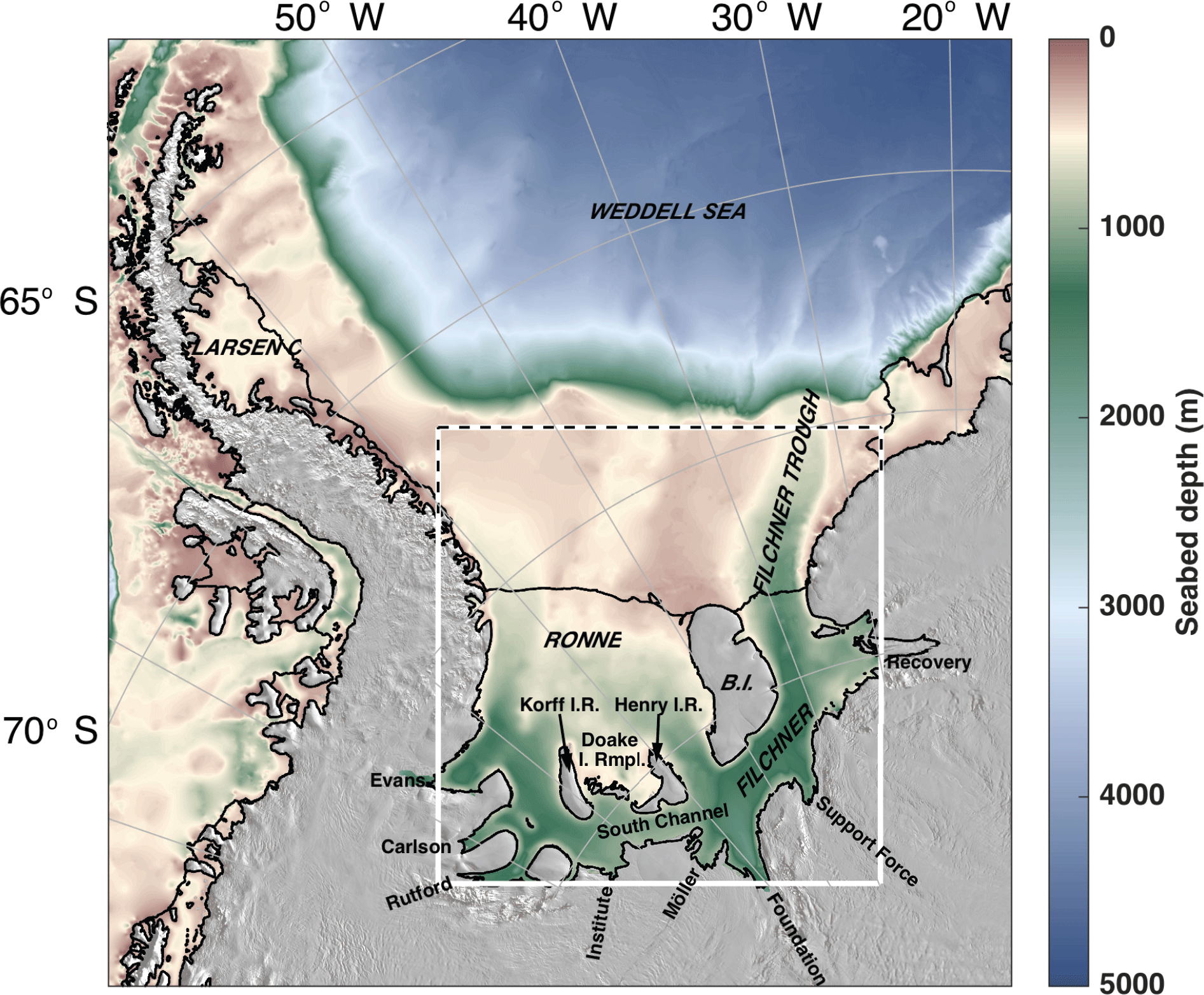
Update: since Ronne Ice Shelf, from which A-76 separated, has ice thickness of about 150 meters [1], if A-76 has the same level above the water as the Ice shelf, about the same surface underwater (which likely is not the case, but good enough for this rough estimate), then 9/10 of the whole iceberg volume is underwater, meaning that the depth underwater is about 1.3 km. Though the area of the iceberg usually increases underwater and the depth in that place is just about 500m[2], so likely it is something like that.
[1] https://www.britannica.com/place/Ronne-Ice-Shelf
[2] https://tc.copernicus.org/articles/12/453/2018/tc-12-453-201...
[1] https://www.britannica.com/place/Ronne-Ice-Shelf
[2] https://tc.copernicus.org/articles/12/453/2018/tc-12-453-201...
Why does dryness mean electrical equipment has to be grounded?
Because static electricity is generated whenever objects touch, whenever wind touches an object, etc.
Normally some objects can dissipate the charge if they are conductive (for example a tree).
But many man made objects do not conduct at all or are isolated from ground (for example car is isolated through non-conductive tires).
For these objects, humid air helps slowly dissipate the charge, but when humidity is below 30% this dissipation becomes very slow process and a large amounts of charge can accumulate.
I have home electronics lab and I keep a humidifier and ionizer to provide humidity and ions to dissipate any charges that can accumulate on any objects (like me).
Normally some objects can dissipate the charge if they are conductive (for example a tree).
But many man made objects do not conduct at all or are isolated from ground (for example car is isolated through non-conductive tires).
For these objects, humid air helps slowly dissipate the charge, but when humidity is below 30% this dissipation becomes very slow process and a large amounts of charge can accumulate.
I have home electronics lab and I keep a humidifier and ionizer to provide humidity and ions to dissipate any charges that can accumulate on any objects (like me).
Yes. 10 percent of it is above water, so you take average height above water, multiply it by 9 to get average depth below water.
The article didn't give any indication of how much was above water unfortunately. Someone else mentioned the main sheet is ~130m above the surface of the water, so that would give a depth of 1.5km!
I wonder which country will claim it and make it into an aircraft carrier.
Someone thought that first: https://en.wikipedia.org/wiki/Project_Habakkuk
There is no provision in international law to claim an iceberg. It belongs to the country on which territorial waters it floats or to nobody if it is in international waters.
It would be fun if it decided to cross boundary between territorial waters and countries tried to literally drag it onto their territory each tugging by the piece on their side.
It would be fun if it decided to cross boundary between territorial waters and countries tried to literally drag it onto their territory each tugging by the piece on their side.
I wonder which sporting organization will claim it and convert it into many multiple playing fields...
For comparison, A68 which broke up near South Georgia earlier this year was 5664 sq km. This one (A76) is 4320 sq km.
According to Wikipedia [1], an iceberg needs to be free floating. Otherwise, I would nominate the entire Ice sheet of the Artic as the largest ice berg in the world as there are no landmass like its southern cousin.
[1] - https://en.wikipedia.org/wiki/Iceberg
[1] - https://en.wikipedia.org/wiki/Iceberg
It sure would be interesting to see what’s under all that ice[1].
https://en.wikipedia.org/wiki/Geography_of_Antarctica
[1] if it wouldn’t drown us all.
https://en.wikipedia.org/wiki/Geography_of_Antarctica
[1] if it wouldn’t drown us all.
I came here with the same pedantic idea about arctic ice- in the summer wouldn't it be detached from any land?
Is there any way to use icebergs to provide drought relief in places like CA?
Could you find a way to direct the ice melt in one direction to even make them self powered to get where you want them?
Could you find a way to direct the ice melt in one direction to even make them self powered to get where you want them?
Is this a reference to Seveneves by Neil Stephenson?
FYI California today is significantly wetter than California was a thousand years ago. Paleoclimatological studies have revealed that the past 150 years in California were unusually wet; they find tree trunks at the bottom of lakes and rivers, showing that those used to be dry land hundreds of years ago. California drying up now is a return to the baseline.
Bad news for those hoping the lush California their grandparents remember might be restored. It is very likely that California will continue to become much drier than anybody in living memory remembers.
Bad news for those hoping the lush California their grandparents remember might be restored. It is very likely that California will continue to become much drier than anybody in living memory remembers.