US National Debt Tops $31T(nytimes.com)
nytimes.com
US National Debt Tops $31T
https://www.nytimes.com/2022/10/04/business/national-debt.html
245 comments
The major issue for the US at the moment is servicing the debt. At 4% interest rates (current rates, this will go higher though), servicing the debt costs $1.25 trillion per year. This means the US government needs to find a way to raise about another $750 billion in taxes every year, but probably closer to $1 trillion as interest and debt increases.
$1 trillion more in tax every year. Not to start new government programs. Not to adequately fund existing programs. None of that. $1 trillion more simply to maintain the status quo of paying interest on the debt.
The CBO estimated before interest rates increased that by 2050, the US government will spend 50% of tax revenue on debt interest payments. This is likely a much higher percentage now with interest rates going through the roof.
And finally, I will note that the average weighted maturity of government debt is less than 5 years, and falling. This means that the treasury is constantly rolling over old debt into new debt at the new interest rates. 25% of the federal debt is in t-bills, which have maturities between 4 weeks and 52 weeks. This means that the $8 trillion in outstanding t-bills will all be refinanced at 4%+ rates in less than a year.
$1 trillion more in tax every year. Not to start new government programs. Not to adequately fund existing programs. None of that. $1 trillion more simply to maintain the status quo of paying interest on the debt.
The CBO estimated before interest rates increased that by 2050, the US government will spend 50% of tax revenue on debt interest payments. This is likely a much higher percentage now with interest rates going through the roof.
And finally, I will note that the average weighted maturity of government debt is less than 5 years, and falling. This means that the treasury is constantly rolling over old debt into new debt at the new interest rates. 25% of the federal debt is in t-bills, which have maturities between 4 weeks and 52 weeks. This means that the $8 trillion in outstanding t-bills will all be refinanced at 4%+ rates in less than a year.
Also salient: There are 3 ways for the government to reduce the debt:
1) Raise taxes (Politically unpopuluar)
2) Cut entitlements (Also Politically unpopular)
3) Inflation (Because the government will pay the debt with dollars that are worth less)
1) Raise taxes (Politically unpopuluar)
2) Cut entitlements (Also Politically unpopular)
3) Inflation (Because the government will pay the debt with dollars that are worth less)
Time to buy bitcoin.
UK is nearly having a currency crisis. Part of issue for US is having twin deficits, trade and fiscal. Means we source much of our actual consumption from external sources who finance our economy.
The debt has to keep growing for the system to keep functioning, but there are diminishing returns of real growth from this increase in debt, plus if there is de-globalization where does the surplus come from externally to be the creditor to finance these deficits?
It's true that many countries are having these problems and US probably has crisis last. But historically it is definitely special.
The debt has to keep growing for the system to keep functioning, but there are diminishing returns of real growth from this increase in debt, plus if there is de-globalization where does the surplus come from externally to be the creditor to finance these deficits?
It's true that many countries are having these problems and US probably has crisis last. But historically it is definitely special.
> if there is de-globalization
There will not be de-globalization without a devastating WWIII and the US might as well take what financing they can get before then because afterwards it will be meaningless.
There will not be de-globalization without a devastating WWIII and the US might as well take what financing they can get before then because afterwards it will be meaningless.
"some degree of it". Trade wars, repatriation of manufacturing, and questioning extended supply lines due to geopolitical factors are all signs of this trend. Not a complete mass isolationism of course. Perhaps also a better frame is some degree of shift away from extreme uni-polarity towards more multi-polarity, a shift that would have similar effects even if it wasn't an absolute shift.
Europe severing energy ties to Russia, regulating US tech cos, West sanctioning Chinese 5G and chip producers, confiscating Euro/Dollar reserves, China, Russia and Japan years ago stopping increasing their holdings of US debt and recently selling them, Europe re-assessing the belief they could have such extreme dependence on US military for security and Russia for energy....all signs of some degree of de-globalization (towards more autarky)
>a devastating WWIII
I don't think it necessarily requires a devastating war, but some war is not that unlikely (we already have it.)
Europe severing energy ties to Russia, regulating US tech cos, West sanctioning Chinese 5G and chip producers, confiscating Euro/Dollar reserves, China, Russia and Japan years ago stopping increasing their holdings of US debt and recently selling them, Europe re-assessing the belief they could have such extreme dependence on US military for security and Russia for energy....all signs of some degree of de-globalization (towards more autarky)
>a devastating WWIII
I don't think it necessarily requires a devastating war, but some war is not that unlikely (we already have it.)
Comparing debt to GDP is a dumb though. You’re comparing a stock to a flow, but it’s a flow that doesn’t have any meaningful relationship to the stock.
GDP doesn’t tell you very much about the serviceability of the debt. What we probably need is some sort of “serviceability score” that accounts for interest rates on the debt, rollover dates, tax collection, currency regime, etc. But that’s basically what ratings agencies do.
GDP doesn’t tell you very much about the serviceability of the debt. What we probably need is some sort of “serviceability score” that accounts for interest rates on the debt, rollover dates, tax collection, currency regime, etc. But that’s basically what ratings agencies do.
True. And the US has one more thing going for it, compared to many European countries: it controls the currency it’s borrowing in. Greece and Italy for example do not.
That looks wrong: https://www.macrotrends.net/countries/GBR/united-kingdom/deb...
Oh, that’s external debt, not public debt. They’re not the same thing.
Public debt: https://en.wikipedia.org/wiki/List_of_countries_by_public_de...
Public debt: https://en.wikipedia.org/wiki/List_of_countries_by_public_de...
> Note that while a country may have a relatively large external debt (either in absolute or per capita terms) it could actually be a "net international creditor" if its external debt is less than the total of external debt of other countries held by it.
I think it is more interesting to look at https://en.wikipedia.org/wiki/List_of_countries_by_public_de...
I think it is more interesting to look at https://en.wikipedia.org/wiki/List_of_countries_by_public_de...
of course it's typical. debt is how the economy works. We create money by creating debt. There is no debt-free contemporary economy. We couldn't even imagine how it would work.
[deleted]
And also when considered per capita!
> China isn’t far behind
Not really reassuring
Not really reassuring
China is fine. That is a table of external debt, not total debt. External debt is serviced, on a currency-neutral basis, by trade. China has an absolutely enormous surplus.
What you definitely don't want to look at is the US external debt to trade surplus ratio.
If you do, you might start buying canned tuna.
What you definitely don't want to look at is the US external debt to trade surplus ratio.
If you do, you might start buying canned tuna.
Looks at Ireland. 700% GDP!
I suspect most of that is private debt though being funneled through the IFSC.
I suspect most of that is private debt though being funneled through the IFSC.
Looks to me like it's just bad data in the table in Wikipedia.
Ireland has a GDP of $499 billion [1]. That would mean an external debt of $228 billion would be 46% of GDP, not 700%.
I wonder what other numbers are wrong in that table.
[1] https://data.worldbank.org/indicator/NY.GDP.MKTP.CD?location...
Ireland has a GDP of $499 billion [1]. That would mean an external debt of $228 billion would be 46% of GDP, not 700%.
I wonder what other numbers are wrong in that table.
[1] https://data.worldbank.org/indicator/NY.GDP.MKTP.CD?location...
Another source pitting Ireland's debt to GDP at 56%[1]. This was >100% in 2012, showing how quickly this stat can change when you regain some fiscal discipline and your GDP grows in the meantime. Looks like Ireland actually did proper counter-cyclical fiscal policy[2] during the good times, to help them keep their debt in check during the bad times. How quaint of them.
[1] https://tradingeconomics.com/ireland/government-debt-to-gdp
[2] https://ec.europa.eu/eurostat/statistics-explained/index.php...
[1] https://tradingeconomics.com/ireland/government-debt-to-gdp
[2] https://ec.europa.eu/eurostat/statistics-explained/index.php...
Look at the historical series. These are all "special" values (outliers).
I'd like to see some compelling evidence that supports the seemingly prevailing economic theory that the US can issue an unlimited amount of debt just because it's denominated in USD and interest rates are historically low. From another NY Times opinion piece (in [1]).
> And the new paradigm suggests both that public debt isn’t a major problem and that government borrowing for the right purposes is actually the responsible thing to do.
> Here’s where it becomes crucial to realize that the world has changed: Interest rates are much lower than they were in the past, and all indications are that they’ll stay low for years to come.
The phrase "for the right purposes" sounds like a scape goat for government spending. What is a right purpose? Morally speaking - almost anything. Economically speaking, I imagine only things that are likely to increase net GDP over the long haul.
It seems clear to me that you can draw a pretty clear line between quantitate easing & government bailouts of companies during COVID to a sizable quantity of current inflation. Asset prices rose in the market, which bubbled down to housing, rent, and consumer products. Supply shocks for oil and trade commodities were part of the equation but only a part. From everything I've read on federal bank history, the more money that's in supply means the higher inflation - almost by definition. You can only issue so much debt out of nothing before dollars are fighting over the same core commodities.
[1] https://www.nytimes.com/2020/12/03/opinion/biden-republicans...
> And the new paradigm suggests both that public debt isn’t a major problem and that government borrowing for the right purposes is actually the responsible thing to do.
> Here’s where it becomes crucial to realize that the world has changed: Interest rates are much lower than they were in the past, and all indications are that they’ll stay low for years to come.
The phrase "for the right purposes" sounds like a scape goat for government spending. What is a right purpose? Morally speaking - almost anything. Economically speaking, I imagine only things that are likely to increase net GDP over the long haul.
It seems clear to me that you can draw a pretty clear line between quantitate easing & government bailouts of companies during COVID to a sizable quantity of current inflation. Asset prices rose in the market, which bubbled down to housing, rent, and consumer products. Supply shocks for oil and trade commodities were part of the equation but only a part. From everything I've read on federal bank history, the more money that's in supply means the higher inflation - almost by definition. You can only issue so much debt out of nothing before dollars are fighting over the same core commodities.
[1] https://www.nytimes.com/2020/12/03/opinion/biden-republicans...
> I'd like to see some compelling evidence that supports the seemingly prevailing economic theory that the US can issue an unlimited amount of debt just because it's denominated in USD and interest rates are historically low.
100% of the time when a country has issued 31T in debt, it has not failed to issue more.
100% of the time when a country has issued 31T in debt, it has not failed to issue more.
Yeah, key thing is flows not instruments at rest. The Fed is currently extracting currency from the market that otherwise was invested in debt, so the flows now are different than they have been at any time in recent memory. Thus the headline is a misdirection play.
The $31T matters less than the fact that the buyer of last resort, who has been participating hugely in the market for decades, has judged it inadvisable to continue. This could have occurred at $3T or $300T. But it has occurred now, and this has serious implications for what the debt-issuers must do next.
The $31T matters less than the fact that the buyer of last resort, who has been participating hugely in the market for decades, has judged it inadvisable to continue. This could have occurred at $3T or $300T. But it has occurred now, and this has serious implications for what the debt-issuers must do next.
> the seemingly prevailing economic theory that the US can issue an unlimited amount of debt just because it's denominated in USD
MMT was never the prevailing theory. It has elements of truth to it, e.g. the limiter on American deficit spending is inflation. But deficits not mattering was always a fringe view.
MMT was never the prevailing theory. It has elements of truth to it, e.g. the limiter on American deficit spending is inflation. But deficits not mattering was always a fringe view.
In the government (and punditry / public discourse) it sure seems to be. Academic and financial circles only matter as much as they can sway the former to make policy.
The last time the US debt did not rise was the Clinton Administration.
At this point, the two party system means you pick between a party that does not care, and a party that pretends to. So far, nothing bad has happened either economically or to their electoral results.
At this point, the two party system means you pick between a party that does not care, and a party that pretends to. So far, nothing bad has happened either economically or to their electoral results.
I'm 30 and most of the people I know who work full-time have no hope of owning a home. Healthcare costs are insane. Higher education costs are insane. Used car prices are insane. Having kids? Saving enough for retirement? What a laugh. The only cheap thing we've got is consumer electronic toys which haven't materially improved QoL in years. More young people than ever seem to be politically open to extremes like fascism or communism.
There hasn't been a single-day-crash, but some bad things have definitely happened economically. We just hide it in "hedonic adjustments".
There hasn't been a single-day-crash, but some bad things have definitely happened economically. We just hide it in "hedonic adjustments".
Anyone that works full-time has a high probability of owning a home, just not necessarily in their current city.
Not saying that's a good thing, but supply constraints and build costs are here to stay for the major metros. Interest rates and remote work being indefinite should help with prices and create buying opportunities for some in larger cities.
But it's better to play the real estate game by being pragmatic about what you can afford where (buy elsewhere and move, invest elsewhere before buying a primary, etc) and how to get to the next level instead of feeling entitled.
I accepted the reality years ago and did 2 investment properties in other cities before buying my primary in the city I wanted to live in.
It sucks to have to do that and take so long to buy a primary, but the game is about capital. And real estate is one of the few beautiful assets in a sea of bullshit you either 1) don't need or 2) doesn't provide any joy.
I know a lot of people on here have contempt for real estate investing but if you aren't in it, IMO, you are depriving yourself and your family of the absolute easiest way to make money and build wealth. And there are plenty of places where you don't need a ton of cash to get started.
Not saying that's a good thing, but supply constraints and build costs are here to stay for the major metros. Interest rates and remote work being indefinite should help with prices and create buying opportunities for some in larger cities.
But it's better to play the real estate game by being pragmatic about what you can afford where (buy elsewhere and move, invest elsewhere before buying a primary, etc) and how to get to the next level instead of feeling entitled.
I accepted the reality years ago and did 2 investment properties in other cities before buying my primary in the city I wanted to live in.
It sucks to have to do that and take so long to buy a primary, but the game is about capital. And real estate is one of the few beautiful assets in a sea of bullshit you either 1) don't need or 2) doesn't provide any joy.
I know a lot of people on here have contempt for real estate investing but if you aren't in it, IMO, you are depriving yourself and your family of the absolute easiest way to make money and build wealth. And there are plenty of places where you don't need a ton of cash to get started.
>I'd like to see some compelling evidence that supports the seemingly prevailing economic theory that the US can issue an unlimited amount of debt just because it's denominated in USD and interest rates are historically low.
This was true perhaps in the 1950s to 1970s or so. It's not true today and very very not true in the last couple years. Nixon's actions back in the 70s set the slippery slope that will result in the USA no longer being dominate as a reserve currency.
What you are curious about is being a reserve currency.
https://en.wikipedia.org/wiki/Reserve_currency#Global_curren...
The advantage of being the reserve currency is that you can indeed print significant money at low inflation because so many other countries are the ones who end up paying the cost. It's not necessarily unlimited, but when you have a dominant position it can be practically unlimited wherein being able to rebase on a new reserve perhaps gold or bitcoin would still be more costly than assuming the cost of holding USD.
Which is why the euro was designed the way it is. They are effectively playing the long game. No single country controls the ability to print money and they have requirements which hurt countries who dont control their debt to gdp. Portugal, Italy, Greece, Spain are all in violation but they end up having to balance their budgets in the future. Greece can never print oodles of money to inflate their way out of their debt and deficit spending. Germany and france will NEVER allow that to happen. If Greece exits the EU it'll be their own demise with >50% poverty within years of that decision.
The USA will inevitably vote themselves more money, as they currently have, and cause so much inflation than the reserve currency hurts all the others and eventually the euro will become #1. When that happens European union will become quite strong and the brits will be kicking themselves for brexit.
This was true perhaps in the 1950s to 1970s or so. It's not true today and very very not true in the last couple years. Nixon's actions back in the 70s set the slippery slope that will result in the USA no longer being dominate as a reserve currency.
What you are curious about is being a reserve currency.
https://en.wikipedia.org/wiki/Reserve_currency#Global_curren...
The advantage of being the reserve currency is that you can indeed print significant money at low inflation because so many other countries are the ones who end up paying the cost. It's not necessarily unlimited, but when you have a dominant position it can be practically unlimited wherein being able to rebase on a new reserve perhaps gold or bitcoin would still be more costly than assuming the cost of holding USD.
Which is why the euro was designed the way it is. They are effectively playing the long game. No single country controls the ability to print money and they have requirements which hurt countries who dont control their debt to gdp. Portugal, Italy, Greece, Spain are all in violation but they end up having to balance their budgets in the future. Greece can never print oodles of money to inflate their way out of their debt and deficit spending. Germany and france will NEVER allow that to happen. If Greece exits the EU it'll be their own demise with >50% poverty within years of that decision.
The USA will inevitably vote themselves more money, as they currently have, and cause so much inflation than the reserve currency hurts all the others and eventually the euro will become #1. When that happens European union will become quite strong and the brits will be kicking themselves for brexit.
> The USA will inevitably vote themselves more money, as they currently have, and cause so much inflation than the reserve currency hurts all the others and eventually the euro will become #1. When that happens European union will become quite strong and the brits will be kicking themselves for brexit.
Nah, us americans are too smart for all that. We'll just start a nice big war.
Nah, us americans are too smart for all that. We'll just start a nice big war.
>Nah, us americans are too smart for all that. We'll just start a nice big war.
So what you're cynically referring to is the war economy. The caveat of debt to gdp is that it's a balance. If you could take on debt and invest properly to the point that the returned GDP is greater. Then you end up lowering debt to gdp.
The caveat of the war economy is that it's not spent on yourself. The trope as it were is that the USA has been 'nation building' in the middle east and ended up neglecting back home.
For example, I am super excited to learn more about the B21 raider later this year. I expect the cost per stealth bomber will probably be around $5 billion each.
How many schools could you build with $5 billion if they decide to build just 1 less? How many roads could be built if you build 2 less?
So what you're cynically referring to is the war economy. The caveat of debt to gdp is that it's a balance. If you could take on debt and invest properly to the point that the returned GDP is greater. Then you end up lowering debt to gdp.
The caveat of the war economy is that it's not spent on yourself. The trope as it were is that the USA has been 'nation building' in the middle east and ended up neglecting back home.
For example, I am super excited to learn more about the B21 raider later this year. I expect the cost per stealth bomber will probably be around $5 billion each.
How many schools could you build with $5 billion if they decide to build just 1 less? How many roads could be built if you build 2 less?
Oh, buddy, I'm 1000% with you here. Hell I was just trying to explain to someone why the Afghanistan war was, in fact, not a source of great wealth and economic prosperity for the US and I used an extremely similar argument (If we sent over fewer tanks would we have had more steel for cars, and a cheaper used car market now?).
My cynicism is more along the lines of
A. Lots of people think GDP == real wealth and can't seem to wrap their heads around our argument
B. You don't have to do better than you have been to keep the global-economic pole position, you just have to be doing better than everyone else. I'm not gonna elaborate on the rest of this, I'll leave that as a sad exercise to the reader.
I really really hope we don't start or find ourselves required to participate in a war.
My cynicism is more along the lines of
A. Lots of people think GDP == real wealth and can't seem to wrap their heads around our argument
B. You don't have to do better than you have been to keep the global-economic pole position, you just have to be doing better than everyone else. I'm not gonna elaborate on the rest of this, I'll leave that as a sad exercise to the reader.
I really really hope we don't start or find ourselves required to participate in a war.
Like you said the debt is denominated in USD, so the USA could repay all that money by minting a 31T$ coin. It would be devastating, the USD would become worthless, some economies would experience deflation while the USA would instantaneously experience hyperinflation.
IMHO, the only reason that the US debt is not a major problem is that no country whant to see the whole economic system collapse so no one will want that debt repaid as long as the interest are paid on time. And in the eventually that the USA is unable to pay the interest on time, a deal will assuredly be brokered to avoid that catastrophic solution.
IMHO, the only reason that the US debt is not a major problem is that no country whant to see the whole economic system collapse so no one will want that debt repaid as long as the interest are paid on time. And in the eventually that the USA is unable to pay the interest on time, a deal will assuredly be brokered to avoid that catastrophic solution.
The US wants to maintain positive inflation, and much of that debt is below the targeted inflation rate which offsets any concerns about the need to create 31$T in new money. Aka if they can pay back 31$T by borrowing 30$T inflation adjusted and then pay back that 30$T by borrowing etc, it’s just free money.
The risk isn’t the need to come up with 31$T at some point the risk is people being unwilling to lend close to the inflation rate. The US economy is addicted to a subsidy from foreign borrowers, and that changing could be seriously problematic.
The risk isn’t the need to come up with 31$T at some point the risk is people being unwilling to lend close to the inflation rate. The US economy is addicted to a subsidy from foreign borrowers, and that changing could be seriously problematic.
https://www.statista.com/statistics/246420/major-foreign-hol...
Addicted might be son overstatement.
Addicted might be son overstatement.
Your right about the risk. But I would like to know how the interest would be paid if no one want to lend more money?
[deleted]
I mean, they unequivocally can continue to issue debt. The question is more "what will the consequences be". And I think the answer is pretty clear that the consequences will be convex upwards while the payoffs will be convex downward to issuing that debt at higher ratio.
We have a balance of trade deficit and our entire relative geopolitical position is based on the strength of the dollar. There of course could be consequences to us of high debt levels
We have a balance of trade deficit and our entire relative geopolitical position is based on the strength of the dollar. There of course could be consequences to us of high debt levels
> Interest rates are much lower than they were in the past, and all indications are that they’ll stay low for years to come.
This does not seem to be true anymore.
This does not seem to be true anymore.
But inflation is even higher.
Full employment is a problem for inflation. China still in lockdown. the leisure & entertainment sector imploding during covid. all kinds of weather issues for crops and livestock. under investment in oil because of covid.
Covid had a huge effect on the world and regardless of the various government responses they've all run into inflation issues.
Covid had a huge effect on the world and regardless of the various government responses they've all run into inflation issues.
The US can borrow, print, and export as many dollars as it feels like because the world still settles contracts in dollars, and US Treasuries are still regarded as the gold standard for central bank reserves.
A reminder that the US told the world go to fuck themselves (Nixon Shock) in 1971, and they never learned their lesson. When you take a look at the DXY in 2022, it's clear they never will.
Which is fine with me, my global purchasing power is phenomenal at the cost of literally 7 billion people who love working much harder than I do, for my benefit.
I couldn't be happier. Thanks, world.
A reminder that the US told the world go to fuck themselves (Nixon Shock) in 1971, and they never learned their lesson. When you take a look at the DXY in 2022, it's clear they never will.
Which is fine with me, my global purchasing power is phenomenal at the cost of literally 7 billion people who love working much harder than I do, for my benefit.
I couldn't be happier. Thanks, world.
Lower interest rates are generally caused by loose monetary supply which has been the case up until the last several months. That looseness ultimately eats away at the middle class, they end up paying the "interest" in the form of reduced purchasing power. Those who have enough can invest in assets which gain value as a result of said loose policy. Those who cannot either find higher paying jobs or suffer the loss of standard of living.
> I'd like to see some compelling evidence that supports the seemingly prevailing economic theory that the US can issue an unlimited amount of debt…
The “US” in your comment is more than one entity. There is no single body that can just make more debt unilaterally.
In particular the spending is funded by selling Bonds, etc. to investors. Purchasers of those bonds include foreign countries, such as China.
The “US” in your comment is more than one entity. There is no single body that can just make more debt unilaterally.
In particular the spending is funded by selling Bonds, etc. to investors. Purchasers of those bonds include foreign countries, such as China.
[deleted]
If inflation is higher than the interest rate, you make money by taking out debt. Its a similar concept to how if you're wealthy enough you can issue margin indefinitely and you pay the interest with more margin, so you never actually pay it back or have to pay taxes. You can just do it forever and it never gets you in trouble.
> I'd like to see some compelling evidence that supports the seemingly prevailing economic theory that the US can issue an unlimited amount of debt…
The “US” in your comment is more than one entity. There is no single body that can just make more debt unilaterally.
Edit: To clarify, the “limit” to the debt is set by the market’s willingness to lend.
The “US” in your comment is more than one entity. There is no single body that can just make more debt unilaterally.
Edit: To clarify, the “limit” to the debt is set by the market’s willingness to lend.
Well you could argue that low interest rates means someone is going to borrow and spend money, regardless of what the government does. It's not the job of the government to prevent inflation, that's the job of the federal reserve.
one component you overlooked is the cheap cost of money, in the form of low interest rates, juicing the economy for the past decade+.
>> one component you overlooked is the cheap cost of money, in the form of low interest rates, juicing the economy for the past decade+.
I've been wondering if "low interest rates" juice the economy, or if "lowering interest rates" does. The presumption seems to be the former, but I suspect a drop in rates will eventually lead to a new equilibrium. In other words, there isn't much long term correlation between interest rates (at a particular level) and growth.
I've been wondering if "low interest rates" juice the economy, or if "lowering interest rates" does. The presumption seems to be the former, but I suspect a drop in rates will eventually lead to a new equilibrium. In other words, there isn't much long term correlation between interest rates (at a particular level) and growth.
I think cheap money expands the economy unsustainably. When you can't make any interest by saving people look for higher ROI via investing. I think in those climates VC money comes cheap, finances unsustainable business models, those businesses employ people which now compete against established businesses for talent and wages rise. With higher wages comes competition for a limited supply of goods and voila, the cycle of inflation. At least that how I understand it, but I'm no economist.
misiti3780(4)
I’m a pinko but even I think the debt is a huge problem. With debt above 100% GDP it means servicing our debt (much of which is not in long term notes) takes X% of our GDP where X is basically the prevailing interest rates. So in a high interest rate environment, say 7%, we need to spend 7% of GDP just on interest. This comes out of our taxes where it’s more like 40% of government tax revenue.
Essentially that means we can’t raise rates past a certain point without either austerity or risking a debt spiral. If inflation is bad enough that those rates are necessary to stop it, practically it means we’re gonna have to deal with inflation until we are safe to raise rates high enough to stop it. Which also requires some austerity in the short term while we wait for debt to become a smaller portion of GDP.
Funnily enough, other countries have it even worse than us, and they’re throwing a hissy fit that we’ve raised rates where we have (already at levels they can’t match) since it weakens their currency relative to the USD. That actually appears to be our current blocker of higher rates moreso than our ability to make payments, per recent Federal Reserve activity.
Essentially that means we can’t raise rates past a certain point without either austerity or risking a debt spiral. If inflation is bad enough that those rates are necessary to stop it, practically it means we’re gonna have to deal with inflation until we are safe to raise rates high enough to stop it. Which also requires some austerity in the short term while we wait for debt to become a smaller portion of GDP.
Funnily enough, other countries have it even worse than us, and they’re throwing a hissy fit that we’ve raised rates where we have (already at levels they can’t match) since it weakens their currency relative to the USD. That actually appears to be our current blocker of higher rates moreso than our ability to make payments, per recent Federal Reserve activity.
From my understanding, this logic is incorrect.
Debt is not serviced from GDP. Debt is serviced by printing free cash (which raises inflation rates). And debt buyers buy it exactly because of inflation, with the majority of the debt actually being held by US funds (pension, endowments, etc) as a way to escape inflation with very little risk.
So this is a sort of perpetual self-balancing feedback loop. Even if the economy will go down, all of this capital still needs to be stored in some non-depreciating form. And government can always just increase inflation by simply printing more cash to service debt.
In a way, funds are also very much dependent on the government and are happy to give money in exchange for escaping inflation. And it’s government that controls the model properties.
I guess that is until there’s another super-stable government and holders can start buying their debt instead (not sure if this is regulated or not).
And I guess this is a major reason for the US to have a global monopoly on stability and try to actively destabilize emerging global powers once in a while to worsen their debt risk profiles.
I’m not an expert, so please correct me if there’s a flaw in this logic.
Debt is not serviced from GDP. Debt is serviced by printing free cash (which raises inflation rates). And debt buyers buy it exactly because of inflation, with the majority of the debt actually being held by US funds (pension, endowments, etc) as a way to escape inflation with very little risk.
So this is a sort of perpetual self-balancing feedback loop. Even if the economy will go down, all of this capital still needs to be stored in some non-depreciating form. And government can always just increase inflation by simply printing more cash to service debt.
In a way, funds are also very much dependent on the government and are happy to give money in exchange for escaping inflation. And it’s government that controls the model properties.
I guess that is until there’s another super-stable government and holders can start buying their debt instead (not sure if this is regulated or not).
And I guess this is a major reason for the US to have a global monopoly on stability and try to actively destabilize emerging global powers once in a while to worsen their debt risk profiles.
I’m not an expert, so please correct me if there’s a flaw in this logic.
Money is fungible so debt can be considered serviced by whatever portion of the federal budget comes from taxes vs more debt. With no deficit spending it would be 100% taxes. With no taxes it’d be 100% more debt.
It’s fine to service debt with more debt if the tax base grows faster than the debt load. When you raise interest rates the debt load goes up quickly though, faster than the tax base. If you issue too much debt the only way to repay it after a certain point is more debt, which increases the monetary base, which leads to inflation. We are not at that point, but we are at the point where something has to give - either rates, government spending, or taxes - to reduce inflation.
Inflation is considered bad because nobody wants to use a currency with too much inflation. Sure the government can always print more money (actually when it’s “printed” it’s the Federal Reserve buying debt from the government with money created de novo) but runaway inflation is one of the worst possible outcomes, and past a certain point becomes the only option.
I don’t know exactly what other points you are trying to make but it’s not true that this is self-balancing. The balancing is done by the Federal Reserve in concert with the rest of the government (who set taxes and spending) through interest rates and open market operations. There is also not an infinite capacity for US debt at the rates the Fed wants which is why the Fed has to buy the debt itself sometimes.
It’s fine to service debt with more debt if the tax base grows faster than the debt load. When you raise interest rates the debt load goes up quickly though, faster than the tax base. If you issue too much debt the only way to repay it after a certain point is more debt, which increases the monetary base, which leads to inflation. We are not at that point, but we are at the point where something has to give - either rates, government spending, or taxes - to reduce inflation.
Inflation is considered bad because nobody wants to use a currency with too much inflation. Sure the government can always print more money (actually when it’s “printed” it’s the Federal Reserve buying debt from the government with money created de novo) but runaway inflation is one of the worst possible outcomes, and past a certain point becomes the only option.
I don’t know exactly what other points you are trying to make but it’s not true that this is self-balancing. The balancing is done by the Federal Reserve in concert with the rest of the government (who set taxes and spending) through interest rates and open market operations. There is also not an infinite capacity for US debt at the rates the Fed wants which is why the Fed has to buy the debt itself sometimes.
100% debt to GDP is a meaningless milestone. Debt is cumulative and has a built-in maturity timeline whereas GDP is a snapshot. Debt service is relative the interest rate and rates have been so low for so long that debt service has simply not been burdensome even at large volumes. Rates are rising now but still fairly low. It's likely time to slow down debt growth but the current accumulation isn't really worrisome.
https://fred.stlouisfed.org/graph/?g=UtFK
https://fred.stlouisfed.org/graph/?g=UtFK
Sure, I picked that ratio because it makes reasoning easy since then interest rates = percentage of GDP.
My point is precisely that it only works when rates are low. When rates need to go higher you can’t spend so much of your tax base on servicing debt without bad things happening. You cannot simply let the debt mature because it gets refinanced at the current rate unless you’re running a budget surplus to reduce the principal (which is generally considered unwise compared to growing/inflating out of it).
Rates don’t stay low forever
My point is precisely that it only works when rates are low. When rates need to go higher you can’t spend so much of your tax base on servicing debt without bad things happening. You cannot simply let the debt mature because it gets refinanced at the current rate unless you’re running a budget surplus to reduce the principal (which is generally considered unwise compared to growing/inflating out of it).
Rates don’t stay low forever
So... does this just go up indefinitely without consequence? It seems like it's rarely spoken about vs the 10-year, inflation, mortgage rates, and other metrics.
It looks like it has never gone down in any meaningful way. [0]
[0] https://fred.stlouisfed.org/series/GFDEBTN
It looks like it has never gone down in any meaningful way. [0]
[0] https://fred.stlouisfed.org/series/GFDEBTN
You can always cut debt down with some inflation. Ten years of 10% inflation, and your debt is just 38% of what it was before.
Yeah and 90% of your citizens had their earnings/savings destroyed.
Why are you saying it like it is something bad?! Inflation is a great equalizer, as it removes the disparity in society! Also, when people know that their assets will depreciate over time, they will be more economically active, doing more investments and buying more things now, and not later. It is also a chance to get rid of your debts, at a smaller cost!
I can’t tell if you’re joking or not…
Financial assets actually do great in inflationary environments. Most people don’t have any.
Why do you think most Americans can’t afford housing?
Most peoples wages won’t even be close to increasing 10%/yr for a decade.
Financial assets actually do great in inflationary environments. Most people don’t have any.
Why do you think most Americans can’t afford housing?
Most peoples wages won’t even be close to increasing 10%/yr for a decade.
I was only half joking.
> Most peoples wages won’t even be close to increasing 10%/yr for a decade.
It's only because you aren't used to such inflation. Once the cycle kicks in, wages start increasing accordingly. I know it first-hand after living in a country with high inflation.
If you are living not in a closed off country, there will be more successful countries out there, so if you won't increase the wages of the workers they'll leave for other economies (or just work remotely), thus, reducing the workforce supply, which drives up wages.
> Most peoples wages won’t even be close to increasing 10%/yr for a decade.
It's only because you aren't used to such inflation. Once the cycle kicks in, wages start increasing accordingly. I know it first-hand after living in a country with high inflation.
If you are living not in a closed off country, there will be more successful countries out there, so if you won't increase the wages of the workers they'll leave for other economies (or just work remotely), thus, reducing the workforce supply, which drives up wages.
90% of Americans have no savings in the first place, they have credit card debt
So what about their wages? How are they going to service that debt if the cost of living is increasing faster than their income?
Wages usually increase accordingly. Source: I live in a country with a high inflation.
Inflation does wonders to debt!
(At least until they raise the interest rate to match inflation)
(At least until they raise the interest rate to match inflation)
Why do I have to pay taxes if the government can just print all the money it needs?
You don't have to pay taxes, you just have to deal with the consequences.
Inflation is a tax.
It’s just regressive (the poorest are paying the most). income tax and ideally a wealth tax get the richest to pay the most.
Obviously the US could use some fixing in both regards.
It’s just regressive (the poorest are paying the most). income tax and ideally a wealth tax get the richest to pay the most.
Obviously the US could use some fixing in both regards.
> It’s just regressive (the poorest are paying the most).
What? If I have $1,000,000, inflation is 10%, and prices readjust I just lost $100k in purchasing power but if I have $1000 I lost $100 in purchasing power. Proportional taxes aren't regressive. Inflation hits wage earners hardest because it lags behind prices but that's not the same thing.
What? If I have $1,000,000, inflation is 10%, and prices readjust I just lost $100k in purchasing power but if I have $1000 I lost $100 in purchasing power. Proportional taxes aren't regressive. Inflation hits wage earners hardest because it lags behind prices but that's not the same thing.
Any entity with $1,000,000 in cash is making a calculated risk play. They could easily put that cash into gold, bonds, stocks, etc. They are betting on cash inspire of the inflation.
Any person with $1,000 is living paycheck to paycheck and has no choice but to keep it in cash (if they can keep it at all).
So really you have to compare $1,000,000 in bonds/averaged stock performance to $1,000 of income per month.
The latter is far more impacted as the cost of gas and food increases 10%.
Any person with $1,000 is living paycheck to paycheck and has no choice but to keep it in cash (if they can keep it at all).
So really you have to compare $1,000,000 in bonds/averaged stock performance to $1,000 of income per month.
The latter is far more impacted as the cost of gas and food increases 10%.
In a pure economic sense someone who lost 10% of their $1000 in savings is doing far worse than someone who lost 10% of $1,000,000 in savings. To the first person that 10% could be the difference between whether or not they have enough to pay rent that month. To the second it's the difference between whether or not they put a down payment on their second home.
[deleted]
Practically speaking the way the government prints money is by creating treasuries that the Federal Reserve purchases. When the federal reserve purchases them, the government gets the amount of the treasury created de novo.
With no taxes all government expenditure would be printed money. That would mean the monetary base increases by the government spending per year. That hasn’t been a problem until recently because only a portion of the government was funded this way, and increasing the monetary base wasn’t (until it did) causing inflation above Fed targets.
Let’s say government spending is 25% of GDP. The federal reserve has our monetary base at around 5.5T out of 20T GDP currently. So we’d have to double our monetary base to fund the government this way for one year. This would cause very high inflation - we basically did fund the government 50% this way for 2 years because of COVID and look where that got us. Imagine inflation then with 100% funding in this manner over long periods.
With no taxes all government expenditure would be printed money. That would mean the monetary base increases by the government spending per year. That hasn’t been a problem until recently because only a portion of the government was funded this way, and increasing the monetary base wasn’t (until it did) causing inflation above Fed targets.
Let’s say government spending is 25% of GDP. The federal reserve has our monetary base at around 5.5T out of 20T GDP currently. So we’d have to double our monetary base to fund the government this way for one year. This would cause very high inflation - we basically did fund the government 50% this way for 2 years because of COVID and look where that got us. Imagine inflation then with 100% funding in this manner over long periods.
I could be wrong but... if inflation was 8% year over year, doesn't that mean our national debt (nominated in dollars) got "eroded" by 8%? aka, inflation is good for the debt?
Yes, inflation is good for debt holders. Unfortunately higher inflation is usually accompanied by higher interest rates making for higher debt payments.
Unfortunately we are constantly issuing new debt to pay back the old debt because the government spends far beyond its means. So it doesn’t help.
To the contrary, while the US can issue debt and people are willing to buy it it is living within its means.
Only a fool thinks the ability to get a loan is equivalent to living within one’s means
If you want to moralise, that's your trip, but borrowing power is an objective measure of your financial health.
The United States is not a person and you can't translate folk economics from your kitchen table to the nation.
That's what everyone says until the government defaults on its debt. The US is a special case because of our unique situation as the military superpower and reserve currency, but look at Argentina, Venezuela, and the UK for a counterpoint.
How do you imagine the US can default on its debt? It borrows in its own money.
I dunno, if you were willing to issue me unlimited borrowing i'm not sure i would care about repayment.
Isn't that exactly the reason repayment matters?
Isn't that exactly the reason repayment matters?
Fun fact: the US has never (except for a short period during the Clinton admin) repaid any of its debt, it just made it insignificant through inflation and economic growth.
Edit for the pedantic: I obviously mean total debt.
Edit for the pedantic: I obviously mean total debt.
The US has absolutely repaid its debts as anyone who’s held a treasury bond to maturity can attest to. I think you meant it has never decreased its debt load.
A different pedantic: The US repaid its debt under Andrew Jackson. All of it.
https://fred.stlouisfed.org/series/FYFSD
There are other times U.S. has paid down debt.
There are other times U.S. has paid down debt.
Sounds like something its lenders should consider.
Not really because it's not remotely true. The US has paid back every piece of debt it has ever issued that has come due.
Of course every debt has been paid, but by making a new greater debt.
Any individual who has a debt would like very much to also be able to continue to borrow money indefinitely and pay the old debt without worries.
Any individual who has a debt would like very much to also be able to continue to borrow money indefinitely and pay the old debt without worries.
Oh good lord that's not how this works at all. Like it takes like 2 minutes to see that this couldn't possibly be the case. If the US was servicing its debt exclusively through taking out more debt what would graph of national debt look like over time -- exponential! The exact same as if the gov't wasn't servicing its debt at all because that's how compound variable rate interest works.
Then just look at the graph of national debt both in nominal and real value.
Then just look at the graph of national debt both in nominal and real value.
log scale chart, looks pretty exponential to me: https://static.seekingalpha.com/uploads/2010/12/14/saupload_...
(from article, but not referencing content besides the chart https://seekingalpha.com/article/241751-visualizing-the-u-s-... )
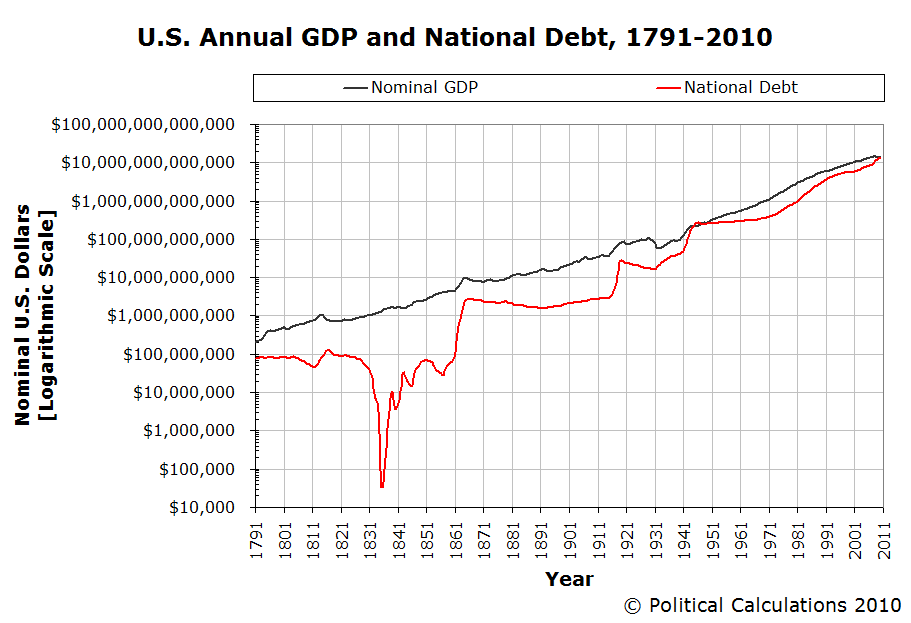
(from article, but not referencing content besides the chart https://seekingalpha.com/article/241751-visualizing-the-u-s-... )
[deleted]
If he's too big and scary for anyone in the neighborhood to beat up, he probably will.
That is correct. Inflation reduces existing debt.
The problem is we continue to issue new and more debt at higher rates so the total amount still only goes up.
The problem is we continue to issue new and more debt at higher rates so the total amount still only goes up.
Yes, the total amount may go up in nominal terms, but it's not going up in real terms if inflation is eroding it faster than new debt is being issued. If the value of the dollar halves in a decade but the debt only goes up to, say, $50T, then the total national debt in real terms has gone down significantly.
> if inflation is eroding it faster than new debt is being issued.
I would be interested to know of a time when inflation was higher than the rate of new debt being issues in the US. Maybe in the 70s when inflation hit record highs but interest rates also hit record highs at that time.
I would be interested to know of a time when inflation was higher than the rate of new debt being issues in the US. Maybe in the 70s when inflation hit record highs but interest rates also hit record highs at that time.
Is there a way to calculate like... the debt but in "inflation adjusted" dollars?
The debt level is reported accounting for inflation.
https://www.usdebtclock.org/
https://www.usdebtclock.org/
Which field? The $31t national debt dollar field? I thought that was un-inflation adjusted dollars?
The national debt field.
I believe it is inflation adjusted and if the US were to 'magically' create a coin worth 31 trillion dollars, that number would go to 0 and we would be able to pay off the entire thing. There would be no more interest payments because there's no more debt to pay interest on.
Except for the fact that we still run a deficit so itd start going back up again.
I believe it is inflation adjusted and if the US were to 'magically' create a coin worth 31 trillion dollars, that number would go to 0 and we would be able to pay off the entire thing. There would be no more interest payments because there's no more debt to pay interest on.
Except for the fact that we still run a deficit so itd start going back up again.
> I believe it is inflation adjusted
I believe it isn't.
I believe it isn't.
>So... does this just go up indefinitely without consequence?
Oh for sure. history has many examples. Greece and Venezuela are your more recent ones. Basically it goes up until the bankers and funds no longer want your debt. THEN the consequences happen.
when the government debt to gdp reaches above 100%, like too many countries have, then credit ratings start dropping. Absolutely nothing will get in your way to pump that up to 200%. The lenders don't care if you're making a terrible decision or not; just whether or not you keep paying. At around 200% is when you struggle to keep paying and your credit rating shifts to junk and nobody wants your debt anymore.
Oh for sure. history has many examples. Greece and Venezuela are your more recent ones. Basically it goes up until the bankers and funds no longer want your debt. THEN the consequences happen.
when the government debt to gdp reaches above 100%, like too many countries have, then credit ratings start dropping. Absolutely nothing will get in your way to pump that up to 200%. The lenders don't care if you're making a terrible decision or not; just whether or not you keep paying. At around 200% is when you struggle to keep paying and your credit rating shifts to junk and nobody wants your debt anymore.
There is a branch of economics that feels that is exactly the case -- that national debt could be unlimited as long as its going back into the economy.
Spending money we don't have and will never repay except by printing more money is just another form of taxation. It never shows up on your pay statement, but the value of your dollars is diluted.
That's true, but it's more palatable to Americans than tax increases.
People aren't real happy about inflation these days. I think they're more unhappy about that than they are about taxes.
The purpose of monetary policy is to stimulate the economy, i.e. increase the value of dollars that are invested in something. The fact that it decreases the value of dollars that aren't invested is a feature, not a bug.
> The purpose of monetary policy is to stimulate the economy
no, its not.
(1) Monetary policy doesn’t have just one purpose.
(2) Sometimes one of its purposes is to slow rather than stimulate the econony.
(3) Mostly its high-level purpose is economic stability.
no, its not.
(1) Monetary policy doesn’t have just one purpose.
(2) Sometimes one of its purposes is to slow rather than stimulate the econony.
(3) Mostly its high-level purpose is economic stability.
1) You responded as if I said, "the only purpose of monetary policy is to stimulate the economy as much as possible even if it introduces instability." Please don't do that.
2) You gotta read the thing I was replying to, and interpret my comment as a response to it, not as a standalone assertion. I think it's pretty obvious that I meant monetary policy resulting in inflation, as that's what they were complaining about, not all possible monetary policies in the abstract.
The person I was replying to was saying that inflation is bad because it dilutes the value of savings, which is therefore sorta kinda like a tax. I'm saying, that's a terrible model; a better one is that monetary policy uses inflation to stimulate investment in order to grow the economy, and doesn't care if that dilutes your savings, because it wants you to invest those savings.
If you disagree, say so, but argue with the whole thing, not with a sentence fragment taken out of context.
2) You gotta read the thing I was replying to, and interpret my comment as a response to it, not as a standalone assertion. I think it's pretty obvious that I meant monetary policy resulting in inflation, as that's what they were complaining about, not all possible monetary policies in the abstract.
The person I was replying to was saying that inflation is bad because it dilutes the value of savings, which is therefore sorta kinda like a tax. I'm saying, that's a terrible model; a better one is that monetary policy uses inflation to stimulate investment in order to grow the economy, and doesn't care if that dilutes your savings, because it wants you to invest those savings.
If you disagree, say so, but argue with the whole thing, not with a sentence fragment taken out of context.
An economist who doesn't study history well enough is the definition of a fool.
> It seems like it's rarely spoken about vs the 10-year, inflation, mortgage rates, and other metrics.
GDP would be one of the better metrics to compare against [1] since it serves as a taxable base for the US government.
[1]: https://www.longtermtrends.net/us-debt-to-gdp/
GDP would be one of the better metrics to compare against [1] since it serves as a taxable base for the US government.
[1]: https://www.longtermtrends.net/us-debt-to-gdp/
What would the consequences be? We are not defaulting on anything and seem unlikely to. The only consequence that might matter is other countries failing to loan us more money, and that probably isn't primarily decided by our debt to income ratio.
I think its safe to say there is never going to be any consequence, just like FED infusions has never been shown to contribute to inflation.
Have you seen a graph of GDP?
Discussion of debt and effects on GDP growth:
https://www.mercatus.org/publications/government-spending/de...
"the results of every study except two find a negative relationship between high levels of government debt and economic growth"
"the results of every study except two find a negative relationship between high levels of government debt and economic growth"
Ray Dalio has a great educational video on the history of debt and how nations always end up dealing with it.
https://www.youtube.com/watch?v=xguam0TKMw8
We know how this story ends, yet we seem helpless to do something different. Why?
https://www.youtube.com/watch?v=xguam0TKMw8
We know how this story ends, yet we seem helpless to do something different. Why?
Because the negative consequences of inflation and disdain for inflation are not felt by the people who create it.
incorrect incentive structure
Anyone smart at economics able to share what type of pressure the US is facing on servicing the growing debt (making interest payments) with rates increasing? Does the fed fund rate directly affect how much interest has to be paid on national debt?
Very little pressure.
https://fred.stlouisfed.org/graph/?g=UtqF
Interest payments relative to federal tax receipts are at multi-decade lows.
Some other important points to remember:
- $5.7 trillion of the debt is held by the Federal Reserve. The interest that they earn on this is passed back to the US Treasury. It effectively "doesn't count" except for whatever minor operating costs the Fed takes out.
- Inflation has risen faster than rates have risen. This means federal tax receipts will likely rise faster than interest payments as well.
https://fred.stlouisfed.org/graph/?g=UtqF
Interest payments relative to federal tax receipts are at multi-decade lows.
Some other important points to remember:
- $5.7 trillion of the debt is held by the Federal Reserve. The interest that they earn on this is passed back to the US Treasury. It effectively "doesn't count" except for whatever minor operating costs the Fed takes out.
- Inflation has risen faster than rates have risen. This means federal tax receipts will likely rise faster than interest payments as well.
> Interest payments relative to federal tax receipts are at multi-decade lows.
It'll take some time before the current debt needs to be replaced at the higher rate. We've had artificially low rates for the past 14 years. I argue that spending 20% of tax revenue on interest alone is grossly irresponsible. We still need to pay out the face value of those treasuries too.
> $5.7 trillion of the debt is held by the Federal Reserve. The interest that they earn on this is passed back to the US Treasury. It effectively "doesn't count" except for whatever minor operating costs the Fed takes out.
It "doesn't count" if you ignore the accelerating wealth disparity in our society.
It'll take some time before the current debt needs to be replaced at the higher rate. We've had artificially low rates for the past 14 years. I argue that spending 20% of tax revenue on interest alone is grossly irresponsible. We still need to pay out the face value of those treasuries too.
> $5.7 trillion of the debt is held by the Federal Reserve. The interest that they earn on this is passed back to the US Treasury. It effectively "doesn't count" except for whatever minor operating costs the Fed takes out.
It "doesn't count" if you ignore the accelerating wealth disparity in our society.
> It "doesn't count" if you ignore the accelerating wealth disparity in our society.
The parent asked about how interest rates affect the burden of servicing the debt. That is the sense in which it literally "doesn't count" -- interest paid by the Treasury to the Fed is returned by the Fed to the Treasury as distributed earnings.
The parent asked about how interest rates affect the burden of servicing the debt. That is the sense in which it literally "doesn't count" -- interest paid by the Treasury to the Fed is returned by the Fed to the Treasury as distributed earnings.
The federal reserve's remittances to the treasury are likely to be completely wiped out within the coming year. The reason is that the (low) interest it earns on its existing portfolio of government securities is fixed and will stay flat while the interest the fed pays out is rising sharply and will rise even further as rates increase.
The fed is not rolling over its government debt portfolio into new debt at higher rates. Rather it is undergoing quantitative tightening selling off/allowing bonds to mature.
The fed is not rolling over its government debt portfolio into new debt at higher rates. Rather it is undergoing quantitative tightening selling off/allowing bonds to mature.
> The federal reserve's remittances to the treasury are likely to be completely wiped out within the coming year. The reason is that the (low) interest it earns on its existing portfolio of government securities is fixed and will stay flat while the interest the fed pays out is rising sharply and will rise even further as rates increase.
Can you explain your reasoning here? It seems wrong to me.
The Fed has stated in speeches that they are planning on keeping trillions of securities as assets on their balance sheet. These will continue to earn billions in interest per year. Further, they do not directly "pay out interest" -- they pay out their net income to the Treasury. Rising rates on US debt does not increase what the Fed has to pay out to the Treasury except indirectly if they purchase more higher-earning assets.
Can you explain your reasoning here? It seems wrong to me.
The Fed has stated in speeches that they are planning on keeping trillions of securities as assets on their balance sheet. These will continue to earn billions in interest per year. Further, they do not directly "pay out interest" -- they pay out their net income to the Treasury. Rising rates on US debt does not increase what the Fed has to pay out to the Treasury except indirectly if they purchase more higher-earning assets.
So the Federal Reserve pays out interest on balances deposited by banks. As of yesterday at close, the interest paid on these balances is 3.15%.
https://www.federalreserve.gov/monetarypolicy/reserve-balanc...
While they do own assets on their balance sheet, these assets have a fixed interest rate. The interest rates stays the same as it was when they bought it. When the fed was buying these treasuries during QE, rates were very low. Less than a percent, less than even half a percent for a while. The interest rate on these interest earning assets, while it is nominally billions of dollars, will stay flat. Meanwhile, the interest it pays out to banks will increase and increase and increase.
If no profit will be available, no remittances will be paid to the treasury.
https://www.federalreserve.gov/monetarypolicy/reserve-balanc...
While they do own assets on their balance sheet, these assets have a fixed interest rate. The interest rates stays the same as it was when they bought it. When the fed was buying these treasuries during QE, rates were very low. Less than a percent, less than even half a percent for a while. The interest rate on these interest earning assets, while it is nominally billions of dollars, will stay flat. Meanwhile, the interest it pays out to banks will increase and increase and increase.
If no profit will be available, no remittances will be paid to the treasury.
Ah, I see. I thought you were trying to say the Fed directly paid interest to the Treasury.
And, wow, I did not know the IORB rate had gotten so high.
https://fred.stlouisfed.org/series/BOGMBBM
I think you are correct. With $3+ trillion in reserve balances, which aren't really expected to go down too much, the reserve interest payments are going to eat up a ton of the Fed's income.
And, wow, I did not know the IORB rate had gotten so high.
https://fred.stlouisfed.org/series/BOGMBBM
I think you are correct. With $3+ trillion in reserve balances, which aren't really expected to go down too much, the reserve interest payments are going to eat up a ton of the Fed's income.
Fed funds rate and total interest paid on outstanding treasury bonds are not a 1:1 relationship. The coupon payments of a bond are determined at the time of issuance. So for example if a 30 year bond was issued 10 years ago, the ongoing coupon payments that the US treasury is paying today on that bond are a fixed amount that was determined at the time the bond was issued 10 years ago. Every individual issuance of bonds has a specific coupon payment which is determined at time of issuance.
The fed rate is, roughly, the rate for new government borrowing. So newly issued bonds will have to pay higher prevailing rates. Also, most bonds only pay interest over their life, so the government still owes the initial principal when they mature. That principal has to be paid, usually by issuing new bonds, which will pay the new, higher prevailing rates. Average time-to-go for US government debt is something like 5 years[1], so that process moves pretty slowly.
[1]: https://www.brookings.edu/blog/up-front/2022/07/27/projectin...
[1]: https://www.brookings.edu/blog/up-front/2022/07/27/projectin...
That's an excellent question...absolutely it does! Not many people seem to pay attention to this fact. Every year we have a multi-trillion dollar deficit in our congressional budget.
To make up this difference, the treasury department has to sell bonds. As the FFR increases, so do the yields on treasuries. Our annual interest payments on federal debt is ~400B. That's over HALF our military budget for some perspective.
If inflation proves to be sticky, what happens if bond yields get pushed up to 10% ? Well, now congress has to borrow at 10% interest. That next 1T+ deficient would cost our country an extra 100B+ per year in coupon payments...AND we still owe the principle on those bonds when they expire. In the volcker era, we had to push interest rates up to almost 20%.
Our government has been incredibly irresponsible with managing our debt. Problem is fixing it seems impossible. We'd need to increase taxes AND cut social services. Can you imagine how painful that would be? Any politician who tried to tackle this issue would become the most hated person in America.
To make up this difference, the treasury department has to sell bonds. As the FFR increases, so do the yields on treasuries. Our annual interest payments on federal debt is ~400B. That's over HALF our military budget for some perspective.
If inflation proves to be sticky, what happens if bond yields get pushed up to 10% ? Well, now congress has to borrow at 10% interest. That next 1T+ deficient would cost our country an extra 100B+ per year in coupon payments...AND we still owe the principle on those bonds when they expire. In the volcker era, we had to push interest rates up to almost 20%.
Our government has been incredibly irresponsible with managing our debt. Problem is fixing it seems impossible. We'd need to increase taxes AND cut social services. Can you imagine how painful that would be? Any politician who tried to tackle this issue would become the most hated person in America.
I haven't run the numbers, but cost of servicing the debt will depend on the structure of debt issued.
A 30y treasury doesn't need to be refinanced/paid back for 30 years, 10y for 10 years etc.
A smart Treasury would have locked in a lot of the debt in longer dated treasuries back when they were yielding 1% or less. This would have made the debt payments largely fixed, regardless of Fed hikes. Unfortunately from what I've heard, they are mostly financing through the fed funds/overnight rate.
So yes, US debt service costs are more variable than they could have been. But maybe somebody can chime in with hard numbers
A 30y treasury doesn't need to be refinanced/paid back for 30 years, 10y for 10 years etc.
A smart Treasury would have locked in a lot of the debt in longer dated treasuries back when they were yielding 1% or less. This would have made the debt payments largely fixed, regardless of Fed hikes. Unfortunately from what I've heard, they are mostly financing through the fed funds/overnight rate.
So yes, US debt service costs are more variable than they could have been. But maybe somebody can chime in with hard numbers
Doesn't that also mean that carrying cost of debt now and while rates are up issued will carry these high rates for long time? Even if rates go back down.
Doesn't affect existing debt but as bonds mature they need to be replaced and that's when servicing costs go up. That happens all the time since bonds are always maturing, but there are different maturities (2, 10, 30 year) so servicing costs go up relatively slowly.
You can actually check for yourself: https://www.treasurydirect.gov/auctions/announcements-data-r...
I'm complete numbskull at economics, but I assume my bank is pretty good at it.
They are absolutely thrilled for me to have a balance on my credit card of as much as I please (up to the debt limit), as long as I make my minimum payment each month.
They are absolutely thrilled for me to have a balance on my credit card of as much as I please (up to the debt limit), as long as I make my minimum payment each month.
Same is true for the US, but we don't know the limit. It could be 32T or 332T, either way when it gets hit bad things happen.
Current average maturity of US debt is about 5 years.
So, it won’t happen immediately; interest payments will gradually rise over the next several years.
So, it won’t happen immediately; interest payments will gradually rise over the next several years.
There will be pressure the day the markets think there is an alternative to the USD.
Gold, silver, Euro, Yen, Bitcoin... they got nothing.
Gold, silver, Euro, Yen, Bitcoin... they got nothing.
I remember in 2008 the National Debt Clock had to add a 14th digit [1] [2] to accommodate the growing debt. Seems a matter of time before it will need a 15th.
[1]: https://www.wsj.com/articles/BL-REB-2108
[2]: https://observer.com/2008/10/durst-to-add-extra-trillion-dol...
[1]: https://www.wsj.com/articles/BL-REB-2108
[2]: https://observer.com/2008/10/durst-to-add-extra-trillion-dol...
I really struggle to wrap my head around the idea that the largest holder of US debt is the US government itself:
https://www.thebalancemoney.com/who-owns-the-u-s-national-de...
https://www.thebalancemoney.com/who-owns-the-u-s-national-de...
Why would the US invest in anything other than the safest bonds on the planet?
But why is the US government investing excess cash in US government debt rather than paying down that debt?
Interesting article, under foreign debt one thing that really stuck out to me is how a tiny country like Luxembourg with a population of only 632k people is the 4th largest holder of US debt at $306B. That to me seems very suspicious.
If you imagine a 'simple' economy, the way to store your wealth is to buy gold and stick it in a safe. In a 'simple' economy, gold is the least risky commodity of exchange. Now consider that US treasuries are arguably less risky than gold, and are easier to exchange.
The FDIC only insures deposits of cash up to 250k, so US debt is basically like "big-boy cash".
The FDIC only insures deposits of cash up to 250k, so US debt is basically like "big-boy cash".
If you imagine a 'simple' economy, the way to store your wealth is to buy gold and stick it in a safe. In a 'simple' economy, gold is the least risky commodity of exchange. Now consider that US treasuries are arguably less risky than gold, and are easier to exchange.
US debt is basically like "big-boy cash".
US debt is basically like "big-boy cash".
This will be solved by taxes, inflation, war, or a combination of the three, sadly.
What is there to solve? As long as we keep paying our debts on these low interest loans (to ourselves mostly, btw), there isn't a problem.
In the future, continuing to spend as rates go up would be progressively less wise as the rates increase, but "solving" debt spending is not nearly the crisis some people seem to think it is.
The US is not operating under the same rules as your personal finances.
In the future, continuing to spend as rates go up would be progressively less wise as the rates increase, but "solving" debt spending is not nearly the crisis some people seem to think it is.
The US is not operating under the same rules as your personal finances.
I wish I had a better mental model for thinking about national debt. Absent that, it's too easy to pattern-match it to personal debt, and automatically you get all the usual judgments and moralizing along with it.
The first rule here absent all others is to understand that the national debt does not function like household debt and so you can't draw comparisons directly. Some of the comparisons are truthy but not necessarily correct.
Another rule to use is that not all spending is treated equally. The country going in to debt to fund projects that boost economic activity (typically measured as GDP) is not the same as the country going in to debt for a different class of projects, for example. Often times we look at national debt but we don't have a great mechanism for evaluating return on that debt.
Another rule to use is that not all spending is treated equally. The country going in to debt to fund projects that boost economic activity (typically measured as GDP) is not the same as the country going in to debt for a different class of projects, for example. Often times we look at national debt but we don't have a great mechanism for evaluating return on that debt.
> It’s hard to relate national finances to personal
People keep saying this and it’s not really true. Even MMT really can be translated to personal finances.
Here is the simple explanation:
Households and individuals consume the goods they buy. Some excess goes towards investments.
Governments do not consume. Building a road/bridge/building/dam is an investment to “have the nation make more money”.
Even when government spends money on “dumb things” a F35 while over paying significantly, it’s an investment. Even if this project doesn’t become “something” itself it can still be a huge national investment. 1. The people who worked on it will spend the money they earned. 2. The people got training that was useful. 3. Technology likely progressed in many small ways that aren’t the end product (eg better wind tunnel simulation, or better GPS chips) and even by learning “what not to do next time”. That said, obviously the government should always aim for better investments rather than worse investments.
Imagine a household that kept taking debt to buy houses and renting those out. As long as the ratio of TotalRent:TotalDebt was healthy at N-1 houses, then the same TotalRent:TotalDebt ratio for N houses continues to be healthy.
No money ever spent on consumption, only on investment. Therefore NationalGDP:NationalDebt is the ratio to watch for. That is how you understand national finances and relate it back to your experience.
Additionally, the household could only have 5 houses in the same neighborhood. So a financial shock could hit it badly. The nation has X TT of investments that are all distributed across city centers, rural areas, and even digital. It’s not just diversified, it is the whole pie.
A large enough shock to cause a destabilization of the NationalGDP:NationalDebt for a country as large as the USA is roughly enumerated as: an extinction event (or close enough), a second US civil war, or a declaration of active war against the USA on US soil. It could also happen because of terribly large scale corruption but it’s unlikely at the scale of the USA.
People keep saying this and it’s not really true. Even MMT really can be translated to personal finances.
Here is the simple explanation:
Households and individuals consume the goods they buy. Some excess goes towards investments.
Governments do not consume. Building a road/bridge/building/dam is an investment to “have the nation make more money”.
Even when government spends money on “dumb things” a F35 while over paying significantly, it’s an investment. Even if this project doesn’t become “something” itself it can still be a huge national investment. 1. The people who worked on it will spend the money they earned. 2. The people got training that was useful. 3. Technology likely progressed in many small ways that aren’t the end product (eg better wind tunnel simulation, or better GPS chips) and even by learning “what not to do next time”. That said, obviously the government should always aim for better investments rather than worse investments.
Imagine a household that kept taking debt to buy houses and renting those out. As long as the ratio of TotalRent:TotalDebt was healthy at N-1 houses, then the same TotalRent:TotalDebt ratio for N houses continues to be healthy.
No money ever spent on consumption, only on investment. Therefore NationalGDP:NationalDebt is the ratio to watch for. That is how you understand national finances and relate it back to your experience.
Additionally, the household could only have 5 houses in the same neighborhood. So a financial shock could hit it badly. The nation has X TT of investments that are all distributed across city centers, rural areas, and even digital. It’s not just diversified, it is the whole pie.
A large enough shock to cause a destabilization of the NationalGDP:NationalDebt for a country as large as the USA is roughly enumerated as: an extinction event (or close enough), a second US civil war, or a declaration of active war against the USA on US soil. It could also happen because of terribly large scale corruption but it’s unlikely at the scale of the USA.
The problem is markets are unpredictable and non-linear. It's not as simple as "we can rack up debt until it starts to become a problem then ease off". Events can (and historically often have) conspire to cause a country's debt situation to change from seemingly fine to disastrous on a radically shorter timeframe than one would expect assuming a linear response to increasing debt.
> The US is not operating under the same rules as your personal finances.
Even if it was, your average person takes on debt equal to maybe 400%-500% their “GDP” when they obtain a mortgage.
Even if it was, your average person takes on debt equal to maybe 400%-500% their “GDP” when they obtain a mortgage.
How about the annual 400B in interest payments this year alone? How about the massive wealth disparity in our society?
I don't want to work for the government 4 months/year if we can just rack up infinite debt and be fine.
I don't want to work for the government 4 months/year if we can just rack up infinite debt and be fine.
>How about the massive wealth disparity in our society?
The people with enough economics/finance education to understand the mechanic are typically on the side where they benefit (enough income to invest in assets that appreciate from our debt & monetary policies). The people who suffer often don't have the time to study this stuff in depth, and when they do they often find socialist/communist information much more attractive and "truthful" emotionally. Unfortunately that content usually confers a really bad understanding of financial mechanics and so people who are on the side that benefits can use said misunderstanding abusively. For example, AOC openly supports MMT. Either she's blissfully unaware of the way that would increase the wealth disparity by pushing up the value of financial assets, or she's aware and is actually as sinister as republicans portray her. I tend to think it's the former.
The people with enough economics/finance education to understand the mechanic are typically on the side where they benefit (enough income to invest in assets that appreciate from our debt & monetary policies). The people who suffer often don't have the time to study this stuff in depth, and when they do they often find socialist/communist information much more attractive and "truthful" emotionally. Unfortunately that content usually confers a really bad understanding of financial mechanics and so people who are on the side that benefits can use said misunderstanding abusively. For example, AOC openly supports MMT. Either she's blissfully unaware of the way that would increase the wealth disparity by pushing up the value of financial assets, or she's aware and is actually as sinister as republicans portray her. I tend to think it's the former.
Damn that’s such a depressing take I hope that’s not right.
I’d much prefer ignorance over outright manipulation.
I’d much prefer ignorance over outright manipulation.
What’s the problem here that needs to be “solved”?
When you have debt you have to make payments. If you don't (can't) make the payments, the people you owe money to get upset.
If you didn't make the payments because you were just irresponsible, people are less likely to lend you money in the future. That's a big problem if you depend on people loaning you money.
If you didn't make the payments because you were just irresponsible, people are less likely to lend you money in the future. That's a big problem if you depend on people loaning you money.
When you control the currency the debt is denominated in you can just devalue it until the debt is no longer a problem. Ordinary debtors don't have that option. The comparison is far from apples to apples but sadly too tempting to make due to similar words, and the opportunity to moralize.
>> When you control the currency the debt is denominated in you can just devalue it until the debt is no longer a problem.
That's called inflation, and the public really doesn't like it. Economists don't actually like it either, nor do governments like it to be too high as that can lead to lots of big problems.
That's called inflation, and the public really doesn't like it. Economists don't actually like it either, nor do governments like it to be too high as that can lead to lots of big problems.
And how likely do you think it is that people will continue loaning money to a country whose currency is constantly being devalued? Eventually the dumb money will run out.
The dollar is incredibly strong right now and will most likely be going forward.
The US is a military, technological, energy & food producing powerhouse. The alternatives are either getting their asses handed to them in a war against their much smaller neighbor or facing a massive demographics crisis
The US is a military, technological, energy & food producing powerhouse. The alternatives are either getting their asses handed to them in a war against their much smaller neighbor or facing a massive demographics crisis
>how likely do you think it is that people will continue loaning money to a country whose currency is constantly being devalued?
as long as those assets continue to outgain the cost of inflation.
as long as those assets continue to outgain the cost of inflation.
countless countries have defaulted on their debt and still get $
see greece, latin america, russia, etc etc
see greece, latin america, russia, etc etc
> $
It is observed that sovereign borrowers that inflate their way out of debt find their ability to borrow in the local currency reduced. They may still be able to borrow USD, though. Argentina in particular comes to mind, with something around 50% of total government debt denominated in USD [0]. Even Russia appears to have $40B in USD or EUR debt (private borrowers in Russia have another $100B or so) [1]. Of course, they can still outright renege on this USD denominated debt but it removes the option of inflating it away.
[0] - https://www.stlouisfed.org/on-the-economy/2021/august/dollar... [1] - https://www.nytimes.com/2022/03/15/business/russia-debt-bond...
It is observed that sovereign borrowers that inflate their way out of debt find their ability to borrow in the local currency reduced. They may still be able to borrow USD, though. Argentina in particular comes to mind, with something around 50% of total government debt denominated in USD [0]. Even Russia appears to have $40B in USD or EUR debt (private borrowers in Russia have another $100B or so) [1]. Of course, they can still outright renege on this USD denominated debt but it removes the option of inflating it away.
[0] - https://www.stlouisfed.org/on-the-economy/2021/august/dollar... [1] - https://www.nytimes.com/2022/03/15/business/russia-debt-bond...
Also those countries' national currencies are not the most popular oil exchange or global reserve currency. Apples to oranges (or maybe pears?).
When you have debt you have to make payments. If you don't (can't) make the payments, the people you owe money to get upset.
So, if the payments are easily made, then this isn't a problem?
So, if the payments are easily made, then this isn't a problem?
Afaik US can always pay its debt. It is counterintuitive but: USG (or its agents) are the sole creators of USD. Fed can always create usd to exchange for bonds as they mature. Other bad things may happen - but not exchanging a bond due for usd in reserve account is not one of them. Unless USG decides willfully to default on a particular bond.
I am not a government that prints its own money.
I doubt it will be solved by taxes. Americans would rather have their currency devalued than pay higher taxes. (Yes I know the dollar is strong now, but what does that say about other currencies?) We’re screwing future generations and ourselves due to the greediness of the ruling class and the stupidity of the working class that keeps voting with the ruling class.
Edit: I’m surprised people were able to even read this post before they downvoted it. I don’t mind downvotes, but at least comment why I’m wrong please.
Edit: I’m surprised people were able to even read this post before they downvoted it. I don’t mind downvotes, but at least comment why I’m wrong please.
Currency devaluation pumps exports and dumps assets/services, so it's not necessarily a bad thing. It promotes a diversified economy that builds real things. Many countries seek it out as a matter of policy.
Currency appreciation dumps exports and pumps assets/services. You know how "we used to make shit in this country, build shit. Now we just stick our hand in the next guy's pocket"? Yeah, that's what currency appreciation does (or, more specifically: reserve currency status where we can/must run a current account deficit without seeing the usual depreciation). Economists call it "Dutch Disease" because they first described it in the Dutch empire, but it happened to the British and American empires too. Think of it like a resource curse, but the resource is finance. It's good for people with fat brokerage accounts, it's good for Wall St, but if you earn your money by building regular shit for regular people, it's bad news for you.
I agree with your conclusion -- our taxation and monetary policy is run for the benefit of wealthy Americans at the expense of poor Americans -- I just think you have the particular issue of currency devaluation a bit backwards. I didn't downvote, but I imagine this is why someone else did.
Currency appreciation dumps exports and pumps assets/services. You know how "we used to make shit in this country, build shit. Now we just stick our hand in the next guy's pocket"? Yeah, that's what currency appreciation does (or, more specifically: reserve currency status where we can/must run a current account deficit without seeing the usual depreciation). Economists call it "Dutch Disease" because they first described it in the Dutch empire, but it happened to the British and American empires too. Think of it like a resource curse, but the resource is finance. It's good for people with fat brokerage accounts, it's good for Wall St, but if you earn your money by building regular shit for regular people, it's bad news for you.
I agree with your conclusion -- our taxation and monetary policy is run for the benefit of wealthy Americans at the expense of poor Americans -- I just think you have the particular issue of currency devaluation a bit backwards. I didn't downvote, but I imagine this is why someone else did.
For one, you can't explain away a problem with your argument but just saying, "I know." You toss out "I know the dollar is strong now" as if it's an inconsequential objection to your main point, when it effectively contradicts your entire contention that a high debt is tantamount to a debased currency.
If you're unwilling to interrogate your own beliefs, that makes them come off as shallow. We've all heard fiscally conservative talking heads prattle on about the debt. What we want is insight as to the accuracy or coherence of these ideas, not just a rote regurgitation.
What effective control does the working class have over the national debt if both major parties have continued to raise it no matter what candidate is put foward? And anyway, how does it benefit the cash-strapped working poor to vote to raise its own taxes so that the debt held by rich bondholders can be paid off. I'm not even saying you're wrong, I'm just saying, make it make sense. Or don't, it's not your obligation to do so. But don't be surprised by downvotes in that case.
If you're unwilling to interrogate your own beliefs, that makes them come off as shallow. We've all heard fiscally conservative talking heads prattle on about the debt. What we want is insight as to the accuracy or coherence of these ideas, not just a rote regurgitation.
What effective control does the working class have over the national debt if both major parties have continued to raise it no matter what candidate is put foward? And anyway, how does it benefit the cash-strapped working poor to vote to raise its own taxes so that the debt held by rich bondholders can be paid off. I'm not even saying you're wrong, I'm just saying, make it make sense. Or don't, it's not your obligation to do so. But don't be surprised by downvotes in that case.
Keep an eye on Japan. Their debt ratio is twice as high. If they belly flop, then start sweating.
[deleted]
[deleted]
I'd be curious to understand the interest rate the US government is paying on the debt verses some other highly indebted countries.
I poked around on google, and it looks like China has around 50% Debt to GDP ratio , Japan had something like 250%, and Russia's was around 20%. I have no idea what I should conclude from this -- other than I don't think it's possible for someone to foreclose on the US for not paying it's debt --- and that if we had massive inflation, and Debt is not inflation adjusted you could drastically reduce the debt -- but you'd have to increase the interest rate on new debt you were issuing.
I poked around on google, and it looks like China has around 50% Debt to GDP ratio , Japan had something like 250%, and Russia's was around 20%. I have no idea what I should conclude from this -- other than I don't think it's possible for someone to foreclose on the US for not paying it's debt --- and that if we had massive inflation, and Debt is not inflation adjusted you could drastically reduce the debt -- but you'd have to increase the interest rate on new debt you were issuing.
China is currently around 75%, Japan just under 100%, US at just over 100%. For comparison the UK was at 340% in 2017 (not sure what now).
https://en.wikipedia.org/wiki/List_of_countries_by_external_...
https://en.wikipedia.org/wiki/List_of_countries_by_external_...
I wonder is EUR countries' debt for other EUR countries should be counted as internal or external. It's same currency so not affected to currency inflation.
China is 77.84% as of 2022.
Source: https://www.statista.com/statistics/270329/national-debt-of-...
Source: https://www.statista.com/statistics/270329/national-debt-of-...
Debt is a misnomer when the debt is serviced exclusively with printed money.
Seems to me they use the term because it works better politically
Seems to me they use the term because it works better politically
Debt as percent GDP:
2000–55%
2008–68%
2016–105%
2020–129%
2022–123%
2000–55%
2008–68%
2016–105%
2020–129%
2022–123%
Much more relevant is the cost of servicing the debt which has trended down/flat over time. Recent rising interest rates will change that somewhat but I see no real area of concern.
https://fred.stlouisfed.org/graph/?g=Utqq
https://fred.stlouisfed.org/graph/?g=Utqq
I see the opposite. Even if interest rates don’t rise more, we’re talking about a tripling of the service cost relative to GDP. That is going to put pressure on budgets for sure.
As you can see from the graph, the tripling of the debt ratio did not triple or even raise the service costs, because the debt market was absorbing debt for free or even at negative cost. The United States would have been very foolish indeed to have not borrowed under these terms.
The weighted average maturity of federal debt is less than 65 months and dropping. Only a very very small portion of the national debt is locked in for thirty years.
Where do you see a tripling? Are you mixing up the lines and their respective x-axis?
Good source: https://fred.stlouisfed.org/series/GFDEGDQ188S
I think the cost to service the loans is much more relevant: https://fred.stlouisfed.org/graph/?g=Utqq
The 2020 number should probably be considered an outlier, since the dramatic drop in GDP in 2020 due to the pandemic increases the ratio.
Now that GDP is recovering, we are falling back onto the trend line towards higher and higher Debt/GDP.
Now that GDP is recovering, we are falling back onto the trend line towards higher and higher Debt/GDP.
The 2008 number is misleading as well since some of the cost of the Iraq War wasn't considered part of the national debt for some reason. When Obama took office, a lot of the gimmicks to make the bad numbers look smaller were ended.
So a lot of ignored dollars stopped being ignored even though, in reality, nothing really changed.
So a lot of ignored dollars stopped being ignored even though, in reality, nothing really changed.
Government interest payments as a percentage of revenue are much more important, because that's when governments actually default.
Making the "per year" explicit:
2000: 6.6 months
2008: 8.2 months
2016: 12.6 months
2020: 15.5 months
2022: 14.8 months
2000: 6.6 months
2008: 8.2 months
2016: 12.6 months
2020: 15.5 months
2022: 14.8 months
holy cow! what could possibly go wrong
Someone tell them to stop buying lattes so they can pay off their debt.
One aspect to this that is less obvious: A bubble in equities accompanied by low unemployement is also basically a bubble in tax receipts. If this reverts to the mean, we could quickly be in a painful situation.
Macro analyst Luke Gromen likes to point out that non discretionary expenditures (entitlement PAYGOs + interest on the debt + TGA drawdowns) already equals more than 100% of tax reciepts. Meaning even if we had focused politicians who were aggressively cuttting (which we don't), even at our elevated tax receipts, it would be structurally impossible to get back to a budget surplus without structural changes. Again, this does not bode well for the likely event where tax receipts fall off of a cliff next year.
If anything, it's a good argument that despite all the tough talk, the Fed cannot keep rates elevated for too long.
Macro analyst Luke Gromen likes to point out that non discretionary expenditures (entitlement PAYGOs + interest on the debt + TGA drawdowns) already equals more than 100% of tax reciepts. Meaning even if we had focused politicians who were aggressively cuttting (which we don't), even at our elevated tax receipts, it would be structurally impossible to get back to a budget surplus without structural changes. Again, this does not bode well for the likely event where tax receipts fall off of a cliff next year.
If anything, it's a good argument that despite all the tough talk, the Fed cannot keep rates elevated for too long.
Correct me if I'm wrong, but this combined with high borrowing rates and a looming recession, basically mean that we are going to again destroy the economies of countries who depend on low borrowing rates, the way we did with Greece and others in 2007? That could mean a second global financial recession. Which would prompt the world to more seriously begin moving their business to China. The promises of stability from the US dollar are obviously a sham if it means destroying their economies every 15-20 years.
Where do you all think that money in your savings accounts comes from (originally, not your immediate counter-party)?
Government spending. The government (or FED) are the only ones that can spend more money into existence.
Just imagine what will happen if the government starts to seriously make big changes to reduce that debt. Deflation is my guess, unless the FED prints to counteract them. In which case the "debt" just changes hands.
Government spending. The government (or FED) are the only ones that can spend more money into existence.
Just imagine what will happen if the government starts to seriously make big changes to reduce that debt. Deflation is my guess, unless the FED prints to counteract them. In which case the "debt" just changes hands.
Note that this is federal only: no accounting for debt carried on state, county, city, or public utility district balance sheets.
One of the benefits of inflation is that debt becomes worth less!
A bigger crisis is the looming social security and Medicare trust running dry and benefits needing to be cut by 25%. It's scheduled to happen within the decade.
A bigger crisis is the looming social security and Medicare trust running dry and benefits needing to be cut by 25%. It's scheduled to happen within the decade.
Run FIAT into the ground, then transition to a new form of currency most likely CBDC. Money is all made up anyway. It's a point of transition that I feel will happen in my lifetime.
No surprise for anyone paying attention. In fact, it's folks like Paul Krugman that have espoused and supported policies that have lead us to this point. We have continuously elected and elevated people who are happy to spend beyond our means from the government coffers, and primarily spend in ways which do not actually directly help the citizens of the US.
We have had ineffective and irresponsible leadership in this country for a very long time, nearly my entire lifetime. Unfortunately, the factors that lead to these irresponsible leaders getting elected are only accelerating, so I don't feel positively about the future state of US national debt or fiscal responsibility.
We have had ineffective and irresponsible leadership in this country for a very long time, nearly my entire lifetime. Unfortunately, the factors that lead to these irresponsible leaders getting elected are only accelerating, so I don't feel positively about the future state of US national debt or fiscal responsibility.
There is a mathematical certainty implied here that I believe many people here can understand. Compounding interest is exponential. We are borrowing money to pay the interest, this will continue until something breaks.
First, the government services its debt, it doesn't let interest accrue perpetually.
Second, inflation continually pushes the value of debt down over time.
Third, the US economy continues to grow, which allows for increased government revenue which allows for servicing an increasingly large debt.
Second, inflation continually pushes the value of debt down over time.
Third, the US economy continues to grow, which allows for increased government revenue which allows for servicing an increasingly large debt.
Yet another "unprecedented" data point - that doesn't even make the Top 10 for world-wide public debt-vs-GDP:
https://www.visualcapitalist.com/global-debt-to-gdp-ratio/
https://www.visualcapitalist.com/global-debt-to-gdp-ratio/
Yes, and?
Tracking debt in nation state currency is spoken tradition, not immutable law of science.
Carrying forward spoken tradition about debts of the past is not an obligation of us or the future.
Just because some apes wrote an IOU down doesn’t bind my sensibilities and agency to serving that IOU. If I’m not mistaken outside parties are not beholden to contracts they did not sign in our legal system. So no law of physics and no law of man obliges me to care about the burden others agree to carry.
Go ahead and come collect, China. We’ll just nuke each other into the Stone Age. The real gap is a thing; we can close ports and make ephemeral debts a non-issue really fast.
Headlines like this are to remind people who believe in such things to not forget some debt they don’t owe serving.
Tracking debt in nation state currency is spoken tradition, not immutable law of science.
Carrying forward spoken tradition about debts of the past is not an obligation of us or the future.
Just because some apes wrote an IOU down doesn’t bind my sensibilities and agency to serving that IOU. If I’m not mistaken outside parties are not beholden to contracts they did not sign in our legal system. So no law of physics and no law of man obliges me to care about the burden others agree to carry.
Go ahead and come collect, China. We’ll just nuke each other into the Stone Age. The real gap is a thing; we can close ports and make ephemeral debts a non-issue really fast.
Headlines like this are to remind people who believe in such things to not forget some debt they don’t owe serving.
US has successfully made every other currency worse, so rest easy, the USD is the least-dirty-shirt in the laundry now, and everyone knows it
Euro - sunk by energy concerns and war
Yuan - sunk by China's isolation from global community
Yen/Pound - sunk by being too much like America without the clout
Gold/Silver/Crypto - never got off the launch pad as a global pricing mechanism
the world has no choice but to embrace the USD
Euro - sunk by energy concerns and war
Yuan - sunk by China's isolation from global community
Yen/Pound - sunk by being too much like America without the clout
Gold/Silver/Crypto - never got off the launch pad as a global pricing mechanism
the world has no choice but to embrace the USD
young people your future has been stolen .
the young will eat the old, if you let them jerry
[deleted]
The whole system is fraudulent.
Scheme on top of scheme on top of scheme.
Look at Payment for order flow. Who benefits. Who created the system in the first place. Bernie Madoff. When he went to jain for his scheme did they remove the systems he built to help make that fortune, absolutely not.
Everyone learns inside a fraudulent system so thats what they know. It's a giant echo chamber.
Here come the down votes.
Everyone learns inside a fraudulent system so thats what they know. It's a giant echo chamber.
Here come the down votes.
How about stop giving money to wall street and banks and actually take money away from them when margin called or when they fail.
It's not like the money is going anywhere. Everyone is hoarding.
Hey i gambled away all the money you gave me. Cool here have some more.
It's not like the money is going anywhere. Everyone is hoarding.
Hey i gambled away all the money you gave me. Cool here have some more.
What money are we giving Wall Street? The 2008 bailout was long ago paid off with interest. America’s debt problem is because neither party wants to raise taxes to sustainable levels.
Taxes on the middle and upper middle class are still at Reagan-era lows and there is no chance they’ll ever be increased.
Taxes on the middle and upper middle class are still at Reagan-era lows and there is no chance they’ll ever be increased.
Some large fraction of funds distributed through the Paycheck Protection Program never made it into the pockets of the people it was intended to protect.
They didn’t go to Wall Street.
Neither party wants to cut the fat.
When a company becomes unsustainable, they have to make tradeoffs and get smarter about their expenses. The government just grows and grows and grows.
They should have to cut the fat like everyone else and get more efficient.
When a company becomes unsustainable, they have to make tradeoffs and get smarter about their expenses. The government just grows and grows and grows.
They should have to cut the fat like everyone else and get more efficient.
This is also my line of thinking. I'd much rather the government at least show a valid, true attempt to cut the fat before even talking about raising my taxes. It seems like, in theory, a government should be bounded by its revenue and raise taxes if it needs more(as voted upon). Instead, tax rates and government spending both seem mainly arbitrary.
You're kidding right?
As with other facilities, the Fed invoked Section 13(3) and received permission from the U.S. Treasury, which through the CARES Act put $75 billion into the three Main Street Programs to cover losses....
You were saying?
As with other facilities, the Fed invoked Section 13(3) and received permission from the U.S. Treasury, which through the CARES Act put $75 billion into the three Main Street Programs to cover losses....
You were saying?
https://www.federalreserve.gov/monetarypolicy/mainstreetlend...
“ The Federal Reserve established the Main Street Lending Program (Program) to support lending to small and medium-sized for profit businesses and nonprofit organizations that were in sound financial condition before the onset of the COVID-19 pandemic.”
What’s “Wall Street?”
“ The Federal Reserve established the Main Street Lending Program (Program) to support lending to small and medium-sized for profit businesses and nonprofit organizations that were in sound financial condition before the onset of the COVID-19 pandemic.”
What’s “Wall Street?”
How about stop giving away money period…
- Inflation reduction act is a joke. All it does is add more inflation, increase regulation and costs, and increase government spending.
- Student loan forgiveness what an absolute disaster of an idea and a terrible message to send. My tax dollars are now going to six figure millennials (if married up to 250k income) to pay for their bachelor of arts degree. Where is my free money for college that I had to pay for?
- Inflation reduction act is a joke. All it does is add more inflation, increase regulation and costs, and increase government spending.
- Student loan forgiveness what an absolute disaster of an idea and a terrible message to send. My tax dollars are now going to six figure millennials (if married up to 250k income) to pay for their bachelor of arts degree. Where is my free money for college that I had to pay for?
[deleted]
> How about stop giving away money period…
That would be very convenient for the ruling class, after all most of the printed money was handed out to them. This would result in some form of feudal system.
Right now government either has to hand out money to workers directly or tax the rich further.
That would be very convenient for the ruling class, after all most of the printed money was handed out to them. This would result in some form of feudal system.
Right now government either has to hand out money to workers directly or tax the rich further.
https://en.m.wikipedia.org/wiki/List_of_countries_by_externa...