Vacant Homes Are a Global Epidemic, and Paris Is Fighting It with a 60% Tax(betterdwelling.com)
betterdwelling.com
Vacant Homes Are a Global Epidemic, and Paris Is Fighting It with a 60% Tax
https://betterdwelling.com/vacant-homes-global-epidemic-paris-fighting-60-tax/
271 comments
I need something better than anecdotal evidence for your claim that tenancy rights are the primary problem. You can find horror stories about problem tenants in any city, same as you can find horror stories about terrible landlords. Do you have quantitative evidence that documents the scale of this problem? Property vacancies, speculation, rents, and related issues are hardly unique to Paris; this is an unsolved problem in economics precisely because living accommodations are not simply fungible commodities and applying crude economic models to complex economic situations leads to inefficient outcomes.
First poster has a point, no need for people to live abroad and to rent their places to have problems...
Laws in France are really leaning towards the tenants. First there's the "trêve hivernale" which could be translated as "winter truce": from November 1st to March 31st, you are not allowed to evict anyone (unless for safety reasons for instance).
By law, when the tenant ceases to pay rent, the owner must inform the renter through a bailiff about that. Then after 2 months, if the renter still hasn't paid, the owner can go to court.
So really, just at that point, if you did the bailiff thing after your tenant failed to pay for 2 months (because you're nice and didn't do it after just 1), by the time you go to court (because you have to wait 2 months), you're already due 4 months of rent.
The judge has the final call about the eviction delay, up to 3 years. So if you are lucky (not possible) and see the judge at that 4 months mark, judge who decides your tenant should be gone, you'll have to wait another 2 months. Because you can't legally kick out anyone without letting them a chance to find something else: they have 2 months to do that.
So that's 6 months already. I'm sure you can at least add 2 or 3 because courts are slow.
If winter comes, and unlike in Game of Thrones, it comes every year, you'll have to wait for the winter break.
The bottom line is on average, an eviction takes 18 months...
I could add the judge can give a payment delay to the tenant: from 2 months to 2 years.
You can google it, it'll be difficult to find a good translation but: https://www.french-property.com/guides/france/working-in-fra... https://www.french-property.com/guides/france/working-in-fra...
Laws in France are really leaning towards the tenants. First there's the "trêve hivernale" which could be translated as "winter truce": from November 1st to March 31st, you are not allowed to evict anyone (unless for safety reasons for instance).
By law, when the tenant ceases to pay rent, the owner must inform the renter through a bailiff about that. Then after 2 months, if the renter still hasn't paid, the owner can go to court.
So really, just at that point, if you did the bailiff thing after your tenant failed to pay for 2 months (because you're nice and didn't do it after just 1), by the time you go to court (because you have to wait 2 months), you're already due 4 months of rent.
The judge has the final call about the eviction delay, up to 3 years. So if you are lucky (not possible) and see the judge at that 4 months mark, judge who decides your tenant should be gone, you'll have to wait another 2 months. Because you can't legally kick out anyone without letting them a chance to find something else: they have 2 months to do that.
So that's 6 months already. I'm sure you can at least add 2 or 3 because courts are slow.
If winter comes, and unlike in Game of Thrones, it comes every year, you'll have to wait for the winter break.
The bottom line is on average, an eviction takes 18 months...
I could add the judge can give a payment delay to the tenant: from 2 months to 2 years.
You can google it, it'll be difficult to find a good translation but: https://www.french-property.com/guides/france/working-in-fra... https://www.french-property.com/guides/france/working-in-fra...
Then comes the nightmare of getting rid of someone who pays (because got want to, for some reason, like having a friend renting your flat).
Basically, it is impossible. Strictly impossible during theft compulsory 3 years rent contract and almost impossible after if the renter does not want to leave.
If you want to sell the flat, good luck as week : not possible during the rent period (except with the renter in the package) and you have to give the renter priority in any case.
Basically, it is impossible. Strictly impossible during theft compulsory 3 years rent contract and almost impossible after if the renter does not want to leave.
If you want to sell the flat, good luck as week : not possible during the rent period (except with the renter in the package) and you have to give the renter priority in any case.
I do own rental properties, including 2 in France. While it is difficult to get rid of a non-paying (or worst paying only time to time), it is not impossible to get rid of them. I did after 3 years of being payed on and off. One thing the landlord can do, is get all the social aid (Caisse d'Allocation Familiale) being sent directly to the landlord. So, at least the landlord does get something every month. Then as mentioned you can go the court route. You can also not renew the lease (granted, in France a lease is 3 year, so be patient) by sending an letter 6 months before the end of the current lease (which I did). The bad tenant left with about 4 missing rents (and damages in the apartment), but I obviously did not give back the deposit. All in all I did lost some money, but that is part of rental properties, that is not CD (Certificate of Deposit) with fixed interest. Like most investments, it incurs some risks too.
Having been a renter for years, I understand that renters need some protections and also an easy way out if they have some financial difficulties. There is a balance to find between landlord and tenant. If we could make easy for a tenant to move and find a more suitable place, I am sure tenants will be less willing to stick (and eventually not pay) when their financial situation changes (e.g. loss of job). But right now, it is almost impossible for someone who just lost his job, to seek a smaller/cheaper place. Hence he gets stuck with the current place, with a rent that is not matching anymore his income.
Having been a renter for years, I understand that renters need some protections and also an easy way out if they have some financial difficulties. There is a balance to find between landlord and tenant. If we could make easy for a tenant to move and find a more suitable place, I am sure tenants will be less willing to stick (and eventually not pay) when their financial situation changes (e.g. loss of job). But right now, it is almost impossible for someone who just lost his job, to seek a smaller/cheaper place. Hence he gets stuck with the current place, with a rent that is not matching anymore his income.
when the 3 years rental period is over, you may end the rent (as the owner) only under specific conditions (see for instance http://www.dossierfamilial.com/immobilier/locataire/locatair...).
It is not like you can end the rent to get another renter (except if it is a close family). This is really crazy and have always been a turn - off for me when wondering about investing in flats (I am French)
It is not like you can end the rent to get another renter (except if it is a close family). This is really crazy and have always been a turn - off for me when wondering about investing in flats (I am French)
>All in all I did lost some money, but that is part of rental properties, that is not CD (Certificate of Deposit) with fixed interest. Like most investments, it incurs some risks too.
But are they worth it? Unless you're making a really large profit, it seems like you're far better off just putting your money into an S&P500 index fund or other stock funds. With a stock fund, all you have to do is put your money in there, and wait. With a rental house, you have to deal with repairs, collecting rent, using the legal system when tenants don't pay, etc. Unless you're making a 100% profit, I fail to see how rental property makes any sense as an investment at all in that environment.
But are they worth it? Unless you're making a really large profit, it seems like you're far better off just putting your money into an S&P500 index fund or other stock funds. With a stock fund, all you have to do is put your money in there, and wait. With a rental house, you have to deal with repairs, collecting rent, using the legal system when tenants don't pay, etc. Unless you're making a 100% profit, I fail to see how rental property makes any sense as an investment at all in that environment.
One word: leverage.
While your $50k investment is making 6% ($3,000/yr) interest in an index fund, my $50k downpayment on a $500k house is making average of 6% ($30,000/yr) equity growth. And I get to deduct the mortgage interest, taxes and maintenance costs of the house while someone else pays most of the mortgage.
I should really have kept that property...
While your $50k investment is making 6% ($3,000/yr) interest in an index fund, my $50k downpayment on a $500k house is making average of 6% ($30,000/yr) equity growth. And I get to deduct the mortgage interest, taxes and maintenance costs of the house while someone else pays most of the mortgage.
I should really have kept that property...
You seem to be assuming that property values are rising. The 2008 crash proves that's something you can't count on.
If you look at a few years out of the last 5 decades, sure. If you look at the trend over decades, which is the timescale I'd expect to be looking at for a real-estate investment, yes, prices are rising.
[deleted]
It is a very well known problem in France. Tenant protection absolutely bonkers here. It actually hurts people looking for apartments as well... you have to earn triple of the rent, you have to give up all of your personal information (e.g. Three years of tax returns) AND have two people to sign a contract that they will pay if you stop paying (all of this is in additions to insurances the landlords already have from banks). As somebody without a family in France to vouch for me, is has been a total hell to rent a place here every time.
Sadly quantitative evidence (i.e. statistics) also don't prove anything.
All I can tell you is that here in France property squatter have rights, and the more the original owner awaits before calling the police, the less he has a chance to recover his property and evict squatters. I would be interested in knowing if others country have the same laws ?
All I can tell you is that here in France property squatter have rights, and the more the original owner awaits before calling the police, the less he has a chance to recover his property and evict squatters. I would be interested in knowing if others country have the same laws ?
"Sadly quantitative evidence (i.e. statistics) also don't prove anything."
Still better than a single anecdote on the internet.
Still better than a single anecdote on the internet.
Plenty of other jurisdictions have similar laws. Adverse possession is a common law legal doctrine designed to prevent the non-use of resources by an absent owner.
It varies from place to place. What you describe is, here in the US, generally called "adverse possession," but frequently it requires the "squatter", as you call it, to make his intention to take ownership known (e.g. by placing a document in writing with the local government department that keeps real property documents).
I see nothing wrong with this. Private property ownership is protected by the government, but almost always predicated on the assumption that the property will be put to use to the people it grants ownership to. Owners have the right to let their properties sit idle, but not without risk. This is a good thing: property is a finite (often arbitrarily and unfairly divided) resource. In my view owners have an obligation to put their property to use, and if I had the power to do so I'd make having idle property financially onerous (at best).
I see nothing wrong with this. Private property ownership is protected by the government, but almost always predicated on the assumption that the property will be put to use to the people it grants ownership to. Owners have the right to let their properties sit idle, but not without risk. This is a good thing: property is a finite (often arbitrarily and unfairly divided) resource. In my view owners have an obligation to put their property to use, and if I had the power to do so I'd make having idle property financially onerous (at best).
I need something better than anecdotal evidence for your claim that tenancy rights are the primary problem
Protecting predatory tenants is a problem but the big one in almost all Western cities is zoning: https://object.cato.org/sites/cato.org/files/serials/files/r....
Contrast this NIMBY approach with, for example, Japan's system: http://www.ft.com/cms/s/0/023562e2-54a6-11e6-befd-2fc0c26b3c....
Protecting predatory tenants is a problem but the big one in almost all Western cities is zoning: https://object.cato.org/sites/cato.org/files/serials/files/r....
Contrast this NIMBY approach with, for example, Japan's system: http://www.ft.com/cms/s/0/023562e2-54a6-11e6-befd-2fc0c26b3c....
Yes and the properties in Japan are cheaply made, unbearably uniform, tiny and expensive even by Paris's standards.
No-one has been able to show anything other than property developers are good at price gouging in any regulatory environment where the government does not build houses.
No-one has been able to show anything other than property developers are good at price gouging in any regulatory environment where the government does not build houses.
>the big one in almost all Western cities is zoning:
Or property taxes that are far, far too low which allows the land value to be captured by landlords rather than the community.
>Contrast this NIMBY approach with, for example, Japan's system
Where people get 100 year multigenerational mortgages...
I guess how you frame the property tax policy debate depends upon how much of the national income you believe should be earned through rent and interest entitlements and how much should be earned by doing actual work...
Currently in most western countries there is a drift from one towards the other driven by targeted tax cuts.
Or property taxes that are far, far too low which allows the land value to be captured by landlords rather than the community.
>Contrast this NIMBY approach with, for example, Japan's system
Where people get 100 year multigenerational mortgages...
I guess how you frame the property tax policy debate depends upon how much of the national income you believe should be earned through rent and interest entitlements and how much should be earned by doing actual work...
Currently in most western countries there is a drift from one towards the other driven by targeted tax cuts.
Thanks for mentioning property tax, one issue that is sadly overlooked in practically every discussion. In Germany there's a small initiative of cities and citizens that aim to restructure property taxes to actually incentive productive use of land: http://www.grundsteuerreform.net/ (unfortunately only in German)
Basically it aims to remove all taxes on buildings and _only_ tax the property it's on, at a rate that is propertional to the value that society (the people living in the city around the property) and the city itself (through infrastructure) provide to the property.
The tax would then strongly encourage productive use of the land instead of speculating with it.
Basically it aims to remove all taxes on buildings and _only_ tax the property it's on, at a rate that is propertional to the value that society (the people living in the city around the property) and the city itself (through infrastructure) provide to the property.
The tax would then strongly encourage productive use of the land instead of speculating with it.
It's encouraging that LVT is actually happening somewhere.
The source article on vacant homes is practically anecdotal. It's not even successfully argued that vacant homes are a meaningful problem in its listed cities.
No methodology is provided. (Spoiler: it's different for each city which are therefore uncomparable). No baseline metric is given. No supporting or relative terms are present. It's only worth is starting a conversation.
No methodology is provided. (Spoiler: it's different for each city which are therefore uncomparable). No baseline metric is given. No supporting or relative terms are present. It's only worth is starting a conversation.
Social sciences cannot very well prove things by experiment, but one statistics you can look at is the price difference of apartment sales depending on whether it is vacant, or occupied by a tenant.
In a normal housing market there is not much difference. A bad tenant is a risk but a good tenant coming with the apartment is an asset.
In Paris, the price difference is significant, with sales prices around 10 % lower for an apartment which has a tenant, depending on area and type of apartment. This shows that tenants are seen primarily as a risk and the housing market is off balance.
This also means that an apartment owner does not wish to take the risk of leasing out in the short term, and the regulation actually increases rental housing shortage.
In a normal housing market there is not much difference. A bad tenant is a risk but a good tenant coming with the apartment is an asset.
In Paris, the price difference is significant, with sales prices around 10 % lower for an apartment which has a tenant, depending on area and type of apartment. This shows that tenants are seen primarily as a risk and the housing market is off balance.
This also means that an apartment owner does not wish to take the risk of leasing out in the short term, and the regulation actually increases rental housing shortage.
IMO you are being a bit lazy here not researching the issue yourself. These kinds of comments are easy to make but hard to respond to. Do your own research and respond with what you find before asking OP to do the same.
ptaipale is the one who made the assertion, the onus is on him to provide evidence, not the person questioning the assertion.
[deleted]
> Paris has very extraordinary tenant protections, even for people who weren't actually tenants and who don't pay their rent.
The problem is that for every story about bad tenants, I can find a story about a shitty landlord. And, often, then shitty landlord affects WAY higher a number of people since shitty landlords all too often have multiple properties.
This is actually a bit of dilemma in small towns in the US. Many small towns have a very poor rental market, so they have many tenants who can barely pay. This also means that the landlords need to keep rental prices very low--which translates into shitty slumlord rentals. However, if regulation steps in to make the place better, it effectively bankrupts the landlord who then abandons the place and now the city gets the joy of what to do with the abandoned property.
The problem is that for every story about bad tenants, I can find a story about a shitty landlord. And, often, then shitty landlord affects WAY higher a number of people since shitty landlords all too often have multiple properties.
This is actually a bit of dilemma in small towns in the US. Many small towns have a very poor rental market, so they have many tenants who can barely pay. This also means that the landlords need to keep rental prices very low--which translates into shitty slumlord rentals. However, if regulation steps in to make the place better, it effectively bankrupts the landlord who then abandons the place and now the city gets the joy of what to do with the abandoned property.
Hoarding of inner city land occurs because inner city land is valuable and naturally scarce. It is valuable because it is possible to leverage it to effectively levy a privatized tax on others for its use (rent).
Gold is also hoarded and not used because it is scarce and valuable, not regulation. It feels odd to have to point that out.
There is basically one (good) solution to this problem: tax land values higher (e.g. raise property taxes). That doesn't eliminate scarcity but it reduces the incentive to hoard and it reduces speculation. Increased land value (which in cities is created by the community) would instead accrue to the community via taxes. Hoarding and not using land would lead to heavy losses.
Property investment would become more of a normal business where high quality construction matters more than making lucky gambles (like the kind that made Trump rich).
Gold is also hoarded and not used because it is scarce and valuable, not regulation. It feels odd to have to point that out.
There is basically one (good) solution to this problem: tax land values higher (e.g. raise property taxes). That doesn't eliminate scarcity but it reduces the incentive to hoard and it reduces speculation. Increased land value (which in cities is created by the community) would instead accrue to the community via taxes. Hoarding and not using land would lead to heavy losses.
Property investment would become more of a normal business where high quality construction matters more than making lucky gambles (like the kind that made Trump rich).
In Vermont USA we have homestead declaration. I declare the home I'm living in as my homestead, can only do it once, and the property taxes are less hardcore because it's my home.
I approve of this arrangement. Why, just because land ownership CAN be a money sink for abstracted accumulation of wealth and power, MUST it be that rewarded money sink? Why is it sacrosanct that people should be able to hoard 'location' beyond what they personally use? Note that I don't think there's a real limit to how big of a property can be 'home'. Versailles? Knock yourself out. You figure you should own 12 Versailles, and keep 11 of them empty? Uh nope. There is only so much area on the planet.
I approve of this arrangement. Why, just because land ownership CAN be a money sink for abstracted accumulation of wealth and power, MUST it be that rewarded money sink? Why is it sacrosanct that people should be able to hoard 'location' beyond what they personally use? Note that I don't think there's a real limit to how big of a property can be 'home'. Versailles? Knock yourself out. You figure you should own 12 Versailles, and keep 11 of them empty? Uh nope. There is only so much area on the planet.
Amusingly, even if everyone had their own personal Palace of Versailles, we still wouldn't cover the entire surface area of the Earth.
Not many people want a property the size of Versailles in someplace like Siberia or Antarctica. Only a small amount of the Earth's surface is land (30%), and of that, only a fraction is land that anyone wants to live on.
I looked up some context out of curiosity. Siberia appears to be home to 40 million people (half a percent of the world) now, living at a population density of five Palace of Versailles per person. Antarctica isn't doing as well, with only 1--5 thousand people at a time.
Millions of people live on land that was formerly water. For example, many people in the Netherlands live below sea level. A sixth of the current land mass of the Netherlands has been reclaimed. Of course, worldwide it seems that only slightly more than about 1% of 1% of land is reclaimed.
Not many people literally live on water, but it seems that the worldwide total is at least 100,000 (or a small multiple thereof).
Estimates of what portion of the land on Earth is "habitable" varies, but is usually about half of the land. At that rate, we would have to share each Palace of Versailles with all of 5 other people.
Millions of people live on land that was formerly water. For example, many people in the Netherlands live below sea level. A sixth of the current land mass of the Netherlands has been reclaimed. Of course, worldwide it seems that only slightly more than about 1% of 1% of land is reclaimed.
Not many people literally live on water, but it seems that the worldwide total is at least 100,000 (or a small multiple thereof).
Estimates of what portion of the land on Earth is "habitable" varies, but is usually about half of the land. At that rate, we would have to share each Palace of Versailles with all of 5 other people.
You're still equating all "habitable" land as equal. I'm sorry, but land in northern Canada or the Saudi Arabian desert is not equivalent to land in Hawaii. Only in one of those places can you enjoy being outdoors year-round; the other places will literally kill you if you stay outside for very long. That's exactly the main reason there's reclaimed land in places like the Netherlands. No one cares about reclaiming land in Siberia because very few people want to live there (and those that do, likely live there just because of work and because they have no easy way of moving someplace nicer).
Finally, those people living in Siberia likely do not have that much living space per person, certainly nothing like the palace of Versailles. More likely, they live in mining towns or small cities, in small houses or apartments, with most of the land area being unused.
Finally, those people living in Siberia likely do not have that much living space per person, certainly nothing like the palace of Versailles. More likely, they live in mining towns or small cities, in small houses or apartments, with most of the land area being unused.
> tax land values higher (e.g. raise property taxes).
More specifically, taxing land irrespective of the value of what's built on top of it.
More specifically, taxing land irrespective of the value of what's built on top of it.
Ideally LVT, but it isn't necessarily prudent to spend political capital to set up an entirely new form of taxation. Property taxes are still a close enough approximation of LVT in cities like San Francisco, Vancouver and London where the majority of the value of a property is derived from its location.
tax land values higher
If you're away for a year or two, DON'T give your apartment to let.
But the main issue, in the large, with the epidemic of vacant apartments isn't that these people all just happen to be going away for a year or two. It's that the apartments are bought solely as vehicles of speculation (or to store and/or launder wealth) -- and are effectively no longer "living spaces", in any meaningful sense.
Then it's now fashionable to frame this as a xenophobic "rich foreigners come and hoard our apartments and cause housing shortage".
Yet there's a lot of evidence that this is exactly what's happening (substituting "exacerbate" for "cause"). And it's not "fashionable" or "xenophobic" to call something what it is. It's called speaking plainly and directly.
But the main issue, in the large, with the epidemic of vacant apartments isn't that these people all just happen to be going away for a year or two. It's that the apartments are bought solely as vehicles of speculation (or to store and/or launder wealth) -- and are effectively no longer "living spaces", in any meaningful sense.
Then it's now fashionable to frame this as a xenophobic "rich foreigners come and hoard our apartments and cause housing shortage".
Yet there's a lot of evidence that this is exactly what's happening (substituting "exacerbate" for "cause"). And it's not "fashionable" or "xenophobic" to call something what it is. It's called speaking plainly and directly.
At least where I live (Helsinki region in Finland), the main issue with empty apartments is not that they are bought as vehicles of speculation. It's that there's not that much vacancy to speak of. The numbers are inflated in the discourse, often ignoring several factors:
1) in a rental market, there is a natural vacancy rate of a few percent due to people moving every few ears, and that
2) apartments that are in statistics "vacant" are not really vacant or empty; they are merely apartments where no person has a permanent address - there still may be people living there. Workers from elsewhere in the country who work in the city for the week but have their permanent address elsewhere with their family; undocumented migrants, etc.
3) apartments belong to elderly or sick people (cancer etc) who are in a care home or equivalent, but don't want to give up their home because they hope to be able to return, or to old people who clearly are not going to return but whose heirs cannot sell the apartment until the owner has passed away. If it were rented out, the care payments would increase with the amount of the rent income, and the only thing owners would get from renting out is risk of a bad tenant.
Yes, no one is living in that apartment just now. Still, it's not primarily a "vehicle for speculation".
1) in a rental market, there is a natural vacancy rate of a few percent due to people moving every few ears, and that
2) apartments that are in statistics "vacant" are not really vacant or empty; they are merely apartments where no person has a permanent address - there still may be people living there. Workers from elsewhere in the country who work in the city for the week but have their permanent address elsewhere with their family; undocumented migrants, etc.
3) apartments belong to elderly or sick people (cancer etc) who are in a care home or equivalent, but don't want to give up their home because they hope to be able to return, or to old people who clearly are not going to return but whose heirs cannot sell the apartment until the owner has passed away. If it were rented out, the care payments would increase with the amount of the rent income, and the only thing owners would get from renting out is risk of a bad tenant.
Yes, no one is living in that apartment just now. Still, it's not primarily a "vehicle for speculation".
Fair enough, but (very clearly) the article wasn't referring to places like Helsinki.
But rather to white-hot, globally active real estate markets like NYC, London, Paris, etc.
But rather to white-hot, globally active real estate markets like NYC, London, Paris, etc.
The article had a headline "Vacant Homes Are a Global Epidemic". If it only covers white-hot real estate markets, it's not very global.
This Paris thing was immediately grabbed by local city activists as proof that Helsinki should do the same.
This Paris thing was immediately grabbed by local city activists as proof that Helsinki should do the same.
"in Hot Real Estate Markets" was the implied ending.
So with the shorter title they were just trying to simplify - not lead anyone astray.
So with the shorter title they were just trying to simplify - not lead anyone astray.
BTW, forgot to add this example of "hoarding". An apartment not used for 70 years...
http://www.dailymail.co.uk/news/article-2323297/Inside-Paris...
http://www.dailymail.co.uk/news/article-2323297/Inside-Paris...
Sydney and Melbourne have similar housing bubbles and vacancy rates, despite having extremely oppressive tenant laws.
Melbourne will soon have a Vacant house tax as well.
http://www.theage.com.au/victoria/vacant-property-tax-expect...
http://www.theage.com.au/victoria/vacant-property-tax-expect...
It is possible to have similar symptoms but a different core issue, especially when comparing 2 countries with very different regulations.
What laws? Home owners can charge whatever rent they want, evict you with a few weeks notice without giving any reason for it, raise the rent as much as they want etc. There's no affordable housing in either of the cities. Investors are hoarding properties and claiming negative gearing and locking first home buyers out of the market. Renters need better protection in Australia if the government is unwilling to do anything about the negative gearing and housing market, which they said they won't do anything about. After all they're paying off these assholes' properties.
Edit: good analysis in this podcast if you're interested http://www.abc.net.au/radionational/programs/bigideas/2016-1...
Edit: good analysis in this podcast if you're interested http://www.abc.net.au/radionational/programs/bigideas/2016-1...
San Francisco has a similar problem. There are many hundreds of "in-law" units that go un-rented because the owner is terrified they will never be able to get rid of the tenant. This article from a local public radio station explains the situation concisely: http://kalw.org/post/growing-number-san-francisco-landlords-...
Not something exclusive to Paris http://www.cbc.ca/news/canada/toronto/james-regan-profession...
And if you leave someone in your apartment/house at least sign a contract.
And if you leave someone in your apartment/house at least sign a contract.
A contract saying what?
They void their unavoidable tenant rights?
They void their unavoidable tenant rights?
Rent is X Euros per month, but is waived for the 1st N months.
A form of rent warranty is required after N months (this might be on the tenancy laws already, I'm not sure)
Or, you know, get references before you let anyone live in your place
A form of rent warranty is required after N months (this might be on the tenancy laws already, I'm not sure)
Or, you know, get references before you let anyone live in your place
I don't see how any of that helps the situation at hand: how can I use my existing property to give an acquaintance a roof over their heads?
The correct solution to this problem is insurance. If the risk is say 0.1% and you get 1k per month in rent for 1 year then. The insurance could pay out up to 1 million and cost 100$ per month leaving a huge net gain.
However, even if it takes 3 years to elect someone that's not even close to 1M in damages.
However, even if it takes 3 years to elect someone that's not even close to 1M in damages.
I haven't read the story but there is a lot of misconception in this familiar story. As it is the same in most developed countries once someone moved into a flat it becomes their dwelling. This is independent of rent. If I let a friend stay with me and not pay rent while they get their life together i can't kick them out.
The owner is a member of the building association. She agreed to pay maintenance and renovation charges. That is an agreement between her and the association. The tenant did not make that agreement so has no say in it.
There is a process to evict someone. This owner sounds like she doesn't want or can't be bothered to follow it. It's a long heartbreaking process that involves courts and police. And due to abuse in the past the judges and police want to be sure every step is followed.
The owner is a member of the building association. She agreed to pay maintenance and renovation charges. That is an agreement between her and the association. The tenant did not make that agreement so has no say in it.
There is a process to evict someone. This owner sounds like she doesn't want or can't be bothered to follow it. It's a long heartbreaking process that involves courts and police. And due to abuse in the past the judges and police want to be sure every step is followed.
> It sounds like Paris is regulating to beat a problem that is at least in a a significant part caused by regulation.
The solution to regulation is always more regulation.
The solution to regulation is always more regulation.
It very possibly is.
Society is not a software algorithm.
Society is not a software algorithm.
No. But at scale members within a society behave in a reliable way. It's often predictable. Sometimes it requires the benefit of hindsight to realize a behavior choice. But going forward it's generally pretty reliable.
Those bad behaviors are often incentivized by regulation. And the best fix is often to simply remove those regulations. Not by adding more. Especially when it comes to real estate, zoning, and rent control.
Those bad behaviors are often incentivized by regulation. And the best fix is often to simply remove those regulations. Not by adding more. Especially when it comes to real estate, zoning, and rent control.
Shame on this comment.
Jerusalem has the same problem. Lots of wealthy Disapora Jews who buy up apartments just so they can vacation there a few weeks out of the year during religious holidays. A cursory walk through some of these neighborhoods makes it clear that they were not built to actually be inhabited in - no vehicular streets, so no parking or access for emergency vehicles or garbage collection; no easy access to public transportation, no corner shops or grocery stores - why would you need them if you're just going to eat out most of the time or pick up groceries while you're touristing around?
The municipality tried to raise taxes, but it isn't working. The owners' pockets are too deep and the apartments are bought for social reasons, not economic ones. Whatever the city charges, the wealthy will pay.
There isn't an easy solution. If the law were to require occupancy, then the law would penalize honest landlords who do seek to rent out their apartments and deal with frictional vacancy as an investment risk. If their apartments were to be "raided" during frictional vacancy, what then? Should law enforcement accept that the vacancy was frictional and not long-term? How is law support supposed to tell the difference? If the law is too hostile to honest landlords, then they'll sell their investments, and the cost of rent will rise, which is regressive.
The only real solution I can think of is require mixed-use zoning and fine developers for failing to lease the retail space. If the developers sell too many apartments to ghost owners, then the retail won't get foot traffic, so the retail space will fail to lease, causing the developer to be fined, and incentivizing the developer to ensure that he sells to long-term occupants instead of ghost owners.
The municipality tried to raise taxes, but it isn't working. The owners' pockets are too deep and the apartments are bought for social reasons, not economic ones. Whatever the city charges, the wealthy will pay.
There isn't an easy solution. If the law were to require occupancy, then the law would penalize honest landlords who do seek to rent out their apartments and deal with frictional vacancy as an investment risk. If their apartments were to be "raided" during frictional vacancy, what then? Should law enforcement accept that the vacancy was frictional and not long-term? How is law support supposed to tell the difference? If the law is too hostile to honest landlords, then they'll sell their investments, and the cost of rent will rise, which is regressive.
The only real solution I can think of is require mixed-use zoning and fine developers for failing to lease the retail space. If the developers sell too many apartments to ghost owners, then the retail won't get foot traffic, so the retail space will fail to lease, causing the developer to be fined, and incentivizing the developer to ensure that he sells to long-term occupants instead of ghost owners.
Then it's reasonable to keep these blocks as is! The definitely bring in more money into the city budget than an average block, and cost much less to maintain (no garbage collection, etc).
From that money, the city can finance things useful for the actual city inhabitants.
From that money, the city can finance things useful for the actual city inhabitants.
This seems like a good problem to have, indeed. But the real problem with empty houses is that if you need to really live in that city, you'll have to pay a lot more, as the number of houses available is "artificially" smaller.
You've put "artificially" in quotes, because presumably you know it's no more artificial than any other kind of supply and demand.
Well the supply is being "artificially" kept down in the sense that a wealthy few are negatively impacting society at large.
I think I agree with you, but it's worth playing the devil's advocate to understand this view more.
How do we know these vacant units are net-negative in societal impact? They take up space and are mostly unused, which is a societal drain. But, the owners pay taxes and use few local resources, which seems like a societal gain.
We could play with the numbers so that they're obviously a societal drain, just assume they've found a way to pay $1 in taxes after creative accounting. We could also assume the opposite, that they're paying for the education and transportation for dozens of city dwellers. So how do we quantify and balance the costs and benefits?
How do we know these vacant units are net-negative in societal impact? They take up space and are mostly unused, which is a societal drain. But, the owners pay taxes and use few local resources, which seems like a societal gain.
We could play with the numbers so that they're obviously a societal drain, just assume they've found a way to pay $1 in taxes after creative accounting. We could also assume the opposite, that they're paying for the education and transportation for dozens of city dwellers. So how do we quantify and balance the costs and benefits?
Also, if you live in the city, you are more likely to take an interest in what happens, and complain to the city council, or vote (in places where that's possible).
Except now you have a big dead space in your city which you need to work around.
Israel's situation is very unique because a large number people visit there and stay there, as you said, for social and religious reasons. Paris may also fit this category. However, for most cities, this isn't the case. Most cities, espcially in the west, have these homes as investment property and not property bought for social reasons. This is certainly the case in Canada where many of these vacant properties are bought by foreign investors (mainly Chinese) for tax and investment purposes. Nobody comes to Canada for social or religious reasons. These kinds of investments are susceptible to economic incentives.
Plenty of social reasons: people like sending their kids to Canadian/USA schools, and it acts as a status symbol.
There's also a bit of the emotional security blanket that if things go to shit in China, an owner would be able to seamlessly move to the other side of the Pacific. Though that's often overstated IMO.
There's also a bit of the emotional security blanket that if things go to shit in China, an owner would be able to seamlessly move to the other side of the Pacific. Though that's often overstated IMO.
Mecca has exactly the same problem, for the same reason. The government there encourages it, resulting in giant hotels and condo complexes which are only occupied during Hajj season. The two million people who actually live and work there are being forced out.[1] Mecca is being turned into a religious Disney World.
[1] https://www.theguardian.com/cities/2016/sep/14/mecca-hajj-pi...
[1] https://www.theguardian.com/cities/2016/sep/14/mecca-hajj-pi...
> Whatever the city charges, the wealthy will pay.
Just a thought... Make the annual penalties rise exponentially with each passing year for any home with sub-50% annual occupancy. At the very least, the ratcheting will provide extremely high tax revenues after a few years, so that absentee owners can subsidize govt affordable housing efforts.
Just a thought... Make the annual penalties rise exponentially with each passing year for any home with sub-50% annual occupancy. At the very least, the ratcheting will provide extremely high tax revenues after a few years, so that absentee owners can subsidize govt affordable housing efforts.
To the contrary, don't make it exponential, just allow it but make it extremely expensive.
If the wealthy will pay whatever penalty tax for unoccupied homes you levy, then let them. Shift a meaningful amount of tax burden on to them and relieve taxes elsewhere. Make it expensive enough that there's at least some pressure against it and leave it be.
If the wealthy will pay whatever penalty tax for unoccupied homes you levy, then let them. Shift a meaningful amount of tax burden on to them and relieve taxes elsewhere. Make it expensive enough that there's at least some pressure against it and leave it be.
That would be way too easy to game. If I'm the rich owner, I rent it out for 51% every other year to reset the clock so I never end up paying a higher rate.
Furthermore I could see the government getting drunk off the high taxes and the massive deficits that would ensue if and when the property is sold to someone who actually lives there.
Furthermore I could see the government getting drunk off the high taxes and the massive deficits that would ensue if and when the property is sold to someone who actually lives there.
The renting out part seems like the goal of the rule, but I agree about the deficits part.
Add strong tenant protections to avoid 6-mo leases. Funnel all revenue from that tax into a special fund whose only use can be affordable housing - where all projects must be financed using existing funds rather that future tax revenues or borrowed debt (govt needn't do debt to finance all programs).
So then I just setup shell corporations to sell the property back and forth between every couple of years to reset the tax.
The original idea was the correct one - just make them high by default. Exponentially raising would cause countless headaches and loopholes.
The original idea was the correct one - just make them high by default. Exponentially raising would cause countless headaches and loopholes.
"no vehicular streets, so no parking"
That sounds amazing. I hate the cars on my street, and walk or cycle everywhere I need to go myself.
That sounds amazing. I hate the cars on my street, and walk or cycle everywhere I need to go myself.
Until you have to move a couch or something.
That's what bike trailers are for: http://www.bikesatwork.com/blog/four-moving-companies-that-u...
Wow. I wanna see them move a piano next.
I lived in Beijing in 1999-2000. Went to a furniture shop to look for something.
I see there a family of 3 choose furniture and point a fairly large sofa. They leave the sofa there and pack themselves in their Mercedes and drive off.
Two guys carry the sofa out, and pack it on a tricycle, with a remarkably high-placed centre of mass for the whole. One guy rides off with the transport bike, presumably trusting that there is a servant at the destination helping him out to carry it to the apartment.
You can do this, but I suppose it requires quite large income inequalities for people to be willing to work with it.
I see there a family of 3 choose furniture and point a fairly large sofa. They leave the sofa there and pack themselves in their Mercedes and drive off.
Two guys carry the sofa out, and pack it on a tricycle, with a remarkably high-placed centre of mass for the whole. One guy rides off with the transport bike, presumably trusting that there is a servant at the destination helping him out to carry it to the apartment.
You can do this, but I suppose it requires quite large income inequalities for people to be willing to work with it.
[deleted]
If you scroll this page down you'll see them doing exactly that. [direct link](http://www.bikesatwork.com/blog/static/images/gentle-giant-6...)
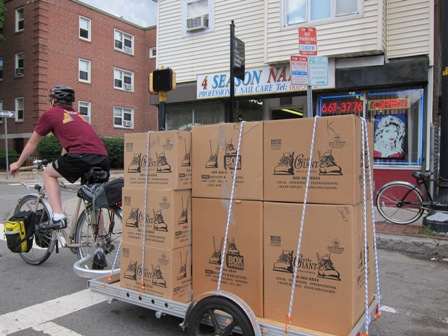
Because there are no couches in Venice?
Vehicles don't have to be huge.
Vehicles don't have to be huge.
The only decent solution for this problem in Jerusalem would be to house the millions of refugees streaming out of next door Syria. Israel has accepted none so far.
Israel has enough problems already without the refugees.
The US and Saudi Arabia who created this mess in the first place are accepting none so far. Anti muslim sentiment is growing across Europe exactly because Merkel invited these refugees over without asking anyone and then imposed refugee quotas on other EU countries. Now we have nutcackes like Marine LePen and Geert Wilders gaining in popularity and threatening with Fr/Nl exits that would most likely break the EU apart.
The US and Saudi Arabia who created this mess in the first place are accepting none so far. Anti muslim sentiment is growing across Europe exactly because Merkel invited these refugees over without asking anyone and then imposed refugee quotas on other EU countries. Now we have nutcackes like Marine LePen and Geert Wilders gaining in popularity and threatening with Fr/Nl exits that would most likely break the EU apart.
You're rewriting history, those sentiments, parties and political leaders were growing in popularity across Europe way before then, that was just gas on the fire.
Israel is next door. Germany, Sweden, Holland, USA are not. 5 million need to be allowed into Israel right now. Surely Israel is not a racist society?
"Need to be allowed"? I'm genuinly curious as to how one can even theoretically come to such a phrasing, regardless particular countries and their politics.
How do you plan to balance the budget when you're getting rid of tax income from wealthy homeowners and replacing it with a likely subsidy burden to help each refugee integrate?
False. Israel has so far treated thousands in hospital and accepted several hundreds. Given the country's relationships and syrian population general attitude towards Israel and jews, it's more than anyone could reasonably expect.
Accepted several hundreds? That would be astoundingly ungenerous even if true. According to here: http://www.independent.co.uk/news/uk/politics/syrian-refugee... .. "Despite its proximity and high level of economic development, Israel has refused to take any Syrian refugees."
If we take a country similar in population size to Israel - Sweden - we can see that they have taken in 2-3% of their population. Israel should at least match that - they are next door! That would mean at a minimum of 300,000 refugees. Open up Israel.
If we take a country similar in population size to Israel - Sweden - we can see that they have taken in 2-3% of their population. Israel should at least match that - they are next door! That would mean at a minimum of 300,000 refugees. Open up Israel.
You're just repeating the same things you already said, and don't even acknowledge counter-arguments I presented. You really expect to convince anyone with this rhetorical style?
> Whatever the city charges, the wealthy will pay.
This is extremely unlikely. If it is true, then the empty apartments should be considered money fountains and used to spread prosperity all over the world. Do you mean that they are already taxing to an extent where direct financial incentives to politicians have reached a level that prevents any further tax rises?
This is extremely unlikely. If it is true, then the empty apartments should be considered money fountains and used to spread prosperity all over the world. Do you mean that they are already taxing to an extent where direct financial incentives to politicians have reached a level that prevents any further tax rises?
I don't see how raids would be a problem for honest landlords. You'd require people to inform the authorities when a place is empty and when it isn't. You pay taxes when it's empty more than x% per year. Authorities check randomly and you pay a fine when the place is vacant even though you said it wasn't.
I don't see the problem.
The solution with fines for vacant retail space seems very inefficient and a bit unfair, since the developer can probably do very little once they sold appartements, and has little influence on whether they are vacant or not.
I don't see the problem.
The solution with fines for vacant retail space seems very inefficient and a bit unfair, since the developer can probably do very little once they sold appartements, and has little influence on whether they are vacant or not.
[deleted]
They're missing a bit of context here. It's normal for some units to be empty at any time for various reasons: remodelling, attempting to find a tenant, attempting to sell, waiting to be demolished/replaced, etc. So there's a baseline "normal" vacancy rate.
If a unit is vacant for one month per year that would be an 8.3% vacancy rate. Certainly not all units turn over every year, particularly owner-occupied, but it's something to calibrate from. Another data point: the US nationwide average vacancy rate is 6.8%. I realize these are crowded cities and thus not entirely average, but that still gives us some baseline.
The cities in the article have anywhere from 1.71% to 9% vacancy rates. 1.71% is actually a very tight market by most standards I've heard of - equivalent to 6 days of vacancy per year per unit. 9% is rather high vacancy, particularly in an expensive market, but not completely out of line.
It seems like they may be overstating their case here.
https://ycharts.com/indicators/us_rental_vacancy_rate
If a unit is vacant for one month per year that would be an 8.3% vacancy rate. Certainly not all units turn over every year, particularly owner-occupied, but it's something to calibrate from. Another data point: the US nationwide average vacancy rate is 6.8%. I realize these are crowded cities and thus not entirely average, but that still gives us some baseline.
The cities in the article have anywhere from 1.71% to 9% vacancy rates. 1.71% is actually a very tight market by most standards I've heard of - equivalent to 6 days of vacancy per year per unit. 9% is rather high vacancy, particularly in an expensive market, but not completely out of line.
It seems like they may be overstating their case here.
https://ycharts.com/indicators/us_rental_vacancy_rate
>It's normal for some units to be empty at any time for various reasons: remodelling, attempting to find a tenant, attempting to sell, waiting to be demolished/replaced, etc. So there's a baseline "normal" vacancy rate.
Or, one can always count long term vacancies, and be done with the subtleties of not-actually-vacant homes...
Or, one can always count long term vacancies, and be done with the subtleties of not-actually-vacant homes...
What really matters is what percentage of the vacant units are on the rental market.
For example in Toronto based on official statistics rental vacancy is 1.2%. 2011 census provides the rest of the required data: there were 1,112,929 private dwellings in Toronto out of which 476,085 were rentals. 1.2% of that is 5,713 units, out of 100,000 estimated vacant.
Imagine what difference on a rental market increasing available vacancies 15 or 20 times would make..
For example in Toronto based on official statistics rental vacancy is 1.2%. 2011 census provides the rest of the required data: there were 1,112,929 private dwellings in Toronto out of which 476,085 were rentals. 1.2% of that is 5,713 units, out of 100,000 estimated vacant.
Imagine what difference on a rental market increasing available vacancies 15 or 20 times would make..
Be careful about those statistics. The official reported vacancy rates in Canada are usually for purpose-built rental accommodation, whereas a large (and increasing) proportion of the rental market is rental of condominiums and secondary suites.
> If a unit is vacant for one month per year that would be an 8.3% vacancy rate.
Generally most of the local governments in the data sets used only consider homes vacant if it's not considered someone's primary address. It's normal to have some vacancies (especially in a global city), but usually not that many. To contrast what a normal-ish number is, Paris has half as many vacant units as all of England. New York City has more than all of England.
A large part of New York City's vacancies has to do with the last real estate crash there. I literally know people that can't remember where their place in New York City is, because they purchased it 15 years ago and didn't want to lose money. Now it just sits as a line item in their assets.
Note: I wrote the article, so I'm bias in defense here.
Generally most of the local governments in the data sets used only consider homes vacant if it's not considered someone's primary address. It's normal to have some vacancies (especially in a global city), but usually not that many. To contrast what a normal-ish number is, Paris has half as many vacant units as all of England. New York City has more than all of England.
A large part of New York City's vacancies has to do with the last real estate crash there. I literally know people that can't remember where their place in New York City is, because they purchased it 15 years ago and didn't want to lose money. Now it just sits as a line item in their assets.
Note: I wrote the article, so I'm bias in defense here.
Regarding vacancy statistics, you will probably find this very interesting (it is an annual assessment of vacant dwellings in Melbourne, Australia):
https://www.prosper.org.au/2015/12/09/speculative-vacancies-...
https://www.prosper.org.au/2015/12/09/speculative-vacancies-...
That's amazing, thanks! I know it's a burning issue in Australia, but the ABS stats were practically antiques.
Something to keep in mind, there is a lot of pressure to under-report vacancy rates, property managers benefit when vancancy is low.
That only matters if the under-reporting is biased towards certain cities. If there's a general incentive, then the 6.8 average for the US is also lower than the real rate.
Do you know if the tax applies to homes vacant for any reason, or just homes that could be on the market but aren't?
Otherwise I could imagine a particularly unwelcome situation where a market downturn or other shock leads to landlords being unable to rent their units, then get hit by both the loss of rent and the 60% tax on top of that.
Hmm. While this is an excellent description of a downside, I don't know if it's ultimately a bad thing.
You'd figure that in such a situation, the landlords are immensely incentivized to sell, or to lower rents, which may continue to be very unwelcome to them...
...but if the point is that real estate speculation is the problem, wouldn't the looming possibility of that situation result in less speculation, or very careful speculation?
On the other hand, that would hit less wealthy landlords harder (larger percent of their wealth), encouraging them to sell, possibly simply driving more ownership to landlords with deep enough pockets to stomach the (temporary) losses?
Complicated!
You'd figure that in such a situation, the landlords are immensely incentivized to sell, or to lower rents, which may continue to be very unwelcome to them...
...but if the point is that real estate speculation is the problem, wouldn't the looming possibility of that situation result in less speculation, or very careful speculation?
On the other hand, that would hit less wealthy landlords harder (larger percent of their wealth), encouraging them to sell, possibly simply driving more ownership to landlords with deep enough pockets to stomach the (temporary) losses?
Complicated!
I remember seeing numbers for London, where the "story" that gets regularly regurgitated that half the town is empty (ok, so I'm exaggerating a bit) due to the Chinese buying investment properties that they for some strange reason supposedly leave empty rather than renting (which would be particularly strange in the UK, which, though squatters rights have been curtailed still is one of the most risky places to leave property empty).
Except the numbers showed vacancy rates at similar levels in expensive, "investment friendly" boroughs like Kensington and Chelsea compared to boroughs where large portions of the rental market is social housing where the council gets tenants in ASAP after cleanup/refurbishment.
I'm sure there are areas with problems, but many pleases it seems to me that the problem is more one of flawed assumptions. E.g. articles about the situation in London have more than once talked about dark streets and no children out playing.
But if there is one thing that has always been different between rich and poor areas, it is density and likelihood that the occupants will be spending money on activities away from home vs. playing around the block. I remember that distinction well even from growing up in Norway with class distinction far flatter than anywhere in London - the "normal" working class neighbourhoods I grew up in were lit and surrounded by kids playing outdoors in the evenings, while e.g. when I went to visit my grandparents in one of the wealthier parts of town, it was always darker - the flats in their building all had two living rooms and a couple of bedrooms with windows facing the road, and more rooms facing the inner courtyard. Even when people were home at night, there would be far less lit windows for the simple reason there were not enough people there to use all the rooms at once.
It seemed to me like people had started from a flawed feeling, and gotten hold of the statistics and asked no critical questions whatsoever about why the numbers where similar in the poorer areas and similar for social housing.
It's appealing story because it "explains" the high house prices people have to deal with by blaming it on some undefined evil absentee investor which won't show up to defend themselves.
I'll note that I've not looked at the issues related to Paris etc.; maybe it's different there and they have a genuine issue, but even if these numbers were abnormally high, "solving" that problem would not in any case be enough to drive the house prices down to affordable levels - no matter what it's clear that if governments want these prices down to affordable levels, they either have to resort to regulation or to stimulate housebuilding, whether by easing regulations or pouring money into it. But it's much easier to blame people for leaving properties empty.
Except the numbers showed vacancy rates at similar levels in expensive, "investment friendly" boroughs like Kensington and Chelsea compared to boroughs where large portions of the rental market is social housing where the council gets tenants in ASAP after cleanup/refurbishment.
I'm sure there are areas with problems, but many pleases it seems to me that the problem is more one of flawed assumptions. E.g. articles about the situation in London have more than once talked about dark streets and no children out playing.
But if there is one thing that has always been different between rich and poor areas, it is density and likelihood that the occupants will be spending money on activities away from home vs. playing around the block. I remember that distinction well even from growing up in Norway with class distinction far flatter than anywhere in London - the "normal" working class neighbourhoods I grew up in were lit and surrounded by kids playing outdoors in the evenings, while e.g. when I went to visit my grandparents in one of the wealthier parts of town, it was always darker - the flats in their building all had two living rooms and a couple of bedrooms with windows facing the road, and more rooms facing the inner courtyard. Even when people were home at night, there would be far less lit windows for the simple reason there were not enough people there to use all the rooms at once.
It seemed to me like people had started from a flawed feeling, and gotten hold of the statistics and asked no critical questions whatsoever about why the numbers where similar in the poorer areas and similar for social housing.
It's appealing story because it "explains" the high house prices people have to deal with by blaming it on some undefined evil absentee investor which won't show up to defend themselves.
I'll note that I've not looked at the issues related to Paris etc.; maybe it's different there and they have a genuine issue, but even if these numbers were abnormally high, "solving" that problem would not in any case be enough to drive the house prices down to affordable levels - no matter what it's clear that if governments want these prices down to affordable levels, they either have to resort to regulation or to stimulate housebuilding, whether by easing regulations or pouring money into it. But it's much easier to blame people for leaving properties empty.
Interesting, any idea where you saw those numbers?
   Neighbourhoods I grew up in were
   lit and ...
* . * . * .
To put it another way: The neighbourhood I live in now is also usually lit in the evenings. I mentioned my childhood because I have very vivid memories of exactly that - you notice the light much more somewhere where the winters are particularly dark.
> And if you look at what gets build now in London (e.g. Nine Elms, or Docklands) it's not large luxury flats, it's almost exclusively studios, 1 and 2 bedrooms, i.e. targeting the lowest end of the market.
This is another trap people go into, though: London is far more than the central areas. Go further out, and things are still closer to "normal".
> And if you look at what gets build now in London (e.g. Nine Elms, or Docklands) it's not large luxury flats, it's almost exclusively studios, 1 and 2 bedrooms, i.e. targeting the lowest end of the market.
This is another trap people go into, though: London is far more than the central areas. Go further out, and things are still closer to "normal".
things are still closer to "normal".
Neither. I mean the mix of properties is not skewed so heavily towards one type of properties, and you have a spread of bigger blocks of flats, smaller ones, terraced housing, detached houses. I live in Croydon, and here you'll find a wide mix from studio flats to mansions, often quite near each other.
The proportion of empty properties does not vary much across London as far as I know. Certainly not enough to be noticeable.
The proportion of empty properties does not vary much across London as far as I know. Certainly not enough to be noticeable.
You are right, I'm only familiar with central London.
I doubt Croydon currently has enough glamour to attract the super rich to park their money with empty mansions.
I imagine that the main reason for property to be empty in Croydon is that it can't be sold/rented at the target price level.
I doubt Croydon currently has enough glamour to attract the super rich to park their money with empty mansions.
I imagine that the main reason for property to be empty in Croydon is that it can't be sold/rented at the target price level.
Empty mansions or super-expensive flats over the long term does not contribute much to the stats - that type of housing make up a vanishingly small part of the total housing volume, so even if they were all empty it wouldn't make much difference.
But Croydon actually has some of the most expensive areas of the UK. When people think of Croydon, they often think only of Croydon town centre, but that's a tiny part of the borough. It doesn't have the 10+ million flats you might find a handful of in Kensington etc., but it does have lots of multi-million properties, in numbers big enough that those are significant for these stats.
E.g. here's an example of the type of things you might find in Purley, which is part of Croydon [1], [2]. In Shirley (also Croydon) you're more likely to find properties around the million mark, but you do have roads where the average is around 1.5-2.5 million.
In terms of empty properties, there's minimal difference between those areas, or the luxury flats near the station, or the middle class areas, or the couple of run down council estates.
[1] http://www.zoopla.co.uk/for-sale/details/41807624?search_ide...
[2] http://www.zoopla.co.uk/for-sale/details/33270402?search_ide...
But Croydon actually has some of the most expensive areas of the UK. When people think of Croydon, they often think only of Croydon town centre, but that's a tiny part of the borough. It doesn't have the 10+ million flats you might find a handful of in Kensington etc., but it does have lots of multi-million properties, in numbers big enough that those are significant for these stats.
E.g. here's an example of the type of things you might find in Purley, which is part of Croydon [1], [2]. In Shirley (also Croydon) you're more likely to find properties around the million mark, but you do have roads where the average is around 1.5-2.5 million.
In terms of empty properties, there's minimal difference between those areas, or the luxury flats near the station, or the middle class areas, or the couple of run down council estates.
[1] http://www.zoopla.co.uk/for-sale/details/41807624?search_ide...
[2] http://www.zoopla.co.uk/for-sale/details/33270402?search_ide...
> Chinese buying investment properties that they for some strange reason supposedly leave empty rather than renting
They are parking money. Property value in London is on the rise although it might not be so forever due to increasing property taxes. Same with Paris, Oslo etc.
They are parking money. Property value in London is on the rise although it might not be so forever due to increasing property taxes. Same with Paris, Oslo etc.
My point was that while that may be true for a small number of properties, the numbers simply does not support the idea that lots of Chinese investors are buying properties and leaving them empty - its a myth (it's not a myth that they are buying).
Everybody is parking money, not just the Chinese.
French legislation also favorizes the tennants, so the owners would rather keep these places empty than even bother renting. Now the city council is coming up with a tax for a problem created through regulation. Which only proves that career politicians do not even understand the economics behind these issues.
French legislation also favorizes the tennants, so the owners would rather keep these places empty than even bother renting. Now the city council is coming up with a tax for a problem created through regulation. Which only proves that career politicians do not even understand the economics behind these issues.
I don't believe you're calculating vacancy rates the same way the article is. You're talking about single-unit vacancy over time, the article is referring to citywide vacancy over volume. Depending on how that number if calculated those could be wildly divergent values.
this was interesting ---- "There’s now 107,000 vacant homes, representing 7.5% of all residential dwellings in the city according to France’s INSEE. Deputy Mayor Ian Brossat told Le Monde that 40,000 of those vacant homes aren’t even connected to the electrical grid."
So almost 40% don't even have the power turned on? Vacant or abandonded?
As an interesting anecdote to add, I have a close friend who purchased an industrial building in Tucson Arizona. It had been there for 40 years when he purchased it and he took ownership of it and did not turn the electric service on for 7 months while he did some landscaping and stuff outside. Turns out that was a big mistake. The code says that if the electric is off for 6 month plus a day, it has to be brought up to current year code spec. So my friend had to spend 3 years and thousands of dollars to upgrade this industrial building in order to get a permit to use it.
I wonder how many of those Paris housing units could even have their electricity turned on even if they wanted to. Would it pass code? Then do they get taxed 60% of fair market in this scenario? My friend spent well over $50,000 just on electrical upgrades, not to mention the cost of an unusable building for 3 years.
Does anyone know current Paris electric code?
So almost 40% don't even have the power turned on? Vacant or abandonded?
As an interesting anecdote to add, I have a close friend who purchased an industrial building in Tucson Arizona. It had been there for 40 years when he purchased it and he took ownership of it and did not turn the electric service on for 7 months while he did some landscaping and stuff outside. Turns out that was a big mistake. The code says that if the electric is off for 6 month plus a day, it has to be brought up to current year code spec. So my friend had to spend 3 years and thousands of dollars to upgrade this industrial building in order to get a permit to use it.
I wonder how many of those Paris housing units could even have their electricity turned on even if they wanted to. Would it pass code? Then do they get taxed 60% of fair market in this scenario? My friend spent well over $50,000 just on electrical upgrades, not to mention the cost of an unusable building for 3 years.
Does anyone know current Paris electric code?
I don't think Tucson believes that's a mistake. Cities would prefer that all buildings are up to code, all the time. Tucson was lenient enough to say that if your friend can afford to keep the building dark for six months, he can afford to bring it up to code. It's entirely likely that if he tried to insure the building, his insurance company would require an inspection and similar work.
Perhaps he needed better inspection before purchase.
Perhaps he needed better inspection before purchase.
it was my friends mistake - the city code was clear but he was not aware of it. He owns a lot of buildings, so he self insures and has done so for 20+ years. This particular building they were making into a new business headquarters, so it was disconnected just -slightly- too long.
There was nothing wrong with the electrical. He was forced to make the 40 year old building ADA compliant, with handicap bathrooms, parking, etc. and a whole other list of requirements that did not apply when the building was built.
So take it as a lesson, not a complaint about code. Also, never shut off utilities if you can help it :)
There was nothing wrong with the electrical. He was forced to make the 40 year old building ADA compliant, with handicap bathrooms, parking, etc. and a whole other list of requirements that did not apply when the building was built.
So take it as a lesson, not a complaint about code. Also, never shut off utilities if you can help it :)
I bet people with disabilities who go there will appreciate the ADA compliance, too.
Its a sewage treatment plant. He has not had anyone come to his business in 25 years that needed ADA compliance. It is part of the current building code, so that is that. No ADA, no final approval.
Paris electric code is the same as for the rest of EU and yes, you can leave the lights off for over 6 months with no repercussions.
Your friend however bought an industrial site and the compliance rules there are likely a lot stricter than in residential.
Your friend however bought an industrial site and the compliance rules there are likely a lot stricter than in residential.
I wonder what France's squatting laws are like. If a list of those homes were to be leaked then it could prove to be interesting.
For France, can't be evicted during winter months, need a judge to decide to evict (so can take a a really long time).
Good luck, Paris. There is a non-negligible number of apartments where the owners can't be found. Paris is an old city. Some of these apartments are very old. The chain of ownership can be quite complex especially when descendants are involved. A friend told me he asked the guardian of a building for the owner details because he wanted to buy it. The guardian only had a 4-digit telephone number, that's how old the information was.
The last person to live there died in 80s. They did have 2 grandchildren one in Canada and the other in Australia. They did not know they inherited an apartment. Do to inheritance laws them and a cousin were the beneficiaries. And to sell this property it required their approval and a split of the proceeds. In total it took 18 months to buy this flat.
I'm sure there are other stories like this.
The last person to live there died in 80s. They did have 2 grandchildren one in Canada and the other in Australia. They did not know they inherited an apartment. Do to inheritance laws them and a cousin were the beneficiaries. And to sell this property it required their approval and a split of the proceeds. In total it took 18 months to buy this flat.
I'm sure there are other stories like this.
Please note this 60% tax is 60% of what one could rent the property for, not 60% of the value. Yearly rents are maybe 5-10% of the value, so a 3% to 6% tax as the word is normally used. Still something, but not nearly extreme as the headline.
No, this is 60% of the property tax, not the rental value. It's much less than rental value, and although quite interesting for the city of Paris (which should net about $30M / year) it is nowhere close 60% of the rental value of those flats.
No, the article clearly states it is 60% of rent:
"Starting in 2015 the city elected to tax vacant homes the equivalent of 20% of the fair market value of rent. On January 30 this year, they decided to triple that amount to 60%. "
"Starting in 2015 the city elected to tax vacant homes the equivalent of 20% of the fair market value of rent. On January 30 this year, they decided to triple that amount to 60%. "
The article is crap, the change is to the property tax (taxe d'habitation http://www.lemonde.fr/argent/article/2017/01/25/a-paris-la-s...).
The property tax is really low in Paris, for a 200ke flat you'll pay less than 200e a year, so while it will bring more tax it will change nothing to the problem.
Rural Arizonan here. One wealthy Californian bought the three houses adjacent to my home ~8 years ago. All have been vacant since purchase. The guy drops by on his brand new Harley once a year, at most. Bare minimum upkeep of property: weeds, flaking paint, unpainted siding, etc. Owner does occasionally show up at city council meetings to protest tax increases, however.
Fairly common to encounter the above in small town historic districts across the nation. Perhaps it's inevitable when housing is viewed as a "holding" rather than a home.
Fairly common to encounter the above in small town historic districts across the nation. Perhaps it's inevitable when housing is viewed as a "holding" rather than a home.
What does he say in response to being called out as an absentee? I'd be pretty aggravated; I feel like if you buy property you should do something with it, and would support use-it-or-lose-it approach.
There's a viewpoint out there called "property rights". It means that the owner has the ability to live in his property, rent out his property, make it into a orca preserve, or use it as a temple to the salamander god.
Weird, I know.
Weird, I know.
Don't patronize me. I already made it clear that I adhere to a 'use it or lose it' view of property rights, so your reply that there are such things as property rights is superfluous.
Just because we disagree doesn't mean I'm ignorant of your position, and it is rude of your to pretend otherwise.
Just because we disagree doesn't mean I'm ignorant of your position, and it is rude of your to pretend otherwise.
Sorry.
I figured the wealthy Californian already made it pretty clear that he adheres to a 'I buy it and I own it' view of property rights. "What does he say in response to being called out as an absentee?" seems obvious.
I figured the wealthy Californian already made it pretty clear that he adheres to a 'I buy it and I own it' view of property rights. "What does he say in response to being called out as an absentee?" seems obvious.
Why are all the nice places getting so insanely expensive? Why not make more nice places? It's no coincidence that the nicest places were built before cars became dominant. If you want your place to be valuable, build for people and not for cars.
> Why are all the nice places getting so insanely expensive?
Because, over the last century, the non-liquid surface area of the planet remained roughly constant while the human population tripled.
And that happened because some incredible portion of the humans believes that birth control is wrong.
Because, over the last century, the non-liquid surface area of the planet remained roughly constant while the human population tripled.
And that happened because some incredible portion of the humans believes that birth control is wrong.
> because some incredible portion of the humans believes that birth control is wrong.
That... may be an oversimplification.
That... may be an oversimplification.
> some incredible portion of the humans believes that birth control is wrong.
Hardly incredible.
Do you believe ending human live is wrong? What about not starting human life? What's the difference in terms of economic utility?
See, now we're getting into a moral issue that has gut feelings and beliefs and upbringings.
Hardly incredible.
Do you believe ending human live is wrong? What about not starting human life? What's the difference in terms of economic utility?
See, now we're getting into a moral issue that has gut feelings and beliefs and upbringings.
At Paris levels of density we could fit the entire population of the world into New Mexico. There is no shortage of space.
Your explanation simply doesn't work.
Your explanation simply doesn't work.
It's because the people making lots of money are making more money than ever before.
This is a much better article on this topic, providing some important additional facts: http://m.leparisien.fr/paris-75004/nouvelles-taxes-sur-les-r...
Using google translate: "For an apartment located on Saint-Louis Island, one of the most speculative sectors in France, the average amount is € 142 per year."
The current vacation home surtax is 20%, so this means the base tax must be €710, so new total for a vacation home would be €1420. Seems like a bargain to what we pay in LA.
Using google translate: "For an apartment located on Saint-Louis Island, one of the most speculative sectors in France, the average amount is € 142 per year."
The current vacation home surtax is 20%, so this means the base tax must be €710, so new total for a vacation home would be €1420. Seems like a bargain to what we pay in LA.
In the article they are speaking of the "l’île Saint-Louis" which is over there : http://www.meilleursagents.com/prix-immobilier/paris-75000/r....
The price is at least 13ke/m2 so it will have no impact.
Small symptom of a larger concern. "Wealth" and "ownership" are not simply material. More importantly, they represent control over institutions and the livelihood and welfare of those institutions employees, members, and managed resources.
Past a point, if that control shifts welfare too far from some sort of common good, should -- and can -- the "ownership" shift to counter-act this?
Or, to put it in old terms, in their way not entirely outdated -- certainly not in sentiment, regardless of those specific words: Noblesse oblige.
Some of our current elites -- like always -- think this should be "trickle down" and that they should retain absolute control. That they are inherently superior, and that their position proves this and justifies whatever they decide and do.
Well, no. It is much more dynamic than that. Just, most people these days would prefer that dynamism exert itself effectively without e.g. war and wholesale exploitation.
My perspective is, more people doing better makes for a happier, more enjoyable, more interesting world.
But I find myself butting up against a lot of not just me-first, but also zero sum gain -- belief and behavior.
When people are using their control to make a bunch of other people unnecessarily miserable, take it away from them.
Perhaps our greatest achievement is the means of doing so without guns and death. Maybe. Sometimes.
Past a point, if that control shifts welfare too far from some sort of common good, should -- and can -- the "ownership" shift to counter-act this?
Or, to put it in old terms, in their way not entirely outdated -- certainly not in sentiment, regardless of those specific words: Noblesse oblige.
Some of our current elites -- like always -- think this should be "trickle down" and that they should retain absolute control. That they are inherently superior, and that their position proves this and justifies whatever they decide and do.
Well, no. It is much more dynamic than that. Just, most people these days would prefer that dynamism exert itself effectively without e.g. war and wholesale exploitation.
My perspective is, more people doing better makes for a happier, more enjoyable, more interesting world.
But I find myself butting up against a lot of not just me-first, but also zero sum gain -- belief and behavior.
When people are using their control to make a bunch of other people unnecessarily miserable, take it away from them.
Perhaps our greatest achievement is the means of doing so without guns and death. Maybe. Sometimes.
This is a real problem. For a while I was running my own company and making more than I could spend - so I bought a house in a nice older neighborhood - walking distance to the beach, restaurants, and a pier, and very pleasant. But I soon discovered that most of my neighbors were never there - perhaps 10% of the houses were owned by wealthy people who would visit once or twice a year. So most residents of my town can't afford to live there - while the wealthy can afford to buy those properties and leave them empty.
Something is very wrong with the US economy and needs to be fixed. I don't want things to be "fair" only for the rich - I want things to be "fair" for our entire society.
Something is very wrong with the US economy and needs to be fixed. I don't want things to be "fair" only for the rich - I want things to be "fair" for our entire society.
If the owners are paying property tax on (very expensive) homes then the extra revenue should be very beneficial to poor people who use city services and contribute little to no tax revenue. If there is no property tax, or it is abated (NYC), or the city prevents new construction, then it is another issue.
[deleted]
While that's how it's supposed to work in theory; do you really still buy into that bullshit? You can't see how that's just another excuse to let the rich keep raping the world at their convenience? Ever been to Lisbon? I swear half the city is vacant by now, all the old beautiful buildings; and poor people have less money than ever.
In Lisbon, I'm told, the issue is that people can't afford rents that would pay for renovations. Also in 2009 or so the locals told me the regulations on how the old buildings were to be renovated were quite strict, adding to the cost.
In Lisbon there's been quite a bit of foreign investment due to their visa program so you have the property market propped up from that.
It's the lower middle class who used to be able to afford to own a home in these areas that now can't, that are really hurt. I've seen this happen in small towns around rural upstate NY in the adirondack park where wealthy people from the city spend massive amounts of money on property and spend a holiday or two per year in them. The economies of these small towns are generally almost non existent and the couple holidays a year isn't enough to lift them up to match the ridiculous rise in real estate and property. It's a really unfortunate situation.
Small town in rural area seems could enable more construction so that people could live in new houses. Don't forget second homes pay taxes.
> most neighbors ... 10%
Was it most or was it 10%?
Edit: I got downvoted for being confused? Please read my comment as pleasantly-toned, not snarky.
Was it most or was it 10%?
Edit: I got downvoted for being confused? Please read my comment as pleasantly-toned, not snarky.
Your question was reasonable. I wondered the same thing. Perhaps it was misinterpreted as signalling some sort of defense of conspicuous consumption / flaunting of wealth. To be clear, that would be an irrational and unfounded interpretation, but such are the hazards of wading into emotionally charged issues (even if you aren't really wading in, just asking an honest question).
The 10% was who visited once or twice a year. Another 10% were never seen over the several years I lived there, and another 10% I saw several times per year. I didn't mean for the number itself to distract from the overall gist - my apologies. And, of course, those are all just rough estimates.
If you are making more money than you could spend then a lot of people would consider you to be rich. If you want more 'fairness', why not lead by example and donate all of your extra money to housing oriented charities?
Worth noting you can't evict people in Paris if they are not paying rent. Some - actually most - ends up paying their renters to make them move out. Maybe these regulations are more the issue than the assumed laziness of landlords.
This is definitely an issue. Even I who is left leaning think it shouldn't be the case.It makes things hard for both the owners and those who seek an accommodation, especially minorities. Owners now ask for crazy guarantees. Imagine you're 40 with an IT job and house owners still ask for your parents to guarantee the rent will be paid!
Bad tenants should definitely be easier to evict. In some parts of the world, if you're 24 hours late paying the rent you can get evicted manu militari, in France, it can take years.
Frankly anybody who is airbnb'ing his house or apartment in France is playing with fire. He could be stuck with squatters for years, there is nothing he could do about it.
Bad tenants should definitely be easier to evict. In some parts of the world, if you're 24 hours late paying the rent you can get evicted manu militari, in France, it can take years.
Frankly anybody who is airbnb'ing his house or apartment in France is playing with fire. He could be stuck with squatters for years, there is nothing he could do about it.
The cost of landlord insurance to protect against delinquent tenants is surely passed on to renters though, driving up the rents as well and maybe contributing to the empty homes problem as nobody can afford to live there.
Vancouver has bypassed the lengthy process of eviction and limits on rent increases with landlords now forcing you to sign yearly contracts with clauses that specify you agree to move out on the day the lease expires, so they can increase the rent however much they wish or toss you out more easily. I have yet to find anywhere that doesn't dangle this yearly lease scheme so I have to now plan a vacation week around lease negotiation time in case they skyrocket it and I'm forced to move.
Vancouver has bypassed the lengthy process of eviction and limits on rent increases with landlords now forcing you to sign yearly contracts with clauses that specify you agree to move out on the day the lease expires, so they can increase the rent however much they wish or toss you out more easily. I have yet to find anywhere that doesn't dangle this yearly lease scheme so I have to now plan a vacation week around lease negotiation time in case they skyrocket it and I'm forced to move.
Some - actually most - ends up paying their renters
Some - actually very few.
Some - actually very few.
How do the rest handle it?
Loopholes, like renoviction, though there's the "winter truce" meaning nobody can be evicted from Oct 15 until April 1. Look how long this process is, roughly a few years before you can even think about calling the police to evict them https://www.french-property.com/guides/france/working-in-fra...
So...how exactly do the rest handle it?
By not renting the property in the first place?
By not renting the property in the first place?
landlords gotta landlord, LOL.
They just charge insane rent to the people how actually pay, just like any other insurance scheme, essentially.
They just charge insane rent to the people how actually pay, just like any other insurance scheme, essentially.
[deleted]
Who would have guessed that introducing large amounts of friction into market interactions would have undesirable second-order consequences?
[deleted]
This boom in Real Estate investment is a consequence of global interest rates being historically low. People want to put their money to work, borrowing is cheap, so they buy assets. Art, commodities, real estate, etc.
When interest rates go up. Fixed-income securities will be much more attractive.
Combine that with local home owners having to pay a higher monthly mortgage payment due to higher rates. Their affordability will go down.
The pendulum will swing and a sellers market will turn into a buyers market.
It will be sellers racing for the exit and patient buyers on the sidelines hoping a little longer wait will produce even better deals.
When interest rates go up, this issue will take care of itself.
When interest rates go up. Fixed-income securities will be much more attractive.
Combine that with local home owners having to pay a higher monthly mortgage payment due to higher rates. Their affordability will go down.
The pendulum will swing and a sellers market will turn into a buyers market.
It will be sellers racing for the exit and patient buyers on the sidelines hoping a little longer wait will produce even better deals.
When interest rates go up, this issue will take care of itself.
The article appears to be talking about vacant homes that are a result of people buying flats and only using them when they visit the city, not vacancies due to demand bottoming out for new housing. A person wealthy enough to buy a spare Manhattan apartment isn't going broke if interest rates go up.
Fixed-income securities are less attractive when there is increasing inflation. A bond that returns 1% will still only return 1%. You don't want your money stuck in 1% bonds when seeing double digit inflation.
Interest rates basically go up to either counter or prevent an increase in the rate of inflation. It's difficult to target a single market to head off a speculative bubble with the tool of interest rates alone, especially if inflation is low and stable.
Fixed-income securities are less attractive when there is increasing inflation. A bond that returns 1% will still only return 1%. You don't want your money stuck in 1% bonds when seeing double digit inflation.
Interest rates basically go up to either counter or prevent an increase in the rate of inflation. It's difficult to target a single market to head off a speculative bubble with the tool of interest rates alone, especially if inflation is low and stable.
You'd think, but someone once told me a pithy statement like "the good lord isn't making any morevland, but he didn't stop making people". Because of that, I wonder how far real estate can ever swing to the buyer's side.
This trend is downright offensive when you realize that many cities with vacant home problems also have homelessness problems.
Boston is actually trying to solve this. They are redirecting the money they spend on homeless shelters towards paying rent for the homeless in otherwise vacant properties and providing lawyers for the owners in case the tenants cause any problems.
Case in point: Los Angeles, which, on the basis of median income, has the least affordable housing of any major city in the US, also has a significant number of vacant apartment listings.
The rental rates for these (mostly new) apartments are so high that they don't address the shortage of housing in the low to mid income range. And the owners (corporate, mostly) prefer to keep the units empty instead of lowering the prices.
So, in a sense, Los Angeles has both too few and too many housing units.
The rental rates for these (mostly new) apartments are so high that they don't address the shortage of housing in the low to mid income range. And the owners (corporate, mostly) prefer to keep the units empty instead of lowering the prices.
So, in a sense, Los Angeles has both too few and too many housing units.
Not an expert, but I've heard a lot of property purchases are a way for rich people in China to evade capital controls.
It's not just capital controls. There is a lot of fraud in China that ends up being laundered in real estate here in Canada:
http://theprovince.com/business/real-estate/mysterious-wheel...
http://theprovince.com/business/real-estate/mysterious-wheel...
Toronto is now also completely out of control:
http://www.greaterfool.ca/2017/03/04/its-official-its-a-bubb...
Normally there would be an epic crash in the near future, but I have come to the conclusion that this time really is different, and I'm not joking.
http://www.greaterfool.ca/2017/03/04/its-official-its-a-bubb...
Normally there would be an epic crash in the near future, but I have come to the conclusion that this time really is different, and I'm not joking.
Shame the government of Ontario won't even consider the BC foreigner tax.
Numbers I've seen suggest that the proportion of "foreign money" in Toronto is even lower than in Vancouver (mostly from GreaterFool.ca), so the tax may not have a large effect.
My question would be: what is their definition of "foreign money", and how are they determining how much of it is involved in their housing market.
We've got the same problem here in Auckland (NZ). Now the 4th least affordable place in the world
http://m.nzherald.co.nz/business/news/article.cfm?c_id=3&obj...
http://m.nzherald.co.nz/business/news/article.cfm?c_id=3&obj...
Out of curiousity, does Auckland also have 18 year old kids driving $100k++ sports cars with N (new driver) stickers as we do here in Vancouver?
Strictly speaking it's not a way to avoid capital controls (which means limits on how much money you can take out of the country). It's a place to put money that has already escaped capital controls.
Not just China. Walking around the wealthiest areas of London I sometimes get a sickening feeling when I think about their occupants. The most beautiful houses and essentially palaces are largely owned by people who have raped their countries. Russians, Saudis, Qataris, Chinese oligarchs and politicians who are very successful thieves.
These are mostly empty apart from a couple of months when the princes of the middle east come to escape the heat. I find it very sad to see things of such beauty being occupied by people who have stolen a countries wealth away from their poorest.
These are mostly empty apart from a couple of months when the princes of the middle east come to escape the heat. I find it very sad to see things of such beauty being occupied by people who have stolen a countries wealth away from their poorest.
This is just rampant populism and greedy politics in action. Everyone understands that the most reasonable solution would be to simply build more (yes, it's possible even in old cities like Paris, just allow adding a few floors on top of every building). If a 20% tax in addition to operating costs of apartments did not help their cause, what - except more tax money - do they expect from 60%? A hypothetical greedy speculator will just rent 1 of 3 apartments and break even.
The point is, that we hav3 already built more but they are not being used to live in, what's to say the same wouldn't continue to happen.
Nobody builds new apartments in order to leave them empty, that's a terrible use of capital (exception: extremely luxurious flats). Speculative investments in real estate are usually old/desolate buildings, where it's worth it to wait until the last renter leaves/dies in order to sell or tear down the whole building. I know that's how things are here in Vienna, I don't see why things would be any different in Paris, where there are very similar problems (old city, strict laws for tenant protection, influx of migrants, investments increasing prices since the 2008 crisis, complaints about empty flats).
People using 10x leverage to get homes, what do you expect?
Has anyone analysed the value of these vacant homes?
Something tells me they're not cheap. They're bought to speculate/invest, after all, right?
So is this trend really hurting those who the government is claiming to protect?
Although I guess one could claim that this trend encourages builders to make more expensive housing when they could make more affordable housing...but that's just how markets work, no?
Something tells me they're not cheap. They're bought to speculate/invest, after all, right?
So is this trend really hurting those who the government is claiming to protect?
Although I guess one could claim that this trend encourages builders to make more expensive housing when they could make more affordable housing...but that's just how markets work, no?
Markets are not created by God. They are the result of laws and policies - as is also true of the distribution of income. We, as a society, can decide how we want our economy to work. (There is plenty of literature describing how free market is a myth.) So "how markets work" in Paris will be with a 60% tax - hopefully it will achieve their goals - otherwise, they can try other things.
> We, as a society, can decide how we want our economy to work.
To a point. Taxation tends to work as well as anything else in economic policy, but price controls and state ownership of production have almost never worked (as far as I can remember).
To a point. Taxation tends to work as well as anything else in economic policy, but price controls and state ownership of production have almost never worked (as far as I can remember).
Ehhh...free market is a myth is a bit of a myth. Free market hasn't really existed in our lifetime is more accurate.
The free market is essentially a natural law. It's the root of economics. Policies and laws merely try to control portions of the formula and when they do that the reaction is predictable.
Put price controls on something, demand will rise and supply will fall. Provide money for a service regardless of price without increasing supply, demand will increase and the price will along with it. Control the price and the supply, then as demand increases you create a market for access.
These are the basic effects that have happened with education, health care, real estate, etc. Everytime policy tries to interfere, the market merely adjusts. When money is handed out from government policy, inflation happens.
You can pass a law that gravity must behave differently...doesn't mean it can actually control it.
The only controls that laws and policies have on markets is tampering.
The free market is essentially a natural law. It's the root of economics. Policies and laws merely try to control portions of the formula and when they do that the reaction is predictable.
Put price controls on something, demand will rise and supply will fall. Provide money for a service regardless of price without increasing supply, demand will increase and the price will along with it. Control the price and the supply, then as demand increases you create a market for access.
These are the basic effects that have happened with education, health care, real estate, etc. Everytime policy tries to interfere, the market merely adjusts. When money is handed out from government policy, inflation happens.
You can pass a law that gravity must behave differently...doesn't mean it can actually control it.
The only controls that laws and policies have on markets is tampering.
This is a very simplistic view of markets, ignoring the fact that demand can be both cultivated and suppressed, elasticity of demand, and sufficiency of supply. Supply and demand give rise to Strange behavior (in the sense of equilibria following strange attractors), but claiming that all interaction is tampering is just the naturalistic fallacy over again. It reminds me of people who object to doctors because they believe medical intervention runs contrary to God's will.
What is cultivating or suppressing demand if not tampering? It doesn't change the formula. Marketing affects demand...but doesn't change the formula at all.
Markets are created by God as much as the Hemilaya mountains.
Sure, we could make Mt Everest look like whatever we want it to, but we'll be fighting nature to do so.
Sure, we could make Mt Everest look like whatever we want it to, but we'll be fighting nature to do so.
I don't understand, why owners buy such vacant homes, which they use twice a year. Renting the same house for two days would be much cheaper.
Also, once they own such property, they could rent it for the time when they are away. They could make a lot of money this way.
In the first case, people are giving away money for nothing. In the second case, people refuse to take money. Why do they do that?
Also, once they own such property, they could rent it for the time when they are away. They could make a lot of money this way.
In the first case, people are giving away money for nothing. In the second case, people refuse to take money. Why do they do that?
I think it is a place to park money. Homes in highly desirable areas tend to maintain their value and usually increase over time. If you're sitting on hundreds of millions or billions of dollars, you can't just stick it all in a savings account or an index fund. It has to go somewhere. Real estate is one place.
Consider a $20 million Manhattan apartment. Even if it has a "management fee" of $5k per month (not uncommon), that's still only 0.3% per year. Far less than you'd pay to a hedge fund or other investment manager to hold on to the money.
Ultimately I think it will be self-defeating. If too many people do this, the vibrancy of the city that makes the real estate valuable in the first place will disappear, because nobody will be able to afford to live there.
Consider a $20 million Manhattan apartment. Even if it has a "management fee" of $5k per month (not uncommon), that's still only 0.3% per year. Far less than you'd pay to a hedge fund or other investment manager to hold on to the money.
Ultimately I think it will be self-defeating. If too many people do this, the vibrancy of the city that makes the real estate valuable in the first place will disappear, because nobody will be able to afford to live there.
> If too many people do this, the vibrancy of the city that makes the real estate valuable in the first place will disappear, because nobody will be able to afford to live there.
Already happening in some places. The average rent of a 1BR in Manhattan leveled off a couple years ago, roughly equal to the average 1BR in Brooklyn. All but the most successful young professionals have fled the city for the boroughs; the artists fled ahead of them, so all the fun night life that used to make NYC so exciting is already out in Queens (for a while it was in Brooklyn, but I think a lot has been pushed out there already, too).
NYC, now, is a lot more dead by comparison. It's still fun for tourists, and the place to be for the sort of evening life that is either more expensive (fine dining) or less capable of flight to the outer boroughs (museums), but if you're a local...
Already happening in some places. The average rent of a 1BR in Manhattan leveled off a couple years ago, roughly equal to the average 1BR in Brooklyn. All but the most successful young professionals have fled the city for the boroughs; the artists fled ahead of them, so all the fun night life that used to make NYC so exciting is already out in Queens (for a while it was in Brooklyn, but I think a lot has been pushed out there already, too).
NYC, now, is a lot more dead by comparison. It's still fun for tourists, and the place to be for the sort of evening life that is either more expensive (fine dining) or less capable of flight to the outer boroughs (museums), but if you're a local...
[deleted]
   Far less than you'd pay to a hedge
   fund or other investment manager
   to hold on to the money.
> There are not many people rich enough not to care about foregoing that much money every month.
However, the few people who are that rich hold a wildly disproportionate share of total real estate. I don't remember the exact numbers and am having trouble finding a decent reference, but it's something like 10% of real estate being held by the top 0.01%.
However, the few people who are that rich hold a wildly disproportionate share of total real estate. I don't remember the exact numbers and am having trouble finding a decent reference, but it's something like 10% of real estate being held by the top 0.01%.
   10% of real estate being
   held by the top 0.01%.
Second, yes, you are right, there are real estate tycoons owning a lot of property, but they typically make their money by renting and selling dwellings, not by leaving them empty. For example which of the world's richest real estate tycoons in the list [1] is leaving substantial numbers of their property empty? My conjecture is: nobody.
[1] https://www.forbes.com/sites/erincarlyle/2016/03/14/the-20-r...
Renters are a hassle, and they have a lot of legal protections. Where I live it's hard to kick them out even if they stop paying, and if they trash the place you could be out a lot of money. I wouldn't rent my vacation home out unless I needed the money.
"legal protections of renters" ... maybe, in other words, it means, that government makes renting extremely unfavorable and complicated. In that case, the government is responsible for empty apartments. They try to solve the problem without realising what is the source of the problem.
Or maybe we need some service for that, which would include insurance and everything, and will just pay owners the money without worrying about anything.
Or maybe we need some service for that, which would include insurance and everything, and will just pay owners the money without worrying about anything.
For insurance to be workable you need to be able to collect more in premiums than you pay out in claims. I suspect we'd already be seeing something like that if the numbers worked.
If the house is also an investment, they can make money by buying rather than renting it. This is part of the problem with so much speculation and housing being treated as an investment: you earn potentially greater returns by buying a house, so everyone starts doing it and th values keep going up.
As to why they don't rent it out when they aren't in town, I can think of a few reasons: they don't want the risk of items in the house being damaged, they don't want "other people" in their house, they like visiting on short notice (even if it's only a few times a year) which isn't compatible with renting.
As to why they don't rent it out when they aren't in town, I can think of a few reasons: they don't want the risk of items in the house being damaged, they don't want "other people" in their house, they like visiting on short notice (even if it's only a few times a year) which isn't compatible with renting.
There is also magnification on the investment with leverage, and it can be a good hedge against inflation.
Condsider a property that costs $1,000,000 which you may be able to finance 75% of. You have $250k invested, but it is the whole value that appreciates. So in a competitive market like Paris, perhaps that $1M house is worth $1.75M in 10 years. Now you have earned $750,000 for your $250,000 investment in 10 years. All the while having something relatively safe, and fun to use.
If it was inflation that caused the increase in home value, then you are covered for that too, much better than keeping cash in a CD or savings account.
Condsider a property that costs $1,000,000 which you may be able to finance 75% of. You have $250k invested, but it is the whole value that appreciates. So in a competitive market like Paris, perhaps that $1M house is worth $1.75M in 10 years. Now you have earned $750,000 for your $250,000 investment in 10 years. All the while having something relatively safe, and fun to use.
If it was inflation that caused the increase in home value, then you are covered for that too, much better than keeping cash in a CD or savings account.
Assuming this was paid off in 10 years, you'd pay 250k in interest. A 500k return is 10% annual. Still good, but not world beating. Also property ownership comes with its own costs (taxes, upkeep, time, etc). A worthy investment all the same, but its not all rainbows and butterflies.
> Now you have earned $750,000
Minus the interest you're paying on the $750K you borrowed in the first place. If that interest outstrips the appreciation of the asset, you lose.
Minus the interest you're paying on the $750K you borrowed in the first place. If that interest outstrips the appreciation of the asset, you lose.
Yes, but the house won't be just so if I rent it for a day or two.
We ended up buying a house so that we can use it for eight weeks every year when we're back in the US so that we can feel like we're in a home for the duration of our stay and not interloping on someone else's home. From our point of view, it's a valid use case.
We ended up buying a house so that we can use it for eight weeks every year when we're back in the US so that we can feel like we're in a home for the duration of our stay and not interloping on someone else's home. From our point of view, it's a valid use case.
I don't understand, why owners buy such vacant homes, which they use twice a year. Renting the same house for two days would be much cheaper.
My wife and I own a condo in the Philippines which we use 1 month out of the year. Why buy when we could just rent or get a timeshare? This place is ours forever, it has already appreciated 50% over what we paid 4 years ago, it is always available when we need it, and we got to decorate it the way we wanted.
My wife and I own a condo in the Philippines which we use 1 month out of the year. Why buy when we could just rent or get a timeshare? This place is ours forever, it has already appreciated 50% over what we paid 4 years ago, it is always available when we need it, and we got to decorate it the way we wanted.
Did you try to offer that condo to your friends or relatives, so they can use it sometimes, too? Maybe this condo can make you more money, than you could imagine. I understand, that it would bother you to find renters and to worry about your house, but maybe we just need some special service for that.
Did you try to offer that condo to your friends or relatives, so they can use it sometimes, too?
My wife's relatives in the Philippines have the key, and they stay there occasionally to use the resort-style pool and cabanas, and a few friends from the UK or Australia who visited the Philippines stayed there. We could make money through AirBnB or longer-term rentals, and in fact the condo management company facilitates that with concierge, checkin/checkout, cleaning, airport transer services, etc, but the rent we would get (~$300-600 after expenses) isn't enough to justify the extra wear and tear on the condo.
My wife's relatives in the Philippines have the key, and they stay there occasionally to use the resort-style pool and cabanas, and a few friends from the UK or Australia who visited the Philippines stayed there. We could make money through AirBnB or longer-term rentals, and in fact the condo management company facilitates that with concierge, checkin/checkout, cleaning, airport transer services, etc, but the rent we would get (~$300-600 after expenses) isn't enough to justify the extra wear and tear on the condo.
It's because money has marginal utility[0]. The 0.001% spend tens of millions a year, each, on this kind of pointless status signaling, and think nothing of conveniences that could pay all expenses for, say, a dozen families of four, for a year (or a decade).
[0]: https://en.wikipedia.org/wiki/Marginal_utility
[0]: https://en.wikipedia.org/wiki/Marginal_utility
> Also, once they own such property, they could rent it for the time when they are away.
being a landlord is a pain in the ass, even if you hire a property management company.
being a landlord is a pain in the ass, even if you hire a property management company.
They are doing it for flexibility. My wife's uncle and his wife do this. They own 3 homes in the bay area. An apartment in the city, a house in Marin and a condo near Monterey. They are well off, but not filthy rich (~$5M in net worth including real estate, which is high, but they are both retired after working good paying jobs).
They don't rent any of them out since they like the flexibility to decide at the last minute where they want to spend the night.
They did luck out and buy these homes when prices were depressed.
They don't rent any of them out since they like the flexibility to decide at the last minute where they want to spend the night.
They did luck out and buy these homes when prices were depressed.
Normally people would own gold and keep it in a nice safe deposit box, but times are never normal, and the government does not have dozens of programs focused on public-private partnerships to make more gold, government backed loans to buy gold, and define percentage of goldowners as a bean counting metric goal which somehow implies success.
Something to think about is all countries sell citizenship rights some more explicitly than others, but all do it, and going rate in the 1st world is about a half million on the balance sheet of a new company, and all you need to do is form a SMLLC and have it purchase the million dollar condo, then you're in on an investment visa and its pretty easy to prove your corporation has an asset of a million bucks, its right there in the tax records. Now the government hopes that people who come in on an entrepreneur VISA actually open a real business, but its hard to prove who's a real businessman vs an incompetent businessman, so anyone going thru the documented motions gets in. Anyway at least some million dollar empty condos are the visual manifestation of the weirdest naturalization ritual in the history of humanity. All countries have wide open visa policies if you're a businessmen willing to invest a large enough amount of money, all of them.
Something to think about is all countries sell citizenship rights some more explicitly than others, but all do it, and going rate in the 1st world is about a half million on the balance sheet of a new company, and all you need to do is form a SMLLC and have it purchase the million dollar condo, then you're in on an investment visa and its pretty easy to prove your corporation has an asset of a million bucks, its right there in the tax records. Now the government hopes that people who come in on an entrepreneur VISA actually open a real business, but its hard to prove who's a real businessman vs an incompetent businessman, so anyone going thru the documented motions gets in. Anyway at least some million dollar empty condos are the visual manifestation of the weirdest naturalization ritual in the history of humanity. All countries have wide open visa policies if you're a businessmen willing to invest a large enough amount of money, all of them.
>I don't understand, why owners buy such vacant homes, which they use twice a year. Renting the same house for two days would be much cheaper.
Because either
(a) they don't care for it being cheaper, they have plenty of money to spare (I know several such people), or
(b) they still have money, but not enough that they don't care about renting vs buying and living vacant. But they see the vacant house as a stable-ish investment on that property (I also know of this latter category).
Both cases don't care to go through the hassle of renting the house to others.
>In the first case, people are giving away money for nothing. In the second case, people refuse to take money. Why do they do that?
Both of these are concerns of middle/working class people like us. Not the concerns of people that make lotsa money (e.g. 500.000 to several million per year).
And above them, they are people who can afford to have whole castles sitting, waiting for them empty with full staff working there in several places in the world and not think twice about it.
Because either
(a) they don't care for it being cheaper, they have plenty of money to spare (I know several such people), or
(b) they still have money, but not enough that they don't care about renting vs buying and living vacant. But they see the vacant house as a stable-ish investment on that property (I also know of this latter category).
Both cases don't care to go through the hassle of renting the house to others.
>In the first case, people are giving away money for nothing. In the second case, people refuse to take money. Why do they do that?
Both of these are concerns of middle/working class people like us. Not the concerns of people that make lotsa money (e.g. 500.000 to several million per year).
And above them, they are people who can afford to have whole castles sitting, waiting for them empty with full staff working there in several places in the world and not think twice about it.
Because they couldn't say then while socializing ".. in MY home in France..", some use it for investment (but only few). If everyone around you have something and talks about something like it's some kind of achievement and just having that thing gives them higher social status then you want that also.
> Also, once they own such property, they could rent it for the time when they are away. They could make a lot of money this way.
And they could make a lot of aggravation this way if they get a nightmare tenant.
And they could make a lot of aggravation this way if they get a nightmare tenant.
Archvied copy, which doesn't require JS:
https://archive.fo/gtByt
https://archive.fo/gtByt
I believe this is responding to a symptom (vacancies) without addressing its primary cause (land speculation.) Housing is viewed as an investment; speculators capture the value of location and public spending by increasing the rent they charge, but don't add any value themselves, essentially siphoning value out of the community. The result is a boom/bust cycle and unaffordable rents. Disincentivizing vacancies may increase supply and lower prices, but occupied properties still have the same fundamental problem. A land tax on the unimproved value of the land is an elegant solution which incentivizes adding value to property rather than using it to park money.
Edit: I'm surprised I'm being downvoted so much - maybe you disagree, but this is at least an attempt to add to the discussion.
Edit: I'm surprised I'm being downvoted so much - maybe you disagree, but this is at least an attempt to add to the discussion.
Nobody complains about speculators on the way down.
Speculators do add value by making the market more efficient.
For example, if there is going to be a house shortage then speculators will buy it early thus rewarding people for developing houses earlier.
Or, if there are too many houses, speculators can short it and bring prices down and so make housing more affordable earlier.
Speculators do add value by making the market more efficient.
For example, if there is going to be a house shortage then speculators will buy it early thus rewarding people for developing houses earlier.
Or, if there are too many houses, speculators can short it and bring prices down and so make housing more affordable earlier.
Is the amount of value speculators capture proportional to the efficiency gains? If there were less or no speculation, what would be the net result?
> Is the amount of value speculators capture proportional to the efficiency gains?
Yes.
> If there were less or no speculation, what would be the net result?
You would have more housing shortages and more excess housing.
Yes.
> If there were less or no speculation, what would be the net result?
You would have more housing shortages and more excess housing.
>Yes.
I'm pretty skeptical, do you have any supporting evidence?
I'm pretty skeptical, do you have any supporting evidence?
There might be evidence, but I could not find it in a cursory search.
Let us assume constant demand for houses.
Suppose a housing shortage is going to happen in 1 year.
Speculators will buy houses thus incentivizing construction and lowering prices in the future. The more adverse the shortage (consider supply and demand) the greater the difference in prices between now and 1 year from now and thus the greater the gains of the speculators.
Speculators are essentially arbitraging over time.
If the speculators incorrectly buy houses when there is excess housing, they will lose money proportional to their mistake.
Let us assume constant demand for houses.
Suppose a housing shortage is going to happen in 1 year.
Speculators will buy houses thus incentivizing construction and lowering prices in the future. The more adverse the shortage (consider supply and demand) the greater the difference in prices between now and 1 year from now and thus the greater the gains of the speculators.
Speculators are essentially arbitraging over time.
If the speculators incorrectly buy houses when there is excess housing, they will lose money proportional to their mistake.
"without addressing its primary cause (land speculation.)"
I don't understand what you mean. We can quibble about the details of this particular tax, but set that aside for a moment.
The best way to fight speculation is to put a tax on it. To see what I mean, imagine these 2 scenarios:
1.) There is a country without any land tax. You see a house that you can buy. You believe prices will be 10% higher within one year. Do you buy the house?
2.) There is a country with a 10% annual land tax. You see a house that you can buy. You believe prices will be 10% higher within one year. Do you buy the house?
In scenario #1 the house is a good investment.
In scenario #2, you would only buy the house if you are going to live in it, or if you can rent it out and make money off of it. In either case, in scenario #2, the house is not vacant.
A land tax forces the owners of land to use the land for productive purposes, rather than just holding it.
I don't understand what you mean. We can quibble about the details of this particular tax, but set that aside for a moment.
The best way to fight speculation is to put a tax on it. To see what I mean, imagine these 2 scenarios:
1.) There is a country without any land tax. You see a house that you can buy. You believe prices will be 10% higher within one year. Do you buy the house?
2.) There is a country with a 10% annual land tax. You see a house that you can buy. You believe prices will be 10% higher within one year. Do you buy the house?
In scenario #1 the house is a good investment.
In scenario #2, you would only buy the house if you are going to live in it, or if you can rent it out and make money off of it. In either case, in scenario #2, the house is not vacant.
A land tax forces the owners of land to use the land for productive purposes, rather than just holding it.
Quite. This system is called Georgism, after the economist who first proposed it.
Maybe I was unclear, but it sounds like we agree: "A land tax on the unimproved value of the land is an elegant solution which incentivizes adding value to property rather than using it to park money."
Vacancies are caused by the fact that we live in scenario #1. Speculators can buy up properties, keep them empty, and reap a financial reward (as long as they time it right) as demand for the location increases.
Vacancies are caused by the fact that we live in scenario #1. Speculators can buy up properties, keep them empty, and reap a financial reward (as long as they time it right) as demand for the location increases.
If land speculators don't provide value, than why isn't everyone a successful speculator?
Of course, it's because they do provide value: They allow land owners to transform illiquid, risky assets into liquid, reliable cash.
Of course, it's because they do provide value: They allow land owners to transform illiquid, risky assets into liquid, reliable cash.
Interesting that they don't mention Vancouver, who also implemented a vacant-housing tax last year.
Indeed.
And Vancouver seems to have a simpler method too:
A tax of 1% of assessed value.
In Paris, they need to come up with a "market rent" figure for each and every property to tax. Do they have those numbers? Using assessment value as Vancouver does, seems a lot easier.
Also, I wonder what's a bigger number: 1% of assessed value, or 60% of market rent. The previous 20% of market rent seems to be a low number, compared to the wealth stored in the property.
In Paris, they need to come up with a "market rent" figure for each and every property to tax. Do they have those numbers? Using assessment value as Vancouver does, seems a lot easier.
Also, I wonder what's a bigger number: 1% of assessed value, or 60% of market rent. The previous 20% of market rent seems to be a low number, compared to the wealth stored in the property.
Market rent would likely be established through a cap rate of assessed value. So I'm assuming it's not really that much harder to do. Works out to around 30% higher than Vancouver's tax.
The problem with Vancouver's system is they determine vacancies through a survey. If you lie, you pay a severe penalty. However, they have a track record of not enforcing anything.
For example, the city has a law preventing the use of a home for an AirBnB full-time without a B&B license. Only 56 B&B licenses have issued in the metro area, and there were more than 2,570 listings that violated that rule at last check. City's response to our article was they have no idea how to figure that out...we offered the bot that cross references it and they said no thanks.
The problem with Vancouver's system is they determine vacancies through a survey. If you lie, you pay a severe penalty. However, they have a track record of not enforcing anything.
For example, the city has a law preventing the use of a home for an AirBnB full-time without a B&B license. Only 56 B&B licenses have issued in the metro area, and there were more than 2,570 listings that violated that rule at last check. City's response to our article was they have no idea how to figure that out...we offered the bot that cross references it and they said no thanks.
Vancouver tax is full of loopholes though and unlikely to change anything. Owners can simply hire phony renovators and keep changing their applications to forever wait for their renovation permits (and avoid the tax) or pretend the work isn't completed. There's many other loopholes, mainly involving strata-governed dwellers with non-rental bylaws who are exempt from the empty home tax a category guaranteed to have exploded in size since the tax was announced.
We cover Vancouver extensively, it's our most written about market. Two of our writers focus exclusively on the situation there, since it's the global real estate bubble on steroids.
[deleted]
[deleted]
It's quite bad in London too. Take a walk down Bishop's Avenue in Hampstead. It's one of the richest roads in the country yet there are 10m+ value mansions literally disintegrating. Some have thick Moss growing on the driveway and many have piles of garbage in the yard.
I've suggested this in the past and it's great to see a large municipality trying it out. Now to put together a list of people who want to live in Paris rent free by signing up to a program of 'bonded house occupiers'. :-)
There is absolutely no way London has that few empty homes.
Going to work every day, seeing the amount of new homes being built (including many where Estates of poorer people are moved out first), vs the high prices, does not add up.
Going to work every day, seeing the amount of new homes being built (including many where Estates of poorer people are moved out first), vs the high prices, does not add up.
The market has a solution to this; it comes in the form of AirBnB. However, many municipalities are aggressively attempting to legislate this market mechanism away.
No, AirBnB isn't a solution to this problem. The problem is there's a constrained supply of housing in Paris and the city wants to try to ensure that people who own housing there actually live there. You know, so there's an actual thriving community and culture instead of fly-by owners that aren't actually residents.
How in the world does a service that encourages turning residential housing into hotel rooms solve that problem exactly? Local wanna be residents are going to rent rooms in the homes of the wealthy absentee homeowners? Maybe some, but I suspect a vast majority are fine just letting them sit vacant. Even if they do, that's no way to build a healthy, thriving community. It's fast food housing. I, as well as many others, don't want to live in a building that's part residential, part hotel.
So your solution is "Let AirBnB enable the absentee owner to rent out their place to the local baker that is priced out of owning.", thereby giving the illusion of a solution but really not solving the problem because the fabric of the community becomes provisional at best.
Seems like a fairly poor solution to me. I hate red tape as much as anyone but I've come around to think that well crafted and executed policy that focuses on the common good is a better option to strive for than figuring out how to enable even more wealth concentration than we already have. The trick is "well crafted and executed" which I agree is rarely the case but we already know the end game with unbridled capitalism. Just ask the pope - https://www.theguardian.com/world/2015/jul/10/poor-must-chan...
How in the world does a service that encourages turning residential housing into hotel rooms solve that problem exactly? Local wanna be residents are going to rent rooms in the homes of the wealthy absentee homeowners? Maybe some, but I suspect a vast majority are fine just letting them sit vacant. Even if they do, that's no way to build a healthy, thriving community. It's fast food housing. I, as well as many others, don't want to live in a building that's part residential, part hotel.
So your solution is "Let AirBnB enable the absentee owner to rent out their place to the local baker that is priced out of owning.", thereby giving the illusion of a solution but really not solving the problem because the fabric of the community becomes provisional at best.
Seems like a fairly poor solution to me. I hate red tape as much as anyone but I've come around to think that well crafted and executed policy that focuses on the common good is a better option to strive for than figuring out how to enable even more wealth concentration than we already have. The trick is "well crafted and executed" which I agree is rarely the case but we already know the end game with unbridled capitalism. Just ask the pope - https://www.theguardian.com/world/2015/jul/10/poor-must-chan...
You've invented a new problem explicitly designed to exclude the solution I mentioned.
The problem in the article is that there is unused/abandoned housing. AirBnB fixes that. If you have a xenophobic fear of tourists or something, that's a different issue. AirBnB also decreases the profitability of large hotels, which means more building space allocated to residential housing.
The problem in the article is that there is unused/abandoned housing. AirBnB fixes that. If you have a xenophobic fear of tourists or something, that's a different issue. AirBnB also decreases the profitability of large hotels, which means more building space allocated to residential housing.
There's nothing xenophobic about wanting to build a community of dedicated citizens. I didn't invent a new problem, you're just failing to account for it in your capitalistic solution. Zoning laws exist for a reason and AirBnB is in direct conflict with them.
Again it goes back to what you want to prioritize, a well knit community or a city of hotel rooms mixed with residential housing that encourages more rent seeking. You're willing to allow for a lower quality and further enriching an already rich upper class. So not only do renters have to pay high rents and never own, they now need to sacrifice any semblance of community as the incentives to AirBnB a place would displace all long term rentals.
Not everything that can be monetized and made efficient should be, but I realize that's super counter to the Ayn Rand HN crowd. I maybe would've agreed with you 10 years ago but I've since realized the flaws in libertarian thinking. Either that or I'm wrong and unbridled capitalism is the right solution to all the problems but I seriously doubt it.
Again it goes back to what you want to prioritize, a well knit community or a city of hotel rooms mixed with residential housing that encourages more rent seeking. You're willing to allow for a lower quality and further enriching an already rich upper class. So not only do renters have to pay high rents and never own, they now need to sacrifice any semblance of community as the incentives to AirBnB a place would displace all long term rentals.
Not everything that can be monetized and made efficient should be, but I realize that's super counter to the Ayn Rand HN crowd. I maybe would've agreed with you 10 years ago but I've since realized the flaws in libertarian thinking. Either that or I'm wrong and unbridled capitalism is the right solution to all the problems but I seriously doubt it.
AirBnB makes it worse for the local population, that's what this 60% thing is about.
Sure it's great as a tourist but as an owner, when you could rent your place for X € a month, on AirBnB you could probably rent it for 70% of that for a week. Bottom line is you're not looking for people to rent it all year long, now you want to make a quick buck and rent it on AirBnB.
There's an article in the HuffPost: http://www.huffingtonpost.fr/2016/03/30/airbnb-paris-locatio...
"In the 10 most touristy areas, 9 to 10 nights on AirBnB cover a whole month of 'regular' rent".
To get there, they analyzed 8000 places out of 35000 (studios and one bedroom).
Sure it's great as a tourist but as an owner, when you could rent your place for X € a month, on AirBnB you could probably rent it for 70% of that for a week. Bottom line is you're not looking for people to rent it all year long, now you want to make a quick buck and rent it on AirBnB.
There's an article in the HuffPost: http://www.huffingtonpost.fr/2016/03/30/airbnb-paris-locatio...
"In the 10 most touristy areas, 9 to 10 nights on AirBnB cover a whole month of 'regular' rent".
To get there, they analyzed 8000 places out of 35000 (studios and one bedroom).
Not sure why that was down voted: I mean the goal of the 60% tax measure is to offer places to rent for locals, AirBnB doesn't solve that, it makes it worse...
A 'solution' that ignores predictable externalities is rarely a sustainable one. That's like saying my solution to the problem of too-expensive trash collection is to offer a lower-cost, more efficient alternative, in which I dump all the trash on your land and hope that I make a fat profit before you notice.
The 60 percent tax sound high, but it is a tax on the going rate for rent, not the value of the property.
Lonelyhomes.ca is attempt to get grassroots enumeration of vacant homes in Vancouver, BC Canada
People paying for assets then not using them.
I don't get this meme on how this could be bad?
I guess because peoples lives often suck and they need to defer blame?
Blaming 'rich' people for why you can't afford to live in the exact spot you want is easier?
These people are subsidising the rest. They are paying year long taxes for assets they don't use.
I really don't get this groupthink.
I don't get this meme on how this could be bad?
I guess because peoples lives often suck and they need to defer blame?
Blaming 'rich' people for why you can't afford to live in the exact spot you want is easier?
These people are subsidising the rest. They are paying year long taxes for assets they don't use.
I really don't get this groupthink.
Whatever the problem is, more government and taxes is surely the solution.
This will deflate house prices by getting demand down.
Good
The article [0] I read is in Finnish and now behind a paywall, but it explains that a woman more or less out of her good heart allowed someone to stay in her flat for a time while she was on an assignment in another country. The person staying in the apartment never really paid any rent, but became a "tenant" so that it is impossible to evict her. The owner has to refurbish and fix the apartment at her own cost, while the person staying there is protected by law and lives there and pays nothing. And makes a horrible mess which the owner has to pay.
It is obvious that such examples send a very strong message: if you're away for a year or two, DON'T give your apartment to let. Keep it empty. If you plan never to use it, then sell it. But if you intent to come back it, just keep it empty. Everything else is too risky, due to the regulations.
Then it's now fashionable to frame this as a xenophobic "rich foreigners come and hoard our apartments and cause housing shortage". The actually guilty to the shortage is local, populist regulation.
[0] http://www.hs.fi/ulkomaat/art-2000002659821.html