Teen Vogue published and then deleted an uncritical story about Facebook(businessinsider.com)
businessinsider.com
Teen Vogue published and then deleted an uncritical story about Facebook
https://www.businessinsider.com/teen-vogue-story-on-facebook-prompts-sponsored-content-questions-vanishes-2020-1
107 comments
The problem with the "it's Teen Vogue's fault for fat fingering the publication" is that Sheryl Sandberg immediately shared the article on her personal Facebook page. I mean, are we to believe that she did not realize this was paid sponcon by her own company (PR/comms falls under her leadership) that it was "mistakenly" published and was organic content (in which case she should've known as well as they had access to FB employees with pictures inside the office).
Mistake or not, FB leadership clearly cheer led it's publication, and then walked back and claimed they had no idea this was sponsored, and only in the last hour or so said it was a "mistake" to deny it was sponsored.
Mistake or not, FB leadership clearly cheer led it's publication, and then walked back and claimed they had no idea this was sponsored, and only in the last hour or so said it was a "mistake" to deny it was sponsored.
> are we to believe that she did not realize this was paid sponcon by her own company
Sure, I can believe it. Because facebook, and companies like them, routinely manage, via their PR departments, to get articles not different than that published without paying for it too. It's certainly the easiest way for a journalist/writer to write an article, from the press releases and interviews given to you by a company, provided on a silver platter. And there isn't a whole lot of money for articles beyond the easiest/cheapest way these days.
The division between "journalism" and "content farm" (write whatever you want that gets eyeballs, if you didn't lie about anything, that's plenty ethical!)... is increasingly a grey area.
Teen Vogue actually happens to be pretty responsible journalism that usually does better than that. But how or why would Sandberg keep track? I'm sure she knows that they got the article their PR department wanted, it literally does not matter to her whether they actually wrote a check with "for that article" in the memo line to make it formally 'sponsored content' or not.
Sure, I can believe it. Because facebook, and companies like them, routinely manage, via their PR departments, to get articles not different than that published without paying for it too. It's certainly the easiest way for a journalist/writer to write an article, from the press releases and interviews given to you by a company, provided on a silver platter. And there isn't a whole lot of money for articles beyond the easiest/cheapest way these days.
The division between "journalism" and "content farm" (write whatever you want that gets eyeballs, if you didn't lie about anything, that's plenty ethical!)... is increasingly a grey area.
Teen Vogue actually happens to be pretty responsible journalism that usually does better than that. But how or why would Sandberg keep track? I'm sure she knows that they got the article their PR department wanted, it literally does not matter to her whether they actually wrote a check with "for that article" in the memo line to make it formally 'sponsored content' or not.
> Teen Vogue actually happens to be pretty responsible journalism that usually does better than that.
On what basis do you say that?
On what basis do you say that?
On the basis that Teen Vogue got a lot of attention around 2016–17 for its political journalism.
https://www.theatlantic.com/entertainment/archive/2016/12/te...
https://qz.com/866305/the-true-story-of-how-teen-vogue-got-m...
https://abcnews.go.com/Business/teen-vogues-evolution-high-f...
That primarily happened under former editor Elaine Welteroth; she left shortly after Condé Nast killed the print edition, and it's my impression that TV has been moving back toward a fashion focus -- although a glance at their web site shows that they're still doing political reporting and op-eds.
https://www.theatlantic.com/entertainment/archive/2016/12/te...
https://qz.com/866305/the-true-story-of-how-teen-vogue-got-m...
https://abcnews.go.com/Business/teen-vogues-evolution-high-f...
That primarily happened under former editor Elaine Welteroth; she left shortly after Condé Nast killed the print edition, and it's my impression that TV has been moving back toward a fashion focus -- although a glance at their web site shows that they're still doing political reporting and op-eds.
At least the second link you posted suggests that the attention they garnered was less about remarkable journalism on its own merit, and more about supporting a reactionary "woke" political narrative.
I think this is similar to the Sokal Squared[0] scandal, in that a tribe (in this case purveyors of progressivism) will judge some work unduly positively.
Put another way, Teen Vogue's notoriety at the time was less "wow, this is truly groundbreaking journalism", and more "wow! Teen Vogue usually writes about makeup, but now they've gone all serious, and they said Fuck Trump! And Fuck Trump indeed! Go Feminism!"
[0]: https://en.wikipedia.org/wiki/Grievance_studies_affair
I think this is similar to the Sokal Squared[0] scandal, in that a tribe (in this case purveyors of progressivism) will judge some work unduly positively.
Put another way, Teen Vogue's notoriety at the time was less "wow, this is truly groundbreaking journalism", and more "wow! Teen Vogue usually writes about makeup, but now they've gone all serious, and they said Fuck Trump! And Fuck Trump indeed! Go Feminism!"
[0]: https://en.wikipedia.org/wiki/Grievance_studies_affair
Calling something "woke" and fabricating quotes to discredit makes you look hysterical.
I don't understand. The word "woke" was literally used in the headline of the second article from the parent comment. Furthermore, I have not quoted anyone, therefore it is impossible for me to have "fabricated" any quotes.
I would argue that given your evidently gross misinterpretation of my comment, it is now actually you who looks hysterical.
I would argue that given your evidently gross misinterpretation of my comment, it is now actually you who looks hysterical.
I do agree with you point about bias.
But you did "air quote" for satire.
But you did "air quote" for satire.
Quartz's article (the second link) made the case that Teen Vogue seemed exceptional because the general public by and large finds the idea of "women's magazines" publishing articles about anything other than fashion and makeup to be mind-blowingly weird. While I think it's true that we humans as a whole are inclined to overpraise that which we already agree with and to criticize that which we already disagree with, it's not as if the journalism landscape of 2016–17 was lacking in reporting/opinion critical of Trump. I would suggest that if TV did get disproportionate attention for theirs, it was because it ran counter to the popular stereotype of women's/teen-girl magazines, even though one could make the case -- as Quartz did -- that there's actually always been both a journalistic streak and a feminist streak in many of them.
In any case, I think the point in the context of TV publishing and unpublishing the Facebook fluff piece is that doing that sort of thing runs counter to the more recent perception of them as politically savvy enough to understand how publishing a PR-provided article like that might look to their audience in particular.
In any case, I think the point in the context of TV publishing and unpublishing the Facebook fluff piece is that doing that sort of thing runs counter to the more recent perception of them as politically savvy enough to understand how publishing a PR-provided article like that might look to their audience in particular.
[deleted]
They also work with a number of wall street banks for research, and were chosen for this specifically for their quality and integrity. The Goldman Sachs Teen Vogue millennial market annuals come to mind. Those were great.
Good question
> I mean, are we to believe that she did not realize this was paid sponcon by her own company
Well, first off, I doubt she wrote that FB post herself, and it's questionable if she even saw it before it went out. But even so, I'd easily believe that she thought the article was organic, not sponsored.
FB (like all other large companies, organisations, interest groups, etc.) pays a lot of money to a PR team to get content like this into publications, and it works quite well. PR flacks are constantly talking to journalists, offering info, trading favours, giving journalists access to insiders or the opportunity to do a photo shoot, and even providing "draft" articles that the journalist can use as a starting point.
These efforts succeed all the time; is it shocking that some FB execs may have believed they worked on Teen Vogue? (We're not exactly talking about the NYT here...)
From Sandberg's point of view, FB pays a lot of money to PR people to get fawning puff pieces into print, and here's a fawning puff piece in print. Why would she smell a rat?
What I want to know is, where did the communication breakdown happen? Who wrote that wording? Did everyone at FB believe they'd convinced Teen Vogue to run an organic puff piece? Was that intended to be a draft that the reporter was going to rewrite? Or was it always intended to be a sponsored post, Teen Vogue messed up by publishing it normally?
Well, first off, I doubt she wrote that FB post herself, and it's questionable if she even saw it before it went out. But even so, I'd easily believe that she thought the article was organic, not sponsored.
FB (like all other large companies, organisations, interest groups, etc.) pays a lot of money to a PR team to get content like this into publications, and it works quite well. PR flacks are constantly talking to journalists, offering info, trading favours, giving journalists access to insiders or the opportunity to do a photo shoot, and even providing "draft" articles that the journalist can use as a starting point.
These efforts succeed all the time; is it shocking that some FB execs may have believed they worked on Teen Vogue? (We're not exactly talking about the NYT here...)
From Sandberg's point of view, FB pays a lot of money to PR people to get fawning puff pieces into print, and here's a fawning puff piece in print. Why would she smell a rat?
What I want to know is, where did the communication breakdown happen? Who wrote that wording? Did everyone at FB believe they'd convinced Teen Vogue to run an organic puff piece? Was that intended to be a draft that the reporter was going to rewrite? Or was it always intended to be a sponsored post, Teen Vogue messed up by publishing it normally?
Right. Interpret Sandberg's statement as "I didn't think we paid for that because I thought we already infiltrated that magazine."
Can’t we assume at this point that Sandberg likely has someone posting on her behalf? Someone who likely is in PR/marketing working “next to” the person/team that spearheaded the article.
This is particularly ironic because there are likely rules against account sharing that Facebook PR does not in fact follow.
This is particularly ironic because there are likely rules against account sharing that Facebook PR does not in fact follow.
I hate that executives, celebrities, etc have people post on their behalf, and then people defend their posts saying "it was probably posted on their behalf." If you allow someone to write as you, it's your fault if they write something out of turn.
I know you're making a different point and not defending her, but this type of thing irks me.
I know you're making a different point and not defending her, but this type of thing irks me.
I remember the blown up case of MKBHD being blocked by wonder woman when he pointed out in a screenshot that she used iPhone despite her being a Huawei ambassador when PRing and asking people to buy Huawei phones on Twitter.
Which was fine if she did it personally but people used it was her pr team as an excuse to shut down drama.
She unblocked MKBHD after deleting/retweeting those tweets using an android phone this time.
I found it a bit weird how her fans and most people casually ignored it using the pr team theory. That just makes it worse.
Which was fine if she did it personally but people used it was her pr team as an excuse to shut down drama.
She unblocked MKBHD after deleting/retweeting those tweets using an android phone this time.
I found it a bit weird how her fans and most people casually ignored it using the pr team theory. That just makes it worse.
there's no way someone could've posted this on her personal FB page without her knowledge
Is that true? Maybe I misunderstand how powerful people typically use media, but I wouldn't be surprised at all to learn that Sheryl Sandberg has an assistant who's allowed to post to her personal Facebook.
you’re conflating the act of posting something with posting something you made up without approval from the person in question.
Ok, but I think you overestimate how much micromanagement might be going on.
Simple story:
- ok we'll do a sponsored post in teen vogue - story is written up! - oh, looks like it’s out, time to post about it
There isn’t gross incompetence, at best it’s just a bit of a timing issue from the mistaken early publish.
Simple story:
- ok we'll do a sponsored post in teen vogue - story is written up! - oh, looks like it’s out, time to post about it
There isn’t gross incompetence, at best it’s just a bit of a timing issue from the mistaken early publish.
That's probably true, but not really what's newsworthy and notable here. I mean, yeah, Teen Vogue surely didn't mean to publish it like that.
But they did, and when they did Facebook promptly crowed about it and pretended that this was journalism showing (pause for breath) Facebook's dedication to honest media coverage. And it was a paid advertisement the whole time.
That's... well, just ew. And none of that has anything to do with CMS features that made the mistake visible to the public.
But they did, and when they did Facebook promptly crowed about it and pretended that this was journalism showing (pause for breath) Facebook's dedication to honest media coverage. And it was a paid advertisement the whole time.
That's... well, just ew. And none of that has anything to do with CMS features that made the mistake visible to the public.
Except that Lauren says that she didn't write the story. https://mashable.com/article/facebook-teen-vogue-sponsored-c...
"At some point, Teen Vogue contributor Lauren Rearick was listed as the author of the story. When reached for comment, Rearick told Mashable that she did not write the article.
"That isn’t my byline," she wrote over email. "I didn’t write this story.""
"At some point, Teen Vogue contributor Lauren Rearick was listed as the author of the story. When reached for comment, Rearick told Mashable that she did not write the article.
"That isn’t my byline," she wrote over email. "I didn’t write this story.""
I don't think she wrote the article (to be clear, I also don't have any insider information on the situation). My conjecture (based on interactions with other journalists) was that the article was prepared for her by some Facebook PR firm as a draft for her to edit.
Maybe she'd decline and it would go up as sponsored/editorial content, maybe she'd soften it up a bit and write it as her own article, maybe (unlikely in this specific case, though it certainly happens in eg. trade journals) she'd sign off on the puff piece exactly as submitted. A representative from that PR firm would have called, met with, or wined and dined with her and offered it for any of the above options, perhaps with an incentive of an exclusive interview as a reward or just as a free piece of work for her to sell to TV.
I totally believe that Lauren didn't write it yet. She did write, for an example article, 'Kitsch X Justine Marjan Created a "Vote" Hair Clip' [1]. There's a significant chance that Kitsch or their PR firm contacted her and suggested that the clip might be something she's interested in writing about, perhaps including some sample copy. There's a chance she wrote that article entirely in a vaccuum, happening across an Instagram post, doing some research, making phone calls...but that's not the way most journalism happens today.
Maybe she'd decline and it would go up as sponsored/editorial content, maybe she'd soften it up a bit and write it as her own article, maybe (unlikely in this specific case, though it certainly happens in eg. trade journals) she'd sign off on the puff piece exactly as submitted. A representative from that PR firm would have called, met with, or wined and dined with her and offered it for any of the above options, perhaps with an incentive of an exclusive interview as a reward or just as a free piece of work for her to sell to TV.
I totally believe that Lauren didn't write it yet. She did write, for an example article, 'Kitsch X Justine Marjan Created a "Vote" Hair Clip' [1]. There's a significant chance that Kitsch or their PR firm contacted her and suggested that the clip might be something she's interested in writing about, perhaps including some sample copy. There's a chance she wrote that article entirely in a vaccuum, happening across an Instagram post, doing some research, making phone calls...but that's not the way most journalism happens today.
The article was modified to include "Editor's note: This is sponsored editorial content." before it was taken down. That likely excludes the "someone hit publish by accident" hypothesis.
> I still find it surprising that CMS vendors sell systems that have minimal friction required to publish something.
They don't, they offer flexible workflow systems not unlike CI/CD pipelines. Customers just want simple and fast, so that's how they configure them.
They don't, they offer flexible workflow systems not unlike CI/CD pipelines. Customers just want simple and fast, so that's how they configure them.
Wordpress can be like that.
Indeed it can, but there are plenty of ways to bolt on an approval workflow. I would be genuinely shocked if a large publisher didn’t have such controls.
No this was a sponsored piece that somebody sold to Facebook. This happens all the time, but Facebook’s PR activities are now under scrutiny.
No this was a sponsored piece that somebody sold to Facebook. This happens all the time, but Facebook’s PR activities are now under scrutiny.
Twitter thread about the mislabeling/misattribution/removal, for context: https://twitter.com/maxwelltani/status/1214957104206876672
Mashable story tracking the takedown and statements by Teen Vogue: https://mashable.com/article/facebook-teen-vogue-sponsored-c...
Update: Sadly, it looks like the Internet Archive copy has now turned into a 404. Mods should probably replace this link with the Mashable writeup above instead.
Mashable story tracking the takedown and statements by Teen Vogue: https://mashable.com/article/facebook-teen-vogue-sponsored-c...
Update: Sadly, it looks like the Internet Archive copy has now turned into a 404. Mods should probably replace this link with the Mashable writeup above instead.
https://archive.is/8J1qB
Since Internet Archive chucked it in memory hole.
Since Internet Archive chucked it in memory hole.
Yes, for a while. But I wonder how that happened.
Assuming that the timestamps in the archive.org timeline are UTC:
So arguably this must have been a manual intervention.
And again, no blame. It's just metadata.
Assuming that the timestamps in the archive.org timeline are UTC:
   2020-01-08 17:03:04 UTC   capture with content
   2020-01-08 18:02:12 UTC   capture with "Uh-Oh ..."
   2020-01-08 18:10:22 UTC   capture with "Uh-Oh ..."
   2020-01-08 18:10:25 UTC   capture with "Uh-Oh ..."
   2020-01-08 18:11:28 UTC   capture with "Uh-Oh ..."
   2020-01-08 ~22:40 UTC     17:03:04 capture present
   2020-01-08 ~23:40 UTC     17:03:04 capture missing
   2020-01-09 ~02:40 UTC     17:03:04 capture present
So arguably this must have been a manual intervention.
And again, no blame. It's just metadata.
The Internet Archive is working for me:
https://web.archive.org/web/20200108170304/https://www.teenv...
https://web.archive.org/web/20200108170304/https://www.teenv...
Please see my post in the other thread about how TFA images fared on the Internet Archiv.
https://news.ycombinator.com/item?id=21998463
https://news.ycombinator.com/item?id=21998463
[deleted]
Archive.is blocks cloudflare dns from resolving it's site. I'd recommend finding something else.
(This comment was posted to https://news.ycombinator.com/item?id=21996263 and merged hither along with the rest of that thread.)
I don't think "fears" is really the right word, and is not part of the original headline...
Regardless, sponsored editorial content is one of those icky things that I'm surprised remotely reputable journalistic outlets get into. You're renting out your reputation to those that could use it (e.g. likely not very reputable themselves and thus can easily drag you down).
How much does an article like this go for? Six-figure range? It just seems like the monetary reward doesn't make up for the possible damage to your perceived journalistic integrity.
Regardless, sponsored editorial content is one of those icky things that I'm surprised remotely reputable journalistic outlets get into. You're renting out your reputation to those that could use it (e.g. likely not very reputable themselves and thus can easily drag you down).
How much does an article like this go for? Six-figure range? It just seems like the monetary reward doesn't make up for the possible damage to your perceived journalistic integrity.
Six figures? My guess is in the low thousands -- if that. Teen Vogue is not that big of a website -- according to SimilarWeb it gets 4M visits every six months, which is less than ~22k visits a day.
A reasonable CPC for native content is under 10 cents. Assuming a 5% CTR (high), that's 1k clicks, for ~$100.
A reasonable CPM is also under 10 cents. That comes in at ~$200.
News articles don't stay on the front page very long.
It's amazing and pathetic how willing companies are to throw their reputation into the ground for almost no money.
A reasonable CPC for native content is under 10 cents. Assuming a 5% CTR (high), that's 1k clicks, for ~$100.
A reasonable CPM is also under 10 cents. That comes in at ~$200.
News articles don't stay on the front page very long.
It's amazing and pathetic how willing companies are to throw their reputation into the ground for almost no money.
The math is different when a company is paying for it. It's not the same economics as a random ad that shows up on the page.
I know. They overpay for stuff like this. But in the order of 10s, not thousands.
The point was, the OP guessed six figures. I was trying to make it clear that I can't imagine this being above the low four figures.
The point was, the OP guessed six figures. I was trying to make it clear that I can't imagine this being above the low four figures.
[deleted]
this is dumb, but I don't think vogue is that dumb. for < $10k many individuals and corporations seeking to wash their reputation by pumping "fake news" could afford it, and if that were true you'd see a lot more of this.
I can't imagine it would be that cheap.
I can't imagine it would be that cheap.
It might cost more than $10,000 to publish something like this, but not all of that money goes to the venue. Just because Teen Vogue didn't have to write it doesn't mean nobody had to write it.
We do see a lot more of this. In all the papers all the time. Usually it's free (except for salaries of PR people) because the propaganda victims pay for it with their monetized eyeballs.
[deleted]
[deleted]
> How much does an article like this go for? Six-figure range?
Anywhere between $800 and $5,000. Most of these articles aren't written by the company paying the magazine, but rather the company hiring a firm to pay off one of the hundreds of people who has publishing access to the magazine's CMS.
Anywhere between $800 and $5,000. Most of these articles aren't written by the company paying the magazine, but rather the company hiring a firm to pay off one of the hundreds of people who has publishing access to the magazine's CMS.
do you have data? a source? for that price nearly any individual in the world could "publish" an article on a major news outlet and make it look like it was written by the editorial staff.
this was a dumb move by vogue, but I hardly believe they were paid off for a few hundred dollars by a $500B company and ok with that.
this was a dumb move by vogue, but I hardly believe they were paid off for a few hundred dollars by a $500B company and ok with that.
> this was a dumb move by vogue
No. This was a dumb move by Advance Publications, who owns Teen Vogue. If companies want the benefits of owning half the market, then let them share the stink of their corruption as well.
No. This was a dumb move by Advance Publications, who owns Teen Vogue. If companies want the benefits of owning half the market, then let them share the stink of their corruption as well.
i get what you're trying to say here, the parent company deserves blame, but ultimately those parent companies are only worth what their brands are worth. The reason they have generic and forgettable names like "Advance Publications" is so they can absorb the stink of corruption without it tainting their consumer-facing brands.
Putting the blame on a recognizable and valuable brand instead of a faceless parent company is the better way to get accountability. If you really want to spread the blame around, you can mention that it's the owner of Reddit and the parent company of Ars Technica, Wired and The New Yorker as well as Teen Vogue.
Putting the blame on a recognizable and valuable brand instead of a faceless parent company is the better way to get accountability. If you really want to spread the blame around, you can mention that it's the owner of Reddit and the parent company of Ars Technica, Wired and The New Yorker as well as Teen Vogue.
You're right, I phrased myself poorly. Putting the blame also on all their subsidiaries, as you suggest, is what I meant.
The reason parents hide themselves is because they don't want all their special interest group customers to realize that the company also publishes magazines for people the customers dislike.
Teen Vogue readers don't want to buy a magazine from Maxim or Modern Hunter or whatever.
Teen Vogue readers don't want to buy a magazine from Maxim or Modern Hunter or whatever.
Teen Vogue is one of many many outlets PR firms pay off or subvert.
The submitted title was "Teen Vogue story on Facebook prompts sponsored content fears, vanishes". That was a decent attempt to squeeze the title down to HN's 80 char limit, but we've replaced it with the article's first subheading, which seems more factual and neutral.
> I'm surprised remotely reputable journalistic outlets get into.
They don't. They may have been reputable before they do this sort of thing, but that reputation is toast once they sell out.
They don't. They may have been reputable before they do this sort of thing, but that reputation is toast once they sell out.
> and is not part of the original headline...
These days, how can we even know?
These days, how can we even know?
Not surprised that Facebook initially denied it. Planting news stories covertly has been part Facebook's PR playbook since the beginning.
https://www.businessinsider.com/facebook-google-lies-2011-5
https://www.technologyreview.com/f/612424/facebook-is-being-...
https://www.businessinsider.com/facebook-google-lies-2011-5
https://www.technologyreview.com/f/612424/facebook-is-being-...
Yep. I assume that any "news" story that fawns over Facebook is a PR plant.
> Newest in teenvoguegate: Facebook sponcon was supposed to be sponcon: “We had a paid partnership with Teen Vogue related to their women’s summit, which included sponsored content. Our team understood this story was purely editorial, but there was a misunderstanding.” - FB spox
https://twitter.com/pkafka/status/1215034900375433216
https://twitter.com/pkafka/status/1215034900375433216
Whenever a FB spokes drone, or senior manager opens their mouth they lie.
That, at least, is my take.
That, at least, is my take.
> Facebook spokesperson Lisa Stratton said: "This piece is purely editorial. We pitched this to Teen Vogue and worked with their team on the piece over the past few months." (Companies' communication teams will sometimes pitch news outlets on possible stories, in the same way news outlets will reach out to companies to ask for interviews and access, and it's not a sign of a financial relationship or underhand behaviour.)
Maybe I'm naive but the idea that Facebook (or whatever company) is "pitching possible stories" to news outlets seems bizarre to me.
Maybe I'm naive but the idea that Facebook (or whatever company) is "pitching possible stories" to news outlets seems bizarre to me.
I will let you in on a secret then, this is how 1/3 of stories work. I have gotten such stories written about my companies. These writers are under constant pressure to churn out stories and welcome someone doing most of the work for them.
Here is a general rule of thumb when reading an article. If what you are reading is not news, you are being marketed to.
Here is a general rule of thumb when reading an article. If what you are reading is not news, you are being marketed to.
If this seems bizarre, I would strongly recommend reading Manufacturing Consent.
A massive amount of news is produced this way because it is a result of a symbiotic relationship between journalists who have a constant need to produce content and powerful institutions who can produce a constant reliable firehose of such content.
A massive amount of news is produced this way because it is a result of a symbiotic relationship between journalists who have a constant need to produce content and powerful institutions who can produce a constant reliable firehose of such content.
Think about how when an announcement is made, a bunch of detailed news stories drop at the same moment. This is pre-arranged. Companies employ PR professionals (or contract with PR firms) who have relationships with news outlets and they pitch stories via those relationships. The news outlet does need to be careful about whether to take these stories at face value if it has a reputation to protect. It also goes for politicians, sports teams, all sorts of entities who care about public relations.
Read Crystalizing Public Opinion by Edward Bernays, father of public relations, to understand the origins of this practice. As thundergolfer mentioned, Manufacturing Consent is also a great read, though not as directly related.
https://www.amazon.com/Crystallizing-Public-Opinion-Edward-B...
https://www.amazon.com/Crystallizing-Public-Opinion-Edward-B...
> it's not a sign of a financial relationship or underhand behaviour.
It may or may not be a sign of a financial relationship, but it's certainly underhanded behavior.
It may or may not be a sign of a financial relationship, but it's certainly underhanded behavior.
Well if it makes you feel any better, most large corps do this, especially brand conscious ones.
If they have a public relations department, they are pitching stories like this.
If they have a public relations department, they are pitching stories like this.
Obligatory PG submarine post: http://www.paulgraham.com/submarine.html
”Of the stories you read in traditional media that aren't about politics, crimes, or disasters, more than half probably come from PR firms.”
”Of the stories you read in traditional media that aren't about politics, crimes, or disasters, more than half probably come from PR firms.”
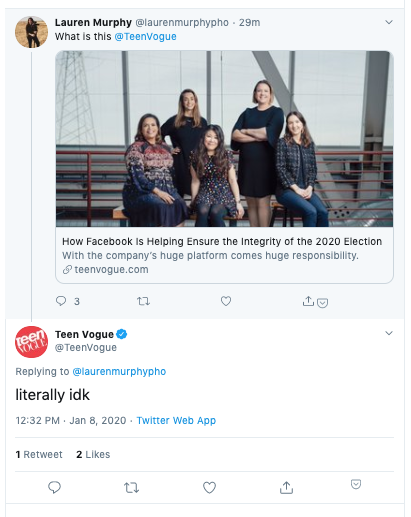
The middle aged social media marketing person, responding in the faux speech of a 14 year old to shrug it all off:
https://pbs.twimg.com/media/ENxrpCCX0AATVYd.png:large
https://pbs.twimg.com/media/ENxrpCCX0AATVYd.png:large
[deleted]
That various people at both Teen Vogue and Facebook don't even know if it was sponsored content or not (and in some cases thought they did) says a lot all on it's own.
No. The issue is they all weren't sure how much truth to admit to, until it went up the chain of command. Decisions like this are hard when you have a web of deceit to navigate.
> But Teen Vogue then added a note saying it was sponsored content, before removing it again. A Facebook spokesperson told Business Insider it wasn’t sponsored content, then finally admitted it was.
Did they let interns run the PR department for a day?
Did they let interns run the PR department for a day?
Suppose the story was marked as sponsored content - what is Facebook's motivation for publishing it in Teen Vogue? Presumably Facebook shouldn't have trouble reaching people. The only sensible explanation is that they had hoped the 'sponsored content' tag would go unnoticed, so that readers would mistakenly attribute the story to Teen Vogue. No matter how you look at it, the aim was deception.
Reminder that only something like 10% of Teen Vogue’s leadership is under 20 years old
I'm assuming you mean *readership rather than leadership? It would be kinda weird if they had even 10% teens as their execs.
But yes, I've also heard it's a bunch of creepy older folks
But yes, I've also heard it's a bunch of creepy older folks
Creepy by virtue of being older than 20?
By virtue of 96% being older than 24? For a magazine called Teen Vogue that's about dating tips and makeup advice for teenagers. Yeah.
While it's not exactly an unbiased source, Wikipedia trusts this citation enough...
https://www.washingtonexaminer.com/opinion/teen-vogue-promot...
While it's not exactly an unbiased source, Wikipedia trusts this citation enough...
https://www.washingtonexaminer.com/opinion/teen-vogue-promot...
Lol yes I did mean readership. Typed that on my phone, appreciate the correction
[deleted]
Is it possible that it was an A/B test with one variant showing the "sponsored content" byline, and the other hiding it?
I'm remembering the Stanford study in 2016 that showed 4 out of 5 middle school students weren't able to distinguish sponsored content from the publication's own content.
Maybe an enterprising Teen Vogue marketer decided to push that number up to 5 out of 5.
https://ed.stanford.edu/news/stanford-researchers-find-stude...
I'm remembering the Stanford study in 2016 that showed 4 out of 5 middle school students weren't able to distinguish sponsored content from the publication's own content.
Maybe an enterprising Teen Vogue marketer decided to push that number up to 5 out of 5.
https://ed.stanford.edu/news/stanford-researchers-find-stude...
Outside my circle, but it just strikes me odd that Teen Vogue would have an article of this type.
Shouldn't Teen Vogue be about teenage fashion stuff? Isn't Facebook the 'old people' platform? Would real teens care?
Shouldn't Teen Vogue be about teenage fashion stuff? Isn't Facebook the 'old people' platform? Would real teens care?
The fashion stuff stopped selling so they pivoted to include more political content, which found success.
https://www.theatlantic.com/entertainment/archive/2016/12/te...
https://www.theatlantic.com/entertainment/archive/2016/12/te...
> Shouldn't Teen Vogue be about teenage fashion stuff? Isn't Facebook the 'old people' platform? Would real teens care?
Teen Vogue has been noted (quantitatively, and in some circles qualitatively as well) for its social and political coverage for several years. Yes, real teens care.
Teen Vogue has been noted (quantitatively, and in some circles qualitatively as well) for its social and political coverage for several years. Yes, real teens care.
Women's careers are interesting to teen girls. This was a "women in business" puff piece.
To get with the times, Teen Vogue recently pivoted from fashion to wokeness.
Is it a pivot, or is wokeness an element of fashion in the demographic it targets?
Bingo. Even the fashion is a signaling medium for wokeness now.
"Literally IDK"
snicker I got a kick out of that response.
[deleted]
[deleted]
FisDugthop(1)
That's the way submarine articles are written and the way a CMS works these days, no surprise to most of the people here I assume, but I still find it surprising that CMS vendors sell systems that have minimal friction required to publish something. You don't quite need an air-gapped multi-key cryptographically secure system, but a few checks by various parties that articles have been copy-edited, fact-checked, verified for browser support and accessibility, and approved by an editor would seem to alleviate a lot of embarrassing publication errors.