Apple’s Mistake (2009)(paulgraham.com)
paulgraham.com
Apple’s Mistake (2009)
http://www.paulgraham.com/apple.html
268 comments
I agree - clumsy is a great way to describe their approach. In my many negative experiences with the review process, I never got the sense that there was evil intent. In the end, it's clear the business as a whole doesn't care about third-party developers - they fulfilled their goals of commoditizing their complements and rode that wave to enduring success.
I do wonder how many amazing products and companies never got started or failed because of their fickle and Kafkaesque review process and their 15-30% revenue cut. For me personally, I've had to nix several business ideas and product features because it was too dependent on Apple's whims.
But that's just Apple being Apple. What really blows my mind is how Google blindly followed Apple. Google could have carved out such a valuable market. No developer fees! Clear and consistent review process! No taking 30%! Instead they blindly walked into the ditch with Apple. Talk about a lack of vision...
I do wonder how many amazing products and companies never got started or failed because of their fickle and Kafkaesque review process and their 15-30% revenue cut. For me personally, I've had to nix several business ideas and product features because it was too dependent on Apple's whims.
But that's just Apple being Apple. What really blows my mind is how Google blindly followed Apple. Google could have carved out such a valuable market. No developer fees! Clear and consistent review process! No taking 30%! Instead they blindly walked into the ditch with Apple. Talk about a lack of vision...
I worked for Google at the time of the Fortnite fiasco and challenged the company on why we didn’t use our “beyond status quo” spirit to innovate the business model. It got raised to the top of our all hands dory and the Play store director had to come on stage to address the question. Scripted response. Scheduled a follow up 1:1 through his admin. Sat in a room for 30 minutes while he fed me bullshit. Walked away convinced Google culture is dead. No longer work at Google
Funny, I had much the same experience over ten years ago!
Google had an internal product called GoogleBase that was a huge "database" of "all products" based on Bigtable. Unfortunately, the whole thing had been misrepresented by the original managers, who moved to another project, and the dozens of engineers on the project were all struggling.
I asked Larry Page about this at a meeting, and he said, "We'll get back to you" and someone did and I responded, but there was no feedback, and eventually, a hundred person years later, it was all cancelled.
It was stressful for me and unproductive.
Google had an internal product called GoogleBase that was a huge "database" of "all products" based on Bigtable. Unfortunately, the whole thing had been misrepresented by the original managers, who moved to another project, and the dozens of engineers on the project were all struggling.
I asked Larry Page about this at a meeting, and he said, "We'll get back to you" and someone did and I responded, but there was no feedback, and eventually, a hundred person years later, it was all cancelled.
It was stressful for me and unproductive.
Thanks for trying.
Difficult to change a business model if it's working quite well (financially). Long-term thinking and short-term bonus payments don't align.
Kudos for your decision to leave.
Difficult to change a business model if it's working quite well (financially). Long-term thinking and short-term bonus payments don't align.
Kudos for your decision to leave.
Yes, sadly. Google is operating on a “what can we get away with?” attitude vs a “what is possible?” one. No single 3P has power to change the system.
Just curious, what does 3P stand for?
I figured there must be sensible people within Google trying to fight the good fight. On the surface, it makes business sense to follow the status quo. But I wonder if that's true for the long term. Wouldn't the Android platform be worth a lot more if they gave developers freedom to explore different strategies and business models? What if we could get proper demos? What if we could properly interact with our customers and do things like easily issue refunds? I don't know, maybe I'm way off, but I always thought that Play Store revenue should be a lot higher than it is now if Google exhibited some leadership.
Google doesn’t care about Android’s experience or the Play Store. It came out in the Oracle lawsuit that Android had only made Google around $25 billion in profit during its existence. Android was already the dominant platform around then. Apple makes more from Google in mobile by Google paying it to be the default search engine than Google makes from Android.
Android is only a defensive play for Google not a profit center
Android is only a defensive play for Google not a profit center
> only $25 billion in profit
Surely there must be a typo in one of these words? I can’t imagine 25 humongous ones being loose change for any business.
Surely there must be a typo in one of these words? I can’t imagine 25 humongous ones being loose change for any business.
For a company the size of Google making $22 billion on a product from 2010 to 2016 is a nothingburger.
https://www.engadget.com/2016-01-21-android-22-billion-in-pr...
This is their total net income between 2010 and 2016.
https://www.macrotrends.net/stocks/charts/GOOG/alphabet/net-...
They pay Apple a reported $18 billion a year to be the default search engine on Apple devices.
https://www.engadget.com/2016-01-21-android-22-billion-in-pr...
This is their total net income between 2010 and 2016.
https://www.macrotrends.net/stocks/charts/GOOG/alphabet/net-...
They pay Apple a reported $18 billion a year to be the default search engine on Apple devices.
It's a single-digit percentage of what ads make, without much room for growth. I doubt it's a single-digit percentage of technical effort.
Please mark this as accepted answer.
> Wouldn't the Android platform be worth a lot more if they gave developers freedom to explore different strategies and business models?
Say Google does the right thing. Enables great apps, charges 4% instead of 30%, everything goes well.
What does Apple do in response? If they do nothing, Android eats their market share. That's kind of the point, isn't it?
But that means they can't do nothing. They'd have to respond in kind; do the right thing too. Which means it's not a competitive advantage for Google. All they do is lose the 30% they're getting right now.
Even worse if Apple is foolish and the move actually succeeds, because then Android gets a real monopoly instead of this duopoly fig leaf they each use to claim they have competition.
This why duopolies are just as bad as monopolies if not worse. We need real competition and barriers to entry low enough that someone without a vested interest in the status quo can actually enter the market.
Say Google does the right thing. Enables great apps, charges 4% instead of 30%, everything goes well.
What does Apple do in response? If they do nothing, Android eats their market share. That's kind of the point, isn't it?
But that means they can't do nothing. They'd have to respond in kind; do the right thing too. Which means it's not a competitive advantage for Google. All they do is lose the 30% they're getting right now.
Even worse if Apple is foolish and the move actually succeeds, because then Android gets a real monopoly instead of this duopoly fig leaf they each use to claim they have competition.
This why duopolies are just as bad as monopolies if not worse. We need real competition and barriers to entry low enough that someone without a vested interest in the status quo can actually enter the market.
I dont think the solution is to drop the fee to 4%. My pushback on the Play execs was that we need something unique, that seems fair and recognizes the value that 3rd party and the platforms provide. The 30 / 70 is simple and clean but its not “good” or “fair”. It doesnt mean you cant capture say 20% of app revenue in a way that is good and fair
That’s true, but it would help Google get out from Apple’s shadow on mobile. From a strategic perspective, you want your competitor being forced to make moves because of your actions. Then you get to dictate the next few steps. But for any of that to matter, you have to view mobile as more than another ad platform, which Google doesn’t seem to.
If Google went to 4% and Apple stayed at 30%, a lot of people would still be buying iPhones and not caring.
Developers would care. For many that difference would double their margins, or quintuple them. People would make apps for Android that didn't exist on iOS, or make them for Android first, or spend more time on the Android version and make it better.
Yes, but consumers of the phones themselves? Anecdotally, I haven't paid money for an app in...5 years or so. So the free apps would still be around, and I guess candycrush and such would get to Android before iPhone, and will be better on Android, but that really isn't going to affect me.
I guess the question is how many phone consumers buy apps (or pay for content in those apps)? And if paid app availability improved (or got worse for their platform), would that affect the next phone they bought.
I guess the question is how many phone consumers buy apps (or pay for content in those apps)? And if paid app availability improved (or got worse for their platform), would that affect the next phone they bought.
> Wouldn't the Android platform be worth a lot more if they gave developers freedom to explore different strategies and business models
Android as a platform is completely at odds with Google as a business, and will continue to be so as long as Google's is only revenue stream is online advertising.
Android as a platform is completely at odds with Google as a business, and will continue to be so as long as Google's is only revenue stream is online advertising.
Ultimately, you ran into reality: That no matter what story these companies sell you on their mission, a 30% profit margin is a 30% profit margin, and not a single person is going to stand in the way of that much profit.
The honest truth is Google culture never existed, they just had most people fooled for a long time.
The honest truth is Google culture never existed, they just had most people fooled for a long time.
I've not dug into it, but explanations I've read that claim they kinda did have a culture until they reverse-acquired themselves with the DoubleClick purchase have some ring of truth, just from my casual external observation over the company's lifespan. It lines up (c. 2008) with some other things—inline ads going full-evil, the search engine anti-spam efforts evidently drying up (or, at least, entirely failing from then on despite whatever effort they were making), et c.
There's a difference between the informal culture of rank and file employees, how they see themselves and their peers, and the upper management. Culture at the bottom can get diluted by hiring too rapidly and a high degree of churn, which doesn't yield sufficient time for new hires to be assimilated into culture, gradually weakening it.
But at the top, for a public company, the only culture that truly exists is the next quarterly report. Once you're on the "must show XX% quarterly growth" treadmill, your decisions will be dictated by strategies to further that. Unless you have a crazy person at the top willing to burn money and investor sentiment (e.g. Elon Musk, Zuckerberg, Jobs. Google doesn't have crazy founders running it anymore, which is why Google Bets are kind of a joke, and why the company continually kills stuff that you need to be in the long hall for to make a success (e.g. gaming studios, red studios -- they finally got a hit Cobra Kai -- and killed it, etc)
That's why some of the earlier comments about understanding Apple's App Store behavior as "good intentioned" is off. That MAY have been the original reason behind Jobs wanting it, to gate keep the platform and protect brand image and quality, but it is NOT the reason for charging high fees today.
Apple made $72 billion on App Store revenue in 2020. Their total revenue was $274 billion, so 26% of all revenue came from the App Store. That is the reason for the inertia in keeping the Store exactly the way it is.
The App Store's purported benefits to the platform: security, quality, etc could all be maintained for a fraction of that. Apple is not spending $72 billion a year on store maintenance. It's very clear this is about money, not high minded principle.
But at the top, for a public company, the only culture that truly exists is the next quarterly report. Once you're on the "must show XX% quarterly growth" treadmill, your decisions will be dictated by strategies to further that. Unless you have a crazy person at the top willing to burn money and investor sentiment (e.g. Elon Musk, Zuckerberg, Jobs. Google doesn't have crazy founders running it anymore, which is why Google Bets are kind of a joke, and why the company continually kills stuff that you need to be in the long hall for to make a success (e.g. gaming studios, red studios -- they finally got a hit Cobra Kai -- and killed it, etc)
That's why some of the earlier comments about understanding Apple's App Store behavior as "good intentioned" is off. That MAY have been the original reason behind Jobs wanting it, to gate keep the platform and protect brand image and quality, but it is NOT the reason for charging high fees today.
Apple made $72 billion on App Store revenue in 2020. Their total revenue was $274 billion, so 26% of all revenue came from the App Store. That is the reason for the inertia in keeping the Store exactly the way it is.
The App Store's purported benefits to the platform: security, quality, etc could all be maintained for a fraction of that. Apple is not spending $72 billion a year on store maintenance. It's very clear this is about money, not high minded principle.
Elsewhere in this thread, someone has suggested that Android makes up a fairly small percentage of Google’s net income. Does that have any bearing on this analysis?
This is a good point. A project within Google that doesn’t move the needle next to it’s search advertising business should not be _driven_ by profit margin. However there are a few reasons why I think this happened within Google Play:
1. Lots of pressure for google products and services to become standalone businesses
2. Too much imbalance of power between business teams and engineering teams within Google Play. The business teams just saw it as copycat App Store and the engineers and product leads didn’t have the influence to overturn this. In some ways this is against what the broader Google culture was thought to have. (Eng/prod > bd).
3. Androids existence as a defense and not as an opportunity to create the future. Android has always been this and it’s engrained culturally.
1. Lots of pressure for google products and services to become standalone businesses
2. Too much imbalance of power between business teams and engineering teams within Google Play. The business teams just saw it as copycat App Store and the engineers and product leads didn’t have the influence to overturn this. In some ways this is against what the broader Google culture was thought to have. (Eng/prod > bd).
3. Androids existence as a defense and not as an opportunity to create the future. Android has always been this and it’s engrained culturally.
There are ways to lie with statistics, but the Play Store is a huge cash cow. I play a mobile game where thousands of players at least have spent more than a car in in-app purchase transactions. Someone told me if you're spending less than $1,000 they consider you free to play. One of the key items for high level play you can only unlock after spending $12,000 on an account.
Imagine if Ford could make 30% profit on selling cars, and didn't even have to manufacture the car.
Fortnite alone is worth hundreds of millions to Google. There's a reason they're willing to compromise any supposed principles they had over it.
Then there are additional effects, like how their control over the Play Store impacts their advertising opportunities on Android.
Imagine if Ford could make 30% profit on selling cars, and didn't even have to manufacture the car.
Fortnite alone is worth hundreds of millions to Google. There's a reason they're willing to compromise any supposed principles they had over it.
Then there are additional effects, like how their control over the Play Store impacts their advertising opportunities on Android.
If someone, like I was, is curious what a ”dory” is in this context, I believe this is it: https://en.wikipedia.org/wiki/Google_Moderator
Sorry about using that terminology!
> Sat in a room for 30 minutes while he fed me bullshit. Walked away convinced Google culture is dead.
I bet you a dollar his bonus is directly, or indirectly tied to Play store revenue. Companies destroy themselves from the inside due to misaligned personal vs. organizational incentives.
I bet you a dollar his bonus is directly, or indirectly tied to Play store revenue. Companies destroy themselves from the inside due to misaligned personal vs. organizational incentives.
We call it a ditch, Google execs call it good returns.
Yep, Google completely ignored why platforms like the PC beat the Macintosh to begin with
Isn’t Android the same Pyrrhic victory that Windows was for PC Makers? All of the market share but none of the profit? No PC maker is making any real money selling PCs just like no Android manufactures are making real money.
At least MS made some decent money on Windows. Google has to pay its competitor Apple more than it makes on Android if you extrapolate what came out during the Oracle lawsuit.
At least MS made some decent money on Windows. Google has to pay its competitor Apple more than it makes on Android if you extrapolate what came out during the Oracle lawsuit.
Did they though? Apple is today by far the most profitable computer manufacturer.
The use of Google Play is at least not mandatory. You can fully DIY your app distribution if you feel like it.
> too dependent on Apple's whims
so why not just make a web app?
so why not just make a web app?
Web apps cannot use certain features, eg. Bluetooth, and it will for sure be less user-friendly and responsive than a native app.
Bluetooth? I don't have any apps that use that.
Steve Jobs treated 3rd party software on "his devices" as a necessary inconvenience.
That only explains Apple's approach until Tim Cook became CEO. They've had more than a decade to evolve behind that mindset. The iPhone is more than 5x older now than it was when PG wrote this article. Jobs can't be blamed for much anymore. If Apple is still stuck in his vision of apps on iOS, that's on them now.
That only explains Apple's approach until Tim Cook became CEO. They've had more than a decade to evolve behind that mindset. The iPhone is more than 5x older now than it was when PG wrote this article. Jobs can't be blamed for much anymore. If Apple is still stuck in his vision of apps on iOS, that's on them now.
> That only explains Apple's approach until Tim Cook became CEO.
Jobs’ decisions (if not necessarily his decision making process) are very much part of the company’s DNA, pretty much all the executives remain Jobsian picks.
Plus it’s hardly been a failure in the market, and it’s not like direct competitors are disrupting the status quo, so from a business perspective what’s the incentive to change?
> The iPhone is more than 5x older now than it was when PG wrote this article.
And it’s never been more successful. Apple’s market cap’s grown by more than an order of magnitude since that essay.
Jobs’ decisions (if not necessarily his decision making process) are very much part of the company’s DNA, pretty much all the executives remain Jobsian picks.
Plus it’s hardly been a failure in the market, and it’s not like direct competitors are disrupting the status quo, so from a business perspective what’s the incentive to change?
> The iPhone is more than 5x older now than it was when PG wrote this article.
And it’s never been more successful. Apple’s market cap’s grown by more than an order of magnitude since that essay.
> Clumsy is the word that comes to mind with regard to their handling of the AppStore. I see little or no evil intent
The emails between Steve, Eddy and Phil seem to say differently. https://9to5mac.com/2020/07/30/internal-emails-show-how-an-a...
The emails between Steve, Eddy and Phil seem to say differently. https://9to5mac.com/2020/07/30/internal-emails-show-how-an-a...
I'm an Android app developer. But, naturally, I have some insight into what my iOS colleagues do.
Every iOS developer I know views the app store as an asinine hurdle that they have to clear, standing between them and their users. They never see it as something helpful. They certainly never see it anything like the way Apple's marketing portrays it. The process of releasing an update is stressful because you just never know whether they'll reject your app over something minor that you consider perfectly normal or even intentional.
Oh, you fixed a critical bug? Too bad, we've typed the word "sex" into the search field and turned the safe search off, and naked people came up. You have to change your ToS to disallow that for us to consider approving your update.
Every iOS developer I know views the app store as an asinine hurdle that they have to clear, standing between them and their users. They never see it as something helpful. They certainly never see it anything like the way Apple's marketing portrays it. The process of releasing an update is stressful because you just never know whether they'll reject your app over something minor that you consider perfectly normal or even intentional.
Oh, you fixed a critical bug? Too bad, we've typed the word "sex" into the search field and turned the safe search off, and naked people came up. You have to change your ToS to disallow that for us to consider approving your update.
> My impression is that Steve Jobs treated 3rd party software on "his devices" as a necessary inconvenience. He preferred the software he had a hand in, the software developed in house.
I'd say this is the struggle of every big firm. I like and contribute to open source, but I will almost always prefer whatever is built in house because the ease to influencing it's development to satisfy my needs is orders of magnitude smaller. Secondarily, when we build software outside of our host domain (as a business) it breeds innovation.
Thanks for layering some context on top of PGs thoughts.
I'd say this is the struggle of every big firm. I like and contribute to open source, but I will almost always prefer whatever is built in house because the ease to influencing it's development to satisfy my needs is orders of magnitude smaller. Secondarily, when we build software outside of our host domain (as a business) it breeds innovation.
Thanks for layering some context on top of PGs thoughts.
That's a very... generous take.
On my 1st London iPhone dev meetup there was a single representative from Apple: a biz dev guy! He asked a single question, when I commented the review process is annoying (compared to anything we had back then).
So, in retrospect, Apple encircled the whole ecosystem from the get go and wanted 120% of all the money that could be extracted. And they executed on it rather flawlessly.
On my 1st London iPhone dev meetup there was a single representative from Apple: a biz dev guy! He asked a single question, when I commented the review process is annoying (compared to anything we had back then).
So, in retrospect, Apple encircled the whole ecosystem from the get go and wanted 120% of all the money that could be extracted. And they executed on it rather flawlessly.
What's the difference between evil and negligent clumsiness?
Intent? Someone who’s evil probably can’t be convinced what they are doing is harmful, since they did it out of greed and selfishness. Someone who’s just incompetent can get better.
Not that I think apple falls particularly in either category but there’s a difference, the ability to realize and change.
Not that I think apple falls particularly in either category but there’s a difference, the ability to realize and change.
You snuck the word negligent in there
I did, and that's why I don't think intent is a difference. It's malicious compliance which does have intent, imho.
For the party on the receiving end, maybe nothing.
Intent.
I partially agree, evil is such a hyperbolic word. However, Apple and its rank and file during the Steve Jobs era believed 3rd party developers to be rather incompetent, and 3rd party software could never live up to the beauty that Apple itself could create. (I also worked at Apple)
If it somehow proved Steve Jobs wrong and some indie company made popular beautiful software, Apple would bend over backward to acquihire them, sell off (read. kill) the product, and get them making beautiful software for Apple. Of course, back then, it was a dream for so many to get noticed by Apple and end up working there.
Don't try to minimize the bad faith moves from Apple by calling them "clumsy". SJ (and proved through documents released from the Epic trial) absolutely treated everything as a zero-sum game and was exceedingly ruthless in getting what he wanted. On the one hand, yes, the iPhone App Store was just an expansion of the iTunes/iPod platform they had started and found worked well. Yes, it also simplified, what at the time, was an insanely complex web of mobile app markets that carriers themselves didn't truly understand the potential of. All would have been fine if they approached it with an open mind and listened to feedback.
The main issue and feelings of "evilness" that so many people express about Apple, is that they so quickly used the App Store process as a weapon against anything that showed signs of stealing market share away from them. For example, around the start of the iPad, so many interesting book store startups launched, (ie. comic books, out of print books, etc.) and I loved it. However, SJ wanted his iBooks platform and through draconian changes in App Store policy, shut them all down over night. Sorry, but there's nothing clumsy about that that. It was very intentional, and very much directed at Amazon's Kindle, regardless of who got hurt along the way.
Developers tried, repeatedly, to give feedback about ways to improve the App Store, time and time again. Instead, Apple closed feedback forums, canceled Q&As at WWDC, and followed up with more App Store policies against speaking out and essentially made it a privilege to work with them.
I loved woking there, I really did, but we shouldn't minimize these feelings of evilness that so many developers express. Their intuitions are right and they deserve to get as much visibility for their pain as possible. Keep in mind that essay was coming from the perspective of a VC who was dealing with a lot of his startups struggling with the App Store and him trying to get Apple to listen. If that meant being dramatic with words like Evil, so be it, but in the end, surprise, it didn't really do anything heh.
If it somehow proved Steve Jobs wrong and some indie company made popular beautiful software, Apple would bend over backward to acquihire them, sell off (read. kill) the product, and get them making beautiful software for Apple. Of course, back then, it was a dream for so many to get noticed by Apple and end up working there.
Don't try to minimize the bad faith moves from Apple by calling them "clumsy". SJ (and proved through documents released from the Epic trial) absolutely treated everything as a zero-sum game and was exceedingly ruthless in getting what he wanted. On the one hand, yes, the iPhone App Store was just an expansion of the iTunes/iPod platform they had started and found worked well. Yes, it also simplified, what at the time, was an insanely complex web of mobile app markets that carriers themselves didn't truly understand the potential of. All would have been fine if they approached it with an open mind and listened to feedback.
The main issue and feelings of "evilness" that so many people express about Apple, is that they so quickly used the App Store process as a weapon against anything that showed signs of stealing market share away from them. For example, around the start of the iPad, so many interesting book store startups launched, (ie. comic books, out of print books, etc.) and I loved it. However, SJ wanted his iBooks platform and through draconian changes in App Store policy, shut them all down over night. Sorry, but there's nothing clumsy about that that. It was very intentional, and very much directed at Amazon's Kindle, regardless of who got hurt along the way.
Developers tried, repeatedly, to give feedback about ways to improve the App Store, time and time again. Instead, Apple closed feedback forums, canceled Q&As at WWDC, and followed up with more App Store policies against speaking out and essentially made it a privilege to work with them.
I loved woking there, I really did, but we shouldn't minimize these feelings of evilness that so many developers express. Their intuitions are right and they deserve to get as much visibility for their pain as possible. Keep in mind that essay was coming from the perspective of a VC who was dealing with a lot of his startups struggling with the App Store and him trying to get Apple to listen. If that meant being dramatic with words like Evil, so be it, but in the end, surprise, it didn't really do anything heh.
> My impression is that Steve Jobs treated 3rd party software on "his devices" as a necessary inconvenience.
That feels "evil" pretty fast, for someone trying to get his software published. Software that only works on their platform, that you could only develop with hardware they supplied.
That feels "evil" pretty fast, for someone trying to get his software published. Software that only works on their platform, that you could only develop with hardware they supplied.
>I see little or no evil intent
Evil in its absolute form rarely exist.
Most evil are created by those who think themselves as so righteous.
My definition of evil includes hypocrisy.
Most of these so called "clumsiness" has been here for years. Most of the current strategy of services revenue growth started in 2014. We are coming close to a whole decade. I think we have given enough benefits of doubt to Apple.
I have been suspicious of Google even in 2005 when they started building their own browser, it took the whole world 10+ years to turn their view from media darling to privacy invading company.
Evil in its absolute form rarely exist.
Most evil are created by those who think themselves as so righteous.
My definition of evil includes hypocrisy.
Most of these so called "clumsiness" has been here for years. Most of the current strategy of services revenue growth started in 2014. We are coming close to a whole decade. I think we have given enough benefits of doubt to Apple.
I have been suspicious of Google even in 2005 when they started building their own browser, it took the whole world 10+ years to turn their view from media darling to privacy invading company.
(caveat: i too worked there) i think what you wrote matches my experience, is basically perfectly said.
On the other hand, their Windows software is universally bad. The ending of Safari for Windows probably means they recognize this to some extent. My guess is they rely heavily on the quality of their libraries and tooling to make good software on OS X and iOS, and they struggle on Windows since it's an alien world.
So maybe it's accurate to say they do understand tooling, and that negates the need to understand software as long as they stick to a world they control.
So maybe it's accurate to say they do understand tooling, and that negates the need to understand software as long as they stick to a world they control.
Even on osx. Pages is bad. Numbers is bad. Calendar is bad. AppStore is slow and cumbersome.
Safari is quite ok.
Safari is quite ok.
MacOS' "productivity" software is my favorite I know of. I'd have to go back to historical (10+ years old) versions of similar products to find ones I like better. Their quality is excellent. They're light on resources (I can forget them in the background), quick to launch, do everything I need (even collaborative editing), and have good-enough templates for most stuff I'd want to do. Preview is best-in-class, as far as I know. Finder may not be amazing but it also crashes ~never (which isn't impressive compared to Windows Explorer but is compared to some, ahem, other platforms) and is lightweight. The calculator is great (and I miss a couple very minor, but thoughtful, UX things about it when I use others). Digital Color Meter is awesome. I wish Notes had export and supported Markdown input, but how smoothly and sanely it handles things like embedding files, and how stable it is and the reliability/speed of sync between devices, makes it pretty damn good anyway. The email reader's stuck at some kind of local maximum like nearly all other email clients, but it's good enough.
The 1st-party software quality is a big part of what keeps me around. Possibly the main thing.
[EDIT] Oh, and the Terminal is one of the best there is. It's very good. Others may have more features, but it's far from minimal, yet manages to have lower input latency than most (which tells me Apple's got their priorities straight)
The 1st-party software quality is a big part of what keeps me around. Possibly the main thing.
[EDIT] Oh, and the Terminal is one of the best there is. It's very good. Others may have more features, but it's far from minimal, yet manages to have lower input latency than most (which tells me Apple's got their priorities straight)
I largely agree. Keynote became a bit bland compared to the competition, but I love working in former iWork apps (especially since they've added no-frills support for equations), Terminal, Preview, etc.
The only thing that I loved, but has become slow and buggy is Grapher. Grapher is a hidden gem, very few applications come close for quickly visualizing a function.
The only thing that I loved, but has become slow and buggy is Grapher. Grapher is a hidden gem, very few applications come close for quickly visualizing a function.
Whoa, there's one I didn't know about.
I should probably take the time to RTFM for that stuff, after more than a decade on the platform. Every time I find another little Apple utility, I end up getting something out of it.
I should probably take the time to RTFM for that stuff, after more than a decade on the platform. Every time I find another little Apple utility, I end up getting something out of it.
Yeah, it's definitely worth poking around in Applications and its sub-folders to find out what the heck is on the computer already. Lots of hidden gems.
It's a case where not having something like the old-school hierarchical Windows Start Menu with its delightful "accessories" section, is unfortunate. Takes a little more digging to find the fun stuff (and even there, Windows hides/hid some cool utilities, especially system-config stuff, so you're unlikely to find them unless you know the name)
Utilities is kind of the equivalent of the Windows Accessories section.
I enjoy Apple's Image Capture with my Epson scanner as well.
And Music. It's a travesty the degree of a downgrade Apples' users experienced going from iTunes to Music. The desktop app (and web app, which seems to be some level of an identical codebase) is so bad it borderlines unusable.
And Xcode. It's always been bad. Messages on Mac? An embarrassment which gets worse with every MacOS update. Spotlight? A meme-level failure of a software product, which can single-handedly consume hours of CPU time to "index" files after every update, then fail to find an application, not even some crazy-hidden file, matching an exact string text search.
Safari is ok, but in the scope of how reliably fantastic modern browsers are, it's still the worst. Not just in standards support & standards correctness, but the application itself.
And Xcode. It's always been bad. Messages on Mac? An embarrassment which gets worse with every MacOS update. Spotlight? A meme-level failure of a software product, which can single-handedly consume hours of CPU time to "index" files after every update, then fail to find an application, not even some crazy-hidden file, matching an exact string text search.
Safari is ok, but in the scope of how reliably fantastic modern browsers are, it's still the worst. Not just in standards support & standards correctness, but the application itself.
> And Music. It's a travesty the degree of a downgrade Apples' users experienced going from iTunes to Music. The desktop app (and web app, which seems to be some level of an identical codebase) is so bad it borderlines unusable.
The most impressive part is that itunes was absolute garbage, and music managed to be worse. Quite a feat really.
The most impressive part is that itunes was absolute garbage, and music managed to be worse. Quite a feat really.
I love Numbers and haven’t been able to find an easy and convenient replacement for it since I left macOS :(
It’s blended spreadsheeting with presentation in a free infinite canvas is the best notebook app I’ve met.
It’s blended spreadsheeting with presentation in a free infinite canvas is the best notebook app I’ve met.
Have you tried the web version? I've never used the full OS X version, so I can't compare.
Yes, and it is not bad, but nowhere as smooth as the macOS app.
I quite disagree on Pages, it's a perfect 80% product.
Nothing replaces Excel however - literally nothing.
As has been said before, its the world most widely deployed programing environment.
Nothing replaces Excel however - literally nothing.
As has been said before, its the world most widely deployed programing environment.
Yep. I do X-Y charts like this https://www.dahosek.com/wp-content/uploads/2021/10/NewImage-... with Excel and Numbers doesn't correctly handle gaps in the date sequence or duplicated dates for the vertical lines (unless they've fixed this since I last checked) so I still keep Office around for that and a few other minor UI affordances that I prefer in Word.
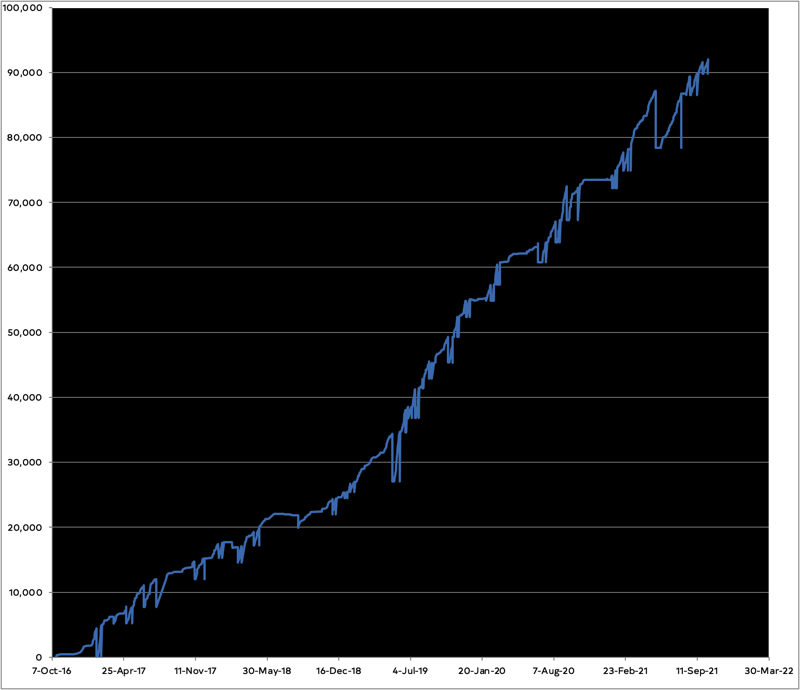
> [Excel is] the world most widely deployed programing environment.
It’s curious to note, then, how utterly peculiar of a programming environment it is: it is a first-order (pre-LAMBDA) purely functional array dataflow language with a sometimes-graphical interface and little to no capacity for any kind of abstraction.
Because of the last point, I would perhaps call it half a programming environment (if programming = make a computer do stuff + assemble simple doings into larger ones, Excel only does the first part). This is alleviated by a clever choice of basic datatype: a two-dimensional array of crufties over which scalar operations (usually) propagate automatically; this affords a rich set of operations that are not so low-level that the absence of abstractions or side effects would be crippling and at the same time not so high-level that you’d have an impulse to drill down into their inner workings and change something. In particular, you can’t store these arrays as elements inside other arrays: the layering is impermeable.
That this is a clever choice of datatype has been noticed elsewhere: witness APL, MATLAB, or even in some sense SQL. Among of all of these, though, Excel is distinguished by how very little it can actually do from a programming perspective (as opposed to a practical perspective or even a primitive-counting perspective). It’s almost like someone sat down and decided to see how little programming functionality a practical tool could contain to still qualify as programming, ditched everything else, then slashed half of the result.
But if it’s a shamelessly minimal programming language (if it qualifies as one at all), it’s quite striking to consider how rich of a programming environment it is. You get intermediate results. You get visual indication of where the values used in the computation came from. You get help for every function as you type it in. You get to change the inputs, or any other detail, and be dropped into an impeccably updated state of your program. You get to see your changes propagate, live, without messing around with REPLs, reloading notebook cells, or restarting hung servers. You get more IDE for your money than CLion and Mathematica combined. On a computer from 1997.
I mean, of course Excel is cheating. If you read papers on “visual programming”, and “differentiable computation”, and “provenance”, and “incremental recompilation”, and all the official names for all that jazz I just described—you’ll see that Excel avoids all the hard problems the academics are struggling with by not having the respective features. (It’s well known that everything gets easier in a purely functional language or without first-class functions, for example.) It even insulates the programmer from the problems of naming and of factoring (and thus avoids having to provide attendant features) by not allowing names or factoring.
Now, I’m not saying that Excel is somehow lacking in features or that it is a pleasant programming environment—it both has a tremendous amount of features and is a pretty miserable programming environment past a very low complexity ceiling. But, for all that is holy, why isn’t everybody trying to figure out how to cheat even harder?
It’s curious to note, then, how utterly peculiar of a programming environment it is: it is a first-order (pre-LAMBDA) purely functional array dataflow language with a sometimes-graphical interface and little to no capacity for any kind of abstraction.
Because of the last point, I would perhaps call it half a programming environment (if programming = make a computer do stuff + assemble simple doings into larger ones, Excel only does the first part). This is alleviated by a clever choice of basic datatype: a two-dimensional array of crufties over which scalar operations (usually) propagate automatically; this affords a rich set of operations that are not so low-level that the absence of abstractions or side effects would be crippling and at the same time not so high-level that you’d have an impulse to drill down into their inner workings and change something. In particular, you can’t store these arrays as elements inside other arrays: the layering is impermeable.
That this is a clever choice of datatype has been noticed elsewhere: witness APL, MATLAB, or even in some sense SQL. Among of all of these, though, Excel is distinguished by how very little it can actually do from a programming perspective (as opposed to a practical perspective or even a primitive-counting perspective). It’s almost like someone sat down and decided to see how little programming functionality a practical tool could contain to still qualify as programming, ditched everything else, then slashed half of the result.
But if it’s a shamelessly minimal programming language (if it qualifies as one at all), it’s quite striking to consider how rich of a programming environment it is. You get intermediate results. You get visual indication of where the values used in the computation came from. You get help for every function as you type it in. You get to change the inputs, or any other detail, and be dropped into an impeccably updated state of your program. You get to see your changes propagate, live, without messing around with REPLs, reloading notebook cells, or restarting hung servers. You get more IDE for your money than CLion and Mathematica combined. On a computer from 1997.
I mean, of course Excel is cheating. If you read papers on “visual programming”, and “differentiable computation”, and “provenance”, and “incremental recompilation”, and all the official names for all that jazz I just described—you’ll see that Excel avoids all the hard problems the academics are struggling with by not having the respective features. (It’s well known that everything gets easier in a purely functional language or without first-class functions, for example.) It even insulates the programmer from the problems of naming and of factoring (and thus avoids having to provide attendant features) by not allowing names or factoring.
Now, I’m not saying that Excel is somehow lacking in features or that it is a pleasant programming environment—it both has a tremendous amount of features and is a pretty miserable programming environment past a very low complexity ceiling. But, for all that is holy, why isn’t everybody trying to figure out how to cheat even harder?
The Excel team is adding support for abstract data types and lambdas. It's currently in the preview release. https://www.microsoft.com/en-us/research/blog/lambda-the-ult...
I realized this with Quicktime 7 and Quicktime X. X is my favorite media player, and yet the experience with 7 on Windows was like a time machine back to the shittiest parts of the 90s.
You thought Quicktime 7 was bad? How about Quicktime 4.0 (released on June 8, 1999)? It took a few versions and a lot of hubris to get Quicktime 4.0 Bad.
http://hallofshame.gp.co.at/qtime.htm
>Interface Hall of Shame - QuickTime 4.0 Player -
http://hallofshame.gp.co.at/qtime.htm
>Interface Hall of Shame - QuickTime 4.0 Player -
Ha ha, that is the shittiest part of the 90's right there.
It served its purpose. Back in 2009, iTunes on Windows was fantastic.
I think that is not a universally agreed upon statement. Checking my receipts, at that time I paid significant money to 3rd parties to sync my iPods to PC without iTunes. It was massively over bloated for what I needed it to do, UI was behind, and once installed it refused to uninstall itself.
(and same continues today. My wife has recognized the sound coming from my office when, every few months , I try to copy photos from my work-mandated iPhone to my windows pc. It's a few hours of screaming, then I give up)
It's tricky. If they don't provide key software for Windows to work with their hardware devices, they'll be blamed for it and called an evil proprietary company (which, fair enough. Just let me plug it as USB storage if you want to avoid that particular reputation :).
On the other hand, if they make their crucial software on Windows half assed, some people like myself at least, will be wary of touching anything Apple with 10ft pole. It May be that working strictly in Apple ecosystem makes for better experience, but that's not my world so I'm not tempted to dip my toes in any more than I have to).
(and same continues today. My wife has recognized the sound coming from my office when, every few months , I try to copy photos from my work-mandated iPhone to my windows pc. It's a few hours of screaming, then I give up)
It's tricky. If they don't provide key software for Windows to work with their hardware devices, they'll be blamed for it and called an evil proprietary company (which, fair enough. Just let me plug it as USB storage if you want to avoid that particular reputation :).
On the other hand, if they make their crucial software on Windows half assed, some people like myself at least, will be wary of touching anything Apple with 10ft pole. It May be that working strictly in Apple ecosystem makes for better experience, but that's not my world so I'm not tempted to dip my toes in any more than I have to).
I tried to use iTunes in 2012(?). iTunes is the most confusing software I have ever used. Maybe it was good in 2009? I wouldn't know.
> Maybe it was good in 2009?
It was not. Though at least it did the job, which was rare enough (then again I’ve had to use sonicstage, now that was some bottom-tier irredeemable garbage).
I’m pretty sure iTunes was at its best when it was SoundJam and got worse every time it got touched afterwards, until Apple managed to declare software bankruptcy… and replace it by something worse than it’d ever been.
It was not. Though at least it did the job, which was rare enough (then again I’ve had to use sonicstage, now that was some bottom-tier irredeemable garbage).
I’m pretty sure iTunes was at its best when it was SoundJam and got worse every time it got touched afterwards, until Apple managed to declare software bankruptcy… and replace it by something worse than it’d ever been.
It wasn't good then either. Still a bloated mess and even worse you were more forced to use it as literally nothing else could do something like put a CBZ in a 3rd party app unless it happened to support Dropbox or something similar. It's just terrible.
[deleted]
Never assume villany where stupidity is sufficient
Clumsy stupidity doesn't make you into the most valuable company in the world.
> Their fundamental problem is that they don't understand software.
then in the same breathe, please tell me who understands it.
then in the same breathe, please tell me who understands it.
That is a direct quote from the article, mandeep, you're gonna have to hassle Paul Graham directly to get a proper answer.
I was pointing to PG himself with my comment, and not the poster.
[deleted]
When this was written I was an Apple fanboy.
These days, as a dev, I really don't trust Apple at all. I would never even think of making a product for any of the Apple platforms. As a freelancer I've stopped taking any iOS/macOS projects too. It's not the 30% but Apple's attitude of controlling their turf like the mafia under pretended moral superiority.
As a user I'm as cynical as I've ever been. I use macOS and Windows on a daily basis, and for dev work I generally prefer macOS over Windows. But I'm always running at least a major macOS version behind and never buy any 1st gen Apple product. I simply expect their stuff to fail in one way or another. I've been bitten way too many times to trust them. Nvidiagate, Radeongate, Yosemite, iPad 3, iPhone 4, etc, the list is very long.
Just weeks ago, my wife's Macbook Air (a 4 year old machine) started having issues with the keyboard and trackpad disconnecting. Apple's authorized repair services* say they want to replace almost all the parts (pretty much excluding the screen) and the repair cost is almost as much as buying a new Air.
* Apple Mexico doesn't really do repairs here like in the US so you're forced to go through one of those services.
Or right now, the Apple TV has been suffering issues with Atmos for the past couple of months. There's a thread in Apple's forums with 14 pages of users complaining which keeps growing even though posts are deleted by the mods constantly.
https://discussions.apple.com/thread/253168177
These days, as a dev, I really don't trust Apple at all. I would never even think of making a product for any of the Apple platforms. As a freelancer I've stopped taking any iOS/macOS projects too. It's not the 30% but Apple's attitude of controlling their turf like the mafia under pretended moral superiority.
As a user I'm as cynical as I've ever been. I use macOS and Windows on a daily basis, and for dev work I generally prefer macOS over Windows. But I'm always running at least a major macOS version behind and never buy any 1st gen Apple product. I simply expect their stuff to fail in one way or another. I've been bitten way too many times to trust them. Nvidiagate, Radeongate, Yosemite, iPad 3, iPhone 4, etc, the list is very long.
Just weeks ago, my wife's Macbook Air (a 4 year old machine) started having issues with the keyboard and trackpad disconnecting. Apple's authorized repair services* say they want to replace almost all the parts (pretty much excluding the screen) and the repair cost is almost as much as buying a new Air.
* Apple Mexico doesn't really do repairs here like in the US so you're forced to go through one of those services.
Or right now, the Apple TV has been suffering issues with Atmos for the past couple of months. There's a thread in Apple's forums with 14 pages of users complaining which keeps growing even though posts are deleted by the mods constantly.
https://discussions.apple.com/thread/253168177
"It's not the 30% but Apple's attitude of controlling their turf like the mafia under pretended moral superiority."
Do you feel the same way with all large consumer corporations or just Apple? Another words, how is Apple different from Microsoft, Google, Amazon, Netflix, or Adobe?
Do you feel the same way with all large consumer corporations or just Apple? Another words, how is Apple different from Microsoft, Google, Amazon, Netflix, or Adobe?
I guess it's a matter of degree, but personally, as a dev, I think it's much worse dealing with Apple than Google or Microsoft.
Adobe... I don't love them either but I don't think they go around waving a moral banner as if they were saving the world.
Netflix I don't know, I'm just an end user and I'm really happy with their service.
Adobe... I don't love them either but I don't think they go around waving a moral banner as if they were saving the world.
Netflix I don't know, I'm just an end user and I'm really happy with their service.
I don't mean this as an excuse, but to a big extent Apple has been so successful with their policies and the propaganda behind why their policies are better for the consumer, that it forces Google/Microsoft to copy them. Many of the things the big tech companies do nowadays was an idea originated and proven at Apple previously.
Edit: sorry, I meant this as a reply to GP question but I'll leave it here.
Edit: sorry, I meant this as a reply to GP question but I'll leave it here.
>but I don't think they go around waving a moral banner as if they were saving the world.
Exactly. That is the big PR difference between Steve Jobs and Tim Cook. That is why forcing out Katie Cotton was a bad idea.
Exactly. That is the big PR difference between Steve Jobs and Tim Cook. That is why forcing out Katie Cotton was a bad idea.
Apple in the US kinda stopped doing repairs. They used to replace screens but now they just give you a new iPhone or iPad.
I don't believe that's true.
Apple has always had a much more wholesale replacement strategy than other manufacturers. Even back in my CompUSA days, when I was the "Mac guy" in the shop, the other techs lamented how much easier my job was. There was a whole range of problems that Apple classified as a full system swap, where someone like HP would have replaced one or two components.
They're still replacing screens, depending on the break. I had a screen replacement last year on my 12. It was just the screen. I believe they're more conservative about screen replacements though, and have a deep enough supply of refurb devices the math might just work out that it's faster/cheaper to just hand the consumer a new device.
Apple has always had a much more wholesale replacement strategy than other manufacturers. Even back in my CompUSA days, when I was the "Mac guy" in the shop, the other techs lamented how much easier my job was. There was a whole range of problems that Apple classified as a full system swap, where someone like HP would have replaced one or two components.
They're still replacing screens, depending on the break. I had a screen replacement last year on my 12. It was just the screen. I believe they're more conservative about screen replacements though, and have a deep enough supply of refurb devices the math might just work out that it's faster/cheaper to just hand the consumer a new device.
I assume at some point, technology becomes so integrated and tiny that it no longer makes sense to do repairs.
By which you mean it makes them more money to sell you a new thing than to make repairs possible.
I had a Mac 512K, and later a Mac SE/30, where I ran A/UX. I would never, ever buy any Apple product, today, under any circumstance.
I had a Mac 512K, and later a Mac SE/30, where I ran A/UX. I would never, ever buy any Apple product, today, under any circumstance.
> 14 pages of users complaining which keeps growing even though posts are deleted by the mods constantly.
Wow. They're still doing that? They were doing the same to hundreds of iMac users with slightly out-of-warranty displays going bad ... 16 years ago.
Wow. They're still doing that? They were doing the same to hundreds of iMac users with slightly out-of-warranty displays going bad ... 16 years ago.
Yep. Same happened with the Radeongate of the 2011 MBP 15''.
I bought an m1 macbook pro not too long ago and I love it. But if I got a job where they offered me a choice between a macbook vs a windows laptop for work purposes, I'd take the windows laptop.
I just find if I need to get work done, PC/Windows is a slightly better option.
I'm personally sympathetic to Graham's points in this 2009 piece. He was prescient about the "bummer" it is to be stuck in a monopolist's monoculture.
But Apple's growth in market value since – from $175B at the end of November 2009, to $2.73T today – at least raises the possibility that Apple wasn't making a "mistake", from the perspective of Apple shareholders, managers, & employees.
Maybe once you've reached a certain powerful 'commanding heights' via other strategy & technology, the optimal enterprise strategy is truly to bully developers, & take their lunch money for yourself.
Still a drag on human progress & welfare, sure.
But Apple's growth in market value since – from $175B at the end of November 2009, to $2.73T today – at least raises the possibility that Apple wasn't making a "mistake", from the perspective of Apple shareholders, managers, & employees.
Maybe once you've reached a certain powerful 'commanding heights' via other strategy & technology, the optimal enterprise strategy is truly to bully developers, & take their lunch money for yourself.
Still a drag on human progress & welfare, sure.
> But Apple's growth in market value since – from $175B at the end of November 2009, to $2.73T today – at least raises the possibility that Apple wasn't making a "mistake" [...] Still a drag on human progress & welfare, sure.
Basically highlighting the issues of capitalism unchecked.
Initially it can be beneficial to society - I'm confident in saying Apple empowered individuals and other companies in the early years through to pretty much around the time this article was written. For all it's flaws it was an overall force of good for society, for humanity... it didn't suddenly stop doing that, but changed focus, and started to erode it.
Over time a market winner, or winners are picked, and then it seems to be just a matter of time until user exploitation starts, without natural pressure to produce the best product, with the best experience, for the user beyond basic tolerability; it slowly devolves into a venture into wealth extraction as the people who originally cared enough about the companies original values either leave, retire or die. Finding ways to lock in users, creating artificial dependence and tricking people into subscriptions are all just optimisations on this path to wealth extraction from the average person.
It sounds a bit conspiracy theorist when I read that back, but it's hard to say it's not true... this just seems to reliably happen to these incumbent corporations.
Basically highlighting the issues of capitalism unchecked.
Initially it can be beneficial to society - I'm confident in saying Apple empowered individuals and other companies in the early years through to pretty much around the time this article was written. For all it's flaws it was an overall force of good for society, for humanity... it didn't suddenly stop doing that, but changed focus, and started to erode it.
Over time a market winner, or winners are picked, and then it seems to be just a matter of time until user exploitation starts, without natural pressure to produce the best product, with the best experience, for the user beyond basic tolerability; it slowly devolves into a venture into wealth extraction as the people who originally cared enough about the companies original values either leave, retire or die. Finding ways to lock in users, creating artificial dependence and tricking people into subscriptions are all just optimisations on this path to wealth extraction from the average person.
It sounds a bit conspiracy theorist when I read that back, but it's hard to say it's not true... this just seems to reliably happen to these incumbent corporations.
> Still a drag on human progress & welfare, sure.
The App Store since 2009 has directly resulted in the creation of Twitter, Instagram, Snapchat, WhatsApp, WeChat etc.
Not sure how you can argue the world hasn't progressed since then.
The App Store since 2009 has directly resulted in the creation of Twitter, Instagram, Snapchat, WhatsApp, WeChat etc.
Not sure how you can argue the world hasn't progressed since then.
Where did I say "the world hasn't progressed since then"? That's a hallucinatory misreading & misrepresentation of my comment.
But also: those successes are attributable to mobile apps in general, not Apple's self-serving policies.
Plausibly, all of these should be possible as zero-install web apps – but as Apple (& others) have started raking in the App Store money, their investment in competitive open web technologies that could match proprietary-platform native-apps has languished.
Further, the App Store's market power is now being used to limit the functionality of such apps – banning competitive payment mechanisms, or entire classes of disfavored speech and content, or product benefits that compete with Apple offerings.
And the App Store plus iOS power is being used to torpedo the business models of Apple competitors – as with the changes in tracking defaults that have kneecapped Facebook revenues, mafia-style.
Does local protection rackets deserve credit for every business that manages to pay, & survive, their shakedown?
But also: those successes are attributable to mobile apps in general, not Apple's self-serving policies.
Plausibly, all of these should be possible as zero-install web apps – but as Apple (& others) have started raking in the App Store money, their investment in competitive open web technologies that could match proprietary-platform native-apps has languished.
Further, the App Store's market power is now being used to limit the functionality of such apps – banning competitive payment mechanisms, or entire classes of disfavored speech and content, or product benefits that compete with Apple offerings.
And the App Store plus iOS power is being used to torpedo the business models of Apple competitors – as with the changes in tracking defaults that have kneecapped Facebook revenues, mafia-style.
Does local protection rackets deserve credit for every business that manages to pay, & survive, their shakedown?
> Plausibly, all of these should be possible as zero-install web apps – but as Apple (& others) have started raking in the App Store money, their investment in competitive open web technologies that could match proprietary-platform native-apps has languished.
Worth noting that this was basically what Jobs offered developers initially and everyone hated it.
Worth noting that this was basically what Jobs offered developers initially and everyone hated it.
Yes, developers wanted more. There were (at least) two paths possible: native apps, & upgrading web capabilities.
It's good some effort was plowed into both, at different timescales!
But currently, the App Store's monopoly/monoculture abuses are retarding progress. The App Store deserves credit not for creating or enabling the social app listed in the ggp – but instead for capturing more of the value of those innovations for AAPL owners & insiders.
It's good some effort was plowed into both, at different timescales!
But currently, the App Store's monopoly/monoculture abuses are retarding progress. The App Store deserves credit not for creating or enabling the social app listed in the ggp – but instead for capturing more of the value of those innovations for AAPL owners & insiders.
> But currently, the App Store's monopoly/monoculture abuses are retarding progress
No evidence of this what so ever.
No evidence of this what so ever.
That’s arguable. Besides the fact that twitter was founded a year before the iphone was even announced, mobile, networked computers we can fit in our pockets drove the creation/adoption of all those things. The app store helped facilitate, sure. But can you really argue they would not have appeared without an app store? What if phones were more like desktops used to be where I can freely install whatever I want from wherever I want? It was that environment that spawned the host of chat apps that preceded twitter and the rest.
These apps / networks have sprung up despite the limitations of the app store.
We have no idea what the present would look like if the app store was more open.
We have no idea what the present would look like if the app store was more open.
I do think human progress and welfare would have been much better off without Twitter and Instagram. I think WhatsApp is basically neutral and I haven't used WeChat or Snapchat so I can't comment on those.
Hopefully that was a joke (?)
If we’re going to talk about “drag on human progress and welfare”, there are much bigger fish to fry in the Tech world than a 30% surcharge by an App Store.
You could start with any social media company and in my opinion, they surpass anything Apple has done as far as a “drag on human progress & welfare”.
You could start with any social media company and in my opinion, they surpass anything Apple has done as far as a “drag on human progress & welfare”.
Whataboutism (https://en.wikipedia.org/wiki/Whataboutism) is pretty boring unless we were specifically trying to create a ranked list of the worst things.
Also, without an explanation of why "in your opinion" "any social media company" is worse, you're just declaring a personal bias - and vaguely, too. (Is social media company Snapchat more destructive than Apple's App Store policies?)
If you have some larger grudge against some specific social media companies, why not write it up, with reasoning & naming names, in an appropriate place? Why only allude to it, to make Apple's destructiveness seem smaller?
Also, without an explanation of why "in your opinion" "any social media company" is worse, you're just declaring a personal bias - and vaguely, too. (Is social media company Snapchat more destructive than Apple's App Store policies?)
If you have some larger grudge against some specific social media companies, why not write it up, with reasoning & naming names, in an appropriate place? Why only allude to it, to make Apple's destructiveness seem smaller?
There are many studies on social media's engagement-at-all-costs effects on individuals and society at large, some performed (with all positive bits socialized) by the social media platforms themselves.[1]
For a balanced view, you could do worse than starting with a search for "social media" on Google Scholar. https://scholar.google.com/scholar?q=google+scholar+social+m...
[1] https://www.washingtonpost.com/technology/2021/09/16/faceboo...
For a balanced view, you could do worse than starting with a search for "social media" on Google Scholar. https://scholar.google.com/scholar?q=google+scholar+social+m...
[1] https://www.washingtonpost.com/technology/2021/09/16/faceboo...
Perhaps, but how is that relevant to a discussion of the destructiveness of Apple's power & policies?
Does it excuse them somehow?
Are you sure App Store dynamics don't, overall, increase the power of the worst social platforms?
Does it excuse them somehow?
Are you sure App Store dynamics don't, overall, increase the power of the worst social platforms?
The parent commenter brought up “drag on human progress and welfare” and keeping the topic to Tech companies I was pointing out there are far worse.
There are studies that show social media causing mental health issues and issues with spreading misinformation, many have shown up here on HN. I was stating my opinion which should be obvious, but maybe it’s not, every comment where you type into a comment text box is an opinion. I don’t have a grudge, just think the contributions to humanity by social media companies are far less than the problems they cause.
The hypocrisy on HN is funny sometimes, many times articles/comments about startups are about monetizing and charging customers more, raising capital, etc. and then for large companies they charge too much and it’s a “drag on human progress and welfare”?
There are studies that show social media causing mental health issues and issues with spreading misinformation, many have shown up here on HN. I was stating my opinion which should be obvious, but maybe it’s not, every comment where you type into a comment text box is an opinion. I don’t have a grudge, just think the contributions to humanity by social media companies are far less than the problems they cause.
The hypocrisy on HN is funny sometimes, many times articles/comments about startups are about monetizing and charging customers more, raising capital, etc. and then for large companies they charge too much and it’s a “drag on human progress and welfare”?
> An organization that wins by exercising power starts to lose the ability to win by doing better work.
Yup. That's more or less what's happening or Oracle right now. They'll profitability soldier on for a while due to the massive amount of legacy servers running Oracle databases at companies all over the world. But, every $BIG_CORP out there has on their roadmap a long-term plan to either drastically reduce their spend on Oracle products, or more often, eliminate it entirely.
Yup. That's more or less what's happening or Oracle right now. They'll profitability soldier on for a while due to the massive amount of legacy servers running Oracle databases at companies all over the world. But, every $BIG_CORP out there has on their roadmap a long-term plan to either drastically reduce their spend on Oracle products, or more often, eliminate it entirely.
> every $BIG_CORP out there has on their roadmap a long-term plan to either drastically reduce their spend on Oracle products, or more often, eliminate it entirely.
You can believe this if you want. But $BIGCORP does not have the same license agreements that you and I see. There is a lot of momentum to stay on Oracle and companies have had decades to migrate away. Some have, most haven't and I think not much is going to change in the next decade.
[] I'm literally telling a coworker we can't do what she wants to do with a Oracle DB server because the license doesn't allow it. Then I get an email from a VP that states we have a special license that does specifically allow it. I'm left wondering how many other companies have special licenses.
You can believe this if you want. But $BIGCORP does not have the same license agreements that you and I see. There is a lot of momentum to stay on Oracle and companies have had decades to migrate away. Some have, most haven't and I think not much is going to change in the next decade.
[] I'm literally telling a coworker we can't do what she wants to do with a Oracle DB server because the license doesn't allow it. Then I get an email from a VP that states we have a special license that does specifically allow it. I'm left wondering how many other companies have special licenses.
I agree that every large corporation that uses Oracle software has a unique license with Oracle.
And every one I’ve heard of considers Oracle a predatory vendor and they want to stop using them.
They do things like charging you per CPU to run Java and even though you only run it on four CPUs you theoretically could run it on your entire VMWare cluster so they charge you for 10,000 CPUs. Which is ridiculous so they’ll give you a unique license for their software and they’ll bundle it all together so it isn’t a la carte anymore so even if you stop using 40% of their software you pay the same amount.
Oracle’s business model seems to me to be to extract every nickel from their customers until they can figure out how to stop using their software. It’s why there are dozens of open source Java distributions now and it’s why things like MariaDB exist.
And every one I’ve heard of considers Oracle a predatory vendor and they want to stop using them.
They do things like charging you per CPU to run Java and even though you only run it on four CPUs you theoretically could run it on your entire VMWare cluster so they charge you for 10,000 CPUs. Which is ridiculous so they’ll give you a unique license for their software and they’ll bundle it all together so it isn’t a la carte anymore so even if you stop using 40% of their software you pay the same amount.
Oracle’s business model seems to me to be to extract every nickel from their customers until they can figure out how to stop using their software. It’s why there are dozens of open source Java distributions now and it’s why things like MariaDB exist.
> And every one I’ve heard of considers Oracle a predatory vendor and they want to stop using them.
Ok, but talk is cheap. If you want to know what people actually want, ignore what they say and pay attention to what they do. Oracle's revenue and net income have been pretty steady for at least the past 5 years. Unless they've found some major new revenue stream, it certainly doesn't look like their customers are leaving in droves.
Ok, but talk is cheap. If you want to know what people actually want, ignore what they say and pay attention to what they do. Oracle's revenue and net income have been pretty steady for at least the past 5 years. Unless they've found some major new revenue stream, it certainly doesn't look like their customers are leaving in droves.
It seems like you’re speaking generally and don’t know just how evil Oracle is as a vendor.
Finding new revenue streams is exactly what Oracle has been doing.
Take just one example - Java. Created in 1995 by SunOS, officially made open source in 2006. Purchased by Oracle in 2009.
Demanded ludicrous runtime licensing fees in 2019.
Want another example? MySQL.
I know first hand of a handful of large cap companies completely shedding themselves of Oracle and have heard of many more that plan to.
Finding new revenue streams is exactly what Oracle has been doing.
Take just one example - Java. Created in 1995 by SunOS, officially made open source in 2006. Purchased by Oracle in 2009.
Demanded ludicrous runtime licensing fees in 2019.
Want another example? MySQL.
I know first hand of a handful of large cap companies completely shedding themselves of Oracle and have heard of many more that plan to.
This has been Oracle's business model forever. The price you pay (off base price that is) is based off off the price they estimate you can pay and what it would cost to migrate off to something else.
Also, they purchase 3rd party applications at a regular basic to make sure new customers/hostages are always coming in the front door.
Also, they purchase 3rd party applications at a regular basic to make sure new customers/hostages are always coming in the front door.
> But, every $BIG_CORP out there has on their roadmap a long-term plan to either drastically reduce their spend on Oracle products, or more often, eliminate it entirely.
Hyperbole much? I guarantee there are plenty of companies doing giant transaction rates happily and stably on their big Oracle.
And plenty of ERP customers who are resigned to staying on their Oracle platform for the foreseeable future, even if only because the competitors are just as greedy shark as Oracle.
Hyperbole much? I guarantee there are plenty of companies doing giant transaction rates happily and stably on their big Oracle.
And plenty of ERP customers who are resigned to staying on their Oracle platform for the foreseeable future, even if only because the competitors are just as greedy shark as Oracle.
It really isn't hyperbole. Ask 10 random CTO's about Oracle, and the majority will tell you they're looking for offramps. It's not just a matter of Oracle being greedy, it's that they are also bullying and difficult to work with. And their licensing rules are one of the circles of hell.
I mean, I'm sure our CTO would tell you they are looking for an offramp.
From time to time we start an initiative to do so (i.e., when there is a new set of executives at a certain level).
However, as the awareness of the actual scope and cost of migrating away becomes clear, the effort is dropped. It's technically possible, but also risky and no one wants to practically pause other development while it occurs -- which makes sense since that would probably be fatal.
From time to time we start an initiative to do so (i.e., when there is a new set of executives at a certain level).
However, as the awareness of the actual scope and cost of migrating away becomes clear, the effort is dropped. It's technically possible, but also risky and no one wants to practically pause other development while it occurs -- which makes sense since that would probably be fatal.
And you know what tends to happen?
Something comes along, that makes it feasible. It might be something surprising. And then, all of the sudden, there's no way to respond - because Oracle the company is so entrenched in the business model of profiting from locked-in customers, that they can't develop a novel response to a novel threat.
Something comes along, that makes it feasible. It might be something surprising. And then, all of the sudden, there's no way to respond - because Oracle the company is so entrenched in the business model of profiting from locked-in customers, that they can't develop a novel response to a novel threat.
Saying that and actually putting in the effort to do it are monumentally different things in some orgs
Unfortunately I think this is a naive take, because it's focused on technical superiority. That's only part of the story.
Companies partner with massive vendors like Oracle and jump through their hoops to remain in support contracts because it enables them to defer some liability and satisfy various regulatory checklists.
Think about a database instability scenario for an online retailer, and consider if you'd rather be the CTO who is to blame for self-hosting, or the CTO who can defer blame onward to the vendor. It's an unfortunate reality in many "enterprise" environments.
Companies partner with massive vendors like Oracle and jump through their hoops to remain in support contracts because it enables them to defer some liability and satisfy various regulatory checklists.
Think about a database instability scenario for an online retailer, and consider if you'd rather be the CTO who is to blame for self-hosting, or the CTO who can defer blame onward to the vendor. It's an unfortunate reality in many "enterprise" environments.
The interesting thing is that it's not a financial question of blame for the CTO, it's a reputation problem.
It's unlikely that even Oracle would pay to make someone whole after a data loss incident. But the reality is that the ability to blame Oracle or another black-box product from some vendor instead of your in-house instance of some open-source project (that no one outside of engineering has heard of) has real career-altering value to stakeholders. Maybe unjustified, but the effect exists nonetheless.
It's unlikely that even Oracle would pay to make someone whole after a data loss incident. But the reality is that the ability to blame Oracle or another black-box product from some vendor instead of your in-house instance of some open-source project (that no one outside of engineering has heard of) has real career-altering value to stakeholders. Maybe unjustified, but the effect exists nonetheless.
sure, there are companies that stay on Oracle, and Oracle the company isn't going away any time soon. But other companies that were on Oracle have moved/are moving away to other enterprise-palatable services (e.g. AWS), and new companies rarely pick Oracle.
Self-hosting is certainly not the only choice nowadays, there are many other companies offering managed databases/other cloud products.
Self-hosting is certainly not the only choice nowadays, there are many other companies offering managed databases/other cloud products.
> every $BIG_CORP out there has on their roadmap a long-term plan to either drastically reduce their spend on Oracle products, or more often, eliminate it entirely.
Oh, I hope you’re right, but am dubious. The F500 (and G500) is wedded to legacy systems, for good reasons, a marriage that even extends to new deployments.
Oh, I hope you’re right, but am dubious. The F500 (and G500) is wedded to legacy systems, for good reasons, a marriage that even extends to new deployments.
Look, it can be right but sometimes the “long term plan” is on the order of a decade or two. “Let’s replace everything” doesn’t happen in a hurry, so it can take a LONG time to shift. I’ve seen projects that are 5 years into approximately 10 year transitions off MongoDB and MySQL in favour of PostgreSQL because everyone is realistic about the available development time to completely reimplement the core product while continuing to build new product features to maintain customer growth and remain fiscally solvent.
That’s more or less what’s happening to VCs as the attention economy dies, people normalize to shovelware apps being copy-paste attention grabbers of little novel utility.
PG is an Apple relative to the majority. His investments create waves in agency of others with or without their informed consent.
The antitrust bill Y com signed onto is to help get “web3” on devices.
True antitrust would be requiring unlocked OS agnostic hardware. We’ll have to settle for VC backed NFT market places, since that is who will flood App Store agnostic OS’s with options.
$BIG_VC has a new metaphor to sell. BOINC2.0!! I mean; web3! They’ll sign up to improve the status quo for them. No need to push for open devices; they’re fine with the OS monopoly.
PG is an Apple relative to the majority. His investments create waves in agency of others with or without their informed consent.
The antitrust bill Y com signed onto is to help get “web3” on devices.
True antitrust would be requiring unlocked OS agnostic hardware. We’ll have to settle for VC backed NFT market places, since that is who will flood App Store agnostic OS’s with options.
$BIG_VC has a new metaphor to sell. BOINC2.0!! I mean; web3! They’ll sign up to improve the status quo for them. No need to push for open devices; they’re fine with the OS monopoly.
You say that, but Oracle hasn't changed in any substantive way in the last 30 years in this regard and they're still insanely profitable. Oracle has the funds to capture key parts of the enterprise ecosystem, so if a new one pops up to replace the Oracle branded product, Oracle will just buy it if Microsoft doesn't first.
Well, as much as the business model is untenable, it lasted 13 years and counting. [0]
The things that have changed aren't strictly upgrades or downgrades. Apple's approval process is much quicker than it was in 2009, but instead of sitting on a bug fix for four weeks, now they reject you with no explanation while 20 other apps doing the same thing Apple is angry about make millions on the store.
>They get away with maltreating developers, in the short term, because they make such great hardware. I just bought a new 27" iMac a couple days ago. It's fabulous. The screen's too shiny, and the disk is surprisingly loud, but it's so beautiful that you can't make yourself care.
I feel the exact same way with the 13" iPad Pro I bought last year. Amazing hardware, but it feels like computing in a straitjacket. Even jailbreaking it only goes so far to fix the underlying problem, which is that playing by Apple's rules is a genuine roadblock to a lot of pro app developers who are accustomed to selling direct-to-consumer.
However, I don't think Apple actually cares. The iPad Pro exists for exactly one kind of customer, and one kind of customer only: professional artists. As far as they're concerned, people who want proper developer tools, the full Adobe or Autodesk suites, or what have you can just give up the touchscreen and cellular modem and buy a Mac.
>With Apple that seems less the case. When you look at the famous 1984 ad now, it's easier to imagine Apple as the dictator on the screen than the woman with the hammer.
...Did Paul Graham consult with Tim Sweeney on #FreeFortnite?
[0] Also, the submission title should probably have a (2009) in it...
The things that have changed aren't strictly upgrades or downgrades. Apple's approval process is much quicker than it was in 2009, but instead of sitting on a bug fix for four weeks, now they reject you with no explanation while 20 other apps doing the same thing Apple is angry about make millions on the store.
>They get away with maltreating developers, in the short term, because they make such great hardware. I just bought a new 27" iMac a couple days ago. It's fabulous. The screen's too shiny, and the disk is surprisingly loud, but it's so beautiful that you can't make yourself care.
I feel the exact same way with the 13" iPad Pro I bought last year. Amazing hardware, but it feels like computing in a straitjacket. Even jailbreaking it only goes so far to fix the underlying problem, which is that playing by Apple's rules is a genuine roadblock to a lot of pro app developers who are accustomed to selling direct-to-consumer.
However, I don't think Apple actually cares. The iPad Pro exists for exactly one kind of customer, and one kind of customer only: professional artists. As far as they're concerned, people who want proper developer tools, the full Adobe or Autodesk suites, or what have you can just give up the touchscreen and cellular modem and buy a Mac.
>With Apple that seems less the case. When you look at the famous 1984 ad now, it's easier to imagine Apple as the dictator on the screen than the woman with the hammer.
...Did Paul Graham consult with Tim Sweeney on #FreeFortnite?
[0] Also, the submission title should probably have a (2009) in it...
> Amazing hardware, but it feels like computing in a straitjacket.
That's precisely what drove me away from apple laptops a few years back and back to linux for my home computing. I was running an (only somewhat) older machine and every update ate more hard drive space and hurt performance. And because apple made it, it was damn near impossible to upgrade either the hard drive or the memory.
But, it is beautiful hardware...
That's precisely what drove me away from apple laptops a few years back and back to linux for my home computing. I was running an (only somewhat) older machine and every update ate more hard drive space and hurt performance. And because apple made it, it was damn near impossible to upgrade either the hard drive or the memory.
But, it is beautiful hardware...
What pg couldn’t predict is that there are still no good alternatives to the Apple ecosystem. For normal people, there’s still only two viable alternatives: MS and Google. Both have their pros and cont, but neither is significantly better than Apple.
Maybe with the coming XR paradigm shift, things will change?
Maybe with the coming XR paradigm shift, things will change?
As an Apple user, I really wish they had competition. I'm a long-time Linux user too, and that ain't competition. I still use Windows a little for work, and personally for gaming, and wow, is that ever not an alternative to what Apple offers. I'm tentatively hopeful for Fuchsia, but 1) It's Google, so will a non-high-effort/high-jank version exist that isn't first and foremost a spying platform? and 2) Android's not all that good and never has been, though to be fair (I suppose) they acquired that.
As it is, when Apple fucks up (which is often!) I survey the "competition" and decide that, no, I don't want to take on four new problems for every one I avoid.
As it is, when Apple fucks up (which is often!) I survey the "competition" and decide that, no, I don't want to take on four new problems for every one I avoid.
I agree and I feel that you’ve summarized the landscape better than I did
I take the state of things as more a strong indictment of the rest of the industry, than Apple's being super-duper awesome. Turns out pretty-good is, like, way better than the rest. :-(
I guess that's what you get with a market of this shape, having very few viable options, all mutually incompatible, plus all tied in with perverse incentives from other parts of their various vertically-integrated behemoth-corporations—even Linux suffers from what sure looks like some fire-and-motion action from Red Hat, I assume aimed at keeping them on top in the support & consulting game. Ubuntu tries something similar off-and-on, but just aren't as good at executing on those plans and have mostly failed.
Really, one of the most remarkable things about Apple is that they do a good job of aligning most of their own incentives with things that provide some kind of significant benefit to users, even if it's arguably only as a side-effect.
I guess that's what you get with a market of this shape, having very few viable options, all mutually incompatible, plus all tied in with perverse incentives from other parts of their various vertically-integrated behemoth-corporations—even Linux suffers from what sure looks like some fire-and-motion action from Red Hat, I assume aimed at keeping them on top in the support & consulting game. Ubuntu tries something similar off-and-on, but just aren't as good at executing on those plans and have mostly failed.
Really, one of the most remarkable things about Apple is that they do a good job of aligning most of their own incentives with things that provide some kind of significant benefit to users, even if it's arguably only as a side-effect.
"Computing in a straitjacket" - this is wonderfully pithy.
Related:
Apple's Mistake (2009) - https://news.ycombinator.com/item?id=7344783 - March 2014 (56 comments)
Apple's Mistake (2009) - https://news.ycombinator.com/item?id=6329991 - Sept 2013 (8 comments)
Apple's Mistake - https://news.ycombinator.com/item?id=1081514 - Jan 2010 (25 comments)
Apple's Mistake - https://news.ycombinator.com/item?id=950751 - Nov 2009 (269 comments)
Apple's Mistake (2009) - https://news.ycombinator.com/item?id=7344783 - March 2014 (56 comments)
Apple's Mistake (2009) - https://news.ycombinator.com/item?id=6329991 - Sept 2013 (8 comments)
Apple's Mistake - https://news.ycombinator.com/item?id=1081514 - Jan 2010 (25 comments)
Apple's Mistake - https://news.ycombinator.com/item?id=950751 - Nov 2009 (269 comments)
So I built a very basic prototype app to explore an idea I had using Flutter (imagine something like a time boxing system where you track how frequently you get distracted). Spent a couple days roughing it out, and then I was able to load it onto my own Android device to start testing. Literally just plugged in my device to my PC, confirm the prompt on the phone, and then `flutter run -d <device_id>`. I also wanted to send it to my brother (who has an iPhone) so he could start playing with it too.
So I had to pay Apple $100 to open a developer account. Then sign a bunch of contracts. Then register an app ID and generate certificates. Then bundle the app and submit it to appstoreconnect. Then wait for a bunch of automated checks to pass and tell me that the app ID is missing entitlements. Then figure out what that even means, attempt to fix the entitlements, and run through the submission again. Then set up testing groups and invite my brother to test the app. Then I have to "submit" the app for approval for testing. And a couple days later finally get approval from Apple so that I can start testing it. And that's the short version; there were a bunch of nonsensical Xcode quirks to deal with.
For context, I've been an iOS developer for a decade, and it still took me the better part of a weekend to get through it all, even though I know exactly what to expect. And this is so one fucking person can try an app for me.
I hate Apple. I don't know how else to put it. I don't think they're evil, I just think they don't give a shit about their developers. Did you know their bug tracker is private? I'll find some weird behavior with, let's say UITableView or something, and spend all day trying to figure out what subtle thing I'm doing wrong using their comically poor documentation. And then somewhere buried in Stack Overflow I'll find someone saying "oh yeah that's a bug in the framework, I submitted a radar 2 years ago". So there's some bug that they know about, and I'm not even allowed to see that. It feels hostile on their part, and it makes me feel hostile on my part. I think Paul Graham was right.
So I had to pay Apple $100 to open a developer account. Then sign a bunch of contracts. Then register an app ID and generate certificates. Then bundle the app and submit it to appstoreconnect. Then wait for a bunch of automated checks to pass and tell me that the app ID is missing entitlements. Then figure out what that even means, attempt to fix the entitlements, and run through the submission again. Then set up testing groups and invite my brother to test the app. Then I have to "submit" the app for approval for testing. And a couple days later finally get approval from Apple so that I can start testing it. And that's the short version; there were a bunch of nonsensical Xcode quirks to deal with.
For context, I've been an iOS developer for a decade, and it still took me the better part of a weekend to get through it all, even though I know exactly what to expect. And this is so one fucking person can try an app for me.
I hate Apple. I don't know how else to put it. I don't think they're evil, I just think they don't give a shit about their developers. Did you know their bug tracker is private? I'll find some weird behavior with, let's say UITableView or something, and spend all day trying to figure out what subtle thing I'm doing wrong using their comically poor documentation. And then somewhere buried in Stack Overflow I'll find someone saying "oh yeah that's a bug in the framework, I submitted a radar 2 years ago". So there's some bug that they know about, and I'm not even allowed to see that. It feels hostile on their part, and it makes me feel hostile on my part. I think Paul Graham was right.
Just wait until you have to manually type "what's new" in each release in each different language your app supports that perhaps adds an invisible fix the user couldn't care less to know about. Oh, and appstoreconnect is designed to prevent you from automating this. This huge time waster is what really makes my blood boil when I think of Apple
Not to be the devil's advocate here but... that seems fine to me? Lots of more technical people complain about terrible changelog entries (I've seen quite a few posts on HN about it too iirc), so I guess no matter what Apple does in this case they'll be a target; just that kind of situation.
Maybe it could be a per-project toggle whether having a "what's new" section is necessary (though on second thought toggling that off might become the new norm leading back to the good old useless changelogs).
Maybe it could be a per-project toggle whether having a "what's new" section is necessary (though on second thought toggling that off might become the new norm leading back to the good old useless changelogs).
90% of updates change things that users would be offended to be told about. They would say "why do I need to know this?" Example: changing width of buttons x y and z under sub menus a b and c to support x y and z device edge cases. In these updates, devs just paste the same "what's new" they wrote for the previous release (which has the info that actually matters, like something new users want to hear about). Releases don't go from 1.1 to 1.2 in mobile, they go from 1.1.43.1 to 1.1.43.2. Having to manually type the same thing in 32 different languages for such small changes is what makes you really dislike the process. You can just select your release notes from the last release on the Play Store
Focusing on iPhone users and and not iPhone developers probably was/is the right thing to do.
iOS isn't a developer's platform and if it were, developers probably wouldn't be interested in it very much, since what developers want more than any API, tool or system is users.
Not that they couldn't focus on users better, or couldn't support developers better w/o impacting users negatively. They could and should, IMO.
Apple has pretty much fixed the issue this post is concerned with (very slow app review process)... but it took several years -- checking the internet, it looks like ~2016 was the general turning point, so around 7 years after this post. It shows just how little the developer experience matters to developers if you have users.
iOS isn't a developer's platform and if it were, developers probably wouldn't be interested in it very much, since what developers want more than any API, tool or system is users.
Not that they couldn't focus on users better, or couldn't support developers better w/o impacting users negatively. They could and should, IMO.
Apple has pretty much fixed the issue this post is concerned with (very slow app review process)... but it took several years -- checking the internet, it looks like ~2016 was the general turning point, so around 7 years after this post. It shows just how little the developer experience matters to developers if you have users.
> Focusing on iPhone users and and not iPhone developers probably was/is the right thing to do.
Broadly speaking, I feel that we in the tech community tend to erroneously assume that what’s good for developers must also be good for users. That’s not necessarily true. Developers are ultimately just businesses looking to extract revenue from users —- we should expect the relationship between developers and users to be adversarial to a certain extent.
Broadly speaking, I feel that we in the tech community tend to erroneously assume that what’s good for developers must also be good for users. That’s not necessarily true. Developers are ultimately just businesses looking to extract revenue from users —- we should expect the relationship between developers and users to be adversarial to a certain extent.
> iOS isn't a developer's platform…
It is, in the sense that a reasonably-good iOS developer experience is necessary but not sufficient. What Apple does prioritize is giving developers a large, vibrant, and engaged audience for their work in exchange for a 30% (or 15%) cut.
It is, in the sense that a reasonably-good iOS developer experience is necessary but not sufficient. What Apple does prioritize is giving developers a large, vibrant, and engaged audience for their work in exchange for a 30% (or 15%) cut.
This is even true on desktop with Apple deprecating and removing features with new OS releases. The assumption is that developers will take care about it.
But for users of niche apps that are no longer supported by developers this is rather problematic and requires to stay at older MacOS versions.
But for users of niche apps that are no longer supported by developers this is rather problematic and requires to stay at older MacOS versions.
Didn’t Apple used to let you run a VM of your laptop? I swear I used to run a VM of a 2011 laptop to use niche software.
One cannot run 32-bit Intel binary on Apple silicon even via VM. I suppose VM vendors may eventually support that via emulation, but it will take a while.
Yes you can. Here’s a link for Snow Leopard on an M1. I use parallels to run windows 7 on an M1.
https://youtu.be/a6FdLON1Nlk
https://youtu.be/a6FdLON1Nlk
You sure can. Parallels has supported this since its first M1 version AFAIK. I'd be surprised if UTM/QEMU doesn't support this as well.
As @Apocryphon comments in a subthread, there's a commodification of app developers.
With iOS, Apple has crossed the threshold of who needs who. Now app developers need Apple way more than Apple needs them.
In many cases, one app to do thing X is mostly as good as another app for the same X. There's no bargaining power to be had unless you're a huge name.
As a developer, you're not leaving the App Store unless you're leaving mobile app development entirely. It'd be commercial suicide (for most) to do that.
With iOS, Apple has crossed the threshold of who needs who. Now app developers need Apple way more than Apple needs them.
In many cases, one app to do thing X is mostly as good as another app for the same X. There's no bargaining power to be had unless you're a huge name.
As a developer, you're not leaving the App Store unless you're leaving mobile app development entirely. It'd be commercial suicide (for most) to do that.
This remains true for the moment. But discontent among developers are cracks in the foundation. The building can weather that for a time because it's mighty and huge. But those cracks are the beginning of the eventual end. If not cared for, will hasten its demise.
Maybe.
The level of control both Google and Apple have in their mobile OS' (only Safari engine being allowed on iOS is an example) makes it much harder for something else entirely to grow outside their ecosystem and them slam them from the left flank, like the web did to MS' dominance.
I'm not entering into the debate whether such technical restrictions are have good (and benign) reasons, but they absolutely keep the control much tighter than it used to be the case on the desktop in Windows heyday.
The level of control both Google and Apple have in their mobile OS' (only Safari engine being allowed on iOS is an example) makes it much harder for something else entirely to grow outside their ecosystem and them slam them from the left flank, like the web did to MS' dominance.
I'm not entering into the debate whether such technical restrictions are have good (and benign) reasons, but they absolutely keep the control much tighter than it used to be the case on the desktop in Windows heyday.
Nah, you can build a PWA that more or less acts entirely like a mobile app and get out of the app store game entirely.
Except Apple is making it impossible for web apps to compete with natives apps by crippling Safari with bugs and not implementing crucial features like push notifications, while banning competing browser engines who could do so. So no, currently web apps are no alternative to native apps on the iPhone.
When regulation comes in to force Apple to lift their anti-competitive practices though... Developers and companies will definitely flock to the web, for many good reasons, just like they did on desktop.
When regulation comes in to force Apple to lift their anti-competitive practices though... Developers and companies will definitely flock to the web, for many good reasons, just like they did on desktop.
> not implementing crucial features like push notifications
Thank goodness.
I don’t need to add de-cluttering my parents’ phones with respect to every website they’ve visited in a year to my Christmas tradition of unfucking the family’s devices. If I want notifications from a website, I’ll give them my phone number or email.
Thank goodness.
I don’t need to add de-cluttering my parents’ phones with respect to every website they’ve visited in a year to my Christmas tradition of unfucking the family’s devices. If I want notifications from a website, I’ll give them my phone number or email.
> implementing crucial features like push notifications
Push notifications are a fucking cancer. It's bad enough disabling them from native apps but I definitely do not want web apps sending them. For every one legitimate user of push notifications there are a hundred (conservative estimate) spam/junk users.
Push notifications are a fucking cancer. It's bad enough disabling them from native apps but I definitely do not want web apps sending them. For every one legitimate user of push notifications there are a hundred (conservative estimate) spam/junk users.
As a consumer I much prefer most app’s web version than polluting my phone with their native stuff.
The lack of notifications is actually one of the biggest reasons. Many app developers abuse notifications so much that I’d rather check uber eats tracking screen every 3 minutes than enable notifications for that app
The lack of notifications is actually one of the biggest reasons. Many app developers abuse notifications so much that I’d rather check uber eats tracking screen every 3 minutes than enable notifications for that app
Which is the insightful reason Apple pivoted away from first class web apps in iOS' early days. They realized they'd never be able to control and tax them as with native. Technical pros and cons were ancillary.
Not as a counter-argument, but I would be curious to find out if there are any big commercial successes that targeted mobile niche but were implemented as a web app.
I can't think of any.
I can't think of any.
Amazon’s app is made up of mostly web views, and so are a lot of others. Apple doesn’t give web apps all the features (e.g. push notifications) as native apps, so it behooves companies to continue using at least native wrappers.
It's still a native app and must play by Apple's rules - for example on monetization.
The fact that it uses a subset of web technologies that Apple deems acceptable is a technical detail.
The fact that it uses a subset of web technologies that Apple deems acceptable is a technical detail.
The only example I can think of is a recent one: Wordle.
It will be interesting to see if that happens or not.
Developers have pretty much solved the launch-fast-and-iterate problem with server-side updates — they don't need to submit a new build to Apple for every update. I'd argue that Apple's app store policies have mostly resulted in higher quality, more secure apps than we would have otherwise (and Android apps are evidence of that), which resulted in more trust and faster adoption from users.
I think the real key is that Apple has recognized that App Store delays are a problem and has taken steps to quantifiably improve the situation. See https://appreviewtimes.com/. Anecdotally, the first version of one of my Apps was approved in < 8 hours. On another, more gray area app, it took ~1.5 weeks. Gone are the days of 4 week update delays. I’ve found that Apple’s release process has identified useful problems in my apps too.
I think it's easy to read this post, then look at Apple's market cap and conclude that Paul got this one wrong.
I don't think he did.
As an entrepreneur, when I held the iPhone 4s in my hand ~10 years ago, I saw only possibilities. In 2022 when I hold my iPhone 13 in my hand, I see a known quantity with all the use-cases permanently ossified. I don't dare to dream about what is possible. Only Apple can truly move this platform forward. I'll be a passive observer.
This is not how I feel about the Mac, and I think Paul's post accounts for the difference. I really feel if I have a great idea and execute I can meaningfully impact the trajectory of the platform.
There is no doubt the iPhone and the iPad will continue to be commercially successful products. But now, 14 years after the launch of the App Store, that feels like such a poor measurement of their net-new impact on society. The magic is gone.
I don't think he did.
As an entrepreneur, when I held the iPhone 4s in my hand ~10 years ago, I saw only possibilities. In 2022 when I hold my iPhone 13 in my hand, I see a known quantity with all the use-cases permanently ossified. I don't dare to dream about what is possible. Only Apple can truly move this platform forward. I'll be a passive observer.
This is not how I feel about the Mac, and I think Paul's post accounts for the difference. I really feel if I have a great idea and execute I can meaningfully impact the trajectory of the platform.
There is no doubt the iPhone and the iPad will continue to be commercially successful products. But now, 14 years after the launch of the App Store, that feels like such a poor measurement of their net-new impact on society. The magic is gone.
We’re just getting old. I used to think the same thing. Then I watched a designer effectively scan my home into a 3D model with her phone and return it from her assistant’s iPad with proposed changes reflected within thirty minutes. That wouldn’t have been possible only a few years ago.
That’s a pretty vain example, but there are a lot of opportunities opened by having a sensor that can create 3D models of nearby surfaces in everyone’s pocket. And that’s just one sensor Apple has added to their phones over the years.
That’s a pretty vain example, but there are a lot of opportunities opened by having a sensor that can create 3D models of nearby surfaces in everyone’s pocket. And that’s just one sensor Apple has added to their phones over the years.
Insistence on this site that iOS devices are "only for consumption" (or similar) baffle me. The things are I/O powerhouses. They're out-of-this-world. The only way that can be true is for people with weirdly tiny notions of what "creating something with a computer" looks like—like, say, using it as a tool to create 3d models of a house on-the-fly and produce (create!) new designs for that house, as in your example. I can't do that shit with my laptop—not without peripherals and a lot more hassle.
I suspect a lot of folks here assume the only type of "content" worth having is text, given the nature of programming, and of this website. Therefore anything that makes text hard to produce cannot possibly be good for "content" creation.
Completely agree.
The difference between then and now is that EVERY use case was changing. As smart phones have "mastered" to the common ones, the real change is happening at the edges and it's crazy what other industries are doing with the platforms.
The difference between then and now is that EVERY use case was changing. As smart phones have "mastered" to the common ones, the real change is happening at the edges and it's crazy what other industries are doing with the platforms.
> Then I watched a designer effectively scan my home into a 3D model with her phone and return it from her assistant’s iPad with proposed changes reflected within thirty minutes.
Curious to know which app she used for that?
Curious to know which app she used for that?
just search for '3D scanner' if you have a Lidar phone and forget about it if not.
The way they crippled AI on the iPhone may make you reconsider if it is just us aging.
Developers really don't have a lot of leverage in anything we do, as much as we like to think so.
Many of us work in such a way that we get summoned every morning at 9 to line up and answer "what did you do yesterday that justified 10% of your paycheck and what will you do today that justifies 10% of your paycheck?
Turnover among executives is considered a crisis. Turnover among developers amounts to whining about our disloyalty and companies screaming at the government to increase immigration.
We are a commodity. A valuable one and hard to obtain one to be sure, but that is it.
Apple understood that and won and developers primarily build for Apple now.
Many of us work in such a way that we get summoned every morning at 9 to line up and answer "what did you do yesterday that justified 10% of your paycheck and what will you do today that justifies 10% of your paycheck?
Turnover among executives is considered a crisis. Turnover among developers amounts to whining about our disloyalty and companies screaming at the government to increase immigration.
We are a commodity. A valuable one and hard to obtain one to be sure, but that is it.
Apple understood that and won and developers primarily build for Apple now.
> They treat iPhone apps the way they treat the music they sell through iTunes. Apple is the channel; they own the user; if you want to reach users, you do it on their terms.
Yep, fast forward to now and it seems that they got it right. Nobody left. Not the users, not the developers. It turns out we really are like musicians
Yep, fast forward to now and it seems that they got it right. Nobody left. Not the users, not the developers. It turns out we really are like musicians
I've been a developer long enough to have seen the whole industry change, multiple times — Apple may have played a part more recently but there have been other forces at work as well for a long time.
Shareware rose, fell, rose again, fell again.
Somewhere in the lulls there a developer could publish their software either through small ma-and-pa publishers (I have experience with Casey & Greene, Inc. if anyone in the Mac community remember them) or through AppStore/Steam, etc.
At one time publishing meant boxes, floppies, ads in magazines, 15% royalties. A designer at that time, as an example, could sell a font for good money. Fonts though became commodities, the big players (Adobe) moved in and one thread of an era came to a close.
CD's replaced floppies and this too had an impact on the industry as well.
AOL and the masses coming on-line obviously had a huge impact (and shareware rose again then — ID Software).
Again the big players moved in: LucasArts, etc. Quality games were expected to have cut scenes. Everquest and the world-building games that followed required teams of artists such that the indie developer once again was in descension.
The iPhone made waves. The AppStore though quickly became a race to the bottom (in price) as a new generation of users came to expect software to be free (like their Facebook and SnapChat).
So I don't know, I don't put a lot of blame on Apple in this regard. The industry has been a very dynamic one. One thing I have come to expect about the software development ride though is to never expect it to be the same ten years out.
Shareware rose, fell, rose again, fell again.
Somewhere in the lulls there a developer could publish their software either through small ma-and-pa publishers (I have experience with Casey & Greene, Inc. if anyone in the Mac community remember them) or through AppStore/Steam, etc.
At one time publishing meant boxes, floppies, ads in magazines, 15% royalties. A designer at that time, as an example, could sell a font for good money. Fonts though became commodities, the big players (Adobe) moved in and one thread of an era came to a close.
CD's replaced floppies and this too had an impact on the industry as well.
AOL and the masses coming on-line obviously had a huge impact (and shareware rose again then — ID Software).
Again the big players moved in: LucasArts, etc. Quality games were expected to have cut scenes. Everquest and the world-building games that followed required teams of artists such that the indie developer once again was in descension.
The iPhone made waves. The AppStore though quickly became a race to the bottom (in price) as a new generation of users came to expect software to be free (like their Facebook and SnapChat).
So I don't know, I don't put a lot of blame on Apple in this regard. The industry has been a very dynamic one. One thing I have come to expect about the software development ride though is to never expect it to be the same ten years out.
Right I didn’t think about before the internet, but yeah at that time developers were even more subject to distributor’s approval (and cut)!
Because the other half of the duopoly treats you more or less the same.
Killing the patient also gets rid of the cancer. One wouldn't say the doctor got it right.
While I agree with a lot of the sentiment in this blog post, it certainly didn't age well. I don't see "developer love" making a lick of difference for how successful the App Store has been (which is, phenomenally). At this point the only thing I see reigning in the power of the App Store (and Play Store, a point pg also got wrong in this post, but I think that was understandable in 2009) is regulation.
There's an old diagram (now a meme) of the points where WWII bombers were hit and survived to have those hits recorded; the underlying theme is that it's the places where hits weren't recorded that were actually fatal. Looking at whether the App Store was sufficient in its "developer love," and looking at what applications were rejected... paints over what applications might have surfaced if its policies were different, but instead were discouraged before they even began.
One of the worst things about the App Store is that there are very few "labors of love" there - very few (if any) quality free-to-play games that don't try to aggressively monetize in-app transactions, very few "shareware" style apps that rival paid subscription apps in quality. There's no real way to quantify what might have existed, but we do know that there were many shareware developers in the early 2000s that wouldn't touch microtransactions with a ten foot pole - where did they go?
I think, in part, all this is due to the App Store process being so wildly unpredictable and exhausting. If you develop something useful, it may be rejected on a whim; the only developers who aren't discouraged after that, are the ones whose investors pay them to not be discouraged, may reach out via backchannels to ensure that rejections are escalated, can fund a pivot if necessary, and in turn expect outsized returns. And so every app becomes optimized for monetary return - which, of course, makes Apple extremely profitable.
It's a really sad situation.
One of the worst things about the App Store is that there are very few "labors of love" there - very few (if any) quality free-to-play games that don't try to aggressively monetize in-app transactions, very few "shareware" style apps that rival paid subscription apps in quality. There's no real way to quantify what might have existed, but we do know that there were many shareware developers in the early 2000s that wouldn't touch microtransactions with a ten foot pole - where did they go?
I think, in part, all this is due to the App Store process being so wildly unpredictable and exhausting. If you develop something useful, it may be rejected on a whim; the only developers who aren't discouraged after that, are the ones whose investors pay them to not be discouraged, may reach out via backchannels to ensure that rejections are escalated, can fund a pivot if necessary, and in turn expect outsized returns. And so every app becomes optimized for monetary return - which, of course, makes Apple extremely profitable.
It's a really sad situation.
Indeed. Myself as an example. I give stuff away for free on the Play Store, but charge to breathe on the App Store. And the only reason I do it is to offset the mental drag it takes to bear with Apple. Else I would just leave
I think apple is right now where amazon was before everyone started hating on bezos.
amazon still reigns, but ppl got the see the pipes pumping biomass from the poor souls that have to deal with their ugly end.
IMHO, this marked their high point, and the same will happen to apple.
amazon still reigns, but ppl got the see the pipes pumping biomass from the poor souls that have to deal with their ugly end.
IMHO, this marked their high point, and the same will happen to apple.
> I don't see "developer love" making a lick of difference for how successful the App Store has been
Therein we see the commodificafion or the mass consumerization or appification or whatever neologism of software, at least for smartphones.
Therein we see the commodificafion or the mass consumerization or appification or whatever neologism of software, at least for smartphones.
> I don't see "developer love" making a lick of difference for how successful the App Store has been
Business history is replete with those whose products were once at the top and / or dominated the industry and yet are now irrelevant.
Business history is replete with those whose products were once at the top and / or dominated the industry and yet are now irrelevant.
This blog post is 13 years old, and was written before App Store had its meteoric rise. A successful "cautionary tale of premature hubris" it ain't.
Favorite passage:
How would Apple like it if when they discovered a serious bug in OS X, instead of releasing a software update immediately, they had to submit their code to an intermediary who sat on it for a month and then rejected it because it contained an icon they didn't like?
How would Apple like it if when they discovered a serious bug in OS X, instead of releasing a software update immediately, they had to submit their code to an intermediary who sat on it for a month and then rejected it because it contained an icon they didn't like?
> Their reputation with programmers used to be great.
Maybe in a vague secondhand sense? Mac developers have pretty much always been a tiny, tiny niche, and I've heard plenty of complaints from them.
Maybe in a vague secondhand sense? Mac developers have pretty much always been a tiny, tiny niche, and I've heard plenty of complaints from them.
If you can make something really nice for developers to use, they may use it - if there are some users to sell to (or, it's orthogonal to the released product).
This is partially why Electon has spread so far I think - developers like working on Macs (because it's basically "linux with a nice gui" for all practical purposes) meaning that if Microsoft wants developers to use VSCode - and not get used to non-Microsoft products - they need to get to where the developers are.
But in those case the devs are the users.
A beautiful SDK won't save you, I've heard stores about how good the BeOS API was, or how wonderful development for various other failed devices/technologies was.
But if you're trying to keep a dying platform alive, you need to reduce friction, and making a good SDK is a way. And Macs were dying for many years ...
This is partially why Electon has spread so far I think - developers like working on Macs (because it's basically "linux with a nice gui" for all practical purposes) meaning that if Microsoft wants developers to use VSCode - and not get used to non-Microsoft products - they need to get to where the developers are.
But in those case the devs are the users.
A beautiful SDK won't save you, I've heard stores about how good the BeOS API was, or how wonderful development for various other failed devices/technologies was.
But if you're trying to keep a dying platform alive, you need to reduce friction, and making a good SDK is a way. And Macs were dying for many years ...
I'm convinced that the UI and more importantly the touchpad is what really drives continued interest in MBPs as developer laptops. If another vendor makes a solid touchpad Apple might suffer a bit. I've yet to find one that comes close.
I feel like I am in bizzaro world with Macs. People say they have good UX but my experience has been different. When I started work today one of my external monitors was missing. A few unplugs/plugs fixed that. Then I was in launchpad and accidentally tried to add an app to whatever that home screen is called. Somehow that caused the icon to get stuck and show on top of all applications. I had to kill the dock to get it to go away. And twice my dock has migrated to a different monitor and I've had to go into settings to move it back.
Admittedly, it seems like my laptop has a case of the Mondays because it's an unusually bad day. But none of that happens with Linux on my desktop.
Also, with the M1 chips Docker is excruciatingly slow and having to resort to Rosetta is an unattractive alternative.
Personally, I don't get why Linux isn't the standard. But then basically every tech company out there is Mac first or Mac only so realistically I'm probably the problem.
Admittedly, it seems like my laptop has a case of the Mondays because it's an unusually bad day. But none of that happens with Linux on my desktop.
Also, with the M1 chips Docker is excruciatingly slow and having to resort to Rosetta is an unattractive alternative.
Personally, I don't get why Linux isn't the standard. But then basically every tech company out there is Mac first or Mac only so realistically I'm probably the problem.
A touchpad on the latest ThinkPad X1 from Lenovo is much improved. While it still does not match Apple, a better keyboard more then offsets it.
What is puzzling is the screen. Lenovo does not have high DPI mate screens and their non-mate screens are way more reflective compared to Apple offerings. Why cannot they order screens from the same vendor as Apple?
What is puzzling is the screen. Lenovo does not have high DPI mate screens and their non-mate screens are way more reflective compared to Apple offerings. Why cannot they order screens from the same vendor as Apple?
Matte screens are just a coating -- you can get the same effect buying an after market film.
It is not the same. I have used one 5 years ago on Dell XPS 13. It still reflected more then on ThinkPad X1. And the whole experience was worse then on MacBook Pro.
It is. Look here: https://en.wikipedia.org/wiki/Matte_display
> Matte displays feature a light-scattering antireflection layer
You can turn any glossy screen into a matte one, but not the other way around.
> Matte displays feature a light-scattering antireflection layer
You can turn any glossy screen into a matte one, but not the other way around.
Immediately orders one
I've dealt with the IRS and with the Apple App Store. The former has far better customer service and is much more transparent.
Not gonna lie, my one and only call with the IRS required waiting about 60 minutes on hold, but once I got to talk to someone, they were friendly, knowledgable, and completely took care of my problem.
In my interactions with app store review, it's usually resulted in a terse response that required some guessing to fully understand. In some cases, we simply gave up because it was too hard to get real answers from someone.
In my interactions with app store review, it's usually resulted in a terse response that required some guessing to fully understand. In some cases, we simply gave up because it was too hard to get real answers from someone.
my one and only call with the IRS required waiting about 60 minutes on hold
Recently I learned that Waiting-on-Hold-as-a-Service is a thing.
According to the newspaper (I forget which one — lots of dead trees around my apartment), there are companies that hire people to do nothing but wait on hold on customer service lines. When the person on hold is next in line, if the company has a paying customer, they switch the call over to them. If not, the person who's been waiting on hold all that time drops the call and dials in again, sort of reserving a spot for the next paying customer.
The rate to get straight through to the IRS is $1,000 to $5,000. I think it's a monthly subscription. A bargain for lawyers and accountants and such.
Recently I learned that Waiting-on-Hold-as-a-Service is a thing.
According to the newspaper (I forget which one — lots of dead trees around my apartment), there are companies that hire people to do nothing but wait on hold on customer service lines. When the person on hold is next in line, if the company has a paying customer, they switch the call over to them. If not, the person who's been waiting on hold all that time drops the call and dials in again, sort of reserving a spot for the next paying customer.
The rate to get straight through to the IRS is $1,000 to $5,000. I think it's a monthly subscription. A bargain for lawyers and accountants and such.
I'm surprised few others are creating agnostic competitors to Google Pixel's Hold for Me feature:
https://support.google.com/assistant/answer/10071878?hl=en
https://support.google.com/assistant/answer/10071878?hl=en
Accountants and such have specialized needs, but for ordinary people, you can just get that for free with a Google Pixel.
It's not the same thing.
The Google thing waits on hold for you. But you still wait.
These services connect you immediately because they have people who have already done the waiting.
The Google thing waits on hold for you. But you still wait.
These services connect you immediately because they have people who have already done the waiting.
Ahh, I see. That's pretty cool!
If you can actually contact the IRS at all. I called multiple times last year and wasn’t even able to be put on hold, just “sorry we have too many people trying to contact us, try later”. If you do actually get a hold of someone, IRS is helpful but also outdated (I had to sign up for a fax service to send documentation to them).
Apple’s responses often leave a lot to be desired, but at least you can use support forums and emails with a good response rate.
Note that I don’t think this is the fault of the IRS at all - they are woefully underfunded and understaffed.
Apple’s responses often leave a lot to be desired, but at least you can use support forums and emails with a good response rate.
Note that I don’t think this is the fault of the IRS at all - they are woefully underfunded and understaffed.
The problem is at least partially that companies flood the IRS call center with spam calls, for the express purpose of "reserving a spot" for people who pay them for expedited access to the IRS call queue.
I still find it baffling you need to _physically mail_ your stock brokerage transactions to the IRS in 2022. And you can only do it via USPS! My brokerage already reports all my gains/losses to the IRS, why do I need to mail another set of the same documents on top of that?
Do you? I never have and I do not see any instructions on Schedule D to breakout individual transactions if they were already included in 1099-B.
Context! Remember, they were slammed with more filings than usual due to the stimulus on top of the backlog from the previous new filings for the previous stimulus. They had to deal with this using a reduced staff amid figuring out how to deal with a newly remote workforce.
It's the same in the UK, I've always had good service from HMRC.
Mind you I suspect people who fiddle their taxes have a different opinion of them.
Mind you I suspect people who fiddle their taxes have a different opinion of them.
It's actually surprising how good it is
This post was perfectly on point.
I think it can be argued that Apple has never been developer friendly, but these days it is painfully difficult to ignore.
And I think this is a huge mistake, I would not be surprised if Microsoft end-up eating their lunch again.
I think it can be argued that Apple has never been developer friendly, but these days it is painfully difficult to ignore.
And I think this is a huge mistake, I would not be surprised if Microsoft end-up eating their lunch again.
An Apple share was worth a little under $7 when PG wrote this. Today, it hovers around $170, and Apple is the largest corporation in history (which also makes it, in some sense, the largest non-governmental institution in history).
What do we think its value would be today if it had been more developer-friendly in the ensuing 12.25 years -- higher, lower, the same? I truly don't know. But either way, a "huge mistake," from Apple's POV, is something that appreciably affects the bottom line. And Apple's insane valuation is face value evidence that anything about its corporate strategy that we view as a huge mistake is probably not.
Perhaps there's a case that what Apple has done is a huge ethical mistake, but we'd have to make the case for that very differently.
What do we think its value would be today if it had been more developer-friendly in the ensuing 12.25 years -- higher, lower, the same? I truly don't know. But either way, a "huge mistake," from Apple's POV, is something that appreciably affects the bottom line. And Apple's insane valuation is face value evidence that anything about its corporate strategy that we view as a huge mistake is probably not.
Perhaps there's a case that what Apple has done is a huge ethical mistake, but we'd have to make the case for that very differently.
> _An Apple share was worth a little under $7 when PG wrote this. Today, it hovers around $170_
And that’s after a 7:1 split in 2014 and a 4:1 split in 2020… money isn’t everything, but they are clearly finding some success via software, which is the fastest growing part of the company of late.
Personally, I have plenty of my own gripes with Apple, but ever since switching to their ecosystem 13 years ago I’ve felt like I hopped off a creaky freight train and onto a high speed maglev.
And that’s after a 7:1 split in 2014 and a 4:1 split in 2020… money isn’t everything, but they are clearly finding some success via software, which is the fastest growing part of the company of late.
Personally, I have plenty of my own gripes with Apple, but ever since switching to their ecosystem 13 years ago I’ve felt like I hopped off a creaky freight train and onto a high speed maglev.
I'm sure many companies felt the same way at their peak. Microsoft certainly lived in its hubris before web and mobile forced it to bet the company on making an AWS for its existing contracts who hadn't yet moved everything to clouds.
Microsoft bought an entire phone company and still failed in the mobile device market. It's hard to identify a future key differentiator that's going to be strong enough to overcome the iOS (status) and Android (widely deployable) ecosystems.
Well, all big companies have their peak and then fail.
It can be difficult to imagine but even IBM and Coca Cola are going do disappear into oblivion at some point.
Apple is not dead from a financial standpoint. But I'd go as far as to call it an incredibly healthy zombie.
It can be difficult to imagine but even IBM and Coca Cola are going do disappear into oblivion at some point.
Apple is not dead from a financial standpoint. But I'd go as far as to call it an incredibly healthy zombie.
As other commenters have already mentioned, it doesn’t really matter how “broken” the App Store is as long as Apple owns the user relationship. Developers follow the user base, which is dependent on Apple’s hardware and overall ecosystem. Although Paul provides a few ad-hoc conversations with frustrated developers, it doesn’t seem like any of the issues mentioned impact the supply of developers for both Apple and its App Store in a meaningful way.
Paul suggests that Apple is “evil”, as if the company is immoral and intentionally aiming to harm a group of people (in this case, the App Store developers). I don’t see any “evil” intent here, and think that Apple intended to develop a feedback loop to incentivize App Store developers to improve quality control.
It’d be difficult to obtain, but what would be interesting to see is a graph of the following data points:
- The frequency of moderate to high-severity client-side bugs released for the same app to Google's Play Store and Apple's App Store.
- If there were ever times where Apple has tightened or loosened their approval process, the before and after on the frequency of client-side issues.
Although app developers have no control over the app approval process, one way to mitigate turnaround time risks in fixing issues is implementing as much logic as possible server-side (of course, there are definitely times where this isn’t feasible).
Paul suggests that Apple is “evil”, as if the company is immoral and intentionally aiming to harm a group of people (in this case, the App Store developers). I don’t see any “evil” intent here, and think that Apple intended to develop a feedback loop to incentivize App Store developers to improve quality control.
It’d be difficult to obtain, but what would be interesting to see is a graph of the following data points:
- The frequency of moderate to high-severity client-side bugs released for the same app to Google's Play Store and Apple's App Store.
- If there were ever times where Apple has tightened or loosened their approval process, the before and after on the frequency of client-side issues.
Although app developers have no control over the app approval process, one way to mitigate turnaround time risks in fixing issues is implementing as much logic as possible server-side (of course, there are definitely times where this isn’t feasible).
Given that pg is a VC, it's interesting to take these comments into consideration given that in 2009 - Apple's market cap was ~$100B and today it's ~$3,000B ($3T).
Getting a 30x return for a company at scale is a phenomenal outcome for any VC. Seems like Apple did something right.
https://companiesmarketcap.com/apple/marketcap/
Getting a 30x return for a company at scale is a phenomenal outcome for any VC. Seems like Apple did something right.
https://companiesmarketcap.com/apple/marketcap/
As did Oracle? Microsoft? Lock-in has always been a profitable strategy.
Umm, no.
- Oracle only 2x market cap [0] (from ~$100B to ~$200B)
- Microsoft only 10x market cap [1] (from ~$200B to ~$2,000B)
Apple with its 30x increase is an order of magnitude more than Oracle and 3x more than Microsoft.
[0] https://companiesmarketcap.com/oracle/marketcap/
[1] https://companiesmarketcap.com/microsoft/marketcap/
- Oracle only 2x market cap [0] (from ~$100B to ~$200B)
- Microsoft only 10x market cap [1] (from ~$200B to ~$2,000B)
Apple with its 30x increase is an order of magnitude more than Oracle and 3x more than Microsoft.
[0] https://companiesmarketcap.com/oracle/marketcap/
[1] https://companiesmarketcap.com/microsoft/marketcap/
I e., Lock-in to walled gardens is obscenely profitable. Just exactly how obscenely varies.
The part about lost goodwill sounds very true. I used to love Cocoa, and did my best to write quality apps for it, despite Mac's small market share.
But App Store ham-fisted rules made me distrust and resent Apple. I've stopped using Apple-only languages and frameworks as much as I could, and as a user I'm looking to leave the platform entirely (which unfortunately after a over a decade of using, I'm locked into and resent that too).
But App Store ham-fisted rules made me distrust and resent Apple. I've stopped using Apple-only languages and frameworks as much as I could, and as a user I'm looking to leave the platform entirely (which unfortunately after a over a decade of using, I'm locked into and resent that too).
I get it, in 2009 smartphones weren't devices that everyone owned. But I still find the myopic obsession with "techie" approval as a harbinger of success pretty narrow-minded. People didn't like the iPhone in 2009 because programmers liked it; people liked it because it felt like (and was) a revolutionary product!
> They're so attracted to the iPhone that they can't leave. But they're looking for a way out.
I know hindsight is 20/20 and all, but there's a much broader point that could have been made here about "what happens in a world in which entire software distribution chains are at the mercy of one or two megacorps?" Now that would have been a remarkably prescient gripe, and a much more accurate guess at the "mistake" Apple was making (if you can call the current backlash a "mistake"?)
> They're so attracted to the iPhone that they can't leave. But they're looking for a way out.
I know hindsight is 20/20 and all, but there's a much broader point that could have been made here about "what happens in a world in which entire software distribution chains are at the mercy of one or two megacorps?" Now that would have been a remarkably prescient gripe, and a much more accurate guess at the "mistake" Apple was making (if you can call the current backlash a "mistake"?)
Article is from 2009. Nevertheless interesting to go back in time and see what has changed. Or hasn't.
Sidebar: am I seeing this wrong, or is PG's website really showing a bad SSL cert? Looks like it is serving some cert for Yahoo domains?
It also isn't auto-upgrading to HTTPS, which is a smaller issue, but just kind of surprising for someone with PG's tech stature.
It also isn't auto-upgrading to HTTPS, which is a smaller issue, but just kind of surprising for someone with PG's tech stature.
Apple gets lots of hate but one thing that's rarely mentioned is how the Play Store prevents you from monetizing a successful app. They do this by making it impossible to turn a free app into a paid app
A normal app goes through these stages: 1- Free. If it's good, it will receive good reviews, which will make it more popular 2- Paid
The first stage is an investment on the part of the developer. He invests his time and effort. But many developers only find out that it's impossible to move to (2) once it's too late (reviews can't be ported to new apps)
A normal app goes through these stages: 1- Free. If it's good, it will receive good reviews, which will make it more popular 2- Paid
The first stage is an investment on the part of the developer. He invests his time and effort. But many developers only find out that it's impossible to move to (2) once it's too late (reviews can't be ported to new apps)
> Now a lot of programmers have started to see Apple as evil.
Well, not until 2016 when Apple began to offer ads in the AppStore -- as though that was a good thing for indy developers.
And a couple years later, when Spotify keeps getting pushed down the list: https://www.nytimes.com/interactive/2019/09/09/technology/ap...
This is why we're going to develop for Spotify's API first.
Well, not until 2016 when Apple began to offer ads in the AppStore -- as though that was a good thing for indy developers.
And a couple years later, when Spotify keeps getting pushed down the list: https://www.nytimes.com/interactive/2019/09/09/technology/ap...
This is why we're going to develop for Spotify's API first.
File along with Michael Dell's "shareholder value" remark.
I don't think Paul realizes how much it doesn't matter that Apple realizes how much it matters that it's broken. Or rather, that it doesn't matter that it's broken.
I believe you are wrong, and Paul is right, but early.
It take times, years and sometimes decades, but developer love is critically important for a platform.
Not matter how broken the App Store was at launch, it was much better than anything that was available at the time, smartphone business was really messy and completely unfair for devs.
It take times, years and sometimes decades, but developer love is critically important for a platform.
Not matter how broken the App Store was at launch, it was much better than anything that was available at the time, smartphone business was really messy and completely unfair for devs.
Being right and early is sometimes indistinguishable from being wrong..
If you are betting on stock yes it might.
But if you are talking long term, it can at least be discussed.
Apple owns the users (on the iOS platform), so there's no incentive for them to fix the developer experience in the store. If anything they are being overtly draconian and repeatedly making (petty) displays of the power they lord over devs.
>>> Programmers don't use launch-fast-and-iterate out of laziness. They use it because it yields the best results. By obstructing that process, Apple is making them do bad work, and programmers hate that as much as Apple would.
I'm a developer, but just to play devil's advocate... think about the end user. Having a review process (though, Apple can improve theirs, see below) helps protect the end user. Programmers, companies, etc. can't just repeatedly push updates non-stop, starting with half-baked apps, iterating too quickly. How do you have a check process that ensures an app is up to standard and "safe"? In addition, the time cost to release adds value to a release, hopefully helping it be more thought out, bringing more value to the user.
Again though... I think the point is that Apple could have a better review process that A) values the developer more and B) shouldn't take as long. I agree with that.
Again though... I think the point is that Apple could have a better review process that A) values the developer more and B) shouldn't take as long. I agree with that.
I dunno, getting you app approved on the (jailbreak) cydia store, via like big boss back in the days was equally hard as the official appstore. This both frustrated and satisfied me; actual people reviewing the work and giving cryptic feedback haha. Is/was(?) the bigboss process inherited from the apple appstore?
It's gotten much worse, but why should the corp care? Shareholders are happy and the sheeple are mostly happy!!
Apple app store revenue from 2017-2020..
https://www.statista.com/statistics/296226/annual-apple-app-...
woody_harrelson_drying_his_tears_with_money.jpg
https://www.statista.com/statistics/296226/annual-apple-app-...
woody_harrelson_drying_his_tears_with_money.jpg
Interesting. Ben Thompson’s Aggregation Theory is more predictive of Apple’s domination of mobile applications than this. Perhaps this is just porn for developers because it makes us feel powerful. The truth, though, is that the developers go where the demand goes.
+1 for expressing the need for a “50% of the size of the MacBook Air“ machine. Oh, and with e-paper display, please.
Sorry. I should have known better than to try to participate in this thread. My apologies.
Carry on.
Carry on.
So China develops an Olympics app for the athletes and tells them they have to have it on their iPhones, yet with only cursory reviews third-party security analysts found it has malware baked inside. This is a high-profile app, something that some high-up in the review process probably was assigned, and they gave it the OK? Can you help me understand the "rules" that you have come to cozy yourself into?
Can you help me to understand why the nasty? I wasn't telling anyone else what to do; simply relating my own experience.
Ah...the heck with it. I should have known better than to stick my oar in here. I'm nuking the comment.
Ah...the heck with it. I should have known better than to stick my oar in here. I'm nuking the comment.
Fair critique, I don't mean anything personal. I was just so peeved about Apple's friendliness to China's communism that I haven't cooled down yet. I am far outside the field of discussion and am only looking in. My question actual question is earnest: I don't understand the "rules" that Apple decides to follow in the context of China.
I strongly suspect that they have caved, and are actively cooperating with the Chinese authorities. It's a really big market, and they luvs their munny. I have no intentions of developing apps for distribution in China.
I'm not happy, too.
I deleted a paragraph in this response about a conversation I had -just this morning- with a friend that owns a fairly substantial company, that does a lot of its manufacturing in China.
I won't go into it, but China has their own "rules," and they have the muscle to enforce them.
I'm not happy, too.
I deleted a paragraph in this response about a conversation I had -just this morning- with a friend that owns a fairly substantial company, that does a lot of its manufacturing in China.
I won't go into it, but China has their own "rules," and they have the muscle to enforce them.
Reading the comments here look like the beginning of a tipping point.
Another genius
Absolutely right, aaaaand... it doesn't matter. People will do whatever is necessary to get their app in the user's hands. But Apple doesn't have Steve Jobs anymore and that matters a lot.
Anyhow, the question driving everything now is "Security?". How do you deliver non-dangerous software to innocent people? What is the (un)fashionably libertarian answer on this anyhow? Let them eat blackmail?
Anyhow, the question driving everything now is "Security?". How do you deliver non-dangerous software to innocent people? What is the (un)fashionably libertarian answer on this anyhow? Let them eat blackmail?
It only matters if Apple doesn't care how many people develop for their platform. You say 'People will do whatever...'. Sure, some will. Some won't. Some have to. Would you want your platform to be skewed in any way towards those that 'have to'?
The libertarian and bog standard answers agree in this case = you don't need to know how, we don't need you to be the decision maker.
The libertarian and bog standard answers agree in this case = you don't need to know how, we don't need you to be the decision maker.
You all still buy their goofy aluminium laptops and publish on their store so I guess Apple wins.
Yawn
This article doesn't hold up so well since Apple has a market cap > $1T. Please tell us how they're gonna fail now, Paul. This is like Ted Dziuba trying to convince the world in '09 that NOSQL was useless and would die soon. Pure genius
It reflects that Apple is a de facto monopoly on app distribution for phone apps.
Not me (caveat: I worked at Apple). Clumsy is the word that comes to mind with regard to their handling of the AppStore. I see little or no evil intent
> Their fundamental problem is that they don't understand software.
That's a bold statement.
I'll be more nuanced. My impression is that Steve Jobs treated 3rd party software on "his devices" as a necessary inconvenience. He preferred the software he had a hand in, the software developed in house.
To me that is enough to explain Apple's approach to the AppStore.