Justice Clarence Thomas uncovered a seven-year-old bug in my program (2013)(franklinchen.com)
franklinchen.com
Justice Clarence Thomas uncovered a seven-year-old bug in my program (2013)
https://franklinchen.com/blog/2013/01/18/how-justice-clarence-thomas-uncovered-a-seven-year-old-bug-in-my-computer-program/
171 comments
The title makes it seem that "Justice Clarence Thomas" uncovered the bug - but that's not true. The bug was uncovered during a routine pre-processing operation.
Yeah, from my perspective this article is deceptive clickbait. I was expecting something along the lines of 19th century US president James Garfield's proof of the Pythagorean Theorem. I wouldn't have clicked if the title had accurately conveyed the article's contents to me.
Without Thomas taking an action - speaking - the bug would remain undiscovered. I think that counts.
I disagree. I thought the article's title was misleading. It was Justice Thomas's name that uncovered the bug, if anything. Justice Thomas himself had nothing to do with it other than his name.
He caused the bug to be exposed to another, he did not discover it, as he did not know there was a bug or that he had any sort of relation with it.
He was part of a phenomenon, someone else was the observer and discoverer of the phenomenon.
The lab rat did not discover rna.
However, the title says "uncovered" not discovered, and as someone else pointed out you could parse the title as referring merely to the text string and not the person.
Those 2 things do kinda make it at least arguable. I think this title would make it through court on a technicality!
He was part of a phenomenon, someone else was the observer and discoverer of the phenomenon.
The lab rat did not discover rna.
However, the title says "uncovered" not discovered, and as someone else pointed out you could parse the title as referring merely to the text string and not the person.
Those 2 things do kinda make it at least arguable. I think this title would make it through court on a technicality!
More accurate title could have been: "Justice Clarence Thomas speaking after 7 years uncovered..".
That to me is him triggering the bug, not discovering it
This thread reminds me of a relevant comic:
http://synd.imgsrv.uclick.com/comics/nq/2015/nq150718.gif
http://synd.imgsrv.uclick.com/comics/nq/2015/nq150718.gif
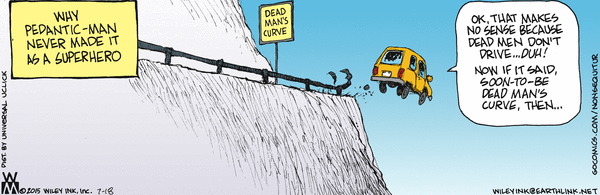
There is no way a single line will ever continue the full meaning of any article anywhere to everyone. I think we need to move on from this expectation. In this case, it's abundantly clear that the author didn't really believe that Justice Thomas found the bug.
This just seems like defending clickbait.
It's abundantly clear the author didn't mean what the title says only after after opening and skimming the article.
Granted, HN's title editorializing didn't help the case. But there's a difference between expecting to preserve the full information of the whole article in a singular title sentence and being annoyed that some title has just enough ambiguity in it that folks will likely click on it.
It's abundantly clear the author didn't mean what the title says only after after opening and skimming the article.
Granted, HN's title editorializing didn't help the case. But there's a difference between expecting to preserve the full information of the whole article in a singular title sentence and being annoyed that some title has just enough ambiguity in it that folks will likely click on it.
I will admit wondering whether Justice Thomas was actually looking at Perl code was part of the reason why I clicked on this.
Is it just me or is it weird that a Supreme Court justice didn't speak at all in court for 7 years?
Apparently that changed during the Zoom era.
He has said that the questioning by the Court is too chaotic, with justices talking over each other and pontificating more than questioning, and didn't feel he gained anything for the loss of dignity. The online format had more formal process of one person then another speaking, and he has apparently taken advantage of it.
He has said that the questioning by the Court is too chaotic, with justices talking over each other and pontificating more than questioning, and didn't feel he gained anything for the loss of dignity. The online format had more formal process of one person then another speaking, and he has apparently taken advantage of it.
He might've gotten more chatty during the Zoom era but Thomas went from no talking to some talking after Scalia died. They voted together most of the time, and Scalia sure did enough talking for the both of them.
See: https://www.cnn.com/2016/02/29/politics/supreme-court-claren... https://www.nytimes.com/interactive/2014/06/24/upshot/24up-s...
See: https://www.cnn.com/2016/02/29/politics/supreme-court-claren... https://www.nytimes.com/interactive/2014/06/24/upshot/24up-s...
There's an interesting graphic that shows how often the Justices vote the same or different, see [1].
[1] https://www.nytimes.com/interactive/2014/06/24/upshot/24up-s...
[1] https://www.nytimes.com/interactive/2014/06/24/upshot/24up-s...
It's pretty interesting that the most "polarized" judges still only disagreed 34% of the time.
Interpreting law is, generally speaking, a pretty objective task and SCOTUS isn't as politically partisan as the media often portrays it. Justices are consummate professionals, friends, and co-workers, not partisan hacks. Ginsburg and Scalia were famously extremely good friends.
> Interpreting law is, generally speaking, a pretty objective task
No, it's not. It is highly subjective; the various canons of legal construction all require subjective judgements, and selecting and prioritizing between them is subjective, and that's not even getting to the degree to which in practice those canons are invoked as post hoc rationalizations for decisions reflecting a jurists ideological and personal biases on the matter at issue.
No, it's not. It is highly subjective; the various canons of legal construction all require subjective judgements, and selecting and prioritizing between them is subjective, and that's not even getting to the degree to which in practice those canons are invoked as post hoc rationalizations for decisions reflecting a jurists ideological and personal biases on the matter at issue.
I'm going to push back on this. Judging is somewhat subjective, sure. But the highly politicized nature of the U.S. Supreme Court makes the process more subjective than is necessary. For the most part, High Courts in other countries aren't discovering new rights in statutes and Constitutional provisions written decades or hundreds of years ago. In Obergefell, the U.S. Supreme Court determined that the implied right to marriage in the U.S. Constitution conferred a right to same-sex marriage. A year later, the European Court of Human Rights reached the exact opposite conclusion about the express right to marriage in Article 12 of the European Convention on Human Rights: https://eclj.org/marriage/the-echr-unanimously-confirms-the-.... In another example, in the 1970s, when many high courts took up the question of abortion, the U.S. Supreme Court was the only one to determine there was a Constitutional right to abortion. Canada, France, Italy, etc., all found that it was a matter for the legislature. There is no high court in any country that intervenes on social questions as much as the U.S. Supreme Court.
In my opinion, the degree to which judging is subjective and ideological is overstated in order to support a level of judicial interventionism on the part of the U.S. Supreme Court that is quite unusual in developed countries. Go read German or Dutch high court opinions--they are a lot drier!
In my opinion, the degree to which judging is subjective and ideological is overstated in order to support a level of judicial interventionism on the part of the U.S. Supreme Court that is quite unusual in developed countries. Go read German or Dutch high court opinions--they are a lot drier!
> But the highly politicized nature of the U.S. Supreme Court makes the process more subjective than is necessary. For the most part, High Courts in other countries aren't discovering new rights in statutes and Constitutional provisions written decades or hundreds of years ago.
Most countries have something closer to a civil law as opposed to common law basic system; and most of the ones that have a common law system also have parliamentary sovereignty as part of their Constitutional order, whether or not they have an actual written Constitution; this doesn't really change the basic subjectivity of legal decisionmaking, but the combination of a common law tradition which frames interpretation of the Constitution and the absence of parliamentary sovereignty gives the US Supreme Court more scope than most high courts have to start with, and more scope naturally means more room for subjectivity to manifest.
Most countries have something closer to a civil law as opposed to common law basic system; and most of the ones that have a common law system also have parliamentary sovereignty as part of their Constitutional order, whether or not they have an actual written Constitution; this doesn't really change the basic subjectivity of legal decisionmaking, but the combination of a common law tradition which frames interpretation of the Constitution and the absence of parliamentary sovereignty gives the US Supreme Court more scope than most high courts have to start with, and more scope naturally means more room for subjectivity to manifest.
> For the most part, High Courts in other countries aren't discovering new rights in statutes and Constitutional provisions written decades or hundreds of years ago.
Germany's constitutional court also does so from time to time, unfortunately.
Decades ago they invented a right to "informational self-determination" that has no textual basis in the constitution.
It's a good right to have. I understand why they felt compelled to do so.
But every time the court decides something like this they have to demarcate the borders, where it applies and where not. In doing so so they draw red lines that the political process can hardly overcome, even if it might have yielded a better end result by giving the edges a little different form.
Last year our court invented a right to school education, again without textual basis.
Germany's constitutional court also does so from time to time, unfortunately.
Decades ago they invented a right to "informational self-determination" that has no textual basis in the constitution.
It's a good right to have. I understand why they felt compelled to do so.
But every time the court decides something like this they have to demarcate the borders, where it applies and where not. In doing so so they draw red lines that the political process can hardly overcome, even if it might have yielded a better end result by giving the edges a little different form.
Last year our court invented a right to school education, again without textual basis.
The nice thing about German constitutional jurisprudence is that there’s an explicit recognition and functional balancing of competing rights and societal interests. This tends to cut both ways from the perspective of American politics. Religious interests and the right to life get robust consideration, but at the same time individual free speech and economic rights aren’t treated as a trump card against societal interests.
Your argument is wrong, but more saliently, is simply not in line with the data of thousands and thousands of cases. Judges on the "opposite" sides of the political spectrum disagree just ~30% of the time. This shows that law is interpreted -- by smart, well-educated, professional justices -- very similarly across the board.
> Your argument is wrong, but more saliently, is simply not in line with the data
It's perfectly in line with the data.
> Judges on the "opposite" sides of the political spectrum
Aren't that far apart because the American political spectrum is very narrow and the process for appointing and confirming judges has historically excluded judges from the extremes within that spectrum.
Much like people who mistake the pre-internet age of narrow media dominance as one of greater media objectivity, you are mistaking common bias with objectivity.
It's perfectly in line with the data.
> Judges on the "opposite" sides of the political spectrum
Aren't that far apart because the American political spectrum is very narrow and the process for appointing and confirming judges has historically excluded judges from the extremes within that spectrum.
Much like people who mistake the pre-internet age of narrow media dominance as one of greater media objectivity, you are mistaking common bias with objectivity.
Sure, most cases aren't polarizing, but that doesn't mean that the law is objective -- the other 30% of cases proves as much.
Personally, I'd be more interesting in knowing how many cases split 5/4 (or 6/3) the obvious way versus how many cases were unanimous or nearly so.
Personally, I'd be more interesting in knowing how many cases split 5/4 (or 6/3) the obvious way versus how many cases were unanimous or nearly so.
9-0 is far more common than 5-4, this is pretty common knowledge for anyone that follows SCOTUS, but here's a source[1].
[1] https://www.washingtonpost.com/news/posteverything/wp/2018/0...
[1] https://www.washingtonpost.com/news/posteverything/wp/2018/0...
Sorry, I see now that my comment was unclear. I mean of the 5/4 splits, I'd be curious what proportion of cases split 5/4 in the expected manner (Democratic vs Republican appointees) versus other alignments (e.g., Sotomayor, Thomas, Gorsuch, and Ginsburg versus the rest).
What you'd actually expect with political parties that aren't particularly cohesive or consistent over time isn't partisan consistency but that judges would vote consistently with the position of their appointing President on issues politically salient at the time of their appointment and less predictably otherwise.
Which, it turns out, is what they tend to do.
Which, it turns out, is what they tend to do.
Asserting that SCOTUS decisions are apolitical and "objective" is inherently political.
Sure, but it’s a policy choice—a more polite way of saying a political choice—to treat SCOTUS like a legal institution rather than a political one.
It is a legal institution, not a political one in the way Congress is explicitly a political institution that writes laws, but the seat holders are not apolitical machines who merely objectively look at what the law says because part of why they are there is that they have perspectives and they exercise this valuable thing called professional judgement that in the private sector people pay a lot of money for. Judicial philosophies which defer to the text as it is written (textualism) or interpret the text as it would have been understood in its original time and place (originalism) are treated with suspicion and politicized by those who believe the text should be interpreted through a modern reading and understanding of the text (living constitutionalism).
SCOTUS will never be perfectly apolitical, not while it is staffed by people as I expect it to in perpetuity, but it should not also succumb to becoming a political institution instead of a legal one.
It is a legal institution, not a political one in the way Congress is explicitly a political institution that writes laws, but the seat holders are not apolitical machines who merely objectively look at what the law says because part of why they are there is that they have perspectives and they exercise this valuable thing called professional judgement that in the private sector people pay a lot of money for. Judicial philosophies which defer to the text as it is written (textualism) or interpret the text as it would have been understood in its original time and place (originalism) are treated with suspicion and politicized by those who believe the text should be interpreted through a modern reading and understanding of the text (living constitutionalism).
SCOTUS will never be perfectly apolitical, not while it is staffed by people as I expect it to in perpetuity, but it should not also succumb to becoming a political institution instead of a legal one.
> Asserting that SCOTUS decisions are apolitical and "objective" is inherently political.
Maybe, it's definitely false, in any case.
Maybe, it's definitely false, in any case.
Unfortunately that changed in 2016-2020 with the McConnell doctrine. The latest appointment's only distinguishing qualifications were partisanship and youth.
I don’t know how this idea possibly gained traction. If you asked me to come up with a short list in 2010 of who the next Supreme Court appointments of a Republican President would be, all three would have been in the list. Gorsuch and Kavanaugh were well known “feeder” judges in the Courts of Appeals, like Judge Garland is and Justice Ginsburg and Justice Souter were before their appointment. Barrett was a prominent law professor. The appointments were completely unsurprising.
It's just a talking point that gets repeated by folks that don't follow the legal profession in general or the federal courts more specifically. It's completely ridiculous to claim that Barrett is a "conservative sockpuppet" as some commenter below us makes. She's been a law professor most of her life. But everyone plays dirty: Garland should've been on SCOTUS (his work on the OKC bombing prosecution speaks for itself, and is not to mention patriotic); it's a shame that Congress blocked that vote, but politics is politics.
We've heard the same thing about Obama's appointments, Bush, and Clinton before him. The sky is always falling, but in reality the courts have been surprisingly stable and politically neutral -- a testament to the United States' governing principle of judicial independence.
We had a more balanced court in the past. Thomas and Scalia were previously on the court's fringe, but now with Amy Coney Barrett the fringe is pushed to crazytown. Pair that with the conservative majority, and you have a recipe for partisan hackery.
I think people have a poor understanding of just how far to the right the median American is on the issues the Supreme Court regularly handles. Remember, the majority of American support school prayer, think abortion should be illegal after the first trimester, and think that race shouldn't be a factor in college admissions or employment. Even in the latest Gallup polls, only 37% of Americans think the current Supreme Court is "too conservative": https://news.gallup.com/poll/4732/supreme-court.aspx
(1) That's a pretty selective survey. Do you deny that I could generate a list of issues the Supreme Court has heard, all on the left side of the American political spectrum, that the majority supports?
(2) Public opinion polls on issues, as opposed to candidates, are essentially meaningless.
(2) Public opinion polls on issues, as opposed to candidates, are essentially meaningless.
Yes, sure, though primarily economic issues—Obamacare, campaign finance, etc.
Opinion polls on issues are important, because two-party politics distorts the signal of what the public really wants. That’s an especially bad problem in America, because race/immigration status splits both the social conservatives (many minorities are socially conservative but caucus with white liberals) and the economic liberals (many white people are economically liberal but caucus with white conservatives).
Abortion is a good example: in both parties the abortion debate is dominated by extremists. If you look at parties, it seems like the country is divided between two extreme positions. But in reality there are lots of pro choice republicans and pro life democrats. And there is actually a broad consensus that abortion should be permissible, but only in the first trimester. Another good example is affirmative action. The Democratic Party establishment loves it, but many democrat voters don’t. Thus, something like Prop 16 fails in California resoundingly even with the nearly universal support of Democratic politicians in an overwhelmingly democratic state.
Of course the exact same things can be said for republicans. The Republican establishment is in love with repealing universal healthcare, while many Republican voters like it.
When we think about the legitimacy of the Supreme Court vis-a-vis the will of the people, it’s important to keep public opinion polling in mind. In the next term, the Supreme Court may will outlaw race-based affirmative action in college admissions, and uphold a 15 week abortion ban. The media will treat both as far right extremism, but both decisions will in fact reflect the popular will.
Opinion polls on issues are important, because two-party politics distorts the signal of what the public really wants. That’s an especially bad problem in America, because race/immigration status splits both the social conservatives (many minorities are socially conservative but caucus with white liberals) and the economic liberals (many white people are economically liberal but caucus with white conservatives).
Abortion is a good example: in both parties the abortion debate is dominated by extremists. If you look at parties, it seems like the country is divided between two extreme positions. But in reality there are lots of pro choice republicans and pro life democrats. And there is actually a broad consensus that abortion should be permissible, but only in the first trimester. Another good example is affirmative action. The Democratic Party establishment loves it, but many democrat voters don’t. Thus, something like Prop 16 fails in California resoundingly even with the nearly universal support of Democratic politicians in an overwhelmingly democratic state.
Of course the exact same things can be said for republicans. The Republican establishment is in love with repealing universal healthcare, while many Republican voters like it.
When we think about the legitimacy of the Supreme Court vis-a-vis the will of the people, it’s important to keep public opinion polling in mind. In the next term, the Supreme Court may will outlaw race-based affirmative action in college admissions, and uphold a 15 week abortion ban. The media will treat both as far right extremism, but both decisions will in fact reflect the popular will.
The median American also wants stricter gun laws, supports same sex marriage & opposes civil forfeiture.
It’s almost like the median American is pretty down the middle on political issues.
It’s almost like the median American is pretty down the middle on political issues.
But that’s my point. The median American has heterodox beliefs.
The current 6-3 Court probably seems “far right” to the 8-10% of people with consistently liberal beliefs (https://hiddentribes.us). But the median voter agrees with the conservative Court on many issues, and disagrees on others. More people think the current court is too conservatives than who think it’s too liberal (it’s a 6-3 court after all) but the plurality (40%) think it’s “about right.”
I’d also point out that, while the median voter may support same sex marriage, they probably go to a church or mosque that does not approve of homosexuality. Amy Coney Barrett may seem like an “extremist” to someone from NYC or SF. But she probably doesn’t seem that way to an immigrant from Latin America, where charismatic Catholicism is prevalent and growing. Likewise, the median voter may support gun control, but they or a neighbor probably own a gun.
I’d also point out that, while the median voter may support same sex marriage, they probably go to a church or mosque that does not approve of homosexuality. Amy Coney Barrett may seem like an “extremist” to someone from NYC or SF. But she probably doesn’t seem that way to an immigrant from Latin America, where charismatic Catholicism is prevalent and growing. Likewise, the median voter may support gun control, but they or a neighbor probably own a gun.
> The latest appointment's only distinguishing qualifications were partisanship and youth.
Can you expand more on this? From my understanding, Gorsuch and Barrett have a solid pedigree, while there are questions around Kavanaugh's.
Can you expand more on this? From my understanding, Gorsuch and Barrett have a solid pedigree, while there are questions around Kavanaugh's.
Kavanaugh has sterling credentials. He was in Law Review at Yale. He was both a SCOTUS Clerk and Bristow Fellow. He argued a case in the Supreme Court. He was a partner at a top law firm. These are the brass rings in the legal profession everyone is trying to grab.
He was a prominent judge in the DC Circuit Court of Appeals for 12 years, during which time he developed a reputation as a “feeder” judge who regularly placed his clerks onto the Supreme Court. That is the same role that Justice Ginsberg and Judge Garland had before they were appointed to the Court.
He was a prominent judge in the DC Circuit Court of Appeals for 12 years, during which time he developed a reputation as a “feeder” judge who regularly placed his clerks onto the Supreme Court. That is the same role that Justice Ginsberg and Judge Garland had before they were appointed to the Court.
Kavanaugh's credentials are strong enough that his absence from Trump's 2016 shortlist of potential nominees was noted in the Washington Post.
Barrett is an ideological sock puppet who's more interested in forcing others to conform to her morality than objectively interpreting the law.
She’s an “ideological sock puppet” because she might vote to Roe, which would simply make American constitutional law the same as … France or Italy (which, contemporaneously with Casey determined that abortion was an issue for the legislature). Madness!
If you read her questions in that case her bias and attempt to set up justification for her own preconceived opinion were clear.
It’s not a “bias” to believe the Constitution doesn’t contain a right to privacy that protects abortion. That’s just being able to read. Pretty much nobody seriously believes in the logic underlying Roe. It’s the Lochner of left-wing jurisprudence. Even Ginsberg criticized the case, and offered a different justification for abortion rights. At this point it’s just stare decisis and ideology sustaining the precedent.
Accusations of “bias” and “preconceived opinion” are absolutely hilarious coming from the left. Republican judges regularly get wobbly and vote for the liberal position (Obergefell, Bostock, Woman’s Health. The liberal judges, however, always vote party line in these cases.)
Accusations of “bias” and “preconceived opinion” are absolutely hilarious coming from the left. Republican judges regularly get wobbly and vote for the liberal position (Obergefell, Bostock, Woman’s Health. The liberal judges, however, always vote party line in these cases.)
Changed? I guess you've never heard of Robert Bork or Ted Kennedy's admitted attempt to sabotage him on the Senate floor.
And the current candidate was strictly chosen from a pool based upon race and chromosomes .
Another comment has a citation for embarrassment over a previous regional dialect, but I'd also heard the "Not justices' place to question attorneys presenting their case" version.
Which has some merit. Show me someone who can listen as closely while they're also thinking of their next question, and I'll show you a liar.
Which has some merit. Show me someone who can listen as closely while they're also thinking of their next question, and I'll show you a liar.
The justices have already read a ton of briefs and deeply understand both sides of the case before oral arguments, it's not the first time they're hearing anything.
Isn't that just how the Supreme Court works though (and I think appeals courts in general)? I thought it was literally just judges/justices questioning lawyers, not witnesses or the defendant on the stand or something.
Maybe I'm just inferring that from how I've seen appeals courts portrayed on TV shows though; I guess I haven't really ever actually been in person to any appeal.
Maybe I'm just inferring that from how I've seen appeals courts portrayed on TV shows though; I guess I haven't really ever actually been in person to any appeal.
As I've heard it, Thomas' position was that it was the attorneys' responsibility to make the best, most complete case they can. And then the justices' responsibility to debate that case against the law and render a verdict.
Or, in other words, if an attorney makes a bad argument, or leaves an argument unsaid, that's their problem. It shouldn't be the justices' task to score points with their colleagues by guiding attorneys to different lines of thought.
But, obviously other justices feel differently. Hence the diversity of behavior! Which isn't necessarily a bad thing.
Or, in other words, if an attorney makes a bad argument, or leaves an argument unsaid, that's their problem. It shouldn't be the justices' task to score points with their colleagues by guiding attorneys to different lines of thought.
But, obviously other justices feel differently. Hence the diversity of behavior! Which isn't necessarily a bad thing.
Right, but my point was that a standard (i.e. non-appeal) usually has lawyers questioning witnesses (or the defendant themself); they're explicitly not allowed to just pontificate without asking a question outside of the opening and closing statements. My understanding of an appeals trial was that there was no witness testimony, just lawyers talking to judges and vice-versa. If my understanding is correct, that means that without judges asking questions, an appeal would just consist of each lawyer essentially making a speech and then sitting down without any ability for discussion. This strikes me as a bit odd, which is why I'm wondering if I'm missing something. If I'm not, I would think Thomas' position is extraordinarily unorthodox, to the point that I wouldn't be surprised if no other appeals judge in the country shared it. I'm not sure how easy it would be to check that, but at the very least, has any other Supreme Court justice in the history of the United States every held that view?
If there is a risk of misunderstanding, it's good to confirm that the attorney is saying what the Justice thinks they are saying, before writing a scathing opinion excoriating the bad argument.
I strongly disagree. If you're a judge listening closely to a lawyer present their case, your head should be filling with questions for their arguments.
The Lawyers don't really present their case in oral arguments. The whole process is 1 hour, and each party involved is given 2 minutes to summarize their position.
This comment betrays that you don't really understand how the legal process works. There's often hundreds and hundreds of pages of briefs that go along with every case, and the oral argument is usually not even that relevant; it's mostly a formality in many cases. It's what gets the headlines, but the "meat" of the case is hardly the oral argument.
Agreed. I would waive oral arguments at practically every opportunity, except that I feel like the judges usually ignore all the written motions and decide based on who is wearing the nicest bow tie during oral arguments.
"... with justices talking over each other and pontificating more than questioning..."
lmao all workplaces are the same
lmao all workplaces are the same
I imagine it could be significantly worse than what most people experience when you throw lifetime appointments into the mix.
And published transcripts of every interaction that is analyzed by law students all over the country, possibly for centuries after your death.
Lifetime *political* appointments lol
If there is one thing that the Founding Fathers got wrong, it is this: Supreme Court appointments should not be lifetime. Immune to politics, sure - Once they're in, they cannot be removed for term, maybe, but I believe that they should be fixed-term, not forever
What I would propose is thus: Each president should be allowed one appointment, 40 year fixed terms. Same confirmation rules, but rather than the vagaries of when justices step down or die, we have a floating pool of 7-10 justices at any time with new ones being added at a fixed rate.
What I would propose is thus: Each president should be allowed one appointment, 40 year fixed terms. Same confirmation rules, but rather than the vagaries of when justices step down or die, we have a floating pool of 7-10 justices at any time with new ones being added at a fixed rate.
Canadian justices must retire at 75.
40years is exactly the problem. 12-20 is reasonable.
Yup. There should be no politics in any court. Only law.
And the law is written by...
People who say, "eeh, we'll let the judges figure this part out."
Thanks for posting his reasoning, but it doesn't convince me -- there is only a very small window of real-time interaction on the cases and they should be making the most of it. If they're not going to ask questions they might as well just rule based on the briefs and not hold oral arguments at all.
Earlier exchange on this point: https://news.ycombinator.com/item?id=17181542
Earlier exchange on this point: https://news.ycombinator.com/item?id=17181542
Not really, when you consider that the oral argument is largely a ceremonial performance.
All of the documentation is provided in advance and scrutinized by the nine justices and their 36 clerks. The judges themselves discuss the merits in far greater depth than the short oral Q&A for the record.
That said, love the oral arguments and have probably listed to and read more than a hundred. They are usually pretty easy to fallow and far more balanced and informative the media summaries
That said, love the oral arguments and have probably listed to and read more than a hundred. They are usually pretty easy to fallow and far more balanced and informative the media summaries
I've always wondered how the "vote" compares before vs after the oral argument and how often (if ever) a justice is persuaded by the answers given in response to questions.
I have heard from various seasoned Supreme Court practitioners and former clerks that you can typically only lose ground in oral arguments, not gain it. I.e. Oral argument that can be carefully crafted and gussied up in the briefing can fall apart under scrutiny at argument. But you'll rarely if ever be able to persuade the Court at oral argument about a point that wasn't persuasive in dozens of pages of briefing.
My favorite example of this is in Citizens United, where the Government's attorney, in response to a question from Justice Alito, conceded that the Government's interpretation of the First Amendment would allow it to ban political books close to an election. See pp. 26-27: https://www.supremecourt.gov/oral_arguments/argument_transcr...
My favorite example of this is in Citizens United, where the Government's attorney, in response to a question from Justice Alito, conceded that the Government's interpretation of the First Amendment would allow it to ban political books close to an election. See pp. 26-27: https://www.supremecourt.gov/oral_arguments/argument_transcr...
Regarding citizens united, is that really something that only came to light in oral arguments? Isn't this a criticism that the opposition would raise in their own briefing package?
Was the relevance simply the admission that the government didn't have an answer to the criticism?
Was the relevance simply the admission that the government didn't have an answer to the criticism?
You’re correct that the significance was that the government’s admission at argument revealed that it did not have a robust principle for distinguishing between the political movie at issue in that case with books.
I don’t recall the details, but I’m sure it came up in the opposition’s briefs. But in a brief you can paper over a thin argument to an extent. You can accuse the opposition of invoking a slippery slope, spend a lot of words making subtle distinctions, etc. It’s certainly fair to say that parties’ briefs often overstate the gravity of the consequences one way or another. So upon reading the briefs, the response might seem quite plausible. But when you’re forced to give a succinct answer to a direct question at oral argument, that kind of evasion falls apart and you’re forced to fully own the implications of your position.
I don’t recall the details, but I’m sure it came up in the opposition’s briefs. But in a brief you can paper over a thin argument to an extent. You can accuse the opposition of invoking a slippery slope, spend a lot of words making subtle distinctions, etc. It’s certainly fair to say that parties’ briefs often overstate the gravity of the consequences one way or another. So upon reading the briefs, the response might seem quite plausible. But when you’re forced to give a succinct answer to a direct question at oral argument, that kind of evasion falls apart and you’re forced to fully own the implications of your position.
I would say that the oral argument has zero impact whatsoever.
Which could point to the Supreme Court being a relic of its time and so partisan and ideologically driven that the entire court is closer to a ceremonial performance than a specific aspect like orals.
Or, in the alternative, it would point to the Supreme Court receiving tens of thousands of words of briefing on the issues prior to argument, supplemented by internal bench memos from their law clerks (some of the brightest young lawyers in the country).
Is Clarence Thomas actually being around anything but a ceremonial performance? I know he has voted unlike what would be predicted before, but it’s pretty rare I think.
I thought usually the surprise is how conservative, arrogant, and/or ideologically driven [vs consistency or actual principles] he is. Which seems to mean more conservative and extreme takes than expected vs any surprise votes that don’t swing that way.
Like his takes on the power a former president he loves can or should have. Including vs the current president.
I thought usually the surprise is how conservative, arrogant, and/or ideologically driven [vs consistency or actual principles] he is. Which seems to mean more conservative and extreme takes than expected vs any surprise votes that don’t swing that way.
Like his takes on the power a former president he loves can or should have. Including vs the current president.
He's given a couple of reasons for this. The first is that he doesn't view it as particularly helpful.
“I think it’s unnecessary in deciding cases to ask that many questions, and I don’t think it’s helpful, I think we should listen to lawyers who are arguing their cases, and I think we should allow the advocates to advocate.”
Most of the general public view oral arguments as the totality of the work that the justices do, but in reality a lot of the work goes on behind the scenes. Reading up on prior decisions, parsing the grammar of a law, reviewing history at the time the law was created, debating behind the scenes, etc. So I could see why asking questions during oral arguments isn't particularly important to him. The other justices do plenty of questioning anyway, so it often becomes redundant.
The second reason he has stated is that he is self conscious about the way he talks because he grew up speaking Geechee (aka Gullah) in rural Georgia. Since he was teased about this dialect, he formed a habit of not speaking.
“I think it’s unnecessary in deciding cases to ask that many questions, and I don’t think it’s helpful, I think we should listen to lawyers who are arguing their cases, and I think we should allow the advocates to advocate.”
Most of the general public view oral arguments as the totality of the work that the justices do, but in reality a lot of the work goes on behind the scenes. Reading up on prior decisions, parsing the grammar of a law, reviewing history at the time the law was created, debating behind the scenes, etc. So I could see why asking questions during oral arguments isn't particularly important to him. The other justices do plenty of questioning anyway, so it often becomes redundant.
The second reason he has stated is that he is self conscious about the way he talks because he grew up speaking Geechee (aka Gullah) in rural Georgia. Since he was teased about this dialect, he formed a habit of not speaking.
It's a shame because he has a lifetime appointment and only one person outranks him, so he is the only person in the world who can freely speak Geechee and change the world's opinion of it.
What would court case be like if none of the Justices ever spoke? Would it just be two sides giving their arguments, witness, and closing arguments? Seems like that would speed things along. But when is communication every 100% concise? Still seems suspicious to me.
Would it even speed things along? The oral argument part of SCOTUS cases takes way less time than the months of deliberation before they reach a verdict. And for the attorneys involved (many of whom are arguing the biggest and most important case of their lives, sometimes with the future of a huge issue hanging in the balance) I imagine they care a great deal about being able to clear up any questions or confusions the justices may have, even at the expense of a few more days (or even weeks) in court.
What would the beach be like if everyone went today?
It's not unreasonable to use the actual context when deciding
It's not unreasonable to use the actual context when deciding
Clearly every human can't be on the beach at once. But all of the Justices can remain silent. What point are you trying to make? Maybe offer a context?
This is the real answer. He knows he'll vote for the most conservative option, so the actual arguments and briefs are a waste of time for him.
It's weird. But also IMO not "totally" weird.
I've sat in a meeting and had everyone ask my questions anyway, better to let them do it. Sometimes I learn more that way.
Not everyone operates in a 'let's hash this out verbally' manner, perhaps they do even less so in a crowd of folks already doing that.
Granted I often find Thomas's opinions kinda absurd... so I'm talking more generally about "not talking" and less so about Thomas. I just wouldn't hold 'not talking' against anyone. Different people operate differently.
I've sat in a meeting and had everyone ask my questions anyway, better to let them do it. Sometimes I learn more that way.
Not everyone operates in a 'let's hash this out verbally' manner, perhaps they do even less so in a crowd of folks already doing that.
Granted I often find Thomas's opinions kinda absurd... so I'm talking more generally about "not talking" and less so about Thomas. I just wouldn't hold 'not talking' against anyone. Different people operate differently.
No issues actually get hashed out in the oral argument.
They are limited to 1 hour. You have 2 or more parties giving opening questions. And the 9 justices questioning each on what are often thousands of pages of documents.
It is really more of an opportunity to publicly critique each side with a few pointed questions.
They are limited to 1 hour. You have 2 or more parties giving opening questions. And the 9 justices questioning each on what are often thousands of pages of documents.
It is really more of an opportunity to publicly critique each side with a few pointed questions.
I duno. I think things happen sometimes. Sometimes not.
There have been cases where it really sounded like there was a traditional split along the court and then some questions pop up and the answers are so bad / arguments clearly absurd / the lawyers have no good answers that suddenly the case is clearly going one way.
Usually this revolves around the sort of second order effects of a potential ruling and where ideology isn't entirely clear / has some conflicts with those second order effects.
There have been cases where it really sounded like there was a traditional split along the court and then some questions pop up and the answers are so bad / arguments clearly absurd / the lawyers have no good answers that suddenly the case is clearly going one way.
Usually this revolves around the sort of second order effects of a potential ruling and where ideology isn't entirely clear / has some conflicts with those second order effects.
I don't think any new or surprise questions pop up in oral argument. Everything has been mapped out in the briefing documents, and hashed out sever times in lower courts.
In fact, I think it would be a bad thing if the court swung on oral arguments. These are very complex topics prepared by an army of lawyers on each side. They should not hinge on if a single presenter doesn't have a clear an concise answer within two seconds of being asked it.
In fact, I think it would be a bad thing if the court swung on oral arguments. These are very complex topics prepared by an army of lawyers on each side. They should not hinge on if a single presenter doesn't have a clear an concise answer within two seconds of being asked it.
I don't doubt everyone prepares. However, there are arguments if you listen to where the attorneys don't have a prepared answer / don't have good answers and the judges genuinely sound surprised.
As for the rulings there's A LOT more than ruling one way or another, the ruling itself can range in all sorts of directions.
As for the rulings there's A LOT more than ruling one way or another, the ruling itself can range in all sorts of directions.
Until you get a performance review where they say that you should be more engaged in meetings. AKA a signal it might be time to update the resume.
My favorite solution for that, or when I feel I need to show some involvement for others.
I ask a specific enough question from someone I don't typically talk to, that I know has a non controversial answer. They answer it and it shows I'm thinking of nuts and bolts and how things work and everyone moves on.
You'd be surprised how many folks think "oh this guy knows all about / is really thinking about that thing to ask that kind of specific question".
Just a quick one like that works well. You do have to know the room and the situation to avoid falling into some messes but it works.
I ask a specific enough question from someone I don't typically talk to, that I know has a non controversial answer. They answer it and it shows I'm thinking of nuts and bolts and how things work and everyone moves on.
You'd be surprised how many folks think "oh this guy knows all about / is really thinking about that thing to ask that kind of specific question".
Just a quick one like that works well. You do have to know the room and the situation to avoid falling into some messes but it works.
Yes, in most meetings I try to say as little as possible, especially when the conversation has diverged from the agenda (i.e. almost every meeting).
At my company, that will get you a bad rating (I know from experience).
Sounds like a company that overvalues debate for its own sake. I've worked in places like that. "Intellectual sparring" was considered important, even if you basically agreed with the discussion or it was uncontroversial, you were expected to find something to contest in almost every meeting. It was tedious but you could game it by having some stock objections ready to throw out. I moved on from there after a couple of years.
I'm not saying never say anything if something important and relevant is being missed, but in my experience that rarely happens.
I'm not saying never say anything if something important and relevant is being missed, but in my experience that rarely happens.
SCOTUS has had relatively quiet justices (both historically and recently), but Thomas stands out even among them for his paucity of words[1].
[1]: https://www.npr.org/sections/thetwo-way/2016/02/29/468576931...
[1]: https://www.npr.org/sections/thetwo-way/2016/02/29/468576931...
He talked a lot, just not into the microphone.
It's hard to get into the Supreme Court to watch oral arguments live because of the mismatch in supply and demand. But if you can, please do. It is really interesting to watch.
It's hard to get into the Supreme Court to watch oral arguments live because of the mismatch in supply and demand. But if you can, please do. It is really interesting to watch.
Not speaking does not mean he isn't thinking. I was impressed how thoroughly he understood the issues in the Google v. Oracle Java case. He even included some sample pseudo-code in his dissent - although the code kind of sucks (footnote on page 46)
https://www.supremecourt.gov/opinions/20pdf/18-956_d18f.pdf
https://www.supremecourt.gov/opinions/20pdf/18-956_d18f.pdf
He has said in at least one interview that he believes the legal arguments and principles should stand on their own merit, and purposefully tries not to be influenced by counsel's oratory skills. Hence, the rarely speaks or questions counsel.
He was treated extremely badly during his nomination because of his views. Black history museum wouldn’t even mention him.
https://thehill.com/opinion/judiciary/353035-justice-delayed...
https://thehill.com/opinion/judiciary/353035-justice-delayed...
Clarence Thomas is one of those points of access that can open one’s eyes to the reality beyond the matrix, because like you imply, he is a rather large glitch in the system that highlights the insincerity, deliberate dishonesty, and facade that hides the evil of the people that loathe him.
A black man may only hold views his masters approved. We are all only as free as those who lord over us permit us, and therefore not free at all. See tech/social media speech and thought control for reference and examples.
A black man may only hold views his masters approved. We are all only as free as those who lord over us permit us, and therefore not free at all. See tech/social media speech and thought control for reference and examples.
Yeah, he's been real oppressed. He gets to impose his "non-approved" views on over 300 million people with no accountability.
Give me a break.
Give me a break.
What drives me nuts about people's criticism of Thomas is that they don't understand what actually makes him different from other Black people. It's not his religiosity or his conservatism. His "don't complain," "don't protest," "pull yourself up by your bootstraps" conservatism is completely normal for people "who look like him." Even his views on racial issues are widely held by other Black people. For example, the majority believe that race shouldn't be even a "minor factor" in college admissions. And only half of Black people think the government "should help improve the social and economic conditions of black people." https://press.princeton.edu/ideas/the-roots-of-black-politic... (Figure 0.5).
What makes Thomas atypical is his partisan choices. Most Black conservatives believe that it's better to caucus with the white social liberals in the Democratic Party (who are often quite hostile to their values) than with the white conservatives in the Republican Party (who are often willing to tolerate anti-Black racism). These is a deeply personal choice between two parties--neither of which well represents the spectrum of interests of Black people--borne of Thomas's singular lived experience.
What makes Thomas atypical is his partisan choices. Most Black conservatives believe that it's better to caucus with the white social liberals in the Democratic Party (who are often quite hostile to their values) than with the white conservatives in the Republican Party (who are often willing to tolerate anti-Black racism). These is a deeply personal choice between two parties--neither of which well represents the spectrum of interests of Black people--borne of Thomas's singular lived experience.
[deleted]
I think it just depends on your feelings about Clarence Thomas. Cogent arguments can be made about his quietness being either a positive or negative thing.
There is no doubt about the quality of his legal mind if you’ve ever heard him speak publicly.
I have found that at higher levels of any organization or situation, the smartest and generally best people speak the least; because they’re listening and have no compulsion to impress.
Generally, I have also found that letting other people speak is quite useful for a number of reasons, especially in an adversarial situation.
I have found that at higher levels of any organization or situation, the smartest and generally best people speak the least; because they’re listening and have no compulsion to impress.
Generally, I have also found that letting other people speak is quite useful for a number of reasons, especially in an adversarial situation.
It makes sense considering his personality: https://www.youtube.com/watch?v=5CPs7f7kYHA. Observe his body language in the first few minutes--the way he sits, where he puts his hands. He's a classic bookish introvert. He opens up as the interview continues, feeding off the interviewer who is a former law clerk and personal friend. But you can see why he might be reluctant to jump into the fray of oral arguments, where people are rushing to get a word in edgewise. (As an aside, I recommend anyone to watch the entire video. It gives a great deal of insight into his personality and thought process.)
Not particularly. Some justices prefer to listen publicly and discuss the case privately with the other justices and in public writing.
There's no need. He knows how he's going to vote before any arguments are given.
Did you consider that he is an idiot?
This is a little clickbaity. I was expecting that Thomas would point out something in oral arguments or in a ruling that make the author look back and say "oh crap, he's right, that doesn't make sense, and it's an artifact of this bug in the program".
To save you the click: the author's program needed to keep a table of Supreme Court Justice names to correctly parse the transcripts, and he forgot to put Thomas on the table. It didn't make a difference, since Thomas never spoke to begin with. Until one day, he did, and the output of the program was obviously wrong, leading to the bug's discovery.
So, it's the presence/absence of the name that found the bug (not the Justice himself!), and, if anything, Thomas delayed the discovery of the bug by breaking convention and never asking questions for so long.
To save you the click: the author's program needed to keep a table of Supreme Court Justice names to correctly parse the transcripts, and he forgot to put Thomas on the table. It didn't make a difference, since Thomas never spoke to begin with. Until one day, he did, and the output of the program was obviously wrong, leading to the bug's discovery.
So, it's the presence/absence of the name that found the bug (not the Justice himself!), and, if anything, Thomas delayed the discovery of the bug by breaking convention and never asking questions for so long.
If anything, Justice Thomas acted here as a sort of impromptu fuzzer.
One problem is in his system there are two sources of truth. A list of justices in the preprocessor Perl script and a list in the main Java program.
List of justices should be stored in a database or file and read by both.
List of justices should be stored in a database or file and read by both.
Why are the names hard coded like that? Database or config file, or like...a regex?
There's been 115 justices in history, only a fraction of them are recorded and they change infrequently after a long confirmation process. So path of least resistance is to hardcode them into scripts.
That still doesn't seem like the path of least resistance. It's much easier to update a YAML or JSON file than update the code.
Wouldn't we have always kept transcripts of the supreme court?
It appears that they are readily available in digital form only for cases since 1968, available on microfiche in some library collections for 1953 and later, and not consistently available in any form prior to 1953[1].
[1] https://www.supremecourt.gov/oral_arguments/availabilityofor...
[1] https://www.supremecourt.gov/oral_arguments/availabilityofor...
That's really stretching the limits of the meaning of the verb "to uncover".
Since Justice Thomas rarely speaks in court and only occasionally writes any opinions, it's hard to judge what he does or doesn't understand about a number subjects including software engineering.
Since Justice Thomas rarely speaks in court and only occasionally writes any opinions, it's hard to judge what he does or doesn't understand about a number subjects including software engineering.
Thomas rarely speaks in Court but he's a prolific writer. He wrote the most opinions in 8 of the last 10 terms: https://www.scotusblog.com/2021/07/in-barretts-first-term-co.... E.g. 23 last year versus 14 for Breyer and 11 each for Roberts and Kagan.
Which makes me skeptical that your opinion of him is actually based on what he's written. For example, his extensive writing on patent law: https://papers.ssrn.com/sol3/papers.cfm?abstract_id=3822741.
Which makes me skeptical that your opinion of him is actually based on what he's written. For example, his extensive writing on patent law: https://papers.ssrn.com/sol3/papers.cfm?abstract_id=3822741.
ecf(2)
Headline is super misleading
Freudian slip.
The real question is: how the hell is Justice Thomas so silent?
"Better to remain silent and be thought a fool than to speak and to remove all doubt."
Not to get political, but based on his record of joined/written opinions, I'm not convinced he needs any questions answered to decide on how he's going to vote on any incoming cases.
As someone fascinated by all creole languages and cultures, especially micro regional ones, Gullah is a forgotten and rich gem.
It pops up in watered down version in pop Southern culture (e.g. Oh Brother, Where Art Thou) as the old Southern version of a "Fortunate Son"-esque touchpoint, but the reality is much more interesting.
Turns out, if you mostly geographically isolate people on barrier islands, they develop a unique culture. See also Tangier Island off Virginia.
Vice News did a Gullah segment: https://m.youtube.com/watch?v=SqDTJogdWmA&t=22s
And here's some spoken word: https://m.youtube.com/watch?v=iCd5W4gwJsI&t=12m6s
It pops up in watered down version in pop Southern culture (e.g. Oh Brother, Where Art Thou) as the old Southern version of a "Fortunate Son"-esque touchpoint, but the reality is much more interesting.
Turns out, if you mostly geographically isolate people on barrier islands, they develop a unique culture. See also Tangier Island off Virginia.
Vice News did a Gullah segment: https://m.youtube.com/watch?v=SqDTJogdWmA&t=22s
And here's some spoken word: https://m.youtube.com/watch?v=iCd5W4gwJsI&t=12m6s
Did you mean to post this in a different thread? It doesn't seem to have any connection to this one.
The article in the GP comment directly mentions the Gulah language though
oof, didn't know that
[deleted]
d23(8)
Curious why this made HN front page.
    0) It's a bug in software
    1) It's amusing
2) He's in the news right now for his spouse being all insurrectiony. 2.5) He was the only justice who voted to block the information relating to said activities when he clearly should have recused himself.