3M is paying $5.5B to resolve 300k lawsuits over defective combat earplugs(qz.com)
qz.com
3M is paying $5.5B to resolve 300k lawsuits over defective combat earplugs
https://qz.com/3m-is-paying-5-5-billion-to-resolve-300-000-lawsuits-o-1850780085
175 comments
It sounds like (pun intended) one side of them was not working as described.
https://www.cnbc.com/2023/03/15/3m-legal-battle-combat-grade...
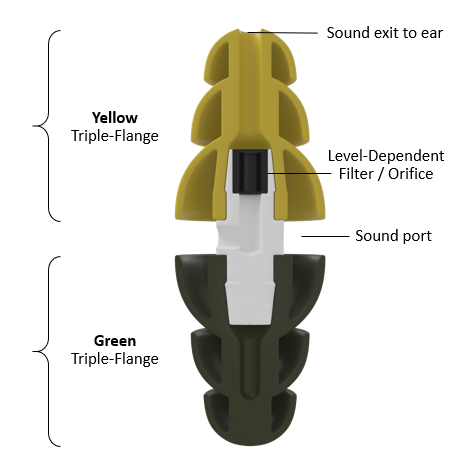
The green end was designed to block out all sound. The yellow end, signaling “whisper mode,” purported to block out loud sound — but allowed the user to hear quieter noises, like conversations.
https://www.cnbc.com/2023/03/15/3m-legal-battle-combat-grade...
Thanks for that. A lot of interesting details:
> “The purpose of the creation of [the Combat Arms earplugs] was to collaborate with the military to solve one of the longest-standing problems they have had, that soldiers won’t wear their hearing protection around loud noises and in combat,” Rucker said.
> Rucker said the plugs were designed in collaboration with the U.S. military and tested by the Air Force, Army, National Institute for Occupational Safety and Health, and others.
> “3M has purposefully skewed this data by relying on hearing standards that do not measure frequencies most affected by noise, concealing the hearing damage suffered by veterans,” said Bryan Aylstock and Chris Seeger, co-lead counsel for the service members and veterans, in a joint statement.
> 3M disagreed with those claims, telling CNBC: “The data support what 3M has maintained throughout this litigation: the Combat Arms Earplugs version two were safe and effective to use. This has been confirmed by every independent, third-party organization that has tested the product, including the Army Research Lab, the Air Force Research lab, NIOSH, and others.”
Ultimately, whose job should it be to determine whether or not they're defective? If the military tested them in advance and determined they met standards, and they were manufactured identically to what the military approved, should 3M be the one held responsible?
> “The purpose of the creation of [the Combat Arms earplugs] was to collaborate with the military to solve one of the longest-standing problems they have had, that soldiers won’t wear their hearing protection around loud noises and in combat,” Rucker said.
> Rucker said the plugs were designed in collaboration with the U.S. military and tested by the Air Force, Army, National Institute for Occupational Safety and Health, and others.
> “3M has purposefully skewed this data by relying on hearing standards that do not measure frequencies most affected by noise, concealing the hearing damage suffered by veterans,” said Bryan Aylstock and Chris Seeger, co-lead counsel for the service members and veterans, in a joint statement.
> 3M disagreed with those claims, telling CNBC: “The data support what 3M has maintained throughout this litigation: the Combat Arms Earplugs version two were safe and effective to use. This has been confirmed by every independent, third-party organization that has tested the product, including the Army Research Lab, the Air Force Research lab, NIOSH, and others.”
Ultimately, whose job should it be to determine whether or not they're defective? If the military tested them in advance and determined they met standards, and they were manufactured identically to what the military approved, should 3M be the one held responsible?
> soldiers won’t wear their hearing protection around loud noises and in combat
I haven't been in combat, thankfully, but I assume the problem is that you also want to hear quiet sounds clearly, and others around you talking etc?
In the audio world we would fix this with a compressor or a limiter. You set a loudness threshold and then reduce the component of the audio input that's above that threshold in volume by a fixed ratio, e.g. 4:1. A limiter is the same but the ratio is infinite (or near it), so the threshold becomes the maximum loudness. Basically, reduce the dynamic range.
I wonder how much it would cost to have active processing like that integrated into hearing protection. I'm sure they've thought of it.
Or maybe I'm thinking too fancy - maybe you could achieve the same thing without electronics. Loud sounds are just more pressure after all... could we have a little hole that's open in normal conditions but loud sounds push it closed?
I know this is probably one of those things where "random idiot on hacker news thinks he has a new idea that we've of course already researched thoroughly in the industry" but if these exit it'd be cool to see, or if they don't it'd be cool to know why.
I haven't been in combat, thankfully, but I assume the problem is that you also want to hear quiet sounds clearly, and others around you talking etc?
In the audio world we would fix this with a compressor or a limiter. You set a loudness threshold and then reduce the component of the audio input that's above that threshold in volume by a fixed ratio, e.g. 4:1. A limiter is the same but the ratio is infinite (or near it), so the threshold becomes the maximum loudness. Basically, reduce the dynamic range.
I wonder how much it would cost to have active processing like that integrated into hearing protection. I'm sure they've thought of it.
Or maybe I'm thinking too fancy - maybe you could achieve the same thing without electronics. Loud sounds are just more pressure after all... could we have a little hole that's open in normal conditions but loud sounds push it closed?
I know this is probably one of those things where "random idiot on hacker news thinks he has a new idea that we've of course already researched thoroughly in the industry" but if these exit it'd be cool to see, or if they don't it'd be cool to know why.
Yeah, that’s absolutely already a thing for regular Joe Schmoe hearing protection. I have a pair. They’re big earmuff types though, not earplugs. I suppose they very well might exist now too.
The fun thing about them is you can turn up the volume and essentially have super hearing while still keeping gun shots quiet.
The fun thing about them is you can turn up the volume and essentially have super hearing while still keeping gun shots quiet.
Would you mind sharing the brand? I'd just like to look them up out of interest.
I am not the person you asked, but I use Walker's XCEL 500BT earmuffs. They work well, and they have Bluetooth.
I shoot a few times a week and compete in target shooting on an amateur level.
I shoot a few times a week and compete in target shooting on an amateur level.
Search for "tactical active headphones", there are multiple brands.
Active noise cancellation earmuffs are widely available. You can buy them at Walmart (at least in states where Walmart sells guns). One brand I found on their website is Radians for $30. Search for "active hearing protection."
3M even makes several dozen models called "Peltor". Some of them have Bluetooth so you can listen to tunes:
https://www.3m.com/3M/en_US/p/c/ppe/hearing-protection/earmu...
I'm not certain these are all doing compression; the cheaper ones are probably just doing waveform inversion once the threshold is reached.
3M even makes several dozen models called "Peltor". Some of them have Bluetooth so you can listen to tunes:
https://www.3m.com/3M/en_US/p/c/ppe/hearing-protection/earmu...
I'm not certain these are all doing compression; the cheaper ones are probably just doing waveform inversion once the threshold is reached.
I’m not an industry expert either, but ear plugs don’t block sound taking other paths to the ear drum like bone conduction. The mix knob on this limiter can’t be turned to 100%
If all of that is true, it’s arbitrary whether 3M is part of the military or not, and can be held responsible.
I was in the Army for a while and used these all the time. I had no idea that the yellow vs green end was for different sound levels, wow.
> Plaintiffs allege Defendants failed to warn or instruct of the following risks and dangers of using the CAEv2 as intended:
(1) that the CAEv2 loosens
imperceptibly in a user’s ears, thereby allowing damaging sounds to bypass the
earplug and enter the ear;
(2) that Aearo’s testing subjects did not follow standard
fitting instructions, but rather used a reconfigured method of folding back the
opposing flanges before inserting the device into their ears;
(3) that following Defendants’ standard instructions for insertion of the CAEv2 would not achieve the 22 Noise Reduction Rating and would thereby pose a serious risk to users; and
(4) that Defendants did not adequately or properly test the CAEv2.
https://www.govinfo.gov/content/pkg/USCOURTS-flnd-3_19-md-02...
https://www.govinfo.gov/content/pkg/USCOURTS-flnd-3_19-md-02...
Wow, I had no idea they were that bad. 22NRR for guns at close range is...not much. Most range shooters will be using at least 30+ (which is WAY MORE than ~40% effective - decibels are logarithmic). Some will even wear 30+ plugs under 35+ muffs. (Which don't add, btw, again, logarithms, but doubling up does get you a few extra decibels reduction over either component alone.
Yes, it should add! If we cascade a 30 dB reduction with another 30 dB reduction, we should get 60 dB reduction.
The only reason you likely won't get anywhere near 60 dB from a combination of plugs and muffs has nothing to do with logarithms, but with physics/topology.
Namely, the reason why these devices have the rating they do and not something better is not only that sounds goes through them but that it goes around them, e.g. through your skull or Eustachian tube or whatever.
When signal is leaking around the attenuators, then their decibel reductions cannot simply add. Even if the attenuators completely block signal, they will be bypassed, and so the best decibel reduction is limited by the floor of the bypassing signal.
But decibels definitely add. E.g. in an electronic circuit where we have vanishingly low leakage around our attenuation stages, if we cascade a -6 dB drop with a -12 dB drop we will get -18 dB. Now suppose we have a parasitic leakage from input to output so that even if we disconnect our circuits signal path, some input still reaches the output: say -100 dB. It might be going through ground wires, or inductive or capacitive cross-talk between circuit traces or whatever. That then sets the upper bound on our attenuation; we will not be able to attenuate better than -100 dB, because then the leakage dominates.
I mentioned the Eustachian tube. If your ears are stuffed to heck and you have muffs over that, and then yawn with an open mouth, you may suddenly hear a lot more noise. Oops!
The only reason you likely won't get anywhere near 60 dB from a combination of plugs and muffs has nothing to do with logarithms, but with physics/topology.
Namely, the reason why these devices have the rating they do and not something better is not only that sounds goes through them but that it goes around them, e.g. through your skull or Eustachian tube or whatever.
When signal is leaking around the attenuators, then their decibel reductions cannot simply add. Even if the attenuators completely block signal, they will be bypassed, and so the best decibel reduction is limited by the floor of the bypassing signal.
But decibels definitely add. E.g. in an electronic circuit where we have vanishingly low leakage around our attenuation stages, if we cascade a -6 dB drop with a -12 dB drop we will get -18 dB. Now suppose we have a parasitic leakage from input to output so that even if we disconnect our circuits signal path, some input still reaches the output: say -100 dB. It might be going through ground wires, or inductive or capacitive cross-talk between circuit traces or whatever. That then sets the upper bound on our attenuation; we will not be able to attenuate better than -100 dB, because then the leakage dominates.
I mentioned the Eustachian tube. If your ears are stuffed to heck and you have muffs over that, and then yawn with an open mouth, you may suddenly hear a lot more noise. Oops!
No, because decibles are logarithmic.
30db + 30db = 33db
https://www.noisemeters.com/apps/db-calculator/
With hearing protection the ratings are in isolation. They are not circuit components that work serially. Sound transmits through the skull physically.
30db + 30db = 33db
https://www.noisemeters.com/apps/db-calculator/
With hearing protection the ratings are in isolation. They are not circuit components that work serially. Sound transmits through the skull physically.
I'm afraid are seriously misunderstanding what that calculator is for.
In this calculator, whenever you add any equal decibel values X, you get X + X = X + 3: three more decibels.
There is a familiar meaning behind that: it means that if we have two independent noise sources of about equal intensity, and add them together, the result is 3dB more intense.
E.g. if we have a loudspeaker playing white noise, and add an identical loudspeaker playing the same kind of of white noise at the same level, we get 3dB more white noise.
It has nothing to do with cascaded boosts or attenuations.
If we add together two sources that contain the same signal, in phase, then the rule is 6 dB. Like two identical loudspeakers in a cabinet instead of one, playing exactly the same signal.
The reason we can add decibels for cascaded attenuations and boosts is exactly the same reason why we can add displacements on a slide rule to do multiplication. Attenuations (such as a voltage divider) multiply the signal. E.g. multiplying by 1/2 is -6db.
In the logarithmic space, multiplication turns to addition. This is typically covered in high school.
> They are not circuit components that work serially.
That's true, but I addressed in it my comment (with several redundant remarks) in such a way that the above remark doesn't add more clarity. I have a sneaking suspicion you might not have read it in detail.
In this calculator, whenever you add any equal decibel values X, you get X + X = X + 3: three more decibels.
There is a familiar meaning behind that: it means that if we have two independent noise sources of about equal intensity, and add them together, the result is 3dB more intense.
E.g. if we have a loudspeaker playing white noise, and add an identical loudspeaker playing the same kind of of white noise at the same level, we get 3dB more white noise.
It has nothing to do with cascaded boosts or attenuations.
If we add together two sources that contain the same signal, in phase, then the rule is 6 dB. Like two identical loudspeakers in a cabinet instead of one, playing exactly the same signal.
The reason we can add decibels for cascaded attenuations and boosts is exactly the same reason why we can add displacements on a slide rule to do multiplication. Attenuations (such as a voltage divider) multiply the signal. E.g. multiplying by 1/2 is -6db.
In the logarithmic space, multiplication turns to addition. This is typically covered in high school.
> They are not circuit components that work serially.
That's true, but I addressed in it my comment (with several redundant remarks) in such a way that the above remark doesn't add more clarity. I have a sneaking suspicion you might not have read it in detail.
> ... is exactly the same reason why we can add displacements on a slide rule ...
I know this analogy was intended to help understanding, but I'm curious - are most people actually familiar with slide rules work?
Just for reference: I'm an engineer in my mid thirties, and I know what a slide rule is, and might even be able to correctly identify the object if it were placed in front of me, but I've never actually seen one (let alone used one), so the analogy you've made is meaningless to me. My girlfriend who's a few years younger than me and also works in tech is vaguely familiar with the concept of the device but had never heard of the term "slide rule". My father is also an engineer and only used one for one class when he was in high school.
I know this analogy was intended to help understanding, but I'm curious - are most people actually familiar with slide rules work?
Just for reference: I'm an engineer in my mid thirties, and I know what a slide rule is, and might even be able to correctly identify the object if it were placed in front of me, but I've never actually seen one (let alone used one), so the analogy you've made is meaningless to me. My girlfriend who's a few years younger than me and also works in tech is vaguely familiar with the concept of the device but had never heard of the term "slide rule". My father is also an engineer and only used one for one class when he was in high school.
[deleted]
Perhaps it would be helpful to consider the path of a phonon going through a barrier. The odds of that phonon making it through is 1 chance in N. If there are two barriers, the odds of a phonon making it through both in series is 1 chance in N^2. That is, the odds multiply, and you are absolutely correct that dB's add (since they are basically log(N) in this case and log(N^2) = 2log(N)).
This probability model doesn't seem to add anything to just straightforward reasoning about how each barrier attenuates the intensity of the sound (or other signal) by a certain fraction.
E.g. 50% is -3 dB, then 25% is another -6 dB for at total of -9 dB.
1> (log10 .5) -0.301029995663981 2> (* 10 (log10 .5)) -3.01029995663981 3> (* 10 (log10 .25)) -6.02059991327962 4> (* 10 (log10 (* .5 .25))) -9.03089986991944
Just logs turning multiplication into addition, like your grandpa's slide rule.
In electronics we use a factor of 20 for voltage cuts/boosts. Half the voltage is -6 dB, because power/intensity (Watts) is voltage squared: half the Volts is a quarter the Watts (P = V^2/R).
E.g. 50% is -3 dB, then 25% is another -6 dB for at total of -9 dB.
1> (log10 .5) -0.301029995663981 2> (* 10 (log10 .5)) -3.01029995663981 3> (* 10 (log10 .25)) -6.02059991327962 4> (* 10 (log10 (* .5 .25))) -9.03089986991944
Just logs turning multiplication into addition, like your grandpa's slide rule.
In electronics we use a factor of 20 for voltage cuts/boosts. Half the voltage is -6 dB, because power/intensity (Watts) is voltage squared: half the Volts is a quarter the Watts (P = V^2/R).
But physically, if you put a 30 db noise reducer behind another 30 db noise reducer, you will get 60 db noise reduction overall.
I predict that TylerE will not believe you.
Neither does osha. They spec that when earring muffs and plugs the effective rating is the higher rated product +5db.
Note that this estimate disagrees with the wholly inappropriate calculator you cited, which will never produce a value exceeding the higher value by more than 3 dB.
OSHA almost certainly had to empirically determine the estimate, either with a real human head, a fake one, or some numerical model or something.
OSHA almost certainly had to empirically determine the estimate, either with a real human head, a fake one, or some numerical model or something.
It disagrees with me (2db) a lot less than it disagrees with you. (25db).
I have no idea what you're referring to; I have not given any estimate, only posited that it will be far short of the naive sum of 60 db. I have an even sneakier suspicion than before that you only read one sentence of my original comment, but don't let that stop you!
That’s likely due to sound conduction through your body. An isolated box inside another isolated box can reach well past +5db of improvement.
This is how you can deal with truly extreme sounds like rocket launches and bomb tests.
There’s some edge cases as distance doesn’t stack well with distance, but distance does stack well with ear protection.
This is how you can deal with truly extreme sounds like rocket launches and bomb tests.
There’s some edge cases as distance doesn’t stack well with distance, but distance does stack well with ear protection.
That’s my entire point! You have to consider the entire system and not isolated components.
Or, well, that's my point that you're trying to hijack as yours. Part of my point: that and that decibels do actually add, but you have to know the limitations.
This sounds like an engineering student arguing with an old tech... 'but the science says ...'.
How do people forget we live in an uncontained system with uncountable variables and no single direction?
That's a very bad faith interpretation, especially considering your first post in this thread was...a reply to mine.
But you can’t!
Sound waves have many paths to the eardrum and related tiny bones.
Sound waves have many paths to the eardrum and related tiny bones.
That applies when sound has a secondary path through the body.
But not all noise reduction just cover the ears. Someone standing in a box with earmuffs could see 30 + 30 = 60db drop for some frequencies. As would someone standing far enough from a sound to see 30db drop off who then uses non distance related ear protection.
But not all noise reduction just cover the ears. Someone standing in a box with earmuffs could see 30 + 30 = 60db drop for some frequencies. As would someone standing far enough from a sound to see 30db drop off who then uses non distance related ear protection.
Attenuation is multiplicative.
If you are attnuating 100% of the signal, yes. That is very much not the case with earplugs.
negative, shock waves from sound will travel through your person and reach your cute little ear plugs from the back side. Remember youre made out of slightly more than jello ... depending on fitness level
Tradeoff with retaining ability to hear commands/maintain situational awareness on the battlefield, perhaps?
While not 3M's product nor the CAEv2, I have several pair "plain ol" soft rubber/silicone earplugs with a similar flange setup.
I've noticed they tend to easily slide out of position just slightly. A bit of ear wax, a bit of sweat, a swallow, etc nudge them just enough to break the seal. Since they're a fully sealed earplug, it's obvious when they shift and I push them back in. I could only imagine how frustrating that shifting would be in combat with these.
I've noticed they tend to easily slide out of position just slightly. A bit of ear wax, a bit of sweat, a swallow, etc nudge them just enough to break the seal. Since they're a fully sealed earplug, it's obvious when they shift and I push them back in. I could only imagine how frustrating that shifting would be in combat with these.
I think you can take it from their settlement that they think they have some reasonable chances of losing. Fighting a lawsuit you are likely to win only costs a fraction of this amount.
I’ve used the shaped orange foam 3M ear plugs extensively while riding a motorcycle. The wind noise is extremely bad for you given the duration and surprisingly high decibels.
One interesting thing I have noticed is that these plugs are extremely sensitive to being inserted correctly and despite extensive experience and good technique (which for me involves two hands, one to insert and one to pull the top of my ear for alignment) I still find the need to reinsert plugs on occasion.
Unfortunately the poor fit isn’t obvious until I am on the road at speed when the sound volume is higher than it should be. If this same situation arises in combat I can easily imagine that the higher intensity of noises would cause hearing damage far sooner and in addition it seems unlikely soldiers would call for a timeout to fix their ear plugs.
One interesting thing I have noticed is that these plugs are extremely sensitive to being inserted correctly and despite extensive experience and good technique (which for me involves two hands, one to insert and one to pull the top of my ear for alignment) I still find the need to reinsert plugs on occasion.
Unfortunately the poor fit isn’t obvious until I am on the road at speed when the sound volume is higher than it should be. If this same situation arises in combat I can easily imagine that the higher intensity of noises would cause hearing damage far sooner and in addition it seems unlikely soldiers would call for a timeout to fix their ear plugs.
I switched from the 3M plugs to Pinlock plugs for most riding. The Pinlock ones are suitable for around town, twisties and short highway runs, but allow me to hear engines, sirens, conversations, etc. They slide in easily with a little water. I still use the foamies for long road trips.
Tangential but using water (which critically is not the same as sweat) to get earplugs in regularly would cause your doctor to have an annuerism.
I'm legit interested in this because I chase constant ear infections from needing to put in earbuds/plugs right after showering for my routine/work flow.
Have you ever had an issue?
I'm legit interested in this because I chase constant ear infections from needing to put in earbuds/plugs right after showering for my routine/work flow.
Have you ever had an issue?
I used to use water all the time to slide earplugs in, and never had any issues with ear infections. But I always had a nagging voice inside my head telling me it wasn’t a good idea.
Did I get lucky? Or maybe I’m just less susceptible to infections? I always made sure the water was clean, but I suppose if there were bacteria on the outer surface of my ear, the water would carry it inward easier than a dry fitting would?
Did I get lucky? Or maybe I’m just less susceptible to infections? I always made sure the water was clean, but I suppose if there were bacteria on the outer surface of my ear, the water would carry it inward easier than a dry fitting would?
It's luck, and maybe genetic thing.
Water cleanliness doesn't guarantee anything, bacteria is everywhere. Some scuba divers with the same technique get infections often, some don't (with same techniques). I got an infection on my first dive, then nothing ever again. Some get them every 6-7 dives.
Water cleanliness doesn't guarantee anything, bacteria is everywhere. Some scuba divers with the same technique get infections often, some don't (with same techniques). I got an infection on my first dive, then nothing ever again. Some get them every 6-7 dives.
> Water cleanliness doesn't matter, bacteria is everywhere[...]
It matters a lot, I've dived extensively, and the only time I've gotten an ear infection was in Indonesia, likely polluted runoff water contributed to that.
You'll find scientific articles backing that up, i.e. infections in general go up when swimming in untreated sewage/runoff, including ear infections.
It matters a lot, I've dived extensively, and the only time I've gotten an ear infection was in Indonesia, likely polluted runoff water contributed to that.
You'll find scientific articles backing that up, i.e. infections in general go up when swimming in untreated sewage/runoff, including ear infections.
Where in Indonesia?
I miswrote that. Water cleanliness matters, but it doesn't guarantee a lack of infection.
Sorry for the confusion.
Sorry for the confusion.
Is it worse than having a bath where your ears go under water or a shower where water splashes into ears? Isn't that something many people do daily?
After a bath or shower, your ears are open to the air, and the water can evaporate.
The earplugs keep the water sealed in your inner ear for a long time where it can't dry, increasing the chance of infection.
Some people do just get more frequent ear infections than others, though, from swimming or even just daily showers/baths. That gets back to the luck/genetics thing.
The earplugs keep the water sealed in your inner ear for a long time where it can't dry, increasing the chance of infection.
Some people do just get more frequent ear infections than others, though, from swimming or even just daily showers/baths. That gets back to the luck/genetics thing.
Diving has total saturation and additional pressure driving the water deeper than water splashed at 1 atmosphere of absolute pressure.
Combat (or riding or flying) has longer duration of dampness than getting out of a bath/shower and going about your normal routine.
Combat (or riding or flying) has longer duration of dampness than getting out of a bath/shower and going about your normal routine.
It doesn't take much. I just run them under the tap and flick most of the water off. It helps form a seal and then dries off. They always come out dry.
I can see how putting them in right after a shower can be worse since you might have water collecting in your ears.
I can see how putting them in right after a shower can be worse since you might have water collecting in your ears.
Custom mold earplugs from a ENT or other similar vendor could be a good fit for you (pun intended)
Custom mold earplugs work _too_ well for motorcycling. They block emergency vehicle sirens.
I once got chased halfway down a mountain by a cop I couldn't hear (my KTM had nearly useless factory mirrors). Cop said he was leaning against n his horn and my foamies blocked it out entirely. Somehow I didn't get a ticket...
I once got chased halfway down a mountain by a cop I couldn't hear (my KTM had nearly useless factory mirrors). Cop said he was leaning against n his horn and my foamies blocked it out entirely. Somehow I didn't get a ticket...
You can get ones with certain dB reductions instead. Those will allow you to still hear but at a lesser level.
This is great for reducing wind noise while riding, but still being able to use in-helmet comms and hearing things like sirens/honking horns.
This is great for reducing wind noise while riding, but still being able to use in-helmet comms and hearing things like sirens/honking horns.
You can also get ones that have interchangeable filters for different levels of protection (and they even make ones that are relatively "flat" across the audible band, which is great for movie theaters that have the volume too high).
Yeah this. Let them know what you're using them for and they'll tune the NRR and frequencies for your use case.
Custom ear plugs don't have a higher decibel reduction rating than foam ones.
They are mostly used for comfort and even frequency response.
They are mostly used for comfort and even frequency response.
I've got flange-shaped earplugs for the motorcycle, they seem to be just fine. Pulling up the ear is good practice for any kind of earplug though, I presume it straightens out the ear canal or something like that, I've used it for audio earbuds as well for a long time.
If they fall out, get different ones.
My dad had custom molded ones for his job (in metalwork), but that was well after the damage was done. He had tinnitus and he's now finally budged and got himself some subtle hearing aids.
If they fall out, get different ones.
My dad had custom molded ones for his job (in metalwork), but that was well after the damage was done. He had tinnitus and he's now finally budged and got himself some subtle hearing aids.
You can do the custom-molded ones yourself now, I had some for motorcycle riding and they worked very well. Unfortunately the ambulance cut them off of me when I got in a wreck so they are toast now, but they did their job great up until then!
I used https://earfuze.com/ but I'm sure there are better ones out now.
I used https://earfuze.com/ but I'm sure there are better ones out now.
Why not use a full head helmet with windshield?
Even a quiet helmet, at speed it's like a radio tuned to static turned up to a noise level just below painful. Windshields can actually make it worse, depending on airflow - turbulent air coming over the top and around the sides of the windshield is louder than clean smooth air. Windshields do more for fatigue, weather protection and aerodynamics.
I wear hearing aids due to motorcycle-related hearing loss, and I have never worn anything less than a full helmet.
I wear hearing aids due to motorcycle-related hearing loss, and I have never worn anything less than a full helmet.
That just does not work unless you have bubble around your whole body and I bet even then it’s sufficiently loud.
Unless you find the perfect windscreen, most have lots of buffeting and it’s actually quite hard to dial it in perfectly.
Helmets do absolutely zero to block noises.
Edit: just to add. I think it stands. The helmet does not block any sound. It may be aero dynamic enough that it helps prevent additional wind noise but it’s not blocking sound. Ear pro all the time.
Unless you find the perfect windscreen, most have lots of buffeting and it’s actually quite hard to dial it in perfectly.
Helmets do absolutely zero to block noises.
Edit: just to add. I think it stands. The helmet does not block any sound. It may be aero dynamic enough that it helps prevent additional wind noise but it’s not blocking sound. Ear pro all the time.
It depends on the helmet and speed. When I got my Arai helmet, the speed where the wind noise is troubling went from 80kmh to 130kmh.
At just 30kph you are getting permanent hearing loss. https://www.noisyplanet.nidcd.nih.gov/have-you-heard/wind-no...
Said it in another thread but while sure it matters, it’s generally a pretty weak argument. It’s your ears and you can decide for yourself but even if it does not sound loud, over the course of a ride it can still be high enough to slowly cause damage.
To me it’s the same kind of argument of friends who would say it’s ok to shoot shotguns without ear pro. Sure it can be done but it adds up.
To me it’s the same kind of argument of friends who would say it’s ok to shoot shotguns without ear pro. Sure it can be done but it adds up.
Maybe I don't ride enough for it to be an issue, but my hearing is top notch for a 35 year old.
I got tested and I'm at 20 y old levels of sensitivity.
I got tested and I'm at 20 y old levels of sensitivity.
And I don’t mean this the wrong way. Your experience is anecdotal. Maybe you ride in a city and slow speeds, maybe you have a windscreen that actually does decent job of creating a bubble over you, maybe you don’t ride for extended periods of time. Too many variables to account for. For the population though, ear pro is recommended for Motorsports. I had a bike once that caused buffeting from the hand guards. It might work for you but generally does not work for many.
If your Arai has the wind deflector in you are giving yourself oxygen deprivation at every stoplight. https://youtu.be/x_ej8sehs8k?si=9LtvP0TfhQzgNDVM
Never been an issue, and I'm susceptible to oxygen deprivation being a big guy with weak lungs.
I get dizzy in crowds, but never while riding.
I get dizzy in crowds, but never while riding.
My Shoei RF 1400 was extremely quiet. Supposedly one of the few helmets that you actually don't need ear plugs with unless you're going extremely fast.
I would be willing to bet the db was high enough to cause damage over enough time. It’s not just just the peaks but also the duration. I would be very surprised if generally helmets provide much if any meaningful db reduction.
Full-face helmets are still very noisy at highway speeds
Just 18mph of wind is enough to cause permanent hearing damage. Windshields and helmets don't block enough of the air (the rider needs some air ventilation for defogging in cold weather and cooling in hot weather.)
If you try to fully seal the helmet you cause measurable oxygen deprivation. https://youtu.be/x_ej8sehs8k?si=9LtvP0TfhQzgNDVM
If you try to fully seal the helmet you cause measurable oxygen deprivation. https://youtu.be/x_ej8sehs8k?si=9LtvP0TfhQzgNDVM
If there's any airflow (and there better be for breathing and ventilation) there's wind noise at speed. You're always better off with plugs.
You might be shocked to learn people have tried that :)
It's hard to believe the amount of road noise on most motorcycles. It's not really comparable to rolling down the window in a nice modern car with good aerodynamics.
It's hard to believe the amount of road noise on most motorcycles. It's not really comparable to rolling down the window in a nice modern car with good aerodynamics.
Is it legal to wear earplugs while riding on public roads?
Not only legal but strongly encouraged by our instructors to prevent hearing loss. There are riding specific earplugs tuned to block the wind and road noise more than sirens, horns, etc
It might surprise you to see how many states it is illegal in (IIRC it's close to half). This may even include states in which the motorcycle school instructors tell you to wear earplugs for hearing loss.
That isn't the case. The majority of the states have no law and a good chunk of the others have exceptions for hearing protection. A lot of the websites online have outdated info- e.g. most websites claim CA and OH ban earplugs, when this clearly isn't the case.
The California carve-out for hearing protection states: "The plugs or molds shall be designed in a manner so as to not inhibit the wearer's ability to hear a siren or horn from an emergency vehicle or a horn from another motor vehicle."
Ohio has a carve out specifically for motorcycles; operators of vehicles cannot (I used to own an RV where the wind and road noise at freeway speeds was well above safe levels for sustained operation).
Ohio has a carve out specifically for motorcycles; operators of vehicles cannot (I used to own an RV where the wind and road noise at freeway speeds was well above safe levels for sustained operation).
In United Kingdom it's even recommend.
andersrs(5)
3M also knows that many of the claimants are full of it - but a court would still side in favor of veterans so it makes sense to settle the cases.
"Nearly a quarter of the plaintiffs with impairment under either AMA or WHO standards reported their condition in hearing tests before they ever used the Combat Arms earplugs"
"Under WHO and National Institute of Health standards, more than 85% of plaintiffs have normal hearing."
"Nearly a quarter of the plaintiffs with impairment under either AMA or WHO standards reported their condition in hearing tests before they ever used the Combat Arms earplugs"
"Under WHO and National Institute of Health standards, more than 85% of plaintiffs have normal hearing."
Were it not for the faulty design, they would not have been exposed to dangerous levels of noise.
But to your credit, there are plenty of arguments that could explain hearing loss at any degree, including voluntary consumption of ototoxic chemicals like alcohol and ibuprofen.
But to your credit, there are plenty of arguments that could explain hearing loss at any degree, including voluntary consumption of ototoxic chemicals like alcohol and ibuprofen.
1. There are hearing disorders related to noise exposure that may come without detectable hearing loss, like hyperacusis and tinnitus. See "Hidden Hearing Loss".
2. Most hearing tests only go up to 8 kHz.
2. Most hearing tests only go up to 8 kHz.
Full of it, or had hearing issues like everyone does in the service, and then goes to a live fire exercise every few weeks or combat with 3M plugs and the issue goes from bad to deaf?
Eh, SCOTUS happily sided with corporate profits over the lives of soldiers in Boyle v. United Technologies Corporation.
>"Under WHO and National Institute of Health standards, more than 85% of plaintiffs have normal hearing."
If a device degrades your hearing from supernormal to just normal, or from high-normal to low-normal, is that not still damage?
If a device degrades your hearing from supernormal to just normal, or from high-normal to low-normal, is that not still damage?
IANAL , but unless you have a reference point to start with , I don't think you could prove damages.
normal is a normal range, unless you can prove your "new" normal is sufficiently worse than what you started with
normal is a normal range, unless you can prove your "new" normal is sufficiently worse than what you started with
When I enlisted into the US Army in 2006, a hearing test was done for all of us as part of the initial entry stuff. Then we had hearing tests every so often since, maybe every year or two. In my case, and I suspect for most, any hearing loss while in service is likely to be documented. I did not have any, and I also didn't use the specific earplugs the lawsuits are about.
Although that does require the hearing tests to be done correctly. It was hard to tell sometimes if I heard the tone or imagined it.
Although that does require the hearing tests to be done correctly. It was hard to tell sometimes if I heard the tone or imagined it.
It sounds like nearly 25% of people have a reference point to start with to prove that their new normal is sufficiently worse than what they started with:
"Nearly a quarter of the plaintiffs ... reported their condition in hearing tests before they ever used the Combat Arms earplugs."
That would seem to mean they have a "before" measurement, and can now test to get an "after" measurement.
"Nearly a quarter of the plaintiffs ... reported their condition in hearing tests before they ever used the Combat Arms earplugs."
That would seem to mean they have a "before" measurement, and can now test to get an "after" measurement.
I read that as the "condition" was hearing loss, implying it wasn't caused by the CA plugs.
Even with all that, almost everyone loses hearing as they age, so you'd really have to shnow not just loss, but loss beyond what'd be expected from a population being nearly 30 years older.
[deleted]
The vast majority of vets I've heard talk about this admit they never actually used the ear plugs in combat... basically when things start happening they weren't reaching for earplugs... The real problem is the military provided no _practical_ combat hearing protection at all for the longest time.
Also aren't the kind of people that go into the army also the kind of people who wouldn't wear ear plugs because it's "uncool"?
Yeah, one of the problems with combat is that it's unpredictable. Over much of the last 20 years, we (American troops) rarely had the initiative. Instead we sat, drove, or walked around essentially waiting to get attacked. Deliberate raids were done almost exclusively by a small cadre of Special Operations folks. So the choice was to wear hearing protection all the time, which seems unreasonable[1], or not be wearing it at all when a rocket or mortar randomly impacted or a car bomb exploded nearby or a fight broke out.
Of course, I'd also bet that most people didn't have their hearing damaged "in combat" because most people didn't see combat, or certainly didn't see much of it. I would bet that most damage was done on live-fire ranges in training, where we have whole days of rounds popping off, or working around aircraft, where there's no excuse for not wearing hearing protection.
[1] Although we eventually mandated eye protection whenever people were outdoors in Afghanistan. Getting everyone to comply with that policy, as a leader, was hard.
Of course, I'd also bet that most people didn't have their hearing damaged "in combat" because most people didn't see combat, or certainly didn't see much of it. I would bet that most damage was done on live-fire ranges in training, where we have whole days of rounds popping off, or working around aircraft, where there's no excuse for not wearing hearing protection.
[1] Although we eventually mandated eye protection whenever people were outdoors in Afghanistan. Getting everyone to comply with that policy, as a leader, was hard.
The reality seems even worse. 1M+ cases of tinnitus or hearing loss linked to these earplugs, claims increasing double digits YoY.
The reality of these lawsuits is that everyone with an impairment who ever used or plausibly used said product in the past will put out their hand for a payout.
Is everyone lying in these suits? No.
Are large numbers of people lying? Yes.
It's like if dell keyboards were linked to arthritis. Suddenly everyone with arthritis is saying they used a dell keyboard for 15 years. They don't have to mention that everyone in their family going back 3 generations had arthritis.
Is everyone lying in these suits? No.
Are large numbers of people lying? Yes.
It's like if dell keyboards were linked to arthritis. Suddenly everyone with arthritis is saying they used a dell keyboard for 15 years. They don't have to mention that everyone in their family going back 3 generations had arthritis.
But don’t you think that’s the first thing that 3M’s counsel looked at to try and prove their innocence? Take the veteran incidence of hearing less divided by the population level incidence of hearing loss and see if that ratio went up after the introduction of 3M earbuds? And if there’s a significant change there then it’s likely that the earbuds were defective by design or there were manufacturing issues. At that point everyone who was exposed to that phenomenon DOES deserve the payout, as there’s a plausible risk that the earbuds worsened it.
Of course they run statistical analysis, but you cannot apply those methods to a case by case evaluation. The stats just let 3M know how hard they are gonna get screwed, and it's not like they are totally innocent anyway.
>At that point everyone who was exposed to that phenomenon DOES deserve the payout
That's the crux right there. The only evidence of being exposed in many of the cases is simply the person's word.
>At that point everyone who was exposed to that phenomenon DOES deserve the payout
That's the crux right there. The only evidence of being exposed in many of the cases is simply the person's word.
[deleted]
I suspect there'll also be a ton of people who suffer from hearing damage because 3M hid the truth about their faulty product but who never join a class action, and that for many (if not most) who do try to get compensation whatever "payout" they get will be nothing compared to what they've lost.
Hearing loss is probably something most of us will deal with at some point, and I've spoken to a lot of people who are already dealing with it and every one of them wishes they'd had more time with good hearing. It changes their daily lives and limits their ability to experience and interact with the world around them.
Hearing loss is probably something most of us will deal with at some point, and I've spoken to a lot of people who are already dealing with it and every one of them wishes they'd had more time with good hearing. It changes their daily lives and limits their ability to experience and interact with the world around them.
Protecting service members is a real challenge. I have a couple of papers investigating hearing protection and voice use in noisy military environments.
https://journals.lww.com/ear-hearing/abstract/2021/11000/eva...
In this study, we evaluated whether an extended-wear hearing aid could feasibly work as a hearing protection device. There were some issues, especially comfort, but perhaps once those issues are solved, extended-wear hearing aids might be a way to protect hearing while still enabling people to hear important situational and environmental sounds even if they have some hearing loss.
https://pubs.asha.org/doi/full/10.1044/2023_JSLHR-23-00150
In this study we found an important effect of noise exposures and temporary threshold shifts on voice problems among service members. To quote myself:
"A fourth hypothesis is that the relationship between voice concerns, hearing difficulties, and TTS arises from the trade-offs of wearing hearing protection in high-level noise environments. The use of hearing protection presents a challenge when selecting an appropriate vocal loudness level for effective communication (Brungart et al., 2012; Vaziri, 2018). In particular, individuals who wear hearing protection in high-noise environments tend to speak quietly, making them difficult to understand. People may overcompensate by talking too loudly (placing their vocal health at risk) or by removing their hearing protection so they can communicate more effectively (thus increasing TTS and placing their hearing at risk)."
https://journals.lww.com/ear-hearing/abstract/2021/11000/eva...
In this study, we evaluated whether an extended-wear hearing aid could feasibly work as a hearing protection device. There were some issues, especially comfort, but perhaps once those issues are solved, extended-wear hearing aids might be a way to protect hearing while still enabling people to hear important situational and environmental sounds even if they have some hearing loss.
https://pubs.asha.org/doi/full/10.1044/2023_JSLHR-23-00150
In this study we found an important effect of noise exposures and temporary threshold shifts on voice problems among service members. To quote myself:
"A fourth hypothesis is that the relationship between voice concerns, hearing difficulties, and TTS arises from the trade-offs of wearing hearing protection in high-level noise environments. The use of hearing protection presents a challenge when selecting an appropriate vocal loudness level for effective communication (Brungart et al., 2012; Vaziri, 2018). In particular, individuals who wear hearing protection in high-noise environments tend to speak quietly, making them difficult to understand. People may overcompensate by talking too loudly (placing their vocal health at risk) or by removing their hearing protection so they can communicate more effectively (thus increasing TTS and placing their hearing at risk)."
Any gun enthusiast that has ever tried to take friends shooting knows how hard it is to get people to wear earplugs correctly, especially the foam ones.
I'd say about 75% of guys do it wrong but will fix it if you show them how.
Basically 100% of women I have taken shooting hate ear plugs and it's almost a relationship argument trying to get them to install them correctly.
I'd say about 75% of guys do it wrong but will fix it if you show them how.
Basically 100% of women I have taken shooting hate ear plugs and it's almost a relationship argument trying to get them to install them correctly.
Now I'm curious, can you point to what most people are doing wrong, and what leads people to hate doing it right? (Does it cause pain or something? What's the resistance?) Even if just a link or a video.
Most people aren't squeezing it enough. They aren't putting it into their ear deep enough. And they aren't doing it fast enough, which causes it to be too big by the time they try to put it in deep enough.
With guys I can tell them that what they've done isn't good enough, and show them again on mine, explain why each step is important again, and they'll do it right.
With women I've found that they're annoyed I'm nitpicking their work or something. I go about it nicely, and eventually get them to do it better but still not really correctly. I'm at a sample size of atleast 6-7 women, atleast 10 men.
Either I'm picking dating partners really poorly, or there's is a real problem with women not being able to take ANY criticism these days.
With guys I can tell them that what they've done isn't good enough, and show them again on mine, explain why each step is important again, and they'll do it right.
With women I've found that they're annoyed I'm nitpicking their work or something. I go about it nicely, and eventually get them to do it better but still not really correctly. I'm at a sample size of atleast 6-7 women, atleast 10 men.
Either I'm picking dating partners really poorly, or there's is a real problem with women not being able to take ANY criticism these days.
[deleted]
Here is how to properly use the inexpensive soft foam ear plugs:
https://www.cdc.gov/niosh/mining/content/earplug.html
What I often see people do is skip all that and just stuff it in the ear until it doesn't fall out. This does not get a proper seal. It might still be better than nothing but I doubt it protects much when used incorrectly.
https://www.cdc.gov/niosh/mining/content/earplug.html
What I often see people do is skip all that and just stuff it in the ear until it doesn't fall out. This does not get a proper seal. It might still be better than nothing but I doubt it protects much when used incorrectly.
The basic steps to doing it properly are
1. Roll the earplug to compress it (similar to if you've ever made a snake out of play-dough). Most people do this properly but some people just immediately try to jam the earplugs in while they're flaccid, which prevents them from inserting very far.
2. While inserting the earplug, use your opposite hand to pull on your ear (eg use your left hand over your head to yank your right ear up a bit). This helps line up your ear canal. Most people don't do this
3. Hold the earplug in place for 10-30 seconds, so that the foam you compressed in step 1 has time to reexpand and lock in. I don't think I've ever seen someone actually do this step.
IMO the move for new shooters (especially indoors, where IMO it's a good idea for everyone) is to double up on ear pro. Use ear plugs in addition to muffs (bonus points for ANC muffs with amplification, so you don't have to shout). It'll reduce the sensory overload and physical discomfort that some people experience.
1. Roll the earplug to compress it (similar to if you've ever made a snake out of play-dough). Most people do this properly but some people just immediately try to jam the earplugs in while they're flaccid, which prevents them from inserting very far.
2. While inserting the earplug, use your opposite hand to pull on your ear (eg use your left hand over your head to yank your right ear up a bit). This helps line up your ear canal. Most people don't do this
3. Hold the earplug in place for 10-30 seconds, so that the foam you compressed in step 1 has time to reexpand and lock in. I don't think I've ever seen someone actually do this step.
IMO the move for new shooters (especially indoors, where IMO it's a good idea for everyone) is to double up on ear pro. Use ear plugs in addition to muffs (bonus points for ANC muffs with amplification, so you don't have to shout). It'll reduce the sensory overload and physical discomfort that some people experience.
[deleted]
Bring a spare set or two of over the head ear muffs. Really hard to get those wrong...
At the range with friends I'll usually loan out my old pairs. I have a couple various quality/tier electric ear muffs, and some old school regular ear muffs.
The electric ones, even the cheap ones, usually get people interested in getting a pair. Being able to hear conversations, but still dampen gunfire is really nice.
The electric ones, even the cheap ones, usually get people interested in getting a pair. Being able to hear conversations, but still dampen gunfire is really nice.
I'm not claiming to be an earplug engineer but I feel like it shouldn't be hard to ensure your product literally does the one thing it's supposed to do: block sound. Particularly if you know that your earplugs are going to be extensively used in very loud environments, i.e. combat.
I hope the $5.5B is well in excess of the military contract's price tag.
I hope the $5.5B is well in excess of the military contract's price tag.
Is it that simple? Ears come in all sizes and shapes, its possible you could make an earplug that worked great for you but not for some other people.
Peeping at news articles though, there may have been an internal memo where they admitted to knowing there was a mistake - but they continued to sell them. Very likely THAT is where the huge fine came. see https://www.greenmatters.com/business/3m-ear-plug-lawsuit
Peeping at news articles though, there may have been an internal memo where they admitted to knowing there was a mistake - but they continued to sell them. Very likely THAT is where the huge fine came. see https://www.greenmatters.com/business/3m-ear-plug-lawsuit
> Ears come in all sizes and shapes, its possible you could make an earplug that worked great for you but not for some other people.
But then it wouldn't be a legal issue since all earplug vendors would have the same issue, and it wouldn't be feasible to have a design that corrects it.
But then it wouldn't be a legal issue since all earplug vendors would have the same issue, and it wouldn't be feasible to have a design that corrects it.
It is absolutely not that simple, for the reasons you name amongst others.
That would be more simple... if that was what these were designed to do.
One of the requirements for these custom-made ear plugs were was to allow the user to hear quiet conversations when used in a certain way.
One of the requirements for these custom-made ear plugs were was to allow the user to hear quiet conversations when used in a certain way.
There are these "audiophile" earphones from companies like Etymotic that are basically earplugs that block all frequencies equally and still make sound good enough to rival the top end of regular headphones, yet we don't hear of those kicking the bucket.
> There are these "audiophile" earphones from companies like Etymotic that are basically earplugs that block all frequencies equally and still make sound good enough to rival the top end of regular headphones, yet we don't hear of those kicking the bucket.
I don't know if you've tried to use those next to lots of rifle fire, but they don't work that great. If we're talking about their ~$40 passive earplugs, the sound reduction isn't sufficient for rifles, even with a perfect fit. You're still over 145dB after the earplugs. It's explicitly not for use with gunshots, it says so on the box.
If you're talking about the active ones marketed for shooting sports (which incidentally don't block all frequencies equally), it's okay reduction for outdoor rifle (still painful for indoor rifle). It's much more passable for pistol than super loud rifles (let alone artillery/etc).
Plus those are $300 a pair, and the 3m plugs in question were what, $10?
I don't know if you've tried to use those next to lots of rifle fire, but they don't work that great. If we're talking about their ~$40 passive earplugs, the sound reduction isn't sufficient for rifles, even with a perfect fit. You're still over 145dB after the earplugs. It's explicitly not for use with gunshots, it says so on the box.
If you're talking about the active ones marketed for shooting sports (which incidentally don't block all frequencies equally), it's okay reduction for outdoor rifle (still painful for indoor rifle). It's much more passable for pistol than super loud rifles (let alone artillery/etc).
Plus those are $300 a pair, and the 3m plugs in question were what, $10?
Very different use case. Those have a transducer (speaker) inside the plug. What you'd actually need to do what they want is active threshold-trigger, or perhaps just really good ANC.
Edit: Also the difference between $200+ custom molds and plugs, vs foam ones that need to cost a few cents each.
Edit: Also the difference between $200+ custom molds and plugs, vs foam ones that need to cost a few cents each.
Ah, the ol’ hacker news “Dropbox is just S3” post.
I probably should not. But I still laugh when my father who has service related hearing loss heard about this lawsuit and his reaction was “They give them earplugs now?”
Weird, I use 3M earplugs when I'm in our data center and I think they are great. That's certainly not the level of noise as combat though. But they are much better than the squishy orange foam ones that the data center provides.
What sort of noise levels are in a data centre, or is the duration of noise the issue?
datacenters are super loud (many many fans + giant HVAC, mostly) but you don't appreciate how loud they are because it's continuous and the frequencies are weird.
Ear protection is definitely recommended if you are in one for days-at-a-time.
Ear protection is definitely recommended if you are in one for days-at-a-time.
[deleted]
These lawsuits are about this particular design, which was designed specifically for the military:
https://filecache.thecampaignroom.com/mr5cm_3mearplugfacts/1...
https://filecache.thecampaignroom.com/mr5cm_3mearplugfacts/1...
Not all 3M earplugs are created equal. These[1][2][3], for example, are steaming piles of hot garbage. I carry a pair of 3M compact 21 dB NRR earmuffs because they're superior to these earplugs that are way too common in our production environment. The skull screws and corded variant are particularly egregious because they have a plastic stem embedded in the foam that can make insertion really uncomfortable and potentially hazardous if you slip or get smacked on the ear.
[1] https://www.3m.com/3M/en_US/p/d/v000153037/
[2] https://www.3m.com/3M/en_US/p/d/v000181515/
[3] https://www.3m.com/3M/en_US/p/d/b00037662/
[1] https://www.3m.com/3M/en_US/p/d/v000153037/
[2] https://www.3m.com/3M/en_US/p/d/v000181515/
[3] https://www.3m.com/3M/en_US/p/d/b00037662/
>are steaming piles of hot garbage
Amazon shows all these plugs have mixed reviews with average rating. I use these 3M plugs and love them: https://www.3m.com/3M/en_US/p/d/b00017636/
You should always find and match your desired band filter with a spec sheet: https://multimedia.3m.com/mws/media/885639O/3m-e-a-r-earplug...
Amazon shows all these plugs have mixed reviews with average rating. I use these 3M plugs and love them: https://www.3m.com/3M/en_US/p/d/b00017636/
You should always find and match your desired band filter with a spec sheet: https://multimedia.3m.com/mws/media/885639O/3m-e-a-r-earplug...
The ones that have never let me down in the field are these[1]. Works well from the low drone of lab server racks to high squeals of running jet engines with double hearing protection.
[1] https://www.3m.com/3M/en_US/p/d/v000153443/
[1] https://www.3m.com/3M/en_US/p/d/v000153443/
tv commercial: "if you or a loved one..."
veteran: "what?"
tv commercial: "served in the military between..."
veteran: "served a delicious military bean?"
tv commercial: "you may be entitled to significant compensation..."
veteran: "I knew those dang earplugs wrecked my hearing but i didnt know people were eating them...i guess that explains the significant constipation..."
veteran: "what?"
tv commercial: "served in the military between..."
veteran: "served a delicious military bean?"
tv commercial: "you may be entitled to significant compensation..."
veteran: "I knew those dang earplugs wrecked my hearing but i didnt know people were eating them...i guess that explains the significant constipation..."
redditor: anything more original?
common citizen: vow that is a good one!
The sad thing is, the yellow 3m earsoft version (https://www.3m.com/3M/en_US/p/d/b00017636/) would probably have been fine in all cases. I've been using those for nearly 20 years. I wear them to sleep, for yard work, shooting, and even a brief stint in aviation. Typically get a year of use out of one pair before I have to change out.
Does it make more sense to sue on your own in cases like this instead of going with the class action lawsuit in order to score a larger settlement?
Edit: clarity
Edit 2: From the article "$265 million: Total awarded to 13 plaintiffs who have sued over the earplugs to date" --> average of $20 million per settlement. At $5.5B for 300k lawsuits the result is an average of 18k per settlement??!! That appears to be a dramatic difference to the individual lawsuits.
Edit: clarity
Edit 2: From the article "$265 million: Total awarded to 13 plaintiffs who have sued over the earplugs to date" --> average of $20 million per settlement. At $5.5B for 300k lawsuits the result is an average of 18k per settlement??!! That appears to be a dramatic difference to the individual lawsuits.
[deleted]
At one point the potential liability was for more than the US GDP, for a product the military still uses and says works…
They are going to pay more than that, nothing is settled and no one has to accept that.
Here is some reading about the details that should make your blood boil: https://prospect.org/power/monopoly-misrepresentation-and-ma...
Here is some reading about the details that should make your blood boil: https://prospect.org/power/monopoly-misrepresentation-and-ma...
Has anyone tried those? Are they worse than normal cheap foam ones? I have never had any ear plugs that I feel is sufficient for gun shots.
I've brought these to the range but I could never even get the damned things in my ears so I just used regular foam plugs.
This whole thing has soured my opinion of 3m ppe products as a whole to the point that I look at my respirator questionably. Does anyone know other companies that produce reliable respirators?
gochi(2)
> 3M has said the CAEv2 earplugs, which were designed in the late 1990s so soldiers could carry only one set of earplugs in multiple types of combat, aren’t faulty unless they are worn incorrectly and 3M said it worked in “close coordination” with the U.S. military to develop the design.
> 3M tried to use the government-contractor defense, which allows companies to be protected if equipment made under a government contract is later found to be defective, but the court rejected the defense because there was never a written contract between the U.S. government and Aearo regarding the earplugs' design.
Unfortunately, I can't find any clear answers around whether they do always work when worn correctly, whether they were manufactured to specification or not, or whether the specification was ultimately (verbally?) approved by the government.
All of which makes it exceedingly hard for any of us to judge whether this was 3M being negligent in design or manufacturing, or the government being negligent in ordering something it knew or should have known was defective in advance, or the military being negligent in not ensuring soldiers were using them correctly, or multiple of these. Unless someone here has more sources?
[1] https://www.forbes.com/sites/maryroeloffs/2023/08/27/3m-may-...