New horror revealed in sargassum blob(caymannewsservice.com)
caymannewsservice.com
New horror revealed in sargassum blob
https://caymannewsservice.com/2023/05/new-horror-revealed-in-sargassum-blob/
112 コメント
The difference from petroleum-eating bacteria is that the genus found in these sargassum patches, Vibrio, includes some much more virulent pathogens. These include (1) flesh-eating bacteria, (2) the species which causes cholera, and (3) the species that causes vibriosis, the intestinal illness commonly contracted from undercooked seafood or exposure to seawater.
The common factor between cholera and vibriosis is the effect these bacteria have on the human gut, increasing permeability ("leaky gut syndrome").
As such, the Vibrio genus is "the dominant cause of death in humans from the marine environment" (quote from the article's FAU source.)
On top of that, sargassum has been increasing due to factors like increasing water temperatures, and large amounts of it end up on beaches or just offshore. It is collected by people in various ways, and even sometimes turned into animal feed. That's not the case with deployments of petroleum-eating bacteria.
Sargassum also acts as an important habitat for many kinds of marine life, increasing the number of vectors by which new Vibrio bacteria could come in contact with humans.
This all means that the potential for a bad outcome is relatively high, but as for any actual concrete risk currently, as you say that hasn't yet been established.
The common factor between cholera and vibriosis is the effect these bacteria have on the human gut, increasing permeability ("leaky gut syndrome").
As such, the Vibrio genus is "the dominant cause of death in humans from the marine environment" (quote from the article's FAU source.)
On top of that, sargassum has been increasing due to factors like increasing water temperatures, and large amounts of it end up on beaches or just offshore. It is collected by people in various ways, and even sometimes turned into animal feed. That's not the case with deployments of petroleum-eating bacteria.
Sargassum also acts as an important habitat for many kinds of marine life, increasing the number of vectors by which new Vibrio bacteria could come in contact with humans.
This all means that the potential for a bad outcome is relatively high, but as for any actual concrete risk currently, as you say that hasn't yet been established.
This paper links Deepwater Horizon and the increase in Vibrio bacteria https://pubmed.ncbi.nlm.nih.gov/23987095/
> We hypothesized the 2010 Deepwater Horizon (DH) oil spill would cause an increase in populations of Vibrio parahaemolyticus carrying environmental adaptation genes. ... These results indicate the effects of the DH oil spill on potentially pathogenic Vp subpopulations were complex and difficult to discern from other concurrent anthropogenic and natural events.
Seems almost the opposite of what you wrote.
Seems almost the opposite of what you wrote.
The problem with petroleum-eating microbes is that they flood the local area with waste products. That it's no longer petroleum doesn't mean it won't still wipe out the local ecosystem - i.e. how fertilizer run-off destroys estuaries because it triggers an algal bloom which promptly chokes off everything else.
Here's the link to the Florida Atlantic University article that this piece summarizes
https://www.fau.edu/newsdesk/articles/perfect-pathogen-storm
https://www.fau.edu/newsdesk/articles/perfect-pathogen-storm
FAU, home of the NCAA-M basketball Cinderella team!
A concern that's been in the back of mind for a while is, what if plastic isn't as long lasting as we think? To put another way, what is the carbon footprint of microorganisms evolving to eat it? Are we looking at another carbon bomb?
About 4% of oil is used to make plastic, so even if all the yearly output of plastic was converted to CO2 by microbes it would not be a huge increase.
Most organisms metabolize organic materials into methane, not CO2.
Edit: > Direct methane emissions released to the atmosphere (without burning) are about 25 times more powerful than CO2 in terms of their warming effect on the atmosphere.
https://www.epa.gov/energy/greenhouse-gases-equivalencies-ca...
Edit: > Direct methane emissions released to the atmosphere (without burning) are about 25 times more powerful than CO2 in terms of their warming effect on the atmosphere.
https://www.epa.gov/energy/greenhouse-gases-equivalencies-ca...
But building a pool, throwing in plastic and bacteria could be a good thing after all.
Then just plant some trees to convert co2 into wood, then cut down the trees, make furniture, then dump furniture into oceans to make new oil.
The circle of oil!
Then just plant some trees to convert co2 into wood, then cut down the trees, make furniture, then dump furniture into oceans to make new oil.
The circle of oil!
AFAIK this circle has stopped working when new organisms evolved that could degrade cellulose ?
But discarded plastic currently keeps CO2 from all of the plastic ever made sequestered.
"All plastic ever made" isn't as much as you would imagine, because half of all plastic ever made has been made in the last 13 years !
That's crazy. And depressing. Have we learned nothing?
Rate is increasing. There’s no individual consumer solution to this. It requires global revolution
It might be 4% of one year, but what about all the plastic produced in the last 70 years?
Here's the graph of global plastics production: https://ourworldindata.org/grapher/exports/global-plastics-p...
It's an exponential curve. Most plastic made was made relatively recently. This is less obvious in the first world, where we've had consumer plastics for many decades. Most growth in plastic use happens outside the US.
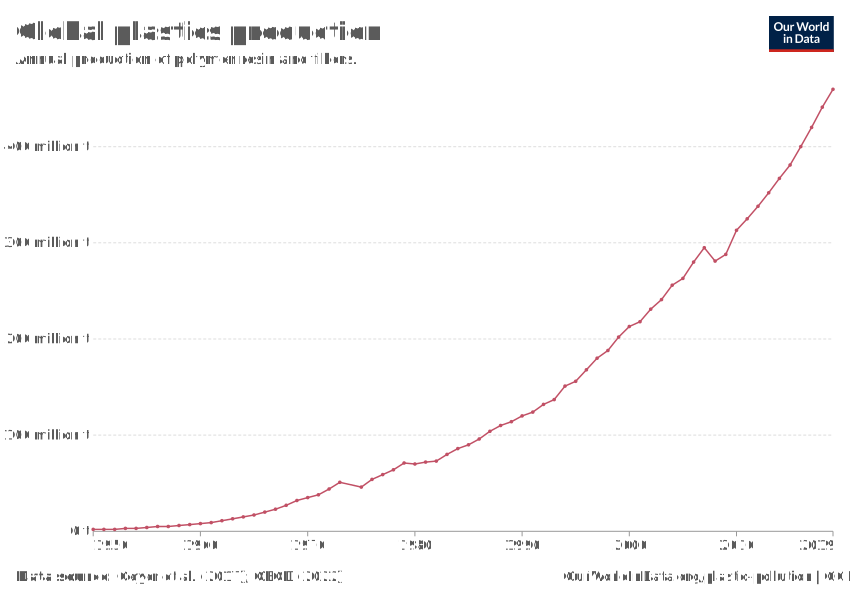
It's an exponential curve. Most plastic made was made relatively recently. This is less obvious in the first world, where we've had consumer plastics for many decades. Most growth in plastic use happens outside the US.
My understanding is that 4% number is for the oil used in plastic production, which is not necessarily the amount of oil sequestered in the actual plastic.
Conversely, I don't know if that number includes production from natural gas and not just crude oil, and a lot of plastic feedstock is made from it.
Conversely, I don't know if that number includes production from natural gas and not just crude oil, and a lot of plastic feedstock is made from it.
Yeah, it's gonna be similar in magnitude to 3 years. Not excellent, but not going to make a long run difference either.
That's without looking at estimates of plastic production, but it's likely enough to be higher now than the majority of the 70 years.
That's without looking at estimates of plastic production, but it's likely enough to be higher now than the majority of the 70 years.
For all the reasons to hate plastic in the oceans, I wouldn't worry about that. Think of the plastic full cycle, almost all plastic comes from oil, but almost all oil goes to energy production.
Therefore what plastic makes it into the oceans represents a small fraction of the total carbon emissions.
Besides, it appears to take a very long time to decay, significantly reducing the GHG potential of plastic
Therefore what plastic makes it into the oceans represents a small fraction of the total carbon emissions.
Besides, it appears to take a very long time to decay, significantly reducing the GHG potential of plastic
Of course, nature wins again: paperclip maximization from flesh-eating bacteria adapted to plastic.
Some context: Vibrio and pseudomonas have long been known to be able to consume hydrocarbons and derivates. Not all vibrio or pseudomonads are pathogenic, much less flesh eating, only some of them.
"flesh eating" is also pretty relative with bacteria. What's talked about as "flesh eating" is common bacteria that have infected an uncommon part of the body - namely when the infection gets into intercellular tissue space.
Yep, and given plastic is useful but pretty stable you’d expect adaptation to plastic would lead to discarding other niches. Like flesh-eating.
You'd think but biology often comes up with stochastic surprises.
[deleted]
The ape pattern is proving self destructive.
Well the Holocene extinction event we are currently causing rivals the destructive power of supervolcanoes and asteroids in the number of species driven to extinction.
Every time a species becomes so well adapted that it takes over the entire biosphere, it effectively wipes out most everything else. When land plants first evolved they did the opposite of what we're doing, turned all the CO2 into oxygen and killed 85% of all life.
Every time a species becomes so well adapted that it takes over the entire biosphere, it effectively wipes out most everything else. When land plants first evolved they did the opposite of what we're doing, turned all the CO2 into oxygen and killed 85% of all life.
> When land plants first evolved they did the opposite of what we're doing, turned all the CO2 into oxygen and killed 85% of all life
That was billions of years before land plants or land anything. The feat was accomplished by cyanobacteria, the first photosynthesis capable organisms on Earth. And they were blue...
That was billions of years before land plants or land anything. The feat was accomplished by cyanobacteria, the first photosynthesis capable organisms on Earth. And they were blue...
I cannot find it, but this reference wouldn't be misplaced in older science fiction works, where humans are templates of an advanced civilization's creation engine (along with other species that have evolved sentience).
Or even from Halo, although there humans are--spoiler spoiler spoiler--"exalted."
Or even from Halo, although there humans are--spoiler spoiler spoiler--"exalted."
Dunno about older sci-fi, but I'm reminded of the short(~100 pages) story All Tomorrows by Nemo Ramjet where humanity is genetically transformed by an alien civilisation into various other human-ish species across the galaxy, as slaves in a vast empire. Alt Shift X has a good audio version of it on youtube.
It definitely hits an interesting nexus point between existential sci-fi and Lovecraftian horror, highly recommend it.
It definitely hits an interesting nexus point between existential sci-fi and Lovecraftian horror, highly recommend it.
Thank-you, I gave it a watch:
https://m.youtube.com/watch?v=imNtSPM3-r4
This one has sections to help organize the story:
All Tomorrows: the Complete Timeline - https://youtu.be/qw9b9LnhY-8
https://m.youtube.com/watch?v=imNtSPM3-r4
This one has sections to help organize the story:
All Tomorrows: the Complete Timeline - https://youtu.be/qw9b9LnhY-8
No it's not. Don't be a misanthrope.
Everything is awesome. Every year gets better and better for most of us on average.
Be glad we're not an icy hellscape like Pluto. Or that we don't not exist.
Everything is awesome. Every year gets better and better for most of us on average.
Be glad we're not an icy hellscape like Pluto. Or that we don't not exist.
The next step when thinking along those lines should be to remember that linearity plays only a temporary role in nature, until some threshold is reached of one or many developments, and things change.
A look at the historic human population numbers on this planet, which exploded to unseen heights only very recently (200 years or so), coupled with looking at the also vastly increased impact of every single person compared to far more spartan living ancient humans, might give one some ideas that extending past trends might be an especially bad idea in our times. Sure, we as a species lived through a lot for hundreds of thousands of years - but none of that past is of much use to predict our future.
A look at the historic human population numbers on this planet, which exploded to unseen heights only very recently (200 years or so), coupled with looking at the also vastly increased impact of every single person compared to far more spartan living ancient humans, might give one some ideas that extending past trends might be an especially bad idea in our times. Sure, we as a species lived through a lot for hundreds of thousands of years - but none of that past is of much use to predict our future.
> Every year gets better and better for most of us on average.
No, it’s not that “better”. Life expectancy increase but stress increase, smartphone penetration grow as well as children working in mines, there’s less and less food shortage but people eat crap and die from obesity. Meanwhile slums continues poping and growing everywhere - even in rich countries - and there’s a ton more lung cancer even for non-smokers.
Is it being misanthropic to point out what feels wrong in our world ? Not being mad or sad does not makes you more a humanity lover.
No, it’s not that “better”. Life expectancy increase but stress increase, smartphone penetration grow as well as children working in mines, there’s less and less food shortage but people eat crap and die from obesity. Meanwhile slums continues poping and growing everywhere - even in rich countries - and there’s a ton more lung cancer even for non-smokers.
Is it being misanthropic to point out what feels wrong in our world ? Not being mad or sad does not makes you more a humanity lover.
I don't think your view is supported by the data. As for stress, I'm not sure how you can measure that. But as for child labor, there has been a steady decrease over the decades (source: https://ourworldindata.org/grapher/various-measures-of-child...). Your comment on food shortages vs. eating bad food is hard to understand. Are you saying it is worse to eat bad food rather than starve to death? Starvation rates are way down from 50 years ago. (source: https://sites.tufts.edu/wpf/files/2017/05/2_170405_world_fam...) As for lung cancer, that doesn't seem to be increasing in rich countries. Here is a link to CDC data for the US (https://www.cdc.gov/mmwr/volumes/67/wr/mm6730a8.htm) Do you have data to back up your claims?

> Everything is awesome. Every year gets better and better for most of us on average.
A man falling 50 stories feels just fine as he passes the 10th floor.
> Be glad we're not an icy hellscape like Pluto.
If we'd evolved on Pluto, we'd be adapted to Pluto. And you'd be saying "Be glad we're not on a flesh-vaporizing hellscape like Earth."
A man falling 50 stories feels just fine as he passes the 10th floor.
> Be glad we're not an icy hellscape like Pluto.
If we'd evolved on Pluto, we'd be adapted to Pluto. And you'd be saying "Be glad we're not on a flesh-vaporizing hellscape like Earth."
This is the right answer. Life is getting better for the vast majority of humanity. Less poverty, more education, better healthcare, longer life, better governments, less war, etc.
The average HN reader is probably in the top 5% of humanity in terms of all these things, so from our point of view things aren't getting that much better (but even we are seeing improvements). But for the rest of humanity, this generation is massively better off than their parents' generation, who are better off than their parents' generation, and so on. Obviously there are places in the world that are not having a great time at the moment, but on average it's getting better.
The average HN reader is probably in the top 5% of humanity in terms of all these things, so from our point of view things aren't getting that much better (but even we are seeing improvements). But for the rest of humanity, this generation is massively better off than their parents' generation, who are better off than their parents' generation, and so on. Obviously there are places in the world that are not having a great time at the moment, but on average it's getting better.
> Every year gets better and better for most of us on average.
So it also did in Rome until it all fell apart. True, things could be worse. But they could be a hell of a lot better too.
So it also did in Rome until it all fell apart. True, things could be worse. But they could be a hell of a lot better too.
> Everything is awesome. Every year gets better and better for most of us on average
If you're freezing cold and start burning your living room everything also gets better and better, on average, for a while
If you're freezing cold and start burning your living room everything also gets better and better, on average, for a while
Pointing out humanity's flaws isn't being a misanthrope, we should strive not to fuck up our planet. Things are usually on an upwards trajectory, until they are not. When I have a company that is growing, there had better be some sustainability there, right? Today, there is some evidence that humanity's improvements used the environment as leverage, and the debt may have come due without the customer base to support it.
edit: removed mixed metaphors
edit: removed mixed metaphors
Pluto is a pretty low bar.
I'm so old I remember when Pluto was a planet, as good as Jupiter or any of them. Now, it's just a punch line.
wildly off topic but have you seen https://www.youtube.com/watch?v=D5XPuS-Y0fg ? it gave me a lot of feelings.
A cold, cold dwarf planet.
On average. But the median is falling.
[deleted]
Seems to me like the pathogen is just adapting to have a new transport mechanism? Rather than it decomposing or making use of microplastics.
Rather than attaching to seaweed, it can also stick to microplastics and (hopefully) be ingested by marine wildlife. At least as I read the articles.
Rather than attaching to seaweed, it can also stick to microplastics and (hopefully) be ingested by marine wildlife. At least as I read the articles.
That is a pretty horrifying prospect
> “Another interesting thing we discovered is a set of genes called ‘zot’ genes, which causes leaky gut syndrome,” said Mincer. “If a fish eats a piece of plastic and gets infected by this Vibrio, which then results in a leaky gut and diarrhoea, it’s going to release waste nutrients such nitrogen and phosphate that could stimulate sargassum growth and other surrounding organisms.”
> “Another interesting thing we discovered is a set of genes called ‘zot’ genes, which causes leaky gut syndrome,” said Mincer. “If a fish eats a piece of plastic and gets infected by this Vibrio, which then results in a leaky gut and diarrhoea, it’s going to release waste nutrients such nitrogen and phosphate that could stimulate sargassum growth and other surrounding organisms.”
Not sure I understand that particular concern of the researcher's - in the absence of such a development, what would you suppose happens to nitrogen & phosphorus that had been hitherto sequestered in the fish's body structure once it completes its lifecycle / becomes dinner for a bigger fish? Does it stay in progressively bigger fish species' biomass, forever? Do the fish ordinarily migrate away from the sargassum as they finish their lifecycle, depositing their bioaccumulated nitrogen & phophorus elsewhere?
They either get eaten, or fall to the ocean floor, ~4,000m down.
Then all those dead floating fish I and others have seen, mostly in pictures, but sometimes in real life must have been a grand collective illusion? I wonder what the terminal velocity of a dead, but not yet inflating, fish would be. I presume it would be only marginally heavier then water, with quite a lot of friction in water.
If they didn't get recycled in the bio-sphere, and didn't float I'd expect pictures of the ocean floor to look like a weird nightmarish Hieronymus Bosch painting of a thick layer of dead but intact fish.
If they didn't get recycled in the bio-sphere, and didn't float I'd expect pictures of the ocean floor to look like a weird nightmarish Hieronymus Bosch painting of a thick layer of dead but intact fish.
Depending on where and how they die, dead fish float briefly because of gas created by bacterial decay, but sink after a rupture, or a few days.
Many dead fish will get eaten as they fall through the water column. Things that sink all that way to the bottom of the ocean do still get recycled by the biosphere - but the biosphere at the bottom, which is only connected tenuously and very slowly with the surface - most of the carbon etc... will stay down there for a very long time.
> I'd expect pictures of the ocean floor to look like a weird nightmarish Hieronymus Bosch painting of a thick layer of dead but intact fish.
Not intact for long, because the seafloor has lots of scavengers, but yes, this is pretty accurate - see Whalefall: https://en.wikipedia.org/wiki/Whale_fall
and Marine Snow:
> About three-quarters of the deep ocean floor is covered in this thick, smooth ooze. The ooze collects as much as six meters every million years.
https://oceanservice.noaa.gov/facts/marinesnow.html
Many dead fish will get eaten as they fall through the water column. Things that sink all that way to the bottom of the ocean do still get recycled by the biosphere - but the biosphere at the bottom, which is only connected tenuously and very slowly with the surface - most of the carbon etc... will stay down there for a very long time.
> I'd expect pictures of the ocean floor to look like a weird nightmarish Hieronymus Bosch painting of a thick layer of dead but intact fish.
Not intact for long, because the seafloor has lots of scavengers, but yes, this is pretty accurate - see Whalefall: https://en.wikipedia.org/wiki/Whale_fall
and Marine Snow:
> About three-quarters of the deep ocean floor is covered in this thick, smooth ooze. The ooze collects as much as six meters every million years.
https://oceanservice.noaa.gov/facts/marinesnow.html
I don't know what they mean. Leaky gut is a hypothetical medical condition, not officially recognized, in which the intestines can absorb larger molecules than normal, compromising gut health.
It doesn't necessarily automatically suggest diarrhea, though that can be one symptom or outcome.
https://my.clevelandclinic.org/health/diseases/22724-leaky-g...
It doesn't necessarily automatically suggest diarrhea, though that can be one symptom or outcome.
https://my.clevelandclinic.org/health/diseases/22724-leaky-g...
I knew an old man who had a literally leaky gut. A liquid that smelled like pee somehow surfaced from his abdomen onto the skin. (He wasn't peeing on himself; if he had been it would have gotten other places, and it didn't.)
Patent urachus perhaps?
https://en.wikipedia.org/wiki/Urachal_fistula
https://en.wikipedia.org/wiki/Urachal_fistula
link to the study: https://www.sciencedirect.com/science/article/pii/S004313542...
A bacterium that can metabolize plastic, which is notoriously difficult to recycle, could be a biodegrading symbiote as well as a pathogen.
Would really suck to have flesh eating bacteria thriving on basically everything in the world though.
Theres an astronomical figure of A Streptococcus bacteria on the human skin, and the same bacteria is responsible for most necrotizing fasciitis. But yet the disease is rare. So flesh eating bacteria is already thriving all over the world, it’s just that infecting human tissue isn’t trivial for bacteria
Sounds like a variant on the 12 monkeys theme.
Funny, my mind immediately went to Vonnegut.
> There was a sound like that of the gentle closing of a portal as big as the sky, the great door of heaven being closed softly. It was a grand AH-WHOOM. I opened my eyes - and all the sea was ice-nine.
> There was a sound like that of the gentle closing of a portal as big as the sky, the great door of heaven being closed softly. It was a grand AH-WHOOM. I opened my eyes - and all the sea was ice-nine.
Usually there’s a limited amount of genetic material to leverage.
If a bacteria adapts to eating plastic, you’d expect the rest to start degrading as it becomes unnecessary, and can be recycled to better plastic eating.
If a bacteria adapts to eating plastic, you’d expect the rest to start degrading as it becomes unnecessary, and can be recycled to better plastic eating.
Going to be interesting that our great grandkids will have to deal with plastic rusting.
Organisms, especially bacteria tend to specialize, so evolution towards optimized plastic eating usually means evolution away from flesh eating.
This is how the first vaccine was invented (and why we call them vaccines).
>the doctor took pus from the cowpox lesions on a milkmaid’s hands and introduced that fluid into a cut he made in the arm of an 8-year-old boy named James Phipps.
Cowpox was sufficiently evolved away from humans and towards cows that it was easy for the human immune system to fight, and provides antibody protection against the much more dangerous smallpox.
This is how the first vaccine was invented (and why we call them vaccines).
>the doctor took pus from the cowpox lesions on a milkmaid’s hands and introduced that fluid into a cut he made in the arm of an 8-year-old boy named James Phipps.
Cowpox was sufficiently evolved away from humans and towards cows that it was easy for the human immune system to fight, and provides antibody protection against the much more dangerous smallpox.
finally, time to build the caves of steel!
The article says that the bacteria uses plastic but does it actually eat it?
Not from my reading. I think most of the commenters on this are mis-reading the article.
There are some bacteria that we are aware of that eat plastic - Rhodococcus ruber is probably the most prominent - but my understanding is that we are not aware of any vibrio bacteria that does, and that's what they're worried about in the sargassum.
You're right, my bad, the article only says the bacteria attaches to the plastic.
The issue here is that it is uncontrollable - it spreads easily and sticks to the plastic, from my understanding. This means that the side effects of the plastic eating are very widespread.
If these bacterium are dangerous to life in the ocean, and they can be moved around on plastic particulate on top of spreading from fish, the implication for the oceanic ecosystem seems grim to me - if not the whole biosphere.
If these bacterium are dangerous to life in the ocean, and they can be moved around on plastic particulate on top of spreading from fish, the implication for the oceanic ecosystem seems grim to me - if not the whole biosphere.
Carrion eaters with the ability to digest plastic would help tremendously. Be they pupae or vultures.
I mean I want to say I would be fine with banning plastic and just using paper/cloth/glass/metal/wood/stone for everything… but I’m not fully sure what I would be giving up here.
Some things are really useful in plastic (like mechanical parts) but there's a lot that we could live without (replace as you said), even though it would be more expensive (short term).
I'm actively trying to choose products with less plastic but it's becoming increasingly hard to find alternatives.
I'm actively trying to choose products with less plastic but it's becoming increasingly hard to find alternatives.
I’m fine with plastic where paper can’t be used so long as we recycle it or return it to the ground where it came from.
Glass seems great - until you learn that sand extraction might be the only thing worse in terms of habitat destruction than oil itself.
Glass seems great - until you learn that sand extraction might be the only thing worse in terms of habitat destruction than oil itself.
Glass is one of the things we've gotten pretty good at recycling though which should cut down on the need for raw materials.
I don't know if we're at the tipping point yet, but when I read reports like this I feel like it's getting pretty damn close.
Alas, the psychological relief of knowing we're past some tipping point will likely never come. Even when we're quite far gone we'll still have a sliver of hope, and we'll magnify its probability in our imaginations the way we already magnify that of of complying with our current climate goals.
The article mentions the Vibrio genus several times, but doesn't mention that this is the genus of bacteria responsible for cholera, which may be helpful context in understanding what it does and what you may have heard about it before.
Honest question, can't we just mix gasoline or something similar with something that will make it float, pour it over the sargasso and then set it on fire?
Edit: we control burn areas on land all the time. Why not on the ocean?
Edit: we control burn areas on land all the time. Why not on the ocean?
To be clear, you want to dump enough gasoline-napalm into the Atlantic Ocean to incinerate a 5,500-mile-long belt of something that's mostly submerged in water?
Well, it's either that or nuke the hurricane that washed it ashore. /s
It's an interesting thought experiment, and I think undeserving of downvotes.
If you could get a bunch of balloons underneath the seaweed to float it above the water, maybe it would have a hope of burning -- but the balloons would have to withstand fire. Difficult.
With a heroic effort maybe you could sweep the stuff onto a beach where it could burn. You'd burn a lot of fuel doing it, though, and then a lot of seaweed, and you wouldn't have changed the conditions that led to its growth in the first place.
If you could get a bunch of balloons underneath the seaweed to float it above the water, maybe it would have a hope of burning -- but the balloons would have to withstand fire. Difficult.
With a heroic effort maybe you could sweep the stuff onto a beach where it could burn. You'd burn a lot of fuel doing it, though, and then a lot of seaweed, and you wouldn't have changed the conditions that led to its growth in the first place.
Gasoline already floats, very well. Oil spills are still long-lasting environmental disasters.
Also, it's difficult to burn to a soaking-wet object without drying it out first. It's difficult to dry out things that are in the ocean.
Also, it's difficult to burn to a soaking-wet object without drying it out first. It's difficult to dry out things that are in the ocean.
"Oil spills are still long-lasting environmental disasters"
What if we just lit them on fire...
:)
What if we just lit them on fire...
:)
BP is way ahead of you https://upload.wikimedia.org/wikipedia/commons/transcoded/f/...
Ah yes, just add petrochemicals and hope the environmental disaster gets better.
Best bets to just leave it the fuck alone.
Best bets to just leave it the fuck alone.
We landed a man on the moon, why not the sun?
hmm maybe at night when the sun is cold?
why not harvest it with ships?
It reminds me of the algae in Benford's Timescape novel.
https://en.wikipedia.org/wiki/Timescape
https://en.wikipedia.org/wiki/Timescape
I'd like a marine biologist and microbiologist to say just how concerning vibrio is in context: Out of context, sure it's a bug associated with diseases we can catch and which wreak havoc.
But lots of bacteria have different forms, intensities, effects. It depends. We're partly made up of bacteria, in a safe context (the gut)
How variant is the level of this bacteria in the beachfront, compared to e.g. from enteric sources (sewage) or normal deposits? Is it seasonal?
Is it also part of the food chain of something else?
But lots of bacteria have different forms, intensities, effects. It depends. We're partly made up of bacteria, in a safe context (the gut)
How variant is the level of this bacteria in the beachfront, compared to e.g. from enteric sources (sewage) or normal deposits? Is it seasonal?
Is it also part of the food chain of something else?
Biology is beating us over the head about how to address climate change.
Grow more of it and sequester the remains.
Grow more of it and sequester the remains.
Hey, can we gather that blob, dry it, and burn it as fuel?
Burning biomass isn’t ideal when we’re dealing with an atmospheric CO2 crisis.
Maybe we should instead try to accelerate the blob’s growth so it would absorb more CO2.
Maybe we should instead try to accelerate the blob’s growth so it would absorb more CO2.
Interestingly, pyrolizing biomass produces energy and solid carbon that can be sequestered. So while it produces less energy than burning biomass, it's energy positive and carbon negative if you bury the carbon output.
So gathering and heating biomass as a resource isn't necessarily the wrong general idea.
So gathering and heating biomass as a resource isn't necessarily the wrong general idea.
>> Burning biomass isn’t ideal when we’re dealing with an atmospheric CO2 crisis.
But it might offset other carbon based fuels. I was just trying to think of a use for that massive blob to get rid of it.
CO2 may be a threat down the road, but what if this blob chokes the oceans in 3 to 5 years? It's growing fast.
But it might offset other carbon based fuels. I was just trying to think of a use for that massive blob to get rid of it.
CO2 may be a threat down the road, but what if this blob chokes the oceans in 3 to 5 years? It's growing fast.
> atmospheric CO2 crisis
(citation needed)
(citation needed)
Instead can it collect it and sink it to store the carbon?
https://www.technologyreview.com/2021/09/19/1035889/kelp-car...
https://www.technologyreview.com/2021/09/19/1035889/kelp-car...
This. Robotic sargassum farming and harvesting, followed by depositing remains in sacrificial oceanic trenches.
they do that with a fraction of it, but it's 5500 miles long (twice the width of the continental US for comparison) so yeah...
why is that a deterrent? just cut down into smaller size chunks just like we poke the earth full of holes to leak out the oil instead of sucking it out in one go.
Love that you used "just" twice to equate something to as much effort as the building and operation of the entire petroleum industry.
likely because it costs a ton of money? but maybe is simply hasn't occurred to anyone who lives there for the last 10 years
well apparently there's a risk of having to interact with a bacteria that can eat both plastic and flesh...
I thought these just attach to plastic. Eating plastic would be great news, right?
It depends on your perspective. We still don't know the impacts of microplastics so more microplastics might be bad news. It's also bad news for a lot of our infrastructure which depends on the assumption that plastics aren't biodegradable
Wow, manmade horrors beyond my comprehension
either this is the next scaremongering or the next lab-made bio-weapon
can't wait to hear this on blast for 5 years
can't wait to hear this on blast for 5 years
It looks like we’re entering the world of that SF book « the windup girl » where plagues and crop failure are the default mode.
as a surfer, this scares the crap outta me.
They don't really know what's going on and so they don't really know if this is all bad news or if there is some silver lining here of some sort, such as a potential means to get rid of plastics in the ocean.
That possibility is not unprecedented. We use petroleum-eating microbes to help clean up oil spills in the ocean. Such microbes are typically harmless to humans.
(Typically -- with the exception that people with cystic fibrosis sometimes die from infection with them though normal humans almost never get infected. To me, this implies people with CF likely retain petroleum products, including plastics, more than average.)