McDonald's ice cream machine hackers say they found 'smoking gun'(wired.com)
wired.com
McDonald's ice cream machine hackers say they found 'smoking gun'
https://www.wired.com/story/kytch-taylor-mcdonalds-ice-cream-machine-smoking-gun/
230 コメント
Archive link: https://archive.ph/fouWj
I worked at McDonalds for 4 years. 2 as a kitchen worker. 2 as a shift manager. I've personally cleaned these machines too many times to count.
I've never heard one person tell "the truth" about this (at least in my personal experience).
Our ice cream machine was often down too but not because it was broken. Because we were short staffed and making ice cream is a HUGE time sink for employees. The manager would just tell the employees "no more ice cream" and they all knew what's up. They'd be very happy that they could focus on food and McCafe and thus not disappoint customers too much due to slow service.
Folks don't quite understand that McDonald's is consistently short staffed and the workers are often doing the work of 2-3 people just to try to get you fast and hot food.
I've never heard one person tell "the truth" about this (at least in my personal experience).
Our ice cream machine was often down too but not because it was broken. Because we were short staffed and making ice cream is a HUGE time sink for employees. The manager would just tell the employees "no more ice cream" and they all knew what's up. They'd be very happy that they could focus on food and McCafe and thus not disappoint customers too much due to slow service.
Folks don't quite understand that McDonald's is consistently short staffed and the workers are often doing the work of 2-3 people just to try to get you fast and hot food.
It's kinda wild how a franchise built around a milkshake machine now cannot bother with milkshakes.
To be fair, Wikipedia says McDonald’s is now 80 (!!!) years old, I expect many foundational aspects of the business have changed since then. But it is wild to see particular aspects of the evolution. I wonder how much was anticipated/planned, and how much “just happened”
i only go there for chicken sandwiches these days...
The company whose OG sign said "McDonald's Famous Hamburgers" the year they introduced "fast food" principles into their operations was actually built around shakes?
Ray Kroc (who is really responsible for the growth of the McDonald's franchise) was a milkshake machine salesman. I believe he was introduced to the McDonalds brothers when selling them a milkshake machine that could mix multiple individual milkshakes at once.
Edit: here's the "multimixer": http://www.sterlingmulti.com/multimixer_history.html
Edit: here's the "multimixer": http://www.sterlingmulti.com/multimixer_history.html
They did pretty much give up on the shakes not long after becoming a popular place. They were one of if not the first to switch from actual cow milk to chemical gelatin formulations.
So they really have always been struggling with the difficulties of quickly serving an ice cream product for their entire existence. That's a long time to have a thorn in your side and put up with it. 80 years according to the other comment.
So they really have always been struggling with the difficulties of quickly serving an ice cream product for their entire existence. That's a long time to have a thorn in your side and put up with it. 80 years according to the other comment.
Had a stint myself and cleaned those Taylor shake machines, takes time as have to disassembler the entire chamber - lots of sharp blades and not many trusted to do it right. Let alone checking all the O-rings, which you often need spares and short of the one you need. Then inspections....so often find they would at least try to close the machine early to shorten the close, and often be down. Sometimes due to lack of milk for the machine and no they can't just pop down the local supermarket to get some - least not known that ever happen, nor risked as be job ending kinda things as cutting into that franchise supply grip.
One problem with your claims is this is pretty well documented as a uniquely McDonalds franchise problem at this point.
Competing fast-food franchises serve similar frozen dairy products, in a similar staffing environment, without their machines constantly being out of service.
This video covered the situation fairly well IIRC:
https://www.youtube.com/watch?v=SrDEtSlqJC4
Competing fast-food franchises serve similar frozen dairy products, in a similar staffing environment, without their machines constantly being out of service.
This video covered the situation fairly well IIRC:
https://www.youtube.com/watch?v=SrDEtSlqJC4
You may be right! Just my experience working there for 4 years at 6 different stores.
This happened all the time at every store I worked at.
BTW Our machine would legit break too. Maybe once a year it would be down for a day.
This happened all the time at every store I worked at.
BTW Our machine would legit break too. Maybe once a year it would be down for a day.
The linked video makes a pretty strong case for it being a "show me the incentives and I'll show you the outcome" situation...
Also staff not keeping the ice cream machine full or ignoring the warnings on the screen or...all the other things. As long as people followed all the rules the machines they were bullet proof.
Exactly! Our ice cream machines were well made and always worked as they should. They'd be down for a couple hours a month to clean but that's it.
The machine would flash and beep when the ice cream mix was low so we were always eager to shut it up.
The machine would flash and beep when the ice cream mix was low so we were always eager to shut it up.
The intersection of minimum wage part time jobs with no benefits and motivated contentious workers is unfortunately fairly small.
This makes sense for daytime-rush "broken" ice cream machines; but almost all the reports I've seen about "broken" machines are about people coming into a dead store during the night-shift, when the employees would in theory have nothing better to do than make them an ice cream.
Your right about this occuring mostly at night.
The store looks dead but do you know if the night crew is caught up on their closing responsibilities? Doing dishes, stocking nuggest sauces, cleaning the grill, disassembling the fry hopper, organizing the stock room, etc...
If the store closes with none of these done the manager will blow their labor budget due to taking 3 hours to close and the employees will be pissed.
Your rebuttal is a good one and your somewhat right. Grabbing you an ice cream cone when there's no customers likely isn't a big deal. The manager usually cuts the ice cream while being overwhelmed (Ahh! 7 ice cream cones and we have 10 cars behind them. No more ice cream!) and never tells employees to start offering it again. Offering ice cream again would piss off the employees and also slow down the manager who's trying to hit labor and drive through times
The store looks dead but do you know if the night crew is caught up on their closing responsibilities? Doing dishes, stocking nuggest sauces, cleaning the grill, disassembling the fry hopper, organizing the stock room, etc...
If the store closes with none of these done the manager will blow their labor budget due to taking 3 hours to close and the employees will be pissed.
Your rebuttal is a good one and your somewhat right. Grabbing you an ice cream cone when there's no customers likely isn't a big deal. The manager usually cuts the ice cream while being overwhelmed (Ahh! 7 ice cream cones and we have 10 cars behind them. No more ice cream!) and never tells employees to start offering it again. Offering ice cream again would piss off the employees and also slow down the manager who's trying to hit labor and drive through times
> The store looks dead but do you know if the night crew is caught up on their closing responsibilities?
I mean, I've never worked in fast food myself, but that split of responsibilities assumes that the night shift are closing, no? There are a lot of 24-hour McDonald's locations, where no explicit "closing" ever happens.
I would assume that in a 24hr location, a lot of what would otherwise be "closing" responsibilities are either spread out as "clean as you go", turned into something done at shift-start/shift-end for each shift (and so made a lot quicker by only having 1/3rd the accumulated workload for each shift), or pushed to the dead-est period (which according to one Quora post is "in the middle of the graveyard shift, 3-6AM".)
I mean, I've never worked in fast food myself, but that split of responsibilities assumes that the night shift are closing, no? There are a lot of 24-hour McDonald's locations, where no explicit "closing" ever happens.
I would assume that in a 24hr location, a lot of what would otherwise be "closing" responsibilities are either spread out as "clean as you go", turned into something done at shift-start/shift-end for each shift (and so made a lot quicker by only having 1/3rd the accumulated workload for each shift), or pushed to the dead-est period (which according to one Quora post is "in the middle of the graveyard shift, 3-6AM".)
You underestimate the creativity and laziness of night shift food workers. Once a daytime manager says "no ice cream", how far away is a night shift worker from just repeating that mantra?
Source: Was one, did that for other things all the time.
> " Sorry, we don't deliver to your area on Mondays "
Source: Was one, did that for other things all the time.
> " Sorry, we don't deliver to your area on Mondays "
It also needs to be cleaned (daily when I was crew), and that often means taking it apart early to get ahead of closing, or putting it together late because you didn’t have enough time to get to it before breakfast ended, or maybe just don’t put it back together at all because the person that usually did it was gone that day.
> the workers are often doing the work of 2-3 people
How is that possible?
How is that possible?
When I worked there during our lunch rush, we would have a person dedicated to every task, fries, coffee, orders, bagging. When it came to the dinner rush, we would have half the staff or less then our lunch rush. So in a sense it is the work of 2 to 3 people.
Also during overnight we would have only one person in the front, and one in the back. Once Uber eats came on the scene our workload increased 3x or more, but no extra staff was added! :-)
Edit: that’s not even mentioning when we would be short staffed, due to people not showing up / calling in, which happened every other day it felt like, and the shift wouldn’t be replaced.
Edit: that’s not even mentioning when we would be short staffed, due to people not showing up / calling in, which happened every other day it felt like, and the shift wouldn’t be replaced.
Yes. Lunch rush is the baby of all McDonalds management. You'll rarely see an understaffed store then. Coincidentally this is the shift that most store managers work.
Night shift is where you'll see the cluster-fucks occur most and it's when the ice cream machine will be "down" the most in my experience
Night shift is where you'll see the cluster-fucks occur most and it's when the ice cream machine will be "down" the most in my experience
Lunch is like one $1200 hour, dinner is $4-600/hour, but occurs over many more hours. Lunch is definitely busier and better staffed, and the dinner crew usually needs to to start thinking about closing, so a few go off at 7 to start dish or clean the back room or whatever.
The customer load on a service business like McDonald's is going to vary chaotically from minute to minute. It's a difficult problem to have it match the staffing level, while staying in business.
> When it came to the dinner rush, we would have half the staff or less then our lunch rush. So in a sense it is the work of 2 to 3 people.
Is dinner as busy per hour as lunch?
Is dinner as busy per hour as lunch?
I suspect this is a franchisee trying to improve profitability versus a company wide issue. I suspect it is highly variable. Also, sometimes sales are unexpectedly higher than normal.
We have comments from people who’ve worked there, which fit the general impression that the places tend to give.
I haven’t worked in fast food, but I’ve worked in retail, and it was my experience that the “nice” manager would schedule us, like… one extra person beyond the bare minimum.
Why do you suspect this, do you have any particular insight into these kinds of businesses beyond the rest of us?
I haven’t worked in fast food, but I’ve worked in retail, and it was my experience that the “nice” manager would schedule us, like… one extra person beyond the bare minimum.
Why do you suspect this, do you have any particular insight into these kinds of businesses beyond the rest of us?
Well, yes I do. I have owned four franchised businesses - all quick serve restaurant style - from two different national chains. Individual franchisees have significant leeway in how they schedule. Some, particularly marginal locations, will cut staffing to the bone. Others that are more confident in sales and doing well are able to schedule more than the bare minimum so that customers don’t wait as long and employees are happier.
Sales unexpectedly higher than normal happens, but that typically only lasts an hour and then you go clean the now very messy store, while if sales were normal you would have enough staff on hand to keep it clean as you go. Stores keep enough clean trays and the like around to handle the worst case extra busy, and the trash cans can go an hour without being emptied. Customers will pick the least dirty table.
Back in the early 2000s, I worked on a product that was the only profit center in a public company. While there were people who worked on overall technical architecture, it was only myself and one front end dev dedicated to the product. Other products that ran in the red had dozens of employees because they were the things that got touted to Wall Street, but we were the very boring thing that kept the company alive.
Back in high school I worked in fast food as a closer. One front end person, one backend person, one manager for dinner rush, late rush, clean up from the day both in the kitchen and the store, some basic prep for the next day (morning shift did main prep), and they kept pushing us to get our times down so that we could walk out the door as soon as the store closed rather than taking any time after closing for our cleanup, etc. Our labor cost per hour was likely around $17. The energy to run the ovens, refrigerators, etc was fairly consistent, while our labor cost for any extra time after closing was a variable cost that ate into their profit margin.
Doesn't matter what industry -- ask a doctor about their workload -- if management can squeeze labor costs, they will.
Back in high school I worked in fast food as a closer. One front end person, one backend person, one manager for dinner rush, late rush, clean up from the day both in the kitchen and the store, some basic prep for the next day (morning shift did main prep), and they kept pushing us to get our times down so that we could walk out the door as soon as the store closed rather than taking any time after closing for our cleanup, etc. Our labor cost per hour was likely around $17. The energy to run the ovens, refrigerators, etc was fairly consistent, while our labor cost for any extra time after closing was a variable cost that ate into their profit margin.
Doesn't matter what industry -- ask a doctor about their workload -- if management can squeeze labor costs, they will.
> if management can squeeze labor costs, they will.
Everybody squeezes costs, including you and I. Don't you shop for the lowest prices? I do. Customers of fast food are pretty price sensitive.
Everybody squeezes costs, including you and I. Don't you shop for the lowest prices? I do. Customers of fast food are pretty price sensitive.
Of course, there's a great deal of price sensitivity especially on commodity products. But - perhaps implicit rather than explicit within my remarks - there's also mismanagement or questionable management. And, price is not always aligned with profit. That Arby's generated something like $1MM in yearly profit, in 1996 dollars. The extra $5.05 they would have paid me for the hour after closing to ensure the store was actually clean, prep was properly done, pans were cleaned etc, made exactly jack squat difference to their margin.
In the case of the tech company...let's just say they are all but forgotten, while other players came along with competent management and have formed new multi-billion dollar businesses.
In the case of the tech company...let's just say they are all but forgotten, while other players came along with competent management and have formed new multi-billion dollar businesses.
Sure, there are a lot of incompetent employers. They usually go out of business. Businesses have a high failure rate, and it's pretty darn hard to make enough at it to put up with all the aggravation and work required to make it successful. Businessmen do not go into business to make a 3% return on capital, as anyone could buy a bond that pays 3%.
Bill Gates famously never went on vacation for something like the first two decades of Microsoft.
Bill Gates famously never went on vacation for something like the first two decades of Microsoft.
It would be nice to have fewer assumptions about others made on HN.
Stated assumptions are fine.
I'll counter you. How do you find competent, reliable people that show up to work consistently and work hard for $9.00 an hour?
You're doing the work of your buddies who called in. Your buddies called in because they're 17 and they're dad made them get this job. They hate it! This happens every damn day.
You're doing the work of your buddies who called in. Your buddies called in because they're 17 and they're dad made them get this job. They hate it! This happens every damn day.
I think many of these jobs are starting at closer to $15/hr now, but perhaps your point still stands
Yeah I think you're right. I'm out of touch now.
I started working there ~10 years ago and my starting pay was $7.30/hr. I made $10/hr as a manager
I started working there ~10 years ago and my starting pay was $7.30/hr. I made $10/hr as a manager
I started at $4.25/hour, but got pushed up to $5 within a year. I feel old now.
What they mean is "the workers have 2-3x more work queued up than can be handled for satisfactory operations"
Quality of service will suffer.
Quality of service will suffer.
What made it a time sink? How could it be made faster?
It's a relative time sink and the toughest logistical challenge in the whole store for workers due to soft serve melting so fast.
You must make the ice cream last. The car has to be at the window (or customer at the counter) when you start. This is the only item in the store that must be prepared like this so you must always have a free person to do this. McDonalds does't provide the labor budget to have "free people" standing around to get your ice cream when you need it. Making ice cream almost always hurt another area of the store in a small way.
Also making a soft serve ice cream cone is much harder than you think. Took me ~2 months to get it down. Dont even get me started on dipped cones.
Fun fact: This is why your mcflurry doesnt have candy at the bottom. Workers hate ice cream! They dont blend it with the machine, they'll just hand blend it to be quick.
The fix would be to take the burden off the the employees. Automate it just like they did drinks. Or increase the labor allowance to have the staff to handle ice cream. They'll probably never do that though.
You must make the ice cream last. The car has to be at the window (or customer at the counter) when you start. This is the only item in the store that must be prepared like this so you must always have a free person to do this. McDonalds does't provide the labor budget to have "free people" standing around to get your ice cream when you need it. Making ice cream almost always hurt another area of the store in a small way.
Also making a soft serve ice cream cone is much harder than you think. Took me ~2 months to get it down. Dont even get me started on dipped cones.
Fun fact: This is why your mcflurry doesnt have candy at the bottom. Workers hate ice cream! They dont blend it with the machine, they'll just hand blend it to be quick.
The fix would be to take the burden off the the employees. Automate it just like they did drinks. Or increase the labor allowance to have the staff to handle ice cream. They'll probably never do that though.
This question makes me think that you believe the problem is an efficiency that can be solved rather than an intentional choice.
Ive worked at several restaurants as a waiter and food prep staff. The businesses have very thin margins and most costs are fixed except for…labor.
When it’s lunch rush, it feels like every atom of your being is pressed to the limit. Then when that’s done your manager has to come around and start assigning random cleaning and other tasks so people aren’t just hanging around.
When they schedule, they want to just *barely* handle the busiest time or otherwise it’s an inefficiency in the system.
Also to mention, restaurant staff aren’t the most…stable workforce in the world. So even if they do schedule to have some buffer, people will quit and call in sick on a dime.
I know what op is talking about when they say they do the work of 2-3 people and I believe them. The system is designed to squeeze that extra bit out of everyone.
If there was a magic mystery inefficiency they found, that would translate to decreasing staffing per shift, not increased breathing room for the individual workers. (IMHO)
Ive worked at several restaurants as a waiter and food prep staff. The businesses have very thin margins and most costs are fixed except for…labor.
When it’s lunch rush, it feels like every atom of your being is pressed to the limit. Then when that’s done your manager has to come around and start assigning random cleaning and other tasks so people aren’t just hanging around.
When they schedule, they want to just *barely* handle the busiest time or otherwise it’s an inefficiency in the system.
Also to mention, restaurant staff aren’t the most…stable workforce in the world. So even if they do schedule to have some buffer, people will quit and call in sick on a dime.
I know what op is talking about when they say they do the work of 2-3 people and I believe them. The system is designed to squeeze that extra bit out of everyone.
If there was a magic mystery inefficiency they found, that would translate to decreasing staffing per shift, not increased breathing room for the individual workers. (IMHO)
We're specifically talking about the efficiency of making ice cream versus other foods. One that makes them change the menu when they're getting busy.
That specific problem can be solved.
And it would not enable any more decrease in staffing, because they're already not making the ice cream.
The question was not about trying to fix the general situation of being understaffed.
That specific problem can be solved.
And it would not enable any more decrease in staffing, because they're already not making the ice cream.
The question was not about trying to fix the general situation of being understaffed.
Thanks for clarifying. I read it as a general question rather than a specific one.
I've never worked at a McDonald's, but I have had to operate and maintain a soft-serve ice cream machine. I don't eat soft serve ice cream because I know how long it takes to clean these machines properly. I've seen what happens when they aren't. I don't trust that places like fast food joints that are understaffed, where the employees aren't motivated enough to do a thorough job, would take the time necessary to make sure those machines are clean.
In my experience the major time sinks happen when multiple McFlurrys were ordered. Mixing one takes about 15-30 seconds, and if too many are ordered at once the ice cream would start to come out slower.
When you’re backlogged with multiple people in line, multiple orders, and you’re a 1-3 person crew in the front, every second counts. Ice cream was the easiest thing to cut because of the stereotype that it was always broken so people didn’t question that it was “down”, and those precious seconds made my 17 year old life much easier.
When you’re backlogged with multiple people in line, multiple orders, and you’re a 1-3 person crew in the front, every second counts. Ice cream was the easiest thing to cut because of the stereotype that it was always broken so people didn’t question that it was “down”, and those precious seconds made my 17 year old life much easier.
Yeah I wondered this too. Watching them work, it certainly doesn’t look like they take more time than most McCafe drinks or making burgers.
It likely doesn't, but McCafe Drinks/Burgers are a staple. Coffee and Burgers are likely included in most of their orders, Ice Cream they get a few each hour.
If it’s only a few that’s no more of a backup than someone getting to order and going “uhhhhhhhhhh” or the people arguing with the cashier that something was wrong.
How long ago was this and have the machines changed over the years? Because this ice cream machine always broken seems like anew phenomenon compared to my tenure back around 97.
I was there for about a year IIRC, other than cleaning the machine "making ice cream" was dumping the premixed liquid into the top two compartments.
I was there for about a year IIRC, other than cleaning the machine "making ice cream" was dumping the premixed liquid into the top two compartments.
I don't think people would care if mcd says they are short staffed. I think people care due to mcd lying.
As a manager you can't tell the customers this. You'd lose your job if your store manager or any higher ups find out.
You lie to the customers and the workers cover for you (the shift manager) because they hate making ice cream.
You lie to the customers and the workers cover for you (the shift manager) because they hate making ice cream.
Every retail/food service job is understaffed. You ask what people displaced by AI will do for a living? That. They'll do that. Because, actually, we do need people at PoS, if we're selling to other people. Hint hint as to why you should be supporting "unskilled" labor unions, high wages for those workers, and the destigmatizing of those types of jobs.
Displaced workers going into unskilled labor doesn't seem like an idealized "post-AI" situation. If anything, it might be something we should guard against. There's nothing wrong with honest work, but some would probably paint that scenario as dystopian, if you consider that many people think creative and autonomous work are important to human flourishing. If anything, I'd want AI to take over those rote jobs so people can focus on that type of creative work they tend to find more fulfilling.
I’m not sure if I’m capable of performing fulfilling work that would also have anything resembling of a demand.
Take creative work. The pre-AI market was already extremely competitive. Few artists can chase autonomy, the rest needs to sell out to some level - usually significant; not the human flourishing we wanted.
AI may disrupt this; still, my guess is that the pool of profitable creative workplaces remains unchanged, at best.
Take creative work. The pre-AI market was already extremely competitive. Few artists can chase autonomy, the rest needs to sell out to some level - usually significant; not the human flourishing we wanted.
AI may disrupt this; still, my guess is that the pool of profitable creative workplaces remains unchanged, at best.
If an artist wants to make a living making art, the art has to be something people are willing to pay for.
If that's "selling out", then so be it. Why should society support the artist if his art has no value to anyone?
If that's "selling out", then so be it. Why should society support the artist if his art has no value to anyone?
Note that our initial goal was different - not an artist who wants to make a living, but an artist who wants to perform fulfilling work.
Draw two circles, 1. fulfilling art 2. art that pays the bills. Create the art that is in the intersection.
Otherwise, you'll need another source of income in order to create fulfilling art.
There's lots of software I'd like to write. I've spent my time writing code that lies in the intersection.
Otherwise, you'll need another source of income in order to create fulfilling art.
There's lots of software I'd like to write. I've spent my time writing code that lies in the intersection.
Let's draw another circle: things you make when 'financial obligations' are not a concern. Where does that intersect? Why aren't we drawing it? How much science was done by 'gentlemen scientists' who never worried about money? How much more would we know if that one person who could have figured out electromagnetism in 1400 didn't have to plow fields all day?
There are an awful lot of professions in the world. Surely people can find one that suits them. Life is what you make of it.
My personal dream was to become a swimsuit model, but it just wasn't working out, so I switched to software.
My personal dream was to become a swimsuit model, but it just wasn't working out, so I switched to software.
You can't think of any other things besides genetics and self-determination that allowed you to be where you are now?
Opportunity presents itself to you and me every day. You can choose.
You're conflating individual decisions with social structures that determine opportunity systemically.
That is a really great place for you to be in! Where code useful and thus valuable, there is a lot in that intersection. Unfortunately where art is concerned, that intersection may be an empty set.
I personally derive a lot of satisfaction from other people enjoying using the programs I write, and I love it when they make money using it. (Many have described to me how D gave them a competitive advantage.) Many give back by funding our annual D conference and providing funding for several of our critical staff members.
I wrote Empire for my personal satisfaction eons ago, and when other people copied it and spread it around, I discovered that it was a lot of fun to get unsolicited emails from people who liked playing it and wanted to let me know. I still get them regularly!
I wrote Empire for my personal satisfaction eons ago, and when other people copied it and spread it around, I discovered that it was a lot of fun to get unsolicited emails from people who liked playing it and wanted to let me know. I still get them regularly!
Sounds like you’re happy in that intersection - and good for you.
Do you actually know any artists or musicians? Any of them that are successful? What you described wouldn't be "selling out," it'd be success. Selling out is the food service job they do to pay their rent, or the lessons they teach, etc. The person you were responding to was pointing out that it's not likely that there is a market for everyone's art, even if everyone was true to their own creative vision.
> Do you actually know any artists or musicians?
Yes, many among family and friends.
> What you described wouldn't be "selling out," it'd be success.
"Selling out" is a common epithet leveled at artists who became successful. Nirvana, for example, was often accused of selling out.
Yes, many among family and friends.
> What you described wouldn't be "selling out," it'd be success.
"Selling out" is a common epithet leveled at artists who became successful. Nirvana, for example, was often accused of selling out.
Yeah but that wasn't the context the person you were responding to was using it in. By your own example, Nirvana doesn't make any sense as they were tremendously successful doing their thing
Oh, it certainly is the context. Nirvana had its beginnings and appeal by being uninterested in success and only played to a niche as "their" group. When Nirvana suddenly became wildly successful, that group felt betrayed.
Nirvana is the perfect example of what I was talking about.
Nirvana is the perfect example of what I was talking about.
Yeah, what you were talking about... not what the other poster was talking about. Try to read and understand other's posts.
It’s almost like the idea of “making a living” is what needs disrupting the most. I didn’t ask to be here, and it’s kind of a shit deal for most folks the way things work now. “How many Einsteins” etc.
If the art I’m interested in making doesn’t fit into this “utilitarian” monetary income model, it means that I can only pursue art in my “spare time”, outside of a necessary job and (for lots of us) family obligations. I guess I could become an art star, or a viral sensation, but we all know how unlikely that is for any one person. There’s not much middle ground.
The thing that we have to acknowledge as a culture is that we don’t generally value art, or highly-specific research avenues, or much of anything that isn’t “productive” in the most myopic sense. That’s a cultural choice, and it’s a bad decision. It fits in well with our naked pursuit of short-term optimization at the expense of everything else though, so at least we’re consistent. Yay.
If the art I’m interested in making doesn’t fit into this “utilitarian” monetary income model, it means that I can only pursue art in my “spare time”, outside of a necessary job and (for lots of us) family obligations. I guess I could become an art star, or a viral sensation, but we all know how unlikely that is for any one person. There’s not much middle ground.
The thing that we have to acknowledge as a culture is that we don’t generally value art, or highly-specific research avenues, or much of anything that isn’t “productive” in the most myopic sense. That’s a cultural choice, and it’s a bad decision. It fits in well with our naked pursuit of short-term optimization at the expense of everything else though, so at least we’re consistent. Yay.
Look at the immensity of the music business, hollywood, books, furniture, buildings, landscaping, toys, the shape of my desk phone, and we pay plenty for it! I look around my office and see the work of artists in most everything in it.
The art that's being disrupted is "give me a picture of a guy riding a bike through our downtown in an impressionist style" (for a brochure or some marketing material). I'd call that artisanal more than creative - it certainly takes skill to produce something that meets those requirements of an acceptable degree of quality, but I don't there is much humanity loses out on having computers do that.
People simply romanticize that kind of work because of its loose association with highly-prestigious creative work. I don't think we lose out on Picassos if we lower the number of graphic designers or caricature artists.
People simply romanticize that kind of work because of its loose association with highly-prestigious creative work. I don't think we lose out on Picassos if we lower the number of graphic designers or caricature artists.
That kind of artisanal work is something that artists can rely upon to fund their more creative ventures. And it is still creative, takes advantage of their illustration skills, etc.
I think that's largely true and most of us are trying to find a balance. Most modern jobs have some aspect of drudgery, or at least less palatable tasks, and we're trying to move the needle towards those tasks that we find fulfilling. But I'd argue some jobs are inherently less amenable to this, if you subscribe to the previously mentioned idea of fullment.
Whatever you'd like, you have to look at reality. It's clear that AI is coming for jobs that are about manipulating information before jobs that are about switching between manipulating objects and serving people.
Service jobs COULD be fulfilling. Spending a few hours a day helping your neighbors access the goods and services that they need is a part of community-building; people enjoy that kind of labor. The problem is the corporatization and "shareholder value"-centric bone-deep resource cuts that characterize most of these workplaces, where employees are forced to work under conditions that nominally prioritize profit over everything else (but are really also about, specifically: employee control, legal ass-covering, and union-busting).
If people got paid well for working limited and predictable hours where they could rely on coworkers to keep the labor load reasonable, I think these jobs would be more desirable. What better way to spend the value unlocked by AI automation?
Service jobs COULD be fulfilling. Spending a few hours a day helping your neighbors access the goods and services that they need is a part of community-building; people enjoy that kind of labor. The problem is the corporatization and "shareholder value"-centric bone-deep resource cuts that characterize most of these workplaces, where employees are forced to work under conditions that nominally prioritize profit over everything else (but are really also about, specifically: employee control, legal ass-covering, and union-busting).
If people got paid well for working limited and predictable hours where they could rely on coworkers to keep the labor load reasonable, I think these jobs would be more desirable. What better way to spend the value unlocked by AI automation?
A couple things:
1) as already stated elsewhere in this thread, automation has been coming for manual labor jobs for decades/centuries before AI has been coming for knowledge workers
2) I think "service" jobs is the wrong discriminator. There are lots of service jobs that are fulfilling. We're a social species and generally have the desire to contribute to our tribe. Service jobs often scratch that itch. Personal training, wedding planners, hairstylists, chef etc. are all service jobs that are fulfilling enough that people want to do those things even when they don't get paid. That should be confused with the rote, drudgery that is associated with jobs like assembly line work or fast food. I'd argue it's less about the pay (although that can't be ignored) and more about the work. Just look at the service job of attorney with its relatively high bar of entry and high pay, yet it still has pretty insane attrition rates. Even if the pay and status is good, people want a job that's fulfilling.
1) as already stated elsewhere in this thread, automation has been coming for manual labor jobs for decades/centuries before AI has been coming for knowledge workers
2) I think "service" jobs is the wrong discriminator. There are lots of service jobs that are fulfilling. We're a social species and generally have the desire to contribute to our tribe. Service jobs often scratch that itch. Personal training, wedding planners, hairstylists, chef etc. are all service jobs that are fulfilling enough that people want to do those things even when they don't get paid. That should be confused with the rote, drudgery that is associated with jobs like assembly line work or fast food. I'd argue it's less about the pay (although that can't be ignored) and more about the work. Just look at the service job of attorney with its relatively high bar of entry and high pay, yet it still has pretty insane attrition rates. Even if the pay and status is good, people want a job that's fulfilling.
1) *Silicon-based manual automation (which is mere decades old and has hit a people-shaped wall)
2) You're conflating and categorizing jobs to benefit your argument, not as an accurate reflection of what I presented. Chef work is brutal, too. The main point seems to be that a mechanically unfulfilling job either needs to have fulfilling social contact (functioning as pressure relief, leverage, etc.), or high pay (i.e., an out). Most people would work a (safe) soul-deadening job for a year if they'd get 20 times the median wage out of it.
2) You're conflating and categorizing jobs to benefit your argument, not as an accurate reflection of what I presented. Chef work is brutal, too. The main point seems to be that a mechanically unfulfilling job either needs to have fulfilling social contact (functioning as pressure relief, leverage, etc.), or high pay (i.e., an out). Most people would work a (safe) soul-deadening job for a year if they'd get 20 times the median wage out of it.
I think that “people shaped wall” is largely defined by that subsidization problem already mentioned elsewhere. If people were paid a non-subsidized wage I think that “silicon-based” automation would begin to take even more of a substantial amount of manual labor. But that “silicon-based” piece is a constraint that wasn’t part of my original point, so it seems you’re levying that for your own, different argument.
I’m only using the words you mentioned. You brought up service jobs, although you may have been using the term somewhat sloppily. Your explanation seems to bolster the point though. People will “put up with” a soulless job if it’s a means to an end. People don’t simply “put up” with a job that is inherently fulfilling. Circling back to the original point, AI forcing people into drudgery is probably not to the benefit of society, especially if there isn’t high pay.
I’m only using the words you mentioned. You brought up service jobs, although you may have been using the term somewhat sloppily. Your explanation seems to bolster the point though. People will “put up with” a soulless job if it’s a means to an end. People don’t simply “put up” with a job that is inherently fulfilling. Circling back to the original point, AI forcing people into drudgery is probably not to the benefit of society, especially if there isn’t high pay.
> If people were paid a non-subsidized wage I think that “silicon-based” automation would begin to take even more of a substantial amount of manual labor.
This is the opposite of most takes, which hold that automation takes over when wages climb too high. But this again assumes capability that machines haven't demonstrated, and does not consider the social externalities.
>But that “silicon-based” piece is a constraint that wasn’t part of my original point
We're talking about AI.
I think you're letting your personal fears warp your analysis. It's clear that service jobs - I am using the correct denotation - are not ipso facto drudgery if structured in such a way as to minimize antisocial aspects. Namely, long hours, weird schedules, and understaffing, which exacerbate undesirable tasks. Happily, the value AI creates paired with the increased size of the service workforce ameliorates these concerns. Scanning groceries for 8 hours on minimum wage sucks. Scanning groceries for 4 hours for higher pay, and with backup in case you need a break, or to leave early, or have an irrate customer, sucks a lot less. This is the clear goal we should be aiming for in order to crowd out the actual dystopias in the works.
This is the opposite of most takes, which hold that automation takes over when wages climb too high. But this again assumes capability that machines haven't demonstrated, and does not consider the social externalities.
>But that “silicon-based” piece is a constraint that wasn’t part of my original point
We're talking about AI.
I think you're letting your personal fears warp your analysis. It's clear that service jobs - I am using the correct denotation - are not ipso facto drudgery if structured in such a way as to minimize antisocial aspects. Namely, long hours, weird schedules, and understaffing, which exacerbate undesirable tasks. Happily, the value AI creates paired with the increased size of the service workforce ameliorates these concerns. Scanning groceries for 8 hours on minimum wage sucks. Scanning groceries for 4 hours for higher pay, and with backup in case you need a break, or to leave early, or have an irrate customer, sucks a lot less. This is the clear goal we should be aiming for in order to crowd out the actual dystopias in the works.
>hold that automation takes over when wages climb too high.
It's not when wages climb too high, it's when the cost differential between wages and automation climb too high. It's possible to have stagnant or declining wages and still be taken over by automation, if the cost of automation drops at a faster rate.
>We're talking about AI.
Yes, and the OP was talking about what happens when AI takes peoples jobs. I was making the larger contextual point that we can see what happens when people lose their job to technology. AI job loss is a subset of that broader context.
>It's clear that service jobs - I am using the correct denotation - are not ipso facto drudgery if structured
I think you've moved the goalposts to suit your arguement. The original point was that people will be working "retail/food" jobs.
>Every retail/food service job is understaffed. You ask what people displaced by AI will do for a living? That.
You took that original point and then expanded it to encompass all service jobs. I do not think all service jobs are drudgery, and I'm made that point clear. Will AI help us get to the point where all get semi-leisurely pro-social and fulfilling work in a service economy? Maybe to a techno-optimist, but I don't see evidence that is the direction our system tends toward. Even if it did, I think it will be a long, long time away with the potential for miserable local minima along the way. So while I do think that certain service jobs can be fulfilling, that is not the future the OP was initially claiming we'd inhabit.
It's not when wages climb too high, it's when the cost differential between wages and automation climb too high. It's possible to have stagnant or declining wages and still be taken over by automation, if the cost of automation drops at a faster rate.
>We're talking about AI.
Yes, and the OP was talking about what happens when AI takes peoples jobs. I was making the larger contextual point that we can see what happens when people lose their job to technology. AI job loss is a subset of that broader context.
>It's clear that service jobs - I am using the correct denotation - are not ipso facto drudgery if structured
I think you've moved the goalposts to suit your arguement. The original point was that people will be working "retail/food" jobs.
>Every retail/food service job is understaffed. You ask what people displaced by AI will do for a living? That.
You took that original point and then expanded it to encompass all service jobs. I do not think all service jobs are drudgery, and I'm made that point clear. Will AI help us get to the point where all get semi-leisurely pro-social and fulfilling work in a service economy? Maybe to a techno-optimist, but I don't see evidence that is the direction our system tends toward. Even if it did, I think it will be a long, long time away with the potential for miserable local minima along the way. So while I do think that certain service jobs can be fulfilling, that is not the future the OP was initially claiming we'd inhabit.
>It's not when wages climb too high, it's when the cost differential between wages and automation climb too high. It's possible to have stagnant or declining wages and still be taken over by automation, if the cost of automation drops at a faster rate
You're splitting hairs to distract from the fact that you misrepresented the dynamic earlier. The point remains that the purported bare per-unit-hour cost savings of AI-based automation versus human labor doesn't necessarily account for newly-incurred costs and externalities, which is the real reason why the latter hasn't been replaced.
>I was making the larger contextual point that we can see what happens when people lose their job to technology. AI job loss is a subset of that broader context.
You broadened the scope to non-AI-based automation.
>The original point was that people will be working "retail/food" jobs.
Which is what I originally commented on. You keep asserting a fundamental drudgery inherent in those positions, and I'm saying that that's inaccurate. I'm not moving goalposts, I'm making a point about why more people working them, and having an interest in working conditions and pay being better, will lessen that drudgery.
>You took that original point and then expanded it to encompass all service jobs.
No.
>I do not think all service jobs are drudgery, and I'm made that point clear.
I don't think you have.
>Will AI help us get to the point where all get semi-leisurely pro-social and fulfilling work in a service economy? Maybe to a techno-optimist, but I don't see evidence that is the direction our system tends toward.
So, here is the crux of the issue. My argument was simple, but it's apparently so outside your concept of what's possible that you just... refuse to understand it. That's fine, people get dragged kicking and screaming into the future all the time. But that doesn't make me wrong. It just means you lack some combination of imagination and observation skills. And I'm sorry if that's rude, but I've had arguments with Trump supporters and nuclear energy advocates that were less frustrating.
>So while I do think that certain service jobs can be fulfilling, that is not the future the OP was initially claiming we'd inhabit.
To conclude, hopefully for good: I know. I'm (first mention of AI) OP. I explained the remedies for the current woes of such positions as workers are inevitably displaced to them.
You're splitting hairs to distract from the fact that you misrepresented the dynamic earlier. The point remains that the purported bare per-unit-hour cost savings of AI-based automation versus human labor doesn't necessarily account for newly-incurred costs and externalities, which is the real reason why the latter hasn't been replaced.
>I was making the larger contextual point that we can see what happens when people lose their job to technology. AI job loss is a subset of that broader context.
You broadened the scope to non-AI-based automation.
>The original point was that people will be working "retail/food" jobs.
Which is what I originally commented on. You keep asserting a fundamental drudgery inherent in those positions, and I'm saying that that's inaccurate. I'm not moving goalposts, I'm making a point about why more people working them, and having an interest in working conditions and pay being better, will lessen that drudgery.
>You took that original point and then expanded it to encompass all service jobs.
No.
>I do not think all service jobs are drudgery, and I'm made that point clear.
I don't think you have.
>Will AI help us get to the point where all get semi-leisurely pro-social and fulfilling work in a service economy? Maybe to a techno-optimist, but I don't see evidence that is the direction our system tends toward.
So, here is the crux of the issue. My argument was simple, but it's apparently so outside your concept of what's possible that you just... refuse to understand it. That's fine, people get dragged kicking and screaming into the future all the time. But that doesn't make me wrong. It just means you lack some combination of imagination and observation skills. And I'm sorry if that's rude, but I've had arguments with Trump supporters and nuclear energy advocates that were less frustrating.
>So while I do think that certain service jobs can be fulfilling, that is not the future the OP was initially claiming we'd inhabit.
To conclude, hopefully for good: I know. I'm (first mention of AI) OP. I explained the remedies for the current woes of such positions as workers are inevitably displaced to them.
It's not unskilled labor which will preserve, so much as it is labor that is difficult to automate. Plenty of skilled jobs, like being a therapist or surgeon, would also be difficult to automate.
McDonalds is also at the far end of the spectrum of "human service jobs that are less-skilled but difficult to automate". There is plenty of demand for higher quality versions - requiring a higher degree of skill and creativity - of the same general type, like fine-dining.
Truly creative (in the sense of it having a high degree of novelty and quality) work is not at risk of being automated any time soon. What is at risk of being automated is the category of "creative" work that requires some skills but is mostly assembly line. Category-defining or truly novel art almost by definition can't be produced by existing AI in any form, because AI can only remix the content it's seen already. "Generic rock song" or "clip-art like picture of a guy yelling at a computer" are at risk of going away, but I hardly think that means humanity will no longer flourish - producing that kind of stuff is romanticized as a cool, highish status thing to do, but functionally I don't really see it as any different or more worth preserving than obsolete skilled labor of the past like carriage-makers or human-computers.
I also think people tend to make the "Lump of Labor" fallacy when thinking about this stuff - economically speaking, if human workers are no longer needed to produce some high-value output, in the long run the excess labor/"talent" that gets freed from that task finds other value-producing tasks to do: https://en.wikipedia.org/wiki/Lump_of_labour_fallacy. Long-term unemployment and underemployment is completely a solvable economic problem; both can increase due to short term shocks like technological development and shifts in supply/demand, and in some cases underemployment is more a matter of "wrongly skilled", but long term they're both a matter of ensuring there is enough money, liquidity, and capital deployed to drive demand for marginal increases in both jobs and quality-of-jobs (without ruinous inflation).
McDonalds is also at the far end of the spectrum of "human service jobs that are less-skilled but difficult to automate". There is plenty of demand for higher quality versions - requiring a higher degree of skill and creativity - of the same general type, like fine-dining.
Truly creative (in the sense of it having a high degree of novelty and quality) work is not at risk of being automated any time soon. What is at risk of being automated is the category of "creative" work that requires some skills but is mostly assembly line. Category-defining or truly novel art almost by definition can't be produced by existing AI in any form, because AI can only remix the content it's seen already. "Generic rock song" or "clip-art like picture of a guy yelling at a computer" are at risk of going away, but I hardly think that means humanity will no longer flourish - producing that kind of stuff is romanticized as a cool, highish status thing to do, but functionally I don't really see it as any different or more worth preserving than obsolete skilled labor of the past like carriage-makers or human-computers.
I also think people tend to make the "Lump of Labor" fallacy when thinking about this stuff - economically speaking, if human workers are no longer needed to produce some high-value output, in the long run the excess labor/"talent" that gets freed from that task finds other value-producing tasks to do: https://en.wikipedia.org/wiki/Lump_of_labour_fallacy. Long-term unemployment and underemployment is completely a solvable economic problem; both can increase due to short term shocks like technological development and shifts in supply/demand, and in some cases underemployment is more a matter of "wrongly skilled", but long term they're both a matter of ensuring there is enough money, liquidity, and capital deployed to drive demand for marginal increases in both jobs and quality-of-jobs (without ruinous inflation).
I agree with some of what you said, but some of this comment seems overly intellectualized to the point of being out-of-touch.
Have you ever worked in fast food? What makes you think it can’t be automated? From my experience (admittedly decades ago), it’s ripe for automation. The work is largely rote and well controlled. The main edge cases (eg an order of salt free fries, or custom orders) are fairly easily managed without out-of-the-box thinking. The processes are well-defined and controlled. In fact, that’s a major contribution of franchise model: the entire process is already defined largely turn-key. IMO one of the reasons they aren’t automated already is because we essentially subsidize wages with social safety nets. This allows the human wage rate to stay below the cost of automation.
We also may disagree on the idea of creative work. By my estimation, creative is defined as not being rote. Maybe the discrepancy is whether you believe combining preexisting ideas is creative; to a large extent most would agree, but that doesn’t, for example, pass the PTOs definition of “non-obvious” so I think there’s some debate as to if it’s truly creative work.
I currently think the jobs that are least likely to be automated are non-rote manual labor, especially non-greenfield repair. Fixing a non-routine plumbing issue or installing a one-of-a-kind control system would just not be economical to automate.
Have you ever worked in fast food? What makes you think it can’t be automated? From my experience (admittedly decades ago), it’s ripe for automation. The work is largely rote and well controlled. The main edge cases (eg an order of salt free fries, or custom orders) are fairly easily managed without out-of-the-box thinking. The processes are well-defined and controlled. In fact, that’s a major contribution of franchise model: the entire process is already defined largely turn-key. IMO one of the reasons they aren’t automated already is because we essentially subsidize wages with social safety nets. This allows the human wage rate to stay below the cost of automation.
We also may disagree on the idea of creative work. By my estimation, creative is defined as not being rote. Maybe the discrepancy is whether you believe combining preexisting ideas is creative; to a large extent most would agree, but that doesn’t, for example, pass the PTOs definition of “non-obvious” so I think there’s some debate as to if it’s truly creative work.
I currently think the jobs that are least likely to be automated are non-rote manual labor, especially non-greenfield repair. Fixing a non-routine plumbing issue or installing a one-of-a-kind control system would just not be economical to automate.
AI will enter meat space long after it replaces knowledge workers
I tend to agree, but there are various degrees of "meat space." Rote manual work has been getting automated away for decades. Now AI is taking away rote (or adjacent) knowledge work. The question is whether a reasonable solution for those displace by AI in the knowledge sector is to go work in the rote manual labor space. That presupposes their labor rate is suppressed below that of automation.
Automation entered meat space centuries before it replaced knowledge work.
>Because, actually, we do need people at PoS, if we're selling to other people.
They haven't installed ordering machines[1] at your local mcdonalds yet?
[1] https://assets.bwbx.io/images/users/iqjWHBFdfxIU/ihydn_7eemN...
They haven't installed ordering machines[1] at your local mcdonalds yet?
[1] https://assets.bwbx.io/images/users/iqjWHBFdfxIU/ihydn_7eemN...
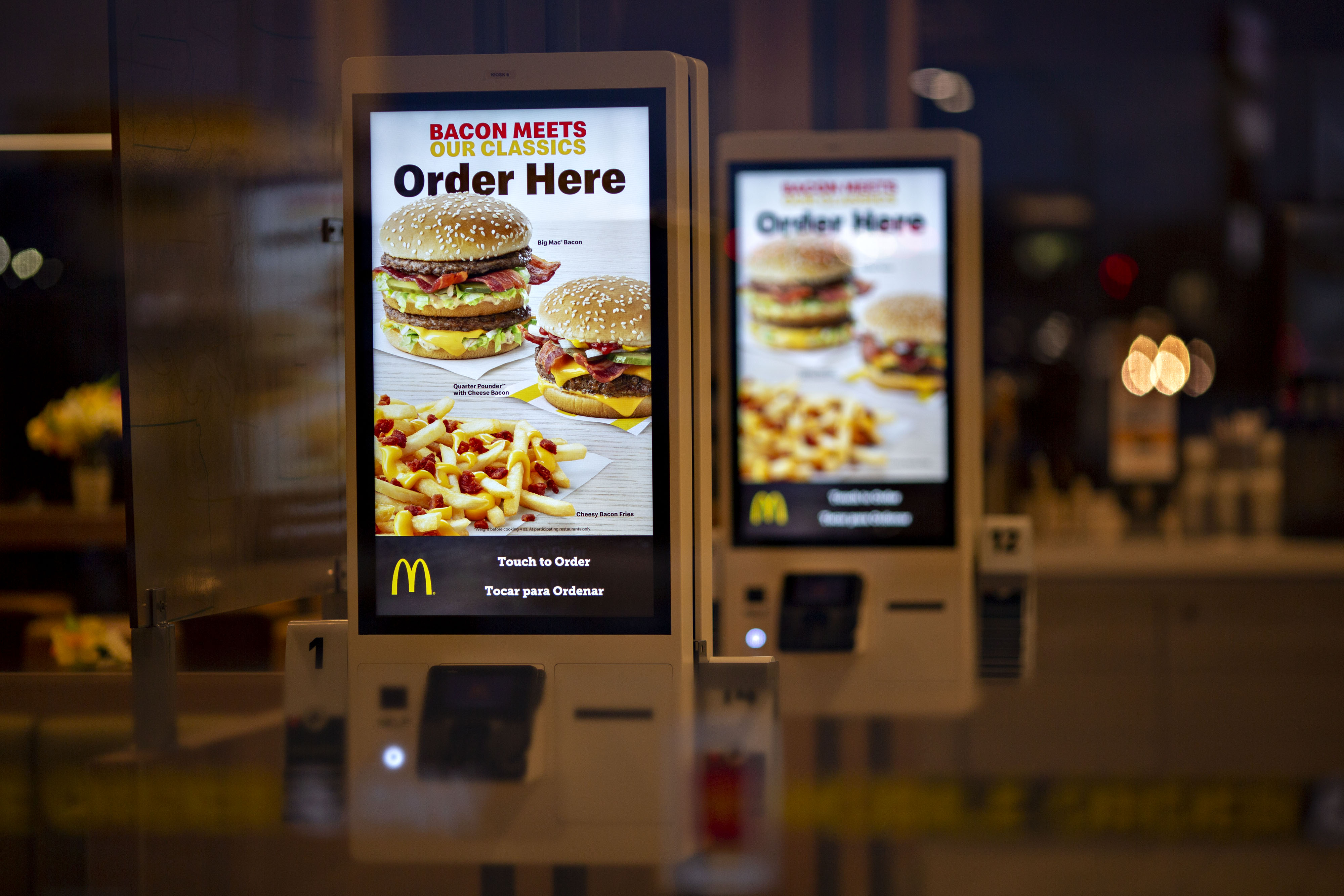
Those things never seem to work properly, at least in the UK. Receipt printers are always broken. Also was a study a few years back pre-COVID about them being covered in faeces particles.
I do prefer them to ordering at the counter due to pretty bad eyesight and having more time and I usually pay by card anyway but they're not the best things.
I do prefer them to ordering at the counter due to pretty bad eyesight and having more time and I usually pay by card anyway but they're not the best things.
pre-COVID about them being covered in faeces particles.
Gross. But somehow I doubt the POS credit card reader would be any different. Those types of studies find grossness everywhere (feces on movie seats, urine in the bar peanuts etc)
Gross. But somehow I doubt the POS credit card reader would be any different. Those types of studies find grossness everywhere (feces on movie seats, urine in the bar peanuts etc)
Don't need to touch those unless you need to use chip and pin. 99% of card machines in the UK take contactless and mobile payments.
Yeah, I was going to ask. Last time I went to McDonalds, the lady at the counter directed me towards the order machines!
It was a ridiculous experience when I tried one recently.
I wanted a bag of ice, since they sell them cheaper than the Kwik-e-mart and I had some perishables I didn't want going bad on the way home.
Do I want to log in? No. Am I sure? But I could be earning bajillions of Rewards Points for my $1.75 purchase!
Now, where are bags of ice? It's not in an obvious category, there's no search, and finally, someone realizes I'm having trouble and looks herself, and then we finally find it at the bottom of the drinks menu, which has too many options to fit on the screen without scrolling randomly.
Now, I proceed to pay. Except I can't. I have a piece of crumpled paper issued by the central government I wish to exchange for my ice. But there's no note acceptor on the machine. The kiosk prints a receipt and I'm supposed to take it to the attended till to pay. Except there was nobody attending it. Again, try and flag down someone so I can finally complete my transaction.
Before, it was "Bag of ice, please." "$1.75", and I'm done in 1/4 the time. Of course, that was facilitated through labour, rather than $4000 worth of shiny touchscreen monitor and glorified Raspberry Pi.
I wanted a bag of ice, since they sell them cheaper than the Kwik-e-mart and I had some perishables I didn't want going bad on the way home.
Do I want to log in? No. Am I sure? But I could be earning bajillions of Rewards Points for my $1.75 purchase!
Now, where are bags of ice? It's not in an obvious category, there's no search, and finally, someone realizes I'm having trouble and looks herself, and then we finally find it at the bottom of the drinks menu, which has too many options to fit on the screen without scrolling randomly.
Now, I proceed to pay. Except I can't. I have a piece of crumpled paper issued by the central government I wish to exchange for my ice. But there's no note acceptor on the machine. The kiosk prints a receipt and I'm supposed to take it to the attended till to pay. Except there was nobody attending it. Again, try and flag down someone so I can finally complete my transaction.
Before, it was "Bag of ice, please." "$1.75", and I'm done in 1/4 the time. Of course, that was facilitated through labour, rather than $4000 worth of shiny touchscreen monitor and glorified Raspberry Pi.
This is so first world problem...
No 'note acceptor'? Thank god, that shit is slow, finicky and ugly. Just PayPass with your plastic card and have the order number in 5 seconds. No, 99 of times from 100 I don't need any paper receipt with an order number, so I don't even click on "print the receipt" button in the first place.
And lastly, I don't buy bags of ice, shovels and dildos at McD.
> Do I want to log in? No. Am I sure? But I could be earning bajillions of Rewards Points for my $1.75 purchase!
Now this is what should bring a slightly boiling cauldrons and pitchforks made from chinesium to those who thought and designed that shit up.
No 'note acceptor'? Thank god, that shit is slow, finicky and ugly. Just PayPass with your plastic card and have the order number in 5 seconds. No, 99 of times from 100 I don't need any paper receipt with an order number, so I don't even click on "print the receipt" button in the first place.
And lastly, I don't buy bags of ice, shovels and dildos at McD.
> Do I want to log in? No. Am I sure? But I could be earning bajillions of Rewards Points for my $1.75 purchase!
Now this is what should bring a slightly boiling cauldrons and pitchforks made from chinesium to those who thought and designed that shit up.
And service became even worse
Not to mention ordering via the app and collecting. QR code websites and tablet ordering machines are rapidly replacing humans taking your order across most restaurants, in the UK and Japan at least.
This is how I can tell neither of you have ever done gig delivery. I'll give you one guess as to how smoothly pick-up goes when there's no one at the cash register. We haven't gone full-automat yet, and I still need someone to actually hand me the order. Preferably, multiple someones, to service the multiple delivery drivers waiting for their pick-ups.
"Taking the order" means listening to their order, keying it in and taking payment. All of that is replaced by apps/kiosks, right? Of course somebody needs to pack it and send it to you.
Again, if you'd been in one of these establishments lately, you would know that all of those tasks are likely done by one person. Including the ones with kiosks (which are often broken or can't take special orders).
Not aimed at you, but the other commenters on your comment.
There is no such thing as unskilled labor. Put a fucking normie from the street into any of these 'unskilled' jobs and find out just how many skills are needed just to do something like customer service.
Looking down on those people is what will lead to another internal conflict. They'll be the ones you depend on when society goes to shit.
There is no such thing as unskilled labor. Put a fucking normie from the street into any of these 'unskilled' jobs and find out just how many skills are needed just to do something like customer service.
Looking down on those people is what will lead to another internal conflict. They'll be the ones you depend on when society goes to shit.
It is not a moral argument. It's a colloquialism that differentiates between different types of work. In part, those jobs are "unskilled" when they take less training to perform. It's not meant to demean the work or the worker.
A plumber or electrician is equally "skilled" work as a software developer, largely due to the extensive apprenticeship requirements.
A plumber or electrician is equally "skilled" work as a software developer, largely due to the extensive apprenticeship requirements.
If it can be taught to a teenager in a couple of days -- which is how many fast food employees get started -- it's not a "skill" in the context of https://en.wikipedia.org/wiki/Skill_(labor)
>If it can be taught to a teenager in a couple of days
Most can't. Hence the frustration you are likely to feel dealing with a teenager in his or her first week on the job.
Most can't. Hence the frustration you are likely to feel dealing with a teenager in his or her first week on the job.
Thank you. I wanted to put this in but couldn't figure out where it would fit.
In particular, the emotional and interpersonal regulation needed to do well at these jobs sometimes borders on superhuman. People stress over office politics, like it's not child's play compared to getting through an 8-hour shift dealing with the sick and irritable public that come into Wendy's or Walgreens with zero leverage over these people who hold your employment in their hands (not even being able to pass things off to a manager, since they're likely bouncing between different stores).
And every workplace has systems and policies that have to be learned. Smart and experienced people can analogize and cut some of the learning curve, but it's still measured in days and weeks, not hours.
In particular, the emotional and interpersonal regulation needed to do well at these jobs sometimes borders on superhuman. People stress over office politics, like it's not child's play compared to getting through an 8-hour shift dealing with the sick and irritable public that come into Wendy's or Walgreens with zero leverage over these people who hold your employment in their hands (not even being able to pass things off to a manager, since they're likely bouncing between different stores).
And every workplace has systems and policies that have to be learned. Smart and experienced people can analogize and cut some of the learning curve, but it's still measured in days and weeks, not hours.
Most jobs ever done by convicts as penal labor would be fundamentally unskilled, no? These are jobs with no expectation of unique talent or skill; with no lengthy on-the-job training; with no ability to fail at the job so badly that they would ever "fire" you. Jobs like "here's a pickaxe, start hitting rocks" or "sit here and pull down the stamper each time a license plate is in front of you" literally can't be done poorly — only done either efficiently or lazily.
If I was to do penal labor, I'd search all days for way do to it poorly.
The difference between unskilled, semi-skilled and skilled labour is usually based on how long it takes to learn how to do the job. It's not meant to be demeaning.
"Unskilled" just means that those type of jobs don't require any prior experience or qualifications. No need to interpret every word literally..
The local Starbucks has regular staff turnover. I've observed that it takes a new guy about 2 days to get up to speed on how to make the treats and run the cash register. Over time they'll get better and more efficient at it, but not that much.
> high wages for those workers
Part of the problem is that for some of these jobs, there is only so much money an employee is able to generate. And for some industries you can only get away with raising prices so much (fast food is relatively easy to raise prices).
I have friends in the grocery industry and they are so hard up for workers (even unionized/good-paying ones) and the margins are already so razor thin that they are looking at starting to close the store on certain days of the week.
So even in unskilled positions, you are going to need huge increases in labor productivity. Which means more customers per employee. So bigger fast food places, bigger stores, bigger farms, bigger hospitals, etc.
Part of the problem is that for some of these jobs, there is only so much money an employee is able to generate. And for some industries you can only get away with raising prices so much (fast food is relatively easy to raise prices).
I have friends in the grocery industry and they are so hard up for workers (even unionized/good-paying ones) and the margins are already so razor thin that they are looking at starting to close the store on certain days of the week.
So even in unskilled positions, you are going to need huge increases in labor productivity. Which means more customers per employee. So bigger fast food places, bigger stores, bigger farms, bigger hospitals, etc.
Australia has a real minimum wage almost twice that of the USA. Do they not have grocery stores there?
* https://stats.oecd.org/Index.aspx?DataSetCode=RMW
> Real hourly and annual minimum wages are statutory minimum wages converted into a common hourly and annual pay period for the 30 OECD countries and six non-member countries for which they are available. The resulting estimates are deflated by national Consumer Price Indices (CPI). The data are then converted into a common currency unit using either US $ current exchange rates or US $ Purchasing Power Parities (PPPs) for private consumption expenditures.
* https://stats.oecd.org/Index.aspx?DataSetCode=RMW
> Real hourly and annual minimum wages are statutory minimum wages converted into a common hourly and annual pay period for the 30 OECD countries and six non-member countries for which they are available. The resulting estimates are deflated by national Consumer Price Indices (CPI). The data are then converted into a common currency unit using either US $ current exchange rates or US $ Purchasing Power Parities (PPPs) for private consumption expenditures.
> So even in unskilled positions, you are going to need huge increases in labor productivity.
Or you could tax the excess profits that companies are earning from eliminating jobs through automation and AI, use that money to pay for healthcare and cover subsidies to bring the cost of food and other necessities down. Then the cost of labor goes down and you don't need to torture people for more productivity.
Or you could tax the excess profits that companies are earning from eliminating jobs through automation and AI, use that money to pay for healthcare and cover subsidies to bring the cost of food and other necessities down. Then the cost of labor goes down and you don't need to torture people for more productivity.
> Because, actually, we do need people at PoS, if we're selling to other people.
I don't know about that. I used to order from a kiosk at a Burger King in 2007 and skip the line.. At a fast food joint, point of sale is likely the easiest job to replace with a machine. My guess for the hardest to replace is cleaning..
I don't know about that. I used to order from a kiosk at a Burger King in 2007 and skip the line.. At a fast food joint, point of sale is likely the easiest job to replace with a machine. My guess for the hardest to replace is cleaning..
He doesn't strictly refer to a cash register and the person behind it, but to the entire counter where someone has to put your order together. The cash register ringing part can be automated away easily, but the "putting all your ordered items onto a tray" part is not automatable in any economically feasible way in 2023, and will not be for the foreseeable future.
In my experience, "Point of Sale" as a term refers to the cash register and the actions around it, not the rest of the business such as delivering the food to the customer.
So it's going to be a dystopian Amazon job, where the fries and burgers come down in conveyor belts and you just put them into the right box. For 8 hours at a time.
Personally I'd prefer that job be automated because it's so mindless.
Personally I'd prefer that job be automated because it's so mindless.
> You ask what people displaced by AI will do for a living? That. They'll do that.
And then the dystopia will be complete.
And then the dystopia will be complete.
I worked at a big box retailer. I enjoyed helping people find solutions to their problems. I assume many chefs enjoy making good food and interacting with their regulars. Ask old-school diner workers or department store salespeople how they felt about their work, particularly when they were paid an actual living wage. The soul-crushing parts aren't inherent to those jobs, they're imposed by exploitative elites. Your dystopia is a "filthy rich f*ckwad" problem, not a "thank you, please come again" problem.
I'd argue that working in a fast food restaurant isn't in the same category as working in a diner or other actual restaurant, being a chef, or working for a big box retailer.
However, whether or not some people find those positions enjoyable isn't relevant to my point. If everyone has to work in those jobs, most people won't find that fulfilling or enjoyable because they're not suited to that sort of work. And when you add the fact that these are low-paying jobs, you have most people doing something they hate for very little pay, because (in this scenario) the work they are suited to do is unavailable. That's the beating heart of a dystopia right there.
(I put too much emphasis on the pay rate. I actually think the pay rate is of secondary importance for this point. A job you hate that pays very well will still make you unhappy.)
However, whether or not some people find those positions enjoyable isn't relevant to my point. If everyone has to work in those jobs, most people won't find that fulfilling or enjoyable because they're not suited to that sort of work. And when you add the fact that these are low-paying jobs, you have most people doing something they hate for very little pay, because (in this scenario) the work they are suited to do is unavailable. That's the beating heart of a dystopia right there.
(I put too much emphasis on the pay rate. I actually think the pay rate is of secondary importance for this point. A job you hate that pays very well will still make you unhappy.)
>I'd argue that working in a fast food restaurant isn't in the same category as working in a diner or other actual restaurant, being a chef, or working for a big box retailer.
I don't disagree. I'd like you to think critically about why.
>If everyone has to work in those jobs, most people won't find that fulfilling or enjoyable because they're not suited to that sort of work. And when you add the fact that these are low-paying jobs, you have most people doing something they hate for very little pay, because (in this scenario) the work they are suited to do is unavailable. That's the beating heart of a dystopia right there.
I think this is incorrect. Firstly, because (per the proposal) they wouldn't be low-paying. Secondly, and to the contrary, if everyone has to work these jobs, then not only are they no longer jobs only for losers and the unskilled, they are suddenly jobs with a lot of staff with which to build accommodating and reasonable schedules.
I WANT a society where my doctor serves food or works the register for a few hours a week, or where someone laid off from their 6-figure coding job can earn (or even be given) enough to avoid losing their house. That's the opposite of a dystopia; that's a world where even the most educated and prestigiously-employed community members are connected to the rest of us. Maybe that's a dystopia for them?
I don't disagree. I'd like you to think critically about why.
>If everyone has to work in those jobs, most people won't find that fulfilling or enjoyable because they're not suited to that sort of work. And when you add the fact that these are low-paying jobs, you have most people doing something they hate for very little pay, because (in this scenario) the work they are suited to do is unavailable. That's the beating heart of a dystopia right there.
I think this is incorrect. Firstly, because (per the proposal) they wouldn't be low-paying. Secondly, and to the contrary, if everyone has to work these jobs, then not only are they no longer jobs only for losers and the unskilled, they are suddenly jobs with a lot of staff with which to build accommodating and reasonable schedules.
I WANT a society where my doctor serves food or works the register for a few hours a week, or where someone laid off from their 6-figure coding job can earn (or even be given) enough to avoid losing their house. That's the opposite of a dystopia; that's a world where even the most educated and prestigiously-employed community members are connected to the rest of us. Maybe that's a dystopia for them?
Reminds me of a short story from 30 years ago that centered around fast food workers who were micromanaged by an AI directing every daily activity.
For anyone wondering: https://en.wikipedia.org/wiki/Manna_(novel)
It's got a happy ending actually.
It's got a happy ending actually.
It has a happy ending for the protagonist, and IIRC only because he inherited an Australian passport. Everyone else in the USA was completely stuck into being meat robots for the overseer AIs.
So, not a happy ending.
Depends on if you are a protagonist or not.
Depends more on whether you support progressive social policies though (I'm a lot less confident Australia would go in like it did, but I'd like to think it could - we did Medicare in the 70s after all).
I actually prefer fast food restaurants with ordering kiosks and not manned POSes. Just like self checkout, no need to wait in a long line.
Gradually not sure. Do we need people in pos. You already do your own order in kiosk and phone. No staff. Cut that. Sorry you cannot order thee we do it take your order.
The food arrived by order number as like today in slot.
Then the backend machine vision can enough …
Sorry …
I did think my Go playing is safe you know.
The food arrived by order number as like today in slot.
Then the backend machine vision can enough …
Sorry …
I did think my Go playing is safe you know.
If McDonald's paid their workers like software engineers, they'd have to charge at least $50 a burger, assuming the sales volume stays the same. But if burgers were $50, the sales volume would drop to zero, and the business would collapse.
> they'd have to charge at least $50 a burger,
That's only a little more than 100% increase from the current near $20 combo meal prices. McDonalds has high margins lately they can afford raises.
That's only a little more than 100% increase from the current near $20 combo meal prices. McDonalds has high margins lately they can afford raises.
A McBurger is what, about $3 ?
Also, McDonald's Corporation is a different company than the McDonald's franchise that sells you the burgers.
Also, McDonald's Corporation is a different company than the McDonald's franchise that sells you the burgers.
They don’t account for externalities.
I still don't understand why McDonald's is accepting a 10-20% "broken" status as remotely acceptable. Especially when its clear its solvable.
because McDonalds corporate profits off of the deal with the manufacturer/servicer who in turn profits off of the McDonalds franchisees. The franchisees aren't given a choice of what machine and servicers they use as corporate dictates what model of machine they are allowed to use and who is allowed to perform service upon it. So Mcdonalds corporate doesn't care because they aren't the ones loosing money on sales or service fees as they don't run many of the restaurants fore them its a profit center.
> they aren't the ones loosing money
From what I'm seeing, besides the monthly rent (in most cases paid to McDonalds), and the required supply purchases, franchisees also have to kick 4% of sales up to corporate.
So corporate is indeed losing money when the machine isn't working (also, they're probably not going to be buying supplies for a broken machine, either).
From what I'm seeing, besides the monthly rent (in most cases paid to McDonalds), and the required supply purchases, franchisees also have to kick 4% of sales up to corporate.
So corporate is indeed losing money when the machine isn't working (also, they're probably not going to be buying supplies for a broken machine, either).
You also have to factor in the cost to profit ratio.
What's more profitable? Kicking out a dozen Big Macs in the same time it takes to make one McFlurry? As an owner, I'm going to focus on where my profits are so that I can maximize those areas that are generating the most profit. Anything with ice cream is a net loss for my profit column so anything I can do to discourage people from increasing those sales which will then cut into my overall profits is just fine with me.
Their McFlurry ice cream items were created to compete with Dairy Queens Blizzard items. I'm not sure why they decided they could compete with DQ, but they thought they would siphon some of that market share from them - which I don't think they ever did, but it didn't lose enough money for them to take the item off of their menus.
What's more profitable? Kicking out a dozen Big Macs in the same time it takes to make one McFlurry? As an owner, I'm going to focus on where my profits are so that I can maximize those areas that are generating the most profit. Anything with ice cream is a net loss for my profit column so anything I can do to discourage people from increasing those sales which will then cut into my overall profits is just fine with me.
Their McFlurry ice cream items were created to compete with Dairy Queens Blizzard items. I'm not sure why they decided they could compete with DQ, but they thought they would siphon some of that market share from them - which I don't think they ever did, but it didn't lose enough money for them to take the item off of their menus.
And if people walk out the door because they wanted ice cream on a hot day and go somewhere else instead and stop coming because they assume your ice cream machine is down?
Its a McDonalds.
They don't go there for ice cream. Yeah, they won't go back for ice cream which has a minimal impact. You can bet they'll still come back for burgers, shakes and fries though.
It just confirms people fall into the trap of not going there for ice cream, which reduces the burden of the people having to use so much time to make ice cream for customers and can instead focus on the stuff that keeps the lights on and the profits coming in.
They don't go there for ice cream. Yeah, they won't go back for ice cream which has a minimal impact. You can bet they'll still come back for burgers, shakes and fries though.
It just confirms people fall into the trap of not going there for ice cream, which reduces the burden of the people having to use so much time to make ice cream for customers and can instead focus on the stuff that keeps the lights on and the profits coming in.
>because McDonalds corporate profits off of the deal with the manufacturer/servicer who in turn profits off of the McDonalds franchisees
Is there more on this? If they can dig up CEO's emails surely they can dig up the financial arrangements between them and mcdonalds?
Is there more on this? If they can dig up CEO's emails surely they can dig up the financial arrangements between them and mcdonalds?
So you know the "puzzle" where you buy a cow for $5, sell it for $10, buy again for $15, sell for $20, and some ding dong on twitter says that you lost money? Well, the same math brains think that if you pay some company $100 and get a $30 kickback, that you somehow made a profit.
You do if you receive services worth more than $70. A competitor to Taylor without the "free money" maintenance contracts might have to charge $80, but Taylor plus McDonald's can charge each other less than the cost of the equipment because the real profit is in the repair bills.
[deleted]
Given all of the parties' (hacked) accounting books, how do you prove that "Foobar service/fee" is actually "illegal kickback"?
1. If we're to take the plaintiffs at face value (ie. the email in question is really the "smoking gun", didn't bother hiding it, and just handed it over in discovery), then surely the defendants are too incompetent to hide the kickbacks?
2. That attitude is dangerously close to "unfalsifiable claim" territory. There's no evidence for your conspiracy? Well duh, it's all-powerful conspirators that we're dealing with. Of course there's going to be no evidence because they hid it all!
2. That attitude is dangerously close to "unfalsifiable claim" territory. There's no evidence for your conspiracy? Well duh, it's all-powerful conspirators that we're dealing with. Of course there's going to be no evidence because they hid it all!
I'm just saying it's very easy to hide this sort of thing. A brief chat at the country club, totally off the record, is all they need to finalize a backroom deal.
The prosecution even argued that the defendents were using Mafia-like language, according to TFA.
The prosecution even argued that the defendents were using Mafia-like language, according to TFA.
[deleted]
Johnny Harris (journalist) covered this story: https://www.youtube.com/watch?v=SrDEtSlqJC4
I feel like the content in this video is surprising only to people who have no clue how these businesses work.
* A complicated machine that will hurt people if configured improperly can't have the operating parameters changed by the end user? Yeah, I'd do that too, the end users are literally children and unskilled workers, and the business is liable if they mess it up. What exactly does the author think that a food service worker is going to do in the service menu of these machines?
* Franchisees can't modify the equipment as they choose? Yeah, that's the way it works, it's not their decision to make.
* Business partners having to choose a product or service as a result of a contractual obligation? Welcome to B2B product sales. This happens everywhere.
* A complicated machine that will hurt people if configured improperly can't have the operating parameters changed by the end user? Yeah, I'd do that too, the end users are literally children and unskilled workers, and the business is liable if they mess it up. What exactly does the author think that a food service worker is going to do in the service menu of these machines?
* Franchisees can't modify the equipment as they choose? Yeah, that's the way it works, it's not their decision to make.
* Business partners having to choose a product or service as a result of a contractual obligation? Welcome to B2B product sales. This happens everywhere.
This might be one of the worst videos I've ever seen. 30 minutes of video for about two paragraphs worth of content. Mind-bogglingly poor information density, it's like the video was deliberately stretched to 30 minutes for no reason other than the fact that he could. Terrible journalism.
ChatGPT summary:
> The video investigates why McDonald's ice cream machines are frequently broken. It reveals that the machines undergo a complex, four-hour cleaning cycle, often misinterpreted as a breakdown. Franchise owners are contractually obliged to use a specific machine model (C602) made by Taylor, which has a high failure rate. The malfunctioning machines, with cryptic error messages and user-unfriendly interfaces, necessitate expensive repairs by Taylor-authorized technicians. An entrepreneur developed an alternative device providing better feedback and reducing breakdowns, but McDonald's allegedly discouraged its use, favoring a less effective solution from a company related to Taylor.
Every day GPT-4 becomes more useful for wading through the swath of bullshit.
ChatGPT summary:
> The video investigates why McDonald's ice cream machines are frequently broken. It reveals that the machines undergo a complex, four-hour cleaning cycle, often misinterpreted as a breakdown. Franchise owners are contractually obliged to use a specific machine model (C602) made by Taylor, which has a high failure rate. The malfunctioning machines, with cryptic error messages and user-unfriendly interfaces, necessitate expensive repairs by Taylor-authorized technicians. An entrepreneur developed an alternative device providing better feedback and reducing breakdowns, but McDonald's allegedly discouraged its use, favoring a less effective solution from a company related to Taylor.
Every day GPT-4 becomes more useful for wading through the swath of bullshit.
Except that your summary misses a ton of important details.
1) The most important one being: "This machine sterilizes itself without removing the feedstock"
The sanitization of these machines is not dependent upon being cleaned by someone who cares or is competent. This minimizes the possibility of food poisoning and the attendant lawsuit.
2) The alternative device had no indemnification associated with it.
If somebody adjusted the machine and then a customer got food poisoning, who was going to be on the hook for the lawsuit?
Practically everything about these machines is defined by lawsuit avoidance combined with the fact that these machines are manufactured in low volume and not that profitable by themselves.
These machines are primarily a legal liability transfer mechanism. The fact that they serve ice cream is completely incidental.
1) The most important one being: "This machine sterilizes itself without removing the feedstock"
The sanitization of these machines is not dependent upon being cleaned by someone who cares or is competent. This minimizes the possibility of food poisoning and the attendant lawsuit.
2) The alternative device had no indemnification associated with it.
If somebody adjusted the machine and then a customer got food poisoning, who was going to be on the hook for the lawsuit?
Practically everything about these machines is defined by lawsuit avoidance combined with the fact that these machines are manufactured in low volume and not that profitable by themselves.
These machines are primarily a legal liability transfer mechanism. The fact that they serve ice cream is completely incidental.
Yeah, not a fan of Harris' videos at all. He defines journalism...differently.
https://www.youtube.com/watch?v=Dum0bqWfiGw
https://www.youtube.com/watch?v=Dum0bqWfiGw
He was good with "Borders", after that no so much. His "documentation" on the Soccer World Cup worker was, well, a repetition of what other journalista already reported on, with less detail and depth but sold in way to make it look like he was the oloy one uncovering it and risking his life doing so.
So no, not a fan neither.
So no, not a fan neither.
Some audiences prefer a bit longer winded content with some entertainment value. Myself, I wouldn't have clicked on an article that discusses this story even if it would have taken me half the time to read it than watch it.
My guess is that they weren't measuring ice cream machine uptime. They were using some other metric. The franchisee is really the one loses sales to a down machine. Corporate McDs is satisfied with the revenue share and doesn't realize more ice cream could be sold.
Because it's never a moral question, it's always a financial one. And the finances shake out quasi-optimally for McDonald's the corporation.
It's not really McDonalds the corporation's problem - they get paid all the same, probably with some definitely-not-kickbacks from the manufacturer.
> they get paid all the same
I haven't looked at a McDonalds franchise contract, but every QSR franchise contract I've seen requires the franchisee to pay the brand a percentage of each location's gross sales.
Broken ice cream machine = less gross sales. Less gross sales = less money going to the brand.
It's also not great for customer satisfaction.
I haven't looked at a McDonalds franchise contract, but every QSR franchise contract I've seen requires the franchisee to pay the brand a percentage of each location's gross sales.
Broken ice cream machine = less gross sales. Less gross sales = less money going to the brand.
It's also not great for customer satisfaction.
Would McDonalds Corp rather sell let's say 1,000 ice creams for $1,000 total at a 2% cut ($20) or an ice cream machine repair (maybe $1,000)?
They're fleecing the franchisees via repairs.
They're fleecing the franchisees via repairs.
Why would McDonald's corporate be getting paid for machine repairs?
The repairs are handled by local distributors of Taylor machines. Taylor itself makes money on replacement parts and machines.
There haven't been any allegations of kickbacks to McDonald's corporate, so I don't get it.
The repairs are handled by local distributors of Taylor machines. Taylor itself makes money on replacement parts and machines.
There haven't been any allegations of kickbacks to McDonald's corporate, so I don't get it.
[deleted]
Thank you for pointing this out! This kind of a simple revenue calculation can be highly insightful.
Aren't most of their ice cream products like <$5? I recall the cones are only like $1. My guess would be that, if there is some kind of arrangement between McD's and Taylor, it's probably way more profitable than the losses they'd see from 10-13% of their ice cream machines being down per month.
Isn't the cost of the ingredients some $0.2 (I have no idea, just estimating by the taste), so that machine is printing money when working?
It's surprising they cannot build a machine that does not break that easily.
It's surprising they cannot build a machine that does not break that easily.
I wouldn't be so sure. Milk, cream, and sugar are relatively expensive ingredients, and labor is very expensive.
Milk/cream is not cheap. It takes a lot of energy to freeze that mixture as well. Most people don't try to measure this, but the ice in your soda probably costs more than the rest of the sugar water (in bulk/wholesale as restaurants buy soda, if you pay retails prices things are different)
Yes, I looked into franchising many years ago and that was my recollection as well -- often groups also sell you the inputs/ingredients and force you to purchase through them to "maintain quality/consistency" which would seem to be another reason why McD would want more volume/sales.
> often groups also sell you the inputs/ingredients and force you to purchase through them to "maintain quality/consistency"
QSR franchisees are famous for cutting every corner they can get away with (as well as cutting even more corners until they get caught by the brand or local health/labor inspectors), so maintaining quality and consistency is a very real concern for these brands.
QSR franchisees are famous for cutting every corner they can get away with (as well as cutting even more corners until they get caught by the brand or local health/labor inspectors), so maintaining quality and consistency is a very real concern for these brands.
Yes, that's fair, but it's also a great way to guarantee recurring revenue for a franchisor whose franchisees are obligated to purchase from them
I thought we were talking about an ice cream machine and not an ink jet printer.
Inkjet printers merely have DRM. Franchises have way more power; they have legally binding contracts.
All the same to the MBAs at these companies looking to squeeze the last penny out of everything
I believe when this first came out it was highlighted that a lot of employees moved back and forth between McD and Taylor. The implication that residual stock or friends across town could influence the situation.
>The implication that residual stock or friends across town could influence the situation.
Yes, that could explain why McDonalds execs would try to discourage franchisees from using Kytch.
It doesn't, however, explain why McDonalds execs seem not to have a problem with 20% of their locations not being able to sell a product that people apparently like enough to complain when they can't get it, which is what the top-level comment was talking about.
Yes, that could explain why McDonalds execs would try to discourage franchisees from using Kytch.
It doesn't, however, explain why McDonalds execs seem not to have a problem with 20% of their locations not being able to sell a product that people apparently like enough to complain when they can't get it, which is what the top-level comment was talking about.
Apparently if the ice cream machine is broken, the franchise can move more product in other higher-margin categories.
So no, it doesn't mean less gross sales.
So no, it doesn't mean less gross sales.
Yep.
me: "I'll have a milkshake please"
McD: "ice cream machine's broke"
me: "ugh. Ok, I'll just have a coke"
me: "I'll have a milkshake please"
McD: "ice cream machine's broke"
me: "ugh. Ok, I'll just have a coke"
Because they don’t give a shit, just like every incumbent.
It’s why institutions so quickly fall - no one gives a shit. Five Guys and Shake Shack do, and they’re eating McDonald’s lunch
It’s why institutions so quickly fall - no one gives a shit. Five Guys and Shake Shack do, and they’re eating McDonald’s lunch
[deleted]
What a joke. McDonald’s may not have the healthiest food but as a corporation they have things locked down. I’ve never seen a place run better at scale than McDonald’s inspite of the bottom of the barrel staff that’s available to them.
The individual McDonald’s are run by franchisees. I’m talking about how corporate has really dropped the ball.
It seems to me that this is the risk you take when you create an unofficial add-on to any product.
I've helped reverse engineer vehicle ECU's to reprogram the fuel injection, turbo pressure, and spark timing systems. But, we wouldn't have expected the manufacturer to do anything except officially discourage the use of the aftermarket tools. That is the name of the game with unofficial add-ons with access to sensitive control systems.
Disclaimer: I did work for a Middleby subsidiary at the time but I don't know anything that isn't public about this situation. We were all very separate companies.
I've helped reverse engineer vehicle ECU's to reprogram the fuel injection, turbo pressure, and spark timing systems. But, we wouldn't have expected the manufacturer to do anything except officially discourage the use of the aftermarket tools. That is the name of the game with unofficial add-ons with access to sensitive control systems.
Disclaimer: I did work for a Middleby subsidiary at the time but I don't know anything that isn't public about this situation. We were all very separate companies.
I guess the difference here is that there's 3 separate parties: McDonalds corporate, Taylor (makes the ice cream machines), and the franchisee. McDonalds requires the franchisee to buy a specific machine from Taylor (or a dramatically more $$ one from an Italian company IIRC), and places other requirements on the franchisee, but is it legal to interfere in the relationship between the franchisee and Taylor?
>legal to interfere in the relationship between the franchisee and Taylor?
I think the term is "tortious interference" but it is notoriously very difficult to have upheld in court. You can obviously compete but you can't deliberately undermine a contract with a competitor. IANAL, but from my reading of the article, that would rely on how substantive the safety claims that McD made are in disincentivizing the use of the 3rd party equipment. (not to mention they party wasn't explicitly named in those safety communications)
https://en.wikipedia.org/wiki/Tortious_interference
I think the term is "tortious interference" but it is notoriously very difficult to have upheld in court. You can obviously compete but you can't deliberately undermine a contract with a competitor. IANAL, but from my reading of the article, that would rely on how substantive the safety claims that McD made are in disincentivizing the use of the 3rd party equipment. (not to mention they party wasn't explicitly named in those safety communications)
https://en.wikipedia.org/wiki/Tortious_interference
Funny that this is the opinion for this product, but mere mention of this concept for Beeper accessing Apple as an add-on product is thought of in a different manner. Because it's a physical product? Because it's not Apple?
Because people commenting on HN are not a hivemind. Some people think this some people think that and there is no guarantee or requirement that these independent thoughts from independent people are consistent.
There shouldn't even be an assumption that two people's definition of consistent lines up. Just because you can draw an equivalence between Taylor and Apple, doesn't mean that other people will or should.
Sometimes the after market changes increase the incentive to buy the base product. I mean that basically is the computing industry from the 360 on.
I somehow feel it is a very different thing with ice cream machines versus automotive applications.
Yes, you can probably harm an order of magnitude more people with a contaminated ice cream machine than with a defective vehicle.
It doesn't sound like the Kytch device was claimed to cause any kind of contamination, it just exposed diagnostic data? To me hacked ECUs seem much more likely to pose a danger to human health - but that's because bad drivers kill and injure a lot of people (maybe people who have done Level 3 tunes are all excellent and responsible drivers... maybe...)
>It doesn't sound like the Kytch device was claimed to cause any kind of contamination, it just exposed diagnostic data?
That's what the article says, but I vaguely remember that there were mentions of overriding the machine's safety interlocks. I searched around and sure enough, I found this:
>The Kytch, based on a Raspberry Pi, offered McDonald’s franchisees insight into both their machines’ operation and failures. It could also override locks that prevent the machines from working due to non-critical errors.
https://arstechnica.com/gadgets/2023/08/mcdonalds-ice-cream-...
(emphasis mine)
As for what the device does today, I'm not so sure. Maybe they realized that overriding locks presents a safety hazard and removed that feature. Maybe they kept it in but decided not to loudly advertise it because it'd make them look bad. Who knows.
That's what the article says, but I vaguely remember that there were mentions of overriding the machine's safety interlocks. I searched around and sure enough, I found this:
>The Kytch, based on a Raspberry Pi, offered McDonald’s franchisees insight into both their machines’ operation and failures. It could also override locks that prevent the machines from working due to non-critical errors.
https://arstechnica.com/gadgets/2023/08/mcdonalds-ice-cream-...
(emphasis mine)
As for what the device does today, I'm not so sure. Maybe they realized that overriding locks presents a safety hazard and removed that feature. Maybe they kept it in but decided not to loudly advertise it because it'd make them look bad. Who knows.
Again, so safety issue. Let's quit struggling so hard to slander what was essentially a monitoring device.
>was essentially a monitoring device.
"monitoring devices" don't "override locks".
"monitoring devices" don't "override locks".
This class of locks sounds a lot like the intro to a video game that says "press start to continue". Imagine your TV is broken so only displays the top half of the image. Are you overriding a lock when you press start, even though you can't see the message? Can I sell you a device that detects the top of the video game and flashes on its own screen "press start to continue"? Absolutely. That is all that's going on here and should be 100% legal.
Reading the lawsuit, though, I'm getting the impression that the safety interlocks on the machine are software-based, not hardware-based. That is, the lock says "door closed" or "door open", and the microcontroller refuses to do anything in the "door open" state. This is in contrast to a hardware lock, where the door closing closes a switch that AC power comes in through. Door open, no power, and completely failsafe.
In the case of software locks, I am sure that monitoring apparatus can break the software interlocks accidentally. I used to work for an ISP and wrote a program that SSH'd to each of our OLTs, and downloaded a ton of data about each customer and sync'd it into our database. (No API except SSH-ing in and typing commands, of course.) This totally broke them after a period of time. One Saturday morning I got a frantic Slack from the CEO "shut it off! all of our OLTs are dead!". (As an aside, I had a slack command to kill the monitoring jobs for exactly this reason... we all thought it was pretty hacky.) After debugging this with the vendor, it essentially turns out that reading data takes a lock, and the watchdog also tries to take that lock, and reboots if it can't within some ridiculous timeframe. (It was actually a little more complex than this, involving two redundant CPUs inside the device going out of sync after not being able to read the other's state for too long, but in the end, it's the watchdog that gets you. Their locks were also implemented wrong; "try to acquire it now, go to sleep for a long time if it fails", rather than being woken up when the lock is unlocked. That's what killed us, we did a LOT of reads, and were probably reading at the exact instant that this thing wanted to do its read to keep the system from rebooting.)
So anyway, in the case of the ice cream machine, this sort of bug is possible. The diagnostic tool is reading the internal state, the "transition to next phase" code runs, fails to get the lock on the door interlock state variable, incorrectly assumes "it's probably locked", and turns on the spinning ice cream mixer of death while someone's hand is elbow-deep in melted ice cream. At the end of the day, software interlocks are evil and have literally killed people before (see Therac-25), and the manufacturer of this machine probably doesn't want liability for bad code they've written. The monitoring device increases the chance of liability, so they want it dead.
I see their perspective, of course, but I still think that "that's too bad" is a fine response to their legal team.
Reading the lawsuit, though, I'm getting the impression that the safety interlocks on the machine are software-based, not hardware-based. That is, the lock says "door closed" or "door open", and the microcontroller refuses to do anything in the "door open" state. This is in contrast to a hardware lock, where the door closing closes a switch that AC power comes in through. Door open, no power, and completely failsafe.
In the case of software locks, I am sure that monitoring apparatus can break the software interlocks accidentally. I used to work for an ISP and wrote a program that SSH'd to each of our OLTs, and downloaded a ton of data about each customer and sync'd it into our database. (No API except SSH-ing in and typing commands, of course.) This totally broke them after a period of time. One Saturday morning I got a frantic Slack from the CEO "shut it off! all of our OLTs are dead!". (As an aside, I had a slack command to kill the monitoring jobs for exactly this reason... we all thought it was pretty hacky.) After debugging this with the vendor, it essentially turns out that reading data takes a lock, and the watchdog also tries to take that lock, and reboots if it can't within some ridiculous timeframe. (It was actually a little more complex than this, involving two redundant CPUs inside the device going out of sync after not being able to read the other's state for too long, but in the end, it's the watchdog that gets you. Their locks were also implemented wrong; "try to acquire it now, go to sleep for a long time if it fails", rather than being woken up when the lock is unlocked. That's what killed us, we did a LOT of reads, and were probably reading at the exact instant that this thing wanted to do its read to keep the system from rebooting.)
So anyway, in the case of the ice cream machine, this sort of bug is possible. The diagnostic tool is reading the internal state, the "transition to next phase" code runs, fails to get the lock on the door interlock state variable, incorrectly assumes "it's probably locked", and turns on the spinning ice cream mixer of death while someone's hand is elbow-deep in melted ice cream. At the end of the day, software interlocks are evil and have literally killed people before (see Therac-25), and the manufacturer of this machine probably doesn't want liability for bad code they've written. The monitoring device increases the chance of liability, so they want it dead.
I see their perspective, of course, but I still think that "that's too bad" is a fine response to their legal team.
The issue isn't a problem with the product, it's a problem with undermining the chain of responsibility and liability.
henriquez(2)
> But, we wouldn't have expected the manufacturer to do anything except officially discourage the use of the aftermarket tools.
I think the issue here is that McDonalds was discouraging the use of the tool, not Taylor (the manufacturer).
I think the issue here is that McDonalds was discouraging the use of the tool, not Taylor (the manufacturer).
>“Not sure if there is anything we can do to slow up the franchise community on the other solution,” FitzGerald wrote on October 17, 2020. “Not sure what communication from either McD or Midd can or will go out.”
That's the extent of the "smoking gun" that's in the article. Needless to say, I'm far from convinced it's a "smoking gun" given how short and probably cherry picked it is. Is there a full copy of the email somewhere? All the cases on courtlistener don't show any relevant documents.
That's the extent of the "smoking gun" that's in the article. Needless to say, I'm far from convinced it's a "smoking gun" given how short and probably cherry picked it is. Is there a full copy of the email somewhere? All the cases on courtlistener don't show any relevant documents.
That's because he uses "not sure" as weasel words, remove the weasel words and you end up with:
"Is there anything we can do to slow up the franchise community on the other solution? What communication from either McD or Midd can or will go out?"
That already sounds a lot more damning. And this is an executive, so if he's asking questions in an e-mail he's telling you to do something. So anyone working for him will interpret that as:
"We need to do something to slow up the franchise community on the other solution. Send out a communication from McD or Midd."
"Is there anything we can do to slow up the franchise community on the other solution? What communication from either McD or Midd can or will go out?"
That already sounds a lot more damning. And this is an executive, so if he's asking questions in an e-mail he's telling you to do something. So anyone working for him will interpret that as:
"We need to do something to slow up the franchise community on the other solution. Send out a communication from McD or Midd."
A few years ago the company I was working for was going through some rapid growth and communication was not great. So when I needed access to a service after months of back and forth nothing happened so kicked the football up the chain and the director responsible wrote this to the relevant team:
> my understanding is that he needs a higher level of access in Marketo to be able to accomplish this task. Do you know anything about this?
and presto! less than a day later I got access.
It's just how leaders talk.
> my understanding is that he needs a higher level of access in Marketo to be able to accomplish this task. Do you know anything about this?
and presto! less than a day later I got access.
It's just how leaders talk.
And a thing I've learned with a few executives doing stuff like this: what they say in person, call, etc. that's not being recorded is a lot more direct than what they say in an email that may get pulled in discovery for a lawsuit.
"All I want to do is this: I just want to find 11,780 votes, which is one more than we have"
"There's nothing wrong with saying, you know, that you've recalculated."
"There's nothing wrong with saying, you know, that you've recalculated."
Except in the Trump–Raffensperger phone call, we actually have the full recording, whereas in the case of the mcdonalds ice cream machine we only have a short quote selected by the plaintiff. If you read my original comment carefully, you'd see that I'm not dismissing the "smoking gun" outright, just that I'm reserving my judgement until the full document came out. If in the case of the Trump–Raffensperger phone call, the only source I had to go off of was a self-interested source (eg. Biden campaign or partisan media outlet) claiming that Trump said "I want you to find 11,780 votes", I'd be reserving judgement as well.
That is a really big deal coming from an executive. Leadership 101 is you never mention a business change or action in the same communication as a situation with a competitor. This guy clearly didn't do his yearly antitrust training.
> Leadership 101 is you never mention a business change or action in the same communication as a situation with a competitor. This guy clearly didn't do his yearly antitrust training
It depends on the nature of the change/action though?
“We are falling behind competitor X in features… that’s why I’m increasing the R&D budget by 10%, and tasking the head of engineering to close the gap” - where is the antitrust issue in that?
It depends on the nature of the change/action though?
“We are falling behind competitor X in features… that’s why I’m increasing the R&D budget by 10%, and tasking the head of engineering to close the gap” - where is the antitrust issue in that?
>Leadership 101 is you never mention a business change or action in the same communication as a situation with a competitor
Source?
Source?
You can reach out to your HR department at work if you are interested in taking leadership specific anti-trust training. Most larger companies have a leadership training track where this type of course is included.
You have to admit, there is a very "will no one rid me of this meddlesome priest?" ring to it.
This is the equivalent of Gates AARD email
https://en.wikipedia.org/wiki/AARD_code
"You never sent me a response on the question of what things an app would do that would make it run with MS-DOS and not run with DR-DOS. Is there [sic] feature they have that might get in our way?"
Good enough for $280 million payout despite AARD code not even being deployed.
https://en.wikipedia.org/wiki/AARD_code
"You never sent me a response on the question of what things an app would do that would make it run with MS-DOS and not run with DR-DOS. Is there [sic] feature they have that might get in our way?"
Good enough for $280 million payout despite AARD code not even being deployed.
Going only from the article, I'm skeptical of part of the argument:
> It also countered in the complaint any claim that a Kytch device's remote connection to an ice cream machine could result in the machine turning on while a person's hand was inside—in fact, Taylor's own manual advises unplugging the machine before servicing it, and removing the door of the machine to access its rotating barrels automatically disables its motor.
I suspect someone who didn't design real-world systems might read this and think "Of course it's not a safety problem, because the machine is unplugged, Silly," or "No one can get hurt by the rotating barrels, because the motor is disabled when something-something."
Meanwhile, people who have designed systems are assuming, "Of course, sometimes the machine won't be unplugged when being maintained. That's one of the things we have to assume will go wrong. And text in a user manual doesn't seem a credible component of safety design here, implying always-perfect operator behavior of teenage fast food workers who are stressed and fatigued."
A lot of engineers' questions come to mind (e.g., about that interlock and other mechanisms and safety scenarios, and how the third-party add-on integrates), but this isn't my specialty, and I'm wondering what that UL certification covered.
I can totally believe that many companies will do all sorts of underhanded things, including colluding to smear a competitor, but I'd want a credible assessment by expert specialist engineers.
> It also countered in the complaint any claim that a Kytch device's remote connection to an ice cream machine could result in the machine turning on while a person's hand was inside—in fact, Taylor's own manual advises unplugging the machine before servicing it, and removing the door of the machine to access its rotating barrels automatically disables its motor.
I suspect someone who didn't design real-world systems might read this and think "Of course it's not a safety problem, because the machine is unplugged, Silly," or "No one can get hurt by the rotating barrels, because the motor is disabled when something-something."
Meanwhile, people who have designed systems are assuming, "Of course, sometimes the machine won't be unplugged when being maintained. That's one of the things we have to assume will go wrong. And text in a user manual doesn't seem a credible component of safety design here, implying always-perfect operator behavior of teenage fast food workers who are stressed and fatigued."
A lot of engineers' questions come to mind (e.g., about that interlock and other mechanisms and safety scenarios, and how the third-party add-on integrates), but this isn't my specialty, and I'm wondering what that UL certification covered.
I can totally believe that many companies will do all sorts of underhanded things, including colluding to smear a competitor, but I'd want a credible assessment by expert specialist engineers.
I like antitrust cases like the next man, but this is weak sauce. They built a sharecropping add-on that was always going to live or die at the whim of Taysol and McDonald's, it was never going to last. Whether Taysol put it in writing or not, it doesn't really matter.
I guess their lawyers are having fun billing their hours, though.
I guess their lawyers are having fun billing their hours, though.
McD's is making more money on their "authorized" repairs (those companies are also owned by them). That's it.
Is broken ice cream machine an American thing because in 30 years I’ve never been into a McDonald’s in Asia/Pacific that had a broken machine. It’s always working.
It seams so. I life in Europe and never had this problem in a McDonald's restaurant.
Is this purely an American thing or am I just unusually lucky? I’ve never ever had a case where the machine was down in Canada.
Monopolists gonna monopolize.
Obligatory "The REAL Reason McDonalds Ice Cream Machines Are Always Broken": https://www.youtube.com/watch?v=SrDEtSlqJC4