Irish datacenters now guzzle 23% of the country's electricity(theregister.com)
theregister.com
Irish datacenters now guzzle 23% of the country's electricity
https://www.theregister.com/on-prem/2026/07/11/irish-datacenters-now-guzzle-23-of-the-countrys-electricity/5270013
312 comments
Of course value is created, the problem is that the value is not created for the people who endure the issues and the pricing is apparently wrong. It is similar to building a SPAM factory somewhere people live on pork, paying higher prices for the pigs and buy all the pigs but not enough for the people who sold you the pigs to use the proceeds to increase the number of pigs or replace them with some other source and as a result you just created a famine.
Maybe they should have been smarter but you operate with more information, you can pay brokers to convince the villagers to sell all their pigs and now the villagers starve, they will find someone who promises to make things right and they will burn your SPAM factory.
Maybe they should have been smarter but you operate with more information, you can pay brokers to convince the villagers to sell all their pigs and now the villagers starve, they will find someone who promises to make things right and they will burn your SPAM factory.
Not exactly the spam example, but Ireland remained a net exporter of food during the potato famine. The good farmland went to cattle and things like that for export.
So we should allocate electricity to less productive uses to benefit people the most?
People should just keep driving inefficient cars rather than having gas prices increase so they can evaluate whether getting a more efficient car makes sense for them.
People should just keep driving inefficient cars rather than having gas prices increase so they can evaluate whether getting a more efficient car makes sense for them.
> People should just keep driving inefficient cars rather than having gas prices increase so they can evaluate whether getting a more efficient car makes sense for them.
You're assuming many can even buy a car right now, let alone a new one.
You're assuming many can even buy a car right now, let alone a new one.
> There IS value being created, or people wouldn't use the tools.
But for who and where is it realized? Ireland’s massive data centers aren’t there to serve Ireland’s tiny population. The value is exported overseas and profits realized overseas.
So what really matters for Ireland (and any country/region hosting these data centers) is whether the benefits in terms of capital spending + the few ongoing jobs created outweighs any increased electricity and environmental costs faced by everyone else.
But for who and where is it realized? Ireland’s massive data centers aren’t there to serve Ireland’s tiny population. The value is exported overseas and profits realized overseas.
So what really matters for Ireland (and any country/region hosting these data centers) is whether the benefits in terms of capital spending + the few ongoing jobs created outweighs any increased electricity and environmental costs faced by everyone else.
Well, speaking as an Irish citizen, the actual problem here is that we haven't built as much wind and solar as we were expecting to when many of those data centers were being developed.
Employees of construction companies, electricity companies and the data center, among others, all get paid, no?
See: “benefits in terms of capital spending + the few ongoing jobs created”
They get paid a rounding-error amount, and only during the brief construction and setup phase, compared to the total amount of money the thing is making for its owners.
The construction companies don't continue to get paid much after the construction is complete.
> The construction companies don't continue to get paid much after the construction is complete.
Perhaps construction companies could hire some copyright lobbyists to get a law passed so they're paid 75 years after the creation of the work.
Perhaps construction companies could hire some copyright lobbyists to get a law passed so they're paid 75 years after the creation of the work.
So we hating exports now? Is this post-globalist forum now?
> So we hating exports now? Is this post-globalist forum now?
Again: who is profiting from said exports?
Do these exports benefit the Irish in any way? If not, why should the Irish care if they even exist? If the exports in questions went away, would it harm the Irish?
Again: who is profiting from said exports?
Do these exports benefit the Irish in any way? If not, why should the Irish care if they even exist? If the exports in questions went away, would it harm the Irish?
Honestly kind of yes. The world is burning, and we can't keep growing like this. Tech optimism made some sense 20 years ago but a lot of us who have been here in that time are feeling pretty jaded.
> So what really matters for Ireland (and any country/region hosting these data centers) is whether the benefits in terms of capital spending + the few ongoing jobs created outweighs any increased electricity and environmental costs faced by everyone else
Exactly, which is WHY IDA Ireland and Enterprise Ireland have been a data center first policy in Ireland since the mid-2000s.
Heck, the only reason Microsoft and Google ended up in Dublin was because the IDA clubbed employment creation with data center construction in the 2000s.
Ireland in the 1990s and 2000s was roughly comparable to Greece developmentally back then and also suffered a Greek style economic meltdown from 2008-13. The only reason Ireland didn't stagnate like Greece was because of how business and tech FDI friendly Ireland was.
Exactly, which is WHY IDA Ireland and Enterprise Ireland have been a data center first policy in Ireland since the mid-2000s.
Heck, the only reason Microsoft and Google ended up in Dublin was because the IDA clubbed employment creation with data center construction in the 2000s.
Ireland in the 1990s and 2000s was roughly comparable to Greece developmentally back then and also suffered a Greek style economic meltdown from 2008-13. The only reason Ireland didn't stagnate like Greece was because of how business and tech FDI friendly Ireland was.
I think that you might have some details wrong here.
Like, Ireland supplied basically all of the English docs for windows 95, and Apple have been in cork since the 80s.
More generally, the reason tech companies came to Ireland since the 2000s was for tax purposes, which ironically enough lead to us getting bucket loads of corporate tax after the OECD reforms.
And no, Ireland in the 2000s was not developmentally the same as Greece, you may be thinking of the 80s and 90s.
But yeah, the only reason we don't look as indebted as Greece is due to our ludicrous GDP figures.
Like, Ireland supplied basically all of the English docs for windows 95, and Apple have been in cork since the 80s.
More generally, the reason tech companies came to Ireland since the 2000s was for tax purposes, which ironically enough lead to us getting bucket loads of corporate tax after the OECD reforms.
And no, Ireland in the 2000s was not developmentally the same as Greece, you may be thinking of the 80s and 90s.
But yeah, the only reason we don't look as indebted as Greece is due to our ludicrous GDP figures.
> Ireland supplied basically all of the English docs for windows 95,
Yep, but the bulk of R&D FDI and the expansion of Ireland's tech scene only arose after Google opened it's campus in Dublin, which itself was in large part to help coordinate Google's data center expansion - especially after acquiring Colt.
> More generally, the reason tech companies came to Ireland since the 2000s was for tax purposes
Not really from personal experience - the tax incentives were nice, but Netherlands also provided a similar tax regime to Ireland during that time period.
It was the data center buildout and incentives by IDA and Enterprise Ireland that were the foundation of Ireland becoming the "Silicon Republic".
Google wouldn't have expanded without the Colt acquisition. Microsoft wouldn't have expanded it's footprint in Ireland without the Data Electronics partnership. Amazon, Vodafone, EMC, Yahoo, and other early 2000s tech companies that helped seed much of the tech industry in Ireland today.
> And no, Ireland in the 2000s was not developmentally the same as Greece
At least with regards to HDI and other developmental indicators, Ireland and Greece both overlapped well into the 2000s. The divergence between the two only kicked in after 2008.
> Apple have been in cork since the 80s...
And was limited to assembly before shifting that to China in the 2000s.
Apple would have entirely left Ireland around then as well if IDA and Enterprise Ireland didn't incentivize Apple to hire support and supply chain staff in Cork - heck, Apple employs around 3% of Cork as a result now.
> But yeah, the only reason we don't look as indebted as Greece is due to our ludicrous GDP figures
It's not just about being indebted. Ireland's median household incomes now significantly exceed those of the UK despite similar CoL - which wasn't a guarantee in the 2000s.
------
Ireland becoming what it is today was not a given in the 2000s - the IDA and Enterprise Ireland pushed boulders to seed the data center ecosystem which helped build the DevOps and Infra ecosystem which then helped seed the domestic ecosystem that exists today.
All the major foreign players in Ireland's tech scene had the option to open in the UK, Netherlands, and Germany as well, but it was the IDA's hard work and foresight in recognizing that data centers and DevOps would allow Ireland to leverage the cloud hyperscaler boom and climb the value chain which allowed Ireland to reach the point it is at today.
Kneecapping an industry that is the bedrock of Ireland's economy will not help Ireland's existing issues - it will only make them worse by incentivizing the industry to shift to competitors like Czechia, Poland, and Romania (all three of whom have adopted Ireland's playbook). Even the UK has begun to use Ireland's playbook to retain it's tech scene.
Yep, but the bulk of R&D FDI and the expansion of Ireland's tech scene only arose after Google opened it's campus in Dublin, which itself was in large part to help coordinate Google's data center expansion - especially after acquiring Colt.
> More generally, the reason tech companies came to Ireland since the 2000s was for tax purposes
Not really from personal experience - the tax incentives were nice, but Netherlands also provided a similar tax regime to Ireland during that time period.
It was the data center buildout and incentives by IDA and Enterprise Ireland that were the foundation of Ireland becoming the "Silicon Republic".
Google wouldn't have expanded without the Colt acquisition. Microsoft wouldn't have expanded it's footprint in Ireland without the Data Electronics partnership. Amazon, Vodafone, EMC, Yahoo, and other early 2000s tech companies that helped seed much of the tech industry in Ireland today.
> And no, Ireland in the 2000s was not developmentally the same as Greece
At least with regards to HDI and other developmental indicators, Ireland and Greece both overlapped well into the 2000s. The divergence between the two only kicked in after 2008.
> Apple have been in cork since the 80s...
And was limited to assembly before shifting that to China in the 2000s.
Apple would have entirely left Ireland around then as well if IDA and Enterprise Ireland didn't incentivize Apple to hire support and supply chain staff in Cork - heck, Apple employs around 3% of Cork as a result now.
> But yeah, the only reason we don't look as indebted as Greece is due to our ludicrous GDP figures
It's not just about being indebted. Ireland's median household incomes now significantly exceed those of the UK despite similar CoL - which wasn't a guarantee in the 2000s.
------
Ireland becoming what it is today was not a given in the 2000s - the IDA and Enterprise Ireland pushed boulders to seed the data center ecosystem which helped build the DevOps and Infra ecosystem which then helped seed the domestic ecosystem that exists today.
All the major foreign players in Ireland's tech scene had the option to open in the UK, Netherlands, and Germany as well, but it was the IDA's hard work and foresight in recognizing that data centers and DevOps would allow Ireland to leverage the cloud hyperscaler boom and climb the value chain which allowed Ireland to reach the point it is at today.
Kneecapping an industry that is the bedrock of Ireland's economy will not help Ireland's existing issues - it will only make them worse by incentivizing the industry to shift to competitors like Czechia, Poland, and Romania (all three of whom have adopted Ireland's playbook). Even the UK has begun to use Ireland's playbook to retain it's tech scene.
> There IS value being created, or people wouldn't use the tools.
While I do think there is value being created, I think this form of argument is not as watertight as it appears at first glance. Humans are very capable of behaving irrationally.
I think there is a lot of harmful, negative “work” being done by AI today. Creating fake videos for Facebook, running girlfriend bots, automated scams, etc. Even employees just trying to be at the top of their employers’ AI token leaderboards. (So last month, I know). There is legitimate value being created, but I don’t think it’s obvious that the positive value is swamping the negative value 10:1.
“There is value being created, or people wouldn’t buy the meth” - people do buy meth, quite enthusiastically, but any sane person would think allocating 23% of a nation’s electricity to a meth factory is a bad plan.
While I do think there is value being created, I think this form of argument is not as watertight as it appears at first glance. Humans are very capable of behaving irrationally.
I think there is a lot of harmful, negative “work” being done by AI today. Creating fake videos for Facebook, running girlfriend bots, automated scams, etc. Even employees just trying to be at the top of their employers’ AI token leaderboards. (So last month, I know). There is legitimate value being created, but I don’t think it’s obvious that the positive value is swamping the negative value 10:1.
“There is value being created, or people wouldn’t buy the meth” - people do buy meth, quite enthusiastically, but any sane person would think allocating 23% of a nation’s electricity to a meth factory is a bad plan.
This might just be my bubble, but us there that much AI being used for girlfriends/scams, or even reels these days?
Most people I know use it as a tool to do things for them, technical or otherwise.
Even the loneliest people I know don't want to talk to a clanker unless there's at least a pretense of work being done.
Most people I know use it as a tool to do things for them, technical or otherwise.
Even the loneliest people I know don't want to talk to a clanker unless there's at least a pretense of work being done.
> This might just be my bubble, but us there that much AI being used for girlfriends/scams, or even reels these days?
How would you react if you got a panicked call from your spouse and it came from their phone number?
To answer your question, it's a series of different but huge problems.
https://www.iansresearch.com/resources/all-blogs/post/securi...
https://www.rfi.fr/en/international-news/20260603-20-minutes...
https://cbsaustin.com/news/local/deepfake-scams-are-creeping...
There's also a whole industry of basically "virtual onlyfans" models that generate a TON of content and ad impressions on everything from Instagram, X, TikTok, even Twitch.tv
How would you react if you got a panicked call from your spouse and it came from their phone number?
To answer your question, it's a series of different but huge problems.
https://www.iansresearch.com/resources/all-blogs/post/securi...
https://www.rfi.fr/en/international-news/20260603-20-minutes...
https://cbsaustin.com/news/local/deepfake-scams-are-creeping...
There's also a whole industry of basically "virtual onlyfans" models that generate a TON of content and ad impressions on everything from Instagram, X, TikTok, even Twitch.tv
>How would you react if you got a panicked call from your spouse and it came from their phone number?
I would be surprised if an AI successfully imitated the batshit insane way my wife and I speak to one another, but I get how that could work for, say, a grandparent or aunty.
>There's also a whole industry of basically "virtual onlyfans" models that generate a TON of content and ad impressions on everything from Instagram, X, TikTok, even Twitch.tv
Are there stats on this? Like if you look at the top hundred influencers on these platforms, how many of them are AI? Is it a long tail?
Like you do hear a lot of stories about this kind of thing happening, but I haven't ever seen a figure that says something like "$x million lost to AI scams" the way you do with romance scams or crypto.
I would be surprised if an AI successfully imitated the batshit insane way my wife and I speak to one another, but I get how that could work for, say, a grandparent or aunty.
>There's also a whole industry of basically "virtual onlyfans" models that generate a TON of content and ad impressions on everything from Instagram, X, TikTok, even Twitch.tv
Are there stats on this? Like if you look at the top hundred influencers on these platforms, how many of them are AI? Is it a long tail?
Like you do hear a lot of stories about this kind of thing happening, but I haven't ever seen a figure that says something like "$x million lost to AI scams" the way you do with romance scams or crypto.
https://fortune.com/europe/2024/02/21/ai-influencers-secreti...
https://www.businessinsider.com/ai-models-creators-see-succe...
https://www.euronews.com/culture/2026/03/17/meet-jessica-fos...
> Like you do hear a lot of stories about this kind of thing happening, but I haven't ever seen a figure that says something like "$x million lost to AI scams" the way you do with romance scams or crypto.
Most people don't have a couple mil laying around. If you mean collectively, how many dudes are going to call the FBI or whatever and admit their life savings are fucked because they fell for AI goon bait? I expect not many.
> would be surprised if an AI successfully imitated the batshit insane way my wife and I speak to one another, but I get how that could work for, say, a grandparent or aunty.
What if her emails and texts between you had been scraped? Very easy and to grab that and record voice with single click or no-click tap jacking attacks.
https://www.businessinsider.com/ai-models-creators-see-succe...
https://www.euronews.com/culture/2026/03/17/meet-jessica-fos...
> Like you do hear a lot of stories about this kind of thing happening, but I haven't ever seen a figure that says something like "$x million lost to AI scams" the way you do with romance scams or crypto.
Most people don't have a couple mil laying around. If you mean collectively, how many dudes are going to call the FBI or whatever and admit their life savings are fucked because they fell for AI goon bait? I expect not many.
> would be surprised if an AI successfully imitated the batshit insane way my wife and I speak to one another, but I get how that could work for, say, a grandparent or aunty.
What if her emails and texts between you had been scraped? Very easy and to grab that and record voice with single click or no-click tap jacking attacks.
[deleted]
No doubt, there's always some bad with the good. The counter is to ask about the proportions.
It's actually a sliding scale of badness, but for the sake of argument let's pop a marker on that imaginary badness line and call everything worse than our marker "bad" and everything better than it "good". Let's also assume such objective criteria exist. This is a lot of assumptions!
Now, assuming we got this far, is the "bad" 1% of the sum? Or 90%? 99%? Because we just don't know, I'm going to make another assumption and assume it's a tiny minority.
We still sell knives even though they can stab. Mostly though, knives do other knife things. And we have police and courts to deal with the bad uses.
It's actually a sliding scale of badness, but for the sake of argument let's pop a marker on that imaginary badness line and call everything worse than our marker "bad" and everything better than it "good". Let's also assume such objective criteria exist. This is a lot of assumptions!
Now, assuming we got this far, is the "bad" 1% of the sum? Or 90%? 99%? Because we just don't know, I'm going to make another assumption and assume it's a tiny minority.
We still sell knives even though they can stab. Mostly though, knives do other knife things. And we have police and courts to deal with the bad uses.
Anyone with half a brain can see that destroying the public internet is a very very bad thing. I now have to half assume you are a bad faith argument by a bot.
The good information is again being siloed to hide it from the scrapers, destroying a massive amount of value.
Poisoning the well of human trust is one of the worst things you can do to society.
The good information is again being siloed to hide it from the scrapers, destroying a massive amount of value.
Poisoning the well of human trust is one of the worst things you can do to society.
Half my brain can see all that; the other half sees nuance.
Which half of your brain did your post come from?
Which half of your brain did your post come from?
Theres no reason for AI hate to bleed over to Data Center hate.
I really cant be stuffed defending AI. It either succeeds or it doesnt. But we get so much value from Data Centers and there's basically no one lauding them as an industry. Its like people waking up one morning and hating trains.
Its like people just discovered they existed yesterday and hate them for no reason.
I really cant be stuffed defending AI. It either succeeds or it doesnt. But we get so much value from Data Centers and there's basically no one lauding them as an industry. Its like people waking up one morning and hating trains.
Its like people just discovered they existed yesterday and hate them for no reason.
We get loads of value from various industries.
That doesn't mean we would benefit from expanding those industries by triple-digit percents just to increase the profits of multibillion-dollar corporations without some pretty strong justifications.
In this case, "data centers" don't benefit anyone in and of themselves. They are merely a container for, well, data. And compute. So the degree to which they benefit us depends entirely on what data is stored there or what is being computed there.
Thus, trying to separate "AI hate" from data centers is not merely unhelpful, it's effectively meaningless. The datacenters are the AI that happens within them. That's literally the only reason so many more are being built now.
That doesn't mean we would benefit from expanding those industries by triple-digit percents just to increase the profits of multibillion-dollar corporations without some pretty strong justifications.
In this case, "data centers" don't benefit anyone in and of themselves. They are merely a container for, well, data. And compute. So the degree to which they benefit us depends entirely on what data is stored there or what is being computed there.
Thus, trying to separate "AI hate" from data centers is not merely unhelpful, it's effectively meaningless. The datacenters are the AI that happens within them. That's literally the only reason so many more are being built now.
And that's grand, but when these things contest for the same resources I use (electricity, natural gas, water, rolling countryside unblemished by pylons), and I already see my bills soaring from a pair of absolutely unnecessary wars, I worry.
The grid is only looking after its capacity. When Grange Castle announced they're adding nearly 200MW of generation (for a nearly 1GW site) planners whoop with joy but that's 200GW of gas turbine for when they've spiked the wholesale price of electricity. It's not grid-surplus storage.
That sort of economic activity drives inflation. Well before you consider maybe-effects like job reduction.
The grid is only looking after its capacity. When Grange Castle announced they're adding nearly 200MW of generation (for a nearly 1GW site) planners whoop with joy but that's 200GW of gas turbine for when they've spiked the wholesale price of electricity. It's not grid-surplus storage.
That sort of economic activity drives inflation. Well before you consider maybe-effects like job reduction.
> It's misplaced to be angry about datacenters themselves. There IS value being created, or people wouldn't use the tools.
Commensurate with their costs, including externalities? That very much remains to be seen.
Commensurate with their costs, including externalities? That very much remains to be seen.
"Just to be contrarian: ..."
Contrarian to the article or to other HN commenters
This article reports on facts, i.e., the CSO data primarily. It also mentions the existence of controversy
It is not taking a position for or against anything
What does it mean to be "contrarian" with respect to an article like this one
To me, this weird defensive behaviour, i.e., absurd attempts to "argue in favour of data centers", is what raises a red flag
The reporting of facts on energy and water use, i.e., data, triggers this behaviour from HN commenters, as opposed to being triggered by the people who are protesting or campaigning against data centers. This article and many others like it have no hint of "anger" whatsoever. The authors are not taking sides in any debate
Then we have companies actively trying to conceal data about data centers. This sort of behaviour is, IMHO, a red flag
If data centers "have value" and are needed despite their impacts, and the proof of this is that "people are using AI" then what's the problem
Why respond to articles that simply report usage statistics (cf. responding to angry protesters or legislation aimed at regulating data center construction)
The article is not taking a position for or against the construction and operation of data centers
Contrarian to the article or to other HN commenters
This article reports on facts, i.e., the CSO data primarily. It also mentions the existence of controversy
It is not taking a position for or against anything
What does it mean to be "contrarian" with respect to an article like this one
To me, this weird defensive behaviour, i.e., absurd attempts to "argue in favour of data centers", is what raises a red flag
The reporting of facts on energy and water use, i.e., data, triggers this behaviour from HN commenters, as opposed to being triggered by the people who are protesting or campaigning against data centers. This article and many others like it have no hint of "anger" whatsoever. The authors are not taking sides in any debate
Then we have companies actively trying to conceal data about data centers. This sort of behaviour is, IMHO, a red flag
If data centers "have value" and are needed despite their impacts, and the proof of this is that "people are using AI" then what's the problem
Why respond to articles that simply report usage statistics (cf. responding to angry protesters or legislation aimed at regulating data center construction)
The article is not taking a position for or against the construction and operation of data centers
For example, this is from another article in the The Irish Times:
"Data centres accounted for almost a quarter of the electricity consumed in Ireland last year, up from 5 per cent in 2015, the Central Statistics Office (CSO) said on Tuesday, amid continuing public debate around the strain the sector is putting on Irish energy infrastructure."
A total of 7,663 gigawatt-hours (GWh) of electricity from Ireland's expanding grid capacity was used by data centres in 2025, up 10 per cent from 6,973GWh in 2024.
Consumption by all other users, including households, rose by just 2 per cent over the same period, the statistics agency said.
In total, data centres alone accounted for 23 per cent of metered electricity consumption last year, up from just over a fifth in 2024.
The latest CSO figures also reveal that data centres increased their electricity consumption on a quarterly basis, from 291 GWh in the first quarter of 2015 to 1,991 GWh in the fourth quarter of last year."
These are just facts. The aricle is not arguing for or against anything
But HN commenters get triggered by such reporting
That's a red flag, IMHO
"Data centres accounted for almost a quarter of the electricity consumed in Ireland last year, up from 5 per cent in 2015, the Central Statistics Office (CSO) said on Tuesday, amid continuing public debate around the strain the sector is putting on Irish energy infrastructure."
A total of 7,663 gigawatt-hours (GWh) of electricity from Ireland's expanding grid capacity was used by data centres in 2025, up 10 per cent from 6,973GWh in 2024.
Consumption by all other users, including households, rose by just 2 per cent over the same period, the statistics agency said.
In total, data centres alone accounted for 23 per cent of metered electricity consumption last year, up from just over a fifth in 2024.
The latest CSO figures also reveal that data centres increased their electricity consumption on a quarterly basis, from 291 GWh in the first quarter of 2015 to 1,991 GWh in the fourth quarter of last year."
These are just facts. The aricle is not arguing for or against anything
But HN commenters get triggered by such reporting
That's a red flag, IMHO
Yeah this is just completely wrong.
Data centers pay sub-market rates for electricity (as well as getting tax relief, generally). Generally, they use so much electricity that more infrastructure needs to be built. Who pays for that? Not the data center. The utility's capex is spread across all customers (sometimes minus the data center).
Then the utility needs to generate moer power or buy it from elsewhere. That's typically at a higher rate than it's currently getting, which raises the average cost of electricity for everyone. But again, the data center is getting a discounted rate so you have a water bed effect raising everyone's prices there too.
And for what? Maybe a few dozens jobs. The "value" being created is for multinational corporations who likely won't pay anything in taxes for it.
Data centers should be taxed for the land value they allegedly create. We have precedents for this sort of thing, most notably imputed rent. So if you spend $300 million on a building that lasts 30 years, that's worth $10M/year+. Then there's all the compute hardware. Assume $700M amortized over 7 years. Well, the imputed rent is at least $110M/year in base costs, so likely $150M+/year.
All this adds up to it should have to pay tens of millions (and maybe as much as $100M/year) in taxes.
Data centers pay sub-market rates for electricity (as well as getting tax relief, generally). Generally, they use so much electricity that more infrastructure needs to be built. Who pays for that? Not the data center. The utility's capex is spread across all customers (sometimes minus the data center).
Then the utility needs to generate moer power or buy it from elsewhere. That's typically at a higher rate than it's currently getting, which raises the average cost of electricity for everyone. But again, the data center is getting a discounted rate so you have a water bed effect raising everyone's prices there too.
And for what? Maybe a few dozens jobs. The "value" being created is for multinational corporations who likely won't pay anything in taxes for it.
Data centers should be taxed for the land value they allegedly create. We have precedents for this sort of thing, most notably imputed rent. So if you spend $300 million on a building that lasts 30 years, that's worth $10M/year+. Then there's all the compute hardware. Assume $700M amortized over 7 years. Well, the imputed rent is at least $110M/year in base costs, so likely $150M+/year.
All this adds up to it should have to pay tens of millions (and maybe as much as $100M/year) in taxes.
Ignoring the taxes part.
Some of the assumption seems valid such as additional infrastructure cost. But I wonder if that is much of anything. I would assume the DC actually paying for the connection. If that is the case additional capex is not spread across consumer.
The other question is that DC provides a decent baseline for electricity usage. Generally speaking that is a good thing. So it is not an additional burden as implied here.
Third being DC is still paying for the electricity. It is not getting subsidised pricing. They may be getting discount wholesale price due to its volume. But it is not like they are selling at a loss while the rest are covered by consumers.
Generally speaking I don't understand why everyone is suddenly against DC. It may be an issue if power generation hasn't been able to keep up. But in most cases so far that is not what is happening here.
Some of the assumption seems valid such as additional infrastructure cost. But I wonder if that is much of anything. I would assume the DC actually paying for the connection. If that is the case additional capex is not spread across consumer.
The other question is that DC provides a decent baseline for electricity usage. Generally speaking that is a good thing. So it is not an additional burden as implied here.
Third being DC is still paying for the electricity. It is not getting subsidised pricing. They may be getting discount wholesale price due to its volume. But it is not like they are selling at a loss while the rest are covered by consumers.
Generally speaking I don't understand why everyone is suddenly against DC. It may be an issue if power generation hasn't been able to keep up. But in most cases so far that is not what is happening here.
For some reason Ireland's government is offering favorable conditions for datacenter construction.
Don't you ever stop to wonder why?
Don't you ever stop to wonder why?
In their world, everyone everywhere is corrupt. This saves them from having to deal with nuance and other such difficult topics
> Who pays for that? Not the data center
uh... how? they do pay for what they use.
uh... how? they do pay for what they use.
Isn't this a similar issue of doctors raised by taxpayers money doing hair transplant and cosmetic surgeries instead of working in much less profitable hospitals with sick people or European scientists and engineers risen by public education working in American tech companies or super rich people from all over the world buying all the homes in London which is valuable not because of its resources but because of the people there and now causing housing problems?
They all have the same issues:
1) Pricing that doesn't account for externalities.
2) Those who bear the consequences are not those who reap the benefits
They all have the same issues:
1) Pricing that doesn't account for externalities.
2) Those who bear the consequences are not those who reap the benefits
In certain Asian countries, medical education is 100% covered but you must work at a public hospital for X years. I honestly think it’s very fair. If tax payers full funds your education, it should be mandatory to work in public services for X amount of years.
This is common for teachers in many US states too -- spend X years teaching where we need you the most and we cover your degree.
In the US a teaching degree might be $50,000, and medical degree might be $500,000. I'm not sure I want my state government covering half a million in education costs for one person... I know that we need doctors but I'd want to see some ROI numbers to justify such a high expense.
In the US a teaching degree might be $50,000, and medical degree might be $500,000. I'm not sure I want my state government covering half a million in education costs for one person... I know that we need doctors but I'd want to see some ROI numbers to justify such a high expense.
The National Health Service Corps (NHSC) Scholarship Program and Indian Health Service Scholarship Program will pay for medical school in exchange for agreeing to work in underserved areas for several years. Some states have similar programs. I'm not sure how you would even begin to calculate ROI for that.
https://www.congress.gov/crs-product/R44970
https://www.congress.gov/crs-product/R44970
It's complex and imperfect, but in this situation the most direct ROI would be the cost of recruiting a newly graduated doctor by increasing the salary until someone accepts compared to the cost of providing the scholarship.
There was an article posted on HN recently about the asymmetry in cost of providing an ambulance service vs the cost of the per-ride service. The cost of a medical degree, and the training on top of the degrees, may seem waaay too high but I am sure that when you need the service you want it to be there. I think if I break a leg, need an emergency surgery, etc I will be okay with $0.00001 of my taxes going into the pile needed for paying off those $500k loans.
At least in the US, the dudes who pick you up in the ambulance do not have medical degrees. They have various certifications that are far less than med-school levels of debt.
I think part of this is the organization of the training. Cuba trains doctors for likely much less than $500k USD. Also, the training we give to a US solider is very expensive but we have "productionized" the process. The people who provide the training are employed by the military, the training is standardized, etc. Maybe a similar approach could work for other skills. Remember, our military trains surgical assistants and nuclear engineers! These are expensive degrees but they manage to do it.
One of the teachers I know had to pay for 7 years past their forgiveness date of 10 years teaching because of the student loan shenanagains in the early 202's and then the shutdowns. Luckily finally she got the loan closed ans is still waiting on the 10% back for paying over.
That is essentially how it works in the US as well thanks to public service loan forgiveness for physicians.
Yep, that's common in many countries for doctors. Not much for anything else(maybe teachers too) and how much X is good enough is debatable.
Certainly common resources are very vulnerable to incorrect pricing and profiteering.
In the past there are many cases where local populations were deprived from their vital needs because some king/queen/sultan/khan etc needed that more.
Certainly common resources are very vulnerable to incorrect pricing and profiteering.
In the past there are many cases where local populations were deprived from their vital needs because some king/queen/sultan/khan etc needed that more.
There are programs that work this way in the US too. Most doctors arent interested because the pay cut you take working for the poor hospitals/military for a decade arent worth the paid off loan.
What kind of plastic surgery are you looking to gatekeep?
Because I guarantee you the people who pointed out that plastic surgery was covered have ideas of what that should be.
Plastic surgery can include burn and emergency surgical scars (trauma surgeons are just trying to keep your insides in and your outsides out, and then they have to run to the next patient to do the same), and hair transplants can include head injuries or cancer surgeries in young people in addition to vain old men.
When we discuss things like this in political arenas, nuance goes out the window and you're contributing to condemning little girls to walk around with giant patches of missing hair and people to tolerate visible scars that will absolutely be used to illegally discriminate against them for jobs that would allow them to afford their own procedures.
Because I guarantee you the people who pointed out that plastic surgery was covered have ideas of what that should be.
Plastic surgery can include burn and emergency surgical scars (trauma surgeons are just trying to keep your insides in and your outsides out, and then they have to run to the next patient to do the same), and hair transplants can include head injuries or cancer surgeries in young people in addition to vain old men.
When we discuss things like this in political arenas, nuance goes out the window and you're contributing to condemning little girls to walk around with giant patches of missing hair and people to tolerate visible scars that will absolutely be used to illegally discriminate against them for jobs that would allow them to afford their own procedures.
He's talking about highly educated doctors taking jobs in private clinics instead of working in public hospitals for less.
Exactly. In countries with medical tourism this not only pushed the doctors to work for tourists instead of the local population that sponsored their education but also the brightest doctors to do things like botox, nose job or hair transplant because its incredibly lucrative. Fields that deal with stuff like cardiovascular deceases or children have become leftover fields where only the idealists and those who couldn't get into the cosmetic stuff specialize.
I think its obvious from the context what kind of plastic surgery, the vanity one.
I think it's obvious from 'all nuance is lost' that it does not matter, at all. You're inviting collateral damage, as I already said.
the grandparent commentor provided examples to illustrate 1 idea. you took one of those examples and showed how it could be used to illustrate another idea. thats fair enough. in your second comment you continued drilling this point without expounding upon it and without referring to the original topic. hence it seems you aren't interested in the overall conversation, rather whatever point you are trying to make. im not trying to be pejorative here, it is legitimately my perspective that the only thing you added to the conversation was collateral damage itself, by annoying someone enough for them to get muted.
Okay, fair enough. But once we stop doing things entirely because we are jealous of how some people use it, everything gets a bit dimmer.
I'm all for pricing externalities in. There are some obvious ways to do that with plastic surgeons on scholarships. There are ways to do that with natural resources and power generation and distribution. There's also perhaps space for making deals with the government where load shedding occurs in the data centers, not unlike how the power companies deal with foundries and such.
(what was this about getting muted?)
I'm all for pricing externalities in. There are some obvious ways to do that with plastic surgeons on scholarships. There are ways to do that with natural resources and power generation and distribution. There's also perhaps space for making deals with the government where load shedding occurs in the data centers, not unlike how the power companies deal with foundries and such.
(what was this about getting muted?)
not sure if you have enabled dead comments or not, somebodys comment was killed for calling you pedantic. anyway nose jobs and skin grafts are both done by a plastic surgeon; one of these procedures saves lives and the other doesn't. the argument is that the taxpayer should prioritize life saving over vanity projects. accusations of jealousy make it seem as though you have missed the point entirely, whether intentionally (which would make the muted person correct) or not
You're slicing that sentence pretty thin.
I said "But once we stop doing things entirely because we are jealous of how some people use it"
That's not jealousy, that's totalitarianism. I'm not going to let you do it at all because I don't like it. The "reason" is jealousy, the action is control.
The electric grid and education are both a sort of commons. Once you start telling people how or if they're allowed to use it, you better have a good goddamned reason for doing so. You can block a data center - and we probably should block some of these data centers - the way people have blocked Walmarts: by demonstrating that the store is entirely extractive and is a drain on local infrastructure and impoverishes communities, and either make them make the community whole or fuck off to be someone else's problem.
If you start moralizing how people can use electricity to block something like this, you're going to quickly rediscover that some people think vibrators are morally wrong, and they'll try to block those too.
I started all of this talking about politics. How you do something matters as much as if or why, once you include everyone instead of just deciding you know best for everyone else.
I said "But once we stop doing things entirely because we are jealous of how some people use it"
That's not jealousy, that's totalitarianism. I'm not going to let you do it at all because I don't like it. The "reason" is jealousy, the action is control.
The electric grid and education are both a sort of commons. Once you start telling people how or if they're allowed to use it, you better have a good goddamned reason for doing so. You can block a data center - and we probably should block some of these data centers - the way people have blocked Walmarts: by demonstrating that the store is entirely extractive and is a drain on local infrastructure and impoverishes communities, and either make them make the community whole or fuck off to be someone else's problem.
If you start moralizing how people can use electricity to block something like this, you're going to quickly rediscover that some people think vibrators are morally wrong, and they'll try to block those too.
I started all of this talking about politics. How you do something matters as much as if or why, once you include everyone instead of just deciding you know best for everyone else.
the other day i tried forcing my point into a topic and got flamed for it, i saw the point as relevant but nobody else did, thanks for providing an example of how i must have looked like. i dont know how anything you said relates to publicly funding medicine over vanity, so i say goodbye and exit the conversation
>Pricing that doesn't account for externalities.
Water and power are priced by third parties, if they aren't passing some cost on to datacenters thats not the fault of datacenters.
>Those who bear the consequences are not those who reap the benefits
Super broad statement that cannot be meaningfully tested. Your power goes up, but your ISP has more and better peers, your emergency services have redundant vxc's between redundant sites, your steam games are cached more locally, your data is hosted in country rather than overseas and hundreds of other little benefits. A lot of which would cause greater whinging if they suddenly evaporated.
Water and power are priced by third parties, if they aren't passing some cost on to datacenters thats not the fault of datacenters.
>Those who bear the consequences are not those who reap the benefits
Super broad statement that cannot be meaningfully tested. Your power goes up, but your ISP has more and better peers, your emergency services have redundant vxc's between redundant sites, your steam games are cached more locally, your data is hosted in country rather than overseas and hundreds of other little benefits. A lot of which would cause greater whinging if they suddenly evaporated.
It's not important whose fault it is, I am sure that the datacenter people believe that they got such a good deal and everything is peachy.
It does matter. Screeching about datacenters when you cant get your polity to price energy correctly is not an issue with datacenters.
It’s not important who’s fault it is, it’s probably the politicians who were looking for short term gain that they can present as creating jobs or maybe even taking bribes to issue permits. It’s not that important who’s personally to blame.
Politicians wouldnt make more or less jobs by pricing power correctly.
If there was suddenly a bunch of people angry at plumbing because pipes had become expensive, and I found myself having to defend the dual benefits of fresh water and sewerage removal, I would likewise try and identify the root cause of pipes being expensive before crazed internet commentators tried to rip up important infrastructure.
If there was suddenly a bunch of people angry at plumbing because pipes had become expensive, and I found myself having to defend the dual benefits of fresh water and sewerage removal, I would likewise try and identify the root cause of pipes being expensive before crazed internet commentators tried to rip up important infrastructure.
The common thread in your examples is the idea of entitlements.
Either entitlement to the doctors/engineers labor or a house one doesnt own.
I dont think externalities is the most useful model for thinking about this because it is easy to construct a more favorable hypothetical. That doesnt mean one is entiteled to it.
Either entitlement to the doctors/engineers labor or a house one doesnt own.
I dont think externalities is the most useful model for thinking about this because it is easy to construct a more favorable hypothetical. That doesnt mean one is entiteled to it.
You are entitled to a benefit from your tax dollars being spent. Otherwise, it's just theft.
No, no you arent. Money given without strings attached is just that.
Claiming ownership of another humans labor is called slavery.
It might be evidence that you or your government isn't benefiting you with its spending. That doesnt put obligation on the recipient.
It might be evidence that you or your government isn't benefiting you with its spending. That doesnt put obligation on the recipient.
My taxes aren't "money given without strings attached". They are payment for services that benefit myself and others in the community. They're not a free gift for the government to hand out, that's theft.
Sure, I agree with that. I just think that is a problem to take up with your government. It doesnt mean a doctor or engineer owes you.
Does the same reasoning apply to student loans? Is the lender engaging in slavery by claiming entitlement to a portion of the student’s future labor?
No, student loans are not slavery for two reasons. First, the borrower agreed and signed a contract. Second, the debt owner is the one calling it due.
This is substantially different than expecting control on how debt free doctors or engineers spend their time or what jobs they work.
The crux of this is that externalty price analysis is only useful when bounded by real harms and property rights. Otherwise, anyone can call anything they dont like an externality: If my employee quits for a better job- Externality! If a woman wants to go home to their family instead of having sex with me - Externality!
This is substantially different than expecting control on how debt free doctors or engineers spend their time or what jobs they work.
The crux of this is that externalty price analysis is only useful when bounded by real harms and property rights. Otherwise, anyone can call anything they dont like an externality: If my employee quits for a better job- Externality! If a woman wants to go home to their family instead of having sex with me - Externality!
The doctors would also have agreed and signed a contract. And the debt owner i.e. the state is calling it due.
Are you claiming that is a fact about the world today or suggesting it as your future hypothetical?
Seems fine if the government or another group was willing to lend or pay for education in exchange for future services.
I think it would be bad policy if the government made this the only way or a licensing requirement.
There are also some moral hazards if the exit Clauses aren't reasonable.
Seems fine if the government or another group was willing to lend or pay for education in exchange for future services.
I think it would be bad policy if the government made this the only way or a licensing requirement.
There are also some moral hazards if the exit Clauses aren't reasonable.
I believe that’s how it is in some places. In others, there’s no obligation after receiving a subsidized education, and this would be a way to fix that. I doubt many people would propose or defend a system where graduates are required to work for the state or go to prison.
Its certainly possible. There have many governments that claimed to own a citizens time, with just that effect. If people chose to work less, they were sentenced to gulags or death.
I was recently reading about the poet Joseph Brodsky's trial for sicial parisitism in the Krushchev era.
They committed the crime of unauthorized use of personal time to right poetry.
I was recently reading about the poet Joseph Brodsky's trial for sicial parisitism in the Krushchev era.
They committed the crime of unauthorized use of personal time to right poetry.
That is about 3% of California's total energy usage
Or about 11,000 GWh which is about 4% of California which means without the theatrics:
California has 4x more data centers than Ireland.
California: ~810 watts per person. (278,000 GWh / 39.4 million people)
Ireland: ~690 watts per person. (32,000 GWh / 5.3 million people)
We have air conditioning and that may be why we use more POWAH
Or about 11,000 GWh which is about 4% of California which means without the theatrics:
California has 4x more data centers than Ireland.
California: ~810 watts per person. (278,000 GWh / 39.4 million people)
Ireland: ~690 watts per person. (32,000 GWh / 5.3 million people)
We have air conditioning and that may be why we use more POWAH
What fraction of Irish GDP is linked to datacenters? If I remember correctly from the pre-AI world, datacenters were at the heart of Dublin's industrial strategy, and they were credibly linked to a double-digit fraction of production.
Irelands big pull to these companies is to not tax them as much as other countries.
That said, once built and lit up, it's hard to move a data center to another country.
Yep, seen a data-centre move happen at work (from a distance - I wasn't effected). For a business with cross-data centre redundancy and no allowable down-time for core business, it was at least a year-long project I think. All for a data-centre in the same city.
A year isnt very long considering sums involved here. At a certain hyperscaler a full dc build out took 2-3 years but we heard that aws did that in a year all in. And also musk proved you can do it literally over holiday break but you don’t have to go that extreme - just dont let cya pmcs do it
Like 90%+ cost of a dc is actual computers which are pretty shippable
Even in the hypothetical that datacenters would double Ireland’s GDP what real positive impact would it have if they pay zero taxes?
They do pay tax, 12.5%. Plus employment during construction and maintenance. There's also ancillary investment in national infrastructure such as Google's CO2 battery
The rest of Europe sued Ireland to get them to stop being a tax haven. Ireland basically refuses to do so. If they did, most of their economy evaporates overnight (and the US government gets a lot more tax revenue). Ireland's economy is basically 2 tax shelters in a trench coat.
I'm actually quite surprised that California only has 4x as many data centers, with CA having more than 7x the population (not to mention being pivotal in the Information Age)
California is not a great place to build data centers. If you need to service CA, there are better options
My electricity costs 34 cent per Kw/h and I can’t afford solar panels or a renovation to air to water heating while the government insists we shouldn’t use oil / coal anymore nor logs or turf to heat our homes
edit: I live in Ireland
edit: I live in Ireland
It's crazy that people have to eat the long payback time to switch to renewable, while these wildly profitable (maybe?) data centers can just drink excessively from the grid or switch on natural gas turbines, and skip the lead times/upfront costs.
If they're so productive, make them eat the cost and lead time so we can all have a cheap, functional electricity grid. It would be so easy to mandate no new data centres unless they can procure their own renewable sources of electricity.
If they're so productive, make them eat the cost and lead time so we can all have a cheap, functional electricity grid. It would be so easy to mandate no new data centres unless they can procure their own renewable sources of electricity.
That's 7x the cost that I pay in the Pacific NW. Where are you?
I am going to assume based on the fact that the article is about Ireland, and Ireland uses the euro, the commenter is in Ireland
Also the mention of turf https://en.wikipedia.org/wiki/B%C3%B3rd_na_M%C3%B3na
That makes it worse! A euro is worth about 10% more than a dollar.
Ireland has a lot of oil in their power mix from what I'm seeing, so that makes a bit of sense.
Maybe the high power cost is why they're deploying ~600GWh of new wind capacity per year for the last 15 years. Because at those rates the wholesale prices should be able to subsidize a lot of loans.
Ireland has a lot of oil in their power mix from what I'm seeing, so that makes a bit of sense.
Maybe the high power cost is why they're deploying ~600GWh of new wind capacity per year for the last 15 years. Because at those rates the wholesale prices should be able to subsidize a lot of loans.
We don't measure capacity in GWh, we measure it in GW. And if Ireland had 600GW of wind, their entire island would be surrounded by a forest of windmills. Also, Ireland lacks any energy storage so none of that wind can be used for baseload, only variable load.
> We don't measure capacity in GWh
I cannot even express how much hatred I have for bad charts, and getting tricked by one anyway when I go in already expecting it to be lying to me is incandescently indescribable.
On Wikipedia there's a very progressive-looking chart that is measuring in TWh/year and going up up up. And as you say,
>Ireland lacks any energy storage so none of that wind can be used for baseload
You always measure baseload in GW or if you're fancy, TW.
So what that chart is really saying is that Wind is adding on average about 70 KW of capacity per year, when amortized over 24 hours. Which is probably on the order of an additional .3GW of capacity per year when the sun is shining and bupkis the rest of the time.
Although given how overcast that region is, maybe measuring solar in TWh/year is a bit excusable, and then they end up measuring everything else that way?
I cannot even express how much hatred I have for bad charts, and getting tricked by one anyway when I go in already expecting it to be lying to me is incandescently indescribable.
On Wikipedia there's a very progressive-looking chart that is measuring in TWh/year and going up up up. And as you say,
>Ireland lacks any energy storage so none of that wind can be used for baseload
You always measure baseload in GW or if you're fancy, TW.
So what that chart is really saying is that Wind is adding on average about 70 KW of capacity per year, when amortized over 24 hours. Which is probably on the order of an additional .3GW of capacity per year when the sun is shining and bupkis the rest of the time.
Although given how overcast that region is, maybe measuring solar in TWh/year is a bit excusable, and then they end up measuring everything else that way?
Ireland doesn't use oil for generation these days; the last oil plant closed a while back. We use a lot of _gas_, which is under a lot of price pressure at the moment.
I'm in the PNW and I pay 11c/kWh (well, I would, if I didn't have solar). Seattle is 13c, King County averages 16c. Where are you paying 5c/kWh? That's exceptionally cheap.
Seattle is nearer 14c (13.75) and likely to increase over the next decade (because of nonsense like[1]).
[1]: This alone will increase costs by something like 4c/kWh from these 70 year old dams: https://www.king5.com/article/news/investigations/skagit-riv...
[1]: This alone will increase costs by something like 4c/kWh from these 70 year old dams: https://www.king5.com/article/news/investigations/skagit-riv...
Seattle now has variable rate. I pull most of my power at night, when it's 8c/kWh.
Nice. I had heard they were planning this, but last time I looked into it, they hadn't rolled it out yet. You have some kind of home battery?
Honestly my biggest draw is charging my car, so I scheduled that. I do have a 3kWh LFP battery I have as an emergency supply, and since it's in my office anyway I charge my laptop off it, and schedule the wall plug it's on. I scheduled the AC to move the house temp up or down at night. On especially hot or cold days I'm sure I'll use it more at other times. :)
Doesn’t picking the variable rate plan mean your day time costs are priced higher? It does where I am. It’s 10c/kWh on the regular plan but on variable it’s 14c during the day and 7c off hours.
Yes. 13.4c flat rate; 16.1c peak, 8.1c trough on the variable rate plan (Seattle).
https://www.seattle.gov/city-light/residential-services/bill...
And the time periods are: https://www.seattle.gov/images/Departments/CityLight/Residen...
So you're paying a marginally higher rate almost all day on variable-rate, but substantially higher 5-9pm. The math pencils if you have a home battery you can use to load-shift, or perhaps drive an EV a lot.
(Also: this structure is clearly designed around summer cooling load, but peak load is actually winter heating. I don't know what SCL is thinking.)
https://www.seattle.gov/city-light/residential-services/bill...
And the time periods are: https://www.seattle.gov/images/Departments/CityLight/Residen...
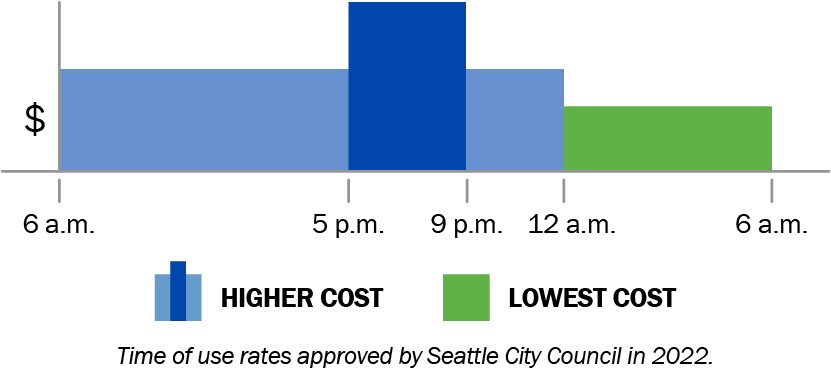
So you're paying a marginally higher rate almost all day on variable-rate, but substantially higher 5-9pm. The math pencils if you have a home battery you can use to load-shift, or perhaps drive an EV a lot.
(Also: this structure is clearly designed around summer cooling load, but peak load is actually winter heating. I don't know what SCL is thinking.)
Correct me if I'm wrong but doesn't PG&E charge one rate for the first ?? kwh and then more for the rest? Perhaps OP made a mistake of using the base rate (which you will blow past if you have too many computers or AC)
They do and how they do the price tranches has changed a lot in the last 5 years. It used to be 4 tranches, 10, 20, 30 and 40. It was very hard to get into the 20 tranch for a single home (maybe if you were bitcoin mining or something). Now the tranches are multiple times higher and its easier to get into the higher tranches. Look on PG&E's website for the specifics.
Near Vancouver.
Guessing Vancouver WA (just north of Portland OR) not BC (Canada). For those not familiar with the area.
correct
You pay $0.05/kWh? That’s insanely low and I though I had it good at $0.1/kWh.
Paying 50 cents here in California. Running the electric oven costs literal dollars. However, this isnt new. Im hoping the data centers bring more attention to our state run cartel and push it over a tipping point.
18 cents here in New Mexico. You must be getting premium government services for paying all of that in California.
9 cents USD here in Ontario and that's considered expensive for Canada.
California utility prices are a function of income.
https://www.cpuc.ca.gov/industries-and-topics/electrical-ene...
https://www.cpuc.ca.gov/industries-and-topics/electrical-ene...
Only the fixed portion is. So about $20 of my $400-800 monthly electric bill is income-based.
Not really. There is a standard rate and then the companies are required by the state to offer an opt in low income tier.
There was a push a year or two back to make it fully income based, where you would have to give the power company your w2 to determine your rate, but it was rejected (for now)
There was a push a year or two back to make it fully income based, where you would have to give the power company your w2 to determine your rate, but it was rejected (for now)
A thread in which yet another American learns how ludicrously cheap the cost of living is in USA despite the constant neverending moaning.
My power is USD$0.271/kWh and I'm nowhere near Ireland.
My power is USD$0.271/kWh and I'm nowhere near Ireland.
For people outside of Ireland: these rates are not the norm. They are usually around 20-22. Can go down 17 if on special plans, or even 12 if you have an electric car.
Actually as of July 1st it is now 38 cents. This is very much the norm
https://www.electricireland.ie/residential/news/detail/elect...
https://www.electricireland.ie/residential/news/detail/elect...
At 34 cents per kwh how can you afford to not get solar?
What kind of question is that? Without knowing anything about the person's geography or local cost of solar, how can you make such a bold assessment of affordability? I live in New Zealand where the capital cost of solar is very expensive and the climate is OK-not-great for solar generation. Even at 30c/kwh the payback (without batteries) is still 15 to 20 years. Not an obvious choice, especially as the capital cost is still declining.
The Sam Vimes theory of socioeconomic unfairness: https://en.wikipedia.org/wiki/Boots_theory
Being poor is expensive.
I mean, if you own a house (you cant put solar on the roof of something you don't own), you probably do have access to loans. Houses make great collerateral.
Not neccesarily saying it makes economic sense to get a loan to install solar, just that homeowners usually aren't the poor class that saying usually applies to.
Not neccesarily saying it makes economic sense to get a loan to install solar, just that homeowners usually aren't the poor class that saying usually applies to.
How many people do you know who own a house? Not a mortgage, own.
The housing market is such that a lot of people are overextended, and the mortgage market encourages people to change their definition of 'enough' house which makes it worse again.
The fact that I don't have solar on my roof is substantially my own fault. I moved in a year after a subsidy ended and it contributed to my procrastination. But then my power grid is comparatively cheap and comparatively renewable, which also contributes.
But I know a lot of people who know a lot of people who can't even stay on top of keeping their expected house repairs up. And that's also an investment in energy and your time and having construction people in your personal space for 2x as long as they estimated it would take.
The housing market is such that a lot of people are overextended, and the mortgage market encourages people to change their definition of 'enough' house which makes it worse again.
The fact that I don't have solar on my roof is substantially my own fault. I moved in a year after a subsidy ended and it contributed to my procrastination. But then my power grid is comparatively cheap and comparatively renewable, which also contributes.
But I know a lot of people who know a lot of people who can't even stay on top of keeping their expected house repairs up. And that's also an investment in energy and your time and having construction people in your personal space for 2x as long as they estimated it would take.
And got electricity price hike last year, and now few weeks ago again, from ~25c kwh, to around 35c kwh! They say its reliance on fossil fuels.
Not just that, think Ireland has one of the most expensive broadbands in the EU!
If you're up to 35c/kWh, solar panels are almost definitely cost effective for you.
depends on where you are. In some parts of California you are out $10-20k just for the permitting and panel upgrade.
Then there are proposals to charge homeowners based on insalled capacity. Part of NEM 3.0 in California was a $8/month per KW, but it was defeated. Who is to say it wont be back in 4.0? that would be about a $1000/yr fee for a 10 kw home system.
Then there are proposals to charge homeowners based on insalled capacity. Part of NEM 3.0 in California was a $8/month per KW, but it was defeated. Who is to say it wont be back in 4.0? that would be about a $1000/yr fee for a 10 kw home system.
It would only apply to new installations, even in last year's proposal.
I'm not aware of any part of California where a permit and panel upgrade would cost more than $7000.
But if you're in those parts of California, your price is also 55c/kWh, not 35c. So... you're still better off.
I'm not aware of any part of California where a permit and panel upgrade would cost more than $7000.
But if you're in those parts of California, your price is also 55c/kWh, not 35c. So... you're still better off.
Ireland consumes roughly 40 TWh per year, that’s less than the production of four EPR reactors or two times Hinkley Point C.
The country could easily solve its electricity problems with nuclear power. They can ask South Korea for help who built four reactors in UAE with 12 years which now provide 25% of the country’s electricity.
The country could easily solve its electricity problems with nuclear power. They can ask South Korea for help who built four reactors in UAE with 12 years which now provide 25% of the country’s electricity.
Nuclear power is a non-starter in IReland because the Sellafield nuclear plant in the UK emitted pollution of various for years but UK officials covered it up. The actual severity of the pollution is open to debate but the loss of trusthad a generational impact.
https://en.wikipedia.org/wiki/Sellafield#Incidents
https://en.wikipedia.org/wiki/Sellafield#Incidents
- To fix these two planks you take a hammer and a nail ... - NO! My uncle hit himself with a hammer real hard last year. It is "is a non-starter". Can we use glue? - Yes, it will be more expensive, less efficient ... - NO! My niece inhaled glue last year. It is "is a non-starter". Can we ... <Light goes out. Conversation continues in a darkness>
Exhibit 1: Why West will lose on AI – they will run out of power. LOL.
Thanks to commenters. (teachrdan and hinkley)
Yes, I know the reasoning. I am one of those who is against nuclear power stations, Chernobyl and Fukushima are too vivid.
But. If we don't "re-industrialise" the West, we die in a cold and darkness. Literally. We already killed marine ecosystem in Black and Caspian seas. Moving as planned in Gulf. With amount of oil tankers just burning out in the open the "carbon emission" goals seem like a joke. And still – we keep crippling our industry with all this ... I am tempted to say "nonsense", but it's not. It's actually right thing to do but we "outmaneuvered" ourselves out of right things. Now we have to deal with survival – economy first, people later.
Thanks to commenters. (teachrdan and hinkley)
Yes, I know the reasoning. I am one of those who is against nuclear power stations, Chernobyl and Fukushima are too vivid.
But. If we don't "re-industrialise" the West, we die in a cold and darkness. Literally. We already killed marine ecosystem in Black and Caspian seas. Moving as planned in Gulf. With amount of oil tankers just burning out in the open the "carbon emission" goals seem like a joke. And still – we keep crippling our industry with all this ... I am tempted to say "nonsense", but it's not. It's actually right thing to do but we "outmaneuvered" ourselves out of right things. Now we have to deal with survival – economy first, people later.
> With amount of oil tankers just burning out in the open the "carbon emission" goals seem like a joke
If you refer to the burning Russian tankers in the Azov, that should reduce emissions. The carried oil would've been used internally in Russia, so it's better to just burn it before it gets used, the same emissions would've been there anyway. And burning the tankers and refineries restricts Russian oil production, which is is a win both for the environment and mankind alike.
If you refer to the burning Russian tankers in the Azov, that should reduce emissions. The carried oil would've been used internally in Russia, so it's better to just burn it before it gets used, the same emissions would've been there anyway. And burning the tankers and refineries restricts Russian oil production, which is is a win both for the environment and mankind alike.
I know this is supposed to be a joke, but you are making a category error if you conflate hitting your thumb with a hammer with running a nuclear power plant.
One of the problems with nuclear is that, for practical and security reasons, you are dependent on an authoritarian regime to run the plant -- a plant that will be inherently not-transparent for the same reasons.
That means you have to trust the authorities in question to tell you the truth about risks like accidental discharges of radioactive waste. In the case of Ireland, which has a long history of being disenfranchised, the trust is understandably broken.
This makes building a new nuclear plant and having it run in your country by the same powers that screwed you over before with the same technology a non-starter.
It seems you didn't read the Sellafield article. If you want to be intellectually honest, I'd suggest starting there. (or at least with the "Incidents" section)
https://en.wikipedia.org/wiki/Sellafield#Incidents
One of the problems with nuclear is that, for practical and security reasons, you are dependent on an authoritarian regime to run the plant -- a plant that will be inherently not-transparent for the same reasons.
That means you have to trust the authorities in question to tell you the truth about risks like accidental discharges of radioactive waste. In the case of Ireland, which has a long history of being disenfranchised, the trust is understandably broken.
This makes building a new nuclear plant and having it run in your country by the same powers that screwed you over before with the same technology a non-starter.
It seems you didn't read the Sellafield article. If you want to be intellectually honest, I'd suggest starting there. (or at least with the "Incidents" section)
https://en.wikipedia.org/wiki/Sellafield#Incidents
And if anyone is wrong, they will only have to deal with it for 20-50 years, then they die and the next 5000 administrations have to deal with the literal fallout.
If your uncle hitting his thumb meant everyone in his line and all of his neighbors would have a flat thumb for the next million years then the government would absolutely involve itself in hammer design and operational safety guidelines.
If your uncle hitting his thumb meant everyone in his line and all of his neighbors would have a flat thumb for the next million years then the government would absolutely involve itself in hammer design and operational safety guidelines.
Fallout came from Chernobyl and Fat Boy. There is no fallout from a reactor that doesn't explode, and Chernobyl exploded for human reasons rather than structural ones.
Yes, waste lasts a long time. That's mostly in the form of a pond of slightly clicky water. The fear is overblown. See http://large.stanford.edu/courses/2026/ph241/teixeira2/
Yes, waste lasts a long time. That's mostly in the form of a pond of slightly clicky water. The fear is overblown. See http://large.stanford.edu/courses/2026/ph241/teixeira2/
People gave their lives to dig underneath Chernobyl. If they hadn’t the aquifers in Eastern Europe would be radioactive for the next million years.
Nuclear takes minimum 15 years to build. Even if they started in earnest theyd still have problems for over a decade
A similar thing happened in greece, but not with data centers. The railroads, airports,shipping ports were privatized and bought by foreign investors. Now the money from those services leaves the country making the greek economy poorer and weaker.
How do the data center people protect their expensive data center from colossal rate hikes? They can’t just pick up and move.
So has Ireland made an agreement with them in some way?
I’m just imagining that if there’s no local value for three beyond some temp construction jobs and a handful of service jobs, surely they can just bilk them until they leave. So I imagine data center companies only locate where they can get very safe terms?
So has Ireland made an agreement with them in some way?
I’m just imagining that if there’s no local value for three beyond some temp construction jobs and a handful of service jobs, surely they can just bilk them until they leave. So I imagine data center companies only locate where they can get very safe terms?
I assume that they sign up to long term contracts to secure the price of power.
When it comes to renewal, the DC operator obviously has a sunk cost that they don't want to walk away from. But the electricity generators are also in the same boat. If the DC shuts up shop then there's x00 MW that the generator won't be able to sell and could suppress prices across the whole country. So both parties are incentivised to come to an agreement.
When it comes to renewal, the DC operator obviously has a sunk cost that they don't want to walk away from. But the electricity generators are also in the same boat. If the DC shuts up shop then there's x00 MW that the generator won't be able to sell and could suppress prices across the whole country. So both parties are incentivised to come to an agreement.
A few years ago I was reading a recruitment report and was surprised to learn that Ireland is a large source of data scientists, so it’s no surprise really
I don’t really see the link between data scientists and datacentres, or even AI researchers and datacentres.
The data scientists aren’t the ones working in the data centres. There’s no real advantage to having the data they’re working on next door unless it’s extremely lag sensitive.
Local proximity of a datacentre is good for fintech, Netflix and gaming servers.
The data scientists aren’t the ones working in the data centres. There’s no real advantage to having the data they’re working on next door unless it’s extremely lag sensitive.
Local proximity of a datacentre is good for fintech, Netflix and gaming servers.
Yep. IDA's services FDI model helped attract much of the tech scene that exists in Ireland today. In the 1990s and 2000s no one would have expected Ireland to become the tech hub it is today without the IDA's foresightedness.
[deleted]
Good work by them. An incredibly clean use of power with strong revenue. As industries go, this is a pretty good use of land and energy.
I would have agreed with that two years ago, to the extent that crypto isn't mined in DCs. But AI is mined in DCs, and looks a bit frothy. Is it delivering value to someone? yes; is it delivering value in the round? jury is still out.
They chose to add the word "guzzle". They could have just written "Irish datacenters now use 23% of the country's electricity". But they made the editorial decision to add in "guzzle". What's the word for this type of propaganda, where they add in some sort of adjective that wasn't needed, in order to prime the reader on how to think/feel, rather than just objectively reporting the facts? What are the odds that the content of the article is objective and factual, given the decisions they made with the headline?
>What's the word for this type of propaganda, where they add in some sort of adjective that wasn't needed, in order to prime the reader on how to think/feel, rather than just objectively reporting the facts?
It's called an editorial.
It's not supposed to be a mere report, concerned with respecting any random person's feeling about how all electricity consumption is equally valid and should be equally respected.
It's called an editorial.
It's not supposed to be a mere report, concerned with respecting any random person's feeling about how all electricity consumption is equally valid and should be equally respected.
Editorials are a thing. This is not an editorial. It's structured as a news report.
Credibility is a thing. Articles like this burn it quite quickly. It really is past time that the scientific community needs to make a public statement rejecting these types of "journalists".
The scientific community has burned a lot of credibility itself to make any kind of statement to that effect.
That's the thing, the popular impression is that this is the case. But if you read what scientists actually wrote/said you would realize that what science says and what activists and journalists claim science says are quite different. That's why its almost impossible for a journalist to get a quote from a scientists on this topic anymore. Its also why there are almost no scientists who are members of "green" political entities (eg Sierra Club) anymore. Did you see a quote from a scientist in this article? When was the last time you saw one?
> Did you see a quote from a scientist in this article?
The article cited the latest figures from Ireland's Central Statistics Office (CSO).
There's little need here for Niels Bohr or a bleeding edge virologist to lean in on annual summary stats on civil infrastructure usage.
The article cited the latest figures from Ireland's Central Statistics Office (CSO).
There's little need here for Niels Bohr or a bleeding edge virologist to lean in on annual summary stats on civil infrastructure usage.
Those are not scientists. They also compute GDP.
Why do they need "a scientist" to compound statistics?
They certainly have BSc Mathematics types. What is the additional scientific discipline you think needs to weigh in here?
They certainly have BSc Mathematics types. What is the additional scientific discipline you think needs to weigh in here?
Your post doesn't have a reply link for some reasons but here is my response. What they need is expertise in energy generation. They need to understand concepts like a duck curve, power storage and its material requirements, relative EROEI of various power generation sources and a basic understanding of when newer forms of generation are likely to be ready. For instance, they should understand that renewables need to be well sited. They need to understand that the solar albino of Ireland is (far) too low for solar PV to be effective. Things of this nature. Engineering things around energy generation and the physics of how a grid works. If you don't understand these things, you are throwing darts at a dart board when you try to provide analysis of various types of industrial infrastructure.
So, you want a different article then.
This article reports that Irish data centres use a particular percentage of the countries power.
> What they need is expertise in energy generation.
Okay, so an actual Electrical Engineer with grid scale experience.
> They need to understand concepts like a duck curve, power storage and its material requirements, relative EROEI of various power generation sources and a basic understanding of when newer forms of generation are likely to be ready.
Many people with a STEM background understand these things .. they are not generally called "scientists" in Commonwealth English.
This article reports that Irish data centres use a particular percentage of the countries power.
> What they need is expertise in energy generation.
Okay, so an actual Electrical Engineer with grid scale experience.
> They need to understand concepts like a duck curve, power storage and its material requirements, relative EROEI of various power generation sources and a basic understanding of when newer forms of generation are likely to be ready.
Many people with a STEM background understand these things .. they are not generally called "scientists" in Commonwealth English.
Also, I don't want a different article, I want one informed by someone who has a real understanding of these topics. For example, if a datacenter is in Washington state, fresh water (and its fresh water we care about here) isn't consumed. In Ireland, probably some is consumed. This is because of wind patterns and where water vapor will be carried to from the datacenter. If its carried over land, fresh water isn't consumed. If its carried over ocean, then it is. Stuff like this is why you actually need knowledge of the issue, and not just an understanding of datacenter cooling systems.
"Many people with a STEM background understand these things .. they are not generally called "scientists" in Commonwealth English."
Sure, but none of them work at the institution referenced by the article. That isn't what they do.
Sure, but none of them work at the institution referenced by the article. That isn't what they do.
This is The Register we're talking about. Of course it is heavily editorialized, that's half their schtick.
It's called a value judgment and an emotionally charged tone. That's certainly a form of editorial but IMO not the good kind. If an outlet seeks to advocate for a cause it ought to do so in a well reasoned manner and with a professional tone.
Can you link to any examples of a good editorial by this measure?
Journalism is allowed to have an opinion, that doesn't make it propaganda.
>Journalism is allowed to have an opinion, that doesn't make it propaganda.
How do you figure? Surely it becomes propaganda for the opinion?
Journalists are not supposed to let opinions show in their reporting, that’s why editorials exist.
How do you figure? Surely it becomes propaganda for the opinion?
Journalists are not supposed to let opinions show in their reporting, that’s why editorials exist.
“I have given up on American journalism. The decline of the American press has long been obvious, and my time is too valuable to waste in an effort to supply the ‘man in the street’ with his daily quota of clichés, gossip, and erotic tripe. There is another concept of journalism, which you may or may not be familiar with. It’s engraved on a bronze plaque on the southeast corner of the Times Tower in New York City.”
—Hunter Thompson, letter to William Kennedy, 1959
“An institution that should always fight for progress and reform, never tolerate injustice or corruption, always fight demagogues of all parties, never belong to any party, always oppose privileged classes and public plunderers, never lack sympathy with the poor, always remain devoted to the public welfare, never be satisfied with merely printing news, always be drastically independent, never be afraid to attack wrong, whether by predatory plutocracy or predatory poverty.”
—Joseph Pulitzer, New York World mission statement, May 10, 1883, quote appears on The New York Times bronze plaque
—Hunter Thompson, letter to William Kennedy, 1959
“An institution that should always fight for progress and reform, never tolerate injustice or corruption, always fight demagogues of all parties, never belong to any party, always oppose privileged classes and public plunderers, never lack sympathy with the poor, always remain devoted to the public welfare, never be satisfied with merely printing news, always be drastically independent, never be afraid to attack wrong, whether by predatory plutocracy or predatory poverty.”
—Joseph Pulitzer, New York World mission statement, May 10, 1883, quote appears on The New York Times bronze plaque
"When you’re young, you look at television and think, There’s a
conspiracy. The networks have conspired to dumb us down. But
when you get a little older, you realize that’s not true. The networks
are in business to give people exactly what they want."
--Steve Jobs
I think the same goes for newspapers. They are businesses that make money from giving people what they want, and like all businesses they eventually care primarily about making money. Whatever else they were founded to care about is secondary at best.
--Steve Jobs
I think the same goes for newspapers. They are businesses that make money from giving people what they want, and like all businesses they eventually care primarily about making money. Whatever else they were founded to care about is secondary at best.
there's an unnatural amount of doomerism against datacenters, of exactly this kind. It's pretty obviously astroturfed.
In case you didn't know, The Register has been deliberately using this kind of language about ALL topics for nearly 30 years. It's part of their appeal and brand, like The Onion. People choose to read The Register because they have this adversarial stance and humorous tone about tech.
The vast majority of the pro-datacenter 'externalities don't matter as long as I make money' is also pretty obviously astroturfed.
The difference is that much of the communication on that end happens in backchannels, directly with the regulators, in secret meetings, without any possibility of public scrutiny.
(When that isn't enough, the firehose of paid advertisements gets fired up to convince the public, instead.)
The difference is that much of the communication on that end happens in backchannels, directly with the regulators, in secret meetings, without any possibility of public scrutiny.
(When that isn't enough, the firehose of paid advertisements gets fired up to convince the public, instead.)
No, not really. My comments are organic - they come from a place of frustration, seeing such trivially wrong arguments against data centers.
All the arguments I see against data centers are arguments against industrialization. There are also arguments against capitalism and wealth inequality, that I sympathise with.
All the arguments I see against data centers are arguments against industrialization. There are also arguments against capitalism and wealth inequality, that I sympathise with.
The vast majority of the anti-datacenter movement is funded by the CCP. That's why it is so lacking in facts. Most datacenters use closed loop cooling. That means it doesn't consume water for anything more than the toilets and water fountains. Yet this talking point pops up in almost every article on the topic. Part of the reason you are seeing closed door meetings now is because leaders know that the public is profoundly misinformed on this topic. It doesn't help when AOC is waving a jar of dirty water as if it is proof of something.
exactly. All of the arguments I see against data centers are simply arguments against industrialization.
The dirty water bit is the most ridiculous thing. It's meant to paint the picture that the data centers themselves are using the water and dirtying it, when in reality the cause is the development of the actual buildings and infrastructure, which would happen with any industrial development!
The dirty water bit is the most ridiculous thing. It's meant to paint the picture that the data centers themselves are using the water and dirtying it, when in reality the cause is the development of the actual buildings and infrastructure, which would happen with any industrial development!
Most data centers do not use closed loop cooling.
They all have a closed cooling loop, but almost all of them cool the exterior condensers with an open cooling loop.
Which draws from the watermain, sprays water on the hot condensers, the water evaporates, cooling the condensers. This is done to reduce their electric bills, because condensers operate more efficiently when they are cold.
The fully closed-loop data center, with air-cooled condensers is the exception, not the rule. Because it sucks even more electricity than a regular one, due to its less-efficient cooling.
You are spreading falsehoods, while also accusing people who are factually accurate of being foreign propaganda mouthpieces. This is at best, ironic and jingoistic, and at worst...
They all have a closed cooling loop, but almost all of them cool the exterior condensers with an open cooling loop.
Which draws from the watermain, sprays water on the hot condensers, the water evaporates, cooling the condensers. This is done to reduce their electric bills, because condensers operate more efficiently when they are cold.
The fully closed-loop data center, with air-cooled condensers is the exception, not the rule. Because it sucks even more electricity than a regular one, due to its less-efficient cooling.
You are spreading falsehoods, while also accusing people who are factually accurate of being foreign propaganda mouthpieces. This is at best, ironic and jingoistic, and at worst...
Do you honestly think that the very detailed understanding of cooling systems that you have has anything in common with the popular opinion that datacenters use lots of water?
Also, you are arguing jargon...and data centers use completely closed loop designs where it makes sense (very cheap power) and use what you describe where it makes sense (with more expensive power and cheaper water). Finally, nothing you said disproves that there is a significant propaganda effort to demonize datacenters by a foreign power.
Also, you are arguing jargon...and data centers use completely closed loop designs where it makes sense (very cheap power) and use what you describe where it makes sense (with more expensive power and cheaper water). Finally, nothing you said disproves that there is a significant propaganda effort to demonize datacenters by a foreign power.
That opinion should be informed by facts and data. This opinion isn't really informed by anything except scientifically illiterate propaganda. That's the problem. Journalists larping as experts in something that they have absolutely no expertise or even the basic scientific background to understand. The amount of misinformation on topics surrounding energy generation is absolutely criminal and journalists are far and away the biggest spreaders of misinformation on this topic. If I could, I would make a journalist without scientific or engineering credentials talking about this topic a felony on par with murder. After all, they are causing significant amounts of misery in the 3rd world with their lies.
Not really, no. It is one of the most important attributes of good journalism that you have to be as impartial.
That's why papers have separate sections for Opinions
> They could have just written "Irish datacenters now use 23% of the country's electricity".
That's objectively described by "guzzle".
That's objectively described by "guzzle".
Is The Register known for objectively reporting facts? If so, I have fundamentally misunderstood it for a quarter century.
> objectively reporting facts?
I believe so. They're not known for neutrally reporting them, which is different.
I believe so. They're not known for neutrally reporting them, which is different.
Do Ireland's data centers objectively "guzzle" electricity?
I don't have any problem with The Register, but reporting laden with value-judging adjectives is not objective.
I don't have any problem with The Register, but reporting laden with value-judging adjectives is not objective.
Objectively, yes. It means to consume excessive or plentiful amounts of something, and 23% of Ireland’s electricity generation capability is objectively an excessive and plentiful amount.
Objectively no, 23% of nothing is nothing. Ireland has no industry. Their grid is smaller than a major city's grid. That this is 23% says a lot more about the size of the Irish grid and their lack of industry than it does about how much energy a datacenter uses.
The characterization as “excessive” is subjective. If you disagree, what are your objective criteria for making that claim? You fundamentally can’t give a correct answer to that, because it requires defining a threshold, and that’s subjective.
If people seriously think claims like this are “objective”, I weep for our collective understanding of reality.
If people seriously think claims like this are “objective”, I weep for our collective understanding of reality.
Of course it’s excessive. Questions should be asked about any one industry using 23% of a nation’s generating capacity, when it was not built for this purpose.
Of course it’s excessive. Ireland’s electricity is not cheap or in such plentiful supply that homes are not affective by this. These data centres are driving up the electricity prices for everyone in Ireland.
Of course it’s excessive. There are only 80 datacentres that used 7.8TWh between them in 2025. That amount of power is used by only the heaviest of industries; it’s 3x more power than the UK steel industry uses, for example.
Of course it’s excessive. The amount of energy used means that more fossil fuels is being used to power them than would otherwise be necessary. Legislation has been written so that new datacentres must in future provide their own [fossil fuel] generators. This in a time of man-made climate change where we all urgently need to reduce our dependence on fossil fuels. It’s not just excessive, it’s deeply irresponsible.
Of course it’s excessive. Ireland’s electricity is not cheap or in such plentiful supply that homes are not affective by this. These data centres are driving up the electricity prices for everyone in Ireland.
Of course it’s excessive. There are only 80 datacentres that used 7.8TWh between them in 2025. That amount of power is used by only the heaviest of industries; it’s 3x more power than the UK steel industry uses, for example.
Of course it’s excessive. The amount of energy used means that more fossil fuels is being used to power them than would otherwise be necessary. Legislation has been written so that new datacentres must in future provide their own [fossil fuel] generators. This in a time of man-made climate change where we all urgently need to reduce our dependence on fossil fuels. It’s not just excessive, it’s deeply irresponsible.
None of your statements give objective conclusions, unless one accepts as premises the implicit value judgments and other subjective assessments they depend on.
It shouldn't surprise you to know that there are people who disagree with everything you're saying. Do you really believe they're all "objectively wrong"? That's the territory of religion - "only my beliefs are the real ones".
It shouldn't surprise you to know that there are people who disagree with everything you're saying. Do you really believe they're all "objectively wrong"? That's the territory of religion - "only my beliefs are the real ones".
Merriam-Webster says:
“Excessive: exceeding what is usual, proper, necessary, or normal”
https://www.merriam-webster.com/dictionary/excessive
The power use of data centres is objectively exceeding what is usual or normal. Therefore it is objectively excessive.
“Excessive: exceeding what is usual, proper, necessary, or normal”
https://www.merriam-webster.com/dictionary/excessive
The power use of data centres is objectively exceeding what is usual or normal. Therefore it is objectively excessive.
"Usual, proper, necessary, or normal" for what purpose?
For data centers, none of those adjectives are being exceeded, so it's not excessive. Ireland is not using more power to run its data centers than anywhere else is, for data centers of a similar size.
To justify the claim of "excessive", you need to define some standard against which that's being measured. That choice of standard is necessarily subjective.
Again, this attempt to reframe subjective claims as objective is an act of either ignorance (not understanding what "objective" means) or zealotry (believing your opinions are the only ones that can be correct, and therefore "objective".) Either way, you need to examine what you're claiming more closely.
For data centers, none of those adjectives are being exceeded, so it's not excessive. Ireland is not using more power to run its data centers than anywhere else is, for data centers of a similar size.
To justify the claim of "excessive", you need to define some standard against which that's being measured. That choice of standard is necessarily subjective.
Again, this attempt to reframe subjective claims as objective is an act of either ignorance (not understanding what "objective" means) or zealotry (believing your opinions are the only ones that can be correct, and therefore "objective".) Either way, you need to examine what you're claiming more closely.
I posted several metrics by which the power used by these data centres is ‘excessive’.
You’ve decided that those don’t matter and you’ve created some other metrics by which you could consider the power use typical.
But just because you’ve found a way to say that they’re typical in one way, that doesn’t mean they’re not excessive in another way. They do use power to excess in some ways, therefore it’s perfectly legitimate to describe them as excessive in that way.
Data centres’ power use is becoming a problem for multiple reasons. The problem isn’t going to be solved by denying that a problem exists, or by taking offense when an adjective is used that draws attention to said problem.
> zealotry (believing your opinions are the only ones that can be correct)
Indeed.
You’ve decided that those don’t matter and you’ve created some other metrics by which you could consider the power use typical.
But just because you’ve found a way to say that they’re typical in one way, that doesn’t mean they’re not excessive in another way. They do use power to excess in some ways, therefore it’s perfectly legitimate to describe them as excessive in that way.
Data centres’ power use is becoming a problem for multiple reasons. The problem isn’t going to be solved by denying that a problem exists, or by taking offense when an adjective is used that draws attention to said problem.
> zealotry (believing your opinions are the only ones that can be correct)
Indeed.
They basically re-report press releases. I've dealt with The Register as well as their sister publications back when I was still in product (especially during shudder RSA).
The Reg keeps a snarky tone, but immediately becomes deferential once a vendor begins a content campaign with them.
They also operated a bot account on HN for years that was spamming Register articles for almost 3 years and accumulated 66K karma until I and a couple others complained about it.
The Reg keeps a snarky tone, but immediately becomes deferential once a vendor begins a content campaign with them.
They also operated a bot account on HN for years that was spamming Register articles for almost 3 years and accumulated 66K karma until I and a couple others complained about it.
I haven't found a single source of Irish power mix over time but what I did find suggests that the amount of renewable power in Ireland has been spiking aggressively in recent years. I see something like 15% in 2024 from one source and >40% in 2026 from another. One chart (which I just found reproduced on wikipedia) of wind power is going up at like 600 GWh per year.
I agree that this title is very opinionated. If the country would have created enough electricity, the percentage wouldn't be a problem
The Register is famous for its jaundiced takes, which are a mix of journalistic cynicism and parody of the febrile language of the UK tabloid press. You are not meant to take it at face value.
First time reading The Register, is it? Because I would expect no less from such a pillar of journalism as them.
I see you've never read The Register before. Their whole value proposition is "here is computing news from cynical, snarky viewpoint". Their motto "Biting the hand that feeds IT" has vanished from the masthead but it's still in their footer.
Guess if people who write articles like LLMs
"Unwanted industrial users consuming over 1/5th Ireland's electricity."
(Ireland has challenges getting enough renewable energy to the island, as well as connecting the northern and southern parts with transmission due to local citizens not friendly to the need for transmission infra; data centers do not belong in Ireland, build them in countries in Europe that have excess clean energy, Spain and France specifically, and eat any latency as unavoidable)
(Ireland has challenges getting enough renewable energy to the island, as well as connecting the northern and southern parts with transmission due to local citizens not friendly to the need for transmission infra; data centers do not belong in Ireland, build them in countries in Europe that have excess clean energy, Spain and France specifically, and eat any latency as unavoidable)
Yeah, but Ireland has a looser regulatory environment where it’s easier for a data centre operator to buy off the relevant government regulators.
Which is most of Ireland's economy. I am fine with pulling the plug on them. They are not. I mean, who wants to lose 2/3rd of their GDP overnight?
Such are the perils of democracy. Sometimes people actually want that growth and don’t want to be a zero growth state forever.
Transformers that are required to supply data centers power have a manufacturing backlog measured in years. If Ireland's government regulators will not make better choices in the interest of their citizens, citizens can make better choices for citizens, in this context, if they choose to do so.
https://pv-magazine-usa.com/2026/05/11/u-s-transformer-marke...
https://www.sectorinsighthq.com/news/UHV_Transmission_Equipm...
https://news.ycombinator.com/item?id=47604887
https://pv-magazine-usa.com/2026/05/11/u-s-transformer-marke...
https://www.sectorinsighthq.com/news/UHV_Transmission_Equipm...
https://news.ycombinator.com/item?id=47604887
> data centers do not belong in Ireland...
Data Centers have been the cornerstone of Ireland's economy since the mid-2000s when the IDA began wooing tech FDI specifically by calling out data center expansion opportunities within the EU [0].
Also, if Europeans actually wish to have a sovereign tech industry, they need domestic compute capacity.
Complaining about American tech dependency and then immediately complaining about steps to build EU tech sovereignty is literally a contradiction.
[0] - https://www.siliconrepublic.com/science/ireland-has-the-pote...
Data Centers have been the cornerstone of Ireland's economy since the mid-2000s when the IDA began wooing tech FDI specifically by calling out data center expansion opportunities within the EU [0].
Also, if Europeans actually wish to have a sovereign tech industry, they need domestic compute capacity.
Complaining about American tech dependency and then immediately complaining about steps to build EU tech sovereignty is literally a contradiction.
[0] - https://www.siliconrepublic.com/science/ireland-has-the-pote...
bgun(2)
I read this as 'Irish Dancers now guzzle....'
I'm sure they work up a sweat but probably not on the same order of magnitude
I'm sure they work up a sweat but probably not on the same order of magnitude
Do they pay for it, and the consequent infrastructure cost increases? If they pay full commercial rates or adjusted rates for behaviours which are net beneficial to the supply process, then isn't this just another form of revenue?
If they have successfully avoided what they consider "externalities" thats a different matter. Like, polluting.
If they have successfully avoided what they consider "externalities" thats a different matter. Like, polluting.
Ireland has been a data center hub for decades - especially thanks to the IDA successfully wooing Microsoft back in 2007 [0], and it helped played a role in helping Ireland partially recover from the AIB and housing collapse back in 2008 and become the tech hub it is today. Heck, it was the corneestone of the IDA's tech FDI policy back then [1].
Heck, Google itself only expanded in Ireland back in the 2000s in large part because they worked on acquiring Colt to build their European CoLo in Ireland, and data centers now represent around 18% of Ireland's total GVA [2].
[0] - https://www.datacenterknowledge.com/hyperscalers/microsoft-p...
[1] - https://www.siliconrepublic.com/science/ireland-has-the-pote...
[2] - https://www.iiea.com/blog/data-centres-in-ireland-the-state-...
Heck, Google itself only expanded in Ireland back in the 2000s in large part because they worked on acquiring Colt to build their European CoLo in Ireland, and data centers now represent around 18% of Ireland's total GVA [2].
[0] - https://www.datacenterknowledge.com/hyperscalers/microsoft-p...
[1] - https://www.siliconrepublic.com/science/ireland-has-the-pote...
[2] - https://www.iiea.com/blog/data-centres-in-ireland-the-state-...
That and misappropriating a lot of the taxes of other countries in the process
It's not misappropriation. Other countries within the EU could be much more business incorporation and FDI friendly, and IDA Ireland tends to be one of the more competent trade promotion agencies within the EU.
Why should Ireland undermine 13% of it's GDP [0]?
Edit: can't reply
> Telling American multinationals you will have them pay 0 tax isn't exactly a "tax policy" as such
Ireland's corporate tax rate is 12.5% but drops to 6.25% if it's qualified R&D and IP income with an added 35% R&D tax credit.
It's attractive, but CEE states like Poland and Czechia can (and often do) match that.
The biggest attraction for Ireland is the fact that everyone speaks English in Ireland, and Irish tax and corporate legal firms have worked with American firms since the 1990s, which reduces the headache.
> Or to 0.005% if you're Apple
Which ended in 2014, yet Ireland still remains attractive for tech FDI.
At the end of the day, Ireland executed much better than it's developmental peers in the 1990s (Spain, Czechia, Russia, Ukraine, Cyprus, Greece, Argentine, and Libya in 1991 based on HDI) simply because it was much more business friendly.
[0] - https://www.trade.gov/country-commercial-guides/ireland-digi...
Why should Ireland undermine 13% of it's GDP [0]?
Edit: can't reply
> Telling American multinationals you will have them pay 0 tax isn't exactly a "tax policy" as such
Ireland's corporate tax rate is 12.5% but drops to 6.25% if it's qualified R&D and IP income with an added 35% R&D tax credit.
It's attractive, but CEE states like Poland and Czechia can (and often do) match that.
The biggest attraction for Ireland is the fact that everyone speaks English in Ireland, and Irish tax and corporate legal firms have worked with American firms since the 1990s, which reduces the headache.
> Or to 0.005% if you're Apple
Which ended in 2014, yet Ireland still remains attractive for tech FDI.
At the end of the day, Ireland executed much better than it's developmental peers in the 1990s (Spain, Czechia, Russia, Ukraine, Cyprus, Greece, Argentine, and Libya in 1991 based on HDI) simply because it was much more business friendly.
[0] - https://www.trade.gov/country-commercial-guides/ireland-digi...
> Why should Ireland undermine 13% of it's GDP
Undercutting other countries on tax policy tends to piss them off. So it comes down to whether the benefits of the policy outweigh the blowback.
The 13% of GDP figure can be a bit misleading as GDP from being a tax haven tends to help the average irish citizen a lot less than more traditional ecconomic activity.
Undercutting other countries on tax policy tends to piss them off. So it comes down to whether the benefits of the policy outweigh the blowback.
The 13% of GDP figure can be a bit misleading as GDP from being a tax haven tends to help the average irish citizen a lot less than more traditional ecconomic activity.
eh, other countries can improve their offering. It's a good thing. We punish companies when they collude to keep salaries low. So too should countries compete with attractive tax packages.
> We punish companies when they collude to keep salaries low
No we fucking don't. I have no idea how you reached that position in the uber era.
No we fucking don't. I have no idea how you reached that position in the uber era.
> eh, other countries can improve their offering.
Or they could use coercive measures to punish the countries undercutting them. There is no world police after all to prevent them.
A big reason why capitalism works is 2 factors: its easy to start competitors and established players are not allowed to shoot up and coming companies. Neither apply to countries.
I'm not arguing about whether its a good thing or not, just that it is the way the world works. Whether or not Ireland's policies are a good idea depends on how much value they capture vs how much value they lose due to their consequences, chief among them being the strain such policies can put on foreign relations & trade.
Or they could use coercive measures to punish the countries undercutting them. There is no world police after all to prevent them.
A big reason why capitalism works is 2 factors: its easy to start competitors and established players are not allowed to shoot up and coming companies. Neither apply to countries.
I'm not arguing about whether its a good thing or not, just that it is the way the world works. Whether or not Ireland's policies are a good idea depends on how much value they capture vs how much value they lose due to their consequences, chief among them being the strain such policies can put on foreign relations & trade.
> The 13% of GDP figure can be a bit misleading as GDP from being a tax haven tends to help the average irish citizen a lot less than more traditional ecconomic activity
As I pointed out, if Ireland didn't adopt it's tech FDI policy which it did in the 1990s, it would be a much poorer country today.
Going from Libyan, Soviet, and Greek to Finland level living standards in 30 years was not guaranteed, and it was Ireland's business friendly policies is what ensured it became a tech hub today and didn't fall into the middle income trap - especially in 2008-12 when Ireland was also in the midst of a Greece style economic meltdown (remember the PIGS?)
Ireland was a developing country in the 1990s, and if they executed better than then much richer Western European states like Germany, France, the UK, and Canada then so be it.
> GDP from being a tax haven tends to help the average irish citizen a lot less than more traditional ecconomic activity.
I've been using HDI which isn't severely impacted by GDP per capita.
And even then, Ireland's median household income [0] is now significantly higher than the UK [1] despite living standard in the UK having been significantly higher than Ireland's until the 2010s because of Ireland's FDI policy.
> Undercutting other countries on tax policy tends to piss them off
Other EU member states such as Poland and Czechia also match Ireland's incentives when asked, which has helped both Czechia and Poland now catch up to historically richer France, Italy, and the UK.
[0] - https://www.cso.ie/en/releasesandpublications/ep/p-silc/surv...
[1] - https://www.ons.gov.uk/peoplepopulationandcommunity/personal...
As I pointed out, if Ireland didn't adopt it's tech FDI policy which it did in the 1990s, it would be a much poorer country today.
Going from Libyan, Soviet, and Greek to Finland level living standards in 30 years was not guaranteed, and it was Ireland's business friendly policies is what ensured it became a tech hub today and didn't fall into the middle income trap - especially in 2008-12 when Ireland was also in the midst of a Greece style economic meltdown (remember the PIGS?)
Ireland was a developing country in the 1990s, and if they executed better than then much richer Western European states like Germany, France, the UK, and Canada then so be it.
> GDP from being a tax haven tends to help the average irish citizen a lot less than more traditional ecconomic activity.
I've been using HDI which isn't severely impacted by GDP per capita.
And even then, Ireland's median household income [0] is now significantly higher than the UK [1] despite living standard in the UK having been significantly higher than Ireland's until the 2010s because of Ireland's FDI policy.
> Undercutting other countries on tax policy tends to piss them off
Other EU member states such as Poland and Czechia also match Ireland's incentives when asked, which has helped both Czechia and Poland now catch up to historically richer France, Italy, and the UK.
[0] - https://www.cso.ie/en/releasesandpublications/ep/p-silc/surv...
[1] - https://www.ons.gov.uk/peoplepopulationandcommunity/personal...
> As I pointed out, if Ireland didn't adopt it's tech FDI policy which it did in the 1990s, it would be a much poorer country today.
Perhaps, but if you want to measure the effect it had on ordinary Irish people you should be using GNI not GDP. I'm not saying it had no effect, just that GDP is a misleading measure.
Perhaps, but if you want to measure the effect it had on ordinary Irish people you should be using GNI not GDP. I'm not saying it had no effect, just that GDP is a misleading measure.
Hence who I used both HDI and median household income.
And even with GNI my argument still holds. I'm surprised how so many HNers don't remember how poor Ireland used to be until 20-30 years ago, especially given how most HNers are in their 30s to 40s.
Ireland, South Korea, and Israel are the poster children of developing countries that successfully escaping the middle income trap and climbing up the economic value chain back in the 2010s.
And even with GNI my argument still holds. I'm surprised how so many HNers don't remember how poor Ireland used to be until 20-30 years ago, especially given how most HNers are in their 30s to 40s.
Ireland, South Korea, and Israel are the poster children of developing countries that successfully escaping the middle income trap and climbing up the economic value chain back in the 2010s.
The low corporate tax might be fair although questionable, however the entire Double Irish Dutch Sandwich mechanism was a way to take taxes of other countries citizens
The "Double Irish Dutch Sandwich" approach ended almost a decade ago as I mentioned, yet tech FDI remains strong and a hallmark of Ireland's economy.
We're still investing in Ireland because IDA and Enterprise Ireland are competent.
And at the end of the day, Luxembourg, Malta, Cyprus, Latvia, Slovenia, Estonia, Austria, Czechia, Hungary, Germany, Poland, Netherlands, and Croatia have all voted with or abstained in favor of Ireland when questions about Ireland's approach came up in the EU.
The primary countries complaining have been France, Italy, and Spain.
We're still investing in Ireland because IDA and Enterprise Ireland are competent.
And at the end of the day, Luxembourg, Malta, Cyprus, Latvia, Slovenia, Estonia, Austria, Czechia, Hungary, Germany, Poland, Netherlands, and Croatia have all voted with or abstained in favor of Ireland when questions about Ireland's approach came up in the EU.
The primary countries complaining have been France, Italy, and Spain.
I thought that went on until 2020, in any case, sure after the corporate taxes of the entire world were funneled there and had created data centers and imported a workforce to Ireland, it is now a place worth investing in.
However that does not make this construct any more moral
However that does not make this construct any more moral
>Ireland's corporate tax rate is 12.5% but drops to 6.25% if it's qualified R&D and IP income with an added 35% R&D tax credit.
Or to 0.005% if you're Apple.
>The Commission's investigation concluded that Ireland granted illegal tax benefits to Apple, which enabled it to pay substantially less tax than other businesses over many years. In fact, this selective treatment allowed Apple to pay an effective corporate tax rate of 1 per cent on its European profits in 2003 down to 0.005 per cent in 2014.
Or to 0.005% if you're Apple.
>The Commission's investigation concluded that Ireland granted illegal tax benefits to Apple, which enabled it to pay substantially less tax than other businesses over many years. In fact, this selective treatment allowed Apple to pay an effective corporate tax rate of 1 per cent on its European profits in 2003 down to 0.005 per cent in 2014.
Telling American multinationals you will have them pay 0 tax isn't exactly a "tax policy" as such.
A parking structure owned by a shopping center might offer free parking in order to drive business goals. That's as much a policy as it would be if they were to charge a fee.
Are we allowed post masto links? I'm an Irish techie. I shot a video about this. Sorry about the camera shake:
https://mastodon.ie/@handi/116900076149521593
https://mastodon.ie/@handi/116900076149521593
> Dump #datacenters - they are not critical Internet infrastructure!
what is the alternative? I don't think self hosting is a robust/defensible option for a majority of internet services
what is the alternative? I don't think self hosting is a robust/defensible option for a majority of internet services
Nobody hosts datacenters in Ireland because of capacity reasons. It's not a good location for power, people or connectivity. They host them there for tax reasons. You can bet your firstborn these datacenters are only the exact size that is the minimum allowed by tax law, not a square millimeter more.
Yes, datacenters are critical internet infrastructure. But in Ireland they're more like a sailing ship with the sails mounted underwater, because that's cheaper for tax reasons.
Yes, datacenters are critical internet infrastructure. But in Ireland they're more like a sailing ship with the sails mounted underwater, because that's cheaper for tax reasons.
> Nobody hosts datacenters in Ireland because of capacity reasons. It's not a good location for power, people or connectivity.
It is, ah, probably about the best location if you want connectivity to both the US and continental Europe (and also, oddly, Japan, via an arctic cable). A big fraction of total transatlantic connectivity goes through Ireland, and there's substantial redundancy.
However, realistically, today datacenters are mostly built in Ireland because there are already datacenters in Ireland. There are no significant tax benefits to building them in Ireland vs most other countries, power is more expensive, and planning is more difficult (a lot of proposed datacenters for Ireland are now being refused planning, due to either grid constraints or dirty backup power arrangements). But, say, eu-west-1 is the biggest European AWS region, so why, as an Amazon customer, wouldn't you use it? (This is also a thing with us-east-1, which I think is still their biggest region despite their attempts to nudge people away from it to east-2...)
Expansion by _existing_ datacenter operators, who came in ages ago when the connectivity advantage was more of a big deal, seems to be the major driver. I don't think anyone who doesn't already have datacenters in Ireland is trying to build them; these days there are other locations with appropriate connectivity, cheaper power, and less fussy regulators.
It is, ah, probably about the best location if you want connectivity to both the US and continental Europe (and also, oddly, Japan, via an arctic cable). A big fraction of total transatlantic connectivity goes through Ireland, and there's substantial redundancy.
However, realistically, today datacenters are mostly built in Ireland because there are already datacenters in Ireland. There are no significant tax benefits to building them in Ireland vs most other countries, power is more expensive, and planning is more difficult (a lot of proposed datacenters for Ireland are now being refused planning, due to either grid constraints or dirty backup power arrangements). But, say, eu-west-1 is the biggest European AWS region, so why, as an Amazon customer, wouldn't you use it? (This is also a thing with us-east-1, which I think is still their biggest region despite their attempts to nudge people away from it to east-2...)
Expansion by _existing_ datacenter operators, who came in ages ago when the connectivity advantage was more of a big deal, seems to be the major driver. I don't think anyone who doesn't already have datacenters in Ireland is trying to build them; these days there are other locations with appropriate connectivity, cheaper power, and less fussy regulators.
https://enterprise.gov.ie/en/publications/publication-files/...
> it is estimated that in 2024, of the order of ~€104bn in annual GVA, 876,000 jobs and €14.6bn in annual employment related tax was enabled by the availability of digital infrastructure provided by data centres located in Ireland.
Seems like the economics of hosting these data centers benefits Ireland substantially, even with their tax breaks.
> it is estimated that in 2024, of the order of ~€104bn in annual GVA, 876,000 jobs and €14.6bn in annual employment related tax was enabled by the availability of digital infrastructure provided by data centres located in Ireland.
Seems like the economics of hosting these data centers benefits Ireland substantially, even with their tax breaks.
Yes, at the cost of removing at least double, and for FANG companies about triple, the tax revenue from other EU governments. And that's just counting company tax (and only specific companies, ie. this is why the "billionnaire tax" is so low, well, this is the EU component of it)
(technically: FANG taxes in Ireland, in violation of OECD treaties, is 12.5%, and for other very large companies 15%. If your company is not at least a certain size, and you haven't transferred "company IP" into Ireland during a certain window that's now closed, other taxes that don't increase with revenue will raise effective tax to as high as 55% for sole traders. And the actual FANG income is mostly generated in France and Germany, who have 25% and 30% company tax rates respectively, with some other EU countries higher still. In other words, this is the tax system billionnaires salivate about: it's a regressive tax, specifically designed to make the ultra rich richer, and push everyone else's wealth down hard, even people outside of Ireland)
PLUS the income tax lost for both other EU countries and employees, because for most FANG employees, this is also a tax increase (assuming they chose to move to Ireland rather than stay in the Netherlands or elsewhere in the EU)
I mean we should unite against this! This system is making literally everyone in the EU poorer compared to the US tech sector. From an unemployed Romanian in a long term care facility to a French billionnaire. All are losing money through this system.
(technically: FANG taxes in Ireland, in violation of OECD treaties, is 12.5%, and for other very large companies 15%. If your company is not at least a certain size, and you haven't transferred "company IP" into Ireland during a certain window that's now closed, other taxes that don't increase with revenue will raise effective tax to as high as 55% for sole traders. And the actual FANG income is mostly generated in France and Germany, who have 25% and 30% company tax rates respectively, with some other EU countries higher still. In other words, this is the tax system billionnaires salivate about: it's a regressive tax, specifically designed to make the ultra rich richer, and push everyone else's wealth down hard, even people outside of Ireland)
PLUS the income tax lost for both other EU countries and employees, because for most FANG employees, this is also a tax increase (assuming they chose to move to Ireland rather than stay in the Netherlands or elsewhere in the EU)
I mean we should unite against this! This system is making literally everyone in the EU poorer compared to the US tech sector. From an unemployed Romanian in a long term care facility to a French billionnaire. All are losing money through this system.
Why should Ireland, a historically poor nation that has been exploited by European powers for centuries, be concerned with the taxes that other (much larger) governments collect? The entire point of tax sovereignty is to avoid this exact issue.
So they should take away other people's money because they can, because of stuff that happened a long time ago, and when they feel like they should be able to just take stuff from other people for some random long ago reason ?
I'm so exited finding someone like you! I'm much like Ireland. I was born desperately poor. My parents gave me second hand presents on , if that. I couldn't pay for my school things back then. I got "support" of child services until I, quite literally, threw them out (down a staircase to be exact), and then decided to study and fix things myself. I'm decently rich now, but not rich enough. Given that you support people just stealing because of not-valid past grievances ... Where do you live and where do you hide the cash?
I'm so exited finding someone like you! I'm much like Ireland. I was born desperately poor. My parents gave me second hand presents on , if that. I couldn't pay for my school things back then. I got "support" of child services until I, quite literally, threw them out (down a staircase to be exact), and then decided to study and fix things myself. I'm decently rich now, but not rich enough. Given that you support people just stealing because of not-valid past grievances ... Where do you live and where do you hide the cash?
Tapes. Trackloads of them. Ferries with lorries with tapes. You know, the European GDPR compliant way. /s
The 80's called and they're proud of you
Maybe we ought to take away society's Spotify etc. and go back to trading cassettes.
I predict it will last all of two days.
You see the mentally ill chaos unfold within hours when DNS or a CDN goes down. Imagine taking their datacenter-dependent toys away for more than a day.
How will they navigate job interviews (in between datacenter protests) without relying on ChatGPT to feed them answers?
Sounds like a circular dependency to me.
I predict it will last all of two days.
You see the mentally ill chaos unfold within hours when DNS or a CDN goes down. Imagine taking their datacenter-dependent toys away for more than a day.
How will they navigate job interviews (in between datacenter protests) without relying on ChatGPT to feed them answers?
Sounds like a circular dependency to me.
No Spotify? It'd be chaos for two days and by day three or four we'd be fine.
I'm not arguing we should but we don't actually need all of this convenience. We'd adapt almost immediately.
I'm not arguing we should but we don't actually need all of this convenience. We'd adapt almost immediately.
You mention a "Chinese economic report". Are you aware the CCP has an active propaganda effort against Western data centers?
https://www.nytimes.com/2026/07/09/business/china-russia-ai-...
https://www.nytimes.com/2026/07/09/business/china-russia-ai-...
Why wouldn't you be allowed to?
The last point is ... strange. Landfills / Datacenters analogy is far fetched and you do want *local* data if you want The Internet. You know, local regions / availability zones? Maximum availability? Cut undersea cables? Even for distributed Mastodon messaging ... LOL
Is 22% of energy generation of a country needed to serve services needed for that country? I mean it starts sounding like blockchain at that point.
How are datacenters not critical internet infrastructure?
Some data centers, sure. 23% of the country's energy worth? I don't think so. Training LLMs is not critical digital infrastructure.
>23% of the country's energy worth?
Dude thats highly unlikely to be LLM training. If anything its cloud. And its cloud because Ireland has been deliberately making itself an attractive place for large businesses to invest.
>In 2016–17, foreign firms paid 80% of Irish corporate tax, employed 25% of the Irish labour force (paid 50% of Irish salary tax), and created 57% of Irish OECD non-farm value-add.
Other people have spilled enough words here that it should be obvious if you read other comments on this thread that Ireland has ridiculously tiny energy grid. The other part of the picture is that the deliberately court foreign multinationals.
Suddenly sitting bolt upright in your chair and screaming "LLMS!!!!!" makes no sense at all.
Dude thats highly unlikely to be LLM training. If anything its cloud. And its cloud because Ireland has been deliberately making itself an attractive place for large businesses to invest.
>In 2016–17, foreign firms paid 80% of Irish corporate tax, employed 25% of the Irish labour force (paid 50% of Irish salary tax), and created 57% of Irish OECD non-farm value-add.
Other people have spilled enough words here that it should be obvious if you read other comments on this thread that Ireland has ridiculously tiny energy grid. The other part of the picture is that the deliberately court foreign multinationals.
Suddenly sitting bolt upright in your chair and screaming "LLMS!!!!!" makes no sense at all.
Excellent video. Thanks for making it. Thanks for sharing it.
The very first country in EU who will make electricity dirt-cheap will win the "Sovereign EU AI Tech" war. That includes produce cheap electricity, cutting the redtape and curbing the Unions mafia. So .. not happening. Back to the US ...
This article could have been a stacked bar chart with a caption. Maybe even should have been. Matter of fact, here you go people: https://imgur.com/a/s9KZRuQ (yearly version with 2015 as the anchor: https://imgur.com/a/f9ypK4W) -- there's also another likely more illuminating chart below, focusing on the YoY differentials.
Would have appreciated a bit more context too. This sounds very serious, but how does it compare in energy use per land area across countries? Or in absolute use? Maybe Ireland is just small? Maybe not very densely populated? Maybe efficient in its energy use otherwise? Maybe all of these?
I also find the tone interesting. It's as if there was a threshold being approached [0], or if the rate was accelerating. But it's kinda the opposite?
> Their share rose to 23 percent in 2025 after passing 20 percent in 2023 and 14 percent in 2021
So from 2021 to 2023 (+2 yrs) the jump was 6pp, and from 2023 to 2025 (also +2 yrs) was 3pp... meaning the expansion rate in usage share has slowed to a half? I could easily imagine a similar article celebrating. Once again though, visual: https://imgur.com/a/0eR3bl6 -- using the actual raw data instead. Basically what the article should have been. You can see the amount of change attributable to DCs being higher than 2025 from 2020 through 2023. 2024 was a significant drop, and 2025 is between the two.
And what's with the random timeskips for the absolute data? Here's 2015, 2019, 2024, 2025, but not 2023 (only %), not 2022, not 2021 (only %), etc. So annoying. If we're throwing numbers around, then let's do it properly gents. The data is all available ^^ [1]. No need for untraceable quotes from a spokesperson; literally just a few clicks and a handful of agent prompts.
[0] Not only is there of course no threshold to speak of, the entire narrative framing is up in the air. Why does it matter how much electricity DCs use (in absolute or relative terms), and who does it matter to? Ireland's electricity use energy mix was recorded to be a suspiciously tight majority "green" in 2024 at least: https://www.iea.org/countries/ireland/electricity - could use all the energy they wanted if it was green energy, no?
[1] https://data.cso.ie/
Would have appreciated a bit more context too. This sounds very serious, but how does it compare in energy use per land area across countries? Or in absolute use? Maybe Ireland is just small? Maybe not very densely populated? Maybe efficient in its energy use otherwise? Maybe all of these?
I also find the tone interesting. It's as if there was a threshold being approached [0], or if the rate was accelerating. But it's kinda the opposite?
> Their share rose to 23 percent in 2025 after passing 20 percent in 2023 and 14 percent in 2021
So from 2021 to 2023 (+2 yrs) the jump was 6pp, and from 2023 to 2025 (also +2 yrs) was 3pp... meaning the expansion rate in usage share has slowed to a half? I could easily imagine a similar article celebrating. Once again though, visual: https://imgur.com/a/0eR3bl6 -- using the actual raw data instead. Basically what the article should have been. You can see the amount of change attributable to DCs being higher than 2025 from 2020 through 2023. 2024 was a significant drop, and 2025 is between the two.
And what's with the random timeskips for the absolute data? Here's 2015, 2019, 2024, 2025, but not 2023 (only %), not 2022, not 2021 (only %), etc. So annoying. If we're throwing numbers around, then let's do it properly gents. The data is all available ^^ [1]. No need for untraceable quotes from a spokesperson; literally just a few clicks and a handful of agent prompts.
[0] Not only is there of course no threshold to speak of, the entire narrative framing is up in the air. Why does it matter how much electricity DCs use (in absolute or relative terms), and who does it matter to? Ireland's electricity use energy mix was recorded to be a suspiciously tight majority "green" in 2024 at least: https://www.iea.org/countries/ireland/electricity - could use all the energy they wanted if it was green energy, no?
[1] https://data.cso.ie/
Good, force the world to build more energy production and mandate all data centers have to be powered by solar+batteries.
also they need the tax to pay for the Irish Navy to prevent Putin from cutting the fiber
Canada seems better positioned for datacenters since they can power them locally with a multitude of options and not impact the local grid.
FB just put shovels in the ground on a datacenter in Alberta. Bringing a new nat gas plant online nearby but it's a little quicker to bring the DC on than the plant.
It seems like local power generation is OK too in Alberta, meaning Natural Gas or Solar on-site without needing to connect it to the grid.
I lived in Ontario for 18 years and found power to be quite expensive compared to the midwestern US state I lived in before and after.
I believe this is due to the concentrated population centers needing to subsidize the transmission to the least populated areas, and would guess this would have an impact on energy costs for data centers in Canada. But again, my experience is (mostly) limited to SW Ontario, where everything is fairly expensive.
I believe this is due to the concentrated population centers needing to subsidize the transmission to the least populated areas, and would guess this would have an impact on energy costs for data centers in Canada. But again, my experience is (mostly) limited to SW Ontario, where everything is fairly expensive.
Quebec has a larger grid and lower rates due to its abundant hydroelectricity.
Ontario's relatively high costs are from the supply mix which is about 50% nuclear, 30% hydro, 10% wind, 10% gas.
Residential kWh as delivered is currently (no pun intended) about 12 US cents which is a bit high if you're used to Midwestern or Alberta coal but those in California are probably envious.
Ontario's relatively high costs are from the supply mix which is about 50% nuclear, 30% hydro, 10% wind, 10% gas.
Residential kWh as delivered is currently (no pun intended) about 12 US cents which is a bit high if you're used to Midwestern or Alberta coal but those in California are probably envious.
> Alberta coal
Alberta doesn't have any coal power plants afaik.
Alberta doesn't have any coal power plants afaik.
Not since 2024[0].. there's still coal mines though.
[0]: https://www.cbc.ca/news/canada/calgary/alberta-genesee-2-off...
[0]: https://www.cbc.ca/news/canada/calgary/alberta-genesee-2-off...
Energy prices are cheaper in Canada as a whole than the US which is cheaper than Europe. While China it's still significantly cheaper that those since they invested in every sort of energy instead of fighting it.
The post above seems to point to Alberta as the best value prop.
Electricity exists to be used, and we have essentially infinite free energy from nuclear power. Why are we wringing our hands pretending like we're going to run out of electrons? The days of hauling and burning ancient organic material to generate power should be over, and all these guilt-based arguments fallaciously require you to accept that as a premise.
Quite right. I built my sodium reactor while the subsidies were in effect and only paid €4000. It's almost paid off already, and as a nice bonus, i get spent control rods, which attract wildlife.
People guzzle smartphones and social media slop 24/7 now.
The angry townspeople ought to be curious how it all works before they grab the pitchforks and torches (to post on Instagram and TikTok).
The angry townspeople ought to be curious how it all works before they grab the pitchforks and torches (to post on Instagram and TikTok).
We need global minimum tax.
Guzzles or sensibly sips?
Ah the old "country's worth of electricity" comparison... Keep in mind that Ireland's entire electricity needs could be covered by a one nuclear power plant (3.8 GW with 4 reactors). IOW, you could offload all Irish datacenters by connecting them to a single nuclear power reactor (~900 MW), a small building that has a footprint of under 50 x 50 meters for the reactor, and another of 100 x 50 meters for the generator.
You don't know about Sellafield, do you?
Nor the law banning nuclear for electricity generation.
Nor the attempt this year to reverse that law which got defeated.
Ireland appears to not want nuclear ;)
Nor the law banning nuclear for electricity generation.
Nor the attempt this year to reverse that law which got defeated.
Ireland appears to not want nuclear ;)
Sweet. Start building TODAY and it will be done in nothing less than 20 years for nothing less than $20 BILLION.
What should they do in the meantime?
What should they do in the meantime?
Sure, $1B for the plant and $19B for the lawyers. Korea and China build them in 4 years for about $1B each. This is entirely self-inflicted by people who are completely scientifically illiterate.
> Korea and China build them in 4 years for about $1B each.
China seems to do 7 years _build time_ at ~$3bn/GW. So you're probably looking at at least a decade project start to end. Also, they're primarily using a reactor that isn't licensed in Europe and won't be anytime soon. The only Chinese plant using a European-licensed reactor type (EPR) took a decade to build (still faster than European builds of the same reactor, but not what you'd call quick).
China seems to do 7 years _build time_ at ~$3bn/GW. So you're probably looking at at least a decade project start to end. Also, they're primarily using a reactor that isn't licensed in Europe and won't be anytime soon. The only Chinese plant using a European-licensed reactor type (EPR) took a decade to build (still faster than European builds of the same reactor, but not what you'd call quick).
No western country ever has. Average cost for the 28 China has under construction today is $7 BILLION
Or Ireland can import electricity from France TODAY as we export on average 10 GW continuously, and most of it is already generated by nuclear :-)
If you were to look at a map you'd see that Ireland is on the other side of a bigger island.
Sure enough France exports up to about 4GW to the UK, and the UK exports up to about 1GW to Ireland. Right now, it being the middle of the night here, France sends us about 2.5GW and we sent Ireland about 500 MW.
Electricity being fungible by nature it doesn't really mean anything to say that's French electricity when it reaches Ireland, it could just as easily be British nuclear, or wind power from a Scottish wind farm, or any number of sources or any mix.
Sure enough France exports up to about 4GW to the UK, and the UK exports up to about 1GW to Ireland. Right now, it being the middle of the night here, France sends us about 2.5GW and we sent Ireland about 500 MW.
Electricity being fungible by nature it doesn't really mean anything to say that's French electricity when it reaches Ireland, it could just as easily be British nuclear, or wind power from a Scottish wind farm, or any number of sources or any mix.
> France sends us about 2.5GW and we sent Ireland about 500 MW.
It's also a two-way flow; while UK<>Ireland transmission tends to net out to UK->Ireland, it's fairly variable; to a large extent whichever side currently has too much wind is the donor.
It's also a two-way flow; while UK<>Ireland transmission tends to net out to UK->Ireland, it's fairly variable; to a large extent whichever side currently has too much wind is the donor.
I believe all of the modern UK interconnects are bi-directional. Most countries have cheaper power when our wind doesn't blow but can't get enough cheap wind power from us when it does.
Current government plans don't seem to take this into account. 40GW of wind power doesn't seem like "basically enough" when you're doing 10GW exports.
They did at least ban "rebidding" where you get permission to build a wind farm, but you think the price you agreed to isn't what you'd prefer so you just bid again next time like nothing happened. Some of the projects which low balled are now stuck, either build it as promised and collect a smaller profit than you'd hoped for or fuck off, no second chances
Current government plans don't seem to take this into account. 40GW of wind power doesn't seem like "basically enough" when you're doing 10GW exports.
They did at least ban "rebidding" where you get permission to build a wind farm, but you think the price you agreed to isn't what you'd prefer so you just bid again next time like nothing happened. Some of the projects which low balled are now stuck, either build it as promised and collect a smaller profit than you'd hoped for or fuck off, no second chances
Yeah, Ireland also primarily exports surplus wind power. Trouble is, when it’s windy in Ireland, it is also often windy in the UK, so no demand, so curtailment is necessary.
The HVDC line to France will help with this; it will less frequently be very windy in Ireland and the UK _and_ France.
Longer term, though, everywhere is going to need a lot more storage (and possibly smart variable demand; remains to be seen how practical that is at scale.)
The HVDC line to France will help with this; it will less frequently be very windy in Ireland and the UK _and_ France.
Longer term, though, everywhere is going to need a lot more storage (and possibly smart variable demand; remains to be seen how practical that is at scale.)
We are about to start doing that: https://en.wikipedia.org/wiki/Celtic_Interconnector
But it is in itself fairly non-trivial; HVDC cables that long are difficult.
But it is in itself fairly non-trivial; HVDC cables that long are difficult.
Better than kicking the can down the road. Energy is effectively always going to be needed.
In 20 years time the same response will be spouted, it will make you wish you did something 20 years before when it was originally discussed.
In 20 years time the same response will be spouted, it will make you wish you did something 20 years before when it was originally discussed.
Right now solar plus batteries is cheaper.
It 20 years it will be vastly so
It's misplaced to be angry about datacenters themselves. There IS value being created, or people wouldn't use the tools.
Construction creates jobs, manufacturing the machines in the buildings is a huge global industry; the value people gain in their work and play is considered worthwhile by them individually.
In the aggregate it all happens in a boring building shaped like a box, mostly built out of the way for economic reasons, and which if well engineered can be pretty efficient for what it does for the human race.