Inca Child Sacrifice Victims Were Drugged(nationalgeographic.com)
nationalgeographic.com
Inca Child Sacrifice Victims Were Drugged
https://www.nationalgeographic.com/culture/article/130729-inca-mummy-maiden-sacrifice-coca-alcohol-drug-mountain-andes-children
69 comments
https://archive.ph/GfxpM
In Firefox, use reader view if you cannot log in
I was actually so mad when it suddenly stopped me from reading. Thanks.
Fascinating. I wonder what the purpose of the drugs were. Coca is a stimulant so was it a religious experience? But the alcohol is a depressant. Overall I'm wondering if the objective was analgesia or for a religious experience.
They were probably used because the Inca needed to sacrifice for religion but they were still humane. We're talking about people, not very different or separated in time from you and I, but with different religious practices.
It only takes a little distance to see that religious practices elsewhere lead to death even today, and one would hope that those would not be painful deaths.
It only takes a little distance to see that religious practices elsewhere lead to death even today, and one would hope that those would not be painful deaths.
Right, so you believe it is for analgesia. But sacrifices need not be humane: they could just as well include components of ritualistic torture for the purpose of punishment. An example: https://www.thenewsminute.com/article/kerala-human-sacrifice...
I am curious if there is evidence that this is for analgesia or for something else.
I am curious if there is evidence that this is for analgesia or for something else.
I wonder if all these sacrifices were because of a lack of food. Better to give your kid to the gods than to watch them slowly starve to death during a bad winter.
"In especially uncertain times, such as when an emperor died, or when volcanoes erupted or severe earthquakes or famine struck, priests sacrificed captured warriors or specially raised, perfectly formed children to the gods."
related to the article above
https://www.theguardian.com/science/2013/aug/04/why-incas-pe...
related to the article above
https://www.theguardian.com/science/2013/aug/04/why-incas-pe...
If this were a bad movie, it would end with the knife falling and then zoom out to show the FEMA trucks only minutes away.
Whoopsie!
Whoopsie!
Did you just watch the movie version of The Mist by Stephen King?
WTF, thats M'night shamalama from the 90s
Coca leaves are not that strong, are they? I mean, can you get really high just by chewing them?
You'd have to chew quite a lot of them, but it's certainly possible.
so happy to live in society mostly free from religious cruelty
Maybe some day we'll stop genitally mutilating baby boys but at least we started (mostly) using analgesics/local anesthetics.
if only
sarcasm :)
If they were to be sacrificed anyway, then this is a mercy. It's much better to be drugged and killed than to have your still-beating heart excised from your body like the Maya sometimes did.
They did it so the victims would become passive.
There's nothing merciful about cold blooded murder.
There's nothing merciful about cold blooded murder.
Don't conflate today's ethics (and especially your particular ethics that is derived from your lived experience in this day and age) with those of the past, they are highly different and cannot be reasonably compared. In the past it was seen as, if we don't sacrifice this child, our entire civilization might die. This was especially justified by those people of the past if there was prolonged drought or suffering where many people were already dying. Due to a lack of scientific context, they simply did not know any better, so we should not map our ethics today onto those of the past.
Bullshit, might as well justify slavery, there are certainly enough contemporary arguments from the time about why it was ethical and scientific.
People justify conscription all the time, which is a particularly bad form of slavery. There is a difference between someone being evil and someone being wrong.
No, I don't think there is. Anyone about to do evil will cook up a batch of kool-aid to transform the act of evil into a "mere" act of being wrong, and the "mere" act of being wrong can certainly lead to being evil in short order. I do not think this distinction exists with anywhere near the level of clarity that would be required to redeem the concept of moral relativism.
Slavery still exists today. It's everywhere we just choose to ignore it for the small chance that one of us will become insanely wealthy. It's just greed. Everyone is capable of it in any time.
Bullshit. My moral standards place me under no obligation to accept moral standards of the past. Quite the opposite, in many cases.
> Due to a lack of scientific context
Explaining is one thing. Excusing is another.
> Due to a lack of scientific context
Explaining is one thing. Excusing is another.
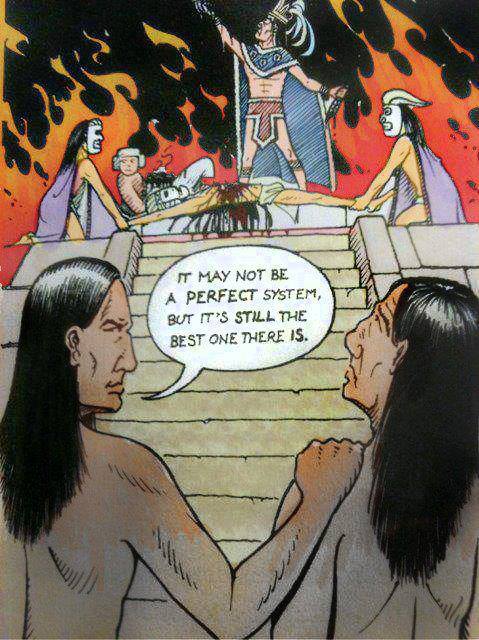
I like to ponder what future societies will be appalled by that we consider totally routine.
My guesses are something to do with animal rights or water usage. Maybe filling big pools with water just so you can swim around will be seen as disgusting waste.
My guesses are something to do with animal rights or water usage. Maybe filling big pools with water just so you can swim around will be seen as disgusting waste.
> Maybe filling big pools with water just so you can swim around will be seen as disgusting waste.
I have seen that being discussed recently, but I wonder: is it really a significant waste?
How much water does it consume, compared to say having a garden, or a green lawn?
Most pools have filtration systems and rarely require to be fully emptied then refilled.
It seems a class-based attack on people who can own pools, and therefore a dogwhistle, because the same attack could be made on taking a shower every day.
I have seen that being discussed recently, but I wonder: is it really a significant waste?
How much water does it consume, compared to say having a garden, or a green lawn?
Most pools have filtration systems and rarely require to be fully emptied then refilled.
It seems a class-based attack on people who can own pools, and therefore a dogwhistle, because the same attack could be made on taking a shower every day.
Less than a lawn, more than a water efficient garden. https://www.latimes.com/local/la-me-pool-haters-20140913-sto...
Most people don't have water efficient gardens, and may refuse the concept.
Also, after reading the article:
> But some of those agencies are walking back the rules as they make a surprising discovery: Pools aren’t the water wasters some have made them out to be.
So I insist: it isn't a large waste. It's a politically motivated move, and therefore a dogwhistle.
I believe it would be better to invite pool owners to reduce evaporation by adopting a system to cover the pool, than to shame them: otherwise, we should shame people having a lawn (and people taking a shower, and people wasting electricity on videogames...)
Also, after reading the article:
> But some of those agencies are walking back the rules as they make a surprising discovery: Pools aren’t the water wasters some have made them out to be.
So I insist: it isn't a large waste. It's a politically motivated move, and therefore a dogwhistle.
I believe it would be better to invite pool owners to reduce evaporation by adopting a system to cover the pool, than to shame them: otherwise, we should shame people having a lawn (and people taking a shower, and people wasting electricity on videogames...)
That’s interesting about a pool compared to a lawn, though I was thinking about a municipal pool in a UK context (barely anyone has a swimming pool and lawns don’t need watering). Maybe we’ll reach a point where the idea of using that much water for recreation seems overly indulgent?
I would clarify that in order to escape the charge of relativism and utilitarianism.
There is no "today ethics" or "yesterday ethics" or "particular ethics". There is merely the objective good, the objective privation of that good (evil), and the science of moral good, i.e., ethics. Otherwise, there is moral good or evil to speak of, only a collection of arbitrary tastes, rendering justice nothing more than the opinion of the powerful (to borrow from Thrasymachus).
Child sacrifice is unjustifiable per se. Meaning, there is no circumstance that justifies child sacrifice because no circumstance can justify an intrinsically evil act. In that sense, we are right to condemn child sacrifice as such.
However, we should also interpret history in context. Someone else mentioned that your stance allows (chattel) slavery to be justified. That is only if we adopt a relativistic or utilitarian stance. (Chattel) slavery is evil as such and unjustifiable as such, but it also has been the norm for most of human history. If any of us were born a thousand or a few thousand years ago, we might even come to hold that slavery is wrong (as, for example, the Church always has), but given how pervasive its practice was, how historically entrenched it was, you would likely also believe that it was simply an unfortunate and endemic fact of human existence in this world (after all, we human beings exploit each other in all sorts of ways, all the time, beginning with the smallest of ways we hardly even notice). And that's if you even payed it any attention given how normal it must have seemed to most people in the world. (For this reason, I think the oikophobic condemnations of "the West", which have become especially rabid in recent years, are preposterous. If anything, it is the West that has, historically, catalyzed the eradication of such practices as chattel slavery and human sacrifice across globe. It is childish and ignorant to believe that the world was populated by gentle peoples before the dark, corrupting forces of "the West" (this villain is given various names) landed on their shores, bringing with them Original Sin.)
There is no "today ethics" or "yesterday ethics" or "particular ethics". There is merely the objective good, the objective privation of that good (evil), and the science of moral good, i.e., ethics. Otherwise, there is moral good or evil to speak of, only a collection of arbitrary tastes, rendering justice nothing more than the opinion of the powerful (to borrow from Thrasymachus).
Child sacrifice is unjustifiable per se. Meaning, there is no circumstance that justifies child sacrifice because no circumstance can justify an intrinsically evil act. In that sense, we are right to condemn child sacrifice as such.
However, we should also interpret history in context. Someone else mentioned that your stance allows (chattel) slavery to be justified. That is only if we adopt a relativistic or utilitarian stance. (Chattel) slavery is evil as such and unjustifiable as such, but it also has been the norm for most of human history. If any of us were born a thousand or a few thousand years ago, we might even come to hold that slavery is wrong (as, for example, the Church always has), but given how pervasive its practice was, how historically entrenched it was, you would likely also believe that it was simply an unfortunate and endemic fact of human existence in this world (after all, we human beings exploit each other in all sorts of ways, all the time, beginning with the smallest of ways we hardly even notice). And that's if you even payed it any attention given how normal it must have seemed to most people in the world. (For this reason, I think the oikophobic condemnations of "the West", which have become especially rabid in recent years, are preposterous. If anything, it is the West that has, historically, catalyzed the eradication of such practices as chattel slavery and human sacrifice across globe. It is childish and ignorant to believe that the world was populated by gentle peoples before the dark, corrupting forces of "the West" (this villain is given various names) landed on their shores, bringing with them Original Sin.)
This is a good comment, compared to the others in this thread. However this line
> There is merely the objective good
again falls into the trap of Kantian ethics. You might believe that there is an objective morality, but others may not [0]. It is a long held debate over whether there is objective versus subjective morality, with good (and poor) arguments on both sides. The utilitarian might say there is no such "evil as such and unjustifiabil[ity] as such" because they could find many scenarios where it is justified, as in the example above of causing an entire civilization to avoid harm were a child to be sacrificed. Let me also state that I am not a staunch utilitarian, yet nor I am I a Kantian, I (as likely most of us) am somewhere in between.
I will agree with you on the "condemnations of the West" points you made though, as I think it's really a strictly Western and perhaps even American view that sees Westerners as being the worst perpetrators, over and above all other civilizations on the plant. No, being humans, any civilization has committed atrocities.
[0] https://plato.stanford.edu/entries/moral-realism/, https://plato.stanford.edu/entries/moral-relativism/
> There is merely the objective good
again falls into the trap of Kantian ethics. You might believe that there is an objective morality, but others may not [0]. It is a long held debate over whether there is objective versus subjective morality, with good (and poor) arguments on both sides. The utilitarian might say there is no such "evil as such and unjustifiabil[ity] as such" because they could find many scenarios where it is justified, as in the example above of causing an entire civilization to avoid harm were a child to be sacrificed. Let me also state that I am not a staunch utilitarian, yet nor I am I a Kantian, I (as likely most of us) am somewhere in between.
I will agree with you on the "condemnations of the West" points you made though, as I think it's really a strictly Western and perhaps even American view that sees Westerners as being the worst perpetrators, over and above all other civilizations on the plant. No, being humans, any civilization has committed atrocities.
[0] https://plato.stanford.edu/entries/moral-realism/, https://plato.stanford.edu/entries/moral-relativism/
Does it really matter? These are long ago historical matters. Whether you consider the past morally awful, well, or incomparable...
I'm more on the cultural left than 95% of people, and this is ridiculous. We not only can use our ethics to judge events of the past, it is a moral imperative to do so to ensure we don't repeat its mistakes.
> your particular ethics that is derived from your lived experience
Nothing you say should be taken seriously by anyone, ever.
Nothing you say should be taken seriously by anyone, ever.
aliqot(1)
xyzal(1)