Silicon Valley exodus: Bay Area tech companies leaving for Texas(ktvu.com)
ktvu.com
Silicon Valley exodus: Bay Area tech companies leaving for Texas
https://www.ktvu.com/news/silicon-valley-exodus-bay-area-tech-companies-leaving-for-texas
618 comments
HP and Oracle don’t exactly represent the heart of Silicon Valley today and what makes it special/unique. I actually think zombie corporations like Oracle, companies that haven’t innovated in decades and instead rely on an army of sales people to sell legacy software, are somewhat the antithesis of Silicon Valley which is really about real technological innovation and disruption at it’s core. I know there are lots of exceptions to this somewhat idyllic version of Silicon Valley but at the same time, you can’t really argue that there is a place in the US (or the rest of the world for that matter) that produces more technological advancements than Silicon Valley. I’m not a believer in American Exceptionalism — just stating facts. This is a long winded way of saying who cares if those companies leave, the Bay Area is probably better off.
Agreed. They're companies trying to avoid taxes or regulation. Only companies on the downslide really consider that as an relevant option.
Some folks in my network are ex-Oracle and my understanding is that the company is run by the CFO and a huge group of MBAs. Any company where the bean counters are at the helm are optimizing for things like quarterly earnings, tax savings like you said, etc. This is the stage where they milk whatever they can out of a dying cash cow. There’s nothing interesting to me about this flavor of capitalism and I don’t think it’s something America should be proud of producing. Conversely, technology innovation and the entire ecosystem in Silicon Valley is really special and almost irreplicable.
Note: I have nothing against MBAs, I just don’t think it’s appropriate for them to have the loudest voice at a non-financial institution. They serve a critical role but it’s a supporting one and not suitable to leadership / company direction.
Note: I have nothing against MBAs, I just don’t think it’s appropriate for them to have the loudest voice at a non-financial institution. They serve a critical role but it’s a supporting one and not suitable to leadership / company direction.
Growth at geriatric tech companies like IBM, HP, Oracle, etc. is largely inorganic, driven by well-negotiated acquisitions of smaller B2B software companies.
It takes MBAs to do this sort of work, and while it isn't for me, I don't think it's the worst business model out there.
It takes MBAs to do this sort of work, and while it isn't for me, I don't think it's the worst business model out there.
Why does it take an MBA to do that work?
You don't need an MBA for the financial/high level business knowledge requirements (though many people involved in this have one), but the people networks that MBA programs provide are very beneficial in getting connected to the right person at the right company.
So MBA actually means MBA from top 10, maybe top 15 school? I can’t imagine the network being too useful for the 25th best MBA program.
My friends have only recently graduated from their MBAs. Will be interesting to see if their networks help.
My friends have only recently graduated from their MBAs. Will be interesting to see if their networks help.
The main value of an MBA is the network. I think lower tier schools can work well if they are tight knit and the graduates tend to stay local to the school. The top tier schools will just have people making more money at more "prestigious" companies.
it doesn't take an MBA to do that work
I've seen a lot of tech companies with CFOs as leaders and you're 100% right. They have a certain set of tools and fix those types of problems, which usually aren't the ways to lead tech companies.
I think every company should be lead by a person who has a strong background in the company's main role. I have seen finance background CEOs get replaced and the Company began to thrive again. Its not a bad investing idea!
Like TSLA?
Correct me if I'm wrong but I believe only Musk is moving to Texas, not Telsa. Thought at this point they are basically one in the same.
He's opening new Tesla facilities in Texas, but currently he hasn't formally announced he's completely pulling operations out of Texas, although he's threatened to in the past.
He made some very suggestive comments last week about Tesla being the last manufacturer of cars in CA.
I might add, the size of the Austin gigafactory is larger than the size of all Tesla factories in the world combined [1].
I will leave you to do the math if Tesla leaving CA isn't a possibility.
[1] https://electrek.co/2020/07/30/tesla-gigafactory-texas-crazy...
I might add, the size of the Austin gigafactory is larger than the size of all Tesla factories in the world combined [1].
I will leave you to do the math if Tesla leaving CA isn't a possibility.
[1] https://electrek.co/2020/07/30/tesla-gigafactory-texas-crazy...
That size comparison doesn't actually show a comparison. It only has the footprints for the other factories, and the entirety of the land purchase for the texas factory. What a bizarre thing!
If you look at the planning documents you'll see that the planned footprint for the texas factory is probably a similar size to the plans for the rest of their "giga" factories. https://electrek.co/wp-content/uploads/sites/3/2020/09/Tesla...
If you look at the planning documents you'll see that the planned footprint for the texas factory is probably a similar size to the plans for the rest of their "giga" factories. https://electrek.co/wp-content/uploads/sites/3/2020/09/Tesla...
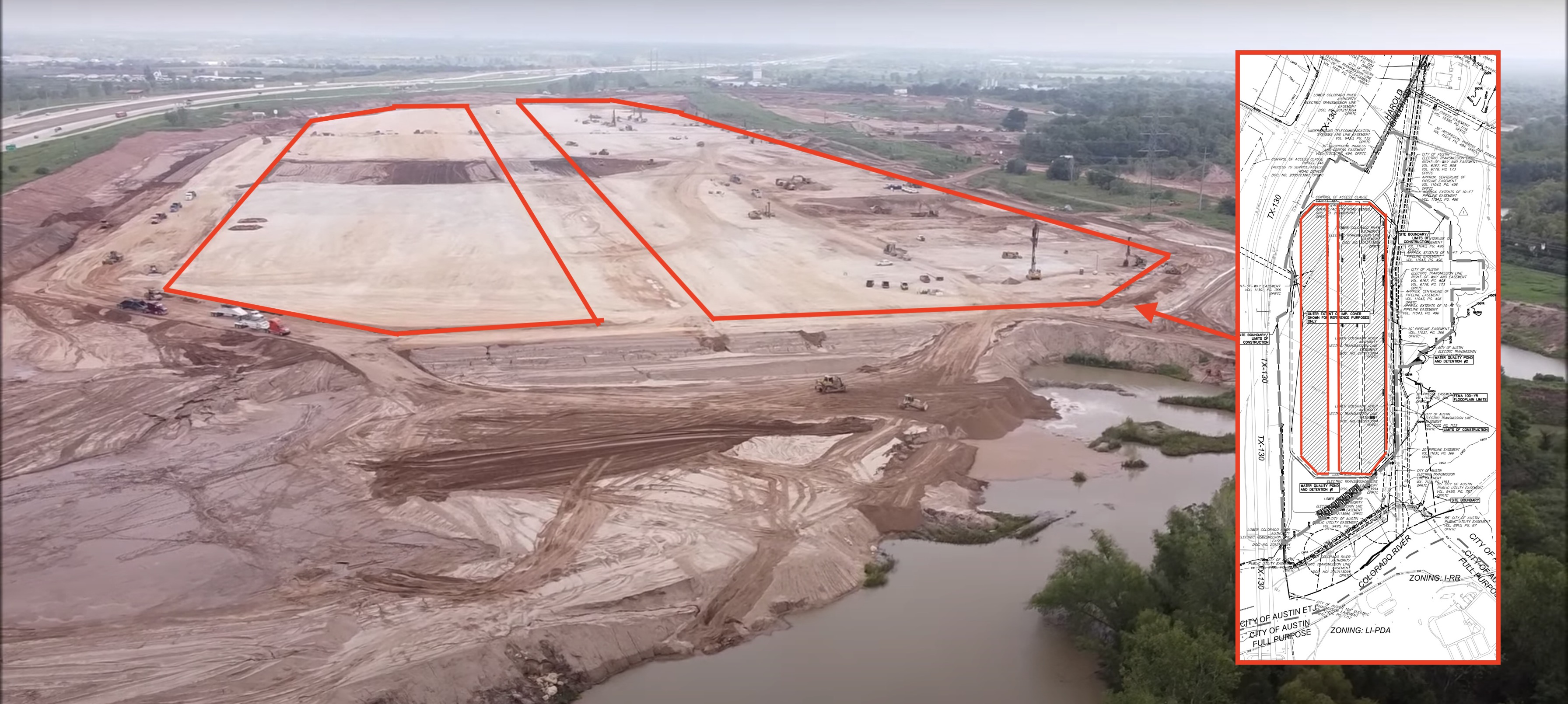
It explains the footprints in the article. They're largely not usable, whereas the Austin one is.
These are manufacturing jobs. It is not exactly like California has a better environment for that than Texas.
These are manufacturing jobs. It is not exactly like California has a better environment for that than Texas.
Your second statement struck me, and I was curious how the manufacturing sectors compare for California vs Texas.
Numbers from the National Association of Manufacturers:
California: $316.7b manufacturing output, 10.67% of state product, 7.72% of employment. [1]
Texas: $230.45b manufacturing output, 12.98% of state product, 7.04% of employment. [2]
So really, it doesn't seem like one state is particularly better than the other for manufacturing by the numbers.
1: https://www.nam.org/state-manufacturing-data/2019-california...
2: https://www.nam.org/state-manufacturing-data/2019-texas-manu...
Numbers from the National Association of Manufacturers:
California: $316.7b manufacturing output, 10.67% of state product, 7.72% of employment. [1]
Texas: $230.45b manufacturing output, 12.98% of state product, 7.04% of employment. [2]
So really, it doesn't seem like one state is particularly better than the other for manufacturing by the numbers.
1: https://www.nam.org/state-manufacturing-data/2019-california...
2: https://www.nam.org/state-manufacturing-data/2019-texas-manu...
> Your second statement struck me, and I was curious how the manufacturing sectors compare for California vs Texas.
And Wall Street was great in New York until they moved to Florida, North Carolina, and Hawaii... and Oil headquarters were huge in California until they moved to Texas... and Big Auto was big in Michigan until they moved to the South and on and on.
What is so mind-boggling about all these people not seeing the trends is acting like what is is what has to be. There's no divine right for these companies to remain in California. It has a terrible business climate. Were it not for oil, agriculture, and defense in parts of CA the Bay Area loathes, there would be very little actual "stuff" produced in California. Software has no geographic attachment to the land like ag or oil, so there's no reason they have to be forced to the Central Valley. They can just leave.
And Wall Street was great in New York until they moved to Florida, North Carolina, and Hawaii... and Oil headquarters were huge in California until they moved to Texas... and Big Auto was big in Michigan until they moved to the South and on and on.
What is so mind-boggling about all these people not seeing the trends is acting like what is is what has to be. There's no divine right for these companies to remain in California. It has a terrible business climate. Were it not for oil, agriculture, and defense in parts of CA the Bay Area loathes, there would be very little actual "stuff" produced in California. Software has no geographic attachment to the land like ag or oil, so there's no reason they have to be forced to the Central Valley. They can just leave.
Tesla is building factories in Texas. Long term Texas makes more sense for manufacturing as there are established supply chains there.
You also probably have tons of cheap flat land that is ideal for manufacturing? So that would seem to make sense.
The Midwest has that too. But it also has unions. :)
It's also a lot further away from the Mexico border, where an awful lot of car parts are manufactured. A whole lot of those parts are already flowing through TX as it is, easier to dip into the existing streams than build new supply chains.
Also a lot of bigger, tech friendly cities -- Dallas, Austin, and Houston is poised to overtake Chicago as the 3rd largest city in the US within a decade or two.
Kanasas may be similar in terms of taxes and political climate (unions) but all its really got going for it is empty space. Ditto for much of the rest of the Midwest.
Also a lot of bigger, tech friendly cities -- Dallas, Austin, and Houston is poised to overtake Chicago as the 3rd largest city in the US within a decade or two.
Kanasas may be similar in terms of taxes and political climate (unions) but all its really got going for it is empty space. Ditto for much of the rest of the Midwest.
Going to Mars? Or running to Mars?
To be fair, here's the complete list of companies in the known universe that don't try to avoid taxes or regulation:
[error data not found]
There's a cost of moving. California's taxes and regulations are bad, bad enough to force many out, but not all. If things continue on their present course, even Google and Amazon, who personally like the political climate there, will have to start looking elsewhere.
[error data not found]
There's a cost of moving. California's taxes and regulations are bad, bad enough to force many out, but not all. If things continue on their present course, even Google and Amazon, who personally like the political climate there, will have to start looking elsewhere.
Most startups don't care about taxes or regulations. Taxes are a rounding error (or literally zero) when you're small and not making any money, which will be the first several years of a startup's life. When you get big you can hire an army of lawyers and accountants to keep all your money in Ireland and avoid them. Regulations just get ignored. When you're small, you're too little a fish to go after; the regulators are busy suing Uber and Lyft and Facebook and Google. When you get big, you can hire an army of lobbyists and PR people to change the regulation, just like Uber and Lyft did.
> Most startups don't care about taxes or regulations.
Yes, but they care about cost. And the reason that everything is so expensive in California is regulation and taxes. Acting like these are separate things is not a valid assumption.
Yes, but they care about cost. And the reason that everything is so expensive in California is regulation and taxes. Acting like these are separate things is not a valid assumption.
I don't believe that the reason everything is so expensive in California is regulation and taxes. Here's why:
The North Coast (Eureka, Crescent City) and Central Valley (Chico, Fresno, Modesto, Bakersfield) are under the same regulatory and tax regime as the rest of California. How expensive is Eureka? Houses average $300K [1]. Restaurant meals are about $10-12. [2][3] How expensive is Bakersfield? Houses are about $250K [4], meals are about $11 [5]. In other words, they're not much different from the rest of America.
I think that much of the contemporary political narrative gets the causality wrong. The Bay Area and LA are expensive because they are home to global monopolies that funnel cash from all over the world into a small region. There's not much land available in these metros, there's a lot of money floating around, there are a lot of people who want to move in to get a piece of this money, and so they bid up the prices of scarce goods. Regulation comes later, to curb the power imbalances from having corporations with more resources than many nation-states, and taxes come so that the state can get a piece of the huge cash flows coming in.
But the primary driver of cost-of-living is being the sink for the disposable income of 7B consumers. Eureka's primary industry is timber, and Bakersfield's is oil. Both of these are commodity markets where the money goes elsewhere in the value chain. Not so with tech and entertainment.
[1] https://www.zillow.com/homes/Eureka,-CA_rb/
[2] http://www.brickandfirebistro.com/menu-.html
[3] https://www.humboldtsmokehouse.com/menu
[4] https://www.zillow.com/homes/Bakersfield,-CA_rb/
[5] https://www.yelp.com/menu/locale-farm-to-table-eatery-bakers...
The North Coast (Eureka, Crescent City) and Central Valley (Chico, Fresno, Modesto, Bakersfield) are under the same regulatory and tax regime as the rest of California. How expensive is Eureka? Houses average $300K [1]. Restaurant meals are about $10-12. [2][3] How expensive is Bakersfield? Houses are about $250K [4], meals are about $11 [5]. In other words, they're not much different from the rest of America.
I think that much of the contemporary political narrative gets the causality wrong. The Bay Area and LA are expensive because they are home to global monopolies that funnel cash from all over the world into a small region. There's not much land available in these metros, there's a lot of money floating around, there are a lot of people who want to move in to get a piece of this money, and so they bid up the prices of scarce goods. Regulation comes later, to curb the power imbalances from having corporations with more resources than many nation-states, and taxes come so that the state can get a piece of the huge cash flows coming in.
But the primary driver of cost-of-living is being the sink for the disposable income of 7B consumers. Eureka's primary industry is timber, and Bakersfield's is oil. Both of these are commodity markets where the money goes elsewhere in the value chain. Not so with tech and entertainment.
[1] https://www.zillow.com/homes/Eureka,-CA_rb/
[2] http://www.brickandfirebistro.com/menu-.html
[3] https://www.humboldtsmokehouse.com/menu
[4] https://www.zillow.com/homes/Bakersfield,-CA_rb/
[5] https://www.yelp.com/menu/locale-farm-to-table-eatery-bakers...
I lived in Bakersfield for a long time.
You know what they don't have, insane zoning restrictions that prevent housing. For example, the Houston MSA, which has almost no zoning restrictions is within 90% of the population (and 80% population density) of the Bay Area 9 county MSA with an average house price of... $249K at 2,000 sq ft.
And there's a reason I left Bakersfield and moved to Austin. It's because PG&E energy prices are benchmarked at Bay Area temperatures, and they have progressive pricing. Because I had a server rack in a garage in super hot (110+ F) summers, I was paying over $600 a month in energy bills in a tiny 1000 sq foot house in a ghetto. If I had lived in a 4 bedroom house, I would have paid less in energy.
And just on a secondary, personal note. Houses in Houston are way, way nicer than houses in San Jose, Oakland, San Francisco etc. This is one of those things where I know that people have just not experienced living in other places when I hear quality arguments around housing, food, or amenities.
It's just not that nice in San Francisco. Seriously. The food is just downright bad in quality and variety compared to even Austin, much less Houston. The housing stock is dreadful. Service is slow. The quality of things in Houston is better than the Bay Area, irrespective of cost.
You know what they don't have, insane zoning restrictions that prevent housing. For example, the Houston MSA, which has almost no zoning restrictions is within 90% of the population (and 80% population density) of the Bay Area 9 county MSA with an average house price of... $249K at 2,000 sq ft.
And there's a reason I left Bakersfield and moved to Austin. It's because PG&E energy prices are benchmarked at Bay Area temperatures, and they have progressive pricing. Because I had a server rack in a garage in super hot (110+ F) summers, I was paying over $600 a month in energy bills in a tiny 1000 sq foot house in a ghetto. If I had lived in a 4 bedroom house, I would have paid less in energy.
And just on a secondary, personal note. Houses in Houston are way, way nicer than houses in San Jose, Oakland, San Francisco etc. This is one of those things where I know that people have just not experienced living in other places when I hear quality arguments around housing, food, or amenities.
It's just not that nice in San Francisco. Seriously. The food is just downright bad in quality and variety compared to even Austin, much less Houston. The housing stock is dreadful. Service is slow. The quality of things in Houston is better than the Bay Area, irrespective of cost.
I'll grant you that Bay Area zoning is fucked up. That's under local jurisdiction, though: the state keeps trying to override local zoning requirements to build more housing and keeps getting shot down at the ballot box.
My sister lives in Houston (well, Sugarland technically), so I'm well acquainted with the metro area. It's a very different lifestyle. The housing stock in the Bay Area is uniquely terrible - most of it is 3BR Eichlers that were mass-produced in the 60s. But people don't spend all that much time indoors. Pre-COVID, my wife and I were out every weekend to museums, hiking, the beach, picnics, restaurants, etc. There are 4 parks within walking distance of my home, 2 commercial downtowns, then the mountains are 5 minutes away, the beach 20, SF 30, SJC 30, the Bay 5, etc. And the weather cooperates - it's a consistent 70 and sunny for 8 months out of the year. Meanwhile, my sister's place is 50% larger for a quarter of the price - but it better be, because it's 100 degrees with sweltering humidity for 8 months out of the year. They need to take a highway onramp to get anywhere. They have no friends, because everyone they meet is so far away. Downtown Houston is a little different (my sister went to Rice, Rice Village is pretty nice), but also a completely different story in terms of housing prices - you start seeing million dollar homes once you get to the downtown areas of Houston.
Different strokes for different folks. We could've purchased my sister's house for cash at the time they bought it. I floated the idea by my wife, and she was like "But then we'd have to live in Houston!"
My sister lives in Houston (well, Sugarland technically), so I'm well acquainted with the metro area. It's a very different lifestyle. The housing stock in the Bay Area is uniquely terrible - most of it is 3BR Eichlers that were mass-produced in the 60s. But people don't spend all that much time indoors. Pre-COVID, my wife and I were out every weekend to museums, hiking, the beach, picnics, restaurants, etc. There are 4 parks within walking distance of my home, 2 commercial downtowns, then the mountains are 5 minutes away, the beach 20, SF 30, SJC 30, the Bay 5, etc. And the weather cooperates - it's a consistent 70 and sunny for 8 months out of the year. Meanwhile, my sister's place is 50% larger for a quarter of the price - but it better be, because it's 100 degrees with sweltering humidity for 8 months out of the year. They need to take a highway onramp to get anywhere. They have no friends, because everyone they meet is so far away. Downtown Houston is a little different (my sister went to Rice, Rice Village is pretty nice), but also a completely different story in terms of housing prices - you start seeing million dollar homes once you get to the downtown areas of Houston.
Different strokes for different folks. We could've purchased my sister's house for cash at the time they bought it. I floated the idea by my wife, and she was like "But then we'd have to live in Houston!"
> Amazon
Headquartered in Seattle, Washington. Not California.
Headquartered in Seattle, Washington. Not California.
Funny to point this out. Bezos literally packed up his car and drove from NYC to Seattle in order to avoid Internet commerce taxes.
Which also does not have state income tax.
nah, we got some of the highest sales tax in the country instead.
Sure, but California has similar levels of sales tax to Washington and the highest state income taxes in addition.
Yea, the stats always say Washington has some of the highest sales tax, but i am shocked at how much i pay when in SF/LA/NYC.
My tax burden has certainly lowered since moving from CA to WA, kinda miss the weather though.
My tax burden has certainly lowered since moving from CA to WA, kinda miss the weather though.
Plenty of company CEO’s know little to nothing about taxes and simply hand relevant details to a different firm. Growth gives exponential returns, taxes give linear returns which is why they can be ignored for years. Regulations are similarly irrelevant for most companies, as long as the competition needs to play by the same rules they tend to zero out as just a cost of doing business.
> taxes give linear returns which is why they can be ignored for years
This isn't true at all. The effect of taxes compound just like anything else. E.g. if Warren Buffet had originally incorporated Berkshire as a Bermuda-based reinsurer, he'd be worth over $400 billion today. If he didn't structure it as an insurer at all he'd only be worth $20 billion.
Tax savings compound at whatever the long-term ROE of the corporate entity. Therefore tax arbitrage is most important for hyper growth companies.
This isn't true at all. The effect of taxes compound just like anything else. E.g. if Warren Buffet had originally incorporated Berkshire as a Bermuda-based reinsurer, he'd be worth over $400 billion today. If he didn't structure it as an insurer at all he'd only be worth $20 billion.
Tax savings compound at whatever the long-term ROE of the corporate entity. Therefore tax arbitrage is most important for hyper growth companies.
When you’re growing at even 10% per month the difference between 50Billion and 400 billion in 50 years is a rounding error on a rounding error. Further, diminishing returns means your stuck investing in ever less profitable operations as you grow. These will often lose money, just look at say Microsoft or Google to see how little an extra 100 billion 10 years ago would give them now.
Nobody is saying they don’t have any upside, but as always it’s the opportunity cost that kills you.
Nobody is saying they don’t have any upside, but as always it’s the opportunity cost that kills you.
Corporate entities have to make quarterly payments. Let's assume you're a $10 million company with 10% monthly ROE/growth. Paying an additional 9% in California corporate tax rates will result in the loss of a billion in market cap within five years. Literally a third of the terminal value of the startup.
Point taken about diminishing marginal returns. But you can see that even taking that into account, the impact of lax tax planning for shareholders is humongous. (Plus many startups are in winner-take-all markets, and effectively have increasing returns to scale.)
The opportunity cost is real. Tax arbitrage will take some amount of bandwidth. But it often takes much less effort to raise cash by minimizing taxes than it does to raise additional equity funding. The former can mostly be done by the CFO in the background, whereas the latter requires the attention of the founders.
Point taken about diminishing marginal returns. But you can see that even taking that into account, the impact of lax tax planning for shareholders is humongous. (Plus many startups are in winner-take-all markets, and effectively have increasing returns to scale.)
The opportunity cost is real. Tax arbitrage will take some amount of bandwidth. But it often takes much less effort to raise cash by minimizing taxes than it does to raise additional equity funding. The former can mostly be done by the CFO in the background, whereas the latter requires the attention of the founders.
That a 9% income tax in California corporate tax rates are on profit. A profitable startup has unlimited runway so the classic X month of runway company is facing ~0 income taxes.
Further it assumes your capital constrained, which might apply to some fast growing business but if your the magical unicorn of a profitable fast growing growing company then capital is the easiest problem to solve. Worst case you might trade a little extra equity, but again that’s linear dilution often based on growth at the current rate.
PS: If your growing 10% per month it takes 6 years to go from 1 million per year in revenue to 1 billion per year in revenue. It’s very fast, but hardly instantaneous. Keeping that up for 12 years means 1 trillion in revenue per year which is extremely rare. Growth will slow eventually, and when it does there are a huge number of things to optimize.
Further it assumes your capital constrained, which might apply to some fast growing business but if your the magical unicorn of a profitable fast growing growing company then capital is the easiest problem to solve. Worst case you might trade a little extra equity, but again that’s linear dilution often based on growth at the current rate.
PS: If your growing 10% per month it takes 6 years to go from 1 million per year in revenue to 1 billion per year in revenue. It’s very fast, but hardly instantaneous. Keeping that up for 12 years means 1 trillion in revenue per year which is extremely rare. Growth will slow eventually, and when it does there are a huge number of things to optimize.
> They're companies trying to avoid taxes or regulation. Only companies on the downslide really consider that as an relevant option.
Which is why continental Europe has so many fast-growing tech companies.
Which is why continental Europe has so many fast-growing tech companies.
I think that the work culture in Europe is also a factor. Europeans are much less willing to work the way a lot of the startups expect.
Good for them. American work culture is...well, retarded (I couldn't think of a less offensive term that also describes it well).
Like Tesla.
HP moving to Texas is the corporate version of my grandparents retiring to Florida.
Except HP is not retiring and no-ones grandparent.
Sure HP and Oracle are not "sexy" but they do employee massive numbers of tech folks. The impact will be noticed. They hire people who later move to the "sexy" companies a few years into their career.
But moving to Texas frees up real estate in the Bay Area for more productive businesses. And given the transient nature of techies, many of those techies would have moved to California will now move to Texas, putting some relief into the housing market and maybe clearing up traffic a bit. I wouldn’t see these two moving as a negative, they’ve long had reputations as bad places to work.
The biggest hit will be on tax revenue, new "sexy" businesses dont tend to make as much money as the zombie companies that seem to print money
California makes money on cap gains taxes as well as corporate income taxes. And likely the personal income taxes won't change.
Complaining about dev teams moving to texas is like complaining about goods being manufactured in China. It's a net positive for the whole world, plus competition will improve the Vally and SF just as much as it improves individual companies and products.
Complaining about dev teams moving to texas is like complaining about goods being manufactured in China. It's a net positive for the whole world, plus competition will improve the Vally and SF just as much as it improves individual companies and products.
Just to note here, the dev teams aren't moving to Texas, management is moving to Texas. The dev teams are more likely to be moving to India where costs are lower (especially if we are talking about Oracle and HPE).
Especially in this "everyone works from home" world that COVID's delivered us. Even after COVID's over, a lot of employers are going to be much more open to permanent work-from-home.
Net positive only if your measure for success is “able to buy more widgets for less money”
Plenty of other criteria on which it is a positive. Raising millions out of poverty. More people working on hard problems.
As to the latter criterion: consider the symbolism of Aricebo collapsing in an uncontrolled fashion on the same day a Chinese spacecraft departed te moon (and a Japanese one prepared to deliver its second sample of an extraterrestrial sample). When the Bush administration restricted stem cell research, China and Singapore picked up the slack. Etc.
In this case exporting technical work to states like Texas not only may open up opportunities for more people to do technical work but can help them as oil related revenues decline.
The world is not zero sum and to me exporting a job to China, India, Romania or Texas as are equivalently positive.
He’ll do you object to Apple building a chip development team in San Diego?
As to the latter criterion: consider the symbolism of Aricebo collapsing in an uncontrolled fashion on the same day a Chinese spacecraft departed te moon (and a Japanese one prepared to deliver its second sample of an extraterrestrial sample). When the Bush administration restricted stem cell research, China and Singapore picked up the slack. Etc.
In this case exporting technical work to states like Texas not only may open up opportunities for more people to do technical work but can help them as oil related revenues decline.
The world is not zero sum and to me exporting a job to China, India, Romania or Texas as are equivalently positive.
He’ll do you object to Apple building a chip development team in San Diego?
I think that them being equivalently positive is a weird way of looking at it? It ignores what the poster you're replying to is probably referring towards. If you value Romanian ideals over Texan ideals then you'd prefer Romania to get a lucrative economic position of power through trade over Texas as the Romanian government provides more utility to you due to more favorable (to you) ideals.
Though, I personally don't think these companies moving to Texas matters that much, but if there was a mass migration it could certainly shake things up in ways that some may appreciate and some dislike.
Though, I personally don't think these companies moving to Texas matters that much, but if there was a mass migration it could certainly shake things up in ways that some may appreciate and some dislike.
California already has plenty of that, and if it ever becomes a problem, that means there is underused capacity that will attract more people (with their income taxes) in again.
Oracle, HPE, and (not moving, but might as well add) IBM have long made their money with legal and financial shenanigans anyways, they are exactly what we should call zombie companies.
Oracle, HPE, and (not moving, but might as well add) IBM have long made their money with legal and financial shenanigans anyways, they are exactly what we should call zombie companies.
They are only moving Head Offices - not closing down campuses; most likely, it's a subset of the bean counters and admin stuff who may be asked to move. If you're cynical, you could argue they are only shipping the "HQ" signage from their Bay Area buildings to Texas.
>> Sure HP and Oracle are not "sexy" but they do employee massive numbers of tech folks.
It's a much different type of employee than you'd have at somewhere like Netflix or Google, though.
It's a much different type of employee than you'd have at somewhere like Netflix or Google, though.
What about Tesla and Palantir?
Palantir has always been creepy and isolated, and Tesla is led by a super-villain who is moving to a state where he can legally force people into offices during a pandemic.
Plus his rockets are there, so that's a perk.
Plus his rockets are there, so that's a perk.
What about Charles Schwab? What about co-founders like the Reddit dude ditching CA?
Alexis Ohanian has lived in Florida since 2017 and it might be because his wife Serena Williams had lived in Florida when she was a child.
Yeah literally nothing about Oracle is useful or innovative. It’s like the WalMart of tech companies; just kind of exists and has rested on its laurels for a decade+.
Idk if that's fair to Walmart, they are definitely trying to compete with Amazon via new efforts.
You are correct; Walmart actually does have some nice innovation labs around the country doing some great work.
Forgot about that and Walmart is an easy target for a lot of things :)
Forgot about that and Walmart is an easy target for a lot of things :)
I don’t disagree that Walmart is making strides on the online shopping front but I also think they are only fighting for survival/relevance and would not produce anything new or interesting without this pressure. In contrast, companies like Amazon relentlessly develop new products and new technologies (see AWS). It’s not a response to external pressure — they don’t need to innovate to stay alive. They really embody the disruptive ambition / anything is possible mentality that fuels Silicon Valley. I sound like an Amazon fan boy but I’m the opposite haha just pointing out a difference in the DNA of these two companies.
Walmart had the largest corporate database in the world at one point in time (about a decade and a half ago), and used it to build a brutally efficient supply chain.
Innovation in process engineering and operations isn't really discussed much here, but it's almost assuredly had a much greater impact on keeping inflation at bay (helping the median American's salary stretch a little farther) than anything Amazon has ever done.
Innovation in process engineering and operations isn't really discussed much here, but it's almost assuredly had a much greater impact on keeping inflation at bay (helping the median American's salary stretch a little farther) than anything Amazon has ever done.
I didn’t know about Walmart’s innovation labs til recently. Might not be as innovative as I think, but it certainly changed the way I view them.
Before Amazon took the crown of using technology for ruthless efficiency, Walmart was king.
I remember reading articles 10-15 years ago about how the minute someone scanned an item at the cash register, Walmart's inventory systems, which knew what product was on what shelf and in what quantity, would automatically order refills from the supplier.
They have always been highly innovative and tech savvy when it comes to the supply chain, at least for physical retail.
I remember reading articles 10-15 years ago about how the minute someone scanned an item at the cash register, Walmart's inventory systems, which knew what product was on what shelf and in what quantity, would automatically order refills from the supplier.
They have always been highly innovative and tech savvy when it comes to the supply chain, at least for physical retail.
Walmart Labs is a really solid workplace from everything I've heard about it.
>the minute someone scanned an item at the cash register, Walmart's inventory systems, which knew what product was on what shelf and in what quantity
I wish this were the case, but anyone thats tried to do online grocery shopping at walmart knows that a lot of stuff shows out of stock, but is actually there in real life.
I wish this were the case, but anyone thats tried to do online grocery shopping at walmart knows that a lot of stuff shows out of stock, but is actually there in real life.
The online ordering is not tied into the realtime supplychain. The inventory mgmt that walmart developed is now ubiquitous among the largest retailers. Walmart is mow on or behind the innovation curve.
They did develop GraalVM, which is quite a technical achievement, or so I've heard (not a user).
Well, Oracle bought Sun, and the team behind it.
I would be more in the mood to praise Oracle for this development, had they not shown how far they could go to hurt Java's community/ecosystem just to squeeze a penny out of it.
I would be more in the mood to praise Oracle for this development, had they not shown how far they could go to hurt Java's community/ecosystem just to squeeze a penny out of it.
That got started under Sun, not Oracle.
And absolutely nothing good happened in 12 years, right?
Don't give Oracle too much credit, Walmart is far more innovative then Oracle.
Oracle has been a good steward of MySQL. I thought it was over when they acquired Sun, but the performance and features have really improved since then.
Oracle is creating innovative new legal theories in Oracle v Google. Not that I'd consider that a positive thing.
Kind of a strange analogy. Walmart provides immense value to millions of people. They've developed an infrastructure that delivers cheap products to areas that otherwise would have few other options.
Oracle is the antithesis of Walmart. They provide insanely expensive options to corporations who are already locked in to their products.
One of the saddest days was when Oracle bought Sun and effectively killed all their open source projects overnight, like OpenOffice and MySQL. Yes, those things are still technically around, but they're not getting any serious development, and all the core developers of those projects have forked them into new open source projects.
Oracle is the antithesis of Walmart. They provide insanely expensive options to corporations who are already locked in to their products.
One of the saddest days was when Oracle bought Sun and effectively killed all their open source projects overnight, like OpenOffice and MySQL. Yes, those things are still technically around, but they're not getting any serious development, and all the core developers of those projects have forked them into new open source projects.
Walmart has contributed to the decline of small businesses in rural areas[0] and they compensate their employees so little that they officially encourage their employees to take advantage of the social safety net[1] despite ever increasing annual net income[2] captured largely by the non-productive latter-generation Waltons.
[0]https://money.com/walmart-stores-closing-small-towns
[1]https://www.forbes.com/sites/clareoconnor/2014/04/15/report-...
[2]https://www.macrotrends.net/stocks/charts/WMT/walmart/net-in...
[0]https://money.com/walmart-stores-closing-small-towns
[1]https://www.forbes.com/sites/clareoconnor/2014/04/15/report-...
[2]https://www.macrotrends.net/stocks/charts/WMT/walmart/net-in...
Not to go too off the rails, but they only “contributed to the decline” by being a better option for customers that switched from small businesses in rural areas to Walmart.
A lot of small businesses are bad. Bad hours, bad selection of products, bad customer service, bad prices.
They’re often held up in some idyllic form, but it’s clear from the behavior of their own customers that Walmart provides these customers more value.
A lot of small businesses are bad. Bad hours, bad selection of products, bad customer service, bad prices.
They’re often held up in some idyllic form, but it’s clear from the behavior of their own customers that Walmart provides these customers more value.
My wife teaches in a small, poor town that is off the beaten path. It is just outside of what most would consider the suburbs (we live on the edge of a suburb and she commutes through rural area to get there). The only grocery store in town is what used to be a locally owned and supplied store, and is now under the branding of a "Piggly Wiggly Xpress." The options are to go there, Dollar General, or drive almost 30 minutes to another option, one of which is a Walmart. Everyone who can just drives to the Walmart.
The local grocery store is the worst excuse for a grocery store I've ever seen. There are only a handful of fresh vegetable options, including $1/lb bananas and $5/head iceberg lettuce. Everything is overpriced and there are very few healthy food options. Apparently a lot of people due to transportation limitations can ONLY shop at this store (or Dollar General), which is expensive and mostly has unhealthy options. There are talks of a Walmart coming in, and I have no doubt it would be a huge quality of life improvements for folks in the town.
The local grocery store is the worst excuse for a grocery store I've ever seen. There are only a handful of fresh vegetable options, including $1/lb bananas and $5/head iceberg lettuce. Everything is overpriced and there are very few healthy food options. Apparently a lot of people due to transportation limitations can ONLY shop at this store (or Dollar General), which is expensive and mostly has unhealthy options. There are talks of a Walmart coming in, and I have no doubt it would be a huge quality of life improvements for folks in the town.
And then they leave the area after a while leaving nothing for anyone. I posted the links for a reason and that's because they support my claims. People like to ignore the facts in favor of their feelings and emotions.
They're held up in some idyllic form because while they're worse for customers, they're on average much better for employees. 'Small business' isn't just meant to be heartwarming when talked about as important - small businesses also spend a much larger percentage of their money on wages.
This feels like a false dichotomy to me (if it’s true which I’m not certain of).
It’s not very good for employees if your small business customers don’t like you and as a result you have to close.
A local car dealership may be great for its employees by ripping off customers and generally being a terrible experience, but I won’t have much sympathy when direct to consumer sales come and wipe them out.
Small businesses need to offer something of value to customers that’s real and differentiated as opposed to a narrative of their own self interest. In short - they have to be competitive. There’s no reason they can’t do this while also being good to employees.
A lot of the complaints I see come across as sour grapes and trying to legislate their existence rather than just being better and caring about what customers want.
At its best capitalism is a force for aligning value and interests between provider and customer. On net this leads to more efficient distribution and better outcomes for the most people.
At its worst it’s rent seeking and leveraging local power over people without choice. Small businesses often fall on that side of the spectrum to me.
It’s not very good for employees if your small business customers don’t like you and as a result you have to close.
A local car dealership may be great for its employees by ripping off customers and generally being a terrible experience, but I won’t have much sympathy when direct to consumer sales come and wipe them out.
Small businesses need to offer something of value to customers that’s real and differentiated as opposed to a narrative of their own self interest. In short - they have to be competitive. There’s no reason they can’t do this while also being good to employees.
A lot of the complaints I see come across as sour grapes and trying to legislate their existence rather than just being better and caring about what customers want.
At its best capitalism is a force for aligning value and interests between provider and customer. On net this leads to more efficient distribution and better outcomes for the most people.
At its worst it’s rent seeking and leveraging local power over people without choice. Small businesses often fall on that side of the spectrum to me.
It's not that simple. Small businesses, like small anything, are less efficient than larger versions. The inefficiencies inevitably bother customers.
It just so happens that in business, much of that inefficiency is the number of employees required per unit of economic activity. Ultimately all employees are an unwanted cost to the consumer. Small businesses have fewer options to avoid that cost, so they account for more employment.
It just so happens that in business, much of that inefficiency is the number of employees required per unit of economic activity. Ultimately all employees are an unwanted cost to the consumer. Small businesses have fewer options to avoid that cost, so they account for more employment.
I don't think Oracle is a innovation focused company but its a bit naive to think they are just resting on laurels. They bring in nearly 40 billion a year in revenue and this year tried to buy tiktok. It's not like people are twiddling their thumbs over there just because the software they make is typically used by enterprise companies in unsexy ways.
Jdk?
https://www.graalvm.org/ seems like a great innovation to me, not sure if there are other examples.
A tech company, leaving the Bay Area? Don’t make me laugh!
Tesla’s leaving? Good riddance to Musk.
HP and Oracle are leaving? Good riddance to zombie tech companies! <- You are here
Uber is leaving? Well they’re slave drivers anyway, good riddance.
...
Tesla’s leaving? Good riddance to Musk.
HP and Oracle are leaving? Good riddance to zombie tech companies! <- You are here
Uber is leaving? Well they’re slave drivers anyway, good riddance.
...
The sarcasm seems lost on people.
Don't forget Charles Schwab leaving to Texas from CA as well. Lefty's will try to justify this all day long. California is bad for business. Period.
If "California is bad for business. Period", then how come it has the 7th largest economy in the world? Seems like business has been thriving there for decades.
(Reducing a complex ecosystem to a pithy statement usually reveals more of your own personal projection, rather than positively contribute to conversations.)
(Reducing a complex ecosystem to a pithy statement usually reveals more of your own personal projection, rather than positively contribute to conversations.)
Parable of the Fox and the Grapes.
I partially agree. However, Elon Musk has personally moved to Texas, and he's begun moving some operations of his companies there as well, like SpaceX and Tesla. And those are certainly disruptors.
You're underestimating just how toxic California's political climate has become towards business. Democrats see them as bottomless pits of money to be abused and extorted, while giving them nothing back in return. Some companies are still willing to put up with it, but many, both companies and individuals, are getting out. Already, California has a net immigration deficit. The only reason California's population isn't shrinking is due to its local birth rate.
You're underestimating just how toxic California's political climate has become towards business. Democrats see them as bottomless pits of money to be abused and extorted, while giving them nothing back in return. Some companies are still willing to put up with it, but many, both companies and individuals, are getting out. Already, California has a net immigration deficit. The only reason California's population isn't shrinking is due to its local birth rate.
The political climate in California is astonishingly toxic and disconnected from the realities of the market. I for one cannot wait to leave this place for greener pastures. California's answer to everything is raise taxes. And everyone cheers. And nothing gets fixed.
It's the latter that really bugs me.
I'm willing and even happy to pay taxes for commensurate benefits. I don't really feel like I get that in CA. It's like an extremely inefficient engine.
Ironically there is one way in which the tax benefits are ABSURDLY generous - unemployment. When I saw how much that returned I was staggered. Perhaps I'm in an income sweet spot, but when I calculated it, it was far more assistance than I would have expected from a non-French government.
I'm aware of course that state tax sits on top of Federal tax, but when you factor into the equation what responsibilities are Federal and not state, it looks astonishingly poorly distributed.
I'm not really sure how the high cost of living is anything other than a milestone around the area's neck. I've lived in v-high COL areas, but that has always gone hand in hand with extreme density, which could easily be viewed at as a simple tax for the provision of world-class services. Somehow I'm out here in suburbia paying Megacity rates.
I'm willing and even happy to pay taxes for commensurate benefits. I don't really feel like I get that in CA. It's like an extremely inefficient engine.
Ironically there is one way in which the tax benefits are ABSURDLY generous - unemployment. When I saw how much that returned I was staggered. Perhaps I'm in an income sweet spot, but when I calculated it, it was far more assistance than I would have expected from a non-French government.
I'm aware of course that state tax sits on top of Federal tax, but when you factor into the equation what responsibilities are Federal and not state, it looks astonishingly poorly distributed.
I'm not really sure how the high cost of living is anything other than a milestone around the area's neck. I've lived in v-high COL areas, but that has always gone hand in hand with extreme density, which could easily be viewed at as a simple tax for the provision of world-class services. Somehow I'm out here in suburbia paying Megacity rates.
> California's answer to everything is raise taxes.
Really? It's almost the end of 2020 and California hasn't passed a single tax increase. Let's look at 2020 ballot measures:
* Requires commercial and industrial properties to be taxed based on market value and dedicates revenue? REJECTED
Source: https://ballotpedia.org/California_2020_ballot_propositions
And legislation?
* AB 2088 - Wealth Tax? REJECTED
* AB 1253 - Tax rate increase on taxpayers making over $1M? REJECTED
* AB 398 - Headcount tax on businesses with 500+ employees? REJECTED
Source: https://blog.armaninollp.com/tax/2020/09/08/ca-legislative-s...
FWIW, Democrats have held a supermajority (>= 2/3) in both the House and Senate all year long.
Really? It's almost the end of 2020 and California hasn't passed a single tax increase. Let's look at 2020 ballot measures:
* Requires commercial and industrial properties to be taxed based on market value and dedicates revenue? REJECTED
Source: https://ballotpedia.org/California_2020_ballot_propositions
And legislation?
* AB 2088 - Wealth Tax? REJECTED
* AB 1253 - Tax rate increase on taxpayers making over $1M? REJECTED
* AB 398 - Headcount tax on businesses with 500+ employees? REJECTED
Source: https://blog.armaninollp.com/tax/2020/09/08/ca-legislative-s...
FWIW, Democrats have held a supermajority (>= 2/3) in both the House and Senate all year long.
> It's almost the end of 2020 and California hasn't passed a single tax increase.
Prop 19 involves both additional exemptions and limitations on existing exemptions from full-value assessment, but is projected on balance to be a net increase, and is definitely an increase for some taxpayers, and it passed. So, while I agree with your general point, this claim is technically overstated.
Prop 19 involves both additional exemptions and limitations on existing exemptions from full-value assessment, but is projected on balance to be a net increase, and is definitely an increase for some taxpayers, and it passed. So, while I agree with your general point, this claim is technically overstated.
This leaves out key context: Prop 19 is designed to rollback some of Prop 13, which has been a financial disaster for CA since the voters passed it, many decades ago. You can trace a lot of California's "let's raise taxes" issues to the lack of revenue caused by Prop 13.
[deleted]
The trick is, will those voting for taxes to be raised do the same when they relocate elsewhere? California is not a dictatorship. The people of the state have voted for this situation.
I realize that not everyone in California votes and thinks the same. Those leaving the state might not be reflective of the voting patterns of the state as a whole but doubt this migration out of California is impactless on the places those leaving go to.
I realize that not everyone in California votes and thinks the same. Those leaving the state might not be reflective of the voting patterns of the state as a whole but doubt this migration out of California is impactless on the places those leaving go to.
Yes, that is a big problem. People don't seem to learn their lesson. CA peoples leave CA and go to austin and we're already seeing some of the same things happening there as in CA, where housing supply is restricted and of course, at that point housing prices go up again.
People just never learn the fundamentals of economics and how those decisions lead to economic hardship for so many, that's the real problem.
People just never learn the fundamentals of economics and how those decisions lead to economic hardship for so many, that's the real problem.
> People just never learn the fundamentals of economics
Maybe. Or they know if they buy today and make it hard to build, they can go somewhere new with a big pile of money later. They got theirs, and they don't care about the others.
In actually, it's a big and heterogeneous group of people. I expect some never learned, as you say. Some are jerks, as I described. Some just don't think deeply enough about their policy choices, and some think there are post-Econ 101 reasons why the Econ 101 dynamics (while important) aren't what dominate.
And of course there are some of us Californians, staying and leaving, who do think it should be easier to build.
Maybe. Or they know if they buy today and make it hard to build, they can go somewhere new with a big pile of money later. They got theirs, and they don't care about the others.
In actually, it's a big and heterogeneous group of people. I expect some never learned, as you say. Some are jerks, as I described. Some just don't think deeply enough about their policy choices, and some think there are post-Econ 101 reasons why the Econ 101 dynamics (while important) aren't what dominate.
And of course there are some of us Californians, staying and leaving, who do think it should be easier to build.
By people, do you mean policymakers that disincentivize building more housing in order to prop up property values?
both the policy makers, and the masses of voters that support them.
SpaceX moving specifically to Brownsville, which is the point closest to the equator in the USA other than Florida. The spaceport will be closer to the equator than Kennedy Space Center.
Oracle leaving for Texas reminded me of this person: https://news.ycombinator.com/item?id=18442941
People getting excited for Texas seems a bit silly! Real tech hub but... this is Oracle. C'mon.
People getting excited for Texas seems a bit silly! Real tech hub but... this is Oracle. C'mon.
The damage to CA's economy won't come from the has-beens leaving, but the never-will-be's that never happen.
It's hard to have a ramen startup when your garage costs a million dollars.
SF has been operating on the "Get Big Quick" financial injection model for a while now, so it probably won't stop those types of companies. But we shouldn't pretend that there's been a good environment for the idyllic startup in at least 20 years in the Bay Area.
It's hard to have a ramen startup when your garage costs a million dollars.
SF has been operating on the "Get Big Quick" financial injection model for a while now, so it probably won't stop those types of companies. But we shouldn't pretend that there's been a good environment for the idyllic startup in at least 20 years in the Bay Area.
> It's hard to have a ramen startup when your garage costs a million dollars.
Word.
Peter Thiel had something to say about this - basically, he said that so much of the VC money that a start up would raise would go to rent that it no longer makes sense to start a company in the Bay Area.
And those garages in Austin, Nashville, Charlotte, Railegh-Durham, and basically every where else are starting to look very attractive to savvy start up founders. Especially under the WFH circumstances bc of covid.
Word.
Peter Thiel had something to say about this - basically, he said that so much of the VC money that a start up would raise would go to rent that it no longer makes sense to start a company in the Bay Area.
And those garages in Austin, Nashville, Charlotte, Railegh-Durham, and basically every where else are starting to look very attractive to savvy start up founders. Especially under the WFH circumstances bc of covid.
Austin's been on the tech radar for a while, but I've seen a lot of my friends from the DC area head down to Raleigh-Durham, easily 5+, and a couple who headed to Nashville.
The rise of remote work has been pushed forward hard by the pandemic which means that new companies with a modern and enlightened structure will have minimal need for facilities and offices. The servers are in the cloud and employees can sublet rooms to keep rent minimal.
The resource metric that really counts is talent. That probably means there will be more of NorCal, BosWash, Texas, and Rust Belt all getting involved and contributing whenever there is a truly significant effort.
The resource metric that really counts is talent. That probably means there will be more of NorCal, BosWash, Texas, and Rust Belt all getting involved and contributing whenever there is a truly significant effort.
Raleigh is where we’re headed in January, California has been great for the past 20 years or so but now with full WFH we don’t need to stay.
But I dont want to live in any of those places. Too hot.
"HP and Oracle don’t exactly represent the heart of Silicon Valley today and what makes it special/unique. I actually think zombie corporations like Oracle,"
This sentiment is problematic. Oracle has 130 000 employees and $40B in revenue. That's massive.
They are a tech company, not a media company like FB.
They are a lynchpin, just because 'we don't like them' doesn't make them 'not' that.
It's like Burning Man: everyone has their view on 'what it is' but really they mean to say 'what it ought to be'. What it is ... is more objective.
Oracle and companies like them are a huge part of what the SV is, full stop.
It's 'mostly' bad for SV to be losing Oracle.
The 'Bay Exit' story is probably overblown, but it's also very real, and less to do with 'leavers' than the fact it's just easier to do things elsewhere in the first place, at least for some kind of companies.
This sentiment is problematic. Oracle has 130 000 employees and $40B in revenue. That's massive.
They are a tech company, not a media company like FB.
They are a lynchpin, just because 'we don't like them' doesn't make them 'not' that.
It's like Burning Man: everyone has their view on 'what it is' but really they mean to say 'what it ought to be'. What it is ... is more objective.
Oracle and companies like them are a huge part of what the SV is, full stop.
It's 'mostly' bad for SV to be losing Oracle.
The 'Bay Exit' story is probably overblown, but it's also very real, and less to do with 'leavers' than the fact it's just easier to do things elsewhere in the first place, at least for some kind of companies.
I agree with everyone's sentiment that Oracle and HP are dinosaurs lead by people in the finance department, but I also agree with yours. These companies are also canaries. We've crossed the tax and bureaucracy threshold that companies are willing to deal with.
I predict that it will continue to be a slow transition until a tax friendly state with a decent tech hub joins California, Montana, North Dakota, and Oklahoma in banning non-competes. If that ever happens, California is in deeper trouble.
I predict that it will continue to be a slow transition until a tax friendly state with a decent tech hub joins California, Montana, North Dakota, and Oklahoma in banning non-competes. If that ever happens, California is in deeper trouble.
The AB5 mess is just emblematic. I'm a "big goverment" supporter, but not so into the totally incompetent govt. The number of loopholes that had to be carved out of this law was ridiculous.
What happened to good infrastructure, education, safety, health care, raise the federal minimum wage etc?
What happened to good infrastructure, education, safety, health care, raise the federal minimum wage etc?
I noticed this as well: the 'exodus' is comprised (so far) of companies which haven't innovated in a long time.
At least according to the linked article, three companies so far have moved to Texas. The word 'exodus' seems to be doing a lot of heavy lifting.
The bigger 'exodus' might be the glut of folks who temporarily moved away from the Bay Area at the start of the pandemic and have made those moves permanent. I don't have hard data to back up whether that would qualify as an exodus (and not sure what number is required for that classification either - just that it's greater than three), other than anecdotal evidence and personally knowing a few folks who moved back to their hometowns permanently from that area.
At least according to the linked article, three companies so far have moved to Texas. The word 'exodus' seems to be doing a lot of heavy lifting.
The bigger 'exodus' might be the glut of folks who temporarily moved away from the Bay Area at the start of the pandemic and have made those moves permanent. I don't have hard data to back up whether that would qualify as an exodus (and not sure what number is required for that classification either - just that it's greater than three), other than anecdotal evidence and personally knowing a few folks who moved back to their hometowns permanently from that area.
A large company like that fertilizes the employment landscape - they hire in large numbers, conduct university recruiting, file H1B paperwork, bring Canadian students and accommodate their co-op schedules, pay relocation, etc. Rarely an expense that a small or medium startup is willing to undertake.
I remember seeing a recruiting report for Yahoo! when I worked there a decade and a half ago. Recruiting kept track of employees' previous work history as well as longevity of such employees within Yahoo! Turns out the top feeder company for them (easy to recruit people, and those recruits tend to linger on) was Oracle.
I remember seeing a recruiting report for Yahoo! when I worked there a decade and a half ago. Recruiting kept track of employees' previous work history as well as longevity of such employees within Yahoo! Turns out the top feeder company for them (easy to recruit people, and those recruits tend to linger on) was Oracle.
My understanding is that California has pretty good laws for allowing employees to move on to other companies (specifically, I think non-competes are illegal there).
It'll be really interesting to see if the fertilization still works as well in a state like Texas that's ok with things like non-competes, etc, being used to limit employee mobility.
It'll be really interesting to see if the fertilization still works as well in a state like Texas that's ok with things like non-competes, etc, being used to limit employee mobility.
> I actually think zombie corporations like Oracle, companies that haven’t innovated in decades and instead rely on an army of sales people to sell legacy software.
Those army of sales people are probably now selling you the latest and greatest in vendor lock-in on behalf of AWS [0] and GCP [1]. There is no escaping the sales army :)
[0] https://www.crn.com/news/cloud/aws-takes-aim-at-oracle-by-hi...
[1] https://www.bizjournals.com/sanjose/news/2019/04/09/google-c...
Those army of sales people are probably now selling you the latest and greatest in vendor lock-in on behalf of AWS [0] and GCP [1]. There is no escaping the sales army :)
[0] https://www.crn.com/news/cloud/aws-takes-aim-at-oracle-by-hi...
[1] https://www.bizjournals.com/sanjose/news/2019/04/09/google-c...
Are you suggesting Oracle wasn't a vendor lock in ploy from the start? I feel like they've just gone from one vendor lock-in to another.
I was suggesting that AWS is probably the new Oracle.
You prefer skinny jeans and beards, I gotcha!
It may have more to do with cost structure. FAANGs have a willingness to pay much higher salaries, even if they could've hired for less than half the cost elsewhere so it makes more sense for them to be in the bay area, especially since those are super high margin businesses. YOu'll notice that Amazon, a business where margins are important is notably absent from the bay area.
Oracle is one of the most hated companies on HN, and for years, I assumed that it's a backwards corporate behemoth. Of course, as I work with startups and not huge enterprises, I have actual experience only with Postgresq, MySQL and MongoDB, and not Oracle, but that video about anthropomorphisizing Larry Ellison is so funny.
However, I started going through CMU intro to databases course (btw, it's amazing) and one advanced database feature or optimization after another, I hear "only MSSQL or Oracle do that". Which strated me thinking: is Oracle really that stupid and backwards? Or is it just folklore?
However, I started going through CMU intro to databases course (btw, it's amazing) and one advanced database feature or optimization after another, I hear "only MSSQL or Oracle do that". Which strated me thinking: is Oracle really that stupid and backwards? Or is it just folklore?
It's not that their tech is bad, it's that the company is evil. Stuff like this, for instance: https://old.reddit.com/r/programming/comments/950n15/amazon_...
[deleted]
What?? HP is THE center of Silicon Valley. Ok it used to be, but so many things came from HP and the whole culture.
> produces more technological advancements than Silicon Valley
Boston would say otherwise.
Boston would say otherwise.
This general topic seems to come back into focus on a regular basis on HN (last time, 1 week ago). People have been leaving SV in numbers for the 30 years I've been here, always citing traffic & cost of housing as the primary reasons. Though this time, you could add decriminalization of petty crime. Nonetheless, the population growth remains net positive.
The fundamental design of the Internet was to be robust against various forms of damage to the network. I see Silicon Valley as a similar type of system. It is not difficult to look back 40 years and see how at each inflection point, The Valley's constituent technologies, and the companies they spawned, led the rest of the world and scaled The Valley up.
- In the 1980s, Silicon Valley's Intel lost it's dominance in DRAM production to Japan. The economic impact was dire, and yet
- In the early 1990s, networking and workstations emerged from the likes of SUN and Cisco. They carried through until global competition stole their wind, and it was on to
- The late 90s and the .COM boom. And what a boom it was, Amazon, Google, followed by another death knell for myriad .COM corpses. Promptly engendering
- The 2000s birth of social media. MySpace faltered, then LinkedIn, then Facebook, then Twitter, came up and are still going strong on the foundation of
- 2010s open source platforms. Still mind-blowing: At one point WhatsApp had 40 software engineers and 400,000,000 users. At 3 years old.
I've heard about the exodus from California, usually citing so many thousands or 10s of thousands of people leaving. But looking a the net population changes, Santa Clara County is down 5,000 from 2018-2019. Alameda, San Mateo, San Francisco are all up.
Silicon Valley is a system that regenerates from one generation to the next, and so far, always bigger and more influential than the last.
The fundamental design of the Internet was to be robust against various forms of damage to the network. I see Silicon Valley as a similar type of system. It is not difficult to look back 40 years and see how at each inflection point, The Valley's constituent technologies, and the companies they spawned, led the rest of the world and scaled The Valley up.
- In the 1980s, Silicon Valley's Intel lost it's dominance in DRAM production to Japan. The economic impact was dire, and yet
- In the early 1990s, networking and workstations emerged from the likes of SUN and Cisco. They carried through until global competition stole their wind, and it was on to
- The late 90s and the .COM boom. And what a boom it was, Amazon, Google, followed by another death knell for myriad .COM corpses. Promptly engendering
- The 2000s birth of social media. MySpace faltered, then LinkedIn, then Facebook, then Twitter, came up and are still going strong on the foundation of
- 2010s open source platforms. Still mind-blowing: At one point WhatsApp had 40 software engineers and 400,000,000 users. At 3 years old.
I've heard about the exodus from California, usually citing so many thousands or 10s of thousands of people leaving. But looking a the net population changes, Santa Clara County is down 5,000 from 2018-2019. Alameda, San Mateo, San Francisco are all up.
Silicon Valley is a system that regenerates from one generation to the next, and so far, always bigger and more influential than the last.
Since cities thrive based on network effects, my question is: did everyone in past exoduses move to the same location? If not, is that not a good reason to believe this time will be different?
Smart, ambitious people tend to congregate, and capital follows. If during past exoduses, people moved to random places, I can see why SV remained the primary magnet. But, this time everyone seems to be moving to Seattle and Austin (based on my anecdotal experience of ~20 SV startups that have moved to Austin in the past 6 months).
Other things that make this time different: remote work being generally acceptable & higher state income tax
Of course, "every time is different", but eventually SV will fall. The question is just when and what the right conditions are.
Smart, ambitious people tend to congregate, and capital follows. If during past exoduses, people moved to random places, I can see why SV remained the primary magnet. But, this time everyone seems to be moving to Seattle and Austin (based on my anecdotal experience of ~20 SV startups that have moved to Austin in the past 6 months).
Other things that make this time different: remote work being generally acceptable & higher state income tax
Of course, "every time is different", but eventually SV will fall. The question is just when and what the right conditions are.
I imagine we will just have more innovation centers. Nothing wrong with that and certainly not deserving of the “California is dying” hype
CA still has the advantage of no noncompetes. It's fairly standard for Texas companies to require an enforceable noncompete. These companies are sort of like mules -- born from perhaps many fertile companies, but produce no offspring.
I've heard this and the general borderline unenforceability of "we own all your work, even during off hours" clauses in employment contracts as a major reason that the center of innovation shifted from Boston and the East Coast to Silicon Valley and California.
Boston should have been Silicon Valley. It had all the education and a much deeper history of innovation. It also could have been down in New Jersey where Bell Labs was.
It would be interesting to see a breakdown of where other states stand on this issue. I know Massachusetts implemented some similar reforms a decade or so ago, but that's a little late to the party.
Boston should have been Silicon Valley. It had all the education and a much deeper history of innovation. It also could have been down in New Jersey where Bell Labs was.
It would be interesting to see a breakdown of where other states stand on this issue. I know Massachusetts implemented some similar reforms a decade or so ago, but that's a little late to the party.
Also rich people that are willing to take a risk, and old people that stay relevant and up-to-date on technology.
I grew up in Boston and spent the first 4 years of my career there. The biggest problem the Boston startup scene has is that VCs won't fund you unless you're 40+, have a proven track record at an established local company, and can demonstrate a solid business model with LOIs or customer contracts in hand. Sounds reasonable, right? Except that Microsoft, Facebook, Reddit, DropBox, and YCombinator all started in Boston and left because none of them ticked the boxes needed to attract funding. I had lunch with Drew Houston right after he closed DropBox's Series A, when he was looking for employee #2. He said that immediately after presenting to Sequoia, the whole office had checked out the product and he had a term sheet within a week; meanwhile the Boston VCs they presented to (despite knowing Drew since childhood) had hemmed and hawed and said "We need more data".
These are the kind of cultural differences that aren't easily papered over with policy. They're also why the Midwest and the South struggle to attract and keep startup ecosystems. I suspect that many of the problems in California (over-regulation, direct democracy, laissez-faire overlooking of social problems like homelessness & crime, the tendency for everyone to jump on the next bubble) are actually the flip sides of the cultural attributes that make it great, which is an extreme openness to new experiences and a willingness to take a chance on new ideas.
I grew up in Boston and spent the first 4 years of my career there. The biggest problem the Boston startup scene has is that VCs won't fund you unless you're 40+, have a proven track record at an established local company, and can demonstrate a solid business model with LOIs or customer contracts in hand. Sounds reasonable, right? Except that Microsoft, Facebook, Reddit, DropBox, and YCombinator all started in Boston and left because none of them ticked the boxes needed to attract funding. I had lunch with Drew Houston right after he closed DropBox's Series A, when he was looking for employee #2. He said that immediately after presenting to Sequoia, the whole office had checked out the product and he had a term sheet within a week; meanwhile the Boston VCs they presented to (despite knowing Drew since childhood) had hemmed and hawed and said "We need more data".
These are the kind of cultural differences that aren't easily papered over with policy. They're also why the Midwest and the South struggle to attract and keep startup ecosystems. I suspect that many of the problems in California (over-regulation, direct democracy, laissez-faire overlooking of social problems like homelessness & crime, the tendency for everyone to jump on the next bubble) are actually the flip sides of the cultural attributes that make it great, which is an extreme openness to new experiences and a willingness to take a chance on new ideas.
The first thing that any state should do to make itself a new tech hub is create strong protections for workers so they can freely move to different companies or found their own.
Pro-labor is not anti business, quite the opposite here. But it's never understood that way.
Pro-labor is not anti business, quite the opposite here. But it's never understood that way.
Problem is: most governments think of "pro-labor" laws as paid sick or maternity leave, labor unions privileges, or protections from being fired, e.g. mandating longer notice periods. This mostly benefit low wage workers, who lack bargaining power, but the needs of highly paid tech workers (such as no non-competes) go unnoticed.
Comprehensive labor reform could be a solid platform for any state representative or governor that wants to make a run in 2024, and I can see several states taking it on. There are many horses to be traded.
Some things like banning non-competes, personal IP protections, corporate immunity from COVID lawsuits, police union reform, teachers union reform, pension reform, family and sick leave... there are so many things to attach one's name to its mind boggling. And there is wide support for some of these things on both sides of the aisle - and it doesn't touch guns or abortion!
Some things like banning non-competes, personal IP protections, corporate immunity from COVID lawsuits, police union reform, teachers union reform, pension reform, family and sick leave... there are so many things to attach one's name to its mind boggling. And there is wide support for some of these things on both sides of the aisle - and it doesn't touch guns or abortion!
The fundamental problem is governments making laws to serve existing companies rather than to help create new things that don't exist yet. It's "hold on to what you have" vs creating something new.
> Boston should have been Silicon Valley. It had all the education
Boston is a tech hub, just smaller.
Boston is a tech hub, just smaller.
I've lived there years ago. It is a tech hub, but it's considerably smaller in most areas and has a less innovative business culture. A tell for this is the pejorative use of the word "cowboy" for someone that doesn't do things by the book. It's something you never hear elsewhere, not even in the Midwest or Texas.
It's also way too classist and aristocratic in its thinking. Where you went to school basically informs a caste system.
Climate aside though, it is a nicer city. It has more usable (though quite old) transit, is very walkable, clean, low crime, and is much more affordable than the Bay Area (though still pricey).
It's also way too classist and aristocratic in its thinking. Where you went to school basically informs a caste system.
Climate aside though, it is a nicer city. It has more usable (though quite old) transit, is very walkable, clean, low crime, and is much more affordable than the Bay Area (though still pricey).
Yes. Interestingly, 80%+ of the world's Ion Implanters for semiconductor fabrication are designed in Greater Boston by Applied Materials (formerly Varian Semiconductor) and Axcelis (formerly Eaton). Implanters are serious science and engineering[0] machines with nearly $2 Billion worth sold in 2020.
[0] https://en.wikipedia.org/wiki/Doping_(semiconductor)
[0] https://en.wikipedia.org/wiki/Doping_(semiconductor)
> Nonetheless, the population growth remains net positive.
In 2019, California had negative population growth.
In 2019, California had negative population growth.
I think you two are saying two different things. Population in California actually went up. But the growth rate was lower than previous years.
"Population Shrinks in California, Still Most Populous State" — NBC Los Angeles, May 2, 2020 [0]
> California had a population of 39.78 million as of January [2020], the state Department of Finance said, down from its previous report of 39.96 million residents in July [2019].
That's the most recent 6 month period we have reported numbers for, and occurred in the 2nd half of 2019. For the full year in 2019, population was still slightly up overall.
[0] https://www.nbclosangeles.com/news/population-shrinks-in-cal....
> California had a population of 39.78 million as of January [2020], the state Department of Finance said, down from its previous report of 39.96 million residents in July [2019].
That's the most recent 6 month period we have reported numbers for, and occurred in the 2nd half of 2019. For the full year in 2019, population was still slightly up overall.
[0] https://www.nbclosangeles.com/news/population-shrinks-in-cal....
Citation?
GP is incorrect. California's growth was a record low, but it was still growth.
https://www.politico.com/news/2020/05/05/california-populati...
https://www.politico.com/news/2020/05/05/california-populati...
I cited it in a reply to my own comment, but here's the link: https://www.nbclosangeles.com/news/population-shrinks-in-cal...
I don’t disagree, but no doubt Detroit felt the same way at one time.
I wonder if Detroit's economy was more fragile because everything built on a handful of enormous corporations. I don't think there was much of a scene of small, innovative companies that didn't depend on the enormous corporations to be in business. Silicon Valley is full of start ups that can be successful on their own. What's really at the heart of SV is the system that makes startups. That's the universities, VCs and incubators.
Some history from Slate's article, "How Did Detroit Become Motor City?"[0] that speak to the points you make:
> everything built on a handful of enormous corporations
"Second, automotive executives in early-20th-century Detroit behaved a lot like Silicon Valley executives today: They regularly switched companies and launched spinoffs and startups. This culture of cross-pollination spread innovative manufacturing and design ideas among the Detroit manufacturers. Distant competitors couldn’t keep up with Motown’s research and development operations and eventually failed or sold themselves to Detroit."
> I don't think there was much of a scene of small, innovative companies that didn't depend on the enormous corporations to be in business
"The people who built the car’s parts eventually learned so much about automotive manufacturing that they went on to launch their own brands. Olds’ subcontractors included the Briscoe brothers, who helped build Buick, and machinist Henry Leland, who created Cadillac and Lincoln. The Dodge brothers also cut their teeth making parts for both Olds and Henry Ford. Ransom Olds, himself, eventually left Olds Motor Works to found the REO car company. A few other executives from Olds founded Chalmers and Hudson. William Durant, the man behind General Motors, was twice forced out of the company, forming Chevrolet and later Durant Motors while he was away. All of these ventures were based in or near Detroit."
[0] https://slate.com/news-and-politics/2012/02/why-are-all-the-...
> everything built on a handful of enormous corporations
"Second, automotive executives in early-20th-century Detroit behaved a lot like Silicon Valley executives today: They regularly switched companies and launched spinoffs and startups. This culture of cross-pollination spread innovative manufacturing and design ideas among the Detroit manufacturers. Distant competitors couldn’t keep up with Motown’s research and development operations and eventually failed or sold themselves to Detroit."
> I don't think there was much of a scene of small, innovative companies that didn't depend on the enormous corporations to be in business
"The people who built the car’s parts eventually learned so much about automotive manufacturing that they went on to launch their own brands. Olds’ subcontractors included the Briscoe brothers, who helped build Buick, and machinist Henry Leland, who created Cadillac and Lincoln. The Dodge brothers also cut their teeth making parts for both Olds and Henry Ford. Ransom Olds, himself, eventually left Olds Motor Works to found the REO car company. A few other executives from Olds founded Chalmers and Hudson. William Durant, the man behind General Motors, was twice forced out of the company, forming Chevrolet and later Durant Motors while he was away. All of these ventures were based in or near Detroit."
[0] https://slate.com/news-and-politics/2012/02/why-are-all-the-...
There were thousands of automotive upstarts prior to the consolidation into GM, Ford and Chrysler, here's just a list of the notable ones:
https://en.wikipedia.org/wiki/List_of_defunct_automobile_man...
This doesn't even include the thousands of automotive supplier upstarts in every part of the supply chain from bolts to tires to tooling.
Similar to Silicon Valley, Detroit was also globally dominant in automotive production prior to 1929 (with 90% of production centered there).
Germany and Japan didn't get seriously into the automotive game until the post-WWII era. And China not until the 2000s. But when they did, they become competitive quite quickly.
You're naive if you don't think the same thing will happen with internet companies. Today the US only represents under 15% of automotive production globally.
This doesn't even include the thousands of automotive supplier upstarts in every part of the supply chain from bolts to tires to tooling.
Similar to Silicon Valley, Detroit was also globally dominant in automotive production prior to 1929 (with 90% of production centered there).
Germany and Japan didn't get seriously into the automotive game until the post-WWII era. And China not until the 2000s. But when they did, they become competitive quite quickly.
You're naive if you don't think the same thing will happen with internet companies. Today the US only represents under 15% of automotive production globally.
Detroit never diversified.
Universities help I think. Stanford, Berkeley &c. Many great public universities and many great universities!
The east coast has entire Ivy League and yet no Silicon Valley. Also, how do you explain Seattle?
Many of the brightest on the East Coast get sucked into finance.
This. Even ignoring the number of students that go study banking/finance in college, the banking/finance industry also employs many CS and math graduates.
University of Washington is a great university. But it does seem like presence of universities is at most a small factor here.
That's his point, Seattle is a tech center without many major universities.
Seattle because Amazon hires and relocates thousands of engineers there who then quit or are PIPed a year or two later, leaving them looking for new opportunities or building new companies.
Pre-2020 Seattle (I do believe a SF like reckoning is on the horizons for Seattle as well because of political overreach on corporations) in fact might be the exact talent sink and hence danger to Bay Area.
Seattle at one point had Microsoft as the hub, Amazon came on the scenes in 2000s - once they both reached critical mass, there was practically no stopping the growth because engineers had an alternative. Eventually we had FB/Twitter/Snap et al starting offices here and having massive presences which led to present day. If only the weather wasn't what it is, I think we would have reached this ~20 yrs ago.
I don't know if it is going to be Austin / Boulder - but once any of those cities build two equally good employment opportunities, it is going to be a real contender. This is what makes TSLA / Oracle move significant: till now what were outposts are becoming real hubs.
Seattle at one point had Microsoft as the hub, Amazon came on the scenes in 2000s - once they both reached critical mass, there was practically no stopping the growth because engineers had an alternative. Eventually we had FB/Twitter/Snap et al starting offices here and having massive presences which led to present day. If only the weather wasn't what it is, I think we would have reached this ~20 yrs ago.
I don't know if it is going to be Austin / Boulder - but once any of those cities build two equally good employment opportunities, it is going to be a real contender. This is what makes TSLA / Oracle move significant: till now what were outposts are becoming real hubs.
Don't forget non-competes which CA outlaws. Job mobility is key to innovation without worrying about getting sued by your former employer.
If you're a software engineer based out of the NY area, almost every recruiting message you get on LinkedIn will be from a fintech company/bank/hedge fund. NY is probably the second biggest tech hub in the US outside of SV, but most engineers work in one of those aforementioned sectors.
A lot of East coast Ivy League grads simply either go into the public sector, or finance. They essentially feed into either D.C. or New York.
The East Coast had Bell Labs, Digital Equipment Corporation, IBM, etc., all of which were absolute powerhouses at various point.
[deleted]
I just came across a NYT article from 1997 talking about the emergence of Texas as a high tech haven, and migration of tech companies from California.
Prominent local superstars included Dell, Nortel and Enron (As well as numerous companies who fared better, admittedly)...
https://www.nytimes.com/1997/11/30/business/a-new-breed-of-w...
Prominent local superstars included Dell, Nortel and Enron (As well as numerous companies who fared better, admittedly)...
https://www.nytimes.com/1997/11/30/business/a-new-breed-of-w...
I’ve seen comments about the “end of Silicon Valley” as early as 1993.
Though back then you could get a house in Cupertino for 300k?
It’s now $3M.
This has some effect and makes living here to start a company higher risk.
Though back then you could get a house in Cupertino for 300k?
It’s now $3M.
This has some effect and makes living here to start a company higher risk.
The 1993 post you refer to: https://groups.google.com/forum/#!original/alt.folklore.comp...
Yep, that was the one.
It’s nearly the exact same conversation you see today. It’s a little wild to me that they thought housing prices were high then.
It makes me wonder if in 2047 I’ll look back at this thread and think “only $2M - what were they complaining about? Can’t find a place today for less than $18M”
It’s nearly the exact same conversation you see today. It’s a little wild to me that they thought housing prices were high then.
It makes me wonder if in 2047 I’ll look back at this thread and think “only $2M - what were they complaining about? Can’t find a place today for less than $18M”
Back then a software engineer at a well-known big company would make around $30-50k (not inflation adjusted). Combined with 1993's interest rates (~7%) $300k was quite steep.
Today the same engineer at a FAANG would make about $300k. Houses are about $2M and interest rates are about 2%, so relatively speaking things are cheaper. However, unlike in 1993, today's salaries are unlikely to grow by 10x over the next 30 years while the mortgage is paid off!
Today the same engineer at a FAANG would make about $300k. Houses are about $2M and interest rates are about 2%, so relatively speaking things are cheaper. However, unlike in 1993, today's salaries are unlikely to grow by 10x over the next 30 years while the mortgage is paid off!
A $300K house in 1993 is only $2M now. :)
All it takes is for some other area to reach some critical mass, to gain a reputation for tech and reach a certain tech size. Once that happens, all that pent up CA move out demand will start prevail.
I am curious if anyone agrees with my take:
HP Enterprise and Oracle did not move because Texas is "more tech friendly." Instead they moved because HPE and Oracle are no longer primarily tech companies. While they do substantial technical work, most of that will remain in SV.
It's sort of the mirror of Apple, which also has a substantial presence in Austin (finance, etc) but is headquartered in SV because it is primarily a tech company.
HP Enterprise and Oracle did not move because Texas is "more tech friendly." Instead they moved because HPE and Oracle are no longer primarily tech companies. While they do substantial technical work, most of that will remain in SV.
It's sort of the mirror of Apple, which also has a substantial presence in Austin (finance, etc) but is headquartered in SV because it is primarily a tech company.
I think this checks out. HPE and Oracle still solve "problems", but they are not problems if technology but problems of sales and organization.
I call it the "COVID come to Jesus moment". I remember for the last year or two. The murmurs here, twitter and reddit has been "Why don't these companies understand that their work can all be remote", "why does X company insist on having on-site employees". Meanwhile on the other side of the spectrum you had the higher ups all murmuring "well if we let people work from home, then our company will be doomed".
Then COVID hit and we had no other option. Everyone went WFH and tech CEO's realized a few weeks/months in that no, their org isn't imploding, it's actually doing pretty damn well.
Now all these tech CEO's are starting to look around and wonder, if my companies productivity didn't drop off a cliff, why should I be paying for this super expensive office space?
Tech CEO's were told this lie that WFH will lead to a catastrophe in their company, all these office closures and moves seem to be a reflection of leadership calling the bluff on this.
Then COVID hit and we had no other option. Everyone went WFH and tech CEO's realized a few weeks/months in that no, their org isn't imploding, it's actually doing pretty damn well.
Now all these tech CEO's are starting to look around and wonder, if my companies productivity didn't drop off a cliff, why should I be paying for this super expensive office space?
Tech CEO's were told this lie that WFH will lead to a catastrophe in their company, all these office closures and moves seem to be a reflection of leadership calling the bluff on this.
Letting senior dev who knows the org chart work from home is very different than onboarding junior employees.
I've seen seniors go completely async (timezones barely compatibles) and periodically you'd see an email from them detailing what they are working on, what they are blocked on and outlining the next steps.
You knew they were doing something simply by looking at the pull requests they sent and the comments they left on the PRs they were reviewing. But try that with a new hire and I guarantee it won't go well.
I've seen seniors go completely async (timezones barely compatibles) and periodically you'd see an email from them detailing what they are working on, what they are blocked on and outlining the next steps.
You knew they were doing something simply by looking at the pull requests they sent and the comments they left on the PRs they were reviewing. But try that with a new hire and I guarantee it won't go well.
WFH when everyone is forced to do it is different than WFH when you decide freely to do it and your competitor doesn't. These companies are fighting market share battles and are willing to pay millions or billions if the scale is large enough for an edge on competition.
I continue to believe when this is over, not much changes in terms of remote work v. in person. Supplemental/support orgs might go WFH but the innovation engines will be in person and close to the c-suite.
I continue to believe when this is over, not much changes in terms of remote work v. in person. Supplemental/support orgs might go WFH but the innovation engines will be in person and close to the c-suite.
They werent told any lies, they are simply micromanagers who want to see their employees in their seats
Also brings the question of what's actually moving. Are any of the workers/jobs moving or is this just the corporate address? My suspicion is that the company is really moving to remote-first and changing it's mail and tax address.
I think this is over played because the articles get views. First the Bay was in trouble because everyone is going to work from Tahoe and Iowa. Then tech companies continued to lease new office space so we've got to have a different doomsday.
Are the headquarters staff for these three companies vital to the Bay area economy? I'm not too worried.
The more interesting question is which city will have the largest crop of unicorns in the next business cycle. If those companies go remote or hit their hyper growth phase in non-Bay cities there will be something to talk about.
Are the headquarters staff for these three companies vital to the Bay area economy? I'm not too worried.
The more interesting question is which city will have the largest crop of unicorns in the next business cycle. If those companies go remote or hit their hyper growth phase in non-Bay cities there will be something to talk about.
"Fleeing California" articles are evergreen on HN. I can never tell if there's anything new, or if it's just people voting up the usual nothingburger, presumably to express displeasure with California culture or governmental policies.
Feels like someone is pulling the strings here. Same thing happened a year or so ago with numerous articles about how robots and self-driving trucks were going to take all the blue collar jobs.
Ironically, a ton of SV companies have been working on ways to keep drivers employed (and possibly even better paid, plus a safer job closer to home).
Regularly overlooked when SV is being demonized for automating jobs though, naturally.
Regularly overlooked when SV is being demonized for automating jobs though, naturally.
They’re evergreen anywhere you find people who low-key wish they could live in CA but can’t. It’s weird; just enjoy your state and do the best to make it better.
Truly don’t get why people who don’t live in CA have so many opinions about it. Most states have problems on par with their economic power and population size; not much more too it than that but “hurr liberal policies are gonna ruin the whole country!” get the low-hanging clickbait (RevContent, etc.)
Truly don’t get why people who don’t live in CA have so many opinions about it. Most states have problems on par with their economic power and population size; not much more too it than that but “hurr liberal policies are gonna ruin the whole country!” get the low-hanging clickbait (RevContent, etc.)
It's because CA has perfect weather which is the one thing that is completely impossible to replicate anywhere else.
The 50 square miles of SF has perfect weather, if you're not put off by cold and clingy fog. The other 160,000 square miles is as much of a mixed bag as any other state (with the exception of Hawaii, which actually has perfect weather).
> with the exception of Hawaii, which actually has perfect weather
Hawaii gets 70 inches of rain per year, and LA gets 15. While there's no denying the natural beauty of Hawaii, saying that it has perfect weather is a matter of personal taste.
> The 50 square miles of SF has perfect weather, if you're not put off by cold and clingy fog.
What does this even mean? SF is 7 miles in diameter, and the various foggy microclimates don't reach far beyond the city's perimeter (and most of the time they don't even reach Potrero Hill). Describing this as a 50 mile perimeter would imply that Palo Alto has a lot of fog, which couldn't be more wrong.
The land between San Diego and SF in the N-S direction and the I5 and the ocean in the E-W direction has what most people would describe as the perfect climate, with just enough variation to suit individual styles. If you prefer a slightly higher temperature you go further south within that area, and otherwise a bit further north. And if you really like the chill air, you step over from San Mateo to Daly City.
We can argue about all sorts of issues that negatively affect California (eg: taxes), but the weather is clearly a huge upside to living there.
Hawaii gets 70 inches of rain per year, and LA gets 15. While there's no denying the natural beauty of Hawaii, saying that it has perfect weather is a matter of personal taste.
> The 50 square miles of SF has perfect weather, if you're not put off by cold and clingy fog.
What does this even mean? SF is 7 miles in diameter, and the various foggy microclimates don't reach far beyond the city's perimeter (and most of the time they don't even reach Potrero Hill). Describing this as a 50 mile perimeter would imply that Palo Alto has a lot of fog, which couldn't be more wrong.
The land between San Diego and SF in the N-S direction and the I5 and the ocean in the E-W direction has what most people would describe as the perfect climate, with just enough variation to suit individual styles. If you prefer a slightly higher temperature you go further south within that area, and otherwise a bit further north. And if you really like the chill air, you step over from San Mateo to Daly City.
We can argue about all sorts of issues that negatively affect California (eg: taxes), but the weather is clearly a huge upside to living there.
> Hawaii gets 70 inches of rain per year, and LA gets 15.
That varies dramatically based on where you are in Hawaii. The prominent mountain ridges produce very sharp rain shadows; Hilo (on the windward side of the Big Island) gets 126" per year, but Kona (on the leeward side) is more like 19". Most people would live in the Honolulu region, which is on the windward (hence drier) side of Oahu.
That varies dramatically based on where you are in Hawaii. The prominent mountain ridges produce very sharp rain shadows; Hilo (on the windward side of the Big Island) gets 126" per year, but Kona (on the leeward side) is more like 19". Most people would live in the Honolulu region, which is on the windward (hence drier) side of Oahu.
> the windward (hence drier) side
I noticed this too late to edit the comment, but it should actually say "leeward" side, not "windward."
I noticed this too late to edit the comment, but it should actually say "leeward" side, not "windward."
Talk about micro climates!
It's a bit hard to call it a microclimate when you're talking about places 60 miles apart, and the ring road peaks at ~2800' if you take the north way via Waimea or ~4000' if you take the south way via Kilauea, or ~6600' if you take the Saddle Road between Mauna Loa and Mauna Kea. There is, after all, a 13000' mountain in between the two sides of the Big Island.
> What does this even mean?
I hate to be pedantic, but you're misreading the parent post (they didn't say "diameter" nor "perimeter" and neither really makes sense in this context) and then being confrontational based on your misreading. You and the parent post both have good points otherwise, best to keep it a friendly discussion.
I hate to be pedantic, but you're misreading the parent post (they didn't say "diameter" nor "perimeter" and neither really makes sense in this context) and then being confrontational based on your misreading. You and the parent post both have good points otherwise, best to keep it a friendly discussion.
I missed the "square" in the "square mile" phrase and thought the OP was referring to a distance (hence my reference to Palo Alto) and not area - my bad.
It depends on what you like to do outdoors I guess. I've lived in southern or northern california for almost 20 years and can pretty much run 365 days a year and bike almost that much. I HAVE run in snow storms in Illinois and North Carolina and heat waves in Houston and Austin, TX so my range of "comfort" is definitely a bit wider than the average person but in general the whole of California has near perfect weather IMO though it does get very hot as you go inland in the summer.
Yeah. Depending upon what you like, you can probably find just about your ideal weather somewhere in CA. The central valley is very hot. SF itself basically never gets hot but you have to sometimes deal with cold fog even in the middle of the summer. You have some of the hottest, driest weather on earth around Death Valley. You have snow in the mountains. Etc.
What you don't really have in general is seasons (except in the mountains). But otherwise, for whatever California's other faults, it's hard to complain too much about the weather if you can choose where you live.
What you don't really have in general is seasons (except in the mountains). But otherwise, for whatever California's other faults, it's hard to complain too much about the weather if you can choose where you live.
Agreed. And a big part of this is a person’s definition of perfect weather.
I’m in SoCal just coastal enough to not get very high highs, but lows rarely pass 55. But, if SF was exactly the same price, I’d prefer that weather by quite a bit (even though anywhere SF to TJ is leagues “better” - by my definition - than the weather of the state I moved from).
I just love that cozy but not-too-chilly climate of SF, ah. Perfect thinking/studying/hiking/reading weather for my tastes.
I’m in SoCal just coastal enough to not get very high highs, but lows rarely pass 55. But, if SF was exactly the same price, I’d prefer that weather by quite a bit (even though anywhere SF to TJ is leagues “better” - by my definition - than the weather of the state I moved from).
I just love that cozy but not-too-chilly climate of SF, ah. Perfect thinking/studying/hiking/reading weather for my tastes.
> The 50 square miles of SF has perfect weather, if you're not put off by cold and clingy fog.
I'd say San Francisco has the worst weather of the area, nearly always cold and foggy as you say.
As soon as you go slightly south toward Silicon Valley or slightly north towards Santa Rosa the weather improves dramatically.
I'd say San Francisco has the worst weather of the area, nearly always cold and foggy as you say.
As soon as you go slightly south toward Silicon Valley or slightly north towards Santa Rosa the weather improves dramatically.
Personally, as someone who doesn't even live in the US, I find these discussions alluring because related topics like homelessness and NIMBY-vs-whatever are so interesting.
Other than that, the "don't bring CA to TX" angle is quite alien to an Australian as laws are fairly similar in each state here.
Other than that, the "don't bring CA to TX" angle is quite alien to an Australian as laws are fairly similar in each state here.
The United States is huge and you can easily divide it into multiple regions that have their own unique culture, their own distinct histories, and different ways of speaking, sometimes dramatically different.
Colin Woodard's book "American Nations" does a good job of explaining this [0], though at some point this book turns into a long rant about GWB and it's safe to put the book down at that point if you don't find that interesting.
[0]: https://www.businessinsider.com/the-11-nations-of-the-united...
Colin Woodard's book "American Nations" does a good job of explaining this [0], though at some point this book turns into a long rant about GWB and it's safe to put the book down at that point if you don't find that interesting.
[0]: https://www.businessinsider.com/the-11-nations-of-the-united...
And yet at the same time, the regions are also remarkably similar in all the same ways. Someone born in California can fly to the heart of Tennessee and have a meaningful conversation with a stranger in their native language.
(It’s one of the reasons why I love the US)
(It’s one of the reasons why I love the US)
I live in Chicago so I know that feeling. We’ve been on the cusp of dying since the 1970s.
Chicago, while not dead, is a fraction of what it used to be. While it used to be at the vanguard of US cities, when is the last time you’ve heard it mentioned in national news in a good way?
Not all cities end up like Detroit. Some just fade into irrelevance.
Not all cities end up like Detroit. Some just fade into irrelevance.
That's not what the doomsayers were predicting. They were expecting a detroit-style implosion since the 1970s, suggesting such an event was just a year or two around the corner.... for the last 45 years. Much different than "This city's influence will wane as other metros rise and grow"
Incidentally, Zillow has Chicago and the surrounding metro area posting the highest growth in home value (source: https://www.chicagobusiness.com/residential-real-estate/chic...)
Incidentally, Zillow has Chicago and the surrounding metro area posting the highest growth in home value (source: https://www.chicagobusiness.com/residential-real-estate/chic...)
[deleted]
Yet for whatever reason, new expensive skyscrapers keep dotting the Chicago skyline. Some death-spiral.
Totally agree, it all depends on where the next FAANG comes from, not what Oracle and HP are doing
I wonder if the people fleeing California will end up voting for the same bad policies that are the reason they had to leave in the first place. That is, do they connect the bad policies to the bad outcomes, or will they still favor the bad policies?
There is one major area for tech people where Texas may prove a nasty surprise to employees: non-compete agreements. For large employers this may be a bonus though as they can keep wages low by stifling competition. Texas does limit non-compete agreements to some degree, but it seems they can still be a serious problem.
There is one major area for tech people where Texas may prove a nasty surprise to employees: non-compete agreements. For large employers this may be a bonus though as they can keep wages low by stifling competition. Texas does limit non-compete agreements to some degree, but it seems they can still be a serious problem.
Is there any evidence that the people moving are responsible for the bad policies? Something tells me the NIMBYs that bought their homes decades ago and pay $3.50 in annual property taxes aren't going anywhere.
What do low property taxes have to do with high rent and lack of housing? Higher property taxes would result in higher rent and property prices...
NIMBYs oppose new construction because it keeps their property values high. They don't care about property values ballooning because they pay property taxes on the assessed values from when they bought, which is often decades ago, due to Prop 13. Prop 13 in general keeps things stagnant. For another example, there is no incentive to renovate/tear down/rebuild bigger because now you will pay significantly higher property taxes. Single family homes don't get turned into denser properties. The list of consequences goes on beyond my interest in it.
> NIMBYs oppose new construction because it keeps their property values high
No, they just don’t want their neighborhoods to change (read: poor people, more traffic). I don’t think most of them are frankly thinking about their property values because it’s just not super relevant, thanks to prop 13.
> For another example, there is no incentive to renovate/tear down/rebuild bigger because now you will pay significantly higher property taxes. Single family homes don't get turned into denser properties.
There is a ton of incentive to build more units: for one, you could sell them for a ton more in aggregate! But there is also a huge disincentive that is not prop 13: zoning laws that prevent basically any increase in density in some absurd fraction of California, especially absurd in central areas and inner ring suburbs.
Prop 13 is definitely an issue, but it’s not the dominant one for the effects you describe.
No, they just don’t want their neighborhoods to change (read: poor people, more traffic). I don’t think most of them are frankly thinking about their property values because it’s just not super relevant, thanks to prop 13.
> For another example, there is no incentive to renovate/tear down/rebuild bigger because now you will pay significantly higher property taxes. Single family homes don't get turned into denser properties.
There is a ton of incentive to build more units: for one, you could sell them for a ton more in aggregate! But there is also a huge disincentive that is not prop 13: zoning laws that prevent basically any increase in density in some absurd fraction of California, especially absurd in central areas and inner ring suburbs.
Prop 13 is definitely an issue, but it’s not the dominant one for the effects you describe.
I don't think it's that simple.
Prop 13 shields NIMBYs from negative externalities of their desire for their neighborhoods not to change. Housing is in short supply which inflates property values, but they don't have to worry about that because they don't want to sell and property taxes continue to remain low due to Prop 13. They can either pass down their property to their children (taxes remain unchanged) or they sell and cash out on their uber expensive property and move out of state sometime later in life. As I alluded in other comments, I suspect it is more often the former rather than the latter since it doesn't make sense to sell.
The incentive to build is low because most existing property owners want to continue living somewhere in the Bay Area and if they move, their taxes reset. Building more units on the same property is a non-starter for that reason. Yes, zoning is also a factor, and goes hand-in-hand with the same agenda that Prop 13 came out of. It's multiple cuts from the same cloth.
Prop 13 shields NIMBYs from negative externalities of their desire for their neighborhoods not to change. Housing is in short supply which inflates property values, but they don't have to worry about that because they don't want to sell and property taxes continue to remain low due to Prop 13. They can either pass down their property to their children (taxes remain unchanged) or they sell and cash out on their uber expensive property and move out of state sometime later in life. As I alluded in other comments, I suspect it is more often the former rather than the latter since it doesn't make sense to sell.
The incentive to build is low because most existing property owners want to continue living somewhere in the Bay Area and if they move, their taxes reset. Building more units on the same property is a non-starter for that reason. Yes, zoning is also a factor, and goes hand-in-hand with the same agenda that Prop 13 came out of. It's multiple cuts from the same cloth.
> Prop 13 shields NIMBYs from negative externalities of their desire for their neighborhoods not to change. Housing is in short supply which inflates property values, but they don't have to worry about that because they don't want to sell and property taxes continue to remain low due to Prop 13.
This is a really good point, and this framing helps me understand your argument much better, thanks!
> The incentive to build is low because most existing property owners want to continue living somewhere in the Bay Area and if they move, their taxes reset.
I don't think this is right, though -- the incentive to move is low, but the incentive to build is high. Since people do move, even though there is a strong counterincentive, we find that properties do come on the market, and overwhelmingly the reason they are not bought by developers to build larger structures with more units is zoning.
If developers could buy a SFH for $2m and build a 4-plex, selling each unit for $1m (numbers that are pretty common in wealthy Bay Area neighborhoods), then they absolutely would and we'd see this all over the place. In my neighborhood this happens every time edge cases in zoning allow it. (Large enough lot that it can be split? Developer buys it, builds two units. Weird commercial conversion with higher floor limits? Developer buys it, builds three units.)
I agree that prop 13 has an impact here, but zoning in most neighborhoods literally prohibits new construction -- so I don't think a prop 13 repeal would have nearly as much of an impact on new housing construction as upzoning or other zoning mitigation. Of course, from an economic perspective both are highly problematic distortions of pricing (along with rent control!), and both need to be reevaluated -- but if I had to pick one, I'd pick zoning!
This is a really good point, and this framing helps me understand your argument much better, thanks!
> The incentive to build is low because most existing property owners want to continue living somewhere in the Bay Area and if they move, their taxes reset.
I don't think this is right, though -- the incentive to move is low, but the incentive to build is high. Since people do move, even though there is a strong counterincentive, we find that properties do come on the market, and overwhelmingly the reason they are not bought by developers to build larger structures with more units is zoning.
If developers could buy a SFH for $2m and build a 4-plex, selling each unit for $1m (numbers that are pretty common in wealthy Bay Area neighborhoods), then they absolutely would and we'd see this all over the place. In my neighborhood this happens every time edge cases in zoning allow it. (Large enough lot that it can be split? Developer buys it, builds two units. Weird commercial conversion with higher floor limits? Developer buys it, builds three units.)
I agree that prop 13 has an impact here, but zoning in most neighborhoods literally prohibits new construction -- so I don't think a prop 13 repeal would have nearly as much of an impact on new housing construction as upzoning or other zoning mitigation. Of course, from an economic perspective both are highly problematic distortions of pricing (along with rent control!), and both need to be reevaluated -- but if I had to pick one, I'd pick zoning!
What kind of an idiotic argument is this? Prop 13 and nimbys are tied at the hip. Repeal prop 13 and you’ll see the same nimbys squeal for more supply to keep prices down.
> What kind of an idiotic argument is this?
Convincing retort there, I should have realized my argument is idiotic! Consider my mind changed.
And I bet you’ve convinced everyone else reading this thread too.
Convincing retort there, I should have realized my argument is idiotic! Consider my mind changed.
And I bet you’ve convinced everyone else reading this thread too.
Well Prop 13 contributes to zoning. Cities get almost no money from residents, so they zone for denser commercial but sparser residential. The ratio of jobs to housing goes wack and you have a shortage of housing for the people who move here for jobs.
This is a common refrain, but cities would absolutely collect substantial property taxes from new residents because new residents are much more likely to be paying substantially higher property taxes (having bought now-expensive properties). Commercial properties bring in tons of sales taxes, but not quite as much in property taxes. (See Figure 6 in [0].)
The history of exclusionary zoning is a history of replacing restrictive racial covenants (binding agreements on property titles that prevent sales to certain groups) and redlining (which rendered unavailable mortgage loans to anyone for properties in neighborhoods that were not majority-white), both of which were invalidated by the Fair Housing Act in 1968, triggering the wave of exclusionary zoning intended to keep out the same people.
The history is clear that this type of zoning is explicitly designed to keep properties expensive, to keep them out of the hands of "undesirables". Prop 13 then insulates longtime residents from that same increase in cost. They go hand in hand, but I'm not sure it's fair to say that Prop 13 contributes to zoning.
[0]: https://lao.ca.gov/reports/2012/tax/property-tax-primer-1129...
The history of exclusionary zoning is a history of replacing restrictive racial covenants (binding agreements on property titles that prevent sales to certain groups) and redlining (which rendered unavailable mortgage loans to anyone for properties in neighborhoods that were not majority-white), both of which were invalidated by the Fair Housing Act in 1968, triggering the wave of exclusionary zoning intended to keep out the same people.
The history is clear that this type of zoning is explicitly designed to keep properties expensive, to keep them out of the hands of "undesirables". Prop 13 then insulates longtime residents from that same increase in cost. They go hand in hand, but I'm not sure it's fair to say that Prop 13 contributes to zoning.
[0]: https://lao.ca.gov/reports/2012/tax/property-tax-primer-1129...
This! Right to the point.
I think Texas got this right. Higher property taxes are assessed every year on the current property value. This has the positive effect to keep the real estate market within reason. Home owners have no incentive to see their taxes explode, unless they plan to sell and move.
CA is a mess! And don't get me started on the fact that property taxes pay for public schools, so if I buy a property today say at $1M whereas my neighbor bought 10y ago and payed $100k guess who is paying the most to finance schools ? It is utterly unfair!
Hence, after almost a decade in SF, I and my finally finally moved on, I kept my job and bought a nice, modern, luxury house in Austin! I and my family are super happy now.
I voted democrats my entire life, I have now realized how wrong I was! SF and CA turned me into a republican! And that's what I vote now.
I think Texas got this right. Higher property taxes are assessed every year on the current property value. This has the positive effect to keep the real estate market within reason. Home owners have no incentive to see their taxes explode, unless they plan to sell and move.
CA is a mess! And don't get me started on the fact that property taxes pay for public schools, so if I buy a property today say at $1M whereas my neighbor bought 10y ago and payed $100k guess who is paying the most to finance schools ? It is utterly unfair!
Hence, after almost a decade in SF, I and my finally finally moved on, I kept my job and bought a nice, modern, luxury house in Austin! I and my family are super happy now.
I voted democrats my entire life, I have now realized how wrong I was! SF and CA turned me into a republican! And that's what I vote now.
> I think Texas got this right. Higher property taxes are assessed every year on the current property value. This has the positive effect to keep the real estate market within reason. Home owners have no incentive to see their taxes explode, unless they plan to sell and move.
And yet density is anathema, single family home zoning is everywhere, and new development construction happens on the edges, and traffic and cost gets worse every year. Just a little more slowly than in the current CA bubble. But make the TX bubble hotter, and watch the prices then!
Republicans who haven't yet had to deal with the same level of bubble-driven rapid inequality growth don't have some better policies in mind - they just haven't hit the breaking point yet. I'm sure things will get there in another decade or two, but I guess perpetually running away from self-induced problems is a pretty good strategy for folks with the money.
And yet density is anathema, single family home zoning is everywhere, and new development construction happens on the edges, and traffic and cost gets worse every year. Just a little more slowly than in the current CA bubble. But make the TX bubble hotter, and watch the prices then!
Republicans who haven't yet had to deal with the same level of bubble-driven rapid inequality growth don't have some better policies in mind - they just haven't hit the breaking point yet. I'm sure things will get there in another decade or two, but I guess perpetually running away from self-induced problems is a pretty good strategy for folks with the money.
every smart person i know in SF is moving to Austin and they all hate the CA dems now.
There is also a huge regulatory burden to build in much of the bay area, which probably extends to other areas of California. Even when land is available, zoned, and purchased, builders often have a hard time actually getting the cities to sign off. Same for things like in-law units. My girlfriend's parent tried to build on in their backyard, but it turns out just getting the permitting done costs upwards of 80k, about as much as the building the unit.
NIMBYs oppose things because of qualitative factors every bit as much as quantitative ones.
NIMBYism and zoning exists in SO many places without Prop 13, and does the same thing. It keeps the poor people (denser housing) out. It keeps the transit stops away. It keeps the power station away.
"Bad policy" it may be, if your goal is "the cheapest aggregate housing for everyone," but talking about getting rid of Prop 13 without all the other causes of NIMBYism will just get your expensive houses slowly replaced with expensive condo buildings and do next to nothing for the poor and homeless. We have exactly zero politicians or parties in this country who are telling us what "good policy" would look like on this issue.
NIMBYism and zoning exists in SO many places without Prop 13, and does the same thing. It keeps the poor people (denser housing) out. It keeps the transit stops away. It keeps the power station away.
"Bad policy" it may be, if your goal is "the cheapest aggregate housing for everyone," but talking about getting rid of Prop 13 without all the other causes of NIMBYism will just get your expensive houses slowly replaced with expensive condo buildings and do next to nothing for the poor and homeless. We have exactly zero politicians or parties in this country who are telling us what "good policy" would look like on this issue.
A lot of people complain about California policies, but I don't ever see anyone stop to think that maybe those policies aren't there to serve them. That is, perhaps they aren't the constituency those policies were implemented for.
And maybe America and certainly California don't need half the country moving to just one state.
And maybe America and certainly California don't need half the country moving to just one state.
So just proud NIMBYism then?
I think if someone really owns this credo - “I’m using the government to improve my life at the expense of someone else’s property rights” - I could maybe respect that? At least it’s consistent.
None of the people I’ve encountered who oppose housing construction seem to see things this way. Most of them seem to be economic conservatives who see themselves as having won a “fair game” and the fact that they’re using the government to strip others of their property rights - rights to build, rights to house - is lost to them. There’s a lot of cognitive dissonance and post-hoc rationalization in this group.
None of the people I’ve encountered who oppose housing construction seem to see things this way. Most of them seem to be economic conservatives who see themselves as having won a “fair game” and the fact that they’re using the government to strip others of their property rights - rights to build, rights to house - is lost to them. There’s a lot of cognitive dissonance and post-hoc rationalization in this group.
It's a mutual agreement to strip each other of troublesome property rights. These people aren't exempting themselves. They want to prevent tragedy-of-the-commons troubles, spite houses, and other anti-social troubles. They mutually agree (government) to prevent anybody from making the place miserable.
Thus there is no right to build: an 80-story apartment tower, a supervised injection place for IV drug users, an organometalic peroxide production plant, a hog farm, and a tire recycling plant.
The demand is there for even more restriction. In many areas, new housing is exclusively in home owner associations or in condominiums.
Thus there is no right to build: an 80-story apartment tower, a supervised injection place for IV drug users, an organometalic peroxide production plant, a hog farm, and a tire recycling plant.
The demand is there for even more restriction. In many areas, new housing is exclusively in home owner associations or in condominiums.
High taxes incentivizes more productive use of real estate, such as multi family housing.
Only to the extent that it makes single family homes unaffordable. Lower taxes incentivize building any type of housing, and cheaper rent for multi-family buildings.
High taxes are good because people will have less room to live? This doesn't sound like a good justification.
Most economists agree that a land value tax is economically the best kind of tax.
Imagine property tax is 0. Why would anyone ever sell? All the land would effectively be owned by hereditary feudal lords.
Texas has higher property taxes than California but more affordable housing. Makes you think.
Imagine property tax is 0. Why would anyone ever sell? All the land would effectively be owned by hereditary feudal lords.
Texas has higher property taxes than California but more affordable housing. Makes you think.
> Imagine property tax is 0. Why would anyone ever sell? All the land would effectively be owned by hereditary feudal lords.
You'd sell for the usual reason, i.e. you'd prefer having money rather than that particular piece of land? That money would be then spent on either consumption or an investment with higher yield than land-holding.
In my home country Poland the land tax is negligible and yet the market for land exists, it's not held forever by "feudal lords".
You'd sell for the usual reason, i.e. you'd prefer having money rather than that particular piece of land? That money would be then spent on either consumption or an investment with higher yield than land-holding.
In my home country Poland the land tax is negligible and yet the market for land exists, it's not held forever by "feudal lords".
Your home country Poland is primarily agricultural - at least compared to the BA - and has much lower demand for housing.
I suspect if you pick apart of the BA housing market you'll see some very large landlords with huge property portfolios. While they're not literally "feudal lords" they might as well be in terms of their self-serving influence on housing policy.
Perhaps not coincidentally, some of them are FAANGs.
https://www.mercurynews.com/2019/11/03/meet-silicon-valleys-...
I suspect if you pick apart of the BA housing market you'll see some very large landlords with huge property portfolios. While they're not literally "feudal lords" they might as well be in terms of their self-serving influence on housing policy.
Perhaps not coincidentally, some of them are FAANGs.
https://www.mercurynews.com/2019/11/03/meet-silicon-valleys-...
But the logic still holds - it there's huge demand for housing, then presumably the land prices are off the charts and the land owners can still be enticed to sell for huge amounts of money and invest into something with higher returns. The market shouldn't be dead.
Funny enough, I actually agree with this, at least from an economics perspective. I'd much rather get rid of the income tax and have higher property taxes. That seems much more efficient to me.
If your goal is to have wealthier/higher income people pay proportionally more taxes than poorer/lower income people, i.e. reduce the wealth/income gap in society, then you want both income and property (specifically land value) tax.
Move to New Hampshire then. There’s no escaping federal income taxes, but the is no state income tax or sales tax. Just a slightly higher property tax, and a lower state budget.
[deleted]
If your goal is to have land be more efficiently used, and thus decrease housing prices by increasing supply, then yes it is.
Whether or not you think efficient land use is a good thing is up to you. The question of what taxes accomplish is separate from the question of if a policy objective is "good".
Whether or not you think efficient land use is a good thing is up to you. The question of what taxes accomplish is separate from the question of if a policy objective is "good".
Why is that bad? If you own a single family home where an apartment tower could house 200 families (and there is demand for those units) why shouldn’t you pay a tax that reflects that?
They are referring to long time California residents taking advantage of Prop 13. Presumably, long time residents vote against "change", which would include construction of new homes. Now imagine a lifetime of such voting. This would lead to a long-term undersupply of housing. Leading to higher housing prices.
edit: added more
edit: added more
If my understanding is right, if you purchase a house and you (or your kids) have been living in it continuously you pay taxes on the original purchase price, rather than current value.
These tax savings pass to homeowner families who stay in one location for multiple decades, especially as land values rise.
Homeowners are very opposed to being displaced, since moving means their taxes would reset to a higher level.
Renters are excluded from these savings.
These tax savings pass to homeowner families who stay in one location for multiple decades, especially as land values rise.
Homeowners are very opposed to being displaced, since moving means their taxes would reset to a higher level.
Renters are excluded from these savings.
That is correct.
Source: just bought my first home in CA. Taxes were surprisingly reasonable
Source: just bought my first home in CA. Taxes were surprisingly reasonable
Not correct: your taxes will go up annually by 2% or CPI, whichever is lower. Granted, this means they will grow substantially slower than historical property appreciation, but it’s not 0.
Also your property taxes start out at 1% of assessed value, which is very low compared with many other high-wealth states.
Also your property taxes start out at 1% of assessed value, which is very low compared with many other high-wealth states.
[deleted]
The above is factually correct.
> you pay taxes on the original purchase price
Not exactly. It is more complex than that. The tax base is supposed to be the market value but if the market value raises, the tax base is allowed to follow only up to a certain margin. With CA and especially Bay Area prices skyrocketing for a while, the effect has been than the tax base lags very far from the actual market value, and for people who bought in the 80s the tax base may be a fraction of their current market value.
Not exactly. It is more complex than that. The tax base is supposed to be the market value but if the market value raises, the tax base is allowed to follow only up to a certain margin. With CA and especially Bay Area prices skyrocketing for a while, the effect has been than the tax base lags very far from the actual market value, and for people who bought in the 80s the tax base may be a fraction of their current market value.
Your understanding is not correct.
When you buy the house your tax rate is 1% (+ local fees) of your purchase price. Every year thereafter, it goes up by at least 2%.
The assessed value will go up by 2% (that's prop13) so the base tax will go up by 2%. However, local city and county can add their own fees on top of that (so they do), therefore in many years the actual dollar amount increase will be more than 2%.
(Source: my property tax bill over the last 23 years.)
When you buy the house your tax rate is 1% (+ local fees) of your purchase price. Every year thereafter, it goes up by at least 2%.
The assessed value will go up by 2% (that's prop13) so the base tax will go up by 2%. However, local city and county can add their own fees on top of that (so they do), therefore in many years the actual dollar amount increase will be more than 2%.
(Source: my property tax bill over the last 23 years.)
High taxes, high cost of living, and bad policies were the primary reasons I left CA. Property tax assessment was 1/6th of fair market value (thank you prop 13). Still decided to leave. Got a house almost 3x the size for the same price, and no homeless tents everywhere is a nice bonus.
Yeah having a house 3x the size is not great for you or the environment, given that people don’t use most of their houses ;-)
It's people telling me what is good for me that is another reason I left.
I didn’t leave voluntarily, miss a lot of things but I absolutely don’t miss this.
Then why haven't you left HN? ;)
I wish people here would stop telling me what's good for me too.
I wish people here would stop telling me what's good for me too.
I think they said “the environment”.
Whether that’s important to you is - as always - completely up to you in this country. I don’t understand the animosity between different states; we can all go wherever we fit best and that’s a great thing.
Nothing wrong with wanting a big house, but also nothing wrong or coercive with mentioning it has environmental impacts
Whether that’s important to you is - as always - completely up to you in this country. I don’t understand the animosity between different states; we can all go wherever we fit best and that’s a great thing.
Nothing wrong with wanting a big house, but also nothing wrong or coercive with mentioning it has environmental impacts
What they actually said was "for you or the environment" without knowing anything about the op, it is hard to say that a lawyer house was bad for him. Maybe he had a family of four living in a small two bedroom.
As far as the environment, almost everything we do is bad for the environment. We should try to minimize or impact, but just because something is "bad for the environment"didn't mean we should stop.
Well, the USA was supposed to be a union of states where they could more or less govern as they see fit based on their own ideology but come together when they need to. But unfortunately the Federal government has gotten involved in far too many things that should have been left up to the states and so there isn't as much diversity or tolerance for other ways of life anymore.
Can you paint a clearer picture of the mechanism for federal intervention being the driver of intolerance?
When something happens at the federal level it affects everyone. Someone in Texas who is conservative is going to be upset about a law that is forced on them that they don't like. However, if that law is only happening on CA and has no effect on them, then they don't care and they can be tolerant of it.
When something affects you personally because it is forced on you it is much harder to be tolerant.
If it only affects the people who want that law then it is much easier to just say "I do me, you do you".
Different states are supposed to have different ways of life based on different value systems. That way people can move to the states that are most in alignment with their values. Laws at the Federal level take that freedom away.
When something affects you personally because it is forced on you it is much harder to be tolerant.
If it only affects the people who want that law then it is much easier to just say "I do me, you do you".
Different states are supposed to have different ways of life based on different value systems. That way people can move to the states that are most in alignment with their values. Laws at the Federal level take that freedom away.
I see what you mean, but I think we have different definitions of tolerate
[deleted]
Where did you go?
My whole family split from CA to between WA and MN for the last 3 years and have now all moved to MN. We have about 6 unused rooms berween our homes and maintain a boat and low tax property (empty) in newport beach. We have a fishing boat for the lakes now. Everything is cheaper and we learned to stay inside from the brutal CA summers over the last 2 decades so the snow is a minor inconvenience that washes out the same.
I guess you're implying that old people are the reason for high housing prices in SV. Respectfully, what are the bad policies my parents are responsible for, besides pioneering the technology that makes you want to live in SV? And buying a house for 85k in a nice neighborhood in order to do so, without forseeing that Facebook and friends were going to move in and make their house unaffordable were it not for the protections you're mocking?
What gives your parents more right to live there than anyone else? Just because they were born first? What about the people that will pioneer the next generation of technology? You’re not entitled to live where you want just because you set up shop there first. This is one of the fundamental reasons property taxes exist. Otherwise, most of the land in the US would be squatted on by powerful families of centuries past. If your parents don’t want to be priced out of the market, maybe they should vote for more and denser housing that would drive property prices down. You don’t get to have a farm in midtown Manhattan. Things change.
> What gives your parents more right to live there than anyone else?
I mean they own the home, so presumably that gives them a right to live there. They went there and bought a home for market value, even if it was a struggle to do so. They didn't complain about the existing residents or suggest that everything had to change to accommodate them. So I'm not quite sure what you're asking.
I mean they own the home, so presumably that gives them a right to live there. They went there and bought a home for market value, even if it was a struggle to do so. They didn't complain about the existing residents or suggest that everything had to change to accommodate them. So I'm not quite sure what you're asking.
[deleted]
I live in a town on the Peninsula, inside San Mateo county. It's basically impossible to get new housing development, and the "affordable housing" requirements for any new development in this place have been 100% seniors-only (i.e. aged 55+) housing in the last few years.
The local government committee meetings on these matters is predominantly filled by two groups of people: those same seniors, and people who are effectively independently wealthy. It's NIMBY-ism all over the place here driven primarily by the wealthy and the old. I don't know if it's the same in other communities or towns in this area, but that's what it is here.
The local government committee meetings on these matters is predominantly filled by two groups of people: those same seniors, and people who are effectively independently wealthy. It's NIMBY-ism all over the place here driven primarily by the wealthy and the old. I don't know if it's the same in other communities or towns in this area, but that's what it is here.
Opposing the construction of anything besides single-family housing for one
Championing restrictive zoning policies. They got theirs, and screw everyone else.
Exactly right. And one reason the "prices are so high" is the possibly illegal monopoly action that Google, Facebook, etc took. Once the Government splits these companies, will the people who inflated the price of housing by paying too much be made to compensate other people who had to pay too much for housing?
House prices are high in SV because they're not building enough housing. Blame zoning laws and racism (Palo Alto only builds low-income housing for people with college degrees and no criminal records. They call it "teacher housing.") Don't blame the generation that came before you.
House prices are high in SV because they're not building enough housing. Blame zoning laws and racism (Palo Alto only builds low-income housing for people with college degrees and no criminal records. They call it "teacher housing.") Don't blame the generation that came before you.
Prop 13 is all of California, right?
> make their house unaffordable were it not for the protections
FB isn't the problem, the problem is zoning... Artificially cutting off supply to the benefit of landowners and capital.
> make their house unaffordable were it not for the protections
FB isn't the problem, the problem is zoning... Artificially cutting off supply to the benefit of landowners and capital.
Proposition 13, mentioned by a sibling comment.
Two counterpoints:
- Direct your discontent toward the corporations and landlords who are exploiting Prop 13 when it wasn't intended for them. It was intended to protect homeowners (often on retirement income) from skyrocketing property values that is out of their control. It's done great at that, but unfortunately (like any regulation) has also been exploited by the greedy.
- That aside, don't presume to be entitled to buy the house you want in the place you want it to be for the amount you want to pay for it. It sucks that I can't afford to buy a nice home in my hometown because FAANG came in and made it the place to be, but I'm also not entitled to that. The notion that people like my parents ought to be taxed out of their home so that well-off twentysomethings can have a more favorable property market really grinds my gears. There are lots of people trying to just live in their hard-earned homes after doing the work and taking the risks of building the tech industry, and most of them didn't become wealthy venture capitalists in the end. Just like most of us won't.
- Direct your discontent toward the corporations and landlords who are exploiting Prop 13 when it wasn't intended for them. It was intended to protect homeowners (often on retirement income) from skyrocketing property values that is out of their control. It's done great at that, but unfortunately (like any regulation) has also been exploited by the greedy.
- That aside, don't presume to be entitled to buy the house you want in the place you want it to be for the amount you want to pay for it. It sucks that I can't afford to buy a nice home in my hometown because FAANG came in and made it the place to be, but I'm also not entitled to that. The notion that people like my parents ought to be taxed out of their home so that well-off twentysomethings can have a more favorable property market really grinds my gears. There are lots of people trying to just live in their hard-earned homes after doing the work and taking the risks of building the tech industry, and most of them didn't become wealthy venture capitalists in the end. Just like most of us won't.
From their perspective, of course it would be unfortunate that your parents cannot continue to have their lifestyle subsidized. For the rest of us, that money could gladly be used for schools, infrastructure, etc
Luckily, if someone is being priced out by fair property taxes, they still own a valuable asset.
Luckily, if someone is being priced out by fair property taxes, they still own a valuable asset.
So, "their perspective" is that their home is where they live, and your perspective is that their home is an asset. From your perspective, they should be glad their asset has multiplied in value, and they should be happy to pay the government based on that. From their perspective, they didn't ask for the asset to increase in value, and they're just trying to live there — while people like you resent them for living there and not building a high-rise apartment building instead.
How about I go to your hometown and bully your folks out of their house? They ought to be fine with that, right? It's just an asset. Come on.
How about I go to your hometown and bully your folks out of their house? They ought to be fine with that, right? It's just an asset. Come on.
Spot on
I bought my Sunnyvale CA house in 1991. I pay $6,000 in property tax. The tax goes up 2%/year. I do not pay $3.50 in taxes. You are, quite frankly, a liar.
The median property tax paid by homeowners in NY State -- a state with no "Prop 13" is $5,865 (according to facts I just googled).
What, exactly, am I getting away with? How will increasing property taxes in a state with the highest income and sales tax solve the housing crisis?
They need to build more housing, and more dense housing.
I live in CA about 8 months/year, and spend the Feb-May in Tel Aviv. We're actively looking to move our U.S. home to Nashville, TN.
The median property tax paid by homeowners in NY State -- a state with no "Prop 13" is $5,865 (according to facts I just googled).
What, exactly, am I getting away with? How will increasing property taxes in a state with the highest income and sales tax solve the housing crisis?
They need to build more housing, and more dense housing.
I live in CA about 8 months/year, and spend the Feb-May in Tel Aviv. We're actively looking to move our U.S. home to Nashville, TN.
Your Sunnyvale house is worth significantly more than the median house price in NY State. Your post confirms that Prop 13 is very good for long-term homeowners.
What are you getting away with? Paying less for schools and common infrastructure than your neighbors who bought in the last decade. They're probably paying 3X more tax than you are, right?
What are you getting away with? Paying less for schools and common infrastructure than your neighbors who bought in the last decade. They're probably paying 3X more tax than you are, right?
How much would you be paying if you bought that same house right now?
How will increasing it help? For one, it would have forced you to sell and move since you have limited interest in living there. You’re not entitled to live where you want just because you were born first. Property taxes specifically exist so that there isn’t a perpetual inheritance of land with no incentive to relinquish it.
How will increasing it help? For one, it would have forced you to sell and move since you have limited interest in living there. You’re not entitled to live where you want just because you were born first. Property taxes specifically exist so that there isn’t a perpetual inheritance of land with no incentive to relinquish it.
> You’re not entitled to live where you want just because you were born first.
And you're not entitled to send men from the government to take my house. (As was done to my grandparents in 1929. See: https://www.jewishvirtuallibrary.org/history-of-jewish-settl... )
And you're not entitled to send men from the government to take my house. (As was done to my grandparents in 1929. See: https://www.jewishvirtuallibrary.org/history-of-jewish-settl... )
> in a state with the highest income and sales tax solve the housing crisis?
When I think of all the people living in their cars around Oakland, raising property taxes and pooling them into social services is something I favor. Highest income is misleading. Lots of people work retail or similar and will never own a home.
> I live in CA about 8 months/year, and spend the Feb-May in Tel Aviv.
I think this speaks to privilege. I’m not saying it’s unearned, I don’t know you. I do agree that more dense housing is badly needed.
When I think of all the people living in their cars around Oakland, raising property taxes and pooling them into social services is something I favor. Highest income is misleading. Lots of people work retail or similar and will never own a home.
> I live in CA about 8 months/year, and spend the Feb-May in Tel Aviv.
I think this speaks to privilege. I’m not saying it’s unearned, I don’t know you. I do agree that more dense housing is badly needed.
How dare you talk about my "privilege."
You just described the real issue with prop 13. Partially occupied and investment properties by individuals.
The insanely low real estate tax increases over time make California real estate investments more appealing to small scale investors. Especially overseas.
The insanely low real estate tax increases over time make California real estate investments more appealing to small scale investors. Especially overseas.
Well looking at voting records of Nevada, Arizona, Texas and Colorado, I’d say say yes. Those moving into those states are bringing their politics with them.
And once they're thoroughly shitted up, there'll be some other place to move.
I like what Matthew McConaughey said about people moving from California to Austin - "Remember why you moved here, and understand you're going to have to vote a certain way if don't want to move again in the future."
I like what Matthew McConaughey said about people moving from California to Austin - "Remember why you moved here, and understand you're going to have to vote a certain way if don't want to move again in the future."
Maybe that's a good policy that was voted for that they can vote for again in the new location?
Texas doesn't have a full time legislature so unlike California the amount of damage they can do is limited.
Even better than a part time legislature, in fact. Texas only meets for a few months every other year.
On top of that, a huge fraction of the laws are written directly in the constitution, meaning that without a supermajority it's impossible to change almost anything.
I dearly love this aspect of Texas. It is such total genius.
And the escapades with legislators fleeing the state in order to block legislation makes for hilarity.
And the escapades with legislators fleeing the state in order to block legislation makes for hilarity.
But when they are in session, they focus on important issues like playing revisionist history with your children's school textbooks...
[deleted]
I'd imagine the owners will, but who knows about the employees. Liberalization in general is happening through the government schools. Pull the kids out, teach them at home or put them in a private school you trust.
“Liberalization” is a massive generalization and I don’t see what connection you’re making between public school curricula and reasons someone might move out of Silicon Valley. It seems a bit silly to do so.
Besides high housing demand and concentrated wealth, what contributed to the way Silicon Valley is today that has anything to do with public schooling?
Besides high housing demand and concentrated wealth, what contributed to the way Silicon Valley is today that has anything to do with public schooling?
Schools train people to believe the TV, and to think of the people who don't believe the TV as dangerous. It's terrifying.
I'm not talking about why someone might move out of Silicon Valley, but as a response to the gp, explaining that the policies aren't being imported from CA. They're being home grown, in TX, in the government schools.
If the parents value fiscal conservatism and traditional values, they'll pull their kids out of government schools and teach them themselves. This will also strengthen the family bonds, weakening the power of the state to make such bad calls.
If the parents value fiscal conservatism and traditional values, they'll pull their kids out of government schools and teach them themselves. This will also strengthen the family bonds, weakening the power of the state to make such bad calls.
What particular policies did people vote for that contributed to their reasons for fleeing?
The LA mayor is telling people to not walk outside because of covid. If thats not absurd big liberal govt policy idk what is. Who would want to live somewhere where the govt thinks they can do that. Your rights as a person dont vanish in a crisis.
https://fortune.com/2020/12/03/los-angeles-new-lockdown-rule...
dannyincolor - He issued an order. Its not an ask. This isnt a where you live thing, this is a govt overstepping their bounds thing. Id have no problem with asking.
https://fortune.com/2020/12/03/los-angeles-new-lockdown-rule...
dannyincolor - He issued an order. Its not an ask. This isnt a where you live thing, this is a govt overstepping their bounds thing. Id have no problem with asking.
The Attorney General of Texas filed a lawsuit claiming the results of election in four other states were invalid. If that isn't rejection of the constitution and democracy I don't know what is.
They had a dispute, and filed a court case, which was dismissed. What’s undemocratic about that? If they ignored the court verdict, that would be rejection of constitution and of republican system of government, sure. However, addressing legal and constitutional complaints through justice system is as constitutional and small-r republican as one can get.
It would be perfectly legal, for example, if a bunch of prominent Democrats got together and filed a lawsuit with the Supreme Court demanding that a bunch of prominent Republicans be arrested, tried, and executed for treason. It would be thrown out immediately, for a number of good reasons. But wouldn't that be... disturbing? I don't want to live in a country where prominent political leaders ask for such things, even if they're fairly sure that they'll be told "no".
Texas likes to pass a whole bunch of stuff that they know will be struck down by the courts. It is purely for political brownie points, there is no real expectation that these things go anywhere.
In this specific case the Texas Attorney General is being investigated by the FBI and hoping to court favor with Trump for a pardon.
In this specific case the Texas Attorney General is being investigated by the FBI and hoping to court favor with Trump for a pardon.
*asking people to.
Also, public health policies have to track with population density.
This would be a massive encroachment on freedom in rural Texas or somewhere of that nature, but is a reasonable ask in the most populous city in the country.
Also, public health policies have to track with population density.
This would be a massive encroachment on freedom in rural Texas or somewhere of that nature, but is a reasonable ask in the most populous city in the country.
[deleted]
Those who've downvoted this comment, can you please explain? Outdoor risk is extremely low, especially when you're walking and wearing a mask.
Read the exceptions in the actual order.
https://www.lamayor.org/sites/g/files/wph446/f/page/file/202...
It isn't as odious as it's made to seem.
You can still grab takeout from a restaurant, buy weed, go to the grocery store, do your laundry, go to an outdoor fitness class, go to youth sports, surf at the beach, do some outdoor lap swimming, get your nails done, go to the zoo, etc. The request to fill out an online form is a very, very basic attempt at contact tracing that is pretty non-invasive.
City of LA was facing a situation where its hospitals were going to wind up being effectively closed due to loss of capacity. Seems like a decent justification for extraordinary measures. Look at Barstow Community right now. 114% of inpatient beds occupied by COVID patients (as-of 12/15). Imagine if LA hospitals looked like that. It would be apocalyptic.
https://www.npr.org/sections/health-shots/2020/12/09/9443799...
As it is, even with that order having gone into effect, ICU capacity in LA county as-of the 11th is 2.7%.
https://www.kqed.org/news/11850757/california-icu-capacity-s...
Plus, if you look at a map of what actually constitutes the City of LA proper, it's a pretty tiny, but extremely high-density slice of the 'Greater LA Area.'
If you really, really want to wander around DTLA, just tell the cops you're walking to the grocery store. They're not walking around arresting anyone who steps outside.
This is a tool that lets city authorities put the brakes on people doing egregiously stupid stuff. They're not stopping people on the street like the gestapo for going about their business.
So, in short the parent comment seemed to express a knee-jerk reaction to a policy without offering an attempt at a reasoned assessment of the context and policy alternatives facing the City, as well as a pragmatic appreciation for the reality of enforcement on the ground. If they offered a viable alternative that seemed reasonable and well thought-out rather than just calling it an "absurd big liberal govt policy" I wouldn't have downvoted. Doesn't matter who runs the city, Repub or Dem, if when you call 911 there's nowhere for the ambulance to take you.
https://www.lamayor.org/sites/g/files/wph446/f/page/file/202...
It isn't as odious as it's made to seem.
You can still grab takeout from a restaurant, buy weed, go to the grocery store, do your laundry, go to an outdoor fitness class, go to youth sports, surf at the beach, do some outdoor lap swimming, get your nails done, go to the zoo, etc. The request to fill out an online form is a very, very basic attempt at contact tracing that is pretty non-invasive.
City of LA was facing a situation where its hospitals were going to wind up being effectively closed due to loss of capacity. Seems like a decent justification for extraordinary measures. Look at Barstow Community right now. 114% of inpatient beds occupied by COVID patients (as-of 12/15). Imagine if LA hospitals looked like that. It would be apocalyptic.
https://www.npr.org/sections/health-shots/2020/12/09/9443799...
As it is, even with that order having gone into effect, ICU capacity in LA county as-of the 11th is 2.7%.
https://www.kqed.org/news/11850757/california-icu-capacity-s...
Plus, if you look at a map of what actually constitutes the City of LA proper, it's a pretty tiny, but extremely high-density slice of the 'Greater LA Area.'
If you really, really want to wander around DTLA, just tell the cops you're walking to the grocery store. They're not walking around arresting anyone who steps outside.
This is a tool that lets city authorities put the brakes on people doing egregiously stupid stuff. They're not stopping people on the street like the gestapo for going about their business.
So, in short the parent comment seemed to express a knee-jerk reaction to a policy without offering an attempt at a reasoned assessment of the context and policy alternatives facing the City, as well as a pragmatic appreciation for the reality of enforcement on the ground. If they offered a viable alternative that seemed reasonable and well thought-out rather than just calling it an "absurd big liberal govt policy" I wouldn't have downvoted. Doesn't matter who runs the city, Repub or Dem, if when you call 911 there's nowhere for the ambulance to take you.
That >100% of beds can be occupied with COVID should raise some questions about those stats.
ICU beds are flexible, it's more of a designation than a hard constant. Sweden doubled their ICU capacity in a few weeks without much difficulty back in March. So it's normal for ICU to run near "capacity" because it'd be kind of wasteful if it didn't.
Remember also that "COVID patient" means "patient who tested positive for COVID", it doesn't mean that's the primary thing wrong with them. Hospitals are super-spreading sites, lots of patients turn up for something uninfected and pick up COVID in hospital. So the stats have to be interpreted carefully, even if you accept the premise that poor planning in the hospital system is justification to tell people they can't go outside. Also consider that COVID spreads inside, not out!
ICU beds are flexible, it's more of a designation than a hard constant. Sweden doubled their ICU capacity in a few weeks without much difficulty back in March. So it's normal for ICU to run near "capacity" because it'd be kind of wasteful if it didn't.
Remember also that "COVID patient" means "patient who tested positive for COVID", it doesn't mean that's the primary thing wrong with them. Hospitals are super-spreading sites, lots of patients turn up for something uninfected and pick up COVID in hospital. So the stats have to be interpreted carefully, even if you accept the premise that poor planning in the hospital system is justification to tell people they can't go outside. Also consider that COVID spreads inside, not out!
As an alternate perspective, that >100% of beds can be occupied by people with COVID could terrify you. People in gurneys lined up along hallways, PPE running low, overflow tents in the parking lots, nurses WAY over ratio handling more patients than is safe, doctors burned-out and scared.
So, any patient in a hospital that tests positive should be going into a negative-pressure room so that the hospital doesn't become a super spreader event. When you get too many patients, it becomes impossible to actually do that, and it gets kind of scary both for people with non-COVID issues, as well as the staff. Doctors, and nurses, and ER techs, and social workers, and respiratory therapists, and security, and janitors, and radiology techs, and CNAs aren't disposable.
The other issue is that you need doctors and nurses to run the ICU. Critical care physicians and nurses are in high demand all over the country right now, and LA may not be able to double their number of ICU specialist staff on a week-by-week basis.
Sweden has a universal, socialized healthcare system, so they are able to allocate resources nationally based on demand. In the United States, it's a checkerboard of private, nonprofit, and county facilities, each with different structures, policies, health record systems, profit sources, etc. so planning and coordination becomes very complex.
Again, the order does not prevent people from going outside, there is a long, long list of exempted activities in the actual order.
I have turned this problem over in my head a lot, and I really can't think of a good alternate policy approach specific for the highly dense urban setting of LA city proper. I don't have a good answer along the lines of 'this is what they should be doing instead.'
So, any patient in a hospital that tests positive should be going into a negative-pressure room so that the hospital doesn't become a super spreader event. When you get too many patients, it becomes impossible to actually do that, and it gets kind of scary both for people with non-COVID issues, as well as the staff. Doctors, and nurses, and ER techs, and social workers, and respiratory therapists, and security, and janitors, and radiology techs, and CNAs aren't disposable.
The other issue is that you need doctors and nurses to run the ICU. Critical care physicians and nurses are in high demand all over the country right now, and LA may not be able to double their number of ICU specialist staff on a week-by-week basis.
Sweden has a universal, socialized healthcare system, so they are able to allocate resources nationally based on demand. In the United States, it's a checkerboard of private, nonprofit, and county facilities, each with different structures, policies, health record systems, profit sources, etc. so planning and coordination becomes very complex.
Again, the order does not prevent people from going outside, there is a long, long list of exempted activities in the actual order.
I have turned this problem over in my head a lot, and I really can't think of a good alternate policy approach specific for the highly dense urban setting of LA city proper. I don't have a good answer along the lines of 'this is what they should be doing instead.'
People in gurneys lined up along hallways, PPE running low, overflow tents in the parking lots, nurses WAY over ratio handling more patients than is safe, doctors burned-out and scared.
'Terrified' is all relative, right? Such things are reported in recent years with nobody panicking like in 2020:
https://www.nbcnews.com/health/health-news/saline-solution-s...
“This is a serious situation and right now we are at the limits of our conservation and adaptation strategy,” said Dr. Paul Biddinger, director of the Center for Disaster Medicine and vice chairman for emergency preparedness at Massachusetts General Hospital in Boston. “We have seen an increase in the number of flu cases compared to last year. If this continues the current trend, we are worried that this will stress our system and make us run out of IV fluids,” added Dr. O’Neill Britton, chief medical officer at Mass General.
https://time.com/5107984/hospitals-handling-burden-flu-patie...
"Hospitals Overwhelmed by Flu Patients Are Treating Them in Tents"
A lot of things that are actually not that alarming and do not cause mass deaths, have been recast this year into apocalyptic end-of-days events that must not be allowed to happen at literally any cost. It's not rooted in anything hard or real, it's to do with the scale of the original projections (which were all wrong).
'Terrified' is all relative, right? Such things are reported in recent years with nobody panicking like in 2020:
https://www.nbcnews.com/health/health-news/saline-solution-s...
“This is a serious situation and right now we are at the limits of our conservation and adaptation strategy,” said Dr. Paul Biddinger, director of the Center for Disaster Medicine and vice chairman for emergency preparedness at Massachusetts General Hospital in Boston. “We have seen an increase in the number of flu cases compared to last year. If this continues the current trend, we are worried that this will stress our system and make us run out of IV fluids,” added Dr. O’Neill Britton, chief medical officer at Mass General.
https://time.com/5107984/hospitals-handling-burden-flu-patie...
"Hospitals Overwhelmed by Flu Patients Are Treating Them in Tents"
A lot of things that are actually not that alarming and do not cause mass deaths, have been recast this year into apocalyptic end-of-days events that must not be allowed to happen at literally any cost. It's not rooted in anything hard or real, it's to do with the scale of the original projections (which were all wrong).
Happy to hear your alternate policy proposal.
If you were mayor of the City of Los Angeles, what would you do differently, and what would be your justification to the citizens for your policy?
Do you feel the policy you outlined would be judged to be significantly better than the current policy by the majority of voters of the City of Los Angeles?
If so, how much better, and measured by which metrics?
Do you feel that there would be pushback against your policy by City Council, Public Health Officials, Public Safety Officials, or other key stakeholders?
What would be the risks if your policy was wrong and you had misjudged the situation? What would be your contingency plans?
If your policies are workable, let's get them concisely outlined and email them to some key interest groups so that they can start getting them out to the public and key stakeholders.
Do you have experience in Public Administration and Public Health? If you're an epidemiologist or city official, your credentials will give your policies more weight and your knowledge and experience will be highly valued since it likely takes into account a variety of 'Chesterton's Fences' that a layperson wouldn't have considered.
Even if you have no knowledge of the field, you might have some great ideas.
If you were mayor of the City of Los Angeles, what would you do differently, and what would be your justification to the citizens for your policy?
Do you feel the policy you outlined would be judged to be significantly better than the current policy by the majority of voters of the City of Los Angeles?
If so, how much better, and measured by which metrics?
Do you feel that there would be pushback against your policy by City Council, Public Health Officials, Public Safety Officials, or other key stakeholders?
What would be the risks if your policy was wrong and you had misjudged the situation? What would be your contingency plans?
If your policies are workable, let's get them concisely outlined and email them to some key interest groups so that they can start getting them out to the public and key stakeholders.
Do you have experience in Public Administration and Public Health? If you're an epidemiologist or city official, your credentials will give your policies more weight and your knowledge and experience will be highly valued since it likely takes into account a variety of 'Chesterton's Fences' that a layperson wouldn't have considered.
Even if you have no knowledge of the field, you might have some great ideas.
Policy proposal in three parts:
1. I'd observe Sweden and follow the actions of Tegnell, as Sweden has had a pretty good pandemic so far.
2. To placate those who are worried I'd focus on raising hospital capacity as much as possible.
3. I'd get a grip on testing. Doctors are all trained not to do indiscriminate testing without any other signs of problems, a lesson that has been forgotten now. I'd end mass testing entirely and focus all testing on people who present with symptoms (this would still be a high level of over-testing because COVID symptoms were worked out by looking at anyone who tested positive so is polluted by a lot of FP noise).
Key metrics are hospital loads and excess deaths. It would be acceptable for the latter to go up by, say, 3x the level a normal flu season would see before starting to impose any population controls.
Pushback: of course there would be. They've all been told by "experts" who know nothing about disease that millions will die unless everyone is locked in their homes right now because exponential growth always lasts forever, don't you know, and they're all terrified of seeming to place anything above health outcomes. But if I were the mayor then they'd ultimately report to me, I guess (I don't live in the US so don't know much about mayoral politics).
The risk if the policy was wrong would be hospitals would get over-full. The contingency plan would be to buy capacity from hospitals in further away regions and invest in rapid buildouts of ambulances, helicopters etc to make it easy to shift capacity around and load balance between hospitals, including to neighbouring regions that disagreed. But I don't think that's likely because we know what happens if you ignore the projections: basically nothing. Look at Swedish all-cause death stats for the year. It'll come in a bit higher than 2018, probably a few percent higher. Nothing important.
W.r.t emailing key interest groups. It's way too far gone for that. People have been proposing rational and sensible alternative plans for the last 8 months, they're all ignored.
I have no experience in public health or epidemiology, thank god. If I did I wouldn't be able to consider alternatives because I'd be a part of the public sector/academic system in which personal reputation as a 'nice guy' or 'clever specialist' is the primary determinant of personal success. I'm much happier in the private sector where what matters is getting results, not the perception of niceness or reasonableness or cleverness.
1. I'd observe Sweden and follow the actions of Tegnell, as Sweden has had a pretty good pandemic so far.
2. To placate those who are worried I'd focus on raising hospital capacity as much as possible.
3. I'd get a grip on testing. Doctors are all trained not to do indiscriminate testing without any other signs of problems, a lesson that has been forgotten now. I'd end mass testing entirely and focus all testing on people who present with symptoms (this would still be a high level of over-testing because COVID symptoms were worked out by looking at anyone who tested positive so is polluted by a lot of FP noise).
Key metrics are hospital loads and excess deaths. It would be acceptable for the latter to go up by, say, 3x the level a normal flu season would see before starting to impose any population controls.
Pushback: of course there would be. They've all been told by "experts" who know nothing about disease that millions will die unless everyone is locked in their homes right now because exponential growth always lasts forever, don't you know, and they're all terrified of seeming to place anything above health outcomes. But if I were the mayor then they'd ultimately report to me, I guess (I don't live in the US so don't know much about mayoral politics).
The risk if the policy was wrong would be hospitals would get over-full. The contingency plan would be to buy capacity from hospitals in further away regions and invest in rapid buildouts of ambulances, helicopters etc to make it easy to shift capacity around and load balance between hospitals, including to neighbouring regions that disagreed. But I don't think that's likely because we know what happens if you ignore the projections: basically nothing. Look at Swedish all-cause death stats for the year. It'll come in a bit higher than 2018, probably a few percent higher. Nothing important.
W.r.t emailing key interest groups. It's way too far gone for that. People have been proposing rational and sensible alternative plans for the last 8 months, they're all ignored.
I have no experience in public health or epidemiology, thank god. If I did I wouldn't be able to consider alternatives because I'd be a part of the public sector/academic system in which personal reputation as a 'nice guy' or 'clever specialist' is the primary determinant of personal success. I'm much happier in the private sector where what matters is getting results, not the perception of niceness or reasonableness or cleverness.
Sweden seems to be grappling with the fallout of that approach:
"Health officials in Sweden have warned that intensive care units (ICUs) in and around Stockholm are under severe pressure and close to capacity for the first time during the pandemic."
"Although the city’s hospitals could increase the number of beds allocated to ICUs, there are insufficient specialist staff to support them, said Björn Eriksson, director of Region Stockholm Healthcare."
https://www.bmj.com/content/371/bmj.m4833
Again, placing a gurney in a closet doesn't make it an ICU bed. You need specialized staff, which are in short supply.
Consider the scale as well that you'll be working with as mayor of LA:
The population of the city of Los Angeles proper is 3.8 million, but the population of the greater LA area (19 million) is almost twice the population of the entire country of Sweden (10 million). Los Angeles has to make policy with limited control inside of a very complex environment.
The homeless population of Los Angeles is estimated to be around 66,000 people. That's twice that of the entire country of Sweden.
The state of California, alone, has 40 million people, and open borders with Arizona, a state with nearly the population of Sweden (7 million) and zero state-level mask restrictions.
Los Angeles County is currently seeing 134 deaths per day from Coronavirus, even with California in lockdown.
https://www.latimes.com/california/story/2020-12-16/l-a-coun...
> "The risk if the policy was wrong would be hospitals would get over-full."
This is not the risk. The risk is that thousands of people would die, both from Corona and the fact that hospitals will be closed to all patients Corona or not.
> "They've all been told by "experts" who know nothing about disease that millions will die unless everyone is locked in their homes right now"
300,000 people have died in the United States so far as a result of Coronavirus. People are projecting we might reach a million by the end of 2020. If we continued on the current trajectory that would be an almost certain bet.
> "The contingency plan would be to buy capacity from hospitals in further away regions and invest in rapid buildouts of ambulances, helicopters etc to make it easy to shift capacity around and load balance between hospitals, including to neighbouring regions that disagreed."
Who would pay for this? We have a private healthcare system, not a public one. The City of LA is not in the business of purchasing and operating helicopters for medical use. There is no budget for that. Private companies like Reach handle the overwhelming majority of medvac and transport helicopters in the U.S.. Ambulances are operated by a checkerboard of private companies and City/County fire. We don't have a socialized, universal healthcare system so it's basically impossible to coordinate resources like this. How would you 'buy' capacity? Billing is through private insurance. Would the city agree to pay all costs related to patients in a hospital in another county? I bet the hospitals wouldn't agree to that since it's almost guaranteed they wouldn't get paid.
One thing that limits the ability to transpose Sweden's policies on the United States is the sheer scale here. California is massive. The U.S. is massive. Individual states are the size of whole European countries, they effectively operate as a schengen area with no restrictions on the flow of people, and spotty mask compliance depending on where you are. And forget grand ideas of coordinating from one city or county to the next. Our system is private, and private companies get to do whatever they want. Unless they're going to be well-paid for something, you can bet they're not going to go along with it.
> "I'm much happier in the private sector where what matters is getting results, not the perception of niceness"
I don't know that putting California, and Los Angeles in another lockdown is being interpreted as niceness here. Lots of people are pissed, people are losing their businesses, but many many people are also dying and becoming very ill. Both Newsom and Garcetti are making some very difficult choices to get results.
I genuinely don't mind that you have a different take on the situation. I'm happy to just sit and discuss this stuff.
"Health officials in Sweden have warned that intensive care units (ICUs) in and around Stockholm are under severe pressure and close to capacity for the first time during the pandemic."
"Although the city’s hospitals could increase the number of beds allocated to ICUs, there are insufficient specialist staff to support them, said Björn Eriksson, director of Region Stockholm Healthcare."
https://www.bmj.com/content/371/bmj.m4833
Again, placing a gurney in a closet doesn't make it an ICU bed. You need specialized staff, which are in short supply.
Consider the scale as well that you'll be working with as mayor of LA:
The population of the city of Los Angeles proper is 3.8 million, but the population of the greater LA area (19 million) is almost twice the population of the entire country of Sweden (10 million). Los Angeles has to make policy with limited control inside of a very complex environment.
The homeless population of Los Angeles is estimated to be around 66,000 people. That's twice that of the entire country of Sweden.
The state of California, alone, has 40 million people, and open borders with Arizona, a state with nearly the population of Sweden (7 million) and zero state-level mask restrictions.
Los Angeles County is currently seeing 134 deaths per day from Coronavirus, even with California in lockdown.
https://www.latimes.com/california/story/2020-12-16/l-a-coun...
> "The risk if the policy was wrong would be hospitals would get over-full."
This is not the risk. The risk is that thousands of people would die, both from Corona and the fact that hospitals will be closed to all patients Corona or not.
> "They've all been told by "experts" who know nothing about disease that millions will die unless everyone is locked in their homes right now"
300,000 people have died in the United States so far as a result of Coronavirus. People are projecting we might reach a million by the end of 2020. If we continued on the current trajectory that would be an almost certain bet.
> "The contingency plan would be to buy capacity from hospitals in further away regions and invest in rapid buildouts of ambulances, helicopters etc to make it easy to shift capacity around and load balance between hospitals, including to neighbouring regions that disagreed."
Who would pay for this? We have a private healthcare system, not a public one. The City of LA is not in the business of purchasing and operating helicopters for medical use. There is no budget for that. Private companies like Reach handle the overwhelming majority of medvac and transport helicopters in the U.S.. Ambulances are operated by a checkerboard of private companies and City/County fire. We don't have a socialized, universal healthcare system so it's basically impossible to coordinate resources like this. How would you 'buy' capacity? Billing is through private insurance. Would the city agree to pay all costs related to patients in a hospital in another county? I bet the hospitals wouldn't agree to that since it's almost guaranteed they wouldn't get paid.
One thing that limits the ability to transpose Sweden's policies on the United States is the sheer scale here. California is massive. The U.S. is massive. Individual states are the size of whole European countries, they effectively operate as a schengen area with no restrictions on the flow of people, and spotty mask compliance depending on where you are. And forget grand ideas of coordinating from one city or county to the next. Our system is private, and private companies get to do whatever they want. Unless they're going to be well-paid for something, you can bet they're not going to go along with it.
> "I'm much happier in the private sector where what matters is getting results, not the perception of niceness"
I don't know that putting California, and Los Angeles in another lockdown is being interpreted as niceness here. Lots of people are pissed, people are losing their businesses, but many many people are also dying and becoming very ill. Both Newsom and Garcetti are making some very difficult choices to get results.
I genuinely don't mind that you have a different take on the situation. I'm happy to just sit and discuss this stuff.
Again, placing a gurney in a closet doesn't make it an ICU bed. You need specialized staff, which are in short supply.
You use non-specialised staff, which is what they were willing to do earlier in the year.
I think there's a huge expectations gap that's developed here. It's not just in Sweden, the same can be seen in other countries: doctors are arguing that anything abnormal at all should be justification for sweeping lockdowns. Lockdowns are utterly destructive and evil partly because they relieve the healthcare sector from any expectation to increase capacity. They just say "no we won't" and everyone loses their minds as if that's the last word.
I think frankly we also have to remember that doctors aren't angels. They are ordinary people who can exaggerate, lie or lose perspective like anyone else. For example in Switzerland doctors recently complained to the government that the healthcare system was about to collapse. A few days later the official dashboard added hospital capacity graphs which showed the system was running at 75% load and when COVID patients started turning up outside of ICU, the total number of beds went up to preserve the headroom. 75% load is very low, it's typical for ICUs in other countries to run at 90%+ utilisation even in normal times. So one must ask, how can they be claiming they're stretched past breaking point when there are so many free beds? Either the national statistics are wrong, or they are wrong, or the stats are hiding important details.
From reading an interview with them (in Switzerland) it became clear that there were a few sources of problems:
1. Basically all COVID patients are very, very old. Past the average life expectancy. The doctors were arguing that they had to increase the number of staff per patient because the cases were so "complicated". This can be seen another way: yes, life extension is quite complicated. Of course if you feel like you should battle to extend every life by another six months and there are no limits to how much effort should be made, or how many sacrifices must be made by others, then it will seem like a lot of cases are incredibly complex and only the most specialised staff are acceptable.
2. They were in denial about hospital-caused infections. They even said nosocomial infections were a "taboo topic". Hospitals are by now generating a large fraction of all cases but they weren't discussing how to fix that, they were just ignoring it. Why bother when they can demand society self-destruct at their behest and the government will do it?
3. They weren't discussing how to increase capacity at all. Anyone could come up with a dozen ideas for what to do in a crisis, especially doctors. They weren't interested.
4. Their attitude to the destruction of public life they were creating was simple. It was words to the effect of, businesses can be rebuilt but a life can't be brought back. In other words they don't recognise that tradeoffs in healthcare exist. In fact, most of the businesses they destroy will never come back, they'll be as dead as the patients - and then who will pay the health insurance premiums? The doctors appeared as oblivious to that question as they were to questions of infection control or capacity increases.
The risk is that thousands of people would die, both from Corona and the fact that hospitals will be closed to all patients Corona or not.
How do you figure hospitals would be closed to all people? Are you saying you think the rate of discharge would drop to zero? Why? There are no situations in which hospitals would become closed to "all people", even if they became full. There'd still be a steady stream of discharges and deaths that free up capacity for new admissions.
300,000 people have died in the United States so far as a result of Coronavirus
No they haven't, not even close: they have died with the virus but many of those were simply relabelled.
Look at Sweden: 2020 will have total all cause deaths a few percent higher than previous years once December is counted. It's not a big number for a supposedly deadly global pandemic. A lot of COVID deaths are ambiguous.
Who would pay for this? We have a private healthcare system, not a public one. The City of LA is not in the business of purchasing and operating helicopters for medical use. There is no budget for that.
Are you really going to cite procedural and budget issues when the chosen alternative is to lock people in their homes and totally destroy the tax base? Lockdowns are such a totally extreme policy that basically anything is cheaper and more politically plausible than that.
I mean you're acting like the government paying hospitals for work is totally unthinkable even though the level of borrowing required to pay for lockdowns is astronomically higher than any hospital bill could ever be. Yes! Buy beds in nearby areas where hospital loads are lower! For crying out loud this is an utterly trivial thing to do compared to what's really being done. Lockdowns are perhaps the most expensive form of virus mitigation anyone could ever invent, literally anything is going to be cheaper than that.
As for size, none of my proposals are scale-dependent. I'm not sure why being bigger would matter.
I don't know that putting California, and Los Angeles in another lockdown is being interpreted as niceness here
Amongst the establishment it certainly is. I am 100% certain that Newsom etc are convinced that they're making the moral choice, the "nice guy" choice and if they told the hospital system to do whatever it took to increase capacity but no, we aren't going to lock down, they'd be pummelled from all sides with accusations that they were heartless, cruel monsters who cared only about money.
Sure, for the people on the receiving end it doesn't seem nice but the people making these decisions and pushing for them are all insulated from the effects by government power. No government health officials are getting pay cuts this year.
You use non-specialised staff, which is what they were willing to do earlier in the year.
I think there's a huge expectations gap that's developed here. It's not just in Sweden, the same can be seen in other countries: doctors are arguing that anything abnormal at all should be justification for sweeping lockdowns. Lockdowns are utterly destructive and evil partly because they relieve the healthcare sector from any expectation to increase capacity. They just say "no we won't" and everyone loses their minds as if that's the last word.
I think frankly we also have to remember that doctors aren't angels. They are ordinary people who can exaggerate, lie or lose perspective like anyone else. For example in Switzerland doctors recently complained to the government that the healthcare system was about to collapse. A few days later the official dashboard added hospital capacity graphs which showed the system was running at 75% load and when COVID patients started turning up outside of ICU, the total number of beds went up to preserve the headroom. 75% load is very low, it's typical for ICUs in other countries to run at 90%+ utilisation even in normal times. So one must ask, how can they be claiming they're stretched past breaking point when there are so many free beds? Either the national statistics are wrong, or they are wrong, or the stats are hiding important details.
From reading an interview with them (in Switzerland) it became clear that there were a few sources of problems:
1. Basically all COVID patients are very, very old. Past the average life expectancy. The doctors were arguing that they had to increase the number of staff per patient because the cases were so "complicated". This can be seen another way: yes, life extension is quite complicated. Of course if you feel like you should battle to extend every life by another six months and there are no limits to how much effort should be made, or how many sacrifices must be made by others, then it will seem like a lot of cases are incredibly complex and only the most specialised staff are acceptable.
2. They were in denial about hospital-caused infections. They even said nosocomial infections were a "taboo topic". Hospitals are by now generating a large fraction of all cases but they weren't discussing how to fix that, they were just ignoring it. Why bother when they can demand society self-destruct at their behest and the government will do it?
3. They weren't discussing how to increase capacity at all. Anyone could come up with a dozen ideas for what to do in a crisis, especially doctors. They weren't interested.
4. Their attitude to the destruction of public life they were creating was simple. It was words to the effect of, businesses can be rebuilt but a life can't be brought back. In other words they don't recognise that tradeoffs in healthcare exist. In fact, most of the businesses they destroy will never come back, they'll be as dead as the patients - and then who will pay the health insurance premiums? The doctors appeared as oblivious to that question as they were to questions of infection control or capacity increases.
The risk is that thousands of people would die, both from Corona and the fact that hospitals will be closed to all patients Corona or not.
How do you figure hospitals would be closed to all people? Are you saying you think the rate of discharge would drop to zero? Why? There are no situations in which hospitals would become closed to "all people", even if they became full. There'd still be a steady stream of discharges and deaths that free up capacity for new admissions.
300,000 people have died in the United States so far as a result of Coronavirus
No they haven't, not even close: they have died with the virus but many of those were simply relabelled.
Look at Sweden: 2020 will have total all cause deaths a few percent higher than previous years once December is counted. It's not a big number for a supposedly deadly global pandemic. A lot of COVID deaths are ambiguous.
Who would pay for this? We have a private healthcare system, not a public one. The City of LA is not in the business of purchasing and operating helicopters for medical use. There is no budget for that.
Are you really going to cite procedural and budget issues when the chosen alternative is to lock people in their homes and totally destroy the tax base? Lockdowns are such a totally extreme policy that basically anything is cheaper and more politically plausible than that.
I mean you're acting like the government paying hospitals for work is totally unthinkable even though the level of borrowing required to pay for lockdowns is astronomically higher than any hospital bill could ever be. Yes! Buy beds in nearby areas where hospital loads are lower! For crying out loud this is an utterly trivial thing to do compared to what's really being done. Lockdowns are perhaps the most expensive form of virus mitigation anyone could ever invent, literally anything is going to be cheaper than that.
As for size, none of my proposals are scale-dependent. I'm not sure why being bigger would matter.
I don't know that putting California, and Los Angeles in another lockdown is being interpreted as niceness here
Amongst the establishment it certainly is. I am 100% certain that Newsom etc are convinced that they're making the moral choice, the "nice guy" choice and if they told the hospital system to do whatever it took to increase capacity but no, we aren't going to lock down, they'd be pummelled from all sides with accusations that they were heartless, cruel monsters who cared only about money.
Sure, for the people on the receiving end it doesn't seem nice but the people making these decisions and pushing for them are all insulated from the effects by government power. No government health officials are getting pay cuts this year.
This is classic troll bait. Railing against the mayor of LA in a thread about housing and employment in the Bay Area. No opportunity to rant about big government must be left untaken, no matter how much of a stretch it is.
Saying 'you can't walk outside!' is an outright lie. Read the exceptions to the order.
Lots of nimby policies (Prop 13, blocking new construction) significantly raises housing costs for everyone, I suspect this isn't a small part of why many people leave.
And you think the people leaving are the ones that voted for this? Can you explain what leads you to think that?
No, probably not generally, I must have misinterpreted the post I commented on, I thought it was general policies leading to people leaving.
Are the people who are leaving the same people who vote for these policies? I suspect tech people who might move to texas are strongly YIMBY, not NIMBY.
There are pockets of Nimby in Texas - truth to be told Austin is one of the most Nimby cities in Texas. The only good thing is unlike Bay Area - the Cities in Texas a primed for outward sprawl.
How is public transit in Austin? Scalable for urban sprawl? I don’t know much about it from an on-the-ground POV
There are no real geographic barriers stopping Austin's growth. I am not in Austin but if I have to guess, the public transport sucks balls. You have to have Car unless you live in the urban core. The bigger problem in Austin is, their nimbyism manifested in such a way that City and County constrain the growth by not expanding the infrastructure.
But the land is there - the city can grow into a bigger metro.
Well, there's a river with too few bridges.
Public transit in Austin is laughably bad unless you're on a small set of travel paths, mostly to the university and a narrow part of the city center.
As an example it takes about 20 minutes to drive from my house to the airport, and 3 hours to get there by bus, not counting the walk to the bus stop. The light rail line goes nowhere near the majority of the city.
If we're doing any sort of event downtown or ACL or whatever, I rent a condo nearby instead of dealing with taxis or busses despite only living 15 minutes from the city center and very much "in Austin."
Nobody deals with publix transit if they can afford not to.
As an example it takes about 20 minutes to drive from my house to the airport, and 3 hours to get there by bus, not counting the walk to the bus stop. The light rail line goes nowhere near the majority of the city.
If we're doing any sort of event downtown or ACL or whatever, I rent a condo nearby instead of dealing with taxis or busses despite only living 15 minutes from the city center and very much "in Austin."
Nobody deals with publix transit if they can afford not to.
but we just floated that $7BN dollar prop to fix it all....right?
As in much of Texas, not very good in most places. If you are central there are some options. And Prop A passed in the last election, which will expand the (single) commuter rail line that exists now (among a few other things). If it is well received, it could potentially expand beyond that. Most residents I know are hopeful but skeptical. Living along Lamar puts you in the best position to take advantage of it, and there is concomitantly a "rapid" bus line that runs regularly North / South fully along it -- I used that on occasion too.
I was fortunate to live in a community on the Commuter rail stop (in Crestview) while I worked downtown and took the train daily for a couple years -- splendid. But though it was packed, I knew nearly nobody else in person that had used it, and many did not even know it existed -- such is the small areas it served.
IMO the best (commuter) features of Austin is it has the room to grow. Unlike Houston (or Dallas, I assume), it has much less roadway infrastructure and things seem slow to build here. So, despite being in and out of this city since college (~20 years ago), I still feel unsure what the future looks like.
I was fortunate to live in a community on the Commuter rail stop (in Crestview) while I worked downtown and took the train daily for a couple years -- splendid. But though it was packed, I knew nearly nobody else in person that had used it, and many did not even know it existed -- such is the small areas it served.
IMO the best (commuter) features of Austin is it has the room to grow. Unlike Houston (or Dallas, I assume), it has much less roadway infrastructure and things seem slow to build here. So, despite being in and out of this city since college (~20 years ago), I still feel unsure what the future looks like.
austin just approved a 7B rail system "to start". It will have 3 lines and a bit underground.
I'm not quite sure. I didn't enjoy the wild fires this year, that becoming normal would push me out of the bay area. The only other major complaint I have is the high cost of living. Sure, there are a lot of policy issues there. But that's purely financial, and financially staying in the bay area makes the most sense for me.
They will probably favor them in the beginning but I think a lot of that comes from the SF bay area echo chamber. Getting exposure to different cultures will probably average things out more politically leading to greater acceptance and diversity of thought.
Many of those people and companies are coming to Austin. Austin is already awash with leftist values and California transplants. The people moving here can probably stay in an echo chamber here as well.
It is worth noting that the Bay Area is impressively diverse already, especially when considering how remarkably not-diverse cities were not that long ago. Cities like San Leandro went from 99.3% white in the 60s to having no racial majority today.
I'd argue that one should step out of their tech bubble and experience the awesome cultures that already exist within the Bay.
I'd argue that one should step out of their tech bubble and experience the awesome cultures that already exist within the Bay.
It's diversity of the uninteresting sort. Ethnic diversity doesn't imply ideological diversity.
The Bay Area is home to a lot of immigrants from all over the world, as well as first generation American citizens whom were raised by their immigrant parents.
Is the implication here that they all have the same ideologies?
Is the implication here that they all have the same ideologies?
They all moved to the Bay Area didn't they? And they left behind people that didn't. Given that they don't spend much time segregating themselves into Chinatowns and Little Italies one should expect some preference for the culture of the Bay Area to explain the selectivity and staying power, when other locations are just as prosperous (New York, Texas, Boston).
An analogy from my own experience: in my youth I was raised in a third world country, but within a community of international expats who worked for the local NGO. They came from countries as diverse as America, Germany, India, China, and what is now South Sudan. What could this ethnic smorgasbord possibly have in common? Answer: a belief in, and commitment to, international cooperation in science. This ideology is what drove the composition of the community.
An analogy from my own experience: in my youth I was raised in a third world country, but within a community of international expats who worked for the local NGO. They came from countries as diverse as America, Germany, India, China, and what is now South Sudan. What could this ethnic smorgasbord possibly have in common? Answer: a belief in, and commitment to, international cooperation in science. This ideology is what drove the composition of the community.
>They all moved to the Bay Area didn't they? And they left behind people that didn't.
No, they didn't. Some moved here by choice, others had no choice but to move where opportunities are, and many were born here as a consequence of their parents being here.
The latter point is of particular note. It is not at all uncommon for first-generation Americans to be torn between their parent's ideologies, values, and culture, and those of the rest of the population. The result is a unique perspective, or put another way, "diversity of thought" regarding many issues.
Anyway, I appreciate the conversation.
No, they didn't. Some moved here by choice, others had no choice but to move where opportunities are, and many were born here as a consequence of their parents being here.
The latter point is of particular note. It is not at all uncommon for first-generation Americans to be torn between their parent's ideologies, values, and culture, and those of the rest of the population. The result is a unique perspective, or put another way, "diversity of thought" regarding many issues.
Anyway, I appreciate the conversation.
My own household is multiethnic and I can tell you that a clash of perspectives and beliefs is not always productive. Rarely did the differences in both sides of my family translate into some kind of enlightened synthesis of values. At worst it fostered tensions over what culture was superior. At best they just naturalized in one direction save the ethnic food. Your mileage may vary by culture: my grandmother and mother didn't get along but the former still was an otaku.
So in the academic sense sure you can say this is a good thing but now you're scapegoating the emotional integrity of families or the people within them for these conflicts. As far as the "diversity of thought" these experiences taught me... I resolve these conflicts by trying to seek concepts that are not tied to any culture or dissolve cultural distinctions, and draw power from that. That's a form of convergence, not divergence. I know some other multiethnic kids that just pick and choose whether they are e.g. German or Chinese when they are either both or neither.
So in the academic sense sure you can say this is a good thing but now you're scapegoating the emotional integrity of families or the people within them for these conflicts. As far as the "diversity of thought" these experiences taught me... I resolve these conflicts by trying to seek concepts that are not tied to any culture or dissolve cultural distinctions, and draw power from that. That's a form of convergence, not divergence. I know some other multiethnic kids that just pick and choose whether they are e.g. German or Chinese when they are either both or neither.
> Given that they don't spend much time segregating themselves into Chinatowns and Little Italies one should expect some preference for the culture of the Bay Area to explain the selectivity and staying power, when other locations are just as prosperous (New York, Texas, Boston).
Honest question, have you ever lived in the Bay Area? It’s an extremely segregated region. It frequently dictates where people live because there is a huge cultural clash. It isn’t little neighborhoods that segregate - it’s entire cities...
Anyway, I don’t think there is much diversity in thought here. There’s plenty of controversy nonsense. I had to see the ladies with signs out in front of the planned parenthood everyday when I still commuted. QAnon rallies are a thing. So forth and so on. It’s not some leftist paradise.
I’d say the thing it lacks is leftism. It’s got a radical amount of neoliberal capitalism on all sides because so many people here are obsessed with money, prestige, and power. Kinda gets old. Ain’t no one looking for a more traditional means of happiness, lol.
Honest question, have you ever lived in the Bay Area? It’s an extremely segregated region. It frequently dictates where people live because there is a huge cultural clash. It isn’t little neighborhoods that segregate - it’s entire cities...
Anyway, I don’t think there is much diversity in thought here. There’s plenty of controversy nonsense. I had to see the ladies with signs out in front of the planned parenthood everyday when I still commuted. QAnon rallies are a thing. So forth and so on. It’s not some leftist paradise.
I’d say the thing it lacks is leftism. It’s got a radical amount of neoliberal capitalism on all sides because so many people here are obsessed with money, prestige, and power. Kinda gets old. Ain’t no one looking for a more traditional means of happiness, lol.
Ethnically maybe. But in terms of diversity of opinions and tolerance of those opinions it's actually much worse that other places in the country I have been.
Hey! If you have a moment: I’m a Christian and a gun owner who is not a fan of the Democratic Party. I live in SF and was born in the East Bay. Would you mind sharing some concrete examples of what you mean by CA being more intolerant than other places? I keep hearing about this but have never really experienced it myself.
Also a gun owner in CA. Came from a state with open carry/no license needed.
I found CA’s laws to be quite reasonable; I was told all variety of stories about guns being taken from my home when I told people I was moving out. Weird stuff.
I think CA is highly demonized and I don’t really get it, even as someone originally from a very conservative (and also evangelical Christian) background/area.
I actually live in a very ethnically diverse area that’s about 50/50 red and blue, and right near the ocean in SoCal. Love the diversity in this state!
I found CA’s laws to be quite reasonable; I was told all variety of stories about guns being taken from my home when I told people I was moving out. Weird stuff.
I think CA is highly demonized and I don’t really get it, even as someone originally from a very conservative (and also evangelical Christian) background/area.
I actually live in a very ethnically diverse area that’s about 50/50 red and blue, and right near the ocean in SoCal. Love the diversity in this state!
Hey! Thanks for replying, good to hear from another resident :D Yea, I certainly don’t agree entirely with CA’s gun laws. I also definitely don’t believe CA is perfect. But I agree that the state seems unfairly demonized, I’ve been trying for a bit now to try dig into why. Agree 100% about loving the diversity in this state.
Back at ya! I also don’t agree with all the laws either, btw, but overall I found them far less onerous than they were hyped to be by my IDPA (sport shooting club) friends asserted.
And yeah, I think being a transplant really helps; it’s easier to realize just how unique the climate and culture truly are. And that applies to any other state where one is a transplant to: I think a big part of this conversation that’s missing is the whole “grass is greener” effect. CA has more population than anywhere else, so we have the most natives by definition (or at least close enough that my point stands - I know the birth rate is below the national median here, but I’d suspect the population outweighs that effect). It’s only in leaving the Midwest that I appreciated some things I overlooked there, but none of those were in the areas of personal freedom (e.g. my city had an amazing food scene and I didn’t know how much I’d miss the unique spirit of that scene).
I do think people make it into this “competition” almost, which is a really odd reflex to me, considering this country has freedom of movement and you can just hit up any of 100s of sites to find a place with the right balance of laws for your lifestyle, costs, diversity, etc.
It’s the furthest from a zero-sum game, in other words, and that argumentative spirit seems like it could be easily replaced with a cooperative one.
Makes me want to start a national real estate/moving consulting company where it’s all focused on finding the perfect place for your specific interests and price point, but I digress
And yeah, I think being a transplant really helps; it’s easier to realize just how unique the climate and culture truly are. And that applies to any other state where one is a transplant to: I think a big part of this conversation that’s missing is the whole “grass is greener” effect. CA has more population than anywhere else, so we have the most natives by definition (or at least close enough that my point stands - I know the birth rate is below the national median here, but I’d suspect the population outweighs that effect). It’s only in leaving the Midwest that I appreciated some things I overlooked there, but none of those were in the areas of personal freedom (e.g. my city had an amazing food scene and I didn’t know how much I’d miss the unique spirit of that scene).
I do think people make it into this “competition” almost, which is a really odd reflex to me, considering this country has freedom of movement and you can just hit up any of 100s of sites to find a place with the right balance of laws for your lifestyle, costs, diversity, etc.
It’s the furthest from a zero-sum game, in other words, and that argumentative spirit seems like it could be easily replaced with a cooperative one.
Makes me want to start a national real estate/moving consulting company where it’s all focused on finding the perfect place for your specific interests and price point, but I digress
As a Texan that hears that frequently among my right winger friends / family, I think its mostly (plain old) ignorance and indifference. When I talk about liking California I get -- effectively -- dirty looks. But concomitantly, if I press for details there are none. So I think it is just one of those talking points that's taken on a life of its own, probably exacerbated by the housing prices that also get blamed on Californians. If I wanted to reason about it from a policy standpoint, I might argue the electoral college plays a significant role. Since in presidential elections the right doesn't need Californian votes, they are fee to demonize it at will -- its free points in a sense. No hills I'd die on, just my 2 cents.
As a Californian who lived in Texas for 2 years, I'm surprised the lack of really great BBQ here isn't what your friends and family bring up.
suppressors are not legal, 10+ round magazines banned, very complex rules around "assault weapons", guns are registered, many new pistols are banned, defacto no issue concealed carry, red flag laws, background check required to purchase ammunition. no peer to peer sales, etc etc.
But you’re not a handgun owner, are you?! Why not? Example #1...
Are you openly any of these things? Do you espouse your Christianity or commitment to proactive self-defense publicly or professionally? What sort of company do you work for and do you self-select for a certain kind of person in your friendships?
Before I answer, could you please give concrete examples of what you mean by intolerance? I’m genuinely curious and trying to be open minded, I hope I’m not coming across as confrontational.
At my last job I was open about my Christianity. I haven’t really had a chance to do that at my current job because of COVID. At my current job though I do talk about the fact that I own a gun in the context of recreation, and at my last job I defended the second amendment in a lunch conversation, but I haven’t really run into an opportunity to espouse a commitment to proactive self defense in a work context… I do talk about self defense with friends though, some of whom strongly oppose the second amendment. My current friends are to my knowledge entirely not Christian.
At my last job I was open about my Christianity. I haven’t really had a chance to do that at my current job because of COVID. At my current job though I do talk about the fact that I own a gun in the context of recreation, and at my last job I defended the second amendment in a lunch conversation, but I haven’t really run into an opportunity to espouse a commitment to proactive self defense in a work context… I do talk about self defense with friends though, some of whom strongly oppose the second amendment. My current friends are to my knowledge entirely not Christian.
The reason why I'm surprised is because a lot of what counts for political commentary within Silicon Valley circles has emphasized stances in cultural issues which seem opposed to either the Christian attitude or second amendment rights or other views that get broadly tagged as "conservative" or "unkind".
It's definitely possible to be tasteful and silent when sitting on a Zoom call as people voice strong views in support of XYZ, but it's another thing to wonder if your working relationships are at risk if you voice the opposite, and the majority of media sponsored by SV money sets up the discourse to make that view look foolish which triplicates the amount of work you need to do to defend it.
At the same time it's possible that this is just an issue of a vocal minority of companies controlling the majority of impressions. Since you seem to have had more positive experiences (which I wouldn't expect), I should let you have the floor.
(Last question, if you don't mind: what denomination?)
It's definitely possible to be tasteful and silent when sitting on a Zoom call as people voice strong views in support of XYZ, but it's another thing to wonder if your working relationships are at risk if you voice the opposite, and the majority of media sponsored by SV money sets up the discourse to make that view look foolish which triplicates the amount of work you need to do to defend it.
At the same time it's possible that this is just an issue of a vocal minority of companies controlling the majority of impressions. Since you seem to have had more positive experiences (which I wouldn't expect), I should let you have the floor.
(Last question, if you don't mind: what denomination?)
Thanks for engaging in a civil way!
Yeah, at my last job people definitely were more vocal about political issues. That’s actually how my religion came up. Now everything is work from home and over video, and people at my new job are also more heads-down. I’d certainly say that people have misconceptions about Christianity or might paint Christians with broad strokes in discussions. But I haven’t found people to be rude after I try to explain my stances, even if they disagree, unless they are not great people to work with in the first place :)
But I don’t think that’s anywhere near as intolerant as for example racism I’ve experienced, which is why the claim that the Bay Area is more intolerant irks me.
I’m a Presbyterian and consider myself to be pretty hardline theologically. TULIP and all that.
EDIT: I would definitely expect different reactions if I said inflammatory things to coworkers like “you’re going to hell!”, or to people against the second amendment “hope you don’t miss your children when the oligarchs enslave them because you didn’t have a gun!” But I think communicating while disagreeing without resorting to vitriol is also just a core part of being an engineer. Maybe those things are true but they’re not really productive ways to engage people.
Yeah, at my last job people definitely were more vocal about political issues. That’s actually how my religion came up. Now everything is work from home and over video, and people at my new job are also more heads-down. I’d certainly say that people have misconceptions about Christianity or might paint Christians with broad strokes in discussions. But I haven’t found people to be rude after I try to explain my stances, even if they disagree, unless they are not great people to work with in the first place :)
But I don’t think that’s anywhere near as intolerant as for example racism I’ve experienced, which is why the claim that the Bay Area is more intolerant irks me.
I’m a Presbyterian and consider myself to be pretty hardline theologically. TULIP and all that.
EDIT: I would definitely expect different reactions if I said inflammatory things to coworkers like “you’re going to hell!”, or to people against the second amendment “hope you don’t miss your children when the oligarchs enslave them because you didn’t have a gun!” But I think communicating while disagreeing without resorting to vitriol is also just a core part of being an engineer. Maybe those things are true but they’re not really productive ways to engage people.
Look up James Damore if you want one of the more canonical examples of this.
Essentially, "tolerance" has been redefined as a term to essentially just mean "liberalism"; whenever you hear someone suggesting that one "be tolerant", you can just mentally replace that with "be liberal". The term is leveled at folks like yourself, who are deemed intolerant and illiberal for having and trying to perpetuate a different value set.
If taken to the utmost extreme, which admittedly few people actually do, this boils down to excluding tolerance of _actually_ different beliefs and ways of life; only tolerance of different looking liberals from different backgrounds is actually included. Different cultures are tolerated as long as they're far away and out of sight and mind.
The irony of all of this is completely lost on them, of course; they don't think about it like this at all. They truly believe themselves to be tolerant, good people, even as they do this!
Most of them are actually trying to be good people, too; if they had been raised in your household they would have grown up to be good Christians, if they had been raised in India they'd be trying to be good Hindus, and so forth. They were raised under the aegis of liberalism and are doing their best to stand up for its own moral principles.
The big problem is that they're incapable of seeing that same kind of goodness in people like you, preferring to boil you down to a reductionist caricature. This same problem rears its head in Christians who don't see the goodness in others, as well; they'd do well to remove the log from their own eye, and so on.
Stepping back from this, I for one find generalized "tolerance" to be a fairly useless mechanism to espouse, anyway. Like any right-thinking person, I have my own moral code of what I believe to be right and wrong, based on philosophies ranging from Christianity to the best atheist thinkers to a variety of Eastern ideas. I'm not going to start believing an action is right when someone else does it that would be wrong if I did it - for a system of morality to make any sense and have any actual purpose it has to attempt to be objective and independent.
Importantly, it only applies to the actions of individuals, not to aggregated cultures, races, or other intersectional groups. When someone commits an immoral act, the context of their identity is only important so much that it might explain their motivations; it does not excuse their actions, unless they're perhaps someone who should not have their own power of attorney, so to speak.
Essentially, "tolerance" has been redefined as a term to essentially just mean "liberalism"; whenever you hear someone suggesting that one "be tolerant", you can just mentally replace that with "be liberal". The term is leveled at folks like yourself, who are deemed intolerant and illiberal for having and trying to perpetuate a different value set.
If taken to the utmost extreme, which admittedly few people actually do, this boils down to excluding tolerance of _actually_ different beliefs and ways of life; only tolerance of different looking liberals from different backgrounds is actually included. Different cultures are tolerated as long as they're far away and out of sight and mind.
The irony of all of this is completely lost on them, of course; they don't think about it like this at all. They truly believe themselves to be tolerant, good people, even as they do this!
Most of them are actually trying to be good people, too; if they had been raised in your household they would have grown up to be good Christians, if they had been raised in India they'd be trying to be good Hindus, and so forth. They were raised under the aegis of liberalism and are doing their best to stand up for its own moral principles.
The big problem is that they're incapable of seeing that same kind of goodness in people like you, preferring to boil you down to a reductionist caricature. This same problem rears its head in Christians who don't see the goodness in others, as well; they'd do well to remove the log from their own eye, and so on.
Stepping back from this, I for one find generalized "tolerance" to be a fairly useless mechanism to espouse, anyway. Like any right-thinking person, I have my own moral code of what I believe to be right and wrong, based on philosophies ranging from Christianity to the best atheist thinkers to a variety of Eastern ideas. I'm not going to start believing an action is right when someone else does it that would be wrong if I did it - for a system of morality to make any sense and have any actual purpose it has to attempt to be objective and independent.
Importantly, it only applies to the actions of individuals, not to aggregated cultures, races, or other intersectional groups. When someone commits an immoral act, the context of their identity is only important so much that it might explain their motivations; it does not excuse their actions, unless they're perhaps someone who should not have their own power of attorney, so to speak.
James Damore was a bit of an idiot in terms of how he argued for his points. His example weakens your position rather than strengthens it.
Hey! Thanks for replying with your explanation. Personally I am not sure if I can see Google’s firing of James Damore as being evidence of liberal bias given the news (feels like it’s increased trust this past year?) they also fire AI researchers and union organizers.
I think for me it seems more like Google is just very much against people speaking up about anything.
I also agree with your comments about how people think they are being tolerant while they are actually being intolerant, but from my personal experience I can’t really ascribe this to either liberals or conservatives particularly. I feel like I’ve had worse experiences with this outside of CA, and I can’t see CA as being particularly intolerant this way. I appreciate you writing back though.
If you have personal experiences with intolerance in CA being worse than other places I’d be particularly interested to hear them.
I think for me it seems more like Google is just very much against people speaking up about anything.
I also agree with your comments about how people think they are being tolerant while they are actually being intolerant, but from my personal experience I can’t really ascribe this to either liberals or conservatives particularly. I feel like I’ve had worse experiences with this outside of CA, and I can’t see CA as being particularly intolerant this way. I appreciate you writing back though.
If you have personal experiences with intolerance in CA being worse than other places I’d be particularly interested to hear them.
> I think for me it seems more like Google is just very much against people speaking up about anything.
Perhaps you're right; certainly I would cleave off Google's private interests (shutting up people who damage their business prospects) from Google's idealized public position (good, diverse, modern liberal values, a trusted source of information, etc). Few people know what their management _really_ thinks or talks about, but we do know their public position well.
Consider this, at least: when firing James Damore, it was absolutely not necessary or expected for them to say anything about how this shouldn't impact efforts to continue to make sure white males are represented in the workplace - quite the contrary.
> from my personal experience I can’t really ascribe this to either liberals or conservatives particularly.
If you reread my post, hopefully it should be clear that I actually did ascribe this behaviour to everyone. The issue in CA is that, at least in urban areas, the liberal value set is the norm, and is enforced as such, much as Christianity would have been enforced a century ago in many cities. For those implicitly doing the enforcement, ranging from thought leaders to city politicians to moms posting on Facebook, it's just the water they swim in; virtue is on a single axis and like most good people they want to swim upstream. It's not "particularly intolerant" in the grand scheme of things, compared to other such cultural centers throughout history, but it is particularly intolerant of anything outside of postmodern American liberalism today, and is perhaps (outside of maybe NYC) the biggest enclave of such thought in the world.
> If you have personal experiences with intolerance in CA being worse than other places
CA and the Hollywood->SF corridor in particular export their value set to the entire world, never mind just America. The intolerance for free speech, conservative or third position values that we see on social media today stems from this. It's not enough to enforce it within their own cities, rather it seems that they need to export it in the form of regulations and propaganda that continually escalates in intensity over time.
It's not far from the proselytizing behaviour that religion has had forever; memetically speaking, it's actually entirely logical that any successful cultural set of values and ideas would have to propagate itself via word and deed in order to survive and grow generationally. In many ways, liberalism is just a third-rate religion; it may have some improvements in select places over the traditional value set that it replaces, but has lost the ability to truly create communities somehow in the process.
Perhaps you're right; certainly I would cleave off Google's private interests (shutting up people who damage their business prospects) from Google's idealized public position (good, diverse, modern liberal values, a trusted source of information, etc). Few people know what their management _really_ thinks or talks about, but we do know their public position well.
Consider this, at least: when firing James Damore, it was absolutely not necessary or expected for them to say anything about how this shouldn't impact efforts to continue to make sure white males are represented in the workplace - quite the contrary.
> from my personal experience I can’t really ascribe this to either liberals or conservatives particularly.
If you reread my post, hopefully it should be clear that I actually did ascribe this behaviour to everyone. The issue in CA is that, at least in urban areas, the liberal value set is the norm, and is enforced as such, much as Christianity would have been enforced a century ago in many cities. For those implicitly doing the enforcement, ranging from thought leaders to city politicians to moms posting on Facebook, it's just the water they swim in; virtue is on a single axis and like most good people they want to swim upstream. It's not "particularly intolerant" in the grand scheme of things, compared to other such cultural centers throughout history, but it is particularly intolerant of anything outside of postmodern American liberalism today, and is perhaps (outside of maybe NYC) the biggest enclave of such thought in the world.
> If you have personal experiences with intolerance in CA being worse than other places
CA and the Hollywood->SF corridor in particular export their value set to the entire world, never mind just America. The intolerance for free speech, conservative or third position values that we see on social media today stems from this. It's not enough to enforce it within their own cities, rather it seems that they need to export it in the form of regulations and propaganda that continually escalates in intensity over time.
It's not far from the proselytizing behaviour that religion has had forever; memetically speaking, it's actually entirely logical that any successful cultural set of values and ideas would have to propagate itself via word and deed in order to survive and grow generationally. In many ways, liberalism is just a third-rate religion; it may have some improvements in select places over the traditional value set that it replaces, but has lost the ability to truly create communities somehow in the process.
For comparison, here's what a Texas echo chamber not too far from Austin looked like when Apple tried to spread their gay cooties there 25 years ago: https://www.nwitimes.com/uncategorized/texas-town-snubs-appl...
Alternatively, the influx of tech money greatly increases the cost of property in Texas. In turn, senior residents start to no longer be able to afford to keep up their property taxes. Eventually a proposition appears on the ballot to limit the growth of property taxes...
There's a lot of land in Texas, and they're not opposed to building high rises.
Citation needed? In my experience, SFHowners who live in a primarily residential neighborhood generally don't want condos if they live in Texas or Maine or California.
While Houston doesn't have zoning use restrictions, apparently many neighborhoods have private land covenants that restrict redevelopment: https://kinder.rice.edu/urbanedge/2020/01/09/no-zoning-in-Ho... So in practice large projects usually will only occur in less wealthy neighborhoods where residents aren't savvy enough to enforce restrictions, and patterns of development end up looking pretty much like most of California. I'm sure it's still much cheaper to build in Texas, though, because the real costs in California aren't the restrictions, per se, but the uncertainty and time delays. Time is the real budget killer, and a silent one that helps to hide the externalities that policies create.
Also, not opposed to building explody chemical plants near residential areas. But I suppose the Oracle folks moving in have enough money to avoid that.
The name "Silicon Valley" refers to the fact that the whole region is perforated with Superfund sites.
https://en.m.wikipedia.org/wiki/Superfund
https://en.m.wikipedia.org/wiki/Superfund
That's not what the name refers to.
You are still limited by commute time. Urban sprawl can be costly to the local government, and ultimately the tax payers.
I'm Texas, increased demand for housing results in production of more housing.
This keeps prices reasonable, and gives people somewhere to live.
This keeps prices reasonable, and gives people somewhere to live.
could you give me like an eli5 explanation of what specific policies you are referring to? I ask this as a left leaning person living in a right leaning state. So from where I sit, I see some of the dumb things my right leaning politicians do but I would love to understand what specific policies people think are some of Califoria's dumbest.
Right-wing people will just have vague criticisms about high taxes.
The obvious low hanging bad-policy fruit in California is Prop 13 though.
The obvious low hanging bad-policy fruit in California is Prop 13 though.
...which was dreamed up and promoted by such right-wing people, back when they had influence in California.
As were most laws that are now criticized. We actually have a huge amount of Conservatives in CA. It’s far from the leftist whatever-the-heck you probably hear.
Make sure you can afford the few % more you’ll pay in taxes and you’ll be just fine! It was negligible compared to my Midwest home state’s taxes; I was genuinely surprised by that after hearing so much negativity about the place and it’s laws.
Come visit sometime, there’s a place for everyone here and housing will snap back after our pandemic precautions phase out.
Make sure you can afford the few % more you’ll pay in taxes and you’ll be just fine! It was negligible compared to my Midwest home state’s taxes; I was genuinely surprised by that after hearing so much negativity about the place and it’s laws.
Come visit sometime, there’s a place for everyone here and housing will snap back after our pandemic precautions phase out.
Trump got more votes in California than in any other state including TX and FL
I left downtown SF in 2018 for Nashville and couldn't be happier. I am fiscally conservative/libertarian so definitely did not align with the bay area politics and echo chamber. The last three years in Nashville have been some of my happiest, but also the most financially successful of my life. Just purchased a home here in Nashville that would be unobtanium in California.
I made this point about not voting for the same policies that caused people to leave California in the Oracle exodus story and got downvoted to death.
I made this point about not voting for the same policies that caused people to leave California in the Oracle exodus story and got downvoted to death.
[deleted]
HN has a very anti-libertarian echo chamber. It's kinda sad.
At least the front page might stop constantly having posts ranting about Californian cities. Reading about Texas not being liberal enough instead will be a refreshing change of pace.
This is a possibility, since an average Californian is far to the left of an average Texan and if we randomly picked few million Californians and transported them to Texas it would have indeed moved the voter base to the left. However, I've seen reports on the new voters in Texas voting to the right of the native Texans (e.g. from Ted Cruz's campaign, might not be a good source for HN, but there is no evidence of the opposite) and since majority of these are from California it could be that California expats in Texas are far to the right of the average Texan. It could be that more conservatives than liberals are escaping California or it could be that liberals prefer to move to other states (like Washington?) or a combination of the two.
If the policies were so bad, they probably wouldn't be there in the first place.
If this is how to fail at policy making, more places should try failing.
If this is how to fail at policy making, more places should try failing.
For me a very frustrating thing was trying to figure out where my tax money went in California. Roads suck. Public education sucks. Tent cities everywhere. Then COVID-19 hit and you could tell, early on, that it was going to be mismanaged, similar to our tax money. So glad I bailed back in May. No Texas for me. Arkansas instead!
I think the last new tax I voted for was in 2004. Back when I was 25 and didn’t fully understand how terribly mismanaged the funds were.
I think the last new tax I voted for was in 2004. Back when I was 25 and didn’t fully understand how terribly mismanaged the funds were.
The California budget is public information. Proposition 13 means you as a new arrival were subsidizing property owners who were there before you, and the broken initiative process means that there's billions from the general fund tied up to pay bonds for pet projects of swindlers who are clever enough to put their projects on the ballot instead of trying to get them past the legislature.
You make it sound like newcomers came and built a viable city for existing Californians. It’s not like California was a wasteland before ‘new comers’ arrived. ‘New comers’ have always been entering California.
The new comers came because California already had an ecosystem and infrastructure in place built ready made for them to thrive.
New comers are not subsidizing existing property owners. They ..and their children use the infrastructure already in place that is subsidized for them.
People with children older than 18 or with no kids have no use for public schools. Since property taxes are being used to fund public education, it’s essentially everyone subsidizing public education. For all. And this includes renters, undocumented immigrants, legal immigrants, those who pay taxes and those who don’t. Everyone. That’s what’s free public education means. For everyone in CA as public school fund budget is redistributed to all counties in California and not just the zip code it’s collected from...
Tweaking Prop 13 won’t miraculously get us better roads or infrastructure. Or affordable housing. It will only go to fix the gap of the unfunded pension liabilities of unionized teachers[1]. Wages account for 60-80% of school budgets. Public education accounts for 44% of state budget. Almost all of property taxes goes towards public education.
[1] https://www.city-journal.org/html/worst-union-america-13470.... The Worst Union in America How the California Teachers Association betrayed the schools and crippled the state
Further:
+ https://reason.com/2018/11/09/california-teachers-unions-opp... California Teachers Unions Oppose Paying Teachers More Because It Would Introduce Too Much Competition Into Public Schools
+ https://fee.org/articles/teachers-unions-are-the-schools-run... Teachers Unions: Are the Schools Run for Them?
+ http://laschoolreport.com/antonucci-california-teachers-asso... Antonucci: California Teachers Association pledges support for Prop. 13 overhaul
The new comers came because California already had an ecosystem and infrastructure in place built ready made for them to thrive.
New comers are not subsidizing existing property owners. They ..and their children use the infrastructure already in place that is subsidized for them.
People with children older than 18 or with no kids have no use for public schools. Since property taxes are being used to fund public education, it’s essentially everyone subsidizing public education. For all. And this includes renters, undocumented immigrants, legal immigrants, those who pay taxes and those who don’t. Everyone. That’s what’s free public education means. For everyone in CA as public school fund budget is redistributed to all counties in California and not just the zip code it’s collected from...
Tweaking Prop 13 won’t miraculously get us better roads or infrastructure. Or affordable housing. It will only go to fix the gap of the unfunded pension liabilities of unionized teachers[1]. Wages account for 60-80% of school budgets. Public education accounts for 44% of state budget. Almost all of property taxes goes towards public education.
[1] https://www.city-journal.org/html/worst-union-america-13470.... The Worst Union in America How the California Teachers Association betrayed the schools and crippled the state
Further:
+ https://reason.com/2018/11/09/california-teachers-unions-opp... California Teachers Unions Oppose Paying Teachers More Because It Would Introduce Too Much Competition Into Public Schools
+ https://fee.org/articles/teachers-unions-are-the-schools-run... Teachers Unions: Are the Schools Run for Them?
+ http://laschoolreport.com/antonucci-california-teachers-asso... Antonucci: California Teachers Association pledges support for Prop. 13 overhaul
> People with children older than 18 or with no kids have no use for public schools.
It is unbelievable to see this actually written down, and in an argument asserting that people from generations ago built an ecosystem for what is currently an exploding knowledge based economy, no less.
It is unbelievable to see this actually written down, and in an argument asserting that people from generations ago built an ecosystem for what is currently an exploding knowledge based economy, no less.
Would you like me to clarify something?
1. A public school education costs anywhere between 10-14k/annum per student.
2. There are 18 years of subsidized free public education.
3. The average home value is around 500k and sometimes higher. Average property tax bill is 6k. But often 15-20k in the Bay Area.
4. Homes that pay 15-20k in the Bay Area only get less than 8k-10k/student. Oakland that makes still less in property taxes has a budget allocation of 14k/student. This is a redistribution of taxes so everyone gets an education.
5. If A has 5 children and rent a home, education is still free.
If B is an undocumented immigrant picking strawberries for minimum wage and have 3 kids, education is still free.
If C has two children and pay 12k as property tax, education is still free for my two kids.
If I am 70 years old and my kids have grown up, my kids are paying taxes. I am still paying taxes on a property that I haven’t sold yet.
Why should I pay MORE taxes for a home that I paid mortgage for ..when all of my property taxes have been paid for 40-50 years. When I get no benefit out of the current school system but still willing to pay my promised share on the home that I finally own after 30 years of mortgage.
Trying to displace elders and seniors who have done their part to educate the children of YOUR loins is like robbing old people to buy candy for your kids.
The younger generation needs to grow up and stop being grabby. We should be taking care of our seniors. We stand on their shoulders. Pay your fucking taxes and raise your own kids instead of trying to chase older people out of their homes because you can’t manage your finances or elect leaders to do their jobs. Stop protesting and go to a city council meeting instead and ask why the taxes you already pay aren’t used for what they are meant for.. fucking hell! Show some fucking respect for all the freebies you enjoy from those who built these cities after wars and depressions and recessions before you were a twinkle in your fathers eye. Goddamit! California needs to fucking wake up.
2. There are 18 years of subsidized free public education.
3. The average home value is around 500k and sometimes higher. Average property tax bill is 6k. But often 15-20k in the Bay Area.
4. Homes that pay 15-20k in the Bay Area only get less than 8k-10k/student. Oakland that makes still less in property taxes has a budget allocation of 14k/student. This is a redistribution of taxes so everyone gets an education.
5. If A has 5 children and rent a home, education is still free.
If B is an undocumented immigrant picking strawberries for minimum wage and have 3 kids, education is still free.
If C has two children and pay 12k as property tax, education is still free for my two kids.
If I am 70 years old and my kids have grown up, my kids are paying taxes. I am still paying taxes on a property that I haven’t sold yet.
Why should I pay MORE taxes for a home that I paid mortgage for ..when all of my property taxes have been paid for 40-50 years. When I get no benefit out of the current school system but still willing to pay my promised share on the home that I finally own after 30 years of mortgage.
Trying to displace elders and seniors who have done their part to educate the children of YOUR loins is like robbing old people to buy candy for your kids.
The younger generation needs to grow up and stop being grabby. We should be taking care of our seniors. We stand on their shoulders. Pay your fucking taxes and raise your own kids instead of trying to chase older people out of their homes because you can’t manage your finances or elect leaders to do their jobs. Stop protesting and go to a city council meeting instead and ask why the taxes you already pay aren’t used for what they are meant for.. fucking hell! Show some fucking respect for all the freebies you enjoy from those who built these cities after wars and depressions and recessions before you were a twinkle in your fathers eye. Goddamit! California needs to fucking wake up.
You're analyzing the effects of Prop 13 at face value, while ignoring its many unintended effects of commercial property undertaxation and rentiering, reduced workforce mobility, concordant increased incentives for NIMBY behavior, effective increase in regressive taxes, etc. Prop 13 (along with California's constitutional amendment referendum system) has a network of pernicuous effects that promote cynical behavior and economic inefficiency on a scale that is unmatched in California politics.
Unintended consequences don’t matter. The intended purpose was to keep seniors and retirees in their homes without the danger of them being made homeless due to the speculative nature of California housing market whose instability is largely contributed to the said feted ‘new comers’.
What you type are talking points that make no sense. Ask anyone who had lived and paid taxes and mortgages in California before 1980, they will tell you why prop 13 is the third rail and the disastrous consequences it had on Californians when they tried to touch it.
These talking points when examined are literally..and I mean literally..meaningless. They are repeated and never analysed. Young people don’t research, look at CA budgets or the insane nutcase formulas Gov. Jerry Brown instituted that has made CA budgetary maze a house of mirrors.
Here is an easy one to remember: when someone is being blamed and loudly and often, pause. Examine. More likely than not they are an easy scapegoat. Consider who is screeching and yelling at them. They are the problem.
California politicians have successfully turned its people against each other. Older Californians feel like the state has become unaffordable and are being strangled to pay the taxes of the new comers who walked into a ready infrastructure ready state. The schools, roads, cities were already planned and ready to be taken over by the tech horde.
On the other hand, there is the tech crowd. Young and having had 18 years of their schooling subsidized by the very people they are trying to unhouse with demands for punitive taxes that offer them no benefits in their old age where they only look forward to a fixed income. They see the young people in their late 20s and 30s trying to grab their homes and can’t understand why these so called millionaires and educated class earning 5 figures need them to die or fuck off to be able to afford a home.
Meanwhile in the background, unions and our ELECTED leaders are pulling the puppet strings to create conflict so that in the chaos of calling each other names, the public will ignore their machinations. The only goal: extract as much taxes as possible to pad public sector jobs/salaries and unfunded pension liabilities. Unions, homeless activists, diversity and inclusionary departments, prison rehab, housing activist are ALL union backed. Everyone else is a puppet too. Look.it.up. Look up CA budget. The unholy alliance to create vote banks for public funding.
The people who are shelling out the money as taxes should stop fighting and take a breath. Look at the REAL enemy. Look how smart he is to keep two cash cows to fighting each other. Wake up.
What you type are talking points that make no sense. Ask anyone who had lived and paid taxes and mortgages in California before 1980, they will tell you why prop 13 is the third rail and the disastrous consequences it had on Californians when they tried to touch it.
These talking points when examined are literally..and I mean literally..meaningless. They are repeated and never analysed. Young people don’t research, look at CA budgets or the insane nutcase formulas Gov. Jerry Brown instituted that has made CA budgetary maze a house of mirrors.
Here is an easy one to remember: when someone is being blamed and loudly and often, pause. Examine. More likely than not they are an easy scapegoat. Consider who is screeching and yelling at them. They are the problem.
California politicians have successfully turned its people against each other. Older Californians feel like the state has become unaffordable and are being strangled to pay the taxes of the new comers who walked into a ready infrastructure ready state. The schools, roads, cities were already planned and ready to be taken over by the tech horde.
On the other hand, there is the tech crowd. Young and having had 18 years of their schooling subsidized by the very people they are trying to unhouse with demands for punitive taxes that offer them no benefits in their old age where they only look forward to a fixed income. They see the young people in their late 20s and 30s trying to grab their homes and can’t understand why these so called millionaires and educated class earning 5 figures need them to die or fuck off to be able to afford a home.
Meanwhile in the background, unions and our ELECTED leaders are pulling the puppet strings to create conflict so that in the chaos of calling each other names, the public will ignore their machinations. The only goal: extract as much taxes as possible to pad public sector jobs/salaries and unfunded pension liabilities. Unions, homeless activists, diversity and inclusionary departments, prison rehab, housing activist are ALL union backed. Everyone else is a puppet too. Look.it.up. Look up CA budget. The unholy alliance to create vote banks for public funding.
The people who are shelling out the money as taxes should stop fighting and take a breath. Look at the REAL enemy. Look how smart he is to keep two cash cows to fighting each other. Wake up.
> The intended purpose was to keep seniors and retirees in their homes without the danger of them being made homeless due to the speculative nature of California housing market whose instability is largely contributed to the said feted ‘new comers’.
That was the stated objective given to economically illiterate voters but not the intended purpose. Those property owners can be targeted with tax exemptions without the "unintended" consequences of Proposition 13. The vast majority of the beneficiaries of Proposition 13 are not seniors who would be put on the street, and the fact that the tax benefit is inheritable makes the idea that this was the purpose of the initiative even more of a farce.
https://www.sccassessor.org/index.php/about-us/department-or...
https://www.sccgov.org/sites/dtac/tax/Pages/parcel-tax-exemp...
That was the stated objective given to economically illiterate voters but not the intended purpose. Those property owners can be targeted with tax exemptions without the "unintended" consequences of Proposition 13. The vast majority of the beneficiaries of Proposition 13 are not seniors who would be put on the street, and the fact that the tax benefit is inheritable makes the idea that this was the purpose of the initiative even more of a farce.
https://www.sccassessor.org/index.php/about-us/department-or...
https://www.sccgov.org/sites/dtac/tax/Pages/parcel-tax-exemp...
what exactly is 'economically illiterate'. i cant take anything you wrote seriously until you explain this made up word wrt this talking point.
if you are talking about the exemption given to the children who inherit property and the prop 13 benefits along with it, i am in agreement.
i am also in cautious agreement with prop 13 being amended when it comes to commercial properties.
any prop 13 amendment that adversely affects tax paying citizens or senior citizens who own property is the untouchable third rail.
any increase in taxes will result in higher cost of living. just like the myth that high density living is sustainable (because a cluster of high density homes within feet of each other is not high density but just over crowded. high density is only sustainable if it spares sprawl and lives within allocated available resources), the notion that high taxes will somehow benefit the state is a very ill thought out plan.
there are a million ways to raise taxes. but following that dollar isnt as easy. every single tax dollar misappropriated by our politicians is a travesty. we are already a highly taxed state. before demanding to tax others on our behalf, perhaps we should first ask WHERE the tax dollars are going right NOW. it's not like we are a tax free state. anyone paying taxes and making a paycheck in california is just an ambulatory ATM for sacramento. tits to balls, we are taxed to death.
if you are talking about the exemption given to the children who inherit property and the prop 13 benefits along with it, i am in agreement.
i am also in cautious agreement with prop 13 being amended when it comes to commercial properties.
any prop 13 amendment that adversely affects tax paying citizens or senior citizens who own property is the untouchable third rail.
any increase in taxes will result in higher cost of living. just like the myth that high density living is sustainable (because a cluster of high density homes within feet of each other is not high density but just over crowded. high density is only sustainable if it spares sprawl and lives within allocated available resources), the notion that high taxes will somehow benefit the state is a very ill thought out plan.
there are a million ways to raise taxes. but following that dollar isnt as easy. every single tax dollar misappropriated by our politicians is a travesty. we are already a highly taxed state. before demanding to tax others on our behalf, perhaps we should first ask WHERE the tax dollars are going right NOW. it's not like we are a tax free state. anyone paying taxes and making a paycheck in california is just an ambulatory ATM for sacramento. tits to balls, we are taxed to death.
> what exactly is 'economically illiterate'. i cant take anything you wrote seriously until you explain this made up word
Have you heard of financial literacy or scientific literacy? Economic literacy is similar. I am using the English language in a very straightforward manner.
> the notion that high taxes will somehow benefit the state is a very ill thought out plan.
Who said anything about increasing total state revenue? After Prop 13 passed, a big chunk of the state revenue was tied up in propping up local governments. By undoing the damage of this highly regressive policy, the state will have the ability to reduce regressive taxes and even income taxes. It will also encourage development (new property developers will no longer be disadvantaged vs. existing landowners), bringing in more money (and reducing blight) and reducing the need to tax individual earners even more.
Have you heard of financial literacy or scientific literacy? Economic literacy is similar. I am using the English language in a very straightforward manner.
> the notion that high taxes will somehow benefit the state is a very ill thought out plan.
Who said anything about increasing total state revenue? After Prop 13 passed, a big chunk of the state revenue was tied up in propping up local governments. By undoing the damage of this highly regressive policy, the state will have the ability to reduce regressive taxes and even income taxes. It will also encourage development (new property developers will no longer be disadvantaged vs. existing landowners), bringing in more money (and reducing blight) and reducing the need to tax individual earners even more.
>I am using the English language in a very straightforward manner.
english is not my first language. economic literacy wrt this topic seems irrelevant.
>After Prop 13 passed, a big chunk of the state revenue was tied up in propping up local governments.
wrong. property taxes are diverted to the state's public education program through a complicated set of formulas called LCFF.[1]
it collects all the property taxes. dumps them in a big pot and redistributes them. for example: an affluent bay area neighbourhood's property taxes will go fund a farm labourer community in central california. 44% of state income goes to public schools. you wont see a dime of it to pursue any of the above stated goals. what is the point in unhousing and imposing punitive taxes on the senior population who have worked hard to buy their homes.
if they are paying low taxes, it automatically means that they bought it years ago. the solution is to regulate housing prices and engage other controls and processes so housing costs dont spiral out of control due to speculative housing markets.
>It will also encourage development (new property developers will no longer be disadvantaged vs. existing landowners), bringing in more money (and reducing blight) and reducing the need to tax individual earners even more.
how? how will increasing taxes on older properties that are still housing original buyers and havent been resold.. 'encourage development' without UNHOUSING existing people with fixed incomes who are already living there.
i think the word you are looking for or didnt mention is 'gentrification'.
people with income and those who consume should be taxed. if someone earns 200k as a FAANG employee, they shouldnt be given more tax breaks than a 70 year old senior houseowner on a fixed income. you are asking that prop 13 punish older houseowners so they will be forced to give up their residences to fund the younger citizenry.
those who consume from smart phones to game consoles to electric cars should be taxed for their higher consumption.
those who have children should be taxed because the children consume resources and need to be educated. the peers of parents should share the burden. not the generation that has already done it's part and is getting ready to retire.
people should be taxed on income. if at all. people shouldnt be taxed because they are old and have fixed immovable assets.
your comment suggests that we should 'reduce the need to tax individual earners' more and by messing with prop 13, you want to increase the burden of taxation on NON EARNERS with non income producing fixed assets. homes are not for income generation or speculative purposes or tax cows.
your proposal wants to add tax paying seniors to the throngs of drug addicted, mentally ill, financially insolvent people, unfortunate people who are already housing insecure.
and we will spend more money on social programs to house them. unless you are hoping that the high taxes will drive them away by making them sell their homes and they will move elsewhere. because the younger generation cannot live within their means and are financially illiterate?
no.
[1]https://www.cde.ca.gov/fg/aa/lc/
english is not my first language. economic literacy wrt this topic seems irrelevant.
>After Prop 13 passed, a big chunk of the state revenue was tied up in propping up local governments.
wrong. property taxes are diverted to the state's public education program through a complicated set of formulas called LCFF.[1]
it collects all the property taxes. dumps them in a big pot and redistributes them. for example: an affluent bay area neighbourhood's property taxes will go fund a farm labourer community in central california. 44% of state income goes to public schools. you wont see a dime of it to pursue any of the above stated goals. what is the point in unhousing and imposing punitive taxes on the senior population who have worked hard to buy their homes.
if they are paying low taxes, it automatically means that they bought it years ago. the solution is to regulate housing prices and engage other controls and processes so housing costs dont spiral out of control due to speculative housing markets.
>It will also encourage development (new property developers will no longer be disadvantaged vs. existing landowners), bringing in more money (and reducing blight) and reducing the need to tax individual earners even more.
how? how will increasing taxes on older properties that are still housing original buyers and havent been resold.. 'encourage development' without UNHOUSING existing people with fixed incomes who are already living there.
i think the word you are looking for or didnt mention is 'gentrification'.
people with income and those who consume should be taxed. if someone earns 200k as a FAANG employee, they shouldnt be given more tax breaks than a 70 year old senior houseowner on a fixed income. you are asking that prop 13 punish older houseowners so they will be forced to give up their residences to fund the younger citizenry.
those who consume from smart phones to game consoles to electric cars should be taxed for their higher consumption.
those who have children should be taxed because the children consume resources and need to be educated. the peers of parents should share the burden. not the generation that has already done it's part and is getting ready to retire.
people should be taxed on income. if at all. people shouldnt be taxed because they are old and have fixed immovable assets.
your comment suggests that we should 'reduce the need to tax individual earners' more and by messing with prop 13, you want to increase the burden of taxation on NON EARNERS with non income producing fixed assets. homes are not for income generation or speculative purposes or tax cows.
your proposal wants to add tax paying seniors to the throngs of drug addicted, mentally ill, financially insolvent people, unfortunate people who are already housing insecure.
and we will spend more money on social programs to house them. unless you are hoping that the high taxes will drive them away by making them sell their homes and they will move elsewhere. because the younger generation cannot live within their means and are financially illiterate?
no.
[1]https://www.cde.ca.gov/fg/aa/lc/
> economic literacy wrt this topic seems irrelevant.
It is supremely relevant. You are advocating a regressive policy that hampers growth, and it's easy to figure this out with economic thinking.
> wrong. property taxes are diverted to the state's public education program through a complicated set of formulas called LCFF.[1]
That doesn't say I'm wrong. It just shows the formula by which the state props up each local government.
> how? how will increasing taxes on older properties that are still housing original buyers and havent been resold.. 'encourage development' without UNHOUSING existing people with fixed incomes who are already living there.
You're making at least three mistakes. The first is that you assume all property is residential. The second is that you assume that all property is developed. Due to Prop 13, there are several undeveloped lots with keep out signs in my neighborhood of million dollar houses. The third is that you assume that apartments can't be redeveloped to house more people. Prop 13 increases the cost of doing so to not only the fixed cost of redeveloping the property but the ongoing cost of significantly higher taxes.
> you are asking that prop 13 punish older houseowners so they will be forced to give up their residences to fund the younger citizenry.
You're falling for a marketing trick the proponents of the initiative intended for rubes. The correct way to keep the few old people in their homes is via tax exemptions, as I've already explained. It is not to give incumbent landowners a huge competitive advantage over new landowners, leading to de facto serfdom.
> you want to increase the burden of taxation on NON EARNERS with non income producing fixed assets.
Who said that? These landlords are producing massive unearned profits. The rents go up with demand, but their costs stay low. Removing prop 13 would bring their profits in line with newer landlords.
> those who have children should be taxed because the children consume resources and need to be educated. the peers of parents should share the burden. not the generation that has already done it's part and is getting ready to retire.
This is economically nonsensical. Who is going to pay the taxes to take care of the elderly if not the children? The state has every incentive to make these children as productive as possible, which means educating them.
It is supremely relevant. You are advocating a regressive policy that hampers growth, and it's easy to figure this out with economic thinking.
> wrong. property taxes are diverted to the state's public education program through a complicated set of formulas called LCFF.[1]
That doesn't say I'm wrong. It just shows the formula by which the state props up each local government.
> how? how will increasing taxes on older properties that are still housing original buyers and havent been resold.. 'encourage development' without UNHOUSING existing people with fixed incomes who are already living there.
You're making at least three mistakes. The first is that you assume all property is residential. The second is that you assume that all property is developed. Due to Prop 13, there are several undeveloped lots with keep out signs in my neighborhood of million dollar houses. The third is that you assume that apartments can't be redeveloped to house more people. Prop 13 increases the cost of doing so to not only the fixed cost of redeveloping the property but the ongoing cost of significantly higher taxes.
> you are asking that prop 13 punish older houseowners so they will be forced to give up their residences to fund the younger citizenry.
You're falling for a marketing trick the proponents of the initiative intended for rubes. The correct way to keep the few old people in their homes is via tax exemptions, as I've already explained. It is not to give incumbent landowners a huge competitive advantage over new landowners, leading to de facto serfdom.
> you want to increase the burden of taxation on NON EARNERS with non income producing fixed assets.
Who said that? These landlords are producing massive unearned profits. The rents go up with demand, but their costs stay low. Removing prop 13 would bring their profits in line with newer landlords.
> those who have children should be taxed because the children consume resources and need to be educated. the peers of parents should share the burden. not the generation that has already done it's part and is getting ready to retire.
This is economically nonsensical. Who is going to pay the taxes to take care of the elderly if not the children? The state has every incentive to make these children as productive as possible, which means educating them.
+
Do you know any neighbors or relatives or friends who you think are benefiting from prop 13? I do. I see them everyday. Many of them pay a fraction of what I pay and I know new home owners will pay more than me.
Those before me also make a lot less and non inflation adjusted income than I do and the kid next door whines about making ‘only 500k’ as joint income and lives paycheck to paycheck. Because two kids.
The problem is not prop 13. The solution doesn’t lie with prop 13 either. Both of them are with California budget and its allocations. The solution lies in LOWER taxes, not higher. The solution lies in local governance and not regional governance. The solution lies in weaning off the teat of Sacramento that itself is attached to the bosom of the likes of highly taxed Bay Area enclaves and figuring out economic opportunities for every part of California. The solution lies in keeping home prices stable and not allow it to fluctuate. The solution lies in NOT concentrating jobs and earning potentials in small high density enclaves. The only advantage of high density high income cities is that they can be taxed heavily.
Because asset valuation is a function of the GDP and economic health/vigor AT THE TIME of sale. For most people, it’s mortgage debt that demands interest. Which itself fluctuates with the health of the country.
And it happens at Wall Street. You know what else happens at Wall Street? The money that comes back as pensions and 401k. The unions and pension funds and insurance companies invest in Wall Street. The whole thing is a like a pit of vipers all entwined and tangled. If you stick your hand into the viper pit, it’s not the vipers that will be bitten.
We should look to stabilize the property market and stop treating housing as a speculative asset. Instead people are lathered up into a frenzy to attack those who they imagine have an unfair advantage over them.
I know homes that have been bought sight unseen by foreign home buyers who rent it out and flip it to buy multiple properties in 4-5 years. In my neighborhood. Tax them! Maybe we should ban foreign investors and speculative investors who treat our housing stock as a gambling chip. That would be a better strategy to deal with California’s housing woes.
But wait! Try. Just try suggesting it at your city council meeting. Try to move it up to your county seat. Try to make it a bill or a proposition. The blinds will come off our collective vision about the nanny state of CA when we actually hold our politician and elected leaders accountable.
But take heart. You will fail. Because they don’t work for you. You work for them.
A proposal: instead of twin cities all over the world, we should be twinning cities within California to avail more economically developed cities to assist less advantaged regions in California. Having a mentor-mentee relationship and sharing resources between two counties is more viable and sustainable. Results will be quicker and more transparent. We can become one truly golden state because we helped each other.
We should all strive to be Robin Hood. Robin Hood and his band of Merry Men did not..as most believe..’steal from the rich and gave it to the poor’. He took from the tax collector and gave it back to the people. We need Robinhood. Not Karl Marx.
Do you know any neighbors or relatives or friends who you think are benefiting from prop 13? I do. I see them everyday. Many of them pay a fraction of what I pay and I know new home owners will pay more than me.
Those before me also make a lot less and non inflation adjusted income than I do and the kid next door whines about making ‘only 500k’ as joint income and lives paycheck to paycheck. Because two kids.
The problem is not prop 13. The solution doesn’t lie with prop 13 either. Both of them are with California budget and its allocations. The solution lies in LOWER taxes, not higher. The solution lies in local governance and not regional governance. The solution lies in weaning off the teat of Sacramento that itself is attached to the bosom of the likes of highly taxed Bay Area enclaves and figuring out economic opportunities for every part of California. The solution lies in keeping home prices stable and not allow it to fluctuate. The solution lies in NOT concentrating jobs and earning potentials in small high density enclaves. The only advantage of high density high income cities is that they can be taxed heavily.
Because asset valuation is a function of the GDP and economic health/vigor AT THE TIME of sale. For most people, it’s mortgage debt that demands interest. Which itself fluctuates with the health of the country.
And it happens at Wall Street. You know what else happens at Wall Street? The money that comes back as pensions and 401k. The unions and pension funds and insurance companies invest in Wall Street. The whole thing is a like a pit of vipers all entwined and tangled. If you stick your hand into the viper pit, it’s not the vipers that will be bitten.
We should look to stabilize the property market and stop treating housing as a speculative asset. Instead people are lathered up into a frenzy to attack those who they imagine have an unfair advantage over them.
I know homes that have been bought sight unseen by foreign home buyers who rent it out and flip it to buy multiple properties in 4-5 years. In my neighborhood. Tax them! Maybe we should ban foreign investors and speculative investors who treat our housing stock as a gambling chip. That would be a better strategy to deal with California’s housing woes.
But wait! Try. Just try suggesting it at your city council meeting. Try to move it up to your county seat. Try to make it a bill or a proposition. The blinds will come off our collective vision about the nanny state of CA when we actually hold our politician and elected leaders accountable.
But take heart. You will fail. Because they don’t work for you. You work for them.
A proposal: instead of twin cities all over the world, we should be twinning cities within California to avail more economically developed cities to assist less advantaged regions in California. Having a mentor-mentee relationship and sharing resources between two counties is more viable and sustainable. Results will be quicker and more transparent. We can become one truly golden state because we helped each other.
We should all strive to be Robin Hood. Robin Hood and his band of Merry Men did not..as most believe..’steal from the rich and gave it to the poor’. He took from the tax collector and gave it back to the people. We need Robinhood. Not Karl Marx.
> You are advocating a regressive policy that hampers growth, and it's easy to figure this out with economic thinking.
How? How is it a regressive policy? It is not like you are taxing real wealth or real income. The value of a property that is a domicile is taxed Ad Valorem. You are taxing a non income. It is not regressive but is in fact, a punitive tax.
A regressive tax policy only applies to that which has entered the economic circulation. An occupied home that is considered a owner occupied residence and generates NO income when punitively taxes is NOT progressive policy.
I don’t want easy. I want facts. Stating something doesn’t make a case for punitive taxes.
> That doesn't say I'm wrong. It just shows the formula by which the state props up each local government.
Yes. It shows that you are wrong. Because it’s NOT for local govt but for regional and state coffers. If you had looked into LCFF you’d have understood that.
>You're making at least three mistakes. The first is that you assume all property is residential.
That is not a mistake. I had stated elsewhere that my argument is only for owner occupied residential properties. Not for commercial properties or rental/investment properties. I am also not in favour of prop 13 benefits being passed on to children of the original owners.
>The second is that you assume that all property is developed. Due to Prop 13, there are several undeveloped lots with keep out signs in my neighborhood of million dollar houses.
I don’t think undeveloped lots should be punitively taxed. Property rights are the corner stone of capitalism and America. If you change that, we will have to accept that we have to amend the constitution.
>The third is that you assume that apartments can't be redeveloped to house more people.
It is not an assumption. High density occupation is not sustainable or desirable. High density homes are suitable for transitional homes and senior housing where the resource spending and consumption activity doesn’t stress the public facilities.
Example: have a high density homes for families in a city that can’t support playgrounds or schools is a bad idea. We have seen in the past that as high density increases for family homes with children, expenditure for public schools also increase. The biggest expenditure of public schools are not salaries and wages, but the pension liabilities as unions negotiate increases every year that gets accrued as pensions. This is absolutely unsustainable and will plunge the state into debt.
>Prop 13 increases the cost of doing so to not only the fixed cost of redeveloping the property but the ongoing cost of significantly higher taxes.
That makes no sense. Your entire premise is based upon the virtue of taxation. It has never occurred to you that the functioning of a state that relies on higher and higher states of taxation is abnormal and odd.
Example: The city and state has done nothing to increase the revenues of ..let’s say..google. Yet, the google employees have filled the state coffers with all manner of taxes. The state of California has had a windfall with taxable income. And yet. YET, they can’t manage their finances.
Instead of trying to keep patching the waterfall of deficit with a bandaid over the rocks, ask WHY?
The solution to our problems is not ask the Dept of taxes to act like our henchmen to collect taxes from those whom we feel are not like us.
>You're falling for a marketing trick the proponents of the initiative intended for rubes.
That’s a dumbass insult and I won’t respond to it.
>The correct way to keep the few old people in their homes is via tax exemptions, as I've already explained. It is not to give incumbent landowners a huge competitive advantage over new landowners, leading to de facto serfdom.
This makes no sense. Rubes, marketing trick, serfdom. I will address this when it makes sense to me.
>Who said that? These landlords are producing massive unearned profits. The rents go up with demand, but their costs stay low. Removing prop 13 would bring their profits in line with newer landlords.
Define Landlords. Do you mean the random person who rents a second home to pad income or real estate/rental firms that rents out apartments to people or commercial building owners?
Anytime you tax someone, that is going to be passed down to the renter. The renter or non house owner is the most subsidized person here. Because public schools are funded by property taxes. And public school expenditure is being eaten up by union negotiated pension liabilities for years to come when your children and their children will still be paying the debts. If ever there was a Ponzi scheme.
>This is economically nonsensical. Who is going to pay the taxes to take care of the elderly if not the children?
You know what sounds nonsensical? When someone puts a fixed amount in the bank for thirty years and when they ask for it when they need it, the bank says that they would be happy to lend it as a high interest loan.
That’s exactly what you are suggesting. Who educated these ‘children’? The elderly have more net worth than the children upon whom millions were spent for education.
Who paid Medicare, social security taxes, 401k contributions that became CAPITAL that the next generations enjoy. They did so they don’t have to pay more taxes.
What you are arguing for is like asking someone to make a deposit and when the time comes for withdrawal, you want to collect interest.
>The state has every incentive to make these children as productive as possible, which means educating them.
This is the problem. Parents expect the state to be the nanny state.
It doesn’t seem to have done a good job, has it? Because it looks like the educated millions of youth can’t even manage their finances and want to run back to the nanny state that raised them to impose more taxes where in fact they should be the ones paying taxes.
Someone who graduated school in 2000 should be able to pay the taxes to educate their generation’s children in public schools. The elderly have already done the job of educating the previous generation.
The youth and state are using each other as henchmen and acting like thugs to separate those who have paid their dues from their assets. If this isnt co-ordinated thuggery, I don’t know what is... the nanny and ward robbing the parent blind.
How? How is it a regressive policy? It is not like you are taxing real wealth or real income. The value of a property that is a domicile is taxed Ad Valorem. You are taxing a non income. It is not regressive but is in fact, a punitive tax.
A regressive tax policy only applies to that which has entered the economic circulation. An occupied home that is considered a owner occupied residence and generates NO income when punitively taxes is NOT progressive policy.
I don’t want easy. I want facts. Stating something doesn’t make a case for punitive taxes.
> That doesn't say I'm wrong. It just shows the formula by which the state props up each local government.
Yes. It shows that you are wrong. Because it’s NOT for local govt but for regional and state coffers. If you had looked into LCFF you’d have understood that.
>You're making at least three mistakes. The first is that you assume all property is residential.
That is not a mistake. I had stated elsewhere that my argument is only for owner occupied residential properties. Not for commercial properties or rental/investment properties. I am also not in favour of prop 13 benefits being passed on to children of the original owners.
>The second is that you assume that all property is developed. Due to Prop 13, there are several undeveloped lots with keep out signs in my neighborhood of million dollar houses.
I don’t think undeveloped lots should be punitively taxed. Property rights are the corner stone of capitalism and America. If you change that, we will have to accept that we have to amend the constitution.
>The third is that you assume that apartments can't be redeveloped to house more people.
It is not an assumption. High density occupation is not sustainable or desirable. High density homes are suitable for transitional homes and senior housing where the resource spending and consumption activity doesn’t stress the public facilities.
Example: have a high density homes for families in a city that can’t support playgrounds or schools is a bad idea. We have seen in the past that as high density increases for family homes with children, expenditure for public schools also increase. The biggest expenditure of public schools are not salaries and wages, but the pension liabilities as unions negotiate increases every year that gets accrued as pensions. This is absolutely unsustainable and will plunge the state into debt.
>Prop 13 increases the cost of doing so to not only the fixed cost of redeveloping the property but the ongoing cost of significantly higher taxes.
That makes no sense. Your entire premise is based upon the virtue of taxation. It has never occurred to you that the functioning of a state that relies on higher and higher states of taxation is abnormal and odd.
Example: The city and state has done nothing to increase the revenues of ..let’s say..google. Yet, the google employees have filled the state coffers with all manner of taxes. The state of California has had a windfall with taxable income. And yet. YET, they can’t manage their finances.
Instead of trying to keep patching the waterfall of deficit with a bandaid over the rocks, ask WHY?
The solution to our problems is not ask the Dept of taxes to act like our henchmen to collect taxes from those whom we feel are not like us.
>You're falling for a marketing trick the proponents of the initiative intended for rubes.
That’s a dumbass insult and I won’t respond to it.
>The correct way to keep the few old people in their homes is via tax exemptions, as I've already explained. It is not to give incumbent landowners a huge competitive advantage over new landowners, leading to de facto serfdom.
This makes no sense. Rubes, marketing trick, serfdom. I will address this when it makes sense to me.
>Who said that? These landlords are producing massive unearned profits. The rents go up with demand, but their costs stay low. Removing prop 13 would bring their profits in line with newer landlords.
Define Landlords. Do you mean the random person who rents a second home to pad income or real estate/rental firms that rents out apartments to people or commercial building owners?
Anytime you tax someone, that is going to be passed down to the renter. The renter or non house owner is the most subsidized person here. Because public schools are funded by property taxes. And public school expenditure is being eaten up by union negotiated pension liabilities for years to come when your children and their children will still be paying the debts. If ever there was a Ponzi scheme.
>This is economically nonsensical. Who is going to pay the taxes to take care of the elderly if not the children?
You know what sounds nonsensical? When someone puts a fixed amount in the bank for thirty years and when they ask for it when they need it, the bank says that they would be happy to lend it as a high interest loan.
That’s exactly what you are suggesting. Who educated these ‘children’? The elderly have more net worth than the children upon whom millions were spent for education.
Who paid Medicare, social security taxes, 401k contributions that became CAPITAL that the next generations enjoy. They did so they don’t have to pay more taxes.
What you are arguing for is like asking someone to make a deposit and when the time comes for withdrawal, you want to collect interest.
>The state has every incentive to make these children as productive as possible, which means educating them.
This is the problem. Parents expect the state to be the nanny state.
It doesn’t seem to have done a good job, has it? Because it looks like the educated millions of youth can’t even manage their finances and want to run back to the nanny state that raised them to impose more taxes where in fact they should be the ones paying taxes.
Someone who graduated school in 2000 should be able to pay the taxes to educate their generation’s children in public schools. The elderly have already done the job of educating the previous generation.
The youth and state are using each other as henchmen and acting like thugs to separate those who have paid their dues from their assets. If this isnt co-ordinated thuggery, I don’t know what is... the nanny and ward robbing the parent blind.
I think you've made my point for me quite well. Especially around cynical behavior.
I am a libertarian and I have felt pretty miserable living in California. Some other people telling what I can or can not do for greater good and then forcing those things down my throat is what made my life miserable.
The last straw off camels back was San Jose banning gas powered stoves. WTF really ? Lucky for me I was under contract for a new house before that. Now I have the house and its prices have gone up suddenly. I feel sorry for sods who will end up buying my house for 5% premium for the pleasure of owning a gas stove, the sort of thing that is kind of free almost everywhere else. Good luck saving the planet with these antics.
The last straw off camels back was San Jose banning gas powered stoves. WTF really ? Lucky for me I was under contract for a new house before that. Now I have the house and its prices have gone up suddenly. I feel sorry for sods who will end up buying my house for 5% premium for the pleasure of owning a gas stove, the sort of thing that is kind of free almost everywhere else. Good luck saving the planet with these antics.
This is why I'm afraid for Texas. I'd hate to see it ruined.
> I wonder if the people fleeing California will end up voting for the same bad policies that are the reason they had to leave in the first place. That is, do they connect the bad policies to the bad outcomes, or will they still favor the bad policies?
They are leaving because of high prices caused by factors that are just as present in cities in Texas.
They're bringing their money and jobs with them, so they'll bring some of those higher prices too.
It's supply and demand, not liberal or conservative policies.
Texas conservative suburb-dwellers don't want higher density housing either. They especially don't want lower income folks near them! Look at how litle public transit exists, because such things would let the poor people get closer to their little burb.
Why are so many people falling for this "hey, look, we have lower prices, therefore we have better policies" talking point? Been there, done that. Lower prices are because I wouldn't pay as much to live there, that's not higher desirability.
They are leaving because of high prices caused by factors that are just as present in cities in Texas.
They're bringing their money and jobs with them, so they'll bring some of those higher prices too.
It's supply and demand, not liberal or conservative policies.
Texas conservative suburb-dwellers don't want higher density housing either. They especially don't want lower income folks near them! Look at how litle public transit exists, because such things would let the poor people get closer to their little burb.
Why are so many people falling for this "hey, look, we have lower prices, therefore we have better policies" talking point? Been there, done that. Lower prices are because I wouldn't pay as much to live there, that's not higher desirability.
California has its own slew of historical policies which have dramatically decreased housing supply. A guy in san francisco was denied a permit to convert his laundromat into apartments because the city planners determined it would cast a partial shadow on a nearby playground for god's sake. That was after he had to shell out $$$ to determine that his laundromat was not a historical site.
In Palo Alto, not a single new house was built in the 1970s.
>It's supply and demand, not liberal or conservative policies.
Do you not understand policies influence supply and demand? What do you think happens to supply after zoning laws and rent control are passed?
In Palo Alto, not a single new house was built in the 1970s.
>It's supply and demand, not liberal or conservative policies.
Do you not understand policies influence supply and demand? What do you think happens to supply after zoning laws and rent control are passed?
> the cost of housing is one-third of Bay Area prices and the absence of a state personal income tax amounts to a 13.3% raise for top earners.
This point always makes me laugh because anyone who lives in affluent TX neighborhoods knows your property tax is _enormous_ and usually makes up for a majority of state income tax you save. They still need to pay for roads and schools, right?
This point always makes me laugh because anyone who lives in affluent TX neighborhoods knows your property tax is _enormous_ and usually makes up for a majority of state income tax you save. They still need to pay for roads and schools, right?
Which is great. A high property tax keeps the price of housing down (what people will pay for a house is cost per month, basically mortgage plus property tax), makes people want to have new housing built so that housing prices don't go up, and promotes a general attitude of anti-NIMBYism. Just the opposite of California with its low property tax and very aristocratic prop 13 problem.
I totally agree and I think property taxes are way more fair and equitable for a society than income taxes. Usually we tax behaviors we want to curb. Income taxes disincentivize people from earning more, whereas property taxes are a consumption tax. In my mind this makes way more sense, and there's good data to suggest property taxes are the best/most efficient way to gain needed revenue for a city but do the least "damage" to economic prosperity
"I totally agree and I think property taxes are way more fair and equitable for a society than income taxes."
Until you retire and no longer can pay the tax and are kicked out of your home.
Logically, it makes more sense to tax people who are actually making money (income and capital gains) since that means they actually have money. Taxing people on a fundamental need (shelter) could potentially increase homelessness, especially if you hit a rough time economically like with the pandemic.
"Income taxes disincentivize people from earning more"
I don't see how flat or even marginal income taxes disincentivize people from making more money.
Until you retire and no longer can pay the tax and are kicked out of your home.
Logically, it makes more sense to tax people who are actually making money (income and capital gains) since that means they actually have money. Taxing people on a fundamental need (shelter) could potentially increase homelessness, especially if you hit a rough time economically like with the pandemic.
"Income taxes disincentivize people from earning more"
I don't see how flat or even marginal income taxes disincentivize people from making more money.
After retirement you have the option to downsize your home.
There's only so far you can downsize. Some of the people being kicked out are lower income and already live in modest homes.
I guess you could also make the argument that you must relocate to cheaper areas, leaving behind your friends and family.
The real question is any if that is "right". Should we force people out of a home that they own or make them move out of the region they lived in, in some case for 30-50 years?
I guess you could also make the argument that you must relocate to cheaper areas, leaving behind your friends and family.
The real question is any if that is "right". Should we force people out of a home that they own or make them move out of the region they lived in, in some case for 30-50 years?
>> I don't see how flat or even marginal income taxes disincentivize people from making more money
When you hit higher tax brackets it gets more difficult to negotiate a raise with your employer, because to get X more money for yourself you need your employer to spend 1.4X more on your salary. Flat tax rates have no such effect.
When you hit higher tax brackets it gets more difficult to negotiate a raise with your employer, because to get X more money for yourself you need your employer to spend 1.4X more on your salary. Flat tax rates have no such effect.
But as a marginal system only taxes the income above the cutoff at the higher rate, you would still make more money.
For example, you are making $99k and paying 4% (pretty close to many state income taxes) on that with the next bracket at $100k with a 6% rate. You get a raise to $110k which means you are making an additional $10360 after tax and only paying an additional $200 in tax (4% vs 6% on that $10k). I don't see why you need a 40% increase.
For example, you are making $99k and paying 4% (pretty close to many state income taxes) on that with the next bracket at $100k with a 6% rate. You get a raise to $110k which means you are making an additional $10360 after tax and only paying an additional $200 in tax (4% vs 6% on that $10k). I don't see why you need a 40% increase.
[deleted]
Couldn't you give property tax breaks to retirees, or to people temporarily out of work?
Seniors do get a slight property tax discount here in Texas. Still I suppose it does encourage people to downsize when they are empty nesters and no longer need to house a big family. In California you get the opposite problem where people can't afford to move as their needs change since their property tax would no longer be kept low.
There is an exception in CA (it's complicated and only good in some counties) where an older person can transfer their tax basis, once, to a new house for precisely this situation.
Once again young people get the shaft in CA though.
Once again young people get the shaft in CA though.
The exceptions are easier to get now with the passage of Prop 19 this year. The summary on Ballotpedia (https://ballotpedia.org/California_Proposition_19,_Property_...) is pretty good:
- allow eligible homeowners to transfer their tax assessments anywhere within the state and allow tax assessments to be transferred to a more expensive home with an upward adjustment;
- increase the number of times that persons over 55 years old or with severe disabilities can transfer their tax assessments from one to three;
- require that inherited homes that are not used as principal residences, such as second homes or rentals, be reassessed at market value when transferred; and
- allocate additional revenue or net savings resulting from the ballot measure to wildfire agencies and counties.
- allow eligible homeowners to transfer their tax assessments anywhere within the state and allow tax assessments to be transferred to a more expensive home with an upward adjustment;
- increase the number of times that persons over 55 years old or with severe disabilities can transfer their tax assessments from one to three;
- require that inherited homes that are not used as principal residences, such as second homes or rentals, be reassessed at market value when transferred; and
- allocate additional revenue or net savings resulting from the ballot measure to wildfire agencies and counties.
Seems like a convoluted system to tax people based on property while still making it means based. What was the reasoning they gave for not just using an income based system, which should more implicitly align with one's means?
Makes gaming the system harder. Once you're rich enough you could only take compensation every other (3rd/5th/etc) year and pay property tax only then. Unlike compensation once the property tax year's gone it's gone, there's no deferring situation (eg, vis a vis deferring comp where the big chunk in later years would still be taxed)
It's not an unusual situation in urban CA for an elderly person to have bought a house currently worth many millions back in the day for <$100k. Downsizing for them means still spending many hundreds of thousands of dollars, far beyond the tax basis of their current home. I think the current system encourages (or at least doesn't disincentivize) older folks with expensive homes to sell and downsize, meaning the tax basis for that same home will increase a whole bunch for the new buyer (since tax basis is recast as the purchase price when sold), ultimately driving more tax revenue.
It's not an unusual situation in urban CA for an elderly person to have bought a house currently worth many millions back in the day for <$100k. Downsizing for them means still spending many hundreds of thousands of dollars, far beyond the tax basis of their current home. I think the current system encourages (or at least doesn't disincentivize) older folks with expensive homes to sell and downsize, meaning the tax basis for that same home will increase a whole bunch for the new buyer (since tax basis is recast as the purchase price when sold), ultimately driving more tax revenue.
"Once you're rich enough..."
Which means you had to recieve that money at some point and it would have been taxed.
I'm sure rich people can avoid or find a way to deduct property taxes anyways. For example, setting up an anonymous Wyoming LLC or some form of trust.
It sounds like the system you are describing for the elderly is specific to CA.
Which means you had to recieve that money at some point and it would have been taxed.
I'm sure rich people can avoid or find a way to deduct property taxes anyways. For example, setting up an anonymous Wyoming LLC or some form of trust.
It sounds like the system you are describing for the elderly is specific to CA.
Most problems and gaming of the tax system comes down to the fact that people are taxed on income and businesses are taxed on profit. Maybe we should tax businesses on income also, but that would be a very different world. Might as well make income taxes illegal and implement a national land tax.
Yeah, PA gives a small discount too.
It depends on how far someone is willing to downsize. Many 1500sqft single homes in that region are paying about $8k-9k per year in property tax. I guess you could cut that in half if you live in a row home of about 900 sqft. That can be a big lifestyle change depending on one's hobbies (gardening, keeping a classic car, beekeeping, etc may require more space). Not to mention $4k-5k could still be around or over 10% of a retired persons income, or even working families too (Philadelphia has the highest rate of extreme poverty of any city in the US measured as families of 4 making <$12k per year).
It depends on how far someone is willing to downsize. Many 1500sqft single homes in that region are paying about $8k-9k per year in property tax. I guess you could cut that in half if you live in a row home of about 900 sqft. That can be a big lifestyle change depending on one's hobbies (gardening, keeping a classic car, beekeeping, etc may require more space). Not to mention $4k-5k could still be around or over 10% of a retired persons income, or even working families too (Philadelphia has the highest rate of extreme poverty of any city in the US measured as families of 4 making <$12k per year).
You could. But you see, that's really working as an income tax then, but even less efficiently/equitably because you now need a mechanism and oversight to classify people/households as retired/out of work and that classification may not be taking into account the difference between someone making more money in retirement than others might make while working.
For example, if I'm retired and making 5% annually on $5M dollars, that's more income than many working class people. Why should I get a break on property tax? If it's income tax, then it applies to everyone equally and you don't need special exceptions for people who lost their income since it would automatically remove the need to pay the tax (no income to withhold from).
For example, if I'm retired and making 5% annually on $5M dollars, that's more income than many working class people. Why should I get a break on property tax? If it's income tax, then it applies to everyone equally and you don't need special exceptions for people who lost their income since it would automatically remove the need to pay the tax (no income to withhold from).
AGE 65 OR OLDER OR DISABLED EXEMPTIONS FREQUENTLY ASKED QUESTIONS:
https://comptroller.texas.gov/taxes/property-tax/exemptions/...
https://comptroller.texas.gov/taxes/property-tax/exemptions/...
texas has waivers if you are over 65 and then there is the homestead exemption etc.
the high property tax is only for the income earners who pay no income tax.
the high property tax is only for the income earners who pay no income tax.
Property taxes are absolutely not more "equitable". Property taxes are like sales taxes, a single person can only consume so much. Similarly large wealthy corporations, or individuals can only buy so much land. And so this kind of tax structure fundamentally burdens the bottom earners of society disproportionately.
A progressive tax system will always be far more equitable.
A progressive tax system will always be far more equitable.
How do income taxes disincentivize people from earning more? It's always better to make more money than to make less, even if you're paying a percentage of it to the government (or whomever).
Earning more usually involves working harder, longer, and/or taking more risk. Taxes reduces the reward for doing these things, so people are less likely to do them. Everyone would love to earn more if the extra money just drops from the sky, but that is not how the world works.
Somehow my hometown suburbs, and where the rest of my family still lives, still found plenty of motivation for NIMBYism and desiring property value appreciation.
You're confusing "you can grow outward with single-family-homes near indefinitely" with "we want more apartment buildings near our precious houses!" You still get a lot of the same problems, you've just changed the complexion of the traffic problems...
You're confusing "you can grow outward with single-family-homes near indefinitely" with "we want more apartment buildings near our precious houses!" You still get a lot of the same problems, you've just changed the complexion of the traffic problems...
> A high property tax keeps the price of housing down
Have you seen Austin prices recently, it's getting pretty hectic in "core" Austin.
> promotes a general attitude of anti-NIMBYism
This isn't entirely true. In the recent election there was a public transit bill in Austin which would raise prop taxes by 4% I think. Even though it passed there was a hefty amount of opposition to supporting it, and generally anything that deals with raising prop taxes.
Also in my local neighborhood (north central austin) there is plenty of nimbyism regarding planned multifamily construction.
Have you seen Austin prices recently, it's getting pretty hectic in "core" Austin.
> promotes a general attitude of anti-NIMBYism
This isn't entirely true. In the recent election there was a public transit bill in Austin which would raise prop taxes by 4% I think. Even though it passed there was a hefty amount of opposition to supporting it, and generally anything that deals with raising prop taxes.
Also in my local neighborhood (north central austin) there is plenty of nimbyism regarding planned multifamily construction.
Well, Austin is has been known for decades as the one city in Texas where people with "California" like values can feel at home. They have immigrated en-mass and continue to change the native culture at a rapid rate, I would imagine.
True about keeping housing prices down. Also the money you pay goes to schools and infrastructure. Instead of going towards a big mortgage and interests.
The property tax being double is still cheaper when the housing costs are 1/3 though, right?
I guess if you Prop 13'd your way into a low assessment, then the math doesn't quite work that way, but for someone who bought a Bay Area house recently, then moved to Texas, the net difference is still a tax reduction.
I guess if you Prop 13'd your way into a low assessment, then the math doesn't quite work that way, but for someone who bought a Bay Area house recently, then moved to Texas, the net difference is still a tax reduction.
A major tax reduction.
Austin property taxes are 1.8%. SF property taxes are 0.65%.
For it to breakeven, just on property tax, Austin property taxes on a house 1/3 the cost of an SF house would have to be 3*0.65 or 1.95%.
So people in Austin effectively pay less or the same on property tax than people in San Francisco.
I might add, house prices in Austin/Dallas/Houston are often less than 1/3rd the price of houses in the Bay Area for comparable quality. In Austin, median housing price is $365K, and the average sq footage of a house in Austin is about 70% larger than one in SF.
Austin property taxes are 1.8%. SF property taxes are 0.65%.
For it to breakeven, just on property tax, Austin property taxes on a house 1/3 the cost of an SF house would have to be 3*0.65 or 1.95%.
So people in Austin effectively pay less or the same on property tax than people in San Francisco.
I might add, house prices in Austin/Dallas/Houston are often less than 1/3rd the price of houses in the Bay Area for comparable quality. In Austin, median housing price is $365K, and the average sq footage of a house in Austin is about 70% larger than one in SF.
> SF property taxes are 0.65%.
The base CA property tax rate is 1%, so it can never be lower than that. It's nearly always higher since localities can add assorted fees to it (so of course they do).
You might have a long-time owner paying 0.65% due to prop13 slowing the year-to-year increase, but as a new purchaser your CA property tax will always be >1%.
The base CA property tax rate is 1%, so it can never be lower than that. It's nearly always higher since localities can add assorted fees to it (so of course they do).
You might have a long-time owner paying 0.65% due to prop13 slowing the year-to-year increase, but as a new purchaser your CA property tax will always be >1%.
> The base CA property tax rate is 1%, so it can never be lower than that.
Prop 13 means lot of people are paying much less than 1%
Prop 13 means lot of people are paying much less than 1%
Source on sf property taxes being 0.6%? Most places I see in Bay Area are 1.1-1.6%.
I took the lowest number I could find.
Double how bad it is for the Bay Area then relative to Austin.
Property taxes in Austin (not to mention how cheap Houston, Dallas are) are not even as expensive as the Bay Area. That's not even considering income taxes or no capital gains.
Double how bad it is for the Bay Area then relative to Austin.
Property taxes in Austin (not to mention how cheap Houston, Dallas are) are not even as expensive as the Bay Area. That's not even considering income taxes or no capital gains.
sf property tax is 1.2
Thank you!
That would make property taxes in Austin need to be 3 * 1.2 or 3.6, which is double what they actually are.
So people in SF pay basically double property tax of people in Austin for their houses, excluding the fact that houses in Austin are much larger.
That would make property taxes in Austin need to be 3 * 1.2 or 3.6, which is double what they actually are.
So people in SF pay basically double property tax of people in Austin for their houses, excluding the fact that houses in Austin are much larger.
You are just continuing to make numbers up in every post you make. Why not just google it? Here are the real numbers:
https://www.austinchamber.com/economic-development/taxes-inc...
https://www.austinchamber.com/economic-development/taxes-inc...
I did.
But using your link, at Travis county (2.2267), once again, it'd need to 3.6% to be equivalent levels of absolute tax paid as SF.
It's effectively 2.2267/3.6 (62%). It doesn't matter really how you slice this, because it's not subtle. People in Austin pay way less property tax than people in SF on equivalent housing, even before other taxes (only in SF) are taken into account.
But using your link, at Travis county (2.2267), once again, it'd need to 3.6% to be equivalent levels of absolute tax paid as SF.
It's effectively 2.2267/3.6 (62%). It doesn't matter really how you slice this, because it's not subtle. People in Austin pay way less property tax than people in SF on equivalent housing, even before other taxes (only in SF) are taken into account.
> They still need to pay for roads and schools, right?
And we do, with far less taxes. $57.38 billion in revenue for TX at 29M population, $100 billion in revenue for CA at 39.5 million population.
It's $1979 per person in TX, and $2531 in CA. Or about 75%.
And we do, with far less taxes. $57.38 billion in revenue for TX at 29M population, $100 billion in revenue for CA at 39.5 million population.
It's $1979 per person in TX, and $2531 in CA. Or about 75%.
True, the property tax rates are higher in TX. But since house prices are much less, in absolute terms you pay less property tax than CA. Combine this with 0% income tax, your tax load is a lot less in TX than CA.
Very true - here in Round Rock (outside Austin), it’s about 2.2% of the home value.
For quick comparison it's 1.18% in San Francisco.
Property tax bill on a $2.7m house in SF is ~$32,400/yr, and the property tax bill on a $1.5m house in Austin would be around ~$33,000/yr.
Property tax bill on a $2.7m house in SF is ~$32,400/yr, and the property tax bill on a $1.5m house in Austin would be around ~$33,000/yr.
If you’re buying a 2.7m house in SF you’re paying at least 80k in state income tax.
True, and not everyone's goal is to minimize their tax bill.
There aren’t many $1.5M houses in Austin. In Round Rock (home of Dell), the highest price you’ll find is around $800k for a 5600 square ft house with premium upgrades.
According to zillow there are 300 homes over $1.5M for sale right now in Austin. Surely many more not currently listed for sale.
Sorry for the long link..
https://www.zillow.com/homes/for_sale/?searchQueryState=%7B%...
Sorry for the long link..
https://www.zillow.com/homes/for_sale/?searchQueryState=%7B%...
Most of those are well over $2M. 1.5M is a tough price point here, because the ones by the water (most of the ones in your link) are really expensive while just a few blocks away the price drops quickly.
[deleted]
There appears to be no problem here: California is still the same sunny beautiful state and its now hopefully going to become slightly more affordable to a different class of people. At the same time, Texas gets an opportunity to get more "averaged" giving more opportunities for the popular vote and electoral college to be correlated.
I would agree with you. This apparent exodus benefits Californians who enjoy California, as well as benefiting the Texans who wish Texas would change.
Traditionally this stuff has meant race to the bottom in terms of taxes and regulations. That is terrible.
But if it instead helps wake up California to actually rezone, densify, remove prop 13, and improve social services, that could be quite good.
But if it instead helps wake up California to actually rezone, densify, remove prop 13, and improve social services, that could be quite good.
>Traditionally this stuff has meant race to the bottom in terms of taxes and regulations. That is terrible.
But there is no race since Texas hasn't made any changes to accommodate these companies
But there is no race since Texas hasn't made any changes to accommodate these companies
Well texas has less taxes and regulations, so they are making the opening gambit of the traditional rat race. The question is whether and how California responds.
Ah yes when Texas joined the union in 1845 and declined to pass a state income tax they made the first move in a centuries long battle with California...
Prop 13 is one of the few reasons many could consider staying in California, vs having to pay property taxes on the bubble prices here. Property taxes do go up at what amounts to reasonable inflation numbers.
The most compelling argument I’ve heard in favor of continuing prop 13, from a good policy perspective is that it lets people stay in their homes. But couldn’t we achieve the same thing by means testing property taxes?
As it is now, the tax rate is set basically based on how long you’ve owned your property. I could be making $$$ and pay very very little. While my neighbor who bought more recently but earns less pays more. This seems deeply unfair to me.
Prop 13 also creates a very volatile tax base for local governments, contributing to the frequent budget issues we see in CA.
Means testing property taxes might make them more volatile than in states that don’t do that, but I can’t imagine it’s worse than the current situation.
Additional prop 13 sets up incentives so homeowners at all income levels are discouraged from selling and moving. And discouraged from allowing more housing supply because they only benefit from increasing housing costs. Taxes that go up with home value tend to blunt some of the benefit of that increasing value.
As it is now, the tax rate is set basically based on how long you’ve owned your property. I could be making $$$ and pay very very little. While my neighbor who bought more recently but earns less pays more. This seems deeply unfair to me.
Prop 13 also creates a very volatile tax base for local governments, contributing to the frequent budget issues we see in CA.
Means testing property taxes might make them more volatile than in states that don’t do that, but I can’t imagine it’s worse than the current situation.
Additional prop 13 sets up incentives so homeowners at all income levels are discouraged from selling and moving. And discouraged from allowing more housing supply because they only benefit from increasing housing costs. Taxes that go up with home value tend to blunt some of the benefit of that increasing value.
Most repeals of prop 13 would still include the widowed grandma clause that prop 13 was sold on. It would just get rid of some profits for the landlord class.
"Means testing property taxes..."
It sounds like income and capital gains taxes would be a better type of system if one wants to charge people based on their means.
It sounds like income and capital gains taxes would be a better type of system if one wants to charge people based on their means.
Prop 13 allows the tax rate to be inherited. Fixing this loophole will be a simple first step for fairness.
> Prop 13 allows the tax rate to be inherited.
No, it allows transfer of property to certain relatives without full-value reassessment. Rates aren't any different than anyone else in the same jurisdiction pays, it's the assessment that is the issue.
No, it allows transfer of property to certain relatives without full-value reassessment. Rates aren't any different than anyone else in the same jurisdiction pays, it's the assessment that is the issue.
You are right. I don't know why I wrote rate; what I meant is that the lower assessment can be inherited. That, I suspect, is the selfish reason many in this thread are asking "why do you want my parents out of their house"?
prop13 growth is capped below inflation. It also has the effect of causing funding shortfalls which have had the direct result of things like California's public schools being ranked 37/50, deteriorating public works, etc.
The single best thing California could do for Californians would be to sunset prop13 protections.
The single best thing California could do for Californians would be to sunset prop13 protections.
Serrano vs Priest had a huge impact on school funding, as much to blame as Prop 13: https://corporate.findlaw.com/law-library/separate-and-unequ...
Prop 13 caused the bubble in the first place.
No, Prop 13 was in response to people being "taxed out of their homes" . Inflation, low interest rates, and turning homes into an "investment" did more to make the bubble.
Prop. 13 allowed people to advocate for exclusionary development policies, capture all of the land value increment of those policies, while at the same time being totally shielded from the taxes on their windfalls. The timeline of California land use abuse was that first came zoning, downzoning, historical preservation, and all the other anti-housing controls. Then came rent control and Prop 13, both of which act to shield incumbents from the consequences of their own actions.
Almost no one was being taxed out of their homes. A real estate tycoon was the reason the bill passed.
What do you think happens in most other states with normal property taxes? Do you think people just continuously get pushed out of their homes because of local taxes?
It's pretty rare even in extremely high property tax counties like Cook and DuPage here in Illinois.
It's pretty rare even in extremely high property tax counties like Cook and DuPage here in Illinois.
I am (not American) trying to see how framing this as getting pushed out of your house is better than saying 'being able to sell your house for a huge gain' is better.
Yes this means folks will have to move, but again as cities grow and shape themselves, is it even the same place people have in mind that they started in?
May be my attitude is colored by my immigrant status though - I was willing to pack up and move, so trying to understand what makes people sticky.
Yes this means folks will have to move, but again as cities grow and shape themselves, is it even the same place people have in mind that they started in?
May be my attitude is colored by my immigrant status though - I was willing to pack up and move, so trying to understand what makes people sticky.
You are right, the bias is with these frontier-minded Americans that cannot see land as a collective good, and selling with a huge profit no hardship.
I have known it to happen to friend’s parents that live in New Jersey, as their pension didn’t keep up with the property tax increases. But New Jersey is notorious for their property tax.
I mean, Prop 13 passed specifically because seniors were losing their homes. But in this case the cure was worse than the disease.
I mean, Prop 13 passed specifically because seniors were losing their homes. But in this case the cure was worse than the disease.
People in PA get pushed out of homes due to the tax too. It's especially common among seniors in high cost areas like Delaware county.
Paying $5k-10k every year perpetually just seems outrageous to me. (I don't make a silicon valley wage)
Paying $5k-10k every year perpetually just seems outrageous to me. (I don't make a silicon valley wage)
> Traditionally this stuff has meant race to the bottom in terms of taxes and regulations. That is terrible.
How is that terrible? That's the best thing that could happen.
How is that terrible? That's the best thing that could happen.
Yeah F regulations man, I really want to employ children and pollute rivers. How dare they impede my capitalism.
People really want to see California and silicon valley fail.
Crab mentality I think, people love these articles
Crab mentality I think, people love these articles
Why do you think this is? I find it really bizarre.
My own family in the Midwest kind of passive aggressively implies that they hope I “feel the effect” of these “oppressive laws” and I’m out here shooting guns, enjoying the desert on HOVs, and visiting Yosemite to bask in the beauty. Oppression seems like the last thing I’ve found here, honestly.
Like what grinds people’s gears so hard about CA? Really would love a clear answer
My own family in the Midwest kind of passive aggressively implies that they hope I “feel the effect” of these “oppressive laws” and I’m out here shooting guns, enjoying the desert on HOVs, and visiting Yosemite to bask in the beauty. Oppression seems like the last thing I’ve found here, honestly.
Like what grinds people’s gears so hard about CA? Really would love a clear answer
My perspective is probably a bit different than most, but for me it's that SV just seems like wasted potential. Like here's this place where the high-paying jobs are attracting the most talented people from around the world and you get there it's like... you have 3+ working adults sharing a house built in the 1950's. With all it's money and resources, the area could be on it's way to becoming the next NYC or Tokyo, but instead we get an increasingly boring area that nobody outside of the tech monoculture has any reason to move to.
Basically, Seattle deserves it more.
Basically, Seattle deserves it more.
I think most of the California gear grinding is probably more politics than anything. Most people I know who don't love SF have no objection to living in a city like San Diego. I think in regards to these specific stories the issue is probably more localized to SV.
Speaking personally, SV is the heavy weight champion of tech areas and people love to cut down proud poppies. This phenomenon exists everywhere. Stories that state Lebron James is overrated or that Tesla has poor build quality always seem to garner attention.
Speaking personally, SV is the heavy weight champion of tech areas and people love to cut down proud poppies. This phenomenon exists everywhere. Stories that state Lebron James is overrated or that Tesla has poor build quality always seem to garner attention.
I think it's a side effect of America's culture war and more recently intensified political war. Fly over vs coasts. And some of misery loves company. And jealousy, California is just kind of cool, not everyone is brave enough to take the chance and move or has the resources. So it's comforting to see oh they're miserable over there.
Though, NY media writes negative stuff about sf too, I think they're jealous that the bay area might be cooler than NYC. When NY has been the one of the ideal places to be for while lol
Though, NY media writes negative stuff about sf too, I think they're jealous that the bay area might be cooler than NYC. When NY has been the one of the ideal places to be for while lol
For me, it's largely a question of whether there's reason to relocate my business. If the latest relocation trend is the real deal and there's a sustainable pool of talent, I'll strongly consider it. I suspect many others follow for similar career-related reasons. Basically, I just want to be able to surround myself with talented people at the lowest cost possible.
> Really would love a clear answer
It's astonishing that you don't understand this, but I'll assume your question is in good faith.
It's because "Silicon Valley" doesn't actually produce etched silicon anymore, or really anything of actual value to humanity, at all. In fact, it's become a net negative for the rest of humanity.
It spends the most valuable IQ points this planet has on endless ad click optimization, addictive social media experiences that induce mass depression, and finding novel ways to censor non-mainstream opinions.
There is no value-add, and there hasn't been for two decades. I suppose Cupertino can lay some small claim to actually advancing humanity with their silicon design, but at the cost of the rest of the company inventing ways to ensure that humans are passive consumers of Apple Credit Cards and Apple TV instead of actually advancing us somewhere other than Idiocracy or Wall-E.
Meanwhile, there are very real and very tangible risks to our very existence that SV ignores because of mathematically flawed assumptions about the actual physical limits to photovoltaics, energy storage, or absurd notions such as "vertical farming". If Wired or The Atlantic prints a glowing story on a 19 year old who will solve resource constraints and climate change, well then, by God they're going to do it. Faith is all you need. Math and reality can GTFO.
What's really hilarious is that HN, at least monthly, gets an article posted and upvoted about how toxic and infantile and terrible SV is, but lessons are never learned because anything that interferes with the income stream necessary to maintain the narrative bubble is mere curiosity.
You even asking this question is indicative of a problem: specifically the problem that you are NOT actually ignorant of the answer. You read the answer on your own echo chamber regularly. Rather, you choose to disregard it and instead regard the people earnestly answering it as trolls, or proles, or some other ignoble fool whose response can be easily forgotten.
As it is that this response will be forgotten. Because introspection is inconvenient, and flyover rubes are beneath you.
It's astonishing that you don't understand this, but I'll assume your question is in good faith.
It's because "Silicon Valley" doesn't actually produce etched silicon anymore, or really anything of actual value to humanity, at all. In fact, it's become a net negative for the rest of humanity.
It spends the most valuable IQ points this planet has on endless ad click optimization, addictive social media experiences that induce mass depression, and finding novel ways to censor non-mainstream opinions.
There is no value-add, and there hasn't been for two decades. I suppose Cupertino can lay some small claim to actually advancing humanity with their silicon design, but at the cost of the rest of the company inventing ways to ensure that humans are passive consumers of Apple Credit Cards and Apple TV instead of actually advancing us somewhere other than Idiocracy or Wall-E.
Meanwhile, there are very real and very tangible risks to our very existence that SV ignores because of mathematically flawed assumptions about the actual physical limits to photovoltaics, energy storage, or absurd notions such as "vertical farming". If Wired or The Atlantic prints a glowing story on a 19 year old who will solve resource constraints and climate change, well then, by God they're going to do it. Faith is all you need. Math and reality can GTFO.
What's really hilarious is that HN, at least monthly, gets an article posted and upvoted about how toxic and infantile and terrible SV is, but lessons are never learned because anything that interferes with the income stream necessary to maintain the narrative bubble is mere curiosity.
You even asking this question is indicative of a problem: specifically the problem that you are NOT actually ignorant of the answer. You read the answer on your own echo chamber regularly. Rather, you choose to disregard it and instead regard the people earnestly answering it as trolls, or proles, or some other ignoble fool whose response can be easily forgotten.
As it is that this response will be forgotten. Because introspection is inconvenient, and flyover rubes are beneath you.
[deleted]
The real state I wonder about is Illinois. Who the hell wants to live in Illinois? Both the state income tax and property tax is absurd and you can easily cross state lines to somewhere cheaper with pretty much the same scenery.
Sure for the more rural parts of IL, you could just as easily live in WI, IN, or IA. A small town in one of those states is not that much different than one in a different state.
But if you want to live in Chicago or the Chicago suburbs, moving to Milwaukee, Madison, or Indianapolis is not the same. Those cities are smaller and won't have the same job opportunities. You also have a major airport in O'hare which allows for easy travel, while airports in WI and IN are smaller with fewer direct flights.
Plus IL has Northwestern and the University of Illinois, which are top tier research universities supplying a lot of jobs. UW-Madison is also a good school, but not in the same league and the past governor in the WI was not good for their university system.
You can also take a look at how WI and IA handle the COVID situation and it tells you a little about the state governments in those states.
But if you want to live in Chicago or the Chicago suburbs, moving to Milwaukee, Madison, or Indianapolis is not the same. Those cities are smaller and won't have the same job opportunities. You also have a major airport in O'hare which allows for easy travel, while airports in WI and IN are smaller with fewer direct flights.
Plus IL has Northwestern and the University of Illinois, which are top tier research universities supplying a lot of jobs. UW-Madison is also a good school, but not in the same league and the past governor in the WI was not good for their university system.
You can also take a look at how WI and IA handle the COVID situation and it tells you a little about the state governments in those states.
I grew up there, and still have nostalgia for it. I miss the nature and seasons, I remember fall being beautiful. I miss the history that could be found and the unique architecture of the old buildings you could find downtown.
But I would not move back, the cost of living is expensive, and the state has not been doing well financially. I think if I were to move again it would be to Washington, I love rainy weather.
But I would not move back, the cost of living is expensive, and the state has not been doing well financially. I think if I were to move again it would be to Washington, I love rainy weather.
Have you never been to Chicago? Pretty nice town.
Yes, and Cook County has a property tax rate that is nearly 2x San Francisco county.
But income taxes are lower. A $200k income has an effective state tax rate of 7.67% in California and 4.95% in Illinois (IL has a flat tax rate).
And considering real estate is much cheaper in Chicago, a home that's half as much would offer the same standard of living, when compared to SF.
So you could pay the same amount in property taxes, and less income tax.
And considering real estate is much cheaper in Chicago, a home that's half as much would offer the same standard of living, when compared to SF.
So you could pay the same amount in property taxes, and less income tax.
IL tax rates will have to go to pay for all of the debt for their defined benefit pensions and retiree healthcare.
CA also has that problem, but not to the degree IL has. IL has fewer high income earners to spread the pain around, and higher debt amounts overall.
It’s part of the reason why land is so much cheaper in IL.
CA also has that problem, but not to the degree IL has. IL has fewer high income earners to spread the pain around, and higher debt amounts overall.
It’s part of the reason why land is so much cheaper in IL.
Illinois voters defeated an initiative to implement graduated income tax in the November 2020 election:
https://ballotpedia.org/Illinois_Allow_for_Graduated_Income_...
Agreed the state has financial issues, but it remains unclear if the upper middle class will bear the responsibility.
https://ballotpedia.org/Illinois_Allow_for_Graduated_Income_...
Agreed the state has financial issues, but it remains unclear if the upper middle class will bear the responsibility.
Anyone that has money and lack of political power. Middle class is a vague term, but currently, a flat % income tax takes evenly from rich and poor, so it benefits the rich.
What will happen now is that IL will increase then 5% income tax to 6% or whatever they have to go meet their needs, and so it will continue to benefit the rich.
Until it gets to a point where the lower income people realize they can make the rich pay more, and vote for marginal income tax rates. That’s when the screws will start getting turned on higher income people.
Once that happens, I would assume anyone with disposable income will have their incomes taxes go up. It only failed 47 to 53 this year, so I imagine it will be soon, but I predict the marginal income tax rates will ratchet up even at a “middle” class household income of $80k+.
And then as more rich people leave, the more the marginal income tax brackets have to be expanded and/or percentages increased.
In any case, there’s no relief until sufficient benefit recipients die, and that stupid COLA is no longer in effect. That is one of the most egregious examples of corruption I have seen. Anyone with high school math can see a 3% annual COLA increase would destroy you unless you had the power to print money.
I’m really curious what this map looks like for last decade instead of just 2017:
https://assets.bwbx.io/images/users/iqjWHBFdfxIU/iPUtINXvmFd...
https://www.bloomberg.com/news/articles/2020-12-05/even-befo...
What will happen now is that IL will increase then 5% income tax to 6% or whatever they have to go meet their needs, and so it will continue to benefit the rich.
Until it gets to a point where the lower income people realize they can make the rich pay more, and vote for marginal income tax rates. That’s when the screws will start getting turned on higher income people.
Once that happens, I would assume anyone with disposable income will have their incomes taxes go up. It only failed 47 to 53 this year, so I imagine it will be soon, but I predict the marginal income tax rates will ratchet up even at a “middle” class household income of $80k+.
And then as more rich people leave, the more the marginal income tax brackets have to be expanded and/or percentages increased.
In any case, there’s no relief until sufficient benefit recipients die, and that stupid COLA is no longer in effect. That is one of the most egregious examples of corruption I have seen. Anyone with high school math can see a 3% annual COLA increase would destroy you unless you had the power to print money.
I’m really curious what this map looks like for last decade instead of just 2017:
https://assets.bwbx.io/images/users/iqjWHBFdfxIU/iPUtINXvmFd...
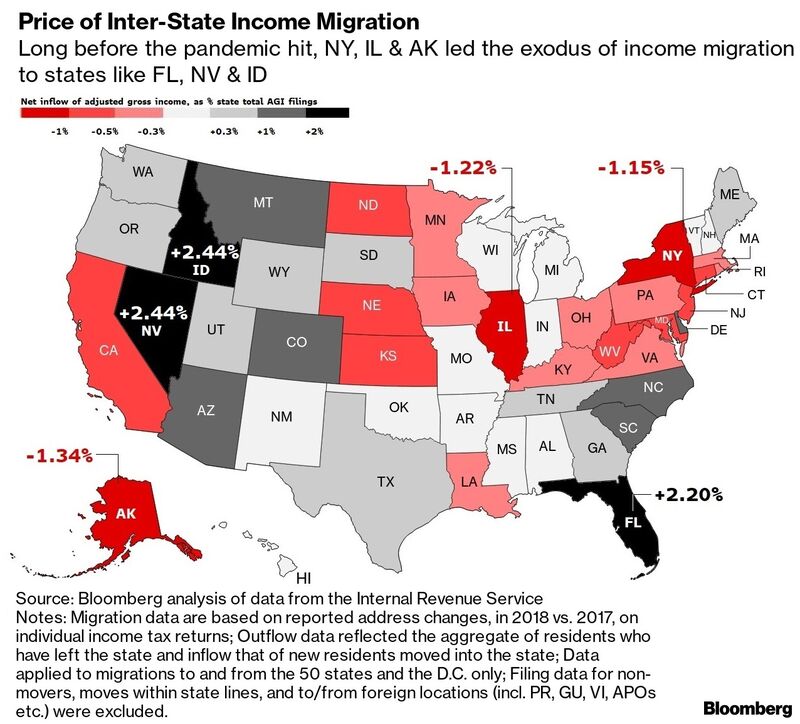
https://www.bloomberg.com/news/articles/2020-12-05/even-befo...
Only the extremely wealthy would leave. An average person does not move their state of residence just to save $1,000 on state taxes. That could be disruptive: leaving family and friends, your job, etc. All to save a grand.
It’s more like $10k to $20k (and ever increasing) per year for dual income professional households compared to a no income tax state like Washington. Over a career of 20 to 30 years, that adds up to a substantial amount of savings.
Basically, the families earning $100k+ would be saving 5%+ of state income tax and at least $5k+ in extra property taxes compared to a non debt burdened state and tolls and all the various other taxes that need to be collected to pay for the compounded debt of pensions and whatnot.
Basically, the families earning $100k+ would be saving 5%+ of state income tax and at least $5k+ in extra property taxes compared to a non debt burdened state and tolls and all the various other taxes that need to be collected to pay for the compounded debt of pensions and whatnot.
Because they are tired of tax increases. It's time to cut pensions.
But from a quick google search result [0], price per square foot is 4 time as expensive in SF versus chicago.
[0]: https://www.propertyshark.com/Real-Estate-Reports/2020/07/07...
[0]: https://www.propertyshark.com/Real-Estate-Reports/2020/07/07...
Which is a good thing. Higher property taxes leads to lower, more realistic real estate prices for new buyers. See Prop 13.
The issue with Chicagoland isn't the property taxes currently, it's the uncertainty on the guaranteed raises that will occur. Sure, you can buy a $650,000 house in the city and pay $13k/yr in property tax, but that might go up to $20k/yr at which point you're underwater on your mortgage and spending an extra $800/mo.
I have the money to buy and the day the city files for bankruptcy and restructures their pensions is the day I purchase. But not a second sooner.
I have the money to buy and the day the city files for bankruptcy and restructures their pensions is the day I purchase. But not a second sooner.
It’s only a good thing if higher property taxes lead to investments in government services and infrastructure.
It’s a bad thing if higher property taxes go towards paying down disproportionate levels of debt.
It’s a bad thing if higher property taxes go towards paying down disproportionate levels of debt.
It's nice from May to October.
I almost died when I visited in February.
I almost died when I visited in February.
You're not living unless the winter weather almost kills you when you're walking the dog!
Nice to visit, wouldn't want to live there.
Did I mention it's the murder capital of the United States?
Did I mention it's the murder capital of the United States?
Meh. Yes, sure, by statistics. But those rates come from neighborhoods that most likely don't have a lot of six-figure salary tech workers in them.
It is the country's third largest city. So by volume it may well be the murder capital. But the murder rate places it like 10th, https://en.wikipedia.org/wiki/List_of_United_States_cities_b...
It has a lot of murders but the QoL crimes seem to be significantly less severe than they are in San Francisco.
Illinois is pretty rough financially, I agree. But it's home to one of the three cities you can realistically live in and call a city in the US. As in no car ownership required, walkable neighborhoods that you never need to leave very often as all your needs are met, etc. This is exceedingly rare in the US, almost non-existent.
So for now, I'll stick with Chicago. Should I move, I completely agree the IL suburbs are completely pointless - I can get the same quality of life cheaper almost anywhere in the US. A suburb is a suburb after all, so things like tax rates and property value are all you really need to make much of a decision on.
So for now, I'll stick with Chicago. Should I move, I completely agree the IL suburbs are completely pointless - I can get the same quality of life cheaper almost anywhere in the US. A suburb is a suburb after all, so things like tax rates and property value are all you really need to make much of a decision on.
I'm assuming the other two are New York and Boston?
A bit of hyperbole in that comment, but yes that was my thought while writing it. I suppose you could make the case for a few more eastern seaboard cities as well.
The population of Illinois peaked in 2009 and has been declining for the past decade.
I’ve read a lot of “the party is over” Bay Area exodus articles and this one is pretty limp, it did nothing but reiterate the news that a couple companies recently left and then poorly rehashed all the usual tropes. It even misrepresents how taxes work with “the absence of a state personal income tax amounts to a 13.3% raise for top earners”.
Not worth arguing about here.
Not worth arguing about here.
[deleted]
These threads have to go. They attract the worst comments HN has to offer.
Yes, let's censor and ban everything you don't agree with.
The quality of comments was substantially worse when I commented. But even still, this thread is barely more than political rhetoric poorly disguised as personal opinions on the bay area. Many of which come from people who haven’t lived there and are using caricatures of lifestyle and people who are from there as the foundation for their opinions.
Threads get closed for less all the time.
Threads get closed for less all the time.
It’s not that. It’s that these arguments are old and had a thousand times. I’m tired of it too. It’s the same people coming in and frequently it’s a lot of people who have never even lived in California or the Bay Area.
These threads bring out some awfully unproductive discussion on HN that is mostly a whine fest. And it’s all sides that whine and it’s old. It’s awfully old.
These threads bring out some awfully unproductive discussion on HN that is mostly a whine fest. And it’s all sides that whine and it’s old. It’s awfully old.
On a very small number of topics HN does appear to do that. My list so far: cryptocurrencies and urbanism.
It's really weird that this site has fairly balanced discussions of just about everything except those two topics. Whenver those two topics come up the result is incredibly one-sided. Like somebody powerful and opinionated has their finger on the scale...
It's really weird that this site has fairly balanced discussions of just about everything except those two topics. Whenver those two topics come up the result is incredibly one-sided. Like somebody powerful and opinionated has their finger on the scale...
I think it's more likely to have the same problem for most if not all topics, you just don't notice it. Somewhat related to Gell-Mann Amnesia...
I know multiple people considering abandoning California due to the homelessness crisis, as the unhoused population (and the problems associated) are expected to increase 10x in the near future as a consequence of the pandemic, with no hope in sight.
That strikes me as a bit of a ridiculous reason to move. The homeless in California are concentrated in a handful of cities, and within those cities, in a handful of neighborhoods. It’s not a problem that you’d be exposed to in a way that truly inconveniences you unless you live or work in very specific locales, and even then, what are the homeless doing that is pushing people to move all the way out of the state rather than just one neighborhood over?
The notion that the homeless population is going to increase tenfold in the near-term also deserves a citation, that’s an immense jump.
The notion that the homeless population is going to increase tenfold in the near-term also deserves a citation, that’s an immense jump.
Many of the tech companies are in the "bad" neighborhoods. Most notably Uber, Twitter and Square are all headquartered right next to one of the worst parts in the city (Civic Center / Tenderloin).
I remember walking to one of those companies for a job interview and seeing someone pooping in broad daylight on the 8th and Market intersection. Not a great first impression.
I remember walking to one of those companies for a job interview and seeing someone pooping in broad daylight on the 8th and Market intersection. Not a great first impression.
Homelessness is not unique to Caliifornia. Seattle and Portland have a big problem with it too. Heck, I’ve seen homeless in rural Indiana by the river and in London. California doesn’t have an answer to this, and I haven’t seen any proposals from either the right or the left that seem viable, but if Texas is so great maybe we should ship the homeless there.
There are 28,995,881 people living in Texas vs 39,512,223 in California. There are 151,278 homeless in California vs 25,848 in Texas.
Is homelessness a problem in Texas? Yes, but it isn't remotely as bad as California. And of course, then there are states with nearly non existent homelessness.
Is homelessness a problem in Texas? Yes, but it isn't remotely as bad as California. And of course, then there are states with nearly non existent homelessness.
Huh it's almost as if it's been forever known to anybody paying attention that other states literally give their homeless bus tickets to California.
Wonder how that affects statistics like yours people like to tout
Wonder how that affects statistics like yours people like to tout
You still didn't answer why that's the case. If Texas has the answer I'm sure California would love to hear it.
I think it's interesting that people forget anything network based tends to unwind just as fast as it winds up. Decorrelation (e.g. low viral coefficient) can be antifragile. If everyone moves to your city for a different reason, it is more resilient to downturns than if everyone moves to your city for the same reason and conditions change. Facebook may unwind for the same reason it was successful: the lack of privacy.
> I think it's interesting that people forget anything network based tends to unwind just as fast as it winds up.
I think that largely depends on market dynamics.
For systems that benefit from strong, direct network effects, the vast majority of users will generally join whichever platform has the largest network. Once you are the clear market leader, you will enjoy fast(er) user growth. Even if your network starts to dwindle, most users will still gravitate to your platform so long as you maintain your market leadership.
I think that largely depends on market dynamics.
For systems that benefit from strong, direct network effects, the vast majority of users will generally join whichever platform has the largest network. Once you are the clear market leader, you will enjoy fast(er) user growth. Even if your network starts to dwindle, most users will still gravitate to your platform so long as you maintain your market leadership.
I agree, I'm arguing that the thing that leads to network success tends to also be the reason it unwinds. Facebook would not have worked if privacy prevailed, which is also the main driver impacting the unwinding of their network.
“Some who have already left San Francisco complained of mismanagement of the city and state. Though it's not clear what exactly they're referring to” (read this the other day)
“Haven't left Silicon Valley; they're still continuing to employ people”
There is this general aloofness of the problems. They need to address it head on and make it more hospitable for companies and residents.
“Haven't left Silicon Valley; they're still continuing to employ people”
There is this general aloofness of the problems. They need to address it head on and make it more hospitable for companies and residents.
My bone to pick with this is in order to make a real dent in these problems, you have to be able to put down roots and live in a place for many years.
San Francisco and the bay area generally are just too expensive (and frankly, too dangerous) for most people to put down those roots and raise a family and get involved meaningfully in the community.
Doesn't excuse most gold-rush tech people from not being involved in local politics at all, you can get involved trivially, but in order to build real lasting coalitions and build real influence people need to stay here a long time and fight it out.
And it's just easier to throw your hands up and move to a new trendy city that doesn't have these problems.
San Francisco and the bay area generally are just too expensive (and frankly, too dangerous) for most people to put down those roots and raise a family and get involved meaningfully in the community.
Doesn't excuse most gold-rush tech people from not being involved in local politics at all, you can get involved trivially, but in order to build real lasting coalitions and build real influence people need to stay here a long time and fight it out.
And it's just easier to throw your hands up and move to a new trendy city that doesn't have these problems.
High taxes, regulations for everything, the government running every part of your personal life, cancer labels on everything... seems like a dream come true. What went wrong?
> the government running every part of your personal life
Hyperbole much? The rest of your comment can be dismissed based on this alone.
Hyperbole much? The rest of your comment can be dismissed based on this alone.
I always wonder if these commenters even live here? I moved from (edit: one of) the most deregulated states in the Union to CA and I have yet to see any tangible example of this.
I’d like to know what specific events or changes or limits on freedom are being referenced. I’m even a (very prolific) gun owner, and found CA’s laws to be perfectly reasonable for my self-defense and hunting/sporting needs.
Seems like a lot of anti-CA hype so far; perfectly fine with being proven wrong, but just don’t see the real world evidence to back these claims.
I’d like to know what specific events or changes or limits on freedom are being referenced. I’m even a (very prolific) gun owner, and found CA’s laws to be perfectly reasonable for my self-defense and hunting/sporting needs.
Seems like a lot of anti-CA hype so far; perfectly fine with being proven wrong, but just don’t see the real world evidence to back these claims.
> the government running every part of your personal life
Isn't marijuana illegal in Texas? California was one of the first states to grant its citizens that freedom.
Isn't marijuana illegal in Texas? California was one of the first states to grant its citizens that freedom.
Can we compare regulations on the following things between Texas and California ?
- Marijuana
- Abortion
- LGBT rights
- Car dealership
My fear as a Texan is that they're just coming here to spread the "good word".
It's actually the anti-socialists that are leaving California for Texas. Doesn't that make sense?
I had a pretty popular take last week on Elon Musk leaving. The same station is now pushing this narrative. I think they are click baiting us all.
HP is not SV. Oracle isnt SV. They arent major players. Maybe there is a larger trend that may come to fruition, but I dont think that will happen. Also, Austin Tx is over crowded already. There is a housing shortage there, we are doomed to see another SF real estate shortage if this becomes true.<rushes to buy Austin property>
HP is not SV. Oracle isnt SV. They arent major players. Maybe there is a larger trend that may come to fruition, but I dont think that will happen. Also, Austin Tx is over crowded already. There is a housing shortage there, we are doomed to see another SF real estate shortage if this becomes true.<rushes to buy Austin property>
> They arent major players.
Not true. Both HP and Oracle are in the top 10 (measured by revenue) of publicly traded companies in California.
Not true. Both HP and Oracle are in the top 10 (measured by revenue) of publicly traded companies in California.
Oracle, HPE, Schwab may not be the hubs of innovation, but they acquire a lot of SV startups, supporting the startup ecosystem. Of course Google, FB will continue to acquire startups just fine, but the pool of acquiring money just got a bit smaller. If large companies continue to leave, they pool will get even smaller over time. I think it represents a potential problem for SV. These departures affect B2B startups so far. But, what happens if Twitter moves HQ? I remember Jack Dorsey saying the SF workforce does not reflect Twitter's user base and he was considering to adjust that.
I think that talks of the wealth tax in CA, is another problem. Now that the possibility has been put forward, the high-net individuals may not be waiting around for that to happen. High-net individuals are funding a lot of startup ecosystem as well. I think that might be a problem.
I think that talks of the wealth tax in CA, is another problem. Now that the possibility has been put forward, the high-net individuals may not be waiting around for that to happen. High-net individuals are funding a lot of startup ecosystem as well. I think that might be a problem.
This is like 1000th article about people leaving Bay Area tech. I get it. Let's check back in a year.
Friendly reminder, Tech is not San Francisco, it's just a city, treat it as such.
California and SF are doomed, but the recent news of HPE and ORCL moving are not a big deal. IMO these are stationary phase companies trying to cut cost. They are not growing revenue, they are not really dynamic companies anymore. Who cares? The swashbuckling SV types never would have worked at these companies anyway. Stability-seeking workers in other states are a much better fit for these companies. Win-win-win.
Do these tech companies telegraph their moves in advance or does this sort of thing become public once all is said and done? Is there anything in the public record with elected officials in dialog with the companies that could be examined after the fact?
Larry Magid said: “I don't think it matters where the CEO sits. What matters is: where is the innovation and where are the job and both HP and Oracle will remain in the valley as employers,"
What would be a move Sufficient enough to meet Larry’s assessment?
What would be a move Sufficient enough to meet Larry’s assessment?
Austin is the perfect place for companies that are expanding administration, finance, operations, legal, marketing etc. Talented individuals with specialist skills now have the freedom to be anywhere. All of this is a good thing.
I completely sympathize with the personal assistant, accountant or support agent (normal commodity jobs) that has a family and is forced to live on the SF peninsula and commute on the 101 each day back to their crummy home that is extortionately priced because they have to compete with the salaries of CEO's and VPs who live a few miles away.
I completely sympathize with the personal assistant, accountant or support agent (normal commodity jobs) that has a family and is forced to live on the SF peninsula and commute on the 101 each day back to their crummy home that is extortionately priced because they have to compete with the salaries of CEO's and VPs who live a few miles away.
The "exodus" is referring to two companies: Oracle and HP Enterprise (spun off from HP in 2015). HPE is moving to Houston and Oracle is moving to Austin.
It also references Elon Musk moving to Austin.
It also references Elon Musk moving to Austin.
As a long term resident of the bay area, I'm happy to see companies relocate elsewhere. The unbridled growth of companies here without improvements to infrastructure like housing and transportation are what caused many of the problems. From 2010 to 2018 my commute roughly doubled in time. As the quality of life degrades in the bay area, it's natural for people and companies to act in their own self interest to relocate elsewhere. The bay area will be ok in the long term.
> ... I'm happy to see companies relocate elsewhere. The unbridled growth of companies here without improvements to infrastructure like housing and transportation are what caused many of the problems.
This seems like an odd mindset. Why are you happy to drain the local economy, instead of working to fix those problems and support a good economy?
This seems like an odd mindset. Why are you happy to drain the local economy, instead of working to fix those problems and support a good economy?
This also seems like an odd mindset. Can’t you have a good economy without overpopulating an area? A saying I grew up with - The frog does not drink up the pond in which it lives.
The Bay Area is far from overpopulated. It's infamous for building as little housing as possible, but allowing office buildings to go up left and right. There's plenty of room to take a little space from new offices and instead build housing.
> overpopulating an area
No place in America is even close to this
No place in America is even close to this
Both HPE and Oracle are not moving many people to Texas per the news release so outside of some tax incentives, I am not really sure how this would help Austin and Houston.
Counterpoint: Google confirmed recently that it's still planning to bring its workers back to the office regularly: https://www.nytimes.com/2020/12/14/technology/google-delays-...
Given that the Texas GOP leadership recently mused publicly about seceding from the United States I wonder how many of the people and companies that left California for Texas would be pleased to wake up one morning and discover they now live in a foreign country? My guess would be: "not so many".
People are self-interested, they might not mind if the new country halves their tax burden.
Despite all these reports, Zillow shows home prices have actually risen. Something is just not adding up here.
[deleted]
If efforts to secede gain any traction, that could disrupt this flow quickly. It's more expensive to do business internationally than state-to-state.
If efforts to secede gain any traction, the disruption will be due to Texas being (once again) demoted from statehood to an occupied military district, as was done in 1867. Of course, this scenario applies to California as well.
It’s already difficult to do business with entities in California if you live in another state. I no longer take contracts with CA based companies after a run in with the FTB. Not worth it.
Many companies that assumed employees are working from home are discovering large numbers of employees are working from other areas and states.
And they are pulling them back or requesting a full move, using taxes as the reason.
Is there any substance to this other than the U.S. tax system being antiquated?
What’s antiquated about it? Political jurisdictions are lines on maps, and they set their own tax laws. It’s the same everywhere else in the world too, isn’t it?
yup don't tell your employer that though and setup a vpn at a friends house..
LOL, tech companies destroyed silicon valley now they are moving to Texas to do it again
Silicon Valley won't even leave behind interesting urban ruins.
Agreed, but luckily the bay area includes all kinds of architecture that isn't corporate offices.
Moffett + Sunnyvale in 100 years could be decently dystopic.
Note: Texas doesn't have a state income tax.
Does climate change play an unspoken role in this? Is California is an increasingly unstable place from an ecology perspective?
There are many negative things about living in California, but I’ve never heard anyone say that an unstable ecology is one of them.
I don't know about unstable ecology, but I'm kind of tired of the yearly weeks of forest fires causing dangerous air quality here in the bay area.
Actually, it's one of the most commonly cited reasons.
One of the more common reasons people are leaving CA is retirement. In the 90s and thousands, it was pretty popular for people to move to Sacrament (Granite Bay and Auburn) to retire. Today it's Tahoe and out of state. People love to retire in the forest, but if it's going to light your house on fire, people will look elsewhere.
One of the more common reasons people are leaving CA is retirement. In the 90s and thousands, it was pretty popular for people to move to Sacrament (Granite Bay and Auburn) to retire. Today it's Tahoe and out of state. People love to retire in the forest, but if it's going to light your house on fire, people will look elsewhere.
To be clear, climate change affects Texas too - it gets hotter here every year.
https://www.keranews.org/2019-08-22/austin-makes-top-10-list...
And unfortunately we have our share of deadly wildfires as well (https://en.wikipedia.org/wiki/Bastrop_County_Complex_Fire), although thankfully not to the same degree that California does.
https://www.keranews.org/2019-08-22/austin-makes-top-10-list...
And unfortunately we have our share of deadly wildfires as well (https://en.wikipedia.org/wiki/Bastrop_County_Complex_Fire), although thankfully not to the same degree that California does.
Some people think if they ignore science hard enough, it'll just make the problems go away.
To be clear, these are dying companies. Good riddance! More room for the green shoots.
We all knew this would happen.
popup21(2)
etherwaste(1)
I am wondering if people going to Texas are aware that the state attorney general filed a lawsuit to the Supreme Court arguing that democratic elections be overturned and Trump appointed king.
Huge subsidy to Texas because of ridiculous policies in CA. Maybe CA should crack down on zoning policy in SF etc.?
These companies leaving for Texas will not have a negative impact on the Bay Area, but it will have a positive impact on Texas.
One of the things I didn't see mentioned in the comments here is the contribution of immigrants in Bay Area tech scene. And CA, with Bay Area in particular is very friendly to immigrants from all over the world. A very large percentage of those will never move to Texas, well unless this migration over the next few decades causes Texas to change its character.
One of the things I didn't see mentioned in the comments here is the contribution of immigrants in Bay Area tech scene. And CA, with Bay Area in particular is very friendly to immigrants from all over the world. A very large percentage of those will never move to Texas, well unless this migration over the next few decades causes Texas to change its character.
Is the Bay Area really friendly to all immigrants in a way that metropolitan Texas is not? I think the definition of friendly should include being able to afford decent space to live. I could imagine that for a young well off Chinese or Indian engineer many cultural aspects such as food and being around many members of your community would be preferable in the Bay Area certainly. But Houston is of the most foreign born cities in the US and for less skilled immigrants their pay check will go much further in Texas.