Introducing iSCSI over TLS(blockbridge.com)
blockbridge.com
Introducing iSCSI over TLS
https://www.blockbridge.com/introducing-iscsi-over-tls/
15 comments
Shared block storage filesystems exist: https://en.wikipedia.org/wiki/Clustered_file_system#Shared-d...
You wouldn't necessarily use this for shared storage though. One might argue that the standard SAN setup where you count on the network being secure is outdated now, same as "secure internal network" mindset in general.
You wouldn't necessarily use this for shared storage though. One might argue that the standard SAN setup where you count on the network being secure is outdated now, same as "secure internal network" mindset in general.
Sometimes when you think you have a "secure internal network", this happens: https://www.washingtonpost.com/business/technology/google-en...
If random access and/or standard FS operations (i.e. ls) across the WAN are desired, GlusterFS is a good choice. It's what I used in a past project with success and what Facebook uses internally. If you know exactly where your resource lives and don't need access a bucket as if it were a directory then S3 is awesome. For random access or FS like use, S3 (native or via FUSE) is pretty laggy.
Don't you need shared access my multiple servers to the same storage for some active/passive clustering techniques?
Thin clients.
This article a bit fishy to me. E.g.:
> In almost all network stacks, per-flow IPsec processing is serialized due to implementation specific constraints of upper level protocols that require in-order packet processing and lower level hardware interfaces that are optimized for latency. The lack of concurrency, combined with memory copy requirements, inline cryptographic operations and multiple traversals of the network layer are to blame for poor performance.
How is that different for the TLS solution? You still need somewhat in-order processing of the TLS stream, memory copies won't really go away with an additional TLS proxy, and the network layer traversals also aren't really that different. Sure one can put work into optimizing all of that, but that appears orthogonal to using TLS to me.
What follows it the usual collection IPSec management downsides -- which may be true but shouldn't affect performance.
IMO the interesting part is pretty far down the post:
> Additionally, TLS record sizes are often larger than MTU (16KB vs 1500/9000B), resulting in lower setup costs for encapsulation.
This may be the actual important change that affects the throughput. It would be interesting to see the effect on real workloads, i.e. not in synthetic benchmarks. Vice versa, it would also be interesting to see the same benchmarks with TLS record sizes limited to the usual MTU sizes.
As the saying goes: I'm not impressed if your prototype is slightly better than what we have in production for years.
> In almost all network stacks, per-flow IPsec processing is serialized due to implementation specific constraints of upper level protocols that require in-order packet processing and lower level hardware interfaces that are optimized for latency. The lack of concurrency, combined with memory copy requirements, inline cryptographic operations and multiple traversals of the network layer are to blame for poor performance.
How is that different for the TLS solution? You still need somewhat in-order processing of the TLS stream, memory copies won't really go away with an additional TLS proxy, and the network layer traversals also aren't really that different. Sure one can put work into optimizing all of that, but that appears orthogonal to using TLS to me.
What follows it the usual collection IPSec management downsides -- which may be true but shouldn't affect performance.
IMO the interesting part is pretty far down the post:
> Additionally, TLS record sizes are often larger than MTU (16KB vs 1500/9000B), resulting in lower setup costs for encapsulation.
This may be the actual important change that affects the throughput. It would be interesting to see the effect on real workloads, i.e. not in synthetic benchmarks. Vice versa, it would also be interesting to see the same benchmarks with TLS record sizes limited to the usual MTU sizes.
As the saying goes: I'm not impressed if your prototype is slightly better than what we have in production for years.
Michaelg,
Regarding the network, the paths are different in a meaningful way, you might want to trace the paths for yourself to see how: https://upload.wikimedia.org/wikipedia/commons/3/37/Netfilte.... Specifically, with IPSec, you make another pass through the network layer, after hitting XFRM in the protocol layer. This is not the case for a normal flow. This “loop” is significant because of the frequency with which it happens. Also, as the post states, random memory accesses are the killer. This additional loop and the logic within exacerbate the problem.
Also, If you’ve been using IPsec in production for multiple years, it’s possible that you using non-AESNI optimized ciphers, so the speedup could in fact be MUCH greater. If you can share a bit about your specific deployment, we would be happy to provide guidance.
Regarding the network, the paths are different in a meaningful way, you might want to trace the paths for yourself to see how: https://upload.wikimedia.org/wikipedia/commons/3/37/Netfilte.... Specifically, with IPSec, you make another pass through the network layer, after hitting XFRM in the protocol layer. This is not the case for a normal flow. This “loop” is significant because of the frequency with which it happens. Also, as the post states, random memory accesses are the killer. This additional loop and the logic within exacerbate the problem.
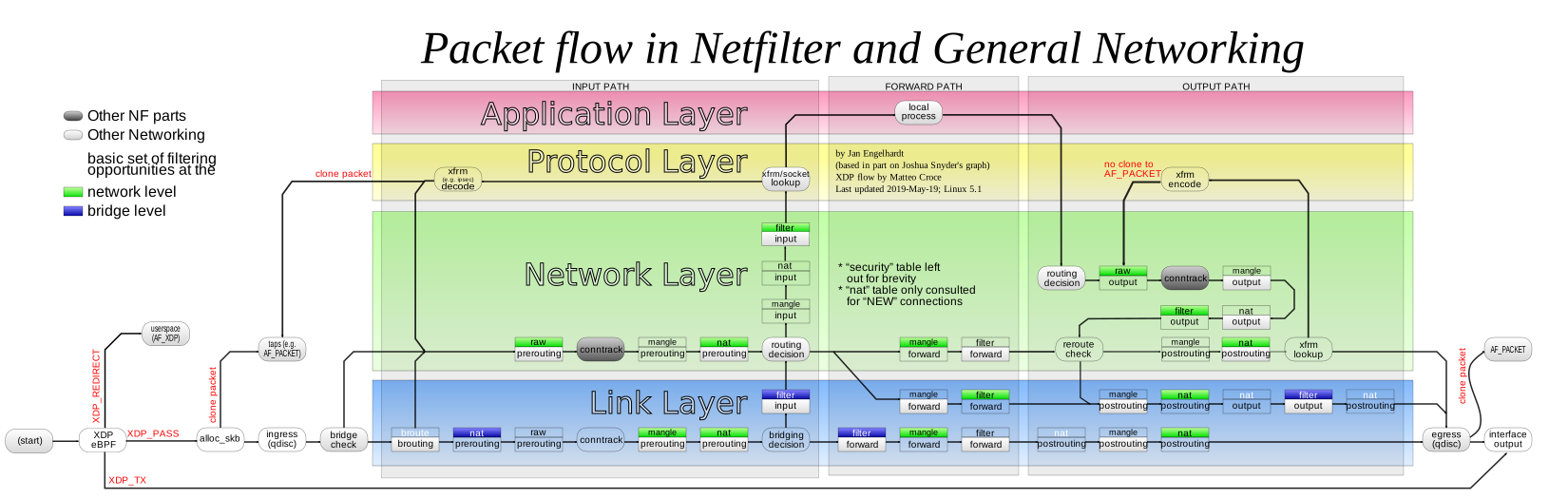
Also, If you’ve been using IPsec in production for multiple years, it’s possible that you using non-AESNI optimized ciphers, so the speedup could in fact be MUCH greater. If you can share a bit about your specific deployment, we would be happy to provide guidance.
Are you really the first to use TLS in securing the storage fabric?
I believe Seagate's Kinetic had TLS features quite awhile ago: http://www.seagate.com/tech-insights/kinetic-vision-how-seag...
Both of which are reminiscent of CMU's NASD research: https://en.wikipedia.org/wiki/Network-Attached_Secure_Disks
New things that are really cool from Blockbridge:
1. Opening up WAN access to storage devices via TLS
2. Kernel drivers (for all major OS's?) allowing storage devices over the WAN
3. Re-imagining how we access block devices
Opens up the possibility for EBS-like storage across the WAN which is, simply, amazing.
I believe Seagate's Kinetic had TLS features quite awhile ago: http://www.seagate.com/tech-insights/kinetic-vision-how-seag...
Both of which are reminiscent of CMU's NASD research: https://en.wikipedia.org/wiki/Network-Attached_Secure_Disks
New things that are really cool from Blockbridge:
1. Opening up WAN access to storage devices via TLS
2. Kernel drivers (for all major OS's?) allowing storage devices over the WAN
3. Re-imagining how we access block devices
Opens up the possibility for EBS-like storage across the WAN which is, simply, amazing.
theonewolf, to the best our knowledge, we are the first to offer TLS protected iSCSI (a block storage transport). As we said in the post, SSL was considered back when the iSCSI protocol was developed, but IPsec won out. Many people use TLS today for object storage (ie. S3, Kinetic, etc.). That said, this post is less of a “pitch” and more of a “here’s what's possible with modern technology”. Regarding NASD, If I recall correctly, that was a file based research project.
BTW, regarding the drivers: none needed, you can do it from userland on any platform with a simple SSL proxy like stunnel. If you want, reach out and we can hook you up with software to play around with.
BTW, regarding the drivers: none needed, you can do it from userland on any platform with a simple SSL proxy like stunnel. If you want, reach out and we can hook you up with software to play around with.
The latency comparison seems a bit crappy to me. Comparing the lowest points in two series of data is very error prone.
Glastra. Maybe this data is a bit better for you, direct from fio.
  TLSv1.2: ecdhe-rsa-aes128-gcm-sha256

  QD1: (groupid=0, jobs=1): err= 0: pid=2140: Sat Mar  5 14:59:49 2016
    read : io=2308.5MB, bw=78791KB/s, iops=19697, runt= 30001msec
      slat (usec): min=2, max=21, avg= 2.42, stdev= 0.50
      clat (usec): min=39, max=56179, avg=47.66, stdev=126.45
       lat (usec): min=46, max=56182, avg=50.14, stdev=126.45
      clat percentiles (usec):
       |  1.00th=[   46],  5.00th=[   46], 10.00th=[   46], 20.00th=[   47],
       | 30.00th=[   47], 40.00th=[   47], 50.00th=[   47], 60.00th=[   47],
       | 70.00th=[   48], 80.00th=[   48], 90.00th=[   49], 95.00th=[   49],
       | 99.00th=[   51], 99.50th=[   51], 99.90th=[   53], 99.95th=[   56],


  IPsec: aes128-gcm96

  QD1: (groupid=0, jobs=1): err= 0: pid=2442: Sat Mar  5 15:27:04 2016
    read : io=1902.6MB, bw=64938KB/s, iops=16234, runt= 30001msec
      slat (usec): min=2, max=29, avg= 2.39, stdev= 0.52
      clat (usec): min=52, max=57367, avg=58.51, stdev=140.69
       lat (usec): min=57, max=57369, avg=60.97, stdev=140.69
      clat percentiles (usec):
       |  1.00th=[   56],  5.00th=[   56], 10.00th=[   57], 20.00th=[   57],
       | 30.00th=[   57], 40.00th=[   57], 50.00th=[   58], 60.00th=[   58],
       | 70.00th=[   58], 80.00th=[   59], 90.00th=[   60], 95.00th=[   61],
| 99.00th=[ 63], 99.50th=[ 65], 99.90th=[ 78], 99.95th=[ 82],latency is especially important for small I/Os, but there are a ton of things that can be done to improve latency in general at an OS and network level
Feld, you are totally right. In fact, there has been discussion in the Linux community about improving IPsec performance. However, as the post states, the difficulty in doing so is the API contract in the kernel. That said, even with a perfectly optimized IPsec stack, having to process each packet individually will always be slower than processing a logical record that is a multiple of packet size.
Oh my. coupling the instability of stateful connections at congestions and all the problem of atomicity/non corrpution of data on the physical layer? It smells like a predictable catastrophe for the future. Not only in terms of a critical path for correctness that is narrower and more sensitive to the noise of the internet, but also in terms of costs. Why do people accept to trade off stability and security for ... what?!
Well. Yes a robot could be juggling efficiently while dancing on a ball. And it would be a nice technical success. And IPSEC/TLS are a ball.
But, why? Can anyone show me a use case where the costs worth the benefits with an actual business explication?
Not just, it is there, so we are gonna use it, lolz. Progress is anything that change, so deal with it we are gonna make a regression and call it progress. :DDDDD
Does every high tech people forgot about money, budget, resources, and contracts?
Bro-tech is tiring.
If you want to synchronize filers for your recovery plan, you don't have to separate them from 1000 km. You can put fiber and use level2 routing with physically protected equipment (level 0 security). You can even if you can stop your activity for 8 hours have your HD backup being delivered by plane in another country.
Ciphering costs money.
Well. Yes a robot could be juggling efficiently while dancing on a ball. And it would be a nice technical success. And IPSEC/TLS are a ball.
But, why? Can anyone show me a use case where the costs worth the benefits with an actual business explication?
Not just, it is there, so we are gonna use it, lolz. Progress is anything that change, so deal with it we are gonna make a regression and call it progress. :DDDDD
Does every high tech people forgot about money, budget, resources, and contracts?
Bro-tech is tiring.
If you want to synchronize filers for your recovery plan, you don't have to separate them from 1000 km. You can put fiber and use level2 routing with physically protected equipment (level 0 security). You can even if you can stop your activity for 8 hours have your HD backup being delivered by plane in another country.
Ciphering costs money.
However, I've never been clear on when someone would use iSCSI other than between nodes in the same cabinet. You can't share storage at the block layer, so the two systems are necessarily tied together exclusively. For WAN use some sort of S3-like blob store would always seem like a better choice?