Venezuelan Hyperinflation Explodes, Soaring Over 440,000 Percent(bloomberg.com)
bloomberg.com
Venezuelan Hyperinflation Explodes, Soaring Over 440,000 Percent
https://www.bloomberg.com/news/articles/2018-01-18/venezuelan-hyperinflation-explodes-soaring-over-440-000-percent
134 comments
How is this a valid argument against "because it's backed up by the state's military power"? In relation to USD US can and does project military power globally to protect and or advance it's economic interests. How Venezuela's case is a valid precedent to prove this premise wrong is very hard to see.
The day Americans stop believing in the dollar, the exact same thing could happen (However I don't see how that would be the case now).
It wouldn't make sense for Americans to stop believing in the dollar most likely... but if they were to do so, I'm sure those insurgent terrorists would find out exactly what military might is backing the dollar in short order.
Also, don't see how it would be the case that Americans or others lose faith in the dollar? Imagine tomorrow that it is revealed that the most core systems in the financial and banking industry were hacked 10 years ago and have been extensively manipulated by, say, Goldman Sachs. Or Walmart. Or whoever. Basically, any bank who says "there are 2 billion dollars in that account" fundamentally can't prove it. What then? When Walmart says 'we made $5 billion last year' and the rest of the world says 'prove it, and no we don't trust your funny-money IT systems'... what do we do then?
Also, don't see how it would be the case that Americans or others lose faith in the dollar? Imagine tomorrow that it is revealed that the most core systems in the financial and banking industry were hacked 10 years ago and have been extensively manipulated by, say, Goldman Sachs. Or Walmart. Or whoever. Basically, any bank who says "there are 2 billion dollars in that account" fundamentally can't prove it. What then? When Walmart says 'we made $5 billion last year' and the rest of the world says 'prove it, and no we don't trust your funny-money IT systems'... what do we do then?
The cynical view on this is your currency to an extent is not only backed by your economy but also by economic resource you can take by force which in case of US is ... I obviously do not want to simplify this to a single factor of mil. power but it's definitely an important aspect.
If people believe there's a currency crisis and that the currency will crash, it becomes a self-fulfilling prophecy. They would instantly convert dollars to another type of currency or goods they think would retain value. They would take their entire paycheck every month and buy any possible physical good they can the same day to try to keep the value. You can have the largest military in the world, the currency would still crash like a rock, trust is everything for a currency.
All Venezuela shows is that a currency is backed by taxes, military power and the power of the economy behind it.
It wasn't a fleeting belief that caused Venezuela's hyperinflation, it was dutch disease wiping out most of their industry followed by oil prices plunging while demand for real goods and services remained static.
The level of spending outstripped the economy's ability to deliver, because the output of that economy is largely oil and oil suddenly wasn't worth very much any more (for reasons that had very little to do with venezuela).
Venezuela would be fucked for this reason with or without hyperinflation. Hyperinflation is simply a side effect of what they're going through. Gold-link their currency and people would be in just as much poverty thanks to their main export tanking - quite possibly even more.
It wasn't a fleeting belief that caused Venezuela's hyperinflation, it was dutch disease wiping out most of their industry followed by oil prices plunging while demand for real goods and services remained static.
The level of spending outstripped the economy's ability to deliver, because the output of that economy is largely oil and oil suddenly wasn't worth very much any more (for reasons that had very little to do with venezuela).
Venezuela would be fucked for this reason with or without hyperinflation. Hyperinflation is simply a side effect of what they're going through. Gold-link their currency and people would be in just as much poverty thanks to their main export tanking - quite possibly even more.
> It's a popular idea that dollars and euros derive their value because taxes are paid in that currency, or because it's backed by the state's military power.
The USD derives its value from an extraordinarily productive and innovative economy, that has led the world for a century, and has been the world's largest economy since the 19th century. The US economy has been highly functioning, and remarkably consistent on an averaged out basis, for approaching 200 years, more so than any other major economy. Venezuela's problem is precisely that their economy ceased to function properly, and its currency followed in line.
The US military exists solely because of that successful economy. One must inherently go before the other. US wealth and economic primacy did not originate from military strength, it originated overwhelmingly from trade, commodities, industry, invention during the 19th century. The US military was barely a third rate power when the US economy became the world's largest circa ~1890.
If military power played an outsized role in determining economic outcomes today, North Korea would be rich. Saddam's Iraq would have been incredibly affluent. Soviet Russia would have ruled the world economically. And Canada today would be bankrupt, as would Norway, Finland and Sweden. Japan would have wilted after WW2, instead they witnessed one of the greatest economic recoveries and booms in world history, almost entirely sans military; their boom wasn't because of Japan's ability to project military power. The US economy would not wilt if the US spent $450 billion (~2.3% of GDP) instead of $700 billion (~3.4% of GDP) on its military - the economy would benefit in fact, by redirecting resources to superior productive uses.
> What happens to the dollar when public consensus, trust and collective belief is weakened?
That has been a fantasy premise for about 3/4 of a century now. The Yen was going to crush the dollar. The Euro was going to overtake the dollar. The Yuan is going to crush the dollar. Meanwhile, dollar dominance is as strong as it has ever been. The US economy chugs forward, adding $600 to $800 billion a year in new economic output, still one of the core leaders in innovation and productivity. Venezuela's failure was one of State corruption and oppression, destroying any semblence of a functioning economic system, it's not because they needed a bit more military might to project with.
The USD derives its value from an extraordinarily productive and innovative economy, that has led the world for a century, and has been the world's largest economy since the 19th century. The US economy has been highly functioning, and remarkably consistent on an averaged out basis, for approaching 200 years, more so than any other major economy. Venezuela's problem is precisely that their economy ceased to function properly, and its currency followed in line.
The US military exists solely because of that successful economy. One must inherently go before the other. US wealth and economic primacy did not originate from military strength, it originated overwhelmingly from trade, commodities, industry, invention during the 19th century. The US military was barely a third rate power when the US economy became the world's largest circa ~1890.
If military power played an outsized role in determining economic outcomes today, North Korea would be rich. Saddam's Iraq would have been incredibly affluent. Soviet Russia would have ruled the world economically. And Canada today would be bankrupt, as would Norway, Finland and Sweden. Japan would have wilted after WW2, instead they witnessed one of the greatest economic recoveries and booms in world history, almost entirely sans military; their boom wasn't because of Japan's ability to project military power. The US economy would not wilt if the US spent $450 billion (~2.3% of GDP) instead of $700 billion (~3.4% of GDP) on its military - the economy would benefit in fact, by redirecting resources to superior productive uses.
> What happens to the dollar when public consensus, trust and collective belief is weakened?
That has been a fantasy premise for about 3/4 of a century now. The Yen was going to crush the dollar. The Euro was going to overtake the dollar. The Yuan is going to crush the dollar. Meanwhile, dollar dominance is as strong as it has ever been. The US economy chugs forward, adding $600 to $800 billion a year in new economic output, still one of the core leaders in innovation and productivity. Venezuela's failure was one of State corruption and oppression, destroying any semblence of a functioning economic system, it's not because they needed a bit more military might to project with.
The consensus valuation of Bitcoin is a whole lot shakier than the consensus valuation of the dollar.
(An interesting lesson to take from the incredible energy consumption of Bitcoin is just how much trust is worth)
(An interesting lesson to take from the incredible energy consumption of Bitcoin is just how much trust is worth)
Cryptocurrencies aren't remotely trustless.
You may not need to trust that the central bank won't fire up its printing press, true. But you're absolutely trusting that someone somewhere will want to exchange your bitcoins for something other than bitcoins, and there's no inherent reason why they would.
You may not need to trust that the central bank won't fire up its printing press, true. But you're absolutely trusting that someone somewhere will want to exchange your bitcoins for something other than bitcoins, and there's no inherent reason why they would.
Well yes, that's obvious...any interaction with someone else require you to 'trust' that they'll do what they say. I think you misunderstanding the context of trust-less in regards to bitcoin though.
Maybe, but I think you're missing my point. When you buy Bitcoin (or whatever) you're betting that someone will want to trade you something else for it in the future. That "someone else" isn't a concrete entity, and "they" haven't given you any assurances of any kind.
I was replying to an argument that cryptocurrencies are superior to state-issued fiat because they don't require trust. IMO this is nonsense. Using anything with zero intrinsic value as a store of value is a gigantic leap of faith.
I was replying to an argument that cryptocurrencies are superior to state-issued fiat because they don't require trust. IMO this is nonsense. Using anything with zero intrinsic value as a store of value is a gigantic leap of faith.
The same trust/consensus is needed with Crypto. The only thing crypto has over USD is that we can be certain of its issuing policy (but even then a fork could change that).
I trust USD issuing, the federal reserve, and American military for the most part (so does wall St, EU, Japan, and China).
I trust USD issuing, the federal reserve, and American military for the most part (so does wall St, EU, Japan, and China).
That works for cash. In case you haven't noticed, cash isn't common any longer. What about about electronic dollar? The money that never exists in any form other than on some computers managed by systems built and maintained as cost centers that need to have every single possible corner cut? Do you trust those systems to accurately reflect what the Fed actually issued? If so, why? They certainly can't provide even reasonable evidence for it, much less proof. The best they can do is "but the computer says" and point to a machine slapped together by an inexperienced technician and running software maybe cobbled together from outsourced components, poorly documented, and rush out 6 months before the developers on the project thought it was actually ready for use.
They're just getting ready to take that system down to patch the WannaCry vulnerabilities, so you might want to check it quickly. They're not sure how long until they're back up.
They're just getting ready to take that system down to patch the WannaCry vulnerabilities, so you might want to check it quickly. They're not sure how long until they're back up.
You definitely make good points and I agree the cut corners are a big issue. However I'm under the impression that there are ledgers that are meticulously kept which track all balances, debt, and cash issuance which need to balance out at every level (from the Gov/Fed to small banks); otherwise the institution would fall.
Why do I trust it? Because it continues to work, can it fail? Sure, but there is little incentive for those in power to mess around as it would jeopardize the system.
> The money that never exists in any form other than on some computers
I'm not going to get into how money works - but your statement could be said about crypto, it only exists on some computer right? Just because it never existed before doesn't mean it won't have utility.
I think the legal system is the real place to fix things - there are certain mechanisms which influence how wealth works its way through the system. At the moment its misbalanced. It has little to do with the USD (well I benefit from USD, perhaps little countries elsewhere have a gripe with it).
Why do I trust it? Because it continues to work, can it fail? Sure, but there is little incentive for those in power to mess around as it would jeopardize the system.
> The money that never exists in any form other than on some computers
I'm not going to get into how money works - but your statement could be said about crypto, it only exists on some computer right? Just because it never existed before doesn't mean it won't have utility.
I think the legal system is the real place to fix things - there are certain mechanisms which influence how wealth works its way through the system. At the moment its misbalanced. It has little to do with the USD (well I benefit from USD, perhaps little countries elsewhere have a gripe with it).
> Why do I trust it? Because it continues to work, can it fail? Sure, but there is little incentive for those in power to mess around as it would jeopardize the system.
The incentive for them does not extend to you, as illustrated in 2008. They fail, you pay.
Do you realize in our current economic climate that your dollar today is more valuable than the same dollar in 10 years? Would you like it to appreciate/depreciate in value as time goes on?
Bitcoin is a perfect hedge against the issues of state-issued currency.
The incentive for them does not extend to you, as illustrated in 2008. They fail, you pay.
Do you realize in our current economic climate that your dollar today is more valuable than the same dollar in 10 years? Would you like it to appreciate/depreciate in value as time goes on?
Bitcoin is a perfect hedge against the issues of state-issued currency.
> However I'm under the impression that there are ledgers that are meticulously kept which track all balances, debt, and cash issuance which need to balance out at every level (from the Gov/Fed to small banks); otherwise the institution would fall.
The more likely it is for the institution to fail as the result of malfeasance, the more certain it is that any malfeasance would be covered up quickly and thoroughly.
The more likely it is for the institution to fail as the result of malfeasance, the more certain it is that any malfeasance would be covered up quickly and thoroughly.
> The money that never exists in any form other than on some computers managed by systems built and maintained as cost centers that need to have every single possible corner cut?
Those systems also probably have more humans carefully monitoring their daily operation than any other kind of system anywhere. People really care about their money.
Those systems also probably have more humans carefully monitoring their daily operation than any other kind of system anywhere. People really care about their money.
I agreed with everything you wrote, until near the end where you said "but also in the US". Forget about politics, but economically the US dollar is still the strongest and most stable currency in the world. It has competitors (which is good!) but I have seen no signs of problems in the US dollar. Inflation has been low in the US for long, probably way too long.
> until near the end where you said "but also in the US"
I'm not talking about inflation, I'm talking about political stability.
As we see in Venezuela, runaway inflation and economic collapse is the result of political instability and a collective loss of trust in leadership, not the cause.
US influence and power has been in decline since before 9/11, and the Iraq war showed that the US is on the wrong side of the inflection point.
This chart [0] demonstrates that the G-Zero [1] trend is accelerating.
[0] Global Leadership https://pbs.twimg.com/media/DT1e0feVoAA8Qd0.jpg:large
[1] G-Zero World https://www.foreignaffairs.com/articles/2011-01-31/g-zero-wo...
I'm not talking about inflation, I'm talking about political stability.
As we see in Venezuela, runaway inflation and economic collapse is the result of political instability and a collective loss of trust in leadership, not the cause.
US influence and power has been in decline since before 9/11, and the Iraq war showed that the US is on the wrong side of the inflection point.
This chart [0] demonstrates that the G-Zero [1] trend is accelerating.
[0] Global Leadership https://pbs.twimg.com/media/DT1e0feVoAA8Qd0.jpg:large
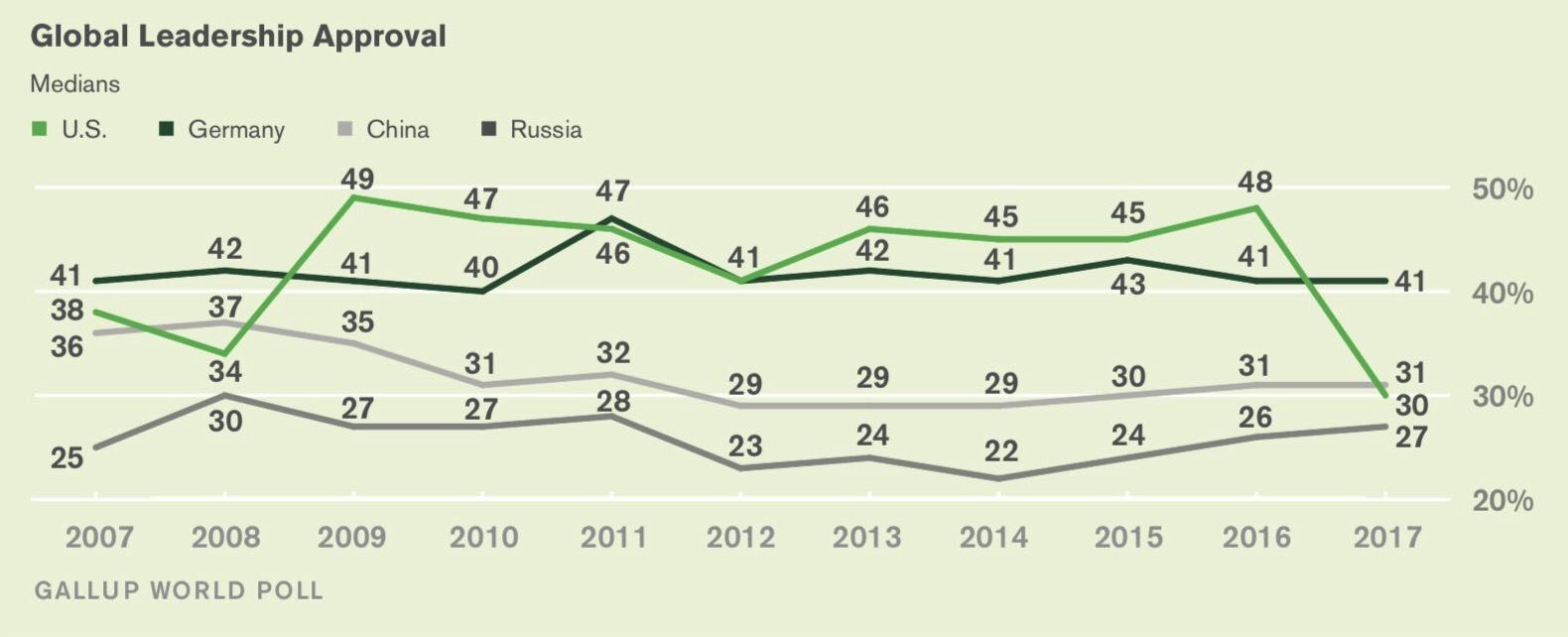
[1] G-Zero World https://www.foreignaffairs.com/articles/2011-01-31/g-zero-wo...
Thanks for the detailed response. I'm hoping that the downward trend in the Global Leadership Approval chart that started in 2016 will reverse itself after the US political situation changes this year (fingers crossed!). If not, well then yes I guess the US dollar would be going down.
Of course, all good things come to an end eventually, and the US dollar hegemony really started after WW2. Crazy to think that a Soviet spy/asset (Harry Dexter White) helped setup the Bretton Woods accord which positioned the US dollar as the strongest in the world [0].
[0] "How a Soviet spy outmaneuvered John Maynard Keynes to ensure U.S. financial dominance" https://www.washingtonpost.com/news/wonk/wp/2013/03/14/how-a...
Of course, all good things come to an end eventually, and the US dollar hegemony really started after WW2. Crazy to think that a Soviet spy/asset (Harry Dexter White) helped setup the Bretton Woods accord which positioned the US dollar as the strongest in the world [0].
[0] "How a Soviet spy outmaneuvered John Maynard Keynes to ensure U.S. financial dominance" https://www.washingtonpost.com/news/wonk/wp/2013/03/14/how-a...
I'm surprised nobody has mentioned that they are printing money to pay for government expenses. That actually works okay on a small scale (economically, it's roughly equivalent to deficit spending), but if you do it too much the currency loses all value.
Crypto actually proves that money doesn't need to be backed by anything. It simply achieves value by being a) useful for transactions and b) scarce. The US dollar's scarcity is carefully handled by the Federal Reserve which is why it has stable value. In Venezuela, the government simply prints money to spend without a thought to managing scarcity, and hyperinflation is the natural result. Collective belief is important, yes, but it's simply a belief about the future scarcity of the currency.
Crypto actually proves that money doesn't need to be backed by anything. It simply achieves value by being a) useful for transactions and b) scarce. The US dollar's scarcity is carefully handled by the Federal Reserve which is why it has stable value. In Venezuela, the government simply prints money to spend without a thought to managing scarcity, and hyperinflation is the natural result. Collective belief is important, yes, but it's simply a belief about the future scarcity of the currency.
>>> Crypto actually proves that money doesn't need to be backed by anything.
Well no, since it's not used as currency in any meaningful scale.
Well no, since it's not used as currency in any meaningful scale.
Cryptocurrencies require just as much consensus and trust as regular currency. If I don't believe that bits and bytes on a hard drive are worth anything, then cryptocurrency is as good as tulips.
> Collective belief is a pretty fragile foundation to build an economy on, hard to build and easy to destroy.
This, IMO, is what economic bubbles are predicated upon. It's hard to build value in our economy as more people are pushed to the side, so let's give away home loans and tether people in with good feelings, based upon poor reasoning!
It started with an arbitrary collective belief; we all just want nuclear family type lives in these all-services included by nearby strip mall, burb communities. Which is ... patently untrue. But people need a home so if that's where the action is!
And some quaint or wonk starts to see through this with data, and invents credit default swaps.
It's a crappy example; I'm tired, no coffee, and this is HN, not some economic summit, the kernel of truth I believe is there is this: Bubbles are the result of pushing social norms into the purview of utilitarian decision making for the species as a whole.
This, IMO, is what economic bubbles are predicated upon. It's hard to build value in our economy as more people are pushed to the side, so let's give away home loans and tether people in with good feelings, based upon poor reasoning!
It started with an arbitrary collective belief; we all just want nuclear family type lives in these all-services included by nearby strip mall, burb communities. Which is ... patently untrue. But people need a home so if that's where the action is!
And some quaint or wonk starts to see through this with data, and invents credit default swaps.
It's a crappy example; I'm tired, no coffee, and this is HN, not some economic summit, the kernel of truth I believe is there is this: Bubbles are the result of pushing social norms into the purview of utilitarian decision making for the species as a whole.
Venezuela has been defaulting on debts since November and the last junk debt traders have finally walked away. No more credit. Venezuela has apparently sold off the last of whatever national assets buyers were interested in; they worked through their gold reserves in 2016-2017 and nothing new is on the table aside from a dubious cryptocurrency scheme and some clapped out PDVSA oil rigs. Venezuelan oil production is collapsing for lack of operating capital and Venezuelan tankers are being seized in foreign ports by creditors. This is cutting off the last meaningful source of foreign currency.
At some point, probably in the next several weeks, the subsistence diet of the Venezuelan military is going to fail and the "Bolivarian revolution" in Venezuela will finally end. But only after having stunted at least one full generation of children.
At some point, probably in the next several weeks, the subsistence diet of the Venezuelan military is going to fail and the "Bolivarian revolution" in Venezuela will finally end. But only after having stunted at least one full generation of children.
There was an op-ed in the WaPo yesterday[1] that was as fascinating as it was terrifying:
Rule No. 1 of surviving hyperinflation is simple: Get rid of your money. Given the speed with which money is shedding its value, holding on to it means you’re losing out. The second you’re paid you run out as fast as you can to buy something – anything – while you can still afford it. It’s better to hold almost any asset than money, because assets hold their value and money doesn’t.
Find a can of tuna? Buy it. Even if you hate tuna. Even if you have no intention of eating tuna. You can always trade it for something else later. Tuna holds its value. Money doesn’t.
I think this is what’s so hard to wrap your mind around if you’ve never experienced hyperinflation. It sounds like it’s about prices rising fast, but it really isn’t. It’s about money breaking down. Under hyperinflation, money no longer works. It doesn’t store value. It just stops doing the basic things people expect money to do. It stops being something you want to have and turns into something you’ll do anything to avoid having: something so worthless you won’t even bend down and scoop it up off the floor while you’re looting.
[1] https://www.washingtonpost.com/news/democracy-post/wp/2018/0...
Rule No. 1 of surviving hyperinflation is simple: Get rid of your money. Given the speed with which money is shedding its value, holding on to it means you’re losing out. The second you’re paid you run out as fast as you can to buy something – anything – while you can still afford it. It’s better to hold almost any asset than money, because assets hold their value and money doesn’t.
Find a can of tuna? Buy it. Even if you hate tuna. Even if you have no intention of eating tuna. You can always trade it for something else later. Tuna holds its value. Money doesn’t.
I think this is what’s so hard to wrap your mind around if you’ve never experienced hyperinflation. It sounds like it’s about prices rising fast, but it really isn’t. It’s about money breaking down. Under hyperinflation, money no longer works. It doesn’t store value. It just stops doing the basic things people expect money to do. It stops being something you want to have and turns into something you’ll do anything to avoid having: something so worthless you won’t even bend down and scoop it up off the floor while you’re looting.
[1] https://www.washingtonpost.com/news/democracy-post/wp/2018/0...
Not just money, the entire economy breaks down. Why bother working at last week's living wage won't buy a loaf of bread today?
>Under hyperinflation, money no longer works. It doesn’t store value. It just stops doing the basic things people expect money to do.
This is a funny way of looking at the problem because it frames money as if it were some sort of robot that did things by itself.
This is a funny way of looking at the problem because it frames money as if it were some sort of robot that did things by itself.
Just a reminder that this is a demonstration of how government-issued fiat currencies are also "not based on physical reality" as many point out for cryptocurrencies.
It's true that fiat currencies only work well if they are managed well. And what we're seeing in Venezuela isn't even poor management anymore. It's more like you took a stack of paper currency and intentionally set it on fire.
Ironically lighting cash on fire is deflationary.
In hindsight, maybe that wasn't the best example...
What's the BTU of a dolar-sized piece of paper? What's the burn duration? At what inflation point is it more practical to burn bolivars for heat than it is to buy oil/fuel/wood with bolivars?
To clarify, currencies can be based on physical reality (paper gold) and you can extend this logic to include a government's GDP of physical goods and management of that GDP. However, that maintains the majority of value for government currencies is tied more to intangible concepts like management and policy rather than goods.
I literally don't think I have ever seen someone say that the issue with cryptocurrencies is that they are "not based on physical reality".
How have you not? Its one of the top 5 arguments against.
Only from libertarian goldbugs who don't like bitcoin, of which I imagine there are three or four.
[deleted]
Oh, I definitely have.
LMAO what?!?!
As the Venezuelan economy is currently a basket case, surely this is evidence that the currency is doing an excellent job of representing reality.
So what's left? Moving to a commodity-backed currency? Pinning it to another major currency? Bloomberg states the problem but doesn't even talk about whether Zimbabwe fixed their problem and if so how so, much less what options are available to Venezuela. I mean sure I can Google it but it's surprising for Bloomberg to publish such a weak article. It's what I'd expect from USA Today.
Brazil had an interesting take on conquering hyperinflation that might apply to Venezuela too (although their current situation is much worse):
https://www.npr.org/sections/money/2010/10/04/130329523/how-...
https://www.npr.org/sections/money/2010/10/04/130329523/how-...
Zimbabwe effectively just abandoned their currency and let people use other currencies.
The same happened here in 1990-s.
That’s how we ended up using euro despite not being in the EU: https://en.wikipedia.org/wiki/Montenegro_and_the_euro
That’s how we ended up using euro despite not being in the EU: https://en.wikipedia.org/wiki/Montenegro_and_the_euro
> So what's left?
Putting someone economically competent in charge?
Putting someone economically competent in charge?
[deleted]
I got to wondering if they did switch to the US dollar would the us issue more currency would would we just experience a small amount of deflation pressure?
Apparently World of Warcraft gold is more valuable at this point than the Venezuelan bolívar fuerte: https://twitter.com/KalebPrime/status/952648572729724934
Hasn't it been so for like a year now? At least half a year?
Seems like the bolivar's and wow gold's value were on par around june/july 2017 (provided that these tweets are accurate):
https://twitter.com/KalebPrime/status/877070731942789121 https://twitter.com/KalebPrime/status/885997066140475395
https://twitter.com/KalebPrime/status/877070731942789121 https://twitter.com/KalebPrime/status/885997066140475395
Borrow huge amounts of money from the banks and buy land... Unless the government is apt to expropriate, then, yeah, just buy anything that stores value.
They are very apt to expropiate. They've notoriously fucked up most industries that way.
They also encourage "invasions" of unoccupied properties.
Furthermore, credit is a joke now. The average venezuelan credit card now issues somewhere around $5 of credit. Buying real estate through credit is similarly ridiculous.
(Source: I live here)
They also encourage "invasions" of unoccupied properties.
Furthermore, credit is a joke now. The average venezuelan credit card now issues somewhere around $5 of credit. Buying real estate through credit is similarly ridiculous.
(Source: I live here)
>Unless the government is apt to expropriate
...how do you think Venezuela got here?
...how do you think Venezuela got here?
They should just buy up as much (insert whatever cryptocurrency they can buy a lot of here) and announce they are switching to this as a national currency.
So where is the new cryptocurrency they promised to issue? They absolutely should switch to cryptocurrency, a highly unstable currency is much better than a currency that is stable in its hyperbolic devaluation and can actually boost the economy. Why don't they do?
That was called the petro or something, i think it was only meant to be for oil trading and not a national currency.
It was meant to be backed by oil and to back the paper bolívars in its turn and I believe they really should start this ASAP. The only alternative is switching to Brazilian Reals, US Dollars or something like that but who is going to give those to them? A cryptocurrency done right can create worldwide-tradeable, hard-to-constrain value and liquidity immediately from nothing but the potential and I can hardly understand what are they waiting for. Is the ruling establishment there just so power-mad they won't give up the printer even in face of ultimate economic collapse?
They don't need actual dollars, just issue a currency with the exchange rate pegged to another one.
Hi from Argentina!
We tried that too almost at the same time that Brazil tried the Real. If you are lucky and it is well done, you can convince people that "1 (ARG)Peso = 1 (USA)Dollar". It worked for 10 years ... (1991-2002) https://en.wikipedia.org/wiki/Convertibility_plan
The main problem is that you must reduce the government deficit (that is usually not popular) or get external credit (but you must not be angry with the international banks).
We tried that too almost at the same time that Brazil tried the Real. If you are lucky and it is well done, you can convince people that "1 (ARG)Peso = 1 (USA)Dollar". It worked for 10 years ... (1991-2002) https://en.wikipedia.org/wiki/Convertibility_plan
The main problem is that you must reduce the government deficit (that is usually not popular) or get external credit (but you must not be angry with the international banks).
A relatively reasonable government like that of Argentina or Brazil can indeed implement a monetary policy and play with deficit and the rate for good but if it consistently fails to it ought to at least provide the people with a usable trading token so they can take care of themselves. It's hard to say what it actually is but given the news we get outside the Venezuelan government is little but useless (not completely perhaps, maybe it keeps drug cartels away or something), they should just issue a reasonably limited amount of relatively valuable currency, halt all but some essential regulations and leave the people alone. Budget deficit cuttig is not popular? I believe the result Venezuelans are getting now are even less popular.
... and screw it again a week later.
Nothing new under the sun.
As a first-order approximation, all currencies in history have ultimately disappeared or stopped working as currencies, from Roman denarii to Italian Florins to Brazilian Cruzeiros to Rwandan Dollars to Venezuelan Bolivares.[a]
Currently there are 190+ countries on earth, most of which have their own currency. Only a fairly small number of those currencies are widely considered stable. The rest are probably destined for the dustbin of history.
[a] https://en.wikipedia.org/wiki/List_of_historical_currencies
As a first-order approximation, all currencies in history have ultimately disappeared or stopped working as currencies, from Roman denarii to Italian Florins to Brazilian Cruzeiros to Rwandan Dollars to Venezuelan Bolivares.[a]
Currently there are 190+ countries on earth, most of which have their own currency. Only a fairly small number of those currencies are widely considered stable. The rest are probably destined for the dustbin of history.
[a] https://en.wikipedia.org/wiki/List_of_historical_currencies
Is anybody even using bolivars in Venezuela anymore? I've been assuming people are using dollars and euros as much as possible.
Capital controls make that pretty difficult. There are government set controls on whether you can purchase foreign currency and even then to how much you are allowed to buy.
I remember back in like 2011 Kirchner did this in Argentina while I was living there. There was out of control inflation and capital controls. The government also covered their ear and said "lalalalala I don't care what the world markets say, our currency is worth $x.)
If you were traveling, you could get foreign currency, but you had to apply for it, prove you were traveling, and then accept that the government would allot how much they thought you needed on your trip. I had a friend get $75 per day for their trip to the states. This creates the black market (or in Argentina, the "dolar blue") where the government said that the exchange was 5:1, but economics and the black market said 15:1 (at one point).
Moral of the story - you can not just ignore basic economic principles and dictate the value of your currency. Focus on building a strong and diverse economy and promoting a free market.
I remember back in like 2011 Kirchner did this in Argentina while I was living there. There was out of control inflation and capital controls. The government also covered their ear and said "lalalalala I don't care what the world markets say, our currency is worth $x.)
If you were traveling, you could get foreign currency, but you had to apply for it, prove you were traveling, and then accept that the government would allot how much they thought you needed on your trip. I had a friend get $75 per day for their trip to the states. This creates the black market (or in Argentina, the "dolar blue") where the government said that the exchange was 5:1, but economics and the black market said 15:1 (at one point).
Moral of the story - you can not just ignore basic economic principles and dictate the value of your currency. Focus on building a strong and diverse economy and promoting a free market.
Mexico did this in the 1980's. It didn't work. It is strange that countries make the same mistakes over and over. I suspect that the Netherlands went through this centuries ago.
"Those who cannot remember the past are condemned to repeat it." -George Santayana
But I guess there's an element of "they did it wrong, we'll do it right" or "it'll work for us this time" or "this time is different because of x" and so on.
But I guess there's an element of "they did it wrong, we'll do it right" or "it'll work for us this time" or "this time is different because of x" and so on.
It is probably out of the desperation. Hoping for a miracle.
They don't realize until it is too late that is much, much easier to avoid Hyperinflation (by having responsible policies) than to fix it.
They don't realize until it is too late that is much, much easier to avoid Hyperinflation (by having responsible policies) than to fix it.
Its illegal to do commercial operations in foreign currency here.
People still do it privately, but you can't openly accept them in your business anywhere.
People still do it privately, but you can't openly accept them in your business anywhere.
Is that law strictly adhered to or is it a kind of “I’m off work in 5, meet me out back” kind of thing?
shouldn't Venezuela be one the richest country in the world? As far as I know they have the biggest oil reserves in the world.
Venezuela is so poorly managed they were losing money at $150/barrel of crude oil.
Last year, oil has been $30 to $50 per barrel. `nuff said. Its an issue of poor governance. Venezuela was heavily dependent on high-priced oil to keep their finances together, and it all collapsed as oil prices dropped.
Last year, oil has been $30 to $50 per barrel. `nuff said. Its an issue of poor governance. Venezuela was heavily dependent on high-priced oil to keep their finances together, and it all collapsed as oil prices dropped.
What were they spending their money on?
Unfortunately, I don't know. I'm an outsider from the USA. So I don't want to get much deeper into the details and pretend I know a lot about Venezuela.
But clearly, they're doing something wrong down there. They are a very oil-rich and resource-rich nation. So they should have the money to do this correctly, even as Oil Prices have dropped.
But clearly, they're doing something wrong down there. They are a very oil-rich and resource-rich nation. So they should have the money to do this correctly, even as Oil Prices have dropped.
I believe this is what economics call Dutch disease.
And corruption probably, although that might not be unrelated.
And corruption probably, although that might not be unrelated.
There's still oil! They could still be rich! They fucked it up.
That's what corruption will do to you.
Interesting how Venezuela is being touted by both capitalists and socialists as a prime example what's wrong with the other.
Have there been socialists blaming capitalism? I've only seen socialists, who previously touted the shining beacon of socialism in Venezuela, now claiming it wasn't true socialism.
The socialism playbook is to blame capitalism "foreign economic sanctions" and "economic warfare". It's what the Russian premieres did, what Castro did, what Chavez did, and what Maduro is doing.
Also they claim that domestic capitalists are hoarding and causing the system to collapse.
Also they claim that domestic capitalists are hoarding and causing the system to collapse.
Yes, I've chatted with several hardcore socialists who decry Venezuela failing because it is (they allege) a capitalist state.
How does Venezuela at all represent capitalism? It's the latest example of what capitalism is not.
Whereas it's more of a prime example of what's wrong with the resource curse.
Do other resource-cursed countries also manage the country so poorly? Usually they at least keep the golden goose alive. In Venezuela, the oil industry was badly damaged through mismanagement.
Yes. Look at most of Africa, the middle East, Russia, etc.
Norway is the only exception I'm aware of.
Norway is the only exception I'm aware of.
owebmaster(1)
Money is a purely social construct. It's only worth something when people collectively believe and trust that it's worth something.
It's a popular idea that dollars and euros derive their value because taxes are paid in that currency, or because it's backed by the state's military power.
Venezuela shows that neither of these are the source of the currency's value.
Collective belief is a pretty fragile foundation to build an economy on, hard to build and easy to destroy.
Another term for "collective belief" is "consensus". We're witnessing a disintegration of political and economic consensus not only in Venezuela, but also in the US.
What happens to the dollar when public consensus, trust and collective belief is weakened?
This is why I find the decentralized, trustless consensus of cryptocurrencies to be especially attractive at this moment in history.