The case for “conditional optimism” on climate change(vox.com)
vox.com
The case for “conditional optimism” on climate change
https://www.vox.com/energy-and-environment/2018/12/28/18156094/conditional-optimism-climate-change
23 comments
> The "yellow jacket" protests were a response to tax increases on fuel as part of the government's strategy to reduce emissions
It's a bit more complicated than that. The protests came because the gas taxes, along with several other changes by the Macron administration, basically all hit the poorest in the country without really impacting the wealthiest.
The goal isn't to stop policies that reduce carbon emissions, its to make sure we don't put the burden of fixing environmental problems first and foremost on the poor when we have people with plenty of resources who are barely getting touched by the costs of the cure even as they carry an outsized share of the blame for the disease.
It's a bit more complicated than that. The protests came because the gas taxes, along with several other changes by the Macron administration, basically all hit the poorest in the country without really impacting the wealthiest.
The goal isn't to stop policies that reduce carbon emissions, its to make sure we don't put the burden of fixing environmental problems first and foremost on the poor when we have people with plenty of resources who are barely getting touched by the costs of the cure even as they carry an outsized share of the blame for the disease.
Carbon fee _and dividend_ is the obvious response to all that.
I don’t see how it’s obvious, especially since it has never been implemented outside of a small scheme in Canada where the dividend goes to businesses rather than households.
All the more reason to implement a large scheme that returns everything to individuals, like the Energy Innovation and Carbon Dividend Act recently introduced in the U.S. House and Senate https://www.coons.senate.gov/newsroom/press-releases/sens-co...
On how it's obvious response to:
> inequality, economic justice, the cost of living, and populist anti-establishment sentiment
On the first and third (and I guess second, depending what you mean by it), it's clearly progressive, see https://energypolicy.columbia.edu/research/commentary/how-bi... and on the fourth, when has there been populist backlash against sending all citizens checks, even when it is a gimmick (as in the case of various last minute rebates, IIRC)?
On how it's obvious response to:
> inequality, economic justice, the cost of living, and populist anti-establishment sentiment
On the first and third (and I guess second, depending what you mean by it), it's clearly progressive, see https://energypolicy.columbia.edu/research/commentary/how-bi... and on the fourth, when has there been populist backlash against sending all citizens checks, even when it is a gimmick (as in the case of various last minute rebates, IIRC)?
Money is a really handy system for dividing up resources amongst people who don't have time to track what all their peers are up to. But it doesn't magically call resources into being, we need some sort of link to the physical world to do that.
People use fossil fuels for everything - travel, access to goods that need to be transported, access to products that require electricity to fabricate (eg, aluminium). If less fossil fuels are used, then it seems highly likely there will be less stuff to distribute.
I'd be surprised if the very wealthy consume enough that they can be made to absorb the real burden, because most wealth is stored in things like paper investments or non-consumer goods.
If there are less goods and there isn't a target that can have their goods reallocated, then someone is going to have to do without and they will be furious. Giving them a "dividend" when there is nothing for them to buy is unlikely to help matters.
People use fossil fuels for everything - travel, access to goods that need to be transported, access to products that require electricity to fabricate (eg, aluminium). If less fossil fuels are used, then it seems highly likely there will be less stuff to distribute.
I'd be surprised if the very wealthy consume enough that they can be made to absorb the real burden, because most wealth is stored in things like paper investments or non-consumer goods.
If there are less goods and there isn't a target that can have their goods reallocated, then someone is going to have to do without and they will be furious. Giving them a "dividend" when there is nothing for them to buy is unlikely to help matters.
If shipping costs more, companies will make different choices about how to manufacture and ship stuff. A simple example might be opening more local bottling plants rather than shipping water for long distances.
So it's not that there will be nothing to buy. The product mix will be different, some prices will be a bit higher based on how much shipping they use, and customers will make different choices, but the effects are likely to be subtle and counterintuitive because supply chains are complicated.
So it's not that there will be nothing to buy. The product mix will be different, some prices will be a bit higher based on how much shipping they use, and customers will make different choices, but the effects are likely to be subtle and counterintuitive because supply chains are complicated.
Are income inequality and environmental progress linked somehow? Do people believe they are? Is there propaganda that climate change is a conspiracy of the wealthy?
If people think they are linked, we're in deep trouble, and we need to demonstrate the opposite fast.
If people think they are linked, we're in deep trouble, and we need to demonstrate the opposite fast.
>"Are income inequality and environmental progress linked somehow?"
They are insofar as anything that negatively impacts the population as a whole will be felt worst by those at the bottom. This is not limited to environmental progress, it applies to just about anything you can think of. Who will suffer the most when sea levels rise? The poor, who cannot easily pick up their lives and relocate. Who will suffer the most when gas is taxed at 500% to reduce consumption? The poor who have little if any surplus income and for whom gas expenses make up a larger fraction of their budget.
When the people at the bottom see people at the top have their discomfort cushioned by their wealth, a tense situation can develop.
They are insofar as anything that negatively impacts the population as a whole will be felt worst by those at the bottom. This is not limited to environmental progress, it applies to just about anything you can think of. Who will suffer the most when sea levels rise? The poor, who cannot easily pick up their lives and relocate. Who will suffer the most when gas is taxed at 500% to reduce consumption? The poor who have little if any surplus income and for whom gas expenses make up a larger fraction of their budget.
When the people at the bottom see people at the top have their discomfort cushioned by their wealth, a tense situation can develop.
Just as there is a mountain of BS funded by oil companies amongst boosters and faux-researchers saying "no problem, do nothing." There is an equal, less talked about, but massive mountain of BS pushed by radical socialists hitching their "smash the system and end capitalism" bandwagon to climate change concerns.
When you're trying to work out what constitutes good policy it makes it really, really hard to sift through and discard all this BS to work out what is likely to happen, what are the various options that can be realistically pursued and which ones make sense in terms of cost and benefit. (Would we be better off spending the resources on something else to improve the world for its people? Is this a massive spend that achieves precisely nothing and should be held in reserve to deal with consequences that will still happen regardless. Difficult questions that are forefront of any sensible policy and significantly harder with so much nonsense being peddled on all sides - wrapped in emotion, religion and righteousness - I have no solutions to offer).
When you're trying to work out what constitutes good policy it makes it really, really hard to sift through and discard all this BS to work out what is likely to happen, what are the various options that can be realistically pursued and which ones make sense in terms of cost and benefit. (Would we be better off spending the resources on something else to improve the world for its people? Is this a massive spend that achieves precisely nothing and should be held in reserve to deal with consequences that will still happen regardless. Difficult questions that are forefront of any sensible policy and significantly harder with so much nonsense being peddled on all sides - wrapped in emotion, religion and righteousness - I have no solutions to offer).
>The populations of developed countries don't understand how much it would hurt their quality of life if they do what it takes to solve this problem
Then they will eventually learn how the problem itself would hurt their quality of life way worse, plus kill tons of them.
Then they will eventually learn how the problem itself would hurt their quality of life way worse, plus kill tons of them.
This kind of statement is designed to provoke introspection resulting in a "resolve to do better."
However, vast communities are not individuals. They don't have the capacity to "put two and two together." Whatever consciousness exists at that level can only express the most basic emanations from it's constituents.
The decision not to grow is a very sophisticated one. Even considering the question is something only a subset of individuals is capable of doing. It is akin to facing and accepting death. Taking that on board, can you imagine what kind of amazing culture we'd have to have for this to be expressed at the level of large groups? (segments of society, etc).
However, vast communities are not individuals. They don't have the capacity to "put two and two together." Whatever consciousness exists at that level can only express the most basic emanations from it's constituents.
The decision not to grow is a very sophisticated one. Even considering the question is something only a subset of individuals is capable of doing. It is akin to facing and accepting death. Taking that on board, can you imagine what kind of amazing culture we'd have to have for this to be expressed at the level of large groups? (segments of society, etc).
There's little doubt that electric cars will displace ICE cars in an S curve fashion. First because it's just a much better technology, second because it's cheaper and third because it's low carbon.
The same is likely true for trucks of all familiar kinds.
It's less clear that the same holds for shipping and air travel. Air travel for flights under 400 miles (due to much reduced maintenance costs) are likely to electrify but the others would probably require the push of regulation.
Heat and air conditioning will very possibly electrify only because the combined costs of wind and solar have been dropping so consistently.
On balance, it really doesn't look half bad for S curve substitution for, say, 80% of the fossil fuel industry over the next 20 years.
EDIT: a few typos
The same is likely true for trucks of all familiar kinds.
It's less clear that the same holds for shipping and air travel. Air travel for flights under 400 miles (due to much reduced maintenance costs) are likely to electrify but the others would probably require the push of regulation.
Heat and air conditioning will very possibly electrify only because the combined costs of wind and solar have been dropping so consistently.
On balance, it really doesn't look half bad for S curve substitution for, say, 80% of the fossil fuel industry over the next 20 years.
EDIT: a few typos
[deleted]
'"marginal, incremental improvements in energy and carbon efficiency cannot do the job and that what is needed is a structural transformation.” In other words, 2 degrees requires radicalism.'
There are such huge opportunities for new jobs and industries and re-organization of society. That coupled with prospect of reasonably predictable doom makes me wonder what on earth goes on in so many people's minds. Why are we not all soiling ourselves in fear? Do all the adults out there really want to leave this world in such a mess? Especially when something can be done now.
There are such huge opportunities for new jobs and industries and re-organization of society. That coupled with prospect of reasonably predictable doom makes me wonder what on earth goes on in so many people's minds. Why are we not all soiling ourselves in fear? Do all the adults out there really want to leave this world in such a mess? Especially when something can be done now.
There are alternatives that can be deployed without reducing carbon emissions:
https://edition-m.cnn.com/2018/11/23/health/sun-dimming-aero...
We'd already be over 2*C if not the aerosols that humans released: https://nca2018.globalchange.gov/img/figure/figure2_1.png
These took out much of the heat from greenhouse gasses. And in my opinion you either buy the climate change models (which are very aware of aerosols), or you don't. It doesn't make sense to believe that the planet will heat up more, that it is due to humans, but aerosols are not a part of the story.
We're not as screwed as many people think.
We'd already be over 2*C if not the aerosols that humans released: https://nca2018.globalchange.gov/img/figure/figure2_1.png
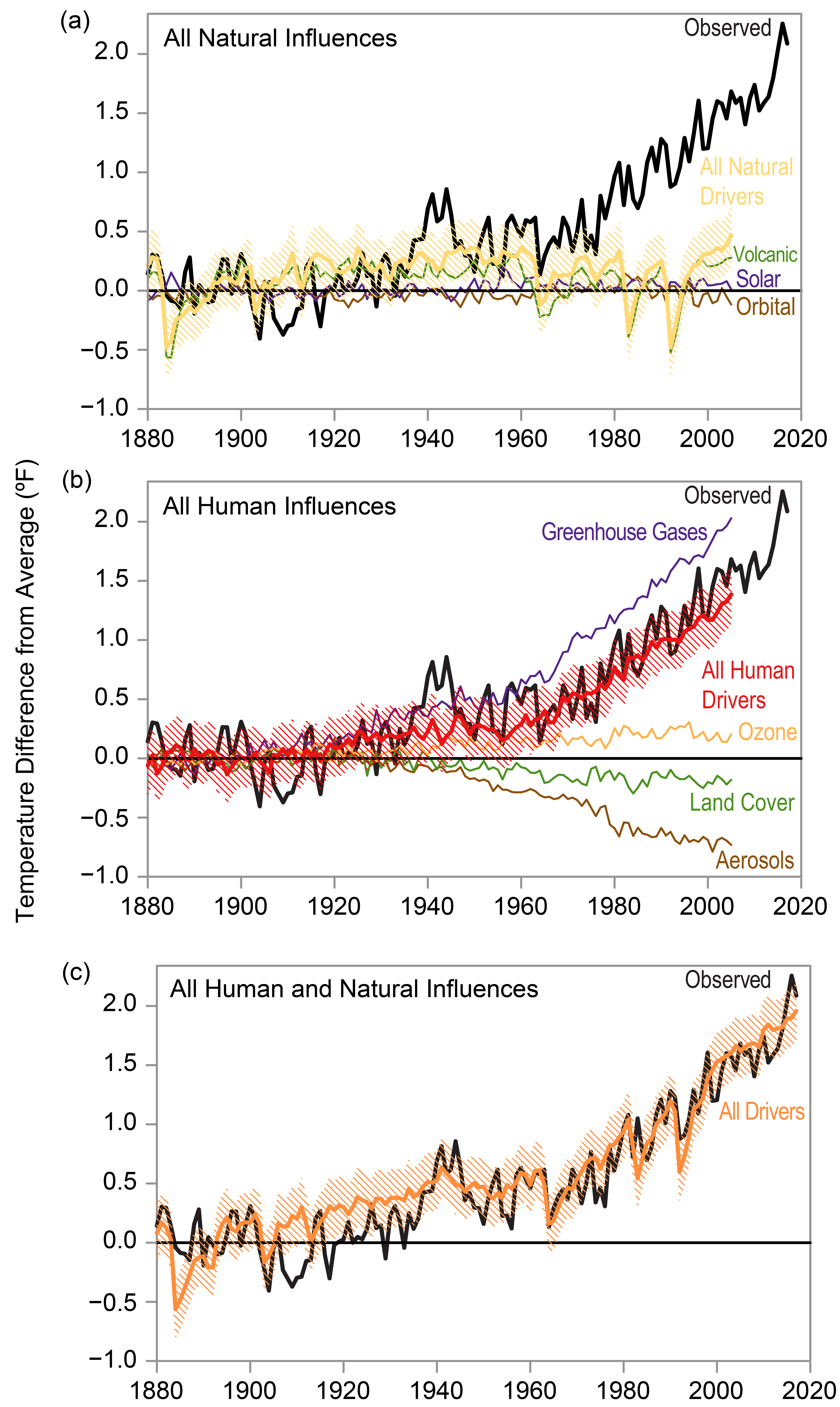
These took out much of the heat from greenhouse gasses. And in my opinion you either buy the climate change models (which are very aware of aerosols), or you don't. It doesn't make sense to believe that the planet will heat up more, that it is due to humans, but aerosols are not a part of the story.
We're not as screwed as many people think.
Even if climate change is nonsense (it isn't) it still makes sense to get off energy sources that are known to destroy air quality. This should be common sense to anybody, who likes smog?
This said some of the talk that I've been hearing recently has me concerned for peoples' mental well being. I've heard numerous peers and coworkers in the past year express belief that they would not live long enough to have grandchildren because humanity will be extinct by then. That we have 20 years or less of life, that the situation is doomed, etc. None of this is a healthy mindset.
This said some of the talk that I've been hearing recently has me concerned for peoples' mental well being. I've heard numerous peers and coworkers in the past year express belief that they would not live long enough to have grandchildren because humanity will be extinct by then. That we have 20 years or less of life, that the situation is doomed, etc. None of this is a healthy mindset.
Yup, climate change is real - it's evident from computing average temperatures. No point in debating that.
I completely agree that smog is terrible and essentially kills people. My point was the really bad consequences of warming (mass migrations from deserted areas and subsequent refugee crises, wars over farmable land, exodus from flooded areas) can be avoided via aerosols.
I completely agree that smog is terrible and essentially kills people. My point was the really bad consequences of warming (mass migrations from deserted areas and subsequent refugee crises, wars over farmable land, exodus from flooded areas) can be avoided via aerosols.
But the source of the warming should be completely open for debate. I for one am looking at the sun as the source, starting with the sunspot maximum event of 1958 that sparked the US government to create Nasa.
Why is that a productive debate? Even if CO2 is not the source, we should still eliminate our reliance on the combustion of fossil fuels because those fuel sources still undeniably pollute our environment in other serious ways. The mining and burning of coal is bad for our environment even if CO2 was a non-issue.
For me, it's about the truth and I'm pretty tired of being dismissed because I dont agree with the anti-human narrative that's becoming the mainstream.
I don't get how you jumped to that last sentence. The way I read what you wrote is that we'd have been screwed earlier without aerosols, but that our current models account for them and still show us being screwed.
My point is that we can deploy more aerosols. See the first link
The populations of developed countries don't understand how much it would hurt their quality of life if they do what it takes to solve this problem. Once they have put up with enough pain, the unrest will make the "yellow jacket" protests in France look routine. Who knows what kind of crazy people would get elected by promising to stop the pain.
The "yellow jacket" protests were a response to tax increases on fuel as part of the government's strategy to reduce emissions. They ballooned into a general airing of grievances about inequality, economic justice, the cost of living, and populist anti-establishment sentiment. Policies to limit emissions in other countries would likely have the same result, because the same sentiments exist throughout the developed world and are behind the global rise of populism.