Why We Stink at Tackling Climate Change(nautil.us)
nautil.us
Why We Stink at Tackling Climate Change
http://nautil.us/issue/69/patterns/why-we-stink-at-tackling-climate-change
65 comments
I have a question on climate change: what's the most accurate prediction for the climate in 2050 at the current rate things are going?
As in, are there predictions in temperature that have been made based on current models that we will hit by 2050 that we can measure in 2050 to see if the models are correct? Have such predictions been made before for, say, 2020 or 2030?
I don't dispute climate change, but my belief in it rests on authorities telling me it's true. It's not based on anything I myself could look at. I'd love to hear some predictions made now or in the past that we could observe whether they're true in the future.
As in, are there predictions in temperature that have been made based on current models that we will hit by 2050 that we can measure in 2050 to see if the models are correct? Have such predictions been made before for, say, 2020 or 2030?
I don't dispute climate change, but my belief in it rests on authorities telling me it's true. It's not based on anything I myself could look at. I'd love to hear some predictions made now or in the past that we could observe whether they're true in the future.
The IPCC (International Panel on Climate Change) is the generally considered the best source on climate change science. They have a nice graph of how things can go based on various amounts of sequestered carbon being injected into the carbon cycle.
Graph: https://www.ipcc.ch/site/assets/uploads/2018/02/SPM.05-01-1....
Report: https://www.ipcc.ch/report/ar5/syr/
It basically shows that if you assume we keep pulling carbon out of the ground (e.g. extracting and burning fossil fuels) we'll end up at +4.5C increase. That kind of change is likely an human extinction-level event (e.g. https://xkcd.com/1379/). The Paris agreements call for a max of +2C, which means we can only pull up about 25% of proven fossil reserves.
So we're going to have to leave 75% of proven fossil reserves in the ground. There's actually a term for this called the "Carbon Bubble", and it's expected to decimate the oil majors and sovereign oil and gas since most of their proven reserves on their balance sheets are going to end up being stranded. https://en.wikipedia.org/wiki/Carbon_bubble
Graph: https://www.ipcc.ch/site/assets/uploads/2018/02/SPM.05-01-1....
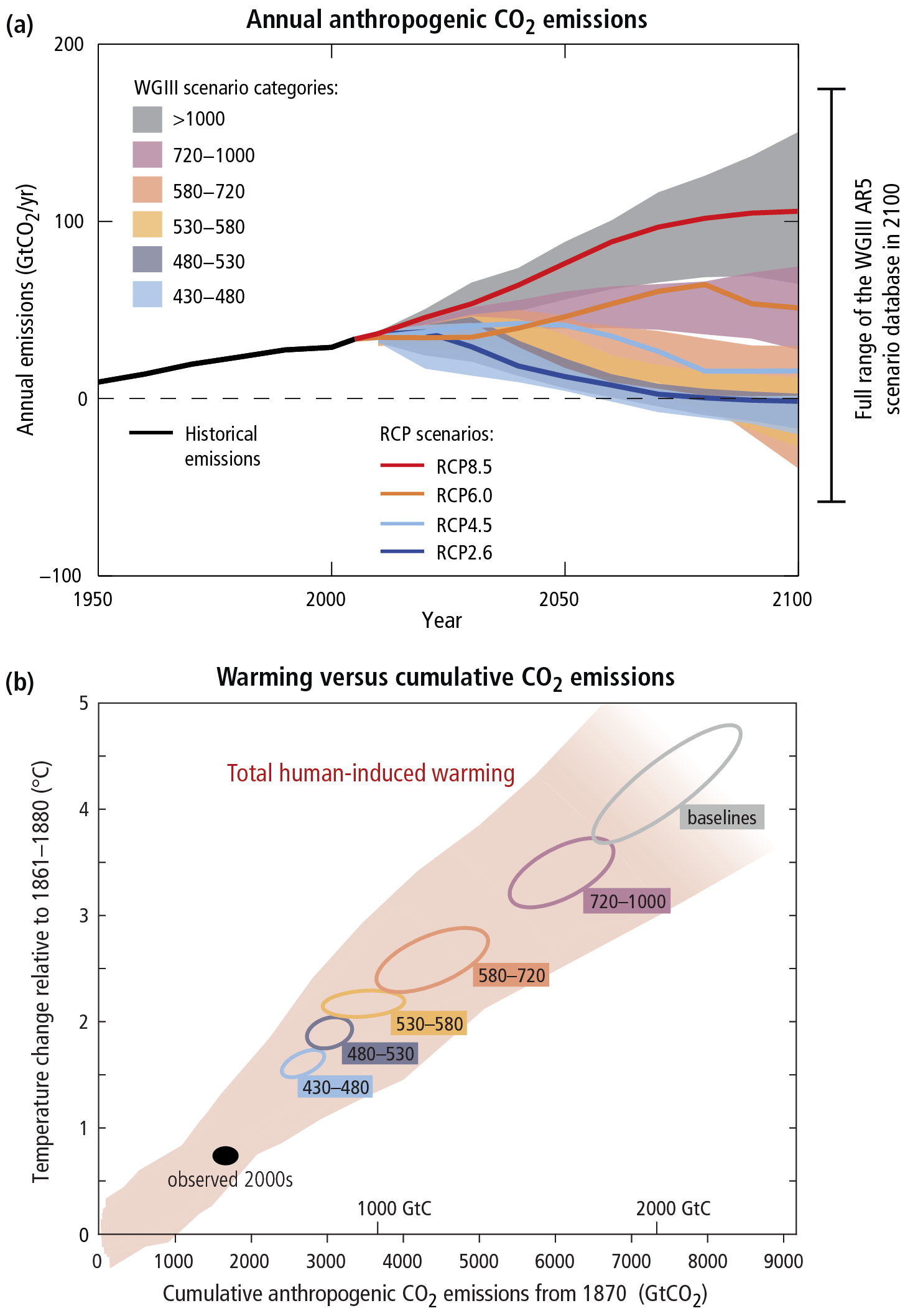
Report: https://www.ipcc.ch/report/ar5/syr/
It basically shows that if you assume we keep pulling carbon out of the ground (e.g. extracting and burning fossil fuels) we'll end up at +4.5C increase. That kind of change is likely an human extinction-level event (e.g. https://xkcd.com/1379/). The Paris agreements call for a max of +2C, which means we can only pull up about 25% of proven fossil reserves.
So we're going to have to leave 75% of proven fossil reserves in the ground. There's actually a term for this called the "Carbon Bubble", and it's expected to decimate the oil majors and sovereign oil and gas since most of their proven reserves on their balance sheets are going to end up being stranded. https://en.wikipedia.org/wiki/Carbon_bubble
> have to leave 75% of proven fossil reserves in the ground.
To nitpick, I think you mean burn them. Oil into plastics has minimal emissions.
To nitpick, I think you mean burn them. Oil into plastics has minimal emissions.
Correct, but plastics and other non-burned uses only accounts for <10% of oil and gas. So you'd have to 10x the number of petrochemical products to make up for the decrease in burned product. Plastics are a pretty mature industry, so 10x is well outside the range of what's possible.
> Why not turn the fatalism and anxiety you feel into a paycheck?
I don't want to sound mean, but the only anxiety I am beginning to feel lately is that more and more people are turning to fighting a gas that all of us exhale, some of them fanatically and violently, and they seem to ultimately agree that we must wind down the economy to beat it. I don't want to lose everything that gave us wealth, progress, medical breakthroughs and freedom for the sole reason that some people are afraid of a warmer climate.
So, what do I do about it?
I don't want to sound mean, but the only anxiety I am beginning to feel lately is that more and more people are turning to fighting a gas that all of us exhale, some of them fanatically and violently, and they seem to ultimately agree that we must wind down the economy to beat it. I don't want to lose everything that gave us wealth, progress, medical breakthroughs and freedom for the sole reason that some people are afraid of a warmer climate.
So, what do I do about it?
> I don't want to lose everything that gave us wealth, progress, medical breakthroughs and freedom for the sole reason that some people are afraid of a warmer climate
There were some/articles studies that were putting part of the “blame” for the recent Syrian Civil War on climate change (as far as I remember increased aridity caused by climate change had forced many rural Syrians onto the cities where they couldn’t all find jobs, hence the conflict) and as such I’m pretty sure that future climate change-induced wars will take care of our “wealth, progress and medical breakthroughs” unless we manage to somehow slow the rate of change.
There were some/articles studies that were putting part of the “blame” for the recent Syrian Civil War on climate change (as far as I remember increased aridity caused by climate change had forced many rural Syrians onto the cities where they couldn’t all find jobs, hence the conflict) and as such I’m pretty sure that future climate change-induced wars will take care of our “wealth, progress and medical breakthroughs” unless we manage to somehow slow the rate of change.
I think this comment is being unfairly downvoted. I believe a lot of so-called environmentalists are actually opposed to civilization, and would prefer if humanity reverted to a hunter-gatherer lifestyle. This is more "natural", and humans are generally happier living like that, so it's not a totally ridiculous idea. The main drawback is that it would require the deaths of billions, but by their revealed preferences, it seems a lot of environmentalists are actually okay with this. Why else would they oppose the only proven solution that could bring CO2 emissions to zero in time to limit the damage to something survivable?: nuclear power.
I think climate change is the biggest current threat to humanity, and almost nobody is taking it as seriously as they should. Even the ongoing protests in London are a massive under-reaction. But how many of those environmentalists actually support a solution that isn't "wind down the economy?" Germany began a complete shutdown their nuclear power plants in response to a reactor containment failure in Japan that killed nobody directly, and even with the worst case assumptions, statistically caused few hundred excess cancer deaths at most. This is 0% of the deaths that will be caused when one of the alternative "wind down the economy" or "uncontrolled temperature rise" plans triggers World War 3.
I think climate change is the biggest current threat to humanity, and almost nobody is taking it as seriously as they should. Even the ongoing protests in London are a massive under-reaction. But how many of those environmentalists actually support a solution that isn't "wind down the economy?" Germany began a complete shutdown their nuclear power plants in response to a reactor containment failure in Japan that killed nobody directly, and even with the worst case assumptions, statistically caused few hundred excess cancer deaths at most. This is 0% of the deaths that will be caused when one of the alternative "wind down the economy" or "uncontrolled temperature rise" plans triggers World War 3.
It's wrong to assume that those of us fighting climate change are anti-nuclear. The only reason I didn't include nuclear in my parent comment is because it isn't currently competitive with either clean or dirty energy sources.
Solar and wind plus storage is way cheaper than nuclear (and that gap is widening over time, not shrinking), so there's not much reason to include it in a pitch for getting a job fighting climate change unless the audience is primarily PhD physicists and researchers.
Solar and wind plus storage is way cheaper than nuclear (and that gap is widening over time, not shrinking), so there's not much reason to include it in a pitch for getting a job fighting climate change unless the audience is primarily PhD physicists and researchers.
> I think climate change is the biggest current threat to humanity, and almost nobody is taking it as seriously as they should.
Here I disagree. We're trying to colonise Mars, but at the same time believe a somewhat warmer climate is an existential threat to humanity. How is that logical?
Climate change will not destroy humanity, civilisation, or even the planet. We will adapt easily. Look to the 20th century for examples of actual threats to humanity...
> This is 0% of the deaths that will be caused when one of the alternative "wind down the economy" or "uncontrolled temperature rise" plans triggers World War 3
Exactly, only that these aren't the only possible triggers for a WW3.
Here I disagree. We're trying to colonise Mars, but at the same time believe a somewhat warmer climate is an existential threat to humanity. How is that logical?
Climate change will not destroy humanity, civilisation, or even the planet. We will adapt easily. Look to the 20th century for examples of actual threats to humanity...
> This is 0% of the deaths that will be caused when one of the alternative "wind down the economy" or "uncontrolled temperature rise" plans triggers World War 3
Exactly, only that these aren't the only possible triggers for a WW3.
> We're trying to colonise Mars, but at the same time believe a somewhat warmer climate is an existential threat to humanity.
That’s an interesting non sequitur. How does the potential for colonization of Mars say anything about how big of a threat climate change is?
That’s an interesting non sequitur. How does the potential for colonization of Mars say anything about how big of a threat climate change is?
> That’s an interesting non sequitur.
I'll have to write it in a more straightforward manner, since it's apparently a non sequitur if you don't understand it: if we are optimistic about living on a planet as hostile as Mars, how can we be pessimistic about surviving a temperature increase of a few degrees on Earth?
I'll have to write it in a more straightforward manner, since it's apparently a non sequitur if you don't understand it: if we are optimistic about living on a planet as hostile as Mars, how can we be pessimistic about surviving a temperature increase of a few degrees on Earth?
That is a very superficial comparison between two problems that are fundamentally different, especially with regards to what’s at stake.
Going to Mars has no deadline, and barely any stakes. If it proves practically unachievable, it’s a failed dream, or maybe just an indefinitely delayed dream; no big deal. Earth is already inhabited by millions of species, and if it becomes even one percent less hospitable, that’s an existential crisis.
Going to Mars has no deadline, and barely any stakes. If it proves practically unachievable, it’s a failed dream, or maybe just an indefinitely delayed dream; no big deal. Earth is already inhabited by millions of species, and if it becomes even one percent less hospitable, that’s an existential crisis.
> Earth is already inhabited by millions of species, and if it becomes even one percent less hospitable, that’s an existential crisis.
No, it's not. This is just the typical scaremongering and dramatisation I'm getting so tired of. Every populated region on Earth becomes much more than one percent less hospitable every winter and there is no crisis, especially not an existential one. We can cope very well with minor changes in weather and climate and we will. Stop obsessing about climate doom scenarios, it's silly.
No, it's not. This is just the typical scaremongering and dramatisation I'm getting so tired of. Every populated region on Earth becomes much more than one percent less hospitable every winter and there is no crisis, especially not an existential one. We can cope very well with minor changes in weather and climate and we will. Stop obsessing about climate doom scenarios, it's silly.
> Every populated region on Earth becomes much more than one percent less hospitable every winter
No, winter is part of the baseline. Life has evolved to to survive during winter, and societies have been built to handle it. We do not have ecosystem collapses or widespread climate refugees every winter. Permanent and unprecedented changes cause completely different problems than a few months of winter.
No, winter is part of the baseline. Life has evolved to to survive during winter, and societies have been built to handle it. We do not have ecosystem collapses or widespread climate refugees every winter. Permanent and unprecedented changes cause completely different problems than a few months of winter.
You're setting up an imaginary strawman. I grew up in the 80s in one of the most environmentalist households you could imagine. My mother was a local politician for the German Green Party, everything was ecological and fair trade in our household, from the food to everything else. She was fighting for windmills, against cars, etc. Our bread was baked by an ecological farmer with a long beard, for some time we fetched the milk directly from a local farmer, and so on. We participated in marches for peace and the protection of the environment, my mother helped voluntarily in the local fair trade shop ("3rd World Shop").
So I've had plenty of experiences with environmentalists over my life and heard many crazy stories, e.g. one of her friends really thought that honey is harmless for children but sugar essentially poison.
Despite all this, even the most radical and craziest person I've ever heard of does not fit the description of an environmentalist that you attribute to this subculture as a whole. There are radicals like VHEMT but these are in a ridiculously small minority. The vast majority of all environmentalist believe that it is perfectly possible for a large number of humans on earth to life in harmony together with nature while sustaining high standards of living. It's all about reasonable consumption and studying ecological lifetime calculations of products.
Where I grew up, Swabia in Germany, is a pretty good example of reasonable & realistic environmental politics. I used to make fun of many of her claims, proudly eating my bacon sandwich and visiting by plane, but it turns out in retrospective that she and her friends were right about most of the issues that most of the things my mother has been fighting for are now in the party programs of all major parties.
So I've had plenty of experiences with environmentalists over my life and heard many crazy stories, e.g. one of her friends really thought that honey is harmless for children but sugar essentially poison.
Despite all this, even the most radical and craziest person I've ever heard of does not fit the description of an environmentalist that you attribute to this subculture as a whole. There are radicals like VHEMT but these are in a ridiculously small minority. The vast majority of all environmentalist believe that it is perfectly possible for a large number of humans on earth to life in harmony together with nature while sustaining high standards of living. It's all about reasonable consumption and studying ecological lifetime calculations of products.
Where I grew up, Swabia in Germany, is a pretty good example of reasonable & realistic environmental politics. I used to make fun of many of her claims, proudly eating my bacon sandwich and visiting by plane, but it turns out in retrospective that she and her friends were right about most of the issues that most of the things my mother has been fighting for are now in the party programs of all major parties.
We exhale it because it's bad for us, and it's not the only thing in the fight against climate change.
The point isn't to wind down the economy to beat it, it's to find alternate ways of keeping the economy going while beating it. Green energy solutions are not winding down the economy, if anything it is supplementing it.
The point isn't to wind down the economy to beat it, it's to find alternate ways of keeping the economy going while beating it. Green energy solutions are not winding down the economy, if anything it is supplementing it.
>We exhale it because it's bad for us
Off-topic in the context of climate change, but that's an oversimplification at best. Not enough CO2 in the body will kill you just as readily as too much.
Off-topic in the context of climate change, but that's an oversimplification at best. Not enough CO2 in the body will kill you just as readily as too much.
Germany's worst week in 2018 in terms of wind and sunshine had 27.6% of it's electricity produced without emitting greenhouse gases. Compare that to 45% of the total energy in the entire year being generated with zero carbon sources. 27.6% is 60% of the annualized renewable share. In other words even in the 5 worst weeks a year our economy only has to shrink down by 40% if seasonal storage beyond a week is impossible.
You are assuming that the economy can smoothly scale down with energy restriction. In reality, everything is highly optimized, with "just in time" supply chains with little safety margin. Once energy demand greatly exceeds supply, the whole system collapses.
And most transport and heating does not use electricity, so the problem is actually worse than 27.6% of normal supply.
And most transport and heating does not use electricity, so the problem is actually worse than 27.6% of normal supply.
“Only” 40%? That’s basically peak to trough Greece!
Do you want to do something about it?
Then a good way to proceed would probably to study why we are all freaking out. The basics for why too much CO2 is a problem are actually quite simple and might be accessible to you experimentally if you so choose.
(What the exact consequences are is more complicated and we have uncertainties on the results, so that might be harder.)
edit: (While some of the models are actually open-source and you can download them, running and understanding them in a useful manner is a full-time job.)
Then a good way to proceed would probably to study why we are all freaking out. The basics for why too much CO2 is a problem are actually quite simple and might be accessible to you experimentally if you so choose.
(What the exact consequences are is more complicated and we have uncertainties on the results, so that might be harder.)
edit: (While some of the models are actually open-source and you can download them, running and understanding them in a useful manner is a full-time job.)
What is the relationship between burning fossil fuels and medical breakthrough, wealth and progress?
So you don't care about it because you don't care about the people as well as species that are already impacted by climate change? Just because you're afraid of having to change your lifestyle? What you should do about it is maybe stop freaking out first about your lifestyle, progress doesn't require screwing climate....
So you don't care about it because you don't care about the people as well as species that are already impacted by climate change? Just because you're afraid of having to change your lifestyle? What you should do about it is maybe stop freaking out first about your lifestyle, progress doesn't require screwing climate....
Nothing? If you don't believe in climate change or believe we should be fighting it, then please get out of the way.
The energy transition is a bigger economic opportunity that the Internet (Bloomberg estimates it at something like $10+ trillion). So you doing nothing is more money for me. Thanks I guess?
The energy transition is a bigger economic opportunity that the Internet (Bloomberg estimates it at something like $10+ trillion). So you doing nothing is more money for me. Thanks I guess?
> The energy transition is a bigger economic opportunity that the Internet (Bloomberg estimates it at something like $10+ trillion). So you doing nothing is more money for me. Thanks I guess?
So where exactly do you think this money is coming from? It'll come out of your pocket (and mine) due to laws that force us to invest in new technology.
So where exactly do you think this money is coming from? It'll come out of your pocket (and mine) due to laws that force us to invest in new technology.
Well, for my company, the money is coming from homeowners and business owners buying clean energy products (solar, batteries, EVs, etc.). They are choosing to buy these new technologies because they want to.
I noticed you didn't really address my core assumption that you don't believe in climate change. So you don't think it's a problem, right? Can you talk a little more about from where you derive that conclusion? It's so rare nowadays to hear someone straight up deny climate change is a problem when there's so much scientific and economic analysis saying the opposite.
I noticed you didn't really address my core assumption that you don't believe in climate change. So you don't think it's a problem, right? Can you talk a little more about from where you derive that conclusion? It's so rare nowadays to hear someone straight up deny climate change is a problem when there's so much scientific and economic analysis saying the opposite.
> They are choosing to buy these new technologies because they want to.
So do I, I have no issues with that. I bought a Tesla Model S 2 years ago because I don't like noise and pollution and it's a cool car. This has nothing to do with buying "to save the planet" or mandated CO2 reductions and EV quotas though, which is what is coming soon and I oppose.
> I noticed you didn't really address my core assumption that you don't believe in climate change.
Why do you make such assumptions? To discredit and offend someone you are discussing with?
> It's so rare nowadays to hear someone straight up deny climate change
It can't be so rare if you accuse people of doing this all the time.
So do I, I have no issues with that. I bought a Tesla Model S 2 years ago because I don't like noise and pollution and it's a cool car. This has nothing to do with buying "to save the planet" or mandated CO2 reductions and EV quotas though, which is what is coming soon and I oppose.
> I noticed you didn't really address my core assumption that you don't believe in climate change.
Why do you make such assumptions? To discredit and offend someone you are discussing with?
> It's so rare nowadays to hear someone straight up deny climate change
It can't be so rare if you accuse people of doing this all the time.
Hmmm, HN is limiting our thread depth, so can you please email me at my email in my profile? I'd like to continue the conversation and learn more about your point of view.
Well i sure as hell hope so. I would love the money being taken from us actually fund something i care about and that will benefit everyone, instead of wasting it on stupid crap.
The internet showed what value is produced by ramping up communications orders of magnitude in bandwidth beyond what was previously possible. At this point our bottleneck for value is energy, not communication
Solar energy doesn't have to worry about entropy: energy from the sun is beating down on us whether we tap it or not. The money will come from the fact that energy produces value. Renewables have been progressing over the past decades to compete with existing carbon infrastructure. To suggest renewables are only hoisted up by policy is to disregard that the oil industry is heavily subsidized & the states currently has a president who will claim "clean beautiful coal"
Solar energy doesn't have to worry about entropy: energy from the sun is beating down on us whether we tap it or not. The money will come from the fact that energy produces value. Renewables have been progressing over the past decades to compete with existing carbon infrastructure. To suggest renewables are only hoisted up by policy is to disregard that the oil industry is heavily subsidized & the states currently has a president who will claim "clean beautiful coal"
https://www.manhattan-institute.org/green-energy-revolution-...
It is indeed magical thinking. "$200,000 worth of Tesla batteries, which collectively weigh over 20,000 pounds, are needed to store the energy equivalent of one barrel of oil. A barrel of oil, meanwhile, weighs 300 pounds and can be stored in a $20 tank. Those are the realities of today’s lithium batteries. Even a 200% improvement in underlying battery economics and technology won’t close such a gap."
Meanwhile the battery industry currently uses 42 percent of global cobalt production, a critical metal for Lithium-ion cells. 70% comes from the Congo where kids do their bit against 'climate change'.
https://www.cbsnews.com/news/cobalt-children-mining-democrat...
It is indeed magical thinking. "$200,000 worth of Tesla batteries, which collectively weigh over 20,000 pounds, are needed to store the energy equivalent of one barrel of oil. A barrel of oil, meanwhile, weighs 300 pounds and can be stored in a $20 tank. Those are the realities of today’s lithium batteries. Even a 200% improvement in underlying battery economics and technology won’t close such a gap."
Meanwhile the battery industry currently uses 42 percent of global cobalt production, a critical metal for Lithium-ion cells. 70% comes from the Congo where kids do their bit against 'climate change'.
https://www.cbsnews.com/news/cobalt-children-mining-democrat...
Cobalt is not a critical metal for all lithium-ion cells, only for maximum energy density lithium-ion cells. If you're willing to sacrifice energy density you can use lithium iron phosphate instead, which is also safer and more durable. BYD Auto, the Chinese company behind the great success of electric buses in China (preventing more CO2 emissions than electric cars) uses lithium iron phosphate.
I feel like at this point it is a political and capitalism problem. We could start impacting global temperature within a week if we actually wanted to fix the issue[1], but a number of industries whose business models basically guarantee they will contribute to climate change won't permit that. Those same companies then lobby congress, etc.
If we had the scenario where we told world governments and corporations that the tipping point of no return is in one month, and if we don't do anything the planet is dead in 50 years, what could we do? If we said (just making these up): 1) limit flights to weekdays; 2) limit cruise ships [2]; 3) companies must allow remote work to reduce commutes. (I'm sure someone can and will come up with better examples). Can you imagine the blowback from airlines, etc? I imagine they will find some way to justify not participating, even though it literally means the death of the planet.
We have the technology and the know-how, it just isn't stronger than the pathological greed of corporations.
[1] https://www.bbc.co.uk/blogs/climatechange/2009/05/911_contra... [2] https://www.vox.com/the-goods/2018/11/15/18096925/cruise-env...
If we had the scenario where we told world governments and corporations that the tipping point of no return is in one month, and if we don't do anything the planet is dead in 50 years, what could we do? If we said (just making these up): 1) limit flights to weekdays; 2) limit cruise ships [2]; 3) companies must allow remote work to reduce commutes. (I'm sure someone can and will come up with better examples). Can you imagine the blowback from airlines, etc? I imagine they will find some way to justify not participating, even though it literally means the death of the planet.
We have the technology and the know-how, it just isn't stronger than the pathological greed of corporations.
[1] https://www.bbc.co.uk/blogs/climatechange/2009/05/911_contra... [2] https://www.vox.com/the-goods/2018/11/15/18096925/cruise-env...
Do you know of any jobs in software related to this, or where one could start searching for such?
Sure!
Most distributed battery storage (Stem, Advanced Microgrid, etc.) and building energy management companies (Carbon Lighthouse, Siemens, etc.) have software divisions that focus on data analysis tools for their customers (think energy dashboards and reports). Also, most grid operators (CAISO, etc.), utilities (PG&E, etc.), and utility vendors (AutoGrid, etc.) have software and data analysis divisions that focus on figuring out how we can keep the grid running while ramping up renewables. Finally, regulators (Dept of Energy, public utility commissions, city managers, etc.) are in desperate need of software and data science talent to help them understand all this new energy advancements that are going on (often at policy hearings utilities are saying one technical thing, distributed energy companies are saying another technical thing, and the panel of regulators have no idea what the technical implications of all this back-and-forth is).
Hope that helps! In addition to the (A) and (B) suggestions in my parent comment, you can try searching typical software job boards (Indeed, etc.) for your language of choice + keywords (clean energy, solar, renewables, smart grid, climate change, etc.). For example, "python solar" in San Francisco returns a bunch of results on indeed.com.
Most distributed battery storage (Stem, Advanced Microgrid, etc.) and building energy management companies (Carbon Lighthouse, Siemens, etc.) have software divisions that focus on data analysis tools for their customers (think energy dashboards and reports). Also, most grid operators (CAISO, etc.), utilities (PG&E, etc.), and utility vendors (AutoGrid, etc.) have software and data analysis divisions that focus on figuring out how we can keep the grid running while ramping up renewables. Finally, regulators (Dept of Energy, public utility commissions, city managers, etc.) are in desperate need of software and data science talent to help them understand all this new energy advancements that are going on (often at policy hearings utilities are saying one technical thing, distributed energy companies are saying another technical thing, and the panel of regulators have no idea what the technical implications of all this back-and-forth is).
Hope that helps! In addition to the (A) and (B) suggestions in my parent comment, you can try searching typical software job boards (Indeed, etc.) for your language of choice + keywords (clean energy, solar, renewables, smart grid, climate change, etc.). For example, "python solar" in San Francisco returns a bunch of results on indeed.com.
Just watched this documentary by David Attenborough [1] the other day. It's unfortunate that still to this day, scientists and researches have to emphasize the phrase 'climate change'.
It's sickening to know that rainforests are being bulldozed off by their hundreds of square kilometers every single day. And it's even more sickening that many think 'reforestation' is going to help this cause.
Rainforests are an ecosystem with thousands of different plants and trees, which contribute to a healthy and flourishing environment. Thinking that you can replace this with a few different species is not the way to approach this problem.
We really have to start looking at these issues from an individual point of view. We have to consider the fact that it might be our individual behavior that's going to inspire change in others.
World's Elite has proven time and time again that they do not care for the planet, not unless there is big money involved.
[1]: https://www.bbc.com/news/entertainment-arts-47988337
It's sickening to know that rainforests are being bulldozed off by their hundreds of square kilometers every single day. And it's even more sickening that many think 'reforestation' is going to help this cause.
Rainforests are an ecosystem with thousands of different plants and trees, which contribute to a healthy and flourishing environment. Thinking that you can replace this with a few different species is not the way to approach this problem.
We really have to start looking at these issues from an individual point of view. We have to consider the fact that it might be our individual behavior that's going to inspire change in others.
World's Elite has proven time and time again that they do not care for the planet, not unless there is big money involved.
[1]: https://www.bbc.com/news/entertainment-arts-47988337
You seem to be conflating two different issues.
Eliminating plant and animal diversity is dangerous for various reasons, but has little to do with climate change.
As to deforestation as a mechanism of CO2 removal vis a vis climate change, there are more trees now than there have ever been.
Eliminating plant and animal diversity is dangerous for various reasons, but has little to do with climate change.
As to deforestation as a mechanism of CO2 removal vis a vis climate change, there are more trees now than there have ever been.
Ignorance is bliss!
reforestation has been ongoing at a massive scale for quite a while now - I drove on a motorway for days across Brazil, for example, and only saw forests of trees lined in perfect rows by the road.
Despite the misanthropic title, the article ends on a positive note:
> Thanks to our cultural evolution, we have cities, houses, and indoor plumbing. As a result, to the benefit of our health, we learned to use toilets. A primate with such behavioral flexibility, capable of going against millennia of natural selection, is nearly miraculous, yet an everyday event. Take heart. An originally arboreal primate species capable of being toilet-trained should also be capable of becoming planet-trained. In Aesop’s tale, remember, the tortoise triumphs. Because the hare and the tortoise are both part of ourselves, they can only win or lose together, which makes it all the more important that we get our hare-brained selves under control.
Personally, I find these heartening perspectives better than the pessimistic ones. And I have found that presenting such views to less informed friends makes them more motivated to take action and limit their consumption rather than the doom and gloom perspective.
> Thanks to our cultural evolution, we have cities, houses, and indoor plumbing. As a result, to the benefit of our health, we learned to use toilets. A primate with such behavioral flexibility, capable of going against millennia of natural selection, is nearly miraculous, yet an everyday event. Take heart. An originally arboreal primate species capable of being toilet-trained should also be capable of becoming planet-trained. In Aesop’s tale, remember, the tortoise triumphs. Because the hare and the tortoise are both part of ourselves, they can only win or lose together, which makes it all the more important that we get our hare-brained selves under control.
Personally, I find these heartening perspectives better than the pessimistic ones. And I have found that presenting such views to less informed friends makes them more motivated to take action and limit their consumption rather than the doom and gloom perspective.
> And I have found that presenting such views to less informed friends makes them more motivated to take action and limit their consumption rather than the doom and gloom perspective.
I dunno. I for one is getting a little tired of all these optimistic endings. It almost sounds like - hey, nothing to worry about, the problem will solve itself. Renewables are getting cheaper and if you just skip one day a week of eating meat then everything will be just fine.
And then you look at the PPM chart and it just keeps going up.
Social science is saying that scaring people doesn't work and I don't understand why. Don't we have the loss aversion? [0]
[0] https://en.wikipedia.org/wiki/Loss_aversion
I dunno. I for one is getting a little tired of all these optimistic endings. It almost sounds like - hey, nothing to worry about, the problem will solve itself. Renewables are getting cheaper and if you just skip one day a week of eating meat then everything will be just fine.
And then you look at the PPM chart and it just keeps going up.
Social science is saying that scaring people doesn't work and I don't understand why. Don't we have the loss aversion? [0]
[0] https://en.wikipedia.org/wiki/Loss_aversion
One of the reasons people are bad at tackling something like the changing climate is that the subject has been turned into something closely resembling a religion and as such has gained adherents spreading the true faith and detractors denying it, with almost no sane discussion being possible between the two. This is a sad state of things as it leads to totally illogical actions on both sides. Combine this with the clear and present danger from commercial interests trying to gain from either keeping the status quo or from selling new and often largely unproven - or even proven ineffective - ways to 'fight climate change' and the stage was set for the current situation.
This situation has occurred earlier in history, an example being the attitude towards nuclear power. While some point at the accidents in Three Miles Island, Chernobyl and Fukushima as examples of why nuclear power is the spawn of Satan and should be banished from this earth, others see those same accidents in the light of the stalled development of nuclear technology due to the actions of those who do everything to stall those developments leading to ancient reactors being kept on-line because their successors have been stalled or cancelled.
This situation has occurred earlier in history, an example being the attitude towards nuclear power. While some point at the accidents in Three Miles Island, Chernobyl and Fukushima as examples of why nuclear power is the spawn of Satan and should be banished from this earth, others see those same accidents in the light of the stalled development of nuclear technology due to the actions of those who do everything to stall those developments leading to ancient reactors being kept on-line because their successors have been stalled or cancelled.
So I have a really serious question. I'm not a denier/skeptic. I just like to look at things logically and pose questions.
Over the next 50 years these 3 things will occur:
1) Only electric vehicles on the ground, air and water
2) All meat for consumption grown in the lab, no farm animals raised
3) No coal plants
Won't this eliminate all major types of pollution?
If at this point, the planet still keeps warming? What are "they" going to blame it on then?
It's quite easy to see this is where technology is going. But yet I never hear anything about it. Just we have 10/12 years until we all die.
Also please don't just down vote me. I'm interested in knowing if there are cycles in warming due to the earth or the sun. I have come across youtube videos and articles that we are in-line for another ice age. I just wonder, if we'll ever get to a peak warm, will it reverse and we'll start cooling rapidly?
Over the next 50 years these 3 things will occur:
1) Only electric vehicles on the ground, air and water
2) All meat for consumption grown in the lab, no farm animals raised
3) No coal plants
Won't this eliminate all major types of pollution?
If at this point, the planet still keeps warming? What are "they" going to blame it on then?
It's quite easy to see this is where technology is going. But yet I never hear anything about it. Just we have 10/12 years until we all die.
Also please don't just down vote me. I'm interested in knowing if there are cycles in warming due to the earth or the sun. I have come across youtube videos and articles that we are in-line for another ice age. I just wonder, if we'll ever get to a peak warm, will it reverse and we'll start cooling rapidly?
You think the planet reaches equilibrium a day after we stop emitting? There's quite a bit of heat capacity at planetary scale.
Current anthropogenic emissions may be causing melting of glaciers and warming for decades or hundreds of years to come. Chances are "they" will continue to accurately blame the 20th and 21st century emissions into the 22nd and 23rd.
Current anthropogenic emissions may be causing melting of glaciers and warming for decades or hundreds of years to come. Chances are "they" will continue to accurately blame the 20th and 21st century emissions into the 22nd and 23rd.
Actually no, that would be folly. But I do expect at some point the planet will self correct.
I think that because I remember the scare of the ozone layer back in the 80s, early 90s.
Now according this article [0], in 2060 it will be completely healed.
Why can't it be said for climate change? I personally don't understand any negative connotations. I can only think it will be a positive outcome.
[0]: https://www.theguardian.com/environment/2018/nov/05/ozone-la...
I think that because I remember the scare of the ozone layer back in the 80s, early 90s.
Now according this article [0], in 2060 it will be completely healed.
Why can't it be said for climate change? I personally don't understand any negative connotations. I can only think it will be a positive outcome.
[0]: https://www.theguardian.com/environment/2018/nov/05/ozone-la...
The reason the ozone layer is healing is because "the scare" led to enactment of laws prohibiting the widespread usage of the chemicals that were destroying it. This is like saying Y2K was nothing but fear mongering.
Reading the latest ozone assessment report [0] I was reminded again how impressive that reaction really was. Between deciding this really is a problem in 1985 (Vienna Convention) and banning the problematic substances (Montreal Protocol) in 1987 there are two (2!!!) years.
And if you look at the plots eg on page ES.23 you can see the expected effects of the Kigali amendment of 2016, where the replacement gases used instead of the previously stopped ones with large climate effects were also banned.
This is the only actually positive thing I've ever seen in the context of climate change. There are at least 0.3°C saved temperature increase until 2100 due to this change.
Of course the source of that problem was simpler and easier to fix, but still, this makes me a little happier. How can we repeat this success?
[0] https://ozone.unep.org/sites/default/files/Assessment_Panel/...
And if you look at the plots eg on page ES.23 you can see the expected effects of the Kigali amendment of 2016, where the replacement gases used instead of the previously stopped ones with large climate effects were also banned.
This is the only actually positive thing I've ever seen in the context of climate change. There are at least 0.3°C saved temperature increase until 2100 due to this change.
Of course the source of that problem was simpler and easier to fix, but still, this makes me a little happier. How can we repeat this success?
[0] https://ozone.unep.org/sites/default/files/Assessment_Panel/...
> If at this point, the planet still keeps warming? What are "they" going to blame it on then?
On living beings, most of them exhale CO2. Those who are already yelling to have fewer children (https://www.theguardian.com/environment/2017/jul/12/want-to-...) will go one step further.
On living beings, most of them exhale CO2. Those who are already yelling to have fewer children (https://www.theguardian.com/environment/2017/jul/12/want-to-...) will go one step further.
These statistics are always completely flawed. They attribute all the CO2 produced by children (and their children, ad infinitum) to their parents. If the replacement rate matches exactly the fertility rate then I will produce an infinite amount of CO2 by having two children assuming they don't die before they have two children too. Currently the fertility rate is below the death rate so in the statistics the number ends up being finite and therefore looks "reasonable". Except the per capita co2 footprint in the UK is around 10 tons per citizen per year. It is impossible to save 60 tons per year.
Even if we accept this as a "reasonable" assumption there is another huge flaw with this statistic. The assumption is that your children will be average polluters. So no matter how much you reduce your own CO2 footprint your children will always produce more CO2 than you. Except if you teach your children to reduce their CO2 footprint by not driving a car you reduce your CO2 footprint by 25% and the CO2 footprint of your children too. Your footprint including descendants goes down from 70 tons to 52.5. A 17.5 ton decrease!
If you do everything in this chart except not having children (assuming an electric car) your CO2 footprint goes down by 38% down from 70 tons to 44 tons. Notably this requires almost no changes in lifestyle. Just switching to renewables is enough.
This chart is harmful, it only serves to make people feel helpless and not take action against climate change.
Even if we accept this as a "reasonable" assumption there is another huge flaw with this statistic. The assumption is that your children will be average polluters. So no matter how much you reduce your own CO2 footprint your children will always produce more CO2 than you. Except if you teach your children to reduce their CO2 footprint by not driving a car you reduce your CO2 footprint by 25% and the CO2 footprint of your children too. Your footprint including descendants goes down from 70 tons to 52.5. A 17.5 ton decrease!
If you do everything in this chart except not having children (assuming an electric car) your CO2 footprint goes down by 38% down from 70 tons to 44 tons. Notably this requires almost no changes in lifestyle. Just switching to renewables is enough.
This chart is harmful, it only serves to make people feel helpless and not take action against climate change.
At least I still blame living (human) beings for the warming.
All the CO2 they exhale got the carbon from plants, which recently pulled it from the air. Humans are carbon neutral.
> All the CO2 they exhale got the carbon from plants, which recently pulled it from the air. Humans are carbon neutral.
This would be true AFAICT if we somehow managed to eat without any CO2 emissions. But agriculture is a huge driver of CO2 emissions and so are logistics, electricity for cooking etc.. So while the CO2 we exhale comes from the atmosphere through plants, animals and so on, we inevitably cause a lot of CO2 emissions as a side-effect in the process.
This would be true AFAICT if we somehow managed to eat without any CO2 emissions. But agriculture is a huge driver of CO2 emissions and so are logistics, electricity for cooking etc.. So while the CO2 we exhale comes from the atmosphere through plants, animals and so on, we inevitably cause a lot of CO2 emissions as a side-effect in the process.
> If at this point, the planet still keeps warming? What are "they" going to blame it on then?
Gas heating ? Methane unleashed ? Ice-free arctic ? ...
Gas heating ? Methane unleashed ? Ice-free arctic ? ...
First, there's about a 30-year lag between emissions and their full heating effect, much like it takes time for water to boil after you turn on the stove.
More importantly, if we go beyond about +2 degrees C, it's likely that positive feedbacks will take over and add several more degrees, with no more help from us. Feedbacks include ice cap melt (so less sunlight is reflected away), CO2 and methane emissions from melting permafrost, and forest fires brought on by drought.
We know this is likely, because you're right about those cycles. In geological history, there have been times when orbital variations caused a small initial heating, and shortly after we see a big rise in greenhouse gases and temperature.
That's why we're worried about fixing things really soon, before that kicks in.
(We are not currently in one of those natural warming cycles, btw.)
More importantly, if we go beyond about +2 degrees C, it's likely that positive feedbacks will take over and add several more degrees, with no more help from us. Feedbacks include ice cap melt (so less sunlight is reflected away), CO2 and methane emissions from melting permafrost, and forest fires brought on by drought.
We know this is likely, because you're right about those cycles. In geological history, there have been times when orbital variations caused a small initial heating, and shortly after we see a big rise in greenhouse gases and temperature.
That's why we're worried about fixing things really soon, before that kicks in.
(We are not currently in one of those natural warming cycles, btw.)
> I'm not a denier/skeptic.
> If at this point, the planet still keeps warming? What are "they" going to blame it on then?
Who is "they"? I think you are a troll.
> If at this point, the planet still keeps warming? What are "they" going to blame it on then?
Who is "they"? I think you are a troll.
This book, a mix of research and speculation (chapter by chapter) was helpful to me in making the abstract threat of climate change real:
https://www.amazon.com/Climate-Wars-Fight-Survival-Overheats...
It will definitely change geopolitics for the foreseeable future.
https://www.amazon.com/Climate-Wars-Fight-Survival-Overheats...
It will definitely change geopolitics for the foreseeable future.
Please read the latest IPCC report it's all in there.
Politicians, being decision makers having vested interest in denying climate change is the epitome of corruption, because unlike other corruption; wealth doesn't prevent themselves or their kin from getting affected in the long run.
We stink at it for a few reasons - some covered by the article - and some not.
Primarily it is due to population in total and our habits of which generate Co2. Our houses, energy expenditure on cars, planes etc are valuable to us, and are not at all easy to change.e.g. Thing about houses designed for A/C with lots of glass. Lifecycle is 50 years.
We are over optimistic about very large infrastructure change in wind / solar and despatchable energy replacing other sources and aren’t very practical. Did someone mention nuclear or is that verboten?
It is also a distributed problem. If one country gets ‘ahead’ it incurs a cost penalty (unless you are one of the few with cheap hydro). What’s the incentive?
Many intuitively believe in climate change but want someone else to pay (doesn’t work out). Who realistically can see widespread support to cut the standard of living?
So, some problems are very hard and this is one of them. No real easy answer. This is why we stink at it. Until the pain is far more evident.
I think the actual reason is that most of the countries hardest hit (due to concievable first order effects) have mostly very low GDP. Hence the incumbents have very little immediate financial incentive to pull their weight.
"Enter global heating (a better word than “warming,” which carries misleading connotations of comfy and toasty)"
That's it. I'm gonna call it "global heating" from now on.
That's it. I'm gonna call it "global heating" from now on.
> What’s wrong with us? Not us Democrats, Republicans, or Americans
But really, Republicans, though.
> Earth is warming mostly due to human activity
> Republicans (Boomer/GenX/Millennial): 18/2x/36
> Democrats: 75
https://www.pewresearch.org/fact-tank/2018/05/14/many-republ...
But really, Republicans, though.
> Earth is warming mostly due to human activity
> Republicans (Boomer/GenX/Millennial): 18/2x/36
> Democrats: 75
https://www.pewresearch.org/fact-tank/2018/05/14/many-republ...
Republicans in the u.s. are the biggest threat to the climate because they don't think there's a problem.
So what can you do about it?
You can get a job fighting climate change! Solar, wind, batteries, and EVs are now competitive against fossil-based incumbents, so now the biggest issue is scaling them up. That means tons and tons of problem solving, which means great software and engineering jobs and startup opportunities!
If you think about it, the switch to renewables means we need to deal with situations where the sun isn't shining and the wind isn't blowing, yet still keep the lights on. That means you have to build in a ton of storage and load control and electrify as much as you can (transportation, heating, etc.). All that new infrastructure needs to have good communication and analysis, which means software! Something like half of the impact of the energy transition will be done through software optimizing the deployment and operation of clean energy assets.
I've posted about this many times[1], so please check out my previous comments on links for finding climate impact work. It's mostly about (A) browsing sector-specific conferences and looking at the expo and speakers' companies for ones that interest you, and (B) showing up to energy meetups just to meet people working in the space. If you're in the bay area, I run a calendar of all the clean energy-related events (https://bayareaenergyevents.com), so I encourage you to just start showing up :)
My favorite climate change joke is, "They say we won't act until it's too late... Luckily, it's too late!"
Why not turn the fatalism and anxiety you feel into a paycheck?
[1]: https://news.ycombinator.com/item?id=15127154