China warns India of 'reverse sanctions' if Huawei is blocked(reuters.com)
reuters.com
China warns India of 'reverse sanctions' if Huawei is blocked
https://www.reuters.com/article/us-huawei-india-exclusive/exclusive-china-warns-india-of-reverse-sanctions-if-huawei-is-blocked-sources-idUSKCN1UW1FF
150 comments
Buying 5G technology from a benign country like Finland or Sweden seems like a good strategy. Both these countries have no aspiration for world domination and have track records of honest business dealings. I don't think either Ericson or Nokia has ever been accused or guilty of spying or stealing technology.
They also have cooperated with GCHQ and the NSA.
Personally I think "the devil you know" mentality is better when considering that any Telecom tech could be compromised. Yeah everybody is probably spying, so you should get your gear from your strongest allies.
Would you rather have a friend or an enemy spying on you? That appears to be the only options now that technology has thoroughly penetrated every day life.
Another point not mentioned enough is that societies with free press are far more likely to find and report exploits/backdoors. In a country like the US you see this a lot. There's many cases of security researchers reporting possible government funded exploits against their own government. In a place like China reporting something like that would probably mean you disappear
Would you rather have a friend or an enemy spying on you? That appears to be the only options now that technology has thoroughly penetrated every day life.
Another point not mentioned enough is that societies with free press are far more likely to find and report exploits/backdoors. In a country like the US you see this a lot. There's many cases of security researchers reporting possible government funded exploits against their own government. In a place like China reporting something like that would probably mean you disappear
> Would you rather have a friend or an enemy spying on you?
A better decision rationale would be; which of the two is more likely to use their spy-data against you?
And the answer to that is without doubt; your own local spy agency, not the one operating in another country.
A better decision rationale would be; which of the two is more likely to use their spy-data against you?
And the answer to that is without doubt; your own local spy agency, not the one operating in another country.
In the long term, I'd not want my country's national security compromised by a morally bankrupt govt not subject to democracy.
Fundamentally much of what you think in this way is the direct product of propaganda from your own state. It would behoove you to investigate your own preconceptions and realise where you first got them.
It would behoove you to not guess at how I arrived at my beliefs and where I live and then claim I've got preconceptions.
I can see the facts of the Chinese government's authoritarianism, their persecution of their minority populations, and their international behavior just fine. In fact, they're so economically influential, that I find criticism of them is muted, and tolerance of their crap is high.
I can see the facts of the Chinese government's authoritarianism, their persecution of their minority populations, and their international behavior just fine. In fact, they're so economically influential, that I find criticism of them is muted, and tolerance of their crap is high.
Tolerance of US crap is high from bombing civilians with drones using CIA black sites. Putting people on no fly lists for arbiratory reasons. Incarcerating minorities are some of the things that the US government does. So when US agencies say they don't like or trust Chinese tech I understand as they probably have backdoors in a lot of the western tech and when Chinese tech is used they lose the back doors. For most countries using Chinese tech vs Western tech is choosing the spying of 1 or the other.
My answer is the group that definitely has historical and real reasons to dislike you. China doesn't like the west. Never has never will.
It's better to risk being spied on by a country where you have lots of expats working in their tech industry. Having those expats greatly increases the likelihood of someone whistleblowing in your country's favor and someone objecting to abuses in your country's favor.
There are thousands upon thousands of first and second generation Indians working in the US and UK tech industries. There are hardly any working in the Chinese tech industry.
There are thousands upon thousands of first and second generation Indians working in the US and UK tech industries. There are hardly any working in the Chinese tech industry.
There is no honest telecom company in that sense. It’s a sensitive and strategic industry.
The question is to whom you would prefer to give this strategic advantage.
Now it looks really bad at us that we are offended from an Asian player after selling our tech to them for many years (well they didn’t had other choices either)
Obviously some 5G components aren’t critical. In that case maybe we must be more open.
The question is to whom you would prefer to give this strategic advantage.
Now it looks really bad at us that we are offended from an Asian player after selling our tech to them for many years (well they didn’t had other choices either)
Obviously some 5G components aren’t critical. In that case maybe we must be more open.
What about Switzerland?
I might be wrong, but I cannot think of any prominent Swiss tech companies off the top of my head. They are way more famous for their neutral-good approach in finance, rather than in tech.
I agree with you that they are on the same level of neutral-good as Finland/Sweden when it comes to international relations in general, though.
I agree with you that they are on the same level of neutral-good as Finland/Sweden when it comes to international relations in general, though.
https://en.wikipedia.org/wiki/Logitech is Swiss-based, but they don't make 5G hardware :)
[deleted]
Do they have the equivalent of Ericsson (SE) or Nokia (FI)? I think these mobile phone tech companies was what was referred to.
Yep. Honest business dealings such as paying your debts, honoring contracts, enforcing the law, and not being a total unpredictable dick are what, historically, have made nations great.
Corrupt leadership can destroy that trust and hamstring an economy for decades, even centuries.
Corrupt leadership can destroy that trust and hamstring an economy for decades, even centuries.
Although not Ericsson, Bofors had developed some bad habits to help sales.
https://en.wikipedia.org/wiki/Bofors#Bofors_gun_scandal
https://en.wikipedia.org/wiki/Bofors#Bofors_gun_scandal
Its hard to say what makes nations great. The sovereign will always honor their commitments, until they don't :) Because how far back are we willing to go? Most states/kingdoms in Europe have always been at war and there is a long history of reneging under economic strain. (especially wars)
When an entity does not honour their commitments, the money starts going to another entity that appears more trustworthy.
I'm not sure what kind of timelines you have in mind, but the above is clear if you look at the past few hundred of years of European history. Wars, in particular, have been funded by honoured business commitments.
I'm not sure what kind of timelines you have in mind, but the above is clear if you look at the past few hundred of years of European history. Wars, in particular, have been funded by honoured business commitments.
>When an entity does not honour their commitments, the money starts going to another entity that appears more trustworthy.
Sure, but when in crises, people heavily favor the short term gains of reneging or violating an agreement over the loss of potential future opportunities.
Also using your logic, Chinese companies appear to be quite a bit trustworthy since businesses and individuals continue to do repeat business in China, continue to open up new businesses in China/sign new contracts etc, etc, etc. As you can imagine, the real-world is a lot more complex.
>I'm not sure what kind of timelines you have in mind, but the above is clear if you look at the past few hundred of years of European history. Wars, in particular, have been funded by honoured business commitments.
I'm talking about things like the confiscation of wealth/property, as happened under Edward I or Phillip IV, or the Stuart period (where the crown sold off lands to fund wars, and did not honor agreements for borrowed funds) for e.g.
Certainly nation states with their constitutions and laws have helped stem this unilateral 'dictatorial' approach to governance, but I think that its a bit too early to say that nation states will always be rational actors. Certainly the US, for e.g. has violated a lot of treaties that were signed with the native americans.
Sure, but when in crises, people heavily favor the short term gains of reneging or violating an agreement over the loss of potential future opportunities.
Also using your logic, Chinese companies appear to be quite a bit trustworthy since businesses and individuals continue to do repeat business in China, continue to open up new businesses in China/sign new contracts etc, etc, etc. As you can imagine, the real-world is a lot more complex.
>I'm not sure what kind of timelines you have in mind, but the above is clear if you look at the past few hundred of years of European history. Wars, in particular, have been funded by honoured business commitments.
I'm talking about things like the confiscation of wealth/property, as happened under Edward I or Phillip IV, or the Stuart period (where the crown sold off lands to fund wars, and did not honor agreements for borrowed funds) for e.g.
Certainly nation states with their constitutions and laws have helped stem this unilateral 'dictatorial' approach to governance, but I think that its a bit too early to say that nation states will always be rational actors. Certainly the US, for e.g. has violated a lot of treaties that were signed with the native americans.
>Nokia has ever been accused or guilty of spying
Which Nokia timeline are you talking about? The current Nokia HMD which outsources to China and was found to have Chinese botnet in them ?
Which Nokia timeline are you talking about? The current Nokia HMD which outsources to China and was found to have Chinese botnet in them ?
You seem to misremember what that scandal was about, or maybe you read a particularly hysterical article that misrepresented the situation.
Nokia had accidentally enabled an option intended for phones sold in China with a China Telecom contract. To verify that they were eligible for use with the contract, the phones would connect to China Telecom servers on first use. For the phones that had that option incorrectly enabled, the request failed (because they weren't in China Telecom's database) and was retried relatively frequently. Based on this behavior, the initial report assumed the worst, but in the end it was misconfigured telemetry.
You can call it spyware if you want, but no botnet was involved.
Nokia had accidentally enabled an option intended for phones sold in China with a China Telecom contract. To verify that they were eligible for use with the contract, the phones would connect to China Telecom servers on first use. For the phones that had that option incorrectly enabled, the request failed (because they weren't in China Telecom's database) and was retried relatively frequently. Based on this behavior, the initial report assumed the worst, but in the end it was misconfigured telemetry.
You can call it spyware if you want, but no botnet was involved.
Always ignore intention. Either a device sent data to china (etc) or it didn't. Otherwise you're concerning yourself more with PR than the technical aspect. I don't care why the process allowed exfiltration of data.
Intention matters if you want to know the reason behind the technical details, and whether a similar incident is likely to happen again in the future.
In this case, Nokia likely won't reintroduce an obfuscated version of the leak to evade detection, because it wasn't intentional. On the other hand, it's certainly possible they'll configure a phone for the wrong carrier again, since the configuration process apparently involves passing a bunch of carrier-specific feature flags at build time.
In this case, Nokia likely won't reintroduce an obfuscated version of the leak to evade detection, because it wasn't intentional. On the other hand, it's certainly possible they'll configure a phone for the wrong carrier again, since the configuration process apparently involves passing a bunch of carrier-specific feature flags at build time.
>Sorry we sent your private data, we did not mean it. Can we still be friends?
All telemetry is spyware. Sending telemetry from European users to China is a glorious fuck-up. They deserve to get hurt for that.
There are very few Indian companies operating in China anyway.
India should block Huawei now even more. Just like in the case with US, China has more to lose that India.
Edit: in case there was any confusion, when I said "US" above I was referring to US-China not US-India.
India should block Huawei now even more. Just like in the case with US, China has more to lose that India.
Edit: in case there was any confusion, when I said "US" above I was referring to US-China not US-India.
India has $60 billion trade surplus with US it is not same relationship when with China, India has $60 billion deficit.
India is not that important for US, it is useful, Yes. Strategically important? Absolutely NOT!
Edit: To Provide Context, there is low scale tit-for-tat going between US and India regarding trade. https://www.cnn.com/2019/06/15/economy/india-tariffs-us-trum...
India is not that important for US, it is useful, Yes. Strategically important? Absolutely NOT!
Edit: To Provide Context, there is low scale tit-for-tat going between US and India regarding trade. https://www.cnn.com/2019/06/15/economy/india-tariffs-us-trum...
For 2018 the India goods trade surplus with the US was $21 billion ($33.5b in US exports to India; $54.3b in India exports to the US).
US exports to India climbed from $21b to $33b over the prior two years (2017 & 2018). That's a nice increase of $12b or 57%; their exports to the US increased by $8b over that same time frame.
To put that into context, US exports to India will match US exports to France this year approximately, so it's already a serious export market for the US (and 50%+ larger than US exports to Italy, which is the 8th largest economy). Importantly, India has serious economic growth and a likely high long-term growth trajectory, whereas most of the top 20 economies have had very little or zero growth the past decade plus. If you're the US and you're seeking export growth, India is one of the best options.
The primary benefit to maintaining a good, equitable economic relationship with India, is that they're likely to have a very large economy in the near future. Even though they will remain poor per capita for a long time, they're almost guaranteed to become the world's third largest economy behind the US and China in the next few decades.
In terms of economic output they passed France this year and will soon pass the UK (within 6-12 months if they haven't already). That puts them #5 behind Germany, which they'll plausibly pass in six or seven years. 20 years from now when they have a $8 or $10 trillion economy, as an American, I'd prefer that the US have a reasonable economic relationship with India that benefits both sides. In the future they will probably be a very important market for the US, so you should try to take care of the relationship today.
US exports to India climbed from $21b to $33b over the prior two years (2017 & 2018). That's a nice increase of $12b or 57%; their exports to the US increased by $8b over that same time frame.
To put that into context, US exports to India will match US exports to France this year approximately, so it's already a serious export market for the US (and 50%+ larger than US exports to Italy, which is the 8th largest economy). Importantly, India has serious economic growth and a likely high long-term growth trajectory, whereas most of the top 20 economies have had very little or zero growth the past decade plus. If you're the US and you're seeking export growth, India is one of the best options.
The primary benefit to maintaining a good, equitable economic relationship with India, is that they're likely to have a very large economy in the near future. Even though they will remain poor per capita for a long time, they're almost guaranteed to become the world's third largest economy behind the US and China in the next few decades.
In terms of economic output they passed France this year and will soon pass the UK (within 6-12 months if they haven't already). That puts them #5 behind Germany, which they'll plausibly pass in six or seven years. 20 years from now when they have a $8 or $10 trillion economy, as an American, I'd prefer that the US have a reasonable economic relationship with India that benefits both sides. In the future they will probably be a very important market for the US, so you should try to take care of the relationship today.
India is not that important for US, it is useful, Yes. Strategically important? Absolutely NOT!
India is extremely strategically important - there's a reason the US goverment now constantly talks about the "Indo-Pacific". It's likely the worlds most populous country, and has a rapidly growing economy.
https://en.wikipedia.org/wiki/India%E2%80%93United_States_re...
https://en.wikipedia.org/wiki/Malabar_(naval_exercise)
India is extremely strategically important - there's a reason the US goverment now constantly talks about the "Indo-Pacific". It's likely the worlds most populous country, and has a rapidly growing economy.
https://en.wikipedia.org/wiki/India%E2%80%93United_States_re...
https://en.wikipedia.org/wiki/Malabar_(naval_exercise)
Tit-for-tat. From my scarce knowledge of game-theory and world-politics it is generally accepted as the default move in these types of situations.
But well, if India sees Huawei as security threat, shouldn't they have a quite good justification for blocking them? It's not that they are outright punishing Huawei for just existing, but that there is, in their opinion, a real cause for them to fear Huawei of spying their networks behalf of Chinese government?
Although the real reason would be a lot more nuanced as usual with politics. But to me it seems a bit unfair. Russia and China (and others, sure) have effectively blocked many foreign companies in different sectors in their respective countries because of security reasons, so why India isn't allowed to do the same thing?
But well, if India sees Huawei as security threat, shouldn't they have a quite good justification for blocking them? It's not that they are outright punishing Huawei for just existing, but that there is, in their opinion, a real cause for them to fear Huawei of spying their networks behalf of Chinese government?
Although the real reason would be a lot more nuanced as usual with politics. But to me it seems a bit unfair. Russia and China (and others, sure) have effectively blocked many foreign companies in different sectors in their respective countries because of security reasons, so why India isn't allowed to do the same thing?
Works well on games.
Only problem is trade isn’t a game.
Or, to put it another way, you have no idea when your opponent will stop playing this game and start playing another one.
Only problem is trade isn’t a game.
Or, to put it another way, you have no idea when your opponent will stop playing this game and start playing another one.
I think "game theory" applies to more situations than the name might imply..
Game theory is about decision making. If you reject game theory, you reject rational decision making being possible. Note that game theory is still useful in the context of making good decisions against irrational decision makers. Your "put another way" is merely pointing out that often in real world scenarios the game's rules are often part of the unknown information
Everything involving decisions is a game. Trade is a game
Everything involving decisions is a game. Trade is a game
If the technology is great, every country will use it without questioning its source, but Chinese tech has never been so innovative, always copying and pasting with a bit of modifications. If you are forcing a country to use your technology, then there's something wrong.
I believe this is incorrect in this case. Huawei is ahead of competitors in the 5G space.
If advanced spying technologies are included they are ahead
Way, waaaaay ahead
That is because everyone else is working on 6G!
Considering the sheer volume of mobile devices in asia, and China in particular, this wouldn't surprise me. However, I was under the impression that "5g" doesn't actually mean anything. As in there is no technical definition or standard that Huawei could be ahead of. Are we just talking about general mobile technologies or have things changed wrt 5G?
> However, I was under the impression that "5g" doesn't actually mean anything. As in there is no technical definition or standard that Huawei could be ahead of. Are we just talking about general mobile technologies or have things changed wrt 5G?
I believe most people mean 5G NR (https://en.m.wikipedia.org/wiki/5G_NR) when they talk about 5G, the same way 4G usually means LTE.
I believe most people mean 5G NR (https://en.m.wikipedia.org/wiki/5G_NR) when they talk about 5G, the same way 4G usually means LTE.
Ah, I didn't know this was a thing. Thanks mate.
I understand where you are coming from ( the always copying and pasting bit) but Huawei leads the 5G patents by a decent margin [1] , Complete article [2]
1: https://files.lbr.cloud/254270/conversions/figure_4_4-full.j...
2: https://www.iam-media.com/who-leading-5g-patent-race
1: https://files.lbr.cloud/254270/conversions/figure_4_4-full.j...
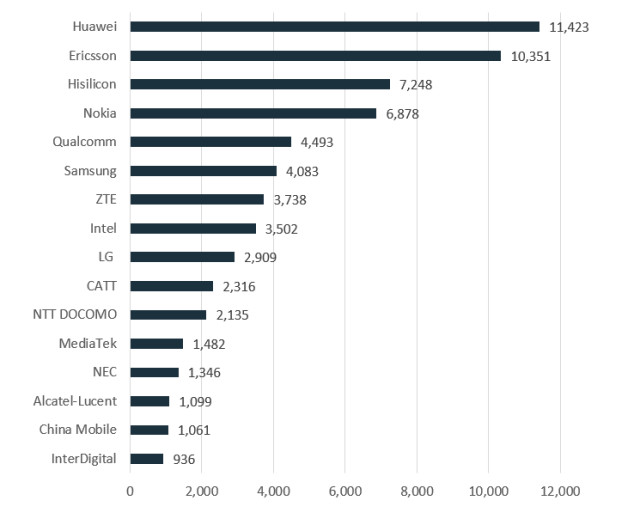
2: https://www.iam-media.com/who-leading-5g-patent-race
There are many Chinese companies doing copy pasting. but in general China is innovative today. You just don’t hear much about what they are building and doing as much as you would hear from EU and US.
So basically, the big companies own the government in their county.
There has long been suspicion that Huawei is actually owned and controlled by the PLA. Not that it really makes much difference even if that were true (China would protect it even if it were a completely private enterprise).
I remember the quote from the RoboCop movie of the 80s when the CEO of OCP said: "We practically are the government".
That movie was ahead of its time.
That movie was ahead of its time.
In the specific case of China its more like the Government owns the big companies. But yes, basically.
In this particular case I think it's the other way around. The government owns the company.
So it's like the US.
Other way around. Many large corporations are founded by CCP members and receive massive government funding. In China at least the business and party elite are one and the same.
Governments typically protect their big players and it makes sense. You don’t expect U.S. don’t do anything if Asia or EU put sanctions on Apple or Microsoft.
As an Indian I personally root for Huawei. If not for any other reason that Ericsson (70% just a decade ago) and co have had a monopoly for far too long.
The only jobs that Ericsson brings to India are low end back office jobs and at the most billing software. Even though it could have been one of their largest growth markets.
This could be a good opportunity to get them/Huawei to setup more cutting edge R&D (especially PHY layer), co-development and manufacturing. India should hand out some Chinese medicine to the Chinese.
High tech is a chicken and egg problem, India has all the ingredients, but apparently free market doesn't work when monopolies are involved.
The only jobs that Ericsson brings to India are low end back office jobs and at the most billing software. Even though it could have been one of their largest growth markets.
This could be a good opportunity to get them/Huawei to setup more cutting edge R&D (especially PHY layer), co-development and manufacturing. India should hand out some Chinese medicine to the Chinese.
High tech is a chicken and egg problem, India has all the ingredients, but apparently free market doesn't work when monopolies are involved.
China has a good relationship with Pakistan.
https://en.wikipedia.org/wiki/China%E2%80%93Pakistan_relatio...
I wonder how that plays into it, given the recent events in Kashimir: https://www.aljazeera.com/news/2019/08/india-revokes-kashmir...
If I had to guess these sanctions and warnings are never purely technological and are mostly political.
https://en.wikipedia.org/wiki/China%E2%80%93Pakistan_relatio...
I wonder how that plays into it, given the recent events in Kashimir: https://www.aljazeera.com/news/2019/08/india-revokes-kashmir...
If I had to guess these sanctions and warnings are never purely technological and are mostly political.
I don't know anything about this, but it seems quite surprising, given China's record of 'disappearing' millions of Muslims (and other citizens) right next door to Pakistan
People from the outside has a tendency to over estimate the unity of other groups. For a long time, the first world nations thought all the Communist countries were buddies but China had border wars with both the USSR and Vietnam. In the Islamic world, Muslim nations fought each other all the time as they still do today. In the Christian realms, the Crusades started with Western Christians sacking Constantinople and the wars of religion between the Catholics and Protestants were pretty brutal. France was at one point allied with the Turks during the period of the "Italian Wars".
It tends to be that people think first of their own welfare and then maybe of their allegiance to the groups they belong to.
It tends to be that people think first of their own welfare and then maybe of their allegiance to the groups they belong to.
A great essay on the topic: https://slatestarcodex.com/2014/09/30/i-can-tolerate-anythin...
China-Pak friendship is driven simply by their mutual enmity of India. Basically, enemy of my enemy is my friend.
Pakistan provides a very strategic route to the Persian Gulf for the Chinese. Even without the India-China rivalry (I hate using this term though because the relationship is quite a bit more complex than a simple rivalry), I think Pakistan would still be a valuable ally to the Chinese. During China's period of isolation, Pakistan also served as a diplomatic corridor to the other countries. Prior to the Nixon visit, China and the US met via Pakistan.
And bewilderingly enough, the US continues to give Pakistan military aid.
That is an odd one isn't it. It seems it is partly a bribe to make sure they safeguard their nukes and keep them from getting into the wrong hands, and also to ensure it doesn't harbor terrorists and militants who might interfere with America's ambitions in the region. Then India has traditionally, since Cold War times at least, been buying Soviet and Russian military technology. From that point of view, US probably wants to counter-balance it by arming Pakistan, to avoid Russia and India getting an upper hand in the region.
Also, interestingly, in the last two years their military aid has been reduced by almost half https://www.statista.com/chart/12384/us-aid-to-pakistan/. It seems the current administration is keen on reducing foreign aid across the board so maybe that's not too surprising. Though if I was China, I would notice that and make sure to "fill that void" so to speak.
Also, interestingly, in the last two years their military aid has been reduced by almost half https://www.statista.com/chart/12384/us-aid-to-pakistan/. It seems the current administration is keen on reducing foreign aid across the board so maybe that's not too surprising. Though if I was China, I would notice that and make sure to "fill that void" so to speak.
I believe the default action for Huawei for such block would actually be purposefully enact the ban on itself:
Stop all sales including spare parts, revoke signing keys, block IPs of cell towers and cloud control panels from that country, stop tech support, and look how soon they will change their musik
Stop all sales including spare parts, revoke signing keys, block IPs of cell towers and cloud control panels from that country, stop tech support, and look how soon they will change their musik
So India just needs to pre-ask for "reverse-reverse-sanctions" from the US: Hey Mr States, we'll not use Huawei like you asked us, if you'll give us extra XXXX access to your country.
More like: “Hey India, if you don’t avoid Huawei with us, you’ll have even bigger sanctions than if you follow Chinese advice. And won’t get spied upon by the Chinese.”
The US needs strong developing countries to manufacture its stuff. Vietnam is still pretty small. India has more familiar industrial relations and government model.
on a serious note. what are the chances of this whole debacle thing causing a full scale warfare ? given the animosity between the 2 neighboring countries India and China. then you factor in US backing India. Then add Russia + china in the mix. This whole sanction and tariff thing can't continue without one side completely asserting dominance over the other. & US will not leave it's position willingly.
China has a history of pegging its currency to the US dollar. Is there precedent for pegging tariffs to the yuan?
Well the US government labelled China a "Currency Manipulator" a couple of days back. Doesnt mean much, but it will add to the trade war between the two
[deleted]
> warning there could be consequences for Indian firms operating in China
What Indian firms even operate in China? What firms from any country other than China have a meaningful presence there?
I guess the threat is meaningful if you include firms doing any business in China, but by restricting exports or imposing tariffs they are shooting themselves in the foot as well.
What Indian firms even operate in China? What firms from any country other than China have a meaningful presence there?
I guess the threat is meaningful if you include firms doing any business in China, but by restricting exports or imposing tariffs they are shooting themselves in the foot as well.
I see people already noticing the timing.
In other news: https://www.dawn.com/news/1498428/china-says-india-move-on-k...
In other news: https://www.dawn.com/news/1498428/china-says-india-move-on-k...
In an ideal world one should not be spied on by anyone else, but in this particular case I think India would be more ok (so to speak) of being spied on by the US than by China, the reason being that India has an ongoing and still open border dispute with China, while its relations with the US are a little more benign. Granted, I'm not from India and I've never visited the country, maybe someone more knowledgeable than me can correct me if I'm wrong.
We detached this subthread from https://news.ycombinator.com/item?id=20629406.
You'd need to have been living on a different planet to think that the US is benign. Relatively benign to their own citizens but far and away the most globally antagonistic country over the last 50 years. The list of wars and interventions, arms dealing, extradition etc would be far beyond anything China has done.
No government is beyond over stepping it's boundaries but unfortunately non US citizens do not have a constitution to protect them from the US government.
China is threatening the US global trade dominance and the US is reacting in exactly the same way incumbents usually do and unfortunately trade wars between major powers have been historical quite bloody.
No government is beyond over stepping it's boundaries but unfortunately non US citizens do not have a constitution to protect them from the US government.
China is threatening the US global trade dominance and the US is reacting in exactly the same way incumbents usually do and unfortunately trade wars between major powers have been historical quite bloody.
adventured(5)
olliej(2)
Isn't that just predatory pricing?
Hmm, what a great way to inspire confidence Huawei isn't working with the Chinese government to add spyware to everything...
"Use Huawei's products, which are not controlled by the Chinese government, or the Chinese government will sanction you".
The Chinese government is about as subtle as an atom bomb.
The Chinese government is about as subtle as an atom bomb.
That's pretty much the policy for any country in the world that sees a domestic company being -in their view- unfairly blocked from doing business in another country. They tell them "if you discriminate against us, we will do the same to you".
Really? What retaliatory action did the US take on behalf of its tech companies following their blocking in China?
The US has started wars to protect foreign investment. The history of Latin America comes to mind. Some examples would be Allende, the bay of pigs invasion and Nicaraguan Contras.
The fact that the US hasn't retaliated much in the tech industry probably just demonstrates that the industry wasn't firmly enough in bed with the government when China began blocking access to google and facebook.
The fact that the US hasn't retaliated much in the tech industry probably just demonstrates that the industry wasn't firmly enough in bed with the government when China began blocking access to google and facebook.
Referencing three American incidents from decades ago (which, although I consider Chile and Nicaragua to be among America's darkest FP moments, were all officially -- and mostly corroborated by the historical record -- undertook in the name of national security rather than commercial interests) hardly indicates this sort of tit-for-tat commercial relations between nations is the global norm.
The US's coup in Chile was done precisely to protect US business interests. That's why large companies like Anaconda were so heavily involved in the coup. The thing that all those incidents share in common is that they all started when the nations involved began nationalising or restricting US companies.
A more modern example of this sort of behavior might be the original US sanctions on Venezuela in the 2000s.
A more modern example of this sort of behavior might be the original US sanctions on Venezuela in the 2000s.
They haven't been blocked in China, they don't operate in China because they don't want to support China's censorship and authoritarian population control.
This is just false. Both Google and Facebook have been reported as seeking Chinese government authority to get re-enter the Chinese market this year, and neither Facebook, Google, or a large chunk of the rest of the Western internet is accessible in the mainland due to the Great Firewall.
As I said, the Chinese actively censor what they consider harmful content. I don't agree with them on that, but that's their position. If you abide by their laws (that is: censor what they want censored and give them access to user data, I guess), you can operate. The UK blocks The Pirate Bay and various other file sharing sites because they figure those sites don't comply with UK laws. As soon as TPB disables the sharing of copyrighted content and appeals, they'd be unblocked, because it's not a blanket ban.
The fact that Google has offices in China, offers services in China and runs conferences in China should show that they aren't blocked as a company. Dragonfly wasn't shut down by China, but by Google after they faced internal push back by employees against supporting Chinese censorship.
The fact that Google has offices in China, offers services in China and runs conferences in China should show that they aren't blocked as a company. Dragonfly wasn't shut down by China, but by Google after they faced internal push back by employees against supporting Chinese censorship.
Not China but google Boeing, Canada and Bombardier.
Which companies were blocked by China from operating?
Google, Facebook, Twitter jump out as examples. These are completely banned from operating due to censorship. Baidu, WeChat, and Weibo are the domestic equivalents, arguably dominant only because of this protectionism. WeChat has outgrown facebook though I think and FB could not win in China now. Corps which sell products in China (as opposed to those who buy manufactured goods that are exported from China) operate only crippled subsidiaries with 51% Chinese ownership for Chinese domestic sales due to their laws.
That's not really correct, is it? Google decided not to comply with censorship laws (which I think is a good call), they weren't outright banned. There's a difference between "you must not operate in our country" and "you must not operate in our country without adhering to local laws".
[deleted]
Any foreign company that isn't willing to create a separate Chinese subsidiary with a Communist Party approved CEO at the helm, and who isn't willing to give up all their IP to said Communist Party.
> Huawei has carried out operations in India for a long time, and has made contributions to the development of Indian society and the economy that is clear to all,
And how is this relevant to backdoors? Just wow.
And how is this relevant to backdoors? Just wow.
华为 'hua-wei' means 'Serve China'
"It's a cookbook, it's a cookbook!"
I don't speak Chinese, but it doesn't seem from Wiktionary like 为 has the meaning 'serve' in its sense of 'obey, assist'.
Couldn't it also be something like 'Chinese-doing'? That seems more similar to what Wikipedia says about the name:
https://en.wikipedia.org/wiki/Huawei#Name
Couldn't it also be something like 'Chinese-doing'? That seems more similar to what Wikipedia says about the name:
https://en.wikipedia.org/wiki/Huawei#Name