The Hardest Natural Languages (1979) [pdf](people.cs.umass.edu)
people.cs.umass.edu
The Hardest Natural Languages (1979) [pdf]
https://people.cs.umass.edu/~rsnbrg/hardest.pdf
41 comments
Relevant Wikipedia article about "Greek to me" and variant in other languages:
https://en.m.wikipedia.org/wiki/Greek_to_me
https://en.m.wikipedia.org/wiki/Greek_to_me
We say that in English too...i think Shakespeare used it. I wonder if Europeans non-Greek have been saying that since Roman (Latin) times as a kind of fun description.
https://grammarist.com/idiom/its-greek-to-me-and-its-all-gre...
Popularized by Shakespeare, but predates him as a latin phrase used by scribes:
Popularized by Shakespeare, but predates him as a latin phrase used by scribes:
Graecum est; non legitur, which means “It is Greek and therefore is impossible to read.”You're right, that line from Shakespeare is even quoted in the paper. From the list of sayings they had collected from various languages, Greek seems like the most popular comparison, followed by Chinese. But since there's a Greek saying that uses Chinese in its comparison, it is Chinese that ends up at the end of the graph.
Edit: I went back to check and that is not right. Chinese wins out by a lot. I simply misremembered.
Edit: I went back to check and that is not right. Chinese wins out by a lot. I simply misremembered.
It's interesting, because through my readings in linguistics, I got the sense that no language is "objectively" harder than any other, that everything is relative to the other languages you know. A Dutch speaker will learn German potentially more easily than French compared to an English speaker, so how do you judge objectively which language is harder? Nevertheless, an entertaining read! I have heard a good candidate for the hardest natural language is Georgian, due to irregular grammar, long consonant clusters, and difficult script. Not sure how to reconcile the apparent objectively difficult features with the previous claim. I guess in the end difficulty might just be a direct result of number of (relatively) unique features compared to other languages (of which they say Georgian has many)
I think that there are some features which can be said to be objectively more difficult than others. For example, all other things being equal, a language that had a larger phonemic inventory than a second would be objectively harder. Now do note that many comparisons means that it is easier on one feature while being harder on another: for example, Chinese has fewer phonemes than English does, but Chinese is tonal whereas English is not, and this makes it difficult to say if Chinese is (at least in terms of phonetics) easier or harder than English.
While it is probably possible to tease out some sense of an objective scale for the phonetics or orthography of a language, when it comes to the grammatical features of a language, I don't think there is a realistic hope of identifying any reasonable scale of easier/harder languages. What makes languages easier or harder with respect to grammar is going to be less driven by absolute metrics of the grammar has this difficult or easy feature and more by the relative metric of does it have grammatical features known or unknown to the listener.
While it is probably possible to tease out some sense of an objective scale for the phonetics or orthography of a language, when it comes to the grammatical features of a language, I don't think there is a realistic hope of identifying any reasonable scale of easier/harder languages. What makes languages easier or harder with respect to grammar is going to be less driven by absolute metrics of the grammar has this difficult or easy feature and more by the relative metric of does it have grammatical features known or unknown to the listener.
It's interesting, because through my readings in linguistics, I got the sense that no language is "objectively" harder than any other, that everything is relative to the other languages you know.
Not really. A language's difficulty is often proportional to how much contact it has with outsiders, i.e., how many people are learning to speak it as adults instead of as children. Isolated groups can develop truly esoteric and labyrinthine languages. When a language is being learned a lot by adults the hard parts tend to get polished off.
Not really. A language's difficulty is often proportional to how much contact it has with outsiders, i.e., how many people are learning to speak it as adults instead of as children. Isolated groups can develop truly esoteric and labyrinthine languages. When a language is being learned a lot by adults the hard parts tend to get polished off.
Simplification of languages learned by adults happened mostly before written text become widespread (with the invention of the printing press). Written languages resist to change more than spoken only.
Spoken languages have still changed after widespread written languages. Mandarin is substantially different from the Classical Chinese used in writing until the 20th century. Modern spoken Finnish (puhekieli) is substantially different from written Finnish (kirjakieli).
H and L languages. The divergence between H and L languages (often called disglossia) is a continual process ever since the invention of writing.
And? How is that relevant to whether or not some languages are harder to learn than others?
Many Japanese adults can't read Japanese fluently since the rules for reading are so complex, I think that makes the language objectively hard to learn.
According to this report, Japan has the highest rates of top-tier reading fluency, and lowest rate of bottom-tier fluency: https://www.oecd.org/skills/piaac/Country%20note%20-%20Japan...
And yet this article says that Japan hasn't conducted a nationwide literacy survey since 1948: https://www3.nhk.or.jp/nhkworld/en/news/backstories/583/ Whereas the most recent such survey in the U.S. seems to have been from 2003: https://nces.ed.gov/naal/
Very confusing. What are some better sources for literacy data? Especially when it comes to educational achievement I'm aware that OCED and similarly globally-ranked reporting structures tend to incentivize data collection gimmicks.
And yet this article says that Japan hasn't conducted a nationwide literacy survey since 1948: https://www3.nhk.or.jp/nhkworld/en/news/backstories/583/ Whereas the most recent such survey in the U.S. seems to have been from 2003: https://nces.ed.gov/naal/
Very confusing. What are some better sources for literacy data? Especially when it comes to educational achievement I'm aware that OCED and similarly globally-ranked reporting structures tend to incentivize data collection gimmicks.
While I'm inclined to agree with your point and I do think that some languages really are just more difficult, I think it should be pointed out that something like 54% of adults in the USA read below a sixth grade level. Many of them (about half) are functionally illiterate.
source:
https://en.m.wikipedia.org/wiki/Literacy_in_the_United_State...
source:
https://en.m.wikipedia.org/wiki/Literacy_in_the_United_State...
Thankfully, while your first assertion is (sadly) accurate, your 2nd is not. From the wikipedia article you cited:
> "Literacy in the United States was determined by the National Center for Education Statistics to be at a mid to high level in 2019, at 79%, with 21% of American adults categorized as having "low level English literacy," including 4.1% classified as "functionally illiterate" and an additional 4% that could not participate.[1] According to the U.S. Department of Education, 54% of adults in the United States have prose literacy below the 6th-grade level."
Functional illiteracy is more like 4-8%.
> "Literacy in the United States was determined by the National Center for Education Statistics to be at a mid to high level in 2019, at 79%, with 21% of American adults categorized as having "low level English literacy," including 4.1% classified as "functionally illiterate" and an additional 4% that could not participate.[1] According to the U.S. Department of Education, 54% of adults in the United States have prose literacy below the 6th-grade level."
Functional illiteracy is more like 4-8%.
It also depends on the population surveyed. I your survey contains non-native speakers, then the figures will show a more pronounced deficiency.
The second claim comes from something I heard mentioned the other day in relation to a New Yorker article about parents finding out during covid lockdowns that their elementary school kids couldn't read hardly at all. I guess they've changed the teaching styles so kids don't really learn like most millenials did.
FWIW, here's what I was found on Google:
> According to the National Center for Educational Statistics (NCES), 21 percent of adults in the United States (about 43 million) fall into the illiterate/functionally illiterate category.
FWIW, here's what I was found on Google:
> According to the National Center for Educational Statistics (NCES), 21 percent of adults in the United States (about 43 million) fall into the illiterate/functionally illiterate category.
The ambiguity of the one-to-many character-reading relationship may also affect its usability for objective diction, as in science. Quoting from Neil Postman’s Technopoly, Nobel Prize for Medicine laureate Susumu Tonegawa said that “the Japanese language does not foster clarity or effective understanding in scientific research” and recommends adopting English.
I think he said it for other reason rather than kanji reading. When people discuss about logical speech and writing in Japanese, it is often said that Japanese language is good at to make sentence ambiguous. Omitting subject and object is pretty common. One-to-many is not much problem compared to that for natives.
True, grammar as a source of ambiguity makes sense.
Do you have a study or article that references those findings? I’m just curious, since I’ve learned some Japanese and the most complex thing I’ve encountered while reading is not knowing certain kanji.
I also studied Japanese. Our teacher (who was a native Japanese person) admitted that one has to be of high school age before they know enough kanji to be able to read a newspaper. Those kanji are in standard lists and part of those lists are what year (of school) they are to be learned by.
For me, the harder parts were Keigo - the politeness levels and how essential they are.
For me, the harder parts were Keigo - the politeness levels and how essential they are.
The article is pretty clearly a tongue-in-cheek trolling thought experiment, not a serious attempt at claiming legitimate hardness of languages.
One objective metric is to see how difficult it is for an adult to pick up a language to near-native-speaker levels.
For a point of comparison, I’ve never heard of anyone learning to speak Hungarian fluently as an adult. I’ve seen clips of people who think they have and… they try hard but no, they haven’t.
Similarly Navajo code talkers were used in WWII because the language was supposedly difficult to pick up.
For a point of comparison, I’ve never heard of anyone learning to speak Hungarian fluently as an adult. I’ve seen clips of people who think they have and… they try hard but no, they haven’t.
Similarly Navajo code talkers were used in WWII because the language was supposedly difficult to pick up.
Adult learners of what language?
Relevant: a difficulty list relative to English according to the Foreign Services Institute: https://www.state.gov/foreign-language-training/
Japanese and Arabic used to be on a special rung in the hardest category.
Japanese and Arabic used to be on a special rung in the hardest category.
Is there a known reason why they were knocked down a tier?
I'm not sure; when I first found the list in ~2018, Japanese and Arabic had asterisks denoting special difficulty.
Depends. Difficult is a binary relation in my experience: _something_ is difficult to _somebody_.
Is Mandarin Chinese difficult for a smart 10-year old, whose parents are Chinese (the mother a lawyer and the father a university professor, saY)? No.
Is English difficult for a dyslectic homeless U.S.-American citizen who got only minimal school education? Probably so.
I know a lot of people who admire Latin for its "logical" structure; I can only say that they probably haven't studied Spanish, where -um doesn't mean one of gazillion different things. I have three linguistics-related degrees, and I have yet to see a study that defines an objective "language difficulty" metric.
Is Mandarin Chinese difficult for a smart 10-year old, whose parents are Chinese (the mother a lawyer and the father a university professor, saY)? No.
Is English difficult for a dyslectic homeless U.S.-American citizen who got only minimal school education? Probably so.
I know a lot of people who admire Latin for its "logical" structure; I can only say that they probably haven't studied Spanish, where -um doesn't mean one of gazillion different things. I have three linguistics-related degrees, and I have yet to see a study that defines an objective "language difficulty" metric.
Defining “smart” for a child in terms of language doesn’t really make sense here - their parents‘ careers being seemingly irrelevant. Our brains are prewired for language acquisition so if any “healthy” individual is around and exposed to a language at a young age they’ll learn it, regardless of parental status etc.
To the outsider, difficulty can be measured in the "effect" or "affect" the language has in settings such as diplomacy where the multilingual multicultural raised creme de la creme meet and talk behind closed doors say at the U.N.
https://faculty.georgetown.edu/jod/texts/twain.german.html
The Awful German Language, Mark Twain
The Awful German Language, Mark Twain
This was a fantastic read! Seeing the German language, that is also foreign to me, and its learning process explained by a master writer, gave me a great new perspective and understanding. Many topics that I felt not completely understood just fits into the place now.
More Twain on German: [http://www.twainquotes.com/German.html]
Fun read, seeing as how this paper is from the late 70's, it would be interesting to know what comments the author got as part of his RFC for Japanese, Norwegian and Swedish.
Incredible essay 'Why Chinese Is So Damn Hard' on this subject from a University of Michigan Professor of Chinese Studies who learned Chinese as an adult: http://pinyin.info/readings/texts/moser.html
TLDR:
>Someone once said that learning Chinese is "a five-year lesson in humility". I used to think this meant that at the end of five years you will have mastered Chinese and learned humility along the way. However, now having studied Chinese for over six years, I have concluded that actually the phrase means that after five years your Chinese will still be abysmal, but at least you will have thoroughly learned humility.
TLDR:
>Someone once said that learning Chinese is "a five-year lesson in humility". I used to think this meant that at the end of five years you will have mastered Chinese and learned humility along the way. However, now having studied Chinese for over six years, I have concluded that actually the phrase means that after five years your Chinese will still be abysmal, but at least you will have thoroughly learned humility.
Diagram of "it's Greek to me"-type language relations here, partly based on this paper:
The directed graph of stereotypical incomprehensibility http://languagelog.ldc.upenn.edu/myl/graph2a.png
source: https://languagelog.ldc.upenn.edu/nll/?p=1024
The directed graph of stereotypical incomprehensibility http://languagelog.ldc.upenn.edu/myl/graph2a.png
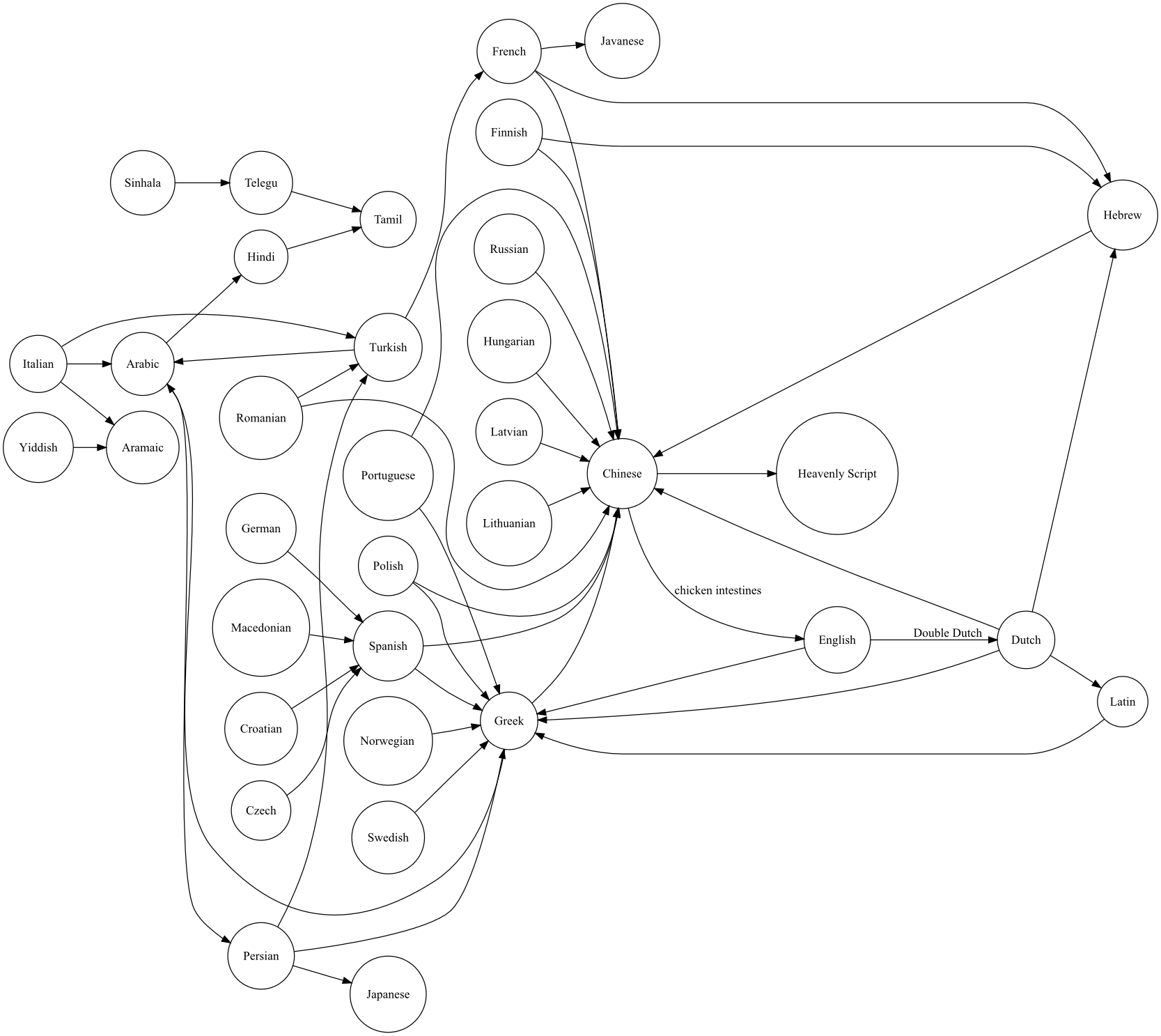
source: https://languagelog.ldc.upenn.edu/nll/?p=1024
How about Lithuanian?
A beautiful language, not more difficult than, say, Polish or Russian.
First 5 languages are the hardest.
It is very cool to see Chinese coming out on top. As for the Norwegian that they left blank, I'll be happy to add that we use Greek to express that something is unintelligible: