Search through historical cookbooks dating back to the Middle Ages(thesifter.org)
thesifter.org
Search through historical cookbooks dating back to the Middle Ages
https://thesifter.org/
34 comments
What book is this? I’d be interested in adding it to my collection.
https://www.booklooker.de/B%C3%BCcher/Henriette-und-Marie-Hr...
I fear there won't be an English version of it though.
I fear there won't be an English version of it though.
Libgen has the 1897 and 1904 in German, the 1904 in English, second to last result on this search page:
https://libgen.rs/search.php?req=Davidis&lg_topic=libgen&ope...
Compiled and adapted for the United States, according to the Thirty-fifth German Original, with Weights and Measures in American equivalents, and an Appendix of Selected Recipes of Peculiar American Dishes Embracing also a Topically arranged List of over 550 Characteristic German Dishes in German, with English translation, giving page where these Recipes can be found ; also a Vocabulary of Culinary Terms in both languages, with full table.
https://libgen.rs/search.php?req=Davidis&lg_topic=libgen&ope...
Compiled and adapted for the United States, according to the Thirty-fifth German Original, with Weights and Measures in American equivalents, and an Appendix of Selected Recipes of Peculiar American Dishes Embracing also a Topically arranged List of over 550 Characteristic German Dishes in German, with English translation, giving page where these Recipes can be found ; also a Vocabulary of Culinary Terms in both languages, with full table.
If I ever become fantastically wealthy, one thing I'd love to do is build a culinary museum. Imagine rotating exhibits where you can taste-test food from hundreds of years ago (or at least a close approximation).
City Tavern in Philadelphia serves food made from 18th century recipes, using the tools available at that time. The prices are in line with typical casual dining (Applebees for example).
It's fun if you are in the area but some recipes have improved in the meantime. IMHO, creme brulee benefitted from the appropriation of the butane torch (I think City Tavern uses an iron).
I just Googled and apparently it is closed:
> After 26 years, Chef Staib has decided to not renew his contract with Independence National Historical Park as operator of City Tavern. He closed the doors to the patrons effective November 2, 2020 allowing time wrap up affairs before turning the building back over to the Park Service.
> After 26 years, Chef Staib has decided to not renew his contract with Independence National Historical Park as operator of City Tavern. He closed the doors to the patrons effective November 2, 2020 allowing time wrap up affairs before turning the building back over to the Park Service.
The lunch cafeteria at the Museum of the American Indian in DC is fabulous sort of in this way.
I searched for beef, went through the list of results trying to find a recipe. I eventually got a link to a scanned google book called “Biscuits and Dried Beef, a Panacea” but then I started reading it and the first page had a quote from poetry. “Cool, these 1800 cookbooks were so well read”, but then as I continued it turned out to be a pleasant fictional work on the life of a poor young Episcopalian Priest with a young family. Nice find but seems like there’s a lot of noise in this.
You found the old version of modern recipe sites.
I wish I had made that connection, nicely done.
There are some really amazing books in here. Like this one from 1390 written in Old English https://babel.hathitrust.org/cgi/pt?id=nyp.33433078975988&vi...
Might give cooking a few of these a try
Might give cooking a few of these a try
Nitpick: that’s definitely not Old English, which is mostly incomprehensible to most readers today. That’s Middle English.
Here’s an example of Old English. https://www.omniglot.com/images/langsamples/smp_oldenglish.g...
Here’s an example of Old English. https://www.omniglot.com/images/langsamples/smp_oldenglish.g...
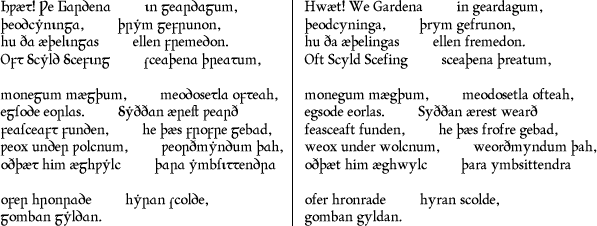
Ahh! Thanks for the correction
There is a blog called Rare Cooking, which digs out old recipes, like John Locke's recipe for Pancakes[1].
[1] https://rarecooking.com/2021/12/14/john-lockes-recipe-for-pa...
[1] https://rarecooking.com/2021/12/14/john-lockes-recipe-for-pa...
Very useful. I searched for "pasta" and almost nothing showed up but I think I am not yet very good at using the tool. Anyway it's very interesting to have a database of some old text about cooking to search.
Pasta and its cognates is a real ball of culinary-taxonomic mud so that's a pretty unlucky first choice I think.
The word pasta and etymological relatives are also the words for all dough, sausage (pâté), porridge, pastry (pâtisserie), pesto, etc etc in different european cuisines and that's just what I know off the top of my head, in use in the last few decades. If you expand it out a couple hundred years who fucking knows what will have been known by that word or its variants.
I'm not even sure how long that usage dates in english either. Even as recently as mid-late 20th century american cookbooks referred to all noodles as macaroni and used that word generically the same way we use pasta now.
The word pasta and etymological relatives are also the words for all dough, sausage (pâté), porridge, pastry (pâtisserie), pesto, etc etc in different european cuisines and that's just what I know off the top of my head, in use in the last few decades. If you expand it out a couple hundred years who fucking knows what will have been known by that word or its variants.
I'm not even sure how long that usage dates in english either. Even as recently as mid-late 20th century american cookbooks referred to all noodles as macaroni and used that word generically the same way we use pasta now.
I think pesto doesn't belong there: it comes from a different Latin word that seems unrelated.
- "From Latin pistus (“crushed, pounded”), from Latin pīnsō (“to pound, beat, crush”), whose frequentative also gave Italian pestare (“to pound”)."
https://en.wiktionary.org/wiki/pesto#Italian
https://en.wiktionary.org/wiki/pasta#Latin
- "From Latin pistus (“crushed, pounded”), from Latin pīnsō (“to pound, beat, crush”), whose frequentative also gave Italian pestare (“to pound”)."
https://en.wiktionary.org/wiki/pesto#Italian
https://en.wiktionary.org/wiki/pasta#Latin
>First attested in English in 1874, the word pasta comes from Italian pasta,
https://en.wikipedia.org/wiki/Pasta
Evidently it is a young word relatively speaking.
https://en.wikipedia.org/wiki/Pasta
Evidently it is a young word relatively speaking.
Why do people keep using Wikipedia? From an actual historical dictionary, the Oxford English Dictionary:
Earliest use as an English word: 1830:
J. P. Cobbett Jrnl. Tour Italy 214 Maccaroni, like vermicelli, is only one of the forms into which the Italians make what they call ‘pasta’ or paste. It requires a particular sort of wheat, a brittle, flinty grain, to make this pasta.
Earliest mention in English (i.e., as an Italian word): 1820:
W. A. Cadell Journey Carniola, Italy & France II. 152 The Italians prefer that [sc. Macaroni] which is fresh made, and made at home, and called pasta di casa, household paste.*
Earliest use as an English word: 1830:
J. P. Cobbett Jrnl. Tour Italy 214 Maccaroni, like vermicelli, is only one of the forms into which the Italians make what they call ‘pasta’ or paste. It requires a particular sort of wheat, a brittle, flinty grain, to make this pasta.
Earliest mention in English (i.e., as an Italian word): 1820:
W. A. Cadell Journey Carniola, Italy & France II. 152 The Italians prefer that [sc. Macaroni] which is fresh made, and made at home, and called pasta di casa, household paste.*
For me, laziness mostly. OED isn't free, and I don't care enough to pay for it, or figure out how to get it free.
Even if the correct date is 1830 or even 1820, it is a distinction without difference. It misses the middle ages by more than a hundred years.
Even if the correct date is 1830 or even 1820, it is a distinction without difference. It misses the middle ages by more than a hundred years.
I just tried "chicken", lots of stuff came up
The Townsends YouTube channel is a fantastic look into the mechanics of early American cooking. https://youtube.com/@townsends
no recipes tho, only metadata
Not necessary, depends on the source, for instance I got this one:
https://digital.slub-dresden.de/werkansicht/dlf/12114/7
(when you trigger the search or view the Works table, the links are in last column)
But it does help if you know the language... :D
(when you trigger the search or view the Works table, the links are in last column)
But it does help if you know the language... :D
Useless if you’re expecting to find ancient recipes
Wrong expectations lead to uselessness
Given "Search through historical cookbooks dating back to the Middle Age", one might be forgiven for expecting to find the odd recipe.
“Search through historical cookbooks!”
*looks for recipes*
“No not like that”
*looks for recipes*
“No not like that”
Interesting, but not useful.
The other big advantage is that it almost entirely relies on local ingredients, so it is very cheap to cook, as long as you reduce the amounts suggested for butter and eggs.