Vincent van Gogh's paintings and drawings(vangoghmuseum.nl)
vangoghmuseum.nl
Vincent van Gogh's paintings and drawings
https://www.vangoghmuseum.nl/en/collection?q=&artist=Vincent+van+Gogh
128 comments
I went to the Van Gogh museum in Amsterdam because I was there and it was on the bucket list. Pictures in a book or on web pages do not do justice to how vibrant the pictures are in real life. Plus, in the days before additional security was required, you could go right up to them (within reason) and check them out up close. They look like they were painted yesterday. Not everyone likes his work but I'm a fan.
My wife and I both struggled to really get into his work until we went to the museum. There's something about the way the museum presented Van Gogh, as a struggling misfit of perhaps questionable talent trying to make friends and looking for a popular counter-culture style, that really clicked with me. I didn't identify with Van Gogh per se, but I suddenly felt for him and his humanity and it peeled away those layers of nonsensical pop-culture that surrounds him.
I think also that I had seen very few of his paintings in person and when you see his late works, after he figured out what he was, they explode off the canvas like nothing I've ever seen before. My wife and I went home and bought a reproduction we were so moved, and then promptly decided not to hang it when it arrived as it lacks that....whatever factor it is in his real works that make them shimmer like something from another plane of spacetime.
I really recommend people who don't like van Gogh to visit that museum.
I think also that I had seen very few of his paintings in person and when you see his late works, after he figured out what he was, they explode off the canvas like nothing I've ever seen before. My wife and I went home and bought a reproduction we were so moved, and then promptly decided not to hang it when it arrived as it lacks that....whatever factor it is in his real works that make them shimmer like something from another plane of spacetime.
I really recommend people who don't like van Gogh to visit that museum.
> Pictures in a book or on web pages do not do justice to how vibrant the pictures are in real life
This is true and big.
The paintings are nice on books and screens but are stunning in real life. There is a lot of nuance in the colours that pictures don't replicate.
Same happens to Vermeer landscapes. His "View of Delft" is just nice on screen but almost magical when seen in real.
This is true and big.
The paintings are nice on books and screens but are stunning in real life. There is a lot of nuance in the colours that pictures don't replicate.
Same happens to Vermeer landscapes. His "View of Delft" is just nice on screen but almost magical when seen in real.
I've just visited the Detroit Institute of Arts (which is excellent, by the way; a revelation to this cynical and displaced Italian). They have a fairly unknown (at least to me) 1873 painting titled Syria by the Sea, by Frederic Edwin Church. It's a capriccio, an imaginary landscape mixing ruins of various civilization, at sunset. On a screen or a page, it's just another bucolic landscape; but its size and colors are such that, in real life, it's simply a glorious experience.
> but its size ...
Interesting that you mention that. Our grandkids all got Van Gogh reproductions for their rooms(). I found it difficult to find the size of the originals and even harder to find reproductions at the same size (looking for cheap stuff on Amazon.) Worse yet, some of the repros were not the same aspect ratio indicating they had been cropped.
I'm not even close to any kind of art expert but it seems to me that the size of the original or what the artist does with an available size canvas are intentional.
() At 3 years old, our eldest grandson looked at a picture on our wall and correctly identified it as a Starry Night. We have no idea where he learned that but were impressed regardless.
Interesting that you mention that. Our grandkids all got Van Gogh reproductions for their rooms(). I found it difficult to find the size of the originals and even harder to find reproductions at the same size (looking for cheap stuff on Amazon.) Worse yet, some of the repros were not the same aspect ratio indicating they had been cropped.
I'm not even close to any kind of art expert but it seems to me that the size of the original or what the artist does with an available size canvas are intentional.
() At 3 years old, our eldest grandson looked at a picture on our wall and correctly identified it as a Starry Night. We have no idea where he learned that but were impressed regardless.
Did you get to see Cotopaxi? It's in the same room, in the center. I have the good fortune of living near the DIA.
We are extremely lucky that the bankruptcy court did not let Detroit's creditors raid the collection.
[deleted]
Van Ostade as well. And Ruisdael too. Those sky paintings are just incredible and seeing them reproduced isn't even close to the real thing.
HN might be the best place to ask. What lights do galleries use? They make the paintings pop.
My house is essentially an art gallery — I had a museum lighting expert do all of the lighting installs and the key thing is going to be the width of the light (correctly focusing the light so it doesn’t spill outside of the painting much,) then color temperature.
The focus of the light is key — by lighting the painting and not lighting the walls around it, that makes it pop a lot more than typically area lighting common in residential applications. Color temperature is also very important. Finally, in my case; my walls are painted a dark, lead-pipe grey so it makes the paintings really jump.
The brand of my lights is Wac Lighting controlled by Lutron dimmers in case you are interested. Color balanced LED. LED used to be inferior for galleries, but the tech has gotten very good (added benefit of running a lot cooler than the old halogen.)
The focus of the light is key — by lighting the painting and not lighting the walls around it, that makes it pop a lot more than typically area lighting common in residential applications. Color temperature is also very important. Finally, in my case; my walls are painted a dark, lead-pipe grey so it makes the paintings really jump.
The brand of my lights is Wac Lighting controlled by Lutron dimmers in case you are interested. Color balanced LED. LED used to be inferior for galleries, but the tech has gotten very good (added benefit of running a lot cooler than the old halogen.)
Another huge aspect is the CRI/CQS of your light sources. CRI (Color Rendering Index) and CQS (Color Quality Scale) try to quantify how faithfully colors are represented when a subject is lit.
Generally a higher CRI equals a higher quality light source. A halogen/incandescent lamp has a perfect score, 100. High end LED sources are usually in the range of 95-98, but that number can be gamed, which has lead to the creation of CQS.
https://blog.1000bulbs.com/home/is-color-quality-scale-bette...
Generally a higher CRI equals a higher quality light source. A halogen/incandescent lamp has a perfect score, 100. High end LED sources are usually in the range of 95-98, but that number can be gamed, which has lead to the creation of CQS.
https://blog.1000bulbs.com/home/is-color-quality-scale-bette...
CQS is super important. That was a key tool for selecting the LED that we did. Thanks for bringing that up!
Any recommendations on how to find the correct color temperature? Should it maybe be matched with the actual painting (how?) or dialed in to fit the rest of the room (how)?
Typically 3600-3800K. My lights are 3600K. A light meter for photography can give you color temperature, but it will always be printed on the box for your bulbs.
I wouldn’t overthink it.. just as long as you stay out of the 4500K+ range (approaching daylight,) things will look great. The warmth of the 3600K range is great — anything less than that and the warmth of the light starts to affect color rendition, anything more and the light gets bluer and harsher.
Your eyes can be the guide. But having correctly focused light at the correct intensity (not too bright for instance) is key. There are use cases for daylight balance — if you are in a mixed light situation such as a windowed or skylight with abondant sunlight, you might consider going a little cooler on the color temperature — but again, use your eyes.
It can be really fun messing with lighting and art! Good luck.
I wouldn’t overthink it.. just as long as you stay out of the 4500K+ range (approaching daylight,) things will look great. The warmth of the 3600K range is great — anything less than that and the warmth of the light starts to affect color rendition, anything more and the light gets bluer and harsher.
Your eyes can be the guide. But having correctly focused light at the correct intensity (not too bright for instance) is key. There are use cases for daylight balance — if you are in a mixed light situation such as a windowed or skylight with abondant sunlight, you might consider going a little cooler on the color temperature — but again, use your eyes.
It can be really fun messing with lighting and art! Good luck.
Thanks for taking the time!
Surely the lighting matters but I think it is only secondary. The thing that's missing in reproductions is the physical texture of the paintings.
I'm thinking super high-end 3D printers in 10 years will solve this problem.
Detail-wise 3d printed reproductions have been decent enough for a while I think. The trickier part is mimicking the texture of complexly layered and blended oil-paint with filaments.
I'm not so certain. Up close, paintings are complex 3D sculptures made from a palette of materials, (not colors), each with varying levels of translucence, different reflective properties, different textures, etc. and they can be combined and moved around in infinitely complex ways.
Might be possible in a few decades, though.
Might be possible in a few decades, though.
They’re doing this! Read about the restoration of Rembrandt’s The Night Watch
(https://www.rijksmuseum.nl/en/whats-on/exhibitions/operation...). Amazing tech.
Next time your in the Netherlands, check out the Kröller-Müller museum. Its collection was created by an art lover who was one of the first to appreciate van Gogh. Although its collection is a bit smaller than that of the van Gogh museum in Amsterdam, it is, I think, of a higher quality.
Kroller-Muller also has a great Mondriaan collection. Mondriaan's later coloured geometric paintings really make sense when you see his early landscapes with trees, and then a period experimenting with thinning out trees focusing on the branches and spaces between them.
The museum also has a fun sculpture garden.
[1] https://krollermuller.nl/en/search-the-collection/keywords=%...
The museum also has a fun sculpture garden.
[1] https://krollermuller.nl/en/search-the-collection/keywords=%...
Plus, bonus nature environment, it's not as touristy as Amsterdam. I mean it's a tourist area for sure, but without the bustle of Amsterdam.
I went there once right after new year's, the museum and restaurant were closed but it was so quiet elsewhere, it was great.
I went there once right after new year's, the museum and restaurant were closed but it was so quiet elsewhere, it was great.
Yep! You can grab a free bike and go for a ride around the park surrounding the museum. Highly recommend it
I will, thanks!
I went a while ago to the same museum. Jean-François Millet's work is in the basement there, as he's one of Van Gogh's inspirations. Millet's work is all dreary peasants toiling in the bleak fields, really grim and depressing stuff, and I would probably never look twice at it online.
Then you get to see his work up close. It's outstanding. It's jaw-droppingly beautiful and intricate. Some of the pieces absolutely overwhelmed me. His paintings are mostly done with a line technique, where he'll paint lines over and over again until the canvas is complete with a comprehensible picture. I'm not sure what it is about screens, but they just don't convey the detail properly at all. On his wikipedia page, Millet's work appears to me as the bleak flat paintings I'd have ignored before I saw his work in person - copies of the exact same paintings I'd seen in person, which overwhelmed me.
I don't really understand why, but there's something fundamentally different about seeing some art in person.
Then you get to see his work up close. It's outstanding. It's jaw-droppingly beautiful and intricate. Some of the pieces absolutely overwhelmed me. His paintings are mostly done with a line technique, where he'll paint lines over and over again until the canvas is complete with a comprehensible picture. I'm not sure what it is about screens, but they just don't convey the detail properly at all. On his wikipedia page, Millet's work appears to me as the bleak flat paintings I'd have ignored before I saw his work in person - copies of the exact same paintings I'd seen in person, which overwhelmed me.
I don't really understand why, but there's something fundamentally different about seeing some art in person.
Also, his paintings are so thick. Photos don't allow you to see how the paint was applied on top of other paint. Seeing them in person allowed me to understand that Van Gogh attacked his canvas.
What's wild is some of his painting appear to be thick without using a ton of paint. It's amazing to think that most of his work was done in a span of couple years.
Destitute outcast dressed in rags. But he could afford to slather his canvases deep with that pricey oil paint. And don't get me started on storage space. Those paintings take up room.
Maybe he had a trustfund. Maybe he spent 99% on art supplies and 1% on potatoes. I dunno.
Maybe he had a trustfund. Maybe he spent 99% on art supplies and 1% on potatoes. I dunno.
"When art critics get together, they discuss color, form, and composition. When artists get together, they discuss where to get a good price on paint." - paraphrasing Picasso
He was not rich, he mostly painted farmers and peasants and never sold anything.
His family, especially his brother Theo, was well off and they sent him an allowance to survive as well as art supplies. (I would not be surprised that they were afraid that, if they send more money he'd spent it on alchool instead of supplies)
As for space, I think he sent most of his paintings to his brother in exchange for the allowance.
His family, especially his brother Theo, was well off and they sent him an allowance to survive as well as art supplies. (I would not be surprised that they were afraid that, if they send more money he'd spent it on alchool instead of supplies)
As for space, I think he sent most of his paintings to his brother in exchange for the allowance.
> Maybe he had a trustfund. Maybe he spent 99% on art supplies and 1% on potatoes. I dunno.
Then maybe read a biography?
Then maybe read a biography?
Actually he had a brother and other relatives who sponsored him. They knew he had some kind of mental illness and basically kept him at a distance. They loved him, but he was a handful.
That museum is great. Spending a day there gave me a deep appreciation for Van Gogh, maybe even art in general. Pictures online definitely don't do it justice. The museum also has a good guided audio tour that narrates Van Gogh's life story as you go through the collection.
The mesmerizing colors and poignant landscapes, the neurotic physicality of the brush strokes, all told through Van Gogh's letters to his brother -- it was a vivid experience. I understood that Van Gogh saw the world in a different way, and for a moment I saw it too.
The mesmerizing colors and poignant landscapes, the neurotic physicality of the brush strokes, all told through Van Gogh's letters to his brother -- it was a vivid experience. I understood that Van Gogh saw the world in a different way, and for a moment I saw it too.
> They look like they were painted yesterday.
Actually, some of the pigments van Gogh used have significantly faded or shifted in color over time. https://cen.acs.org/articles/94/i5/Van-Goghs-Fading-Colors-I...
Actually, some of the pigments van Gogh used have significantly faded or shifted in color over time. https://cen.acs.org/articles/94/i5/Van-Goghs-Fading-Colors-I...
That's sad. If only he had known 7 layer Flemish technique. On the other hand, then we wouldn't have his unique style.
I've had that same rewarding experience at the museum. I figured at least part of it was because you don't fully appreciate the depth of the paint itself on the canvas when looking at a photo of Van Gogh's work. I was really struck by how much dimension there was in the medium, as opposed to a typical oil on canvas painting, like say, The Night Watch. It's physically a very different thing than a photograph can convey. I think you grow up hearing VG is this awesome painter who did these awesome works, here they are, and they look cool, but personally I never appreciated his work as much as I did after seeing the physical objects. The story is more than the graphical composition and color, the brush strokes are more two dimensional. The gestalt is beyond what a book or poster can convey.
I didn't have an opinion until I visited the Met and went through their impressionist exhibit. One of the centerpieces was a self portrait but I was absolutely enthralled by his Sunflower.
https://www.metmuseum.org/art/collection/search/436524?sortB...
https://www.metmuseum.org/art/collection/search/436524?sortB...
That museum was definitely one of the highlights! I can only second every recommendation for it.
[deleted]
When I went to Amsterdam, I made the mistake of not booking tickets in advance. It was totally sold out the entire time I was there. Would love to have gone.
The Rijksmuseum next door was impressive, though extremely crowded.
The Rijksmuseum next door was impressive, though extremely crowded.
You can still go right up to them and look at them very close.
I was there last month…my goodness it was busy. So many people. Go early if you can.
I guess I'm the only one who found the museum to be lackluster.
The FAQ on that site has an entry for "Where is ‘The Starry Night’?" and its answer is at Museum of Modern Art in NYC.
Where it happens that I saw it a few weeks ago, as part of a big Van Gogh exhibition with many of his paintings.
I have to say that if you have a chance to go to that, or to another Van Gogh exhibition, I really recommend it.
From what I understand, not everyone resonates with his work. In fact I believe I saw a critical post on HN some time ago from someone who mentioned having "art students". I'm cynical enough to think they may have been middle school students because I don't think there are many serious people in the art world today who don't love Van Gogh.
And yet, I have a friend who, when the subject of the importance of preserving Van Gogh's work came up, said "They've never done anything for me!" so he couldn't see a reason why it mattered. And, of course, few loved his work while he was alive. Gauguin is even said to have even mocked some of Van Gogh's work in his own, even though they painted together for a time. (This is mentioned at the exhibition at MOMA and a relevant Gauguin is shown.)
So, YMMV. But, I had tears in my eyes from the beauty. Give Van Gogh a chance; his work may really come to mean something to you. It may not, but if it happens that you have yet to do so, it might be worth your while to give it some time, letting yourself be in a state of openness to the forms and colors.
Where it happens that I saw it a few weeks ago, as part of a big Van Gogh exhibition with many of his paintings.
I have to say that if you have a chance to go to that, or to another Van Gogh exhibition, I really recommend it.
From what I understand, not everyone resonates with his work. In fact I believe I saw a critical post on HN some time ago from someone who mentioned having "art students". I'm cynical enough to think they may have been middle school students because I don't think there are many serious people in the art world today who don't love Van Gogh.
And yet, I have a friend who, when the subject of the importance of preserving Van Gogh's work came up, said "They've never done anything for me!" so he couldn't see a reason why it mattered. And, of course, few loved his work while he was alive. Gauguin is even said to have even mocked some of Van Gogh's work in his own, even though they painted together for a time. (This is mentioned at the exhibition at MOMA and a relevant Gauguin is shown.)
So, YMMV. But, I had tears in my eyes from the beauty. Give Van Gogh a chance; his work may really come to mean something to you. It may not, but if it happens that you have yet to do so, it might be worth your while to give it some time, letting yourself be in a state of openness to the forms and colors.
I was never a fan of Van Gogh until I saw Starry Night in person at MOMA in NYC.
The thing that jumps out at me is literally the paint on the painting. There is a lot of height to it. The paint is so thick in sections that it sticks out far above the canvas that it can cause a shadow next to it. We tend to think of paintings as 2 dimensional but Starry Night is 3D and seeing it online or in a book or poster is not the same experience.
Since then I've seen about 10 other Van Gogh paintings in museums and I noticed this similar style in his paintings.
The thing that jumps out at me is literally the paint on the painting. There is a lot of height to it. The paint is so thick in sections that it sticks out far above the canvas that it can cause a shadow next to it. We tend to think of paintings as 2 dimensional but Starry Night is 3D and seeing it online or in a book or poster is not the same experience.
Since then I've seen about 10 other Van Gogh paintings in museums and I noticed this similar style in his paintings.
Yes! Getting to see him up close really changed my mind on him. Obviously the transmitted colors of a screen aren't the reflected colors of light. But even quality print books aren't good because of the 3-D data that is missed.
He didn't just paint, he carved.
That was the thing that really 'made' Van Gogh for me. The en plain air mixing of globs very thick paints on the canvas took a lot of technical skill and mastery. I've tried doing it myself, and honestly, modern store-bought paints aren't up to the task. Getting the oil just right is really difficult. You have to have a consistency a bit south of the stiff-peaks phase of whipped eggs (sorry for mixing domains here, I don't know how else to describe it). Once you get a hold of your paints, you can start to learn how to do this on vertically held canvases, but it's still really difficult.
Then, you have to put the emotion and ease of use into your hand sweeps. His carving of the paint was obviously done in smooth motions with little going back for touch-ups. Just a glob, swooshed on, then mixing in the oil with another swooshing and beating, all globbed up on the canvas. Getting that energy and skill together is, again, really hard.
Seeing Van Gogh, in natural light, up close, really changed my mind on him. So much so that I've tried to replicate his paintings and have gotten no where close. A true master and innovator, in my mind.
He didn't just paint, he carved.
That was the thing that really 'made' Van Gogh for me. The en plain air mixing of globs very thick paints on the canvas took a lot of technical skill and mastery. I've tried doing it myself, and honestly, modern store-bought paints aren't up to the task. Getting the oil just right is really difficult. You have to have a consistency a bit south of the stiff-peaks phase of whipped eggs (sorry for mixing domains here, I don't know how else to describe it). Once you get a hold of your paints, you can start to learn how to do this on vertically held canvases, but it's still really difficult.
Then, you have to put the emotion and ease of use into your hand sweeps. His carving of the paint was obviously done in smooth motions with little going back for touch-ups. Just a glob, swooshed on, then mixing in the oil with another swooshing and beating, all globbed up on the canvas. Getting that energy and skill together is, again, really hard.
Seeing Van Gogh, in natural light, up close, really changed my mind on him. So much so that I've tried to replicate his paintings and have gotten no where close. A true master and innovator, in my mind.
https://www.moma.org/magazine/articles/462 has a nice page where they did a high res 3d scan + model of the painting that you can explore on there; the only thing missing I think is that you can't change the light source.
What I like about Van Gogh's work, is the 'vibrant energy' in his paintings. But I had to experience his work in person to come to appreciate and perceive that. Prior to my first in-person experience with his paintings, I was in the 'meh' camp. It was a similar story for me with the work of Georgia O'Keefe.
I had the same reaction to "Irises" at the Getty Museum in LA.
If a city near you has the Van Gogh Immersive Experience, go see it. It's quite impressive. Also, if they're your thing, it would be a great thing to see while on psychedelics.
If a city near you has the Van Gogh Immersive Experience, go see it. It's quite impressive. Also, if they're your thing, it would be a great thing to see while on psychedelics.
My favorite thing to do when looking at paintings is to stand next to it and look at it from a steep side angle.
You can really see the texture and brushstrokes better, which as you said, brings a lot of life to the visual.
You can really see the texture and brushstrokes better, which as you said, brings a lot of life to the visual.
I saw it the other day. Its home is MoMA, but it is currently on loan at the Met through August 27th.
I just went the other day, and it was definitely worth seeing.
https://www.metmuseum.org/exhibitions/van-gogh-cypresses
I just went the other day, and it was definitely worth seeing.
https://www.metmuseum.org/exhibitions/van-gogh-cypresses
I’m in the “van Gough: meh” camp.
But one thing (of many) that I love about being alive is that not everybody has the same tastes, and I enjoyed reading your comment.
But one thing (of many) that I love about being alive is that not everybody has the same tastes, and I enjoyed reading your comment.
the yellow paint in "A Starry Night" is made with what was called "Indian Cow Yellow".
It's made by feeding cows nothing but mango leaves and dehydrating their urine to a paste.
Now you know...
It's made by feeding cows nothing but mango leaves and dehydrating their urine to a paste.
Now you know...
If anyone's ever in the Netherlands for more than a couple of days, I'd highly recommend checking out the Kröller-Müller Museum. It has the second-largest collection of Van Gogh paintings [1], but also a sizeable number of paintings from the period leading up to his work, and following his work. It's really interesting to see how it fits in the larger developments in the painting world, and feels like his work is a crucial link in the transition from Rembrandt to abstract work like Mondriaan's.
[1] And while you're at it, visit the Van Gogh museum in Amsterdam for the largest collection.
[1] And while you're at it, visit the Van Gogh museum in Amsterdam for the largest collection.
The best way I have come to understand art is that for a moment it lets me experience how it felt to be another person. When I see some of Van Gogh's works, take the Church at Auvers, or Starry Night, I feel like I can understand the overwhelming beauty - how he felt - when he looked at a church or the night sky.
I have times when I am deeply touched by a ordinary moment. I see a person walking on a dirt country road. Or a mother look at her daughter with utter love. And those things I would like to share with others, so I have tried to paint. I am not a good painter.
But I do think every person should try to express those moments that touch them - in some media or another. And who knows, if you try to paint something perhaps someone will see it and it will take their breath away.
I have times when I am deeply touched by a ordinary moment. I see a person walking on a dirt country road. Or a mother look at her daughter with utter love. And those things I would like to share with others, so I have tried to paint. I am not a good painter.
But I do think every person should try to express those moments that touch them - in some media or another. And who knows, if you try to paint something perhaps someone will see it and it will take their breath away.
I don't paint, but I do take pictures. And looking at how painters throughout history depicted the world had an impact on my photography. Especially Van Gogh, as it was the first painter, and museum, I visited by actively trying to learn something instead of just admiring, or not, works of art.
After all, the use of light and composition are almost universial concepts.
After all, the use of light and composition are almost universial concepts.
A couple of years ago I read Irving Stone's biography of Van Gogh [1] and it very much enriched my experience of Van Gogh's art.
The book is based largely on a collection of letters between Vincent and his brother Theo and is quite moving sometimes.
I recommend it!
[1] https://en.wikipedia.org/wiki/Lust_for_Life_(novel)
The book is based largely on a collection of letters between Vincent and his brother Theo and is quite moving sometimes.
I recommend it!
[1] https://en.wikipedia.org/wiki/Lust_for_Life_(novel)
For an art noob, can someone help me understand why the perspective is off in so many of them? I know that he's a master and I don't want to contest that, but the perspective being off feels a little...amateurish? Or is that an intentional choice? If it is, would love to know the 'why' of it
Well, you are right.
When it comes to drawing Van Gogh isn't really "a master". He began painting very late in life, didn't have a long apprenticeship and his career lasted just 10 years. Also, he lived in a cultural context (post-impressionism) that was moving away from classical notions of drawing and composition.
Besides, he wasn't the kind of guy that would spend days or weeks or months in a painting. Most of his paintings were the work of one day or afternoon on the field or beach, he wanted that quick burst of expression. That's why he was so prolific. Think jazz improvisation, not classical music composition.
The greatness of his work comes from the vibrant use of colour and brushwork, not drawing and composition.
When it comes to drawing Van Gogh isn't really "a master". He began painting very late in life, didn't have a long apprenticeship and his career lasted just 10 years. Also, he lived in a cultural context (post-impressionism) that was moving away from classical notions of drawing and composition.
Besides, he wasn't the kind of guy that would spend days or weeks or months in a painting. Most of his paintings were the work of one day or afternoon on the field or beach, he wanted that quick burst of expression. That's why he was so prolific. Think jazz improvisation, not classical music composition.
The greatness of his work comes from the vibrant use of colour and brushwork, not drawing and composition.
I used to think “painting is obsolete since we have photographs”.
I later came to realize that paintings can show things photographs can’t, often much more.
Every time you “say” (express) something you are making choices: emphasizing some things and glossing over others. Something strange happens to you but when you tell me about it you skip the extraneous details and focus on what reinforces your point. Taking a photograph, even if not edited (cropped, lighting changed, etc), and even if spontaneous or lucky, is as much about what is not in the frame as what is. In a good movie, we don’t have to wait while the character goes to the bathroom, or while they drive to the store. We just get the part of the story that matters (this is Chekhov’s gun).
All that is true of a painting, but like a story you can make lots of edits, pulling things literally into the frame that are metasyntactic, that a camera would never see.
In a way the sharp literalism of a photo is much too limiting, as it tunes your visual system to focus on the image itself more than what might be expressed.
I later came to realize that paintings can show things photographs can’t, often much more.
Every time you “say” (express) something you are making choices: emphasizing some things and glossing over others. Something strange happens to you but when you tell me about it you skip the extraneous details and focus on what reinforces your point. Taking a photograph, even if not edited (cropped, lighting changed, etc), and even if spontaneous or lucky, is as much about what is not in the frame as what is. In a good movie, we don’t have to wait while the character goes to the bathroom, or while they drive to the store. We just get the part of the story that matters (this is Chekhov’s gun).
All that is true of a painting, but like a story you can make lots of edits, pulling things literally into the frame that are metasyntactic, that a camera would never see.
In a way the sharp literalism of a photo is much too limiting, as it tunes your visual system to focus on the image itself more than what might be expressed.
And even with just images. Last winter a saw two horses in snowy hills. It was a beautiful image. I tried to capture it with my camera but couldn't. The hills were too flat, the snow didn't have the blue hue from my memory and the horses didn't have such a wild manes. Maybe the picture I took was a more realistic representation of reality but it did not capture what I expirienced. Stiqll think of painting it.
I don't really think I got it until I saw one in person.
It was only a faily small piece but the guy really gobbed so much paint on there that it looked like the flowers on it were real and sticking out of the painting. It was really quite impressive and I don't think I've seen anything quite like it since.
I think you could probably label the whole field of post-impressionism as just being smudgy or whatever, and it is a really easy style to copy (People have been doing it for like 100+ years now) so I can see where the idea that it's amateurish comes from. But you have to understand it came from a time where people would really deride your work if it didn't fit along established lines and that people like him really pushed the boundaries of what was considered acceptable to call "art" in their contemporary time.
It was only a faily small piece but the guy really gobbed so much paint on there that it looked like the flowers on it were real and sticking out of the painting. It was really quite impressive and I don't think I've seen anything quite like it since.
I think you could probably label the whole field of post-impressionism as just being smudgy or whatever, and it is a really easy style to copy (People have been doing it for like 100+ years now) so I can see where the idea that it's amateurish comes from. But you have to understand it came from a time where people would really deride your work if it didn't fit along established lines and that people like him really pushed the boundaries of what was considered acceptable to call "art" in their contemporary time.
I did not understand modern art until I saw it in the way people from that era would have seen it. I was on Day 7 of a vacation in St. Petersburg and we'd gone from gallery to gallery for nearly a week, covering art from the 14th century onwards.
After about the 10,000th realistic painting with vaguely mythological/religious themes, it was simply exhausting. And then we entered a room that housed Matisse's 'The Conversation' and it took my breath away.
A gigantic, bright blue painting in an old Russian palace after a week of gallery hopping...it was absolutely majestic. I can only imagine the impact something like that must have had on people who had known nothing but the same old realistic style.
What throws me about Van Gogh, though, is that unlike Matisse, he's not entirely modern or abstract - he's still trying to capture some semblance of reality, and he's even making an attempt at realistic perspective, but something is just off. I admire the style, but I could never come to grips with what he's trying to do (or not trying to do) with his perspectives.
After about the 10,000th realistic painting with vaguely mythological/religious themes, it was simply exhausting. And then we entered a room that housed Matisse's 'The Conversation' and it took my breath away.
A gigantic, bright blue painting in an old Russian palace after a week of gallery hopping...it was absolutely majestic. I can only imagine the impact something like that must have had on people who had known nothing but the same old realistic style.
What throws me about Van Gogh, though, is that unlike Matisse, he's not entirely modern or abstract - he's still trying to capture some semblance of reality, and he's even making an attempt at realistic perspective, but something is just off. I admire the style, but I could never come to grips with what he's trying to do (or not trying to do) with his perspectives.
AFAIK his paintings were never intended to be 'realistic' in the sense we may value, but instead: symbolic. He played with color, intensity, and perspective, expressing vast emotion, and in some cases, turmoil. His mental health and state changed throughout his life which you can almost "see" evolving through his art as he aged. He's incredible to read about - https://www.vangoghmuseum.nl/en/art-and-stories/stories/vinc...
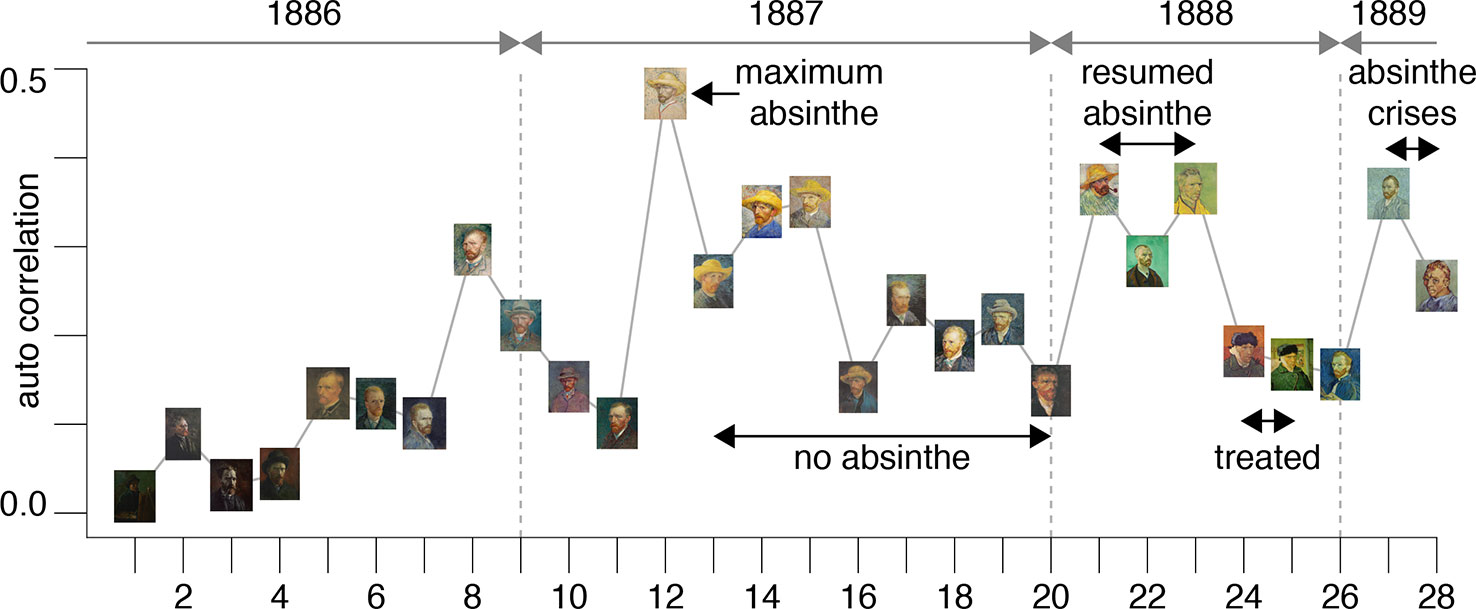
EDIT: I find this really interesting: a visual timeline of how his relationship with alcohol changed his artistic style in various phases of his life: https://www.frontiersin.org/files/Articles/536428/fpsyt-11-0...
EDIT: I find this really interesting: a visual timeline of how his relationship with alcohol changed his artistic style in various phases of his life: https://www.frontiersin.org/files/Articles/536428/fpsyt-11-0...
Van Gogh was heavily inspired by Japanese woodprints, which often utilized 1-point perspective, leading to a sort of "flat" look.
When it comes to his understanding of perspective, Van Gogh was so obsessed with realism that he never drew from imagination and even used/invented his own physical perspective grid to check his work.
And for why his work might appear "amateurish": this was a deliberate style choice by Van Gogh. He was a person who wanted to disguise his expertise. In one of his letters, he notes to a fellow artist that he wants his work to draw people in who "swear he has no technique" and be so "savant" that his work almost appears naive and does not "reek of its cleverness". He's trying to fool us.
When it comes to his understanding of perspective, Van Gogh was so obsessed with realism that he never drew from imagination and even used/invented his own physical perspective grid to check his work.
And for why his work might appear "amateurish": this was a deliberate style choice by Van Gogh. He was a person who wanted to disguise his expertise. In one of his letters, he notes to a fellow artist that he wants his work to draw people in who "swear he has no technique" and be so "savant" that his work almost appears naive and does not "reek of its cleverness". He's trying to fool us.
Its worth bringing up that his shaky mental state was probably very influential on his work.
>He was a person who wanted to disguise his expertise
He didn't have expertise. Maybe you are thinking of Picasso?
He didn't have expertise. Maybe you are thinking of Picasso?
I can’t speak on his behalf, but I can speak on my own experiences in creating art. It could be something as simple as that whatever you create is not always intended to be a great work, but rather it starts out as an experiment to teach yourself something, or learn a technique, and you work on it so much that you enjoy it, and it eventually becomes something. Artists aren’t really concerned with perfection all the time, sometimes we’re just discovering something in the craft.
noob here too, but I wanted to share what I found in one of the descriptions (“The bedroom”, which I chose while skimming through the thumbnails after reading your comment):
“The rules of perspective seem not to have been accurately applied throughout the painting, but this was a deliberate choice. Vincent told Theo in a letter that he had deliberately ‘flattened’ the interior and left out the shadows so that his picture would resemble a Japanese print”
“The rules of perspective seem not to have been accurately applied throughout the painting, but this was a deliberate choice. Vincent told Theo in a letter that he had deliberately ‘flattened’ the interior and left out the shadows so that his picture would resemble a Japanese print”
The goal of art is not to follow rules. That’s why you have all these books that are the “art and science” of this and this. When you follow strict rules you have science, but to make art you have to stop following rules.
We’re several hundred years past that anyway, with Picasso and those random paint splatter paintings.
But to give the science explanation, Van Gogh made impressionist paintings, the goal of which is to create and ambiance, an atmosphere of an impression the artist felt when creating the painting.
Finally, if you study great art you’ll see none of them have correct perspective. Van gogh just shoved it in your face. But having 100% correct perspective is a very amateur quality in itself
We’re several hundred years past that anyway, with Picasso and those random paint splatter paintings.
But to give the science explanation, Van Gogh made impressionist paintings, the goal of which is to create and ambiance, an atmosphere of an impression the artist felt when creating the painting.
Finally, if you study great art you’ll see none of them have correct perspective. Van gogh just shoved it in your face. But having 100% correct perspective is a very amateur quality in itself
I highly recommend this long video:
"Waldemar On The Life Of Vincent Van Gogh"
https://www.youtube.com/watch?v=365r2m7_B10
Waldemar is awesome, Van Gogh's life is much more interesting than I ever thought.
Also highly recommend all of Waldemar's other "Perspective" videos. You will no longer be a noob. These are definitely from his perspective- it's all about Mary Magdalene with Waldemar.
"Waldemar On The Life Of Vincent Van Gogh"
https://www.youtube.com/watch?v=365r2m7_B10
Waldemar is awesome, Van Gogh's life is much more interesting than I ever thought.
Also highly recommend all of Waldemar's other "Perspective" videos. You will no longer be a noob. These are definitely from his perspective- it's all about Mary Magdalene with Waldemar.
'perspective' it's just a tool in toolbox of creativity and you can play with it whatever you think would be appropriate to archive your goals.
It is definietely intentional, since some of the earlier and less expressionist drawings use classical perspective.
As an aside, Broey Deschanel just released a video discussing the van Gogh "Experience"-style exhibitions: https://www.youtube.com/watch?v=cOFBAJStuk8
Slightly related: I've noticed first in Ghent, then in Amsterdam, that at certain moments of the day, the eddies and the waves of the water reflections in the channels are quite similar to the Van Gogh trademark lines.
It must be great to see these original works in person. As other accounts have made clear. A rare spectacle.
But it's also not viable, resources-wise, for every human being to travel to (say) Amsterdam in person for a viewing, for the experience.
It will be nice when, one day, that full experience can be had, one way or another, without the cost of burning X (dozen/hundred/thousand) gallons of gas and ~ a months salary in costs per-time-per-person.
I daresay that even now, with what limited technology we have, some of the dimensional properties would be able to be somewhat (not wholly!) represented for remote viewers, well beyond what a simple photograph represents. e.g. a detailed 3d scan and dedicated viewing software, with or without HMD/VR.
The notion that highly endowed and profitable physical Art Galleries probably aren't entirely keen for that vision to proceed at pace, and certainly not as a free-for-all, does occur to me.
But it's also not viable, resources-wise, for every human being to travel to (say) Amsterdam in person for a viewing, for the experience.
It will be nice when, one day, that full experience can be had, one way or another, without the cost of burning X (dozen/hundred/thousand) gallons of gas and ~ a months salary in costs per-time-per-person.
I daresay that even now, with what limited technology we have, some of the dimensional properties would be able to be somewhat (not wholly!) represented for remote viewers, well beyond what a simple photograph represents. e.g. a detailed 3d scan and dedicated viewing software, with or without HMD/VR.
The notion that highly endowed and profitable physical Art Galleries probably aren't entirely keen for that vision to proceed at pace, and certainly not as a free-for-all, does occur to me.
Note that, already, "experiencing" the 3 dimensional aspect of the paint thickness - which is something that many in-person viewers comment upon, as one of the most striking parts of the experience - can be done at home by anybody with a web browser.
https://www.moma.org/magazine/articles/462
https://www.moma.org/magazine/articles/462
I went to a exhibit of van Gogh's lesser known works in Denver some years ago. For me, it really humanized him. As I recall, he learned his craft partly through a mail correspondence class. On display were some of his studies or "homework assignments" which I found particularly moving. He was seeking a path to a better life just like everyone else.
On one of the paintings[0] you can see electricity poles that look fairly modern. I didn't realise that was already the case back then!
[0]: https://www.vangoghmuseum.nl/en/collection/d0420V1962
[0]: https://www.vangoghmuseum.nl/en/collection/d0420V1962
1887 is in the beginning of France electrification it could indeed be electricity poles (mostly haphazard efforts in France from 1880 to 1890-ish but it’s the entrance of Paris so not an unlikely candidate).
Alternatively that could also be part of the telegraphs system which was fairly widespread at the time (the painting is of one of Paris gates).
Alternatively that could also be part of the telegraphs system which was fairly widespread at the time (the painting is of one of Paris gates).
They look more like telephone poles, and if my google-fu is serving me, it's unlikely that large scale power distribution was around in Paris in 1887:
https://histoire.bnpparibas/en/the-compagnie-parisienne-de-d...
https://histoire.bnpparibas/en/the-compagnie-parisienne-de-d...
There was a woman on television in the 1990s who actually met Van Gogh back when she was a kid. I was surprised to hear that, just as you are surprised to see telephone poles in his pictures.
I like this collection because of how much there is to see. Van Gogh was more prolific than I had somehow imagined.
There are different kinds of artists, and one kind (that I identify with) does it because of some semi-compulsion. It's not "oh, I think I'll do some art today, wouldn't that be nice?" but rather "I _need_ to make something; I will not feel right until I do. Where's my paint?" These are the ones who would keep producing even if nobody ever saw their work.
I guess that jives with my understanding of Van Gogh's history. Not a commercial success, not sought-after. But he did it anyway.
There are different kinds of artists, and one kind (that I identify with) does it because of some semi-compulsion. It's not "oh, I think I'll do some art today, wouldn't that be nice?" but rather "I _need_ to make something; I will not feel right until I do. Where's my paint?" These are the ones who would keep producing even if nobody ever saw their work.
I guess that jives with my understanding of Van Gogh's history. Not a commercial success, not sought-after. But he did it anyway.
Bit of both here. Definitely Van Gogh painted largely because he wanted to, but at the same time, the people helping him were constantly reminding him of the commercial necessities of the art, pushing him to produce more in this or that fashionable style.
Not very impressive at the painfully low resolution you download the images at. You can zoom in for a larger view, but the website does all it can to prevent users from actually downloading the high resolution image.
Pathetic for a museum.
Pathetic for a museum.
You can get URLs to the high resolution images using the network inspector. E.g. https://iiif.micr.io/TZCqF/full/1800,/0/default.webp

If you're interested in playing around more with this, it's using a standard called IIIF (https://iiif.io) for image access via API. It's used by many museums, libraries, and archives.
One of the benefits of this is that you can get access to a metadata file that lets you know technical information about the image: It's at https://iiif.micr.io/TZCqF/info.json.
One of the benefits of this is that you can get access to a metadata file that lets you know technical information about the image: It's at https://iiif.micr.io/TZCqF/info.json.
This is how it should be done:
https://www.nga.gov/collection/art-object-page.163184.html
Downloadable JPEG in 4096 × 2441 pixels. Public domain licence.
Another example of the Rijksmuseum neighbouring the Van Gogh Museum:
https://www.rijksmuseum.nl/nl/rijksstudio/kunstenaars/johann...
Downloadable JPEG in 4226 × 4762 pixels. Public domain licence. Only downside is a required account there, but while it asks for an e-mail address, it doesn't bother to check it. (So why ask? Sounds like a GDPR violation.)
I consider these a baseline for important historical works unencumbered by copyright. There is no reason the Van Gogh Museum should hoard digital assets. That is not their mission.
https://www.nga.gov/collection/art-object-page.163184.html
Downloadable JPEG in 4096 × 2441 pixels. Public domain licence.
Another example of the Rijksmuseum neighbouring the Van Gogh Museum:
https://www.rijksmuseum.nl/nl/rijksstudio/kunstenaars/johann...
Downloadable JPEG in 4226 × 4762 pixels. Public domain licence. Only downside is a required account there, but while it asks for an e-mail address, it doesn't bother to check it. (So why ask? Sounds like a GDPR violation.)
I consider these a baseline for important historical works unencumbered by copyright. There is no reason the Van Gogh Museum should hoard digital assets. That is not their mission.
You need to learn to scrape better: https://iiif.micr.io/qDCTO/full/1800,/0/default.jpg

You can push that to 3569x4699 - https://iiif.micr.io/qDCTO/full/3569,/0/default.jpg
Then it will complain that 3570x4700 is too large because "the maximum is 4000x4000px" which is weird because 3569x4699 is already bigger than 4000x4000 in both linear and areal dimension.
But what they really mean is 16Mi pixels - 16770731 (3569x4699) < 16777216 (2*24, 4096x4096) < 16779000 (3570x4700).

Then it will complain that 3570x4700 is too large because "the maximum is 4000x4000px" which is weird because 3569x4699 is already bigger than 4000x4000 in both linear and areal dimension.
But what they really mean is 16Mi pixels - 16770731 (3569x4699) < 16777216 (2*24, 4096x4096) < 16779000 (3570x4700).
I shouldn't have to circumvent anything.
I wouldn’t really say pathetic though. It’s a step in the right direction.
I've been to most of the world's great art museums, but I haven't been there. (Or the Hermitage, but that's off the table at the moment /s) What are some lesser-known museums I need to add to the list?
I have one for you: https://folkartmuseum.org/. You can see the whole thing in an hour. If you think Van Gogh lacked formal training: these people had none whatsoever.
This is really a great thread, HN'ers. Very literate, educated, and well-composed.
I have one for you: https://folkartmuseum.org/. You can see the whole thing in an hour. If you think Van Gogh lacked formal training: these people had none whatsoever.
This is really a great thread, HN'ers. Very literate, educated, and well-composed.
I (and someone else too) already mentioned the Kröller-Müller elsewhere, but if you're in the Netherlands anyway, I'd recommend the Mauritshuis as well, and close to it is also the Escher museum if you're into that. I assume the Rijksmuseum is already crossed off :)
From the lesser known Frans Hals in Haarlem is very nice and much less busy
For those in NYC - The Met has an exhibit on now of Van Goghs Cypresses paintings[0]
I highly recommend going if you are in NYC.
This exhibit includes Starry Night (which is on loan from the MOMA, also in NY) along with many others. For any moderate to major fan of Van Gogh it will not disappoint.
[0]https://www.metmuseum.org/exhibitions/van-gogh-cypresses
I highly recommend going if you are in NYC.
This exhibit includes Starry Night (which is on loan from the MOMA, also in NY) along with many others. For any moderate to major fan of Van Gogh it will not disappoint.
[0]https://www.metmuseum.org/exhibitions/van-gogh-cypresses
One of the biggest lessons Van Gogh taught us is that social status can be an extremely poor representation of merit.
We can walk down the street proud in our suits and high standing, while any beggar on the street might be a Van Gogh (discovered, or not), capable of things we cannot dream of.
We can walk down the street proud in our suits and high standing, while any beggar on the street might be a Van Gogh (discovered, or not), capable of things we cannot dream of.
I recommend this museum. It did not give me the same jaw-dropping experience as staring into Starry Night at MOMA. But it is a great museum and it spans over the entire life of Van Gogh, his development and tools. There is also a lot humor and distance in the descriptions which makes the experience less dark considering all the misery in his life.
Only the visible spectrum, with light coming from one direction only? Researchers will probably want more.
Van Gogh Worldwide has a number of photos of paintings done with raking light and sometimes even X-ray. The raking light really allows one to see the amount of paint applied.
I am intrigued by your comment. Is there a real effort to photograph paintings in nonvisible spectrum and fuller set of angles?
OpenSeaDragon
https://openseadragon.github.io/examples/in-the-wild/ (an open source package that can provide the deep zooming experience just like MicrIO used for these paintings) has been used for this collection:
http://boschproject.org/book_links.html
where you can compare the visible light with some kind of UV (I guess? you have to buy the book to find out), eg:
http://boschproject.org/view.html?mode=curtain&layout=top-ma...
http://boschproject.org/book_links.html
where you can compare the visible light with some kind of UV (I guess? you have to buy the book to find out), eg:
http://boschproject.org/view.html?mode=curtain&layout=top-ma...
Non-visible spectrum, including x-ray, is common.
It allows one to see what’s below the surface (sketches or painted-over parts)
Researchers also use all kinds of machinery to figure out how paintings were made, what materials were used, etc.
A painting by Rembrandt was put in a synchrotron, for example (https://scitechdaily.com/researchers-discover-unusual-compou...)
Fuller sets of angles also is fairly normal and must have happened for some of van Gogh’s paintings, since you can or could buy 3D prints of them (https://all3dp.com/3d-printing-van-gogh-painting/)
It allows one to see what’s below the surface (sketches or painted-over parts)
Researchers also use all kinds of machinery to figure out how paintings were made, what materials were used, etc.
A painting by Rembrandt was put in a synchrotron, for example (https://scitechdaily.com/researchers-discover-unusual-compou...)
Fuller sets of angles also is fairly normal and must have happened for some of van Gogh’s paintings, since you can or could buy 3D prints of them (https://all3dp.com/3d-printing-van-gogh-painting/)
So, I wasn't really sure about the final season of Ted Lasso until the episode "Sunflowers". I won't go in to detail as to what the relevance here is in case you haven't seen it, but I thought it was just simply beautiful.
Seeing these paintings in person at the museum completely changed my appreciation for Van Gogh (I'm more of a rembrandt guy). The physical texture of the sunflowers is... its own art form beyond painting.
[deleted]
I've been lucky enough to spend some time in Auvers-sur-Oise back in 2012 while at the same time jumping to Amsterdam to van Gogh's museum. It was an interesting experience.
I can recommend https://vangoghexpo.com/ for those who love van gogh.
No Starry Night though, I wonder how much the MoMA would allow digitalising it
There's a high resolution (30,000 × 23,756 pixels) picture of it on Wikipedia [1] - thanks to the Google Art project [2]
[1]: https://en.wikipedia.org/wiki/File:Van_Gogh_-_Starry_Night_-...
[2]: https://artsandculture.google.com/asset/the-starry-night-vin...
[1]: https://en.wikipedia.org/wiki/File:Van_Gogh_-_Starry_Night_-...

[2]: https://artsandculture.google.com/asset/the-starry-night-vin...
I was once in the Orsay museum, and realized that the Van Gogh paintings are nice enough to put in the kitchen; which unfortunately is a bar too high for 99% of existing paintings in the world. For some reasons, many painters do not try to make beautiful things, or they are incapable.
Cool, now that they’re digitised we can cover them in soup
Luxury that's worthless if you are chased by heat and thirst
Agreed, but the same can be said for any creative output by another human, can it not? Watching movies, reading books, listening to music... even reading articles and comments on Hacker News would be "worthless luxuries" if one is "chased by heat and thirst".
or if the entire solar system is being pulled into a two-dimensional black hole