Why Does Incrementalism Dominate When the Environmental Crisis Is Getting Worse?(transformatise.com)
transformatise.com
Why Does Incrementalism Dominate When the Environmental Crisis Is Getting Worse?
https://www.transformatise.com/2023/08/why-does-incrementalism-dominate-when-the-environmental-crisis-is-getting-worse/
17 comments
If motivated leaders can’t find a credible pathway over decades, I’m skeptical that an “urgent system wide transformation” is possible or desirable.
I’ve noticed the lack of realism in climate policy for a while now. Plans that assume critical material supplies will be available when needed, ignoring mining development; plans assuming batteries will become cheaper when needed, ignoring development time; assuming there are enough skilled workers to install huge swathes of renewables, ignoring housing limits. Don’t get me wrong: these problems can be solved given time, but cannot be sped up arbitrarily to meet our unrealistic policy goals.
The article does similar: claims that our system is fundamentally broken but instead of suggesting a realistic fix, decides it’s best to scrap the whole system! To replace with… something else that doesn’t have these problems. Conveniently this replacement is not discussed.
Most people’s mental calculus has already started shifting to geoengineering and other amelioration tactics. Many people are convinced it is all too late: so why bother.
I’ve noticed the lack of realism in climate policy for a while now. Plans that assume critical material supplies will be available when needed, ignoring mining development; plans assuming batteries will become cheaper when needed, ignoring development time; assuming there are enough skilled workers to install huge swathes of renewables, ignoring housing limits. Don’t get me wrong: these problems can be solved given time, but cannot be sped up arbitrarily to meet our unrealistic policy goals.
The article does similar: claims that our system is fundamentally broken but instead of suggesting a realistic fix, decides it’s best to scrap the whole system! To replace with… something else that doesn’t have these problems. Conveniently this replacement is not discussed.
Most people’s mental calculus has already started shifting to geoengineering and other amelioration tactics. Many people are convinced it is all too late: so why bother.
> If motivated leaders can’t find a credible pathway over decades
Define motivated, define leaders, define can't find ;)
> I’m skeptical that an “urgent system wide transformation” is possible or desirable
The only other alternative (resulting from your previous point) is thus status quo and inevitable collapse.
> I’ve noticed the lack of realism
Yeah, such signs are everywhere :)
> instead of suggesting a realistic fix, decides it’s best to scrap the whole system
I don't know if you code or not ... but the system is akin to a large collection of large programs, defined by its rules and the interactions between its parts. When the system's complexity reaches a level where necessary meaningful changes become impossible, the only (albeit painful) solution is to rewrite the system. I'm afraid we've reached that point.
> Conveniently this replacement is not discussed
That would be the topic for others. In my opinion, given the system's complexity and the numerous possible ways forward, it's not even possible to address it succinctly in a reasonable scope and it would detract from the main point of this piece.
> geoengineering and other amelioration tactics
https://www.theguardian.com/environment/2023/jul/30/radical-...
"It is not a solution but an extremely dangerous band-aid that covers up the global warming problem without healing it, creating a false and unwarranted sense of climate safety while the core of the problem continues to fester."
> any people are convinced it is all too late: so why bother
Fight, flee or freeze (or fawn).
https://www.researchgate.net/profile/Zoe-Leviston/publicatio...
From anger to action: Differential impacts of eco-anxiety, eco-depression, and eco-anger on climate action and wellbeing
Define motivated, define leaders, define can't find ;)
> I’m skeptical that an “urgent system wide transformation” is possible or desirable
The only other alternative (resulting from your previous point) is thus status quo and inevitable collapse.
> I’ve noticed the lack of realism
Yeah, such signs are everywhere :)
> instead of suggesting a realistic fix, decides it’s best to scrap the whole system
I don't know if you code or not ... but the system is akin to a large collection of large programs, defined by its rules and the interactions between its parts. When the system's complexity reaches a level where necessary meaningful changes become impossible, the only (albeit painful) solution is to rewrite the system. I'm afraid we've reached that point.
> Conveniently this replacement is not discussed
That would be the topic for others. In my opinion, given the system's complexity and the numerous possible ways forward, it's not even possible to address it succinctly in a reasonable scope and it would detract from the main point of this piece.
> geoengineering and other amelioration tactics
https://www.theguardian.com/environment/2023/jul/30/radical-...
"It is not a solution but an extremely dangerous band-aid that covers up the global warming problem without healing it, creating a false and unwarranted sense of climate safety while the core of the problem continues to fester."
> any people are convinced it is all too late: so why bother
Fight, flee or freeze (or fawn).
https://www.researchgate.net/profile/Zoe-Leviston/publicatio...
From anger to action: Differential impacts of eco-anxiety, eco-depression, and eco-anger on climate action and wellbeing
I meant the leaders of the environmental movement, they can’t seem to agree on a strategy or proposal that is realistic. Nuclear is still opposed by many green groups.
Why is collapse certain but adaptation is impossible?
I code a bit and I understand the metaphor but I don’t agree with the premise. Revolution would cause more carbon pollution than reform and likely make our eco problems worse. Where is the evidence that the world is beyond reform?
I don’t think an explanation would detract. If you say one solution hasn’t worked and say we need a different category of solution, surely you need to define the category?
Of course it’s dangerous, but if climate change is an existential threat then besides reform, it is the most realistic solution that exists. I’d take the risk of geoengineering over a political revolution any day.
Why is collapse certain but adaptation is impossible?
I code a bit and I understand the metaphor but I don’t agree with the premise. Revolution would cause more carbon pollution than reform and likely make our eco problems worse. Where is the evidence that the world is beyond reform?
I don’t think an explanation would detract. If you say one solution hasn’t worked and say we need a different category of solution, surely you need to define the category?
Of course it’s dangerous, but if climate change is an existential threat then besides reform, it is the most realistic solution that exists. I’d take the risk of geoengineering over a political revolution any day.
I spent a lot of time on this reply. When it led nowhere due to complex topics and numerous questions, I saved the draft for another response and turned to ChatGPT instead. I have work to do, so I apologize in advance.
---
You might think enough's being done. But my take? Not even close. Our environment's carrying capacity? We've overshot it. And it's getting worse fast. All our politicians seem to be doing is upping just the renewable energy game, but it's too little and too slow.
E.g. animal species 70% decline in the last 50 years, 80% of insects gone, 90% sharks, empty seas by 2040's, rapid melting of glaciers/polar regions, slowing of AMOC / thermohaline circulation. We could have large scale crop failures, billions of migrants, famines, wars ... all within next few decades.
We're pretty much on the "business as usual" path from "The Limits of Growth" by The Club of Rome. Some recent studies revisited it and yup, we're on that trajectory. I think I've mentioned that to you before :)
I'll simply say that this year has been extreme in terms of climate. It's truly frightening. I'd highlight the polar ice extents, sea temperatures, the threat of the AMOC collapsing, droughts, crop failures... the list just go on.
Reply to your comment (with the help of ChatGPT):
- Disagreements within the Environmental Movement: It's true that within the environmental movement, as with many movements, there is no monolithic consensus. Various groups and individuals have different priorities, risk assessments, and strategies. Nuclear power, for instance, is divisive. On one hand, it offers a carbon-free source of abundant power; on the other, concerns about waste disposal, nuclear proliferation, and accidents like Fukushima linger.
- Collapse vs. Adaptation: Many experts believe that parts of our system might face difficulties, leading to local collapses, but this doesn't mean that adaptation is impossible. Humans have historically shown remarkable resilience and adaptability. Others argue that systemic vulnerabilities and interconnected challenges are too overwhelming for mere adaptation. They believe that historical examples of societal collapses provide cautionary tales for our current trajectory.
- Revolution vs. Reform: A sudden revolution or abrupt systemic change can lead to unintended consequences, including potentially more pollution as you pointed out. But the call for revolution often comes from a place of desperation or impatience with the pace of reform. Both approaches have merits and demerits.
- Evidence of Irreformability: The belief that the world is beyond reform often stems from observing slow political and systemic responses to escalating environmental issues. Yet, there is evidence of progress in many areas: growth of renewable energy, conservation efforts, and international agreements like the Paris Accord, to name a few. (myshpa: too slow, too little)
- Categories of Solutions: (me) stop fossil fuels asap (faster than planned, we'll be at 1.5 Celsius not in 2050, but in a few years, and e.g. insects could die off long before that), reform agriculture (big possibilities to store massive amounnt of carbon in our soils), abolish animal agriculture, plant based diets (stop overfishing, deforestation, biodiversity loss, pollution, soil erosion, eutrophication ... too many positives to be ignored as is), and reforest/rewild pastures, optionally even deserts to store as much carbon and enable return of the biodiversity, then reform/handle financial system, degrowth, ubi, inequality, ...
- Geoengineering vs. Political Revolution (me):
https://www.theguardian.com/environment/2023/jul/30/radical-...
“It is not a solution but an extremely dangerous band-aid that covers up the global warming problem without healing it, creating a false and unwarranted sense of climate safety while the core of the problem continues to fester.”
Why is collapse possible (environmental reasons only)?
- Food Shortages: Disruption in agricultural yields due to changing rainfall patterns, heatwaves, and pests
- Water Scarcity: Diminished freshwater sources caused by decreasing snowpack, shrinking glaciers, and changing rainfall patterns
- Sea Level Rise: Displacement of millions of people from coastal cities, leading to refugee crises.
- Extreme Weather Events: Increased frequency and severity of hurricanes, floods, droughts, and heatwaves damaging infrastructure and affecting livelihoods.
- Economic Impact: Decrease in productivity in heat-affected areas, disruption of global trade, and increased costs of adaptation and disaster mitigation.
- Health Risks: Spread of diseases like malaria or dengue to new regions, and heat-related illnesses.
- Ecosystem Disruption: Loss of biodiversity (pollinators, for example) and death of coral reefs affecting fisheries and communities that depend on them.
- Migration and Conflict: Resource scarcity leading to regional conflicts and mass migrations, putting stress on receiving areas.
- Feedback Loops: Melting ice increasing ocean warmth (as ice reflects sunlight) or release of methane from permafrost amplifying warming.
- Social Disruption: Strain on social systems and institutions as they try to respond to and manage climate-related crises.
Few today's links:
https://www.theguardian.com/world/2023/aug/08/drastic-action...
‘Virtually certain’ extreme Antarctic events will get worse without drastic action, scientists warn
Record low sea ice levels, the collapse of ice shelves, and surface temperatures 38.5C above average cited as concerns in new review
https://i.redd.it/hdlrqdrr3wgb1.png
Antarctic sea ice extent 1979-2023
https://www.livescience.com/planet-earth/climate-change/19-m...
19 'mass extinctions' had CO2 levels we're now veering toward, study warns
https://theshot.net.au/general-news/murdochs-climate-denial-...
During Earth’s hottest year, Murdoch’s climate denial is un-f*ck1ng-hinged
https://news.sky.com/story/tumbling-records-and-unprecedente...
Climate change: Antarctica could become planet's 'radiator' due to 'extreme' weather, fear scientists carrying out government review
https://www.energyportal.eu/news/china-has-approved-more-tha...
China Approves Over 50 Gigawatts of New Coal Power
https://www.ecowatch.com/south-america-winter-heat-wave-2023...
South American Winter Feels Like Summer With Mountain Temperatures Above 100°F
https://www.washingtonpost.com/climate-environment/2023/07/2...
Scientists detect sign that a crucial ocean current is near collapse
https://research.noaa.gov/2023/06/28/global-ocean-roiled-by-...
The surface temperatures of about 40% of the global ocean are already high enough to meet the criteria for a marine heatwave — a period of persistent anomalously warm ocean temperatures — which can have significant impacts on marine life as well as coastal communities and economies. The new forecast ... that it will increase to 50% by September, and it could stay that way through the end of the year.
“Normally we might expect only about 10% of the world’s oceans to be ‘hot enough’ to be considered a marine heatwave, so it’s remarkable to reach 40% or 50%, even with long-term warming,”.
https://zacklabe.com/global-sea-ice-extent-conc/
Global: Sea-Ice Concentration/Extent/Thickness
---
You might think enough's being done. But my take? Not even close. Our environment's carrying capacity? We've overshot it. And it's getting worse fast. All our politicians seem to be doing is upping just the renewable energy game, but it's too little and too slow.
E.g. animal species 70% decline in the last 50 years, 80% of insects gone, 90% sharks, empty seas by 2040's, rapid melting of glaciers/polar regions, slowing of AMOC / thermohaline circulation. We could have large scale crop failures, billions of migrants, famines, wars ... all within next few decades.
We're pretty much on the "business as usual" path from "The Limits of Growth" by The Club of Rome. Some recent studies revisited it and yup, we're on that trajectory. I think I've mentioned that to you before :)
I'll simply say that this year has been extreme in terms of climate. It's truly frightening. I'd highlight the polar ice extents, sea temperatures, the threat of the AMOC collapsing, droughts, crop failures... the list just go on.
Reply to your comment (with the help of ChatGPT):
- Disagreements within the Environmental Movement: It's true that within the environmental movement, as with many movements, there is no monolithic consensus. Various groups and individuals have different priorities, risk assessments, and strategies. Nuclear power, for instance, is divisive. On one hand, it offers a carbon-free source of abundant power; on the other, concerns about waste disposal, nuclear proliferation, and accidents like Fukushima linger.
- Collapse vs. Adaptation: Many experts believe that parts of our system might face difficulties, leading to local collapses, but this doesn't mean that adaptation is impossible. Humans have historically shown remarkable resilience and adaptability. Others argue that systemic vulnerabilities and interconnected challenges are too overwhelming for mere adaptation. They believe that historical examples of societal collapses provide cautionary tales for our current trajectory.
- Revolution vs. Reform: A sudden revolution or abrupt systemic change can lead to unintended consequences, including potentially more pollution as you pointed out. But the call for revolution often comes from a place of desperation or impatience with the pace of reform. Both approaches have merits and demerits.
- Evidence of Irreformability: The belief that the world is beyond reform often stems from observing slow political and systemic responses to escalating environmental issues. Yet, there is evidence of progress in many areas: growth of renewable energy, conservation efforts, and international agreements like the Paris Accord, to name a few. (myshpa: too slow, too little)
- Categories of Solutions: (me) stop fossil fuels asap (faster than planned, we'll be at 1.5 Celsius not in 2050, but in a few years, and e.g. insects could die off long before that), reform agriculture (big possibilities to store massive amounnt of carbon in our soils), abolish animal agriculture, plant based diets (stop overfishing, deforestation, biodiversity loss, pollution, soil erosion, eutrophication ... too many positives to be ignored as is), and reforest/rewild pastures, optionally even deserts to store as much carbon and enable return of the biodiversity, then reform/handle financial system, degrowth, ubi, inequality, ...
- Geoengineering vs. Political Revolution (me):
https://www.theguardian.com/environment/2023/jul/30/radical-...
“It is not a solution but an extremely dangerous band-aid that covers up the global warming problem without healing it, creating a false and unwarranted sense of climate safety while the core of the problem continues to fester.”
Why is collapse possible (environmental reasons only)?
- Food Shortages: Disruption in agricultural yields due to changing rainfall patterns, heatwaves, and pests
- Water Scarcity: Diminished freshwater sources caused by decreasing snowpack, shrinking glaciers, and changing rainfall patterns
- Sea Level Rise: Displacement of millions of people from coastal cities, leading to refugee crises.
- Extreme Weather Events: Increased frequency and severity of hurricanes, floods, droughts, and heatwaves damaging infrastructure and affecting livelihoods.
- Economic Impact: Decrease in productivity in heat-affected areas, disruption of global trade, and increased costs of adaptation and disaster mitigation.
- Health Risks: Spread of diseases like malaria or dengue to new regions, and heat-related illnesses.
- Ecosystem Disruption: Loss of biodiversity (pollinators, for example) and death of coral reefs affecting fisheries and communities that depend on them.
- Migration and Conflict: Resource scarcity leading to regional conflicts and mass migrations, putting stress on receiving areas.
- Feedback Loops: Melting ice increasing ocean warmth (as ice reflects sunlight) or release of methane from permafrost amplifying warming.
- Social Disruption: Strain on social systems and institutions as they try to respond to and manage climate-related crises.
Few today's links:
https://www.theguardian.com/world/2023/aug/08/drastic-action...
‘Virtually certain’ extreme Antarctic events will get worse without drastic action, scientists warn
Record low sea ice levels, the collapse of ice shelves, and surface temperatures 38.5C above average cited as concerns in new review
https://i.redd.it/hdlrqdrr3wgb1.png

Antarctic sea ice extent 1979-2023
https://www.livescience.com/planet-earth/climate-change/19-m...
19 'mass extinctions' had CO2 levels we're now veering toward, study warns
https://theshot.net.au/general-news/murdochs-climate-denial-...
During Earth’s hottest year, Murdoch’s climate denial is un-f*ck1ng-hinged
https://news.sky.com/story/tumbling-records-and-unprecedente...
Climate change: Antarctica could become planet's 'radiator' due to 'extreme' weather, fear scientists carrying out government review
https://www.energyportal.eu/news/china-has-approved-more-tha...
China Approves Over 50 Gigawatts of New Coal Power
https://www.ecowatch.com/south-america-winter-heat-wave-2023...
South American Winter Feels Like Summer With Mountain Temperatures Above 100°F
https://www.washingtonpost.com/climate-environment/2023/07/2...
Scientists detect sign that a crucial ocean current is near collapse
https://research.noaa.gov/2023/06/28/global-ocean-roiled-by-...
The surface temperatures of about 40% of the global ocean are already high enough to meet the criteria for a marine heatwave — a period of persistent anomalously warm ocean temperatures — which can have significant impacts on marine life as well as coastal communities and economies. The new forecast ... that it will increase to 50% by September, and it could stay that way through the end of the year.
“Normally we might expect only about 10% of the world’s oceans to be ‘hot enough’ to be considered a marine heatwave, so it’s remarkable to reach 40% or 50%, even with long-term warming,”.
https://zacklabe.com/global-sea-ice-extent-conc/
Global: Sea-Ice Concentration/Extent/Thickness
“We are acting too slow”. This is the key question. What is the optimal response? Too fast and we collapse the systems we will need to adapt. Too slow and we will not be able to adapt. The predictions that make you anxious are very uncertain or very far in the future. Being precautions you feel compelled to act ‘quickly.’ But in the history of climate responses rash policies have made problems worse. Take biofuel subsidies causing food shortages in the 3rd world. Or sulphate emissions reductions causing warming over the last 5 years! When we reflexively act without a consistent model with validated assumptions then we do ourselves a disservice. I know of multimillion dollar projects that spent years of work to suit the new sulphate emission limits, and now we find out that may have helped cause record sea surface temperatures.
I want action on climate change but I don’t want the solution to cause more damage than the problem itself.
Few misc responses: We may be beyond the carrying capacity of the earth in some ways, but most of these (eg soil health, fishing sustainability) is dominated by non-global warming anthro effects, so for those issues we should focus on those more direct causes. Take your claim that 90% of sharks are gone: closest evidence I can find is “90% of the world's open-ocean sharks died off in mystery extinction event 19 million years ago.” Recent shark population decrease is mainly because of demand for shark fin soup, with some effect due to CO2, but surely a tiny effect compared to commercial fishing. Ice melting faster: of course this is true, a warming world causes ice to melt. But the critical point is what are the effects of this and when? If Greenland is going to melt over 10,000 years then adaptation should be relatively easy. Melting in 50 years would be a different story. Will it be a local ecosystem collapse or just a redistribution as species adapt and fill new niches?
Most of your claims are worst case scenarios from models with a lot of uncertainty and lack of predictive power. Circulation stopping? Droughts? These are likely to be worse with a warmer world, but how much more likely/worse? Some models predict an increase in farmland as the poles thaw. Some areas experience more rainfall due to increased evaporation.
Consider the most reflexive climate action group: extinction rebellion. Their current goal is to stop UK oil and gas development. What would be the likely result of this? Historically when a multinational oil and gas corporation can’t develop in their preferred location they… develop in another location. The other locations are likely to be deep sea or 3rd world countries with less regulation. Both options result in worse environmental outcomes including worse emissions. This is why the ‘revolution’ options aren’t wise: there are basically no known paths to revolution which don’t involve mass conflict and the alternative, reform, is still possible.
One point that did confuse me: why is global trade threatened?
I want action on climate change but I don’t want the solution to cause more damage than the problem itself.
Few misc responses: We may be beyond the carrying capacity of the earth in some ways, but most of these (eg soil health, fishing sustainability) is dominated by non-global warming anthro effects, so for those issues we should focus on those more direct causes. Take your claim that 90% of sharks are gone: closest evidence I can find is “90% of the world's open-ocean sharks died off in mystery extinction event 19 million years ago.” Recent shark population decrease is mainly because of demand for shark fin soup, with some effect due to CO2, but surely a tiny effect compared to commercial fishing. Ice melting faster: of course this is true, a warming world causes ice to melt. But the critical point is what are the effects of this and when? If Greenland is going to melt over 10,000 years then adaptation should be relatively easy. Melting in 50 years would be a different story. Will it be a local ecosystem collapse or just a redistribution as species adapt and fill new niches?
Most of your claims are worst case scenarios from models with a lot of uncertainty and lack of predictive power. Circulation stopping? Droughts? These are likely to be worse with a warmer world, but how much more likely/worse? Some models predict an increase in farmland as the poles thaw. Some areas experience more rainfall due to increased evaporation.
Consider the most reflexive climate action group: extinction rebellion. Their current goal is to stop UK oil and gas development. What would be the likely result of this? Historically when a multinational oil and gas corporation can’t develop in their preferred location they… develop in another location. The other locations are likely to be deep sea or 3rd world countries with less regulation. Both options result in worse environmental outcomes including worse emissions. This is why the ‘revolution’ options aren’t wise: there are basically no known paths to revolution which don’t involve mass conflict and the alternative, reform, is still possible.
One point that did confuse me: why is global trade threatened?
> Take biofuel subsidies
Yeah, yet another stupid "solution".
https://www.reuters.com/business/environment/us-corn-based-e...
> sulphate emissions reductions
You're right, the question is how big effect that had. I don't have the info.
> 90% of sharks are gone
https://www.seaspiracy.org/facts (sorry for the uppercase)
FOR THE FIRST TIME SHARKS ARE GOING EXTINCT BECAUSE OF US
SPECIES LIKE THRESHER, BULL AND HAMMERHEAD SHARKS HAVE LOST UP TO 80-99% OF THEIR POPULATIONS IN THE LAST TWO DECADES
APPROX. 50 MILLION SHARKS ARE KILLED EVERY YEAR AS BYCATCH
> Greenland is going to melt over 10,000 years then adaptation should be relatively easy. Melting in 50 years would be a different story
https://today.uconn.edu/2023/07/greenland-melted-recently-sh...
Until recently, geologists believed that Greenland was a fortress of ice, mostly unmelted for millions of years
Long-lost ice core reveals that much of Greenland was green 416,000 years ago
It’s really the first bulletproof evidence that much of the Greenland ice sheet vanished when it got warm
The CO2 levels during Marine Isotope Stage 11 interglacial were lower than today, but warming was still sufficient to generate major Greenland ice sheet melting.
If we melt just portions of the Greenland ice sheet, the sea level rises dramatically,
Four-hundred-thousand years ago there were no cities on the coast,” says Bierman, “and now there are cities on the coast."
> Circulation stopping? Droughts? These are likely to be worse with a warmer world, but how much more likely/worse
I can't answer that. Nobody probably can. Does it matter?
> extinction rebellion ... worse environmental outcomes including worse emissions
You're comparing extinction with worse emissions. I know almost nothing about extinction rebelion, but after this discussio I can understand their despair ;)
> why is global trade threatened
That's ChatGPT point ... probably disruptions in production etc.
I don't have anything else to say. I'd talk about biodiversity loss etc., but I'll spare you. Thank you for the discussion.
Yeah, yet another stupid "solution".
https://www.reuters.com/business/environment/us-corn-based-e...
> sulphate emissions reductions
You're right, the question is how big effect that had. I don't have the info.
> 90% of sharks are gone
https://www.seaspiracy.org/facts (sorry for the uppercase)
FOR THE FIRST TIME SHARKS ARE GOING EXTINCT BECAUSE OF US
SPECIES LIKE THRESHER, BULL AND HAMMERHEAD SHARKS HAVE LOST UP TO 80-99% OF THEIR POPULATIONS IN THE LAST TWO DECADES
APPROX. 50 MILLION SHARKS ARE KILLED EVERY YEAR AS BYCATCH
> Greenland is going to melt over 10,000 years then adaptation should be relatively easy. Melting in 50 years would be a different story
https://today.uconn.edu/2023/07/greenland-melted-recently-sh...
Until recently, geologists believed that Greenland was a fortress of ice, mostly unmelted for millions of years
Long-lost ice core reveals that much of Greenland was green 416,000 years ago
It’s really the first bulletproof evidence that much of the Greenland ice sheet vanished when it got warm
The CO2 levels during Marine Isotope Stage 11 interglacial were lower than today, but warming was still sufficient to generate major Greenland ice sheet melting.
If we melt just portions of the Greenland ice sheet, the sea level rises dramatically,
Four-hundred-thousand years ago there were no cities on the coast,” says Bierman, “and now there are cities on the coast."
> Circulation stopping? Droughts? These are likely to be worse with a warmer world, but how much more likely/worse
I can't answer that. Nobody probably can. Does it matter?
> extinction rebellion ... worse environmental outcomes including worse emissions
You're comparing extinction with worse emissions. I know almost nothing about extinction rebelion, but after this discussio I can understand their despair ;)
> why is global trade threatened
That's ChatGPT point ... probably disruptions in production etc.
I don't have anything else to say. I'd talk about biodiversity loss etc., but I'll spare you. Thank you for the discussion.
Thank you too.
I’ll correct a couple points I think you missed: the extinction rebellion people are not offering a policy that stops warming or stops existential threats from warming. They are choosing simplicity over efficacy. It’s absurd to say I am choosing extinction, I oppose them _because_ their politics won’t result in reducing risk of extinction. What does it matter if the risk of droughts/circulation changes is low? Because if the risk is low, then there is a greater chance that an early intervention will cause more harm that it saves. I gave you a few examples of such policies. Acting from ignorance almost always results in bad policy. You may interpret this as me being “too slow” but I have shown that being “too fast” results in negative outcomes that makes the problem harder to solve.
I’ll correct a couple points I think you missed: the extinction rebellion people are not offering a policy that stops warming or stops existential threats from warming. They are choosing simplicity over efficacy. It’s absurd to say I am choosing extinction, I oppose them _because_ their politics won’t result in reducing risk of extinction. What does it matter if the risk of droughts/circulation changes is low? Because if the risk is low, then there is a greater chance that an early intervention will cause more harm that it saves. I gave you a few examples of such policies. Acting from ignorance almost always results in bad policy. You may interpret this as me being “too slow” but I have shown that being “too fast” results in negative outcomes that makes the problem harder to solve.
> rebellion people are not offering a policy
The way I see it they're just "the end is nigh" people, screeming "wake up people, do something".
Scientists are screaming too, in their own way, but nobody listens.
> I’ll correct a couple points I think you missed
Allow me to do the same ;)
> It’s absurd to say I am choosing extinction
The problem of climate change and the overshoot is known for 50-70 years, and probably more. Just look how effective we've been in solving those problems, so far. We're still growing, polluting more than ever, destroying more than ever, on an exponential curve. Every ten years is much more worse than previous ten. There is no no sign that those trends are slowing.
https://futureearth.org/wp-content/uploads/2015/01/great_acc...
You want guarantees and assurances and policies from environmental groups and scientists, which is imho unreasonable given how complex the problems and nature are.
Exact numbers are irrelevant. It's all estimates anyway. But we don't have anything better to help us navigate.
https://upload.wikimedia.org/wikipedia/en/1/1e/What_if_it%27...
I understand we should stay away from bad policies, and we've surely seen enough of that from our politicians who are looking for fast and easy solutions to be able to placate their base that they're doing something, vote me again.
But what's so bad e.g. on abolishing animal ag, which is not necessary (for human health), has alternatives, and is at the same time extremely inefficient, polluting, destructive and is behind most of the problems of the overshoot?
What's so bad on deciding to not start new oil wells, save those subsidies (and we subsidize it a lot), and instead redirect it to renewables and research of new technologies?
There are few things we could do almost instantly, like to remove/phase out subsidies for the most polluting sectors, and it would do a lot to stop to mitigate the negative effects of the overshoot (I hope you're not disputing that we're, in fact, in the overshoot).
But instead we're subsidizing the biggest polluters forever more, still expanding production, curbing nothing (coal is still at 82%) ... there's nothing to suggest that we're on the right track.
It's not that we're slowing too slow. We're still pressing the pedal to the floor, driving faster and faster to the ... scratch that ... down the cliff.
For me ... waiting, delaying meaningful (not politically convenient) actions means choosing extinction. Absolutely. We couldn't live as we do without the support of the environment.
The way I see it they're just "the end is nigh" people, screeming "wake up people, do something".
Scientists are screaming too, in their own way, but nobody listens.
> I’ll correct a couple points I think you missed
Allow me to do the same ;)
> It’s absurd to say I am choosing extinction
The problem of climate change and the overshoot is known for 50-70 years, and probably more. Just look how effective we've been in solving those problems, so far. We're still growing, polluting more than ever, destroying more than ever, on an exponential curve. Every ten years is much more worse than previous ten. There is no no sign that those trends are slowing.
https://futureearth.org/wp-content/uploads/2015/01/great_acc...
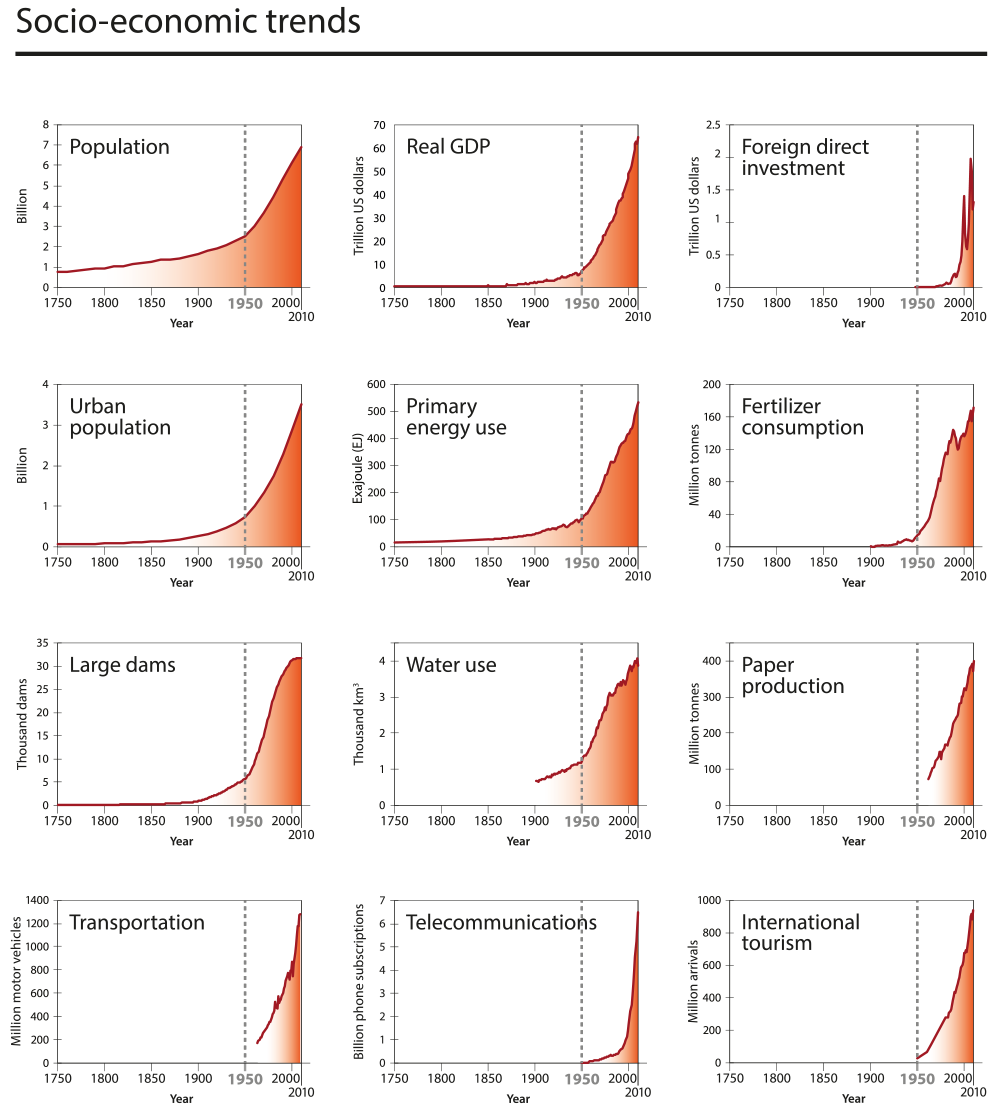
You want guarantees and assurances and policies from environmental groups and scientists, which is imho unreasonable given how complex the problems and nature are.
Exact numbers are irrelevant. It's all estimates anyway. But we don't have anything better to help us navigate.
https://upload.wikimedia.org/wikipedia/en/1/1e/What_if_it%27...

I understand we should stay away from bad policies, and we've surely seen enough of that from our politicians who are looking for fast and easy solutions to be able to placate their base that they're doing something, vote me again.
But what's so bad e.g. on abolishing animal ag, which is not necessary (for human health), has alternatives, and is at the same time extremely inefficient, polluting, destructive and is behind most of the problems of the overshoot?
What's so bad on deciding to not start new oil wells, save those subsidies (and we subsidize it a lot), and instead redirect it to renewables and research of new technologies?
There are few things we could do almost instantly, like to remove/phase out subsidies for the most polluting sectors, and it would do a lot to stop to mitigate the negative effects of the overshoot (I hope you're not disputing that we're, in fact, in the overshoot).
But instead we're subsidizing the biggest polluters forever more, still expanding production, curbing nothing (coal is still at 82%) ... there's nothing to suggest that we're on the right track.
It's not that we're slowing too slow. We're still pressing the pedal to the floor, driving faster and faster to the ... scratch that ... down the cliff.
For me ... waiting, delaying meaningful (not politically convenient) actions means choosing extinction. Absolutely. We couldn't live as we do without the support of the environment.
We seem to be going in circles a bit here. For example, what is wrong with banning oil wells in the UK? I already explained that: it doesn't reduce production, it just moves it to places with less environmental regulation. Why didn't you engage with my argument on that point? What is wrong with reflexive policies like banning animal ag? As I have shown, such policies are generally not well thought out and cause more problems because advocates refuse to consider nuance (eg biofuels, sulphate reduction).
I don't want guarantees and assurances from anyone, those don't exist when discussing scientific theories: I just want good data/models of the problem and solutions that are logical and practical. I want nuance instead of impractical doomerism. You can keep repeating "collapse", "overshoot", "down the cliff" but you need to back this up with models and data. So far you have only referenced models which explicitly tell us not to interpret them as a future prediction! You refer to articles that exaggerate risks by choosing the worst results from single studies (eg arctic ice gone by 2030!). You keep bringing up problems which are basically independent of climate change (eg shark population) and ignoring any progress we have made in terms of renewables. This is not a logical scientific approach to solving a serious problem. This kind of approach also doesn't convince skeptics: it just reinforces their belief that climate activists are immune to argument and nuance.
I don't want guarantees and assurances from anyone, those don't exist when discussing scientific theories: I just want good data/models of the problem and solutions that are logical and practical. I want nuance instead of impractical doomerism. You can keep repeating "collapse", "overshoot", "down the cliff" but you need to back this up with models and data. So far you have only referenced models which explicitly tell us not to interpret them as a future prediction! You refer to articles that exaggerate risks by choosing the worst results from single studies (eg arctic ice gone by 2030!). You keep bringing up problems which are basically independent of climate change (eg shark population) and ignoring any progress we have made in terms of renewables. This is not a logical scientific approach to solving a serious problem. This kind of approach also doesn't convince skeptics: it just reinforces their belief that climate activists are immune to argument and nuance.
> what is wrong with banning oil wells in the UK
A swift phase-out of fossil fuels should be the policy.
https://www.bloomberg.com/opinion/articles/2023-07-27/the-ha...
The Harsh Truth: We're Using More Oil Than Ever
> reflexive policies like banning animal ag
Animal ag. is not on the same level as biofuels (profitable and politically convenient and wrong) or sulphate reduction (I don't watch that space).
You wrote in another discussion "what's wrong with pastures"? If you're interested in addressing these problems, I suggest exploring agriculture. You will discover that it's a much larger problem than one might infer from following mainstream media.
> you need to back this up with models and data ... which explicitly tell us not to interpret them as a future prediction
Because it's risky for the scientists monitoring a trend to provide precise predictions about the future, the major challenges lie in complex systems, long timescales, and both known and unknown unknowns. Predictions of this sort would come under criticism from various perspectives, and due to the uncertainties involved, such a step could likely result in the destruction of many careers.
ELI5: It's comparable to a game of Jenga where you take pieces from the bottom and place them on top. With each added piece, the structure becomes increasingly unstable. The exact moment of collapse is uncertain, but the eventual outcome is inevitable.
> approach also doesn't convince skeptics
Not my job. "Climate grief" encompasses various stages, with skepticism being one of the initial ones. It's likely that some individuals may never be persuaded (in advance).
> immune to argument and nuance
That's the issue on both fronts.
A swift phase-out of fossil fuels should be the policy.
https://www.bloomberg.com/opinion/articles/2023-07-27/the-ha...
The Harsh Truth: We're Using More Oil Than Ever
> reflexive policies like banning animal ag
Animal ag. is not on the same level as biofuels (profitable and politically convenient and wrong) or sulphate reduction (I don't watch that space).
You wrote in another discussion "what's wrong with pastures"? If you're interested in addressing these problems, I suggest exploring agriculture. You will discover that it's a much larger problem than one might infer from following mainstream media.
> you need to back this up with models and data ... which explicitly tell us not to interpret them as a future prediction
Because it's risky for the scientists monitoring a trend to provide precise predictions about the future, the major challenges lie in complex systems, long timescales, and both known and unknown unknowns. Predictions of this sort would come under criticism from various perspectives, and due to the uncertainties involved, such a step could likely result in the destruction of many careers.
ELI5: It's comparable to a game of Jenga where you take pieces from the bottom and place them on top. With each added piece, the structure becomes increasingly unstable. The exact moment of collapse is uncertain, but the eventual outcome is inevitable.
> approach also doesn't convince skeptics
Not my job. "Climate grief" encompasses various stages, with skepticism being one of the initial ones. It's likely that some individuals may never be persuaded (in advance).
> immune to argument and nuance
That's the issue on both fronts.
‘Should be the policy’ : even if that policy doesn’t affect the problem as I have argued and you ignore?
’Risky to make predictions’: if a theory isn’t predictive or falsifiable, then by what epistemology is it scientific?
‘Game of Jenga… inevitable’: assertion with no evidence
‘Not my job’: how can you claim to be so keen for action, yet don’t care if others think your arguments are convincing?
’Risky to make predictions’: if a theory isn’t predictive or falsifiable, then by what epistemology is it scientific?
‘Game of Jenga… inevitable’: assertion with no evidence
‘Not my job’: how can you claim to be so keen for action, yet don’t care if others think your arguments are convincing?
Individual Performative Activism on the environment is trendy and low-hanging fruit. And 98.7% compatible with continuing to live in a comfy-but-Earth-ruining-at-scale manner.
Individual effective action is untrendy, very damaging to ~any well-off modern western lifestyle, and shows ~zero signs of having enough people do it to actually have a major impact on the planet's welfare.
Which one do you actually expect humans to choose?
Individual effective action is untrendy, very damaging to ~any well-off modern western lifestyle, and shows ~zero signs of having enough people do it to actually have a major impact on the planet's welfare.
Which one do you actually expect humans to choose?
Because "urgent system-wide transformation" is just a euphemism for war.
I doubt it, the author's other articles suggest they want a revolution to get rid of capitalism.
It's ironic that they criticize the current approach for not working, and then suggest a nebulous 'transformation' that has even less chance of working. Even if they created a communist revolution in the US, they would then need to extend this to the rest of the world which would likely involve wars that increase emissions.
https://aninjusticemag.com/is-revolution-necessary-to-move-f... https://aninjusticemag.com/is-free-market-capitalism-sustain...
It's ironic that they criticize the current approach for not working, and then suggest a nebulous 'transformation' that has even less chance of working. Even if they created a communist revolution in the US, they would then need to extend this to the rest of the world which would likely involve wars that increase emissions.
https://aninjusticemag.com/is-revolution-necessary-to-move-f... https://aninjusticemag.com/is-free-market-capitalism-sustain...
Or revolution.
or we could just build a ton of nuclear plants.
As growing climate change impacts are experienced across the globe, the message that greenhouse gas emissions must fall is unambiguous. Yet the Emissions Gap Report (EGR) 2022: The Closing Window – Climate crisis calls for rapid transformation of societies finds that the international community is falling far short of the Paris goals, with no credible pathway to 1.5°C in place. Only an urgent system-wide transformation can avoid climate disaster.