Why Are Men More Vulnerable to Depression in Fatherhood?(thereader.mitpress.mit.edu)
thereader.mitpress.mit.edu
Why Are Men More Vulnerable to Depression in Fatherhood?
https://thereader.mitpress.mit.edu/why-are-men-more-vulnerable-to-depression-in-fatherhood/
79 comments
It has been 5 years and while it's getting better, I still regret every single day. I never wanted one since I believe I'm unsuitable to be a parent, yet everyone around me assured me it would be ok. It wasn't. I don't spend more than 10 consecutive minutes of quality time with my wife each day and I have lost all desire to do anything. That doesn't really matter though, because I can't do anything. I feel like my ability to execute has been reduced so much. My kid isn't even bad. I think they are quite good. I am the problem. This makes me feel even worse because my kid loves me and I can't return it.
Sorry to hear this. I urge you to seek some kind of help and support for this, because what you’re describing rings of depression, whatever the root cause (even if it feels obvious).
Really sorry you're going through this. I hope you're finding a few bright moments here and there. 5 was still a difficult, draining age in our house, but it gets easier. You'll find your kid playing more independently soon, maybe even just wanting to do their thing while you do yours, and that'll be a relief. It took me a long time to accept that life is different now, and to not obsess over the differences. Once I did, I suddenly found myself motivated to pick up old hobbies and felt more of a connection to my kiddo. Hang in there, and take care of yourself.
Sorry to hear you're going through that. It does sound like having someone to open up and talk to, even someone you pay (i.e. A therapist), could help. This is especially true if many crucial things around you sound to be positive.
All the best and don't forget that it can get better!
All the best and don't forget that it can get better!
Having someone you pay is actually key here (at least for me.) Never do I want to fix something more then when there's money on the line. I'm sure that getting lucky in finding a therapist that can understand you and provide a hint as to change your approach or bolster you when you're correct but unsure. Free advice can be perfectly correct, but when you're paying maybe you take it more seriously.
>I believe I'm unsuitable to be a parent, yet everyone around me assured me it would be ok
They might just have said that not to sound alarming, and to close the subject.
You know yourself infinitely better than anyone else does, so if you have even the slightest doubt, you should never rely on others to decide what's best for you.
Be especially wary of people close to you, as proximity increases the belief of knowledge much more easily than actual knowledge.
Reminds me of a Philip Roth quote: "The fact remains that getting people right is not what living is all about anyway. It's getting them wrong that is living, getting them wrong and wrong and wrong and then, on careful reconsideration, getting them wrong again."
They might just have said that not to sound alarming, and to close the subject.
You know yourself infinitely better than anyone else does, so if you have even the slightest doubt, you should never rely on others to decide what's best for you.
Be especially wary of people close to you, as proximity increases the belief of knowledge much more easily than actual knowledge.
Reminds me of a Philip Roth quote: "The fact remains that getting people right is not what living is all about anyway. It's getting them wrong that is living, getting them wrong and wrong and wrong and then, on careful reconsideration, getting them wrong again."
Kids need love and compassion. They don’t need perfect parents. You’ll have a ton more regret later if you raise a kid that becomes a broken adult.
Kids aren’t kids forever. They get older and become more autonomous. You want them to grow up and be successful in all things in life. Surprisingly, beyond some life skills, if kids have people in their life that care about them then they have a greater chance of loving themselves, which helps them face life’s challenges.
Kids aren’t kids forever. They get older and become more autonomous. You want them to grow up and be successful in all things in life. Surprisingly, beyond some life skills, if kids have people in their life that care about them then they have a greater chance of loving themselves, which helps them face life’s challenges.
> Kids need love and compassion. They don’t need perfect parents.
Now you are just making him feel worse, since his problem is that he can't give his kids love and compassion.
Now you are just making him feel worse, since his problem is that he can't give his kids love and compassion.
By no means an I an expert, but in my experience, engaging with your family and learning to open up to them (even about your feelings of inadequacy) results in a much richer relationship. It’s like listening to a sad song when you’re sad. You may find that they are yearning to be closer to you, even if you don’t think you’re what they need.
Best of luck, friend. :)
Best of luck, friend. :)
There’s a RegretfulParents subreddit if you need to commiserate or vent.
It’s the no sleep thing compounded with stress of an extra dependent. I love being a father, but that first year in particular was tough.
I have two kids and while I was never depressed, I can see how it can happen. You get virtually no sleep for at least a year after the kid is born and you have to completely change your life routine (no more last-minute weekend trips for my wife and I).
You also don't see your friends as much and it can feel isolating. This also leads to more stress for you and your partner. Many people divorce/break up during this time because of the this.
I wouldn't change a thing though. I love being a father.
You also don't see your friends as much and it can feel isolating. This also leads to more stress for you and your partner. Many people divorce/break up during this time because of the this.
I wouldn't change a thing though. I love being a father.
The economic reality is both parents are usually working these days. Parenting responsibilities are a lot more shared than they used to be while men identify strongly with how they perform at work. It’s a squeeze.
Not sure it is these days; in my youth in the 80s-90s, at least 5 fathers of friends committed suicide (4 by hanging, 1 by gassing himself in his car). Might be more I don't know about.
No sure about the stats / difference.
No sure about the stats / difference.
I am going to guess your group of friends was quite the outlier. Or you considered a ton of people to be your friends.
> Or you considered a ton of people to be your friends.
That's an awful way to write that. You're insinuating that maybe their friends weren't true. How could you know?
That's an awful way to write that. You're insinuating that maybe their friends weren't true. How could you know?
I think you are maybe looking for offense. If I say “I consider them a good friend” it doesn’t bring into question the strength of the friendship.
I didn't say good friends; I was in school; guys in my class are my friends unless they are my enemies. And I included that I don't know the stats or data on it, but hearing from others now, many years later, it was not rare.
I also had 2 family members and 2 good friends commit suicide over my lifetime: no idea about stats again, but I know a lot of people (and I live in a completely different country now) who had similar stats.
I also had 2 family members and 2 good friends commit suicide over my lifetime: no idea about stats again, but I know a lot of people (and I live in a completely different country now) who had similar stats.
You're totally right. I didn't think of it that way.
I've also experienced this (sample of 1 in the 2000's) but it is devastating for all who are near.
This is the real problem IMO. I live in a very religiously conservative country with pretty strict gender roles in marriages. Having lived in the West before, I definitely see a lot less dysfunction or mental health issues here, at least from my peers. But there's also a lot of collectivism here - village to raise a child sort of thing and most people live in joint families.
The human being is still adapting to a very new and very foreign reality.
The human being is still adapting to a very new and very foreign reality.
It should be obvious that having children is going to cause a negative impact, for an extended a duration, on a relationship. I find folks jump into being a parent with rose tinted glasses, not fully grasping what a 20+ year commitment looks like (trying to juggle a career and the economics, a partner, and children in what is essentially perpetuity).
https://ericalayne.co/wp-content/uploads/2013/06/kidhappy.gi...
https://www.ted.com/talks/rufus_griscom_alisa_volkman_let_s_...
https://www.hhs.gov/sites/default/files/parents-under-pressu...
(parent)
https://ericalayne.co/wp-content/uploads/2013/06/kidhappy.gi...
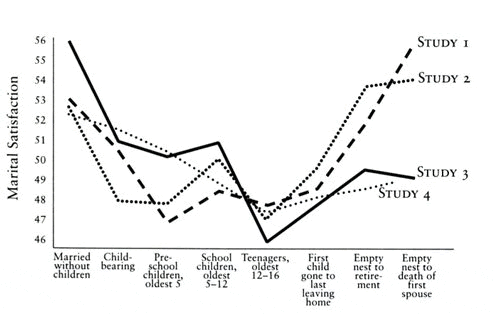
https://www.ted.com/talks/rufus_griscom_alisa_volkman_let_s_...
https://www.hhs.gov/sites/default/files/parents-under-pressu...
(parent)
Many, many years into my “commitment” and it’s been the best time of my life. And my partner’s, too. I’d do it all again in a heartbeat, even the tougher times. YMMV, but such is life.
Congrats on winning the lottery, most people do not.
I must say, in my experience of the parents I know and see regularly on a level I would consider very close, we must be a cluster of lottery winners.
https://www.psychologytoday.com/ca/blog/new-gps-intimate-rel...
> ~48% of first marriages fail, ~60% of second marriages, ~70% third marriages.
https://pmc.ncbi.nlm.nih.gov/articles/PMC4240051/
> The Centers for Disease Control stopped gathering complete data on the number of children affected by divorce in 1988, and at that time more than one million children were affected (Cohen 2002). Since then, the incidence of divorce has continued to climb, and according to the 2009 American Community Survey, only 45.8 percent of children reach age 17 years while still living with their biologic parents who were married before or around the time of the child's birth (Fagan and Zill 2011). The majority of divorces affect younger children since 72 percent of divorces occur during the first 14 years of marriage. Because a high percentage of divorced adults remarry, and 40 percent of these remarriages also end in divorce, children may be subjected to multiple family realignments (Cohen 2002).
https://www.pewresearch.org/social-trends/2024/07/25/the-exp...
> 57% of adults under 50 who say they’re unlikely to ever have kids say a major reason is they just don’t want to; 31% of those ages 50 and older without kids cite this as a reason they never had them
https://www.pewresearch.org/social-trends/2021/10/05/rising-...
> As relationships, living arrangements and family life continue to evolve for American adults, a rising share are not living with a romantic partner. A new Pew Research Center analysis of census data finds that in 2019, roughly four-in-ten adults ages 25 to 54 (38%) were unpartnered – that is, neither married nor living with a partner. This share is up sharply from 29% in 1990. Men are now more likely than women to be unpartnered, which wasn’t the case 30 years ago.
https://www.census.gov/library/stories/2024/11/family-househ...
> About 39% of U.S. family households this year included the householder’s children under 18, according to new U.S. Census Bureau estimates.
https://www.voronoiapp.com/demographics/Over-Half-of-Househo... (draw your attention to the shrinking yellow “married parent” cohort, 17.9%)
TLDR A majority of US households don’t have kids, and only 18% are households with married parents.
(Aggressively data driven; "May the odds be ever in your favor")
> ~48% of first marriages fail, ~60% of second marriages, ~70% third marriages.
https://pmc.ncbi.nlm.nih.gov/articles/PMC4240051/
> The Centers for Disease Control stopped gathering complete data on the number of children affected by divorce in 1988, and at that time more than one million children were affected (Cohen 2002). Since then, the incidence of divorce has continued to climb, and according to the 2009 American Community Survey, only 45.8 percent of children reach age 17 years while still living with their biologic parents who were married before or around the time of the child's birth (Fagan and Zill 2011). The majority of divorces affect younger children since 72 percent of divorces occur during the first 14 years of marriage. Because a high percentage of divorced adults remarry, and 40 percent of these remarriages also end in divorce, children may be subjected to multiple family realignments (Cohen 2002).
https://www.pewresearch.org/social-trends/2024/07/25/the-exp...
> 57% of adults under 50 who say they’re unlikely to ever have kids say a major reason is they just don’t want to; 31% of those ages 50 and older without kids cite this as a reason they never had them
https://www.pewresearch.org/social-trends/2021/10/05/rising-...
> As relationships, living arrangements and family life continue to evolve for American adults, a rising share are not living with a romantic partner. A new Pew Research Center analysis of census data finds that in 2019, roughly four-in-ten adults ages 25 to 54 (38%) were unpartnered – that is, neither married nor living with a partner. This share is up sharply from 29% in 1990. Men are now more likely than women to be unpartnered, which wasn’t the case 30 years ago.
https://www.census.gov/library/stories/2024/11/family-househ...
> About 39% of U.S. family households this year included the householder’s children under 18, according to new U.S. Census Bureau estimates.
https://www.voronoiapp.com/demographics/Over-Half-of-Househo... (draw your attention to the shrinking yellow “married parent” cohort, 17.9%)
TLDR A majority of US households don’t have kids, and only 18% are households with married parents.
(Aggressively data driven; "May the odds be ever in your favor")
I am sorry for you if you experienced this first hand, or fear you might end up experiencing this. I wish you all the best and happy holidays.
On the contrary, I’ve been with my partner for over 20 years and am happy enough. But, I don’t let my emotions get in the way of logic and the rational when advising others. I recognize luck for what it is, and you should to. We won the lottery, as I said; most do not. I’m just trying to help people who haven’t made the one way door choice yet potentially suffer less. Be well, take care.
Edit: I never felt this subthread was anything other than the polite exchange of data and thoughts, and I hope you felt the same way too.
Edit: I never felt this subthread was anything other than the polite exchange of data and thoughts, and I hope you felt the same way too.
I appreciate the data and considered response. And yes, I do recognize luck but also that good things take work, too. And your posts have made me recogize it all the more - it’s good to have a moment to realize that not everyone experiences what you do. Also I appreciate HN for enabling this to be a thoughtful exchange. So all the best - and I do mean that!
[deleted]
>It should be obvious that having children is going to cause a negative impact, for an extended a duration, on a relationship.
But often a positive impact. I would think more often than not the positive outweighs the negative, but not for everybody.
But often a positive impact. I would think more often than not the positive outweighs the negative, but not for everybody.
> 20+ year commitment
I'm 33y into mine and I don't know how long it/me will last.
I'm 33y into mine and I don't know how long it/me will last.
I don’t think it is obvious, because you get a lot of contradictory data on this.
Secondly, if people hadn’t rose tinted glasses, we’d have a massive drop in fertility, I am pretty sure. The facts of parenthood are not very attractive. The nom quantifiable intangible stuff makes it worth it, but those are very difficult to grasp in theory. The negative sides on the other hand are very easy to grasp…
Secondly, if people hadn’t rose tinted glasses, we’d have a massive drop in fertility, I am pretty sure. The facts of parenthood are not very attractive. The nom quantifiable intangible stuff makes it worth it, but those are very difficult to grasp in theory. The negative sides on the other hand are very easy to grasp…
Refer to current total fertility rates [1]. Note that ~40% of annual pregnancies in the US and internationally are unintended [2] (the data does not indicate what percentage of those are unwanted, leaving us to infer from other data sources around parental preference [3]). If we drive down those unintended pregnancies through robust access to contraceptives and reproductive healthcare, I presume the drop in fertility rate ("we’d have a massive drop in fertility") we're already seeing [4] [5] would only accelerate.
> The facts of parenthood are not very attractive.
Yes, exactly, the burden is to explain this to people who don't know so they can make an informed choice.
[1] https://ourworldindata.org/fertility-rate
[2] https://news.ycombinator.com/item?id=37300184 (citations)
[3] https://www.axios.com/2024/07/25/adults-no-children-why-pew-...
[4] https://www.healthdata.org/news-events/newsroom/news-release...
[5] https://www.vox.com/23971366/declining-birth-rate-fertility-...
> The facts of parenthood are not very attractive.
Yes, exactly, the burden is to explain this to people who don't know so they can make an informed choice.
[1] https://ourworldindata.org/fertility-rate
[2] https://news.ycombinator.com/item?id=37300184 (citations)
[3] https://www.axios.com/2024/07/25/adults-no-children-why-pew-...
[4] https://www.healthdata.org/news-events/newsroom/news-release...
[5] https://www.vox.com/23971366/declining-birth-rate-fertility-...
Well, if you want humanity to end, sure, you should inform people better.
But that’s a one sided information flow. You can quantify how much money a kid costs. You can’t quantify what it brings to you. Hence this information would be by essence very partial…
But that’s a one sided information flow. You can quantify how much money a kid costs. You can’t quantify what it brings to you. Hence this information would be by essence very partial…
> You can’t quantify what it brings to you
You can’t know until you’ve already walked through the one-way door. What about all of that aggregate regret and suffering for those who didn’t want, or don’t want after kids are here?
Humanity isn’t going to end because we empower people who don’t want kids to not have them, although the population will compress over the next 200 years (from 10B downward). There will always be parents who really want to be parents, as well as parents who thought they wanted to be but regret it.
For those who want to eat the glass, we salute you. Options for everyone else.
You can’t know until you’ve already walked through the one-way door. What about all of that aggregate regret and suffering for those who didn’t want, or don’t want after kids are here?
Humanity isn’t going to end because we empower people who don’t want kids to not have them, although the population will compress over the next 200 years (from 10B downward). There will always be parents who really want to be parents, as well as parents who thought they wanted to be but regret it.
For those who want to eat the glass, we salute you. Options for everyone else.
sad to say: YES, this is absolutely true.
Esp the 20 year commitment if you get separated and if there are children and if you just cant see the other person anymore after years of relationship before the children arrived.
Esp the 20 year commitment if you get separated and if there are children and if you just cant see the other person anymore after years of relationship before the children arrived.
I wonder if this is just because it’s hard, and your expectations will likely be unmet, or if there is another reason? Is there an “evolutionary biology “ reason?
As a parent of 6.9 children, parenting is a huge commitment. But I have lived my entire life since 27 raising children, so to me it’s life as usual. A key factor is making time for your relationship and maintaining intimacy. Intimacy in its many forms is sooo foundational, anyone that ignores or neglects it is likely asking for serious challenges down the road.
As a parent of 6.9 children, parenting is a huge commitment. But I have lived my entire life since 27 raising children, so to me it’s life as usual. A key factor is making time for your relationship and maintaining intimacy. Intimacy in its many forms is sooo foundational, anyone that ignores or neglects it is likely asking for serious challenges down the road.
I'd love to hear so much more from your experience!
I'm on the fence about this topic and hearing from someone who has had more than 2 might help generalise how having a kid could be.
For me, it feels like one of the few things I've experienced in life on which I won't have much control over after the first decision (of having a kid).
Almost everything else is me deciding every day to do or not do something. This is different.
I'm on the fence about this topic and hearing from someone who has had more than 2 might help generalise how having a kid could be.
For me, it feels like one of the few things I've experienced in life on which I won't have much control over after the first decision (of having a kid).
Almost everything else is me deciding every day to do or not do something. This is different.
You’re right about flipping the switch and then living that decision for the next 20plus years. Once you make that choice, you’re in it for the long haul.
I’m kind of an extreme example because I took the job to heart and designed a whole new life around providing the best developmental foundation for my children I could figure out how to.
For us,that was choosing to pivot from our comfortable cntracting business into a life intentionally filled with challenges , situations, hardships, triumphs, and struggles that we would overcome as a family.
It was way outside of my comfort zone, to be sure, but the point was to give them actual life experience and skills so that when they became adults they would be as prepared as possible to manage situations, overcome obstacles, and manage risk.
It was often uncomfortable but rewarding beyond measure.
I’m kind of an extreme example because I took the job to heart and designed a whole new life around providing the best developmental foundation for my children I could figure out how to.
For us,that was choosing to pivot from our comfortable cntracting business into a life intentionally filled with challenges , situations, hardships, triumphs, and struggles that we would overcome as a family.
It was way outside of my comfort zone, to be sure, but the point was to give them actual life experience and skills so that when they became adults they would be as prepared as possible to manage situations, overcome obstacles, and manage risk.
It was often uncomfortable but rewarding beyond measure.
This sounds interesting, do you have more information on what you pivoted into?
I'm interested in doing something like world schooling and this sounds it might be related.
I'm interested in doing something like world schooling and this sounds it might be related.
We didn’t have the resources to provide a high quality private education, so we uprooted, sold our stuff, packed up a cargo trailer and a van, and spent a decade getting by on a shoestring while doing the most interesting and challenging things we imagined we might achieve as a family.
From an early age, aside from their siblings, they interacted primarily with adults in their world, often from different cultures and speaking different languages, and often in situations where the stakes were high (intrinsic danger imposed by the natural environment and classical physics) .
They learned to be a cohesive team, to handle responsibility within the range of their understanding, to seek and accept council, and to ignore immature behavior when it pops up in inappropriate times.
This sometimes rugged beginning has served them quite well in their lives.
After traveling from Alaska to Oregon , we traded in the cargo trailer for a camper trailer because camping was a pain in the “@&. We shipped our tools and supplies from the cargo trailer to a boatyard in Florida.
When we got to the boatyard, we spent the next two years living in our camper as we rebuilt a 50foot steel schooner.
We didn’t have much cash, so we did all of the work ourselves and salvaged steel from where we could find it.
We became great customers of the metal recyclers in the area lol.
The most expensive thing was buying the epoxy based paint and the bottom paint, which cost almost as much as we paid for the boat. (And the 500 dollars a month for the boatyard)
Other than that , thousands of grinding disks and maybe 20 harbor freight grinders lol.we found they would last through 4 or 5 brush replacements if you didn’t burn up the armatures by using brushes to the point of failure.
We spent the next few years sailing the east coast and the Caribbean, central and northern South America. We would salvage contaminated fuel and filter it and treat itfor our auxiliary engine and generator, getting paid for removing the expired diesel, and I did engine and electrical repair on other boats.
It wasn’t a comfortable life, but it was full of opportunities to teach things about life, lots of skills, and independent thinking and action. Probably the most important lessons were in risk tolerance and risk management. It’s easy to be overly risk averse in the modern world, or to limit your risk taking to avocational pursuits.
I was happy to swallow the anchor when it was time for the kids to start building their social structures and to get started in more advanced levels of education.
It was hard, and an enormous sacrifice for more than a decade, but I wouldn’t trade that experience for my kids for anything else that we could have realistically managed.
The kids grew up in an adult world, but there were lots of other boat kids, and we often stopped for months at a time. When we would be in a place for more than a month or two, the kids would enroll in local schools, which we treated like social studies/ language class, managing primary curriculum on the boat.
Anyway, I’m really happy with the results. They’re all grown and starting families of their own now, and it’s been obvious that their upbringing was key in their many successes.
They refer to it as their “cheat code” because they basically aren’t deterred by anything that they have to learn or become proficient in, and they know from experience that they can do anything they reasonably decide to do.
They have all built houses (as in personally built them) and have are finding their way in software, finance, politics, farming, robotics, and whatever else is interesting to them… basically living what most would describe as a privileged life despite having come from very modest means.
From an early age, aside from their siblings, they interacted primarily with adults in their world, often from different cultures and speaking different languages, and often in situations where the stakes were high (intrinsic danger imposed by the natural environment and classical physics) .
They learned to be a cohesive team, to handle responsibility within the range of their understanding, to seek and accept council, and to ignore immature behavior when it pops up in inappropriate times.
This sometimes rugged beginning has served them quite well in their lives.
After traveling from Alaska to Oregon , we traded in the cargo trailer for a camper trailer because camping was a pain in the “@&. We shipped our tools and supplies from the cargo trailer to a boatyard in Florida.
When we got to the boatyard, we spent the next two years living in our camper as we rebuilt a 50foot steel schooner.
We didn’t have much cash, so we did all of the work ourselves and salvaged steel from where we could find it.
We became great customers of the metal recyclers in the area lol.
The most expensive thing was buying the epoxy based paint and the bottom paint, which cost almost as much as we paid for the boat. (And the 500 dollars a month for the boatyard)
Other than that , thousands of grinding disks and maybe 20 harbor freight grinders lol.we found they would last through 4 or 5 brush replacements if you didn’t burn up the armatures by using brushes to the point of failure.
We spent the next few years sailing the east coast and the Caribbean, central and northern South America. We would salvage contaminated fuel and filter it and treat itfor our auxiliary engine and generator, getting paid for removing the expired diesel, and I did engine and electrical repair on other boats.
It wasn’t a comfortable life, but it was full of opportunities to teach things about life, lots of skills, and independent thinking and action. Probably the most important lessons were in risk tolerance and risk management. It’s easy to be overly risk averse in the modern world, or to limit your risk taking to avocational pursuits.
I was happy to swallow the anchor when it was time for the kids to start building their social structures and to get started in more advanced levels of education.
It was hard, and an enormous sacrifice for more than a decade, but I wouldn’t trade that experience for my kids for anything else that we could have realistically managed.
The kids grew up in an adult world, but there were lots of other boat kids, and we often stopped for months at a time. When we would be in a place for more than a month or two, the kids would enroll in local schools, which we treated like social studies/ language class, managing primary curriculum on the boat.
Anyway, I’m really happy with the results. They’re all grown and starting families of their own now, and it’s been obvious that their upbringing was key in their many successes.
They refer to it as their “cheat code” because they basically aren’t deterred by anything that they have to learn or become proficient in, and they know from experience that they can do anything they reasonably decide to do.
They have all built houses (as in personally built them) and have are finding their way in software, finance, politics, farming, robotics, and whatever else is interesting to them… basically living what most would describe as a privileged life despite having come from very modest means.
I have five. It is the most utterly fulfilling aspect of my life. I'm going to (mis)quote John Deloney about this issue:
You know how when you're single and making money hand over fist and you have a lot of money (compared to you as a teen), and it's awesome? And then you first get married, together you're pretty poor but you're having tons of sex, and it's a different kind of awesome? And then you have children, and you're sleep deprived and sex is kind of weird and the baby is pooping on stuff, but you see your own child--and again, it's a different kind of awesome.
You know how when you're single and making money hand over fist and you have a lot of money (compared to you as a teen), and it's awesome? And then you first get married, together you're pretty poor but you're having tons of sex, and it's a different kind of awesome? And then you have children, and you're sleep deprived and sex is kind of weird and the baby is pooping on stuff, but you see your own child--and again, it's a different kind of awesome.
Not very useful but thanks for the attempt :)
LOL sorry, wish you the best either way!
Because being a parent is hard.
I love all the "helpless" internet advice in this thread by people who are oblivious to what depression is.
"Oh you're depressed and suffer from making executive decisions. Why don't you just make a decision and fix this?! You know therapists exist right!? Fuck you're so fucking dumb, you piece of shit. Just be happy, it's not that hard!"
"Oh you're depressed and suffer from making executive decisions. Why don't you just make a decision and fix this?! You know therapists exist right!? Fuck you're so fucking dumb, you piece of shit. Just be happy, it's not that hard!"
You might also be oblivious to what depression IS, because clinical psychologists are, as well.
Depression is a cluster of symptoms, for all intents and purposes. There is some evidence that SSRIs help these symptoms, but direct causal seratonin deficiency hypotheses have yet to be supported.
There's scant evidence that modern non-pharmaceutical therapeutic interventions (with the exception of niche interventions like CBT) are even effective, yet the advice "go to therapy" gets tossed around constantly as if it's Science(tm) with a capital S.
You can claim that the "depression is just a matter of perspective bro" is an ignorant take, but according to the literature, "depression is a chemical imbalance", or any other definitive "depression is X" claim is equally ignorant. We still don't really know. We're still searching.
Depression is a cluster of symptoms, for all intents and purposes. There is some evidence that SSRIs help these symptoms, but direct causal seratonin deficiency hypotheses have yet to be supported.
There's scant evidence that modern non-pharmaceutical therapeutic interventions (with the exception of niche interventions like CBT) are even effective, yet the advice "go to therapy" gets tossed around constantly as if it's Science(tm) with a capital S.
You can claim that the "depression is just a matter of perspective bro" is an ignorant take, but according to the literature, "depression is a chemical imbalance", or any other definitive "depression is X" claim is equally ignorant. We still don't really know. We're still searching.
[deleted]
alphan0n(4)
yes and something I vaguely remember about $5 bills
The answer is obvious: Because children suck and those parents realize that they have ruined their lives entirely by choice and are now stuck chained to some kid for the next 18 years at least. The more interesting question is why this was not even considered a possible explanation in the article? We all know the reason.
When you are in the final stages of life and have nobody to visit you, you will regret this type of thinking.
While the notion of spending your twilight years with your beloved children is wonderful, what I see happening just as often is seniors ending up in a nursing home, seeing their children and grandchildren only a few times a year, if even that. This seems especially true in American society versus other countries.
And that’s not even counting the cases where your children can’t stand you, if not estranged and outright hate you. Which if you read suggestions that ever dare to suggest that you can indeed live with your parents beyond the age of 18, seems to happen quite often too.
The first scenario is the good ending, and would definitely be worth the effort of raising children.
The second ending? I think I’d rather just not have kids at all if that’s my fate.
And that’s not even counting the cases where your children can’t stand you, if not estranged and outright hate you. Which if you read suggestions that ever dare to suggest that you can indeed live with your parents beyond the age of 18, seems to happen quite often too.
The first scenario is the good ending, and would definitely be worth the effort of raising children.
The second ending? I think I’d rather just not have kids at all if that’s my fate.
Post term abortion isnt cheap