Google begins testing AI-only search results(arstechnica.com)
arstechnica.com
Google begins testing AI-only search results
https://arstechnica.com/google/2025/03/google-is-expanding-ai-overviews-and-testing-ai-only-search-results/
55 comments
This is the wrong move. People are starting to get used to their AI results even that many times inaccurate. I get wrong out dated results all the time, when I look for coding and documentation questions I’d the same thing.
I've watched other (regular) folks use Google lately. They use it as a question/answer tool and only read the AI stuff at the top.
>Currently, the predominant business model for commercial search engines is advertising. The goals of the advertising business model do not always correspond to providing quality search to users. For example, in our prototype search engine one of the top results for cellular phone is "The Effect of Cellular Phone Use Upon Driver Attention", a study which explains in great detail the distractions and risk associated with conversing on a cell phone while driving. This search result came up first because of its high importance as judged by the PageRank algorithm, an approximation of citation importance on the web [Page, 98]. It is clear that a search engine which was taking money for showing cellular phone ads would have difficulty justifying the page that our system returned to its paying advertisers. *For this type of reason and historical experience with other media [Bagdikian 83], we expect that advertising funded search engines will be inherently biased towards the advertisers and away from the needs of the consumers.*
>[...]
>In general, it could be argued from the consumer point of view that the better the search engine is, the fewer advertisements will be needed for the consumer to find what they want. This of course erodes the advertising supported business model of the existing search engines. However, there will always be money from advertisers who want a customer to switch products, or have something that is genuinely new. But we believe the issue of advertising causes enough mixed incentives that it is crucial to have a competitive search engine that is transparent and in the academic realm.
>[...]
>In general, it could be argued from the consumer point of view that the better the search engine is, the fewer advertisements will be needed for the consumer to find what they want. This of course erodes the advertising supported business model of the existing search engines. However, there will always be money from advertisers who want a customer to switch products, or have something that is genuinely new. But we believe the issue of advertising causes enough mixed incentives that it is crucial to have a competitive search engine that is transparent and in the academic realm.
God, I wish Google would stop assaulting us with this crap.
Oh, but you are wrong, it's only getting started.
Imagine an LLM that answers your queries. Amazing!
Now imagine there's a separate add LLM that inserts seamless ads in the first LLM's answers. You'd almost never be able to tell actual search results from ads.
Native advertising taken to the Nth degree. There are advertising execs drooling when they hear stuff like this.
Imagine an LLM that answers your queries. Amazing!
Now imagine there's a separate add LLM that inserts seamless ads in the first LLM's answers. You'd almost never be able to tell actual search results from ads.
Native advertising taken to the Nth degree. There are advertising execs drooling when they hear stuff like this.
Can anyone explain Google's moves here? Pre-2024, it made sense. LLMs seem like a game changer technology that could threaten Google Search. But in 2024 and onwards, we know that's not the case as we are past peak LLM. Adding LLMs unreliability to their main money maker seems awfully misguided. Are they under investor pressure to add LLMs everywhere?
I think the LLMs are merely a method. Google really doesn't want you to leave the Google ecosystem. Hence why they have maps, flights, news, shopping, ...
LLMs allow them to extract information from websites and present those to you, while surrounded by only their ads.
And once that is commonplace somebody will start to add 'Fetch relevant products related to this question from our database, and include them in a natural way into the answer.
LLMs allow them to extract information from websites and present those to you, while surrounded by only their ads.
And once that is commonplace somebody will start to add 'Fetch relevant products related to this question from our database, and include them in a natural way into the answer.
Whatever you think about the quality of the response, this is an end of an era right here. The 30-year reign of 10-link SERPs is on life support.
I can't remember what I used for search before AltaVista? I know I had a notepad on my desk. A lot of web sites I used didn't even have domains so you had to just note down all the IPs.
I can't remember what I used for search before AltaVista? I know I had a notepad on my desk. A lot of web sites I used didn't even have domains so you had to just note down all the IPs.
Lycos?
I also used Archie for ftp search, https://en.wikipedia.org/wiki/Archie_(search_engine) and Veronica for gopher, https://en.wikipedia.org/wiki/Veronica_(search_engine) .
I also used Archie for ftp search, https://en.wikipedia.org/wiki/Archie_(search_engine) and Veronica for gopher, https://en.wikipedia.org/wiki/Veronica_(search_engine) .
Ask Jeeves, maybe? Depending on what order you found them.
Aside from search engines I also remember webrings.
Aside from search engines I also remember webrings.
There was barely a web before AltaVista. I can remember buying "web directories" - physical books or magazines of nearly every website that existed at the time.
Then there was the Yahoo Web Directory. I actually wish this would come back. A curated directory of major and trustworthy web locations would actually be pretty good, especially for less experienced web users who can otherwise be easily tricked.
Then there was the Yahoo Web Directory. I actually wish this would come back. A curated directory of major and trustworthy web locations would actually be pretty good, especially for less experienced web users who can otherwise be easily tricked.
Translations suffered a similar fate already a while ago. Some of the results are completely unusable AI gibberish now, sometimes even with invented words. That's for English -> German.
What's baffling is that translation is the core competency LLMs were designed for.
What's baffling is that translation is the core competency LLMs were designed for.
This happened a few months ago. They changed the backend completely. You can also notice it’s much slower (say from 5 ms to 200 ms). But I don’t think it’s worse.
The translation built into Chrome regularly misinterprets Japanese as Chinese (despite this being objectively, trivially detectable for any significantly long string based just on the codepoints) and offers no way to correct it.
This is a new regression!
This is a new regression!
It is. There are cases where simple words or common expressions in very mainstream languages (French, German, English) just aren't translated at all or translated ridiculously badly.
I predict we’ll end up going full circle.
AI is hot now and there’s perceived value in having answers just spoon-fed.
But eventually, at least some people will want to explore contrasting takes, dig deeper to understand context, and so there will be a desire to have access to the source material (ie: lists of links like we have now).
AI is hot now and there’s perceived value in having answers just spoon-fed.
But eventually, at least some people will want to explore contrasting takes, dig deeper to understand context, and so there will be a desire to have access to the source material (ie: lists of links like we have now).
And it will catch on. Everyone here knows LLMs are not a search engine, yet the average Joe treats chatgpt et al like it is. Just a few days ago I was talking to a relative (70yo) and we were arguing about whether the pool at a bathhouse in a smaller town nearby was 25 or 50m. Their website didn't say, and some quick googling didn't reveal anything. So he quickly opened the chatgpt app and a second later told me proudly that it was 50m so he was right. I didn't even try to explain to him how it can't possibly know.
Now, Google would obviously not just run a plain old LLM that was trained on their index but give it access to live data, but the same thing will still happen. People won't even be able to think they have a chance to check multiple results and question the validity. Whatever the AI spits out is the truth.
Now, Google would obviously not just run a plain old LLM that was trained on their index but give it access to live data, but the same thing will still happen. People won't even be able to think they have a chance to check multiple results and question the validity. Whatever the AI spits out is the truth.
why would anyone advertise in an llm chat box?
isn't Google's whole business model generating clicks to websites?
Another Ars [dupe]
Discussion: https://news.ycombinator.com/item?id=43269332
Discussion: https://news.ycombinator.com/item?id=43269332
The same AI search results that recommend that their users eat glue or kill themselves.
I don't believe this is a right move for Google, but Google does not care about that. Google cares about showing ads, and I'd love to know how they plan on doing that, when everybody will google a term, read the (terrible) AI description and close the tab. Will the ads be injected directly into the responses? Will this be fairly and transparently disclosed?
There was a running theory that google results have detoriated in quality because google wants you to scroll down, to look at more ads. This runs contrary to this expected behavior, so I don't know what to think. I might have to start looking for an alternative.
I really like Ecosia, but if anybody has any recommendations, do tell.
I don't believe this is a right move for Google, but Google does not care about that. Google cares about showing ads, and I'd love to know how they plan on doing that, when everybody will google a term, read the (terrible) AI description and close the tab. Will the ads be injected directly into the responses? Will this be fairly and transparently disclosed?
There was a running theory that google results have detoriated in quality because google wants you to scroll down, to look at more ads. This runs contrary to this expected behavior, so I don't know what to think. I might have to start looking for an alternative.
I really like Ecosia, but if anybody has any recommendations, do tell.
They show a picture in the article where a few website are linked on top of the answer.
https://cdn.arstechnica.net/wp-content/uploads/2025/03/AI-Mo...
I assume the ads could be to replace the first website by an ad.
With LLM, it's also very possible that the ad get injected directly into the result.
For instance, searching for 'is car insurance obligatory?' would return the usual paragraph about yes and why and then tell you insuranceX has pretty good car insurance pricing and reputation.
https://cdn.arstechnica.net/wp-content/uploads/2025/03/AI-Mo...
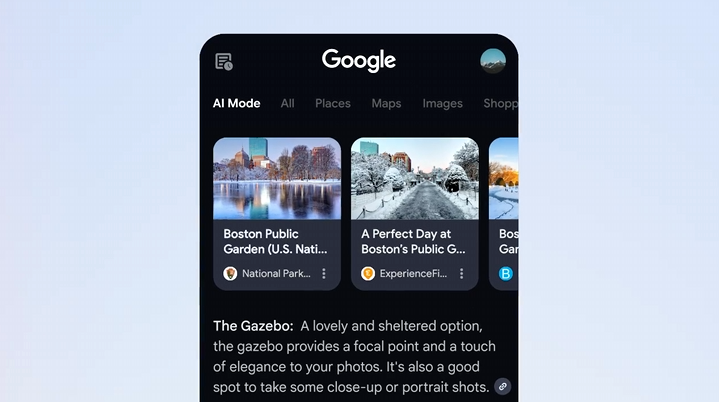
I assume the ads could be to replace the first website by an ad.
With LLM, it's also very possible that the ad get injected directly into the result.
For instance, searching for 'is car insurance obligatory?' would return the usual paragraph about yes and why and then tell you insuranceX has pretty good car insurance pricing and reputation.
I’ve been quite happy with Kagi so far.
> I'd love to know how they plan on doing that, when everybody will google a term, read the (terrible) AI description and close the tab.
Using an LLM, they can set up the bot-character to dynamically recommend, persuade, and prime viewers directly.
A subtler version of the Truman Show model: https://m.youtube.com/watch?v=BCJyGy6AFJo
Using an LLM, they can set up the bot-character to dynamically recommend, persuade, and prime viewers directly.
A subtler version of the Truman Show model: https://m.youtube.com/watch?v=BCJyGy6AFJo
Any recommendations for search engines that do not get rid of results that violate DMCA? You know, "watch X free online" used to give me all sorts of useful websites, now it typically does not or it takes longer to find them.
Of course if you know where to look, it does not matter as much, and I do, but still. :P
I just want the old Google experience.
Of course if you know where to look, it does not matter as much, and I do, but still. :P
I just want the old Google experience.
Brave search seems the least censored
I’ve personally replaced about 2 out of 5 searches with chatgpt queries so I do believe it’s in the right direction
I think the first paragraph while true is not indicative of anything since it can be fixed and improved
I think the first paragraph while true is not indicative of anything since it can be fixed and improved
SOTA ChatGPT models have a hallucinaton rate of 37.1%! [1]
I can't say that I have not used it in similar ways though, and it might be very often the best alternative. I just worry that in this age of misinformation, many incorrect 'facts' will be absorbed blindly into these models and spewed forth.
(edit - wrong source, my bad) [1] https://nypost.com/2025/02/28/business/sam-altmans-openai-la...
I can't say that I have not used it in similar ways though, and it might be very often the best alternative. I just worry that in this age of misinformation, many incorrect 'facts' will be absorbed blindly into these models and spewed forth.
(edit - wrong source, my bad) [1] https://nypost.com/2025/02/28/business/sam-altmans-openai-la...
I'm not sure if you meant to cite that source, it has nothing to do with the hallucination rate you state in your post.
You are completely right, my bad! Fixed the source now.
This further pushes us into walled gardens. Facebook, Google, ChatGPT, so on.
So, I have to use another search engine to verify the results?
I used a ChatGPT this morning. I asked for a website url related to one of my queries. It kept giving me wrong ones. I believe this is going to be frequent in the LLM era and I fail to see how it AI-only results are an improvement when this fundamental flaws of LLMs are not tackled head-on
Google has caught a serious case of FOMO. Every major/minor player is scrambling to blend search with LLMs.
This is no simple case of FOMO. I'd rather say that this is a classic case of the Innovators Dilemma. It's their Kodak Moment.
Related "Expanding AI Overviews and Introducing AI Mode" 62 comments: https://news.ycombinator.com/item?id=43269332
It is patiently obvious that not all "searches" are questions. Google would be crazy to drop that capability. Otherwise if I type in IKEA I would get an article about a store, which is not what anyone would want.
time to select my new search engine
[deleted]
When it comes to search Google needs to do something. Asking LLM chat questions + asking for sources of information works better for me then Google search responses, cluttered with sponsored links/infomercial/spam blogs, etc.
We are at the moment Google search was introduced, Lycos, Alta Vista, Yahoo Search, etc. had to give the ground to the new player, now we are at the beginning of the next cycle.
One more thing that kills Google is social media and European GDPR regulation - those two factors are connected, as they destroyed "the old Internet". Nobody blogs anymore because it is much easier to get attention by posting on social media (slight exaggeration, but still...). GDPR made having an independent forum a nightmare. Right to be forgotten, data export on demand, data accuracy requirement. Big players can afford all this stuff (and it is not easy, I've been through that), hobbyist forum rather not, besides, it is easier to create Facebook (Meta) group or Twitter (X) community.
As a result Google crawler does not have too much value content to read. Yes, there are niches, like StackOverflow, so Google is a nice search engine on top of SO content. Until SO people will decide that free lunch is over, they will train their own AI to make some bucks.
We are at the moment Google search was introduced, Lycos, Alta Vista, Yahoo Search, etc. had to give the ground to the new player, now we are at the beginning of the next cycle.
One more thing that kills Google is social media and European GDPR regulation - those two factors are connected, as they destroyed "the old Internet". Nobody blogs anymore because it is much easier to get attention by posting on social media (slight exaggeration, but still...). GDPR made having an independent forum a nightmare. Right to be forgotten, data export on demand, data accuracy requirement. Big players can afford all this stuff (and it is not easy, I've been through that), hobbyist forum rather not, besides, it is easier to create Facebook (Meta) group or Twitter (X) community.
As a result Google crawler does not have too much value content to read. Yes, there are niches, like StackOverflow, so Google is a nice search engine on top of SO content. Until SO people will decide that free lunch is over, they will train their own AI to make some bucks.
I think you’re misattributing society’s preferences to something different (GDPR). People who were born around 1995 basically lived through haydays of Facebook, peak days of Twitter and etc. Frankly, it was a great experience. Those people grew up, and didn’t need to maintain phpbb, deal with extremely turf-protecting admins, and just got used to frictionless online communities.
I think, you should blame the continuously shortening attention spans of an average person. Nobody wants to wait for anything anymore, and current services (YouTube, TikTok, Facebook, Instagram, Twitter) are much better at giving dopamine hits, than dealing with small forums.
Saying this as a person who used to live in niche online communities, but I’m still on the younger side of things, so felt the shift in society in person as my friends got exposed to the larger internet.
I think, you should blame the continuously shortening attention spans of an average person. Nobody wants to wait for anything anymore, and current services (YouTube, TikTok, Facebook, Instagram, Twitter) are much better at giving dopamine hits, than dealing with small forums.
Saying this as a person who used to live in niche online communities, but I’m still on the younger side of things, so felt the shift in society in person as my friends got exposed to the larger internet.
Pretty excited for this but looks like the testing program is still behind a waitlist - even for Google One subscribers
Results may vary, but I was accepted within hours.
Nice. What'd you think of it?
Nothing obviously bad about the very litle I've used it so far. Almost disorienting how little distraction there is from clean interface. Need to figure out if there's anything that distinguishes it from using Gemini directly.
Interesting. Thanks for sharing!
Official source: https://blog.google/products/search/ai-mode-search/
And here I am still waiting for AI-less search results.
The whole new iteration of attempts to game this are going to be fascinating. The adversarial nature of AIs trying to produce content better able to fool the AI judging the content sounds like the perfect Petri dish to quickly increase sophistication.
Yesterday I searched google for more information on the common house centipede, in my current location.
The AI summary was helpful, but the image it chose was of a centipede with a woman's head. https://howanimalsdoit.wordpress.com/wp-content/uploads/2011...
So I think maybe they need to let it sit in the oven a little bit longer.