This is about the journalism that is serious. That tells stories, reports, and goes deep into subjects.
My impression is that most media today is nowhere near this. They're just cheap dopamine source, containing only "news", not any serious discussion.
"This ____ grills ______ on his comments about __________." -- this is typical American title, but in other countries this sort of news is abundant, and differs only in wording, not the essence.
A local media news: Lebron James died in a crash. Which happened at the other side of the world in another country, nothing to do with the place itself. Because the media is owned by a holding company, and metrics are measured and aggressively optimized.
Trump became a source of cheap dopamine for every non-serious media in the world. "American president said that X. <insert your tongque in cheek/sarcastic/caustic comment>".
"Traffic jams in city X reached level 9!" (screenshot of a mobile map with traffic layer)
I must say that already in the early 2000s web developers were tired of hand-coding everything, and many sought some sort of automation -- a framework, a CMS. Already in 2004 I made a site with barebone approach -- put a txt in a diretory tree and let PHP simply add tags instead of linebreaks and insert it into HTML. The alternative those days was a heavy content management systems. And I came to Django after two awful PHP frameworks, written by lead developers at the workplaces. So, frameworks like Django were a more gradual transition, and they were much more pleasant to work with.
Sure, as you pushed it further, like add versioning to objects, things got very tricky and not guaranteed to work, and no way to fix.
I worked mostly on frontend in 2012-16, in plain HTML+CSS, and then quit, because React was required everywhere, and I tried and hated it.
But before React, I don't recall frontend as very inspiring and joyful.
It was fun to see your work immediately on the screen. I did apply skills and had to solve some weird situations. I could optimize our CSS with OOCSS approach (later used in Bootstrap) -- only to complaints -- semantics! too many classes! (my trump card was that their commits contained +200 lines of CSS, while mine mostly had 0 -- and our CSS was already bloated into several megabytes).
But this was a dead end. I tried making tools to find out unused styles, to automate some patterns -- like click a button and load some content over Ajax. But the guys, who copy-pasted code with dumb solution to this, got 2-3x more tickets closed. I proposed a tool to make screenshots of pages and diff them to search for regressions, but the response was it's heavy RnD, we're not a research institute, we got to ship the next popup tomorrow, etc.
There was an article here, 18 years ago, called The Gospel of Consumption. It also noticed that since 1950s, the productivity had gone so far, it would have been enough to work just 2 hours a day.
I had similar problems. Compilation got 10x faster once I split one crate into workspace with crates inside. The checks are only done on the compiled one. Then, I got rid of serde, because its derive macros are heavy and add some seconds of hickup (other serialization frameworks based on proc macros are slow too: rkyv, musli).
> Many languages of Russia got their alphabets already in the late nineteenth century or around the 1906 rebellion. If you look at publications then in Mari, Chuvash, Ossetic, etc. the Cyrillic orthography already has most of the special characters that were used in the Soviet era.
Good point. So, it's not evil Commies that forced Cyrillic upon them. :)
Regarding Uzbekistan -- well, let's assume Latin won. I wonder how did it make them go off the influence of Russia? Until 2024 attacks and more anti-immigration push, they were quite in orbit, despite the fact that they got rid of this "propaganda and influence weapon" of Cyrillic.
Oh, yes, the alphabet is used to write texts to convey evil empires' messages! Why am I so strangely defensive, really? Well, it's the most ridiculous argument people use here. Somebody is conquered, governed -- you may say colonized, -- there's army and police, but you all are pointing at the alphabet.
Like, if you're on the USA/Israeli side in the current conflict, well, maybe quit using Arabic numerals, switch to Roman?
I wonder, what's your take on your alternative scripts. Latin was enforced by Roman catholic church. Poor Germanic peoples! Muslims enforced their Arabic abjad on Indo-European Farsi, where abjad doesn't quite fit.
All these alternatives have a history of bloody colonialism. Any better options?
They're just 3 states, and they have 0 texts from pre-Cyrillic period in the Latin alphabets they came up with.
Azeri language is similar to Turkish, it's an easy job, and they can watch Turkish media with no issues, and there's an infinite corpus of Turkish texts for them.
For Uzbekistan and Turkmenistan the situation is that they used Arabic script before the Soviet times. There are no texts in the Latin they chose, and their scripts and languages are far from Turkish.
If you walk down the street in Tashkent, there are signs and even announcements in Cyrillic, even in public schools. It takes long to take off, and it's probably 2nd if not 3rd version of Latin.
And also, they teach Russian in Uzbekistan too, and watch Russian media, and share political views. You must have good imagination to suggest that the switch to Latin de-colonized them.
In Kazakhstan, Latin was pet project of the former president, and is currently abandoned.
No, you're wishfully thinking. What made people absorb the Soviet version of history and politics, was school curriculum, and central TV, and teaching Russian to keep them in orbit. Cyrillic alone won't allow this.
Funnily, you don't know or omit the details yourself.
Russian Empire didn't give the conquered nations the alphabet, but USSR did, as part of supporting local nationalists (surprize!). And it first gave them the Latin script.
Secondly, using different scripts for the same language isn't hard. Serbs use both Cyrillic and Latin interchangeably, and many people used Latin traslit in computers and phones when their codepages weren't available yet, and it wasn't a big problem. It takes you at most 2 weeks to learn Arabic script without knowing the language, and with own language of slightly older version, it's even easier.
You also suggest Arabic is their "proper" language, but abjad is not suitable for Turkic languages -- there vowels are significant, and many more than the 3 Arabic vowel diacritics. They had actually Turkic runes instead. Why don't you bash Arabic too?
What about Germanic peoples? Was switching to Latin from their runes an evil oppression?
It is military force and administration, that set school curriculum, use a certain script, and teach an edited history. Not the Cyrillic.
> The adventure genre was what people liked before the mentioned Don Quixote, not by reading, but from folk tales, which are older than dirt, especially if you lived by the coast and met sailors around.
Well, maybe. I meant the genre like Jules Verne, Robert Stivenson.
Actually, I checked facts and found out that Daniel Defoe (I thought he lived in the same epoch), in fact lived in XVII-XVIII, much earlier.
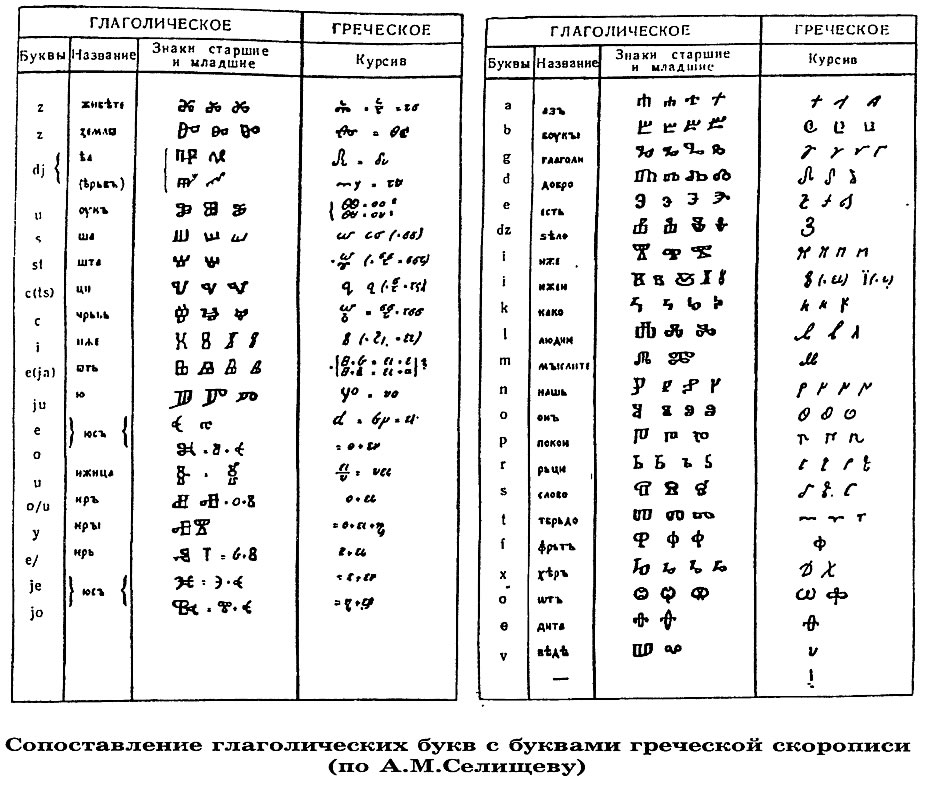
Interestingly, it was also a derivative of Greek, but the cursive version. It's harder to write, but apart from that, I like it. Ⱂⱃⰺⰲⰵⱅ, ⱂⰺⱎⰺⱅⰵ Ⰳⰾⰰⰳⱁⰾⰺⱌⰵⰻ!
This author is suggesting that Cyrillic is a sort of tool or weapon in the arms of the authority, and is imposed upon the people for purely political reasons. This is just false projection of modern politics onto old times. It's shameless propaganda.
In reality, at the time, it was the Eastern Christian church that was more liberal than Rome. Rome insisted every local church make services in Latin, and didn't translate it in the local language.
The Eastern church instead, had the bible in Greek, but allowed to translate it in local languages and make services in them. Initially, those translations were made with Greek letters, which weren't fully reflecting the phonology of Slavic and other languages, so they were extended, which produced Cyrillic.
As I understand, the same way Coptic script in Egypt, and Ge'ez in Ethiopia were made, thanks to Eastern Christian church allowing this.
p.s. Saint Cyril, in fact, invented the Glagolitic script. Cyrillic was named after him, and initially "Cyrillic" alphabet was mostly Greek, plus some characters from Glagolitic, like Ⱎ, ⱍ and ⱑ.
I guess, there's another set of tranformations in stories.
At least in European culture, stories lost their religious part in the modernity. Probably people stopped understanding it earlier, but they were transformed in the XIX century. For example, a knight didn't serve a lady in medieval literature -- he served the god. Some story had a knight standing on his knees in lady's sleeping room, of course, having no sex, nor kisses -- not because of "romantic" self-denial, as we would think -- but just because they were praying. They were busy saving their souls before the judgement day. In the Enlightment age, people stopped understanding this, and replaced it with purely romantic motivation.
The other stories, that villagers told their kids, were probably to scare them, about the dangerous world around. The characters were motivated purely by the need to survive, and minding their own business, no high moral goal. In XIX century, with steam locomotives and boats, people could travel to unthinkable places, and many moved to cities, so you couldn't scare kids with a witch or a werewolf living in that forest beyond that lastmost house. So, storytellers invented the adventure genre. So, instead of trying to survive, characters go far away on purpose, where they need to fight to survive. Or there are some unknown human villains, who the good character has to fight.
In late XX century, this story becomes unconvincing too. Big villains and monsters are unimaginable, so stories start breaking this pattern, often demonstratively: here's a monster, ugly and huge, the little boy is scared of him, but suddenly the monster turns out nice, and loves dancing walzer or makes sweet pancakes, and they become friends. Soviet cartoons in the 80s were 100% postmodernist, whilst what I saw of the American ones, were still like 80% modernist -- the bad guys, danger, the righteous main character.
Interesting read, wouldn't have thought this of Pinocchio. Sadly, when I was learning Italian, I was reading more sophisticated things like Il Fu Mattia Pascal, with quite superficial understanding.
My impression is that most media today is nowhere near this. They're just cheap dopamine source, containing only "news", not any serious discussion.
"This ____ grills ______ on his comments about __________." -- this is typical American title, but in other countries this sort of news is abundant, and differs only in wording, not the essence.
A local media news: Lebron James died in a crash. Which happened at the other side of the world in another country, nothing to do with the place itself. Because the media is owned by a holding company, and metrics are measured and aggressively optimized.
Trump became a source of cheap dopamine for every non-serious media in the world. "American president said that X. <insert your tongque in cheek/sarcastic/caustic comment>".
"Traffic jams in city X reached level 9!" (screenshot of a mobile map with traffic layer)