> I do not understand why designers are so insistent on making tools so difficult and unpleasant to use.
Because they need something to pad their resume. In fact, most of the things that are wrong with software today are for the same reason.
Executives want to make bold changes, so the Start button must be "re-imagined." For the same reason, Product Managers "re-imagine" the menus that have been in place for years and Product Designers "re-imagine" the design language to remove all cues that a button clicks and a panel scrolls.
In my routine trips to the auto parts stores over the past 20 years, I have seen their throughput drop as more and more of these modern ideas seeped in. Their text menus had been the same for decades, with as many options for a next action as there were keys on the keyboard. If my intuition is correct, they were remote sessions to a server/mainframe. How about that for keeping the computation close to the data. Now that has all been replaced with a single button and a cursor.
I'm not a die-hard CLI user by any stretch, but I understand the impulse after watching usability circle the drain year after year. There's a healthy middle somewhere and I am hoping to find it.
Every public figure has been called names. It comes with the territory and usually it's not worth mentioning. It's part of the deal and shouldn't be surprising to anyone who has decided to step into the public square. Some people fixate on that so they can get their 15 seconds of fame in the culture war game, others return the focus to the cause they are fighting for.
> Thanks for telling me what I should do, without knowing what I've been doing.
I can't read your mind. So far it's all emotions and no content, so hopefully you have been doing something more than that.
How are the complicit media organized? Is there a secret WhatsApp thread going on between the hundreds of media organizations? Who runs the organization? How do they keep it a secret?
The guidance from the CDC has been relatively clear: closures depend on the state of the local hospital system and transmission rates. Closures that avoid overwhelming health systems protect medical staff, increase COVID survival rates, and allow people who need non-COVID treatment for diseases like cancer to have access. It has been that way since the beginning of COVID, and is part of the standard response for every pandemic in modern history.
The only person who has been bringing up racism is you. If you want to participate in a culture war by complaining about culture wars, go right ahead. If you want to discuss pandemic response, please join the conversation. Better yet, join the campaign to get people vaccinated. It will save lives and we can re-open more quickly.
She was correct if you don't consider children as a vector for COVID-19 transmission to parents and grandparents. Hundreds of thousands more people would have died if schools weren't shutdown before the vaccine was available.
I think there was almost a good system in place: a variety of ad-supported sites that professionally reviewed new products, and a variety of ad-supported forums where you could get the advice of other people. Manufacturers win in both cases if they can make a good product that survives the professional review and doesn't fall apart or immediately break so the forums give it a pass.
The problem is tracking and dependence on ad networks. Corporations doggedly chasing the bottom line don't want to spend the time or the money to pick and choose specific forums and sites to advertise. They want to pretend to automate that process. Their laziness not only killed the old networks and communities around various product segments, but helped start the "listicle" de-evolution that has decreased content quality across the entire internet.
I used to be able to type in "product_name review" and get some useful, well-known sites. Now I get recycled garbage content, and I have to check all of those sites individually or restrict the domain in the search. It's ridiculous.
> As far as I can tell, you just made that up. Literally no Google hits
NAFTA was passed in the very early days of the internet. Here's a great quote about it from former presidential candidate Ross Perot via wikipedia:
"We have got to stop sending jobs overseas. It's pretty simple: If you're paying $12, $13, $14 an hour for factory workers and you can move your factory south of the border, pay a dollar an hour for labor, ... have no health care—that's the most expensive single element in making a car—have no environmental controls, no pollution controls and no retirement, and you don't care about anything but making money, there will be a giant sucking sound going south. ... when [Mexico's] jobs come up from a dollar an hour to six dollars an hour, and ours go down to six dollars an hour, and then it's leveled again. But in the meantime, you've wrecked the country with these kinds of deals."
Perot was from Texas, and mocked by corporate media as a clueless hillbilly for suggesting that NAFTA would be a bad deal for Americans. It was one of the few issues Noam Chomsky and Rush Limbaugh and all the major unions agreed on. Trump, whether sincere or not, uses it as one of his main talking points because it is absolutely true. Selling out our capacity to manufacture our own goods has been a terrible choice for Americans. We can't make the things our civilization needs to function. We have hollowed out entire metro areas and replaced steady paychecks and fairly cohesive social units with "gig" work and broken families.
That's a long way of saying their memory is accurate, but I think it's a critical moment to understand in modern US history. NAFTA was a big fucking deal, and the owners of corporate media spared no one to make sure it would get passed. They understood the power it would give them in terms of wealth accumulation and bargaining power to beat down unions and wages. Everyone thought Clinton wouldn't capitulate since it was unpopular with Democrats, but Clinton was attracted to and further corrupted by Wall St power and depended on them for guidance.
For a lot of Americans, NAFTA was the beginning of the end of their community. They are still pissed off about it, and that's the reason the criticism of the Clintons can turn vile in certain circles. It's not entirely unearned. I don't like the Clintons, though I voted for her as the lesser of two evils in 2016.
Because people in debt are easier to control. It's the same reason we are the only nation that does not provide healthcare as a right. Millions of people would quit tomorrow if they were sure their kids would have access to healthcare.
For reference, visit any nation with these rights. You will find more small businesses, fewer franchised chains, and happier people.
According to Leonard Susskind[1], fine tuning is a compelling argument by itself[2], and the strongest case is the cosmological constant.[3] In a nutshell it is a sort of repelling force first proposed by Einstein to create a workable model for a static universe who later regretted it as one of the biggest mistakes in his career. However, the theory is now back with Nobel prize winning research showing that expansion is accelerating, which would require a positive number. It could explain a large portion of "dark matter."
When expressed in one way, it is 10^-122 "units of the square Planck length". I'm not smart enough to completely understand it, but it is (according to physicists) an incredibly precise ingredient in the various properties of physics that make our Universe possible. Any larger or smaller and the model falls apart. If it is an accident, that is one hell of a lottery ticket.
Trump claimed the election was stolen, held a rally on the day the vote was being formally accepted by Congress, told a crowd of thousands to march to the Capitol, and then that crowd stormed the building and beat a cop to death while they hunted for Congressional representatives for the same purpose.
It was a terrorist act, and Trump hasn’t been arrested yet.
In addition to your points here, I found the hypothesis below very interesting. In a nutshell, American governments are incentivized to zone for expensive land that doesn't require much infrastructure. So we get giant, sparse suburbs and institutional opposition to affordable housing because that reduces the tax base.
'Local German officials, like local leaders everywhere, seek bigger budgets to provide more and better services to their constituents. What’s different about Germany is that the way to get bigger budgets is to increase local populations. And, as Professor Buettner says, “Ultimately, to get people, municipalities will need to support housing.”
The result is a system of incentives that is the opposite of “fiscal zoning”—the US practice of zoning land in ways that maximize local governments’ income and minimize their costs. In places with high sales taxes, such as Washington State, leaders zone more land for shopping centers. In places where residential property taxes are capped, such as California, they zone less land for homes and more for offices. In affluent suburbs, they often zone land for houses on large lots, excluding low-income people.
Maximizing property values is such a central concern of local government in the United States that Dartmouth economist William Fischel developed the notion into an entire political theory. His “homevoter hypothesis” holds that local governments are almost single-mindedly focused on maximizing real estate values, because homeowners typically vote their home values in local elections. German jurisdictions gain financially by maximizing population, not house values, and because renters outnumber homeowners in the country, homevoters are not the dominant electoral force in local German elections. Renters are.'
Not too worried about it. It only happens during wartime for G20 nations, the last being in the 1920s/1940s. When those nations were on the gold standard.
> Would you be happy with no paper certificates for gold and just use gold coins? From your earlier argument I suspect the answer is no.
Everyone's answer is no. Even during the prime of the standard, people made transactions on paper currency promising they represented gold because no one is going to lug around heavy coinage, spend the time to authenticate it (since it's easier to counterfeit than modern paper/plastic currency), or have to decide between making trips to banks or having a pile of it they have to constantly guard.
> Every single argument you have made is that governments and banks cant be trusted with paper money even when it is backed by gold. So, why do you push for fiat currency?
Because for every person who isn't part of the aristocracy close to centers of power, there is no difference. If a currency is mismanaged, it doesn't matter whether it promised gold or low inflation. During all of the previous crises, the first things banks and governments did is suspend specie payments.
> If government and banks are not to be trusted with paper money then hard currency is the only solution left that doesn't require trust in anybody.
If you want to live in a nation state with a credible legal system, and I think everyone does, you have to trust them to some extent. You have to trust that they won't take away your property by force, throw you in jail to take your wealth, allow someone else to do those things without consequences, or mismanage their currency to the point where it hyper inflates.
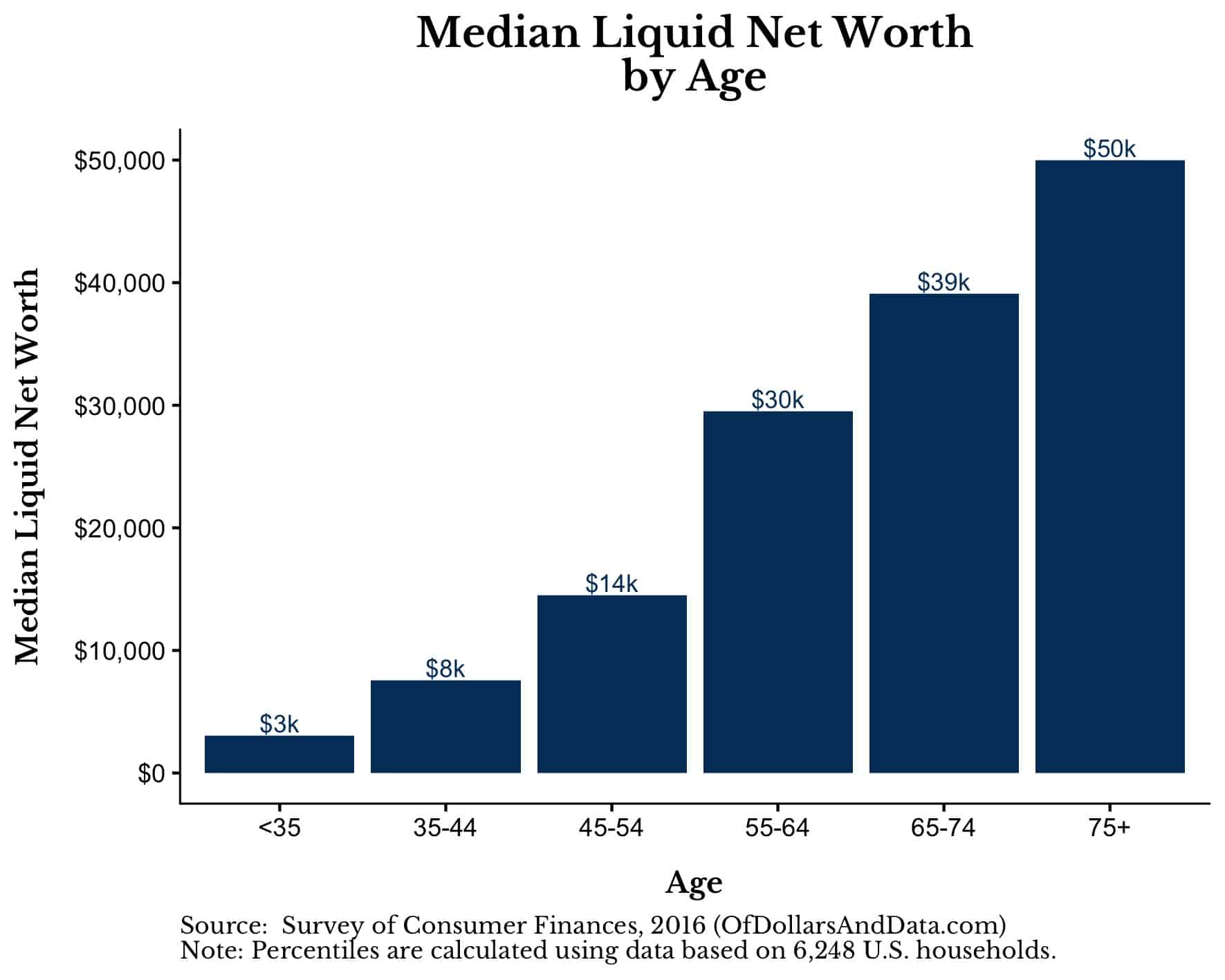
Credible governments have things like the FDIC so normal people don't have to worry about their local credit union going under as long as their account has less than $250k in it. Since the average liquid net worth of Americans is less than $50k[1], that pretty much covers everyone. It has virtually ended the problems of bank runs and panics except for black swan events like 9/11.
Even for things like the 2007 Financial Crisis, being on a gold standard wouldn't change anything. The policy mistake of removing the firewall between traditional banking and investment banking as well as leverage limits would have still led to over-speculation and CDO Ponzi schemes. The gold standard would have just added another knot to the crisis as well as provided some video footage of huge crowds trying to get specie payments and walking away empty handed. Nations like Canada avoided that entire crisis, except for what was unavoidable due to their relationship with the global economy.
> Gold is a currency trusted by all, fiat is a currency of force.
> You have to trust that banks or governments aren't going to steal your gold. If you don't trust them you change your dollars back to gold.
> With any currency its value comes down to trust.
Do you see the problem here? The entire argument for the gold standard always goes back to trust of the institution that is promising to exchange paper for gold. There is a long, long history of banks and governments unable to produce lumps of metal when demanded, and that has caused panics and recessions. Even if they were sound but had logistical issues moving gold around and exchanging it.
Again, there is no difference between a piece of paper that promises to be worth some amount of gold and a piece of paper that promises not to mismanage a fiat currency. They both depend on full faith in the institution that made the promise.
> A gold standard allowed people a way to keep their wealth in a durable form in times of low trust with no conversion cost.
If they had the physical gold, there is always a conversion cost. A lot of immigrants use gold as a bank of sorts, and they always lose a few points when they sell and buy back. In a crisis, as we both agree, gold is worthless, or at least worth a lot less as everyone tries to sell theirs for food. Holding paper that should be exchangeable for gold has no more inherent value than a fiat currency.
> It allowed people to "take their ball and go home" so to speak. No governments needed to trust another country's fiat. The money exchanged in trade had a real, verifiable, persistent value.
It allowed people to have a piece of paper with a promise that they could "take their ball and go home" so to speak. No governments needed to trust another country's fiat, they needed to trust they weren't lying about their gold reserves and their management of it. The money exchanged in trade was a promise that it was backed by a real, verifiable, persistent value.
> Whatever excuses the US Government gave for ending the gold standard it still acted unconstitutionally. The government was facing a damaged economy and dwindling gold reserves as people and countries redeemed dollars for gold. The government saw their dwindling gold reserves as a problem instead of a function of a gold standard. This is the same as a casino
The government saw their inability to manage the money supply when it was tied to gold as an existential crisis to the Union. If you were in charge, based on your arguments here, you'd rather let the south secede or win the Civil War than tarnish the reputation of the gold standard. That's a bit more serious than a casino going bankrupt.
> It wasn't a problem with the currency it was a lack of trust in the issuer that the issuer saw as a reduction in "their" money that needed to be stopped. It was never "their" money to start with. It always belonged to the people. The people were just taking their ball home.
And when many of those people tried to take their ball and go home, there was no gold for them to collect. The system failed because the institution was mismanaged, or because there was a panic and they couldn't handle the logistics of moving lumps of metal around. That's the whole reason the world has moved away from the gold standard. I'm not sure how you see the long history of it's repeated failures as evidence that the problem is not the gold standard, but the lack of a perfect implementation of it.
> It is a terrible idea for a civilization that exists in a system with finite resources to use a currency that is unbounded and exponential. The disconnect between the nominal economic substrate and raw reality will lead to broad class theft and environmental destruction.
Well, this is certainly a different argument than "1850-early 1900s is a great example of the benefits of the gold standard"
> 1. For class theft, don't just take my word for it, take Paul Krugman's
Or, take his word on why the gold standard is a bad idea? (written before the EU was a thing)
"Why not emulate our great-grandfathers and tie our currencies to gold? Very few economists think this would be a good idea. The argument against it is one of pragmatism, not principle. First, a gold standard would have all the disadvantages of any system of rigidly fixed exchange rates--and even economists who are enthusiastic about a common European currency generally think that fixing the European currency to the dollar or yen would be going too far. Second, and crucially, gold is not a stable standard when measured in terms of other goods and services. On the contrary, it is a commodity whose price is constantly buffeted by shifts in supply and demand that have nothing to do with the needs of the world economy..."
> As for environmental destruction, surely you can see how putting society on a compounding treadmill of devaluation encourages consumption as a driver of economic growth (if we fail to post a positive growth number, we WILL have at least a transient economic crisis), and it's patently evident that we buy more, shittier things that need to be replaced, because there is diminished opportunity cost for saving your money to buy something better and more robust: but hey, it's good for circular flow.
I agree that inflation can drive part of the problem in the constant pursuit of growth and profit at the expense of the environment. The problem is that moving to a gold backed currency wouldn't change any of that. We know this because the regulations introduced by the EPA in 1970, just as the US moved completely off the gold standard, are the reason that the US has cleaner air and water. Along with the fact that corporations externalized the environmental costs of our consumption habits to Southeast Asia. None of that would be different if the US had stayed on the gold standard.
> Or, maybe you like environmental destruction and screwing the poor. If you do, you should probably say that up front, instead of hiding it behind difficult-to-unpack-ese like Krugman does.
Ignoring the mild annoyance of this insinuation, it remains completely ridiculous. What was the life expectancy in the height of the gold standard? What is it now? What countries are the most carbon neutral, the most environmentally sound, and have the highest standard of living? Are they using a fiat currency system?
The difference is in policy. Most of the EU is beating the US on every metric for the average person because of their laws. Individuals in those countries have rights to food, shelter, healthcare, and education, and because those governments are legitimate and relatively uncorrupted, those rights are not only recognized but realized. Having the ability to build homes, schools, and hospitals without having to dig gold out of the ground first is part of the reason why they are able to do it.
> in the small, probably cryptocurrencies (which burn to make CO2) are better than mining, which dumps mercury effluent into the environment, and maybe there will even be efficient cryptocurrencies that burn up less CO2.
Finally, we can agree. Gold makes about as much sense as cryptocurrency. When used as a mechanism to try and restrict the money supply for a given economy, they complicate the situation with zero benefits for the economy or the environment.
> But all are better than, say, an economic system that has the unboundedness property AND is propped up by paying off defense contractors that build depleted uranium tipped rounds that are dropped on civilians halfway around the world.
Please elaborate on how the gold standard would eliminate the problems of the military industrial complex and American imperialism.
> More gold or an increase in gold value is required to represent greater wealth.
Not true. A restriction in supply can raise the price, and the discovery of new sources can lower it. Plus wealth is entirely subjective. Would you rather have a warehouse full of food, water, and ammunition during a crisis, or a warehouse full of gold? (Hint: people may not want to trade food for a soft metal that can't be fashioned into anything but decoration.)
> The gold can be traded for or mined.
It can also be lost in a shipwreck[1] contributing to a banking panic[2].
> However, the gold standard ensures that the dollar you earn today maintains purchasing power for as long as you care to keep it. Your gold backed dollar can't be made worthless in a generation by the excess of politicians seeking money, power, and control.
Of course it can. Private banks failed all the time, despite claiming that you could trade their notes for gold/silver. Governments can simply abandon the gold standard (and they did).
It all comes down to the fact that gold backed currency does not solve the primary problem of credibility and corruption at the levels of institutions and governments. It only adds another variable. Your ability to trade your paper for gold is still dependent on the ability and willingness of that bank or government to make the exchange. If they say no, what are you going to do?
The next step you could take is to refuse currency and to use only gold/silver/clam shells/whatever to do your transactions, which simply puts you at a huge disadvantage in any modern economy. Literally no one is going to do business with you if they have to add the burden of authenticating your clam shells to buy your product or rent your time.
In the end, there is no functional difference between "We promise that we will give you a grain of gold for this dollar if you ask" and "We promise to not mismanage this currency into hyperinflation." During an existential crisis, both promises may be broken. Hell, they probably will be broken. But the promise on the paper you're holding isn't going to matter either way.