* I know a person still running their entire businesses off an old HP-41 series calculator and an accounting book.
* A company I worked for in 2003 was running their entire DHCP off a 1985 built VAX. It worked and hadn't been rebooted for 15 years.
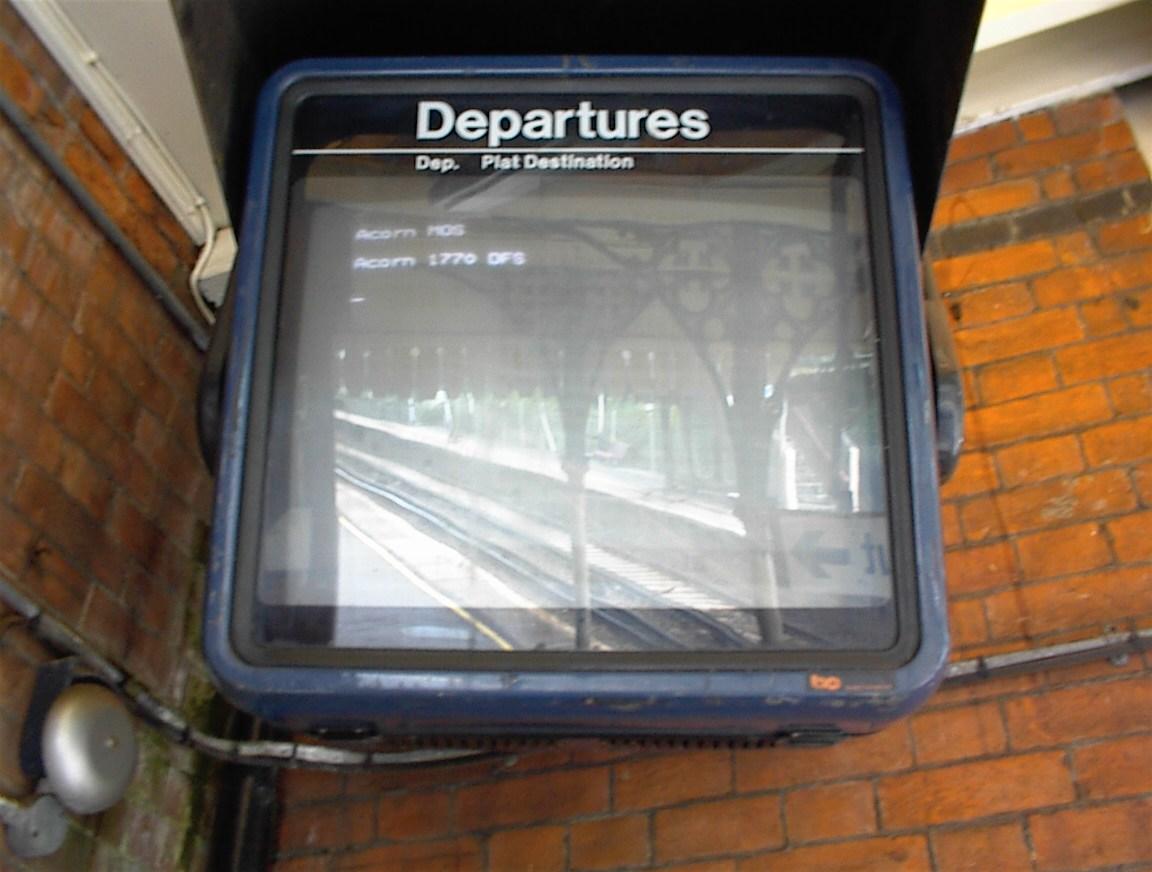
* Until well into the 00's, most UK rail timetable displays across the UK were running off circa 1985 BBC Micros. The following display was quite a regular occurrence: http://www.ntk.net/2000/07/14/dohtrain.jpg
Just because it's old, doesn't mean it doesn't work and leaving it isn't the most cost effective thing to do.
Visual Basic is derived from the same roots. I think the use is acceptable.
For reference, I started on PDS (QBASIC 7) and used VB for DOS for a number of years. Awesome products. My father built a piece of software on PDS 7 which basically ran most of London's bus and payroll system. It had networking and everything.
Selling hardware and PCs yes. And that's only because of the insane markup on apple products.
Lets throw consultancy, ISVs and software sales on those figures and watch the mac whither into insignificance instantly even if we throw iTunes and mac app store and all the apple ISVs in as well.
Med Express is being an asshat. The buyer is being an asshat too.
Med Express have a supposed reputation to defend which they have obviously really shown here i.e. sue anyone who says anything bad. The buyer also has a trigger finger for leaving negative feedback.
Having been on the end of import duty having to be paid AND on the end of negative feedback for misquoting postage I understand both sides.
However, eBay is a feedback battle ground these days to the point the feedback system is worthless. Buyers bend over and take anything from sellers who threaten them with fraud reports to PayPal, retaliation for leaving negative feedback and occasionally physical violence. Sellers bend over and take stuff from buyers who make false claims, leave negative feedback for terribly minor things and don't send payment.
All of this results in a stalemate where both sides are forced to leave positive feedback. If you dare do anything else, shit will hit the fan, even if the service is a POS. It's a form of mutually assured destruction.
All of the above is why I don't use eBay any more.
There isn't an honest feedback rating anywhere on it.
Its also why we invoice and take wire payments rather than storing CC details. There's just so much to go wrong.
Also PKI is shit for this sort of thing. As demonstrated, the moment that public key is gone, then the whole system falls like a house of cards. For the non believers of this fact, why else would there be a certificate revocation list and root CA updates for windows periodically...
Well your database is a black box technically speaking. It's very hard to scale it horizontally and it is very expensive to scale it vertically as time goes on.
Logic suggests that you should keep as much processing functionality outside something which can't be scaled cheaply or easily and push it to cheaper front end servers.
On this basis, anything which implies more work than collecting and shifting the data over the wire shouldn't really be in the database. Parsing / processing JSON is one of those things that's going to eat CPU/memory.
Fundamentally there's nothing wrong with storing JSON inside the database and processing it externally, but processing it inside the database is a big risk.
I've seen the same thing over the years with XML in the database and more recently people adding CLR code to SQL Server stored procedures.
The main advantage of standalone packages is I can choose whatever version of package XYZ I want and push it out rather than being stuck with the package version the repository ships with until either the maintainer updates it or you patch it yourself or argue with some shoddy backport.
That's fine but for some of us, connectivity is not ubiquitous and it isn't necessarily legal to ship our code or data somewhere else unknown on the Internet...
All have irritating bugs, hibernation and sleep problems, random crashes despite being absolutely bog standard Intel hardware across the board supposedly fully supported by Linux. The same kit doesn't exhibit any problems under Windows.
The Timeline series machines under Windows 7 got a whopping 8-10 hours battery life of average load OUT OF THE BOX. Under Ubuntu, even with all the powertop tweaks etc, 3 hours was pushing it.
Current Ubuntu, CentOS and Debian were tried on each machine at the time.
Just can't be bothered any more. Linux (Debian) sits inside a VirtualBox VM on Windows on my T61 where ironically the battery lasts longer when it's in a VM than on bare metal...