Lake Tahoe hits a critically low water threshold(sfgate.com)
sfgate.com
Lake Tahoe hits a critically low water threshold
https://www.sfgate.com/renotahoe/article/Lake-Tahoe-drought-water-rim-algae-16533020.php
71 comments
At the rate we're going there will eventually be armed conflict in the western US over water. Large municipalities and maybe even the federal government need to put together a plan to buy out farmers after we have to turn off their taps for good. Ground water will only go so far. At some point we will have to acknowledge that some areas are just never going to be sustainable for agriculture ever again.
Cities have been buying out farms for years now. They can buy a single farm with water rights, then drain the aquifer over the next 10-20 years. Every other family that depends on that aquifer gets screwed, with wells that dry up.
The western water laws are enshrined in states constitutions. It's going to get a lot worse before the laws are changed.
Just one example: https://www.elpasotimes.com/story/news/2016/07/06/el-paso-wa...
The western water laws are enshrined in states constitutions. It's going to get a lot worse before the laws are changed.
Just one example: https://www.elpasotimes.com/story/news/2016/07/06/el-paso-wa...
Time for my usual WITWUS post.
We have know this for more than 140 years [0].
I strongly recommend that everyone living in the western United States read at least the introduction[1] to Beyond the Hundredth Meridian[2]. The introduction is more relevant now than it was when it was written 67 years ago, itself 75 years after the publication of Lands of the Arid Region.
Previously:
https://news.ycombinator.com/item?id=27910098
https://news.ycombinator.com/item?id=18098899
https://news.ycombinator.com/item?id=26964166
0. https://pubs.usgs.gov/unnumbered/70039240/report.pdf LANDS OF THE ARID REGION John Wesley Powell 1878
1. https://erenow.net/modern/beyond-the-hundredth-meridian/1.ph... Bernard DeVoto 1954
2. Beyond the Hundredth Meridian: John Wesley Powell and the Second Opening of the West ISBN:9780140159943 Wallace Stegner 1954
We have know this for more than 140 years [0].
I strongly recommend that everyone living in the western United States read at least the introduction[1] to Beyond the Hundredth Meridian[2]. The introduction is more relevant now than it was when it was written 67 years ago, itself 75 years after the publication of Lands of the Arid Region.
Previously:
https://news.ycombinator.com/item?id=27910098
https://news.ycombinator.com/item?id=18098899
https://news.ycombinator.com/item?id=26964166
0. https://pubs.usgs.gov/unnumbered/70039240/report.pdf LANDS OF THE ARID REGION John Wesley Powell 1878
1. https://erenow.net/modern/beyond-the-hundredth-meridian/1.ph... Bernard DeVoto 1954
2. Beyond the Hundredth Meridian: John Wesley Powell and the Second Opening of the West ISBN:9780140159943 Wallace Stegner 1954
Or we could just stop exporting almonds to other countries.
https://www.motherjones.com/wp-content/uploads/LA-vs-Exports...
https://www.motherjones.com/wp-content/uploads/LA-vs-Exports...
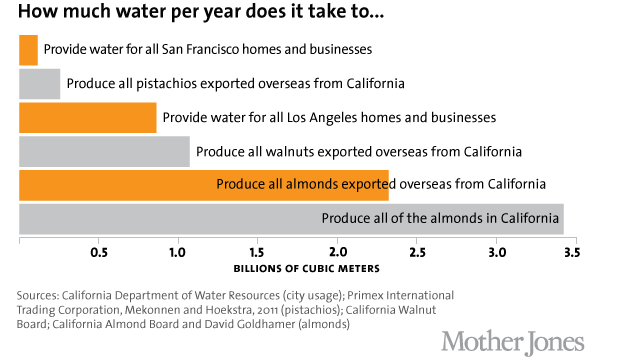
Here's an idea, charge 5x the amount for water for farms than we do residential, (or any industrial/commercial purpose) and if you pollute the water ways you pay 3x the cost to fix it, and if it isn't fixable you pay some really exorbitant (might as well go out of business fee).
Sure prices will go up on goods from those water ways, but maybe they won't..maybe they'll do better more environmental farming to preserve water, like vertical farming.
Sure prices will go up on goods from those water ways, but maybe they won't..maybe they'll do better more environmental farming to preserve water, like vertical farming.
Agricultural use of water is heavily subsidized. The amount of water you would have to pay $2000 for, Big Ag gets for around $40.
Source: https://blogs.berkeley.edu/2018/01/26/the-cost-of-irrigation...
Source: https://blogs.berkeley.edu/2018/01/26/the-cost-of-irrigation...
An individual almond contains only a small portion of the water used to grow it, so presumably the vast majority of the water used to grow almonds in California actually stays in California.
"Today nearly 80% of California almond orchards
are using microirrigation and, as older orchards
are replaced, we expect that number to grow."
"Previous studies have shown that a reasonable estimate of the runoff volume is 15-20% of the applied water."
Source: https://www.almonds.com/sites/default/files/2020-04/Almond-I...
"Previous studies have shown that a reasonable estimate of the runoff volume is 15-20% of the applied water."
Source: https://www.almonds.com/sites/default/files/2020-04/Almond-I...
I'd guess that runoff is a relatively small compared to transpiration. If it takes gallons of water to grow a single almond, there's no way that a significant portion of that is still in the almond when it's exported. IIRC almonds aren't particularly thirsty compared to other nuts, they're just really popular so their stats look the most dramatic.
Indeed, they're not especially thirsty; California just grows an incredible volume of them because we subsidize their production with vastly underpriced water far cheaper than the rate per volume that residential users have to pay.
It takes about a gallon of water to produce an almond, and the residual ends up in the air, where it's basically useless.
I mean, you don't see the state repealing rules about low-flow showers and toilets because "the water stays in California", right?
It takes about a gallon of water to produce an almond, and the residual ends up in the air, where it's basically useless.
I mean, you don't see the state repealing rules about low-flow showers and toilets because "the water stays in California", right?
https://www.npr.org/2015/05/28/408295800/the-water-knife-cut...
Listened to this book describing what you predict while driving across the Central Valley... It sure does feel like just a matter of time.
Listened to this book describing what you predict while driving across the Central Valley... It sure does feel like just a matter of time.
That is a great book.
https://en.wikipedia.org/wiki/California_water_wars
But yeah, it's going to get a lot worse.
But yeah, it's going to get a lot worse.
and a plug into: https://en.wikipedia.org/wiki/Cadillac_Desert
Or, in a more optimistic approach, the market will take over here. Private water delivery companies? Agricultural advances to use less water? Prices for water-hungry crops going up, shifting consumers to cheaper alternatives?
The problem is that water rights are covered by State constitutions and statutes. Introducing markets would require changing those laws and seizing water rights. That might require making huge compensation payments to existing rights holders. Politically it's just extremely difficult.
In general US agriculture is extremely wasteful of water. We could drastically cut water consumption by adopting farming techniques used in Israel, but food costs would increase.
In general US agriculture is extremely wasteful of water. We could drastically cut water consumption by adopting farming techniques used in Israel, but food costs would increase.
“That might require making huge compensation payments to existing rights holders.”
I doubt most of the stakeholders paid anything for their water rights. Perhaps, if there is any compensation, it would be equal to what they paid for the actual rates originally inflation adjusted.
I doubt most of the stakeholders paid anything for their water rights. Perhaps, if there is any compensation, it would be equal to what they paid for the actual rates originally inflation adjusted.
That's not how the law works. Acquisition price is irrelevant to 5th Amendment rights. Compensation must be based on current fair market value. You might consider that unfair but it's the reality of our laws today.
The easy thing to do would be to tank the value of water rights first.
Taxes seem like an obvious option. I can't think of any constitutional reasons why they can't tax you for drawing from natural springs, else all new taxes would be a constitutional issue. You may not even need to nationalize then.
You might also be able to simply ban private consumption of water from waterways. Nothing is being seized, they still own the water, it's just worthless because they can't use it. Similar to what would happen if we ban coal. I don't think we'd have to go track down everyone with rights to a coal vein and pay them what it's worth.
Taxes seem like an obvious option. I can't think of any constitutional reasons why they can't tax you for drawing from natural springs, else all new taxes would be a constitutional issue. You may not even need to nationalize then.
You might also be able to simply ban private consumption of water from waterways. Nothing is being seized, they still own the water, it's just worthless because they can't use it. Similar to what would happen if we ban coal. I don't think we'd have to go track down everyone with rights to a coal vein and pay them what it's worth.
Laws can be changed, especially when it comes to people’s survival.
The market is always too late in constraining resources often running counter to it. Higher prices for water will lead to more water being mined. High oil prices led to deep water drilling, fracking, and tar sands.
What's the prospect for building large pipelines from places with abundant water? It would be extremely costly up front but infrastructure like that can last over a century fairly easily.
Afghanistan did it thousands of years ago. Some of them still work. They are called a Karez IIRC.
I wonder about that too but is it even possible to do such a thing on the scale that’s needed? Also, are there places that have enough water to supply the West or would they dry out too?
What if we created inland seas? Pipe salt water inland into reservoirs... the water evaporates, and then catch the rainfall which maybe is filtered of the salt?
Is there a map somewhere that illustrates areas with different water availability? I don't think average rainfall is quite the metric as places like Michigan have access to the Great Lakes. I'd want to compare places with low or high natural water.
Yeah, and the midwest will be next. Agriculture at scale has really destroyed our aquafiers.
it is not impossible to bring water through pipes, or invest heavily in desalination
But to bring water through the pipes, you have to have water at the other end of the pipe. That's rare out west, and getting more rare.
Pacific Ocean has some water in it.
Not usable water, though. That brings you back to desalination, which is... possible. Is it possible on the scale that's needed? It's not obvious that it is.
Physically possible? Yes.
Financially feasible? Not yet, and maybe not ever. We’ll see.
Financially feasible? Not yet, and maybe not ever. We’ll see.
Here's a chart of Lake Tahoe water levels since 1900: https://www.usgs.gov/center-news/water-science-lake-tahoe-ba....
That's a chart from 1900 to 2017. It lacks the current data. According to current provisional data, the lake level was lower in 2016 than it is today.
https://nwis.waterdata.usgs.gov/usa/nwis/uv/?cb_00065=on&for...
https://nwis.waterdata.usgs.gov/usa/nwis/uv/?cb_00065=on&for...
Looks like it has reached this level quite a few times, but perhaps more often in recent years.
The 1930s was the Dust Bowl. The 1988-89 drought, while not as severe as the Dust Bowl, was the costliest in terms of economic damage and hit most of NA. As you can see by that chart, it took five or more years to recover from it.
It's also possible to see that the region never really recovered from the 2002 drought. Droughts are getting ever more frequent and the region isn't getting enough time between them to recover.
It's also possible to see that the region never really recovered from the 2002 drought. Droughts are getting ever more frequent and the region isn't getting enough time between them to recover.
"Droughts are getting ever more frequent and the region isn't getting enough time between them to recover."
This doesn't seem to be true, it seems that CA has been a uncharacteristacally wet for the last 500 years or so. Before that the drought/wet swings were much wilder with much more severe droughts
https://www.eastbaytimes.com/wp-content/uploads/2016/07/2014...
http://ocp.ldeo.columbia.edu/res/div/ocp/pub/cook/Cook_etal_...
This doesn't seem to be true, it seems that CA has been a uncharacteristacally wet for the last 500 years or so. Before that the drought/wet swings were much wilder with much more severe droughts
https://www.eastbaytimes.com/wp-content/uploads/2016/07/2014...

http://ocp.ldeo.columbia.edu/res/div/ocp/pub/cook/Cook_etal_...
As long as there hasn't been any significant changes in population or agriculture in the region in the last 500 years it's no big deal
From this chart alone, it appears that the water in the lake (or its sources) is drawn down much faster in modern times during dry years—the slopes of the downturns get steeper and steeper each decade.
As I recall, the watershed for Lake Tahoe is actually very small, because the surrounding ridges are quite close to the lake. The surface of the lake is the majority of the total collection area for precipitation.
To me, this suggests that evaporative losses may also be a significant portion of the draw-down you see each year, i.e. precipitation and evaporation on the same surface area. A trend towards more rapid reductions in water level may say something about climate shift, with hotter and drier summer conditions?
To me, this suggests that evaporative losses may also be a significant portion of the draw-down you see each year, i.e. precipitation and evaporation on the same surface area. A trend towards more rapid reductions in water level may say something about climate shift, with hotter and drier summer conditions?
Perhaps also reduction of watershed area because of development and capturing of waste water? I know there are mitigation efforts around the usual farm and garden runoff (nitrogen etc.) for Tahoe; lack of such mitigation why Clear Lake[0] is a soupy green.
[0] https://en.wikipedia.org/wiki/Clear_Lake_(California)
[0] https://en.wikipedia.org/wiki/Clear_Lake_(California)
Yes, but probably due to increasing development and population increases... It's to be expected, as the region wasn't meant to support all the new people and companies watering their new lawns, cooling data centers, and people taking baths and washing their Ferraris.
Climate change is indeed real, but exaggeration about it's effects only drives profit up, fear often creates apathy and fatigue, rather than encouraging positive change in identifying and adjusting the root causes of the issue.
Climate change is indeed real, but exaggeration about it's effects only drives profit up, fear often creates apathy and fatigue, rather than encouraging positive change in identifying and adjusting the root causes of the issue.
I expect you're being downvoted because agricultural irrigation is the primary use of water, not residential water use. Residential water use makes up a relatively paltry fraction of total use compared to agricultural.
How much Lake Tahoe water (or feed water) is used for agriculture?
Can't speak for tahoe, but here in Utah, I read that total residential water use accounts for about 2% of the total water use of the state, and individual households it's something like 0.02% ... so really it's like comparing an ounce of piss to the ocean.
Alfalfa farms (of which the governor is an alfalfa farmer) are the worse culprits as it's a water heavy plant, and we're also a top exporter of alfalfa to Asia, so essentially Asia's buying our water from us via alfalfa.. there's plenty of other corporate/industrial culprits, but farms are a huge one here..
Alfalfa farms (of which the governor is an alfalfa farmer) are the worse culprits as it's a water heavy plant, and we're also a top exporter of alfalfa to Asia, so essentially Asia's buying our water from us via alfalfa.. there's plenty of other corporate/industrial culprits, but farms are a huge one here..
I'm specifically asking about Tahoe. Down in the valley below, California uses a LOT of water for agriculture, no question. But I'm not sure ag-use is an issue for Tahoe water.
I ask because it's a high alpine lake surrounded by mountains. It has no significant water outflow. I'm not sure there's a path for water from the lake's watershed into agricultural land. Water is lost from the lake to evaporation in enormous amounts and to local uses in much smaller but probably still significant amounts, and that might be about it.
But OP argues that overpopulation leads to increased water usage. Farming takes more water as more people it has to feed.
The statement was a pretty obvious insertion of humor to lighten the mood. I'll eat the downvotes because I don't want to be serious in a world that believes in punishing people for trying to have a sense of humor. :P
I think ClickBait is what is driving the drought, and even other cases of public anxiety more than anything else right now.
It's unfortunate that major news outlets feel the need to capitalize on fear to generate profit now more than ever. The anxiety drives people to flood supermarkets and over-buy goods, which pleases advertisers, and it's a constant cycle of fear that can lead to major safety problems for us all during a real crisis.
Fear mongering is now even present in major news sources, this constant process of sensationalizing issues without proper historical context diminishes the value of rational and trust-worthy news reporting that used to truly solve societal problems in the past... We should hold news outlets accountable for over-sensationalism like how CNN and others are reporting on this drought cycle... :/
It's unfortunate that major news outlets feel the need to capitalize on fear to generate profit now more than ever. The anxiety drives people to flood supermarkets and over-buy goods, which pleases advertisers, and it's a constant cycle of fear that can lead to major safety problems for us all during a real crisis.
Fear mongering is now even present in major news sources, this constant process of sensationalizing issues without proper historical context diminishes the value of rational and trust-worthy news reporting that used to truly solve societal problems in the past... We should hold news outlets accountable for over-sensationalism like how CNN and others are reporting on this drought cycle... :/
The drought has some pretty obvious effects if you live out here in California. A small lake near me that I usually go hiking to with my little kids, Jewel Lake, dried up entirely this summer. That hasn't happened in years. (Well, I've never seen it dry up before, I don't know when the last time was.)
When I was a kid in the Midwest we had snow days sometimes and missed school. We don't have those here because it doesn't snow. But we have had smoke days in the past few years, where the air was too smoky for kids to go to school.
The California drought might seem like some exaggerated mainstream media junk to people on the east coast. But out here in California, drought vs non-drought is just a mundane, practical part of life. We root for it to start raining in the fall because that means fire season is over. We chat about the drought weather with people in town to make small talk the way I chatted about the Red Sox when I lived in Boston. I think you have just categorized this issue wrong - this is the sort of news that is actually relevant to normal peoples' lives.
When I was a kid in the Midwest we had snow days sometimes and missed school. We don't have those here because it doesn't snow. But we have had smoke days in the past few years, where the air was too smoky for kids to go to school.
The California drought might seem like some exaggerated mainstream media junk to people on the east coast. But out here in California, drought vs non-drought is just a mundane, practical part of life. We root for it to start raining in the fall because that means fire season is over. We chat about the drought weather with people in town to make small talk the way I chatted about the Red Sox when I lived in Boston. I think you have just categorized this issue wrong - this is the sort of news that is actually relevant to normal peoples' lives.
I can attest to what @lacker has written. In twenty years I've been visiting Jewel lake, I have never seen it completely dry. The stream running in has gone dry. The marsh under the boardwalk is bone dry. The ferns are now kindling. The turtles are gone.
On the fog-ward side of the hill (the wet side; also known as Berkeley) the succulents are dying. Until this year, growing a jade plant (and many other succulents) required no watering. The mist in the air was enough. They're now red and their leaves are shriveled. They are dying from the drought. I see this every day.
The media is not making things up, and they are not sensationalizing this. If anything the media is under-reporting how bad things are.
On the fog-ward side of the hill (the wet side; also known as Berkeley) the succulents are dying. Until this year, growing a jade plant (and many other succulents) required no watering. The mist in the air was enough. They're now red and their leaves are shriveled. They are dying from the drought. I see this every day.
The media is not making things up, and they are not sensationalizing this. If anything the media is under-reporting how bad things are.
Huh? Consumers buying extra toilet paper and bags of flour doesn't affect the amount of snowfall around Lake Tahoe.
Just as a footnote... Obviously clickbait doesn't cause droughts, that part was a joke about irresponsible news reporting on the water threshold being sensationalized.
If you look at the graph in OP's post, the lake has reached low levels like this in years prior to now, which is very telling about how much certain news agencies are over-embellishing on how current low levels are dire.
Lets keep sanity and practicality involved in this. I also did state that global warming is real. I do believe it is a real issue, faulty correlations are not real though.
If you look at the graph in OP's post, the lake has reached low levels like this in years prior to now, which is very telling about how much certain news agencies are over-embellishing on how current low levels are dire.
Lets keep sanity and practicality involved in this. I also did state that global warming is real. I do believe it is a real issue, faulty correlations are not real though.
Like the other replies here, I disagree. I am in coastal Southern California and we enjoy a fair degree of water independence, but even so up until recently drought conditions affected us greatly. I am thankful that my municipality got a desal plant up and running as that has relieved us of a lot of the 'please conserve water' messaging we used to get, which is now gone.
This is also a gentle reminder that the majority of water use here is agricultural, and that a large share of that usage goes to almond production -- which is one of the thirstiest (and most profitable) plants around. If our agribusiness switched to more economical crops the severity of the drought might be greatly lessened.
This is also a gentle reminder that the majority of water use here is agricultural, and that a large share of that usage goes to almond production -- which is one of the thirstiest (and most profitable) plants around. If our agribusiness switched to more economical crops the severity of the drought might be greatly lessened.
This weekend I kayaked on Lake Mead near Las Vegas. The water levels are also super low. When you look at the lines where the water levels used to be it’s unbelievable how much it has shrunk. Unless something fundamentally changes the West is in serious trouble between droughts and fires.
I wonder if there will be massive infrastructure projects to pump water from areas with abundant water. If that’s even possible. Pretty much similar to the way Hoover Dam was built to make living out in the desert feasible.
I wonder if there will be massive infrastructure projects to pump water from areas with abundant water. If that’s even possible. Pretty much similar to the way Hoover Dam was built to make living out in the desert feasible.
Tahoe is relatively protected from water diversion because it is up high in the mountains: there isn't that much agriculture to divert water for and there isn't a large population either.
The water problems of California are mostly felt in the central valley where the most agriculture is. A much larger lake, Lake Tulare, disappeared from there over 100 years ago due to agriculture, dams, and water diversion.
The water problems of California are mostly felt in the central valley where the most agriculture is. A much larger lake, Lake Tulare, disappeared from there over 100 years ago due to agriculture, dams, and water diversion.
The higher up you are the more people down below that want your water. Pretty sure that there are demands on Lake Tahoe as part of the Truckee River and downstream interests.
How much does that actually effect Tahoe? I Would assume that an alpine outflow is always taking the maximum amount of water that it can regardless of downstream usage. And that it only matters if alterations are made to outflows or if other new diversions are made.
Tahoe supplies the Truckee river which is part of the water supply for agriculture near Reno and Carson city. So even Tahoe's got demands placed on it.
Lake Tahoe's water levels fluctuate a lot.
[deleted]
The mud should be mined and used as fertilizer, not left to dry and get blown by wind. But it seems to be too polluted.
Looks like Half Life 2.
Tahoe Valley
HN is apparently going to have a separate meta-discussion about climate. (Which is fine, but it’s worth a click-through to read the article. I’m glad I did!)