Antarctica’s potential collapse could damage coastal cities across the globe(nytimes.com)
nytimes.com
Antarctica’s potential collapse could damage coastal cities across the globe
https://www.nytimes.com/interactive/2017/05/18/climate/antarctica-ice-melt-climate-change-flood.html?_r=0
243 comments
What your remembering from the 70's was actually happening then. In Florida 50 square miles of wetlands were disappearing each year. Thing was it was caused by erosion and frankly we changed how water flowed across much of Florida and rearranged a lot of the coast to keep it from happening.
But, this is not just limited to Florida. We now do a lot to keep coastline looking like you're used to. The barrier islands around North and South Carolina are largely man made structures at this point.
However, beach houses are built on stilts and you can keep moving sand so it's not that noticeable. But, the larger context of what's going on is flooding keeps getting worse. NYC for example was underwater in a recent storm doing a lot of damage and largely shutting down the city. Such events are going to become more regular as it goes form Massive storm surge, to normal storm surge, to unusual high tides, to regular high tides. But, NYC is on bedrock so they can use dikes and keep things ok. Other areas like Miami with different geology can't use the same approach.
PS: Also, don't forget, Chicago Was Raised Over Four Feet in the 19th Century. So, if you’re willing to spend a lot of money we can keep building in swamps.
But, this is not just limited to Florida. We now do a lot to keep coastline looking like you're used to. The barrier islands around North and South Carolina are largely man made structures at this point.
However, beach houses are built on stilts and you can keep moving sand so it's not that noticeable. But, the larger context of what's going on is flooding keeps getting worse. NYC for example was underwater in a recent storm doing a lot of damage and largely shutting down the city. Such events are going to become more regular as it goes form Massive storm surge, to normal storm surge, to unusual high tides, to regular high tides. But, NYC is on bedrock so they can use dikes and keep things ok. Other areas like Miami with different geology can't use the same approach.
PS: Also, don't forget, Chicago Was Raised Over Four Feet in the 19th Century. So, if you’re willing to spend a lot of money we can keep building in swamps.
Miami has been investing heavily in water pumping systems because they experience 'sunny day' flooding as a result of sea level rise and high tides. It will buy them some time but eventually they're going to either have to abandon ship or go full Venice.
I continue to be confounded by the real estate bubble in Miami for this reason. They can adopt whatever euphemisms they like; what they are experiencing is now sea level rise as a result of climate change. The trend towards inundation is clear and accelerating.
Why then would you invest at Bay Area-level prices for a condo in a building which cannot keep its lobby dry, already?
The entire Gulf is based on porous limestone bedrock which makes sea walls completely untenable as a solution. Water will find a way in.
QED absent some truly miraculous black swan technological advance, Miami etc. are literally doomed to drown.
WTH are people thinking?
The only thing I can come up with is that it's a temporary parking place for foreign money banked at a loss if necessary to exfiltrate it into the US. :P
Why then would you invest at Bay Area-level prices for a condo in a building which cannot keep its lobby dry, already?
The entire Gulf is based on porous limestone bedrock which makes sea walls completely untenable as a solution. Water will find a way in.
QED absent some truly miraculous black swan technological advance, Miami etc. are literally doomed to drown.
WTH are people thinking?
The only thing I can come up with is that it's a temporary parking place for foreign money banked at a loss if necessary to exfiltrate it into the US. :P
>what they are experiencing is now sea level rise as a result of climate change. The trend towards inundation is clear and accelerating.
>Why then would you invest at Bay Area-level prices for a condo in a building which cannot keep its lobby dry, already?
>WTH are people thinking?
Because the people of Miami simply don't believe you and don't believe that there's any climate change happening. And it's now the official position of the US government that there's no climate change.
>Why then would you invest at Bay Area-level prices for a condo in a building which cannot keep its lobby dry, already?
>WTH are people thinking?
Because the people of Miami simply don't believe you and don't believe that there's any climate change happening. And it's now the official position of the US government that there's no climate change.
A lot of them also don't plan on living long enough to see the seeds bear fruit though or they're knowingly buying property that they know is on a bubble but also know that they don't plan on holding the property long enough to see the bubble burst.
Honestly, that would be pretty cool to see. Like, yeah, the path there is not 'fun', but a Venician Miami would be really cool if we could just snap our fingers and be at the end point.
Foreigners have a really distorted idea of Venice.
The whole city suffers from high tides to the point where they have a different electrical system compared to the rest of Italy. San Marco square is usually under knee-high water; a problem to which solution they spent €6B, but that didn't work out almost at all. Add the fact that the whole place smells like a sewer most of the time, and you have a better picture of what it is like.
It might be a cool place for a 1 or 2 day visit, but definitely not a nice place to live.
The whole city suffers from high tides to the point where they have a different electrical system compared to the rest of Italy. San Marco square is usually under knee-high water; a problem to which solution they spent €6B, but that didn't work out almost at all. Add the fact that the whole place smells like a sewer most of the time, and you have a better picture of what it is like.
It might be a cool place for a 1 or 2 day visit, but definitely not a nice place to live.
Yeah, Florida is mostly porous limestone and old coral. Dikes are useless, because water leaks underneath.
> Thing was it was caused by erosion
So, was it sea level rising or not? You gave some examples of the effects of storms and erosion (which are not new, even in geological time), but didn't actually address the concerns of the person you were replying to.
So, was it sea level rising or not? You gave some examples of the effects of storms and erosion (which are not new, even in geological time), but didn't actually address the concerns of the person you were replying to.
The 70's example was from erosion and was simply a false equivalency with sea level rise. On the other hand coastal erosion is also made worse by sea level rise.
So, I continued by mentioning barrier islands / coastal cities and what's happening to them.
So, I continued by mentioning barrier islands / coastal cities and what's happening to them.
> So, I continued by mentioning barrier islands / coastal cities and what's happening to them
Exactly, but you failed to mention how "what's happening to them" is in any way related to sea level rise. You made the claim that "flooding keeps getting worse" and "Such events are going to become more regular" but didn't actually back up those claims. Instead, you seem to imply that sea level rise is responsible for some recent observations, despite the fact that even the most extreme projections of sea level rise couldn't possibly be responsible for the flooding you mention (in your own words, those events were the result of "storm surge" activity).
Exactly, but you failed to mention how "what's happening to them" is in any way related to sea level rise. You made the claim that "flooding keeps getting worse" and "Such events are going to become more regular" but didn't actually back up those claims. Instead, you seem to imply that sea level rise is responsible for some recent observations, despite the fact that even the most extreme projections of sea level rise couldn't possibly be responsible for the flooding you mention (in your own words, those events were the result of "storm surge" activity).
Even 1cm of sea level rise makes the problem worse. That does not mean on it's own it's the only cause, just that without sea level rise NYC would have received slightly less than 19 billion in damages. I am not saying that's 10B or 18.999B, but the point is not the scale of the difference just which side sea level rise sit's on.
Further, going from 1cm to 2cm or 20cm to 21cm of rise again makes the problem worse. The point is you don't wake up one day and the worlds on fire, just spend slightly more on reconstruction year after year.
Further, going from 1cm to 2cm or 20cm to 21cm of rise again makes the problem worse. The point is you don't wake up one day and the worlds on fire, just spend slightly more on reconstruction year after year.
[deleted]
NYC for example was underwater in a recent storm doing a lot of damage and largely shutting down the city
NYC was not underwater. A small part along the rivers got flooded due to poor drainage and river water water backflooding the sewer system. That is, water went into the sewers from the rivers and then got pushed up. The water then settled into low areas (basements and such), causing lots of damage.
At no time was any part of NYC "underwater".
NYC was not underwater. A small part along the rivers got flooded due to poor drainage and river water water backflooding the sewer system. That is, water went into the sewers from the rivers and then got pushed up. The water then settled into low areas (basements and such), causing lots of damage.
At no time was any part of NYC "underwater".
This [0] is my kids' elementary school and the ballfields they play in, during Superstorm Sandy, and I assure you that it was very much underwater. Interestingly, the water came north up West Street, not east from the Hudson, but it's hard to see how that matters.
The expected sea level rise this century does not (most likely) put NYC underwater at high tide, but it does whenever there is a storm surge associated with high tide [1]. Sandy alone cost NYC at least $19 B [2].
[0] http://www.tribecatrib.com/sites/default/files/images/Ball%2... [1] http://www.motherjones.com/blue-marble/2013/10/sandy-anniver... [2] https://www.dnainfo.com/new-york/20121126/new-york-city/bloo...
The expected sea level rise this century does not (most likely) put NYC underwater at high tide, but it does whenever there is a storm surge associated with high tide [1]. Sandy alone cost NYC at least $19 B [2].
[0] http://www.tribecatrib.com/sites/default/files/images/Ball%2... [1] http://www.motherjones.com/blue-marble/2013/10/sandy-anniver... [2] https://www.dnainfo.com/new-york/20121126/new-york-city/bloo...

> the sewers from the rivers and then got pushed up. The water then settled into low areas (basements and such), causing lots of damage.
After half a lifetime of hearing this and not caring, humanity might have failed when they do start to see visible effects and can no longer do anything about it.
As I understand, the main point of the article is that if the huge sheet of ice dislodges from main land, it is essentially going to melt entirely and no longer slow more land ice from getting to the ocean faster.
The timeframe in which the ice will melt is uncertain, but it will surely melt. So by the time you noticed water rising, it will be too late. By taking this wait and see approach, you are basically negligencing the problem to the next one or two, maybe three generations to helplessly endure.
The main test for humanity here is if it can coordinate and take one for the team economically so as to prevent itself from actual catastrophe in the future generations. So far it's not looking good.
As I understand, the main point of the article is that if the huge sheet of ice dislodges from main land, it is essentially going to melt entirely and no longer slow more land ice from getting to the ocean faster.
The timeframe in which the ice will melt is uncertain, but it will surely melt. So by the time you noticed water rising, it will be too late. By taking this wait and see approach, you are basically negligencing the problem to the next one or two, maybe three generations to helplessly endure.
The main test for humanity here is if it can coordinate and take one for the team economically so as to prevent itself from actual catastrophe in the future generations. So far it's not looking good.
Imagine if we do all the work to prevent climate change, end up being wrong, and are left with a clean and sustainable economy.
This sounds just like a religious argument. "What if we do the good things that some religious book says we should do, avoid the bad, be decent human beings, and help others, and there's no afterlife to be rewarded by?" I suspect it elicits exactly the same visceral responses by the target audience.
That analogy is too generic - it will apply to any action which has two distinct kinds of benefits. Pascal's wager has many issues which wont apply here. A:'This approach to programming improves memory safety', B:'Not interested', A:'It also makes code more modular/reusable', B:'Pascal's Wager!'
Also, if one is doing a cost benefit analysis - one has to include things like political instability caused by oil dependence(see Middle East politics), funding of extremist groups, and health benefits due to reduction of air pollution.
Also, if one is doing a cost benefit analysis - one has to include things like political instability caused by oil dependence(see Middle East politics), funding of extremist groups, and health benefits due to reduction of air pollution.
Sadly I think you're underestimating the appeal of religion. If this idea were as popular as religious ideas we'd have gone green a generation ago.
Religious ideas are only popular when you don't have to put much effort and only pay a token sum of money.
Once religion demands dedication most people will find paradigm where they skip working while still consider themself pious.
Once religion demands dedication most people will find paradigm where they skip working while still consider themself pious.
Well it's only a "religious argument" if you also assume that the fossil fuels our economy currently relies upon are somehow never going to run out. Renewable energy is the only long term solution to a number of energy problems, the climate change issue just makes the need for it that much more important.
It sounds like Pascal's wager: https://en.wikipedia.org/wiki/Pascal%27s_Wager
It is not a good sign if your worldview rests on reasoning like this...
It is not a good sign if your worldview rests on reasoning like this...
The reason Pascal's wager is bullshit is that it rests on two assumptions to convince non-believers:
1. Infinite badness of hell;
2. Infinitesimal possibility of religious truth.
Reasoning about climate change doesn't really involve multiplying infinity by zero. There is more evidence to back up a non-zero chance of catastrophe, and we don't have to rely on inifinite badness to make action worthwhile. Finite badness does the trick just fine.
Unlike Pascal's wager, the question of climate change action is rooted in knowable quantities. Unfortunately, a lot of these are still unknowns to a degree, and a lot of misinformation exists, making it difficult for non-experts to keep up.
1. Infinite badness of hell;
2. Infinitesimal possibility of religious truth.
Reasoning about climate change doesn't really involve multiplying infinity by zero. There is more evidence to back up a non-zero chance of catastrophe, and we don't have to rely on inifinite badness to make action worthwhile. Finite badness does the trick just fine.
Unlike Pascal's wager, the question of climate change action is rooted in knowable quantities. Unfortunately, a lot of these are still unknowns to a degree, and a lot of misinformation exists, making it difficult for non-experts to keep up.
Assuming that ice core data is being interpreted correctly, there is an almost guaranteed chance of catastrophic climate change sometime in the "near" future regardless of human impact:
https://en.wikipedia.org/wiki/File:Vostok_Petit_data.svg
EDIT:
Looking at that a bit closer, I get peak temperatures at ~ 412.5k, 322.5k, 237.5k, 127.5k, and 7.5k years ago.

EDIT:
Looking at that a bit closer, I get peak temperatures at ~ 412.5k, 322.5k, 237.5k, 127.5k, and 7.5k years ago.
The other problem with Pascal's wager is widespread disagreement about what you really have to do to satisfy the alleged deity. Many religions claim that if you aren't a member of that particular religion, then you go to hell. Well, with all the different religions, that makes it pretty hard to choose the "correct" one, doesn't it? And if you're looking at the ways you have to limit your life and actions (e.g. not having premarital sex) to please this god, again, the different religions disagree hugely. Some religions say it's sinful to drink alcohol, others don't have this problem. Some say you can't eat pork or shellfish, again others disagree. Some religions say that you need to be completely celibate (I think the Shakers were like this), and not have any kids. So your odds of both choosing the "correct" religion and following its precepts acceptably are vanishingly small.
> "What if we do the good things that some religious book says we should do, avoid the bad, be decent human beings, and help others, and there's no afterlife to be rewarded by?"
> It is not a good sign if your worldview rests on reasoning like this...
Are you saying that it's not a good thing to have lived a good life and done good by your fellow humans?
> It is not a good sign if your worldview rests on reasoning like this...
Are you saying that it's not a good thing to have lived a good life and done good by your fellow humans?
Hmm, I'm having trouble figuring out your argument here. I see three premises:
Premise A: Pascal's wager is based on sound reasoning.
Premise B: People who live by pascals wager "live a good life", etc.
Premise C: "Living a good life" is a desirable thing.
Somehow you are arguing that if I reject premise A I must also reject premise C (if I were to act rationally), but I don't follow it.
Premise A: Pascal's wager is based on sound reasoning.
Premise B: People who live by pascals wager "live a good life", etc.
Premise C: "Living a good life" is a desirable thing.
Somehow you are arguing that if I reject premise A I must also reject premise C (if I were to act rationally), but I don't follow it.
>This sounds just like a religious argument. "What if we do the good things that some religious book says we should do, avoid the bad, be decent human beings, and help others, and there's no afterlife to be rewarded by?"
The problem is that the religious books want you to do a bunch of things that really are bad and awful. Aside from the bits about murdering unbelievers and apostates, and stoning your disobedient children, and not eating pork (which is actually good for the pigs I guess if you follow it), they'd also have you do things like forgo all contraception, leaving you with a bunch of children you're not prepared to take care of, or being celibate, which really isn't fun or healthy, and basically living like they did in Victorian times (see the other article here today about the "scandalous" behavior at Victorian beaches with some men and women actually swimming together--the horror!). If there isn't a really good reason to enjoy various human activities that really aren't harmful, then why shouldn't you?
The problem is that the religious books want you to do a bunch of things that really are bad and awful. Aside from the bits about murdering unbelievers and apostates, and stoning your disobedient children, and not eating pork (which is actually good for the pigs I guess if you follow it), they'd also have you do things like forgo all contraception, leaving you with a bunch of children you're not prepared to take care of, or being celibate, which really isn't fun or healthy, and basically living like they did in Victorian times (see the other article here today about the "scandalous" behavior at Victorian beaches with some men and women actually swimming together--the horror!). If there isn't a really good reason to enjoy various human activities that really aren't harmful, then why shouldn't you?
This talking point really only works as long as "we do all this work" is vague.
If it's replaced by what alarmists actually claim is necessary, it becomes very clear why it's not that simple.
If it's replaced by what alarmists actually claim is necessary, it becomes very clear why it's not that simple.
There's also the bonus that if we switch to renewables before sucking every drop of chemical energy out of the earth's crust, the leftovers will be a nice gift to our great great grandchildren if we accidentally destroy civilization and they have to bootstrap it from scratch.
> end up being wrong, and are left with a clean and sustainable economy
Transformation has costs, it's not a free ride. The investment that you do there is not being done somewhere else.
Transformation has costs, it's not a free ride. The investment that you do there is not being done somewhere else.
We're still reaping benefits of the Apollo project almost half a century later, and it cost less than what governments have spent pushing advances in clean energy that are already paying off in real economic terms. There is quite a bit of money flowing around the world, and it tends to produce more when spent. There's no shortage of money.
> We're still reaping benefits of the Apollo project almost half a century later,
Care to elaborate about the benefits of the Apollo project?
Care to elaborate about the benefits of the Apollo project?
NASA has helpfully provided pages on this exact subject under spinoff.nasa.gov.
For Apollo in particular: https://spinoff.nasa.gov/flyers/apollo.htm
Good search query for finding more detailed analyses (not in a snarky LMGTFY way, there's just so much to list either as a direct benefit or as something made possible by those early innovations): apollo spin off technologies
For Apollo in particular: https://spinoff.nasa.gov/flyers/apollo.htm
Good search query for finding more detailed analyses (not in a snarky LMGTFY way, there's just so much to list either as a direct benefit or as something made possible by those early innovations): apollo spin off technologies
very good point! just think about it - all the panic and then nothing - but then we are stuck with solar power, more vegetarians, less pollution in the ocean and on and on ... terrible! waiting until the very last moment is the only feasible strategy
This is essentially Pascal's wager and comes with all the problems associated with it. Another way to put your statement would be 'Imagine if we pay tens of trillions of dollars for something which only costs 500 billion dollars'
This statement is getting closer... but the numbers are still off... At this point green solutions are probably only about 30% more expensive than non-green(and getting cheaper every year).
And that's the thing.. if they're getting cheaper every day, eventually they'll become the rational alternative.
I look forward to home solar and the supporting technology. The prices aren't quite there for me but I think they will be in the next five years.
In the meantime, I grew up being told "turn off the lights to save electricity!" and now with more efficient bulbs, power consumption is down about 80-90% to where energy for lighting is rounding error.
I look forward to home solar and the supporting technology. The prices aren't quite there for me but I think they will be in the next five years.
In the meantime, I grew up being told "turn off the lights to save electricity!" and now with more efficient bulbs, power consumption is down about 80-90% to where energy for lighting is rounding error.
The pros and cons are rarely made clear: imagine if removing cheap sources of energy makes our standard of living much worse.
This should be of interest: http://industrialprogress.com/wp-content/uploads/2017/03/MCF...
The unmet need for cheap, plentiful, reliable energy:
There are 7 billion people in the world who need cheap, plentiful, reliable energy to flourish. Some 3 billion have virtually no energy by our standards, which means we need vastly more energy.
It is extremely difficult to produce cheap, plentiful, reliable energy. In the entire history of humanity, only three industries have achieved this on any scale: the hydrocarbon (fossil fuel) industry, the nuclear industry, and the hydroelectric power industry.
This should be of interest: http://industrialprogress.com/wp-content/uploads/2017/03/MCF...
The unmet need for cheap, plentiful, reliable energy:
There are 7 billion people in the world who need cheap, plentiful, reliable energy to flourish. Some 3 billion have virtually no energy by our standards, which means we need vastly more energy.
It is extremely difficult to produce cheap, plentiful, reliable energy. In the entire history of humanity, only three industries have achieved this on any scale: the hydrocarbon (fossil fuel) industry, the nuclear industry, and the hydroelectric power industry.
The root page is not making me optimistic about this organization's bias-checking capacity:
>> For the last 40 years, so-called environmentalists have held back industrial progress around the world. That's why we're helping industry fight for its freedom, with new ideas, arguments, and policies that will improve our economy and our environment.
>> For the last 40 years, so-called environmentalists have held back industrial progress around the world. That's why we're helping industry fight for its freedom, with new ideas, arguments, and policies that will improve our economy and our environment.
Look at his actual arguments and data. He cites sources thoroughly IIRC.
Alex Epstein unfortunately is well known for being heavily biased in the climate-change denial direction.
I don't think anyone would argue against the idea that fossil fuels have helped technological progress over the last century and a half, which seems like the core of his thrust.
The problem is the almost dismissive attitude about the future prediction consensus. Generally, the scientific consensus is against his statement: "The [future] warming impact of CO2 is mild and quite possibly positive".
From there, it seems like he is selectively framing his arguments. For instance, higher CO2 concentrations does increase crop yields (as stated), but scientists believe this will be offset by higher temperatures and drier conditions. (https://www.nasa.gov/feature/goddard/2016/nasa-study-rising-...). Statements like "Warming is almost universally desired among civilizations" seem to ignore that there is such a thing as too hot for the human body, let alone for other things such as food or having a reliable water supply (http://www.fao.org/3/a-i5188e.pdf).
It seems like a strange bias to think that there is zero room to improve our energy pattern and sources compared to what we have now. Or that only three industries (hydro, fossil fuel, nuclear) will possibly ever exist to provide cheap, plentiful energy. (For a start, I'll ding him an additional point for forgetting about the original cheap, plentiful energy source humans used: "traditional biomass". EG: wood, crop waste, dung, etc.)
I don't think anyone would argue against the idea that fossil fuels have helped technological progress over the last century and a half, which seems like the core of his thrust.
The problem is the almost dismissive attitude about the future prediction consensus. Generally, the scientific consensus is against his statement: "The [future] warming impact of CO2 is mild and quite possibly positive".
From there, it seems like he is selectively framing his arguments. For instance, higher CO2 concentrations does increase crop yields (as stated), but scientists believe this will be offset by higher temperatures and drier conditions. (https://www.nasa.gov/feature/goddard/2016/nasa-study-rising-...). Statements like "Warming is almost universally desired among civilizations" seem to ignore that there is such a thing as too hot for the human body, let alone for other things such as food or having a reliable water supply (http://www.fao.org/3/a-i5188e.pdf).
It seems like a strange bias to think that there is zero room to improve our energy pattern and sources compared to what we have now. Or that only three industries (hydro, fossil fuel, nuclear) will possibly ever exist to provide cheap, plentiful energy. (For a start, I'll ding him an additional point for forgetting about the original cheap, plentiful energy source humans used: "traditional biomass". EG: wood, crop waste, dung, etc.)
I don't think anyone would argue against the idea that fossil fuels have helped technological progress
But many implicitly ignore the benefits of fossil fuels. I hear many variations of the comment I originally replied to, i.e., "even if there's no climate change, reducing fossil fuel use is pure win". I think many imagine we could keep roughly the same quality of life with the majority of our power coming from solar panels and wind farms. Smarter environmentalists realise this is not true, but the general public is very confused on the issue, especially as the more rational greens get lumped in with the activist crazies.
(One very important point in to explain Alex's context: many greens (not all, granted) are opposed on moral grounds to nuclear, and even to hydro, which floods valleys and messes with nature. The root of this is the desire to minimise human impact, but "minimising human impact" is ultimately at odds with "maximising human flourishing").
to think that there is zero room to improve our energy pattern and sources compared to what we have now
He doesn't think this. Obviously improved nuclear power, ultimately fusion power, is the real long-term solution. However, hopes that we can significantly improve solar or wind power are doomed to crash into reality -- there's fundamental limits to how much energy you can extract from the wind (https://en.wikipedia.org/wiki/Betz%27s_law) or from photons (https://en.wikipedia.org/wiki/Shockley%E2%80%93Queisser_limi...). Burning wood and dung works for poor countries that lack infrastructure, but it's more expensive that fossil fuels, and more polluting, even more polluting than coal.
But many implicitly ignore the benefits of fossil fuels. I hear many variations of the comment I originally replied to, i.e., "even if there's no climate change, reducing fossil fuel use is pure win". I think many imagine we could keep roughly the same quality of life with the majority of our power coming from solar panels and wind farms. Smarter environmentalists realise this is not true, but the general public is very confused on the issue, especially as the more rational greens get lumped in with the activist crazies.
(One very important point in to explain Alex's context: many greens (not all, granted) are opposed on moral grounds to nuclear, and even to hydro, which floods valleys and messes with nature. The root of this is the desire to minimise human impact, but "minimising human impact" is ultimately at odds with "maximising human flourishing").
to think that there is zero room to improve our energy pattern and sources compared to what we have now
He doesn't think this. Obviously improved nuclear power, ultimately fusion power, is the real long-term solution. However, hopes that we can significantly improve solar or wind power are doomed to crash into reality -- there's fundamental limits to how much energy you can extract from the wind (https://en.wikipedia.org/wiki/Betz%27s_law) or from photons (https://en.wikipedia.org/wiki/Shockley%E2%80%93Queisser_limi...). Burning wood and dung works for poor countries that lack infrastructure, but it's more expensive that fossil fuels, and more polluting, even more polluting than coal.
Ultimately, from a very long term perspective, one has to recognize that fossil fuels are not going to last forever -- at least in an economically viable form. The exact nature of when we (for all practical purposes) fossil fuels become economically too costly has been hotly debated over the years (it will be a while, sure) but since our economy is so dependent on them, I would view exploration of practical fossil fuel reduction as a win for this reason alone -- perhaps it is a matter less urgent than climate change, but it still is something to consider.
Yes, there are limits to extraction, but solar and wind power's advantage is that, location wise, it is viable in far more places than something like hyrdo power; it also can be set up in a more decentralized fashion which can be advantageous for some scenarios (remote areas with little existing infrastructure for instance). I've always thought that solar and wind's biggest challenge to overcome is more the non-continuous nature of that power source. At any rate at this time I don't think it's safe to predict what a long term solution might be or might not be. There probably is (as like now) no single solution that is right for every location.
Yes, there are limits to extraction, but solar and wind power's advantage is that, location wise, it is viable in far more places than something like hyrdo power; it also can be set up in a more decentralized fashion which can be advantageous for some scenarios (remote areas with little existing infrastructure for instance). I've always thought that solar and wind's biggest challenge to overcome is more the non-continuous nature of that power source. At any rate at this time I don't think it's safe to predict what a long term solution might be or might not be. There probably is (as like now) no single solution that is right for every location.
I have to use heuristics to sort through the enormous volume of information trying to make its way into my head these days. Such blatant bias is enough to send anything from this organization to the mental blocklist.
The thing is if we're successfully at avoiding a cataclysm, we won't know we were right.
In this specific situation, I'd rather not know we were wrong that know for a fact we were right.
In this specific situation, I'd rather not know we were wrong that know for a fact we were right.
Same issue occurred with Y2K. Dire threats, nothing occurred on actual date. Fact is there was an immense effort to update millions of lines of code throughout our infrastructure -- apparently successfully. Do recall several cases of old systems being kept running "to see what would happen" and they did demonstrate the failure.
Just because we averted disaster doesn't mean it wasn't going to happen.
Just because we averted disaster doesn't mean it wasn't going to happen.
Let me tell you about the five major car accidents I narrowly avoided on the way to work this morning. They didn't happen but they would have!
Just because it didn't happen doesn't mean we "averted disaster." It's entirely possible that much (or even all) of the build up was normal media fear mongering and loosely based on reality.
Just because it didn't happen doesn't mean we "averted disaster." It's entirely possible that much (or even all) of the build up was normal media fear mongering and loosely based on reality.
It's like the Y2K bug. People still act like it was made-up. We can't prove the bug would have caused all the predicted problems because we fixed the bug. All we know is we got a lot of updated, modern systems and huge R&D budgets from all the money that flooded into fixing it. How much of the tech we take for granted today is because of all that investment?
We're in the same position with climate change. All we've gotten out of it so far is affordable renewable energy, better tech for power monitoring and distribution, and a lot of new jobs. So far, solving a maybe is proving to be a good investment, and may save us all if the worst case scenarios are realistic.
We're in the same position with climate change. All we've gotten out of it so far is affordable renewable energy, better tech for power monitoring and distribution, and a lot of new jobs. So far, solving a maybe is proving to be a good investment, and may save us all if the worst case scenarios are realistic.
We can try again on January 19th 2038 if we're inclined when the unix 32-bit timestamp runs out.
In which the real incomes of billions of the poorest people are significantly lower thanks to decades of compounded lower economic growth?
TANSTAAFL.
TANSTAAFL.
We are not even at a place where we have seriously tried the low hanging options, like a major serious worldwide effort at building better energy technologies(there has been a lot of great work, but not great relative to what we can do), reducing tariffs on solar, giving cheap access to green technologies to poorer countries, or researching and publicizing mitigating steps which can reduce damage when natural disasters occur.
Also, there are plenty of costs for the default option which should be included in the analysis. These are severe especially for low lying countries with a big coastline. But even for other countries, public health suffers due to burning fossil fuels, and political instability in oil rich countries has a big effect on the world.
Also, there are plenty of costs for the default option which should be included in the analysis. These are severe especially for low lying countries with a big coastline. But even for other countries, public health suffers due to burning fossil fuels, and political instability in oil rich countries has a big effect on the world.
This wreaks of fear-mongering. How can you claim that only the poorest would be affected? Income as a number of dollars is irrelevant, only purchasing power matters. i.e. the gap between rich and poor in real purchasing terms.
I didn't say "only", but generally the poor in the developing world spend a much larger fraction of their income on energy. They are also the most dependent on significant economic growth to see qualitative improvements in their lives and well-being.
Seems like jobs installing and maintaining solar and wind farms could solve both problems. There are probably already local projects going on all over the developing world that don't get much press. Something Facebook discovered when they tried to parachute in with their perfect, locked down internet solution and discovered people were already working on the access problem.
So we put taxes on the things we need to stop doing and distribute the revenue to the poor (or everyone for simplicity) who would then spend the money on the now cheaper things we need to start doing.
thanks to global economic growth those people no longer have to live in huts but are allowed to sew bags - they can buy Nikes and Coke!
As the economist Bjorn Lomborg has been quite vocal about, we have lots of global problems and fixing climate change isn't the biggest problem.
https://youtu.be/pQSGuC9GF70
He does argue that we should be spending a lot more on research to find cheaper solutions, however.
[Update]
While you're downvoting me, you should understand that I'm simply passing along one of main arguments made by the Republican party. You live in your echo chamber and they live in their's.
Can anyone guess why we are moving backwards in addressing the problem?
https://youtu.be/pQSGuC9GF70
He does argue that we should be spending a lot more on research to find cheaper solutions, however.
[Update]
While you're downvoting me, you should understand that I'm simply passing along one of main arguments made by the Republican party. You live in your echo chamber and they live in their's.
Can anyone guess why we are moving backwards in addressing the problem?
Bjørn Lomborg is well known for a bait and switch strategy to climate change. He recognises the problem and often gives reasonable recommendations, but then throws in a lot of other problems together with misleading/discredited statistics to explain why we shouldn't actually do anything near term about climate change.
For example, he argues that fixing poverty with cheap energy has bigger economic impact than fixing climate change. He then puts up a statistic connecting expansion of coal energy in China with a fall in extreme poverty. However he doesn't mention that the fall in poverty can mostly be attributed to improved agriculture and happened a decade before the coal expansion. Further, if you really wanted to get energy to rural areas far away from the power grid, distributed energy production from subsidised solar would be much cheaper as well as environmentally reasonable.
Bjørn is not the worst denier, but he is also not intellectually honest and you get a strong feeling that he intentionally tries to make preventing climate change seem at odds with fighting poverty, when it is really to sides of the same problem.
For example, he argues that fixing poverty with cheap energy has bigger economic impact than fixing climate change. He then puts up a statistic connecting expansion of coal energy in China with a fall in extreme poverty. However he doesn't mention that the fall in poverty can mostly be attributed to improved agriculture and happened a decade before the coal expansion. Further, if you really wanted to get energy to rural areas far away from the power grid, distributed energy production from subsidised solar would be much cheaper as well as environmentally reasonable.
Bjørn is not the worst denier, but he is also not intellectually honest and you get a strong feeling that he intentionally tries to make preventing climate change seem at odds with fighting poverty, when it is really to sides of the same problem.
Hey, I'm just reporting back one of the common responses that I get when discussing climate change with people. If you've got something of substance (e.g. a few links) that address why he's wrong, that would help.
Btw, I got downvoted because people don't like my comment?
I really wish HN readers would get out of their echo chamber and understand the other side. The controlling Republican party really does believe that it's not worth investing the money into fixing climate change because of arguments like Bjorn's.
Pick ANY article on the WSJ that discusses solar, climate change, or even Tesla, and it degenerates into bashing subsidizing solar, climate change bashing, etc
Here's today's article: https://www.wsj.com/articles/solar-company-sunrun-was-manipu...
By the way, can you provide references for your claims?
Btw, I got downvoted because people don't like my comment?
I really wish HN readers would get out of their echo chamber and understand the other side. The controlling Republican party really does believe that it's not worth investing the money into fixing climate change because of arguments like Bjorn's.
Pick ANY article on the WSJ that discusses solar, climate change, or even Tesla, and it degenerates into bashing subsidizing solar, climate change bashing, etc
Here's today's article: https://www.wsj.com/articles/solar-company-sunrun-was-manipu...
By the way, can you provide references for your claims?
> distributed energy production from subsidised solar would be much cheaper as well as environmentally reasonable
How can you claim that energy production subsidised with public money is cheaper than the same energy produced with no subsidies? The Chinese government could spend the money saved from solar subsidies in unemployment salaries or hospitals and free health care.
How can you claim that energy production subsidised with public money is cheaper than the same energy produced with no subsidies? The Chinese government could spend the money saved from solar subsidies in unemployment salaries or hospitals and free health care.
What energy source is unsubsidized? It's definitely not fossil fuels.
This comment is often made without providing any detail. Can you provide some numbers, with references, for more discussion?
For the US: https://www.eia.gov/analysis/requests/subsidy/
The numbers are a bit out of date. All I could find other than that is a reference to a study in 2015 on Wikipedia, but it links to a page that's missing the data the reference was pointing to.
https://en.wikipedia.org/wiki/Energy_subsidies
The numbers are a bit out of date. All I could find other than that is a reference to a study in 2015 on Wikipedia, but it links to a page that's missing the data the reference was pointing to.
https://en.wikipedia.org/wiki/Energy_subsidies
It's a long and complicated document, but from a quick scan it seems that most of the subsidies listed are directed towards either renewable energies and alternative fuels (ethanol, alcohol) or the distribution grid, so proportionally equal for all sources.
[deleted]
> Bjørn is not the worst denier
Do you believe it's possible for intelligent, informed, people of good will to look at a set of facts and come to different policy proposals?
Public policy is informed by science, but it is grounded in values. It seems to me that you call Bjorn Lomborg intellectually dishonest simply because he disagrees with you on policy.
Do you believe it's possible for intelligent, informed, people of good will to look at a set of facts and come to different policy proposals?
Public policy is informed by science, but it is grounded in values. It seems to me that you call Bjorn Lomborg intellectually dishonest simply because he disagrees with you on policy.
Why do you assume people call Bjorn Lomborg intellectually dishonest simply because he disagrees with them. It is more likley that they are calling him intellectually dishonest because he is intellectually dishonest. Occam's razor applies.
I assume good faith on the part of Bjorn Lomborg. I also assume good faith on the part of the parent. I am trying to point out that well informed, well intentioned people can disagree without being intellectually dishonest.
Also Occam's razor really doesn't apply: a) Bjorn Lomborg makes arguments in good faith and the parent is wrong b) Bjorn Lomborg makes arguments in bad faith and the parent is right
To my eye, a & b are equivalently parsimonious in their assumptions.
Also Occam's razor really doesn't apply: a) Bjorn Lomborg makes arguments in good faith and the parent is wrong b) Bjorn Lomborg makes arguments in bad faith and the parent is right
To my eye, a & b are equivalently parsimonious in their assumptions.
I'm betting we are not going to be able to prevent substantial climate change. The effects are too slow and diffuse, and the changes required too costly. We could do it, but we'd only do it if we were scared, and we're not scared yet.
Some time during the 21st century there will be a critical event that prods us into dramatic action, some real disaster that even the critics won't be able to deny. After that, things will be different. It may be the first time we have to abandon a major city. Perhaps Miami. Unfortunately, at that point, it will be too late to stop many large-scale effects.
Some time during the 21st century there will be a critical event that prods us into dramatic action, some real disaster that even the critics won't be able to deny. After that, things will be different. It may be the first time we have to abandon a major city. Perhaps Miami. Unfortunately, at that point, it will be too late to stop many large-scale effects.
You have the assumption that is will be bad as long as it happens. It won't be bad if it happens slowly. 100 years or a few generations is more than enough to get out of the way. Just look at the population growth in the past 100 years. All those extra people somehow found a place to live and fitted in. We can find them a new place to live just as slowly and just as easily.
> We can find them a new place to live just as slowly and just as easily.
See, for example, the current state of migration from Syria, Iraq, and Northern Africa. Slow and easy, right?
See, for example, the current state of migration from Syria, Iraq, and Northern Africa. Slow and easy, right?
Doesn't get much coverage outside of Thailand, but there is a low lying coastal area called Khun Samut Chin that has been inundated by ocean for a distance of about 1km over the last couple of decades. It is a bit of a tourist destination now because while all of the houses have been moved to higher ground over the years there is a temple that is isolated out in the middle of the water.
They say it is a combination of rising sea level and erosion. It might happen that way other places in the future, where a slight increase in sea level causes high tides and storm surges to reach father inland, resulting in land being washed away.
They say it is a combination of rising sea level and erosion. It might happen that way other places in the future, where a slight increase in sea level causes high tides and storm surges to reach father inland, resulting in land being washed away.
A map of that area (the red dot is the temple.. left is 70s, center 90s):
https://witnesstreephotography.files.wordpress.com/2013/01/m...
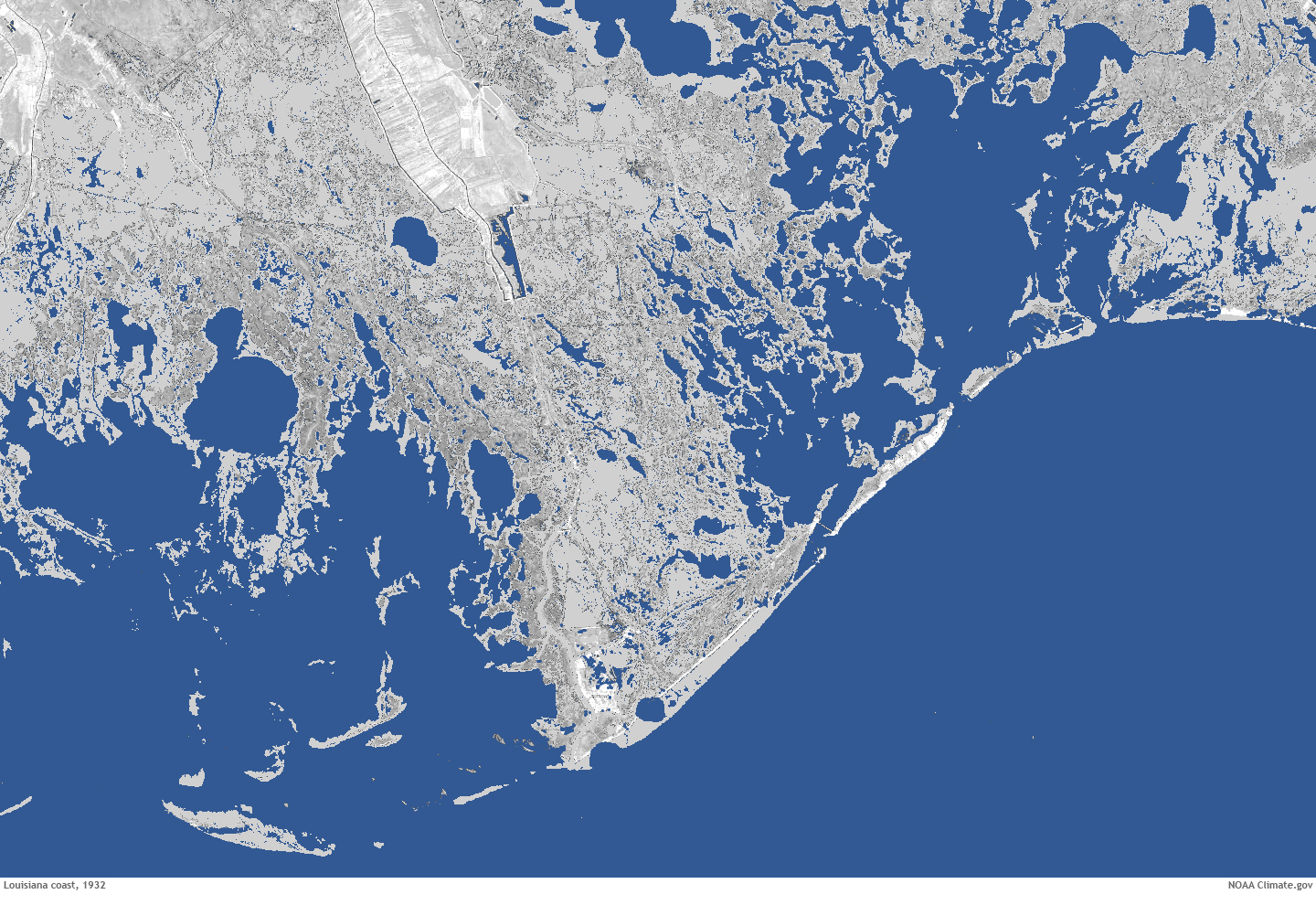
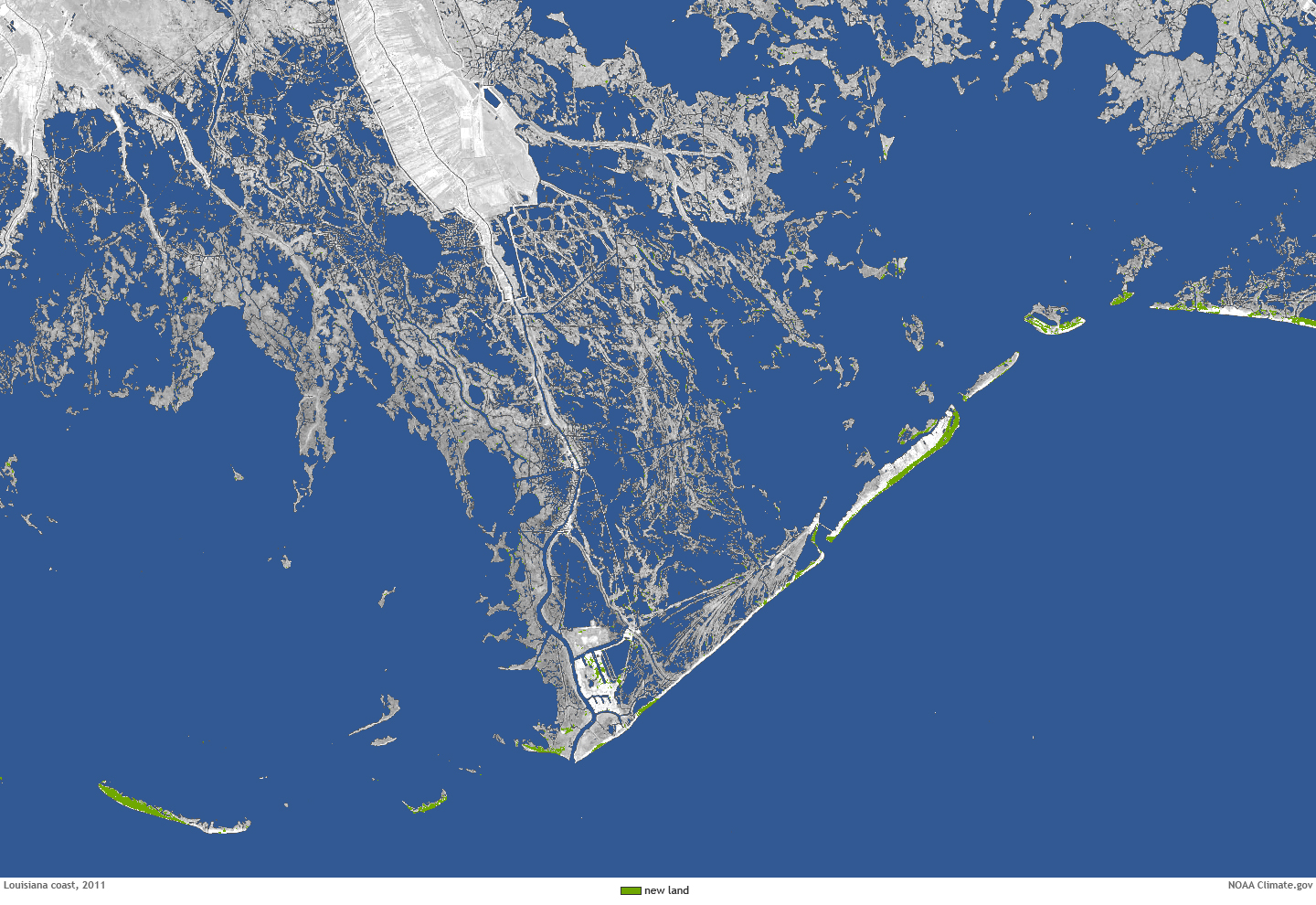
We have an area similar to that in the US..
Louisiana 1932: https://www.climate.gov/sites/default/files/LandLossinSouthe...
and in 2011: https://www.climate.gov/sites/default/files/LandLossinSouthe...
And land loss along the atlantic coast: https://www.epa.gov/climate-indicators/atlantic-coast
And increased coastal flooding (note, some cities being flooded 40 days out of the year.. thats pretty significant): https://www.epa.gov/climate-indicators/climate-change-indica...

We have an area similar to that in the US..
Louisiana 1932: https://www.climate.gov/sites/default/files/LandLossinSouthe...
and in 2011: https://www.climate.gov/sites/default/files/LandLossinSouthe...
And land loss along the atlantic coast: https://www.epa.gov/climate-indicators/atlantic-coast
And increased coastal flooding (note, some cities being flooded 40 days out of the year.. thats pretty significant): https://www.epa.gov/climate-indicators/climate-change-indica...
"A study published in 2009 by the University of Colorado
at Boulder indicates that human factors are causing
deltas in Asia and America to sink significantly. The
study concludes that this problem is exacerbated by
sediments being trapped upstream by reservoirs and
dams, man-made channels and levees that whisk sediment
into the oceans beyond coastal floodplains, and
the accelerated compacting of floodplain sediment
caused by the extraction of groundwater and natural
gas."
People always mention 'rising sea levels' with loss of land but it seems to me the real issue is local human behaviour.
http://www.deltatimes.org/doc/deltatimes/turning-the-tide.pd...
People always mention 'rising sea levels' with loss of land but it seems to me the real issue is local human behaviour.
http://www.deltatimes.org/doc/deltatimes/turning-the-tide.pd...
Indeed. This is known to be a factor in the Bangkok area. Huge amounts of ground water are pumped from the aquifer and the land is subsiding as a result. It is making the a annual local flooding problem during rainy season worse, particularly when there is heavy runoff during a high tide.
Can you cite any actual science to back that up? And make sure you exclude any sources that say "as early as 2000".
Or is this the new denialist meme? Instead of "in the 70s they were warning us about a new ice age" it's evolved into "in the 70s they said we'd have drowned by now".
I suppose it's getting slowly closer to the actual state of science.
Or is this the new denialist meme? Instead of "in the 70s they were warning us about a new ice age" it's evolved into "in the 70s they said we'd have drowned by now".
I suppose it's getting slowly closer to the actual state of science.
Can we not assume bad faith on behalf of other commenters? I've heard similar things from a grandparent, an older science teacher, and a CS prof I knew well. Everyone knows that science reporting is in a terrible state today, but I honestly don't think it was much better 40-50 years ago. The problem has always been that the non expert journalists that publish the stories exaggerate the outcomes of research, across the board. Painting people's experiences of popular climate science in the 70's as denialism is nonconstructive and needlessly insulting.
> Can we not assume bad faith on behalf of other commenters?
I'll try with this one, but at a certain point things just become willful ignorance, as is the case with the "in the 70's it was all about the new ice age" trope. In fact, willful ignorance would summarize OP's whole post.
I'll try with this one, but at a certain point things just become willful ignorance, as is the case with the "in the 70's it was all about the new ice age" trope. In fact, willful ignorance would summarize OP's whole post.
Climate models back in the 70s were very crude. There were only about two decades of atmospheric CO2 measurements. And, as I recall, predictions were stated with far greater uncertainty. So I wouldn't be surprised if some high-end estimates are clearly wrong by now.
Edit: But maybe initial models were decent enough:
The First Climate Model Turns 50, And Predicted Global Warming Almost Perfectly
http://www.forbes.com/sites/startswithabang/2017/03/15/the-f...
Edit: But maybe initial models were decent enough:
The First Climate Model Turns 50, And Predicted Global Warming Almost Perfectly
http://www.forbes.com/sites/startswithabang/2017/03/15/the-f...
> And, as I recall, predictions were stated with far greater uncertainty.
The bigger problem is people taking the upper bound of that uncertainty and concluding they were wrong because reality turned out to not be near the upper bound. Kind of like how political polls are "wrong", even when the result falls within the margin of error.
The bigger problem is people taking the upper bound of that uncertainty and concluding they were wrong because reality turned out to not be near the upper bound. Kind of like how political polls are "wrong", even when the result falls within the margin of error.
True. But some writers (even science writers) sensationalize by focusing on upper-bound estimates. And most people never see primary sources, even abstracts or executive summaries.
In headlines maybe, the articles almost always include phrases like "as early as 20xx" that communicate the uncertainty.
We had the same thing being reported in the late 70's.
There was a travelling exhibit that visited my high school which was an analog computer - you could set your energy sources (coal, hydro, nuclear, solar) and see how long society could run before we re-entered the Dark Ages (literally - no more electric lights!). Thinking about it - the consumption side was likely a rising wave function which predicted steadily-increasing use of electricity.
This was around the time when the EPA's Energy Star program got started, and I suspect it did a lot to counter the increase in demand.
You can also look at the films of the 70's to get some of the zeitgeist of the era - "Soylent Green", "Silent Running", "No Blade of Grass", "Damnation Alley", and so on, all with the theme that the Earth no longer nourishes life.
There was a travelling exhibit that visited my high school which was an analog computer - you could set your energy sources (coal, hydro, nuclear, solar) and see how long society could run before we re-entered the Dark Ages (literally - no more electric lights!). Thinking about it - the consumption side was likely a rising wave function which predicted steadily-increasing use of electricity.
This was around the time when the EPA's Energy Star program got started, and I suspect it did a lot to counter the increase in demand.
You can also look at the films of the 70's to get some of the zeitgeist of the era - "Soylent Green", "Silent Running", "No Blade of Grass", "Damnation Alley", and so on, all with the theme that the Earth no longer nourishes life.
Who knows? Maybe it'll eventually get so close that the claims made actually match up with reality. Then maybe even some of those "denialists" will get on board.
Unfortunately the media makes aggressive predictions either to get a point across or for ratings but it is happening.
Miami is investing in mediating current and future floods. I feel the fact that flood prevention is a significant part of your budget and planning that says something https://www.youtube.com/watch?v=c1dnlHPzhQA
Miami is investing in mediating current and future floods. I feel the fact that flood prevention is a significant part of your budget and planning that says something https://www.youtube.com/watch?v=c1dnlHPzhQA
Miami has an erosion problem.
Look at a map of Louisiana.
https://www.pri.org/stories/2014-09-23/louisianas-coastline-...
https://www.pri.org/stories/2014-09-23/louisianas-coastline-...
"Dramatic erosion and sinking land along the southeastern coast of Louisiana could lead to “the largest forced migration for environmental reasons in the history of the country,” a new report says."
Not rising sea levels.
Not rising sea levels.
I believe that is rising sea levels. The sea is not a static thing with a constant level as seen from land. The local level rises and falls with weather conditions and tides. As the general level rises, you would expect land close to the shore to wash away. Like when you build a sand castle on the beach and then the tide comes in and washes it into the sea.
IIRC, the sinking of Louisiana is more related to the channelization of the Mississippi. Without the sediment formerly delivered by yearly floods from the Misssissippi, the land is eroding away.
> In the late 70's, I can remember a rash of stories on the nightly news, telling us that scientists were predicting that half of Florida was going to be underwater by the 2000's. Perhaps, even as a kid, I was sensitized to reporting on science, since my 4th-grade science text book was also predicting we'd be in a mini ice age in the 80's, and completely out of oil by 2000. And, dang it, I was looking forward to driving.
Isn't the difference with today the consensus among scientist. In any time period you can probably find some scientist making exaggerated claims about X. It feels a lot different when you have hundreds of scientist coming together to write things like IPCC reports. This isn't just some scientist says X. This is the vast majority of scientist more or less agree that X is a major problem.
Isn't the difference with today the consensus among scientist. In any time period you can probably find some scientist making exaggerated claims about X. It feels a lot different when you have hundreds of scientist coming together to write things like IPCC reports. This isn't just some scientist says X. This is the vast majority of scientist more or less agree that X is a major problem.
I think you may have been misinformed. There is a consensus that CO2 in the atmosphere has an affect on global temperatures. I don't think there is any consensus that it's a major problem, nor is there a consensus on the best course of action (of course that's a political question not a scientific one).
I've been seen a lot of "reasonable sounding" climate skeptics on HN lately.
What's going on? I struggle to believe this community is _that_ ignorant; either I'm wrong or there's a fairly intentional and sophisticated astroturfing campaign going on.
What's going on? I struggle to believe this community is _that_ ignorant; either I'm wrong or there's a fairly intentional and sophisticated astroturfing campaign going on.
I see this all the time too. There's always some appeal to open-mindedness or an interesting hypothesis.
It's all horseshit of course, in the same vein as antivax.
It's all horseshit of course, in the same vein as antivax.
Have you ever considered the possibility of the alarmists being the ones actually involved in an "intentional and sophisticated astroturfing campaign" of global scale?
You may disagree with climate change skepticism, but you still ought to recognize the fact that a group of government-funded scientists with incomes tied to political agendas all screaming "but almost all of us agree on this thing!" in every media outlet is a bit suspicious (as if the laws of nature have anything to do with size of your bandwagon). Add the fact that they've been demonstrably wrong over and over again for the past 50+ years, and it smells even more fishy. You may not change your position on the matter, but it shouldn't be surprising that even educated people (especially those who have heard these predictions for decades) are skeptical.
You may disagree with climate change skepticism, but you still ought to recognize the fact that a group of government-funded scientists with incomes tied to political agendas all screaming "but almost all of us agree on this thing!" in every media outlet is a bit suspicious (as if the laws of nature have anything to do with size of your bandwagon). Add the fact that they've been demonstrably wrong over and over again for the past 50+ years, and it smells even more fishy. You may not change your position on the matter, but it shouldn't be surprising that even educated people (especially those who have heard these predictions for decades) are skeptical.
It's not "we agree", it's "all the different strands of evidence agree": that's the difference between a scientific consensus and a social (ie, bandwagon) one.
> all the different strands of evidence agree
Are you referring to evidence that suggests climate is always changing (in which case I also agree!), or evidence of AGW? If it's the latter, I'm afraid you'd be ignoring an incredibly strong body of evidence on the contrary.
Are you referring to evidence that suggests climate is always changing (in which case I also agree!), or evidence of AGW? If it's the latter, I'm afraid you'd be ignoring an incredibly strong body of evidence on the contrary.
I'm afraid you've been mislead. The jury is in on this, AGW is not in dispute in the scientific community.
https://climate.nasa.gov/scientific-consensus/
(The link goes to a page with further references and papers)
https://climate.nasa.gov/scientific-consensus/
(The link goes to a page with further references and papers)
Here's an earlier NY Times article about a coastal Virginia community where property values are plummeting because a combination of rising sea levels and sinking land levels is gradually flooding the whole place out:
https://www.nytimes.com/2017/04/18/magazine/when-rising-seas...
(They're seeing the effect faster because it's not just rising seas at work, but the rising seas are definitely part of it. This pattern will be increasingly common over time.)
https://www.nytimes.com/2017/04/18/magazine/when-rising-seas...
(They're seeing the effect faster because it's not just rising seas at work, but the rising seas are definitely part of it. This pattern will be increasingly common over time.)
Looking for a house in the Boston area last year, I definitely turned down some properties because of the risk during sea level rise. Regardless of what the seas actually do, increasing _concern_ about climate change could impact my future property value, which I wanted to avoid.
My real estate agent was relatively new to the business, but she said she hadn't heard of anyone bringing climate change up as a factor in deciding which house to buy, which I thought was odd. My house is safe up to about a 10 meter rise now!
My real estate agent was relatively new to the business, but she said she hadn't heard of anyone bringing climate change up as a factor in deciding which house to buy, which I thought was odd. My house is safe up to about a 10 meter rise now!
Island nations of the pacific are another example in addition to already posted ones
http://www.independent.co.uk/environment/climate-change/glob...
https://www.theguardian.com/environment/2015/oct/14/pacific-...
http://www.independent.co.uk/environment/climate-change/glob...
https://www.theguardian.com/environment/2015/oct/14/pacific-...
Isn't the ocean bubbling up through the drainage in Florida?
Do you happen to have sources for the seventies stories? Maybe even in New York times?
(Thanks for just asking for sources rather than immediately attacking the intensions of the grandparent.)
So a couple of Google searches show that there are dozens, maybe hundreds, of online lists of failed predictions of climate change maintained by climate change skeptics. For instance:
https://www.thenewamerican.com/tech/environment/item/18888-e...
From that list, I picked one story to track down:
> On June 30, 1989, the Associated Press ran an article headlined: “UN Official Predicts Disaster, Says Greenhouse Effect Could Wipe Some Nations Off Map.” In the piece, the director of the UNEP’s New York office was quoted as claiming that “entire nations could be wiped off the face of the earth by rising sea levels if global warming is not reversed by the year 2000.” He also predicted “coastal flooding and crop failures” that “would create an exodus of ‘eco-refugees,’ threatening political chaos.”
Worryingly, searching for this headline mostly returned more climate change skeptics websites. But this isn't totally unexpected since it dates to before internet adoption, and I was eventually able to find this archive photo from a local newspaper that appears to substantiate it.
https://www.newspapers.com/newspage/83413062/
Thats just sample size 1, though. Will see if I can find a NYTimes article.
Edit: So a lot of these lists look like copypasta. Some are partial, but here is a pretty complete version:
http://forum.weatherzone.com.au/ubbthreads.php/topics/109996...
There are several mentions of the NY Times, and the two I checked were real (including at least one which was just a letter to the editor, and so not endorsed by the paper.) Note that these predictions are generally for global cooling. Many people says it's unfair to quote these claims because they did not represent the consensus position at the time (but this doesn't invalidate the grandparent's claim; he doesn't say NY Times).
Anyhow, I would love to someone else take this further, but my initial impression is that the claim "there were a bunch of plausible sounding stories about coastal flooding in reputable newspapers" is probably true, but that this doesn't mean it reflected a consensus view back then. On the other hand, the current story also doesn't reflect a consensus view regarding any near- or medium-term claims.
So a couple of Google searches show that there are dozens, maybe hundreds, of online lists of failed predictions of climate change maintained by climate change skeptics. For instance:
https://www.thenewamerican.com/tech/environment/item/18888-e...
From that list, I picked one story to track down:
> On June 30, 1989, the Associated Press ran an article headlined: “UN Official Predicts Disaster, Says Greenhouse Effect Could Wipe Some Nations Off Map.” In the piece, the director of the UNEP’s New York office was quoted as claiming that “entire nations could be wiped off the face of the earth by rising sea levels if global warming is not reversed by the year 2000.” He also predicted “coastal flooding and crop failures” that “would create an exodus of ‘eco-refugees,’ threatening political chaos.”
Worryingly, searching for this headline mostly returned more climate change skeptics websites. But this isn't totally unexpected since it dates to before internet adoption, and I was eventually able to find this archive photo from a local newspaper that appears to substantiate it.
https://www.newspapers.com/newspage/83413062/
Thats just sample size 1, though. Will see if I can find a NYTimes article.
Edit: So a lot of these lists look like copypasta. Some are partial, but here is a pretty complete version:
http://forum.weatherzone.com.au/ubbthreads.php/topics/109996...
There are several mentions of the NY Times, and the two I checked were real (including at least one which was just a letter to the editor, and so not endorsed by the paper.) Note that these predictions are generally for global cooling. Many people says it's unfair to quote these claims because they did not represent the consensus position at the time (but this doesn't invalidate the grandparent's claim; he doesn't say NY Times).
Anyhow, I would love to someone else take this further, but my initial impression is that the claim "there were a bunch of plausible sounding stories about coastal flooding in reputable newspapers" is probably true, but that this doesn't mean it reflected a consensus view back then. On the other hand, the current story also doesn't reflect a consensus view regarding any near- or medium-term claims.
Thanks for the legwork. Would need to see the actual content of the predictions.
But at least from your quote, the actual effects are not supposed to happen by the year 2000.
It's just that the amount of CO2 emitted by year 2000 has already committed us to a certain amount of climate change, that will just take a while to happen.
Here's one article with some actual sources, looking at predictions from the year 1981. https://www.skepticalscience.com/lessons-from-past-predictio...
But at least from your quote, the actual effects are not supposed to happen by the year 2000.
It's just that the amount of CO2 emitted by year 2000 has already committed us to a certain amount of climate change, that will just take a while to happen.
Here's one article with some actual sources, looking at predictions from the year 1981. https://www.skepticalscience.com/lessons-from-past-predictio...
> But at least from your quote, the actual effects are not supposed to happen by the year 2000.
> It's just that the amount of CO2 emitted by year 2000 has already committed us to a certain amount of climate change, that will just take a while to happen.
I agree visible effects by 2000 are not strictly implied by the quote, but it's a bit strained to say it's not suggested. Carbon stays in the atmosphere for a long time, but, unless I'm mistaken, the earth thermalizes to the temperature associated with a steady carbon level (inducing a corresponding sea level rise) fairly quickly. (Original commenter said 2000s.) My understanding is that most of the worrying "inertia" for warming, where the damage appear later, comes from either more complicated climate mechanisms (beyond just sea level rise from melting ice) and the slowness of changing the energy sector.
> It's just that the amount of CO2 emitted by year 2000 has already committed us to a certain amount of climate change, that will just take a while to happen.
I agree visible effects by 2000 are not strictly implied by the quote, but it's a bit strained to say it's not suggested. Carbon stays in the atmosphere for a long time, but, unless I'm mistaken, the earth thermalizes to the temperature associated with a steady carbon level (inducing a corresponding sea level rise) fairly quickly. (Original commenter said 2000s.) My understanding is that most of the worrying "inertia" for warming, where the damage appear later, comes from either more complicated climate mechanisms (beyond just sea level rise from melting ice) and the slowness of changing the energy sector.
This was about sea level rise. Glacier melting takes decades. There are potential very nonlinear effects with that too, so at some point, much later, sea level rise can be very fast, and it's too late to do much by then anymore.
This is a very rough sketch and going by memory so best to check for yourself: on Antarctica, there are certain "gatekeeper" glaciers in valleys between the sea and large lowlands with multikilometer thick ice. If the gatekeeper glacier is lost, then the sea will flow into the big basin, and the large area will melt rapidly / float away as ice bergs etc.
Eric Rignot has some interesting presentations: https://www.youtube.com/watch?v=u3ivlofypzE
This is a very rough sketch and going by memory so best to check for yourself: on Antarctica, there are certain "gatekeeper" glaciers in valleys between the sea and large lowlands with multikilometer thick ice. If the gatekeeper glacier is lost, then the sea will flow into the big basin, and the large area will melt rapidly / float away as ice bergs etc.
Eric Rignot has some interesting presentations: https://www.youtube.com/watch?v=u3ivlofypzE
Thanks!
If you were really interested in what is actually happening, you would not be using half-remembered journalism from forty years ago as your source of information.
[deleted]
I was born in the 80's, and not in US, so my perspective is certainly different.
But I don't remember ever reading a serious article about running out of oil by 2000 (saw a few about 2050), and about cities being under water by now.
There were plenty of those things in popular literature and movies. But not in serious reporting, even science reporting being as bad as it was.
But I don't remember ever reading a serious article about running out of oil by 2000 (saw a few about 2050), and about cities being under water by now.
There were plenty of those things in popular literature and movies. But not in serious reporting, even science reporting being as bad as it was.
As your only criterion for validity seems to be that something has already happened, an article that attempts to use the scientific method to explore future possibilities is not for you.
I remember that too, but wasn't it the end of the century, not the beginning? And the measurements in Florida have shown a rise of more than 1mm/y for a while now.
Billingsgate island off Eastham Ma.
That was pre fossil fuels and was really caused by erosion.
My point of posting it is that the sea takes things for various reasons and land is not static either.
Land can be sinking or rising for geological reasons and we have to be careful what some might attribute to sea level rise.
That was pre fossil fuels and was really caused by erosion.
My point of posting it is that the sea takes things for various reasons and land is not static either.
Land can be sinking or rising for geological reasons and we have to be careful what some might attribute to sea level rise.
The Netherlands are spending several billion euros to build larger dams. They do this because of the rising sea levels.
I'm from The Netherlands and this is news for me. Do you have a source?
Good for you. I think you should back up your words & plunk down some cash on some ocean front property somewhere.
You have to make bold (and often later false) predictions to get peoples' attention. Nobody pays attention to "scientists predict that there is a 10% chance of X in 20 years, a 25% chance in 50 years, and a 50% chance in 100 years" type stuff even if X is something really bad. To get the media and the average busy person to pay attention, it must be an emergency. It must be a crisis.
But... it's a catch-22. When you make those kinds of bold, sensational predictions you lose the thinking people who pay attention. They'll notice that your prediction is unlikely and later turns out to be false. They'll make a note of it and never listen to you again.
Some day we will really run out of certain fossil fuels, and if we haven't made them obsolete by then we are in big trouble. Some day if we keep dumping CO2 and methane into the atmosphere we will trigger some kind of runaway climate effect with potentially disastrous consequences. We also may trigger something like an ocean anoxic event. When will these things happen? Nobody knows, but it could be within our lifetimes (especially with life extension maybe coming) and it's even more likely within our childrens' lifetimes.
"Why didn't anyone say something!?!?"
They did, but they did too early and in the wrong way. But if they'd said it calmly and rationally nobody would have paid attention either.
P.S. I personally find ocean acidification far scarier than climate change. We can move cities a lot easier than we can figure out how to survive without the oceans.
But... it's a catch-22. When you make those kinds of bold, sensational predictions you lose the thinking people who pay attention. They'll notice that your prediction is unlikely and later turns out to be false. They'll make a note of it and never listen to you again.
Some day we will really run out of certain fossil fuels, and if we haven't made them obsolete by then we are in big trouble. Some day if we keep dumping CO2 and methane into the atmosphere we will trigger some kind of runaway climate effect with potentially disastrous consequences. We also may trigger something like an ocean anoxic event. When will these things happen? Nobody knows, but it could be within our lifetimes (especially with life extension maybe coming) and it's even more likely within our childrens' lifetimes.
"Why didn't anyone say something!?!?"
They did, but they did too early and in the wrong way. But if they'd said it calmly and rationally nobody would have paid attention either.
P.S. I personally find ocean acidification far scarier than climate change. We can move cities a lot easier than we can figure out how to survive without the oceans.
I'm afraid when the end of the world finally comes, there's going to be a ton of people who will be upset it didn't happen the way they wanted it to.
I remember reading Bob Novak in the mid 2000s. Every week he'd predict that whatever the current news was, the United States would be pulling out of Iraq.
Finally I emailed him. "Bob! Keep it up! Sooner or later you're bound to be right"
He's not right yet, but my point holds. At some point, something really bad is going to happen that scientists have been predicting. Bound to happen. But once that happens, there will be a hundred other things that didn't make the cut.
The precautionary principle is great, but not when you have dozens or hundreds of things all of which with potentially catastrophic consequences. Then it's all just so much noise.
I remember reading Bob Novak in the mid 2000s. Every week he'd predict that whatever the current news was, the United States would be pulling out of Iraq.
Finally I emailed him. "Bob! Keep it up! Sooner or later you're bound to be right"
He's not right yet, but my point holds. At some point, something really bad is going to happen that scientists have been predicting. Bound to happen. But once that happens, there will be a hundred other things that didn't make the cut.
The precautionary principle is great, but not when you have dozens or hundreds of things all of which with potentially catastrophic consequences. Then it's all just so much noise.
> Extensive satellite monitoring began in the 1990s and, within a decade, evidence emerged that the ice sheet was already starting to speed up, retreat and destabilize. Since then, the rate at which some of the glaciers are dumping ice into the ocean has tripled. More than 100 billion tons are lost every year.
I have a pet peeve about large numbers being thrown about without context. 100 billion tons of ice lost every year is a large number. How many tons of ice are in the whole of the ice sheet? 30M km^3 * 0.239913 mi^3/km^3 * 3.82 Gt/mi^3 = ~27.5 million gigatons. So that gives us about 275,000 years at current rates before the ice sheet is gone.
I got the 30M km^3 from here: https://www.sciencedaily.com/terms/antarctic_ice_sheet.htm and other conversions from here: http://www.sealevel.info/conversion_factors.html
I have a pet peeve about large numbers being thrown about without context. 100 billion tons of ice lost every year is a large number. How many tons of ice are in the whole of the ice sheet? 30M km^3 * 0.239913 mi^3/km^3 * 3.82 Gt/mi^3 = ~27.5 million gigatons. So that gives us about 275,000 years at current rates before the ice sheet is gone.
I got the 30M km^3 from here: https://www.sciencedaily.com/terms/antarctic_ice_sheet.htm and other conversions from here: http://www.sealevel.info/conversion_factors.html
Sure, but that's assuming a linear rate of decay, which it has not and will not be. There's a tipping point well before your theoretical limit. Ice breaks up and slides into the ocean quite a long time before it all melts.
[deleted]
If the whole ice sheet disappears, we disappear.
I don't see the correlation. The disappearance itself doesn't seem to be the problem, but the accumulation of consequences of even the process of it disappearance that are the problem; not least of which is the cost of adaptation.
If it disappears sea level would rise significantly. Therefore we would disappear because most of our civilization would be effected that lives around sea level.
That's a non-sequitur right there. It's not like the entire Antarctica melts in a year or two; in the worst case, it's multi-decade process. It's pretty easy to adapt to such change; we (obviously) built cities before and can do that again.
At the time scales we are talking about, our cities can ooze away from the sea slowly just by abandoning property that is currently flooding. The sea is rising at around 3mm / year, which is about a foot a century. Even if we multiplied this ten-fold, that's still only about an inch and a quarter a year we'd have to cope with. We'd have to raise some levies, abandon some property, and maybe update some other infrastructure. Not great, but not the end of the world.
A billion tons is a cubic kilometer, maybe easier to visualize how tiny a part of Antarctica that is.
Here is Brisbane, Australia, the property market for low-lying areas is still running hot. This is despite the flood of 2011 (which was so great it caused sea levels to drop by as much as 7mm) which destroyed many of them, and the insurance companies have either refused to insure them or at very high premiums with low coverage. No one cares, they still vote for politicians who promise the coal jobs will come back and still burn coal for most of the electricity.
Here is Amsterdam, Holland, the property market for low-lying areas is still running hot since about 800 years and we are, not will be, 2 meters (7 foot in Freedom) under sealevel. [0]
And about two thirds of the country is vulnerable to flooding, while the country is among the most densely populated on Earth. [1]
Not trying to deny possible flooding by melting ice and expanding seawater, just saying (at least the Dutch) people tend to not care to much about "possible" "one day" "change of 1 in a 100" scenarios while the living is good.
[0] https://en.wikipedia.org/wiki/Amsterdam [1] https://en.wikipedia.org/wiki/Flood_control_in_the_Netherlan...
And about two thirds of the country is vulnerable to flooding, while the country is among the most densely populated on Earth. [1]
Not trying to deny possible flooding by melting ice and expanding seawater, just saying (at least the Dutch) people tend to not care to much about "possible" "one day" "change of 1 in a 100" scenarios while the living is good.
[0] https://en.wikipedia.org/wiki/Amsterdam [1] https://en.wikipedia.org/wiki/Flood_control_in_the_Netherlan...
Netherland absolutely takes flooding very seriously. After the 1953 flood, it was decided that that level of flooding should not happen more than once every 10,000 years. The Deltaworks [0] are the result of this.
Sea level rise reduces the effectiveness of this coastal protection, so a lot more money is needed to improve the Deltaworks. Fortunately we're a rich country and we can afford it. But only up to a point. There's no way to protect Netherland against a 50 m sea level rise.
So as global warming continues, this is going to cost us increasing amounts of money, and eventually our descendants are going to have to abandon this country anyway.
Note that it was never about us drowning. It's about our grandchildren and further in the future. Unfortunately a lot of people have quite literally an "apres moi le deluge" attitude about this.
[0] https://en.wikipedia.org/wiki/Delta_Works
Sea level rise reduces the effectiveness of this coastal protection, so a lot more money is needed to improve the Deltaworks. Fortunately we're a rich country and we can afford it. But only up to a point. There's no way to protect Netherland against a 50 m sea level rise.
So as global warming continues, this is going to cost us increasing amounts of money, and eventually our descendants are going to have to abandon this country anyway.
Note that it was never about us drowning. It's about our grandchildren and further in the future. Unfortunately a lot of people have quite literally an "apres moi le deluge" attitude about this.
[0] https://en.wikipedia.org/wiki/Delta_Works
I live in Amsterdam too. This meme that we're all under sealevel is common, but wrong.
While literally true in some areas is extremely misleading in the context of a discussion about how rising sealevels impact world cities in general. Your Wikipedia source shows that the elevation goes as low as -2 meters, not that that's the mean elevation of the city.
Here's an elevation map of Amsterdam:
http://www.floodmap.net/Elevation/ElevationMap/?gi=2759794
And here's one of The Netherlands:
http://www.floodmap.net/Elevation/CountryElevationMap/?ct=NL
Now I happen to live -1 below in Amsterdam, but I'm the exception. Most of Amsterdam is above sealevel, the average seems to be around 6-10 meters above.
But most importantly, the elevation profile of the entire country is one where the coast is much higher than sealevel, and then gradually slopes downwards to bits of the interior that are entirely landlocked, but are say 1 meter below sealevel. In other words we have pockets of land that are below sealevel, but they're surrounded by and protected by land that's not.
There's pretty much zero overlap between where Amsterdam has been sited for the last 800 years and the areas that are anywhere near being under sealevel.
While literally true in some areas is extremely misleading in the context of a discussion about how rising sealevels impact world cities in general. Your Wikipedia source shows that the elevation goes as low as -2 meters, not that that's the mean elevation of the city.
Here's an elevation map of Amsterdam:
http://www.floodmap.net/Elevation/ElevationMap/?gi=2759794
And here's one of The Netherlands:
http://www.floodmap.net/Elevation/CountryElevationMap/?ct=NL
Now I happen to live -1 below in Amsterdam, but I'm the exception. Most of Amsterdam is above sealevel, the average seems to be around 6-10 meters above.
But most importantly, the elevation profile of the entire country is one where the coast is much higher than sealevel, and then gradually slopes downwards to bits of the interior that are entirely landlocked, but are say 1 meter below sealevel. In other words we have pockets of land that are below sealevel, but they're surrounded by and protected by land that's not.
There's pretty much zero overlap between where Amsterdam has been sited for the last 800 years and the areas that are anywhere near being under sealevel.
The 2011 floods were in areas next to rivers; indeed some of the worst hit towns are nowhere near the coast, no?
When it comes to ocean rise, no-one is predicting a "Day After Tomorrow"-style flood wave. The scientific paper linked in TFA has 6 feet over the next 80 years as the worst case scenario. This is in line with most other estimates (e.g. from the IPCC).
I'm as afraid of climate change as the next person, but sea level rise affecting rich coastal cities is so slow, so easily measured, so easy to engineer our way out of, and so obviously a net profitable endeavour to protect against, as compared to many of the other climate change threats like ocean acidification, large ecosystem collapses, food shortages etc. I don't understand how any sensible person can worry about sea level rise affecting western cities.
When it comes to ocean rise, no-one is predicting a "Day After Tomorrow"-style flood wave. The scientific paper linked in TFA has 6 feet over the next 80 years as the worst case scenario. This is in line with most other estimates (e.g. from the IPCC).
I'm as afraid of climate change as the next person, but sea level rise affecting rich coastal cities is so slow, so easily measured, so easy to engineer our way out of, and so obviously a net profitable endeavour to protect against, as compared to many of the other climate change threats like ocean acidification, large ecosystem collapses, food shortages etc. I don't understand how any sensible person can worry about sea level rise affecting western cities.
Glacial melting can have quite fast effects. For example when a glacial lake is building do to melting and the ice dam holding back all the water breaks. The content of the whole glacial lake can be swooped to the oceans in one flush. It doesn't even have to be melted water. Rivers under the ice due to melting ice can transport whole ice sheets to the coast and into the oceans. Carrying all the weight of the ice with it, into the oceans.
Now the ice sheets have a MASSIVE weight that pushs on the whole antarctic continent. Releasing all that weight has an effect on the earth crust. Much less weight on the antarctic continent and overall more weight on the oceans.
This will result in tensions in the earth crust. We know how these are released: Earth quakes. Earth quakes can also result in tsunamis.
A lot of coastal cities are not really prepared for tsunamis.
Just telling a story what CAN happen.
Just telling a story what CAN happen.
Indeed. The emergence of the black and baltic seas 8000 years ago were comparatively rapid events. Escapable, but extremely rapid. Jökulhaups can also have enormous and rapid effects, like the Missoula or Spokane floods.
Just judging by how mother nature has acted in the last few years, I suspect that sea level rise will be anything but gradual. I'm sure someone here on HN has a climate science background and can weigh in; but even though the sea level rise will take place over the course of 80 years, it seems reasonable that it would happen in fits and starts, i.e. catastrophic flooding every few years.
That flood was from being a river valley, not from being low lying and coastal, coastal areas weren't affected.
Toowoomba also flooded during that event, and that's on top of the great dividing range.
Toowoomba also flooded during that event, and that's on top of the great dividing range.
It's a lemming planet.
Take notice that this is Part 2, here is the Part 1 (there's also Part 3):
https://www.nytimes.com/interactive/2017/05/18/climate/antar...
https://www.nytimes.com/interactive/2017/05/18/climate/antar...
How did they decide what is West Antarctica and what is East Antarctica? Isn't it all North Antarctica?
Western hemisphere, Eastern hemisphere. Ultimately down to the 0 meridian running through Greenwich and for this you can thank English naval power.
Or you can thank the English for figuring out how to measure longitude.
Well yes :)
Greenwich is actually not a bad location to place the 0 meridian since it makes the international date line run through the least populated region of the world.
Greenwich is actually not a bad location to place the 0 meridian since it makes the international date line run through the least populated region of the world.
There's a very good Omega Tau episode on this.
http://omegataupodcast.net/229-ant-arctic-sea-ice/
http://omegataupodcast.net/229-ant-arctic-sea-ice/
> If that ice sheet were to disintegrate, it could raise the level of the sea by more than 160 feet
I was wondering how they got 160ft, it looks like it's from this paper http://www.the-cryosphere.net/7/375/2013/tc-7-375-2013.pdf.
I was wondering how they got 160ft, it looks like it's from this paper http://www.the-cryosphere.net/7/375/2013/tc-7-375-2013.pdf.
6ft eh? I'm sure there's a technological solution to that https://en.m.wikipedia.org/wiki/Raising_of_Chicago
6ft by the end of the century. 160ft in total.
Both these figures are just sensationalism. 6 feet is the newly added "extreme" scenario. The low is still 1 foot by 2100. Just to repeat that - current science predicts that sea level might rise by 1 foot in 2100.
160 feet for the whole Antarctic ice sheet is not a problem at all because it will take 1000s or at least 100s of years. Most buildings don't last even 100 years. Neither do a lot of national borders. We'll have rebuilt all our cities by then so it's plenty of time to gradually move the rebuilding further and further inland as the sea encroaches. Even better, our predictions are only going to get more and more accurate so we can do more planning further in advance. Nobody's predicting any disaster due to the whole Antarctic ice sheet melting. High sea level - yes, problem for people - no.
160 feet for the whole Antarctic ice sheet is not a problem at all because it will take 1000s or at least 100s of years. Most buildings don't last even 100 years. Neither do a lot of national borders. We'll have rebuilt all our cities by then so it's plenty of time to gradually move the rebuilding further and further inland as the sea encroaches. Even better, our predictions are only going to get more and more accurate so we can do more planning further in advance. Nobody's predicting any disaster due to the whole Antarctic ice sheet melting. High sea level - yes, problem for people - no.
I think we should fight greenhouse emissions as much as possible, but at the same time we should be realistic and plan accordingly. We should have a disaster plan (how to we move everybody to cities that won't be flooded, any nuclear plants on the coast to take care of? etc.) and a geo-engineering plan (can we capture this CO2 in some way?) and... a space exploration plan.
who knows? maybe defeating aging will push us to think longer term
who knows? maybe defeating aging will push us to think longer term
I moved to a (cold) place 5500 ft above sea level nearly 20 years ago partly with global warming in mind. Unfortunately I didn't anticipate that climate change would lead to a significant increase in wild fires too.
> a space exploration plan
As you talk about a dramatic disaster touching billions of people, would you mind to explain me how space exploration could make a dent in such a colossal situation?
As you talk about a dramatic disaster touching billions of people, would you mind to explain me how space exploration could make a dent in such a colossal situation?
Ah, that's easy. The best sites to test designs for sustainable colonies on Mars are in the deserts; the best sites to test designs for sustainable colonies on Europa are in the oceans; the best sites to test designs for sustainable colonies on asteroids are at the tops of mountains.
Once you have sustainable colonies in the deserts, the oceans and the mountaintops, you have much less urgency to move them out to space...
Once you have sustainable colonies in the deserts, the oceans and the mountaintops, you have much less urgency to move them out to space...
If you put yourself on a very long term trajectory, say 500 years, don't you think the only way to make a dent on the situation is space? I mean, what else would you do as a species? How else would you make sure humanity has a bright future?
What's wrong with underwater ice melting? Ice density is lower than waters, so water level should actually decrease from that.
it's not "underwater ice", it's "ice sitting on soil that is below sea level". The ice sheet is thick enough to be significantly above water level, but it's especially vulnerable to temperature increases in the ocean, since ocean water can start flowing under the ice and melt it from below.
Thank you, now that makes sense.
The article is about ice on land melting. But actually when floating ice melts it increases sea levels a little bit as well, as explained here: https://www.quora.com/If-water-is-denser-than-ice-why-do-sea...
Note, especially the first answer, which says that the effect from melting floating ice is quite small and that the primary drivers of rising sea levels from global warming are melting ice on land and thermal expansion of sea water.
I hope you understand that an iceberg floating in water displaces the same volume as ice as water [1].
1. I am ignoring the complexity of freshwater and saltwater mixing.
1. I am ignoring the complexity of freshwater and saltwater mixing.
It's not the only flaw in the article. Also it chooses to ignore the fact that unlike the Arctic, the Antartic does actually not have any net ice loss at all; in some parts the ice is melting, but this loss is offset by other parts which are gaining in volume.
https://www.nasa.gov/feature/goddard/nasa-study-mass-gains-o...
https://www.nasa.gov/feature/goddard/nasa-study-mass-gains-o...
There is a difference between ice and sea ice.
Basically Antartica has been losing land ice while sea ice has been growing.
https://www.skepticalscience.com/antarctica-gaining-ice-inte...
The important bit about sea vs land ice.
> when land ice melts and flows into the oceans global sea levels rise on average; when sea ice melts sea levels do not change measurably but other parts of the climate system are affected, like increased absorbtion of solar energy by the darker oceans.
Basically Antartica has been losing land ice while sea ice has been growing.
https://www.skepticalscience.com/antarctica-gaining-ice-inte...
The important bit about sea vs land ice.
> when land ice melts and flows into the oceans global sea levels rise on average; when sea ice melts sea levels do not change measurably but other parts of the climate system are affected, like increased absorbtion of solar energy by the darker oceans.
> Basically Antartica has been losing land ice while sea ice has been growing.
The Nasa article says the reverse, land ice is growing and sea ice melting. Also the NYT article states that it is especially the Antarctic sea ice that is vulnerable because of the rising ocean water temperature.
But I've read your link and learned that the Nasa article is controversial. Well what do I know ..
The Nasa article says the reverse, land ice is growing and sea ice melting. Also the NYT article states that it is especially the Antarctic sea ice that is vulnerable because of the rising ocean water temperature.
But I've read your link and learned that the Nasa article is controversial. Well what do I know ..
Amomgst other things, that ice is acting like a plug for a lot of ice on land.
A really well designed article. Kudos to the web design team at NYtimes on that.
Really clunky, jittery scroll with a load of blank space for me. Would much rather a clean, simple HTML+CSS layout without all the fancy javascript. (IE 10)
> (IE 10)
try upgrading to Netscape Navigator? ;)
try upgrading to Netscape Navigator? ;)
Obvious troll is obvious. Hackernews readers don't use IE 10.
> IE 10
How dare you.
You, Sir, are part of the problem.
How dare you.
You, Sir, are part of the problem.
10?!
Indeed, first time I come across such a website where scrolling is not jittery as f and either too slow or too fast! I generally hate these kinds of website, but this one seems executed flawlessly.
...or maybe kudos to the Chrome/Webkit team for finally fixing their weird scrolling behavior :) Years ago when I tried to implement such a thing myself the only browser that provided a decent experience on all platforms and devices with respect to such a scrolling-driven site was Firefox (and yeah, Safari, as Apple had a page like that themselves showing some mac pro or smth... but that worked like shit on anything except Safari on MacOS).
...or maybe kudos to the Chrome/Webkit team for finally fixing their weird scrolling behavior :) Years ago when I tried to implement such a thing myself the only browser that provided a decent experience on all platforms and devices with respect to such a scrolling-driven site was Firefox (and yeah, Safari, as Apple had a page like that themselves showing some mac pro or smth... but that worked like shit on anything except Safari on MacOS).
Looks great on mobile too! Kudos to Paul Graham for tweeting this out.
Off-topic: I'm surely not alone in utterly despising this kind of website design?
On-topic: If we think the immigration crisis is 'bad' now... It's like comparing a dispute over garden fences to WWII.
On-topic: If we think the immigration crisis is 'bad' now... It's like comparing a dispute over garden fences to WWII.
I love to see experimentation with different layouts. I most definitely wouldn't want to pay my energy bills on such a site. But this kind of content is like a coffee-table magazine, where such variety encourages you to think about the content differently.
For me personally, the trend towards all websites looking like Medium or Google material design is much worse.
For me personally, the trend towards all websites looking like Medium or Google material design is much worse.
I suspect presenting content in bite-sized chunks can help people focus rather than skim.
I think Medium layouts are a great way to get people reading just the content without sidebar ads and interjections to read a related article - that stuff wrecks so many news websites.
I think Medium layouts are a great way to get people reading just the content without sidebar ads and interjections to read a related article - that stuff wrecks so many news websites.
This design isn't one of their best, but I generally enjoy the different things the NYT does in that area. Some of their JS folks present at meetups across NYC, highly recommend checking those out if you're in the area.
It's web design for story telling. I quite like the format for certain types of content.
albeva(4)
Could?
[deleted]
The good news is that wealth inequality will go down: Rich people all own expensive property near the coast, so it'll get flooded and they'll have to pay the poor to move them closer inward.
The wealthy also own all the expensive property inlands. In general, the poor don't own a lot of property at all, one of the reasons of the widening wealth gap (property prices rising only benefits the people that own property).
[deleted]
One interesting observation is that the wealthy also do not seem to be concerned with a destabilizing climate. One would think with all that money & free time, they'd like the common people to stop messing up their planet please. I guess the wealthy are just way too outnumbered.
This stuff would probably go over better with the red state crowd if the same outlets hadn't chicken littled us in the 70s with global cooling.
Also, I don't know how much of a difference we can make in the west when China and India are polluting so hard that it blots out the daylight.
Also, I don't know how much of a difference we can make in the west when China and India are polluting so hard that it blots out the daylight.
^ This was not meant as a denial of global warming. I'm just complaining about media sensationalism and Chinese air quality standards.
Not denial, but still makes 2 claims (the first one is completely false) that deniers always make.
Apparently Wikipedia and I must be sharing a mass hallucination about Time, Newsweek, and a pop science show narrated by Leonard Nimoy.
https://en.wikipedia.org/wiki/Global_cooling#Concern_in_the_...
If the media weren't such blatant purveyors of disaster porn, people would be taking this issue more seriously.
https://en.wikipedia.org/wiki/Global_cooling#Concern_in_the_...
If the media weren't such blatant purveyors of disaster porn, people would be taking this issue more seriously.
> Dr. DeConto and Dr. Pollard do not claim that this is a certainty
Boil 'em in oil, the stinkin' deniers.
Oh, wait, that's the scientists that this did this study about a time a century in the future.
More sensationalist journalism just stirring up emotions.
Boil 'em in oil, the stinkin' deniers.
Oh, wait, that's the scientists that this did this study about a time a century in the future.
More sensationalist journalism just stirring up emotions.
It's forty years later, and the only land that I've read about that we've lost to global ocean level rise is some "islands" in the South Pacific that were only a couple millimeters above sea level anyway. Can someone here point me to actual, significant, usable land loss due to rising sea level? I'm not saying it hasn't happened, but I figure, if it had, it would be something that gets trotted out at every one of these discussions.
Now we're getting a beautifully-rendered Times article where some NASA climatologist says that, in another 10 years, we could have some "significant retreat." After half a lifetime of hearing this, and not seeing anything like the kind of change that would threaten man's survival, I'm sorry, but I'm skeptical.