Decap of a tiny chip that plays Christmas songs(twitter.com)
twitter.com
Decap of a tiny chip that plays Christmas songs
https://twitter.com/kenshirriff/status/1472297415201869831
27 comments
Years ago we took one of the happy birthday tune cards and connected it to the floppy drive hinge on a PC, the developer was convinced we had installed a TSR program to play it every time he inserted a floppy, not realising it was a hardware hack. Weeks of fun until he found out.
As an 80s kid, these melody cards were among the first things that piqued my interest for what later lead me to studying electrical engineering / computer architecture and now doing web development.
Funny how small experiences can shape a primary school kid's path. Similar experiences include those mini play-with-your-pinkie pianos, putting a 9V battery on the tongue, and the effects of putting a paperclip into an AC power socket.
Funny how small experiences can shape a primary school kid's path. Similar experiences include those mini play-with-your-pinkie pianos, putting a 9V battery on the tongue, and the effects of putting a paperclip into an AC power socket.
> putting a 9V battery on the tongue, and the effects of putting a paperclip into an AC power socket.
Removing insulation from a live phone wire with my teeth (I had decided to put an extension in my room without asking for help...) was one of mine, that definitely made me more careful. Went just fine until I closed the circuit with my tongue by accident just as someone called. Not pleasant.
Removing insulation from a live phone wire with my teeth (I had decided to put an extension in my room without asking for help...) was one of mine, that definitely made me more careful. Went just fine until I closed the circuit with my tongue by accident just as someone called. Not pleasant.
> Removing insulation from a live phone wire with my teeth (I had decided to put an extension in my room without asking for help...) was one of mine, that definitely made me more careful. Went just fine until I closed the circuit with my tongue by accident
I read this and thought "so what?".
> just as someone called.
Ahh there it is. Yep, that is indeed not pleasant.
I read this and thought "so what?".
> just as someone called.
Ahh there it is. Yep, that is indeed not pleasant.
Yeah, I'd done it once or twice before, and it went well since nobody called, and so I did not for a moment think about the difference. It helped strongly reinforce to make sure stuff is disconnected, not just "not harmful right this instance", before touching it.
The 90v(?) AC that comes through the phone line to make it ring was intended to be powerful enough to ring a physical bell. Back before the exchange was automated, home telephones had a hand-cranked generator to produce that signal. According to my dad, kids used to take those out of old phones and use them for all kinds of shenanigans. (Like shocking their friends, siblings, and the dog, I'm guessing.)
I'm certain someone will come up with the idea of pairing a smartphone with a taser at some point, and closing the loop on this.
I'd be unsurprised if someone is already selling something similar as a sex toy.
I had basically the same experience. I had messed with phone wires a lot, and they were always harmless, until someone called one day. I messed with them more carefully from then on :P
I am so glad I am not the only one who did this. I was messing around with the phone wires because my sister was hogging the phone and I had important business on a MUD. I found if I put a large resistor across two of the wires (I can't remember which now) the call quality would degrade enough that she would stop and I could get back on the internet.
I did this too! I picked up the wrong wire - I was installing a phone extension for my Nan - and stuck the wire in my mouth to strip it, as you always do as a kid. I was sitting cross-legged on the floor and got "blown" backwards across the room just like in a movie. I'd been shocked a dozen times from the 240V mains due to prior misadventures, but that was the worst shock I'd ever had. I couldn't taste anything for four days afterwards.
>and the effects of putting a paperclip into an AC power socket.
I believe that (in earlier years when electric protections were non existant or just a huge fuse) is one of the origins of survivorship bias ...
I believe that (in earlier years when electric protections were non existant or just a huge fuse) is one of the origins of survivorship bias ...
I remember the first attic of a house of a certain age to learn that it used to be a thing to not have insulated wiring. Instead, the wiring used a series of insulators as standoffs/guides, but bare exposed copper carrying live current. I was flabbergasted that more homes didn't burn to the ground.
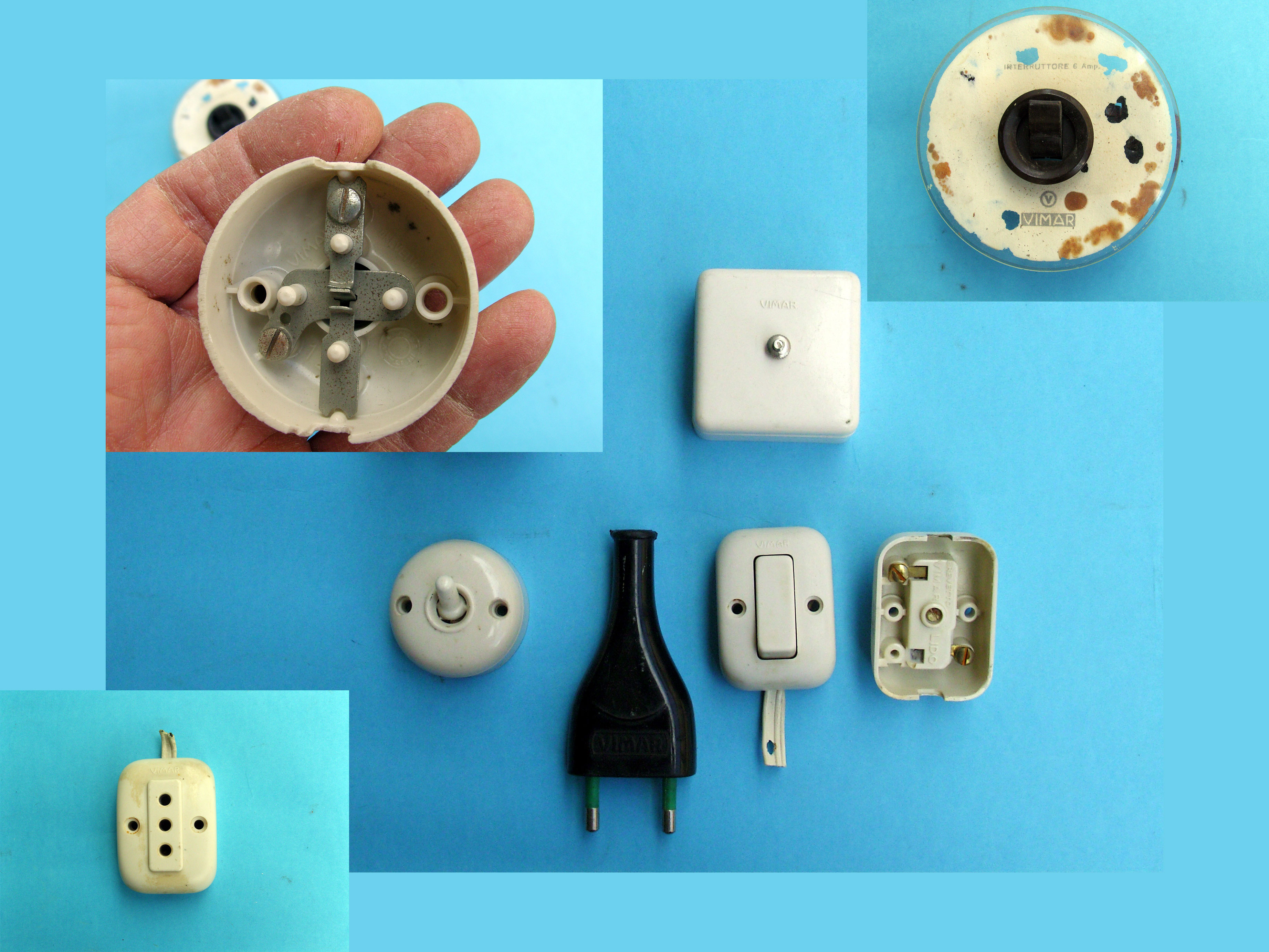
Yep, and at least here (Italy) up the '60's or maybe even '70's many older houses were "retrofitted" with what was called "piattina", which you can see here attached to a switch and to a socket:
http://www.museolaluce.com/wp-content/uploads/2009/03/vimar4...
it was two wires (no earth/ground) and was fixed using tiny nails that were driven in the plastic slip between the two wires, the "luxury" version were these (on the right):
http://www.museolaluce.com/wp-content/uploads/2009/03/btic.j...
but the most common ones had not a real insulator, they were simply steel nails dipped in some rubbery paint.
In theory the nail should have never come in contact with any of the two wires, but expecially where there was some corner preventing the nail to be hammered perfectly straight or because of sloppy installation, after a few years (with the rubber/insulation becoming stiff and microcracking) it happened.
http://www.museolaluce.com/wp-content/uploads/2009/03/vimar4...
it was two wires (no earth/ground) and was fixed using tiny nails that were driven in the plastic slip between the two wires, the "luxury" version were these (on the right):
http://www.museolaluce.com/wp-content/uploads/2009/03/btic.j...
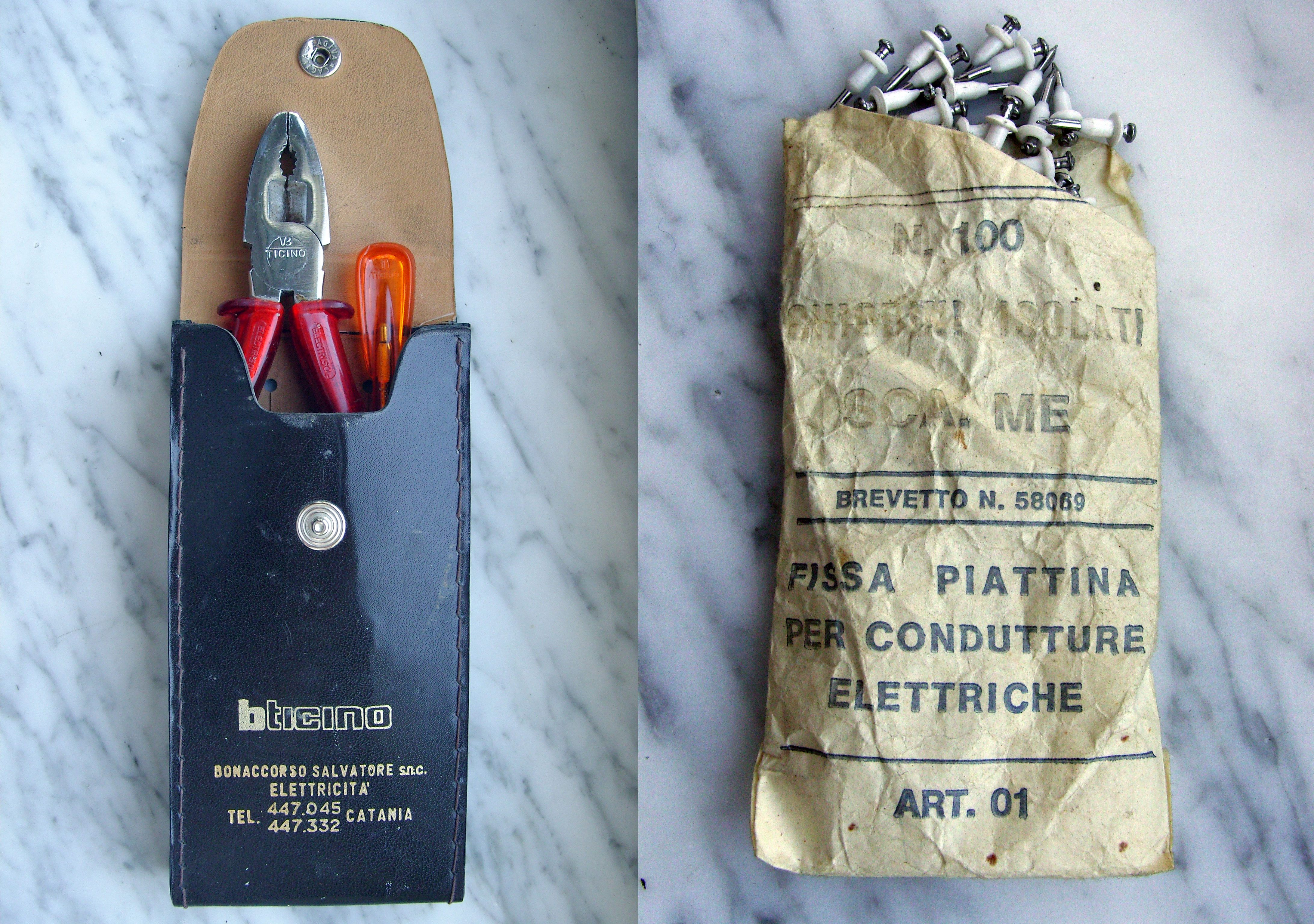
but the most common ones had not a real insulator, they were simply steel nails dipped in some rubbery paint.
In theory the nail should have never come in contact with any of the two wires, but expecially where there was some corner preventing the nail to be hammered perfectly straight or because of sloppy installation, after a few years (with the rubber/insulation becoming stiff and microcracking) it happened.
Look up “Knob And Tube Wiring” on Wikipedia for details (which claim that the wires should have been insulated, but I believe I’ve seen the same as you report, in a California house built in the 1950s).
Without wanting to be that guy, I’m really glad I grew up in a country with shuttered power sockets.
LOL, so did I. That does not stop a 9-year-old child from putting a paper clip there, I can promise you. The 9-year-old brain is ideally-developed for defeating this type of precaution.
Eventually I just found it easier to attach wires to a plug, put the plug in the socket and then just short the wires together.
Eventually I just found it easier to attach wires to a plug, put the plug in the socket and then just short the wires together.
What resources are there for learning about how to read die shots? I'm surprised that one is able to glean so much information from it.
I focus on 1970s and 1980s chips, which are simple enough to understand. For that generation, Mead and Conway's Introduction to VLSI Systems is a good place to start. https://ai.eecs.umich.edu/people/conway/VLSI/VLSIText/PP-V2/...
Old books on chip design are also useful, and can usually be obtained for cheap.
Also see The Layman's Guide to IC Reverse Engineering: http://siliconzoo.org/tutorial.html
The author of the tweet (Ken Shirriff) is particularly good at explaining things. A couple of his posts showing that:
http://www.righto.com/2018/06/silicon-die-analysis-op-amp-wi...
http://www.righto.com/2016/02/555-timer-teardown-inside-worl...
http://www.righto.com/2018/06/silicon-die-analysis-op-amp-wi...
http://www.righto.com/2016/02/555-timer-teardown-inside-worl...
[deleted]
Interesting. There is a chip that was once one of my friend's favorites for his consulting work... it was essentially a 6502 with huge mask-programmable ROM and a tiny (like 128 byte) RAM -- it was designed for greeting cards, where if you bought 100K+ quantities of passivated, unencapsulated die, they cost between 1 and 2 cents.
> I dissolved the transistor-like package in boiling sulfuric acid
Well, well. Here's something cool to add to my list of home lab tools!
Well, well. Here's something cool to add to my list of home lab tools!
Now someone needs to code an emulator for it.
I was expecting Doom. :/