Federal judge stays deportations of travelers in Trump immigration order(thehill.com)
thehill.com
Federal judge stays deportations of travelers in Trump immigration order
http://thehill.com/blogs/blog-briefing-room/news/316714-federal-judge-blocks-trump-immigration-ban-nationwide
382 comments
bexp(1)
I hope this is true. At least we still have a (mostly) independent judiciary.
I think the title of this post is wrong. Here's another post - http://www.theverge.com/2017/1/28/14427086/federal-court-hal... - that states that "The court specifically ruled on Darweesh and Alshawi’s petition; the ACLU will have to include all other similarly-affected immigrants as part of a class action to have it apply more broadly."
This is incorrect - the government tried to remove the ACLU's and NILC's standing by allowing Darweesh and Alshawi (the representative plaintiffs) through, but they prevailed in getting a stay on behalf of the class.
It looks like The Verge has fixed the sentence to "The court specifically ruled on Darweesh and Alshawi’s petition; other similarly-situated people being detained and those in transit are covered by the ruling, which is only temporary."
It is true that this doesn't stay the entire executive order. It just responds to the habeas-corpus bits for those who already made it to the US (including someone who was being placed on a plane leaving the US as the order was being made, and hopefully was allowed to get back off that plane).
It looks like The Verge has fixed the sentence to "The court specifically ruled on Darweesh and Alshawi’s petition; other similarly-situated people being detained and those in transit are covered by the ruling, which is only temporary."
It is true that this doesn't stay the entire executive order. It just responds to the habeas-corpus bits for those who already made it to the US (including someone who was being placed on a plane leaving the US as the order was being made, and hopefully was allowed to get back off that plane).
I think it's fairly unclear for the moment. Some ACLU affiliated account twittered "stay is national": https://twitter.com/dale_e_ho/status/825521534383095809
The wording of the ruling looks like it applies nationally to me:
"WHEREFORE, IT IS HEREBY ORDERED that the respondents, their officers, agents, servants, employees, attorneys, and all members and persons acting in concert or participation with than, from the date of this Order, are
ENJOINED AND RESTRAINED from, in any manner or by any means, removing individuals with refugee applications approved by U.S. Citizenship and Immigration Services as part of the U.S. Refugee Admissions Program, holders of valid immigrant and non-immigrant visas, and other individuals from Iraq, Syria, Iran, Sudan, Libya, Somalia, and Yemen legally authorized to enter the United States."
"WHEREFORE, IT IS HEREBY ORDERED that the respondents, their officers, agents, servants, employees, attorneys, and all members and persons acting in concert or participation with than, from the date of this Order, are
ENJOINED AND RESTRAINED from, in any manner or by any means, removing individuals with refugee applications approved by U.S. Citizenship and Immigration Services as part of the U.S. Refugee Admissions Program, holders of valid immigrant and non-immigrant visas, and other individuals from Iraq, Syria, Iran, Sudan, Libya, Somalia, and Yemen legally authorized to enter the United States."
I think that may have meant it applied to all airports as opposed to just the New York airports, but it could still only apply to the people who have already been held and not future travelers.
I'm sorry to report that it's not over yet:
> Stay covers the airport detainees and those currently in transit. Doesn't change ban going forward. Prev unclear tweet deleted
https://twitter.com/JessicaHuseman/status/825525603491278848
> Important clarification. This does not prevent Trump admin from blocking new travelers.
https://twitter.com/ericgeller/status/825525917602693120
> Stay covers the airport detainees and those currently in transit. Doesn't change ban going forward. Prev unclear tweet deleted
https://twitter.com/JessicaHuseman/status/825525603491278848
> Important clarification. This does not prevent Trump admin from blocking new travelers.
https://twitter.com/ericgeller/status/825525917602693120
More than you know.
The CBP was ignoring the court ruling in some airports (Dulles, at least). Federal Marshals were called upon to enforce it. https://twitter.com/mjs_DC/status/825571882586013696 (and others.
This is a true constitutional crisis, the worst in at least several generations.
The CBP was ignoring the court ruling in some airports (Dulles, at least). Federal Marshals were called upon to enforce it. https://twitter.com/mjs_DC/status/825571882586013696 (and others.
This is a true constitutional crisis, the worst in at least several generations.
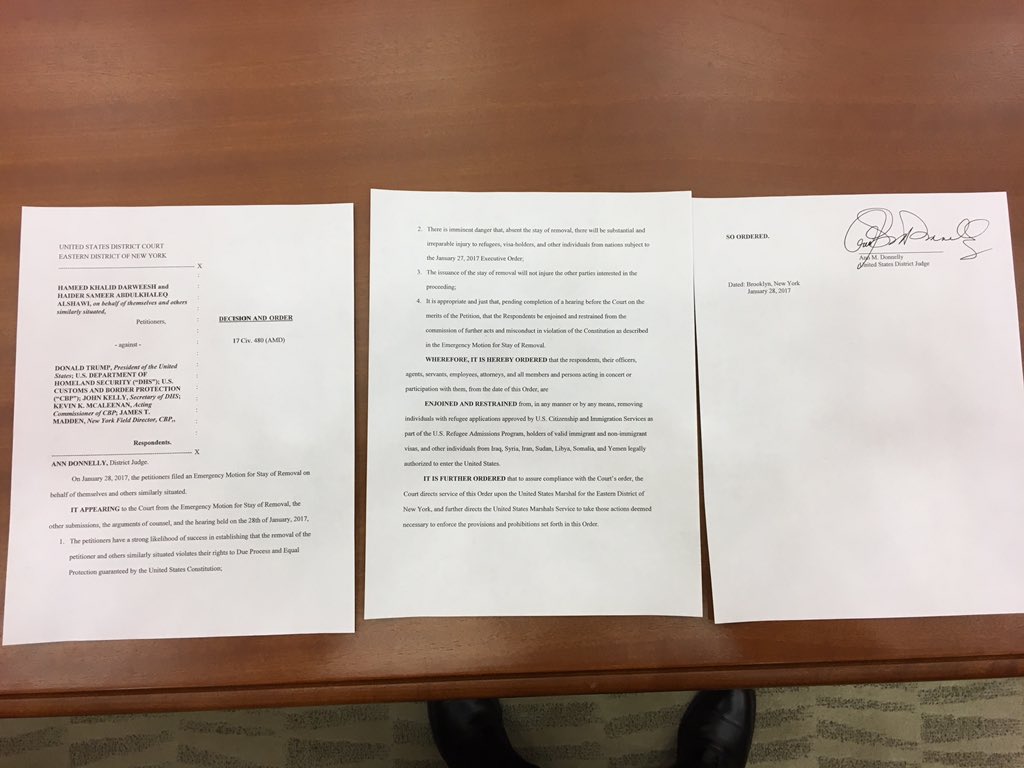
Clear from the judges order that this only helps those few immigrants caught in transit during the order being signed.
I was at the solidarity rally at the Dulles International Airport in Herndon, VA for a few hours, although I had left by the time this story broke. I'd wonder if it got announced to the crowd.
[deleted]
What is the authority chain usually here. Can a Federal judge block other such executive orders? Is this used often
The USA has clear separation and balance of powers, and the judiciary gets to rule on matters of law and constitution interpretation, so ya. It's like Rock Paper Scissors.
shawn-butler(6)
Trump and the Republican Congress are going to appoint many judges during his term, including Supreme Court judges. That could be Trump's most enduring legacy.
Unless the dems block all those nominnees. If they do, we could actually see some bipartisan work to appoint moderates.
Given the Republican commitment to popular bipartisan work over the last eight years, I wouldn't hold my breath.
I'm not even holding my breath for the dems to put up a fight :/
When Democracts decided to vote "yes" on some of the more ridiculous appointments, even though they would have been appointed even if those Democrats voted no, it was done for them. I can't take a single thing a Democrat congressman says seriously when opposing Trump if they couldn't even say no to Ben Carson being appointed as HUD secretary.
Grow a spine. What do they even stand for these days?
Grow a spine. What do they even stand for these days?
This article speaks directly to your point: http://www.vox.com/policy-and-politics/2017/1/27/14397448/de...
Basically, the standard practice used to be for most cabinet appointments to be easily confirmed with bipartisan support. Obama's appointments saw unprecedented levels of push-back from republicans, but still received significant numbers of republican votes. Democratic opposition to Trump's nominations has been, again, unprecedented.
My opinion: perhaps, given the fact that their votes are purely symbolic anyway, some democrats are choosing to 'pick their battles', and vote yes to the picks they feel are halfway reasonable, saving opposition for the cases where (again, in their opinions) it matters most.
Basically, the standard practice used to be for most cabinet appointments to be easily confirmed with bipartisan support. Obama's appointments saw unprecedented levels of push-back from republicans, but still received significant numbers of republican votes. Democratic opposition to Trump's nominations has been, again, unprecedented.
My opinion: perhaps, given the fact that their votes are purely symbolic anyway, some democrats are choosing to 'pick their battles', and vote yes to the picks they feel are halfway reasonable, saving opposition for the cases where (again, in their opinions) it matters most.
I remember during Alito's nomination, the Democrats stomped their feet, huffed and puffed, but eventually confirmed him anyway.
[deleted]
Republicans control the house and senate. It is not going to happen.
How could they do that?
They have enough Senators to filibuster a nomination.
AFAICT it's unclear whether the Republicans would, or even could, do away with the Senate's power to filibuster a Supreme Court nomination over this.
At any rate, everyone on Trump's short list of nominees seems basically no worse than Scalia, so things shouldn't change too dramatically for now.
AFAICT it's unclear whether the Republicans would, or even could, do away with the Senate's power to filibuster a Supreme Court nomination over this.
At any rate, everyone on Trump's short list of nominees seems basically no worse than Scalia, so things shouldn't change too dramatically for now.
The two alleged front runners on his SCOTUS list right now are moderates (Gorsuch and Hardiman). I'm not sure those two are all that distinguishable from Garland frankly.
So Tump ignores the court and we have a constitutional crisis.
Let's wait for that to happen. Seriously, if this occurs (and we are all damn well aware Trump is capable of it), this will approach a whole new level of madness.
Wasn't a very long wait: http://nypost.com/2017/01/29/customs-agents-ignore-judge-enf...
Some part of me wants Trump to make this mistake, and make more big mistakes of the non-lethal variety quickly so that there is grounds to impeach him before he starts a war.
You are more optimistic than I am about the prospect of a GOP-controlled congress impeaching a GOP president.
I think they would only do so if he did something that was obvious to everyone to be a serious existential threat to the US's existence as a country.
I mean, it'd have to be something even more beyond the pale than ignoring the Constitution and transforming the US government into an authoritarian regime without the rule of law. Like, nuking China for no reason, or something.
I think they would only do so if he did something that was obvious to everyone to be a serious existential threat to the US's existence as a country.
I mean, it'd have to be something even more beyond the pale than ignoring the Constitution and transforming the US government into an authoritarian regime without the rule of law. Like, nuking China for no reason, or something.
According to Robert Reich[0], the republicans' whole plan is to use trump to ram through their unpopular agenda and then impeach him when he's no longer useful:
Him: They’ll get as much as they want – tax cuts galore, deregulation, military buildup, slash all those poverty programs, and then get to work on Social Security and Medicare – and blame him. And he’s such a fool he’ll want to take credit for everything. Me: And then what? Him (laughing): They like Pence. Me: What do you mean? Him: Pence is their guy. They all think Trump is out of his mind. Him: So the moment Trump does something really dumb – steps over the line – violates the law in a big stupid clumsy way … and you know he will ... Me: They impeach him? Him: You bet. They pull the trigger.
[0]https://www.facebook.com/RBReich/posts/1445206565491935
Him: They’ll get as much as they want – tax cuts galore, deregulation, military buildup, slash all those poverty programs, and then get to work on Social Security and Medicare – and blame him. And he’s such a fool he’ll want to take credit for everything. Me: And then what? Him (laughing): They like Pence. Me: What do you mean? Him: Pence is their guy. They all think Trump is out of his mind. Him: So the moment Trump does something really dumb – steps over the line – violates the law in a big stupid clumsy way … and you know he will ... Me: They impeach him? Him: You bet. They pull the trigger.
[0]https://www.facebook.com/RBReich/posts/1445206565491935
He's been in office for one week. At this rate, he won't last more than a few months. I'm fully confident that he'll piss off the wrong group of people at some point in the next 0-6 months and land himself in court. If Bill came close from lying about cheating on his wife...then again, sort the votes chart at https://en.wikipedia.org/wiki/Impeachment_of_Bill_Clinton by party affiliation. Then again, I'm sure many more Red Team would want Pence instead, so I'm sure we'll see.
The odds of that seem fairly high. Maybe not on this particular decision (I think he'd have a hard time convincing all immigration officials to break the law), but we're heading in that direction very rapidly.
That's what impeachment is for. Pence, not Trump, is the GOP establishment's preferred president.
The ACLU is also reporting that the stay was granted: https://twitter.com/dale_e_ho/status/825520404777287680.
Many of you are probably watching the horror show unfold and wondering what tangible thing you can do. Joining or contributing to the ACLU is one small but important, specific way to help: https://action.aclu.org/secure/become-freedom-fighter-join-a....
https://twitter.com/seligerj/status/825529092414046208
Many of you are probably watching the horror show unfold and wondering what tangible thing you can do. Joining or contributing to the ACLU is one small but important, specific way to help: https://action.aclu.org/secure/become-freedom-fighter-join-a....
https://twitter.com/seligerj/status/825529092414046208
Is it possible to anonymously donate to the ACLU?
As a PR in the process of obtaining citizenship, a small fear of mine is that USCIS will start penalizing applicants that support organizations opposed to Trump. Today just proved that anything is possible and I'm sure we've all seen the stories about CBP asking to see the social media feeds of travelers in the past.
As a PR in the process of obtaining citizenship, a small fear of mine is that USCIS will start penalizing applicants that support organizations opposed to Trump. Today just proved that anything is possible and I'm sure we've all seen the stories about CBP asking to see the social media feeds of travelers in the past.
I've been considering donating but never had until just now. I was going to give $10/mo but kicked it up to $15/mo on your behalf so you don't have to worry about donating yourself and experiencing negative consequences as a result. Good luck on obtaining your citizenship.
Wow. That's amazing. Thank you!
I'm replicating @nnf's response - never donated till now, figured I'll do $10 monthly, but bumped it to $15 for you.
I just kicked in $250, one-time. To echo other posters, this was something I've been meaning to do.
I'm also throwing in an extra $25 one time donation. Not much but all my wife will allow at the moment.
Also amazing! Thank you!
I was thinking the same thing. One obvious thing to do is not claim it as a tax deductible donation, since it will go into federal records, which is easily accessed by law enforcement. Getting your past credit card statements may require one more hoop to jump through for them.
Gosh.. how far have we fallen that we are seriously discussing this?
Gosh.. how far have we fallen that we are seriously discussing this?
It seems that ACLU donations are not tax-deductable.
Just as an FYI, donations to the ACLU Foundation (which have somewhat more limited uses -- no lobbying, but still support litigation and other functions -- but still support the broad mission) are tax deductible.
https://action.aclu.org/what-difference
https://action.aclu.org/what-difference
Cool!
But at https://action.aclu.org/donate-aclu it should perhaps say that, after "Contributions to the American Civil Liberties Union are not tax deductible."
But at https://action.aclu.org/donate-aclu it should perhaps say that, after "Contributions to the American Civil Liberties Union are not tax deductible."
ACLU and ACLUF are different organizations. ACLU can lobby and donate to politicians, which is what makes them not tax deductible. ACLUF puts restrictions on where the money can go but has tax deductible donations.
Right. And ACLU can litigate. I used to donate to a litigation fund, and donor names were published. But I've never heard about that for ACLU. I wonder what was different about that litigation fund.
It looks like you can donate by check: https://www.aclu.org/how-you-can-help, but I don't see an option for cash or Bitcoin. I suppose it could be possible to donate cash in person at one of their physical offices
If they can take a check, they ought to be able to take a postal money order which you can pay for with cash.
Perfect use case for Bitcoin, by the way.
I'm tired of donating to someone un-anonymously and then basically getting harassed for years.
I'm tired of donating to someone un-anonymously and then basically getting harassed for years.
It should be possible. I'm a Bitcoin skeptic but this is absolutely the model use-case.
The best option is to give a friend you trust cash. They, in turn can donate by proxy and that is basically how Citizens United works so it should be safe enough.
There isn't really a good way to do it on your own unfortunately.
There isn't really a good way to do it on your own unfortunately.
I really hope someone from ACLU is listening in this thread and doing something about taking anonymous donations (can they even?). This is a genuine fear that many of us non-citizens have.
It would be very cool if they accepted donations using Bitcoin etc.
This has been my fear too. I suggest use SudoPay.
I wouldn't worry about it, with the ACLU.
The ACLU has been demonized and criminalized by the right for generations. IIRC, during the McCarthy witch hunts, being an ACLU member made one suspect.
It also depends where you are, for example in New York City or in rural Texas. I heard someone tell the story that in the 1950s or 60s in a small town in the the Eastern U.S., they subscribed to the New Republic and a similar magazine using a neighbor's address so that the postman wouldn't report them.
It also depends where you are, for example in New York City or in rural Texas. I heard someone tell the story that in the 1950s or 60s in a small town in the the Eastern U.S., they subscribed to the New Republic and a similar magazine using a neighbor's address so that the postman wouldn't report them.
The ACLU has been demonized and criminalized by the right for generations.
Well, to be honest, they seem to be selective about what constitutional rights they are willing to fight for.[1]
[1]http://lidblog.com/aclu-getting-blasted-by-members-for/
Well, to be honest, they seem to be selective about what constitutional rights they are willing to fight for.[1]
[1]http://lidblog.com/aclu-getting-blasted-by-members-for/
We have the NRA to protect the 2nd amendment. The ACLU can focus on the other ones. There's no need to try and put it all under one tent: a lot of the pro 2nd amendment folks would not be happy supporting the other things ACLU fights for (separation of church and state, etc.)
Nothing precludes you from being a member of both.
Nothing precludes you from being a member of both.
[deleted]
I'm not sure what that has to do with criminalizing them; is that somehow illegal? By the way, an interesting website you cited. Here are the top headlines on the front page:
* Trump’s Ban of Refugees from Terror-Prone Countries Not Comparable to Holocaust
* USA Today Distorts Truth To Make Hero Gun Owner Look Bad
* STUDY: About 800,000 Non-citizens Voted for Hillary in 2016 Election
* Trump’s Ban of Refugees from Terror-Prone Countries Not Comparable to Holocaust
* USA Today Distorts Truth To Make Hero Gun Owner Look Bad
* STUDY: About 800,000 Non-citizens Voted for Hillary in 2016 Election
That's a pretty weak argument.
The ACLU undeniably supports Second Amendment rights. They do disagree with the Heller decision, but they don't actively oppose it. They do support the same fundamental argument behind the Miller decision that is cited by gun owners as a pro-gun rights position[0].
In their own words, they tend not to take Second Amendment cases because those are already handled by many other, much more well-funded organizations. Whereas the ACLU spends a lot of its money on causes that aren't supported by as many other groups.
[0] The Miller decision is cited by both gun rights advocates and gun control advocates for different reasons, but the part of the Miller decision from which the ACLU derives its own position is one which is fundamentally supported by gun rights advocates - the ACLU just happens to take a less expansive view of that decision.
The ACLU undeniably supports Second Amendment rights. They do disagree with the Heller decision, but they don't actively oppose it. They do support the same fundamental argument behind the Miller decision that is cited by gun owners as a pro-gun rights position[0].
In their own words, they tend not to take Second Amendment cases because those are already handled by many other, much more well-funded organizations. Whereas the ACLU spends a lot of its money on causes that aren't supported by as many other groups.
[0] The Miller decision is cited by both gun rights advocates and gun control advocates for different reasons, but the part of the Miller decision from which the ACLU derives its own position is one which is fundamentally supported by gun rights advocates - the ACLU just happens to take a less expansive view of that decision.
I agree the argument upthread is weak, but your defense of the ACLU is kinda weak, too.
The ACLU's official legal stance on the 2nd Amendment is that it protects a collective right, not an individual right. And that collective right is, as a practical matter, reposed with the state. See https://www.aclu.org/other/second-amendment
In other words, the ACLU sees the 2nd Amendment as a states' rights issue. But we we all know that states' rights is a loaded term in American political discourse. It was originally coined to defend Federal laws which affirmed property interests in slaves traveling in Northern states. In other words, the issue of the day was the slave holding states' rights to pass laws defending the property rights of its slave holders. And the argument was that if those property laws could be ignored once a slave fled to a non-slave state, it effectively diminished states' rights to protect the interests of its citizens (i.e. property interests in slaves).
The biggest reason why the ACLU takes the legal stance it does is because many of its supporters support a so-called right to be free of violent crime. In particular, that means the right of local communities suffering from criminal gun violence to pass laws restricting gun rights. Initially that was a round-about way of referring to black, inner-city communities, but with the increasing attention given to gun massacres in predominantly white, suburban, areas, that "right to be free of violent crime" has become more inconclusive.
It's important to understand as a legal matter the ACLU's stance effectively advances a states' rights argument, albeit in a narrow circumstance. However, their policy explanation for why they're doing that is couched in terms of what's effectively an individual right, specifically the right to be free of gun crime.
The policy justification is arguably consistent with the ACLU's usual focus on human rights matters, but also rather inconsistent from a legal perspective in that the concept of a right to be free of [gun] crime as an excuse to limit others freedom is quite tortured. The history regarding states' rights issues, and the perpetual discriminatory treatment of minorities--specifically black minorities--by states that traditionally defend gun rights adds several layers of complexity. That complexity is important and relevant, but it doesn't justify the tortured conceptual logic of the ACLU's policy reasoning.
From a purely textual and historical perspective I think it's pretty much beyond dispute that the 2nd Amendment was about preservation of states' powers to regulate (or not regulate) guns. Many state constitutions had clauses that specifically framed it as an individual right. So, yes, gun rights were often and widely seen as an individual right in some places. But the Federal constitution was almost exclusively focused on defining the limits of when and how federal legislative powers trumped state legislative powers. So while the federal government couldn't pass laws abridging political speech, states were free to do exactly that for 150 years. That's why the 1st Amendment isn't couched in terms of an individual right, but in terms of restricting federal powers--... shall make no law ... abridging the freedom of speech. That's because the real issue of the day was whether the federal government could pass laws that interfered with state laws protecting _or_ restricting behavior. It's only where the Federal government was expected to have a direct and necessary relationship with an individual person (eminent domain, search & seizure, trial) where things are framed as individual, inalienable rights.
This was especially important in matters of gun rights. Because the federal government had ultimate authority to command state militias, states were afraid the federal government would limit their ability to defend themselves. The right of a state to defend itself basically boils down to the ability to prevent and suppress insurrections and rebellions, especially but not exclusively slave rebellions. Controlling that meant states needed the freedom to both protect the gun rights of some people, but also to limit the gun rights of other people, and to generally regulate guns however they saw fit. Different states might have wildly differing laws based on their circumstance. (You can sort of see how that fits the ACLU's logic of freedom from crime, but the perspective is still different--securing a state's regulatory power vs focusing on a very specific, individual "right".
But after the Civil War, and in particular the passage of the 13th and 14th Amendments, there began a shift of using Federal constitutional laws to limit both federal and state powers, and thus a shift toward emphasizing particular individual rights. Remember, the inalienable rights Jefferson mentioned in the Declaration of Independence were vague--life, liberty, and happiness. The next sentence says that the way to secure those vague rights was by securing the ability of men to govern themselves. It's a defense of democracy. It doesn't proscribe rules for limiting government power; on the contrary it affirms the power and legitimacy of self government to contravene pre-existing laws and limitations in order to secure individual rights as they saw fit. And in the context of a federal government, the highest concern was preserving the power of those individual state governments to address liberty issues as they best saw fit.
The Civil War finally proved how limiting that conception of government was in actuality, even though it was long theoretically understood. It proved that even well-governed democracies were prone to act in a tyrannical manner even despite their own laws. (The 14th Amendment secures the right to equal protection of the laws.) The nation wasn't yet prepared to tackle that dilemma until it became an existential issue 80 years later. But the point is, you can't read the Federal constitution in terms of individual rights. Little of the original text makes sense from that perspective. But neither can you understand and explain subsequent legal and political reasoning, and the evolution of that reasoning, without understanding the complete history.
The ACLU's official legal stance on the 2nd Amendment is that it protects a collective right, not an individual right. And that collective right is, as a practical matter, reposed with the state. See https://www.aclu.org/other/second-amendment
In other words, the ACLU sees the 2nd Amendment as a states' rights issue. But we we all know that states' rights is a loaded term in American political discourse. It was originally coined to defend Federal laws which affirmed property interests in slaves traveling in Northern states. In other words, the issue of the day was the slave holding states' rights to pass laws defending the property rights of its slave holders. And the argument was that if those property laws could be ignored once a slave fled to a non-slave state, it effectively diminished states' rights to protect the interests of its citizens (i.e. property interests in slaves).
The biggest reason why the ACLU takes the legal stance it does is because many of its supporters support a so-called right to be free of violent crime. In particular, that means the right of local communities suffering from criminal gun violence to pass laws restricting gun rights. Initially that was a round-about way of referring to black, inner-city communities, but with the increasing attention given to gun massacres in predominantly white, suburban, areas, that "right to be free of violent crime" has become more inconclusive.
It's important to understand as a legal matter the ACLU's stance effectively advances a states' rights argument, albeit in a narrow circumstance. However, their policy explanation for why they're doing that is couched in terms of what's effectively an individual right, specifically the right to be free of gun crime.
The policy justification is arguably consistent with the ACLU's usual focus on human rights matters, but also rather inconsistent from a legal perspective in that the concept of a right to be free of [gun] crime as an excuse to limit others freedom is quite tortured. The history regarding states' rights issues, and the perpetual discriminatory treatment of minorities--specifically black minorities--by states that traditionally defend gun rights adds several layers of complexity. That complexity is important and relevant, but it doesn't justify the tortured conceptual logic of the ACLU's policy reasoning.
From a purely textual and historical perspective I think it's pretty much beyond dispute that the 2nd Amendment was about preservation of states' powers to regulate (or not regulate) guns. Many state constitutions had clauses that specifically framed it as an individual right. So, yes, gun rights were often and widely seen as an individual right in some places. But the Federal constitution was almost exclusively focused on defining the limits of when and how federal legislative powers trumped state legislative powers. So while the federal government couldn't pass laws abridging political speech, states were free to do exactly that for 150 years. That's why the 1st Amendment isn't couched in terms of an individual right, but in terms of restricting federal powers--... shall make no law ... abridging the freedom of speech. That's because the real issue of the day was whether the federal government could pass laws that interfered with state laws protecting _or_ restricting behavior. It's only where the Federal government was expected to have a direct and necessary relationship with an individual person (eminent domain, search & seizure, trial) where things are framed as individual, inalienable rights.
This was especially important in matters of gun rights. Because the federal government had ultimate authority to command state militias, states were afraid the federal government would limit their ability to defend themselves. The right of a state to defend itself basically boils down to the ability to prevent and suppress insurrections and rebellions, especially but not exclusively slave rebellions. Controlling that meant states needed the freedom to both protect the gun rights of some people, but also to limit the gun rights of other people, and to generally regulate guns however they saw fit. Different states might have wildly differing laws based on their circumstance. (You can sort of see how that fits the ACLU's logic of freedom from crime, but the perspective is still different--securing a state's regulatory power vs focusing on a very specific, individual "right".
But after the Civil War, and in particular the passage of the 13th and 14th Amendments, there began a shift of using Federal constitutional laws to limit both federal and state powers, and thus a shift toward emphasizing particular individual rights. Remember, the inalienable rights Jefferson mentioned in the Declaration of Independence were vague--life, liberty, and happiness. The next sentence says that the way to secure those vague rights was by securing the ability of men to govern themselves. It's a defense of democracy. It doesn't proscribe rules for limiting government power; on the contrary it affirms the power and legitimacy of self government to contravene pre-existing laws and limitations in order to secure individual rights as they saw fit. And in the context of a federal government, the highest concern was preserving the power of those individual state governments to address liberty issues as they best saw fit.
The Civil War finally proved how limiting that conception of government was in actuality, even though it was long theoretically understood. It proved that even well-governed democracies were prone to act in a tyrannical manner even despite their own laws. (The 14th Amendment secures the right to equal protection of the laws.) The nation wasn't yet prepared to tackle that dilemma until it became an existential issue 80 years later. But the point is, you can't read the Federal constitution in terms of individual rights. Little of the original text makes sense from that perspective. But neither can you understand and explain subsequent legal and political reasoning, and the evolution of that reasoning, without understanding the complete history.
First, I appreciate the time you took to write a thoughtful response.
Second, I wouldn't really say I'm defending the ACLU here - namely because I disagree with their stance. I won't go into why I disagree, because it's not relevant, but the point of my comment was to point out that the original argument (which comes from an incredibly right-wing website - just take a look at the front page) overstates the case that the ACLU is anti-gun.
But finally - the 'states rights' aspect of it is more complicated. The ACLU, I'll point out, doesn't use the term "states rights" (which I agree is a dog-whistle term). They refer to the right being held by the state, but unlike the specific term "states rights", that's not always a coded concept.
And I think the thing that's missing in your argument is the basic fact of where the topic of gun control actually arose in US public discourse. You do allude to it here:
> Initially that was a round-about way of referring to black, inner-city communities, but with the increasing attention given to gun massacres in predominantly white, suburban, areas, that "right to be free of violent crime" has become more inconclusive.
Simply put: gun control was not a mainstream issue until black Americans[0] started arming themselves in large numbers and (importantly) in an organized manner. That was the tipping point that brought gun control into mainstream attention, and the early organized anti-gun groups had a very noticeable (albeit coded - not always explicit) anti-black agenda.
[0] Not just the Black Panthers - even Martin Luther King Jr. was a very adamant gun owner.
Second, I wouldn't really say I'm defending the ACLU here - namely because I disagree with their stance. I won't go into why I disagree, because it's not relevant, but the point of my comment was to point out that the original argument (which comes from an incredibly right-wing website - just take a look at the front page) overstates the case that the ACLU is anti-gun.
But finally - the 'states rights' aspect of it is more complicated. The ACLU, I'll point out, doesn't use the term "states rights" (which I agree is a dog-whistle term). They refer to the right being held by the state, but unlike the specific term "states rights", that's not always a coded concept.
And I think the thing that's missing in your argument is the basic fact of where the topic of gun control actually arose in US public discourse. You do allude to it here:
> Initially that was a round-about way of referring to black, inner-city communities, but with the increasing attention given to gun massacres in predominantly white, suburban, areas, that "right to be free of violent crime" has become more inconclusive.
Simply put: gun control was not a mainstream issue until black Americans[0] started arming themselves in large numbers and (importantly) in an organized manner. That was the tipping point that brought gun control into mainstream attention, and the early organized anti-gun groups had a very noticeable (albeit coded - not always explicit) anti-black agenda.
[0] Not just the Black Panthers - even Martin Luther King Jr. was a very adamant gun owner.
As a non-American: what's the usual non-dog-whistling term for "state rights"?
I might say "federalist", but AFAIK in the US that's pretty much reserved for the effort to make the Constitution back then.
I might say "federalist", but AFAIK in the US that's pretty much reserved for the effort to make the Constitution back then.
Today federalism connotes an emphasis on limiting the powers of the federal government in favor of state and individual rights. Thus, the Federalist Society is a libertarian leaning political and legal membership association that promotes less regulation, and in particular emphasizes a diminishment of federal regulatory powers.
So federalist would, I think, be appropriate today. The Federalist Society is hardly non-partisan, but the terms federalist and federalism haven't [yet] become associated with any partisan political ideology. And the Federalist Society is still quite respectable, IMO. They largely maintain an earnest and honest legal and scholarly discourse, unlike many other right- and left-leaning political associations today.
So federalist would, I think, be appropriate today. The Federalist Society is hardly non-partisan, but the terms federalist and federalism haven't [yet] become associated with any partisan political ideology. And the Federalist Society is still quite respectable, IMO. They largely maintain an earnest and honest legal and scholarly discourse, unlike many other right- and left-leaning political associations today.
> the Federalist Society is a libertarian leaning ...
The Federalist Society is establishment, movement arch-conservative. They are the legal wing of the elite, establishment conservative movement, with several Supreme Court Justices as members. If you look at the list of members here, you will see it is not libertarian or libertarian-leaning:
https://en.wikipedia.org/wiki/Federalist_Society#Notable_mem...
The Federalist Society is establishment, movement arch-conservative. They are the legal wing of the elite, establishment conservative movement, with several Supreme Court Justices as members. If you look at the list of members here, you will see it is not libertarian or libertarian-leaning:
https://en.wikipedia.org/wiki/Federalist_Society#Notable_mem...
The federalist society and their website's published opinions look to be to be doctrainaire right wing conservatives. If you look at the about us entry of their webpage, it says individual liberty and traditional values and the rule of law.
[deleted]
But from the perspective of gun owners a collective/state right isn't comparable to an individual right.
Decades ago the ACLU was quite anti-gun. The only reason they got roped into the gun debate (something of a pointless distraction for them) is because of their work with minority communities, their work in helping them deal with the consequences of increasing violent crime during the 1970s and 1980s, and in particular their help in strategizing responses to state and federal laws that they thought were causative or contributive factors of that crime. The ACLU began to believe that equality couldn't be promoted merely by defending the existing panoply of liberties; that to defend civil liberties you had to arm communities with new legal tools to fight what were perceived as biased and oppressive behavior maintained in the guise of equality and liberty. (Just like the original function of the states' rights debate was to protect slavery by appeal to notions of liberty.) And part of that biased behavior was state governments ignoring the plight of some black communities wrt to gun regulation. (As you alluded to, the the prejudice is laid bare by the fact that many of same people and institutions that are today rabidly anti-gun regulation were previously very much pro-gun regulation at the height of and in direct response to the Black Panthers and black power movements, and in particular the movements for them to become armed.)
From the the ACLU's perspective, smart gun regulations could help reduce crime without imposing any undue constraints on legitimate uses of guns. The ACLU and their supporters' notions of legitimate use are clearly in opposition to that of many gun rights proponents--at least the vocal ones who managed to define the debate.
So early on the ACLU provided assistance to communities and legislators writing laws which restricted gun use. And they weren't doing it out of concern about the breadth of those laws. Rather they did so to try to make them as broad as legally and politically possible. It would be sort of like the ACLU not only defending the KKK in a free speech law suit, but helping them write their propaganda. The former defends a principle, the latter is difficult to defend by saying you're just helping them to stay within the bounds of the law.
After the conservative movement gained steamed during the 1980s and 1990s, and after it thoroughly internalized the values and legal reasoning of the rabidly pro-gun rights movement, the ACLU began to see the writing on the wall. It also helped that there always existed conflict internally about their choice to take an official legal stance and to inject itself into the debate at the cost of considerable political capital on other issues. So the past 10 or so years has seen an unwinding of the ACLUs stance and remediation of the trouble it has caused them. That unwinding includes cooperation with the NRA on blocking some federal regulations. It was a very strategic assistance, though perhaps I'm being overly cynical. But from what little I've read internally it created some serious discord because a large contingent of support inside and outside the ACLU comes from the social justice movement, for which gun regulation is a huge issue.
In the next few years don't be surprised if they just silently move away from the issue altogether. I doubt they'll ever affirm an individual right, but they don't have to affirm it. The whole issue was always a distraction from more pressing and important work. Gun violence is a real problem, but it's not something the ACLU is well-situated in any shape or form to help deal with. Better to stop antagonizing guns rights activists, especially when it feeds political divisiveness at at moment when they need all the cooperation they can find fighting for voting rights. And the focus on voting will rightly serve as a distraction for the powerful interests that kept the ACLU in the gun debate for so long.
Plus, the debate is largely over. The law of the land is that gun rights are an individual right under the Federal constitution. End of story. I may disagree with their historical reasoning and some of their legal justification, but I accept that their decision provided finality to both the legal and and political debate. There are alot of unanswered questions, but I don't think they'll be at all consequential.
And for the record, I'm not anti-gun. I'm not afraid of guns. I've shot plenty of guns, including machine guns. I'm comfortable around guns. I'd like to see more open carry and less concealed carry. IMO too many politically left-leaning people have an irrational fear of guns. And while I don't deny that gun regulation could and arguably has limited crime in some countries, I don't think it would be particularly effective nor viable in the U.S. Our gun culture is too strong to make it politically viable, and our society is too violent (criminals and police) for it to really have any effect on street level violence. More regulation won't make the violence go away. What will almost certainly make it go away is less regulation of drugs. I'm not pro-drug, either, but I'll take stepping over more passed out heroin users on the streets than having to worry about dodging bullets. I'd prefer neither, but you can't have everything.
Decades ago the ACLU was quite anti-gun. The only reason they got roped into the gun debate (something of a pointless distraction for them) is because of their work with minority communities, their work in helping them deal with the consequences of increasing violent crime during the 1970s and 1980s, and in particular their help in strategizing responses to state and federal laws that they thought were causative or contributive factors of that crime. The ACLU began to believe that equality couldn't be promoted merely by defending the existing panoply of liberties; that to defend civil liberties you had to arm communities with new legal tools to fight what were perceived as biased and oppressive behavior maintained in the guise of equality and liberty. (Just like the original function of the states' rights debate was to protect slavery by appeal to notions of liberty.) And part of that biased behavior was state governments ignoring the plight of some black communities wrt to gun regulation. (As you alluded to, the the prejudice is laid bare by the fact that many of same people and institutions that are today rabidly anti-gun regulation were previously very much pro-gun regulation at the height of and in direct response to the Black Panthers and black power movements, and in particular the movements for them to become armed.)
From the the ACLU's perspective, smart gun regulations could help reduce crime without imposing any undue constraints on legitimate uses of guns. The ACLU and their supporters' notions of legitimate use are clearly in opposition to that of many gun rights proponents--at least the vocal ones who managed to define the debate.
So early on the ACLU provided assistance to communities and legislators writing laws which restricted gun use. And they weren't doing it out of concern about the breadth of those laws. Rather they did so to try to make them as broad as legally and politically possible. It would be sort of like the ACLU not only defending the KKK in a free speech law suit, but helping them write their propaganda. The former defends a principle, the latter is difficult to defend by saying you're just helping them to stay within the bounds of the law.
After the conservative movement gained steamed during the 1980s and 1990s, and after it thoroughly internalized the values and legal reasoning of the rabidly pro-gun rights movement, the ACLU began to see the writing on the wall. It also helped that there always existed conflict internally about their choice to take an official legal stance and to inject itself into the debate at the cost of considerable political capital on other issues. So the past 10 or so years has seen an unwinding of the ACLUs stance and remediation of the trouble it has caused them. That unwinding includes cooperation with the NRA on blocking some federal regulations. It was a very strategic assistance, though perhaps I'm being overly cynical. But from what little I've read internally it created some serious discord because a large contingent of support inside and outside the ACLU comes from the social justice movement, for which gun regulation is a huge issue.
In the next few years don't be surprised if they just silently move away from the issue altogether. I doubt they'll ever affirm an individual right, but they don't have to affirm it. The whole issue was always a distraction from more pressing and important work. Gun violence is a real problem, but it's not something the ACLU is well-situated in any shape or form to help deal with. Better to stop antagonizing guns rights activists, especially when it feeds political divisiveness at at moment when they need all the cooperation they can find fighting for voting rights. And the focus on voting will rightly serve as a distraction for the powerful interests that kept the ACLU in the gun debate for so long.
Plus, the debate is largely over. The law of the land is that gun rights are an individual right under the Federal constitution. End of story. I may disagree with their historical reasoning and some of their legal justification, but I accept that their decision provided finality to both the legal and and political debate. There are alot of unanswered questions, but I don't think they'll be at all consequential.
And for the record, I'm not anti-gun. I'm not afraid of guns. I've shot plenty of guns, including machine guns. I'm comfortable around guns. I'd like to see more open carry and less concealed carry. IMO too many politically left-leaning people have an irrational fear of guns. And while I don't deny that gun regulation could and arguably has limited crime in some countries, I don't think it would be particularly effective nor viable in the U.S. Our gun culture is too strong to make it politically viable, and our society is too violent (criminals and police) for it to really have any effect on street level violence. More regulation won't make the violence go away. What will almost certainly make it go away is less regulation of drugs. I'm not pro-drug, either, but I'll take stepping over more passed out heroin users on the streets than having to worry about dodging bullets. I'd prefer neither, but you can't have everything.
First, I appreciate your nuanced response about the ACLU.
> IMO too many politically left-leaning people have an irrational fear of guns.
The fact that you could place the word 'irrational' in front of 'fear of guns' at all, says a lot to me about your views. I don't think I would ever mistake you for anti-gun.
As someone who is from a rural area, has also shot plenty of guns (many if not most of them assault weapons), and leans left politically; I would disagree with the assumption that more regulation would not be effective or viable in the US. It has been shown many times that a majority of gun owners[1] (and an overwhelming majority of Americans in general) support universal background checks, it's mostly only the gun lobby that keeps it from happening.
You're never going to make all the violence go away. And I agree that changing how we deal with drugs may well make a bigger difference than gun control. However, it's hard for me to come up with an argument that justifies the right of every citizen to own and carry an assault weapon. And while a total ban on all assault weapons may be extreme, I think it's hard to believe that it wouldn't result in a reduction in homicides, not to mention mass shootings where the body counts would be much lower. Gun culture too strong? We're just too violent? If this was the case you would think we wouldn't need a huge gun lobby spending millions of dollars every year to fight sensible restrictions.
[1] https://www.americanprogress.org/press/release/2015/11/17/12...
> IMO too many politically left-leaning people have an irrational fear of guns.
The fact that you could place the word 'irrational' in front of 'fear of guns' at all, says a lot to me about your views. I don't think I would ever mistake you for anti-gun.
As someone who is from a rural area, has also shot plenty of guns (many if not most of them assault weapons), and leans left politically; I would disagree with the assumption that more regulation would not be effective or viable in the US. It has been shown many times that a majority of gun owners[1] (and an overwhelming majority of Americans in general) support universal background checks, it's mostly only the gun lobby that keeps it from happening.
You're never going to make all the violence go away. And I agree that changing how we deal with drugs may well make a bigger difference than gun control. However, it's hard for me to come up with an argument that justifies the right of every citizen to own and carry an assault weapon. And while a total ban on all assault weapons may be extreme, I think it's hard to believe that it wouldn't result in a reduction in homicides, not to mention mass shootings where the body counts would be much lower. Gun culture too strong? We're just too violent? If this was the case you would think we wouldn't need a huge gun lobby spending millions of dollars every year to fight sensible restrictions.
[1] https://www.americanprogress.org/press/release/2015/11/17/12...
The Drug War didn't work out so well. It not only didn't stop the spread of drugs, it exacerbated the problem. It made it more violent.
I'm not saying that prohibition is never a useful tool. It often is. I just don't see gun regulations lessening the problem of criminal gun violence in the American context.
There are already too many guns in this country floating around, and the ones used for criminal violations are already possessed illegally. It'd be like banning cocaine when every household in the country already has a magically self-replenishing stash. Because gun rights are firmly established--before but especially after the Heller--you'll never be able to suppress either guns or ammunition to the point where either becomes sufficiently cost-prohibitive to criminals. It's not exactly cheap now anyhow. Even handguns aren't as easy to acquire on the black market as people think, let alone assault weapons. And a black man carrying an illegal gun is basically begging for life imprisonment whether or not he ever uses it to directly hurt or even threaten someone. Yet there's plenty of people running around with illegal guns, not so much because they're easy to acquire so much as because that's the culture--that's the flip side to our obsession with gun ownership, legal or otherwise. It was always that way. Most recently we mythologized it in the Western, but it's a rare area where the brutality of the fictional imagining was less than the reality. People in this country have always been shooting each other, especially the criminals. But even when they were legal we never had had problem with military-type assault weapons, with the exception of organized crime during prohibition.
(Anyhow, I'm not saying I support allowing everybody to buy assault weapons. My point is regulation should be less of an emphasis.)
We're less violent today than we were 100 years ago, but that's not because of gun regulation. It's because people naturally moved away from it, just like people are naturally moving away from smoking. Government policies coaxed the move away from smoking with public bans and taxation. Importantly, that helped shift the culture. But nobody ever once challenged an individual's right to smoke.
We can fight the gun culture and the culture of violence without having to antagonize what are entrenched and powerful political movements. Regulation isn't even the best approach, IMO.
I think gun regulation could have a very real effect on massacres. But those numbers, while tragic, are too small. It's sickening to say, but those tragedies can't sustain the political will necessary to impose stricter laws. And in any event, the prevalence of people with mental health disorders using guns is a reflection of our gun culture. I think this is one area where violence in movies and video games truly matters. But, again, the body count isn't big enough to sustain such regulation, and such content regulation raises even bigger constitutional issues.
Relatedly, guns are a big factor in suicide in this country. Stricter regulation might actually have a very real impact there, substantially reducing body count. But it might not. What's the degree to which guns are causative? I'm amenable to accepting, in light of the preliminary evidence, that it's high degree. But the sad fact of the matter is that in our culture there's little sympathy for white men committing suicide when their own hand guns. Again, I don't see the political will capable of sustaining meaningfully effective regulation. You can't substantially address the suicide issue without restricting private ownership of handguns in your own home. Assault weapons are feasible; it's no more possible to substantially restrict handguns in homes than it is reviving slavery. Mental health checks don't help very much because we're all prone to depression, and at times far removed from when the weapons are acquired.
Regarding some liberal-leaning people being irrationally afraid of guns: I don't think it's contentious that many people unaccustomed to guns are reflexively and viscerally fearful around guns and suspicious of anyone not in a position of authority carrying a gun. Just look at the responses of people in suburban coffee shops when people carry openly, or the public commentary discussing those incidents.
I get why they're fearful. They should be to some extent. But those same people will step in front of a car while staring at their iPhone while crossing the street. Sometimes they don't have the right of way. Even if they do, sometimes the car hasn't come to a complete stop. I don't know about you, but I never walk into the path of a car until it's going slow enough that I feel I could dodge it if the driver never stopped. In downtown areas with lots of pedestrians that I might have push through, that means I don't leave the curb until every car has come to a complete stop. But few people take that very reasonable precaution. (It's a tiny risk, but an extra second of standing costs me almost nothing, and it's one of the few risks you can so easily control.) While it's not per se irrational to make a different calculation, it is irrational to be more fearful of a gun in Starbucks than the car at the intersection. Both should be feared and respected, especially when you're in control of the machine. But usually you should be more fearful of the car, not the gun, especially when the car is pointed at you and the gun isn't.
The analogy is important because if you grew up in an area with lots of guns around, you don't have that reflexive fear of guns. Familiarity makes for a comfortable coexistence, and makes it easier to think more clearly about the issue. No doubt it's easier for you to think more clearly about it, no matter the conclusions you ultimately draw. People who don't understand that are too quick to judge and dismiss gun-rights proponents as irredeemably stupid or wreckless. And that fear clouds their ability to understand how people could both want a gun and also be trusted to own and use it safely. It feeds into the divisive atmosphere. I don't think guns are some inalienable right, and I don't adhere to the legal theories that have now enshrined those rights. But that lack of fear also makes it easier for me to understand the political costs of regulation, and their viability, and you and I can quickly come to terms with our fundamental disagreement. If you feared guns and thought no sane person whatsoever would want the privilege for himself, let alone for others, to carry around a weapon in public, what would it matter how effective gun regulation would be at stopping gun violence? Just ban them and move on. But that kind of unwillingness to appreciate different cultural values is how we end up with such a divisive political culture, which ultimately empowers extremists and demagogues. Yes, most people supported and still support sensible gun regulation, including most gun owners. But because substantial numbers of a certain type of left-leaning American (white, rich, urban) weren't comfortable joining forces with centrist gun owners--couldn't bring themselves to compromise their notion that there's no legitimate justification for widespread gun possession--they laid the ground work for the current situation. Their brinkmanship has resulted so far in the worst possible legal outcomes.
I can support brinkmanship and a refusal to compromise when it comes to voting rights, or when it comes to abortion and women's bodily autonomy. Those are principles I'm willing to risk everything for. But for guns right? Given all the equivocal evidence about the complex reasons and sources of gun violence? It was pointless and stupid for liberals to be and continue to be so intransigent. Political compromise sometimes means also having to compromise closely held values. And we need to learn to be able to do that more often, especially when our reasons for sticking to our guns, so to speak, are relatively weak compared to other serious issues of the day.
I'm not saying that prohibition is never a useful tool. It often is. I just don't see gun regulations lessening the problem of criminal gun violence in the American context.
There are already too many guns in this country floating around, and the ones used for criminal violations are already possessed illegally. It'd be like banning cocaine when every household in the country already has a magically self-replenishing stash. Because gun rights are firmly established--before but especially after the Heller--you'll never be able to suppress either guns or ammunition to the point where either becomes sufficiently cost-prohibitive to criminals. It's not exactly cheap now anyhow. Even handguns aren't as easy to acquire on the black market as people think, let alone assault weapons. And a black man carrying an illegal gun is basically begging for life imprisonment whether or not he ever uses it to directly hurt or even threaten someone. Yet there's plenty of people running around with illegal guns, not so much because they're easy to acquire so much as because that's the culture--that's the flip side to our obsession with gun ownership, legal or otherwise. It was always that way. Most recently we mythologized it in the Western, but it's a rare area where the brutality of the fictional imagining was less than the reality. People in this country have always been shooting each other, especially the criminals. But even when they were legal we never had had problem with military-type assault weapons, with the exception of organized crime during prohibition.
(Anyhow, I'm not saying I support allowing everybody to buy assault weapons. My point is regulation should be less of an emphasis.)
We're less violent today than we were 100 years ago, but that's not because of gun regulation. It's because people naturally moved away from it, just like people are naturally moving away from smoking. Government policies coaxed the move away from smoking with public bans and taxation. Importantly, that helped shift the culture. But nobody ever once challenged an individual's right to smoke.
We can fight the gun culture and the culture of violence without having to antagonize what are entrenched and powerful political movements. Regulation isn't even the best approach, IMO.
I think gun regulation could have a very real effect on massacres. But those numbers, while tragic, are too small. It's sickening to say, but those tragedies can't sustain the political will necessary to impose stricter laws. And in any event, the prevalence of people with mental health disorders using guns is a reflection of our gun culture. I think this is one area where violence in movies and video games truly matters. But, again, the body count isn't big enough to sustain such regulation, and such content regulation raises even bigger constitutional issues.
Relatedly, guns are a big factor in suicide in this country. Stricter regulation might actually have a very real impact there, substantially reducing body count. But it might not. What's the degree to which guns are causative? I'm amenable to accepting, in light of the preliminary evidence, that it's high degree. But the sad fact of the matter is that in our culture there's little sympathy for white men committing suicide when their own hand guns. Again, I don't see the political will capable of sustaining meaningfully effective regulation. You can't substantially address the suicide issue without restricting private ownership of handguns in your own home. Assault weapons are feasible; it's no more possible to substantially restrict handguns in homes than it is reviving slavery. Mental health checks don't help very much because we're all prone to depression, and at times far removed from when the weapons are acquired.
Regarding some liberal-leaning people being irrationally afraid of guns: I don't think it's contentious that many people unaccustomed to guns are reflexively and viscerally fearful around guns and suspicious of anyone not in a position of authority carrying a gun. Just look at the responses of people in suburban coffee shops when people carry openly, or the public commentary discussing those incidents.
I get why they're fearful. They should be to some extent. But those same people will step in front of a car while staring at their iPhone while crossing the street. Sometimes they don't have the right of way. Even if they do, sometimes the car hasn't come to a complete stop. I don't know about you, but I never walk into the path of a car until it's going slow enough that I feel I could dodge it if the driver never stopped. In downtown areas with lots of pedestrians that I might have push through, that means I don't leave the curb until every car has come to a complete stop. But few people take that very reasonable precaution. (It's a tiny risk, but an extra second of standing costs me almost nothing, and it's one of the few risks you can so easily control.) While it's not per se irrational to make a different calculation, it is irrational to be more fearful of a gun in Starbucks than the car at the intersection. Both should be feared and respected, especially when you're in control of the machine. But usually you should be more fearful of the car, not the gun, especially when the car is pointed at you and the gun isn't.
The analogy is important because if you grew up in an area with lots of guns around, you don't have that reflexive fear of guns. Familiarity makes for a comfortable coexistence, and makes it easier to think more clearly about the issue. No doubt it's easier for you to think more clearly about it, no matter the conclusions you ultimately draw. People who don't understand that are too quick to judge and dismiss gun-rights proponents as irredeemably stupid or wreckless. And that fear clouds their ability to understand how people could both want a gun and also be trusted to own and use it safely. It feeds into the divisive atmosphere. I don't think guns are some inalienable right, and I don't adhere to the legal theories that have now enshrined those rights. But that lack of fear also makes it easier for me to understand the political costs of regulation, and their viability, and you and I can quickly come to terms with our fundamental disagreement. If you feared guns and thought no sane person whatsoever would want the privilege for himself, let alone for others, to carry around a weapon in public, what would it matter how effective gun regulation would be at stopping gun violence? Just ban them and move on. But that kind of unwillingness to appreciate different cultural values is how we end up with such a divisive political culture, which ultimately empowers extremists and demagogues. Yes, most people supported and still support sensible gun regulation, including most gun owners. But because substantial numbers of a certain type of left-leaning American (white, rich, urban) weren't comfortable joining forces with centrist gun owners--couldn't bring themselves to compromise their notion that there's no legitimate justification for widespread gun possession--they laid the ground work for the current situation. Their brinkmanship has resulted so far in the worst possible legal outcomes.
I can support brinkmanship and a refusal to compromise when it comes to voting rights, or when it comes to abortion and women's bodily autonomy. Those are principles I'm willing to risk everything for. But for guns right? Given all the equivocal evidence about the complex reasons and sources of gun violence? It was pointless and stupid for liberals to be and continue to be so intransigent. Political compromise sometimes means also having to compromise closely held values. And we need to learn to be able to do that more often, especially when our reasons for sticking to our guns, so to speak, are relatively weak compared to other serious issues of the day.
>> We're less violent today than we were 100 years ago, but that's not because of gun regulation. It's because people naturally moved away from it, just like people are naturally moving away from smoking. Government policies coaxed the move away from smoking with public bans and taxation. Importantly, that helped shift the culture. But nobody ever once challenged an individual's right to smoke.
We have less smoking because of government policies which led to better awareness that smoking is really bad for you (as you say), but we do have explicit policies stopping an individual from smoking, in restaurants and businesses. That person's right to smoke up was abridged to help improve the health of others around them.
We have less smoking because of government policies which led to better awareness that smoking is really bad for you (as you say), but we do have explicit policies stopping an individual from smoking, in restaurants and businesses. That person's right to smoke up was abridged to help improve the health of others around them.
They're very transparent about their position on the 2nd amendment. They're not hiding anything.
https://www.aclu.org/other/second-amendment
https://www.aclu.org/other/second-amendment
I would worry about it if I was still a PR. Even as a naturalized citizen I worry about it.
Well, you are free to be as paranoid as you like and maybe that's a good thing but no, I don't think ACLU donations are grounds for denying your naturalization application. To actually take away citizenship is even harder. You can read about the basic criteria here
http://www.alllaw.com/articles/nolo/us-immigration/grounds-d...
but please don't come back to tell me that donating to the ACLU can be interpreted as not having "demonstrated good moral character in the years leading up to application for citizenship".
http://www.alllaw.com/articles/nolo/us-immigration/grounds-d...
but please don't come back to tell me that donating to the ACLU can be interpreted as not having "demonstrated good moral character in the years leading up to application for citizenship".
Would you also like me to not tell you that the president will sign an executive order banning people from "Muslim" countries?
I do agree that it is extremely unlikely that my citizenship will be taken away.
Being denied naturalization does not seem out of the realm of possibility with the way things are going. More specifically, I bet that the probability is high enough that making a donation to the ACLU has negative expected value.
I do agree that it is extremely unlikely that my citizenship will be taken away.
Being denied naturalization does not seem out of the realm of possibility with the way things are going. More specifically, I bet that the probability is high enough that making a donation to the ACLU has negative expected value.
That's not much of an argument and equating all bad things is not a very useful way to think about things (but again, you're welcome to it, it just doesn't make for much of a conversation). The president can't change laws with executive orders.
I think you are overestimating the power of laws and the strength of institutions like the courts. All those people were lynched for a century in the south, and it was illegal every time. Americans of Japanese ancestry were put in camps in WWII, no thanks to the courts. Under GW Bush, the NSA conducted illegal surveillance and the U.S. government illegally kidnapped and tortured people.
I'm not. And again, this is equating every conceivable bad thing. It's a deeply naive (never mind disempowering) way to think. Yes, governments do illegal things. Yes, of course, it's possible that the Trump or some other administration will try to constrain naturalization in some way. It's not going to be over ACLU donations, if they do.
In fact U.S. immigration / customs has a long history of testing political beliefs. The comment above makes confident statements and throws in some hyperbole, but provides no basis to believe them.
Hang on, you brought up lynchings and internment when we were talking about ACLU donations and naturalization and I am engaging in hyperbole? Also, we're not talking about immigration or customs but specifically about naturalization. Take a look at the lengthy wikipedia page
https://en.wikipedia.org/wiki/Ideological_restrictions_on_na...
In its worst excesses, during wars, anarchist and red scares, I can't find anything in there remotely close to 'donated to ACLU, denied naturalization'. Someone even managed to get a favourable court ruling after admitting to being a communist. In 1943. What is your basis for believing an ACLU donation (not even membership, a mere donation) is going to ruin your chances of naturalization. 'The US government has done and continues to do bad things' is not sufficient basis.
https://en.wikipedia.org/wiki/Ideological_restrictions_on_na...
In its worst excesses, during wars, anarchist and red scares, I can't find anything in there remotely close to 'donated to ACLU, denied naturalization'. Someone even managed to get a favourable court ruling after admitting to being a communist. In 1943. What is your basis for believing an ACLU donation (not even membership, a mere donation) is going to ruin your chances of naturalization. 'The US government has done and continues to do bad things' is not sufficient basis.
> ACLU has negative expected value.
Welcome to the Internet. Anyone is free to have an opinion. Live in fear and do nothing.
Welcome to the Internet. Anyone is free to have an opinion. Live in fear and do nothing.
I was at SFO until a little after 2AM. The things most frightening me right now are (not just SFO but multiple locations):
1. CBP appears to be willfully disobeying orders from federal courts.
2. CBP also is reportedly refusing to speak to sitting members of Congress, they only report to Trump, when Congress most certainly does have oversight powers and the ability to call CBP on the carpet.
At this point I'm seeing open speculation about whether/when a federal court will just send in the US Marshals to start perp-walking CBP personnel out of the airports in leg irons. And that is not a good place for a country which allegedly has the rule of law to be.
1. CBP appears to be willfully disobeying orders from federal courts.
2. CBP also is reportedly refusing to speak to sitting members of Congress, they only report to Trump, when Congress most certainly does have oversight powers and the ability to call CBP on the carpet.
At this point I'm seeing open speculation about whether/when a federal court will just send in the US Marshals to start perp-walking CBP personnel out of the airports in leg irons. And that is not a good place for a country which allegedly has the rule of law to be.
My current approach is to donate $10 every time i start typing a political rant on social media. Once i get to a state where i don't quite have that urge so often, i'll switch to a regular payment.
I donated but only $5/month. Hopefully that is an actual donation after credit card processing fees. Hopefully I can make it $10/month later this year.
Thank you. I know "every bit counts" is corny, but we can do the math: $5 less Stripe processing fees (to pick a representative number) is $4.55. If every one of the 65,844,954 who voted for Hillary donated $4.55 a month, that would be just shy of $300 million a month.
The ACLU's 2015 financials showed them operating on $94 million a year ($79 million of which was from normal contributions): https://www.charitynavigator.org/?bay=search.summary&orgid=3...
In 2015, they laid off 7% of their staff, saying that they had a regular annual deficit of $15 million: http://wpo.st/6DkW2
If you and everyone else who supports the ACLU's goals donates $5 a month, the ACLU would be orders of magnitude better funded and more effective.
The ACLU's 2015 financials showed them operating on $94 million a year ($79 million of which was from normal contributions): https://www.charitynavigator.org/?bay=search.summary&orgid=3...
In 2015, they laid off 7% of their staff, saying that they had a regular annual deficit of $15 million: http://wpo.st/6DkW2
If you and everyone else who supports the ACLU's goals donates $5 a month, the ACLU would be orders of magnitude better funded and more effective.
Good call. I just set up monthly contributions and would urge others to as well.
This.
If you have the means - and a lot of us here on HN do - consider going a step further and matching donations from friends and family. Many employers also have donation matching programs, and if yours doesn't now is the time to ask.
If you have the means - and a lot of us here on HN do - consider going a step further and matching donations from friends and family. Many employers also have donation matching programs, and if yours doesn't now is the time to ask.
[deleted]
If the ban goes to the Supreme Court and is struck down because Trump didn't wait to fill the vacancy with a loyalist first, he'll have essentially failed the marshmallow test.
https://pbs.twimg.com/media/C2V-XWcVIAAoel4.jpg
https://pbs.twimg.com/media/C2V-XWcVIAAoel4.jpg

Contrary to (common?) belief, I'm not convinced that someone like Scalia would have let the ban stay.
Yeah, Scalia was certainly conservative and had some literal-genie interpretations of the Constitution, but he wasn't exactly a lapdog. It seemed like he had a fairly libertarian interpretation of the first amendment and probably wouldn't have approved of thinly veiled religious discrimination.
Although not relevant here, Scalia and Stevens dissented in Hamdi v. Rumsfeld. The majority issued a weak sauce opinion that admitted the possibility of detaining a U.S. citizen with some due process short of a trial under some circumstances. Scalia and Stevens pointed out that the government must try a US citizen in regular court unless it suspends habeus corpus.
How could he have let the ban stay -- in its current form? Many people didn't like his decisions for various of their own preferences for particular outcomes, but he generally didn't "make new law" with his decisions.
This wouldn't have five votes even with a Trump nominee. I'm not sure it'd have three.
I'd be pretty scared if it has one. It's pretty clearly illegal.
Thomas was the sole dissenter in Hamdi v. Rumsfeld, which struck down the detention of a US citizen held in Guantanamo without trial. He's an intense believer in the power of the executive over the border and national security.
(This is not totally clear cut. Controlling entry across the border is an issue uniquely within the President's powers. I think the due process issue overrides that for immigrants who have been granted visas and green cards, but I could see Thomas being "unitary executive" enough to see differently.)
(This is not totally clear cut. Controlling entry across the border is an issue uniquely within the President's powers. I think the due process issue overrides that for immigrants who have been granted visas and green cards, but I could see Thomas being "unitary executive" enough to see differently.)
The point is that the executive is constrained within the laws passed by Congress, and there is a law (https://en.wikipedia.org/wiki/Immigration_and_Nationality_Ac...) that clearly makes this not ok to do.
If the supreme court starts upholding executive orders over standing law, I'd be terrified.
If the supreme court starts upholding executive orders over standing law, I'd be terrified.
Which law does it violate?
All the complaints rest on the Immigration and Nationalization Bill of 1965 (https://en.wikipedia.org/wiki/Immigration_and_Nationality_Ac...), which from a high level makes it pretty clear that you cannot discriminate by nation of origin/birth.
Thanks for that reply. It looks like the text of the relevant law is here: https://www.law.cornell.edu/uscode/text/8/1152
The law as written references a lot of other sections, but it seems pretty straightforward. My interpretation is that Trump's order is illegal.
The law as written references a lot of other sections, but it seems pretty straightforward. My interpretation is that Trump's order is illegal.
After thinking about it for a while, I realized the law is about issuance of visas. Trump is disallowing people with valid visas from entering the country. It's not clear to me that there is a conflict here.
Good on you for actually reading the law rather than just skimming Wikipedia like I did.
I'm going to defer with the ACLU's assertion that it's unconstitutional/illegal because I trust them and they know a lot more about the law than I do. Here's their explanation for why they think it's illegal: https://www.aclu.org/blog/speak-freely/well-see-you-court-wh...
I'm going to defer with the ACLU's assertion that it's unconstitutional/illegal because I trust them and they know a lot more about the law than I do. Here's their explanation for why they think it's illegal: https://www.aclu.org/blog/speak-freely/well-see-you-court-wh...
This past election season has taught me that you really can't trust anything written anymore. If you really want to understand you have to follow the links to source material. It's time-consuming.
It's going to get at least four votes for Trump, maybe nine.
The only way it goes to SCOTUS is if the government appeals.
Given that this only effects those in transit (based on a comment in another thread) it probably wouldn't hit the Supreme Court before people finally end their trips and get to the US.
It certainly would not get to the Supreme Court unless a lower court ruled against Trump and Trump decided to appeal. However, that's probably the most likely scenario anyway.
That's unlikely to happen before the new justice is seated. Getting on the SCOTUS docket normally takes years, and I'll be surprised if we don't have a new justice before the next term starts.
Honestly I don't think you'd see a partisan ruling on this. There is an originalist argument that Congress has no power to regulate immigration and that it is the sole duty of the executive, but there are myriad ways the justices could get around that if they so desired. I'm no expert on the court, but I would imagine it would break 6-2 or better against the EO.
He could just play the executive order dance
An injunction against new EOs would be a rather fascinating Constitutional crisis...
Such an injunction would be without any basis in law whatsoever, the constitution instructs the President to "take care that laws be faithfully executed". Individual executive orders need to have their own constitutional reasoning, but since executive orders are really the means by which the president fulfills that clause, a court could not prohibit them altogether.
The question, then, is what recourse would the courts have against a President who just spams new EOs with the same text and new IDs? Can he be charged with contempt of court?
Those orders would not hold an legal water. Any court that saw them would throw them out on precedent.
As an equivalent example of this, if the court rules a particular law unconstitutional and congress passes the same law under a different name, that law would be utterly powerless as well. In general, Changing the name of something doesn't change its legality.
As an equivalent example of this, if the court rules a particular law unconstitutional and congress passes the same law under a different name, that law would be utterly powerless as well. In general, Changing the name of something doesn't change its legality.
Legal DOS?
That's funny.
Donated to the ACLU for the first time today. I also plan to call my representative on Monday.
The text of Trump's temporary order is mostly copy-pasted from temporary orders enacted by Obama that have withstood scrutiny, so I wouldn't get hopes up for a full reversal.
It's quite telling that when Obama had summarily banned Iraqi refugees for 6 months in 2011 we have heard nary a peep from the press.
Trump is banning visa and Green Card holders from returning to the States. This is notably different.
Not to mention dual citizens. Who the heck is downvoting factual information?
Someone with alternative factual information, it seems...
> Trump is banning visa and Green Card holders from returning to the States. This is notably different.
From a foreigner's standpoint, that isn't notable at all. In fact, it's nothing more than closing a loophole.
When the US government specifically dictates that a kind of foreigners are banned from entering US soil, the exceptions to that rule doesn't change the rule or even the spirit of the rule.
The US government wants those foreigners off their land, and that's it.
I agree that it's a silly rule, but it wasn't implemented overnight.
From a foreigner's standpoint, that isn't notable at all. In fact, it's nothing more than closing a loophole.
When the US government specifically dictates that a kind of foreigners are banned from entering US soil, the exceptions to that rule doesn't change the rule or even the spirit of the rule.
The US government wants those foreigners off their land, and that's it.
I agree that it's a silly rule, but it wasn't implemented overnight.
> From a foreigner's standpoint, that isn't notable at all.
It's a massive difference, and makes a massive difference in the lives of my foreign friends.
There are people who have been living here for decades affected by this order. They have their entire lives here.
There's a massive difference between preventing someone from establishing a new life here and destroying the life they've built here over years.
It's a massive difference, and makes a massive difference in the lives of my foreign friends.
There are people who have been living here for decades affected by this order. They have their entire lives here.
There's a massive difference between preventing someone from establishing a new life here and destroying the life they've built here over years.
Yeah, but Obama also bombed their countries first, which is notably worse.
As a foreigner, for me this looks like a hypocrisy theater of crocodile tears. But then again, this is par for the course for politics in general, and US politics in particular.
As a foreigner, for me this looks like a hypocrisy theater of crocodile tears. But then again, this is par for the course for politics in general, and US politics in particular.
That bombing was extensively reported and widely criticized.
This attempt to dismiss complaints as hypocrisy is really tiresome. Obama bombed some countries so who cares if Trump fucks over law-abiding American residents for no reason.
Also, I'm fairly sure Obama didn't bomb Iran.
This attempt to dismiss complaints as hypocrisy is really tiresome. Obama bombed some countries so who cares if Trump fucks over law-abiding American residents for no reason.
Also, I'm fairly sure Obama didn't bomb Iran.
>That bombing was extensively reported and widely criticized.
Really? Did taxi drivers stop serving the airport? Company leaders asking others to "take a stand"? Liberal media unanimous against it? Judicial intervention?
Because it seems this has 10x or 100x the scale those "widely criticisms" of the bombings had under Obama (during Bush, and for the Iraq war it was only slightly better).
>This attempt to dismiss complaints as hypocrisy is really tiresome. Obama bombed some countries so who cares if Trump fucks over law-abiding American residents for no reason.
Well, that's the hypocrisy though. What's worth protesting "law-abiding American residents" who are denied entrance is not for non-Americans from the same countries who are bombed.
Is the world tiring US with all these demands for consistency?
It's like that Mel Brooks quote: “Tragedy is when I cut my finger. Comedy is when you fall into an open sewer and die.”
>Also, I'm fairly sure Obama didn't bomb Iran.
No (though Bush did several covert military action and internal meddling there), but he did the same thing Trump did:
"The State Department stopped processing Iraq refugees for six months in 2011, federal officials told ABC News [in 2013] – even for many who had heroically helped U.S. forces as interpreters and intelligence assets."
Really? Did taxi drivers stop serving the airport? Company leaders asking others to "take a stand"? Liberal media unanimous against it? Judicial intervention?
Because it seems this has 10x or 100x the scale those "widely criticisms" of the bombings had under Obama (during Bush, and for the Iraq war it was only slightly better).
>This attempt to dismiss complaints as hypocrisy is really tiresome. Obama bombed some countries so who cares if Trump fucks over law-abiding American residents for no reason.
Well, that's the hypocrisy though. What's worth protesting "law-abiding American residents" who are denied entrance is not for non-Americans from the same countries who are bombed.
Is the world tiring US with all these demands for consistency?
It's like that Mel Brooks quote: “Tragedy is when I cut my finger. Comedy is when you fall into an open sewer and die.”
>Also, I'm fairly sure Obama didn't bomb Iran.
No (though Bush did several covert military action and internal meddling there), but he did the same thing Trump did:
"The State Department stopped processing Iraq refugees for six months in 2011, federal officials told ABC News [in 2013] – even for many who had heroically helped U.S. forces as interpreters and intelligence assets."
Why do people keep bringing up this Iraq refugee thing as if it were equivalent? I'm not going to defend that action, but it's not at all the same. Screwing with legal US residents is a whole different level.
Didn't we sabotage their centrifuges? I would consider that an act of war.
Please point out the vast protests that occurred in the US over the Syrian bombings. Surely that drew extremely large marches. Or perhaps link me to the Huffington Post's Syrian death counter that tracked how many people Obama's war on Syria killed.
Whataboutism is absolute poison. Are you actually arguing that we should ignore evil on the basis that prior evil wasn't sufficiently protested? Or are you just trying to score a point for your team? I don't get it.
>Whataboutism is absolute poison. Are you actually arguing that we should ignore evil on the basis that prior evil wasn't sufficiently protested?
No, selective interest is absolute poison.
Whataboutism is merely about prioritization.
It allows people to have their pet causes and feel good about themselves while ignoring larger scale evil going on and affecting both their country and the lives of millions.
And it's not like what's suggested is something like "do something about everything bad going on or do nothing" paralysis.
It's like, major major evil affecting hundreds of thousands of lives is going on by your country and you don't give a damn, and suddenly you all jump for a much smaller offense.
Prioritize damnit. You can't largely ignore 10x and cry wolf for 1x. Or you can, and you did, but you shouldn't.
In the 60s they knew how to mass protest for both civil rights, women/gay rights, AND the Vietnam war for example, at the same level of engagement.
No, selective interest is absolute poison.
Whataboutism is merely about prioritization.
It allows people to have their pet causes and feel good about themselves while ignoring larger scale evil going on and affecting both their country and the lives of millions.
And it's not like what's suggested is something like "do something about everything bad going on or do nothing" paralysis.
It's like, major major evil affecting hundreds of thousands of lives is going on by your country and you don't give a damn, and suddenly you all jump for a much smaller offense.
Prioritize damnit. You can't largely ignore 10x and cry wolf for 1x. Or you can, and you did, but you shouldn't.
In the 60s they knew how to mass protest for both civil rights, women/gay rights, AND the Vietnam war for example, at the same level of engagement.
I could argue about priorities, but I'm more interested in a larger question.
What's your end game here? If you want us to go back in time and protest drone strikes more strongly, my understanding is that this is not practical. If you want us to stop caring about Trump's insane actions, I can't understand why. If you want us to care more about more stuff in the future, that makes sense, but it's not the meaning I get from what you write. What are you after?
What's your end game here? If you want us to go back in time and protest drone strikes more strongly, my understanding is that this is not practical. If you want us to stop caring about Trump's insane actions, I can't understand why. If you want us to care more about more stuff in the future, that makes sense, but it's not the meaning I get from what you write. What are you after?
+1. Can't wait for them to start "protesting" against the exact same kinds of drone strikes and bombing raids Obama ordered for years when Trump starts ordering them.
[deleted]
The difference to me is context. I admit that I don't have a great recollection of the details of Obama's refugee ban, but from what I remember I have no reason to believe that he was motivated by something other than national security risk (whether or not the risk was significant enough to justify the ban is something I don't claim to know).
But the context of Trump's ban is very different. He promised a Muslim ban during his campaign, and according to Rudy Giuliani (tonight on Fox News), Trump asked him for advice on implementing the Muslim ban but in a technically legal way. I see no reasonable interpretation of this as anything other than Trump's team's best effort to discriminate against Muslims while being technically legal.
But the context of Trump's ban is very different. He promised a Muslim ban during his campaign, and according to Rudy Giuliani (tonight on Fox News), Trump asked him for advice on implementing the Muslim ban but in a technically legal way. I see no reasonable interpretation of this as anything other than Trump's team's best effort to discriminate against Muslims while being technically legal.
> I see no reasonable interpretation of this as anything other than Trump's team's best effort to discriminate against Muslims while being technically legal.
How about Trump fulfilling his campaign promises while being technically legal?
How about Trump fulfilling his campaign promises while being technically legal?
That's a different way of saying the same thing. One of his promises was to ban Muslims.
The State Department implemented new layers of bureaucracy at the start of 2011 which acted as a de facto impediment/delay to applicants in the Iraqi refugee program, and were rightly criticized at the time. [1]
This differs substantially from an affirmative ban which stranded people at airports.
[1] http://www.nytimes.com/2011/07/13/world/middleeast/13baghdad...
This differs substantially from an affirmative ban which stranded people at airports.
[1] http://www.nytimes.com/2011/07/13/world/middleeast/13baghdad...
This report (dated 13 July 2011) by the NYTimes with the title "Visa Delays Put Iraqis Who Aided U.S. in Fear" is the exact opposite of "nary a peep". [0]
[0] http://www.nytimes.com/2011/07/13/world/middleeast/13baghdad...
EDIT: remove appositional identification of the NYTimes as "widely considered the US newspaper of record". Change from interrogative to declarative mood.
[0] http://www.nytimes.com/2011/07/13/world/middleeast/13baghdad...
EDIT: remove appositional identification of the NYTimes as "widely considered the US newspaper of record". Change from interrogative to declarative mood.
Yep, hardly a peep at all. Where were the large scale protests? Where was the 24/7 media coverage across every possible outlet? Where was the widespread outrage? It didn't exist, which is why the story didn't continue to have legs and most forgot it ever happened.
From the 2011 NYT story (which was on A1):
> The Obama administration has required new background checks for visa applicants, reacting to a case in Kentucky in which two Iraqi immigrants were arrested on suspicion of ties to an insurgent group, according to American officials in Baghdad.
You're surprised that there weren't nationwide protests for "required new background checks for visa applicants", versus an outright ban against green card holders? Maybe because most people don't know of a current visa applicant from Iraq, but many people know of green card holders -- i.e. people who have been living legally in the United States -- who are now banned from re-entry.
> The Obama administration has required new background checks for visa applicants, reacting to a case in Kentucky in which two Iraqi immigrants were arrested on suspicion of ties to an insurgent group, according to American officials in Baghdad.
You're surprised that there weren't nationwide protests for "required new background checks for visa applicants", versus an outright ban against green card holders? Maybe because most people don't know of a current visa applicant from Iraq, but many people know of green card holders -- i.e. people who have been living legally in the United States -- who are now banned from re-entry.
The "peep" is national media coverage. The insinuation of the GGP was that mainstream media did not cover this fact. Given the reputation of the NYTimes as the US newspaper of record, the article I cite is the journalistic equivalent of using a bullhorn.
The fact that people did not protest the 2011 executive order which suspended the approval of visa applications from Iraq indicates people were not unduly alarmed.
In the present case, however, many people believe that the indiscriminate ban on immigration from 7 majority-Muslim nations is immoral and possibly a violation of the US Constitution. The protests indicate that public opinion opposes this administration's executive action.
In other words, the media were very "loud" about Obama's 2011 and Trump's 2017 executive actions halting immigration.
The people, however, see these two things very differently, as well they should.
EDIT: grammar, readability, clarification of subject in second paragraph, change metaphor from "shouting" to "using a bullhorn".
The fact that people did not protest the 2011 executive order which suspended the approval of visa applications from Iraq indicates people were not unduly alarmed.
In the present case, however, many people believe that the indiscriminate ban on immigration from 7 majority-Muslim nations is immoral and possibly a violation of the US Constitution. The protests indicate that public opinion opposes this administration's executive action.
In other words, the media were very "loud" about Obama's 2011 and Trump's 2017 executive actions halting immigration.
The people, however, see these two things very differently, as well they should.
EDIT: grammar, readability, clarification of subject in second paragraph, change metaphor from "shouting" to "using a bullhorn".
Did this apply to persons who had green cards or visas?
No, it specifically relates to increased security checks and verification for refugee visa-seeking applicants (a major discussion point of R governmental agenda, but since it was enacted by a Dem president he is still clearly soft/weak on terrorism).
[deleted]
FYI, Chris Sacca is matching grants to ALCU up to $150K...
https://twitter.com/sacca/status/825475296614707200
https://twitter.com/sacca/status/825475296614707200
More precisely, it only blocks part of Trump's order:
"Judge Ann Donnelly of the US District Court in Brooklyn granted a request from the ACLU to stay deportations of those detained on entry to the United States following President Trump's executive order."
https://www.washingtonpost.com/local/social-issues/refugees-...
"Judge Ann Donnelly of the US District Court in Brooklyn granted a request from the ACLU to stay deportations of those detained on entry to the United States following President Trump's executive order."
https://www.washingtonpost.com/local/social-issues/refugees-...
Wow, it seems like US is a 24-hour reality show now.
What do you expect when a reality tv star is elected president?
We fucked up. We got too confident and comfortable. For one, I'm sorry. There's a lot of other Americans out here for think and feel the same way.
To everybody that warned us about Trump, We cannot express to you how regretful we are. We've really got a lot to make up for.
To everybody that warned us about Trump, We cannot express to you how regretful we are. We've really got a lot to make up for.
funkju(6)
If anyone thinks that this ruling is a surprise to the Trump administration, think again. I have no doubt that he conferred with his AG about his executive order and discuss possible outcomes such as a judge blocking his order. Maybe he expected this outcome?
Regardless, we'll see what his next move is.
Regardless, we'll see what his next move is.
> Maybe he expected this outcome?
If you subscribe to the "provoke outrage to cover something else" theory, this might be it: https://www.washingtonpost.com/amphtml/politics/trump-holds-...
Trump added Breitbart's Bannon to the National Security Council, and demoted the Director of National Intelligence and the Chairman of the Joint Chiefs of Staff from it to make room.
If you subscribe to the "provoke outrage to cover something else" theory, this might be it: https://www.washingtonpost.com/amphtml/politics/trump-holds-...
Trump added Breitbart's Bannon to the National Security Council, and demoted the Director of National Intelligence and the Chairman of the Joint Chiefs of Staff from it to make room.
It's fairly obvious from a reading of the text that Trump (or more likely Bannon) didn't consult any kind of lawyer or national security officer while crafting the order.
https://www.lawfareblog.com/malevolence-tempered-incompetenc...
https://www.lawfareblog.com/malevolence-tempered-incompetenc...
Does anybody have experience with the logistics involved in organizing strangers against such actions?
From what I've read, most of today's protests have been ad hoc. Most just famous or political people saying "Show up at JFK" or "Show up at LAX".
The fact that so many people gathered (at so many airports) without any kind of major force behind them shows that this order was clearly misguided.
The fact that so many people gathered (at so many airports) without any kind of major force behind them shows that this order was clearly misguided.
A little OT, I guess, but the WaPo's story about this repeats a map I've seen that shows the seven countries.
Conspicuously absent are Egypt, Saudi Arabia, UAE and Lebanon, which is where the people who hijacked the 9/11 planes, the worst, and most logistically complex, terrorist act against the US ever, were from. Where's the logic? https://en.wikipedia.org/wiki/September_11_attacks#FBI
I don't at all think that this order should be in effect, but I don't see the logic in its implementation.
Conspicuously absent are Egypt, Saudi Arabia, UAE and Lebanon, which is where the people who hijacked the 9/11 planes, the worst, and most logistically complex, terrorist act against the US ever, were from. Where's the logic? https://en.wikipedia.org/wiki/September_11_attacks#FBI
I don't at all think that this order should be in effect, but I don't see the logic in its implementation.
Not that I agree with the EO, but the logic behind it was that 6 of those 7 countries have ongoing insurgencies involving the IS, and Iran was dragged in there due to either existing prejudice or more likely their involvement in Syria and Iraq.
If this was entirely driven by religion they'd better put Bosnia and Albania on the list too.
If this was entirely driven by religion they'd better put Bosnia and Albania on the list too.
Of course, if they're battling extremists insurgencies, then likely they aren't going to give as much push back diplomatically, and very little that matters. IMO, the administration would have banned more if they weren't worried about a backlash from key military allies in the region.
Plus the most populous Islamic country, Indonesia.
Albania is actually mostly atheist/agnostic country. It has three religions on paper but most people are not religious at all.
It is a staunch US ally and part of NATO as well.
That logic doesn't hold water. If the rule was banning any country that has any muslims then it would ban 98% of European countries, as all have a %percentage of practicing muslims.
This rule seems more like a childish fit, to appease to the base voter that voted out of fear of muslims in general.
That logic doesn't hold water. If the rule was banning any country that has any muslims then it would ban 98% of European countries, as all have a %percentage of practicing muslims.
This rule seems more like a childish fit, to appease to the base voter that voted out of fear of muslims in general.
Yeah, there was an article on HN today from a Venezuelan writer (which HN flagged away ...) describing Chavez's and Trump's tactic, which is to paint a group with the bad guy label, and whip people up to hate that group, and in turn love the guy who says only he can save them.
> Iran was dragged in there due to either existing prejudice or more likely their involvement in Syria and Iraq.
Definitely the latter. They are directly opposed to Saudi Arabia and Wahhabism. [1] Saudi Arabia is an ally of the United States. It is a kind of Middle Eastern Cold War (war by proxy).
[1] http://www.middleeasteye.net/essays/proxies-and-politics-why...
Definitely the latter. They are directly opposed to Saudi Arabia and Wahhabism. [1] Saudi Arabia is an ally of the United States. It is a kind of Middle Eastern Cold War (war by proxy).
[1] http://www.middleeasteye.net/essays/proxies-and-politics-why...
This was discussed quite extensively in a previous thread: https://news.ycombinator.com/item?id=13508220
There's no need for wild theories. The list of countries was previously chosen by the Obama administration. The EO specifically orders for additional research into amending the list of countries in the future.
[1] - https://mobile.nytimes.com/2017/01/28/us/politics/annotating...
". . . I hereby proclaim that the immigrant and nonimmigrant entry into the United States of aliens from countries referred to in section 217(a)(12) of the INA, 8 U.S.C. 1187(a)(12), would be detrimental to the interests of the United States, and I hereby suspend entry into the United States, as immigrants and nonimmigrants, of such persons for 90 days from the date of this order . . . The Secretary of Homeland Security, in consultation with the Secretary of State, shall submit to the President a list of countries recommended for inclusion on a Presidential proclamation that would prohibit the entry of foreign nationals."
[1] - https://mobile.nytimes.com/2017/01/28/us/politics/annotating...
". . . I hereby proclaim that the immigrant and nonimmigrant entry into the United States of aliens from countries referred to in section 217(a)(12) of the INA, 8 U.S.C. 1187(a)(12), would be detrimental to the interests of the United States, and I hereby suspend entry into the United States, as immigrants and nonimmigrants, of such persons for 90 days from the date of this order . . . The Secretary of Homeland Security, in consultation with the Secretary of State, shall submit to the President a list of countries recommended for inclusion on a Presidential proclamation that would prohibit the entry of foreign nationals."
I have yet to see anyone try to justify the choice of countries. I know I live in a bit of a bubble with regard to the particular Trump brand of conservatism, but I usually see people arguing the opposite side, even if it's just being quoted by people who agree with me.
The choice of countries actually dates back to a 2015 Act of Congress restricting access to the Visa Waiver Program to nationals or prior recent visitors of certain countries. These people will have had to apply for a visa instead, and presumably are subject to more stringent checking than most.
The list of countries wasn't defined by Congress beyond Iraq and Syria (presumably thanks to those being specifically called out in the name "Islamic State of Iraq and Syria"). It did include provision for the Secretaries of State and Homeland Security to designate additional countries.
My gut feeling is that the current administration didn't choose to target the same countries deliberately, but rather chose to incorporate the prior legislation by reference as a defence against legal challenges.
The EO wording is that "immigrant and nonimmigrant entry into the United States of aliens from countries referred to in section 217(a)(12) of the INA, 8 U.S.C. 1187(a)(12), would be detrimental to the interests of the United States". The referenced legislation is here: https://www.law.cornell.edu/uscode/text/8/1187#a_12 .
The list of countries wasn't defined by Congress beyond Iraq and Syria (presumably thanks to those being specifically called out in the name "Islamic State of Iraq and Syria"). It did include provision for the Secretaries of State and Homeland Security to designate additional countries.
My gut feeling is that the current administration didn't choose to target the same countries deliberately, but rather chose to incorporate the prior legislation by reference as a defence against legal challenges.
The EO wording is that "immigrant and nonimmigrant entry into the United States of aliens from countries referred to in section 217(a)(12) of the INA, 8 U.S.C. 1187(a)(12), would be detrimental to the interests of the United States". The referenced legislation is here: https://www.law.cornell.edu/uscode/text/8/1187#a_12 .
I haven't seen this list referenced by the administration as the rationale, but the list of countries is the same as those included in a question added to the Electronic System for Travel Authorization (ESTA) application in June 2016, which addresses countries DHS considers at higher risk:
Have you traveled to, or been present in, Iraq, Syria, Iran, Sudan, Libya, Somalia, or Yemen on or after March 1, 2011?
https://www.cbp.gov/travel/international-visitors/visa-waive...
Please note that I really don't understand the details of the visa process in general or this program in particular, or how DHS arrived at this list of countries. I'm just submitting it as an pre-existing list of countries the DHS has expressed concern about with respect to immigration and visas. Nor do I have any reference that this list was used for the Executive Order. That said, it does seem reasonable to imagine that similar reasoning was used in choosing the countries listed in the Executive Order.
Have you traveled to, or been present in, Iraq, Syria, Iran, Sudan, Libya, Somalia, or Yemen on or after March 1, 2011?
https://www.cbp.gov/travel/international-visitors/visa-waive...
Please note that I really don't understand the details of the visa process in general or this program in particular, or how DHS arrived at this list of countries. I'm just submitting it as an pre-existing list of countries the DHS has expressed concern about with respect to immigration and visas. Nor do I have any reference that this list was used for the Executive Order. That said, it does seem reasonable to imagine that similar reasoning was used in choosing the countries listed in the Executive Order.
Thanks, that is very helpful.
No one seems to be talking about that fact that Trump can do these things because the Congress has specifically authorized the president to do so. It seems as though a massive amount of power in one person's hands is OK is some situations but not in others, depending on one's political persuasion.
And the list of countries is from Homeland Security's list of "countries of concern" compiled during the Obama administration. And signed into law by Obama himself.
https://sethfrantzman.com/2017/01/28/obamas-administration-m...
Of course some will blast me as supporting Trump or supporting this ban. Not true.
And the list of countries is from Homeland Security's list of "countries of concern" compiled during the Obama administration. And signed into law by Obama himself.
https://sethfrantzman.com/2017/01/28/obamas-administration-m...
Of course some will blast me as supporting Trump or supporting this ban. Not true.
I'm an Iraqi Canadian with a Muslim name, so I know a little more than the average person about this issue.
I can tell you that what Trump is doing is unequivocally worse than what Obama did. One of the things Obama did when he became president was make it easier for nationals of several Arab countries (including Iraq) to travel into the United States.
After the 9/11 attacks, the Bush administration required travellers from a number of Arab countries to disclose their travel plans at entry. It also placed limitations on their movement within the US. Obama and the Democrats waived that requirement. Unfortunately I can't remember the name of this law, and I couldn't find it now. If you can find it and comment with the name, I'd greatly appreciate it. (see update below)
What Obama did in 2015 might have been negative for Arabs who come from the nations affected, but he still left the process better than he had received it.
Also, he didn't campaign on banning Muslims from entering the US, didn't thoughtlessly keep out Green Card holders and dual citizens, didn't say "Islam doesn't like us".
There is no comparison between Obama and Trump.
Edit: it was NSEERS. https://en.wikipedia.org/wiki/National_Security_Entry-Exit_R...
I should point out I'm not criticizing your opinion, which is entirely valid. Just pointing out how I see it myself.
I can tell you that what Trump is doing is unequivocally worse than what Obama did. One of the things Obama did when he became president was make it easier for nationals of several Arab countries (including Iraq) to travel into the United States.
After the 9/11 attacks, the Bush administration required travellers from a number of Arab countries to disclose their travel plans at entry. It also placed limitations on their movement within the US. Obama and the Democrats waived that requirement. Unfortunately I can't remember the name of this law, and I couldn't find it now. If you can find it and comment with the name, I'd greatly appreciate it. (see update below)
What Obama did in 2015 might have been negative for Arabs who come from the nations affected, but he still left the process better than he had received it.
Also, he didn't campaign on banning Muslims from entering the US, didn't thoughtlessly keep out Green Card holders and dual citizens, didn't say "Islam doesn't like us".
There is no comparison between Obama and Trump.
Edit: it was NSEERS. https://en.wikipedia.org/wiki/National_Security_Entry-Exit_R...
I should point out I'm not criticizing your opinion, which is entirely valid. Just pointing out how I see it myself.
> I can tell you that what Trump is doing is unequivocally worse than what Obama did.
The point was that Obama established the legal infrastructure to enact this law, and without this legal infrastructure Trump's actions wouldn't be possible to implement.
Sure, Trump is responsible for his policies. Yet, no one can turn a blind eye on the mishap that enabled these mistakes to be made.
Even if a straw ultimately broke the proverbial camel's back, that doesn't eliminate the responsibility of the predecessor who piled heaps of straw on the camel.
The point was that Obama established the legal infrastructure to enact this law, and without this legal infrastructure Trump's actions wouldn't be possible to implement.
Sure, Trump is responsible for his policies. Yet, no one can turn a blind eye on the mishap that enabled these mistakes to be made.
Even if a straw ultimately broke the proverbial camel's back, that doesn't eliminate the responsibility of the predecessor who piled heaps of straw on the camel.
I hope you have read the entirety of my comment because I explain why I see things that way.
I did not claim Obama was a saint, but his record on this specific matter is already far better than Trump's.
P.S. the downvotes for the parent comment are unwarranted.
I did not claim Obama was a saint, but his record on this specific matter is already far better than Trump's.
P.S. the downvotes for the parent comment are unwarranted.
6 of the 7 countries facing a temporary ban, are happy to enforce a permanent ban on Israeli Jews from entering their lands.
Because we should strive to emulate countries like Iran when it comes to how we treat people, right?
The governments of those people decided that, not the people who lived there. I'm sure you don't want to be judged for the actions taken by your government.
well thank goodness we don't penalize innocent individuals for the abhorrent laws of their nation's governments - especially when many of those people come from nations in which the people have no say and no control over their government and its actions.
The "No Fly List" unilaterally revoked the right of countless innocent American citizens to travel for many months without any notice or redress -- most found out when they tried to travel. The precedent has been around for a long time and is still winding its way through the courts 15 years later. (Americans have the right to travel freely by common conveyance per the Supreme Court from way back. The government has managed to avoid having this question adjudicated through a variety of procedural gimmicks, keeping the list in force.)
Visa holders can explicitly have their entry privileges revoked without cause at any time; it may be a questionable practice but it is still entirely within the express letter of the law for such things. If American citizens don't have standing to travel freely even to return home, then visa holders certainly don't and the former abhorrent practice still has not been fully adjudicated. Visa holders are not going to have rights that have eluded American citizens in recent years.
Visa holders can explicitly have their entry privileges revoked without cause at any time; it may be a questionable practice but it is still entirely within the express letter of the law for such things. If American citizens don't have standing to travel freely even to return home, then visa holders certainly don't and the former abhorrent practice still has not been fully adjudicated. Visa holders are not going to have rights that have eluded American citizens in recent years.
Border detainment and no fly lists have been an ongoing problem for the last 2 administrations. There was some outrage on sites like HN, but generally no one seemed to care. It's nice that people are getting mad, but it is bothersome that Trump had to get elected for people to finally notice.
Criticism of Franzman who called Arendt a white supremacist: https://engageonline.wordpress.com/2016/06/16/7958/amp/
Also, Trump's order applies to green card holders. This is a major and worrying expansion beyond a refugee pause. http://mobile.reuters.com/article/amp/idUSKBN15C0R4
Also the problem isn't the "amount of power", the problem is using that power badly. And yes many wish Obama accepted even more refugees. https://mobile.nytimes.com/2016/08/25/opinion/anne-frank-tod...
Also, Trump's order applies to green card holders. This is a major and worrying expansion beyond a refugee pause. http://mobile.reuters.com/article/amp/idUSKBN15C0R4
Also the problem isn't the "amount of power", the problem is using that power badly. And yes many wish Obama accepted even more refugees. https://mobile.nytimes.com/2016/08/25/opinion/anne-frank-tod...
> Also the problem isn't the "amount of power", the problem is using that power badly.
Actually, the problem is precisely the "amount of power".
You can't grant someone the power to do something and then proceed to assume that no one could actually do it.
If it's supposed to be impossible to implement, don't build the tools to do it.
Actually, the problem is precisely the "amount of power".
You can't grant someone the power to do something and then proceed to assume that no one could actually do it.
If it's supposed to be impossible to implement, don't build the tools to do it.
Also the problem isn't the "amount of power", the problem is using that power badly.
That's disturbing, but not surprising. I guess unchecked power is ok with you as long as it's policies that you're OK with being implemented.
That's disturbing, but not surprising. I guess unchecked power is ok with you as long as it's policies that you're OK with being implemented.
I think this is a misunderstanding/misrepresentation of the argument. Following your logic, everyone criticising the Iraq war would be a hypocrite if they did not also oppose Congress' power to authorise wars.
Others are arguing that this executive order violates constitutional rights because it's awfully close to a religious test. Within that line of reasoning, there's no contradiction between opposing this order and not opposing Obama's, assuming those do not violate constitutional rights.
Others are arguing that this executive order violates constitutional rights because it's awfully close to a religious test. Within that line of reasoning, there's no contradiction between opposing this order and not opposing Obama's, assuming those do not violate constitutional rights.
Of course that's okay with most folks. Reality is messy, and large swaths of it are unamenable to formalization in laws; human discretion will always be required.
Now, we can argue about where the balance is best struck, whether it's better to have the president making decisions vs. individual government workers, etc. Those discussions are fine. But we nerds have to stop pretending that a nation's laws are or could be or even should be as black and white and bug free (hah!) as most computer code.
Now, we can argue about where the balance is best struck, whether it's better to have the president making decisions vs. individual government workers, etc. Those discussions are fine. But we nerds have to stop pretending that a nation's laws are or could be or even should be as black and white and bug free (hah!) as most computer code.
It's a hypocritical, authoritarian, and dangerous belief that many people of every demographic share.
> And signed into law by Obama himself.
In lieu of "blasting" you, can I ask how this is relevant? Does this change something? It doesn't seem the same to say a country is of concern vs. effectively suspending all visa entry including permanent residents with zero notice after campaigning on banning Muslims. Are these two things comparable?
In lieu of "blasting" you, can I ask how this is relevant? Does this change something? It doesn't seem the same to say a country is of concern vs. effectively suspending all visa entry including permanent residents with zero notice after campaigning on banning Muslims. Are these two things comparable?
The idea that a president should ever have this power is ridiculous. Only people who think that their president is a benevolent figure would dare support this ability. So yes, it is relevant, because people should start asking, "what if [insert evil politician] had this kind of power?" That would prevent these issues from being possible in the first place.
> The idea that a president should ever have this power is ridiculous. Only people who think that their president is a benevolent figure would dare support this ability.
Precisely.
Now, please someone pay attention to what the NSA has been set up to do.
Precisely.
Now, please someone pay attention to what the NSA has been set up to do.
You're right that Congress has been slowly ceding a lot of its presidential oversight responsibilities. That's been going on a long time, not just during the Obama administration. It goes back at least as far as 9/11 and likely well before.
While it would have been great to see more opposition to this earlier, I'm glad to see people making noise about it now. With the hyper-polarization we've got right now in the US it's hard for people to step back and realize there are actually things that we agree on, regardless of who we may have voted for. Knee-jerk reactions that rationalize why we can't work together is one of the things that's been keeping us from moving forward as a country.
While it would have been great to see more opposition to this earlier, I'm glad to see people making noise about it now. With the hyper-polarization we've got right now in the US it's hard for people to step back and realize there are actually things that we agree on, regardless of who we may have voted for. Knee-jerk reactions that rationalize why we can't work together is one of the things that's been keeping us from moving forward as a country.
They're not talking about that because it's not relevant here. People are reacting to the action he took. The basis for it and the underlying legal structures are a different, or at least tangential conversation. If the house is on fire that may not be the right time to discuss why someone was allowed to store flammable chemicals next to the furnace.
>It seems as though a massive amount of power in one person's hands is OK is some situations but not in others, depending on one's political persuasion.
Yes. What's wrong here is the actual policy, not the details of how it came to be policy. Political views are not morally equivalent or something just because they're political views.
Yes. What's wrong here is the actual policy, not the details of how it came to be policy. Political views are not morally equivalent or something just because they're political views.
What's wrong here is allowing a single person to have the ability to do this in the first place. Giving a single person power over controlling who can enter the country should raise of huge red flag, regardless of political persuasion. Those who allowed this ability to be in the president's hands are at least at equal fault for allowing this to happen.
> Trump can do these things because the Congress has specifically authorized the president to do so.
Brighter liberals I know have complained that Obama and the Democrats in congress by passing these laws were handing the next Republican President the legal equivalent of a loaded gun.
Brighter liberals I know have complained that Obama and the Democrats in congress by passing these laws were handing the next Republican President the legal equivalent of a loaded gun.
No, the point of the stay is that he cannot.
https://www.nytimes.com/2017/01/27/opinion/trumps-immigratio...
See:
8 U.S. Code § 1152 - Numerical limitations on individual foreign states
See this analysis https://www.nytimes.com/2017/01/27/opinion/trumps-immigratio...
Also, the ACLU's complaint is that permanent residence holders are being denied due process by being kicked out of the country without legal recourse, so it is not purely by the policy. See Judge Donelly's Stay Order: https://twitter.com/joshleitzel/status/825529124986900480/ph...
https://www.nytimes.com/2017/01/27/opinion/trumps-immigratio...
See:
8 U.S. Code § 1152 - Numerical limitations on individual foreign states
See this analysis https://www.nytimes.com/2017/01/27/opinion/trumps-immigratio...
Also, the ACLU's complaint is that permanent residence holders are being denied due process by being kicked out of the country without legal recourse, so it is not purely by the policy. See Judge Donelly's Stay Order: https://twitter.com/joshleitzel/status/825529124986900480/ph...
Largely unrestricted executive power is like leaving bear traps open and armed in your living room. 9 times out of 10 you're going to step around them, but one day your trip to make coffee is going to really suck.
> "IT IS FURTHER ORDERED that to assure compliance with the Court's order, the Court directs service of this Order upon the United States Marshal for the Eastern District of New York, and further directs the United States Marshals Service to take those actions deemed necessary to enforce the provisions and prohibitions set for in this order."
Is the U.S. Marshals Service part of the judicial or executive branch?
(Source: https://www.aclu.org/legal-document/darweesh-v-trump-decisio...)
Is the U.S. Marshals Service part of the judicial or executive branch?
(Source: https://www.aclu.org/legal-document/darweesh-v-trump-decisio...)
Executive. It is part of the Department of Justice.
https://en.wikipedia.org/wiki/United_States_Marshals_Service
https://en.wikipedia.org/wiki/United_States_Marshals_Service
Its in a weird situation where it is technically part of the DOJ, but its primary statutory duty is to carry out the orders of the judicial branch: 28 U.S.C. § 566.
It's part of the power separation. Congress makes laws, can impeach the executive, and confirms judges, judiciary interprets laws, orders, and constitution, executive nominates judges, vetoes or signs laws, and enforces them.
While many Trump stories should be flagged, some are important for society and for HN to discuss.
This is one of those important stories. Americans can not stick their heads in the sand about these anti-muslim actions.
Please do not delete this story. The American and global tech community needs to discuss this. Trump and his advisors win when HN deletes stories like this.
This is one of those important stories. Americans can not stick their heads in the sand about these anti-muslim actions.
Please do not delete this story. The American and global tech community needs to discuss this. Trump and his advisors win when HN deletes stories like this.
I feel alone on this board in thinking this. While I believe the execution of the order was clumsy (why ban green card holders who have already made a life for themselves here and people already mid-flight?), the people of any nation have the right to self determination and have to have complete control over who comes into their country. Trump did not hide his intentions about what he was going to do once in office. He said it loudly and repeatedly. And he still got roughly half the votes.
Two issues:
Regarding the specific cases currently making the news, I believe there's a competing argument that people should have the assurance that their personal relation with the government is governed by a set of predictable rules and not subject to sudden and dramatic changes. That would include that any administration is in some way bound by the commitments of their predecessors. To use a less controversial example: If I painted the walls in the white house, finishing 10 minutes before Trump was sworn in, should the new administration be required to pay me?
Secondly, there are limits to the power of the majority, even in a democracy: "Democracy isn't two wolves and a sheep voting on what's for dinner". These limits are defined by the constitution. The bill of rights for individual rights, and much of the rest for the mechanisms of government. That's why Trump won't be God-Emperor His Trumpitrump the First, even though he could probably get the electoral college votes for it.
That may seem somewhat unconstitutional, and it requires a definition of "democracy" that is far more complicated than majority-rule, which is sometimes called "the tyranny of the majority".
Regarding the specific cases currently making the news, I believe there's a competing argument that people should have the assurance that their personal relation with the government is governed by a set of predictable rules and not subject to sudden and dramatic changes. That would include that any administration is in some way bound by the commitments of their predecessors. To use a less controversial example: If I painted the walls in the white house, finishing 10 minutes before Trump was sworn in, should the new administration be required to pay me?
Secondly, there are limits to the power of the majority, even in a democracy: "Democracy isn't two wolves and a sheep voting on what's for dinner". These limits are defined by the constitution. The bill of rights for individual rights, and much of the rest for the mechanisms of government. That's why Trump won't be God-Emperor His Trumpitrump the First, even though he could probably get the electoral college votes for it.
That may seem somewhat unconstitutional, and it requires a definition of "democracy" that is far more complicated than majority-rule, which is sometimes called "the tyranny of the majority".
I agree with you. I wonder if Trump did this in the most inflammatory way he could manage on purpose.
Beyond moral rules, the President's power is constrained both by the Constitution and Congress. He is not within his right to issue executive orders that violate the previous.
Does this executive order violate the constitution?
IANAL: The constitutionality of this EO is a bit beyond by expertise, but it does appear to me to violate at least one federal law: https://en.wikipedia.org/wiki/Immigration_and_Nationality_Ac...
The text of the law: https://www.law.cornell.edu/uscode/text/8/1152
That law mentions visa issuance. But Trump is disallowing people with valid visas from coming in. Is it actually illegal? If so, what specifically is the conflict?
That law mentions visa issuance. But Trump is disallowing people with valid visas from coming in. Is it actually illegal? If so, what specifically is the conflict?
An E.O. which violates Constitutionally-valid statutory restriction on the executive is, ipso facto, a violation of the provision of the Constitution empowering Congress with the authority to control the matter addressed by the statute.
> This is one of those important stories. Americans can not stick their heads in the sand about these anti-muslim actions.
The thing is, Trump was elected mainly because a large percentage of americans explicitly asked for these anti-muslim actions to be implemented.
It would be disingenuous to assume that these actions, no matter how much ill-advised they are, aren't sought by a significant number of US citizens.
In a related issue, tech forums are typically packed with discussions regarding immigration, where US citizens complain about foreign workers, including legal workers and the visa programs that enabled them to work in the US. Now that Trump was democratically elected, US citizens shouldn't just pretend that the US has some unresolved issues regarding immigration, protectionism, and even issues regarding race, religious, and cultural differences.
The thing is, Trump was elected mainly because a large percentage of americans explicitly asked for these anti-muslim actions to be implemented.
It would be disingenuous to assume that these actions, no matter how much ill-advised they are, aren't sought by a significant number of US citizens.
In a related issue, tech forums are typically packed with discussions regarding immigration, where US citizens complain about foreign workers, including legal workers and the visa programs that enabled them to work in the US. Now that Trump was democratically elected, US citizens shouldn't just pretend that the US has some unresolved issues regarding immigration, protectionism, and even issues regarding race, religious, and cultural differences.
This is an embarrassment.
Even if you completely agree with what the order does, it's impossible to claim that the implementation of this was anything other than a complete and utter disaster. No warning, no clear way to enforce the order, widespread protest, and getting the courts involved within 24 hours.
This is going to have ramifications for years to come. We want to encourage the world's best and brightest to come here, and a precedent of unannounced, widespread, severe changes to enforcement of the laws will cause people to reconsider.
This is utter negligence and I'm ashamed of my country.
Even if you completely agree with what the order does, it's impossible to claim that the implementation of this was anything other than a complete and utter disaster. No warning, no clear way to enforce the order, widespread protest, and getting the courts involved within 24 hours.
This is going to have ramifications for years to come. We want to encourage the world's best and brightest to come here, and a precedent of unannounced, widespread, severe changes to enforcement of the laws will cause people to reconsider.
This is utter negligence and I'm ashamed of my country.
CNN is reporting that the
White House over ruled the DHS when it came to green cards.
>Friday night, DHS arrived at the legal interpretation that the executive order restrictions applying to seven countries -- Iran, Iraq, Libya, Somalia, Syria, Sudan and Yemen -- did not apply to people who with lawful permanent residence, generally referred to as green card holders. The White House overruled that guidance overnight, according to officials familiar with the rollout. That order came from the President's inner circle, led by Stephen Miller and Steve Bannon. Their decision held that, on a case by case basis, DHS could allow green card holders to enter the US.
>Friday night, DHS arrived at the legal interpretation that the executive order restrictions applying to seven countries -- Iran, Iraq, Libya, Somalia, Syria, Sudan and Yemen -- did not apply to people who with lawful permanent residence, generally referred to as green card holders. The White House overruled that guidance overnight, according to officials familiar with the rollout. That order came from the President's inner circle, led by Stephen Miller and Steve Bannon. Their decision held that, on a case by case basis, DHS could allow green card holders to enter the US.
It is truly scary that someone like Bannon has power.
I've seen a few references to this applying to people with dual citizenship too - is that true or is this only effecting permanent residents?
hj88(1)
james-watson(2)
mrtree(3)
mrtree(1)
And the DHS has responded to this ruling already:
https://www.dhs.gov/news/2017/01/29/department-homeland-secu...
No foreign national in a foreign land, without ties to the United States, has any unfettered right to demand entry into the United States or to demand immigration benefits in the United States.
No foreign national in a foreign land, without ties to the United States, has any unfettered right to demand entry into the United States or to demand immigration benefits in the United States.
What do we do when the executive branch starts ignoring the orders of the judiciary?
It's Congress' responsibility to impeach him.
For the people who support the ban: do you realise it was catching people in transit, who had no intention of staying in the US?
Here's one woman who was flying from Costa Rica to Scotland. Her initial flight transited through the US, where she was told her transit visa was no longer valid.
http://www.bbc.co.uk/news/uk-scotland-glasgow-west-38788116
Here's one woman who was flying from Costa Rica to Scotland. Her initial flight transited through the US, where she was told her transit visa was no longer valid.
http://www.bbc.co.uk/news/uk-scotland-glasgow-west-38788116
I'd like to know why anyone thinks America owes anyone anything?
The ban is absolutely necessary. You Americans have a great country but you're going to ruin it if you don't take your time to listen to Trump.
There is no way that unchecked immigration is a good thing for any country in the world let alone America.
I've heard what has been said about how immigration made America what it is today - great. However, immigration should be based on whether the immigrant will add value to your country. If an immigrant is coming to set up a business, do further studies and other positive things like that, then by all means provide them with a way to come in.
However, if there's a threat of terrorism from the immigrant or if they aren't adding value but will instead be recipients of welfare all I can ask is, WHAT THE HELL IS GOING ON?
How can you sustain this? You cannot save everyone in the world. You just can't. The best you can do is help them from a camp in their own country and even then, it's your choice as a country that has fair elections.
Why did you even have these elections if you're going to disallow the president that you yourselves chose in FAIR elections to do his jobs. Is there anything new that Trump is doing that he did not promise his voters he would do? If not, then you're saying that the majority of the people that chose Trump don't deserve to be heard and that only your views matter.
And don't even get me started on that business of, 'we didn't vote for him...he didn't get the popular vote'.
Why is it okay for previous presidents who won in the electoral college to be legitimized but not Trump? This is absolutely UNFAIR and selfish of anti-Trumpians. Remember, you take away California and Trump actually wins the popular vote anyway. To me, this is a clear indication that one state wants to bully the rest of the country into doing things their way and their way only. So UNFAIR.
Without getting into my country of origin, I will tell you this; we too are building a wall to stop illegal aliens from a neighboring Muslim country from getting in. These fundamentalists are really terrible human beings. We have lost so many lives to their suicide attacks. Friends and families losing their loved ones to these actions. I remember a time we were so scared of the attacks that we had to close offices in the daytime when working and verify you knew who was knocking on the door before letting them in. It was a terrible time and with a recent attack, last week to more precise, the fear is coming back. I just wish we had finished putting up our wall by now and that it was as strong as the proposed American one.
People have to be responsible for their own country. They have to build their own countries and stop the fundamentalism.
The ban is absolutely necessary. You Americans have a great country but you're going to ruin it if you don't take your time to listen to Trump.
There is no way that unchecked immigration is a good thing for any country in the world let alone America.
I've heard what has been said about how immigration made America what it is today - great. However, immigration should be based on whether the immigrant will add value to your country. If an immigrant is coming to set up a business, do further studies and other positive things like that, then by all means provide them with a way to come in.
However, if there's a threat of terrorism from the immigrant or if they aren't adding value but will instead be recipients of welfare all I can ask is, WHAT THE HELL IS GOING ON?
How can you sustain this? You cannot save everyone in the world. You just can't. The best you can do is help them from a camp in their own country and even then, it's your choice as a country that has fair elections.
Why did you even have these elections if you're going to disallow the president that you yourselves chose in FAIR elections to do his jobs. Is there anything new that Trump is doing that he did not promise his voters he would do? If not, then you're saying that the majority of the people that chose Trump don't deserve to be heard and that only your views matter.
And don't even get me started on that business of, 'we didn't vote for him...he didn't get the popular vote'.
Why is it okay for previous presidents who won in the electoral college to be legitimized but not Trump? This is absolutely UNFAIR and selfish of anti-Trumpians. Remember, you take away California and Trump actually wins the popular vote anyway. To me, this is a clear indication that one state wants to bully the rest of the country into doing things their way and their way only. So UNFAIR.
Without getting into my country of origin, I will tell you this; we too are building a wall to stop illegal aliens from a neighboring Muslim country from getting in. These fundamentalists are really terrible human beings. We have lost so many lives to their suicide attacks. Friends and families losing their loved ones to these actions. I remember a time we were so scared of the attacks that we had to close offices in the daytime when working and verify you knew who was knocking on the door before letting them in. It was a terrible time and with a recent attack, last week to more precise, the fear is coming back. I just wish we had finished putting up our wall by now and that it was as strong as the proposed American one.
People have to be responsible for their own country. They have to build their own countries and stop the fundamentalism.
In what way does the U.S. have "unchecked immigration"?
Edit: also, you have a bizarrely pessimistic view of immigrants' and refugees' potential to contribute to their host country. My parents were part of the flood of refugees that came after the fall of Saigon. Like the incoming Syrians today, they were taken in by American families and lived off of welfare for years. Now they, and their children, contribute to the nation's bottom-line, never mind the goodwill that America incurs by taking in people of need.
Edit: also, you have a bizarrely pessimistic view of immigrants' and refugees' potential to contribute to their host country. My parents were part of the flood of refugees that came after the fall of Saigon. Like the incoming Syrians today, they were taken in by American families and lived off of welfare for years. Now they, and their children, contribute to the nation's bottom-line, never mind the goodwill that America incurs by taking in people of need.
I am against indiscriminate immigration policies.
There are always trade-offs. For every good immigrants such as your folks, there are those who are utterly destructive. This is just a fact. Therefore, you cannot be careless about who comes into your country. Some people just don't want the same things that you do. They prefer chaos because after death, they will meet their maker and get rewarded for their fundamentalism.
It then becomes a question of, do you accept the downside if the upside is as mundane as perceived goodwill. I think not.
I repeat, not all can be saved and for that matter, not all want to be saved. Some of them actually hate America and as soon as they are in, they will hurt Americans on purpose.
There are always trade-offs. For every good immigrants such as your folks, there are those who are utterly destructive. This is just a fact. Therefore, you cannot be careless about who comes into your country. Some people just don't want the same things that you do. They prefer chaos because after death, they will meet their maker and get rewarded for their fundamentalism.
It then becomes a question of, do you accept the downside if the upside is as mundane as perceived goodwill. I think not.
I repeat, not all can be saved and for that matter, not all want to be saved. Some of them actually hate America and as soon as they are in, they will hurt Americans on purpose.
> Why is it okay for previous presidents who won in the electoral college to be legitimized but not Trump?
The only other president who won EC but not popular vote was George W Bush.
The only other president who won EC but not popular vote was George W Bush.
Yes but all others weren't legitimized because of the popular vote. It was because of the electoral college. If ever there was a problem with the current system, you should have fixed it then and not complain now that Trump won.
matt4077(1)
Here's a woman who was travelling from Costa Rica to Scotland. The flight stops in the US. She had a correct transit visa. She was stoppend because of Trump's ban.
http://www.bbc.co.uk/news/uk-scotland-glasgow-west-38788116
How many Americans have been killed by Scottish-Iranian vets?
http://www.bbc.co.uk/news/uk-scotland-glasgow-west-38788116
How many Americans have been killed by Scottish-Iranian vets?
How do you suppose you can deal with radicalized immigrants if you're indiscriminate about immigration?
It is a temporary ban first of all.
Secondly, it is not just about security. It is also about welfare.
I'm not a proponent of welfare but if you must have it, then you cannot possibly combine that with unrestricted immigration because the logical outcome of that is a population full of immigrants on welfare voting themselves more welfare. Is that how America was built? No. It was built by hard working intelligent people to a country that is the envy of many today.
It is a temporary ban first of all.
Secondly, it is not just about security. It is also about welfare.
I'm not a proponent of welfare but if you must have it, then you cannot possibly combine that with unrestricted immigration because the logical outcome of that is a population full of immigrants on welfare voting themselves more welfare. Is that how America was built? No. It was built by hard working intelligent people to a country that is the envy of many today.
What makes you think immigrants just come to vote "themselves more welfare"? Many groups of immigrants and refugees start off poor. I don't know where you learned about America, but we have enough resources that things aren't a zero sum game between immigrants and current citizens.
First of all, anyone can learn about anything now. Everything is everywhere now so you cannot lie to anyone about what America is like or what it isn't like. I suggest you forfeit that line of argument.
Secondly, riddle me this; do more immigrants vote for the party that promises more government welfare or less government welfare? I don't even know where you're going with this.
Finally, no one believes that resources aren't finite and as such it isn't a zero-sum game more than I do. However, when you have speak of how the wealthy/corporations should pay more taxes and those taxes should go to fund more welfare...clearly that's a mindset that says things are scarce and that it is a zero-sum game. One party says expropriate from producers to fund welfare the other says reduce regulation and taxes to incentivise more production. One has a producer mindset, the other has a consumer mindset.
Secondly, riddle me this; do more immigrants vote for the party that promises more government welfare or less government welfare? I don't even know where you're going with this.
Finally, no one believes that resources aren't finite and as such it isn't a zero-sum game more than I do. However, when you have speak of how the wealthy/corporations should pay more taxes and those taxes should go to fund more welfare...clearly that's a mindset that says things are scarce and that it is a zero-sum game. One party says expropriate from producers to fund welfare the other says reduce regulation and taxes to incentivise more production. One has a producer mindset, the other has a consumer mindset.
– Steve Jobs was the son of Syrian immigrants
– Segej Brin's parents were also immigrants
– Most immigrants don't vote at all, because immigration does not imply citizenship
- (this argument intentionally left blank to make dang's life easier)
– Most naturalised citizen vote democratic, yes. Jews also voted for Hillary (74%:26% according to https://www.algemeiner.com/2016/11/14/examining-the-jewish-v...). So did Harvard grads. Are those two groups also lazy "people with a consumer mindset"?
– Segej Brin's parents were also immigrants
– Most immigrants don't vote at all, because immigration does not imply citizenship
- (this argument intentionally left blank to make dang's life easier)
– Most naturalised citizen vote democratic, yes. Jews also voted for Hillary (74%:26% according to https://www.algemeiner.com/2016/11/14/examining-the-jewish-v...). So did Harvard grads. Are those two groups also lazy "people with a consumer mindset"?
>Most naturalised citizen vote democratic
Doesn't that mean something to you? It is no wonder many democrats want even more immigrants. Look at a state such as California...
27% of California's population was foreign born, about twice the US percentage.
Don't you think these politicians are aware of this and it is undoubtedly the reason they want even more immigrants? It has nothing to do with caring for other humans for them. It is all about increasing the number of democrats as much as possible irregardless of whether it is good for the country or not. Don't let them take you for a ride.
>Steve Jobs was the son of Syrian immigrants
These occurrences will be there from time to time but look at how and when these immigrants came to America.
There was a time when it was much harder to come to America and that meant that only the best people went to America. Not just everyone and anyone. The DV lottery program was the beginning of the end for the right kind of immigration to America.
When I look at the caliber of people that actually made it to America from my country before this was introduced, man, they were smart, hardworking and any country losing them to America felt the pinch. Now, the DV program has been sending just about anyone regardless of whether they were adding value to America. It is an indicator that it is on longer understood that even though immigration is good, it is only as good as the caliber of people you let in.
Who should be let in you ask? Those seeking education, expatriates, entrepreneurs, scientists etc. Not everyone.
Doesn't that mean something to you? It is no wonder many democrats want even more immigrants. Look at a state such as California...
27% of California's population was foreign born, about twice the US percentage.
Don't you think these politicians are aware of this and it is undoubtedly the reason they want even more immigrants? It has nothing to do with caring for other humans for them. It is all about increasing the number of democrats as much as possible irregardless of whether it is good for the country or not. Don't let them take you for a ride.
>Steve Jobs was the son of Syrian immigrants
These occurrences will be there from time to time but look at how and when these immigrants came to America.
There was a time when it was much harder to come to America and that meant that only the best people went to America. Not just everyone and anyone. The DV lottery program was the beginning of the end for the right kind of immigration to America.
When I look at the caliber of people that actually made it to America from my country before this was introduced, man, they were smart, hardworking and any country losing them to America felt the pinch. Now, the DV program has been sending just about anyone regardless of whether they were adding value to America. It is an indicator that it is on longer understood that even though immigration is good, it is only as good as the caliber of people you let in.
Who should be let in you ask? Those seeking education, expatriates, entrepreneurs, scientists etc. Not everyone.
> There was a time when it was much harder to come to America and that meant that only the best people went to America. Not just everyone and anyone. The DV lottery program was the beginning of the end for the right kind of immigration to America.
The diversity visa lottery program requires that you have a high school diploma and come from a country that has sent very small numbers of people to America. And the DV lottery includes only 50,000 winners. Are you aware of how large America's population is, and how small 50,000 people is relative to the U.S. and to the size of normal annual immigration?
Yes, the point of the diversity visa is to add diversity to the immigrant pool, so that it isn't totally dominated by Asia and Latin America, because the U.S. has had historical success with diversity.
The diversity visa lottery program requires that you have a high school diploma and come from a country that has sent very small numbers of people to America. And the DV lottery includes only 50,000 winners. Are you aware of how large America's population is, and how small 50,000 people is relative to the U.S. and to the size of normal annual immigration?
Yes, the point of the diversity visa is to add diversity to the immigrant pool, so that it isn't totally dominated by Asia and Latin America, because the U.S. has had historical success with diversity.
>Are you aware of how large America's population is, and how small 50,000 people is relative to the U.S. and to the size of normal annual immigration?
That is not the point. I'm simply stating that lately America has been less strict with the caliber of immigrants allowed in and the DV program best exemplifies it.
That is not the point. I'm simply stating that lately America has been less strict with the caliber of immigrants allowed in and the DV program best exemplifies it.
Yes, it is the point. You're claiming that America's DV program is emblematic of how standards have fallen, as if there were a golden age in American immigration. You talk about how America was built by intelligent hard-working immigrants. Yes, it was, but those immigrants wouldn't have been let in with your mentality. How many of the millions of Italian and Irish immigrants during the late 19th century were college graduates? My understanding is that most of them arrived on American shores as extremely poor. Same with the Chinese during that time. Since you aren't American, maybe you weren't aware that one of America's golden ages was in the 1940s and 1950s, and those late 19th century immigrants would have played a large part in that.
Similarly, war refugees from the 1970s through the 1980s were not particularly high "caliber", and certainly not self-sufficient enough to survive without hundreds of millions in American government aid, nevermind the generosity of American families and churches in providing sponsorship.
Again, you're not from America, so maybe it's hard to understand that America is lucky enough to have the resources and geographical placement so that immigration can be a net benefit rather than a zero-sum drag on society. You seem to think that there is no regulation of immigration at all, when in fact, it has been the subject of several laws that specify the annual composition and allowance, and these are things based on the study of history and economic realities. And also, observations that American families are happier when they've been reunited, which is why family-based visas are a large part of the annual allocation [0]
[0] https://travel.state.gov/content/visas/en/immigrate/family/f...
Similarly, war refugees from the 1970s through the 1980s were not particularly high "caliber", and certainly not self-sufficient enough to survive without hundreds of millions in American government aid, nevermind the generosity of American families and churches in providing sponsorship.
Again, you're not from America, so maybe it's hard to understand that America is lucky enough to have the resources and geographical placement so that immigration can be a net benefit rather than a zero-sum drag on society. You seem to think that there is no regulation of immigration at all, when in fact, it has been the subject of several laws that specify the annual composition and allowance, and these are things based on the study of history and economic realities. And also, observations that American families are happier when they've been reunited, which is why family-based visas are a large part of the annual allocation [0]
[0] https://travel.state.gov/content/visas/en/immigrate/family/f...
I suggest you understand that just because "anyone can learn about anything now" doesn't mean that you yourself have fulfilled that promise. For example, you seem to misunderstand the notion of welfare. The mindset behind it is not zero-sum, it's quite the opposite. The hope and expectation is that those who need welfare get the helping hand they need to establish themselves. Again, I can speak from personal experience growing up with food stamps, and now living and working in Silicon Valley.
How do you suppose you can deal with radicalized immigrants if you're indiscriminate about immigration?
I don't think it's fair to describe the current situation as indiscriminate. There are existing limits. One can reasonably argue whether they're appropriate or adequate or effective, but to imply that there are no limits or vetting at all is disingenuous.
I don't think it's fair to describe the current situation as indiscriminate. There are existing limits. One can reasonably argue whether they're appropriate or adequate or effective, but to imply that there are no limits or vetting at all is disingenuous.
It may not be so as it is but left to the devices of Trump's detractors, the ultimate goal is to be as limitless as you can.
Even if that isn't the case, can you honestly say we live in times where we can ignore that more needs to be done? To me, it is absolutely binary; either you think more should be done or you don't.
The real debate here is whether Trump's ban constitutes doing what's necessary and I say yes.
Even if that isn't the case, can you honestly say we live in times where we can ignore that more needs to be done? To me, it is absolutely binary; either you think more should be done or you don't.
The real debate here is whether Trump's ban constitutes doing what's necessary and I say yes.
If you expect others to engage you in nuanced discussion, you need to do so yourself, which not only means being more careful with language like "indiscriminate", but also includes avoiding sweeping generalizations like "left to the devices of Trump's detractors, the ultimate goal is to be as limitless as you can."
All around are accusations of "they're not listening to us", "they don't really understand the problem", "they don't realize the logical conclusion of their positions". A lot of people are barely talking at each other, much less actually with each other.
I can — and do — honestly say we live in times where we need to spend a lot more effort in listening and understanding each other, as people, as opposed to partisans.
All around are accusations of "they're not listening to us", "they don't really understand the problem", "they don't realize the logical conclusion of their positions". A lot of people are barely talking at each other, much less actually with each other.
I can — and do — honestly say we live in times where we need to spend a lot more effort in listening and understanding each other, as people, as opposed to partisans.
She's not immigrating to the US!!!!!
She lives and works in Scotland. She was on vacation in Costa Rica. Her plane flies from Costa Rica to Scotland, with a change in the US.
She lives and works in Scotland. She was on vacation in Costa Rica. Her plane flies from Costa Rica to Scotland, with a change in the US.
Like I said, it's a temporary ban to allow the President and his team to figure things such as these out.
It is also an edge case that can be overlooked because there are other routes to get to her desired destination.
She is an Iranian. You and I don't know her. We cannot speak to her credibility. We cannot even speak to the credibility of an actual American who goes to Iran and comes back after a spending some time there let alone hers. How can you know whether she is radicalized unless you're absolutely careful about who comes into your country? These things are happening and cannot be sugarcoated or denied any longer. Something must be done and I for one am glad that Trump is setting such a great example for all other countries.
It is also an edge case that can be overlooked because there are other routes to get to her desired destination.
She is an Iranian. You and I don't know her. We cannot speak to her credibility. We cannot even speak to the credibility of an actual American who goes to Iran and comes back after a spending some time there let alone hers. How can you know whether she is radicalized unless you're absolutely careful about who comes into your country? These things are happening and cannot be sugarcoated or denied any longer. Something must be done and I for one am glad that Trump is setting such a great example for all other countries.
You're insane. Could you kindly point out any terrorist acts in the US by any citizen of any of the nationalities now banned?
If you want Trump to "be an example for other countries", how should the woman ever get to Costa Rica, considering Costa Rica <-> Iran is probably not popular enough to warrant a direct flight?
How exactly is a woman that is not allowed to exit the terminal, and has been through three metal detectors a risk to America?
Considering there has been no single incident with any terrorists from the nations in the last 30 years (yeah, I just spoiled the answer for the first question, sorry), would I be expecting too much when asking why nobody thought to pick up the phone and ask immigrations "If I were to ban people from country X, is there anything I should keep in mind". After all, it took DHS less than 6 hours to identify ambiguities with regards to green cards and visas.
If you want Trump to "be an example for other countries", how should the woman ever get to Costa Rica, considering Costa Rica <-> Iran is probably not popular enough to warrant a direct flight?
How exactly is a woman that is not allowed to exit the terminal, and has been through three metal detectors a risk to America?
Considering there has been no single incident with any terrorists from the nations in the last 30 years (yeah, I just spoiled the answer for the first question, sorry), would I be expecting too much when asking why nobody thought to pick up the phone and ask immigrations "If I were to ban people from country X, is there anything I should keep in mind". After all, it took DHS less than 6 hours to identify ambiguities with regards to green cards and visas.
No name calling please. I'm very much sane and the furthest thing from a deplorable so to speak.
Please tell me we're not ignoring that most terrorism is Muslim affiliated. That, coupled with the fact that there have been many attacks all over the world by Muslim terrorists leads me to ask a simple question, does it then not make sense to ban people from largely Muslim countries until more can be done to thwart these attacks?
Should nothing be done according to you?
As for that woman, that is an edge case and it can be tolerated for now until travelers on transit can be isolated more carefully in the future. For now, the ban must be employed because more important things are at stake here i.e. security.
>How exactly is a woman that is not allowed to exit the terminal
>If you want Trump to "be an example for other countries", how should the woman ever get to Costa Rica, considering Costa Rica <-> Iran is probably not popular enough to warrant a direct flight?
I would suggest that they be stopped before coming to America in the first place. Let them use another route until authorities can figure out what the hell is going on. America is after all high on extremists' target priority lists.
Don't use this small instance of this woman to discredit the entire ban on these 7 nations' emigrants.
Please tell me we're not ignoring that most terrorism is Muslim affiliated. That, coupled with the fact that there have been many attacks all over the world by Muslim terrorists leads me to ask a simple question, does it then not make sense to ban people from largely Muslim countries until more can be done to thwart these attacks?
Should nothing be done according to you?
As for that woman, that is an edge case and it can be tolerated for now until travelers on transit can be isolated more carefully in the future. For now, the ban must be employed because more important things are at stake here i.e. security.
>How exactly is a woman that is not allowed to exit the terminal
>If you want Trump to "be an example for other countries", how should the woman ever get to Costa Rica, considering Costa Rica <-> Iran is probably not popular enough to warrant a direct flight?
I would suggest that they be stopped before coming to America in the first place. Let them use another route until authorities can figure out what the hell is going on. America is after all high on extremists' target priority lists.
Don't use this small instance of this woman to discredit the entire ban on these 7 nations' emigrants.
> Should nothing be done according to you?
Not sure if you're aware of this but America has a Department of Homeland Security as well as USCIS, both funded to the tune of billions of dollars to provide screening of the immigration process. There is a lot more than "nothing" that has been done to regulate immigration before Trump's executive order.
Not sure if you're aware of this but America has a Department of Homeland Security as well as USCIS, both funded to the tune of billions of dollars to provide screening of the immigration process. There is a lot more than "nothing" that has been done to regulate immigration before Trump's executive order.
Clearly whatever is being done is insufficient and that's why there are attacks by Islamists. As such Trump has decided to be more proactive. He needs more support and accolades for being brave enough to do what's needed even though it is controversial.
How many people have died in America due to Islamist attacks since 9/11, nevermind immigrant Islamist attacks?
What? Why would you even ask that?
Do you want America to be like France where because of insufficient immigration controls they get an attack every so often from these Islamic immigrants?
Do you want America to be like France where because of insufficient immigration controls they get an attack every so often from these Islamic immigrants?
> Why would you even ask that?
You said,
> Clearly whatever is being done is insufficient and that's why there are attacks by Islamists.
If, as the parent is hinting, there have been few-to-no attacks by immigrant Islamists (and few attacks by Islamists of any stripe) in the US, I don't see how it's remotely clear that "whatever is being done is insufficient". What the hell does "sufficient" look like?
> Do you want America to be like France where because of insufficient immigration controls they get an attack every so often from these Islamic immigrants?
Personally? Maybe. If the cost of getting rid of it was zero, then no, of course not. But I choose to bear much higher risks because I don't like the trade-offs necessary to eliminate them. There is no reason this should be different.
You said,
> Clearly whatever is being done is insufficient and that's why there are attacks by Islamists.
If, as the parent is hinting, there have been few-to-no attacks by immigrant Islamists (and few attacks by Islamists of any stripe) in the US, I don't see how it's remotely clear that "whatever is being done is insufficient". What the hell does "sufficient" look like?
> Do you want America to be like France where because of insufficient immigration controls they get an attack every so often from these Islamic immigrants?
Personally? Maybe. If the cost of getting rid of it was zero, then no, of course not. But I choose to bear much higher risks because I don't like the trade-offs necessary to eliminate them. There is no reason this should be different.
Why would I ask that? Because I wonder if you actually know. You said you weren't from America, so I can understand if most of your knowledge about America comes from the news, rather than a view of the facts over a timeframe longer than last week.
I mean, to equate America with France, as if geography and economics had nothing to do with immigration, makes me think that you come in with flawed assumptions about how the world works.
I mean, to equate America with France, as if geography and economics had nothing to do with immigration, makes me think that you come in with flawed assumptions about how the world works.
I personally support the executive order in its motif.
Radicalization of US-born or US-admitted Muslims by clerics, relatives, social media -- is real, eg [1] (Fort-hood terrorist), San-Bernardino terrorists [2].
Therefore, the argument could not just be about questioning if any visa/green card holder for the initial list of 7 'banned-county -->to--> Muslim terrorist perpetrating killing on US soil'.
It is a preventive measure, with a time limit . Very appropriate for this period of time, given the war with ISIS.
I am not, however, impressed with the execution or the preparation that went into this particular order. I would like to see a different level of scrutiny and reduced personal inconvenience afforded to US green card holders.
Appreciate that majority on this forum, including highly respected scientists, will disagree with me. But please allow the expression of, at-least partially informed dissent.
[1] http://www.washingtonpost.com/wp-dyn/content/article/2009/12...
[2] https://en.wikipedia.org/wiki/Rizwan_Farook_and_Tashfeen_Mal...
Radicalization of US-born or US-admitted Muslims by clerics, relatives, social media -- is real, eg [1] (Fort-hood terrorist), San-Bernardino terrorists [2].
Therefore, the argument could not just be about questioning if any visa/green card holder for the initial list of 7 'banned-county -->to--> Muslim terrorist perpetrating killing on US soil'.
It is a preventive measure, with a time limit . Very appropriate for this period of time, given the war with ISIS.
I am not, however, impressed with the execution or the preparation that went into this particular order. I would like to see a different level of scrutiny and reduced personal inconvenience afforded to US green card holders.
Appreciate that majority on this forum, including highly respected scientists, will disagree with me. But please allow the expression of, at-least partially informed dissent.
[1] http://www.washingtonpost.com/wp-dyn/content/article/2009/12...
[2] https://en.wikipedia.org/wiki/Rizwan_Farook_and_Tashfeen_Mal...
[deleted]
All squares are rectangles, but not all rectangles are squares.
Not all terrorists are muslims, just a majority of them in our current time. This is due to the destabilization of the region more than their religion, although the more radical versions of the religion certainly play a part. Similar things occured in Ireland back in the day: terrorism created by destabilization and fueled by radical religious zeal.
Edit: my auto correct sucks
Edit: my auto correct sucks
> Not all terrorists are muslims, just a majority of them in our current time
In terms of terrorism in the US, that's not actually true by most counts. The US has seen more far-right terrorists than radical Islamic terrorists. Casualty counts for the Islamic terrorists are typically higher, but there are both more events and more individuals involved in far-right terrorism.
It's still worth noting that in terms of actual risk-per-individual both are astonishingly rare, and if your goal is to save lives that might otherwise be lost to violence there are far, far better ways of doing it.
In terms of terrorism in the US, that's not actually true by most counts. The US has seen more far-right terrorists than radical Islamic terrorists. Casualty counts for the Islamic terrorists are typically higher, but there are both more events and more individuals involved in far-right terrorism.
It's still worth noting that in terms of actual risk-per-individual both are astonishingly rare, and if your goal is to save lives that might otherwise be lost to violence there are far, far better ways of doing it.
[deleted]