What's Really Warming the World?(bloomberg.com)
bloomberg.com
What's Really Warming the World?
https://www.bloomberg.com/graphics/2015-whats-warming-the-world/
220 comments
Thank you for the link. This is a fantastic lecture that presents a very accessible synthesis of geologic and atmospheric science. Starts off a bit slow, but I suggest sticking with it.
It addresses a number of the arguments presented in this thread.
It addresses a number of the arguments presented in this thread.
I just watched it: It has a lot of interesting stuff on time scales of some millions or billions of years. Yup, in particular, there have been some huge swings in temperature and CO2 concentrations and big effects in weathering rocks, the pH of the oceans, what plants have to do differently in their breathing in response to big CO2 concentration changes, etc.
He wants to claim "The Biggest Control Knob: Carbon Dioxide in Earth's Climate History".
It does appear that he argued that CO2 is a big indicator of temperature changes. He brings in some surprising ideas that with big changes in temperature from whatever cause, CO2 turns out to be nearly necessarily an indicator. Okay.
But, I'm not seeing that his interesting stuff says that CO2 is a control.
He discusses two big causes of big temperature changes, and neither is CO2:
His first cause is that some many millions of years ago, the sun gave the Earth about 30% less solar energy because the sun was cooler because it was burning more hydrogen, thus, converting it to helium and later got warmer because it had more helium. He does confess that we have poor data on how much cooler the sun was. But he goes on to say that it was clear that then the Earth had liquid water, and for this it needed to have the greenhouse effect of CO2 to keep the water from freezing. So, if believe that some many millions (some billions) of years ago the sun was significantly cooler, then maybe a CO2 greenhouse effect kept some of the water from freezing. Other ways to keep the water from freezing? Maybe volcanoes, radioactive decay of rocks, asteroid strikes, dust, water vapor, methane in the atmosphere, maybe more? But, okay, maybe in an extreme situation of a few billion years ago with an Earth atmosphere with a lot of CO2 (didn't yet have plants converting CO2 to O2), maybe also methane and water vapor, maybe clouds of dust, etc. the CO2 did help warm the Earth. But here the control was the cooler sun, not the CO2.
His second cause was some effects of the Earth's orbit or some such. So, that effect caused several periods of global cooling that can be seen in the ice core samples going back 800,000 years. He states clearly that CO2 did not cause that cooling, that as he mentioned the orbit did. But then he goes on to explain how with the cooling there got to be more CO2 and, then, some warming he attributes to the extra CO2. But, again, the control was the orbit, not the CO2.
His arguments are interesting, but his case is big swings in temperature and CO2 concentrations over millions of years with lots of big effects from the sun, the Earth's orbit, volcanoes, geology (weathering of rocks), pH of the oceans, huge changes in the oceans (e.g., lots of hydrogen sulfide), etc.
He's not really talking about some significant effect of Joe's gasoline powered lawnmower on the temperature in NYC in year 2050 thus justifying carbon taxes on Joe's gasoline.
He wants to claim "The Biggest Control Knob: Carbon Dioxide in Earth's Climate History".
It does appear that he argued that CO2 is a big indicator of temperature changes. He brings in some surprising ideas that with big changes in temperature from whatever cause, CO2 turns out to be nearly necessarily an indicator. Okay.
But, I'm not seeing that his interesting stuff says that CO2 is a control.
He discusses two big causes of big temperature changes, and neither is CO2:
His first cause is that some many millions of years ago, the sun gave the Earth about 30% less solar energy because the sun was cooler because it was burning more hydrogen, thus, converting it to helium and later got warmer because it had more helium. He does confess that we have poor data on how much cooler the sun was. But he goes on to say that it was clear that then the Earth had liquid water, and for this it needed to have the greenhouse effect of CO2 to keep the water from freezing. So, if believe that some many millions (some billions) of years ago the sun was significantly cooler, then maybe a CO2 greenhouse effect kept some of the water from freezing. Other ways to keep the water from freezing? Maybe volcanoes, radioactive decay of rocks, asteroid strikes, dust, water vapor, methane in the atmosphere, maybe more? But, okay, maybe in an extreme situation of a few billion years ago with an Earth atmosphere with a lot of CO2 (didn't yet have plants converting CO2 to O2), maybe also methane and water vapor, maybe clouds of dust, etc. the CO2 did help warm the Earth. But here the control was the cooler sun, not the CO2.
His second cause was some effects of the Earth's orbit or some such. So, that effect caused several periods of global cooling that can be seen in the ice core samples going back 800,000 years. He states clearly that CO2 did not cause that cooling, that as he mentioned the orbit did. But then he goes on to explain how with the cooling there got to be more CO2 and, then, some warming he attributes to the extra CO2. But, again, the control was the orbit, not the CO2.
His arguments are interesting, but his case is big swings in temperature and CO2 concentrations over millions of years with lots of big effects from the sun, the Earth's orbit, volcanoes, geology (weathering of rocks), pH of the oceans, huge changes in the oceans (e.g., lots of hydrogen sulfide), etc.
He's not really talking about some significant effect of Joe's gasoline powered lawnmower on the temperature in NYC in year 2050 thus justifying carbon taxes on Joe's gasoline.
> He's not really talking about some significant effect of Joe's gasoline powered lawnmower on the temperature in NYC in year 2050 thus justifying carbon taxes on Joe's gasoline.
Of course not. First "on the temperature in NYC" is wrong. The topic is the whole Earth. Second it's not "Joe's gasoline powered lawnmower" that we worry about, but the amount of CO2 pushed by the whole Earth, all actions of all humans, measured in billions of tonnes of carbon per year! Third the scientists don't do anything about the "carbon taxes" (at least not the climate scientists) that's what the politicians (and economists) claim "has sense." The scientists just say "don't push that much CO2, the results can be very bad."
See:
http://www.ipcc.ch/report/ar5/wg3/
specifically "Summary for Policymakers and Technical Summary":
http://ipcc.ch/pdf/assessment-report/ar5/wg3/ipcc_wg3_ar5_su...
It has different "mitigations" analyzed but it's the politicians that do the things.
Of course not. First "on the temperature in NYC" is wrong. The topic is the whole Earth. Second it's not "Joe's gasoline powered lawnmower" that we worry about, but the amount of CO2 pushed by the whole Earth, all actions of all humans, measured in billions of tonnes of carbon per year! Third the scientists don't do anything about the "carbon taxes" (at least not the climate scientists) that's what the politicians (and economists) claim "has sense." The scientists just say "don't push that much CO2, the results can be very bad."
See:
http://www.ipcc.ch/report/ar5/wg3/
specifically "Summary for Policymakers and Technical Summary":
http://ipcc.ch/pdf/assessment-report/ar5/wg3/ipcc_wg3_ar5_su...
It has different "mitigations" analyzed but it's the politicians that do the things.
I suspect that we are mostly in agreement but are not reading English the same way. What I said about Joe, a generic guy, his lawnmower, a generic emitter of CO2, gasoline, a generic source of carbon to burn, and NYC, a generic city highly interested in CO2 and pushing carbon taxes, were all generic examples; looks like I should have had a prefix of "such as".
But my main point was that the lecture was talking about wildly different scales than what we are seeing on Earth now or likely for, say, the rest of this century. Or, the lecture was talking about really extreme, very different, conditions -- due to a cooler sun and the earth's orbit -- over 800,000 years to many millions of years. Heavily he was discussing geology, that is, a science of really slow changes, from volcanoes, huge swings in the chemistry of the air and water of earth, etc.
For your "billions of tonnes of carbon per year", I don't know what to think about that, that is, I don't know what to compare it with so don't know if that amount is, for all of the earth and sources of CO2, methane, etc. just a tiny, insignificant, nearly invisible drop in the total bucket or a major change. E.g., I have yet to see good data on how much CO2 and/or methane comes from volcanoes, on land and in the oceans, year by year. E.g., how much CO2 is dissolved in the upper, say, 2000 feet of the oceans, and if the temperature of that water is increased by, say, 1 degree C, how much of that CO2 will escape into the atmosphere? My point here is, I'm short on information to evaluate the quantities involved here, e.g., your "billions".
It was an interesting talk, e.g., with lots of really cute chemistry -- I wish my chemistry courses had had that much depth. I can see how geologists, e.g., in the AGU, could get really involved. Or, the lecture should be really popular on some Web site like HN but GN for Geology News!
But I see very little relevance in that lecture for the current intense discussions leading to carbon taxes, etc., which seem to be of high concern on HN.
E.g., if the sun gets 30% cooler, then we might want to review the lecture, if anyone is still here! Or, if the earth has an orbit situation such as in the several cases of global cooling that show in the ice cores from 800,000 or so years ago, then maybe we should rush to add all the CO2 to the atmosphere we could and otherwise risk big ice sheets in Kansas, Texas, Panama, or some such?
But these cases, along with the big asteroid hit of 65 million years ago, the huge volcanoes of the Russian traps, when India moved north, hit South Asia and pushed up the Himalayas, even when Yellowstone blew and put, IIRC, ash 1000 feet deep 1000 miles down wind, are super major biggie causes of disaster, and, of course, if a gamma ray burst popped off somewhere in our part of our galaxy, as far as I can tell, that make everything humans are doing now just an invisible, trivial nit.
From all I've seen, if we want to talk about human sources of CO2 and their contributions to significant global warming for the rest of this century, then we have a lot of really hard work to do.
Why?
(1) A lot of work was done trying to predict what the realistic CO2 levels would do to global temperatures, and now we can see that nearly all the temperature predictions from that work were way, way too high.
(2) In a sense, we know too much: E.g., we know that the fluid flows, both in the atmosphere and the oceans, satisfy the Navier-Stokes equations of fluid flow. So, first cut, we would have to solve those equations for the surface of the earth, on both land and the oceans. And we would have to include the effects of all the solar and infrared radiation involved. Then, even to get started, we would need the current initial conditions, e.g., what the volcanoes were doing, and we are a long way from knowing those. Then, we would be very short on a suitable computer.
Sure, we'd like to take an approach easier than (2), but as in (1) that easier approach was nearly all wildly inaccurate. With (2), we are stuck, or stuck-o.
But the lecture had some amazing geology and chemistry!
But my main point was that the lecture was talking about wildly different scales than what we are seeing on Earth now or likely for, say, the rest of this century. Or, the lecture was talking about really extreme, very different, conditions -- due to a cooler sun and the earth's orbit -- over 800,000 years to many millions of years. Heavily he was discussing geology, that is, a science of really slow changes, from volcanoes, huge swings in the chemistry of the air and water of earth, etc.
For your "billions of tonnes of carbon per year", I don't know what to think about that, that is, I don't know what to compare it with so don't know if that amount is, for all of the earth and sources of CO2, methane, etc. just a tiny, insignificant, nearly invisible drop in the total bucket or a major change. E.g., I have yet to see good data on how much CO2 and/or methane comes from volcanoes, on land and in the oceans, year by year. E.g., how much CO2 is dissolved in the upper, say, 2000 feet of the oceans, and if the temperature of that water is increased by, say, 1 degree C, how much of that CO2 will escape into the atmosphere? My point here is, I'm short on information to evaluate the quantities involved here, e.g., your "billions".
It was an interesting talk, e.g., with lots of really cute chemistry -- I wish my chemistry courses had had that much depth. I can see how geologists, e.g., in the AGU, could get really involved. Or, the lecture should be really popular on some Web site like HN but GN for Geology News!
But I see very little relevance in that lecture for the current intense discussions leading to carbon taxes, etc., which seem to be of high concern on HN.
E.g., if the sun gets 30% cooler, then we might want to review the lecture, if anyone is still here! Or, if the earth has an orbit situation such as in the several cases of global cooling that show in the ice cores from 800,000 or so years ago, then maybe we should rush to add all the CO2 to the atmosphere we could and otherwise risk big ice sheets in Kansas, Texas, Panama, or some such?
But these cases, along with the big asteroid hit of 65 million years ago, the huge volcanoes of the Russian traps, when India moved north, hit South Asia and pushed up the Himalayas, even when Yellowstone blew and put, IIRC, ash 1000 feet deep 1000 miles down wind, are super major biggie causes of disaster, and, of course, if a gamma ray burst popped off somewhere in our part of our galaxy, as far as I can tell, that make everything humans are doing now just an invisible, trivial nit.
From all I've seen, if we want to talk about human sources of CO2 and their contributions to significant global warming for the rest of this century, then we have a lot of really hard work to do.
Why?
(1) A lot of work was done trying to predict what the realistic CO2 levels would do to global temperatures, and now we can see that nearly all the temperature predictions from that work were way, way too high.
(2) In a sense, we know too much: E.g., we know that the fluid flows, both in the atmosphere and the oceans, satisfy the Navier-Stokes equations of fluid flow. So, first cut, we would have to solve those equations for the surface of the earth, on both land and the oceans. And we would have to include the effects of all the solar and infrared radiation involved. Then, even to get started, we would need the current initial conditions, e.g., what the volcanoes were doing, and we are a long way from knowing those. Then, we would be very short on a suitable computer.
Sure, we'd like to take an approach easier than (2), but as in (1) that easier approach was nearly all wildly inaccurate. With (2), we are stuck, or stuck-o.
But the lecture had some amazing geology and chemistry!
> A lot of work was done trying to predict what the realistic CO2 levels would do to global temperatures, and now we can see that nearly all the temperature predictions from that work were way, way too high.
You're wrong. The predictions are very good, and your claims are based on... some wrong sources obviously.
The rest of your post is also wrong. Specifically:
> I don't know what to compare it with so don't know if that amount is, for all of the earth and sources of CO2, methane, etc. just a tiny, insignificant, nearly invisible drop in the total bucket or a major change.
It's irrelevant that you don't know. Your "ignorance" won't make global warming disappear. Ditto for your claiming that the scientific methods aren't to your taste. No "denier" was able to make anything scientifically relevant up to now. That's the fact.
You're wrong. The predictions are very good, and your claims are based on... some wrong sources obviously.
The rest of your post is also wrong. Specifically:
> I don't know what to compare it with so don't know if that amount is, for all of the earth and sources of CO2, methane, etc. just a tiny, insignificant, nearly invisible drop in the total bucket or a major change.
It's irrelevant that you don't know. Your "ignorance" won't make global warming disappear. Ditto for your claiming that the scientific methods aren't to your taste. No "denier" was able to make anything scientifically relevant up to now. That's the fact.
> You're wrong. The predictions are very good, and your claims are based on... some wrong sources obviously.
The main reference I have in mind is just
http://www.energyadvocate.com/gc1.jpg
that for dozens of climate models plots the predicted values of global temperature along with the observed values. Nearly all the predicted values are wildly too high. So, if we believe the graph, then in science we essentially junk nearly all the models.
As I tried to outline, the model builders were on a long walk on a short pier: Nearly all their modeling efforts, with whatever approximations, short cuts, etc. they took, failed.
Then, really, to return to first principles, they had to solve the Navier-Stokes equations for the surface of the earth, the oceans and the atmosphere. Doing a good job with that would be essentially minute by minute weather prediction, and as we know we can't do that accurately for more than two weeks or so.
That's what the model builders ran into -- the Navier-Stokes equations. IIRC we've had some good progress with those equations for, say, some boat hulls and some aircraft wings. The whole earth? Not a chance.
> It's irrelevant that you don't know.
Sure it is relevant if accept a little diplomatic circumlocution: I've tried to follow some of the global warming issue for years, and so far I have not seen the data. Without the circumlocution and diplomacy, the more literal and blunt remark is that nearly all of us are short on such data either because it has not been collected very well or the people writing the main arguments don't include it. Or, the situation is like I was a customer at a fast food restaurant, got a hamburger, opened it up, and asked "I don't know where the beef is".
> No "denier" was able to make anything scientifically relevant up to now. That's the fact.
Well, in the graph in the link I gave above, a few of the models, maybe only one, were fairly accurate -- they predicted nearly no increase in global temperatures. So, maybe the author of that model was a "denier" in which case at least one "denier" did something "scientifically relevant".
For more on "scientifically relevant" from deniers, there is the argument that at least for the past few thousand years, we know the cause of the temperature changes, and CO2 had nothing to do with the changes. Really, basically the greenhouse effect -- from CO2, methane, water vapor, etc. -- didn't either.
Instead the cause of global cooling was more clouds -- they have a net cooling effect (net, not a greenhouse effect). The clouds were from some water molecules in the atmosphere collected into water droplets from the action of cosmic rays. Of course, the cosmic rays come at essentially constant rates over time but maybe with some variation with direction. So, when there was fewer cosmic rays, there were fewer clouds and some global warming. Why fewer cosmic rays? Well, when the sun has sun spots, there is more solar wind -- think really 3D all around our solar system, not just in the plane of the orbit of the earth, and reducing the rate of cosmic rays from all directions including way out and high above the plane of the earth's orbit.
So, when the sun has more sun spots, there is more solar wind, more cosmic rays blocked from hitting the earth, fewer clouds, and global warming. When the sun is quieter, there is some global cooling.
IIRC, over the past few thousand years or so, and maybe longer, the data on variations in sun spots do well fitting the variations in global temperatures while data on CO2 concentrations does not.
So, people with the sun spot explanation are "deniers" and may have found the real cause of global warming/cooling for the last few thousand years or so at least and, thus, been "scientifically relevant".
More generally, science needs to be subject to review, and a reviewer, even a "denier", who does find actual errors is also "scientifically relevant".
Along the lines of reviewing, I would note that so far it appears that over the past 800,000 years, the cases of global cooling were not preceded by lower concentrations of CO2. E.g., the Little Ice Age was not preceded by lower concentrations of CO2. Neither was the cooling from 1940 to 1970.
For more, yes, sure, CO2 is a greenhouse gas. Fine. We agree on that. So, CO2 can warm the earth -- we agree. But we can also agree that lighting a match will warm the earth. So, for CO2 warming the earth, the question is how much? Hate to say: (A) Just looking at the historical record from the past few thousand years, maybe the past 800,000 years, it appears that more CO2 has no detectable warming effect. (B) For some solid science, e.g., evaluating the effect of CO2 just from first principles of mathematical physics, including the Navier-Stokes equations, we can't do the calculations and, thus, for this approach, are stuck-o. Here maybe (A) is a review and "scientifically relevant". For (B), that's also "scientifically relevant" but so obvious that it is a trivial contribution.
There are a lot of research problems without good solutions -- some of the details of the big bang, dark energy, dark matter, the origin of the highest energy cosmic rays, the origin of life on earth, quantum mechanics and relativity inside a black hole, a cure for cancer, how good natural intelligence works, etc. Well, one more is prediction of the temperature of earth for the next 100 years. Sorry 'bout that. While I've solved some problems in applied math and published the results, I can't apologize for not solving all outstanding problems. Sorry I don't know how to predict the temperature of earth for the next 100 years, but maybe I should say that I can't see that anyone else knows how either. In that case, my view is that carbon taxes are not justified.
The main reference I have in mind is just
http://www.energyadvocate.com/gc1.jpg
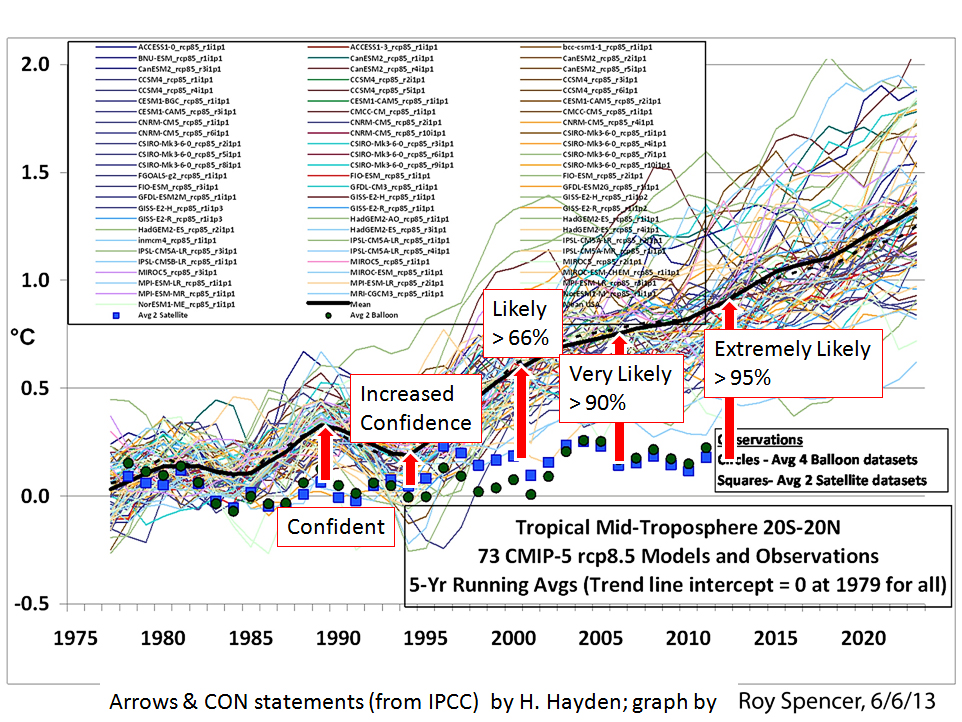
that for dozens of climate models plots the predicted values of global temperature along with the observed values. Nearly all the predicted values are wildly too high. So, if we believe the graph, then in science we essentially junk nearly all the models.
As I tried to outline, the model builders were on a long walk on a short pier: Nearly all their modeling efforts, with whatever approximations, short cuts, etc. they took, failed.
Then, really, to return to first principles, they had to solve the Navier-Stokes equations for the surface of the earth, the oceans and the atmosphere. Doing a good job with that would be essentially minute by minute weather prediction, and as we know we can't do that accurately for more than two weeks or so.
That's what the model builders ran into -- the Navier-Stokes equations. IIRC we've had some good progress with those equations for, say, some boat hulls and some aircraft wings. The whole earth? Not a chance.
> It's irrelevant that you don't know.
Sure it is relevant if accept a little diplomatic circumlocution: I've tried to follow some of the global warming issue for years, and so far I have not seen the data. Without the circumlocution and diplomacy, the more literal and blunt remark is that nearly all of us are short on such data either because it has not been collected very well or the people writing the main arguments don't include it. Or, the situation is like I was a customer at a fast food restaurant, got a hamburger, opened it up, and asked "I don't know where the beef is".
> No "denier" was able to make anything scientifically relevant up to now. That's the fact.
Well, in the graph in the link I gave above, a few of the models, maybe only one, were fairly accurate -- they predicted nearly no increase in global temperatures. So, maybe the author of that model was a "denier" in which case at least one "denier" did something "scientifically relevant".
For more on "scientifically relevant" from deniers, there is the argument that at least for the past few thousand years, we know the cause of the temperature changes, and CO2 had nothing to do with the changes. Really, basically the greenhouse effect -- from CO2, methane, water vapor, etc. -- didn't either.
Instead the cause of global cooling was more clouds -- they have a net cooling effect (net, not a greenhouse effect). The clouds were from some water molecules in the atmosphere collected into water droplets from the action of cosmic rays. Of course, the cosmic rays come at essentially constant rates over time but maybe with some variation with direction. So, when there was fewer cosmic rays, there were fewer clouds and some global warming. Why fewer cosmic rays? Well, when the sun has sun spots, there is more solar wind -- think really 3D all around our solar system, not just in the plane of the orbit of the earth, and reducing the rate of cosmic rays from all directions including way out and high above the plane of the earth's orbit.
So, when the sun has more sun spots, there is more solar wind, more cosmic rays blocked from hitting the earth, fewer clouds, and global warming. When the sun is quieter, there is some global cooling.
IIRC, over the past few thousand years or so, and maybe longer, the data on variations in sun spots do well fitting the variations in global temperatures while data on CO2 concentrations does not.
So, people with the sun spot explanation are "deniers" and may have found the real cause of global warming/cooling for the last few thousand years or so at least and, thus, been "scientifically relevant".
More generally, science needs to be subject to review, and a reviewer, even a "denier", who does find actual errors is also "scientifically relevant".
Along the lines of reviewing, I would note that so far it appears that over the past 800,000 years, the cases of global cooling were not preceded by lower concentrations of CO2. E.g., the Little Ice Age was not preceded by lower concentrations of CO2. Neither was the cooling from 1940 to 1970.
For more, yes, sure, CO2 is a greenhouse gas. Fine. We agree on that. So, CO2 can warm the earth -- we agree. But we can also agree that lighting a match will warm the earth. So, for CO2 warming the earth, the question is how much? Hate to say: (A) Just looking at the historical record from the past few thousand years, maybe the past 800,000 years, it appears that more CO2 has no detectable warming effect. (B) For some solid science, e.g., evaluating the effect of CO2 just from first principles of mathematical physics, including the Navier-Stokes equations, we can't do the calculations and, thus, for this approach, are stuck-o. Here maybe (A) is a review and "scientifically relevant". For (B), that's also "scientifically relevant" but so obvious that it is a trivial contribution.
There are a lot of research problems without good solutions -- some of the details of the big bang, dark energy, dark matter, the origin of the highest energy cosmic rays, the origin of life on earth, quantum mechanics and relativity inside a black hole, a cure for cancer, how good natural intelligence works, etc. Well, one more is prediction of the temperature of earth for the next 100 years. Sorry 'bout that. While I've solved some problems in applied math and published the results, I can't apologize for not solving all outstanding problems. Sorry I don't know how to predict the temperature of earth for the next 100 years, but maybe I should say that I can't see that anyone else knows how either. In that case, my view is that carbon taxes are not justified.
> Sorry I don't know how to predict the temperature of earth for the next 100 years, but maybe I should say that I can't see that anyone else knows how either. In that case, my view is that carbon taxes are not justified.
That summarizes how you see the issue. If the scientists can't convince you that they can "predict" the values exactly in the shortest time period ("100 years") the "carbon taxes are not justified."
Everything else is trying to rationalize that, taking the info from these who cherry-pick their argument of the day that nothing important is going on.
In reality the global warming issue is not about meteorologically "predicting" "100 years" at all. It's about recognizing the impact, which will happen no matter how much cherry-picking origin-adjusting short-term charts could be produced.
Yes, "the models" are not giving meteorological predictions. I don't know how old are you, but if you're going to live even just the next 20 years, you'll see for yourself that in the 20 years even if "the models" would wiggle between, the Earth will be much warmer on average, just like 2016 broke all the records since we measure. It will happen again and again. And if you plan to have children or have them already, please write one single letter to them with your "predictions" of how they are going experience Earth warming. You probably won't live enough to see that, but they will be able to see how much you were wrong, that's I'm sure.
That summarizes how you see the issue. If the scientists can't convince you that they can "predict" the values exactly in the shortest time period ("100 years") the "carbon taxes are not justified."
Everything else is trying to rationalize that, taking the info from these who cherry-pick their argument of the day that nothing important is going on.
In reality the global warming issue is not about meteorologically "predicting" "100 years" at all. It's about recognizing the impact, which will happen no matter how much cherry-picking origin-adjusting short-term charts could be produced.
Yes, "the models" are not giving meteorological predictions. I don't know how old are you, but if you're going to live even just the next 20 years, you'll see for yourself that in the 20 years even if "the models" would wiggle between, the Earth will be much warmer on average, just like 2016 broke all the records since we measure. It will happen again and again. And if you plan to have children or have them already, please write one single letter to them with your "predictions" of how they are going experience Earth warming. You probably won't live enough to see that, but they will be able to see how much you were wrong, that's I'm sure.
First, the scientific evidence for your claims is in one word, JUNK. For proof of the junk status, their predictions have already failed badly.
Again, once again, over again, yet again, one more time, this time just for you, in science, when predictions are proven badly wrong, then we junk the science. That's much of why we do look to science for solid answers.
As in the graphs in the link I gave, nearly all the models have been proven badly wrong; just click on the link and look at the picture; download the picture and use a graphics program to zoom in on the details.
So, due to the bad predictions, we junk the models.
Now we are very short on scientific evidence.
The long dark ages of the ascent of man show that non-scientific evidence is ugly, disgusting, dangerous stuff -- snake oil, witches' brews, toxic swill, leach bleeding, burning girls alive at the stake, horrible human suffering, e.g., get the Black Death, kill about a third of the population and have dead bodies piled up in the streets from the bacteria from the fleas from the rats because some idiots killed off the cats that were eating the rats.
Second, you are concentrating on CO2, and there is next to no solid evidence that CO2 is having any effect now on the temperature of the earth at all. For evidence, over at least the last few thousand years, higher temperatures were not preceded by higher CO2 concentrations (except for pulling out of the Little Ice Age clearly caused by fewer sun spots so that the pulling out was likely caused by normal sun spot activity and not the CO2 from the industrial revolution -- also note the cooling of 1940 to 1970 when if anything CO2 concentrations were higher) and lower temperatures were not preceded by lower CO2 concentrations.
Third, some of the best evidence is that the temperature variations in the earth over the past few thousand years at least up to the present are due to variations in sun spot activity with CO2 just irrelevant. The sun spot data actually fits the temperature data, and the CO2 data very much does not. A biggie is the Little Ice Age -- lower sun spot activity but not lower CO2.
Your claims that it's so hot now are from data cooked by NOAA and NASA due to what Obama and the global warming alarmists wanted. Or, really, how much warmer is it, since when, in degrees C, measured how, by whom, when, and published where? At best you are talking changes too small to be at all sure about. More likely you are being fooled by deliberately fraudulent data.
For a little more, as of 2006, the US National Academy of Sciences report, right, still at
http://www.nap.edu/catalog/11676.html
quite carefully showed (A) that the temperature of the earth in 2006 was essentially the same as in year 1000 before the Little Ice Age, and the increase in temperature in the 100 years before year 2006 was very much like the increase in temperature in the 100 years before year 1000. Just see the graph early in the report. The time series statistics were from David Brillinger at Berkeley, a student of John Tukey at Princeton and Bell Labs, and Brillinger is a good candidate for the best time series guy on the planet. It's a serious report. Clearly the increase in temperature before year 1000 was not caused by an increase in human emissions of CO2. So, CO2 is not the only cause of temperature increases or changes. So there must be other causes. So, even if you do all you want against CO2, the other causes might remain and, really, make your CO2 efforts a total waste.
Or, again, yet again, once again, over again, one more time, this time maybe you will pay attention: The Little Ice Age was real, e.g., was the cause of the ice on the Delaware River in the famous painting of Washington crossing that river and of the extreme cold when Napoleon left Moscow. Well, the Little Ice Age certainly was not caused by lower CO2 concentrations. So, why, oh why do you continue to believe that changes in CO2 concentrations are the only cause, or now even a significant cause at all, of changes in global temperature? Nothing could be more clear: (A) At the start of the Little Ice Age, temperature went down, but lower CO2 was not the cause. (B) CO2 changes are not the only cause of temperature changes. You are fully able to see this.
Warmer? Heck there was some significant warming: In the Middle Ages, they were growing grapes in England! That's warmer than now! And that warming was not from higher CO2 concentrations.
And, for more, there was nothing very unusual about the temperature in year 2006. And since year 2006, the change in temperature has been too small to be at all sure the change was not actually zero -- there's been no significant change since year 2006. Net, we're not warmer than in year 1000 when CO2 was irrelevant, and, again, it is not clear that CO2 now is having any effects at all.
Due to sun spots or whatever, it really might be warmer in 20 years as you fear. No one really knows. The IPCC doesn't know; I don't know; no one knows what the sun spots might do; no one knows what the effect of realistic amounts of CO2 might be; there is no good evidence; the evidence that CO2 is a big danger is junk science seriously debunked by the bad predictions I referenced; and you don't know.
You are back to the thinking of the Mayans who killed people to pour their blood on a rock to keep the sun moving across the sky. You want stop humans from emitting CO2 to keep from warming the planet, and your evidence is, net, no better than that of the Mayans. Your solution is similar: Sacrifice.
Or, you have in mind a classic trilogy: (A) Human transgression, sin, this time against Mother Earth, (B) retribution from an angry god, Mother Earth, with global warming that hurts our children, (C) redemption for our sins from sacrifice, like the Mayans did, that causes us to suffer, e.g., shut down much of our economy. You are going for the attractions of an old pagan religion. You are being manipulated by people who want money from subsidies, etc. No thanks. Wise up.
We don't know what the climate will do. We can't cure all cancers, either. Relax. For CO2 and the climate, f'get about them. Do something else.
And, no carbon taxes. No higher electric bills. No attacking our cars, trucks, and airplanes. No shooting our economy in the gut. No thanks.
Again, once again, over again, yet again, one more time, this time just for you, in science, when predictions are proven badly wrong, then we junk the science. That's much of why we do look to science for solid answers.
As in the graphs in the link I gave, nearly all the models have been proven badly wrong; just click on the link and look at the picture; download the picture and use a graphics program to zoom in on the details.
So, due to the bad predictions, we junk the models.
Now we are very short on scientific evidence.
The long dark ages of the ascent of man show that non-scientific evidence is ugly, disgusting, dangerous stuff -- snake oil, witches' brews, toxic swill, leach bleeding, burning girls alive at the stake, horrible human suffering, e.g., get the Black Death, kill about a third of the population and have dead bodies piled up in the streets from the bacteria from the fleas from the rats because some idiots killed off the cats that were eating the rats.
Second, you are concentrating on CO2, and there is next to no solid evidence that CO2 is having any effect now on the temperature of the earth at all. For evidence, over at least the last few thousand years, higher temperatures were not preceded by higher CO2 concentrations (except for pulling out of the Little Ice Age clearly caused by fewer sun spots so that the pulling out was likely caused by normal sun spot activity and not the CO2 from the industrial revolution -- also note the cooling of 1940 to 1970 when if anything CO2 concentrations were higher) and lower temperatures were not preceded by lower CO2 concentrations.
Third, some of the best evidence is that the temperature variations in the earth over the past few thousand years at least up to the present are due to variations in sun spot activity with CO2 just irrelevant. The sun spot data actually fits the temperature data, and the CO2 data very much does not. A biggie is the Little Ice Age -- lower sun spot activity but not lower CO2.
Your claims that it's so hot now are from data cooked by NOAA and NASA due to what Obama and the global warming alarmists wanted. Or, really, how much warmer is it, since when, in degrees C, measured how, by whom, when, and published where? At best you are talking changes too small to be at all sure about. More likely you are being fooled by deliberately fraudulent data.
For a little more, as of 2006, the US National Academy of Sciences report, right, still at
http://www.nap.edu/catalog/11676.html
quite carefully showed (A) that the temperature of the earth in 2006 was essentially the same as in year 1000 before the Little Ice Age, and the increase in temperature in the 100 years before year 2006 was very much like the increase in temperature in the 100 years before year 1000. Just see the graph early in the report. The time series statistics were from David Brillinger at Berkeley, a student of John Tukey at Princeton and Bell Labs, and Brillinger is a good candidate for the best time series guy on the planet. It's a serious report. Clearly the increase in temperature before year 1000 was not caused by an increase in human emissions of CO2. So, CO2 is not the only cause of temperature increases or changes. So there must be other causes. So, even if you do all you want against CO2, the other causes might remain and, really, make your CO2 efforts a total waste.
Or, again, yet again, once again, over again, one more time, this time maybe you will pay attention: The Little Ice Age was real, e.g., was the cause of the ice on the Delaware River in the famous painting of Washington crossing that river and of the extreme cold when Napoleon left Moscow. Well, the Little Ice Age certainly was not caused by lower CO2 concentrations. So, why, oh why do you continue to believe that changes in CO2 concentrations are the only cause, or now even a significant cause at all, of changes in global temperature? Nothing could be more clear: (A) At the start of the Little Ice Age, temperature went down, but lower CO2 was not the cause. (B) CO2 changes are not the only cause of temperature changes. You are fully able to see this.
Warmer? Heck there was some significant warming: In the Middle Ages, they were growing grapes in England! That's warmer than now! And that warming was not from higher CO2 concentrations.
And, for more, there was nothing very unusual about the temperature in year 2006. And since year 2006, the change in temperature has been too small to be at all sure the change was not actually zero -- there's been no significant change since year 2006. Net, we're not warmer than in year 1000 when CO2 was irrelevant, and, again, it is not clear that CO2 now is having any effects at all.
Due to sun spots or whatever, it really might be warmer in 20 years as you fear. No one really knows. The IPCC doesn't know; I don't know; no one knows what the sun spots might do; no one knows what the effect of realistic amounts of CO2 might be; there is no good evidence; the evidence that CO2 is a big danger is junk science seriously debunked by the bad predictions I referenced; and you don't know.
You are back to the thinking of the Mayans who killed people to pour their blood on a rock to keep the sun moving across the sky. You want stop humans from emitting CO2 to keep from warming the planet, and your evidence is, net, no better than that of the Mayans. Your solution is similar: Sacrifice.
Or, you have in mind a classic trilogy: (A) Human transgression, sin, this time against Mother Earth, (B) retribution from an angry god, Mother Earth, with global warming that hurts our children, (C) redemption for our sins from sacrifice, like the Mayans did, that causes us to suffer, e.g., shut down much of our economy. You are going for the attractions of an old pagan religion. You are being manipulated by people who want money from subsidies, etc. No thanks. Wise up.
We don't know what the climate will do. We can't cure all cancers, either. Relax. For CO2 and the climate, f'get about them. Do something else.
And, no carbon taxes. No higher electric bills. No attacking our cars, trucks, and airplanes. No shooting our economy in the gut. No thanks.
What you call "the graphs in the link I gave" is not the most recent graph from the (denialist) source that you'd like to use, it's from 2013, and since then we have had the warmest year ever recorded (2016). Here's the discussion of the more recent graph from your sources, which your sources used in their 2016 testimony (and that graph still doesn't include the results of 2016 and it's still "cooked"). Note that the baseline was "cooked". Here the discussion:
http://www.realclimate.org/index.php/archives/2016/05/compar...
and the corrected graphs, done without bias:
http://www.realclimate.org/images/christy_trop_new.png
To be precise, in the graphs, the prediction of the models is compared to the satellite data which don't measure surface temperatures and which are confirmed to have slower warming trend at the moment. Are the measured data below the range of the models in some years? Sure. Will the measurements move in the direction of the model once 2016 data are there? Yes. Does the surface temperature data (which you avoided by picking only the satellite ones) match the models significantly better? Yes, and that isn't on these graphs at all. Here's how it looks when we use all the data we have and compare with the models:
https://tamino.wordpress.com/2016/05/17/models/
In short, what you believe to see on that graph is not what most of the scientists see (I'm not counting among the "most" John Christy and Roy Spencer, who produce or promote these cooked versions and ignore all the evidence they don't like). The scientists see that the measured satellite data did go below the lines of what the model would have expected, but they don't consider that the models are invalidated with these measurements, and even less so once 2016 is included.
https://tamino.wordpress.com/2017/01/18/global-temperature-t...
The report from 2006 that you refer to is also not concluding what you believe it concludes. Reading the report is enough to see that.
https://www.nap.edu/read/11676/chapter/4#p200108c09970027001
So, by supporting what you support, you're still destroying the future of your children and grandchildren, if you ever plan to have them, and you obviously do it only for the very egoistic goals of not even trying to make any change because from your perspective you're doing fine. (your words: "no carbon taxes. No higher electric bills. No attacking our cars, trucks, and airplanes. No shooting our economy in the gut. No thanks.")
Like I've said, it will be obvious in only 20 years, but then it will be even harder to do anything -- and the effects will last for hundreds of years. And if you write the letter to your children and grandchildren (or the kids of the relatives if you don't plan to have children) and they survive to read it, they will be able to see who and how influenced their future, so please do that. If you're right, they will celebrate you as a hero. If you aren't right, and unless you are already planning to die sooner than in 20 years, you'll see it for yourself, then I'm sure they'll use some other words for you, reading your message.
http://www.realclimate.org/index.php/archives/2016/05/compar...
and the corrected graphs, done without bias:
http://www.realclimate.org/images/christy_trop_new.png
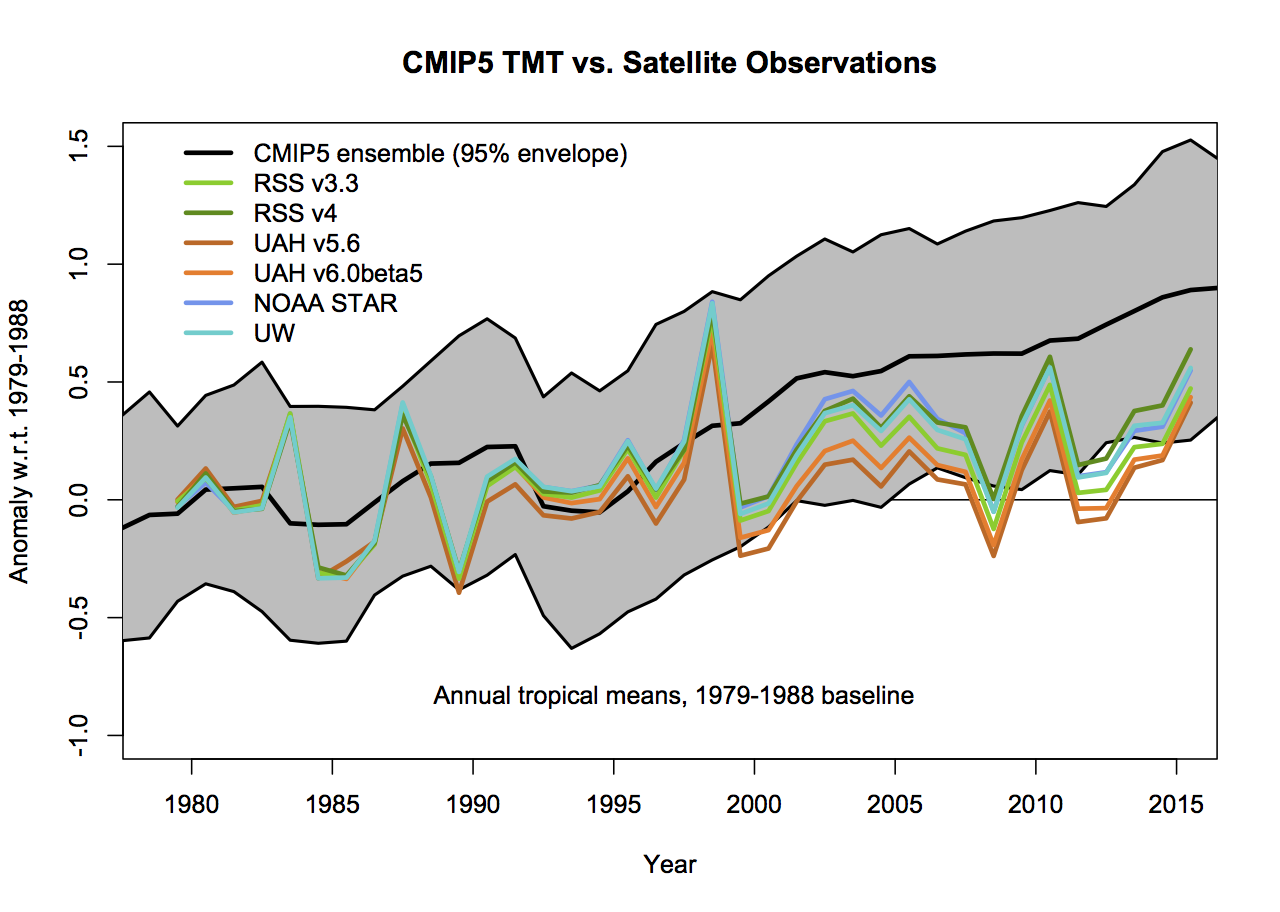
To be precise, in the graphs, the prediction of the models is compared to the satellite data which don't measure surface temperatures and which are confirmed to have slower warming trend at the moment. Are the measured data below the range of the models in some years? Sure. Will the measurements move in the direction of the model once 2016 data are there? Yes. Does the surface temperature data (which you avoided by picking only the satellite ones) match the models significantly better? Yes, and that isn't on these graphs at all. Here's how it looks when we use all the data we have and compare with the models:
https://tamino.wordpress.com/2016/05/17/models/
In short, what you believe to see on that graph is not what most of the scientists see (I'm not counting among the "most" John Christy and Roy Spencer, who produce or promote these cooked versions and ignore all the evidence they don't like). The scientists see that the measured satellite data did go below the lines of what the model would have expected, but they don't consider that the models are invalidated with these measurements, and even less so once 2016 is included.
https://tamino.wordpress.com/2017/01/18/global-temperature-t...
The report from 2006 that you refer to is also not concluding what you believe it concludes. Reading the report is enough to see that.
https://www.nap.edu/read/11676/chapter/4#p200108c09970027001
So, by supporting what you support, you're still destroying the future of your children and grandchildren, if you ever plan to have them, and you obviously do it only for the very egoistic goals of not even trying to make any change because from your perspective you're doing fine. (your words: "no carbon taxes. No higher electric bills. No attacking our cars, trucks, and airplanes. No shooting our economy in the gut. No thanks.")
Like I've said, it will be obvious in only 20 years, but then it will be even harder to do anything -- and the effects will last for hundreds of years. And if you write the letter to your children and grandchildren (or the kids of the relatives if you don't plan to have children) and they survive to read it, they will be able to see who and how influenced their future, so please do that. If you're right, they will celebrate you as a hero. If you aren't right, and unless you are already planning to die sooner than in 20 years, you'll see it for yourself, then I'm sure they'll use some other words for you, reading your message.
It may be that we are at significant risk of a big disaster.
So, we want to be correct.
For one, we can conclude that there is little or no danger, that we need do nothing, do nothing, be wrong, and have a big disaster.
For another, we can put on big time carbon taxes, cobber the economy for ourselves and our children, but again might be wrong, that is, have clobbered the economy for no good reason.
So we want a good answer.
Finally, just applying my judgment and what I can smell with my nose, I come down on the side that the crucial part of this issue is not science but politics and money.
E.g., today it did finally sink in to me that, with all the different model results in the graph I linked to, at least one of the results had to be close to reality and, thus, an accurate prediction. Luck would have it that the model with the most accurate prediction was the one predicting essentially no change -- whew, that was a close one! A lot of people could have been fooled with that one!
For one, we can conclude that there is little or no danger, that we need do nothing, do nothing, be wrong, and have a big disaster.
For another, we can put on big time carbon taxes, cobber the economy for ourselves and our children, but again might be wrong, that is, have clobbered the economy for no good reason.
So we want a good answer.
Finally, just applying my judgment and what I can smell with my nose, I come down on the side that the crucial part of this issue is not science but politics and money.
E.g., today it did finally sink in to me that, with all the different model results in the graph I linked to, at least one of the results had to be close to reality and, thus, an accurate prediction. Luck would have it that the model with the most accurate prediction was the one predicting essentially no change -- whew, that was a close one! A lot of people could have been fooled with that one!
It's fascinating how you ignore all the measurements that don't match your, as you say, "political" view, if you followed the links, that is. Because you can't say then you didn't understand how much are of them disproving your claims, and what they mean, and still claim you earned a Ph.D. Do you really think it's the whole world conspiracy? Because the "political" claim has no sense unless you believe that world consists only of the US of A, it's most of the scientists all around the world. If you simply say that the short-term politics is more important for you than the future of the world, I can at least understand.
Anyway, "the greatest shortcoming of the human race is our inability to understand the exponential function":
https://www.youtube.com/watch?v=O133ppiVnWY
Anyway, "the greatest shortcoming of the human race is our inability to understand the exponential function":
https://www.youtube.com/watch?v=O133ppiVnWY
Ah! Circumlocution. My new favourite word :)
I had a look at the Navier-Stokes stuff and what I found was incredible complicated maths. I'd like it if you'd linked out to some discussions on this topic but in any case I was able to find this [0] which takes the position that many climate scientists have invoked Navier-Stokes as a theoretical basis but mathematicians in general consider the finer details of NS behaviour at this scale to be (practically) unknowable.
My personal insight from an information science pov is that NS would be the wrong tool to use. It looks like an exhaustive model used at a fine-grained scale that would be simply too complex at macro level.
[0] https://climateaudit.org/2005/12/22/gcms-and-the-navier-stok...
I had a look at the Navier-Stokes stuff and what I found was incredible complicated maths. I'd like it if you'd linked out to some discussions on this topic but in any case I was able to find this [0] which takes the position that many climate scientists have invoked Navier-Stokes as a theoretical basis but mathematicians in general consider the finer details of NS behaviour at this scale to be (practically) unknowable.
My personal insight from an information science pov is that NS would be the wrong tool to use. It looks like an exhaustive model used at a fine-grained scale that would be simply too complex at macro level.
[0] https://climateaudit.org/2005/12/22/gcms-and-the-navier-stok...
I followed your link on the Navier-Stokes equations. Nice.
They mentioned C. Fefferman: I'd forgotten that he wrote the problem description for the Navier-Stokes equations for Clay. Fefferman is one of the most respected mathematicians going.
They mentioned C. Fefferman: I'd forgotten that he wrote the problem description for the Navier-Stokes equations for Clay. Fefferman is one of the most respected mathematicians going.
When I was applying to grad school for applied math, one place I applied was the Division of Applied Math at Brown University. I had a business trip to the small jet engine shop of GE in Lynn, MA, so went down to Brown to meet some profs. Had lunch. Talked. I got one piece of advice: "Stay away from the Navier-Stokes equations."
Yup, good advice.
The Navier-Stokes equations are old stuff now. Basically they are just Newton's second law, the gas law, etc. -- just basic physics. If you want to calculate the flows of fluids -- liquids and/or gasses -- from first principles of the basic physics, then you are stuck with the Navier-Stokes equations. It's like calculating the trajectory of a home run baseball -- need Newton's second law, the law of gravity, and at least something first cut on air resistance (right, in fine detail, the air resistance would again be the Navier-Stokes equations but good enough for a baseball or artillery shell, there are some good enough, simple approximations).
Or for calculating what fluids do, from the basic physics, that is, from what we DO know about the basic physics, we just can't avoid the Navier-Stokes equations anymore than for the baseball we can avoid Newton's second law force = mass times acceleration. Yup, this is a case were we know too much: We DO know that, for calculating from a solid basis, that is, from first principles, for the math we need, we DO have the equations and they are just the Navier-Stokes equations. Sorry 'bout that.
You mentioned that you noticed that the Navier-Stokes equations are complicated math -- right!
As I mentioned, maybe we can do well with the Navier-Stokes equations for some boat hull or some airplane wing. Okay. Early in my career, I got started on the Navier-Stokes equations at the US Naval Ship R&D Center at Carderock, MD -- right, with the big towing tank used for designing ship hulls. That was before the guy at Brown told me "stay away from the" equations. He was right!
So, you are correct: Trying to solve the Navier-Stokes equations for all the oceans and all the atmosphere of the earth is a wild thigh slapper, absurd, out of the question. We don't have such a computer. Even if we did, we don't have even the required initial conditions -- that is, the current state of the flows in the oceans and the atmosphere. Or, we are stuck-o.
We will also want to know that the Navier-Stokes equations are nicely stable, that is, that a butterfly flapping its wings in NY will not cause rain instead of sunshine in Japan (to borrow from various movies). IIRC, Richard Bellman wrote his Princeton dissertation on the stability of ordinary differential equations -- IIRC the stability of the Navier-Stokes equations is a challenging topic, e.g., appears to be part of one of the Clay Math problems along with P versus NP, etc.
And the real problem is still worse: E.g., likely we would have to handle turbulence, known to be difficult. When I was at Carderock, there was a guy working on turblence; he had been for years; maybe he is still there still working on turbulence; maybe in another 100 years he will have some good progress! In principle, we are talking about handling winds blowing through trees (would need the details on all the leaves of all the trees!!!) and the resulting turbulence. Would need some good details on associated biology. Would need .... And after have all of that, as the climate started to change, we would need good details on how the biology would change, and we don't have any equations from first principles for that.
So, why do we need to do the fluid flow calculations? Well, we're talking about CO2. For that, we want to know where it goes, e.g., into the water, out of the water, into/out of seashells into the upper atmosphere, close to the ground, as it warms, as in the greenhouse effect, where it goes, sucked up by the plants, reacts with rocks, etc.
So, what people have done is use various assumptions, simplifications, and approximations. It's a little like in freshman physics where we assume a block slides down a plane, and the plane has no friction, or a ball rolls down a plane and we ignore the moment of inertia of the ball.
So, people tried such approximations, etc. We DO know the basic physics, and a big part of that is the Navier-Stokes equations. And we have more physics on the black body radiation that is the source of the infrared radiation that is the source of the warming of the CO2 that is the warming of the greenhouse effect. We have a lot of the basic physics and chemistry. And that basic science just does not tell us that there are some nice, easy approximations that will let us predict the climate.
E.g., suppose some day during the years we are predicting, it rains. It might! Then after the rains, where is the CO2? Do we have partially carbonated rain water? In principle, we will want to know where the CO2 goes. So, part of our calculation will be to predict when it rains. Hmm ....
Yes, as is often the case in physics, for some purposes we can just use the law of conservation of energy, calculate energy into the earth from the sun and energy out of the earth from radiation to space and get the balance and temperature change. Okay. But the details, if we want them, of the energy in and energy out will take us back to the Navier-Stokes equations. So, maybe we can make some simplifying assumptions. Apparently then ... we come up with the models that predicted much higher temperatures by now.
Then, in all of this, we have an assumption that is now looking like week old dead fish: It's all about the greenhouse effect and CO2 and not something else. What "something else"?
Apparently an argument can be made that, really, at anything like currently realistic levels of CO2, CO2 and the greenhouse effect are essentially irrelevant and the main cause is just clouds from water droplets from cosmic rays blocked or not by the solar wind from sun spots. In that case, we can calculate all we want with the Navier-Stokes equations, make more bad predictions, and accumulate some big computer bills. So, for accurate predictions, we'd be into predicting the sun spot activity of the sun. Hmm .... Is that at all promising?
The lecture on geology and CO2 was really interesting: It got into the orbit of the earth, the power (energy per unit time) to the earth from solar radiation, some geology, and some tricky chemistry but not sun spots!
Net, so far, it's tough to predict either the weather or the climate. Sorry 'bout that! It's also tough to cure cancer, explain dark matter and dark energy, ..., etc.
Yup, good advice.
The Navier-Stokes equations are old stuff now. Basically they are just Newton's second law, the gas law, etc. -- just basic physics. If you want to calculate the flows of fluids -- liquids and/or gasses -- from first principles of the basic physics, then you are stuck with the Navier-Stokes equations. It's like calculating the trajectory of a home run baseball -- need Newton's second law, the law of gravity, and at least something first cut on air resistance (right, in fine detail, the air resistance would again be the Navier-Stokes equations but good enough for a baseball or artillery shell, there are some good enough, simple approximations).
Or for calculating what fluids do, from the basic physics, that is, from what we DO know about the basic physics, we just can't avoid the Navier-Stokes equations anymore than for the baseball we can avoid Newton's second law force = mass times acceleration. Yup, this is a case were we know too much: We DO know that, for calculating from a solid basis, that is, from first principles, for the math we need, we DO have the equations and they are just the Navier-Stokes equations. Sorry 'bout that.
You mentioned that you noticed that the Navier-Stokes equations are complicated math -- right!
As I mentioned, maybe we can do well with the Navier-Stokes equations for some boat hull or some airplane wing. Okay. Early in my career, I got started on the Navier-Stokes equations at the US Naval Ship R&D Center at Carderock, MD -- right, with the big towing tank used for designing ship hulls. That was before the guy at Brown told me "stay away from the" equations. He was right!
So, you are correct: Trying to solve the Navier-Stokes equations for all the oceans and all the atmosphere of the earth is a wild thigh slapper, absurd, out of the question. We don't have such a computer. Even if we did, we don't have even the required initial conditions -- that is, the current state of the flows in the oceans and the atmosphere. Or, we are stuck-o.
We will also want to know that the Navier-Stokes equations are nicely stable, that is, that a butterfly flapping its wings in NY will not cause rain instead of sunshine in Japan (to borrow from various movies). IIRC, Richard Bellman wrote his Princeton dissertation on the stability of ordinary differential equations -- IIRC the stability of the Navier-Stokes equations is a challenging topic, e.g., appears to be part of one of the Clay Math problems along with P versus NP, etc.
And the real problem is still worse: E.g., likely we would have to handle turbulence, known to be difficult. When I was at Carderock, there was a guy working on turblence; he had been for years; maybe he is still there still working on turbulence; maybe in another 100 years he will have some good progress! In principle, we are talking about handling winds blowing through trees (would need the details on all the leaves of all the trees!!!) and the resulting turbulence. Would need some good details on associated biology. Would need .... And after have all of that, as the climate started to change, we would need good details on how the biology would change, and we don't have any equations from first principles for that.
So, why do we need to do the fluid flow calculations? Well, we're talking about CO2. For that, we want to know where it goes, e.g., into the water, out of the water, into/out of seashells into the upper atmosphere, close to the ground, as it warms, as in the greenhouse effect, where it goes, sucked up by the plants, reacts with rocks, etc.
So, what people have done is use various assumptions, simplifications, and approximations. It's a little like in freshman physics where we assume a block slides down a plane, and the plane has no friction, or a ball rolls down a plane and we ignore the moment of inertia of the ball.
So, people tried such approximations, etc. We DO know the basic physics, and a big part of that is the Navier-Stokes equations. And we have more physics on the black body radiation that is the source of the infrared radiation that is the source of the warming of the CO2 that is the warming of the greenhouse effect. We have a lot of the basic physics and chemistry. And that basic science just does not tell us that there are some nice, easy approximations that will let us predict the climate.
E.g., suppose some day during the years we are predicting, it rains. It might! Then after the rains, where is the CO2? Do we have partially carbonated rain water? In principle, we will want to know where the CO2 goes. So, part of our calculation will be to predict when it rains. Hmm ....
Yes, as is often the case in physics, for some purposes we can just use the law of conservation of energy, calculate energy into the earth from the sun and energy out of the earth from radiation to space and get the balance and temperature change. Okay. But the details, if we want them, of the energy in and energy out will take us back to the Navier-Stokes equations. So, maybe we can make some simplifying assumptions. Apparently then ... we come up with the models that predicted much higher temperatures by now.
Then, in all of this, we have an assumption that is now looking like week old dead fish: It's all about the greenhouse effect and CO2 and not something else. What "something else"?
Apparently an argument can be made that, really, at anything like currently realistic levels of CO2, CO2 and the greenhouse effect are essentially irrelevant and the main cause is just clouds from water droplets from cosmic rays blocked or not by the solar wind from sun spots. In that case, we can calculate all we want with the Navier-Stokes equations, make more bad predictions, and accumulate some big computer bills. So, for accurate predictions, we'd be into predicting the sun spot activity of the sun. Hmm .... Is that at all promising?
The lecture on geology and CO2 was really interesting: It got into the orbit of the earth, the power (energy per unit time) to the earth from solar radiation, some geology, and some tricky chemistry but not sun spots!
Net, so far, it's tough to predict either the weather or the climate. Sorry 'bout that! It's also tough to cure cancer, explain dark matter and dark energy, ..., etc.
> sun spots
No, it's not the sun spots that are warming the Earth now:
https://www.iau.org/news/pressreleases/detail/iau1508/
"IAU, international astronomical organisation that brings together more than 10 000 professional astronomers from almost 100 countries:
The results, presented at the IAU XXIX General Assembly in Honolulu, Hawai`i, today, make it difficult to explain the observed changes in the climate that started in the 18th century and extended through the industrial revolution to the 20th century as being significantly influenced by natural solar trends.
The sunspot number is the only direct record of the evolution of the solar cycle over multiple centuries and is the longest scientific experiment still ongoing.
The apparent upward trend of solar activity between the 18th century and the late 20th century has now been identified as a major calibration error in the Group Sunspot Number. Now that this error has been corrected, solar activity appears to have remained relatively stable since the 1700s [3]."
It is CO2:
http://www.ucsusa.org/global_warming/science_and_impacts/sci...
http://history.aip.org/climate/co2.htm
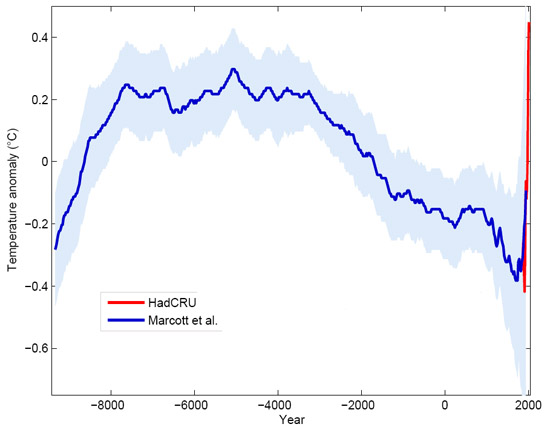
Compared to the last 8000 years there was never such a fast change, it's not "natural":
http://history.aip.org/climate/images/Marcott.jpg
No, it's not the sun spots that are warming the Earth now:
https://www.iau.org/news/pressreleases/detail/iau1508/
"IAU, international astronomical organisation that brings together more than 10 000 professional astronomers from almost 100 countries:
The results, presented at the IAU XXIX General Assembly in Honolulu, Hawai`i, today, make it difficult to explain the observed changes in the climate that started in the 18th century and extended through the industrial revolution to the 20th century as being significantly influenced by natural solar trends.
The sunspot number is the only direct record of the evolution of the solar cycle over multiple centuries and is the longest scientific experiment still ongoing.
The apparent upward trend of solar activity between the 18th century and the late 20th century has now been identified as a major calibration error in the Group Sunspot Number. Now that this error has been corrected, solar activity appears to have remained relatively stable since the 1700s [3]."
It is CO2:
http://www.ucsusa.org/global_warming/science_and_impacts/sci...
http://history.aip.org/climate/co2.htm
Compared to the last 8000 years there was never such a fast change, it's not "natural":
http://history.aip.org/climate/images/Marcott.jpg
Okay, I read your
https://www.iau.org/news/pressreleases/detail/iau1508/
So, there were measurements of larger, easier to see sun spots, all sun spots including small ones, and sun spot clusters. There have been some old records and also some data from some tricky chemistry on earth in some rocks or some such of effects of sun spots, data that goes way back, maybe thousands of years, maybe more. So, someone applied Kelley's Variable Constant and Fink's Finagle Factor with their thumb on the scale and corrected all the data and got, presto, bingo, wonder of wonders, a grant for CO2 research from the old Obama Administration?????
Even taking that article at face value, for discussing global warming, CO2, and sun spots, the article doesn't look nearly as relevant as we would want. Actually it looks like it is knocking down arguments I was not making, picking arguments it could knock down, setting up straw men just to knock them down, and not very directly addressing global warming.
E.g., the article knocks down an argument about a long term, increasing "trend" of sun spots. Okay. I was never aware that anyone claimed that there was such a "trend".
E.g., apparently there have been claims of a recent "maximum" of sun spots, and the article claimed to knock down that claim, also. Gee, the article was the first I'd heard of any such "maximum" -- I was not arguing for such a "maximum".
It remains that the Little Ice Age was darned cold, and it was in force when Washington crossed the Delaware and Napoleon returned from Moscow. IIRC from the last time I looked up The Little Ice Age on Wikipedia, the LIttle Ice Age lasted much longer than the link's relatively short interval for the Maunder Minimum.
Q. 1. So, what the heck caused the fall in temperature at the beginning of the Little Ice Age?
A. 1. Apparently no one is arguing, or has data on, lower CO2 concentrations as the cause. So, CO2 is not the only cause of global cooling.
Then, sure, cancel that cause, i.e., suppose whatever it was it goes away, and we should see some global warming without considering CO2 unless there was lower CO2 at the beginning of the cooling.
Q. 2. What got us out of the Little Ice Age?
A. 2. Maybe CO2 from the Industrial Revolution? Or maybe the earth just returned to what it was doing before it got cold, whatever the cause of that warmer globe was, and not CO2.
For,
http://www.ucsusa.org/global_warming/science_and_impacts/sci...
that's really sad stuff; I'm sorry to see the UCS push that stuff: So, they argue that to the best they know how, just "natural" can't explain the temperature variations. Then in their models, they put in what they believe would be the effects of CO2 and, presto, bingo, wonder of wonders, and I can believe after some appropiate debugging and grant from the Obama Administration, the model fits old history. That's weaker than over cooked pasta.
Didn't one of those links mention how warm it is now? I don't believe it is especially warm now: From what I've seen, there's been no significant increase in temperature for the past 16 or so years. So, in particular the temperature is essentially the same as in year 2006 when the NAS report I referenced claimed that the temperature in 2006 was essentially the same as in year 1000 before any influence from human sources of CO2.
I can't be very sure about the sun spot explanation, but to me it looks much better than the CO2 explanation.
Net, I don't see work that lets us predict the temperature 100 years from now other than just guess "no change".
Also, in just simple terms from lots of just simple temperature evidence, I see no reason for alarm.
https://www.iau.org/news/pressreleases/detail/iau1508/
So, there were measurements of larger, easier to see sun spots, all sun spots including small ones, and sun spot clusters. There have been some old records and also some data from some tricky chemistry on earth in some rocks or some such of effects of sun spots, data that goes way back, maybe thousands of years, maybe more. So, someone applied Kelley's Variable Constant and Fink's Finagle Factor with their thumb on the scale and corrected all the data and got, presto, bingo, wonder of wonders, a grant for CO2 research from the old Obama Administration?????
Even taking that article at face value, for discussing global warming, CO2, and sun spots, the article doesn't look nearly as relevant as we would want. Actually it looks like it is knocking down arguments I was not making, picking arguments it could knock down, setting up straw men just to knock them down, and not very directly addressing global warming.
E.g., the article knocks down an argument about a long term, increasing "trend" of sun spots. Okay. I was never aware that anyone claimed that there was such a "trend".
E.g., apparently there have been claims of a recent "maximum" of sun spots, and the article claimed to knock down that claim, also. Gee, the article was the first I'd heard of any such "maximum" -- I was not arguing for such a "maximum".
It remains that the Little Ice Age was darned cold, and it was in force when Washington crossed the Delaware and Napoleon returned from Moscow. IIRC from the last time I looked up The Little Ice Age on Wikipedia, the LIttle Ice Age lasted much longer than the link's relatively short interval for the Maunder Minimum.
Q. 1. So, what the heck caused the fall in temperature at the beginning of the Little Ice Age?
A. 1. Apparently no one is arguing, or has data on, lower CO2 concentrations as the cause. So, CO2 is not the only cause of global cooling.
Then, sure, cancel that cause, i.e., suppose whatever it was it goes away, and we should see some global warming without considering CO2 unless there was lower CO2 at the beginning of the cooling.
Q. 2. What got us out of the Little Ice Age?
A. 2. Maybe CO2 from the Industrial Revolution? Or maybe the earth just returned to what it was doing before it got cold, whatever the cause of that warmer globe was, and not CO2.
For,
http://www.ucsusa.org/global_warming/science_and_impacts/sci...
that's really sad stuff; I'm sorry to see the UCS push that stuff: So, they argue that to the best they know how, just "natural" can't explain the temperature variations. Then in their models, they put in what they believe would be the effects of CO2 and, presto, bingo, wonder of wonders, and I can believe after some appropiate debugging and grant from the Obama Administration, the model fits old history. That's weaker than over cooked pasta.
Didn't one of those links mention how warm it is now? I don't believe it is especially warm now: From what I've seen, there's been no significant increase in temperature for the past 16 or so years. So, in particular the temperature is essentially the same as in year 2006 when the NAS report I referenced claimed that the temperature in 2006 was essentially the same as in year 1000 before any influence from human sources of CO2.
I can't be very sure about the sun spot explanation, but to me it looks much better than the CO2 explanation.
Net, I don't see work that lets us predict the temperature 100 years from now other than just guess "no change".
Also, in just simple terms from lots of just simple temperature evidence, I see no reason for alarm.
Indeed in your circumlocutive manner you have described a task akin to building a sand castle one grain of sand at a time. You're getting into the territory of pascals demon. If you could produce such a sophisticated model why would you even bother with the weather since you'd be able to produce so much more than than that!
What you describe sounds quixotic. Tilting at windmills. I would be very disappointed indeed to discover that climate science floundered in the face of trying to do the impossible.
The history of innovation is littered with stories of impasse quickly followed by the discovery of a short cut and then progress. It's all about short cuts. When I play chess I don't evaluate all possible moves - when I play poker I don't count the cards. Yet - I can play both quite effectively. How is this? Because dispite my incapability to grasp all the variables I can develop quite sophisticated models with effective predictive power.
Nobody expects the sciences to be exhaustive down to the atomic level. Not all sciences are physics. All that is required is a framework into which all extant knowledge can be integrated; methodology for gathering new data and a means to extrapolate predictions.
As a software engineer I'm never expected to write x86 assembly language to implement a functioning web site. All I need to do is read a book on HTML look at a few examples online and then off I go. I can probably do a better web site than the guy writing the ASM code for a living.
That is what using your NS equations is like for computing your boat hull. Far better off reviewing other people's accounts of what works and putting them together - testing - and seeing if it works. Yes there are a great number of edge cases you may never be able to account for but there are only so many hours in a day and you need to produce something that works for the case in point - not all possible situations.
And so it goes with climate science - you can't possibly predict everything to this minutist detail - you can only observe and measure, observe and measure, catalogue, and integrate and continue as infinitum continuously refining your models. Some stuff won't integrate like other stuff but eventually you'll get to a point where you start to have some predictable capacity. By definition this approach can never be "complete" but as we discuss "completeness" isn't possible.
But what we do have from our catalogued observations and measurements is a huuuuge body of knowledge about what "actually does happen". Nothing is ever that wildly out of the blue that our existing knowledge and modelling can't have some premonition of it. There are exceptions of course but like we say without doing the impossible it isn't possible to foresee these ...
But what we can do is, to within a certain degree of certainty make predictions about what is likely to happen. Like if you're swimming in a lake in Africa or something and you see a shimmering movement on the water do you wait to compute that it's just an agglomeration of leaves? Do you wait to see if it moves with the characteristic vortices of a crocodile or so you just GET THE FUCK OUT OF THE WATER straight away?
I know which is be doing. Even if it means all my friends laughing at me because sure I'll feel a little bit embarrassed but in the alternative reality where it was a crocodile but I gave up trying to exhaustively model what it was I have died a horrible and brutal death.
So as much as I appreciate your educational pedigree and thank you for sharing your valuable time with me I do remain sceptical of your scepticism. Though you have conclusively demonstrated what we cannot know you have said little to explain what we do and our corroborating experiences heretofore. Hope this doesn't come across as too much of a circumlocutive gish gallop I've been trying to type this on my phone on the train without recourse to any notes or any editing capabilities. Sorry 'bout that ;-)
What you describe sounds quixotic. Tilting at windmills. I would be very disappointed indeed to discover that climate science floundered in the face of trying to do the impossible.
The history of innovation is littered with stories of impasse quickly followed by the discovery of a short cut and then progress. It's all about short cuts. When I play chess I don't evaluate all possible moves - when I play poker I don't count the cards. Yet - I can play both quite effectively. How is this? Because dispite my incapability to grasp all the variables I can develop quite sophisticated models with effective predictive power.
Nobody expects the sciences to be exhaustive down to the atomic level. Not all sciences are physics. All that is required is a framework into which all extant knowledge can be integrated; methodology for gathering new data and a means to extrapolate predictions.
As a software engineer I'm never expected to write x86 assembly language to implement a functioning web site. All I need to do is read a book on HTML look at a few examples online and then off I go. I can probably do a better web site than the guy writing the ASM code for a living.
That is what using your NS equations is like for computing your boat hull. Far better off reviewing other people's accounts of what works and putting them together - testing - and seeing if it works. Yes there are a great number of edge cases you may never be able to account for but there are only so many hours in a day and you need to produce something that works for the case in point - not all possible situations.
And so it goes with climate science - you can't possibly predict everything to this minutist detail - you can only observe and measure, observe and measure, catalogue, and integrate and continue as infinitum continuously refining your models. Some stuff won't integrate like other stuff but eventually you'll get to a point where you start to have some predictable capacity. By definition this approach can never be "complete" but as we discuss "completeness" isn't possible.
But what we do have from our catalogued observations and measurements is a huuuuge body of knowledge about what "actually does happen". Nothing is ever that wildly out of the blue that our existing knowledge and modelling can't have some premonition of it. There are exceptions of course but like we say without doing the impossible it isn't possible to foresee these ...
But what we can do is, to within a certain degree of certainty make predictions about what is likely to happen. Like if you're swimming in a lake in Africa or something and you see a shimmering movement on the water do you wait to compute that it's just an agglomeration of leaves? Do you wait to see if it moves with the characteristic vortices of a crocodile or so you just GET THE FUCK OUT OF THE WATER straight away?
I know which is be doing. Even if it means all my friends laughing at me because sure I'll feel a little bit embarrassed but in the alternative reality where it was a crocodile but I gave up trying to exhaustively model what it was I have died a horrible and brutal death.
So as much as I appreciate your educational pedigree and thank you for sharing your valuable time with me I do remain sceptical of your scepticism. Though you have conclusively demonstrated what we cannot know you have said little to explain what we do and our corroborating experiences heretofore. Hope this doesn't come across as too much of a circumlocutive gish gallop I've been trying to type this on my phone on the train without recourse to any notes or any editing capabilities. Sorry 'bout that ;-)
Your view of a lot of the methodology in science, and more so in engineering, is correct or nearly so, and I agree with it nearly so.
BUT!!!! So far in saying what human sources of CO2 will do to the temperature of the earth, as in the graph at the link I gave, we're in deep, fuming, reeking, brown sticky stuff -- the predictions from nearly all the models were badly wrong.
So, one approach to something better is to return to first principles of physics. History shows that that approach has been known to work. And IIRC by now the Navier-Stokes equations have been quite good for boat hulls and airplane wings. But as I outlined and you noticed, using first principles to say what the temperature of earth will be in 100 years is too difficult, absurdly too difficult, even if ignore turbulence around leaves, too darned difficult -- and it might even be unstable. So, that approach won't work, either.
So, as you outlined, we need to find a way that does work. In such a case we will need to check it, test it, validate it, etc. And at this point, from the graphs, no one but 10 year old sweet, cute, darling, adorable but gullible and naive Virginia will believe any testing based on predicting old data and, instead, will want a prediction of the NEXT 20 years and the WAIT 20 years to take the work seriously.
Soooo, right, we fall back to some back of the envelope approaches.
Here's one such I've already explained here:
(1) For CO2, for nearly everything in the record for the past 800,000 years (the geologic time intervals in the lecture seem to be different) shows that temperature went up without preceding CO2 concentrations going up and temperature went down without preceding CO2 concentrations going down. So, net, CO2 is not nearly the only cause of temperature changes. And, since we are now willing to do first cut approximations, we conclude in practical terms that, under anything like current conditions, CO2 is irrelevant. Bluntly, the variations in CO2 concentrations don't match the variations in temperature worth a darn.
(2) The stuff I outlined about sun spots fit the temperature data much better. The example that sticks out like sore thumb is the Little Ice Age -- that is, the Maunder Minimum after guy Maunder who noticed that there were nearly no sun spots during the Little Ice Age.
Otherwise, so far we don't know even as much as dip squat about the change in temperature, from CO2 or anything else, in the next 100 years. Clearly the first cut, safe bet is that there won't be any change.
And, it helps a lot that currently the temperature and the changes in temperature don't look at all unusual. I.e., it was hotter in the Medieval times when people were growing grapes in England.
Or, worry about if going to get cancer and f'get about CO2. Sure as heck f'get about carbon taxes.
BUT!!!! So far in saying what human sources of CO2 will do to the temperature of the earth, as in the graph at the link I gave, we're in deep, fuming, reeking, brown sticky stuff -- the predictions from nearly all the models were badly wrong.
So, one approach to something better is to return to first principles of physics. History shows that that approach has been known to work. And IIRC by now the Navier-Stokes equations have been quite good for boat hulls and airplane wings. But as I outlined and you noticed, using first principles to say what the temperature of earth will be in 100 years is too difficult, absurdly too difficult, even if ignore turbulence around leaves, too darned difficult -- and it might even be unstable. So, that approach won't work, either.
So, as you outlined, we need to find a way that does work. In such a case we will need to check it, test it, validate it, etc. And at this point, from the graphs, no one but 10 year old sweet, cute, darling, adorable but gullible and naive Virginia will believe any testing based on predicting old data and, instead, will want a prediction of the NEXT 20 years and the WAIT 20 years to take the work seriously.
Soooo, right, we fall back to some back of the envelope approaches.
Here's one such I've already explained here:
(1) For CO2, for nearly everything in the record for the past 800,000 years (the geologic time intervals in the lecture seem to be different) shows that temperature went up without preceding CO2 concentrations going up and temperature went down without preceding CO2 concentrations going down. So, net, CO2 is not nearly the only cause of temperature changes. And, since we are now willing to do first cut approximations, we conclude in practical terms that, under anything like current conditions, CO2 is irrelevant. Bluntly, the variations in CO2 concentrations don't match the variations in temperature worth a darn.
(2) The stuff I outlined about sun spots fit the temperature data much better. The example that sticks out like sore thumb is the Little Ice Age -- that is, the Maunder Minimum after guy Maunder who noticed that there were nearly no sun spots during the Little Ice Age.
Otherwise, so far we don't know even as much as dip squat about the change in temperature, from CO2 or anything else, in the next 100 years. Clearly the first cut, safe bet is that there won't be any change.
And, it helps a lot that currently the temperature and the changes in temperature don't look at all unusual. I.e., it was hotter in the Medieval times when people were growing grapes in England.
Or, worry about if going to get cancer and f'get about CO2. Sure as heck f'get about carbon taxes.
The problem I'm having, and I have a masters in statistics, is that this data is generated after the fact. If you compare the predictions of the 2000-2010 period with the "after-the-fact" predictions of the 2000-2010 period ... There's a huge difference. According to the prediction EVERY year between 2000 and 2010 was between a 3 and 5-sigma event. In the after-the-fact model this is simply ignored, and the data follows the graph much better and ... nothing special happened apparently.
Sorry no. This is an indication that your predictions are worthless. And of course, after such a massive fuckup, it's going to take a bit of work to convince people otherwise. But none of that is happening, I wonder why not.
The worst of it all is that I used to make a similar argument, first about 1990-2000, then about 1995-2005. They all had the same result. Suddenly, and without explanation they were far, far cooler (compared to the prediction). Not quite 5-sigma years, but 3 sigma years were in there. 2000-2010 is the worst of the lot, but there isn't any decade-long period where one can say ... well climate scientists ... well done. You were right. The IPCC AR's, predicted temperature anomaly versus observed temperature anomaly.
Given these circumstances, how can we give any credence to the idea that the IPCC predictions about the future will match reality ? The joke is that in order for their 95% prediction to actually be true in 95% of cases they now have to be correct for 20.000 years. They don't even predict out that far. It's a joke, but it's also true. You'd think it would give people pause.
And all this is still ignoring the many fundamental theoretical problems climate science has. When they say "it's worse than ever before" ... well they're right, in terms of many variables. Ok ... but that means their methods are invalid. Statistics can fill in expected values in an observed population of values. And yet their claim is that the observed populations are VERY different from the ones seen before. Ok, fine claim. You can even prove that to some extent with statistics. And they've done that. After that, of course, you cannot use statistics to predict these values anymore ! This alone could explain why their predictions are so horribly bad.
I get the utilitarian argument. We don't have any better way of making predictions about the climate. That's great, but that doesn't make our best prediction adequate, nor is it even value-free. In some ways, it's just a political argument : "this looks worrying, let's fix it". It should be treated as such.
Sorry no. This is an indication that your predictions are worthless. And of course, after such a massive fuckup, it's going to take a bit of work to convince people otherwise. But none of that is happening, I wonder why not.
The worst of it all is that I used to make a similar argument, first about 1990-2000, then about 1995-2005. They all had the same result. Suddenly, and without explanation they were far, far cooler (compared to the prediction). Not quite 5-sigma years, but 3 sigma years were in there. 2000-2010 is the worst of the lot, but there isn't any decade-long period where one can say ... well climate scientists ... well done. You were right. The IPCC AR's, predicted temperature anomaly versus observed temperature anomaly.
Given these circumstances, how can we give any credence to the idea that the IPCC predictions about the future will match reality ? The joke is that in order for their 95% prediction to actually be true in 95% of cases they now have to be correct for 20.000 years. They don't even predict out that far. It's a joke, but it's also true. You'd think it would give people pause.
And all this is still ignoring the many fundamental theoretical problems climate science has. When they say "it's worse than ever before" ... well they're right, in terms of many variables. Ok ... but that means their methods are invalid. Statistics can fill in expected values in an observed population of values. And yet their claim is that the observed populations are VERY different from the ones seen before. Ok, fine claim. You can even prove that to some extent with statistics. And they've done that. After that, of course, you cannot use statistics to predict these values anymore ! This alone could explain why their predictions are so horribly bad.
I get the utilitarian argument. We don't have any better way of making predictions about the climate. That's great, but that doesn't make our best prediction adequate, nor is it even value-free. In some ways, it's just a political argument : "this looks worrying, let's fix it". It should be treated as such.
You claim to have a "masters in statistics" but that doesn't really help me in understanding the main points of your argument. In a nutshell what you are saying is that a lot of the statistical models developed have changed over the last 20 years or so to accommodate the data that has actually emerged. That each of these models if they were applied today would diverge significantly in their predictions from the actual situation we're seeing today? I find this a stunning indictment of mainstream scientific consensus, especially considering many of the actors in that field probably have Masters in statistics and other fields, PhDs and professorships.
But, we do see this kind of skew in other fields, in particular economics comes to mind, where an overarching consensus on what is and is not good seems to promote the viewpoints selected for discussion, while neglecting counter-theses.
But, we do see this kind of skew in other fields, in particular economics comes to mind, where an overarching consensus on what is and is not good seems to promote the viewpoints selected for discussion, while neglecting counter-theses.
> I find this a stunning indictment of mainstream scientific consensus
How exactly ? Climate science is thoroughly in the humanities at this point, very much not in exact science, and this is hardly the only wrong-but-we-can't-do-better consensus that exists. People believe this and it provides them with things to do, with the "ability to predict". Except, it's not correct use of math, with the predictable result that the outcome doesn't match reality. We "believe" a lot of things for political reasons. For instance, starting in 1995 or so papers suddenly started showing that all races are equal in everything, from iq to running speed. It's becoming controversial to state that Africans need supplemental UV at high latitudes, despite the medical consequences of not doing so. Looking at differences in their performance is systematically removed from all textbooks. Now look at reality. You have watched the olympic games recently ? I assure you the impression you get from those races is more or less correct.
As for this specific one, you can simply look this up. That's supposed to be the beauty of science, except, of course where there's "scientific consensus", whatever that means. And you know, worst case is you learn something.
For the lazy, google it (this looks reasonable): http://clivebest.com/blog/?p=2208 (but obviously download the IPCC AR0 and check the data in a table as well)
Obviously there is scientific consensus in the statistics community too that you can't do what climate models do without destroying your credibility, but coming out and saying that ... isn't happening. And sadly, I know why.
Even if you disregard results, you know how the IPCC arrives at their 95% certainty interval ? They take 20 highly non-linear climate models, assume normal distribution of the results per-year (think about that for 5 seconds), and come up with confidence intervals. To claim this won't provide accurate results ... does that really require data ? At what point can you just call bullshit without further study ? One statistics paper humorously provided a proof that with this process, you can create any outcome you want.
And for the conspiracy nuts : the most recent IPCC AR leaves out actual numbers entirely. Because apparently (yes really) they're too easy to criticize.
How exactly ? Climate science is thoroughly in the humanities at this point, very much not in exact science, and this is hardly the only wrong-but-we-can't-do-better consensus that exists. People believe this and it provides them with things to do, with the "ability to predict". Except, it's not correct use of math, with the predictable result that the outcome doesn't match reality. We "believe" a lot of things for political reasons. For instance, starting in 1995 or so papers suddenly started showing that all races are equal in everything, from iq to running speed. It's becoming controversial to state that Africans need supplemental UV at high latitudes, despite the medical consequences of not doing so. Looking at differences in their performance is systematically removed from all textbooks. Now look at reality. You have watched the olympic games recently ? I assure you the impression you get from those races is more or less correct.
As for this specific one, you can simply look this up. That's supposed to be the beauty of science, except, of course where there's "scientific consensus", whatever that means. And you know, worst case is you learn something.
For the lazy, google it (this looks reasonable): http://clivebest.com/blog/?p=2208 (but obviously download the IPCC AR0 and check the data in a table as well)
Obviously there is scientific consensus in the statistics community too that you can't do what climate models do without destroying your credibility, but coming out and saying that ... isn't happening. And sadly, I know why.
Even if you disregard results, you know how the IPCC arrives at their 95% certainty interval ? They take 20 highly non-linear climate models, assume normal distribution of the results per-year (think about that for 5 seconds), and come up with confidence intervals. To claim this won't provide accurate results ... does that really require data ? At what point can you just call bullshit without further study ? One statistics paper humorously provided a proof that with this process, you can create any outcome you want.
And for the conspiracy nuts : the most recent IPCC AR leaves out actual numbers entirely. Because apparently (yes really) they're too easy to criticize.
> They take 20 highly non-linear climate models, assume normal distribution of the results per-year (think about that for 5 seconds), and come up with confidence intervals.
Like I say, "stunning". Thank you for following up - I'll be sure to follow up your links etc. at the next possible opportunity.
I'm still wedded to the notion that climate change, global warming etc. "is" real, and caused by human activity, but I'm very much open to scepticism about how science is deployed day to day.
EDIT
I don't think it's fair to describe climate science as being "in the humanities" just because it can't have the same precision as physics. It is still concerned with the empirical gathering and analysis of information. Perhaps it is going beyond its capabilities, similarly to economics (hence my comparison there) but like economics it does still does possess a great degree of predictive power and pedagogical value.
Like I say, "stunning". Thank you for following up - I'll be sure to follow up your links etc. at the next possible opportunity.
I'm still wedded to the notion that climate change, global warming etc. "is" real, and caused by human activity, but I'm very much open to scepticism about how science is deployed day to day.
EDIT
I don't think it's fair to describe climate science as being "in the humanities" just because it can't have the same precision as physics. It is still concerned with the empirical gathering and analysis of information. Perhaps it is going beyond its capabilities, similarly to economics (hence my comparison there) but like economics it does still does possess a great degree of predictive power and pedagogical value.
What makes me mad about these kinds of data based climate change arguments is that they don't engage with the data in an honest way.
The huge problem is 1880 was one of the coldest years in history. That cold period was caused by volcanism, several volcanos erupted causing a cold period that lasted from the 1600s to the late 1800s. This period is known as the little ice age. The worst of this period was in 1816 which was known as the "year without a summer." The Earth has gradually been warming since then.
https://en.wikipedia.org/wiki/Little_Ice_Age
So when we track from the little ice age to now and say the world as gotten warmer and present this as unusual or surprising findings, you know that they are not being honest with you.
I'm not saying that climate change isn't happening, I'm not saying it isn't man made. All I'm pointing out here is that proponents of global warming aren't engaging with the facts in an honest and forthright way.
The huge problem is 1880 was one of the coldest years in history. That cold period was caused by volcanism, several volcanos erupted causing a cold period that lasted from the 1600s to the late 1800s. This period is known as the little ice age. The worst of this period was in 1816 which was known as the "year without a summer." The Earth has gradually been warming since then.
https://en.wikipedia.org/wiki/Little_Ice_Age
So when we track from the little ice age to now and say the world as gotten warmer and present this as unusual or surprising findings, you know that they are not being honest with you.
I'm not saying that climate change isn't happening, I'm not saying it isn't man made. All I'm pointing out here is that proponents of global warming aren't engaging with the facts in an honest and forthright way.
You're criticizing what you consider to be an oversimplification, and your criticism is itself based on an oversimplification.
It seems you're implying that the argument being presented is basically just, "The world is getting warmer, aaaa!!!" There's much more to it than that. In fact, even the article you're criticizing provides a more nuanced justification than that, which opens you up to criticism for constructing a strawman argument. The real argument is, "Researchers have built detailed models to try and understand how the climate behaves, and sussed out many, if not all, the factors that influence global climate, and based on those models we can make certain worrying inferences about the current state of things and how we expect them to develop in the future."
Those models do a very good job of hindcasting global climate over the period for which we have good, detailed data. This period admittedly and unfortunately does not cover much of the Little Ice Age. In climate science, as everywhere else, the GIGO principle applies. But since we do still get non-garbage out when we put non-garbage in, that leaves us in a state where they seem to be our most reliable source of information. If you want to challenge them, it's not enough to point out various historical events that are primarily hard to explain due to lack of data. You need to be able to propose a better model.
Concrete example: Nobody threw Newton out the window just because, despite all the myriad places where his model worked stunningly well, there were a few things it couldn't explain. They waited until Einstein came up with a model that explained everything Newton's model could handle and more. And then they used that in some spots, but still mostly just stuck with Newton because the math is easier and accurate enough for almost any practical use. That's the way science works for physics, and that's the way it works for climatology, too.
It seems you're implying that the argument being presented is basically just, "The world is getting warmer, aaaa!!!" There's much more to it than that. In fact, even the article you're criticizing provides a more nuanced justification than that, which opens you up to criticism for constructing a strawman argument. The real argument is, "Researchers have built detailed models to try and understand how the climate behaves, and sussed out many, if not all, the factors that influence global climate, and based on those models we can make certain worrying inferences about the current state of things and how we expect them to develop in the future."
Those models do a very good job of hindcasting global climate over the period for which we have good, detailed data. This period admittedly and unfortunately does not cover much of the Little Ice Age. In climate science, as everywhere else, the GIGO principle applies. But since we do still get non-garbage out when we put non-garbage in, that leaves us in a state where they seem to be our most reliable source of information. If you want to challenge them, it's not enough to point out various historical events that are primarily hard to explain due to lack of data. You need to be able to propose a better model.
Concrete example: Nobody threw Newton out the window just because, despite all the myriad places where his model worked stunningly well, there were a few things it couldn't explain. They waited until Einstein came up with a model that explained everything Newton's model could handle and more. And then they used that in some spots, but still mostly just stuck with Newton because the math is easier and accurate enough for almost any practical use. That's the way science works for physics, and that's the way it works for climatology, too.
You'll see someone like this in every global warming discussion that happens with an educated audience. They'll put on all the plumage of reasonable dissent: "I don't think that the argument for AGW takes into account <pet theory>." In an audience of non-experts, they will go unanswered, and appear to have a point, until you spend an hour or two digging through the relevant IPCC reports and discover that not only has <pet theory> been investigated, it has been extensively investigated by dozens of labs across hundreds of studies using methodologies you never dreamed possible, along with 3 or 4 variants of the argument, all of which were quite thoroughly put to rest.
If you confront them with this evidence, citing all the reports and papers, they'll just switch from <pet theory> to <pet theory 2>, possibly after firing off a final riposte defending <pet theory> that makes it abundantly clear they couldn't even be bothered to read the links you dug up, forcing you to ask yourself if you really want to do all that homework again.
Fake-reasonable arguments are easy. Countering them is hard. If you don't discard them as a matter of policy (peer review or STFU), they will dominate the decision making process with 100% certainty.
If you confront them with this evidence, citing all the reports and papers, they'll just switch from <pet theory> to <pet theory 2>, possibly after firing off a final riposte defending <pet theory> that makes it abundantly clear they couldn't even be bothered to read the links you dug up, forcing you to ask yourself if you really want to do all that homework again.
Fake-reasonable arguments are easy. Countering them is hard. If you don't discard them as a matter of policy (peer review or STFU), they will dominate the decision making process with 100% certainty.
This has been the "go to" method of people like this who argue positions that rail against established science or history, from evolution to trickle-down to holocaust denialism. They cannot win on the basis of honest and sincere debate, so they play underhanded confidence games along with gaslighting in order to convince you to their side.
Honestly, if you are engaging in this, consider whether your side really is the right side to be on in the first place.
Honestly, if you are engaging in this, consider whether your side really is the right side to be on in the first place.
A trap most of us will fall in to is to assume intents of the anonymous strangers with which we talk on these message boards. In serious academic-ish discussion, I think we should stick as closely to the topic at-hand and avoid pointing out patterns of argumentation where we're easily led into the abyss of us-vs-them and accusations of manipulation. (Manipulation might be rampant, but hard to objectively define anonymously.)
The GP does some finger pointing ("you know that they are not being honest with you.") which might have detracted subsequent (and valid) questions that could be answered in a more pleasant sense by other HNers. We should set an example, if we're feeling superior.
The GP does some finger pointing ("you know that they are not being honest with you.") which might have detracted subsequent (and valid) questions that could be answered in a more pleasant sense by other HNers. We should set an example, if we're feeling superior.
> In serious academic-ish discussion, I think we should stick as closely to the topic at-hand and avoid...
So does that mean you're willing to do the legwork to dig up the IPCC reports, chase down the studies they reference, and put together an academic-quality rebuttal? Or are you just asking for someone else to do it?
In either case I offer my sincere gratitude to anyone willing to fight the weighted odds. It ain't gonna be me, though. Been there, done that. I've got a few hours of weekend left, and I aim to enjoy them.
So does that mean you're willing to do the legwork to dig up the IPCC reports, chase down the studies they reference, and put together an academic-quality rebuttal? Or are you just asking for someone else to do it?
In either case I offer my sincere gratitude to anyone willing to fight the weighted odds. It ain't gonna be me, though. Been there, done that. I've got a few hours of weekend left, and I aim to enjoy them.
[deleted]
[deleted]
I'll rephrase: I'm asking for less speculation on the [malicious] intent of someone with whom one may disagree on HN. Poisons the discussion even worse.
It's easy to hand-wring about conflict. It's hard to fight a dishonorable opponent honorably.
You have the power to make this change. Not retroactively in this discussion, of course, but in the next. Spend the time to research the truth, the effort to write a scholarly reply, and there will be no need for responses like the one you saw me make.
You have the power to make this change. Not retroactively in this discussion, of course, but in the next. Spend the time to research the truth, the effort to write a scholarly reply, and there will be no need for responses like the one you saw me make.
I'm with you on almost all those points! Getting older I realize more and more the importance of realizing the energy "the fight" has taken out of me, and opening up grounds for others with energy reserves to carry on the intellectual battles. I think I'm on the sidelines for a while.
[deleted]
I like the response peer review or STFU. Maybe PRoSTFU.
What is that technique the fake-reasonable argument makers use? It's like a Gish gallop but slower. Maybe that's the best description of it.
What is that technique the fake-reasonable argument makers use? It's like a Gish gallop but slower. Maybe that's the best description of it.
The Gish Trot, then?
I joke, but the whole point of the Gish Gallop is to rapid fire weak arguments. I don't think it exactly fits.
As an aside, does anyone know of a good source that categorizes and explains these modern underhanded argument techniques?
I joke, but the whole point of the Gish Gallop is to rapid fire weak arguments. I don't think it exactly fits.
As an aside, does anyone know of a good source that categorizes and explains these modern underhanded argument techniques?
I've seen the term "Rhetological Fallacies" used - there's no shortage of resources enumerating them online. Wikipedia has a whole section, there's a website called rationalwiki and commonly cited (though I have yet to read) is Carl Sagan's "Baloney Detection Kit".
For a more askew look at the topic check out Derailing for Dummies :)
http://www.derailingfordummies.com
FWIW I think its important to be careful with these concepts. I often see a perfectly valid point though a poorly constructed argument blown out of the water by reference to these techniques. There's an awful lot of subtlety to this stuff which if misapplied can cause you to miss out on certain valuable points being made just because of how they're being made. Also important to remember that these "weapons" can also be abused by the hypothetical ne'er-do-wells to prevent novel contributions to discussion ...
For a more askew look at the topic check out Derailing for Dummies :)
http://www.derailingfordummies.com
FWIW I think its important to be careful with these concepts. I often see a perfectly valid point though a poorly constructed argument blown out of the water by reference to these techniques. There's an awful lot of subtlety to this stuff which if misapplied can cause you to miss out on certain valuable points being made just because of how they're being made. Also important to remember that these "weapons" can also be abused by the hypothetical ne'er-do-wells to prevent novel contributions to discussion ...
> proponents of global warming aren't engaging with the facts in an honest and forthright way.
You want to read about global warming from climate scientists, as your questions are easily answered. Peer reviewers are as vicious as in any other science: the concerns you raise here would be the least of their ammunition.
You want to read about global warming from climate scientists, as your questions are easily answered. Peer reviewers are as vicious as in any other science: the concerns you raise here would be the least of their ammunition.
He was not complaining about a lack of available information. He was complaining about non-rigorous arguments being passed off as a sufficient justification of a political position.
If I say global warming is caused by the decline in the population of pirates in the world, my conclusion may be correct but my reasoning is flawed. If people pressured you to believe in global warming on the basis of the pirate argument, you would be right to push back on that.
If I say global warming is caused by the decline in the population of pirates in the world, my conclusion may be correct but my reasoning is flawed. If people pressured you to believe in global warming on the basis of the pirate argument, you would be right to push back on that.
If all he wanted to say is "this infographic should have included the last 400 years instead, so people aren't misled by learning about the Little Ice Age", "proponents of global warming aren't engaging with the facts in an honest and forthright way" is a very poor way of expressing that.
[deleted]
That gives me even less faith in the quality of findings.
Having seen the pathetic state of literature review in the various engineering fields, I cannot expect it to be better in meteorological fields. No doubt there is a certain subset of effective and critical reviewers, but I expect dogma, exciting findings, and name recognition still rule the day.
The most the volume of politics in engineering where our work is not overtly political to those outside outfield is astounding. I don't buy that in a field with so many non-expert pressures applied the review process escapes unadulterated.
Having seen the pathetic state of literature review in the various engineering fields, I cannot expect it to be better in meteorological fields. No doubt there is a certain subset of effective and critical reviewers, but I expect dogma, exciting findings, and name recognition still rule the day.
The most the volume of politics in engineering where our work is not overtly political to those outside outfield is astounding. I don't buy that in a field with so many non-expert pressures applied the review process escapes unadulterated.
I don't find this type of argument very useful because usually instead of making specific, falsifiable criticisms of the literature, this argument starts with "wow, scientists can be wrong or prone to human biases sometimes" which turns into a general "I have a touchy-feely sense that maybe some stuff is wrong with climate science", which quickly turns into "I guess most of the literature out there is completely wrong and thus we can do away with those conclusions regardless of the volume of evidence" to "I guess everyone and every viewpoint has an equal chance of being right".
Of course scientists make mistakes. Of course there is dogma and politics. Of course this has an effect, and of course we should take this seriously - and scientists can and do take it seriously. For example, look up the "reproducibility crisis" - some of the harshest criticism of existing science is yet again made by practicing scientists. But this is different than armchair handwringing.
Of course scientists make mistakes. Of course there is dogma and politics. Of course this has an effect, and of course we should take this seriously - and scientists can and do take it seriously. For example, look up the "reproducibility crisis" - some of the harshest criticism of existing science is yet again made by practicing scientists. But this is different than armchair handwringing.
You're right that non-scientific pressures existing isn't sufficient to support the position that scientific research is inaccurate. However, it certainly is solid ground for exercising a bit of skepticism about scientific research -- particularly when it is well documented that the political distribution of scientists does not reflect that of the greater population and the scientific issue at hand has become political.
Moreover, there seems to be a knee-jerk reaction among non-experts to discredit this skepticism as being "anti-science" or being the work of climate-change "deniers." For example, see here[0]. The commenter laments that non-experts might suggest a criticism of peer-reviewed work without being an expert themselves on that criticism. He or she even accuses them of arguing in bad faith ("They'll put on all the plumage of reasonable dissent") and suggests that anyone who has not undergone the rigor of peer review is not qualified to have an opinion ("peer review or STFU"). I fear that if there were valid criticism to be heard, it would at best only fall on deaf ears.
[0]: https://news.ycombinator.com/item?id=13739382
Moreover, there seems to be a knee-jerk reaction among non-experts to discredit this skepticism as being "anti-science" or being the work of climate-change "deniers." For example, see here[0]. The commenter laments that non-experts might suggest a criticism of peer-reviewed work without being an expert themselves on that criticism. He or she even accuses them of arguing in bad faith ("They'll put on all the plumage of reasonable dissent") and suggests that anyone who has not undergone the rigor of peer review is not qualified to have an opinion ("peer review or STFU"). I fear that if there were valid criticism to be heard, it would at best only fall on deaf ears.
[0]: https://news.ycombinator.com/item?id=13739382
> particularly when it is well documented that the political distribution of scientists does not reflect that of the greater population and the scientific issue at hand has become political.
The issue at hand has become political in the USA, whereas there's plenty of science outside. This is like the "teaching evolution" debate. Even within the US, what would the "political pressure" argument be? That the Democratic party is trying to make people believe in AGW just so they can get to power and raise taxes?
The issue at hand has become political in the USA, whereas there's plenty of science outside. This is like the "teaching evolution" debate. Even within the US, what would the "political pressure" argument be? That the Democratic party is trying to make people believe in AGW just so they can get to power and raise taxes?
> I fear that if there were valid criticism to be heard, it would at best only fall on deaf ears.
I'm not closed to this point of view, but it sure seems to be a rare case indeed.
If you look at it from the reverse perspective, climate scientists have been explaining /basic/ material and conclusions to deniers for decades now. If you want to criticize, I don't think there should be a peer-review barrier but you sure should at least be familiar with the body of work you're criticizing. Or else, how could you possibly contribute anything of substance? Go read the IPCC reports, or /something/. That's just common sense. A lot of criticism fails to meet that minimum bar, and also has usually been addressed beforehand.
I'm not a climate scientist, but right now I'm taking a graduate level class in databases and data systems. We're reading a lot of papers, some from academia and some from industry. But what I'm realizing is how lacking in nuance and content the discussions on even highly technical places like HN can be at times. Like when I see stuff like "NoSQL is bad for joins", it's like "really? on what system? under what conditions?". The ease with which laymen can assert conclusive-sounding statements on a whim is terrifying. The more you learn, the more you get the opposite instinct - to withhold judgement until something seems very clear. This destroys conversation dynamics when scientists are pitted against climate deniers. And a lot of times, I suspect that the arguments made fall in the "not even wrong" category. Then, the people who make the assertions aren't even willing to listen to the counterargument because it's "too technical". As if everything has a pithy one-liner response. In the end, this results in a massive amount of frustration on the part of the scientists, which leads us to the pickle we're in today.
Anyway, this discussion reminds me of the whole discussion in the 50s/60s about the health effects of smoking, and how it took forever for doctors and scientists to convince people that this was real. All the tobacco industry had to do was to criticize specific bits and pieces, discredit specific researchers, call things "inconclusive", and suddenly their criticism was as legitimate as a huge body of research. That's the dangerous bit here. Take a look: http://www.who.int/tobacco/media/en/TobaccoExplained.pdf
I'm not closed to this point of view, but it sure seems to be a rare case indeed.
If you look at it from the reverse perspective, climate scientists have been explaining /basic/ material and conclusions to deniers for decades now. If you want to criticize, I don't think there should be a peer-review barrier but you sure should at least be familiar with the body of work you're criticizing. Or else, how could you possibly contribute anything of substance? Go read the IPCC reports, or /something/. That's just common sense. A lot of criticism fails to meet that minimum bar, and also has usually been addressed beforehand.
I'm not a climate scientist, but right now I'm taking a graduate level class in databases and data systems. We're reading a lot of papers, some from academia and some from industry. But what I'm realizing is how lacking in nuance and content the discussions on even highly technical places like HN can be at times. Like when I see stuff like "NoSQL is bad for joins", it's like "really? on what system? under what conditions?". The ease with which laymen can assert conclusive-sounding statements on a whim is terrifying. The more you learn, the more you get the opposite instinct - to withhold judgement until something seems very clear. This destroys conversation dynamics when scientists are pitted against climate deniers. And a lot of times, I suspect that the arguments made fall in the "not even wrong" category. Then, the people who make the assertions aren't even willing to listen to the counterargument because it's "too technical". As if everything has a pithy one-liner response. In the end, this results in a massive amount of frustration on the part of the scientists, which leads us to the pickle we're in today.
Anyway, this discussion reminds me of the whole discussion in the 50s/60s about the health effects of smoking, and how it took forever for doctors and scientists to convince people that this was real. All the tobacco industry had to do was to criticize specific bits and pieces, discredit specific researchers, call things "inconclusive", and suddenly their criticism was as legitimate as a huge body of research. That's the dangerous bit here. Take a look: http://www.who.int/tobacco/media/en/TobaccoExplained.pdf
We're talking about a pile of papers that have been accepted at Nature and Science over a span of decades, not a paper about how Agile is the best programming methodology.
While that's true, there is another issue here. If global warming went away tomorrow -- as in, it were to be completely proven to not exist -- every single climate change scientist would be out of a job. They'd literally have to start over their entire professional career from scratch with almost zero chance of getting any kind of funding. This includes everyone who peer reviews the papers too.
Meanwhile if Agile is proven to be terrible, it would be a huge boon for those writing about programming methodology as they could easily invent a new one and sell that.
So there is far more economic reason for almost every scientist involved to argue that global warming is definitely happening, while there is almost no economic reason for a computer scientist to argue it. So I don't think sheer quantity of papers in journals is necessarily a proof that global warming papers are any better than Agile papers in good journals.
EDIT: Instantly downvoted on posting! I've struck a nerve. That, to me, proves that people have a lot more to hide than they let on. I've certainly never been downvoted when discussing an Agile paper.
I was also thinking about the papers on Agile vs global warming, and the Agile papers generally read as far more balanced and generally go into much deeper detail than any global warming paper. So I think I'd personally trust the Agile papers more because they do at least have significant discussion on the negatives of the approach and generally cite negative studies themselves.
Meanwhile if Agile is proven to be terrible, it would be a huge boon for those writing about programming methodology as they could easily invent a new one and sell that.
So there is far more economic reason for almost every scientist involved to argue that global warming is definitely happening, while there is almost no economic reason for a computer scientist to argue it. So I don't think sheer quantity of papers in journals is necessarily a proof that global warming papers are any better than Agile papers in good journals.
EDIT: Instantly downvoted on posting! I've struck a nerve. That, to me, proves that people have a lot more to hide than they let on. I've certainly never been downvoted when discussing an Agile paper.
I was also thinking about the papers on Agile vs global warming, and the Agile papers generally read as far more balanced and generally go into much deeper detail than any global warming paper. So I think I'd personally trust the Agile papers more because they do at least have significant discussion on the negatives of the approach and generally cite negative studies themselves.
> If global warming went away tomorrow -- as in, it were to be completely proven to not exist -- every single climate change scientist would be out of a job.
1. That's a bit like saying if powered aviation goes away tomorrow (as in, it is to be completely proven to be impossible), every single engineer at Boeing would be out of a job.
2. The incentive structure doesn't work that way. If you could show that global warming isn't real, yes, all the other climate scientists will lose their job, but you will be rich beyond your dreams. Every billion-dollar petro-business will shower you with praise and contracts. You will be hailed as a savior of mankind, saving a million jobs and preventing policy mistakes that would have cost many billion dollars. The stake has never been higher.
So who's brainwashing all those French, Japanese, Chinese climate researchers to conspire with NASA against their own interest?
1. That's a bit like saying if powered aviation goes away tomorrow (as in, it is to be completely proven to be impossible), every single engineer at Boeing would be out of a job.
2. The incentive structure doesn't work that way. If you could show that global warming isn't real, yes, all the other climate scientists will lose their job, but you will be rich beyond your dreams. Every billion-dollar petro-business will shower you with praise and contracts. You will be hailed as a savior of mankind, saving a million jobs and preventing policy mistakes that would have cost many billion dollars. The stake has never been higher.
So who's brainwashing all those French, Japanese, Chinese climate researchers to conspire with NASA against their own interest?
> 1. That's a bit like saying if powered aviation goes away tomorrow (as in, it is to be completely proven to be impossible), every single engineer at Boeing would be out of a job.
Yes, that's exactly what I'm saying. If you were doing a study on whether powered aviation is going away tomorrow, 99% (well probably 100%) of Boeing engineers would tell you that it isn't. Obviously. But you cannot use that as a proof that powered aviation is not going away. Even if it was going away, that's just not how you prove it. See? If every single powered aviation engineer in the world peer reviewed a paper on powered aviation not going away, it's still not any better or any more proof of it. There is too much financial incentive. It's not a good argument.
Now how much more so in the case of climate science where you can't clearly see airplanes flying above your head?
> 2. The incentive structure doesn't work that way. If you could show that global warming isn't real, yes, all the other climate scientists will lose their job, but you will be rich beyond your dreams. Every billion-dollar petro-business will shower you with praise and contracts. You will be hailed as a savior of mankind, saving a million jobs and preventing policy mistakes that would have cost many billion dollars. The stake has never been higher.
There's a few scientists trying to show this. They even have some papers that have convinced many non-climate scientists, although all have massive flaws if you look closely. Regardless, no matter how good those papers were, do you really believe all climate scientists would just sit down and say 'oh well, it was a nice life while it lasted' ? If a paper was released that truly did refute all climate science, nearly every climate scientist would declare it false, probably without even reading it. They'd look for spelling mistakes in the paper and declare it false if they found one. They'd tear it apart and convince themselves it was false, because their lives would literally depend on it.
> So who's brainwashing all those French, Japanese, Chinese climate researchers to conspire with NASA against their own interest?
Do you think researchers work in silos devoted to their own country without using the work of others...? That's not really how it works imo. Besides, climate change is massively good news for China -- they're making a fortune off 'green' solutions. I just checked and France and Japan are also, although to a much lesser extent. So I don't think this works as proof either.
Yes, that's exactly what I'm saying. If you were doing a study on whether powered aviation is going away tomorrow, 99% (well probably 100%) of Boeing engineers would tell you that it isn't. Obviously. But you cannot use that as a proof that powered aviation is not going away. Even if it was going away, that's just not how you prove it. See? If every single powered aviation engineer in the world peer reviewed a paper on powered aviation not going away, it's still not any better or any more proof of it. There is too much financial incentive. It's not a good argument.
Now how much more so in the case of climate science where you can't clearly see airplanes flying above your head?
> 2. The incentive structure doesn't work that way. If you could show that global warming isn't real, yes, all the other climate scientists will lose their job, but you will be rich beyond your dreams. Every billion-dollar petro-business will shower you with praise and contracts. You will be hailed as a savior of mankind, saving a million jobs and preventing policy mistakes that would have cost many billion dollars. The stake has never been higher.
There's a few scientists trying to show this. They even have some papers that have convinced many non-climate scientists, although all have massive flaws if you look closely. Regardless, no matter how good those papers were, do you really believe all climate scientists would just sit down and say 'oh well, it was a nice life while it lasted' ? If a paper was released that truly did refute all climate science, nearly every climate scientist would declare it false, probably without even reading it. They'd look for spelling mistakes in the paper and declare it false if they found one. They'd tear it apart and convince themselves it was false, because their lives would literally depend on it.
> So who's brainwashing all those French, Japanese, Chinese climate researchers to conspire with NASA against their own interest?
Do you think researchers work in silos devoted to their own country without using the work of others...? That's not really how it works imo. Besides, climate change is massively good news for China -- they're making a fortune off 'green' solutions. I just checked and France and Japan are also, although to a much lesser extent. So I don't think this works as proof either.
Your whole argument could be applied to biology too. If someone proved the theory of evolution false, millions of geneticists would be out of a job therefore we should suspect the theory of evolution to be false.
That's a great point -- and maybe explains why the theory of evolution had so much push back for so long? Maybe there's a link to skepticism and these kinds of financial or credibility links? Is it subconscious even? Could be useful in anticipating which theories would face more pushback?
No, the theory of evolution didn't have so much push back for so long because people thought "scientists are making this up just to get more grant money". It was because it went against mainstream religious belief of the time.
He's positing, not decrying that evolution vs. creationism wasn't because it went against the mainstream religious belief (which is still iffy without proper research).
[deleted]
Wait a second: with that kind of logic, how would you distinguish "economic reasons" from "scientific reasons"? What, to your mind, distinguishes genuine scientific discoveries from "stuff people believe because they want a job"? Every successful scientific discovery ever got/kept someone a job, and sometimes even a Nobel prize. I can't help but notice that your logic works on every single scientific field, without exception, which tells me it's likely to be flawed, or am I wrong?
In the end, the only proper way to do this is with arguments based on merit, rather than perceived motivations of other people, because those perceptions are much more likely to be flawed than arguments based on merit.
In the end, the only proper way to do this is with arguments based on merit, rather than perceived motivations of other people, because those perceptions are much more likely to be flawed than arguments based on merit.
I don't that's true.
For an example that would apply to computer science: "99% of computer scientists agree that computers are the future of mankind". I don't think you even need to do a study here, it's obvious that around 99% of computer scientists would believe that, because it's what their lives are built around. Climate change scientists' lives are built around the existence of climate change, and so obviously they'd have the same beliefs.
Where the value of a scientific paper comes in is within the discipline: how do a I best use this computer to accomplish something? How do I best cut down on the effects of carbon on the atmosphere? If I increase oxygen density, what will happen? Regardless of the answer to these questions, the people involved will be able to continue their lives. They're disconnected with economic reasons because no matter the answer to the question, there is more work for them. Economic reasons come in when the results of a study would directly threaten the livelihood of the scientist. In that case, we can't just assume that because all the scientists agree that it's automatically perfect.
> In the end, the only proper way to do this is with arguments based on merit, rather than perceived motivations of other people.
Correct! My point was more about how the Agile paper is disparaged. I have more reason to believe the results of an accredited and published Agile paper than I do a paper on the very reason an entire field of study exists.
My personal belief that climate change is real and a huge problem is irrelevant here: I still find the Agile paper to be more convincing. The only reason I believe in climate change is because I've checked the science myself to the best of my ability, and not because of the peer reviewed papers which I believe would say the same exact thing even if climate change does not exist. Hopefully that makes it clearer.
For an example that would apply to computer science: "99% of computer scientists agree that computers are the future of mankind". I don't think you even need to do a study here, it's obvious that around 99% of computer scientists would believe that, because it's what their lives are built around. Climate change scientists' lives are built around the existence of climate change, and so obviously they'd have the same beliefs.
Where the value of a scientific paper comes in is within the discipline: how do a I best use this computer to accomplish something? How do I best cut down on the effects of carbon on the atmosphere? If I increase oxygen density, what will happen? Regardless of the answer to these questions, the people involved will be able to continue their lives. They're disconnected with economic reasons because no matter the answer to the question, there is more work for them. Economic reasons come in when the results of a study would directly threaten the livelihood of the scientist. In that case, we can't just assume that because all the scientists agree that it's automatically perfect.
> In the end, the only proper way to do this is with arguments based on merit, rather than perceived motivations of other people.
Correct! My point was more about how the Agile paper is disparaged. I have more reason to believe the results of an accredited and published Agile paper than I do a paper on the very reason an entire field of study exists.
My personal belief that climate change is real and a huge problem is irrelevant here: I still find the Agile paper to be more convincing. The only reason I believe in climate change is because I've checked the science myself to the best of my ability, and not because of the peer reviewed papers which I believe would say the same exact thing even if climate change does not exist. Hopefully that makes it clearer.
Why do you insist that the economic incentive is the only, the primary, and most relevant incentive there? Surely you must understand that a lot of people want to do a good job, which in this case means doing good science (which is an abstract concept, unrelated to people's personal motivations). Wanting to do a good job that stands up to scrutiny of one's peers is as much of an incentive as anything. Haven't you experienced that in your own work? Indeed, historically, science has got a lot of things right. I think you might be unreasonably cynical about all this.
> Historically, science has got a lot of things right.
Can you name any historical outcome of science that did not align in some way with the financials? I cannot name a single scientist who ever researched himself out of a job. Yet that is what would happen to climate science researchers if they were able to prove climate change isn't real. It's unprecedented and I don't think using the historical track record of financially beneficial science is a good argument.
As for doing a good job -- sure, I try do a good job always. But that is entirely within the confines of my job. I'm not going to do a good job that would directly get me fired. Most people wouldn't. Most climate science researchers wouldn't.
Economic incentive is usually not the primary incentive, but in the case of climate science, there is a massive peer incentive to prove that climate change is an enormous risk. Saying something like "I don't think climate change matters" is going to get you snide comments from your peers and nobody is going to want to co-author papers with you. It's a big problem of science and exists in many other areas too. Politics matters.
Can you name any historical outcome of science that did not align in some way with the financials? I cannot name a single scientist who ever researched himself out of a job. Yet that is what would happen to climate science researchers if they were able to prove climate change isn't real. It's unprecedented and I don't think using the historical track record of financially beneficial science is a good argument.
As for doing a good job -- sure, I try do a good job always. But that is entirely within the confines of my job. I'm not going to do a good job that would directly get me fired. Most people wouldn't. Most climate science researchers wouldn't.
Economic incentive is usually not the primary incentive, but in the case of climate science, there is a massive peer incentive to prove that climate change is an enormous risk. Saying something like "I don't think climate change matters" is going to get you snide comments from your peers and nobody is going to want to co-author papers with you. It's a big problem of science and exists in many other areas too. Politics matters.
> every single climate change scientist would be out of a job
That's very flawed reasoning: Do you think these scientists didn't have a job before?
> I was also thinking about the papers on Agile vs global warming, and the Agile papers generally read as far more balanced and generally go into much deeper detail than any global warming paper.
Where are you getting your global warming papers from?
That's very flawed reasoning: Do you think these scientists didn't have a job before?
> I was also thinking about the papers on Agile vs global warming, and the Agile papers generally read as far more balanced and generally go into much deeper detail than any global warming paper.
Where are you getting your global warming papers from?
> That's very flawed reasoning: Do you think these scientists didn't have a job before?
A huge percentage of them didn't actually. Most of the current researchers into climate change have always worked as researchers in this field. You have to remember the field has been around since the 60s, but has rapidly begun to attract PHD students and others because of the vast amounts of grant money devoted to it in recent years.
> Where are you getting your global warming papers from?
Nature and Science. Where are you getting your Agile papers from?
A huge percentage of them didn't actually. Most of the current researchers into climate change have always worked as researchers in this field. You have to remember the field has been around since the 60s, but has rapidly begun to attract PHD students and others because of the vast amounts of grant money devoted to it in recent years.
> Where are you getting your global warming papers from?
Nature and Science. Where are you getting your Agile papers from?
> has rapidly begun to attract PHD students and others because of the vast amounts of grant money devoted to it in recent years
I think you are very likely wrong about the causal link there: the way science organizations allocate money is that they decide what is important to study, so it should make sense that important fields are the ones that attract money and people. And there's a general scientific sense in which some fields are more important to the progress of science than others. But that's just how it should be, and less important fields should have less money. So you observe the expected behaviour (important fields get more research effort), but you think you're seeing a pathological behaviour instead. After all, what evidence would you accept that climate science deserves that particular level of funding?
I think you are very likely wrong about the causal link there: the way science organizations allocate money is that they decide what is important to study, so it should make sense that important fields are the ones that attract money and people. And there's a general scientific sense in which some fields are more important to the progress of science than others. But that's just how it should be, and less important fields should have less money. So you observe the expected behaviour (important fields get more research effort), but you think you're seeing a pathological behaviour instead. After all, what evidence would you accept that climate science deserves that particular level of funding?
There's lots of evidence to show that climate science deserves a lot of funding -- our world kind of depends on it. Believe me, I'm not in disagreement with you there.
However, I think there is a massive causal link there. If you're looking to do your PHD and your advisor tells you to research climate change because of all the grant money, that seems like a massive link to me. Then once you have your PHD on climate change, the obvious next step for funding is to do more research on climate change.
However, I think there is a massive causal link there. If you're looking to do your PHD and your advisor tells you to research climate change because of all the grant money, that seems like a massive link to me. Then once you have your PHD on climate change, the obvious next step for funding is to do more research on climate change.
Then in what way does any of that condemn climate science? The PhD student in your example decides to study climate science because a committee of scientists somewhere decided climate science is objectively important enough to get people to study it. Seems okay to me.
Yes, seems okay to me too. It's how you'd expect it to work. But now that we're in the position we're in, there is a financial incentive for climate science researchers to never research anything to disprove the basis for those committees to keep giving them money. And any non-climate science researcher would never be taken seriously. And any climate science researcher who found evidence against climate change would be heavily incentivized not to publish. And it's why it's not convincing for climate scientists to tell you that climate science exists.
Although really what I was trying to get at originally is simply that multiple climate change scientists endorsing each other on the existence of climate change does not make their work any more convincing than just a single author in a good journal discussing Agile. It went on a major windy path, but hopefully you at least understand my point even if you disagree.
Although really what I was trying to get at originally is simply that multiple climate change scientists endorsing each other on the existence of climate change does not make their work any more convincing than just a single author in a good journal discussing Agile. It went on a major windy path, but hopefully you at least understand my point even if you disagree.
> Where are you getting your Agile papers from?
Same place as lrenaud.
Same place as lrenaud.
Why would any climate scientist be out of a job? The climate is constantly undergoing changes that include more than temperature. Air and water currents, precipitation, movement of glaciers, etc.
I don't agree with the down vote applied to your post. However, the rhetorical device of claiming an opponent has ulterior motives is frowned upon on HN.
I don't agree with the down vote applied to your post. However, the rhetorical device of claiming an opponent has ulterior motives is frowned upon on HN.
From a cursory glance into the grants and money devoted to climate science research from the UN and others, nearly all of it directly relates to climate change. There is a market for general studies into planetary climate, but they're minuscule compared to the amount of funding provided by the fear of climate change.
To deny the financial link here is purposeful blindness, in my opinion. If all of the studies showed that no climate change was occurring, and all of the studies were funded by oil companies, you'd no doubt be agreeing with me. Actually the studies that are funded by oil companies do show far less climate change, while those funded by the UN show the most. Coincidence? Not a chance.
> I don't agree with the down vote applied to your post. However, the rhetorical device of claiming an opponent has ulterior motives is frowned upon on HN.
Fair enough, but I literally got down voted 5 seconds after pressing submit. I've never seen that before, and I have a feeling I was downvoted by someone without even having my post read fully. It was more of a personal anecdote to myself that there's more here than meets the eye.
To deny the financial link here is purposeful blindness, in my opinion. If all of the studies showed that no climate change was occurring, and all of the studies were funded by oil companies, you'd no doubt be agreeing with me. Actually the studies that are funded by oil companies do show far less climate change, while those funded by the UN show the most. Coincidence? Not a chance.
> I don't agree with the down vote applied to your post. However, the rhetorical device of claiming an opponent has ulterior motives is frowned upon on HN.
Fair enough, but I literally got down voted 5 seconds after pressing submit. I've never seen that before, and I have a feeling I was downvoted by someone without even having my post read fully. It was more of a personal anecdote to myself that there's more here than meets the eye.
What resources do you use to look into the funding sources and scope of climate science studies?
I've seen quite a few articles here on HN based off of NOAA and NASA studies regarding other interesting climate topics, such as variation in jet streams and ocean currents, changes in rainfall (especially California), and the development of storms. That's just my haphazard exposure, certainly not a definitive answer.
Are climate scientists so specialized that they can't pivot to another discipline within meteorology?
Do climate scientists even stay within the field more than other academics? I was under the impression that the vast majority of post-docs and PhD candidates perform laboratory work for a few years, fail to get tenure, and then work in private industry in a tangentially related field for much better compensation. Post-docs and PhD candidates are also notoriously underpaid. Wouldn't tenure follow from a groundbreaking study that disproved mainstream scientific belief, instead of boringly replicating existing findings?
Of course there is an economic link to everything. You still haven't established the link in a meaningful fashion. "I'm just asking questions" isn't good enough to present a convincing argument.
I've seen quite a few articles here on HN based off of NOAA and NASA studies regarding other interesting climate topics, such as variation in jet streams and ocean currents, changes in rainfall (especially California), and the development of storms. That's just my haphazard exposure, certainly not a definitive answer.
Are climate scientists so specialized that they can't pivot to another discipline within meteorology?
Do climate scientists even stay within the field more than other academics? I was under the impression that the vast majority of post-docs and PhD candidates perform laboratory work for a few years, fail to get tenure, and then work in private industry in a tangentially related field for much better compensation. Post-docs and PhD candidates are also notoriously underpaid. Wouldn't tenure follow from a groundbreaking study that disproved mainstream scientific belief, instead of boringly replicating existing findings?
Of course there is an economic link to everything. You still haven't established the link in a meaningful fashion. "I'm just asking questions" isn't good enough to present a convincing argument.
Unfortunately, the numbers we need here are all confidential. Here's the list of UN grants though: http://www.unccd.int/en/programmes/Capacity-building/CBW/mar...
Here's a decent article on the economic effects on climate science research: http://www.ucsusa.org/publications/got-science/2015/got-scie... - This is in the opposite direction, but it shows how easily money is a factor. The fact still remains that there are unknown and undisclosed links to research that is paid to give a specific result.
As for climate scientists, yes they are fairly specialized. A PHD is always going to be specialized. And even more so, nearly all work for climate scientists is in research or in explaining climate change: https://www.indeed.com/q-Climate-Scientist-jobs.html
> Wouldn't tenure follow from a groundbreaking study that disproved mainstream scientific belief, instead of boringly replicating existing findings?
Not if even trying to research it would get you immediately fired. Stating you don't believe climate change exists inside a climate science department will almost instantly guarantee you will be axed. You're definitely not going to get funding to study it.
> Of course there is an economic link to everything. You still haven't established the link in a meaningful fashion. "I'm just asking questions" isn't good enough to present a convincing argument.
That we agree that there is an economic link, and that an economic link will influence outcomes, is literally all I'm saying.
Here's a decent article on the economic effects on climate science research: http://www.ucsusa.org/publications/got-science/2015/got-scie... - This is in the opposite direction, but it shows how easily money is a factor. The fact still remains that there are unknown and undisclosed links to research that is paid to give a specific result.
As for climate scientists, yes they are fairly specialized. A PHD is always going to be specialized. And even more so, nearly all work for climate scientists is in research or in explaining climate change: https://www.indeed.com/q-Climate-Scientist-jobs.html
> Wouldn't tenure follow from a groundbreaking study that disproved mainstream scientific belief, instead of boringly replicating existing findings?
Not if even trying to research it would get you immediately fired. Stating you don't believe climate change exists inside a climate science department will almost instantly guarantee you will be axed. You're definitely not going to get funding to study it.
> Of course there is an economic link to everything. You still haven't established the link in a meaningful fashion. "I'm just asking questions" isn't good enough to present a convincing argument.
That we agree that there is an economic link, and that an economic link will influence outcomes, is literally all I'm saying.
There is some risk of institutionalized bias such as you are suggesting. The possibility should not be dismissed entirely.
But I don't think it's true that every scientist expressing a belief in anthropogenic global warming has a conflict of interest. Some number of them are tenured professors, for example. This is a good example of the value of the tenure system in academia.
As for the papers in Nature and Science, well, I haven't read them, but given the extreme politicization of the issue, it doesn't surprise me that the authors are tending to omit qualifications and caveats, since many people who want to dismiss the evidence would pick up on these -- as we're seeing in this very discussion.
But I don't think it's true that every scientist expressing a belief in anthropogenic global warming has a conflict of interest. Some number of them are tenured professors, for example. This is a good example of the value of the tenure system in academia.
As for the papers in Nature and Science, well, I haven't read them, but given the extreme politicization of the issue, it doesn't surprise me that the authors are tending to omit qualifications and caveats, since many people who want to dismiss the evidence would pick up on these -- as we're seeing in this very discussion.
> But I don't think it's true that every scientist expressing a belief in anthropogenic global warming has a conflict of interest. Some number of them are tenured professors, for example. This is a good example of the value of the tenure system in academia.
Even a tenured professor still wants to be published in leading journals. Plus he gets a huge amount of credibility within his own university by being constantly published. Tenure definitely is a positive here, but it's not a get-out-of-jail free card by any means as there are a ton of incentives for him to stick to the climate change dogma regardless.
> As for the papers in Nature and Science, well, I haven't read them, but given the extreme politicization of the issue, it doesn't surprise me that the authors are tending to omit qualifications and caveats, since many people who want to dismiss the evidence would pick up on these -- as we're seeing in this very discussion.
Great point! I agree fully. But is it really useful? Now instead of people picking up on these qualifications and caveats to attack the argument, they're pointing out the caveats themselves and saying 'Haha! You ommitted this! You have something to hide!'. So the cure they're trying to use here seems worse than the disease. We put in these qualifications and caveats to protect our work. A good Agile paper would include the criticisms of Agile too -- not because they want to, but because it's important to understand the weak points. Obfuscating it doesn't help anyone in the long run, and it doesn't stop the same people attacking it anyway.
Even a tenured professor still wants to be published in leading journals. Plus he gets a huge amount of credibility within his own university by being constantly published. Tenure definitely is a positive here, but it's not a get-out-of-jail free card by any means as there are a ton of incentives for him to stick to the climate change dogma regardless.
> As for the papers in Nature and Science, well, I haven't read them, but given the extreme politicization of the issue, it doesn't surprise me that the authors are tending to omit qualifications and caveats, since many people who want to dismiss the evidence would pick up on these -- as we're seeing in this very discussion.
Great point! I agree fully. But is it really useful? Now instead of people picking up on these qualifications and caveats to attack the argument, they're pointing out the caveats themselves and saying 'Haha! You ommitted this! You have something to hide!'. So the cure they're trying to use here seems worse than the disease. We put in these qualifications and caveats to protect our work. A good Agile paper would include the criticisms of Agile too -- not because they want to, but because it's important to understand the weak points. Obfuscating it doesn't help anyone in the long run, and it doesn't stop the same people attacking it anyway.
> That, to me, proves that people have a lot more to hide than they let on.
Or it proves you're making stupid arguments people can't be bothered engaging with.
Or it proves you're making stupid arguments people can't be bothered engaging with.
> If global warming went away tomorrow -- as in, it were to be completely proven to not exist -- every single climate change scientist would be out of a job.
Your mental model of how grants get distributed to scientists is incorrect.
Your mental model of how grants get distributed to scientists is incorrect.
As someone who has received a number of grants, I don't think I'm entirely incorrect here. Although I was exaggerating, the field would shrink dramatically, departments would be shut down or merged, journals would stop carrying articles on a wide range of subjects which would force the researchers to publish into new fields they have no prior experience in. That puts them in a position of competing with researchers already in those fields. With most institutions requiring their researchers to get into journals, you can hopefully see how this would have a very big impact on everyone's career.
I don't think there is actually a prior example of this ever happening as I don't know of any other field of study where everything is based off a single issue. And if that issue were false (yes yes, I know it isn't -- but if it was!) then the entire field would collapse. Something to think about.
I don't think there is actually a prior example of this ever happening as I don't know of any other field of study where everything is based off a single issue. And if that issue were false (yes yes, I know it isn't -- but if it was!) then the entire field would collapse. Something to think about.
> As someone who has received a number of grants, I don't think I'm entirely incorrect here. Although I was exaggerating
Yeah, and I replied in kind. Apologies. FWIW, I played the grant game too, with a small amount of success before I jumped ship.
While you're right that climate change being proven wrong would cause a contraction in the field, I don't think this fact translates cleanly into incentives that could keep a collective lie afloat. Three reasons, if you'll pardon my bullets.
1. Whoever successfully spearheaded the change would be set for life in terms of reputation (and, more than likely, position + funding), so there's a prisoner's dilemma in favor of the truth coming out.
2. Individual studies often happen at a granularity where it's not clear whether or not they support "The Narrative" until long after they are complete. E.g. if a study's "deliverable" is to measure the blackbody radiation from Earth, the number only has relevance to the climate change argument once differenced against solar influx, inflow/outflow from heat reservoirs, nuclear heating from the core, etc.
3. The whole kerfuffle over heat storage in the deep ocean played out as one would expect if the process works, and didn't play out as one would expect if everyone were part of a coverup, intentional or otherwise. A ton of models broke, the literature generally admitted this was the case, and the cause was tracked down until its source and implications were understood.
Yeah, and I replied in kind. Apologies. FWIW, I played the grant game too, with a small amount of success before I jumped ship.
While you're right that climate change being proven wrong would cause a contraction in the field, I don't think this fact translates cleanly into incentives that could keep a collective lie afloat. Three reasons, if you'll pardon my bullets.
1. Whoever successfully spearheaded the change would be set for life in terms of reputation (and, more than likely, position + funding), so there's a prisoner's dilemma in favor of the truth coming out.
2. Individual studies often happen at a granularity where it's not clear whether or not they support "The Narrative" until long after they are complete. E.g. if a study's "deliverable" is to measure the blackbody radiation from Earth, the number only has relevance to the climate change argument once differenced against solar influx, inflow/outflow from heat reservoirs, nuclear heating from the core, etc.
3. The whole kerfuffle over heat storage in the deep ocean played out as one would expect if the process works, and didn't play out as one would expect if everyone were part of a coverup, intentional or otherwise. A ton of models broke, the literature generally admitted this was the case, and the cause was tracked down until its source and implications were understood.
Your own experience in your own field might not be representative of other fields. Surely you have to consider that possibility?
The claim was that peer review in climate science is comparable to any other science. Ignoring the semantics of "engineering" vs "science", if your experience with peer review in another field is not positive, then it's fair to say the claim doesn't inspire much confidence.
You say that 1880 was one of the coldest years in history. The data series used in the article indicate that the entire decade 1903-1913 was significantly colder.
If you then look at the contribution to climate from volcanic activity (CO2 and sulphates, in both directions), the fourth graph in the article ("Is It Volcanoes?"), the data show that 1880 did not have a significant negative temperature contribution from volcanic activity, and although 1884-5 did, so too did 1964-66, 1983, and 1992.
There is no consensus on the cause of the Little Ice Age; although volcanism is one possible cause, there are other possible causes both external (solar activity, orbital cycles) and anthrogenic (reafforestation following pandemic-induced population collapse in Europe and the Americas). If that last cause is indeed a contributing factor, it supports the anthrogenic climate change theory. Even if it is excluded, the removal or reversal of external factors is totally insufficient to explain observed warming in the last century.
If you then look at the contribution to climate from volcanic activity (CO2 and sulphates, in both directions), the fourth graph in the article ("Is It Volcanoes?"), the data show that 1880 did not have a significant negative temperature contribution from volcanic activity, and although 1884-5 did, so too did 1964-66, 1983, and 1992.
There is no consensus on the cause of the Little Ice Age; although volcanism is one possible cause, there are other possible causes both external (solar activity, orbital cycles) and anthrogenic (reafforestation following pandemic-induced population collapse in Europe and the Americas). If that last cause is indeed a contributing factor, it supports the anthrogenic climate change theory. Even if it is excluded, the removal or reversal of external factors is totally insufficient to explain observed warming in the last century.
At first, you might think it's just something like this (http://www.tylervigen.com/spurious-correlations), but as far as I can tell, the arguments come largely from first principles physics, validated through both experiments and historical observations including both human and natural records. I don't think this is a dishonest "look these line up!" argument.
I agree that it's frustrating when lay person proponents make arguments that don't hold up, and initially thought this article was doing that, but it's really just a snapshot into what's mentioned in the Methods section, which points to ModelE2 which is a physical simulation. It's being honest, just super brief.
I agree that it's frustrating when lay person proponents make arguments that don't hold up, and initially thought this article was doing that, but it's really just a snapshot into what's mentioned in the Methods section, which points to ModelE2 which is a physical simulation. It's being honest, just super brief.
I disagree.
As you said, by 1880 the world was recovering from Little Ice Age. That is, between 1880 and mid-20th century the world showed a natural tendency to become progressively warmer.
This natural warming reduces the contrast with what followed, and makes the graph look more like a smooth transition. As others commented, if you look farther back, natural temperature variations smooth out, and the "hockey stick" shape becomes unmistakable.
As you said, by 1880 the world was recovering from Little Ice Age. That is, between 1880 and mid-20th century the world showed a natural tendency to become progressively warmer.
This natural warming reduces the contrast with what followed, and makes the graph look more like a smooth transition. As others commented, if you look farther back, natural temperature variations smooth out, and the "hockey stick" shape becomes unmistakable.
You're right. However, it's hard to argue with the speed at which this warming occurs. It's never seen before if you look at all the records we have. That's what's worrying.
The sample size of our records is incredibly small when stacked against the history of the earth and all the records we're missing.
What makes you think so? There's plenty of ways to indirectly know past temperatures, even if there wasn't a human writing it down.
Not with the accuracy and resolution of the data we have since last century. When you compare the current time series with the reconstructed ones from the past, you're comparing a day by day thermometric reading with the assembled averages of multiple, very noisy and extremely low frequency samples. Very tricky to say from those what might have been the actual speed of change in the past.
Tricky for sure, as in it requires scientists to understand statistics and probability. Thankfully, many do, and many university departments hire mathematicians to keep the quality there high.
[deleted]
With the quality of data we have from the past your reconstruction can only be so accurate. Its not a stretch to say our reconstructions cant really predict the short term spikes were trying to compare against.
We'd be incredibly unlucky to have missed a temperature change as fast as the one we're measuring now, if it indeed would have been caused by a small sample size of past measurements.
How unlucky we would have to be sounds like something you can calculate rather than just claim off hand.
That's what's called a "p-value", and as you guessed it is indeed calculated. It's a basic tool of science, to the point that even better probabilistic tools have been advocated for years, and it's one of the first things you check when you're reviewing a paper.
I'm aware of what a "p-value" is but what were talking about is reconstruction from historical samples and its perfectly calculable what kind of events wouldnt show up in that reconstruction (and p-values have almost nothing to do with it). Your attitude is obnoxious.
You say it's calculable and I agree. What's make you think it isn't calculated? Sorry if I came out as obnoxious, but "you should be able to calculate that" is a veiled accusation that it is in fact not calculated, as if no scientists take this seriously.
"How unlucky we would have been to see this data of the past, if a spike in temperatures had actually happened then" is P(data|hypothesis), the frequentist argument for or against a hypothesis. It's what a p-value is, but arguing what to call it is pointless anyway.
"How unlucky we would have been to see this data of the past, if a spike in temperatures had actually happened then" is P(data|hypothesis), the frequentist argument for or against a hypothesis. It's what a p-value is, but arguing what to call it is pointless anyway.
Im not making an accusation that climate scientists wouldnt calculate this, because its not something thats in the content of the paper were discussing. My accusation is that you (or whoever i replied to) didnt have that data.
At the same time I wouldn't be surprised if there were climate scientists who chose to avoid these sorts of calculations.
Also, the p-value might tell you whether or not an event like this would literally be one of your samples, but its not whats going to tell you whether or not a reconstruction from these samples contains information about these events. Although I guess its not much of a distinction.
At the same time I wouldn't be surprised if there were climate scientists who chose to avoid these sorts of calculations.
Also, the p-value might tell you whether or not an event like this would literally be one of your samples, but its not whats going to tell you whether or not a reconstruction from these samples contains information about these events. Although I guess its not much of a distinction.
I don't have the data, and it'd be a cool trivia to know. I don't think corradio said "incredibly unlucky" because he just flipped a coin. Rather because if the probability weren't so, global warming, as an unprecedented thing, wouldn't be discussed outside of scientific circles yet.
>Rather because if the probability weren't so, global warming, as an unprecedented thing, wouldn't be discussed outside of scientific circles yet.
Heres where we disagree.
Heres where we disagree.
And that's fine, given that I nor that commenter have the data. But if you believe your critique against the science of the matter is something the whole set of climate scientists happen to have overlooked for decades, the burden is on you to read the actual papers and find out if you're right or not.
If you're right and all of them have overlooked it, you'll have material for a hell of a paper yourself: There's nothing more juicy than a paper that mathematically proves that a pile of accepted scientific literature is flawed.
Imagining possible flaws of a paper before reading it is so easy that it's hard to really strike gold (it is equally easy for the authors and reviewers). But it is also an enjoyable way to learn how those flaws have been taken care of.
If you're right and all of them have overlooked it, you'll have material for a hell of a paper yourself: There's nothing more juicy than a paper that mathematically proves that a pile of accepted scientific literature is flawed.
Imagining possible flaws of a paper before reading it is so easy that it's hard to really strike gold (it is equally easy for the authors and reviewers). But it is also an enjoyable way to learn how those flaws have been taken care of.
In addition, the quality of our data is subject to debate. For example, using ship-water inflow temperature measurements which are warmer than buoy-measured temperatures as well as using models of suspicious provenance to extrapolate data where none exists.
NOAA researchers corrected for the "cold bias" from buoy measurements compared to measurements made in ship engine rooms.
My point isn't to deny the climate is changing but to call into question the quality of the data being used to create models and formulate policy. Each source of measurement has inherent bias and error -- that's the nature of scientific measurement -- especially measurements that often occur in the hulls of a ship. Who calibrates the measurement devices? Who calibrated them 50 years ago?
NOAA researchers corrected for the "cold bias" from buoy measurements compared to measurements made in ship engine rooms.
My point isn't to deny the climate is changing but to call into question the quality of the data being used to create models and formulate policy. Each source of measurement has inherent bias and error -- that's the nature of scientific measurement -- especially measurements that often occur in the hulls of a ship. Who calibrates the measurement devices? Who calibrated them 50 years ago?
> using models of suspicious provenance
As in "I learned this model in a dark alley in Stalingrad, and I won't defend it in my paper"? Good luck trying to publish a paper if your model isn't well known and you don't explain it.
As in "I learned this model in a dark alley in Stalingrad, and I won't defend it in my paper"? Good luck trying to publish a paper if your model isn't well known and you don't explain it.
The end of the last ice age had much faster warming, see:
http://www.nature.com/scitable/knowledge/library/abrupt-clim...
http://www.nature.com/scitable/knowledge/library/abrupt-clim...
It wasn't "much faster" then at all. First, the work you've sent doesn't have the temperature graph, it's the "oxygen isotope record" on the y axis. Second, it's true that the last glacial period had much colder climate, but the changes were across a thousand of years for a few degrees, now we can have that amount of changes over a hundred years if nothing is done -- some ten times faster!
And at that time there were no 7 billion people and no world economy that would be affected.
Also, the temperatures that we can reach are going in the direction that can be higher than those recorded in the last 5 million years! If we "do something" we can stay at one or two degrees, not crossing that target. If we "don't do anything" it can be 4 (or even 6) degrees warming, 2 (or 4) degrees more than the maximum(!) in the last 5 million years.
https://en.wikipedia.org/wiki/Temperature_record#/media/File...
That's why there's so much worry.
And at that time there were no 7 billion people and no world economy that would be affected.
Also, the temperatures that we can reach are going in the direction that can be higher than those recorded in the last 5 million years! If we "do something" we can stay at one or two degrees, not crossing that target. If we "don't do anything" it can be 4 (or even 6) degrees warming, 2 (or 4) degrees more than the maximum(!) in the last 5 million years.
https://en.wikipedia.org/wiki/Temperature_record#/media/File...

That's why there's so much worry.
What do you propose? You raised a nit, and didn't propose a solution.
As another commentor pointed out, this is a trivial fact known to all researchers in the field. If this was actually a devastating reply, then it would be pointed out in peer reviewed journals.
As another commentor pointed out, this is a trivial fact known to all researchers in the field. If this was actually a devastating reply, then it would be pointed out in peer reviewed journals.
There are many other indicators of global temperature which have been used to make assertions going back anywhere from 500-100000 years depending on what methodology you use: http://grist.org/climate-energy/one-hundred-years-is-not-eno...
It is interesting to note that the statistical evidence for global warming is relatively weak (at least compared to particle physics, where 3 to 5 sigma is expected for discoveries), https://wattsupwiththat.com/2016/04/07/no-statistically-sign... it is only because we have a known causal mechanism that we can say with confidence that man-made global warming is occurring. I liked that this article focused on causes of global temperature change, even if it did not present the data in a good manner.
> aren't engaging with the facts in an honest and forthright way.
One of the more roundabout ways of calling someone a liar that I've seen.
One of the more roundabout ways of calling someone a liar that I've seen.
[deleted]
From NASA - volcanic vs solar activity: https://pubs.giss.nasa.gov/abs/st07500u.html
"volcanos erupted causing a cold period that lasted from the 1600s to the late 1800s"
Correlation vs causation - while the volcanic winter phenomenon is well-known, there are those that propose that solar activity is the primary driver of climate on Earth:
https://www.amazon.com/Neglected-Sun-Precludes-Catastrophe-I...
http://www.breitbart.com/big-government/2016/08/12/winter-is...
Not to say that the greenhouse effect is not real, or that anthropogenic CO2 does not cause warming - just that the magnitude of the effect may well be greatly over-hyped.
"volcanos erupted causing a cold period that lasted from the 1600s to the late 1800s"
Correlation vs causation - while the volcanic winter phenomenon is well-known, there are those that propose that solar activity is the primary driver of climate on Earth:
https://www.amazon.com/Neglected-Sun-Precludes-Catastrophe-I...
http://www.breitbart.com/big-government/2016/08/12/winter-is...
Not to say that the greenhouse effect is not real, or that anthropogenic CO2 does not cause warming - just that the magnitude of the effect may well be greatly over-hyped.
You'll probably get flak for linking to breitbart.
Here is a look going back further in time (1). If you choose a time earlier than 1880, I think it actually strengthens the case for global warming. The concerning bit is not the record heat we see today, but the rate of change.
(1) https://xkcd.com/1732/
EDIT:
To explicitly address the argument here:
It's not disingenuous to compare to 1880 because if you were to choose any date earlier, you would come to the same conclusion. (It's nice to start with 1880 where we have actual records because then you can avoid arguments about the method you used to make projections about past temperatures).
(1) https://xkcd.com/1732/
EDIT:
To explicitly address the argument here:
It's not disingenuous to compare to 1880 because if you were to choose any date earlier, you would come to the same conclusion. (It's nice to start with 1880 where we have actual records because then you can avoid arguments about the method you used to make projections about past temperatures).
I am not so sure about 'natural causes' being the cause of the Mini Ice Age. I am open minded to believing that it was Western diseases that killed off 'native' people in the Americas and plagues that killed people in Eurasia resulting in the forest reclaiming man made clearings, sucking CO2 into the plant life and out of the atmosphere and oceans. There was more to it than a dinosaur style die-off with some mega event causing the woe.
Kindly see the longer time period:
https://xkcd.com/1732/
"When the people say ''the climate has changed before'' these are the kinds of changes they're talking about"
https://xkcd.com/1732/
"When the people say ''the climate has changed before'' these are the kinds of changes they're talking about"
Great minds think alike ;)
(that is, we posted the same link at roughly the same time)
(that is, we posted the same link at roughly the same time)
Welcome to the world of "data journalism".
I find it interesting that a self professed lawyer would create an account on a technology news website during an election year and regularly post against government regulation. How do you have so much time to argue against climate change and other "liberal" topics?
Please don't attack the messenger if you have nothing to say about the message.
Is questioning a person's motivations ad hominem? How else could we have a discussion about potential "shaping" in online pseudonymous discussions?
Motivation is irrelevant if he makes a valid point.
It's because global warming politics has nothing to do with temperature. The incentive isn't to cool the planet, but alter the world economic model. Whether or not that's a worthy goal is irrelevant -- using the climate to advance that apparent agenda is fraudulent.
Here's more on that theory -- with appropriate links to source material from the UN. https://www.reddit.com/r/climateskeptics/comments/441rl6/un_...
This is not dissimilar to the Eugenics debates in the early 20th century: it was 'settled science' advocated by thought leaders and politicians at the time -- some with noble intentions but ultimately the core of the issue was the elimination of so-called undesirables in society using 'science' as a rationale. Look at documents and speeches by Eugenics proponents at the time -- strangly similar to the "settled science" arguments one hears today. The purpose of the Eugenics movements was far different than the climate movement today -- but no less nefarious depending on the side of the issue you may fall.
Here's more on that theory -- with appropriate links to source material from the UN. https://www.reddit.com/r/climateskeptics/comments/441rl6/un_...
This is not dissimilar to the Eugenics debates in the early 20th century: it was 'settled science' advocated by thought leaders and politicians at the time -- some with noble intentions but ultimately the core of the issue was the elimination of so-called undesirables in society using 'science' as a rationale. Look at documents and speeches by Eugenics proponents at the time -- strangly similar to the "settled science" arguments one hears today. The purpose of the Eugenics movements was far different than the climate movement today -- but no less nefarious depending on the side of the issue you may fall.
That's completely ridiculous and a total mischaracterisation of what was said. What environmentalists are saying is that the negative externalities of fossil fuel burning are affecting everyone, and perhaps most of all the people in a lot of poor countries.
I'm really amazed at how climate skeptics try their best to twist and distort reality to rationalize their comfortable but unsustainable lifestyle. Why not pull out Occam's razor and realize that 99% of all environmentalists are worried about the future of human life on this planet, because a lot of data is pointing in that direction, and are not involved in any nefarious global conspiracy theory?
I'm really amazed at how climate skeptics try their best to twist and distort reality to rationalize their comfortable but unsustainable lifestyle. Why not pull out Occam's razor and realize that 99% of all environmentalists are worried about the future of human life on this planet, because a lot of data is pointing in that direction, and are not involved in any nefarious global conspiracy theory?
> The incentive isn't to cool the planet, but alter the world economic model.
This reads so clearly as a projection from climate deniers, heavily invested in protecting their stake in the current world economic model.
This reads so clearly as a projection from climate deniers, heavily invested in protecting their stake in the current world economic model.
Maybe that is the UN's position but I think most people just want energy produced cleanly which helps the environment beyond just global warming which is important for long-term economic health. And it will likely reduce respiratory illness.
I think the parent post is just confusing cause and effect. A UN official says that addressing climate change will require massive changes to the global economy and he hears that that's the goal all along.
I do not see any will to abandon the current world order or really even take anything like adequate steps to address the problem.
How diligently have you applied your skepticism to such alternate theories and premises?
I would question the assumptions and first principles that underpin your worldview.
I would question the assumptions and first principles that underpin your worldview.
> The only real question is: What are we going to do about it?
Zilch, so long as politicians corrupted by the fossil fuel industry are in power.
"It is difficult to get a man to understand something, when his salary depends upon his not understanding it!" -- Upton Sinclair
Zilch, so long as politicians corrupted by the fossil fuel industry are in power.
"It is difficult to get a man to understand something, when his salary depends upon his not understanding it!" -- Upton Sinclair
There is a substantial percentage of the electorate who are ideologically opposed to the very notion of climate change. They're ideologically opposed to conservation, they're ideologically opposed to large scale government interventions for any purpose, they are specifically opposed to any sort of tax so a carbon tax is right out, and they are even ideologically opposed not simply to environmentalism, but to (it seems) environmentalists.
Now in this environment, all the fossil fuel industry has to do is encourage that section of the electorate to continue to believe things they already believe. The fundamental problem here is (in my own humble opinion) the large number of voters with ideological blinders on, and that's the problem that's ultimately got to be addressed.
Now in this environment, all the fossil fuel industry has to do is encourage that section of the electorate to continue to believe things they already believe. The fundamental problem here is (in my own humble opinion) the large number of voters with ideological blinders on, and that's the problem that's ultimately got to be addressed.
Calling it ideological blinders is an easy dismissal, and also one that, IMO, isn't terribly useful.
I think what you're really dealing with is cognitive dissonance: Accepting what the science says on climate probably means accepting that you yourself could be be contributing to a situation that could be a serious problem for your children and grandchildren. It probably also implies making some lifestyle modifications that may feel severe, such as cutting way back on high-carbon activities like driving and meat consumption. In a situation like that, which option is less daunting: Accepting the consensus opinion of climate scientists and all the worry that implies, or going with the denialists so that you can get back to business as usual?
I think what you're really dealing with is cognitive dissonance: Accepting what the science says on climate probably means accepting that you yourself could be be contributing to a situation that could be a serious problem for your children and grandchildren. It probably also implies making some lifestyle modifications that may feel severe, such as cutting way back on high-carbon activities like driving and meat consumption. In a situation like that, which option is less daunting: Accepting the consensus opinion of climate scientists and all the worry that implies, or going with the denialists so that you can get back to business as usual?
> Calling it ideological blinders is an easy dismissal, and also one that, IMO, isn't terribly useful.
No it's not an easy dismissal. It's the exact opposite of an easy dismissal. It's a really hard problem.
No it's not an easy dismissal. It's the exact opposite of an easy dismissal. It's a really hard problem.
I think there needs to be a grand compromise, but we're a bitter two party system that makes every issue a grand ideological debate.
Give me nuclear energy and I'll gladly pay that carbon tax.
Give me nuclear energy and I'll gladly pay that carbon tax.
This is what we can do https://en.wikipedia.org/wiki/Space_sunshade
It may not be cost effective today, but it may be later.
There are bigger threats out there than the current climate change. Antibiotics losing effectiveness is one, yet is seems like almost all countries in the world still ignores that fact.
It may not be cost effective today, but it may be later.
There are bigger threats out there than the current climate change. Antibiotics losing effectiveness is one, yet is seems like almost all countries in the world still ignores that fact.
> There are bigger threats out there than the current climate change. Antibiotics losing effectiveness is one, yet is seems like almost all countries in the world still ignores that fact.
I'm not sure antibiotic resistance is a greater threat to humanity than global warming. Sure, people dying from simple infections and pretty much all surgery becoming very risky is bad, but humanity has survived for thousands of years without antibiotics. We've never experienced a 5+ degree increase in global temperatures. Relying on unproven climate engineering seems risky.
I'm not sure antibiotic resistance is a greater threat to humanity than global warming. Sure, people dying from simple infections and pretty much all surgery becoming very risky is bad, but humanity has survived for thousands of years without antibiotics. We've never experienced a 5+ degree increase in global temperatures. Relying on unproven climate engineering seems risky.
The pro is that it is a single thing that we can do no matter who believes what.
The negative is that it allows us to bypass one problem of pollution (climate change) but does noting to address the problem itself, which has other side effects that also harm humans.
The negative is that it allows us to bypass one problem of pollution (climate change) but does noting to address the problem itself, which has other side effects that also harm humans.
I like to remind people that Joseph Fourier figured out the Greenhouse effect about 200 years ago, well before there was any good indication we were turning the Earth into Venus
It's interesting that we still try to scare people with the effect of global warming by saying: Average World temperature has risen by 1.8 degrees Fahrenheit.
This may scientifically be a huge concern. But for the average person? When I open my window the temperature drops by more than 5 degrees and i don't even feel it.
However, the first day i went to cairo egypt, i immediately understood the problem of pollution. I smelled it right out of the plane. And for the years that followed I had to deal with the health consequences on a daily basis.
Climate change is boring, you still have to argue to convince people. But breathing in that thick grey smog shows you the consequences immediately.
This may scientifically be a huge concern. But for the average person? When I open my window the temperature drops by more than 5 degrees and i don't even feel it.
However, the first day i went to cairo egypt, i immediately understood the problem of pollution. I smelled it right out of the plane. And for the years that followed I had to deal with the health consequences on a daily basis.
Climate change is boring, you still have to argue to convince people. But breathing in that thick grey smog shows you the consequences immediately.
This is a very good point. Once the science is clear and solid, those who want to effect political change based on it still have to do the work of presenting it in a way that makes "common sense" by being relatable. Otherwise it'll never be persuasive enough.
A far more interesting question for me is the system response.
Let's stipulate, for the purposes of the next bit of discussion, that it a fact that human activity is changing the balance of gases in the atmosphere and causing a net increase in warmth. So the planet is warming up and up and up.
Our planet is a system, and by that I mean it has a number of dynamic processes that all run along that are being influenced by other processes. The basis of a climate model is to capture all of those processes and include them in the model so that given changes to a particular part of the system you can predict how the other parts will respond.
To Vivek's point, the "best" model would let you take all of the data you can get and put that in for the various modeled parameters at any given time and get back an answer. But we don't have one of those models.
For example, none of the IPC's models allow for an ice age even though we know we have had ice ages. I haven't looked recently but the literature on what might be the factor behind the cycle of warm and cold cycles is still unknown.
Second, we have ice cores which suggest that with much lower CO2 levels the planet was warmer than it is now, and which much higher CO2 levels it was cooler than it is now. As a result, the research we've done, the models we've produced, are accurate for a small set of conditions which we have been observing for a very short period of time (even giving credit for the first Sumerian tablets).
We also know that there have been periods of time where this planet was unable to support human life. Not that we hadn't evolved or emerged yet, completely unable to exist. Once, like Mars today, our atmosphere was nearly all CO2!
And the really important bit, we don't know how to control climate change, it is pretty clear we can dump a lot of CO2 into the air and affect it but we don't have the necessary understanding, and models, needed to drive it in one direction or another. As a result, if we cut our carbon foot print to zero, we are still 100% at risk of extinction from climate change. Only then it will be due to one of the other things that we're not in control of doing it instead of us. There isn't a climate scientist out there who has ever gone on the record to say "do this and it will 'end' global warming." They can't because we don't know enough to know what would drive the climate to stay in it's current state forever.
Let's stipulate, for the purposes of the next bit of discussion, that it a fact that human activity is changing the balance of gases in the atmosphere and causing a net increase in warmth. So the planet is warming up and up and up.
Our planet is a system, and by that I mean it has a number of dynamic processes that all run along that are being influenced by other processes. The basis of a climate model is to capture all of those processes and include them in the model so that given changes to a particular part of the system you can predict how the other parts will respond.
To Vivek's point, the "best" model would let you take all of the data you can get and put that in for the various modeled parameters at any given time and get back an answer. But we don't have one of those models.
For example, none of the IPC's models allow for an ice age even though we know we have had ice ages. I haven't looked recently but the literature on what might be the factor behind the cycle of warm and cold cycles is still unknown.
Second, we have ice cores which suggest that with much lower CO2 levels the planet was warmer than it is now, and which much higher CO2 levels it was cooler than it is now. As a result, the research we've done, the models we've produced, are accurate for a small set of conditions which we have been observing for a very short period of time (even giving credit for the first Sumerian tablets).
We also know that there have been periods of time where this planet was unable to support human life. Not that we hadn't evolved or emerged yet, completely unable to exist. Once, like Mars today, our atmosphere was nearly all CO2!
And the really important bit, we don't know how to control climate change, it is pretty clear we can dump a lot of CO2 into the air and affect it but we don't have the necessary understanding, and models, needed to drive it in one direction or another. As a result, if we cut our carbon foot print to zero, we are still 100% at risk of extinction from climate change. Only then it will be due to one of the other things that we're not in control of doing it instead of us. There isn't a climate scientist out there who has ever gone on the record to say "do this and it will 'end' global warming." They can't because we don't know enough to know what would drive the climate to stay in it's current state forever.
> As a result, if we cut our carbon foot print to zero, we are still 100% at risk of extinction from climate change.
No, not in the comparable time frames. Please do see that https://xkcd.com/1732/ if you haven't.
> we don't have the necessary understanding, and models, needed to drive it in one direction or another.
No. We know that we drive it to very fast warming with filling the atmosphere with CO2.
https://www.youtube.com/watch?v=ujkcTZZlikg&t=4m24s
> we don't have one of those models.
We do. See above. See the bloomberg article to which we comment -- the effects are confirmed with the models.
> I haven't looked recently but the literature on what might be the factor behind the cycle of warm and cold cycles is still unknown.
Or maybe you haven't looked carefully enough? The cycles are, unsurprisingly, connected to how much the Sun warms the Earth (that's not a constant):
https://www.youtube.com/watch?v=ujkcTZZlikg&t=18m05s
Milankovitch was aware and slowly calculated the periods at the times when the computers didn't exist (he started some 100 years ago) knowing the exact astronomical behavior of the Earth. Now we can do it much easier.
https://en.wikipedia.org/wiki/Milankovitch_cycles
We have less exact models the further we move in the past, but that's irrelevant. It's like complaining that you don't know who was the wife of Socrates' second uncle, and that therefore we can't talk about the son-in-law of Donald Trump. You know less the more you move in the past, but it's not the argument to ignore what's going up now.
> there isn't a climate scientist out there who has ever gone on the record to say "do this and it will 'end' global warming."
It's completely the opposite. All the IPCC messages of all the world scientists were always "cut the CO2 emissions if you don't want huge increase in the average Earth temperature so fast like it never happened in the history of Earth, you are not going to like the effects." If anything IPCC reports are made to sound less "alarming" than they should be, given what we know. The most recent:
http://www.ipcc.ch/report/ar5/wg3/
Specifically:
http://www.ipcc.ch/pdf/assessment-report/ar5/wg3/WGIIIAR5_SP...
No, not in the comparable time frames. Please do see that https://xkcd.com/1732/ if you haven't.
> we don't have the necessary understanding, and models, needed to drive it in one direction or another.
No. We know that we drive it to very fast warming with filling the atmosphere with CO2.
https://www.youtube.com/watch?v=ujkcTZZlikg&t=4m24s
> we don't have one of those models.
We do. See above. See the bloomberg article to which we comment -- the effects are confirmed with the models.
> I haven't looked recently but the literature on what might be the factor behind the cycle of warm and cold cycles is still unknown.
Or maybe you haven't looked carefully enough? The cycles are, unsurprisingly, connected to how much the Sun warms the Earth (that's not a constant):
https://www.youtube.com/watch?v=ujkcTZZlikg&t=18m05s
Milankovitch was aware and slowly calculated the periods at the times when the computers didn't exist (he started some 100 years ago) knowing the exact astronomical behavior of the Earth. Now we can do it much easier.
https://en.wikipedia.org/wiki/Milankovitch_cycles
We have less exact models the further we move in the past, but that's irrelevant. It's like complaining that you don't know who was the wife of Socrates' second uncle, and that therefore we can't talk about the son-in-law of Donald Trump. You know less the more you move in the past, but it's not the argument to ignore what's going up now.
> there isn't a climate scientist out there who has ever gone on the record to say "do this and it will 'end' global warming."
It's completely the opposite. All the IPCC messages of all the world scientists were always "cut the CO2 emissions if you don't want huge increase in the average Earth temperature so fast like it never happened in the history of Earth, you are not going to like the effects." If anything IPCC reports are made to sound less "alarming" than they should be, given what we know. The most recent:
http://www.ipcc.ch/report/ar5/wg3/
Specifically:
http://www.ipcc.ch/pdf/assessment-report/ar5/wg3/WGIIIAR5_SP...
I love Randall's illustrations. And to be clear I don't have any argument at all with the data that shows humans dumping lots and lots of CO2 into the air. I wish it went back 40,000 years though.
My interest is about the systemic response of the planet to heat. Not CO2, heat. Because over time the planet has gone from very hot to very cold and back again. Richard Alley in that youtube video makes this point nicely where he points out that if Ice Ages were just caused by the tilt of the planet, you would expect they would either oscillate from pole to pole, or from equator to pole. And yet they don't, they take the whole planet with them. Why?
One of the papers I read discussed the notion of water vapor and its effect on global temperatures. Its hard to get right for the models since it doesn't leave a good footprint and it is difficult to evaluate using gas bubbles in ice cores.
In the current models if you add clouds to the stratosphere you get more warming (it traps heat) if you add clouds to the troposphere you get cooling. The basis for the nuclear winter argument is the obscuring of the troposphere.
So one of the big wild cards in climate science is this, as the atmosphere warms it can hold more water vapor, that is basic physics. But if that water vapor condenses in the troposphere it cools the planet, if it condenses in the stratosphere it warms the planet. So you can start the next ice age using the existing models of climate that we've built, by assuming a large fraction of the additional water vapor becomes clouds in the troposphere. Is that the future? Or is it desertification? Or is it something else?
To reiterate, I completely agree with every climate scientist who says you won't like the result, and that is what they say. You wrote it in your comment:
"cut the CO2 emissions if you don't want huge increase in the average Earth temperature so fast like it never happened in the history of Earth, you are not going to like the effects."
But they don't say "cut the CO2 emissions and the climate will moderate to a comfortable stability." Because from a systems perspective the climate always changes. Everyone who understands the argument understands humans are destabilizing the climate, but we haven't yet figured out how the Earth is going to react to that destabilization. I agree with you that "we're not going to like it."
And I mourn that when people talk about the climate it gets immediately politicized (by both sides). The Earth is an amazing system and we have a lot to learn about it, it is a shame that talking about what we know and what we wish to know sets up such emotional debate.
My interest is about the systemic response of the planet to heat. Not CO2, heat. Because over time the planet has gone from very hot to very cold and back again. Richard Alley in that youtube video makes this point nicely where he points out that if Ice Ages were just caused by the tilt of the planet, you would expect they would either oscillate from pole to pole, or from equator to pole. And yet they don't, they take the whole planet with them. Why?
One of the papers I read discussed the notion of water vapor and its effect on global temperatures. Its hard to get right for the models since it doesn't leave a good footprint and it is difficult to evaluate using gas bubbles in ice cores.
In the current models if you add clouds to the stratosphere you get more warming (it traps heat) if you add clouds to the troposphere you get cooling. The basis for the nuclear winter argument is the obscuring of the troposphere.
So one of the big wild cards in climate science is this, as the atmosphere warms it can hold more water vapor, that is basic physics. But if that water vapor condenses in the troposphere it cools the planet, if it condenses in the stratosphere it warms the planet. So you can start the next ice age using the existing models of climate that we've built, by assuming a large fraction of the additional water vapor becomes clouds in the troposphere. Is that the future? Or is it desertification? Or is it something else?
To reiterate, I completely agree with every climate scientist who says you won't like the result, and that is what they say. You wrote it in your comment:
"cut the CO2 emissions if you don't want huge increase in the average Earth temperature so fast like it never happened in the history of Earth, you are not going to like the effects."
But they don't say "cut the CO2 emissions and the climate will moderate to a comfortable stability." Because from a systems perspective the climate always changes. Everyone who understands the argument understands humans are destabilizing the climate, but we haven't yet figured out how the Earth is going to react to that destabilization. I agree with you that "we're not going to like it."
And I mourn that when people talk about the climate it gets immediately politicized (by both sides). The Earth is an amazing system and we have a lot to learn about it, it is a shame that talking about what we know and what we wish to know sets up such emotional debate.
> we haven't yet figured out how the Earth is going to react to that destabilization.
Oh yes we did. It will get warmer. And remain much longer warmer than we'd like. Unless the CO2 production is cut. It's that simple.
Oh yes we did. It will get warmer. And remain much longer warmer than we'd like. Unless the CO2 production is cut. It's that simple.
What the global climate change skeptics won't acknowledge is that, in practical, political, and economic terms, they have already lost the argument.
What the skeptics want, or at least most of them, is for the human race to stay on fossil fuels forever. Perhaps 20 years ago they might have persuaded the world that this is the right path. But instead the world went down the path of developing renewable energy, and it is now getting so cheap that it is going to replace fossil fuels over the coming decades. And there is nothing the skeptics can do to stop this from happening.
What the skeptics want, or at least most of them, is for the human race to stay on fossil fuels forever. Perhaps 20 years ago they might have persuaded the world that this is the right path. But instead the world went down the path of developing renewable energy, and it is now getting so cheap that it is going to replace fossil fuels over the coming decades. And there is nothing the skeptics can do to stop this from happening.
That was really cool but it bothers me that they don't show the y axis for the effecting factors. Does anyone know if it's normalized or completely arbitrary?
They share the same Y axis, the values are taken from simulations. From the article:
"The colored temperature lines are the modeled estimates that each climate factor contributes to the overall temperature. Each factor was simulated five times, with different initial conditions; each slide here shows the average of five runs. GISS researchers laid out their historical simulations in detail last year in this [0] article."
[0] http://pubs.giss.nasa.gov/abs/mi08910y.html
"The colored temperature lines are the modeled estimates that each climate factor contributes to the overall temperature. Each factor was simulated five times, with different initial conditions; each slide here shows the average of five runs. GISS researchers laid out their historical simulations in detail last year in this [0] article."
[0] http://pubs.giss.nasa.gov/abs/mi08910y.html
As I understood it they all showed (modeled) contribution to temperature change at the same scale as the data graph, that's why they could all sum up at the end.
>The colored temperature lines are the modeled estimates that each climate factor contributes to the overall temperature.
There's only one y axis, and it's degrees F for both lines.
There's only one y axis, and it's degrees F for both lines.
Here is something I've always wondered about. Coal, oil and gas is originally organic matter. By the creation of coal, oil and over millions of years the overall level of free carbon was reduced and probably lower temperatures. However by starting to burn oil, coal and gas we are increasing the freed carbon again back to some earlier historic level.
I seems we would just be setting us up to a return to a even lusher greener planet like during the Jurassic period. Of course it would be a disaster for our current civilization but it does not seem world-ending.
I seems we would just be setting us up to a return to a even lusher greener planet like during the Jurassic period. Of course it would be a disaster for our current civilization but it does not seem world-ending.
>Of course it would be a disaster for our current civilization but it does not seem world-ending.
That's the point. We probably can't destroy all life on earth. But we can destroy the conditions that created our civilization and sustained it.
That's the point. We probably can't destroy all life on earth. But we can destroy the conditions that created our civilization and sustained it.
The Anabaena Event is something you'd be interested in.
Also, the decrease in atmospheric CO2 below 200ppm would be catastrophic to almost all photosynthesizing crop-type plants. For reference the natural cycle has had us oscillating between 220 and 280 ppm for the past 4M years.
Also, the decrease in atmospheric CO2 below 200ppm would be catastrophic to almost all photosynthesizing crop-type plants. For reference the natural cycle has had us oscillating between 220 and 280 ppm for the past 4M years.
This really needs to be given more attention, because the natural alternative to global warming is probably significant global cooling.
Looking at the long-term trend we've been in a geological ice age for the past 2M years, due to the poles being permanently frozen. During this ice age we've had a few interglacial periods lasting about 10K years, but the current one is still dragging on.
Either we are due for a return to glacialization or we've broken the trend; human caused warming is a likely factor.
Looking at the long-term trend we've been in a geological ice age for the past 2M years, due to the poles being permanently frozen. During this ice age we've had a few interglacial periods lasting about 10K years, but the current one is still dragging on.
Either we are due for a return to glacialization or we've broken the trend; human caused warming is a likely factor.
I mean, not even the Oxygen Holocaust was world-ending. Not sure that's the bar we want to measure our actions against :)
Discussion from 2015: https://news.ycombinator.com/item?id=9771493
Can someone explain why aerosols are decreasing in their graph?
A definition of what they consider an aerosol would be a good start, which I didn't see on there. Apparently the term can cover a large number of natural and unnatural compositions of matter: https://en.wikipedia.org/wiki/Aerosol
A definition of what they consider an aerosol would be a good start, which I didn't see on there. Apparently the term can cover a large number of natural and unnatural compositions of matter: https://en.wikipedia.org/wiki/Aerosol
Aerosols are not decreasing, but rather increasing. They reduce insolation, both directly and by increasing cloudiness. So they counteract greenhouse forcing.
The main anthropogenic aerosols are sulfur oxides and particulates from fuel combustion. And potentially, crap from nuclear explosions ("nuclear winter"). Main natural sources are deserts, sea salt and volcanoes.
So anyway, if China manages to reduce its aerosol emissions faster than its CO2 emissions, mean global temperature will likely increase even faster.
The main anthropogenic aerosols are sulfur oxides and particulates from fuel combustion. And potentially, crap from nuclear explosions ("nuclear winter"). Main natural sources are deserts, sea salt and volcanoes.
So anyway, if China manages to reduce its aerosol emissions faster than its CO2 emissions, mean global temperature will likely increase even faster.
Aerosols are not decreasing. They are increasing.
But increasing amounts of Aerosols causes Global Cooling, not warming, which is why the graph angles downwards.
But increasing amounts of Aerosols causes Global Cooling, not warming, which is why the graph angles downwards.
Aerosols aren't decreasing, the line shows the effect on the average temperature. Aerosols have a negative effect.
Weren't they regulated after acid rain and ozone layer concerns in the 90s?
Yes, SOX were regulated to mitigate acid rain, and particulates for health reasons. But then China starting burning massive amounts of dirty coal, with virtually no emissions controls. And that reduced global warming.
Regrettably at the moment cannot parse through this entire thread but surely proponents are aware that global temperature seems to have fluctuated within historical record, and not just the Little Ice Age
Extending further, we know that paleoclimates could be radically different and have oscillated. I knew this even in elementary school
Is Earth's climate changing? Of course; and that is because of course it will. Should we tax ourselves to feel good about it? I think a dubious prospect, in light that climate already changes in absence of anthropogenic activity, therefore there must be certainty; furthermore, a tax won't even help, as massive noncompliant countries such as China industrialize
Then there is always curiously left out the consideration, now forgotten depending on your birthyear, that scientists of a recent generation were up in arms about global cooling instead
I think there is danger of a curious autism and naivete re: the trustworthiness of certain scientists - remember they are people - coupled with a kind of religious fanaticism
Extending further, we know that paleoclimates could be radically different and have oscillated. I knew this even in elementary school
Is Earth's climate changing? Of course; and that is because of course it will. Should we tax ourselves to feel good about it? I think a dubious prospect, in light that climate already changes in absence of anthropogenic activity, therefore there must be certainty; furthermore, a tax won't even help, as massive noncompliant countries such as China industrialize
Then there is always curiously left out the consideration, now forgotten depending on your birthyear, that scientists of a recent generation were up in arms about global cooling instead
I think there is danger of a curious autism and naivete re: the trustworthiness of certain scientists - remember they are people - coupled with a kind of religious fanaticism
> Should we tax ourselves to feel good about it?
Respectfully, I think you might be entirely missing the point of why people want to do something about climate change.
> Then there is always curiously left out the consideration, now forgotten depending on your birthyear, that scientists of a recent generation were up in arms about global cooling instead
It is not forgotten, but it is untrue: see for example the discussion in The Myth of the 1970s Global Cooling Scientific Consensus (http://journals.ametsoc.org/doi/pdf/10.1175/2008BAMS2370.1).
Respectfully, I think you might be entirely missing the point of why people want to do something about climate change.
> Then there is always curiously left out the consideration, now forgotten depending on your birthyear, that scientists of a recent generation were up in arms about global cooling instead
It is not forgotten, but it is untrue: see for example the discussion in The Myth of the 1970s Global Cooling Scientific Consensus (http://journals.ametsoc.org/doi/pdf/10.1175/2008BAMS2370.1).
Climate change destroyed civilizations. Any student of history knows this, and that, without even to tease apart the mysterious circumstances of, say the Bronze Age - it is as simple as Greenland getting too cold.
The impulse just "to do" something is a religious impulse.
Global cooling is an ancillary matter; it doesn't change the point. After all, the globe really will cool sometime in the future
The impulse just "to do" something is a religious impulse.
Global cooling is an ancillary matter; it doesn't change the point. After all, the globe really will cool sometime in the future
> Then there is always curiously left out the consideration, now forgotten depending on your birthyear, that scientists of a recent generation were up in arms about global cooling instead
Scientists in the past thought that the earth was flat. That doesn't mean that present scientists that believe that the earth is round are wrong.
Science evolves, usually in the direction of greater understanding.
Scientists in the past thought that the earth was flat. That doesn't mean that present scientists that believe that the earth is round are wrong.
Science evolves, usually in the direction of greater understanding.
The global climate is changing faster than at any time in recent history and this will impact on society and is already affecting people in marginal regions.
We have tools (taxation, among others) which can slow and perhaps stop the rate of change, so perhaps we should be using them instead of ignoring the issue and assuming/hoping that business-as-usual will work.
It is so very pathetic that we have to see these types of diagrams spelling things out so elementary about global warming, now.
At the heart of this, I still believe strongly there needs to be some type of mandatory subject, as core as reading and math, about reasoning and classifying types of information, taught in grade school, given the recent turn of events in the American election.
If kids were shown the different ways information is generated and how the quality of the information directly correlates to the ways in which it was obtained, they would have some sort of toolset to understand the world to the point of it eventually being culturally unacceptable to be ardantly ignorant. This would radically dismantle strongly held beliefs of the past that are baseless in reason, bringing forth a brighter future. Of course this would be completely opposed and blocked by organizations that thrive on disinformation till their dying breath.
At the heart of this, I still believe strongly there needs to be some type of mandatory subject, as core as reading and math, about reasoning and classifying types of information, taught in grade school, given the recent turn of events in the American election.
If kids were shown the different ways information is generated and how the quality of the information directly correlates to the ways in which it was obtained, they would have some sort of toolset to understand the world to the point of it eventually being culturally unacceptable to be ardantly ignorant. This would radically dismantle strongly held beliefs of the past that are baseless in reason, bringing forth a brighter future. Of course this would be completely opposed and blocked by organizations that thrive on disinformation till their dying breath.
What is magical about 1880-1910 as the implied "normal" average baseline? Why not 1600? 1400? 2500 BC?
Beyond a certain time, data collection wasn't common enough, so my understanding is that people pick a baseline from a period of time when people were already collecting data in substantial amounts. I guess 2nd half of 19th century, with all the industrialization, was when people both had enough resources, and were also interested in trying to actually collect it. I think this is similar to how the baselines for all satellite-measured data (like arctic sea ice, I think) start in the 70s.
But the other comment is right too, which baseline doesn't matter so much, so long as the choice is reasonable, and used consistently. This is because, in the end, absolute values aren't meaningful on their own, only differences between them (similar to how one always reads about global temperature anomalies, rather than global temperature).
But the other comment is right too, which baseline doesn't matter so much, so long as the choice is reasonable, and used consistently. This is because, in the end, absolute values aren't meaningful on their own, only differences between them (similar to how one always reads about global temperature anomalies, rather than global temperature).
You shouldn't care about what reference is taken. The point is that compared to any reference, the curve is increasing.
The point is that compared to any reference, the curve is increasing
But that in and of itself doesn't mean anything - the Earth has warmed from two ice ages that we know of. The baseline absolutely determines what conclusions can be drawn from the data.
But that in and of itself doesn't mean anything - the Earth has warmed from two ice ages that we know of. The baseline absolutely determines what conclusions can be drawn from the data.
That's ridiculous, of course you need a baseline for any sort of evaluation. Your comment implies any sort of warming, regardless of absolute levels, is bad.
Ok, then, how about this. The baseline is 0 degrees, because that is the lowest that temperature can be.
Would that be a fair baseline?
Would that be a fair baseline?
[deleted]
sorry for not being clear enough. I meant that the speed of warming is of interest here. That speed is independent of the baseline chosen. And that speed is what is worrying.
That doesn't make sense. What if the reference is 5 minutes ago?
Take the reference that is 5min ago, call it T0.
You will still observe that temperatures (i.e the sequence of measured temperatures minus T0) are increasing.
Changing the reference changes the y-scale of a graph, but does not change the derivative (the speed at which it changes, i.e. increases or decreases).
Did you look at the graph?
The local derivative is most definitely not indicative of a general trend.
For comparison, I throw a ball down at the ground, and for the first 0.1 seconds it's moving down - can I conclude that the ball is going to keep moving down, even when it hits the ground? That's your logic.
The local derivative is most definitely not indicative of a general trend.
For comparison, I throw a ball down at the ground, and for the first 0.1 seconds it's moving down - can I conclude that the ball is going to keep moving down, even when it hits the ground? That's your logic.
I don't think you know what baseline means.
Baseline is just the starting point of the x-axis. It doesn't matter.
Personally I'd set the baseline to 0 degrees. Because thats how temperature works.
But you can pick whatever you want. It does not matter what you x-axis starts at. It doesn't change the data.
Or you could just have no baseline. Just remove the X-axis line from the graph.
Baseline is just the starting point of the x-axis. It doesn't matter.
Personally I'd set the baseline to 0 degrees. Because thats how temperature works.
But you can pick whatever you want. It does not matter what you x-axis starts at. It doesn't change the data.
Or you could just have no baseline. Just remove the X-axis line from the graph.
What? Just because it's daytime (in the US) right now? In a few hours when it's dark, the temperature will definitely be going down when compared with a baseline of 5 minutes in the past. I don't think you've thought this through...
Then you could still look at the graph from 10 years ago, and compare it to your baseline of 5 minutes ago.
"baseline" just means the line that defines the 0 point on the X-axis.
It is just a flat line across the bottom graph It doesn't matter.
"baseline" just means the line that defines the 0 point on the X-axis.
It is just a flat line across the bottom graph It doesn't matter.
If we're talking about annual average temperature, what doesn't make sense is thinking about 5min ago.
800 million years ago is my reference point
see another comment because it is a period that lends itself to showing a stronger increase than exist. the simple truth is that nearly every model still shows more warming than has occurred.
there were some wonderful events in the 1880s, including one of the most amazing snow storms the NY area ever saw, can you imagine fifty foot drifts?
still there is a lot of warming but when we focus on per capita it allows many of the true violators to escape notice (Read Asia (china/india/etc)). plus looking at many sources the impact of C02 ranges from 10 to 30% so how can you factor in somethings whose range is so great. I still think a lot of industrialized raising of livestock isn't fairly accounted for as methane is more dangerous than CO2
just for fun https://en.wikipedia.org/wiki/Winter_of_1886%E2%80%9387
https://en.wikipedia.org/wiki/January_1886_blizzard
https://en.wikipedia.org/wiki/Great_Blizzard_of_1888
though Buffalo would again see thirty to forty foot drifts in 1977
there were some wonderful events in the 1880s, including one of the most amazing snow storms the NY area ever saw, can you imagine fifty foot drifts?
still there is a lot of warming but when we focus on per capita it allows many of the true violators to escape notice (Read Asia (china/india/etc)). plus looking at many sources the impact of C02 ranges from 10 to 30% so how can you factor in somethings whose range is so great. I still think a lot of industrialized raising of livestock isn't fairly accounted for as methane is more dangerous than CO2
just for fun https://en.wikipedia.org/wiki/Winter_of_1886%E2%80%9387
https://en.wikipedia.org/wiki/January_1886_blizzard
https://en.wikipedia.org/wiki/Great_Blizzard_of_1888
though Buffalo would again see thirty to forty foot drifts in 1977
The sheep.
Really. There was a documentary on TV claiming that when sheep digest food they eliminate some substances that make the world warmer and they invented a device to catch that gas they eliminate through their mouths.
Really. There was a documentary on TV claiming that when sheep digest food they eliminate some substances that make the world warmer and they invented a device to catch that gas they eliminate through their mouths.
Cattle as well: http://www.npr.org/sections/thesalt/2014/04/11/301794415/gas...
There's even been action to reduce global warming from dairy cattle in California:
https://phys.org/news/2016-11-california-dairy-cows-combat-g...
According to that last article:
Livestock are responsible for 14.5 percent of human-induced greenhouse gas emissions, with beef and dairy production accounting for the bulk of it, according to a 2013 United Nations report.
To imply that it's only livestock (or only sheep, for that matter), is not accurate.
There's even been action to reduce global warming from dairy cattle in California:
https://phys.org/news/2016-11-california-dairy-cows-combat-g...
According to that last article:
Livestock are responsible for 14.5 percent of human-induced greenhouse gas emissions, with beef and dairy production accounting for the bulk of it, according to a 2013 United Nations report.
To imply that it's only livestock (or only sheep, for that matter), is not accurate.
True, but the facts almost seem beside the point to climate change deniers.
If someone hasn't seen it yet, xkcd made a very good representation of global warming, at scale:
https://xkcd.com/1732/
https://xkcd.com/1732/
Maybe it's just me, but I don't think the argument we need is that global warming is happening - yes, there are deniers - I think we need better proof that we're actually fucked if temperatures keep going this way. That's what I see people pushing back against now, not so much the reality that climate change is now happening.
It's like playing whack-a-mole. You'll never convince them.
Who is "them"? There are many smart people who acknowledge that climate change is happening, but also acknowledge that there's no proof that there's a clear urgent action we need to do.
Case in point.
You didn't actually make a point.
Global warming isn't real. OK, it's real, but it's not manmade. OK, it's manmade, but there isn't anything we can do about it. OK, there is something we can do about it, but we can't afford it. And so on like this forever.
They should've used Celsius in the article.
Anyone in Montréal or Edinburgh who's interested in working on a company that does greenhouse gas and land use assessments, this company is hiring for Django and ReactJS:
http://stackoverflow.com/jobs/companies/ecometrica
http://stackoverflow.com/jobs/companies/ecometrica
I can accept that in an infographic meant for a wide audience very strong correlation may imply causation. The aim of the infographic is, indeed, praiseworthy.
However the missing y axis for the second factor really upsets me! What's the normalization? How has data been rescaled? That can affect __a lot__ how visually correlated two datasets appear.
However the missing y axis for the second factor really upsets me! What's the normalization? How has data been rescaled? That can affect __a lot__ how visually correlated two datasets appear.
The problem you're thinking of is when you display two different kinds of data on the same axis and so there's two degrees of freedom in how you choose their relative scaling and offset. This makes it very easy to show "obvious" relationships. But the data here all has a very natural sense in which they share the same axis: they're all temperatures of the world, or simulated values thereof. So the choice in scaling and offset makes little to no difference in how the data is perceived.
[deleted]
Correct me if i'm wrong but this data seem to put deforestation as benign. Wouldn't continued trend of deforestation make effect of GHS emissions worse? More that temperature changes shouldn't we worried about oxygen health of the planet?
I think they're just including the albedo effect of deforestation in that graph, not the GHG effect of burning and decaying trees. (Cropland is usually lighter coloured than forest, so reflects more light and heat, giving a cooling effect.)
Oxygen is not a worry in any realistic scenario. Crops still photosynthesize, and in any case most of our oxygen comes from marine phytoplankton. CO2 is measured in parts per million (currently around 400ppm), oxygen is around 20%, so CO2 would reach toxic levels (1%) long before any oxygen shortage became a problem.
Oxygen is not a worry in any realistic scenario. Crops still photosynthesize, and in any case most of our oxygen comes from marine phytoplankton. CO2 is measured in parts per million (currently around 400ppm), oxygen is around 20%, so CO2 would reach toxic levels (1%) long before any oxygen shortage became a problem.
ha! thanks for clarifying, then I presume they are also not counting the decrease in CO2 absorption due to deforestation. I think that that bit of their section is dangerous by labeling it "is it deforestation? No!". Interpretation for avg readers: Let's continue with it!
Taking this from - https://www.nytimes.com/2017/02/24/business/energy-environme...
> Forest loss is detrimental to the earth’s climate. The clearing of woodlands and the fires that accompany it generate one-tenth of all global warming emissions, according to the Union of Concerned Scientists, making the loss of forests one of the biggest single contributors to climate change.
Taking this from - https://www.nytimes.com/2017/02/24/business/energy-environme...
> Forest loss is detrimental to the earth’s climate. The clearing of woodlands and the fires that accompany it generate one-tenth of all global warming emissions, according to the Union of Concerned Scientists, making the loss of forests one of the biggest single contributors to climate change.
I just want to say one thing: What a beautiful interactive chart!
"Humans have cut, plowed, and paved more than half the Earth's land surface."
Calling bullshit on that claim.
Calling bullshit on that claim.
[deleted]
(2015)
These series are the outputs of models fit to the data, so no surprises. The "confidence intervals" describe the tightness of the fit (if we're lucky), not the uncertainty in a measurement.
That was a terrible use of graphs.
The biggest error in this presentation is that author-chose a scale to ensure that the carbon scale was amplified just right to appear to be the same as the temperature scale. In all other cases, he chose small amplifications so that the other factors would appear to be unchanged.
The second error in this presentation is that the graphs plainly show that aerosols do have a negative correlation with temperature.
The third error is that correlation is not causation. Lack of correlation can prove non-causation, which is what the author was mostly going for. So this is a minor point.
The biggest error in this presentation is that author-chose a scale to ensure that the carbon scale was amplified just right to appear to be the same as the temperature scale. In all other cases, he chose small amplifications so that the other factors would appear to be unchanged.
The second error in this presentation is that the graphs plainly show that aerosols do have a negative correlation with temperature.
The third error is that correlation is not causation. Lack of correlation can prove non-causation, which is what the author was mostly going for. So this is a minor point.
1. As nom points out, the Methodology section just below the graphs states clearly "The colored temperature lines are the modeled estimates that each climate factor contributes to the overall temperature." So the black line and the various lines of the hypothesized contributing factors are on the same scale.
2. Yes, the graph shows the increase in aerosols having a cooling effect over time. The text states, "Some pollutants cool the atmosphere, like sulfate aerosols from coal-burning. These aerosols offset some of the warming. (Unfortunately, they also cause acid rain.)" Perhaps you thought the graph was a graph of aerosol levels, rather than a graph of modeled impact of aerosols on temperature?
3. WRT "Correlation is not causation": this phrase is quite abused. As you note, non-correlation can be evidence of non-causation, and correlation can be indicative of causation. Since we have straightforward causal theories for the relationship between atmospheric CO2 and increased temperature, and experimental evidence, and historical evidence, its a rather silly point to dispute in this simple representation of various factors that get offered as alternatives to atmospheric greenhouse gasses.
2. Yes, the graph shows the increase in aerosols having a cooling effect over time. The text states, "Some pollutants cool the atmosphere, like sulfate aerosols from coal-burning. These aerosols offset some of the warming. (Unfortunately, they also cause acid rain.)" Perhaps you thought the graph was a graph of aerosol levels, rather than a graph of modeled impact of aerosols on temperature?
3. WRT "Correlation is not causation": this phrase is quite abused. As you note, non-correlation can be evidence of non-causation, and correlation can be indicative of causation. Since we have straightforward causal theories for the relationship between atmospheric CO2 and increased temperature, and experimental evidence, and historical evidence, its a rather silly point to dispute in this simple representation of various factors that get offered as alternatives to atmospheric greenhouse gasses.
No it wasn't. All values share the same Y axis and are calculated by simulating climate models. As I understand it, the graphs show how temperature would have evolved if there was only one of the influencing factors present.
They also tell you right in the the graph title that some aerosols have the adverse effect and can cool the atmosphere.
They also tell you right in the the graph title that some aerosols have the adverse effect and can cool the atmosphere.
Okay, I am wrong about the Y-Scale between graphs. Nevertheless the author did make the incomparable y-scales between temperature and causes intentionally similar.
What even is the scale for these comparisons? I don't know how one can measure orbital changes, land use, or solar or volcanic activity in degrees Fahrenheit.
The graph shows predicted global temperature from climate models, with 90% confidence intervals, varying only that factor and keeping other factors unchanged. So the scale is exactly the same unit - Kelvin.
Thank you for explaining this. I should also admit that, at first I didn't notice the "Methodology" notes at the bottom.
I was actually at a political event yesterday where some derp derp conservative was going on about how this stuff is all hoax.
Meanwhile, we are in upstate NY, in late February, sitting outside enjoying the 80 degree weather which is warmer than Los Angeles.
Meanwhile, we are in upstate NY, in late February, sitting outside enjoying the 80 degree weather which is warmer than Los Angeles.
I understand where you're coming from. That said, including "some derp derp conservative" in your comment makes it easy for anyone who disagrees with you to dismiss anything else you say as partisan. Similarly, the issue is climate change. Looking at a single day, no matter how extreme, is an anecdote. The debate around the science supporting climate change is difficult enough without pointing to anecdotes in support of the theory.
Given you chose to comment on this, I believe climate change is something you care about. One of the ways to be more effective in getting something done is to not leave yourself open to easy dismissal by those who disagree with you.
Given you chose to comment on this, I believe climate change is something you care about. One of the ways to be more effective in getting something done is to not leave yourself open to easy dismissal by those who disagree with you.
You mean because it's 80° instead of 79° global warming must be real?
Meaning that in the nearly 40 years that I have been on earth, most of which within a 100 mile radius of where I live now, the average temperature at this time of year is around 20F.
I never recall a day that was that warm in February, in Albany, NY.
I never recall a day that was that warm in February, in Albany, NY.
Los Angeles is right by the ocean so it has much less temperature variation.
As a Bayesian I particularly enjoy Alley's running theme that: while there certainly could be alternative explanations for what is happening, we simply cannot find anything that explains the data better than CO2.
I see many skeptics pointing out tiny holes in the main AGW hypotheses, but the real Bayesian test is "how much better does one hypothesis explain the observed data than then other?". When you put all the pieces of the atmospheric CO2 argument together it seem to explain what we're observing dramatically better than a thousand "...but what about?" that don't fit together into a coherent counter hypothesis.
As an example: Suppose I come home and see my front window broken, my door open and my laptop missing. I assume I have been robbed based on this evidence. You could say "but couldn't the window have been broken by some kid throwing rocks?", "maybe you left the door unlocked and the wind blew it open", "are you absolutely sure you didn't leave your laptop at work?"
While individually each of these counter hypotheses may explain a single event just as well, together they don't work:
P(window broke, door open, laptop missing | robbed) x P(robbed) >> P(window broke, door open, laptop missing | neighbor threw rock, left door unlocked and left laptop at work) x P(neighbor threw rock & left door unlocked & left laptop at work).
[0] https://www.youtube.com/watch?v=RffPSrRpq_g
edit: forgot to add my priors in that last section