Trump threatens to 'close' down social media platforms(techcrunch.com)
techcrunch.com
Trump threatens to 'close' down social media platforms
https://techcrunch.com/2020/05/27/after-twitter-fact-check-trump-threatens-to-regulate-or-close-down-social-media-platforms/
1,698 comments
I think it's even more concerning than that.
Threatening to shut down private companies -- not for limiting speech, not for refusing to distribute speech -- but for exercising their own right to free speech alongside the free speech of others (in this case the president).
There is no right to unchallenged or un-responded-to speech, regardless of how you interpret the right to free speech.
Threatening to shut down private companies -- not for limiting speech, not for refusing to distribute speech -- but for exercising their own right to free speech alongside the free speech of others (in this case the president).
There is no right to unchallenged or un-responded-to speech, regardless of how you interpret the right to free speech.
> There is no right to unchallenged or un-responded-to speech
There are forms of government where certain forms of speech cannot be challenged. Well, not safely anyway.
I should know, I lived for 20 years in that sort of place (Eastern Bloc kid).
There are forms of government where certain forms of speech cannot be challenged. Well, not safely anyway.
I should know, I lived for 20 years in that sort of place (Eastern Bloc kid).
What was that like?
I tried to make the question more precise, but I’m not quite sure what I’m asking. I guess I was hoping to hear more from you because normally I’ve only heard it from books, not from an actual person who lived under it.
pg’s trick for getting interesting answers is to ask “What surprised you the most?” That may be relevant here — if you had to pick some surprising differences, what specifically would they be?
I tried to make the question more precise, but I’m not quite sure what I’m asking. I guess I was hoping to hear more from you because normally I’ve only heard it from books, not from an actual person who lived under it.
pg’s trick for getting interesting answers is to ask “What surprised you the most?” That may be relevant here — if you had to pick some surprising differences, what specifically would they be?
Not the GP poster, but I have also lived in the Eastern Block before 1989. I was surprised by the lies. Everyone had to lie with a straight face, otherwise risk being arrested. We had to lie that everything was great, the party wonderful, while in reality we needed heat, food, books, general shopping items, the right to travel and study abroad (outside the Eastern Block) and the right to speak freely.
My friend from China PR said something similar. I tried to get her in touch with another friend from China PR as I thought they’d be able to assist or at least understand her immigration problem. However, she explained strangers from China PR have to play this weird dance where each pledges allegiance to the Communist Party more in case the other person is a spy or something.
But see, it was not surprising. It was just... life, and how can that be surprising?
I guess what would shock you is how normal it felt for us, back then. I mean, when that's all you know, that's just how it is.
You had to be careful with the general frame of the ideas that you expressed in public - but that was normal. You could not freely leave the country - but that was normal. Anything that had to do with the government was a bunch of lies - but that was normal.
Yet life went on. People grew up, got married, got a job, etc.
We used to tell a lot of jokes about the government - I guess as a way to cope. I miss those jokes.
I guess what would shock you is how normal it felt for us, back then. I mean, when that's all you know, that's just how it is.
You had to be careful with the general frame of the ideas that you expressed in public - but that was normal. You could not freely leave the country - but that was normal. Anything that had to do with the government was a bunch of lies - but that was normal.
Yet life went on. People grew up, got married, got a job, etc.
We used to tell a lot of jokes about the government - I guess as a way to cope. I miss those jokes.
Attaching a disclaimer to the speech of another though is not straightforward. Will they get into the business of fact checking everyone over certain number of followers? Will they do it impartially world-wide? How can they even be impartial world wide given the different contradictory points of view, valid from both sides? Cyprus? What’s the take there?
I love the theoretical situation that doesn't exist as a justification for not doing the right thing. This isn't a "different points of view" - this is the leader of the United States LYING on their platform, and them choosing to provide a link to FACTUAL INFORMATION. There is no "contradictory point of view" - he claimed there was massive voter fraud and there's literally 0 proof to back up his claim and mountains of evidence to counter it.
It's even worse than just spreading his usual distract-from-the-day's-real-news nonsense. He's actively dissuading _some number_ of people from voting.
As always with him, the proof is in the projection: he's accusing others of interfering in the election (states expanding mail in voting, Twitter, etc.) while he's actively doing it himself.
As always with him, the proof is in the projection: he's accusing others of interfering in the election (states expanding mail in voting, Twitter, etc.) while he's actively doing it himself.
I think news organizations are unfortunately choosing to do non-news for ratings, though. And how is Trump interfering with the election? In principle, there are real risks with unjustified mail-in voting, and I think restrictions would protect the integrity of my vote. Do you have evidence Trump is doing this to interfere with the 2020 election?
There are no facts to support your principle though, just your imagination. For example, Oregon, where I live, has, in reality, been doing mail in ballots for nearly two decades. In those two decades there have been hardly a hand-full of convictions for mail fraud related to ballots that entire time, with millions of mail-in-ballots cast. And there are no indications or notions of any subversive fraud.
There is simply nothing that indicates voting by mail is less secure than our wonky voting machines, but there is plenty of evidence that ballots by mail help more people vote.
The only reason to oppose mail in voting, much like supporting rejiggering districts (gerrymandering), is to rig the vote. Your feelings of insecurity simply don’t matter, as they are entirely unfounded as well as flat out wrong.
There is simply nothing that indicates voting by mail is less secure than our wonky voting machines, but there is plenty of evidence that ballots by mail help more people vote.
The only reason to oppose mail in voting, much like supporting rejiggering districts (gerrymandering), is to rig the vote. Your feelings of insecurity simply don’t matter, as they are entirely unfounded as well as flat out wrong.
From 2016 election alone:
https://www.oregonlive.com/politics/2019/04/10-oregon-voters...
Frankly, there are dozens of such cases in Oregon alone.
Your "assertion" does not "fit the facts"
Frankly, there are dozens of such cases in Oregon alone.
Your "assertion" does not "fit the facts"
I am not a maths person, but 10 out of millions fits my definition of a “hand-full”. And if you read the article that you linked to, which definitely does not stand for what you think it does unless you based your opinion on the title, it in no way contradicts what I said, which is effectively: voting by mail is at least as secure as any other method we have, and it makes it easier for more people to vote.
Here’s an excerpt from your article about the devious voter fraudsters: “At the time of the election, (Robbins) was suffering from kidney infections which impacted his cognition,” said Oregon Department of Justice spokeswoman Kristina Edmunson. “He does not remember voting two ballots, but acknowledges that he did and is extremely remorseful.”
Here’s an excerpt from your article about the devious voter fraudsters: “At the time of the election, (Robbins) was suffering from kidney infections which impacted his cognition,” said Oregon Department of Justice spokeswoman Kristina Edmunson. “He does not remember voting two ballots, but acknowledges that he did and is extremely remorseful.”
> In those two decades there have been hardly a hand-full of convictions for mail fraud related to ballots that entire time, with millions of mail-in-ballots cast. And there are no indications or notions of any subversive fraud.
But that's the objection. Mail in voting is problematic because the fraud is so hard to detect.
Suppose someone obtains and submits a bunch of mail in ballots. Ballots of people who don't normally vote etc. How would they even get caught? "We haven't caught very many of them" is the problem.
> The only reason to oppose mail in voting, much like supporting rejiggering districts (gerrymandering), is to rig the vote.
You could say it's to prevent someone else from rigging the vote.
Also, this:
https://fivethirtyeight.com/features/there-is-no-evidence-th...
So if it doesn't really affect the balance of legitimate ballots and only makes fraud more difficult, why would somebody be against it unless they're legitimately concerned about fraud?
But that's the objection. Mail in voting is problematic because the fraud is so hard to detect.
Suppose someone obtains and submits a bunch of mail in ballots. Ballots of people who don't normally vote etc. How would they even get caught? "We haven't caught very many of them" is the problem.
> The only reason to oppose mail in voting, much like supporting rejiggering districts (gerrymandering), is to rig the vote.
You could say it's to prevent someone else from rigging the vote.
Also, this:
https://fivethirtyeight.com/features/there-is-no-evidence-th...
So if it doesn't really affect the balance of legitimate ballots and only makes fraud more difficult, why would somebody be against it unless they're legitimately concerned about fraud?
I guess I have not seen any factual basis to conclude that mail-in voting is problematic. I get the theoretical argument, and can imagine all sorts of USPS conspiracies to rig the vote, but the fact is we have multiple states that allow mail-in voting, where millions of voters have cast ballots by mail, and both parties have won and lost elections while watching and recounting numerous votes... and there is no indication that this process has been problematic, ever. And certainly no evidence that it is not at least as secure as the voting machines we have, while still facilitating more people voting.
> and there is no indication that this process has been problematic, ever.
It's a thing that actually happens:
https://www.nbclosangeles.com/news/local/cudahy-officials-co...
https://www.dothaneagle.com/news/crime_court/woman-convicted...
https://www.stltoday.com/news/local/metro/cahokia-village-tr...
There are also even more small time cases like this:
https://gvwire.com/2019/08/23/mexican-man-who-supports-trump...
Where it's only one person voting when they're not eligible. Those cases often aren't even prosecuted, but at scale it adds up.
It's a thing that actually happens:
https://www.nbclosangeles.com/news/local/cudahy-officials-co...
https://www.dothaneagle.com/news/crime_court/woman-convicted...
https://www.stltoday.com/news/local/metro/cahokia-village-tr...
There are also even more small time cases like this:
https://gvwire.com/2019/08/23/mexican-man-who-supports-trump...
Where it's only one person voting when they're not eligible. Those cases often aren't even prosecuted, but at scale it adds up.
All those articles are about absentee ballots which absolutely nobody in DC is trying to stop entirely. It is how deployed military persons vote. Trump and the republicans are trying to stop States from implementing state-wide voting, or expanding absentee ballots for all citizens which more states are trying to implement due to a friggin’ pandemic. And yes, every system will have people that try to mess with it. But as Oregon’s nearly 2 decades of state-wide-vote-by-mail demonstrates, voting by mail is no more problematic than any other method of voting and it is more convenient for voters.
Edit: clarity while trying to maintain brevity.
Edit: clarity while trying to maintain brevity.
> Suppose someone obtains and submits a bunch of mail in ballots. Ballots of people who don't normally vote etc. How would they even get caught?
For a start in California mail in ballots have to be signed and the signature has to match the registered voter's signature on file.
So you're assuming someone can steal a bunch of registered voters' ballots and fake their signatures.
For a start in California mail in ballots have to be signed and the signature has to match the registered voter's signature on file.
So you're assuming someone can steal a bunch of registered voters' ballots and fake their signatures.
Nobody examines anything but a tiny sample of the signatures unless there is a recount.
Were there a persistent, large-scale problem, a small sample over many elections would detect it, but actually the process is that each signature is matched before the inner ballot envelope is moved forward to be counted.
Here in WA state, my daughter kept changing her signature and had to verify her mail-in ballot for several elections.
I mean on first pass you can just compare the number of votes to voters
Grave ballots would require new/additional votes. That would sure the expected ballot returns.
There are a ton of ways to verify elections statistically that you could read into
Grave ballots would require new/additional votes. That would sure the expected ballot returns.
There are a ton of ways to verify elections statistically that you could read into
Rules around mail in votes vary by state (some disallow entirely for legitimate reasons). My imagination can not determine what you mean by ‘hardly a handful of convictions‘, but here is a list of quite a few specific convictions for fraudulent absentee voting (along with other forms of voter fraud): https://www.whitehouse.gov/sites/whitehouse.gov/files/docs/p...
That is some evidence that mail-in votes can be abused. And you should consider how hard it is to detect such abuse. I’d love to see some evidence on why the benefits of mail-in voting outweighs the risks.
Also some evidence on your claims that mail-in voting favors one particular party would be enlightening.
That is some evidence that mail-in votes can be abused. And you should consider how hard it is to detect such abuse. I’d love to see some evidence on why the benefits of mail-in voting outweighs the risks.
Also some evidence on your claims that mail-in voting favors one particular party would be enlightening.
The 300+ page document you cited to proves my point - almost none of those cases are related to states with mail-in voting. Absentee ballots =/= mail-in voting. ALL states have absentee ballots, regardless of whether mail-in voting is a statewide practice. And nobody is suggesting getting rid of absentee ballots, especially not republicans or Trump, because it is how many enlisted persons vote. Of all the states that have statewide mail in voting, none have voter-fraud issues that are unlike states without mail-in voting. All of this is very well demonstrated by the extensive PDF you posted.
And I certainly did not claim that mail-in voting favors one particular party, simply that it enables more people to vote and is at least as secure as any other system of voting that we have in the US. That said, I think it is worth asking - why is one party, with truly zero supporting facts, so vehemently opposed to voting by mail? And why is it the same party that so unabashedly gerrymanders voting districts: https://www.rollingstone.com/politics/politics-news/how-the-...
I know political rants are semi-frowned upon these days on HN, but it is deeply important that we as a society figure this stuff out.
And I certainly did not claim that mail-in voting favors one particular party, simply that it enables more people to vote and is at least as secure as any other system of voting that we have in the US. That said, I think it is worth asking - why is one party, with truly zero supporting facts, so vehemently opposed to voting by mail? And why is it the same party that so unabashedly gerrymanders voting districts: https://www.rollingstone.com/politics/politics-news/how-the-...
I know political rants are semi-frowned upon these days on HN, but it is deeply important that we as a society figure this stuff out.
I don’t think it ‘proves’ your point, because:
1. Absentee ballots are similar if not easier to detect, e.g. you might expect mail-in voter fraud if you see absentee voter fraud or vice-versa. For example, in Pennsylvania right now, the only difference in requirement for getting an absentee vs mail-in ballot is that you need a reason for the absentee, which gives one avenue of verification. Mail-in ballots don’t need any reason.
2. there are a number of categories that could have been done on mail-in votes, because it’s harder to detect with mail-in votes. It may just be a matter of how the convictions were categorized.
I think your distinction is valid and correct, but somewhat pedantic.
You said the only reason to oppose mail in voting is to rig the vote. That’s a pretty strong implication. But I would say an open mind would ask the other direction: why is anyone opposed to increasing voter integrity? You can’t simply ignore that. Voter integrity appeals to me as a normal-ass American with 1 vote.
You may have noticed I haven’t been political, and stay on principle. We as a society should be able to talk openly about principle without corrosive contempt for those with differing viewpoints.
I think your distinction is valid and correct, but somewhat pedantic.
You said the only reason to oppose mail in voting is to rig the vote. That’s a pretty strong implication. But I would say an open mind would ask the other direction: why is anyone opposed to increasing voter integrity? You can’t simply ignore that. Voter integrity appeals to me as a normal-ass American with 1 vote.
You may have noticed I haven’t been political, and stay on principle. We as a society should be able to talk openly about principle without corrosive contempt for those with differing viewpoints.
What risks to mail-in voting aren't already covered by mail fraud laws? AFAIK those laws are sufficient for normal crimes that one can easily commit by mail, so elections don't have any special treatment.
Personally, I'd like to vote by mail because there's a bit of a global pandemic going on. Preventing me from voting in a safe way (with a simple, well-tested solution, I might add) is an outright assault on my right to vote. So the integrity of your vote is really harmed far more by the willful incompetence of those in power.
Personally, I'd like to vote by mail because there's a bit of a global pandemic going on. Preventing me from voting in a safe way (with a simple, well-tested solution, I might add) is an outright assault on my right to vote. So the integrity of your vote is really harmed far more by the willful incompetence of those in power.
> What risks to mail-in voting aren't already covered by mail fraud laws?
With ordinary mail fraud, the victim tends to notice. You have a bill for something but the something never arrives.
With mail in ballots, if someone registers people who didn't register themselves and then takes their ballots, the real constituents weren't expecting to get a ballot and then don't notice when none shows up.
There are also a lot of problems that have really nothing to do with mail fraud. When people fill out their ballots outside the context of a polling place with election monitors, anybody could be intimidating them or paying them to vote in a particular way and then verifying that they do.
With ordinary mail fraud, the victim tends to notice. You have a bill for something but the something never arrives.
With mail in ballots, if someone registers people who didn't register themselves and then takes their ballots, the real constituents weren't expecting to get a ballot and then don't notice when none shows up.
There are also a lot of problems that have really nothing to do with mail fraud. When people fill out their ballots outside the context of a polling place with election monitors, anybody could be intimidating them or paying them to vote in a particular way and then verifying that they do.
Well, take a look at the following examples of convictions made for ‘fraudulent use of absentee ballots’ (and other forms of voter fraud): https://www.whitehouse.gov/sites/whitehouse.gov/files/docs/p...
I suppose the pandemic is a valid point for wanting to vote by mail, but concerns for voting integrity are still there. I think there should be an easy-to-implement contactless yet in-person way to vote (maybe similar to how you get a coronavirus test), which would avoid the rather drastic action of allowing universal mail-in voting. Know that there are many states who ban / regulate it for good reason.
I suppose the pandemic is a valid point for wanting to vote by mail, but concerns for voting integrity are still there. I think there should be an easy-to-implement contactless yet in-person way to vote (maybe similar to how you get a coronavirus test), which would avoid the rather drastic action of allowing universal mail-in voting. Know that there are many states who ban / regulate it for good reason.
> Well, take a look at the following examples of convictions made for ‘fraudulent use of absentee ballots’ (and other forms of voter fraud)
163 cases of "fraudulent use of absentee ballots" over 1988-2017. Probably a lot more useful to worry about the scantron machine accuracy.
163 cases of "fraudulent use of absentee ballots" over 1988-2017. Probably a lot more useful to worry about the scantron machine accuracy.
Those are the ones that just got caught. (And first page says it is a sampling not a comprehensive list...) It shouldn’t happen at all. And it will get worse with less stringent forms of mail-in voting, wouldn’t you agree?
A quick Google shows that paper ballots have a 1-4% inaccuracy rate in correctly recording voter intent. That's about 5 orders of magnitude higher, so we should stop using paper ballots entirely, since any amount of inaccuracy is unacceptible.
Fraud should be prevented. Inaccuracies should be improved.
> 163 cases of "fraudulent use of absentee ballots" over 1988-2017.
That's more than five cases a year, of those that have been caught. Five stolen elections a year seems like a lot.
> Probably a lot more useful to worry about the scantron machine accuracy.
The scantron machine isn't purposely trying to alter the election results so the errors it makes aren't all in the same direction.
That's more than five cases a year, of those that have been caught. Five stolen elections a year seems like a lot.
> Probably a lot more useful to worry about the scantron machine accuracy.
The scantron machine isn't purposely trying to alter the election results so the errors it makes aren't all in the same direction.
Yes. He is throwing this particular tantrum specifically in order to influence the 2020 election.
As with most of Trump's dumber scandals, he has already literally confessed to his impure motives.
https://www.chicagotribune.com/nation-world/ct-nw-nyt-mail-v...
As with most of Trump's dumber scandals, he has already literally confessed to his impure motives.
https://www.chicagotribune.com/nation-world/ct-nw-nyt-mail-v...
It's pretty typical of corrupt demagogues to commit crimes to call others corrupt while they imprison dissenters, etc.
Hmm. I don’t think that is evidence. He is not admitting to trying to unfairly influence The 2020 election, but stating a symptom of his belief (incorrect or not) that fraudulent votes tend to be for the party opposing his, which is a legitimate, provable view.
I agree with you that his view fraud tends to be committed by Democrats is something that can be determined to be true or false. Unfortunately for our president, most fraud is committed by Republicans and not democrats.
The single largest case of voter fraud in this countries history happened in North Carolina in 2018. That was committed by a Republican.
If you investigate the voter fraud instances in Trumps own listing you will find that the majority of them are committed by Republicans.
Combine this information with the efforts by Republicans to suppress the vote and you can see the problem. In North Dakota, the Republican-controlled legislature passed a law that required all citizens to have a physical mailing address to be able to vote. Sounds resonible right? Well, this was after a Democrat won a Senate election in that state thanks in large part to the Native American population. Most Native Americans live on reservations in that state and part of living on the reservations is a lack of physical mailing addresses.
Nothing about having a physical address is going to make voter fraud less likely. It's plain as day that Republicans are just interested in suppressing the votes of people who vote against them.
The single largest case of voter fraud in this countries history happened in North Carolina in 2018. That was committed by a Republican.
If you investigate the voter fraud instances in Trumps own listing you will find that the majority of them are committed by Republicans.
Combine this information with the efforts by Republicans to suppress the vote and you can see the problem. In North Dakota, the Republican-controlled legislature passed a law that required all citizens to have a physical mailing address to be able to vote. Sounds resonible right? Well, this was after a Democrat won a Senate election in that state thanks in large part to the Native American population. Most Native Americans live on reservations in that state and part of living on the reservations is a lack of physical mailing addresses.
Nothing about having a physical address is going to make voter fraud less likely. It's plain as day that Republicans are just interested in suppressing the votes of people who vote against them.
> The single largest case of voter fraud in this countries history happened in North Carolina in 2018. That was committed by a Republican.
The Chicago “Democratic Machine” laughs and says “hold my beer.”
The Chicago “Democratic Machine” laughs and says “hold my beer.”
You are the first person to engage me with intellectual honesty, so thank you.
I don’t care who commits the fraud. I want my vote to count as it should. So that’s a why I believe we should be vigilant about mail in voter fraud.
Your Native American example is an example of a corner case that should be addressed properly. Indeed it is unfair if there were no other ways for Native Americans to vote (surely they could vote in person? If not, I’d classify that as a violation of rights). But this doesn’t extend generally, not does it nullify general mail vote fraud concerns.
And I would add more evidence under the claim ‘majority of fraud committed by Republicans’ in order to be more convincing.
I don’t care who commits the fraud. I want my vote to count as it should. So that’s a why I believe we should be vigilant about mail in voter fraud.
Your Native American example is an example of a corner case that should be addressed properly. Indeed it is unfair if there were no other ways for Native Americans to vote (surely they could vote in person? If not, I’d classify that as a violation of rights). But this doesn’t extend generally, not does it nullify general mail vote fraud concerns.
And I would add more evidence under the claim ‘majority of fraud committed by Republicans’ in order to be more convincing.
> Well, this was after a Democrat won a Senate election in that state thanks in large part to the Native American population. Most Native Americans live on reservations in that state and part of living on the reservations is a lack of physical mailing addresses.
There is nothing about a reservation that prevents it from having a mailing address. People on reservations receive mail all the time. Even someone who doesn't currently know what it is can find out. And it seems like a pretty crappy voter suppression method if it at best only works until people figure out what their mailing address is.
> Nothing about having a physical address is going to make voter fraud less likely.
Having a physical address proves you live in the district. It prevents people from making a mistake and voting in the wrong elections, or voting in the wrong elections on purpose. It gives the government something to investigate if they suspect fraud. The perpetrator will either have to give their real address (leading investigators right to them) or a fake address (allowing investigators to prove that person doesn't live there).
> It's plain as day that Republicans are just interested in suppressing the votes of people who vote against them.
The Democrats do the same thing. They regularly e.g. schedule school board elections off-cycle (a separate election day than the major elections for statewide offices) so that most people don't show up, which allows the election to be dominated by teachers unions. And there isn't even a pretext for doing that -- it has no other purpose, and wastes a ton of money to hold a separate election.
There is nothing about a reservation that prevents it from having a mailing address. People on reservations receive mail all the time. Even someone who doesn't currently know what it is can find out. And it seems like a pretty crappy voter suppression method if it at best only works until people figure out what their mailing address is.
> Nothing about having a physical address is going to make voter fraud less likely.
Having a physical address proves you live in the district. It prevents people from making a mistake and voting in the wrong elections, or voting in the wrong elections on purpose. It gives the government something to investigate if they suspect fraud. The perpetrator will either have to give their real address (leading investigators right to them) or a fake address (allowing investigators to prove that person doesn't live there).
> It's plain as day that Republicans are just interested in suppressing the votes of people who vote against them.
The Democrats do the same thing. They regularly e.g. schedule school board elections off-cycle (a separate election day than the major elections for statewide offices) so that most people don't show up, which allows the election to be dominated by teachers unions. And there isn't even a pretext for doing that -- it has no other purpose, and wastes a ton of money to hold a separate election.
Trump is using his position of authority to spread fear, uncertainty and doubt about the legitimacy and reliability of mail-in voting. There's a strong possibility that this will result in _at least_ one person deciding not to vote if they're unable or unwilling to vote in person in this year's election. By definition, this is interference.
It’s not interference in the scenario you’ve described, because there’s no way to tell such a person would have voted against him. And you can’t ignore the main point, which is voter integrity, which I as a normal American agree with.
So you care about voter integrity? What effect on voter integrity is there when the president of the United States goes around spreading lies about the integrity of the voting system?
The effect may be large or it may be small, but there will be an effect. If you truly cared about voter integrity you would care about this too.
The effect may be large or it may be small, but there will be an effect. If you truly cared about voter integrity you would care about this too.
I do care, but maybe our current views differ. Can you be specific about what you think the lies are? I believe mail in fraud is a real concern, and here is a list of convictions for mail in voter fraud (and other forms): https://www.whitehouse.gov/sites/whitehouse.gov/files/docs/p...
It's not a concern at all. Colorado has had mail-in voting for years by default, with the option to show up at a precinct. Every ballot is bar coded. I get an email when it's mailed. I get an email soon after I've dropped it off at an official drop box.
Every current and past Secretary of State from each state will tell you election fraud happens, and that it's rare enough it doesn't have an effect on the outcome.
Trump is lying when he said there is a 100% certainty of a rigged election if there's widespread mail-in ballots. Be clear about what he means by rigged. A system-wide fraud that influences the outcome of an election.
It's the same kind of lie about 3 million voters being "illegals" in 2016 and why he lost the popular vote. It's the same kind of lie he told about buses being shipped up from Massachusetts to New Hampshire to explain why he lost New Hampshire. The same lies about "you will not believe what my people are finding in Hawaii" about Obama's birth certificate. And the thousands of people cheering on 9/11. And the hundreds of people he knew who died on 9/11 yet went to no funerals, zero zip.
And it's the same tactic he used in 2016 to set the stage for his loss. When asked if he would accept election results if he lost he refused to say yes, he only said he'd accept the election results if he won.
He excels at creating doubt and confusion. That's his entire life history way before he was in politics.
He's an asshole. He's a complete waste of space. He's a whiny little bitch. He's always been this way. It's not new. He was this way when he was a Democrat too. As president. As candidate. Before he was even in politics. He has always been a piece of shit asshole. He will always be a piece of shit asshole. And hilariously this is a completely unremarkable observation. The absurd claim would be that he's a compassionate person of strong ethical and moral character, a role model you want your kids to look up to, mimic, and be like when they grow up.
Every current and past Secretary of State from each state will tell you election fraud happens, and that it's rare enough it doesn't have an effect on the outcome.
Trump is lying when he said there is a 100% certainty of a rigged election if there's widespread mail-in ballots. Be clear about what he means by rigged. A system-wide fraud that influences the outcome of an election.
It's the same kind of lie about 3 million voters being "illegals" in 2016 and why he lost the popular vote. It's the same kind of lie he told about buses being shipped up from Massachusetts to New Hampshire to explain why he lost New Hampshire. The same lies about "you will not believe what my people are finding in Hawaii" about Obama's birth certificate. And the thousands of people cheering on 9/11. And the hundreds of people he knew who died on 9/11 yet went to no funerals, zero zip.
And it's the same tactic he used in 2016 to set the stage for his loss. When asked if he would accept election results if he lost he refused to say yes, he only said he'd accept the election results if he won.
He excels at creating doubt and confusion. That's his entire life history way before he was in politics.
He's an asshole. He's a complete waste of space. He's a whiny little bitch. He's always been this way. It's not new. He was this way when he was a Democrat too. As president. As candidate. Before he was even in politics. He has always been a piece of shit asshole. He will always be a piece of shit asshole. And hilariously this is a completely unremarkable observation. The absurd claim would be that he's a compassionate person of strong ethical and moral character, a role model you want your kids to look up to, mimic, and be like when they grow up.
> It’s not interference in the scenario you’ve described, because there’s no way to tell such a person would have voted against him.
Who they would have voted for isn't actually relevant. The fact that they didn't (in our hypothetical) vote as a result of the FUD is evidence of interference.
If someone was making robocalls telling voters that voting machines in their district weren't to be trusted and some number of people didn't vote, would you consider that to be interference?
> And you can’t ignore the main point, which is voter integrity, which I as a normal American agree with.
What is a "normal American" and why would you say that in this context?
By definition, I'm a "normal American" and I also care about "voter integrity". However, I just have absolutely no reason to believe that mail-in voting, which has been used widely for decades by the select states (blue and red) which allow everyone to do it and by _every_ state which allows for absentee voting, is any less secure than any other method.
If you've seen any of the presentations/POCs from Defcon's Voting Machine Hacking Village, read anything about how easily Diebold machines can be manipulated, etc. I just can't believe you'd make the argument that mail-in voting is less secure in good faith.
Who they would have voted for isn't actually relevant. The fact that they didn't (in our hypothetical) vote as a result of the FUD is evidence of interference.
If someone was making robocalls telling voters that voting machines in their district weren't to be trusted and some number of people didn't vote, would you consider that to be interference?
> And you can’t ignore the main point, which is voter integrity, which I as a normal American agree with.
What is a "normal American" and why would you say that in this context?
By definition, I'm a "normal American" and I also care about "voter integrity". However, I just have absolutely no reason to believe that mail-in voting, which has been used widely for decades by the select states (blue and red) which allow everyone to do it and by _every_ state which allows for absentee voting, is any less secure than any other method.
If you've seen any of the presentations/POCs from Defcon's Voting Machine Hacking Village, read anything about how easily Diebold machines can be manipulated, etc. I just can't believe you'd make the argument that mail-in voting is less secure in good faith.
I look for the perspective here and Sweden, and if its an established fact that the mail-in ballot system used by California can not be abused, why does Sweden then have a significant more restrictive and expensive rules around mail-in ballots?
To be specific, here you can only use mail-in ballots as an exception if you live outside the border of Sweden, and you can only make a request to use the mail-in ballot if you visit an embassy first or use the digital identity system through one of the Swedish banks, which then operate similar to the embassy in its role in identification processing.
Naturally using less security does not mean fraud has happened in the past, but it should be relevant to the question if fraud may happen in the future. If we have factually evidence it won't happen then Sweden should change it rules to make it easier for people to vote and reduce costs to embassies. If we are uncertain, well, then the question is a fair game to ask what is good enough security and what isn't.
To be specific, here you can only use mail-in ballots as an exception if you live outside the border of Sweden, and you can only make a request to use the mail-in ballot if you visit an embassy first or use the digital identity system through one of the Swedish banks, which then operate similar to the embassy in its role in identification processing.
Naturally using less security does not mean fraud has happened in the past, but it should be relevant to the question if fraud may happen in the future. If we have factually evidence it won't happen then Sweden should change it rules to make it easier for people to vote and reduce costs to embassies. If we are uncertain, well, then the question is a fair game to ask what is good enough security and what isn't.
As I commented in another thread, this is an argument for letting the perfect be the enemy of the good. (The person I was commenting to there utterly missed my point.)
We don't know that the mail-in ballot system here in California is absolutely, with 100% certainty, immune to abuse. We do have reasonably good circumstantial evidence at this point that it does not appear to increase the chance for voter fraud, and furthermore, we have reasonably good evidence, based on multiple studies conducted over many years that anyone can easily find if they care to, that there are very, very few fraudulent ballots cast in American elections. There is, however, also reasonably good evidence that American elections have a history of efforts to prevent eligible voters from casting votes at all, and that this is far and away the kind of "voter fraud" that we need to be concerned about.
As a general axiom, therefore, in American elections, campaigns that have as their goal making it more difficult for eligible voters to vote in the name of "reducing fraud" should be viewed with, well, a high degree of suspicion.
We don't know that the mail-in ballot system here in California is absolutely, with 100% certainty, immune to abuse. We do have reasonably good circumstantial evidence at this point that it does not appear to increase the chance for voter fraud, and furthermore, we have reasonably good evidence, based on multiple studies conducted over many years that anyone can easily find if they care to, that there are very, very few fraudulent ballots cast in American elections. There is, however, also reasonably good evidence that American elections have a history of efforts to prevent eligible voters from casting votes at all, and that this is far and away the kind of "voter fraud" that we need to be concerned about.
As a general axiom, therefore, in American elections, campaigns that have as their goal making it more difficult for eligible voters to vote in the name of "reducing fraud" should be viewed with, well, a high degree of suspicion.
I have never heard anyone describe the Swedish system as perfect. Voting participation is close to 90% so there is very good evidence that we do not need mail-in ballot for people living in Sweden in order to make it easy for eligible voters to cast their votes.
If we are going by evidence then finding the cause of the lower voting participation in the US should be the goal, for which there exist plenty of research studies conducted over many decades. A lot of people have wondered why there is such a large difference between EU and US. The general conclusions is not the lack of more easy to use internet based solutions, but rather to concepts like minimum wages, trust in government, belief in the efficacy of voting, combining the system of taxation to voter registration, access to voting centers, and voter fatigue when people have to vote in multiple elections in close proximity.
The resistance and general suspicion to internet based solutions with weak security should not be taken as a campaign to make it more difficult for eligible voters to vote. A government website where an anonymous user can put in a a registered person postal address in order to trigger part of the voting process should be viewed with legit suspicion.
If we are going by evidence then finding the cause of the lower voting participation in the US should be the goal, for which there exist plenty of research studies conducted over many decades. A lot of people have wondered why there is such a large difference between EU and US. The general conclusions is not the lack of more easy to use internet based solutions, but rather to concepts like minimum wages, trust in government, belief in the efficacy of voting, combining the system of taxation to voter registration, access to voting centers, and voter fatigue when people have to vote in multiple elections in close proximity.
The resistance and general suspicion to internet based solutions with weak security should not be taken as a campaign to make it more difficult for eligible voters to vote. A government website where an anonymous user can put in a a registered person postal address in order to trigger part of the voting process should be viewed with legit suspicion.
Yes, which is why Mr Trump should address those issues:
- minimum wages - trust in government - belief in the efficacy of voting - combining the system of taxation to voter registration - access to voting centers - and voter fatigue when people have to vote in multiple elections in close proximity
(Let me add disenfranchisement after a prison sentence etc, too.)
And he should not make a stink about mail votes and any number of random accussations. Look at the big picture. He has us debating the finer nuances about one tiny individual bomb in his ground covering barrage of crap. Mission accomplished. How's the Corona effort going, by the way?
- minimum wages - trust in government - belief in the efficacy of voting - combining the system of taxation to voter registration - access to voting centers - and voter fatigue when people have to vote in multiple elections in close proximity
(Let me add disenfranchisement after a prison sentence etc, too.)
And he should not make a stink about mail votes and any number of random accussations. Look at the big picture. He has us debating the finer nuances about one tiny individual bomb in his ground covering barrage of crap. Mission accomplished. How's the Corona effort going, by the way?
> How's the Corona effort going, by the way?
Pretty good if you don't live in Stockholm. The worst hit areas is the retirement homes around the Stockholm region, which account for most deaths. The other areas of Sweden are operating mostly like normal except for industries that been effected by closed borders. Economically we are currently a bit ahead compared to our neighbors because of difference in tactics in handling the pandemic, but it is expected to go down as the Swedish economy is comparable more depended on exports. Most news focus on the economic depression as a result of the pandemic rather than on the health sector. Latest news is that a few airports are closing down, and that the partially state owned airline is having economical problems.
Pretty good if you don't live in Stockholm. The worst hit areas is the retirement homes around the Stockholm region, which account for most deaths. The other areas of Sweden are operating mostly like normal except for industries that been effected by closed borders. Economically we are currently a bit ahead compared to our neighbors because of difference in tactics in handling the pandemic, but it is expected to go down as the Swedish economy is comparable more depended on exports. Most news focus on the economic depression as a result of the pandemic rather than on the health sector. Latest news is that a few airports are closing down, and that the partially state owned airline is having economical problems.
The election infrastructure is vulnerable in multiple ways.
The fact that there's a new conservative talking point about the dangers of voting by mail (and no other aspects of voting security) shows that this message is bullshit.
The reality is that the conservative party actively works to curtail voting because they are in the minority and it's the only way for them to stay in power.
The fact that there's a new conservative talking point about the dangers of voting by mail (and no other aspects of voting security) shows that this message is bullshit.
The reality is that the conservative party actively works to curtail voting because they are in the minority and it's the only way for them to stay in power.
> The reality is that the conservative party actively works to curtail voting because they are in the minority and it's the only way for them to stay in power.
Well, that's the tactical reason.
Bigger picture, conservativism is about narrowing and liberalism about broadening and equalizing access to the levers of power; conservatives for narrowing the franchise both because of immediate tactical advantage and because of fundamental ideological reasons.
Well, that's the tactical reason.
Bigger picture, conservativism is about narrowing and liberalism about broadening and equalizing access to the levers of power; conservatives for narrowing the franchise both because of immediate tactical advantage and because of fundamental ideological reasons.
Look, I grew up as a prototypical SF Bay Area liberal. But I'm not a kid anymore and I can recognize the value of many elements of true conservatism.
I've had little love for every Republican administration, but this is the first time I'm actually afraid of them. What is happening now is not conservatism, it's fascism with a dash of Christian Dominionism.
> Bigger picture, conservativism is about narrowing and liberalism about broadening and equalizing access to the levers of power; conservatives for narrowing the franchise both because of immediate tactical advantage and because of fundamental ideological reasons.
Are you in marketing? Because you sound like it, and I'm not buying what your selling.
Let's try Wikipedia for grins:
"Traditionalist conservatism, also referred to as classical conservatism, traditional conservatism or traditionalism, is a political and social philosophy emphasizing the need for the principles of a transcendent moral order, manifested through certain natural laws to which society ought to conform in a prudent manner."
Now that's a bit better. Using that definition tell me how that applies to Trump's GOP.
Disclaimer: I have no love for the DNC either, but at least with them it's a more genteel corruption and their ostensible goals are not entirely unpalatable.
p.s. @dang, I'm in dangerous territory here being political on HN, but it was meant to be germane to the OP.
I've had little love for every Republican administration, but this is the first time I'm actually afraid of them. What is happening now is not conservatism, it's fascism with a dash of Christian Dominionism.
> Bigger picture, conservativism is about narrowing and liberalism about broadening and equalizing access to the levers of power; conservatives for narrowing the franchise both because of immediate tactical advantage and because of fundamental ideological reasons.
Are you in marketing? Because you sound like it, and I'm not buying what your selling.
Let's try Wikipedia for grins:
"Traditionalist conservatism, also referred to as classical conservatism, traditional conservatism or traditionalism, is a political and social philosophy emphasizing the need for the principles of a transcendent moral order, manifested through certain natural laws to which society ought to conform in a prudent manner."
Now that's a bit better. Using that definition tell me how that applies to Trump's GOP.
Disclaimer: I have no love for the DNC either, but at least with them it's a more genteel corruption and their ostensible goals are not entirely unpalatable.
p.s. @dang, I'm in dangerous territory here being political on HN, but it was meant to be germane to the OP.
This feels a weird position to be in as a liberal, but:
You're ascribing to conservativism what should belong to a particular political party at a particular time. Yes, the current Republican party does intend to limit franchise by minorities, and this has literally been stated ala Hofeller.
That is not a conservative position and many things the Republican party does are not actually conservative.
Just as Democrats at their worse can be about finding equality by restricting rights and treating people like zoo animals, the Republicans at their worse are about winning the power grab ethics be damned. And at those extremes, neither party represents the values of liberalism or conservativism.
You're ascribing to conservativism what should belong to a particular political party at a particular time. Yes, the current Republican party does intend to limit franchise by minorities, and this has literally been stated ala Hofeller.
That is not a conservative position and many things the Republican party does are not actually conservative.
Just as Democrats at their worse can be about finding equality by restricting rights and treating people like zoo animals, the Republicans at their worse are about winning the power grab ethics be damned. And at those extremes, neither party represents the values of liberalism or conservativism.
> You're ascribing to conservativism what should belong to a particular political party at a particular time
No, I'm ascribing to conservativism what has defined it since the classic liberal/conservative divide emerged in the Enlightenment (well, except that at the very beginning the conservative position was merely to retain the existing narrow distribution of access to the levers of power, resting on appeals to religious and other traditional bases; it's only after the liberal side had some success in broadening access that the conservative position became actively reversing that progress, but it has remained so since.)
No, I'm ascribing to conservativism what has defined it since the classic liberal/conservative divide emerged in the Enlightenment (well, except that at the very beginning the conservative position was merely to retain the existing narrow distribution of access to the levers of power, resting on appeals to religious and other traditional bases; it's only after the liberal side had some success in broadening access that the conservative position became actively reversing that progress, but it has remained so since.)
This book mostly agrees with you, but would claim even at the beginning it was a counter-reaction:
The Reactionary Mind - Wikipedia https://en.m.wikipedia.org/wiki/The_Reactionary_Mind
The Reactionary Mind - Wikipedia https://en.m.wikipedia.org/wiki/The_Reactionary_Mind
So your argument is, if Sweden isn't doing it, it must be a bad idea? :)
Pretty much.
So...we should do all the other things Sweden is doing for their citizens ASAP
Trap succeeded. I don't expect you will hear back from him/her though.
> we should do all the other things Sweden is doing for their citizens ASAP
I hope not. Their treatment and forced castration of autistic people carried on for most of the last century was horrid.
I hope not. Their treatment and forced castration of autistic people carried on for most of the last century was horrid.
There was plenty of voter fraud, like when he was 'elected' but all the ballots were destroyed in an unreasonable quick time frame. Then there were the precincts with more than 100% voter turnout.
Free speech means you have the right to express yourself. It does not mean a private company is at all required to give you a platform... They can moderate content as they choose.
As far as tagging an individual user account in this way, I'm sure there are provisions for that in the TOS that Trump agreed to in order to use the site.
On a legal level, I can't imagine anything has been done wrong. On an ethical level, the only problem I see so far might be that Twitter is taking it upon themselves to be fact checkers, and personally I don't mind so far, I think the public benefit probably far outweighs any negatives.
Free speech means you have the right to express yourself. It does not mean a private company is at all required to give you a platform... They can moderate content as they choose.
As far as tagging an individual user account in this way, I'm sure there are provisions for that in the TOS that Trump agreed to in order to use the site.
On a legal level, I can't imagine anything has been done wrong. On an ethical level, the only problem I see so far might be that Twitter is taking it upon themselves to be fact checkers, and personally I don't mind so far, I think the public benefit probably far outweighs any negatives.
WHY do you say he is lying ? He has sufficient evidence that there is indeed voter/absentee ballot fraud going on. Saying that he has ZERO proof is the REAL lie.
The below is just a snapshot. Just a teensy-weensy bit of research will give you hundreds of articles like the below.
Report from Government Accountability Institute: http://www.g-a-i.org/wp-content/uploads/2017/07/Voter-Fraud-...
https://www.dallasnews.com/news/2018/07/11/voter-fraud-inves...
https://eu.detroitnews.com/story/news/local/oakland-county/2...
https://www.latimes.com/local/lanow/la-me-ln-skid-row-voter-...
https://www.nbcnews.com/politics/politics-news/central-figur...
https://www.dothaneagle.com/news/crime_court/fourth-person-c...
https://www.dallasnews.com/news/2018/07/11/voter-fraud-inves...
https://www.latimes.com/california/story/2019-08-09/duplicat...
The below is just a snapshot. Just a teensy-weensy bit of research will give you hundreds of articles like the below.
Report from Government Accountability Institute: http://www.g-a-i.org/wp-content/uploads/2017/07/Voter-Fraud-...
https://www.dallasnews.com/news/2018/07/11/voter-fraud-inves...
https://eu.detroitnews.com/story/news/local/oakland-county/2...
https://www.latimes.com/local/lanow/la-me-ln-skid-row-voter-...
https://www.nbcnews.com/politics/politics-news/central-figur...
https://www.dothaneagle.com/news/crime_court/fourth-person-c...
https://www.dallasnews.com/news/2018/07/11/voter-fraud-inves...
https://www.latimes.com/california/story/2019-08-09/duplicat...
Thank you.
Is Trump lying though? Here’s a list of tons of convictions on fraudulent use of absentee ballots (and other forms of voter fraud): https://www.whitehouse.gov/sites/whitehouse.gov/files/docs/p...
> Here’s a list of tons of convictions on fraudulent use of absentee ballots (and other forms of voter fraud): https://www.whitehouse.gov/sites/whitehouse.gov/files/docs/p....
wait, 938 convictions over what looks like is over two decades? Just in the presidential election years that's something like 625 million votes. That's very little fraud.
(and there's some nonsense in there if it's trying to present itself as voter fraud...like the California cases of candidates misrepresenting their home address. What does that have to do with any voters?)
wait, 938 convictions over what looks like is over two decades? Just in the presidential election years that's something like 625 million votes. That's very little fraud.
(and there's some nonsense in there if it's trying to present itself as voter fraud...like the California cases of candidates misrepresenting their home address. What does that have to do with any voters?)
Please read the report by the GAI. 15,000 to 45,000 duplicate votes in the 2016 election alone. And that is only what was caught.
http://www.g-a-i.org/wp-content/uploads/2017/07/Voter-Fraud-...
http://www.g-a-i.org/wp-content/uploads/2017/07/Voter-Fraud-...
Not sure where 15,000 to 45,000 comes from, as the report itself concludes only c.8500 cases of duplicate voting.
I'm also not sure about the methodology there, so perhaps someone could explain it to me.
From what it looks like, GAI started with 60,000 matches from the state data. Then they... added additional identifiers and confirmed c.7000 of them? How do you get from uncertain data to more certain data in this way?
There seem to be c.15,000 instances of prohibited addresses being registered, which I don't believe alone indicates voter fraud.
I'm also not sure about the methodology there, so perhaps someone could explain it to me.
From what it looks like, GAI started with 60,000 matches from the state data. Then they... added additional identifiers and confirmed c.7000 of them? How do you get from uncertain data to more certain data in this way?
There seem to be c.15,000 instances of prohibited addresses being registered, which I don't believe alone indicates voter fraud.
"Extending GAI’s conservative matching method to include all 50 states would indicate an expected minimum of 45,000 high-confidence duplicate voting matches"
GAI was unable to conduct a comprehensive review since a complete data set of state voter rolls is currently unobtainable. (it was denied)
GAI was unable to conduct a comprehensive review since a complete data set of state voter rolls is currently unobtainable. (it was denied)
I don't quite understand why the expect that there would be ~6x the number detected, though, assuming that the ~8500 cases detected is accurate. It would be very (and probably statistically naive) if the minimum total cases was simply because they have only ~1/6 of the total number of state pairings.
I think the other major concern I have, other than the methodology, are the definitions - I still don't know whether 8500 represents 8500 people who voted twice (17000 total votes cast), or 4250 people who voted twice, or something in between, or some thing completely different. Perhaps I missed this.
I think the other major concern I have, other than the methodology, are the definitions - I still don't know whether 8500 represents 8500 people who voted twice (17000 total votes cast), or 4250 people who voted twice, or something in between, or some thing completely different. Perhaps I missed this.
As a US citizen, I would prefer to have 0 such convictions. I would not belittle these results, as these may not be all convictions, and these are just the ones that got caught.
And of course even if the sheer number of votes is not on the same order of magnitude as all votes cast, we should still worry because a relatively small number of votes can have an outsized effect when placed appropriately.
Edit: as the first page states, this is not a comprehensive list, but a ‘sampling’.
And of course even if the sheer number of votes is not on the same order of magnitude as all votes cast, we should still worry because a relatively small number of votes can have an outsized effect when placed appropriately.
Edit: as the first page states, this is not a comprehensive list, but a ‘sampling’.
> As a US citizen, I would prefer to have 0 such convictions
great, but what does that have to do with providing evidence that
> There is NO WAY (ZERO!) that Mail-In Ballots will be anything less than substantially fraudulent."
is not substantial nonsense based on zero evidence, but more importantly (given that this thread is about "lying"), that
> The Governor of California is sending Ballots to millions of people, anyone living in the state, no matter who they are or how they got there, will get one.
isn't at all true?
great, but what does that have to do with providing evidence that
> There is NO WAY (ZERO!) that Mail-In Ballots will be anything less than substantially fraudulent."
is not substantial nonsense based on zero evidence, but more importantly (given that this thread is about "lying"), that
> The Governor of California is sending Ballots to millions of people, anyone living in the state, no matter who they are or how they got there, will get one.
isn't at all true?
I think he was just pointing to the larger problem. If we accept the premise that these companies are unable to be unbiased and accurate with the application of their rules at scale, which we have every reason to believe, then the problem is the platform itself.
>I love the theoretical situation that doesn't exist as a justification
You must love philosophy. Is this really the first you have heard someone use a hypothetical in an ethical argument?
You must love philosophy. Is this really the first you have heard someone use a hypothetical in an ethical argument?
I think the claim is an exaggeration, but I don’t think that the method is fraud proof.
Let’s see fact checks on diet claims, exercise, claims about social solutions, claims about the economy, etc., etc. Let’s see fact checks on their own advertisers.
Let’s see fact checks on diet claims, exercise, claims about social solutions, claims about the economy, etc., etc. Let’s see fact checks on their own advertisers.
Their advertisers are not operating from the office of the chief executive of one of the largest and most successful of nations.
So some forms of disinformation are more acceptable than others even if they have more immediate effects on people?
This is the "Doesn't cure cancer!" response.
They don't have to be perfect. They don't have to save the world. They don't have to cure cancer. Any improvement is an improvement.
They don't have to be perfect. They don't have to save the world. They don't have to cure cancer. Any improvement is an improvement.
Yes. There are degrees of disinformation. Some are worse than others.
Life is not binary.
Life is not binary.
where does twitter draw the line, and how does that line affect the usage of the platform?
If twitter created some arbitrary rule like "We're going to fact-check all state/government personnel.", then the state/government personnel would just change platforms.
it's a real issue -- it's potentially more dangerous to push politicians to lie on platforms that fact-checkers can't respond and provide feedback towards, and if twitter starts playing hardball against politicians that's exactly what will happen.
A ton of small echo-chamber communities that splinter off as a result of perceived hostility or discrimination from twitter (but really any social media group) and the general public may be more hostile/dangerous than having these groups of people being vetted by the public at large constantly on twitter or other popular platforms.
If twitter created some arbitrary rule like "We're going to fact-check all state/government personnel.", then the state/government personnel would just change platforms.
it's a real issue -- it's potentially more dangerous to push politicians to lie on platforms that fact-checkers can't respond and provide feedback towards, and if twitter starts playing hardball against politicians that's exactly what will happen.
A ton of small echo-chamber communities that splinter off as a result of perceived hostility or discrimination from twitter (but really any social media group) and the general public may be more hostile/dangerous than having these groups of people being vetted by the public at large constantly on twitter or other popular platforms.
If these echo chambers move elsewhere, Twitter might be a more sought-after media.
Meanwhile, I make the claim that the echo chambers will stagnate rapidly outside a big platform. The echo chambers need constant exposure to gain new ideological members. If left to a private-club-platform, they will not showcase themselves.
Note that there is a strong adherence to the YCombinator’s code of conduct on the current platform - but we come back to discuss ideas here, not to a not-vetted forum. By making the level of adherence to fact checks, discussions will improve.
Meanwhile, I make the claim that the echo chambers will stagnate rapidly outside a big platform. The echo chambers need constant exposure to gain new ideological members. If left to a private-club-platform, they will not showcase themselves.
Note that there is a strong adherence to the YCombinator’s code of conduct on the current platform - but we come back to discuss ideas here, not to a not-vetted forum. By making the level of adherence to fact checks, discussions will improve.
So... don't do any fact-checking because the people you're fact-checking might go to a platform where there's no fact checking? I hope you recognize how absurd that idea is.
Yes, please, let's definitely see fact checking on all those things. I hope that's Twitter's longer-term plan. But I think starting with politicians, especially POTUS, is a pretty good place to start.
> Attaching a disclaimer to the speech of another though is not straightforward.
Yes it is, it just involves adding an html element below it
> Will they get into the business of fact checking everyone over certain number of followers
Their choice, because of the first amendment they can do it to anyone or noone at their leisure or based on whatever criteria they like and as arbitrarily as they like.
> Will they do it impartially world-wide
Their choice, because of the first amendment they can choose to be as impartial or as partial as they like as locally or globally as they like.
> How can they even be impartial world wide given the different contradictory points of view, valid from both sides
The simplest solution is to not be impartial, but that's a decision that is wholly up to them and whatever they decide is protected by the first amendment
See how simple it is? They do whatever they feel like and the government is obligated to not interfere. The end.
(Other governments might object to some of these decisions, the US government most certainly has no legal power to)
Yes it is, it just involves adding an html element below it
> Will they get into the business of fact checking everyone over certain number of followers
Their choice, because of the first amendment they can do it to anyone or noone at their leisure or based on whatever criteria they like and as arbitrarily as they like.
> Will they do it impartially world-wide
Their choice, because of the first amendment they can choose to be as impartial or as partial as they like as locally or globally as they like.
> How can they even be impartial world wide given the different contradictory points of view, valid from both sides
The simplest solution is to not be impartial, but that's a decision that is wholly up to them and whatever they decide is protected by the first amendment
See how simple it is? They do whatever they feel like and the government is obligated to not interfere. The end.
(Other governments might object to some of these decisions, the US government most certainly has no legal power to)
Thank you. The naive, incorrect view is that private entities restrict your constitutional rights by refusing to host UGC or by editorializing/annotating it.
An evolved, but still incorrect view is that a private entity is legally or constitutionally obligated to apply their policy about hosting speech consistently across all users.
An evolved, but still incorrect view is that a private entity is legally or constitutionally obligated to apply their policy about hosting speech consistently across all users.
Fairness is an impossible outcome but a worthwhile pursuit.
There are tons of edge cases with free speech, but we almost certainly want the free market to experiment with potential solutions. It would be great if there were attempts at a free speech Twitter, a free of hate Twitter, free of disinformation Twitter, etc. and let the chips fall where they may.
There are tons of edge cases with free speech, but we almost certainly want the free market to experiment with potential solutions. It would be great if there were attempts at a free speech Twitter, a free of hate Twitter, free of disinformation Twitter, etc. and let the chips fall where they may.
I don't want free martek experimentation here. Freedom and promotion of speech has massive effect on society and politics of the day. It's massively inappropriate to put market forces and wallstreet quarterly reports in charge of it.
Free speech in a public, shared space is a constitutional right. Free speech to write whatever you want on a private company's website is not. It's governed by their terms of service.
As long as their terms of service is applied equally and consistently it should be legal as far as I know. Maybe you could make the argument that their rules are discriminatory and aren't being (or can't be) enforced equally, but that's different from telling a company that they have to accept any type of content without restriction.
FB, YT, Reddit, Twitter, etc. have been removing posts and banning users for years. So, the act isn't new, but the fact that it's being applied to the President is new.
As long as their terms of service is applied equally and consistently it should be legal as far as I know. Maybe you could make the argument that their rules are discriminatory and aren't being (or can't be) enforced equally, but that's different from telling a company that they have to accept any type of content without restriction.
FB, YT, Reddit, Twitter, etc. have been removing posts and banning users for years. So, the act isn't new, but the fact that it's being applied to the President is new.
The problem with that argument is that speech is moving online, and there is no public shared space - all platforms are private.
So you've just privatised policing of free speech, and it's now subject to arbitrary rules and whims of management and wall-street. Twitter can ban you if they don't like what you are saying, and they are not obligated to enforce rules equally or to even explain what you breached. The terms and conditions are very fuzzy on to what is actually offensive.
If I host my own website, my cloud provider can ban me. If I self host at home on my own server, my internet service provider could cut me off - my ISP contract has a specific clause in their contract, stating that they could cut me off if they deem my content offensive, they are judge, jury and executioner and they owe me no explanation.
All of this creates great potential for foul play, where a hypothetical rich or powerful person or party could silence embarrassing news with a few phone-calls, and there is sod all you could do about it.
So you've just privatised policing of free speech, and it's now subject to arbitrary rules and whims of management and wall-street. Twitter can ban you if they don't like what you are saying, and they are not obligated to enforce rules equally or to even explain what you breached. The terms and conditions are very fuzzy on to what is actually offensive.
If I host my own website, my cloud provider can ban me. If I self host at home on my own server, my internet service provider could cut me off - my ISP contract has a specific clause in their contract, stating that they could cut me off if they deem my content offensive, they are judge, jury and executioner and they owe me no explanation.
All of this creates great potential for foul play, where a hypothetical rich or powerful person or party could silence embarrassing news with a few phone-calls, and there is sod all you could do about it.
Isn't that exactly what happened with the internet?
And it seems the market have already chosen that a slightly moderated but not too heavily model seems to retain and attract the most users.
Twitter I don't think is putting in place these moderation mechanism for fun or through their own personal CEO's own moral and ethics. They do what they think will be best for business.
And it seems the market have already chosen that a slightly moderated but not too heavily model seems to retain and attract the most users.
Twitter I don't think is putting in place these moderation mechanism for fun or through their own personal CEO's own moral and ethics. They do what they think will be best for business.
There is no constitutional edge or corner case. The language, for once, is unambiguous.
Wait, to be clear you mean the language "Congress shall make no law" which clearly doesn't apply to Twitter? I agree it's unambiguous the constitution doesn't allow the government to restrict Twitter's rights
> Attaching a disclaimer to the speech of another though is not straightforward.
From a free speech perspective, it's straightforward, private parties can choose to relay (or not) whatever viewpoints they want, and can choose to relay those viewpoints with or without commentary.
From a “what’s an ideal policy” perspective, maybe it's not, but “your policy is not ideal” isn't an exception to free speech justifying government intervention.
> How can they even be impartial
Private actors aren't required to be impartial. In fact, the whole premise of the marketplace of ideas is that private parties will be partial in choosing which ideas to present and how to present them.
From a free speech perspective, it's straightforward, private parties can choose to relay (or not) whatever viewpoints they want, and can choose to relay those viewpoints with or without commentary.
From a “what’s an ideal policy” perspective, maybe it's not, but “your policy is not ideal” isn't an exception to free speech justifying government intervention.
> How can they even be impartial
Private actors aren't required to be impartial. In fact, the whole premise of the marketplace of ideas is that private parties will be partial in choosing which ideas to present and how to present them.
> In fact, the whole premise of the marketplace of ideas is that private parties will be partial in choosing which ideas to present and how to present them.
The issue is that a few giant corporations have got a cartel going. It's really an antitrust problem which is only a speech problem because the market is the marketplace of ideas.
The issue is that a few giant corporations have got a cartel going. It's really an antitrust problem which is only a speech problem because the market is the marketplace of ideas.
Twitter's not the supreme court, and they don't have to set a universal maxim to act.
Exactly. They are not, but they like to play like they are.
Because it's their walled garden and everyone using it signed a contract acknowledging this
You can argue it's wrong or imoral or destructive to society or whatnot, by you can not argue that, within the context of US law, it is illegal. They are perfectly within the bound of the law to do what they do.
What would NOT be lawful would be Trump to close them down because they did what they did. That is full stop illegal if he did it. Not sure how legal it even is to threaten it this way.
At this point, Twitter might as well even close Trump's account. Still legal, still within their rights.
What would NOT be lawful would be Trump to close them down because they did what they did. That is full stop illegal if he did it. Not sure how legal it even is to threaten it this way.
At this point, Twitter might as well even close Trump's account. Still legal, still within their rights.
Sure they can. And then they can be treated as a publisher with ALL the legal liabilities. They can be sued in court as the 1996 Communications Decency Act. Section 230 will no longer be applied to them.
Is any of that necessary? Applying extra scrutiny to the president is not unusual.
as long as they are not using limited public goods (e.g. part of the EM spectrum to broadcast), then from my perspective they can do anything they want assuming it doesn't break another law.
now if they want to use limited public goods, well then there's a role for the FCC or something like it...
now if they want to use limited public goods, well then there's a role for the FCC or something like it...
Twitter is the place where the entire media and political classes hang out. They're all addicted to it. These people's opinions shape real-world politics and election outcomes.
Could that be a 'limited public good'? Due to the network effects, it seems like only one website at a time would hold this status.
Could that be a 'limited public good'? Due to the network effects, it seems like only one website at a time would hold this status.
No, you don’t get to declare something to be a limited public good after it gets popular.
Twitter deserves credit for creating their platform, absolutely. They created a platform where everyday people can interact with top media and politicians.
Now that it's here, and they're all on it.. "the coffee shop can throw you out" seems a little trite. I don't like Trump either, set him aside, what if we were on the wrong side of Twitter's politics?
Now that it's here, and they're all on it.. "the coffee shop can throw you out" seems a little trite. I don't like Trump either, set him aside, what if we were on the wrong side of Twitter's politics?
I fear letting the government regulate twitter more than I fear twitter deciding my politics aren’t acceptable. I can leave Twitter, but creating a back door for the government to regulate political speech has consequences that stretch much further than Twitter itself.
I'm not talking about the government regulating speech, I'm talking about the government regulating against Twitter deciding your politics are unacceptable. Whatever they may be. More speech.
I'd be fine with retaining Twitter's right to add commentary, as they did to Trump, as long as it's clear who's saying what.
I'd be fine with retaining Twitter's right to add commentary, as they did to Trump, as long as it's clear who's saying what.
Giving the government the explicit ability to enumerate what speech is and is not worthy of protection from Twitter is not a very pro free speech idea. It does not take a large amount of imagination to see how the ability to decide what speech must be carried can be easily abused by the government.
Even without explicit abuse, this is effectively the government saying "you must transmit this information, no matter what", which is an unwelcome intrusion of governmental power, in my opinion.
Even without explicit abuse, this is effectively the government saying "you must transmit this information, no matter what", which is an unwelcome intrusion of governmental power, in my opinion.
I mean, they already enumerate that child porn isn't allowed, but kitten pictures are. We're just negotiating the boundaries. I'm advocating for the widest possible boundaries, because I think it creates the least possibility for the selective abuse that you're worried about.
Check this out: https://en.wikipedia.org/wiki/Common_carrier
What would be novel in twitter's case, is that rather than recognizing that the phone company is a natural physical monopoly and hence must not refuse service to the politically unpopular, twitter is more of a natural social monopoly because of network effects. It would be an expansion of the doctrine, but it's arguably justified to the extent that you can't just go 'start your own twitter'.
Check this out: https://en.wikipedia.org/wiki/Common_carrier
What would be novel in twitter's case, is that rather than recognizing that the phone company is a natural physical monopoly and hence must not refuse service to the politically unpopular, twitter is more of a natural social monopoly because of network effects. It would be an expansion of the doctrine, but it's arguably justified to the extent that you can't just go 'start your own twitter'.
> I mean, they already enumerate that child porn isn't allowed, but kitten pictures are.
Child porn is unprotected speech that does not enjoy first amendment protections. What you are advocating for is giving the government control over forms of protected speech, which is a whole different ball of wax. Creating precedent that the government should regulate acknowledged protected speech is not a good idea at all.
> What would be novel in twitter's case, is that rather than recognizing that the phone company is a natural physical monopoly and hence must not refuse service to the politically unpopular, twitter is more of a natural social monopoly because of network effects
Twitter is not a monopoly.
Child porn is unprotected speech that does not enjoy first amendment protections. What you are advocating for is giving the government control over forms of protected speech, which is a whole different ball of wax. Creating precedent that the government should regulate acknowledged protected speech is not a good idea at all.
> What would be novel in twitter's case, is that rather than recognizing that the phone company is a natural physical monopoly and hence must not refuse service to the politically unpopular, twitter is more of a natural social monopoly because of network effects
Twitter is not a monopoly.
So, you want to make political beliefs a protected class?
Would that make political parties illegal?
Would that make political parties illegal?
[deleted]
[deleted]
[deleted]
What requires them to be impartial?
2019-nCoV(1)
It's not a "requirement" but by policing/editing content (other than what is explicitly illegal) you open yourself to a whole new set of obligations/liabilities that no one really wants to deal with.
IANAL but an example could be:
Someone posts a pirate ebook on their facebook profile. They can hide behind the "yeah but it was the user" harbor.
vs.
Someone posts a pirate ebook on a facebook profile, facebook staff thinks it's cool and puts it on a special themed section called "Pirate picks from today". They will be in trouble.
IANAL but an example could be:
Someone posts a pirate ebook on their facebook profile. They can hide behind the "yeah but it was the user" harbor.
vs.
Someone posts a pirate ebook on a facebook profile, facebook staff thinks it's cool and puts it on a special themed section called "Pirate picks from today". They will be in trouble.
they didn't police anything; the guy's tweet got posted without any sort of gatekeeping
they didn't edit anything; it was very clear what he posted and it was his exact words as written. there weren't even any dark ui patterns to make it look like the fact check was part of what he said.
they didn't edit anything; it was very clear what he posted and it was his exact words as written. there weren't even any dark ui patterns to make it look like the fact check was part of what he said.
I don't know about "they" and "the guy". I was just explaining why, in general, content providers prefer to stay of trouble ...
1. You're generally wrong except in some special cases
2. Twitter already automatically adds posts to special themed sections called "What's happening", so even if you were right there is no added liability.
3. Adding fact checking is not adding things to special themed sections, so this is off topic.
2. Twitter already automatically adds posts to special themed sections called "What's happening", so even if you were right there is no added liability.
3. Adding fact checking is not adding things to special themed sections, so this is off topic.
The legal obligations that platforms be neutral in order to not be liable for content on their website is a complete and utter fabrication in the public’s mind, and has no basis in US law.
It's not a complete fabrication, though to be sure the present debate has been painstakingly engineered over several years by multiple political factions.
Section 230 of the 1996 Communications Decency Act, which immunized from tort liability "interactive computer service[s]", was passed in response to a 1995 NY state court case that found Prodigy liable for statements posted on a forum by one of its users. See https://en.wikipedia.org/wiki/Stratton_Oakmont,_Inc._v._Prod.... The test the judge employed in that case was the degree to which Prodigy exercised editorial control over user-posted content, and in that case the judge found Prodigy exercised such sufficient editorial control that the discretion it effectively exercised in failing to remove the statement made Prodigy liable.
If Section 230 was revoked then that test of editorial control would presumably become the law in many if not most U.S. states as, AFAIU, the test wasn't created out of whole cloth, but rooted in well-established precedent. Some states might go another way but I doubt it; categorical, bright line limitations on liability are an unusual feature of judge-made law (which emphasizes fairness in the context of the particular parties, with less weight given to hypotheticals about society-wide impacts) and are typically created by statute. Other jurisdictions seem to have ended up applying very similar rules as the NY court, and even supposed Section 230 analogs (e.g. EU Directive 2000/31/EC) seem more like the NY rule in practical effect than Section 230's strong, categorical protections. Manifest editorial control seems like a sensible test for deciding when a failure to remove constitutes negligence; sensible, at least, if you're going to depart from strong Section 230-like protections. But I would expect significant variance in the degree of control required to be exhibited absent a national rule. In any event, massive sites like Twitter and Facebook might be faced with some stark choices--go all-in on censorship, or take a completely hands-off approach a la Usenet.
Section 230 of the 1996 Communications Decency Act, which immunized from tort liability "interactive computer service[s]", was passed in response to a 1995 NY state court case that found Prodigy liable for statements posted on a forum by one of its users. See https://en.wikipedia.org/wiki/Stratton_Oakmont,_Inc._v._Prod.... The test the judge employed in that case was the degree to which Prodigy exercised editorial control over user-posted content, and in that case the judge found Prodigy exercised such sufficient editorial control that the discretion it effectively exercised in failing to remove the statement made Prodigy liable.
If Section 230 was revoked then that test of editorial control would presumably become the law in many if not most U.S. states as, AFAIU, the test wasn't created out of whole cloth, but rooted in well-established precedent. Some states might go another way but I doubt it; categorical, bright line limitations on liability are an unusual feature of judge-made law (which emphasizes fairness in the context of the particular parties, with less weight given to hypotheticals about society-wide impacts) and are typically created by statute. Other jurisdictions seem to have ended up applying very similar rules as the NY court, and even supposed Section 230 analogs (e.g. EU Directive 2000/31/EC) seem more like the NY rule in practical effect than Section 230's strong, categorical protections. Manifest editorial control seems like a sensible test for deciding when a failure to remove constitutes negligence; sensible, at least, if you're going to depart from strong Section 230-like protections. But I would expect significant variance in the degree of control required to be exhibited absent a national rule. In any event, massive sites like Twitter and Facebook might be faced with some stark choices--go all-in on censorship, or take a completely hands-off approach a la Usenet.
You're correct that there is some basis for it in past precedent, which was corrected in Section 230. But given the law as it stands today, the idea is completely false (even if it's not completely made up).
There are certainly prudential concerns with platforms fact checking; is Twitter implying that other Trump tweets are factually correct?
But whether or not you like the feature, the idea that the president of the United States would threaten “shutting down” Twitter because he doesn’t like a feature is beyond the pale, full stop.
But whether or not you like the feature, the idea that the president of the United States would threaten “shutting down” Twitter because he doesn’t like a feature is beyond the pale, full stop.
They don't have to because they would've banned and will continue to ban anyone else who's tweeted the type of stuff that Trump's tweeted. They've only gotten into this situation because they've refused to ban or suspend Trump's account.
In the game of whack-a-mole of false-information spewers I think it makes sense to tag those with the largest audiences who have the largest sway like Trump as this is the most efficient way to curb disinformation. Twitter is doing the public a solid by doing this and I laud them for it.
No, it doesn’t work like that, corporations will only FactCheck people they disagree with.
Yes, especially when so-called fact checking is also deeply flawed and does not link to the actual congressional reports and investigations.
As they move into a “publisher” role, they will be liable in count.
You're wrong. Stop spreading misinformation.
> No provider or user of an interactive computer service shall be treated as the publisher or speaker of any information provided by another information content provider" (47 U.S.C. § 230)
> No provider or user of an interactive computer service shall be treated as the publisher or speaker of any information provided by another information content provider" (47 U.S.C. § 230)
https://en.wikipedia.org/wiki/Section_230_of_the_Communicati...
To sum up: If the platform becomes the "information content provider", defined as "any person or entity that is responsible, in whole or in part, for the creation or development of information", then they loose the protection. The statute also excepts federal criminal liability and intellectual property claims.
Creation or development of information can exclusively be moderation, as has been shown in copyright cases. Cutting (deciding what to show and what not to show), re-arrange or changing the context can create new original work, which would make the creator an information content provider for that. At the same time, doing either of those does not automatically cause the moderator to become a creator of original work.
As lawyers like to say, it all depends on the details of the specific case. To take a extreme example outside of this twitter discussion, taking an video interview and cutting it to create a new narrative would make the editor responsible for that whole new version.
To sum up: If the platform becomes the "information content provider", defined as "any person or entity that is responsible, in whole or in part, for the creation or development of information", then they loose the protection. The statute also excepts federal criminal liability and intellectual property claims.
Creation or development of information can exclusively be moderation, as has been shown in copyright cases. Cutting (deciding what to show and what not to show), re-arrange or changing the context can create new original work, which would make the creator an information content provider for that. At the same time, doing either of those does not automatically cause the moderator to become a creator of original work.
As lawyers like to say, it all depends on the details of the specific case. To take a extreme example outside of this twitter discussion, taking an video interview and cutting it to create a new narrative would make the editor responsible for that whole new version.
> can exclusively be moderation
But not for the purposes of section 230. And there's significant precedent to this effect that you'd need a supreme Court ruling to change it.
But not for the purposes of section 230. And there's significant precedent to this effect that you'd need a supreme Court ruling to change it.
Feel free to link to the supreme court ruling that has a precedent which proves that creating new derivative works does not result in the author becoming an information content provider.
To take an fictional twitter example, blocking a user from a website is unlikely to create a derivative work. Removing a post in the middle of a twitter chain that makes up a story could change the narrative and content of that story, and if done intentionally would create a derivative work. The user could then sue twitter for copyright infringement, and if the new story is defamatory, under liability laws. We could for example imagine a rape story where the post that includeded the word "Stop" was removed, where the author would then have a legit legal claim against the moderation.
It all depend on context, intent, and the details of a specific case. The tools of moderation does not define what is legal and what is not.
To take an fictional twitter example, blocking a user from a website is unlikely to create a derivative work. Removing a post in the middle of a twitter chain that makes up a story could change the narrative and content of that story, and if done intentionally would create a derivative work. The user could then sue twitter for copyright infringement, and if the new story is defamatory, under liability laws. We could for example imagine a rape story where the post that includeded the word "Stop" was removed, where the author would then have a legit legal claim against the moderation.
It all depend on context, intent, and the details of a specific case. The tools of moderation does not define what is legal and what is not.
It comes down to intent. If the intent of moderation is "taken in good faith to restrict access to or availability of material that the provider or user considers to be obscene, lewd, lascivious, filthy, excessively violent, harassing, or otherwise objectionable, whether or not such material is constitutionally protected", section 230 provides immunity. "Otherwise objectionable" is very, very broad.
To that I 100% agree. if the intent of an moderation is only to restrict access to or availability of material for those reasons, then that is likely not a derivative work.
>You're wrong. Stop spreading misinformation.
Be a bit more tolerant of other people's point of view.
Anyway, I think you are misinterpreting the intention of that sentence. It basically means that, in principle, the behavior of being a "provider or user of an interactive computer service" does not imply that it is "the publisher or speaker of any information provided [...]". But that does not exempt them from potentially being the actual publisher, and all the rights/obligations that go with it.
Trivial example: Someone publishing its work on the web (hence becoming a "user of an interactive computer service") does not imply that they lose copyright; even though they "shall [not] be treated as the publisher or speaker of any information provided [...]".
Again, IANAL, but I read a lot of copyright, safe harbor law, DCMAs, etc... and it goes like that.
Be a bit more tolerant of other people's point of view.
Anyway, I think you are misinterpreting the intention of that sentence. It basically means that, in principle, the behavior of being a "provider or user of an interactive computer service" does not imply that it is "the publisher or speaker of any information provided [...]". But that does not exempt them from potentially being the actual publisher, and all the rights/obligations that go with it.
Trivial example: Someone publishing its work on the web (hence becoming a "user of an interactive computer service") does not imply that they lose copyright; even though they "shall [not] be treated as the publisher or speaker of any information provided [...]".
Again, IANAL, but I read a lot of copyright, safe harbor law, DCMAs, etc... and it goes like that.
> Anyway, I think you are misinterpreting the intention of that sentence.
They're not wrong. Every single time Section 230 comes up, there's somebody here arguing that Section 230 doesn't actually mean that companies can choose who they want to censor without becoming a publisher.
But it does. That was the explicit point of Section 230, and that's how Section 230 has played out in legal courts ever since it was established.
https://en.wikipedia.org/wiki/Section_230_of_the_Communicati...
----
But of course, that entire debate about Section 230 is irrelevant here because Twitter hasn't censored anybody, and I haven't seen anyone give a clear reason why neutrality requirements on commentary wouldn't be outright unconstitutional, regardless of what Section 230 says.
They're not wrong. Every single time Section 230 comes up, there's somebody here arguing that Section 230 doesn't actually mean that companies can choose who they want to censor without becoming a publisher.
But it does. That was the explicit point of Section 230, and that's how Section 230 has played out in legal courts ever since it was established.
https://en.wikipedia.org/wiki/Section_230_of_the_Communicati...
----
But of course, that entire debate about Section 230 is irrelevant here because Twitter hasn't censored anybody, and I haven't seen anyone give a clear reason why neutrality requirements on commentary wouldn't be outright unconstitutional, regardless of what Section 230 says.
I believe that you and root_axis (https://news.ycombinator.com/item?id=23331051) confusion arises from the lack of understanding of how Section 230 applies.
From your own quoted source:
"A defendant must satisfy each of the three prongs to gain the benefit of the immunity:
1. [...]
2. [...]
3. The information must be "provided by another information content provider," i.e., the defendant must not be the "information content provider" of the harmful information at issue."
The moment you create your own content (even if you are a content provider yourself) you lose the protection of Section 230 over that. Editing/policing content is, in most cases, akin to creating content. You cannot make a list of "staff picks" and then claim that the content comes from other sources. Putting that list together (even if you're just quoting somebody else) is equivalent to an action of creation, you are the creator of that list. You chose what to put in it and what to exclude. You ARE the original creator of this and Section 230 does not apply for you.
From your own quoted source:
"A defendant must satisfy each of the three prongs to gain the benefit of the immunity:
1. [...]
2. [...]
3. The information must be "provided by another information content provider," i.e., the defendant must not be the "information content provider" of the harmful information at issue."
The moment you create your own content (even if you are a content provider yourself) you lose the protection of Section 230 over that. Editing/policing content is, in most cases, akin to creating content. You cannot make a list of "staff picks" and then claim that the content comes from other sources. Putting that list together (even if you're just quoting somebody else) is equivalent to an action of creation, you are the creator of that list. You chose what to put in it and what to exclude. You ARE the original creator of this and Section 230 does not apply for you.
> The moment you create your own content (even if you are a content provider yourself) you lose the protection of Section 230.
No. Practically every social network and publisher creates their own content occasionally, yet there's plenty of precedent for companies like Google, Ebay, Amazon, Apple, and Facebook being protected under Section 230.
A better, more accurate way of phrasing your objection would be to say, "Section 230 does not protect you from lawsuits over the specific content you created." So if Twitter's company-written annotation was found to be libel, they could of course be sued over that.
But adding your own content to a forum/platform has no bearing on whether Section 230 applies more broadly to other content that you host. Take a deeper look at your example:
> You cannot make a list of "staff picks" and then claim that the content comes from other sources
This is exactly what Amazon, Apple, and Google Play do every day. And all of those platforms have been ruled to be protected by Section 230 in multiple lawsuits -- covering everything from trademark violations to defective products. The fact that Amazon has a "recommended brand" section does not mean that they are liable for everything that shows up on their store. And that's a principle that's held up in real courts over, and over, and over again.
> Editing/policing content
I don't want to keep beating the same horse, but that's not what Twitter did. They didn't edit Trump's tweet or restrict it, they added their own speech next to Trump's tweet. That has nothing to do with Section 230, it's just a generic, common case of 1st Ammendment protected counterspeech.
No. Practically every social network and publisher creates their own content occasionally, yet there's plenty of precedent for companies like Google, Ebay, Amazon, Apple, and Facebook being protected under Section 230.
A better, more accurate way of phrasing your objection would be to say, "Section 230 does not protect you from lawsuits over the specific content you created." So if Twitter's company-written annotation was found to be libel, they could of course be sued over that.
But adding your own content to a forum/platform has no bearing on whether Section 230 applies more broadly to other content that you host. Take a deeper look at your example:
> You cannot make a list of "staff picks" and then claim that the content comes from other sources
This is exactly what Amazon, Apple, and Google Play do every day. And all of those platforms have been ruled to be protected by Section 230 in multiple lawsuits -- covering everything from trademark violations to defective products. The fact that Amazon has a "recommended brand" section does not mean that they are liable for everything that shows up on their store. And that's a principle that's held up in real courts over, and over, and over again.
> Editing/policing content
I don't want to keep beating the same horse, but that's not what Twitter did. They didn't edit Trump's tweet or restrict it, they added their own speech next to Trump's tweet. That has nothing to do with Section 230, it's just a generic, common case of 1st Ammendment protected counterspeech.
>[..., but] Twitter didn't do this.
I was talking in a broad sense. I never accused or defended twitter of doing anything. Please stop making such weak strawmans.
Regarding the rest of your arguments, you're basically agreeing with me with a different set of words. I am glad you got the point :).
I was talking in a broad sense. I never accused or defended twitter of doing anything. Please stop making such weak strawmans.
Regarding the rest of your arguments, you're basically agreeing with me with a different set of words. I am glad you got the point :).
> Be a bit more tolerant of other people's point of view.
Why would I tolerate a blatant falsehood?
> that does not exempt them from being the actual publisher, and all the rights/obligations that go with it.
With respect, you're totally misinformed. Social media websites do not fall under any kind of "publisher" obligation, this is a totally made up meme that people spread online.
Now, if you want to argue that we should change the laws so that these websites would fall under some kind of publisher obligations, I would disagree, but that would at least allow room for "tolerance of other people's point of view". However, in terms of the actual law you and the parent are unequivocally incorrect.
Why would I tolerate a blatant falsehood?
> that does not exempt them from being the actual publisher, and all the rights/obligations that go with it.
With respect, you're totally misinformed. Social media websites do not fall under any kind of "publisher" obligation, this is a totally made up meme that people spread online.
Now, if you want to argue that we should change the laws so that these websites would fall under some kind of publisher obligations, I would disagree, but that would at least allow room for "tolerance of other people's point of view". However, in terms of the actual law you and the parent are unequivocally incorrect.
I really don't know the answer to this so I'm not trying to trick you, really just trying to see how far Section 230 goes.
If a Twitter user posts child porn (which is an example of an illegal act in the US), and Twitter knows that it is on the platform and does not remove the content, do you know if Twitter would therefore become liable for the content?
(Again, this is more exploring Section 230, not about the specific controversy du jour.)
If a Twitter user posts child porn (which is an example of an illegal act in the US), and Twitter knows that it is on the platform and does not remove the content, do you know if Twitter would therefore become liable for the content?
(Again, this is more exploring Section 230, not about the specific controversy du jour.)
They would very likely be liable under SESTA/FOSTA, although I don't know how much precedent exists around that specific law right now. This is part of the reason why many adult sections on sites like Reddit/Craigslist were shut down after SESTA/FOSTA passed. The companies didn't want to risk extra liability in that area.
Section 230 also wouldn't have necessarily protected them before SESTA/FOSTA either, federal criminal liability was always exempted. It's just that SESTA/FOSTA made that a lot more explicit and generally widened that liability.
Section 230 isn't a blanket protection against literally anything (it also has a number of holes surrounding copyright). It's just a much broader protection than many people online think, and the areas where it doesn't protect platforms typically don't line up well with where Internet commenters think it shouldn't protect companies.
IANAL, don't go out and do something stupid and then claim that I said it was legally OK. But in general a good heuristic for talking about Section 230 online is that it's, "not unlimited, but probably broader than you're thinking." But if you're trying to launch your own service or something and you want legal advice about where exactly the line is drawn, you should talk to an actual lawyer.
Section 230 also wouldn't have necessarily protected them before SESTA/FOSTA either, federal criminal liability was always exempted. It's just that SESTA/FOSTA made that a lot more explicit and generally widened that liability.
Section 230 isn't a blanket protection against literally anything (it also has a number of holes surrounding copyright). It's just a much broader protection than many people online think, and the areas where it doesn't protect platforms typically don't line up well with where Internet commenters think it shouldn't protect companies.
IANAL, don't go out and do something stupid and then claim that I said it was legally OK. But in general a good heuristic for talking about Section 230 online is that it's, "not unlimited, but probably broader than you're thinking." But if you're trying to launch your own service or something and you want legal advice about where exactly the line is drawn, you should talk to an actual lawyer.
I love HN. Thank you so much for the thoughtful response.
> If a Twitter user posts child porn (which is an example of an illegal act in the US), and Twitter knows that it is on the platform and does not remove the content, do you know if Twitter would therefore become liable for the content?
Section 230 isn't absolute, there are several specific exceptions. One example is the FOSTA law from 2017 which explicitly overrides Section 230.
https://www.congress.gov/bill/115th-congress/house-bill/1865
> The bill amends the Communications Act of 1934 to declare that section 230 does not limit: (1) a federal civil claim for conduct that constitutes sex trafficking, (2) a federal criminal charge for conduct that constitutes sex trafficking, or (3) a state criminal charge for conduct that promotes or facilitates prostitution in violation of this bill.
There are some other examples I'm not thinking of off the top of my head, but on a note directed more towards the general discussion, I'd point out that creating laws to limit the scope of Section 230 is illustrative of the kind of freedoms it affords site operators in the general case.
Section 230 isn't absolute, there are several specific exceptions. One example is the FOSTA law from 2017 which explicitly overrides Section 230.
https://www.congress.gov/bill/115th-congress/house-bill/1865
> The bill amends the Communications Act of 1934 to declare that section 230 does not limit: (1) a federal civil claim for conduct that constitutes sex trafficking, (2) a federal criminal charge for conduct that constitutes sex trafficking, or (3) a state criminal charge for conduct that promotes or facilitates prostitution in violation of this bill.
There are some other examples I'm not thinking of off the top of my head, but on a note directed more towards the general discussion, I'd point out that creating laws to limit the scope of Section 230 is illustrative of the kind of freedoms it affords site operators in the general case.
thank you!
>Social media websites do not fall under any kind of "publisher" obligation
No one said they did. But also Section 230 does not imply that they're exempt of that, in the case they become such a thing. And remember that those rights/obligations are acquired the moment they are exercised.
Consider the following:
Twitter (the platform), on its official twitter account (on their own platform) decides to publish something which has legal repercussions. Are they exempt of them because of that statement on Section 230? No, not at all.
No one said they did. But also Section 230 does not imply that they're exempt of that, in the case they become such a thing. And remember that those rights/obligations are acquired the moment they are exercised.
Consider the following:
Twitter (the platform), on its official twitter account (on their own platform) decides to publish something which has legal repercussions. Are they exempt of them because of that statement on Section 230? No, not at all.
To use a different example, somebody today used the New York Times web site: Section 230 gives them immunity for anything posted by randos in the comments to their articles, where they operate as a platform.
Section 230 does NOT give the NYT immunity for anything in the articles themselves, where they operate as a publisher. However, absent S. 230 protection, those articles and their publisher still enjoy regular First Amendment protection, which is quite strong. In particular, there are nearly insurmountable obstacles for a public figure to win a defamation lawsuit in the US.
Section 230 does NOT give the NYT immunity for anything in the articles themselves, where they operate as a publisher. However, absent S. 230 protection, those articles and their publisher still enjoy regular First Amendment protection, which is quite strong. In particular, there are nearly insurmountable obstacles for a public figure to win a defamation lawsuit in the US.
> Section 230 gives them immunity for anything posted by randos in the comments to their articles
You're aware that comments on NYT articles are also human-moderated, yes?
You're aware that comments on NYT articles are also human-moderated, yes?
Yes, and section 230 explicitly states that moderation does not waive that immunity:
(2) Civil liability
No provider or user of an interactive computer service shall be held liable on account of— (A) any action voluntarily taken in good faith to restrict access to or availability of material that the provider or user considers to be obscene, lewd, lascivious, filthy, excessively violent, harassing, or otherwise objectionable, whether or not such material is constitutionally protected [...]
https://www.law.cornell.edu/uscode/text/47/230
(2) Civil liability
No provider or user of an interactive computer service shall be held liable on account of— (A) any action voluntarily taken in good faith to restrict access to or availability of material that the provider or user considers to be obscene, lewd, lascivious, filthy, excessively violent, harassing, or otherwise objectionable, whether or not such material is constitutionally protected [...]
https://www.law.cornell.edu/uscode/text/47/230
> Twitter (the platform), on its official twitter account (on their own platform) decides to publish something which has legal repercussions. Are they exempt of them because of that statement on Section 230? No, not at all.
No, not at all, because Section 230 has nothing to say about the scenario you are describing.
> No provider or user of an interactive computer service shall be treated as the publisher or speaker of any information _provided by another information content provider_
In your scenario Twitter is the provider of the information, so naturally they are liable for the legal repercussions of posting that information. Everyone already understands how this works intuitively, obviously when something illegal or otherwise legally significant is posted to the internet there isn't even a question of whether or not the posting platform is legally responsible for it as long as they are perceived to be taking reasonable steps to remove the offending content. If the site operators are posting the questionable content directly then obviously they are liable.
That's not what we're talking about though, we're discussing twitter having labled Trump's tweet as misinformation. I guess you're suggesting that twitter is the "publisher" of that warning and thus they are legally responsible for it, which is true, but there is nothing illegal about what they published so the hypothetical is moot.
No, not at all, because Section 230 has nothing to say about the scenario you are describing.
> No provider or user of an interactive computer service shall be treated as the publisher or speaker of any information _provided by another information content provider_
In your scenario Twitter is the provider of the information, so naturally they are liable for the legal repercussions of posting that information. Everyone already understands how this works intuitively, obviously when something illegal or otherwise legally significant is posted to the internet there isn't even a question of whether or not the posting platform is legally responsible for it as long as they are perceived to be taking reasonable steps to remove the offending content. If the site operators are posting the questionable content directly then obviously they are liable.
That's not what we're talking about though, we're discussing twitter having labled Trump's tweet as misinformation. I guess you're suggesting that twitter is the "publisher" of that warning and thus they are legally responsible for it, which is true, but there is nothing illegal about what they published so the hypothetical is moot.
You got the point!
Meaning that the statement by eanzenberg:
>"As they move into a “publisher” role, they will be liable in count (sic)."
Is not wrong. At least not over what concerns Section 230.
To paraphrase and summarize the whole discussion:
"As they move into a “publisher” role, Section 230 will not exempt them from what they do."
Meaning that the statement by eanzenberg:
>"As they move into a “publisher” role, they will be liable in count (sic)."
Is not wrong. At least not over what concerns Section 230.
To paraphrase and summarize the whole discussion:
"As they move into a “publisher” role, Section 230 will not exempt them from what they do."
> Section 230 will not exempt them from what they do.
I'm glad we came to an understanding but this is a strawman. You might as well be saying "Section 230 does not exempt twitter from the law". This is very obviously not something anyone is arguing.
I'm glad we came to an understanding but this is a strawman. You might as well be saying "Section 230 does not exempt twitter from the law". This is very obviously not something anyone is arguing.
Social media platforms should be considered publications. A company cannot say they have an open platform and call Themselves immune if they’re going to editorialize and punish views you disagree with. Section 230 needs to destroyed.
The leap you're making here is that by moderating things on their platform, they suddenly become the publisher of said information. This is neither in the text of the law, nor in how the courts have interpreted it.
Yes, if Twitter publishes something defamatory in their own name, they're liable. No, they are not the publisher of any content they choose to moderate.
Yes, if Twitter publishes something defamatory in their own name, they're liable. No, they are not the publisher of any content they choose to moderate.
prox(1)
I'm sorry that Rubicon was crossed a long time ago. When you told businesses who they must serve. Hilariously, many people want it both ways, they want it illegal for a bakery to not make gay wedding cakes, but also want twitter et all to stop people from saying bad things.
I am not a free speech extremist, and recognise you need to balance the competing demands as these platforms are defacto digital town squares. There are several problems that currently exist. They are:
1) Who decides what is and isn't on the platform Now that the web has effectively been centralised into a handful of organisations, being locked out of a platform can be seriously harmful. There are no appeals, or arbitration on decisions made. No courts to provide an independent check.
2) Asymmetry of rule application The biggest issue is rules are not applied fairly. Certain types of people seem free to repeatedly break the rules on platforms without recourse.
I am not a free speech extremist, and recognise you need to balance the competing demands as these platforms are defacto digital town squares. There are several problems that currently exist. They are:
1) Who decides what is and isn't on the platform Now that the web has effectively been centralised into a handful of organisations, being locked out of a platform can be seriously harmful. There are no appeals, or arbitration on decisions made. No courts to provide an independent check.
2) Asymmetry of rule application The biggest issue is rules are not applied fairly. Certain types of people seem free to repeatedly break the rules on platforms without recourse.
There is a coherent distinction between the two cases (it's entirely fair not to think it's a distinction that you care about, but it's worth presenting the other side's argument right). The argument against Masterpiece Cakeshop was that gay people are a protected class in state anti-discrimination laws, and that the constitutional right to free speech (and free exercise of religion) does not include the ability to treat gay customers differently. "Being the president" is not a protected class.
(If you want to argue that a platform is treating people differently because of political affiliation, then yes, I'd agree that the argument about Masterpiece Cakeshop would apply - but it's far from obvious that any platform is in fact treating people differently because of political affiliation.)
(If you want to argue that a platform is treating people differently because of political affiliation, then yes, I'd agree that the argument about Masterpiece Cakeshop would apply - but it's far from obvious that any platform is in fact treating people differently because of political affiliation.)
Right, and they lost that argument because gays were not treated differently from other customers, since if a straight person asked for a gay wedding cake they would also be refused.
My point was not on the merits of the case, but rather that many people on one side demand that this be made illegal, and yet on the other demand that twitter shut trump up. They demand free speech for themselves while silencing critics.
My point was not on the merits of the case, but rather that many people on one side demand that this be made illegal, and yet on the other demand that twitter shut trump up. They demand free speech for themselves while silencing critics.
It's not like Twitter is deleting his posts though? Just adding an annotation pointing out the lies (eg that California lets "anyone" vote when voters actually have to be registered.)
If Trump posted that America was being invaded by little green men from outer space would it be unreasonable to annotate that too?
If Trump posted that America was being invaded by little green men from outer space would it be unreasonable to annotate that too?
I'm not sure that refusing a gay wedding cake to a straight person would avoid your action as being discriminatory toward a protected class, since that's the effect. Perhaps it would.
I also don't know that I would want Trump to be silenced, since he's often his own worst critic.
I don't think Twitter is stopping him from saying bad things, either; in fact, they're pretty explicitly letting him say things, and they just happen to have something to say about what he's said, too.
I also don't know that I would want Trump to be silenced, since he's often his own worst critic.
I don't think Twitter is stopping him from saying bad things, either; in fact, they're pretty explicitly letting him say things, and they just happen to have something to say about what he's said, too.
I have struggled with both points of the argument for a while now. In general, I'm inclined to agree with your assessment that this would be a glaring overreach on the side of the feds. It's also apparent that social networks have a tendency to cater massively to one side of the increasingly divided political spectrum, as proven with experiments like Gab. I've always liked the idea of having a Twitter clone that bases their philosophy on the 1st amendment, but in reality, all it did was to attract the polar opposite of the /r/politics subreddit (to put it lightly), rather than to facilitate free and open discourse.
On the other hand, Twitter, Facebook, YouTube et al are undoubtedly massively influential on the public opinion and their corporate position on political topics - Yoel Roth's recent tweets serve as a decent example, showing clearly that this person cannot be an objective "fact checker" - essentially create a public forum where I am not able to exercise my first amendment rights (and, legally speaking, rightfully so). I cannot help but to find this very concerning.
YouTube (despite numerous issues with their interpretation of free speech), for instance, starting linking Wiki articles under videos that cover certain topics or are uploaded by certain channels. Videos by the BBC show a notice that the BBC is a British public broadcast service, simply informing the viewer about the fact that any bias they might encounter can be easily identified (feel free to switch "BBC" with "RT"). I've found that to be a decent middle ground between outright suppressing views by a corporation pretending to be the authority on certain topics and broadcasting everything without any context.
On the other hand, Twitter, Facebook, YouTube et al are undoubtedly massively influential on the public opinion and their corporate position on political topics - Yoel Roth's recent tweets serve as a decent example, showing clearly that this person cannot be an objective "fact checker" - essentially create a public forum where I am not able to exercise my first amendment rights (and, legally speaking, rightfully so). I cannot help but to find this very concerning.
YouTube (despite numerous issues with their interpretation of free speech), for instance, starting linking Wiki articles under videos that cover certain topics or are uploaded by certain channels. Videos by the BBC show a notice that the BBC is a British public broadcast service, simply informing the viewer about the fact that any bias they might encounter can be easily identified (feel free to switch "BBC" with "RT"). I've found that to be a decent middle ground between outright suppressing views by a corporation pretending to be the authority on certain topics and broadcasting everything without any context.
FWIW, the BBC World Service podcast "The Compass" [1] has an excellent series on free speech by the veteran BBC journalist Robin Lustig. I highly recommend it. He covers tech companies, universities, blasphemy laws, etc.
[1] - https://www.bbc.co.uk/programmes/p035w97h/episodes/downloads
For me, free speech is fundamentally about trying to rectify the injustice of an imbalance of power between those in authority and the ordinary citizen. During the Enlightenment, the authorities were monarchs, but even before that, the origins of free speech can be seen in the Reformation, the authorities being the established Church and the battles being eg the right to a Bible in your own language or the right to worship without priests.
In modern times, authorities can be just straightforward, well, authoritarian. Global leaders & business people who tweet or post on FB carry an authority ex officio that make their proclamations much more acceptable to the neutral reader. That in itself is a dangerous situation and Twitter or FB absolutely need to take control. If these companies want us to take them seriously as champions of free speech, they have to play their role to help restore that balance of power, by being far more stringent about fact-checking the tweets of those global leaders than they would be for ordinary posters.
Those right-wingers who love to proclaim themselves champions of free speech are really objecting to the Tyranny of the Majority. That is not an authority that requires a rebalance of power. It is just an established opinion.
[1] - https://www.bbc.co.uk/programmes/p035w97h/episodes/downloads
For me, free speech is fundamentally about trying to rectify the injustice of an imbalance of power between those in authority and the ordinary citizen. During the Enlightenment, the authorities were monarchs, but even before that, the origins of free speech can be seen in the Reformation, the authorities being the established Church and the battles being eg the right to a Bible in your own language or the right to worship without priests.
In modern times, authorities can be just straightforward, well, authoritarian. Global leaders & business people who tweet or post on FB carry an authority ex officio that make their proclamations much more acceptable to the neutral reader. That in itself is a dangerous situation and Twitter or FB absolutely need to take control. If these companies want us to take them seriously as champions of free speech, they have to play their role to help restore that balance of power, by being far more stringent about fact-checking the tweets of those global leaders than they would be for ordinary posters.
Those right-wingers who love to proclaim themselves champions of free speech are really objecting to the Tyranny of the Majority. That is not an authority that requires a rebalance of power. It is just an established opinion.
> If these companies want us to take them seriously as champions of free speech, they have to play their role to help restore that balance of power, by being far more stringent about fact-checking the tweets of those global leaders than they would be for ordinary posters.
What about the executive and majority stockowners of these companies, and how they might abuse their power?
I would rather prefer a federated structure like email. Anybody can choose their own clients to generate their own biased/unbiased feeds, and with plugins for fact checking.
Elizabeth Warren had a position on making the big tech companies open platforms. That was along the same lines, and would provide a far better solution than handing off the power to control people off to FB and Twitter execs
What about the executive and majority stockowners of these companies, and how they might abuse their power?
I would rather prefer a federated structure like email. Anybody can choose their own clients to generate their own biased/unbiased feeds, and with plugins for fact checking.
Elizabeth Warren had a position on making the big tech companies open platforms. That was along the same lines, and would provide a far better solution than handing off the power to control people off to FB and Twitter execs
> Those right-wingers who love to proclaim themselves champions of free speech are really objecting to the Tyranny of the Majority. That is not an authority that requires a rebalancing of power. It is just an established opinion.
A tyranny of the majority—which you appear not to understand is a bad thing[0]—is a disaster and precisely what modern democratic institutions seek to avoid. It always leads to the repression of minorities, whether that's ethnic minorities, religious minorities, or political minorities. I doubt you would be much in favor of tyranny by a majority of a different political persuasion.
[0]: https://en.wikipedia.org/wiki/Tyranny_of_the_majority
A tyranny of the majority—which you appear not to understand is a bad thing[0]—is a disaster and precisely what modern democratic institutions seek to avoid. It always leads to the repression of minorities, whether that's ethnic minorities, religious minorities, or political minorities. I doubt you would be much in favor of tyranny by a majority of a different political persuasion.
[0]: https://en.wikipedia.org/wiki/Tyranny_of_the_majority
You're right that I worded it wrong. I was trying to say that they see it as a tyranny of the majority, whereas it is it is just a majority opinion.
The platforms themselves are an established authority. Giving them power over what the media and politicians can say should be recognised as a real transfer of power. Objecting to such a concentration of power in the hands of three unelected American tech companies (Google, Twitter, and Facebook) who have billions of users and whose products cannot be avoided without significant difficulty is not exclusively right wing and has nothing to do with tyranny of the majority.
Weren’t newspapers and major TV networks in the same position of unelected power as recently as a decade ago?
There has never been “unbiased” media in the USA. Even PBS, NPR, and in other countries the CBC and BBC have been (often quite rightly) accused of bias.
I’m not sure what the ultimate answer to “fair public discourse” is, but “government regulated media” surely isn’t the answer we want.
There has never been “unbiased” media in the USA. Even PBS, NPR, and in other countries the CBC and BBC have been (often quite rightly) accused of bias.
I’m not sure what the ultimate answer to “fair public discourse” is, but “government regulated media” surely isn’t the answer we want.
Yes, the media were and are in a similar position of power, and despite some bumps in the road they've turned out to be a very good thing.
I don't object to a good-faith defense of Twitter etc. as arbiters of truth, because it's entirely possible they'll do a good job and become a responsible authority. I do object to the idea that only the political right would have a problem with them, and that the only problem anyone could have is tyranny of the majority. I'm more worried about tyranny of Jack Dorsey than tyranny of the majority.
I don't object to a good-faith defense of Twitter etc. as arbiters of truth, because it's entirely possible they'll do a good job and become a responsible authority. I do object to the idea that only the political right would have a problem with them, and that the only problem anyone could have is tyranny of the majority. I'm more worried about tyranny of Jack Dorsey than tyranny of the majority.
It's pretty ironic but you miss the fact that the the ones in authority right now are indeed google, twitter, facebook etc. They are in control of the information you see and can curate what you call an "established opinion". Global leaders tweet don't carry any authority if you don't support their view, it is the perception of general opinion those tech companies create with their algorithm that creates this authority. Certainly, assigning CNN as the Washington Post as "fact checkers" is not a good start or stringent, it is simply touting an opinion which is not going to change anything because no Trump supporter takes the CNN seriously.
>In modern times, authorities can be just straightforward, well, authoritarian.
This is one of my biggest pet peeves with the current political climate. Everyone forgets the Y axis on the political compass! This is why people who understand that both parties are authoritarian could see past the Russiagate and other bullshits but most of the country couldn't.
If one is still falling for the left/right paradigm one won't be able to understand the bigger picture at play. It's much more about authoritarianism vs libertarianism.
This is one of my biggest pet peeves with the current political climate. Everyone forgets the Y axis on the political compass! This is why people who understand that both parties are authoritarian could see past the Russiagate and other bullshits but most of the country couldn't.
If one is still falling for the left/right paradigm one won't be able to understand the bigger picture at play. It's much more about authoritarianism vs libertarianism.
> FWIW, the BBC World Service podcast
The BBC is the last place I'd look to understand free speech. There is a reason why orwell based the ministry of truth on the bbc.
The BBC is the last place I'd look to understand free speech. There is a reason why orwell based the ministry of truth on the bbc.
If you think the BBC is an arbiter of free speech, I have a bridge to sell.
https://m.youtube.com/watch?v=lLcpcytUnWU
https://m.youtube.com/watch?v=lLcpcytUnWU
If you listened to the podcasts, you'll be gratified to hear his conclusions then.
> essentially create a public(1) forum where I am not able to exercise my first amendment rights(2) (and, legally speaking, rightfully so(3)). I cannot help but to find this very concerning.
(1) Private forum, displayed in the public. (2) Those rights protect your speech from being suppressed BY THE GOVERNMENT. (3) Correct if you meant legally as a private company running a private forum, they can manage the content as they see fit, including fact checking the POTUS. Or incorrect if you meant you have a legal right to exercise your speech on their platform free of their rules.
(1) Private forum, displayed in the public. (2) Those rights protect your speech from being suppressed BY THE GOVERNMENT. (3) Correct if you meant legally as a private company running a private forum, they can manage the content as they see fit, including fact checking the POTUS. Or incorrect if you meant you have a legal right to exercise your speech on their platform free of their rules.
[deleted]
Privately owned areas are still often public (as opposed to publicly owned) spaces in the physical relam. While the digital is indeed different, you seem overly dismissive of this fact by omission and unnessarry capitolization.
capitalization, if we must nit, we must nit it right.
The obvious way around both of these arguments is to offer consumers more choices. If someone is censored from a particular platform, there needs to be another that they can use.
There are a tiiiiny number of companies that are controlling global communications, and that should make us all uncomfortable.
Being banned from one restaurant in town, should not mean you're banned from all restaurants in the world.
There are a tiiiiny number of companies that are controlling global communications, and that should make us all uncomfortable.
Being banned from one restaurant in town, should not mean you're banned from all restaurants in the world.
Right, but if you dress in a shirt with a Swastika you're going to get banned from every restaurant in town pretty quickly, and I don't think that is a bad thing.
If each one came to that decision separately, then sure, ban them. The problem arises when a company controls, say, 90% of the restaurants. And then ban you for no reason.
It's not a problem if people frequent the popular restaurants by choice. Maybe regular people aren't fans of restaurants whose main differentiating feature is their "swastika shirts welcome" sign.
So when Twitter starts to ban people for no reason, let's object then. The idea that we all have to start when they are banning Nazi's because of some slippery slope is ludicrous.
[deleted]
[flagged]
I downvoted you primarily because it is irrelevant to the point GP was making. On top of that I didn¨t find it interesting as I think it's fairly wide known that they co-opted the icon.
> EDIT: to all the down-voters, I am not sure why the down-votes
Probably because the point you're trying to make here is 1) nitpicking a detail of a hypothetical example which wasn't particularly relevant to the discussion, and 2) the "but it's not always a symbol of hate" argument is a rather common neo-Nazi talking point.
Probably because the point you're trying to make here is 1) nitpicking a detail of a hypothetical example which wasn't particularly relevant to the discussion, and 2) the "but it's not always a symbol of hate" argument is a rather common neo-Nazi talking point.
You're not being down-voted because people don't believe you. You're being down-voted because you de-railed a discussion to insert a commonly-known fact as if it were some big revelation. We all know the swastika has a history outside Nazism, just like we know that you are unlikely to encounter an out-of-context swastika in the western world.
There are a tiiiiny number of companies that are controlling global communications, and that should make us all uncomfortable.
I don't think that quite describes the situation. Those with no money often have no recourse against Google, Facebook or CNN. But those with money whether individuals or corporation (even outside the media world), have many ways of shaping opinion, whether that shaping is public relations, SEO, media-creation or legal action.
Just during the time that Facebook has attempted to spread the standard, cautiously wide mainstream view of covid and the shutdown through their information center, I've received an ocean of polarizing false-claims about Covid and the shutdown through sponsored ads. Those ads cost money and they certainly show how today, money, any money, has a voice.
I don't think that quite describes the situation. Those with no money often have no recourse against Google, Facebook or CNN. But those with money whether individuals or corporation (even outside the media world), have many ways of shaping opinion, whether that shaping is public relations, SEO, media-creation or legal action.
Just during the time that Facebook has attempted to spread the standard, cautiously wide mainstream view of covid and the shutdown through their information center, I've received an ocean of polarizing false-claims about Covid and the shutdown through sponsored ads. Those ads cost money and they certainly show how today, money, any money, has a voice.
There are a tiny number of big companies in each field now. Usually four or less. Four big banks. Four big cable companies. Last week it became clear that only four big meat companies are left. Still five big movie studios, although ViacomCBS is much smaller than the big four.
There are other platforms. The issue isn't the platforms, they want the audience from one platform on other platforms as well. Consumers have the choice to use those other platforms, and people do actively use those other platforms. They just don't necessarily bring the same audience.
> Being banned from one restaurant in town, should not mean you're banned from all restaurants in the world.
So is the suggestion that I should be forced to serve people I don't want to serve?
> Being banned from one restaurant in town, should not mean you're banned from all restaurants in the world.
So is the suggestion that I should be forced to serve people I don't want to serve?
The current US law regarding restaurants is in fact that an commercial establishment have very little freedom to refuse to save people based on who they are.
The problem with social media is that the big platforms, like the post office or your ISP often ends up as an natural monopoly that can be just as dangerous to your political freedoms as any out of control government department by virtue of being just as powerful in the real world.
The problem with social media is that the big platforms, like the post office or your ISP often ends up as an natural monopoly that can be just as dangerous to your political freedoms as any out of control government department by virtue of being just as powerful in the real world.
> The current US law regarding restaurants is in fact that an commercial establishment have very little freedom to refuse to save people based on who they are.
To be clear, current US law protects things that one can not change about themselves eg: race --and even this is a bit of an oversimplification (see being gay or a woman)-- but it in no way prevents a restaurant from serving someone because of the attire they are wearing or the speech they are speaking.
To be clear, current US law protects things that one can not change about themselves eg: race --and even this is a bit of an oversimplification (see being gay or a woman)-- but it in no way prevents a restaurant from serving someone because of the attire they are wearing or the speech they are speaking.
Or their profession.
A classic example being that it is permissible to refuse to rent an apartment to a lawyer. (And in fact this is common in some places.)
A classic example being that it is permissible to refuse to rent an apartment to a lawyer. (And in fact this is common in some places.)
exactly, think of a bartender refusing to serve a problematic former client a drink, or the bouncers not letting them in, due to them being specifically sanctioned.
private business absolutely has the right to refuse service to people over their behavior or expressed intentions.
the US first amendment protects against GOVERNMENTAL infringement.
in terms of this Twitter tempest-in-a-teapot, they ALSO have a right to free speech and Trumps demonstrably FALSE claims can absolutely be addressed, labeled as false, and that is an absolute right to free speech that Trump has already threatened with specious "governmental action" which PRECISELY violates both the letter and the spirit of the first amendment!
Trump is violating it!
the US first amendment protects against GOVERNMENTAL infringement.
in terms of this Twitter tempest-in-a-teapot, they ALSO have a right to free speech and Trumps demonstrably FALSE claims can absolutely be addressed, labeled as false, and that is an absolute right to free speech that Trump has already threatened with specious "governmental action" which PRECISELY violates both the letter and the spirit of the first amendment!
Trump is violating it!
> The current US law regarding restaurants is in fact that an commercial establishment have very little freedom to refuse to save people based on who they are.
I was referring to non-protected classes of people.
For example, I have the right to refuse to serve someone who has written bad checks at my establishment, for example.
Or I have the right to refuse service to someone who has caused harm to my clients.
Which leads back to my question: Should I be forced to serve these people?
I was referring to non-protected classes of people.
For example, I have the right to refuse to serve someone who has written bad checks at my establishment, for example.
Or I have the right to refuse service to someone who has caused harm to my clients.
Which leads back to my question: Should I be forced to serve these people?
[EDIT] I'd love to hear a counter argument to go with the down votes. Have I failed to add any substance to this conversation? [/EDIT]
> So is the suggestion that I should be forced to serve people I don't want to serve?
Well, yes. Like a utility company.
It doesn't matter who is hooked up to the water/sewer/internet/etc., they get service. I think the platform/publisher debate needs to actually be had.
Right now Twitter/FB/etc. are acting like publishers (silencing some, ignoring others) rather than platforms. If they are going to take responsibility for what is on their platform, they need to take full responsibility (a publisher). Or, they need to take no responsibility, as far as that goes under the law (a platform, which I here conflate with utility).
As it stands, all of the major social media companies are biased to the US left, and they cater largely to the left [0][1]. When they silence, they silence the US political right. Or comments that are critical of the CCCP[2]. Or legitimate medical opinions about Covid-19[3].
[0] https://dailycaller.com/2017/08/11/conservative-and-independ...
[1] https://www.nationalreview.com/2018/03/social-media-companie...
[2] https://arstechnica.com/tech-policy/2020/05/youtube-auto-del...
[3] https://www.nbcnews.com/tech/tech-news/youtube-facebook-spli...
> So is the suggestion that I should be forced to serve people I don't want to serve?
Well, yes. Like a utility company.
It doesn't matter who is hooked up to the water/sewer/internet/etc., they get service. I think the platform/publisher debate needs to actually be had.
Right now Twitter/FB/etc. are acting like publishers (silencing some, ignoring others) rather than platforms. If they are going to take responsibility for what is on their platform, they need to take full responsibility (a publisher). Or, they need to take no responsibility, as far as that goes under the law (a platform, which I here conflate with utility).
As it stands, all of the major social media companies are biased to the US left, and they cater largely to the left [0][1]. When they silence, they silence the US political right. Or comments that are critical of the CCCP[2]. Or legitimate medical opinions about Covid-19[3].
[0] https://dailycaller.com/2017/08/11/conservative-and-independ...
[1] https://www.nationalreview.com/2018/03/social-media-companie...
[2] https://arstechnica.com/tech-policy/2020/05/youtube-auto-del...
[3] https://www.nbcnews.com/tech/tech-news/youtube-facebook-spli...
> So is the suggestion that I should be forced to serve people I don't want to serve?
It's not as crazy an idea as it sounds. You may already be forced to. You cannot not serve people based on a protected characteristic.
It's not as crazy an idea as it sounds. You may already be forced to. You cannot not serve people based on a protected characteristic.
Let me know when any of the big social media platforms start banning specific minorities and you'll have a point.
Racists are not a protected class
I was referring to not protected classes of people.
For example, I have the right to refuse to serve someone who has written bad checks at my establishment, for example.
Or I have the right to refuse service to someone who has caused harm to my clients.
For example, I have the right to refuse to serve someone who has written bad checks at my establishment, for example.
Or I have the right to refuse service to someone who has caused harm to my clients.
I get it, but your wording in the OP missed that nuance. I was merely pointing out that as a society we have decided some reasons to refuse service are unacceptable. It is therefore a lot less inconceivable that other reasons might be considered unacceptable.
>I've always liked the idea of having a Twitter clone that bases their philosophy on the 1st amendment, but in reality, all it did was to attract the polar opposite of the /r/politics subreddit (to put it lightly)
Well, a few other crowds did move to it but were quickly banned under the argument that their speech did not count as speech and thus wasn't protected. I remember it being quite a humorous (ironic?) twist for a company claiming to champion free speech.
Well, a few other crowds did move to it but were quickly banned under the argument that their speech did not count as speech and thus wasn't protected. I remember it being quite a humorous (ironic?) twist for a company claiming to champion free speech.
On the other hand, Twitter, Facebook, YouTube et al are undoubtedly massively influential on the public opinion
You could have said the same thing about the press fifty or sixty years ago.
You could have said the same thing about the press fifty or sixty years ago.
Even if you take the most libertarian view of free speech, the proper recourse would be to sue and let the courts decide and/or work with Congress on explicit legislation on the responsibilities of content hosters. Declaring that he would use his executive authority to punish a private company for personal injury is dangerously authoritarian in my view.
What bugs me is that so many people always jump straight to the most base and rudimentary catch phrase arguments on the topic. It's always "private companies != free speech for others, just for them" or the opposite "we should be able to say whatever whenever", inevitably followed up by a "but you don't have a right to consequence/response free speech"... it's tiring and shallow thinking on the subject.
I just ctrl+f'd for "public forum" and yours was the first hit. One thing in particular I would like to comment on is that post-Trump's election I started listening to some of my SO's legal field podcasts because I wanted less sensational analysis. I very distinctly remember a series on the Opening Arguments one where they went into some depth about why Twitter should be legally considered a limited public-forum (this was in response to some other Trump-Twitter hubbub at the time).
So, just granting that, how does potentially being a "limited public forum" change it's rights and responsibilities to it's users? What about the heavy US government involvement in these companies, how could that change the analysis? What about the fact that dominate platforms are able to control the narrative due to that domination? Doesn't that completely fuck up the free speech concept? "Everyone uses X, but you can't because we don't like you, so you can have your free speech over there in that corner where nobody is." What kind of dangers in the long run does this present? Why do these companies so easily fall into models of censorship, and what kind of future would that mean for the public? (not looking to actually get into the convo necessarily, I'm commenting on the meta of the discussion and wish these kinds of questions were being asked more)
I personally hate youtubes banner for controversial shit. It always links to some shitty ass Wikipedia thats been heavily controlled/edited. Wikipedia is just not a good source of info on controversial topics, (though looking through revision history certainly can add context of what is "missing").
I just ctrl+f'd for "public forum" and yours was the first hit. One thing in particular I would like to comment on is that post-Trump's election I started listening to some of my SO's legal field podcasts because I wanted less sensational analysis. I very distinctly remember a series on the Opening Arguments one where they went into some depth about why Twitter should be legally considered a limited public-forum (this was in response to some other Trump-Twitter hubbub at the time).
So, just granting that, how does potentially being a "limited public forum" change it's rights and responsibilities to it's users? What about the heavy US government involvement in these companies, how could that change the analysis? What about the fact that dominate platforms are able to control the narrative due to that domination? Doesn't that completely fuck up the free speech concept? "Everyone uses X, but you can't because we don't like you, so you can have your free speech over there in that corner where nobody is." What kind of dangers in the long run does this present? Why do these companies so easily fall into models of censorship, and what kind of future would that mean for the public? (not looking to actually get into the convo necessarily, I'm commenting on the meta of the discussion and wish these kinds of questions were being asked more)
I personally hate youtubes banner for controversial shit. It always links to some shitty ass Wikipedia thats been heavily controlled/edited. Wikipedia is just not a good source of info on controversial topics, (though looking through revision history certainly can add context of what is "missing").
It's further complicated by the people who sued Trump for blocking them. They won, he had to unblock them.
Considering they could log out (or open a private tab) and view the content, obviously it wasn't access to the information that was fundamental but the act of the President taking a step to reduce someone's access.
With that in mind, the underlying host taking a similar action is either a) Okay because it's their system? or b) Bad because they're blocking or altering the message?
We're in this really weird spot of free speech vs private property vs public forum vs free access vs..
Considering they could log out (or open a private tab) and view the content, obviously it wasn't access to the information that was fundamental but the act of the President taking a step to reduce someone's access.
With that in mind, the underlying host taking a similar action is either a) Okay because it's their system? or b) Bad because they're blocking or altering the message?
We're in this really weird spot of free speech vs private property vs public forum vs free access vs..
This is a point of concern I have that I rarely see others bring up. The problem with A is that it creates a loop hole as all the next government official has to do is pick a host that aligns with their own views to communicate to the masses.
Imagine a future president picks a Catholic forum to make the same sort of announcements that Trump currently does, specifically a catholic forum that bans any advocacy of pro-choice discussion. It is relatively easy to find a similar forum on any side of a modern hot button political issue.
Imagine a future president picks a Catholic forum to make the same sort of announcements that Trump currently does, specifically a catholic forum that bans any advocacy of pro-choice discussion. It is relatively easy to find a similar forum on any side of a modern hot button political issue.
Not really - the 1st amendment limits the government (including the President), not the public nor private companies.
Twitter's upcoming option to limit replies is being touted as a politician's dream, but in the US it's likely going to be unuseable for the same reason
Twitter's upcoming option to limit replies is being touted as a politician's dream, but in the US it's likely going to be unuseable for the same reason
If you want to go Constitution 101, you should probably be correct. The text of the 1st Amendment says "Congress" and nothing about the President/Executive Branch.. and is wholly irrelevant to the point I raised.
I think you will find that the prevailing interpretation is much broader than a literal reading of the text, in a number of ways. Though it mentions "make no law" it applies to executive agency rulings, though it specifies "Congress" it applies equally to state and local governments, etc.
If you're going to make legal nitpicks, you should probably have a thorough understanding of the jurisprudence.
If you're going to make legal nitpicks, you should probably have a thorough understanding of the jurisprudence.
In my original GP comment above, I was describing actual, recent rulings until the "nuh uh 1st amendment!" comment.
And I wish you were right. That was how I always read it too but we've found out repeatedly - and recently - that state & local governments (and state universities) can ban numerous things, contrary to the 1st Amendment.
And I wish you were right. That was how I always read it too but we've found out repeatedly - and recently - that state & local governments (and state universities) can ban numerous things, contrary to the 1st Amendment.
I'm not sure what you're talking about, but the first amendment is exactly why state governments and local governments must allow, for example, the local satanic temple to open the council meeting with a prayer. And why publicly funded universities must allow street preachers and pro-life demonstrators.
localhost(3)
Yoel Roth who? Oh, after some googling it looks like Fox News has picked the target for the latest Two Minutes Hate.
Why should that be clear? Judging them by their actions rather than their words, it's quite plain that "free speech extremists" are no such thing, except inasmuch as it applies to them. They demand to be free to say whatever they like, and they demand everyone else be required to listen while they do it.
They ARE free to say whatever they like; their problem is that they then have to face the consequences.
I mean I can say whatever I want on this platform as well, but if I cross a line my posts will be hidden and eventually my account blocked. And that is fair, it's what I agreed to, and not only that but it's morally just.
The free speech extremists confuse freedom of speech with protection from consequences.
Interestingly, Trump and some other celebrities on Twitter have had special protection from said consequences.
I mean I can say whatever I want on this platform as well, but if I cross a line my posts will be hidden and eventually my account blocked. And that is fair, it's what I agreed to, and not only that but it's morally just.
The free speech extremists confuse freedom of speech with protection from consequences.
Interestingly, Trump and some other celebrities on Twitter have had special protection from said consequences.
I mean by that logic you could say that China has free speech but anyone who speaks out against the government just has to 'face the consequences' of being put in prison.
The obvious difference is that Twitter isn't the government.
It is not, though this gets at the subtext of this whole thing: companies with greater power than many national governments.
Tech CEOs can now influence the public as much or more so than any politicians. So this is fundamentally about power to influence.
Trump is mad because he thinks he is and should be the most powerful person on the planet. This action stands in contrast to that.
Tech CEOs can now influence the public as much or more so than any politicians. So this is fundamentally about power to influence.
Trump is mad because he thinks he is and should be the most powerful person on the planet. This action stands in contrast to that.
Companies do not have the power to throw people in jail or legally kill with a military.
> Companies do not have the power to throw people in jail or legally kill with a military.
Blackwater is a private enterprise and arguably is able to legally kill (and is in a sense a form of private military). Beyond that obvious example, private police agencies have existed in the US for some time.
https://en.m.wikipedia.org/wiki/Private_police_in_the_United...
Blackwater is a private enterprise and arguably is able to legally kill (and is in a sense a form of private military). Beyond that obvious example, private police agencies have existed in the US for some time.
https://en.m.wikipedia.org/wiki/Private_police_in_the_United...
Um... What is the United Fruit Company?
A lot of people don't like the idea of these social media (i.e. ad-tech) companies trying to influence public opinion, especially when these platforms initially billed themselves neutral parties.
> They ARE free to say whatever they like; their problem is that they then have to face the consequences.
Specifically, the consequence of other people exercising the same freedom of speech, including by deciding not to relay certain speech of the self-styled “free speech” advocates.
Specifically, the consequence of other people exercising the same freedom of speech, including by deciding not to relay certain speech of the self-styled “free speech” advocates.
[deleted]
pinkfoot(1)
Also, in this case no one is being censored. It's not like the president isn't allowed to post and is having his "freedom of speech" taken away. This is more like his speech is being responded to, and he doesn't like that others can challenge what he's saying. The very antithesis of free speech.
Applied unequally. Reminds me of these old fact checks during the election:
https://www.factcheck.org/2016/09/trump-pence-acid-wash-fact...
> Republican presidential nominee Donald Trump falsely claimed Clinton “acid washed” 33,000 personal emails to delete them, calling it “an expensive process.” The FBI said Clinton’s tech team used BleachBit, which is a free software program. It does not use chemicals.
These sorts of "fact checks" are blatant horse shit that always go in one direction. Some "challenge", the very antithesis of any sort of good faith discussion on the facts.
https://www.factcheck.org/2016/09/trump-pence-acid-wash-fact...
> Republican presidential nominee Donald Trump falsely claimed Clinton “acid washed” 33,000 personal emails to delete them, calling it “an expensive process.” The FBI said Clinton’s tech team used BleachBit, which is a free software program. It does not use chemicals.
These sorts of "fact checks" are blatant horse shit that always go in one direction. Some "challenge", the very antithesis of any sort of good faith discussion on the facts.
So fact check the fact check. The response to perceived violation of free speech (fact checking) isn’t blocking speech.
How should this work exactly? In addition to the reply system - someone can post a reply, to which others can in turn reply - we have a fact-check system - someone can post a fact-check which others can in turn fact-check? Isn't that kind of redundant?
The entire point of the "fact-check" - and what people object to - is the privileged position, that makes direct replies impossible.
The entire point of the "fact-check" - and what people object to - is the privileged position, that makes direct replies impossible.
[deleted]
Other people aren't able to just slap a fact check directly on anyone's tweet, that all other viewers of the tweet are exposed to with or without clicking through to replies.
If you have something to say in good faith, let me know.
If you have something to say in good faith, let me know.
Your argument seems to be that substandard fact checkers exist, so all fact checkers are substandard. I don’t see how it follows. In this case, it’s extremely well documented (and there is bipartisan agreement) that mail in ballots are not a substantial source of fraud.
States that allow no excuse mail in ballots are evenly split between red and blue.
Do you have a specific critique of statements Twitter made in this case?
States that allow no excuse mail in ballots are evenly split between red and blue.
Do you have a specific critique of statements Twitter made in this case?
Let's not play coy with this false discussion about mail-in ballots. We both know that's not what this is about.
Twitter does not fact-check Democrats. The end.
Twitter does not fact-check Democrats. The end.
Twitter also doesn't fact check Republicans. It fact checks exactly one person, known for spreading misinformation.
[deleted]
> distribute hate speech, dangerously factually incorrect information and harassment
Until everyone can agree on a universal arbiter for what those things mean in a concrete way, there will always be demographics who strongly disagree.
The reason free speech exists as a concept is because of a historic understanding that there fundamentally cannot be an unbiased arbiter for 'good' or 'bad' speech.
On the other side of this, the internet is increasingly controlled by a particular demographic with a particular definition of what things like 'hate speech' mean. Which suppresses and censors a wide range of topics that the other demographics do want to discuss. When the entire internet makes it impossible to express certain views, we can't claim to have free speech anymore. It's not good enough to say 'well if you don't like it then you can go and shout your views out on the street instead'.
The weapon against 'incorrect information' is education, not censorship. Censorship has never worked to actually quash 'wrongthink', it only marginalises and energises demographics who are censored, and drives them to eventually revolt. See: trump winning presidency.
Until everyone can agree on a universal arbiter for what those things mean in a concrete way, there will always be demographics who strongly disagree.
The reason free speech exists as a concept is because of a historic understanding that there fundamentally cannot be an unbiased arbiter for 'good' or 'bad' speech.
On the other side of this, the internet is increasingly controlled by a particular demographic with a particular definition of what things like 'hate speech' mean. Which suppresses and censors a wide range of topics that the other demographics do want to discuss. When the entire internet makes it impossible to express certain views, we can't claim to have free speech anymore. It's not good enough to say 'well if you don't like it then you can go and shout your views out on the street instead'.
The weapon against 'incorrect information' is education, not censorship. Censorship has never worked to actually quash 'wrongthink', it only marginalises and energises demographics who are censored, and drives them to eventually revolt. See: trump winning presidency.
>The reason free speech exists as a concept is because of a historic understanding that there fundamentally cannot be an unbiased arbiter for 'good' or 'bad' speech.
I thought it was to protect citizens' rights to hold their governments accountable.
>On the other side of this, the internet is increasingly controlled by a particular demographic with a particular definition of what things like 'hate speech' mean.
Hilariously, I agree with the wording but am willing to bet we disagree on who the controlling demographic is. Everyone remembers the stronger emotional reactions.
I thought it was to protect citizens' rights to hold their governments accountable.
>On the other side of this, the internet is increasingly controlled by a particular demographic with a particular definition of what things like 'hate speech' mean.
Hilariously, I agree with the wording but am willing to bet we disagree on who the controlling demographic is. Everyone remembers the stronger emotional reactions.
Free speech and its protection predates the modern concept of governments. Free speech is about ensuring that there's a broad pool of ideas in society so that it doesn't stagnate into a degenerate vertical of narrow beliefs.
> bet we disagree on who the controlling demographic is
I don't have a horse in the race. All I'm saying is that there is a bias due to the existence of a controlling demographic, and this undermines free speech when that demographic is able to censor what's visible to the average internet user. As a proponent of free speech, I'll fight for it even if it means that it unleashes views that I disagree with - that's the exact purpose of it. The most terrifying part about accepting censorship because you happen to agree with the censors, is that the censors will change over time and you will eventually find yourself on the receiving end.
> bet we disagree on who the controlling demographic is
I don't have a horse in the race. All I'm saying is that there is a bias due to the existence of a controlling demographic, and this undermines free speech when that demographic is able to censor what's visible to the average internet user. As a proponent of free speech, I'll fight for it even if it means that it unleashes views that I disagree with - that's the exact purpose of it. The most terrifying part about accepting censorship because you happen to agree with the censors, is that the censors will change over time and you will eventually find yourself on the receiving end.
> Free speech and its protection predates the modern concept of governments.
But it doesn't predate the concept of government or the idea of government’s accountability to it's citizens; it appears to have emerged directly attached to that concept in Athenian democracy.
> Free speech is about ensuring that there's a broad pool of ideas in society so that it doesn't stagnate into a degenerate vertical of narrow beliefs.
No, it's really about preserving the proper subject relation of the government to the citizenry, as opposed to the inverse.
It's not against coalescing around consensus ideas, it's against the state dictating where that consensus will fall. There's obviously situations where nominally private institutions are de facto arms of the state, so you can't simply ignore formally private institutions, but just because a private actor has a powerful voice doesn't mean they stop being a free participant in the marketplace of ideas and must be constrained in order to preserve an artificial absence of consensus.
But it doesn't predate the concept of government or the idea of government’s accountability to it's citizens; it appears to have emerged directly attached to that concept in Athenian democracy.
> Free speech is about ensuring that there's a broad pool of ideas in society so that it doesn't stagnate into a degenerate vertical of narrow beliefs.
No, it's really about preserving the proper subject relation of the government to the citizenry, as opposed to the inverse.
It's not against coalescing around consensus ideas, it's against the state dictating where that consensus will fall. There's obviously situations where nominally private institutions are de facto arms of the state, so you can't simply ignore formally private institutions, but just because a private actor has a powerful voice doesn't mean they stop being a free participant in the marketplace of ideas and must be constrained in order to preserve an artificial absence of consensus.
Free speech's western society roots come from ancient Greece. The whole point now and then is to protect people from political persecution by the government.
I feel most people arguing for "free speech" applied universally to governments and private parties don't really understand the classical nature of it very well and how it functions as a pillar of democracy. If they did they would understand the paradox it would create when the restrictions placed on government are applied to private parties..
I feel most people arguing for "free speech" applied universally to governments and private parties don't really understand the classical nature of it very well and how it functions as a pillar of democracy. If they did they would understand the paradox it would create when the restrictions placed on government are applied to private parties..
Moderation of non-state-managed platforms is not censorship. In fact, it would be a violation of free speech to limit private parties ability to moderate.
This is where it gets tricky. Because 99.9% of the popular internet is 'non state-managed platforms'.
There doesn't exist an avenue to meaningfully exercise free speech on the internet. You can make your own blog, but it will never go viral. Because the only means for something to go viral is that 99.9% composed of privately censored platforms. We've gotten into a situation where censorship has changed shape from 'one is prevented from expressing a view' to 'a view is prevented from reaching an audience'. Which is far worse than old school Stalin era censorship.
This is not an easy question, but it is clearly a case of the law needing to be updated in light of how technology has evolved. We can't claim to have free speech if there's de-facto no way to exercise it on the primary communication channel of our time.
Concrete example: it has recently come out that youtube has been silently censoring a wide array of comments that express anti-china views. Like most users, I was completely unaware that this is going on. Youtube distorted my perception of reality by suppressing an entire class of opinions from being visible. They didn't tell anyone that they're doing it, there was no transparency, and when they were caught, they said 'whoops it was a bug sorry lol'. That's crazy. What else are they suppressing? I do want laws to stop that even if it exposes me to comments I don't like.
Or consider the degenerate case: Imagine Facebook takes over the entire internet. They buy Google, they buy Twitter, they buy pretty much everything than an average user will ever see. And Zucc comes along and says, from now on any mention of a certain political view on any of these platforms will be censored. This is ok by the rules you're proposing, but it's clearly not ok in terms of the spirit of free speech laws.
There doesn't exist an avenue to meaningfully exercise free speech on the internet. You can make your own blog, but it will never go viral. Because the only means for something to go viral is that 99.9% composed of privately censored platforms. We've gotten into a situation where censorship has changed shape from 'one is prevented from expressing a view' to 'a view is prevented from reaching an audience'. Which is far worse than old school Stalin era censorship.
This is not an easy question, but it is clearly a case of the law needing to be updated in light of how technology has evolved. We can't claim to have free speech if there's de-facto no way to exercise it on the primary communication channel of our time.
Concrete example: it has recently come out that youtube has been silently censoring a wide array of comments that express anti-china views. Like most users, I was completely unaware that this is going on. Youtube distorted my perception of reality by suppressing an entire class of opinions from being visible. They didn't tell anyone that they're doing it, there was no transparency, and when they were caught, they said 'whoops it was a bug sorry lol'. That's crazy. What else are they suppressing? I do want laws to stop that even if it exposes me to comments I don't like.
Or consider the degenerate case: Imagine Facebook takes over the entire internet. They buy Google, they buy Twitter, they buy pretty much everything than an average user will ever see. And Zucc comes along and says, from now on any mention of a certain political view on any of these platforms will be censored. This is ok by the rules you're proposing, but it's clearly not ok in terms of the spirit of free speech laws.
I think you are wrong it saying that there doesn’t exist an avenue to excercise free speech on the internet. The internet in and of itself is arguably the best tool ever developed for expression of free speech. It’s the distribution to a mass audience that becomes tricky, but any and every media/medium before the internet had the same challenges to the individual.
On today's modern internet, you can express just about anything you want.
The issue is that if you express 'wrongthink', then the 99.9% of platforms will prevent your idea from spreading, even if it would have otherwise spread or become popular.
This is how censorship has changed form. It's no longer about stopping someone form saying something, it's about preventing certain views/ideas from ever being allowed to spread or become viral or reach a wide audience.
Twitter is notorious for soft-censoring posts, where only connections 1-2 hops away from the author can see them, and then they don't exist. Those posts, no matter how much they resonate with people, can never spread to a large audience.
If we backport it to the real world, it's a bit like saying, sure we still have freedom of speech. You are welcome to go and say anything you want inside this soundproof box with room for only 1 person.
The issue is that if you express 'wrongthink', then the 99.9% of platforms will prevent your idea from spreading, even if it would have otherwise spread or become popular.
This is how censorship has changed form. It's no longer about stopping someone form saying something, it's about preventing certain views/ideas from ever being allowed to spread or become viral or reach a wide audience.
Twitter is notorious for soft-censoring posts, where only connections 1-2 hops away from the author can see them, and then they don't exist. Those posts, no matter how much they resonate with people, can never spread to a large audience.
If we backport it to the real world, it's a bit like saying, sure we still have freedom of speech. You are welcome to go and say anything you want inside this soundproof box with room for only 1 person.
I feel that because web tech advanced more quickly than much of society, a vacuum of power developed and Google was forced to step in. If Google had its way, it wouldn't police any content and it would illegally host HBO shows like Game of Thrones -- when you try to hold them responsible, Google would pass off all burden to the offending individual. That's how YouTube used to run.
Other industries have things like the FCC or the FDA where companies can say, "Look, we did our due diligence, the FDA approved our drug."
Other industries have things like the FCC or the FDA where companies can say, "Look, we did our due diligence, the FDA approved our drug."
Do you think digital media needs a state run mediator?
I think it's probably time.
We've become quite protective of the data that's collected by digital products for fear of a concentration of power.
But then we all see the internet as a great 'leveller', and we don't want to disturb that balance.
The likes of the FDA (or your local equivalent) work at a certain scale... Perhaps civilly agreed constraints can be applied to companies who have managed to cultivate a userbase of a certain size.
Like a 'tax' of a kind on the amount of 'trash' you're allowed to ignore, before the police physically ensure you and your users can't abuse state infrastructure for whatever your nefarious purpose is.
We've become quite protective of the data that's collected by digital products for fear of a concentration of power.
But then we all see the internet as a great 'leveller', and we don't want to disturb that balance.
The likes of the FDA (or your local equivalent) work at a certain scale... Perhaps civilly agreed constraints can be applied to companies who have managed to cultivate a userbase of a certain size.
Like a 'tax' of a kind on the amount of 'trash' you're allowed to ignore, before the police physically ensure you and your users can't abuse state infrastructure for whatever your nefarious purpose is.
This is an argument that is being made - an FDA for information.
https://www.theguardian.com/technology/2016/apr/18/a-toxic-w...
One of the people making the argument is Nate Matias, the guy behind Civil servant, which is essentially the first open testing system to see the impact of content moderation rules on users -
https://www.fastcompany.com/3068556/reminder-you-can-manipul...
https://www.theguardian.com/technology/2016/apr/18/a-toxic-w...
One of the people making the argument is Nate Matias, the guy behind Civil servant, which is essentially the first open testing system to see the impact of content moderation rules on users -
https://www.fastcompany.com/3068556/reminder-you-can-manipul...
Didn't Google develop Content ID voluntarily, though? It's not like anyone forced them to. Though I guess it may have been to avoid the threat of regulation
it's clearly impossible for trump to shut down twitter. he doesn't know how his own government works and doesn't care to know, because his goal is entirely self-promotion and personal profit. he's not a hard person to figure out.
it's more concerning that people are taking it seriously enough to create so much chatter. it's not even a free speech issue, insofar as twitter is not a government entity. there's literally no 'there' there.
it's more concerning that people are taking it seriously enough to create so much chatter. it's not even a free speech issue, insofar as twitter is not a government entity. there's literally no 'there' there.
I think it's not as impossible as you make it out to be. He might not understand how to do it, but if he were to leverage the tools at his disposal, he definitely could do it.
I initially thought that he could not gut the American administration _too_ much because of institutional inertia and the systems put in place that still had you country functioning pretty well once he took power. But now here we are, him having placed stoodges at the head most most institutions and gutted them of power.
If he could do that, he most obviously could lead to Twitter falling apart. Another poster outlined here how that could work:
https://news.ycombinator.com/item?id=23330463
I initially thought that he could not gut the American administration _too_ much because of institutional inertia and the systems put in place that still had you country functioning pretty well once he took power. But now here we are, him having placed stoodges at the head most most institutions and gutted them of power.
If he could do that, he most obviously could lead to Twitter falling apart. Another poster outlined here how that could work:
https://news.ycombinator.com/item?id=23330463
no, even he's not dumb enough to try, but even so, he'd never get far enough to do any real damage. the courts would quickly strike down such obvious abuses of power. the framers were smart enough to anticipate someone like trump (more like nixon, but trump is a poor man's nixon). he also doesn't have the stamina or self-control to follow through before he'd be right back on twitter preaching to his choir. he's too addicted to the instant validation he gets from it.
the massive federal bureaucracies don't turn on a dime and are still running fine (we have food, power, water, commerce, justice, etc.), despite trump's paranoia around having anyone around him stealing his limelight, including competent cabinet members and heads of other federal agencies. hopefully these next few months are the final season of reality tv government here.
the massive federal bureaucracies don't turn on a dime and are still running fine (we have food, power, water, commerce, justice, etc.), despite trump's paranoia around having anyone around him stealing his limelight, including competent cabinet members and heads of other federal agencies. hopefully these next few months are the final season of reality tv government here.
Well, he's trying it.
yeah, the plot thickens on this week’s episode as our protagonist tries desperately to not get kicked off the island and lose his conch of invincibility, even though we all know he especially deserves it.
it’s a small squeak though, unlikely to last more than a news cycle. he just loves the twitter limelight too much, loves being a bully, and really needs the media distracted on him for the next 6 months. we’ll get a bunch of these tirades as he tries every outrage to see what sticks with the media and keeps that sweet camera lens on him.
it’s a small squeak though, unlikely to last more than a news cycle. he just loves the twitter limelight too much, loves being a bully, and really needs the media distracted on him for the next 6 months. we’ll get a bunch of these tirades as he tries every outrage to see what sticks with the media and keeps that sweet camera lens on him.
This. He's selling to his base, not Twitter.
Exactly. This fits right into his playbook of (1) cry loudly about something and say you’re going to take action (2) do nothing while his base gets pumped on how Trump is “hard on Twitter” and not putting up with their obvious bias (3) the next scandal drops in a week, everybody moves on and forgets.
I really appreciate your approach to this argument. You really cut through any strawman fallacies by pointing out that there's a debate along a spectrum about what protecting free speech entails, but that the President needs to have limitations in his power over private companies. I think this final point is not debatable in a legal context; he does not legally have that power.
Darn right he does not have the power.
Either the president does not know the constitutional limits on his power, or he knows them but still thinks it's a good idea to claim power that he does not have. I'm not sure which is worse.
Either the president does not know the constitutional limits on his power, or he knows them but still thinks it's a good idea to claim power that he does not have. I'm not sure which is worse.
>Either the president does not know the constitutional limits on his power, or he knows them but still thinks it's a good idea to claim power that he does not have. I'm not sure which is worse.
Or he knows what he is allowed to do and is just saying stupid crap like he usually does. Trump doesn't have a filter and just says/tweets whatever pops into his head. This could be another example of that.
Or he knows what he is allowed to do and is just saying stupid crap like he usually does. Trump doesn't have a filter and just says/tweets whatever pops into his head. This could be another example of that.
Trump loves twitter. If he actually had a problem with it, he could just stop posting.
So I think it's more of a third choice - He doesn't care if he has the power, he's just creating chaos and conflict to excite his base, as he has been doing for years.
So I think it's more of a third choice - He doesn't care if he has the power, he's just creating chaos and conflict to excite his base, as he has been doing for years.
goatherders(1)
>private companies [...] free speech
One thing that seems relevant in the discussion about speech restrictions on social media is the fact that most if not all of the major websites are deliberately set up to maximize user engagement. The site is designed, measured and iterated on in order to induce users to comment as much as possible.
That practice seems to be incompatible with unrestricted speech. Eventually people run out of nice things to say. Facebook's policy is very obviously "if you don't have anything nice to say, say something anyway, we want money". Free speech has been sustainable historically because it's natural for people to think before they say something controversial, but now we have websites that actively undermine that built-in filter.
One thing that seems relevant in the discussion about speech restrictions on social media is the fact that most if not all of the major websites are deliberately set up to maximize user engagement. The site is designed, measured and iterated on in order to induce users to comment as much as possible.
That practice seems to be incompatible with unrestricted speech. Eventually people run out of nice things to say. Facebook's policy is very obviously "if you don't have anything nice to say, say something anyway, we want money". Free speech has been sustainable historically because it's natural for people to think before they say something controversial, but now we have websites that actively undermine that built-in filter.
One thing that gets me about the people who use "free speech" in this way is the sense of entitlement.
20-30 years ago mass media was only accessible to people with large amounts of money to purchase advertising or run their own media platform such as a TV or radio station or a newspaper. It was closed to everyone else unless you could pull off some stunt to get five minutes of fame and somehow leverage that to deliver a message.
Now you have these vast platforms enabling anyone with a few bucks and cheap computer to potential address millions upon millions of people in near real time. It's completely unprecedented. In many cases these platforms are free as long as you comply with some minimal platform rules and regulations around what you can and cannot say. For most platforms the rules really are pretty minimal. Twitter is one of the least restrictive. You have to be a real obnoxious ass to get kicked off Twitter.
Somehow people have become so accustomed to this free and ubiquitous open access mass media that what was just a few decades ago impossible is now seen as an entitlement. Refuse to let your platform be used to deliver my message? You're censoring me!
Censorship refers to the use of force to prevent someone from speaking. The government has a legal monopoly on force, so generally this requires a law to be passed or perhaps an abuse of the civil court system to leverage the government to shut down someone's speech.
I can't speak for every country but in the USA that is extremely rare. We take the first amendment very seriously around here. You've got to go pretty far to get actually censored. You can buy books on how to make illegal drugs for example, or slander public figures on social media with baseless accusations, or publish software designed to directly facilitate illegal activity, and rarely will anything happen to you.
Being denied access to speak via someone else's privately owned and operated platform is not censorship. Nobody is preventing you from speaking. They're just refusing to assist you in delivering that speech.
Imagine someone walking into a newspaper office 40 years ago and demanding to have their op-ed printed (for free!) and then shouting "censorship!" when the newspaper refused? It's ridiculous.
I thought conservatives were skeptical of entitlements, especially when they involve other peoples' property.
20-30 years ago mass media was only accessible to people with large amounts of money to purchase advertising or run their own media platform such as a TV or radio station or a newspaper. It was closed to everyone else unless you could pull off some stunt to get five minutes of fame and somehow leverage that to deliver a message.
Now you have these vast platforms enabling anyone with a few bucks and cheap computer to potential address millions upon millions of people in near real time. It's completely unprecedented. In many cases these platforms are free as long as you comply with some minimal platform rules and regulations around what you can and cannot say. For most platforms the rules really are pretty minimal. Twitter is one of the least restrictive. You have to be a real obnoxious ass to get kicked off Twitter.
Somehow people have become so accustomed to this free and ubiquitous open access mass media that what was just a few decades ago impossible is now seen as an entitlement. Refuse to let your platform be used to deliver my message? You're censoring me!
Censorship refers to the use of force to prevent someone from speaking. The government has a legal monopoly on force, so generally this requires a law to be passed or perhaps an abuse of the civil court system to leverage the government to shut down someone's speech.
I can't speak for every country but in the USA that is extremely rare. We take the first amendment very seriously around here. You've got to go pretty far to get actually censored. You can buy books on how to make illegal drugs for example, or slander public figures on social media with baseless accusations, or publish software designed to directly facilitate illegal activity, and rarely will anything happen to you.
Being denied access to speak via someone else's privately owned and operated platform is not censorship. Nobody is preventing you from speaking. They're just refusing to assist you in delivering that speech.
Imagine someone walking into a newspaper office 40 years ago and demanding to have their op-ed printed (for free!) and then shouting "censorship!" when the newspaper refused? It's ridiculous.
I thought conservatives were skeptical of entitlements, especially when they involve other peoples' property.
Entitlement?
First of all please credit the right people, reaching millions of people for free is not Twitter's\Facebook's accomplishment.
You can host a webpage on a raspberri pi and reach millions of people.
Secondly, media platforms affect the reat of society amd its perfectly reasomable that some standards be set for how they operate. Thats usually some form of fair treatment, and you should not be denied a platfork for fictitious or discriminatory reasons
You can host a webpage on a raspberri pi and reach millions of people.
Secondly, media platforms affect the reat of society amd its perfectly reasomable that some standards be set for how they operate. Thats usually some form of fair treatment, and you should not be denied a platfork for fictitious or discriminatory reasons
> There are people who advocate the idea that private companies should be compelled to distribute hate speech, dangerously factually incorrect information and harassment under the concept that free speech is should be applied universally rather than just to government.
The companies would also presumably have to allow commercial spam.
The companies would also presumably have to allow commercial spam.
This is not to point fingers and be an ass but people in the US need to realize the difference between a right and a privilege when it comes to free speech.
You have the right to free speech. That's not disputed. You are entitled to it. However you don't have the right to distribute that free speech on a private companies platform, that's a privilege offered by the owners not a entitlement.
It's very simple. Like it or not, that's your constitution.
Lets just play this out.. The president of the US (a supposed conservative) closes down one of the largest private companies in the US.. Not for doing something illegal as with `SilkRoad` for example.. But for practicing their own business policies.
Does that sound right to anyone ?
You have the right to free speech. That's not disputed. You are entitled to it. However you don't have the right to distribute that free speech on a private companies platform, that's a privilege offered by the owners not a entitlement.
It's very simple. Like it or not, that's your constitution.
Lets just play this out.. The president of the US (a supposed conservative) closes down one of the largest private companies in the US.. Not for doing something illegal as with `SilkRoad` for example.. But for practicing their own business policies.
Does that sound right to anyone ?
All these people who bought iphones for the curated app store talking about how Twitter shouldn't be allowed to curate their product. Perhaps Twitter is big _because_ it curates its product. That's what people want.
The threat to force private entities to toe the line is the only speech issue here. If you think people want unedited speech then I believe Gab could use some of your money.
The threat to force private entities to toe the line is the only speech issue here. If you think people want unedited speech then I believe Gab could use some of your money.
Twitter has been increasing the amount of curation / censorship as they have grown.
Arguing that Twitter users must prefer said curation / censorship because Gab exists doesn't hold up because Twitter has other obvious advantages, like a massive network effect.
Arguing that Twitter users must prefer said curation / censorship because Gab exists doesn't hold up because Twitter has other obvious advantages, like a massive network effect.
Thats like comparing a car dealership to a debating club.
Open source a transparent, government sponsored free-speech communication platform that clones Facebook functionality for organizing information in an intuitive way for the most tech unsaavy person.
Outright ban all user tracking and profiling transparently with annual code audits and watchdog groups that can punish those in charge for not adhering to this, no advertisements, no selling data, and put 18f on the job of designing/developing it based off sound human principles, no army of behavioral researchers and Psychologists A/B testing bait-and-click engagement dark pattern metrics that penetrate deeply into the reward system of our neuroplastic brains and yanks on that lever of addiction formation with ease. Cut the bullshit and I'm on board. I'll even work for free on this if you promise to make it a reality, hell consider it a public utility if you have to so it stays funded and maintained.
The Advertising industry needs to be lobotomized and severely scaled back to more traditional forms of reaching people where they are, not vacuuming up every ounce of data their movement, click, search, and vitals generate unbeknownst to them. Good riddance.
Outright ban all user tracking and profiling transparently with annual code audits and watchdog groups that can punish those in charge for not adhering to this, no advertisements, no selling data, and put 18f on the job of designing/developing it based off sound human principles, no army of behavioral researchers and Psychologists A/B testing bait-and-click engagement dark pattern metrics that penetrate deeply into the reward system of our neuroplastic brains and yanks on that lever of addiction formation with ease. Cut the bullshit and I'm on board. I'll even work for free on this if you promise to make it a reality, hell consider it a public utility if you have to so it stays funded and maintained.
The Advertising industry needs to be lobotomized and severely scaled back to more traditional forms of reaching people where they are, not vacuuming up every ounce of data their movement, click, search, and vitals generate unbeknownst to them. Good riddance.
It's actually pretty hard to run an online platform that sets the bar at "free speech" and not have it kind of suck.
Trolling is free speech, being a jerk is free speech, hate speech is free speech, pornography is free speech. Any forum that sets the bar at "free speech" is going to be filled with the dregs with depressing speed. There's a reason why Gab never really gained serious traction.
Trolling is free speech, being a jerk is free speech, hate speech is free speech, pornography is free speech. Any forum that sets the bar at "free speech" is going to be filled with the dregs with depressing speed. There's a reason why Gab never really gained serious traction.
I don't think it is impossibly hard. The platform can just let users pick what they want to see. E.g. be it trolling, hate, or pornography (search engines already do the latter).
Another concept is just following a set of moderators.
Either way there is already Secure Scuttlebutt.
Another concept is just following a set of moderators.
Either way there is already Secure Scuttlebutt.
There seems to be a substantive difference between search engines and social media networks in this area, probably because search engine users don’t interact with each other.
Distributed social media might solve this problem, but to be honest I don’t know a single person in my life on one. And I’d never heard of Secure Scuttlebutt before.
Distributed social media might solve this problem, but to be honest I don’t know a single person in my life on one. And I’d never heard of Secure Scuttlebutt before.
I would say SSB (Secure Scuttlebutt) is not ready for prime time yet, as it lacks cross-device identities.
While the general idea might be ok, and there are certainly concerns with the ad driven business model of the current popular “free” platforms, I don’t see how this solve this particular problem.
Fundamentally you still have the choice of curating some content or not. On the extreme ends are things like hate speech and exploitive content. Then there are “false” or incorrect information. You either allow them unchecked or you don’t. This isn’t a technological problem.
Fundamentally you still have the choice of curating some content or not. On the extreme ends are things like hate speech and exploitive content. Then there are “false” or incorrect information. You either allow them unchecked or you don’t. This isn’t a technological problem.
The fundamental question is, do people have a right to free speech on the web?
The web is nearly entirely privately owned, which makes answering this question difficult.
On one hand, the web is where we do 90% of our communication these days and losing that right seems like losing most of the first amendment.
I’m convinceable either way. Did telephone companies have a right to censor land line speech? Should they? Should ISPs be able to censor? Should cloudflair? AWS? It seems like industries like ISPs should be regulated to be “dumb pipes”. But where social networks fall is less clear.
The web is nearly entirely privately owned, which makes answering this question difficult.
On one hand, the web is where we do 90% of our communication these days and losing that right seems like losing most of the first amendment.
I’m convinceable either way. Did telephone companies have a right to censor land line speech? Should they? Should ISPs be able to censor? Should cloudflair? AWS? It seems like industries like ISPs should be regulated to be “dumb pipes”. But where social networks fall is less clear.
ISPs and telco networks are on a different layer (physical, and transport layers) of the stack than social media (application layer). ISPs and telco networks can and do perform traffic routing shaping, and throttle or cut off abusive users who consume too much bandwidth, or run a high-traffic web server from their home network. Because these actions affect other users of their networks. But if someone uses Comcast to post a sweary rant on the interwebs - it makes no difference to other Comcast customers. So they don't (at present, though the repealing of net neutrality now allows it) and shouldn't moderate actions at the application layer.
Social media is the opposite. Abusive users of those networks operate at the application layer, and can spoil the experience of other users at the application layer but (likely) not at the network layer. So they moderate user activity at the application layer.
In each case it's about trying to ensure bad actors don't ruin other customers'/users' experience. It's just done in different ways depending on what part of the network stack the bad actors do their work in.
Social media is the opposite. Abusive users of those networks operate at the application layer, and can spoil the experience of other users at the application layer but (likely) not at the network layer. So they moderate user activity at the application layer.
In each case it's about trying to ensure bad actors don't ruin other customers'/users' experience. It's just done in different ways depending on what part of the network stack the bad actors do their work in.
What about Cloudflare/AWS? Cloudflare notably denied to service some unruly websites, and those websites got DDOSed off the web.
Good question. I don't know the answer.
A broader question would, I suppose, be do we have rights at all on the internet?
We've already lost the right to privacy, we don't have the right to not self incriminate, we don't have the right to be free of arbitrary punishment, we aren't presumed Innocent until proven guilty, and we don't have unlimited free speech.
Do I think this as it should be? No. We exist, as humans, on the internet and therefore should have human rights.
We've already lost the right to privacy, we don't have the right to not self incriminate, we don't have the right to be free of arbitrary punishment, we aren't presumed Innocent until proven guilty, and we don't have unlimited free speech.
Do I think this as it should be? No. We exist, as humans, on the internet and therefore should have human rights.
Social media companies are of course not obligated to distribute any content in particular, and in fact they are obligated to remove content which is illegal.
They are however only protected from civil liability for good faith restriction of otherwise legal content on their platform. To the extent to which that moderation is done on content that is compliant with the TOS, or without prior notice and indication of what terms were violated, or only selectively with an agenda to influence the broader social discourse, they may not necessarily benefit from an assumption of good faith, and therefore may be subject to civil liability.
And honestly, who wouldn't want social media companies to have a more fair and transparent TOS and moderation policy?
They are however only protected from civil liability for good faith restriction of otherwise legal content on their platform. To the extent to which that moderation is done on content that is compliant with the TOS, or without prior notice and indication of what terms were violated, or only selectively with an agenda to influence the broader social discourse, they may not necessarily benefit from an assumption of good faith, and therefore may be subject to civil liability.
And honestly, who wouldn't want social media companies to have a more fair and transparent TOS and moderation policy?
This is about Twitter trying to pick winners and losers in the marketplace of attention. I don't think the Feds will have to dig very deep to find a cause for action. Twitter has conceivably already crossed the line to become a publisher. If they collude with other publishers they're running into the territory of anti-competitive agreements. Anti-trust action may be viable. Picking winners and losers and colluding with competitors is in the scope of illegal business. Double down with lobbying violations if the "fact-checkers" are unregistered foreign agents.
[deleted]
And on the flipside, these companies have grown to the point they could be considered a public utility or even monopoly. There certainly is precedent for governments compelling utility providers to not restrict their services arbitrarily.
You are playing word salad with lots of different concepts and it looks like you are making hypotheticals with what we could make companies do.
Companies growing does not make them into utilities. Utilities are providers of very specific commodity services which are specifically defined by statutory law.
Monopolies (as in anti-trust law) are companies which abuse their power to hurt the consumer. Traditional anti-trust law doesn't work against social media companies because consumers pay no cash for the transactions. We could change anti-trust law, but since there is no analog, it's not clear what we would change it to.
> There certainly is precedent for governments compelling utility providers to not restrict their services arbitrarily.
There is also precedent for governments to uphold a concept of "decency" (the same government that defines it as "I know it when I see it") which communities can judge for themselves, without a written definition. I, personally, don't see the judgements that social media companies make as "arbitrary" (they do have written ToS and they attempt to give their content moderators guidelines/baselines for judging decisions).
Companies growing does not make them into utilities. Utilities are providers of very specific commodity services which are specifically defined by statutory law.
Monopolies (as in anti-trust law) are companies which abuse their power to hurt the consumer. Traditional anti-trust law doesn't work against social media companies because consumers pay no cash for the transactions. We could change anti-trust law, but since there is no analog, it's not clear what we would change it to.
> There certainly is precedent for governments compelling utility providers to not restrict their services arbitrarily.
There is also precedent for governments to uphold a concept of "decency" (the same government that defines it as "I know it when I see it") which communities can judge for themselves, without a written definition. I, personally, don't see the judgements that social media companies make as "arbitrary" (they do have written ToS and they attempt to give their content moderators guidelines/baselines for judging decisions).
The law is basically word salad. And the idea of Twitter and other social networks being utilities isn't something I invented.
https://en.m.wikipedia.org/wiki/Social_media_as_a_public_uti...
https://en.m.wikipedia.org/wiki/Social_media_as_a_public_uti...
> The law is basically word salad.
I don't disagree.
> the idea of Twitter and other social networks being utilities isn't something I invented
Fair enough. I don't blame you. I just don't think it's easy or reasonable to overload the word "utility" as applied to content, which is exactly why it's currently governed by Section 230 and not Common Carrier.
I don't disagree.
> the idea of Twitter and other social networks being utilities isn't something I invented
Fair enough. I don't blame you. I just don't think it's easy or reasonable to overload the word "utility" as applied to content, which is exactly why it's currently governed by Section 230 and not Common Carrier.
There are companies that come close to that point (Google comes to mind), but Twitter certainly isn't at that level.
Twitter distributes a lot of dangerous information unchecked. For example, today, thousands of people were tweeting fake or improperly captioned photos related to the horrible events in Minnesota this week.
Just two examples: https://www.snopes.com/fact-check/make-whites-great-again-ha...
and https://www.snopes.com/fact-check/police-minnesota-trump-ral...
There were others; blaming people and nations that had nothing to do with this brutal horrible act for aiding and abetting.
Twitter will do nothing about this very harmful behavior. I reported some of the most egregious fake information being tweeted or retweeted and nothing happens.
Just two examples: https://www.snopes.com/fact-check/make-whites-great-again-ha...
and https://www.snopes.com/fact-check/police-minnesota-trump-ral...
There were others; blaming people and nations that had nothing to do with this brutal horrible act for aiding and abetting.
Twitter will do nothing about this very harmful behavior. I reported some of the most egregious fake information being tweeted or retweeted and nothing happens.
wait, how does this work, someone in power does something tyrannical and authoritarian and so we just step back and argue the finer points of why it may be okay to have certain regulations or not, thereby ignoring the whole point it's their tyranny dodging democracy?
to be fair this has been going on for three years now, something insane is done, instead of focusing on the insanity, people pivot to the policy
this is not how democracy works
to be fair this has been going on for three years now, something insane is done, instead of focusing on the insanity, people pivot to the policy
this is not how democracy works
Yeah it's pretty interesting we are sitting here arguing about free speech nuance(with people who lack a basic understanding of it as would have been taught in high school civics TBH) and weak-man arguing if the POTUS tweet was really inaccurate based on the purposeful vagaries of the first sentence while rest contained straight up factual errors(lies?).
While we are doing this the most astonishing thing happening is actually the extent to which the POTUS is constantly lying and spreading miss/disinformation. Every day. For more than three years now as you point out.
I wouldn't be surprised if Trump is the single greatest source of lies and otherwise false and purposefully misleading information in most peoples lives. Perhaps even greater than all other sources combined! That and the amount of effort spent discussing this for years is incredible.
While we are doing this the most astonishing thing happening is actually the extent to which the POTUS is constantly lying and spreading miss/disinformation. Every day. For more than three years now as you point out.
I wouldn't be surprised if Trump is the single greatest source of lies and otherwise false and purposefully misleading information in most peoples lives. Perhaps even greater than all other sources combined! That and the amount of effort spent discussing this for years is incredible.
Why do the opinions of hypothetical groups of people carry any weight? Make your arguments in concrete terms, like: Trump is full of shit whether people agree with him or not, and if Trump does try anything it is going to have so much splash damage against other websites that he would run the risk of being sent with a SpaceX capsule into the sun...by everybody.
[deleted]
Yeah I hate social media platforms but Trump shutting them down would be crossing the Rubicon
Who fact checks the fact checkers?
Twitter is not a private company, it's a publicly tradable company that can technically even fully be owned by the Chinese government itself through perfectly legally buying their shares on the open market.
You don't see a problem here?
You don't see a problem here?
Shares of a company being traded on different company's stock exchange (which is only regulated by the government, not operated by them) has nothing to do with whether free speech is enforced on their platform.
Are you saying public company is worse? At least they are reporting their ownership.
I'm saying there are laws against foreign interference in domestic politics for obvious reasons, so if some foreign government for example - which can openly buy Twitter stocks as there is no legal restriction and can do so either directly or like with Reddit indirectly by getting Tencent to buy it off - is moderating the speech of the president, then there's a big problem.
But what if you turn that argument around - a US owned company is dominating media pandscape of other countries, and gets to decide who gets a loudspeaker and who does not. Is thay foreign interference?
> There are people who advocate the idea that private companies should be compelled to distribute hate speech, dangerously factually incorrect information and harassment under the concept that free speech is should be applied universally rather than just to government.
Firstly, stop qualifying it with "hate", "factually incorrect", etc. It's a cheap tactic by authoritarian types to justify censorship. The religious zealots, authoritarian governments, etc all use the same argument you do to censor. Free speech is free speech whether you like it or disagree with it or whether it is factually incorrect.
Secondly, the question is whether a private company has a monopoly position. For example, we wouldn't allow power, water, telephone, etc companies from denying service based on what these companies feel are hateful or not. A christian ceo of these companies can't deny service to lgbt homes/companies/etc just because he doesn't like them or their speech. You get the idea?
Thirdly, if a social media platform is a vehicle for communication by elected officials, should that platform be allowed to limit citizen's access to said politician. I believe the courts already ruled twitter cannot deny people access to trump's twitter. But I'm not sure.
> Surely, it's clear here that having the actual head of the US government threatening to shut down private companies for how they choose to manage their platforms is a far more disturbing and direct threat against free speech even in the narrowest sense.
Yes. It is a concern worthy of discussion. But so are the other aspects of this issue which you naively dismiss as "hate"/etc.
Firstly, stop qualifying it with "hate", "factually incorrect", etc. It's a cheap tactic by authoritarian types to justify censorship. The religious zealots, authoritarian governments, etc all use the same argument you do to censor. Free speech is free speech whether you like it or disagree with it or whether it is factually incorrect.
Secondly, the question is whether a private company has a monopoly position. For example, we wouldn't allow power, water, telephone, etc companies from denying service based on what these companies feel are hateful or not. A christian ceo of these companies can't deny service to lgbt homes/companies/etc just because he doesn't like them or their speech. You get the idea?
Thirdly, if a social media platform is a vehicle for communication by elected officials, should that platform be allowed to limit citizen's access to said politician. I believe the courts already ruled twitter cannot deny people access to trump's twitter. But I'm not sure.
> Surely, it's clear here that having the actual head of the US government threatening to shut down private companies for how they choose to manage their platforms is a far more disturbing and direct threat against free speech even in the narrowest sense.
Yes. It is a concern worthy of discussion. But so are the other aspects of this issue which you naively dismiss as "hate"/etc.
> Thirdly, if a social media platform is a vehicle for communication by elected officials, should that platform be allowed to limit citizen's access to said politician. I believe the courts already ruled twitter cannot deny people access to trump's twitter. But I'm not sure.
How does this square with the fact that Donald Trump regularly blocks people from viewing his Twitter account for disagreeing with him or refusing to acknowledge his (apparent) infallibility? Is that not a much more egregious violation, and by an actual government official to boot?
How does this square with the fact that Donald Trump regularly blocks people from viewing his Twitter account for disagreeing with him or refusing to acknowledge his (apparent) infallibility? Is that not a much more egregious violation, and by an actual government official to boot?
> How does this square with the fact that Donald Trump regularly blocks people from viewing his Twitter account for disagreeing with him
He can't block them. That's my point.
"Trump can't block users from his Twitter feed, federal judge rules Blocking users from viewing his Twitter account is unconstitutional and a violation of the First Amendment, according to the judge."
https://www.nbcnews.com/news/all/trump-can-t-block-users-his...
I don't think he should be allowed to block americans from posting legal content on his feed.
He can't block them. That's my point.
"Trump can't block users from his Twitter feed, federal judge rules Blocking users from viewing his Twitter account is unconstitutional and a violation of the First Amendment, according to the judge."
https://www.nbcnews.com/news/all/trump-can-t-block-users-his...
I don't think he should be allowed to block americans from posting legal content on his feed.
And yet he continues to do so [1] and continues to fight for his right to do so.[2]
Somehow the right-wing rage machine never takes on that particular free speech battle. Strange isn't it?
[1]https://lawandcrime.com/high-profile/trump-violates-federal-...
[2]https://www.politico.com/story/2019/08/23/trump-twitter-bloc...
Somehow the right-wing rage machine never takes on that particular free speech battle. Strange isn't it?
[1]https://lawandcrime.com/high-profile/trump-violates-federal-...
[2]https://www.politico.com/story/2019/08/23/trump-twitter-bloc...
> And yet he continues to do so [1] and continues to fight for his right to do so.[2]
And I'm against it as long as it is an american behind the account.
> Somehow the right-wing rage machine never takes on that particular free speech battle. Strange isn't it?
Nothing strange about it. People with agenda all want censorship when it suits them. This entire thread is chock full of left-wing rage machine defending censorship just because it suits their ideology.
Left-wing rage machine and right-wing rage machine are ultimatel the same thing. They want control and obedience.
And I'm against it as long as it is an american behind the account.
> Somehow the right-wing rage machine never takes on that particular free speech battle. Strange isn't it?
Nothing strange about it. People with agenda all want censorship when it suits them. This entire thread is chock full of left-wing rage machine defending censorship just because it suits their ideology.
Left-wing rage machine and right-wing rage machine are ultimatel the same thing. They want control and obedience.
m0zg(2)
I wasn't going to post anything because of the direction HN seems to lean and because they get enraged about these sort of discussions. Hear me out and feel free to respond instead of shunning me out.
The bigger issue is these platforms only get those free speech protections because they're platforms. The moment they start editing content like this, they become editors to a publishing platform, and they should be held liable for all that they've published. You can't just have your cake and eat it too, today they make you happy to censor the evil orange man, tomorrow they may censor those you support.
Absolute power corrupts absolutely.
We're seeing with YouTube that they're deleting posts against Communist China:
https://news.ycombinator.com/item?id=23324695
https://news.ycombinator.com/item?id=23221264
https://news.ycombinator.com/item?id=23317570
Worse what happens when you cross Facebook imposing Chinese censorship on the whole world?
https://news.ycombinator.com/item?id=13018770
https://news.ycombinator.com/item?id=12479990
What happens when Google is used to push liberal bias?
Vimeo deletes videos claiming such bias from Google despite clear evidence in video:
https://news.ycombinator.com/item?id=20302010
"If we break things up, we can't stop Trump" replace Trump with any political candidate you've ever supported by the way to understand why this sort of thing is dangerous:
https://news.ycombinator.com/item?id=20265502
https://news.ycombinator.com/item?id=20697780
I am sure I will get into fire for this comment, considering my citations were flagged to death because people don't agree with others. But mark my words, if the tables were flipped and they were censoring all your favorite candidates, you'd be outraged and against anything that would hinder free speech.
If you take away anything from this post be sure to be this:
Twitter, Google, Facebook etc are considered "platforms" the moment they editorialize content, they become publishers. Platforms are protected for obvious reasons, they cannot reliably contain every single thing a user posts, but a publisher dictates what is published, and is definitely liable for what they publish. These platforms want to be hybrids, but that gives them dangerous power to push agendas as they claim they are trying to stop.
The bigger issue is these platforms only get those free speech protections because they're platforms. The moment they start editing content like this, they become editors to a publishing platform, and they should be held liable for all that they've published. You can't just have your cake and eat it too, today they make you happy to censor the evil orange man, tomorrow they may censor those you support.
Absolute power corrupts absolutely.
We're seeing with YouTube that they're deleting posts against Communist China:
https://news.ycombinator.com/item?id=23324695
https://news.ycombinator.com/item?id=23221264
https://news.ycombinator.com/item?id=23317570
Worse what happens when you cross Facebook imposing Chinese censorship on the whole world?
https://news.ycombinator.com/item?id=13018770
https://news.ycombinator.com/item?id=12479990
What happens when Google is used to push liberal bias?
Vimeo deletes videos claiming such bias from Google despite clear evidence in video:
https://news.ycombinator.com/item?id=20302010
"If we break things up, we can't stop Trump" replace Trump with any political candidate you've ever supported by the way to understand why this sort of thing is dangerous:
https://news.ycombinator.com/item?id=20265502
https://news.ycombinator.com/item?id=20697780
I am sure I will get into fire for this comment, considering my citations were flagged to death because people don't agree with others. But mark my words, if the tables were flipped and they were censoring all your favorite candidates, you'd be outraged and against anything that would hinder free speech.
If you take away anything from this post be sure to be this:
Twitter, Google, Facebook etc are considered "platforms" the moment they editorialize content, they become publishers. Platforms are protected for obvious reasons, they cannot reliably contain every single thing a user posts, but a publisher dictates what is published, and is definitely liable for what they publish. These platforms want to be hybrids, but that gives them dangerous power to push agendas as they claim they are trying to stop.
> The bigger issue is these platforms only get those free speech protections because they're platforms. The moment they start editing content like this, they become editors to a publishing platform, and they should be held liable for all that they've published. You can't just have your cake and eat it too, today they make you happy to censor the evil orange man, tomorrow they may censor those you support.
No, this is totally incorrect.
> No provider or user of an interactive computer service shall be treated as the publisher or speaker of any information provided by another information content provider" (47 U.S.C. § 230)
No, this is totally incorrect.
> No provider or user of an interactive computer service shall be treated as the publisher or speaker of any information provided by another information content provider" (47 U.S.C. § 230)
I looked at the wiki for §230 of the CDA.
It appears that removing the liability shield for social media platforms[0] is a popular position for both Republicans and Democrats by a wide margin. Nothing has transpired, yet.
However, the §230 is nuanced. There's case law where the liability shield defense has been rejected. See the defamatory information issues [1] where the site merely editorialized the headlines and was deemed a publisher.
[0] https://en.wikipedia.org/wiki/Section_230_of_the_Communicati...
[1] https://en.wikipedia.org/wiki/Section_230_of_the_Communicati...
It appears that removing the liability shield for social media platforms[0] is a popular position for both Republicans and Democrats by a wide margin. Nothing has transpired, yet.
However, the §230 is nuanced. There's case law where the liability shield defense has been rejected. See the defamatory information issues [1] where the site merely editorialized the headlines and was deemed a publisher.
[0] https://en.wikipedia.org/wiki/Section_230_of_the_Communicati...
[1] https://en.wikipedia.org/wiki/Section_230_of_the_Communicati...
> editing content
Twitter are not editing they are editorializing.
Twitter are not editing they are editorializing.
Sorry for the poor grammar, English is my second language.
No problem. I think you make a good point FWIW.
Can't edit (ha) the original post, but it makes more sense after reading your comment that it would be editorializing and not editing.
Ya, English is a hoot, eh? :-)
You can say whatever you want, however theses companies don't have to provide you a platform to do so.
Especially if they determine its not in their financial interest.
Especially if they determine its not in their financial interest.
100%
Of all the crazy shit Presidents say on the path to literally murdering hundreds of thousands of people in other countries, it amazes me that the thing that upsets people is Trump bloviating about doing something to a big evil capitalist mega-corp which he is clearly not going to do.
I think the actual conservative pain point is that they (correctly) observe that freedom of association (i.e. businesses get to choose their customers) only seems to apply when it benefits progressives - contrast Google evicting milquetoast conservatives from Youtube with no legal repercussions versus that baker in Colorado getting sued a bunch of times for not wanting to bake gay, satanist, etc. themed cakes. There are plenty of examples along these lines.
In general, the last 50-60 years have seen private individuals and businesses stripped of their rights to turn away customers, in the US mostly under the guise of the CRA, FHA, etc. YouTube finds itself remarkably (and unsurprisingly) unrestrained by these kind of (progressive) laws.
In general, the last 50-60 years have seen private individuals and businesses stripped of their rights to turn away customers, in the US mostly under the guise of the CRA, FHA, etc. YouTube finds itself remarkably (and unsurprisingly) unrestrained by these kind of (progressive) laws.
There's ample for why it's illegal to discriminate against classes of people. Imagine business in the 20s with signs saying "Irish need not apply" or "No dogs or Jews". The recent case with the baker was extending the protection of human rights to gay couples.
Any "conservative" content that has been kicked off of platforms like YouTube has been specifically targeted not for political reasons but because they were spreading hate speech and/or dangerous disinformation. Things like racism, sexism, religious intolerance, specific accusations (ie Joe Scarborough is a murderer) or dangerous disinformation (ie 5G causes Coronavirus) are not intrinsic to any group of people. There's still plenty of content around mainstream conservatism that can be viewed freely.
I think any attempt to argue a slippery slope isn't valid. People aren't computers and just because you can't apply a mathematically rigorous distinction between these kinds of speech doesn't mean that a reasonable person can't easily distinguish them.
Any "conservative" content that has been kicked off of platforms like YouTube has been specifically targeted not for political reasons but because they were spreading hate speech and/or dangerous disinformation. Things like racism, sexism, religious intolerance, specific accusations (ie Joe Scarborough is a murderer) or dangerous disinformation (ie 5G causes Coronavirus) are not intrinsic to any group of people. There's still plenty of content around mainstream conservatism that can be viewed freely.
I think any attempt to argue a slippery slope isn't valid. People aren't computers and just because you can't apply a mathematically rigorous distinction between these kinds of speech doesn't mean that a reasonable person can't easily distinguish them.
> The recent case with the baker was extending the protection of human rights to gay couples.
He offered to sell them a pre-made cake (in compliance with non-discrimination laws). The question was whether he could be compelled to perform an act of speech (custom-making a cake) that violated his sincerely-held religious beliefs.
He offered to sell them a pre-made cake (in compliance with non-discrimination laws). The question was whether he could be compelled to perform an act of speech (custom-making a cake) that violated his sincerely-held religious beliefs.
It was a work for hire service that he refused, the speech argument is pretty flimsy (to me at least). To me it's like trying to say that your hedge trimming service is a creative act, and thus speech, so your landscaping company can deny service to a same-sex couple. I guess reasonable people can disagree, but we wouldn't be as conflicted it it was an interracial couple that he was denying services to. I doubt history will be kind to that SC decision.
Hedge trimming can be done by anyone with a hedge trimming machine. This baker made beautiful unique artistic cakes that were a product of his own life and experiences and sensibilities. Also, a wedding cake specifically celebrates a matrimony whose existence the baker would deny. Any hedge trimming service that satisfied those qualifications would indeed possibly be subject to the same controversy.
Regardless of the context of this case, it's odd that the state can now seemingly force someone to engage their creativity and artistic sensibility for any reason. It is now federal judicial precedence that he must lawfully create a satisfyingly beautiful cake for anyone who= asks. What if it's not beautiful enough? Is that punishable by law? Who judges the beauty?
Probably the baker should have just made a half assed cake...
Regardless of the context of this case, it's odd that the state can now seemingly force someone to engage their creativity and artistic sensibility for any reason. It is now federal judicial precedence that he must lawfully create a satisfyingly beautiful cake for anyone who= asks. What if it's not beautiful enough? Is that punishable by law? Who judges the beauty?
Probably the baker should have just made a half assed cake...
> Regardless of the context of this case, it's odd that the state can now seemingly force someone to engage their creativity and artistic sensibility for any reason.
No, the state (because the citizens wanted it that way) can merely require you to treat people the same regardless of race, gender, religion, or sexual orientation if you are offering services to the public. If you offer services to the public you can't pick and choose based on that criteria. You're free to create whatever you like, for whomever you like, if you're not a public business. Plus you can still refuse services to lawyers, people without shirts or shoes, or people who indent with spaces if you're a public business.
I fail to see how the state not enabling bigotry in services offered to the public constitutes oppression.
No, the state (because the citizens wanted it that way) can merely require you to treat people the same regardless of race, gender, religion, or sexual orientation if you are offering services to the public. If you offer services to the public you can't pick and choose based on that criteria. You're free to create whatever you like, for whomever you like, if you're not a public business. Plus you can still refuse services to lawyers, people without shirts or shoes, or people who indent with spaces if you're a public business.
I fail to see how the state not enabling bigotry in services offered to the public constitutes oppression.
> I fail to see how the state not enabling bigotry in services offered to the public constitutes oppression.
If you really can't see it, there has to be some kind of observational defect in your model of the world. Forcing people to do work they don't want to do is bad because compulsory labor is bad. It blows my mind that this is not immediately obvious to people who live in a society that (reasonably) vocally opposes slavery.
Also, "not enabling bigotry" is an insanely stilted way of saying "forcing people to perform labor they don't want to".
If you really can't see it, there has to be some kind of observational defect in your model of the world. Forcing people to do work they don't want to do is bad because compulsory labor is bad. It blows my mind that this is not immediately obvious to people who live in a society that (reasonably) vocally opposes slavery.
Also, "not enabling bigotry" is an insanely stilted way of saying "forcing people to perform labor they don't want to".
> Forcing people to do work they don't want to do is bad because compulsory labor is bad
This is the same tired argument that every bigoted person whines about when they're 'forced' to treat human beings like human beings.
You'll be extremely relieved to know that nobody forced them to open a business that sells products and services to the general public. They made that choice. The only thing they are 'forced' to do is follow the extremely reasonable "don't discriminate" requirement.
If you really can't see it, there has to be some kind of observational defect in your model of the world.
This is the same tired argument that every bigoted person whines about when they're 'forced' to treat human beings like human beings.
You'll be extremely relieved to know that nobody forced them to open a business that sells products and services to the general public. They made that choice. The only thing they are 'forced' to do is follow the extremely reasonable "don't discriminate" requirement.
If you really can't see it, there has to be some kind of observational defect in your model of the world.
It's a fact, not disputed by either party, that he offered to sell them a generic cake or one with a different message. So it's not true that he denied them service "because" they were gay.
Thought experiment: Imagine an individual woman went into the store and said to him "My son is marrying his boyfriend this weekend. Can you make a custom cake for them?" The baker says no. Should that be illegal?
Thought experiment #2: Imagine an alt-right troll goes into a Jewish bakery and asks for a cake that says "Jesus is Lord". The baker says no. Should that be illegal?
Thought experiment: Imagine an individual woman went into the store and said to him "My son is marrying his boyfriend this weekend. Can you make a custom cake for them?" The baker says no. Should that be illegal?
Thought experiment #2: Imagine an alt-right troll goes into a Jewish bakery and asks for a cake that says "Jesus is Lord". The baker says no. Should that be illegal?
> So it's not true that he denied them service "because" they were gay.
So it's cool to discriminate if you offer something that's separate but equal?
So it's cool to discriminate if you offer something that's separate but equal?
Sorry, I don't think this is a good-faith reply. Would you consider answering my thought experiment questions?
> You'll be extremely relieved to know that nobody forced them to open a business that sells products and services to the general public.
Same goes for Twitter. By your logic, Twitter has no grounds to complain when Trump screws them over for censoring conservatives, because no one forced them to go into business.
Are you really thinking about this? I feel like you're just responding with bad-faith platitudes.
Same goes for Twitter. By your logic, Twitter has no grounds to complain when Trump screws them over for censoring conservatives, because no one forced them to go into business.
Are you really thinking about this? I feel like you're just responding with bad-faith platitudes.
[deleted]
In general, trimmed hedges don't inherently convey a meaningful message, but if you asked someone to trim the hedges into a message that violated your sincerely-held religious beliefs then I think the same principle would apply.
> we wouldn't be as conflicted it it was an interracial couple that he was denying services to
I don't believe you would be able to make a "sincere religious conviction" argument against it - I'm not aware of any mainstream religions that prohibit interracial marriage as part of their doctrine (as opposed to an epiphenomenon of the cultural practices of the people who make up the group).
> we wouldn't be as conflicted it it was an interracial couple that he was denying services to
I don't believe you would be able to make a "sincere religious conviction" argument against it - I'm not aware of any mainstream religions that prohibit interracial marriage as part of their doctrine (as opposed to an epiphenomenon of the cultural practices of the people who make up the group).
> I don't believe you would be able to make a "sincere religious conviction" argument against it
People have used sincere religious arguments against interracial relationships for decades if not centuries. The reason it's not invoked now is because we've had a couple generations where the law of the land was obviously morally superior to the scriptures, to the point it's not seriously debated anymore.
People have used sincere religious arguments against interracial relationships for decades if not centuries. The reason it's not invoked now is because we've had a couple generations where the law of the land was obviously morally superior to the scriptures, to the point it's not seriously debated anymore.
As far as I am aware, there is nothing in the scriptures of any major religions regarding interracial marriage (which makes sense, since the modern conception of race didn't exist thousands of years ago when most of them were written). So I'm not sure what "sincere religious belief" those people would have been using in their arguments - just being a Christian doesn't automatically make any sincere belief you hold a religious one. Many religions do have scriptural prohibitions against homosexuality, however.
> So I'm not sure what "sincere religious belief" those people would have been using in their arguments - just being a Christian doesn't automatically make any sincere belief you hold a religious one.
There are absolutely sincere people whose religious beliefs are that interracial marriage is morally wrong[1].
> Reagan says many black athletic stars choose white wives in a willful attempt to make their offspring lighter, challenging God’s plan. “He don’t want them to be like him, so he’ll marry another. … It’s another defiance of God’s law, it’s a worldly way.” And the pastor condemns fellow ministers who perform interracial marriages. “Some of the men in pulpits should have a pantywaist instead of a preacher coat on!”
[1] https://www.splcenter.org/hatewatch/2014/02/19/tennessee-pas...
There are absolutely sincere people whose religious beliefs are that interracial marriage is morally wrong[1].
> Reagan says many black athletic stars choose white wives in a willful attempt to make their offspring lighter, challenging God’s plan. “He don’t want them to be like him, so he’ll marry another. … It’s another defiance of God’s law, it’s a worldly way.” And the pastor condemns fellow ministers who perform interracial marriages. “Some of the men in pulpits should have a pantywaist instead of a preacher coat on!”
[1] https://www.splcenter.org/hatewatch/2014/02/19/tennessee-pas...
Arguably the most powerful Christian organization in the U.S., the Southern Baptist Convention, was founded to support slavery.
What's actually in scripture has very little to do with the religious beliefs many profess.
What's actually in scripture has very little to do with the religious beliefs many profess.
I'm not religious so I don't really support it, I'm just trying to play devil's advocate. It seems to me that there is a significant difference between "my religious organization was founded with the express purpose of supporting slavery, at a time and place when slavery was the most important political issue in the country" and "homosexuality is just one of a long list of things that are banned, but is not called out in any sort of special way"
> The recent case with the baker was extending the protection of human rights to gay couples.
So is it a "human right" to use a business's services even if they don't want you to, or not? Be consistent. If it is, it's a human right violation to politically deplatform people.
> has been specifically targeted not for political reasons
This is obvious bullshit to anyone who follows youtube/twitter/facebook censorship drama. Tons of people have been deplatformed without having e.g. harassed anyone.
> they were spreading hate speech
Is this supposed to impress us? That something someone said falls under this recently-made-up category that coincidentally includes a bunch of factual rightist talking points?
> There's still plenty of content around mainstream conservatism
I'm sure you feel that way, but conservatives certainly don't agree with you.
> I think any attempt to argue a slippery slope isn't valid
There's not a slippery slope argument here - YouTube, Twitter, and others have deleted content that many conservatives think is obviously fine and within the bounds of civil discourse.
Here are two related things that came up in my feed literally today:
https://www.theverge.com/platform/amp/2020/5/26/21270290/you...
https://www.nbcnews.com/news/amp/ncna1201181
So is it a "human right" to use a business's services even if they don't want you to, or not? Be consistent. If it is, it's a human right violation to politically deplatform people.
> has been specifically targeted not for political reasons
This is obvious bullshit to anyone who follows youtube/twitter/facebook censorship drama. Tons of people have been deplatformed without having e.g. harassed anyone.
> they were spreading hate speech
Is this supposed to impress us? That something someone said falls under this recently-made-up category that coincidentally includes a bunch of factual rightist talking points?
> There's still plenty of content around mainstream conservatism
I'm sure you feel that way, but conservatives certainly don't agree with you.
> I think any attempt to argue a slippery slope isn't valid
There's not a slippery slope argument here - YouTube, Twitter, and others have deleted content that many conservatives think is obviously fine and within the bounds of civil discourse.
Here are two related things that came up in my feed literally today:
https://www.theverge.com/platform/amp/2020/5/26/21270290/you...
https://www.nbcnews.com/news/amp/ncna1201181
> they (correctly) observe that freedom of association (i.e. businesses get to choose their customers) only seems to apply when it benefits progressives
This can be mostly likely summed up as self-selection bias. Discrimination laws are not being applied unequally to people of differing political opinions. It is much more common that people's political identities are self-chosen based on their own personal identity and experiences.
This can be mostly likely summed up as self-selection bias. Discrimination laws are not being applied unequally to people of differing political opinions. It is much more common that people's political identities are self-chosen based on their own personal identity and experiences.
The actual dominating selection bias is that "discrimination laws" were an authoritarian progressive political strategy, so they align most closely with authoritarian progressive beliefs and interests.
So was social security and a ton of other laws, but that's pretty irrelevant in today's politics.
As far as politics today is concerned, I would sure hope that both conservatives and liberals both agree that is it wrong to deny service based on someone's membership in a protected class.
As far as politics today is concerned, I would sure hope that both conservatives and liberals both agree that is it wrong to deny service based on someone's membership in a protected class.
> As far as politics today is concerned, I would sure hope...
Of course, as a progressive (I'm guessing), you would hope the overton window stays firmly within the progressive comfort zone. This has little to do with the fact that progressive laws do, in fact, generally work in opposition to conservative (rightist and/or libertarian) politics, even if we can retroactively come up with some clean-sounding justification like "it's about human rights". It's not self-selection bias.
Of course, as a progressive (I'm guessing), you would hope the overton window stays firmly within the progressive comfort zone. This has little to do with the fact that progressive laws do, in fact, generally work in opposition to conservative (rightist and/or libertarian) politics, even if we can retroactively come up with some clean-sounding justification like "it's about human rights". It's not self-selection bias.
Free speech for all political factions on major public forums is the cooperate-cooperate quadrant of the prisoner's dilemma. If forums controlled by the blue faction defect and start censoring the red faction, the red faction needs to threaten to retaliate in order to scare the blue faction into cooperating again. It's simple tit-for-tat. This is game theory 101.
Surely, it's clear here that having the actual head of the US government threatening to shut down private companies
The United States President has neither the authority nor power to start censoring Twitter on his own. Right now, Jack Dorsey has far more power over allowed public speech in America than Donald Trump.
Surely, it's clear here that having the actual head of the US government threatening to shut down private companies
The United States President has neither the authority nor power to start censoring Twitter on his own. Right now, Jack Dorsey has far more power over allowed public speech in America than Donald Trump.
Why does the "red faction" control no forums? Doesn't that seem odd to you? There's no reason they couldn't. Why don't forums aligned with their values attract broad participation?
The inner party of the "blue faction" is the network of people who really like coordinating and taking over and running institutions. Here is a good article from just the other day on how it works: https://archive.vn/87OEG The "outer party" of the "blue faction" are those people who go along with what those institutions say and do. The "red faction" is the unwashed masses who are generally busy with their own lives, who haven't gotten with the program, haven't been bought off and whine about how the "blue faction" controlled institutions and bureaucracies are screwing them over.
> The United States President has neither the authority nor power to start censoring Twitter on his own. Right now, Jack Dorsey has far more power over allowed public speech in America than Donald Trump.
Exactly! This is American Civics 101. When you become President, you lose things because you have power. You and I have more legal authority to restrict speech than the President.
Exactly! This is American Civics 101. When you become President, you lose things because you have power. You and I have more legal authority to restrict speech than the President.
I don't have more power to restrict speech than the President, but Jack Dorsey does. Jack Dorsey has total control of one the two most important internet speech utilities in the world, President Trump has no Constitutional powers to ban people on Twitter or Facebook or anywhere else.
A lot of people have been wrong about what the current President could or would do. Ann Coulter comes to mind.
It's not really clear why other people enable the President, which is the underlying reason why you can't reassure people that he's ineffectual.
It's not really clear why other people enable the President, which is the underlying reason why you can't reassure people that he's ineffectual.
>There are people who advocate the idea...
One thing that I hope people remain aware of is that there are a number of different arguments in play and while sometimes they have similar outcomes in specific situations, they often wildly differ.
For example, there is the argument that Twitter is not to be considered just a private company, as decided by a court when Trump was not allowed to block other accounts. The argument would be that twitter blocking a user entirely would be restricting their right to interact with their government officials through an official channel. Now, if Twitter blocked such a user from interacting with everyone except government officials, then that would be acceptable because the person is still allowed to interact with government officials through official channels. Also Twitter would be able to stop acting as an official government channel by ending any accounts that count as such and free to fully block a user thereafter.
This is not the same argument that you are talking about, but I do commonly see people treating it as the same.
One thing that I hope people remain aware of is that there are a number of different arguments in play and while sometimes they have similar outcomes in specific situations, they often wildly differ.
For example, there is the argument that Twitter is not to be considered just a private company, as decided by a court when Trump was not allowed to block other accounts. The argument would be that twitter blocking a user entirely would be restricting their right to interact with their government officials through an official channel. Now, if Twitter blocked such a user from interacting with everyone except government officials, then that would be acceptable because the person is still allowed to interact with government officials through official channels. Also Twitter would be able to stop acting as an official government channel by ending any accounts that count as such and free to fully block a user thereafter.
This is not the same argument that you are talking about, but I do commonly see people treating it as the same.
> dangerously factually incorrect information
Here's the problem. Who is doing the fact checking? Who fact checks the fact checkers?
The world isn't black and white. State press releases are not facts. There is no authority that is the arbitrator of truth.
Here's the problem. Who is doing the fact checking? Who fact checks the fact checkers?
The world isn't black and white. State press releases are not facts. There is no authority that is the arbitrator of truth.
As long as the sources can be checked, challenged, and counter-opinions can be voiced, I personally don't think it matters that much. It's the blind acceptance of statements and accusations that match our existing world view that we need to combat, I think.
And how do you challenge an opinion?
By giving your own.
In other words, we just need more speech, not more restrictions on speech.
-- reply to below because I'm restricted and at comment limit (ironic, eh?)
> Isn't that exactly what Twitter did? They left the speech up, and added a note below it expressing their opinion that a particular link demonstrates that the tweet was not factual.
Anybody can reply to a comment on twitter and cite the facts, and people can reply to those comments and contest or argue them. The specific difference is Twitter's "fact checking box" cannot be replied to - which makes them the ministry of truth.
All Twitter had to do was create a @twitterfactchecks handle and reply to the posts in question - perhaps promoting their reply to the top so that it is most visible, but then people could reply to @twitterfactchecks contesting their opinion (a fact check is always an opinion, if you didn't get what I was hinting at above.)
By giving your own.
In other words, we just need more speech, not more restrictions on speech.
-- reply to below because I'm restricted and at comment limit (ironic, eh?)
> Isn't that exactly what Twitter did? They left the speech up, and added a note below it expressing their opinion that a particular link demonstrates that the tweet was not factual.
Anybody can reply to a comment on twitter and cite the facts, and people can reply to those comments and contest or argue them. The specific difference is Twitter's "fact checking box" cannot be replied to - which makes them the ministry of truth.
All Twitter had to do was create a @twitterfactchecks handle and reply to the posts in question - perhaps promoting their reply to the top so that it is most visible, but then people could reply to @twitterfactchecks contesting their opinion (a fact check is always an opinion, if you didn't get what I was hinting at above.)
> Anybody can reply to a comment on twitter and cite the facts, and people can reply to those comments and contest or argue them. The specific difference is Twitter's "fact checking box" cannot be replied to - which makes them the ministry of truth.
Surely you see the irony of your trying to regulate how Twitter formats their free speech on their own platform?
Surely you see the irony of your trying to regulate how Twitter formats their free speech on their own platform?
Isn't that exactly what Twitter did?
They left the speech up, and added a note below it expressing their opinion that a particular link demonstrates that the tweet was not factual.
They left the speech up, and added a note below it expressing their opinion that a particular link demonstrates that the tweet was not factual.
Moreover, twitter has demonstrated its inability to do this already. From their repudiation of the claims made about mail-in ballots:
>Trump falsely claimed that mail-in ballots would lead to "a Rigged Election.
We don't know if the claim is false; it hasn't happened yet. It could have said unlikely, improbable, whatever. Making this statement, however, is just as charged as the one it opposes.
>Trump falsely claimed that mail-in ballots would lead to "a Rigged Election.
We don't know if the claim is false; it hasn't happened yet. It could have said unlikely, improbable, whatever. Making this statement, however, is just as charged as the one it opposes.
From the article:
> Clicking through the new prompt from Twitter brings users to a fact-checking page debunking the president’s false claims with the header “Trump makes unsubstantiated claim that mail-in ballots will lead to voter fraud.” The page also offers a summary of the issue with bullet points providing context for the misleading tweets and links to stories by CNN, the Hill, the Washington Post and other news sources. Still, the prompt itself stops short of calling the tweet’s claims incorrect or misleading, instead opting for neutral language.
> Clicking through the new prompt from Twitter brings users to a fact-checking page debunking the president’s false claims with the header “Trump makes unsubstantiated claim that mail-in ballots will lead to voter fraud.” The page also offers a summary of the issue with bullet points providing context for the misleading tweets and links to stories by CNN, the Hill, the Washington Post and other news sources. Still, the prompt itself stops short of calling the tweet’s claims incorrect or misleading, instead opting for neutral language.
Where does speech about religion fall? There are people on all sides who would consider the others to be spreading "dangerously factually incorrect information".
If companies are going to self-moderate their platforms then they should not receive any kind of legal protection from user-generated content. I wholly believe companies have every right to dictate what is on their platform but they cannot have it both ways. If you can afford to moderate content you disagree with, you can do so for illegal content as well.
If I own a store and someone injures themselves on the premises I am held liable for that. I did not force that person to enter the store but the benefits of having a store outweighed the risks. Why should internet companies receive special treatment? They should be 100% liable for what happens on their "premises" if they are going to take the risk of allowing user-generated content.
If I own a store and someone injures themselves on the premises I am held liable for that. I did not force that person to enter the store but the benefits of having a store outweighed the risks. Why should internet companies receive special treatment? They should be 100% liable for what happens on their "premises" if they are going to take the risk of allowing user-generated content.
This presumes equal weight of all content. Some content gets far more attention and thus must face a higher degree of scrutiny. This is the only way to curate at scale.
Apple does this with the App Store, where it is possible to get away with breaking app store rules if the app is not downloaded very often. It is not worth the time and energy for Apple to challenge apps that no one is downloading in the first place.
On twitter, with regard to illegal content it also has to matter the degree. How illegal / and reprehensible is it? How often is this tweet being requested?
Apple does this with the App Store, where it is possible to get away with breaking app store rules if the app is not downloaded very often. It is not worth the time and energy for Apple to challenge apps that no one is downloading in the first place.
On twitter, with regard to illegal content it also has to matter the degree. How illegal / and reprehensible is it? How often is this tweet being requested?
Twitter has some automated method of determining whether a tweet is NSFW and it is very accurate to the point where I didn't even realize they allowed that content. They can figure out how to filter illegal content as well.
I believe this is the basis for conservative opinion on this. The trouble is, even offline there is no universal 'filter' for illegality.
Law enforcement must also work at scale, and focus on illegal behavior that is having the most impact.
When a court finds this power is used improperly, such as the arrest of Stormy Daniels in Columbus, Ohio, there are penalties.
For something like this to stand, I believe conservatives will have to prove major examples conservative bias. Unfortunately, the tweets in question so far will not be great evidence of that.
Law enforcement must also work at scale, and focus on illegal behavior that is having the most impact.
When a court finds this power is used improperly, such as the arrest of Stormy Daniels in Columbus, Ohio, there are penalties.
For something like this to stand, I believe conservatives will have to prove major examples conservative bias. Unfortunately, the tweets in question so far will not be great evidence of that.
Store owners, at least in the US, are not 100% liable for injuries on their property. Their liability depends on several factors, which include the reasonableness of their behavior and the behavior of the visitor.
If you take that to the extreme, then someone running a forum for young kids would not be allowed to remove pornographic material, lest they be held liable for all other inappropriate content that gets posted.
Because the scale makes this nearly impossible. Or rather, extremely expensive to the point where only the biggest of companies can do so, and at the cost of real-time information.
How often are people bootstrapping a social media site? That's not something you rollout with a tight budget. Most websites do not allow user-generated content. This won't have nearly as big of an effect on the sector as you think.
Whether they are paying people or writing automated systems to remove content they disagree with, these companies argued for this legal protection on the grounds of protecting free-speech, and now that they want to restrict it they don't deserve those same protections.
Whether they are paying people or writing automated systems to remove content they disagree with, these companies argued for this legal protection on the grounds of protecting free-speech, and now that they want to restrict it they don't deserve those same protections.
> If companies are going to self-moderate their platforms then they should not receive any kind of legal protection from user-generated content. I wholly believe companies have every right to dictate what is on their platform but they cannot have it both ways. If you can afford to moderate content you disagree with, you can do so for illegal content as well.
So if I run a chess forum and disallow posts that are not related to chess, your belief is that if one of my users posts a libelous statement about another user's alleged conduct during a chess game at a tournament in their city, I should be on the hook for the first user's post?
If I can afford to spend maybe 20 minutes a day reviewing all posts that keyword-based scanning suggest might not be about chess, I should have been able to fly to the city that tournament was in and conduct an investigation to determine if what the user said was true before allowing the post to stay up on my forum?
So if I run a chess forum and disallow posts that are not related to chess, your belief is that if one of my users posts a libelous statement about another user's alleged conduct during a chess game at a tournament in their city, I should be on the hook for the first user's post?
If I can afford to spend maybe 20 minutes a day reviewing all posts that keyword-based scanning suggest might not be about chess, I should have been able to fly to the city that tournament was in and conduct an investigation to determine if what the user said was true before allowing the post to stay up on my forum?
Do they have protection right now? Platforms are already held responsible for illegal activities and are subject to requests by law enforcement and copyright holders. They're generally given a chance to respond to a request, challenge requests through channels and listen to appeals. But they would eventually be culpable if they weren't compliant.
Sounds like you're referring to DMCA where as I was referring to heinous crimes like drug/sex/child trafficking. They do have protection right now in either case.
I'm referring to both. But in both cases, the content hosts don't get punished instantly. They are served with notice of offending content and given a chance to comply. The host and the creator both have avenues of appeal. At least, in the US they do. It varies country to country.
This is clearly incredibly complicated and hinges on all kinds of nuanced definitions that are not yet universally accepted, such as "what is twitter?" As a thought experiment, though, if Twitter is not a publisher, then I think it would be acceptable for the government to sanction it for failing to provide "equal time." That is not the same as the government sanctioning it for airing or failing to air the type of content that the government wants. The latter is clearly an overstep, but the former is currently accepted doctrine.
[deleted]
There’s tons of fraud and bad acts in mail in voting but I 100% support allowing it and fixing the systems.
Entirely, 100% disagree. The Internet is now our primary form of communication. It is the information highway. Sticking to the whole "free speech only applies to the government" is adhering to the letter of the law and not the spirit of the law. Posting on Twitter is now the equivalent of standing in a public square and yelling your protest. Allowing private companies to shut this down because we made the terrible mistake of handing over our primary means of communication to private companies, doesn't mean it has to always be that way.
EDIT: Imagine if we allowed phone companies to listen to all calls and then censor the ones they didn't like. People would be outraged. This is what is happening on the Internet.
EDIT: Imagine if we allowed phone companies to listen to all calls and then censor the ones they didn't like. People would be outraged. This is what is happening on the Internet.
> Posting on Twitter is now the equivalent of standing in a public square and yelling your protest
Don’t you think it’s more akin to standing in a privately owned square and yelling your protest?
Don’t you think it’s more akin to standing in a privately owned square and yelling your protest?
100% of the popular internet is a 'private square'. That's the problem.
There doesn't exist any platform right now where one can share an idea and have that idea go viral, unless the idea is first gated through private censorship.
Sure one could make their own blog or website to express their idea, but the chance of it spreading is then pretty much 0, because again any means for links or ideas to spread are all 'private squares' with their own censorship.
This is how the internet broke free speech. This is where the law needs to catch up with technology.
There doesn't exist any platform right now where one can share an idea and have that idea go viral, unless the idea is first gated through private censorship.
Sure one could make their own blog or website to express their idea, but the chance of it spreading is then pretty much 0, because again any means for links or ideas to spread are all 'private squares' with their own censorship.
This is how the internet broke free speech. This is where the law needs to catch up with technology.
Not all at. The legal fact that it is privately owned goes against the spirit of the law in terms of freedom of speech. How many people used to stand in private squares and protest? Nobody sees Twitter as a private square. They see it as the Internet.
I am taking issue with the fact that we have allowed private companies to be the gate-keepers of what should be public spaces.
I am taking issue with the fact that we have allowed private companies to be the gate-keepers of what should be public spaces.
This whole hokey spirit of the law BS is really irritating. Here’s the real spirit of the First Amendment: it is an explicit limitation on the authority of Congress over certain freedoms spelled out within the First Amendment.
Go read the First Amendment, just the first five words. Here, I’ll spell them out for you:
“Congress shall make no law...”
Now here’s the thing about the Constitution: it means what it says. There’s no spirit in there that you need a law degree and 10 years on the Federal bar to really draw out and interpret at some courtroom seance. It’s words with the force of law, and we are a nation of laws.
Now if you read the rest of the Amendment, you’ll note that it says nothing about the President, it says nothing about the Courts, and it says nothing about any kind of exceptions, like if the speech is exceptionally hurtful. It also says nothing about the States, that came later post-14th Amendment, but not in the manner that the drafters of the 14th Amendment who had nothing on Madison intended. Rather than the Privileges or Immunities clause, not to be confused with the Privileges and Immunities clause, it came about by the due process clause through a process called incorporation, wherein individual rights in the Bill of Rights began to apply to the States.
Oh, and most importantly, it says nothing about the Internet! Now there is a way to get the result that you intended, and it is really rather simple. It turns out that if you want to make changes to the law, you pass a law. You build a consensus, and a coalition around that consensus, and you use the powers vested in lawmakers to get your result.
So what about the President? Well he doesn’t really have any power to regulate speech either, other than the powers that Congress gives him, which it can’t grant because it doesn’t have the lawful authority to make those laws. That happened once, at least once, with the Alien and Seditions Act not long after the ink on the Bill of Rights dried. This would later come to be understood as “unconstitutional”. My point is the President has no more power than that which is listed in Article II and which the Congress in its lawful capacity vested in him, that is to say statutory powers, some of which only exist in specific circumstances. It’s still a lot of power, more so than it should be in my opinion since Congress has abdicated much of its responsibility, but it isn’t enough to do anything more than his Article II powers plus whatever Congress has granted under its Article I authority plus amendments.
So where do private companies fall in here? Welp, they’re still private companies, not public. They’re not governed by the First Amendment. If they were nationalized, they would effectively fall under the First Amendment because Congress is the supreme branch of the government no matter how much they sell themselves short with that coequal horseshit. You don’t have to agree with the decisions that private companies engage in, just like I don’t agree with you, a private citizen, invoking the “spirit of the law” rather than deferring to the actual text. If the law can mean whatever you want it to mean, then it effectively means nothing and our entire conception of the Rule of Law falls apart. It’s not perfect, it is not always just, but it is the basis for the form and authority of the Federal Government. Lasting changes to the law come about by passing more laws and anything below that standard is ephemeral. As for Twitter? It can do whatever it wants. They have been undermining their credibility as a useful platform for communication for 10 years and I see no reason why they would stop now, but either way the First Amendment exists to protect Twitter from the Government, not for the Government to be protected from Twitter. The President has a level of speech that goes beyond free speech because his speech has the force of a government order to his subordinates no matter how stupid or asinine and regardless of the medium. I don’t like it, but that’s the world we live in.
Go read the First Amendment, just the first five words. Here, I’ll spell them out for you:
“Congress shall make no law...”
Now here’s the thing about the Constitution: it means what it says. There’s no spirit in there that you need a law degree and 10 years on the Federal bar to really draw out and interpret at some courtroom seance. It’s words with the force of law, and we are a nation of laws.
Now if you read the rest of the Amendment, you’ll note that it says nothing about the President, it says nothing about the Courts, and it says nothing about any kind of exceptions, like if the speech is exceptionally hurtful. It also says nothing about the States, that came later post-14th Amendment, but not in the manner that the drafters of the 14th Amendment who had nothing on Madison intended. Rather than the Privileges or Immunities clause, not to be confused with the Privileges and Immunities clause, it came about by the due process clause through a process called incorporation, wherein individual rights in the Bill of Rights began to apply to the States.
Oh, and most importantly, it says nothing about the Internet! Now there is a way to get the result that you intended, and it is really rather simple. It turns out that if you want to make changes to the law, you pass a law. You build a consensus, and a coalition around that consensus, and you use the powers vested in lawmakers to get your result.
So what about the President? Well he doesn’t really have any power to regulate speech either, other than the powers that Congress gives him, which it can’t grant because it doesn’t have the lawful authority to make those laws. That happened once, at least once, with the Alien and Seditions Act not long after the ink on the Bill of Rights dried. This would later come to be understood as “unconstitutional”. My point is the President has no more power than that which is listed in Article II and which the Congress in its lawful capacity vested in him, that is to say statutory powers, some of which only exist in specific circumstances. It’s still a lot of power, more so than it should be in my opinion since Congress has abdicated much of its responsibility, but it isn’t enough to do anything more than his Article II powers plus whatever Congress has granted under its Article I authority plus amendments.
So where do private companies fall in here? Welp, they’re still private companies, not public. They’re not governed by the First Amendment. If they were nationalized, they would effectively fall under the First Amendment because Congress is the supreme branch of the government no matter how much they sell themselves short with that coequal horseshit. You don’t have to agree with the decisions that private companies engage in, just like I don’t agree with you, a private citizen, invoking the “spirit of the law” rather than deferring to the actual text. If the law can mean whatever you want it to mean, then it effectively means nothing and our entire conception of the Rule of Law falls apart. It’s not perfect, it is not always just, but it is the basis for the form and authority of the Federal Government. Lasting changes to the law come about by passing more laws and anything below that standard is ephemeral. As for Twitter? It can do whatever it wants. They have been undermining their credibility as a useful platform for communication for 10 years and I see no reason why they would stop now, but either way the First Amendment exists to protect Twitter from the Government, not for the Government to be protected from Twitter. The President has a level of speech that goes beyond free speech because his speech has the force of a government order to his subordinates no matter how stupid or asinine and regardless of the medium. I don’t like it, but that’s the world we live in.
Are you okay with the most populated spaces for people to express their opinions, that have de facto replaced the public spaces used for protest and expressing views in times gone by, being controlled by private companies? Are you okay with those same private companies using their effective monopoly on 3 billion social media users' ability to express themselves to censor opinions they don't like?
If they were the only way to communicate, no, but they’re not, and even if they were, the solution is still to pass a law, not reinterpret the First Amendment to say something it doesn’t by looking at it funny and reading it aloud in your best Al Capone as a chipmunk voice in order to draw out a spirit that isn’t actually there.
I’m okay with Twitter and Facebook doing whatever they want to their crappy websites. They aren’t the web, they’re not even all the social media apps on the web. They’re just a couple of large fish in the Ocean.
The mistake you’re making is assuming the discourse on Twitter matters. Arguably the President’s tweets do matter as much as anything the President does, but outside that scope it isn’t as representative of society as the site’s core users believe it to be. That doesn’t mean it doesn’t punch above its weight in driving discourse, but it is just one more tool in a world that is not lacking in ways to send what is effectively a text message.
I mean arguably this forum post I’m writing is hardly distinguishable from a text message. I’m typing this on my phone, and there’s a decent chance you or someone else is reading this on their phone.
On any given day someone might be participating on Twitter, Facebook, an IRC channel, their email, Discord, Slack, Reddit, whatever. They might even write a blog or publish a podcast. At the end of the day it is all communications, as much as saying a toast at a wedding or a cheers at the bar. It’s not important to me that Twitter shoots itself in the foot so long as they’re not the only way for people to gather and communicate, and they are objectively not the only way for people to gather and communicate because that’s an enormous chunk of what people spend their lives doing.
EDIT: this occurred to me after my original post, that I didn’t really address your gather to protest point.
First, the kind of protesting that you’re talking about taking place on Twitter falls into two categories: coordinating a protest in meatspace, or collectively whining.
Second, actual protests still happen all the bloody time in meatspace. The March for Life, the Women’s March, there was a controversial protest in Virginia a few years back with a controversial counter protest which ended with someone driving an automobile into the crowd. There was a drive-thru protest in Michigan a few weeks ago, and people gathered to protest Newsom closing the beaches in Orange County not long after that. Protests, in the free to assemble sense, are still a largely meatspace event with some coordination taking place using whatever modern comms tech is convenient. Back when modern comms tech wasn’t convenient and available and safe to use, Hong Kong protesters turned to mesh networking applications last year.
I’m okay with Twitter and Facebook doing whatever they want to their crappy websites. They aren’t the web, they’re not even all the social media apps on the web. They’re just a couple of large fish in the Ocean.
The mistake you’re making is assuming the discourse on Twitter matters. Arguably the President’s tweets do matter as much as anything the President does, but outside that scope it isn’t as representative of society as the site’s core users believe it to be. That doesn’t mean it doesn’t punch above its weight in driving discourse, but it is just one more tool in a world that is not lacking in ways to send what is effectively a text message.
I mean arguably this forum post I’m writing is hardly distinguishable from a text message. I’m typing this on my phone, and there’s a decent chance you or someone else is reading this on their phone.
On any given day someone might be participating on Twitter, Facebook, an IRC channel, their email, Discord, Slack, Reddit, whatever. They might even write a blog or publish a podcast. At the end of the day it is all communications, as much as saying a toast at a wedding or a cheers at the bar. It’s not important to me that Twitter shoots itself in the foot so long as they’re not the only way for people to gather and communicate, and they are objectively not the only way for people to gather and communicate because that’s an enormous chunk of what people spend their lives doing.
EDIT: this occurred to me after my original post, that I didn’t really address your gather to protest point.
First, the kind of protesting that you’re talking about taking place on Twitter falls into two categories: coordinating a protest in meatspace, or collectively whining.
Second, actual protests still happen all the bloody time in meatspace. The March for Life, the Women’s March, there was a controversial protest in Virginia a few years back with a controversial counter protest which ended with someone driving an automobile into the crowd. There was a drive-thru protest in Michigan a few weeks ago, and people gathered to protest Newsom closing the beaches in Orange County not long after that. Protests, in the free to assemble sense, are still a largely meatspace event with some coordination taking place using whatever modern comms tech is convenient. Back when modern comms tech wasn’t convenient and available and safe to use, Hong Kong protesters turned to mesh networking applications last year.
I dont think the government should be able to prevent platforms from engaging in moderation just because I might disagree with the moderation policies of some of said platforms.
A private company that has a monopoly on speech is no longer a private company, it's essentially an unelected and unaccountable part of the permanent government.
You need to think about entities based on their properties, not the labels that are attached to them. That ought to be obvious to people who program for a living; think of a private company with a speech monopoly as the good old .txt.exe scam.
You're attaching the label "not government" to Google, but in terms of properties it is like the government. YouTube has openly admitted to manipulating video results despite it costing them money to do so. Their monopoly position is so strong that the YouTube leadership rules us like a dictatorship.
I would prefer it if these tech monopolies were simply broken up. But failing that, they need to obey the first amendment or be shut down in the US.
Europe is a different beast, but I think the UK at least should adopt the US first amendment.
You need to think about entities based on their properties, not the labels that are attached to them. That ought to be obvious to people who program for a living; think of a private company with a speech monopoly as the good old .txt.exe scam.
You're attaching the label "not government" to Google, but in terms of properties it is like the government. YouTube has openly admitted to manipulating video results despite it costing them money to do so. Their monopoly position is so strong that the YouTube leadership rules us like a dictatorship.
I would prefer it if these tech monopolies were simply broken up. But failing that, they need to obey the first amendment or be shut down in the US.
Europe is a different beast, but I think the UK at least should adopt the US first amendment.
I am so tired of this disingenuous line of argumentation. Twitter is not at all like a government, it is a private business that offers a free service which you are under no obligation to use, it has no army or legal authority over your life, stop acting like what gets posted or removed from twitter is anything other than a bullshit triviality.
I don't think you have understood my point.
When a company has a total monopoly over a sector, you are obliged to use the service they provide or you will simply go without that service entirely.
Twitter is not a clear example of this, because it doesn't really have a solid monopoly. But Google and Facebook certainly are - there really isn't a competitor to YouTube or Google Search, and there isn't a competing social network to Facebook.
When a company has a total monopoly over a sector, you are obliged to use the service they provide or you will simply go without that service entirely.
Twitter is not a clear example of this, because it doesn't really have a solid monopoly. But Google and Facebook certainly are - there really isn't a competitor to YouTube or Google Search, and there isn't a competing social network to Facebook.
How does this reconcile with the laws of many euro countries compelling website forums to delete content that they deem objectionable? Most recently France passed such a law[0].
> There are multiple levels of fines. It starts at hundreds of thousand of euros but it can reach up to 4% of the global annual revenue of the company with severe cases.
How can these euro countries claim to be free societies when they restrict the most basic element of personal freedom?
It's not just France. Several of the euro countries have laws like this.
[0]: https://techcrunch.com/2020/05/14/france-passes-law-forcing-...
> There are multiple levels of fines. It starts at hundreds of thousand of euros but it can reach up to 4% of the global annual revenue of the company with severe cases.
How can these euro countries claim to be free societies when they restrict the most basic element of personal freedom?
It's not just France. Several of the euro countries have laws like this.
[0]: https://techcrunch.com/2020/05/14/france-passes-law-forcing-...
Why does it need to reconcile? EU governments are allowed to make stupid or bad policies. That doesn't contradict the basic fact that Twitter is not at all like a government, even when it is forced by actual governments to remove content.
I'm referring to this statement:
> stop acting like what gets posted or removed from twitter is anything other than a bullshit triviality
Should we not care about something that gets removed from Twitter because the French or German or Chinese government didn't want it there?
> stop acting like what gets posted or removed from twitter is anything other than a bullshit triviality
Should we not care about something that gets removed from Twitter because the French or German or Chinese government didn't want it there?
Whether or not you care about Twitter content removal is subjective, but the answer of whether you should care more if Twitter or the government removed the content is pretty clear: you should care more about the government every time. Latching onto "should we care" is kind of pedantic and misses the point.
The most Twitter can do is tell you to find somewhere else to publish your speech. The most the French / German / Chinese government can do is destroy your entire life and the lives of everyone who publishes or consumes your speech.
So when a government leader starts talking about suppressing critical speech, that's a lot more worrisome than Twitter deleting tweets. The abuse of power is hardly comparable. You might even say that in comparison, it's a bullshit triviality.
The most Twitter can do is tell you to find somewhere else to publish your speech. The most the French / German / Chinese government can do is destroy your entire life and the lives of everyone who publishes or consumes your speech.
So when a government leader starts talking about suppressing critical speech, that's a lot more worrisome than Twitter deleting tweets. The abuse of power is hardly comparable. You might even say that in comparison, it's a bullshit triviality.
> How does this reconcile with the laws of many euro countries compelling website forums to delete content that they deem objectionable?
There's nothing to reconcile. A social media website is not at all like a government, I don't see what the laws in Europe have to do with that.
There's nothing to reconcile. A social media website is not at all like a government, I don't see what the laws in Europe have to do with that.
I'm referring to this statement:
> stop acting like what gets posted or removed from twitter is anything other than a bullshit triviality
Should we not care about something that gets removed from Twitter because the French or German or Chinese government didn't want it there?
> stop acting like what gets posted or removed from twitter is anything other than a bullshit triviality
Should we not care about something that gets removed from Twitter because the French or German or Chinese government didn't want it there?
Those laws are democratically accountable though, so it's not the same thing as what I am talking about.
The 9th Circuit Court of Appeals disagrees:
"Despite YouTube's ubiquity and its role as a public-facing platform, it remains a private forum, not a public forum subject to judicial scrutiny under the First Amendment," the court said."
https://cdn.arstechnica.net/wp-content/uploads/2020/02/youtu...
"Despite YouTube's ubiquity and its role as a public-facing platform, it remains a private forum, not a public forum subject to judicial scrutiny under the First Amendment," the court said."
https://cdn.arstechnica.net/wp-content/uploads/2020/02/youtu...
So what's the criteria for ascertaining that a company, like Twitter, has a monopoly on speech and why does that make it like a government? Unless you are claiming that the US government has a monopoly on speech - meaning that anything the US government does not want said, cannot be said in public which is certainly not true in this case since the head of the US government is threatening to shut down Twitter over something they "said".
> So what's the criteria for ascertaining that a company, like Twitter, has a monopoly on speech
There's no hard criterion, but YouTube is a great example; it is so dominant in the video industry that either you use their service, or almost nobody will see your videos. Facebook is another one - it is now the only social network of its type, and also owns Instagram. If your content is banned from Facebook and Instagram and YouTube and deranked on Google Search, your audience reach will drop to almost nothing. Just two companies control the majority of speech on the western internet.
Twitter IMO doesn't fit into this pattern; it is quite good with free speech. Richard Spencer still has a Twitter account!
There's no hard criterion, but YouTube is a great example; it is so dominant in the video industry that either you use their service, or almost nobody will see your videos. Facebook is another one - it is now the only social network of its type, and also owns Instagram. If your content is banned from Facebook and Instagram and YouTube and deranked on Google Search, your audience reach will drop to almost nothing. Just two companies control the majority of speech on the western internet.
Twitter IMO doesn't fit into this pattern; it is quite good with free speech. Richard Spencer still has a Twitter account!
The US government deliberately limits its speech monopoly via the 1st amendment, but outside that that limitation it does have a speech monopoly enforced by prison sentences.
You can read about exceptions here:
https://en.m.wikipedia.org/wiki/United_States_free_speech_ex...
You can read about exceptions here:
https://en.m.wikipedia.org/wiki/United_States_free_speech_ex...
Sheer size is a form of monopoly and government. If a company can't be tipped out of your position by a scrappy startup like Youtube, arguably Twitter, then the people have to step in to start making decisions about what it gets to do.
No company has a monopoly on speech. Especially not twitter of all places...
Google/YouTube & Facebook/Instagram together constitute a bloc that can censor a message very effectively.
I agree that Twitter doesn't quite fit this pattern though.
I agree that Twitter doesn't quite fit this pattern though.
Has any group of people in history ever had so much control over public discourse at such a large scale as Facebook, or Twitter?
Facebook and Twitter do not control public discourse.
If they do not control public discourse, why were there allegations that misinformation on those platforms can affect elections? Isn't this new policy of Twitter an admission that they do affect discourse, and thus need to be more responsible?
Is shaping it by selectively removing it a form of control?
Operational control of a website does not equate to control of public discourse. Other things exist on the internet besides social media.
Are you suggesting the President is incapable of other forms of communication?
Obviously not, I was asking whether or not algorithmic or otherwise selectively moderated could shape how millions of the public can communicate their ideas. Let alone thought leaders and others the public interacts with to guide societal questions and answers.
>control: the power to influence or direct people's behavior or the course of events
This is seems to indicate they are stepping into a form of control.
https://www.theatlantic.com/technology/archive/2014/06/every...
https://www.theatlantic.com/technology/archive/2014/06/every...
They also do in the form of moderation, (secret) algorithms and suggestions based on (undisclosed) advertisers
Then who controls the code that their platforms run on, and how is FB able to conduct emotional manipulation experiments?
https://www.theatlantic.com/technology/archive/2014/06/every...
https://www.theatlantic.com/technology/archive/2014/06/every...
If you don't want to be manipulated by Facebook then don't use it. Yes, Facebook is very popular. Anyway, don't use it.
I quit FB many years ago, because I'm technically and historically literate. And yet there are billions of other people who are not, and who do use it, and this strongly effects my life
https://en.m.wikipedia.org/wiki/Network_effect
https://en.m.wikipedia.org/wiki/Network_effect
This is a silly argument. The service that Facebook offers is becoming so important that asking people not to use it is like asking people not to breathe, and over time it will become moreso.
> The service that Facebook offers is becoming so important that asking people not to use it is like asking people not to breathe
Utterly absurd hyperbole. There are a billions of people in the world who do not use Facebook, comparing the use of Facebook to drawing breath is about as ridiculous as it gets.
Utterly absurd hyperbole. There are a billions of people in the world who do not use Facebook, comparing the use of Facebook to drawing breath is about as ridiculous as it gets.
It's not ridiculous. If you want to have friends, promote a brand etc in the modern world you need these networks.
The reason that activists engage in deplatforming activity is that it's effective at destroying movements; brands like Milo Yianopolous and Generation Identity were totally destroyed by deplatforming by a few key social networks.
I can provide the evidence on those if you don't believe me.
The reason that activists engage in deplatforming activity is that it's effective at destroying movements; brands like Milo Yianopolous and Generation Identity were totally destroyed by deplatforming by a few key social networks.
I can provide the evidence on those if you don't believe me.
> If you want to have friends, promote a brand etc in the modern world you need these networks.
A total falsehood that is easily disproven by the many millions of people who have friends that don't use social media and the many thousands of successful companies that don't advertise on social media.
A total falsehood that is easily disproven by the many millions of people who have friends that don't use social media and the many thousands of successful companies that don't advertise on social media.
Well, just off the top of my head:
* The PRC government right now
* Pretty much any government behind the iron curtain during the cold war
* The Catholic church over much of its history
...
I mean, come on. Pick any reasonably competent totalitarian regime and you'll find that one of core pillars of the support structure is precisely "control over public discourse".
So maybe in context putting a fact check link under a tweet doesn't sound so bad?
* The PRC government right now
* Pretty much any government behind the iron curtain during the cold war
* The Catholic church over much of its history
...
I mean, come on. Pick any reasonably competent totalitarian regime and you'll find that one of core pillars of the support structure is precisely "control over public discourse".
So maybe in context putting a fact check link under a tweet doesn't sound so bad?
Try again, your only example that comes close to the scale and number of users of FB (2.6B MAU), is PRC (1.4B citizens), and that does not exactly help your case that FB is too powerful.
MAUs are not a measurement of control over an individual. For the vast majority of Facebook users, Facebook is a very small slice of their life composing only a few minutes of activity per use. If someone opens up the Facebook app for 5 minutes a month they are considered a MAU. Suggesting that browsing an app for a few minutes out of a day is comparable to authoritarian control over 1.4 billion people demonstrates a complete lack of perspective in reality.
What measurement would you suggest we use to approximate the number of people whose communication is under the control of a particular organization?
>If someone opens up the Facebook app for 5 minutes a month they are considered a MAU. Suggesting that browsing an app for a few minutes out of a day is comparable to authoritarian control over 1.4 billion people demonstrates a complete lack of perspective in reality.
Your strawman is what lacks perspective of reality. The average FB user spends 30-60 minutes on Facebook each day, depending on the source.
>If someone opens up the Facebook app for 5 minutes a month they are considered a MAU. Suggesting that browsing an app for a few minutes out of a day is comparable to authoritarian control over 1.4 billion people demonstrates a complete lack of perspective in reality.
Your strawman is what lacks perspective of reality. The average FB user spends 30-60 minutes on Facebook each day, depending on the source.
> What measurement would you suggest we use to approximate the number of people whose communication is under the control of a particular organization
You'd first have to a establish a definition for the term "control".
> The average FB user spends 30-60 minutes on Facebook each day
Voluntarily interacting with an app for 45 minutes a day does not in any concevibile interpretation meet the definition of "control". The user is literally in complete control of the apps they interact with on their phone or computer.
You'd first have to a establish a definition for the term "control".
> The average FB user spends 30-60 minutes on Facebook each day
Voluntarily interacting with an app for 45 minutes a day does not in any concevibile interpretation meet the definition of "control". The user is literally in complete control of the apps they interact with on their phone or computer.
>You'd first have to a establish a definition for the term "control"
Let me google that for you:
>control: the power to influence or direct people's behavior or the course of events.
Let me google that for you:
>control: the power to influence or direct people's behavior or the course of events.
Hm, is fact checking solved problem? I remember someone here had their game flagged just because it referenced SARS-CoV-2. I hear almost daily horror stories of youtube algo's screwing up content creator. As a human, I still struggle a lot to read a paper and figure out what I just read. On top of that, things like the GPT2 from OpenAI might generate very human like comment.
Is there no way to consider social media as unreliable overall and not bother fact checking anything there? All this tech is relatively new but maybe we should think in longer time scale. Wikipedia is still not used as a source in school work because that's the direction educational institution moved. If we could give a status that nothing on social media is too be taken seriously, maybe it's a better approach.
Let me end this on a muddier concept. I thought masks was a good idea from the get go but there was an opposing view that existed at some point about this even from "authoritative" sources. In that case, do we just appeal to authority? Ask some oracle what "fact" is and shun every other point of view?
Is there no way to consider social media as unreliable overall and not bother fact checking anything there? All this tech is relatively new but maybe we should think in longer time scale. Wikipedia is still not used as a source in school work because that's the direction educational institution moved. If we could give a status that nothing on social media is too be taken seriously, maybe it's a better approach.
Let me end this on a muddier concept. I thought masks was a good idea from the get go but there was an opposing view that existed at some point about this even from "authoritative" sources. In that case, do we just appeal to authority? Ask some oracle what "fact" is and shun every other point of view?
> Is there no way to consider social media as unreliable overall and not bother fact checking anything there?
The issue is that this is not just a random social media post, it's coming from the President of the US, and most people expect that someone in that position will not post clearly false messages, specially when those messages affect something as fundamental as the election process.
The issue is that this is not just a random social media post, it's coming from the President of the US, and most people expect that someone in that position will not post clearly false messages, specially when those messages affect something as fundamental as the election process.
Imagine if a U.S. president were to flagrantly make up a claim that some other country was developing weapons of mass destruction. Imagine that there was no way to verify this claim. Imagine that the president insisted on invading said country on the basis of the unsupported claim.
Do most people still expect that someone in that position will not post clearly false messages, specially when those messages affect something as fundamental as the death of thousands of people and the overthrow of a government?
Iran contra, Watergate, Vietnam, ...
Is there any trust left?
It's bewildering that the answer is, "Yes". It's discouraging that so many presidents have so often deceived the people so horribly. It's much much more discouraging that the people don't learn.
Do most people still expect that someone in that position will not post clearly false messages, specially when those messages affect something as fundamental as the death of thousands of people and the overthrow of a government?
Iran contra, Watergate, Vietnam, ...
Is there any trust left?
It's bewildering that the answer is, "Yes". It's discouraging that so many presidents have so often deceived the people so horribly. It's much much more discouraging that the people don't learn.
What exactly is your position? That no one should believe any statement from any politician ever and so there is no reason to demand that politicians live up to any standards?
How exactly is a society with those principles supposed to function?
How exactly is a society with those principles supposed to function?
A: no one should believe any statement from any politician ever
B: don't demand that politicians meet standards
Your argument (not mine): A -> B
Then you argue that B is dysfunctional so A leads to dysfunction.
Can you not imagine some C such as
C: demand that politicians live up to some standard
Wherein A->C makes everything better?
The fact that you concocted B to discredit A is a logical fallacy called "strawman".
Either you already understood this, but hoped for an audience that did not, or you didn't even realize what you had done. I point it out here for your possible benefit and for the possible benefit of anyone else who doesn't understand this flawed reasoning. I apologize to everyone who recognized it immediately and has then suffered through this response.
B: don't demand that politicians meet standards
Your argument (not mine): A -> B
Then you argue that B is dysfunctional so A leads to dysfunction.
Can you not imagine some C such as
C: demand that politicians live up to some standard
Wherein A->C makes everything better?
The fact that you concocted B to discredit A is a logical fallacy called "strawman".
Either you already understood this, but hoped for an audience that did not, or you didn't even realize what you had done. I point it out here for your possible benefit and for the possible benefit of anyone else who doesn't understand this flawed reasoning. I apologize to everyone who recognized it immediately and has then suffered through this response.
You seemed to have missed the context that you're arguing the "against" position in a thread about social media fact-checking, i.e. a "demand that politicians live up to some standard [of truth]"
Language has implied meaning, it's one of the maxims of conversation in the field of linguistics, of the Cooperative principle [1].
If you're going to immediately jump to technical dissection of a conversation, you should probably consider the relevant field first.
[1] https://en.wikipedia.org/wiki/Cooperative_principle#Maxim_of...
Language has implied meaning, it's one of the maxims of conversation in the field of linguistics, of the Cooperative principle [1].
If you're going to immediately jump to technical dissection of a conversation, you should probably consider the relevant field first.
[1] https://en.wikipedia.org/wiki/Cooperative_principle#Maxim_of...
Your "strawman" was very clearly directly implied by what you said. And the fact that you just attacked the argument instead of just responding like a normal person does not help your case.
All modern administrations maybe aside from Jimmy Carter’s have had shenanigans going on. None of them are clean. So it’s clear there will be lies from everyone. Some intentional, some mistaken.
That said. I don’t see a solution to this dilemma. It has no satisfactory solution.
That said. I don’t see a solution to this dilemma. It has no satisfactory solution.
Calling a President out on their lies seems like a satisfactory solution to me.
Unfortunately, the modern political climate is such that even that is considered censorship. We can't even dare claim that lies exist, because obviously no one person or institution can be trusted to define what is and isn't truth without an ulterior motive.
So the only politically correct solution is to assert that all politicians are equally (maximally) corrupt, all statements are equally valid, all attempts at nuance are motivated by partisan hypocrisy, and any possible solution is a slippery slope to an Orwellian dystopia, so we have no option but to simply let the fire burn.
Although I must say, it is strange how none of this seemed to be the case prior to 2016.
Unfortunately, the modern political climate is such that even that is considered censorship. We can't even dare claim that lies exist, because obviously no one person or institution can be trusted to define what is and isn't truth without an ulterior motive.
So the only politically correct solution is to assert that all politicians are equally (maximally) corrupt, all statements are equally valid, all attempts at nuance are motivated by partisan hypocrisy, and any possible solution is a slippery slope to an Orwellian dystopia, so we have no option but to simply let the fire burn.
Although I must say, it is strange how none of this seemed to be the case prior to 2016.
Melodramatic. Big tech has appointed itself as the gatekeepers of truth, and has regularly added new creative types of censorship. Look at his Twitter, where positive comments are reparented so professional noise makers can whine. Look at all of the content creators who have been deplatformed, demonitized, and algorithmically deprioritized in favor of allowed speech. Creative, right?
Now is an opportune time for Trump to make a big claim to get attention and frame reality to his advantage. Politics 101. Trump is actively being attacked by a well established and well funded machine. Reminding people of this as election time approaches mobilizes them.
Now is an opportune time for Trump to make a big claim to get attention and frame reality to his advantage. Politics 101. Trump is actively being attacked by a well established and well funded machine. Reminding people of this as election time approaches mobilizes them.
We can do that or we can sit and wait for the electorate to pick a president who never lies.
Only one of the two is realistic.
Only one of the two is realistic.
"If you like your health care plan, you can keep it" is up there as well.
https://www.politifact.com/article/2013/dec/12/lie-year-if-y...
https://www.politifact.com/article/2013/dec/12/lie-year-if-y...
Somewhat off-topic, but it's funny you mention Iran contra and not Operation Ajax [1] where the CIA literally distributed propaganda and overthrew the Iranian government.
This lead to huge stability in Iran and the middle-east and arguably lead to the rise of Al-Qaeda and a super unpopular right-wing religious government in Iran that they have now.
[1]: https://en.wikipedia.org/wiki/1953_Iranian_coup_d%27%C3%A9ta...
This lead to huge stability in Iran and the middle-east and arguably lead to the rise of Al-Qaeda and a super unpopular right-wing religious government in Iran that they have now.
[1]: https://en.wikipedia.org/wiki/1953_Iranian_coup_d%27%C3%A9ta...
That is a very apples to oranges comparison. For example, in the case of Iraq (a terrible moral mistake and embarrassment for the US in my opinion), the President, his administration, and most of the media really believed the Iraqi's were making weapons of mass destruction. They were extremely biased, and they suppressed the counter argument. All bad, I am not trying to defend it, but not the same. The other historical examples you give are all different in their own way. But in almost every case (except Watergate) they involve some reputable people who in good faith believed what they were saying.
No knowledgeable person believes what Trump is saying about mail in ballots. I don't think he believes it. This is really different.
No knowledgeable person believes what Trump is saying about mail in ballots. I don't think he believes it. This is really different.
On the one hand. You are somewhat right.
Except the his administration part. I dont think cheney and rumsfeld believed it. It was largely manufactured. And the “counter arguments” werent really arguments. The administrations own advisors said the uranium couldnt have been sold.
And the tubes they barely clung to as proof were heavily contested by just as many that believed it internally. Thats not actionable intel.
And when the advisor outed his own reports publicly, his wifes career was ended by being outed.
It was malicous from within from specific participants, but not necessarily the president. Unvetted, unactionable intel was used as cover. Nothing more.
Bushes negligence was not being throrough and surrounding himself and empowering the absolutely wrong people. But the buck still stopped with him.
Except the his administration part. I dont think cheney and rumsfeld believed it. It was largely manufactured. And the “counter arguments” werent really arguments. The administrations own advisors said the uranium couldnt have been sold.
And the tubes they barely clung to as proof were heavily contested by just as many that believed it internally. Thats not actionable intel.
And when the advisor outed his own reports publicly, his wifes career was ended by being outed.
It was malicous from within from specific participants, but not necessarily the president. Unvetted, unactionable intel was used as cover. Nothing more.
Bushes negligence was not being throrough and surrounding himself and empowering the absolutely wrong people. But the buck still stopped with him.
Propaganda machine at work. Americans will always believe it is the best and most moral country in the world even if it the exact opposite.
[deleted]
The message isn't clearly false. See this article for example:
https://www.nytimes.com/2012/10/07/us/politics/as-more-vote-...
> Yet votes cast by mail are less likely to be counted, more likely to be compromised and more likely to be contested than those cast in a voting booth, statistics show. Election officials reject almost 2 percent of ballots cast by mail, double the rate for in-person voting.
You could say that 1% increase in problems is small, but in close elections that could easily be considered huge.
https://www.nytimes.com/2012/10/07/us/politics/as-more-vote-...
> Yet votes cast by mail are less likely to be counted, more likely to be compromised and more likely to be contested than those cast in a voting booth, statistics show. Election officials reject almost 2 percent of ballots cast by mail, double the rate for in-person voting.
You could say that 1% increase in problems is small, but in close elections that could easily be considered huge.
Ballots get rejected for all sorts of reasons, as the article mentions, fraud and errors. A double rejection rate can't be 100% attributable to fraud. Here's what the President claimed:
> There is NO WAY (ZERO!) that Mail-In Ballots will be anything less than substantially fraudulent. Mail boxes will be robbed, ballots will be forged & even illegally printed out & fraudulently signed. The Governor of California is sending Ballots to millions of people, anyone..... ....living in the state, no matter who they are or how they got there, will get one. That will be followed up with professionals telling all of these people, many of whom have never even thought of voting before, how, and for whom, to vote. This will be a Rigged Election. No way!
> There is NO WAY (ZERO!) that Mail-In Ballots will be anything less than substantially fraudulent. Mail boxes will be robbed, ballots will be forged & even illegally printed out & fraudulently signed. The Governor of California is sending Ballots to millions of people, anyone..... ....living in the state, no matter who they are or how they got there, will get one. That will be followed up with professionals telling all of these people, many of whom have never even thought of voting before, how, and for whom, to vote. This will be a Rigged Election. No way!
> The Governor of California is sending Ballots to millions of people, anyone..... ....living in the state, no matter who they are or how they got there, will get one
This is also patently false - they're sending out ballots to registered voters, not everyone regardless of how they got there.
> That will be followed up with professionals telling all of these people, many of whom have never even thought of voting before, how, and for whom, to vote. This will be a Rigged Election. No way!
Who are these "professionals"?
I thought that according to the right, Americans were perfectly capable of making life / death decisions for themselves and those around them during an active pandemic. So a trivial thing such as misinformation should be easy to deal with for them.
This is also patently false - they're sending out ballots to registered voters, not everyone regardless of how they got there.
> That will be followed up with professionals telling all of these people, many of whom have never even thought of voting before, how, and for whom, to vote. This will be a Rigged Election. No way!
Who are these "professionals"?
I thought that according to the right, Americans were perfectly capable of making life / death decisions for themselves and those around them during an active pandemic. So a trivial thing such as misinformation should be easy to deal with for them.
Also worth noting that every election cycle there are professionals hired by party officials and ambitious candidates to tell millions of people how to vote.
They’re called “campaigns.”
And they work especially well on the kind of people who think Trump’s posture of outrage is in response to genuinely outrageous behavior.
They’re called “campaigns.”
And they work especially well on the kind of people who think Trump’s posture of outrage is in response to genuinely outrageous behavior.
Although I'm no trump supporter, it would be incorrect to assume there is no democratic push to get out the vote. Vote Save America ( https://votesaveamerica.com/ ) is run by Crooked Media, who are most well known for having Obama officials running podcasts like Pod Save America and Pod Save The World (as well as noted black activist Deray hosting Pod Save The People). This is clearly a group that wants to get Trump out and they are actively organizing to encourage calling, texting, donating to democratic campaigns in swing states, and pushing for mail-in voting.
(Disclaimer: I am pro mail-in voting and lean leftist in my political beliefs. I am merely disagreeing that there are no pushes to encourage people to vote that are also anti-trump.)
(Disclaimer: I am pro mail-in voting and lean leftist in my political beliefs. I am merely disagreeing that there are no pushes to encourage people to vote that are also anti-trump.)
Sure. And if Trump only meant that people will campaign against him he sure has a roundabout way of saying it.
Correct. His implication that this somehow makes the voting process less valid is 100% wrong. It in fact makes the voting process more inclusive. But it is wrong to say there are no movements to teach people how to vote and to make voting easier explicitly with the belief that a more inclusive voting populace will vote trump out.
> many of whom have never even thought of voting before, how, and for whom, to vote. This will be a Rigged Election. No way!
So basically he is afraid of more people voting? Like how is a election where more people then ever vote rigged? Like wtf.
This might fall in line with the analysis of <forgot name sorry> which claimed that election results are more based on which people vote and which don't then on swing voters and that swing voters are pretty much irrelevant.
If this is true and it turns out that an majority of voters in the US is more on the side of the democrats then a voting method which makes more people vote could indeed cause a long term defeat of the republicans in a fair democratic non rigged manner!
So basically he is afraid of more people voting? Like how is a election where more people then ever vote rigged? Like wtf.
This might fall in line with the analysis of <forgot name sorry> which claimed that election results are more based on which people vote and which don't then on swing voters and that swing voters are pretty much irrelevant.
If this is true and it turns out that an majority of voters in the US is more on the side of the democrats then a voting method which makes more people vote could indeed cause a long term defeat of the republicans in a fair democratic non rigged manner!
Of course he's afraid of people voting: he and his party are only in power because people don't vote.
I would say it's as much a result of flaws in the electoral college system. States like Texas and California are way too large for a winner-take-all to reflect voter will.
[deleted]
It much be nice to be able to read the minds of non-voters and decide how they would have voted if they had bothered to.
Partially correct. He’s in power because the left didn’t vote as much as they could’ve, but he’s also in power because his party’s constituents overwhelmingly supported him and went out in droves to vote for him. Hillary thought she had a sure win, so she didn’t campaign in some states; Trump seized those opportunities and won more support.
I often hear it stated as "We disliked Hillary so much, we voted for someone worse".
You can phrase it that way. But it's a deceptive statement. For the most part, people don't switch parties they vote for. They just choose not to vote instead. So taken in aggregate, you could say "we disliked Hillary so we voted for someone worse".
But the more accurate statement is that some groups of people decided not to vote at all because they disliked Hillary, and other groups of people decided to show up and vote.
But the more accurate statement is that some groups of people decided not to vote at all because they disliked Hillary, and other groups of people decided to show up and vote.
> way. But it's a deceptive statement. For the most part, people don't switch parties they vote for.
You are forgetting that most Americans are self-proclaimed independents and not sworn to support either of the two parties.
You are forgetting that most Americans are self-proclaimed independents and not sworn to support either of the two parties.
Most independents reliably vote one party or the other. The number of "true" independents, who will frequently switch the party they vote for, is about 10%.
Not "most": it's a plurality, not a majority (31/37/28 D/I/R)
https://news.gallup.com/poll/15370/party-affiliation.aspx
If you look at the week by week numbers, you see variance; I suspect most independents lean one way or another, but their willingness to commit in a poll varies based on various affairs.
https://news.gallup.com/poll/15370/party-affiliation.aspx
If you look at the week by week numbers, you see variance; I suspect most independents lean one way or another, but their willingness to commit in a poll varies based on various affairs.
The American voters’ approach to government often reduces to “cutting off the nose to spite the face.”
And just to beat this dead horse slightly more: The US does not have democratic elections. Clinton won by that measure. Trump won because we value some people’s votes more than others.
You’re right with regard to your first point: we don’t have directly democratic elections; We have representative (indirect) elections (a la the Electoral College).
With regards to your other point: Hillary did not win the election, no matter how you spin it. She won the popular vote, but that means nothing in terms of who becomes President (read: who wins).
We also don’t “value some people’s votes more than others.” The Electoral College votes based on the way that state’s populace votes, and every electorate’s vote is equal. However, each state can have their own rules regarding how those votes are distributed: some states are winner-takes-all at the state level, while Maine and Nebraska are winner-take-all at the district level.
One can argue whether the Electoral College should exist at all, but it’s worth keeping in mind why it was created: we are a union of states (United States of America), not a homogenous unit (United America?).
With regards to your other point: Hillary did not win the election, no matter how you spin it. She won the popular vote, but that means nothing in terms of who becomes President (read: who wins).
We also don’t “value some people’s votes more than others.” The Electoral College votes based on the way that state’s populace votes, and every electorate’s vote is equal. However, each state can have their own rules regarding how those votes are distributed: some states are winner-takes-all at the state level, while Maine and Nebraska are winner-take-all at the district level.
One can argue whether the Electoral College should exist at all, but it’s worth keeping in mind why it was created: we are a union of states (United States of America), not a homogenous unit (United America?).
> Hillary did not win the election, no matter how you spin it.
I didn't say she did. I said she won the democratic election, which you call the popular vote. It's the same thing.
> We also don’t “value some people’s votes more than others.”
This is another tomato tomahhto splitting of hairs. A Nebraskan voter's vote is worth about 3.4 Californian votes. If you don't consider that as "counting some people's votes more than others", I don't know what to tell you. We can argue about whether you think that is a good idea (aka have the electoral college debate). But there should be no debate whether we do systematically prefer some voters over others.
I didn't say she did. I said she won the democratic election, which you call the popular vote. It's the same thing.
> We also don’t “value some people’s votes more than others.”
This is another tomato tomahhto splitting of hairs. A Nebraskan voter's vote is worth about 3.4 Californian votes. If you don't consider that as "counting some people's votes more than others", I don't know what to tell you. We can argue about whether you think that is a good idea (aka have the electoral college debate). But there should be no debate whether we do systematically prefer some voters over others.
> We also don’t “value some people’s votes more than others.”
This stance just ignores the facts of electoral college vote allocation as well as the related and probably much more important existence and power of the Senate. The rules that define the federal government intentionally discount the contributions of millions in the most populous states. It's a crime that would have been rectified decades ago were it not explicitly written into the Constitution (see Baker v. Carr).
This stance just ignores the facts of electoral college vote allocation as well as the related and probably much more important existence and power of the Senate. The rules that define the federal government intentionally discount the contributions of millions in the most populous states. It's a crime that would have been rectified decades ago were it not explicitly written into the Constitution (see Baker v. Carr).
Actual political scientists 100% for sure do not split hairs like that unless there's a reason they're trying to distinguish between two flavors of democracy and there's risk of confusion, and would definitely describe any part of the American election system as falling under the umbrella of "democratic". For one thing, it's not some kind of club with very strict rules for inclusion and being in or out is super important in some kind of way, and for another it would mean almost no systems or parts of systems would be "democratic" so we'd just have to invent another word to take over the very useful role that word serves now.
[EDIT] to be clear it's fine to think some parts of our election systems suck (they definitely fucking do) but "it's not democratic" isn't a very useful, meaningful, or even clear objection, per se.
[EDIT] to be clear it's fine to think some parts of our election systems suck (they definitely fucking do) but "it's not democratic" isn't a very useful, meaningful, or even clear objection, per se.
> Like how is a election where more people then ever vote rigged?
Lets say the states decide to send out mail in ballots to all members of a house hold. A parent intercepts the ballots and fills them out on behalf of the kids or grandparents, or even the previous tenants. All of a sudden casting multiple votes becomes much easier by a single person.
In a more cynical situation, the ballots are intercepted and returned filled out by party members.
Lets say the states decide to send out mail in ballots to all members of a house hold. A parent intercepts the ballots and fills them out on behalf of the kids or grandparents, or even the previous tenants. All of a sudden casting multiple votes becomes much easier by a single person.
In a more cynical situation, the ballots are intercepted and returned filled out by party members.
What's the line between "we have the best burgers in the world," and actually lying? You'll notice that Mr. POTUS said "less than substantially," whch barely means anything. Maybe he thinks 2% is "more than substantially." You can't lie if you phrase everything in a way that doesn't say anything.
Specificity. It's an existing exception in advertising law (or so I've been told). Anyone can claim "we have the best burgers" -- and many restaurants do -- because it's non-specific. Ironically, if you were to attempt humility by claiming "we have the second-best burgers", that becomes a specific claim, and you'd need research to support it.
"The Governor of California is sending Ballots to millions of people, anyone living in the state" is a specific claim, and would need to be supported. It's a different category of claim than merely boasting "I am the best president".
"The Governor of California is sending Ballots to millions of people, anyone living in the state" is a specific claim, and would need to be supported. It's a different category of claim than merely boasting "I am the best president".
There's also some room in the law for puffery in advertising, which includes the use of vacuous statements like "the best".
It's pointless to quibble about what POTUS is getting at. He clearly intends to claim "mail-in voting is fraudulent." The question of whether it's a lie has more to do with whether his claim is accurate.
No what Mr. POTUS said was
> There is NO WAY (ZERO!) that Mail-In Ballots will be anything less than substantially fraudulent
Translation: 100% certainty that Mail-In Ballots are substantially fraudulent
Where do you get the 2% from?
> Maybe he thinks 2% is “more than substantially”
We don’t know what he thinks - we know what he wrote. And he didn’t write a “maybe 2% chance of fraud”
He specified a 100% certainty of substantial election fraud
> There is NO WAY (ZERO!) that Mail-In Ballots will be anything less than substantially fraudulent
Translation: 100% certainty that Mail-In Ballots are substantially fraudulent
Where do you get the 2% from?
> Maybe he thinks 2% is “more than substantially”
We don’t know what he thinks - we know what he wrote. And he didn’t write a “maybe 2% chance of fraud”
He specified a 100% certainty of substantial election fraud
The difference is that everyone knows “we have the best burgers in the world” is subjective, and therefore, not true. When it comes to statistics (read: not subjective measures), it’s possible to lie.
The phrase does indeed say something. "anything less than substantially fraudulent" means near and total fraud. Claiming ~100% of mail-in ballots are fraudulent is baseless and untrue.
I just don't see how you can go from "anything less than substantially" to 100%. You can't go from "substantially" to any percentage.
For an example, I could pull the same trick on your comment. I could try and convince people that "does indeed," implies 100% confidence, and then I could point out that since from a Bayesian perspective you should never reach 100% confidence, you can't know what you're talking about. Obviously nobody would buy that, because it's not you that wrote down 100%, it was me.
For an example, I could pull the same trick on your comment. I could try and convince people that "does indeed," implies 100% confidence, and then I could point out that since from a Bayesian perspective you should never reach 100% confidence, you can't know what you're talking about. Obviously nobody would buy that, because it's not you that wrote down 100%, it was me.
You're getting entangled in the details. It's clear from his tweets that what he means is that mail-in ballots will cause a rigged election. We shouldn't trust rigged elections, so he's saying that if the election includes mail-in ballots, it will be untrustworthy.
In order to make that reasoning (you could say that arguments are not false or true, they're just arguments) he's using false (CA will not be sending ballots to "anyone") and unsubstantiated (mail-in ballots have been working for years without extended robberies and forging, why would this be any different?) claims.
You can search and reason about the words so that "technically" he isn't lying. But the actual message he's sending is very, very clear.
In order to make that reasoning (you could say that arguments are not false or true, they're just arguments) he's using false (CA will not be sending ballots to "anyone") and unsubstantiated (mail-in ballots have been working for years without extended robberies and forging, why would this be any different?) claims.
You can search and reason about the words so that "technically" he isn't lying. But the actual message he's sending is very, very clear.
What does 'substantial' mean? "of considerable importance, size, or worth.". We further constrain the definition with 'anything less than'. So what we're saying is, 'of an especially considerable importance, size of worth'. Okay, well, what does that mean? It has to be a number large enough to influence the election result, but there's no evidence election results have flipped elections due to enough fraudulent mail-in ballots. With this interpretation, the numeric quantity does not matter, but the impact does, yet it is still untrue.
He obviously doesn’t think it is 2% because 2% in California would be nowhere close to “rigging the election” (his words).
So "dark patterns" are ok?
That article was 8 years old an deals mostly with people who vote absentee.
States like Oregon and Washington have systems in place to make sure every ballot is counted. You get 18 days to send in your ballot, you can check online to see if your ballot has been received. If not, you have plenty of time to request a new one.
Oregon has been voting by mail for almost 20 years. In that time they have sent out about 100M ballots with only 12 cases of voter fraud found.
States like Oregon and Washington have systems in place to make sure every ballot is counted. You get 18 days to send in your ballot, you can check online to see if your ballot has been received. If not, you have plenty of time to request a new one.
Oregon has been voting by mail for almost 20 years. In that time they have sent out about 100M ballots with only 12 cases of voter fraud found.
> Oregon has been voting by mail for almost 20 years.
But here is what people seem to gloss over -- Yes, Oregon has been voting by mail for almost 40 years in fact. But it wasn't just done overnight. In fact, the process started before most here were born; in 1981 mail-in voting was allowed at the local level[0], and it wasn't until 6 years later that it was determined to be something Oregon would do every year. And it wasn't until 2000, nearly 20 years later, that presidential elections were included.
What we're talking about for this election cycle is drastically and suddenly switching the method of voting, not phasing it in over 40 years like Oregon did. When you make a drastic change like that, the situation is ripe for failure and abuse, because the people and systems in place are not equipped to handle the situation. Frankly, they don't even know what they're getting into until they're into it, and a major election is not the time to find out that the whole system is messed up.
[0] https://en.wikipedia.org/wiki/Vote-by-mail_in_Oregon
But here is what people seem to gloss over -- Yes, Oregon has been voting by mail for almost 40 years in fact. But it wasn't just done overnight. In fact, the process started before most here were born; in 1981 mail-in voting was allowed at the local level[0], and it wasn't until 6 years later that it was determined to be something Oregon would do every year. And it wasn't until 2000, nearly 20 years later, that presidential elections were included.
What we're talking about for this election cycle is drastically and suddenly switching the method of voting, not phasing it in over 40 years like Oregon did. When you make a drastic change like that, the situation is ripe for failure and abuse, because the people and systems in place are not equipped to handle the situation. Frankly, they don't even know what they're getting into until they're into it, and a major election is not the time to find out that the whole system is messed up.
[0] https://en.wikipedia.org/wiki/Vote-by-mail_in_Oregon
Fortunately California isn't going from zero to 100% vote-by-mail in one shot either. I've been voting by mail in California - including for presidential elections - for 15 years now, and it wasn't a new thing when I started.
Technology has also grown leaps and bounds since 1981.
Oregon may have taken a long time as it was a leader. Charting the unknown. States enabling more mail in voting now have well established examples to follow. Its hardly "drastically" changing anything.
Oregon may have taken a long time as it was a leader. Charting the unknown. States enabling more mail in voting now have well established examples to follow. Its hardly "drastically" changing anything.
My day job is building healthcare interfaces. I've done more than my share of immunization registry interfaces, where we connect a clinic up to the state registry.
If I've learned anything working with state governments, it's that they all think they know better than the other states. They'll all set off on their own paths, rather than duplicating the successes from other states.
Only after a few annoying failures will they come to something akin to parity (in the case of immunization registries, it's the CDC's specification guidelines, which were there all along).
If I've learned anything working with state governments, it's that they all think they know better than the other states. They'll all set off on their own paths, rather than duplicating the successes from other states.
Only after a few annoying failures will they come to something akin to parity (in the case of immunization registries, it's the CDC's specification guidelines, which were there all along).
The ability to check one's ballot status implies that the ballot is tied to one's identity. How does the system guarantee vote secrecy?
Edit. From Wikipedia, https://en.wikipedia.org/wiki/Elections_in_Oregon#Balloting
Ballots packs are mailed to every registered voter 14 to 18 days before the election. When the ballot pack comes in the mail, it includes:
Once received, an Elections Official at the elections office where the ballot is received will compare the signature on the ballot return envelope to the signature on the voter registration card to verify that the voter is registered to vote. Once verified, the secrecy envelope containing the actual ballot is removed and polled with the other ballots. Once the "polls" close at 8pm on Election Day, the ballots are removed from their secrecy envelopes and counted.
Edit. From Wikipedia, https://en.wikipedia.org/wiki/Elections_in_Oregon#Balloting
Ballots packs are mailed to every registered voter 14 to 18 days before the election. When the ballot pack comes in the mail, it includes:
An official ballot
A secrecy envelope
A ballot return envelope
Once received, an Elections Official at the elections office where the ballot is received will compare the signature on the ballot return envelope to the signature on the voter registration card to verify that the voter is registered to vote. Once verified, the secrecy envelope containing the actual ballot is removed and polled with the other ballots. Once the "polls" close at 8pm on Election Day, the ballots are removed from their secrecy envelopes and counted.
“Vote secrecy” refers to the inability for an attacker to know who you voted for, not that you voted. Checking whether your vote was counted gives you an answer to the latter, not the former. In other words, it’s not possible to prove who you voted for after the fact unless you took pictures (or some other copy).
What keeps an attacker from:
Variation:
Open the ballot envelope and the secrecy envelope
Note who you voted for
Pack the secrecy envelope and the ballot envelope
Use the vote information in whatever way they see fit
Variation:
Hey grandpa Joe, I'm here to help you vote
Note who you voted for
Help you pack the secrecy envelope and the ballot envelope
Use the vote information in whatever way they see fitI don’t know how other states do it, but I’m assuming you’re given a “ballot ID” that your vote is associated with (instead of your name). So if someone opened your vote-by-mail ballot, all they’d have is your ballot ID, so they wouldn’t know who voted for who.
Also, what stops someone from doing that with the current voting system? We have computers do the counting with little to no oversight; They could easily be programmed to report people who “voted the wrong way.”
With regards to your variation, that’s an inherent weakness of vote-by-mail, yes. There’s not much that can be done about that other than outlawing vote-by-mail.[^a]
[^a]: Due to the way the Constitution is written, the power to decide the method of voting is not with the federal government. As such, the Tenth Amendment delegates that power to the states. Meaning, the power to require “secret ballots” rests with the states, and many do not have such requirements in their Constitutions. It also means that the federal government can’t outlaw vote-by-mail without a Constitutional amendment.
Also, what stops someone from doing that with the current voting system? We have computers do the counting with little to no oversight; They could easily be programmed to report people who “voted the wrong way.”
With regards to your variation, that’s an inherent weakness of vote-by-mail, yes. There’s not much that can be done about that other than outlawing vote-by-mail.[^a]
[^a]: Due to the way the Constitution is written, the power to decide the method of voting is not with the federal government. As such, the Tenth Amendment delegates that power to the states. Meaning, the power to require “secret ballots” rests with the states, and many do not have such requirements in their Constitutions. It also means that the federal government can’t outlaw vote-by-mail without a Constitutional amendment.
A political machine that can make use of the 'who did Joe voted for' information is likely to have access to the ballot id database and link 'ballot id 43abfd32' to Joe.
On voting machines, good point. We should not use voting machines either.
On voting machines, good point. We should not use voting machines either.
Then what exactly should we do? Physical ballot boxes? We can imagine all sorts of ways to tamper with votes that way, surely. Even if there's a paper trail, doesn't somebody somewhere have the ability to tamper with it? We can surely propose a flaw in every possible voting system, can't we?
It seems to me your criticisms very much fall into "letting the perfect be the enemy of the good" territory. States have conducted some version of vote-by-mail or absentee balloting for decades, and there's no evidence I'm aware of that either of these have, in practice, materially increased voter fraud. Furthermore, studies on existing voter fraud conducted by groups like the Brennan Center for Justice and the Heritage Foundation have concluded the incident rates are around 0.0025% -- and that's the high end of the estimates. Even if your concern that a push to move most states to vote-by-mail in the 2020 election causes that number to go up substantially proves valid, how likely is it, truly, that it increases by the two orders of magnitude it would take to bring it up to a quarter of a percent -- and that such an incredible increase goes essentially unnoticed and unchallenged?
It seems to me your criticisms very much fall into "letting the perfect be the enemy of the good" territory. States have conducted some version of vote-by-mail or absentee balloting for decades, and there's no evidence I'm aware of that either of these have, in practice, materially increased voter fraud. Furthermore, studies on existing voter fraud conducted by groups like the Brennan Center for Justice and the Heritage Foundation have concluded the incident rates are around 0.0025% -- and that's the high end of the estimates. Even if your concern that a push to move most states to vote-by-mail in the 2020 election causes that number to go up substantially proves valid, how likely is it, truly, that it increases by the two orders of magnitude it would take to bring it up to a quarter of a percent -- and that such an incredible increase goes essentially unnoticed and unchallenged?
Exactly. We should not trade off the weakening of the voting process for convenience. The voting process deserves to be as strong as we can possibly make it. In person, on paper, on a weekend day.
With the processes already in place for states that have vote by mail is their fraud rate actually higher than states that have in person voting?
This is a cost benefit analysis, there are known upsides with no proven downsides and the only downsides seem to be unproven.
This is a cost benefit analysis, there are known upsides with no proven downsides and the only downsides seem to be unproven.
That's not what he said. He claimed the election will be rigged and also claimed California is sending ballots to non-voters.
It's a bunch of nonsense. Oregon has been using vote by mail since like 1981. The kind of fraud the president is fear mongering about doesn't happen there.
If other states see higher problem rates in their vote by mail, it's likely a selection effect due to vote by mail being not the main method.
If other states see higher problem rates in their vote by mail, it's likely a selection effect due to vote by mail being not the main method.
The message isn't clearly false. See this article for example;
Seriously. I am getting a "we have always been at war with East Asia" vibe from this latest uproar.
If you use Google search tool to look up "mail-in voting fraud" and limit the search to before April 1st, you get a lot of concerned articles from NPR, NY Times, Propublica, etc, that mail-in voting fraud is a problem to worry about, and that expanding mail-in voting might lead to more fraud (and they also think Republicans will benefit from this expansion): https://www.google.com/search?q=mail-in+voting+fraud&source=...
But then Trump tweets about and there is a 180 and now it is disinformation to claim that a massive increase in mail-in voting will lead to a massive fraud problems.
Two old quotes are interesting to me:
From NY Times in 2012:
> “Absentee voting is to voting in person,” Judge Richard A. Posner of the United States Court of Appeals for the Seventh Circuit has written, “as a take-home exam is to a proctored one.”
From Pro Publica in March 2020 ( https://www.propublica.org/article/voting-by-mail-would-redu... ):
> “To move from a couple of thousand to a couple of million requires an entirely different infrastructure,” said Tammy Patrick, a former county election official who is now a senior adviser at the nonprofit Democracy Fund in Washington, D.C.
Just from those two quotes, it is not at all unreasonable to extrapolate and predict that massively increasing mail-in voting on a tight schedule is going to be a huge fricking problem. I don't know what the answer is, and I don't which party is going to benefit more. And even if you think Trump is wrong, he is still making a prediction that is based on real concerns, which is something that politicians do all the time, it is not a blatant error of fact.
Seriously. I am getting a "we have always been at war with East Asia" vibe from this latest uproar.
If you use Google search tool to look up "mail-in voting fraud" and limit the search to before April 1st, you get a lot of concerned articles from NPR, NY Times, Propublica, etc, that mail-in voting fraud is a problem to worry about, and that expanding mail-in voting might lead to more fraud (and they also think Republicans will benefit from this expansion): https://www.google.com/search?q=mail-in+voting+fraud&source=...
But then Trump tweets about and there is a 180 and now it is disinformation to claim that a massive increase in mail-in voting will lead to a massive fraud problems.
Two old quotes are interesting to me:
From NY Times in 2012:
> “Absentee voting is to voting in person,” Judge Richard A. Posner of the United States Court of Appeals for the Seventh Circuit has written, “as a take-home exam is to a proctored one.”
From Pro Publica in March 2020 ( https://www.propublica.org/article/voting-by-mail-would-redu... ):
> “To move from a couple of thousand to a couple of million requires an entirely different infrastructure,” said Tammy Patrick, a former county election official who is now a senior adviser at the nonprofit Democracy Fund in Washington, D.C.
Just from those two quotes, it is not at all unreasonable to extrapolate and predict that massively increasing mail-in voting on a tight schedule is going to be a huge fricking problem. I don't know what the answer is, and I don't which party is going to benefit more. And even if you think Trump is wrong, he is still making a prediction that is based on real concerns, which is something that politicians do all the time, it is not a blatant error of fact.
>Yet votes cast by mail are less likely to be counted, more likely to be compromised and more likely to be contested than those cast in a voting booth, statistics show.
"Statistics show." Yeah, no, that's not how it works. Evidence shows, and there isn't any, or the New York freaking Times would describe it.
"Statistics show." Yeah, no, that's not how it works. Evidence shows, and there isn't any, or the New York freaking Times would describe it.
Trump didn't say "it will lead to more problems", he said that "There is NO WAY (ZERO!) that Mail-In Ballots will be anything less than substantially fraudulent". There's absolutely no evidence of that, and it's not true that "The Governor of California is sending Ballots to millions of people, anyone living in the state".
There's no justification at all for that tweet. He's saying that mail-in votes will lead to substantially fraudulent elections, eroding the trust in the process. One could even consider what he's saying as dangerous to the democratic system itself.
There's no justification at all for that tweet. He's saying that mail-in votes will lead to substantially fraudulent elections, eroding the trust in the process. One could even consider what he's saying as dangerous to the democratic system itself.
There are countries using mail ballots since like forever. I don't think even Trump can claim Switzerland was undemocratic or forged.
I feel like the only people who think Twitter is a credible fact checker of the President are not the people who would believe anything the President says anyways.
While this feels like it's true in the broad strokes, and it is certainly a good quip, it's important to remember that there are always going to be people on the border between one and the other, who can easily be influenced to fall a certain way if they believe a certain exclamation or falsehood.
I don't believe those people matter politically. Every election there's a lot of rhetoric about "undecided voters" but in practice the campaigns don't care about those people. I know undecided voters isn't exactly what you're talking about, but I think the concept applies.
The real effort is in getting your historic/likely supporters to show up rather than stay home. If someone is a big Biden supporter, there's almost nothing you can say that will get them to vote Trump. And vice versa. So your hope is to get your likely Biden supporter angry/scared/whatever enough to get off their butt and vote. That's what these things are about. That's why Trump says crazy flamboyant things. It's why Twitter never fact checks things like the gender pay gap, perhaps the most debunked concept in all of economics.
For me, seeing the world through this lens results in a lot more things making sense. It's especially true now that information/news is so siloed. People in power can say basically anything they want as long as it's emotionally aligned with their team. And their team will never know they've been lied to, because they don't watch the other side's rebuttals. For example, Twitter is fact checking Trump on this mail in ballot fraud issue in the same week that there's multiple examples of mail in ballot fraud in the news. But the people who think Twitter is a reasonable source to fact check Trump will never see that, so they will get away with it.
The real effort is in getting your historic/likely supporters to show up rather than stay home. If someone is a big Biden supporter, there's almost nothing you can say that will get them to vote Trump. And vice versa. So your hope is to get your likely Biden supporter angry/scared/whatever enough to get off their butt and vote. That's what these things are about. That's why Trump says crazy flamboyant things. It's why Twitter never fact checks things like the gender pay gap, perhaps the most debunked concept in all of economics.
For me, seeing the world through this lens results in a lot more things making sense. It's especially true now that information/news is so siloed. People in power can say basically anything they want as long as it's emotionally aligned with their team. And their team will never know they've been lied to, because they don't watch the other side's rebuttals. For example, Twitter is fact checking Trump on this mail in ballot fraud issue in the same week that there's multiple examples of mail in ballot fraud in the news. But the people who think Twitter is a reasonable source to fact check Trump will never see that, so they will get away with it.
This isn't about who is persuaded by what. It is about what responsibilities the media has to the public.
Democratic elections are supposed to be the failsafe for that no?
In a direct democracy like Switzerland, yes. In a very indirect democracy like the United States there is basically nothing you can do if your representatives are not doing their job properly except wait for the next election and hope the candidates get better.
There is the recall option
No, it's not.
Democratic elections rely on the demos being informed of the truth.
Recent election winners have used social media to present, more effectively than using just the press, a preferred narrative that has - IMO - conned the electorate and won narrow wins for parties/people based primarily on falsehoods.
You can't preserve democracy by relying solely on elections.
Those who seriously, and serially, abuse the system also attack the ability of people to post/make their vote. Again happening the ability of the demos to choose their candidates.
In some countries the system stands markedly against a fuller democracy - by use of things such as electoral colleges, or first-past-the-post voting systems.
TL;DR see para.3
Recent election winners have used social media to present, more effectively than using just the press, a preferred narrative that has - IMO - conned the electorate and won narrow wins for parties/people based primarily on falsehoods.
You can't preserve democracy by relying solely on elections.
Those who seriously, and serially, abuse the system also attack the ability of people to post/make their vote. Again happening the ability of the demos to choose their candidates.
In some countries the system stands markedly against a fuller democracy - by use of things such as electoral colleges, or first-past-the-post voting systems.
TL;DR see para.3
> most people expect that someone in that position will not post clearly false messages
Who the hell actually expects that from any elected politician, let alone Trump?
Is the idea that all politicians constantly controversial among other adults? I thought we all knew this?
Who the hell actually expects that from any elected politician, let alone Trump?
Is the idea that all politicians constantly controversial among other adults? I thought we all knew this?
Under a doctrine of free speech, politics has no "clearly false messages". There are only "messages". You are, however, allowed to state that a message is "clearly false".
Thus if you wish to say that the world is flat, then you are allowed to say so, and others are allowed to state their supporting or opposing arguments on the same topic on the same forum, and everyone is allowed to listen.
Thus if you wish to say that the world is flat, then you are allowed to say so, and others are allowed to state their supporting or opposing arguments on the same topic on the same forum, and everyone is allowed to listen.
Under a doctrine of free speech, politics has no "clearly false messages".
Free speech and the correctness of a message are orthogonal concerns - the Earth is flat is a false claim no matter whether there is free speech or not and neither supporting nor opposing arguments have any bearing on that fact, they may however influence other people accepting or rejecting it.
Free speech and the correctness of a message are orthogonal concerns - the Earth is flat is a false claim no matter whether there is free speech or not and neither supporting nor opposing arguments have any bearing on that fact, they may however influence other people accepting or rejecting it.
Free speech (a la First Amendment) has limits. Case in point: the FTC and deceptive advertising; The courts have repeatedly held that deception is not protected speech.
A good way of looking at rights is: yours end when it begins harming someone else. For example, one can “assemble”[^a] and protest, but once you start getting violent, your right to protest is gone and you’ll probably be arrested.
Tangent:
However, there is a controversial reading of the concept of free speech (concept, not First Amendment), and that is: what about monopolies silencing you? Most people would agree that removing a disorderly person from your restaurant is ok, but where do you draw the line when it comes to monopolies?
As in, what if a restaurant chain owned 90% of the restaurants (all brands included) in the country, and they banned you because they didn’t like the words coming out of your mouth?
I don’t know the answer to that.
----
[^a]: quotes because the First Amendment refers to it as “assembling”
A good way of looking at rights is: yours end when it begins harming someone else. For example, one can “assemble”[^a] and protest, but once you start getting violent, your right to protest is gone and you’ll probably be arrested.
Tangent:
However, there is a controversial reading of the concept of free speech (concept, not First Amendment), and that is: what about monopolies silencing you? Most people would agree that removing a disorderly person from your restaurant is ok, but where do you draw the line when it comes to monopolies?
As in, what if a restaurant chain owned 90% of the restaurants (all brands included) in the country, and they banned you because they didn’t like the words coming out of your mouth?
I don’t know the answer to that.
----
[^a]: quotes because the First Amendment refers to it as “assembling”
“Yours end when it begins harming someone else” is in itself a slippery slope and a dangerous precedent used by folks to limit free expression. How exactly do you define “harm”? Does emotional or mental or spiritual/religious harm count? If so you are one step closer to a complete dismantle of the first amendment.
Hence I think that statement should be extremely narrowly applied to direct physical violence (and threat of), and that’s it. Anything more and you are just masquerading as wanting to censor speech under the guise of that highly exploitable statement.
Hence I think that statement should be extremely narrowly applied to direct physical violence (and threat of), and that’s it. Anything more and you are just masquerading as wanting to censor speech under the guise of that highly exploitable statement.
It’s for sure a slippery slope, but it seems to be the way the courts have ruled. Thankfully, they’ve generally taken it case by case (except for the Miller Test), and (generally) rejected the concept of “prior restraint”. It’s why I said it’s a good rule of thumb, not an absolute.
> Does emotional or mental or spiritual/religious harm count?
Actually, it depends. Sometimes yes; sometimes no. Anti-bullying laws are very much a thing, but then there’s the Westboro Baptist Church (where the courts have ruled their hate speech is protected).
Wikipedia has a list of “free speech exceptions”[0]. Among those include fraud (sometimes in the form of depriving someone of property through lies), CP (harm to minors), threatening the President, and others.
[0]: https://en.wikipedia.org/wiki/United_States_free_speech_exce...
> Does emotional or mental or spiritual/religious harm count?
Actually, it depends. Sometimes yes; sometimes no. Anti-bullying laws are very much a thing, but then there’s the Westboro Baptist Church (where the courts have ruled their hate speech is protected).
Wikipedia has a list of “free speech exceptions”[0]. Among those include fraud (sometimes in the form of depriving someone of property through lies), CP (harm to minors), threatening the President, and others.
[0]: https://en.wikipedia.org/wiki/United_States_free_speech_exce...
> Under a doctrine of free speech, politics has no "clearly false messages".
I'm really not following this argument. If something is stated with a political purpose, it cannot be false?
I'm really not following this argument. If something is stated with a political purpose, it cannot be false?
I think the argument is that political arguments are rarely of the "The sky is blue" category, but more along the lines of (and I'm making up an example here). "The economy has never been better"
There are several ways you could measure this - is it based on the S&P Index? Rising GDP? Income inequality reducing? Low unemployment? Balance of Payments? Not all of those measures may be true at once, and if they're not true which one is the correct measure?
The relative importance could vary from person to person. Somebody with, say, a large pension fund might see the S&P Index as the most important measure. Somebody else might view it as income inequality.
You could argue a case for each one, and each voter would have to make up their own mind as to whether they agree with the statement.
There are several ways you could measure this - is it based on the S&P Index? Rising GDP? Income inequality reducing? Low unemployment? Balance of Payments? Not all of those measures may be true at once, and if they're not true which one is the correct measure?
The relative importance could vary from person to person. Somebody with, say, a large pension fund might see the S&P Index as the most important measure. Somebody else might view it as income inequality.
You could argue a case for each one, and each voter would have to make up their own mind as to whether they agree with the statement.
And he wasn’t prevented from saying anything. We got more speech here, not less.
I was in the social media support for one of the candidates during the Democratic primaries. Because of that we had direct access to twitter and the DNC social medial group.
We noticed David Rothkop who had a decent size following and contributed to MSNBC and the DailyBeast was a registered foreign agent of the United Arab Emirates [1]
David Rothkopf had made some wild accusations against two presidential candidates who were most critical of Saudi Arabia and the United Arab Emirates.
We asked Twitter multiple times that if anyone is a registered foreign agent and is constantly commenting on the US primaries and elections, that twitter should flag that account with some indicator or icon.
All Twitter's government public relation person did was to give us some lip service and didn't do anything about it.
[1] https://efile.fara.gov/docs/6596-Exhibit-AB-20180927-1.pdf
We noticed David Rothkop who had a decent size following and contributed to MSNBC and the DailyBeast was a registered foreign agent of the United Arab Emirates [1]
David Rothkopf had made some wild accusations against two presidential candidates who were most critical of Saudi Arabia and the United Arab Emirates.
We asked Twitter multiple times that if anyone is a registered foreign agent and is constantly commenting on the US primaries and elections, that twitter should flag that account with some indicator or icon.
All Twitter's government public relation person did was to give us some lip service and didn't do anything about it.
[1] https://efile.fara.gov/docs/6596-Exhibit-AB-20180927-1.pdf
> As a human, I still struggle a lot to read a paper and figure out what I just read
Has this always been the case for you? or just in the past few years?
I didn't care about news until the first gulf war. Then something flipped a switch in my brain and I could not get enough news. When news broadcasters started adopting websites in the 90's, I was like a junkie.
I don't recall significant partisan division over Gulf War I, but I do recall a hard left/right split with the house takeover by Gingrich in 1994, and then the Clinton impeachment. Late 1990's is where things started to become bifurcated (remember, I wasn't paying attention in the 70's and 80's so it could have been as bad).
Fast forward to mid 2010's and suddenly there are too many websites with "news" combined with SEO and recommendation algorithms spouting demonstrable nonsense that I can't help but hear Steve Bannon's "Flood the zone with shit" argument.
Because it is working on me. I am over-educated (an engineering patent attorney for a top silicon company), I get paid to be a critical thinker. Facts and news just are clearly under assault from the zone-flooding angle to the point where being critical wears me to the bone.
Was this intentional, or is this a consequence?
Has the zone been successfully flooded as Bannon commanded?
Has this always been the case for you? or just in the past few years?
I didn't care about news until the first gulf war. Then something flipped a switch in my brain and I could not get enough news. When news broadcasters started adopting websites in the 90's, I was like a junkie.
I don't recall significant partisan division over Gulf War I, but I do recall a hard left/right split with the house takeover by Gingrich in 1994, and then the Clinton impeachment. Late 1990's is where things started to become bifurcated (remember, I wasn't paying attention in the 70's and 80's so it could have been as bad).
Fast forward to mid 2010's and suddenly there are too many websites with "news" combined with SEO and recommendation algorithms spouting demonstrable nonsense that I can't help but hear Steve Bannon's "Flood the zone with shit" argument.
Because it is working on me. I am over-educated (an engineering patent attorney for a top silicon company), I get paid to be a critical thinker. Facts and news just are clearly under assault from the zone-flooding angle to the point where being critical wears me to the bone.
Was this intentional, or is this a consequence?
Has the zone been successfully flooded as Bannon commanded?
I think it's a natural effect of internet expansion. Stick 7B humans in a room together and you'll get a lot of noise because the world is a big place and events are literally happening everywhere all at once. Some find opportunity in that because the real world power is still trapped in spatially localized social networks and the internet can't reliably pierce that realm. Secrets are valuable.
The noise we interact with is the intersection of waves created half a world away and the waves we create or come into contact with locally. The best perspective to maintain, in my opinion, is that local is the most important. If you were under immediate threat of death (eg a stranger with a knife in your home), you probably wouldn't care what's happening in DC, you'd be 100% focused on the danger in front of you. I measure that as "more important". The problem is in distant or murky danger, where you don't want to be caught off-guard. You have to be able to gauge your ability to adapt and achieve safety in comparison to the magnitude of danger, then limit your anxieties. Do what you can to be prepared and accept the rest. (This is what I have learned from a lifelong anxiety disorder).
There is also no general mechanism for making sense of the massive amount of information being produced, so it's overwhelming. Google attacks the problem as an indexing tool (I'm sure they're attempting to become a generally intelligent agent). Wikipedia is a curated collection of humanity's abstract knowledge. Neither describes causality of arbitrary macroeconomic events though. If there was one broadly accepted source of truth then we'd all cling to it like a life raft.
The noise we interact with is the intersection of waves created half a world away and the waves we create or come into contact with locally. The best perspective to maintain, in my opinion, is that local is the most important. If you were under immediate threat of death (eg a stranger with a knife in your home), you probably wouldn't care what's happening in DC, you'd be 100% focused on the danger in front of you. I measure that as "more important". The problem is in distant or murky danger, where you don't want to be caught off-guard. You have to be able to gauge your ability to adapt and achieve safety in comparison to the magnitude of danger, then limit your anxieties. Do what you can to be prepared and accept the rest. (This is what I have learned from a lifelong anxiety disorder).
There is also no general mechanism for making sense of the massive amount of information being produced, so it's overwhelming. Google attacks the problem as an indexing tool (I'm sure they're attempting to become a generally intelligent agent). Wikipedia is a curated collection of humanity's abstract knowledge. Neither describes causality of arbitrary macroeconomic events though. If there was one broadly accepted source of truth then we'd all cling to it like a life raft.
> Ask some oracle what "fact" is and shun every other point of view?
This statement concerns me, greatly. Its implication is that facts are merely point of view statements. That is just, well, it's just wrong.
Facts are facts. The truth is the truth. They don't care what your beliefs are. If it is empirically true, then it is true.
Why and when did it become okay to hand-wave and dismiss anything you didn't believe in, personally, just because you don't believe in it? What is this world?
This statement concerns me, greatly. Its implication is that facts are merely point of view statements. That is just, well, it's just wrong.
Facts are facts. The truth is the truth. They don't care what your beliefs are. If it is empirically true, then it is true.
Why and when did it become okay to hand-wave and dismiss anything you didn't believe in, personally, just because you don't believe in it? What is this world?
Oh, I would disagree with that.
It is amazingly easy to lie with statistical "facts", through careful sampling, use of technical language, and overly broad or narrow definitions: https://medium.com/@hollymathnerd/how-to-defend-yourself-fro...
I could write a "factual" article claiming hundreds of mass shootings in 2020 (obviously false). I just need to define a "mass shooting" as an incident where four or more people are injured (no deaths required).
Or an equally "factual" article claiming that zero mass shootings in 2020 (also obviously false). I just need to define a "mass shooting" as an incident where twenty or more people are killed.
Exact same dataset, two different and mutually exclusive "facts".
It is amazingly easy to lie with statistical "facts", through careful sampling, use of technical language, and overly broad or narrow definitions: https://medium.com/@hollymathnerd/how-to-defend-yourself-fro...
I could write a "factual" article claiming hundreds of mass shootings in 2020 (obviously false). I just need to define a "mass shooting" as an incident where four or more people are injured (no deaths required).
Or an equally "factual" article claiming that zero mass shootings in 2020 (also obviously false). I just need to define a "mass shooting" as an incident where twenty or more people are killed.
Exact same dataset, two different and mutually exclusive "facts".
To go even deeper, using your example...
What counts as "injured" or "killed"? If shots are fired and the resulting human stampede kills 4 people, does that count as 4 mass shooting deaths? Obviously the shooter is at fault, but these details affect the interpretation of events.
My undergrad was in statistics. In our capstone course, my professor had us read journal articles and discuss the statistical analyses within. I remember one study we read (peer reviewed, a couple dozen citations), and my professor's take away was, "I can't say it's wrong, but based on the data they gave, I can't for the life of me figure out how they reached their statistical conclusions." So yeah, it's a "fact" that the researchers reached a certain conclusion, but the conclusion itself is not fact.
I don't believe in post-truth, but "Facts are facts; truth is truth" is a philosophical statement, not a practical one. And even then, we have an entire field of philosophy to iron out those details, which we call epistemology.
What counts as "injured" or "killed"? If shots are fired and the resulting human stampede kills 4 people, does that count as 4 mass shooting deaths? Obviously the shooter is at fault, but these details affect the interpretation of events.
My undergrad was in statistics. In our capstone course, my professor had us read journal articles and discuss the statistical analyses within. I remember one study we read (peer reviewed, a couple dozen citations), and my professor's take away was, "I can't say it's wrong, but based on the data they gave, I can't for the life of me figure out how they reached their statistical conclusions." So yeah, it's a "fact" that the researchers reached a certain conclusion, but the conclusion itself is not fact.
I don't believe in post-truth, but "Facts are facts; truth is truth" is a philosophical statement, not a practical one. And even then, we have an entire field of philosophy to iron out those details, which we call epistemology.
> What counts as "injured" or "killed"? If shots are fired and the resulting human stampede kills 4 people, does that count as 4 mass shooting deaths? Obviously the shooter is at fault, but these details affect the interpretation of events.
Absolutely!
> I don't believe in post-truth, but "Facts are facts; truth is truth" is a philosophical statement, not a practical one.
Bingo. :)
Absolutely!
> I don't believe in post-truth, but "Facts are facts; truth is truth" is a philosophical statement, not a practical one.
Bingo. :)
In this example, the empirical facts are "hundreds of incidents where four or more people are injured" and "no incidents where twenty or more people are killed". Those facts still exist. The different definitions of "mass shooting" are spin, which obscures facts, but does not eliminate them. Yes, it is hard to pierce the spin to find the facts, but the facts are there somewhere.
I just read the short book "How To Lie With Statistics" this year and it holds up incredibly well despite being nearly 70 years old!
You're making a strong statement in favor of fact checking.
People can lie with statistics and people can lie without statistics. The latter is much easier, but the former is possible, as you lay out.
That's why we need to check whether an alleged fact is true, or at least can be confirmed from multiple sources of evidence so it can be accepted as true for the time being. We can also check statistics for anomalies and errors. Statisticians do that all the time.
All of that is fact checking.
People can lie with statistics and people can lie without statistics. The latter is much easier, but the former is possible, as you lay out.
That's why we need to check whether an alleged fact is true, or at least can be confirmed from multiple sources of evidence so it can be accepted as true for the time being. We can also check statistics for anomalies and errors. Statisticians do that all the time.
All of that is fact checking.
You are talking about the conceptual notion of a "fact", which is out of human reach. Outside of mathematics, labelling anything as a fact is an opinion, and the label is considered okay as long as everyone involved has a high confidence about this opinion.
For example, if you let an apple fall down to the ground and you say "The apple fell to the ground", then you can't really know whether it's a fact or not, because you don't have access to the official logs of the Universe where it would be recorded that "An apple fell to the ground". So you have to trust your senses (and for example the fact that you're not under hallucination or visualizing an illusion) to put some confidence into this belief. If you know you're not under drug usage and if there are other witnesses of the event, then you'll have a very high degree of confidence into the idea that the apple indeed fell on the ground, so much confidence that you would consider it a fact.
When it comes to complex questions about society and everything that we can read on the news, such degree of confidence is very rare. In the end, the threshold at which you consider something to be "a fact" is subjective and for this reason I think all this "facts aren't opinions" thing is dangerous, because it gives the illusion that what we call "facts" are absolute and binary, whereas it's often things we just have a high confidence about, and so it opens the door to slide our standard of what a fact is.
What matters is that our view of the world shouldn't be shaped by what we hope or believe the world _should_ be, but by what it really _seems_ to be. And that is sufficient enough without having to get on one's high horse with "facts".
I don't question the casual usefulness of the word "fact" in appropriate contexts, but when the discussion at hand precisely handles the very nature of what is a fact and what isn't, we need to dig down the true implications of the word.
For example, if you let an apple fall down to the ground and you say "The apple fell to the ground", then you can't really know whether it's a fact or not, because you don't have access to the official logs of the Universe where it would be recorded that "An apple fell to the ground". So you have to trust your senses (and for example the fact that you're not under hallucination or visualizing an illusion) to put some confidence into this belief. If you know you're not under drug usage and if there are other witnesses of the event, then you'll have a very high degree of confidence into the idea that the apple indeed fell on the ground, so much confidence that you would consider it a fact.
When it comes to complex questions about society and everything that we can read on the news, such degree of confidence is very rare. In the end, the threshold at which you consider something to be "a fact" is subjective and for this reason I think all this "facts aren't opinions" thing is dangerous, because it gives the illusion that what we call "facts" are absolute and binary, whereas it's often things we just have a high confidence about, and so it opens the door to slide our standard of what a fact is.
What matters is that our view of the world shouldn't be shaped by what we hope or believe the world _should_ be, but by what it really _seems_ to be. And that is sufficient enough without having to get on one's high horse with "facts".
I don't question the casual usefulness of the word "fact" in appropriate contexts, but when the discussion at hand precisely handles the very nature of what is a fact and what isn't, we need to dig down the true implications of the word.
>If you know you're not under drug usage and if there are other witnesses of the event, then you'll have a very high degree of confidence into the idea that the apple indeed fell on the ground, so much confidence that you would consider it a fact.
As soon as you start talking about what happened with those other witnesses, the group begins influencing the way each other remember what happened, and the narrative becomes more "real" than the actual memory. The more time that passes, and the more times the story of the apple falling from the tree is told, the more reinforced the narrative becomes, regardless of how the apple got to the ground.
As soon as you start talking about what happened with those other witnesses, the group begins influencing the way each other remember what happened, and the narrative becomes more "real" than the actual memory. The more time that passes, and the more times the story of the apple falling from the tree is told, the more reinforced the narrative becomes, regardless of how the apple got to the ground.
>Facts are facts. The truth is the truth.
My immediate reaction to such sentiments is that the ones who hold them would have imprisoned Galileo and poisoned Socrates. We can comfortably say that the truth exists. We cannot so comfortably say that we know what it is.
My immediate reaction to such sentiments is that the ones who hold them would have imprisoned Galileo and poisoned Socrates. We can comfortably say that the truth exists. We cannot so comfortably say that we know what it is.
"To know that you do not know is the best.
To think you know when you do not is a disease.
Recognizing this disease as a disease is to be free of it."
> Its implication is that facts are merely point of view statements.
No, its implication is that claiming that something is a "fact" does not mean it actually is a fact. Which is perfectly true.
No, its implication is that claiming that something is a "fact" does not mean it actually is a fact. Which is perfectly true.
It's the human world and this has always been the case. Humans as a whole have never been 100% rational.
Facts can be inconvenient and falsehoods comforting. We are dealing with people after all...
The truth is out there but you don't know it, I don't know it, Trump doesn't know it and Biden doesn't know it. We will all have strong beliefs and they will be rooted in our different ideologies.
How can a statement about the future be empirically wrong?
So if the president says "The sun won't rise tomorrow", we can't reject that statement out of hand?
You'd be wise too, but you wouldn't be rejecting it empirically.
You wait long enough and then check whether the prediction was true? If not, the prediction was false.
Easy. A "statement" can't be wrong, but a "prediction" of the future must be built on a predictive model that has worked in the past, and the model must be fed parameters rooted in reality. Failing that, it is wrong.
If Trump's statement about fraud is not predictive, then it is fiction and meaningless instead of wrong.
If Trump's statement about fraud is not predictive, then it is fiction and meaningless instead of wrong.
If all policitians' twitter accounts required that all their statements submitted a "predictive model" to reinforce their tweet - then at least your argument would make logical sense.
In this case, it just seems like Twitter disagrees with him. They aren't really arguing facts.
In this case, it just seems like Twitter disagrees with him. They aren't really arguing facts.
I did not mention Twitter's actions. They are not relevant for my analysis.
Having said that, the comparative fairness argument supports a status quo that rewards bombastic discourse, at the expense of truthfulness. We now know it is socially pernicious.
Having said that, the comparative fairness argument supports a status quo that rewards bombastic discourse, at the expense of truthfulness. We now know it is socially pernicious.
Tomorrow gravity is going to reverse and fling you into the sun.
If gravity were reversed you would actually be flung away from the sun. I ask you to please be correct and factual at all times. This is a discussion on the internet after all.
I see you understand.
> Ask some oracle what "fact" is and shun every other point of view
Because the 'correct answer' to many questions is 'it depends...'. You enumerate the advantages and disadvantages of various options and pick an option that satisfies some sort of evaluation function (which may depend on your point of view). Some of the advantages and disadvantages are facts while others are probabilities.
This of course doesn't work well in short form media or for people who like things simple.
Because the 'correct answer' to many questions is 'it depends...'. You enumerate the advantages and disadvantages of various options and pick an option that satisfies some sort of evaluation function (which may depend on your point of view). Some of the advantages and disadvantages are facts while others are probabilities.
This of course doesn't work well in short form media or for people who like things simple.
Yes, fact checking a single vocal and influential individual on everything they say is indeed a solved problem!
We've been doing it for years, on every president and congressman in America.
There are such things as indisputable falsehoods. And when important people relay them as the truth there are dozens of fact checking organizations that exist only to call these individuals out and hold them accountable to their word.
The fact that Twitter has started doing this with one specific individual is neither new nor innovative.
We've been doing it for years, on every president and congressman in America.
There are such things as indisputable falsehoods. And when important people relay them as the truth there are dozens of fact checking organizations that exist only to call these individuals out and hold them accountable to their word.
The fact that Twitter has started doing this with one specific individual is neither new nor innovative.
There is a huge difference between a algorithm which detect potential fake news and adds a banner like "find information about <topik> here", "this is likely faktual wrong", etc. And a algorithm which removes the content outright.
With other words:
- fact check => removal == bad especially if automatised, basically censorship
- fact check => warning + link to some source + maybe slightly less visibility in search (but still visible and potentially still even first result) == ok, people still can make their own opinion there is basically no censorship.
(Side note, yes I'm aware that even "non" censoring methods can have a minimal censoring effect due to peoples laziness, but it's quite limited and IMHO acceptable especially if linked sources are objective.)
With other words:
- fact check => removal == bad especially if automatised, basically censorship
- fact check => warning + link to some source + maybe slightly less visibility in search (but still visible and potentially still even first result) == ok, people still can make their own opinion there is basically no censorship.
(Side note, yes I'm aware that even "non" censoring methods can have a minimal censoring effect due to peoples laziness, but it's quite limited and IMHO acceptable especially if linked sources are objective.)
It is not at all a solved problem. Fact-checking has the ancient "who watches the watchers" problem. Who facts checks the fact-checkers? And more broadly, censoring harassing tweets has the problem that a lot of activism looks a lot like harassment, and censoring "conspiracy theories" looks a lot like powerful people censoring those speaking truth to power.
For anyone who believes that Twitter should be in the business of fact-checking, or censoring harassing or disinformation, tell me which of these should be fact-checked or censored:
1. "Don't wear masks. They don't work and take away masks from healthcare workers."
2. "The government is lying about whether masks work or not because we don't have enough masks for everyone."
3. "Masks help. Everyone should be wearing masks, wear a home-made mask if we don't have enough store bought ones."
4. "Fact: coronavirus is not airborne"
5. "Coronavirus is airborne."
6. "Scientists think Hydroxychloroquine might be effective in treating coronavirus, link here: "
7. "Scientists think treating men with estrogen might be effective in treating coronavirus, link here: "
8. "Look at this video of this Karen calling the police and lying because a black man who just told her to leash his dog. Do better white women."
9. "Look at this article about this Shylock who scammed thousands of seniors out of their retirement money. Do better Jews.
10. "Look at this Laquisha and her five kids taking over the bus and screaming and disturbing all the other riders. Do better black women."
11. Look, another tech-bro mansplaining and whitesplaining why racism isn't really a thing. I can only stomach so much of this ignorance.
12. "Under the Trump administration, there are actual Nazi's in the White House."
13. "Trump is a traitor against his country, he criminally colluded with Russia to rig the election."
14. "Representative Scarborough killed his intern."
15. "There is a paedophilia blackmail network that is pulling the strings behind the Democratic party."
16. "There is no precedent that anybody can find for someone who has been charged with perjury just getting off scot-free"
17. "The United States is the highest taxed nation in the world -- that will change."
18. "Michael Brown was murdered by a white police officer in Ferguson, Missouri."
19. "If Democrats were truly serious about eradicating voter fraud, they would severely restrict absentee voting, permitting it only when voters have a good excuse, like illness."
20. "Absentee voting is to voting in person as as a take-home exam is to a proctored one. And just as teachers have reported a massive cheating as a result of moving to take-home tests during coronavirus, we can expect massive fraud as we move to mail-in ballots."
Here are my answers if I was running Twitter: I would not fact-check any of these statements. I would censor the one's using derogatory racial language that is 8, 9, 10, and 11. Also 8, 9 and 11 should be banned for harassing a private citizen. For the potentially defamatory statements -- 12, 13, 14 and 15 -- if made by a real-name account they should be let stand and the offended person or organization can sue in court for defamation if they think it is false. If made by an anon account, the statement should be removed if reported.
For anyone who believes that Twitter should be in the business of fact-checking, or censoring harassing or disinformation, tell me which of these should be fact-checked or censored:
1. "Don't wear masks. They don't work and take away masks from healthcare workers."
2. "The government is lying about whether masks work or not because we don't have enough masks for everyone."
3. "Masks help. Everyone should be wearing masks, wear a home-made mask if we don't have enough store bought ones."
4. "Fact: coronavirus is not airborne"
5. "Coronavirus is airborne."
6. "Scientists think Hydroxychloroquine might be effective in treating coronavirus, link here: "
7. "Scientists think treating men with estrogen might be effective in treating coronavirus, link here: "
8. "Look at this video of this Karen calling the police and lying because a black man who just told her to leash his dog. Do better white women."
9. "Look at this article about this Shylock who scammed thousands of seniors out of their retirement money. Do better Jews.
10. "Look at this Laquisha and her five kids taking over the bus and screaming and disturbing all the other riders. Do better black women."
11. Look, another tech-bro mansplaining and whitesplaining why racism isn't really a thing. I can only stomach so much of this ignorance.
12. "Under the Trump administration, there are actual Nazi's in the White House."
13. "Trump is a traitor against his country, he criminally colluded with Russia to rig the election."
14. "Representative Scarborough killed his intern."
15. "There is a paedophilia blackmail network that is pulling the strings behind the Democratic party."
16. "There is no precedent that anybody can find for someone who has been charged with perjury just getting off scot-free"
17. "The United States is the highest taxed nation in the world -- that will change."
18. "Michael Brown was murdered by a white police officer in Ferguson, Missouri."
19. "If Democrats were truly serious about eradicating voter fraud, they would severely restrict absentee voting, permitting it only when voters have a good excuse, like illness."
20. "Absentee voting is to voting in person as as a take-home exam is to a proctored one. And just as teachers have reported a massive cheating as a result of moving to take-home tests during coronavirus, we can expect massive fraud as we move to mail-in ballots."
Here are my answers if I was running Twitter: I would not fact-check any of these statements. I would censor the one's using derogatory racial language that is 8, 9, 10, and 11. Also 8, 9 and 11 should be banned for harassing a private citizen. For the potentially defamatory statements -- 12, 13, 14 and 15 -- if made by a real-name account they should be let stand and the offended person or organization can sue in court for defamation if they think it is false. If made by an anon account, the statement should be removed if reported.
I fail to see how 8, 9 and 11 harass a particular person but 10 doesn't?
Can 15 really sue the person for defamation? Regardless, IMO, the DNC is part of the government and therefore open to public criticism, especially anonymously. This goes for all the other statements here about government bodies and officials.
I'm having trouble processing "tech-bro" as something worth censoring, but I have to admit it's derogatory and aimed at a particular stereotype, and so it's in the same category as the other statements. But it leads me to wonder: Don't all descriptions of a certain group of people end up falling into that category? Where does the line stop? People will (and have, historically) just start using the non-derogatory descriptions as derogatory ones if you censor the ones they currently use.
Can 15 really sue the person for defamation? Regardless, IMO, the DNC is part of the government and therefore open to public criticism, especially anonymously. This goes for all the other statements here about government bodies and officials.
I'm having trouble processing "tech-bro" as something worth censoring, but I have to admit it's derogatory and aimed at a particular stereotype, and so it's in the same category as the other statements. But it leads me to wonder: Don't all descriptions of a certain group of people end up falling into that category? Where does the line stop? People will (and have, historically) just start using the non-derogatory descriptions as derogatory ones if you censor the ones they currently use.
I fail to see how 8, 9 and 11 harass a particular person but 10 doesn't?
Woops. It was 9 that arguably wouldn't be harassing a particular person if the article they were commenting on was about how the person had been convicted in a court of law. My thinking is that signal boosting something bad someone has done is not harassment if they have actually been convicted of a felony.
Can 15 really sue the person for defamation? Regardless, IMO, the DNC is part of the government and therefore open to public criticism, especially anonymously.
The DNC could sue the person, but under current American libel laws, which are very strict, they would probably lose. Basically as long as the person can show some grounds for honestly believing the claim, however stretched or flimsy, the person is not liable. Libel laws in other countries are less strict.
But it leads me to wonder: Don't all descriptions of a certain group of people end up falling into that category? Where does the line stop? People will (and have, historically) just start using the non-derogatory descriptions as derogatory ones if you censor the ones they currently use.
I think the rule would be that if you are referring to a group that is a protected class (sex being a protected class) then you should use the word that that group uses to call itself. Or the very least, a neutral term, not a term invented by critics. So with "tech bro", it was not a term coined by men in tech themselves, it was coined by people who were criticizing male tech culture, and so should not be allowed.
It's always going to be a bit subjective, and there will be churn of epithets over time, but even reducing the number of derogatory epithets used by 95% is still better than nothing.
Woops. It was 9 that arguably wouldn't be harassing a particular person if the article they were commenting on was about how the person had been convicted in a court of law. My thinking is that signal boosting something bad someone has done is not harassment if they have actually been convicted of a felony.
Can 15 really sue the person for defamation? Regardless, IMO, the DNC is part of the government and therefore open to public criticism, especially anonymously.
The DNC could sue the person, but under current American libel laws, which are very strict, they would probably lose. Basically as long as the person can show some grounds for honestly believing the claim, however stretched or flimsy, the person is not liable. Libel laws in other countries are less strict.
But it leads me to wonder: Don't all descriptions of a certain group of people end up falling into that category? Where does the line stop? People will (and have, historically) just start using the non-derogatory descriptions as derogatory ones if you censor the ones they currently use.
I think the rule would be that if you are referring to a group that is a protected class (sex being a protected class) then you should use the word that that group uses to call itself. Or the very least, a neutral term, not a term invented by critics. So with "tech bro", it was not a term coined by men in tech themselves, it was coined by people who were criticizing male tech culture, and so should not be allowed.
It's always going to be a bit subjective, and there will be churn of epithets over time, but even reducing the number of derogatory epithets used by 95% is still better than nothing.
I would fact check 4 only if it was posted by Trump or someone with a similar level of authority and following. As far as I can tell that's the only one that is provably false.
What's incredible is that #4 itself was a fact-check by none-other-than the World Health Organization, back on March 29th -- https://twitter.com/who/status/1243972193169616898
Now in fairness this was before airborne transmission was as well established [1]. The Tweet came 45 minutes before the LA Times article documenting airborne transmission at a choir practice. But still -- it is unforgivable that they said, "Fact: COVID19 is NOT airborne" rather than saying, "We don't know."
And it really shows the dangers with Youtube's policy of banning coronavirus related videos that contradict World Health Organization advice -- there is no magic pixie dust that makes the WHO an infallible authority, and like any bureaucracy, they are subject to increasing rot and incompetence over time.
[1] Actually, to be more specific, it seems this whole "airborne" versus "droplet" transmission distinction that the WHO was adhering to is a false dichotomy and that it is much more of a messy gradient than sharp distinction.
Now in fairness this was before airborne transmission was as well established [1]. The Tweet came 45 minutes before the LA Times article documenting airborne transmission at a choir practice. But still -- it is unforgivable that they said, "Fact: COVID19 is NOT airborne" rather than saying, "We don't know."
And it really shows the dangers with Youtube's policy of banning coronavirus related videos that contradict World Health Organization advice -- there is no magic pixie dust that makes the WHO an infallible authority, and like any bureaucracy, they are subject to increasing rot and incompetence over time.
[1] Actually, to be more specific, it seems this whole "airborne" versus "droplet" transmission distinction that the WHO was adhering to is a false dichotomy and that it is much more of a messy gradient than sharp distinction.
Retroactive fact checking is an interesting question. Should social media fact check content that was shown to be false after it was posted? I'd say yes.
They could detect if the post is still getting significant search traffic, and if so, do the fact check.
Even before we knew about the Seattle choir, Twitter could have given the tweet a fact-check in the form, "Actually, there is conflicting evidence and we are not sure to what extent it is airborne." But of course on what authority does Twitter make that fact check? There are no easy answers.
Even before we knew about the Seattle choir, Twitter could have given the tweet a fact-check in the form, "Actually, there is conflicting evidence and we are not sure to what extent it is airborne." But of course on what authority does Twitter make that fact check? There are no easy answers.
> youtube algo's screwing up content creator
A slightly different problem, but Tom Scott did an excellent video on the automation of the copyright system on YouTube: https://www.youtube.com/watch?v=1Jwo5qc78QU
In summary, auto copyright checking solves Most copyright issues, to a degree that no other solution can really provide. And while there are a small (yet very unfair) number of false positives, the benefit that the system as a whole allows far outpaces that downtrend: for YouTube to exist!
With regards to fact checking, I'd be more interested to hear how many people who read those kind of "fact flags" actually change their opinion in an easy case (flat earth, climate change, etc.). Honestly, the problem of "true truth" might never be solved, but so will the cause of incompetence never disappear.
A slightly different problem, but Tom Scott did an excellent video on the automation of the copyright system on YouTube: https://www.youtube.com/watch?v=1Jwo5qc78QU
In summary, auto copyright checking solves Most copyright issues, to a degree that no other solution can really provide. And while there are a small (yet very unfair) number of false positives, the benefit that the system as a whole allows far outpaces that downtrend: for YouTube to exist!
With regards to fact checking, I'd be more interested to hear how many people who read those kind of "fact flags" actually change their opinion in an easy case (flat earth, climate change, etc.). Honestly, the problem of "true truth" might never be solved, but so will the cause of incompetence never disappear.
>Hm, is fact checking solved problem?
It doesn't need to be a solved problem to provide value by flagging highly questionable content. And many statements are known to be false or misleading, and providing info to people who don't know better is a step in a positive direction.
It doesn't need to be a solved problem to provide value by flagging highly questionable content. And many statements are known to be false or misleading, and providing info to people who don't know better is a step in a positive direction.
One nuance about facts is that they change over time as we learn more about whatever the fact is about. Take SARS-CoV-2 for example, our best scientific knowledge about it has changed significantly since the start of the year. Some _facts_ from January would be considered _misinformation_ now. You might say that the actual facts are the underlying truth, but even that doesn't help. Our current view on the underlying truth are what is widely considered to be factual. The underlying truth can also change, for instance as the virus evolves and takes on different characteristics. Fact checking is most definitely not solved and I would posit that it's fundamentally intractable.
There's a big murky middle where you can't really tell but in the case of what Trump is complaining about an informed observer would come to a conclusion really quickly.
Voter registration rolls are pretty notorious for being out of date and unreliable.
Personally I don’t have a problem with anyone who wants to vote by mail being able to request a ballot. Most states already allow no-excuse absentee ballets.
I think the problem arises when the State automatically mails ballots to every registered voter at an address.
If too many ballots show up at a house because someone requested it, there’s a paper trail. If too many ballots show up at a house automatically, there’s zero paper trail to be able to tell if they were all filled out and mailed back, besides the overall voter participation rate going up, which surely it will do.
Personally I don’t have a problem with anyone who wants to vote by mail being able to request a ballot. Most states already allow no-excuse absentee ballets.
I think the problem arises when the State automatically mails ballots to every registered voter at an address.
If too many ballots show up at a house because someone requested it, there’s a paper trail. If too many ballots show up at a house automatically, there’s zero paper trail to be able to tell if they were all filled out and mailed back, besides the overall voter participation rate going up, which surely it will do.
Seems to me the solution there is to fix the voter registration rolls, rather than to make voting harder for people who are already on the rolls.
It’s quite possible that “fixing the voter registration rolls” actually is worse at “making voting harder for people on the rolls” then simply letting people who want an absentee ballot to request one as they have always had to do.
Voting is a responsibility and a civic duty. It need not be effortless, and in fact it should not be effortless. It should be economical, practical, predictable, safe, and secure.
Registering to vote is one step in the process. It’s something anyone who wants to vote can and should know about. Typically cities/towns will send out a census every year which if you do not complete will result in you being removed from the voter rolls, but I’m sure it varies by state.
Once you’ve registered I think most people would expect they can lookup their designated polling time and place and arrive then to place their vote. You would not want someone who has registered and expects to be registered to be unexpectedly removed from the rolls, for example, and only discover this at the last minute.
This also doesn’t address the auditability concern. I would be extremely wary of any system which can associate a serial number on a ballot with who it was mailed to. Such a system is totally unacceptable in my opinion.
By comparison, I have absolutely no issue keeping a list of who requests a mail in ballot, just like I have no issue with keeping a list of who votes in person. Obviously people who receive a mail-in ballot cannot also vote in person, right?
So I don’t particularly like the idea of banning in person voting either. I’m sure many people will find voting by mail convenient, but I’m sure there are also people who find that physically voting in person is both an important ritual and more reassuring that their vote actually is being counted, but also could be more convenient for them.
Voting is a responsibility and a civic duty. It need not be effortless, and in fact it should not be effortless. It should be economical, practical, predictable, safe, and secure.
Registering to vote is one step in the process. It’s something anyone who wants to vote can and should know about. Typically cities/towns will send out a census every year which if you do not complete will result in you being removed from the voter rolls, but I’m sure it varies by state.
Once you’ve registered I think most people would expect they can lookup their designated polling time and place and arrive then to place their vote. You would not want someone who has registered and expects to be registered to be unexpectedly removed from the rolls, for example, and only discover this at the last minute.
This also doesn’t address the auditability concern. I would be extremely wary of any system which can associate a serial number on a ballot with who it was mailed to. Such a system is totally unacceptable in my opinion.
By comparison, I have absolutely no issue keeping a list of who requests a mail in ballot, just like I have no issue with keeping a list of who votes in person. Obviously people who receive a mail-in ballot cannot also vote in person, right?
So I don’t particularly like the idea of banning in person voting either. I’m sure many people will find voting by mail convenient, but I’m sure there are also people who find that physically voting in person is both an important ritual and more reassuring that their vote actually is being counted, but also could be more convenient for them.
The trouble is that fixing the voter registration rolls means removing names from them, and the other American political faction - the Democrats and all the others opposed to Trump - push a different vote rigging narrative where every name removed from the list is a vote that's been suppressed by the Republicans. This happens even when the supposed voters both haven't voted in years and haven't actually been removed from the rolls or made ineligible to vote.
In particular, I recall there being a very popular article/blog post that went hugely viral on Twitter comparing Trump's election margins in key states with the number of supposedly "suppressed" votes in that election, allegedly demonstrating that Trump won the election that way, where it was clear that the author knew the supposed voter suppression scheme wouldn't even work as described. Part-way through, after the breathless claims about hundreds of thousands of voters, was a careful ass-covering disclaimer about how what actually happened to voters on the purge lists which would supposedly stop them from voting would depend on the state. That disclaimer was because, in at least one of those key states Trump had to win and probably all, being put on the list didn't stop people from voting at all - they just had to confirm or update their address when they went to vote.
In particular, I recall there being a very popular article/blog post that went hugely viral on Twitter comparing Trump's election margins in key states with the number of supposedly "suppressed" votes in that election, allegedly demonstrating that Trump won the election that way, where it was clear that the author knew the supposed voter suppression scheme wouldn't even work as described. Part-way through, after the breathless claims about hundreds of thousands of voters, was a careful ass-covering disclaimer about how what actually happened to voters on the purge lists which would supposedly stop them from voting would depend on the state. That disclaimer was because, in at least one of those key states Trump had to win and probably all, being put on the list didn't stop people from voting at all - they just had to confirm or update their address when they went to vote.
> push a different vote rigging narrative where every name removed from the list is a vote that's been suppressed by the Republicans
Politics gonna politik. Neither team red nor team blue is above slimy tactics. That's not an excuse not to push for a viable, non-partisan solution.
I personally don't think periodically scrubbing rolls is either the right solution nor a good one. When they are scrubbed, the scrubbing is usually done by elected officials (who are almost certainly not above the corruption temptation) and who generally choose to over-scrub given too little confirmable data (causing false positive to be removed and increasing the burden on the average voter who doesn't know what happened or how to assure that their ballot isn't invalidated).
Citizens should demand that the government actually use the data is already has on us and keep our address and eligibility current. One simple PubSub system with {Post Office, DMV, Credit Bureaus} as publishers of address changes and {Elections, IRS, etc} as consumers would fix this pretty quick.
Politics gonna politik. Neither team red nor team blue is above slimy tactics. That's not an excuse not to push for a viable, non-partisan solution.
I personally don't think periodically scrubbing rolls is either the right solution nor a good one. When they are scrubbed, the scrubbing is usually done by elected officials (who are almost certainly not above the corruption temptation) and who generally choose to over-scrub given too little confirmable data (causing false positive to be removed and increasing the burden on the average voter who doesn't know what happened or how to assure that their ballot isn't invalidated).
Citizens should demand that the government actually use the data is already has on us and keep our address and eligibility current. One simple PubSub system with {Post Office, DMV, Credit Bureaus} as publishers of address changes and {Elections, IRS, etc} as consumers would fix this pretty quick.
I don't know how the implementation of mail-in voting is in the States. Here's how I would implement it:
1. Ballots contain: a ballot, a serial number, a small envelope and a large envelope. 2. The voter fills in the ballot and stuffs in the small envelope and closes it. 3. Voter now needs to get a code from a webpage and add to the serial number card. Here's the part where infrastructure in Iceland is excellent. Nigh everyone has personal electronic certificates on their phones so authentication is easy. I must admit I have no idea how easy or hard this would be in the States. 4. Puts the small envelope and the serial number card in the large envelope and closes it. 5. Mails in the large envelope. 6. Precinct opens the large envelope and validates the serial number. If it is valid, puts the small envelope in box headed for counting. 7. Count the votes. Declare results. 8. Investigate the "bad serials and validation number".
There are fun things to think about doing to increase confidence in the voting process. In this scheme I describe the validation code could be a hash of the serial and a salt. Then you could actually release all the validation cards so voters can actually verify that their ballots were counted.
1. Ballots contain: a ballot, a serial number, a small envelope and a large envelope. 2. The voter fills in the ballot and stuffs in the small envelope and closes it. 3. Voter now needs to get a code from a webpage and add to the serial number card. Here's the part where infrastructure in Iceland is excellent. Nigh everyone has personal electronic certificates on their phones so authentication is easy. I must admit I have no idea how easy or hard this would be in the States. 4. Puts the small envelope and the serial number card in the large envelope and closes it. 5. Mails in the large envelope. 6. Precinct opens the large envelope and validates the serial number. If it is valid, puts the small envelope in box headed for counting. 7. Count the votes. Declare results. 8. Investigate the "bad serials and validation number".
There are fun things to think about doing to increase confidence in the voting process. In this scheme I describe the validation code could be a hash of the serial and a salt. Then you could actually release all the validation cards so voters can actually verify that their ballots were counted.
I found a very detailed description of how absentee ballots are handled in Orange County (CA) here [1]
It’s a complex and laborious process, including multiple partially automated steps both in sending, receiving, and processing an application for an absentee ballot, as well sending, receiving, and processing the absentee ballot itself (in one of several possible languages, as requested by the voter).
This includes a manual step of comparing the voters signature on an outer envelope, which is scanned by machine and presented to remote data entry techs for side-by-side comparison with the signature on the scanned application for the absentee ballot. If the signatures aren’t a good enough match as decided by the human, the ballot is rejected (and the voter eventually notified).
So if you’re not sending applications for an absentee ballot out to voters, where is this signature coming from that you are comparing against? It can’t possibly be the electronically captured signature on the drivers license, because that one is chicken scratch...
[1] - https://www.ocvote.com/election-library/docs/2007%20Grand%20...
It’s a complex and laborious process, including multiple partially automated steps both in sending, receiving, and processing an application for an absentee ballot, as well sending, receiving, and processing the absentee ballot itself (in one of several possible languages, as requested by the voter).
This includes a manual step of comparing the voters signature on an outer envelope, which is scanned by machine and presented to remote data entry techs for side-by-side comparison with the signature on the scanned application for the absentee ballot. If the signatures aren’t a good enough match as decided by the human, the ballot is rejected (and the voter eventually notified).
So if you’re not sending applications for an absentee ballot out to voters, where is this signature coming from that you are comparing against? It can’t possibly be the electronically captured signature on the drivers license, because that one is chicken scratch...
[1] - https://www.ocvote.com/election-library/docs/2007%20Grand%20...
There several problems with mail-in voting systems, including your proposal. On top of my head:
* The tampering envelope is extended to weeks instead of hours.
* There is a non-zero risk of vote secrecy violation.
* There is a non-zero risk of voter pressuring.
Coming from a country that earned the right to vote through violent revolt, it is strange how established democracies, especially the US, are cavalier with weakening the voting process: vote on a Tuesday [???], no paper trail voting machines [???], mail-in voting [???].
* The tampering envelope is extended to weeks instead of hours.
* There is a non-zero risk of vote secrecy violation.
* There is a non-zero risk of voter pressuring.
Coming from a country that earned the right to vote through violent revolt, it is strange how established democracies, especially the US, are cavalier with weakening the voting process: vote on a Tuesday [???], no paper trail voting machines [???], mail-in voting [???].
I'm in a country where the right to vote is not under attack (yet at least). The Republicans have been doing their level best to reduce the number of voters and slicing the electorate into favorable lots (gerrymandering). Now it would be nice if the US could just hold elections in a similar manner to (most) European nations and just allow all citizens to vote (no registration needed) and some states are moving that way [0]. This effort is one of the fronts of that war where people want to preserve their right to vote. It's especially relevant now in this strange year of social distancing. The concerns you cite are all valid and some have mitigations. VBM is usually not mail-in but mail-out ballots. You get your ballot by mail, fill it in then go to the post-office or some designated location to hand in the ballot. It has round about the same chances for corruption as a regular paper election. If you could at that location invalidate your ballot and get a new one then voter pressuring goes away too. That leaves secrecy violation. If there's nothing that links serial numbers with voters (it's just the signature that validates the ballot), then there's no chance of secrecy violation.
In a perfect world I would execute elections in the same manner we do in Iceland. Voting booth, paper ballots, pencils for marks. We have a presidential election this summer and everyone was worried if COVID would suppress the vote. Looks like it won't since we only have 2 active cases and new cases are almost none (can't find the numbers atm but iirc we had 7 new cases in the month of May).
[0]: https://www.brennancenter.org/our-work/research-reports/auto...
In a perfect world I would execute elections in the same manner we do in Iceland. Voting booth, paper ballots, pencils for marks. We have a presidential election this summer and everyone was worried if COVID would suppress the vote. Looks like it won't since we only have 2 active cases and new cases are almost none (can't find the numbers atm but iirc we had 7 new cases in the month of May).
[0]: https://www.brennancenter.org/our-work/research-reports/auto...
I believe we are mostly on the same page. Voting should be in person, on paper, on a weekend day. It can be done, even in covid times.
One more thought: Simple >>> Complex.
Small variations in a technically correct process may break some of its properties. The more complex the process, the easier is to inject variations, some of them adversarial. If gerrymandering is to be taken as an example, this can be taken to quite some extremes by two sides driven to win the zero-sum game at all costs. But even in absence of that, bugs happen.
To nitpick one detail, I'm not persuaded by the secrecy violation prevention argument. You either prevent secrecy violation by anonymization, or you prevent vote fraud by keeping a link between the voter and the ballot. You can't have both at the same time. In person voting minimizes the bounding box of anonymization: in space, at the ballot box, and in time, the election day. Hopefully both parties afford to have observers during this space-time interval. As you spread out the voting process, both spatially and temporally, it becomes increasingly impractical / too expensive to maintain observers of the entire process.
One more thought: Simple >>> Complex.
Small variations in a technically correct process may break some of its properties. The more complex the process, the easier is to inject variations, some of them adversarial. If gerrymandering is to be taken as an example, this can be taken to quite some extremes by two sides driven to win the zero-sum game at all costs. But even in absence of that, bugs happen.
To nitpick one detail, I'm not persuaded by the secrecy violation prevention argument. You either prevent secrecy violation by anonymization, or you prevent vote fraud by keeping a link between the voter and the ballot. You can't have both at the same time. In person voting minimizes the bounding box of anonymization: in space, at the ballot box, and in time, the election day. Hopefully both parties afford to have observers during this space-time interval. As you spread out the voting process, both spatially and temporally, it becomes increasingly impractical / too expensive to maintain observers of the entire process.
The serial number in my scheme would not be linked to voter. It's not registered, only signed for the validation code.
Fair enough. If I understand correctly, the server only uses the user's identity to generate a random serial number, then only remembers the serial number and the fact that user X has generated a serial number.
With that, we are left with the following attack vectors: the server and its software, either via hacking or via subtle rule tweaks, targeted ballot invalidation, voter pressure. As a technopesimist, I'm especially uncomfortable that a key piece of the process is an opaque blob of silicon that can't meaningfully be inspected by a human observer. Echoes of Diebold voting machines, plus billions of dollars poured into elections. But I can see why HN audience is prone to be persuaded this is a good idea.
With that, we are left with the following attack vectors: the server and its software, either via hacking or via subtle rule tweaks, targeted ballot invalidation, voter pressure. As a technopesimist, I'm especially uncomfortable that a key piece of the process is an opaque blob of silicon that can't meaningfully be inspected by a human observer. Echoes of Diebold voting machines, plus billions of dollars poured into elections. But I can see why HN audience is prone to be persuaded this is a good idea.
I generally think that paper and pencil are far superior to electronic machines for voting. Algorithms and computing can enable methods to support paper voting.
Clarification: serial number is mailed with the ballot, contains a signature (like two part keys for API f.ex.). You submit the serial for signing through authentication mechanism (verifying the voter). The signature can be either PKI or hash. This way you can validate serials, signatures and have them independent from the ballot after separation. If you have designated drop-off locations you insure the ballots are tamper-proof after being filled out (barring massive system-wide fraud).
Clarification: serial number is mailed with the ballot, contains a signature (like two part keys for API f.ex.). You submit the serial for signing through authentication mechanism (verifying the voter). The signature can be either PKI or hash. This way you can validate serials, signatures and have them independent from the ballot after separation. If you have designated drop-off locations you insure the ballots are tamper-proof after being filled out (barring massive system-wide fraud).
In practice, vote secrecy does not appear to be a priority concern of the authorities. More so when you have to educate more than 3000 local authorities [number of counties in US] to pay attention to the issue. I did a quick duckduckgo for images of US mail-in ballots, and found many instances of mail that have the sender information on, as is customary for US postage. Found even a couple pictures of ballot envelopes from Portland, Oregon, where they explicitly ask the voter to provide a return address, that is to tie their identity to the ballot:
https://imgur.com/ZRHuLWd
http://mediad.publicbroadcasting.net/p/northwestnews/files/s...
https://imgur.com/ZRHuLWd
http://mediad.publicbroadcasting.net/p/northwestnews/files/s...
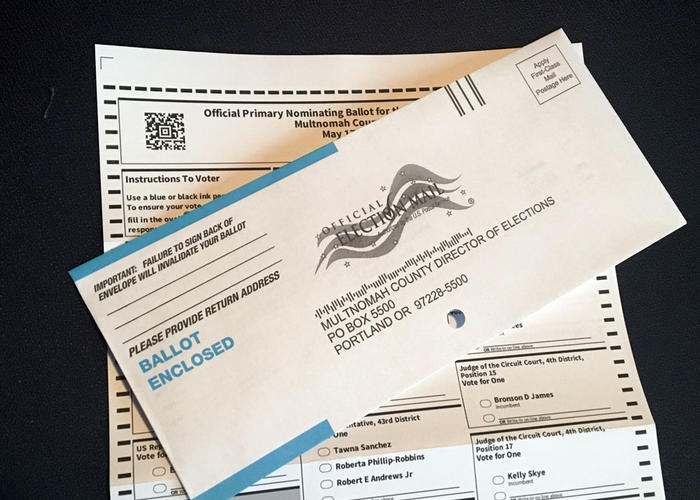
[deleted]
On masks as a good idea, I am still a little concerned with touch transmission. I see people without gloves touching their mask. This is totally contaminating the mask.
I would really like a settled question on whether mail and groceries are safe to touch. There was a study that came out saying the virus could exist on different surfaces for different periods of time. News reported last week that CDC update the website that indicated that the study was flawed. Soon after the CDC added clarification which still leaves the conclusion open. https://www.cdc.gov/media/releases/2020/s0522-cdc-updates-co...
I would really like a settled question on whether mail and groceries are safe to touch. There was a study that came out saying the virus could exist on different surfaces for different periods of time. News reported last week that CDC update the website that indicated that the study was flawed. Soon after the CDC added clarification which still leaves the conclusion open. https://www.cdc.gov/media/releases/2020/s0522-cdc-updates-co...
there is no such thing as truth as such; instead there are only theories and their predictive power (you could be in the matrix). so the best thing we have is the scientific method -- as individuals, we can all apply scientific thinking.
[deleted]
> If we could give a status that nothing on social media is too be taken seriously
The subject at hand are public statements from the president of the United States. How exactly does one not "take that seriously"? Given the gravity of the situation: if it's wrong, and you know it's wrong, surely you have a responsibility to tell people it's wrong. Right?
> Ask some oracle what "fact" is and shun every other point of view?
How is Trump being "shunned" here? Twitter put a correction link at the bottom of his tweet.
The subject at hand are public statements from the president of the United States. How exactly does one not "take that seriously"? Given the gravity of the situation: if it's wrong, and you know it's wrong, surely you have a responsibility to tell people it's wrong. Right?
> Ask some oracle what "fact" is and shun every other point of view?
How is Trump being "shunned" here? Twitter put a correction link at the bottom of his tweet.
llcoolv(1)
freen(1)
Fact checking is far from a solved problem. The can of worms that Trump opened when he started the "fake news" conversation is still very much open.
Trump didn't start that "conversation". "Fake News" was a term originally intended to reflect the false "news-like" advertisements that were being purchased on social media (primarily Facebook, and primarily targetting conservative users). Trump appropriated it as a way to label unflattering news coverage from mainstream sources.
Hardly just unflattering, MSM pushed the "Russia" narrative for 3 years and there was literally nothing there. Hard to call that anything other than fake news. In fact its looking more and more like the actions from the Obama admin were likely highly corrupt and there will likely people going to jail. Just recently the media has been reporting that Trump called the virus a "hoax", which was a complete lie.
Mueller went out of his way to say that his investigation did not exonerate Trump, and realistically the only reason more people did not go to jail (and a lot of people went to jail, including one of Trump's campaign managers) is because key players were successful in obstructing justice.
Like, you can be skeptical of the idea that the Russian interference was decisive in the election without dismissing the very real lawbreaking that happened.
Like, you can be skeptical of the idea that the Russian interference was decisive in the election without dismissing the very real lawbreaking that happened.
> Mueller went out of his way to say that his investigation did not exonerate Trump
I think it was inappropriate for him to stress this, and that it undermined his legitimacy and the legitimacy of the investigation. It isn't the job of an investigator to "exonerate" people that havn't been charged or prosecuted for a crime.
As far as I can tell all these comments did was validate his supporters beliefs that the investigation was a politically motivated attack, and simultaneously served as a psychological "out" for his detractors that were convinced he was in cahoots with Putin to undermine the country. Widening the divide between 2 sets of people that really ought to reconcile.
Disclaimer: I am not american, so this is an outsiders perspective.
I think it was inappropriate for him to stress this, and that it undermined his legitimacy and the legitimacy of the investigation. It isn't the job of an investigator to "exonerate" people that havn't been charged or prosecuted for a crime.
As far as I can tell all these comments did was validate his supporters beliefs that the investigation was a politically motivated attack, and simultaneously served as a psychological "out" for his detractors that were convinced he was in cahoots with Putin to undermine the country. Widening the divide between 2 sets of people that really ought to reconcile.
Disclaimer: I am not american, so this is an outsiders perspective.
What alternative did he have? The president's hand-picked AG had released an extremely misleading "summary" of Mueller's findings, which the president was using to claim total exoneration.
Trump's supporters would have taken any action beyond cowed silence as evidence of a "politically motivated attack," because that's been the president's messaging. The investigation itself was characterized as "politically motivated messaging," despite having been started under Trump by Trump appointees.
Mueller isn't responsible for "widening the divide," and there was nothing he could do to heal it while living up to his mandate. The president, or at least the president's team, did a lot of illegal things during the election. You don't meaningfully hold them to account or heal "the divide" by falsely exonerating the president.
Trump's supporters would have taken any action beyond cowed silence as evidence of a "politically motivated attack," because that's been the president's messaging. The investigation itself was characterized as "politically motivated messaging," despite having been started under Trump by Trump appointees.
Mueller isn't responsible for "widening the divide," and there was nothing he could do to heal it while living up to his mandate. The president, or at least the president's team, did a lot of illegal things during the election. You don't meaningfully hold them to account or heal "the divide" by falsely exonerating the president.
Here are some facts about the investigation into Russian interference in the 2016 election:
1. A total of 34 individuals and 3 companies were indicted by Mueller's investigators. A total of 8 have pleaded guilty to or been convicted of felonies, including 5 Trump associates and campaign officials. Here's a Wall Street Journal article about the convictions: https://www.wsj.com/articles/mueller-indictments-whos-who-15... Also, here's a long Wikipedia article about the whole investigation: https://en.wikipedia.org/wiki/Special_Counsel_investigation_...
2. When the Mueller report was about to be released, Attorney General Barr wrote a memo to Congress that purported to summarize the principal conclusions. Trump and Republican supporters seized on this to claim Trump was exonerated. In fact, Mueller explicitly stated that he did not exonerate Trump. Further, in a subsequent letter of his own, Mueller stated that Barr's memo "did not fully capture the context, nature, and substance" of the investigation. (Washington Post article here: https://www.washingtonpost.com/world/national-security/muell...)
3. A bipartisan report from the US Senate affirms the findings by US Intelligence agencies about Russian interference in the 2016 election. Here's a Wall Street Journal article: https://www.wsj.com/articles/senate-report-affirms-u-s-intel...
There are many more findings, but I tried to be concise in response to the specific claim that there is "nothing there".
When the investigation began and Mueller was appointed, Republicans praised him. (C.f. Fox News article: https://www.foxnews.com/politics/robert-mueller-appointment-...). Now they claim the investigation was either unlawful, or that FBI investigators were criminals, or similar. One does not need to take my or anyone else's word for what Mueller's team reported. You can get the redacted report from the government or even Amazon, and read it for yourself. You can also get the Senate committee's report from the government and read it for yourself. It is clear to me (and should be clear to anyone who has read the report or followed the story) that it is a flat-out lie to say there is "nothing there", and that Trump supporters have shifted from welcoming a fair investigation into Russian interference to attacking the investigators. And that's where we are now.
1. A total of 34 individuals and 3 companies were indicted by Mueller's investigators. A total of 8 have pleaded guilty to or been convicted of felonies, including 5 Trump associates and campaign officials. Here's a Wall Street Journal article about the convictions: https://www.wsj.com/articles/mueller-indictments-whos-who-15... Also, here's a long Wikipedia article about the whole investigation: https://en.wikipedia.org/wiki/Special_Counsel_investigation_...
2. When the Mueller report was about to be released, Attorney General Barr wrote a memo to Congress that purported to summarize the principal conclusions. Trump and Republican supporters seized on this to claim Trump was exonerated. In fact, Mueller explicitly stated that he did not exonerate Trump. Further, in a subsequent letter of his own, Mueller stated that Barr's memo "did not fully capture the context, nature, and substance" of the investigation. (Washington Post article here: https://www.washingtonpost.com/world/national-security/muell...)
3. A bipartisan report from the US Senate affirms the findings by US Intelligence agencies about Russian interference in the 2016 election. Here's a Wall Street Journal article: https://www.wsj.com/articles/senate-report-affirms-u-s-intel...
There are many more findings, but I tried to be concise in response to the specific claim that there is "nothing there".
When the investigation began and Mueller was appointed, Republicans praised him. (C.f. Fox News article: https://www.foxnews.com/politics/robert-mueller-appointment-...). Now they claim the investigation was either unlawful, or that FBI investigators were criminals, or similar. One does not need to take my or anyone else's word for what Mueller's team reported. You can get the redacted report from the government or even Amazon, and read it for yourself. You can also get the Senate committee's report from the government and read it for yourself. It is clear to me (and should be clear to anyone who has read the report or followed the story) that it is a flat-out lie to say there is "nothing there", and that Trump supporters have shifted from welcoming a fair investigation into Russian interference to attacking the investigators. And that's where we are now.
We had 2 billion-dollar campaigns operating for a year.
Russia had some paid shit posters and a 100k Facebook ad spend.
Blaming Russia is just a cop-out. No need to hold ourselves accountable, it was those damn Russians!
Russia had some paid shit posters and a 100k Facebook ad spend.
Blaming Russia is just a cop-out. No need to hold ourselves accountable, it was those damn Russians!
So you just go on hn to answer without reading the posts you answer to?
I'm curious what you mean by "literally nothing there", considering dozens of people have been charged and found guilty/jailed with crimes relating to the investigation, many of which were part of the Trump administration or working closely together with them [1]. Paul Manafort, the chairman of Donald Trumps' 2016 campaign is currently serving a 7.5 year prison sentence relating to this investigation.
[1] https://www.theguardian.com/us-news/ng-interactive/2018/dec/...
[1] https://www.theguardian.com/us-news/ng-interactive/2018/dec/...
> Paul Manafort, the chairman of Donald Trumps' 2016 campaign is currently serving a 7.5 year prison sentence relating to this investigation.
"He was convicted on five counts of tax fraud, one of the four counts of failing to disclose his foreign bank accounts, and two counts of bank fraud."
So, he was convicted of tax fraud and bureaucratic discrepencies. While factually related to the investigation, none of these charges has nothing to do with what the investigation was about.
"He was convicted on five counts of tax fraud, one of the four counts of failing to disclose his foreign bank accounts, and two counts of bank fraud."
So, he was convicted of tax fraud and bureaucratic discrepencies. While factually related to the investigation, none of these charges has nothing to do with what the investigation was about.
I don't know the source you're quoting, but it's pure spin. The tax fraud and reporting violation were in direct service to the need to hide his foreign payments from Russian interests. You're also forgetting his guilty pleas for failing to register as a foreign agent (Russia again) and witness tampering (which is criminal obstruction of justice!).
This is all directly related to his work for Russia and Russian interests, in exactly the same way that Al Capone's famous tax evasion conviction was the result of his operation of a criminal organization.
This is all directly related to his work for Russia and Russian interests, in exactly the same way that Al Capone's famous tax evasion conviction was the result of his operation of a criminal organization.
Apologies, the source is wikipedia's page on Paul Manafort[1]. Also the article says he was involved with Yanukovich, not with Putin, but still in the worst case this is in the equivalent to the Biden-Poroshenko tape[2].
Tax fraud rendering you guilty of all the bad things you were ever accused of is not really sound logic. Also, I am not really defending Manaford - tbh after reading more on him, this whole Ukrainian foray seems to be one of his lesser offenses. But for example in the case of Flynn/Trump where prosecutors were taped discussing how they need to "find him guilty of anything or provoke him to cross the law", there is no doubt of bias.
1. https://en.wikipedia.org/wiki/Paul_Manafort
2. https://www.youtube.com/watch?v=7lA3oOo1oZc
Tax fraud rendering you guilty of all the bad things you were ever accused of is not really sound logic. Also, I am not really defending Manaford - tbh after reading more on him, this whole Ukrainian foray seems to be one of his lesser offenses. But for example in the case of Flynn/Trump where prosecutors were taped discussing how they need to "find him guilty of anything or provoke him to cross the law", there is no doubt of bias.
1. https://en.wikipedia.org/wiki/Paul_Manafort
2. https://www.youtube.com/watch?v=7lA3oOo1oZc
> Tax fraud rendering you guilty of all the bad things you were ever accused of is not really sound logic.
The contention above was that there was "literally nothing to" Russian interference in the 2016 election. Manafort's convictions for activities related to his attempts to hide his Russian influence is clear evidence to the contrary.
I don't see anyone saying this makes Manafort guilty of "all the bad things he was ever accused of". But it makes him guilty of hiding Russian influence in the 2016 election, which was the point to be demonstrated.
The contention above was that there was "literally nothing to" Russian interference in the 2016 election. Manafort's convictions for activities related to his attempts to hide his Russian influence is clear evidence to the contrary.
I don't see anyone saying this makes Manafort guilty of "all the bad things he was ever accused of". But it makes him guilty of hiding Russian influence in the 2016 election, which was the point to be demonstrated.
How could they be related to something that did not stand in court, in other words did not legally happen? This is quite the contradiction.
Interesting, didn't know about that. Thanks for the info.
Then perhaps you can give me some more clarification:
* What about the Russian troll farms running fake pro-Trump social media accounts?
* What about the hacking of Clinton's email server and strategic release of those emails right before the election (even though the e-mails ended up containing nothing incriminating)?
* What about the many people lying/obstructing justice that were investigated? Why were so many people caught lying if there was nothing to hide?
Honestly curious, I'm not from the US so I don't have a horse in the race and I don't know that much about the investigation, but it seems to be quite obvious something fishy is going on there. Whether or not Trump's team was personally involved is another matter, but it seems obvious Russia meddled in the election extensively to assist Trump in winning. That alone seems quite alarming to me.
It also feels like you are defending it primarily because it happened to someone on your team, and you would not be defending it if the situation were reversed and, say, Clinton was assisted by China or something like this, even if she had no part to play in the assistance.
Then perhaps you can give me some more clarification:
* What about the Russian troll farms running fake pro-Trump social media accounts?
* What about the hacking of Clinton's email server and strategic release of those emails right before the election (even though the e-mails ended up containing nothing incriminating)?
* What about the many people lying/obstructing justice that were investigated? Why were so many people caught lying if there was nothing to hide?
Honestly curious, I'm not from the US so I don't have a horse in the race and I don't know that much about the investigation, but it seems to be quite obvious something fishy is going on there. Whether or not Trump's team was personally involved is another matter, but it seems obvious Russia meddled in the election extensively to assist Trump in winning. That alone seems quite alarming to me.
It also feels like you are defending it primarily because it happened to someone on your team, and you would not be defending it if the situation were reversed and, say, Clinton was assisted by China or something like this, even if she had no part to play in the assistance.
* What about the Russian troll farms running fake pro-Trump social media accounts?
Until there is no hard evidence, those troll farms are conspiracy theories. Besides, these days the left press is so ridiculously biased that NYT, Guardian, etc could easily qualify as troll farms.
* What about the hacking of Clinton's email server and strategic release of those emails right before the election (even though the e-mails ended up containing nothing incriminating)?
You mean the "e-mail server" (lol) which was "hosted" at her bedroom? You do realise that here of all places there is probably the highest number of people to see how ridiculous this is.
* What about the many people lying/obstructing justice that were investigated? Why were so many people caught lying if there was nothing to hide?
There is always something to hide, the question is were they guilty of what they were accused or not. Also after this appeared:
'What is our goal?' one of the notes dated January 24 2017 - the day of the interview - read. 'Truth/Admission or to get him to lie, so we can prosecute him or get him fired?'
I would not give too much credibility to those investigators.
1. https://www.dailymail.co.uk/news/article-8271953/Unsealed-me...
Until there is no hard evidence, those troll farms are conspiracy theories. Besides, these days the left press is so ridiculously biased that NYT, Guardian, etc could easily qualify as troll farms.
* What about the hacking of Clinton's email server and strategic release of those emails right before the election (even though the e-mails ended up containing nothing incriminating)?
You mean the "e-mail server" (lol) which was "hosted" at her bedroom? You do realise that here of all places there is probably the highest number of people to see how ridiculous this is.
* What about the many people lying/obstructing justice that were investigated? Why were so many people caught lying if there was nothing to hide?
There is always something to hide, the question is were they guilty of what they were accused or not. Also after this appeared:
'What is our goal?' one of the notes dated January 24 2017 - the day of the interview - read. 'Truth/Admission or to get him to lie, so we can prosecute him or get him fired?'
I would not give too much credibility to those investigators.
1. https://www.dailymail.co.uk/news/article-8271953/Unsealed-me...
* Until there is no hard evidence, those troll farms are conspiracy theories.
As far as I see reading about the report, there were multiple indictments made against several Russian entities and nationals for online campaigns supporting Donald Trump [1]. They were (obviously) not prosecuted, but the evidence is there, otherwise there would be no indictments.
[1] https://www.businessinsider.com.au/mueller-indicts-russians-...
* Besides, these days the left press is so ridiculously biased that NYT, Guardian, etc could easily qualify as troll farms.
This feels to me like you are not diversifying your news sources at all, and are only reading biased right-wing news and using that to feed your existing biases. The left wing media is not anymore biased than the right wing media, and there exists a scale of bias on both sides (there exists both ridiculously biased left wing media and ridiculously biased right wing media and everything in between).
I suggest you diversify where you get your news from to get a clearer picture of the world. Try to keep more of an open mind. Nothing good comes from blindly following one side or the other - both sides have plenty of good and plenty of criminals.
* You mean the "e-mail server" (lol) which was "hosted" at her bedroom? You do realise that here of all places there is probably the highest number of people to see how ridiculous this is.
Plenty of people have a private e-mail server at home for one reason or the other. This was blown up way out of proportion. Partisanship has heavily clouded your judgement here.
* There is always something to hide, the question is were they guilty of what they were accused or not. Also after this appeared:
* 'What is our goal?' one of the notes dated January 24 2017 - the day of the interview - read. 'Truth/Admission or to get him to lie, so we can prosecute him or get him fired?'
* I would not give too much credibility to those investigators.
This seems like a conspiracy theory to me. Weren't the investigators Republicans themselves?
As far as I see reading about the report, there were multiple indictments made against several Russian entities and nationals for online campaigns supporting Donald Trump [1]. They were (obviously) not prosecuted, but the evidence is there, otherwise there would be no indictments.
[1] https://www.businessinsider.com.au/mueller-indicts-russians-...
* Besides, these days the left press is so ridiculously biased that NYT, Guardian, etc could easily qualify as troll farms.
This feels to me like you are not diversifying your news sources at all, and are only reading biased right-wing news and using that to feed your existing biases. The left wing media is not anymore biased than the right wing media, and there exists a scale of bias on both sides (there exists both ridiculously biased left wing media and ridiculously biased right wing media and everything in between).
I suggest you diversify where you get your news from to get a clearer picture of the world. Try to keep more of an open mind. Nothing good comes from blindly following one side or the other - both sides have plenty of good and plenty of criminals.
* You mean the "e-mail server" (lol) which was "hosted" at her bedroom? You do realise that here of all places there is probably the highest number of people to see how ridiculous this is.
Plenty of people have a private e-mail server at home for one reason or the other. This was blown up way out of proportion. Partisanship has heavily clouded your judgement here.
* There is always something to hide, the question is were they guilty of what they were accused or not. Also after this appeared:
* 'What is our goal?' one of the notes dated January 24 2017 - the day of the interview - read. 'Truth/Admission or to get him to lie, so we can prosecute him or get him fired?'
* I would not give too much credibility to those investigators.
This seems like a conspiracy theory to me. Weren't the investigators Republicans themselves?
On top of that if there was evidence behind all indictments, then we would not need judges, only prosecutors. It is up to the court to decide if "there is evidence" or not.
Incorrect. Evidence is evidence. Anyone can judge evidence for validity. You could look up the evidence right now and judge it yourself. It only carries legal implications if a court prosecutes, but that does not mean the evidence does not exist or that a crime did not occur if a court did not prosecute.
Thanks for taking the time to critique my psyche, reading habits and personality. It would have been somewhat better if you stuck to the topic in stead of lowly as hominem, but in some cases this is too much to expect :D :D
[deleted]
I'm not trying to win any arguments - calling it an ad hominem makes no sense. Just trying to understand your perspective and make you realise your own biases. People too often blame the other side of their biases (in your case, "left wing is biased") without being aware of their own.
Yet another post, that is 100% factually correct and still gets downvoted into oblivion by the leftist bots. LOL.
I'd say Trump appropriated it to point out how untrustworthy the "real" news is. And he was and is right about that in general, even if he's often wrong.
Hmm, Trump's use seems to entirely have been to label things that are true that he wants [his supporters] to deny are true? Someone levels a factual criticism against him, they get thrown out and he says it's "fake news".
Worse, for me in the UK, his success got adopted by UK Tories, now we also have a people in positions of power who just dodge hard questions and where possible exclude press as punishment. People in power who lie and aren't held to account. It's diabolical -- but by subverting the rule of law they're able to continue.
Worse, for me in the UK, his success got adopted by UK Tories, now we also have a people in positions of power who just dodge hard questions and where possible exclude press as punishment. People in power who lie and aren't held to account. It's diabolical -- but by subverting the rule of law they're able to continue.
It's certainly not a solved problem when the "Head of Site Integrity" has a history of anti-Trump tweets and called the President a Nazi.
And that's just the head of the team. You can see the hard-left and pro-Antifa affiliations of the team outlined here: https://nickmonroe.blog/2019/11/28/dear-jack-twitter-is-poli...
And that's just the head of the team. You can see the hard-left and pro-Antifa affiliations of the team outlined here: https://nickmonroe.blog/2019/11/28/dear-jack-twitter-is-poli...
pro-Antifa means Pro Anti-Fascist which means to organise some movement against fascism.
Would we really want people to be the inverse ? Meaning would we like them to be more fascist or accepting of fascism ?
What exactly happened that AntiFa has become a group that people don't support ? Maybe I missed something there.
Would we really want people to be the inverse ? Meaning would we like them to be more fascist or accepting of fascism ?
What exactly happened that AntiFa has become a group that people don't support ? Maybe I missed something there.
This is assuming entities match their names. We only have to consider the Democratic People's Republic of Korea to see that is not the case.
By that logic Uranus was named after your anus. See simple. And "The Ministry of Truth" always said true things. And the
"Vice and Virtue Ministry" was a noble institution.
https://en.wikipedia.org/wiki/Vice_and_Virtue_Ministry
Why? because things and people are always named after what they are! See Biggus Dickus
https://www.youtube.com/watch?v=kx_G2a2hL6U
https://en.wikipedia.org/wiki/Vice_and_Virtue_Ministry
Why? because things and people are always named after what they are! See Biggus Dickus
https://www.youtube.com/watch?v=kx_G2a2hL6U
I think it depends on how you define "Fascist". Is it people that actually go around attacking people of colour? Or is it just a synonym for anyone not a Bernie-Bro?
I think people also have a problem with the violent methods employed by Antifa, such as beating up unarmed journalists.
I think people also have a problem with the violent methods employed by Antifa, such as beating up unarmed journalists.
"Antifa" is highly decentralized, with as many autonomous groups as you can count affiliating themselves with the movement. This sort of sentiment sounds a bit like when out-of-touch news anchor refer to "the hacker known as 4chan". Many pacifists identify with "antifa".
In general, provocative and non-defensive violence seems to be a strategy employed by a small minority of people involved in the anti-fascist movement. As is usually the case, the loudest voices are amplified, so the small amount of provocative violence is highlighted by the news media, as well as by the critics of the anti-fascist movement.
In general, provocative and non-defensive violence seems to be a strategy employed by a small minority of people involved in the anti-fascist movement. As is usually the case, the loudest voices are amplified, so the small amount of provocative violence is highlighted by the news media, as well as by the critics of the anti-fascist movement.
> What exactly happened that AntiFa has become a group that people don't support ?
The rise of right-wing, racist, nationalist, jingoist, corporatist strong-man authoritarianism.
I think there's a shorter term for that...
The rise of right-wing, racist, nationalist, jingoist, corporatist strong-man authoritarianism.
I think there's a shorter term for that...
Antifa is best known for their violent intimidation of political dissidents.
chlodwig(1)
Pro-Life means Pro-Humans which means to organize some movement against death.
Would we really want people to be the inverse? Meaning would we like them to accept more of death?
Would we really want people to be the inverse? Meaning would we like them to accept more of death?
dboreham(2)
It is crazy to see how well he knows his base and how to get them to rally close to an election. Making them think everything is a liberal bias against them, and if they don't vote for his big government agenda they will receive a big government agenda. This is just one more way for him to get his base to believe everything he says versus people who actually prove what he says is a lie. He wants state run media and social media just like China. As much as he talks about hating China he would love to be China.
It isn't that he has a special insight into his base, he is just willing to abandon any sense of truth or decency to flame it. That is what is remarkable about him.
One can hate or like Biden, but he put it perfectly: This is a prostitution of the presidency. Nothing more, nothing less.
Republicans are willing to look away, and let Trump run rampant, if it means that they'll get their part in return (judges, etc.)
Trump, in turn, will say anything. He has no restrains, and knows this - he can say absolutely anything, and no-one within will do or say anything.
Right now, the presidency (for Trump) is a case of survival. He needs to remain in power, in order to escape whatever civil charges he'll face.
For his own sake, Trump should have never ran for Presidency. He hates his job, and got lost in his own ego.
Republicans are willing to look away, and let Trump run rampant, if it means that they'll get their part in return (judges, etc.)
Trump, in turn, will say anything. He has no restrains, and knows this - he can say absolutely anything, and no-one within will do or say anything.
Right now, the presidency (for Trump) is a case of survival. He needs to remain in power, in order to escape whatever civil charges he'll face.
For his own sake, Trump should have never ran for Presidency. He hates his job, and got lost in his own ego.
I disagree with everything Trump says, does, and stands for.
'
But this is literally the only thing I won't short change him on.
He really does understand the base, the media and pollsters, and other the other candidates never really got that in the last election.
A LOT of politicians are willing to lie and fan those flames, but he has been more successful at knowing what lies to tell and really breaking new ground with his bullshit.
Does anyone think that a conspiracy theory invented by Rick Perry or Mitch McConnell would go viral or catch the public eye like one of Trumps half assed tweets?
He really does understand the base, the media and pollsters, and other the other candidates never really got that in the last election.
A LOT of politicians are willing to lie and fan those flames, but he has been more successful at knowing what lies to tell and really breaking new ground with his bullshit.
Does anyone think that a conspiracy theory invented by Rick Perry or Mitch McConnell would go viral or catch the public eye like one of Trumps half assed tweets?
> any sense of truth
The very "fact check" twitter claims to have done is wrong. I have provided sources in my previous comments.
The very "fact check" twitter claims to have done is wrong. I have provided sources in my previous comments.
And this is specifically on a tweet calling the validity of the election into question. It's blatantly wrong, but he needs his base to believe him when he says the election is rigged.
What was blatantly wrong about it?
Mail-in ballots don't generally increase the instances of election fraud. All of the "what ifs" have been investigated in the states that have had general-populace mail-in for years and been found not to occur in either (a) numbers that sway the election or (b) numbers distinguishable from in-person fraud (which is usually of the form "person not eligible to vote, but voting office screwed up and granted them a card" or "person moved and failed to notify election boards of the relocation; voted in the wrong district").
I have provided plenty of sources in my other comment on why "Mail-in ballots don't generally increase the instances of election fraud" is 100% wrong:
https://news.ycombinator.com/item?id=23331091
https://news.ycombinator.com/item?id=23331091
Every election has at least one story of rampant incompetence and/or outright fraud where one person is able to alter hundreds to thousands of votes. For elections where it can literally be 50.2% to 49.8%, it can make all the difference.
Rampant incompetence isn't the same as fraud, and one would still have to make the case that we lose hundreds of envelopes more often than we have an entire data-store go missing (or, for that matter, than we have a fleet of digital voting machines crash and deny access to the polls to face-to-face voters for hours).
Then the tweet wasn't 'factually incorrect' as was claimed, perhaps unsubstantiated given past performance isn't a guarantee of future performance but certainly election security is nothing to turn a blind eye to.
Please do not spead false information on HN. The tweet in question is:
> "There is NO WAY (ZERO!) that Mail-In Ballots will be anything less than substantially fraudulent."
Twitter labeled it as unsubstantiated, and provided a link to facts on mail-in ballots. Even if they didn't, his tweet is factually incorrect.
> "There is NO WAY (ZERO!) that Mail-In Ballots will be anything less than substantially fraudulent."
Twitter labeled it as unsubstantiated, and provided a link to facts on mail-in ballots. Even if they didn't, his tweet is factually incorrect.
Which part are you asserting is factually wrong, that the election that hasn't happened yet will have "substantially fraudulent" mail in ballots?
Or are you asserting that mail-in-ballots are secure or secure-enough to maintain the American democracy?
Or are you asserting that mail-in-ballots are secure or secure-enough to maintain the American democracy?
Mail-in ballots have existed for decades in elections all across the country and no one has questioned their legitimacy. If you accept the results of elections that have occurred prior to today, then there is no basis for the argument that mail-in ballots are illegitimate all of a sudden.
The problem isn't their legitimacy, it's that there have been numerous stories about one or very few persons affecting hundreds or thousands of votes, basically like an amplification attack on democracy. When mail-in ballots are only a small percentage of the overall votes it's not as large of an issue. What Trump asserted was simply that we'll see a sharp increase in the number of fraudulent votes because the attack surface is going to be exponentially larger.
Trump's assertion is based on the notion that mail-in-ballots see higher rates of fraud than in-person. It's not difficult to see why that would be the case, but I will concede I don't have first hand numbers.
The insidious thing about this situation is that there is now a lot of anger on both sides. If cooler heads had waited a bit longer, collected real data on the rates of voter fraud, actually addressed Trump's concerns about stolen/forged ballots rather than calling him a liar and linking to puff pieces from two of his biggest and unfairest outlets, we would stand a better chance at resolving this amicably.
Trump's assertion is based on the notion that mail-in-ballots see higher rates of fraud than in-person. It's not difficult to see why that would be the case, but I will concede I don't have first hand numbers.
The insidious thing about this situation is that there is now a lot of anger on both sides. If cooler heads had waited a bit longer, collected real data on the rates of voter fraud, actually addressed Trump's concerns about stolen/forged ballots rather than calling him a liar and linking to puff pieces from two of his biggest and unfairest outlets, we would stand a better chance at resolving this amicably.
If you were told that gerrymandering has a demonstrably larger effect on an election's legitimacy than mail-in voting, would you be as vocal against gerrymandering as you are against mail-in voting? If it is really about election legitimacy to you, isn't that what you should do?
I have provided plenty of sources in my other comment on why 100% factually correct:
https://news.ycombinator.com/item?id=23331091
https://news.ycombinator.com/item?id=23331091
I'm not sure where you're getting the "factually incorrect" claim; "unsubstantiated" is the actual terminology Twitter used:
"Trump makes unsubstantiated claim that mail-in ballots will lead to voter fraud"
"Trump makes unsubstantiated claim that mail-in ballots will lead to voter fraud"
Mmm citation needed here.
Hasn't the other side been #NotMyPresient and throwing a tantrum about the validity of the last election? Trump is not a trailblazer in this regard
(a) imagining there's one "other side" is a fallacy. There are multiple interest groups. Some more aligned with the President and his administration, some less.
(b) you'll have to be more specific about what you mean, but the "tantrum" I've heard is that the system as set up over-represents land over people, not that the result is illegitimate. A legitimate result in a badly-crafted system is materially different from claiming the process as designed is compromised.
(b) you'll have to be more specific about what you mean, but the "tantrum" I've heard is that the system as set up over-represents land over people, not that the result is illegitimate. A legitimate result in a badly-crafted system is materially different from claiming the process as designed is compromised.
I'm observing from the outside (read: the other side of the Atlantic), but my understanding is that people who say #NotMyPresident do it because of either a) a perceived lack of shared values between them and the president or b) in reference to him losing the popular vote, like several other presidents before him.
"The other side" has been pointing out how broken the electoral college is, not claiming that Trump is president on illegal grounds.
There's a massive difference between...
1. Questioning whether the Electoral College (and its tendency to devalue votes in some states) has a place in the modern US.
2. Questioning whether the election itself is completely rigged (via fraudulent votes).
#1 is the question many liberals have been asking. #2 is thee claim that the entire GOP has been making for years, despite their own investigations never turning up more than a few individuals voting fraudulently (but never systematic fraud perpetrated by the political left, as they claim).
1. Questioning whether the Electoral College (and its tendency to devalue votes in some states) has a place in the modern US.
2. Questioning whether the election itself is completely rigged (via fraudulent votes).
#1 is the question many liberals have been asking. #2 is thee claim that the entire GOP has been making for years, despite their own investigations never turning up more than a few individuals voting fraudulently (but never systematic fraud perpetrated by the political left, as they claim).
Headline: Hillary Clinton: Trump is an ‘illegitimate president’
https://www.washingtonpost.com/politics/hillary-clinton-trum...
https://www.washingtonpost.com/politics/hillary-clinton-trum...
Mail-in ballots make it much easier to commit voter fraud, I don't see how anyone could possibly argue to the contrary.
https://www.whitehouse.gov/sites/whitehouse.gov/files/docs/p...
https://www.whitehouse.gov/sites/whitehouse.gov/files/docs/p...
If you actually skim that document, the vast majority are simple single-vote "pleaded guilty to the charge of knowingly voting while ineligible" scenarios. They had to go back twenty years to find a thousand of these, out of billions of votes cast during that period.
A Heritage Foundation paper from the White House website. What a reputable source....
https://www.washingtonpost.com/politics/2020/05/26/review-tr...
Many states already do mail-in ballots and they're much more secure than the sketchy voting machines currently in use: https://qz.com/1783766/these-voting-machine-security-flaws-t...
https://www.washingtonpost.com/politics/2020/05/26/review-tr...
Many states already do mail-in ballots and they're much more secure than the sketchy voting machines currently in use: https://qz.com/1783766/these-voting-machine-security-flaws-t...
It's got nothing to do with voter fraud which is another conspiracy tagline for his base to hang their propaganda on. His whole intent is to make it harder to vote and reduce voting % as much as possible in order to amplify his rabid base votes who will move heaven and earth to vote and keep their racist dear leader in power.
This isn't news to anyone, he's openly said Republicans would never be elected again if it was easier to vote.
This isn't news to anyone, he's openly said Republicans would never be elected again if it was easier to vote.
Well I read that document you've provided as strong evidence that mail in voting is safe. You've sourced a document that is from the "mail voting is unsafe" team, and they've only been able to find a very few number of such cases, spanning thirty years (it goes back to 1990 at least), and almost all of those cases were caught before the votes affected the outcome.
Can you maybe explain your thinking?
Have you done the math? The document you reference is absent of impact analysis, even vague on the numbers. 1,071 incidents but how many actual votes? How many votes were actually cast? How many were caught before they were counted? Let's take Alabama. 14 reports, but actually first four are all the same incident. So 11 reports. Not off to a good start there. Nine of the remaining were single instance voting. Two were a conspiracy. One conspiracy was caught, in 1994 when it occurred, but is labeled as "Disposition: 2005", which I initially assumed meant that they were caught in 2005, and had gotten away with it. But in fact they were caught at the time because they submitted 1,400 votes in a county of 7000 people. The one that got away with it was caught at the time, and earned the role of a city commissioner of a city of 68,000 people. And yet the person was elected anyway, despite the evidence. So you've got "14" incidents, that are really only 11, and only 1 that got away with in a small city election where even they were caught yet allowed to win. So with just this one state, of the 14 claimed, there was only 1. So for 1071 that's 76. Over 30 years. There are 20,000 cities in the usa. So ~600,000 elections of all sizes they found 76 instances of successful fraud, and only in non-state-wide elections. And that's just me spending thirty minutes with your primary document.
What's interesting is that the Heritage Foundation didn't publish that math. Didn't get into detail.
Can you maybe explain your thinking?
Have you done the math? The document you reference is absent of impact analysis, even vague on the numbers. 1,071 incidents but how many actual votes? How many votes were actually cast? How many were caught before they were counted? Let's take Alabama. 14 reports, but actually first four are all the same incident. So 11 reports. Not off to a good start there. Nine of the remaining were single instance voting. Two were a conspiracy. One conspiracy was caught, in 1994 when it occurred, but is labeled as "Disposition: 2005", which I initially assumed meant that they were caught in 2005, and had gotten away with it. But in fact they were caught at the time because they submitted 1,400 votes in a county of 7000 people. The one that got away with it was caught at the time, and earned the role of a city commissioner of a city of 68,000 people. And yet the person was elected anyway, despite the evidence. So you've got "14" incidents, that are really only 11, and only 1 that got away with in a small city election where even they were caught yet allowed to win. So with just this one state, of the 14 claimed, there was only 1. So for 1071 that's 76. Over 30 years. There are 20,000 cities in the usa. So ~600,000 elections of all sizes they found 76 instances of successful fraud, and only in non-state-wide elections. And that's just me spending thirty minutes with your primary document.
What's interesting is that the Heritage Foundation didn't publish that math. Didn't get into detail.
[citation needed; editor rejected source as unreliable]
"There is NO WAY (ZERO!) that Mail-In Ballots will be anything less than substantially fraudulent. Mail boxes will be robbed, ballots will be forged & even illegally printed out & fraudulently signed. The Governor of California is sending Ballots to millions of people, anyone living in the state, no matter who they are or how they got there, will get one. That will be followed up with professionals telling all of these people, many of whom have never even thought of voting before, how, and for whom, to vote. This will be a Rigged Election. No way!"
The claim is not that it's easier to commit fraud. The claim is that allowing vote-by-mail compromises the integrity of an election. That's why it's important to show that voter fraud is quite rare (your link includes cases back to 1990 at least) and has a fairly high chance of being detected. Colorado, Hawaii, Oregon, Washington and Utah conduct elections entirely by mail. Trump voted by mail!
The claim is not that it's easier to commit fraud. The claim is that allowing vote-by-mail compromises the integrity of an election. That's why it's important to show that voter fraud is quite rare (your link includes cases back to 1990 at least) and has a fairly high chance of being detected. Colorado, Hawaii, Oregon, Washington and Utah conduct elections entirely by mail. Trump voted by mail!
So you're telling me that The Heritage Foundation, a conservative think-tank, set out to prove how rampant an issue voter fraud is (as this is a seeming tent-pole of Trump's push to delegitimize any election that goes against him) and they came up with a whopping 1,285 cases across the entire US?
What I see is that they've proven that voter fraud is not a problem in the United States. And, by extension, that there is no problem with mail-in-balloting leading to voter fraud. Looking at two states that only vote by mail, they have 27 cases of voter fraud in THE LAST TWENTY YEARS.
Voter fraud, whether in person or by mail, IS NOT A PROBLEM. It's simply Trump working to sow the seeds of insurrection should he lose in November.
What I see is that they've proven that voter fraud is not a problem in the United States. And, by extension, that there is no problem with mail-in-balloting leading to voter fraud. Looking at two states that only vote by mail, they have 27 cases of voter fraud in THE LAST TWENTY YEARS.
Voter fraud, whether in person or by mail, IS NOT A PROBLEM. It's simply Trump working to sow the seeds of insurrection should he lose in November.
Trump himself votes by mail, as does most of his family. Should we throw out their votes as well?
Welcome to politics, where the rhetoric is made up and truth doesn't matter.
There's an unsolved conundrum I haven't heard mentioned yet.
After the 2016 election, there was a thought that too much false information is spreading on social media. This happens in every country and across every form of communication - but social media platforms seem particularly worrysome (and is particularly bad with Whatsapp forwards in some Asian countries).
So what should the social media companies do? Censor people? Disallow certain messages (like they do with terrorism related posts)?
They settled on just putting in fact check links with certain posts. Trust in the fact deciding institution will of course be difficult to settle. No one wants a ministry of truth (or the private alternative).
So the question remains - do you, or how do you lessen the spread of misinformation?
After the 2016 election, there was a thought that too much false information is spreading on social media. This happens in every country and across every form of communication - but social media platforms seem particularly worrysome (and is particularly bad with Whatsapp forwards in some Asian countries).
So what should the social media companies do? Censor people? Disallow certain messages (like they do with terrorism related posts)?
They settled on just putting in fact check links with certain posts. Trust in the fact deciding institution will of course be difficult to settle. No one wants a ministry of truth (or the private alternative).
So the question remains - do you, or how do you lessen the spread of misinformation?
I think we're trapped in a structural innovation problem. Social media, no matter how it started, is now the pipeline for information. The internet is displacing old media forms but stalling out on that development.
The system is stuck in two local maximums: news publishers which use their own web properties as some kind of newspaper/television hybrid, and social media platforms which conceive of media as only posts, votes, & comments. They're both "monolithic architectures" (so to speak) which lack the kind of modularity or extensibility that would enable innovation.
On the Internet, we should be looking at information within the context of general computation. There are data sources (reporters, individuals, orgs) which get mixed with signals (votes, fact-checks, annotations) and then ranked, filtered, and rendered. An open market would maximize the modularity and extensibility of each of these components so that better media products can be created.
The social platforms are in a difficult position because they have total control over what's carried on their platforms, and so they want to assert a position of neutrality -- which is why they're adamant they're not media companies. But if they're controlling any part of the pipeline other than compute and hosting, they're not a neutral platform. They're a part of the media.
The way we've historically walked the tight-rope of misinformation vs censorship is to create an open market for journalism so that there's accountability through the system. I don't think we'll have an open market until we componentize social media and stop seeing journalism and the design of social media as two distinct things.
The system is stuck in two local maximums: news publishers which use their own web properties as some kind of newspaper/television hybrid, and social media platforms which conceive of media as only posts, votes, & comments. They're both "monolithic architectures" (so to speak) which lack the kind of modularity or extensibility that would enable innovation.
On the Internet, we should be looking at information within the context of general computation. There are data sources (reporters, individuals, orgs) which get mixed with signals (votes, fact-checks, annotations) and then ranked, filtered, and rendered. An open market would maximize the modularity and extensibility of each of these components so that better media products can be created.
The social platforms are in a difficult position because they have total control over what's carried on their platforms, and so they want to assert a position of neutrality -- which is why they're adamant they're not media companies. But if they're controlling any part of the pipeline other than compute and hosting, they're not a neutral platform. They're a part of the media.
The way we've historically walked the tight-rope of misinformation vs censorship is to create an open market for journalism so that there's accountability through the system. I don't think we'll have an open market until we componentize social media and stop seeing journalism and the design of social media as two distinct things.
Its a big problem. On the one hand social media companies are utterly unsuitable for the role of arbitrers of truth. All they do is enforce the fashionable, safe truths, which might end up not being safe or true. On the other hand there is definitely disinformation out there, carefully crafted to achieve specific goals. We need a sort of peer review for social media, some sort of trust network that you can use to assess the reliability of information. The fact check is one such mechanism, though who checks the checkers is still a issue..
In the case of Facebook at least, there is evidence they knowingly allow their algorithms to promote divisive content: https://www.wsj.com/articles/facebook-knows-it-encourages-di...
Of course they do, they are a for profit company not some enlightened beings we should delegate our sense making to. The whole social media revolution is a net negative and human culture has not caught up to this yet.
Media literacy and criticism classes in middle school?
Absolutely.
It's always surprising to me to see tech folks disparage humanities studies, then seem flabbergasted at how to fight problems like disinformation/misinformation. IMO, studying language, literature, and criticism are critical skills for operating in a culture that is flooded with information.
In terms of what we can do right now... I've been following Mike Caulfield on Twitter (@holden) and he is doing some interesting work on developing mental tools that school kids can use to evaluate the information that comes to them in social feeds.
https://twitter.com/holden
It's always surprising to me to see tech folks disparage humanities studies, then seem flabbergasted at how to fight problems like disinformation/misinformation. IMO, studying language, literature, and criticism are critical skills for operating in a culture that is flooded with information.
In terms of what we can do right now... I've been following Mike Caulfield on Twitter (@holden) and he is doing some interesting work on developing mental tools that school kids can use to evaluate the information that comes to them in social feeds.
https://twitter.com/holden
I used to think this was the answer.
I now think the problem with this is a lack of standards. It is documented that textbook manufacturers publish different history and science texts based on the region of the country regarding the civil war or evolution.
Not to be a nihilist, but what makes you think underfunded schools that struggle to teach basic reading will teach media literacy and criticism with any success? and will be supported by publishers that feel the same way?
I also think critical thinking is VERY hard. Harder than people imagine. It is hard to teach, hard to deploy, hard to practice. I'm not sure even 20% of the population could muster the brain power required to sift through today's onslaught of zone-flooding garbage.
I now think the problem with this is a lack of standards. It is documented that textbook manufacturers publish different history and science texts based on the region of the country regarding the civil war or evolution.
Not to be a nihilist, but what makes you think underfunded schools that struggle to teach basic reading will teach media literacy and criticism with any success? and will be supported by publishers that feel the same way?
I also think critical thinking is VERY hard. Harder than people imagine. It is hard to teach, hard to deploy, hard to practice. I'm not sure even 20% of the population could muster the brain power required to sift through today's onslaught of zone-flooding garbage.
I now think the problem with this is a lack of standards.
That's fair, it's certainly one of many hurdles that this sort of a solution would have to face.
Not to be a nihilist, but what makes you think underfunded schools that struggle to teach basic reading will teach media literacy and criticism with any success? and will be supported by publishers that feel the same way?
Well I'd probably answer that by starting out with an inquiry on how nihilism is a factor in what is a completely valid question about implementation? A school's ability to fund this kind of program from textbooks to technology to training staff and instructors has to be considered, this type of educational program doesn't happen in vacuum.
So I'd say you're right to ask questions about the disparity in school funding and how it would affect a media literacy curriculum-even if I'm not sure it's particularly accurate to describe such questions as "nihilist", they're completely necessary. But by no means am I intending to make any sort of value judgement about how successful this school or that school will be by merely suggesting taking a stab at introducing media literacy into public schooling.
To the questions of publishers, excellent question again. Maybe there are some models already out there worth exploring and iterating upon to maximize the value across the various school systems and school models (public, montessori, et al), a few people have commented that there are comparable programs where they live, I'd be curious to see if there are systems worth replicating in this thought experiment.
I think you raise excellent points here, all things said.
That's fair, it's certainly one of many hurdles that this sort of a solution would have to face.
Not to be a nihilist, but what makes you think underfunded schools that struggle to teach basic reading will teach media literacy and criticism with any success? and will be supported by publishers that feel the same way?
Well I'd probably answer that by starting out with an inquiry on how nihilism is a factor in what is a completely valid question about implementation? A school's ability to fund this kind of program from textbooks to technology to training staff and instructors has to be considered, this type of educational program doesn't happen in vacuum.
So I'd say you're right to ask questions about the disparity in school funding and how it would affect a media literacy curriculum-even if I'm not sure it's particularly accurate to describe such questions as "nihilist", they're completely necessary. But by no means am I intending to make any sort of value judgement about how successful this school or that school will be by merely suggesting taking a stab at introducing media literacy into public schooling.
To the questions of publishers, excellent question again. Maybe there are some models already out there worth exploring and iterating upon to maximize the value across the various school systems and school models (public, montessori, et al), a few people have commented that there are comparable programs where they live, I'd be curious to see if there are systems worth replicating in this thought experiment.
I think you raise excellent points here, all things said.
Funding is a red herring, it's not primarily about money. The whole framework of school is not geared towards this, because there is just not enough teachers who have the capability to teach something like this. They themselves aren't the brightest minds. Now, higher salaries could in principle make teaching jobs more attractive to the best minds, but it would require a huge social change, not just shuffling the budget around a little bit.
And from the children's side: It's already extremely hard to teach kids anything at a deeper level, especially those ones who will later on become susceptible to misinformation. If I look at my Facebook feed, schoolmates who got bad grades around age 10 are the ones sharing fake quiz results, horoscope stuff, "you won't believe what THIS person..." articles, listicles, racist stuff etc. Sure it's just correlational, but I think we don't have much better ways than we currently do in school.
If we could go back in time and design some critical thinking curriculum, are you sure you could teach something useful to those struggling 10-year-olds, that would keep their adult selves away from Internet bullshit?
And from the children's side: It's already extremely hard to teach kids anything at a deeper level, especially those ones who will later on become susceptible to misinformation. If I look at my Facebook feed, schoolmates who got bad grades around age 10 are the ones sharing fake quiz results, horoscope stuff, "you won't believe what THIS person..." articles, listicles, racist stuff etc. Sure it's just correlational, but I think we don't have much better ways than we currently do in school.
If we could go back in time and design some critical thinking curriculum, are you sure you could teach something useful to those struggling 10-year-olds, that would keep their adult selves away from Internet bullshit?
If we could go back in time and design some critical thinking curriculum, are you sure you could teach something useful to those struggling 10-year-olds, that would keep their adult selves away from Internet bullshit?
Yes. That's why I made the suggestion to begin this thread with. What those 10-year-olds who grow-up to become adults (as we all do) do with that information is impossible to ever truly know, but I think something of value could be taught, yes, absolutely.
But I disagree that funding is a red-herring, no it's not solely about the money, but as I said: curriculum implementation does not happen in a vacuum. It's relevant, and I don't see many useful discussions about implementation specifically happening without it. If there's a discussion to be had about the ethics or merits of media literacy, sure money probably doesn't carry as much weight--but I'm trying to speak as broadly as possible on the topic to avoid the trappings of turtles-all-the-way-down kvetching about the stylistics over how the discussion is framed.
Yes. That's why I made the suggestion to begin this thread with. What those 10-year-olds who grow-up to become adults (as we all do) do with that information is impossible to ever truly know, but I think something of value could be taught, yes, absolutely.
But I disagree that funding is a red-herring, no it's not solely about the money, but as I said: curriculum implementation does not happen in a vacuum. It's relevant, and I don't see many useful discussions about implementation specifically happening without it. If there's a discussion to be had about the ethics or merits of media literacy, sure money probably doesn't carry as much weight--but I'm trying to speak as broadly as possible on the topic to avoid the trappings of turtles-all-the-way-down kvetching about the stylistics over how the discussion is framed.
It would be interesting to see such a curriculum in the concrete, perhaps some country has something like that.
For example, we had something approximating it in Hungary, in history class. The very fist history lesson we had, was on historical sources, how historians work, "who benefits?", how you can know that a coin saying "minted in 350 BC" must be fake etc. And then later it was all facts and gospel, no critical presentation of different possibilities and interpretations and framings. Because it would be overwhelming.
But to actually train critical thinking, all classes should be redesigned in this manner, encouraging kids to poke holes in the material, but teachers can barely venture out of the confines of the curriculum. An elementary school physics teacher won't be able to explain things to you the same way a professor could if you raise some criticism or find a plothole in the simplified lie-to-children presentation. They'll just say, "that's how it is, memorize it".
It's a very difficult problem and hardly scalable.
For example, we had something approximating it in Hungary, in history class. The very fist history lesson we had, was on historical sources, how historians work, "who benefits?", how you can know that a coin saying "minted in 350 BC" must be fake etc. And then later it was all facts and gospel, no critical presentation of different possibilities and interpretations and framings. Because it would be overwhelming.
But to actually train critical thinking, all classes should be redesigned in this manner, encouraging kids to poke holes in the material, but teachers can barely venture out of the confines of the curriculum. An elementary school physics teacher won't be able to explain things to you the same way a professor could if you raise some criticism or find a plothole in the simplified lie-to-children presentation. They'll just say, "that's how it is, memorize it".
It's a very difficult problem and hardly scalable.
Someone suggested below that it was working in their countries, but the comment got flag-killed not long after it was posted. If that person is still following the thread hopefully they'd be willing to share their experiences on it and what the success metrics look like.
That said...
Reading other more recent comments though I think we're drifting a bit here and introducing some creep into my initial suggestion: critical thinking and media literacy certainly have some overlap in the types of class and even perhaps overlap in topic, but I'm unsure if I'd necessarily agree that 'media literacy' as a school topic needs to go all the way down the rabbit hole of of unpacking "critical theory" and "how to think critically" just to hold courses on what I initially and deliberately called 'media literacy and criticism'.
Your points are nonetheless well met, however-it definitely is a difficult nut to crack, and I can't help but wonder if it's a type of thing where if the immediate benefits maybe don't come from solving the problem but manifest as external results from simply looking at existing similar curricula and going from there-to maybe lower the initial hurdles of implementation that you and others spoke of? What do you think?
That said...
Reading other more recent comments though I think we're drifting a bit here and introducing some creep into my initial suggestion: critical thinking and media literacy certainly have some overlap in the types of class and even perhaps overlap in topic, but I'm unsure if I'd necessarily agree that 'media literacy' as a school topic needs to go all the way down the rabbit hole of of unpacking "critical theory" and "how to think critically" just to hold courses on what I initially and deliberately called 'media literacy and criticism'.
Your points are nonetheless well met, however-it definitely is a difficult nut to crack, and I can't help but wonder if it's a type of thing where if the immediate benefits maybe don't come from solving the problem but manifest as external results from simply looking at existing similar curricula and going from there-to maybe lower the initial hurdles of implementation that you and others spoke of? What do you think?
What are example topics of media literacy that you would cover? How to check the URL bar? How to look for institutional affiliations in an article? Give them a whitelist of publications they can trust? Warn them to look out for bad spelling (what if they themselves cannot spell well?)?
Perhaps tell them a story and ask them to rewrite it such that the bad guy comes out looking like the good guy and vice versa, or similar manipulations and framing exercises. To pick out manipulative phrases from presidential speeches, like peace, democracy, our great nation etc. But that would directly conflict with what they hear in other classes. Or perhaps use the example of dictatorial propaganda, text and posters alike, point out manipulative stuff.
Perhaps one interesting thing would be to peek behind the curtains. To tell them how news are made, how books are produced, how science works, what is peer review, how they can look up the original primary source (but this is too advanced for kids...). That books and knowledge and articles don't just fall out of the sky, they are deliberately produced with goals in mind.
I fear that ultimately it would devolve into a "don't believe everything you read, kids!", similar to "don't do drugs" lectures.
Perhaps tell them a story and ask them to rewrite it such that the bad guy comes out looking like the good guy and vice versa, or similar manipulations and framing exercises. To pick out manipulative phrases from presidential speeches, like peace, democracy, our great nation etc. But that would directly conflict with what they hear in other classes. Or perhaps use the example of dictatorial propaganda, text and posters alike, point out manipulative stuff.
Perhaps one interesting thing would be to peek behind the curtains. To tell them how news are made, how books are produced, how science works, what is peer review, how they can look up the original primary source (but this is too advanced for kids...). That books and knowledge and articles don't just fall out of the sky, they are deliberately produced with goals in mind.
I fear that ultimately it would devolve into a "don't believe everything you read, kids!", similar to "don't do drugs" lectures.
Example topics:
* How to source and read cited sources of online publications
* Copyright, fair use, associated topics (memes would be a great way to capture the attention of a middle schooler and would be a perfect tangent to these topics)
* Print and online advertising, how print markets have changed and evolved with the new digital landscape and the influence advertising and money has on content production (Youtuber's and patreons, again, a topic relevant to a young captive mind and one they're familiar with)
There's genuinely NO shortage of boilerplate contemporary lesson plans all across the internet covering "media literacy" as an applied subject matter for young minds-such that I don't really believe this to be as difficult of a teachable subject as many people commenting here are trying to make it out as being[0]
[0] https://mediaeducationlab.com/topics/Teaching-Media-Literacy
* How to source and read cited sources of online publications
* Copyright, fair use, associated topics (memes would be a great way to capture the attention of a middle schooler and would be a perfect tangent to these topics)
* Print and online advertising, how print markets have changed and evolved with the new digital landscape and the influence advertising and money has on content production (Youtuber's and patreons, again, a topic relevant to a young captive mind and one they're familiar with)
There's genuinely NO shortage of boilerplate contemporary lesson plans all across the internet covering "media literacy" as an applied subject matter for young minds-such that I don't really believe this to be as difficult of a teachable subject as many people commenting here are trying to make it out as being[0]
[0] https://mediaeducationlab.com/topics/Teaching-Media-Literacy
This is what I was looking for with my most recent reply to your reply. Thanks!
> I'm not sure it's particularly accurate to describe such questions as "nihilist", they're completely necessary.
Yeah. 'Nihilist' wasn't the correct word. Perhaps fallacious was more accurate: I think the subtext of my Q was, "If you can't fix everything why even start?" Which is dangerous.
I think I was fishing for answers: how is critical thinking even taught? My only experience with school was my one pass through it. And I didn't start critically thinking until my late 20's during the Clinton administration. I remember taking a critical thinking class in college (engineering school) and just sitting there as a freshman with my mouth hanging open when called on to make a critique.
It took a degree of engagement for me to become critical about issues. But then I was one-sided, and it took literally 20 more years before I started realizing there are two sides to an argument.
Not to toot my own horn, but I was very smart and very unobjective about anything outside of tech for 4/5ths of my life.
> But by no means am I intending to make any sort of value judgement about how successful this school or that school will be by merely suggesting taking a stab at introducing media literacy into public schooling.
I don't know how many other HN'ers have the same question, but I'd really like to know: how would a teacher proceed to instill what took me 40+ years to learn (and still learning!) into a teen-aged brain?
Any teachers out there?
Yeah. 'Nihilist' wasn't the correct word. Perhaps fallacious was more accurate: I think the subtext of my Q was, "If you can't fix everything why even start?" Which is dangerous.
I think I was fishing for answers: how is critical thinking even taught? My only experience with school was my one pass through it. And I didn't start critically thinking until my late 20's during the Clinton administration. I remember taking a critical thinking class in college (engineering school) and just sitting there as a freshman with my mouth hanging open when called on to make a critique.
It took a degree of engagement for me to become critical about issues. But then I was one-sided, and it took literally 20 more years before I started realizing there are two sides to an argument.
Not to toot my own horn, but I was very smart and very unobjective about anything outside of tech for 4/5ths of my life.
> But by no means am I intending to make any sort of value judgement about how successful this school or that school will be by merely suggesting taking a stab at introducing media literacy into public schooling.
I don't know how many other HN'ers have the same question, but I'd really like to know: how would a teacher proceed to instill what took me 40+ years to learn (and still learning!) into a teen-aged brain?
Any teachers out there?
To properly think critically you'd have to even question what school teaches you. The framework of school as an institution, it's purposes, it's origins. If you're lucky, your parents teach you how the real world relates to school, how teachers are just normal people, and aren't experts, that schools are operated under a certain ideological agenda, either governmental or from the owners of the private institution. That even experts aren't truth-oracles and have disagreements. That in complicated questions, like history, different countries may teach very different stories in school. And that your school's version is also not unbiased.
I don't see how you can teach the essence of critical thinking when it's in itself a fiercely individualistic don't-just-trust-the-authority idea.
If you teach it as such, you will get people to believe in any and all crackpottery because "I learned not to trust school and experts, I now found the actual truth that my school has repressed in this creationist UFO book on how aliens built the pyramids".
The other option is to teach them not to trust anything that comes from "unapproved" sources, only believe your government institutions, UN orgs etc. This may seem like a good baseline for the average person but it's just appeal to authority and not critical thinking.
I think there is just no such thing as "critical thinking" that could be taught as such, in itself. You have to go to the object level. If you want to dispel creationism, you have to teach biology and talk about how we know what we know about evolution and make sure people deeply understand it in their bones and they don't just regurgitate what they think you expect of them. It's the same in every subject. If you want people not to believe in magic healing crystal energy vibrations and parapsychology and homeopathy, you have to get them to understand some principles of real medicine and real physics (with equations and exercises all that). Only someone who has firm foundations on the object level, can successfully apply critical thinking.
One thing that could be taught though is propaganda techniques, marketing psychology, how it relates to the brain's reward systems, how ads are designed and monitored, A/B testing and tracking in cell phones, addiction. How cults form, the human biases that cult leaders use, a lot of stuff about human behavior, social psychology, trust, different personality types. Fallacies, pitfalls of thinking. But all these are very meta and again, to have a good grasp of these, you need a good actual base on the object level.
Most of actual critical thinking in the real world looks like "wait a minute, that doesn't feel right according to my model of how the world works". It's not really by matching things against a shortlist of logical fallacies that you had to memorize for some test.
I don't see how you can teach the essence of critical thinking when it's in itself a fiercely individualistic don't-just-trust-the-authority idea.
If you teach it as such, you will get people to believe in any and all crackpottery because "I learned not to trust school and experts, I now found the actual truth that my school has repressed in this creationist UFO book on how aliens built the pyramids".
The other option is to teach them not to trust anything that comes from "unapproved" sources, only believe your government institutions, UN orgs etc. This may seem like a good baseline for the average person but it's just appeal to authority and not critical thinking.
I think there is just no such thing as "critical thinking" that could be taught as such, in itself. You have to go to the object level. If you want to dispel creationism, you have to teach biology and talk about how we know what we know about evolution and make sure people deeply understand it in their bones and they don't just regurgitate what they think you expect of them. It's the same in every subject. If you want people not to believe in magic healing crystal energy vibrations and parapsychology and homeopathy, you have to get them to understand some principles of real medicine and real physics (with equations and exercises all that). Only someone who has firm foundations on the object level, can successfully apply critical thinking.
One thing that could be taught though is propaganda techniques, marketing psychology, how it relates to the brain's reward systems, how ads are designed and monitored, A/B testing and tracking in cell phones, addiction. How cults form, the human biases that cult leaders use, a lot of stuff about human behavior, social psychology, trust, different personality types. Fallacies, pitfalls of thinking. But all these are very meta and again, to have a good grasp of these, you need a good actual base on the object level.
Most of actual critical thinking in the real world looks like "wait a minute, that doesn't feel right according to my model of how the world works". It's not really by matching things against a shortlist of logical fallacies that you had to memorize for some test.
To add to this: you have to rely on authorities in a sense. I trust that Einstein's theory of General Relativity is true because I trust in the scientific consensus. I trust that the claims made by climate scientists are true because I trust in the peer review process. Now, of course, all of these people can be wrong. But I, as an individual, only have a limited number of years to live and I cannot verify every single of piece of information for myself. Ergo, I have to decide to trust certain authorities, at least partially if I want to do anything useful with my life.
That's true. But you also actually have to learn at least some things that came out of the same official sources and make sure that they do make sense.
That's why I'm saying that the object level is important. Teaching meta is way more difficult.
Also, as I wrote somewhere else, if I look at my Facebook feed for posts of former schoolmates, the ones who had good grades at the time and ended up in higher ed, learning about the world, they don't post fake news and clickbait and horoscopes and don't allow random apps to post in their name etc., while those who used to be struggling and couldn't learn English (as a foreign language) well etc. they do post junk.
Now there are always exceptions, like the university educated engineer who turns to build a perpetuum mobile and cries conspiracy for "getting silenced" etc. But by and large what it comes down to is having a large body of knowledge and understanding about the world. It's not particularly that their "critical thinking" skills are better. They have just read more, learned more, can use foreign language sources, generally have a better model of how the (natural and social) world works, condensed to "intuition". Simply dropping in a "critical thinking" course for kids won't make a significant effect I fear.
That's why I'm saying that the object level is important. Teaching meta is way more difficult.
Also, as I wrote somewhere else, if I look at my Facebook feed for posts of former schoolmates, the ones who had good grades at the time and ended up in higher ed, learning about the world, they don't post fake news and clickbait and horoscopes and don't allow random apps to post in their name etc., while those who used to be struggling and couldn't learn English (as a foreign language) well etc. they do post junk.
Now there are always exceptions, like the university educated engineer who turns to build a perpetuum mobile and cries conspiracy for "getting silenced" etc. But by and large what it comes down to is having a large body of knowledge and understanding about the world. It's not particularly that their "critical thinking" skills are better. They have just read more, learned more, can use foreign language sources, generally have a better model of how the (natural and social) world works, condensed to "intuition". Simply dropping in a "critical thinking" course for kids won't make a significant effect I fear.
1,000 times yes! In elementary and middle school, I had weekly learning from our school librarian on seeking the truth through a consensus of multiple sources. She taught us how to properly use Wikipedia as a source for finding other sources.
Crash Course (the YouTube channel) published a short series last year on Navigating Digital Information (https://www.youtube.com/playlist?list=PL8dPuuaLjXtN07XYqqWSK...). I really appreciated its pointers for how to deal with social media.
Crash Course (the YouTube channel) published a short series last year on Navigating Digital Information (https://www.youtube.com/playlist?list=PL8dPuuaLjXtN07XYqqWSK...). I really appreciated its pointers for how to deal with social media.
Ah thank you for the recommendation! Big fan of Crash Course and really big fan of PBS Digital Studios in general.
I have been wondering how one would teach enough evolutionary psychology and neuroscience to children to make them less susceptible to memetic engineering. Now that we have gone from human marketers to automated systems working to influence purchases and votes, traditional media criticism seems insufficient.
That’s an interesting question, though I suppose my response would be media literacy and criticism doesn’t have to necessarily imply traditional media in a singular breadth. In suggesting media literacy it was encompassing a spectrum.
Still: good question!
Still: good question!
I'm definitely not suggesting that "media criticism" is the wrong term. Just that people need a lot more background to understand what "media" actually is.
Maybe an approach to this could follow the model of algebra and calculus?
Students who take and show competency in pre-algebra qualify to move on to higher level maths building foundational knowledge for the more complex systems.
It wouldn’t necessarily have to be 1:1 in the model and structure of classes, but that’s my thinking. Media literacy shouldn’t be a one semester course, maybe not even a one year course, but instead a component of a radically different educational framework that informs our young students how to critique, analyze and reason their way through the digital frontier.
By no means would this kind of shift in education be easy, but in my mind ease is as much a threat to progress than hardship in some cases.
Students who take and show competency in pre-algebra qualify to move on to higher level maths building foundational knowledge for the more complex systems.
It wouldn’t necessarily have to be 1:1 in the model and structure of classes, but that’s my thinking. Media literacy shouldn’t be a one semester course, maybe not even a one year course, but instead a component of a radically different educational framework that informs our young students how to critique, analyze and reason their way through the digital frontier.
By no means would this kind of shift in education be easy, but in my mind ease is as much a threat to progress than hardship in some cases.
I took a critical thinking class in university, which covered deceptive messaging from advertisements fairly heavily. I'd like to think they all came out of that class no longer able to be fooled by this sort of thing, but I know it isn't the case.
It's easy to get people to question advertising, because they aren't emotionally invested. Once you stray into religion and politics, people often stop caring that they're hearing plainly untrue, or even self-contradictory, ideas.
It's easy to get people to question advertising, because they aren't emotionally invested. Once you stray into religion and politics, people often stop caring that they're hearing plainly untrue, or even self-contradictory, ideas.
Sure, I'm all for teaching it. It would still face the same issues as other education topics. Use science as an example. It is taught in schools. And yet, we still have a strong anti-science culture in the U.S.
I'd agree, with one caveat: there have been plenty of cases where groups push political or other controversial causes via the schools systems (see: the "teach the controversy" and "intelligent design" cases of trying to classify a deistic creation story as backed by science). I can easily see a world where media literacy classes are hijacked to teach the opposite of what ideally should be taught, in order to serve the needs of a few politicians rather than society as a whole.
critical thinking classes from kindergarten through the end of college.
i have developed a loose curriculum for the latter half of that pipeline, but getting the education uniformly distributed throughout the public mind market is the hard part.
i have developed a loose curriculum for the latter half of that pipeline, but getting the education uniformly distributed throughout the public mind market is the hard part.
Im sorry, but what does a critical thinking class even mean?
If you aren't being taught critical thinking already in English, History, and Math then what are you being taught?
Isn't that the entire point of those classes?
If you aren't being taught critical thinking already in English, History, and Math then what are you being taught?
Isn't that the entire point of those classes?
I'm not who you were replying to but I think what people typically mean is instead of just being told X is true you help people come to the conclusion that X is true. One of the best way to do that is to understand both sides of an issue and come to the conclusion that one side is correct. Not only does it cause people to understand why they believe something but it causes them to understand why people on the opposite side of this topic believes what they do.
Many people are guilty of not actually understanding why people believe what they do. They will read arguments by people on their side but won't read the best arguments made by the opposite side. They will instead read the arguments by either people who make crappy arguments or by people on their own side explaining the opposition's view. This typically results in awful, often strawmen arguments for the opponent's views.
If teachers could set up debates between students on topics I think it would be good. Ideally, the student should disagree with the side they are supposed to defend, though isn't always possible. This will force them to look up the views held by the other side. The teacher should understand the best arguments on both sides and should step in when arguments are being made incorrectly or when a student misses a good response.
This of course would often times not work well because teachers don't understand their opponent's views so I am not sure how to actually handle this. You could possibly have a teacher with a different view help moderate the debate, but there is a disproportionate amount of teachers who are liberal (I've seen some studies that put it at over 80%) so it would not always be practical.
This doesn't always work on every topic like math, but it could be helpful in both English (for meaning behind books, poems, etc) and various history topics.
I am sure there are additional ways to help students learn critical thinking but this could be a good way if teachers are actually able to present both sides in a fair way.
Many people are guilty of not actually understanding why people believe what they do. They will read arguments by people on their side but won't read the best arguments made by the opposite side. They will instead read the arguments by either people who make crappy arguments or by people on their own side explaining the opposition's view. This typically results in awful, often strawmen arguments for the opponent's views.
If teachers could set up debates between students on topics I think it would be good. Ideally, the student should disagree with the side they are supposed to defend, though isn't always possible. This will force them to look up the views held by the other side. The teacher should understand the best arguments on both sides and should step in when arguments are being made incorrectly or when a student misses a good response.
This of course would often times not work well because teachers don't understand their opponent's views so I am not sure how to actually handle this. You could possibly have a teacher with a different view help moderate the debate, but there is a disproportionate amount of teachers who are liberal (I've seen some studies that put it at over 80%) so it would not always be practical.
This doesn't always work on every topic like math, but it could be helpful in both English (for meaning behind books, poems, etc) and various history topics.
I am sure there are additional ways to help students learn critical thinking but this could be a good way if teachers are actually able to present both sides in a fair way.
As I said in another comment I fear the thread I’ve started here may be suffering from some creep. “Media literacy” as a topic definitely exercises the critical thinking muscles of the brain as a specific and applied school subject, but if the discussion people would rather have is the vague call to “teach kids critical thinking” and left at that, then I gotta go because that’s a conversation that is far less precise and will get really weird really fast.
gonzo41(1)
Whatsapp forwards is largely a solved problem. Now you can't forward whatsapp messages to more than 5 people at a go. And if you try doing 5 people at a time consecutively, your account is automatically deleted even before you reach 30 total forwards.
Some people adopted a strategy of adding users to a group and dropping whatever message they have but that too is solved by allowing only known contacts to add you to groups.
Some people adopted a strategy of adding users to a group and dropping whatever message they have but that too is solved by allowing only known contacts to add you to groups.
Your solution is to ban humans from talking to more than 5 others at once?
It is an interesting solution if nothing else. What about capping the number of users or followers to 100 or 1000 other people? That is closer to how humans interacted for the vast majority of history since the development of language. If you think about it, it's extremely unnatural for single people to have direct communication to millions of people. Information can still spread from social group to social group. I don't endorse the idea, but I would be interested to see how it might work and how information would spread and ideas change.
Forwarding WhatsApp messages is a tiny subset of "talking to people".
The subject of this thread is "how do you lessen the spread of misinformation?" across all of social media, and the parent claims that whatsapp has largely solved this problem. So we're talking about applying these restrictions much more broadly.
you can talk to hundred people at at time. You just can't forward the same message to more than 5 people at the time. What's the problem with that?
They can talk to more than 5 people at once, just not through the WhatsApp platform. I take it you think email spammers are also unjustly treated too.
[deleted]
It's as simple as toning down the virulance and addiction potential that has been baked into social media over the years. Revert to chronological feeds based on timestamp alone, and not sorting based on how many inflammatory comments and shares they have. Ban more pages that produce and share these misinformed posts. These are problems that these engagement algorithms themselves created, and social media companies are too timid to actually solve for fear of affecting stock price.
I don't think reverting to chrono content makes sense. If popularity doesn't influence what's top-of-feed, then we'll just be flooded with un-interesting content.
Imagine if HN or Reddit didn't sort by popularity? Everyone would need to sort through /new. ...that's not scalable.
What would be better would be to reward controversial content. If lots of people downvote something, and also lots of people upvote, then maybe it needs more attention, not less?
So that rather than creating ever-more-extremist bubbles, people are more likely to see opinions that make them force them to appreciate other points of view.
Imagine if HN or Reddit didn't sort by popularity? Everyone would need to sort through /new. ...that's not scalable.
What would be better would be to reward controversial content. If lots of people downvote something, and also lots of people upvote, then maybe it needs more attention, not less?
So that rather than creating ever-more-extremist bubbles, people are more likely to see opinions that make them force them to appreciate other points of view.
>that's not scalable
and therein lies the problem. The issue is the scale in the first place. Twitter et al produce so much garbage because they're designed towards virality outside of any human scale.
Bring social networks down to the size that a community can coherently operate in and you've diminished the problem.
HN arranges by popularity but actually in a fairly limited way. There's no scores shown and the downvotes are capped, and most threads you can actually read through because they've got less than 200 comments or so.
Do the same for Facebook or twitter. Limit connections, hide visible upvotes or likes, cap the number of people something can be shared with by one user, make people choose who they are in contact with, which immediately puts scarcity and value on connection and communication. Obviously there is no commercial incentive for these companies to do this, who live off the entropy they generate.
and therein lies the problem. The issue is the scale in the first place. Twitter et al produce so much garbage because they're designed towards virality outside of any human scale.
Bring social networks down to the size that a community can coherently operate in and you've diminished the problem.
HN arranges by popularity but actually in a fairly limited way. There's no scores shown and the downvotes are capped, and most threads you can actually read through because they've got less than 200 comments or so.
Do the same for Facebook or twitter. Limit connections, hide visible upvotes or likes, cap the number of people something can be shared with by one user, make people choose who they are in contact with, which immediately puts scarcity and value on connection and communication. Obviously there is no commercial incentive for these companies to do this, who live off the entropy they generate.
I think hn is an exception because the raw feed is a firehose, and votes serve to filter it (I actually follow hn chronologically via RSS, but with a vote threshold as a filter), but most people aren't following 1000s of accounts posting to their timeline at once. Networks like facebook and twitter used to be chronological, you could scroll through in 10 minutes and catch up on all new content for the day if you were in a rush akin to RSS, and one day that changed.
> Imagine if HN or Reddit didn't sort by popularity? Everyone would need to sort through /new. ...that's not scalable.
Reddit gives people the choice, so you can sort by new if you want to.
Choice is good, right?
Reddit gives people the choice, so you can sort by new if you want to.
Choice is good, right?
> toning down the [...] addiction potential that has been baked into social media over the years
That hurts the bottom line so the social media companies won't do it unless they are forced to.
> Revert to chronological feeds based on timestamp alone
At the very least this should be an option (and not one that is automatically reset every time you view a page -- I'm looking at you facebook).
That hurts the bottom line so the social media companies won't do it unless they are forced to.
> Revert to chronological feeds based on timestamp alone
At the very least this should be an option (and not one that is automatically reset every time you view a page -- I'm looking at you facebook).
Right, the actual fix is to change their core business model which they'll never do.
As a straw man for discussion; I'm not too familiar with what Twitter is doing, but in an ideal world I think the solution would look something like what Twitter sounds like. Notably, posts containing objectively false information would be flagged, but not necessarily censored.
With that straw man though, it's fairly easy to poke holes. How do we ever even implement that? Even if we ignore the sheer volume of posts, a single post is often difficult to fact check. The lie can be subtle, but even worse is the human language and how much room there can be for misdirection, dishonesty, etc.
In my spare time I work on a project (not even close to release lol) with the goal of easing information sharing, retention, etc - as I figure part of the problem to the current age is a lack of information. Wikipedia is great, but it's quite large form discussion and I think we need better tools to help us document our own conclusions. BUT, even in all the effort I've put towards this tool I haven't dreamed of quantifying the truthiness.
I just don't see how we're going to cope with these sort of truth problems. It concerns me. It feels like information is a tool of war these days, and I am concerned we're losing.
With that straw man though, it's fairly easy to poke holes. How do we ever even implement that? Even if we ignore the sheer volume of posts, a single post is often difficult to fact check. The lie can be subtle, but even worse is the human language and how much room there can be for misdirection, dishonesty, etc.
In my spare time I work on a project (not even close to release lol) with the goal of easing information sharing, retention, etc - as I figure part of the problem to the current age is a lack of information. Wikipedia is great, but it's quite large form discussion and I think we need better tools to help us document our own conclusions. BUT, even in all the effort I've put towards this tool I haven't dreamed of quantifying the truthiness.
I just don't see how we're going to cope with these sort of truth problems. It concerns me. It feels like information is a tool of war these days, and I am concerned we're losing.
One avenue that has been taken by Youtube for example with the Coronavirus news is to not try to detect lies/truths but just detect the controversial topic and add a banner under the video with a link to official sources. It's much simpler to implement. A disadvantage is that it becomes so ubiquitous that people probably don't care about the link.
At least they try to detect the topic. Reddit's app has for some time been permanently showing a "look at /r/coronavirus" banner at the top of the default Home tab. I'm not exactly sure how they're moderating that or whatever, but the fact it's there all the time doesn't seem to reduce conspiracies flying around the rest of their site and they don't make any effort to attach it to them posts.
The NYT is doing a special podcast on this topic right now.
In one of their episodes, they interview the CEO of YouTube about what they're doing to stop the spread of misinformation on web content platforms like their own.
Her response is that they're no longer tailoring their recommendation models or carousels based purely on engagement alone, but also based on potential harm or impact, because the common misinformation preys on being highly engaging. The biggest example of this is how YouTube is dealing with Covid-19 misinformation, that the "COVID-19 news" carousel on the home page doesn't get much engagement but is important for people to stay informed.
It's a good listen if you have the time: https://www.nytimes.com/2020/05/07/podcasts/rabbit-hole-yout...
In one of their episodes, they interview the CEO of YouTube about what they're doing to stop the spread of misinformation on web content platforms like their own.
Her response is that they're no longer tailoring their recommendation models or carousels based purely on engagement alone, but also based on potential harm or impact, because the common misinformation preys on being highly engaging. The biggest example of this is how YouTube is dealing with Covid-19 misinformation, that the "COVID-19 news" carousel on the home page doesn't get much engagement but is important for people to stay informed.
It's a good listen if you have the time: https://www.nytimes.com/2020/05/07/podcasts/rabbit-hole-yout...
Twitter created a special rule [1] for public officials who violate their Terms of Service. They feel there's a genuine "public interest" in being able to see (and respond to) these communications, even though they would not normally be allowed on the platform.
Are people aware that there are two classes of users on Twitter, subject to different sets of rules? Twitter hides this fact, for some reason, but it's something that ought to be glaringly obvious to anyone viewing any of a user's tweets.
[1]: https://blog.twitter.com/en_us/topics/company/2019/publicint...
Are people aware that there are two classes of users on Twitter, subject to different sets of rules? Twitter hides this fact, for some reason, but it's something that ought to be glaringly obvious to anyone viewing any of a user's tweets.
[1]: https://blog.twitter.com/en_us/topics/company/2019/publicint...
[deleted]
They could easily start by prominently linking to high-quality easy-to-read information on critical thinking skills. They have a multitude of ways to develop and optimise this sort of information.
I imagine I'll get downvoted for this, but I think it needs to be said. Perhaps one way to lessen the spread of misinformation is to not operate services that limit messages to 280 characters. The world is not black and white. Meaningful topics are almost always nuanced and do not lend themselves to pithy sound bites. Let me demonstrate my point in a provocative way:
===== The world would be a better place if Twitter did not exist. =====
Note the lack of caveat, nuance, or elaboration here. It's not conducive to making the argument in a compelling and convincing way, especially not in the ways espoused by Hacker News. People who agree with that statement are going to agree. People who don't are going to be outraged.
If you do agree with the above the real question is what to do about it. Does the problem lie with the people at Twitter? With capitalism? With democracy? With the particular implementation that is the United States? Is this just something inherent to human nature? Or is the internet to blame? There are no simple answers to these questions. But perhaps the mediums that we use to have the discussions have a substantial impact on the conversation.
===== The world would be a better place if Twitter did not exist. =====
Note the lack of caveat, nuance, or elaboration here. It's not conducive to making the argument in a compelling and convincing way, especially not in the ways espoused by Hacker News. People who agree with that statement are going to agree. People who don't are going to be outraged.
If you do agree with the above the real question is what to do about it. Does the problem lie with the people at Twitter? With capitalism? With democracy? With the particular implementation that is the United States? Is this just something inherent to human nature? Or is the internet to blame? There are no simple answers to these questions. But perhaps the mediums that we use to have the discussions have a substantial impact on the conversation.
To be fair, this isn't a new problem. Historically, newspapers had a similar control. It is interesting because most people want to be in an echo chamber. We as humans long to belong. We don't want to be completely wrong. Newspapers mitigated this by having multiple layers of editorial control and attempting to only put people in control who value truth, although that isn't absolute. The difference with Twitter is that anyone can spew anything and to large audiences and the network effect is huge. Back in the day, a newspaper printing garbage in Tulsa probably had no influence in Seattle. That is no longer the case.
The interesting thing that I think Jack Dorsey should respond directly to Trump's tweet about regulation is "I'm sorry you no longer find Twitter useful. Feel free to use a competitor's product." The main reason that the social networks haven't clamped down is that they need the eyeballs and controversial figures generate a lot on both sides (hate/love).
The interesting thing that I think Jack Dorsey should respond directly to Trump's tweet about regulation is "I'm sorry you no longer find Twitter useful. Feel free to use a competitor's product." The main reason that the social networks haven't clamped down is that they need the eyeballs and controversial figures generate a lot on both sides (hate/love).
> how do you lessen the spread of misinformation?
It's a problem that we cannot actually engage in any debate or correction. President Trump is a perfect example of this, he drops his Tweet and then, poof, he's gone. He will not respond to difficult question about freedom of speech, etc.
Trump drops his talking point and runs away, then Twitter drops their "fact check" and runs away. I don't think anyone is the better for it. Nobody's minds have been changed. Nobody has been educated or given serious thought to difficult issues. Nobody has had empathy for others. Having the "fact check" is better than not, but not much, and "fact checks" are not always correct.
If we could somehow social engineer our way to meaningful debates on these difficult topics, we would be much better off. I know the President can't respond to millions of people, but if we could, somehow, systematically choose just a few of the best counterpoints and force some dialogue, then a lot of the "bullshit" would immediately evaporate.
It's a problem that we cannot actually engage in any debate or correction. President Trump is a perfect example of this, he drops his Tweet and then, poof, he's gone. He will not respond to difficult question about freedom of speech, etc.
Trump drops his talking point and runs away, then Twitter drops their "fact check" and runs away. I don't think anyone is the better for it. Nobody's minds have been changed. Nobody has been educated or given serious thought to difficult issues. Nobody has had empathy for others. Having the "fact check" is better than not, but not much, and "fact checks" are not always correct.
If we could somehow social engineer our way to meaningful debates on these difficult topics, we would be much better off. I know the President can't respond to millions of people, but if we could, somehow, systematically choose just a few of the best counterpoints and force some dialogue, then a lot of the "bullshit" would immediately evaporate.
Social media companies don't necessarily need to take a stand. Label any tweet with the word 'vaccine/vaccination' with a link to the WHO (or insert users country health ministry) info on vaccines. There is obiviously a lot of topics to cover (voting rights, flat earth, conspiracy theories etc) but isn't the thing tech companies can do well is things at scale?
You can also go backwards, The problem with social media is that anyone can comment on it. and that's not a desirable trait for complex discussions. I can't tell how many times I've seen a news article and the top post in a forum like here or reddit be some expert explaining the article and indicate the failures of it. This is solvable, a social media for experts, every single link given a rating on its truthfulness. by actual non-anonymous experts. or hell, you can scrape for the link on twitter, have a database of professionals who have commented on twitter on the article and indicate what they said about it. Anyway, I'm just spitballing now so I'll stop.
>So the question remains - do you, or how do you lessen the spread of misinformation?
The easiest is to get rid of bots and control who can tweet. Anyone can create an account but to tweet you need to prove your identity. Bots are the real issue. Trump lying on social media is a problem but it's not fundamentally dissimilar to him lying on TV or at a campaign rally. He is a liar and whatever platform he is on he will use it to lie. The problem is all the bots masquerading as humans making people think and believe that the lies are mainstream facts.
The easiest is to get rid of bots and control who can tweet. Anyone can create an account but to tweet you need to prove your identity. Bots are the real issue. Trump lying on social media is a problem but it's not fundamentally dissimilar to him lying on TV or at a campaign rally. He is a liar and whatever platform he is on he will use it to lie. The problem is all the bots masquerading as humans making people think and believe that the lies are mainstream facts.
What would be required to prove your identity? Would you be able to tweet anonymously, or must you tweet under that identity? There are some issues with that, for example people without government identification would not be allowed to tweet. Perhaps you could use unique fingerprints, but that turns into a huge privacy concern and I can never see that being accepted. Maybe there are some unique bio-markers that could be used which people feel would be irrelevant or otherwise useless enough to not be an invasion of privacy.
Drivers license, utility bill, phone number, credit card, etc. The same types of things that other services ask you to provide to prove that you are a real person.
Tweeting anonymously is a non-starter unless they can curtail the bot problem in some other way. If they could curtail the bot problem then they would be doing it already and we wouldn't be having this discussion.
Half the content on Twitter and Facebook is from bots. I would say this is the most fundamentally urgent problem to solve to protect Democracy in this country.
Tweeting anonymously is a non-starter unless they can curtail the bot problem in some other way. If they could curtail the bot problem then they would be doing it already and we wouldn't be having this discussion.
Half the content on Twitter and Facebook is from bots. I would say this is the most fundamentally urgent problem to solve to protect Democracy in this country.
The point of proving identity would be to curtail the bot problem. If someone can fake identification in order to get an account created, then it's trivial to just make up a fake name and picture of a person. Forcing people to not be anonymous does nothing to solve a bot problem, and causes a lot of problems. What if that person is gay with a very conservative family that would not accept them? They would be unable to speak how they please with mandatory non-anonymity.
Twitter already requires a phone number, prepaid credit cards can be very cheap, and not everyone has utility bills in their names. Many people cannot get drivers licenses. These are great for privileged people, but discriminatory against unprivileged people. I don't think stifling their voices is something we need more of.
Twitter already requires a phone number, prepaid credit cards can be very cheap, and not everyone has utility bills in their names. Many people cannot get drivers licenses. These are great for privileged people, but discriminatory against unprivileged people. I don't think stifling their voices is something we need more of.
That would be deal breakers with whistleblowers (Edward Snowden).
Misinformation spreads a lot human-to-human too. Like on Whatsapp or Facebook for example.
It does but that also happens in real life outside of digital spaces. It’s not something you can control.
How much did this “reopen America” botnet influence national discussion? People don’t innately expect a Twitter or Facebook user to be a bot. We have to remove these bot accounts.
https://www.cs.cmu.edu/news/nearly-half-twitter-accounts-dis...
How much did this “reopen America” botnet influence national discussion? People don’t innately expect a Twitter or Facebook user to be a bot. We have to remove these bot accounts.
https://www.cs.cmu.edu/news/nearly-half-twitter-accounts-dis...
I would be fine with a public ministry of truth. Atleast we will have the free speech rights.
Wo have given too much power to these private companies.
Wo have given too much power to these private companies.
hammock(1)
There's nothing we can do. We should stop pretending otherwise.
This it it. We did it. There is nothing for us to do, but celebrate.
This it it. We did it. There is nothing for us to do, but celebrate.
Almost no one is ever happy with fact-checking, it often just leads to more disputes about whether or not the fact-checking is correct or warranted. To me it seems much more efficient to simply teach people not to take anything posted on social media seriously and to better think for themselves. One may say that the president should be an exception because of the number of people he reaches, but what about a famous actor with millions of followers? Or Elon Musk? What would the line of acceptable influence be in order to make someone fact-checkable? The set of fact-checkable people could be very large, and the manpower required to fact check all of them formidable.
One may also argue that the president harms our country's image but again, senators and congressmen represent us as well and can also influence large amounts of people.
That does not mean he must go uncontested; people can still dispute everything he says by responding (the original form of fact-checking). The discussion should instead be about whether or not political figures should be able to block people. I remember that was an issue a while ago, and I'm not sure where it is now.
One may also argue that the president harms our country's image but again, senators and congressmen represent us as well and can also influence large amounts of people.
That does not mean he must go uncontested; people can still dispute everything he says by responding (the original form of fact-checking). The discussion should instead be about whether or not political figures should be able to block people. I remember that was an issue a while ago, and I'm not sure where it is now.
We have tried teaching people not to believe everything they read on the internet already. We need solutions that actually work.
It's wishful thinking at best to believe that Twitter replies can effectively refute arguments. They don't establish public dialog unless the OP retweets the responses. You can't call it a dialogue if, effectively, there's only one person talking. Even simple refutations fail on Twitter.
"We can't fact check one person because it'd be hard to do the same for a large number of people" is classic perfect-as-enemy-of-good. We get huge bang-for-buck by handling some obvious outliers and known bad actors, and that's worth doing.
It's wishful thinking at best to believe that Twitter replies can effectively refute arguments. They don't establish public dialog unless the OP retweets the responses. You can't call it a dialogue if, effectively, there's only one person talking. Even simple refutations fail on Twitter.
"We can't fact check one person because it'd be hard to do the same for a large number of people" is classic perfect-as-enemy-of-good. We get huge bang-for-buck by handling some obvious outliers and known bad actors, and that's worth doing.
What western democracies really need is an entire government segment dedicated to fact-checking. We could call it the "Department of Truth" (or "Ministry of Truth" in UK) and it would be responsible for labeling things on social media as true or false using little fact checker badges.
So when 'fact checkers' end up with a right-wing bias will that still seem prudent? History is full of people in power, expanding their powers only to see their opposition use them more effectively against them.
> simply teach people not to take anything posted on social media seriously and to better think for themselves
clearly there is nothing simple about this
clearly there is nothing simple about this
> teach people not to take anything posted on social media seriously and to better think for themselves.
Most underrated comment in this thread...
Most underrated comment in this thread...
It took all of 5 minutes for fact checking to become just as broken as the fake news it was trying to correct. Trump will clearly say something, and then I'll see people share directly conflicting fact checkers, one that says he said it, and one that says the words never left his mouth.
And just like before the fact checkers, people believe what they want to believe, nothing more, nothing less.
And just like before the fact checkers, people believe what they want to believe, nothing more, nothing less.
There seem to be some upside down priorities here. Many folks seem to be arguing that its an unacceptable form of censorship for a private platform to annotate content it allows others to post. Meanwhile, I'm seeing barely a mention of the fact that the President of the United States has threatened to use government power to shut down an entire sector of the economy devoted to communication. The latter is almost certainly a violation of the Constitution. The former, almost certainly not.
Mhm.
Also missing from the parts of the discussion i've yet read, is the question of what sort of software we're using.
At the risk of using a buzzword, decentralized comms could reduce the risks of constitutional shutdown. And maybe even be better.
Also missing from the parts of the discussion i've yet read, is the question of what sort of software we're using.
At the risk of using a buzzword, decentralized comms could reduce the risks of constitutional shutdown. And maybe even be better.
I hope they name it mastodon.gov
Because that's how far we've gone from reality. The word censorship has lost almost all meaning in online arguments when people are trying to argue that what Twitter did constitutes censorship while Trump publicly threatening them with shutdown somehow does not.
It's become increasingly obvious that the argument around censorship has never been actually about censorship but rather as another political bludgeon you can use to beat your opponent over the head with by scoring some easy points since censorship = bad. They ignore the power dynamics at play which is what makes censorship possible.
It's become increasingly obvious that the argument around censorship has never been actually about censorship but rather as another political bludgeon you can use to beat your opponent over the head with by scoring some easy points since censorship = bad. They ignore the power dynamics at play which is what makes censorship possible.
One factor is that Trump says a lot of dumb things, and almost none of them are true.
Instead he seems to say whatever outrageous thing that can get attention so he's the center of the news cycle. Once again, it worked.
When he actually does something to silence twitter, I'll be upset too. But I'm not falling for the "big crazy talk ploy" again.
Instead he seems to say whatever outrageous thing that can get attention so he's the center of the news cycle. Once again, it worked.
When he actually does something to silence twitter, I'll be upset too. But I'm not falling for the "big crazy talk ploy" again.
Hot off the press:
> President Donald Trump is expected to sign an executive order aimed at social media companies on Thursday, White House press secretary Kayleigh McEnany told reporters Wednesday evening, a move that comes as the president and his allies have escalated their allegations that companies like Twitter and Facebook stifle GOP voices.
https://www.politico.com/amp/news/2020/05/27/trump-executive...
> President Donald Trump is expected to sign an executive order aimed at social media companies on Thursday, White House press secretary Kayleigh McEnany told reporters Wednesday evening, a move that comes as the president and his allies have escalated their allegations that companies like Twitter and Facebook stifle GOP voices.
https://www.politico.com/amp/news/2020/05/27/trump-executive...
I think it will improve the debate a lot to have a concrete policy to discuss, rather than guesses about what Trump might do.
Perhaps they see it as targeting a political figure because of political differences rather than trying to prevent the spread of misinformation. I'm not seeing any annotations on a number prominent members of Congress spreading misinformation.
Where in the US Constitution does it say presidents cannot threaten companies? Obama had his share of threats. I'm sure they could find a suitable legal issue with Twitter targeting Trump while ignoring members of Congress.
Where in the US Constitution does it say presidents cannot threaten companies? Obama had his share of threats. I'm sure they could find a suitable legal issue with Twitter targeting Trump while ignoring members of Congress.
> Where in the US Constitution does it say presidents cannot threaten companies?
The Articles of the US Constitution aren't an enumerated list of illegal actions. It's the wrong place to look for limitations of presidential power.
I love that our expectations of the current president are so low that we will use excuse them because "the previous presidents did it too!" You aren't actually saying what he's doing is legal; you are simply increasing the importance of precedent over the statutory restraints of power -- it's a very dangerous argument to make.
The Articles of the US Constitution aren't an enumerated list of illegal actions. It's the wrong place to look for limitations of presidential power.
I love that our expectations of the current president are so low that we will use excuse them because "the previous presidents did it too!" You aren't actually saying what he's doing is legal; you are simply increasing the importance of precedent over the statutory restraints of power -- it's a very dangerous argument to make.
> The Articles of the US Constitution aren't an enumerated list of illegal actions. It's the wrong place to look for limitations of presidential power.
The US Constitution is indeed an enumerated list of federal governmental powers, including the President's. At least that is the standard interpretation. Obviously there are an infinite number of ways those enumerated powers might manifest themselves but the overall scope and nature of the powers is indeed limited by the US Constitution.
The US Constitution is indeed an enumerated list of federal governmental powers, including the President's. At least that is the standard interpretation. Obviously there are an infinite number of ways those enumerated powers might manifest themselves but the overall scope and nature of the powers is indeed limited by the US Constitution.
You aren't disproving my statement.
I was being particularly pedantic because it was relevant to my parent comment.
The Articles of the Constitution are affirmatively defined positive powers of the branches of government. They are not affirmatively defined negative powers.
The Bill of Rights (the first 10 Amendments) are closer to that, but they don't specifically talk about The President and their scopes have had to be interpreted by courts to determine (1) are the rights they guarantee applied to {all people, all US residents, all US citizens, etc} and do they protect against {US government, state/local governments, other private citizens, etc}.
I was being particularly pedantic because it was relevant to my parent comment.
The Articles of the Constitution are affirmatively defined positive powers of the branches of government. They are not affirmatively defined negative powers.
The Bill of Rights (the first 10 Amendments) are closer to that, but they don't specifically talk about The President and their scopes have had to be interpreted by courts to determine (1) are the rights they guarantee applied to {all people, all US residents, all US citizens, etc} and do they protect against {US government, state/local governments, other private citizens, etc}.
Well I guess we are in agreement but I found your formulation confusing. In particular "It's the wrong place to look for limitations of presidential power" is what I was responding to.
Given your followup I now understand what you were saying.
Given your followup I now understand what you were saying.
"Obama had his share of threats."
Cite two.
Cite two.
A quick Google found two:
https://www.theguardian.com/world/2014/aug/07/obama-tax-inve...
https://www.reuters.com/article/us-obama-financials/obama-th...
Not sure this will support the original commenters point, as these "threats" have a basis in reality and appear to be good causes unlike Trump's, but these are "threats" by Obama at least according to the journalists involved.
Edit: why the downvotes? I am showing that the Trump supporter above is full of shit, Obama's "threats" were for good causes
https://www.theguardian.com/world/2014/aug/07/obama-tax-inve...
https://www.reuters.com/article/us-obama-financials/obama-th...
Not sure this will support the original commenters point, as these "threats" have a basis in reality and appear to be good causes unlike Trump's, but these are "threats" by Obama at least according to the journalists involved.
Edit: why the downvotes? I am showing that the Trump supporter above is full of shit, Obama's "threats" were for good causes
You might have avoided the downvotes if you had made it clear what your point was. As it reads without the edit, it sounds like you're arguing the opposite of what your edit says.
Edit - to be clear I did not downvote
Edit - to be clear I did not downvote
Thanks for the reply. I had thought putting quotes around threats and including "appear to be good causes" would be enough. Lesson learned!
Trump supporter? I cannot wait for Trump to be gone. If I were a Trump supporter, I would refer to him as President or President Trump. More like person who is not triggered just by the mere mention of Trump.
I never even insinuated Obama's threats were not for good causes. Part of being a president is to execute laws and regulations which includes threats of action.
Since I have no doubt someone will take my "President" comment above out of context, I will not refer to a political figure by their former position title. To me, wishing/expecting to be referred by their former position is akin to using it as a title of nobility and expecting to be treated as nobility.
I never even insinuated Obama's threats were not for good causes. Part of being a president is to execute laws and regulations which includes threats of action.
Since I have no doubt someone will take my "President" comment above out of context, I will not refer to a political figure by their former position title. To me, wishing/expecting to be referred by their former position is akin to using it as a title of nobility and expecting to be treated as nobility.
Also not in the Constitution that you can't yell "Fire!" in a crowded theatre, but decent human beings understand that that's not to be done.
That is exactly how I see it. I see it as silicon valley employees taking it upon themselves to try to get the last word in with Trump's message. Linking to CNN and WP was just beyond the pale.
> its an unacceptable form of censorship for a private platform to annotate content it allows others to post
It is an unacceptable form of censorship to hand over our modern day equivalent of the public square to private companies, and then allow them to police what people say in it.
Freedom of speech was always intended to be protected in public. The Internet is now our equivalent of the public space. It is time this problem is solved once and for all, and the Internet is now reclassified as both a public utility and a public space.
Yes, those of us with technical know-how can argue that personal websites are that equivalent. But this is depriving those that see Twitter, Facebook, et. al. as a public platform, of the right to have their voice heard. A tweet is now the equivalent of a placard on the street. Do we really want to censor that because we messed up in how we allowed the Internet to be run?
It is an unacceptable form of censorship to hand over our modern day equivalent of the public square to private companies, and then allow them to police what people say in it.
Freedom of speech was always intended to be protected in public. The Internet is now our equivalent of the public space. It is time this problem is solved once and for all, and the Internet is now reclassified as both a public utility and a public space.
Yes, those of us with technical know-how can argue that personal websites are that equivalent. But this is depriving those that see Twitter, Facebook, et. al. as a public platform, of the right to have their voice heard. A tweet is now the equivalent of a placard on the street. Do we really want to censor that because we messed up in how we allowed the Internet to be run?
> Yes, those of us with technical know-how can argue that personal websites are that equivalent. But this is depriving those that see Twitter, Facebook, et. al. as a public platform, of the right to have their voice heard. A tweet is now the equivalent of a placard on the street. Do we really want to censor that because we messed up in how we allowed the Internet to be run?
Disagree, because street space is limited, whereas there are a multiplicity of websites you can go to. It isn’t just a matter of personal websites. There’s a Twitter-like, Gab, which can be used. The president and his multi-million dollar campaign apparatus could easily strike a deal with Gab to host some more Gab servers and get their message out via Gab to anyone of their twitter followers who wants to sign up.
Never mind that Trump is not actually being censored on twitter in any way - his message still went out to all his followers, simply with an appended notice that Twitter itself considers the message to be factually wrong.
EDIT: this is like saying that the President has the right to publish whatever content he wants in a specific newspaper. Back in the day, a city might have a dozen newspapers - they could each print what they liked and if they decided not to print a person’s letter to the editor, that was no violation of free speech. Or if they print the letter to the editor with a note explaining they disagree with it, that certainly doesn’t violate free speech either.
Disagree, because street space is limited, whereas there are a multiplicity of websites you can go to. It isn’t just a matter of personal websites. There’s a Twitter-like, Gab, which can be used. The president and his multi-million dollar campaign apparatus could easily strike a deal with Gab to host some more Gab servers and get their message out via Gab to anyone of their twitter followers who wants to sign up.
Never mind that Trump is not actually being censored on twitter in any way - his message still went out to all his followers, simply with an appended notice that Twitter itself considers the message to be factually wrong.
EDIT: this is like saying that the President has the right to publish whatever content he wants in a specific newspaper. Back in the day, a city might have a dozen newspapers - they could each print what they liked and if they decided not to print a person’s letter to the editor, that was no violation of free speech. Or if they print the letter to the editor with a note explaining they disagree with it, that certainly doesn’t violate free speech either.
> this is like saying that the President has the right to publish whatever content he wants in a specific newspaper
Nobody sees a news-paper as a public space. The fact that anybody can make a social media account and instantly publish information that can be read by anybody, and the fact that people conceptually now see public profiles as public spaces, means that we need to treat them that way.
Nobody sees a news-paper as a public space. The fact that anybody can make a social media account and instantly publish information that can be read by anybody, and the fact that people conceptually now see public profiles as public spaces, means that we need to treat them that way.
> Nobody sees a news-paper as a public space. The fact that anybody can make a social media account and instantly publish information that can be read by anybody, and the fact that people conceptually now see public profiles as public spaces, means that we need to treat them that way.
This just doesn’t make sense to me. Ever since the first anti-spam technology was deployed, online web forums and mailing lists have employed moderation. There’s law on this going back to the early 1990s when AOL and CompuServe had to moderate their platforms. Nothing has really changed except that there are more options and more ways to get the message out than ever before.
Want a public space? Simply get a server and throw up a phpBB or wordpress or mastodon or gab or GNUSocial instance and you’ve got your own space. As president, trump could easily get the word out via email to his millions of registered supporters and they would flock to the new space and post there.
This just doesn’t make sense to me. Ever since the first anti-spam technology was deployed, online web forums and mailing lists have employed moderation. There’s law on this going back to the early 1990s when AOL and CompuServe had to moderate their platforms. Nothing has really changed except that there are more options and more ways to get the message out than ever before.
Want a public space? Simply get a server and throw up a phpBB or wordpress or mastodon or gab or GNUSocial instance and you’ve got your own space. As president, trump could easily get the word out via email to his millions of registered supporters and they would flock to the new space and post there.
These laws made sense in the pre-social media days.
The fact that 3 billion people (from a quick Google search) are now using social media means that the goal posts have changed. 3 billion people are using the services of private companies to make their voices publicly heard. They think that they are exercising their right to freedom of speech by using something so accessible and ubiquitous. As accessible as public squares used to be.
To turn around and say "sorry, social media might be really easy to use and might be the primary form of communication for most people in the first world, but private companies should be able to control that" is very disingenuous.
The reason this is so tricky is that there is simply no historical precedent for this level of hyperconnectivity. But I certainly reject the idea of using the old laws of public vs. private companies to dictate how we as a society use the publicly accessible and readable internet.
The fact that 3 billion people (from a quick Google search) are now using social media means that the goal posts have changed. 3 billion people are using the services of private companies to make their voices publicly heard. They think that they are exercising their right to freedom of speech by using something so accessible and ubiquitous. As accessible as public squares used to be.
To turn around and say "sorry, social media might be really easy to use and might be the primary form of communication for most people in the first world, but private companies should be able to control that" is very disingenuous.
The reason this is so tricky is that there is simply no historical precedent for this level of hyperconnectivity. But I certainly reject the idea of using the old laws of public vs. private companies to dictate how we as a society use the publicly accessible and readable internet.
An individual website is not the internet.
Anyone who uses the internet has a choice of millions of websites. Everyone using twitter and seeing the twitter notification on Trump’s tweets knows that twitter placed it there. If they were outraged, they can use Google and find alternative social media sites like Mastodon or Gab.
Trump could do the same.
There is simply no comparison to a “public square” since there are easy, accessible alternatives to get the messages out over the internet.
If you want to talk about “public square”, perhaps the easiest comparison would be internet access itself. If ISPs cut off Trump’s internet connection for posting wrong think, that could be seen as a free speech issue I think. But even banning him from any specific individual website is simply a matter for that website’s owner to decide.
Anyone who uses the internet has a choice of millions of websites. Everyone using twitter and seeing the twitter notification on Trump’s tweets knows that twitter placed it there. If they were outraged, they can use Google and find alternative social media sites like Mastodon or Gab.
Trump could do the same.
There is simply no comparison to a “public square” since there are easy, accessible alternatives to get the messages out over the internet.
If you want to talk about “public square”, perhaps the easiest comparison would be internet access itself. If ISPs cut off Trump’s internet connection for posting wrong think, that could be seen as a free speech issue I think. But even banning him from any specific individual website is simply a matter for that website’s owner to decide.
They don't have a choice of millions of websites. Like I said in another comment in a thread with you, the network effect is real. People go where there are other people. Nobody goes to an empty street to protest. What would be the point in that? We have allowed the most populated spaces for people to express their opinions to be controlled by private companies.
Trump has an email and SMS list with millions of supporters. He can also post on facebook whenever he wishes, or address the nation in prime time speeches that will be carried on TV channels and live streams. He can also continue to post on twitter, as twitter didn’t delete any of his tweets, so he can use network effects on twitter and simply post Gab or Mastodon links and try to get his enormous base of followers to use another platform.
His speech is not being suppressed. In fact, he’s probably the person who has the least problem in the entire country of being heard or noticed.
Edit: by the way, ask MySpace, AOL, MSN, or other failed once-popular social networks how well the “network effects” worked out. People know how to use a different website if they actually care to do so.
His speech is not being suppressed. In fact, he’s probably the person who has the least problem in the entire country of being heard or noticed.
Edit: by the way, ask MySpace, AOL, MSN, or other failed once-popular social networks how well the “network effects” worked out. People know how to use a different website if they actually care to do so.
This issue goes beyond Trump. People have been de-platformed on various social media sites. Twitter has taken on the role of the virtual public space. Twitter is performing a public service in their publishing of tweets. People that don't see it that way are still living in the dot-com bubble. The Internet has grown beyond what anybody had imagined. People don't go out and protest anymore because they do it online.
We will never see protests of the 60s and 70s scale today in person. People do what they did back then online. And they don't go out and protest because they feel like their voice is being broadcast enough through social media. And yet to have that censored by private companies is unacceptable when that in the modern day use case.
We will never see protests of the 60s and 70s scale today in person. People do what they did back then online. And they don't go out and protest because they feel like their voice is being broadcast enough through social media. And yet to have that censored by private companies is unacceptable when that in the modern day use case.
> This issue goes beyond Trump. People have been de-platformed on various social media sites. Twitter has taken on the role of the virtual public space. Twitter is performing a public service in their publishing of tweets
People who have been de-platformed can always go to Gab (I know they had issues being dropped a few times but my understanding is they have adopted a decentralized approach and resolved it). It is freely available on the internet. The only reason people are using Twitter instead of Gab is that the marketplace prefers the lightly-moderated Twitter to the complete free-for-all of Gab. Edit: again, Trump is a billionaire, he could easily fund more Gab servers and blast it out to his followers and get his message out.
> People don't go out and protest anymore because they do it online.
I invite you to visit Washington DC whenever the virus is over and see the large in-person protests that regularly happen in the nation’s capital.
Never mind that there’s a physical riot / protest going on yesterday and today over police brutality, today, in Minneapolis.
> And they don't go out and protest because they feel like their voice is being broadcast enough through social media. And yet to have that censored by private companies is unacceptable when that in the modern day use case.
So the reason they aren’t going out in person is because they aren’t being censored. Look at what is going on in Hong Kong over the past year if you want to see what happens when people in the modern internet-connected world are actually angry. You get millions on the street, not just posting online.
People who have been de-platformed can always go to Gab (I know they had issues being dropped a few times but my understanding is they have adopted a decentralized approach and resolved it). It is freely available on the internet. The only reason people are using Twitter instead of Gab is that the marketplace prefers the lightly-moderated Twitter to the complete free-for-all of Gab. Edit: again, Trump is a billionaire, he could easily fund more Gab servers and blast it out to his followers and get his message out.
> People don't go out and protest anymore because they do it online.
I invite you to visit Washington DC whenever the virus is over and see the large in-person protests that regularly happen in the nation’s capital.
Never mind that there’s a physical riot / protest going on yesterday and today over police brutality, today, in Minneapolis.
> And they don't go out and protest because they feel like their voice is being broadcast enough through social media. And yet to have that censored by private companies is unacceptable when that in the modern day use case.
So the reason they aren’t going out in person is because they aren’t being censored. Look at what is going on in Hong Kong over the past year if you want to see what happens when people in the modern internet-connected world are actually angry. You get millions on the street, not just posting online.
> The only reason people are using Twitter instead of Gab is that the marketplace prefers the lightly-moderated Twitter to the complete free-for-all of Gab.
No. The reason people are using Twitter is because most other people are using Twitter. The network effect is very real and very strong on social media.
If you wanted to protest something, would you go to the least populated public space that people are gathering, or the most populated?
We have allowed the most highly populated places where people share ideas, to be controlled by a private company. That is not in the spirit of freedom of speech in the slightest.
No. The reason people are using Twitter is because most other people are using Twitter. The network effect is very real and very strong on social media.
If you wanted to protest something, would you go to the least populated public space that people are gathering, or the most populated?
We have allowed the most highly populated places where people share ideas, to be controlled by a private company. That is not in the spirit of freedom of speech in the slightest.
> No. The reason people are using Twitter is because most other people are using Twitter. The network effect is very real and very strong on social media.
Trump has millions of followers on his email lists. He could send out an email or SMS tomorrow inviting his followers to begin posting on a new Donald Trump Gab or Mastodon server. Edit: heck, he could even post it on his twitter!
He chooses to post on twitter instead. He doesn’t even try to use an alternative website.
This is not about restricting his free speech, this is about him trying to drum up controversy.
Trump has millions of followers on his email lists. He could send out an email or SMS tomorrow inviting his followers to begin posting on a new Donald Trump Gab or Mastodon server. Edit: heck, he could even post it on his twitter!
He chooses to post on twitter instead. He doesn’t even try to use an alternative website.
This is not about restricting his free speech, this is about him trying to drum up controversy.
I already said this goes beyond Trump. Others have been censored before, and they won't be the last. Trump is the only person in a position to actually do something about it.
Trump could set up an alternative to twitter tomorrow using his billion dollar fortune as seed capital. The technology is already out there - GNUSocial, Gab, and Mastodon.
Look at theDonald.win as an example. Reddit banned their forum, so they created a new website where they can post.
Trump has the audience of millions to create a right-wing only website where his followers can chat together if they wish, or he could encourage his followers to join Gab.
Look at theDonald.win as an example. Reddit banned their forum, so they created a new website where they can post.
Trump has the audience of millions to create a right-wing only website where his followers can chat together if they wish, or he could encourage his followers to join Gab.
Obviously you can't see beyond Trump. I'm trying to make a point about freedom of speech on the Internet, and you can't see beyond "orange man has money". There are broader issues at stake here than partisan politics. The next decade could shape the rest of the century. I certainly don't want that century to be dictated to by private companies whose only guiding principle is profit.
I’m an outsider (not American, don’t live in America) so I’m almost not entitled to have an opinion on the matter, but it always strikes me as fairly odd when people of one persuasion or another rail against the ‘bias’ that they perceive against them in one circumstance or another (including media coverage).
Of course people see bias against them. It’s classical confirmation bias: every time something goes their way, it’s unremarkable, but as soon as something doesn’t, it’s noticeable.
Isn’t it equally possible —nay, probable even, especially in this case— that the perceived bias is only the prevailing opinion of the majority against whom one is in a minority?
Of course people see bias against them. It’s classical confirmation bias: every time something goes their way, it’s unremarkable, but as soon as something doesn’t, it’s noticeable.
Isn’t it equally possible —nay, probable even, especially in this case— that the perceived bias is only the prevailing opinion of the majority against whom one is in a minority?
> so I’m almost not entitled to have an opinion on the matter
I'm gonna go ahead and disagree with you here. The US is such a prominent nation, that can make or break the economies other countries, depending on their political actions.
I've seen a lot of this "It's US politics, so none of your business" writing when criticizing Trump - but fact is that most countries are not perfectly de-coupled from each others. The US relies on some countries, while other countries relies on the US.
Sure, you do not have any right to vote for him, but you sure as hell are entitled to voice your opinion on him.
I'm gonna go ahead and disagree with you here. The US is such a prominent nation, that can make or break the economies other countries, depending on their political actions.
I've seen a lot of this "It's US politics, so none of your business" writing when criticizing Trump - but fact is that most countries are not perfectly de-coupled from each others. The US relies on some countries, while other countries relies on the US.
Sure, you do not have any right to vote for him, but you sure as hell are entitled to voice your opinion on him.
I most definitely do have an opinion on him, and a very negative one at that. However, I try to keep that as reserved as possible for a number of reasons, including:
- Manifesting my like or dislike of the man immediately places one side or the other of tribal warfare, and that is precisely what I’d like to see less of;
- In my experience Americans are extremely testy and sometimes downright hostile when foreigners express opinions about their governance (the whole foundational process, at least as it is taught today, was of a rejection of ties to the Old Wolrd and its old, flawed ways)... I’ve even had people berate me online for being a condescending neo-imperialistic foreigner meddling in their affairs ‘proving’ that the Democrats are traitors who sell out America’s interests to foreigners (because if foreigners prefer Democrats, it must be because they get something in return);
- I sometimes get somewhat annoyed at others when they bring up “pizza, pasta, mafia” caricatures of my own home country (Italy) so I always wonder how much of what I think I ‘know’ is simply stereotype.
For all these reasons, I prefer to be as impartial as I possibly can.
- Manifesting my like or dislike of the man immediately places one side or the other of tribal warfare, and that is precisely what I’d like to see less of;
- In my experience Americans are extremely testy and sometimes downright hostile when foreigners express opinions about their governance (the whole foundational process, at least as it is taught today, was of a rejection of ties to the Old Wolrd and its old, flawed ways)... I’ve even had people berate me online for being a condescending neo-imperialistic foreigner meddling in their affairs ‘proving’ that the Democrats are traitors who sell out America’s interests to foreigners (because if foreigners prefer Democrats, it must be because they get something in return);
- I sometimes get somewhat annoyed at others when they bring up “pizza, pasta, mafia” caricatures of my own home country (Italy) so I always wonder how much of what I think I ‘know’ is simply stereotype.
For all these reasons, I prefer to be as impartial as I possibly can.
I have Italian friends on FB constantly voicing their criticisms of US government. It just strikes me as massively hypocritical when Italy's government is a complete train wreck. It's easy to criticize, it's harder to lead by example.
My instinct is to reply "Then show us how it's done with your own government. It isn't easy, is it?"
My instinct is to reply "Then show us how it's done with your own government. It isn't easy, is it?"
That’s precisely the kind of response I’m referring to, and it’s why I try to remain as neutral as possible.
Though if I may be blunt, faulting individuals for living under a political system that does not engender cohesive leadership isn’t really fair (which is another reason I prefer not to wade into the American political debate).
Though if I may be blunt, faulting individuals for living under a political system that does not engender cohesive leadership isn’t really fair (which is another reason I prefer not to wade into the American political debate).
How do you know that they aren't just as critical of their own government?
This is basically true. Liberal or conservative, everybody I talk to who can communicate ideas without injecting vitriol into every word agrees that 90% of "censorship" of conservatives is just censorship of standard low-value hateful garbage, and that genre of speech, while committed on all sides, is highly overrepresented by conservatives, which makes life hard for the majority of conservatives who are rational.
PragerU has their content taken down and/or restricted on a regular basis from big tech platforms. Their videos express generic and cliche conservative ideas and values. While many people may not agree with what they say it is a far stretch to call it "low-value hateful garbage".
It's important to note that youtube is not removing prageru videos, it was just hiding them from being suggested automatically unless you opt in to "non-restricted". There are plenty of parents that would object to their toddlers watching videos about the death penalty or abortion. "Liberal" videos about these topics were similarly restricted. All of the prageru videos are still accessible.
It is also the case that being restricted limits monetization on those videos, but advertisers don't want to be associated with those topics.
It is also the case that being restricted limits monetization on those videos, but advertisers don't want to be associated with those topics.
[deleted]
2019-nCoV(3)
This is a great perspective.
Americans get too bogged down in the muck to look up to realize what's actually going on around them or be aware of just how hypocritical they are.
Americans get too bogged down in the muck to look up to realize what's actually going on around them or be aware of just how hypocritical they are.
Not every day a sitting President threatens a media outlet for exercising their freedom of the press, but it's not the first time it's happened.
Of course, most Presidents have been constrained by some modicum of understanding that their oath to uphold the Constitution applies to the whole thing.
Of course, most Presidents have been constrained by some modicum of understanding that their oath to uphold the Constitution applies to the whole thing.
Is Twitter a media outlet? If they want to be classified as such it might make them susceptible to slander lawsuits
Please read this article: https://www.theverge.com/2019/6/21/18700605/section-230-inte...
[deleted]
If the Trump election campaign wants to sue Twitter for libel, they're welcome to try. The President has already tried suing the New York Times for libel for publishing an op-ed he didn't like.
Honestly just more proof that we need decentralization of the Internet. Handing over control of our digital platforms and identities to 3rd party for-profit companies is not the way the internet should work.
Aye but with no one in charge, how can the masses protect themselves against ever-increasing disinformation campaigns?
If there is control over information, how do the masses protect themselves against disinformation campaigns coming from official sources?
Conspiracy theories and baseless nonsense is the price you pay to be able to criticize those in power. It is a price worth paying.
Conspiracy theories and baseless nonsense is the price you pay to be able to criticize those in power. It is a price worth paying.
Independent fact checkers not associated with government authorities (like what Twitter is doing in this case) seems like one solution.
I'm really bugged by the leap of logic that fact checkers will supposedly always parrot the government line, when even this specific thread itself is about a fact checker existing that's going against the president's line.
I'm really bugged by the leap of logic that fact checkers will supposedly always parrot the government line, when even this specific thread itself is about a fact checker existing that's going against the president's line.
[deleted]
Well in the case of mastodon, I found an instance with an owner whose judgement I trust.
I think the main problem with twitter is scale: Because the network allows you to reach the whole world it also is a big target for disinformation networks and the sheer volume of posts makes it uneconomical to moderate.
If you look at mastodon, the instance I'm on has about 600 monthly active users. That's pretty easy for an admin to handle. If a bunch of users show up orchestrating a disinfo campaign the admin would notice, and if an instance is a source of disinfo it can be blocked.
Instance will stop federating with other instances if they are too much to deal with, so admins are incentivized not to grow beyond what they could moderate, to maintain access to the fediverse.
I think the main problem with twitter is scale: Because the network allows you to reach the whole world it also is a big target for disinformation networks and the sheer volume of posts makes it uneconomical to moderate.
If you look at mastodon, the instance I'm on has about 600 monthly active users. That's pretty easy for an admin to handle. If a bunch of users show up orchestrating a disinfo campaign the admin would notice, and if an instance is a source of disinfo it can be blocked.
Instance will stop federating with other instances if they are too much to deal with, so admins are incentivized not to grow beyond what they could moderate, to maintain access to the fediverse.
Mass disinformation campaigns become more expensive and difficult to orchestrate if you have to target them at zillions of decentralized forums, each with their own moderation policies and local cultures.
But you don't have to do that, any more than an invading army has to occupy all centers of power at once. And people aren't going to spread across zillions of decentralized forums because people put value on network effects, and larger networks are worth more than small ones.
Thus Facebook isn't one giant blob of people yelling at each other, but has huge numbers of groups where people can meet, while also being able to find/contact almost anyone else. Of course I participate in small decentralized forums relevant to my specific interests/hobbies, but I don't only watch those, and you probably don't either. That would be like only ever reading local news and skipping news about your state/country/international events. You can do that but you'll be putting yourself at a big disadvantage, which most people prefer not to do.
Thus Facebook isn't one giant blob of people yelling at each other, but has huge numbers of groups where people can meet, while also being able to find/contact almost anyone else. Of course I participate in small decentralized forums relevant to my specific interests/hobbies, but I don't only watch those, and you probably don't either. That would be like only ever reading local news and skipping news about your state/country/international events. You can do that but you'll be putting yourself at a big disadvantage, which most people prefer not to do.
Idea: put a monetary cost on publishing information. Receiving spam should be profitable. Disinformation campaigns will be costly.
If the information is useful and worth reading, the viewer will pay back the publisher, an amount which covers the initial publishing cost and additional revenue for the publisher.
Conversely, if the information is garbage or incorrect, the viewer will not pay the fee and it will be a loss for the publisher.
The payments can be small, cheap and fast via Bitcoin's Lightning Network.
If the information is useful and worth reading, the viewer will pay back the publisher, an amount which covers the initial publishing cost and additional revenue for the publisher.
Conversely, if the information is garbage or incorrect, the viewer will not pay the fee and it will be a loss for the publisher.
The payments can be small, cheap and fast via Bitcoin's Lightning Network.
> Disinformation campaigns will be costly.
Then the rich most likely win, whether they are right or wrong.
And given How wrong Trump is on many things (including what he himself has said in the past) that is not going to be a good thing. Yes there will be popular gatherings where many people put in a bit to counteract disinformation from small groups of well funded individuals (or just one well funded individual) but those things take with organised orchestration or luck (often both) to be successful, more so than the actions of smaller groups or individuals.
While this would reduce individual knuckle-draggers shouting from the rooftops because they feel slighted, and would reduce knee-jerk reactions somewhat, it wouldn't shift the balance of power significantly at all at the top end, it would just change how score is kept.
> If the information is useful and worth reading ... if the information is garbage or incorrect
This has exactly the same problem as the current situation: how do the people who currently believe (and propagate) misinformation behave any differently under this scheme? They might not forward the misinformation as much due to the cost, but that same will happen with provable facts because the cost is universal so the current balance probably wouldn't be upset.
Then the rich most likely win, whether they are right or wrong.
And given How wrong Trump is on many things (including what he himself has said in the past) that is not going to be a good thing. Yes there will be popular gatherings where many people put in a bit to counteract disinformation from small groups of well funded individuals (or just one well funded individual) but those things take with organised orchestration or luck (often both) to be successful, more so than the actions of smaller groups or individuals.
While this would reduce individual knuckle-draggers shouting from the rooftops because they feel slighted, and would reduce knee-jerk reactions somewhat, it wouldn't shift the balance of power significantly at all at the top end, it would just change how score is kept.
> If the information is useful and worth reading ... if the information is garbage or incorrect
This has exactly the same problem as the current situation: how do the people who currently believe (and propagate) misinformation behave any differently under this scheme? They might not forward the misinformation as much due to the cost, but that same will happen with provable facts because the cost is universal so the current balance probably wouldn't be upset.
Equivalent to silencing poor people, which was probably not your intention.
I'm not suggesting silencing the poor. I'm suggesting that people should pay (very small amounts) for the information they want to read, and that publishers will need to maintain good reputations in order to have a continued revenue stream.
There's not really any "publisher" anyway. Everyone is an equal participant. A two-way conversation is one where each user attaches some money to each message to effectively bypass a spam filter and have their message promoted to the top of the recipient's feed. The back and forth sending of money means that neither participant is earning or losing - they're just swapping money.
It is only costly if you are sending messages out and getting no responses. (Ie, nobody wants to converse with you or subscribe to receive future messages from you). Meaning your information is garbage or uninteresting.
Wealthy people will be forced to provide good or engaging content in order to continue receiving revenue. If they're just putting out junk information then they'll eventually just be burning money as they won't be able to develop a reputation and nobody will subscribe to receiving future content from them.
SPAM would be profitable in this scenario. Each advertisement a user receives in their feed will have money attached to it. The advert can be ignored, in which case the recipient keeps the money, or the advert might be clicked or have a promotion code used to make a purchase - in which case the advertiser then knows whether the recipient is interested in their products and will likely pay a higher fee next time to promote their adverts up the user's feed. The advertiser then has a strong incentive to limit the messages they put out and instead focus on who they're delivering them to.
In the current situation, it is simply too cheap (zero cost) to publish. The costs, if any, are subsidized by good content or user's data being sold to advertisers. By putting a cost on publishing, the good content is paid for directly and the bad content is largely ignored - demoted to the bottom of each user's information feed.
There's not really any "publisher" anyway. Everyone is an equal participant. A two-way conversation is one where each user attaches some money to each message to effectively bypass a spam filter and have their message promoted to the top of the recipient's feed. The back and forth sending of money means that neither participant is earning or losing - they're just swapping money.
It is only costly if you are sending messages out and getting no responses. (Ie, nobody wants to converse with you or subscribe to receive future messages from you). Meaning your information is garbage or uninteresting.
Wealthy people will be forced to provide good or engaging content in order to continue receiving revenue. If they're just putting out junk information then they'll eventually just be burning money as they won't be able to develop a reputation and nobody will subscribe to receiving future content from them.
SPAM would be profitable in this scenario. Each advertisement a user receives in their feed will have money attached to it. The advert can be ignored, in which case the recipient keeps the money, or the advert might be clicked or have a promotion code used to make a purchase - in which case the advertiser then knows whether the recipient is interested in their products and will likely pay a higher fee next time to promote their adverts up the user's feed. The advertiser then has a strong incentive to limit the messages they put out and instead focus on who they're delivering them to.
In the current situation, it is simply too cheap (zero cost) to publish. The costs, if any, are subsidized by good content or user's data being sold to advertisers. By putting a cost on publishing, the good content is paid for directly and the bad content is largely ignored - demoted to the bottom of each user's information feed.
This is only a problem if you believe the public education system isn't doing its job to create thoughtful, educated people with an understanding of the world around them.
[deleted]
The same way we do it with email.
Trump could start his own Mastodon or Gab server for his legions to follow him on. His campaign certainly has the resources.
I once got a strike on social media for posting an article about a German doctor that recommended whiskey to cure covid19. It was a joke, and any reasonable adult would know this is false.
It's hard for me to feel sorry for companies that go down the fact checking route with algorithms; It always ends up causing more damage than value.
12 years ago we didn't have this problem, and I think that's mostly related to the fact there was some UX resistance to hitting the "reahare" button.
It's hard for me to feel sorry for companies that go down the fact checking route with algorithms; It always ends up causing more damage than value.
12 years ago we didn't have this problem, and I think that's mostly related to the fact there was some UX resistance to hitting the "reahare" button.
Unfortunately the idea that alcohol can kill the virus (if you drink it) is taken seriously by some, and has resulted in more than 700 deaths in Iran https://www.aljazeera.com/news/2020/04/iran-700-dead-drinkin...
alcohol does kill viruses, so it should be taken seriously. the falsehood is that drinking alcohol will kill viruses in your body without doing other harm. the missing intuition is the deleterious effects on the body and the lack of targeting once therein.
our biological systems are infinitely complex and shouldn't be arbitrarily subject to whims of fashion or fear. the panic and frenzy whipped up by media and politicians, rather than information and intuition-building, are principally at fault here.
our biological systems are infinitely complex and shouldn't be arbitrarily subject to whims of fashion or fear. the panic and frenzy whipped up by media and politicians, rather than information and intuition-building, are principally at fault here.
Not sure algorithms are the problem in this case. I haven't seen your post of course, but as you describe it I'd have flagged it as covid19 misinformation.
I'd probably understand that you posted it as a joke, but I'd also know that regardless of your intentions, many people would not understand the joke.
I think you probably earned your strike.
I'd probably understand that you posted it as a joke, but I'd also know that regardless of your intentions, many people would not understand the joke.
I think you probably earned your strike.
> I once got a strike on social media for posting an article about a German doctor that recommended whiskey to cure covid19.
You mean I've been taking all this medication for nothing?
You mean I've been taking all this medication for nothing?
> I once got a strike on social media for posting an article about a German doctor that recommended whiskey to cure covid19. It was a joke, and any reasonable adult would know this is false.
There are a heck of a lot of non-reasonable adults on social media.
Unless something is very explicitly and prominently labeled as a joke or satire, in a way that won't get separated from it when it is re-shared by your downstream viewers, there's a good chance quite a few people will not catch on that it is not intended to be true.
Social media can be particularly bad in this regard because it often encourages only spending a short time reading each individual post. It pushes breadth over depth.
> 12 years ago we didn't have this problem, and I think that's mostly related to the fact there was some UX resistance to hitting the "reahare" button.
I'm not sure that is most of it, but it contributes to increasing volume in people's feeds, pushing the breadth vs. depth balance toward breadth so makes things worse.
There are a heck of a lot of non-reasonable adults on social media.
Unless something is very explicitly and prominently labeled as a joke or satire, in a way that won't get separated from it when it is re-shared by your downstream viewers, there's a good chance quite a few people will not catch on that it is not intended to be true.
Social media can be particularly bad in this regard because it often encourages only spending a short time reading each individual post. It pushes breadth over depth.
> 12 years ago we didn't have this problem, and I think that's mostly related to the fact there was some UX resistance to hitting the "reahare" button.
I'm not sure that is most of it, but it contributes to increasing volume in people's feeds, pushing the breadth vs. depth balance toward breadth so makes things worse.
Literally hundreds of people, including children, have died drinking bootleg alcohol being hawked as a COVID-19 cure. It is simply not the case that “any reasonable adult” knows your joke is a joke - that may be the case in developed countries where people have reliable access to actual doctors. But in developing countries this has been a serious problem.
Misinformation kills innocent people. A harsh no-tolerance policy is acceptable given this is the worst global health crisis in 100 years.
Misinformation kills innocent people. A harsh no-tolerance policy is acceptable given this is the worst global health crisis in 100 years.
Wow. I was going to ask for a source since your mention of hundreds of deaths sounded so unbelievable, but it was very easy to find:
> Iran: Over 700 dead after drinking alcohol to cure coronavirus
https://www.aljazeera.com/news/2020/04/iran-700-dead-drinkin...
Crazy what people will do due to misinformation.
There were some news reports after Trump's suggestions to use disinfectant as a COVID-19 cure that hundreds of people had called health services to ask if it was indeed a legitimate way to get rid of coronavirus. Now I'm wondering how many didn't call and just went ahead with the "treatment".
Crazy what people will do due to misinformation.
There were some news reports after Trump's suggestions to use disinfectant as a COVID-19 cure that hundreds of people had called health services to ask if it was indeed a legitimate way to get rid of coronavirus. Now I'm wondering how many didn't call and just went ahead with the "treatment".
People are now seriously arguing that jokes should be censored, and by algorithms no less? This is an extreme position.
Why not put them in jail as well, at least until the danger is passed? I mean, they're killing innocent people with their misinformation and this is the worst global health crisis in 100 years.
Why not put them in jail as well, at least until the danger is passed? I mean, they're killing innocent people with their misinformation and this is the worst global health crisis in 100 years.
Completely disagree.
My audience, my friends and family, are all educated reasonable adults.
My audience, my friends and family, are all educated reasonable adults.
We could fine/punish people if they post misinformation, even implement a kind of points system where the person has some societal rights given or taken, like being banned from sharing, commenting, doing any type of publishing on the internet.
Would that be too harsh? For sure it would prevent needless deaths.
Would that be too harsh? For sure it would prevent needless deaths.
Let’s address the reality of the situation first. I am not interested in playing this stupid game where the private acts of private corporations suddenly become the acts of government.
A private content publisher is allowed to moderate the stuff they publish. Simon and Schuster rejecting my novel is not censorship. This principle includes highly permissive content publishers like Facebook and Twitter. I don’t think anyone here is seriously arguing that the Klan deserves a Facebook group. Obviously it’s well within Facebook’s rights as both an online business and a publicly-accessible service to kick the Klan out. So I am really not seeing what is so authoritarian about removing misinformation about public health - the only way your argument is even remotely defensible is if you wrap it up in a ridiculous thought experiment. And being banned from Facebook for posting conspiracy theories is no more Stalinist than being banned from Chuck-E-Cheese for booing Munich’s Make Believe Band.
To get to your actual point:
Shouting “fire!” in a crowded theater when there is no fire will land you in jail. Lying about the efficacy of your pharmaceutical company’s medications will (or should) land you in jail. And a successful libel/slander lawsuit can ruin you. Some of these legal issues are thorny and I have mixed feelings on them (until recently Canada has highly repressive libel laws). But certainly lying pharma executives who get people killed should go to jail. Certainly the guy who pranked the crowded theater should be held criminally liable for the resulting stampede. Free speech is not and had never been the same thing as freedom from consequences of speech.
If it’s just some guy ranting on the street then yes, congratulations, the state should leave him alone.
A private content publisher is allowed to moderate the stuff they publish. Simon and Schuster rejecting my novel is not censorship. This principle includes highly permissive content publishers like Facebook and Twitter. I don’t think anyone here is seriously arguing that the Klan deserves a Facebook group. Obviously it’s well within Facebook’s rights as both an online business and a publicly-accessible service to kick the Klan out. So I am really not seeing what is so authoritarian about removing misinformation about public health - the only way your argument is even remotely defensible is if you wrap it up in a ridiculous thought experiment. And being banned from Facebook for posting conspiracy theories is no more Stalinist than being banned from Chuck-E-Cheese for booing Munich’s Make Believe Band.
To get to your actual point:
Shouting “fire!” in a crowded theater when there is no fire will land you in jail. Lying about the efficacy of your pharmaceutical company’s medications will (or should) land you in jail. And a successful libel/slander lawsuit can ruin you. Some of these legal issues are thorny and I have mixed feelings on them (until recently Canada has highly repressive libel laws). But certainly lying pharma executives who get people killed should go to jail. Certainly the guy who pranked the crowded theater should be held criminally liable for the resulting stampede. Free speech is not and had never been the same thing as freedom from consequences of speech.
If it’s just some guy ranting on the street then yes, congratulations, the state should leave him alone.
I don't think its as simple as that. Many of these large companies do so much business with the government, and comply to so many government rules already, at some point you have to wonder to what degree they are separate at all. If lockheed Lockheed Martin, Planatir, or Boeing ceased getting government money, they would probably not exist.
And if Facebook and Twitter really became anti establishment, their stock would tank, and most likely would quickly be taken over or bankrupted.
Well, I don't think it can be see as a positive even if human beings are the ones to fact-check.
Who is someone working for Facebook or anyone else to flag my messages because they think they're not factual?
This is crazy.
Who is someone working for Facebook or anyone else to flag my messages because they think they're not factual?
This is crazy.
If you think the fact checker is wrong, you're welcome to provide your view -- fact checking is better than censorship and absolutely needed on social media to hinder its use for control at the population level (Cambridge Analytica style control).
Thanks for your permission to provide my view.
If every participant were acting in good faith, it wouldn't be a problem.
I guess the issue is "getting a strike". Sure, if your posts are misinformation, why not add a label that says so.
But giving a strike? That's going too far and your case highlights why: you can't make a joke anymore.
A strike is stifling free speech whereas a label is just informative. It might be biased, it might not be, but it doesn't prevent you from expressing yourself, be it by making a joke or spreading accurate information or spreading ridiculous conspiracy theories.
But giving a strike? That's going too far and your case highlights why: you can't make a joke anymore.
A strike is stifling free speech whereas a label is just informative. It might be biased, it might not be, but it doesn't prevent you from expressing yourself, be it by making a joke or spreading accurate information or spreading ridiculous conspiracy theories.
The head of integrity has unabashedly showcased his strong political bias on Twitter, and I suspect things will begin going poorly for either him or Twitter shortly.
lol what, he is biased for pointing out misinformation from a prominent public figure, after years of Twitter being criticised for allowing false information to proliferate?
I think he is referencing those tweets: https://twitter.com/LevineJonathan/status/126545757821512499...
That's attacking the person rather than the action - were the fact checking moderations wrong?
Sure, their personal political bias should put them up to a greater level of scrutiny; but it they can still fact check without bias.
So, have they?
Sure, their personal political bias should put them up to a greater level of scrutiny; but it they can still fact check without bias.
So, have they?
I think it's a much greater stretch to pretend that this person's obvious political bias doesn't leak into the "fact checking" they choose to do - or not to do, which is kind of the bigger issue. They may "correctly", ignoring the philosophically charged issue of "correct", fact check a certain politician but choose to ignore a different politician's statements that would otherwise be noted as incorrect under the same or similar standard.
The appearance is disqualifying on its own.
They're gonna get dragged for these tweets any time they fact check anything, even if their judgment is always impeccable.
They're gonna get dragged for these tweets any time they fact check anything, even if their judgment is always impeccable.
> They're gonna get dragged for these tweets
They’ll get dragged for doing anything that doesn’t align with X party. If not his tweets than something else.
Not saying people shouldn’t have common sense about what they post on a public forum tho...
They’ll get dragged for doing anything that doesn’t align with X party. If not his tweets than something else.
Not saying people shouldn’t have common sense about what they post on a public forum tho...
Yeah, but why hand them ammo. Like you say.
I'm pretty sure most judges would recuse if they had statements like that surface.
Sections (a) (1) and especially (a) (5) here, for example: https://www.americanbar.org/groups/professional_responsibili...
I'm pretty sure most judges would recuse if they had statements like that surface.
Sections (a) (1) and especially (a) (5) here, for example: https://www.americanbar.org/groups/professional_responsibili...
ha oh, in that case that's a bit of an own goal from Twitter.
Although I doubt he put that fact checking warning up all on his own, there must have been a policy in place that senior management agreed to, and legal have presumably okayed.
Although I doubt he put that fact checking warning up all on his own, there must have been a policy in place that senior management agreed to, and legal have presumably okayed.
Wow! I would say, unless Twitter has double standards, it should fact-check the tweets of its own "head of integrity".
Twitter obviously has double standards; has for years. Remember when the US elected a troll and Twitter responded to calls they enforce their own TOS by modifying the TOS to have a carve-out for "newsworthiness?"
Everyone hates change.
Twitter wants to live in the future so it has to change and show behaviors more like the news and information service it currently is, And trump and others don't want twitter to change because currently they can communicate with bubbles isolated from reality.
I really don't like twitter for all the crap and bots that's on there. I think it's a terrible format. But I think we are in a middle time, were new publishers and formats are rising at the same time as traditional media is falling. Hopefully larger publisher's and media organizations such as Facebook, Google and Twitter take the power and responsibility they have seriously.
I really don't like twitter for all the crap and bots that's on there. I think it's a terrible format. But I think we are in a middle time, were new publishers and formats are rising at the same time as traditional media is falling. Hopefully larger publisher's and media organizations such as Facebook, Google and Twitter take the power and responsibility they have seriously.
No no, he is biased from his own Twitter history. It is clear he despises Trump and conservatives more generally. I don't have a dog in this fight, but I would certainly pause to consider the ramifications of this individual being the source of truthiness for Twitter b
We'll see how it goes. It certainly wouldn't be the first time someone with strong personal biases was put in a position to editorialize on someone else's signal.
It is not misinformation to be concerned about mail-in ballots. There have been screw ups with mail in ballots in the past. For example: https://www.npr.org/templates/story/story.php?storyId=964371...
For more stories just google "Military main-in ballots lost"
For more stories just google "Military main-in ballots lost"
Turns out, people with important jobs that require impartiality (like judges) have real, personal, opinions and feelings.
He dismissed the entire Midwest as lunatics to be ignored. There’s a lot of hackers and engineers and amazing companies in the Midwest.
He’s mindless in his opinions. He’s not against a policy or a politician. He’s separating society.
He’s mindless in his opinions. He’s not against a policy or a politician. He’s separating society.
I'm from the midwest. I usually get fucking pissed when people call them flyover states, caused major friction with a cofounder for years.
But seeing this mislabeled as "bias" has got to be the silliest and most hyperbolic over-reaction I've ever seen.
It's somebody being a minor asshole on Twitter. That is not bias of any substantial sort.
Feelings are important, but as somebody who does get his (overly sensitive) feelings hurt by that statement, I'm at least mature enough to place it in context.
We need to grow up as a society. There are faaaaaar worse actual biases on display everyday on Twitter, from people with far more power. We have a president who's threatening to use his own political bias to shut down or regulate companies based only in what he perceives as politics.
But seeing this mislabeled as "bias" has got to be the silliest and most hyperbolic over-reaction I've ever seen.
It's somebody being a minor asshole on Twitter. That is not bias of any substantial sort.
Feelings are important, but as somebody who does get his (overly sensitive) feelings hurt by that statement, I'm at least mature enough to place it in context.
We need to grow up as a society. There are faaaaaar worse actual biases on display everyday on Twitter, from people with far more power. We have a president who's threatening to use his own political bias to shut down or regulate companies based only in what he perceives as politics.
I am as annoyed by all the feelings getting hurt as you are, but this guy is directing a sizeable amount of money in some backward intra-nationalist way, which only slows down progress, even if it is 'only perception'. It is open bigotry plain and simple.
but judges are publicly accountable, while corporations (and their agents) can do what they want. Comes back down to the publisher/curator debate.
You can hold private companies accountable via secondary boycott. It's more complicated but it can be done.
Correct. Also, you won’t be dragged to a keyboard connected to a computer logged in to Twitter at gunpoint, but you sure will be dragged to court to face a judge at gunpoint. There are different standards of accountability that match the standards of compulsion and violence.
'Are held' and 'can be done' are obscenely different to conflate them.
The amount of leeway given to one side of the political spectrum is what causes this whole heated political climate.
Whenever some known person from the "right side of history" says something clearly bad, there are always comments like yours "but but but", whereas when the source is on the "wrong side of history" it is taken as final and irrefutable proof of their evilness and no amount of perspective or depth is allowed.
Things will get better when we can give a level headed non-partisan response to statements like
>Today on Meet The Press, we're speaking with Joseph Goebbels about the first 100 days...' - What I hear whenever Kellyanne is on a news show.'
Whenever some known person from the "right side of history" says something clearly bad, there are always comments like yours "but but but", whereas when the source is on the "wrong side of history" it is taken as final and irrefutable proof of their evilness and no amount of perspective or depth is allowed.
Things will get better when we can give a level headed non-partisan response to statements like
>Today on Meet The Press, we're speaking with Joseph Goebbels about the first 100 days...' - What I hear whenever Kellyanne is on a news show.'
twitter is a private organization. Regulating the speech of private organizations is a dangerous slope to be on.
When private organizations are regulating the speech of the population? It's a necessary slope.
Because doing it without centralized government control is bad. But regulation of speech can be good. Take a look at https://www.globaltimes.cn/content/1189120.shtml for an interesting discussion.
Because doing it without centralized government control is bad. But regulation of speech can be good. Take a look at https://www.globaltimes.cn/content/1189120.shtml for an interesting discussion.
spinach(3)
As a hill to die on though, it's certainly revealing!
Private organization that enjoys the legal protections of a platform. Reclassify them as a publisher. Can't have it both ways.
> Private organization that enjoys the legal protections of a platform. Reclassify them as a publisher. Can't have it both ways.
You absolutely can, and that's even been a norm in the US since CDA Section 230 was implemented specifically to make that possible, within certain bounds, which Twitter sits well within.
Admittedly, that's been progressively chipped away recently.
You absolutely can, and that's even been a norm in the US since CDA Section 230 was implemented specifically to make that possible, within certain bounds, which Twitter sits well within.
Admittedly, that's been progressively chipped away recently.
Yes I am aware of CDA section 230. Another way of saying what I said is I think CDA section 230 needs to be repealed, or define exemptions that don't allow the type of draconian actions places like Twitter, Google, and Facebook are taking against free speech to qualify for protection under the act.
Joe Biden is for the idea: https://www.nytimes.com/interactive/2020/01/17/opinion/joe-b...
Joe Biden is for the idea: https://www.nytimes.com/interactive/2020/01/17/opinion/joe-b...
> or define exemptions that don't allow the type of draconian actions places like Twitter, Google, and Facebook are taking
The government being selective about which expressive choices by a platform operator are get favorable treatment under law rapidly gets into violations of actual Constitutional free speech protections, unlike the private actions that people are making fake “free speech” claims about.
The government being selective about which expressive choices by a platform operator are get favorable treatment under law rapidly gets into violations of actual Constitutional free speech protections, unlike the private actions that people are making fake “free speech” claims about.
By the same token, the government enacting legislation that gives these same tech companies blanket protection over the clear bias they institute is by extension limiting free speech by government law. In other words, the government passed a law that enabled others to limit free speech. Wonder if this angle has been tried in court yet?
> By the same token, the government enacting legislation that gives these same tech companies blanket protection over the clear bias they institute is by extension limiting free speech by government law.
No, it's not. Permitting private bias without government consequence is the definition of free speech. Restricting it is contrary to free speech, and is permitted only to the extent that it fits within recognized Constitutional limitations on the right of free speech.
No, it's not. Permitting private bias without government consequence is the definition of free speech. Restricting it is contrary to free speech, and is permitted only to the extent that it fits within recognized Constitutional limitations on the right of free speech.
Maybe an ignorant question but how would classifying Twitter as a publisher solve the issue?
I’m guessing you mean that they should be held accountable for what people post there? Or is there a different angle I’m not seeing?
I’m guessing you mean that they should be held accountable for what people post there? Or is there a different angle I’m not seeing?
This article does a good job of explaining the issue (if you can stomach viewing an article on a conservative site, I know many here can't, but the information is good) https://www.theamericanconservative.com/articles/social-medi...
Here's also some history on the law https://www.eff.org/issues/cda230/legislative-history
Also preempting the brigade downvoting anything that has the word 'conservative' in it by pointing out that Joe Biden is actually for this idea as well (middle of article when he starts talking about the Facebook hearings and CDA 230):
https://www.nytimes.com/interactive/2020/01/17/opinion/joe-b...
Here's also some history on the law https://www.eff.org/issues/cda230/legislative-history
Also preempting the brigade downvoting anything that has the word 'conservative' in it by pointing out that Joe Biden is actually for this idea as well (middle of article when he starts talking about the Facebook hearings and CDA 230):
https://www.nytimes.com/interactive/2020/01/17/opinion/joe-b...
I can rewrite your post:
```
This article does a good job of explaining the issue https://www.theamericanconservative.com/articles/social-medi...
Here's also some history on the law https://www.eff.org/issues/cda230/legislative-history
This is not a conservative-only point of view: Joe Biden is actually for this idea as well (middle of article when he starts talking about the Facebook hearings and CDA 230): https://www.nytimes.com/interactive/2020/01/17/opinion/joe-b...
```
You are allowed to be informative without being obnoxious. I was not aware of this issue and the article on theamericanconservative have an interesting point of view. The tone you used however will make most people here ignore or dismiss you. Yes, there is an anti-conservative bias on HN, but most people will still read an argument even on breibart if it is good.
I understand the concern of the article but imho cancelling 230 might cripple them, and the propostion of state regulation will make them lost their power overseas. Will it allow other, european, asian or SA platforms to emerge? If the answer is yes it might have interesting side effects.
```
This article does a good job of explaining the issue https://www.theamericanconservative.com/articles/social-medi...
Here's also some history on the law https://www.eff.org/issues/cda230/legislative-history
This is not a conservative-only point of view: Joe Biden is actually for this idea as well (middle of article when he starts talking about the Facebook hearings and CDA 230): https://www.nytimes.com/interactive/2020/01/17/opinion/joe-b...
```
You are allowed to be informative without being obnoxious. I was not aware of this issue and the article on theamericanconservative have an interesting point of view. The tone you used however will make most people here ignore or dismiss you. Yes, there is an anti-conservative bias on HN, but most people will still read an argument even on breibart if it is good.
I understand the concern of the article but imho cancelling 230 might cripple them, and the propostion of state regulation will make them lost their power overseas. Will it allow other, european, asian or SA platforms to emerge? If the answer is yes it might have interesting side effects.
Cancelling 230 IMO is the wrong thing to do as well, but it, at minimum, needs to be modified to lay out some sort of "minimum neutrality / anti-bias criteria" and provisions for holding these Tech companies accountable -- something like 3 strikes and you're out -- you lose your platform status -- hey! kind of how like they treat the rest of us! Bonus points if we can algorithmically determine it so they lose it without human input or consideration of context and then have to beg not to be "deplatformed" by yelling for help from an actual human on other social media sites.
Thanks for the links and diversity of sources.
Yup I agree. Internet companies have enjoyed the cost benefits from being classified as both a platform and a publisher.
It was clever of them to convince the internet community that it's about "free speech" when it's actually always about the costs.
It was clever of them to convince the internet community that it's about "free speech" when it's actually always about the costs.
If fact-checking the President when he says untrue things is "strong political bias," there are larger problems than the fate of one employee at Twitter.
the real shame is that integrity is a politically biased position now.
Which neither Twitter nor Trump posess in great margin.
Sorry, what "bias" is that?
It's pretty obvious that DT is not going to shut down the very platforms he relies on for his political survival. Even he's not that stupid. Nor does he have any real regulatory authority that could be employed that wouldn't also bite him back. So this is just him trying to bully the platforms into letting him say whatever without being exposed to any criticism or being called out for bullshit.
Sure, but such bullying is rather dangerous.
Normally such threads come from people which are somewhat in the process or trying to de-mantel a democracy. So a US president saying something like that is quite worrying even if his intentions are not to undermine the US democracy.
Normally such threads come from people which are somewhat in the process or trying to de-mantel a democracy. So a US president saying something like that is quite worrying even if his intentions are not to undermine the US democracy.
That is exactly his intentions. He is an idiot for using Twitter in the first place. He should have been advocating for a decentralized Internet where his followers could live in a bubble catered to them.
Aren't the algorithms probably better at curating that bubble than people would be themselves though? If I started using Twitter and I followed Trump, a few people posting weird pro-Trump memes about him at the top of the comments on his tweets, and pro-Trump media, wouldn't the algorithm curate me a pretty nice bubble feed? Twitter always spam my feed with random things people I follow liked/replied to, surely they'd do the same for people with that sort of account too?
There's bullying and there's bullying. Some Presidents have used the IRS against their opponents. If this President uses only rhetoric, then I'm fine with that. Also, pushing rule-making authority at the FCC or FTC is not over the line the way using the IRS is.
DT doesn't "rely on twitter for his political survival", any platform he goes to all his supporters would happily follow while gleefully trashing twitter on their way out the door.
> Nor does he have any real regulatory authority that could be employed that wouldn't also bite him back
I'm not convinced of that. Trump has repeatedly shown he is willing to exercise executive authority to the fullest extent possible and the courts have repeatedly affirmed his ability to do so. I'm not sure what kind of "bite back" you expect, but that kind of thing has never been an obstacle for Trump. At the end of the day I think you're right that he's bullying them, but I think it's wrong to believe that he won't actually go after them if they do not comply with his demands or at the very least retract the fact-check and praise him
> Nor does he have any real regulatory authority that could be employed that wouldn't also bite him back
I'm not convinced of that. Trump has repeatedly shown he is willing to exercise executive authority to the fullest extent possible and the courts have repeatedly affirmed his ability to do so. I'm not sure what kind of "bite back" you expect, but that kind of thing has never been an obstacle for Trump. At the end of the day I think you're right that he's bullying them, but I think it's wrong to believe that he won't actually go after them if they do not comply with his demands or at the very least retract the fact-check and praise him
> DT doesn't "rely on twitter for his political survival", any platform he goes to all his supporters would happily follow while gleefully trashing twitter on their way out the door.
they wouldn't, and even if they did it would be a helpful change. society's legitimization of twitter (a brand whose logo is on so many unrelated products, billboards, flyers, advertisements etc) is what makes his disinformation on that platform dangerous.
if he's siloed to somewhere that is obviously just for his supporters, it will have far less of a dangerous effect. people made the same threat about alex jones, and deplatforming him was absolutely a positive for society.
they wouldn't, and even if they did it would be a helpful change. society's legitimization of twitter (a brand whose logo is on so many unrelated products, billboards, flyers, advertisements etc) is what makes his disinformation on that platform dangerous.
if he's siloed to somewhere that is obviously just for his supporters, it will have far less of a dangerous effect. people made the same threat about alex jones, and deplatforming him was absolutely a positive for society.
> they wouldn't
I mean the influencers would never voluntarily cede a legion of followers but they'd absolutely and vocally support Trump if he moved to a different platform and all his fans would create accounts on that new platform if they didn't have one already.
> society's legitimization of twitter...
We're in complete agreement there, it's a tough cultural problem, not sure how we solve it without just teaching the next generation to be highly skeptical of social media platforms.
> he's siloed to somewhere that is obviously just for his supporters, it will have far less of a dangerous effect
I don't think it makes much difference, it costs nothing to just "exist" on twitter even if you engage primarily on a different platform, twitter would just become one of many targeted dumping grounds for all the crap they cook up in the silo. Honestly I'm surprised it hasn't happened already, but I think it's their next logical step, something like a mainstream 4chan.
I mean the influencers would never voluntarily cede a legion of followers but they'd absolutely and vocally support Trump if he moved to a different platform and all his fans would create accounts on that new platform if they didn't have one already.
> society's legitimization of twitter...
We're in complete agreement there, it's a tough cultural problem, not sure how we solve it without just teaching the next generation to be highly skeptical of social media platforms.
> he's siloed to somewhere that is obviously just for his supporters, it will have far less of a dangerous effect
I don't think it makes much difference, it costs nothing to just "exist" on twitter even if you engage primarily on a different platform, twitter would just become one of many targeted dumping grounds for all the crap they cook up in the silo. Honestly I'm surprised it hasn't happened already, but I think it's their next logical step, something like a mainstream 4chan.
>and all his fans would create accounts on that new platform if they didn't have one already.
I have plenty of family who are Trump supporters and not one of them has a Twitter account.
I have plenty of family who are Trump supporters and not one of them has a Twitter account.
What's your point? Obviously not every Trump supporter has a twitter account, I'm talking about his twitter fans.
That he has a tiny number of twitter fans--too tiny to build a platform on.
He uses twitter because the influencers are on twitter. There's a reason he posts there instead of on his campaign website.
If he really thought leaving twitter wouldn't cost him anything, he would have done it already.
He uses twitter because the influencers are on twitter. There's a reason he posts there instead of on his campaign website.
If he really thought leaving twitter wouldn't cost him anything, he would have done it already.
> That he has a tiny number of twitter fans--too tiny to build a platform on
He has 80m followers on twitter alone, that's ~20% of all twitter users, even if half of that followed him to a new platform it would be instantly legitimized, it doesn't have to be bigger than twitter to be a success. That's without considering all the ancillary support from Trump media allies who would direct all their fans to engage on Trump's new platform for the sake of freedom and free speech in America.
> If he really thought leaving twitter wouldn't cost him anything, he would have done it already.
I believe it's the next logical step. Twitter doesn't really matter in the grand scheme of things, the media will report on whatever Trump says no matter where he posts it and his supporters will inevitably skip the reports and go directly to the source.
He has 80m followers on twitter alone, that's ~20% of all twitter users, even if half of that followed him to a new platform it would be instantly legitimized, it doesn't have to be bigger than twitter to be a success. That's without considering all the ancillary support from Trump media allies who would direct all their fans to engage on Trump's new platform for the sake of freedom and free speech in America.
> If he really thought leaving twitter wouldn't cost him anything, he would have done it already.
I believe it's the next logical step. Twitter doesn't really matter in the grand scheme of things, the media will report on whatever Trump says no matter where he posts it and his supporters will inevitably skip the reports and go directly to the source.
>He has 80m followers on twitter alone, that's ~20% of all twitter users,
Many of his followers are bots, and almost 75% haven't logged in more than 120 days. I'd be very surprised if more than 10% of his followers were real and active.
>I believe it's the next logical step.
If it was that easy he would've done it already if just for the ego boost. Twitter is getting him something that he doesn't think he can get on his own.
>his supporters will inevitably skip the reports and go directly to the source.
Again, my family is full of trump supporters and none of them read his tweets directly.
Many of his followers are bots, and almost 75% haven't logged in more than 120 days. I'd be very surprised if more than 10% of his followers were real and active.
>I believe it's the next logical step.
If it was that easy he would've done it already if just for the ego boost. Twitter is getting him something that he doesn't think he can get on his own.
>his supporters will inevitably skip the reports and go directly to the source.
Again, my family is full of trump supporters and none of them read his tweets directly.
It would be completely different and give his ridiculous nonsense an appropriate context. Think about how every NBA game, breakfast show, mayonnaise commercial, news outlet shows people's tweets to make people feel connected through social networking. It's hyper-branded as Twitter, as tweets. Fox news and OANN are not going to be able to give the cultural relevancy to kkknet or whatever they'd call their alternative.
Social media companies always act like they are completely guiltless in the rise of the harmful far-right, but these far-right people exploit their inventions to obtain cultural relevancy. The right truly struggles to create culture on their own
Social media companies always act like they are completely guiltless in the rise of the harmful far-right, but these far-right people exploit their inventions to obtain cultural relevancy. The right truly struggles to create culture on their own
The salient comparison is Bezos and WaPo. Even if Trump can’t attack a newspaper directly, he can (and has) attacked other business ventures to try to force censorship - hit AWS hard enough that Bezos interfere with his newspaper to get Trump off his back. Given yesterday’s WSJ story about Facebook, it seems to be working.
One tactic I think is likely to come from Barr and the DOJ is a corrupt selective enforcement of anti-trust laws - decide Twitter and AWS are monopolies but Facebook and Microsoft are not.
One tactic I think is likely to come from Barr and the DOJ is a corrupt selective enforcement of anti-trust laws - decide Twitter and AWS are monopolies but Facebook and Microsoft are not.
Twitter being a monopoly but Facebook not would be totally ridiculous in more than one way.
EDIT: Just to be clear I'm not saying your post is ridiculous, but Trump is. And yes the following is somewhat sarcasm END EDIT.
Let me guess next Mercedes and BMW have a oligopol on cars and china will be classified as a company with an monopol on cheap products.
The crazy/scary think is that I believe Trump would totally cable of doing it if he get's the legal power and time to do so...
EDIT: Just to be clear I'm not saying your post is ridiculous, but Trump is. And yes the following is somewhat sarcasm END EDIT.
Let me guess next Mercedes and BMW have a oligopol on cars and china will be classified as a company with an monopol on cheap products.
The crazy/scary think is that I believe Trump would totally cable of doing it if he get's the legal power and time to do so...
Twitter has opened a whole can of worms. There are several official state agencies with their propaganda PR arms on Twitter. Will they fact check them too and risk being banned in those countries?
It's a moral question that Twitter has to answer for themselves; are they willing to risk getting banned in those countries? Are they willing to risk having the government of the country they operate from shut them down?
I mean I want to say they should let that happen, but the US is toothless in that the population wouldn't revolt if it happened. Twitter would end but nothing would change.
But it's not going to go there, Twitter will sit with the government, they'll make a deal, some palms will be greased and they will bow to their government overlords.
Companies are fucky like that; on the one hand they influence public discourse and voting behaviour, on the other they're morally flexible and will grovel for their government masters if they get to earn money there (see also Google and China, Hollywood films and China, etc).
I mean I want to say they should let that happen, but the US is toothless in that the population wouldn't revolt if it happened. Twitter would end but nothing would change.
But it's not going to go there, Twitter will sit with the government, they'll make a deal, some palms will be greased and they will bow to their government overlords.
Companies are fucky like that; on the one hand they influence public discourse and voting behaviour, on the other they're morally flexible and will grovel for their government masters if they get to earn money there (see also Google and China, Hollywood films and China, etc).
That’s probably why they’ve delayed taking this stance for so long. They have, after all, typically refrained from “fact-checking” leaders or politicians in other countries too. I assume it’s just got to a point where they’re no longer to (in their good conscience) offset readership/users with the promulgation of highly questionable statements.
And to be perfectly honest, I’m all for it, especially if they’ve done this (and will do this more broadly, as you suggest) despite expecting to take a substantial ‘hit’ to their bottom line.
And to be perfectly honest, I’m all for it, especially if they’ve done this (and will do this more broadly, as you suggest) despite expecting to take a substantial ‘hit’ to their bottom line.
The easiest way for them to answer it is not to answer it.
They're an American company and can choose to justify fact-checking only the US President if they want. It's not like hypocrisy has bothered them in the past; it clearly didn't bother them when the US elected a troll and they fixed the glitch of their own TOS suggesting he be banned from their service by modifying the TOS to have a carve-out for "newsworthiness."
They're an American company and can choose to justify fact-checking only the US President if they want. It's not like hypocrisy has bothered them in the past; it clearly didn't bother them when the US elected a troll and they fixed the glitch of their own TOS suggesting he be banned from their service by modifying the TOS to have a carve-out for "newsworthiness."
Spoiler alert: no.
How can the "private platform so they can do whatever they want" crowd reconcile their views on election interference using social media in 2016 with this latest move by Twitter? If they can do what they want with their platform why did it matter in 2016 and why does it not matter now?
What views are you insinuating that I have on "election interference using social media in 2016"?
I can't directly answer the question. However, I think what complicates this issue is the political actors involved. Twitter may be a private platform, but when the President posts a Tweet, that is very much a public, political, government message.
For example, a federal judge barred Trump from blocking followers, despite Twitter being a private platform.
https://www.cnbc.com/2018/05/23/trump-cant-block-twitter-fol...
For example, a federal judge barred Trump from blocking followers, despite Twitter being a private platform.
https://www.cnbc.com/2018/05/23/trump-cant-block-twitter-fol...
The big difference here is the judge was restricting Trump as a government actor from doing something while the Twitter side of things is Twitter doing something on their own platform. Trump very much was using Twitter as the official place for announcements for a while and if it's the official place to learn government policy you can't block people from seeing it.
That's a false equivalence.
Arguing that a platform shouldn't have to host arbitrary content isn't the same as saying that a platform should get to host arbitrary content. If you run a website I'd argue that you shouldn't have to post other peoples' content on it - that doesn't mean I think you should get a free pass to post any illegal content you like - which was the issue with election interference.
Arguing that a platform shouldn't have to host arbitrary content isn't the same as saying that a platform should get to host arbitrary content. If you run a website I'd argue that you shouldn't have to post other peoples' content on it - that doesn't mean I think you should get a free pass to post any illegal content you like - which was the issue with election interference.
Well, Facebook and Twitter are currently used in cyberwarfare to destabilise western democracies and the result is pretty impressive, because it works.
Give people their Facebook but remove the algorithms from the timeline and close all groups to make it harder for people to spread misinformation and group together to celebrate it. Or close it all together, social media doesn't have that many upsides. My observation from more than ten years with those tools.
No idea where the problem lies in Twitter but marking tweets with lies and conspiracy stuff is a step in a good direction.
Give people their Facebook but remove the algorithms from the timeline and close all groups to make it harder for people to spread misinformation and group together to celebrate it. Or close it all together, social media doesn't have that many upsides. My observation from more than ten years with those tools.
No idea where the problem lies in Twitter but marking tweets with lies and conspiracy stuff is a step in a good direction.
Social media can't not have algorithms for limiting what you get to see, otherwise you'd be swamped with items on your timeline and you'd stop using them. Oh, I see what you're doing. Yes, they should get rid of the algorithms!
One alternative is to ban politicians from using these private websites as "official pulpits". As private websites they are under no legal obligation to allow anyone to use them. If politicians want to communicate with constituents, then let them do so through government websites. Why does the US government not create its own "Twitter" service? Government websites are subject to laws and regulations that private websites are not. Unlike private websites they would be required to honour free speech protections under existing US law.
As we know, the private websites have incentives to allow politicians to use them as pulpits because it drives "engagement" and, in some cases, because they want to sell political ads or ad services.
As we know, the private websites have incentives to allow politicians to use them as pulpits because it drives "engagement" and, in some cases, because they want to sell political ads or ad services.
The term "private websites" might be ambiguous. What I mean is "privately-owned websites".
This gets to the issue of property rights. It's not unlike the tribal debate over mask requirements in private businesses.
If you are a conservative you believe in property rights. Thus, private companies can make whatever rules they want...with their property...and if I don't agree with them, I go elsewhere.
The same is true with Twitter. So it makes this whole fiasco so hypocritical. If you claim to be a conservative but you don't respect a business' right to set its own rules, you're a charlatan.
If you are a conservative you believe in property rights. Thus, private companies can make whatever rules they want...with their property...and if I don't agree with them, I go elsewhere.
The same is true with Twitter. So it makes this whole fiasco so hypocritical. If you claim to be a conservative but you don't respect a business' right to set its own rules, you're a charlatan.
As usual he is just playing the victim when people call him out on his lies. What makes it different and worth watching is when the platform instead of a user does it.
This should have happened a long time ago. Flag people / tweets but don't taken them down. Ignore flagged tweets. Create public black lists of spammers/trolls.
People are still waiting for twitter to clear up all the bots. From what I am aware the challenge is not bots but people masquerading 1000s of accounts manually, so it's actually a misnomer to call them bots.
People are still waiting for twitter to clear up all the bots. From what I am aware the challenge is not bots but people masquerading 1000s of accounts manually, so it's actually a misnomer to call them bots.
Wasn’t it Voltaire who said “I disapprove of what you say, but I will defend to the death your right to say it”?
Nonetheless, this is pretty much par for the course for what the world has come to expect.
Edit: It turns out that though phrase is often attributed to Voltaire, it was actually Evelyn Beatrice Hall, as noted by the poster below, to whom I am grateful for the correction.
Nonetheless, this is pretty much par for the course for what the world has come to expect.
Edit: It turns out that though phrase is often attributed to Voltaire, it was actually Evelyn Beatrice Hall, as noted by the poster below, to whom I am grateful for the correction.
Actually, no, turns out it was Evelyn Beatrice Hall[0].
[0]https://en.wikipedia.org/wiki/Evelyn_Beatrice_Hall
[0]https://en.wikipedia.org/wiki/Evelyn_Beatrice_Hall
Thanks, I stand corrected.
When Voltaire was alive the French government was a monarchy that employed official censors that had the authority to prevent criticism of the church or state from being published by anyone. That kind of censorship is explicitly illegal under the first amendment. There is really no precedent for the mass publication of free-flowing content from anyone in the world prior the 1980s that would be relevant.
Censorship by the church is not illegal under the first amendment.
Would he defend your right to say it in his living room, though?
(Let's also not lose sight of the fact that Trump hasn't even had his tweets deleted or censored in any fashion. Just a note added underneath.)
(Let's also not lose sight of the fact that Trump hasn't even had his tweets deleted or censored in any fashion. Just a note added underneath.)
Clearly broadcast and social media are a new occurrence that needs to be factored into the discussion somehow, and if you were to argue that applying Enlightenment political theory to the current situation is an anachronism, I would tend to agree.
I’d also like to see social media and search engines legislated as utilities... but I’m in the EU so my opinion scarcely matters, to be perfectly honest.
I’d also like to see social media and search engines legislated as utilities... but I’m in the EU so my opinion scarcely matters, to be perfectly honest.
> I’m in the EU so my opinion scarcely matters, to be perfectly honest
That's not really true (I say this as an American). Sure, the US government is highly unlikely to change their policies based on what people living in the EU think. That doesn't mean the EU can't legislate such things within their own borders though. There's no technological reason a search engine or social media platform couldn't be based in the EU; for example, Qwant exists (https://www.qwant.com).
That's not really true (I say this as an American). Sure, the US government is highly unlikely to change their policies based on what people living in the EU think. That doesn't mean the EU can't legislate such things within their own borders though. There's no technological reason a search engine or social media platform couldn't be based in the EU; for example, Qwant exists (https://www.qwant.com).
>Would he defend your right to say it in his living room, though?
Twitter is not a living room.
Arguing from bad faith does no one good.
Twitter is not a living room.
Arguing from bad faith does no one good.
I don't have to let trump stand on my front porch and scream lies at top volume, and twitter doesn't either. Twitter is protected by the first amendment here, not trump.
Twitter's platform is private, not public. Twitter should waste no more time in making that crystal clear.
If you own the printing press, you get to decide what you print. If it were otherwise -- if the government, or anyone else, could control what we said and didn't say with our private resources -- well, that's not anywhere any of us really wants to live.
Twitter's platform is private, not public. Twitter should waste no more time in making that crystal clear.
If you own the printing press, you get to decide what you print. If it were otherwise -- if the government, or anyone else, could control what we said and didn't say with our private resources -- well, that's not anywhere any of us really wants to live.
He tweeted his threat to shutdown Twitter, gotta love this.
Twitter has refused to enforce their terms of service on accounts from various heads of state. They pretty much earned this. ("I didn't think leopards would eat my face," sobbed the woman who voted for the Leopards Eating People's Faces Party.)
He has to. He doesn't have another media outlet where he's as directly visible to his primary constituency as he is on Twitter.
Ironic, isn't it?
Fox News?
The existence of such a diversity of views on whether or not the statement was factual or not factual is enough of a good reason to see why this feature is not a good idea.
The discussion being had between diverse perspectives is not helped when the platform starts flagging things with its own hand-picked opinion.
The discussion being had between diverse perspectives is not helped when the platform starts flagging things with its own hand-picked opinion.
However you feel about this, Twitter did it in pretty much the worst way possible.
1. They had someone with a clear history of strong anti-Trump and anti-Republican sentiment take the action (https://twitter.com/LevineJonathan/status/126545757821512499...)
2. Twitter chose a prediction rather than a factual statement to fact check ("Mail-In Ballots will be..."). Why not start with a truly factually wrong statement about the past?
3. They picked something that is actually debatable! A bipartisan committee concluded it carried some risks in 2005: https://www.wsj.com/articles/heed-jimmy-carter-on-the-danger...
The notion that a company can ever be trusted to "fact check" (aka determine objective truth) is just completely laughable. The closest we can come is labeling agent beliefs about truth ("X says Y is false").
Doing nothing would be better than doing this. Even better would be building solutions that allow community-based (and ideally personalized) derivations of consensus (this is what we're doing at LBRY).
1. They had someone with a clear history of strong anti-Trump and anti-Republican sentiment take the action (https://twitter.com/LevineJonathan/status/126545757821512499...)
2. Twitter chose a prediction rather than a factual statement to fact check ("Mail-In Ballots will be..."). Why not start with a truly factually wrong statement about the past?
3. They picked something that is actually debatable! A bipartisan committee concluded it carried some risks in 2005: https://www.wsj.com/articles/heed-jimmy-carter-on-the-danger...
The notion that a company can ever be trusted to "fact check" (aka determine objective truth) is just completely laughable. The closest we can come is labeling agent beliefs about truth ("X says Y is false").
Doing nothing would be better than doing this. Even better would be building solutions that allow community-based (and ideally personalized) derivations of consensus (this is what we're doing at LBRY).
Wow a comment that isn't just calling trump a racist and is calmly laying out the facts....
I don’t understand why this is downvoted. You laid out good reasons to explain twitter did this in the worst possible way.
Do people here just not want to see it regardless of its factual nature? That seems like the eventual issue with “fact checking” social media posts.
Do people here just not want to see it regardless of its factual nature? That seems like the eventual issue with “fact checking” social media posts.
Agreed. Pretty much asking for an intervention. Practically begging for a crackdown. Larger plan?
I wonder, at point is Twitter supposed to block the user for constant spread of disinformation on its platform? Or would that violate the user's right to "free speech"? Could the user protect himself by claiming, that he is simply expressing "his own opinion"?
Free speech means the government can't come after you for statements. Anyone claiming a company is infringing on their free speech is at best ignorant of, and at worst purposefully misconstruing, the bill of rights. You have no right to post whatever you want on a private company's platform, they can ban you whenever and for whatever reason they want.
In other words, the only reasons for Twitter not ban such a user are 1) business (that he might be driving a substantial amount of traffic); and 2) PR (that banning him would bring much more negative than positive coverage for the company)?
Public figures have it harder when it comes to using the "it's just my opinion" argument.
YOU can claim vaccines are a fake, and that's bad, but won't have harder consequences on you.
A medical doctor can't claim the same thing without losing their position as a medical doctor; they kinda lose a bit of that "it's just my opinion" card as part of the responsibilities they have with society.
YOU can claim vaccines are a fake, and that's bad, but won't have harder consequences on you.
A medical doctor can't claim the same thing without losing their position as a medical doctor; they kinda lose a bit of that "it's just my opinion" card as part of the responsibilities they have with society.
I notice this post is flagged.
HN will do what it do, but I can't escape the feeling that in an era where a President uses Twitter, HN will become less relevant as a technological discourse destination if it lacks the will to touch the ramifications of technology and politics combined.
HN will do what it do, but I can't escape the feeling that in an era where a President uses Twitter, HN will become less relevant as a technological discourse destination if it lacks the will to touch the ramifications of technology and politics combined.
We have enough forums that allow or encourage political discussions and then inevitably devolve into hyper-partisan shitshows (Twitter, Facebook, Reddit, etc.). It's nice to have a refuge that's mostly free from this dynamic.
Good point. I respect the right of people to have a safe space. I hope HN can continue to be one.
These are interesting times we live in, with a President leveraging modern communications technology in a way that hasn't really been seen since the fireside chat era of the Roosevelt administration.
These are interesting times we live in, with a President leveraging modern communications technology in a way that hasn't really been seen since the fireside chat era of the Roosevelt administration.
Cue republicans outraged at the president's attack on the first amendment.
..
Lol joking, they love it.
..
Lol joking, they love it.
Not like there’s any real impact here. Now if Twitter were in the cake business, it’d be a national security imperative to defend their rights as a private entity.
It's really hard for people to put aside their personal political views and look at things from a legal point of view.
The issue here is whether these private companies are actually making rules within their own private domain, or if they control a public space.
If you feel like you intuitively know the answer to that question, take that as an indication that you haven't loaded enough of the prerequisites in your mind to actually understand what is at stake.
There are simple arguments for both sides of the equation, but the details become maddening before you even get to the complications of how it's all subservient to advertising, personal data tracking, and in a realm that is testing our current definition of monopoly.
The issue here is whether these private companies are actually making rules within their own private domain, or if they control a public space.
If you feel like you intuitively know the answer to that question, take that as an indication that you haven't loaded enough of the prerequisites in your mind to actually understand what is at stake.
There are simple arguments for both sides of the equation, but the details become maddening before you even get to the complications of how it's all subservient to advertising, personal data tracking, and in a realm that is testing our current definition of monopoly.
If you have any resources you can point me toward, I would love to read the best arguments for each side.
The best I've found so far is a supreme court case called Marsh v Alabama which has nothing to do with the internet but does touch on the application of the first amendment to a private physical space.
The best I've found so far is a supreme court case called Marsh v Alabama which has nothing to do with the internet but does touch on the application of the first amendment to a private physical space.
Putting aside concerns about overreach government powers, would ending social media as we know it really be a bad thing?
How? Forbid all of it? Forbid what, exactly - any app that allows communication between more than 1 person?
Even if Twitter were to go bankrupt tomorrow, something else would come to replace it.
Even if Twitter were to go bankrupt tomorrow, something else would come to replace it.
Social media can only survive because of safe harbor provisions. If sites become responsible for the content they host, social media as we know would instantly die out.
So would a vast number of things. github, blogs, cloud, public web hosting of almost any kind.
Sure. I'm not saying that I think it would be good, just that it's possible.
You are not forced to follow or interact poeple you disagree with.
Funny you say, but on social platforms we know you are kind of forced, through suggestions and ads.
Newspapers "force" you to read articles by their writers and ads as well... This has nothing to do with social media.
Newspapers are curated and responsible for what they publish.
If Trump actually closed it (not going to happen), then something may come along to replace Twitter, but it certainly wouldn't act like Twitter.
Although it's impossible to put the genie back in the bottle, social media has had a net negative effect on a LOT of people. There's people that have had a big positive effect to. So, it's not obvious where it ends up on net if that even matters.
But, yeah. There's a lot of people that would be better off not on social media. But it's so addictive that they can't help themselves.
I, for one, have stopped using social media (unless you consider HN social). And I've had a lot less friends because of it. But it's been a huge improvement in my mood and outlook on life.
But, yeah. There's a lot of people that would be better off not on social media. But it's so addictive that they can't help themselves.
I, for one, have stopped using social media (unless you consider HN social). And I've had a lot less friends because of it. But it's been a huge improvement in my mood and outlook on life.
> unless you consider HN social
Why wouldn't we? Pseudonyms? Reddit is considered social, I think, and that tends to be even more difficult to map to IRL identity.
Edit: just barely not inb4!
Why wouldn't we? Pseudonyms? Reddit is considered social, I think, and that tends to be even more difficult to map to IRL identity.
Edit: just barely not inb4!
Yeah, that's why I only somewhat included it. It's tougher to follow specific people. But it is possible if you keep a list yourself of interesting accounts and check in later on what they've posted.
But the dynamic is definitely different and seems a lot more anonymous unless you are a really high profile account like antirez, patio11, drewdevault, or a CEO of some well known company or startup.
But the dynamic is definitely different and seems a lot more anonymous unless you are a really high profile account like antirez, patio11, drewdevault, or a CEO of some well known company or startup.
Perhaps it would be easier to enumerate the things that aren't social networks. Does the postal system constitute a social network, at least in the literal sense of those words? Maybe! It's a network that facilitates social interactions after all.
>(unless you consider HN social)
Yes, yes it is. What else would it be? What's the difference between sites like HN and reddit, and facebook?
Yes, yes it is. What else would it be? What's the difference between sites like HN and reddit, and facebook?
I think one place HN falls short of what I think of as social media is that there's no following of individual accounts, that creation of networks and personalized feeds feels like part of the core of what separates social media from simpler forums. Reddit was closer to just forums as well but subreddits allowed you to more directly curate and associate between groups, now every user basically has their own little subreddit they can post on and people can follow and join.
Yes, so that's why I somewhat included it. But, it's definitely on the lighter side of social I think.
On HN, it's a lot tougher to follow specific people, though it's cool to see posts and then follow up with what they've recently posted or commented.
On HN, it's a lot tougher to follow specific people, though it's cool to see posts and then follow up with what they've recently posted or commented.
I could do without Facebook and Twitter, but what counts as social media? Does Stack Exchange count? Hacker News? Email?
We probably need a more detailed vocabulary for describing various types of social media. In my opinion, the most insidious forms of social media share three attributes:
* Broad reach - they are accessible to and used by a population broadly for public communication rather than a specific subset of the population or private communication.
* Optimized for engagement - Content is personalized and optimized for individual engagement. Compare this to a stream of content organized by time (email inbox) or basically time with minimal voting/decaying (HN)
* Feedback is quantifiable and visible - Likes, retweets, upvotes (ie, engagement metrics) are countable and displayed to users. I think this gets at something deep in the human psyche and encourages users to chase those metrics.
It turns out that in systems with all three (FB, Twitter), you create enormous echo chambers that only occasionally flare up into outrage when they inevitably leak to a broader audience. This is great for engagement but pretty self evidently bad for society.
Lots of sites fit somewhere on this spectrum (including HN and Stack Exchange) but have basic safeguards to prevent the worst types of behavior. But this is usually because they aren't profit motivated to slide all the way to one side on the three factors above.
* Broad reach - they are accessible to and used by a population broadly for public communication rather than a specific subset of the population or private communication.
* Optimized for engagement - Content is personalized and optimized for individual engagement. Compare this to a stream of content organized by time (email inbox) or basically time with minimal voting/decaying (HN)
* Feedback is quantifiable and visible - Likes, retweets, upvotes (ie, engagement metrics) are countable and displayed to users. I think this gets at something deep in the human psyche and encourages users to chase those metrics.
It turns out that in systems with all three (FB, Twitter), you create enormous echo chambers that only occasionally flare up into outrage when they inevitably leak to a broader audience. This is great for engagement but pretty self evidently bad for society.
Lots of sites fit somewhere on this spectrum (including HN and Stack Exchange) but have basic safeguards to prevent the worst types of behavior. But this is usually because they aren't profit motivated to slide all the way to one side on the three factors above.
[deleted]
Just so we're clear: Hacker News is social media.
Are message boards / BBS / forums?
Yes.
I don't want to be dismissive, if you have some kind of distinction you're trying to get at, I'm open to hearing it. But I personally don't see a big conceptual difference between Reddit and a forum, other than that one of them happened to get bigger. And I'm pretty skeptical of using size as a criteria here, because it would force us to say that Google+ and MySpace stopped being social media at some point when they dipped in popularity.
I don't want to be dismissive, if you have some kind of distinction you're trying to get at, I'm open to hearing it. But I personally don't see a big conceptual difference between Reddit and a forum, other than that one of them happened to get bigger. And I'm pretty skeptical of using size as a criteria here, because it would force us to say that Google+ and MySpace stopped being social media at some point when they dipped in popularity.
The distinction I was going for was things that predate the classification terminology. I guess there's no particular reason not to apply such classification retroactively, but it feels a bit weird considering that in the heyday of these technologies, few if any people referred to them as social media. Seems a bit like saying "let's stream some music" as you're loading up a CD player. Technically yes there is a stream of bits but it just seems silly to speak in such terms.
[deleted]
But you can - just don't use it.
Trump would have no intention of ending social media. He just wants to end social media that doesn't do what he wants.
And yes, that would be an overwhelmingly bad thing.
And yes, that would be an overwhelmingly bad thing.
I think it would be great and I pretty much long for it. It's so obvious that even if it may be an overreach, there is such malpractice going on from all major social media players.
Youtube: Censors youtubers, documented in so many cases. It also gives "authoritarian news" a heavier weight in the algorithm. Removes comments with "communist bandits" in Chinese.
Twitter: Seriously bans people if they say the wrong pronoun
Reddit: A few people controls the majority of big subreddits, bans people with conservative views outright. Bans people that upvote stuff that they don't like. The have removed, banned hundreds of subreddits and users in the last few months. While they have chinese owners.
Facebook: Surprisingly the best of the bunch when it comes to serving every viewpoint imo. But they have had huge privacy implications just so many times.
But even so, I am very torn on the subject. The best thing would probably to force these companies not to censor/ban/remove people based on opinions. But the best thing for the world would most likely for these social media sites to not exist in the first place.
Personally I think social media sucks but I think most people are not ready to live without it either.
Youtube: Censors youtubers, documented in so many cases. It also gives "authoritarian news" a heavier weight in the algorithm. Removes comments with "communist bandits" in Chinese.
Twitter: Seriously bans people if they say the wrong pronoun
Reddit: A few people controls the majority of big subreddits, bans people with conservative views outright. Bans people that upvote stuff that they don't like. The have removed, banned hundreds of subreddits and users in the last few months. While they have chinese owners.
Facebook: Surprisingly the best of the bunch when it comes to serving every viewpoint imo. But they have had huge privacy implications just so many times.
But even so, I am very torn on the subject. The best thing would probably to force these companies not to censor/ban/remove people based on opinions. But the best thing for the world would most likely for these social media sites to not exist in the first place.
Personally I think social media sucks but I think most people are not ready to live without it either.
Twitter will kowtow to the President here. He is the reason alone Twitter survived the last 6 years and they have shown publicly that politicians and celebrities play by different rules on their platform.
In the last 15+ years we have heard this same story, "X platform wouldn't exist without Y user". This has never turned out to be true for any large scale social media platform. For the platforms that have failed, it was always a better platform that took their place, not one single user causing a mass migration.
Look at the_donald, which had a mass migration off of Reddit, and everyone said Reddit was going to shutdown without their ad revenue. Still waiting...
Look at the_donald, which had a mass migration off of Reddit, and everyone said Reddit was going to shutdown without their ad revenue. Still waiting...
I agree but I really think Trump saved Twitter. The company was for sale and couldn't find a buyer remotely interested. They couldnt find anyone willing to take the CEO seat so they asked Jack Dorsey to come back. They were in the dumps as a company until Trump started to tweet like a madman. I really do believe that Trump saved Twitter. I dont remember people thinking Reddit would fail if they lost the_donald subreddit?
Don't forget that the largest shareholders of Twitter, after its own founders are the government of Saudi Arabia acting though Walid bin Talal. Censorship is not unknown in Saudi Arabia.
Why not just kick him off for tos violation and be done with it. That would be an article worth reading...
He is the President of the United States! And 50% of the people like his policies (if not his personal behavior)
Only a little under 25% of the US affirmatively voted for him in the 2016 election (a little over 25% voted for his opponent, and roughly 50% chose to not vote at all). Included in that 25% would be people who either voted against his opponent, or voted on a single issue that overrode all other considerations (in the US, blocking legal abortions is the single biggest driver of these voters).
If people chose not to vote, I don't think their opinion matters too much. Excluding people ineligible to vote and people who didn't vote out of protest, although a better choice would have been to write in a vote.
"his policies"?
This is something I don't understand about current politics, a leader uses their people to create greatness. If it's "Trump's policies" wth is everyone else in the political system doing? In the UK we get "Boris says" but it's quite clear all policy decisions are being made under Cummings, and he gets them presumably from liaison with Tory donors.
Trump/Boris clearly know nothing about medicine, epidemiology, public health care so if ideas actually there's they should probably be rejected.
Why this focus on individuals, as if one person should be holding power in a democratic government. That's clearly wrong.
This is something I don't understand about current politics, a leader uses their people to create greatness. If it's "Trump's policies" wth is everyone else in the political system doing? In the UK we get "Boris says" but it's quite clear all policy decisions are being made under Cummings, and he gets them presumably from liaison with Tory donors.
Trump/Boris clearly know nothing about medicine, epidemiology, public health care so if ideas actually there's they should probably be rejected.
Why this focus on individuals, as if one person should be holding power in a democratic government. That's clearly wrong.
We like to believe that government is a person, it takes less mental cycles.
I can imagine a lot of people would start boycotting Twitter after that. Fewer users and their activity means fewer ads displays means fewer $$$ for Twitter.
Hmmm If they also launched some paid model at the same time, I’d consider paying...
Because Twitter changed its TOS specifically to legitimize Trump's violations of the earlier version.
Trump is working the refs even though they are already very much in his favor.
Trump is working the refs even though they are already very much in his favor.
Its evident to me that our strategy to combat misinformation is not going great at the moment. I've been on Reddit for over 13 years and the site has gone through many changes.
What if we changed our thinking from removing/flagging bad content to fostering rich discourse?
I'll use r/politics for example, I currently do not think there is productive or rich discourse being had there. If you have had a different experience please let me know.
I think for the political arena it would do us good to try to emulate the US House of Representatives where representatives are given equal time to address the floor. In this way you will be exposed to other perspectives. The ways we can achieve this are similar to the approach NYT has taken to comments. You can still sort comments by most recommended, but there are also "Featured Comments". Featured Comments are chosen by a team at NYT, presumably from ideologically diverse perspectives, and they choose comments that are insightful and rich in information without toxicity. Does anyone else think that would be a good idea?
I think its important because I truly believe Americans are far more alike then different and just about everyone feels like they are under attack or have been violated. Its time to heal and listen and understand that we are in it together and the people that we really should be castigating are the people filled with prejudice to the point where they have shut themselves off from hearing other perspectives. I believe there is a vast middle in the USA, but its currently getting drowned out and it should have a louder voice.
What if we changed our thinking from removing/flagging bad content to fostering rich discourse?
I'll use r/politics for example, I currently do not think there is productive or rich discourse being had there. If you have had a different experience please let me know.
I think for the political arena it would do us good to try to emulate the US House of Representatives where representatives are given equal time to address the floor. In this way you will be exposed to other perspectives. The ways we can achieve this are similar to the approach NYT has taken to comments. You can still sort comments by most recommended, but there are also "Featured Comments". Featured Comments are chosen by a team at NYT, presumably from ideologically diverse perspectives, and they choose comments that are insightful and rich in information without toxicity. Does anyone else think that would be a good idea?
I think its important because I truly believe Americans are far more alike then different and just about everyone feels like they are under attack or have been violated. Its time to heal and listen and understand that we are in it together and the people that we really should be castigating are the people filled with prejudice to the point where they have shut themselves off from hearing other perspectives. I believe there is a vast middle in the USA, but its currently getting drowned out and it should have a louder voice.
>I think for the political arena it would do us good to try to emulate the US House of Representatives where representatives are given equal time to address the floor.
This is a weird example. Representatives don't listen to each other. The speeches are for their constituents.
>Featured Comments are chosen by a team at NYT, presumably from ideologically diverse perspectives, and they choose comments that are insightful and rich in information without toxicity.
Agreed, the solution to the problems caused by getting rid of gatekeepers is to bring back gatekeepers. How do you do it with something like twitter though, where there were no gatekeepers to begin with?
This is a weird example. Representatives don't listen to each other. The speeches are for their constituents.
>Featured Comments are chosen by a team at NYT, presumably from ideologically diverse perspectives, and they choose comments that are insightful and rich in information without toxicity.
Agreed, the solution to the problems caused by getting rid of gatekeepers is to bring back gatekeepers. How do you do it with something like twitter though, where there were no gatekeepers to begin with?
Is it really a technical problem, though?
If the majority of people _want_ to fight and is more willing to act in bad faith to hurt the opponent / win the argument rather than willing to correct their opinion by discovering facts, I don't think any technical solution could, nor should, try to correct that ("nor should", because it could quickly turn into some sort of oppression).
That being said, I commend you for looking for such solution, if only because masses' mood swings faster than technical solutions are implemented, and your features will be there when people are fed up with constant conflicts.
If the majority of people _want_ to fight and is more willing to act in bad faith to hurt the opponent / win the argument rather than willing to correct their opinion by discovering facts, I don't think any technical solution could, nor should, try to correct that ("nor should", because it could quickly turn into some sort of oppression).
That being said, I commend you for looking for such solution, if only because masses' mood swings faster than technical solutions are implemented, and your features will be there when people are fed up with constant conflicts.
I think it is to some extent. The "Tyranny of the Majority" on internet forums pushes people to finding safe spaces for them. It's great that you can find subreddits for your interest and I even think they should exist for political ideologies, but I think it would do us a big service to see the main political arena to be more like the US House of Representatives.
For me, I see the main problem is that we need to create demand for fair and balanced news sources. I really don't like when you only hear about perceptions of other perspectives from pundits/activists, instead of hearing the opinion from its source. I think this is breeding prejudice. I think there is a vast amount of misrepresentation and the backlash we see is from people who often don't feel like they have the proper avenues to express themselves.
I try to be part of the solution, by paying for subscriptions for Bloomberg and WSJ. Its a hard problem, that's for sure.
For me, I see the main problem is that we need to create demand for fair and balanced news sources. I really don't like when you only hear about perceptions of other perspectives from pundits/activists, instead of hearing the opinion from its source. I think this is breeding prejudice. I think there is a vast amount of misrepresentation and the backlash we see is from people who often don't feel like they have the proper avenues to express themselves.
I try to be part of the solution, by paying for subscriptions for Bloomberg and WSJ. Its a hard problem, that's for sure.
> What if we changed our thinking from removing/flagging bad content to fostering rich discourse?
"The answer to bad speech is more speech."
Brilliant people who have said this or some trivial variation thereof:
"The answer to bad speech is more speech."
Brilliant people who have said this or some trivial variation thereof:
- U.S. Supreme Court Justice Louis Brandeis:
https://prospect.org/culture/remedy-speech/
- U.S. President Barack Obama
https://www.answers.com/Q/Who_said_answer_bad_speech_with_more_speech
- Penn Jillette
https://bigthink.com/in-their-own-words/why-the-solution-to-bad-speech-is-always-more-speech
- Google CEO (then) Eric Schmidt
https://www.news18.com/news/india/the-answer-to-bad-speech-is-more-speech-googles-eric-schmidt-598251.html
[deleted]
> What if we changed our thinking from removing/flagging bad content to fostering rich discourse?
So swapping a hard problem for an even harder one?
So swapping a hard problem for an even harder one?
> What if we changed our thinking from removing/flagging bad content to fostering rich discourse?
You can't foster rich discourse without removing/flagging bad content. That's like trying to clean a litterbox by adding more litter rather than removing the shit. Eventually the whole thing is just going to stink.
You can't foster rich discourse without removing/flagging bad content. That's like trying to clean a litterbox by adding more litter rather than removing the shit. Eventually the whole thing is just going to stink.
>I'll use r/politics for example, I currently do not think there is productive or rich discourse being had there. If you have had a different experience please let me know.
The top post on r/politics on Super Tuesday was about Sanders winning Vermont. There was no discussion to be had about Biden absolutely cleaning up.
The top post on r/politics on Super Tuesday was about Sanders winning Vermont. There was no discussion to be had about Biden absolutely cleaning up.
This could be an extinction level event for the right. They have managed to circumvent the conventional media by going directly to the masses. If social media is mediated by the highly educated, and typically left leaning staff; there will be no way for the right to send out there message. The left leaning staff think they are doing the right thing, but what they are doing will extinguish the oxygen to the other side.
And this is the government that the HN crowd is screaming to “regulate tech”?
In a lot of European countries nazi speech is forbidden, and I would posit that it works: the police murders less minorities, the difference in earnings and life expectancy are narrower, and generally violent deaths are lower.
Maybe it's time for the US to become a member of the international community, by adopting common codes.
Maybe it's time for the US to become a member of the international community, by adopting common codes.
So censoring hitler online means less police violence?
Please do show me the data.
Baseless nationalism is just as unwelcome from any country as it is fron the USA. Stop it.
Please do show me the data.
Baseless nationalism is just as unwelcome from any country as it is fron the USA. Stop it.
"Europe" is not a nation, this word is like garlic for the nationalists.
Police shootings in the U.S. do not happen because Nazis get to speak in the U.S.
There seem to be a lot of different threads of argument here and lots of the discussion seems to meander between them.
The way I see it:
The way I see it:
- The "town square" concept (and whether individual social media apps/websites constitute what is historically called that in the legal realm). Can a person say something which should get them banned from a town square? What if multiple town squares coordinate their actions against a single user/content?
- Private party "censorship". Is what social media companies do "censoring"?
- The role of 1st Amendment in "protecting speech" of private individuals against private companies (which historically is not covered by the 1st Amendment, but is covered by the principle of Free Speech)
- The role of 1st Amendment in "protecting speech" of private companies against the president (which might be covered under the 1st Amendment, depending on other factors)
- Whether the 1st Amendment protects from threats from government officials, as opposed to actions of officials
- Private sector companies using their own moderation rules+workforce (including vague rule definitions and no ability to get a judgement about where "the line" is)
- Brigades of political activists using the moderation systems against their adversaries
- Whether the political tendencies of employees at the relevant social media companies have any significant bias for/against specific users/content
- Whether a private sector company is allowed to curate content on its property (and the sub-arguments which revolve around ToS/EULA/contracts)
- Legal responsibilities+liability of social media "platforms" under "Section 230" (and some people misunderstand this industry to be under Common Carrier laws, which regulates more commoditized telco systems)
- Second-order effects of account bans, including loss of access and content under shared accounts (eg. getting banned from your Facebook account also leaves you locked out of any account you connected with Facebook Connect / OAuth)[deleted]
So he just admitted that fact checking is suppressing conservative voices?
That's awesome.
That's awesome.
He's also admitted that voter suppression is the main reason Republicans even get elected[0].
God help us if we ever get a competent authoritarian into office who's cunning enough not to say the corrupt part out loud.
[0]https://www.washingtonpost.com/politics/2020/03/30/trump-vot...
God help us if we ever get a competent authoritarian into office who's cunning enough not to say the corrupt part out loud.
[0]https://www.washingtonpost.com/politics/2020/03/30/trump-vot...
The corrupt part out loud is a distraction from the hidden corruption.
It seems to not matter though as his supporters either 1) don't watch the sources sharing the truth, 2) don't have critical thinking mechanisms for integrity, and/or 3) decide it's "fake news" without critical thinking trying to determine if Trump is the propagandist or whomever Trump claims is the "fake news."
To your point, Trump being out in the open with his BS is probably what his base likes. I have family members who think that he is a great president, go figure.
BTW, I view most politicians from both parties, DNC, and RNC to be corrupt, controlled by special interests.
Not to go to far afield here, but I will vote for either a democrat or republican based on public records of who their donors are. Turns out that based on this criteria I usually vote for Democrats but not always.
BTW, I view most politicians from both parties, DNC, and RNC to be corrupt, controlled by special interests.
Not to go to far afield here, but I will vote for either a democrat or republican based on public records of who their donors are. Turns out that based on this criteria I usually vote for Democrats but not always.
"Controlled by special interests" is half the story.
The other half is to realize that in the US representative democracy, the people who change policy are the ones who are dedicated enough to the task to make a career out of it, at the expense of other things they could be doing. Because the system isn't managed by the will of the people; it's managed by the will of the subset of the people who put the (quite large amount of) effort in to be known and heard. Most Americans don't even do the base work of showing up to vote in every election (and the turnout numbers are too low to explain that effect by voter suppression alone).
Those with other things to do and not enough time to be devoted full-time to policy-craft label those who do "special interests."
The NRA is a special interest, but so is the ACLU. And the NAACP. And the AFL-CIO. And the EFF.
The other half is to realize that in the US representative democracy, the people who change policy are the ones who are dedicated enough to the task to make a career out of it, at the expense of other things they could be doing. Because the system isn't managed by the will of the people; it's managed by the will of the subset of the people who put the (quite large amount of) effort in to be known and heard. Most Americans don't even do the base work of showing up to vote in every election (and the turnout numbers are too low to explain that effect by voter suppression alone).
Those with other things to do and not enough time to be devoted full-time to policy-craft label those who do "special interests."
The NRA is a special interest, but so is the ACLU. And the NAACP. And the AFL-CIO. And the EFF.
Well, the ACLU and EFF are my personal special interests, but I think you probably know that I am talking about corporate lobyists buying the votes of democrats and republicans in congress, of corporate news media that sways public opinion.
Right, but the ACLU and EFF are part of that story; funding SIGs that have the human expertise to interface to politicians efficiently is one of the mechanisms corporations "buy votes." Not all corporate lobbying is by people with the corporation's name in their title; corporations outsource by supporting SIGs aligned with them.
The EFF has received millions in funding from both Google as a corporate entity and one of Google's co-founders as direct donation.
This is one of the reasons campaign finance reform is such a wicked problem; if the real goal is to diminish the corporate voice relative to the voice of the common citizen, one has to account for the fact that money can buy basically every mechanism by which voices are amplified. It can even, subtly applied, buy the opinion of the common citizen.
The EFF has received millions in funding from both Google as a corporate entity and one of Google's co-founders as direct donation.
This is one of the reasons campaign finance reform is such a wicked problem; if the real goal is to diminish the corporate voice relative to the voice of the common citizen, one has to account for the fact that money can buy basically every mechanism by which voices are amplified. It can even, subtly applied, buy the opinion of the common citizen.
"I view most politicians from both parties, DNC, and RNC to be corrupt, controlled by special interests." the problem with this is the scale of it as it is not equal.
You call it voter suppression, other people call it election integrity. If ballot harvesting is allowed and you don't need an ID to vote then fraud becomes much easier.
Biased fact checking would be and would be par for the course for many "news" organizations on both sides
Readers beware: it's basically useless to argue either side of this position because the level of nuance, complexity, and convolution involved in such a discussion is beyond the limits of what a threaded comment board can accomplish.
The fundamental question is, do people have a right to free speech on the web?
The web is nearly entirely privately owned, which makes answering this question difficult.
On one hand, the web is where we do 90% of our communication these days.
On the other hand, the web is privately owned not public.
I’m convinceable either way. Did telephone companies have a right to censor land line speech? Should ISPs be able to censor? Should Cloudflare? AWS? If telephone companies would have run afoul of the 1st amendment to regulate phone speech, It seems like other “foundational” industries like ISPs and Cloudflare should be regulated to be “dumb pipes”.
Where social networks fall is less clear.
The web is nearly entirely privately owned, which makes answering this question difficult.
On one hand, the web is where we do 90% of our communication these days.
On the other hand, the web is privately owned not public.
I’m convinceable either way. Did telephone companies have a right to censor land line speech? Should ISPs be able to censor? Should Cloudflare? AWS? If telephone companies would have run afoul of the 1st amendment to regulate phone speech, It seems like other “foundational” industries like ISPs and Cloudflare should be regulated to be “dumb pipes”.
Where social networks fall is less clear.
I don't always see eye-to-eye with the President, but closing down social media platforms sounds like a win for the country. Tough, bitter medicine but exactly what we need in the long term.
We changed the URL from https://abcnews.go.com/Politics/trump-threatens-close-social... to one that doesn't contain an auto-playing video. (via https://news.ycombinator.com/item?id=23322719, but the comments have been moved thence hither).
I feel like we are slowly reaching the state the movie “Idiocracy” describes. I feel very torn about this. On the one hand I don’t think we should leave it up to companies like Twitter to censor things. On the other hand I find it hard to believe that the president is constantly claiming things without any evidence backing up. It started with the claims of millions of illegal voters in 2016 and the commission they started disbanding quietly after finding nothing. And now publicly spreading rumors about killing somebody.
It’s insane how little respect the US has for the integrity of its political system. As long as it may hurt the “other” side everything is ok without regard to the damage they are constantly doing the health of the system.
It’s insane how little respect the US has for the integrity of its political system. As long as it may hurt the “other” side everything is ok without regard to the damage they are constantly doing the health of the system.
> On the one hand I don’t think we should leave it up to companies like Twitter to censor things.
True, but the think is Twitter did not censor his post. They added a "fact-check" hint that just pointed out that he was speaking made up thinks containing a link to an informative article.
This is very different to censorship. People can still freely decided to believe him, or read the facts and don't or read the facts and still believe him.
It's comparable with threaten to shutdown or control printed press when a specific new letter complained that what he says is complete makeup and wrong.
True, but the think is Twitter did not censor his post. They added a "fact-check" hint that just pointed out that he was speaking made up thinks containing a link to an informative article.
This is very different to censorship. People can still freely decided to believe him, or read the facts and don't or read the facts and still believe him.
It's comparable with threaten to shutdown or control printed press when a specific new letter complained that what he says is complete makeup and wrong.
Twitter made a pragmatic choice.
They realize that simply deleting the posts in question and banning the user (Stable Genius) would have a serious backlash from the hard-right. They did what they feel was the next best thing, which is to call out the garbage for what it is by slapping an unremovable label on it. It sort-of seems like a "win", they get to smack-down the asshole, yet not "censor" him.
Unfortunately Stable Genius is playing a different game.
It's a game where outrage, even when directed at him, actually HELPS him. It gives him yet another grievance to trot around, yet another distraction for the public, more leverage for his base, more grist for his vitriol. Meanwhile other republicans will use this cover to continue to cram through unpopular and self-serving greedy agendas, in "shock doctrine" style.
The thing is Twitter is not news, it has no loyalty to the public or the truth. It is a purely money making enterprise, like any other corporation. Jack Dorsey and the board can do whatever the F they want.
They realize that simply deleting the posts in question and banning the user (Stable Genius) would have a serious backlash from the hard-right. They did what they feel was the next best thing, which is to call out the garbage for what it is by slapping an unremovable label on it. It sort-of seems like a "win", they get to smack-down the asshole, yet not "censor" him.
Unfortunately Stable Genius is playing a different game.
It's a game where outrage, even when directed at him, actually HELPS him. It gives him yet another grievance to trot around, yet another distraction for the public, more leverage for his base, more grist for his vitriol. Meanwhile other republicans will use this cover to continue to cram through unpopular and self-serving greedy agendas, in "shock doctrine" style.
The thing is Twitter is not news, it has no loyalty to the public or the truth. It is a purely money making enterprise, like any other corporation. Jack Dorsey and the board can do whatever the F they want.
Trump's claim was that there _will be_ fraud if we have mail in ballots.
Unless Jack Dorsey knows the future, I'm not sure you can fact check something that hasn't happened yet.
Unless Jack Dorsey knows the future, I'm not sure you can fact check something that hasn't happened yet.
Did you read the entire thing first?
https://www.snopes.com/fact-check/mail-in-ballot-voter-fraud...
What's True
While no U.S. government agency officially compiles state-by-state data on voter fraud, and requirements for mail-in voting vary by state, analysis by elections experts shows that fraud is slightly more common with mail-in voting than in-person voting at polling places.
What's False All types of voter fraud in U.S. elections is minuscule in comparison to the number of ballots cast, according to elections experts. Taking that into consideration, it is problematic to make comparisons between types of ballot-casting systems and erroneous to claim mail-in voting "substantially" increases the risk of fraud.
https://www.snopes.com/fact-check/mail-in-ballot-voter-fraud...
What's True
While no U.S. government agency officially compiles state-by-state data on voter fraud, and requirements for mail-in voting vary by state, analysis by elections experts shows that fraud is slightly more common with mail-in voting than in-person voting at polling places.
What's False All types of voter fraud in U.S. elections is minuscule in comparison to the number of ballots cast, according to elections experts. Taking that into consideration, it is problematic to make comparisons between types of ballot-casting systems and erroneous to claim mail-in voting "substantially" increases the risk of fraud.
snopes? Really?
> experts shows that fraud is slightly more common with mail-in voting than in-person voting at polling places
So where is the line between slightly and substantial?
So where is the line between slightly and substantial?
Interesting thing to consider..
If fraud is more common with mail in voting and some states (or everyone?) converts entirely to mail in voting, how much will fraud increase overall?
Will it increase enough to change the overall results? With Michigan and Wisconsin being decided in 2016 by less than 1% of the vote, there's not much margin for error, fraud, or mistakes.
If fraud is more common with mail in voting and some states (or everyone?) converts entirely to mail in voting, how much will fraud increase overall?
Will it increase enough to change the overall results? With Michigan and Wisconsin being decided in 2016 by less than 1% of the vote, there's not much margin for error, fraud, or mistakes.
another issue I don't see brought up in generalist areas is electronic voting machines. closed source / unaudited / unauditable software in voting machines - what % of fraud exists in those, and how would we even tell? lots of posturing about 'mail in' stuff right now, but compared to electronic machines used in many districts, I'd still prefer mail-in paper ballots.
Agreed. The entire system and the people involved must be open for audit and review.
Imagine what happens when $countryX realizes that bribing a few mailmen is even more cost effective than misinformation campaigns?
Imagine what happens when $countryX realizes that bribing a few mailmen is even more cost effective than misinformation campaigns?
By your reasoning, what he said was not true in the sense that it cannot be verified.
Right, neither claim can be falsified until after the fact, so why add a "fact check" ? We won't know the implications of large scale mail in voting in the US during a particularly charged election until after its happened
[deleted]
His claim wasn't that there will be some amount of fraud... it was that they won't be "anything less than substantially fraudulent" (https://twitter.com/realDonaldTrump/status/12652558351245393...).
Claiming mail-in votes will be majority fraudulent, and by implication that the entire vote is invalid... is a much stronger claim, which IMO requires much stronger proof.
Given that mail-in ballots have been in used for a long time, there's a good history of data, so it's not predicting the future out of nothing, but based on past evidence.
The twitter fact-check link in fact goes into that precise thing.
Claiming mail-in votes will be majority fraudulent, and by implication that the entire vote is invalid... is a much stronger claim, which IMO requires much stronger proof.
Given that mail-in ballots have been in used for a long time, there's a good history of data, so it's not predicting the future out of nothing, but based on past evidence.
The twitter fact-check link in fact goes into that precise thing.
How many fraudulent votes constitutes a substantial amount? What percentage?
This is such a bizarre and useless take. So now I can claim that gravity will turn off tomorrow, and because you don't know the future you just have to sit there quietly and let me spread obvious misinformation?
Trump is making an extraordinary claim. He must back up that claim, whether that's by revealing that there's a true plot against him; referencing historical data; or something else.
Trump is making an extraordinary claim. He must back up that claim, whether that's by revealing that there's a true plot against him; referencing historical data; or something else.
They set up a commission in 2016 and found nothing so they closed it quietly. But they are still making the same claims. To me this shows that they have no interest in establishing hard facts. Trump says whatever benefits him as long as he can get away with it.
It's extraordinary to claim there will be an uptick in fraud if we do large scale mail in voting in the US?
Even the above linked claim in snopes says fraud is more common with mail in ballots.
Even the above linked claim in snopes says fraud is more common with mail in ballots.
[deleted]
For people that treat a "Fact Check" as an automatic "filter out this information" (I think there is a huge subset of the population that does, people don't thoughtfully take into account Fact Checks, they just treat them as a rebuke), it has the net effect of censorship. The move by twitter is kind of dumb in that sense because the population has already polarized into groups that think anything trump says is false, and those who do not. They are just basically putting an official seal on which side of that argument they land.
Allowing him to post on their service with a counterpoint stitched right underneath his misinformation is far preferable for him to alternatives they could choose.
Those alternatives would be "censorship" (in some sense; not any real legal sense).
This is not censorship.
Those alternatives would be "censorship" (in some sense; not any real legal sense).
This is not censorship.
What is the difference between this and the top tweet response posting the same response as always happened before with his tweets? The only thing we learned is that Twitter is no longer even trying to be impartial.
Twitter hasn't been trying to be impartial since the time they chose not to enforce their TOS when the US elected Trump, so that's nothing new.
The difference is that Twitter's editorial voice differs from the voice of some Twitter user.
The difference is that Twitter's editorial voice differs from the voice of some Twitter user.
This is ridiculous. The whole free speech argument is that people can decide for themselves when they have access to more information. Marketplace of ideas and all.
Now adding information is somehow bad? There is no consistency in this argument.
Now adding information is somehow bad? There is no consistency in this argument.
[deleted]
>On the one hand I don’t think we should leave it up to companies like Twitter to censor things.
Education != censorship. The tweets were never deleted.
This is exactly what we need today when everyone blindly trusts what they read online because they like the person who says it and tell their audience that anyone saying differently is lying
Education != censorship. The tweets were never deleted.
This is exactly what we need today when everyone blindly trusts what they read online because they like the person who says it and tell their audience that anyone saying differently is lying
Trivia bit: The writer behind Idiocracy feels the same way, saying he never expected it to become a documentary.
Details in https://thehill.com/blogs/in-the-know/in-the-know/270642-idi...
Details in https://thehill.com/blogs/in-the-know/in-the-know/270642-idi...
Reaching Idiocracy is a pretty big understatement.
To be honest, it feels that the president should have a babysitter, if you look at his constant tweet tirades.
To be honest, it feels that the president should have a babysitter, if you look at his constant tweet tirades.
What kind of oversight could even work though? We have the Queen in my neck of the woods but that is not exactly accountable and never does anything to check poor governance and only rips off taxpayers. We also have non-confidence votes which can bring down a Prime Minister, and it seems to work (in minority governments at least).
How can a separation of powers approach still check itself? Like different term limits, VP powers, congressional army? Banning factions or breaking up parties that get too big, banning private donors? Rooting for the American experiment to get sorted!
How can a separation of powers approach still check itself? Like different term limits, VP powers, congressional army? Banning factions or breaking up parties that get too big, banning private donors? Rooting for the American experiment to get sorted!
You can’t have hard rules to achieve this. In the end it’s a matter of integrity and ethics to guide actions. You can’t write that down as an algorithm. Unfortunately it seems the system is set up for psychopaths who don’t know no limits as long as they can profit.
> What kind of oversight could even work though?
Some New Confucians and Neo-Reactionaries argue that this kind of basic oversight should be provided by a novel council/board of "wise scholars", or people with real intellectual accomplishments which are not under serious dispute-- appointed with very long, perhaps lifetime terms. There's really no equivalent to this in the U.S. other than perhaps the Supreme Court, but the House of Lords in the U.K. is quite similar and does not currently have much of a political role, so it could be repurposed with relative ease.
Some New Confucians and Neo-Reactionaries argue that this kind of basic oversight should be provided by a novel council/board of "wise scholars", or people with real intellectual accomplishments which are not under serious dispute-- appointed with very long, perhaps lifetime terms. There's really no equivalent to this in the U.S. other than perhaps the Supreme Court, but the House of Lords in the U.K. is quite similar and does not currently have much of a political role, so it could be repurposed with relative ease.
> What kind of oversight could even work though? We have...that is not exactly accountable and never does anything to check poor governance...
> How can a separation of powers approach still check itself?
If you approach the problem (and it is in fact a very real problem) from an engineering/computing perspective, would a possibly useful approach be to develop an AI that consumes all (or as much as possible) relevant data, and then spits out instances of events where accountability is lacking? Tune it on the overly eager side so it spits out lots of false positives along with legitimate issues, and then a bipartisan committee that consists of representatives from various factions (government, corporate, unions, finance, law enforcement & military), as well as the general public to sort through what comes out.
This would obviously be a fairly major undertaking, but nothing beyond all sorts of other things we do on a regular basis I wouldn't think, and from the amount of news stories and forum comments on the matter, I think the problem is big enough to spend a fair amount of time and money on coming up with some solution.
> How can a separation of powers approach still check itself?
If you approach the problem (and it is in fact a very real problem) from an engineering/computing perspective, would a possibly useful approach be to develop an AI that consumes all (or as much as possible) relevant data, and then spits out instances of events where accountability is lacking? Tune it on the overly eager side so it spits out lots of false positives along with legitimate issues, and then a bipartisan committee that consists of representatives from various factions (government, corporate, unions, finance, law enforcement & military), as well as the general public to sort through what comes out.
This would obviously be a fairly major undertaking, but nothing beyond all sorts of other things we do on a regular basis I wouldn't think, and from the amount of news stories and forum comments on the matter, I think the problem is big enough to spend a fair amount of time and money on coming up with some solution.
Euh, with T.? A babysitter who can forbid him things that are "not decent", most people learn it when they are a toddler/teenager.
It's named "common decency" for a reason.
Nobody is going to teach their kids to unleash their bulldog when someone does not agree with you ;)
It's named "common decency" for a reason.
Nobody is going to teach their kids to unleash their bulldog when someone does not agree with you ;)
It only feels different now because this President's image is based on such bluster. He's speaking to his people in the way that they like.
A lot of past US Presidents were likely no more competent, but their images demanded that they appear such. Reagan was probably suffering from dementia. JFK was high most of the time. It's just that the PR strategy for those guys was different because their public personae were groomed for different expectations.
Well that, and neither had Twitter.
Idiocracy is an easy pull and rings true because of outward appearances, but the reality is (and probably always has been) closer to Vonnegut's Player Piano or Kubrik's Doctor Strangelove.
A lot of past US Presidents were likely no more competent, but their images demanded that they appear such. Reagan was probably suffering from dementia. JFK was high most of the time. It's just that the PR strategy for those guys was different because their public personae were groomed for different expectations.
Well that, and neither had Twitter.
Idiocracy is an easy pull and rings true because of outward appearances, but the reality is (and probably always has been) closer to Vonnegut's Player Piano or Kubrik's Doctor Strangelove.
Except that President Dwayne Elizondo Mountain Dew Herbert Camacho had the capacity to realize there was someone smarter than he was and appointed him to solve the problem at hand.
I understand what you mean but I'm always frustrated when I see Idiocracy brought up in these discussions. Idiocracy is fine if you view it as a light satirical comedy but if you take it seriously to talk about politics it has very sinister undertones.
For one thing it's extremely classist, throughout the movie popular culture is seen as fodder for dumb people while high culture if for clever people. Beyond that it also says that, effectively, dumb people and poor people are the same thing (as exemplified by the "white trash" segment at the start of the movie) and that dumb, poor people are bound to breed dump, poor people (and apparently they do that a lot) while clever people would breed other clever people (but they don't do it because... reasons). So social determinism taken to the limit.
I mean just look at this intro: https://www.youtube.com/watch?v=YwZ0ZUy7P3E
What are examples of clever people? Darwin, Beethoven and Da Vince.
Examples of "degeneracy"? A girl in skimpy clothes, wrestling and a... woman with boxing gloves? Because clearly "panem et circenses" is a novel concept.
Then we go to say "with no natural predators to thin the herd, we began to simply began to reward those who reproduced the most and left the intelligent to become an endangered species". So we're now talking full-on eugenics. Also Beethoven was well known for fending packs of wolves in his youth, proving his evolutionary superiority.
And I'm this point I'm literally one minute into the movie and I could go on and on and on. At best it's elitist, at worst it's much darker than that.
If you like the movie as a funny comedy then be my guest, but please stop bringing it up in political discussions. If anything it's a symptom of the very thing you're decrying: a dumbed down, unnuanced caricature of political discourse.
For one thing it's extremely classist, throughout the movie popular culture is seen as fodder for dumb people while high culture if for clever people. Beyond that it also says that, effectively, dumb people and poor people are the same thing (as exemplified by the "white trash" segment at the start of the movie) and that dumb, poor people are bound to breed dump, poor people (and apparently they do that a lot) while clever people would breed other clever people (but they don't do it because... reasons). So social determinism taken to the limit.
I mean just look at this intro: https://www.youtube.com/watch?v=YwZ0ZUy7P3E
What are examples of clever people? Darwin, Beethoven and Da Vince.
Examples of "degeneracy"? A girl in skimpy clothes, wrestling and a... woman with boxing gloves? Because clearly "panem et circenses" is a novel concept.
Then we go to say "with no natural predators to thin the herd, we began to simply began to reward those who reproduced the most and left the intelligent to become an endangered species". So we're now talking full-on eugenics. Also Beethoven was well known for fending packs of wolves in his youth, proving his evolutionary superiority.
And I'm this point I'm literally one minute into the movie and I could go on and on and on. At best it's elitist, at worst it's much darker than that.
If you like the movie as a funny comedy then be my guest, but please stop bringing it up in political discussions. If anything it's a symptom of the very thing you're decrying: a dumbed down, unnuanced caricature of political discourse.
>Idiocracy
Or how they call it on the right side: Clown World. Guess nobody is happy with the current affairs.
Or how they call it on the right side: Clown World. Guess nobody is happy with the current affairs.
From what I've seen, "clown world" can refer to perceived injustices like white women choosing black men as partners more than the incompetence or silliness of our president (or other world leadership).
Of course, it is colored by the viewpoints of the other side. But there are also connections, like the idiotic emphasis on consuming. And they laugh about the incompetence of Bernie Sanders (getting cucked all the time!) or "Creepy" Joey. Same abstraction, other implementation.
The most actionable decision one can make is to vote for candidates who don't make us test these questions. Academically, it's somewhat intriguing, but in terms of actual leadership, there are more pressing issues. (Unless your wedge issue is testing political free speech by government officials on private platforms. Then, by all means, have at it).
I've been watching Mrs. America, and it does a great job of showing an earlier, developing version of wedge politics leading up to the Reagan revolution. Where we are now feels like the inevitable conclusion to the process of eschewing norms for political gain.
“Where we are now feels like the inevitable conclusion to the process of eschewing norms for political gain.“
Agreed. Congress should be ashamed of themselves.
Agreed. Congress should be ashamed of themselves.
What's sad is that the movie was meant as a joke. (I think?)
And here we are? How did this happen?
And here we are? How did this happen?
The rabbit hole goes deeper.
If the movie describes reality then it does it pretty well and then apparently reality can be described as a joke.
If the movie satires reality and we cannot discern the satire from reality then reality was already a joke to begin with, we just didn't know.
The question is not how did we get here or how did this happen? But how do we get out of here? :)
If the movie describes reality then it does it pretty well and then apparently reality can be described as a joke.
If the movie satires reality and we cannot discern the satire from reality then reality was already a joke to begin with, we just didn't know.
The question is not how did we get here or how did this happen? But how do we get out of here? :)
This is not the first time that what was thought of as satire was actually an astute observation. This happened a lot under communism. A lot of jokes were just plain facts.
> It started with the claims of millions of illegal voters in 2016
No, it started long before that. Trump's political profile came about from being the most famous advocate of Birtherism[1] -- promoting the idea that Barack Obama is not American and demanding his birth certificate.
He later reached a plurality of Republican primary polls by saying that undocumented Mexican immigrants are rapists and murderers[2].
Trump has been a conspiracy theorist for years now.
1. https://en.wikipedia.org/wiki/Barack_Obama_citizenship_consp...
2. https://www.washingtonpost.com/news/fact-checker/wp/2015/07/...
No, it started long before that. Trump's political profile came about from being the most famous advocate of Birtherism[1] -- promoting the idea that Barack Obama is not American and demanding his birth certificate.
He later reached a plurality of Republican primary polls by saying that undocumented Mexican immigrants are rapists and murderers[2].
Trump has been a conspiracy theorist for years now.
1. https://en.wikipedia.org/wiki/Barack_Obama_citizenship_consp...
2. https://www.washingtonpost.com/news/fact-checker/wp/2015/07/...
> No, it started long before that. Trump's political profile came about from being the most famous advocate of Birtherism[1] -- promoting the idea that Barack Obama is not American and demanding his birth certificate.
Go back farther and read about his actions regarding The Central Park Five. His history is full of complete bs like this.
Go back farther and read about his actions regarding The Central Park Five. His history is full of complete bs like this.
> He later reached a plurality of Republican primary polls by saying that undocumented Mexican immigrants are rapists and murderers[2].
He later reached a plurality of Republican primary polls while saying...
If you use "by" it implies causation, something no one is able to know, whereas "while" accurately points out that the two events only occurred simultaneously.
Now I'm not sure if you were just writing casually, and I fully expect that now that I've pointed out this "minor" technical shortcoming in your statement you will see my point, and I'm in no way implying that you had a strong intent to imply a cause and effect relationship between these two events...but please don't underestimate the potential significance the aggregate effect millions of seemingly minor slip-ups like this (this is only one example, and only one form) can have on the collective consciousness (aggregate of the internal mental models of all people) of the members of national and global societies when individual members of those societies are subjected to it over a long period of time. If you now think about it, it may seem like you "know" how large of an effect it has, but you actually have literally no way of knowing with certainty and accuracy what the actual effect is.
The world is incredibly complex, filled with all sorts of randomness and incredibly counter-intuitive events, but this is not how we perceive it. We perceive the world as extremely structured and organized, as if mostly everything "adds up", but only because our brain evolved to provide this illusion to our consciousness. This "good enough" illusion rose to the top over all other evolutionary paths that were tried, under the set of conditions in existence at the time they evolved. If conditions (variables) changed significantly, would we be shocked if a formerly highly trustworthy ML/AI model started producing less accurate predictions? I don't think so. Then why should we be surprised if the biological AI in our minds exhibits similar behavior when the inputs undergo a fundamental change? To me, this would be the equivalent of believing in magic of some sort.
People's (that includes you and me) perception of the world is formed based on the information they consume - all of it. It may seem (clear as day, and in full UHD+ resolution) that your personal worldview is based solely on strict evidence and logic, but the fact of the matter is, this is not how the human mind works. Sure, some minds are better at it than others, but the exact degree to which that is true is also unknowable, and making judgements on relative capability are subject to the very same phenomenon I point out.
I will wrap this up with a challenge: for the next month, read not just the news, but also all the general conversations and individual comments in social media forums from your normal perspective, and then also from this perspective. Carefully consider(!) when people are discussing a complicated, massively multivariate issue, whether the discreet observations and assertions that people make are actually knowably true, "first-principle" facts, or if they are actually predictions produced by an amazingly sophisticated AI model. This will not be easy, at all...it will be very difficult and require extreme discipline (you are literally fighting against nature), but the results may be incredibly interesting (perhaps one of the most interesting things you have encountered in years), if you are willing(!) to give it a serious try.
He later reached a plurality of Republican primary polls while saying...
If you use "by" it implies causation, something no one is able to know, whereas "while" accurately points out that the two events only occurred simultaneously.
Now I'm not sure if you were just writing casually, and I fully expect that now that I've pointed out this "minor" technical shortcoming in your statement you will see my point, and I'm in no way implying that you had a strong intent to imply a cause and effect relationship between these two events...but please don't underestimate the potential significance the aggregate effect millions of seemingly minor slip-ups like this (this is only one example, and only one form) can have on the collective consciousness (aggregate of the internal mental models of all people) of the members of national and global societies when individual members of those societies are subjected to it over a long period of time. If you now think about it, it may seem like you "know" how large of an effect it has, but you actually have literally no way of knowing with certainty and accuracy what the actual effect is.
The world is incredibly complex, filled with all sorts of randomness and incredibly counter-intuitive events, but this is not how we perceive it. We perceive the world as extremely structured and organized, as if mostly everything "adds up", but only because our brain evolved to provide this illusion to our consciousness. This "good enough" illusion rose to the top over all other evolutionary paths that were tried, under the set of conditions in existence at the time they evolved. If conditions (variables) changed significantly, would we be shocked if a formerly highly trustworthy ML/AI model started producing less accurate predictions? I don't think so. Then why should we be surprised if the biological AI in our minds exhibits similar behavior when the inputs undergo a fundamental change? To me, this would be the equivalent of believing in magic of some sort.
People's (that includes you and me) perception of the world is formed based on the information they consume - all of it. It may seem (clear as day, and in full UHD+ resolution) that your personal worldview is based solely on strict evidence and logic, but the fact of the matter is, this is not how the human mind works. Sure, some minds are better at it than others, but the exact degree to which that is true is also unknowable, and making judgements on relative capability are subject to the very same phenomenon I point out.
I will wrap this up with a challenge: for the next month, read not just the news, but also all the general conversations and individual comments in social media forums from your normal perspective, and then also from this perspective. Carefully consider(!) when people are discussing a complicated, massively multivariate issue, whether the discreet observations and assertions that people make are actually knowably true, "first-principle" facts, or if they are actually predictions produced by an amazingly sophisticated AI model. This will not be easy, at all...it will be very difficult and require extreme discipline (you are literally fighting against nature), but the results may be incredibly interesting (perhaps one of the most interesting things you have encountered in years), if you are willing(!) to give it a serious try.
> If you use "by" it implies causation
I intended to imply causation. I deeply enjoyed your not-at-all condescending lecture about how gullible, biased, and imprecise I am, though. In return, I will advise you not to be presumptuous about internet strangers' intelligence.
> something no one is able to know
Untrue. What if you just asked voters, "Why did you vote for Trump?" Or what if you asked them, "What issues are important to you?"
Some of the best predictors of Trump support were:
- support for building a wall to prevent undocumented immigration from Mexico[1][2]
- anxiety about immigration in general[1]
- a belief that the US is, was, and must remain a white, Christian nation[3]
In fact, a majority of Republicans see immigrants (legal or not) in general as being a net-negative on society[4].
There is a reason Trump's rallying cry was "build the wall". There is a reason he is the candidate of choicee for white nationalists (which is not to say that I'm claiming that all of his supporters are white nationalists). Most Americans agree with me, though[5].
1. https://www.pewresearch.org/fact-tank/2016/08/25/5-facts-abo...
2. https://news.virginia.edu/content/center-politics-poll-takes...
3. https://www.prri.org/research/white-working-class-attitudes-...
4. https://www.pewresearch.org/hispanic/2015/09/28/chapter-4-u-...
5. https://www.washingtonpost.com/politics/2019/08/05/most-amer...
I intended to imply causation. I deeply enjoyed your not-at-all condescending lecture about how gullible, biased, and imprecise I am, though. In return, I will advise you not to be presumptuous about internet strangers' intelligence.
> something no one is able to know
Untrue. What if you just asked voters, "Why did you vote for Trump?" Or what if you asked them, "What issues are important to you?"
Some of the best predictors of Trump support were:
- support for building a wall to prevent undocumented immigration from Mexico[1][2]
- anxiety about immigration in general[1]
- a belief that the US is, was, and must remain a white, Christian nation[3]
In fact, a majority of Republicans see immigrants (legal or not) in general as being a net-negative on society[4].
There is a reason Trump's rallying cry was "build the wall". There is a reason he is the candidate of choicee for white nationalists (which is not to say that I'm claiming that all of his supporters are white nationalists). Most Americans agree with me, though[5].
1. https://www.pewresearch.org/fact-tank/2016/08/25/5-facts-abo...
2. https://news.virginia.edu/content/center-politics-poll-takes...
3. https://www.prri.org/research/white-working-class-attitudes-...
4. https://www.pewresearch.org/hispanic/2015/09/28/chapter-4-u-...
5. https://www.washingtonpost.com/politics/2019/08/05/most-amer...
> I intended to imply causation.
Oh, ok. Would you mind then explaining in detail how it is you came to know(!) what was and was not the comprehensive, multivariate motivation of all the people who voted in Republican primary polls, and how you managed to measure/calculate accurate values for each variable (or at least this one single variable, for each person, or even the aggregate for the overall group)? I mean this question literally, not rhetorically.
> I deeply enjoyed your not-at-all condescending lecture about how gullible, biased, and imprecise I am, though. In return, I will advise you not to be presumptuous about internet strangers' intelligence.
I made no personal criticisms of you, or and presumptions about internet strangers intelligence. Rather, this is just a manifestation of the very things I was referring to.
>> something no one is able to know
> Untrue. What if you just asked voters, "Why did you vote for Trump?" Or what if you asked them, "What issues are important to you?"
a) no one has done that, at scale, and in a form where very specific conclusions (like yours) can be formed
b) even when people answer a question "truthfully", it does not necessarily reflect true cause and effect, which are largely determined by neurological processes in the subconscious mind, that even the very best neurologists/psychologists barely understand, and that even the person in possession of the mind is not privy to. As an example, does it seem you know, absolutely, that the specific things you write here are True(!), absolutely? And yet, if I ask for epistemically sound, confirmable quantitative evidence, are you able to provide any, that does not consist of, or rely heavily upon, a narrative?
> Some of the best predictors of Trump support were...
These are all attempts to measure and understand reality (based in part on some discrete "measurements", assembled into a persuasive narrative form). They are not reality itself. But, this is not to say these these measurements are not accurate - perhaps they are even very accurate - I am simply stating that it is unknown how accurate they are.
Oh, ok. Would you mind then explaining in detail how it is you came to know(!) what was and was not the comprehensive, multivariate motivation of all the people who voted in Republican primary polls, and how you managed to measure/calculate accurate values for each variable (or at least this one single variable, for each person, or even the aggregate for the overall group)? I mean this question literally, not rhetorically.
> I deeply enjoyed your not-at-all condescending lecture about how gullible, biased, and imprecise I am, though. In return, I will advise you not to be presumptuous about internet strangers' intelligence.
I made no personal criticisms of you, or and presumptions about internet strangers intelligence. Rather, this is just a manifestation of the very things I was referring to.
>> something no one is able to know
> Untrue. What if you just asked voters, "Why did you vote for Trump?" Or what if you asked them, "What issues are important to you?"
a) no one has done that, at scale, and in a form where very specific conclusions (like yours) can be formed
b) even when people answer a question "truthfully", it does not necessarily reflect true cause and effect, which are largely determined by neurological processes in the subconscious mind, that even the very best neurologists/psychologists barely understand, and that even the person in possession of the mind is not privy to. As an example, does it seem you know, absolutely, that the specific things you write here are True(!), absolutely? And yet, if I ask for epistemically sound, confirmable quantitative evidence, are you able to provide any, that does not consist of, or rely heavily upon, a narrative?
> Some of the best predictors of Trump support were...
These are all attempts to measure and understand reality (based in part on some discrete "measurements", assembled into a persuasive narrative form). They are not reality itself. But, this is not to say these these measurements are not accurate - perhaps they are even very accurate - I am simply stating that it is unknown how accurate they are.
Compared to our present reality Idiocracy was actually utopic: https://www.youtube.com/watch?v=OmZOZjHjT5E
I mostly agree, and I for one would welcome the rock as president, so maybe I'm part of the problem. However, any time I catch myself thinking that the idiots have taken over[1] I am reminded of this XKCD[2] from over 10 years ago, and I try to knock myself down a peg
[1] NOFX reference, I normally wouldnt refer to anyone as an idiot, especially on HN which is where I come to feel dumb by comparison.
[2] https://xkcd.com/603/
[1] NOFX reference, I normally wouldnt refer to anyone as an idiot, especially on HN which is where I come to feel dumb by comparison.
[2] https://xkcd.com/603/
> On the one hand I don’t think we should leave it up to companies like Twitter to censor things.
Is it really _censorship_ to fact check tweets? I mean, Twitter hasn't _removed_ (i.e. censored) any tweets from Trump, just added an annotation.
Is it really _censorship_ to fact check tweets? I mean, Twitter hasn't _removed_ (i.e. censored) any tweets from Trump, just added an annotation.
> Is it really _censorship_ to fact check tweets?
Not at all. Free speech in both cases. He is free to say what he thinks, we (us as individuals, Twitter as a company, everyone) are free to say we think he is talking complete and utter balderdash if that is what we think.
A president trying to silence Twitter's statement about what he has said by intimidating them is an attempt at censorship though.
Not at all. Free speech in both cases. He is free to say what he thinks, we (us as individuals, Twitter as a company, everyone) are free to say we think he is talking complete and utter balderdash if that is what we think.
A president trying to silence Twitter's statement about what he has said by intimidating them is an attempt at censorship though.
Use * text * (but without spaces) to italicize text btw.
[deleted]
ecmascript(1)
[deleted]
“Fact checking” is a nice exercise and somewhat helpful but a lot of people say half baked or stupid things all the time, including myself. Part of a healthy discourse is the ability to say questionable things and having a discussion.
Once you start fact checking where does it end? A lot of people have different views on different things and there is no clear right or wrong.
What I would like to see is that the US political system starts fact checking itself and stop spreading misinformation. This should be done out of self respect.
Once you start fact checking where does it end? A lot of people have different views on different things and there is no clear right or wrong.
What I would like to see is that the US political system starts fact checking itself and stop spreading misinformation. This should be done out of self respect.
Public officials choose to live a live under intense scrutiny and should expect to be challenged on their positions and able to provide well-reasoned arguments for their opinions and actions. "Fact checking" is a necessary component of a functional democracy. As small and local news outlets die en masse from the social media takeover, someone needs to pick up the slack.
>Once you start fact checking where does it end?
With all the facts being checked?
With all the facts being checked?
I imagine he's suggesting that it will end with all the opinions being checked.
Nothing wrong with that, particularly if those opinions are communicated in a way that makes them look like statements of fact.
Someone being able to say "I think your opinion is wrong" is no less a freedom of speech matter than someone being able to state an opinion in the first place. Freedom of speech does not, or at least it should not, give special privilege or protection to the first person who speaks.
Someone being able to say "I think your opinion is wrong" is no less a freedom of speech matter than someone being able to state an opinion in the first place. Freedom of speech does not, or at least it should not, give special privilege or protection to the first person who speaks.
This is a tough position for Twitter because they now have to fact check practically all of his tweets. Any tweet not checked will be seen either as tacit endorsement by Trump's political opponents or 'undeniable truth' by some portion of their users regardless of validity.
The line between fact and opinion can become very blurry. Whatever you do there will be a lot of issues that can’t be fact checked.
I couldn't disagree more-- with the "slowly" part, that is. As some people might say, "there are no brakes on the Trump train". Enjoy the show!
I think that's just symptoms of the real problem: the extremely profit oriented media industry.
Senselessly creating and reporting on "conflicts" and "scandals" makes them the most money. Trump is just playing their game.
Senselessly creating and reporting on "conflicts" and "scandals" makes them the most money. Trump is just playing their game.
Trump plays no game but his own. There is no world to him except what he perceives, even more so than 99.9% of people his own self-supporting delusions drive his entire existence. No one can puncture that bubble, at least not that I've seen.
I am surprised how people can still have this simplistic, lazy view. Including most "journalists".
Anyways, by downvoting you already showed that you don't care about open discussions. Good luck with that.
Anyways, by downvoting you already showed that you don't care about open discussions. Good luck with that.
Simplistic? I've been reading investigative reports of his very narcissistic, unstable behavior for decades. He's no different in office, just far more visible.
He's not playing a media game when he praises every network that talks him up, and calls everyone else Never Trumpers, conspiracies, and fake news.
That's a narcissist who can't accept ever being wrong. Have you ever seen how he waffles and grabs at any straw any time he's told to his face that something he said or tweeted was blatantly wrong? It's very obvious, diagnosable behavior.
Not simplistic at all. More like all too well informed, and honestly afraid of what his personality cult might do even beyond the damage they've already caused.
He's not playing a media game when he praises every network that talks him up, and calls everyone else Never Trumpers, conspiracies, and fake news.
That's a narcissist who can't accept ever being wrong. Have you ever seen how he waffles and grabs at any straw any time he's told to his face that something he said or tweeted was blatantly wrong? It's very obvious, diagnosable behavior.
Not simplistic at all. More like all too well informed, and honestly afraid of what his personality cult might do even beyond the damage they've already caused.
The "Trump personality cult" that I see most often is the one you practice. Kind of a "reverse cult", where you are so focused on "not following" a person that it hinders rational thought.
Pretty interesting phenomenon.
Pretty interesting phenomenon.
I find it incredibly easy to believe that the president is constantly claiming things without any evidence backing him up.
It started decades before the 2016 illegal voter claims, and has been a flagrant, constant, malignant part of his personality since childhood.
Research the constant streams of lawsuits and other allegations against him, his companies, and many of his closer associates.
And then wonder how someone can screw up so badly that they run a casino into bankruptcy. A money printing factory, and it was so badly managed that it folded.
And this is who the "disaffected" voted in.
I only hope that this little episode is the shock to the system that wakes up enough people. But there's too many Trumpers for me to think that's happened.
It started decades before the 2016 illegal voter claims, and has been a flagrant, constant, malignant part of his personality since childhood.
Research the constant streams of lawsuits and other allegations against him, his companies, and many of his closer associates.
And then wonder how someone can screw up so badly that they run a casino into bankruptcy. A money printing factory, and it was so badly managed that it folded.
And this is who the "disaffected" voted in.
I only hope that this little episode is the shock to the system that wakes up enough people. But there's too many Trumpers for me to think that's happened.
Has there ever been a time in history where politicians weren't slimy lying weasels? I feel like a lot of people came of age during the Obama era, which had a friendly media, and never realized the truth about how presidents usually are until we got to the Trump era and the media started doing its job again. Does anyone remember how we got in to Iraq?
I came of age with Reagan in office, I've seen plenty of politicians.
How many other presidents have had a lifetime of lying publicly and being caught at it over and over for decades, and still lying and spouting obviously false BS, over and over, throughout a lifetime?
Every other prior president that I have any knowledge of their lives prior to office, has never displayed the level of inability to see anything but what they want to, and an inability to see facts and corrections as anything but personal attacks.
He is a classic narcissist, unlike anyone that's ever held the office before.
Johnson is the only other one I can think of who ever reached near this level of unstable behavior.
> the truth about how presidents usually are
No, Trump is unique in the history of the office. Bush doesn't hold a candle to Trump's personality disorder. Saying so fails to acknowledge just how critically self-absorbed and malignant his behavior is.
How many other presidents have had a lifetime of lying publicly and being caught at it over and over for decades, and still lying and spouting obviously false BS, over and over, throughout a lifetime?
Every other prior president that I have any knowledge of their lives prior to office, has never displayed the level of inability to see anything but what they want to, and an inability to see facts and corrections as anything but personal attacks.
He is a classic narcissist, unlike anyone that's ever held the office before.
Johnson is the only other one I can think of who ever reached near this level of unstable behavior.
> the truth about how presidents usually are
No, Trump is unique in the history of the office. Bush doesn't hold a candle to Trump's personality disorder. Saying so fails to acknowledge just how critically self-absorbed and malignant his behavior is.
Idiocracy is premised on the idea that dumb people have more kids than smart people: https://www.youtube.com/watch?v=sP2tUW0HDHA
Based on the positive reaction to the "birthrates are at all time low!" article last week, it looks like most of the HN crowd is happy about it: https://news.ycombinator.com/item?id=23246734
Based on the positive reaction to the "birthrates are at all time low!" article last week, it looks like most of the HN crowd is happy about it: https://news.ycombinator.com/item?id=23246734
> the president is constantly claiming things without any evidence backing up
[to those voting down: these are convicted cases of voter fraud. If you are in favor of fact-checking these cases demonstrate the core question: who deserve this power?]
Let's fact check these fact checkers.
Here are some cases convicted in court of election fraud, a lot of them involve fraudulent use of absentee ballots https://www.whitehouse.gov/sites/whitehouse.gov/files/docs/p...
And there is also a problem with the chain of trust, since 28 million mail-in ballots went missing in the last four elections: https://www.realclearpolitics.com/articles/2020/04/24/28_mil...
Or what about the mail carrier recently charged with meddling with the ballot requests in his chain of trust? https://www.whsv.com/content/news/Pendleton-County-mail-carr...
And if you think politicians would never cheat, a Pennsylvania election official just plead guilty to stuffing the ballot box. He was paid by candidates that I believe won: https://www.breitbart.com/politics/2020/05/21/doj-democrats-...
[to those voting down: these are convicted cases of voter fraud. If you are in favor of fact-checking these cases demonstrate the core question: who deserve this power?]
Let's fact check these fact checkers.
Here are some cases convicted in court of election fraud, a lot of them involve fraudulent use of absentee ballots https://www.whitehouse.gov/sites/whitehouse.gov/files/docs/p...
And there is also a problem with the chain of trust, since 28 million mail-in ballots went missing in the last four elections: https://www.realclearpolitics.com/articles/2020/04/24/28_mil...
Or what about the mail carrier recently charged with meddling with the ballot requests in his chain of trust? https://www.whsv.com/content/news/Pendleton-County-mail-carr...
And if you think politicians would never cheat, a Pennsylvania election official just plead guilty to stuffing the ballot box. He was paid by candidates that I believe won: https://www.breitbart.com/politics/2020/05/21/doj-democrats-...
"Although there is no evidence that the millions of missing ballots were used fraudulently, the Public Interest Legal Foundation, which compiled the public data provided from the Election Assistance Commission, says that the sheer volume of them raises serious doubts about election security."
So... no evidence of fraudulent use.
28 million out of how many? "almost 1 in 5". so roughly 150 million ballots mailed out over multiple years and elections, and < 20% are not returned. Or something else?
What does "unaccounted for" mean? They knew they were mailed out. All I can divine from that is 'not returned'.
"There’s little doubt that as the number of mail-in ballots increases, so does fraud."
Yet, right above that in the article, it says of the 28 million - "no evidence of fraud". How many more mail-in ballots do you need to get evidence of fraud? 200 million? 300 million?
What is the insinuation? People are mailing their ballots back, but they're getting "lost"?
It seems that when there's evidence found - as in, criminal investigations turn up fraud and people are charged and prosecuted - "there's evidence of fraud!". When no evidence is found... that's also evidence that it's going on, but not discovered yet. That's how I read this hysteria over 'mail in ballots'.
So... no evidence of fraudulent use.
28 million out of how many? "almost 1 in 5". so roughly 150 million ballots mailed out over multiple years and elections, and < 20% are not returned. Or something else?
What does "unaccounted for" mean? They knew they were mailed out. All I can divine from that is 'not returned'.
"There’s little doubt that as the number of mail-in ballots increases, so does fraud."
Yet, right above that in the article, it says of the 28 million - "no evidence of fraud". How many more mail-in ballots do you need to get evidence of fraud? 200 million? 300 million?
What is the insinuation? People are mailing their ballots back, but they're getting "lost"?
It seems that when there's evidence found - as in, criminal investigations turn up fraud and people are charged and prosecuted - "there's evidence of fraud!". When no evidence is found... that's also evidence that it's going on, but not discovered yet. That's how I read this hysteria over 'mail in ballots'.
> So... no evidence of fraudulent use.
First link has plenty of people convicted of voter fraud using absentee ballots: https://www.whitehouse.gov/sites/whitehouse.gov/files/docs/p...
> 28 million out of how many? "almost 1 in 5". so roughly 150 million ballots mailed out over multiple years and elections, and < 20% are not returned. Or something else?
The second link was there to provide data on what happens to absentee ballots along the chain of trust. As you said 1/5 is unaccounted for.
The third link is one court case of a mail man meddling with absentee ballots, and admitting to doing so. It shows the chain-of-trust of mail system is much weaker than what we expect with in-person voting.
Would you be happy if 1/5 of the people that showed up at the voting office was unaccounted for?
> It seems that when there's evidence found - as in, criminal investigations turn up fraud and people are charged and prosecuted - "there's evidence of fraud!".
Seems like you commented without inspecting all evidence or in bad faith when you ignore the evidence in the first link of convicted cases of absentee ballot fraud, then state this.
First link has plenty of people convicted of voter fraud using absentee ballots: https://www.whitehouse.gov/sites/whitehouse.gov/files/docs/p...
> 28 million out of how many? "almost 1 in 5". so roughly 150 million ballots mailed out over multiple years and elections, and < 20% are not returned. Or something else?
The second link was there to provide data on what happens to absentee ballots along the chain of trust. As you said 1/5 is unaccounted for.
The third link is one court case of a mail man meddling with absentee ballots, and admitting to doing so. It shows the chain-of-trust of mail system is much weaker than what we expect with in-person voting.
Would you be happy if 1/5 of the people that showed up at the voting office was unaccounted for?
> It seems that when there's evidence found - as in, criminal investigations turn up fraud and people are charged and prosecuted - "there's evidence of fraud!".
Seems like you commented without inspecting all evidence or in bad faith when you ignore the evidence in the first link of convicted cases of absentee ballot fraud, then state this.
didn't ignore it - was responding specifically to text/headline of one of the other articles, which pretty clearly had "28 million" as the click bait, then later says "no evidence of fraud was found".
What does "unaccounted for" mean?
"Would you be happy if 1/5 of the people that showed up at the voting office was unaccounted for?"
huh? how does that compare to ballots mailed out that were not returned? Again - "unaccounted for" is... nebulous. If 100m were mailed out, and 20m were not returned... are they "unaccounted for"?
There's context missing here. What are the historical averages?
If in any given year, 20% of mailed out ballots are not returned, and that's pretty average for 10-15-20 years... 20% "unaccounted for" is a non-issue. If the average is 4%, and in one election it's 20% or more... yeah, that's an issue that needs investigation. That information was not provided in the articles I saw, instead they just appear to rely on "big" numbers.
What does "unaccounted for" mean?
"Would you be happy if 1/5 of the people that showed up at the voting office was unaccounted for?"
huh? how does that compare to ballots mailed out that were not returned? Again - "unaccounted for" is... nebulous. If 100m were mailed out, and 20m were not returned... are they "unaccounted for"?
There's context missing here. What are the historical averages?
If in any given year, 20% of mailed out ballots are not returned, and that's pretty average for 10-15-20 years... 20% "unaccounted for" is a non-issue. If the average is 4%, and in one election it's 20% or more... yeah, that's an issue that needs investigation. That information was not provided in the articles I saw, instead they just appear to rely on "big" numbers.
> didn't ignore it - was responding specifically to text/headline of one of the other articles
Why did you move on from the comment most relevant to the topic of the fact check? Fact check disputed evidence of absentee voter fraud, and firs link shows evidence.
I put the first link first to establish a common frame that the fact checkers were wrong, and the second-to-third are more advanced topics.
First link demonstrates the question we should ask: Who deserve the power of determining what is true or not? Does a committee at twitter deserve that power?
> What does "unaccounted for" mean?
That is the crux of the problem with the mail in ballot chain of trust, isn't it?
You wouldn't have to ask this question at a physical voting spot, where this would be irregular and systems are in place to document the chain-of-trust to the degree necessary for voting.
Why did you move on from the comment most relevant to the topic of the fact check? Fact check disputed evidence of absentee voter fraud, and firs link shows evidence.
I put the first link first to establish a common frame that the fact checkers were wrong, and the second-to-third are more advanced topics.
First link demonstrates the question we should ask: Who deserve the power of determining what is true or not? Does a committee at twitter deserve that power?
> What does "unaccounted for" mean?
That is the crux of the problem with the mail in ballot chain of trust, isn't it?
You wouldn't have to ask this question at a physical voting spot, where this would be irregular and systems are in place to document the chain-of-trust to the degree necessary for voting.
I find it absolutely ridiculous that this is being voted down. news.ycombinator.com is not what it used to be, or maybe I've changed.
I guess this demonstrates the tactics that is highly unfavorable to help people make up their own mind:
1) mislead by ignoring evidence, pushing a narrative using "authoritative sources" that fall far short of objectivity standards
2) if #1 fail vote down (shadowbanning, downvotes, etc etc)
3) if #2 fail censor and ban.
4) if #3 fail tell people to ignore those showing contrary evidence, by without evidence claiming they belong to bad group X or because they can't possibly understand due to having identity characteristic Y
This is so boring and trite. It should be clear to everyone at this point that enough people are awake to these tactics to force a discussion on equal terms. With all truths on the table.
I guess this demonstrates the tactics that is highly unfavorable to help people make up their own mind:
1) mislead by ignoring evidence, pushing a narrative using "authoritative sources" that fall far short of objectivity standards
2) if #1 fail vote down (shadowbanning, downvotes, etc etc)
3) if #2 fail censor and ban.
4) if #3 fail tell people to ignore those showing contrary evidence, by without evidence claiming they belong to bad group X or because they can't possibly understand due to having identity characteristic Y
This is so boring and trite. It should be clear to everyone at this point that enough people are awake to these tactics to force a discussion on equal terms. With all truths on the table.
Believe it or not but Sasha Baron Cohen made a great argument to everyone who thinks that Twitter should not interfere with freedom of speech.
Basically quoting Sasha's argument "freedom of speech is not the freedom of reach". Spreading lies, hate and false information is everyone's right if they do it in their home alone but they shouldn't be allowed to reach bigger audiences.
Video here: https://youtu.be/PVWt0qUc0CE
Basically quoting Sasha's argument "freedom of speech is not the freedom of reach". Spreading lies, hate and false information is everyone's right if they do it in their home alone but they shouldn't be allowed to reach bigger audiences.
Video here: https://youtu.be/PVWt0qUc0CE
Very much disagree. If I cut your reach to 0, I denied you the freedom of speech. If cut your reach in half, I still affected your freedom of speech.
The question is whether fb/Twitter should be subjected to freedom of speech restrictions or not
The question is whether fb/Twitter should be subjected to freedom of speech restrictions or not
Your reach on Twitter being cut to 0 is absolutely constitutionally allowed.
Sure, I'm not contesting that. It is a different question if freedom of speech regulations apply to Twitter or not.
But freedom of reach is a part of freedom of speech.
But freedom of reach is a part of freedom of speech.
[deleted]
I'm getting extremely tired of his Twitter tantrums. I suspect many feels the same way. I shan't shed not one tear if he get voted out in the November elections.
I'd be fed up if he wasn't the president of the USA. The fact that he is, and constantly spouts stuff like this, and gets away with it, is... terrifying.
Why doesn't Twitter "fact check" the fake photo of the MN Cop in discriminatory clothing that's been trending on Twitter all day?
https://twitter.com/search?q=%22Make%20Whites%20Great%20Agai...
They are working as editors which does not provide them FCC section 230 protection.
https://twitter.com/search?q=%22Make%20Whites%20Great%20Agai...
They are working as editors which does not provide them FCC section 230 protection.
After listening to the conference it just boils down to whether these social media companies are public forums protected from liability or publishers. Once they made the move to edit content, they became publishers. It's actually pretty clear. All that is happening is that they're losing their public forum status, rightfully so.
The comments here are surprising, to say the least. I just ask that some of you actually take a step back and realize what you're defending here.
Remove the monopoly that large tech companies have by regulating open access to user generated and uploaded content so others can compete with different service offerings. I know it’s an unpopular opinion but geez, if there are hundreds of millions of user generated content pieces each day that are only accessible through one platform it’s a monopoly.
He won't do any such thing. This is just red meat for his base to distract them from the fact he hasn't done anything for them.
I'm not saying this is related in any way but in the last few days I've seen a lot of toots from new users introducing themselves to the fediverse. And a lot of them are mentioning twitter.
I hope this means we finally get some big profile names in the fediverse. A lot of celebrities are talking about the issue but I have yet to see anyone mention valid alternatives.
I hope this means we finally get some big profile names in the fediverse. A lot of celebrities are talking about the issue but I have yet to see anyone mention valid alternatives.
A private company is not obliged to publish anyone's Tweets, blog posts, opinions, etc and it is not a violation of free speech.
How curious. I don't recall him reacting the same way when he was on the receiving side before the Cambridge Analytica scandal.
Repost from duplicate post:
Obviously, based on his history, it is just a reaction, but not necessarily an idle threat. I am both hesitant and interested at the same time. It is a little like his stance on FISA. It it clear any changes are just to benefit the president with other benefits being an afterthought, but some of the power held by FISA and social media should be curbed
Obviously, based on his history, it is just a reaction, but not necessarily an idle threat. I am both hesitant and interested at the same time. It is a little like his stance on FISA. It it clear any changes are just to benefit the president with other benefits being an afterthought, but some of the power held by FISA and social media should be curbed
If he doesn't like it, he could easily have one of his supplicants build a twitter clone for his rage tweeting. There is nothing hard about building a twitter clone, the only hard part is getting the users in the door, but that'd be easy for him with 40% of the country treating him like he's a god.
I was surprised to see Gab as a top reply to one of his tweets. Gab has a verified Twitter account, and it was offering itself as an alternative to the 'censorship'.
I don't find it surprising, but do find it sad. Few people understand how the internet works, and that there's probably an alternative to every platform, utility, or library out there.
I don't find it surprising, but do find it sad. Few people understand how the internet works, and that there's probably an alternative to every platform, utility, or library out there.
The problem Twitter is going to face has nothing to do with Trump.
By doing 'fact checking' like this they they open themselves up to the charge that anything that doesn't have the little (!) meets some standard. Expect 10x more people @jack, @twittersupport etc... every time they see something they find misleading.
This is a bad move.
By doing 'fact checking' like this they they open themselves up to the charge that anything that doesn't have the little (!) meets some standard. Expect 10x more people @jack, @twittersupport etc... every time they see something they find misleading.
This is a bad move.
Written above “utterly unsustainable”. I can see no long term win here, esp when the arbiter they chose clearly has his own issues.
I could see partnering with independent journalist corps to investigate flagged tweets. Guessing They'd only do it for verified accounts. They'd have control over the corp quality and bias, so could offer a reasonably neutral fact checking service if they choose to.
Interesting to see public information warefare playing out in real time.
Interesting to see public information warefare playing out in real time.
I absolutely want to agree with you, but we’ve already seen controversial fact checkers ranging from, politifact, Snopes, mediamatters, Hillary Clinton‘s campaign, and in this instance Twitter’s own employee with his own colorful statements.
The issue becomes with what fact checkers omit, who’s statements are scrutinized and whose are the ignored as “jokes”, what part of a statement they choose to focus on, or any sort of perspective at all. If you’re an adult you know that life is shades of gray.
Was Biden being racist when he said “you ain’t black” if Blacks don’t vote for him? How would a fact checker properly handle this?
“Fact checking“ even with the best intentions, is it game I don’t think we want to play.
> Interesting to see public information warefare playing out in real time.
Agreed
The issue becomes with what fact checkers omit, who’s statements are scrutinized and whose are the ignored as “jokes”, what part of a statement they choose to focus on, or any sort of perspective at all. If you’re an adult you know that life is shades of gray.
Was Biden being racist when he said “you ain’t black” if Blacks don’t vote for him? How would a fact checker properly handle this?
“Fact checking“ even with the best intentions, is it game I don’t think we want to play.
> Interesting to see public information warefare playing out in real time.
Agreed
It's not easy, that's for sure. But this is also not a new problem. The field of journalism exists to address these complicated issues, which emerge from basic human communication rather than any recent technological advancement. In a real sense, truth is whatever society wants it to be and every attempt to fact check will be a political battle shrouding/suppressing potential physical violence. I'm not sure what the solution is other than our society finding a baseline of common truth first before addressing points where we differ.
Also, the US previously had the fairness doctrine which seems to have worked well in comparison with this era without it (though I have not done much research into it, and I can see how an administration like the one we have today would abuse it).
Also, the US previously had the fairness doctrine which seems to have worked well in comparison with this era without it (though I have not done much research into it, and I can see how an administration like the one we have today would abuse it).
I really hope they he makes demands they’re unwilling to agree to, and they simply suspend his account instead.
I think a better solution for Trump, since he obviously doesn't have the power to 'close' social media, would be to create a competitor. There should be a public social media company, tied to real identity, that would support something like Twitter. You could post your thoughts or essays there, follow people, comment, etc. Put out a request for design proposals, the emphasis should be on sharing thoughts attributed to your real identity, keeping your account safe, recovering passwords, and things like that.
Having a national social media would have the side benefit of allowing a better identity system than social security numbers which are a travesty. I have to share my social security number with many people, but also somehow keep it safe? Instead, I should have a public and private key pair, and this could be associated with my National Social Media account for a single identity, and sign messages with my private key if I need to apply for a loan, or a lease, or whatever.
The National Social Media account could enshrine the same protections afforded by the US constitution - free speech, you cannot be censored top down, only by people blocking you. The government cannot spy on your usage patterns or edit your messages, and so on.
If Trump were to get such a thing created, and it worked reasonably well, and he started using it exclusively instead of Twitter, I think it would gain a lot of traction. I know I would try it out.
Having a national social media would have the side benefit of allowing a better identity system than social security numbers which are a travesty. I have to share my social security number with many people, but also somehow keep it safe? Instead, I should have a public and private key pair, and this could be associated with my National Social Media account for a single identity, and sign messages with my private key if I need to apply for a loan, or a lease, or whatever.
The National Social Media account could enshrine the same protections afforded by the US constitution - free speech, you cannot be censored top down, only by people blocking you. The government cannot spy on your usage patterns or edit your messages, and so on.
If Trump were to get such a thing created, and it worked reasonably well, and he started using it exclusively instead of Twitter, I think it would gain a lot of traction. I know I would try it out.
It seems like this could be achieved with login.gov, if anyone wanted. It requires MFA (password + U2F/TOTP) which should be sufficient to prove who you are and that you are signing something. There’s integration docs for government services.
I'm not opposed to it, but I imagine you would have a lot of people very hesitant to put their opinions on record with a system that is controlled by the government. The big benefit with Twitter is it's co-mingled with citizen and government employees alike and I'm not sure how you'd promote a government run system. Governments needs a subpoena to access records from a private company (theoretically) but if that layer of protection isn't there because the system is owned by a government, then I doubt anyone would want to use it for more than press releases, wedding announcements, births, obituaries and things like that.
I'll believe Twitter's new actions are pure once it starts fact-checking politicians of all stripes.
Somehow technology needs to help bridge the divide here. Literally the ONLY argument that needs to be had is "what are facts and logic". Unfortunately not enough people know what these are, which is severely hampering our country's ability to function as a democracy.
Complete objectivity is impossible. This is why Ayn Rand's Objectivism philosophy was so broken. It's not just that humans can't be completely objective -- any AI can't be either, and you can't write have a human write an algorithm that yields 100% objectivity. It can't be done. There is no short-cut. The arguments have to be had. Consensus/democracy/institutions is all we've got, and we have to and will make that work.
Not sure we're disagreeing here. But, an important point would be that we should be striving for objectivity. In Trump's world objectivity is not a goal. To him it's an obstacle.
Certainly we should be striving for objectivity. But our political divisions run deep, and many people have a hard time seeing the other side's point of view. Your assertion that "[i]n Trump's world objectivity is not a goal" is indicative that you aren't open to the possibility that he's being more objective than you think, therefore, if your view is less objective than you think, then clearly you're part of the problem. Of course, maybe you're right, but you don't seem open to the possibility that you're wrong. And that simply illustrates my point about the difficulty of arriving at objective truth in matters where we're so deeply divided.
I may seem "closed" to the possibility that Trump is being more objective than me. Then again we all have over 3 years of observations on which to base our conclusions.
I will be interested, and open-minded, when reading your treatise explaining how one could conclude that Trump has been an objective reasonable President.
I will be interested, and open-minded, when reading your treatise explaining how one could conclude that Trump has been an objective reasonable President.
Ah, but I wouldn't argue that he's an objectively reasonable President. I would argue that there are people who believe that he is, and that we all have to be open to the possibility that either (or even both) sides are similarly objective as to their view of that question.
[deleted]
1. Is Twitter going to fact-check every political figure? Every public figure with more than a million followers?
2. Who decides what is a viable source? As a part of their "fact check", Twitter linked to CNN, which is almost as bad as Fox News these days. This really isn't helping their case for supposed neutrality.
3. I don't like Trump, didn't vote for him, and find his tweets embarrassing. But I don't need Twitter to tell me what to think.
2. Who decides what is a viable source? As a part of their "fact check", Twitter linked to CNN, which is almost as bad as Fox News these days. This really isn't helping their case for supposed neutrality.
3. I don't like Trump, didn't vote for him, and find his tweets embarrassing. But I don't need Twitter to tell me what to think.
>But I don't need Twitter to tell me what to think.
I think what this discussion is revealing is that a lot of people, and a lot of people that work it tech it seems, actually do want someone to tell them what to think. Which may be part of the baseline or mean human condition. Thinking and deciding for yourself is hard, and when other people think and decide for themselves in a different way than you it seems to generate an immune response and a reaction that calls for intervention from above.
I think what this discussion is revealing is that a lot of people, and a lot of people that work it tech it seems, actually do want someone to tell them what to think. Which may be part of the baseline or mean human condition. Thinking and deciding for yourself is hard, and when other people think and decide for themselves in a different way than you it seems to generate an immune response and a reaction that calls for intervention from above.
Twitter and other media platforms will be terribly upset if it becomes illegal regulate content published on their site.
I await with popcorn. It is going to be hilarious if tweets from 4chan become constitutionally protected.
I await with popcorn. It is going to be hilarious if tweets from 4chan become constitutionally protected.
I actually don’t mind if this happens. Just close social media already.
Rising have a good discussion of the ramifications IMO https://youtu.be/pY8xnMXXlqI
Good luck with that (not). Today we have decentralized social networks specifically designed to combat that kind of censorship, and other problems with centralized control.
For videos, see https://joinpeertube.org or https://libry.tv
For micro-blogging, see https://joinmastodon.org
For photos, see https://pixelfed.org
For others, see https://fediverse.party/
For videos, see https://joinpeertube.org or https://libry.tv
For micro-blogging, see https://joinmastodon.org
For photos, see https://pixelfed.org
For others, see https://fediverse.party/
Adding a link to a factual counter-argument is not censorship. Even adding a link to a non-factual, non-sensical rant is not censorship.
You're actually suggesting that posting dissenting information is censorship?!?
Black is white! Good is bad!
You're actually suggesting that posting dissenting information is censorship?!?
Black is white! Good is bad!
No, I am suggesting that closing down Twitter because they ban content that is harassing, that is censorship.
it's not censorship. not even close. good grief.
(I think we need a semantic refactoring tool for threads like this one to extract the minimal graph of argument-and-counter-argument; DRY for discussions.)
Good, I hope this forces them to decide whether to be neutral platforms or publishers. They've been having their cake and eating it too for far too long.
If that's a reference to the protections under section 230 of the Communications Decency Act, it doesn't work that way. The whole point of section 230 was to say that being non-neutral does not subject a platform to liability for content supplied to that platform by users.
I'm not sure why, but a lot of people seem to think it is the opposite: you have to be neutral to be protected. There was a court case that ruled that way before section 230. Congress wrote 230 specifically to reverse that.
I'm not sure why, but a lot of people seem to think it is the opposite: you have to be neutral to be protected. There was a court case that ruled that way before section 230. Congress wrote 230 specifically to reverse that.
"The Trump administration’s proposal seeks to significantly narrow the protections afforded to companies under Section 230 of the Communications Decency Act, a part of the Telecommunications Act of 1996. Under the current law, internet companies are not liable for most of the content that their users or other third parties post on their platforms. Tech platforms also qualify for broad legal immunity when they take down objectionable content, at least when they are acting “in good faith.”
I hope they take Trump head-on, and declare an affirmative right to freedom of the press that does not violate safe-harbor policy.
Why? Thats the whole problem.
The problem is that sites (that users can choose to use or refrain from using) have a right to freedom of the press and protection against libel / slander lawsuits for also re-hosting information that third parties post through them?
I don't think that's a problem. Sounds like working-as-intended.
https://www.theverge.com/2019/6/21/18700605/section-230-inte...
I don't think that's a problem. Sounds like working-as-intended.
https://www.theverge.com/2019/6/21/18700605/section-230-inte...
What amazes me about the US, is that there's no accountability for any actions.
If I start lying to me team at work, I'll have a very uncomfortable meeting with my boss.
If our sales people start lying to clients, the company may get dragged into courts.
If head of state lies when publicly addressing the country in many other countries, they'll be held accountable before congress.
But US seems to be about absolute freedom, and not about following ANY rules, no matter how basic. I never get why people accept such a system.
If I start lying to me team at work, I'll have a very uncomfortable meeting with my boss.
If our sales people start lying to clients, the company may get dragged into courts.
If head of state lies when publicly addressing the country in many other countries, they'll be held accountable before congress.
But US seems to be about absolute freedom, and not about following ANY rules, no matter how basic. I never get why people accept such a system.
I have worked in one of those so called social networks. Yes Google, Facebook,Twitter in the heard of Silicon Valley the majority are liberal companies. Hard to talk about religion, 2A, traditional family values without being treated as a racist or a Trump supporter... There is a case against Google (YouTube division) from PragerU which claims yes you can't be a public forum and restrict people's opinions, you can't have it both ways. In a nutshell, private companies are that and should be regulated if they control the narrative (politics)
Twitter must have automation for this, since they do it for tweets generally. How do they do that? Anybody know?
Imagine a future where billionaires buy stakes in twitter to influence their "fact-checking", corporations use their ad-spend as a lever to get twitter to "fact-check" stories critical of them while various levels of government try to use everything from privacy law to building permits to pressure them to "fact-check" their opponents more and themselves less.
For those missing the context, Twitter didn’t actually remove or censor anything; they added a small call-out next to a politically motivated tweet.
Trump responded in an aggressive manner that can be perceived as threatening. That’s one discussion, and one I’m not currently capable of engaging in rationally.
The other discussion is whether Twitter did right in this case. Rather than tell Twitter they’re out of place, I actually think they did the right thing, provided they’re willing to do it _more_, to shift towards having this performed by a group with some transparency around it, and to reference sources when they do so.
Seeing politicians I can’t stand called out in public for lying is deeply satisfying, but won’t change my mind about anything. I’d be interested in seeing what happens when fact checks on all politicians are considered expected & there’s a purported neutral party doing so. Can that be done without the process itself being eaten alive by political agendas? Would I personally be open to fact checks on politicians that I myself favor, and would it change my perspective on them? It feels worth trying to find out.
Ultimately, even if we end up deciding that an approach is unworkable, I applaud anyone willing to at least try to clean up our discourse right now. It’s ugly enough to have created a divide that will eventually threaten violence at scale if not addressed.
Edit: curious why the downvotes; this was deliberately civil.
Trump responded in an aggressive manner that can be perceived as threatening. That’s one discussion, and one I’m not currently capable of engaging in rationally.
The other discussion is whether Twitter did right in this case. Rather than tell Twitter they’re out of place, I actually think they did the right thing, provided they’re willing to do it _more_, to shift towards having this performed by a group with some transparency around it, and to reference sources when they do so.
Seeing politicians I can’t stand called out in public for lying is deeply satisfying, but won’t change my mind about anything. I’d be interested in seeing what happens when fact checks on all politicians are considered expected & there’s a purported neutral party doing so. Can that be done without the process itself being eaten alive by political agendas? Would I personally be open to fact checks on politicians that I myself favor, and would it change my perspective on them? It feels worth trying to find out.
Ultimately, even if we end up deciding that an approach is unworkable, I applaud anyone willing to at least try to clean up our discourse right now. It’s ugly enough to have created a divide that will eventually threaten violence at scale if not addressed.
Edit: curious why the downvotes; this was deliberately civil.
It is deeply satisfying to watch politicians get fact checked, especially when this reaffirms our world view. It's simply another tool in the toolkit for social media platforms to get us involved. To wield this more effectively to maximize engagement --which is an unsurprising move for social media companies, given their profit incentive to maximize ads-- the companies could choose to show individual fact-checks from a user's opposing political party only. I agree that fact checks don't change people's opinions, because people do not care if their world view is based in lies or reality, all that's important to the average social media consumer is the affirmation.
I feel like if Twitter fact-checked one tweet from a high-profile Democrat for every one they did of a high-profile Republican, there would be a lot less outcry over the situation. I know the president happens to be a high-profile Republican, and as a result he's a more salient target for fact-checking, but lying and being wrong are both bipartisan strategies. The accusation is that Twitter is almost completely staffed by Dem voters and that they're biased as a result. Everyone knows the premise of that accusation is true, so a little formal knod to dispel the conclusion would be welcome.
My emotion-driven reaction here (“ha! They’d run out of lies from side A before scratching the surface with side B!”) is _exactly_ why trying something like this would be a good move.
What a maroon.
Moron?
Likely a reference to a Bugs Bunny catch-phrase: https://www.youtube.com/watch?v=_NYFq7ZJg4c
I always thought maroon was actual slang for "idiot", when in fact it was just a cartoon rabbit ironically mispronouncing the word moron.
Bugs Bunny is also the reason "nimrod" has become slang for an inept person. Nimrod in the Bible is a powerful warrior and capable hunter, but Bugs used it ironically against Elmer Fudd.
[deleted]
Is it even possible for the president to shut them down? Does he have the authority?
I’m seeing a couple of red herrings dominate these comments, which really have no relevancy to the issue at hand.
1. The veracity of twitter’s fact checking. This absolutely does not matter, since Twitter may host or refuse to host whatever they want on their own website, including incorrect fact checks if that’s how they get their jollies (not that there’s any evidence that their fact checks have been incorrect so far, because there isn’t). On the other hand, Trump doesn’t have the same right, because he doesn’t own Twitter.com
2. Hate speech, and whether it is ever justified. Again, this doesn’t matter. Twitter has the right to remove (or visibly flag as the case may be) any post they want on their website, for any reason they want. They might do so because a post is hate speech, but they’d be just as firmly within their rights to do so for any other reason.
I think all of the confusion in these comments exists because the law is very simple, but many folks here don’t like the conclusion:
1. Twitter may fact check, flag, or remove the posts of Trump or any other user completely at their discretion, even if their fact checking turns out to be incorrect. Nothing about this violates Trump’s first amendment rights in any way.
2. I had hoped this was obvious, but in case it’s unclear to you, Trump and the US government absolutely do not have the power to shut down or punish Twitter in any way just because they don’t like the way that Twitter has fact checked Trump’s posts. This would in fact (obviously) violate Twitter’s first amendment rights.
Finally, there is no legal distinction between a “platform” and a “publisher” that in any way restricts the control that a business has over their own website. Anyone who claims otherwise is simply incorrect, and not worth listening to.
1. The veracity of twitter’s fact checking. This absolutely does not matter, since Twitter may host or refuse to host whatever they want on their own website, including incorrect fact checks if that’s how they get their jollies (not that there’s any evidence that their fact checks have been incorrect so far, because there isn’t). On the other hand, Trump doesn’t have the same right, because he doesn’t own Twitter.com
2. Hate speech, and whether it is ever justified. Again, this doesn’t matter. Twitter has the right to remove (or visibly flag as the case may be) any post they want on their website, for any reason they want. They might do so because a post is hate speech, but they’d be just as firmly within their rights to do so for any other reason.
I think all of the confusion in these comments exists because the law is very simple, but many folks here don’t like the conclusion:
1. Twitter may fact check, flag, or remove the posts of Trump or any other user completely at their discretion, even if their fact checking turns out to be incorrect. Nothing about this violates Trump’s first amendment rights in any way.
2. I had hoped this was obvious, but in case it’s unclear to you, Trump and the US government absolutely do not have the power to shut down or punish Twitter in any way just because they don’t like the way that Twitter has fact checked Trump’s posts. This would in fact (obviously) violate Twitter’s first amendment rights.
Finally, there is no legal distinction between a “platform” and a “publisher” that in any way restricts the control that a business has over their own website. Anyone who claims otherwise is simply incorrect, and not worth listening to.
Obviously, based on his history, it is just a reaction, but not necessarily an idle threat. I am both hesitant and interested at the same time. It is a little like his stance on FISA. It it clear any changes are just to benefit, but some of the power held by FISA and social media should be curbed.
Let’s face it Silicon Valley is run by leftists. Nothing to see here move on.
Offtopic: The difference of reading newssites with and without JavaScript enabled is so insane, it's crazy how my flagship phone on a 200k WiFi connection grinds to an halt on the first few seconds (apart from the jarring experience of jumping content)
If major platforms become regulated to legally ban censorship, this could actually be a good thing... These platforms could become more like public utilities.
Although it also sounds like it would be great for entrenched incumbents and cause barriers to entry.
Although it also sounds like it would be great for entrenched incumbents and cause barriers to entry.
Direct link to Tweet (TC doesn't really add any detail and people have moaned about their cookie-consent dark patterns before):
https://twitter.com/realDonaldTrump/status/12656016113107394...
https://twitter.com/realDonaldTrump/status/12656016113107394...
Nitter link (for anyone who doesn't like opening Twitter links):
https://nitter.net/realDonaldTrump/status/126560161131073945...
Somewhere in a another universe there exists alternative facts.
As a Republican and as an American, it pains me to have that man as the standard barer. Even when he makes a point that I think main-stream circa 2006-2014 Republicans would have agreed with, he does it in such a bad, ham fisted, way that nothing changes. Even though Trump spent almost his entire adult life as not conservative, he's now what people associate with the term. But he's not "conservative" in any sense of the word: he's not conservative in temperament, he's not conservative in his use (or threat to use) of government power, he's not seeking to conserve any precedents. It makes it impossible to make any sort of debate on the actual point, because everything becomes about him.
Will you still vote Republican? Just curious, please ignore this question if you think it too personal or impertinent.
"Close" doesn't refer to the social media platform as close , the social media platform itself is a closely-integrated platform rather than a closed one.
Headline is a bit taking things out of context. He is basically saying they can either allow all free speech or cease to exist, I would tend to agree.
It's literally using a word he used, hence the quotes.
No speech was disallowed, so this would be much ado about nothing.
No speech was disallowed, so this would be much ado about nothing.
Ok. Do it.
As with all things trump, the man spends his days flailing about from one tantrum to the next with no actual focus or initiative. Bluster all day, every day.
As with all things trump, the man spends his days flailing about from one tantrum to the next with no actual focus or initiative. Bluster all day, every day.
Twitter tweeted this out recently:
> We added a label to two @realDonaldTrump Tweets about California’s vote-by-mail plans as part of our efforts to enforce our civic integrity policy. We believe those Tweets could confuse voters about what they need to do to receive a ballot and participate in the election process.
https://twitter.com/TwitterSafety/status/1265838823663075341
> We added a label to two @realDonaldTrump Tweets about California’s vote-by-mail plans as part of our efforts to enforce our civic integrity policy. We believe those Tweets could confuse voters about what they need to do to receive a ballot and participate in the election process.
https://twitter.com/TwitterSafety/status/1265838823663075341
His account should have been closed long ago. The only reason it wasnt is eyeballs and dollars. This is a late but welcome development.
Call his bluff. Suspend his account.
Considering purely on the freedom of expression.
It's Twitter's web server, which is a private property of the for-profit company. They don't have a contract with the Trump that they distribute the expression of Trump without modification. So it's their right to express their idea on their web server.
If the Trump want to distribute a true unmodified expression to the public, he can easily do so by setting up his own web server.
It's Twitter's web server, which is a private property of the for-profit company. They don't have a contract with the Trump that they distribute the expression of Trump without modification. So it's their right to express their idea on their web server.
If the Trump want to distribute a true unmodified expression to the public, he can easily do so by setting up his own web server.
Finally a policy I can get behind.
I want to see an actual statistical analysis of how many of Trump's "threats" on social media/Twitter have resulted in genuine legislative action. I remember a few years back now my alma mater (UC Berkeley) getting extremely upset of Trump threatening to withhold "federal funding" for the perceived anti-conservative action of canceling some trashy public speaker shill whose name now escapes me.
[deleted]
Am I the only one that sees the irony that
A) Twitter, a private company, was merely adding a warning to his tweet which doesn't restrict his speech at all, and has long been defended by conservatives that private companies restricting speech is not a violation of the first amendment
AND
B) Trump threatened to use the powers of government to stop someone from violating his speech that is not protected by the first amendment is ACTUALLY VIOLATING THE FIRST AMENDMENT?
A) Twitter, a private company, was merely adding a warning to his tweet which doesn't restrict his speech at all, and has long been defended by conservatives that private companies restricting speech is not a violation of the first amendment
AND
B) Trump threatened to use the powers of government to stop someone from violating his speech that is not protected by the first amendment is ACTUALLY VIOLATING THE FIRST AMENDMENT?
Trump stated an opinion about what he personally believes will happen if mail-in ballot use is expanded. He might be incorrect, but Twitter singling this out to promote opposing opinions is by no means "fact checking."
This is a campaign contribution with a real economic value that should be calculable. So let's just let the FEC figure out the value of this contribution and all of the existing regulations will apply.
This is a campaign contribution with a real economic value that should be calculable. So let's just let the FEC figure out the value of this contribution and all of the existing regulations will apply.
Any media source that earns its revenue via advertising must be considered entertainment.
Fact checking entertainment is nonsense.
Fact checking entertainment is nonsense.
First, some government authorities (such as at airports) ask for social media information. Employers can, as well, when doing background checks.
Next, Twitter, Facebook and Instagram have become de-facto presence for political figures, companies and individuals. Erased from here, they cease to exist. Almost like scrubbing a Google search result.
The above points COMPEL the U.S. government and any other government to consider the possibility that they are now a public utility (like electrical companies) and an essential service. The argument that they are private companies and therefore should forever be removed from the jurisdiction of the 1st Amendment (in the case of the U.S.), since this only applies to government, is extremely antiquated. Did smartphones and Presidential tweets exist in 1776?
If electrical companies and railroads can be regulated and for-profit, then why would "my company, I do what I want" magically apply forever to Faceook, Twitter and Instagram?
I am NOT defending what Trump was quoted saying here. I AM making a case that we need to update our legal framework to account for modernity. And to account for a heretofore unpredictable and unfathomable technological achievement of an instant network of human ideas and presence that is controlled by a few California companies. I'd bet money that the question will be considered in the coming few years by the high courts, and there's a non-zero chance they'll agree with what I've just said.
Next, Twitter, Facebook and Instagram have become de-facto presence for political figures, companies and individuals. Erased from here, they cease to exist. Almost like scrubbing a Google search result.
The above points COMPEL the U.S. government and any other government to consider the possibility that they are now a public utility (like electrical companies) and an essential service. The argument that they are private companies and therefore should forever be removed from the jurisdiction of the 1st Amendment (in the case of the U.S.), since this only applies to government, is extremely antiquated. Did smartphones and Presidential tweets exist in 1776?
If electrical companies and railroads can be regulated and for-profit, then why would "my company, I do what I want" magically apply forever to Faceook, Twitter and Instagram?
I am NOT defending what Trump was quoted saying here. I AM making a case that we need to update our legal framework to account for modernity. And to account for a heretofore unpredictable and unfathomable technological achievement of an instant network of human ideas and presence that is controlled by a few California companies. I'd bet money that the question will be considered in the coming few years by the high courts, and there's a non-zero chance they'll agree with what I've just said.
I wish we could just all tune Trump out. In this 75 years of existence his contribution to humanity is a big fat zero. His tweets are useless, only exist to peddle conspiracy theory, to deflect, to self congratulate and to rile up his base. I don't know why we pay attention to him and forget about the vast kindness that exist is our day to day life.
If anyone else used twitter the way Trump does, twitter would have removed them from the platform long ago.
I thin that their transparently profit motivated move in treating him so differently-- by not banning him-- weakens their moral case against regulation.
Twitter's relationship with Trump isn't about anyone's right to free speech, it's about twitter's income stream.
I thin that their transparently profit motivated move in treating him so differently-- by not banning him-- weakens their moral case against regulation.
Twitter's relationship with Trump isn't about anyone's right to free speech, it's about twitter's income stream.
"Trump to sign executive order on social media Thursday." - White House press secretary.[1]
[1] https://thehill.com/policy/technology/499847-trump-to-sign-e...
[1] https://thehill.com/policy/technology/499847-trump-to-sign-e...
Brilliant move by Trump's team forcing Twitter into this. He can now visibly blame another media outlet and continue building the narrative that the election results need to be challenged in case he lost. While also making sure voter turnout is high enough because his base thinks they need to "fight" this because it's deemed unfair.
Y’all wanted government regulation over tech - here you go. Be careful what you ask for.
Considering the fact that every fact checker in existence has consistently rated Trump the least accurate candidate (or president), unless you believe in an evidenceless conspiracy that there is mass manipulation of the broadly accepted truth going on, this should not be the least bit surprising
clear sign of stupidity ... nothing else needs to be said ...
Who would have thought that being a massive a-hole can be such a successful brand? Trump misses no opportunity to demonstrate his unwavering commitment to despotism. He will make a great dictator once his presidency runs out.
[deleted]
Twitter's leadership is a bunch of cowards who are only now taking the smallest steps to do something about Trump's lies and demagoguery. They should have banned him years ago.
I stopped using Twitter on January 20th, 2017. I had been a user since they started, but I went through and programatically deleted every tweet, like, follower, etc. I now just have my name and I never use the site. I wish more people would do the same. Don't delete your account, just stop using it.
If Twitter had just held everyone on their platform to the same standards, I would be somewhat accepting of them as a neutral platform for free speech. But they decided to ignore the threats, lies, bullying, name calling, racism, sexism and more coming from not just Trump, but all of his followers. So they can go to hell for all I care now.
I stopped using Twitter on January 20th, 2017. I had been a user since they started, but I went through and programatically deleted every tweet, like, follower, etc. I now just have my name and I never use the site. I wish more people would do the same. Don't delete your account, just stop using it.
If Twitter had just held everyone on their platform to the same standards, I would be somewhat accepting of them as a neutral platform for free speech. But they decided to ignore the threats, lies, bullying, name calling, racism, sexism and more coming from not just Trump, but all of his followers. So they can go to hell for all I care now.
Fact Check: Oceania has always been at war with Eastasia.
[deleted]
When Trump closes down social media we can finally go back to the version of the Internet were people just had personal blogs and you curated your "feed" yourself by subscribing to their RSS.
A "conservative" government threatens to shut down private businesses. Wait, what?
Maybe the billionaire hotel magnate from New York should arrange a leveraged buyout of the business he doesn't like, and shut it down when he owns it.
Maybe the billionaire hotel magnate from New York should arrange a leveraged buyout of the business he doesn't like, and shut it down when he owns it.
Seems nonsensical like most of what Trump does, until you accept that he operates on the third axis of the political compass: how flattering or critical something is to Trump.
Just to distance myself from the current "conservative" establishment, I would argue that their views are not conservative so much as they are a relatively newer form of fascism. Typically with fascism there is nationalism that prioritizes the citizens of the nation above all else, but with this new "conservatism" in the US, the nationalism is a bit more race-based. But other than that it's much more close to fascism than what we in the US typically considered "conservatism".
Maybe we need a new word for it altogether?
Maybe we need a new word for it altogether?
>Maybe we need a new word for it altogether?
It's called the "alt-right[0]."
And at the fringe of the fringe, right-wing accelerationism[1].
[0]https://en.wikipedia.org/wiki/Alt-right
[1]https://www.vox.com/the-highlight/2019/11/11/20882005/accele...
It's called the "alt-right[0]."
And at the fringe of the fringe, right-wing accelerationism[1].
[0]https://en.wikipedia.org/wiki/Alt-right
[1]https://www.vox.com/the-highlight/2019/11/11/20882005/accele...
>the nationalism is a bit more race-based
You could almost say it's a white nationalism. But really I think it's less about race and more about capital and political fealty. Loyalty to the seats of power above all else, and your value to the party and its "society" determined relative to your capital holdings.
You could almost say it's a white nationalism. But really I think it's less about race and more about capital and political fealty. Loyalty to the seats of power above all else, and your value to the party and its "society" determined relative to your capital holdings.
Ethnofascism or Ethnopluralism...
Its not real "conservative" views that get censored
is it its entryist far right views.
Its like in the UK when Corbyn's crank supporters claim ultra far left positions are main steam labour views when they are not.
Its like in the UK when Corbyn's crank supporters claim ultra far left positions are main steam labour views when they are not.
Corbyn is ultra far left? The way he was getting slandered as some sort of neonazi, I assumed he was considered too rightwing or something.
British politics can be confusing to outside observers..
British politics can be confusing to outside observers..
There was a concerted effort to smear him from within his own party, it’s not surprising that you got that impression.
Edit: There is even a sister reply to this comment repeating the same nonsense, from a Google employee. Misinformation winning again.
Edit: There is even a sister reply to this comment repeating the same nonsense, from a Google employee. Misinformation winning again.
Yep full he's full Tankie - more interested in turning Labour into a niche party and dreaming of a revolution.
The sort who sell papers calling on the UK to help Assad crush the counter revolutionary's under the tracks of tanks.
The sort who sell papers calling on the UK to help Assad crush the counter revolutionary's under the tracks of tanks.
He's the Islamic terrorist sympathizer type of anti-Semite, not the neo-Nazi type. We get it from both sides.
Can you say 'Dumbass'? I knew ya could :D
This ‘fact check’ makes unfair biases way too easy. It is not a soulless algorithm or natural law that chooses the target and contents of these ‘fact checks’, but unaccountable individuals. Like communism, good in theory, but hard to implement. I hold my vote to be extremely precious, and would like to protect its value, and we should be vigilant about ways to do that. Mail-in voting seems too easily hackable, especially considering almost half of Americans don’t even vote (e.g. lots of opportunity for illegitimate mail-in voting).
A new controvery for Trump so people ignore his previous Controversy of the Week. More airtime for Trump, it's a repeat of 2016. Unfortunately.
[deleted]
I think that "fighting terrorist propaganda" is actually the origin of social media building tools for moderating politics. Most people seem to date it to the 2016 US presidential election, presumably because they weren't following Middle East politics as closely as US politics.
I really saw a chilling effect in r/SyrianCivilWar after the rise of ISIS. Media showing graphic violence would remain on the site for several more years -- r/WatchPeopleDie was removed only last year -- but videos considered to be "supporting" ISIS (even if only because they showcased recent advances by ISIS or allies) started being removed from Reddit, Twitter, YouTube, and other places. I think that even LiveLeak eventually started removing some of these videos. Reddit itself started banning pro-ISIS posters.
There was plenty of all-sides hand-wringing before 2016 that social media wasn't doing enough to suppress terrorist propaganda.
"After the recent spate of terrorist attacks inspired by the so-called Islamic State, lawmakers on both sides of the aisle have called for greater cooperation from social media companies like Facebook, YouTube and Twitter in combating hate propaganda."
https://www.cnbc.com/2015/12/08/how-social-media-cos-try-to-...
The social networks banned a lot of content that would be legal to publish in the United States. They went well above and beyond removing only the "imminent lawless action" speech that falls outside of First Amendment protections. And with good reason. Plenty of lawmakers were ready to make their lives miserable if they didn't take an aggressive anti-terrorist stance.
It's fun to daydream about big American social media companies removing only such speech as would be unprotected by the First Amendment. But sites like YouTube have never offered that much latitude. Even in the pre-Google days YouTube didn't allow porn -- not even perfectly legal, mainstream porn. And of course it's perfectly legal to advertise locksmith and dental services but I don't want platforms overrun with high volume advertising for those businesses either. Finally, both Republican and Democratic legislators were talking less than 5 years ago about how social media had a responsibility to curb terrorists' propaganda, regardless of the stronger protections enshrined in the First Amendment.
I don't really like where we are with social media, but I wish that the discussions we had around these issues on HN were more historically grounded instead of centering on partisan polarization around the 2016 presidential election and its aftermath.
I really saw a chilling effect in r/SyrianCivilWar after the rise of ISIS. Media showing graphic violence would remain on the site for several more years -- r/WatchPeopleDie was removed only last year -- but videos considered to be "supporting" ISIS (even if only because they showcased recent advances by ISIS or allies) started being removed from Reddit, Twitter, YouTube, and other places. I think that even LiveLeak eventually started removing some of these videos. Reddit itself started banning pro-ISIS posters.
There was plenty of all-sides hand-wringing before 2016 that social media wasn't doing enough to suppress terrorist propaganda.
"After the recent spate of terrorist attacks inspired by the so-called Islamic State, lawmakers on both sides of the aisle have called for greater cooperation from social media companies like Facebook, YouTube and Twitter in combating hate propaganda."
https://www.cnbc.com/2015/12/08/how-social-media-cos-try-to-...
The social networks banned a lot of content that would be legal to publish in the United States. They went well above and beyond removing only the "imminent lawless action" speech that falls outside of First Amendment protections. And with good reason. Plenty of lawmakers were ready to make their lives miserable if they didn't take an aggressive anti-terrorist stance.
It's fun to daydream about big American social media companies removing only such speech as would be unprotected by the First Amendment. But sites like YouTube have never offered that much latitude. Even in the pre-Google days YouTube didn't allow porn -- not even perfectly legal, mainstream porn. And of course it's perfectly legal to advertise locksmith and dental services but I don't want platforms overrun with high volume advertising for those businesses either. Finally, both Republican and Democratic legislators were talking less than 5 years ago about how social media had a responsibility to curb terrorists' propaganda, regardless of the stronger protections enshrined in the First Amendment.
I don't really like where we are with social media, but I wish that the discussions we had around these issues on HN were more historically grounded instead of centering on partisan polarization around the 2016 presidential election and its aftermath.
Obligatory xkcd
https://xkcd.com/1357/
[deleted]
He won't though, obviously.
Complaining loudly that social media platforms are "biased" is a way to get special treatment without any official enforcement action.
Indeed, hence why Facebook fired their reviewers for public content during the 2016 campaign.
But given that that worked out so well, I'm sure there's no problem :P
But given that that worked out so well, I'm sure there's no problem :P
I'm old enough to remember when conservatives accused the left of being against "free speech".
It switches sides every 15-25 years, as youd notice, surely.
Parties have little in common with what they were even 20 years ago.
Parties have little in common with what they were even 20 years ago.
Twitter should just ban Trump.. seems straightforward. He breaks all their rules.
From a free speech/free press standpoint, private company Twitter absolutely has the right to editorialize Trump's tweets, while Trump trying to silence Twitter would be the government infringing on the right to free speech/press.
But if that were true then they would be personally liable in a court of law for tweets that break the law. Seems like they want to be treated as both an "editor" with the right to change user content and "just a distribution platform". They can't have it both ways.
This comment aged well...
What about from an FEC regulations standpoint? Does Twitter have the right to insert DNC messaging into Trump tweets without the DNC disclosing the donation?
That would be in violation of electoral law, and the moment Twitter does that, I'm sure there will be a repercussion. It's also quite the leap, even from here.
Exactly. It is just another lie that Twitter would be "stifling free speech". Free speech was not stifled: Trump could even say what he wanted even though it is a private platform.
When referring to free speech, it is common to refer to the moral backbone of freedom of speech (strong entity shouldn't be able to silence the masses) instead of just the legal/constitutional definition.
But no message was suppressed. There was no silencing.
How do you even fact check a powerful cognitive dissonance generator? Because that's what Trump is.
Trying to fact check that kind of person makes no sense. The man himself makes no sense, and he knows. He's a troll and also the US president.
Trying to fact check that kind of person makes no sense. The man himself makes no sense, and he knows. He's a troll and also the US president.
This isn't really news because Trump doesn't have the power to do this, and none of the people with the power want to do it. I think people really need to learn to tune out (and not amplify) Trump's ravings.
Trump exists because of social media.
Can this even be considered a free speech issue? They aren't deleting his tweet, only displaying it alongside a fact check. Of course you can try to call into question the impartiality of the fact check but that is a long way from not deciding not to show the content.
And if he decided to "close" Twitter, it would actually be a clear case of censorship from the government and a violation of free speech.
Twitter is merely labelling a tweet as being factually incorrect, it's not hiding the content.
Twitter is merely labelling a tweet as being factually incorrect, it's not hiding the content.
It would actually be the first action in this whole story that would truly fall under the definition of "prohibiting the free exercise thereof; or abridging the freedom of speech"
Well, it wouldn't be, because he _couldn't do it_. He's not a dictator, despite apparent aspirations.
Real question: As the head of the Federal executive branch, who would stop him?
Judges in every district, appeals court, and the SCOTUS. An injunction would be put in place not more than an hour after such a deceleration by the POTUS was made.
Genuine question: What would happen if there was a massive conspiracy to just plow through with the plan despite the injunction? Sure, Congress could impeach him again and “convict” him, but what if the people with the power to literally remove him refused to cooperate?
I know this is a very massive hypothetical, but it’s one I’ve wondered for a while. Basically, as the head of one of the branches, he could have subordinates forcefully removed, but who’ll forcefully remove him in this case?
I know this is a very massive hypothetical, but it’s one I’ve wondered for a while. Basically, as the head of one of the branches, he could have subordinates forcefully removed, but who’ll forcefully remove him in this case?
You're describing a coup. We haven't had one in the US, but many other countries have. In a coup it starts to matter a lot who has the actual power and where their loyalties lie.
https://en.wikipedia.org/wiki/Coup_d%27%C3%A9tat
https://en.wikipedia.org/wiki/Coup_d%27%C3%A9tat
Typically it's the military that holds the real power once a coup starts.
There's no mechanism to make it happen.
It would have to happen through the courts, and the courts won't allow it.
They can bully Twitter and threaten to e.g. withhold federal contracts (though even this runs into legal trouble) but how does the executive branch just "shut down" a platform?
You can't just send in the FBI and put a halt on things.
This will just be more of his mindless rage that a certain portion of the population gobbles up. His real goal is to discredit Twitter et al, which is unlikely to have much impact.
It would have to happen through the courts, and the courts won't allow it.
They can bully Twitter and threaten to e.g. withhold federal contracts (though even this runs into legal trouble) but how does the executive branch just "shut down" a platform?
You can't just send in the FBI and put a halt on things.
This will just be more of his mindless rage that a certain portion of the population gobbles up. His real goal is to discredit Twitter et al, which is unlikely to have much impact.
As long as the senate doesn't cooperate there is no way apparently to remove or have any influence over the president or the executive branch. He is just making sure he doesn't step too far so the GOP will consider voting against him. I think this would go too far, but have thought so many times before.
The good news is that the presidency (and the leader of the executive branch) is very time limited. The constitution is so clear that there is no wiggle room at all, no matter what happens between now and January next year, the only way he stays in power is by winning the election. Also it seems pretty clear there will be a democrat as acting president if we fail to vote for a new one, but that is mostly coincidences and luck this time around.
The last four years have shown that there are no real checks and balances and they depend on one party keeping its own members in line, and that the GOP have moved far, far, to the right as they are loosing the potential to win fair elections. Winding this down is not going to be pleasant, and in the long run we desperately need reforms. Also it seems like the current best case is that the GOP get voted out everywhere, but that is also a terrible outcome, we need a real opposition party and competition of ideas.
The good news is that the presidency (and the leader of the executive branch) is very time limited. The constitution is so clear that there is no wiggle room at all, no matter what happens between now and January next year, the only way he stays in power is by winning the election. Also it seems pretty clear there will be a democrat as acting president if we fail to vote for a new one, but that is mostly coincidences and luck this time around.
The last four years have shown that there are no real checks and balances and they depend on one party keeping its own members in line, and that the GOP have moved far, far, to the right as they are loosing the potential to win fair elections. Winding this down is not going to be pleasant, and in the long run we desperately need reforms. Also it seems like the current best case is that the GOP get voted out everywhere, but that is also a terrible outcome, we need a real opposition party and competition of ideas.
I don't think it's massively hypothetical. It can happen and can get real, real quick.
When in the course of human events...
It's a silly question because the senate wouldn't convict him.
Well, yes, it’s a silly question. I’m essentially asking what would happen in a coup (as other people have said it is), and that’s not going to happen in the US anytime soon it seems. But it doesn’t mean we can’t ask, “what would probably happen?”
>What would happen if there was a massive conspiracy to just plow through with the plan despite the injunction?
In real terms, what are you imagining here? Trump having the NSA execute a DDOS against Twitter? I feel like you have to get to some pretty fantastical action-movie type plots to make this happen.
In real terms, what are you imagining here? Trump having the NSA execute a DDOS against Twitter? I feel like you have to get to some pretty fantastical action-movie type plots to make this happen.
Doesn't have to be that complicated. The DOJ announces an investigation into Twitter advertising practices. They get a friendly judge to issue some kind of injunction against showing ads for the duration of the investigation. No more revenue. Whether they actually find anything is irrelevant.
That probably won't happen though, this is really just about stirring up a frenzy of right-wingers so Twitter will have to bow down to them and give them more and more concessions in hopes that somehow, someday they'll stop accusing everything of being biased against them.
That probably won't happen though, this is really just about stirring up a frenzy of right-wingers so Twitter will have to bow down to them and give them more and more concessions in hopes that somehow, someday they'll stop accusing everything of being biased against them.
DDOS? It would be much simpler: a few people with guns.
Trump sending armed federal/military agents to all the Twitter buildings on US soil in order to shut them down is even more Hollywood than NSA DDOS.
Remove their DNS records.
Again, how? Cyberattack, court order, or people with guns?
That's essentially a coup; it's how democracies die. I think it's highly unlikely that the security and military services would go along with a coup over _Twitter_.
In this bizarre hypothetical, Twitter would presumably just fail over to servers outside the US, as would all other significant tech companies. Or, y'know, California might secede. It's such a weird proposition that it's hard to speculate about.
In this bizarre hypothetical, Twitter would presumably just fail over to servers outside the US, as would all other significant tech companies. Or, y'know, California might secede. It's such a weird proposition that it's hard to speculate about.
[deleted]
have you not been paying attention? Those things you mentioned have been increasingly reseated with Trump loyalists.
Well, considering how huge that branch is, if he didn’t stop once the courts ordered him to, Congress could remove him from office, and he’d be “escorted” out of the White House by the Secret Service.
Didn't Congress already impeach the president but the Senate voted to keep him in office?
Yes. But ignoring the courts would be a different thing: incompetence. See the 25th Amendment § 4[0]:
> Whenever the Vice President and a majority of either the principal officers of the executive departments or of such other body as Congress may by law provide, transmit to the President pro tempore of the Senate and the Speaker of the House of Representatives their written declaration that the President is unable to discharge the powers and duties of his office, the Vice President shall immediately assume the powers and duties of the office as Acting President.
> ...
Basically, if Congress decides Trump is incompetent, Pence will immediately become President. No impeachment trial will be necessary. And if Trump refuses to leave the White House at that point, he will be forcefully removed. Whether that’ll actually happen remains to be seen; Section 4 has never been invoked since its ratification.
[0]: https://en.wikipedia.org/wiki/Twenty-fifth_Amendment_to_the_...
> Whenever the Vice President and a majority of either the principal officers of the executive departments or of such other body as Congress may by law provide, transmit to the President pro tempore of the Senate and the Speaker of the House of Representatives their written declaration that the President is unable to discharge the powers and duties of his office, the Vice President shall immediately assume the powers and duties of the office as Acting President.
> ...
Basically, if Congress decides Trump is incompetent, Pence will immediately become President. No impeachment trial will be necessary. And if Trump refuses to leave the White House at that point, he will be forcefully removed. Whether that’ll actually happen remains to be seen; Section 4 has never been invoked since its ratification.
[0]: https://en.wikipedia.org/wiki/Twenty-fifth_Amendment_to_the_...
The President was brought up for incompetence to Congress in 2017 when he fired FBI director Jame Comey after Comey refused the President's request to drop the election-meddling investigation involving the President's personal friend. It's right there in the wikipedia article. The President got a pass. How would this be any different?
If I understand correctly, it takes more than the President being charged with incompetence. It takes the Vice President and a majority of the Cabinet agreeing. That didn't happen, not by a long shot.
Considering the President surrounds himself with people who only support him, such as firing all the IG's that were investigating any Republican party members, what's to keep that from happening again in this instance?
Nothing. The correct thing happened last time, too.
See, "incompetence" doesn't mean blundering. It means senility or insanity. Firing Comey may be many things, but it's not incompetence.
You want him gone? Get in line; a lot of people want that. But you're going to have to either vote him out or impeach him. And to impeach him, you're going to have to persuade more than one Republican Senator that he's crossed the line - which means you need something that the other side recognizes as an actual case.
See, "incompetence" doesn't mean blundering. It means senility or insanity. Firing Comey may be many things, but it's not incompetence.
You want him gone? Get in line; a lot of people want that. But you're going to have to either vote him out or impeach him. And to impeach him, you're going to have to persuade more than one Republican Senator that he's crossed the line - which means you need something that the other side recognizes as an actual case.
> The correct thing happened last time, too.
See, the thing is, during the trial in the Senate, Trump’s lawyers literally said:[0]
> Every public official that I know believes that his election is in the public interest, and mostly you're right. Your election is in the public interest. And if a president did something that he believes will help him get elected, in the public interest, that cannot be the kind of quid pro quo that results in impeachment.
The fact that all but one GOP member voted to acquit is extremely concerning.
> Firing Comey may be many things, but it's not incompetence.
It may not be incompetence, but it sure as hell is corrupt.
[0]: https://www.cnn.com/2020/01/29/politics/dershowitz-quid-pro-...
See, the thing is, during the trial in the Senate, Trump’s lawyers literally said:[0]
> Every public official that I know believes that his election is in the public interest, and mostly you're right. Your election is in the public interest. And if a president did something that he believes will help him get elected, in the public interest, that cannot be the kind of quid pro quo that results in impeachment.
The fact that all but one GOP member voted to acquit is extremely concerning.
> Firing Comey may be many things, but it's not incompetence.
It may not be incompetence, but it sure as hell is corrupt.
[0]: https://www.cnn.com/2020/01/29/politics/dershowitz-quid-pro-...
[deleted]
Yes, the House impeached him, but the Senate did not convict and remove him.
> Twitter is merely labelling a tweet as being factually incorrect, it's not hiding the content.
I think it really depends on what you view twitter as. If it's a communications platform, like your phone, then yes 'merely labelling a tweet' is as troubling as your phone company deciding to shut your call off when you mention to a friend that you're going to vote for Biden. If Twitter is a publishing platform, then it certainly can expose its editorial bias, but one must really consider whether or not it should have to pay its writers.
I think it really depends on what you view twitter as. If it's a communications platform, like your phone, then yes 'merely labelling a tweet' is as troubling as your phone company deciding to shut your call off when you mention to a friend that you're going to vote for Biden. If Twitter is a publishing platform, then it certainly can expose its editorial bias, but one must really consider whether or not it should have to pay its writers.
> "shut your call off"
I fail to see how those two are equivalent, shutting off would be removing the tweet, they did not do that. Labeling something is not equivalent to censuring the tweet or cutting off communication.
Warning users is similar to phones letting you know they think a caller is spam.
I fail to see how those two are equivalent, shutting off would be removing the tweet, they did not do that. Labeling something is not equivalent to censuring the tweet or cutting off communication.
Warning users is similar to phones letting you know they think a caller is spam.
> Warning users is similar to phones letting you know they think a caller is spam.
This is a device feature, not a company one (I think at least). Plus spam has a clear meaning of unwanted commercial messages. I still receive calls from political campaigns regularly, and I would hope my phone company did not take it upon themselves to stop that.
This is a device feature, not a company one (I think at least). Plus spam has a clear meaning of unwanted commercial messages. I still receive calls from political campaigns regularly, and I would hope my phone company did not take it upon themselves to stop that.
But isn't that what all the tweets under the tweet from president probably do? They correct him? What would be the difference?
The difference would be one is a company, the other a real person. No need for the company to get involved.
People who ignore the correctios and other tweets will ignore the company anyway.
The difference would be one is a company, the other a real person. No need for the company to get involved.
People who ignore the correctios and other tweets will ignore the company anyway.
What are you trying to argue? That the company shouldn't bother because the factual information might be present below Trump?
Surely you understand that the company posting a fact checker is a more credible source, and that there are plenty of twitter users who, even if they disagree with Trump, may not be aware of the facts.
Surely you understand that the company posting a fact checker is a more credible source, and that there are plenty of twitter users who, even if they disagree with Trump, may not be aware of the facts.
I'm trying to argue that this is a slippery slope.
Would you trust Elon Musk to put truth under tweets from his company? With his behaviour in the last month(s) I wouldn't trust him with shit.
The next step is Google putting "fact checks" beside search results? Or what? Or a ministry of truth?
Im from Germany, and we see what's going on in America. And we all saw it happening already here, years back.
But I guess every nation needs to go its path and needs to fix their problems on their own.
Would you trust Elon Musk to put truth under tweets from his company? With his behaviour in the last month(s) I wouldn't trust him with shit.
The next step is Google putting "fact checks" beside search results? Or what? Or a ministry of truth?
Im from Germany, and we see what's going on in America. And we all saw it happening already here, years back.
But I guess every nation needs to go its path and needs to fix their problems on their own.
At least until recently the top tweet appearing under Trump's tweets was the one about John Mcafee giving away bitcoins, so I'd say that mechanism isn't working very well.
constitutional law professor with a phd in political theory slowly raises hand
No, it cannot even be considered a free speech issue (except insofar as Trump proposes to censor Twitter). Those of us in the con law/democratic theory community, and everyone else in the universe who is even semi-rational, use them term "counterspeech" to describe what Twitter did.
Traditionally, counterspeech is seen as the virtuous alternative to censorship---as the thing that us snotty free speech people tell those who call for their opponents to be censored to do instead. John Stuart Mill would jump up and down and pop champagne in celebration of what Twitter did.
No, it cannot even be considered a free speech issue (except insofar as Trump proposes to censor Twitter). Those of us in the con law/democratic theory community, and everyone else in the universe who is even semi-rational, use them term "counterspeech" to describe what Twitter did.
Traditionally, counterspeech is seen as the virtuous alternative to censorship---as the thing that us snotty free speech people tell those who call for their opponents to be censored to do instead. John Stuart Mill would jump up and down and pop champagne in celebration of what Twitter did.
(We detached this subthread from https://news.ycombinator.com/item?id=23322571)
If Trump can levy something vs Twitter then soon enough he'll be using the same mechanism to say fake news is censoring him when they report on what he's saying
Not only does it not seem to be a free speech issue to me, from my point of view this is basically the best-case scenario for avoiding censorship of contentious issues on dominant platforms like Facebook/Twitter. It's the obvious conclusion to arguments like, "the way to deal with bad speech is with more good speech."
Twitter saw speech they disagreed with, and they fixed it with more speech. They haven't censored any of Trump's arguments, they didn't delete his tweets. They just added their own commentary on top of them. That's what Republicans have always claimed they wanted. Argue that people are wrong, don't censor them. Don't throw people off the platform, add a fact-check.
I grew up listening to Republicans rail against the Fairness Doctrine, and I basically agreed with them on that point. Forcing private broadcasters to act like they were neutral on every issue was problematic. But now apparently that's flipped and free speech means forcing a private company not to take sides on any issue, even when taking a side doesn't require censoring or restricting anyone else's speech.
Any Republican that was genuinely anti-censorship would be cheering Twitter's move, even if they disagreed with the content of this particular fact-check.
Twitter saw speech they disagreed with, and they fixed it with more speech. They haven't censored any of Trump's arguments, they didn't delete his tweets. They just added their own commentary on top of them. That's what Republicans have always claimed they wanted. Argue that people are wrong, don't censor them. Don't throw people off the platform, add a fact-check.
I grew up listening to Republicans rail against the Fairness Doctrine, and I basically agreed with them on that point. Forcing private broadcasters to act like they were neutral on every issue was problematic. But now apparently that's flipped and free speech means forcing a private company not to take sides on any issue, even when taking a side doesn't require censoring or restricting anyone else's speech.
Any Republican that was genuinely anti-censorship would be cheering Twitter's move, even if they disagreed with the content of this particular fact-check.
[deleted]
And twitter doesn't do this with leftist speech that's wrong/inaccurate propaganda for the sake of propaganda, like (oh, for instance) today someone was posting a photoshopped picture of one of the recent reportedly abusive cops in a "Make America White Again" red hat.
So wave the bloody shirt, that's AOK, but say that vote by mail facilitates fraud, and you get a personalized "We Don't Think So!" message from twitter.
Twitter hosts outrage mobs that have the stated goals of getting people fired, and it has caused people I was following to quit the platform.
They simultaneously want to exercise editorial discresion while not being liable for for all the outrageous or outright wrong speech they do host.
So wave the bloody shirt, that's AOK, but say that vote by mail facilitates fraud, and you get a personalized "We Don't Think So!" message from twitter.
Twitter hosts outrage mobs that have the stated goals of getting people fired, and it has caused people I was following to quit the platform.
They simultaneously want to exercise editorial discresion while not being liable for for all the outrageous or outright wrong speech they do host.
One of the coolest features of the web is the hyperlink. You can provide one of these "hyperlinks" to another site as a way to back up assertions you're making or to provide context.
A great place for one of these "hyperlinks" would be to show everyone this photoshopped picture you're talking about. Not everyone follows whatever sites you'd consider to be "news".
And no, I'm not going to do the legwork and search for random articles trying to figure out what the fuck you're talking about.
You also might want to consider that a person with legal power, say a government official, might be held to a higher standard of informational accuracy than some rando posting a photoshopped picture.
A great place for one of these "hyperlinks" would be to show everyone this photoshopped picture you're talking about. Not everyone follows whatever sites you'd consider to be "news".
And no, I'm not going to do the legwork and search for random articles trying to figure out what the fuck you're talking about.
You also might want to consider that a person with legal power, say a government official, might be held to a higher standard of informational accuracy than some rando posting a photoshopped picture.
Here's a hyperlink with the example Bloody Shirt that was being waved around, along with how the poster thinks it was made.
https://twitter.com/RationalDis/status/1265681731094548480
https://twitter.com/RationalDis/status/1265681731094548480
A random tweet isn't context! Not everyone is drinking from the shit pipeline that is Twitter. All I got from that Tweet was some guy isn't another guy?
Provide some co text like a news article or something. If you can't provide some context for people to understand maybe that's the signal to you that whatever random shit you're talking about doesn't quite rise to the level of seriousness of the President spewing unsubstantiated bullshit as claims of fact.
If you think some "leftist" was making absurd claims of fact or saying demonstrably untrue things, report them to Twitter asking for their post to be flagged.
Provide some co text like a news article or something. If you can't provide some context for people to understand maybe that's the signal to you that whatever random shit you're talking about doesn't quite rise to the level of seriousness of the President spewing unsubstantiated bullshit as claims of fact.
If you think some "leftist" was making absurd claims of fact or saying demonstrably untrue things, report them to Twitter asking for their post to be flagged.
so? you're free to not use the service; it still isn't a free speech issue in terms of limiting expression.
> exercise editorial discresion
Adding a fact-check link to a Tweet is not censorship. Nobody took Trump's link down. And Twitter has a 1st Amendment right both to comment on what it wants to comment on, and to avoid commenting on what it doesn't want to comment on -- regardless of what their reasoning behind those decisions is.
Again, Republicans should be applauding this. Open dialog is what you wanted, right? You wanted no censorship, just open debate. Well that's what you got. Twitter didn't censor the post, they debated it. And they have every right to do so.
If your argument is that Twitter needs to be 100% politically neutral every time it makes a comment on anything, and that its editorial staff shouldn't have the ability to form opinions or choose what they comment on, then that's the Fairness Doctrine, regardless of what you want to call it.
It is of course also legal for Twitter to choose how they outright censor content because of Section 230, but I give Republicans a little bit more slack over objecting to that protection, since at least Section 230 isn't literally a Constitutional right. But anyone who wants to complain that companies should be required to be "fair" when adding political annotations is not someone who supports the 1st Amendment.
Adding a fact-check link to a Tweet is not censorship. Nobody took Trump's link down. And Twitter has a 1st Amendment right both to comment on what it wants to comment on, and to avoid commenting on what it doesn't want to comment on -- regardless of what their reasoning behind those decisions is.
Again, Republicans should be applauding this. Open dialog is what you wanted, right? You wanted no censorship, just open debate. Well that's what you got. Twitter didn't censor the post, they debated it. And they have every right to do so.
If your argument is that Twitter needs to be 100% politically neutral every time it makes a comment on anything, and that its editorial staff shouldn't have the ability to form opinions or choose what they comment on, then that's the Fairness Doctrine, regardless of what you want to call it.
It is of course also legal for Twitter to choose how they outright censor content because of Section 230, but I give Republicans a little bit more slack over objecting to that protection, since at least Section 230 isn't literally a Constitutional right. But anyone who wants to complain that companies should be required to be "fair" when adding political annotations is not someone who supports the 1st Amendment.
A fact check would be fine if it led to objective analyses of some sort, or even Wikipedia. But when I clicked it, it displayed some highly partisan sources, including a CNN article with its usual "Trump bad" vitriol. Maybe it was an algorithm's fault, but it didn't work at all.
How do you objectively report on trump without it painting him in a bad light?
One way is showing what multiple experts and news sources say about the facts, such as the Washington Post, The Hill, Forbes, the ACLU, Bloomberg, CBS News, CNN, ABC News, Fortune Magazine, Vox, MSNBC, Huffington Post, and the Christian Science Monitor.
Which Twitter did - https://twitter.com/i/events/1265330601034256384
This focus on complaining about just CNN is a red herring.
Which Twitter did - https://twitter.com/i/events/1265330601034256384
This focus on complaining about just CNN is a red herring.
It seems to me that general media are sanitising Trump speech, go out of way to find coherent meaning or sense where original statement had only a little. One could argue they are making him look better despite disliking him.
> How do you objectively report on trump without it painting him in a bad light?
You are missing the point. Using objective reporting to paint a bad person in a bad light is exactly what "the media" should do.
I went to cnn's homepage and clicked on this article[1]. Lets look at the first paragraph:
> President Donald Trump's use of the bully pulpit to defy his own government's advice on face coverings has turned into the era's latest ideologically motivated assault on science and civility. His noncompliance is a symbol of his refusal to adopt the customary codes of the presidency during a crisis and his habit of turning even a dire national moment to political advantage.
You can't possibly call that objective reporting. The factual content is true, but highly highly subjective and filled with inflammatory language.
Saying "Trump refuses to wear a facemask in defiance of $HealthExpert's advice" is objective. Calling that act "an assault on science and civility" is a heavily inflammatory and subjective stance.
To be clear, I don't disagree with CNN here. Trump is being dumb. But you can't pretend like CNN is objective or unbiased.
CNN, like all news media, is a private, profit seeking corporation who will pander to their audience to generate ad revenue. And there is nothing inherently wrong with that. But turning around and treating this multi-million dollar corporation as the sole arbiter of absolute, objective truth is plain foolish.
[1]https://www.cnn.com/2020/05/26/politics/donald-trump-covid-m...
EDIT: Some argue that this is an opinion piece and so my point is invalid. Up in the top left corner, this article is marked as "Analysis by $Author" instead of just "by $Author". They don't label it as an opinion, and they don't place it differently on their home page. It is an analysis on current events, written by a CNN reporter, hosted on the CNN front page. This is an explicit endorsement of the content of the article, and it's crazy to say that CNN is absolved of all journalistic integrity because this article is an "analysis" versus "regular" news. The only difference is the addition of the single word "Analysis" hidden in the top left corner. This article is clearly meant to be treated as any other.
I suppose that is the problem with using examples, though. People would rather pick apart the example rather than face the larger claim. Without examples, of course, the point would be dismissed as unsubstantiated. It's just not possible to change people's minds, I guess.
EDIT 2: This is what an actual opinion piece looks like: https://www.cnn.com/2019/07/21/opinions/trump-racist-tweet-m...
They disclaim that the article is the authors opinion, they host it in the opinions section, and have opinion in the header, etc. The article I linked is not an opinion piece.
You are missing the point. Using objective reporting to paint a bad person in a bad light is exactly what "the media" should do.
I went to cnn's homepage and clicked on this article[1]. Lets look at the first paragraph:
> President Donald Trump's use of the bully pulpit to defy his own government's advice on face coverings has turned into the era's latest ideologically motivated assault on science and civility. His noncompliance is a symbol of his refusal to adopt the customary codes of the presidency during a crisis and his habit of turning even a dire national moment to political advantage.
You can't possibly call that objective reporting. The factual content is true, but highly highly subjective and filled with inflammatory language.
Saying "Trump refuses to wear a facemask in defiance of $HealthExpert's advice" is objective. Calling that act "an assault on science and civility" is a heavily inflammatory and subjective stance.
To be clear, I don't disagree with CNN here. Trump is being dumb. But you can't pretend like CNN is objective or unbiased.
CNN, like all news media, is a private, profit seeking corporation who will pander to their audience to generate ad revenue. And there is nothing inherently wrong with that. But turning around and treating this multi-million dollar corporation as the sole arbiter of absolute, objective truth is plain foolish.
[1]https://www.cnn.com/2020/05/26/politics/donald-trump-covid-m...
EDIT: Some argue that this is an opinion piece and so my point is invalid. Up in the top left corner, this article is marked as "Analysis by $Author" instead of just "by $Author". They don't label it as an opinion, and they don't place it differently on their home page. It is an analysis on current events, written by a CNN reporter, hosted on the CNN front page. This is an explicit endorsement of the content of the article, and it's crazy to say that CNN is absolved of all journalistic integrity because this article is an "analysis" versus "regular" news. The only difference is the addition of the single word "Analysis" hidden in the top left corner. This article is clearly meant to be treated as any other.
I suppose that is the problem with using examples, though. People would rather pick apart the example rather than face the larger claim. Without examples, of course, the point would be dismissed as unsubstantiated. It's just not possible to change people's minds, I guess.
EDIT 2: This is what an actual opinion piece looks like: https://www.cnn.com/2019/07/21/opinions/trump-racist-tweet-m...
They disclaim that the article is the authors opinion, they host it in the opinions section, and have opinion in the header, etc. The article I linked is not an opinion piece.
It's not just CNN saying that the President is lying about mail-in voting.
There's a long list of news organizations:
https://twitter.com/i/events/1265330601034256384
There's a long list of news organizations:
https://twitter.com/i/events/1265330601034256384
Sure but that does not make it okay necessarily. Did you read what the OP said? The news sources are all opinion with bias and artistic flare for effect, sprinkled with a few dabs of factually correct details to maintain the aura of "legitimate news source".
You are not responding to the content of what you are replying to.
It is irrelevant how many true things CNN says, or how broadly other organizations agree with them. CNN is still not presenting things in an objective way. Which means that those you would like to convince will flip the bozo bit because of the bias, and never even hear the evidence.
Note that we seldom notice bias in others when it matches our own. So CNN's bias is invisible to its core audience. Just as Fox News' bias is invisible to theirs. But it can't be missed by anyone whose biases differ, or who are actively looking for whether things are presented with bias.
But http://gatewayjr.org/how-a-popular-media-bias-chart-determin... gets it right. CNN skews liberal, and isn't particularly accurate. It is better than Fox News...but not by much.
It is irrelevant how many true things CNN says, or how broadly other organizations agree with them. CNN is still not presenting things in an objective way. Which means that those you would like to convince will flip the bozo bit because of the bias, and never even hear the evidence.
Note that we seldom notice bias in others when it matches our own. So CNN's bias is invisible to its core audience. Just as Fox News' bias is invisible to theirs. But it can't be missed by anyone whose biases differ, or who are actively looking for whether things are presented with bias.
But http://gatewayjr.org/how-a-popular-media-bias-chart-determin... gets it right. CNN skews liberal, and isn't particularly accurate. It is better than Fox News...but not by much.
>You are not responding to the content of what you are replying to.
That's because the content I am responding to is a red herring to the question of Twitter's actions.
This derailment into "Is CNN biased?" is not relevant when the majority of news organizations are in agreement about the president lying in the tweet.
Further muddying the waters with claims that it's all just an "opinion" anyways is also non-sequitur because there are definitive facts about mail-in voting showing otherwise: https://twitter.com/i/events/1265330601034256384
That's because the content I am responding to is a red herring to the question of Twitter's actions.
This derailment into "Is CNN biased?" is not relevant when the majority of news organizations are in agreement about the president lying in the tweet.
Further muddying the waters with claims that it's all just an "opinion" anyways is also non-sequitur because there are definitive facts about mail-in voting showing otherwise: https://twitter.com/i/events/1265330601034256384
My comment was a direct reply to my parent, who asked a fair question about how media is to deal with Trump. I make no greater claims about this specific situation and I am not derailing a discussion, I am directly answering an interesting question. If anything, you are derailing a discussion about news media bias with the red herring of "but Trump bad".
For you to say that its wrong to discuss media bias because Trump did a bad thing is dishonest at best. Yes, Trump is acting a fool on Twitter as he always is. That does not mean that the news media is beyond reproach and it is wrong to call into question their biases.
For you to say that its wrong to discuss media bias because Trump did a bad thing is dishonest at best. Yes, Trump is acting a fool on Twitter as he always is. That does not mean that the news media is beyond reproach and it is wrong to call into question their biases.
You clicked on an opinion article and caught the vapors when you found that it contained an opinion.
This is an "Analysis", not an opinion. This is what a CNN opinion piece looks like:
https://www.cnn.com/2019/07/21/opinions/trump-racist-tweet-m...
It is at a /opinions/ url, it has the word "Opinion" in the header, and it has this disclaimer above the article:
> The opinions expressed in this commentary are his own
Most importantly, it is not posted directly on the CNN home page. You have to click a link to go to the opinions section to see opinion articles.
The article I chose as an example is not an opinion piece. It is presented to the user the same way every other news piece is, just with the word "Analysis" tacked on in the corner. No reasonable person would say "Oh, this is just an analysis, I shouldn't take it seriously".
https://www.cnn.com/2019/07/21/opinions/trump-racist-tweet-m...
It is at a /opinions/ url, it has the word "Opinion" in the header, and it has this disclaimer above the article:
> The opinions expressed in this commentary are his own
Most importantly, it is not posted directly on the CNN home page. You have to click a link to go to the opinions section to see opinion articles.
The article I chose as an example is not an opinion piece. It is presented to the user the same way every other news piece is, just with the word "Analysis" tacked on in the corner. No reasonable person would say "Oh, this is just an analysis, I shouldn't take it seriously".
> It is presented to the user the same way every other news piece is, just with the word "Analysis" tacked on in the corner.
The word 'Analysis' is right there in the title on their web site, it's not confusing in the slightest to a reasonable person imho.
The word 'Analysis' is right there in the title on their web site, it's not confusing in the slightest to a reasonable person imho.
The word 'Analysis' appears once, under the title (not in it), in a much smaller and greyed out font. Very few people would notice it, IMHO.
And even if they did, I don't see how that changes anything. This is CNN's analysis of the news, and it has all the problems I outlined in my original comment. This is not disclaimed as the author's own opinion, it is CNN's explanation of the news, and it is filled with subjectivity and inflammatory content.
You would have to be incredibly dishonest with yourself to read that article and not conclude that CNN is biased against Trump.
And I reiterate: I don't think bias in media is inherently bad. But it is foolish to think that private media corporations are unbiased, altruistic arbiters of the complete and objective truth. This is the point I am making, but I suspect you would rather continue to nitpick the examples I have chosen rather than engage in a good faith discussion.
And even if they did, I don't see how that changes anything. This is CNN's analysis of the news, and it has all the problems I outlined in my original comment. This is not disclaimed as the author's own opinion, it is CNN's explanation of the news, and it is filled with subjectivity and inflammatory content.
You would have to be incredibly dishonest with yourself to read that article and not conclude that CNN is biased against Trump.
And I reiterate: I don't think bias in media is inherently bad. But it is foolish to think that private media corporations are unbiased, altruistic arbiters of the complete and objective truth. This is the point I am making, but I suspect you would rather continue to nitpick the examples I have chosen rather than engage in a good faith discussion.
I went to https://www.cnn.com/politics and the article title is right there: "Analysis: Trump takes his war on masks to new lows." The "Analysis" is even in bold font.
> You would have to be incredibly dishonest with yourself to read that article and not conclude that CNN is biased against Trump.
I read it as a non-values neutral piece, and that is not a slant against Trump so much as it's a stance against a pattern of behavior with harmful ramifications for the country's public health. Do you think there's a neutral ground between recklessly endangering public health for political gain versus not doing that?
> But it is foolish to think that private media corporations are unbiased, altruistic arbiters of the complete and objective truth.
I don't know who you're arguing with on this point.
> You would have to be incredibly dishonest with yourself to read that article and not conclude that CNN is biased against Trump.
I read it as a non-values neutral piece, and that is not a slant against Trump so much as it's a stance against a pattern of behavior with harmful ramifications for the country's public health. Do you think there's a neutral ground between recklessly endangering public health for political gain versus not doing that?
> But it is foolish to think that private media corporations are unbiased, altruistic arbiters of the complete and objective truth.
I don't know who you're arguing with on this point.
The piece is marked as 'Analysis by Stephen Collinson'. I tend to think that's an opinion piece and treat it appropriately. You call it unfair, non-objective reporting. You fail to identify that it's not reporting at all: it's an opinion piece.
I believe that the unclear identification of an article as 'news' or 'opinion' is a general problem with media. The demarcation was usually clear in the print media, it's often not clear in the digital media. I'd love to see improvement.
I often ask for examples of the press treating Trump unfairly, and I'm always (not sometimes, always) given links to opinion pieces. The public can't seem to discern between the two, which points to a general problem of media illiteracy. This illiteracy is then used to draw false conclusions about the media as a whole, and your post is doing the same.
I believe that the unclear identification of an article as 'news' or 'opinion' is a general problem with media. The demarcation was usually clear in the print media, it's often not clear in the digital media. I'd love to see improvement.
I often ask for examples of the press treating Trump unfairly, and I'm always (not sometimes, always) given links to opinion pieces. The public can't seem to discern between the two, which points to a general problem of media illiteracy. This illiteracy is then used to draw false conclusions about the media as a whole, and your post is doing the same.
See my edits. The article I chose as an example is absolutely not an opinion piece.
Ok, would you say that it is analysis a la definitions provided here? (http://thespeakernewsjournal.com/difference-news-opinion-ana...)
I'll admit that the piece you linked blurs the line between analysis and opinion. You assert that it's not an opinion piece, but I'd assert that it's absolutely not news, it's not reporting, and the larger points of my parent comment still stand: I don't think it's fair to point poeple to this piece and say "look how unfair CNN is".
I'll admit that the piece you linked blurs the line between analysis and opinion. You assert that it's not an opinion piece, but I'd assert that it's absolutely not news, it's not reporting, and the larger points of my parent comment still stand: I don't think it's fair to point poeple to this piece and say "look how unfair CNN is".
From your link:
> They provide the reader with facts and evidence. They do not include their own opinion. They are similar to professional teachers. The draw conclusions from events, but the conclusions they state are clearly based on evidence.
I think the article could be called 'analysis' based on your definition, but the article definitely is less clinical than this definition would suggest. It reads more like it was written by an "angry teacher" vs a "professional teacher".
> I don't think it's fair to point poeple to this piece and say "look how unfair CNN is".
I would agree with you if this article was clearly marked as something less than factual reporting. You touched on the issue of branding different kinds of articles earlier. If CNN is going to push this article to their front page and not disclaim the author's opinion, then they need to be responsible for its content. I don't think putting the word 'Analysis' in small grey text in the corner releases them from their responsibilities as a news organization.
The content of the article is biased and inflammatory, even if factually sound. CNN put their seal of approval on this biased content, and so I think it is fair to say "look how unfair CNN is".
> They provide the reader with facts and evidence. They do not include their own opinion. They are similar to professional teachers. The draw conclusions from events, but the conclusions they state are clearly based on evidence.
I think the article could be called 'analysis' based on your definition, but the article definitely is less clinical than this definition would suggest. It reads more like it was written by an "angry teacher" vs a "professional teacher".
> I don't think it's fair to point poeple to this piece and say "look how unfair CNN is".
I would agree with you if this article was clearly marked as something less than factual reporting. You touched on the issue of branding different kinds of articles earlier. If CNN is going to push this article to their front page and not disclaim the author's opinion, then they need to be responsible for its content. I don't think putting the word 'Analysis' in small grey text in the corner releases them from their responsibilities as a news organization.
The content of the article is biased and inflammatory, even if factually sound. CNN put their seal of approval on this biased content, and so I think it is fair to say "look how unfair CNN is".
Would an AP article similarly critical of the president's remarks been more acceptable?
> Would an AP article similarly critical of the president's remarks been more acceptable?
Seems like it would be more acceptable.
(sorry for the ads)
CNN: https://mediabiasfactcheck.com/cnn/
AP : https://mediabiasfactcheck.com/associated-press/
Seems like it would be more acceptable.
(sorry for the ads)
CNN: https://mediabiasfactcheck.com/cnn/
AP : https://mediabiasfactcheck.com/associated-press/
Whether reporting on Trump objectively makes him look 'bad' obviously depends on the content being reported on. The objective reporting (meaning, nothing but the facts, no insinuations or implications past what we can garner from the facts) on something like Trump tweeting about Joe Scarborough's possible culpability in the death of his intern might make him look bad while reporting of Trump's efforts to pull troops from abroad back home might make him look good.
The problem though, as I think some of the posters above have touched on, is how can Twitter effectively account for media biases in a way that will not make them look biased? I suppose that's just begging the question of: should they care if they appear biased?
One thought I've had is that perhaps, for every tweet that Twitter decides to put a 'fact-check' on, they could link to three different sources of information - one with a well-established left-bias, one with a well-established right-bias, and one without any well-established bias. Just an idea, I'm sure that'll probably present problems as well.
The problem though, as I think some of the posters above have touched on, is how can Twitter effectively account for media biases in a way that will not make them look biased? I suppose that's just begging the question of: should they care if they appear biased?
One thought I've had is that perhaps, for every tweet that Twitter decides to put a 'fact-check' on, they could link to three different sources of information - one with a well-established left-bias, one with a well-established right-bias, and one without any well-established bias. Just an idea, I'm sure that'll probably present problems as well.
That's a step in the right direction. But both sides of the political media coin are biased in that they don't do fact-based reporting only.
Let's look at the tweet from the linked article and see how reporting should happen:
>"Republicans feel that Social Media Platforms totally silence conservatives voices" "We will strongly regulate, or close them down, before we can ever allow this to happen. We saw what they attempted to do, and failed, in 2016."
1. Republicans claim social media platforms silence conservative viewpoints. 2. Donald Trump intends to regulate/close them down if they are engaging in this, or prevent them from doing so with regulation. 3. Donald Trump claims that social-media platforms tried to do something in 2016 (insinuating that they meddled with the election).
I don't know about you but I would love actual investigative journalism to look at the above points as it's so loaded and could practically swing elections if confirmed and people decided to act on it.
So the items they need to do for the above facts:
1. Track down some legitimate poll of how Republicans feel about this. Find peer-reviewed studies that look at data-dumps or reports by the media companies. Send emails to social-media companies with details, request data about the makeup of account actions or bans, etc. If < 50% of republicans feel this way, call him out on it. <-- that sort of thing is fact-checkable for Twitter.
2. Talk about the options that Donald Trump has. Investigate the legality about it, consult some lawyers, showcase a poll on the matter, investigate how Common-Carrier laws might apply to this, etc. The media should assume he is right and play that out. What if Donald Trump is on to something and the statistical facts are being hidden. Investigate. Make a note of this and write an article in half a year about how it disappeared from his campaign so he broke his promise/commitment. Hold him accountable, help people see the things that they may have forgotten, be the voice of clear-headed reason and good outcomes for all involved.
3. Really, same as the above on some level. It's been almost 4 years, there is bound to be a plethora of peer-reviewed sources and concluded outcomes. Mention the outcomes of some of the claims during the 2016 election, track down some polls and tie it all together. They're supposed to provide insight and a big-picture view of it all.
Let's look at the tweet from the linked article and see how reporting should happen:
>"Republicans feel that Social Media Platforms totally silence conservatives voices" "We will strongly regulate, or close them down, before we can ever allow this to happen. We saw what they attempted to do, and failed, in 2016."
1. Republicans claim social media platforms silence conservative viewpoints. 2. Donald Trump intends to regulate/close them down if they are engaging in this, or prevent them from doing so with regulation. 3. Donald Trump claims that social-media platforms tried to do something in 2016 (insinuating that they meddled with the election).
I don't know about you but I would love actual investigative journalism to look at the above points as it's so loaded and could practically swing elections if confirmed and people decided to act on it.
So the items they need to do for the above facts:
1. Track down some legitimate poll of how Republicans feel about this. Find peer-reviewed studies that look at data-dumps or reports by the media companies. Send emails to social-media companies with details, request data about the makeup of account actions or bans, etc. If < 50% of republicans feel this way, call him out on it. <-- that sort of thing is fact-checkable for Twitter.
2. Talk about the options that Donald Trump has. Investigate the legality about it, consult some lawyers, showcase a poll on the matter, investigate how Common-Carrier laws might apply to this, etc. The media should assume he is right and play that out. What if Donald Trump is on to something and the statistical facts are being hidden. Investigate. Make a note of this and write an article in half a year about how it disappeared from his campaign so he broke his promise/commitment. Hold him accountable, help people see the things that they may have forgotten, be the voice of clear-headed reason and good outcomes for all involved.
3. Really, same as the above on some level. It's been almost 4 years, there is bound to be a plethora of peer-reviewed sources and concluded outcomes. Mention the outcomes of some of the claims during the 2016 election, track down some polls and tie it all together. They're supposed to provide insight and a big-picture view of it all.
mamon(4)
Free speech is not just an American constitutional right; many countries throughout the world consider free speech to be a human right.
So, yeah, many of us get a bit worked up when people are kicked off platforms, because they are being silenced, sometimes to the point of being shut out of the modern internet entirely (when their rights to a DNS address are comprehensively removed).
Hate speech and lies are terrible, but they’re not the only thing being silenced.
So, yeah, many of us get a bit worked up when people are kicked off platforms, because they are being silenced, sometimes to the point of being shut out of the modern internet entirely (when their rights to a DNS address are comprehensively removed).
Hate speech and lies are terrible, but they’re not the only thing being silenced.
Okay, so I think there's some nuance there, I think there's a pragmatic line to draw - I don't think someone has a right to say anything on twitter, I just don't think that's twitters role is to be neutral. But I think there's a line where we go from a product that's curated and moderated - something like twitter, to something that is truly infrastructure. The DNS example is great, I don't think a DNS company should be able to refuse to service based on the content that's being served because the role of the DNS is simply to resolve a name to an address. What's served on that address is immaterial. I think we draw a bright line between those two types of things, although I'm sure it's more difficult than that when we're trying to design a law.
But at what point does an service cross from being an platform in an competitive market to an crucial part of the infrastructure used by an society for communication?
If twitter/facebook is allowed to serve as a primary means for an government organisation/department to serve as the primary way which it communicate it's not to hard to argue that that line have been crossed where it have to act as an "open access" common carirer, from an pragmatic real world stand point.
Putting an purely technical definition as the core of this debate is arguing over how many angels can fit on an pin needle, and not of any real value for deciding what kind of society we want.
If twitter/facebook is allowed to serve as a primary means for an government organisation/department to serve as the primary way which it communicate it's not to hard to argue that that line have been crossed where it have to act as an "open access" common carirer, from an pragmatic real world stand point.
Putting an purely technical definition as the core of this debate is arguing over how many angels can fit on an pin needle, and not of any real value for deciding what kind of society we want.
If Twitter wants control over what's published on their site, then they give up their rights (their 'free harbor'-alike protections) to not be held responsible for the content they censor and let through.
Twitter et al. are where modern speech happens. They pushed themselves into this position, and thus upholding the human right to free speech also falls upon them.
So long as Twitter is not shut down, then perhaps some government oversight (to the limit of holding Twitter responsible for what and who they censor) is appropriate.
Free speech, in this case, trumps my intense dislike of our current administration.
Twitter et al. are where modern speech happens. They pushed themselves into this position, and thus upholding the human right to free speech also falls upon them.
So long as Twitter is not shut down, then perhaps some government oversight (to the limit of holding Twitter responsible for what and who they censor) is appropriate.
Free speech, in this case, trumps my intense dislike of our current administration.
>If Twitter wants control over what's published on their site, then they give up their rights (their 'free harbor'-alike protections) to not be held responsible for the content they censor and let through.
Where is this in US law? Are you confusing DMCA safe harbor issues with speech?
All platforms take control over content - otherwise they could not remove child porn, PII, etc., and they don't lose DMCA safe harbor exemptions, which only applies to copyrighted items posted by users.
Where is this in US law? Are you confusing DMCA safe harbor issues with speech?
All platforms take control over content - otherwise they could not remove child porn, PII, etc., and they don't lose DMCA safe harbor exemptions, which only applies to copyrighted items posted by users.
It appears like you are conflating the removal of illegal content with the censorship of legal content. Two very different concepts.
I didn't conflate anything. You claimed Twitter loses "rights" by exercising control over content, and I asked where you got that idea. Where is the law that backs your claim? Do you have one?
It doesn't have to be a black and white a binary choice as you suggest. Maybe that's what you'd like because it makes the rule easier to grasp but it's possible to allow a threshold on how much they can interfere before things get to a point where a heavy handed solution like government involvement is needed to regulate them.
Even in the case of DNS, you can still use a local hosts file to use a human-readable name.
Then Twitter has to lose their protections as a 'carrier' and become a publisher with all the regulation that goes along with being a publisher.
No they don't. People seem to have this idea that either you should be liable for nothing and control nothing or liable for everything control everything. The point of these platforms is that whilst they're allowing users to post under limited conditions, they don't have any pre-publication editorial control. That is a material difference from a publisher. They also aren't totally agnostic to content (like a DNS service). This attempt to hold user-generated content to the same standard as news organisations is clearly ridiculous and I don't know why people keep trying to apply it. It's a great way of ensuring that no level of regulation will ever be applied - since the suggested level of regulation completely destroys the business model of several hundred billion dollar businesses.
This concept is already enshrined in law, the concept of free harbor. So long as a service provider doesn't do their own curation, they are not held responsible for the content that is posted. However, if they do curate, then they are responsible.
Applying this to Twitter, Facebook et al. is not that big of a leap.
> completely destroys the business model of several hundred billion dollar businesses
They are not entitled to their business model, especially not at the price of trampling upon something broadly considered to be an inherit human right.
Applying this to Twitter, Facebook et al. is not that big of a leap.
> completely destroys the business model of several hundred billion dollar businesses
They are not entitled to their business model, especially not at the price of trampling upon something broadly considered to be an inherit human right.
>So long as a service provider doesn't do their own curation, they are not held responsible for the content that is posted.
Except they are held responsible if they don't curate. Look at laws like SESTA to see how platforms that don't self-curate content that could sexualize minors are legally liable.
I'm not saying SESTA is bad, I'm saying this idea that platforms need to be hands-off towards curation to maintain safe harbor protection is not true.
Except they are held responsible if they don't curate. Look at laws like SESTA to see how platforms that don't self-curate content that could sexualize minors are legally liable.
I'm not saying SESTA is bad, I'm saying this idea that platforms need to be hands-off towards curation to maintain safe harbor protection is not true.
You’re conflating removing illegal content with removing legal content that someone doesn’t like.
Which is exactly the point, that platforms who do not self-curate some types of user-generated content are not protected by safe harbor laws.
Your idea that safe-harbor laws only apply to platforms who don't self-curate is absurd precisely because there is illegal content they, the platforms, can be held liable for instead of the users.
Your idea that safe-harbor laws only apply to platforms who don't self-curate is absurd precisely because there is illegal content they, the platforms, can be held liable for instead of the users.
(We detached this subthread from https://news.ycombinator.com/item?id=23322571)
>Free speech is not just an American constitutional right; many countries throughout the world consider free speech to be a human right.
Although virtually none do so in unrestricted fashion. Hate speech, racism, genocide denial and so on aren't protected by free-speech in the overwhelming amount of legislations even in countries with a liberal tradition, and just like any other right free speech is subject to limitations.
Although virtually none do so in unrestricted fashion. Hate speech, racism, genocide denial and so on aren't protected by free-speech in the overwhelming amount of legislations even in countries with a liberal tradition, and just like any other right free speech is subject to limitations.
Just to be absolutely clear, the United States is one (yes, unique) case that does protect all of the types of speech you listed here.
Of those listed, yes, but SCOTUS has ruled that speech whose expression causes harm is not protected by the first amendment - i.e. your photos of children performing sexual acts are not protected by the first amendment.
The first amendment is not a blank check to express anything you want in the U.S.
The first amendment is not a blank check to express anything you want in the U.S.
Incitement isn't protected speak though. It's not unabridged, nor black and white.
Correct. Twitter may be silenced altogether for exercising journalistic integrity.
> So, yeah, many of us get a bit worked up when people are kicked off platforms, because they are being silenced, sometimes to the point of being shut out of the modern internet entirely (when their rights to a DNS address are comprehensively removed).
Why is it bad that were refusing to let something like stormfront operate in polite society? Your free speech absolutism is dangerous.
You can't debate an inherently bad-faith interlocutor, so dealing with Nazis points "out in the open," "in the marketplace of ideas," will not work. It will only legitimize their viewpoint as one worthy of consideration, thus debate. It's cool and good what happened to them.
Why is it bad that were refusing to let something like stormfront operate in polite society? Your free speech absolutism is dangerous.
You can't debate an inherently bad-faith interlocutor, so dealing with Nazis points "out in the open," "in the marketplace of ideas," will not work. It will only legitimize their viewpoint as one worthy of consideration, thus debate. It's cool and good what happened to them.
You debate an inherently bad-faith interlocutor, not to win the debate with them, but to win the audience. The thing is, something like stormfront is out there, whether twitter or whoever carries them or not. I'd like their drivel to be clearly exposed as drivel, and clearly understood to be drivel by everyone, so that when they get exposed to it in some unexpected way (they follow an innocent-looking link or whatever), then they take one look, think "Oh yeah, that garbage. Yeah, they make it sound good, but it's still trash." That happens when the stuff is publicly challenged and refuted, not when it's hidden away.
Jean-Paul Sartre called this out half a century ago when faced with the alt-right of his time:
>Never believe that anti-Semites are completely unaware of the absurdity of their replies. They know that their remarks are frivolous, open to challenge. But they are amusing themselves, for it is their adversary who is obliged to use words responsibly, since he believes in words. The anti-Semites have the right to play. They even like to play with discourse for, by giving ridiculous reasons, they discredit the seriousness of their interlocutors. They delight in acting in bad faith, since they seek not to persuade by sound argument but to intimidate and disconcert. If you press them too closely, they will abruptly fall silent, loftily indicating by some phrase that the time for argument is past.
>Never believe that anti-Semites are completely unaware of the absurdity of their replies. They know that their remarks are frivolous, open to challenge. But they are amusing themselves, for it is their adversary who is obliged to use words responsibly, since he believes in words. The anti-Semites have the right to play. They even like to play with discourse for, by giving ridiculous reasons, they discredit the seriousness of their interlocutors. They delight in acting in bad faith, since they seek not to persuade by sound argument but to intimidate and disconcert. If you press them too closely, they will abruptly fall silent, loftily indicating by some phrase that the time for argument is past.
This is the opposite of what your parent comment is arguing...
Not entirely. I think you can interact with people doing what Sartre describes, and do so in a way that other people can see what is going on - can see the phoniness and gamesmanship of the anti-Semite.
You're not going to persuade people who are playing that game. They're just going to keep playing the game, and enjoy the fact that they're "winning" (in their own terms). But I think you can make it so that they lose in the battle for hearts and minds.
You're not going to persuade people who are playing that game. They're just going to keep playing the game, and enjoy the fact that they're "winning" (in their own terms). But I think you can make it so that they lose in the battle for hearts and minds.
Yeah, that's not how it works at all. People who start watching the Qanon videos in their Youtube reccomendations aren't going to then get swayed by your eloquent speech, they are going to get sucked into a whole alternate world where your arguments are just dismissed as part of the conspiracy.
My point was that they should be exposed to why this stuff is garbage before they start watching Qanon, so that, when they stumble onto a Qanon video, they aren't swayed by the video's eloquent(?) speech or dazzling(?) logic.
> My point was that they should be exposed to why this stuff is garbage before they start watching Qanon
You're effectively calling for some sort of cultural revolution that stamps out anti-Semitism through proper education. Seriously we've tried this with other topics, all they're going to do is say you're indoctrinating children, then you'll inevitably fall into a defensive position where you feel like you have to back it up with numbers and eloquent arguments. Bam, they've won because there will always be a first movers advantage with information: your opponent can now make an outrageous claim that people see, internalize, and then never see your rational follow-up to. You're all so incredibly terrified of censorship when the real terror is right in front of your eyes: a torrent of information, engagement, and half-consumption.
This is so incredibly tedious. I see the same thing that I'm describing here happen with any number of semblance of social progress: homosexuality, trans rights, even marijuana legalization. This cyclic pattern has to be hell, I can't fathom any other possible explanation for such a thoroughly trained helplessness.
You're effectively calling for some sort of cultural revolution that stamps out anti-Semitism through proper education. Seriously we've tried this with other topics, all they're going to do is say you're indoctrinating children, then you'll inevitably fall into a defensive position where you feel like you have to back it up with numbers and eloquent arguments. Bam, they've won because there will always be a first movers advantage with information: your opponent can now make an outrageous claim that people see, internalize, and then never see your rational follow-up to. You're all so incredibly terrified of censorship when the real terror is right in front of your eyes: a torrent of information, engagement, and half-consumption.
This is so incredibly tedious. I see the same thing that I'm describing here happen with any number of semblance of social progress: homosexuality, trans rights, even marijuana legalization. This cyclic pattern has to be hell, I can't fathom any other possible explanation for such a thoroughly trained helplessness.
How do you do that though? If someone doesn't know what QAnon is why would they watch a video debunking it? If you have mass media doing take downs of it that will just inspire a certain segment of the population to believe it because "Look how THEY don't want you to know this!"
The sad thing is that tech, especially Youtube and Facebook, have through their algorithms promoted these conspiracy theories since QAnon conspiracy theorist watch a lot of videos and comment a lot which are the metrics they promote.
I'm going to point you to the entire European history as a counter point. Take your pick of any pogrom, forced relocation, or whatever, and you'll always find people speaking out against it. It didn't do any good.
Such a tough subject.
The problem is this tactic is consistently agaisnt many dissident publications, often on pro-democratic ones by autocratic countries. So what/where do you draw the line for "this speech is unacceptable so we won't propagate DNS entries for it", and who draws it? USA? ICANN? The host country? Each DNS gets to pick and choose?
Going in the other direction, if this speech is so bad, why don't ISP's just ban the IP? We could do like Youtube automated takedowns, only it's a packet blackhole.
At the expense of pushing the satire, what we really need is Deep Packet Free Speech Inspection (tm). All packets are inspected by a blockchain-powered AI in the cloud for acceptibility and lack of Nazi content. All servers which respond to HTTPS must escrow TLS keys to enable Freedom Audits.
If allowing an operator to have DNS records or an IP address "legitimizes" them, then we need some full-blown worldwide consortium which determines the (il)legitimacy of each and every domain. Who has votes in this consortium? What if China wants to put the kabash on some Uyghurs because of "Terrorism" but Netherlands want to keep it up. Sounds like a beaurocratic nightmare.
The problem is this tactic is consistently agaisnt many dissident publications, often on pro-democratic ones by autocratic countries. So what/where do you draw the line for "this speech is unacceptable so we won't propagate DNS entries for it", and who draws it? USA? ICANN? The host country? Each DNS gets to pick and choose?
Going in the other direction, if this speech is so bad, why don't ISP's just ban the IP? We could do like Youtube automated takedowns, only it's a packet blackhole.
At the expense of pushing the satire, what we really need is Deep Packet Free Speech Inspection (tm). All packets are inspected by a blockchain-powered AI in the cloud for acceptibility and lack of Nazi content. All servers which respond to HTTPS must escrow TLS keys to enable Freedom Audits.
If allowing an operator to have DNS records or an IP address "legitimizes" them, then we need some full-blown worldwide consortium which determines the (il)legitimacy of each and every domain. Who has votes in this consortium? What if China wants to put the kabash on some Uyghurs because of "Terrorism" but Netherlands want to keep it up. Sounds like a beaurocratic nightmare.
There's an extremely easy line to draw: "if you run the server, you make the rules".
If you run a DNS server, you're free to refuse to carry any record you want. And people are free to use or not use your DNS server, based on its policies. (There are various DNS servers that purport to block ads and malware, for instance.)
If you run a blog, you can choose to not allow comments at all, or moderate them as you see fit. If someone wants to reply in a way you don't want to host, they can respond via their own blog.
If you run a hosting company, you can (and should) refuse to host spammers, malware, people launching DDoS attacks, and so on.
If you run an email server, you can choose to reject spam.
Many interesting and desirable policies happen at the meta-level, based on that fundamental principle along with freedom of association. People will choose which servers to use based on the nature and quality of moderation; it's one of the defining aspects of a service.
If you run a DNS server, you're free to refuse to carry any record you want. And people are free to use or not use your DNS server, based on its policies. (There are various DNS servers that purport to block ads and malware, for instance.)
If you run a blog, you can choose to not allow comments at all, or moderate them as you see fit. If someone wants to reply in a way you don't want to host, they can respond via their own blog.
If you run a hosting company, you can (and should) refuse to host spammers, malware, people launching DDoS attacks, and so on.
If you run an email server, you can choose to reject spam.
Many interesting and desirable policies happen at the meta-level, based on that fundamental principle along with freedom of association. People will choose which servers to use based on the nature and quality of moderation; it's one of the defining aspects of a service.
> People will choose which servers to use based on the nature and quality of moderation;
That was literally my entire point. The broader issue is can entity X force entity Y to shut down a service, eg shutting down Stormfront. If one country allows them to stay up, they stay up. This is how the internet is supposed to work. The alternative I pointed out was deliberately dystopian for the point of satire, apparently that was lost.
That was literally my entire point. The broader issue is can entity X force entity Y to shut down a service, eg shutting down Stormfront. If one country allows them to stay up, they stay up. This is how the internet is supposed to work. The alternative I pointed out was deliberately dystopian for the point of satire, apparently that was lost.
Domains do get taken down sometimes already without that international bureaucratic nightmare consortium that you're proposing. I'm not sure your solution sounds good.
> Sounds like a beaurocratic nightmare
Okay, give me the keys and Ill do it.
Okay, give me the keys and Ill do it.
> Twitter has now shown that everything we have been saying about them (and their other compatriots) is correct. Big action to follow!
https://twitter.com/realDonaldTrump/status/12656495454107443...
$TWTR already down 5%.
https://twitter.com/realDonaldTrump/status/12656495454107443...
$TWTR already down 5%.
Twitter brought this upon themselves. It's going to be 2016 all over again.
nocitrek(1)
It seems like any remotely political post on HN gets flooded and upvoted with provable incorrect comments. Twitter team which is doing "fact checks" is severely biased and factually wrong.
Twitter's "Head of Site Integrity" Yoel Roth boasts on his LinkedIn that he is in charge of "developing and enforcing Twitter’s rules".
> “He leads the teams responsible for developing and enforcing Twitter’s rules”
Here's a few of his tweets:
> Massive anti-Trump protest headed up Valencia St. San Francisco.
> I’m just saying, we fly over those states that voted for a racist tangerine for a reason.
> The “you are not the right kind of feminist” backlash to yesterday’s marches has begun. Did we learn nothing from this election?
> Yes, that person in the pink hat is clearly a bigger threat to your brand of feminism than ACTUAL NAZIS IN THE WHITE HOUSE
> How does a personality-free bag of farts like Mitch McConnell actually win elections?
> “Today on Meet The Press, we’re speaking with Joseph Goebbels about the first 100 days…” —What I hear whenever Kellyanne is on a news show
This same person doesn't stand up to his own purity tests:
> It wouldn't be a trip to New York without at least one big scary tranny.
> "Trans is a category worth being linguistically destabilized in the same way we did gay with 'fag,'" he wrote. "Sorry, but I don’t subscribe to PC passing the buck. Identity politics is for everyone."
Twitter's "fact check" is literally wrong. Until few years ago, every one agreed that mail-in ballot has massive fraud:
> “votes cast by mail are less likely to be counted, more likely to be compromised & more likely to be contested than those cast in a voting booth, statistics show.”
https://www.nytimes.com/2012/10/07/us/politics/as-more-vote-...
Just 1 week ago: Close Results In Paterson Vote Plagued By Fraud Claims; Over 3K Ballots Seemingly Set Aside - A county spokesman said 16,747 vote-by-mail ballots were received, but the county's official results page shows 13,557 votes were counted — with uncounted ballots representing 19%
https://www.nbcnewyork.com/news/local/close-results-in-pater...
> California Secretary of State confirmed double-voting in one case and suspected double-voting by a number of other registered voters on Super Tuesday:
https://www.scribd.com/document/456618983/CA-SOS-Duplicate-V...
Yesterday, WEST VIRGINIA – Thomas Cooper, a USPS mail carrier in Pendleton County, was charged today in a criminal complaint with attempted election fraud, U.S. Attorney Bill Powell announced.
https://www.justice.gov/usao-ndwv/pr/pendleton-county-mail-c...
In 2004, Jerry Nadler (Democrat) asserts that paper ballots, particularly in the absence of machines, are extremely susceptible to fraud:
https://streamable.com/tbzu47
Future head of the Democrat Party Debbie Wasserman Schultz opposing mail-in ballots due to the risk of election fraud in 2008:
https://streamable.com/2tyqp1
West Virginia Mail Carrier Charged With Altering Absentee Ballot Requests:
https://time.com/5843088/west-virginia-mail-carrier-fraud-ab...
Also Twitter’s Trump ‘Fact Check’ Does Not Disclose Company Partnered with Groups Pushing Mail-In Ballots.
-----------
https://twitter.com/yoyoel/status/822654925217873921
https://twitter.com/yoyoel/status/823312544425132033
https://twitter.com/catfashionshow/status/298477704666300416
https://twitter.com/yoyoel/status/890812999874691073
https://twitter.com/yoyoel/status/823260235796094978
Twitter's "Head of Site Integrity" Yoel Roth boasts on his LinkedIn that he is in charge of "developing and enforcing Twitter’s rules".
> “He leads the teams responsible for developing and enforcing Twitter’s rules”
Here's a few of his tweets:
> Massive anti-Trump protest headed up Valencia St. San Francisco.
> I’m just saying, we fly over those states that voted for a racist tangerine for a reason.
> The “you are not the right kind of feminist” backlash to yesterday’s marches has begun. Did we learn nothing from this election?
> Yes, that person in the pink hat is clearly a bigger threat to your brand of feminism than ACTUAL NAZIS IN THE WHITE HOUSE
> How does a personality-free bag of farts like Mitch McConnell actually win elections?
> “Today on Meet The Press, we’re speaking with Joseph Goebbels about the first 100 days…” —What I hear whenever Kellyanne is on a news show
This same person doesn't stand up to his own purity tests:
> It wouldn't be a trip to New York without at least one big scary tranny.
> "Trans is a category worth being linguistically destabilized in the same way we did gay with 'fag,'" he wrote. "Sorry, but I don’t subscribe to PC passing the buck. Identity politics is for everyone."
Twitter's "fact check" is literally wrong. Until few years ago, every one agreed that mail-in ballot has massive fraud:
> “votes cast by mail are less likely to be counted, more likely to be compromised & more likely to be contested than those cast in a voting booth, statistics show.”
https://www.nytimes.com/2012/10/07/us/politics/as-more-vote-...
Just 1 week ago: Close Results In Paterson Vote Plagued By Fraud Claims; Over 3K Ballots Seemingly Set Aside - A county spokesman said 16,747 vote-by-mail ballots were received, but the county's official results page shows 13,557 votes were counted — with uncounted ballots representing 19%
https://www.nbcnewyork.com/news/local/close-results-in-pater...
> California Secretary of State confirmed double-voting in one case and suspected double-voting by a number of other registered voters on Super Tuesday:
https://www.scribd.com/document/456618983/CA-SOS-Duplicate-V...
Yesterday, WEST VIRGINIA – Thomas Cooper, a USPS mail carrier in Pendleton County, was charged today in a criminal complaint with attempted election fraud, U.S. Attorney Bill Powell announced.
https://www.justice.gov/usao-ndwv/pr/pendleton-county-mail-c...
In 2004, Jerry Nadler (Democrat) asserts that paper ballots, particularly in the absence of machines, are extremely susceptible to fraud:
https://streamable.com/tbzu47
Future head of the Democrat Party Debbie Wasserman Schultz opposing mail-in ballots due to the risk of election fraud in 2008:
https://streamable.com/2tyqp1
West Virginia Mail Carrier Charged With Altering Absentee Ballot Requests:
https://time.com/5843088/west-virginia-mail-carrier-fraud-ab...
Also Twitter’s Trump ‘Fact Check’ Does Not Disclose Company Partnered with Groups Pushing Mail-In Ballots.
-----------
https://twitter.com/yoyoel/status/822654925217873921
https://twitter.com/yoyoel/status/823312544425132033
https://twitter.com/catfashionshow/status/298477704666300416
https://twitter.com/yoyoel/status/890812999874691073
https://twitter.com/yoyoel/status/823260235796094978
Sorry, do these data points prove that votes cast by mail are not "less likely to be counted, more likely to be compromised & more likely to be contested than those cast in a voting booth"?
Did you read my full comment?
[deleted]
Yes, and I saw your examples. But do they prove that mail-in votes are:
1. less likely to be counted 2. more likely to be compromised & 3. more likely to be contested than those cast in a voting booth?
Or are they just some examples of mail-in voter fraud? (Some aren’t even that, still just discrepancies being investigated)
1. less likely to be counted 2. more likely to be compromised & 3. more likely to be contested than those cast in a voting booth?
Or are they just some examples of mail-in voter fraud? (Some aren’t even that, still just discrepancies being investigated)
The NBC news article I quoted explains exactly what you are asking:
> Close Results In Paterson Vote Plagued By Fraud Claims; Over 3K Ballots Seemingly Set Aside
> A county spokesman said 16,747 vote-by-mail ballots were received, but the county's official results page shows 13,557 votes were counted — with uncounted ballots representing 19 percent of all votes cast
> The spokesman later told the Paterson Press that the additional 2,390 disqualifications were due to the election board comparing signatures on the ballots to those previously on file for voters, and the new ones not matching up. The spokesman also would not explain the breakdown of what ward those ballots were from, or which candidates were voted for in those disqualified ballots. According to the Paterson Press, four wards had more votes go uncounted than the winner's margin of victory — meaning the uncounted ballots possibly could have tipped the election in favor of one of the candidates.
I think it’s not worth debating political topics on HN because all I get is comments flagged (aka disappears), downvoted and people being intellectually dishonest. Seems like no one clicks on any of the sources before downvoting and attacking.
> Close Results In Paterson Vote Plagued By Fraud Claims; Over 3K Ballots Seemingly Set Aside
> A county spokesman said 16,747 vote-by-mail ballots were received, but the county's official results page shows 13,557 votes were counted — with uncounted ballots representing 19 percent of all votes cast
> The spokesman later told the Paterson Press that the additional 2,390 disqualifications were due to the election board comparing signatures on the ballots to those previously on file for voters, and the new ones not matching up. The spokesman also would not explain the breakdown of what ward those ballots were from, or which candidates were voted for in those disqualified ballots. According to the Paterson Press, four wards had more votes go uncounted than the winner's margin of victory — meaning the uncounted ballots possibly could have tipped the election in favor of one of the candidates.
I think it’s not worth debating political topics on HN because all I get is comments flagged (aka disappears), downvoted and people being intellectually dishonest. Seems like no one clicks on any of the sources before downvoting and attacking.
A persons signature often changes over time - it’s a ridiculous reason to void a vote.
All that should matter is the form being delivered to the correct address of a registered voter, and that voter only voting once - with the obvious identity / address checks being undertaken on registration.
All that should matter is the form being delivered to the correct address of a registered voter, and that voter only voting once - with the obvious identity / address checks being undertaken on registration.
You are probably being downvoted because you are moving the goalpost:
I am not asking you if mail in voter fraud has ever happened, I am asking you if there is proof that there is more mail in voter fraud than in person voter fraud.
I don’t think you will be able to give me anything that indicates this, much less proves it, Twitters statement stands correct
I am not asking you if mail in voter fraud has ever happened, I am asking you if there is proof that there is more mail in voter fraud than in person voter fraud.
I don’t think you will be able to give me anything that indicates this, much less proves it, Twitters statement stands correct
So he’s biased. Does that mean him fact checking is wrong? Sure, we should demand accountability on both sides, but it’s hard to be completely neutral.
Did you read my comment in full? I provided 5 different sources (all liberal too) that Twitter's "fact checking" is 100% wrong.
No, you just provided some examples. You didn’t prove that their statement is wrong.
Did you even click on the nytimes article or nbc article? It literally proves their statement is wrong. I think it’s impossible to change your mind when you aren’t willing to read it.
What sentence from the NBC or NYT article indicates that mail-in voting is MORE fraudulent than in-person voting? That’s the statement right?
This all hinges on this one thing, anything short of this and Twitter’s statement on Trump’s tweet is correct.
This all hinges on this one thing, anything short of this and Twitter’s statement on Trump’s tweet is correct.
These sources fail to prove that Twitter fact checking is wrong.
I think you are being dishonest and therefore impossible to change your mind.
Hey, resorting to an ad hominem is always easier than discussing the point or defending the facts you present. Your summary statement, "every one agreed that mail-in ballot has massive fraud," can't be reconciled with a fact that several states have had no-excuse-needed vote by mail for decades. and nothing has indicated that their fraud rate is higher than the election result fraud rate in other states.
If your experience has been that everyone is in agreement on the topic, I suggest it's because you're getting your information from sources with a specific political leaning. The consensus is not aligned with that statement; In fact, the general consensus in the statistical community is the opposite.
If your experience has been that everyone is in agreement on the topic, I suggest it's because you're getting your information from sources with a specific political leaning. The consensus is not aligned with that statement; In fact, the general consensus in the statistical community is the opposite.
It was not an ad hom attack. Saying someone is being dishonest is not an ad hom attack when you didn't even make any point. You made a single statement "These sources fail to prove that Twitter fact checking is wrong." without any exact points on any of the sources I provided. You gave a 1 line "not true" comment. An ad hom attack is when I am not "criticizing the points you are making" but you never really made any points except just say "fails to prove." That's like you writing a research paper filled with sources and your professor gives you a 0/100 with a one line response "fails to prove."
My comment literally states from a NYTimes article that stats agree with me:
> “votes cast by mail are less likely to be counted, more likely to be compromised & more likely to be contested than those cast in a voting booth, statistics show.”
https://www.nytimes.com/2012/10/07/us/politics/as-more-vote-...
This case from just last week had a 19% fraud:
> Close Results In Paterson Vote Plagued By Fraud Claims; Over 3K Ballots Seemingly Set Aside
> A county spokesman said 16,747 vote-by-mail ballots were received, but the county's official results page shows 13,557 votes were counted — with uncounted ballots representing 19 percent of all votes cast
> The spokesman later told the Paterson Press that the additional 2,390 disqualifications were due to the election board comparing signatures on the ballots to those previously on file for voters, and the new ones not matching up. The spokesman also would not explain the breakdown of what ward those ballots were from, or which candidates were voted for in those disqualified ballots. According to the Paterson Press, four wards had more votes go uncounted than the winner's margin of victory — meaning the uncounted ballots possibly could have tipped the election in favor of one of the candidates.
Unless you can actually counter my sources without crying victim of "ad hom" attack which I certainly didn't, my original statement stands true.
My comment literally states from a NYTimes article that stats agree with me:
> “votes cast by mail are less likely to be counted, more likely to be compromised & more likely to be contested than those cast in a voting booth, statistics show.”
https://www.nytimes.com/2012/10/07/us/politics/as-more-vote-...
This case from just last week had a 19% fraud:
> Close Results In Paterson Vote Plagued By Fraud Claims; Over 3K Ballots Seemingly Set Aside
> A county spokesman said 16,747 vote-by-mail ballots were received, but the county's official results page shows 13,557 votes were counted — with uncounted ballots representing 19 percent of all votes cast
> The spokesman later told the Paterson Press that the additional 2,390 disqualifications were due to the election board comparing signatures on the ballots to those previously on file for voters, and the new ones not matching up. The spokesman also would not explain the breakdown of what ward those ballots were from, or which candidates were voted for in those disqualified ballots. According to the Paterson Press, four wards had more votes go uncounted than the winner's margin of victory — meaning the uncounted ballots possibly could have tipped the election in favor of one of the candidates.
Unless you can actually counter my sources without crying victim of "ad hom" attack which I certainly didn't, my original statement stands true.
The counter argument looks like this. https://www.snopes.com/fact-check/mail-in-ballot-voter-fraud...
But in addition to direct counterarguments, there's also the need to consider effects and what beliefs about what is happening predict should be observable.
How does one reconcile these cherry picks against the larger pattern that states that allow no-excuse-needed mail-in voting don't have higher fraud rates than states that do?
But in addition to direct counterarguments, there's also the need to consider effects and what beliefs about what is happening predict should be observable.
How does one reconcile these cherry picks against the larger pattern that states that allow no-excuse-needed mail-in voting don't have higher fraud rates than states that do?
Using snopes as a "fact check" is the same as using CNN to claim Trump is a Russian puppet.
https://www.realclearpolitics.com/articles/2018/07/18/snopes...!
https://www.realclearpolitics.com/articles/2018/07/18/snopes...!
You're attacking the source instead of the information. And you continue to refrain from addressing the question: if mail-in voting is more susceptible to fraud, why are the states that have allowed it for decades not showing more fraud than states that don't?
You still haven't answered this from NYTimes article in my very first comment, so I have the luxury to wait for your response to this stat:
> “votes cast by mail are less likely to be counted, more likely to be compromised & more likely to be contested than those cast in a voting booth, statistics show.” - Ion Sancho, the elections supervisor
Archive if the NYTimes link shows paywall:
http://archive.is/6ZEMO
> “votes cast by mail are less likely to be counted, more likely to be compromised & more likely to be contested than those cast in a voting booth, statistics show.” - Ion Sancho, the elections supervisor
Archive if the NYTimes link shows paywall:
http://archive.is/6ZEMO
The question is my response. The facts the NYTimes cites imply there should be predictable, observable outcomes in races in states that have allowed more mail-in balloting for decades. Where is evidence of those outcomes?
This is great signal. It's a shame instead of saying any of this, the President makes wild accusations without any citations.
He has made citations. It’s literally on the White house website for anyone to see. He has also tweeted it out several times.
"Republicans feel that Social Media Platforms totally silence conservatives voices"
Reddit is the best example of that. I don't want to defend him but look at every single news and politics related sub from /r/news, /r/worldnews, /r/politics etc.
But that happens here too. Honestly I blame the upvote downvote system more. Reddit and HN are both really wrong with it
Reddit is the best example of that. I don't want to defend him but look at every single news and politics related sub from /r/news, /r/worldnews, /r/politics etc.
But that happens here too. Honestly I blame the upvote downvote system more. Reddit and HN are both really wrong with it
There is trend in American conservatism to take increasingly hostile and indefensible positions, and that trend has been met with counter trend that increasingly marginalizes those voices. Arguing for limited government is not likely to get a huge reaction from any given public platform. But arguing in favor of debunked conspiracy theories that make false allegations or defending the president's frequent personal attacks on individuals can and probably should be met with downvotes. Just like any personal attack should be.
The very same Reddit where criticism frequently gets you banned or censored in subreddits like /r/conservative ?
Just because the majority in a particular community disagrees with you doesn't make you censored or silenced.
Just because the majority in a particular community disagrees with you doesn't make you censored or silenced.
I posted a few random comments to the_donald right after the election and it took years before I didn’t have a good chance of getting a really nasty message about how I was a Nazi when leaving comments anywhere else.
How is reddit silencing conservative voices? Downvotes don't count. There's plenty of conservative and right leaning subreddits with a lot of activity.
Just because there's not as much traction or acceptance among the users of reddit for conservative or right-wing ideas, comments etc. doesn't mean Reddit itself is actively silencing voices. You can't force people to not downvote things they don't like or agree with.
Just because there's not as much traction or acceptance among the users of reddit for conservative or right-wing ideas, comments etc. doesn't mean Reddit itself is actively silencing voices. You can't force people to not downvote things they don't like or agree with.
Reddit literally censors the actual Donald Trump campaign subreddit: it's hidden behind a scary warning screen and demonetized https://old.reddit.com/r/The_Donald . Hilarious. They don't even pretend to be unbiased or to care about their userbase that's equally on both sides of the political spectrum.
Reddit resisted doing that for years, until the violations of Reddit's site-wide rules became too blatant and widespread to continue ignoring.
Where the "violations" of Reddit site-wide rules involved having lots of users and being able to push stuff up to the frontpage merely by upvoting it, like any other subreddit would. Of course when /r/politics does it, they don't call it "violating site-wide rules".
https://www.theverge.com/2019/6/26/18759967/reddit-quarantin...
> Media Matters for America pointed out posts where r/The_Donald members fantasized about or encouraged violence related to Oregon’s recent climate change vote where Republican lawmakers fled the state Senate to prevent a climate change bill from passing, one of them even implying that he would respond to any police action with violence. r/The_Donald members posted comments like “none of this gets fixed without people picking up rifles” and “[I have] no problems shooting a cop trying to strip rights from Citizens.” The posts were later removed.
Various other bits of misbehavior ensued: https://en.wikipedia.org/wiki/R/The_Donald#Quarantine,_restr...
> In November 2019, the subreddit's moderators attempted to evade Reddit's imposed quarantine by reviving and promoting a subreddit called r/Mr_Trump. This subreddit was banned by Reddit's administrators in accordance with its policy that "attempting to evade bans or other restrictions imposed on communities is not allowed on Reddit." Days later, Reddit's admins warned the subreddit's moderators about trying to out the alleged White House whistleblower in the Trump–Ukraine scandal in violation of Reddit's rules on harassment and inviting vigilantism.
and Reddit bans the left-wing equivalents for similar actions: https://www.nytimes.com/2020/02/29/us/politics/bernie-sander...
> Over the summer, the “Chapo Trap House” message board, which has nearly 153,000 members who chat about the news and memes of the day, was censured by Reddit, which hosts it. The page now has limited reach and is in a sort of digital purgatory, where it remains.
> Media Matters for America pointed out posts where r/The_Donald members fantasized about or encouraged violence related to Oregon’s recent climate change vote where Republican lawmakers fled the state Senate to prevent a climate change bill from passing, one of them even implying that he would respond to any police action with violence. r/The_Donald members posted comments like “none of this gets fixed without people picking up rifles” and “[I have] no problems shooting a cop trying to strip rights from Citizens.” The posts were later removed.
Various other bits of misbehavior ensued: https://en.wikipedia.org/wiki/R/The_Donald#Quarantine,_restr...
> In November 2019, the subreddit's moderators attempted to evade Reddit's imposed quarantine by reviving and promoting a subreddit called r/Mr_Trump. This subreddit was banned by Reddit's administrators in accordance with its policy that "attempting to evade bans or other restrictions imposed on communities is not allowed on Reddit." Days later, Reddit's admins warned the subreddit's moderators about trying to out the alleged White House whistleblower in the Trump–Ukraine scandal in violation of Reddit's rules on harassment and inviting vigilantism.
and Reddit bans the left-wing equivalents for similar actions: https://www.nytimes.com/2020/02/29/us/politics/bernie-sander...
> Over the summer, the “Chapo Trap House” message board, which has nearly 153,000 members who chat about the news and memes of the day, was censured by Reddit, which hosts it. The page now has limited reach and is in a sort of digital purgatory, where it remains.
This is because it is littered with personal attacks, lies and defamation. When the president pushes unsubstantiated conspiracy theories and makes constant attacks against private citizens, that crosses the line regardless of party. Being unbiased does not mean promoting/supporting vile personal attacks.
They had to quarantine that sub because of a tidal wave of pro-shooting-cops posts whenever a bunch of Oregonian Republicans skipped town to hide in the woods with paramilitaries.
I don't believe the Donald Trump campaign has officially recognized that subreddit as being a part of their campaign...
but they also did the same quarantine to r/Chapo_Traphouse, a leftist podcast subreddit, so I'm not sure why you think it's not equal. Did you not know about Chapo being quarantined?
but they also did the same quarantine to r/Chapo_Traphouse, a leftist podcast subreddit, so I'm not sure why you think it's not equal. Did you not know about Chapo being quarantined?
Case and point being the valid point you raised being down voted into the gray. Upvote/Downvote systems just encourage the side with the most free time to be the only opinion seen. I think this may be part of the reason so many people on Reddit and Hacker News are routinely surprised by election results. Echo chambers do not represent the real world
Uh huh...
Good.
If this happens, we can always make better Trump tweets: http://TrumpTweets.io
Twitter banning Conservatives from the platform for fair talking points is far more concerning than the government threatening to punish companies for silencing their users.
Clearly competition is not solving this problem. So should the federal government do something about it? Maybe.
Clearly competition is not solving this problem. So should the federal government do something about it? Maybe.
If Twitter wants to fact check, fine. But posting links to pieces by anti-Trump news outlets is not fact checking.
Calling normal news outlets "anti-Trump" is just falling for his crybully antics.
Not really. They do have a bias. Regardless of that it's still not fact checking.
It's not black and white. Framing them as "anti-Trump" makes it seem like they are extremist against Trump. If anything they are "anti-Trump" because 1) Trump is anti-them and 2) they report on his plain daylight criminality.
About bloody time twitter.
I mean, social media should be more regulated and laws should definitely be enacted to hold those companies more liable for the content that is published on their platforms. The problem is that I definitely do not want Trump deciding on how to do it.
Right now, social media is a pretty bad cesspool. No one takes the blame for allowing sociopaths to dominate those platforms.
Right now, social media is a pretty bad cesspool. No one takes the blame for allowing sociopaths to dominate those platforms.
The oddest part of of this whole thing is that Trump supporters are typically the personal freedoms above all else crowd. Yet Trump openly talks about having/wanting authoritative, dictator level power.
They really aren’t for personal freedom. That group is basically hoping he stays on as a dictator because they believe he is the only one who can save the nation. I wish I was kidding.
Because what they don't say (at least always; some will) - "they are for personal freedoms _they_ believe in, not necessarily _all_ or _yours_".
Is no-one going to talk about how this is explicitly what "freedom of speech" means? That Trump is one of the few people that "freedom of speech" doesn't apply, because it's protection FROM HIM doing exactly this kind of thing.
Twitter has every protected right to criticize the president (which they should have been doing a whole lot more of but that's a different discussion). That's the whole point of "freedom of speech" in our Bill of Rights. Our government literally cannot do what Trump wants to do, and to try to say that he can is to explicitly say that the Constitution is meaningless and void.
Twitter has every protected right to criticize the president (which they should have been doing a whole lot more of but that's a different discussion). That's the whole point of "freedom of speech" in our Bill of Rights. Our government literally cannot do what Trump wants to do, and to try to say that he can is to explicitly say that the Constitution is meaningless and void.
> Trump is one of the few people that "freedom of speech" doesn't apply
No, Trump is one of the few people that the first amendment of the constitution of the United States doesn't apply. Free speech is broader than any specific law, whether you think people deserve it or not.
No, Trump is one of the few people that the first amendment of the constitution of the United States doesn't apply. Free speech is broader than any specific law, whether you think people deserve it or not.
There's an extremist viewpoint on free speech that it is a categorical good, divorced from any societal utility or harm, which elevates it almost to a point of religion.
It's always interesting to me when I observe it in action, because not even the US legal system---a system that, among the systems of the world, enshrines free speech as more untouchable than most nations---agrees with this absolutist premise.
It's always interesting to me when I observe it in action, because not even the US legal system---a system that, among the systems of the world, enshrines free speech as more untouchable than most nations---agrees with this absolutist premise.
You mean the first amendment being trampled on by a president threatening legal action against a private company?
The first amendment isn't a catch-all freedom-of-consequences thing; if (to use a straw man argument) Twitter did not remove ISIS propaganda, the US government would shut down.
While technically proclaiming the virtues of joining an army to fight for them can be considered freedom of speech and should be protected, in practice it's not because they're a deplorable terrorist organization.
While technically proclaiming the virtues of joining an army to fight for them can be considered freedom of speech and should be protected, in practice it's not because they're a deplorable terrorist organization.
This argument makes me pretty uneasy, since it seems like it can essentially be used to censor whatever you want. If e.g. the people fighting for climate justice get branded as ecoterrorists, wouldn't removing their 'propaganda' be ok under that line of thought?
I think the right to free speech isn't some enshrinement of the right to spew garbage, but the realization that restrictions of free speech can very easily be turned against 'good' causes.
I think the right to free speech isn't some enshrinement of the right to spew garbage, but the realization that restrictions of free speech can very easily be turned against 'good' causes.
[deleted]
(I've moved my comment to the intended parent comment):
https://news.ycombinator.com/item?id=23322672
Except that leftists and libs have their own sort of low-value hateful garbage. Which usually doesn't get censored or "fact-checked" on Twitter.
True, but Twitter's hypocrisy doesn't relate to my point. But you're totally justified in that confusion, because my comment that you're replying to somehow ended up on the wrong parent. Here it is in the correct location:
https://news.ycombinator.com/item?id=23322672
Edit: To clarify, I'm saying it doesn't relate because my point is that deleting hateful garbage off a private platform isn't censorship, and Twitter should fix their hypocrisy by deleting all hateful garbage with equal veracity, rather than the alternate fix, which would be to allow it all.
https://news.ycombinator.com/item?id=23322672
Edit: To clarify, I'm saying it doesn't relate because my point is that deleting hateful garbage off a private platform isn't censorship, and Twitter should fix their hypocrisy by deleting all hateful garbage with equal veracity, rather than the alternate fix, which would be to allow it all.
[deleted]
If Twitter's going to have a fact-checking feature, using it exclusively for Presidents and not the userbase at large feels like a fine use of it.
> Except that leftists and libs have their own sort of low-value hateful garbage.
Any of similar prominence to the President of the United States?
Any of similar prominence to the President of the United States?
I'm really not outraged by that fact that twitter burst the Donald Trump info bubble, but the fact that they don't do the same thing when a member of an opposite party is also partial with the truth is a bad sign. Tbh they should have started with a controversial anti-trump statement before enforcing this in trump.
Also they should not have called that "fact checking" or "debunking".
Also they should not have called that "fact checking" or "debunking".
What's a better word?
"Rebuttal" would work better. Calling it a fact check implies "I'm right, you're wrong. The debate is over."
Calling it a fact check implies that there are facts. Facts are real things, they are not up for debate.
This is silly. Everyone knows there are facts. What you're replying to assumes this already.
> Everyone knows there are facts.
The notion of "post-truth politics" is one of the major issues of the day. "Everyone knows there are facts" is not actually a given in modern discourse.
The notion of "post-truth politics" is one of the major issues of the day. "Everyone knows there are facts" is not actually a given in modern discourse.
As it should be, with a fact check (at least if the fact is demonstrably false).
"Debates" (insofar as that concept even exists on a platform like Twitter) started on false grounds should not be allowed to continue.
If I make a claim "A, therefore B, therefore C", and A is demonstrably false, I'm not going to insist we keep discussing B and C for the sake of not "ending the debate". I should be forced to either concede or find a new line of reasoning.
"Debates" (insofar as that concept even exists on a platform like Twitter) started on false grounds should not be allowed to continue.
If I make a claim "A, therefore B, therefore C", and A is demonstrably false, I'm not going to insist we keep discussing B and C for the sake of not "ending the debate". I should be forced to either concede or find a new line of reasoning.
Why? Trump's absolutely the reason for the need here - politicians have always lied, but it would probably be more useful if twitter or anyone marked when he was telling the truth; you'd have a much smaller dataset to manage.
The hypocrisy of the Pro-Business Republican party is really astounding. One one hand they fight for deregulation and small government so that coal and oil companies can pollute the environment (because you know, according to Trump global warming is a hoax perpetuated by the Chinese. Yes he really believes that), and now they want to censor and shut down social media platforms? Trump was impeached and should have been kicked out of office, but thanks to the Republican party, he is still in office. I can't even tell what the Republican party even stands for anymore. Low taxes and reduced safety net? Climate denialism? Christian values?
I honestly think you could pick a random 16 year old kid off the street and they'd make a better president than Trump. That's the sad and embarrassing state of affairs that is U.S. politics. I tend to err on the free speech side when it comes to social media platforms, but when you're the U.S. president and spreading baseless conspiracy theories and blatant lies with real consequences, then you damn well should get fact checked and called out on your nonsense.
Never been a more embarrassing time to be an American.
I honestly think you could pick a random 16 year old kid off the street and they'd make a better president than Trump. That's the sad and embarrassing state of affairs that is U.S. politics. I tend to err on the free speech side when it comes to social media platforms, but when you're the U.S. president and spreading baseless conspiracy theories and blatant lies with real consequences, then you damn well should get fact checked and called out on your nonsense.
Never been a more embarrassing time to be an American.
I hope he does.
These gigantic centralized silo monopolies that recreate the experience of AOL online.
They have way more power than any American (or any other country) company should have in the world. Their reach is global, what they do, impacts millions of people who have no say whatsoever.
I long for a much more distributed system. (Doesn't have to be some fancy federated system.
I would be happy with real competition by a few hundred companies distributed around the world.
Closing down, or neutering the behemoths would be the most useful thing Trump will ever do.
He will soon realize that he cannot, or maybe he just forgets about it, or maybe he tries and the supreme court strikes it down. I cannot imagine how much money is flowing from the silos to lobbyists in Washington right now.
These gigantic centralized silo monopolies that recreate the experience of AOL online.
They have way more power than any American (or any other country) company should have in the world. Their reach is global, what they do, impacts millions of people who have no say whatsoever.
I long for a much more distributed system. (Doesn't have to be some fancy federated system.
I would be happy with real competition by a few hundred companies distributed around the world.
Closing down, or neutering the behemoths would be the most useful thing Trump will ever do.
He will soon realize that he cannot, or maybe he just forgets about it, or maybe he tries and the supreme court strikes it down. I cannot imagine how much money is flowing from the silos to lobbyists in Washington right now.
He's extremely unlikely to take real action because Twitter is his primary channel for reaching his political base. It's not guaranteed they'd migrate to where else he may choose to go (ever helped a relative figure out how to install a Zoom-alike videoconferencing app on their phone? Like that, but multiplied by millions of people. The science of engagement and stickiness tells us about half wouldn't bother to follow if they had to install one more app to hear the President's words).
Of all the things Trump has said, why add a fact check on this point that includes all kinds of vagueness?
How is it a fact that mail-in ballots will not lead to rigged elections? Just that there's no evidence to support it doesn't mean it can't be true (however unlikely). If we're really to police politicians, surely it should be only on absolutely logically false points?
The point about that only registered votes will receive ballots and not just anyone might be a real correction, but it sort of depends on who can be a registered voter, I don't know the details of that. It also seems like a relatively minor point.
And the third correction is just horrendous. Trump targeted California, and they add a "get the facts" that other states also exist. How is that categorically relevant? Obviously Trump is concerned with leftwing influence, so he's singling California out, it's most certainly valid.
So Twitter releases what's possibly the most culturally significant feature they've released in 10 years, and they fuck up 2 out of 3, and the only one they might have gotten right has not enough information and seems to be minor?
To me it seems there's only 2 rational explanations: whoever made the check the facts did so without oversight or involvement of a committee, and will be fired, or Twitter simply does not want to actually do this, and tries to get out of the public pressure to do so by making a weak attempt and then giving up. I hate to be cynical, but the first one option just doesn't seem very likely given the gravity of the situation.
edit: if I was the CEO of Twitter and I would have given the final 'go' on the "what you need to know" it would have looked like this:
- In the state of California only registered voters receive ballots.
So: no hear-say about evidence that is missing, no accusing a politician of lies and definitely not naming that politician in every line. Just the facts, and let the reader figure out how that reflects on the tweet the politician made.
How is it a fact that mail-in ballots will not lead to rigged elections? Just that there's no evidence to support it doesn't mean it can't be true (however unlikely). If we're really to police politicians, surely it should be only on absolutely logically false points?
The point about that only registered votes will receive ballots and not just anyone might be a real correction, but it sort of depends on who can be a registered voter, I don't know the details of that. It also seems like a relatively minor point.
And the third correction is just horrendous. Trump targeted California, and they add a "get the facts" that other states also exist. How is that categorically relevant? Obviously Trump is concerned with leftwing influence, so he's singling California out, it's most certainly valid.
So Twitter releases what's possibly the most culturally significant feature they've released in 10 years, and they fuck up 2 out of 3, and the only one they might have gotten right has not enough information and seems to be minor?
To me it seems there's only 2 rational explanations: whoever made the check the facts did so without oversight or involvement of a committee, and will be fired, or Twitter simply does not want to actually do this, and tries to get out of the public pressure to do so by making a weak attempt and then giving up. I hate to be cynical, but the first one option just doesn't seem very likely given the gravity of the situation.
edit: if I was the CEO of Twitter and I would have given the final 'go' on the "what you need to know" it would have looked like this:
- In the state of California only registered voters receive ballots.
So: no hear-say about evidence that is missing, no accusing a politician of lies and definitely not naming that politician in every line. Just the facts, and let the reader figure out how that reflects on the tweet the politician made.
> Just that there's no evidence to support it doesn't mean it can't be true (however unlikely).
That's the thing. If there is no evidence to support it, it cannot be asserted as an unequivocally true statement. Trump doesn't claim that it "might" be true, or he "believes" it to be true, he says, effectively, "this is the unarguable truth". And Twitter says "not so fast".
That's the thing. If there is no evidence to support it, it cannot be asserted as an unequivocally true statement. Trump doesn't claim that it "might" be true, or he "believes" it to be true, he says, effectively, "this is the unarguable truth". And Twitter says "not so fast".
But the whole idea of democracy is that we elect politicians based on their beliefs and ideals. We pick either conservative or progressive, not based on any evidence of their efficacy but on our feelings about those views. And the idea is then that the aggregate of those feelings (especially over time) leads to a prosperous and stable nation.
Maybe I have to yield this point, and say that Twitter should also call out politicians on making baseless statements. (Which will be all of the time because twitter doesn't have a very neat way of including footnotes, and politicians are not known to publish tweets as academic papers) but even then the commentary should be something like:
- the trump administration has not published evidence to support the statement that mail-in ballots lead to rigged elections.
Which is very different from just saying it's a false claim in my opinion.
Maybe I have to yield this point, and say that Twitter should also call out politicians on making baseless statements. (Which will be all of the time because twitter doesn't have a very neat way of including footnotes, and politicians are not known to publish tweets as academic papers) but even then the commentary should be something like:
- the trump administration has not published evidence to support the statement that mail-in ballots lead to rigged elections.
Which is very different from just saying it's a false claim in my opinion.
For the most part, I support platform neutrality. I don't agree with all the Google censorship of misinformation and "misinformation" on their platforms. I think Facebook should have less evil algorithms (it seems designed to encourage polarization), but I wouldn't want censorship or commentary their either.
This case is an exception. Twitter drew a line in the sand. It is in exactly the right place.
The PoTUS is threatening to shut down elections in November: he seems to be doing everything in his power to have a national emergency then when people can't vote, to shut down post offices, and to ban voting by mail. Any other problems with the PoTUS, we should address in the ballot box and through citizen activism (not through corporate activism). But when the PoTUS tries to shut down the ballot box or shut down citizen activism, that's different.
I don't think he's likely to be successful, but I didn't think coronavirus would hit us this hard either. In January, it was a manageable billion-dollar problem. We did nothing. Now, it's a multi-trillion dollar problem. Right now, Trump trying to cancel the election is a manageable problem too; by his personality, if he doesn't get traction, we're done. He'll move on. But if he does get traction, we'll have a completely different scale of problem on our hands.
This case is an exception. Twitter drew a line in the sand. It is in exactly the right place.
The PoTUS is threatening to shut down elections in November: he seems to be doing everything in his power to have a national emergency then when people can't vote, to shut down post offices, and to ban voting by mail. Any other problems with the PoTUS, we should address in the ballot box and through citizen activism (not through corporate activism). But when the PoTUS tries to shut down the ballot box or shut down citizen activism, that's different.
I don't think he's likely to be successful, but I didn't think coronavirus would hit us this hard either. In January, it was a manageable billion-dollar problem. We did nothing. Now, it's a multi-trillion dollar problem. Right now, Trump trying to cancel the election is a manageable problem too; by his personality, if he doesn't get traction, we're done. He'll move on. But if he does get traction, we'll have a completely different scale of problem on our hands.
The internet itself needs to be the platform that is neutral, and then allowing the freedom of people to have private corporations - "digital land" they own - and can therefore moderate how they choose to govern, thereby giving individuals the freedom to decide who they use, give their attention to, and support financially.
There are separate issues like economies of scale that don't allow a completely level playing field - however a monthly UBI where part of it is required to be allocated to be used for digital services (e.g. pay for Facebook vs. being bombarded by manipulative ads) would allow everyone to afford costs of bandwidth-CPU usage etc to take that burden off of private companies and would level the playing field.
Similarly these massive platforms like Facebook wouldn't have grown to their scale if people's data and networks were completely mobile with no friction, therefore it would be a competitive battle based on governance and not merely difficulty, laziness, leading to strong defensible network effects.
There are separate issues like economies of scale that don't allow a completely level playing field - however a monthly UBI where part of it is required to be allocated to be used for digital services (e.g. pay for Facebook vs. being bombarded by manipulative ads) would allow everyone to afford costs of bandwidth-CPU usage etc to take that burden off of private companies and would level the playing field.
Similarly these massive platforms like Facebook wouldn't have grown to their scale if people's data and networks were completely mobile with no friction, therefore it would be a competitive battle based on governance and not merely difficulty, laziness, leading to strong defensible network effects.
> It is in exactly the right place
If they start fact-checking everybody, it is. Otherwise, they're just campaigning for the other side.
If they start fact-checking everybody, it is. Otherwise, they're just campaigning for the other side.
They have been fact checking other people. It was precisely that they weren’t fact checking trump.
"The PoTUS is threatening to shut down elections in November:"
linkage ??
linkage ??
There isn't one. It's just fearmongery.
If there's a public health crisis, and people can't safely leave homes and can't vote by mail, there is no meaningful election.
Right now, he's:
* Doing everything in his power to have a public health crisis (which means people can't go out to vote)
* Working to bankrupt the USPS so people can't vote by mail
* Threatening to go after states which support vote-by-mail (that's the tweet and similar statements -- withholding federal funding to states which vote by mail)
That's a concerning set of signals.
That's not a verbal threat like a declaration of war, if that's the link you're looking for. It's a threat like when a country conducts military drills on your border, or like when there's a new virus outbreak on the other side of the world. Problems might or might not materialize, but you should take actions to be ready both to minimize the odds of problems, and in case they do.
Our current PoTUS is an opportunist. He hedges and hangs out ideas to see if they'll get traction. If he gets any traction on an idea, he exploits it very effectively. If he doesn't get traction, he moves on. That has upsides and downsides, but in this case, it's to everyone's advantage that he doesn't get traction.
And the response should be very similar. If a country appears to be preparing to invade, you prepare to defend yourself. That doesn't mean you need to be obnoxious about it or try to provoke a war (politeness pays), but you do want to respond to the threat.
I apologize if I was imprecise in my wording. The word 'threat' has multiple meanings. I don't want to vilify the PoTUS, but I do want to make sure the checks-and-balances stay in place. That take vigilance against threats, both real and potential.
Right now, he's:
* Doing everything in his power to have a public health crisis (which means people can't go out to vote)
* Working to bankrupt the USPS so people can't vote by mail
* Threatening to go after states which support vote-by-mail (that's the tweet and similar statements -- withholding federal funding to states which vote by mail)
That's a concerning set of signals.
That's not a verbal threat like a declaration of war, if that's the link you're looking for. It's a threat like when a country conducts military drills on your border, or like when there's a new virus outbreak on the other side of the world. Problems might or might not materialize, but you should take actions to be ready both to minimize the odds of problems, and in case they do.
Our current PoTUS is an opportunist. He hedges and hangs out ideas to see if they'll get traction. If he gets any traction on an idea, he exploits it very effectively. If he doesn't get traction, he moves on. That has upsides and downsides, but in this case, it's to everyone's advantage that he doesn't get traction.
And the response should be very similar. If a country appears to be preparing to invade, you prepare to defend yourself. That doesn't mean you need to be obnoxious about it or try to provoke a war (politeness pays), but you do want to respond to the threat.
I apologize if I was imprecise in my wording. The word 'threat' has multiple meanings. I don't want to vilify the PoTUS, but I do want to make sure the checks-and-balances stay in place. That take vigilance against threats, both real and potential.
Fully agree with this post. This administration does not have the public good at heart. Democracy must be sustained at any cost, and one particular political party (with power stolen through gerrymandering and stonewalling) led by one particular authoritarian (who is strongly supported by criminal foreign oligarchs and Americans who hate race mixing) is doing all it can to erode fundamental democratic institutions. That anyone supports these brazen power grabs is extremely disconcerting to me.
Recommendation: "Hiding in Plain Sight" by Sarah Kendzior: https://www.amazon.com/Hiding-Plain-Sight-Invention-Erosion-...
Recommendation: "Hiding in Plain Sight" by Sarah Kendzior: https://www.amazon.com/Hiding-Plain-Sight-Invention-Erosion-...
"Logical" HNers will say that those bullets don't amount to a bad faith attack on the election. They basically give Trump the benefit of the doubt.
You can't give authoritarians the benefit of the doubt. They'll take that inch and turn it into miles and miles.
Trump is well beyond benefit of the doubt bankruptcy.
You can't give authoritarians the benefit of the doubt. They'll take that inch and turn it into miles and miles.
Trump is well beyond benefit of the doubt bankruptcy.
They don't amount to an attack. They amount to a threat.
Threats to our democracy need to be checked.
This isn't about Trump or about giving or not giving someone the benefit-of-the-doubt. If it were Obama, Warren, Bush, or whomever else, I wouldn't want to give a path to cancelling an election either. The PoTUS doesn't have that kind of power, and it the PoTUS is making moves suggesting that kind of power grab, they need to be checked on it by the rest of the system, whoever it is, and regardless of intent.
That's the point of checks-and-balances: they're something we should be able to agree on regardless of whether we trust the individual. They're about the system and not about the person.
Threats to our democracy need to be checked.
This isn't about Trump or about giving or not giving someone the benefit-of-the-doubt. If it were Obama, Warren, Bush, or whomever else, I wouldn't want to give a path to cancelling an election either. The PoTUS doesn't have that kind of power, and it the PoTUS is making moves suggesting that kind of power grab, they need to be checked on it by the rest of the system, whoever it is, and regardless of intent.
That's the point of checks-and-balances: they're something we should be able to agree on regardless of whether we trust the individual. They're about the system and not about the person.
>Republicans feel that Social Media Platforms totally silence conservatives voices
Not wrong tho especially if you just look at the mainstream media
Not wrong tho especially if you just look at the mainstream media
Andrew Bosworth, a top corporate executive considered a confidant of Zuckerberg, said in a post in December that Facebook was “responsible for Donald Trump getting elected” in 2016 through his effective advertising campaign
https://www.washingtonpost.com/technology/2020/02/20/faceboo...
https://www.washingtonpost.com/technology/2020/02/20/faceboo...
I'm sure they would have taken credit regardless who won. Have to keep the ad money flowing
Possibly, yeah. But given that they ran millions of dollars worth of his ads, claiming that he was "totally silenced" is a bit silly.
Kind of baffling to read this. Do you actually believe that because you want to feel hard done by, or do you have any facts?
Also do you feel it is wrong for media to report that something is incorrect if it verifiably is?
Also do you feel it is wrong for media to report that something is incorrect if it verifiably is?
[deleted]
Last I checked, Fox news had higher ratings than the other mainstream channels.
[deleted]
Forget about the free speech albatross. To me, what Twitter is doing looks like a clear case of election interference. They are basically giving free ads to the opposition of Trump. He tweets something, they annotate it with a link to media sources that are heavily biased toward the democrats.
Will they be giving the same treatment to @joebiden? He has been known to lie and plagiarize throughout his political career.
Who qualifies as a reliable source for fact checking? I see links to sources like CBS and CNN, neither of which are known as bastions of truth, and both of which have failed many fact checks themselves, in recent memory.
Will they be giving the same treatment to @joebiden? He has been known to lie and plagiarize throughout his political career.
Who qualifies as a reliable source for fact checking? I see links to sources like CBS and CNN, neither of which are known as bastions of truth, and both of which have failed many fact checks themselves, in recent memory.
> To me, what Twitter is doing looks like a clear case of election interference.
I'll be sure to look for the DNC ads on Fox, if they're not told they're unwelcome.
Or pro-choice messaged ads in conservative religious publications.
Hey, Fox could even agree to run Trump ads for free.
None of those things are election interference.
I'll be sure to look for the DNC ads on Fox, if they're not told they're unwelcome.
Or pro-choice messaged ads in conservative religious publications.
Hey, Fox could even agree to run Trump ads for free.
None of those things are election interference.
They give free ads to Trump by providing him a platform in the first place! He doesn't have to use that platform.
If Biden lies in a tweet, they should flag it!
I suspect, however, that he does not have the time to sit tweeting trash all day long while “leading” this country.
I suspect, however, that he does not have the time to sit tweeting trash all day long while “leading” this country.
Just looking at Biden's twitter timeline, I see plenty of tweets that could be "fact checked," if we're using Trump's voter fraud claim as an example of what needs to be checked. Yet somehow, I doubt any of them will.
Examples:
- "36,000 Americans could be alive today if President Trump had acted sooner." [This is entirely speculative and impossible to prove, similar to Trump's mail-in voting claim]
- "The hard truth is Donald Trump ignored the warnings of health experts and intelligence agencies, downplayed the threat COVID-19 posed, and failed to take the action needed to combat the outbreak." [This is false, and certainly not a "hard truth". He took early action including closing the borders to China, which Joe Biden deemed xenophobic at the time.]
- "I've said it before, and I'll say it again: No company pulling in billions of dollars in profits should pay a lower tax rate than firefighters and teachers." [This is highly misleading, and could benefit from context, e.g. https://www.wsj.com/articles/does-amazon-really-pay-no-taxes...]
- "In the middle of this crisis, President Trump is trying to cut food assistance. It’s morally bankrupt." [This is misleading. He's not cutting food assistance; the USDA is attempting to add a work requirement to SNAP benefits.]
- "In the middle of the worst public health crisis in our lifetime, President Trump is actively trying to terminate health insurance for millions of Americans. It's unthinkable." [Highly misleading if not outright false.]
Are any of these black-and-white false? No. But neither is what Twitter is fact checking Trump for. If they were to apply fair standards, they would "fact check" Biden too. But they won't. And we all know why. Maybe it has something to do with the fact that the person in charge of this new policy has called Trump a "nazi" and a "racist tangerine."
Examples:
- "36,000 Americans could be alive today if President Trump had acted sooner." [This is entirely speculative and impossible to prove, similar to Trump's mail-in voting claim]
- "The hard truth is Donald Trump ignored the warnings of health experts and intelligence agencies, downplayed the threat COVID-19 posed, and failed to take the action needed to combat the outbreak." [This is false, and certainly not a "hard truth". He took early action including closing the borders to China, which Joe Biden deemed xenophobic at the time.]
- "I've said it before, and I'll say it again: No company pulling in billions of dollars in profits should pay a lower tax rate than firefighters and teachers." [This is highly misleading, and could benefit from context, e.g. https://www.wsj.com/articles/does-amazon-really-pay-no-taxes...]
- "In the middle of this crisis, President Trump is trying to cut food assistance. It’s morally bankrupt." [This is misleading. He's not cutting food assistance; the USDA is attempting to add a work requirement to SNAP benefits.]
- "In the middle of the worst public health crisis in our lifetime, President Trump is actively trying to terminate health insurance for millions of Americans. It's unthinkable." [Highly misleading if not outright false.]
Are any of these black-and-white false? No. But neither is what Twitter is fact checking Trump for. If they were to apply fair standards, they would "fact check" Biden too. But they won't. And we all know why. Maybe it has something to do with the fact that the person in charge of this new policy has called Trump a "nazi" and a "racist tangerine."
So much simpler: one guy says outlandish, easily disproven things 100 times a day. Its just shooting fish in a barrel - lazy.
> Public Service Announcement: The Right to Free Speech means the government can't arrest you for what you say. It doesn't mean that anyone else has to listen to your bullshit or host you while you share it.
> The 1st Amendment doesn't shield you from criticism or consequences.
> If you're yelled at, boycotted, have your show cancelled, or get banned from an internet community, your free speech rights aren't being violated. It's just that the people listening to you think you're an asshole, and they're showing you the door.
https://xkcd.com/1357/
> The 1st Amendment doesn't shield you from criticism or consequences.
> If you're yelled at, boycotted, have your show cancelled, or get banned from an internet community, your free speech rights aren't being violated. It's just that the people listening to you think you're an asshole, and they're showing you the door.
https://xkcd.com/1357/
I think the position of this article requires a poor assumption with regards to the "marketplace of ideas." It assumes a majority of rational, fact-checking, good-faith actors which is just not the case in the real world. And without that particular check in place, falsehoods gain an undeserved advantage in the "marketplace of ideas."
So in this view, who gets to determine who is a "rational, fact-checking, good-faith actor" who should enjoy the privilege of free speech, and conversely, who should not have those same rights?
That's such a stupid comic. The 1st Amendment doesn't give you a right to free speech, it says they won't take away your right.
The comic correctly spells out some of the implications and limitations of the first amendment.
The problem inevitably has flared up: Twitter's head of integrity leading this push has previously tweeted that Trump is a Nazi and accused the flyover states of being racist.
https://twitter.com/Liz_Wheeler/status/1265463081997484032
This isn't going to end well, and unless Twitter is going to exercise this impartially (which is impossible given a human is involved), they are going to lose their platform status, and justifiably so.
https://twitter.com/Liz_Wheeler/status/1265463081997484032
This isn't going to end well, and unless Twitter is going to exercise this impartially (which is impossible given a human is involved), they are going to lose their platform status, and justifiably so.
> This isn't going to end well, and unless Twitter is going to exercise this impartially (which is impossible given a human is involved), they are going to lose their platform status, and justifiably so.
This isn’t how the law works, and Trump’s enemies, the Democrats, control the House of Representatives.
Section 230 of the Communications Decency Act protects the ability of online services to moderate content, this has been repeatedly upheld by the courts. The only way it could change is if the Senate, House, and President agree on a new law and pass it.
If you want to learn more, https://en.wikipedia.org/wiki/Section_230_of_the_Communicati...
This isn’t how the law works, and Trump’s enemies, the Democrats, control the House of Representatives.
Section 230 of the Communications Decency Act protects the ability of online services to moderate content, this has been repeatedly upheld by the courts. The only way it could change is if the Senate, House, and President agree on a new law and pass it.
If you want to learn more, https://en.wikipedia.org/wiki/Section_230_of_the_Communicati...
What is the justification?
What’s “platform status”?
You can either be a 'platform' for other people to speak, where you aren't held responsible for the content you host, or you can be a 'curator' where you control the content and are responsible or what you host.
The trouble with Twitter (in some people's view) is that they play both sides- they're just a public platform when there is something illegal that they're hosting, but they're a curator when they don't like what you've posted.
The trouble with Twitter (in some people's view) is that they play both sides- they're just a public platform when there is something illegal that they're hosting, but they're a curator when they don't like what you've posted.
You can also be both.
Like every newspaper website that has a comment section. They are responsible for the parts they publish but not the user generated comments. There is no legal requirement to be one or the other.
For whatever reason, most people seem to get this backwards.
Here is the relevant legal code Section 230 C1: “No provider or user of an interactive computer service, a platform, shall be treated as the publisher or speaker of any information provided by another information content provider.”
There is nothing in the law that says a publisher is responsible for user generated contact (even if they moderate it). In fact the law says just the opposite.
Edit: added note in parenthesis
Like every newspaper website that has a comment section. They are responsible for the parts they publish but not the user generated comments. There is no legal requirement to be one or the other.
For whatever reason, most people seem to get this backwards.
Here is the relevant legal code Section 230 C1: “No provider or user of an interactive computer service, a platform, shall be treated as the publisher or speaker of any information provided by another information content provider.”
There is nothing in the law that says a publisher is responsible for user generated contact (even if they moderate it). In fact the law says just the opposite.
Edit: added note in parenthesis
>There is nothing in the law that says a publisher is responsible for user generated contact. In fact the law says just the opposite.
I think you're misunderstanding the section. A publisher of content is very much responsible for it. After all, it says that "no provider [...], a platform, shall be treated as the publisher" i.e. a platform is not a publisher (so therefore a platform is not liable).
However, if you stop being just a 'platform', you could become liable for the content you host. I think moderation in general is fine, but if you started curating the content I think you could get in trouble.
I think you're misunderstanding the section. A publisher of content is very much responsible for it. After all, it says that "no provider [...], a platform, shall be treated as the publisher" i.e. a platform is not a publisher (so therefore a platform is not liable).
However, if you stop being just a 'platform', you could become liable for the content you host. I think moderation in general is fine, but if you started curating the content I think you could get in trouble.
This is not how the experts explain it. Section 230 is not about splitting providers in publishers and platforms. That is the common misunderstanding. The Verge has done several articles on this very subject[0].
0. https://www.theverge.com/2019/6/21/18700605/section-230-inte...
0. https://www.theverge.com/2019/6/21/18700605/section-230-inte...
Section 230 is not about splitting them, but the first amendment itself already makes that distinction (as your article points out).
I think the article's headline "says it doesn’t matter if you’re a publisher or a platform" is incorrect, because if sec 230 eliminated that distinction it would be in conflict with the first amendment. The interviewee also never makes this claim. It's more so that current rulings of section 230 simply say that you don't "publish" but "platform" user generated content.
As far as I know the contention is where the limits of this are. There definitely is a point where it stops, since a digital magazine very much is a publisher and responsible for the articles it puts out. Some people think heavily curating already means that it's not just user generated content, while others think it's fine.
In the end, I think this is something that will eventually be decided by a (supreme?) court ruling. Trump won't get to decide this alone, but I don't think it's impossible for him to escalate this.
I think the article's headline "says it doesn’t matter if you’re a publisher or a platform" is incorrect, because if sec 230 eliminated that distinction it would be in conflict with the first amendment. The interviewee also never makes this claim. It's more so that current rulings of section 230 simply say that you don't "publish" but "platform" user generated content.
As far as I know the contention is where the limits of this are. There definitely is a point where it stops, since a digital magazine very much is a publisher and responsible for the articles it puts out. Some people think heavily curating already means that it's not just user generated content, while others think it's fine.
In the end, I think this is something that will eventually be decided by a (supreme?) court ruling. Trump won't get to decide this alone, but I don't think it's impossible for him to escalate this.
Who cares? This is about ethics, not laws. If you are a proponent of this argument you would just advocate for changing the law
Doesn’t just about every platform, forum, blog comment section, etc. do this? It seems untenable not to allow moderation.
I agree and I'm generally anti-regulation of the media.
But the argument would be that your average forum, blog comment section, etc. isn't one of the most important mediums of communication in the world's leading superpower's democracy
But the argument would be that your average forum, blog comment section, etc. isn't one of the most important mediums of communication in the world's leading superpower's democracy
I’m assuming Section 230?
People have read a lot into section 230 that they want to see there to imply there's some distinction between unmoderated (AKA 'platform status') and moderated platforms. In fact the only thing it really does is provide that 1) providers or users can't be held liable things users say and 2) if you voluntarily moderate your service you aren't incurring a civil liability.
Check the text yourself [0] there's nothing in there about having to either be a complete free zone or even to moderate neutrally to get protection from civil liabilities. Personally I wish they'd take a tougher stance but legally they don't have to and I /really/ don't think it's a good idea to legally require them to because the definition of what is and isn't moderation worthy will change on a dime. [1]
[0] https://www.law.cornell.edu/uscode/text/47/230
[1] Especially under the 'unitary executive' theory which is used a lot to try to undermine any congressional restrictions or accountability on the executive branch. That means the interpretation and enforcement can and will switch overnight every 4-8 years.
Check the text yourself [0] there's nothing in there about having to either be a complete free zone or even to moderate neutrally to get protection from civil liabilities. Personally I wish they'd take a tougher stance but legally they don't have to and I /really/ don't think it's a good idea to legally require them to because the definition of what is and isn't moderation worthy will change on a dime. [1]
[0] https://www.law.cornell.edu/uscode/text/47/230
[1] Especially under the 'unitary executive' theory which is used a lot to try to undermine any congressional restrictions or accountability on the executive branch. That means the interpretation and enforcement can and will switch overnight every 4-8 years.
Blue Check mark.
To clarify, he didn't call Trump a Nazi. He said there are "actual Nazis in the White House" which could be a reference to staff or appointees.
Regardless, that would need to be fact checked?
I hope he goes through with it, then gets dragged for abuse of power. But that's not likely to happen; the president has too much power, and there are no checks and balances in place. He is only still in power because his party voted to keep him in a sham 'trial', and they only voted in favor because else their party would look divided.
our two party system is a national disgrace.
It's remarkable that Trump has consistently been against free-speech but still has the support of a non-trivial number of self-described "libertarians" like Thiel. This is in the 1st amendment sense as saying he wants to open up libel laws in 2016 [0] to his comments on video games [1] and flag burning [2] to in the broader sense in his anger at the kneeling protesters [3].
[0] https://www.washingtonpost.com/news/the-fix/wp/2016/02/26/do...
[1] https://www.nbcnews.com/politics/donald-trump/fact-check-tru...
[2] https://www.washingtonpost.com/politics/2019/06/15/no-braine...
[3] https://www.nbcnews.com/politics/donald-trump/trump-says-nfl...
[0] https://www.washingtonpost.com/news/the-fix/wp/2016/02/26/do...
[1] https://www.nbcnews.com/politics/donald-trump/fact-check-tru...
[2] https://www.washingtonpost.com/politics/2019/06/15/no-braine...
[3] https://www.nbcnews.com/politics/donald-trump/trump-says-nfl...
Or the guns rights activists barely flinching at "Take the guns first, go through due process second". Just trying to imagine their reaction if the previous officeholder had said that.
The anger at the kneeling protestors is especially revealing considering the debate centered around whether the private NFL could interfere with the expression of the players.
The anger at the kneeling protestors is especially revealing considering the debate centered around whether the private NFL could interfere with the expression of the players.
Because in Trump's case, the slippery slope of "first they came for" doesn't apply.
They know exactly who he doesn't want having guns, and why, and it's not them, and they agree, so there's a strong silence.
They know exactly who he doesn't want having guns, and why, and it's not them, and they agree, so there's a strong silence.
public expression, on the NFL's property, under the NFL's name... Nobody believes Kapernick should be denied the right to say and do what he wants to say and do, but if I take actions contrary to my employer's best interests, on company time and property, my company can't restrict my right to speak, but they can sure tell me I can't do it on their property anymore, and they can terminate my employment as well.
As for the gun issue, nobody in the gun crowd liked that comment from him. Some have even argued they're not going to vote for him going forward as a result. But when the alternative is people who literally believe that the second amendment doesn't exist, doesn't say what it says, and don't believe that the SCOTUS rulings that have come down on it have any effect, what choice do they have?
As for the gun issue, nobody in the gun crowd liked that comment from him. Some have even argued they're not going to vote for him going forward as a result. But when the alternative is people who literally believe that the second amendment doesn't exist, doesn't say what it says, and don't believe that the SCOTUS rulings that have come down on it have any effect, what choice do they have?
It’s surprising only if you take them at face value. I don’t and I’m never surprised, it’s all quite predictable actually.
In this instance is he really against free speech though? Seems like the struggle seems to be between his freedom of speech and twitter's. It all comes down to the question of whether twitter is a "publisher" with the freedom to edit/change content users post on its site. Seems like they want to be treated as both when its convenient for them.
His speech is still there it just has a commentary beside it. Nothing in 230 requires a company to be either neutral or hands off with user content to get protection from civil liabilities for moderation.
You were saying...
Thiel seems to want to use Trump to break the US system of government because he thinks that’s the only way to move forward. He’s disrupting.
I don’t believe that at all. Thiel just wants whatever makes the most money for him. He isn’t looking out for the rest of the country.
I wonder what percentage of people in the tech community voted this guy in...
And I wonder how many of these people will vote him in once again... How can there be so many smart people in the US yet this guy ends up as their leader?
And I wonder how many of these people will vote him in once again... How can there be so many smart people in the US yet this guy ends up as their leader?
It really isn't about fact checking. No social media company is in position to do so, especially when dealing with unknown. It is about blocking the message, which IMHO is the same thing as tired old deplatforming. I am not taking sides here, but would it not be fair to have every journalist and politician who keeps tweeting about the Russian collision marked for fact checking or banned now that "official" sources disagree?
If companies want to allow user generated content they should be liable for moderating it. The legal protections that these companies have thrived on should be repealed. They don't seem to have trouble removing content they disagree with so illegal content shouldn't be any more difficult.
nobody is in a position to declare any fact truth. it's impossible almost by definition.
that doesn't mean that it isn't possible for some facts. in fact, i believe social media are among the best positioned to do so for surprisingly many facts.
that doesn't mean that it isn't possible for some facts. in fact, i believe social media are among the best positioned to do so for surprisingly many facts.
That would be hilarious to watch. Unfortunately we all know that’s not happening.
It seems like most people here believe there is no evidence of mail-in voter fraud (for some reason...). Here’s a huge list of convictions for ‘fraudulent use of absentee ballots’: https://www.whitehouse.gov/sites/whitehouse.gov/files/docs/p...
Edit: some might think this list is comprehensive, but the first page says it is a ‘sampling’, a 400-page sampling.
Edit: some might think this list is comprehensive, but the first page says it is a ‘sampling’, a 400-page sampling.
This list proves the total irrelevance of voter fraud. Going back 30 years there are only 1000 such cases in a country of 300M+!
To justify severely hampering the public’s right to vote you would need to demonstrate a pattern of recent fraud efforts that swung elections to the side committing the fraud. as far as I know there are exactly zero of those at the federal level, and probably near zero at any level of government.
There is no legitimate independent body studying this who believes voter fraud in the United States justifies the widespread disenfranchisement strategy the GOP is applying in so many elections across the country. Full stop.
To justify severely hampering the public’s right to vote you would need to demonstrate a pattern of recent fraud efforts that swung elections to the side committing the fraud. as far as I know there are exactly zero of those at the federal level, and probably near zero at any level of government.
There is no legitimate independent body studying this who believes voter fraud in the United States justifies the widespread disenfranchisement strategy the GOP is applying in so many elections across the country. Full stop.
Hmm. It is a rather arbitrary condition that we should be able to prove that voter fraud swung an election before we should be worried about it. There are a lot of recent convictions, which should not happen at all. And I don’t see how a ‘small‘ amount of evidence can prove the point against the evidence.
It should be worrying that this is happening at all. Our vote is one of our most precious forms of expression. This list of convictions is just the ones the author knew of, the ones that just got caught.
Oh and I would love see any evidence on the disenfranchisement you mentioned to update my worldview with. Don’t worry, if you give me a little bit of evidence, I won’t take it as proof that you are ‘wrong’.
It should be worrying that this is happening at all. Our vote is one of our most precious forms of expression. This list of convictions is just the ones the author knew of, the ones that just got caught.
Oh and I would love see any evidence on the disenfranchisement you mentioned to update my worldview with. Don’t worry, if you give me a little bit of evidence, I won’t take it as proof that you are ‘wrong’.
On the contrary, these random, isolated incidents, many in tiny local elections, should give us great confidence in our electoral system. Such a tiny rate of problems means our democracy is incredibly strong with respect to fraud.
From an article by Ian Millhiser:
‘ Voter fraud is a fake problem
Despite Trump’s claims that enhanced access to mailed-in ballots will increase voter fraud, such fraud barely exists. The state of Oregon, for example, has provided more than 100 million mail-in ballots to voters since 2000 but has only documented about 12 cases of fraud.
Similarly, according to the Brennan Center for Justice’s Wendy Weiser and Harold Ekeh, “an exhaustive investigative journalism analysis of all known voter fraud cases identified only 491 cases of absentee ballot fraud from 2000 to 2012” — and billions of votes were cast during that period.
Thus, Weiser and Ekeh write, “it is still more likely for an American to be struck by lightning than to commit mail voting fraud.”
These negligible examples of voter fraud, moreover, need to be weighed against the potential impact of a pandemic. If voters are either unable to leave their homes to cast a vote or unwilling to do so due to fears of becoming infected, hundreds of thousands or even millions of voters could be disenfranchised if they are unable to vote by mail.
So even if Trump’s warnings of voter fraud are offered in good faith — and not merely as an excuse to reject voting rights policies that, in his own words, do not “work out well for Republicans” — the president is proposing that we disenfranchise thousands or even millions of voters in order to prevent a small handful of fraudulent ballots from potentially being cast in 2020.“
This is in the context of systematic efforts by the current administration in concert with right-leaning local governments to suppress voting in ways they think will help them win the election.
https://www.vox.com/2020/5/20/21264821/trump-michigan-nevada...
From an article by Ian Millhiser:
‘ Voter fraud is a fake problem
Despite Trump’s claims that enhanced access to mailed-in ballots will increase voter fraud, such fraud barely exists. The state of Oregon, for example, has provided more than 100 million mail-in ballots to voters since 2000 but has only documented about 12 cases of fraud.
Similarly, according to the Brennan Center for Justice’s Wendy Weiser and Harold Ekeh, “an exhaustive investigative journalism analysis of all known voter fraud cases identified only 491 cases of absentee ballot fraud from 2000 to 2012” — and billions of votes were cast during that period.
Thus, Weiser and Ekeh write, “it is still more likely for an American to be struck by lightning than to commit mail voting fraud.”
These negligible examples of voter fraud, moreover, need to be weighed against the potential impact of a pandemic. If voters are either unable to leave their homes to cast a vote or unwilling to do so due to fears of becoming infected, hundreds of thousands or even millions of voters could be disenfranchised if they are unable to vote by mail.
So even if Trump’s warnings of voter fraud are offered in good faith — and not merely as an excuse to reject voting rights policies that, in his own words, do not “work out well for Republicans” — the president is proposing that we disenfranchise thousands or even millions of voters in order to prevent a small handful of fraudulent ballots from potentially being cast in 2020.“
This is in the context of systematic efforts by the current administration in concert with right-leaning local governments to suppress voting in ways they think will help them win the election.
https://www.vox.com/2020/5/20/21264821/trump-michigan-nevada...
Gonna play some devil's advocate
Freedom of speech is a concept, and a legal definition in the US. It's true that Twitter has no _legal_ obligation to uphold free speech since it's not a government entity.
But if you support the _concept_ of free speech, Twitter is stiffing conversation by playing a moral judge on what is considered truth and what's considered lies.
The Constitution was written 200 years ago without any of the today's technology. Back then, all "speech" happens either live in person, or by individual printing presses. Government back then was the biggest threat to the concept of free speech, so it's indoctrinated in the constitution as a legal concept.
Today, public discussion space has moved onto social media platforms. Government is no longer the biggest threat to speech (because of the Constitution), but private companies like Facebook, Twitter, Google, etc who can just ban anyone at will and cause them to lose the ability to reach their followers. If you want to protect free speech as a concept, then we need to update our legal concept to include any platform or service that's identified as critical to public discussion.
Similar to how electricity companies are regulated as utilities companies because they're so crucial to people's daily lives, social media platforms should be regulated as speech platforms because they're so crucial to today's conversations happening in society.
This is the hard truth. You won't like it because you hate the man. But it's the truth / end devil's advocate
Freedom of speech is a concept, and a legal definition in the US. It's true that Twitter has no _legal_ obligation to uphold free speech since it's not a government entity.
But if you support the _concept_ of free speech, Twitter is stiffing conversation by playing a moral judge on what is considered truth and what's considered lies.
The Constitution was written 200 years ago without any of the today's technology. Back then, all "speech" happens either live in person, or by individual printing presses. Government back then was the biggest threat to the concept of free speech, so it's indoctrinated in the constitution as a legal concept.
Today, public discussion space has moved onto social media platforms. Government is no longer the biggest threat to speech (because of the Constitution), but private companies like Facebook, Twitter, Google, etc who can just ban anyone at will and cause them to lose the ability to reach their followers. If you want to protect free speech as a concept, then we need to update our legal concept to include any platform or service that's identified as critical to public discussion.
Similar to how electricity companies are regulated as utilities companies because they're so crucial to people's daily lives, social media platforms should be regulated as speech platforms because they're so crucial to today's conversations happening in society.
This is the hard truth. You won't like it because you hate the man. But it's the truth / end devil's advocate
There are people who advocate the idea that private companies should be compelled to distribute hate speech, dangerously factually incorrect information and harassment under the concept that free speech is should be applied universally rather than just to government. I don't agree, I think it's a vast over-reach and almost unachievable to have both perfect free speech on these platforms and actually run them as a viable business.
But let's lay that aside, those people who make the argument claim to be adhering to an even stronger dedication to free speech. Surely, it's clear here that having the actual head of the US government threatening to shut down private companies for how they choose to manage their platforms is a far more disturbing and direct threat against free speech even in the narrowest sense.