Nearly 1k mysterious strands revealed in Milky Way’s center(news.northwestern.edu)
news.northwestern.edu
Nearly 1k mysterious strands revealed in Milky Way’s center
https://news.northwestern.edu/stories/2022/01/nearly-1000-mysterious-strands-revealed-in-milky-ways-center/
177 コメント
That is a strikingly beautiful photo. Thanks for sharing it
But it’s in Flickr, so all interaction is blocked including zoom.
I see about 600x400 pixels of that photo.
What a wonderful Internet we’ve made for ourselves.
I see about 600x400 pixels of that photo.
What a wonderful Internet we’ve made for ourselves.
There's a download button in the bottom right, if you hit Original you get the actual original. Here it is: https://live.staticflickr.com/65535/51847931721_c3feebd201_o...

I am just wondering what is it that prevents that link to open the image in a browser window but forces a download of it?
Usually it's a HTTP header that's sent to your browser: Content-Disposition: attachment
Thanks, I had always wondered why some sites behave differently with some file types. A bit annoying, if you just want to glance at something for a while but not keep it around for longer.
There are browser addons that force the browser to ignore this header, for chrome e.g. https://chrome.google.com/webstore/search/undisposition?hl=e....
Or content-disposition as of HTTP/2. Just verified with the browser console that it's sending that header (and using HTTP/2).
Specific to Flickr URLs, its the '_d' at the end. Remove it and you can view it normally in the browser. But as danielbln wrote, that 'Content-Disposition' header is what forces a download in general.
https://live.staticflickr.com/65535/51847931721_c3feebd201_o...
https://live.staticflickr.com/65535/51847931721_c3feebd201_o...

Probably a courtesy from the website owner to not cause a runaway browser tab as it tries to render 60MB of image.
I mean the first internet-connected computers like the imac g3 had only 32 MB of memory.
I mean the first internet-connected computers like the imac g3 had only 32 MB of memory.
Somehow I rage slapped my way out of that. No idea what I did.
I just don't understand the underlying motivation to lock things down like that. It like a cortisol fountain and I get wholly irrationally unreasonably mad. It's actually funny in retrospect.
I just don't understand the underlying motivation to lock things down like that. It like a cortisol fountain and I get wholly irrationally unreasonably mad. It's actually funny in retrospect.
Remember that time Yahoo made Flickr ridiculously slow to access from Europe, to the point where it wasn't actually usable? Lasted near 10 years I believe. Hah, good times.
Override zoom settings in your browser. A must have on mobile. Use it all the time.
Judy Schmidt has combined this with Spitzer/WISE infrared data to produce the following image, and has added annotations for some of the more prominent structures (mostly the radio arc and supernova remnants in the galactic centre direction) :
https://www.flickr.com/photos/geckzilla/51854563587/
and the deep link (9144 x 5964, but no annotations) for people who have trouble with flickr's UI:
https://live.staticflickr.com/65535/51854563587_4446b5cd40_o...
https://www.flickr.com/photos/geckzilla/51854563587/
and the deep link (9144 x 5964, but no annotations) for people who have trouble with flickr's UI:
https://live.staticflickr.com/65535/51854563587_4446b5cd40_o...

I think I need to print that out, that’s wild.
I’ll have to get on my desktop because that site is hilariously useless on my mobile.
I’ll have to get on my desktop because that site is hilariously useless on my mobile.
Second link is gone.
Never thought about Flickr till now, been almost a decade.
Wild. Letting my imagination run free, there's something in the radio data, second poof from the bottom, that looks like... a contrail? That's not right, but what is that thing?
I think you are looking at the Mouse Pulsar Wind Nebula ("PWN").
Prettier X-ray and radio pictures, and animations : https://www.chandra.harvard.edu/photo/2004/mouse/index.html
A recent summary: https://ui.adsabs.harvard.edu/abs/2018ApJ...861....5K/abstra... ("famous for its spectacular tail"). There is a link to the arxiv preprint below the abstract.
Lots and lots of additional papers about The Mouse, with its conspicuously long tail, PWN G359.23-0.82, driven by its Vela-like pulsar J1747-2958.
https://www.semanticscholar.org/paper/Heartbeat-of-the-Mouse...
Prettier X-ray and radio pictures, and animations : https://www.chandra.harvard.edu/photo/2004/mouse/index.html
A recent summary: https://ui.adsabs.harvard.edu/abs/2018ApJ...861....5K/abstra... ("famous for its spectacular tail"). There is a link to the arxiv preprint below the abstract.
Lots and lots of additional papers about The Mouse, with its conspicuously long tail, PWN G359.23-0.82, driven by its Vela-like pulsar J1747-2958.
https://www.semanticscholar.org/paper/Heartbeat-of-the-Mouse...
Awesome, thank you!
This is an incredible image and the filaments are super-mysterious. Do you know how large the objects in the image are? Are we looking at the whole Milky Way or a very zoomed-in part of the center?
Zoomed-in part in the center, "1400 light-years across the centre of the Galaxy." as a linked paper indicates. Milky Way is long, 105700 light years in diameter.
Along these lines, why SARAO's MeerKAT radio telescope (https://www.sarao.ac.za/science/meerkat/about-meerkat/) is the observatory behind this discovery is that it has a good view of the galactic centre because of the orientation of the Earth and solar system within the galaxy : https://commons.wikimedia.org/wiki/File:Motion_of_Sun,_Earth...

This is perfect for a Desktop Wallpaper. Thanks for sharing!
To download this on the iPhone:
– request desktop view
– in the bottom right push the down arrow and select original
- a PNG file will download that you can open and save
– request desktop view
– in the bottom right push the down arrow and select original
- a PNG file will download that you can open and save
Thank you! There are high-res versions of the images from the article embedded in the PDF (linked in the article) as well. (You can use pdfimages to extract them.)
what is the orange beam in the pictures with the telescope?
Most likely a laser guide star[1].
[1] https://en.wikipedia.org/wiki/Laser_guide_star
[1] https://en.wikipedia.org/wiki/Laser_guide_star
There's something so striking about how non-intuitive these strands are. I'm not well versed in astronomy or physics, but these seem to go against my mental model of how the galaxy organizes itself. They're like massive cosmic aberrations. Though now I suppose in time they'll make perfect sense.
These can't be cosmic strings, right?
I would argue they’re galactic, not cosmic strings — places that the quasar formed “loop” excitations which were somehow frozen in place when it extinguished.
https://en.wikipedia.org/wiki/Anyon
https://en.wikipedia.org/wiki/Anyon
Wow, I had no idea about anyons. What a fascinating concept.
This is probably a stupid question, but how can anything in our three dimensional world truly be two dimensional? How is that imposed on matter or energy?
I thought we used 1/2/3 dimensions to help ourselves understand our world better; like theoretical tools we can use on paper or a computer to simulate and explore reality. But we actually have 2 dimensional objects in the world?
This is probably a stupid question, but how can anything in our three dimensional world truly be two dimensional? How is that imposed on matter or energy?
I thought we used 1/2/3 dimensions to help ourselves understand our world better; like theoretical tools we can use on paper or a computer to simulate and explore reality. But we actually have 2 dimensional objects in the world?
I don't have a reply to your question but another comment above [0] argues that Anyons don't do much to explain this particular phenomena.
[0] : https://news.ycombinator.com/item?id=30160407
[0] : https://news.ycombinator.com/item?id=30160407
Sibling makes a good suggestion to read the better physics reply, and my response to it.
Anyons don’t only exist in lower dimensions: because of how knot theory works, we found the simplest cases in a highly confined electrons — but there’s higher dimensions analogs for higher dimensional knots.
You no longer get anyons from particles exchanging position, but rather, from when fields tangle in 2-knots.
However, the rings in a magnetic field form a torus, so tangles in the magnetic field can (theoretically) knot fairly easily, eg from energies swirls in an accretion disk.
Anyons don’t only exist in lower dimensions: because of how knot theory works, we found the simplest cases in a highly confined electrons — but there’s higher dimensions analogs for higher dimensional knots.
You no longer get anyons from particles exchanging position, but rather, from when fields tangle in 2-knots.
However, the rings in a magnetic field form a torus, so tangles in the magnetic field can (theoretically) knot fairly easily, eg from energies swirls in an accretion disk.
Are these “frozen” quasar anyons?
Nobody has ever addressed my question about how the braiding you’d expect to form in a quasar would unwind — and if it doesn’t, we should expect to find most structures along “cooled, inflated” braiding. Which we seem to.
> Explained in a colloquial manner, the extended objects (loop, string, or membrane, etc.) can be potentially anyonic in 3+1 and higher spacetime dimensions in the long-range entangled systems.
https://en.wikipedia.org/wiki/Anyon
In particular, the “loops” would be magnetic field lines from the singularity to the disc (and back), which would become tangled via swirls within the disc as it spiraled inwards. While each piece would be small, the total braid would be quite large — due to number of particles and chaotic nature of the disc.
I know a single anyon doesn’t weigh much - but is there an estimate of “anyonic mass” to the galaxy, stores as tangles?
Nobody has ever addressed my question about how the braiding you’d expect to form in a quasar would unwind — and if it doesn’t, we should expect to find most structures along “cooled, inflated” braiding. Which we seem to.
> Explained in a colloquial manner, the extended objects (loop, string, or membrane, etc.) can be potentially anyonic in 3+1 and higher spacetime dimensions in the long-range entangled systems.
https://en.wikipedia.org/wiki/Anyon
In particular, the “loops” would be magnetic field lines from the singularity to the disc (and back), which would become tangled via swirls within the disc as it spiraled inwards. While each piece would be small, the total braid would be quite large — due to number of particles and chaotic nature of the disc.
I know a single anyon doesn’t weigh much - but is there an estimate of “anyonic mass” to the galaxy, stores as tangles?
> Nobody has ever addressed my question
Ok, I will try. I have to admit I do not fully understand what you are asking.
As noted in the link at the top, it is reasonable to speculate that these filaments are related to the activity of the galactic centre supermassive black hole. However, we do not have a quasar in our galaxy, and it is hard to imagine (consistent with evidence from this and similar galaxies at various cosmological redshifts) that the Milky Way possessed an active galactic centre which subsequently was quenched. Indeed, part of the mystery here is that there is a quite weak magnetic field permeating the galactic centre, and little outward cosmic ray pressure.
The spectral index (more details at https://arxiv.org/abs/2201.10552 §3.1, "nonthermal radio filaments that have broad spectral index distribution as well as the steepest spectral index that can readily be discerned at high latitudes", cf https://en.wikipedia.org/wiki/Spectral_index although neither link is especially friendly to non-experts) is entirely consistent with synchrotron radiation, which does not require any exotic particles at the filamentary sources of the radio emissions. As discussed in §3.2 of the arxiv preprint, all we need is highly accelerated electrons. The mechanism for accelerating the electrons is unknown, but there are several explanations available that do not require exotic particles. §4.3 discusses several plausible alternatives.
I'm no expert on anyons but I do know how Wilczek described them when he first proposed them, and Keilmann's observations of his humour, and I struggle to see what problems introducing anyons might reasonably solve at these bulk scales. Additionally, I do not see how anyonic behaviour -- rather than straightforward magnetobremsstrahlung -- could be relevant, much less a better description, at the warm temperatures in the environments of these filaments and galactic centre molecular clouds.
Unfortunately, I don't understand your second last paragraph at all.
Ok, I will try. I have to admit I do not fully understand what you are asking.
As noted in the link at the top, it is reasonable to speculate that these filaments are related to the activity of the galactic centre supermassive black hole. However, we do not have a quasar in our galaxy, and it is hard to imagine (consistent with evidence from this and similar galaxies at various cosmological redshifts) that the Milky Way possessed an active galactic centre which subsequently was quenched. Indeed, part of the mystery here is that there is a quite weak magnetic field permeating the galactic centre, and little outward cosmic ray pressure.
The spectral index (more details at https://arxiv.org/abs/2201.10552 §3.1, "nonthermal radio filaments that have broad spectral index distribution as well as the steepest spectral index that can readily be discerned at high latitudes", cf https://en.wikipedia.org/wiki/Spectral_index although neither link is especially friendly to non-experts) is entirely consistent with synchrotron radiation, which does not require any exotic particles at the filamentary sources of the radio emissions. As discussed in §3.2 of the arxiv preprint, all we need is highly accelerated electrons. The mechanism for accelerating the electrons is unknown, but there are several explanations available that do not require exotic particles. §4.3 discusses several plausible alternatives.
I'm no expert on anyons but I do know how Wilczek described them when he first proposed them, and Keilmann's observations of his humour, and I struggle to see what problems introducing anyons might reasonably solve at these bulk scales. Additionally, I do not see how anyonic behaviour -- rather than straightforward magnetobremsstrahlung -- could be relevant, much less a better description, at the warm temperatures in the environments of these filaments and galactic centre molecular clouds.
Unfortunately, I don't understand your second last paragraph at all.
Wait, how do we get the Fermi bubbles without a period of active galactic centre? Or do you mean that there's been no large scale jets from our SMBH?
"Quasar" goes to luminosity, and our galaxy could never have been as luminous as any quasar we know of without some mechanism to totally block fast (matter) outflows and another to block the quenching of star formation from the negative feedback of a highly luminous galactic centre.
Our central black hole is very quiet (as opposed to active), at least a dozen orders of magnitude below the Eddington luminosity in X-rays. Quasars are at (or a very large percentage of) the Eddington luminosity, almost certainly for at least Gyr durations.
The Fermi bubbles are interesting, but around luminous AGNs (at all redshifts) we tend to find extended outflows in ionized ("hibals") and molecular gasses, and afaik we don't see anything like that associated with those gammas. AFAIR there is also a missing ~ 1250 angstrom restframe peak and an associated relativistic wind's redshift (0.1-0.2 c or 30-60 Mm/s) leading to line driving. About a decade ago there was a fair amount of discussion about the Fermi bubbles as evidence of a (not so high) luminosity AGN jet, but it seemed to require contrivances to drop in a sufficiently massive molecular cloud (~ 10^5 solar masses around 10^7 years ago, but don't quote me, not my speciality, and I was already convinced about the present << quasar luminosity (and no trace of tremendous variability or eruptive phase up to considerably more than a few percent of the Eddington luminosity) and by the stellar population).
Our central black hole is very quiet (as opposed to active), at least a dozen orders of magnitude below the Eddington luminosity in X-rays. Quasars are at (or a very large percentage of) the Eddington luminosity, almost certainly for at least Gyr durations.
The Fermi bubbles are interesting, but around luminous AGNs (at all redshifts) we tend to find extended outflows in ionized ("hibals") and molecular gasses, and afaik we don't see anything like that associated with those gammas. AFAIR there is also a missing ~ 1250 angstrom restframe peak and an associated relativistic wind's redshift (0.1-0.2 c or 30-60 Mm/s) leading to line driving. About a decade ago there was a fair amount of discussion about the Fermi bubbles as evidence of a (not so high) luminosity AGN jet, but it seemed to require contrivances to drop in a sufficiently massive molecular cloud (~ 10^5 solar masses around 10^7 years ago, but don't quote me, not my speciality, and I was already convinced about the present << quasar luminosity (and no trace of tremendous variability or eruptive phase up to considerably more than a few percent of the Eddington luminosity) and by the stellar population).
I appreciate the reply, but I think we’re slightly talking past each other in that you’re discussing anyons as a source of the emissions from the structure, while I’m saying that the emissions are from a classical source aligned to an anyon — the overall structure the radiant gases you’re describing are attracted to, and source of filament shape. That the emissions match synchrotron radiation doesn’t distinguish, in that we’d expect electrons flowing along/around a loop excitation to emit precisely that, right?
I would say that galactic anyons solve a problem:
The toroidal knotting you’d expect around some kind of active black hole would produce effects we see, and connects them via the same mechanism —
1. Why galaxies have weird filament structures everywhere — gas is settling into loop excitations around the black hole;
2. Which is also why the galaxy seems unusually bound, because pulling it apart places additional strain in many, many anyons we can’t see or readily interact with (due to scale);
3. While also explaining the same features at a higher scale, eg galactic clusters or why so many things like Great Attractor look like the intersection of a toroidal knot.
My last paragraph is that it’s my understanding some tiny amount of energy goes into being the anyon, and hence it has mass. So the “braiding” of any system would contribute a (small?) mass to it — and I wanted to see the calculation.
I assume I’m off on a wild chase, but I want to see where the math fails for my own education.
I would say that galactic anyons solve a problem:
The toroidal knotting you’d expect around some kind of active black hole would produce effects we see, and connects them via the same mechanism —
1. Why galaxies have weird filament structures everywhere — gas is settling into loop excitations around the black hole;
2. Which is also why the galaxy seems unusually bound, because pulling it apart places additional strain in many, many anyons we can’t see or readily interact with (due to scale);
3. While also explaining the same features at a higher scale, eg galactic clusters or why so many things like Great Attractor look like the intersection of a toroidal knot.
My last paragraph is that it’s my understanding some tiny amount of energy goes into being the anyon, and hence it has mass. So the “braiding” of any system would contribute a (small?) mass to it — and I wanted to see the calculation.
I assume I’m off on a wild chase, but I want to see where the math fails for my own education.
I'm afraid I'm not much more clued-in now about what you're thinking. I'll try my best.
> ... "braiding" of any system would contribute a (small?) mass to it -- and I wanted to see the calculation
My best guess is that you are thinking that the (far from active) black hole in the central parsec of our galaxy is somehow lifting mass out of itself and into the wider galaxy, and so will briefly discuss that.
A reasonable first step towards the theoretical footing behind that is Murata & Soda 2006, in Phys. Rev. D. https://journals.aps.org/prd/abstract/10.1103/PhysRevD.74.04..., "Hawking radiation from rotating black holes and gravitational anomalies" (also at https://arxiv.org/abs/hep-th/0606069v2) where the scalar field (also seen in Hawking 1978) is literally a form of "anyon" field. I don't see how the use of the name "anyon" helps, however, and the outward flux is going to be small -- even very very small compared to the ordinary thermal collisions of gas and dust in the galaxy centre, let alone the stars there.
I think that means you're on course for an extension to the Standard Model of Particle Physics to add in some electromagnetically-non-interacting species that decays at some distance into electromagnetically-interacting ones, along the lines of various dark matter decay models, especially those designed to produce "feedback" in spite of quiet galactic centres. I don't think this is likely to bear fruit, but cf. this blog on DM->tau decay: http://honorsfellows.blogs.wm.edu/2011/06/12/decaying-dark-m...
> I assume I'm off on a wild chase, but I want to see where the math fails for my own education.
I'm afraid I can't join you on your chase, wild or not, but I think that the mathematics of black holes is reasonably accessible and easy enough to find in a variety of textbooks. Coupling an anyon field to it is an exercise in quantum field theory on curved spacetime (as in Murata & Soda) or perhaps a second-quantization of an electrovac solution based on Kerr-Newman. I'm really struggling to see how -- given the high temperatures and high particle numbers involved -- anything is to be gained by looking at the truly microscopic behaviour of the stress-energy tensor, even in the very near region of the horizon. I'm also struggling to see how such effects relating to our central black hole are not totally washed out by processes in the bulge or in the thin disc. Our central black hole is not only far from active, it is also quite small compared to the black holes we find in other galaxies, especially Seyferts and recently discovered high-redshift (z ~ 7.6) QSOs. There is also a lot of dust and gas along our line of sight to the galactic centre, and between these filamentary structures and the galactic centre. (A number of these filaments are much closer to known radio-bright supernova remnants, as detailed in the study, but don't seem very different from those far from known SNRs.) There is also no evidence for beyond-the-standard-model(-of-particle-physics) physics in the discovery of these filaments. I don't mind being asked to think about BTSM, but these filaments are a very poor justification for that.
Finally, the only knotting I expect around a quasar or microquasar are bright spots in the plasma of jets consistent with small-angle radiation, and it's hard to think of a better explanation than proper motion of the source. We see this in stellar-mass X-Ray binaries (especially nearby microquasars), for example. The absence in extragalactic quasars supports this idea, since the proper motion of those sources will necessarily be lower than galactic ones by a couple orders of magnitude.
> I want to see where the math fails for my own education
If you care to write down some math now, I promise to at least have a look at it and see if I can aim you at some additional resources which may be more helpful still.
> ... "braiding" of any system would contribute a (small?) mass to it -- and I wanted to see the calculation
My best guess is that you are thinking that the (far from active) black hole in the central parsec of our galaxy is somehow lifting mass out of itself and into the wider galaxy, and so will briefly discuss that.
A reasonable first step towards the theoretical footing behind that is Murata & Soda 2006, in Phys. Rev. D. https://journals.aps.org/prd/abstract/10.1103/PhysRevD.74.04..., "Hawking radiation from rotating black holes and gravitational anomalies" (also at https://arxiv.org/abs/hep-th/0606069v2) where the scalar field (also seen in Hawking 1978) is literally a form of "anyon" field. I don't see how the use of the name "anyon" helps, however, and the outward flux is going to be small -- even very very small compared to the ordinary thermal collisions of gas and dust in the galaxy centre, let alone the stars there.
I think that means you're on course for an extension to the Standard Model of Particle Physics to add in some electromagnetically-non-interacting species that decays at some distance into electromagnetically-interacting ones, along the lines of various dark matter decay models, especially those designed to produce "feedback" in spite of quiet galactic centres. I don't think this is likely to bear fruit, but cf. this blog on DM->tau decay: http://honorsfellows.blogs.wm.edu/2011/06/12/decaying-dark-m...
> I assume I'm off on a wild chase, but I want to see where the math fails for my own education.
I'm afraid I can't join you on your chase, wild or not, but I think that the mathematics of black holes is reasonably accessible and easy enough to find in a variety of textbooks. Coupling an anyon field to it is an exercise in quantum field theory on curved spacetime (as in Murata & Soda) or perhaps a second-quantization of an electrovac solution based on Kerr-Newman. I'm really struggling to see how -- given the high temperatures and high particle numbers involved -- anything is to be gained by looking at the truly microscopic behaviour of the stress-energy tensor, even in the very near region of the horizon. I'm also struggling to see how such effects relating to our central black hole are not totally washed out by processes in the bulge or in the thin disc. Our central black hole is not only far from active, it is also quite small compared to the black holes we find in other galaxies, especially Seyferts and recently discovered high-redshift (z ~ 7.6) QSOs. There is also a lot of dust and gas along our line of sight to the galactic centre, and between these filamentary structures and the galactic centre. (A number of these filaments are much closer to known radio-bright supernova remnants, as detailed in the study, but don't seem very different from those far from known SNRs.) There is also no evidence for beyond-the-standard-model(-of-particle-physics) physics in the discovery of these filaments. I don't mind being asked to think about BTSM, but these filaments are a very poor justification for that.
Finally, the only knotting I expect around a quasar or microquasar are bright spots in the plasma of jets consistent with small-angle radiation, and it's hard to think of a better explanation than proper motion of the source. We see this in stellar-mass X-Ray binaries (especially nearby microquasars), for example. The absence in extragalactic quasars supports this idea, since the proper motion of those sources will necessarily be lower than galactic ones by a couple orders of magnitude.
> I want to see where the math fails for my own education
If you care to write down some math now, I promise to at least have a look at it and see if I can aim you at some additional resources which may be more helpful still.
I’m asking for resources on the toroidal knotting of the large scale EM around black holes, both nearby in the immediate accretion disk and from the perspective of the galaxy as a whole.
Those knots are (supermacro) anyons, because they’re tangles in a field that form particle-like excitations, though in this case loop like excitations. And what we’re seeing as weird patterns is gas dancing around those loop excitations within the galaxy, eg emitting synchrotron radiation as they do.
That would be one explanation of why we find so many filaments perpendicular to the galactic plane.
> I'm really struggling to see how -- given the high temperatures and high particle numbers involved -- anything is to be gained by looking at the truly microscopic behaviour of the stress-energy tensor, even in the very near region of the horizon.
For the same reason that braiding tells us something about the behavior of plasma globes — the topology doesn’t just “go away”, and we need to account for where the tangle went. It either fell into the black hole or it’s still here. For the same reason plasma globe filaments only collapse at topological defects.
The precise reason that I think that we can’t ignore the braiding term is that we’re forming an entanglement structure between all of those particles — and while it’s a jumbled mess, that’s precisely why we can’t ignore its contribution to mass and galactic binding.
I also would point out that this doesn’t require any extensions to the standard model — I’m just saying something that happens small also happens big: that braiding is a fact of the wave equation.
Those knots are (supermacro) anyons, because they’re tangles in a field that form particle-like excitations, though in this case loop like excitations. And what we’re seeing as weird patterns is gas dancing around those loop excitations within the galaxy, eg emitting synchrotron radiation as they do.
That would be one explanation of why we find so many filaments perpendicular to the galactic plane.
> I'm really struggling to see how -- given the high temperatures and high particle numbers involved -- anything is to be gained by looking at the truly microscopic behaviour of the stress-energy tensor, even in the very near region of the horizon.
For the same reason that braiding tells us something about the behavior of plasma globes — the topology doesn’t just “go away”, and we need to account for where the tangle went. It either fell into the black hole or it’s still here. For the same reason plasma globe filaments only collapse at topological defects.
The precise reason that I think that we can’t ignore the braiding term is that we’re forming an entanglement structure between all of those particles — and while it’s a jumbled mess, that’s precisely why we can’t ignore its contribution to mass and galactic binding.
I also would point out that this doesn’t require any extensions to the standard model — I’m just saying something that happens small also happens big: that braiding is a fact of the wave equation.
> I’m just saying something that happens small also happens big: that braiding is a fact of the wave equation
There are multiple sources in the galaxy, so on purely a Gauss Law analysis I am pretty sure you are barking up the wrong tree.
There are multiple sources in the galaxy, so on purely a Gauss Law analysis I am pretty sure you are barking up the wrong tree.
Additionally,
> [the] Great Attractor look[s] like the intersection of a toroidal knot
What? Please explain.
> the galaxy seems unusually bound
Discovered features of our galaxy is about the best evidence for Copernicanism that we have. Up to the limit of current observation, there is nothing at all physically special about the Milky Way for any practical purposes.
We would therefore expect to find filamentary structures in other spiral galaxies in our sky, and be surprised (which is great for theorists) if they were not there when we look.
What do you mean by pulling our galaxy apart? What's the mechanism?
Here is where you should write down the maths you are hoping someone will check, and here is where you get to satisfy your complaint that nobody has ever answered you seriously before.
In particular, and please forgive me that I can't think of a politer way of putting it, I think you need to demonstrate that you have any idea at all about what you are talking about in your numbered paragraphs in this reply-comment's parent.
> [the] Great Attractor look[s] like the intersection of a toroidal knot
What? Please explain.
> the galaxy seems unusually bound
Discovered features of our galaxy is about the best evidence for Copernicanism that we have. Up to the limit of current observation, there is nothing at all physically special about the Milky Way for any practical purposes.
We would therefore expect to find filamentary structures in other spiral galaxies in our sky, and be surprised (which is great for theorists) if they were not there when we look.
What do you mean by pulling our galaxy apart? What's the mechanism?
Here is where you should write down the maths you are hoping someone will check, and here is where you get to satisfy your complaint that nobody has ever answered you seriously before.
In particular, and please forgive me that I can't think of a politer way of putting it, I think you need to demonstrate that you have any idea at all about what you are talking about in your numbered paragraphs in this reply-comment's parent.
These are wormholes, obviously. On a serious note, beautiful and awe-inspiring!
> Among the remaining mysteries, Yusef-Zadeh is particularly puzzled by how structured the filaments appear. Filaments within clusters are separated from one another at perfectly equal distances — about the distance from Earth to the sun.
Sounds like the wake of shipping lanes, the ships even follow regulations to stay a safe distance away from one another, though they really should do something about those older engines that mess up the landscape for everyone with the wakes. If that's not a sci-fi story yet, it probably should be!
I wonder what those actually are, though.
Sounds like the wake of shipping lanes, the ships even follow regulations to stay a safe distance away from one another, though they really should do something about those older engines that mess up the landscape for everyone with the wakes. If that's not a sci-fi story yet, it probably should be!
I wonder what those actually are, though.
Looks almost mycelial to me.
[deleted]
Plasma pinches?
https://www.plasma-universe.com/pinch/
https://www.plasma-universe.com/pinch/
Yes, I would like to know what the plasma physicists can suggest. Plasma physics is the hardest kind of physics, so plasma physicists have to be better than other physicists. What they say deserves more attention.
Most who have found employment actually doing science study the sun, I think. But fusion projects divert many of them.
Most who have found employment actually doing science study the sun, I think. But fusion projects divert many of them.
> Plasma physics is the hardest kind of physics, so plasma physicists have to be better than other physicists.
I'm pretty sure this is a joke, but I could use some reassurance.
I'm pretty sure this is a joke, but I could use some reassurance.
No joke. Quantum field theory seems easy when compared to plasma fluid dynamics.
Clearly warp-drive signatures.
I'm no physicist, but I do enjoy hypothesising what these sorts of things could be.
It's interesting when the question of what is driving electrons across these filaments at near-light speed is still open... could they be natural accelerators? What if you could ride one of these filaments?
Or what if they're like the exhaust trails of an FTL vehicle/body? Or something inter-dimensional?
Knowing they're very far away, are we looking for them closer to home? Can they even be observed with such clarity if they were closer to us?
It's interesting when the question of what is driving electrons across these filaments at near-light speed is still open... could they be natural accelerators? What if you could ride one of these filaments?
Or what if they're like the exhaust trails of an FTL vehicle/body? Or something inter-dimensional?
Knowing they're very far away, are we looking for them closer to home? Can they even be observed with such clarity if they were closer to us?
I had pretty same thoughts about it!
I wonder if they are interference patterns from some massive waves interacting.
Came here to ask this. A 1-D artifact with even or periodic spacing really suggested an interference pattern to me as well.
Yeah, this is pure uninformed speculation, but what if they're the edge of cosmic ray propagation. Where they lose most of their energy between stars ans are still bound by gravity and just interact with other edges forming resonating lines.
>what if they're like the exhaust trails of an FTL vehicle
That would be rather depressing, if true. There's only a couple strands, so it would seem that FTL travel is very very rare. Among the 100 billion stars in our galaxy, only a handful have used FTL travel in the last 25,000 years?
That would be rather depressing, if true. There's only a couple strands, so it would seem that FTL travel is very very rare. Among the 100 billion stars in our galaxy, only a handful have used FTL travel in the last 25,000 years?
How is it depressing if something previously thought of as impossible turns out to be possible?
Maybe the costs are *ahem* astronomical, so the tech is reserved for very large ships, only needing or affording a few trips. You know, like our one ever visit to the Moon.
Maybe they’re the tubes connecting gates or wormholes carrying a regular traffic of thousands of ships.
Maybe the costs are *ahem* astronomical, so the tech is reserved for very large ships, only needing or affording a few trips. You know, like our one ever visit to the Moon.
Maybe they’re the tubes connecting gates or wormholes carrying a regular traffic of thousands of ships.
> You know, like our one ever visit to the Moon.
You know this is not factually true, even if you just consider the Apollo project.
You know this is not factually true, even if you just consider the Apollo project.
Well, if FTL travel were even possible, it would consume monumental amounts of energy (current known physics say you need an infinite amount to accelerate a mass to v=c), so it would have to be an extremely rare event.
It probably goes down after that, cause you’re traveling back in time. Just a leverage from Quantum Gods, not a real investment. /jk
The current situation is more depressing that we have zero evidence of any life outside Spaceship Earth.
One single evidence of physics breaking aliens would be the most cheerful thing in my lifetime.
One single evidence of physics breaking aliens would be the most cheerful thing in my lifetime.
I agree. Not because I’d ever hope to meet them in my lifetime, but I could know that our people could reach those same heights, and in small ways, each of us can be part of that story.
We have evidence of life on Mars from the Viking landers, we just ignored it because it's inconvenient.
Since the strands cut across the galaxy, if they are FTL trails whoever left them was probably just passing through, in equally spaced formations.
Maybe they're highways, scars from millions of ships taking the same route.
Lines for communication and direct energy transfer at the Galaxy's center?
>Knowing they're very far away, are we looking for them closer to home?
Not only that but they're also huge. If we were inside one we may see them as some sort of an almost uniform, isotropic field ... perhaps like cosmic background radiation?
Not only that but they're also huge. If we were inside one we may see them as some sort of an almost uniform, isotropic field ... perhaps like cosmic background radiation?
> Or what if they're like the exhaust trails of an FTL vehicle/body?
Thank you for saying it. I desperately want this to be the case.
Thank you for saying it. I desperately want this to be the case.
Me too. Even if an alien race that wants to annihilate us had them. It would be just awesome to know if it was indeed possible to craft such devices.
My less than plausible wishful thinking theory -
The balloon structures are civilizations with the ability to move at least throughout their local group, the strands are results of experimentation for whatever technology allows them to do so. :)
The balloon structures are civilizations with the ability to move at least throughout their local group, the strands are results of experimentation for whatever technology allows them to do so. :)
It's never aliens.
Black hole accretion disks are my bet. Accretion disks are the most hot and violent places we know of. The more powerful the plasma dynamo, the larger the magnetic field lines will be. Think Van Allen belts but galactic scale.
Electrons move freely along magnetic field lines and they are very lightweight. Moving at near light speed along them isn't a unique phenomenon. Hell, every TV on the planet until 20 years ago used to make an electron beam.
Black hole accretion disks are my bet. Accretion disks are the most hot and violent places we know of. The more powerful the plasma dynamo, the larger the magnetic field lines will be. Think Van Allen belts but galactic scale.
Electrons move freely along magnetic field lines and they are very lightweight. Moving at near light speed along them isn't a unique phenomenon. Hell, every TV on the planet until 20 years ago used to make an electron beam.
And electrons avoid close proximity to each other? But of course this is not exactly what we usually call "close"..
But it would fit so well, because those wobbly curves almost scream "vortex" to my eyes. Interplay between forces towards some sink/collector and repulsive forces amongst the attracted, doesn't this almost always end up looking like that? If a mathematical pattern can be found across a range as wide as bathtub sinks and tornadoes, perhaps we should not be surprised to find it on galactic scale as well. But the dimensions involved, the fact that this whole thing apparently emits sufficient waves/particles for us to detect, crazy!
But it would fit so well, because those wobbly curves almost scream "vortex" to my eyes. Interplay between forces towards some sink/collector and repulsive forces amongst the attracted, doesn't this almost always end up looking like that? If a mathematical pattern can be found across a range as wide as bathtub sinks and tornadoes, perhaps we should not be surprised to find it on galactic scale as well. But the dimensions involved, the fact that this whole thing apparently emits sufficient waves/particles for us to detect, crazy!
The primary requirement on any accounting is to explain why the streaks run parallel and equidistant.
One could imagine black holes forming far out in the accretion disk of a supermassive black hole, with the matter already organized by the central mass. That would seem to demand a collection of coplanar accretion discs around the baby holes (which could themselves be quite large), and the holes themselves in that plane. (But we still need to explain their regular spacing.)
Maybe that would also help explain how the "impossible"-mass holes seen by LIGO form?
One could imagine black holes forming far out in the accretion disk of a supermassive black hole, with the matter already organized by the central mass. That would seem to demand a collection of coplanar accretion discs around the baby holes (which could themselves be quite large), and the holes themselves in that plane. (But we still need to explain their regular spacing.)
Maybe that would also help explain how the "impossible"-mass holes seen by LIGO form?
Or Astrophage???
Is it puzzling that they all seem to be aligned / orientated perpendicular to the galactic plane - they are not randomly orientated at all.
Or at least the ones we see. How would they look like if viewed from above?
Or at least the ones we see. How would they look like if viewed from above?
I guess that could be a form of survivor bias; we can only detect them well if they have this orientation towards us.
They could be aligned with the magnetic field lines around the Galactic Center: https://media.springernature.com/original/springer-static/im...
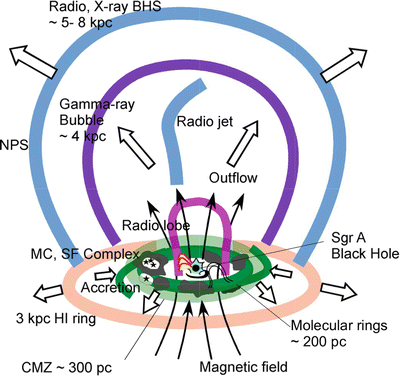
If they are from accretion disks then it would make sense. The average velocity of matter in the milky way is rotational, so most black holes should also have rotating dragged frames in the galactic plane as matter from different altitudes are accreted.
There is ample evidence contradicting the idea that the poles of pulsars are aligned with galactic north-south.
Indeed, our own solar system is not aligned with galactic north-south,
https://commons.wikimedia.org/wiki/File:Motion_of_Sun,_Earth...
and that is hardly unusual or unexpected:
http://curious.astro.cornell.edu/about-us/159-our-solar-syst...
And while we don't have many galactic black hole candidates, the ones we have and can see beaming are haphazardly oriented, and there's no reason why black holes should behave differently from their progenitor stars (oriented haphazardly) or other compact objects (the pulsars mentioned above).
Indeed, our own solar system is not aligned with galactic north-south,
https://commons.wikimedia.org/wiki/File:Motion_of_Sun,_Earth...
and that is hardly unusual or unexpected:
http://curious.astro.cornell.edu/about-us/159-our-solar-syst...
And while we don't have many galactic black hole candidates, the ones we have and can see beaming are haphazardly oriented, and there's no reason why black holes should behave differently from their progenitor stars (oriented haphazardly) or other compact objects (the pulsars mentioned above).
The mass of the solar system is moving in the plane of the galaxy in a rotational direction. If our solar system was accreted by a black hole the solar system would add to black hole's dragged frame rotational energy in the galactic plane.
What a few puffs of dust that have not reached an energy minimum yet do isn't important.
What a few puffs of dust that have not reached an energy minimum yet do isn't important.
As shown in your reply's parent comment which I made, we are not moving in the plane of the galaxy.
There is further detail from Ethan Siegel here: https://medium.com/starts-with-a-bang/ask-ethan-37-the-earth...
Quoting a tiny fraction that article:
Additionally, amplifying my previous comment, almost no known black hole candidates' equators are aligned with their host galaxies' thin discs, at any redshift.
There is further detail from Ethan Siegel here: https://medium.com/starts-with-a-bang/ask-ethan-37-the-earth...
Quoting a tiny fraction that article:
The Sun appears to move *up-and-down* and in-and-out with respect to the rest of the galaxy as it revolves around the Milky Way.
Additionally, amplifying my previous comment, almost no known black hole candidates' equators are aligned with their host galaxies' thin discs, at any redshift.
You realize that your quote is a lead-in to talk about Earth's procession, yes? You shouldn't suggest that the article is claiming that the Sun's galactic orbit is outside of the galactic plane, because it isn't.
>The Sun is presently located about 25-to-27,000 light years from the galactic center, and makes the shape of a simple ellipse around the galaxy.
>The Sun is presently located about 25-to-27,000 light years from the galactic center, and makes the shape of a simple ellipse around the galaxy.
All this time spent on string theory and we find strands.
"Stretching up to 150 light-years long, the one-dimensional strands (or filaments) are found in pairs and clusters"
This is surely very interesting and raises lots of lovely questions, found in pairs aspect must be indicative of something. Would love to know if the pair's spacing constant. Also, how can they be one-dimensional as my understanding is, we would not be able to measure them far away if that was the case.
"Stretching up to 150 light-years long, the one-dimensional strands (or filaments) are found in pairs and clusters"
This is surely very interesting and raises lots of lovely questions, found in pairs aspect must be indicative of something. Would love to know if the pair's spacing constant. Also, how can they be one-dimensional as my understanding is, we would not be able to measure them far away if that was the case.
All cosmos related reporting must say something like; “these strands indicate the possibility of life on other worlds”.
Galaxy lightning. Or maybe FTL Vapor trails.
Found them missing strings from the strings theory!
Intergalactic chemtrails!
Petrova Lines?
Amazing book
https://www.goodreads.com/book/show/54493401
https://www.goodreads.com/book/show/54493401
I found the concept pretty goofy when I was reading it but then I had to stop and remind myself that not only do I know shockingly little about the universe, our greatest experts do, too.
Whatever fantastical concept we can imagine likely exists in some iteration out there.
Whatever fantastical concept we can imagine likely exists in some iteration out there.
I liked the concept, but the execution was ... lacking. Some aspects like language (hopefully not spoiling too much) seemed to me treated very naively.
I do agree on that, I wasn't a huge fan of the storytelling which did a lot of belabored hand-holding and did indeed feel like an amateur who did just enough research to treat the reader like a naive student.
That's a hard trick to pull, though. How do you tell an expert's tale without a) getting too technical for most or b) getting to ELI5 for the few?
That's a hard trick to pull, though. How do you tell an expert's tale without a) getting too technical for most or b) getting to ELI5 for the few?
Those were spectral lines.
It's the Webway! https://warhammer40k.fandom.com/wiki/Webway
No no, it's clearly the Splitstream - https://andromeda.fandom.com/wiki/Slipstream
Just when you thought the vastness of space could not get any more mind blowing, you learn about filaments and superstructures spanning billions of light years.
https://en.wikipedia.org/wiki/Hercules%E2%80%93Corona_Boreal...
This one measures 10 billion light years. Now recall that 1 light year is about 10 trillion kilometers... tick, tick, tick, boom! Mind blown again.
https://en.wikipedia.org/wiki/Hercules%E2%80%93Corona_Boreal...
This one measures 10 billion light years. Now recall that 1 light year is about 10 trillion kilometers... tick, tick, tick, boom! Mind blown again.
Thats totally ungraspable for human brains, mind blowing!
Thats 10^23 kilometers, the same order of magnitude as the avogardo constant, means e.g. 14 gramms of carbon correspond to about 6.22 * 10^23 atoms of carbon, its the same magnitude to some of the larger smallest things...
You can a bit actually by scaling down everything.
Imagine earth is the size of a grain of sand. Nearest star would beat approximately 4000km away. Light would travel at 0.3m/sec.
Moon is only 4mm away. The sun only 16 meters.
and how long is this strand in question?
In this model, the sun is 16 metres away and is 8 light minutes in real money.
The strands from the article are 150 light years which is seventy eight million, eight hundred and ninety four thousand light minutes (78894000lm) or nine million, eight hundred and sixty one thousand, seven hundred and fifty times the distance of the sun (9861750x) which gives us 16mx9861750 or one hundred and fifty seven thousand, seven hundred and eighty eight km (157788km). About 40% of the way to the (real) moon.
If you mean the Hercules Great Wall, 10 billion light years is five quadrillion, two hundred and fifty nine trillion, six hundred billion light minutes (5259600000000000lm) which gives us six hundred and fifty seven trillion, four hundred and fifty billion (657450000000000x) times the distance to the sun which would be ten trillion, five hundred and nineteen billion, two hundred and million km (10519200000000km). Or "quite big".
The strands from the article are 150 light years which is seventy eight million, eight hundred and ninety four thousand light minutes (78894000lm) or nine million, eight hundred and sixty one thousand, seven hundred and fifty times the distance of the sun (9861750x) which gives us 16mx9861750 or one hundred and fifty seven thousand, seven hundred and eighty eight km (157788km). About 40% of the way to the (real) moon.
If you mean the Hercules Great Wall, 10 billion light years is five quadrillion, two hundred and fifty nine trillion, six hundred billion light minutes (5259600000000000lm) which gives us six hundred and fifty seven trillion, four hundred and fifty billion (657450000000000x) times the distance to the sun which would be ten trillion, five hundred and nineteen billion, two hundred and million km (10519200000000km). Or "quite big".
Love it, thanks. Turns out it isn't actually very realistic to approximate the Hercules Great Wall. Astonishing
I think you're missing a zero and must mean 0.03 m/s for light. Otherwise, your other distances have the wrong order of magnitude in terms of light-seconds.
Even 0.003 m/s, since the moon is about one light secon away.
To stay at the scale of our galaxy:
> Filaments within clusters are separated from one another at perfectly equal distances — about the distance from Earth to the sun.
Does that mean that they are able to distinguish individual filaments that are "only" 1 AU apart, but ~ 25 000 light years (~1 600 000 000 AU) away from us? Because that would also be damn impressive!
> Filaments within clusters are separated from one another at perfectly equal distances — about the distance from Earth to the sun.
Does that mean that they are able to distinguish individual filaments that are "only" 1 AU apart, but ~ 25 000 light years (~1 600 000 000 AU) away from us? Because that would also be damn impressive!
The angular separation would be only 0.00013 arcseconds, so very impressive indeed. Hubble has an angular resolution of around 0.05 arcseconds in comparison. Radio telescopes can get better angular resolution than that using interferometry between distantly separated telescopes. Perhaps that's how they can do it.
The reported angular resolution (in the main paper: https://arxiv.org/abs/2201.10541) is 4 arcseconds. This is radio interferometry, which makes for better resolution, but it’s at a very low frequency (centered around 1.28 GHz = about 23 cm), which makes for worse resolution.
I think they messed up. I quickly scanned and couldn't find any reference to what they are talking about in the paper, but if you look at the resolutions involved it's much more likely they are talking about parsecs, which is defined as 'the distance from the sun at which 1 AU subtends a distance of 1 arcsecond' or a little over 3 light years.
Paper is here - https://arxiv.org/pdf/2201.10541.pdf
(Edit:Yes take a look at the images and scale bars on page 14)
Paper is here - https://arxiv.org/pdf/2201.10541.pdf
(Edit:Yes take a look at the images and scale bars on page 14)
This video on the Great Attractor, which is pulling our galaxy towards it, gives a nice overview of superstructures: https://youtu.be/0w4OTD4L0GQ
See this excellent video on the scale of the cosmos: https://youtu.be/4iC9Qi3y9q8
And this one on how the universe would meet its fate at the hands of Dark Energy: https://youtu.be/fdFf5PRPE9g
This one on the emptiness of the universe is quite fascinating as well: https://youtu.be/BCjWmfWq0pU
See this excellent video on the scale of the cosmos: https://youtu.be/4iC9Qi3y9q8
And this one on how the universe would meet its fate at the hands of Dark Energy: https://youtu.be/fdFf5PRPE9g
This one on the emptiness of the universe is quite fascinating as well: https://youtu.be/BCjWmfWq0pU
Thanks so much for these links.
Just watched the first one and it was great.
Looking forward to the rest.
Just watched the first one and it was great.
Looking forward to the rest.
I like these two from the authors of the Laniakea super cluster paper in 2014
Nature: https://youtu.be/rENyyRwxpHo
Contributing Author: https://youtu.be/Ayj4p3WFxGk
Nature: https://youtu.be/rENyyRwxpHo
Contributing Author: https://youtu.be/Ayj4p3WFxGk
Here's another fun one - a time lapse of the universe: https://www.youtube.com/watch?v=uD4izuDMUQA
Basically suggesting that if our universe was a human life, we'd still be in the hospital right after birth. So much time left to go.
Basically suggesting that if our universe was a human life, we'd still be in the hospital right after birth. So much time left to go.
I recall feeling a lot of existential dread when reading https://en.wikipedia.org/wiki/Timeline_of_the_far_future ... and this video just dug all that up again :)
Thanks for these links. TIL about this YT channel, and I was impressed with the quality.
Is there a book which describes and explains all such things in detail for common public?
Stephen Hawking's A Brief History of Time comes to mind: https://wiki2.org/en/A_Brief_History_of_Time
I wanted to see this written out so here goes:
1,000,000,000,000
x 10,000,000,000
-----------------------
10,000,000,000,000,000,000,000
Or
10 ** 22
Aka Ten Sextillion
1,000,000,000,000
x 10,000,000,000
-----------------------
10,000,000,000,000,000,000,000
Or
10 ** 22
Aka Ten Sextillion
Or one could say the speed of light is pretty slow on the cosmic scale
[deleted]
We need warp drive technology ASAP so we can go see what these things taste like.
Most likely they taste like chicken.
Perhaps these strings pertain to a warp drive super highway
"And, while Yusef-Zadeh already knew the filaments are magnetized, now he can say magnetic fields are amplified along the filaments, a primary characteristic all the filaments share."
Yup - definitely related to warp drive tech ;)
Yup - definitely related to warp drive tech ;)
You fool! Don't you realize where these filaments come from? There's an old example from a distant galaxy that demonstrates their formation. [1]
[1] https://www.youtube.com/watch?v=s2hM1tyEL0U&t=1m29s
[1] https://www.youtube.com/watch?v=s2hM1tyEL0U&t=1m29s
Better question: will it blend?
When time and space become increasingly intertwined and obscure as we are looking towards big bang, I really think that our perception of "structure" has to be perceived completely differently than we do now.
We witness structure in a 3d space, have to add time to that dimension and yet look onto something back in time, when commonly agreed fixtures like the fine structure constant might have had a different value or not exist at all.
We witness structure in a 3d space, have to add time to that dimension and yet look onto something back in time, when commonly agreed fixtures like the fine structure constant might have had a different value or not exist at all.
A structure that’s 10 billion light years is crazy, given that observable universe Israel itself is 93 billion light years.
What exactly is it?
These numbers do not mean anything. Our mind can naturally process small numbers (units, then "it is a small group", then "it is a big group").
One million, when not attached to something tangible, cannot be processed. A house is one million euros - that I can get. What is one million protons side to side - I have no idea.
Of course, I can calculate that 10^6x10^-15 m is 10^-9 m. Right..
Same goes for scale. If I say - twice the width of a tree you immediately get an idea. Twide the width of a hair - not much. A million times the width of a hair - neither.
So 10^9x10^12x10^3 m = 10^24m, looks it is a lot.
One million, when not attached to something tangible, cannot be processed. A house is one million euros - that I can get. What is one million protons side to side - I have no idea.
Of course, I can calculate that 10^6x10^-15 m is 10^-9 m. Right..
Same goes for scale. If I say - twice the width of a tree you immediately get an idea. Twide the width of a hair - not much. A million times the width of a hair - neither.
So 10^9x10^12x10^3 m = 10^24m, looks it is a lot.
To claim that the fact that (most?) humans' lack of hardware for processing numbers with exceptionally large or small magnitudes is equivalent to the numbers not meaning anything is... odd. Isn't the whole point of learning, curiosity, and even articles like this to assist us in developing our own internal software to increase understanding beyond what our naive hardware can do?
I do not understand.
Do you know how large 50000 bacteria side to side are? I don't. I can compute the number but these are neither scales nor magnitudes I am used to.
300,000 km seems to be large but I do not know how much. About 10 times the perimeter of our planet. But this does not say much either.
But when you say "five people in a room, and then two joined" you have no problems processing the numbers.
Do you know how large 50000 bacteria side to side are? I don't. I can compute the number but these are neither scales nor magnitudes I am used to.
300,000 km seems to be large but I do not know how much. About 10 times the perimeter of our planet. But this does not say much either.
But when you say "five people in a room, and then two joined" you have no problems processing the numbers.
See, e.g., holoduke's comment in this thread. The main tool that I (I'd say "we", but I know that different folks visualize differently) have for understanding the scale of the universe is analogy. It's absolutely non-trivial to understand (grasp / grok / missing English verb) this sort of thing -- but it's absolutely possible to continue to get better at it, and to comprehend more and more as you learn and experience more and more.
An individual person can't point at something they don't comprehend and rightly claim it is meaningless. I'd argue the same is true in the extreme: if something can't be comprehended by _anyone_, that doesn't make it meaningless.
How do people make microchips, without understanding precisely and intimately how physics works at the scale of nanometers? Just because you don't isn't proof that nobody can.
If you like thinking about cosmic scales and deep time, Stephen Baxter's Xeelee Sequence may appeal (try to look past the schlocky name) .
Without too many spoilers, the coarse structure of the universe is imagined to be able to be manipulated into tools and weapons.
Without too many spoilers, the coarse structure of the universe is imagined to be able to be manipulated into tools and weapons.
One of the strands is Puppeteers' planet constellation, which is escaping, because this galaxy is imploding. It takes 10,000 years when we know about it, and then it is too late.
Pretty good desktop background picture I have now.
What are the chances of these being an artifact of the observation equipment?
Just like you can have all kinds of optical aberrations, does the same go for radio based observations?
For instance, isn't it odd that most of them happen to lie in the vertical direction of this particular observatory across many lightyears of distance?
Just like you can have all kinds of optical aberrations, does the same go for radio based observations?
For instance, isn't it odd that most of them happen to lie in the vertical direction of this particular observatory across many lightyears of distance?
I'd love to read more about this, in all aspects of astrophysics!
It's not that I doubt that astrophysicists take this into account, I'm sure they do! But when we see an "image of a black hole", that's really a gazillion data points from a multitude of different observatories, processed by human made algorithms with human made models and biases, and it happens to look just like we expected - how do we know it's not just our assumptions that made it into the processing and modelling?
Again, I'm sure every astrophysicist ever has thought about this and knows how it's handled, so it's not a criticism. I'd just love to read more about it, as a layperson :)
It's not that I doubt that astrophysicists take this into account, I'm sure they do! But when we see an "image of a black hole", that's really a gazillion data points from a multitude of different observatories, processed by human made algorithms with human made models and biases, and it happens to look just like we expected - how do we know it's not just our assumptions that made it into the processing and modelling?
Again, I'm sure every astrophysicist ever has thought about this and knows how it's handled, so it's not a criticism. I'd just love to read more about it, as a layperson :)
(not an expert in this, just a fan) Always a possibility and RF is generally more prone than visible light to artifacts, in part because its much harder to eliminate from the environment.
However, in this case the brighter filaments have been observed for decades, the wide angle view of this image is from 1989 from the VLA array in New Mexico with some data augmentation from Spitzer space telescope.
https://public.nrao.edu/gallery/the-center-of-our-galaxy-2/
The MeerKAT study just increases the resolution and signal to noise ratio, which has allowed us to see many more of them, but we can see the 'old' ones as well. The emission phenomena is pretty well understood AFAIK, the mystery just being mostly when/why/how they got there.
The other thing to keep in mind is that these filaments are huge in the night sky. The image we see is a mosaic of many observations that spans 3.5 x 2.5 degrees. The moon is ~.5 degrees, or about the same size as that giant bubble on the lower right.
Here's the paper. I just scanned through it and its relatively approachable - https://arxiv.org/pdf/2201.10541.pdf
Edit: Check out the section 'OBSERVATIONS AND DATA PROCESSING'
However, in this case the brighter filaments have been observed for decades, the wide angle view of this image is from 1989 from the VLA array in New Mexico with some data augmentation from Spitzer space telescope.
https://public.nrao.edu/gallery/the-center-of-our-galaxy-2/
The MeerKAT study just increases the resolution and signal to noise ratio, which has allowed us to see many more of them, but we can see the 'old' ones as well. The emission phenomena is pretty well understood AFAIK, the mystery just being mostly when/why/how they got there.
The other thing to keep in mind is that these filaments are huge in the night sky. The image we see is a mosaic of many observations that spans 3.5 x 2.5 degrees. The moon is ~.5 degrees, or about the same size as that giant bubble on the lower right.
Here's the paper. I just scanned through it and its relatively approachable - https://arxiv.org/pdf/2201.10541.pdf
Edit: Check out the section 'OBSERVATIONS AND DATA PROCESSING'
The image is a mosaic of many observations and the “puzzles pieces” line up so to speak. It’s not a single snapshot.
These sorts of images always makes me wonder about how many of the images of the universe we see, are how they look from our perspective, vs how they look from "above" etc.
I suppose this one is from our perspective?
How we know that the arms of the milky way are bent when viewed "from above"? Imagine if they were straight lines when viewed from above. From our perspective, they would appear to be spiraling arms, since the light at the far end of the arm would take longer to reach us.
I'm not doubting astrophysics here, I'm just a layperson that wonders how these things are properly taken into account.
I suppose this one is from our perspective?
How we know that the arms of the milky way are bent when viewed "from above"? Imagine if they were straight lines when viewed from above. From our perspective, they would appear to be spiraling arms, since the light at the far end of the arm would take longer to reach us.
I'm not doubting astrophysics here, I'm just a layperson that wonders how these things are properly taken into account.
I'm guessing, in terms of angle (ie "above" or "our perspective"), this is pretty much what you'd see. We collect data sitting here on planet earth, so more or less, everything we see is from the same vantage point in the universe. The overall size and shape of things can be calculated by relative motion of objects in space. We also can make educated guesses about the shape of our own galaxy by observing others from the outside.
One day humanity will gain the ability to simulate these filaments as viewed from directly top-down and discover that the lines converge to spell out TEXT GALAXY PLEASE IGNORE.
Looks like DNA strands. We're part of a big cell ...
It’s the second trisolarian fleet! (Three body problems books. Highly recommended)
I wonder if they are the signal of smaller spinning black holes that have been whipped by larger ones to near the speed of light such that the Hawking radiation is magnetic in nature due to spin.
> Stretching up to 150 light years long, the one-dimensional strands (or filaments) are found in pairs and clusters, often stacked equally spaced, side by side like strings on a harp.
Are they really one-dimensional or is it just relative to their 150 LY length?
Are they really one-dimensional or is it just relative to their 150 LY length?
Why does northwestern have a press release on a result they were not involved with? The new measurement was by South African and European scientists.
What a sad bunch of derivative scientific clout chasers.
What a sad bunch of derivative scientific clout chasers.
Odds these structures can help explain away dark matter?
we perhaps live inside an atom that lives inside an atom that lives inside an atom that lives inside and atom that lives inside an atom
everything is a matter of point of view and perspective
everything is a matter of point of view and perspective
While not directly related to these magnetic strands, but regarding superstructure, compare with the latest 2.1 trillion body simulation of a universe formation, mapped as well as possible to the observed universe properties:
https://youtu.be/R7nV6JEMGAo
described at http://skiesanduniverses.org/Simulations/Uchuu/
That's another kind of superstructure, the dark-matter-guided scaffold of galaxy formation in the observable universe volume.
https://youtu.be/R7nV6JEMGAo
described at http://skiesanduniverses.org/Simulations/Uchuu/
That's another kind of superstructure, the dark-matter-guided scaffold of galaxy formation in the observable universe volume.
Are they transwarp conduits?
I don't see any reference to strands in any other galaxy. Are these strands too faint to be detected if they were present in Andromeda or any other galaxy?
"Didn't know to look for them; will look for them now", essentially.
Whether it's easy to resolve them (or rule them out, if not resolved) in M31 is a good question for radioastronomers.
However, from a broad Copernican Principle perspective, it would be very strange if they were in our galaxy but not M31 or other spiral galaxies.
Whether it's easy to resolve them (or rule them out, if not resolved) in M31 is a good question for radioastronomers.
However, from a broad Copernican Principle perspective, it would be very strange if they were in our galaxy but not M31 or other spiral galaxies.
https://www.flickr.com/photos/astro_jcm/51847931721