How to Turn an IKEA Coffee Table into a DIY Server Rack(wiki.eth0.nl)
wiki.eth0.nl
How to Turn an IKEA Coffee Table into a DIY Server Rack
https://wiki.eth0.nl/index.php/LackRack
205 comments
Also don't forget there are more IKEA things that can host computers. I used a Kallax shelf for a beautiful home server.
https://blog.haschek.at/2014/07/ikea-server-rack-nope-not-th...
https://blog.haschek.at/2014/07/ikea-server-rack-nope-not-th...
Wow, aren’t you scared of accidents when refilling the water?
I personally never had a water/coffee accident, but Louis Rossmann’s YouTube channel is full of laptop board repair videos due to water damage.
I personally never had a water/coffee accident, but Louis Rossmann’s YouTube channel is full of laptop board repair videos due to water damage.
I am sure everyone who saw that picture immediately thought of natural selection.
Had it for 7 years, never had a spill. Now I do have a proper rack for all my servers
Fair play. I'd have been too nervous to ever get a coffee.
But what a great way to beat the coffee addiction!
Their HEJNE shelves are particularly good if you have longer rackmount gear.
https://www.klos.com/~john/hejne.jpg
https://www.klos.com/~john/hejne.jpg
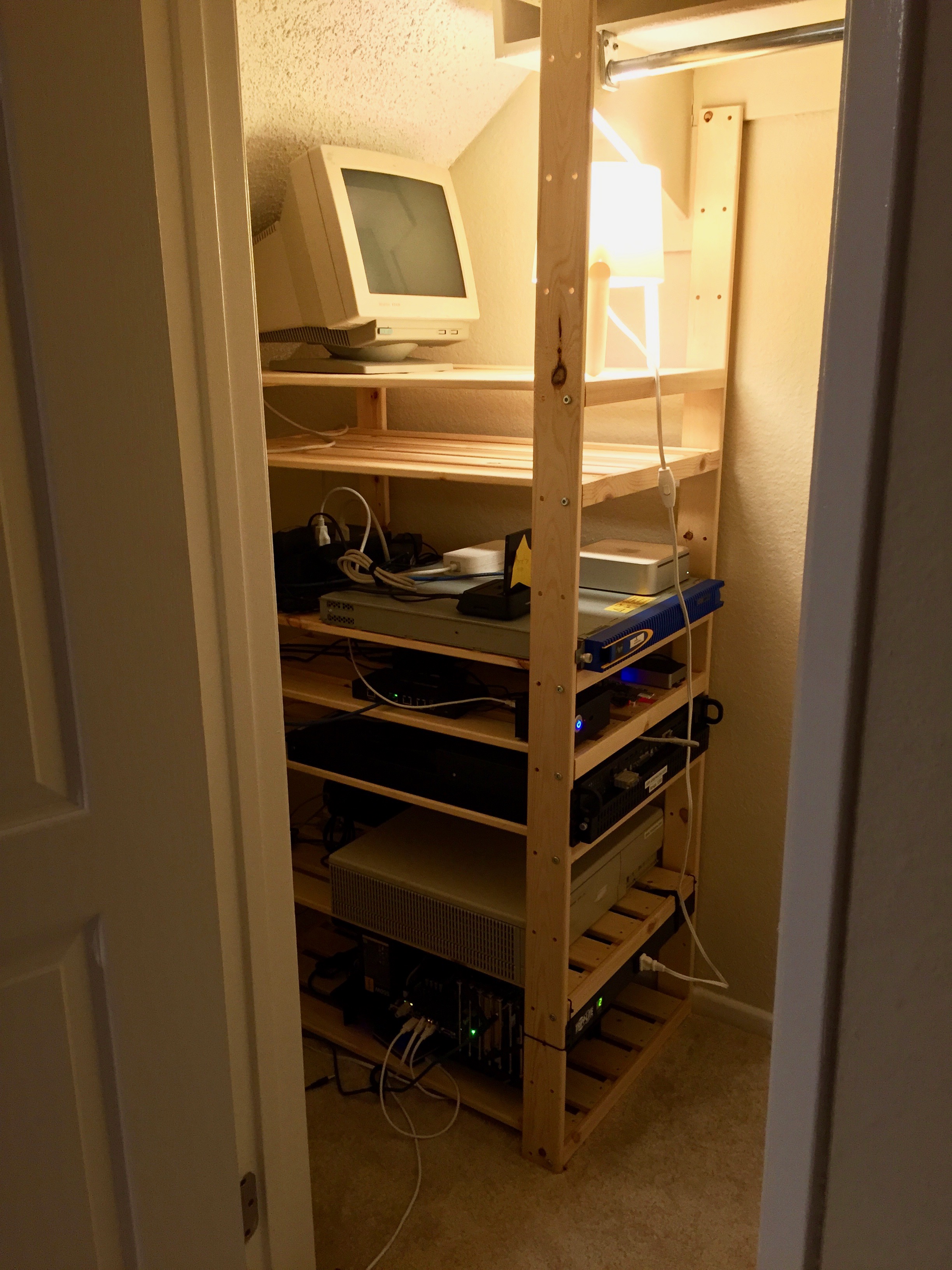
“enter image description here”
I have the same mug from McDonalds.
LACK tables are also popular in the 3D printing community as well for enclosures:
https://all3dp.com/2/ikea-3d-printer-enclosure-tutorial/
https://all3dp.com/2/ikea-3d-printer-enclosure-tutorial/
[deleted]
I used to desire putting rack mounted equipment in my homelab and actually filled a lackrack with decommissioned servers and switches but quickly found that rackmounted equipment tends to have loud, high speed fans which are quite unpleasant to spend any time with.
I have a 14U rack next to my desk.
It's doable, but you need to spend time to optimize the noise factor:
- If you need many cores but can live with lower clock speeds, you can underclock.
- 1U servers will be noisy no matter what. 2U is already more manageable. 4Us are the best.
- GPUs will be noisy, no real solution around that. High heat production, and they hinder the air flow, so the front fans will have to spin faster. I physically remove GPUs from chassis when I'm not actively using them.
- There are small-size soundproof server cabinets that can easily solve this problem. They're very expensive though.
- Depending on the server, you can directly control fan speed at the firmware level. This needs careful control if you don't want to destroy your hardware and/or burn down your place.
- The pandemic makes all this much harder. I used to keep things running lightly during the night and full blast during the day when everyone was out of the house. I saved tons of money, compared to what I would have paid on any cloud platform. Now that we're home 24/7 it's not so worth it anymore.
Also this is all worth it if you actually enjoy playing with the hardware, in that case the money you put into this brings you both fun and cheap compute. If the setup is a chore for you, don't do it, it probably won't be worth your hourly rate.
Fun fact: the noise/space/aesthetics factors are referred to in the community as the "WAF" - Wife Acceptance Factor ;-)
It's doable, but you need to spend time to optimize the noise factor:
- If you need many cores but can live with lower clock speeds, you can underclock.
- 1U servers will be noisy no matter what. 2U is already more manageable. 4Us are the best.
- GPUs will be noisy, no real solution around that. High heat production, and they hinder the air flow, so the front fans will have to spin faster. I physically remove GPUs from chassis when I'm not actively using them.
- There are small-size soundproof server cabinets that can easily solve this problem. They're very expensive though.
- Depending on the server, you can directly control fan speed at the firmware level. This needs careful control if you don't want to destroy your hardware and/or burn down your place.
- The pandemic makes all this much harder. I used to keep things running lightly during the night and full blast during the day when everyone was out of the house. I saved tons of money, compared to what I would have paid on any cloud platform. Now that we're home 24/7 it's not so worth it anymore.
Also this is all worth it if you actually enjoy playing with the hardware, in that case the money you put into this brings you both fun and cheap compute. If the setup is a chore for you, don't do it, it probably won't be worth your hourly rate.
Fun fact: the noise/space/aesthetics factors are referred to in the community as the "WAF" - Wife Acceptance Factor ;-)
>Fun fact: the noise/space/aesthetics factors are referred to in the community as the "WAF" - Wife Acceptance Factor ;-)
I work in Aerospace so I spend entirely too much time around pilots, amongst whom it's a common thing to refer to Wife Acceptance as Tower Clearance. E.g.:
>I'm thinking about getting one of those big green eggs
>Nice. Do you think Tower will let you?
>I won't let her see it until it's too late
Etc
I work in Aerospace so I spend entirely too much time around pilots, amongst whom it's a common thing to refer to Wife Acceptance as Tower Clearance. E.g.:
>I'm thinking about getting one of those big green eggs
>Nice. Do you think Tower will let you?
>I won't let her see it until it's too late
Etc
You must acquire a HP Z series Z620 machine for your server needs. Potentially also the Z840 and newer versions Z series (must verify noise emissions from all subsequent models above Z620). I have had a huge success with my Z620. Considering expanding to buy more nodes. It has a very low accoustic footprint. My girlfriend instantly approved :)
edit: yes, get the version with the Xeon E5 series. Preferably already with the double CPU configuration.
edit2: yes, and also don't get the first version that has Xeon X-series. It will not perform well enough for semi-modern homelab workloads.
edit: yes, get the version with the Xeon E5 series. Preferably already with the double CPU configuration.
edit2: yes, and also don't get the first version that has Xeon X-series. It will not perform well enough for semi-modern homelab workloads.
There are at least 2 generations of the motherboard, make sure you get the second (z620). Also if it still has the original workstation Nvidia card, toss it and replace it. Pissed off the cat that settles on top of the machine since it was no longer so warm, but definitely cheaper to run and the new cheap card is faster too.
Just to back this up, the HP z series is rack mountable, but also stackable.
They can be used for structural purposes as well, its perfectly possible to make a sturdy set of bookshelves with 4x z620s and 4 scaffold planks.
They can be used for structural purposes as well, its perfectly possible to make a sturdy set of bookshelves with 4x z620s and 4 scaffold planks.
> "WAF" - Wife Acceptance Factor ;-)
You made my day! That's the primarily limiting factor in my "bedroom datacenter" expansion :D
You made my day! That's the primarily limiting factor in my "bedroom datacenter" expansion :D
Honestly it’s a brilliant term. I’ve seen it in the Audiophile, DIY Audio, and Synthesizer communities as well.
While WAF capacity tends to be fairly constant over time, careful strategic planning can ensure sufficient WAF capacity to avoid significant restrictions on side project activity.
While WAF capacity tends to be fairly constant over time, careful strategic planning can ensure sufficient WAF capacity to avoid significant restrictions on side project activity.
Threadripper and 10 SSD RAID array, everything liquid cooled with one large slow fan. Throw in some LED edge RAM
You can always water-cool the GPU, with big radiators. I have no idea about how to do it in 4U, I personally just use off the shelf consumer hardware (mini-ITX, small PSUs, short GPU, etc.) and 3D print the cases. ~10 cm height is perfectly achievable with custom cases and PCI riser cables.
There are no riser cables that are stable for PCI-Ev4.
LINKUP sells them - I have 7 for a home server. Up to 50cm for v4 and I have a couple v3 because they go up to 1 meter.
https://www.amazon.com/gp/product/B0898QMCLS
https://www.amazon.com/gp/product/B0898QMCLS
I’ve never heard of this. Can you explain why?
(I don’t use riser cables FWIW)
(I don’t use riser cables FWIW)
> There are small-size soundproof server cabinets that can easily solve this problem.
I would have thought anything that restricts sound would also impede air flow.
I would have thought anything that restricts sound would also impede air flow.
See eg this demo: https://youtu.be/NfTP3yhTybc?t=150
I could never afford one (they're also super heavy so you have to be careful your floor can take it) but I assume the idea is to replace the airflow noise of many small fans with a few much larger ones.
I could never afford one (they're also super heavy so you have to be careful your floor can take it) but I assume the idea is to replace the airflow noise of many small fans with a few much larger ones.
I’m a proponent of using Intel NUCs as headless servers. I’d be happier if the psu brick was incorporated and there was another nic, but they quiet, small and powerful in the NUC8 and NUC10 flavours. They can fit 2 drives when in the larger sized case, and so a NAS or similar is probably needed.
They can be stacked, are readily available and seem very reliable.
They can be stacked, are readily available and seem very reliable.
To scale, I prefer tablets with a wwan port and a shattered screen: on ebay, for less than $100 each, I can fit 2x m2 NVMe (one 2242 in the wwan port), they are small, and each come with their own UPS (battery) and standardized power connector (USB-c) while supporting KVM (AMT if you know which models to buy)
Nice. What are you running on them?
ESXi runs nicely on a Nuc, and it’ll do a load of VMs with plenty of resources (the Nucs will take 64gb). But the price for that is probably 5-10x what you are describing.
ESXi runs nicely on a Nuc, and it’ll do a load of VMs with plenty of resources (the Nucs will take 64gb). But the price for that is probably 5-10x what you are describing.
> the price for that is probably 5-10x what you are describing.
Indeed the reason why I do what I do!
I can have 10x of them for the cost of 1 of your Nucs.
For example, my latest purchase was $15 per tablet with 8Gb of RAM, delivered. Add 2x brand new M2 2230 drives which cost about $20 apiece, and each node costs about $55.
> What are you running on them?
Sharded databases and Ceph clusters mostly. Each shard uses very little power (and does not run hot) but has 2x nvme in mirror. With raid10 f2 on linux or zfs mirror on bsd you gain in read speed on top of the raid1 safety.
Sometimes I add USB external storage: tablets often have 2 USBC ports, so $100 gives an extra 8Tb for warm storage. For HDD, USBC is not a restricting factor anymore.
Now I am trying VMs: with a dedicated NVMe, IO performance is good, but there is not enough RAM yet. When 16Gb becomes the new normal, that will be much easier.
Indeed the reason why I do what I do!
I can have 10x of them for the cost of 1 of your Nucs.
For example, my latest purchase was $15 per tablet with 8Gb of RAM, delivered. Add 2x brand new M2 2230 drives which cost about $20 apiece, and each node costs about $55.
> What are you running on them?
Sharded databases and Ceph clusters mostly. Each shard uses very little power (and does not run hot) but has 2x nvme in mirror. With raid10 f2 on linux or zfs mirror on bsd you gain in read speed on top of the raid1 safety.
Sometimes I add USB external storage: tablets often have 2 USBC ports, so $100 gives an extra 8Tb for warm storage. For HDD, USBC is not a restricting factor anymore.
Now I am trying VMs: with a dedicated NVMe, IO performance is good, but there is not enough RAM yet. When 16Gb becomes the new normal, that will be much easier.
My home server for years was various laptops with busted screens :) ran quiet, low power usage, but with more than enough compute for my usage!
I’ve lately moved to a second hand Dell SFF office PC, as it gave me more expansion and even faster compute. Sits next to the router in the lounge, the girlfriend forgets it’s even there!
I’ve lately moved to a second hand Dell SFF office PC, as it gave me more expansion and even faster compute. Sits next to the router in the lounge, the girlfriend forgets it’s even there!
I could use a more flexible/scalable term. SOAF (Significant Other Acceptance Factor)? SOA? SOFA? SOC (SO Compliance)?
https://news.ycombinator.com/item?id=25067485
https://news.ycombinator.com/item?id=25067485
I had a colleague back in the very late 90s that lived in a typical British semi-detached house. Under the stairs was a cupboard against the external wall. He decided to make that his server room with a rack and "cheap" second hand kit.
To cool it, he drilled through the external brick wall several times and fitted exhaust fans.
His hall sounded like standing behind a 747.
If it rained, he often ended up tripping the fuses.
</end of anecdote>
To cool it, he drilled through the external brick wall several times and fitted exhaust fans.
His hall sounded like standing behind a 747.
If it rained, he often ended up tripping the fuses.
</end of anecdote>
In our dorm all CS student closets rather resembled server racks. A friend overdid it though as he additionally used 4 workstations as bedposts. In summer he regularly slept in the shared kitchen because in addition to noise the temperature would also be of concern. I don't think the WAF would have been measurable.
Not a full server-rack but had 4 desktops (2-side by side on either side of my small desk) running a variety of stuff in my first two years of university (CS1.6 servers, WoW emu server, network bridge, teamspeak, DC server) - one was my personal computer. In 3rd year it went up to 5 since my room was slightly bigger and my friend would often come play games in my room (he didn't have internet).
Harry Potter and the Chamber of CPUs
I had a roommate who did this. He did computational neuroscience back before gpus were a thing. It was great for heating the house. Terrible for actually being in the house.
Hah. I did computational neuroscience back before GPUs were a thing. It's astounding really. Jobs I ran back in 2005 that I waited days for take, literally, minutes now.
To my surprise, All the Dell servers we have try to keep the noise at a minimum unless they're pushed to their max.
I'm not aware of the any other servers, switches or actively cooled equipment tried to do that.
IBM BladeCenter H is the worst offender: "Is acoustic management enabled? No? OK, everything is at full speed, then".
I'm not aware of the any other servers, switches or actively cooled equipment tried to do that.
IBM BladeCenter H is the worst offender: "Is acoustic management enabled? No? OK, everything is at full speed, then".
I remember going to a Bladecenter demo at an IBM facility when they first came out, and the demonstrator pulled something that triggered the fans to go on HIGH and the way it wound up like a jet engine was so comically loud the entire room of 30 guests all broke out laughing
Here's an idea of what it was like:
https://youtu.be/pS8h8z1c0bI?t=106
Here's an idea of what it was like:
https://youtu.be/pS8h8z1c0bI?t=106
In the video you can hear only one of the two. Other one is connected to other power supply.
We had a lot of them, with full configuration, at full load. Go, figure.
They can generate a lot of heat though.
We had a lot of them, with full configuration, at full load. Go, figure.
They can generate a lot of heat though.
Good lord, must have been like a wind tunnel in the back of the rack!
To be fair, they ARE impressively CPU dense
To be fair, they ARE impressively CPU dense
I think that small businesses and home buyers have begun to make noisier (heh) demands for quieter servers. I assume that a sizable percentage of the 1U market is going to small businesses that don’t want their printer closet sounding like it’s trying to take off.
The more usual small business form factor is less-deep 3-4U cases that can be used as a tower or rackmount (once we go past small NAS boxes). Or shallow 1U with low-power parts for routers/small appliances.
"Proper" 1U servers feel more like a thing for larger places, where density starts to matter more. Not sure why so many comments here focus on 1U.
"Proper" 1U servers feel more like a thing for larger places, where density starts to matter more. Not sure why so many comments here focus on 1U.
Because decommissioned 1U is the cheapest entry into homelabbing (check labgopher)
The usual recommendations are R720 and DL380 though? neither of which are 1U.
R720 and DL380 are old, very ubiquitous servers. They are good workhorses and parts are plenty. Also they're not very closed platforms. They're not very silent though.
However with an iLO or iDRAC license, they're joy to administer and use. They're also very reliable too.
However with an iLO or iDRAC license, they're joy to administer and use. They're also very reliable too.
I think instinctually it feels like 1U is what you should buy if you don’t need top of the line. That was my assumption as a non-hardware guy considering a home rack. I changed my mind once I found out about the noise issue.
[deleted]
You can get many top-of-line servers for various scenarios in 1U configuration. It can be quite packed up to a point (including GPUs).
For home use servers, if you want 1U form factor, you can take a look at Dell's shallow 1U servers. They're pretty modestly powered but small, I think relatively silent and easy to maintain.
Higher end servers have some fun features like advanced BMCs and such, but they come with relevant price tags, power consumption and noise.
You can also look at SME tower servers.
For home use servers, if you want 1U form factor, you can take a look at Dell's shallow 1U servers. They're pretty modestly powered but small, I think relatively silent and easy to maintain.
Higher end servers have some fun features like advanced BMCs and such, but they come with relevant price tags, power consumption and noise.
You can also look at SME tower servers.
Recent HP servers do the same, and are actually quieter in my experience.
But yeah as soon as you put an unsupported HDD or extension card in there, it'll assume the worst and spin everything full blast.
But yeah as soon as you put an unsupported HDD or extension card in there, it'll assume the worst and spin everything full blast.
Trying to keep the noise is at minimum is a noble thing to pursue I think. Otherwise it's deafening when it's working in the system room.
In an HPC environment that doesn't matter much, anyway. Heh.
In an HPC environment that doesn't matter much, anyway. Heh.
[deleted]
Less fan noise is less airflow, which means less cold-side air wasted.
I thought fan noise was also affected by the fan’s mechanics? Like, the bearings and such? Sure, you’re not going to get the same performance out of a silent fan as a jet engine, but the noise gains (heh) are worth it in most cases.
> I thought fan noise was also affected by the fan’s mechanics?
In a 1U server, you're running 5-7 tandem mounted, counter rotating Delta fans which can spin up to 18KRPM. They're in a confined space, have big cores to drive them and they need to supply a blanket of airflow to get things cool.
Higher efficiency components and a good implicit airflow design affects much more than the fans themselves, since there's not much space to optimize the fan design itself compared to the airflow as a whole inside the server.
Moreover, more intelligent system management solutions with more sensors both inside the chips and on the motherboard allows the BMC to see the whole picture and manage these fans in a more informed manner.
In a 1U server, you're running 5-7 tandem mounted, counter rotating Delta fans which can spin up to 18KRPM. They're in a confined space, have big cores to drive them and they need to supply a blanket of airflow to get things cool.
Higher efficiency components and a good implicit airflow design affects much more than the fans themselves, since there's not much space to optimize the fan design itself compared to the airflow as a whole inside the server.
Moreover, more intelligent system management solutions with more sensors both inside the chips and on the motherboard allows the BMC to see the whole picture and manage these fans in a more informed manner.
With the likes of AMD Threadripper around now, I guess there is even less reason now to have a home rack - a single Threadripper in a standard tower case likely has more compute capability than most home racks from just a few years ago.
The main reason now is cost, however it's hard to hit the sweet spot between initial investment and on going electricity costs.
About 10 years ago I tried to built my own rack in the basement so noise was not the issue but power consumption was the issue. After connecting a few Cisco switches on my UPS I realized that each one was consuming at least 60-80W being idle which would sum up to a considerable amount of money running 24/7 together with the rest of my planned to be equipment. As I was only going to run this setup for the fun of it, after a couple of months I decided to give the majority of the network hardware away and use gns3 for the limited work I wanted to do
Mikrotik sells an amazing line of high-speed low power switches, but most of the server gear still draws a lot of wattage.
In the late ‘90s I had an internship at IBM. Sometimes you’d need to go into the server room to do your work and I remember the white noise from all the fans in there being perfect for falling asleep to. Granted, that wasn’t the goal, but if you went in there in the afternoon to get work done, it took all of your willpower to not fall asleep at a terminal.
Likewise. I did one at Hursley in 2000 and had to go down there when one of the Linux boxes would freeze up during performance testing and would need a physical reboot. So loud down in that basement.
I did something similar with an old server a friend of mine acquired from a internet company that had gone out of business.
I remember taking out ALL of the fans AND trying to put it under an arm chair and it was still the loudest thing in my apartment. Needless to say, I got rid of it not long after that.
I remember taking out ALL of the fans AND trying to put it under an arm chair and it was still the loudest thing in my apartment. Needless to say, I got rid of it not long after that.
what about upgrading fans to silent fans? Has anyone tried noctua fans?
This is a typical 1U server fan. https://youtu.be/YrU1D4bgn78
There's not a lot of space left in a 1U server, and to get the right airflow, the airspeed has to be much much higher as what you'd get in a normal ATX case.
Can you replace it with quieter small fans, while maintaining good airflow? Sure sometimes. Is it ever going to be "quiet"? Not a chance.
There's not a lot of space left in a 1U server, and to get the right airflow, the airspeed has to be much much higher as what you'd get in a normal ATX case.
Can you replace it with quieter small fans, while maintaining good airflow? Sure sometimes. Is it ever going to be "quiet"? Not a chance.
Of course 1U servers are the most extreme case. Having rackmount equipment at home is fine if you can put it out of the way and pay a bit of attention to what you buy - i.e. a 3U or 4U machine will usually have much more normal fans you can swap to quiet ones. Some people also swap fans on 1U switches.
Pro-tip: removing the fans from switches make them much quieter!
More seriously: most switches will survive fine without fans if you don't use them too intensely (see eg https://www.reddit.com/r/Cisco/comments/3iu57s/home_lab_swit...)
More seriously: most switches will survive fine without fans if you don't use them too intensely (see eg https://www.reddit.com/r/Cisco/comments/3iu57s/home_lab_swit...)
Contrary to what some sibling comments suggest, I am currently using an older HPE-2530-48G-PoEP switch with the 3 builtin fans swapped for Noctua nf-a4x20-pwm (installation went very smoothly). They are actually less audible than the disks of my NAS next to it. Admittedly, I am only using about third to half the ports and the load is only moderate most of the times but this setup has been working flawlessly for over a year now.
I guess it depends on your workload and the specific hardware involved but using server hardware with quiet fans in a living room environment can certainly be achieved.
I guess it depends on your workload and the specific hardware involved but using server hardware with quiet fans in a living room environment can certainly be achieved.
Server fans are like 12V 1A, Noctua don’t make that kind of fans.
Fan diameter actually corresponds to server thickness. 1U use 4cm, 3U and 4U use 8 or 12cm. Power consumption stays the same, which means monsters like 1U Xeons come with like horizontal 8-unit array of a pair of contra-rotating 4cm 12V/0.5A(12V x 0.5A x 2 in series = 12W per unit) fans.
Noctua don’t make that kind of jet engines.
Fan diameter actually corresponds to server thickness. 1U use 4cm, 3U and 4U use 8 or 12cm. Power consumption stays the same, which means monsters like 1U Xeons come with like horizontal 8-unit array of a pair of contra-rotating 4cm 12V/0.5A(12V x 0.5A x 2 in series = 12W per unit) fans.
Noctua don’t make that kind of jet engines.
The fan will be more expensive than the one it is cooling and it wont make much difference in sound and it might even overheat because the silent fan run slower less air flow.
Aren't Noctua fans quite large, like 12cm in diameter? In a 1U chassis, your fan can only be around 4cm in diameter, because they have to be mounted at the back. You can't mount them horizontally, because of course rack units are meant to be stacked close together.
Not sure how relevant my case is for the discussion because I have a dual socket Xeon workstation in a tower case. I built my rig with the big noctua coolers with brown fans. They are super quiet and highly recommend them.
There aren't any silent server fans. They're small high speed ones (they have to be because of the height restriction) so there's no way you can put a large low speed fan in like you can with a desktop. Plus servers run hotter precisely because they can have loud fans with lots of airflow.
Doesn't work; the 1U fans are a different format, than any noctua I was able to locate. Regardless I tried putting noctua in a 1U rack, ended up with horrible hack like this: https://petermolnar.net/article/home-server-downsizing/inwin...

Servers are optimized for small size. If the rental space cost is not the biggest cost you can build a quiet server that also performs better! eg. something like a noctua nh on the cpu.
Old hardware yes, newer generations are quite quiet when not under high load. But people buy old hardware and then find out the hard way...
Unfortunately true. I stuck a water cooling system in my home lab machines. Not plug and play as many components expect airflow anyway...
On decommissioned servers, if there is no variable speed control you can solder resistors to the fans and just monitor temps.
Fans are a solvable problem: just put a few walls and/or ceilings between you and them. What is not solvable is the power consumption. I got a secondhand server about 10 years ago, placed it in a cellar, played with it for a few months - and then I realized my electricity bill had gone up by 30%.
The hardware is probably much better now, if one pays attention, but still, it's a big gotcha.
The hardware is probably much better now, if one pays attention, but still, it's a big gotcha.
This. You don't want to keep that stuff around you. It should be locked up in a server room or at least a closet.
And a well ventilated closet at that.
Indeed. My rule of thumb is, if you can grow weed in your closet, then it's a good closet for servers.
And how do you know if you can grow weed in your closet?
Well, if you can put a few servers in there, you’re good!
Well, if you can put a few servers in there, you’re good!
Can you explain that? I’m not understanding the connection?
You need good ventillation in a closet for both activities.
The opposite of turning an Ikea coffee table into a server rack has to be turning an Apple Xserve into a coffee table:
https://www.reddit.com/r/homelab/comments/kig3gw/do_coffee_t...
https://imgur.com/a/6TLqWks
https://www.reddit.com/r/homelab/comments/kig3gw/do_coffee_t...
https://imgur.com/a/6TLqWks
That's cool! I'm using a cheesegrater Mac Pro as a night stand:
https://i.imgur.com/qZW9nkN.jpg
https://i.imgur.com/qZW9nkN.jpg

Using drive trays as drawers shows class, but putting a computer in a glass box is too easy.
On the other hand, there are computers with a form factor that allows direct reuse as a table or sideboard, like the Connection Machine CM2 (smaller than it looks in most photographs) or the less curvy SGI Onyx and Onyx2 models (the perfect size for bedside use).
On the other hand, there are computers with a form factor that allows direct reuse as a table or sideboard, like the Connection Machine CM2 (smaller than it looks in most photographs) or the less curvy SGI Onyx and Onyx2 models (the perfect size for bedside use).
This is an older picture of my 'Lack Rack' setup:
https://louwrentius.com/static/images/lackrack01.jpg
https://louwrentius.com/static/images/lackrack02.jpg
I recently discovered that a single Lack table is only rated for 20 Kg or so, which I'm violating quite a bit.
It's still standing ...
---------------------------------------------------------
Also about noise of 19" gear: yes this is a real problem, this is why I would recommend not to go for any 1u servers, as they use tiny fans (as mentioned in other threads here) and they are extremely loud and annoying.
I also have an HP DL380 Gen8 (2U server, not in the picture) and you need a special room for that with the door closed.
The large NAS server that is pictured is actually 4U and uses very large fans, that are temperature controlled. This box is very silent. This is a custom build not an off-the-shelf server.
https://github.com/louwrentius/storagefancontrol
There is a whole 'cottage industry' of people modding/hacking their COTS server (HP/Dell) to make them more silent, but that's another effort, so:
"bezint eer gij begint" (Dutch)
Or: really consider your options and consequences before buying a rack server...
https://louwrentius.com/static/images/lackrack01.jpg
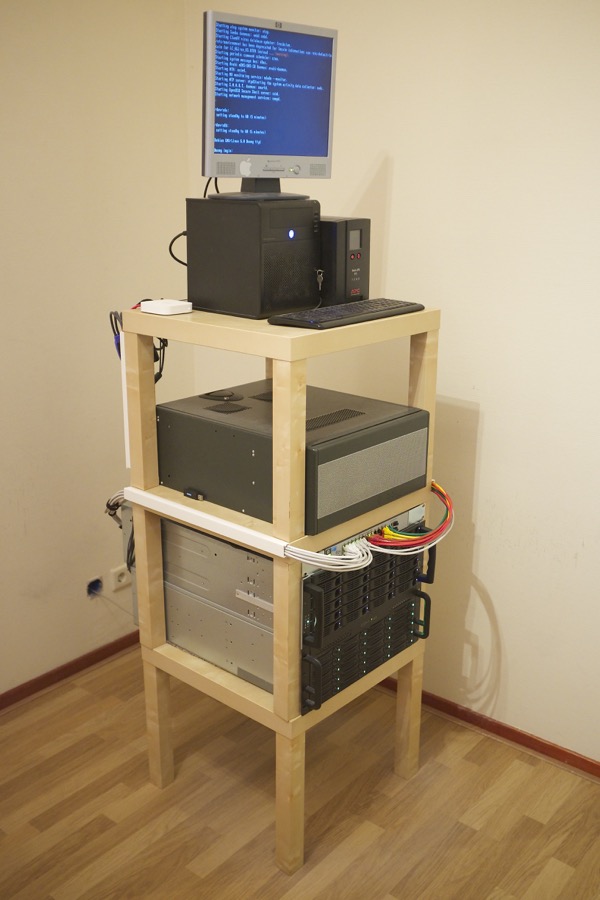
https://louwrentius.com/static/images/lackrack02.jpg

I recently discovered that a single Lack table is only rated for 20 Kg or so, which I'm violating quite a bit.
It's still standing ...
---------------------------------------------------------
Also about noise of 19" gear: yes this is a real problem, this is why I would recommend not to go for any 1u servers, as they use tiny fans (as mentioned in other threads here) and they are extremely loud and annoying.
I also have an HP DL380 Gen8 (2U server, not in the picture) and you need a special room for that with the door closed.
The large NAS server that is pictured is actually 4U and uses very large fans, that are temperature controlled. This box is very silent. This is a custom build not an off-the-shelf server.
https://github.com/louwrentius/storagefancontrol
There is a whole 'cottage industry' of people modding/hacking their COTS server (HP/Dell) to make them more silent, but that's another effort, so:
"bezint eer gij begint" (Dutch)
Or: really consider your options and consequences before buying a rack server...
I've been monitoring how much it costs to run an hp i5 6th gen desktop 24/7 over the last few weeks. I use it as my main server. The electricity cost is coming in at about £2.50 per month (idles just under 20w).
An old hp dual core duo box is coming in at about £3.50 per month.
I'm sticking with SSDs as metal disks burn about 5w per disk. My monitor on standby burns about 10w, so it is being powered off.
I thought if you were reading about modding a desk you may find this interesting :-)
An old hp dual core duo box is coming in at about £3.50 per month.
I'm sticking with SSDs as metal disks burn about 5w per disk. My monitor on standby burns about 10w, so it is being powered off.
I thought if you were reading about modding a desk you may find this interesting :-)
I run a custom 4U server with consumer hardware (older Ryzen) and 2 network switches, ATT Fiber Box, 1U Mikrotik Router and various accessories at ~100Wh, so ~$9/month. I am surprised how energy efficient this stuff has gotten - I do recall running a much smaller setup not too long ago that cost me a whole lot more.
Agreed. I used to build servers and put them in datacentres. It was amazing seeing how the specs went up and power usage went down through the years. I recollect new HP Gen9 Dl360s idling at about 200w.
Years ago I turned a decommissioned server into my desktop (when 4gb was a lot of memory). Worked fine, but when I switched to a laptop as primary and turned it off I think my power bill dropped by $20-30/month.
If I'd checked the draw earlier I'd have killed it far sooner.
If I'd checked the draw earlier I'd have killed it far sooner.
We built esports broadcast studios and I don't remember exactly why, but the rack we ordered didn't arrive or was damaged, and we needed our stuff to be more organized because it was a mess, just a few RUs, and still. We needed better access, and one of our guys ordered that table and we just screwed the equipment in, was so funny that it fit perfectly, we even canceled the order and just used this solution for like 2 years
The best idea is to turn it upside down, put casters on the bottom through the "top of the table" and then you can load it upwards. You have about 9U of space available but you can line up one table on top of each and connect them.
TL; DR: the LACK ikea table is the exact same size as server racks. You can just stack’em and add rails.
They are also perfect for making an enclosure for the Ender 3 series of 3D printers. I think you need two of them stacked but the price is right and it is a popular solution for when you need to shield your prints from drafts.
http://www.tmproductions.com/projects-blog/2019/11/24/buildi...
http://www.tmproductions.com/projects-blog/2019/11/24/buildi...
That is exactly what made me buy some Lack tables originally (for my Ender 3). I was wondering if it was going to be Lack before I clicked on the main link (regarding server racks), and it was. :) I’ve found them super useful at home because of their flexibility. I’m planning on buying a bunch more and replacing some other furniture I have with them because I believe I can make them work better than the specific-purpose ones I have now.
You'd miss out on the great writing in the article though :)
Which begs the question: did Ikea name it "Lack" because they knew this, or even designed it on purpose? To me it looks like word play.
I always thought it was due to the glossy lacquer-like finish (lack means lacquer, as in the wood finish). Also there are more pieces in the series, not just the tables.
It also means "annoyed", which I always found amusing. :)
Source: am Swedish.
It also means "annoyed", which I always found amusing. :)
Source: am Swedish.
Came here to say exactly this. I'm so LACK with you.
LACK is a whole series of furnitures and only one desk seem to be useable for this rack-hack.
There's also a 3 slot wide tv/media cupboard, which I recently found out is 3x 19" ... I did have to take of the rack-ears of my switch, since that was just 1-2 mm too wide.
The names are pretty straightforward. It would be fun to see the localized version alongside the original name, though -- Point, Rock, Clean, Cliff, Colorful, Carry?
As a Scandinavian, it always feels like being part of an inside joke to walk through IKEA in London and realise most people have no idea how many of the names refers directly or tongue in cheek to the purpose of the product.
The LACK table was introduced in 1980
My even more favorite IKEA piece for short-depth rackmount gear is no longer made: CORRAS Bedside Table, in Birch Effect.
https://duckduckgo.com/?q=ikea+corras+rack&t=h_&iar=images&i...
Unlike the LACK, includes a floor, casters, and adjustable shelves.
I've bought several of these, currently down to 2, and sorely wishing I had 1-2 more.
After the CORRAS was discontinued, there was also a slightly-different EINA model, but not in Birch Effect. (The closest finish I found for EINA was best described as Pressed Sawdust Vomit Effect.)
When I again have wood workshop access, I'm going to learn how to make nicely-finished solid-wood homages to the CORRAS.
https://duckduckgo.com/?q=ikea+corras+rack&t=h_&iar=images&i...
Unlike the LACK, includes a floor, casters, and adjustable shelves.
I've bought several of these, currently down to 2, and sorely wishing I had 1-2 more.
After the CORRAS was discontinued, there was also a slightly-different EINA model, but not in Birch Effect. (The closest finish I found for EINA was best described as Pressed Sawdust Vomit Effect.)
When I again have wood workshop access, I'm going to learn how to make nicely-finished solid-wood homages to the CORRAS.
It’s a nice DIY project but why? Racks cost next to nothing open frame racks that are more stable and better suited cost <$50 new on Amazon and you can buy them often for the price of scrap on auction sites.
If you want / need a DIY rack i also recommend using cheap aluminum extrusions those cost next to nothing from China (well pre pandemic at least) and since you aren’t building anything that requires high precision you don’t need to pay a premium for them.
If you want / need a DIY rack i also recommend using cheap aluminum extrusions those cost next to nothing from China (well pre pandemic at least) and since you aren’t building anything that requires high precision you don’t need to pay a premium for them.
> It’s a nice DIY project but why?
Because it's extremely cheap and easily discardable if not required anymore or something more permanent comes around. It's an alternative to having a switch/machine sit on the floor, not "nobody needs to buy racks anymore". (And at least around here, "racks for scrap value" isn't exactly common, or if it is it's full-height ones with pickup only (or understandably expensive shipping))
Because it's extremely cheap and easily discardable if not required anymore or something more permanent comes around. It's an alternative to having a switch/machine sit on the floor, not "nobody needs to buy racks anymore". (And at least around here, "racks for scrap value" isn't exactly common, or if it is it's full-height ones with pickup only (or understandably expensive shipping))
> It’s a nice DIY project but why?
I think you answered your own question.
I think you answered your own question.
Well I was being nice, this probably creates more waste than it reduces since a rack can be reused many times and the metal can be fully recycled.
Lack is essentially made out of paper and resin, there are more environmentally conscious ways to reuse a table...
Lack is essentially made out of paper and resin, there are more environmentally conscious ways to reuse a table...
Proud owner and runner of a lackrack here at home myself. I used this guide to get me started.
Mine ultimately is 2 lack tables, one on top of the other, with poplar square dowels in the legs for structural strength. I'm able to run 1" furring strips from the back legs to the front legs - voila - rails. I get about 12U on mine, built for <$50 USD
Mine ultimately is 2 lack tables, one on top of the other, with poplar square dowels in the legs for structural strength. I'm able to run 1" furring strips from the back legs to the front legs - voila - rails. I get about 12U on mine, built for <$50 USD
I am spooked about LACK as a rack: its legs are far from made of strong material, and wood screws are very likely to tear out with a sufficiently heavy rackmount item. I'm not talking big servers; just small music synthesizers would be sufficient.
Lack table is also a decent frame for 3d printer enclosure:
https://linx.wot.lv/xcwkf2rs.jpg

For my music rack I had used the discontinued RAST end table:
https://us.amazon.com/IKEA-Ikea-Rast-Nightstand/dp/B01GUHPVK...
End table: $15 rails: $8 screws: $1
It's too bad they don't make it anymore.
End table: $15 rails: $8 screws: $1
It's too bad they don't make it anymore.
I was lucky enough to grab two RASTs coincidentally the week they were discontinued. The RAST rack is extremely sturdy and inexpensive. I really wish I could get more. I used mending straps to mount them atop each other so I have a nice desk height rack for my studio equipment.
I have long wished for a standard which was like half the scale of 20" rack-mount. I have a home lab and I work for a boutique engineering firm. Neither of those use cases can justify a full height rack but both would benefit from the design mindset that exists for the standardized rack-mount ecosystem.
You're talking about half the height and width? That would be pretty useful, you're right. Maybe be able to put 4 of these halfracks in a normal rack.
Apple used to sell (or recommend, I forget) a half-height rack for academic use of XServes. I know one faculty who got one and didn't realize it would turn his office into a noisy datacentre. He had it moved to a spare office.
Apple used to sell (or recommend, I forget) a half-height rack for academic use of XServes. I know one faculty who got one and didn't realize it would turn his office into a noisy datacentre. He had it moved to a spare office.
Half depth servers and half depth + width ones for higher density mounting exists, though performance is kind of limited, blade servers are also a thing.
But what I’ve heard about blades is they’re too dense for multi story building datacenters and that sharing blade chassis creates SPoF, and those points aren’t ideal.
But what I’ve heard about blades is they’re too dense for multi story building datacenters and that sharing blade chassis creates SPoF, and those points aren’t ideal.
Yeah... I'm talking something that would be shorter in width and length... so less volume.
Anyway rack-mount equipment is so loud because it all uses tiny fans that are driven at very high RPMs. Using fewer larger fans that spun slower would be much quieter. I would guess that using water cooling might be still quieter but I suspect that would be a lot of effort. Having a single very large fan at the top of the rack, that ran on mains AC, might work fine, assuming the right heat sinks and ducting.
Anyway rack-mount equipment is so loud because it all uses tiny fans that are driven at very high RPMs. Using fewer larger fans that spun slower would be much quieter. I would guess that using water cooling might be still quieter but I suspect that would be a lot of effort. Having a single very large fan at the top of the rack, that ran on mains AC, might work fine, assuming the right heat sinks and ducting.
Possibly something along the lines of Eurocards (as people who make synthesizers call them), which is based around Eurocards -- still used in industry.
https://en.wikipedia.org/wiki/Eurorack
(Unless you just meant a less-than-42U 19" rack, which is easily available. You can buy 19" racks as small as 6U.)
https://en.wikipedia.org/wiki/Eurorack
(Unless you just meant a less-than-42U 19" rack, which is easily available. You can buy 19" racks as small as 6U.)
I really wish 10 inch racks and equipment were more common. I installed a 10 inch rack in my house (only with a switch and a few patch panels), but it the choice for components was really limited. Anyways, I am glad smaller size racks exist at all.
Now that you mention I do have some half width server boards kicking around on steel trays. I always assumed they went in some two-up side by side, but the trays are a little odd for that.
Some vendors have systems where multiple nodes go into one case, e.g. Supermicro BigTwin or Dell PowerEdge C-series.
[deleted]
https://www.ikea.com/us/en/p/hejne-shelf-unit-softwood-s7903...
HEJNE comes in a 19 5/8 width and is much more sturdy if you really want to stack-rack some equipment.
But if you have room for a HENJE you probably have room for a real rack.
https://www.sweetwater.com/c685--Studio_Equipment_Racks
Remember there are two kinds of racks! Those designed to mount equipment from the front and only to be used with LIGHT equipment, and those designed to take rails and full-weight server equipment.
HEJNE comes in a 19 5/8 width and is much more sturdy if you really want to stack-rack some equipment.
But if you have room for a HENJE you probably have room for a real rack.
https://www.sweetwater.com/c685--Studio_Equipment_Racks
Remember there are two kinds of racks! Those designed to mount equipment from the front and only to be used with LIGHT equipment, and those designed to take rails and full-weight server equipment.
This is hilarious!
Serious face: You'd have to replace the very lightweight particleboard legs with solid wooden ones for better stability and safety.
Serious face: You'd have to replace the very lightweight particleboard legs with solid wooden ones for better stability and safety.
While I wouldn't choose to use particleboard for a piece of furniture myself (that's my inner woodworker rebelling at the thought), the bigger concern is how it's used. For the LACK side tables, the legs are attached with a single double-ended dowel stud that sits the middle of the leg. I suppose you could add some glue during assembly, but you're really just gluing exposed particleboard to a veneer, with very little--if any--added strength. It's truly ridiculous example of joinery, even by cheap knock-down furniture standards. Amusingly, the server mounts will do more to help stabilize the legs they're attached to.
You can also use threaded inserts epoxied when attaching the racks to the legs, which will have still have significant holding power in particleboard. Just make sure to use inserts with coarser threads (depending on where you buy them, they may be labeled as softwood inserts), which will have greater holding power in particleboard. Just remember to drill a very slightly oversized hole (both in terms of depth and diameter, so it's just a hair wider than the exterior threads so the epoxy can fully surround the insert) for your inserts.
To make install easier, cut a piece of tape around the end of the insert to keep the epoxy from covering the internal threads.[0] And if you have a file, file a groove vertically across the insert from the top to the bottom. The epoxy will get pushed up through those grooves, locking the insert down so it can't twist. Scrape off the squeeze-out, let the epoxy set, and you're good to go. There are also tapping inserts you can use without having to break out a file.[1]
0. https://www.woodmagazine.com/materials-guide/fasteners/tips-...
1. https://www.mcmaster.com/threaded-inserts/tapping-inserts-fo...
You can also use threaded inserts epoxied when attaching the racks to the legs, which will have still have significant holding power in particleboard. Just make sure to use inserts with coarser threads (depending on where you buy them, they may be labeled as softwood inserts), which will have greater holding power in particleboard. Just remember to drill a very slightly oversized hole (both in terms of depth and diameter, so it's just a hair wider than the exterior threads so the epoxy can fully surround the insert) for your inserts.
To make install easier, cut a piece of tape around the end of the insert to keep the epoxy from covering the internal threads.[0] And if you have a file, file a groove vertically across the insert from the top to the bottom. The epoxy will get pushed up through those grooves, locking the insert down so it can't twist. Scrape off the squeeze-out, let the epoxy set, and you're good to go. There are also tapping inserts you can use without having to break out a file.[1]
0. https://www.woodmagazine.com/materials-guide/fasteners/tips-...
1. https://www.mcmaster.com/threaded-inserts/tapping-inserts-fo...
For "real" servers and anything containing HDDs, definitely. But for a switch, some 1U el cheapo half-depth server and a power rail, the particleboard is sufficient. But one-time use only, the holes you drill into it wear out when reused.
You can use molly bolts to mount stuff into the hollow legs with reasonable stability (the article calls them 'cavity plugs' which isn't a term I recognized, might be a regional thing)
Thye are different things. Cavity plugs are the plastic plugs that go into the hole and expand once you screw into them. Molly bolts would definitely be better in this case.
See that's the weird thing, the link to a 'cavity plug' in the article (about halfway down) takes you to this page:
https://www.fischer-international.com/en/products/cavity-fix...
That looks a lot like what I'd call a molly bolt
I just googled a cavity plug and I'm not sure I'd use it in this application
https://www.fischer-international.com/en/products/cavity-fix...
That looks a lot like what I'd call a molly bolt
I just googled a cavity plug and I'm not sure I'd use it in this application
They used to have a lack with casters and a bottom shelf which made it perfect for heavy storage servers. I just retired my storinator for a proper rack, but the lack was able to support a ~70lb (maybe more, its a beast) server without issue. The Casters made it really easy to work with given how heavy this server is fully loaded.
https://www.ikeaddict.com/ikeapedia/en/Product/10198411-2/ca...
https://www.ikeaddict.com/ikeapedia/en/Product/10198411-2/ca...
DIY solutions are affordable and fun, but my wife would NEVER be cool with some rack pc's chilling under the coffee table.
Just now starting to set up my homelab, and found this LM Cases wooden rack that has the MRS approval: https://www.sweetwater.com/store/detail/LM4URack--lm-cases-4...
Just now starting to set up my homelab, and found this LM Cases wooden rack that has the MRS approval: https://www.sweetwater.com/store/detail/LM4URack--lm-cases-4...
TBF it is not the best coffee table, I think it’s such a popular product for all the other uses.
The use cases for us was to shove 10cm off the feet and use it as a ground table (e.g. a kid can do homework on it while sitting on the floor), it’s also light enough to be easily moved from one room to the other. The other one supports the printer with the paper stock under it.
The use cases for us was to shove 10cm off the feet and use it as a ground table (e.g. a kid can do homework on it while sitting on the floor), it’s also light enough to be easily moved from one room to the other. The other one supports the printer with the paper stock under it.
For that price, you can get a custom version on Reverb covered in your choice of tolex.
The LACK series is pretty flexible. I have two of the “TV stand/media” version, one under my main desk holding a switch, subwoofer and a couple of small machines off the floor and another as a standing desk:
https://taoofmac.com/space/blog/2020/07/19/1630
https://taoofmac.com/space/blog/2020/07/19/1630
I did this with a 1U LaCie case I picked up at surplus about 12 years ago. I was running a version of FreeNAS on it with grand visions of having both my media center storage at hand in the living room and a place for our backups.
I did not appreciate how loud rackmount case fans. I found it totally unacceptable, and abandoned the whole thing.
I did not appreciate how loud rackmount case fans. I found it totally unacceptable, and abandoned the whole thing.
Nowadays you'd be able to shove a couple of raspberry pi 4s and a bunch of big HDDs on a rack shelf and get something similar with far less noise.
I recently got an HP Microserver Gen8 for that. It's quite quiet, yet it delivers a reasonable amount of power and i/o throughput.
I've got one with a 17W-tdp xeon processor though.
It's a awesome little machine because it has a lot of enterprise-level management functions (including ILO) yet it's very small and quite cheap to buy (used).
I've got one with a 17W-tdp xeon processor though.
It's a awesome little machine because it has a lot of enterprise-level management functions (including ILO) yet it's very small and quite cheap to buy (used).
I have one as well for 4 yrs now. I like how you get the 4 enclosures for hdds and an internal usb slot for a thumb drive to put the OS on... And even a fifth internal sata slot you can use to add ssd cache to the raid (as long as you use Software RAID with lvm). There is even a second DDR3 non-registered ECC RAM slot so you can get up to 16gb memory.
... But quiet is not how I'd call it. My Synology NAS (718+) is not only more powerful but also requires significantly less cooling.
I just hate that I need two ssd's (read&write separately) and need to use the hdd enclosures, so it reduces the potential raid size to an awkward/uneven number: 5... I wouldn't buy the NAS again because of that.
... But quiet is not how I'd call it. My Synology NAS (718+) is not only more powerful but also requires significantly less cooling.
I just hate that I need two ssd's (read&write separately) and need to use the hdd enclosures, so it reduces the potential raid size to an awkward/uneven number: 5... I wouldn't buy the NAS again because of that.
At least on my Gen8, most of the noise comes from the 1U-size power supply. I swapped that out for a PicoPSU with an external solid-state power brick and now you can’t hear it at all unless you put your ear right up next to it. (Well, the power brick that comes with the kit has a high-pitched coil whine that you can hear when it’s quiet, but it’s just an ordinary 12v supply so you can replace it with a better one if that’s a problem.)
I'd love to see a 6 bay HP MicroServer. I too have a Gen8 and my only real complaints are: max 16GB of RAM, and only 4 drive bays which sorta limits you to RAID10 as a best compromise. In the newest model they've rotated the bays to be horizontal and made it half the height; but I'd love to see that same idea at the original height with a few more bays. It'd be a cracking little machine that way.
My MicroServer has the E3 Xeon (which was a pain to find in the UK, had to buy the chip off eBay in the end) and for a home server it's pretty stellar. I do want something more powerful for a headless workstation though.
My MicroServer has the E3 Xeon (which was a pain to find in the UK, had to buy the chip off eBay in the end) and for a home server it's pretty stellar. I do want something more powerful for a headless workstation though.
You probably want to use raid10 anyway though. Parity raids are dangerous if you don't have a full backup of all data, as recovery stresses all disks, increasing the likelihood of a second and consequently full failure significantly.
I do keep a full off-site backup of all the important stuff at least :)
Yeah RAID10 is a bit of an oddity. I definitely think it's the way to go on 4 disk setups, as it has the same failure level as a RAID5 but with significantly faster resilver times (i.e. both can lose any 1 disk and recover). RAID10 could theoretically lose 2 disks and recover so long as they're not in the same mirror pair.
After that it starts to feel like a bit more of a gamble though as you _could_ lose all disks in a single mirror on larger arrays. Say with 12 disks and a RAID7 setup (I'm converting from ZFS setups which is what I know :D) compared to RAID10; you could in theory tolerate notably more disk failures (50%) in RAID10, but you could also take 2 failures in the same mirror and immediately lose data.
But yeah the resilver times are horrible even when just mirroring two drives on my server, so I'm definitely wary of the stress resilvering a RAID5-7 array will put on the disks.
I think my ideal setup would be two servers with RAID10 arrays mirroring each other. Or I suppose with ZFS you could create two RAID10 arrays in the same machine and then make them a mirrored pair. Which would be entertaining, but I have no idea what RAID number that converts into!
Yeah RAID10 is a bit of an oddity. I definitely think it's the way to go on 4 disk setups, as it has the same failure level as a RAID5 but with significantly faster resilver times (i.e. both can lose any 1 disk and recover). RAID10 could theoretically lose 2 disks and recover so long as they're not in the same mirror pair.
After that it starts to feel like a bit more of a gamble though as you _could_ lose all disks in a single mirror on larger arrays. Say with 12 disks and a RAID7 setup (I'm converting from ZFS setups which is what I know :D) compared to RAID10; you could in theory tolerate notably more disk failures (50%) in RAID10, but you could also take 2 failures in the same mirror and immediately lose data.
But yeah the resilver times are horrible even when just mirroring two drives on my server, so I'm definitely wary of the stress resilvering a RAID5-7 array will put on the disks.
I think my ideal setup would be two servers with RAID10 arrays mirroring each other. Or I suppose with ZFS you could create two RAID10 arrays in the same machine and then make them a mirrored pair. Which would be entertaining, but I have no idea what RAID number that converts into!
Not sure what CPU you had in your microserver, but mine has a Xeon CPU, which is fast enough for nas-like workloads.
"Goodies
You can put food and/or drink on your rack."
/internal screaming in horror intensifies
/internal screaming in horror intensifies
Surprised nobody mentioned IKEAHacks, there's a community dedicated to specifically modifying IKEA products into other things: https://www.ikeahackers.net/
- Oh hello there. Welcome to my home. Please have a sit while I grab some coffee.
whilrling noises
whilrling noises
The price table, comparing the countries, is interesting.
Why does this things cost around 10 Euro in Russia, but only 3 Euro in Denmark? I would expect the opposite, if I look at the value of money in those countries.
My guess would be shipping costs from the manufacturers to stores. I'd hazard a guess they have their man production in Scandinavia/western Europe rather than Russia.
I’ve been wanting to get into hpc, or just learning mpi. Does anyone think getting two of these refurbished HP Proliant DL360 G7 Servers would be a good value/performance compromise? I like to tinker so the thought of administrating as well as programming some openmpi stuff is interesting.
https://www.ebay.com/itm/HP-Proliant-DL360-G7-Server-2x-L564...
https://www.ebay.com/itm/HP-Proliant-DL360-G7-Server-2x-L564...
check labgopher -> https://labgopher.com/
This is super neat, although for $200 I got a really great rack from Amazon that I'm super pleased with. It's really well built, and the wheels make it easy to move around which is important for a house where I don't have a ton of space and need to be able to move it to access storage: https://smile.amazon.com/gp/product/B076VVY212/
Server stack sits in a closet just off the floor. There is a heater duct opening behind it. At the top of that cavity is a 4" elbow turning up, a temp controlled fan an a pipe up through the ceiling and into the attic. Open end has screen to keep any rodents out. Door has a small vent to let air in. Works well, I don't hear the noise unless I'm right next to the door. Closet also has the wifi and other stuff in it.
I think the space behind the tv is ideal to hide hideous tech equipment. The problem is to reach it. Have not figured it out yet.
If it's connected to the tv, sure, but otherwise.. what's the benefit?
Wireless APs/routers are not great there, the TV will block signal.
Everything else I can think of (home server, switches, smart hubs, etc) is IMHO better in a hidden but more accessible spot. I say this as someone with a lot of this type of gear in my house and an obsession with neat/hidden cables and just generally making things like this as invisible as possible.
Wireless APs/routers are not great there, the TV will block signal.
Everything else I can think of (home server, switches, smart hubs, etc) is IMHO better in a hidden but more accessible spot. I say this as someone with a lot of this type of gear in my house and an obsession with neat/hidden cables and just generally making things like this as invisible as possible.
The benefit would be if wall space is scarce. I have a quite small home and do not want to use too much of it for tech gadgets. The space behind the tv feels like a place where many ugly things can be hidden.
If I ever have a house and it’s large enough and I have enough time and money to do house projects, I plan on making a wiring closet behind the media center.
I remember a while back there being an Apple implementation of this at MacWorld around the time of the second gen iPods.
Found it!
https://m.youtube.com/watch?v=rw2nkoGLhrE
Found it!
https://m.youtube.com/watch?v=rw2nkoGLhrE
Installation advice from TFA:
> If you mount the first item, it is recommended to install it against the table top for good fit. This happens automatically if you have the LackRack upside down, except in zero gravity environments.
> If you mount the first item, it is recommended to install it against the table top for good fit. This happens automatically if you have the LackRack upside down, except in zero gravity environments.
My current setup is a desktop chassis, does anyone have a ressource about transferring components into a rackmount chassis? I'm afraid of buying a chassis that is incompatible with my current motherboard/cpu.
It's mostly your motherboard form factor -- ATX, ITX, etc etc. Check what the rack mount case supports, same as any other case. Some very giant desktop motherboards are ~impossible to find rack mount cases for. (Eg, old EVGA motherboards that were some sort of mega-ATX.)
A 4U case should fit desktop cards and cooling components, but you should probably double check that too.
A 4U case should fit desktop cards and cooling components, but you should probably double check that too.
I use my Lack to keep my desktop off the ground but also not be on my table. It's a reasonable height next to my desk, and there's space for a multiplug. The value!
I do the same with my Lack! But with two tower PC:s (wfh/private) and a USB switch on top and a switch and surge protector mounted underneath.
One tidy braid of network/power from the wall and one thick but tidy braid of usb/power/dp/hdmi to dual screens and USB hub on the desk.
One tidy braid of network/power from the wall and one thick but tidy braid of usb/power/dp/hdmi to dual screens and USB hub on the desk.
Fire risk? I don't think it's a good idea to put high power electronics in a highly combustible dry compressed wood frame.
I've wanted to turn a 2u or 3u server into desk for quite some time now. Never considered the other way around
Slightly off topic, but I find it interesting that LACK is cheaper in Denmark than in Poland
The page is incorrect (or out of date), it's 39 DKK (€5.23), and 24PLN (€5.27).
Still cheaper, but only just. It might be to try and attract people to the Ikea shops in Denmark, which are generally significantly less conveniently located than their closest competitor here, Jysk.
Still cheaper, but only just. It might be to try and attract people to the Ikea shops in Denmark, which are generally significantly less conveniently located than their closest competitor here, Jysk.
As a fun alternative, one of these tables is used for my dogs' food and water bowl.
[deleted]
wow havent seen that hardware (baystack 350T!) in a really long time! maybe even an extreme networks switch in there. Must have been mid-late 90s photos I'd guess
Hmm ... Wood being a bad conductor of heat, wouldn't this slightly heat up the internals of the server?
No. Heat isn't expelled out of the top of a server because there's usually another server in the way. Heat comes out of the back.
Yes, it is largely expelled from the back due to the fan and ventilation holes, but the metal body also absorbs and expels some heat. It is the latter part that I am talking about (for the topmost rack in contact with the wood in this DIY).
And if/when there is a smoke alarm in your kitchen (or the building), and a fireman will walk through that guy's door, and sees THAT, I would like be a fly on the wall for the explanations he will give.
I also enjoy the IKEAHackers, but home-made wooden racks on servers is 'reckless' (I am being super polite here).
I also enjoy the IKEAHackers, but home-made wooden racks on servers is 'reckless' (I am being super polite here).
Lol @FAQ - does the lackrack provides redundant power supply.
How do you deal with the noise?
Is it called a deskbottom?
Nice! A single-use server rack,
as seen on Airbnb Plus!
No mention of temperature, heat, hot server, and its expected long term effects, including potentially harmful fumes.
Yeah, just don't do it.
It's hilarious. But that's about it.
My favourite bit on this site re. The long version of the LACK table or "enterprise edition":
"Following ICT tradition, the Enterprise Edition is more than three times as expensive, while providing less stability than two of the regular products combined."